Church Life

The Costly Gospel That Keeps Christian Pilots Flying to the Ends of the Earth

Q&A with Mission Aviation Fellowship President David Holsten on the challenges of reaching the most isolated villages in the world.

Christianity Today October 15, 2021
Ends of the Earth Movie

In a remote village on the side of a mountain in Papua, a man has been writing letters.

“I’ve written so many letters asking for teachers to come,” he says. “I’ve written so many letters, my pens have all run out of ink. I don’t have any more pens to write with. But then all of the sudden I heard you guys were coming. I was so happy hearing that I could not sleep at all last night.”

A new documentary tells the story of that arrival and the missionary pilots who support the work of Bible translators, church planters, and Christian teachers in the remotest mountain villages. Ends of the Earth will be playing in about 700 theaters across the US on Monday, October 18, and Thursday, October 21. It is also available to churches.

CT talked to Mission Aviation Fellowship President and CEO David Holsten about the importance of the documentary, his theology of missions, and the challenges of flying small planes in and out of mountain villages like Puluk, where it took the people 15 years to build a runway with picks, shovels, and crowbars.

What are your hopes for this documentary?

We want people to see with clarity how the gospel can bring lasting change to somebody living in great isolation—isolation that isn’t just geographical. They are spiritually isolated, linguistically isolated, ethnically isolated. In some of these villages, infant mortality is 80 percent, women and children are abused, and there’s constant war. It’s pretty horrific.

Liku, a Wano Bible teacher, says this in the documentary: “People in America might think we live in a pristine, beautiful place, but they haven’t seen for themselves what it is really like here.”

The gospel and the values of the kingdom that follow change people’s lives in a deep and impactful way. And we want that story to be told. That’s good news.

It’s a mysterious part of the gospel that says God loves the people at the very edge of what the world thinks matters, the people who are marginalized. You know, even among Christians there’s a kind of calculation about return on investment (ROI) and “bang for our buck.” You hear this with mission work too. But we can’t really approach this from an ROI perspective. The gospel is costly. Jesus comes and he gives his life so we can have life. And he’s the shepherd who goes after the one lost sheep.

MAF lives in the world of that one: This little tribe of 100 people, 150 people, living on the top of a mountain—to most of the world, they don’t exist and they certainly don’t matter. From a financial standpoint it doesn’t make sense. It’s costly to take an aircraft up there that’s a worth a few million dollars.

But what’s the price of a soul? We wanted to show that story.

How is mission aviation different from other kinds of flying?

You’re flying in areas that are remote, and because of that, there is minimal infrastructure, whether that’s communications equipment that allows regular contact with air traffic control or weather-reporting equipment that can give you an accurate picture and forecasts weather conditions.

Maintenance is challenging too. You can’t just order a part and have it show up the next morning on a FedEx truck. You have to anticipate changing a component, in some cases, up to four months before you need to change it.

The pilots do everything pretty much on their own. Airline pilots get on their planes, and the load, the weight of the load, the balance of it has been calculated for them. A missionary pilot has to compute the load of the aircraft. They have to load and unload it. The passengers come aboard, and they have to brief them in their language. You may even have to climb up on the wing to put the fuel into the plane. It’s pretty different.

And then probably the most significant differences are the airstrips themselves. As you see in the documentary, these airstrips are made by villages with hand tools. They are grass or dirt or rock; they can have slope—they tend to slope—and it’s a very dynamic setting. Every time I get ready to land, I’m circling, looking for a wild pig or a water buffalo that’s going to come out on the runway.

It’s really quite challenging. You have to be able to fly your aircraft with a high level of precision, which I think most pilots enjoy rising to that challenge. But it’s unforgiving of any significant mistakes.

I think it’s one of the most gratifying ways to use an airplane.

Mission aviation requires such precision and careful planning. Is there some tension between that and the ethos of the missionaries on the ground? Especially in these remote regions, missionaries often place an emphasis on adapting, making do, and being creative and flexible.

Oh, it sounds like you’ve had some experience with missions! There is an interesting tension there. Flying requires a lot of planning. It requires a lot of resources and a lot of systems and infrastructure. I’ve seen that raise the eyebrows of our missionary peers. Some people see that as being very business-like and—maybe this is an inelegant way to say it, but—nonspiritual.

But it’s what is required. It’s what you have to do in order to have a service that people can have confidence in. And you know when people are putting their kids on an airplane, they really appreciate the preparation and how careful we are.

I think for the most part we work together and people understand that different contexts need different approaches.

CT reported on the one fatal accident that MAF has had in the last 20 years, when pilot Joyce Lin died in a crash in 2020. The investigation is still ongoing, so I know you can’t talk about the details of what happened. But can you talk about how that tragedy has impacted MAF?

An event like this, as difficult as it is, forces you to wrestle with, really, what is the price you’re willing to pay? Everybody who does mission aviation wrestles with that at some level, but it became a whole lot more real to everybody: If that were to happen to me, if that were to happen to my husband, if it were to happen to my friend, would I believe that loss was for a worthy thing? Is it something I would ultimately be willing to give my life to?

In aviation it’s sort of anathema to say it’s okay to give your life for something. You’re always seeking to make it as safe as you possibly can. We invest a tremendous amount of research and effort so that we don’t have to pay that price. But the truth is, you assume a certain level of risk anytime you take off and fly in an airplane in the places that we fly. There’s a reality—that’s one of the tensions in mission aviation ministry.

Joyce’s team really had to wrestle with this. And I think they would say, and they will say, “Yeah. Yeah, this is something that is worth it.”

When you see the impact of the gospel, the airstrip being opened so Wano Bible teachers can go in and begin their gospel presentation, you say, “Yes, this is a priceless thing.”

One of the most interesting parts of the documentary, to me, was seeing the Wano Christian leaders setting priorities for the mission work. Liku is shown making decisions, for example, about where the next runway should go. Can you talk about the partnership between Western missionaries and Papuan believers?

Liku is our brother. He’s our brother, and I can hardly talk about him without crying. But if you go do this sort of work and you think, I’m here with all the answers, you will be humbled. If your eyes are even remotely open, you will quickly think, I have so much to learn from these guys. And that’s one of the highlights of the time overseas: to learn from these brothers and sisters.

This is my opinion, but I think God has called us to work cross-culturally with brothers and sisters. That’s part of the Great Commission, that we need to be cross-cultural.

Just recently we had a gathering, and a young woman raised her hand and said, “What do you think about the Western colonialism that’s been attached to mission work?”

I said, “In my journey that I’ve been on the last 20 years, I haven’t seen that.” I’m not saying it didn’t take place. I know it has. I know there have been flawed approaches and sinful behavior—that is absolutely the case. But what I’ve seen in the last 20 years is a journeying side by side. I see humility far more than arrogance, people across cultures saying, “How do I walk with you? Teach me a way to appropriately contextualize this in this setting.”

And it’s a beautiful thing. You are forced to wrestle with your inadequacies and the gifting of brothers of sisters who haven’t had anywhere near the access to resources that you’ve had. It’s inspiring. It’s humbling. And praise God for it.

In some ways the documentary is like a recruiting film. Does MAF need more pilots? Do the missions you serve need more workers?

Oftentimes we find ourselves saying things like, “We could use twice the number of pilots we have.” Globally, right now we might have 80 or 90 pilots. We could use twice that amount.

When I visit a team in Papua or the other places we serve, like Haiti, Lesotho (which is in Africa), or the Democratic Republic of the Congo, I often find one person doing several jobs.

We recruit mostly from the Christian colleges with training programs for missionary pilots: Moody Bible Institute, Liberty University, LeTourneau University. But it’s a challenging process and a long process. Most folks, on average, enroll in a flight training program, which is five years long. They’ll go through that program; then they’ll often work for a year or two to get experience. They join us and go through support raising, all of that. It’s not unusual from the time they started the program to the first flight overseas to take eight or nine years.

It takes a lot of focus and drive to get through that.

And there are other folks who know how to fly, but they don’t have the commitment to incarnational presence and the spiritual aspect. We got calls from some airline pilots early on during COVID. They were seeing the downturn, and they would reach out intrigued by what we do and approach us to see if this is something they could do for six months until airline business picks back up.

But they lacked the understanding and what it demands spiritually. To do this, you have to learn another language, uproot your family, count the costs, and really say, “God has called me.”

Our prayer is “Lord, stir the heart of this generation.”

We think people will be intrigued by what we do. Ultimately, we would love to see people get behind our ministry, and we hope the young men and women who are intrigued by mission work—we pray their hearts are stirred.
News

Ronnie Floyd Resigns from SBC Executive Committee

The EC president and CEO says he “will not and cannot” lead after its vote to waive attorney-client privilege.

Christianity Today October 14, 2021
Baptist Press

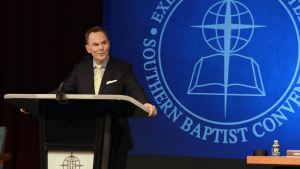
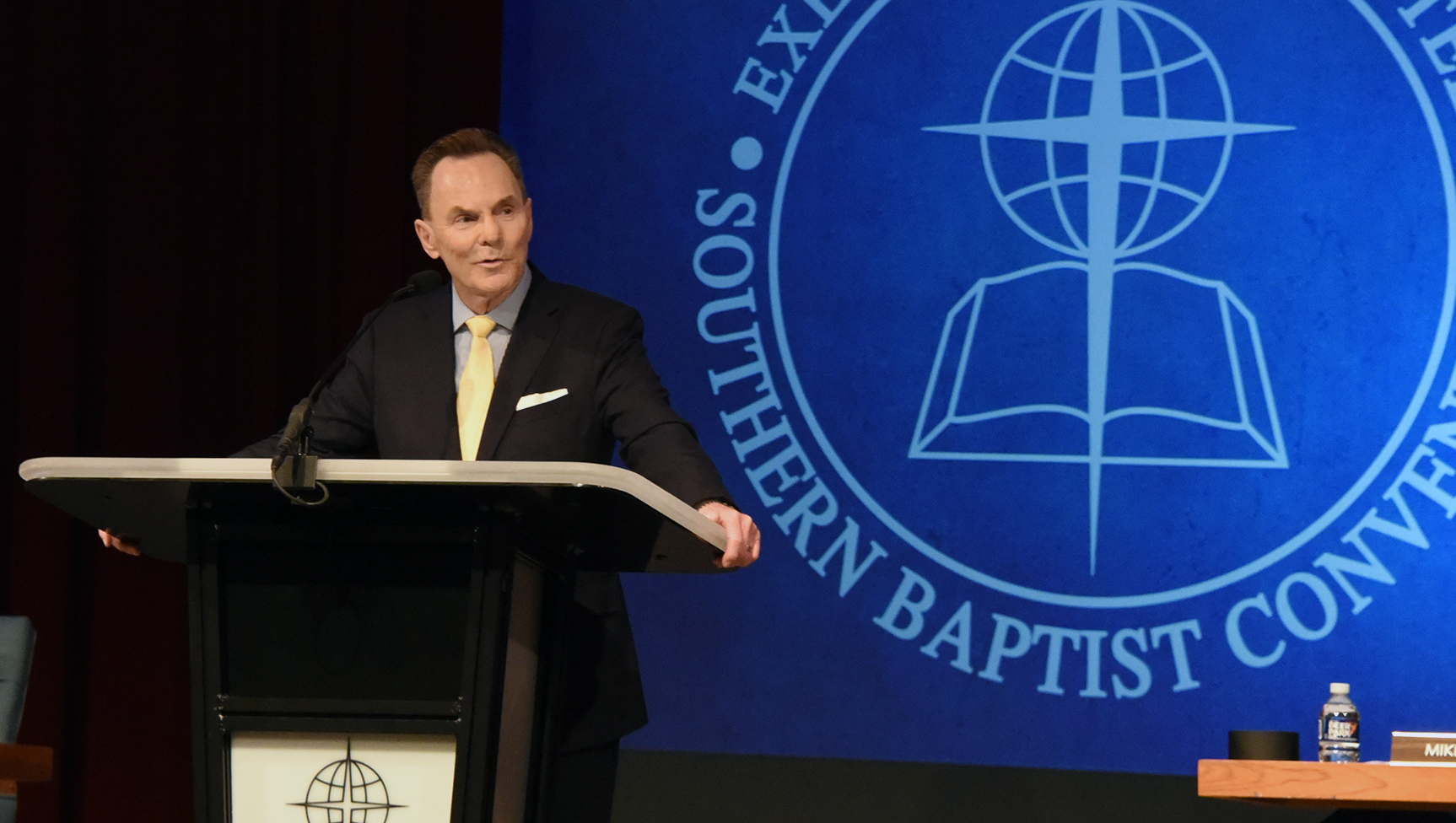
Ronnie Floyd is the latest to leave the Southern Baptist Convention’s Executive Committee (EC) over its decision to hand over privileged documents in an upcoming abuse investigation.

Floyd, the president and CEO of the EC, announced in an email Thursday night that he could no longer serve in the role, which he has held for two years. His resignation is effective October 31.

In the past couple weeks, more than ten members of the EC left around the much-debated vote on attorney-client privilege, and the EC’s longtime attorneys, James Guenther and James Jordan, withdrew their legal services.

In his resignation letter, Floyd repeated his commitment to the outside review of the EC, but continued to emphasize the potential risks and liability of waiving privilege.

“The decisions made on Tuesday afternoon, October 5, in response to the 2021 Convention now place our missionary enterprise as Southern Baptists into uncertain, unknown, unprecedented and uncharted waters,” he wrote.

“Due to my personal integrity and the leadership responsibility entrusted to me, I will not and cannot any longer fulfill the duties placed upon me as the leader of the executive, fiscal, and fiduciary entity of the SBC. In the midst of deep disappointment and discouragement, we have to make this decision by our own choice and do so willingly, because there is no other decision for me to make.”

Rolland Slade, EC chairman, told Baptist Press, “I am saddened by his resignation. He’s had a tremendous ministry for years and years. I know he loves Southern Baptists. I know it was his intention to come to Nashville to serve Southern Baptists well and I believe he’s fulfilled that to the best of his ability. However, I understand the vote of the committee put him in a very difficult position.”

Floyd spent more than 30 years as pastor of Cross Church in Arkansas and served as SBC president from 2014 to 2016 before becoming EC president in 2019, in the midst of convention-wide efforts to address the SBC’s response to sexual abuse. He succeeded Frank Page, who resigned in 2018 over a “morally inappropriate relationship.”

The denomination voted at its annual meeting in June to investigate how the EC responded to abuse claims and survivors over the past 20 years.

Floyd, as EC president, was not a voting member but sided with those who supported the investigation but opposed waiving privilege.

“Like almost all of you, I do not have a vote on the Board of Trustees, but I do have a vote in heaven from my knees. I am praying to the God of Heaven to perform a miracle that will bring us all together,” he wrote in an October 1 open letter, once again emphasizing the EC’s fiduciary responsibilities.

Leaked materials ahead of the annual meeting, which prompted the call for a third-party investigation, included a recording of a discussion in which Floyd spoke of preserving “the base” of the denomination rather than being concerned about what survivors could say.

After the material was made public, Floyd responded by saying he did not have “the same recollection of these occurrences as stated” but did take the allegations seriously. In his resignation letter, he wrote, “One of the most grievous things for me personally has been the attacks on myself and the trustees as if we are people who only care about ‘the system.’ Nothing could be further from the truth.”

EC member Joe Knott, who also worried that waiving attorney-client privilege could put the SBC at legal risk, characterized the upcoming investigation as a chance to “vindicate Ronnie Floyd without destroying the Southern Baptist Convention.”

During his tenure as EC president, Floyd set new benchmarks for missionaries, church planting, giving, and youth discipleship through his Vision 2025 plan. Some Southern Baptist leaders, including EC president emeritus Morris H. Chapman and Midwestern Baptist Theological Seminary president Jason Allen, extended prayers for Floyd, and former EC member Chuck Williams, who resigned October 1, tweeted his support.

https://twitter.com/cwms53/status/1448829720825630720

Those who believed waiving privilege was the right thing to do for the sake of the integrity of the investigation and the polity of their convention questioned Floyd’s leadership around the issue, and some wanted to see him leave the position.

Ahead of the October 5 meeting, one trustee told CT he considered a vote of no confidence against EC leaders, saying Floyd and Vice President Greg Addison “had not led or supported the efforts of this trustee body to abide by the will of the messengers of our convention,” which called for the investigation and waiver.

Earlier this week, prior to Floyd ’s resignation, EC trustees had requested to call a special meeting to address vacancies and leadership.

According to its bylaws, following a presidential resignation, the EC’s board of trustees can elect a six-member search committee, which can receive nominations, along with the board chair.

News
Wire Story

Investigation Finds No Evidence of Abuse by Former Menlo Volunteer

The third-party inquiry, though, critiques lack of transparency by pastor John Ortberg, who resigned last year.

Christianity Today October 14, 2021
Video screen grab via Menlo Church / RNS

In this series

A third-party investigation at one of northern California’s most prominent megachurches that consumed its congregation and former pastor’s fractious family ended this week with a report that found no evidence the pastor’s adult child had acted on his confessed attraction to minors.

“After interviewing 104 witnesses and reviewing or analyzing more than 500,000 documents, Zero Abuse Project did not find any disclosure or other direct evidence the volunteer in question sexually abused a child,” said the report by the firm hired by Menlo Church near San Francisco to study its handling of the confession.

In 2018, one of Pastor John Ortberg’s offspring, referred to only as “Individual A” in the report, but identified in earlier news reports as Johnny Ortberg, confessed to having long been sexually attracted to children.

John Ortberg, a bestselling author who played a role in exposing misconduct by former Willow Creek pastor Bill Hybels, did not report the confession to church staff or other leaders. Nor did he remove Individual A from volunteering with children at the church or insist the volunteer stop coaching as a youth sports team.

The matter remained secret until another Ortberg family member, Daniel Lavery, informed church leaders. The pastor was suspended in late 2019 and was allowed to return, but the congregation was not told about the family connection between Individual A and their pastor.

“… Zero Abuse concludes that the decision of the Senior Pastor not to disclose to church leaders or others the conversation he had with the volunteer, as well as the decision of the church Elders not to be fully transparent about this situation, caused significant damage to the Menlo community,” the report states.

The report found leaders had harmed the church by withholding key information from congregation members, including that the church volunteer who had confessed to being attracted to children was related to Menlo pastor John Ortberg. Zero Abuse Project was also critical of Ortberg, who resigned in the summer of 2020 after months of controversy at the church.

The report also found flaws in the church’s child protection policies and recommended a series of changes, including that the church undertake a restorative justice process in order to rebuild trust.

The review by Zero Abuse did uncover an unrelated incident of sexual misconduct by a staff member at Menlo. During the review, the church learned a staff member had allegedly solicited nude photos from a teenage boy while serving on staff at another church.

“We advised and assisted Menlo in reporting this case to the authorities and also advised Menlo to terminate the employment of this individual,” Zero Abuse stated in its report. “Menlo did terminate this individual’s employment and communicated this case to its community and the public.”

Zero Abuse also found that Individual A was often alone with individual youth group members, including given them rides home but found no evidence of grooming or abuse. At the time, church rules did not ban volunteers from being alone with children or youth of the opposite sex.

The report also raised concern about a laptop belonging to Individual A, which had gone missing at one point. Several witnesses reported that Individual A was concerned about their search history being reviewed, because of visits to sites about people who were attracted to children. Individual A denied any illegal activity to the witnesses Zero Abuse spoke to.

“In our conversation with him, Individual A also denied doing anything illegal with the laptop. However, he did decline our offer to examine the laptop,” the report stated. The report also stated the evidence “supports a conclusion that Individual A’s laptop had a search history related to his attraction to children.”

Zero Abuse recommended Menlo Church take a number of steps, including hiring a full-time child protection director, strengthening its child protection policy, and expanding its mandatory reporter training.

Church leaders plan to hold an open house on October 17 to discuss the report. They also apologized for how church leaders acted.

“We mourn the hurt we have caused, and we hope the completion and findings of this investigation are the next steps in a healing journey,” John Crosby, the church’s transitional pastor, and David Kim, chair of the church session, said in a letter to the congregation.

News
Wire Story

America’s Oldest Denomination Faces Split Over LGBT Issues

With dozens of congregations already on their way out, the Reformed Church in America anticipates “difficult decisions” at its postponed General Synod this week.

Christianity Today October 14, 2021
Eric Skwarczynski / Lightstock

This week, North America’s oldest denomination will confront its gridlock over LGBTQ ordination and same-sex marriage. Votes cast in Tucson at the Reformed Church in America’s General Synod—delayed 16 months due to the pandemic—will chart the course for the already-splintering denomination.

In the past year, conservative factions have broken ties with the RCA, with other churches threatening to follow. Delegates to the synod, which starts Thursday and will continue through Tuesday, will determine how the denomination might restructure to entice congregations to stay, if the church will establish an external mission organization and whether departing congregations can plan on taking their church buildings with them.

“At General Synod, delegates come from across the RCA to discern the mind of Christ together,” said Christina Tazelaar, RCA director of communications. “There are difficult decisions on the agenda, along with many things to celebrate, and we’re praying that the Holy Spirit guides every decision.”

The RCA is a historically Dutch Reformed denomination dating back to the 1620s, when New York was known as New Amsterdam. Today, the RCA has fewer than 200,000 members and 1,000 churches. While in theory RCA churches are united by their polity, history, and Reformed convictions, they hold a range of political and theological beliefs.

The RCA isn’t the only Protestant denomination facing division over views on sexuality. Next year, the United Methodist Church is expected to vote on a proposal to split the denomination over the inclusion of LGBTQ members, and the RCA’s sister denomination, the Christian Reformed Church, will grapple with its contentious human sexuality report at its own synod.

“It’s a case study in how a church can or cannot navigate questions of identity, questions that are tense, matters of conflict,” said Matthew van Maastricht, pastor at Altamont Reformed Church in Altamont, New York. “We are just one part of a greater reshaping of the broader American Protestant landscape.”

According to the Rev. Dan Griswold, clerk of the RCA’s Holland Classis, the RCA debates involve specific questions: Can an RCA church host a wedding between a same-sex couple, and can an RCA minister officiate such a wedding? Can noncelibate gay people be elected as elders and deacons and ordained as ministers? While these questions are often framed as political, they are also theological.

“It’s really about how we view the Bible, how we understand God, and the nature of the church,“ said the Rev. Lynn Japinga, professor of religion at RCA-affiliated Hope College. “It’s a fundamental difference in approach to the Christian faith that’s the source of all this. … Do you have more of a rule-based faith, or do you have a more grace-based faith?”

Ron Citlau, senior pastor of Calvary Church near Chicago, frames the question differently.

“I’ve dealt with same-sex attraction, and the issue for me and many of the people I know is, is it a thing for which Jesus Christ needs to come to redeem us, or is it a blessing he wants us to embrace?” said Citlau, who is married to a woman and whose church helped form the conservative non-RCA Kingdom Network. “If we get sin wrong, there are larger things at stake.”

The debate is also a question of polity. The RCA has a localized structure that gives classes—regional church groups—authority over matters such as discipline and ordination. While all RCA churches follow the Book of Church Order, they don’t have to follow the General Synod’s recommendations.

“There’s nothing in the Book of Church Order that says anything explicit about sexuality at all,” said David Komline, associate professor of church history at Western Theological Seminary. “The General Synod has repeatedly made statements that are more traditional in orientation about sexuality, but those are just statements. There are no mechanisms in place to hold people accountable to these statements.”

An ongoing question is whether the General Synod ought to be able to make dictates it can enforce. In recent years, conservative RCA members have pushed for General Synod to do just that. In 2016, the General Synod voted to amend the Book of Church Order to define marriage as between a woman and a man. However, the measure failed to win the necessary two-thirds approval from the classes.

“We found that the RCA is designed in such a way, intentionally or not, in which the vast majority cannot move to what they believe is right because there are just enough progressive classes that can veto,” said Citlau. According to Citlau, the two-thirds rule gives disproportionate power to classes with progressive views and fewer members. But progressive members argue the General Synod was never designed to issue top-down decisions in the first place.

In 2018, General Synod formed a team charged with discerning whether the RCA should stay together, restructure, or separate. In their Vision 2020 Report, that team suggested a path involving all three avenues. First, the report recommends appointing a team for reorganizing classes by affinity rather than geography; churches would opt into classes and group themselves by shared values. The second proposal is to create an external RCA mission agency that would allow departing churches to continue supporting RCA’s global missions work. Third, the report recommends allowing a departing church to retain its property and assets.

These three proposals are scheduled to be debated on Saturday and require a simple majority of votes to pass—but the measures could be radically amended before then, and other overtures could be adopted as well.

Regardless of what happens at the General Synod, the RCA is already splitting. The Kingdom Network, an alliance currently composed of five churches in Indiana and Illinois, officially left the RCA on September 9. The group was formerly an RCA classis that prioritized church planting.

“The RCA has this albatross around its neck, and historically it moves very slow,” said Citlau. “From our point of view, the house is burning. We can’t keep saying, we’re going to wait five more years and have a couple of committees. It’s already a bloody mess, and until you’re willing to get in there and make some choices, there’s no way through. And we did our best effort to make a way through.”

In May 2021, the Alliance of Reformed Churches was formed as an alternative to the RCA for conservative churches questioning their place in the denomination. According to their website, more than 125 churches have expressed interest in joining the alliance.

“The Alliance of Reformed Churches is praying with the RCA for the clear leading of God’s Spirit at its General Synod,” the Alliance said in a statement emailed to RNS. “Our prayers will be with our brothers and sisters as they walk together through this significant moment in the RCA’s history.”

More departures are likely on the way. The 2020 Vision Report said: “We have informally learned of entire classes’ intention to exit the denomination in the near future.” These departures have been a long time coming; the RCA has been debating sexuality and LGBTQ inclusion since the 1970s.

“People on different sides of the spectrum have been fighting for about 40 years, and they’re sick of it,” said Komline. “They believe their fighting is impeding their mission. I think that’s the case on both sides. The liberals want to go pursue justice, as they define it, and the evangelicals want to share the gospel as they define that.”

According to Griswold, these divisions can be traced back even further. The RCA was originally formed by several waves of Dutch immigrants. Those in the earlier waves settled along the East Coast, where they eventually developed sensibilities that resembled those of their mainline peers, while migrants who came in the 19th century often settled further west. Today, the cultural and theological divides are still evident. All except five of the 44 churches listed as LGBTQ-affirming by Room for All—an LGBTQ-affirming network in the RCA—are in the Northeast.

“As America as a whole has shifted, the RCA has experienced some similar shifts,” said Komline. “Just as America now is very polarized, so is the RCA.”

Theology

What Comes After the Purity Culture Reckoning

We don’t need a better guidebook or a different set of rules. We need to change the way we approach the conversation.

Christianity Today October 14, 2021
Illustration by Mallory Rentsch / Source Images: Marina Reich / Unsplash

I wish I still had my copies of the popular sexuality and dating books from my youth so I could see which quotes I highlighted as a 15-year-old. I’m sure there is a list somewhere in my handwriting titled “What I Want in a Future Husband” (though, to be honest, it was probably pretty short: Jonathan Taylor Thomas).

While writing Talking Back to Purity Culture, I reread fresh copies of those books. As I revisited the words that had so shaped me and my peers, I felt the glass cracking under the weight of my internalized beliefs. I felt embarrassed realizing that so much of what I had accepted as true had nothing to do with biblical sexuality or the grace of God.

Before You Meet Prince Charming by Sarah Mally depicts a woman’s heart as a chocolate cake. If someone eats a piece before the party (i.e., marriage), the cake, and consequently her relational worth, is no longer whole. In the introduction to Every Young Woman’s Battle, Stephen Arterburn warns female readers that every time a man has sex with a woman, he takes “a piece of her soul.”

Alongside these unbiblical messages about human worth that fly squarely in the face of the theology of the imago Dei were the false promises of marriage, great sex, and children for anyone who practiced premarital celibacy. But it was, perhaps, the overarching message that women were responsible for the sexual purity of both genders that burdened me the most as a teenager growing up in the church.

In their book, For Young Women Only, Shaunti Feldhahn and Lisa A. Rice report that “teenage guys are conflicted by their powerful physical urges” and “many guys don’t feel the ability or responsibility to stop the sexual progression.” Their conclusion for women? “Guys need your help to protect both of you.”

Despite Jesus’ words to the contrary, I remember believing that men truly couldn’t control their lust if women didn’t take on the responsibility of dressing and acting in ways that squelched it. These books made it clear to me that the responsibility for sexual sin and temptation—even assault—fell squarely on the shoulders of women. I couldn’t believe some of the lies I saw sandwiched in between Bible verses or the tactics that were used and the carrots that were dangled. I cringed. I cried. And one time, I threw a book across the room.

There is a growing movement of conversative Christians who feel a holy discontent with the way the evangelical movement has approached the topics of sex, marriage, and gender. We have seen harmful and unbiblical teachings perpetuated for far too long, and a needful reckoning is taking place.

Sheila Wray Gregoire, blogger and author of The Great Sex Rescue, has seen her own perspective change as she learned more about women’s experiences in Christian marriages, including through a massive survey on marital satisfaction, faith, and beliefs about sex.

“I have spent the last year taking down old blog posts and asking for my oldest books to be taken out of print,” she told me. “I’m reviewing and refining. I want to be sure the information I’m giving is actually healthy.”

Her hope is that popular Christians authors who have promoted what she deems false, harmful messages about sex and marriage, including Emerson Eggerichs (Love & Respect) and Stephen Arterburn and Fred Stoeker (Every Man’s Battle), will do the same.

Even as our eyes open to the shortcomings and mistakes of past teachings, it hasn’t been easy to articulate what we should be teaching instead. If not the tenets of ’90s purity culture, what should we teach our children about sexuality?

Teaching discernment

The most common question I get is “What book can I give my teenager?” Books are tangible. We can touch them, recommend them, and dog-ear their pages. If you sign a purity pledge card, you can put it on your bulletin board at home or inside a journal. If you buy a purity ring, you can wear it on your finger every day. We love to hold obedience in our hands.

But my fear is that, in our attempts to reform past teachings, we could easily fall into trading the old rules for another set and treating them as the new definition of wisdom, obedience, and Christianity for all believers.

Our new rules might look different, but they can quickly become just as dogmatic and extrabiblical. Plus, black-and-white regulations on these topics—things like whether to kiss outside marriage or when teens can start dating—can diminish our need to study God’s Word, practice discernment, and develop our own convictions.

Certainly, children and teenagers need guidance, and creating family rules and structure is wise. But we underestimate adolescents if we assume they are unable to wrestle with these issues. Give them a chance. (You can always use your veto power!) Having conversations may feel more intimidating than simply laying down the law, but in the end, this gives your children the tools to navigate these issues with wisdom and discernment, long after they leave your care.

Purity culture started with biblical concepts. Holiness is biblical, as are warnings against fornication. But I wonder how things would have been different for so many of us if, instead of church youth group turning into yet another dating versus courtship debate, we had deep-studied the attributes of God together. Or if, instead of putting on a modesty fashion show, we had pored over the Gospels and the life of Christ. To isolate and overemphasize certain ideas from the Bible risks misinterpretation, but it also risks creating our own version of Christianity, righteousness, and even salvation.

When I taught high school English, students often asked, “What will be on the test?” They asked it so often that I stopped giving them tests and began only assigning essays and projects. This forced deeper thought and nuance and, of course, more work. But it wasn’t just the students who preferred clearer, more direct answers. As a teacher, I would have found it easier to open up a novel and tell them what to think, to explain the worldview instead of asking them to figure it out themselves as we read the text together. It took more time, more discussion, and more frustration to teach literature with nuance and thought. But it was worth it.

Discernment is the long-game. If we replace purity culture with a new series of how-to or how-not-to books and conferences, we are falling right back into the same practices. When our children are small, we might stick a list of rules on the refrigerator. Children need clear guidance. They are still growing and are not able to think through things with the discernment of an adult. There is a place for lists of rules that go beyond Scripture, with items like “Pick up your toys before getting out a new set” or “No sugary snacks before dinner.” But as mature Christians, we must move beyond living on milk alone.

“Anyone who lives on milk, being still an infant, is not acquainted with the teaching about righteousness. But solid food is for the mature, who by constant use have trained themselves to distinguish good from evil” (Heb. 5:13–14).

The church does not need a new and better set of rules on sexuality. We need spiritual formation. When we break down the tough, gray areas of Scripture into extrabiblical rules, whether conservative or progressive, we remove the opportunity for Christians to discuss, think deeply, wrestle with God’s Word, and be conformed into the image of Christ.

Always reforming

There is a line in Gregoire’s new book that says, “It’s important as a culture that we confront the damage we have done—even if by accident—so we can walk forward toward the abundant life Jesus wants for us.” My husband, Evan, suggested that a term for this process could be taken from the Protestant Reformation: semper reformanda, or “always reforming.”

We must be willing to look back with humility on what we have believed and taught. Our goal in “always reforming” is to conform ever more closely to God’s Word and the person of Jesus Christ. It is not God who needs reforming but our own hearts and understanding.

There will be a time in the near future when we look back on this period of church history, when Christians decided to reevaluate purity culture, and discover critiques that missed the gospel and pendulum swings that need to be corrected. My book will be on the list. So will many others. That’s how this works.

We are imperfect disciples, continually grappling to understand God and his Word better. We will make mistakes along the way, and this will demand regular reflection. Reassessment. Reforming. Humility is required not only for conversion but also for the entire Christian life.

In everything we do, say, and promote, we must take time to step back and ask ourselves, “Is this really of Christ?” It is exhausting but holy work.

Rachel Joy Welcher is the author of Talking Back to Purity Culture: Rediscovering Faithful Christian Sexuality as well as a columnist and editor at Fathom magazine.

Ideas

Christians Shouldn’t Need a Mandate to Provide Paid Family Leave

Staff Editor

There are clear, pro-life reasons why mothers and fathers need time with new babies.

Christianity Today October 14, 2021
Illustration by Mallory Rentsch / Source Images: Peter Dazeley / WesAbrams / Getty Images

When our twins were born in 2019, I took six weeks off work. My husband did too—thanks to his then-employer’s family leave plan, offered equally to new mothers and fathers alike—and it’s impossible to overstate how indispensable his leave became.

It wasn’t that I had a difficult physical recovery. Mercifully, I didn’t, especially by the standard of multiples pregnancies. But I found I couldn’t set myself up for tandem nursing alone, which meant that without my husband’s help, I would have been nursing 50 percent of my hours every day—not my waking hours, all my hours. And if each twin took a full hour to eat, every two hours, nursing would’ve occupied 100 percent of my days and nights. I literally could not have done it by myself.

I’ve been thinking about the importance of paid family leave again recently, both because of personal circumstance—we’ve had some childcare disruptions, and once again my husband’s job made it possible for him to shoulder that task—and because it’s the subject of increasing political attention.

The Biden administration’s American Families Plan, introduced in April, would eventually provide 12 weeks of family leave per year, paid at up to $4,000 per month, should it become law.

Paid family leave is financially messy in the United States, where many of our benefits come through our employers. Some smaller businesses and organizations truly wouldn’t be able to comply with a mandate to provide lengthy leave, unless it were subsidized at a high enough level to pay both a new hire and the person on leave.

If employers of any size believe they can’t afford to comply, they might respond by refusing to hire people—especially women—who strike them as likely to have more children.

Moreover, one poll shows lower- and working-class families (who are least likely to have paid family leave now) strongly prefer having one parent (usually the mother) at home full time, which partly shifts the paid leave issue to a single-income household issue. These families also rank cash assistance or wage subsidies over leave if asked to choose among federal childcare support options.

But if the execution side of this issue is complex, the Christian stance is simple: We should provide the best family leave possible. Christians who own or manage businesses ought to lead the way on family leave, based on three Christian convictions.

First, family leave is pro-life. The basic physical need I experienced with our twins—to say nothing of mothers with complicated pregnancies and infants who require NICU care—is part of giving birth. In our country, where both infant and maternal mortality are too high, parental leave could save lives. There is clearly a link—even if indirect—between maternity leave and babies surviving.

As former CT managing editor Katelyn Beaty has argued, giving mothers especially time to rest, heal, and meet their new babies without incurring significant economic hardship is fundamentally pro-family and pro-life. It builds an irreplaceable foundation for a new phase of family life.

Second, we can certainly make a scriptural case for family leave, highlighting similarities to Old Testament purification rules (which in practice gave new mothers a rest after birth) and the Bible’s frequent injunctions to help one another in love (Rom. 12:13).

For Christian business owners, offering family leave voluntarily—without a federal mandate, which might come with subsidies—is an opportunity for sacrificial generosity in imitation of Christ (Eph. 5:2).

For some employers, especially in very small businesses and ministries, offering weeks of paid leave may be financially impossible. But there are also organizations that could offer family leave and choose instead to put their spare resources to other, more self-serving ends.

Among Christians, this ought not be. Family leave should be a business priority for us, even if it entails real sacrifice (Phil. 2:3-4)—be that longer hours for us during an employee’s absence or lower profits or pay.

My third ground for Christian leadership on family leave is fatherhood. There is a mountain of evidence, both researched and anecdotal, that men need to spend time—extensive time, undistracted time—with their children in those initial weeks after birth or adoption. Missing that time can create a durable emotional distance between father and child because the father didn't learn alongside the mother from the very beginning. (It can also be damaging to the parents’ relationship, as more early paternity leave is linked to lower divorce rates.)

How many times have you heard a new father declare himself “helpless” or “useless” with his own infant? How ingrained in our culture is the stereotype of the father who is hapless, distant, or both—who can’t change a diaper or doesn’t know what his kids will eat? And how can we be surprised by any of this if we don’t give fathers time off to get to know their children?

Research has shown “fathers who take paternity leave are more likely, a year or so down the road, to change diapers, bathe their children, read them bedtime stories, and get up at night to tend to them.”

That bedtime stories bit suggests that not only do leave-trained fathers become more practically competent, they also become better equipped to follow biblical commands about parenting, both those fathers themselves tend to cite (“Start children off on the way they should go,” Prov. 22:6) and the one I loved to whip out as a child (“Do not exasperate your children,” Eph. 6:4).

It is impossible to disciple—let alone avoid exasperating—a child you do not know. Mothers who give birth plunge into the deep end of parenting by biological default, but fathers (and both parents if they’re pursuing adoption) need leave to begin to know their new children early and well.

American Christians, particularly evangelicals, have long considered themselves defenders of the family and advocates of good parenting. Modeling tangible, sacrificial support for mothers and fathers—and, most of all, children—is a needful way to match word and deed.

News

Pew: US, France, and Korea Are Most Divided—Especially over Religion

Survey of almost 19,000 adults in 17 nations examines societal conflict between different religions, political parties, races and ethnicities, and urban and rural communities.

Christianity Today October 13, 2021
Illustration by Christianity Today / Source Images: Saul Martinez / Stringer / Brandon Bell / Mohamed Rasik / Getty Images

“Conflict” is a troublesome word to describe a society. But increasingly across advanced global economies—and particularly the United States—their societies believe it is the correct label.

If there is any good news, religious conflict lags behind.

The Pew Research Center surveyed almost 19,000 people in 17 North American, European, and Asia-Pacific nations this past spring about their perception of conflict across four categories: between political parties, between different races and ethnicities, between different religions, and between urban and rural communities.

The US ranked top or high in each.

A global median of 50 percent see political conflict, 48 percent see racial conflict, 36 percent see religious conflict, and 23 percent see urban-rural conflict.

But in the US, 9 in 10 viewed political conflict as “serious” or “very serious.”

Asian nations varied considerably. South Korea matched the US at 90 percent seeing serious political polarization, with Taiwan third at 69 percent. Singapore was lowest overall at 33 percent, while Japan was 39 percent.

France (65%), Italy (64%), Spain (58%), and Germany (56%) followed Taiwan.

A National Council of Churches (NCC) official has refused to allow the Institute on Religion and Democracy (IRD) to examine the council’s financial records. The records earlier were made available to two staff members of the United Methodist Reporter.The IRD, a research organization known for its attacks on the NCC, had tried to obtain information regarding NCC grants made to outside organizations. IRD research director Kerry Ptacek said a staff member in the NCC’s office of information set up an appointment for him to view the financial data. He said the appointment was subsequently rescheduled and then canceled by Warren Day, the NCC’s information director.Day told Religious News Service that the IRD received treatment different from that given the United Methodist Reporter because that newspaper serves the largest denomination in the NCC.Ptacek said he believes the NCC refused to let him see the books because the IRD had charged that NCC grants were going to pro-Sandinista groups in Nicaragua. He said he tried to gain access to financial information that was not contained in data routinely made available by the NCC. Several months earlier, United Methodist Reporter staff members were allowed to examine a large computer printout of NCC financial data. The United Methodist Reporter published a series of articles in the wake of reports nearly two years ago in Reader’s Digest and on CBS-TV’s “60 Minutes” alleging NCC support of leftist causes.After the Reader’s Digest and “60 Minutes” reports, Ptacek said NCC officials made such statements as “our records are open” or “our books are open.” In response, Day said, “I have not found this sort of thing in writing.” Day said the highest elected officials of NCC-member bodies and heads of those denominations’ finance offices have access to the NCC’s books. But he added that access is not routinely given to “any self-appointed group on the outside.”RELIGIOUS NEWS SERVICE

In terms of race, the US ranked first again, with 71 percent seeing serious conflict. France was second at 64 percent, and South Korea and Italy third at 57 percent. Singapore again ranked lowest, at 25 percent.

South Korea had the highest perception of religious conflict, at 61 percent. France followed at 56 percent, and the US at 49 percent. Germany and Belgium registered 46 percent each. Taiwan was lowest, at 12 percent.

Evangelicals are caught in the crossfire between Communist guerrillas and government forces.Terrorist-related violence has bloodied Peru’s Ayacucho state for more than four years. In at least two recent incidents, evangelical churches were singled out and Christians were killed.The Evangelical Pentecostal Church of Peru has lost 10 pastors in Ayacucho through terrorist attacks. A Presbyterian leader who fled to Lima, Peru’s capital, said guerrillas connected with the Maoist Sendero Luminoso (Shining Path) movement have prohibited evangelization and other church activities in remote villages that are under their control. It is considered dangerous even to carry a Bible, he said.Another evangelical leader in Lima said it is believed that the army has killed innocent people it suspected of being terrorists. Merely talking with either the guerrillas or the soldiers is often regarded as complicity.Shining Path has generally operated in the remote Andes Mountains regions of central Peru, and especially in the state of Ayacucho. Between 3,000 and 4,000 people have been killed, and hundreds more wounded since the Maoist organization’s seeming declaration of war four years ago.In July, terrorists armed with machine guns and explosives attacked a Pentecostal prayer meeting in the jungle village of Santa Rosa. They left behind seven dead, seven seriously wounded, and seven with lesser wounds, said a pastor who survived the attack. He said guerrillas had previously threatened to kill the evangelicals because they refused to join Shining Path.Santa Rosa has two churches—referred to as Number 1 and Number 2—that belong to the Evangelical Pentecostal Church of Peru. Due to a terrorist attack several days earlier, the Number 2 church had closed its doors. To encourage the congregation, the other Pentecostal believers called a united prayer meeting on July 27 at the Number 2 church. “A church of God should not be closed,” said Alfredo Vasquez, pastor of the Number 1 church.Vasquez said violence erupted the afternoon of the prayer meeting. Terrorists burst into the church shouting and firing weapons. They sprayed the congregation with machine gun and small arms fire, he said, and some touched off explosives.“The earth shook,” he said. “The brothers and sisters began running. Some threw themselves on the ground under the benches.”Finally, the terrorists moved on to sack stores in the village for provisions. One of the Christians touched off a hand grenade given him by some soldiers, and the terrorists began to scatter, said Vasquez, who was wounded in the attack. The pastor was shot by a man he recognized as a baptized member of the church who had joined the guerrillas. The next day Vasquez was taken to the city of Ayacucho, the capital of Ayacucho state, where doctors removed 33 pieces of buckshot from his body.A few days later in the village of Callqui-Nisperocniyocc, two hours north of the city of Ayacucho, six Christians were murdered. Witnesses say government soldiers interrupted a prayer meeting at the National Evangelical Presbyterian Church. After searching for a certain woman and not finding her, some of the soldiers dragged six young men outside. Two soldiers stayed in the church and demanded that the congregation sing. The church members heard bursts of machine gun fire but thought the soldiers outside only wanted to scare them. Later, the horrified church members found the six men who had been dragged outside murdered within 25 feet of the church’s door.Vicente Saico Tinco, a church elder from a neighboring city, said Christians in Callqui-Nisperocniyocc suspected that an enemy had denounced them as terrorists. On occasion, individuals falsely accuse personal enemies in order to get rid of them.In a signed declaration, Saico, pastor Saturnino Gavilan, and church council president Victor Contreras asked the National Evangelical Council of Peru (CONEP) and Presbyterian Church leadership to report the incident to government authorities. The men wrote: “We must declare that the [murdered] … brothers were faithful believers in the Lord, and so it is even more painful to us that their lives have been taken without asking who was who, without any investigation whatsoever.”Evangelicals have become targets of terrorist violence for a number of reasons. They generally oppose Shining Path’s violence and refuse to join the movement. They also get into trouble when they are interrogated. If they have talked to the police, they admit it when questioned by the rebels. They have the same problem if they tell the police they have talked to the guerrillas.While guerrillas terrorize the population, police and armed forces personnel apparently have committed atrocities while trying to crack down on terrorism. Complicating the situation are peasant vigilante groups and the powerful and violent cocaine traffickers, who stand to benefit if anarchy reigns. Investigators suspect links between the guerrillas and the cocaine traffickers.In August, evangelicals in Lima began to collect food, clothing, and money for Ayacucho residents who have been left destitute by the violence.PersonaliaCharles V. Morton, 48, has been named executive director of World Concern, an international relief and development organization based in Seattle. From 1972 through 1981, Morton served as vice-president of Far East operations for Pepsi Cola International. He negotiated Pepsi Cola’s first contract with the People’s Republic of China. He replaces Arthur L. Beals, executive director of World Concern since 1975.Guy S. Sanders, Jr., has been elected president of The Gideons International. A building contractor from Bamberg, South Carolina, Sanders has served as the Gideons’ international vice-president for the past three years.Vernon Grounds, president emeritus of Denver Conservative Baptist Seminary, has been named president of Evangelicals for Social Action (ESA). He will stay in Denver, where he directs a counseling center at the seminary. Grounds will attend major evangelical events as ESA’s chief spokesman. Ronald Sider, former president of the ESA board of directors, has become chairman of the board.William L. Baumgaertner has been named associate director of the Association of Theological Schools in the United States and Canada. He will replace Marvin J. Taylor, who has held the post since 1970. Baumgaertner previously served as executive director of the seminary department of the National Catholic Education Association.Joseph McFarland will be inaugurated this month as president of Geneva College in Beaver Falls, Pennsylvania. He assumed the presidency in July. McFarland previously served as director of academic affairs for the Kansas Board of Regents.

Nearly 1 in 4 French (23%) saw religious conflict as “very serious.”

Age plays a role in perception. Pew noted that adults under 30 are significantly more likely than those ages 65 and older to see strong religious divisions in Greece (60% vs. 24%), Belgium (62% vs. 38%), Japan (42% vs. 22%), Italy (49% vs. 30%), the US (58% vs. 42%), Spain (24% vs. 10%), and Taiwan (17% vs. 7%).

Conversely, Canadians under 30 are significantly more likely than Canadians ages 65 and older to say there is no strong religious conflict (78% vs. 65%). [Editor’s note: See full chart at bottom.]

Religious diversity, however, is not a consistent indicator of conflict.

Pew estimates France to be 58 percent Christian and 8 percent Muslim. South Korea is 30 percent Christian and 22 percent Buddhist. Yet the US is 76 percent Christian and 1 percent Muslim.

The three lowest perceptions of religious conflict are also across the spectrum. Taiwan (12%) is 44 percent folk religious, 21 percent Buddhist, 15 percent other, and 6 percent Christian. Singapore (21%) is 32 percent Buddhist, 18 percent Christian, 16 percent Muslim, 9 percent other, and 7 percent Hindu. Yet Spain (19%) is 75 percent Christian and 3 percent Muslim.

Pew also tracked the perception of religious conflict between the religious and nonreligious, and in every nation the percentage of “unaffiliated” is substantial. The overall difference in perception was negligible, however, except in certain subcategories.

Half of conservatives in the US perceived conflict between the religious and nonreligious, compared to only 39 percent between religious groups. The political right in Germany, Canada, and Italy had similar perceptions. In Sweden, the only statistically significant difference was found on the political left, among which 26 percent perceive interreligious conflict but only 12 percent perceive secular conflict.

https://datawrapper.dwcdn.net/5yxXe

Politics exacerbates perceptions across the board.

In the US, Democrats and those leaning Democrat have a 24 percent difference in their perception of racial conflict, compared to corresponding Republicans. The racial divide is less severe, with Blacks perceiving conflict at 82 percent, Hispanics at 70 percent, and whites at 69 percent.

Democratic affiliation also creates a difference in perception of religious conflict (+17%) and urban-rural conflict (+10%). Tellingly, there is no difference between political parties in perception of political conflict (90% each). And more than half (54%) of Americans viewed this conflict as “very strong.”

France has similar political polarization. Its largest gap is in the perception of racial conflict, where 22 percentage points separate the right-of-center Republicans (76%) and the ruling En March (54%).

Socialists, however, are the outliers in politics and religion. They trail the Republicans (67%) by 20 percentage points in their perception of religious conflict. But they are ahead of En March (57%) by 14 percentage points in their perception of political conflict.

In Singapore, however, where the People’s Action Party has 89 percent political representation, differences in perception are shaped instead by ethnicity and religion. Indians recognize political (49% vs. 28%), ethnic (46% vs. 18%), and religious (35% vs. 14%) conflict more readily than their fellow Chinese citizens.

Singapore’s Muslims, meanwhile, recognize ethnic (40% vs. 23% vs. 14%) and religious (36% vs. 20% vs. 11%) conflict more readily than the city-state’s Buddhists and Christians.

Pew tested two factors that may contribute to the overall sense of conflict. A global median of 61 percent believe COVID-19 made their societies more politically divided. And a global median of 39 percent believe most people disagree on basic facts. Highest are France (61%), the US (59%), and Italy and Spain (55% each).

Measuring all four conflict areas on a 4-point scale, the US scored a 2.85. South Korea scored 2.83, and France 2.72. Singapore was lowest at 2.13.

https://datawrapper.dwcdn.net/OMTVl

Yet despite the recognition of widespread conflict, there may be additional good news—depending on perspective. Around the world, increasing numbers express support for diversity.

A global median of 76 percent believe having people of many ethnic groups, religions, and races makes their society a better place to live. The sentiment is strongest in Singapore (92%), New Zealand (88%), Canada (86%), the US (85%), the United Kingdom (85%), and Australia (85%).

Only Greece (51%) and Japan (50%) believe it makes their society worse. South Korea ranks third (36%).

But the negative sentiment is changing. In the 11 nations where this question was also asked in 2017, 9 nations have seen increases in support. Greece climbed 24 percentage points in the past four years, Japan 15 percentage points, and South Korea 6 percentage points.

Pew noted three indicators of disproportionate support: identification with the political left; the belief that the economy is doing well; and youth.

Of the latter, the generation gap is clear. Those ages 18-29 in Italy (84%) express support for diversity 33 percentage points greater than those 65 and older (51%). In France, the age difference is 30 points (83% vs 53%), while in Japan it is 28 points (60% vs 32%).

Those who view diversity negatively tend to associate with the populist right. Supporters of the Sweden Democrats are 41 percentage points higher for “unfavorable” (89%) than the rest of society (48%). Supporters of the Alternative for Germany are 32 percentage points higher (76% vs 44%), as are members of Italy’s Lega (73% vs 41%).

“Alongside growing openness to diversity, there is a recognition that societies may not be living up to their ideals,” stated Pew researchers. “[But] overall, fewer people see strong religious conflict.”

https://datawrapper.dwcdn.net/rQdoI
News

Christians Welcome Coup in Guinea

After yet another military overthrow of a democratically elected leader in West Africa, minority evangelicals debate the role of faith in politics.

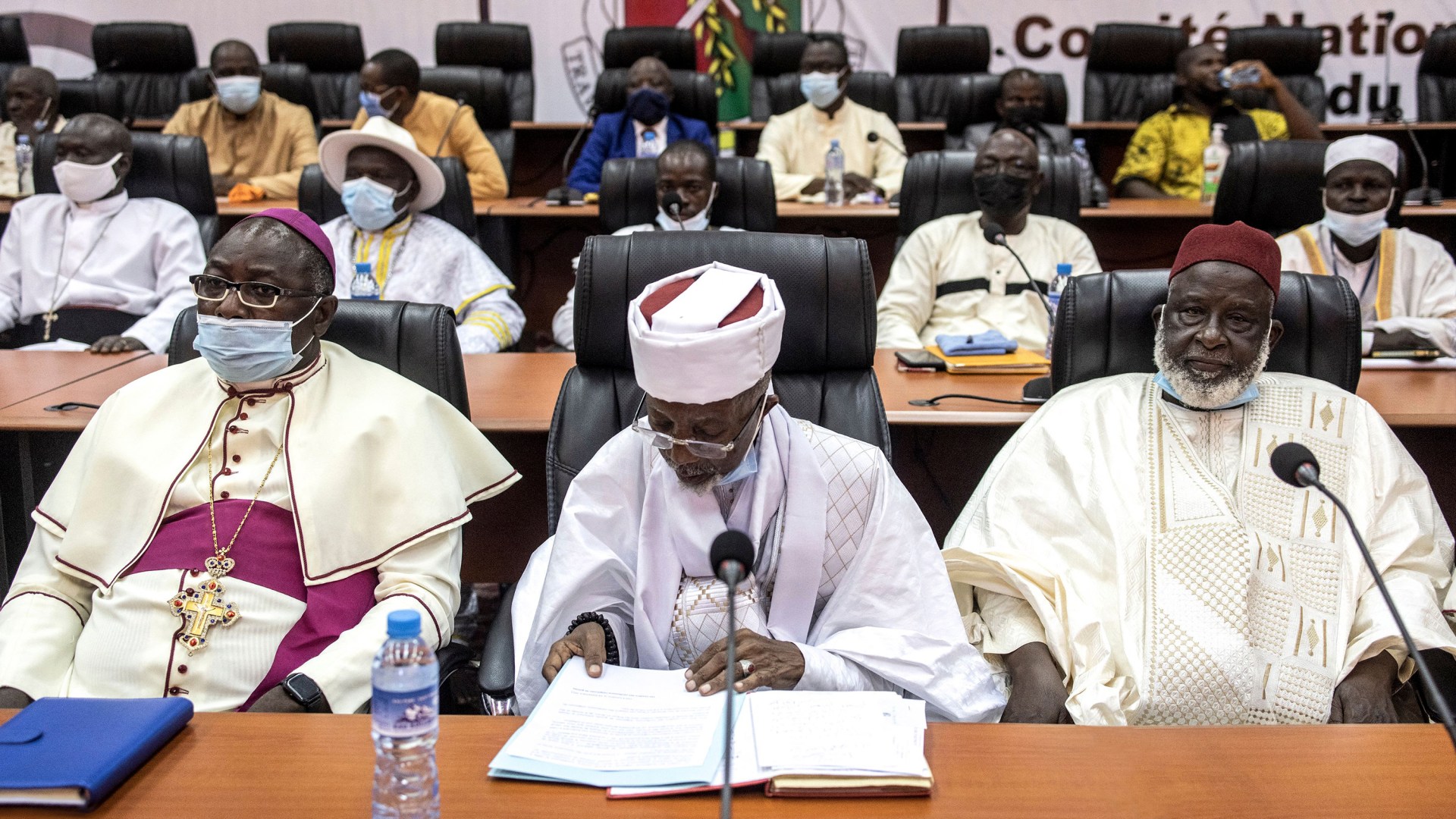
Guinean religious leaders gather at the Peoples Palace in Conakry ahead of the first session of talks with Colonel Mamady Doumbouya on September 14, 2021.

Guinean religious leaders gather at the Peoples Palace in Conakry ahead of the first session of talks with Colonel Mamady Doumbouya on September 14, 2021.

Christianity Today October 13, 2021
John Wessels / Getty Images

In its 63 years of independence, Guinea has had three presidents. Last month, the West African nation suffered its third coup d’etat.

This time, says the local Christian minority, their Francophone country might just get it right.

“Alpha Conde cannot return,” said Etienne Leno, a Christian and Missionary Alliance (CMA) pastor. “We are praying that the new military authorities—who we find to be wise and intelligent—will be led by God.”

On September 5, Colonel Mamady Doumbouya, head of the Guinean special forces, ousted the 83-year-old president. Once an imprisoned opposition leader, Conde became the nation’s first democratically elected head of state in 2010 and won a second term in 2015.

Leno originally found much hope in Conde’s mandate, which was ushered in after the international community aided domestic forces to remove the military junta that violently seized power in 2008. Conde improved the business, tourism, and energy sectors, restoring Guinea’s global reputation.

Local infrastructure was neglected, however, and the Oregon-sized nation lagged in domestic development. One-third of the economy was linked to the mining of bauxite, the primary resource for aluminum. Guinea boasts the world’s largest reserves, but foreign companies dominate the extraction.

Despite 7 percent annual growth, nearly 50 percent of the 13 million population lived in poverty. And by late 2019, 36 percent of the country believed Guinea was moving in the wrong direction.

And then Conde made his power grab. He pushed through a March 2020 referendum for constitutional changes to reset his term limits and in October won reelection again. Both votes were challenged by violently suppressed protests.

Almost a year later, Doumbouya had had enough.

He promised no political witch hunt as he “made love to Guinea,” but it was nonetheless clear that opposition would not be tolerated. As the colonel—sworn in on October 1 as Guinea’s interim president—assembled a national dialogue, protests in support filled the streets and Christians noted the surprising calm.

Five days after the coup, the Association of Evangelical Churches and Missions of Guinea (AEMEG)—affiliated with the World Evangelical Alliance—issued a televised statement recognizing the new authorities. Catholic and Muslim groups made similar announcements.

“Relations are good in general,” Leno told CT. “Our message is for peace and national unity.”

One aspect of the takeover may have helped ensure it: Doumbouya shares the same Malinke ethnicity as Conde. Representing one-third of Guineans, the Malinke are second in population to the Fulbe people (41%), more widely known across West Africa as Fulani. Both groups are Muslim, as is the third-largest ethnic group, the Soussu (12%).

The Ministry of Religious Affairs counts Christians as 8 percent of the population, with the remaining 7 percent belonging to traditional religions. Christians are generally from the Kpelle and other smaller ethnic groups, though conversions have taken place among all tribes.

“We are grateful to God for our religious freedom, in this moment of crisis,” said Emmanuel Ouamouno, an Assemblies of God (AG) pastor and head of the evangelical radio ministry IBRA. ”We pray for our various religious leaders to serve together in advancing the principles of God’s kingdom.”

It will be essential. While only 52 percent of Guineans trust the military, 79 percent trust their spiritual guides.

Ouamouno is staying neutral.

“If the army takes on the needs of the population, it will be difficult to take power out of their hands,” he told Evangelical Focus. “Everything will depend on how the army behaves.”

Immediately after the coup, the Economic Community of West African States (ECOWAS) issued sanctions on junta leaders. Already dealing with supposedly transitional military leadership in Mali and Chad, the regional body called for elections within six months.

Early signs may be encouraging.

Though no timeline was given, Doumbouya promised neither he nor any transitional official will run for office. A national council of 81 people will be established, consisting of politicians, trade unions, businessmen, youth, and security members, with 30 percent female representation. Serving as the legislature, they will draft a new constitution and prepare for local, regional, and national elections.

And on October 7, Doumbouya fulfilled his pledge to appoint a civilian prime minister, choosing a respected diplomat and economic development expert.

Though the coup appears to be popular, support for democracy is strong, favored by 77 percent of Guineans. The same percentage rejects military rule. And 76 percent support term limits—the issue that upended Conde’s presidency.

“We should all participate in the restoration of democracy, in prayer and if necessary, in demonstrations,” said Tamba Kondiano, an AG pastor. “We are not officially taking a position, but we remain vigilant and are ready to accompany the new authorities.”

Guineans once welcomed Conde as a “sign of relief,” he said, and urged caution. The former president still commands 90 percent support among his ethnic group, he estimated. Among Christians, however, it has dropped to single digits.

Violence was severe in Nzerekore, a predominantly Christian city in the southeastern forested region, where Muslim supporters of Conde clashed with Christians and animists over the referendum. Mosques and churches were damaged in the melee, which killed 30 people and injured 70.

In 2013, a similar conflict in the city, Guinea’s second largest, killed 54.

Ethnic politics characterizes the nation, multiple Guinean sources told CT, and elections predictably consist of two rounds.

In the first round, the Fulbe candidate wins a plurality but falls short of the 51 percent necessary for victory. In the runoff, the Malinke and Soussu—whose ethnic groups share more similarities—team up to defeat the “outsiders,” whose 18th-century jihad conquered the area. Christians, who are concentrated in the cities, the southern coast, and the forested areas, tend to join the other minorities.

Before Conde, the second president was Soussu. The first president was Malinke. Many Fulbe believe it is now their tribe’s turn. Their leading politician, Cellou Diallo, was among the first to endorse the coup.

Doumbouya has not appealed to ethnic interests, instead framing the overthrow as the will of the people. Both Leno and Kondiano called on ECOWAS to support Guinea in the military-led return to democratic legitimacy.

But for much of Guinea’s history, Christians have stayed on the sidelines. The first president, Sekou Toure, expelled foreign missionaries in 1967, hindering the church from developing mature theological reflection.

“These realities ended up convincing us that a good Christian could not do politics,” said Leno. “But today, there is a new generation of evangelical youth.”

These believers tend to be less attached to ethnicity and are strongly pro-democracy. The National Front for the Defense of the Constitution, formed in response to Conde’s referendum, is headed by a Fulbe and assisted by an influential Baptist.

The former head of parliament was a Christian, though few have risen to the level of ministers, governors, and prefects. AEMEG, however, serves as an effective liaison between state and church, said Kondiano.

In addition to hosting a yearly “March for Jesus,” the evangelical association conducts a yearly prayer meeting in the legislature, to which it invites leading politicians. Most recently, Diallo was in attendance.

Some Christians believe this shift is a mistake.

“Young people should be very careful with politics,” said Ouamouno. “Once our brothers make friends with politicians, we lose them.”

Rather than serving the church through their positions of influence, he said, they become corrupt mouthpieces for their party. It can polarize a congregation, he said, which instead should be united around Jesus.

While divided in opinion about politics, Guinean sources agreed: Denominational division must be overcome. Kondiano has sought to complement the work of AEMEG by cofounding the “Christians of Guinea” Facebook page. He is currently seeking to expand cooperation with the nation’s Catholic churches.

The Holy Ghost Fathers first evangelized the area in 1877, and the CMA started work in 1919. Today, the evangelical denomination counts 437 churches and an additional 154 unofficial fellowships. Christians have influence beyond their share of population through a network of schools and hospitals.

Though the days of Toure’s persecution have long passed, Guinean Christians still view their religious freedom as incomplete. Sources told CT they want government funding for theological education, as is provided for Muslim imams. There should be more Christians in the administration—especially the deputy position in the Ministry for Religious Affairs. And they said discrimination exists against Christians in housing, making it difficult to rent in the larger cities.

Some Muslim converts to Christianity fear family reaction but are not harassed by the state. On both government restrictions and social hostilities involving religion, the Pew Research Center ranks Guinea moderately low—scoring between 2 and 3 on a 10-point scale.

Churches have been planted in all regions of Guinea, though most in attendance are Christians originally from the forested region. But the IBRA radio station operates freely in a Muslim region, and the constitution guarantees the right of individuals to choose and profess their religion.

“The evangelical church is like a wounded panther, regaining its strength,” said Ouamouno. “Our main challenge is to return to the unity of the body of Christ.”

And though the AG pastor distrusts politics, he longs for national leaders like David, Ezra, and Daniel. Until Christians can play that role—and some are already trying—these hopes must be directed to the junta.

“Pray for the new authorities in our transition,” Ouamouno said, “that the Eternal One will illumine their path, toward peace in Guinea.”

News

Evangelism Not a Priority in Canadian Churches

Even during crisis of COVID-19, few are finding ways to share their faith, study finds. 

Christianity Today October 13, 2021
adrianna geo / Unsplash

If Canadians have been longing for meaning in their lives during the COVID-19 pandemic, it is unlikely that anyone has told them about Jesus.

According to a recent survey conducted by Alpha Canada and the Flourishing Congregations Institute, 65 percent of church leaders say that evangelism hasn’t been a priority for their congregations over the last several years. Fifty-five percent say their congregations do not equip Christians to share their faith.

Shaila Visser, national director of Alpha Canada, said she was somewhat surprised by the numbers because she sees so many opportunities for Christians to share their faith. The pandemic, in particular, has caused people to ask significant questions about the meaning and purpose of their lives.

“The opportunity before the church in Canada is to meet them and their questions with the person of Jesus,” she said, “to show them that Jesus is very good.”

The survey asked Canadian leaders across Christian denominations, “As you think about your local congregation/parish over the last several years, to what extent would you say your congregation/parish has given priority (or not) to evangelism?”

More than 2,700 church leaders responded between May and July 2021.

About 20 percent said evangelism was a moderate concern. Only 9 percent said it was a high priority for members of their congregation to share their faith.

Respondents included a few leaders from the mainline United Church of Canada and just over 20 percent from the Roman Catholic Church. The majority, though, came from evangelical traditions, including leaders from Baptist churches, Pentecostal churches, the Christian and Missionary Alliance, the Evangelical Free Church, the Church of the Nazarene, the Foursquare Church, and the Salvation Army. The tendency not to emphasize evangelism appears to be widespread.

Steven Jones, president of the Fellowship of Evangelical Baptist Churches in Canada, said he was “deeply concerned” by the numbers. He notes they reflect the continued decline of evangelical Christianity in Canada.

Historically, about 10 percent of Canadians have considered themselves evangelical. Today, according to the Evangelical Fellowship of Canada’s quadrennial census, only 6 percent of Canadians are evangelical. These are the lowest numbers on record.

Christianity has increasingly been viewed in a negative light in secular Canadian culture, particularly in the wake of sexual abuse scandals and light being shed on the role churches played for decades in residential schools for Indigenous people in Canada. Dozens of churches were spray-painted, vandalized, and burned following the discovery of mass graves at several residential schools this summer.

That negative view was clearly seen in the responses to the Alpha survey. The number one challenge to evangelism, leaders said, was “perceived antagonism toward Christian values and the Christian church.”

According to David Koop, pastor of Coastal Church, a large urban congregation in Vancouver, British Columbia, a lot of younger Christians have accepted the secular Canadian criticisms of the faith.

“The next generation has a really different narrative that they’re listening to,” he said.

Because secular society views church as a problem, he said, many Christians seem to shy away from sharing their faith. At the very least, they’re more averse to traditional methods of evangelism. For much of the 20th century, evangelism meant passing out tracts or knocking on people’s doors. Today, Koop said, there’s more emphasis on relationships and showing people how you live out your faith.

When the survey participants were asked to list the three most common methods of evangelism encouraged among their congregation/parish, the most common answer was “showing one’s faith through their actions.”

In some ways, Koop thinks that’s a positive shift.

“I think the most effective way is still just to do what Jesus said in Luke 10,” Koop said. “Go to people’s homes. Get to know them. Live in a community relationship. Pray for them.”

He’s found the pandemic has created roadblocks in that effort with many churches looking inward rather than focusing on evangelism.

“There’s a weariness,” he said. “There’s a sense I need to keep my own fences mended and stay strong.”

Jeff Eastwood, who lives and pastors a church on the opposite end of the country in Charlottetown, Prince Edward Island, sees the same thing. Broad cultural changes have made it more difficult to speak about faith when antireligious rhetoric abounds.

“When the majority—or it seems like the majority—are giving assent to this ideology, it becomes more difficult for Christians to speak into that, especially in a nuanced way,” said Eastwood, who pastors Grace Baptist Church.

Eastwood encourages Christians to do what Jesus did, though, and connect with people where they are, engaging them and speaking to their specific situations.

“The best evangelism comes out of relationships,” he said.

The survey was done during widespread lockdowns in Canada because of the pandemic. Christian leaders say they’re not clear what effect COVID-19 has had on evangelism.

It may have exacerbated the problem and made evangelism harder. Outreach became more difficult, with gatherings prohibited and many people limiting contact to a small “bubble” of people. Eastwood’s church, for example, had to cancel its Vacation Bible Study.

Plus, church leaders who were already working as hard as they could were overwhelmed trying to adapt to changing conditions. It became easier for churches to focus on themselves and not the broader community.

“COVID has given a great excuse to be very selfish," said Vijay Krishnan, who pastors The Well, a church in the suburbs of Toronto.

Krishnan believes that this tendency is something that believers have struggled with since the New Testament period. The early church was content to stay in Jerusalem rather than carry out the Great Commission. It took persecution, he said, to scatter them to the ends of the world as Jesus had commanded.

At the same time, Krishnan said, the pandemic has created opportunities for people to be more open about their struggles. Most people have been impacted in some way by the pandemic, and that shared cultural experience can open doors to talk about more personal matters.

When people share their struggles, he doesn’t just tell them he’ll pray for them but prays for them at the moment.

“It’s like you’re inviting them to a spiritual encounter with a God you know,” Krishnan said.

Visser has also had opportunities to pray with people because of COVID-19.

“What it provides is an encounter between two people with God in the middle, regardless of what they believe,” she said.

The best way to share your faith is to listen to people, she said, and then “run toward their pain and meet them in the messiness of their lives or in the beauty of their lives.”

In a time when many are suffering from loneliness, providing opportunities for human interaction can be a powerful form of evangelism.

“The world is longing for in-person connection around meaningful conversations, and inviting them into spaces where they can have that connection and encounter God is increasingly important,” Visser said. “It’s more important than it was before the pandemic.”

In a pandemic, though, that may mean going online. Visser ran an Alpha program on Zoom for friends spread across Canada. She said she probably wouldn’t have done that before COVID-19.

“We have never met in person as a group, and we have formed some of the deepest, most wonderful supportive community opportunities you could even imagine,” she said. “All on Zoom.”

Jones said a lot of evangelical churches are embracing online opportunities and looking for opportunities they wouldn’t have before.

“I think all our churches need to be live streaming because we are reaching people who would never go through the door of a church or facility, but they will go to your website,” he said. “It’s a good first place.”

And the need is urgent. Canadians are looking for meaning and purpose, struggling with loneliness, and dealing with the tragedies brought by COVID-19.

“People are hurting, and they’re confused,” Eastwood said. “We have an opportunity to speak into that in a real way.”

Books
Review

You Can’t Reach Nonbelievers with ‘Passive Congeniality’

Two experts on intercultural evangelism explore the challenge of sharing Christ in a climate of growing indifference.

Christianity Today October 13, 2021
Illustration by Mallory Rentsch / Source Images: Kevin Laminto / Unsplash / Kwangmoozaa / Getty Images

Christian evangelism entails a conversation with people of different beliefs. But those conversations are also often between people of different cultures. That’s where Effective Intercultural Evangelism, a new book from missiologists W. Jay Moon and W. Bud Simon, steps into the discussion. They want to help Christians share the good news of Jesus in a world of diverse cultural perspectives.

Effective Intercultural Evangelism: Good News in a Diverse World

Effective Intercultural Evangelism: Good News in a Diverse World

IVP

224 pages

Readers might assume such a resource would be aimed at those in cross-cultural missionary contexts. But the authors want us to realize that when we talk with the average non-Christian in our communities, they don’t just believe differently than we do. They often think, process, feel, appreciate, and evaluate differently than we do. They come to the conversation with different worldviews.

Consider, for example, the category of human desires. The authors encourage believers to ask their friends, “If you could receive any one of the following four things, which would it be? Deliverance, restoration, forgiveness, or belonging?” It’s a helpful question. Is deliverance more appealing to you? What about restoration? Do you ultimately seek forgiveness and cleansing? Or does discovering a sense of belonging and a longing for home more accurately describe your desires?

Moon and Simon believe that a person’s greatest desire is shaped by their worldview. The aim of their book is to help readers “discern various worldviews and how to continue God conversations that are relevant to each of these worldviews.” In other words, they want to equip evangelists to tap into the needs, desires, values, and assumptions of those around them. As Christians better understand the perspectives of their conversation partners, they’re more confident and competent to help them take the next step toward following Jesus.

Fluid worldviews

Here’s how Moon and Simon define intercultural evangelism: as “the process of putting Christ at the center of someone’s worldview in order to initiate them into Christian discipleship through culturally relevant starting points.” The authors group these cultural starting points into worldview categories that form the structure of much of the book. Borrowing from the work of the pioneering Bible translator Eugene Nida and others, they address the dominant worldview frameworks of guilt/justice, shame/honor, and fear/power, along with an emerging category they identify as “indifference/belonging with purpose.”

At the outset, it’s important to acknowledge that the borders between these categories are porous. Each perspective can be present to one degree or another in any given person, group, or larger culture. Worldview studies popular among evangelicals a generation ago may have erred at this point by assigning people fixed labels and lumping them into rigid categories. But one strength of Moon and Simon’s work is how it recognizes that worldviews can change and develop over time and within people.

For example, the category of “indifference/belonging with purpose” represents just such a situation, as the authors connect it to the climate of the modern West, where a secularist mindset increasingly prevails over a more traditional guilt/innocence framework. They also cite research that shows millennials in the US increasingly demonstrating characteristics of shame/honor culture. This seems to be a byproduct of globalization and multiculturalism, but also the rise of social media and a collectivist mentality toward shame and fame.

Commenting on this development among younger generations, the authors quote Andrews University religion professor Glenn Russell: These days, writes Russell in a 2016 youth ministry conference address, you “know if you are good or bad almost immediately as the online responses reveal whether you are honored (famed) or excluded (shamed).” Russell continues, “Morality is less about right and wrong and more about inclusion and exclusion.” This phenomenon demonstrates an overlap of cultures. It also signals the significant turbulence in our day over morality and priorities.

While Moon and Simon recognize and empathize with non-Christians’ desires, such as avoiding exclusion or shame, they don’t isolate or absolutize those desires. Instead, they talk about the fundamental problem of the human condition as sin and how that sin leads to other felt problems. Whereas non-Christian worldviews tend to make fear or shame primary, the Bible depicts such problems as secondary and derivative. The solution to those problems, then, must include repentance, the critical step of turning away from sin to follow Christ.

What’s a little less clear is how the framework of “indifference/belonging with purpose” fits into Moon and Simon’s discussion of worldview. For example, it’s easy to find biblical stories of people who respond to God and their human condition in guilt, shame, or fear. Indifference isn’t as simple to spot, and the authors’ attempts at Scriptural examples—such as Zacchaeus finding belonging and purpose with Jesus—fall flat at times because of it. A culture of religious apathy appears to be a later historical development almost foreign to the biblical world.

Nevertheless, I found the authors’ observations of growing indifference in Western society resulting from secularism and pluralism to be some of the most interesting and thought-provoking parts of the book. Thankfully, other writers (like Alan Noble and Kyle Beshears) are also helping the church think evangelistically through these developments. One has to wonder, though, if such apathy is an anomaly that will ultimately succumb to more traditional, dominant worldviews. Furthermore, Western indifference toward Christianity could quickly give way to intolerance within our lifetimes.

A posture of preparedness

Perhaps the greatest strength of Effective Intercultural Evangelismis the cross-cultural experience of the authors. Throughout the book, they share stories of initiating evangelistic conversations with those who inhabit different worldviews. When those around them interpret life’s events through a certain cultural lens, the authors immediately identify an opening for the gospel.

For example, if someone attributes cancer or a devastating drought to evil spirits, the authors take that as an open door to talk about God’s authority and compassion. Rather than trying to dismantle someone’s worldview, they point to where God fits within it. Presumably, the same approach could be taken with those who ascribe hurricanes or forest fires to purely naturalistic or manmade causes, such as climate change or public policy. The point isn’t to argue; it’s to direct others to a powerful God who cares.

But this requires a posture of preparedness for evangelism, a willingness to listen as a people-oriented learner, to be empathetic, and to meet people where they are. Christians must also be ready to respond and believe God can and will speak in that moment. As the authors demonstrate, what won’t work is the typical “passive congeniality” approach that’s well-intentioned but rarely demonstrates a willingness to speak of Christ in everyday conversation.

On further reflection, the cultural indifference that Moon and Simon diagnose isn’t only a characteristic of non-Christians. It’s also pervasive in the Western church. This suggests, then, that the greatest hindrance to evangelism isn’t necessarily the dispassionate starting point of nonbelievers but rather that of believers. It’s our unconcerned apathy and passivity toward those who need to hear the gospel.

Of course, that gospel should connect with people where they are. The good news of Jesus has something to offer every culture and every person. To the guilty offender it extends forgiveness and justification. To the shamed and excluded it offers the hope of glory. To the fearful and weak it promises deliverance and power. Even the indifferent and listless it welcomes with belonging and purpose, a future and a home.

But this is where I would add to Moon and Simon’s thesis about the positive way Christ speaks into diverse worldviews. The gospel doesn’t merely connect with personal desires and cultural values; it critiques them. To those who aspire to honor and glory, the Cross speaks shame. To those who desire power and privilege, the Cross speaks weakness. To those who want to be in the right, the crucified Jesus holds out his arms as a condemned criminal. The gospel is culturally relevant and radically counter-cultural.

Such also is the paradoxical nature of those who follow Jesus. The shocking reality of the kingdom is that women and men across the world are following Christ even when it results in shame, suffering, exclusion, and oppression. By the power of Jesus’ resurrection life, Christians are those who willingly and gladly take on that which their culture is conditioned to despise and reject. Not only that, but they do so with joy inexpressible.

Perhaps when we live out these counterintuitive values of the kingdom—and when we open our mouths with the joy of knowing Christ—his gospel will awaken the desires of every culture, even the otherwise indifferent.

Elliot Clark works with Training Leaders International. He is the author of Evangelism as Exiles: Life on Mission as Strangers in Our Own Land as well as a forthcoming book, Mission Affirmed: Recovering the Missionary Motivation of Paul (Crossway, January 2022).

addApple PodcastsDown ArrowDown ArrowDown Arrowarrow_left_altLeft ArrowLeft ArrowRight ArrowRight ArrowRight Arrowarrow_up_altUp ArrowUp ArrowAvailable at Amazoncaret-downCloseCloseellipseEmailEmailExpandExpandExternalExternalFacebookfacebook-squarefolderGiftGiftGooglegoogleGoogle KeephamburgerInstagraminstagram-squareLinkLinklinkedin-squareListenListenListenChristianity TodayCT Creative Studio Logologo_orgMegaphoneMenuMenupausePinterestPlayPlayPocketPodcastprintremoveRSSRSSSaveSavesaveSearchSearchsearchSpotifyStitcherTelegramTable of ContentsTable of Contentstwitter-squareWhatsAppXYouTubeYouTube