News

‘Political Evangelicals’? More Trump Supporters Adopt the Label

Surveys show evangelical identity holding steady over the last presidency, but with more complicated partisan connotations for the church.

Christianity Today September 16, 2021
Jeff Swensen / Getty Images

Despite tense polarization, there was no mass exodus from evangelicalism by white evangelicals who disliked Donald Trump nor by evangelicals of color during the four years of his presidency, Pew Research Center found.

According to analysis released Wednesday, more Americans started identifying as born-again or evangelical Protestants between 2016 and 2020 than stopped calling themselves evangelicals. The boost came almost entirely from white Trump supporters.

Among those who didn’t consider themselves evangelicals when the former president was elected, nearly 1 in 6 had begun identifying as evangelicals by 2020. Just 1 percent of white Americans who did not favor Trump made the same switch.

The findings complicate an already fraught discussion around the future of the evangelicalism and the political baggage the label carries in the United States.

“Evangelicalism is not collapsing, despite the enthusiastic predictions of its detractors. However, what it is becoming I think is worthy of more conversation,” said Ed Stetzer, executive director of the Wheaton College Billy Graham Center. “There are significant implications to the fact that significant numbers of white Trump supporters now identify as evangelical or born again. We don’t know why, and correlation does not always mean causation, but there is more to study here.”

The Real Issue: Free Exercise Of ReligionBehind all this furor lies a basic issue. It concerns religious people, and also those who treasure Judeo-Christian values. (Though these two groups overlap, they are not identical. And evangelicals are a part—but only a part—of both groups.) The basic issue facing both is this: Shall they have the freedom to preserve their heritage and to communicate it effectively to the next generation? In the past, these values were central in our society. Today many of us are fearful that they are being pushed to the periphery of American life.Certainly evangelicals are not seeking a return to a New England-type theocracy. Nor do they wish to support the establishment of religion—either their own or some innocuous civil religion. They are unequivocally committed to the First Amendment and to its extension to state and local governments.The issue is over the free exercise of religion. For evangelicals—and, indeed, for most Americans—our faith in God, our freedom to worship as we choose, our commitment to basic Judaeo-Christian values, and our right to hand these on to our children are worth fighting and dying for.Moreover, most Americans are convinced not only that religion and religious values are basic to the social structure of our society, but that they are essential to the preservation of our American freedoms as well. They claim the freedom to express the centrality of these values and to preserve them as a treasured portion of our culture. For the health of the nation, it is imperative that we do not seek to dam up these spiritual forces. It is dangerously short-sighted to allow those opposed to religion, or those appealing to a misapplied sense of liberty, to destroy freedoms so thoroughly imbedded in our nation’s history.Yet we must also safeguard the liberties of those who reject these values. We must take care not to foist on any minority a religion or value system they do not wish for themselves and their children.The Dilemma We FaceTo put the issue succinctly: The “free exerise” clause of the First Amendment has run into conflict with its “establishment” clause. Evangelicals, as well as most Americans, are equally committed to both.The establishment clause demands that no national or state law or local school board shall force religion upon unwilling citizens, including children in public schools. It means that the government cannot support a religion, or favor one religion over another, or over no religion at all.All Americans want to preserve the constitutional ban against the establishment of religion. But all Americans—and especially evangelicals—are also concerned about the “free exercise” portion of this basic freedom: they urgently want the right to preserve their heritage of Judaeo-Christian values and to be free to pass it on to future generations.The Swing Of The Church-State PendulumIn the early days of the Republic, many state and local governments maintained quasi-religious establishments. Gradually through the nineteenth century, beginning with Rhode Island and Virginia, the churches became disestablished. Most of this development took place by the direct influence of evangelicals committed to freedom and to the protection of nonevangelicals.Then in the middle of the present century, the pendulum began to swing toward a more rigorous application of the establishment clause with a view to wiping out any possible support for religion. A series of Supreme Court decisions began in 1947 (Everson v. Board of Education) in which Justice Hugo Black set the tone. Harking back to Thomas Jefferson’s phrase “wall of separation,” he argued that the First Amendment “erected a wall of separation between church and state.… Neither a state nor the federal government … can pass laws which aid one religion, aid all religions, or prefer one religion over another.… No tax in any amount, large or small, can be levied to support any religious activities or institutions.”No doubt most who supported this trend had a sincere desire to protect minorities. But many evangelicals came to think that it was motivated by an opposition to their cherished Judaeo-Christian values. They are convinced that a relatively small segment of the population (with a high percentage in leadership roles) is opposed to these values and working through the educational establishment and governmental agencies to destroy them. Zeal to protect the minority from an establishment religion has jeopardized the freedom of the majority to practice and preserve religious and moral values for their children.A Solution To The Church-State ProblemEvangelicals believe both in disestablishment and in free exercise. And we believe that these two freedoms are compatible. It is possible to secure the freedom of a minority from government support for an undesired religion, and, at the same time, to safeguard the freedom of any group (whether it is a majority or a minority) to exercise their right to preserve their religion, and to pass it on to the next generation.What is needed is a clear statement of guidelines for public schools. At the moment, 90,000 elementary schools and 16,000 secondary schools are wandering around in no man’s land on this issue. School boards, principals, superintendents, legislators, and the general public do not know where to turn. Consequently, they tend to play it safe by backing away from any pressures, just to keep out of trouble. In practice, this usually means keeping religion completely out of our public schools.Evangelicals have nothing to lose and everything to gain by coming up with an enlightened policy that will (1) safeguard a minority’s right to be free of an imposed religion, and also (2) safeguard the right of free exercise of religion and its effective transmission to future generations.Instead of a wall of separation (which our founding fathers never introduced and which our nation has never really practiced throughout its history), we propose this guideline: Accommodation without preference and without coercion.This would allow for indirect government support of religion for its values, but not because the government approves of religion as religion. Thus tax exemption for churches would be permissible, as would indirect support for private schools. This guideline would allow military and legislative chaplains so as not to deprive public servants of their freedom of worship, and recourse to prayer if they wished it. It would allow the recognition of the historical role played by the Christian religion and by Judaism in the development of America, and an expression of appreciation for such contributions (see the Supreme Court decision approving governmental funds for the Pawtucket crèche). It would allow direct financial support for students in religious schools, and not discriminate against them because they chose to study in such schools.“Free Access”: An Ideal ExampleThe bill currently before Congress to support “free access” to public school facilities for religious groups provides an excellent example of “accommodation without preference and without coercion.” Most public schools “accommodate” students who wish to participate in all sorts of special interest groups such as social clubs, or clubs for drama, photography, or stamp collecting. By what right can students with a special interest in religion be denied such privileges when they are freely granted to others?The principle of “free access” would protect the free exercise of religion by permitting religious people a practical means of transmitting their religion and their values to their children. And evangelical students in our elementary and secondary public schools could meet for prayer and Bible study, or for instruction in the Christian faith or basic ethical values—areas so greatly lacking in their education today.Somehow if we Americans are to preserve our heritage, we must work out a practical means of transmitting it to our children. We believe that to do this effectively we must vigorously reassert what has been the basic position of our nation through most of its history: not a wall against religion; not even an absolute line of separation between church and state; but a policy of true freedom for all, based on accommodation without preference and without coercion.KENNETH S. KANTZER

In the past two presidential elections, white evangelical Protestants made up a core voting bloc for Trump, as they did for previous Republican candidates, including Mitt Romney, John McCain, and George W. Bush. But “just 30% of non-White voters who identify as born-again or evangelical Protestants (including just 12% of Black evangelical voters) reported casting a ballot for Trump” in 2020, researchers wrote.

Still, evangelical identity among people of color held steady in the Pew survey. Non-white respondents were just as likely to drop the evangelical label during Trump’s term in office as they were to adopt it. Around a quarter identified as born-again or evangelical in both 2016 and 2020.

Among white evangelicals, although slightly more Trump opponents had given up their evangelical identity in recent years compared to Trump supporters, the difference was not statistically significant since it fell within the margin of error, Pew researchers wrote.

To historian Thomas Kidd, the possibility that Americans began calling themselves evangelical simply because they backed president Trump “should be of concern to all pastors and committed churchgoers.”

His 2019 book Who Is an Evangelical?: The History of a Movement in Crisis argues that the popular connotation that evangelicals are white Republicans—or white Republican Trump supporters—fails to capture the historic and current breadth of the movement. It was released in the midst of a renewed debate over the evangelical label following the 2016 election.

“There are good reasons for churches to continue to describe themselves as ‘evangelical,’ if by that term they are referencing their historic commitment to the Bible's authority, the necessity of spiritual conversion, and the felt presence of God in daily life,” Kidd said this week.

“But pastors in particular should realize that the meaning they attach to evangelical may not be the same as that of some in their congregation. I suspect most pastors would not want to inadvertently signal to their congregations that they are effectively branch offices of Donald Trump’s GOP, simply by making undefined use of the term evangelical.”

While many evangelicals and evangelical institutions see their movement in theological terms, to the point that Christian pollsters have tried to break out evangelicals by belief rather than self-identity, the label has taken on a political dimension over decades of polling, media coverage, and the partisan involvement of evangelicals themselves.

“But what if a gap between what we claim to be and what we support politically emerges? The Trump administration raised these questions in new and unusual ways,” said Mark Caleb Smith, director of the Center for Political Studies at Cedarville University. “If the Pew study holds up, and is confirmed by other data sources, it presents the challenge in a new light. Is it possible that people not within the religious tradition of evangelicalism are only ‘political evangelicals’? Does this reflect poorly on us?”

Trump embraced the support of dozens of evangelical leaders, ranging from prominent Southern Baptist pastors to prosperity preachers popularized on TBN like his longtime friend Paula White-Cain. While a swath of Christians decried Trump’s character, others celebrated how his administration defended religious freedom, the pro-life cause, and conscience protections. (And some Christians did both.)

After the 2016 election, analyses of voter surveys indicated that Clinton voters were more likely than Trump voters to disaffiliate, but not dramatically. In 2018, the General Social Survey found that, even with the divide over Trump and growing numbers of unaffiliated Americans, the evangelical share of the population in the US continued to hold steady, as it had for a decade.

Smith at Cedarville says the social and political overtones to evangelicalism in America may be unavoidable, which becomes a challenge if they interfere with the mission of the church.

“My concern is that this shift might make it more difficult to present ourselves as ambassadors for Christ. Will those who disagree with our politics dismiss us theologically out of hand? If so, this presents real problems for who we are,” he said. “The Great Commission still beckons us, but our culture is so politicized and polarized that spreading the gospel under what is seen as a political banner becomes much harder.”

News

Evangelicals Endorse Unprecedented Ecumenical Plea for the Environment

Ahead of a UN climate summit, Catholic, Orthodox, and Anglican leaders jointly promote a “Season of Creation.”

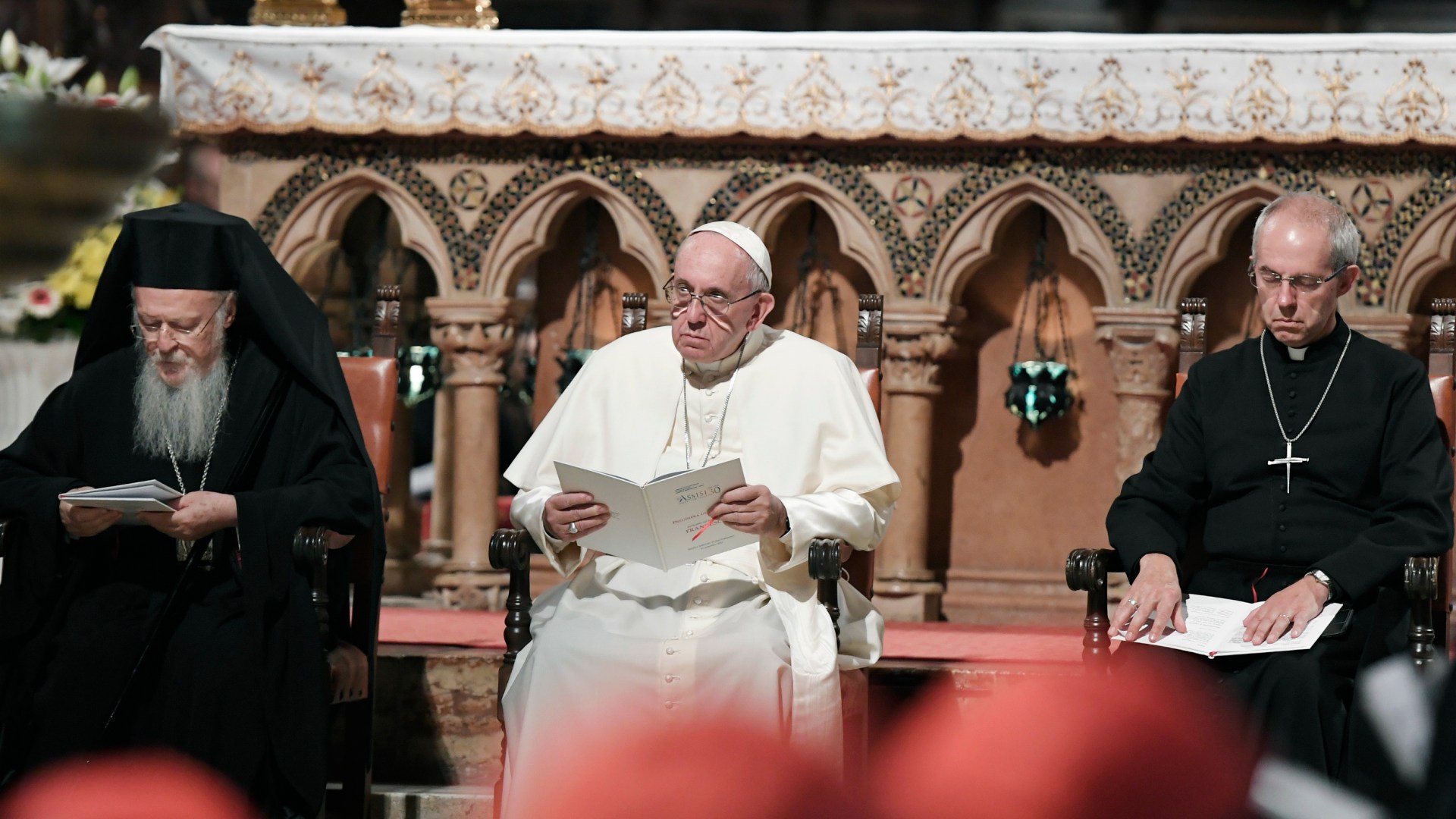
In this 2016 file photo, Pope Francis flanked by Orthodox Patriarch of Constantinople Bartholomew I, left, and Canterbury Archbishop Justin Welby, pray together inside the Basilica of St. Francis, in Assisi, Italy.

In this 2016 file photo, Pope Francis flanked by Orthodox Patriarch of Constantinople Bartholomew I, left, and Canterbury Archbishop Justin Welby, pray together inside the Basilica of St. Francis, in Assisi, Italy.

Christianity Today September 16, 2021
Tiziana Fabi / Pool Photo via AP

In their first joint statement ever, the spiritual leaders of Christianity’s three largest denominations addressed the United Nations.

“Listen to the cry of the earth, pledging meaningful sacrifices,” stated their appeal. “We must decide what kind of world we want to leave to future generations.”

Pope Francis of the Roman Catholic Church; Bartholomew I, ecumenical patriarch of the Eastern Orthodox Church; and Justin Welby, the evangelical Anglican archbishop of Canterbury, issued their plea this month to delegates attending next month’s UN climate summit in Scotland.

Noting that life on “the earth which God has given” has become an “urgent matter of survival,” the three leaders framed inaction as a severe injustice.

“The people bearing the most catastrophic consequences of these abuses are the poorest on the planet,” they stated, “and have been the least responsible for causing them.”

The Lausanne/World Evangelical Alliance Creation Care Network (LWCCN) “wholeheartedly endorsed” the statement.

“The environmental crisis represents the greatest challenge humanity has ever faced,” said Ed Brown, LWCCN co-catalyst for creation care, “and is a monumental failure to obey the clear command of Scripture to care for God’s creation.”

Francis, Bartholomew, and Welby urged corporations to seek “people-centered profits.” They called on nations to “stop competing for resources, and start collaborating.”

But they also called on Christians to pray, celebrating this “Season of Creation.”

In 1989, then Ecumenical Patriarch Dimitrios I declared September 1 as a day of prayer for creation. In partnership with the World Council of Churches (WCC), the day became a season, extended to October 4. And in 2015, the same year Francis issued the landmark environmental encyclical Laudato Si (Praised Be), the Catholic church embraced the initiative.

Brown served on the Season of Creation advisory committee until last year.

“Doctrinal unity is not necessary to join hands when facing a common threat, he said. “But cooperation opens up opportunities to share why we are working to save God’s creation: because we love him, and we care for the poor, both of which are hallmarks of historical evangelical Christianity.”

Last month, the World Evangelical Alliance (WEA) met with the WCC to discuss areas of future cooperation, including climate change. And last week, WEA general secretary Thomas Schirrmacher participated in the International Union for Conservation of Nature world congress, joined by Catholic representative Cardinal Peter Turkson.

“Our motivation is clear: Collaboration around an issue that is global, urgent, and unites us,” said Dave Bookless, LWCCN co-catalyst, “but without compromising our biblical and Christ-centered basis.”

An Anglican priest in the United Kingdom and director of theology for A Rocha International, a Christian conservation organization, Bookless assumed the advisory committee duties from Brown.

Responsible for preparing the scriptural reflections for the Season of Creation, he ensured their biblical foundation. And in the run-up to the UN climate summit, churches in the UK launched “Climate Sunday” to be celebrated within the summit’s five-week duration.

Tearfund prepared a conversation guide. World Vision offered a sermon on trees. The UK’s Methodist Church and Catholic Bishops Conference are sponsoring partners. Over 1,600 congregations have registered so far.

Bookless praised cooperation with evangelicals.

“Our experience with both Lausanne and WEA has been really supportive,” he said. “And the media stereotype of US evangelicals does not reflect the global picture at all.”

In 2012, the WEA launched its Creation Care Task Force, and two years later joined with Lausanne to create the LWCCN. But its climate ambassador, Katherine Hayhoe, appointed in 2020, finds the American response to be lacking.

Only one-third of US evangelicals support her, she tweeted, referring to a 2015 Pew Research study.

“I don’t accept global warming on faith: I crunch the data, I analyze the models,” she said. “The data tells us the planet is warming, [and] the science is clear that humans are responsible.”

Brown notes the National Association of Evangelicals in the US has emphasized creation care. And Bookless says that there is no reason the WEA couldn’t have been included in the Catholic-Orthodox-Anglican joint statement.

“So far it has been a personal initiative between leaders,” he said. “But I guess it could grow beyond them.”

News

Evangelical Colleges Join Effort to Promote Faith in the Vaccine

A campaign to educate campuses about COVID-19 vaccination shifts from persuading the hesitant to making it easier for the willing.

Christianity Today September 16, 2021
Spencer Platt / Getty Images

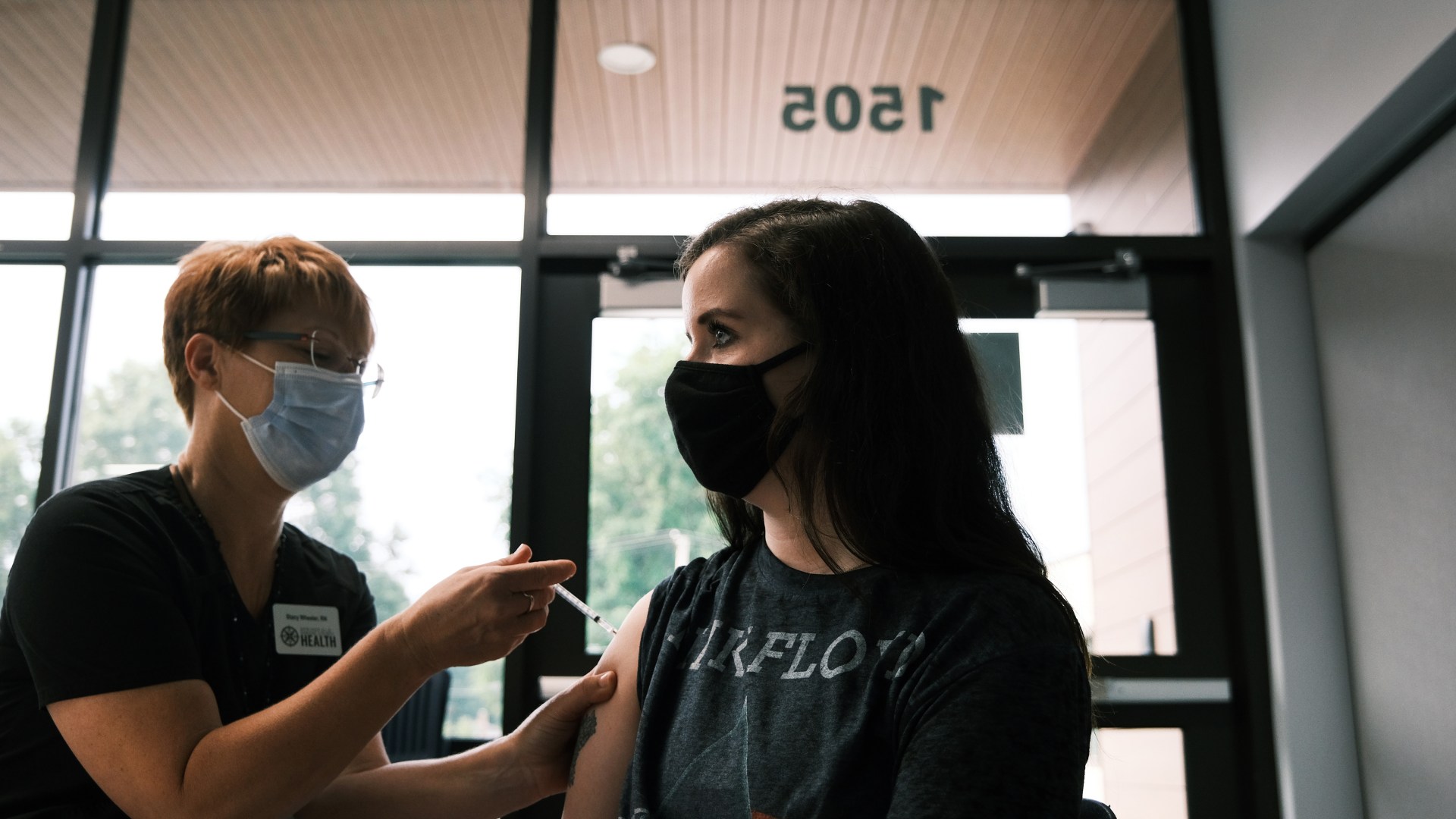
Last week, as President Joe Biden was announcing a new vaccine mandate for large workplaces, students at more than 100 Christian colleges were trying to persuade their communities to get the shot voluntarily.

Since those between the ages of 18 and 29 are among the least likely to be hospitalized or to suffer serious illness or death due to COVID-19, swaths of young people didn’t get the shot as soon as it became available earlier in the year.

Dozens of evangelical schools belonging to the Council for Christian Colleges and Universities (CCCU) have joined an interfaith effort called Faith in the Vaccine, designed to recruit students and faculty to help inform their communities about vaccination and recognize the role religious identity might play in people’s hesitation.

“This was not about hounding people into getting the vaccine or shaming them if they were hesitant,” said Eboo Patel, founder of Interfaith Youth Corps (IFYC), which launched the effort last spring and has disbursed $4 million to fund the campaign so far. “It was very much about engaging with great respect and sensitivity … and helping them kind of talk their own way into vaccination.”

Nearly 50 CCCU member schools signed up for the program. IFYC, along with medical professionals from the Rush University Medical School, trained campus ambassadors in conversational tactics and medical information about the vaccines.

But what started out as a campaign to promote education around vaccination within these faith communities has shifted to efforts to actually get shots in arms. The Faith in the Vaccine ambassadors, according to IFYC, have helped promote or host hundreds of clinics and events across the country, accounting for an estimated 10,000 or more vaccinations.

Persuasion, not Pressure

Organizers saw the campaign as a way to make sure people had the information they needed around vaccination. Aaron Hinojosa, a faculty ambassador for the program at Azusa Pacific University, said participants aren’t using religion to pressure or shame people.

“It’s not to the point where it’s like, ‘You have to do it,’” Hinojosa said, “But, ‘Here’s what we know, here’s what it is, and you have to make a good, informed decision.’”

Some found the conversational approach was a little too hazy to be motivating.

“A lot of the goal, it seemed at beginning, was trying to have these conversations with people that are vaccine hesitant or vaccine rejectors, and almost change their minds,” said Joel Frees, faculty ambassador at Southern Nazarene University in Oklahoma.

He said it was difficult to find ways to encourage college students who saw that their age put them at a very low risk for severe illness. Frees said he struggled to energize his team of ambassadors over the summer, when outbreaks fell.

Hinojosa’s team at Azusa Pacific hadn’t reported much activity last spring, either, other than a series of Instagram Live videos about why they chose to get vaccinated and personal conversations between ambassadors and their loved ones.

Surveys conducted by IFYC along with the Public Religion Research Institute (PRRI) tracked attitudes toward the vaccine. Between March and June, “vaccine refusal” held steady at around 14 percent, while vaccine hesitancy diminished from 28 percent of respondents to just 15 percent. So IFYC announced in July that instead of focusing on persuading the former, they’d work to help the latter.

The change in approach came just as the delta variant was emerging as the most active strain in the US. With delta, young people have suffered more than earlier in the pandemic; Americans under age 50 now account for roughly a third of COVID-19-positive patients in hospitals.

Campuses have seen delta’s impact in contrast to the earlier months of the pandemic. Several Christian colleges, including Liberty University and Cedarville University, had the first few weeks of the school year disrupted by outbreaks among the student body.

Few CCCU schools—including Seattle Pacific University and Pepperdine University—required vaccination for this school year, allowing for exemptions due to medical, religious, or philosophical reasons.

From Conversations to Clinics

According to PRRI’s survey, the three most-cited reasons among all Americans for not yet getting vaccinated were the inability to get time off of work, trouble finding childcare, and transportation issues.

After those survey results were in, Faith in the Vaccine ambassadors began working with local health departments and other institutions to host, organize, and publicize vaccine clinics.

Frees said Southern Nazarene’s ambassadors have worked with the Oklahoma City Health Department to host two vaccine clinics on campus, administering a total of 74 shots to mostly students. They’ve also hosted educational seminars for students about the vaccine and how it was developed.

Hinojosa at Azusa Pacific said ambassadors helped the university’s inconveniently located health department set up a temporary vaccine station in the middle of campus one day.

Bethel University in St. Paul, Minnesota, organized a mobile vaccine clinic for local migrant workers who may not have been able to access the vaccine otherwise, Patel said.

PRRI found in March that Hispanic Protestants were the most hesitant to get vaccinated, followed by white evangelicals. Some ambassadors reported the hesitation about getting the vaccine among the Latino community stems from fear that if they show up at a clinic, their immigration status may be exposed.

At an online rally this week, IFYC shared several video testimonies from other Faith in the Vaccine student ambassadors about their successes.

In one video, Tori Wootan from University of the Incarnate Word in San Antonio said they’d hosted a clinic in the tiny nearby town of Natalia—population 1,200—where 56 people were vaccinated.

Irene Kuriakose from Queens University in Charlotte, North Carolina, said her group encouraged community members to get vaccinated by giving away grocery gift cards and raffle tickets for a $500 prize. Others set up information tables with swag outside popular campus events, like move-in week or athletic competitions.

“You’d be surprised how many people are interested in scheduling or reporting their vaccines if you provide them a super cool bucket hat,” said Anu Agbi, student ambassador at Baylor University.

At Emory University in Atlanta, Rachel Lewis said a homeless man had been hanging around multiple vaccine clinics, where ambassadors were also handing out hygiene items and toiletries. At the fourth clinic, he finally agreed to get the vaccine.

“We’ve been able to provide a lot of vaccines to a lot of people, and our community members now trust us,” Lewis said.

Patel said sharing these stories at their rally this week was a way to motivate Faith in the Vaccine teams across the country to continue their “fall push.” It’s up to IFYC donors now, he said, to continue funding the program into the winter and spring.

News
Wire Story

Religious Exemption Requests Spike as Employers Mandate Vaccine

Some white evangelicals, the faith group most likely to refuse to get the shot, join thousands in citing “sincerely held” religious beliefs.

Christianity Today September 15, 2021
Seth Wenig / AP

About 3,000 Los Angeles Police Department employees are citing religious objections to try to get out of the required COVID-19 vaccination. In Washington state, hundreds of state workers are seeking similar exemptions. And an Arkansas hospital has been swamped with so many such requests from employees that it is apparently calling their bluff.

Religious objections, once used sparingly around the country to get exempted from various required vaccines, are becoming a much more widely used loophole against the COVID-19 shot.

And it is only likely to grow following President Joe Biden’s sweeping new vaccine mandates covering more than 100 million Americans, including executive branch employees and workers at businesses with more than 100 people on the payroll.

The administration acknowledges that some small minority of Americans will use—and some may seek to exploit—religious exemptions. But it said it believes even marginal improvements in vaccination levels will save lives.

It’s not clear yet how many federal employees have requested a religious exemption. The Labor Department has said an accommodation can be denied if it causes an undue burden.

In the states, mask and vaccine requirements vary, but most offer exemptions for certain medical conditions or religious or philosophical objections. The use of such exemptions, particularly by parents on behalf of their schoolchildren, has been growing over the past decade.

The allowance was enshrined in the federal Civil Rights Act of 1964, which says employers must make reasonable accommodations for employees who object to work requirements because of “sincerely held” religious beliefs.

A religious belief does not have be recognized by an organized religion, and it can be new, unusual or “seem illogical or unreasonable to others,” according to rules laid out by the Equal Employment Opportunity Commission. But it can’t be founded solely on political or social ideas.

That puts employers in the position of determining what is a legitimate religious belief and what is a dodge.

Many major religious denominations have no objections to the COVID-19 vaccines. But the rollout has prompted heated debates because of the longtime role that cell lines derived from fetal tissue have played, directly or indirectly, in the research and development of various vaccines and medicines.

Roman Catholic leaders in New Orleans and St. Louis went so far to call Johnson & Johnson’s COVID-19 shot “morally compromised.” J&J has stressed that there is no fetal tissue in its vaccine.

Moreover, the Vatican’s doctrine office has said it is “morally acceptable” for Catholics to receive COVID-19 vaccines that are based on research that used cells derived from aborted fetuses. Pope Francis himself has said it would be “suicide” not to get the shot.

In New York, state lawmakers attempted to make the vaccine mandatory for medical workers, with no religious exemptions. On Tuesday, a federal judge blocked the rule because it lacked the opt-out.

An August AP-NORC poll found that 58 percent of white evangelical Protestants, 72 percent of white mainline Protestants, 80 percent of Catholics and 73 percent of Americans who are religiously unaffiliated say they have been vaccinated. Seventy percent of nonwhite Protestants say they have been, including 70 percent of Black Protestants.

Among white evangelical Protestants, the religious group least likely to have been vaccinated, 33 percent say they will not get the shot.

Across the US, public officials, doctors, and community leaders have been trying to help people circumvent COVID-19 mask and vaccine requirements.

In Tulsa, Oklahoma, pastor Jackson Lahmeyer is offering a “religious exemption” form on his church’s website for download, along with links for suggested donations to the church. The 29-year-old is running for the US Senate.

Anyone interested can get the form signed by a religious leader. He said on Twitter that more than 14,000 people have downloaded it. He wrote that what was amazing was “how many pastors refuse to sign the form for members in their church.” He said he can sign if someone joins the church and donates.

But obtaining a religious exemption is not as simple as producing a signed form from a religious leader. Measles outbreaks in schools over the past decade prompted some states to change their policies. Some now require an actual signed affidavit from a religious leader, instead of an online form. California got rid of nonmedical exemptions in 2015.

Erika Cole, a Maryland-based attorney who serves as a senior editorial advisor with ChurchLawAndTax.com, a CT sister site, previously told CT employers shouldn’t require church leaders to verify religious exemptions.

“Currently, there are two legally recognized exemptions from a mandatory vaccination: medical reasons and sincerely held religious beliefs. When presented with notice of a religious exemption, some employers have requested the employee provide support from the church he/she attends. This, of course, is troublesome for a number of reasons,” Cole said. “…according to the EEOC, the individual, not the church he or she attends, holds the ‘sincerely held religious belief’ that may be the basis for refusing vaccination. As such, it is the individual’s right to advise his/her employer of that belief, and not a requirement of the church he/she may attend.”

Some private employers are taking a hard line. United Airlines told employees last week that those who obtain religious exemptions will be put on unpaid leave until new coronavirus testing procedures are in place.

In Los Angeles, Police Chief Michel Moore said he is waiting for guidance from the city’s personnel department regarding the exemptions. The city has mandated that municipal employees get vaccinated by Oct. 5 unless they are granted a medical or religious exemption. A group of LAPD employees is suing over the policy.

“I can’t and won’t comment on the sincerity level” of people claiming a religious exemption, the police chief said. “I don’t want to speculate. Religion in America has many different definitions.”

Ten LAPD employees have died of COVID-19, and thousands in the department have been infected.

In Washington state, approximately 60,000 state employees are subject to a mandate issued by Gov. Jay Inslee that they be fully vaccinated by Oct. 18 or lose their job, unless they obtain a medical or religious exemption and receive an accommodation that allows them to remain employees.

As of Tuesday, more than 3,800 workers had requested religious exemptions. So far, 737 have been approved, but officials stressed that an exemption does not guarantee continued employment.

Once the exemption is approved, each agency has to evaluate the employee’s position and whether the person can still do the job with an accommodation while ensuring a safe workplace. Seven accommodations so far have been granted.

Inslee spokeswoman Tara Lee said that the process “may help distinguish between a sincerely held personal belief and a sincerely held religious belief.”

In Arkansas, about 5 percent of the staff at the privately run Conway Regional Health System has requested religious or medical exemptions.

The hospital responded by sending employees a form that lists a multitude of common medicines—including Tylenol, Pepto-Bismol, Preparation H, and Sudafed—that it said were developed through the use of fetal cell lines.

The form asks people to sign it and attest that “my sincerely held religious belief is consistent and true and I do not use or will not use” any of the listed medications.

In a statement, Conway Regional Health President and CEO Matt Troup said: “Staff who are sincere … should have no hesitancy with agreeing to the list of medicines listed.”

News

Died: Marilyn Laszlo, Bible Translator Who Inspired Missionaries to ‘Come By Here’

The passionate storyteller spent nearly a quarter century developing written language and Scripture for a Papua New Guinea village.

Christianity Today September 15, 2021
Courtesy of Laszlo Mission League / Edits by CT

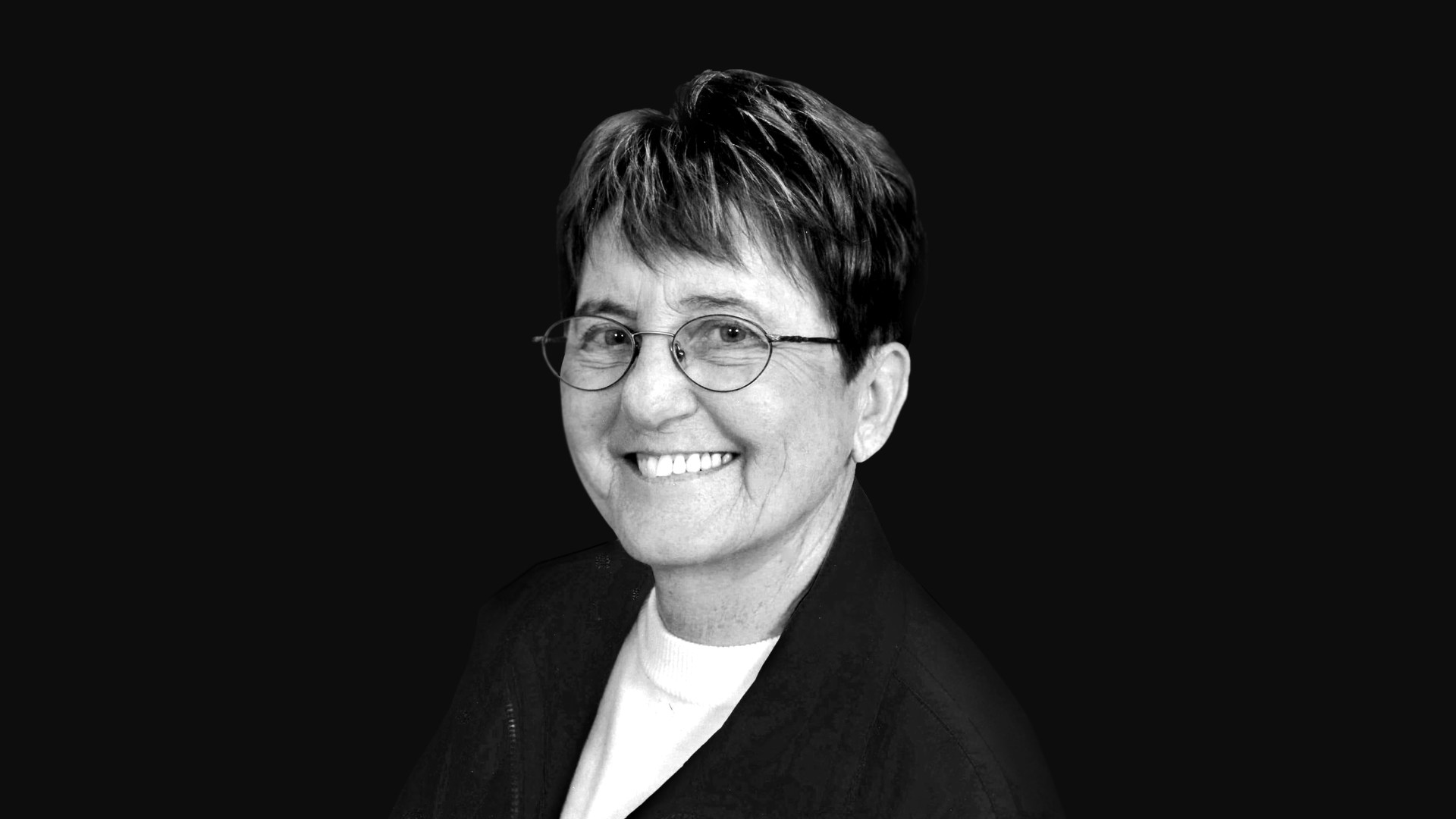
Marilyn Laszlo always considered herself a “Hoosier farmgirl.” The 88-year-old died last week just a few miles from her family’s nine-acre property outside Valparaiso, Indiana. But the news of her death was felt most deeply in a village on the other side of the world.

A missionary and Bible translator known for her bold faith and powerful storytelling, Laszlo spent 24 years living in the Hauna Village in Papua New Guinea. There, she formulated a written language and translated the Bible for the once-unreached Sepik Iwam people, starting by carving words into banana leaves.

When she passed away from Alzheimer’s on September 9, village leaders launched a five-day mourning ritual called a “house cry” in Laszlo’s honor, covering themselves in mud, grieving, and planning commemorations for a woman who changed their community forever.

The ministry efforts she began in Hauna more than 50 years ago—including a church, school, and clinic—continue to this day. They have turned the riverside village into a hub for the region. Up until the COVID-19 outbreak, Lazslo’s sister and ministry partner Shirley Killosky taught and served in Hauna full time.

“Marilyn’s legacy is still touching lives in Hauna Village and across the world,” said John Chestnut, president and CEO of Wycliffe Bible Translators. Laszlo was sent to Hauna through Wycliffe in 1967 and later served as a speaker for the ministry, before launching her organization, Laszlo Mission League, in 2003. “Praise God that this faithful servant is now in the presence of her Savior.”

Laszlo’s story of persistence in the face of a challenging mission field was retold in documentaries, memoirs, and, most poignantly, her own speaking appearances in churches and colleges. It was used as a testimony of God’s work in faraway places and as inspiration for Christians to dedicate their lives to the Great Commission.

“The number of people who are on the mission field today because of Marilyn’s story? Who knows,” said Topher Philgreen, president of Laszlo Mission League, which estimates that she inspired thousands to become missionaries. “We need to carry on what she started. The need is still very large in places like Papua New Guinea.”

When she was young, Laszlo would often get asked about the risks of living in a remote jungle community and responded, “I have learned that the safest place in the whole world is to be at the center of God’s will.”

For her, that was the Hauna village, where she lived to see God “meet these people in their own culture and in their own language.” Laszlo prayed that God would “touch the hearts” of believers at home so they could serve the unreached villages around hers.

Laszlo shared the story of her Bible translation work at Urbana ’81, where she spoke and played her film Come By Here. In it, Laszlo recounts how leaders in a distant village up the river from Hauna had erected a building with a cross to serve as a church, but they had no missionary or pastor. They just wanted to be ready for when someone like her would come to tell their people about God.

During later visits to Hauna—Laszlo took her final trip there in 2013, before her memory worsened—she would meet with members of the original team who helped create the New Testament translation decades before, as well as American missionaries who moved overseas after hearing her story.

Andy Keener, now executive vice president for partnerships at Wycliffe, first met Laszlo on a mission trip to the village in 1985. He said that God used her example to call him to his lifelong work in Bible translation. He described Laszlo as a “passionate and skilled storyteller” who was “committed to the story of the gospel of Jesus Christ.”

Laszlo completed the Sepik Iwam translation in 1990, bringing men from her translation team to speak in the US the following year, including at a Billy Graham Crusade.

For the rest of her ministry career, she spoke and promoted mission work, retiring due to her health in 2012.

Audiences laughed when Laszlo quipped that all her Bible translation training didn’t prepare her to be greeted by a group of villagers wearing “zero clothes.” Laszlo shared that when she and her missionary partner first arrived, the village gathered to debate whether they were men or women, only to decide these white strangers must have been neither.

She’d walk across the stage, animated, acting out what it was like to try to get them to tell her the word for “house” or “tree,” only for them to say “finger” because she was pointing so much.

“Marilyn Laszlo was tough as nails and had guts for Jesus; and she will be greatly missed,” said Franklin Graham, who got to know Laszlo through her work in Papua New Guinea in the early 1980s and authored the foreword to her book Mission Possible. “To know Marilyn Laszlo was to know a woman of good humor, grace, and grit. She wasn’t afraid of anything and her compassion for people was the hallmark of ministry throughout her life.”

She was born in Gary, Indiana, as one of four sisters in the Laszlo family and grew up helping her dad on the family farm in Liberty Township. A graduate of Bryan College and Indiana University, she taught high school prior to following God’s call to missions and studying at the Summer Institute of Linguistics.

Wycliffe has said that more than half its translations had been conducted by single women like Laszlo, and Laszlo Mission League plans to launch a scholarship in her name to support women in the field.

Philgreen said, “If she could do anything, she would love to see a women get a clear path into Bible translation ministries” and for such ministries to reach the goal of getting a Bible into every language and to every unreached people group.

When Laszlo first arrived among the Sepik Iwam, they had no written language and no knowledge of Christianity. And within her lifetime, the villagers were able to communicate with fellow believers in the US almost daily through WhatsApp.

Philgreen messaged last week to let them know Lazslo was in her final days. The day they heard the news, the Bible training school in Hauna celebrated eight more graduates from its program—eager to teach the same Good News she brought half a century before.

Her memorial service will take place October 5, 2021 at 6 p.m. central, at Liberty Bible Church in Chesterton, Indiana, and will be livestreamed through the Laszlo Mission League site.

News

Died: David Yonggi Cho, Founder of the World’s Largest Megachurch

The Korean Pentecostal promoted cell groups and gifts of the Holy Spirit for church growth.

Christianity Today September 14, 2021
Courtesy of David Yonggi Cho / edits by Rick Szuecs

David Yonggi Cho, the Korean Pentecostal who founded the world’s largest megachurch, died on Tuesday at the age of 85.

Cho and his mother-in-law started a church in Seoul in 1958 in a tent pieced together from bits of US Army tents. Yoido Full Gospel Church, affiliated with the Assemblies of God, grew to a weekly attendance of about 800,000 people in seven Sunday services, with hundreds of licensed ministers and thousands of laypersons leading weekly small groups of 10 to 15 people.

Cho popularized the idea of cell groups, arguing they are key to discipleship and to fostering the intimate connections that tie individuals to a large and growing church. He also promoted Pentecostal practices of prayer and healing as essential to dynamic church growth.

“I myself was devoted to praying with a do-or-die desperateness,” Cho told the journal Church Growth. “When we apply God’s word in our lives and experience God’s dispensation, we are empowered by God. Christians who believe in Jesus receive the Holy Spirit. … One only finds empty pews in many European churches. What caused it? The reason is that European churches have betrayed the Holy Spirit.”

Billy Watson, president of Oral Roberts University, called Cho “one of the great leaders of the Spirit-Empowered movement” and predicted his legacy would impact Christians for generations.

Cho was born on February 14, 1936, in the rural county of Ulju. His father owned a glove and sock manufacturing company, but it went bankrupt during Cho’s childhood, forcing him to make his own way in the world.

He learned English from hanging around American military bases, and by the age of 15 began to work for the troops as a translator.

His life changed at 17, when tuberculosis sent him to the hospital coughing up blood and rethinking his understanding of the universe. As a Buddhist, Cho later explained, he had been taught that he must suffer to “become Buddha through hardship.”

Jesus, it seemed, offered an alternative. Christians told him that “Jesus the living God is your friend, mentor and guide here and now.” After reading a Bible given to him by a young woman, Cho decided to reach out to the Christian God.

“As a last resort,” he wrote in his 2019 memoir, “I decided to look to the God I did not know. I cried out, ‘God I want to live! I want to live! Please help me!”

When he was later released from the hospital, cured of tuberculosis, he gave the glory to God and claimed a miraculous healing. In 1956, he started attending the Full Gospel Bible College in Seoul, preparing to become a minister.

Two years later, he and Jashil Choi, his future mother-in-law, started holding services in a tent. Only four or five people came to the first service, but within three years, regular attendance had grown to 600.

By the early 1960s, Cho harbored ambitions to grow his congregation into the largest church in Korea. He later told Church Growth that this was because he wanted to be rich and famous, and he had a competitive spirit.

“The Lord had to let me fail so that I would turn to him in my need and allow him to build his own church—in his own way,” Cho said.

The church grew into the thousands but then plateaued for several years at 2,400 before Cho developed the idea of cell groups. He started by empowering 20 deaconesses to develop groups in 20 districts in the city. Cho refined and reorganized the groups and the training for leadership as he went, and by 1973, the church had about 18,000 members.

The congregation built a new building in Yoido, the financial district of Seoul. Three years later, Cho founded Church Growth International to teach the principles he had learned internationally.

While many churches around the world adopted and adapted Cho’s cell group model, his ministry was not without controversy. He was frequently accused of preaching the prosperity gospel, telling his followers that faith will produce profit, fame, and material luxury.

Cho, however, said Christians do encounter suffering, but they know that God is causing them to suffer for their benefit.

“Fundamentally, God wants us to be healthy, spiritually and physically. He also wants to give us hope. Sometimes God wants us to change, which often comes with pain,” he said in an interview earlier this year. “It is critical for us to keep our faith that he has good intentions and that he would give us what may seem bad at the moment but will turn out to be good eventually.”

In 1981, two Assemblies of God leaders accused Cho’s church of accommodating ancestor worship. Some in the church continued cultural practices of lighting candles in front of deceased relatives and bowing to their pictures on important days. Cho said it was possible to distinguish between ancestor worship and honoring your father and mother, but many Christian leaders in Korea and the larger Pentecostal world saw that as heretical.

Cho stepped back from full-time ministry in 2008, passing leadership to Young Hoon Lee, the current pastor of Yoido Full Gospel Church.

In his retirement, Cho faced his most serious scandal. He was found guilty of embezzling funds from the church and was given a three-year suspended sentence. He had directed leadership of the church to buy unlisted stocks owned by his eldest son. The value was inflated, and the church reportedly lost about 13 billion won, the equivalent of about $12 million. He was also found guilty of evading taxes in the stock deal.

Cho told his church that the conviction was the hardest day in his life of ministry. But he also said his conscience was clear before God, and the church allowed him to continue in part-time ministry.

His supporters said Cho was really guilty of being too naive about his wayward son and argued Cho has not personally benefitted from the stock scam or his many years in ministry. He continued to preach at the church on occasion until his health deteriorated in 2020.

“All I did was offer my life just like the boy who gave the five loaves and two fish,” Cho is quoted on the church’s website. “I simply held on to the dreams that the Lord gave me.”

Cho is survived by his three sons, and the church is planning a funeral for Sunday.

Theology

Christian Marriage Demands that We Study Our Desires, Not Hide Them

Being faithful to a spouse requires living in community, seeking God daily, and learning from our celibate brothers and sisters.

Christianity Today September 14, 2021
Illustration by Mallory Rentsch / Source Images: Alexander Krivitskiy / Jake Pierrelee / Roksolana Zasiadko / Unsplash / Pexels

This summer, my husband and I celebrated two decades of marriage. We’ve been together now almost as long as we’ve been apart—a feat made possible by the fact that we married right out of college.

In the not too distant past, couples who married young laid a foundation for a life together. Cultural, religious, and personal values meant that these “cornerstone” marriages would eventually pass through silver, ruby, and golden anniversaries as a matter of course. Whether the marriage was happy, faithful, or even safe was often beside the point. By now, however, our cultural views on divorce have changed, as well as our understanding of marriage. Whereas in the past, social and cultural bonds held a marriage in place (sometimes trapping the vulnerable in abusive and dangerous unions), today the weight falls on the individuals. Couples must now want to be together in order to stay together. We’re not asking whether we are happy in our marriages but whether we could be happier outside of them. To make matters even more difficult, the changing nature of marriage means we expect more from our spouses. Famed relationship therapist Esther Perel notes that we ask the same person to give us belonging and identity, continuity and transcendence, comfort and edge, and predictability and surprise.

“We are asking from one person,” says Perel, “what once an entire village used to provide.” And when our expectations are this high, we’ll inevitably be disappointed. Perel calls this conundrum a “crisis of desire,” because in modern marriage, desire plays an outsized role in not only our couplings but in their permanence. So what are we to do? How do we pursue faithfulness in a culture that elevates desire above everything? The question is not whether we will be attracted to someone other than our spouse but rather what we will do when that happens. How will we respond—not when we are unhappy—but when we think we could potentially be happier? Do we cultivate and entertain such attractions, allowing them to simmer on a “back burner”?

“To walk in a holy, healthy sexual ethic,” writes Dorothy Greco in Marriage in the Middle: Embracing Midlife Surprises, Challenges, and Joys, “we must refute misguided teaching and recognize when culture is leading us astray.”

But rather than grit our teeth and hang on until the end, Greco suggests that the path to long-term fidelity runs through a better understanding of desire and attraction. “We will also need to acknowledge the power of our God-given sexuality,” she continues, “become aware of our areas of temptation, and find the balance between self-control and sexual expression.” Unfortunately, many of us are caught off-guard by temptation, in part because we don’t understand our own attractions and desires. Rather than learning to examine those feelings, we often opt for repression and avoidance, only to be surprised when we are swept off our feet by an unexpected connection or attraction to another person. “Repression and avoidance have a Christian name but a pagan lifestyle,” writes Rachel Gilson. They rely on the will to suppress desire rather than on Christ to transform it. One of the greatest indictments of these approaches, in Gilson’s opinion, is that “one does not need Jesus Christ to practice them.” And “a system that doesn’t need Jesus is not meaningfully Christian.” In this respect, it’s essential that we learn to face desire head on, not to undermine faithfulness, but rather to pursue it. For guidance, we can look to Christians who are already walking this road of self-awareness, especially those whose experience of attraction hasn’t been seamless and simple. People of sexual minorities, for example, are often profoundly aware of their attractions precisely because they don’t align with those of their peers. And this awareness grants them perspective and knowledge that the rest of us need. The evangelical community has expended a lot of conversational energy debating and even policing how faithful members of sexual minorities define their experience of attraction. Can they call themselves gay, or does that elevate sexual identity above identity in Christ? (Both the Southern Baptist Convention national gathering and the General Assembly of the Presbyterian Church in America took up some form of this question this summer.) Although these debates matter, perhaps our time would be better spent learning from brothers and sisters who are sacrificially committed to traditional Christian teaching on marriage. Their experiences of attraction (or lack thereof) won’t culminate in marriage or sexual coupling, which means they’re the very ones suited to teach the rest of us how to live faithfully with our own.

Their lives testify to the fact that being attracted to someone doesn’t mean we have to be with that person, any more than experiencing attraction to someone other than your spouse means the end of your marriage.

Learning to examine our desires and attractions—and how to distinguish between the two—has the potential not only to bridge the gap between LGBT and straight believers but to equip couples for lifelong fidelity. That clarity and nuance will go a long way when you find yourself attracted to someone other than your spouse.

But pursuing lifelong marriage requires even more than a study of desire. We must understand that while yearning to be known and loved is God-given, wanting to have a single person satisfy those needs is not. Perhaps it’s time we recovered the village. When the New Testament authors speak about people’s sexual lives, they do so in context of the community of believers. Unlike our modern notion of marriages and nuclear families as discrete building blocks of society, the Epistles reflect a vision of a larger community in which our marriages and families exist. And this community is made up of many different members, all joined together as the body of Christ. In this sense, healthy community supports lifelong marriage, not by peer pressure or expectation, but by expanding the kinds of relationships each spouse can access. Here in the family of God, we can learn to relate to each other as fathers, mothers, sisters, and brothers. Out of these relationships, we learn to be better husbands and wives while also mitigating how much we expect of each other. But here, too, we have to be careful. A group of people cannot become our ultimate source of life, love, and transcendence any more than one other person can. Living faithfully in both community and marriage means learning what many of our unmarried brothers and sisters already know.

In the words of writer Vivian Warren: “The love of Jesus will never fail as human loves often do, and it will take me into the other world when the time comes.” Out of this love, we can return to our unions as whole people, committing ourselves again to the calling of marriage. We do not trust our desires or even the years we’ve already invested. Instead, we take up our vows daily and trust that he who promises to keep us faithfully to the end will also keep us faithful to each other.

Hannah Anderson is the author of Made for More, All That’s Good, and Humble Roots: How Humility Grounds and Nourishes Your Soul.

News

RZIM Donors Fight to See If Their Funds Enabled Abuse

A federal judge declined to expedite discovery, but lawyers will ask for 17 years of financial records and hundreds of thousands of documents.

Christianity Today September 14, 2021
Mike Stewart / AP Images

Lawyers in Georgia battled over access to the financial records of Ravi Zacharias International Ministries (RZIM) on Monday.

In the first hearing of a proposed class-action suit, representatives for donors Derek and Dora Carrier argued they needed “expedited discovery” to allow them access to the hundreds of thousands of financial documents they say will prove that “RZIM allowed donated funds to be diverted for use in Zacharias’s schemes to perpetrate sexual abuse.”

The federal judge denied the motion to expedite the process, but the legal team is expected to make their case for access again after proving the grounds for the suit.

The Carriers’ attorneys are asking for records of all donations made to RZIM since 2004, when Zacharias became part owner of Touch of Eden, a massage therapy spa located in a shopping center near RZIM headquarters. They also want documentation of how those donations were used, particularly if they went to payments made to defend Zacharias against allegations of sexual abuse, to pay off accusers and hush up allegations, or to hire public relations and crisis management professionals to protect RZIM’s reputation.

“RZIM is sitting on a pile of money, and no one knows how RZIM is spending that money,” Drew Ashby, of the firm Ashby Thelen Lowry, told CT. “Our clients view this as God’s money, not their money, and they want that money back to invest in legitimate ministry purposes to build the kingdom of God.”

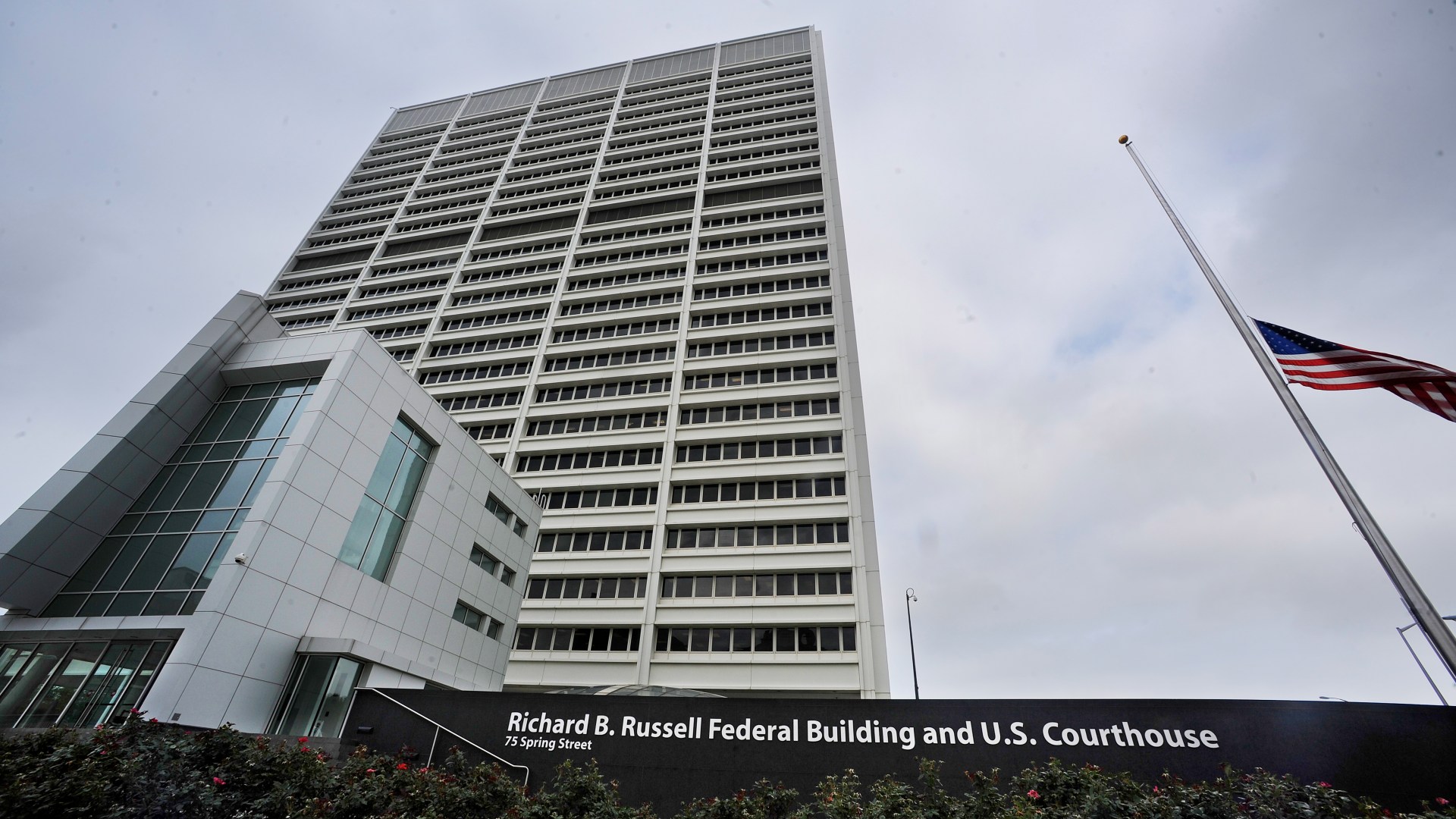
In a brief filed ahead of the hearing at the federal courthouse in Atlanta Monday, the Carriers’ attorneys urged the court to remember that RZIM leaders have “shown themselves to be deceitful.”

“They defended Zacharias in the face of accusations of sexual abuse, failed to investigate those accusations, used donated funds to finance sexual misconduct, and continue to use donated funds for personal and other purposes that fall outside of their stated missions,” wrote attorneys Michael McGlamry, Brad Sohn, and Graham and MaryBeth LippSmith. Four firms are representing the Carriers and other potential members of the class.

RZIM has acknowledged Zacharias sexually harassed women in multiple countries. The RZIM board took some responsibility in a public statement in February.

“We were trusted by our staff, our donors, and the public to mentor, oversee, and ensure the accountability of Ravi Zacharias, and in this we have failed,” the statement said. “We regret that we allowed our misplaced trust in Ravi to result in him having less oversight and accountability than would have been wise and loving.”

The lawsuit, however, alleges that RZIM didn’t just fail to keep its famous founder in check, but gave him the resources necessary to cover up sexual abuse and continue abusing women.

According to the investigation paid for by RZIM, Zacharias used money designated for “humanitarian effort” to pay four massage therapists. He paid for their school and living expenses and provided one with an apartment near his writing retreat in Bangkok. One therapist told investigators that after Zacharias arranged for her financial support, he demanded sex, and she felt obligated to comply because she had accepted the money.

The report did not find any evidence that anyone within RZIM or on its board knew about sexual misconduct. It was not, however, an exhaustive investigation and did not focus on corporate complicity.

RZIM hired Guidepost Solutions, a management consulting firm that has specialized in sexual abuse cases, to evaluate “structures, culture, policies, processes, finances, and practices” and to propose reforms. The evaluation appears to be ongoing.

On Monday, the Carriers’ attorneys asked for quick access to records of “payments and/or transfers” to Guidepost, “and/or any other consultant, victim-advocate, or person who is engaged in public relations, crisis management, marketing, or rebranding.”

Sarah Davis, who replaced her father Zacharias as CEO of RZIM in 2019, told the court it would likely cost more than $100,000 to give the Carriers’ attorneys everything they’re asking for. She estimates the process would take 45 days and require her, her executive team, and some of RZIM’s downsized staff to devote their full attention to the requests. (Earlier this year, RZIM laid off more than 60 percent of staff.) The ministry would probably have to bring in additional accountants as well.

Davis also said in a written statement to the court that some of the information the Carriers’ lawyers want to see is confidential and people who give unrestricted gifts have no legal right to object to how RZIM uses the money. Each donor, when thanked and given a receipt for their tax-deductible donation, is told that, according to IRS guidelines, “contributions are solicited with the understanding that RZIM has complete control over the use of donated funds.”

After listening to the arguments from both sides for about an hour, Judge Thomas Thrash denied the motion for expedited discovery. The Carriers’ attorneys will be allowed to ask for access to RZIM’s financial records again, but first they have to prove there are grounds to go forward with the lawsuit and convince the court to certify a class of plaintiffs represented by the Carriers.

“We were asking for leeway, but the judge chose to stick with the rules,” Ashby told CT. “We are going to get to those books. The question is how long can … RZIM keep us from looking behind the curtain.”

RZIM’s lawyers, from the firm Watson Spence LLP, did not return calls requesting comment.

RZIM has filed a motion seeking to have the case dismissed. The ministry’s representatives say the Carriers and other donors who gave to RZIM were not harmed by Zacharias’s abuse.

“Their claims are based upon the faulty premise that Mr. Zacharias’ misconduct transformed the Carriers’ gift into an injury, Mr. Zacharias’ life into a nullity, and RZIM into a fraud,” the lawyers argue. “This is not reality and the deficiencies in the Carriers’complaint are fatal, open, and obvious.”

The Carriers gave RZIM $30,000 in 2020. Derek Carrier plays professional football for the Las Vegas Raiders, and he and his wife, Dora, were regular listeners to RZIM podcasts.

RZIM’s attorneys also say that even if the Carriers or other donors were harmed, the federal court has no jurisdiction over the matter because RZIM is registered as a church and thus protected from government interference by the First Amendment. RZIM’s lawyers say the dispute is over “purely ecclesiastical assertions” and the court is not entitled to rule on whether Zacharias conformed to the “moral standards of ‘real’ Christian leaders” or RZIM exercised “appropriate ecclesiastical discipline.”

The court will rule on the motion to dismiss next.

News

Verdict Nears for Palestinian Accused of Diverting World Vision Funds

Mohammad el-Halabi has refused plea deals that would “pollute” the image of Christian aid organization, lawyer says.

Christianity Today September 13, 2021
Momen Faiz/NurPhoto via Getty Images

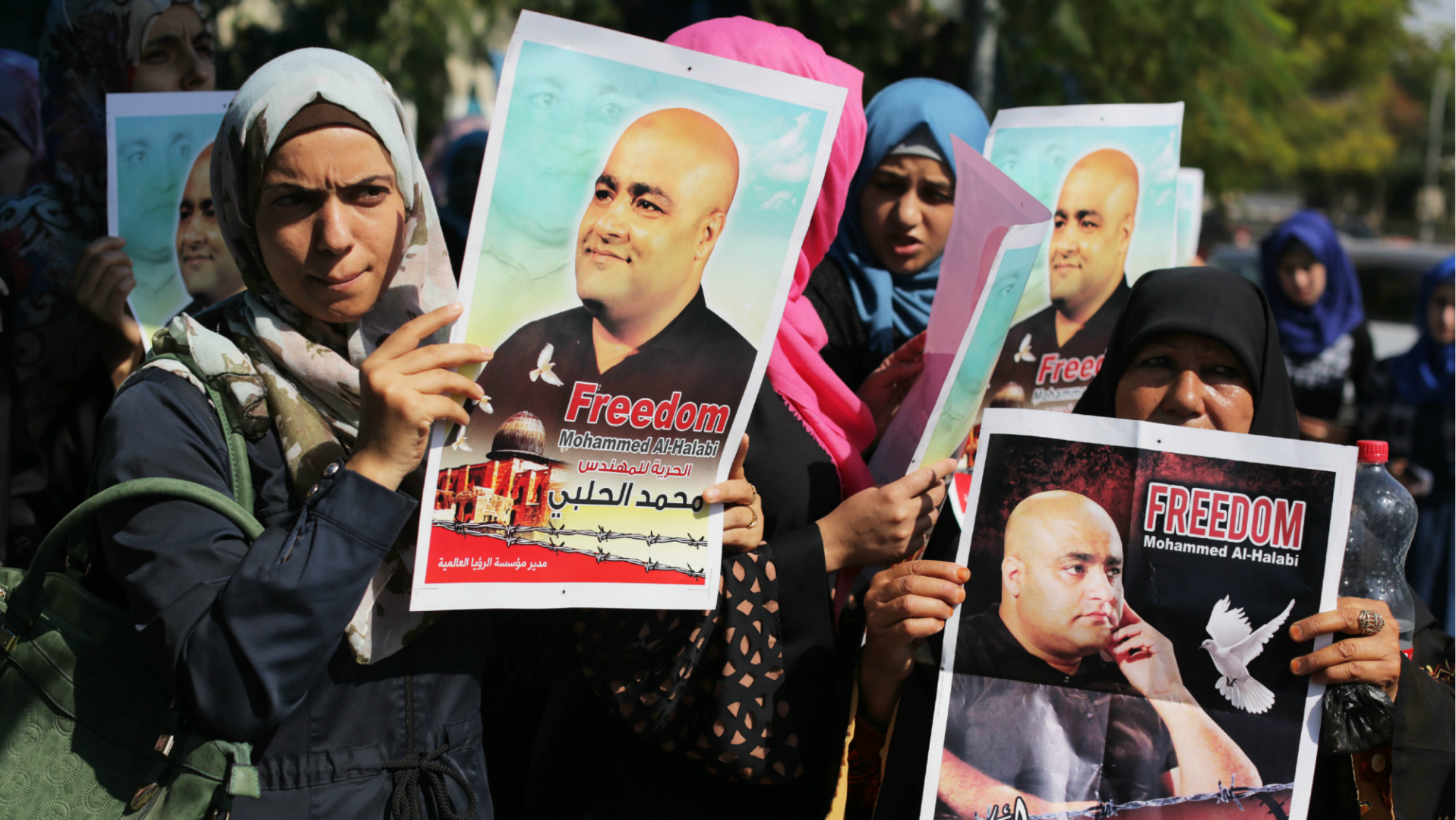
Mohammad el-Halabi believes the truth will set him free.

The former Gaza director of World Vision has now spent more than half a decade in prison, and according to his lawyer, the Israeli government has offered him plea deal after plea deal. He could potentially go home if he would only confess that funding for the Christian humanitarian aid organization was diverted to support terrorism.

But Halabi has refused.

“He is saying he will not admit to things he never did,” Maher Hanna, who represents Halabi, told CT. “He will not pollute the image of World Vision just to get a personal discount and go home to be with his children.”

Hanna, himself a Christian, said this is one of the remarkable things about this case that has not been noted in the international headlines: A Muslim man who worked for a Christian organization is refusing, under severe pressure and at great personal risk, to betray one of the largest evangelical charities in the world and harm its future work.

“We should admire that position that Muhammad is taking for himself. It’s a high Christian value,” Hanna said.

Close observers and insiders say Halabi’s trial looks like it will conclude this fall. The Israeli court could reach a verdict as early as this month.

The case has been making its way through the Israeli justice system—tediously and obscurely—since Halabi was arrested by the state security service while attempting to pass through the Erez checkpoint between Gaza and Israel on June 15, 2016.

Halabi was subsequently accused of using his position with World Vision to aid Hamas, the Palestinian Islamist militant group that has governed Gaza since 2007. Israeli officials allege he was diverting funds meant to feed and educate children to instead help Hamas prepare another surprise attack on Israel.

If the accusations against him are true, Halabi is responsible for what The Guardian reported would have been “the biggest aid money heist in history.”

Founded in 1950, World Vision is one of the world’s largest charities, operating in nearly 100 countries, with an annual budget exceeding $3 billion. It sometimes hires non-Christian administrators, such as Halabi, and receives lots of support from international governments and secular institutions. But World Vision also has clear Christian commitments and a mission “to follow our Lord and Savior Jesus Christ in working with the poor and oppressed” and “promote human transformation, seek justice, and bear witness to the good news of the Kingdom of God.”

When Halabi was arrested, serious suspicion fell on the humanitarian work the group was doing in Gaza. Evangelical donors in the US—a significant part of World Vision’s support—started asking tough questions. Some governments, including those in Australia and Germany, immediately halted funding for World Vision projects.

World Vision leaders took the allegations seriously. The organization did not immediately put out a strong statement in Halabi’s defense, but instead expressed its commitment to cooperating with authorities and said, “World Vision is committed to the highest standards of accountability, and conducts regular internal and external financial audits.”

The group suspended its Gaza programs indefinitely in August 2016. Then it contracted one of the world’s largest multinational law firms to conduct an external, independent forensic investigation. After examining over 280,000 emails and documents, interviewing 180 people, and forensically examining every aspect of the Gaza operation between 2011 and 2016, the law firm delivered a 264-page report.

A person with firsthand knowledge of the investigation said, “The investigation did not find even a hint of funds being diverted to Hamas or any schemes or collusions involving other World Vision employees or third parties.” Investigators also couldn’t find “any material evidence suggesting [Halabi] was affiliated with, or worked for, Hamas.”

Although the law firm made suggestions for improving financial controls—a normal outcome of any financial review—the investigators actually found Halabi was diligent in assuring World Vision avoided any entanglement with Hamas, even inadvertently.

That report was finished in 2017; prosecution against Halabi continued for another four years and counting.

Additional reporting from the US Agency for International Development and the Australian and German governments corroborated the results of the independent audit, finding zero evidence of diverted funds.

Without credible accounting evidence, sources familiar with the prosecution told CT that the case against Halabi rests on the testimony of one former World Vision employee and a fellow prisoner who claims he heard Halabi confess to the crime.

However, the prosecution—citing national security concerns—has presented most of its case in closed hearings. At the several open hearings that have been held, no evidence of guilt appears to have been presented. Hanna has also not been allowed to see all the evidence against his client, and when he was shown some documents, he wasn’t allowed to see the originals, make copies, or take notes.

Representatives at the Office of the United Nations High Commissioner for Human Rights have condemned the secretive process, saying it is “not worthy of a democratic state.”

Hanna said it is like being thrown into the ocean with one’s hands and feet tied. Nevertheless, he says Halabi’s innocence has been established beyond a reasonable doubt.

“The charges against him are ridiculous,” he said. “They limited me from accessing important material because it would just be embarrassing if they allowed me to see it all or put it out in the public.”

Now Halabi waits for the courts to reach a verdict, trusting that the truth is enough to set him free.

His father, Khalil el-Halabi, said Mohammad is confident because he is innocent.

“They offered him several deals to get out of prison in three or five years, to be released to hug his wife and children in Gaza again,” the elder Halabi told CT, “but he has always told them the truth—‘I am innocent, my work was humanitarian, I served the poorest families in Gaza.’”

Khalil said he has been encouraged that as his son refuses to tarnish the reputation of a Christian aid organization, Christian communities in Gaza, Bethlehem, and Jerusalem have shown Halabi their support. Catholic and Orthodox churches rang their bells during his court sessions and “still today, many Christian brothers send gifts to his children and messages of solidarity to his family,” he said.

Sara Bach, a World Vision supporter from Hildesheim, Germany, said it does not matter to her whether Mohammed el-Halabi is Muslim or not. She supports World Vision because it “has embraced causes and policies that address real world issues and injustices for the poor and vulnerable.”

The human suffering in the Palestinian territories is one cause she doesn’t think evangelicals should ignore.

For more than half a decade now, though, World Vision’s work in Gaza has remained suspended while the Muslim former director sits in prison and rejects plea deal after plea deal.

“That means that the case isn’t just against a single man,” said Bach. “Children and families are suffering because of the loss of trust and support from World Vision in Gaza. That’s a real tragedy.”

Ideas

Why 9/11 Brought Neither Unity Nor Revival

Staff Editor

Many Christians think spiritual renewal followed the terrorist attacks, but the record shows otherwise.

Christianity Today September 10, 2021
Illustration by Rick Szuecs / Source Images: Gerd Altmann / Pixabay / Wuhua / PngTree

The immediate aftermath of the terrorist attacks of September 11, 2001, was a strange and fearful time, but it also seemed a hopeful time.

“A massive shift in perspective happened to our country on September 11,” wrote Philip Yancey in 2001. For a little while, he mused, the sense that everything had changed in a single morning “made us look at our land, our society, and ourselves in a new way.” It made us “live in conscious awareness of death,” made us notice that “many of us fill our lives with trivialities,” and forced us to “turn to our spiritual roots.”

Talk of unity was everywhere. Church attendance spiked, and Christian leaders began predicting a national revival. In a 2001 speech, President George W. Bush praised Americans for our decency, kindness, and commitment to one another. Now, on the 20th anniversary of the 9/11 attacks with the US military withdrawn from Afghanistan, we should ask: Were those hopes fulfilled?

We certainly didn’t maintain that sense of unity. Quickly, Christians got into heated discussions about whether we could support military invasions, torture, the Patriot Act, and more. Since then, our political divisions seem even more embittered, and polarization is on the rise. And as for the policy—well, wherever you land on these things, my guess is you aren’t too happy with how it’s gone, and our current political discourse is awash with talk of treason and even civil war.

Our lack of unity isn’t the only disappointment. The foretold revival never came, either.

For a few weeks after 9/11, people packed the pews, but it soon became apparent there was not a “great awakening or a profound change in America’s religious practices,” as Frank M. Newport, Gallup Poll editor in chief, told The New York Times in November of 2001.

Barna Group confirmed that conclusion in 2006. It tracked “19 dimensions of spirituality and beliefs” and found “none of those 19 indicators [were] statistically different” from pre-attack measures. In other words, the 9/11 attacks didn’t put American Christians on a trajectory toward more orthodox beliefs or more consistent habits of prayer, church attendance, or Scripture reading. Insofar as we can measure matters of faith, the decline of American religiosity continued apace.

Almost as quickly as the new perspective on life Yancey saw in 2001, Americans turned away, back to trivialities and escalating antipathies, like a dog returning to its vomit (Prov. 26:11). As a culture newly aware of mortality, we embraced the recklessness of YOLO, not the care of memento mori. “Spiritually speaking,” said Barna’s David Kinnaman, “it’s as if nothing significant ever happened.”

Still, the myth that the 9/11 attacks catalyzed a spiritual awakening lives on. A 2013 Barna Group survey found Americans—and particularly born-again Christians—believe 9/11 “made people turn back to God.”

Why were our hopes for ourselves so wrong? Why did we not live into our own ideals? I have two answers to suggest—and one reason to hope anew.

My first suggestion is that what we thought was hope wasn’t hope at all. It was less Christian trust in the character and redemption of God than American optimism coated with not-quite-biblical bromides that when there’s bad, good will follow.

Americans love to believe that “everything happens for a reason,” and that after a short period of time, sorrow will always turn into joy and suffering into sanctification. We quote Romans 8:28—“we know that in all things God works for the good of those who love him”—and incorrectly interpret it to mean that everything that happens to us will somehow work out okay.

And it will—on the eschatological scale. God promises that one day we will live in perfect joy and justice with him, and “there will no longer be any death; there will no longer be any mourning, or crying, or pain” (Rev. 21:4, NASB).

But God does not promise us lives that reliably get nicer, either for us as individuals or even for our society. Sometimes evil happens and then just keeps on happening for centuries. Sometimes things don’t work out okay and there’s no perceptible reason for what happens to us.

Nor does suffering “naturally or automatically lead to growth or good outcomes,” as pastor and author Tim Keller has observed. “It must be handled properly or faced patiently and faithfully.” A couple extra Sunday services in the fall of 2001 is not a commitment to the long, slow work of sanctification.

The second answer to our disappointed hope is about how we preserved 9/11 in our memory. “Never forget,” we said, over and over and up through today. Part of what we meant was “Never forget the people we lost and the heroism of ordinary Americans who helped amid the horror.” Yet another part was vengeance. In his September 2001 address, Bush promised the American people he would “not forget the wound to our country and those who inflicted it.” He swore never to yield, rest, or relent in the “mission” our country had found in our “anger.” Too many Americans, including some Christians, adopted this response in a vengeful way.

We were right to be angry at the great wrongs of 9/11, but at some point, rehearsing that anger year after year doesn’t move us toward justice, love, or the forgiveness Jesus commands of his followers. It moves us toward resentment, hostility, and bitterness, with all the trouble it brings (Heb. 12:15).

How we remember is as important as that we remember, as theologian Miroslav Volf has argued, and we should discipline ourselves to remember “both with the desire for knowing truth and with the desire of overcoming enmity and creating a communion in love.”

As we remember 9/11 again this year, it is not too late to change that memory. It is not too late to begin to seek the goods of unity and revival we wanted in 2001.

We can still become more peaceable and prudent in our politics. We can still draw near to God, and he will draw near to us, for “now is the day of salvation” (James 4:8; 2 Cor. 6:2). We can still learn real hope—not ahistorical American optimism, but the weightier hope that comes through perseverance, character, and the love of God.

addApple PodcastsDown ArrowDown ArrowDown Arrowarrow_left_altLeft ArrowLeft ArrowRight ArrowRight ArrowRight Arrowarrow_up_altUp ArrowUp ArrowAvailable at Amazoncaret-downCloseCloseellipseEmailEmailExpandExpandExternalExternalFacebookfacebook-squarefolderGiftGiftGooglegoogleGoogle KeephamburgerInstagraminstagram-squareLinkLinklinkedin-squareListenListenListenChristianity TodayCT Creative Studio Logologo_orgMegaphoneMenuMenupausePinterestPlayPlayPocketPodcastprintremoveRSSRSSSaveSavesaveSearchSearchsearchSpotifyStitcherTelegramTable of ContentsTable of Contentstwitter-squareWhatsAppXYouTubeYouTube