News

How T.D. Jakes and Local Churches Became Affordable Housing Developers

The current crisis has led faith groups in Atlanta and beyond to see the market as part of their ministry.

Christianity Today August 12, 2021
graphiknation / Getty Images

When Rev. Herman “Skip” Mason was transferred in 2019 to pastor West Mitchell Street Christian Methodist Episcopal (CME) Church in downtown Atlanta from Augusta, Georgia, he never imagined that two years later he would still be looking for affordable housing in his hometown and forced to commute over 100 miles every week.

This summer, with home prices continuing to climb during the pandemic, the Atlanta native learned that Bishop T. D. Jakes, pastor of The Potter’s House in Dallas, was behind an effort to develop affordable housing at a former military base nearby.

“I’m a pastor and an educator, so I have a limit as to what I can afford,” Mason said in an interview with CT. “T. D. Jakes, come on and build your affordable housing!”

Jakes and his real estate company were approved by the McPherson Implementing Local Redevelopment Authority (Fort Mac LRA for short) to buy approximately 94.5 acres of former historic Army base Fort McPherson for a mixed-used development.

“My cultural fluency results from having grown up in a community like the Atlanta communities surrounding Fort McPherson,” said Jakes in a press release in which the pending purchase was announced. “In my travels across all of America, I see too many Black and Brown working-class people still falling victim to the continued gentrification of our neighborhoods.”

The project is one of several in Atlanta where faith leaders are investing in affordable housing for the sake of their communities. Across the country, churches with property in prime locations are turning over one block, one building, one lot at a time through movements like “Yes in God’s Backyard” in California. Atlanta-area pastor Rev. David Lewicki discusses the calling of affordable housing as a ministry.

“We are increasingly convinced that affordable housing is the foundation of beloved community,” the Presbyterian minister wrote at Faith & Leadership. “Housing is a profound and even holy good.”

In the Georgia capital, among the fastest-growing metro areas in the US, rent prices are rising faster than income levels, according to the mayor’s office. As of June, Atlanta home prices jumped 24.3 percent compared to last year and sold for a median price of $406,000.

Lewicki’s church got involved in lobbying for more inclusionary zoning policies to allow for lower-priced options in their area and began to create a land trust so they could get involved in addressing the legacy of racial and economic segregation in the city.

Other churches are doing the same with their own property. Atlanta First United Methodist Church has partnered with Evergreen Real Estate Group to develop 1.8 acres owned by the church on Peachtree Street.

“I love this city and I love the people of this city, and I knew that our church had the capacity and the resources in the land to make a huge difference in available housing in the city,” said Rev. Jasmine R. Smothers, the first Black and first female pastor of the church. “I told the leadership team and the congregation, let’s attempt something so big that without God, it is bound to fail. It’s a God-sized vision.”

The project is expected to be completed by 2023. Two towers are going up, comprised of 300 units (including three-bedroom units suitable for families). Eighty percent will be devoted to affordable housing, as defined by local median-income standards.

The development will also include the expansion of the church’s Atlanta First Day School and parking, church office renovations, and commercial retail space. The sanctuary, which dates back to 1903, will remain as it is.

A fellow UMC congregation in the metro area, College Park First United Methodist Church, announced similar plans to build an affordable housing and arts development. The Diamond @ College Park, located next to the 125-year-old church, will include a mix of affordable, market, and above-market housing, plus retail space. Church leaders made the move in the midst of the economic strain brought on by COVID-19.

Smothers says given the rates of homelessness and housing insecurity in Atlanta, “any affordable housing in Atlanta is good news.” She’s excited to hear that Jakes has committed to investing in the area too.

“We’re literally fielding phone calls every single day about rental assistance and preventing evictions, so I’m a huge proponent of any affordable housing we can build here in the city,” she said.

But others have worried about having big-name outsiders take over such a massive development, the second-largest economic project in the area after the expansion of Hartsfield-Jackson Atlanta International Airport, according to Fort Mac LRA board chairman Cassius F. Butts.

Fort McPherson is also the home base of media mogul Tyler Perry, whose Tyler Perry Studios is located on 330 acres of the property. Fort Mac LRA also approved Perry’s purchase of 37.5 more acres to build an entertainment district . According to the Atlanta Business Chronicle, Jakes’s company paid $29 million while Perry paid $8.4 million for the land.

A local coalition had initially proposed plans for the deserted Army base, but Atlanta officials made a deal with Perry instead. Community activists hope that the projects will benefit surrounding areas, which are now full of abandoned houses, broken sidewalks, and closed stores.

“It’s been a while since [Tyler Perry’s] been there, and we haven’t quite seen the transformation,” said Deborah Scott, executive director of Georgia Stand-Up, a “think and act tank” that works toward economic inclusion.

Perry “has done some great things for individuals in the community, whether it’s giving out gift cards at Christmas or paying off people’s Christmas bills at the grocery stores,” Scott said, “but what we’re looking for in this new development with T. D. Jakes and Tyler Perry still being there, and together owning more than 400 acres, is that they would be very responsible to the people who are outside of those gates.”

Scott said local leaders connected to Georgia Stand-Up are in touch with Jakes about visiting Capella Park, the 400-acre neighborhood he developed in south Dallas.

Jakes’s goal in McPherson, like with Capella, is to address racial and economy disparities and use business and development as a means for community flourishing. One of the reasons the pastor owns a real estate company in his name is because he wants to encourage property ownership as a way to build generational wealth.

In his announcement for the McPherson deal, Jakes quoted Luke 3:11 (KJV): “He answereth and saith unto them, He that hath two coats, let him impart to him that hath none; and he that hath meat, let him do likewise.”

“There is a desire for a mix of affordable and market rate living, retail options to support residents and surrounding neighborhoods with easy access to healthy food choices, restaurants, grocery, and soft goods stores,” he said in remarks to CT. “These types of businesses create jobs, allow room for local entrepreneurs, as well as national brands.”

Rev. Olu Brown pastors Impact Church, located in Atlanta but close to McPherson. “Having led a church in that area for some years now, it’s a win-win in a prime location to do what they’re doing,” he told CT. “I’m 100 percent on board with the location and the plan.”

Affordable housing and community development can seem like just business ventures—which they are—but pastors know how much these issues directly affect their congregants and stem from biblical calls for community.

“Ever since Paul, Barnabas, Simeon, Lucius and Manaen gathered in Antioch (Acts 13), the church has offered the world a vision of integrated community. Integration is the work of the Holy Spirit,” wrote David Lewicki, who copastors North Decatur Presbyterian Church. “Just as important, Jesus often provoked his followers to give up their wealth for something greater.”

Mason, at West Mitchell Street CME, has followed the housing market as a historian, a prospective buyer, and a pastor.

“The prices are going up in areas such as Vine City, around the universities, southwest Atlanta where homes that used to be, at one time, in the low $100,000s that are now going for $200,000 and $300,000 and $400,000,” he said. “It’s pricing out a lot of folks who want to move back or just move into the communities. It’s certainly creating some challenges for people who are there because as those house values increase, the taxes are going to go up.”

In fact, he is researching how his church, in existence since 1882, can become involved in providing housing.

“My church is just a block from the Mercedes-Benz dome, so we’re in very rich territory,” he said. West Mitchell Street CME’s one-acre downtown church can earn up to $12,000 for its parking lot during the Atlanta Falcons’ football season.

“At the rate my home search is going, I’m going to have a build a place that includes the pastor’s condo for whatever pastor is pastoring the church,” he said. “A lot of people have moved into the city with cash from places where homes cost much more than they do in Atlanta, so they are able to put cash on these houses. But this is where my faith comes in; I’m doing the work and having faith that something will come.”

Ideas

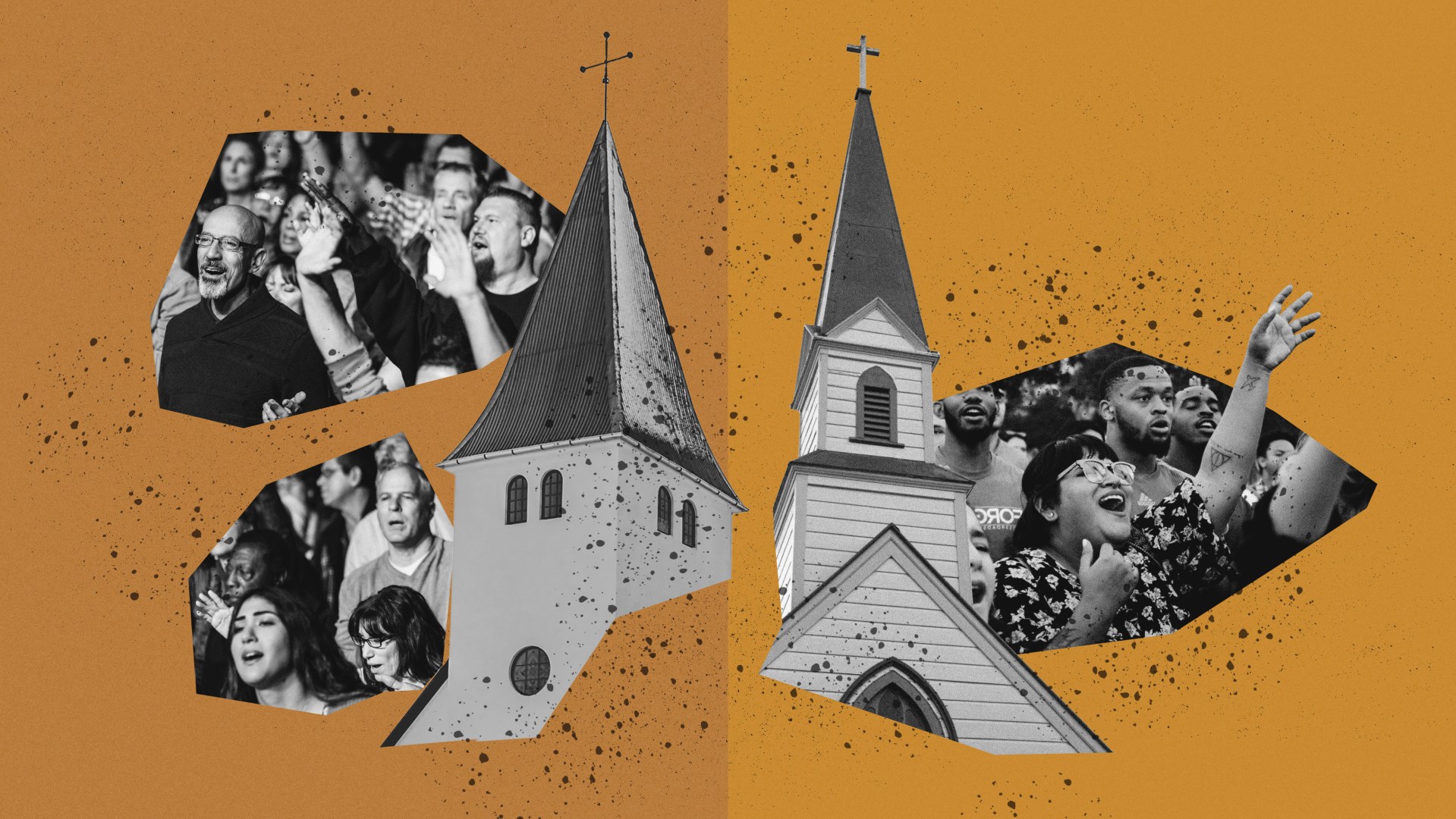
Is Evangelicalism Due for a Hundred-Year Schism?

Staff Editor

Our divisions are markedly political, and they echo religious controversies of the past.

Christianity Today August 12, 2021
Illustration by Rick Szuecs / Source images: Cason Asher / Ludovic Charlet / Unsplash / Dan Whitfield / Pexels / Damion Hamilton / Lightstock

“You have heard that it was said to the people long ago, ‘You shall not murder, and anyone who murders will be subject to judgment,’” Jesus told the crowd in the Sermon on the Mount. “But I tell you that anyone who is angry with a brother or sister will be subject to judgment. … You have heard that it was said, ‘You shall not commit adultery,’” he continued. “But I tell you that anyone who looks at a woman lustfully has already committed adultery with her in his heart” (Matt. 5:21-22, 27-28). He goes on to set a higher standard in other aspects of life, too, a standard where even private intentions matter to God.

The future of American evangelicalism—particularly white evangelicalism, a part often wrongly mistaken for the whole—has been subject to intense scrutiny for at least half a decade, and this year’s departures of Russell Moore (who has begun a public theology project here at CT) and Beth Moore (no relation to Russell) from the Southern Baptist Convention have revealed just how deep those divisions are.

As I’ve browsed reporting on the Moores’ decisions and read analyses on whether the US evangelical movement is heading for a schism—a complete and formal break in fellowship—Jesus’ words about murder and adultery keep coming to mind: If intentions matter so much, have we split already?

Widened and embittered division in the movement is certainly impossible to deny. The specific issues are many, some comparatively new (critical race theory, former President Donald Trump), some all too familiar (racism and race relations beyond the one theory, roles of women, sexual ethics, Christian nationalism, church handling of abuse), all with a political edge.

It’s not primarily about different policy agendas or rival partisan loyalties. On paper, a lot of that remains unchanged. The political division I see is more, as CT president Timothy Dalrymple wrote in April, about different informational worlds feeding different fears, hopes, habits of speech, and political priorities. And that political aspect is crucial, in two ways, to thinking through where we are now and where we may go next.

The first is this: If we were to diagram where American evangelicals coalesce around the issues I’ve just listed, the collective result would look a lot like a new (and newly important) tribal division in US politics.

For a long time, there was a stereotype that cast Republicans as rich people who go to country clubs and work at big banks, and Democrats—Hollywood and the media aside—as poor and working-class. This was a decent shorthand once, but no longer.

Nationally, we aren’t polarized according to income as we once were; the “diploma divide” is now the more useful indicator, and its importance is growing. More educated people increasingly vote Democratic, while the less educated increasingly vote Republican. That disparity contributes to a defensive populism on the American right, including among educated Republicans, via the perception that elite institutions (where college degrees are a baseline for participation) are all controlled by political enemies.

Among white evangelicals, the education-politics correspondence isn’t so strong. Being college-educated doesn’t make you a Democrat or a progressive theologically or politically. But there’s an echo of the diploma divide in the discord among evangelicals.

The populist faction in evangelicalism similarly accuses prominent figures and institutions (“big eva,” in the Twitter terminology) of neglecting or abandoning truth to curry secular, liberal favor. Such accusations played a role in both Moores’ departures from the SBC, though both remain dependably theologically conservative.

In a widely shared Twitter thread in late May, historian of American religion and politics (and CT contributor) Paul Matzko compared this divide to older divisions in American Christianity in the 1830s and 1930s. Those were times, like ours, of “intense political polarization,” he told me in an email exchange, as well as “intensive technological innovation, dramatic social change, and widespread fears that something vital was being lost in the shuffle.”

Matzko believes our politicized breach is already in its middle stages and will prove irreparable. He anticipates “the current divide will widen into a series of formal splits that cut through each of the major evangelical denominations and institutions,” a forecast with which I struggle to disagree.

Yet I’m less sure about his expectation that the populist faction “retain control of the existing infrastructure.” In many cases, I think that will prove true—the Southern Baptist Convention could become one such case, though the June gathering in Nashville seems to have delayed it.

Elsewhere, however, institutions may go to progressive evangelicals and still-churched post-evangelicals, to borrow a label from a June Mere Orthodoxyarticle proposing a six-way fracture of US evangelicalism. See, for example, Bethany Christian Services’ shift on LGBT adoption, or how disagreement over gay marriage within Mennonite Church USA has led to conservative departures while progressives stayed put.

The question of reparability brings me to the second way focusing on the political nature of this division is instructive: Our turmoil is significantly about political content consumption and how it competes with Scripture, pastor, and church community to claim our attention and disciple our minds.

Matzko’s Twitter thread gestured in this direction: “Evangelical clergy only get their congregants in the pews one to three times a week,” he wrote, while their favored political media “get them every day, all day.” When there’s a conflict between the two, polling suggests, political media win and the intra-evangelical divide expands.

Matzko highlighted political media sources like Newsmax, One America News, and outlets further right, which is the pulpit’s populist competition, but the same dynamic can and does emerge anywhere on the political spectrum.

The bad news, as he wrote to me, is it’s very difficult to break habits of heavy media consumption in a political echo chamber. The resultant “influence gap” between church and political content will prove a durable challenge to discipleship regardless of the issue arguments at hand.

But the good news—as Matzko and the Mere Orthodoxy authors, Michael Graham and Skyler Flowers, noted alike—is that as alarming, precarious, and dire as intra-church conflicts feel now, some past upheavals have ultimately borne good fruit. “Something new can be built on a firmer foundation, new churches founded, new magazines started (or older magazines expanded), new denominations coalesce, new communities engaged and churched, and so on,” Matzko wrote to me. “You wouldn’t have thought it possible in the 1930s,” when the liberal-fundamentalist schism happened, “but if it happened then, why couldn’t it happen in, say, the 2030s?”

And after all, Graham and Flowers conclude, the “church is not held together by its own strength but by the unbreakable bond of the unity of the Spirit. With this confidence, the church can move forward into this sorting, whatever it may look like, with hope that the Lord is using it to strengthen and embolden his church for fruitful mission in this age.”

I suspect that we have indeed already split in our hearts, and that it is impossible to go back to what we had before. Our schism is already here by the standard Jesus raises in the Sermon on the Mount, and we too often do not behave as we ought with the knowledge that, together, we “are of Christ, and Christ is of God” (1 Cor. 3:23). We may well be “subject to judgment,” not least for treating fellow Christians as our enemies. Yet even here, God can and will work for our good (Rom. 8:28).

News

Assemblies of God Growing with Pentecostal Persistence

How has the 3.2-million-member denomination avoided decline?

Christianity Today August 11, 2021
Ocampproductions / Lightstock

At most denominational conferences these days, leaders have to recognize and reckon with the challenge of continued declines in membership. But for the US Assemblies of God (AG), which drew 18,000 registered attendees to its General Council meeting in Orlando last week, it’s a different story.

The world’s largest Pentecostal denomination, the Assemblies of God has been quietly growing in the US for decades, bucking the trend of denominational decline seen by most other Protestant traditions.

At three million members, the Assemblies of God is far outsized nationally by groups like the Southern Baptist Convention, which is more than four times as large. But in many ways, the Assemblies of God can provide a case study for what many Southern Baptists—and really, all Christians—want to see: steady and sustainable growth.

It’s difficult to pinpoint exactly why the Assemblies of God has continued to increase over the past 15 years. Research shows that membership of the Assemblies of God has become more politically conservative and more religiously active today than just a decade ago, but its own numbers indicate that it has achieved incredible racial diversity—44 percent of members in the United States are ethnic minorities. A confluence of these trends may be factors in its ability to keep its numbers up.

https://datawrapper.dwcdn.net/WB8Jl

Compared to the two largest Protestant denominations in the United States—the Southern Baptist Convention and the United Methodist Church—the Assemblies of God has always been outnumbered. In 2005, there were about 16.3 million Southern Baptists in the US, by the denomination’s own tally, and nearly 8 million United Methodists. At the time, the Assemblies of God reported 2.8 million members.

However, between 2005 and 2019, both the Southern Baptists and the United Methodists reported a membership decline. In 2019, there were 14.5 million Southern Baptists, down 11 percent. The United Methodists reported a total of 6.5 million members in 2019, down 19 percent. Meanwhile, the Assemblies of God grew over 16 percent to nearly 3.3 million members.

While other denominations have been dropping year-over-year for more than a decade, there have only been three years in the past 40 when the Assemblies of God did not report annual growth in adherents. Just one of those came this century. As a result, the Assemblies of God has managed to add nearly half a million members since 2005.

As it has grown over the decades, the Assemblies of God has maintained its Pentecostal theological distinctives, like believing in divine healing, practicing spiritual gifts like speaking in tongues, and anticipating a premillennial second coming of Christ.

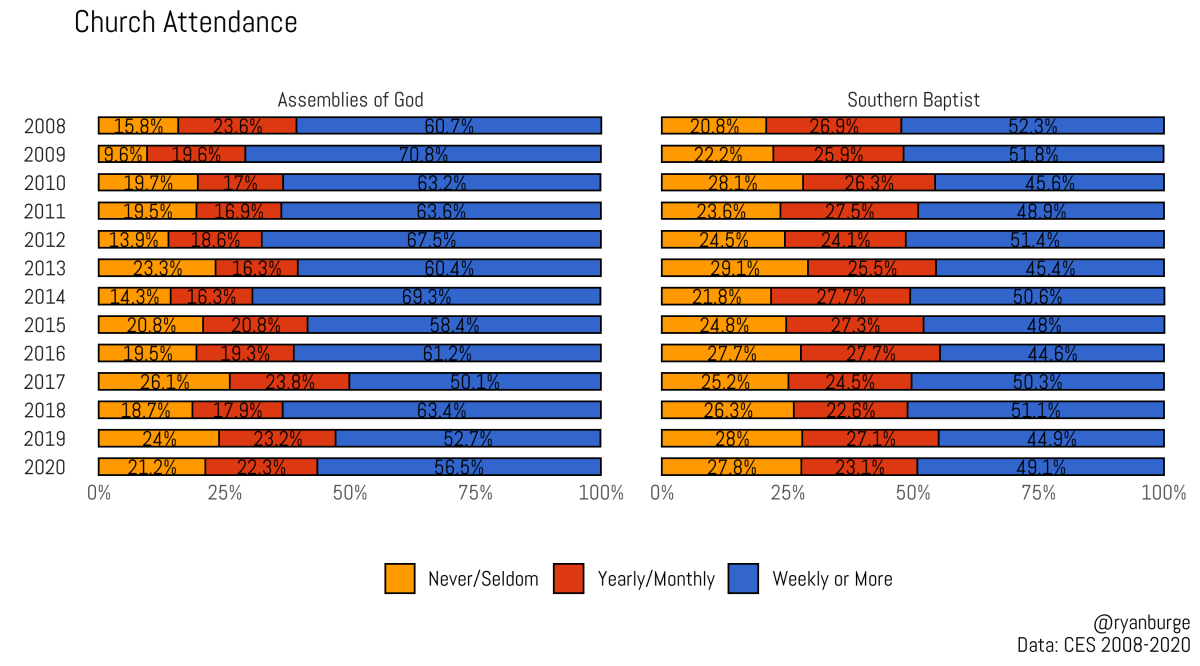
When analyzing survey data on the church attendance patterns among traditions, it’s clear that the Assemblies of God is not growing by adding lukewarm worshipers to its ranks and church roles. Instead, the data point to a denomination that is incredibly active in congregational life. On average, about a third of US Christians attend church weekly. In 2020, the Cooperative Election Study reported that 57 percent of AG members attend church at least once a week, compared to 49 percent of Southern Baptists.

What we can learn from the loss of 269 passengersI see it,visually and on radar.… The light is flashing.… What are instructions?” All of us in the free world remember the chilling words of Soviet pilot 805 concerning Korean Air Lines Flight 007: “Now I will try a rocket.… I am closing on the target.… I have executed the launch.… The target is destroyed.”“How could they do it?” we exclaimed. Then, with a touch of bitterness, we may have recalled the old Cold War battle cry, “You can always trust a Communist—to be a Communist!” It was as if the Soviet government were determined to prove this was so.The Korean pilot and his 269 civilian passengers ranging in age from 4 to about 70 flew far above the clouds in passage from Alaska to Korea. They were serenely unaware that they were miles off course and flying over a highly sensitive Soviet military establishment. Then, without warning, a soviet Su-15 interceptor launched the missile that blasted a planeload of people from the air.We Must Understand Soviet FearsWhy would the Soviets do it? I think of myself as an essentially p fair-minded person. I remember the Golden Rule and try to put myself in the other person’s shoes. But long years of Russian history have created for the Soviets a paranoid fear of invasion. The flat plains of their Western borders invited enemies, making defense almost impossible. Rome, Sweden, Turkey, France, Britain, Austria, Hungary, Germany in World War I, then a generation later Germany again in World War II—all remind every Russian citizen that his very racial name, Slavic, means slave. And now the United States and its allies ring their military forces around the edges of the Soviet empire. And add to this the Mongul invasions from past centuries, the Japanese occupation of lower Sakhalin Island in 1905 after the Russo-Japanese War, to say nothing of the constant Soviet fear of China, the colossus of the East.Yes, I can understand the Soviet fear of invasion and how, for them, self-defense has become paranoia. That explains Article 36 of the Soviet Border Law Code: “Use weapons and military technology for … repulsing violators of the state border of the USSR on land, water, and in the air … in cases when stopping the violation cannot be achieved by other means.” In today’s nuclear world with threatening war on every side, I can understand the order to shoot down air flights that trespass sensitive areas along borders.Chilling Pattern Toward Human LifeBut 269 men, women, and children shot down in an unarmed civilian passenger plane!The evidence seems overwhelming that either (1) the Soviet pilot knew this was a civilian plane that might or might not have also been engaged in spy activity, or (2) he did not know whether it was a civilian plane. In either case, the pilot, his ground crew, and the general who approved the action knew that it might well be a civilian plane filled with passengers. And the Soviets were unprepared or unwilling to take adequate precautions to insure that they would not be shooting down a commercial passenger plane that had simply wandered off course.This was not the first time such an incident had occurred. In April 1978, another Korean civilian passenger plane flew over Soviet air space. The Russian interceptor shot off 15 feet of its wing and killed two passengers, but the pilot managed to get the planeload of people back to ground safely. In that incident, the Korean pilot had given the distress signal and indicated by the internationally agreed-upon sign of turning on his landing lights that he would follow the instructions and guidance of the interceptor plane. But the Soviet pilot shot the passenger plane down anyway.Philosophy Does Affect ActionsEvents like these tell us something about the mindset of the Soviet leadership and its military establishment. They demonstrate a different view of human life and what it means to be human. Officially, at least, Soviet leadership is committed to a philosophy of dialectical materialism: a human being is essentially a thing. He can be used, and then becomes disposable when he gets in the way. He has no inalienable rights or inherent dignity stemming from God’s image in him. Such values are essentially inconsistent with a merely one-dimensional materialistic view of mankind.Against this stands a Christian view of humanity that finds its deepest expression in the most familiar verse in all the Bible—John 3:16: “For God so loved the world, that he gave his only begotten Son.…” By creation God made me—and every other human—a creature of infinite value. By redemption he demonstrated that I, along with every other human person, still have infinite value in spite of sin. The Christian knows that humans are not expendable. Every human being is of infinite value to our God, and therefore must be held in infinite value by us.Fortunately for our world, neither communism nor Marxist materialism is a monolithic structure always on the side of evil. Christians are not alone in setting a high value on life. By natural revelation, and in some cases by direct borrowing from biblical revelation, many non-Christians recognize the uniqueness of humankind. Many Muslims, Buddhists, and those of other faiths recognize the inherent worth of man. There is much truth in many religions, and even in dialectical materialism. It is precisely these pieces of truth that give non-Christian religions their religious and moral power over mankind.And unfortunately, Christians, committed to the doctrine that God created us in his own image and that every human is the object of God’s redemptive love, have not always acted accordingly. Remember the Thirty Years’ War in Central Europe or, closer to home, some of the more unpleasant scenes from the recent war in Vietnam? Professing Christians are not always good; professing Marxists are not always bad.My point is simply this: At the core of the Christian view is the infinite worth of each human. By contrast, Soviet leadership is avowedly committed to a philosophy of materialism, rejecting the Christian view. Given its current paranoid fear of invasion, the Soviet leadership only acted consistently with its own basic view of mankind in shooting dow KAL Flight 007 at the price of 269 passengers lives.Free World ResponseWhere does that leave us in the free world? Some representatives of the so-called New Right call us to a renewal of the Cold War of two decades ago. To them, an apology with indemnity followed by serious negotiations to avoid a repetition of this tragedy is not enough. They say the Soviets are wholly evil. They are uncivilized barbarians, and we must be prepared to destroy them or they will destroy us. Therefore, we must exact an appropriate vengeance. We must cut off all negotiations with the Soviets. We must stop scientific and cultural exchanges. We must revoke the grain agreement. We must call off the arms negotiations. And above all, we must build up our nuclear stockpile and conventional weaponry to the point where we can crush any Soviet aggression.Unfortunately, such actions would in most cases hurt us far more than the Communists. Isolating ourselves from the Soviets and refusing to negotiate with them will not stop the building of their war machine. And we have no evidence that Soviet communism will simply disappear from our earthly scene.By contrast with the New Right, the traditional liberal all too often deludes himself by thinking that the Soviets really hold to a noble system. Their unruly and unjust actions are caused by us. We goad them into such behavior. If we would only stop threatening them, reduce or renounce armaments, and start talking with them, all would be well.Such a view is blind to the avowed philosophy of Soviet leadership, and denies the reality of human depravity—Russian as well as American. Such a view is utterly irresponsible in its assessment of Soviet actions.Ostracizing the Soviet Union as a parish among nations will not make it go away. Rushing into an ever-escalating arms race can only place a crushing burden upon ourselves as well as on the Soviets; and in the end, it is most likely to lead to our own annihilation as a people. But trusting the Communists to be “good boys” is only asking them to deny their nature.A Realistic Christian Middle WayWe must see the Soviets for what they are and wisely map our course accordingly. We must call the Western world to a serious renewal of the disarmament discussions. We must seek justice by law, negotiation, and arbitration. We must do what we can to alleviate Soviet fear of invasion ingrained in them through the centuries.But, because we do believe in their depravity as well as our own, we will seek disarmament that can be checked. We will seek to meet their threats to world peace with firmness and strength. Because we place infinite value on human life and freedom, we strive for justice, oppose war, and struggle for mutual disarmament. But because we also believe in depravity, we must be prepared, as a last resort, to stop violence even by violence.Let us remember the massacre of 007. But as Christian people, let us not react with blind hate. Nor with the sticky sentimentalism that denies the depravity of man and ignores the history of Marxist philosophy and action. Rather, let us respond as becomes Christian people—“wise as serpents and harmless as doves.”KENNETH S. KANTZER

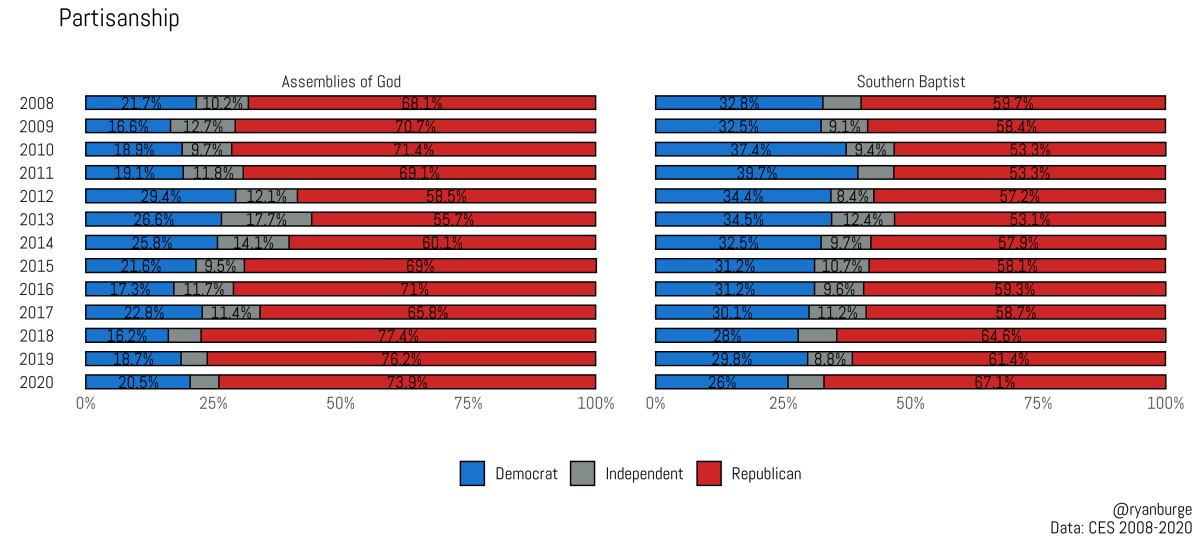
When the analytical lens turns to political partisanship, a more nuanced story emerges of how the AG has shifted compared to the Southern Baptists.

During the 2008 presidential election, about 22 percent of AG members identified as Democrats compared to 68 percent who affiliated with the Republican Party. Among Southern Baptists, the differences weren’t as stark. About a third of Southern Baptists were Democrats and 60 percent were Republicans.

Over the past 12 years, both traditions have drifted toward the right. In 2020, nearly three-quarters of all AG members said that they were Republicans, up about 5 percentage points. Among Southern Baptists, 67 percent claimed to be a Republican, an increase of 7 percentage points. But the share of AG members who are Democrats remained basically unchanged during that time, while declining nearly 7 percentage points among Southern Baptists.

Pastors, denominational leaders, and those in the pews are always interested in what leads to a denomination’s growth, particularly when the group is growing year after year while others around it experience decline. The Assemblies of God currently has around 13,000 congregations, more than a quarter of which were formed in the past decade.

It’s difficult to pinpoint just one reason for the increase in membership, but the data do paint a portrait of a membership that is very involved in the life of the church. When half of all members report weekly attendance, this goes a long way in warding off defections to other denominations. Research shows that such involvement makes it more likely that young people raised in the tradition will not leave it as they move into adulthood. More than half (53%) of AG adherents are under 35.

The fact that its churches are so politically homogeneous may work in its favor as well. Research has increasingly shown that more and more Americans are choosing their churches based on political considerations. If this is the case, then AG churches portray a clear message to potential converts about their political orientation, making it easy for newcomers to know what the church is about.

Finally, it may be helpful that the Assemblies of God, though growing, is small enough to lay low in the national media, largely avoiding the controversy and attention toward infighting in other denominations.

As the nones continue to rise and more and more nondenominational churches are planted in the United States, it will likely become more difficult for the Assemblies of God to sustain its growth.

As I describe in my forthcoming book on surveys—20 Myths about Religion and Politics in America—almost no traditional denomination has seen any growth in the past 12 years, so the Assemblies of God is a true outlier. It seems to have found a combination of factors that has succeeded even in these difficult times.

Ryan P. Burge is an assistant professor of political science at Eastern Illinois University. His research appears on the site Religion in Public, and he tweets at @ryanburge.

Books
Review

Grief Can Weigh You Down, but It Doesn’t Have to Pull You Under

Shawn Smucker’s latest novel explores the burden of unresolved regret and the healing power of sacrificial love.

Christianity Today August 11, 2021
Illustration by Mallory Rentsch / Source Images: Jesse Gardner / Marko Blazevic / J Waye Covington / Unsplash

Paul Elias is dying.

Weight of Memory

Weight of Memory

REVELL

368 pages

The mass growing inside his head is beyond the ability of his doctor to treat, and he will be dead sometime between “anytime and three weeks.” It’s a burden he chooses to carry alone, not revealing it to anyone. In addition to his terminal diagnosis, he is faced with the unsettling fact that when he is gone, there will be no one to care for his flighty 11-year-old granddaughter, Pearl, for whom he is the sole guardian. Even more unsettling is the fact that she’s been disappearing while reporting strange visits from a silver-haired woman no one else can see, who asks for help finding something she’s lost.

Until now, Paul has successfully fled and barricaded himself from his painful past. But confronting his mortality and Pearl’s need for a guardian forces him to return with her to Nysa, the town where he grew up, and where Mary, his wife and Pearl’s grandmother, drowned in a lake 40 years prior. What will they find there? Will someone from Paul’s past be able to care for Pearl when he’s gone? Will painful memories resurface, awakened by a familiar place? And will he finally find the peace that’s eluded him since his wife died?

The Weight of Memory is the third novel Shawn Smucker has written for an adult audience, following Light from Distant Stars (winner of the 2020 CT Book Award for Fiction) and These Nameless Things. In these books, as well as two young adult novels, Smucker seamlessly weaves together elements of suspense and magical realism to explore the psychological baggage of his characters. The past is a prison for so many of them, a parade of Jacob Marleys burdened by chains of regret. Much of the suspense arises from the winding paths they take to release those chains. Smucker’s stories are grounded in the realities of pain and healing, guilt and forgiveness, which give the light touches of fantasy their poignancy.

Heavy secrets

As Paul and Pearl are drawn inexorably to Nysa, a shriveled, dying town that the world has long passed by, they discover that Paul’s wife, Mary, was not the last one to drown in Nysa’s lake. In fact, a rash of drownings had sent most of the population packing, leaving an aura of death hanging about the town. Smucker’s lush descriptions bring Nysa and its world-weary characters to life. The town has a familiar, lived-in quality reminiscent of the forgotten coal communities that pepper the Appalachian corridor near where Smucker lives in Lancaster, Pennsylvania.

The settings of the novel are almost living, breathing characters unto themselves, a testament to Smucker’s gift for creating a mood. Take water, for example, in its various forms. At first it presents a placid face, both as Paul and Pearl cross the long bridge to Nysa and as they come upon the glassy surface of the lake. But then it reveals its capricious nature with threatening rain and entombing depths that become more ominous against the backdrop of the drownings.

The concept of drowning itself becomes a kind of metaphysical conceit in The Weight of Memory. At one point, one character cautions another, “Secrets are heavy things. They’ll drag you under if you don’t let them go.” Like slipping deeper beneath the waves, it’s the secrets we keep that pull us away from one another and deeper into isolation. As Paul tries to hide his terminal diagnosis from more and more people, including Pearl, he can feel the mass in his head growing larger and his isolation and fear of death growing deeper.

Just as there is an oppressive heaviness in keeping secrets, there is also healing in bringing things to light. A common theme in Smucker’s writing is that his characters create more pain for themselves by holding things in, for fear of being found out, than they would by coming clean. When the truth comes to light, there is often, though not always, a holy grief that lifts the attendant burdens away. At one point, a character says, “Grief is hard and good. It is the disease and the medicine, all at once.” Whether that grief will heal or consume is a pivotal matter in many of Smucker’s novels.

Throughout The Weight of Memory, interspersed flashbacks show the events that led to Mary’s drowning. They ebb and flow within the unfolding story like tides coming in and out, slowly uncovering essential elements of backstory. In addition to lifting unresolved weights from characters’ shoulders, they also offer the reader a kind of unburdening, slowly relieving the delicious tension of being held in suspense.

Rays of hope

Though heavy themes of psychological and spiritual distress run through Smucker’s novels, there is always a ray of hope that pierces the darkness. In The Weight of Memory, that ray of hope is Paul’s granddaughter, Pearl. At the risk of being too on the nose, her character is evocative of her mollusk-born namesake—a thing of beauty forged from past sorrow and adversity. She is a complex character, in some ways emotionally regressing, with a wild and vivid imagination that has not yet been corralled by the weight of reality that burdens Paul. In other ways she is wise beyond her years and aware of things she has no reason to know.

The power of the bond between Paul and Pearl drives the story forward. Dynamics between the two are constantly shifting, and Paul is sometimes exasperated and at other times mystified by her. The intimacy of the setting heightens the unexplored tensions in their relationship. In some ways, Pearl is still the same little girl that Paul has been raising, but in other ways she is metamorphosing into someone Paul doesn’t fully recognize. He is not sure how worried he should be about her visions of the silver-haired lady and her tendency to disappear at the drop of a hat.

But there is also no question about the depth of their love and care for one another. They are both willing to make sacrifices for one another, and Pearl is often the only thing keeping Paul from spiraling into despair. As the story unfolds, they both make difficult decisions about how far they are willing to go to heal the wounds of the past.

At its heart, The Weight of Memory is a story about the power of sacrificial love to overcome even the deepest fissures in the human soul and the heaviest psychological burdens we carry. There is a vein of lightness and whimsy that runs through the narrative, carrying the reader through the heavier themes of loss and regret. This sets it apart from rank-and-file suspense novels, which often mistake dour heaviness for emotional and spiritual depth. The book has a slow-release poignancy that sneaks up on you in a quiet, unhurried sort of way. The intrigue of unlocking the various mysteries will bring you to the table, but the heart will make you stay.

Jonathan Sprowl is a writer and editor based in Colorado Springs.

Theology

The Racial Justice Debate Needs Civil Discourse, Not Straw Men

Conversations about equality often lack goodwill. Part of the problem is a newfound fear of common grace.

Christianity Today August 10, 2021
Image: Illustration by Mallory Rentsch & Rick Szuecs / Source Images: WikiMedia Commons / Taylor / Unsplash / Zack Jarosz / Pexels / CSA Images / Getty

This piece is the second installment in a two-part series on racial justice debates. Read the first article here.

The words critical race theory, systemic racism, woke, and social justice are case studies in language confusion. People define these terms in radically different ways and use those definitions to distort the views of others.

To some, systemic racism means that discrimination exists in different social, political, and legal structures to varying degrees and intensities. Others think of systemic racism as the idea that all of society is irredeemably racist.

Most scholars define critical race theory (CRT) as a legal movement examining how racism impacts laws, customs, and practices in the United States, despite the gains of the civil rights movement. Critics often use the term CRT broadly enough to include nearly all left-leaning discourse on race and injustice in the United States.

The Book of Common Prayer defines the work of social justice as contending “fearlessly against evil and [making] no peace with oppression; and [helping] us use our freedom rightly in the establishment of justice in our communities and among the nations.” In this reading, social justice is the work of resisting evil and injustice where we discover it locally and nationally. Others contend that social justice is a Marxist idea rooted in the false belief that we can establish a utopia on earth through human actions.

When I was growing up in the Black community, woke simply meant a person who became more aware of our history and more socially conscious as a result. This social consciousness led us to encourage pride in Black achievement and to spur our youth on to greater success. We even had a habit of chiding people who got “super woke” and became too preachy.

That term has now been largely rendered toxic—a holding place for all left-leaning ideas, no matter how extreme. In other words, “woke” has come to be defined as everything the political Right does not like about the Left.

Of course, there are people who speak about race, racism, and injustice in ways that give me pause. But those individuals do not all travel under a simple banner that’s easily identified and dismissed. Mature thought requires more work than that.

Which definitions are right, then, and how can we know? And as Christians, how do we study the semantics of these fraught debates?

Much of this entire conversation violates a basic rule of language that I learned as a New Testament scholar. I went to seminary because I wanted to learn to read and interpret the Scriptures. I sat alongside other people committed to the same. We did the work of hermeneutics.

In that seminary setting, we discovered that word studies are central to biblical studies. Words have what we call a “semantic range,” which simply means that we use them with shades of nuance. Words and phrases can be used in different ways, depending on the context.

For example, when a husband says to his wife, “I love you,” he means something slightly different than a young child who says, “I love cheeseburgers.” Other cases get even more complicated. If someone says a funny joke and you respond with “I hate you,” the word hate actually means something along the lines of “You are outlandishly funny.”

Put another way, words take on meaning in the context of sentences, paragraphs, and larger works. Words also have particular meaning in particular linguistic communities. For example, if a southerner says, “Bless your heart,” that phrase is often not a compliment or statement of praise.

In biblical studies, when we’re trying to find out what an author means by a word or phrase, a good place to start is the writer’s own use of a word. From there, we expand out to common usage in his or her particular linguistic community, and then out from there to the wider society. After that, we have a good understanding of a word’s semantic range—its possibilities. (For example, Paul may have one shade of meaning when he uses a word, and James may have another.)

However, novices in biblical studies often commit a common mistake called “illegitimate totality transfer.” That fancy phrase refers to the habit of taking all possible meanings of a word found across a whole swath of literature and downloading them into one particular use of the word.

For example, you could do a word search on agape and find the different ways this word is used by different authors and then conclude that when any writer says “agape,” they must have all of those uses in mind. However, our particular understanding of that word must be derived from its meaning in context and from what we can glean from an author’s worldview.

All this may seem miles away from the discussion of wokeness, justice, systemic racism, and critical race theory. But I would maintain that many within the “anti-woke” crowd are guilty of the basic fallacy of illegitimate totality transfer, or at least some variant of it.

When Christians discuss justice, some interlocuters have a tendency to go and find all the worst and least helpful definitions of justice or systemic racism and then download those definitions into the use of the term.

But words do not work that way. They have meaning in context that derives from an author’s own use. We are simply not allowed to go and find a definition that we dislike and attribute it to a fellow believer. At bottom, that is slander and the epitome of a straw man. Instead, we must do the necessary and hard work of understanding writers, preachers, and communicators who speak to these issues.

The logical outcome of this practice is vital to Christians. The vast majority of justice issues are openly discussed in biblical texts. Scripture was written to address a fallen world, and our particular sins (personal and corporate) are often variations on the struggles humans have had since the beginning.

When we open the Word, we see biblical accounts of oppressors and the oppressed. We see biblical discussions of systems. And we see biblical definitions of justice, injustice, and liberation. So when we claim to be building upon these definitions and accounts, Christian charity demands that our opponents meet us on the ground where we have chosen to fight, not somewhere else.

Sadly, this fair-minded form of debate is rarely practiced. Here’s the reason why, as I see it: There’s a newfound fear of common grace.

Christian theologians use that term to refer to the fact that truths articulated in the Bible (such as the existence of systems of oppression) can be observed by people who are not Christians or whose Christianity may look very different than ours. God has given humans the ability to think and reason. One does not have to be a believer to discover truths about the human condition.

Furthermore, there are truths and ideas not explicitly addressed in Scripture that cohere with a Christian way of viewing reality. Christianity provides principles, some explicit commands, and definite boundaries that shape our discourse and give us space to discern together the right course of action.

Of course, common grace is often limited and partial. That’s why ideas are judged against the Scriptures, core theological principles, and the wider Christian tradition. But nonetheless, we are called to recognize common grace in others. We do so for many reasons, one of which is that it helps us to practice civil discourse.

Put more simply: When Christians view their interlocuters in the context of common grace, they’re more prone to interpret words charitably, and discussion moves forward rather than backward.

Doing the work of justice requires careful give and take of ideas, and dialogue requires a certain confidence in Christianity and other Christians. It requires us to believe that what we teach is true and can withstand scrutiny. It requires us to believe that we can speak the truth about the best version of our opponents’ beliefs and still be okay. And it requires us to believe that Christianity has the power to change the world and that the world lacks the resources to dismantle Christianity.

There are no threats to the gospel, properly speaking, because Christ is risen and he reigns. We must regain that humble confidence, not in the strength and subtlety of our arguments but in the power of God, who displays his power through weakness. What can be threatened is a particular church’s faithfulness to the Good News, or the spiritual well-being of Christians who may stray from the truth. Paul, an exemplar of faith, resists these kinds of missteps but nonetheless remains confident in God.

By God’s grace, we can find our way forward in the critical race theory debate and the various related disputes. That progress begins with interpreting others’ words and ideas with generosity, not with fearmongering. It begins with seeking semantic clarity and understanding semantic range. And it begins with opening to the world the whole of our faith tradition—including Christian social teaching—with the confidence that he who began a good work will carry it on to completion on the day of our Lord.

Esau McCaulley is an assistant professor of New Testament at Wheaton College and the author of Reading While Black: African American Biblical Interpretation as an Exercise in Hope.

News

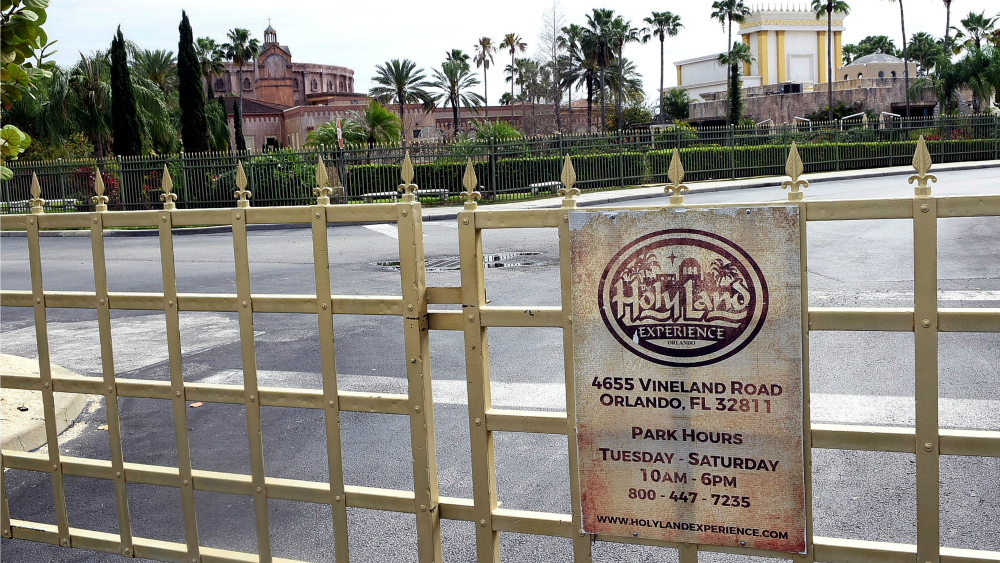
The Holy Land Experience Never Made It to the Financial Promised Land

After 20 years, the ambitious biblical theme park is closed for good.

Christianity Today August 10, 2021
Paul Hennessy/SOPA Images/LightRocket via Getty Images

The dream of a Bible theme park died in Florida last week, after 20 years of innovation and renovation—not to mention cash infusions, cost cuts, and rate hikes—failed to make the Holy Land Experience financially sustainable.

The 14-acre park was once conceived as Christian competition for Walt Disney World. Evangelical visionaries imagined a family entertainment experience that could pull at least a portion of Orlando’s annual visitors from the mouse’s magic kingdom to the kingdom of God.

But it never quite worked. The reenactments of resurrection, scale miniature model of first-century Jerusalem, animatronic John Wycliffe, and the Trin-i-tee mini golf course were never enough. While the “living biblical museum” attracted attention, controversy, and not a few visitors willing to pay the $17, then $29, and ultimately $50 ticket prices, the Holy Land Experience couldn’t find a firm financial footing.

For the last few years of its existence, it had annual operating deficits of about $5 million, with no one willing to step up to cover that as a ministry cost.

Religious anthropologist James Bielo, who studies places that “materialize the Bible,” said the Holy Land Experience was arguably the most famous of the biblical replicas in the US, even though it always struggled to survive.

“The ones that stay on the landscape are kind of the exception,” he said. “Holy Land recreations typically pop up in a kind of visionary fit. Someone gets excited, they pour a lot of resources into it, there’s a big opening, but in five, 10, 20 years, it’s gone.”

Bielo has cataloged about 50 parks that have ceased to exist, including a drive-through Bible garden, a Book of Job park, a “Golgotha Fun Park,” and a biblical history wax museum.

The Holy Land Experience came to an end on August 2, when it was sold to a Seventh-day Adventist health care company for $32 million. There is no indication the Adventists are interested in attempting their own version of a theme park.

AdventHealth has not announced specific plans for the site but said in an official statement it “will make a significant investment in redeveloping the property to bring enhanced health care services to the community.” The company currently runs 29 hospitals in Florida, as well as health care facilities in eight other states.

The Holy Land Experience started as the brainchild of Marvin Rosenthal, a Jewish convert and ordained Baptist minister who called himself a “Christian Hebrew.”

Rosenthal was raised in Philadelphia and converted to Christianity after his mother, who ran a candy store, started reading the New Testament. He saw her life transformed and wanted what she had.

After graduating from Philadelphia College of the Bible—now Cairn University—Rosenthal was ordained as a Baptist and started an independent ministry focused on end times theology and the need for Jews to accept Jesus.

In 1989, Rosenthal and his family moved to Florida and started the ministry Zion’s Hope. When Zion’s Hope sold some property to the state for the construction of a highway, Rosenthal was moved to invest the profits into a replication of the Holy Land, which would allow people to experience Israel as it was in Jesus’ time

“We hope all visitors will come and see the majesty of God. Or at least go home and dust off their Bibles,” Rosenthal told a Florida newspaper. “I’ve come to appreciate how helpful it is for people not only to read about some of the great truths of the Bible, but to see some of the great places, the environments, the sounds, the touches, the smells.”

The 14-acre park was building on a tradition of Holy Land recreations, according to Bielo. They come from a variety of Christian perspectives, with some more evangelistic and others more educational. The first in the US was built by liberal Christians in Chautauqua, New York, in 1874.

Other locations followed, from New Jersey to Arkansas to California, and there was something of a boom of Holy Land miniatures and roadside attractions with the expansion of car culture and summer road trips in the mid-20th century. There were at least 10 new biblical parks built in the 1950s, eight more in the ’60s, and another seven in the ’70s.

The Holy Land Experience was the first opened in the 21st century. Rosenthal, however, said the experience would take visitors out of time.

“They will leave the 21st century behind and embark on a journey that is unequalled anywhere in the world,” he told reporters in 2001. “It will be an experience that is educational, historical, theatrical, inspirational, and evangelical.”

The theme park cost $16 million to open, and Zion’s Hope contributed additional funds to cover expenses. Rosenthal estimated annual operating costs of more than $3 million and said he thought he needed 180,000 to 200,000 people paying a $17 cover charge (plus $5 for parking) to make ends meet.

The grand opening received national publicity—some generated by Jewish activists who said the Holy Land Experience was designed to covert Jews.

Irv Rubin, chair of the Jewish Defense League, compared the theme park to the Holocaust: “There are two ways you can murder Jews,” he told the media. “Physically, like Auschwitz, and spiritually, the way of Marvin Rosenthal.”

Rubin was arrested, a short time later, on charges that he conspired to bomb a mosque in California and the office of US Congressman Darrell Issa. (Rubin died by suicide in 2002 while awaiting trial in a Los Angeles prison.)

As the controversy over Rosenthal’s messianic Christianity faded, it was replaced by a clash over taxes.

Local authorities insisted the Holy Land Experience, as a theme park, should pay about $160,000 per year in taxes. Rosenthal and his attorney’s countered that it was a religious nonprofit and should be tax exempt.

The struggle continued in the courts until 2006 when then-Governor Jeb Bush signed a law that carved out an exemption for theme parks that displayed biblical manuscripts and waived admission at least one day a year. The Holy Land Experience, which had a special exhibit with a Gutenberg Bible, a replica of Pilgrim’s Progress author John Bunyan’s jail cell (with the original key), and an $80,000 animatronic Bible translator John Wycliffe, started offering free admission one or two days per year.

Despite the tax break, however, and about a quarter of a million annual visitors, the Holy Land Experience could not break even. It just cost more to run than Rosenthal calculated. By 2007, the park was $8 million in debt and required regular gifts from the family of Robert Van Kampen, the millionaire-investor-turned-Bible-collector who died in 1999.

The theme park was saved from its dire financial predicament by Trinity Broadcasting Network (TBN). Cofounders and televangelists Paul and Jan Crouch bought the Holy Land Experience in 2007. They planned to use it as a studio and a set for new television productions, promote the tourist attraction at little cost to Christians who watched TBN, and cut expenses to make the park financially sustainable.

In the first year, they laid off about a quarter of the staff and outsourced some of the more expensive maintenance, including cleaning and landscaping. They increased the number of visitors by about 25 percent, freshened up some of the attractions, and added new ones. Visitors could now get their picture taken so it looked like they were walking on water with an actor portraying Jesus. And they could play putt-putt around Bible-story dioramas at the mini golf course dubbed Trin-i-tee.

During the first TV show broadcast from the Holy Land Experience, Paul Crouch explained how it would be like a faith-based version of Universal Studios and called the theme park “our latest miracle.” Jan Crouch—who took on the day-to-day operation of the park as her personal project—cried with joy until her mascara ran.

Financially, however, the Holy Land Experience still required lots and lots of cash. In 2010, TBN put more than $40 million into it. In 2011, another $23 million. In 2012, TBN stopped raising money with telethons, after much criticism of the fundraising practice, and cut support to the theme park to about $2 million per year.

At the same time, ticket sales started falling. From a height of about 250,000 visitors, it dropped to 180,000 paying adults in 2013 and then just continued to decline. Tax records show nearly $9 million in ticket sales in 2014 dropped to $8.5 million the next year, and down to $7.1 million the year after that, when Jan Crouch died.

The park’s financial straits did not improve with new TBN management after the Crouches. Ticket sales dropped to $5.5 million in 2018 and then plummeted in 2020. Attendance was down by about 50 percent before COVID-19, and then the park was shut down by the pandemic.

“Orlando is a kind of fantasy heaven, where imaginative dreams become reality,” wrote Mark I. Pinsky, former reporter for the Orlando Sentinel. “Less well known is that Orlando is also a place where ambitious dreams sometimes die hard, especially when entertainment and Christian religion are combined.”

After 20 years of trying, the Holy Land Experience could not stop losing money. It could not find firm financial footing.

The Holy Land Experience had long been criticized for trivializing faith to appeal to the masses. Timothy Beal, author of Roadside Religion, said “the actual physical place lacked personality and soul.” Burke Long, author of Imagining the Holy Land, said the theme park was an example of “something deep in the American culture that prefers the fake to the authentic.”

But in the end, the Holy Land replica in Orlando wasn’t preferred by enough people to sustain the cost of the dream of a Bible-based theme park. In August 2021, it closed for good.

Books

Philip Yancey: My Benediction to the Beloved Storyteller, Walter Wangerin Jr.

A tribute to the late author of “The Book of the Dun Cow,” “Jesus: A Novel,” and “Water, Come Down!”

Christianity Today August 9, 2021
Wikimedia Commons

Last week, Walter Wangerin Jr. passed away, and a unique voice fell silent. His wife Thanne (short for Ruth Anne), his family, and a few close friends from Valparaiso University were with him when he died.

I first encountered Walter as a speaker at a conference in which we both participated. A slender man with a handsome, angular face and a shock of dark hair, he stalked the stage like a Shakespearean actor. I thought of the accounts of Charles Dickens sitting onstage in the great halls of England, reading his stories to a mesmerized audience.

Yet Wangerin was neither reading nor sitting. He was performing in the purest sense of the word, weaving stories and concepts together in erudite prose, directing our minds and emotions much as a conductor directs an orchestra’s sounds—now meditative and melodic, now electrifying and bombastic.

We got to know each other mainly through the Chrysostom Society, a group comprising 20 or so writers of faith. Walt usually sat quietly on the margins, stroking his then-shaven chin while observing everything around him with piercing blue eyes. He rarely showed emotion, and when he spoke, he acted as a peacemaker, calming the heated arguments that sometimes emerged from the gaggle of writers. A pastor by profession and calling, he seemed thrilled simply to be in the company of writers.

A few years before, he had written The Book of the Dun Cow. At the time, he was trying to support his family on the salary provided by his predominantly African American church, and his days were filled with counseling, parenting, social work, and the many tasks of an inner-city pastor.

To his surprise more than anyone’s, his first book won the National Book Award in the science fiction category, a prestigious award that propelled him into exalted company. The winners in other categories that year included Henry Kissinger, Tom Wolfe, John Irving, William Styron, and Madeleine L’Engle.

Walt and I became fast friends. I had been working in publishing for more than a decade, and he had many questions about the arcane world of editors, agents, and marketing. He wanted only to write, and had just resigned from the church in order to devote himself to the craft full time. I answered dozens of letters of anguish about the pressure he felt from publishers to modify his style. Editors drove him crazy. They urged him to streamline his “heightened prose” and adopt a more pragmatic tone. Walt would listen to their advice, agonize for weeks, and finally decide to ignore it.

No doubt, staying true to his principles cost Walt a broader readership. For example, his book As for Me and My House contains more helpful advice than a dozen others offering “ten steps for a better marriage.”

Yet he rightly refused to accommodate his natural style to the artificiality of self-help bromides. He chose to subsume some of his most powerful personal experiences into The Orphean Passages, knowing that many readers would miss the Greek myth’s overtones. And in private conversations, I heard from him chilling childhood stories that he declined to write about because of the pain it would cause family members.

Walt knew he was swimming against the tide. He spoke of the “cool pragmatism” of modern literary taste. He sought instead to draw the reader into another world, a suspension of disbelief carried more by music and lyricism than by sense and reason. He once told me in a letter that “a writer hopes for the obedience of a good reader who says, ‘I will enter this world a while, however different it is from my own more familiar expressions of truth.’”

Thousands and ultimately millions of readers responded. The late Eugene Peterson, sometimes called “the pastor’s pastor,” credited Wangerin’s first book with helping to clarify his understanding of the pastor’s life. The Book of the Dun Cow, a fantasy novel based loosely on a tale from Geoffrey Chaucer, stars a rooster and a basilisk, along with such supporting characters as a rat, a fox, a toad, and a melancholy dog.

Peterson explained that this unlikely tale diagnoses what’s wrong with modern culture, infected as it is by covert evils that also threaten to undermine the Christian community. Other pastors happily borrowed Wangerin’s stories from Ragman and Miz Lil and The Chronicles of Grace.

Early on, I found myself acting as a kind of guide as Walt confronted the burgeoning evangelical subculture. A lifelong Lutheran, he was accustomed to careful exposition and liturgical worship. I remember when he first heard Tony Campolo speak. He marveled “that a man can be so loud, so funny, and so angry, all at the same time.” Eventually, Walt himself became a prophetic voice to many evangelicals, a popular speaker and frequent interview subject.

Once, we spent a retreat weekend evaluating each other’s manuscripts. We took a break to hike the grounds of a conference center near Colorado Springs and suddenly found ourselves strolling in a meadow where grazed a herd of Rocky Mountain sheep. We stopped walking, so as not to scare them, and stood in silence for a few minutes, watching.

“Want to see a trick?” Walt whispered. “I can whistle at a frequency higher than the human ear can detect.”

I looked at him skeptically. “If I can’t hear it, how will I know?”

“Watch those sheep,” he replied. “I’ll start high and then work down to a frequency you can hear.” He pursed his lips and blew, and not a sound came out that I could detect. Instantly, though, the sheep halted their grazing and lifted their heads toward us, newly alert. A few seconds later, I heard his piercing whistle in a descending scale.

That image has stayed with me, for as I review the shelf full of books written by my friend, I realize that he both heard and wrote in unique ways. I learned to be gentle with my own editorial suggestions for Walt. “The horns of a snail retract at a touch,” he once wrote me. He worried over his books as he worried over his children. Words were to him a sacred offering, given in response to a prompting others did not perceive and sometimes did not understand.

As both a sermonizer and an artist, with graduate degrees in theology and English, Walt lived with the constant tension of how best to express themes of grace and the Cross. As a pastor, he found that story conveys truth most effectively and profoundly. As he told one interviewer, “While the intellect must be addressed in communicating Christian truth, it will not be truth for the hearer until the hearer is also touched deep within himself or herself.”

Although Walt had a mystical, otherworldly side, he nevertheless lived in the mess of human experience. As a child, he endured abuse, including when his mother carried through on a threat to put him in a garbage bag and leave him beside the curb for the garbage truck. A neighbor, who observed squirming motions in the black plastic bag, liberated him.

In academic days, he joined a protest movement that formed a breakaway seminary-in-exile. In his 20s, he led a church congregation with a different racial and social makeup than any he had known. He chaired committee meetings, ministered to street people, negotiated a racially blended family, and taught Bible and literature to cynical undergraduates. On a whim, he bought a farm, where he spent many hours repairing fences, mowing grass, and building a writing retreat reachable only by a trek on wooden planks across muddy fields. Each of these experiences found their way into his self-revealing books.

After the success of his early books, Wangerin was invited to speak on university campuses. He discovered that when he went as a pastor, the left-brained, conceptual approach failed to hold attention. Students assumed he was putting boundaries on reality, not imparting it. On the other hand, when he went as a storyteller, he could function as a kind of priest. “Tell us a story,” they said, and sat down like children. By drawing on his immersion in raw humanity, he could mediate the bewilderment they felt about the adult world they would soon enter.

“If I go as a writer,” he explained, “they assume that I’ve gone through all the torments, all the anguish a prophet should go through and, I mean, I’ve suffered. And not only have I suffered, but I’ve survived in order to write, and I’ve come to some sense of hope, because writing is always putting disorder into order.”

I recently came across one letter that Walt wrote me from Cameroon in 1995. In his vivid prose, he described an appalling sight: two black birds perched on the haunch of a donkey, pecking at an open wound. The African driver of his car yearned for a gun to put the animal out of its misery.

Three days later, returning down the same road, they saw the donkey lying on the ground, now with five birds, their beaks bloody red, pecking away at muscle tissue. Walt despised those birds and pitied the poor donkey—until later he learned the truth. The birds were oxpeckers, born with crimson beaks. Far from hurting the beast, they were cleansing its wound of the maggots breeding there. They were, in fact, saving the donkey’s life. A few days later the donkey was standing again, scarred but alive.

I see a parallel in Wangerin’s work. Some have accused him of writing in a tone of morosity. He wrote of child abuse, and the murderous Saint Julian, and a deluded rooster, and a collapsed Native American culture, and the Passion of Jesus, and The Book of Sorrows. He wrote, in other words, of the reality of our fallen planet in all its brokenness. Truth hurts. Yet it also heals. As a pastor, Walt wrote to heal, to attempt to put disorder into order.

Almost every year, Walt sent me at least one new manuscript or completed book. He authored more than 40 books—including 13 children’s books—as well as books about prayer, marriage, grief, and childhood. He experimented with poetry, plays, sermons, memoirs, a mass, and meditations on Christmas, Easter, and the Passion—oh yes, and also narrative retellings of Jesus, Paul, and the entire Bible.

In his spare time, he taught literature and theology at the University of Evansville and Valparaiso University, penned a weekly newspaper column, and hosted an evening radio show, all while traveling widely as a speaker and helping rear two birth children and two adopted children.

I often wondered at his manic output. And then in January 2006, I received a letter that began,

To tell it to you in story form:

On December 26, while grocery shopping with my granddaughter Cassindra, I reached to touch my neck, just above the left clavicle bone, and found a good-sized mass, some four inches long and deeper under the bone than I could feel. Within two hours, our family physician was examining the mass. … I went almost immediately for both a CAT scan and an X-ray.

Fortunately, all of our children and all of their children were visiting us for Christmas. On Wednesday night of Christmas Week, Thanne and I told our four kids and their sweethearts, darlings, honeys what we had come to know at that point.

Like everything else in Walt’s life, the ordeal with cancer made it into a book, Letters from the Land of Cancer. A biopsy performed on Epiphany revealed metastatic cancer, detected in the lymph nodes but spread from a primary site in his lungs.

His life hung in the balance. Over the next few months, he received the lifetime maximum of radiation, along with chemotherapy five days a week. “I promise you, I am at peace,” he insisted. “We have a wonderful community surrounding us here in Valparaiso, both the town and the University. And my faith, despite so much that I do not know, looks forward to the kingdom.”

In 23 letters, Walt chronicled the stages of his ordeal. The meetings with oncologists. The pain. The surgeries. The sleepless nights. He faced the prospect of death every day. His world shrank. Trips were canceled, and he couldn’t walk a hundred feet without gasping for breath.

I visited Walt at one of the lowest points. He was hairless—“no eyelashes, whiskers, hairs on the backs of my toes, not even in my ears and nose,” he said. He dragged an oxygen cylinder behind him “like an obedient puppy,” in the words of his friend Luci Shaw. Even so, he had to stop every few feet to catch his breath, which seemed to keep running away from him.

He spoke of the losses: missing the premiere of an off-Broadway production of Dun Cow, the ability to sing in church, a recent decision to leave the beloved farm and find a simple house in town. In his immunocompromised state, he had to avoid human touch, even a hug or a handshake.

Meanwhile, Walt studied classics on “the art of dying” and took their wisdom to heart. Lutheran guilt surged up. He had, after all, smoked a pipe for years—could that have precipitated the cancer? Along with many others, I received letters from him apologizing for some slight misunderstanding, wondering what amends he should make.

“I beg God that I might do this thing with grace and gracefully, no matter its length or its ending,” he wrote. “I want to get good at old. Spiritually to approach my losses with the same craft and talent and devotion with which I approach a novel, a poem, a sermon.” He went on to say:

It is often said that once one confronts death, he/she changes, thereafter living every day to the fullest. Every moment becomes its own lifetime. A sort of intense awareness of the present is implied. And I do believe that this happens.

The less time the individual is allowed to presume to follow the present moment, the more important becomes the present moment. The days become, accordingly, more important in themselves.

But however short or long my personal hereafter, a year, a half year, the time present has remained for me what it always was: an opportunity to pay attention.

Pay attention he did. His letters dissect every mood, every jolt of pain or fear, every sign of the changing seasons outside his home.

I saw him just after the chemotherapy—“naked as a baby rat,” in his words— wheezing as he walked me a few yards to my car. “My body is weak, but my mind is fine,” he assured me. Later, he confessed in a letter, “Most of my career I’ve been a breathless kid, rushing things to publication before they were really ready, and now I’m sorry about that. Too messy and too stupid.” He returned to some of his major works and made extensive revisions. He sought to clean up his legacy, with books that yield artistic pleasure as well as joy.

As it happened, Walt lived in the land of cancer for more than 15 years. New books kept appearing under his name. His hair grew back, which he celebrated by letting it grow long, with a grey moustache, beard, and ponytail. He took on the post of writer in residence at Valparaiso. On special occasions, he would conserve energy to deliver an address to an always-packed chapel.

On August 5, after 77 years on earth, his body finally succumbed.

Knowing the man and his story, including parts of it he never published, I want to give him a kind of benediction. I want to say, “Walt, like Saint Julian, like the rooster Chauntecleer, you have been through the silent passage—a time when God was not speaking. You have plumbed the depths, falling to the very bottom. And there you have tasted grace. You have found The Story at the foundation of the universe, that by his wounds we are healed. And you have faithfully and artfully passed it on. Rest content, dear Walter. You have given us a well-crafted life. Because you paid attention, so can we.”

Philip Yancey is the author of numerous books, including the forthcoming Where the Light Fell: A Memoir (Convergent Books, October 2021). Portions of this tribute were adapted from Songs from the Silent Passage: Essays on the Works of Walter Wangerin, Jr. (Rabbit Room Press, 2021). Published with permission.

News

Korean Missionaries Gather to Exhort the Next Generation and North Korea

More than 700 participate in first Korean World Missionary Fellowship convocation to be held within Korea.

Participants at the Korean World Missionary Fellowship convocation at Handong Global University in July 2021.

Participants at the Korean World Missionary Fellowship convocation at Handong Global University in July 2021.

Christianity Today August 9, 2021
Courtesy of HGU

Long before K-pop swept the world, South Korean missionaries traversed it.

More than 20,000 missionaries belong to the Korean World Missionary Fellowship (KWMF), which last month held its first convocation hosted in Korea after decades of convening in the United States.

Despite the pandemic postponing the quadrennial event, the hybrid gathering cohosted by evangelical Handong Global University in the port city of Pohang drew 300 missionaries in-person and 400 virtually from 75 nations.

There was a tone of urgency among senior missionaries at the decline of a Korean missions movement that once sent the second-highest number of missionaries in the world. “We need to view our mission with a new perspective and engage in our work with more diverse approaches,” KWMF Chairman Choi Keun-bong, who has worked as a missionary in Kyrgyzstan for 28 years, told CTS News. “If we do not do so, we may enter a time when it would be hard for missions to survive.”

The three-day convocation, served by 300 mostly student volunteers, featured numerous panels and workshops on Korean missions as well as opportunities for fellowship. The days were long, kicking off with revival prayer meetings at 6:30 a.m. and wrapping up with worship services at 10 p.m.

Among the key themes of the convocation were North Korea, generational transition, and educational ministry. On the last day, the three came together in the Pohang Statement, translated from Korean into English, Spanish, and Chinese [further explained here].

For the first time in its history, the KWMF published a code of ethics for missionaries and a public call to emancipate from North Korea six South Korean Christians currently held captive from four to eight years [see sidebar below].

“We declare, as Korean missionaries, that we have the special duty and calling to bring forth reconciliation and evangelization in the Korean Peninsula,” the group stated. “We call for the protection and release of the unduly detained Christian workers in North Korea.”

Although Pyongyang—once called the Jerusalem of the East—seems impervious to foreigners today, Handong awarded an honorary doctorate to an Egyptian Coptic Christian businessman during the convocation partly to help liberate the detained Christians.

Orascom CEO Naguib Sawiris lifts up Romans 8:31 (“If God is for us, who can be against us”) as his favorite Bible verse, and the billionaire has invested $250 million in North Korea to provide telecommunications services to its six million citizens. “It is my faith in God that is the source of my courage,” he told the Handong community in an interview, and he committed to strive for the release of the six detained Christians.

The other recipient of a Handong honorary doctorate at the KWMF event was Reuben Torrey IV, who was recognized for his American family’s four generations of missionary service in East Asia.

The patriarch, R. A. Torrey, was a superintendent of Moody Bible Institute who led revivals in China and Japan in the first decade of the 1900s. His son, R. A. Torrey II, became a missionary in China, where R. A. Torrey III was born. Torrey III grew up in Pyongyang, helped re-establish Anglican Sungkonghoe University in Korea, and founded Jesus Abbey in the eastern mountains of Korea in 1965.

Torrey IV continues to serve at Jesus Abbey, which has become a vibrant ecumenical community visited by some 10,000 Christians every year.

“We awarded the Torrey family with the hope that Korean missionary families would also serve multiple generations,” said Won Jae-chun, professor of law at Handong and an organizer of the convocation. “Most Korean missionaries are in their 50s and 60s now, and the number of missionaries under 40 are shrinking. They are praying for not only their children, but the next generation of missionaries.”

South Korea has long sent the most number of missionaries after the US—an impressive feat for a young nation of 52 million whose Christians numbered less than 1 percent of the population in 1900. But during the past decade, its number of missionaries has been surpassed by larger nations such as Brazil and China. The KWMF convocation regularly discussed this “inflection point” in Korean mission history.

“Handong has a thousand children of missionaries as students,” university president Chang Soon-heung told CTS News. “We hope that young people would gain a new heart for mission after this convocation.”

The gathering provided an opportunity not only for Handong students and other volunteers to learn from the participating missionaries, all of whom had served for at least five years, but also for the missionaries to replenish themselves and receive the support they sometimes lack in their mission fields.

“During the last evening’s worship, I felt the presence of the Holy Spirit and sensed that sovereign God would use this convocation as an inflection point for a new era of mission,” said Jang Ho-jin, a graduating student at Handong International Law School who volunteered as a vocalist with the law school’s praise band. “Children danced to our songs on stage, and missionaries of all age sang and danced together which made us feel united as one.”

For four months leading up to the convocation, Handong surveyed Korean missionaries to explore the myriad challenges they face. About 60 percent of the 300 respondents stated they are in need of psychotherapy or counseling; 70 percent had encountered legal problems in their mission field; and 90 percent did not have a retirement plan. In response, Handong offered counseling and legal support booths throughout the convocation, and announced a plan to build a residential community for retired missionaries next to its campus.

The last KWMF convocation, which gathered 971 missionaries and 4,500 clergy and lay participants, was hosted in 2016 at Azusa Pacific University in California after the first seven convocations took place at Wheaton College in Illinois, beginning in 1988. The location of the next convocation is still undecided.

“If I were the president of Wheaton or Azusa, I’d want to host the next KWMF convocation as it was such a gem and a blessing,” said Won. “This convocation will be relevant not only for Korean mission, but also for world mission as we innovate on what we have learned from Western missionaries to move from ‘West to the rest’ evangelism to ‘[global] South-to-South’ cooperation.”

The KWMF convocation was welcomed by leading pastors and seminary presidents in Korea. Leaders at Yoido Full Gospel Church, the world’s largest congregation, and at Soongsil University and Presbyterian University and Theological Seminary, founded by American missionaries more than a century ago, were among the two dozen Christian leaders who sent congratulatory videos.

“In the past century, the Korean church has been indebted to the Western churches for the gospel,” said Sarang Community Church senior pastor Oh Jung-hyun. “During the next century, the Korean church should pay back the debt of gospel to the world churches.”

“I believe that the mission work will not diminish after the pandemic,” said Onnuri Church senior pastor Lee Jae-hoon, whose church came to the rescue of Handong when the university founded in 1994 faced financial challenges during its early years. “With God’s wisdom beyond our imagination, we will be better equipped for the commission to witness the gospel.”

Profiles of the six South Korean Christians detained in North Korea and advocated for by KWMF (provided by HGU):


Three South Korean missionaries:

1) Kim Kook-kie: Pastor detained since October 2014 for carrying out a ministry helping North Koreans,

kotjebi

(North Korean street children), and Korean-Chinese with various medical supplies, clothes, and farm machinery since 2003.

2) Choi Chun-kil: Pastor arrested and detained since December 2014 and sentenced to “indefinite compulsory labor” in June 2015. Official reason for his detainment is “anti-DPRK espionage activities under the manipulation of the US and puppet South Korea.”

3) Kim, Jung-wook: Pastor arrested and detained since October 2013 and sentenced for life in 2014, for establishing a noodle company which ran humanitarian aid projects and a North Korean ministry in Dandung, China, that offered food, medicine, and shelter.

The official reason for the detainment of each is “anti-DPRK espionage activities under the manipulation of the US and puppet South Korea.”

Three South Korean Christian workers who are all former North Korean refugees:

4) Ko Hyon-chol: Arrested in May 2016 while crossing the Amnok River to help orphan girls escape from North Korea to an island located near the river. Current status unknown.

5) Kim Won-ho: Abducted on the Chinese side of the border in March 2016. Current status unknown.

6) Ham Jin-woo: A reporter abducted in May 2017 while reporting on the Chinese side of the China-North Korea border between Sanhe and Longjin. Before he fled North Korea, he worked in its General Bureau of Reconnaissance managing intelligence operations targeting South Korea and Japan. He obtained South Korean citizenship in 2011 and worked as a reporter at Daily NK, a South Korean media outlet which specializes in North Korean news. He also helped missionaries that helped North Korean people. Current status unknown.

Correction: An earlier version of this article inaccurately stated Jesus Abbey is located in the western mountains of South Korea. The abbey is located in the eastern mountains.

Theology

The Olympics Are About Failure

Olympic dreams inspire countless millions to pursue goals they’ll never achieve. Here’s why that’s a good thing.

Christianity Today August 6, 2021
Dean Mouhtaropoulos / Getty Images

I still remember how it felt when I first saw it. The year was 1984, and the Olympics were held in Los Angeles. Families around the globe gathered around their glowing televisions as stories of striving and victory flooded into their living rooms.

I was eight years old, and enraptured. The torch relay, the opening ceremonies, the extraordinary accomplishments of Carl Lewis and Edwin Moses and Mary Lou Retton, and the succession of medal ceremonies where the American flag unfurled and tear-stricken athletes sang our national anthem—all captivated me. Most captivating of all was the men’s gymnastics team winning the gold medal. My soul was elevated.

Perhaps you’ve seen a seagull on a pier over the ocean. When the wind is right, the bird has only to stretch out its wings and it will rise on the streams of the air. That’s the way it felt. It was a dream and a yearning and a flight of the soul all at once.

That yearning set the spheres of my life in motion. It inspired me to begin a career in gymnastics. It filled my mind with brilliant images when I lay down to sleep. It sustained me through countless hours of training and an excruciating series of injuries. It took me all around the country and even over the oceans, as I became a junior national all-around champion and member of the national team. It even took me to a college I could never have afforded otherwise, and an NCAA championship in my freshman year at Stanford University.

Then it came crashing down. A few months before the Olympic Trials in 1996, I fell from the horizontal bar and broke my neck. In a blink, my gymnastics career ended in failure and a lifelong sentence of spinal damage and chronic pain.

As a person of faith, I believe that history is filled with the purposes of God. The universe is rich with intention and permeated with meaning. As the psalmist writes, “All the days ordained for me were written in your book before one of them came to be.” (Ps. 139:16). Which begs the question: What was the point? What was the purpose of those thousands of hours of training and hardship if it was only to end in injury and disappointment? Where was the meaning in that?

The same question has come to mind as I have watched the Tokyo Olympics on television. Again we see stories of victory in the face of impossible odds. Yet we see more stories of failure. Many athletes see their stories lose the plot. Injuries and circumstances intervene. Athletes who were expected to win, even dominate, come up short. And if it sounds harsh to call these things “failures,” then perhaps we have not recognized what a friend failure can be.

The Olympics, in fact, are all about failure. They certainly inspire enormous amounts of it.

The vast majority of athletes who go to the Olympics will not win a medal at all, much less a gold medal. Many of those who do win a gold medal in one event will also fall short in others. Then, of course, the overwhelming majority who strive to make the Olympic team in the first place fail to do so.

Take women’s gymnastics. In America alone, millions of girls participate in gymnastics and tens of thousands compete in any given year. Every four years, six at most will make the Olympic team. If one million girls watch Simone Biles or Suni Lee and enroll in gymnastics classes with Olympic dreams in their hearts, perhaps 999,999 will fail to achieve that dream.

Of course, there are smaller victories on the path. But even that one gymnast in a million who achieves her dream of making the Olympic team will become intimately familiar with failure. Learning new skills and new routines requires countless failures along the way. Even a gymnast as dominant as Biles will press through a seemingly endless succession of failures—and then when she makes the Olympics, her story will likely be complex. Every gymnast on the United States team endured her share of successes and failures. Jade Carey was weeping one night and draped in gold on another.

The point is not to criticize the athletes. The point is that failure is essential to the athletic life. The Olympic dream animates tens and perhaps hundreds of millions around the globe to pursue dreams they will never achieve—but in striving for those dreams, if they are lucky, they become more of who they were meant to be.

I’ve asked numerous Olympic athletes about their experiences. One thing they agree on was that it was never really about the Olympic Games themselves. It was about the people they became in striving for excellence. It was, in large measure, about what failure made them. Victory, when it came at all, was treacherous. It threatened to unmake what failure had made. Victory is more dangerous for the soul, defeat more instructive.

This is not simply the secular aphorism that failure makes us stronger. It doesn’t always do so. Some failures are so devastating or so complete that it may be hard to find a redemptive arc. Some failures make us bitter rather than better.

When we’re willing to learn from its instruction, however, failure can be the best thing that ever happened to us. The Bible is rife with stories of failure. Could Abraham and Moses have become exemplars of faith if they had not failed? Could David have written his psalms? The Teacher in Ecclesiastes tried to find meaning in the pursuits of the world, and we are blessed by the wisdom he gained through failure. Would Peter and Paul have become supple instruments in the hands of God if they had not been humbled by their failures?

In retrospect, I can see it. Failure—the failures I endured all along the way as well as the failure to make the Olympic team due to injury—has shaped me so profoundly that I hardly know who I would be apart from it. It showed me the end of myself. It taught me compassion. It showed me my many sins and flaws. It showed me my need for a strength beyond my own. It illuminated the grace of God. In some respects, the Olympic dream plays a role similar to the Law (Rom. 3:20; 7:7). As an ideal of perfection, it inspires striving, failure, and ultimately the acknowledgement of our own shortcomings and our utter dependence on God.

As with other athletes, those who make the Olympics and those who do not, the purpose of my gymnastics career was never to purchase a few shining moments of gold-medal glory, but to prepare me for the rest of my life. It was never about making me a champion. It was about making me an instrument.

After my career ended, an older gymnast told me, “You learned how to excel at one thing. Now take everything you learned and excel at something else.” It seemed like helpful counsel, and perhaps it was what I needed to hear at the time. But I was not yet ready to leave behind the cult of victory.

Now, 25 years later, with the perspective that offers, I would put it differently. To athletes and all of us who experience failure and disappointment, I would say this: You have learned how to fail in fellowship with God. Now go and fail again and greet your failure as a friend. For your failure will refine you, if you let it. It will shape you more and more into the likeness of Christ. And in becoming like Christ, you become an instrument for his glory and for the good of the world.

Timothy Dalrymple is president and CEO of Christianity Today. Follow him on Twitter @TimDalrymple_.

News

Football Player Sues RZIM Claiming Misuse of Funds

Class action alleges apologetics organization misrepresented the ministry and “bilked” faithful Christian donors.

Christianity Today August 5, 2021
Tim Warner / Getty Images

An NFL football player and his wife are suing Ravi Zacharias International Ministries (RZIM), claiming the world’s largest apologetics ministry “deceived faithful Christians” and “bilked tens—if not hundreds—of millions of dollars from well-meaning donors.”

Derek Carrier, a tight end for the Las Vegas Raiders, and his wife Dora Carrier were regular listeners to RZIM podcasts and gave the ministry $30,000 in January 2020.

They supported RZIM’s mission to “touch both the heart and the intellect of the thinkers and opinion-makers of society with the truth of the gospel” and trusted the integrity of the ministry’s leadership. They didn’t know that Zacharias had owned multiple spas where he sexually abused employees and had been credibly accused of preying on women in multiple countries.

Now the Carriers say they believe Zacharias and the leadership of RZIM “misrepresented the true nature of their ministry and the use of funds donated in support of their stated purpose.” Ravi Zacharias’s estate, administered by his widow Margaret, is also named as a defendent.

The lawsuit, filed in Atlanta on Thursday, asks the federal court to certify the Carriers as representatives of a class of donors harmed by RZIM. According to their lawyers, the class would include people like the Carriers who gave large sums to support apologetics, but also donors who gave $5, $10, or $100.

“I would imagine the vast majority of donors gave under $100,” Kim Johnson, an attorney representing the Carriers, told CT. “Nobody is going to file a claim for $100. Nobody can bear the costs of going to court for such a small amount. A class action allows us to represent all the donors and hold this ministry accountable for what was really a sham.”

Sarah Davis, who replaced her father as head of RZIM a few months before he died in 2020, did not immediately return CT’s request for comment.

In March 2021, after releasing a report on the investigation confirming Zacharias’ history of sexual abuse, Davis announced that RZIM would reorganize as a grant-giving ministry, distributing funds to other groups focused on defending the truth of the gospel and caring for victims of sexual abuse. The RZIM board released a statement apologizing to donors and others for failing to “ensure the accountability of Ravi Zacharias.”

According to the independent investigation paid for by RZIM, Zacharias used tens of thousands of dollars of ministry funds dedicated to a “humanitarian effort” to pay four massage therapists. One of the women said after she received the financial support, Zacharias demanded sex.

The ministry has an estimated $30-$45 million but has not reported donations to the Internal Revenue Service since it reclassified itself as a church in 2015. At the time, it was receiving about $25 million in gifts annually.

RZIM and Ravi Zacharias’s estate will have the opportunity to file motions to dismiss the class action suit. If the case goes forward, the court will consider whether there is a legally acceptable class of plaintiffs and start the discovery process.

The Carriers are seeking a jury trial and asking for compensatory, consequential, and punitive damages.

The Nevada-based Christian couple became supporters of RZIM after years of listening to the ministry’s podcasts, including the daily program “Just Thinking” and the weekly “Let My People Think.” In November 2019, they heard Zacharias asking for $300,000. He explained the ministry, with 93 speakers in 15 countries, required donor support.

“If you seek the mind of the Lord and ask him what he will have you give, I am sure we can meet that goal,” Zacharias said. “Without givers like you, our ministry would not be able to continue reaching those around the globe with the gospel.”

Zacharias was stepping down from leadership at that time but assured podcast listeners that the work would continue with their support.

The Carriers prayed about it, and decided to give part of their tithe to the ministry. They sent their $30,000 gift at the start of the year.

Derek Carrier has been outspoken about his faith on and off the football field, frequently sharing his testimony and telling groups of teens why he believes faith and family are greater than football.

“I do everything as if it’s worship,” he once told his hometown California newspaper. “At the end of the day, I kind of just leave it and say, ‘Whatever the outcome is, your will be done, not mine.’”

addApple PodcastsDown ArrowDown ArrowDown Arrowarrow_left_altLeft ArrowLeft ArrowRight ArrowRight ArrowRight Arrowarrow_up_altUp ArrowUp ArrowAvailable at Amazoncaret-downCloseCloseellipseEmailEmailExpandExpandExternalExternalFacebookfacebook-squarefolderGiftGiftGooglegoogleGoogle KeephamburgerInstagraminstagram-squareLinkLinklinkedin-squareListenListenListenChristianity TodayCT Creative Studio Logologo_orgMegaphoneMenuMenupausePinterestPlayPlayPocketPodcastprintremoveRSSRSSSaveSavesaveSearchSearchsearchSpotifyStitcherTelegramTable of ContentsTable of Contentstwitter-squareWhatsAppXYouTubeYouTube