News

ISIS Executes Christian Businessman Kidnapped in Egypt’s Sinai

Family mourn yet celebrate martyrdom of Coptic grandfather who financed the only church in his city, so as to build “a home in heaven.”

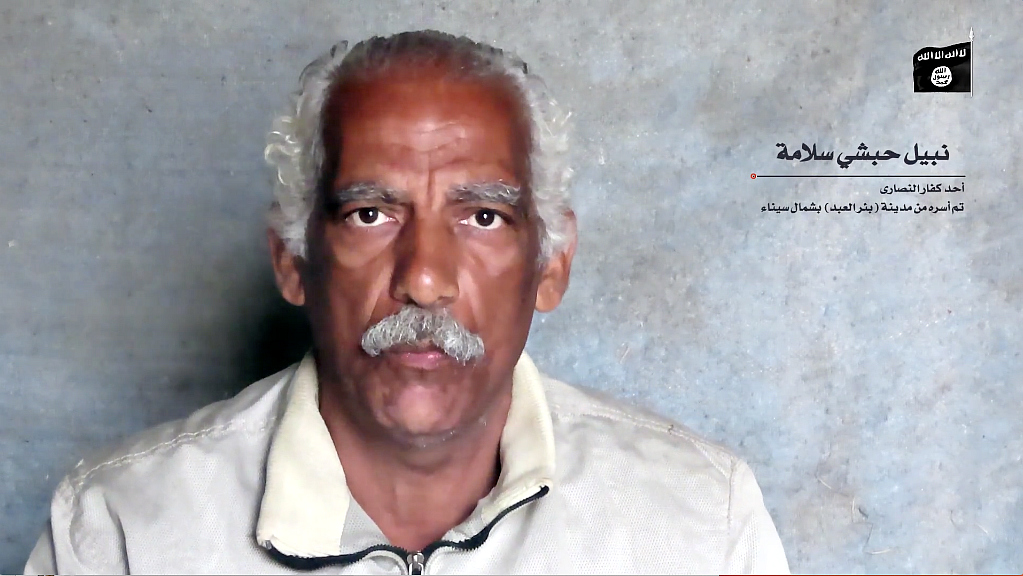
Nabil Habashi Salama, a Coptic Christian kidnapped from Bir al-Abd in North Sinai, speaks before his execution in the propaganda video of an Egyptian ISIS affiliate.

Nabil Habashi Salama, a Coptic Christian kidnapped from Bir al-Abd in North Sinai, speaks before his execution in the propaganda video of an Egyptian ISIS affiliate.

Christianity Today April 19, 2021
Wilayat Sinai / Telegram screenshot by Christianity Today

The Islamic State has claimed another Christian victim.

And Egypt’s Coptic Orthodox Church has won another martyr.

“We are telling our kids that their grandfather is now a saint in the highest places of heaven,” stated Peter Salama of his 62-year-old father, Nabil Habashi Salama, executed by the ISIS affiliate in north Sinai.

“We are so joyful for him.”

The Salamas are known as one of the oldest Coptic families in Bir al-Abd on the Mediterranean coast of the Sinai Peninsula. Nabil was a jeweler, owning also mobile phone and clothing shops in the area.

Peter said ISIS targeted his father for his share in building the city’s St. Mary Church.

In a newly released 13-minute propaganda video entitled The Makers of Slaughter (or Epic Battles), a militant quotes the Quran to demand the humiliation of Christians and their willing payment of jizya—a tax to ensure their protection.
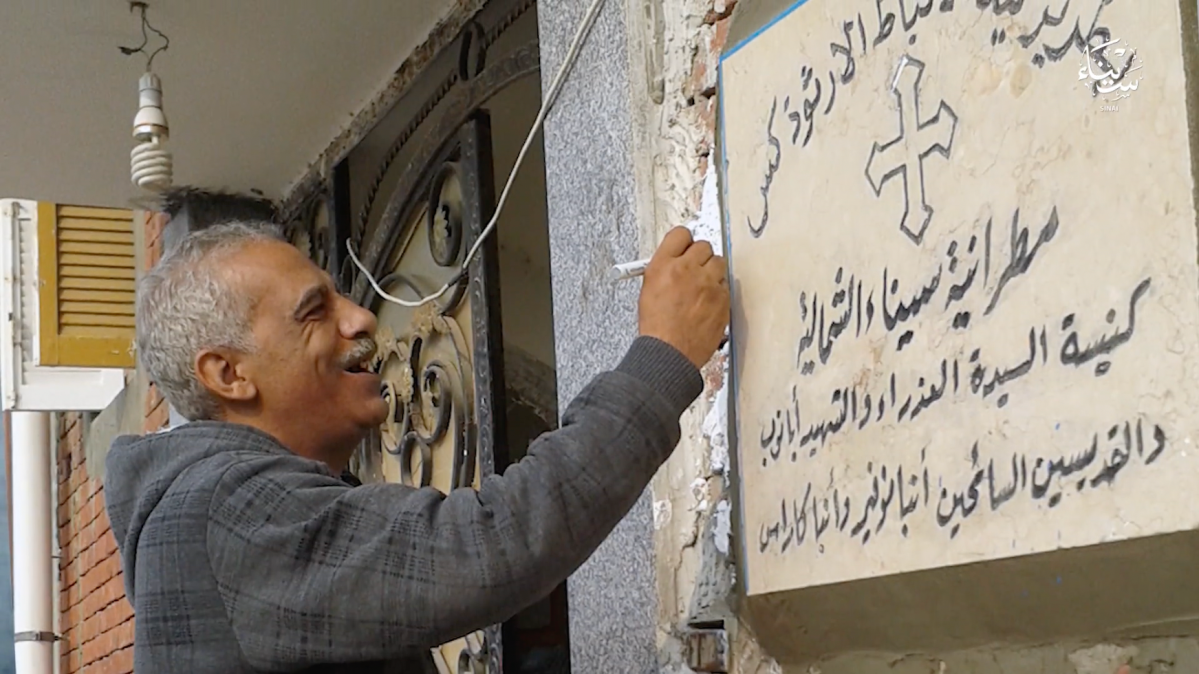
Nabil Habashi Salama at his Coptic Orthodox church, The Church of St. Mary, St. Abanoub, and St. Karas, in Bir al-Abd, North Sinai, Egypt.

Nabil was kidnapped five months ago in front of his home. Eyewitnesses said during his resistance he was beaten badly before being thrown into a stolen car. It may be that these were separate kidnappers, because in the video that shows Nabil’s execution, he said he was held captive by ISIS for 3 months and 11 days.

On April 18, he was shot in the back of the head, kneeling.

“As you kill, you will be killed,” states the video, directed to “all the crusaders in the world.”

It addresses all of Egypt’s Christians, warning them to put no faith in the army. And Muslims which support the Egyptian state are called “apostates.” Two other Sinai residents—tribesmen who cooperated with the military—are also executed in the video.

Peter Salama said that in the effort to drive Nabil from his faith, his teeth were broken.

Nabil’s daughter Marina joined in the tribute.

“I will miss you, my father,” she wrote on Facebook. “You made us proud during your life with your virtues, and in your martyrdom with your strong faith.”

The Coptic Orthodox Church issued an official statement, calling Nabil “a faithful son and servant” who “adhered to his religion until death.”

It then reiterated support for the Egyptian army and state. Such acts, it stated, will “only raise our determination … to preserve our precious national unity.”

Earlier this month Egypt announced an additional 82 churches had been legalized, increasing the total to 1,882 since a corrective law was passed in 2016.

Three militants have been killed, with three others being pursued, stated the Ministry of Interior today, which referred to Nabil as a “citizen.”

But the video and execution raise fears of renewed ISIS activity after a relatively long period of quiet. In 2017, the affiliate opened fire on Muslims praying in a Bir al-Abd mosque, killing over 300 in the deadliest terrorist attack in modern Egyptian history.

That same year, they also targeted Christians living in nearby Arish, driving over 100 families from their homes.

Since then, the Egyptian army launched a massive campaign to defeat the local ISIS branch, which has never managed to seize and hold territory. In 2018, state security announced that over 900 militants were killed.

https://datawrapper.dwcdn.net/v8V2a

In 2019, Christian families slowly began to return, though no hard numbers were available at the time of publishing. In 2012, Coptic Orthodox Bishop Cosman stated there were 740 Christian families in his North Sinai diocese. But prior to the exodus, church officials stated the total was down to only 160.

Today, the women wear head coverings so as not to stand out as Christians. After informing authorities of a ransom demand of $318,000 (the Associated Press reports $127,000), Peter said, state security told him and his family to relocate for safety.

“We live in ruins after closing our means of subsistence,” he told the Coptic publication Watani.

Two other Copts, kidnapped in Sinai last year, were recently released after the payment of ransom.

“President Sisi has been personally committed to promoting peaceful co-existence between Christians and Muslims in Egypt, and his government has taken some encouraging steps,” stated Mervyn Thomas, president of Christian Solidarity Worldwide, offering his condolences to the Salama family.

“[But] abductions … highlight that far more must be done to uproot sectarianism, protect vulnerable communities, promote social cohesion, and uphold fundamental human rights for all Egyptians.”

Meanwhile, the president of the Protestant Churches of Egypt echoed the sentiments of the Coptic Orthodox.

“Together with the Egyptian state, we face all challenges and evils with zeal,” Andrea Zaki told CT, “and we always and forever affirm our authentic Egyptian unity.”

Peter Salama, however, focused on eternity.

“Do not think that I am building this church for here,” he recalled his father Nabil saying. “I am building for myself a home in heaven.”

And it was this peace that allowed Nabil to tell his son prior to his execution, while under the duress of his captors:

“All is fine, thank God.”

News

Ashes to Ashes: How St. Vincent Churches Keep Hope After Recent Volcanic Eruption

Water and supplies from ministry partners represent the gospel in action during the biggest disaster on the island in a generation.

Christianity Today April 19, 2021
Orvil Samuel / AP

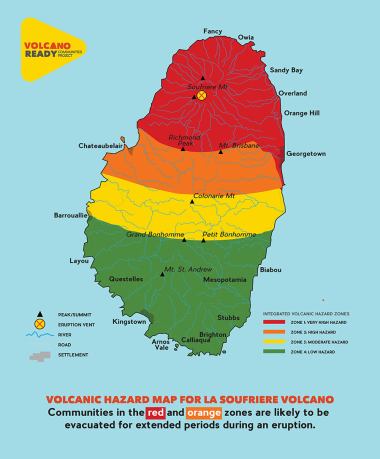
Christians on the Caribbean island of St. Vincent made their way through ash-covered streets and poor air conditions to attend church Sunday for the first time since the eruption of the La Soufrière volcano more than a week before.

Over the past week, ministry leaders worked together to organize resources and care for those displaced by the disaster. Around 20,000 people have evacuated from their homes in the northern areas closest to the explosions, which could continue for weeks.

Many churches remain closed, and several church buildings in the region near the volcano—including a Baptist and a Pentecostal sanctuary—were destroyed when their roofs collapsed under the weight of a foot or two of fallen ash. But in the “green zones” to the south, church leaders were able to spend a couple hours together in worship.

Pastor Kelron Harry gathered with Arnos Vale Church of the Nazarene, a congregation of 190 people. Harry, the district superintendent for the Nazarenes, has spent every day since the eruption messaging fellow denominational and ministry leaders and helping with relief efforts.

They update each other on the safety of their members, receive donations at the ports, and coordinate to get supplies and water to not only the 3,000 people in shelters but to the majority of evacuees who are staying with friends and family. Churches are also preparing and serving meals for the displaced.

Few court cases have aroused more concern among evangelicals—or created more puzzlement—than the recent creation-science case in Little Rock, Arkansas. At stake were basic values to which the fundamentalist-evangelical community is deeply committed. The evangelical will lay down his life in defense of freedom of religion, and for most evangelicals, this includes the right to determine the education of his children. He knows that in many public schools, evolution is taught explicitly as the rational alternative to the biblical teaching about creation held by uneducated fundamentalists!All evangelicals resent this. It is a violation of their constitutional right to the free exercise of their religion. They will make laws to secure their rights, and they will battle them through the courts and beyond. Eventually they will win—if America is to remain a free nation.But evangelicals are equally committed against any infringement of the religious rights of others. For conscience’ sake they support separation of church and state and reject the establishment of any particular religion, including their own.Evangelicals are divided over whether or not to support the Arkansas law. Here you can read how two conservative evangelicals sorted out the issues.—Eds.

This is the first volcanic eruption on St. Vincent in 42 years, and because they don’t know when the eruption will be over, people are afraid and anxious. The island was already struggling because so many people work in restaurants and hotels, which suffered widespread shutdowns due to the coronavirus.

“We are trying to do what’s necessary and bring hope,” said Harry. “We want to do that by sharing the gospel, but we also hope they see it in us as we extend a hand of compassion to them.”

Local church leaders have partnered with local businesses and ministries in nearby islands, such as Is There Not A Cause (ITNAC), a Christian relief org based in Trinidad and Tobago that has sent palates of water along with supplies like toiletries, batteries, lamps, and masks. Nazarene Compassionate Ministries and the Trinidad and Tobago Nazarene district sent supplies through the local port.

Despite the difficulty of seeing their home in crisis because of the volcano, pastors say see God’s grace to them through the body of Christ stepping up to help.

“I’m seeing the goodness of people coming out. Many persons who are searching, who are looking for hope, they’ll see it too,” said Harry. “Despite the volcano, despite the COVID-19 pandemic, God is still at work.”

One of the providential ministry partners has been OM Ships, which conducts Christian outreach through port visits. Its vessel Logos Hope spent three months in St. Vincent’s capital and main port, Kingstown, at the start of the year. It was close enough to return with aid after the eruption.

Last week, the ship pumped 40,000 gallons of desalinated water for citizens whose supply had been contaminated with ash, plus a firetruck made two runs to supply water to a local prison.

“We absolutely saw God’s timing in that our planned visit came at a time of great need for people,” said OM Ships spokeswoman Julie Knox.

People on Logos Hope were able to meet and pray with the people of St. Vincent as they distributed hundreds of clothing items, hygiene packs, gospel leaflets, kids games, and coloring books, as well as frozen food and freshly baked bread. A small team of crewmembers stayed behind to continue to assist while the ship moved on to Curaçao for maintenance.

“Being able to minister to people in need in this way was a great boost to the ship’s volunteers, who have had usual outreach curtailed by the pandemic,” Knox said. The ship will be back in Kingstown next month for a longer stay.

In St. Vincent and the Grenadines, about three-quarters of the population is Protestant, and the disaster stands to have long-term impacts on the churches there. While congregations in hazardous zones were prepared to move online after doing virtual worship during the pandemic, most do not have setups for digital giving.

Also, because many church buildings are erected over the course of years through volunteer work, it won’t be easy to replace the ones that have been destroyed in a matter of days, Harry said.

Kelron Harry receives a shipment of donations from Nazarene Compassionate Ministries and the Trinidad and Tobago Nazarene district.

The recent volcanic activity represents a change in fate for St. Vincent, which has historically been spared the hurricane disasters that have hit fellow islands in the Caribbean. The country’s indigenous name, Hairouna, designates it “the land of the blessed.” Harry worries that Christians have become complacent and need to call out to God.

“The entire nation has been covered in ashes. When I look in the Bible, ashes speak to the mortality of man, and ashes also represent repentance,” said Harry, who preached on those themes at his church on Sunday. “The Lord says to us, ‘Pull your sackcloth. Call on me, and I will save you.’ We all need to take responsibility and repent together.”

He also has reminded his congregation and fellow Nazarenes that their current circumstances do not change the reality of God’s love and care for them.

“I understand that we do live in a broken world, and nature has been affected also,” he said. “We will see volcanos; we will see hurricanes. I also believe God is a God who restores.”

Baptist Press reported on church efforts led by pastor Cecil Richards at Kingstown Baptist Church, about 10 miles south of the volcano.

Richards was a kid when the 1979 eruption took place, the very same week as this one. But many in the island don’t remember another disaster like this.

“We have faced crisis before, but we have come through,” Richards told worshipers last Sunday during a virtual church service. “And in this period with the confluence coming together with so many different things at once, particularly the coronavirus, and the COVID aftermath and the volcano, this is an accentuated crisis for us.”

News

Died: Ole Anthony, Terror to Televangelists

He dug through prosperity preachers’ trash and pushed a radical Christian community to be more like the first-century church.

Christianity Today April 19, 2021
Courtesy of the Trinity Foundation / edits by Rick Szuecs

When it came down to it, Ole Anthony would admit to a lot of the bad things people said about him.

“My own grandiose bull— can get in the way,” he told a reporter in 2004. “I was a schemer and a promoter. That’s just the way my mind works.”

Anthony needed to believe he was special, and he convinced those around him they were part of a spiritual elite. He was at times a huckster. He never stopped being a hustler. He exaggerated and lied about his life to impress people. He dreamed up grand plans to feed his ego and confirm his unmistakable charisma, never letting anything be reined in by humility or other people’s good sense.

But in the process he preached a message of God’s grace to those who wouldn’t have heard it otherwise. He founded a radical community of Christians committed to recreating the first-century church. And he took on the work of exposing televangelists who perverted the name of Christ for financial gain as cheap frauds.

According to the small church he founded in Dallas, Anthony was “more like an Old Testament prophet” than anything else.

“Any conversation with him left you pondering your relationship with God,” said Gary Bucker, an elder at Community on Columbia.

John Rutledge, another elder, said Anthony’s Bible teaching “could cut through a listener’s fog of self-delusion and clarify the need for redemption. It did for me, at least.”

Anthony died on Friday, April 16, at age 82. A long-time pipe smoker, he was diagnosed with lung cancer in 2017 and it spread to his liver and his brain. He stopped teaching his daily 7:30 a.m. Bible study about two years before his death. In some of the final recordings, his pain and struggle are audible.

“There’s nothing left to do and there hasn’t been anything left to do since Pentecost,” Anthony taught in March 2019. “There's nothing left to do. That’s which is perfect has come. Do you see how important that is, that there’s nothing left to do?”

‘You were meant to be a failure’

Anthony was born in Minnesota on October 3, 1938. His family moved to Wickenburg, Arizona, a desert town billed as the “dude ranch capital of the world,” when Anthony was 10. His father left sometime after, and his mother ran a small nursing home.

By his account, Anthony was a wild youth who got into trouble with girls, drugs, and the law. A reporter for the Dallas Observer found, however, that he worked at a Safeway grocery store, belonged to the National Honor Society and his high school’s radio club, and coedited the yearbook. There was no evidence he got in any significant trouble.

At 18, he joined the Air Force and was stationed in South Korea. Anthony became a special weapons maintenance technician. He later inflated that to “surveillance operative and analyst,” telling stories about how he worked as a spy “behind the bamboo curtain” in Communist-controlled parts of Asia and witnessed nuclear tests in the South Pacific, including one memorable explosion that he said “vaporized an entire island.”

Anthony’s commanding officer, Captain William D. Ballard, said that wasn’t quite accurate, telling one reporter, “we were not that kind of field operation.” According to Ballard, Anthony installed seismic monitoring systems to detect secret nuclear weapons tests around the world.

“Ole always pushed the edge,” Ballard told another reporter. “I wouldn’t have guessed that he would become so religious. But, when he gets into something, he gets into it right up to his eyeballs.”

After he got out of the Air Force, Anthony returned to Texas and got involved in Republican politics, working as a consultant for Barry Goldwater’s presidential campaign in 1964 and a regional campaign manager for Texas Senator John Tower in 1966. He ran for state legislature himself in 1968 and lost.

Anthony launched a political PR firm in Dallas in 1971, but then had his life changed by Norman Grubb, a British missionary to the Belgian colony of Congo, who spoke about the meaning of the Cross and dying to self.

“The words that really got to me,” Anthony later said, “were: ‘You were meant to be a failure. That is the only way God can use you. Look around you with honest eyes. Don’t you see that all human effort is futile, empty and vain? All that is necessary for you is: Abandon yourself, pick up your cross and follow Him.’”

He frequently compared the conversation experience to a nuclear blast—“If you understand that God wants complete surrender from you, it’s like an atomic bomb going off in your head”—and made up a story about how he’d seen a bomb test. His friend, journalist John Bloom, who became famous in Texas for writing a satirical column about drive-in movies under the name Joe Bob Briggs, said that Anthony was trying to communicate the “mystical flash of understanding” he experienced.

“It’s impossible to explain how these things happen,” said Bloom, who had his own conversion in 1984.

A community is born

Anthony was changed enough that he abandoned his PR firm and started Trinity Foundation, named after the world’s first nuclear test site in New Mexico. He planned to organize and promote evangelistic events, but failed almost immediately. He tried to buy a TV station, but didn’t succeed. He hosted a radio show that was moderately successful in the region, but then got canceled, possibly for being difficult to work with.

“One by one all of Ole’s projects for God came to nothing,” Bloom wrote. “By the time I met him, the Trinity Foundation appeared to be comatose. In fact, it was just being born.”

In 1974, the Trinity Foundation was reduced to a Bible study. Anthony hoped it would attract the Republican officials and businessmen he had previously worked with, but it actually drew people on the margins of Texas society, with trauma and trouble and a need for the message that Jesus loved the downcast and downtrodden and did all the work that needed to be done on the cross.

“The people who showed up didn’t just bring their Bibles,” Bloom said. “They brought teenage pregnancies, divorces, bad-check charges, warrants, feuds with parents, child-custody battles, drug habits, alcoholism, car wrecks, and more or less constant illness without benefit of medical insurance. All these trauma dramas poured into the Bible study, sending Ole to the passages in which Paul exhorted Christians to embrace their afflictions and glory in their adversity.”

Anthony, going back to those New Testament exhortations, became fixed on the idea that Christians today should be more like the first-century church. He and his followers committed to sharing all that they had with each other and with anyone else in need, following Acts 2:42–47.

They bought housing on one street and called it “the Block,” meeting for daily Bible studies, shared meals, and day-to-day discipleship.

Members agreed to take in homeless people, and Anthony devised a short-lived but much publicized plan to solve the homelessness problem, with every church in the country to take in one or two people in need. Few congregations signed on for the project, though some Dallas churches would send people to the Block with a note they weren’t set up to help but knew that Anthony was.

Anthony was also influenced by a Messianic Jewish leader named Zola Levitt, and the community started celebrating Jewish feasts and fasts, interpreting Rosh Hashanah, Yom Kippur, Purim, Pentecost, the Feast of Ab, and other celebrations as texts about Jesus.

According to the church today, each feast is “like a piece of a jig-saw puzzle in time” and “when the picture is complete, we find ourselves gazing at a portrait of Jesus Christ.”

Accusations of spiritual abuse

In the radicalism and the reinvention of the Block, some people were hurt. According to former members, the community lost any sense of personal boundaries, and Anthony dominated the group with his charisma, masking his will as group consensus and controlling people’s lives. He decided who could get married. He told people where to live. He gave away their belongings and put homeless people in their homes without asking.

Perhaps the most destructive practice was a scapegoating ritual the Block called “the hot seat.” One person—commonly someone who had pushed back against Anthony, former members say—would sit in the center, and the group would assault them with accusations until they broke down.

“It was brutal,” said Powell Holloway, who sat in the hot seat in 1986. “The whole purpose was to die to self, to get in touch with the fact that you were chief of sinners.”

When people finally psychologically crumpled, they would stop resisting the worst accusations against them and embrace self-loathing and shame. Members would frequently confess to the worst sins they could imagine, including pedophilia, voyeurism, bestiality, incest, and prostitution. While some of the confessions were true, more were made up to demonstrate total submission to the group.

Anthony, as the leader, did not sit in the hot seat, former members say.

The current church says the community has grown and evolved since then and no longer practices the hot seat. The church nonetheless acknowledges that Anthony’s vision of “full-contact Christianity” could be confrontational and abrasive.

Investigating televangelists

The small group of intense Christians came to national attention in the early 1990s, when Trinity Foundation started investigating televangelists. One of the members of the community told Anthony that when he fell on hard times, he pledged his last $5,000 to Robert Tilton, host of Success N Life, a prosperity gospel program that was on the air in more than 200 television markets.

“I needed some snake oil, and he had some snake oil to sell,” Harry Guetzlaff would later say. “It made perfect sense at the time. I believed that God was active in my life, and Tilton was saying, ‘Give me a buck and God will give you back a hundred.’”

Anthony and the group were offended by this betrayal of the gospel, and tried to get someone to do something. They contacted National Religious Broadcasters, but got no response. They connected a local prosecutor, but the district attorney was not convinced that Tilton, a cartoonish character who would shadowbox demons on the air, was doing anything illegal. They contacted various media but got no response, until a producer at ABC told them they would need to produce evidence to get any attention and offered a few suggestions for how to find it.

They found what they were looking for in dumpsters behind Tilton’s office, his lawyer’s office, an Oklahoma bank branch, and a computer data management office. Trinity found Tilton was depositing the checks, computerizing the information in the prayer requests, and asking for more money by direct mail. Hundreds of thousands of papers he had promised to read, pray over, and lay hands on were ripped up and dumped in the trash.

“It was literally widows and orphans,” Anthony said. “That’s who supports the televangelists—the weakest, most vulnerable people in the world.”

On November 21, 1991, ABC aired a prime time investigation into Tilton and two other televangelists, using the evidence gathered by the Trinity Foundation. Diane Sawyer interviewed Anthony and shared footage of the trash he and the newly born “garbologists” had collected. Shortly after the program, five agencies announced criminal investigations into Tilton, and his ministry collapsed.

Trinity went on to do more than 300 other investigations into televangelists, including Benny Hinn, Kenneth Copeland, and Paula White. The ministry received support from hundreds of donors across the country, sent church members to be trained and licensed as private investigators, and became the only full-time media ministry watchdog organization.

In 1996, the foundation acquired the evangelical satire magazine The Door and occasionally used it in the war against televangelists as well, such as the time it published a Playboy-style photograph investigators had found of a naked W. V. Grant shortly after he was convicted of failing to pay back taxes.

The church and Trinity Foundation were eventually established as independent operations, though they remained closely connected. The church was named Community on Columbia.

In 2007, when a US Senate committee led by Republican Chuck Grassley started investigating prominent televangelists, with an eye toward tightening tax regulation on multibillion-dollar media ministries, Trinity gave the government 38 reports. The Senate’s final report did not result in any push to change the law.

Anthony was undeterred and spoke out against televangelists when they supported Donald Trump in 2016. He continued to work with journalists interested in exposing prosperity gospel fraud, all while maintaining his daily Bible study and participating in life at Community on Columbia. He took as its motto a Latin phrase attributed to Martin Luther: “Crux sola est nostra theologia,” meaning, “The cross alone is our theology.”

In the end, Anthony’s message to the televangelists, the needy people who showed up at the Block in Dallas, and his own grandiose schemes were one and the same. As he explained it once to Bloom, “A lot of these people are clinging to their miserable little self-images. They don’t understand that it’s about God. It’s about them, but only the part of them that contains God. They still think they’re special.”

Anthony never married. He will be buried by his nieces in St. Peter, Minnesota. A memorial will be held in Dallas on May 1.

Books
Review

In a Post-Christian Culture, There’s No Good Way Around Being the ‘Baddies’

If we have to wear the villain label, we can at least wear it with calmness, confidence, and joy.

Christianity Today April 19, 2021
Illustration by Mallory Rentsch / Source Images: Peter Sjo / Aaron Sebastian / Unsplash

A classic sketch by the British comedy duo Mitchell and Webb sees a pair of Nazi SS officers in the grip of an existential crisis.

Being the Bad Guys: How to Live for Jesus in a World That Says You Shouldn't (How to live confidently for Christ in a post-Christian culture.)

One says to the other: “Have you looked at our caps recently? … They’ve got skulls on them. Have you noticed that our caps have actually got little pictures of skulls on them?”

Realization dawns: “Hans … are we the baddies?”

Contemporary Western culture finds itself curiously split on the question of moral absolutes. On the one hand, in the golden age of prestige TV, we pride ourselves on the moral complexity of our stories: the flawed protagonist, the tortured hero, the sympathetic villain. Using the tools of psychology and sociology, we do our best to understand what has gone wrong for those who do wrong, and we accept (more or less) that we’re all damaged, striving people.

On the other hand, we seem to define more rigidly every day the boundaries of what’s acceptable, in the process cheerfully consigning larger and larger swaths of our fellow citizens to that no man’s land beyond the cultural pale.

Do we or do we not believe in goodies and baddies? How do we treat those we place in that second camp? And what happens when other people place us there?

In his short and very readable book Being the Bad Guys: How to Live for Jesus in a World That Says You Shouldn’t, Australian pastor and blogger Stephen McAlpine sails into the contested waters of Christian cultural engagement with admirable calmness. It’s a delicate moment for discussions of this kind. Christians across the political and ecclesial spectrum probably would agree that the relationship between the church and the wider culture is currently rocky, but they would also disagree, vigorously, about what exactly has gone wrong and what a constructive response looks like.

Good bad guys

For McAlpine, a good place to start is taking seriously accusations that Christians are the “bad guys.” Particularly in the wake of Christian involvement in the Capitol riots of January 6, and with revelation upon revelation of abuse by prominent church leaders, it is right for outside criticism to prompt soul-searching rather than defensiveness. Some hostility arises from our own failings; and humility is always in order for the Christian.

But from McAlpine’s read of an increasingly post-Christian culture, on some fronts there simply isn’t going to be an honorable way around being the baddie: “The fact is that often we are accused of doing wrong not because we are living too little like Jesus but because we are living too much like him.”

Being the Bad Guys takes seriously those flash points where a Christian ethic—especially Christian sexual ethics—comes into conflict with social orthodoxy. But it also suggests that if fear and outrage are the default response to encountering cultural opposition, then we’re doing it wrong:

So this book isn’t about how to stop being the bad guys; it’s about how to be the bad guys. It’s about how to be the best bad guy you can be—to refuse to be surprised, confused, despairing and mad about it, and to find a way to be calm, clear-sighted, confident and even joyful in it.

Being a good bad guy, McAlpine counsels us, is all about having Bible-shaped expectations. If we Christians are astonished and resentful when we experience pushback from the culture, we have forgotten the insistence of the entire New Testament that opposition—even hatred and persecution—are par for the course for followers of Jesus. If we find ourselves on the back foot, feeling besieged or helpless, we have lost sight of who we claim to serve. As McAlpine puts it:

If we are focused on Jesus, then we will not become self-entitled or embittered Christians who play the victim card and get angry when society pushes against us. We will instead be filled with joy. When we don’t join in the cheers when our cultural enemies lose a battle, or when we don’t shout angrily at them when they win a battle, it will only be because Jesus is our hope and joy—and he is our example of what it looks like to entrust yourself to the One who judges justly (1 Pet. 2:23).

Those who have trod this path before us include Daniel, the one for whom God is big and humans are therefore only human-sized, neither to be feared nor despised. Or Haggai, who took God’s people to task for their complacency, their reluctance to poke their heads above the parapet. Or Peter, the reformed culture warrior who went from cutting off the ear of an enemy to exhibiting and counseling joy as the fitting response to unjust suffering. Being the Bad Guys makes it abundantly clear that pressure, and the grace to be cheerful under it, is nothing new or strange for the people of God.

Antipathy and neediness

McAlpine’s proposed way forward has a lot to do with embracing a place “at the cultural margins,” and with forming communities that are “thick and rich” and “don’t get caught up in the increasingly toxic culture war.” Ideally, he observes, churches will offer programs of discipleship more effective and life-giving than the alternative religion of the day, the “individualistic narrative of the authentic self.”

At its best, Being the Bad Guys offers a grace-filled vision of what various “tactics” of Christian cultural engagement are actually for. At the end of the day, for the Christian, the reason to be alarmed at cultural tides pulling away from the shore of Judeo-Christian ethics is not because this leaves the church stranded, but because those ethics further the good of our neighbors. As McAlpine writes:

Our primary concern is—or ought to be—not that our personal lives will become harder, nor that our children will have to grow up in a hostile sexual setting, nor even that we might lose our jobs because of our faith. Rather, it is that the rapid rejection of this binary understanding of the world will both destroy and be used to destroy those who have been made in the image of God. It is a rejection of God himself. Human flourishing is at risk because of this rejection.

McAlpine’s analysis of our culture’s religion of authenticity and self-creation is frequently incisive and helpful, including how Christians too have been drawn into it. However, his decision to keep the spotlight trained throughout on issues around gender identity and sexual ethics won’t sit as well with some readers. He insists that “this book deals with sexuality a lot not because I am obsessed with it (an accusation often levelled at orthodox Christians) but because the culture is.”

Perhaps he’s right to place sexuality at the epicenter of the current clash between kingdom values and the world—I don’t know. But while concern for people wounded or confused by the various waves of the sexual revolution is clear in these pages, so too, at times, is a cynicism or dismissiveness towards those who embrace a progressive narrative around sex and gender, a posture that may well exacerbate this divide. Where such thorny and deeply personal questions are involved, jibes about the “hope of a new world that is all glitter and rainbows,” or how coming out in the public eye “hits the authenticity jackpot,” sit uneasily beside the more compassionate, inviting vision the book holds out.

Are we the baddies? Being the Bad Guys brings into focus not only the antipathy but also the neediness of our world; not only the call to stand firm in the face of opposition but also the call to actively and lovingly serve those around us; not only the rapidly shifting ground of cultural change but also the utterly secure future promised to those whose Lord is Jesus. In other words, it simply unpacks what it might look like, in 21st-century Western culture, to live such good lives that, though our neighbors accuse us of being the bad guys, our words and actions—and the grace to be found in our communities—tell a very different story.

Natasha Moore is a senior research fellow at the Centre for Public Christianity in Sydney.

Reading Is Up During the Pandemic. That’s Good for Christians.

There are spiritual and cultural implications of deep reading.

Christianity Today April 19, 2021

The pandemic has surely taken more than it has given.

Even so, this unexpected furlough from life as usual has offered some opportunities to reorient our lives and ourselves, even if only in small ways.

One small way in which people’s lives have been enriched during the time of COVID-19 is through reading—whether more or better reading, or both.

A year ago, at the start of this global crisis, The Guardian reported an immediate surge in book sales as people prepared for what we all hoped would be a short-lived lockdown. Increased sales of classics, including Gabriel García Márquez’s One Hundred Years of Solitude and Love in the Time of Cholera, Toni Morrison’s Beloved, F. Scott Fitzgerald’s The Great Gatsby, and Sylvia Plath’s The Bell Jar were among those noted right away.

Several months later, this sales trend continued. Penguin Random House noted sale spikes among some of its most notoriously long classic titles, including its 1,440-page edition of War and Peace, along with Don Quixote (1,056 pages) Anna Karenina (865 pages), Middlemarch (880 pages), and Crime and Punishment (720 pages). And Publishers Weekly reported last October that sales of books for the first three quarters of the year were up by more than 6 percent compared to 2019.

Naturally, as a lifelong reader and an English professor, I think this uptick in reading is excellent news. I have long been an advocate for reading widely and reading well, because good literature not only can form our character but also is a source of endless delight—even if, admittedly, a taste for quality literature is one that must be cultivated and sometimes taught (which is why I have edited a series of classic works designed to teach those who feel ill-equipped to read the classics on their own).

But my desire to spread the gospel of good literature isn’t merely a matter of wanting others to love what I love. Rather, good literature has been and continues to be a preservative of the good, beautiful, and true. Good literature is also in many ways part of our legacy as people of the Word. I do not think it is overreaching to say that the future state of literature and literacy will directly reflect the state of the church and its role in influencing the surrounding culture. After all, as Percy Bysshe Shelley famously proclaimed in his A Defense of Poetry, “Poets are the unacknowledged legislators of the world.” What we read—and who is reading—has profound implications for what our world will look like.

Deep reading stretches and prepares our brains for receptiveness of meaning and truth.

Indeed, the National Endowment for the Arts’ comprehensive 2007 report on the reading habits of Americans, “To Read or Not to Read: A Question of National Consequence,” found that reading skills and reading habits have significant “civic, social, cultural, and economic implications.” Literary readers, according to the report, are more likely to patronize museums and concerts, participate in sports and outdoor activities, volunteer, and vote.

Skilled readers are also more likely to get better-paying positions, and employers say that deficiencies in reading and writing skills of new employees are one of their top concerns, as those deficiencies incur significant, measurable costs for companies. Despite these benefits of reading, the extensive data the report drew on showed a general decline in Americans’ reading habits and abilities.

The report says nothing, of course, about the implications of reading for a people whose life and belief is (or is supposed to be) centered on the Word. But in a timely new book Recovering the Lost Art of Reading, Leland Ryken and Glenda Faye Mathes soberly observe that lowered rates of reading and literacy in the US over the past decade or two have led to a culture “impoverished” of mental acuity, imagination, and verbal and critical thinking skills.

“Our leisure has little meaning, and we’re consumed with self,” they write. “We fail to recognize beauty or the value of either the past or essential human experience. We suffer from a lack of edification and a shrunken vision.”

This is why these recent reports of an increase of reading quality literature are so heartening.

In asking people in my own life how reading has gone for them in the pandemic, many report a pull to read more and to read deeply. Some of this desire owes to the extra time and stillness that the pandemic has imposed on some of us. But more is attributed to a need to retreat from the frenzy of the times and to find depth and comfort in the stability and richness that a good book provides.

On the other hand, some people have shared their struggles during these recent days with decreased ability to focus and pay attention (something I’ve also experienced). Some of this problem is likely because of the very real stresses of the pandemic.

But a measure of this inability to focus is likely the result of what digital media does to our brains. Significant research in cognitive science finds that reading done on screens activates different regions of the brain than does reading on a printed page. These differences have implications for attention span, retention, and long-term memory.

The part of the brain used when we engage in the “deep reading” encouraged by printed books develops a “reading-brain circuit,” explains researcher Maryanne Wolf in Reader, Come Home: The Reading Brain in a Digital World. “Within this circuit,” according to Wolf, “deep reading significantly changes what we perceive, what we feel, and what we know and in so doing alters, informs, and elaborates the circuit itself.” In other words, deep reading stretches and prepares our brains for receptiveness of meaning and truth, perhaps like the harrowing of a field prepares it to receive seeds and yield a harvest.

Yet so much of the reading we do day in and day out consists of just the facts (even if the facts are wrong). We consume information, directions, and data: where to go, when to be there, and whom to report to, or who did what, why they did it, and why they should (or shouldn’t) have done so.

Truth is not reducible to mere facts, however. For human beings made in the image of God, truth is found in the meaning of things. Human beings are interpretive, meaning-making creatures.

For example, the facts of Christ’s death, burial, and resurrection were observed by human eyes and testified by human tongues. But those witnesses then, along with those of us today, 2,000 years later, must make meaning of those facts to understand and receive their truth.

We must similarly make meaning throughout our lives of all the facts that enter our range of experience and knowledge. And herein lies, perhaps, the best argument for expanding our range of experience and knowledge by reading good literature. While novels, poetry, and drama are not (usually) expressive of “facts,” they offer truth through our meaning-making, interpretive faculties. Deep reading—the kind required by literary works—Wolf explains, “requires the use of analogical reasoning and inference if we are to uncover the multiple layers of meaning in what we read.”

We are meaning-making creatures. The meaning we make and receive in reading literary words reflects the meaning we make and receive when confronted with the Word.

Perhaps this is why in Caring for Words in a Culture of Lies, Marilyn McEntyre says, “Good reading is a pastoral calling.” And perhaps the pandemic is proving that good reading is a calling for more than pastors too.

Karen Swallow Prior is research professor of English and Christianity and culture at Southeastern Baptist Theological Seminary. Her most recent books are Frankenstein: A Guide to Reading and Reflecting (B&H, 2021) and Jane Eyre: A Guide to Reading and Reflecting (B&H, 2021).

News

Crisis Chaplains Return to Minneapolis After Daunte Wright Killing

The spiritual care ministry finds itself responding to more situations of “civil unrest” following recent shootings and police killings.

Frieda and Robert Roulds pray at Daunte Wright’s memorial in Brooklyn Center, Minnesota.

Frieda and Robert Roulds pray at Daunte Wright’s memorial in Brooklyn Center, Minnesota.

Christianity Today April 18, 2021
Courtesy of BGEA

Less than a year after ministering at a memorial to George Floyd in South Minneapolis, chaplains Robert and Frieda Roulds returned to the Twin Cities last week to offer spiritual care in the aftermath of another black man’s death at the hand of police.

The husband-wife team arrived in Brooklyn Center, Minnesota, three days after Daunte Wright was fatally shot by an officer during a traffic stop. At a memorial erected at the site of the incident, emotions were high as they heard tearful mourners recount their experiences with racism and ongoing frustration with law enforcement.

“They don’t realize that it’s one grief after another after another,” Frieda Rounds said. “They are carrying a lot with them.”

The Rouldses, from Illinois, are two of five chaplains deployed to Minnesota by the Billy Graham Evangelistic Association (BGEA)’s rapid response team. This is the eighth time in its 20-year history that BGEA has sent chaplains in response to situations it deems “civil unrest,” most of which stem from police killings.

Though their ministry focuses on temporary emotional and spiritual care after a crisis, they’ve returned to the same area for the second time in just under a year and ended up recognizing some of the same people from before.

Minneapolis has endured so much trauma—COVID-19 restrictions and deaths; George Floyd’s death; the murder trial of former officer Derek Chauvin, who is accused of killing Floyd; and now Wright’s death—that the chaplains say people don’t know where to start process everything that’s happened over the past year.

“If you haven’t resolved one grief or trauma, you can’t move forward and deal with the one you’re in right now,” said Frieda Roulds. “You still have one that’s holding on to you that you need to deal with.”

The Rouldses were invited by Revive Brooklyn Park Church to support ongoing response efforts by local clergy, who have mobilized amid recent gatherings and protests. With a temporary curfew issued by the Brooklyn Park mayor, many churches have canceled weeknight activities.

Pastor McKinley Moore of Jehovah Jireh Ministries, a Church of God in Christ congregation in Brooklyn Center, said his community is distressed and worried and that people need support from clergy. He organized afternoon prayer meetings in front of the Brooklyn Center Police Department building and at the site of Wright’s killing.

“It helps when pastors from neighboring communities come in to assist,” said Moore, who has lived in Brooklyn Center for 29 years. “We appreciate that.”

But it’s more complicated when people arrive from out of state, he said. People from the outside may not understand the community divisions, tensions, and lingering frustrations they’re stepping into. Local pastors have the benefit of knowing their neighborhoods and being there to offer spiritual care and assistance long-term.

The BGEA chaplains see their work as temporary, as a way to help ministry leaders at a time when they may be stretched for capacity. They recognize that doing so in these in “civil unrest” situations is a particular challenge compared to arriving after a natural disaster or other types of crises.

“When there’s a disaster, there’s loss and grief. But with civil unrest we’re hearing and seeing a lot of people who are angry,” said Robert Roulds. “There’s no other grief components; we’re just dealing strictly with anger.”

Before going out for the day, he leads the group in prayer for God to lead hurting people to them and their message. “Give us eyes to see, ears to hear, and a heart for the people in this community,” he prayed.

Because tensions run high, chaplains are trained to watch people closely before approaching to ask how they are holding up.

“It takes a greater wisdom on the part of the chaplains to know how to navigate through this type of ministry event and to stay focused on our mission, which is to be a ministry of presence and to share the hope we have in Christ as a solution to the problems that we face as individuals and society,” wrote Ken Dunlap, the team’s manager of deployment and peer support.

Race is also a major factor in the two police killings and the community response. The Rouldses, who are coordinating the ministry in Brooklyn Center, are African American. Frieda Roulds recalled last year how seeing children afraid of what was happening in their community made her think back to growing up in Birmingham in the civil rights era and being afraid that her family would be targeted with violence.

BGEA has an extensive church network that connects chaplains to communities in need after a crisis, and its goal is to work in partnership with churches so that support efforts can continue even after the chaplains leave.

Josh Holland, assistant director of the BGEA rapid response team, said sometimes BGEA will send in chaplains at the request of an individual church, but not always. “The primary factor for us is when an event exceeds a community’s ability to respond, and we have chaplains who are available to come along the local church,” he said.

The Rouldses and their team came to Minnesota at the request of Mark Henry, lead pastor of Revive Church in nearby Brooklyn Park.

Robert Roulds prayed with the church last week on Facebook Live and shared about their work, saying even people who look like they’re doing fine on the outside are often really grateful to have someone offer to pray for them. They also attended Revive’s services on Sunday to meet with anyone from the church who needed counsel or care.

The ministers—who show up on site wearing shirts, jackets, and hats designating them as chaplains—also hope to ease tensions by hearing out and honoring citizens’ concerns. Robert Roulds described how the Brooklyn Center Police Department building is barricaded by National Guard troops while protesters stand on their own on an opposite corner.

“The residents see one-sidedness and protection for police but not for residents. They feel like their voices are not being heard, and there’s a lot of frustration,” Robert said. “That’s why we are here: to be a ministry of presence and to let them know the world is not against you.”

About 70 Minnesota clergy across faith traditions came out to the police department on Thursday night in solidarity with protesters seeking justice for Daunte Wright, and Brooklyn United Methodist Church has assembled a team to stand guard during nightly protests to protect businesses, apartment complexes, and homes from violence.

BGEA chaplains work with the community during the day, but their training has taught them to not engage in conversations with rioters. Robert Roulds said rioters are fueled by their anger and a sense of hopelessness, so during the night chaplains “pray and ask God that the solution will be peaceful and there will be no more harm.”

He shared with the Revive congregation an encouragement from Galatians 6:9: “Let us not become weary in doing good.” While his team will be there for two weeks, the deeper work of lament, healing, and reconciliation will take place in the months and years ahead.

Besides Minnesota, BGEA chaplain teams have been deployed this year to a COVID-19 field hospital in California; sites of devastating ice storms in Texas and tornadoes in Georgia; the Boulder, Colorado, neighborhood where a gunman killed 10 people at a grocery store; and now the FedEx facility in Indianapolis where a gunman killed eight people and wounded several others on April 15.

Since 2018, they have responded to 22 shootings.

News
Wire Story

Liberty Sues Jerry Falwell Jr. for $10M Over Sex Scandal

The university alleges the former president manipulated the board to create a “safety net” for himself while anticipating the backlash of his marital scandal and Trump support.

Christianity Today April 16, 2021
Alex Wong / Getty Images

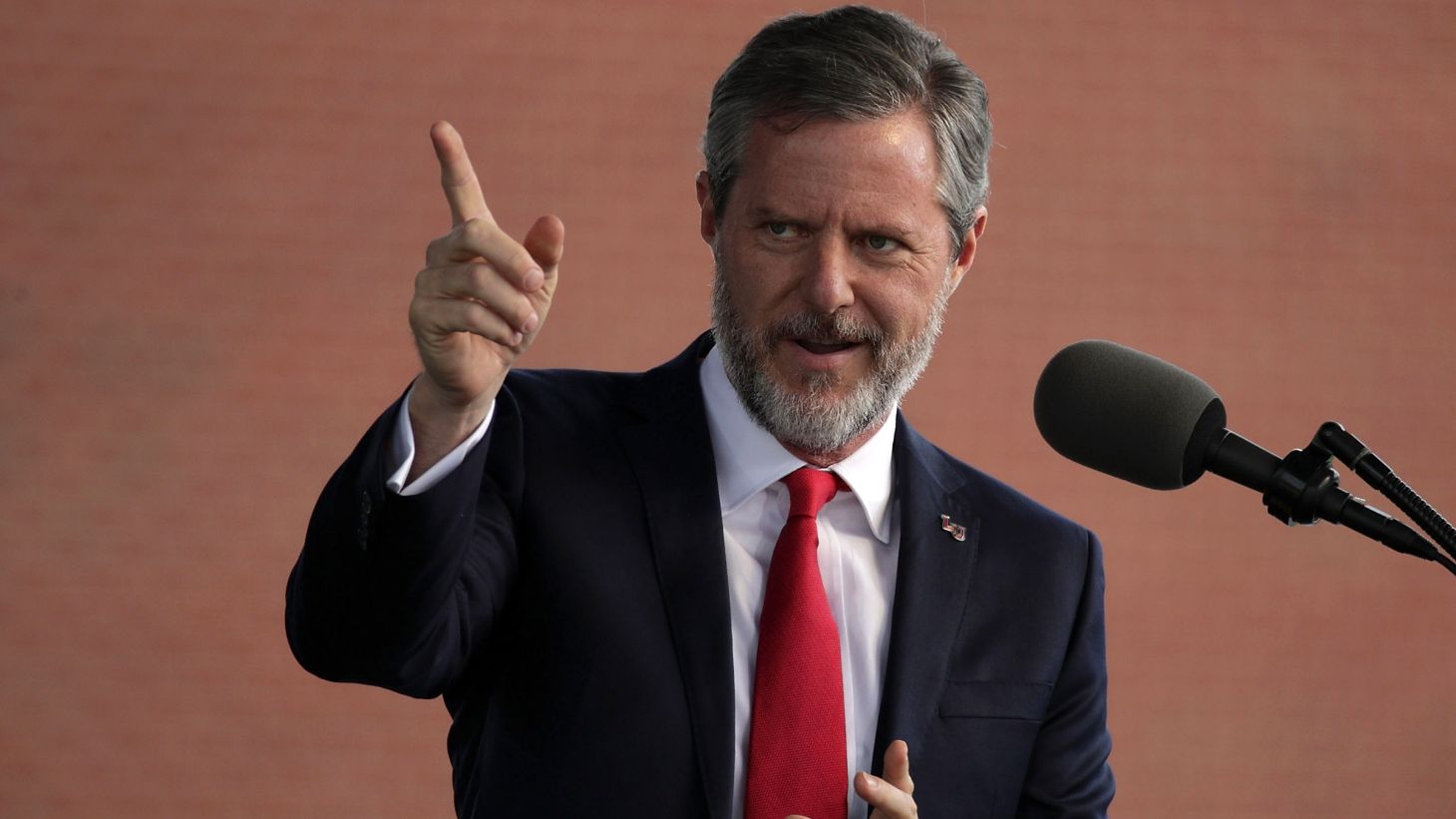
Liberty University, one of the nation’s largest Christian universities, is suing former President Jerry Falwell Jr. for $10 million, citing a breach of contract and a conspiracy to mislead the university’s board.

Falwell, son of Liberty founder the late Rev. Jerry Falwell Sr., resigned as Liberty’s president in August 2020 after years of controversy due to his support of Donald Trump and allegations of misconduct.

A complaint in the lawsuit, filed in a Lynchburg, Virginia, circuit court, claims Falwell “fashioned a deceitful scheme to manipulate the Executive Committee of Liberty” while negotiating his last contract.

The complaint also states Falwell created the so-called Granda plan to conceal his family’s relationship with Giancarlo Granda, a young man the couple had met while vacationing in Florida. Granda has claimed to have had a long-term sexual relationship with Jerry Falwell Jr. and with his wife, Becki Falwell. The Falwells have denied that claim but have admitted that Becki had an affair with Granda. The couple also bought a Miami beach youth hostel in 2013 that Granda managed and also had a share in.

The complaint claims Falwell devised a plan to cover up the relationship, fearing Granda would make it public, and that Granda asked Falwell for payoffs in order to keep racy photos of Becki Falwell out of the public eye.

“Most damaging, Falwell Jr. knew that Granda would be able to provide details about the fact of the affair with Becki, its duration, Falwell Jr.’s role in abetting it, the attendant circumstances of the affair, and the specific activities in which Granda, Falwell Jr. and Becki engaged in during the affair.”

Rather than telling the board about Granda, Falwell hid it from Liberty’s board, according to the complaint. Falwell also became concerned his high-profile support of Trump would backfire and might cost him his job.

Then, in 2019, he negotiated a new employment agreement with the board, which included a raise and a more favorable severance if he were fired. The complaint claims Falwell continued to conceal his dealings with Granda while trying to create a “safety net” for himself.

Falwell’s actions clashed with the school’s moral code, known as the “Liberty Way”—which requires faculty and administration to agree to a statement of faith and to adhere to “biblical standards of morality,” including strict rules limiting sex to within a heterosexual marriage.

The school’s president was expected to be “a standout spiritual leader for the college,” according to the complaint.

The suit seeks $10 million in damages and a return of any Liberty property still in Falwell Jr.’s possession.

Falwell Jr. did not immediately respond to requests for comment.

Culture

DMX Bared His Sins and Soul to Make His Music a Testimony

How the life and lyrics of the late rapper challenge our notions of sanctification and struggle.

Christianity Today April 16, 2021
Paras Griffin / Getty Images

Earl “DMX” Simmons kept it real whether he was testifying about his angels or his demons.

While it’s common for grief, depression, anxiety, and faith to come up in popular music today, Simmons rose to fame at a time when hip-hop songs about flashy cars, jewelry, and expensive clothes ruled the charts. The rapper best known by his stage name DMX shot videos in his childhood neighborhood wearing workman’s jumpsuits and few gold chains.

Simmons—who died last week at age 50—is the first and only rapper to have five albums debut at No. 1 on the Billboard 200 chart, and he did so while making Christianity a central element of his music. DMX’s witness over his 30-year career reshaped how the genre engages faith in public.

“Before DMX, black R&B artists would generally wear a cross, briefly mention they were reared in the black church in their youth, or thank Jesus for their success during award shows,” said Cassandra Chaney, a professor at Louisiana State University who researched how rappers discuss heaven in their music. “When DMX came on the scene, he showed the world that they could and should have a personal relationship with Jesus Christ.”

Simmons grew up in the projects of Yonkers, New York, the only son of a teenage mother. Raised a Jehovah’s Witness, his favorite childhood book was a Jehovah’s Witness children’s Bible. But Simmons wrote in his autobiography that he left the Witnesses when his mother declined an insurance settlement after he was hit by a car as a child, citing a religious belief against accepting charity.

Simmons had a troubled childhood. His father abandoned the family. His mother was abusive and sent him to a children’s home. He was first arrested at age 10. But he found solace in the arms of his grandmother. In “I Miss You,” Simmons celebrates her influence: “I thank you for my life / I thank you for my Bible / I thank you for the song that you sang in the morning ‘Amazing Grace.’”

Despite his difficult upbringing, Simmons would become a multiplatinum artist and grow deeper in his Christian faith. In one of his Instagram Bible studies last summer, he called “every album a prayer.” He had a habit of concluding both his albums and concerts with prayer.

“I grew up in church right outside Yonkers and always struggled with it not being cool to pray or talk about Jesus near friends,” said Jordan Rice, pastor of Renaissance Church in NYC. “I’ll never forget at the end of Summer Jam in ’98 or ’99 where DMX closed out his set with a prayer. He was crying, and so were thousands of people in the audience. That honestly emboldened me to say that I was a Christian.”

Simmons died April 9, after spending more than a week on life support following a heart attack. In both his life and his tragic death, he challenges the notion that Christianity leads to a life free of trouble. Simmons struggled openly with substance abuse, after having been tricked into smoking crack for the first time at 14 by a friend and mentor. He was arrested multiple times and served several prison sentences for offenses ranging from tax evasion to assault.

Simmons battled his demons just as publicly as he fought for his better angels to prevail. His song “Angel” begins with a paraphrase of Mark 8:36: “What good is it for a man to gain the world / Yet lose his own soul in the process?” He then raps, “I’m callin’ out to you, Lord, because I need your help / See, once again I’m havin’ difficulty savin’ myself / Behavin’ myself, you told me what to do, and I do it / But every and now and then it gets a little harder to go through it.”

Simmons was an ordained deacon at Morning Star Baptist Church, the church he attended while living in Arizona. He told GQ in an interview in 2019 that he had read the Bible completely three times, and in the same year he led prayers at Kanye West’s Sunday Service.

Alejandro Nava, author of In Search of Soul: Hip-Hop, Literature, and Religion, said Simmons’s “unabashed willingness to bare his sins and soul to the world” made him unique. “Unlike most gangster rappers, who almost always put on masks of machismo and hardness, DMX revealed to the world the crippling burdens and struggles eating away at his psyche,” said Nava, a professor at the University of Arizona.

In the hit song “Slippin,” he brings up drugs, prison sentences, abuse, and abandonment: “ I’m slippin’ I’m fallin’ I can’t get up / Ay yo I’m slippin’ I’m fallin’ I can’t get up / Ay yo I’m slippin’ I’m fallin’ I gots to get up / Get me back on my feet so I can tear s— up.”

This song reflects the message of another popular early ’00s song by gospel artist Donnie McClurkin, “We Fall Down.” McClurkin sings, “We fall down / But we get up / For a saint / Is just a sinner who fell down / But we couldn’t stay there / And got up.”

It can be hard to look at the life of someone who struggled so publicly to stay sober and out of prison, and see the hand of God in their life. Many Christians believe—or at least hope—that once saved, life goes perfectly, our demons are excised, and we are only tempted toward minor sins we can privately confess in our quiet times.

Rice, the pastor and fellow Yonkers native, emphasizes grace in the story of an artist who kept turning to God in his struggle.

“In practice, all of us can identify with the disappointment of living beneath what a holy God requires from us,” he said. Simmons’s “life and tragic death highlight, not extinguish, for me the nature of grace. Undeserving people get unearned benefits by an unobligated giver.”

The gospel is not some magic formula for the perfect life, as Paul attests, and some of us will fail spectacularly. But the good news is that Jesus will always meet us in the pit.

“It’s important to recognize that the men and women of the Bible that we like to put on pedestals were pretty messy people,” said Nicola Menzie, founder and editor of Faithfully Magazine. “Their testimonies, and [Simmons]’s testimony, show that there is room in the presence of God for all of us. God sees us exactly as we are and His love doesn’t fade— whether we’re at our best or at our lowest moments.”

Simmons represents a different kind of testimony, but one the church needs to hear.

“His faith in God, however, was a constant reminder that there was love in the world, and that love could be more powerful than the forces of violence and death,” said Nava, who referenced how DMX addressed this tension explicitly in his music. His song “The Convo,” from the 1998 album It’s Dark and Hell is Hot, “describes the voice of God as exhorting him to choose life over death, poetry over guns: ‘No,’ God says, ‘Put down the guns and write a new rhyme.’”

Robert Tinajero, an English professor specializing in the rhetoric of rap at the University of North Texas – Dallas, referenced another track from that album, “Prayer,” where Simmons prays, “I come to you hungry and tired, you give food and let me sleep / I come to you weak, you give me strength and that’s deep / So if it takes for me to suffer, for my brother to see that light / Give me pain till I die, but please Lord treat him right.”

“Like a number of rappers (and people in general), [Simmons] seemed to struggle between living a godly life and living a life of vice and indulgence,” Tinajero said. “His lyrics could be quite violent and misogynistic, but he also had a caring and spiritual side to him.”

In addition to preaching and reading Scripture on social media, he also took to the pulpit after his ordination as a deacon. A 2015 sermon was recently posted online, showing Simmons speaking of God as a God of second chances and bringing up his desire for God to remove his impulse to do drugs. He talked about breaking sinful patterns: “Being born again, that’s the first step, and the second step is to stay in that Word.”

Sharing the love of God with others was part of Simmons’s testimony both on and off the stage. In the aftermath of his death, several stories went viral on social media about his kindness and generosity to regular people he encountered on airplanes and in the streets of Mt. Vernon, New York. Nava says that is one of the biggest takeaways from Simmons’s life that reflects one of the fundamental messages of Jesus’ life.

Simmons shared Jesus’ devotion “to the poor and outcast of the projects, ghettos, and barrios of the world. … Those he called his ‘dogs’ essentially meant the disenfranchised individuals and groups of society, those whom society treats like animals or lepers, those whom Jesus cherished above all,” he said.

Through his life and lyrics, Simmons invites us to reconsider our own relationships with those who are suffering or marginalized. In his song “I’ma Bang,” Simmons raps, “I speak for the meek and the lonely, weak and hungry / Speak for the part of the street that keep it ugly.”

Despite Simmons’s exceptional career and fame, his story also brings up systemic issues that affect millions in our country: poverty, the availably and quality of affordable housing, abuse, and the brokenness of the criminal justice system.

Chicago pastor Jonathan Brooks says Simmons’s life reminds us that “we all live in complex neighborhoods full of complex people and complex structural issues. Therefore, our understanding of how the gospel message is actually understood and applied there will also be complex.”

In Romans 7, we meet Paul at war with himself, lamenting the good he desires but seems unable to do. Earl Simmons, the rapper known as DMX, understood Paul’s internal battle. His willingness to speak and rap about that struggle gave contemporary language for every Christian who has a heart to follow God, but must continually fight temptation or substance abuse.

Just as the grace of God was available to Paul, it was also available to Earl “DMX” Simmons.

Kathryn Freeman is an attorney and former director of public policy for the Texas Baptist Christian Life Commission. Currently, she is a master of divinity student at Baylor University’s Truett Seminary and one half of the podcast Melanated Faith.

‘Minari’ Recognizes Those Who Have Sacrificed Much. So Can the Church.

The Oscar-nominated film is a homage to those who feel invisible.

Christianity Today April 16, 2021
A24 Press

As a child, I dreaded being assigned the “family tree” project. As the daughter of a first-generation Korean immigrant mother and a second-generation, half-Lebanese father, I wasn’t exactly set up for success. I would usually put the project off until the night before, then, in a panic, ask my parents for the names of their parents and their siblings, half of which I couldn’t spell, and with equal parts frustration and shame write a series of question marks for great-grandparents and great-great-grandparents.

My complex heritage, along with being part of a constantly relocating US military family, also made the common question, “Where are you from?” difficult to answer. At times, my family seemed to be from nowhere. I could easily believe we had sprung up from the ground, grown from scattered seeds.

When I saw the trailer for A24’s Minari last year, I was floored by its simplicity and the beauty of actors with Korean features in a starkly American setting. We were six months into a global pandemic that was first identified in China, and some used that fact to justify hatred and violence toward their Asian neighbors. Advocacy group Stop AAPI Hate reported nearly 3,800 harassment and assault incidents against Asian Americans from mid-March 2020 through February 2021. The film released during a time when many Asian Americans, so used to being silent and invisible, were being seen for all the wrong reasons.

Now, Minari is nominated for six Academy Awards, following a year in which a Korean film with a Korean director won Best Picture. Yet this film is not a morality tale of an Asian family fighting the indignities of 1980s racism. Rather, it’s an invitation to sit with the writer/director, Lee Isaac Chung, as he shares his childhood memories of loss, identity, and the third culture created when two collide into one another. It offers an opportunity for the church especially to embrace those who are wrestling with belonging and acceptance.

We meet the Yi family as they drive up to their mobile home in rural Arkansas. The parents, Jacob (Steven Yeun) and Monica (Han Ye-ri), want better opportunities elsewhere after finding life in California too expensive and the work too demanding. Their children, Anne (Noel Cho) and David (Alan S. Kim), are less bothered by the move than by the constant fights between their parents about Jacob’s idea to start a farm growing Korean fruits and vegetables with the little money they’ve saved.

The couple faces many pressures in their new life: Monica is mourning the Korean church community they’ve left and is uncertain that the farm is tenable. They live far away from other Korean Americans. More importantly, they’re far from a hospital for David’s weak heart. Jacob asks for Monica’s patience while working the land. Along the way, he befriends and hires Paul (Will Patton), a white Korean War veteran and charismatic Christian who speaks in tongues. Paul is unabashedly enthusiastic about Jacob’s dream, encouraging him when he faces failure.

As a concession to his wife, Jacob offers to bring his mother-in-law over from Korea to help with childcare. Soonja (Youn Yuh-jung) was widowed at a young age and has learned to not take life too seriously in her quest to survive as a single mom. Her grandchildren treat her warily, noticing that nothing she does is like the American grandmothers they’ve seen on TV. She can’t cook, she gambles and curses, and her Korean mannerisms confuse them as third-culture kids.

Despite the children holding her at arms’ length, Soonja persists in seeing them for who they are, always assuming the best about their intentions and finding the bright side of their life together. She optimistically plants minari seeds along a nearby creek and explains, “Minari is truly the best. It grows anywhere, like weeds. … Rich or poor, anyone can enjoy it and be healthy. Minari can be put in kimchi, put in stew, put in soup. It can be medicine if you are sick. Minari is wonderful, wonderful!”

Though the film is semi-autobiographical, it feels like an elegy to Chung’s grandmother, who gave her last years to raise him and his sister. He brings her life of anonymity into the spotlight for his larger story of sacrifice, joy in hardship, and growing where you are—however unwillingly—planted. As Chung says in his Fresh Air interview, “I guess I just hope that this film would somehow capture who she was, someone who is invisible. I would hope that she would be seen …”

While watching, I remembered the Korean women who have loved and sacrificed for me anew. My grandmother, who almost moved to the States with us, would crack up while watching American wrestling and scold my mom about being easier on me and my brother. My aunts, who welcomed us into Korean life with abundant food and good humor. The women who cleaned, served, and taught us their first language at the Korean American churches I grew up in. My mother, who worked and pushed our family into stability, worlds away from the want she and my father experienced as children.

These women helped me, a third-culture kid who never knew how to fit in, feel seen. Yet because of their gender, ethnicity, and class, they lived with a cloud of invisibility, something Chung understands.

The kingdom of God flips societal recognition on its head (Matt. 20:16). In the parable of the sheep and the goats, Jesus says he will recognize his followers by those who served the least of these: “For I was hungry and you gave me something to eat, I was thirsty and you gave me something to drink, I was a stranger and you invited me in, I needed clothes and you clothed me, I was sick and you looked after me, I was in prison and you came to visit me” (Matt. 25:35–36). The women who do much of this work in life have been seen by Jesus each step of the way, and those who do it in faith receive their reward in death.

But the body of Christ doesn’t have to wait to recognize those who are great in his kingdom. Each day we have the chance to see with the eyes of Jesus those who labor in the margins for our well-being, collectively and individually. The custodians, home health providers, and spa workers. The small-scale farmer, the chicken sexer, the seasonal worker. What would it look like to not only see but call them and their families into community?

In a prominent scene for evangelical viewers, the Yis are warmly welcomed mid-service as the pastor asks for new visitors to stand. At a predominantly white church, they stand out as “different.” After service, church members are friendly but clearly lack cross-cultural understanding. The church kids try to connect with Anne and David but seem to see Asian stereotypes instead of kids just like them.

A believer himself, Chung makes it clear that the congregation isn’t the film’s villain, but these scenes point to a lack of imagination in the church. Unlike their charismatic friend Paul, who has so little and yet wholeheartedly embraces the Yi family, the people in this church do little to reach out.

To serve those on the margins implies that we will open up our lives and stretch our comfort zones to understand those who are different from us. We ask, “What do you need?” and listen. We question our own expectations and ideas about what different groups should be like and put real effort into learning who they actually are, seeing and welcoming our differences. Minari invites us to move toward others in humility, praying to have the heart of Jesus along the way.

Jennifer Clark has lived in three countries and consumes as much movies and culture as her family life allows. She is the community manager for Area Code Network.

Ideas

The Splintering of the Evangelical Soul

President & CEO

Why we’re coming apart, and how we might come together again.

Christianity Today April 16, 2021
Illustration by Mallory Rentsch / Source Images: Kimson Doan / Unsplash / imtmphoto / Getty Images

New fractures are forming within the American evangelical movement, fractures that do not run along the usual regional, denominational, ethnic, or political lines. Couples, families, friends, and congregations once united in their commitment to Christ are now dividing over seemingly irreconcilable views of the world. In fact, they are not merely dividing but becoming incomprehensible to one another.

Recently, a group of my college friends, all raised and nurtured in healthy evangelical families and congregations, reconnected online in search of understanding. One person mourned that she could no longer understand her parents or how their views of the world had so suddenly and painfully shifted. Another described friends who were demographically identical, who had once stood beside him on practically every issue, but who now promoted ideas he found shocking. Still another said her church was breaking up, driven apart by mutual suspicion and misunderstanding.

“These were my people,” one said, “but now I don’t know who they are, or maybe I don’t know who I am.”

What do you do when you feel you’re losing the people you love to a false reality? What do you do with the humbling truth that they have precisely the same fear about you?

The quandary is not unique to evangelicals. But fellow believers who once stood shoulder to shoulder now find that tectonic shifts have thrust them apart, their continents are separating, and they cannot find a bridge back to common ground. How could our views of reality diverge so dramatically—and is there anything we can do to draw together again?

The plausibility curve and the information curve

Among the most persistent interests of my academic career was the question of how people form beliefs. Not how they should form beliefs, in some idealized vision of perfected rationality, but how they actually form beliefs as embodied creatures embedded in communities and cultures. I want to introduce a simple conceptual tool, influenced in part by the work of Peter Berger, that may help us understand what is happening.

Imagine a horizontal plane that curves downward into a bowl, rises back again, and returns to a horizontal plane. The curve, from one end of the bowl to the other, represents the range of claims an individual finds believable. Let’s call it a plausibility curve. Claims that fall in the center of the curve will be perceived as most plausible; they require little evidence or argumentation before an individual will consent to believe. Claims falling near the edges are increasingly implausible as they deviate from the center, requiring progressively more persuasion. Claims falling entirely outside the plausibility curve are beyond the range of what a person might believe at a given point in time, and no amount of evidence or logic will be sufficient.

What determines the plausibility of a given claim is how well it conforms to what an individual experiences, already believes, and wants to believe. The full range of a person’s beliefs is rather like a photomosaic (see an example here): Thousands of experiences and perceptions of reality are joined together, and out of those thousands emerge larger patterns and impressions, higher-order beliefs about the nature of reality, the grand narratives of history, the nature of right and wrong, good and evil, and so forth. Attempts to change a single belief can feel fruitless when it is embedded in countless others. Where does one begin to address a thousand interlocking disagreements at once? Evidence to the contrary is almost irrelevant when a claim “fits” with an entire network of reinforcing beliefs. This is part of what gives a plausibility curve its enduring strength and resistance to change.

Desire plays a particularly complicated role in the plausibility curve. We may desire not to believe a claim because it would separate us from those we love, confront us with painful truths, require a change in our behavior, impose a social cost, or so on. We may desire to believe a certain claim because it would be fashionable, confirm our prejudices, set us apart from those around us, anger our parents, or for countless other reasons. We will require more persuasion for claims we do not want to believe, and less for those we do.

Like the Overton window in political theory, a plausibility curve can expand, contract, and shift. Friends or family members whose plausibility curves were once identical may find that they diverge over the course of time. Claims one person finds immediately plausible are almost inconceivable to the other. But how does this happen? That’s where the information curve comes in.

Imagine a mirror-image bowl above the plausibility curve. This is the information curve, and it reflects the individual’s external sources of information about the world—such as communities, authorities, and media. Those sources in the center of the information curve are deemed most trustworthy; claims that come from these sources are accepted almost without question. Sources of information on the outer ends of the bowl are considered less trustworthy, so their claims will be held up to greater scrutiny. Sources outside the curve entirely are, at least for this individual, so lacking in credibility that their claims are dismissed out of hand.

The center of the information curve will generally align with the center of the plausibility curve. The relationship is mutually reinforcing. Sources are considered more trustworthy when they deliver claims we find plausible, and claims are considered more plausible when they come from sources we trust. A source of information that consistently delivers claims in the center of the plausibility curve will come to be believed implicitly.

Change can begin on the level of the plausibility curve. Perhaps an individual joins a religious community and finds it is more loving and reasonable than she had expected. She will no longer find it plausible when a source claims that all religious communities are irrational and prejudiced, and this will gradually shift her information curve in favor of more reliable sources. Or another person experiences the loss of a child, and no longer desires to believe that death is the end of consciousness. He is more open to other claims, expands his sources of information, and slowly his beliefs shift.

Change can also begin on the level of the information curve. An individual raised in a certain community with well-established authorities, such as her parents and pastors, goes to college and is introduced to new communities and authorities. If she judges them to be trustworthy sources of information, this new information curve will likely shift her plausibility curve. As her set of beliefs changes, she may even reach a point where the sources that once supplied most of her beliefs are no longer considered trustworthy at all. Or imagine a person who has lived his entire life consuming far-left media sources. He begins to listen to conservative media sources and finds their claims resonate with his experience—only slightly at first, but in increasing measure. Gradually he consumes more and more conservative media, expanding or shifting his information curve, and this in turn expands or shifts his plausibility curve. He may reach a point where his broader perceptions of the world—the deeper forces at work in history, the optimal ways of organizing societies and economies, the forces for good and evil in the world—have been wholly overturned.

Consider the 9/11 Truth movement and the QAnon movement. Most Americans will find the notion that the Bush administration orchestrated a massive terrorist attack in order to invade the Middle East and enrich their friends in the oil industry, or that global liberal elites would construct an international child trafficking operation for the purpose of pedophilia and cannibalism, beyond the bounds of their plausibility curve. Others, however, will find that one conspiracy or the other resonates with their plausibility curve, or their information curve may shift over time in such a way that brings their plausibility curve with it. Claims that once seemed impossible to contemplate came to appear conceivable, then plausible, then reasonable, and finally self-evident. Of course conservatives would sacrifice thousands of innocent lives to justify a “war for oil” because conservatives are greedy and that’s what conservatives do. Of course liberals would sacrifice thousands of children in order to advance their own health and power because liberals are perverse and that’s what liberals do.

As a final definitional note, let’s call the whole structure, the plausibility curve and the information curve, an informational world. An informational world encompasses how an individual or a community of individuals receives and processes information. Differing informational worlds will have differing facts and sources. Our challenge today is that we occupy multiple informational worlds with little in common and much hostility between them.

What does all of this have to do with the evangelical movement? A great deal.

The evangelical crises

The American evangelical movement has never been comprised of a single community. Depending on the criteria, estimates generally put the number of American evangelicals at 80-100 million. Even if we split the difference at 90 million, this would make the American evangelical population larger than every European nation save Russia. It is also diverse, reaching across all regions, races, and socioeconomic levels. What held the movement together historically was not only a shared set of moral and theological commitments, but a broadly similar view of the world and common sources of information. Their plausibility curves and information curves largely overlapped. There were some matters on which they differed, but the ground they shared in the middle served as a basis of mutual understanding and fellowship.

This sense of commonality grew increasingly strained as groups not formerly identified as evangelical came to be lumped together, defining the category “evangelical” less in theological terms and more in social, cultural, and political terms. This broader evangelical movement today is dividing into separate communities that still hold some moral and theological commitments in common but differ dramatically on their sources of information and their broader view of the world. Their informational worlds have little overlap. They can only discuss a narrow range of topics if they do not want to fall into painful and exasperated disagreement.

One group within American evangelicalism believes our religious liberties have never been more firmly established; another that they have never been at greater risk. One group believes racism is still systemic in American society; another that the “systemic racism” push is a progressive program to redistribute wealth and power to angry radicals. One is more concerned with the insurrection at the Capitol; another with the riots that followed the killing of George Floyd. One believes the Trump presidency was generationally damaging to Christian witness; another that it was enormously beneficial. One believes the former president attempted a coup; another that the Democrats stole the election. One believes masks and vaccines are marks of Christian love; another that the rejection of the same is a mark of Christian courage.

There are countless groups in between, of course, but these examples illustrate the tension: We occupy the same reality but starkly different worlds. There is a real question whether these worlds can (or should) draw back together again. This is a critical moment for our movement.

What, then, can be done? The model itself suggests where to start. If we move the information curves toward a common center, the plausibility curve will follow. Information comes through three sources: media, authorities, and community. One reason for our disunity is that these three sources are in crisis in American evangelicalism. I will only briefly outline these points.

First, the crisis of media is acute. Even as media today has grown more powerful and pervasive, it has also grown more fragmented and polarizing. The dynamics of modern media reward content that is immediate, angry, and hyperbolic, rendering the media into a marketplace for scorn sellers and hate merchants. Evangelicals find themselves torn between social media platforms and legacy media sources that openly advocate progressive causes and cancel conservative voices and far-right sources that traffic in paranoia and misinformation. In short, the digital media landscape has evolved to profit from our vices more than our virtues, and it has become incredibly effective at dividing audiences into hermetic media spheres that deliver only the information and commentary that confirms the audiences’ anxieties and antipathies.

This presents an extraordinary challenge for Christian discipleship. Media consumption has been climbing for years, and it soared amid the pandemic. Members of our congregations may spend a few hours a week in the Word of God (which should always be the Christian’s most important source of information and authority) but 40 hours or more mainlining the animosities of the day. Once the information curve begins a leftward or rightward drift, the algorithms of digital media and the manipulations of politicians and profiteers accelerate the momentum. Soon Christian communities that once shared a broader view of the world find they only agree on the bare essentials of faith. It will be difficult to address other parts of the information curve until we have brought some semblance of sanity into our media consumption. The longer we live in separate media worlds, the deeper and broader our divisions will become. The longer we give ourselves to media gluttony, skimping on the deeper nourishment that cultivates Christ within us, the less we will have in common.

The media crisis reaches across the whole of society, but the evangelical movement also faces an authority crisis of its own making. A generation of evangelical leaders who commanded immense respect, at least across the broad middle of American evangelicalism, have passed away. The current generation of evangelical institutional leaders, though markedly more diverse than their forebears, struggle to rise above the rampant ideological othering of our time. Moreover, the movement has seen countless leaders fall from grace in spectacularly destructive ways. At the same time, we have seen the rise of the celebrity pastor. It was once the case that a long obedience in the same direction, a life of humble study and service, earned a person a modicum of spiritual authority and a modest living. Today, a dashing profile and a talent for self-promotion can earn wealth and stardom in the Christian celebrity marketplace.

The consequence is disillusionment and division. While younger generations head for the exits, those who remain in our churches become further entrenched in their own ideological camps. If it is ever to be true again that broadly respected authorities form an important part of our shared information curve, it will be because we turn from a culture of celebrity to a culture of sanctification, where leadership is less about building a platform and more about carrying the cross of Christ. It will be because we remember the words of Jesus that “whoever wants to become great among you must be your servant” (Matt. 20:26). It will also be because we relearn how to listen to men and women of wisdom, leaders as well as neighbors, without crucifying them over political differences.

The third way to shift the information curve is to address our crisis of community. Community is essential to Christian life. It deepens our knowledge of the Word, forges our shared identity in Christ, cultivates Christian character, and disciples our young. Yet the pressures, temptations, and glowing distractions of contemporary life have strained the ties that bind us, replacing the warmth and depth of incarnate community with a cold digital imitation. The pandemic has only deepened our isolation, causing many to look outside their churches to political tribes or conspiracist communities for a sense of purpose and belonging. Further, the hyper-politicization of the American evangelical movement has led to a political sorting. Congregants who do not like their pastors’ stances depart for other churches whose politics are the same as theirs. But congregations comprised of individuals whose informational worlds are nearly identical will tend toward rigidity and increasing radicalism—what Cass Sunstein calls the Law of Group Polarization.

Rather than withdrawing into communities of common loathing, the church should be offering a community of common love, a sanctuary from the fragmentation and polarization, from the loneliness and isolation of the present moment. The church should model what it means to care for one another in spite of our differences on social and political matters and affirm the incomparably deeper rootedness of our identity in Christ.

Michael O. Emerson, a sociologist and scholar of American religion at the University of Illinois at Chicago, recently said he has studied religious congregations for 30 years but has “never seen” such an extraordinary level of conflict. “What is different now?” he asked. “The conflict is over entire worldviews—politics, race, how we are to be in the world, and even what religion and faith are for.” What I have offered above is a model for understanding how we have come to such a pass, and a mere suggestion of how we might begin the generational project before us.

We are not without hope. Lies ring hollow at the end of the day. Hatred is a poor imitation of purpose, celebrity a poor replacement for wisdom, and political tribes a poor comparison to authentic Christian community. We are a people defined by the resurrection of the Son of God. We are called to be redeemers and reconcilers.

So perhaps we can begin to build bridges across our informational worlds. Perhaps we can nurture a healthy media ecosystem that offers a balanced view of the world and a generous conversation about it. Perhaps we can restore a culture of leadership defined by humility over celebrity and integrity over influence. Perhaps we can invite those who have found counterfeit community in their political tribes to rediscover a richer and more robust community in Christ. All of these things will be essential to rebuilding a shared understanding of the world God created and what it means to follow Christ within it.

Timothy Dalrymple is president and CEO of Christianity Today. Follow him on Twitter @TimDalrymple_.

Apple PodcastsDown ArrowDown ArrowDown Arrowarrow_left_altLeft ArrowLeft ArrowRight ArrowRight ArrowRight Arrowarrow_up_altUp ArrowUp ArrowAvailable at Amazoncaret-downCloseCloseEmailEmailExpandExpandExternalExternalFacebookfacebook-squareGiftGiftGooglegoogleGoogle KeephamburgerInstagraminstagram-squareLinkLinklinkedin-squareListenListenListenChristianity TodayCT Creative Studio Logologo_orgMegaphoneMenuMenupausePinterestPlayPlayPocketPodcastRSSRSSSaveSaveSaveSearchSearchsearchSpotifyStitcherTelegramTable of ContentsTable of Contentstwitter-squareWhatsAppXYouTubeYouTube