News

Summit Produces a ‘Pentecost’ Moment for International Religious Freedom

First IRF summit led by civilians not governments pulls off bipartisan participation as attendees welcome news on next ambassador.

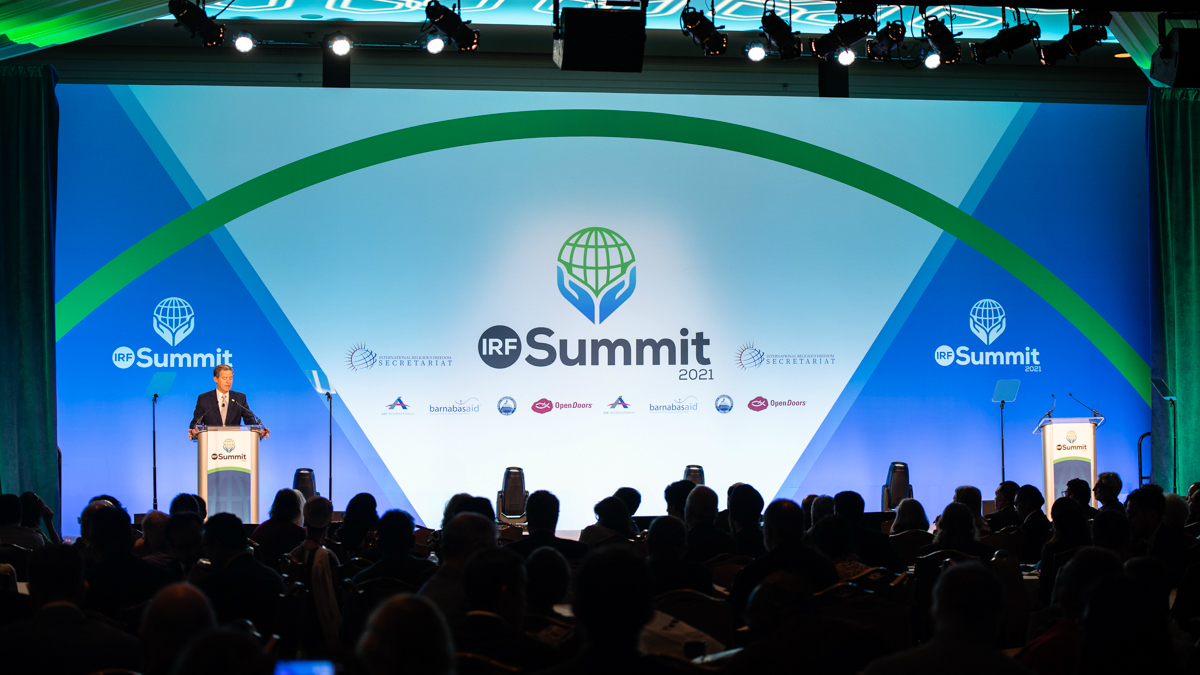
Former IRF ambassador Sam Brownback speaks at the 2021 International Religious Freedom Summit in Washington.

Former IRF ambassador Sam Brownback speaks at the 2021 International Religious Freedom Summit in Washington.

Christianity Today July 19, 2021
Hailey Sadler / IRF Summit

In this series

One word floated forebodingly between parentheses throughout promotional material for the 2021 International Religious Freedom (IRF) Summit:

Invited.

Following the names of Nancy Pelosi, Antony Blinken, and Samantha Power, it indicated uncertainty if the key Democratic stalwarts would participate.

As the approximately 1,200 registered attendees arrived, the distributed official program still did not include the current House speaker, secretary of state, or USAID administrator.

However, Mike Pompeo, Blinken’s predecessor at the US State Department, had a keynote address from the stage.

“There were a lot of questions heading into this summit, with a lot of hesitancy from the Biden people,” summit co-chair Sam Brownback told CT. “But we worked hard to make it bipartisan.”

Unlike the previous two ministerial meetings held in Washington, DC (and a third held virtually in Poland), this year’s IRF gathering was organized by civil society, not governments.

Brownback, the US ambassador-at-large for international religious freedom during the Trump administration, was now a private citizen. He partnered with Katrina Lantos Swett, former chair of the US Commission on International Religious Freedom, who was appointed by former Democratic senator Harry Reid.

Brownback chased the Republicans, and Lantos Swett the Democrats. Their friendship, Pam Pryor, senior advisor to the summit, told CT, is the “gold standard” in bipartisan cooperation.
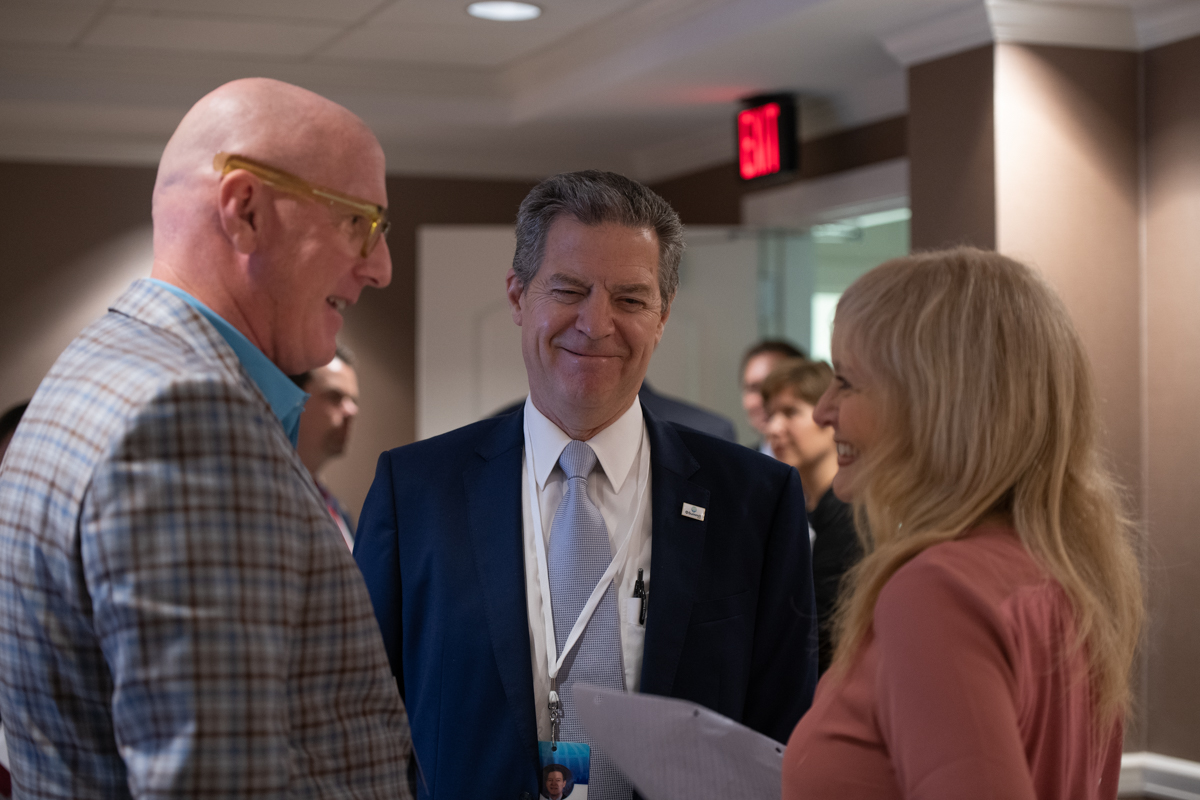
Co-chairs Sam Brownback (middle) and Katrina Lantos Swett (right) with Open Doors president David Curry (left) at the 2021 International Religious Freedom Summit in Washington.

In the end, Lantos Swett was relatively successful. Unable to appear in person, Pelosi, Blinken, and Power all provided prerecorded remarks.

“The summit demonstrates our ironclad commitment to international religious freedom,” stated Pelosi, “which transcends party and politics.”

The executive branch agreed.

“The US is committed to advance human rights,” stated Blinken, “and religious freedom is a vital component of our diplomacy.”

As did the leader of a key implementing organ, the US Agency for International Development (USAID).

“The fight for international religious freedom is not just a reflection of who we are as Americans, but of strategic national interest to the United States and a key foreign policy objective,” stated Power. “The Biden-Harris administration is dedicated to its protection and advancement, at home and around the world.”
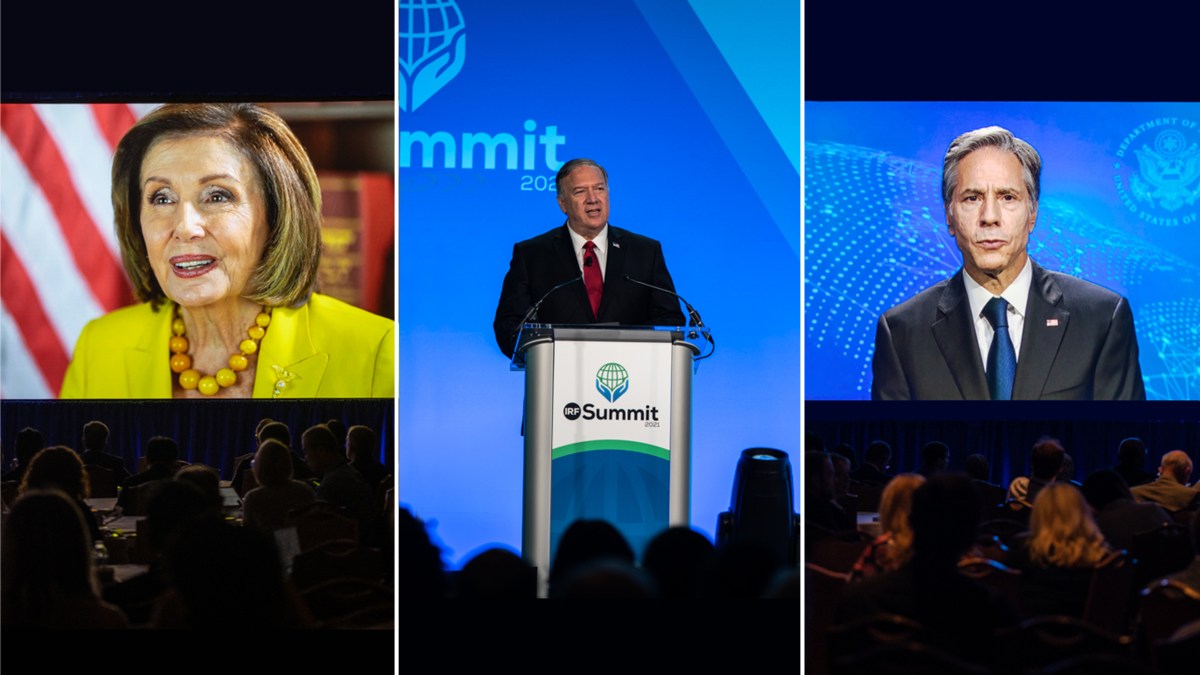
Speaker of the House Nancy Pelosi, former Secretary of State Mike Pompeo, and current Secretary of State Antony Blinken address the 2021 International Religious Freedom Summit in Washington.

Brownback felt vindicated.

He and Lantos Swett balanced Republican and Democratic IRF supporters in Congress, such as Chris Smith (R-NJ) and Henry Cuellar (D-TX) in the House of Representatives and Chris Coons (D-DE) and James Lankford (R-OK) in the Senate. They brought together advocates both right and left of center, such as Tony Perkins of the Family Research Council and Zeenat Rahman of the Inclusive America Project.

And between the 81 convening partners, every major religion of the world was represented.

“All of this together convinced the new administration that this is a broad movement, and that they wanted to be a part of it,” Brownback told CT.

“And they are.”

While scheduling did not permit Pelosi, Blinken, and Power to appear on stage, in-person proof was provided by Melissa Rogers, executive director of the White House Office of Faith-Based and Neighborhood Partnerships.

She also provided the news that summit participants were waiting for and chatting about in the hallways.

Bringing “warm greetings” from President Joe Biden, she said he would appoint the next IRF ambassador in “the coming weeks.”

Melissa Rogers speaks at the 2021 International Religious Freedom Summit in Washington.

While both George W. Bush and Barack Obama tarried as presidents in making their nominations, Trump took only six months. Biden is approaching the same mark.

Rogers also said the administration would “maintain the momentum” from previous ministerials and support the 2022 ministerial hosted by the United Kingdom in London. (Brazil has been scheduled to host in 2021.)

“Your work is vital, and you hold us accountable,” she said to the audience. “There is so much common ground on religious freedom, and so much good we can all do together.”

At the summit, however, this depended on the avoidance of domestic politics, said Peter Burns, the event’s executive director. Over two months the organizing committee solidified 10 panel discussions, organized by topic—not region—in order to be as broad as possible.

China, Nigeria, and Pakistan were nonetheless frequent targets throughout. Various participants highlighted Uyghur Muslims as monitored by malign technology, Nigerian Christians as victims of genocide, and Ahmadi Muslims as subjects of legal structures of discrimination.

Positive examples were also highlighted. An ecumenical prayer service brought together Mideast Christians. Philanthropy multiplied the concept of “covenantal pluralism.” And Kazakhstan signed a new agreement to educate both its clerics and its police on religious freedom and the rule of law.

“Tony Perkins and Samantha Power are at the same event, saying the same things, differently,” said Burns. “It’s really cool.”

Katrina Lantos Swett speaks at the 2021 International Religious Freedom Summit in Washington.

But with such high-level political participation, partisan talking points were inevitable.

Pompeo criticized Biden for prioritizing climate change over religious freedom. He called the summit a “God-driven” continuation of Trump’s work. And he celebrated the United Arab Emirates’s opening of an embassy in Israel.

Rogers highlighted Biden’s reversal of Trump’s restrictions on Muslim and African immigration. She emphasized the importance of LGBT rights within the panoply of religious freedom. And Power called out Israel within her list of violating nations.

More substantive was the debate over the place of religious freedom within human rights overall.

“Oppression always begins against religious freedom,” said Pompeo, “leads to the loss of other civil and political rights, and can even come to include genocide.”
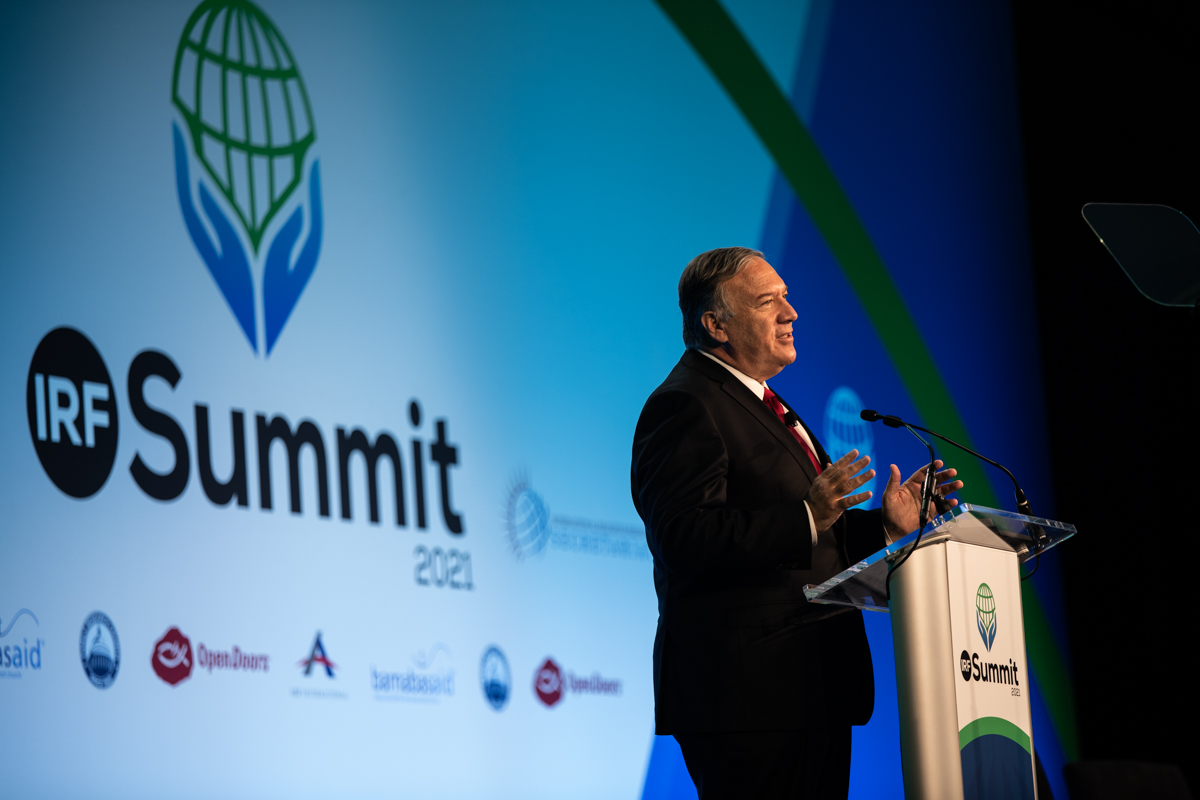
Former Secretary of State Mike Pompeo speaks at the 2021 International Religious Freedom Summit in Washington.

Democrats emphasized a “nesting” approach.

“The freedoms to speak freely, to assemble freely, and to advocate your cause to political leaders are interdependent,” said Power. “Religious freedom cannot exist without them.”

David Saperstein, the Jewish rabbi who preceded Brownback as IRF ambassador, tried to balance the perspectives from the stage.

“You cannot have freedom of religion if you do not have freedom of speech, press, and association,” he said. “But conversely, you cannot have these rights without freedom of religion and conscience.”
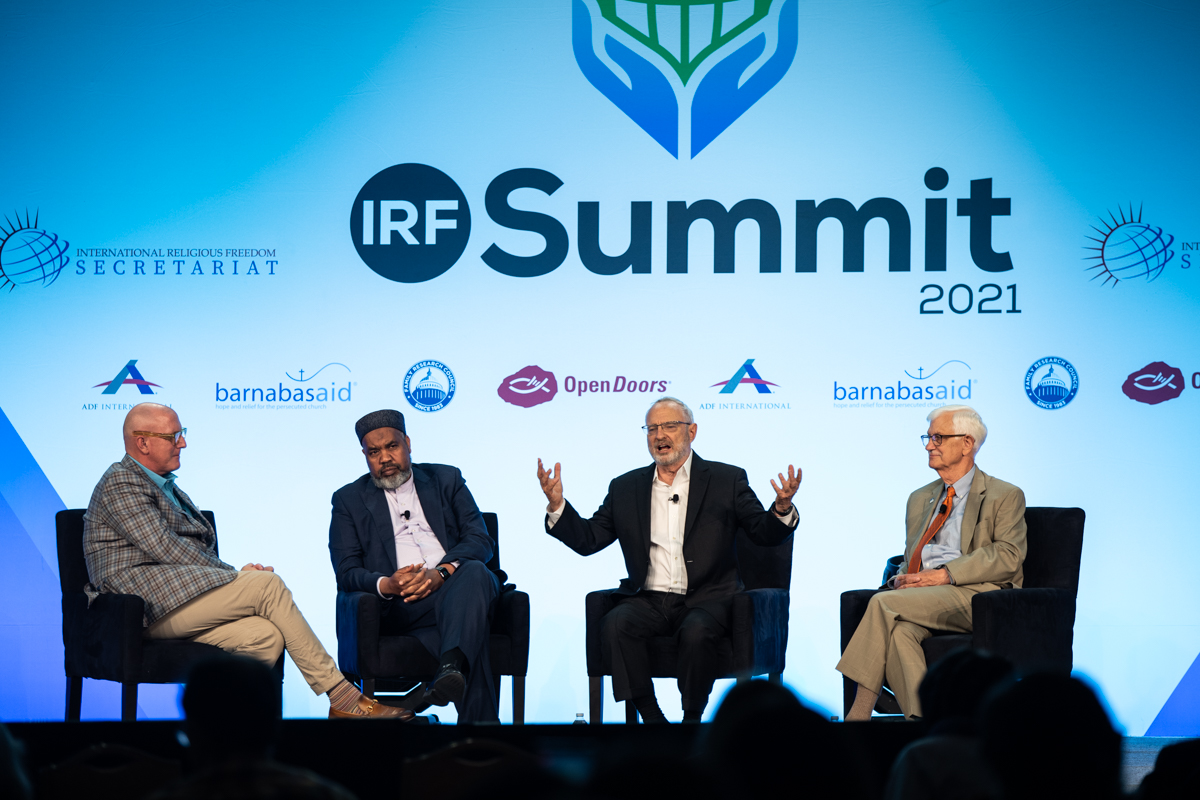
Previous IRF ambassador David Saperstein speaks at the 2021 International Religious Freedom Summit in Washington.

Overall, the attendance and sponsorships titled rightward, and Pompeo’s address solicited more robust applause than those from Democratic leaders. But Saperstein reminded everyone of 1998, when the International Religious Freedom Act (IRFA) moved through Congress without a single dissenting vote.

“IRFA was needed because religious freedom was a forgotten stepchild in the human rights movement,” he said. “Twenty-three years later, what we did worked.”

And for this, Brownback was pleased.

Having previously told CT that the last ministerial felt like Christmas, he was asked if this gathering felt like Easter.

“No, more like Pentecost,” he replied, after a brief pause.

“The spirit here is very peaceful, very pleasant—and very broad.”
News
Wire Story

Court Upholds Ruling in Favor of InterVarsity at U of Iowa

“We are hard-pressed to find a clearer example of viewpoint discrimination.”

Christianity Today July 19, 2021
Phil Roeder / Flickr

Update (December 6, 2021): A state panel agreed Monday to spend nearly $2 million to settle two federal lawsuits brought against the University of Iowa in 2017 from Christian student groups that lost their campus status over their faith positions.

Lawyers for the student group Business Leaders in Christ were awarded $1.37 million in fees and costs for litigating the case. InterVarsity Christian Fellowship will be paid $20,000 in damages and about $513,000 in attorney fees.

A federal appeals court has upheld a 2019 ruling against the University of Iowa, affirming that the university discriminated against a Christian club by stripping it and dozens of other religious clubs of their registered status.

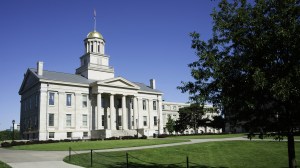
A three-judge panel of the US 8th Circuit Court of Appeal on Friday found that a lower federal court correctly ruled that the university can’t selectively deregister student organizations. That ruling came on a lawsuit filed by InterVarsity Christian Fellowship after university administrators deregistered its local chapter along with multiple other religious groups.

The university moved to deregister the groups after another faith-based group, Business Leaders in Christ, sued the university for kicking it off campus following a complaint that it wouldn’t let an openly gay member seek a leadership post.

The appeals court said Friday that “we are hard-pressed to find a clearer example of viewpoint discrimination.”

The university had not allowed Christian, Muslim, and Sikh groups to appoint leaders based on their shared faith, selectively enforcing its policy requiring all clubs to offer equal opportunity and access regardless of classifications including race, religion, national origin, age, gender, sexual orientation, or gender identity.

According to Becket, which represented InterVarsity Christian Fellowship in the case, “the court warned that university officials who ‘make calculated choices about enacting or enforcing [such] unconstitutional policies’ should be on notice that they are not entitled to qualified immunity but instead will be held personally accountable for their actions.”

https://twitter.com/DBlombergSC/status/1416073817651392514

The university exempts sororities, fraternities, and some sports clubs from its policy prohibiting sex discrimination and allows some groups to require members of specific racial groups, the appeals court said.

It even allowed one group, LoveWorks, to require its members to sign a “gay-affirming statement of Christian faith” while disqualifying groups that required members to affirm different religious statements of faith, the court said.

“The university’s choice to selectively apply the Human Rights Policy against InterVarsity suggests a preference for certain viewpoints — like those of LoveWorks—over InterVarsity’s,” Circuit Judge Jonathan Allen Kobes wrote for the panel. “The university focused its ‘clean up’ on specific religious groups and then selectively applied the Human Rights Policy against them. Other groups were simply glossed over or ignored.”

Attorneys with the Iowa Attorney General’s Office listed on court filings as representing the university in the lawsuit did not immediately return phone messages Friday seeking comment.

A UI spokeswoman, Anne Bassett, said in an email Friday afternoon that the university “respects the decision of the court and will move forward in accordance with the decision.”

Daniel Blomberg, an attorney for InterVarsity, said Friday's ruling puts other schools on notice.

“Schools are supposed to be a place of free inquiry and open thought, but the school officials here punished opinions they didn’t like and promoted ones they did — all while using taxpayer dollars to do it,” Blomberg said.
Theology

One Easy Trick to See If You’re Reading the Bible Right

I knew Scripture was inerrant and inspired, but didn’t let it move me to devotion.

Christianity Today July 19, 2021
Illustration by Mallory Rentsch / Source Images: WikiMedia Commons

Augustine said there’s a way you can check or double-check whether you understand the Bible. If you read it right, he said, it would produce a “double love of God and of neighbor.”

In fact, “whoever finds a lesson there useful to the building of charity,” Augustine wrote, “even though he has not said what the author may be shown to have intended in that place, has not been deceived, nor is he lying in any way.”

I read these words from On Christian Doctrine in the fall of 2008, and I knew that I had a problem. I had spent the previous two years in the Biblical Exegesis program at Wheaton College Graduate School, and I was not confident that all my training in Hebrew, Greek, and exegesis had fostered that “double love” in me. I understood the importance of Scripture, I knew it was inspired, but had I let it affect me the way that it should?

I didn’t think the problem was my Greek or Hebrew. I knew it wasn’t the Scriptures themselves. I suspected it was my theology.

I was taught all the verses explaining how Scripture is inerrant, infallible, inspired, and sharper than a two-edged sword, but these words seemed sterile and static when describing the book I knew was different than all other books. The facts of Biblical inspiration were solid enough, but I didn’t have a dynamic social imaginary to animate my Christian life towards study and devotion.

Augustine was right: I should love God and my neighbor more after reading Scripture, so what might this look like? Was there a Biblical paradigm, and not just prooftexts, that could help me? I found a way forward in John 5.

In John 5:1-18, Jesus heals a man at Bethesda who was sick for 38 years. It was on the Sabbath, which created controversy. Jesus responded with testimony about who he really is. He didn’t testify about himself, since, “If I testify about myself, my testimony is not true” (John 5:31). Instead, as required by Deuteronomy 19:15, he called witnesses.

First, there is John the Baptist, who is “another who bears witness to me” (John 5:33). Second, “the works which the Father has granted me to accomplish … bear me witness that the Father has sent me” (John 5:36). Third, Jesus said, “the Father who has sent me has himself borne witness to me” (John 5:37).

Finally, Jesus said the Scriptures themselves point to him. Here, I think, Jesus offers an important adjustment to my view—and I think the standard evangelical view—of what it means to “get the Scriptures right.”

He says, “You search the Scriptures because you think that in them you have eternal life; and it is they that bear witness about me. … If you believed Moses, you would believe me, for he wrote of me” (John 5:39, 46).

It is not enough to just say that Scripture is inerrant. We should understand its purpose and ultimate referent. Jesus is saying in this text that his contemporaries could not understand his ministry, because they misunderstood the referential nature of Scripture. It is about him. Moses and all the prophets wrote about him. In the same way, we misunderstand the Scripture if we miss that it is testifying to the Christ who came, died, and rose again.

We are just as prone to misunderstanding the purpose of the Scriptures as people were in the first century—maybe more so.

We need to recover the witness of the Bible. Any use of Scripture that doesn’t comport with this testimonial purpose of Scripture will be insufficient because it will stop short of Scripture’s own purpose.

Recovering this theology of Scripture as witness to Christ could change our Christian lives in two ways. First, it could remind us that we love the Bible because we love Jesus, and encourage us to plunge ourselves back into Scripture.

One distinguishing mark of Christians who prioritize the primary nature of Scripture as witness will be their immersion in the Scriptures because they love him to whom they testify. We are incredibly privileged to have the full scriptural witness to the person and work of Christ, including the gospels and the full apostolic testimony of the New Testament. As Thomas Cranmer eloquently prayed so long ago, we should “read, mark, learn, and inwardly digest” the Scriptures.

Second, we might follow in the footsteps of John the Baptist, who faithfully bore witness to Christ as Jesus said in John 5:33.

I’m reminded of the famous Isenheim altarpiece, painted by Matthias Grünewald. John the Baptist is depicted at the crucifixion—a wildly but wonderfully anachronistic image, since John was beheaded well before Christ’s death—and he’s standing at the side, with one bony finger pointing to Jesus. There we find the words, “He must increase, but I must decrease.”

What is in his other hand? An open Bible. This, I think, is the pattern we are supposed to imitate. Like John, with Scripture in one hand, and pointing to Christ with the other, we are made to bear witness to Christ. All our reading, studying, struggling, debating, living, and even dying can be animated by this task: testifying to Christ.

And then, as Augustine teaches us, it is easy to check whether or not we’ve gotten this right. Do I have a double love for God and my neighbor?

If I have not charity …

Theology

We Put Down Roots. Then Everything Around Us Shifted.

We must find new ways to live faithfully in places that have changed.

Christianity Today July 19, 2021
Kelli M. Allison / Lightstock

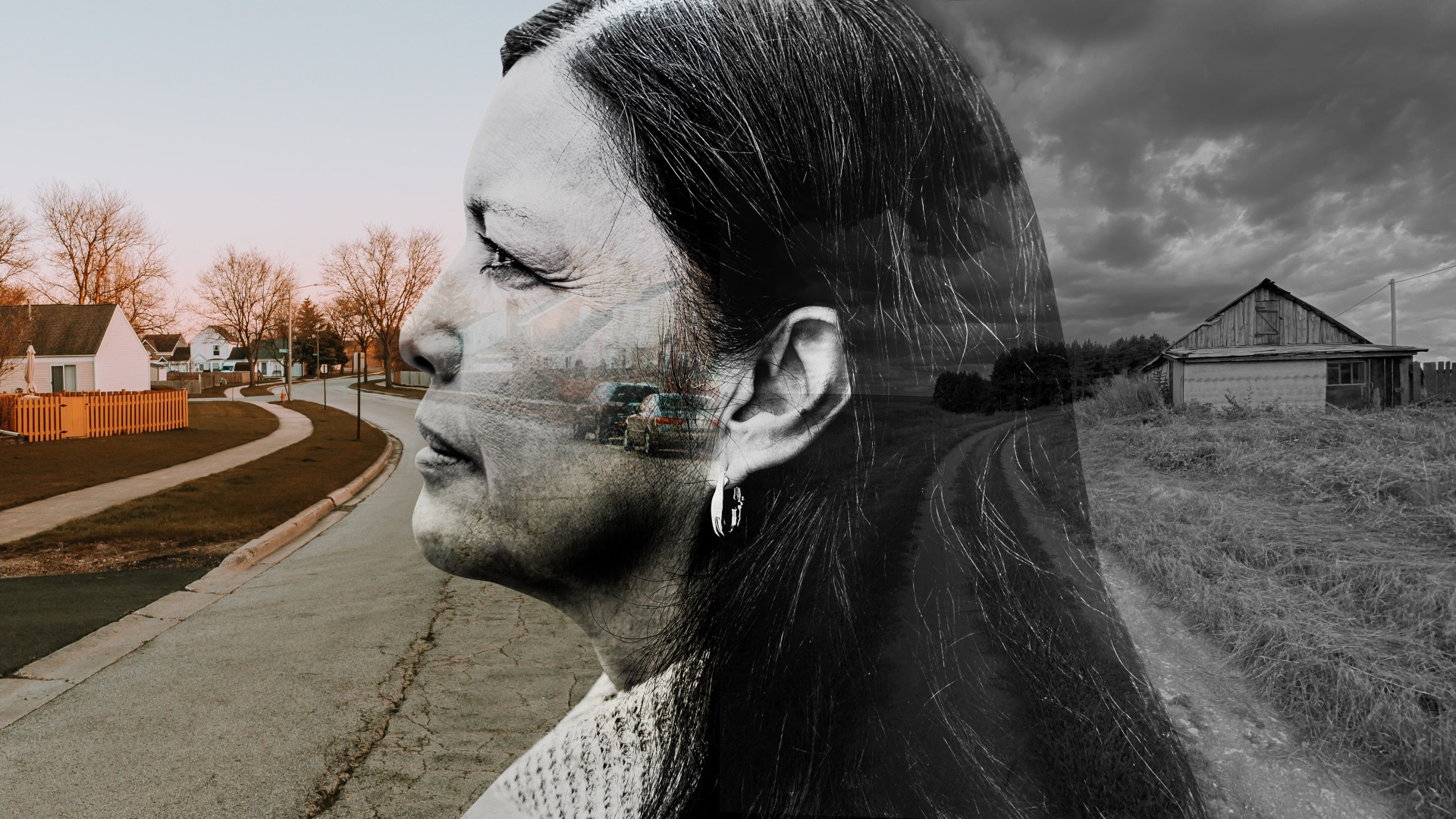
If you’ve moved lately (or have tried to), you’ll know that there’s a shortage of available properties pushing prices to an all-time high. Many would-be buyers, including first-time buyers, have been priced out of the market and stuck in places they’d rather not be—and, in some cases, places they no longer recognize. It’s been nine years now since my husband and I bought our first home. After a decade of moving from place to place, we returned to his native Virginia to minister in a rural community. We were drawn by both providence and desire, and the home we bought came to represent these things for us. We quickly made it our own, replacing the orange carpet in the basement and updating the wood-grained paneling. We planted fruit trees and put in gardens. Then, fences and hedgerows. We renovated bathrooms and again replaced the flooring when the drains failed and the basement flooded, all while sinking our roots deeper and deeper into the surrounding community. Then the earthquakes hit. Not literally earthquakes, but interpersonal and vocational ones. After eight years, we transitioned out of the ministry that had brought us here. Our children moved on from the elementary school that sits a stone’s throw from our house, and we found ourselves feeling displaced despite living at the same address. Soon enough, our private tremors were encircled by global ones. COVID-19 hit, and we, along with our neighbors, found ourselves locked in our homes. Schools and churches closed and the library, too—our points of shared community were lost. Of course, we checked on each other, but, at first, we didn’t know whether our presence was more threat than benefit. “I fell like the floor keeps moving under my feet,” my husband confessed a few months in. “Every time I try to take the next step, I lose my balance.” But at least now, we had a strange kind of solidarity—ours was no longer the only world shaking.

How can we continue on when God calls us to stay put? How can we stay in places that feel like they’re eroding away?

Almost 18 months later, the aftershocks have begun to subside. We’re emerging and trying to reestablish life together. But much has changed. Church attendance lags, teachers and community leaders have retired early, and the library still is not fully reopened. Larger political fractures have separated friends, and opinions once viewed as moderate are now deemed “radical” by whomever does not hold them. We have not moved. But the world has changed around us. And suddenly I find my notions about place challenged, particularly my belief that embracing your place can offer a rare source of stability in modern life. As someone who longs, in the words of Wendell Berry, to be part of “the membership” of a place, this had been a difficult reality to accept. I thought putting down roots would provide permanence. But nobody told me that earthquakes can uproot the strongest of trees. I still believe that the Lord’s providence determines the boundaries of where we live and when (Acts 17:26). I still believe that we must show up in the communities in which we’ve been placed. But I have a deepening appreciation for life east of Eden, a world in which our place can be shaken and disrupted. I know now that the ground under our feet should not be trusted—at least not with our soul’s stability. So how can we continue on when God calls us to stay put? How can we stay in places that feel like they’re eroding away despite our attempts to stay rooted in them? I’m still sorting this out. But I’m learning that we must pay attention to the changes. And we must tell the truth about them. We must tell the truth about the deeper fault lines that existed long before the earthquake hit. We must tell the truth that they will pose dangers for generations to come. We must also tell the truth that some places will never again be what they once were. Sentimentality is the particular temptation of those of us who long for place, and we must guard against it. If the past few years have taught us anything, it’s that the desire to live in a land of our imagining can change the course of history. We’ve also learned that the desire to make a land “great again” will find particular resonance in those places whose changing stories have been left unattended and untold. But even as we grieve communities that will never again be what they once were, we must also open ourselves to the fact that some things need to change. A recent study suggests that 29 percent of pastors have considered leaving ministry in the past year. Like their counterparts in other professions, many pastors are wrestling with the trajectory and sustainability of their work. Earthquakes have a way of leveling weak or poorly designed infrastructure, exposing deeper concerns that we may have ignored during more stable times.

In reflecting on this, Pastor John Starke of New York City notes that “while the pandemic has surely exposed what is fragile in our world and in the church, it has also exposed what is in vain … [some] had been trying to build something that God had no intention of building. ” And so I wonder, how does work and life need to change not despite the earthquake but because of it? What things need to be torn down to make way for new possibilities?

Reporting on the challenges churches face coming out of the pandemic, Kate Shellnutt writes “What feels like struggles atop struggles could be an opportunity for the church to live up to its ideals, to care well for each other and look to God in their suffering.” But more than anything in this moment, I find myself learning to hope—to believe that even as an earthquake remakes a place that this place can still hold possibility and calling.

Years before moving to our present home, my husband and I relocated to Hawke’s Bay, New Zealand, for a short-term ministry position. We lived in a borrowed house next to fields of sheep and down the road past the vineyards and apple orchards. A particularly fertile region, Hawke’s Bay is also known for its history of seismic activity, and every year, the town of Napier commemorates the 1931 earthquake. A 7.8 magnitude event, it remains New Zealand’s deadliest natural disaster. Churches and schools collapsed. Homes caught fire and were destroyed. Hundreds died and thousands more were injured. Eventually, Napier rebuilt in its signature Art Deco style, and the town’s architecture has become world-renowned, drawing tens of thousands to an annual themed festival. But something else happened. The same quake that leveled Napier extended it, lifting nearly 40 square kilometers (roughly 10,000 acres) of viable real estate out of the ocean. Today, if you fly into the Hawke’s Bay Airport, the wheels of your plane will land on ground reclaimed from the sea. Because here’s another thing: In the New Testament, earthquakes accompany God’s apocalyptic work of redemption (Matt. 27:51-54). They open tombs (Matt. 28:2), break chains, and unlock prison doors (Acts 16:26). And perhaps more than anything, they signal the presence of God in a place (Acts 4:31). In this moment, we must find new ways of being in places we have not left. But having been stripped of our small dreams for the places we call home, we can dream anew. Even as we continue on in a landscape that feels foreign to us, that is simultaneously familiar and unknown, we take heart that God is “our refuge and strength, an ever-present help in trouble…

we will not fear, though the earth give way and the mountains fall into the heart of the sea, though its waters roar and foam and the mountains quake with their surging. (Ps. 46:1-3)

Instead of looking to a place, whether new or old, we look to a person. Because when our places change around us—when we can no longer recognize our communities, country, or churches—God does not. And it is his faithfulness that allows us to continue on faithfully in spaces that we might rather leave—and not only to stay but to find contentment and joy in them. We remember that we were only ever strangers and pilgrims on this earth to begin with. And from this place, we can continue on to that better country that waits for us—to that kingdom that cannot be shaken.

Hannah Anderson is the author of Made for More, All That’s Good, and Humble Roots: How Humility Grounds and Nourishes Your Soul.

News

Will Central Asia Become ‘Stans’ for Religious Freedom?

Kazakhstan pledges improvements at 2021 IRF Summit in Washington DC, following footsteps of neighboring Uzbekistan.

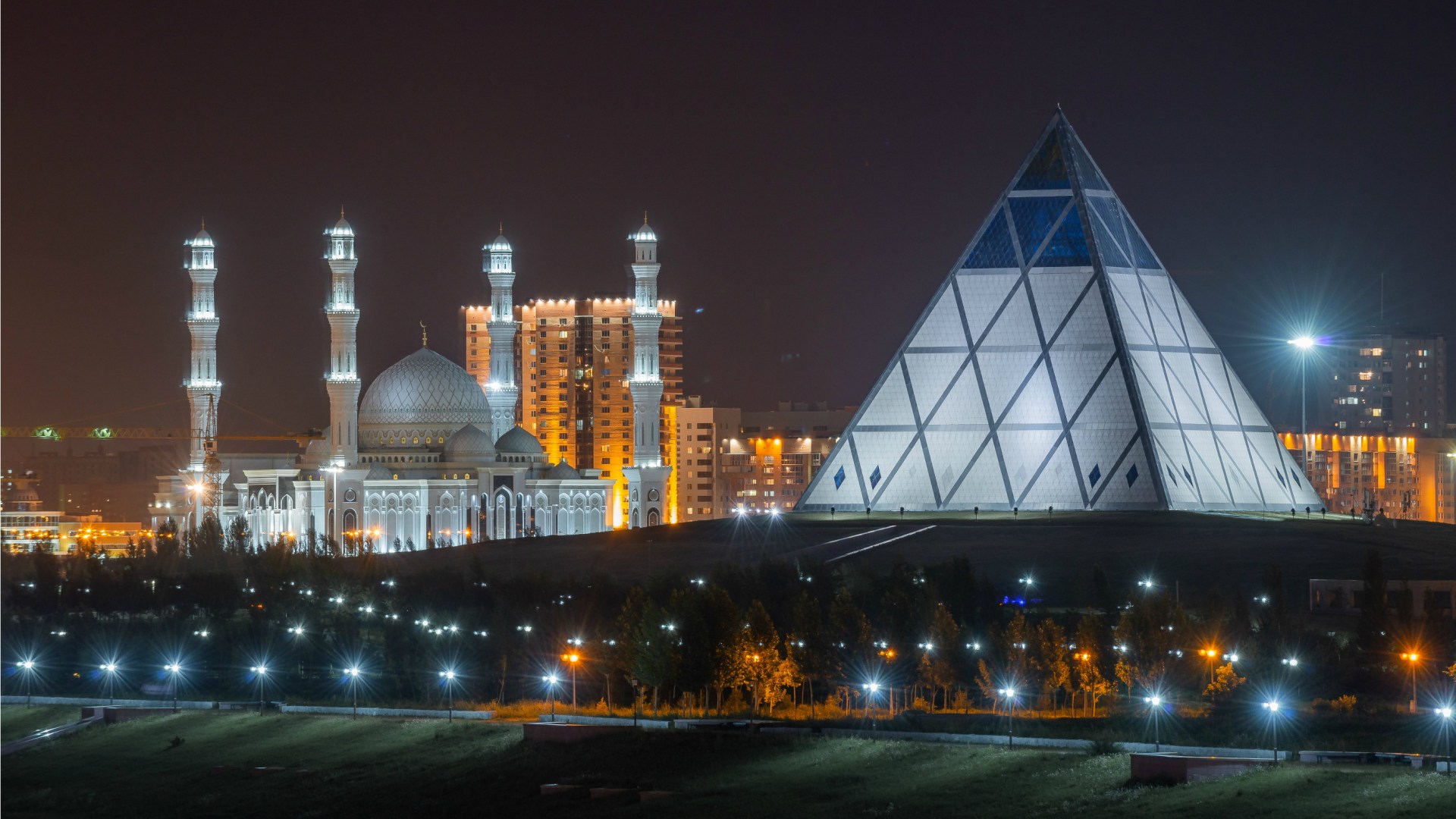
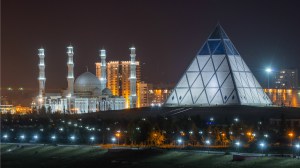
The Palace of Peace and Reconciliation in Nur-sultan (formerly Astana), Kazakhstan.

The Palace of Peace and Reconciliation in Nur-sultan (formerly Astana), Kazakhstan.

Christianity Today July 16, 2021
Nutexzles

In this series

Now two of “the five ’Stans” are becoming bigger fans of—or, as Gen Z would say, “stanning” for—religious freedom.

“In Kazakhstan, all denominations can freely follow their religion,” said Yerzhan Nukezhanov, chairman of the Central Asian nation’s committee for religious affairs, “and we will continue to create all necessary conditions for religious freedom.”

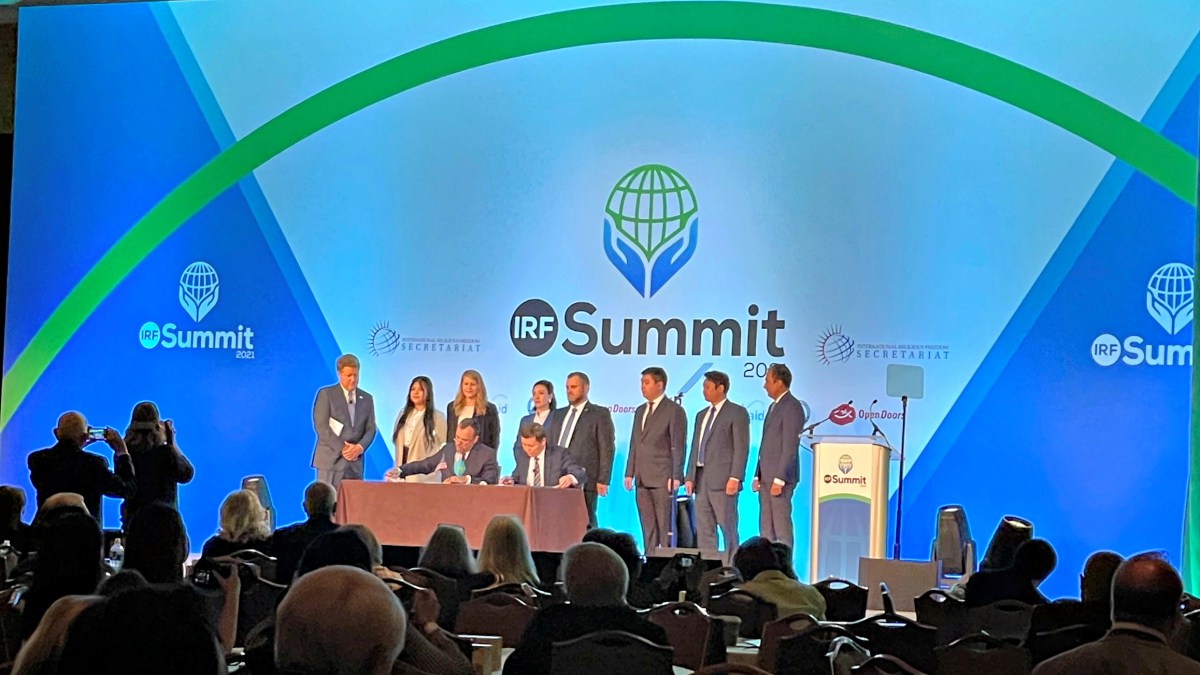
Speaking at the 2021 International Religious Freedom (IRF) Summit in Washington, DC, Nukezhanov signed a memorandum of understanding with Wade Kusack, head of the Love Your Neighbor Community. It sets a three-year roadmap that will train local imams, priests, and pastors in dialogue, culminating in the establishment of religious freedom roundtables in nine Kazakh cities.

“It is a front door approach in openness and transparency with the government,” Kusack told CT. “Mutual trust is built one relationship at a time.”

An ethnic Belarusian, Kusack is also the senior fellow for Central Asia at the Institute for Global Engagement (IGE), the American NGO which helped shepherd Uzbekistan’s efforts to improve its IRF standing. In 2018, top Uzbek officials pledged reforms at the first Ministerial to Advance Religious Freedom, convened by the US State Department.

Later that year, the State Department removed Uzbekistan from its list of Countries of Particular Concern (CPC) for the first time since 2005. Downgraded to Special Watch List status, by 2020 the nation had made enough progress to be delisted altogether.

Recent developments in Kazakhstan were hailed as a “proof of concept” for the engagement model of IRF advocacy. Not listed as a CPC by the State Department, the nation has been recommended for watchlist status by the US Commission on International Religious Freedom (USCIRF) since 2013.

Kazakhstan signs a religious freedom MOU at the 2021 International Religious Freedom Summit in Washington.

Nukezhanov noted 2018 as the year his committee established a religious freedom working group specifically to demonstrate openness to American concerns. That same year, Nikolay Popov was fined $600 for sharing his Christian faith—without a license.

Popov, part of the Council of Baptist Churches in Kazakhstan’s Karaganda region, also failed to secure government approval of the religious literature he distributed. The administrative court of Balkhash, 380 miles southeast of the capital city Nur-Sultan (formerly Astana until 2019), found him guilty of “illegal missionary activity.”

Kazakhstan’s 1995 constitution establishes a secular state that guarantees freedom of religion and belief. This includes the right to propagate one’s religion. A 2011 law, however, added restrictions that in practice privileged the “traditional” religions of Kazakhstan—Sunni Islam and Russian Orthodoxy—while requiring all faiths to register and operate according to a set of bureaucratically tedious restrictions.

National registration requires 5,000 members, with 300 members in each of 14 regional districts. Regional registration requires two locations with 250 members each, while local registration must list the names and addresses of at least 50 founding members.

The overall climate has led the Baptist churches to refuse registration in principle.

Elijah Brown, general secretary of the Baptist World Alliance, called the new MOU a “historic moment,” hoping it will proceed to address the registrations, restrictions, and fines that leave Baptists and other religious minorities in Kazakhstan vulnerable to violations.

“The commitment of the Kazakhstan government to establish religious freedom roundtables is an important and significant step,” he said. “It is now essential that these roundtables intentionally include representatives of all faith traditions.”

Because Baptists are not the only ones experiencing difficulty. In 2017, 20 Muslims were taken to court and fined for saying aloud the word Amen during prayers at their mosque. The action—allegedly associated with Islamic extremism—violates the code of the Association of Muslims of Kazakhstan. All mosques must register with the association, which appoints their local imams.

Now, faith leaders will be meeting together.

“Where there is no equal and open dialogue, stereotypical thinking can lead to a violation of citizens’ rights to freedom of religion,” said Alexander Klyushev, chairman of the Association of Religious Communities of Kazakhstan, a grouping of evangelical churches. “Most often this affects the rights of religious minorities, or religious communities that are seen as a potential fifth column in the country.”

Klyushev was part of the early working group that interacted with Kazakh officials and American sponsors. In November 2019, the Kazakh ambassador to the US and the Ministry of Information and Social Development, which oversees religious affairs, held the first Religious Freedom Roundtable in Shymkent, the nation’s third largest city. Four gatherings have now been held in total, in four different cities.

Since then, Kazakhstan has dropped plans to amend the 2011 law to further strengthen control of the state. And USCIRF has noted positively that the number of administrative prosecutions for religious offenses has continued to decline, falling from 284 in 2017 down to 160 in 2019.

And in 2020, Thomas Schirrmacher, now general secretary of the World Evangelical Alliance, met with Kazakhstan’s grand mufti and the president of its Catholic bishops conference.

“The government made a concerted effort to improve its record on religious freedom,” stated USCIRF in its latest report prior to this week’s IRF summit and MOU signing, “working to design and implement reforms in conversation with US counterparts.”

“While USCIRF is concerned by elements of current draft reforms, the commission is very encouraged by Kazakhstan’s willingness to engage in open dialogue and believes this will result in positive outcomes for religious freedom,” commissioner Nadine Maenza told CT after the MOU was signed.

Kusack argues that religious freedom liberates believing communities to serve their nation.

“When no one gets in the way of religious practice, such people usually become the most positive and effective members of the local society,” he told CT. “They contribute to the development of charity, adhering to the values of service to one’s neighbor.”

But winning the right to do so takes time.

Kusack first interacted with Kazakh religious leaders in 2010, and engaged governmental figures in 2013. Contacts continued steadily, and last year—despite the COVID-19 pandemic—he conducted 36 meetings with 146 Kazakh officials.

The roadmap calls for the multifaith religious leader retreat to take place next month, on August 15. And by February next year, participants will join law enforcement officials in a certificate course on religion and the rule of law, designed by Brigham Young University.

“This will make [officials] look more professional and win opportunities to communicate with the outside world,” he said. “Such certification can serve as a social elevator.”

Graduates will be invited to co-chair the nine city roundtables, expected to be established by the end of 2022.

Tomas Thomassov, pastor of the local religious association of Pentecostals called Joy Church, attended the earlier preliminary roundtable meetings and was encouraged. Officials promised to listen to and look into Pentecostal complaints.

“Dialogue took place between the religious organizations themselves, as well as with the state,” he said. “We felt a fresh breeze, and it gave us hope.”

Kazakhstan’s traditional religious groups were similarly positive with the balance represented.

“One harmful stereotype has already been abandoned in Kazakhstan—that the state should withdraw from the religious sphere. This would untie the hands of destructive religious organizations,” said Bishop Gennady of the Kaskelen diocese and manager of affairs for the Kazakh branch of the Russian Orthodox Church.

“But similar [in harm] is unjustifiably tight control,” he said. “The more the state cooperates with traditional faiths which have proved their peace position, the less extremists will have a breeding ground.”

Like elsewhere in Central Asia, fear of Islamic terrorism has led to state oversight of Muslim communities. But Kusack anticipates the non-registered Ahmadiyya sect of Islam will be included in the roadmap. While Wahhabi-influenced Muslims will not be included initially, he hopes that over time the nonviolent among them can be drawn in.

Despite the progress, what has yet to take place is widespread communication about these developments. At the time of the first working group roundtable meetings, only 12 out of 3,328 registered Kazakh media publications mentioned anything at all about religious freedom.

“Even if the reality is that this is only for a formal report or for propaganda purposes,” said Kusack, “people of different religions gather at these venues.”

He described the changed attitudes of religious leaders since the roundtables began, such as when a Baptist pastor showed him a bouquet of flowers sent by a Muslim imam for the Easter holiday. This relationship was established at the meetings, at which the imam confessed he previously considered Baptists to be “evil people” who were always indignant about something, but now see them as normal individuals who love their country.

“When we break down stereotypes, we turn to universal values,” said Kusack. “And these evoke a response in the hearts of people, regardless of their religion.”

Prior to this week’s signing, Klyushev agreed as he held out hope that the meetings would produce more than just warm relations. The role of government is crucial, and cooperation is just getting started.

“Public administration always plays a very important role in interreligious harmony,” he said, “and the tolerant attitude of different religions to one other.”

This year’s IRF summit in Washington—convened by civil society rather than the earlier ministerials convened by the US government—featured many examples of traditional name-and-shame advocacy. China, Nigeria, and India were frequent targets.

But there was also an increase in engagement-based strategies. Kusack believes it may be a new model.

“We are elevating religious freedom to new levels,” he told summit participants from the main stage. “This framework can be replicated throughout Central Asia, and beyond.”

Rafael Balgin reported from Almaty, Kazakhstan

News

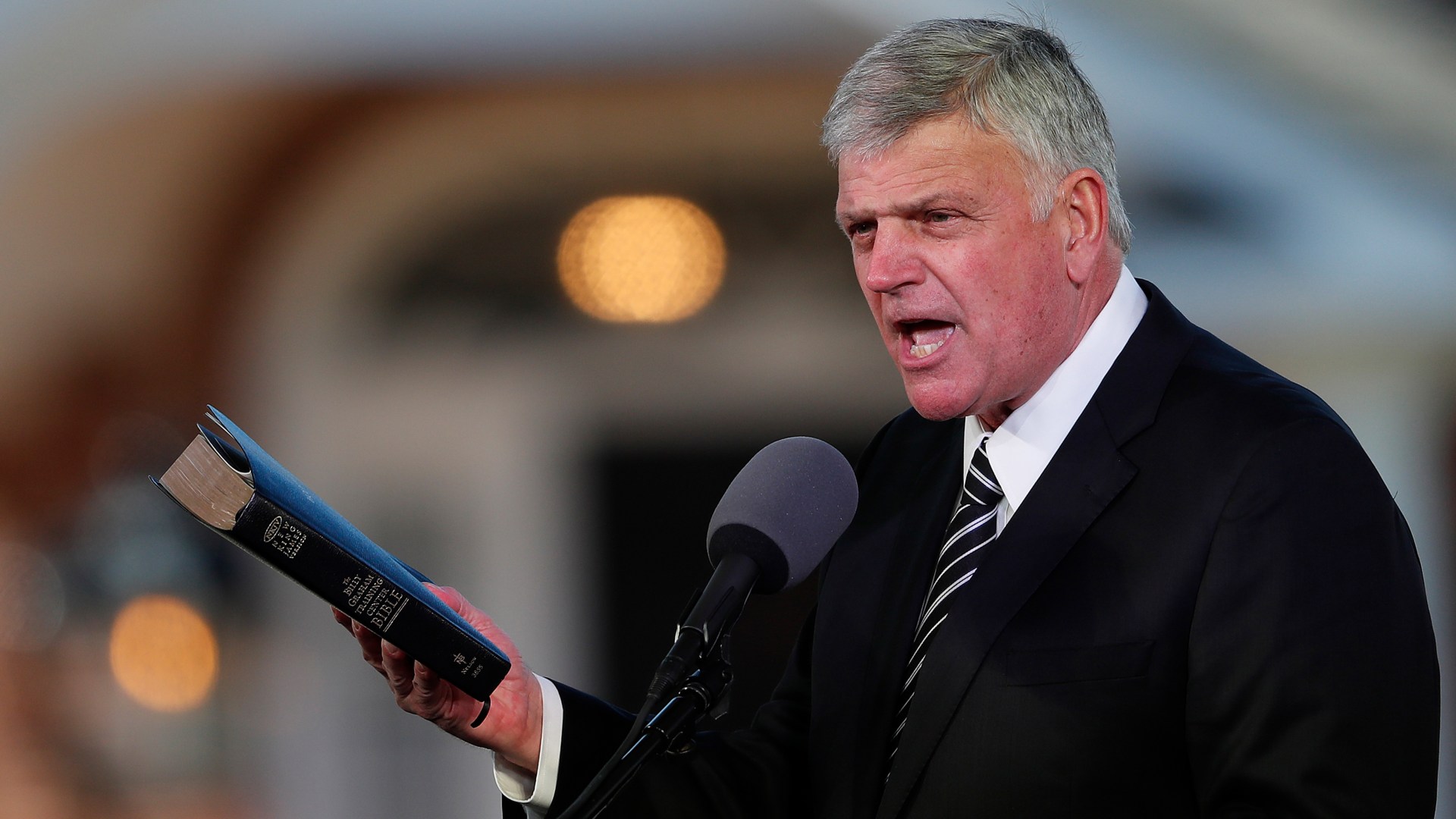
British City Apologizes for Removing Franklin Graham Ads

Updated: Evangelist celebrates “important movement for religious freedom in the UK.”

Christianity Today July 16, 2021
AP Photo/John Bazemore

Update (July 16): The British city of Blackpool must apologize for removing Franklin Graham ads from public buses, admit the act was discrimination, and pay the organizers of the Lancashire Festival of Hope a total of 109,000 pounds (the equivalent of about $150,000).

Judge Claire Evans handed down the terms on Friday morning, with agreement from both sides. The city published the apology on its website and must pay the fines in one week.

The court calculated the cost of removing the bus ads at 84,000 pounds for the Festival of Hope’s legal fees and an additional 25,000 for “just satisfaction,” because the city violated the UK Human Rights Act of 1998.

When the city removed the ads, it claimed this was necessary because of “heightened tension” caused by Graham’s position on LGBT issues. But internal emails showed officials expressing their own disapproval of Graham and looking for a legal reason to stop the advertising campaign. Roughly 200 area churches sponsored Graham’s event, which was attended by about 9,000 people.

“This is an important moment for religious freedom in the UK,” Graham said in a statement to CT. “We’re grateful to God for the final outcome of this case, and for what it will mean for churches and Christians across the UK in the years ahead. The Good News of Jesus Christ must be proclaimed. My prayer is that this case will encourage Christians to stand firm.”

The terms cannot be appealed and the court order is public, so the case can serve as a precedent in British law.

Evan’s ruling in April found that the city “gave preference to the rights and opinions of one part of the community,” while disregarding the rights and opinions of others.

“A pluralistic tolerant society allows for the expression of many different and sometimes diametrically opposed beliefs,” she wrote.

In its official apology, the city acknowledges that the advertisements themselves were not offensive, even if some find Graham’s beliefs about same-sex relationships offensive. They described the act of removing the ads as discrimination.

“We discriminated against Lancashire Festival of Hope because of the religious beliefs of Franklin Graham and in doing so interfered with Lancashire Festival of Hope’s right to freedom of speech,” the statement says. “We sincerely apologise to the organisers of the event for the upset and inconvenience caused.”

The city now has new policies for bus advertisements. The new policy says the city will reject ads deemed “likely to cause widespread or serious offence to members of the public,” but also states the city is “fully committed to meeting its obligations under the Human Rights Act 1998.”

—–

Original post (April 5, 2021): Franklin Graham’s British bus signs seemed innocuous. They said, “Lancashire Festival of Hope with Franklin Graham—Time for Hope.”

But the message, the messenger, and his history of controversial statements about homosexuality sent the seaside resort town of Blackpool into turmoil in 2018, as elected officials and administrators rushed to find a way to remove the advertisements from public transportation.

“Clearly this chap cannot be allowed a stage to promote this venom,” wrote one city official an email to the council. Another called the evangelist and the president of Samaritan’s Purse a “bile spewing preacher.” A third official didn’t know who Graham was, but looked him up on the internet and said she was “a bit shocked” at things Graham had said about LGBT people on Fox News.

The town removed the Festival of Hope signs just 24 hours after they went up on city buses, citing “heightened tension” and complaints from local residents.

Now, more than two years later, a British court has ruled that was an act of religious discrimination. Graham’s name and record of controversial statements might be offensive to some in Blackpool, according to Judge Claire Evans, but the town was wrong to censor him. The bus sign was protected by the British Equality Act of 2010 and the European Convention on Human Rights.

“All religions and beliefs are characteristics protected by law,” Evans wrote in a 35-page decision handed down last week. “The domestic courts and the European Court of Human Rights have consistently affirmed that a pluralistic tolerant society allows for the expression of many different and sometimes diametrically opposed beliefs.”

According to the judge, Blackpool exhibited “a wholesale disregard for the right to freedom of expression” and “gave preference to the rights and opinions of one part of the community,” while disregarding the rights of festival organizers and the British Christians who agree with Graham.

James Barrett, chairman of the Billy Graham Evangelistic Association board, praised the ruling and called it a rebuke to cancel culture in the UK.

“It is a significant day for religious liberty and freedom of speech,” he said. “The court clearly affirmed that Christians and other people of faith who publicly express traditional religious views about marriage and human sexuality are protected by law.”

More than 9,000 people heard Graham speak at the Festival of Hope, despite the lack of bus ads. The event was supported by about 200 area churches.

Blackpool and its public transportation company defended themselves against religious discrimination claims with several arguments in court last month.

First, they said there was a rule against all political and religious ads, regardless of specific content. The court rejected this claim, pointing out that though there is such a rule on the books, Graham’s ad was accepted at first and Blackpool officials never referenced the written policy in their discussions about removing Graham’s ad. Official correspondence indicates the town normally does allow political advertising.

Second, the town said the decision was made to protect city property, since the bus signs could become targets for vandalism and graffiti. The records didn’t show any actual threats of vandalism, though. Instead, the town officials seem to have invented the concern as a plausible legal argument after they decided to reject the ads because of Graham’s positions on LGBT issues.

“The posters are not offensive and they advertise what is the reality in that the conference is taking place,” one transportation administrator wrote to the town’s legal counsel. “I am of the mind to remove the posters because from what I see our buses could become the target of people taking revenge.”

The legal counsel replied that “I think your approach of removing the adverts to ensure that we do not have the buses becoming a target for the argument is a strong one and does not seek to take sides but is a practical response to a potential problem.”

Council leader Simon Blackburn was not so cautious about taking sides, though. The Labour Party member insisted the town fly the rainbow flag when Graham arrived in Blackpool. He said “it’s obviously just the right thing to do,” and communicated official solidarity with the LGBT community.

Blackpool’s lawyers’ third argument was that the town was not removing the advertisements because of their religious content, but because the public would be offended by the ad.

The judge said this argument would “would be to give free rein to discrimination.” Minorities—whether religious, racial, or sexual—only need legal protections of their civil rights and their access to public spaces when they are considered offensive. The Equality Act and other anti-discrimination laws were designed to protect people when their presence in the public square disliked by a majority of the public.

While the town was “trying to distance itself from controversy and public opprobrium,” Evans wrote, that “is not the same as operating a policy of neutrality.” She found the town’s religious discrimination was explicit and stated clearly in internal discussions about the bus ads.

British buses in other towns have drawn attention for displaying ads for other faith efforts, including Islamic Relief’s Ramadan campaign in 2016 and a national “Atheist Bus Campaign” in 2008. Earlier this year, a leftist political faction in Germany spoke out against Bible verse advertisements in public transportation there, saying they make riders feel uncomfortable.

The court will now consider financial damages and rule on what Blackpool owes festival organizers.

Blackpool, for its part, told the BBC it would review changes to the advertising policy on public transportation, but the resort town remains committed “to promoting equality and diversity, eliminating discrimination and increasing respect, tolerance, and understanding throughout our community.”

News

Why Congregations Aren’t Waiting to Leave the United Methodist Church

With a denominational split delayed, some are willing to pay big to exit now.

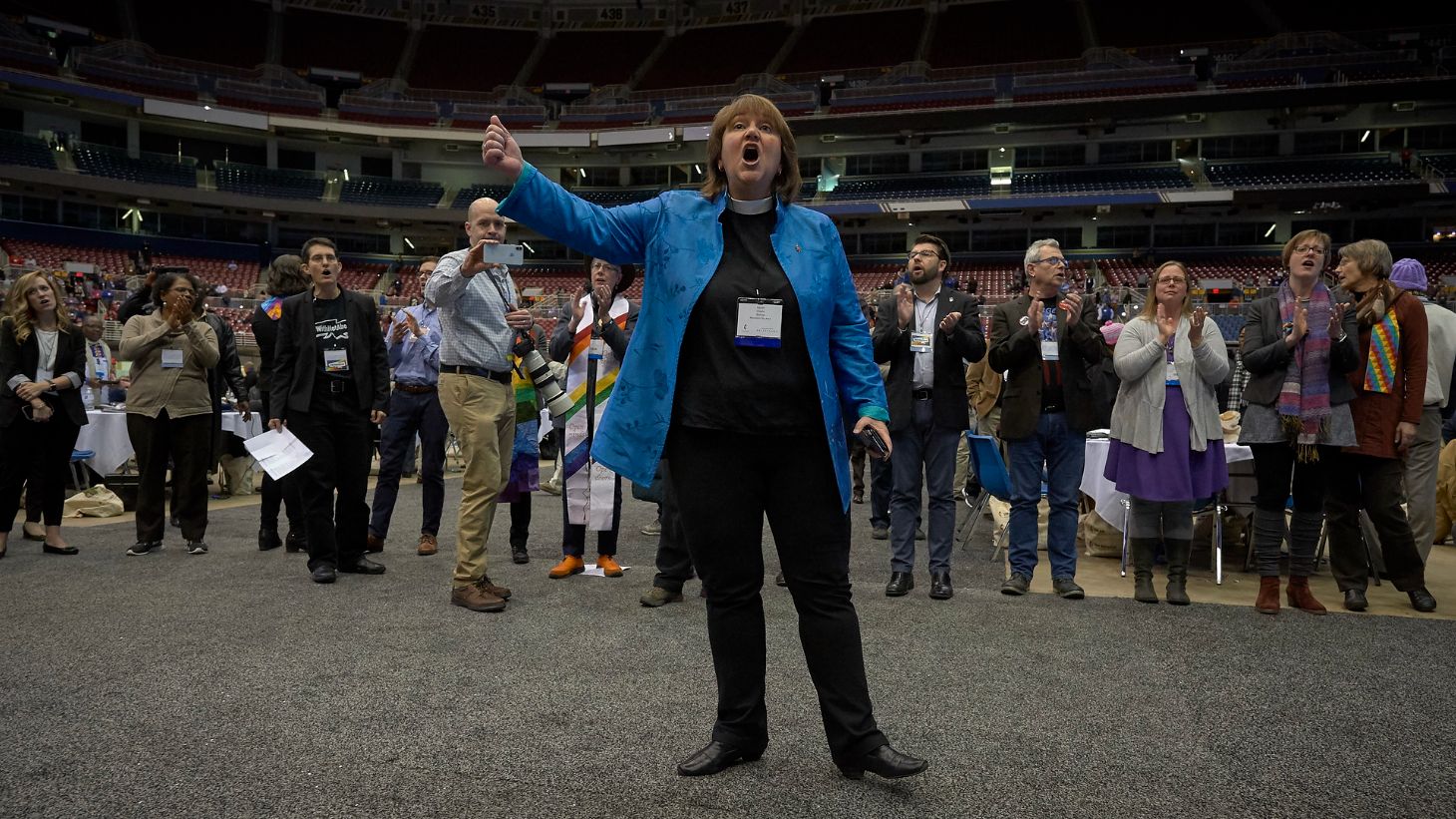
The UMC had voted to strengthen church policies about homosexuality at a special session back in 2019.

The UMC had voted to strengthen church policies about homosexuality at a special session back in 2019.

Christianity Today July 16, 2021
Paul Jeffrey / United Methodist News Service

Caught in a decades-long battle over LGBT issues, with a proposed denominational split delayed again by the pandemic, dozens of conservative and progressive churches are leaving the United Methodist Church (UMC) without a tidy exit plan.

Two years ago, factions in the United Methodist Church (UMC) agreed on a plan for splitting the denomination with conservative churches keeping their property as they leave. But the UMC has twice postponed its General Conference and won ’t meet until August 2022 to vote on the proposal, called the “Protocol of Reconciliation and Grace Through Separation.”

A United Methodist News review of US annual conference reports and publicly available journals found that the 54 conferences—regional UMC governing bodies—approved at least 51 disaffiliations in 2020. Annual conference reports for 2021 show that the annual conferences have approved 38 disaffiliations so far in 2021.

Though the disaffiliations represent a sliver of the more than 31,000 United Methodist churches nationwide, they show that some churches are willing to take the hard way out of the UMC.

“For us, we felt the Lord was leading us to go. As far as the protocol is concerned, it ’s something that is up in the air,” said Alvin Talkington, a member of the disaffiliation team at Boyce Church, a 100-member congregation in Ohio that left the denomination last fall.

The decision to leave came after years of frustration with the East Ohio Conference for not valuing the church’s conservative doctrinal stance on issues such as homosexuality and not finding conservative ministers to serve the church.

“Out of the last ten pastors, there might have been three or four who fit our doctrine,” said Talkington. The church hired its most recent pastor without the help of the annual conference, and the lay leadership led the effort to disaffiliate.

The move came at a cost to the East Liverpool, Ohio, church.

For centuries the denomination has maintained a trust clause, which states that churches hold property in trust for the entire denomination. To depart with property, churches can use a provision added by the 2019 special session of the General Conference, allowing churches to disaffiliate for “reasons of conscience” related to human sexuality. This addendum is sometimes called Section 2553.

Even under Section 2553 disaffiliation requires churches to pay hefty financial obligations to their conferences: several years of contributions to the pension and payment of two years of aportionments, money local churches give to support the conference and denomination. Though not specified in Section 2553, some conferences also require churches to pay a percentage of the church’s total assets. The annual conferences must also vote to release a church. But if churches waited until the protocol ’s approval, they could walk away with their buildings and no major fees.

Leaders at Boyce firmly believed its future was not with the UMC and weren ’t sure when the protocol would be approved or what the final language would be, so the church disaffiliated under Section 2553 last September. It had to pay a $92,000 fee on the way out.

“The protocol provides a way for churches to leave and for pastors to keep their pensions without fees,” said John Lomperis, United Methodist director for the Institute on Religion and Democracy. “If you go through the protocol, the denomination waives its right to assert the trust clause and churches can keep buildings.”

Another church that opted to leave before the protocol vote was the United Church of Altona, now The Grove Community Church of Altona, Illinois.

The church cited concerns over leadership as its reason for disaffiliating and paid over $120,000 to leave the Illinois Great Rivers Conference. The congregation felt like the conference did not support the church as it struggled to find and maintain good pastoral leadership.

“We were floundering, and we were afraid if we kept going the way we were, we would keep losing members,” said Carla Gibbons, a member of the Grove Community Church disaffiliation team.

Before 2020, the majority of disaffiliating churches have been on the traditional side of the theological spectrum. Most have left citing weariness with the debate or a lack of enforcement of the denomination ’s bans related to homosexuality.

Some of these churches, like Grace Fellowship Church in Katy, Texas, have found a new home in the conservative Free Methodist Church, while others, like Boyce Church and Grove Community Church, are moving forward as independent churches.

But progressive churches are leaving the UMC, too. In 2020, three Maine churches and one Texas megachurch left the UMC over what they see as LGBT discrimination. Houston ’s Bering Memorial United Methodist Church left the UMC for the United Church of Christ. New Brackett Church in Peaks Island, Maine, became independent, but the church and its pastor are considering joining both the United Church of Christ and the Unitarian Universalist Association.

“We feel that this decision would allow maximum participation from a wide spectrum of people and beliefs in the life of our church,” the church website says.

Progressive churches leaving the denomination also consider the Alliance of Baptists and the UK-based Inclusive Church. In June, leaders of Love Prevails, a group of UMC progressive pastors, announced their departure from the denomination.

The Wesleyan Covenant Association, which includes 125,000 people in 1,500 churches, formed to lobby in favor the UMC’s traditional marriage stance. Now, the group has become the core of the Global Methodist Church, a conservative denomination to receive departing congregations after the split.

Neither the UMC nor the Global Methodist Church want churches striking out on their own.

Will Willimon, professor at Duke Divinity School, sees how students studying ministry are worried about what the denomination will look like when they are ready to enter it. “I think bishops should be pleading with people to please stay,” he said.

He wonders if the exodus of churches will force remaining churches and UMC leaders to put the focus back where it needs to be: on local churches ministering in their communities.

“I advise people to stay focused on the local mission. This is the basic unit of the church, and maybe if we can recover that, we could be okay,” Willimon said.

Lomperis hopes that some of the conservative churches that have left the UMC will eventually join the Global Methodist Church. He understands the frustration churches feel toward conferences that don ’t value their conservative theology. But rejecting the denominational structure isn ’t the answer, he said. He hopes that the Global Methodist Church can develop a leaner, less bureaucratic arrangement that gives more power to local congregations.

“We strongly discourage any premature quitting and encourage people to wait on the protocol. For those who have left, we hope that later when we get the protocol, they will come join the GMC,” he said.

Since leaving the UMC, members of The Grove Community Church have hired a part-time, independent pastor to lead the congregation. Gibbons is encouraged to see attendance up from 20 to 90 in worship, a combination of new families and returning members, even as she acknowledges there is always a honeymoon period with a new pastor.

And members of former UMC churches maintain their appreciation for historic Methodism and its contributions to global Christianity.

“The United Methodist Church has probably done more globally than just about any other denomination there is,” said Talkington of Boyce Church. “They do a lot of good, but this scriptural thing—they are just willing to tear it apart.”

Books
Review

What Happens in Left-Behind Places Doesn’t Stay in Left-Behind Places

Our “culture of transience” has far-reaching social and economic costs—and some that are harder to quantify.

Christianity Today July 16, 2021
Illustration by Mallory Rentsch / Source Images: Noah Blaine Clark / Dhru B / Natalia Shavlova / Unsplash

Many of us like the idea of living a countercultural life. We want to be fish swimming against the current, not sheep in a crowd. But cultures are hard to identify, let alone counter. In her new book, Uprooted: Recovering the Legacy of the Places We’ve Left Behind, journalist Grace Olmstead shows us an American culture of transience we may not have noticed or even understood to be problematic. It turns out that swimming against the current might look exactly like staying in one place.

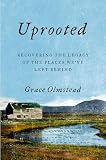
Uprooted: Recovering the Legacy of the Places We've Left Behind

Uprooted: Recovering the Legacy of the Places We've Left Behind

Bantam Press

272 pages

In the book, we see that the choice to stay and put down roots may be not only the most countercultural life choice available to many of us, but the choice with the greatest potential for healing so much of what ails us, as individuals and as a nation. In this deeply personal study of a small Idaho farming community, Olmstead argues that a culture of transience “almost always results in extraction and exploitation of the places left behind,” and that this isn’t only a problem for those who are stuck or who choose to stay “behind.”

This is a book about places, but it is also a book about limitations and dependence. We need one another, and we need roots. We also need limits, and the fewer limits we have, the greater our need for discernment amidst a consumerist culture of almost endless choice. As Olmstead notes, “we move to places that will offer us something: to places that fit the consumptive cadences of our time, not to places that might ask something of us.” Uprooted is a persuasive call to dig in, give back, and perhaps even move back.

The need for rootedness

Since leaving the rural Idaho town her family has called home for generations to attend college in Virginia, Olmstead has, paradoxically, used her journalism to champion places experiencing postindustrial collapse or brain drain. Olmstead herself wonders if the paradox makes her a hypocrite, and her writing here is fueled by two questions: Should she return? And will it matter if she does?

The question many readers will bring to this book is distinct but related to Olmstead’s own: What difference does the decline of one faraway farming town make to me and where I live? The surprising answer is that it matters much more than most of us know.

Uprooted weaves together the stories of Olmstead’s parents, grandparents, and great-grandparents—the history of their farming home in the fruitful though arid Emmett Valley—with detailed assessments of the current state of American farming life. Olmstead explores everything from debt to loneliness, suicide to soil health. She is one of many writers to mine this problematic territory, and she is clear about her debt to writers like Wendell Berry and academics who study America’s farms and small towns, but Olmstead harnesses the emotional power of her personal experience to give this subject new focus and force.

The loss of Olmstead’s family farm becomes emblematic of losses that plague communities across our country. These losses are economic (most farms can no longer support one family, let alone generations). They are practical (I was surprised to learn that despite our Dust Bowl history, some farmers do still risk their topsoil by leaving fields bare after harvest). And the losses are spiritual and cultural as well. These last are hard to quantify with data, but Olmstead evokes them for us in poetic language: “Participating in farm tradition was like taking your place in the dance,” she writes, “joining arms with the company behind and before. Family, food, soil, and place were all bound together in the rhythm of the seasons, and to be fed was to remember.”

Such losses are too easy to overlook in a culture that equates success with moving up and moving out. As Olmstead reminds us, “Few Americans take easily to the idea of rootedness.” We tell the best and brightest of our youth, “You will go far!” I’m not sure I would have seen this as a problem before reading this book, but Olmstead is convincing in her argument that the fault lines in our agricultural communities will require the very best we can offer if they are to be repaired. Brain drain isn’t only a problem for those anonymous places left behind; it is a problem for all of us. Chances are, most of the food in our homes comes from such “anonymous” places, and problems there quickly reveal themselves here.

Olmstead doesn’t only take a magnifying glass to Emmett, Idaho, where orchard trees are bulldozed for suburbia even as the crowds at the local cherry festival grow. She steps back to ask much bigger questions about our universal human need for rootedness. To use the colloquial terms Olmstead borrows from novelist Wallace Stegner, are we boomers or stickers?

Boomers are those, like gold miners of yore, who swoop in, extract resources, and move on. From schools to weather, we talk about our places like customers rating products on Amazon. We may long for connection, but entrenched consumerist habits sabotage our efforts to put down roots. Becoming stickers—growing roots, deepening our dependance on others, cultivating our communities through committees and boards and local institutions—is slow, sometimes tedious, work. Olmstead’s depiction of her “Grandpa Dad”—who would work all day in the field before showering and heading off for a meeting of the hospital board, church board, or Land Bank Board—highlighted for me just how much I overvalue my own comfort and “free” time.

My story echoes Olmstead’s in interesting ways. My father left the family farm in Comanche, Texas, for college, military service, and, eventually, missionary work. During childhood visits to my grandmother’s farmhouse, I touched the tension between staying and going when I traced the intricate carvings on a wooden chest my father had sent his mother from Thailand decades before. I could at least experience the place my father had left behind, but my own children have never read the stones in that country cemetery where generations of our family were laid to rest in hope of resurrection. Unless I write the names on the back of photographs, they will never know them.

And yet, my children are growing up on the edge of Lancaster County, Pennsylvania. Because our Amish neighbors have embraced limitations and interdependence for generations, our landscape still looks in many respects like the small-farm landscapes Olmstead has watched disappear in Idaho. The Amish commitment to farm only what they can care for with a team of horses means that we have access to the kind of storybook beauty and delicious local food out of reach to most Americans.

We also have a very near example of strongly countercultural discernment. While most of our American farms are monocultures, and work and activities pull our families in a dozen different directions, I regularly drive past farms checkered with various crops and grazing animals. And I have never forgotten the story I heard about a local Amish farmer who chose to add tobacco to his other crops because its labor-intensive harvest was something his whole family could participate in together, sharing both the work and the delight of a life lived in harmony with growing things.

Nourishing the generations

Ultimately, Uprooted is a valuable guide for the kind of discernment we all must exercise if we are to cultivate strong roots in our unique places. While Olmstead believes that her desire to care for aging parents will eventually lead her family back to Idaho, that outcome is not the only possible good she describes.

My own father left the farm, but he continued to nourish his roots by purchasing land in Comanche. He is an absentee landlord with a difference: He knows those fields, he loves those fields, and I have watched him say no to quick profits because he did not believe it was in the best long-term interest of the place he once called home.

And after years of moving, after living in city and suburb, my family and I have put down roots in the ground of an old Pennsylvania farmhouse. Ten years ago, we hoped this place would nurture our children, but it will soon nurture the generation preceding us as well. My husband’s parents are leaving Texas to come and live with us. Because we have worked hard to root ourselves in this place and this community, I am confident they will find this home is fertile enough to nourish them, too.

We can and should applaud those who say “yes” to the call to go far and make disciples. But we must also credit those who stay and do the same, passing on knowledge, history, faith, and love for the land to the next generation. What do we owe the places we’ve left behind? We owe them everything, but as Olmstead helps us understand, we can repay that debt in so many fruitful ways.

Christie Purifoy lives with her husband and four children in a farmhouse in Southeastern Pennsylvania. She is the author of Placemaker: Cultivating Places of Comfort, Beauty, and Peace.

Church Life

What I Want to Remember When English Churches Sing Again

Worship music is important, but God cares more about the heart.

Christianity Today July 15, 2021
Illustration by Rick Szuecs / Source Images: Gabriel Brito / Unsplash / Rido81 / Envato

My eldest sons, aged 8 and 6, stayed up to watch England beat Denmark 2–1 in the Euro 2020 semifinal last week. It was very exciting and, caught up in the soccer spirit, they invented their own football song:

England, England, for you we sing

You’re gonna win the Euros thing

I’m not sure if they knew what the “Euros thing” actually was, or that England, which lays claim to the invention of soccer, hadn’t reached the final match of a major tournament in 55 years. But it turns out you can sing with excitement even if you don’t fully understand what you’re singing about. Joy makes people sing.

There is no group in the world for whom singing is more natural and appropriate than Christians. Here in England, we are eagerly anticipating singing together again. The UK government has announced that all COVID-19 restrictions will be lifted on July 19, including limitations on congregational singing in England. (Scotland and Wales have already lifted this ban.)

Groups, including religious groups, have not been allowed to sing indoors together since March 2020. For some of this time, only three designated people were permitted to sing to a socially distanced congregation, with many churches using a hybrid model of virtual and in-person services.

Now that churches in England can sing again, it’s important to reflect on why we sing, as well as reflect on the lessons from the pandemic. I work as a lecturer for a small Christian college, the Nexus Institute of Creative Arts (ICA). Back in March 2020, our principal shared with our school that he believed this season wasn’t a time to pause normal proceedings until we can go back to how things were, but a time to learn and grow—COVID-19 would be part of our pilgrimage toward spiritual maturity.

We must say, first of all, that the pandemic did not stop us from worshiping. I have led worship regularly during the COVID-19 lockdowns. That has been done either from home—hoping that Zoom’s gallery view function lets me feel connected in some way to my church family—or “leading” worship in a room full of people who are not allowed to join in with the song.

This is basically like inviting friends over for a meal, sitting to eat, and devouring the food you have prepared while they just watch.

Despite the frustrations, I have learned many important lessons. The church father Athanasius wrote that “he who sings well puts his soul in tune.” Christian singing has always been connected to Christian virtue. Singing stirs up in us godly affections and tunes our souls to the heart of God. Singing involves every part of the person—body, mind, memory, emotion, spirit—and this is a beautiful gift from our gracious God that we must use wisely.

There were moments in the pandemic when the need for deep and meaningful worship became really clear. I remember one Sunday during a Zoom service, we sang “In Christ Alone,” which includes the words “From life’s first cry to final breath / Jesus commands my destiny.”

In the congregation, that Sunday, some friends came with their two-day old daughter. Because of the way that distance was collapsed by Zoom, the service was also attended by my father-in-law. It turned out to be his last Sunday before aggressive pancreatic cancer took him home to be with the Lord.

We need songs that are beautiful and painfully true. We need songs that have enough strength to bear the weight of our sorrows, and that connect the valleys of this life to the glories of heaven above. Are we singing of a God who is bigger than pandemics? Are we singing of a God who gives hope at the graveside?

Worship culture can become a placebo of entertainment. But the gospel is the good news of a God who has suffered and died, but whose resurrection brings life.

Worship is not just personal. It’s congregational. This season has also shown me the importance of the body of Christ. As we’ve responded to the restrictions in various ways, we expressed our commitment to one another. And I was reminded that though individuals might not sing, the church is singing.

Physical proximity is good, but spiritual unity is better. And if our worship really is a meaningful expression of the gathered body of Christ, then I’ve learned in this time that my role as a worship leader is to facilitate participation, not to deliver a performance.

Hannah Hodges, one of my Nexus ICA colleagues, writes that “playing songs back to back is actually an unbelievably limited expression of what corporate worship has the potential to be.” She encourages worship leaders to “embrace the mess and step outside your comfort zone. I’ve found in doing that, it teaches me time and time again not to rely on my own strength and ability to lead worship, but to be wholly dependent on the Holy Spirit.”

The pandemic has given us the opportunity to relearn what it means to worship in the presence of God.

In his book Worship and the World to Come, pastor and theologian Glenn Packiam suggests that there are three paradigms to corporate worship: encounter, formation, and mission. The central text for our understanding of what it means to encounter God in worship, as historian Lester Ruth has pointed out, is taken from the King James Version of Psalm 22:3, which says that God inhabits the praises of his people.

But in COVID-19, these experiences are more like the apostle John’s in Revelation 1, where we meet Christ in our isolation. And like Psalm 23, where we know that God is with us even though we walk through the valley of the shadow of death. I’ve learned that if I am with Jesus, I cannot be in the wrong place, because he cannot be in the wrong place.

Our production standards, our professional musicians, our stadium-filling ballads are all fine and good, but they cannot replace the gentle touch of Christ to a broken soul. The God who walked with Adam in the evening in Eden, whose glory filled the tabernacle, who came to dwell among us, and whose Spirit makes us his temple on earth will meet us as we worship.

A pandemic will not thwart his heart to be with his redeemed people. Whether we sing together or apart or not at all, that’s the important thing.

As I’ve tried to lead worship in the pandemic, I’ve learned how important singing is. But also how important singing isn’t.

Singing is downstream from the Great Commandments. We are called, as Christians, to take up our mask and follow Jesus. We are called to love God and our neighbor in times of singing and times of silence.

I don’t think it is a coincidence that we could not gather to sing at a time when God is calling us back to lives of righteousness, justice, and mercy. Isaac Watts, no stranger to the importance of singing, once wrote, “The Great God values not the service of men if the heart be not in it: The Lord sees and judges the heart; He has no regard for outward forms of worship, if there be no inward adoration, if no devout affection be employed therein. It is therefore a matter of infinite importance, to have the whole heart engaged steadfastly for God.”

So yes, let’s eagerly celebrate the return of singing to our churches. But as we do so, may our songs be richer and sweeter for the journey we have been on in these times—because if not, we’re just like my boys cheering on England, enthusiastically singing about things we don’t fully understand.

News

Study: Regular Bible Readers Experienced More Stress in 2020, But Also More Hope

In times of trials, Scripture strengthened and encouraged.

Christianity Today July 14, 2021
David Sacks / Getty Images

Ainslee Moss felt the full weight of 2020.

For her, the year included juggling the responsibilities of running several nonprofit thrift stores in York County, South Carolina, directing a women’s shelter ministry, coordinating drop-offs for new mothers and seniors unable to leave their home in the pandemic, and traveling back and forth to the hospital with her elderly father who was fighting heart problems and esophageal cancer.

Her father, David Gentry, died at the end of the year, on December 27.

“Definitely one of the most challenging years I think I’ve ever been through,” Moss said. “I had my days that I had my good cries, but I think one of the things that kept me sane in those times was knowing that God has our days numbered.”

At the worst moments in 2020, she said, she turned to Psalm 34:1: “I will bless the Lord at all times” (ESV).

According to data from the State of the Bible survey by the American Bible Society (ABS), Moss’s experiences over the past year are in line with many Christians in America.

People who are “Bible engaged”—which the society defines as people who read Scripture multiple times per week and cite its impact on their daily lives as a key way they relate to God—struggled in 2020. They reported stress and anxiety at slightly higher rates than the rest of the population. But they also had more hope.

“Jesus said, ‘In this world you will have trouble, but take heart I have overcome the world,’” John Farquhar Plake, lead researcher at ABS, told CT. “We see that played out in the lives of real people in the data.”

The survey found that one-quarter of Americans are experiencing moderate levels of stress and 10 percent are experiencing extremely high levels.

Nearly half of respondents said they had trouble sleeping, 44 percent reported feeling tense, 44 percent said they were lonely and cut off from others, and 37 percent said they felt numb or detached.

Every measure of anxiety increased a bit between June 2020 and January 2021 in the study.

Christians who regularly turn to the Bible were not immune. In fact, the opposite was true.

“We actually found that more Scripture-engaged people experience more stress and often higher levels of trauma,” Plake said.

According to the study, “A strong relationship to the Bible often coexists with—and could even be compelled by—the hardships of life.”

Plake said the correlation could be explained by the fact that people turn to the Bible more when they’re in trouble than when everything in their lives is going well. From what the data shows, the Scripture gives people hope. Bible-engaged people scored 71 out of 100 on a hope agency test, rating the truth of statements such as “If I were in trouble, I know I could get out,” and “I can think of many ways to reach my goals.” Bible-disengaged respondents in the ABS study scored about 14 points lower.

Plake says the findings should encourage churches and ministries as they respond to the needs of people such as Moss, who have been through a lot in the past 12 months. The study affirms the Bible is a source of hope and encouragement.

Marlaina Centeno, a pastor and church partnership associate with the American Bible Society’s Trauma Healing Institute, said that women and minorities are statistically more likely to experience trauma—in general and perhaps even more in the difficulties of the pandemic.

“There are so many stresses that have happened in the past year on top of COVID, it compounded,” she said.

While trauma can create a barrier for some people when it comes to forming a relationship with God, Centeno said the data indicates that people in times of pain and suffering are strengthened by reading the Bible.

She suspects the impact is even greater when the Bible is read in groups, as relationships are also a source of comfort and encouragement. When people come together and form relationships and study the Bible together, they come away strengthened.

Centeno said while she’s seen a lot of hurt over the past year, she’s also seen a lot of healing.

“I’ve done in-person groups. I’ve done online groups throughout this entire year with COVID and it’s amazing what happens,” she said, “from the first session of people coming in so incredibly heavy and having a lot of stress and a lot of pain and then six weeks later or six sessions later seeing some bring their pain to the cross and being able to see that light.”

Plake said church leaders should take away two lessons from the State of the Bible report: First, people are hurting, whether they show it or not. And second, the Bible offers hope.

“It’s wild to realize that what was true 2,000 years ago is still true in the 21st century,” he said. “Just as God changed people’s lives, as it’s recorded in the Book of Acts and the Pauline Epistles, we see those same kinds of things in the data of 21st century Americans. The Bible is not out of date. It’s still relevant and God’s still at work.”

For Moss, it was in the pages of Scripture that she found the hope and strength to return to work at Tender Hearts Ministries soon after her dad died.

“I’m going to see him again one day because that’s what Scripture promises,” she said.

She also knows her dad would want her to continue doing what God called her to. As she counsels those who are at rock bottom, she points them to the same source of stability she goes to—the Bible.

“We are giving them hope,” she said.

addApple PodcastsDown ArrowDown ArrowDown Arrowarrow_left_altLeft ArrowLeft ArrowRight ArrowRight ArrowRight Arrowarrow_up_altUp ArrowUp ArrowAvailable at Amazoncaret-downCloseCloseellipseEmailEmailExpandExpandExternalExternalFacebookfacebook-squarefolderGiftGiftGooglegoogleGoogle KeephamburgerInstagraminstagram-squareLinkLinklinkedin-squareListenListenListenChristianity TodayCT Creative Studio Logologo_orgMegaphoneMenuMenupausePinterestPlayPlayPocketPodcastprintremoveRSSRSSSaveSavesaveSearchSearchsearchSpotifyStitcherTelegramTable of ContentsTable of Contentstwitter-squareWhatsAppXYouTubeYouTube