News

Prayers for Unity in Eastern Washington House Race

Cathy McMorris Rodgers says she wants to bring people together in divisive times.

Christianity Today October 21, 2020
Courtesy of Cathy for Congress

Update (November 4): Cathy McMorris Rodgers was reelected to a ninth term with 59 percent of the vote.

Editor’s note: This profile is the third in a CT series featuring Christian candidates from both parties who are running for Congress in November.

Congresswoman Cathy McMorris Rodgers has firsthand experience with what political division looks like. She knows how it feels to be hated. She has been called a liar, has had people turn their backs on her as she spoke, and was once booed off a stage.

It’s part of the reason she’s so passionate about unity.

McMorris Rodgers is seeking reelection to the US House of Representatives in Washington’s 5th District, an office she has held since 2005. McMorris Rodgers was at one point the chair of the House Republican Caucus, making her the highest-ranking GOP woman in the House, and she was considered by President Donald Trump for the position of Secretary of the Interior. Before congress, she served as a member of the Washington State House for 11 years. She is now seeking her ninth term as a US representative.

McMorris Rodgers won her last race by more than 30,000 votes, and according to a recent forecast from Politico, she is predicted to win again in 2020. She is also outraising her Democratic opponent Dave Wilson, according to reporting from the Spokesman-Review. By mid July, she brought in almost $3 million in contributions, compared to Wilson's $28,000.

But even though she’s winning, McMorris Rodgers knows the last weeks of the campaign won’t be without challenges. In fact, the last four years have brought some of the toughest days of her political career.

One of the worst was January 16, 2017. In that narrow stretch of time between an election and inauguration, McMorris Rodgers was asked to give a speech in Spokane. After a very divisive national election, the congresswoman was asked to talk about unity and the legacy of Martin Luther King Jr. She planned to discuss how tense it was on Capitol Hill and how she had charged her staff to be part of the change and healing in Washington, DC, culture.

She was just starting when the boos began. Some in attendance began chanting, “Save our healthcare.” She heard someone shout that she was a liar.

https://twitter.com/_BradDBrown/status/821124300807675910

“It was really a difficult time,” McMorris Rodgers told Christianity Today. “There was a lot of division.”

Freda Gandy, executive director of Spokane’s MLK Family Outreach Center at the time, took the stage after the congresswoman and admonished the hecklers.

“I do understand where people were coming from,” Gandy told the local newspaper. “But we were there to hear from her, and to be in the same room together.”

As awkward and awful as that experience was, McMorris Rodgers had to follow it up hours later with another appearance at an event organized by the local NAACP chapter in Spokane. McMorris Rodgers had reached out to ask how she could help after some racist graffiti had been spray-painted on a nearby outreach center. She was invited to take part in an event and agreed.

After getting booed, she was a bit apprehensive about what she might be walking into.

The NAACP had gathered representatives from law enforcement, education, the African American community, the Asian community, and the LGBT community for a 90-minute roundtable. They talked, and then as a group they identified three areas that they wanted to improve, establishing priorities they could all share.

McMorris Rodgers said the experience blew her away. Despite their varied backgrounds, they now had common goals.

“I can embrace this,” she remembers thinking.

The meeting gave her a renewed vision of unity—one that she’s pursued through divisions and disagreements for the last four years and one she is pitching to the voters again as she asks for their votes in November.

McMorris Rodgers is a conservative who receives consistently high marks from conservative lobby groups, especially on the issues of opposing abortion, defending the Second Amendment, and supporting Washington State businesses.

Her detractors say she is too aligned with Trump and unwilling to criticize him even when she disagrees. McMorris Rodgers mostly support’s Trump’s agenda but has broken with the White House on a few important issues. In the last session, she voted against Trump’s plan to withdraw US troops from Syria, his proposal to lift sanctions on several Russian businesses, and his emergency declaration providing funds for a border wall.

From McMorris Rodgers’s perspective, though, there’s already a lot of criticism and a lot of division. She’s more interested in what brings her district together.

One way McMorris Rodgers has tried to pursue unity in Washington’s 5th District is through regular dinner gatherings. The idea originally came from a Christian friend who owns a coffee shop in Spokane who asked her if she ever brought people together for a meal. He suggested that food has a way of generating good conversations.

McMorris Rodgers liked the idea and made it a reality. Some of the conversations were easy. Others were tough. There were times people sat down at the table with completely different viewpoints. But in the end, she believes the unity dinners have helped foster greater understanding.

“I think it’s important to go outside your comfort zone. It’s important to reach out to those who don’t look like you or don’t share the same background or experiences,” she said. “We would come together, and you’d find everybody has a story and everybody has had struggles and heartache and loss in their lives. … At different times we all need each other.”

McMorris Rodgers believes relationships are foundational—not only between people but also between people and God.

McMorris Rodgers was raised in a Christian home and attended Pensacola Christian College for her undergraduate degree. Today she belongs to an Evangelical Free church and says her relationship with God has shaped her beliefs in many areas of life and politics. This year, it has motivated her more than ever to bring people together in prayer.

“I recognize we may not all agree on the same things,” McMorris Rodgers said. “We‘re going to bring different opinions, differing agendas, but as we come together in prayer, I find that we build relationships. We build understanding. We build trust so that we can actually have a foundation from which we can discuss and search for solutions.”

That doesn’t mean there won’t be challenges, though.

Washington’s 5th District, like a lot of places in America this last summer, experienced some divisions over issues of racism after the death of George Floyd and the subsequent protests. Spokane saw thousands gathering to demonstrate against police brutality, some vandalism, and then armed counterprotesters.

McMorris Rodgers points to the community’s response to that division, though. The morning after destructive protests, she said, people from the community stood up and spoke out against the destruction while defending the rights of peaceful demonstrators.

Now, she’s watching her community come together in response to COVID-19.

“I’ve been heartened by so many stories of people helping each other, of creative ideas and American ingenuity,” she said. “Those stories of creativity and ingenuity have been inspiring.”

One distillery in her area switched to making hand sanitizer. A young volunteer started printing material for masks on a 3-D printer.

For her, these are real-life examples of people bearing each other’s burdens. This is a time of burdens, she said.

The president touted economic successes in his State of the Union Address in February and declared a “blue-collar boom,” saying America is the envy of the world. While there have been great accomplishments in the last four years, McMorris Rodgers said she worries about the people who are struggling.

“At the very same time, we had record suicides, record divorce, record substance abuse,” she said. “In America we had a lot of people who were being overcome by despair.”

To address this despair, she began getting other women—Democrats and Republicans—together to pray and seek God’s face.

In an election year when tensions are high, voices are raised, and the nation seems to move from crisis to crisis, McMorris Rodgers believes there are only more reasons to pray. She knows what division looks like, and she has decided this is the best way to respond. It’s her message for this moment and this year.

“It’s a time when we’re going back to fundamentals and priorities,” she said. “As each one of us individually seeks God, it brings you a peace in the midst of it.”


News

Health Care Sharing Ministries Fight for Legitimacy Amid Lawsuits

Regulators aim to prevent another Trinity HealthShare scam. But ministries plan to do it themselves.

Christianity Today October 21, 2020
Hinterhaus Productions / Getty

Amid a flurry of recent legal actions against Trinity HealthShare and its operations affiliate Aliera Companies, other health care sharing ministries are working to keep their place and reputation as an alternative to insurance.

Some say the entire industry requires greater oversight as “illegitimate” companies use the model—and exemptions carved out for faith-based options—to flout regulations.

Christian health care sharing ministries have existed since the 1980s but took off over the past decade. Since 2010, when the Affordable Care Act exempted members of health care sharing ministries from purchasing insurance, these groups have grown from around 200,000 members to include over 1.5 million Americans. Trinity (now known as Sharity) has 21,800 member households (not individuals) while Samaritan Ministries International, one of the better-known groups, has around 82,000.

New ministries have popped up across the country, making it more challenging for consumers and regulators to sift the wheat from the chaff. Longstanding ministries say they know the regulations, ascribe to Christian commitments, and have a long history of serving their members. They fear that new groups are taking advantage of the model they built.

Katy Talento, the executive director for the Alliance of Health Care Sharing Ministries, told CT that Trinity—which has been sued in multiple states—is not a legitimate health care sharing ministry but a “sham front group” for the for-profit company Aliera.

Talento said that though scams have tarnished the health care sharing ministries’ image, the Alliance represents supportive communities faithfully sharing healthcare needs. Beyond Trinity, OneShare, which was also affiliated with Aliera, has faced legal troubles recently.

The Alliance, a policy advocacy group formed to “protect and preserve” the rights of members, has distanced itself from Trinity and Aliera, who are, according to attorney Jay Angoff, “by far the clearest violators of the law.”

Angoff represents a Missouri class-action lawsuit against them. Similar lawsuits are underway in California, Washington, and Colorado.

Corlyn and Bruce Duncan are the lead plaintiffs in the California lawsuit. When Corlyn Duncan required spinal surgery in 2018, Aliera approved the surgery but paid only a fraction of the costs, leaving her with over $70,000 in unpaid bills, according to the Duncans’ attorneys.

The plaintiffs, along with regulators, argue that Trinity does not meet the state and federal definitions of a health care sharing ministry and thus is operating as an unauthorized insurer. In 2019, Congress removed the penalty for individuals who don’t have insurance; however, regulators often refer back to the ACA requirements when determining which groups are legitimate.

Health care sharing ministries must share a common set of religious or ethical beliefs and share medical expenses, even after a member develops a medical condition. But they don’t have to adhere to ACA minimum coverage requirements. Further, the rules state that they must have existed continuously since December 31, 1999.

Meanwhile, insurance regulators in six other states have taken other legal actions against Trinity and Aliera. Trinity and Aliera have filed motions to dismiss the lawsuits against them and appealed cease and desist orders in many states.

In recent weeks, the pair won small victories as two states agreed with some of their requests: New Hampshire courts halted insurance department proceedings against Trinity and Aliera as they sue the state for religious discrimination, and a Washington federal court granted their request to require plaintiffs to arbitrate their complaints within their organizations, pending any court proceedings.

Whether current rules adequately inform consumers is still in question. Talento said ministries meeting federal requirements received a letter of exemption that helps consumers tell true ministries from paper schemes. Trinity does not have one, however Trinity President Joe Guarino noted that the federal government stopped issuing them in 2016. Trinity began offering plans through Aliera in 2018.

“It means someone has looked under the hood,” Talento said. The Alliance coordinates between seven of the nine major open-membership ministries with letters of exemption, while only three of these seat board members. The Alliance has been rebuilding since last year, when at one point Christian Care Ministry (which runs Medi-Share) was the sole member, and “many ministries are in the process of joining,” Talento said.

The Alliance is also developing an accreditation body that would independently review each ministry and offer a “Good Housekeeping seal,” Talento said. For now, she said, the best “purity test” is the letter of exemption.

JoAnn Volk, a professor at Georgetown University whose team analyzed regulations governing health care sharing ministries, disagreed, saying that a letter of exemption is not a comment on the legitimacy of the program. The ACA exemption was written, she said, so that “if you like what you have, you can keep it.”

The growth of health care sharing ministries in recent years has prompted at least 30 states to write “safe harbor” laws that often echo the ACA definition. These laws exempt ministries from being regulated as insurance, which would require standards of solvency and legal obligation to pay claims. Some states have more stringent requirements for exemption, such as not using insurance brokers or suggesting a history of paying claims.

Regulators, said Volk, are concerned that consumers may not understand what they’re getting when joining a health care sharing ministry. “Too many people are out there looking for an affordable option. This is offered to them. They think it’s going to do more than it does,” said Volk.

Trinity and Aliera, according to Angoff, conveyed the impression that they are an insurance company by using insurance agents, issuing membership cards, and detailing what’s covered and not covered.

Guarino said it is no longer using insurance brokers and has revised its materials and practices in the past year to better inform members that Trinity is not an insurance company.

Yet many Christians who seek out health care sharing ministries know they’re not getting insurance. The different setup can be part of the appeal.

For Sarah Harms, a member of Samaritan, these stories of legal disputes involving other ministries underscore the need for prospective members to do their research.

“Not all ministries are created equal,” she stressed.

Samaritan, founded in 1994, reports a member retention rate of 85 to 90 percent. Harms recommends going by word of mouth from people who have had their needs met by a ministry and been through the process.

Still, Volk said that “it would be a mistake to conclude that if Aliera is taken out of rotation, everything else is fine.” The problem, Volk said, is that “health care sharing ministries don’t have to meet any consumer protections and are self-policing.”

Spurred by recent complaints, the National Council of Insurance Legislators considered a model law for state regulators to use, but it was withdrawn in August. The law would have required ministries to share information to operate within a state, including their letter of exemption, basic enrollment numbers, program guidelines, and contractors like insurance brokers. Volk said regulators would have been able to get a better handle on the number of operating ministries and members within their states.

In another vein, with the prodding of the Trump administration, the IRS proposed a rule in June that would allow contributions to health care sharing ministries to be tax deductible expenses, in the same category as insurance premiums. Twenty state attorneys general have objected to the rule, arguing that it will “increase consumer confusion and fraud in the healthcare marketplace.”

While health care sharing ministries seem willing to work with regulators, some are quick to point out that they are nonprofits and should be regulated as such, not by state insurance departments. Christopher Jin is president of United Health Share Ministries, established in 2018. “We welcome more regulation,” he said, “if regulators want to take this upon themselves.”

Liuan Huska is a writer living in the Chicago area. Her new book on chronic illness,

Hurting Yet Whole

, publishes in December with InterVarsity Press.

Read our November cover story “Christians Invented Health Insurance. Can They Make Something Better?”

News

Turks and Armenians Reconcile in Christ. Can Azeris Join Them?

Confessing the genocide, Turkish evangelicals seek forgiveness on behalf of their nation. With ongoing war in Nagorno-Karabakh, is there a path forward also with Azerbaijan’s believers?

The Armenian Genocide Memorial in Yerevan, Armenia

The Armenian Genocide Memorial in Yerevan, Armenia

Christianity Today October 21, 2020
Maja Hitij - Getty / Mallory Rentsch - Christianity Today

Editor’s note: CT’s complete coverage of Armenian Christians is here.

Bahri Beytel never thought he would find Turkish food in Armenia.

An ethnic Turk and former Muslim, the pastor of Bethel Church in Istanbul skipped Burger King and KFC in Yerevan, the capital city, in order to complete a spiritual mission.

Six years ago, prompted to take a journey of reconciliation, he went in search of an authentic Armenian restaurant—and found lahmajun, a flatbread topped with minced meat, vegetables, and spices.

One letter was off from the Turkish spelling. Smiling, he ordered it anyway, in English.

“Are you a Turk?” snapped the owner—in Turkish—after Beytel pronounced it incorrectly. “God spare me from becoming a Turk.”

The owner’s family hailed from Gaziantep, near Turkey’s border with Syria, which before the genocide was a mixed religious city with a thriving Armenian community. Ignoring the insult, the pastor explained he was a Christian, not a Muslim, and had come to ask for forgiveness on behalf of his ancestors.

Up to 1.5 million Armenians were killed between 1914–1923, as the Ottoman Empire crumbled. Once home to many diverse Christian communities, the modern state was built on a secular but ethnic Turkish foundation.

No Turk can be a Christian, the restaurant owner scoffed. He demanded the secret sign made centuries ago by believers in the catacombs.

Beytel drew the fish.

By the end of the conversation, the man gave him a hug, with a tear in his eye.

“If Turkey takes one step, the Armenians are ready to forgive,” said Beytel, of his time at a conference in the Armenian capital. “It was amazing to hear them call me brother.”

There was more to come. One year later, Beytel was 1 of about 15 Turkish Christians to apologize at the Armenian Genocide Memorial in Yerevan.

“As a Muslim, I wouldn’t say I hated Armenians. But I would have called them the enemy, and that they were bad,” Beytel said.

“When I came to Jesus, everything changed.”

But the implications took time.

Beytel became a Christian in 2000. But it was not until 2009 when he met Jacob Pursley, an American minister to Turkey, that he began to wrestle with his share in the national responsibility.

The spiritual growth of the church is hindered by the unconfessed sin of genocide, Pursley implored the believers. He urged Turkish Christians to seek reconciliation with Armenians, on behalf of the nation.

“It was a terrible event,” Beytel recalled thinking. “They killed us, we killed them. But what does that have to do with me?”

But over the next four years, Beytel researched the actual history of the genocide, realized his faulty education, and prayed. Eventually, he found his way to Armenia.

It was not easy to convince others.

In 2013, Pursley wrote a book in Turkish to promote his conviction. Distributing it in the churches, several thought he was an American spy. One member of a nearby congregation threatened to take him to court. Many recognized the historic atrocity, but feared Muslims would reject them more than they already do.

But over time, others also began to encourage the idea of reconciliation, and more and more Turkish pastors joined Pursley on his Armenia trips. There was a cultural awakening also, as Turkish intellectuals began speaking positively toward their eastern neighbor. And politically, there was a period some thought the two nations might normalize relations.

“Today, we can hardly hear these voices,” said Hrayr Jebejian, the Armenian general secretary of the Bible Society in the Gulf. “And the war [in Nagorno-Karabakh], I am afraid, leaves very little room for peace and reconciliation.”

Turkey’s period of openness toward its neighbors gave way to military interventions, he said. And now, he says Ankara is driving its fellow Turkic people in Azerbaijan to ethnically cleanse Armenians from their enclave—just as Turkey did a century before.

“Christian theology is based on accepting, respecting, and living with the ‘other,’” Jebejian said. “Turkey needs to learn this lesson.”

But even as the idea gains traction in Turkish churches, they are reluctant to share it widely. Beytel’s desire to speak of the reconciliation efforts to the media was quashed.

“It is easy to confess in church; as Christians, they [Armenians] have to forgive us,” he said. “But if we do not lead, confession will be impossible for others.”

But perhaps there is another way for the spiritual hindrance to be removed?

“As long as Armenians keep cursing Turkey, fruit will not come out of Turkey,” said Fadi Krikor, the German founder of Father’s House for All Nations. “The curse can be removed by Armenia, even if Turkey does not ask for forgiveness.”

Born to an Armenian father, in 2019 Krikor led a German delegation to Etchmiadzin, Armenia’s fourth-largest city and seat of the Armenian Apostolic Orthodox Church. Addressing their Christian “older brothers,” the Lutheran representatives asked forgiveness for their role in the genocide. It included the great grandson of Kaiser Wilhelm II, who was allied with Turkey at the time.

“We pray,” replied Archbishop Nathan, “and God gives forgiveness.”

Pursley was present, and now resides in Armenia. In 2017, the Turkish government began asking about his writing pseudonym, and with colleagues kicked out of the country he no longer felt he was welcome.

Beytel now lives in the United States.

In the last three years, now missions pastor at the Yerevan International Church, Pursley has preached in nearly 100 evangelical churches in Armenia, founded a school for missions, and partnered in sending 300 Armenian missionaries to the Turkic world. Several of these were long-term, though few have been able to remain.

Pursley began bringing Turkish pastors to Armenia in 2008, and the seed has grown.

“The fruit of reconciliation is prayer and blessing,” he said, “and from this they reach out with the gospel.”

Arman Manukyan, pastor of Emmanuel Church in Etchmiadzin near the closed border with Turkey, developed a vision for reconciliation after the German initiative. Welcoming Turkish pastors to Armenia, he embraced them with tears.

“Reconciliation is not something that can be taught,” he said. “It has to be done through friendship, created in an environment of confession.”

When Manukyan accepted Christ 20 years ago, he lost his “hatred” for Turks. But while good relations can be possible between them and Armenians—many Turkish businessmen operate successfully in Yerevan—it usually ignores the elephant in the room.

“Denial [of the genocide] makes reconciliation impossible,” he said, making a comparison to Jews and the Holocaust. “How can you build a friendship upon a lie?”

Similarly, and per Archbishop Nathan’s reference to “God,” Pursley said in the current climate it is “impossible” for the Armenian Orthodox church to forgive Turkey. As part of the state, it is governed by geopolitical realities. This also makes it difficult for Armenians to speak out in favor of reconciliation, and some of his returning missionaries have been interrogated by their own government.

Armenian authorities are wary lest naïve citizens be “duped,” and create a security threat.

Such concerns are especially heightened now, with the outbreak of war within Azerbaijan. More than 770 Armenian soldiers have been killed so far. (Azerbaijan does not disclose military casualties.) Things are tense in Turkey also.

“Armenians in our country fear that hostility will be directed towards them,” said Soner Tufan, spokesman for the Association of Protestant Churches in Turkey.

“Nationalism has risen, and war has no winner.”

Indeed, demonstrations passed in front of Istanbul’s Armenian patriarchate as protesters hurled curses in support of Azerbaijan. The city has since placed security guards in front of its Armenian churches.

Armenian member of parliament Garo Paylan, who has “yearned for Turkish-Armenian reconciliation,” warned that hate speech could lead to hate crimes.

Tufan noted that the contested enclave of Nagorno-Karabakh is legally Azerbaijani territory. But Protestants want peace, no matter the political outcome.

“Writhing in sorrow,” he said, “we pray for the solution to come.”

Back in Armenia, the nation is praying. Every day, Pursley said, several church-connected small groups petition God for love to reach their Turkish and Azeri neighbors.

“I don’t see how it will happen, but God can do a miracle,” said Manukyan.

“Peace must come first. They will not accept the gospel from an enemy nation.”

In some sense, it could be easier—and harder—with Azerbaijan. Turkey must admit the genocide, the Etchmiadzin pastor said. With Baku, only a peace treaty is necessary.

But while in Turkey the Armenians were victims, with Azerbaijan both sides think the other has to apologize. Manukyan said it will need to happen at the same time. Current attention is elsewhere, however, helping the victims in Nagorno-Karabakh. But he is also asking for prayer, to stop a new genocide.

“Armenians are not only legitimately defending their homeland, but also their existence,” Jebejian said. “Is there a chance for reconciliation? I’m not so sure.”

Manukyan says part of the silence is out of concern. He believes it could make trouble for the Azeri church, if the government knew it had contacts with Armenians.

Sources in both nations confirmed there are few initiatives underway between the two evangelical communities. Nor were they aware of any strong friendships between them.

Direct calls would be viewed as a security threat, said Mushfig Bayramov, an Azeri believer. Once in the early 90s, he was questioned by police for his religious activity, but never for meeting with Armenians. But the Azeri church has other more pressing priorities.

“It is more important to reach out to our own people,” said Bayramov. “We are not a Christian nation, and [Azeris] might wonder where our allegiances lie.”

If they try to build bridges, they will be suspected as traitors and spies.

Bayramov has met Armenians at international church conferences, he said. While some have been friendly, others have given him the cold shoulder.

Formerly a secular Muslim, as a pastor Bayramov was once able to assist an Armenian woman in Uzbekistan to apply for asylum in Canada. But he admitted struggling with the thought: Why should I help her?

Armenians—as the Christian nation—bear the duty of reconciliation, Bayramov said, compared to the “Muslim” Azeri believers. He warned Armenians about Jesus’ statement in the Gospels on the secrets of the kingdom: Unless they act in accordance with their faith, “even what they have will be taken from them.”

Which is the very thing Armenians fear in Nagorno-Karabakh. And of Armenia itself, landlocked and surrounded by larger nations and Turkic peoples.

With Turkey, some are trying.

“You are only one person,” said the restaurant owner to Beytel. “The whole Turkish nation must come and apologize.”

“But one flower heralds spring,” he replied. “Perhaps a garden will grow.”

Correction: Beytel skipped Burger King in Yerevan, not McDonald’s.

News

Azerbaijan Evangelicals: Conflict with Armenians Is Not a Religious War

Young but growing community of former Muslims says Armenian warnings about genocide in Nagorno-Karabakh hurt the spread of the gospel.

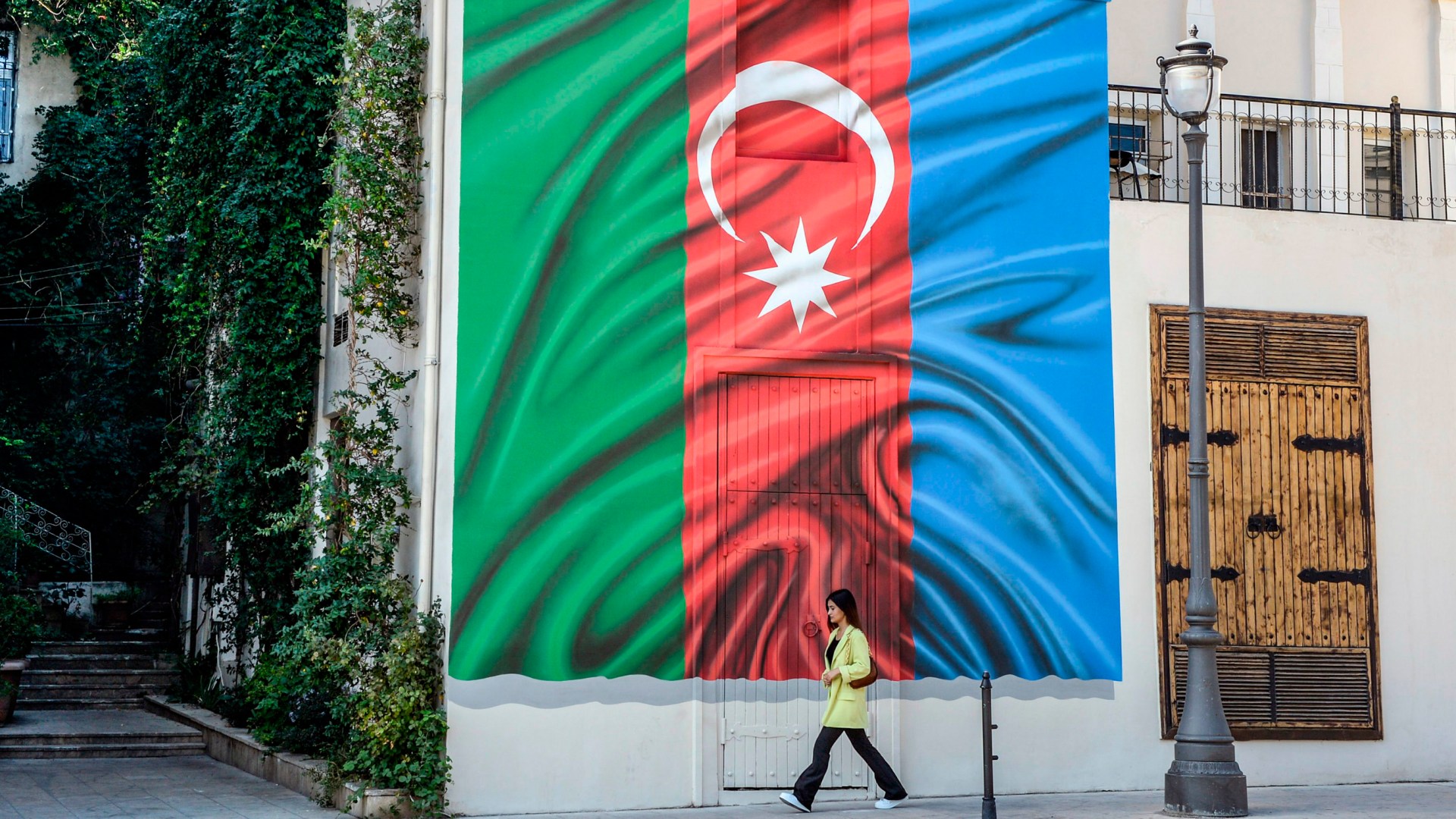
A woman walks past a building with a painting of the Azerbaijani flag on its wall in Baku on October 14, 2020, amid the ongoing military conflict between Armenia and Azerbaijan over the breakaway Nagorno-Karabakh region.

A woman walks past a building with a painting of the Azerbaijani flag on its wall in Baku on October 14, 2020, amid the ongoing military conflict between Armenia and Azerbaijan over the breakaway Nagorno-Karabakh region.

Christianity Today October 21, 2020
Tofik Babayev / AFP / Getty Images

Editor’s note: CT’s complete coverage of Armenian Christians is here.

Vadim Melnikov once fought for the land of Noah.

Donning his Azerbaijani uniform 17 years ago, the ethnic Russian took his post to defend Nakhchivan, an Azeri enclave bordering Turkey and separated from their countrymen by the nation of Armenia.

Known in both the Armenian and Azeri languages as “the place of descent,” referring to Noah’s landing on nearby Mt. Ararat, Nakhchivan is a geographical reminder of the mixed ethnic composition of the Caucasus Mountains.

As is Nagorno-Karabakh, an Armenian enclave within Azerbaijan.

Its etymology is also a reminder of the region’s diversity. Nagorno is Russian for mountains, while Karabakh combines the Turkic for black and the Persian for garden.

Armenians call it Artsakh, the name of a province in their ancient kingdom. For the last three weeks, they have been defending their de facto control of the region as Azerbaijan fights to reassert its sovereignty.

As Melnikov did decades ago in Nakhchivan. Armenian soldiers crossed into Azeri mountain villages, before his unit drove them out.

This was one of the many border conflicts that followed a war of demography. But in the years before and after the 1991 independence of both nations, about 30,000 people were killed as hundreds of thousands on both sides fled or were driven to their lands of ethnic majority.

A 1994 ceasefire established the status quo, and the Minsk Group—headed by Russia, France, and the United States—preside over negotiations.

Despite the previous ethnic violence, Azerbaijan boasts that it remains a nation of multicultural tolerance. Of its 10 million population, 96 percent are Muslim—roughly two-thirds Shiite and one-third Sunni. Russian Orthodox represent two-thirds of the Christian population, while over 15,000 Jews date back to the Old Testament era.

Melnikov is part of the 0.26 percent evangelical community. And on behalf of their nation, eight churches and the Azerbaijan Bible Society wrote an open letter to decry the popular conception that this conflict pits Muslims against Christians. (More than 770 Armenian soldiers have been killed so far. Azerbaijan does not disclose military casualties.)

“The war which has been between Azerbaijan and Armenia during the last 30 years is purely political confrontation, it has no religious context,” they wrote.

“In fact, this history and [the] continuous attempts of Armenia to present this war as a religious one, can become a stumbling block for many Azerbaijani people, who hear [the] gospel nowadays.”

An earlier letter by leaders of Azerbaijan’s Muslim, Jewish, and Russian Orthodox communities communicated similarly—minus the gospel reference—while congratulating President Ilham Aliyev over initial military successes.

Raised Orthodox in the capital city of Baku, Melnikov learned the faith from his mother, despite official Soviet efforts at suppression. But he spoke of a Russian Baptist village and its dairy industry, which he liked to visit. It was exempted from government taxes, to encourage his ethnic community to remain in Azerbaijan.

“Being a Russian and a Christian, the president is very good to us,” Melnikov said. “I have seen good times and bad, but today there is more freedom than ever before in our history.”

Melnikov became a believer in a nondenominational church in 1992. But by the late 1990s, he said, evangelical churches were banned in Azerbaijan.

Today, however, he pastors 1 of 14 home fellowships connected to the Vineyard church in Baku. Consisting of about 200 people, they baptized 50 converts last summer—almost entirely Azeri Muslim. In fact, about 90 percent of evangelicals are of a Muslim background, he said.

But this identity is held very loosely.

“There are Quranic verses on the wall, a Christmas tree in the corner, and vodka on the table” of the typical Azeri home, said Brian Gilson, head of Oklahoma-based P28 Global Ministries, whose doctoral research is on the evangelical movement in Azerbaijan.

“Not only are most Azeris not religious, but the government’s main concern is to counter violent extremism.”

President Aliyev is authoritarian, Gilson said, but the state does not interfere in the private lives of citizens. It is good for Azerbaijan’s public image to allow churches of all varieties to operate freely.

Meanwhile, it can be “draconian” toward Muslim groups, said Chris Jones, executive director for the North American Azerbaijan Network. Having served in country from 1994 to 2002, he now oversees ministry partnerships extending the gospel to Azeris in Europe, the Caucasus nation of Georgia, and Iran—where they constitute up to 25 percent of the population.

While foreign Christian evangelists keep a low profile, the government actively clamps down on unauthorized religious outreach from Iran, Saudi Arabia, and Turkey. The 2019 US State Department’s religious freedom report stated there were around 50 religious activists detained as political prisoners. (The nation does not rank on Open Doors’s watch list of the world’s 50 worst persecutors of Christians.)

“Demonizing Azerbaijan as a jihadi puppet of Turkey is just nonsense,” Jones said, referring to Armenian fears of a renewed genocide.

As Armenians tend to blame Turkey for interfering in the region, Azerbaijanis blame Russia. The superpower to the north likes to keep the Caucasus “slightly unstable,” said Gilson, to keep everyone dependent on Moscow.

Since Baku has developed an independent foreign policy, Gilson attributes the current Nagorno-Karabakh conflict to Russia, pushing Armenia, as it is squeezed out of a recent gas pipeline project now flowing through Georgia into Turkey en route to Eastern Europe.

Yet if reconciled with Azerbaijan, the ethnic enclave might yet prosper. Aliyev has promised not only to let Armenians stay in their homes as citizens, but to develop the area economically. (Nagorno-Karabakh, despite having a 75-percent Armenian majority in 1925, was assigned to Azerbaijan as part of Joseph Stalin’s efforts to divide ethnic communities under Russian rule.)

Home to abundant natural resources, Azerbaijan has prospered while Nagorno-Karabakh has remained poor. A Gallup poll in 2013 found 72 percent of the region’s residents “struggling,” with an additional 16 percent “suffering.” Only 13 percent described themselves as “thriving.”

While both nations were long officially atheist, Armenia held to its ancient faith. The first nation to accept Christianity in 301 AD, revival came when the Soviet Union began to crumble.

But in Azerbaijan, then-USSR President Mikhail Gorbachev’s policy of glasnost [openness] stirred spiritual questioning among many, even as he cracked down on the independence movement.

A few early European and Korean pastors led several of the current evangelical leaders to Christ, with churches that mirrored the diversity of the nation. Azeris, Russians, and even converted Jews worshiped together—with Armenians.

But when the Armenians took control of Nagorno-Karabakh, the Azeris were humbled, Jones said. From England, his family came with a subsequent wave of foreign workers, planting churches and providing hospital and community-based care to the displaced in Ganja, Azerbaijan’s second-largest city.

Today it is subject to bombing in the current conflict, as both sides accuse each other of hitting civilian areas. Jones has friends in Ganja whose relatives have died.

Meanwhile, the evangelical churches were undergoing a shift. Moving away from the model of pastor-centered leadership, Azeris instituted grassroots networks of house churches.

“As an Azeri, I felt a call to reach my own people,” said Mushfig Bayramov, one of the early evangelical leaders. “If I don’t, who will?”

Originally a “Muslim atheist” from a well-educated family, he was saved in 1991 after following a beautiful girl and her mysterious leather-bound book to a Bible study. Within a year, he was assistant pastor, and in 1997 he was ordained a minister in the Greater Grace Christian movement.

In the early 2000s, he led a church plant in a city outside Baku, distributing tracts on the street and hosting gospel discussion groups in tea houses.

Within two years, 70 Azeris were saved.

“People were very broken,” Bayramov said. “The gospel was a balm to their soul.”

But as the church grew, a problem arose. In the mind of most Azeris, Xrystian meant Armenian.

Bayramov pushed forward anyway, embracing the official translation. His testimony appeared in the local newspapers, and he went on TV to debate a Muslim. Those who were uncomfortable he called “cowards,” saying they were ashamed of Christ.

Over time, Bayramov realized his judgmentalism, developing more sympathy for those who instead called themselves Messichi. Meaning “follower of the Messiah,” the term would be admirable to many Azeris.

Jones said this was not to hide their new identity, but to respect their family honor. To be a Xrystian would be akin to national betrayal, and identification with the warmongering Armenians who seized their land.

Today, about 70 percent of evangelicals call themselves Messichi. While all view themselves as one in Christ, Bayramov still considers it a mistake. Eventually, Muslim Azeris will see them together in meetings with the Western Xrystians and conclude they are all the same.

Earlier periods of oppression against evangelicals waned when Western nations intervened, looking for signs of liberalization along with economic energy interests. In 2009, a new period of registration began, which now totals 24 Christian religious communities in 14 official churches.

Azerbaijani leaders say there are many more, and count about 50,000 believers.

But it was within the last few years, in conjunction with the new gas pipeline, that the government began to openly accommodate evangelical Christians.

Gilson spoke of one well-known underground movement that was given a church building, at the expense of the state. “We know what you are doing,” they were told, “and we want you to register.” Bayramov spoke of agents of the secret police who would come to his services, pretending to be seekers.

“This is the communist playbook 101, to keep control,” said Jones. “Of course they try to infiltrate churches, to keep an eye on things.

“This is normal for the region.”

In the beginning, the government didn’t know what to do with all the foreigners. Since then, sources indicated that unlike the suspected anti-government extremism of some Muslim movements, evangelicals have demonstrated that they support their nation.

“I want to show Azeris that Christians can be patriotic,” said Bayramov, now residing in Hungary.

“But also to help Armenians, to see that they are doing a disservice to Christ.”

Unable to understand their “Christian” mission, he asked why Armenians seize and fight for land, instead of evangelizing their neighbors.

He has never experienced any of them reaching out in love.

“Many Armenians portray this conflict as Muslim versus Christian,” said the Azeri evangelical. “If that is so, then who is to blame?”

Perhaps many? There is disservice to Christ on all sides.

Like many mutual atrocities exchanged between Armenia and Azerbaijan, the 1992 Khojaly incident is disputed in its details. But among the contested total of between 161 and 613 dead, Melnikov remembers hearing of children with crosses inserted in their mouths.

Armenians have their memories also. They recall the 1988 Sumgait killings in Azerbaijan, resulting in between 26 and over 200 dead. And in 2004, an Azeri murdered his fellow Armenian student in a NATO-sponsored English class. After eight years in a European prison, he was extradited home, only to be pardoned amid a hero’s welcome.

Of current accusations, Azeri sources demur.

Azerbaijan takes care of its Armenian heritage. One can view their cathedral in Baku, and walk among the graveyards. But reports say that in Nakhchivan, ancient khachars—ornately carved headstones from Christian tombs—have been destroyed. Azerbaijan reverses the allegations.

The attack on the Armenian cathedral in Shusha—if from an Azerbaijani missile—was certainly a mistake.

The Azeri evangelicals CT interviewed have no reports about Syrian mercenaries, and if present, that would be Turkey. The government has no patience for extremists, while the national military does not need the help.

Weapons from Turkey, however, have increased six-fold this year.

But while Ankara may be pushing the conflict for its own interests, they say, the drive comes from the people.

Nearly 20 percent of Azerbaijan’s land is occupied by ethnic Armenians. A whole generation has passed since Azeris were pushed out of their homes, whether in Armenia proper, Nagorno-Karabakh, or its surrounding occupied territories.

The displaced constitute up to 10 percent of Azerbaijan’s population.

Thus the current war is a popular one.

“I have never seen the country so united,” Melnikov said. “But with so much bloodshed, people are saying don’t stop until we recover everything.”

Citizens are volunteering for the front lines. Relief supplies are amply donated. They are tired of Minsk Group failures. They want to win.

But above all, Azerbaijani evangelicals want to make one thing clear: The conflict is not religious.

“Let us not mix sacred with not-sacred,” stated their open letter.

“This is a political war; it has nothing to do with Christianity.”

Correction: The Sumgait killings took place in 1988, not 1998.

Books

5 Books That Turn Our Grumbling into Gratitude

Chosen by Dustin Crowe, author of “The Grumbler’s Guide to Giving Thanks: Reclaiming the Gifts of a Lost Spiritual Discipline.”

Simon Migaj / Unsplash

The Practice of Praise

Charles Spurgeon

Though Spurgeon’s 19th-century volume is the oldest on my list, it might be the most tweetable. Flip to any page, and you’ll find concise, whimsical words about the dangers of a grumbling spirit or God’s delight in our gratitude. Spurgeon teaches us how to instill daily praise and thanksgiving into our lives, whether we’re in a season of sorrow or a season of blessing.

One Thousand Gifts: A Dare to Live Fully Right Where You Are

Ann Voskamp

Perhaps you’ve noticed more attention given to gratitude over the past decade, whether in your local bookstore or your social media feed each November. Here’s the book that helped jump-start that movement. With poetic prose, Voskamp takes the reader on a personal journey of observing God’s gifts all around us. As we learn to see God’s world with new, grateful eyes, it changes our perspective on everything else.

Hannah Coulter

Wendell Berry

Other books on this list might teach us to choose gratitude over grumbling, but this one helps us feel the beauty of a grateful life. Hannah Coulter is an account of one woman’s life as she looks back on belonging to a place and a people through love and loss, grief and gratitude. Through Hannah’s story, we see what it looks like to receive all of life as a gift.

Practicing Affirmation: God-Centered Praise of Those Who Are Not God

Sam Crabtree

Grumbling is rooted in seeing what we don’t like about something or someone rather than the good God might do through them. It grabs onto frustrating, annoying, or challenging circumstances. Once you step in, it’s easy to get stuck. But affirmation helps pull us loose by clinging to what’s commendable (Phil. 4:8). This book teaches us to consider God’s gracious work by affirming others, which cultivates the discipline of encouragement rather than criticism and complaint.

Thanksgiving: An Investigation of a Pauline Theme

David W. Pao

This volume, from InterVarsity Press’s excellent series New Studies in Biblical Theology, traces the theme of thanksgiving in Paul’s letters. It helpfully emphasizes the God-centeredness of thanksgiving. Grumbling is symptomatic of a deeper problem: ingratitude toward God. Many books on gratitude focus on the tangible blessings we should see and celebrate. But too often, they stop there. Pao reminds us that thanksgiving should lead us to love and worship the God who gives us all things.

Books

New & Noteworthy Fiction

Chosen by Sarah Sundin, author of World War II-era novels.

Things We Didn’t Say

Amy Lynn Green (Bethany House)

Much will be said of the unique format of this debut novel, told entirely through letters and newspaper articles. As Johanna Berglund translates for German prisoners of war at a camp in Minnesota during World War II, she corresponds with her friend Peter Ito, an instructor in Japanese for US military intelligence. Not only does the story sparkle with wit, but it has great depth and understanding of humanity. Through Johanna’s eyes, we see the dangers of prejudice and rumors—and of thinking too highly of ourselves. And we see the importance of humility, of searching out the flaws within our own souls.

The White Rose Resists

Amanda Barratt (Kregel)

Many are fascinated by the White Rose, a band of German university students who stood up to Hitler. Amanda Barratt brings this harrowing time to life through the real-life person of Sophie Scholl, as well as fictional characters—Kirk Hoffmann, a member of the White Rose, and Annalise Brandt, the daughter of an SS officer who questions what she’s been taught. We all like to believe we would risk everything for the sake of truth and freedom if we were ever in a similar situation. This novel makes us ponder if we would prioritize our lives, homes, and loved ones instead.

The London Restoration

Rachel McMillan (Thomas Nelson)

Secrets can destroy the best of relationships. Newlyweds Brent and Diana Somerville are reunited in London after World War II, but more than their beloved city needs restoration. He’s carrying the secret of his PTSD, and she is required by law to conceal her code-breaking work—and her current work with MI6 to bring down a Soviet spy ring. On top of this intriguing plot, Rachel McMillan describes London’s architecture in ways that will delight any Anglophile. Overall, this is a loving look into a marriage and an exploration of honesty, trust, memory, and the willingness to start anew.

Books
Review

Share the Gospel with Prisoners. Then Apply It to the System.

Evangelicals are superb at the first task. To what extent do they embrace the second as well?

Illustration by Paige Stampatori

In 1979, Charles Colson, the nation’s best-known evangelical prison ministry director, visited the Washington State Penitentiary in Walla Walla to share the gospel of Jesus Christ. Colson, who had been in prison himself only five years earlier for his role in the Watergate scandal, was known for his sympathy to prisoners’ concerns.

God’s Law and Order: The Politics of Punishment in Evangelical America

God’s Law and Order: The Politics of Punishment in Evangelical America

Harvard University Press

352 pages

$37.00

When he found out that the men in Walla Walla’s solitary confinement facility had to live with human waste and rotting food that the warden refused to clean up, he promised to lobby the state legislature for change. The effort succeeded, and Colson expanded his campaign for prison reform nationwide. But because Colson was no liberal, his ministries depended on a close alliance with law-and-order evangelicals and even law-and-order politicians who helped create the prison system that Colson found so troubling.

This paradox is central to the historical narrative that Aaron Griffith presents in God’s Law and Order: The Politics of Punishment in Evangelical America. With an undergraduate degree from Wheaton College and a history of personal involvement in prison ministry, Griffith sympathizes with many of the evangelicals profiled in the book—especially Colson, whom he describes as genuinely compassionate and sincerely interested in prisoners’ well-being.

But with a doctoral degree from Duke University Divinity School, Griffith is also well-versed in liberal Protestant critiques of evangelical politics, and he shares the concerns of critics who question whether evangelical support for law and order can be squared with a gospel-centered theology. Have evangelicals adopted their seemingly contradictory views of the prison system in spite of their theology, or because of it?

Centers of Law and Grace

Prisons have long held an irresistible theological attraction to evangelicals, Griffith argues, because conservative Christians have seen them as centers of both law and grace—that is, places where sinners are punished but also places where many find redemption. As early as the 1920s, American evangelicals saw a moral dimension to the nation’s crime wave. While liberal Protestants thought that social reform could reduce crime, evangelicals saw crime as a consequence of rejecting God—which made gospel preaching the best antidote. Billy Graham made this argument frequently in the 1950s, and his ministry produced films to celebrate the stories of notorious criminals who renounced their wicked ways after finding Jesus at one of Graham’s crusades.

With their strong faith in the power of conversion, evangelicals devoted more time to prison ministry than any other Christian group in the late 20th and early 21st centuries. And as Griffith argues, this faith in conversion was, in some sense, at odds with law-and-order politics. In the 1950s and early 1960s, evangelicals seemed more interested in converting criminals than locking them up. The gospel, they thought, could produce far better results in criminals’ lives than long prison sentences.

This was the belief, for instance, of David Wilkerson, the charismatic minister who became famous for his evangelistic work with New York youth gangs, as described in his best-selling memoir The Cross and the Switchblade. It was also Graham’s message. But in the 1960s, this changed. Amid widespread conservative fears of rising crime rates and racial unrest, many white evangelicals, including Graham, embraced law-and-order politics. Even Wilkerson became convinced that troubled youth faced greater problems than gospel preaching alone could solve. He came to believe that the problem of the cities was heroin and that tougher drug laws were the answer.

In the early 1970s, a few black evangelicals—Tom Skinner, most prominently—challenged white evangelical support of conservative law-and-orderpolitics and tried directing their attention to racial injustice within the prison system. But most white evangelicals were not receptive to Skinner’s message. When he became more outspoken on racial issues, Moody Bible Institute dropped his radio program, and the director of the National Association of Evangelicals criticized him.

For a few years in the late 20th century, it seemed that Colson might turn evangelicals away from law-and-order politics and restore the conversion-centered approach that characterized earlier evangelical thinking about prisons. Before his born-again conversion in 1974, Colson had worked as a White House aide to the Republican president most associated with the politics of law and order: Richard Nixon. But after Colson was indicted for breaking the law himself, he found Jesus and changed his views.

Driven by a new spirit of compassion and a desire to see as many criminals as possible come to know Jesus, he launched a national prison ministry and began speaking out against the death penalty. Execution, he told the Southern Baptist Convention in 1979, ended all chances of conversion. If Baptists believed in saving the lost, they should never support prematurely ending the life of someone who might not know Jesus.

This was the classic conversionist approach that viewed a personal relationship with Jesus as the antidote to every social problem while rejecting state solutions—punitive or rehabilitative—as beside the point, if not actively harmful. At first, Colson’s ministry focused almost entirely on evangelism in prisons rather than campaigns for prison reform. But after repeatedly hearing complaints about inhumane prison conditions and seeing a few examples firsthand, he began lobbying for reform, partly to remove barriers to the gospel but mostly out of genuine compassion for people he didn’t want to see suffer unnecessarily. He advocated alternatives to prison sentences for people convicted of nonviolent crimes, and he called for restorative-justice approaches that would prioritize making amends to victims over simply locking people up.

Griffith finds much to appreciate in Colson’s approach, but he also notes Colson’s unwillingness to challenge his law-and-order allies, whether politicians or fellow evangelicals. In the early 1990s, he reversed his stance on the death penalty and endorsed it. Although Colson went further than most evangelicals in perceiving problems in the prison system, he, like nearly all of his white evangelical peers, subscribed to a colorblind racial ideology and individualist ethos that made it very difficult to denounce the structural inequities of the criminal justice system.

For more than half a century, white evangelicals (and even a few black evangelical allies) assumed that prison was fair—that pretty much everyone there deserved to be there. Crime resulted from personal sin, and sinners were punished in jail, which prepared them to encounter the life-transforming power of the gospel. But what if the criminal justice system was not fair? What if, as many nonevangelical liberals of the early 21st century argued, it was a tool of racial oppression that functioned to control a disproportionately poor and nonwhite population? What if the greatest sin behind the prison system is not the wrongdoing of the convicts behind bars but the injustice of the legal system itself? Could evangelical theology offer an effective tool to fight such structural sin?

Theological Retooling

Griffith seems conflicted about this. On the one hand, evangelicals’ belief in the power of conversion has led them to spend more time with those in prison than any other group of Americans. When it comes to showing personal compassion to individual prisoners, evangelicals motivated by Jesus’ exhortations in Matthew 25 have outshone adherents of any other religion or philosophy.

And yet, to the extent that challenging structural deficiencies in the criminal justice system is now a pressing matter, evangelicals who have long held to an individualist view of sin and a strictly personal view of salvation will need to do some theological retooling. Liberal Protestants, not evangelicals, are the Christians who have most often seen sin in structural terms and viewed their theology as a resource for fighting systemic injustice.

In Griffith’s opinion, convincing most white evangelicals to see the prison system in these terms will require a theological shift and a movement-wide repentance radical enough to constitute what he calls a religious “conversion” in its own right. This would involve admitting that individualistic views of sin and salvation need to be supplemented with liberal Protestant theologies of structural sin that white evangelicals have eschewed for the past century.

As long as one remains committed to an evangelical theology of personal sin and salvation, Griffith’s proposal will be difficult to accept in its entirety. But perhaps addressing the issues that concern Griffith will not require such a wholesale theological revision, because evangelicals who adhere to the ethics of the New Testament can likely find more resources in their own theological tradition to address injustice in the prison system than Griffith seems to acknowledge.

If the apostle Paul, for instance, could do evangelistic work within a prison system that he and other early Christians knew was unfair, perhaps contemporary American evangelicals can as well. And perhaps they can also renounce their view that the law is colorblind and begin to acknowledge the vast racial disparities in the nation’s prison system, even while continuing their evangelistic prison ministries.

When it comes to proclaiming the power of the gospel to transform every sinner, including those behind bars, an evangelical Christian cannot compromise without, in some sense, ceasing to be an evangelical. But if Griffith’s book prompts evangelical believers to apply the gospel not only to individuals in prison but also to the structure of the prison system itself, that would undoubtedly be a good thing. And maybe in the process, as Griffith suggests, the gospel will induce repentance not only among those behind bars but also among some evangelicals who voted for the policies that put so many there in the first place.

Daniel K. Williams teaches history at the University of West Georgia. He is the author of Defenders of the Unborn: The Pro-Life Movement before Roe v. Wade and God’s Own Party: The Making of the Christian Right.

Books
Review

A True Religion Does Three Things and Answers Four Questions

John Stackhouse offers a checklist for sincere spiritual searchers.

Illustration by Rick Szuecs / Source Images: Givaga / Envato / Eliott Reyna / Unsplash

The more you interact with people outside the Christian faith, the likelier you are to encounter the intriguing question scholar and writer John G. Stackhouse Jr. raises in his latest book, Can I Believe?: An Invitation to the Hesitant. After all, Christianity unabashedly proclaims some odd, even bizarre-sounding ideas: a talking serpent, a death-dealing piece of fruit, a city’s walls collapsing at the sound of a trumpet, and the sun standing still in the sky, not to mention a young carpenter who turns water into wine, walks on water, and eventually rises from the dead.

Can I Believe?: Christianity for the Hesitant

Can I Believe?: Christianity for the Hesitant

Oxford University Press, USA

224 pages

$15.78

Then there are Christianity’s ethical demands, some of which seem unrealistic at best, like the call to turn the other cheek and love our enemies. Does anyone really live up to these standards? Throw in elements of the church’s checkered history—its role, for instance, in the Crusades and the Inquisition, or its occasional ambivalence about scientific discovery—and there seems to be ample reason not merely to reject Christianity but to find it utterly appalling.

And yet, some two billion people across all lines of culture, class, ethnicity, time, and place have come to embrace this strange, self-denying, and often-controversial faith. Most of them are sensible and decent, and quite a few—Ivy League professors, Oxbridge dons, Nobel and Pulitzer Prize winners—are incredibly intelligent, sophisticated thinkers. How has this happened?

In his book, Stackhouse invites outsiders to consider whether Christian faith is more reasonable and compelling than they might suppose. After defining religion as a set of beliefs, values, and practices, he sets out some basic issues that anyone would want to consider in sorting through the panorama of philosophies and faiths on offer today. This is a helpful step, one that is often missing in works of apologetics.

There are three things, according to Stackhouse, that any religion should do. First, it should provide a creed that accurately describes the way things are. Second, it should present a code that teaches us how to respond to the way things are. And third, it should offer a community of people who can encourage and instruct as we strive to understand the religion and live out its teachings. When approaching any religion, Stackhouse says, ask how well it fulfills these three purposes.

He acknowledges, of course, that things can go wrong. For instance, a person could visit a dying or declining church and come away with a poor or distorted view of Christianity. The antidote, Stackhouse argues, is to try to engage with a religion at its best before dismissing it.

Later in the book, Stackhouse proposes a set of four questions that can help someone get at the essence of any religion and evaluate it: What is real? What is best? What is wrong? And what can be done? He mentions his own positive experience using this fourfold approach as a framework for introducing Christianity to Chinese audiences while lecturing in that country.

With this framework in mind, Stackhouse turns his attention to Christianity, which he calls “the most popular and yet perhaps the most unlikely explanation of reality of any of the major ideological options.” He identifies four Christian teachings that qualify as essential. First is the doctrine of creation, which answers “What is real?” Second is the idea of shalom, or flourishing, which answers “What is best?” Stackhouse calls this the foundation of Christian hope for both the present and the future, when God will fulfill his promise to bring flourishing on a global scale and still all the world’s chaos.

A third essential teaching, the reality of sin and evil, represents “What is wrong?” in our lives. The fourth, what Stackhouse calls Christianity’s solution (in response to “What can be done?”), receives an extended treatment in the book. Stackhouse covers such concepts as the fresh start we all need, the new birth, renewal, sanctification, the Trinity, the cross of Christ, his death and resurrection, forgiveness, and the hope of a new world to come, where we are entirely transformed and no desire to sin remains.

The book then examines a number of grounds—historical, philosophical, ethical, pragmatic, aesthetic, psychological, and experiential—for the validity of these essential Christian teachings. Stackhouse takes care to address two of the thorniest obstacles to belief: the exclusivity of the gospel and the problem of a good God allowing evil to exist.

Along the way, Stackhouse raises what might be the most foundational question of all: When it comes to matters of religion, how much can we actually know? It’s a question some will find unsettling. But Stackhouse works through it, reminding us that our situations in life, along with our interests, values, hopes, and fears, can deeply influence the way we think. He offers three suggestions for managing this reality: Choose your company wisely, widen your conversations to include varying perspectives, and acknowledge the influence of your will in deciding what to believe.

Stackhouse is an engaging and honest writer. And the book is a good read for Christians who want to wrestle with the central questions of their faith as well as prepare for discussions with those outside the Christian community. It should also prove useful to non-Christians who are interested in spirituality or religion but unsure how to carry out their search. The book includes illustrations, stories, and accounts of the author’s personal experience that make it more readable while demonstrating the relevance of its ideas.

Many explorations of the Christian faith come across more as dogmatic lectures than honest inquiries. Part of what makes Can I Believe? so refreshing, by contrast, is Stackhouse’s willingness to present Christianity as a logical and appealing system of thought while respecting the conclusions his readers will draw. Given the many strengths of his book, it’s reasonable to hope that more of them will answer its core question with a yes than a no.

Paul Chamberlain directs the Institute for Christian Apologetics at Trinity Western University in British Columbia. He is a co-editor of Everyday Apologetics: Answering Common Objections to the Christian Faith.

Books

How Churches Elevate and Protect Abusive Pastors

A psychologist explores the power dynamics that help turn shepherds into wolves.

Illustration by Rick Szuecs / Source image: Cynoclub / Envato Elements

The seduction of power, both individual and institutional, is a tale as old as time. Within the church, the misuse and abuse of authority has taken a devastating toll in broken lives and congregations. Yet the true nature of power often goes unacknowledged and unexplored. In Redeeming Power: Understanding Authority and Abuse in the Church, psychologist Diane Langberg brings several decades of experience counseling clergy leaders and trauma survivors to this topic. Tim Hein, a pastor and lecturer in Australia and the author of Understanding Sexual Abuse: A Guide for Ministry Leaders and Survivors, spoke with Langberg about why pastors and ministry leaders sometimes feed on their flocks.

Redeeming Power: Understanding Authority and Abuse in the Church

Redeeming Power: Understanding Authority and Abuse in the Church

Brazos Press

224 pages

$12.09

The word power is a contested one in our culture. How do you define it?

Basically, power is influence—the capacity to produce an effect. If I walk up to you, and I’m bigger than you, and I push you down, then I have done something that had an effect. And everybody has some sort of influence—even an infant. If you bring a baby home from the hospital and it starts screaming at 3 a.m., what do you do? You get up!

This is part of what it means to be God’s image-bearers. He has told us, Rule! Rule over the earth. That’s a power word. As sinners, of course, we’ve ruined this like we’ve ruined everything else. But exercising power is still part of our essence, even if individuals and systems are prone to misusing it.

If all of us wield power and influence of some sort, then why are Christian leaders, in your view, especially susceptible to becoming power-abusers? What do they fail to appreciate about the power they have?

By and large, the schools we have for educating Christian leaders do not teach about such things. Seminaries give practical knowledge about how to run a church or a ministry, but they aren’t doing enough to illuminate the nature of power and the dynamics that cause issues of abuse to arise—and then be covered up.

Another problem is that seminaries haven’t always done enough to teach leaders the importance of understanding themselves and their own vulnerabilities—the hurts and wounds that might never have been named, let alone dealt with. I’ve worked with tons of pastors over the years, and many of these good men and women go into these positions having never asked these questions of themselves. Think, for instance, of a man in the pulpit whose father physically abused him and spoke to him like he was trash. He’ll be full of wounds, and that’s going to affect how he uses his position of leadership. But his ignorance of himself and the wounds he’s carrying make him vulnerable to feeding off his sheep. I can’t tell you how many pastors have sat in my office weeping, saying, “I don’t know how I got here” after they’ve behaved abusively themselves.

A pastor reading this might be thinking, “I don’t feel very powerful. I’ve got my elders on my back, budgetary pressure to handle, and church members criticizing my sermons. Are you telling me I have dangerous levels of power?”

It doesn’t matter what you do for a living. Power is inherent in being human. For pastors, you might have power in your home, over your spouse or children. You might have power in every conversation you have, because your words have an impact on the people listening. And if you’re not aware of the power you exercise, you aren’t as likely to examine how you’re using it.

So you end up feeding off people, using them to meet your needs or make up for your vulnerabilities. Maybe that looks like going to the grocery store and being hideously rude to the cashier. Or maybe it looks like schmoozing with everybody there and knowing it will feed your ego because they’ll all think you’re wonderful. As long as you’re using the sheep for food, then you’re a wolf, not a shepherd. Ezekiel 34 warns against shepherds who feed and clothe themselves rather than their sheep. And Jesus speaks about the Pharisees in similar ways in John 10.

How do you see the broader Christian culture in the West, with its temptations toward fame and status, feeding into the problem of abusive church leaders?

Well, that’s just human nature. Think back to the beginning of creation: The one who deceived us away from God wanted to be like the Most High. Talk about an abuse of power! So it’s always there, as part of human nature, to want glory and esteem. On one level, we’re meant for those things, but after the Fall we seek them in illicit ways. Sex is one obvious way. But in subtler ways, we can find glory and esteem in externals—things like positive feedback on social media, the numbers in the pews, or the number of books you’ve sold. And it’s little things, too: You can be a pastor in a tiny town and take pride in feeling like the most important guy there.

We all want to be loved, and in fact it’s God’s design that we’re meant to be loved. So it gets muddy, because I wouldn’t ever want to say that anyone who seeks esteem is guaranteed to abuse power and have no empathy. But we need to be aware of how the Fall has corrupted that desire and made us practiced in the art of self-deception.

You say your experience as a psychologist has taught you that you can tell what is most important to someone by what that person protects most defiantly. How does this dynamic play out in the ranks of church leadership?

With most people, you can identify the one thing that refuses examination by others, the one thing you won’t let into the light. And if someone figures it out, you’ll look for other ways to hide it. One obvious concrete example is pornography. But we also do this with things like money and status.

And systems as a whole tend to do this as well. The feeling might be, “We’re this well-known church, and this terrible thing has happened, and we have to protect our reputation rather than drag this stuff into the light and let God do his work.” With churches or other institutions, what’s most important is what gets protected, and often enough that’s the institution itself.

How, then, can the church as an institutional system be redeemed from this tendency, and how can the congregation itself support this?

The way the Bible depicts the church, Christ is the head and we’re part of his body. So there’s a system involved, but it’s a system that’s supposed to follow its head. My father was sick for many years. He was a colonel in the Air Force, bright, and a fabulous athlete. But he ended up with a neurological disease. One of the lessons I learned as I watched him basically disintegrate over 30 years is that a body that doesn’t follow its head is a sick body. It’s a sick system. The church’s problem, then, isn’t that it’s a system, but that the system often fails to follow its head.

And surely, the congregation has some responsibility for keeping the system healthy, mainly by worshiping Christ and him alone. But the church also needs to pray for its leaders, that God will uphold them in godly leadership—not for the sake of gaining the material and reputational blessings we’ve come to love so much, but for God himself to be honored above all.

Joy That Won’t Wither

Politics fade. Our hope endures forever.

Micah Hallahan / Unsplash

Isaiah 40 is one of the loveliest chapters in the Bible. In one moment, it speaks softly and tenderly. “Comfort my people,” it says. “Speak tenderly to Jerusalem” and tell her that her suffering is at an end (vv. 1–2). The Lord is coming out of the wilderness, and the glory of the Lord will be revealed.

In another moment, it casts a majestic vision of the surpassing greatness of God, who created all things and rules equally over the princes of the earth and the stars of the heavens. The people are grass, it says, “but the word of our God endures forever” (v. 8). God has measured the waters of the earth in the hollow of his hand. He has weighed the mountains as though they were dust. Set before the everlasting God, the Creator of the unspeakable vastness and beauty and complexity of the universe, even the nations themselves are “as nothing” and “less than nothing” (v. 17).

Americans will remember 2020 as a year in which our union of states felt far more fragile than we had imagined it to be. In one recent survey, 80 percent of American voters said the country is “out of control.” The once-rich fabric that weaves us together is now thin, strained, and splitting. And as Daniel Silliman and Ted Olsen illuminate in this issue, the split runs straight through the heart of the church. With so much at stake in the next few months, it’s hard to imagine the situation will improve.

Which is why passages like Isaiah 40 provide a more expansive theological perspective. Pandemics come and go. Battles are fought and forgotten. Political powers pass in a blink, and nations rise and fall like the grass beneath the withering sun. The Word of God endures into eternity, and those who are joined to Christ will outlive the mountains and the seas. Politics and culture are not unimportant, but neither are they the hope of the world. Love requires that we engage in public life for the good of our neighbor, but it also requires that we show our neighbor the grace of Jesus Christ.

So what can we do in this painful and perilous moment to reflect the grace of Jesus? We can demonstrate in our behavior that the eternal things remain eternal. We can lift up the wounded and speak hope to the fearful. We can be quick to listen and slow to speak. We can conduct ourselves with humility, compassion, and grace, showing kindness where it is least expected. We can honor the inestimable worth in each and every person and invite them with us into life everlasting.

Perhaps we can even do what is most countercultural when the culture is soaked through with hatred: tell someone on the other side of the aisle that we love them and demonstrate it in our deeds.

Timothy Dalrymple is president and CEO of Christianity Today. Follow him on Twitter @TimDalrymple.

Apple PodcastsDown ArrowDown ArrowDown Arrowarrow_left_altLeft ArrowLeft ArrowRight ArrowRight ArrowRight Arrowarrow_up_altUp ArrowUp ArrowAvailable at Amazoncaret-downCloseCloseEmailEmailExpandExpandExternalExternalFacebookfacebook-squareGiftGiftGooglegoogleGoogle KeephamburgerInstagraminstagram-squareLinkLinklinkedin-squareListenListenListenChristianity TodayCT Creative Studio Logologo_orgMegaphoneMenuMenupausePinterestPlayPlayPocketPodcastRSSRSSSaveSaveSaveSearchSearchsearchSpotifyStitcherTelegramTable of ContentsTable of Contentstwitter-squareWhatsAppXYouTubeYouTube