Church Life

God Called Me to Encourage Fellow Black Students in White Coats

CCCU Young Alumni Award winner discusses how diversity in medicine improves care for the most vulnerable.

Christianity Today January 14, 2021
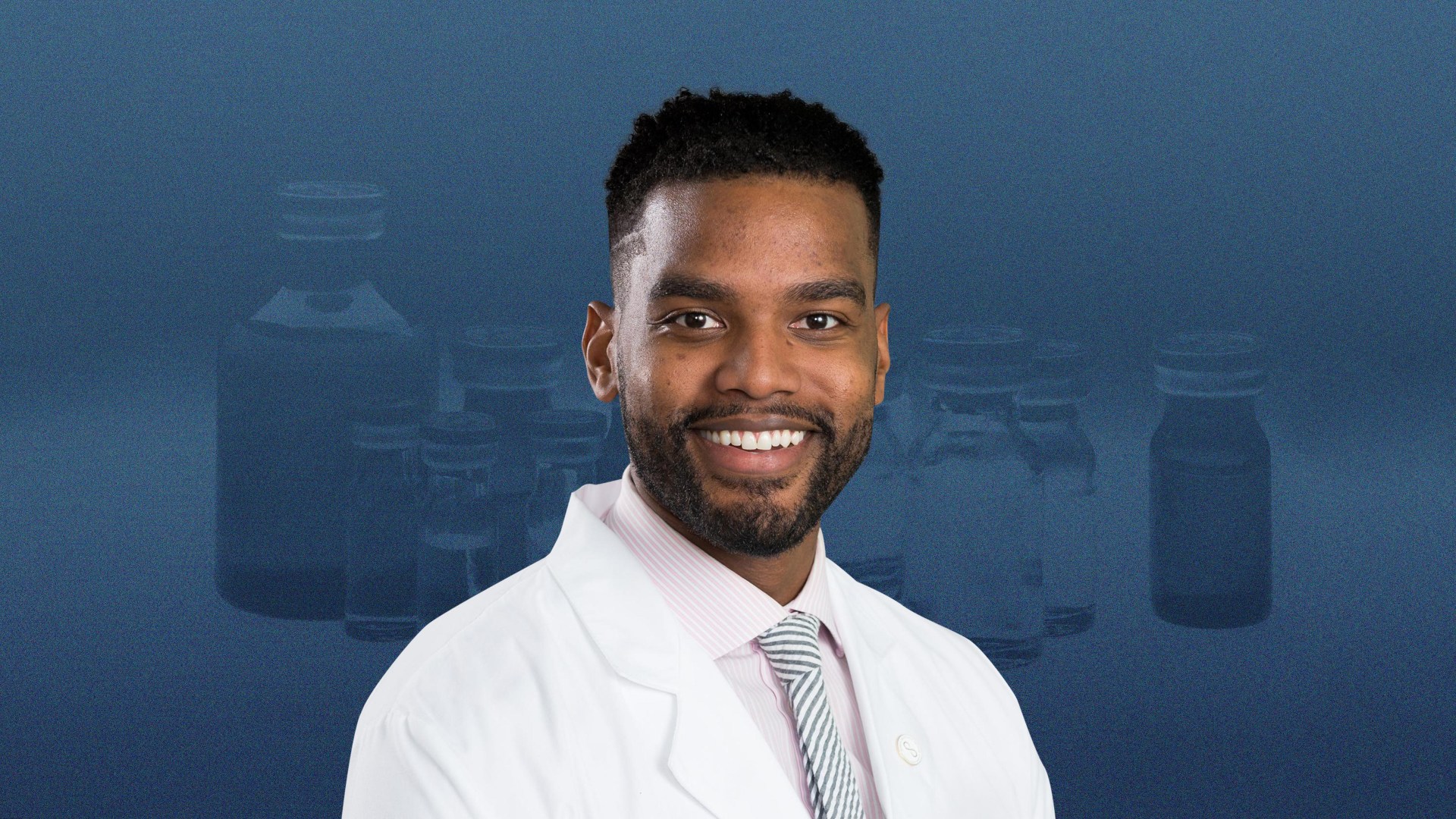
Portrait: Courtesy of CCCU / Source Images: National Cancer Institute / Edits by Mallory Rentsch

Thirty-year-old medical student Emmanuel McNeely considers his life goal and God-given calling to work toward gender and racial diversity in medicine.

“That way we can help eliminate health disparities and really improve health outcomes for all races,” said McNeely, a 2012 graduate of Palm Beach Atlantic University currently pursuing his doctorate in medicine at the Florida Atlantic University’s Charles E. Schmidt College of Medicine.

As an African American med student planning to specialize in orthopedic surgery, McNeely believes his career ambitions are a direct result of a surgeon who took the time to mentor him. He has co-founded The Dr. M.D. Project to provide more minority students with guidance in the field. The project earned McNeely the 2021 Young Alumni Award from the Council for Christian Colleges & Universities (CCCU).

McNeely, “embodies the whole-person love and care that Jesus himself models for us in Scripture,” said CCCU president Shirley Hoogstra. “The global pandemic has highlighted just how important it is for us to have medical professionals like Emmanuel who are committed both to serving and training up the next generation of leaders within underrepresented communities.”

Study after study has detailed the health disparities between black and white patients in the United States, with black Americans suffering from diseases like diabetes, hypertension, and heart disease at higher rates while receiving lesser care.

Researchers have found that black patients seen by black doctors have better health outcomes, but only around 5 percent of active physicians are black, according to a 2018 survey by the Association of American Medical Colleges.

A Chicago native, McNeely’s life changed at age 19 when he shadowed his mentor—Dr. Edgar D. Staren at the Cancer Treatment Centers of America—doing a gallbladder removal. He left the operating room with the boost of confidence knowing Staren believed in him and wanting to become a surgeon too.

“I felt empowered. I thought, ‘He’s patient. He believes in my abilities, and he’s taking the time to actually teach me,’” he said. “That was a defining moment.”

Through the challenges of pursuing a career in medicine and the weight of the current racial tensions, McNeely said his identity in Christ has given him the confidence to move forward and hope for progress.

As part of The Dr. M.D. Project, which he runs with his wife, Sa’Rah, McNeely hosts workshops featuring his own insights and expert speakers such as human resource managers, African American surgeons, and department heads. He also facilitates a virtual professor mentorship by connecting students with mentors in their desired professions.

“Sa’Rah and I had overcome so many hurdles and learned as we went,” he said. “That was really the driving force for us creating The Dr. M.D. Project—to give guidance, encouragement, and also instruction on how to really get over obstacles, get over adversity, and pursue your dreams.”

The couple also belongs to All Nations Worship Assembly in Baltimore, where Emmanuel McNeely plays drums in the worship band and hosted a virtual comedy show during the pandemic. “The Bible says a merry heart does good like a medicine,” he said.

McNeely, who is slated to receive the CCCU award at a ceremony in March, recently spoke to CT about the work of The Dr. M.D. Project and how Christ led him to pursue more equitable medical care for all people.

Share a little about your passion for the intersection of faith and calling.

I was once asked in a medical school interview how I foresaw my faith hindering my future practice of medicine. They looked at my resume and saw that I was very involved in church. That really struck me because I recognized that faith can be looked down upon for someone wanting to serve in a field of medicine.

I grew up with two parents who were very involved in the church, and we were really big on showing the love of Christ by shining our light so that others could see it. For me, faith meant more for me to actually show the love of Christ. In medical school, they teach us that African Americans have predispositions to diseases that other people don’t necessarily have. Therefore, to love our neighbor is to provide them the best care.

Tell us about your story and how you came to Christ. Obviously, you grew up in church, but is there a particular time when you went from “lost” to “found”?

My story starts at about six years old. That’s right about when I really understood that Jesus died for me, that someone loved me enough to die for me, and because of that, I’ll have eternal life. But I will say that high school is when I really came into finding my identity in Christ. A lot of people recognized me as being different. I played on the football team, and they’d say, “Hey, preacher boy! You have to pray before the game!” I had no clue how they knew I was a Christian, but that’s when I got a good understanding that you shine your light. You don’t have to preach at people. God will peek through, and that light will shine in a dark place, and he’ll get the glory from it.

What drew you into medicine, even what specifically drew you to surgical medicine?

I knew I liked chemistry. I was thinking about some kind of career in medicine. I got that opportunity to shadow Dr. Edgar D. Staren after I got a job at Cancer Treatment Centers of America. [I realized] there was something about caring for someone who is at their lowest state. I worked as a chemotherapy technician and I made chemotherapy, but it wasn’t until I actually shadowed Dr. Staren and went into the operating room when I saw that I could take someone from their lowest state and, after the surgery, bring them back to a [better] place. It really made me think about Christ and how he takes us from a broken place and puts us back together again. He’s the Great Physician.

Share your thoughts on this year’s collision between the medical world, with the pandemic, and the rise of racial tensions. How do you fit into all of this, how does your mission fit into this, and how does The Dr. M.D. Project fit into this?

The blessing about getting to the point where we are, though we have a long way to go, is that Sa’Rah and myself are afforded a platform. We’re afforded a seat at the table during this pandemic. I’ve been invited to rooms to speak about what was going on in the media with George Floyd and all the protests. It’s a really unique opportunity to be at the table and to speak for the community.

Everyone should be represented within medicine, and if minorities, specifically black patients, are vulnerable to certain diseases, you better believe we need them represented at the table. We need black physicians, and we need minority physicians. For me, 2020 has really amplified the need for more black physicians—male and female—to be at the table.

I was able to actually work with The Johns Hopkins Hospital on their “Stand With You” video, and I was blessed to be featured on the news to speak about racial tensions and the video. [2020] really highlighted the need for black physicians. It also highlighted the need for gender and racial harmony. In a white coat, I can be a hero.
If you had an audience of students in front of you right now, what would be the first thing you’d say to encourage them?

The first thing I would tell them is that it’s possible. You don’t need to compare yourself to others or question your ability. But what you do need to do is to find a mentor—someone who’s doing exactly what you want to do—and to learn from them. Get guidance and instruction. My last piece of advice would be to never quit. Let your passion drive the pursuit of your dream. If you’re passionate and you’re willing to work hard enough, you can accomplish anything.

For all the students out there, can you share about the importance of study?

I believe studying is important because it enhances critical thinking. As a future physician, we are taught in medical school how to think critically and how to be detectives. We rule in diagnoses, and we rule out diagnoses. Someone presents to you and you have to identify a whole list of potential causes for their current condition. I believe studying is so important because it allows you to really enhance your critical thinking skills.

I really live by “study to show yourself approved” (2 Tim. 2:15, Modern English Version) and “whatever you do, work at it with all your heart, as working for the Lord, not for human masters” (Col. 3:23). If I’m studying, I do it as an offering to God. If I’m learning, I’m doing it for that patient that I’m going to be taking care of late at night, and they’re there alone and need a fully faithful, energetic, confident, and competent surgeon to take care of them at their most vulnerable state.

What was it like to study at a Christian college and to be a part of a Christian academic community?

At any college, Christian or not, the students are under immense stress. They’re trying to identify who they are. They’re trying to figure out their next step. For me, Palm Beach Atlantic University was beautiful, because I incorporated faith in my pursuits—I had a reason for why I was studying. When I felt depressed, I leaned on the Lord. I would go to chapel, and our campus pastor would be preaching on motivation. I would go in empty, and I would return filled. Then I would go right across the street to the library, and I’d sit there fueled and impassioned because there was purpose to my studying.

I really believe faith-based learning gives a purpose; it gives you a why. A lot of students are asking, Why am I doing this? I know what I want to do, but why? Christian education is so important because it defines your why. We do everything unto the Lord for his glory, and he allows us to do great things for his glory.

Rachel Kang is a writer and the creator of Indelible Ink Writers. Her first book, on creativity as calling, is due out in 2022.

News

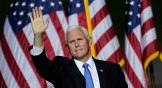
Most Evangelical Trump Voters Didn’t Turn on Mike Pence

While Trump extremists set the vice president up as a traitor, most believers stood by his decision to confirm the election.

Christianity Today January 13, 2021
Megan Varner / Getty Images

At a farewell gathering last Friday, outgoing Vice President Mike Pence recalled the Bible reference his chief of staff texted him after he certified Joe Biden’s victory, The Washington Post reported. It was 2 Timothy 4:7: “I have fought the good fight, I have finished the race, I have kept the faith.”

Pence was pushed into the political spotlight during the tense final weeks of the presidential term, as he refused President Donald Trump’s demands that he use his position to fight the election results and then refused Democrats’ demands that he invoke the 25th Amendment to remove Trump from office.

But Christian political scientists say recent events won’t do much to separate Pence’s legacy from Trump’s contentious shadow. MAGA loyalists will side with the president over him, and evangelicals who respected Pence’s character from the beginning see his conscience on display as he broke from the president’s campaign to discredit the election.

Pence was welcomed on to Trump’s presidential ticket back in 2016 largely for his faith. One of the most outspoken evangelicals ever elected vice president, he was framed as the kind of moral, dependable politician Republican Christians could trust—before Trump built up his own evangelical networks and ties.

Though the VP spent most of the past four years working in the background and standing by the president, that dynamic has shifted in recent weeks. Pence has taken a place in the political spotlight and opposed to Trump, who said his vice president “didn’t have the courage” to reject the congressional confirmation of the election, though Pence insisted he did not have constitutional authority to do so.

For evangelicals who backed Trump, “I think that actually many within this community were more stung by Trump’s open criticism of Pence than by what Pence chose to do in his refraining from exercising a questionable power,” said Scott Waller, politics professor at Biola University.

“Pence was a faithful supporter of the president and his policies. To throw him under the bus, as he did in the waning hours of his presidency, probably diminished Trump’s reputation among evangelicals much more than anything Mike Pence has done in the last two weeks.”

After legal challenges to vote counts failed in several states, the president and the “Stop the Steal” crowds repeatedly called on Pence to overturn the election and keep the hope of a last-ditch Trump victory alive. Ahead of the Capitol breach last Wednesday, rioters chanted “Hang Mike Pence” and erected a wooden gallows on the lawn. The morning after, with Biden’s win official, people calling Pence “Judas” trended on Twitter.

Some conservative Christians have risen to defend Pence from the extreme attacks.

https://twitter.com/DavidBrodyCBN/status/1347010383463198722

David Brody, a Christian Broadcast Network commentator and Trump supporter, also spoke up on his behalf on Twitter, saying he deserved to be treated better for his longtime loyalty to the president.

Rick Santorum, a Catholic Republican, called Pence “the indispensable leader America needed.” Focus on the Family president Jim Daly applauded the vide president for “doing what’s right.”

https://twitter.com/DalyFocus/status/1346992043285909507

Most evangelical leaders’ political statements have been focused more on the president, though.

“This is a complicated political environment. I did not hear many evangelicals who support Trump defending Pence,” said Mark Caleb Smith, political scientist at Cedarville University. “I also believe that most of the criticism of Pence probably came from non-evangelicals. At that moment, evangelical support for or against Trump was a more defining political characteristic than support for or against Pence. I suspect this is true for most voters, including evangelicals.”

It’s approval levels for the president that define Americans’ views of an administration, even more so with a leader as attention-grabbing as Trump. Though Pence offered some evangelical reassurance in the beginning, “support for President Trump grew among evangelicals regardless of Vice President Pence’s presence,” Smith noted.

Through his closest spiritual mentor, Paula White-Cain, Trump developed his own relationships with televangelists, pastors, and ministry leaders. In the 2020 campaign, white evangelical enthusiasm grew, as a majority told pollsters they were casting their ballots for Trump, and not just against his opponent.

Franklin Graham said the Capitol violence wouldn’t deter evangelicals from supporting Trump, whom he has urged to meet with the incoming president and vice president to ensure a peaceful transition of power. But the evangelical ministry leader saved higher praise for Pence, saying, “Our nation has been blessed to have this man serve as Vice President for four years. I thank God for him and for his character, integrity, and wisdom.”

Texas pastor Bob Roberts—who had criticized the administration’s policies around immigration, refugees, and Muslims—thanked the VP for his stand. “As a brother in Christ know that thousands if not millions of us are praying for your continued wisdom, endurance, courage & leadership,” he tweeted.

A majority of Americans (68%) as well as a majority of evangelicals (60%) agree with the vice president’s decision not to interfere with the certification process, according to a Politico/Morning Consult poll.

“I doubt Pence’s decision to abide by his constitutionally prescribed duties altered his standing among many evangelicals. They either liked him from the start, or they were ambivalent until he turned on Trump,” said Daniel Bennett, political science department chair at John Brown University.

Pence was raised Catholic and became born-again at a Christian music festival in college; he and his family attended an Evangelical Free church in Indiana, where he advocated for pro-life policies and religious freedom. Pence continued to reach out to evangelicals and champion their causes—speaking at events like the March for Life and the Southern Baptist Convention annual meeting.

“Other than George W. Bush, Pence is the most outspoken evangelical Republican to ever serve on a presidential ticket,” Bennett said. “But his legacy will always be tied to Trump, for better or for worse.”

Both leaders saw their favorability ratings drop following the election and the president’s ongoing fight to claim victory, including among evangelicals.

Throughout his political career, Pence has quoted 2 Chronicles 7:14, a verse that has become a mantra among Trump supporters: “If my people, who are called by my name, will humble themselves and pray and seek my face and turn from their wicked ways, then I will hear from heaven, and I will forgive their sin and will heal their land.” It was the most-searched verse around the 2016 election and jumped to the third most-searched verse on Bible Gateway last year.

But it was a version of the familiar lines from Ecclesiastes he quoted in a letter sent Tuesday to House Speaker Nancy Pelosi, stating that he would not evoke the 25th Amendment to remove the president from office.

“The Bible says that ‘for everything there is a season, and a time for every purpose under heaven … a time to heal … and a time to build up,’” Pence wrote. “In the midst of the global pandemic, economic hardship for millions of Americans, and the tragic events of January 6, now is the time for us to come together, now is the time to heal.”

News

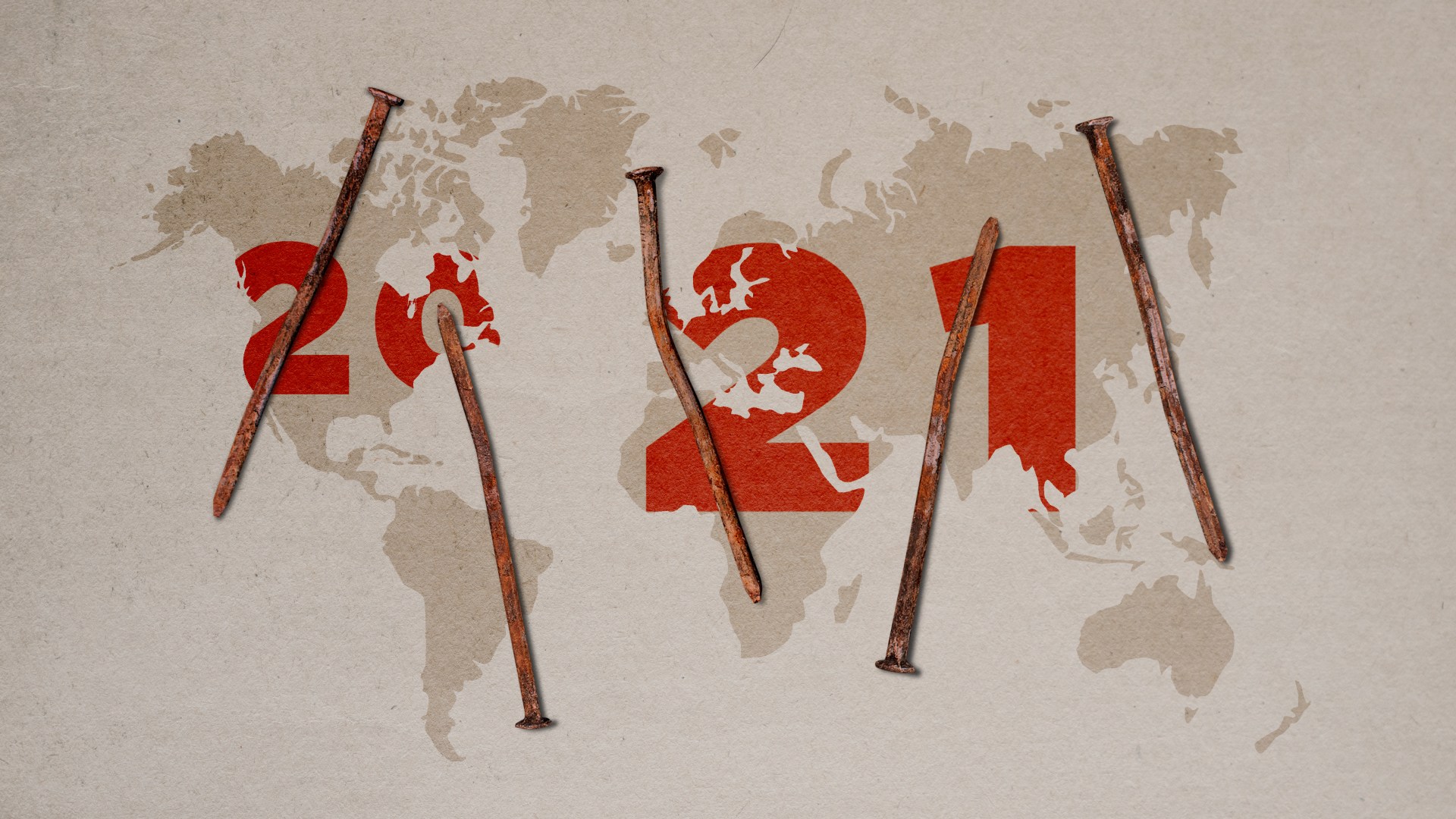
The 50 Countries Where It’s Most Dangerous to Follow Jesus in 2021

Latest report on Christian persecution finds 3 in 4 martyrs are in Nigeria, ranked among 10 worst persecutors for first time.

Christianity Today January 13, 2021
Illustration by Mallory Rentsch / Source Image: Benne Ochs / Getty Images

Editor’s note: Open Doors has now released the 2023 World Watch List of Christian persecution.

Every day, 13 Christians worldwide are killed because of their faith.

Every day, 12 churches or Christian buildings are attacked.

And every day, 12 Christians are unjustly arrested or imprisoned, and another 5 are abducted.

So reports the 2021 World Watch List (WWL), the latest annual accounting from Open Doors of the top 50 countries where Christians are the most persecuted for following Jesus.

“You might think the [list] is all about oppression. … But the [list] is really all about resilience,” stated David Curry, president and CEO of Open Doors USA, introducing the report released today.

“The numbers of God’s people who are suffering should mean the Church is dying—that Christians are keeping quiet, losing their faith, and turning away from one another,” he stated. “But that’s not what’s happening. Instead, in living color, we see the words of God recorded in the prophet Isaiah: ‘I will make a way in the wilderness and rivers in the desert’” (Isa. 43:19, ESV).

The listed nations contain 309 million Christians living in places with very high or extreme levels of persecution, up from 260 million in last year’s list.

Another 31 million could be added from the 24 nations that fall just outside the top 50—such as Cuba, Sri Lanka, and the United Arab Emirates (UAE)—for a ratio of 1 in 8 Christians worldwide facing persecution. This includes 1 in 6 believers in Africa and 2 out of 5 in Asia.

Last year, 45 nations scored high enough to register “very high” persecution levels on Open Doors’s 84-question matrix. This year, for the first time in 29 years of tracking, all 50 qualified—as did 4 more nations that fell just outside the cutoff.

Open Doors identified three main trends driving last year’s increase:

  • “COVID-19 acted as a catalyst for religious persecution through relief discrimination, forced conversion, and as justification for increasing surveillance and censorship.”
  • “Extremist attacks opportunistically spread further throughout Sub-Saharan Africa, from Nigeria and Cameroon to Burkina Faso, Mali, and beyond.”
  • “Chinese censorship systems continue to propagate and spread to emerging surveillance states.”

Open Doors has monitored Christian persecution worldwide since 1992. North Korea has ranked No. 1 for 20 years, since 2002 when the watch list began.

The 2021 version tracks the time period from November 1, 2019 to October 31, 2020, and is compiled from grassroots reports by Open Doors workers in more than 60 countries.

“We are not just talking to religious leaders,” said Curry, at the livestream launch of this year’s list. “We’re hearing firsthand from those experiencing persecution, and we only report what we can document.”

The purpose of the annual WWL rankings—which have chronicled how North Korea now has competition as persecution gets worse and worse—is to guide prayers and to aim for more effective anger while showing persecuted believers that they are not forgotten.

Where are Christians most persecuted today?

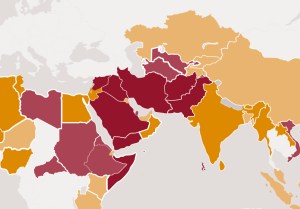
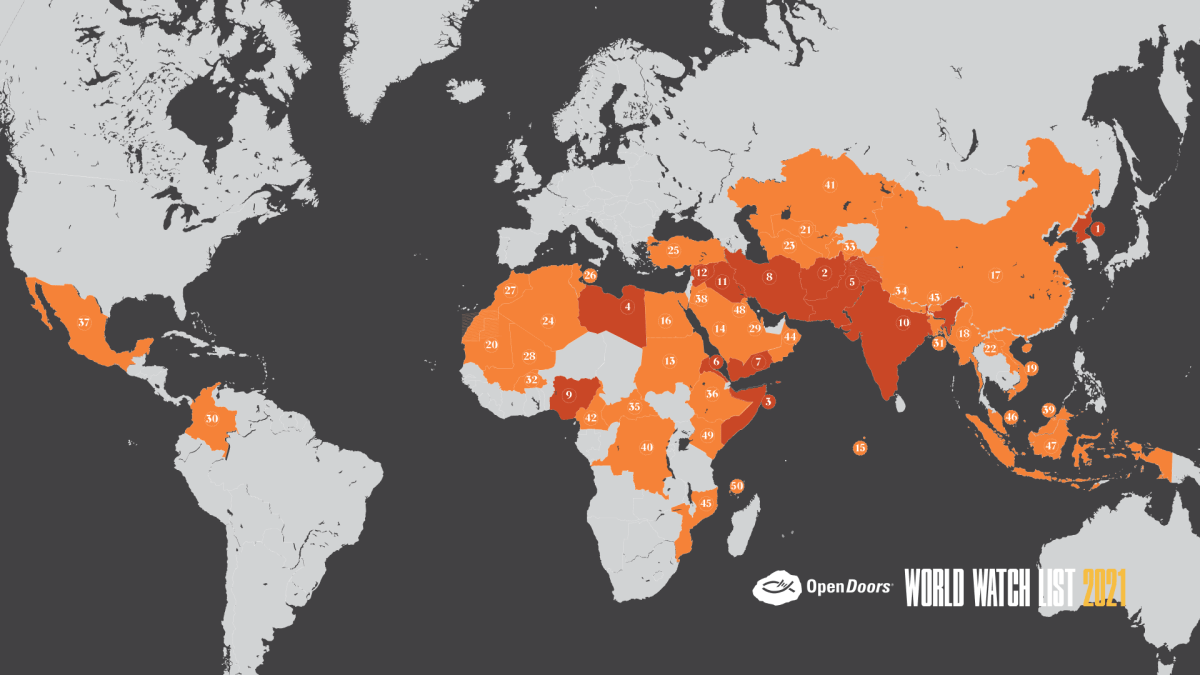
This year the top 10 worst persecutors are relatively unchanged. After North Korea is Afghanistan, followed by Somalia, Libya, Pakistan, Eritrea, Yemen, Iran, Nigeria, and India.

Nigeria entered the top 10 for the first time, after maxing out Open Doors’s metric for violence. The nation, with Africa’s largest Christian population, ranks No. 9 overall but is second behind only Pakistan in terms of violence, and ranks No. 1 in the number of Christians killed for reasons related to their faith.

Sudan left the top 10 for the first time in six years, after abolishing the death penalty for apostasy and guaranteeing—on paper at least—freedom of religion in its new constitution after three decades of Islamic law. Yet it remains No. 13 on the list, as Open Doors researchers noted Christians from Muslim backgrounds still face attacks, ostracization, and discrimination from their families and communities, while Christian women face sexual violence.

(This switch among the top 10 echoes the decision of the US State Department in December to add Nigeria and remove Sudan from its Countries of Particular Concern list, which names and shames governments which have “engaged in or tolerated systematic, ongoing, and egregious violations of religious freedom.”)


1. North Korea
2. Afghanistan
3. Somalia
4. Libya
5. Pakistan
6. Eritrea
7. Yemen
8. Iran
9. Nigeria
10. India

India remains in the top 10 for the third year in a row because it “continues to see an increase in violence against religious minorities due to government-sanctioned Hindu extremism.”

Meanwhile, China joined the top 20 for the first time in a decade, due to “ongoing and increasing surveillance and censorship of Christians and other religious minorities.”

Of the top 50 nations:

  • 12 have “extreme” levels of persecution and 38 have “very high” levels. Another 4 nations outside the top 50 also qualify as “very high”: Cuba, Sri Lanka, United Arab Emirates, and Niger.
  • 19 are in Africa (6 in North Africa), 14 are in Asia, 10 are in the Middle East, 5 are in Central Asia, and 2 are in Latin America.
  • 34 have Islam as a main religion, 4 have Buddhism, 2 have Hinduism, 1 has atheism, 1 has agnosticism—and 10 have Christianity.

The 2021 list added four new countries: Mexico (No. 37), Democratic Republic of Congo (No. 40), Mozambique (No. 45), and Comoros (No. 50).

Mozambique rose 21 spots (up from No. 66) “due to extremist Islamic violence in the northern province of Cabo Delgado.” The Democratic Republic of Congo rose 17 spots (up from No. 57) “mainly due to attacks on Christians by the Islamist group ADF.” Mexico rose 15 spots (up from No. 52) due to rising violence and discrimination against Christians from drug traffickers, gangs, and indigenous communities.

Four countries dropped off the list: Sri Lanka (formerly No. 30), Russia (formerly No. 46), United Arab Emirates (formerly No. 47), and Niger (formerly No. 50).


1. Pakistan
2. Nigeria
3. Democratic Republic of Congo
4. Mozambique
5. Cameroon
6. Central African Republic
7. India
8. Mali
9. South Sudan
10. Ethiopia

Open Doors reporting period: November 2019 to October 2020

Other big changes in rankings: Colombia rose 11 spots from No. 41 to No. 30 due to violence from guerrillas, criminal groups, and indigenous communities and growing secular intolerance. Turkey rose 11 spots from No. 36 to No. 25 due to an increase in violence against Christians. And Bangladesh rose seven spots from No. 38 to No. 31 due to attacks on Christian converts among its Rohingya refugees.

However, other types of persecution can outweigh violence [as explained below]. For example, the Central African Republic fell 10 spots from No. 25 to No. 35, yet violence against Christians there remains extreme. And Kenya fell six spots from No. 43 to No. 49 though attacks there “increased significantly.”

Meanwhile, South Sudan ranks among the top 10 most violent nations tracked by Open Doors (at No. 9), yet doesn’t even make the top 50 watch list (at No. 69).

For the list’s 25th anniversary in 2017, Open Doors released an analysis of persecution trends over the past quarter-century. The top 10 nations over the 25-year span were: North Korea, Saudi Arabia, Iran, Somalia, Afghanistan, Maldives, Yemen, Sudan, Vietnam, and China.

Five countries appear on both the 25-year and 2021 top 10 lists—a concerning sign of the stability of persecution, noted Open Doors.

How are Christians persecuted in these countries?

Open Doors tracks persecution across six categories—including both social and governmental pressure on individuals, families, and congregations—and has a special focus on women.

But when violence is isolated as a category, the top 10 persecutors shift dramatically—only Pakistan, Nigeria, and India remain. In fact, 20 nations are now deadlier for Christians than North Korea.

Worldwide registered martyrdoms rose to 4,761 in the 2021 report, up 60 percent from the 2,983 tallied the year before and surpassing the 4,305 deaths noted in the 2019 report. (Open Doors is known for favoring a more conservative estimate than other groups, who often tally martyrdoms at 100,000 a year.)


1. Nigeria: 3,530
2. Democratic Republic of Congo: 460
3. Pakistan: 307
4. Mozambique: 100*
5. Cameroon: 53
6. Burkina Faso: 38
7. [name withheld]: 36
8. Central African Republic: 35
9. Mali: 33
10. [name withheld]: 20

*Estimate | Open Doors reporting period: November 2019 to October 2020

Nine in 10 Christians killed for their faith were in Africa, the rest in Asia. Nigeria led the world with 3,530 martyrs confirmed by Open Doors for its 2021 list.

During the launch event, Curry interviewed Afordia, a Nigerian Christian health care worker whose husband was executed by Boko Haram. After cutting off communication networks in the couple’s village, the extremists rounded up the men and asked each one if they were a Muslim or an infidel.

“‘No, I am not an infidel or a Muslim, I am a Christian,’ my husband told them,” she said. “Then he knelt down on the side of the road, and prayed.”

Abduction of Christians rose to 1,710, up 63 percent from the 1,052 tallied the year before, the first time the category was tracked by Open Doors. Nigeria tops the list, with 990.

Pakistan led the world in forced marriages, a new category tracked last year, with about 1,000 Christians married to non-Christians against their will. Asia accounted for 72 percent of the forced marriages tallied by Open Doors, with Africa—led by Nigeria—the remaining 28 percent.


1. China: 3,088
2. Nigeria: 270
3. Angola: 100*
4. Democratic Republic of Congo: 100*
5. Ethiopia: 100*
6. Rwanda: 100*
7. Bangladesh: 90
8. India: 76
9. Pakistan: 68
10. Mexico: 61

*Estimate | Open Doors reporting period: November 2019 to October 2020

China arrested, jailed, or detained without charge 1,147 Christians for faith-related reasons, out of a total of 4,277 worldwide. This tally by Open Doors rose from 3,711 last year and 3,150 in 2019.

Meanwhile, attacks and forced closures of churches numbered 4,488 worldwide, with the vast majority recorded in China, followed by Nigeria. In last year’s report, the tally had skyrocketed from 1,847 to 9,488, with China accounting for 5,576 alone.

Open Doors cautioned that in several nations, the above violations are very difficult to document precisely. In these cases, round numbers are presented, always leaning towards conservative estimates.

Its research is certified and audited by the International Institute for Religious Freedom, a World Evangelical Alliance-backed network based in Germany.

Why are Christians persecuted in these countries?

The main motivation varies by country, and better understanding the differences can help Christians in other nations pray and advocate more effectively for their beleaguered brothers and sisters in Christ.

For example, though Afghanistan is the world’s No. 2 worst persecutor and an officially Muslim nation, the main motivation of persecution there—according to Open Doors research—is not Islamic extremism but ethnic antagonism, or what the report calls “clan oppression.”

Open Doors categorizes the primary sources of Christian persecution into eight groups:

Islamic oppression (29 countries): This is the main source of persecution that Christians face in more than half of the watchlist countries, including 5 of the 12 where Christian face “extreme” levels: Libya (No. 4), Pakistan (No. 5), Yemen (No. 7), Iran (No. 8), and Syria (No. 12). Most of the 29 are officially Muslim nations or have Muslim majorities; however, 7 actually have Christian majorities: Nigeria (No. 9), Central African Republic (No. 35), Ethiopia (No. 36), Democratic Republic of Congo (No. 40), Cameroon (No. 42), Mozambique (No. 45), and Kenya (No. 49).

Clan oppression (6 countries): This is the main source of persecution that Christians face in Afghanistan (No. 2), Somalia (No. 3), Laos (No. 22), Qatar (No 29), Nepal (No. 34), and Oman (No. 44).

Dictatorial paranoia (5 countries): This is the main source of persecution that Christians face in five countries, mostly in Central Asia with Muslim majorities: Uzbekistan (No. 21), Turkmenistan (No. 23), Tajikistan (No. 33), Brunei (No. 39), and Kazakhstan (No. 41).

Religious nationalism (3 countries): This is the main source of persecution that Christians face in three Asian nations. Christians are primarily targeted by Hindu nationalists in India (No. 10), and by Buddhist nationalists in Myanmar (No. 18) and Bhutan (No. 43).

Communist and post-communist oppression (3 countries): This is the main source of persecution that Christians face in three countries, all in Asia: North Korea (No. 1), China (No. 17), and Vietnam (No. 19).

Christian denominational protectionism (2 countries): This is the main source of persecution that Christians face in Eritrea (No. 6) and Ethiopia (No. 36).

Organized crime and corruption (2 countries): This is the main source of persecution that Christians face in Colombia (No. 30) and Mexico (No. 37).

Secular intolerance (0 countries): Open Doors tracks this source of persecution faced by Christians, but it is not the main source in any of the 50 countries studied.

What are the main trends in the persecution of Christians?

Open Doors identified four new or continuing trends in why and how Christians were persecuted for their faith last year.

First, the pandemic offered a new avenue for persecution, as Open Doors documented discrimination against Christians receiving COVID-19 relief in Ethiopia, Malaysia, Nigeria, Vietnam, and the Middle East.

In India, where more than 100,000 Christians received aid from Open Doors partners, 80 percent reported being previously “dismissed from food distribution points. Some walked miles and hid their Christian identity to get food elsewhere,” noted researchers. Open Doors also collected reports of “Christians in rural areas being denied aid” in Myanmar, Nepal, Vietnam, Bangladesh, Pakistan, Central Asia, Malaysia, North Africa, Yemen, and Sudan. “Sometimes, this denial was at the hands of government officials, but more often, it was from village heads, committees or other local leaders.”

Open Doors noted:

“The global pandemic made persecution more obvious than ever—simply because so many people needed help. The clear discrimination and oppression suffered by Christians in 2020 must not be forgotten, even after the COVID-19 crisis fades into our collective memory.”

Public health lockdowns also increased the vulnerability of many believers. “Christians who abandon a majority faith to follow Christ know they risk losing all support from spouses, families, tribes, and communities, as well as local and national authorities,” noted researchers. “If they lose income due to COVID-19, they can’t fall back on customary networks for survival.” Meanwhile, church leaders from Egypt to Latin America told Open Doors that bans on church services caused donations to drop by about 40 percent, reducing their own income and the ability of their congregations to offer assistance to the wider community.

“We’ve been fighting a virus we cannot see with the naked eye,” said Curry. “Less known, but equally as viral, is the discrimination, isolation, and violence against Christians using COVID-19 as leverage and justification.”

The Open Doors report noted:

“Most converts from majority faiths said confinement due to a COVID-19 quarantine locked them in with those most antagonistic to their faith in Jesus. This especially affected minority women and children. For millions of Christians, work, education, and other outside interests provide a brief time of calm from regular persecution. So when the lockdowns occurred, it meant this respite was no longer available.”

“We have also received reports that the kidnapping, forcible conversion, and forced marriage of women and girls increased during the pandemic because of increased vulnerability. Additionally, places in Latin America that are vulnerable to drug gangs have become even more dangerous for Christians, since the pandemic has decreased the presence of official authorities who try to maintain order.”

Second, increasing video and digital surveillance of religious groups and improvements in and proliferation of surveillance technology was another key trend.

“China maintains it moved decisively to contain COVID-19 after the virus took flight in Wuhan,” noted Open Doors researchers. “But for its 97 million Christians, the cost in heavy restrictions—as surveillance reached into their homes, online and off-line interactions were tracked, and their faces were scanned into the Public Security database—is high.”

According to the report:

“Reports from counties in Henan and Jiangxi provinces say cameras with facial recognition software are now in all state-approved religious venues. Many of these cameras are reported to be installed next to standard CCTV cameras, but they link to the Public Security Bureau, meaning artificial intelligence can instantly connect with other government databases. The facial recognition software is linked to the ‘Social Credit System’ in China, which monitors the loyalty of citizens with regards to the tenets of communism.”

“China’s war on faith—a return to government as god—is back,” said Curry, who interviewed a Muslim Uighur about government “detainment centers” during the livestream. She warned against the export of these technologies.

Likewise in India, Open Doors researchers noted, “religious minorities fear contact-tracing apps will have ‘function creep’ and will be used to keep an eye on them and their movements.”

Third, the trend of “citizenship tied to faith” continued to spread. “In countries like India and Turkey, religious identity is increasingly tied to national identity—meaning, to be a ‘real’ Indian or a good Turk, you must be a Hindu or a Muslim, respectively,” noted researchers. “This is often implicitly—if not explicitly— encouraged by the ruling government.”

Open Doors noted:

“Amidst a surge of Hindu nationalism, Indian Christians are constantly pressured by strident propaganda. The message ‘to be Indian, you must be Hindu’ means mobs continue to attack and harass Christians, as well as Muslims. The belief that Christians are not truly Indian means widespread discrimination and persecution is often conducted with impunity. India also continues to block the flow of foreign funds to many Christian-run hospitals, schools and church organizations, all under the guise of protecting the Indian national identity.”

“In Turkey, the Turkish government has also assumed the role of nationalist protector of Islam. The Hagia Sophia was originally a cathedral and then a mosque, until modern Turkey decided it should be a museum. But in July 2020, the Turkish president persuaded a court to make it a mosque again, strengthening Turkish nationalism. … Turkish influence and nationalist aims extend beyond its borders, most notably in its backing of Azerbaijan in its conflict with Armenia.”

Fourth, attacks by mostly Muslim extremists increased despite lockdowns to contain the coronavirus. “In much of the world, violence against Christians actually decreased during the COVID-19 pandemic,” noted researchers, but Christians in sub-Saharan Africa “faced up to 30 percent higher levels of violence than the previous year.”

Open Doors noted:

“Several hundred mostly Christian villages in Nigeria were either occupied or ransacked by armed Hausa-Fulani Muslim militant herdsmen; sometimes, fields and crops were destroyed as well. Boko Haram—and splinter group Islamic State of West Africa Province , an ISIS affiliate— continue to plague Nigeria and northern Cameroon.”

“In the Sahel region just south of the Sahara Desert, Islamic extremism is fuelled by injustice and poverty. These extremist groups exploit governmental failures, and armed jihadists spread propaganda, push recruitment and conduct regular attacks. This year, some groups pledged to wage war against ‘infidels’ like Christians—they claim ‘Allah punishes us all’ with the pandemic because of the infidels.”

“In Burkina Faso, until recently known for its inter-religious harmony between Muslims and Christians, 1 million people—1 in 20 of the population—are displaced (and millions more are hungry) as a result of drought and violence. Last year, Burkina Faso dramatically entered the [WWL] for the first time. This year, Islamic extremists continue to target churches (14 killed in one attack, 24 in another).”

How does the WWL compare to other top reports on religious persecution?

Open Doors believes it is reasonable to call Christianity the world’s most severely persecuted religion. At the same time, it notes there is no comparable documentation for the world’s Muslim population.

Other assessments of religious freedom worldwide corroborate many of Open Doors’s findings. For example, the latest Pew Research Center analysis of governmental and societal hostilities toward religion found that Christians were harassed in 145 countries in 2018, more than any other religious group. Muslims were harassed in 139 countries, followed by Jews in 88 countries.

When examining only hostility by governments, Muslims were harassed in 126 countries and Christians in 124 countries, according to Pew. When examining only hostility within society, Christians were harassed in 104 countries and Muslims in 103 countries.

All nations of the world are monitored by Open Doors researchers and field staff, but in-depth attention is given to 100 nations and special focus on the 74 which record “high” levels of persecution (scores of more than 40 on Open Doors’s 100-point scale).

Sam Brownback, US ambassador-at-large for international religious freedom, commended the World Watch List.

“The day will come when people are able to practice their faith freely, and governments will protect this right,” he said during the livestream. “This day is getting nearer, and Open Doors helps with this effort.”

Correction: In its first release of the report, Open Doors miscategorized the primary source of persecution in Colombia (No. 30) as “clan oppression.” The correct primary source is “organized crime and corruption.”

Editor’s note: CT offers this report in Spanish, Portuguese, French, Chinese, Korean, Indonesian, Russian, Arabic, Catalan, and Galician as part of CT Global’s 350+ translations.

Did we miss a language you’d like to read or share this in? Contact us and suggest a translation here.

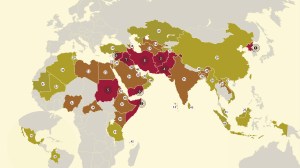
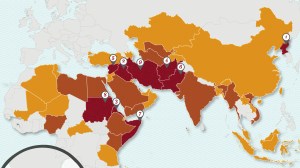
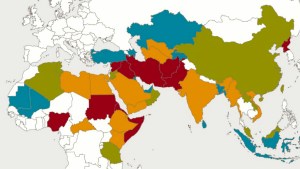
Map of the 50 countries where persecution of Christians is worst.

The 2021 World Watch List rankings:

3 Bioethical Questions About COVID-19 Vaccines

After considering new mRNA technology, Christian experts are in favor.

Christianity Today January 13, 2021
Matt Slocum / AP

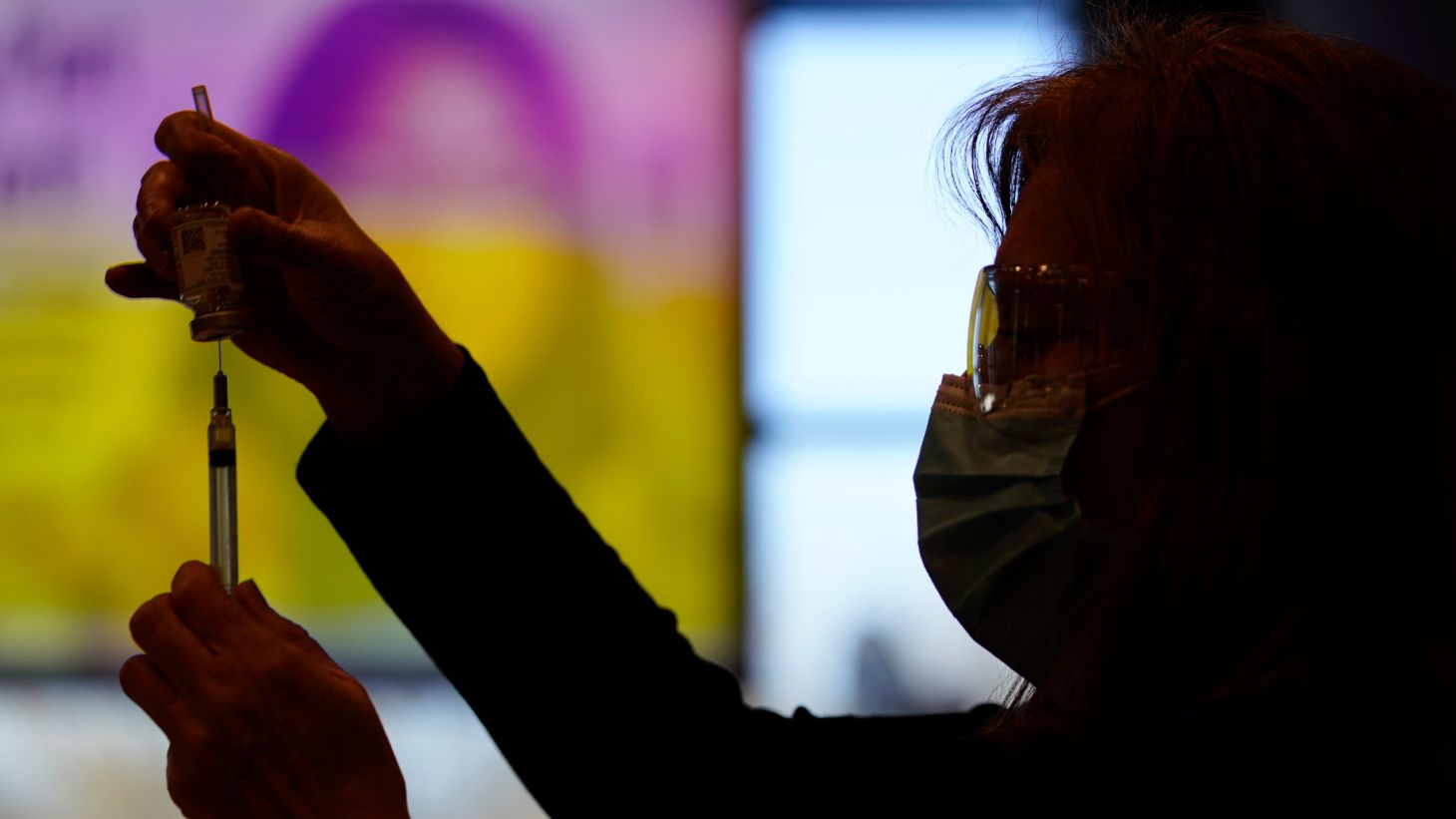
As the COVID-19 vaccine rollout in the US expands from health care staff to elderly citizens and essential workers, Americans are weighing whether to get the shot when given the chance.

Though the coronavirus vaccines from Moderna and Pfizer represent a new type of vaccine—using mRNA rather than a weakened form of the virus to trigger the immune response—some of the basic ethical questions around them stem from existing concerns over vaccination.

Vaccine hesitancy ranked among the World Health Organization’s top 10 threats to global health in 2019, before the pandemic began. Some American Christians have declined vaccines due to ethical and religious concerns over their formulation, and some share concerns with the vaccine-hesitant minority over safety and side effects.

The COVID-19 vaccine, so far, has been shown to be 94–95 percent effective, with side effects that go away within a few days. Still, 50 percent of white evangelicals and 59 percent of black Protestants say they won’t get it, while the majority of the US population overall (60%) says they will, according to the latest Pew Research Center survey.

Despite the ambivalence, Christians have historically advocated for vaccination as an expression of love for neighbors, saying the benefits far outweigh the chance of harm. In the 1700s, Puritan preacher Cotton Mather urged his congregation to be inoculated from smallpox before the first vaccination had even been successfully developed. Today, leading Christian medical professionals and ethicists promote vaccines.

With today’s generation of American faithful once again considering whether a vaccine is safe and ethical, many evangelical organizations and experts have already weighed in. Some of the following questions focus on whether the vaccines themselves are safe and ethical for individuals to use—starting with grappling over the common use of abortion-derived fetal cell lines in vaccine development—and some take a closer look at the ethics of distribution for the sake of local and global neighbors.

1. Does getting a vaccine made using cells from aborted fetuses violate pro-life convictions?

The Christian Medical and Dental Association commended the Moderna and Pfizer vaccines, which use mRNA technology, because they do not contain fetal cells and do not rely on fetal cells for in production.

The companies did use fetal cell lines in testing—to check for potential side effects or damage to cells—as is standard practice for vaccine review. The fetal cell lines themselves do not contain fetal tissue; they were grown in labs from fetal cells obtained decades ago.

To produce many of today’s vaccines, manufacturers use fetal cell lines obtained through two abortions in the 1960s that have been cultured and frozen in storage for long-term use. At the time, fetal cells were thought to be the best way to host the virus in a living cell, and they’ve been used to develop vaccines for rubella (the “R” in the MMR), rabies, hepatitis A, chickenpox, shingles, and polio (though not the version used in the US).

Newer vaccines are moving away from fetal cell lines, as scientists find alternatives such as animal cells and non-fetal human cells to create viable treatments. The Charlotte Lozier Institute, the research arm of the pro-life Susan B. Anthony List, created a chart to explain when fetal cells were used by vaccine candidates that received funding from Operation Warp Speed, the government’s vaccine-development program.

The institute distinguishes between vaccines like Moderna and Pfizer that used the cells for testing to confirm the antibody response and others that rely on the abortion-derived fetal cells to produce the vaccine itself.

Though they are not yet approved for use in the US, the AstraZeneca and Johnson & Johnson vaccines used the old fetal cell lines to develop and create the vaccine itself, as well as in lab testing. AstraZeneca’s vaccine was approved in four countries in the last week. Both companies have signed an agreement with the recently formed global consortium COVAX to distribute vaccines to low- and middle-income countries. Their vaccines are also cheaper, making them more accessible for some countries.

Two other vaccine candidates, Novavax and Sanofi Pasteur, are still in trials but will likely be used as well. They do not use the fetal cell lines in development. Both of these are “protein subunit” vaccines, which use a protein from the virus to trigger an immune response.

But even in the case of those requiring fetal cell lines for production, many pro-life leaders say still they’re not opposed to getting vaccines. The Catholic Church says that those who choose immunization are not culpable for the sin of an abortion. The Southern Baptist Ethics & Religious Liberty Commission also said receiving the vaccine is morally permissible.

The Center for Bioethics and Human Dignity (CBHD), housed at Trinity International University, suggests that the way to right the past wrong is to advocate for ethically derived cell lines or better production methods for vaccines. The Christian Medical and Dental Association joined three other pro-life medical associations in calling researchers to develop ethical COVID-19 vaccines free of abortive fetal cells in any stage of development.

2. Is the mRNA technology safe and ethical to take?

As Christian ethicists Matthew Arbo, C. Ben Mitchell, and Andrew T. Walker wrote last month for Public Discourse, “Because of the rapid pace of development under Operation Warp Speed, it seems natural to worry that COVID-19 vaccines may not be as safe and effective as they would have been if they were developed more slowly.”

“Although it is true that the vaccines have been developed quickly, the same scientific process has been followed,” they said. “In fact, because the stakes are so high, the scrutiny and oversight have never been more intense.”

Scientists have studied mRNA to make immunotherapies since the 1990s, even though it’s only now being used in vaccines. Going off of what they learned about coronaviruses during the 2002–2004 SARS virus outbreak and the 2012 MERS outbreak, scientists knew they could use mRNA to target the spike protein that causes transmission.

Less than two weeks after reporting the novel coronavirus to the World Health Organization, Chinese researchers sequenced the DNA of the virus and made it publicly available. Within days, Moderna researchers had applied past research and finalized the sequence for the mRNA vaccine.

The Pfizer and Moderna COVID-19 vaccines use a synthetic strand of mRNA, which tells human cells how to make the spike protein that sits on the surface of the novel coronavirus, activating an immune response. This is not DNA; it’s RNA, so it degrades easily and cannot insert itself into human genetic code.

Usually, any major problems with vaccines will turn up within the first few months of a trial, according to National Institutes of Health director and Christian geneticist Francis Collins. So far, none of the side effects or risks have been much different than other vaccines. But scientists won’t know long-term effects of mRNA vaccines until more time has passed.

The CBHD believes vaccine companies and US regulatory agencies have mitigated risk as much as possible, despite the record-breaking speed of the discovery. The ERLC agrees, viewing prioritization by the US government as instrumental in the speediness of the regulatory process.

3. Do we have a Christian obligation to get a COVID-19 vaccine?

The CBHD explored this question, concluding that scientists need to know more about the COVID-19 vaccine to adequately provide an answer. The organization suggested that in the future, any moral obligation might be similar to that of getting an annual flu vaccine. However, right now many see a moral imperative to receive it because of the ongoing spread of the SARS-CoV-2 virus and rising deaths. Some assume herd immunity—where enough people are immune after having COVID-19 that it protects those who have not yet had the disease—can be achieved without the vaccine, but it will not be without a high price of likely many more deaths, said Collins.

Scientists don’t know how much of the population needs to be vaccinated to achieve herd immunity. It was initially estimated to be 70 percent, but immunologist Anthony Fauci has more recently shifted to a higher number. For very contagious diseases, like measles, that percentage is 95 percent and still small outbreaks can occur.

Albert Mohler, president of the Southern Baptist Theological Seminary, suggested that people who approach vaccination as a personal choice with consequences that affect only them should think more broadly about their susceptible neighbors.

“There are third parties—people who cannot take the vaccine or do not yet have access to it that could still be infected by those who refuse to take the vaccine,” he wrote. “The general principle of the common good comes down to benevolence, love, care for others, laying down personal priorities for the service of others. Christians thinking about the issue of the vaccine must weigh this key biblical principle as part of their thinking.”

Mohler said he would get vaccinated and encourage other Christians to do the same, but he opposed efforts by the government or others to coerce people to get the vaccine.

Some Christian colleges, along with mandating COVID-19 safety precautions, required students to get a flu shot and could require a COVID-19 vaccine when doses are available. It remains to be seen whether employers or other settings—even churches—might consider the benefits of requiring vaccination.

“Just as states and localities have vaccination requirements for entry to daycares and public schools, we may soon see COVID vaccines required to engage in many areas of community life—perhaps even in churches,” wrote Joe Carter for The Gospel Coalition. “Discussions about such mandates should be rooted in neighbor love (Mark 12:31) and wisdom (Prov. 4:7). To do this well requires we seek out the most accurate information possible and base our judgment on God-given reason and prudence.”

News
Wire Story

Pastors More Reluctant to Preach on Race

Though most still address the topic in sermons, preachers report more pushback from their congregations over the past four years.

Christianity Today January 12, 2021
Ben White / Lightstock

Pastors seem more reluctant to address issues of race in their congregations today than four years ago.

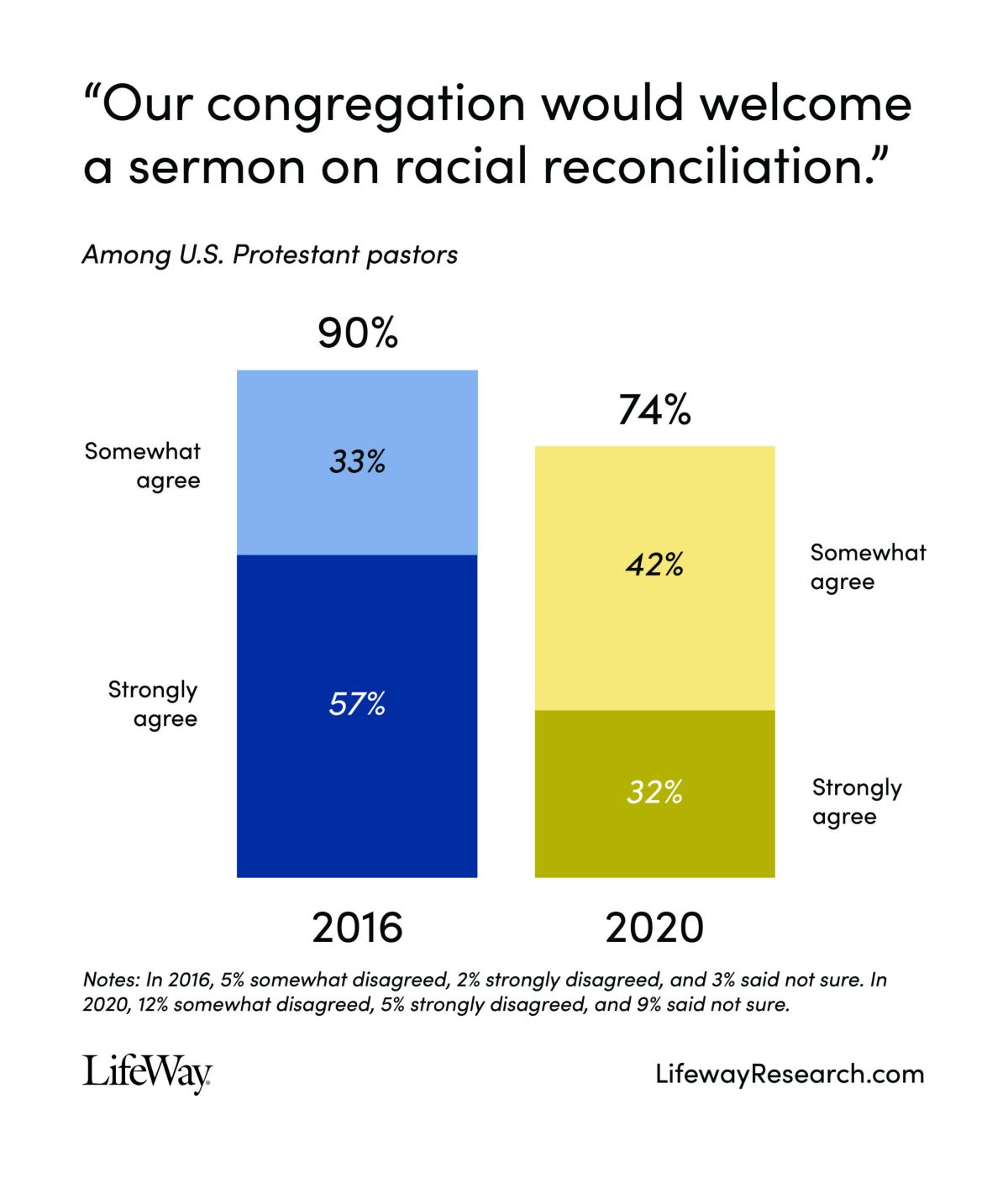
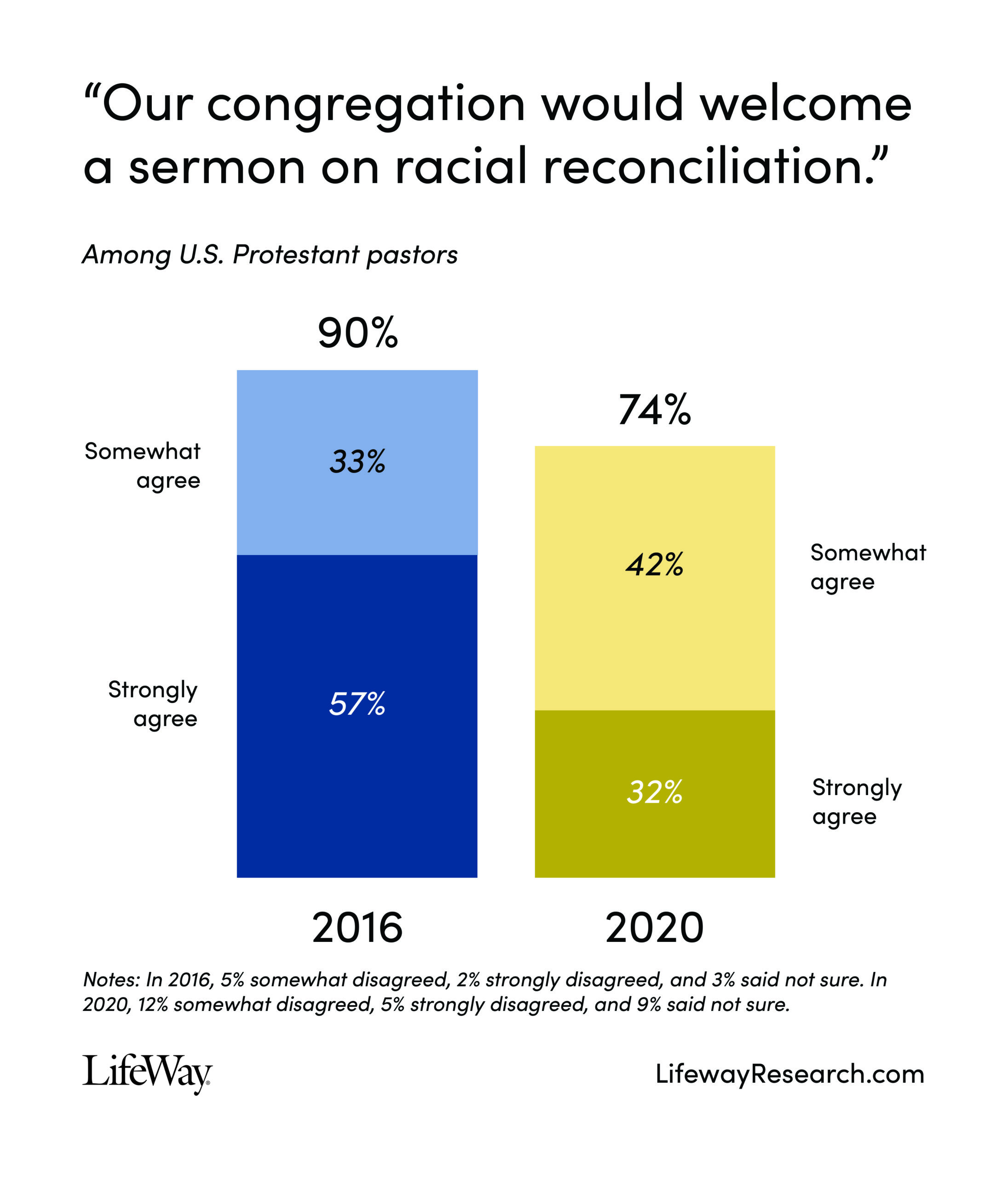
According to a LifeWay Research study, 74 percent of pastors agree their congregation would welcome a sermon on racial reconciliation, with 32 percent strongly agreeing. In 2016, however, 90 percent of pastors believed their congregation would be open to a sermon on the topic, with 57 percent strongly agreeing.

Today, 17 percent of pastors say their church would not want to hear about racial reconciliation, up from 7 percent in 2016.

“While most pastors’ teaching is not limited to things their congregation wants to hear, it is helpful to know the reaction pastors anticipate from their congregation,” said Scott McConnell, executive director of LifeWay Research. “Instead of a majority strongly agreeing, now only a third of pastors have no hesitation that their congregation would welcome a sermon on racial reconciliation.”

African American pastors (93%) are more likely than white pastors (73%) or pastors of other ethnicities (74%) to say their church would be open to a sermon on racial reconciliation.

Pastors of churches with 250 or more in attendance (83%) are the most likely church size to say their congregation would welcome such a sermon.

Denominationally, Methodists (83%), Presbyterian/Reformed (79%), Pentecostals (78%), and Baptists (74%) are more likely than pastors of Lutheran churches (59%) to believe their congregation would like to hear a sermon on the topic.

Sermon feedback

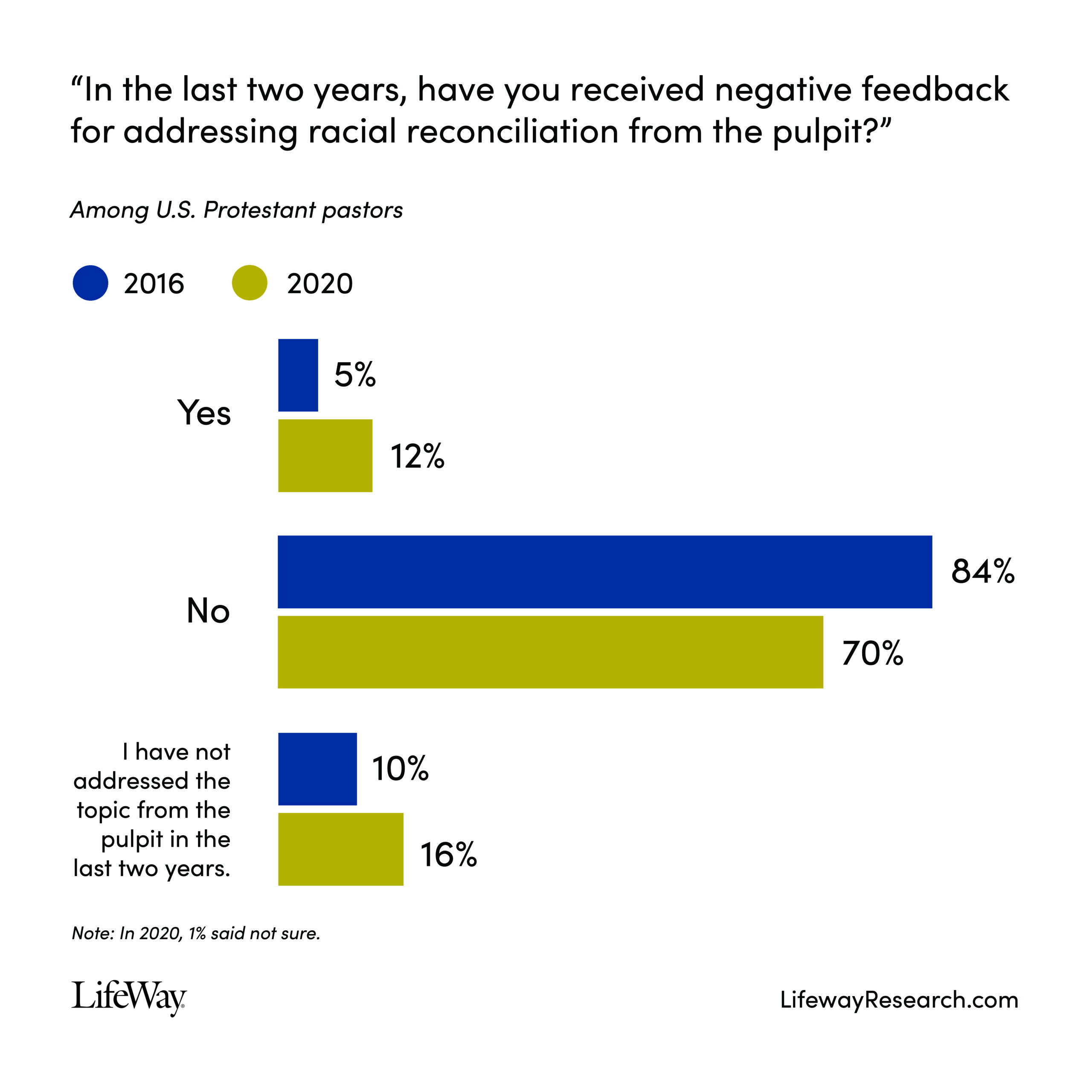
More than 8 in 10 pastors (83%) say they’ve preached on racial reconciliation in the past two years, including 70% who say they have not received any negative feedback because of those sermons and 12% who have been criticized.

Close to 1 in 6 pastors (16%) admit they have not addressed racial reconciliation from the pulpit in the past two years.

Compared to 2016, however, more pastors say they have received negative feedback, and more have ignored the topic in their sermons.

Four years ago, 5 percent said they were criticized for a sermon on racial reconciliation compared to 12 percent today. One in 10 pastors (10%) said they had not preached on the topic in the last two years in 2016, while 16 percent say that is the case now.

“The typical pastor is addressing racial reconciliation from the pulpit and without pushback from their congregation,” said McConnell. “However, the noticeable increase in pastors avoiding the topic and receiving criticism could signal there are new dynamics emerging.”

White pastors (17%) and pastors of other ethnicities (18%) are more than twice as likely as African American pastors (6%) to say they have not addressed racial reconciliation from the pulpit in the past two years.

White pastors (14%) are also more likely than pastors of other ethnicities (3%) to say they have received negative feedback from sermons on the topic.

Pastors 65 and older (20%) are more likely than pastors 45 to 54 (13%) to say they’ve not talked about the topic from the pulpit in the past two years. Younger pastors (18 to 44) are the most likely to say they’ve had negative feedback from preaching a sermon related to race (21%).

Lutheran pastors (27%) are twice as likely as Baptist (13%), Presbyterian/Reformed (13%) and Pentecostal pastors (12%) to say they have not addressed the issue in a sermon in the past two years.

Sermon requests

Around 1 in 5 pastors (21%) say leaders in their church have directly urged them to preach on racial reconciliation, while 77% have not heard such requests.

In 2016, a quarter of pastors (26%) said they had been asked for sermons on the topic, and 73% said they had not.

“There are many possible reasons fewer churchgoers are asking for sermons on racial reconciliation,” said McConnell. “However, you cannot say that fewer Americans are talking and thinking about race today compared to four years ago.”

White pastors (79%) and pastors of other ethnicities (77%) are more likely than African American pastors (56%) to say they have not heard such requests.

Evangelical pastors (81%) are more likely than their mainline counterparts (63%) to say no leaders in their church have asked them to preach on racial reconciliation.

Pastors in the South (79%) are more likely than pastors in the West (70%) to say they haven’t heard such congregational urging.

Lutheran (90%) and Baptist pastors (86%) are more likely than Pentecostal (77%), Restoration movement (70%), Presbyterian/Reformed (68%) and Methodist pastors (63%) to say they have not had leaders ask for a sermon on that topic.

Methodology: The mixed mode survey of 1,007 Protestant pastors was conducted Sept. 2 – Oct. 1, 2020 using both phone and online interviews. Responses were weighted by region and church size to more accurately reflect the population. The sample provides 95 percent confidence that the sampling error does not exceed plus or minus 3.4 percent. Comparisons are also made to a telephone survey of 1,000 Protestant pastors using random sampling conducted Aug. 22 – Sept. 16, 2016.

Ideas

Where Is the Gospel in God’s Judgments on the Nations?

Columnist; Contributor

How to find the good, true, and beautiful in passages that seem anything but.

Illustration by Rick Szuecs / Source images: Creative Commons / Envato

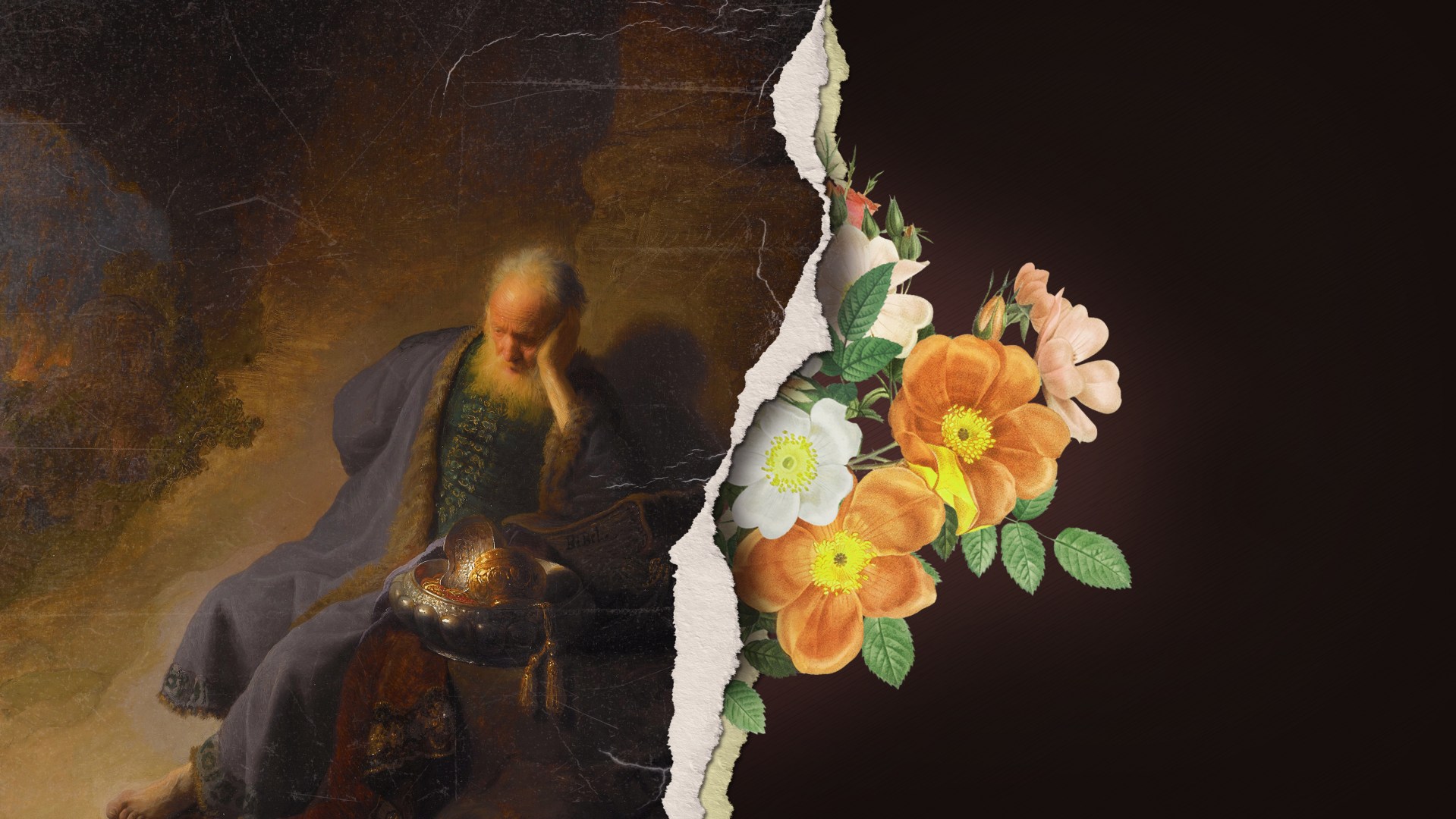
The hardest parts of Scripture, in my experience, are not the bits you don’t understand. Failing to understand can be good; it can prompt thought, investigation, and discovery. No, the real trouble comes when you know exactly what is going on, and it doesn’t look good, true, or beautiful. Think, for instance, of the prophetic oracles of judgment against the nations, which run for page after terrifying page, with (apparently) no hope, no contemporary application, and no end in sight.

The last seven chapters of Jeremiah are a case in point. How can a book containing such glorious promises have such a depressing ending? There are nine oracles of judgment against the nations—Egypt, Philistia, Moab, Ammon, Edom, Damascus, Kedar and Hazor, Elam, and Babylon—followed by Jerusalem’s destruction. The judgments are severe and sometimes graphic. Four nations receive a one-verse promise of future mercy (46:26; 48:47; 49:6; 49:39), but these are just four droplets of hope in a seven-chapter desert of disaster. How do we find goodness, joy, and gospel in these passages? As happens so often in the Old Testament, we find an answer in the exodus story.

The final chapters of Jeremiah contain ten divine judgments: nine against foreign nations, and the last upon Judah itself. Ezekiel 25–33 runs through an equivalent sequence: nine oracles against nations and their kings, followed by Jerusalem’s destruction. And a similar pattern occurs in Isaiah 13–23. That is unlikely to be a coincidence.

Ten, of course, is a very significant number in the exodus story. We all know the Ten Commandments, and we may recall the wilderness generation forfeiting entry to the Promised Land by disobeying God ten times (Num. 14:22–23). Crucially, there were also ten plagues sent upon a foreign nation (Egypt), the last of which led to Israel’s deliverance in the middle of the night. Since the plagues are the paradigmatic biblical example of judgment on foreign nations, it is possible that Jeremiah, Isaiah, and Ezekiel are deliberately presenting their oracles as plagues of judgment.

Looking closer, we see other clues. Jeremiah begins his oracles with Egypt (46:2). He ends with an escape in the middle of the night, with enemies in hot pursuit (52:7–9). His imagery in these chapters includes the river Nile, biting flies, dead livestock, locusts, judgment upon Pharaoh and Egypt’s gods, the overthrow of horses and chariots, and the sea drying up.

Reading Jeremiah with that in mind, at least three things become clearer. The first is that we are witnessing a battle of the gods. Repeatedly, Jeremiah reminds us that Amon, Ra, Chemosh, Molech, Bel, Marduk, and company are being exposed as a sham. Our culture may worship different gods—Ares, Mammon, Bacchus, Aphrodite, Gaia—but they are just as powerless to save. When God brings judgment, their impotence is revealed, which is cause for celebration.

The second revelation is that the climactic judgment falls upon God’s people. In Exodus, the tenth plague strikes Egypt, and Pharaoh loses his firstborn son. But in Jeremiah, the tenth judgment strikes Jerusalem, and King Zedekiah loses both of his sons before being blinded and deported to Babylon. Oppression and idolatry among the nations provoke plagues of judgment; in Zion the consequences are even worse. Israel can’t scapegoat a depraved world while there are idols in the sanctuary.

The third thing to notice is that after the tenth plague comes deliverance. In Exodus, after God’s people have been mired in slavery for four centuries, judgment comes and they are graciously freed from captivity. Jeremiah ends the same way. God’s people have been mired in idolatry for four centuries, and judgment has come. But the final four verses show King Jehoiachin being graciously freed from captivity, given fresh clothes, raised above all other kings, and seated at the royal table (52:31–34).

Amid judgment, God remains gracious. Jehoiachin has hope and a future, and so do his people. In the years to come, one of them will be lifted from the prison of death, given fresh clothes, raised above kings and nations, and seated at the royal table. And he will invite everyone—including foreigners like me from idolatrous nations that deserve judgment—to join him.

Andrew Wilson is teaching pastor at King’s Church London and the author of God of All Things. Follow him on Twitter @AJWTheology.

Ideas

Humoring the President Was Not Harmless

Staff Editor

As a little leaven works through a loaf, indulging deceit led to disaster at the Capitol last Wednesday.

Christianity Today January 11, 2021
Win McNamee / Staff / Getty Images

The administration officials and members of Congress who enabled President Trump’s attempts to delegitimize the presidential election did not truly believe he won. They chose to coddle the president’s deception (and, I suspect, self-deception) because they thought it would endear them to his most loyal voters, and they assumed no one would get hurt.

“What is the downside for humoring him for this little bit of time? No one seriously thinks the results will change,” an unnamed senior Republican official told The Washington Post in November. “He went golfing this weekend. It’s not like he’s plotting how to prevent Joe Biden from taking power on Jan. 20. He’s tweeting about filing some lawsuits, those lawsuits will fail, then he’ll tweet some more about how the election was stolen, and then he’ll leave.”

I think Trump will indeed leave, as he finally said he would in a brief video Thursday. But that doesn’t mean there was no downside. It doesn’t mean no one got hurt. In Washington on Wednesday, we witnessed a “failed insurrection,” to use the phrase of Senate Majority Leader Mitch McConnell, in which pro-Trump demonstrators, some armed with guns, stormed the Capitol and rioted inside. The chaos claimed multiple lives as it made credible all but the direst warnings about what Trump’s elevation to the highest office in our country could bring.

Humoring him was not harmless.

For Christians, this should be no surprise. Scripture warns us that small patterns and habits grow to shape our lives in large ways. This is true of both faithfulness and sin, virtue and vice. “Don’t you know that a little yeast leavens the whole batch of dough?” Paul asked the Corinthian church, incredulous at their acceptance of open, incestuous adultery in their congregation (1 Cor. 5:6).

Not every Corinthian was guilty of this sin—so far as we know, only two people were involved (1 Cor. 5:1). But the whole church did tolerate it (v. 2), and Paul knew the corruption would spread if left unchecked. “God will judge those outside” the church, he concluded (v. 13). Among fellow Christians, we challenge each other—in love and humility—to conform our lives to the standard of God in Christ (Eph. 5:1–2).

Jesus hit on the same theme to close one of his parables. “Whoever can be trusted with very little can also be trusted with much, and whoever is dishonest with very little will also be dishonest with much” (Luke 16:10).

The small things we do shape who we become. A practice of small kindnesses grows into a character of magnanimity; a habit of small lies becomes a compulsive monster of deceit. This is true of groups as much as individuals. It was true of the body of Christ at Corinth, and it is true of our body politic in the United States today.

The madness in Washington last week was not created ex nihilo. It is the due result of five years of humoring deception, of falsely believing that truth could be brought about by lies. It is what happens when you embrace a president who is dishonest in the little things, and the big things, and just about everything. It is what happens when you “call evil good and good evil” for the sake of political convenience or power (Isa. 5:20). It is what happens when warnings about the importance of character are ignored. It is what happens when those who cautioned their fellow evangelicals against backing Trump—because he has lived a very public life of gaudy rapacity, vainglory, cruelty, dishonesty, and lust—are attacked and dismissed as “liberals” or accused of insufficient care for the unborn.

What we saw in Washington last Wednesday is what happens when the president insists he won an election he lost and, instead of telling him and the American people the truth, his allies go along with it. It is what happens when they file lawsuit after lawsuit without a whit of merit, pushing legal claims so bad they are dismissed in court after court, by judge after judge—including judges nominated by Trump himself.

It is what happens when they prioritize power over honesty and cosset mass delusion, even in Jesus’ name. It is what happens after two months of the president and his associates telling millions of disappointed, frightened, angry people that they were cheated, that the foundation of our representative government was undermined, that they really ought to do something about it, that maybe that something should be violent, and that they should “never concede.”

Well, some of them did do something. This is what the dough looks like leavened. This is where dishonesty in the little things leads.

In the immediate aftermath of Wednesday’s events, I’ve seen defensiveness over assignment of responsibility to white evangelicals because of our unusually high support for Trump at the ballot box. Is it fair, some have asked, to blame all evangelicals for actions (storming the Capitol) many would never condone, or for the election of a president many backed for policy reasons if at all?

Blame is too strong a term. Paul didn’t blame the church at Corinth for the adultery in their congregation. But he did call them to account for their toleration of it—acceptance of the sin was a sin itself. He also issued a bracing call to recommitment to “sincerity and truth” as followers of Jesus (1 Cor. 5:8), which is precisely what we need as well. It is an indictment of our discipleship and fidelity to the truth, as CT contributing editor Ed Stetzer recently argued in USA Today, that “not only our people, but many of our leaders, were easily fooled and co-opted by a movement that ended with the storming of the Capitol building.”

We must practice trustworthiness in the little things, scrutinizing our own actions and bearing one another’s burdens so that together we may “fulfill the law of Christ” (Gal. 6:2), who is truth itself.

Bonnie Kristian is a columnist at Christianity Today.

News
Wire Story

What Trump-Supporting Pastors Preached After the Capitol Attack

Sermons mentioned national divides, condemned violence, and applauded police—and some did not reference the event at all.

Christianity Today January 11, 2021
Jacquelyn Martin / AP

Support for President Donald Trump has been consistently strong among evangelicals, with some professing that he has been the best friend Christians have had in the White House.

On the first Sunday since a mob of his supporters seeking to overturn President-elect Joe Biden’s election stormed the US Capitol and five people including a police officer died, the messages from the pulpits of Christian leaders who’ve backed Trump were as disparate as the opinions of the nation’s citizenry.

They ranged from recitations of debunked conspiracy theories of who was responsible, to calls for healing and following Jesus Christ rather than any individual person, to sermons that made no mention of Wednesday’s chaos and what it means for the future.

Here is a look at what some were preaching to their flocks:

Brian Gibson in Owensboro, Kentucky

Brian Gibson, pastor and founder of HIS Church, spoke to his Christian congregation and online viewers about his bus tour around the US the past month to speak with supporters of President Trump.

“I stand up and represent Jesus Christ of Nazareth, and I preach to stand for the First Amendment. I intend to keep this nation a free nation. HIS Church, we intend to keep this nation a free nation,” he said, referencing both the president’s recent banning from social media platforms and restrictions on church assembly during the pandemic.

Gibson was onstage January 5 at a “Prayer to Save America” event billed as a combination worship service and rally for Trump the day before congressional certification of the electoral votes. As he described the events of the 6th, Gibson questioned how easily the Capitol was breached, raising debunked assertions that antifa supporters were among the violent mob.

“So now I know some, some bad actors went in and I believe potentially there were antifa up there. I think more and more I know there were antifa up there, insiders up there that started that action. And I also know that some Trump supporters followed their lead without a shadow of a doubt because you don’t get 2 million people together without having some radicals in the crowd or some simple people in the crowd that you could lead anywhere, right?” he asked.

Samuel Rodriguez in Sacramento

Samuel Rodriguez, the president of the National Hispanic Christian Leadership Conference who delivered a prayer at Trump’s inauguration and has also advised him, told his congregation Sunday that America needs to hear a message of repentance.

“We must all repent, even the church needs to repent. The American nation will be healed when the American church repents,” he said to some cheers and applause.

“We must repent for making the person who occupies the White House more important than the one who occupies our hearts. We must repent for permitting the donkey and the elephant to divide what the Lamb died for on the cross,” Rodriguez said. “We must repent for voting for individuals whose policies run counter to the word of God and the spirit of the living God.”

Rodriguez, the lead pastor of New Season, said he was praying for a season of “instead of”—“Instead of destroying property, building altars. Instead of confrontation, conversations. … Instead of many under fear, one nation under God.”

John Hagee in San Antonio

John Hagee of Cornerstone Church, a staunch supporter of Trump, did not mention the president by name but criticized the assault on Congress by what he called “a rebellious mob.”

“The Secret Service had to escort the vice president of the United States to safety out of the Capitol building. Gun shots were fired. Tear gas was deployed in the Capitol Rotunda. People were killed. … This was an assault on law. Attacking the Capitol was not patriotism, it was anarchy,” Hagee said.

His words drew tepid applause from the crowd at his megachurch, but they soon after gave Hagee a standing ovation when he rallied support for law enforcement: “This is what happens when you mob the police. This is what happens when you fire the police.”

“This is what happens when you watch a policeman shot and belittle his sacrifice for the public,” he continued. “Wake up, America! America and democracy cannot function without the rule of law. We back the blue.”

Paula White-Cain in Apopka, Florida

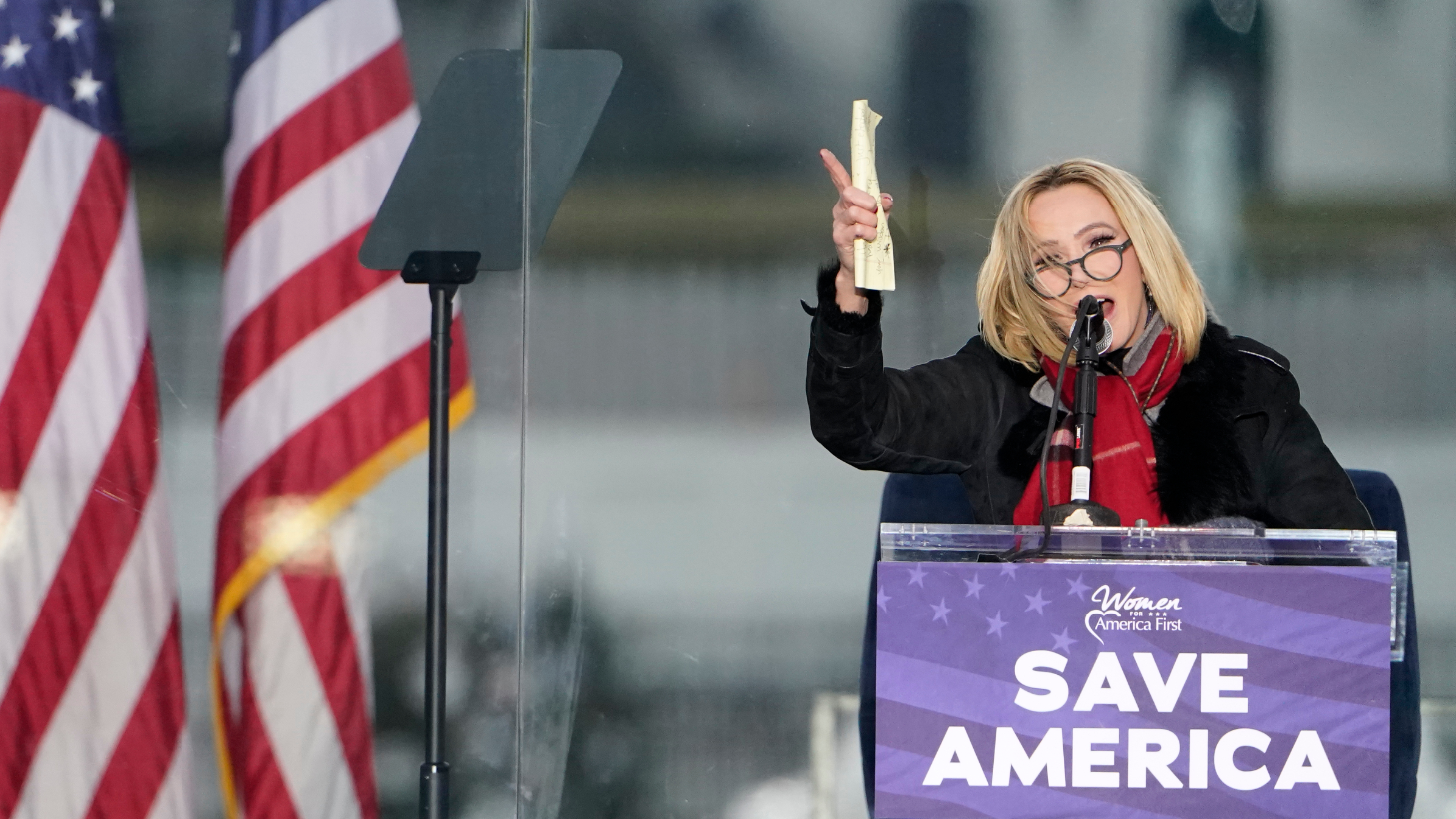
Paula White-Cain, a longtime spiritual counselor to Trump and who served as a faith adviser in his White House, made a subtle allusion to the insurrection ahead of her Sunday sermon.

Calling the nation “deeply divided,” White-Cain condemned “lawlessness” and added that “my hope is never rested in any person, any man. My hope is in Jesus Christ.”

White, who delivered a post-election prayer service in which she called upon “angelic reinforcement” to help achieve victory, also reaffirmed her commitment to the First Amendment—an echo of the warnings from some conservatives this week that their freedom of speech was threatened.

Tim Remington in Coer D’Alene, Idaho

Tim Remington, the conservative Christian pastor of The Altar church, avoided specific references to Trump and the attack on the Capitol, but offered plenty of politically charged warnings.

“The next two weeks are probably the most important two weeks in the history of America,” said Remington, who in the spring led in-person services in defiance of a stay-at-home order issued by the governor. “I pray the army of the Lord is ready.”

He targeted the media in particular for criticism.

“I rebuke the news in the name of Jesus,” Remington said. “We ask that this false garbage come to an end. … It’s the lies, communism, socialism. I don’t know how we’ve put up with it this long.”

And without going into specifics, he said America “is not seeking the truth.”

“For them to suppress another person’s opinion — it’s wrong, it’s unconstitutional,” he said. “God have mercy.”

Darrell Scott in Cleveland Heights, Ohio

Darrell Scott, the black senior pastor of New Spirit Revival Center, did not mention the events in Washington.

Scott, an early supporter of Trump’s 2016 campaign who worked with the administration on urban and prison issues, once praised the administration as “probably the most proactive administration regarding urban America and the faith-based community in my lifetime.”

But there was no talk of the president Sunday in a livestreamed service entitled “What God Has for Me,” in which Scott focused on encouraging congregants to recognize God’s involvement in their lives.

Books
Review

After Binging on the Internet in 2020, We Need a Major Knowledge-Diet Overhaul

Brett McCracken applies food-pyramid principles to our habits of media consumption.

Illustration by Laura Freeman

In the wake of last year’s election season, many of us have been asking difficult questions about our nation and ourselves. Can we restore a sense of shared American identity despite our differences? Is it possible for the church to engage in politics without getting stuck in familiar partisan ruts?

The Wisdom Pyramid: Feeding Your Soul in a Post-Truth World

The Wisdom Pyramid: Feeding Your Soul in a Post-Truth World

Crossway

192 pages

Underneath these larger issues are questions about the kind of people we’ve become in the internet age. Thinking back on all the tweets, videos, articles, comments, and memes I consumed as the election drew near, I’ve begun asking myself: “Was it worth it?” Once I had decided on my preferred candidate and done what I could to advocate for my neighbor, did all the time and energy I devoted to reading, watching, and responding online benefit me personally? Did it make me a better citizen of heaven (or Texas)?

Of course, 2020 was a strange year, and it is hard to imagine how we would have coped without the internet. We needed up-to-date information about the spread of the coronavirus, and we needed ways to connect with our church communities during lockdowns. Tragically, it took seeing the murder of George Floyd to jar many of us into acknowledging the realities of injustice in our country. And in an election year, of course it’s important to be an informed voter, from the president down to the county commissioner.

Yet for all the good the internet brings, my guess is that most of us would admit that our media usage hasn’t been altogether healthy over the past few years. Many of us can readily recall Donald Trump’s “Covfefe” tweet, the fly on Mike Pence’s forehead, or the latest celebrity-pastor hot take, even if it’s been forever since we read a novel. A disorder running this deep won’t be fixed by spending a little less time checking Twitter. We’re long overdue, it appears, for a major overhaul of what we consume and how we consume it.

Craving Perpetual Novelty

Brett McCracken aims to reset our media priorities in his new book The Wisdom Pyramid: Feeding Your Soul in a Post-Truth World. McCracken, a seasoned film critic and a senior editor for The Gospel Coalition, draws on the familiar image of the food pyramid, which helps us visualize what we should eat and in what proportions. At the base of the pyramid are healthy foods like fruits and vegetables, which should form the foundation of our diet, while less healthy things we should eat in moderation, like sugars and red meat, appear in the narrower sections up top. Instead of helping us resist the pandemic munchies, McCracken wants to guide us toward realigning our intake of media and the world around us, so that we are formed in wisdom rather than folly.

McCracken begins the book with an exploration of what can happen when we suffer from this kind of imbalance. Like a doctor diagnosing the consequences of overindulging on sugary and fatty foods, he describes what the past two decades of always-on internet consumption have wrought. We see the ways information overload can lead to feelings of anxiety, stress, and powerlessness. Even though we realize this to some extent, McCracken says we still crave “perpetual novelty,” which prevents us from thinking deeply and makes us more susceptible to things like fake news.

This constant rush of newness only serves to accelerate a feedback loop of deeper anxiety and compulsive clicking. And the end result, says McCracken, is a turn toward self-centeredness, where we tend to focus on “looking within” and “finding our truth” rather than submitting to realities outside of ourselves. When we do find a few moments of solace, we are quickly distracted by yet another breaking-news notification. McCracken acknowledges that many of these problems predate the internet, but he argues that digital media have amplified and intensified them.

Most readers will likely see something of themselves (or perhaps of a friend on Facebook) in what McCracken describes in these opening chapters. We know we can’t fully unplug from the internet, but we sense that something is deeply wrong with how we use it. This is where the logic of the wisdom pyramid comes in. Just as Augustine urged us to rightly order our loves, McCracken contends that growing in wisdom involves rightly ordering our intake of the world around us.

At the bottom of McCracken’s pyramid, occupying the largest space, is the Bible. Then, moving up the pyramid, there are progressively smaller layers for five additional wisdom sources: the church, nature, books, beauty (films, art, music, and so on), and finally, the internet and social media. In other words, Scripture and the church should be our primary formative influences. And partaking of the natural world, books, and beauty can greatly enrich our lives. But the internet and social media, while not intrinsically harmful, should only be consumed in smaller doses.

The wisdom pyramid offers something beyond a quick media fast or a simplistic exhortation to “put down your phone and read your Bible.” Instead, McCracken wants us to rethink the world around us and how we apportion it. He reminds us of the importance of things like spending time in nature, which, in a digital world, can help us “feel our createdness . . . and feel closer to our Creator.” And he urges us to avoid “filling our senses . . . with whatever micro-spectacle comes across our feed.” Instead, we should carefully curate what we consume, leaving space for contemplation.

McCracken also offers practical recommendations for reconnecting with these sources of wisdom or reviving practices we’ve long neglected. For example, in his chapter on books, he draws on authors like Alan Jacobs, who reassures us that we can read what interests us rather than trudge through every book we don’t enjoy. Each chapter concludes with a set of probing questions that should prove immensely helpful to anyone contemplating a reset.

Rightly Ordered Lives

McCracken’s wisdom pyramid is not intended as a literal guide for how many minutes to spend drawing from each source; its purpose is to spur reflection on how we spend our days and what kind of people we become as a result. As we reflect on the election and the challenges of 2020, pondering what it will take to emerge from our hyperpolarized age, we’ll need to think carefully about more than just our media portion sizes. We’ll also need to consider how the items at the top of the pyramid tend to trickle down and overflow into those on the bottom, for good and for ill.

In other words, it’s not merely that our wisdom diets are too heavy on the processed junk of the internet and social media and too light on the staple foods of God’s Word and his church. More worrisome, perhaps, is how our appetite for the former can spoil our taste for the latter.

For example, a pastor friend of mine in the Dallas area recently told me that one of his congregants complained about his sermon series on Micah, protesting that he needed to preach “more Paul and less prophets.” Evidently, Micah’s emphasis on justice and mercy seemed uncomfortably close to perspectives the congregant had learned to disapprove of online. Like most evangelicals, this person would likely think of himself as having the Bible and the church at the base of his own wisdom pyramid. And yet it seems that something else in his life is spilling down over it and seeping into everything else. He, like all of us, needs to examine not just his media intake but also how the world he inhabits colors the way he reads Scripture (and influences which Scriptures he prefers to read).

That is not to say that the upper layers of the pyramid should never influence how we see the church or interpret Scripture. Indeed, another factor worth considering alongside McCracken’s pyramid is the role of diverse human relationships. In the category of the church, McCracken invites us to consider how other believers can challenge, encourage, rebuke, and pray for us.

But relationships outside the church—or at least outside our own church—are also vitally important in forming our souls. Sometimes listening to those outside our normal life spheres (and our social media bubbles) is what brings new wisdom, creativity, and insight. These encounters can also inspire fresh understandings of Scripture and God’s love for his creation.

At its best, the internet can be a place where we cconnect with those who differ and confront both the joys and sufferings of those we only rarely encounter. Unfortunately, it seems that our subjugation to algorithms often stultifies our thinking and pushes us further apart. Rather than learning to converse in meaningful ways, we tend to fill our online discussions with empty talk and virtue signaling.

This underscores our need to find new ways of forming significant relationships with our literal neighbors. As we (hopefully) emerge from the pandemic lockdowns this year, we will enjoy a window of opportunity to rebuild an infrastructure of care and concern for those around us, drawing all of us deeper into the way of Jesus.

Before engaging in such a lofty task, however, we must have our own lives rightly ordered. Toward this end, McCracken helpfully closes The Wisdom Pyramid with what he calls “marks of wisdom”: cultivating discernment rather than reading and consuming indiscriminately, exercising patience rather than going too fast, and practicing humility rather than constantly focusing on ourselves.

Wise words indeed.

John Dyer is a dean and theology professor at Dallas Theological Seminary. He is the author of From the Garden to the City: The Redeeming and Corrupting Power of Technology.

News

After Israel, Will Morocco Normalize with Christians?

As fledgling local church movement lauds increased ties with the Jewish state, Moroccan believers debate if official recognition of their faith is needed at home.

Christianity Today January 8, 2021
Illustration by Mallory Rentsch / Source Images: Fadel Senna / Getty Images/ Nagesh Badu / Fabio Santaniello Bruun / Unsplash / WikiMedia Commons

President Donald Trump’s Abraham Accords have been singular in focus—build Middle East peace upon Arab states establishing full relations with Israel.

And although not officially linked, three of the four nations to normalize with the Jewish state this year received something from the United States in return.

The first, the United Arab Emirates (UAE), was cleared to purchase American F-35 fighter jets. (The second, Bahrain, which already hosts a US naval base, is understood to be part of a gradual Gulf alignment with Israel.)

The third, Sudan, was removed from the US list of state sponsors of terrorism.

This month, the fourth, Morocco, was granted US recognition of its longstanding claim to the Western Sahara, a mostly desert region on the northwest coast of Africa, which seeks independence.

But absent from the accords is any emphasis on religious freedom, despite the Trump administration making it a central feature of its foreign policy. And in relation to Christians, each nation has a unique situation.

The Emirates is officially 100 percent Muslim, though it facilitates the worship of its majority population of migrant workers. And following normalization, the UAE relaxed its sharia-based laws.

Bahrain has a native Christian population of about 1,000 people, descended from communities in Lebanon, Syria, and India. Three years ago, its king signed a declaration esteeming individual “freedom of [religious] choice” as a “divine gift.”

Sudan’s Christians, though only 3 percent of the population, are indigenous citizens. And following the 2019 popular revolution, Sudan implemented religious reforms, including repeal of its apostasy law.

Morocco is in between.

Long lauded for its treatment of local Jews, Morocco’s constitution recognizes Judaism and considers the 3,000-strong community as an integral part of its society. And during last year’s visit by Pope Francis, King Muhammad VI interpreted his official title of “Commander of the Faithful” as “the Commander of all believers … [including] Moroccan Jews and Christians from other countries, who are living in Morocco.”

But the omission stood out.

“He didn’t mention us,” said Zouhair Doukali, a Moroccan Christian.

“I want the government to recognize all minorities, so that we can live as Moroccan citizens.”

Estimates of the North African nation’s unofficial Christian citizens vary widely, from 5,000 to 50,000. Foreign-resident Christians are estimated at about 30,000 Catholics and 10,000 Protestants, who enjoy religious freedom in legally registered churches.

But whereas the UAE and Sudan have been improving their religious freedom image, Morocco has moved backwards, according to a new report on blasphemy laws by the US Commission on International Religious Freedom (USCIRF).

One of eight nations to have expanded blasphemy provisions since USCIRF’s last report, in 2018 Morocco doubled its fines and jail terms. It also expanded the law’s jurisdiction from only official publishers to include any individuals in public or online forums.

And proselytizing, described as “shaking the faith of a Muslim,” can be punished with up to three years in prison.

Open Doors ranks Morocco No. 26 on its World Watch List of the 50 countries where it is hardest to be a Christian.

But unlike the UAE, where conversion is illegal and can meet the death penalty, Morocco assigns no penalties for conversion. The government has said so publicly.

“There is no persecution in Morocco,” stated spokesman Mustapha El Khalfi, “and there is no discrimination on the basis of faith.”

Moroccan Christian sources agree there is no state persecution. Over the past decade, the government has largely left converts alone. And since all are assumed to be Muslim, there are no issues marrying other believers. (Marriage in Morocco is a matter of civil registration, whereas in some Arab states it has a religious character and Muslims may not enter into Christian marriage.)

Some Christians, however, want full human rights.

Doukali accepted Christ in 2000 and lived 10 years as a secret believer. But taking courage from the book of Acts, he decided to go public.

“You cannot stay afraid forever,” he said. “Some family members stopped talking to me, but I won back my life.”

It helps that he is self-employed as an electrician. Most Moroccan Christians keep their faith private, Doukali said, afraid of social pressures that might cost them their jobs.

But private does not mean hidden. Most Christians meet in house churches, with many locations known by local residents, and presumably all by national intelligence. Doukali worships with about 15 others in Casablanca, under a local Moroccan pastor.

The rule for safety is the same for neighborliness: Keep down the noise.

But allowance is not the same as facilitation.

In 2016, Doukali and other believers formed the Coordination of Moroccan Christians (CMC) and approached the National Council of Human Rights. They were received warmly, he said, and were promised assistance.

The next year, they gave their papers to the government to register as an official organization. To date, there has been no reply. Several sources stated they were involved in the CMC at some point, but the organization has since withered amid personal disputes.

Still, the demand remains for legal recognition as Christians and registration of church buildings. Some also ask for the right to Christian marriage and burial.

For others, there are more important issues—including personal safety.

“We are not asking for freedom,” said Saeed, a Moroccan Christian using a pseudonym in order to protect his ministry. “We have to build the church first, so people can be firm in their faith.”

Having become a Christian in 1990, Saeed translated the Bible into the local dialect of his Amazigh language. The indigenous population of many parts of Morocco and Algeria, the Amazigh were a mix of Christians, Jews, and animists before the spread of Islam.

Notable church leaders include Augustine (whose heritage was previously highlighted by CT), Tertullian, and Cyprian of Carthage.

Today, Saeed’s house church includes about 40 believers. They meet in a single-family home, so their worship does not alert the neighbors.

He is concerned about Muslim radicals, not the government. But there is an advantage to keeping faith below the radar, Saeed said. Security monitors the public figures, which he believes can limit their effectiveness.

“We are not a threat to the government; we are too small,” he said. “Our treatment depends on their interests, and what they want to show to the outside world.”

Morocco’s reputation is good.

In 2012, the UN Human Rights Office convened in the nation’s capital and formulated the Rabat Plan of Action to curb discrimination and incitement against religious minorities.

In 2016, the Marrakesh Declaration assembled more than 200 clerics from around the world, urging Muslim nations to better protect their Christian minorities.

And now in 2020, normalization with Israel highlights Morocco’s historical relationship with the Jews. During World War II, the then-king rebuffed Nazi efforts to deport the community to Germany.

The accord with Israel will help Christians indirectly, Saeed said. Ordinary Moroccans will learn to accept diversity and eventually Christian citizens also.

One day, thousands will come to Christ, he said. He wants the church to be ready to receive them and not risk complicating things now through public advocacy. If the radicals rise up in offense, the government may be forced to crack down.

“I can deal with prison, or death, but we have to take care to protect the others,” Saeed said.

“If you want to do things long term, you have to be wise, and slow.”

However, that does not necessarily mean silent.

Youssef Ahmed is one of the few second-generation Moroccan Christians. From Tangier, his father converted in 1936 through the colonial-era headquarters of the North Africa Mission. In 1945, the father spent two years in prison after refusing to recant his faith. And as a boy, Youssef regularly had rocks thrown at him on the way to the mission school.

In 1975, Youssef married a fellow Moroccan Christian, but shortly afterwards the government seized the mission hospital and church in which they had wed. Many believers stopped meeting, afraid for their safety. But others joined to form a house church in the Ahmed family home, known to neighbors to this day.

In 2004, God called him into full-time ministry. Six years later, he helped mitigate a crisis.

By then the house church movement was going strong. In 2005, the Newsboys headlined a Christian music festival in Marrakesh. But in 2010, the government kicked out more than 100 foreign Christian workers throughout the country.

Once again, Moroccan believers scattered.

Only this time, there was significant infighting. Pastors feared informants. Would-be leaders jostled over funding. And denominational conflicts between groups connected to Baptist or Pentecostal missions contributed to overall disunity.

Ahmed, now 66 years old, summoned his senior status to convene 35 national leaders from each region of Morocco. After leading them in reconciliation, the church began to grow again.

“The king says you have the freedom to believe what you want, but not to show it publicly,” Ahmed said. “The message is this: We respect your religion, but you respect ours—meaning Morocco’s.”

Polling data, however, suggests Moroccans are respecting their own religion less and less. The number declaring themselves “not religious” has tripled since 2013, now encompassing 15 percent of the population. The same survey, released in 2019 by Arab Barometer and the BBC, finds only 25 percent have faith in their religious leaders.

And 4 in 10 desire to emigrate.

Some of these come to the church seeking baptism, said Ahmed. Their aim, however, is the baptismal certificate they can present to officials in Europe—when they seek asylum. After clarification, some become true seekers.

But while care must be taken lest Christian pastors “shake the faith of a Muslim,” many leaders want the record put straight.

“If anyone claims religious asylum because of government persecution, he is lying,” said Rachid Imounan, an Amazigh church planter who lives in the southern city of Agadir.

“The king has my loyalty and respect, as a Moroccan Christian.”

Like Ahmed, Imounan’s children have had rocks thrown at them. He has suffered death threats. Yet he continues his public internet radio ministry and supervises a network of 150 believers in the surrounding area—including the Western Sahara.

The security network serves the monarchy and keeps overall stability, he said. While the king has implemented a liberal agenda, the Moroccan government has been dominated by political Islamists since 2011, when constitutional reforms staved off Arab Spring protests.

Moroccan Christians hope next year’s elections might unseat them.

The prime minister has not publicly rejected normalization with Israel, though he used the opportunity to pledge “unshakable support” for the Palestinians. But his coalition allies have called it “deplorable.”

All Moroccan Christian sources expressed strong support for relations with Israel, however. And obtaining US recognition of the disputed Western Sahara territory—rich in phosphates and fishing resources—will strengthen the nation’s economic development, especially in the south.

Many analysts chided the Trump administration for reversing longstanding US policy, which favored a referendum on independence, and noted the territory’s facilitation of church-supported Christian workers. But Moroccan believers once rejected a shipment of Arabic Bibles due to their inclusion of a world map listing the Western Sahara as distinct from Morocco.

Muhammad VI chairs the al-Quds [an Arabic name signifying Jerusalem] committee of the Organization of Islamic Cooperation (OIC). Formed in 1975, the committee is dedicated to implementing the OIC resolutions in the Arab-Israeli conflict. Anger from the Palestinians has been muted compared to the preceding normalization deals, as the king reached out directly to assure them of his continued support for their independent state.

But while the recent deal brokered by the Trump administration is popular with the small Christian community, polling data suggests they are the minority. In a November survey by the Konrad Adenauer Foundation, only 17 percent of Moroccans express support for the Abraham Accords. Only 26 percent believe Israel has a right to exist, and 7 in 10 view the Jewish state unfavorably.

Imounan used to be one of them.

“Moroccans were raised to be against Israel, and to hate the Jews,” he said.

“But now this will change—and be a blessing to our nation.”

Since the accord, the education ministry announced it has revised curriculum to include Jewish history and culture.

Whether or not future developments include Morocco’s Christian heritage—and present—the young church believes that relations with Israel signal that the nation is headed in the right direction.

“As Christians, our goals are for peace, with love toward all peoples,” said Imounan. “This puts Morocco on the right path with the world.”

addApple PodcastsDown ArrowDown ArrowDown Arrowarrow_left_altLeft ArrowLeft ArrowRight ArrowRight ArrowRight Arrowarrow_up_altUp ArrowUp ArrowAvailable at Amazoncaret-downCloseCloseellipseEmailEmailExpandExpandExternalExternalFacebookfacebook-squarefolderGiftGiftGooglegoogleGoogle KeephamburgerInstagraminstagram-squareLinkLinklinkedin-squareListenListenListenChristianity TodayCT Creative Studio Logologo_orgMegaphoneMenuMenupausePinterestPlayPlayPocketPodcastprintremoveRSSRSSSaveSavesaveSearchSearchsearchSpotifyStitcherTelegramTable of ContentsTable of Contentstwitter-squareWhatsAppXYouTubeYouTube