News

Southwestern, Baylor Settle With Foundation that Shifted Support After Paige Patterson’s Firing

Three allies of former seminary president agree to ban from leadership in any Texas charities or Southern Baptist entities.

Christianity Today February 8, 2021
Michael-David Bradford / Wikimedia Commons

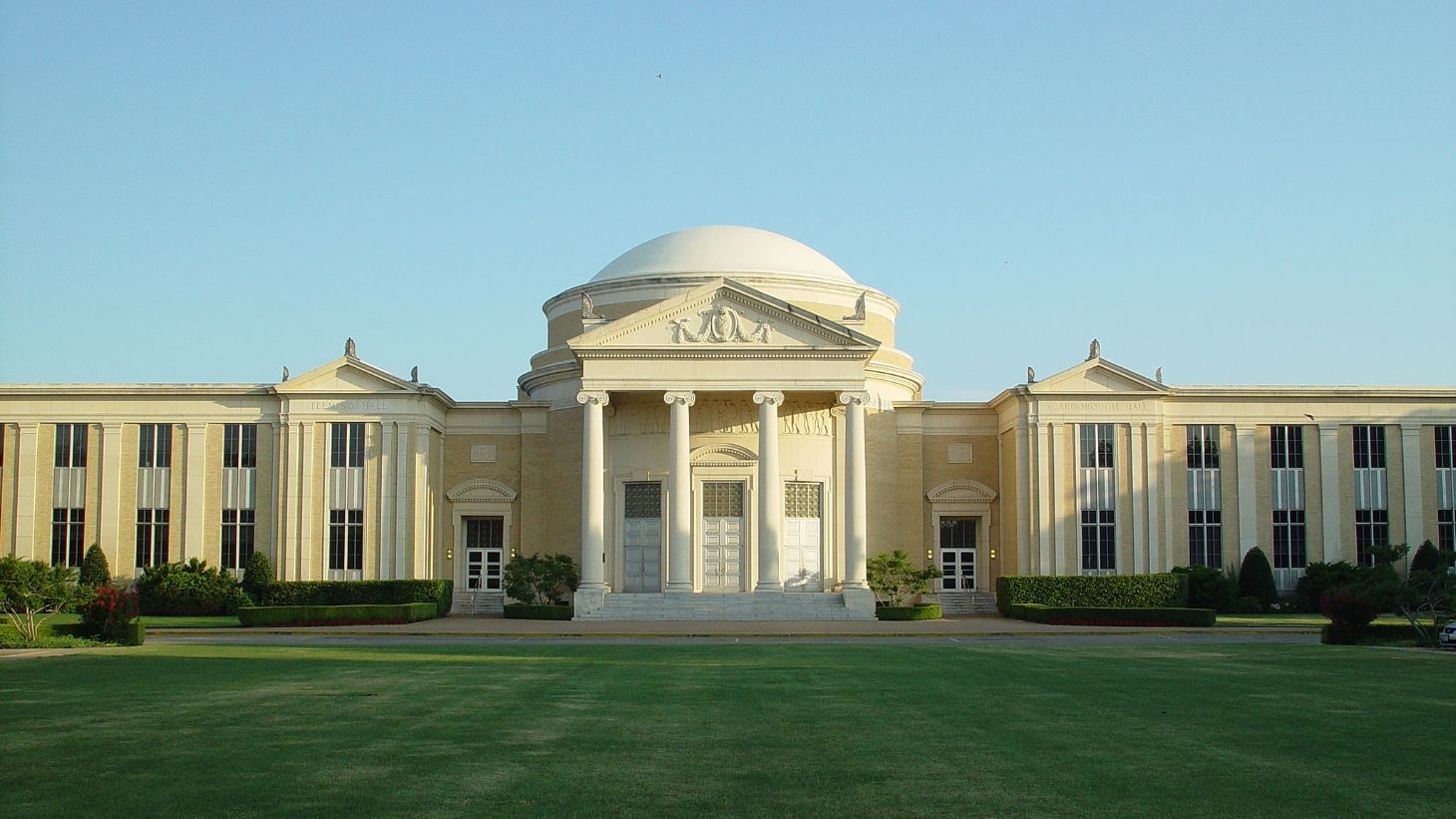
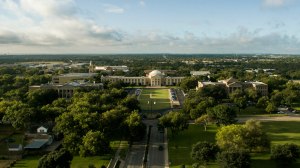
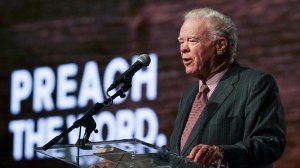
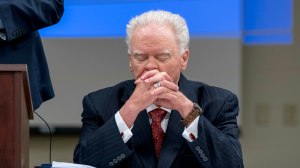
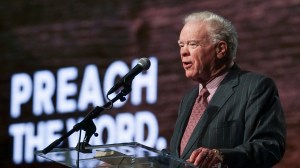
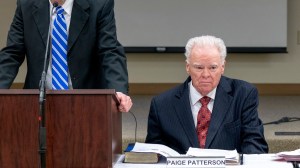
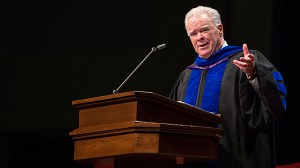
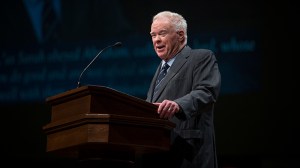
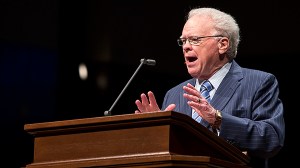
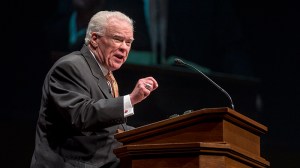
This week, Southwestern Seminary and Baylor University settled a lawsuit with a charitable foundation that restructured its leadership and took control of millions in funding following the firing of Paige Patterson, former president of Southwestern, in 2018.

The two Texas Baptist schools sued the Harold E. Riley Foundation last year, alleging a “secret coup” to divert gifts away from them, despite being designated as the sole beneficiaries of the foundation.

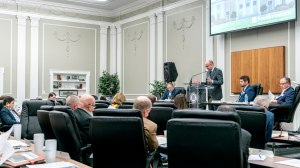
The parties settled in a Tarrant County, Texas, court on Monday, with four leaders from Southwestern and Baylor replacing the board members accused of trying to “seize control of the Foundation and its assets.” Harold E. Riley, the late benefactor and namesake, had set up the organization to fund his alma maters.

The resigned board members—Mike C. Hughes, Charles Hott, and Augie Boto—agreed not to hold any leadership positions or employment at charities in Texas or at any Southern Baptist Convention (SBC) entities. They are not able to serve in “any fiduciary capacity, whether as an officer, director, or trustee,” per the terms of the settlement.

Hughes had been Southwestern’s vice president for institutional advancement under Patterson (2006–2017), and Boto had been a longtime SBC Executive Committee member, serving as executive vice president and interim president two years ago.

Colby Adams, an incoming board member and Southwestern’s vice president for strategic initiatives, told CT he could think of no other instance in which leaders had been subject to such restrictions across the denomination, but “we believe this is a just result, given the inappropriate actions of the persons involved in this matter.”

Boto offered a statement by text message to Baptist Press, saying, “The services rendered by the foundation’s trustees have always been in keeping with Harold Riley’s wishes, as well as in the best interests of both Southwestern Seminary and Baylor University. I trust the new trustees that the beneficiaries have chosen will commit themselves to do those same things. I wish them well.”

Southwestern president Adam Greenway said that the outcome “vindicates” the school’s decision to pursue litigation in the case.

“While painful and costly, this cause of action was necessary to protect charitable donors who deserve the confidence that the purpose of their generous gifts will be fulfilled with integrity and without interference,” said Greenway, who became president in 2019. “This victory is not only for Southwestern Seminary and Baylor University, but for all who are committed to ensuring that resources intended to advance Kingdom purposes are not misused.”

In December 2020, Texas Attorney General Ken Paxton sided with Southwestern and Baylor by intervening in the case and issuing a subpoena compelling testimony from Patterson. Southwestern said seminary leaders say they will cooperate with any further investigation by the attorney general’s office following the settlement of their civil suit.

News

Died: Hershel Shanks, Editor Who Saved Biblical Archaeology from Academics

Hershel Shanks battled top scholars to make the Dead Sea Scrolls available to the public.

Christianity Today February 8, 2021
Biblical Archaeology Review / Edits by Mallory Rentsch

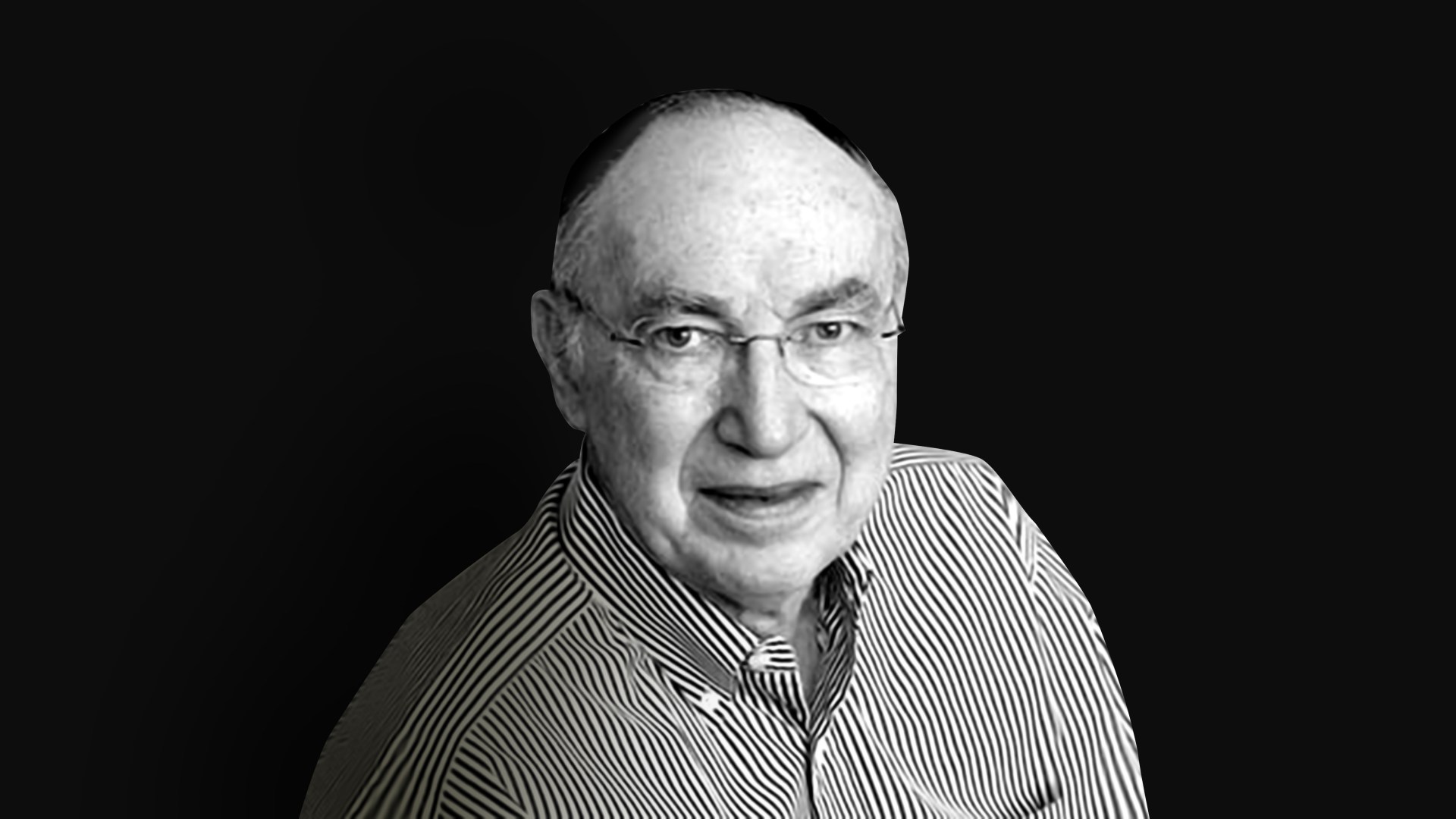
Hershel Shanks, the founder and longtime editor of Biblical Archaeology Review, died on Friday at the age of 90.

With his popular bi-monthly magazine, Shanks trumpeted the latest discoveries at digs across the Holy Land, promoted (and sometimes prompted) fierce archaeological controversies, and tirelessly advocated for public access to the latest scholarship.

Shanks had no credentials in archaeology, biblical studies, or the ancient Near East. He was a lawyer. He nonetheless did more than anyone in recent memory to stimulate biblical archaeology.

“He has a gift—a journalist’s eye, as it were—of spotting hidden nuggets within the world of arcane academic scholarship,” said Eric H. Cline, professor of classical and ancient Near Eastern studies at the George Washington University. “He winnowed wheat from chaff and brought topics, ideas, and new discoveries to a much larger audience of interested readers.”

In scholarly terms, Shanks made the technical research “accessible” to an educated public. But Shanks’s core insight was that the main obstacle between an eager public and academic scholarship was the scholars themselves. The insight was not always appreciated by professional archaeologists.

“His tactic was always to overdramatize the topic and try to marshal public attention to pressure scholars (which usually worked),” wrote William G. Dever, archaeology professor at Lycoming College in Pennsylvania, in a special edition of the Review honoring Shanks in 2018. “Then he would turn to a new, perhaps even more sensational issue.”

Dever served on the editorial board for the Review, but noted he had to resign in protest several times.

“I recall saying once, ‘Hershel, get into epistemology. That’s the next big thing,’” Dever recalled. “Without blinking an eye, he replied, ‘Okay, but what’ll I use for illustrations?’”

Shanks was a born into a Jewish family in Sharon, Pennsylvania, in 1930. His father, Martin, owned a shoe store, and Shanks sold his first pair at 11 years old. He decided not to go into the family business, though, and after earning an English degree at Haverford College, he went to Harvard Law School and became a lawyer. Shanks worked in the Department of Justice for several years, and handled Appeals Court cases. Then he went into private practice in Washington, DC.

At 42, however, he took a yearlong sabbatical that changed his life. He decided to move to Jerusalem in 1972 with his wife, Judith, and their two young daughters, Elizabeth and Julia. Shanks planned to write a novel about King Saul, but instead spent the year visiting archaeological digs with his family.

By the time he was done, Shanks had a new passion. With the support of his wife, an editor at Time-Life books, Shanks decided to leave the law and launch the Biblical Archaeological Society and its magazine.

“I remember telling Hershel that no amateur could possibly understand and interpret the then-burgeoning and complex archaeological research in Israel in any sensible way,” Dever said. “Boy, was I wrong!”

Shanks started the magazine in 1975. Within 10 years, he was sending new issues to more than 100,000 subscribers. Nearly a third of his readers were evangelicals. Most of the subscribers were educated but, like Shanks, not academics. They were just interested in the new insights archaeology could add to their understanding of the context and world of the Bible.

Christopher Rollston, professor of northwest Semitic languages and literatures at the George Washington University, said he understood the reach of the Review when he visited his small hometown in Michigan. He spotted a copy in the local barbershop, and a guy at the lumberyard asked him questions about a recent article.

The biggest test of Shanks’s clout in the field came in the early 1990s, when he decided it was time to make the Dead Sea Scrolls widely available. Though the texts had been discovered in the 1940s, only bits and pieces had been shown to the public—or even to other scholars.

The academics in charge of the study of the scrolls were carefully guarding them until their own extensive research was published. The head of the research project said people who wanted access to the texts were “a bunch of fleas who are in the business of annoying us.” Martin Abegg, a graduate student, recalls being forbidden from sharing information about the scrolls with academics in the US.

Shanks thought this was dumb and persuaded Abegg to let him publish the “bootleg” version of the scrolls that Abegg had reconstructed by computer from a concordance of Dead Sea Scrolls words that was assembled in the late 1950s but kept secret outside of a small group of specialists.

A Preliminary Edition of the Unpublished Dead Sea Scrolls—The Hebrew and Aramaic Texts from Cave Four was published in 1991. The New York Times said it broke “the scroll cartel.”

The same year, Shanks convinced another scholar, Robert Eisenman of California State University, Long Beach, to let him publish a facsimile edition of photographs of scroll fragments he had secretly obtained.

Shanks was sued for copyright infringement and ordered to pay $40,000, but as Lawrence H. Schiffman, Hebrews studies professor at New York University, later wrote, “The lock had finally been broken.” The Israel Antiquities Authority appointed Emmanuel Tov the new head of the Dead Sea Scrolls research team, and scholars published “every scrap of parchment, including unidentifiable pieces” in the next 12 years.

In addition to his work on the magazine, Shanks authored more than a dozen books, including three on the Dead Sea Scrolls, two on Jerusalem, and one on the Temple Mount. He wrote a book on ancient synagogues and another on Jewish jokes, as well as an autobiography, where he briefly recounts his “subtle and complicated” relationship with the Bible and his own struggles reconciling the God of the Old and New Testaments with the pain and suffering he saw in the world.

According to Robert R. Cargill, who took over at the helm of the Review in 2018, Shanks’s great strength as an editor was that he never shied away from controversy.

“He asked tough questions,” Cargill wrote, “and if he didn’t like the answer, or if he felt that someone wasn’t being straight with him, he asked someone else. He welcomed dissenting opinions and often pitted them against one another so that his readers could witness the scholarly debates for themselves.

“That was Hershel’s other great strength: He knew his readers and fought for them passionately.”

Shanks, for his part, said the work was not as altruistic as it might have seemed.

“I didn’t look for the idea that I thought would interest the reader,” he wrote in his autobiography. “I proceeded from what interested me! Then my job was to make the public interested in what I was interested in. My excitement and enthusiasm no doubt helped me along.”

Shanks is survived by his wife, Judith, and his daughters, Elizabeth and Julia.

News

Mexican Census: Evangelicals at New High, Catholics at New Low

Thanks to migration, missions, and Pentecostal flair, Protestants now make up a 10th of the population.

Christianity Today February 8, 2021
Manuel Velasquez / Getty Images

The Catholic majority in Mexico is slipping, as Protestants surpassed 10 percent of the population in the country for the first time ever.

According to recently released data from Mexico’s 2020 census, the Protestant/evangelical movement increased from 7.5 percent in 2010 to 11.2 percent last year.

The Catholic Church has historically dominated the religious landscape across Latin America, but especially in Mexico, which ranks among the most heavily Catholic countries in the region. Today, though an overwhelming majority of Mexicans still identify as Catholic, declines are accelerating.

It took 50 years—from 1950 to 2000—for the proportion of Catholics in Mexico to drop from 98 percent to 88 percent. Now, only two decades later, that percentage has slipped another 10 points to 77.7 percent.

National church leaders attribute the boom in Protestantism to a range of factors, from the influence of Americans and fellow Latin Americans in the country to effective evangelical outreach in indigenous areas.

Pentecostalism dominates the Protestant landscape, and even many of Mexico’s historical denominations—think Baptists, Presbyterians, and Methodists—have been “pentecostalized” in some beliefs and practices, embracing energetic worship, healing, and spiritual gifts.

Nearly a million American-born people live in Mexico, as well as tens of thousands of Guatemalans and Venezuelans, and others from Central American countries. Some of them have brought evangelicalism with them, while others encounter it when they arrive in Mexico, according to Rosa A. Duarte de Markham, coordinator of the department of biblical translation at the Missionary Cooperation of Mexico (Comimex).

Markham also believes that the recent Protestant growth reflects how Mexican society longs for the sense of morality and family values upheld in evangelical churches.

“Mexico has been in mourning for several years due to enforced disappearances. Surely this has led to the search for God as a comforter, to value peace and justice,” she said. “On the other hand, the need to rescue the family nucleus has led mothers and fathers to search in the Word of God for values such as fidelity in marriage, harmony, love of children, honesty, and a healthy lifestyle.”

The 77.7 percent Catholic figure from the recent Census resembles ongoing polling on religious affiliation by Latinobarómetro, which found that the Catholic population in Mexico has hovered around 80 percent for at least 25 years.

The most popular Protestant affiliation in Mexico, according to Latinobarómetro, is nondenominational, at 3 percent of the population in 2018. Overall, Protestants are more active in their faith, with 63 percent of nondenominational Mexicans considering themselves practicing, compared to 41 percent of Catholics.

Fifty years ago, there were very few Protestants in Mexico, but missionary efforts were underway. Over the years, the population grew more committed to evangelism—particularly in areas where the Catholic Church didn’t have as prominent a presence—and the expansion over the past decade shows that their efforts have borne fruit.

“The most important thing is that the Catholic Church had a monopoly on belief for many years, and that monopoly broke most particularly after the Second World War,” said Roberto Blancarte, sociologist of religion and professor at El Colegio de México.

According to Blancarte, there were simply not enough priests in Mexico to meet the needs of all the people. At the turn of the century, there was only one priest for every 6,000 Mexicans, a staggering deficit that left a pastoral void in regions poorer and farther afield than major urban centers. Protestants stepped up to fill that void, sending pastors to rural, indigenous areas.

Today, Mexico’s northernmost states have significant Protestant populations thanks to American influence around the border. The far southern Mexican states of Chiapas and Tabasco have populations that are upwards of 35 percent evangelical, the most of any Mexican states. These are also the states with the largest indigenous populations, Blancarte points out.

“The big change was not missionaries themselves, but the translation of the Bible into native languages,” said Blancarte, referencing efforts by evangelical groups including SIL International. “That allowed many people to read the Bible directly and to have local ministers who develop, in their own language, their own services.”

Experts also saw popular Pentecostal-style worship appealing to indigenous believers’ backgrounds in ecstatic spirituality and magic, as well as ritual Catholics who still adhere to syncretistic spiritual beliefs.

For decades, the growth of Protestantism has corresponded with the decline of Catholicism in other Latin American countries, with dramatic changes in places like Honduras, Nicaragua, and Brazil. Even up until several years ago, Mexico was seen as an exception to the trend.

Now, as Protestantism rises in the majority Catholic country, so do the proportion of Mexicans without ties to organized religions. In the 2020 census, those with no religion rose from 4.7 percent to 8.1 percent. Another 2.5 percent consider themselves a believer but don’t have a religious affiliation.

The religious shifts have begun to foster a greater sense of pluralism and, for some, tolerance. They’ve also influenced the political sphere, according to Blancarte, with evangelicals becoming more visible and powerful, despite there being no monolithic evangelical voting bloc.

“We are still a minority, but we are a majority within this minority, and this gives us some force and the government is starting to look at us to see what we think about certain issues,” said Cirilo Cruz, president of CONEMEX, the National Evangelical Fellowship of Mexico.

Cruz also cautioned against the tendency to be seduced by political power for the sake of having influence and prays that evangelical leaders handle their new position in Mexican society carefully and prophetically.

“We need to be careful in regard to how we grow,” said Cruz. “That our DNA will be biblical. That our DNA will hold values, principles, and ethics emanating from the Word of our God.”

There is little data yet on the trajectory of Mexico’s Protestant community during the ongoing coronavirus health crisis, but church leaders have been adamant about continued evangelization in the midst of the pandemic.

“As for Mexican Protestants, in this time of the COVID-19 pandemic, we have understood that our call is to continue preaching the good news of salvation,” said Markham, “to bring love and hope to a world that is collapsing.”

News
Wire Story

Supreme Court Lets California Return to Church Indoors

Justices lift the total ban on indoor worship, though capacity limits and singing restrictions remain.

Christianity Today February 6, 2021
Matt Winkelmeyer / Getty Images

The Supreme Court is telling California that it can’t bar indoor church services because of the coronavirus pandemic, but it can keep for now a ban on singing and chanting indoors.

The high court issued orders late Friday in two cases where churches had sued over coronavirus-related restrictions in the state. The high court said that for now, California can’t ban indoor worship as it had in almost all of the state because virus cases are high.

The justices said the state can cap indoor services at 25 percent of a building’s capacity. The justices also declined to stop California from enforcing a ban put in place last summer on indoor singing and chanting. California had put the restrictions in place because the virus is more easily transmitted indoors and singing releases tiny droplets that can carry the disease.

“This is a huge win for religious liberty,” wrote Eric Rassbach, an attorney with the religious liberty firm Becket Fund, noting that the state was the only one with a total ban on indoor worship. “40 million people live in CA, and most haven’t been able to worship together for half a year. #SCOTUS has vindicated a core First Amendment right.”

The justices were acting on emergency requests to halt the restrictions from South Bay United Pentecostal Church in Chula Vista and Pasadena-based Harvest Rock Church and Harvest International Ministry, which has more than 160 churches across the state.

Chief Justice John Roberts wrote that “federal courts owe significant deference to politically accountable officials” when it comes to public health restrictions, but he said deference “has its limits.”

Roberts wrote that California’s determination “that the maximum number of adherents who can safely worship in the most cavernous cathedral is zero—appears to reflect not expertise or discretion, but instead insufficient appreciation or consideration of the interests at stake.”

In addition to Roberts, Justice Neil Gorsuch and Justice Amy Coney Barrett also wrote to explain their views. Gorsuch and Justice Clarence Thomas would have kept California from enforcing its singing ban. Barrett, the court’s newest justice, disagreed. Writing for herself and Justice Brett Kavanaugh, she said it wasn’t clear at this point whether the singing ban was being applied “across the board.”

She wrote that “if a chorister can sing in a Hollywood studio but not in her church, California’s regulations cannot be viewed as neutral,” triggering a stricter review by courts. The justices said the churches who sued can submit new evidence to a lower court that the singing ban is not being applied generally.

“As this crisis enters its second year—and hovers over a second Lent, a second Passover, and a second Ramadan—it is too late for the State to defend extreme measures with claims of temporary exigency, if it ever could,” Gorsuch wrote. “Drafting narrowly tailored regulations can be difficult. But if Hollywood may host a studio audience or film a singing competition while not a single soul may enter California’s churches, synagogues, and mosques, something has gone seriously awry.”

The court’s three liberal justices dissented, saying they would have upheld California’s restrictions. Justice Elena Kagan wrote in a dissent for herself, Justice Stephen Breyer and Justice Sonia Sotomayor that the court’s action “risks worsening the pandemic.”

She said that the court was “making a special exception for worship services” rather than treating them like other activities where large groups of people come together “in close proximity for extended periods of time.” In areas of California where COVID-19 is widespread, which includes most of the state, activities including indoor dining and going to the movies are banned.

“I fervently hope that the Court’s intervention will not worsen the Nation’s COVID crisis. But if this decision causes suffering, we will not pay. Our marble halls are now closed to the public, and our life tenure forever insulates us from responsibility for our errors. That would seem good reason to avoid disrupting a State’s pandemic response. But the Court forges ahead regardless, insisting that science-based policy yield to judicial edict,” she wrote.

Charles LiMandri, an attorney for South Bay United Pentecostal Church, said in a statement that he and his clients were “heartened by this order” and “thank the high court for upholding religious liberty.”

Liberty Counsel’s Mat Staver, who represents Harvest Rock Church, said in a statement that he and his clients would “continue to press this case until religious freedom is totally restored.”

The court’s action follows a decision in a case from New York late last year in which the justices split 5-4 in barring the state from enforcing certain limits on attendance at churches and synagogues. Shortly after, the justices told a federal court to reexamine California’s restrictions in light of the ruling.

News

Israeli Archaeologists Find First Purple Fabric from King David’s Era

Researchers recreated the ancient dyeing process with mollusks.

Christianity Today February 5, 2021
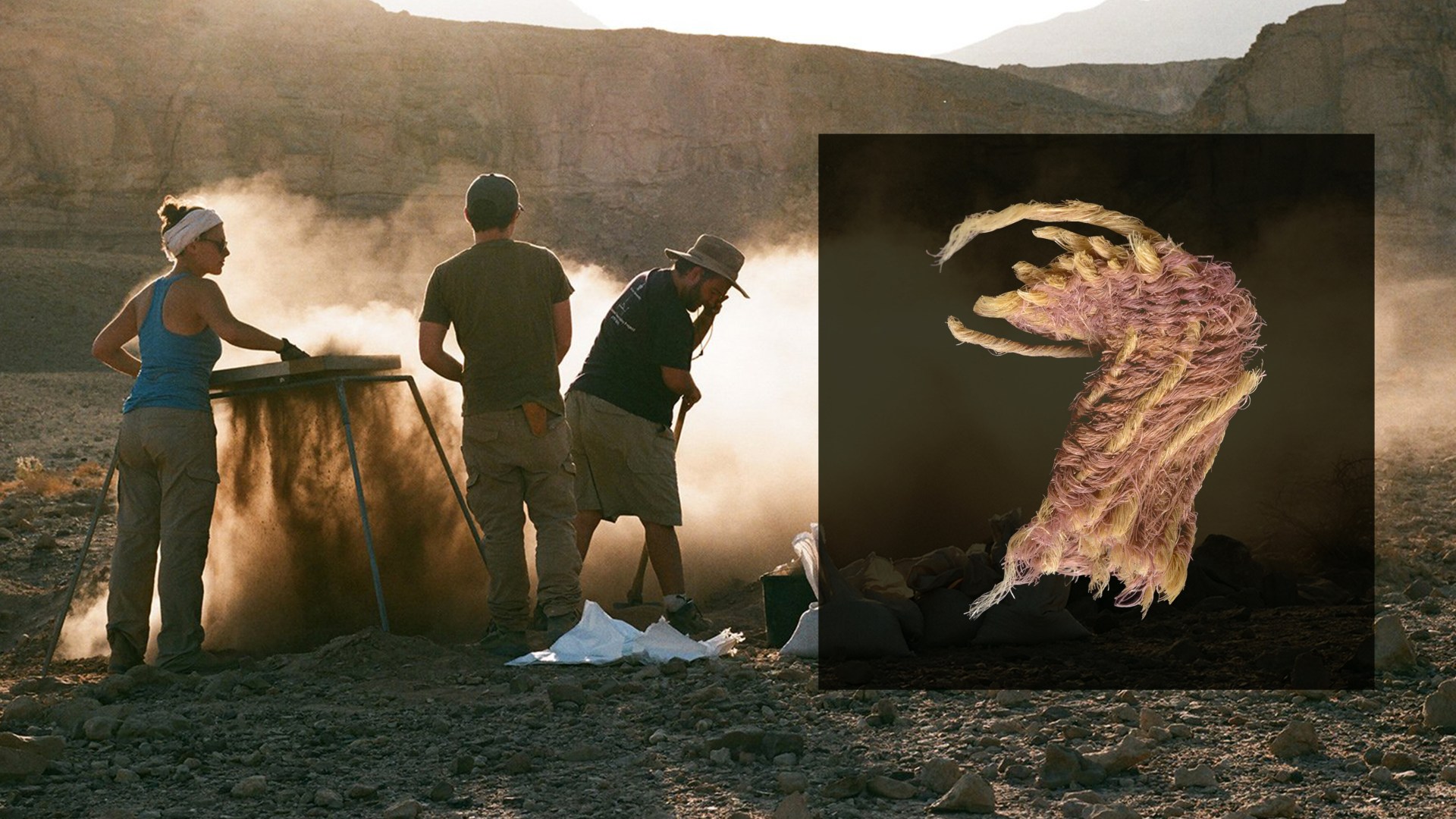
Fabric: Photo by Dafna Gazit, courtesy of the Israel Antiquities Authority / Workers: Photo by Hai Ashkenazi, Courtesy of the Central Timna Valley Project / RNS

The color purple appears several times in the Bible, usually in a robe draping one of the kings of ancient Israel. But the search for an authentic artifact dyed the royal color from the time of King David has always proved elusive.

That changed this week, after researchers from the Israel Antiquities Authority, Bar Ilan University and Tel Aviv University said they had identified pieces of fabric dyed “true purple” dating to the 10th century BCE, when the Hebrew Bible says David and Solomon ruled in Jerusalem.

“This is the first piece of textile ever found from the time of David and Solomon that is dyed with the prestigious purple dye,” Naama Sukenik, curator of organic material at the Israel Antiquities Authority, said in a joint statement.

The three scraps were among several discovered by archaeologists in recent years in the Timna Valley, the site of a vast ancient copper mining operation in southern Israel. Direct carbon dating revealed that the fabrics hark back to about 1000 BCE.

Timna was likely part of the kingdom of Edom, bordering the kingdom of Israel to the south. The biblical Book of Samuel relates how David and his army battled and conquered the Edomites.

The Old and New Testaments mention that David, Solomon, and the priests of the Jewish Temple, as well as Jesus some centuries later, all wore purple garments, and according to ancient sources, purple textiles were highly valued and a symbol of nobility.

Sukenik said that the vast majority of the ancient textiles excavated by archaeologists around the world were dyed with colors derived from plants. But the purple dyes in the Timna Valley find were made from another source: the secretions of mollusks.

“The use of animal-based dyes is regarded as much more prestigious, and served as an important indicator for the wearer’s high economic and social status.”

The remnants of the purple-dyed cloth that archaeologists unearthed at Timna “are not only the most ancient in Israel, but in the Southern Levant in general,” she said. The only other true purple-dyed textiles found in the region were from the Roman period: two from Masada and three from a cave in the Judean Desert.

To determine which mollusk species produced the dyes found on the Timna textiles and how the various hues were created, researchers identified dry molecules belonging to specific sea mollusk species.

Zohar Amar, a professor from Bar Ilan University, traveled to Italy, where mollusks are a favorite dish and therefore plentiful, to help reconstruct the precise origin of the dyes. The process “took us back thousands of years, and has allowed us to better understand obscure historical sources associated with the precious colors of azure and purple,” Amar said.

The researchers, who published their findings in the journal PLOS ONE, believe that in order to produce the vivid purple and azure (tekhelet) dyes worn by King David and Jesus, biblical-era dyers had to extract tiny amounts of dyestuff from thousands of mollusks, and then exposed it to varying amounts of light. More light produces azure; less light, purple.

Discovering ancient textiles made of perishable organic materials such as wool is exceedingly rare because they decompose quickly. The arid conditions at Timna preserved the fabrics.

As a result of the region’s bone-dry climate “we are able to recover organic materials such as textile, cords and leather from the Iron Age, from the time of David and Solomon, providing us with a unique glimpse into life in biblical times,” said Erez Ben-Yosef, an archaeologist at Tel Aviv University. “The state of preservation at Timna is exceptional.”

Although archaeologists have not found any permanent settlements in Edomite territory, Ben-Yosef said, the fact that the textiles were discovered there indicates that the nomads who resided there lived in a “stratified society” and that some people must have had elite status and wealth.

The research at Timna “has showed us that even without such buildings, there were kings in our region who ruled over complex societies, formed alliances and trade relations, and waged war on each other.”

A nomadic society “was not measured in palaces and monuments of stone,” he said, but in items that were valued at the time.

Ben-Yosef said this insight can be applied to the kingdom of David, which archaeologists continue to search for. Many believe that excavations conducted near the Old City of Jerusalem have unearthed the palace. Others are less certain.

If the buildings excavated in Jerusalem were built by someone other than David, there is no need for despair, Ben-Yosef said. “The wealth of a nomadic society was not measured in palaces and monuments made of stone, but in things that were no less valued in the ancient world,” like purple dye.

“David may not have expressed his wealth in splendid buildings,” he added, “but with objects more suited to a nomadic heritage such as textiles and artifacts. It is wrong to assume that if no grand buildings and fortresses have been found, then biblical descriptions of the United Monarchy in Jerusalem must be literary fiction.”

New & Noteworthy Fiction

Chosen by Hannah Vanderpool, novelist and teacher.

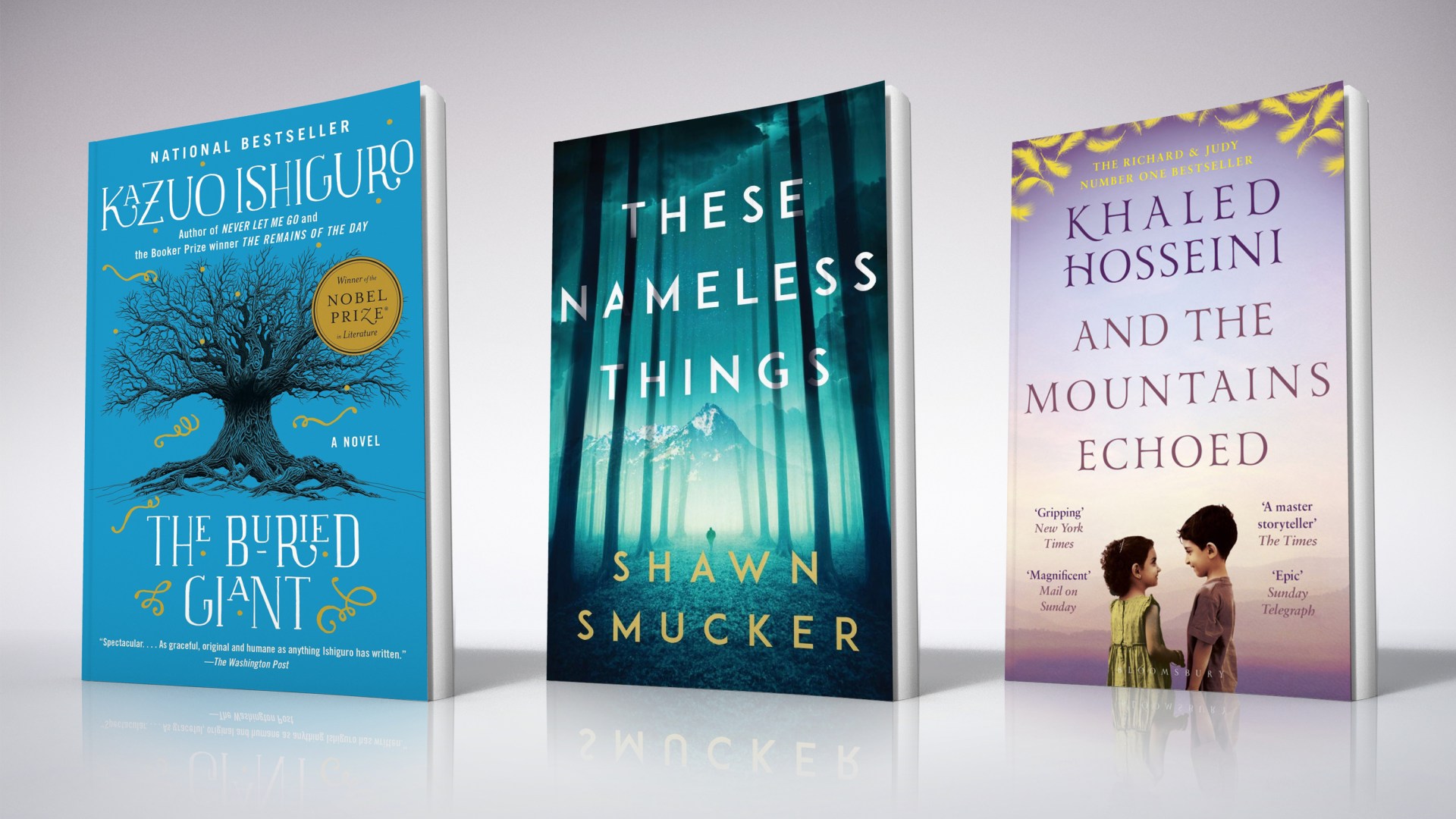
The Buried Giant

Kazuo Ishiguro (Vintage Books)

Set in post-Arthurian England, The Buried Giant is a tale of adventure, mystery, and magic featuring an elderly couple who set out on a dangerous journey to visit their long-lost son. Their chief problem is that they can’t recall most of the details of their shared past—and their forgetfulness seems less like the result of old age and more like purposeful enchantment. A story of fidelity, loss, and the power of forgiveness, the novel reads like a fairy tale but tackles deep moral and philosophical questions while affirming the power of love.

These Nameless Things

Shawn Smucker (Revell)

Written as a mirror to Dante’s Inferno, These Nameless Things is an atmospheric story about what it’s like to live under the weight of personal guilt. The main character, Dan, finds himself among a motley crew of escapees from a mountain they associate with horror and torture. Though he no longer suffers at the hands of his captors, Dan hasn’t found peace, since he’s vaguely aware that he’s guilty of crimes he can’t quite remember. The story, though dystopian in flavor, is ultimately deeply hopeful and reminds us of the beauty of forgiveness.

And the Mountains Echoed

Khaled Hosseini (Riverhead Books)

Set in Afghanistan, And the Mountains Echoedweaves several seemingly disconnected stories together, moving back and forth in time from 1952 to 2010 to paint a picture of a conflicted and beautiful country. The book pierces straight to the heart with tender prose, allowing readers a glimpse into what it means to be both an Afghani native and an expatriate living in the United States. All of Hosseini’s novels offer Western readers a more nuanced understanding of Afghanistan, and this one is no exception. Warm but unflinching, it portrays the ways in which humans are essentially the same all over the world.

Books
Review

Is ‘Authenticity’ Enough for Christian Apologetics?

Appeals to nonbelievers should go beyond pure rationality, but they shouldn’t go beyond the bounds of Scripture.

Christianity Today February 5, 2021
Illustration by Mallory Rentsch / Source Images: Ololade Masud / Pexels / Aaron Burden / Unsplash

Justin Bailey’s Reimagining Apologetics: The Beauty of Faith in a Secular Age highlights a problem that plagues certain forms of Christian persuasion: the failure to take imagination seriously. For some Christians, apologetics is a matter of dry-as-the-desert technical arguments—or of intellectually arm-wrestling non-Christians into submission. Add an evangelical ethos hopelessly enamored with perpetual culture-warring, and you have a profound problem in much current Christian witness.

Reimagining Apologetics: The Beauty of Faith in a Secular Age

Reimagining Apologetics: The Beauty of Faith in a Secular Age

IVP Academic

272 pages

Bailey begins by noting that, according to philosopher Charles Taylor, we live in a world (a “social imaginary”) where everyone assumes that ultimate answers lie within. We follow what resonates with our inner life. Therefore, the wise apologist who wants to reach a non-Christian engages not with what is (externally, objectively) true, but with what (internally, subjectively) moves him or her emotionally and aesthetically. Not truth, but beauty. Not rationality, but authenticity. The key lies with the imagination. We must provide space, Bailey writes, for non-Christians to “feel their way into faith.”

After providing a brief philosophy and theology of the imagination, Bailey turns to novelists Marilynne Robinson (of Gilead fame) and George MacDonald (who inspired C. S. Lewis) as models of what such engagement would look like. They created imaginary worlds that allowed non-Christians to see through the eyes of faith. He then applies his findings to apologetical method based on a threefold model of the imagination: sensing, seeing, and shaping. Sensing prioritizes the aesthetics of belief, emphasizing what non-Christians would find beautiful and believable. Seeing invites them to try on a Christian vision—a larger, “thicker” view of reality. Shaping invites them to a “poetic participation” that encourages them to situate their own life-projects within God’s redemption project. By suspending the question of truth to pursue beauty and imaginative resonance, Bailey argues, apologetics will appeal to those alienated from God but seeking authenticity.

Authenticity and Authority

This is a sharply written, well-researched proposal for a new way of doing apologetics. Those who haven’t studied apologetics may find it slow going in places, but don’t let that deter you. Bailey provides plenty of vivid illustrations and examples. And, in the main, his point is correct. Many conservative Christians, and apologists in particular, have been culturally tone-deaf and have made themselves (ourselves) an obnoxious presence that few non-Christians are interested in engaging. But Bailey’s book is part of a growing movement, in apologetics, that emphasizes beauty and imaginative resonance. Sound missiology seeks to contextualize the gospel in ways that make sense to a particular people group. In this case, the target group is those of our own culture alienated from Jesus.

That said, I do have concerns. There is always the risk that contextualization will lead to a compromised message—a gospel “gone native,” paganized in translation. Bailey is well aware of these risks, but I am concerned he never fully reckons with the risks of contextualizing the gospel to the particular social imaginary that prevails in today’s Western world. Authenticity necessarily places the self first and foremost, judging all beliefs and lifestyles by the standard of “What feels right for me?” As Bailey writes, we all must take “authentic ownership of our lives,” and the job of apologetics is to help create capacious (a favorite word of his) spaces in which non-Christians can create something attuned to the beauty that God has created, in which God is somehow present, beckoning them forward.

But what if the point of Scripture is that our lives are not our own? What if we have no “authentic ownership of our lives” but are rather called to turn our eyes away from ourselves to God and others, whom we are to love and serve? Can we simply combine authenticity with taking up one’s cross and losing one’s life (Matt. 16:24–26)?

Bailey seeks to guard against selfishness by countering that apologists should offer non-Christians a “thicker” version of authenticity to broaden the narcissistic horizons of “thin” authenticity. Thick seems to mean, by turns, self-giving, theologically deep, or grounded in the biblical “theodrama” of the New Testament. It seems to serve as a substitute or marker of biblical authority, but without the sharp edges that would shut down a nonbeliever’s imaginative and aesthetic search for a faith that resonates with their experience.

If I had to pinpoint a central cause for concern in Reimagining Apologetics, it would be the author’s stance on biblical authority. Though Bailey affirms biblical authority occasionally, it is de facto marginalized in his actual methodology. He never truly allows the Bible to delimit the imaginative space legitimately available to the non-Christian in his or her exploration. Why? Because when appealing to those seeking authenticity, beauty must be considered as separable from truth in the interest of not disrupting the fragile “feeling into faith” process. In fact, Bailey decries what he calls contemporary apologists’ “fixation on truth.”

This has specific consequences for faith. Both of Bailey’s apologetical role models, MacDonald and Robinson, denied that God would eternally punish anyone who rejected him. They were unable to quite believe in a God who was less generous and gracious than they imagined him to be. And Bailey never corrects them, as if conforming God to our imaginary image of him is somehow justified. This is treacherously close to inviting non-Christians to violate the first and second commandments and presenting that as a genuine life of faith. Even for the most mature Christians, the way God is portrayed in the Bible won’t always appear beautiful or good. The real journey of faith involves spiritual wrestling to conform our imaginations to the reality of his person and character as revealed in Scripture. Submitting one’s imagination and will to someone else is always a struggle, but Christians simply don’t have the license to do otherwise and call it genuine (“authentic”) faith.

Submitting to another’s authority is anathema to the ethos of authenticity. Again, Bailey understands this, noting that we must orient and “reframe” the non-Christian’s quest within God’s project, but I am unconvinced that he quite squares that circle. In essence, he is using the textures and channels of authenticity (what resonates with the seeker) to move seekers past and out of authenticity toward the willing, joyful acceptance of an authority and life-direction not their own. But I remain unsure that Bailey even acknowledges the contradiction, assuming instead that, at its best, Christian faith dovetails seamlessly with the yearning for authenticity. Sometimes it doesn’t, and we need to figure out how to guide non-Christians into recognizing that. Reimagining Apologeticsgives us precious little guidance here.

Competing Authenticities

Further, we live in a world of multiple competing authenticities. Simply showing the Christian vision’s “thickness” will not suffice. Tara Isabella Burton’s recent book Strange Rites: New Religions for a Godless World explores a dazzling array of “intuitional” religions that have lured people away from traditional religions in the age of the internet, with examples ranging from online fan cultures to occult and “wellness” movements to political ideologies left and right. All of these communities are super “thick” in the imaginations of their adherents . They resonate profoundly within the minds and lives of their followers. How are we to differentiate between competing thick imaginative visions?

This is where “presuppositional” apologetics, which posits Christian faith as the basis for all thought, gives important guidance. Bailey dismisses it in one footnote as a form of Scriptural “foundationalism” focused not on rational truthfulness, like classical apologetics, but on biblical truth. This struck me as both unfair and curious, given that his own imaginative apologetics (sensing/seeing/shaping) bears a striking structural resemblance to the presuppositional argument: trying on the non-Christian’s perspective, showing how it falls apart, then inviting the non-Christian to see reality through Christian eyes.

Bailey is right. Apologetics needs the imagination. But let us use it within the bounds of Scripture, which alone can sort between competing authenticities.

A few years ago, I taught a college student who confessed to me that my class convinced her she wasn’t a Christian. Intrigued, I asked to discuss her revelation over coffee. She told me she used to pray, and she figured this kind of behavior—carried out in one of the world’s most atheist countries (Czech Republic), no less—marked her out as a Christian. But that changed when she took my comparative worldviews class, which starts with Christian theism. She learned that God isn’t a vague idea but a person with specific traits and desires. She didn’t like that at all, and so she stopped seeing herself as Christian.

We talked, and I tried to persuade her both that God exists and that this was something to celebrate. I’ve always felt strange about that exchange. On the one hand, that outcome seemed inevitable: God is who he is, and I couldn’t have denied that in my teaching. On the other hand, it felt like I was doing the opposite of what I should have done. Had I read Reimagining Apologetics before those conversations, I would have spent more time exploring why she prayed, how it made her feel, and what resonated with her about connecting with God.

Many who read this book will feel provoked. But Bailey also gives us much to chew on, and much to learn.

Ted Turnau teaches culture, religion, and media studies at Anglo-American University in Prague, Czech Republic. He is a co-author of The Pop Culture Parent: Helping Kids Engage Their World for Christ.

News

The National Prayer Breakfast Isn’t the Only Time Politicians Pray Together

The Christian calls for unity by President Biden and members of Congress continue at weekly bipartisan gatherings.

Christianity Today February 4, 2021
Courtesy of 2021 National Prayer Breakfast

Politicians from both political parties came together to testify to the work of God in the country and pray for reconciliation on Thursday, just like they do every week, only this time their prayers were televised on C-SPAN.

The National Prayer Breakfast represents the most public-facing display of the regular bipartisan prayer meetings that take place in each chamber of Congress. Due to the pandemic, the annual event was held virtually for the first time in history, and the politicians’ petitions for unity felt more critical coming less than a month after the divisive uprising at the Capitol where they work.

The recent hour-long presentation consisted of pre-recorded clips from President Joe Biden, several former presidents, and members of Congress. They appealed to Christian teachings on neighborly love and reconciliation to get the country through political divisions and the burdens of the coronavirus crisis.

“For me in the darkest moments, faith provides hope and solace,” said Biden, who referenced one his favorite quotes, philosopher Søren Kierkegaard’s line that “faith sees best in the dark.”

“It provides clarity and purpose as well. It shows the way forward, as one nation in a common purpose: to respect one another, to care for one another, and to leave no one behind.”

The president urged the country to see each other—especially the hungry, the needy, the dying—as fellow Americans rather than as Republicans and Democrats. Other participants likewise emphasized a spirit of bipartisanship, rooted in their convictions around a common humanity before God.

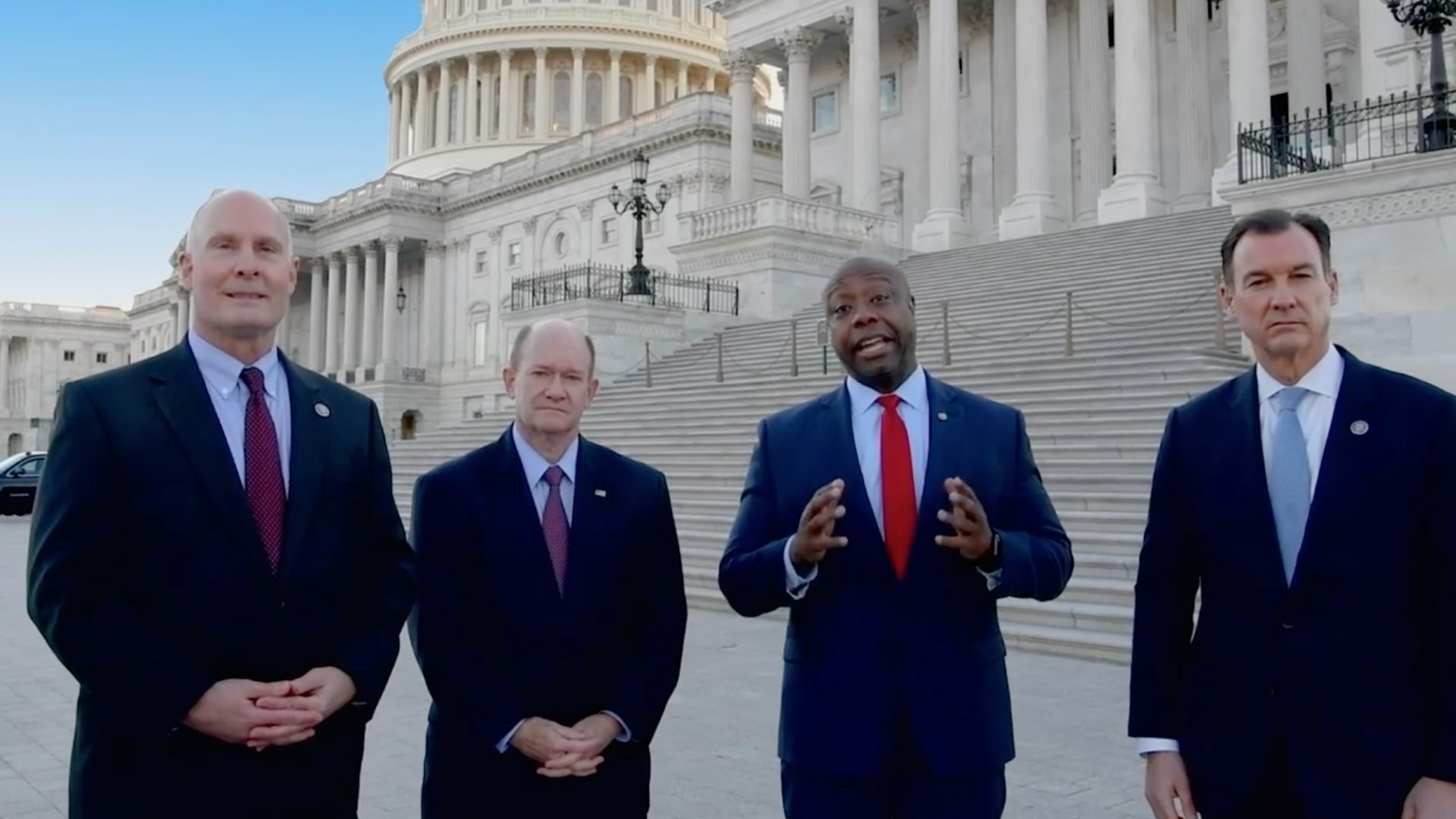
The four co-chairs of the event— Sen. Tim Scott, Sen. Chris Coons, Rep. John Moolenaar, and Rep. Tom Suozzi—convene weekly prayer breakfasts where members of Congress share prayer requests, reflections, hymns, and their testimonies.

“Our nation today more than ever needs to see a bipartisan coalition of believers, believing in America, our God, and frankly, all of you, our country,” said Scott, a Republican and evangelical from South Carolina.

Every president since Dwight Eisenhower has attended the National Prayer Breakfast, put on by the Fellowship Foundation, also called the Fellowship or the Family. The Christian organization brings together Capitol Hill influencers for prayer and fellowship outside the constraints of political obligations. (The National Prayer Breakfast is not the same as the National Day of Prayer, which is acknowledged every May by presidential proclamation, or the Easter Prayer Breakfast, a White House tradition President Barack Obama began in 2010.)

Coons, a lifelong Presbyterian with a degree from Yale Divinity School, said the National Prayer Breakfast “recognizes the teachings of Jesus but is not limited to Christianity.” Nearly 9 in 10 members of Congress (88%) identify with a Christian tradition, compared to 65 percent of the country overall.

Some have scrutinized the Fellowship Foundation over the years for its secrecy and raised concerns after last year’s National Prayer Breakfast turned political, with former President Donald Trump touting his acquittal during his remarks.

It’s the second year in a row that the event fell the same week as impeachment proceedings. In 2020, Senate chaplain Barry Black told CT that even during politically challenging seasons, like impeachment trials or government shutdowns, members of Congress continue to unite in prayer.

“I see God at work in the fact that every week senators come together for a prayer breakfast,” the chaplain said. “I see God at work when I see every week senators coming to a Bible study, again both sides of the aisle. … As chaotic as things may seem sometimes, I see God at work in the level of civility that we somehow seem to manage in spite of how polarized our nation is.”

The gatherings have continued virtually during the pandemic.

“It’s a different way to do it, but the same faithful God who is at work around us and through us,” said Sen. James Lankford, a Republican and Baptist minister from Oklahoma. He read from 2 Corinthians 5, likening Christian politicians to those in the early church charged as Christ’s ambassadors, entrusted with the ministry of reconciliation.

“Help us to be reconciled. Help us to see each other as you see us,” Lankford prayed. “Give us unity through the challenges to be able to answer the hard questions that we have to face together.”

Democratic Sen. Kirsten Gillibrand of New York mentioned how much she missed in-person worship and singing, calling it one of the hardest impacts of COVID-19 and saying, “This prayer breakfast gives us a chance to share in that national fellowship.”

Suozzi, a fellow New York Democrat, said the event brought participants together to remember the call to to love their neighbors and their enemies, “one of the biggest challenges we have right now.”

Thursday morning’s presentation included historical clips spanning from Ronald Reagan in 1984 to Trump in 2017, as well as new statements from former presidents Jimmy Carter, Bill Clinton, George W. Bush, and Barack Obama.

“Prayer is the language of reconciliation,” Bush said. “It has the vocabulary of grace, love, and peace our nation needs to move forward together.”

Ideas

Dispelling the Smog of Falsehood and ‘Fake News’

Staff Editor

Old-fashioned preaching and discipleship can confront the conspiracies that threaten how we know truth.

Christianity Today February 4, 2021
Illustration by Rick Szuecs / Source images: Samuel Corum / Stringer / Brent Stirton / Staff / Getty

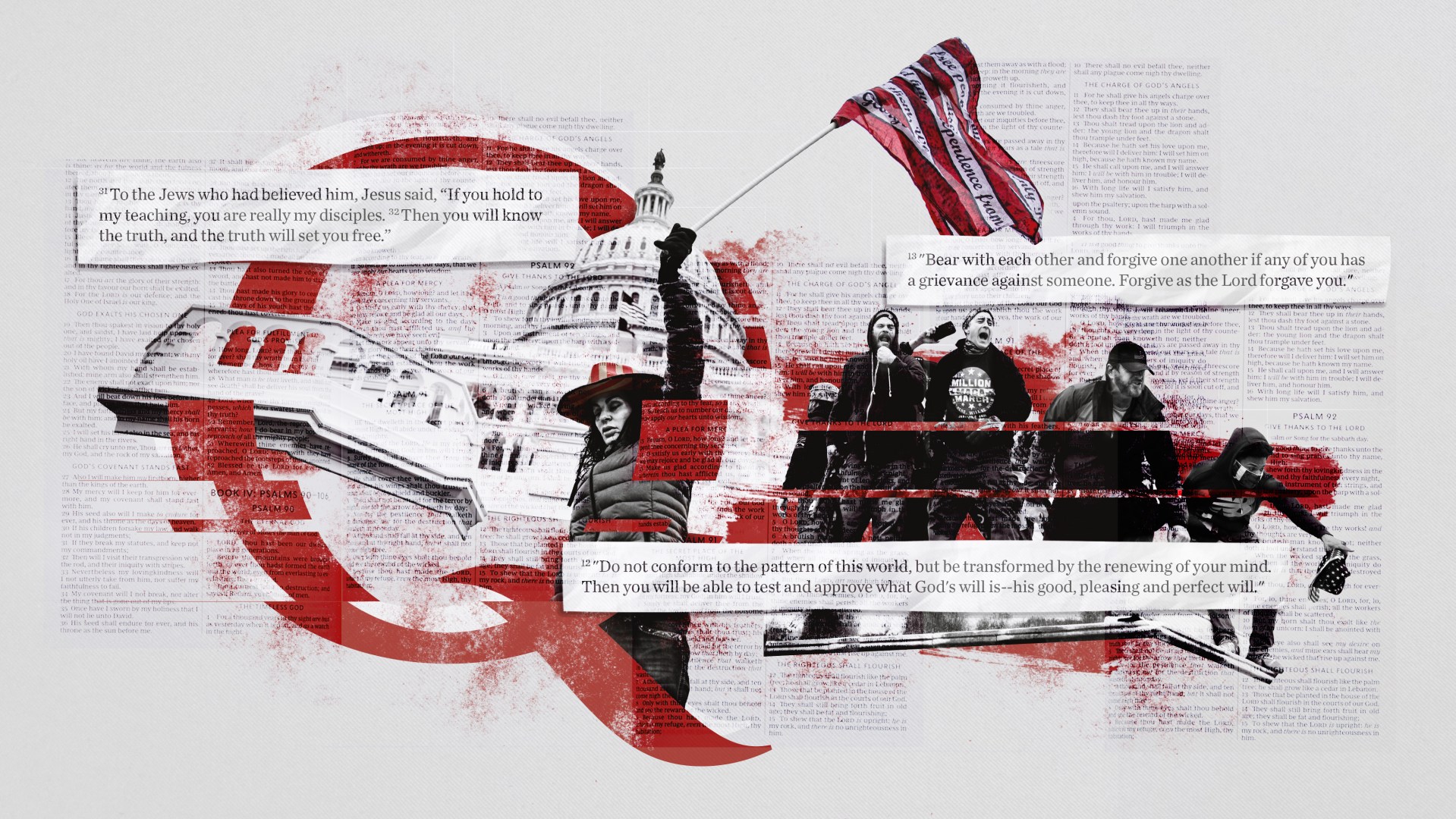
Some of the rioters who stormed the US Capitol in early January chanted their demand to “hang Mike Pence.” But some likely thought the former vice president was already dead.

In fringier corners of former President Donald Trump’s base, particularly those influenced by the QAnon conspiracy theory, there’s a rumor that Pence was executed by a Trump-run military tribunal last year. So were the Obamas, the Clintons, President Joe Biden, and Chief Justice John Roberts. News reports showing them apparently reacting to current events, the story goes, are simply computer-generated. Or maybe holograms. Or actors? Or clones!

This is, of course, absurd. It’s also utterly unassailable: We can’t take Biden around for a doubting Thomas routine with every conspiracy theorist. Even if we could, there’s no external proof this sort of theory cannot account for and dismiss.

But most remarkable about this belief is that some significant portion of the people who hold it would describe themselves as evangelicals. Their social media bios are festooned with phrases like “conservative Christian,” “Bible-believing Christian,” “fighting for faith,” “John 3:16,” “God-fearing,” “Christian, wife, and mother.” They share Bible verses, sometimes in the same post as their conspiracy theorizing. They express faith that God will accomplish the overhaul of American governance of which the imagined executions are just one part. They might go to church—maybe your church.

Most politically engaged Americans generally, and Christians specifically, don’t believe anything quite so wild. But this theory about high profile executions is not quite the aberration we might hope. “[I]n my experience and in my conversations among pastors, we are growing more and more alarmed by the prevalence of belief in conspiracy theories and far-fetched political ideas, especially since the election,” said Daniel Darling, who is a pastor, the senior vice president of National Religious Broadcasters, a CT contributor, and author of books including A Way with Words: Using Our Online Conversations for Good.

Darling’s perspective, which he shared with me in an email interview in January, is backed up by new survey data from Lifeway. Fully half of Protestant pastors in America say they “frequently hear members of [their] congregation[s] repeating conspiracy theories they have heard about why something is happening in our country,” that poll found. The trend seems to be strongest, said Scott McConnell, executive director of Lifeway Research, “in politically conservative circles, which corresponds to the higher percentages in the churches led by white Protestant pastors.”

“With most pastors I talk to, it’s a fraction of their congregations,” Darling told me, “perhaps among the most politically engaged or the most plugged in online. And yet it is enough of an element that it has many pastors worried,” he continued, especially about “how captive many [Christians] are to their preferred media outlets, which are growing more and more extreme, and how seemingly resistant many are to hearing reasonable rebuttals.”

The effect is an epistemic crisis, and it is not exclusively a fringe phenomenon. The subtler lie can be the strongest—“If you think you are standing firm, be careful that you don’t fall!” (1 Cor. 10:12). This crisis is more than a pressing political problem; it’s also an urgent matter of Christian discipleship, for Christians are supposed to be people of truth (John 8:31–32).

Epistemology is simply the study of knowledge: What do we know and how do we know it? What are trustworthy sources of knowledge? Is the world really as we perceive it? If truth exists (as Christians affirm), can we access it rightly? We are in an epistemic crisis because our answers to these questions in the public sphere are a disastrous mess.

An epistemic smog is pouring into our homes and our heads via autoplay and infinite scroll.

The last five years of American politics have been a time of “alternative facts” and “truth [that] isn't truth.” Accusations of “fake news,” some fair and some cynically slanderous, fly fast and thick. Mainstream media outlets are rejected for being flawed or biased (an oft-deserved critique!), but the pseudonymous digital rumor-mongers rising to replace them are worse. Too many on the Right embrace “dreampolitik”—if it feels right, believe it—while among too many on the Left, a totalized emphasis on personal experience as a mediator of knowledge renders communication impossible across the lines of identity. The upshot is we’re certain about things that don’t warrant certainty and doubtful of basic facts. An epistemic smog is pouring into our homes and our heads via autoplay and infinite scroll.

I wanted to talk to Darling because I think I can describe this problem well. I certainly know it when I see it, including—to my dismay—in my own family. But I commonly feel at a loss as to what to do about it. I know what it looks like in my life to practice what Graeme Wood at The Atlantic called “mental hygiene” (which I would say is a spiritual hygiene, too). “The struggle is internal, and familiar to all who consume media,” Wood wrote, and for me it has meant limits—too often broken—on the time and content of my media consumption, as well as a daily routine that includes reading Scripture before my phone.

But what about other people, people who may not even recognize the epistemic crisis exists? I can’t impose my limits and routine on them. G. K. Chesterton in Orthodoxy advised against arguing with the conspiracy theorist, recommending instead to give him “air,” to show there is “something cleaner and cooler outside the suffocation of a single argument.” But what does that look like in the age of smartphones, when an endless font of controversy and confusion is always in our pocket?

Public commentary—like this very article—can only do so much, Darling told me. It serves “a purpose,” he wrote, “but this has to be solved relationally” and in the local church. Too “many evangelicals are catechized more by their favorite niche political podcast and pundits and politicians” than by the Bible, he continued, a characterization which I suspect might be unwelcome, but which is indisputable if we consider the time allotted to each.

“So perhaps pastors need to return to this kind of old-fashioned preaching that warns against bad influences and urges us to ‘renew our minds’ (Rom. 12:2) with Scripture,” Darling said, while including in their discipleship practices “a sustained and nuanced emphasis on what it means to engage politics in a healthy way.” Churches can use small groups, recommending reading, research, and podcasts, as well as classes to train and encourage members. To fail to address political engagement and content consumption, Darling argued, means “ceding that ground to the fear merchants and media conglomerates who trade eyeballs for profit.”

And all this must happen in the context of Christian love: in friendship; in prayer and fasting and spiritual warfare (Eph. 6:10–18); in “bear[ing] with each other and forgiv[ing] one another” (Col. 3:13). We may not be able to argue people out of epistemic crisis—but we can appeal, Darling concluded, to Christian virtue and mission, asking questions like: Is this really worth our time and energy? Does it help us “to live a life worthy of the calling [we] have received” (Eph. 4:1)? Does it turn anyone’s mind toward Christ? We needn’t believe in Clone Biden for the answer to be “no.”

Bonnie Kristian is a columnist at Christianity Today.

News

CT Media Presents: The Harvest

The story of Marisol and Joel Lopez, a couple who find Christ’s love in the midst of field labor.

California’s San Joaquin Valley not only boasts 17 billion dollars in annual revenue, it’s also home to over 100,000 laborers. The Harvest, a documentary produced by CT Media, follows the story of Marisol and Joel Lopez, a couple who discover the transforming love of Christ in the midst of their challenging life as migrant workers in the valley. To learn more about migrant farm workers, read this report by Bekah McNeel:

This short film was part of CT’s December 2020 issue, which explored the many ways God is at work through the global church, bringing light and life, hope and healing in the age of the pandemic. Find more at MoreCT.com/globe.

addApple PodcastsDown ArrowDown ArrowDown Arrowarrow_left_altLeft ArrowLeft ArrowRight ArrowRight ArrowRight Arrowarrow_up_altUp ArrowUp ArrowAvailable at Amazoncaret-downCloseCloseellipseEmailEmailExpandExpandExternalExternalFacebookfacebook-squarefolderGiftGiftGooglegoogleGoogle KeephamburgerInstagraminstagram-squareLinkLinklinkedin-squareListenListenListenChristianity TodayCT Creative Studio Logologo_orgMegaphoneMenuMenupausePinterestPlayPlayPocketPodcastprintremoveRSSRSSSaveSavesaveSearchSearchsearchSpotifyStitcherTelegramTable of ContentsTable of Contentstwitter-squareWhatsAppXYouTubeYouTube