Books
Review

Life’s Darkest Moments Call for Prayers We’d Never Choose to Pray

When words fail, says Tish Harrison Warren, we can rely on ancient liturgy to supply them.

Christianity Today January 28, 2021
Illustration by Mallory Rentsch / Source Images: Tim Mossholder / Melchior Damu / Zach Guinta / Unsplash / Darren Thompson / EyeEm / Getty Images

The first year of our marriage, I found a full pill case pushed behind some bottles of shampoo under the bathroom sink. They belonged to my husband’s first wife, Danielle, from years earlier, before her fight with cancer ended in death. My husband, Evan, apologized—not because he had done anything wrong but because he could not prevent these reminders of grief from occasionally falling out of closets and drawers. This is where they had lived together. Where she baked, laughed, and lost her hair.
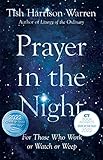
Prayer in the Night: For Those Who Work or Watch or Weep

Prayer in the Night: For Those Who Work or Watch or Weep

IVP Formatio

208 pages

Since then we have moved into a house of our own, one with high ceilings, a creaky old staircase, and lots of “character.” From time to time, I post pictures of our home and our joy—usually when Evan is wearing his tan, thrift-store blazer and I have taken the time to put on lipstick. Each time, someone inevitably comments, “You two look so happy,” or “I hope to have a love like that someday.” And we are so happy. This love is a gift, one of the kindest God has ever given me.

But what Instagram and Twitter don’t show is something that author and Anglican priest Tish Harrison Warren expresses in her new book Prayer in the Night: For Those Who Work or Watch or Weep: that “our bright and shining lives, our explosions of joy, good work, and love, are always silhouetted by the shadow of death.”

As she began writing, Warren couldn’t have known how much we would need her book in these pandemic times. Now, almost a year in, a nurse friend of mine tells me about performing last rites for COVID patients who would otherwise die alone. I give “air hugs” to the widows at church instead of holding them close. Christians tear one another apart on social media over pandemic procedures, politics, and everything else under the sun. We are collectively lonely, frustrated, and sad.

And Warren invites us to enter that sadness. “Jesus,” she reminds us, “wept as one with hope, but his hope did not diminish his weeping.” Too often, the church’s approach to suffering feels like being shushed in a movie theater. We feel the pressure to stifle our sobs and move on before ever getting the chance to lament. Warren doesn’t shy away from the presence of pain. She acknowledges it, both personally and theologically, describing theodicy—the belief that human suffering and God’s goodness coexist—as a “scream” and an “ache that cannot be shaken.” We long “for a God who notices our suffering,” she writes, “who cares enough to act, and who will make all things new.”

A Priest Who Couldn’t Pray

We lost our baby this year. The day I was supposed to hear a heartbeat, I found out instead that I was miscarrying. Evan was waiting in the car, due to COVID restrictions, and when he drove to the entrance of the hospital to pick me up, instead of handing him a picture of our growing child, I had to tell him the news. In that moment, I didn’t have any words. I knew God still loved us. We still loved him. But I didn’t know how to pray.

After a series of devastating losses, Warren describes herself as “a priest who couldn’t pray.” “In some wordless place deep within,” she admits, “I had hoped that God would keep bad things from happening to me.” Warren brings up something we are reluctant to admit: that we often condemn the prosperity gospel as unbiblical while secretly holding on to the hope that we will get good things in return for our good behavior. I know God didn’t owe Evan and me a child, but giving us that burst of joy only to deflate it confused me. I had no words. My faith flickered.

When Warren was walking through her own valley of the shadow of death, she reached for ancient liturgy. In a particularly devastating moment, she and her husband turned to a prayer known as Compline, one usually reserved for evening services and nighttime. They recited the prayer together, holding on to the words for dear life. Warren’s book is a meditation on this prayer, but more than a mere celebration of liturgy, it is about “how to continue to walk the way of faith without denying the darkness.” One way we fight for faith in the dark is through prayer.

As a Bible church kid, I didn’t grow up with much liturgy. I learned the Lord’s Prayer and the doxology, but prayer was usually “free form,” as Warren calls it—“unscripted” and “original.” This lent itself to beautiful, intimate prayer times when I was alert and clearheaded, but in moments when I was too terrified to think straight or too grieved for words, it was difficult to create my own prayers. Warren acknowledges free-form prayer as important and needed, but she points to liturgy—the prayers that have been handed down to us—as an essential gift for when we need to “pray beyond what we can know, believe, or drum up in ourselves.”

Warren believes that “prayer often precedes belief.” This flips a cherished spiritual practice on its head. Instead of waiting to pray until we have enough faith, we can borrow the prayers of saints before us, leaning into their words, preaching them to our hearts, and offering them back to God as an act of surrender. When I pray, “Thy will be done,” during the Lord’s Prayer, I do so with open hands. It is such a hard prayer to pray because we know from Jesus’ prayer in Gethsemane that God’s will often involves suffering. To pray those words, I have to physically demonstrate surrender in order to get my heart to follow. “Thy will be done” is a prayer I borrow and pray out of obedience—not because I don’t mean it but because I’d never have the courage to create such a prayer myself.

Warren believes that “prayer actually shapes our inner life. And if we pray the prayers we’ve been given, regardless of how we feel about them or God at the time, we sometimes find, to our surprise, that they teach us how to believe.” This idea reminds me of the debate Christians have about Bible reading. Do we read the Bible only when we desire it, or do we read the Bible as a spiritual discipline? Some have argued that forcing ourselves to read the Bible makes it an obligation, more guided by guilt than love. Others point out that when we don’t desire Scripture is actually when we need it most. They believe reading the Word out of obedience can thaw our hearts and renew our desire to draw near to God.

It is the psalms we have memorized and the prayers we recite at church and scribble into our journals, the books of liturgy spread throughout our homes, that will be there when words fail us. When we wonder if God has failed us. When we know we need to pray but can’t do so on our own. Liturgy can train the muscle memory of our hearts.

Blooming in the Dark

“If we are to discover the things that only bloom in the dark,” Warren says, “we must cooperate with the work that suffering does in us.” Liturgy might make prayer more accessible, but lament is an uncomfortable practice. It requires facing our pain head-on, and as Warren points out, “we will do almost anything to avoid it.” I remember binge-watching the entire Gilmore Girls series during my divorce. It was God’s grace to escape into the fictional town of Stars Hollow for a time, but eventually I had to return to my own life and face what was crumbling. This involved crying out to God through ugly tears, struggling to sleep, and refusing to distract myself from the pain. It was one of the hardest things I’ve ever had to do, but God met me there.

Without sugarcoating suffering, Warren points out that it is in spaces of deep grief that we learn “the depths of the love of God.” Those in the fellowship of the suffering understand that God’s presence in grief is an intimacy like no other. When our faith is flickering from an onslaught of suffering, says theologian Nicholas Wolterstorff in his book Lament for a Son, our only answer is the “sight of God himself scraped and torn. Through our tears we see the tears of God.”

We may never understand the reasons why we suffer, but we do know that God suffers with us. “God did not keep bad things from happening to God himself,” Warren powerfully writes, and “there is no darkness into which he has not descended. He knows the texture and taste of everything I most fear.”

After the year we have had, there isn’t a person I know who doesn’t need this book. We may not have asked for the kind of refining we have collectively endured, but not all spiritual practices are taken up by choice. The most “shaping spiritual practices of our lives,” Warren says, “are things we’d never have chosen.”

Rachel Joy Welcher is an artist, poet, and editor at Fathommagazine. She is the author of Talking Back to Purity Culture: Rediscovering Faithful Christian Sexuality. Follow her on Twitter @racheljwelcher.
News

Pew: How COVID-19 Changed Faith in 14 Countries

According to survey of 14,000 people, the pandemic has strengthened religious belief most in US, Spain, and Italy, while South Korea leads in lost faith.

Christianity Today January 27, 2021
Illustration by Mallory Rentsch / Source Images: Yoshiyoshi Hirokawa / Sittichai Karimpard / EyeEm / Getty Images

“Consider it pure joy, my brothers and sisters, whenever you face trials of many kinds, because you know that the testing of your faith produces perseverance.”

James, the brother of Jesus, didn’t have a global pandemic in mind when he wrote these words in the opening chapter of his biblical epistle to “the 12 tribes scattered among the nations.” But as the coronavirus closed churches worldwide, a global survey of more than 14,000 people has found that few lost faith while many of the most faithful gained.

Today, the Pew Research Center released a study on how COVID-19 affected levels of religious faith this past summer in 14 countries with advanced economies: Australia, Belgium, Canada, Denmark, France, Germany, Italy, Japan, the Netherlands, Spain, South Korea, Sweden, the United Kingdom, and the United States.

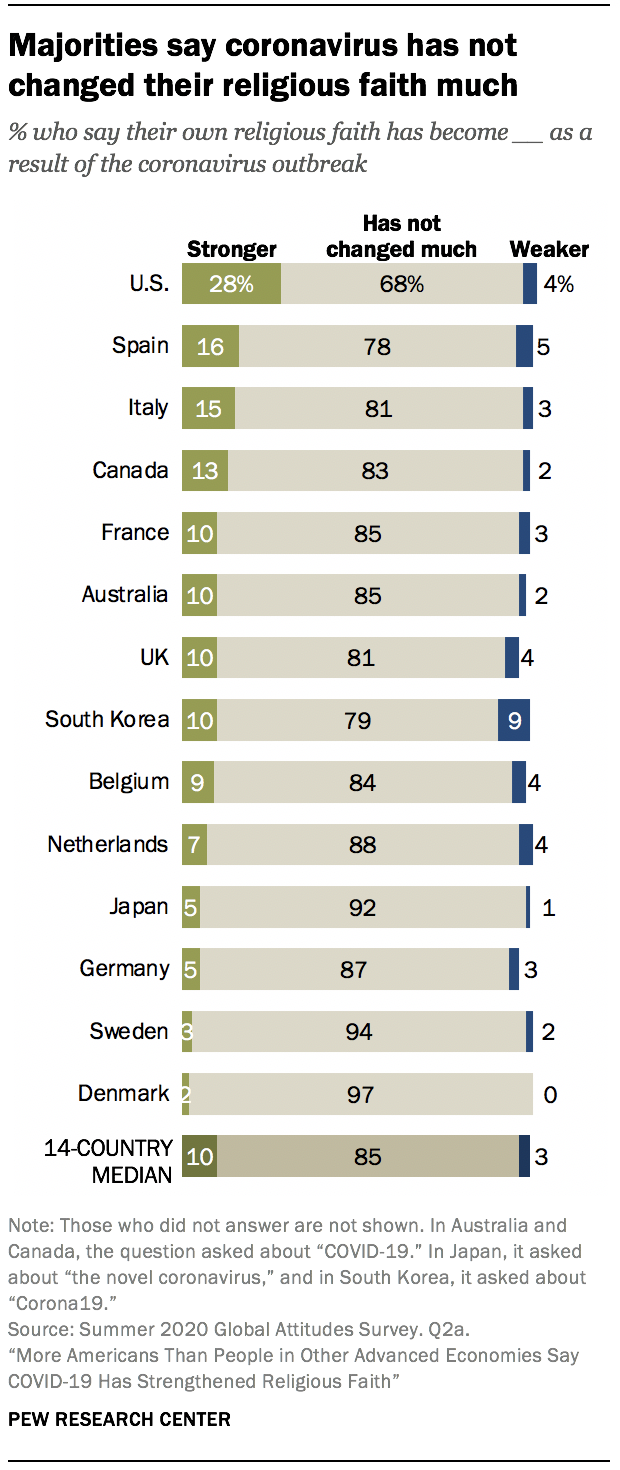
“In 11 of 14 countries surveyed, the share who say their religious faith has strengthened is higher than the share who say it has weakened,” noted Pew researchers. “But generally, people in developed countries don’t see much change in their own religious faith as a result of the pandemic.”

Overall, a median of 4 out of 5 of each country’s citizens said their faith was more or less unchanged.

But leading the pack in strengthened faith: the United States.

And leading the pack in weakened faith: South Korea.

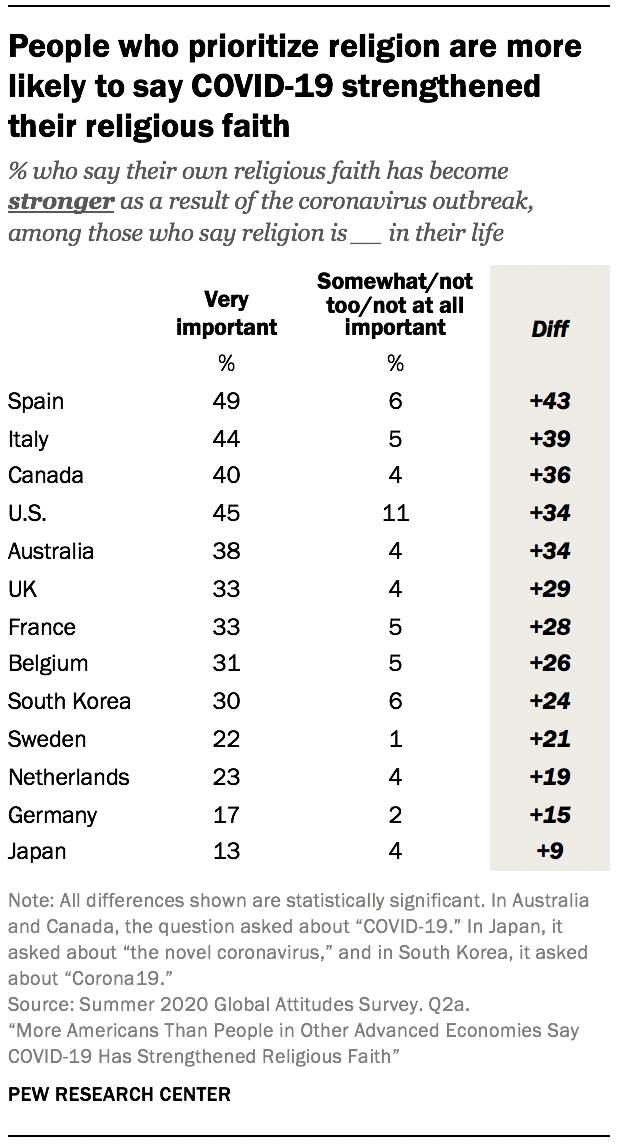
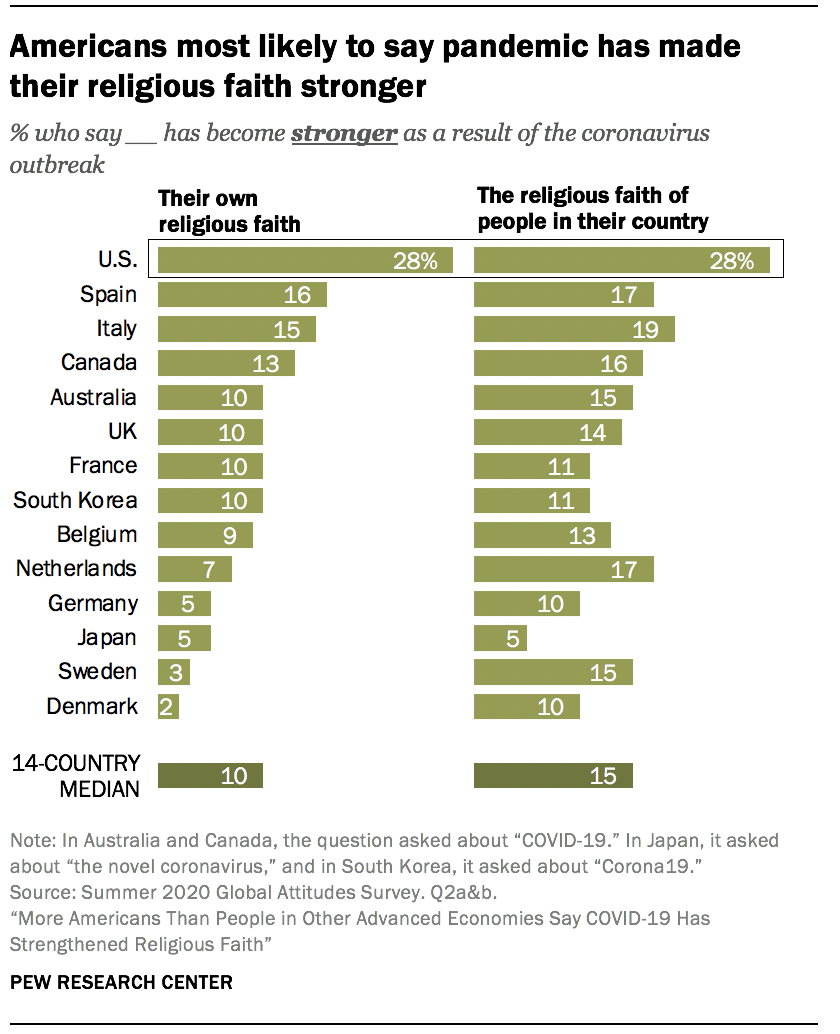
Americans were three times more likely to report their religious faith had become stronger due to the pandemic: 28 percent, vs. a global median of 10 percent. Next came Spaniards (16%) and Italians (15%), whose nations were two of the worst hit during the coronavirus’s deadly outbreak in the spring. About 1 in 10 Canadians, French, Australians, Brits, Koreans, and Belgians said the same.

Meanwhile, Koreans were three times more likely to report their religious faith had become weaker due to the pandemic: 9 percent, vs. a global median of 3 percent. Next came Spaniards (5%), followed by a tie between Americans, Brits, Belgians, and the Dutch (4%).

However, among only respondents who said religion was “very important” in their lives, a far larger share reported strengthened faith. This included 49 percent of faithful Spaniards, 45 percent of Americans, 44 percent of Italians, and 40 percent of Canadians. The global median was 33 percent.

Once again, South Korea reported the most lost faith. Among Koreans who said religion was “very important” in their lives, 14 percent said their faith had become weaker—about three times the global median of 5 percent. They were followed by the French (8%), Brits (7%), then a tie between Spaniards, Dutch, and Swedes (5%).

Among respondents who said religion was not important or only somewhat important in their lives, 1 in 10 Americans reported strengthened faith (11%), followed by Spaniards and Koreans (6%).

(The United States remains an outlier on religiosity: 49 percent of Americans told Pew that religion is very important in their lives, vs. 24 percent of Spaniards and 17 percent of Koreans.)

Pew found no significant differences between men and women overall, but “two exceptional cases” were Italy and South Korea. In Italy, 20 percent of women say their faith has strengthened vs. only 10 percent of men. In South Korea, 13 percent of women say their faith has strengthened vs. only 8 percent of men.

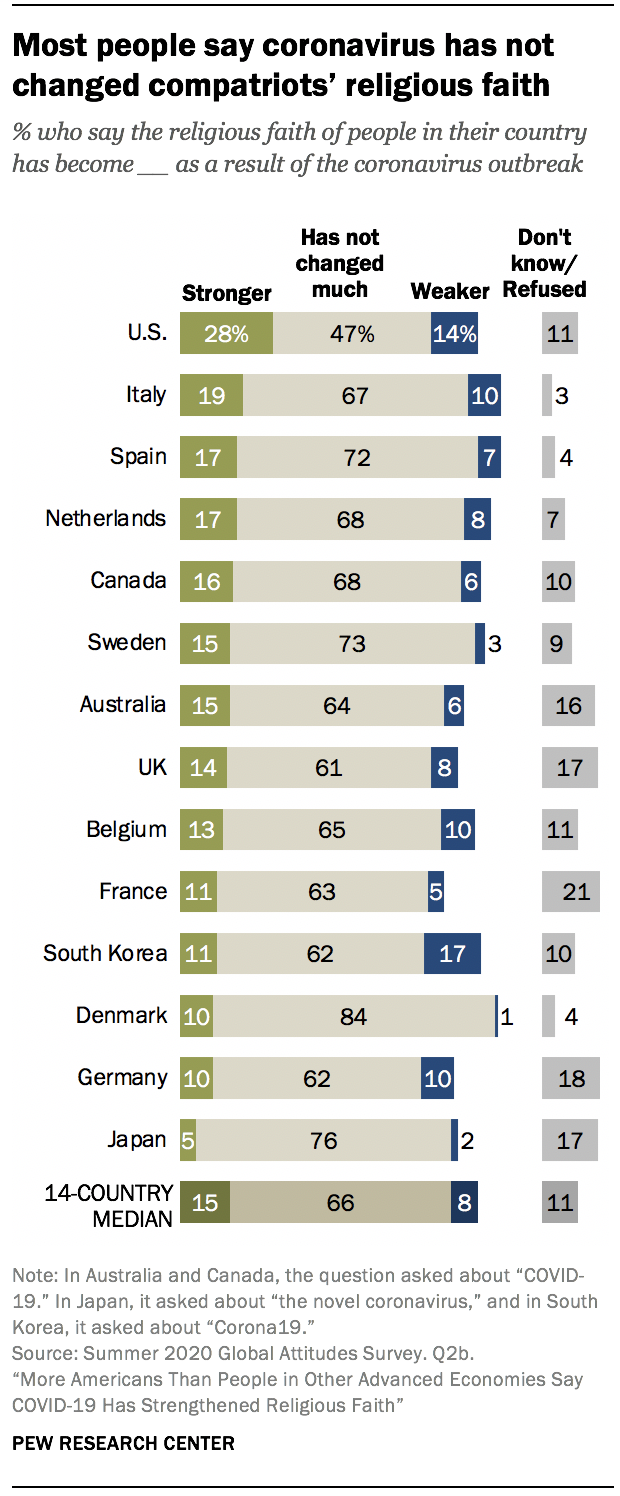
Pew also asked respondents to assess the pandemic’s impact on the faith of their nation as a whole. Once again, Americans led the way with 3 in 10 saying faith in the US had become stronger.

In most countries, people were more likely to say the religious faith of their fellow citizens had become stronger (global median: 15%) than to say the same about their own faith (global median: 10%). Significantly, in the Netherlands only 7 percent of the Dutch say their own faith is stronger, but 17 percent say the faith of other Dutch is stronger. The same significant spread was found among Swedes (3% vs. 15%) and Danes (2% vs. 10%).

Meanwhile, Koreans were most likely to say that religious faith in their nation has weakened (17%), followed by Americans (14%) then by Italians, Belgians, and Germans (10%). Others matched or fell below the global median (8%).

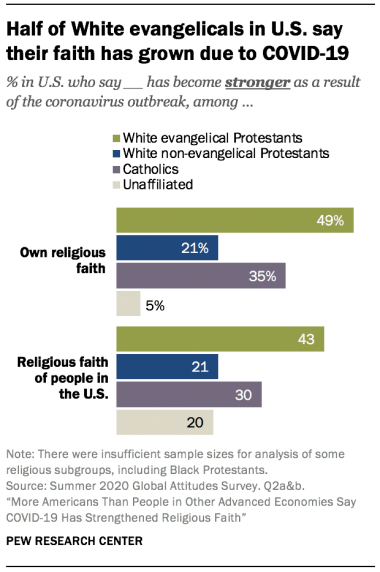
In the US, white evangelicals were the most likely to say their faith had become stronger (49%), followed by Catholics (35%), white non-evangelical Protestants (21%) and the unaffiliated (5%). This was a modest increase from April, when Pew found a strengthened faith reported by 41% of white evangelicals, 27% of Catholics, 19% of white non-evangelical Protestants, and 7% of the unaffiliated.

Pew’s summer survey did not have enough black Protestants to break out, but in the April survey they led all American faith groups, with 54 percent saying their faith had been strengthened.

After being cleared of mail fraud allegations, organizers of the “Religious Inaugural Celebration …” in Washington, D.C., proceeds on course with plans for this month’s interfaith prayer service that coincides with the change in administration.Charges of misleading the public were directed against James “Johnny” Johnson, who planned the gathering in his capacity as an independent, evangelical lay minister. (He serves as vice-president of the Full Gospel Business Men’s Fellowship, and was assistant secretary of the navy under Richard Nixon. Johnson also has close ties with the President-elect, who appointed him director of veteran’s affairs in California in 1967. He was the first black ever named to a state cabinet post.)In October, Johnson’s independent inaugural committee issued more than 40,000 formal invitations, which bore a gold, embossed eagle emblem. The official-looking invitations requested attendance at a “nonsectarian, nonpartisan, nonpolitical” prayer meeting on January 19 and 20 at Washington’s Starplex Armory. After the election, Ronald Reagan’s official inaugural committee complained that the invitations would confuse and mislead recipients by suggesting that purchasers of the tickets would be treated to an appearance by either Reagan or Vice-president-elect George Bush. In fact, neither one had agreed to attend the festivities, though both were invited.As a result, a grand jury investigation was threatened and then dropped when Johnson’s committee agreed to alter substantially their emblem and name (from “Presidential” to “Religious” Inaugural Celebration with Love), and to provide their guests with disclaimers edging away from the promise of a presidential appearance. Johnson expected several thousand participants.A donation of 5 each or 0 per couple was indicated on the invitation, but anyone could register to attend both days’ events for . Those paying full price would receive “VIP treatment,” a spokesman said, including two catered dinners and four souvenir books. Coinciding with official inauguration day events, this interfaith celebration was scheduled to include speakers ranging from the mayor of Washington, D.C., to Bill Bright of Campus Crusade, to Paul Yonggi Cho of the world’s largest local church in Seoul, Korea, and such musical entertainers as Dino and Debbie, Danny Gaither, and the Evangel Temple Choir.“What we are trying to establish is a public witness to the world that we who take our faith seriously and who love our country wish to be able to gather together in a spirit of prayer. We are vitally concerned about the health and welfare of our president and other leaders, and we are concerned for the peace of the world. We only want to unite in prayer in behalf of those ends,” Johnson said.Unlike the well-known inaugural balls, which have been part of the inauguration festivities since the days of James Madison, the religious ceremony was nonpartisan. While most of the event’s organizers are Christians, people of other faiths were invited to participate in the common interest of prayer.Science and ReligionNew-Found Allies In The Sociobiology Debate?All is not well on the sociobiology front (see “Sociobiology: Cloned from the Gene Cult,” p. 16). While evangelical scholars are debating how to meet the inroads of this new academic discipline, they may have found allies among some highly regarded anthropologists.According to a report in The Chronicle of Higher Education (Dec. 15, 1980), sociobiology has not “made it” as an organized body of knowledge. At least that’s the view of Jerome Barkow, a Dalhousie University anthropologist. He organized a symposium as part of the annual meeting of the American Anthropological Association to take a look at sociobiology “as the dust settles.”“Dust” in this case refers to the fierce arguments in academia over whether or not sociobiology is indeed a legitimate field of scholarship. Although it had made its way into some introductory textbooks, sociobiology has been criticized as “an attempt to justify genetically the sexist, racist, and elitist status quo in human society.” Those words were put forward at the anthropologists’ 1976 meeting, but they failed to carry in a resolution of condemnation.Since then the debate has simmered. Barkow admits sociobiology has not led to a resurgence of racism, but neither has it solved some of its fundamental theoretical problems. Among them, according to Barkow, are: the relationship between cultural and biological evolution; how to study such concepts as “inclusive fitness”; and the relationship between sociobiology and ecological and biosocial research.Worldwide Church of GodArmstrong Is Unscathed By Legal Attacks, ExposésLegal battles and controversy don’t seem to cramp the style of Herbert W. Armstrong and his Worldwide Church of God (WCG).California Attorney General George Deukmejian in October dropped the state’s two-year-old investigation of the Worldwide Church—initiated after some former members complained that Armstrong and WCG general counsel Stanley Rader siphoned off up to million in church funds for their personal use. Deukmejian complained that the recently adopted “Petris Bill” too severely stripped him of power to prosecute cases involving alleged financial abuses by religious groups. (He dropped investigations of 11 other religious groups as well.)Through it all, the group retained roughly the same membership of about 68,000 worldwide (50,000 in the U.S.). The court battles apparently did not hurt income, which stayed close to the 1979 figure of million. (The WCG has lost 35,000 nonmember contributors since 1976.)Later in the same month Armstrong and Rader flew to Egypt for a meeting with President Anwar Sadat. There, they presented the first 0,000 of million pledged for Sadat’s planned million trifaith worship center at the base of Mount Sinai. Afterward, they flew to Jerusalem to meet with Israeli Prime Minister Menacham Begin.Armstrong’s estranged son, Garner Ted, asserted in a telephone interview that his father’s global tours are represented to WCG members as evangelistic missions. But to foreign officials, Garner Ted charges, Herbert Armstrong is portrayed by advance man Rader as a wealthy philanthropist who is willing to give away large sums of money in exchange for invitations to address distinguished gatherings on such innocuous topics as “The Seven Laws of Success.” A year ago Armstrong got red-carpet treatment in China after donating 0,000 in books to Chinese libraries. (Garner Ted’s own Church of God International, formed after he was expelled from his father’s church in 1978, now claims 70 congregations and about 3,000 members.)Both Garner Ted and his father owe most of their visibility today to the air waves. Herbert Armstrong’s “World Tomorrow” program is now aired on 58 radio and 52 television stations in the U.S. He has a sur-Garner Ted Armstrong prisingly wide electronic media influence in Canada, where his programs air on 53 radio and 81 television stations. Gamer Ted is carried on 50 U.S. radio stations: his fledgling church has experienced defections by several key leaders, who complain he is too autocratic.Herbert Armstrong’s doctrines are rejected by evangelicals: he denies the existence of the Trinity, the soul, hell, and of the Holy Spirit as a person. A distinctive teaching is British Israelism—that Anglo-Saxons are the true Israel, with Britain being the tribe of Ephraim, and the U.S. the tribe Manasseh.More recently, his lifestyle and reputation have been questioned in two controversial books written by former WCG members. WCG officials Sherwin McMichael and Henry Cornwall secured a court order to halt distribution of one of these: David Robinson’s Herbert Armstrong’s Tangled Web (John Hadden Publishers). It contains damaging charges, such as Armstrong’s alleged shocking sexual behavior.Robinson, however, appealed and the ruling was overturned. A million suit against Robinson by the two men was pending, but the recent firing of McMichael from his Washington, D.C., pastorate may have cooled his zeal to pursue the matter further.JOSEPH M. HOPKINSPersonaliaClyde Kilby will retire in July from his job as curator of the Marion Wade Collection at Wheaton College. During his 15 years as curator, Kilby has built up the most comprehensive collections anywhere of C. S. Lewis, Owen Barfield. Dorothy Sayers, and Charles Williams. Other works in the collection include those of G. K. Chesterton, George MacDonald, and J.R.R. Tolkien. All are British authors. Kilby has lectured at more than 50 colleges, edited or authored 10 books, originated Wheaton College’s annual Writers’ Conference 24 years ago, and has been a book reviewer for the (now defunct) New York Herald Tribune.Kenneth L. Barker, professor of semitics and Old Testament at Dallas Theological Seminary, has been named executive secretary of the committee on Bible translations for the New York International Bible Society, as well as its vice-president of Bible translations. Barker will be directing the preparation of a New International Version study Bible. He replaces Edwin Palmer, who died last September.Although federal money may no longer be used to pay for abortions, state money may, and New York is one of the few states still financing abortions—about 50,000 of them a year. Governor Hugh Carey, a Roman Catholic, announced recently that he will reexamine this position. Carey strongly opposes capital punishment, which is illegal in the state.Unitarians and UniversalistsEvangelicals Are Bruised Bucking Maine’S MainlinersSome pastors lose members because of their preaching. Daryl Witmer in tiny Sangerville, Maine, lost his church building, too.Members of the United Church of Sangerville recently vacated the church building where they have met for 30 years, by order of the Northeast District Unitarian Universalist Association, which owns the building. The district office in Portland had notified the church in 1978 that it allegedly violated a trust deed requiring that Unitarian Universalist preaching be maintained there. Pastor Witmer’s self-described “sound Bible preaching ministry” apparently was in violation. As a solution, the church discussed with the district the option of buying the building at a mutually agreed upon price, a course that appeared likely.In the meantime, however, a small group of United Church members became unhappy with Witmer’s conservative theology. They subsequently broke away to form the incorporated First Universalist Church of Sangerville. The Northeast District UUA accepted the Universalist church into full membership last October, and granted the church’s request for the building. The district notified the United Church that it must vacate within 30 days. Since then, the United Church has met in the town hall.The building shuffle caused some hard feelings in this know-everybody town of about 900 (although the United Church chose not to contest the district’s action). Alice Moulton, newly elected president of the Universalist congregation and one who earlier left Witmer’s church, complained that Witmer overemphasized baptism and public profession of faith. (Witmer affirms believer’s baptism, but denies accusations that he ever made rebaptism a prerequisite for membership.) Moulton said she didn’t so much object to Witmer’s “born-again theology,” but that it was preached so narrowly that members not believing exactly like Witmer felt unwelcome.Moulton noted that the new Universalist church has Baptists, Methodists, Universalists (she wasn’t sure if there are any Unitarians), and even some with views similar to Witmer’s. “This small town has only one Protestant church; we believe it’s essential that everyone be able to go to church,” she said. (There is a Roman Catholic church.)Many evangelicals regard New England as a mission field. With that in mind, Witmer sought the Sangerville pastorate six years ago. To him, the recent building hassle showed again that “it’s a rugged thing to move into an area where theological liberalism is entrenched.” While he lacks formal seminary or Bible college training (he left Eastern Mennonite College after two years in favor of study on his own and at Francis Schaeffer’s L’Abri Fellowship), Witmer, 29, established a growing evangelical ministry.Like a circuit rider, Witmer preaches three Sunday services—at Sangerville, and in the nearby communities of Monson (pop. 700) and Abbot (pop. 400). With Sangerville, these form the so-called Sangerville, Abbot, Monson Larger Parish (called “Sam”). Since Witmer’s arrival, all have grown in membership, although they are small by superchurch standards. The Sangerville church has grown from 35 to 100 and the other two churches are up to about 60 members each.Members attribute the growth to an effective small groups and discipleship ministry. A local high school administrator, Charles House, provides leadership in this area, drawing from his experiences at Park Street Church in Boston while a Gordon College student.The churches have a united youth program, and send a newsletter, “Sam-ogram,” to their communities. The Sangerville church has ideas about evangelistic outreach, but local funeral home owner and United Church member Peter Neal said the feeling has been that it is more important in the early going “to build a core group of solid Christians.”Witmer said the recent events have been “a growing experience” for his congregation, which realizes the church is more than a building. However, he admits it’s tough having to leave a building, especially when it is recognized as the church in town.JOHN MAUSTPublishing‘Crying Wind’ Is Back, But Not As A Biography This TimeThe book Crying Wind is back—this time as a “biographical novel.” Harvest House Publishers is distributing the book with the above cover flap description, which is intended to correct discrepancies that caused Moody Press in 1979 to declare the book out of print, along with its sequel. My Searching Heart (CT, Oct. 19, 1979, p. 40).The books describe the Christian conversion and subsequent experiences of a young Indian girl, Crying Wind, which the author, Linda Davison Stafford, ascribed as happening to her. Problems resulted, however, when Moody Press editors learned that Stafford apparently didn’t do all those things. For instance, they were told she did not grow up on a Kickapoo Indian reservation with her grandmother and has little, if any, Indian blood or background.The editors agreed the books carried a strong Christian message, and would have been fine if only they had been presented as fiction. But they weren’t. And the editors felt constrained to remove the books as outside “the editorial standards of Moody Press.” (Later editions had carried a disclaimer that some names, dates, and places had been changed to “protect the privacy of those involved.”)In an interview, Stafford said the problems resulted from “an unfortunate misunderstanding” between herself and Moody Press and from the publisher’s “changes in staff and policies.” Saying she had changed certain names and events to prevent embarrassment to certain family members and friends, she added that Crying Wind “is still based on my life.”Stafford maintained she does have an Indian heritage—that her mother was raised on a Kickapoo reservation, for instance. She remembers dressing U.S.-style during high school, but only as an attempt “to fit in with the crowd.” Married and the mother of four children, Stafford said today she wears Indian garb even at her Divide, Colorado, home. She believes Harvest House’s decision to publish the book is answered prayer, and that it again will be a boost to the cause of Indian missions.Harvest House believes honesty is maintained by calling Crying Wind a biographical novel. Harvest House publisher Bob Hawkins said in a telephone interview, “Because of the moving story, because of what it [Crying Wind] has done for so many people, we felt we should bring it back.”The Irvine, California, publishing company probably had some business motives, too. In a mailing to booksellers, Hawkins wrote, “When Crying Wind was previously published it was a very, very best seller and sold over 80,000 copies [italics his]. Now you can take advantage of the opportunity to help many hundreds, yes thousands, of people across the nation who have been asking for Crying Wind in bookstores.”Moody Press had returned the book copyrights to Stafford, and Harvest House dealt directly with her. Showing her wide-ranging writing interests, she has finished a forthcoming Indian recipe book, Crying Wind’s Kitchen (Intercom), and mentions plans for a romantic novel. She also wants to write a book shedding light on her earlier credibility problems.The PhilippinesAmbitious Growth Goals Pledged By EvangelicalsThe term “historic” in evangelical circles usually describes such major international gatherings as Berlin, Lausanne, or Pattaya. But 488 evangelical leaders representing 81 denominations and parachurch organizations who recently gathered in a two-city “Congress on Discipling a Nation” in the Philippines felt a sense of history in the making that in some respects transcends the significance of those more widely publicized gatherings.These men and women gathered not just to talk about discipling their nation but to commit themselves to “proclaim the evangel of salvation and to persuade men and women so that there will be at least one church in every barangay [ward] or no less than 50,000 congregations in the Philippines by the year 2000 should the Lord tarry.”As the 284 delegates from Cebu City in the Visayan Islands and the 204 from Baguio City in northern Luzon stood to read in unison the “Church-in-Every-Barangay Covenant,” which includes the above quote, they seemed to sense the immensity of the moment. Never before had the body of Christ of one nation committed itself to the systematic planting of a church within easy access of every citizen of the entire country. For the Philippine church, this means adding about 40,000 congregations to their present 10,000 in just 20 years, providing one church for about every 1,500 residents of the island nation.Such a far-reaching commitment by this major slice of the nation’s evangelical leadership follows a decade of solid achievement. Stirrings of this unified assault began with a handful of delegates to Berlin in 1966 and a group of about 60 to the Asia/South Pacific Congress on Evangelism in 1968. These paved the way for the All Philippines Congress on Evangelism in 1970, at which 350 delegates committed themselves to a goal of 10,000 evangelistic Bible study groups throughout the nation. While still rejoicing at having exceeded this goal in March 1973, leaders began praying and talking about a new target. “In order for every citizen in the nation to have a genuine opportunity to make an intelligent decision about Christ,” they reasoned, “we need to have at least one vibrant evangelical congregation in every barrio.”To accomplish such a monumental task would mean growing from about 5,000 congregations to 42,000 just to have a church in every existing barrio. It was assumed that the number of barrios would increase even while they were multiplying their churches.Undaunted, the 60 Filipino delegates to Lausanne in 1974 wrote into their platform for action their commitment to “Establish a local congregation in every barrio in the country.” Another 75 leading pastors, denominational leaders, and missionaries gathered near Manila later that year for an Evangelism/Church Growth Workshop with Vergil Gerber and Donald McGavran. After making faith projections for their denominations and churches, they affirmed the goal of Lausanne, set the actual number at 50,000, and agreed on the year 2000 as the deadline.Could the diverse members of the body of Christ of an entire nation forget their differences and work together toward such an almost unthinkable goal? Researchers Bob Waymire and James Montgomery of O.C. Ministries (OCM, formerly Overseas Crusades) determined to find out early in 1978. Spot checks with 12 denominations revealed an almost six-fold increase in annual rate of church formation in the four years since the workshop. These denominations had planted exactly 1,300 more new churches in that four-year period than they would have had they continued growing at the rate of the previous decade. Furthermore, they had added over 67,000 more converts to their rolls than they would have.Denominations that threw their weight behind specific programs of action seemed to fare best. The “Target 400” program of the Christian and Missionary Alliance (CMA) was ahead of schedule, increasing from 500 churches to 900. Conservative Baptists and Southern Baptists already had growth programs under way before the 1974 workshop; both were experiencing dramatic growth. Nazarenes and Free Methodists were spurting ahead after setting major growth goals at the workshop. New, indigeneous denominations were, if anything, growing fastest of all.Seeing that excellent—sometimes brilliant—progress was being made, Keith Davis, OCM field director for the Philippines, decided it was time to gather the church together again to share victories, plan new strategies, and get an even broader commitment to the task of saturating the nation with evangelical congregations. The two-part Congress on Discipling a Nation during November was the result.Doubling Every Four YearsIt was to be no haphazard event. With the research complete. Montgomery teamed with McGavran to write a 175-page book, The Discipling of a Nation, which all delegates read before the congress. Montgomery and McGavran also spoke at the congress and were joined by such experienced Philippine hands as Leonard Tuggy of the Conservative Baptists, Leslie Hill of the Southern Baptists, and Met Castillo of the CMA. They demonstrated together that discipling an entire nation by planting a congregation in every small community was not only God’s will, but reasonable and possible. That they were convincing was evidenced by some sentiments in the Baguio segment of the congress that perhaps the goal had been set too low!They had a point. The 12 denominations studied (out of more than 75) alone are already growing at a rate that would take them beyond the 50,000 goal by 2000. Furthermore, CMA leaders at the congress set their sights on 40 percent of the goal as they agreed on a “2, 2, 2” program: they want to grow from a current membership of 60,000 in about 900 churches to a membership of 2 million in 20,000 churches by the year 2000. (The program will not become official until all CMA districts in the Philippines agree to it.) The CMA growth is projected, like that of many of the others, on a continuing annual growth of 15 percent. At this rate, membership and churches double every four years. The rate is not difficult to achieve in the very responsive Philippines, but it gets increasingly difficult to maintain as a denomination gets bulkier each succeeding year.Nonetheless, the nearly 500 leaders at the congress seemed incredibly committed to the task. Hardly any grumbled that the goal was unreachable. Furthermore, the unity displayed by participants from an unprecedented 81 different denominations and organizations was something leaders of the previous generation only dreamed about. That three of the four main Filipino speakers were from Pentecostal backgrounds was barely noted, for example.Such unity is possible partly because no group was asked to drop its own program to cooperate in a joint effort. Unity has come by working toward a common goal rather than by linking organizationally.Possibility ThinkingEven if the goal is reached, of course, the whole nation will not have been discipled. Forty thousand new churches would probably add no more than four or five million to the existing one million evangelicals in the Philippines. This would total only 6 to 8 percent of the anticipated population of 80 million by the end of the century.But Philippine leaders argue that with a church in every barrio, the whole nation, with its many different ethnic groups and homogeneous units, could be discipled, for there would be an evangelical congregation for every 1,200 to 1,500 people. A congregation of 100 committed believers could systematically reach out to the remainder of its community, and this would be possible in every community—however the Matthew 28:19 challenge to make disciples “of all nations” might be defined.When Met Castillo of the CMA first read the full text of The Discipling of a Nation, the accuracy of its thesis suddenly burst upon him. “This is it,” he cried out. “All along we have been seeing the task as merely enlarging our borders. Now that we see the end result is discipling the whole nation, we can throw all our denominational energies into it.”Perhaps a whole new way of thinking and doing mission has begun. If so, the church of the Philippines really is making history.NENE RAMIENTOS
Among all Americans, 24 percent said their faith had been strengthened in April, compared to the 28 percent in the summer.

About a third of Americans believe the pandemic offers a lesson for humanity sent by God (35%), according to a prior Pew survey. A similar share (37%) believe there is a lesson to learn but it was not sent by God.

Pew surveyed 14,276 adults by telephone from June 10 to August 3 in the 14 countries, selected for being advanced economies.

Pew noted that “all of the countries surveyed were under social distancing and/or national lockdown orders due to COVID-19,” however “not all countries have experienced the disease in the same way” and the pandemic “situation has changed substantially since the survey was conducted.”

During the fielding period, Australia, Japan, and the United States had rising numbers of infections, while Italy and some other European countries had started to recover from the large number of cases reported in April and May. Nearly all countries surveyed experienced significant spikes in infections and deaths in the fall and winter.

Pew also found a third of respondents said their family’s relationship had strengthened as a result of the pandemic (global median: 32%). About 4 in 10 Spaniards, Italians, Americans, Brits, and Canadians reported this, as did 3 in 10 Belgians, French, Australians, and Swedes.

Germans led the way among those who said family relationships had weakened (13%), followed by Belgians (11%) and Koreans (10%).

Yong J. Cho, outgoing general secretary of the Korea World Missions Association, told CT he saw “two interpretations” of Pew’s findings among Koreans.

First, it reflects that South Korea is a “strong group-oriented society.” “The whole country has been affected as a group. General media were very critical of the Christian church and her responses to the pandemic,” Cho, a pastor and PhD who this week became the new president of Global Hope, told CT. “During the survey period, there was very strong anti-government demonstrations among the conservative churches. The current government is generally against evangelical or conservative Christianity in Korea. That is one reason why people think that religious faith in Korea has weakened.”

Second, Korean churches place a high value on in-person communal worship. “Christianity and other religions in Korea have emphasized the physical presence as an essential element of worship,” he said. “Because of COVID-19, the very restricted physical gathering of the churches has weakened the passion of faith.”

The findings in Italy were not surprising, said Leonardo de Chirico, vice chairman of the Italian Evangelical Alliance. Though churches were closed for about three months, the majority Roman Catholic Church encouraged both positive thinking and traditional practices such as indulgences and Marian rosaries, including one led by Pope Francis himself on national TV.

“What kind of faith is it? Is it wishful thinking? Is it a self-empowerment mantra? Is it a hope that all will go well and that we will soon go back to normal?” the pastor of Rome’s Breccia di Roma church told CT. “But where is God, where is the gospel?”

Chirico said evangelical churches in Italy also faced the “unprecedented challenge” of living in community, evangelizing, and caring for the elderly and the vulnerable—all at a public health-mandated distance.

“The presence [of churches] on the internet has exploded quantitatively, but it does not mean that we have succeeded to manage it well,” he said. “The long-term consequences are still to be envisaged, let alone tackled. Will real community relationships resume? Will participation and involvement be a feature of future church life? … We walk step by step, but it’s not clear where we are going in terms of the overall gospel dynamic. It is sobering, and it should lead us on our knees to pray.”

This post will be updated.

After being cleared of mail fraud allegations, organizers of the “Religious Inaugural Celebration …” in Washington, D.C., proceeds on course with plans for this month’s interfaith prayer service that coincides with the change in administration.Charges of misleading the public were directed against James “Johnny” Johnson, who planned the gathering in his capacity as an independent, evangelical lay minister. (He serves as vice-president of the Full Gospel Business Men’s Fellowship, and was assistant secretary of the navy under Richard Nixon. Johnson also has close ties with the President-elect, who appointed him director of veteran’s affairs in California in 1967. He was the first black ever named to a state cabinet post.)In October, Johnson’s independent inaugural committee issued more than 40,000 formal invitations, which bore a gold, embossed eagle emblem. The official-looking invitations requested attendance at a “nonsectarian, nonpartisan, nonpolitical” prayer meeting on January 19 and 20 at Washington’s Starplex Armory. After the election, Ronald Reagan’s official inaugural committee complained that the invitations would confuse and mislead recipients by suggesting that purchasers of the tickets would be treated to an appearance by either Reagan or Vice-president-elect George Bush. In fact, neither one had agreed to attend the festivities, though both were invited.As a result, a grand jury investigation was threatened and then dropped when Johnson’s committee agreed to alter substantially their emblem and name (from “Presidential” to “Religious” Inaugural Celebration with Love), and to provide their guests with disclaimers edging away from the promise of a presidential appearance. Johnson expected several thousand participants.A donation of 5 each or 0 per couple was indicated on the invitation, but anyone could register to attend both days’ events for . Those paying full price would receive “VIP treatment,” a spokesman said, including two catered dinners and four souvenir books. Coinciding with official inauguration day events, this interfaith celebration was scheduled to include speakers ranging from the mayor of Washington, D.C., to Bill Bright of Campus Crusade, to Paul Yonggi Cho of the world’s largest local church in Seoul, Korea, and such musical entertainers as Dino and Debbie, Danny Gaither, and the Evangel Temple Choir.“What we are trying to establish is a public witness to the world that we who take our faith seriously and who love our country wish to be able to gather together in a spirit of prayer. We are vitally concerned about the health and welfare of our president and other leaders, and we are concerned for the peace of the world. We only want to unite in prayer in behalf of those ends,” Johnson said.Unlike the well-known inaugural balls, which have been part of the inauguration festivities since the days of James Madison, the religious ceremony was nonpartisan. While most of the event’s organizers are Christians, people of other faiths were invited to participate in the common interest of prayer.Science and ReligionNew-Found Allies In The Sociobiology Debate?All is not well on the sociobiology front (see “Sociobiology: Cloned from the Gene Cult,” p. 16). While evangelical scholars are debating how to meet the inroads of this new academic discipline, they may have found allies among some highly regarded anthropologists.According to a report in The Chronicle of Higher Education (Dec. 15, 1980), sociobiology has not “made it” as an organized body of knowledge. At least that’s the view of Jerome Barkow, a Dalhousie University anthropologist. He organized a symposium as part of the annual meeting of the American Anthropological Association to take a look at sociobiology “as the dust settles.”“Dust” in this case refers to the fierce arguments in academia over whether or not sociobiology is indeed a legitimate field of scholarship. Although it had made its way into some introductory textbooks, sociobiology has been criticized as “an attempt to justify genetically the sexist, racist, and elitist status quo in human society.” Those words were put forward at the anthropologists’ 1976 meeting, but they failed to carry in a resolution of condemnation.Since then the debate has simmered. Barkow admits sociobiology has not led to a resurgence of racism, but neither has it solved some of its fundamental theoretical problems. Among them, according to Barkow, are: the relationship between cultural and biological evolution; how to study such concepts as “inclusive fitness”; and the relationship between sociobiology and ecological and biosocial research.Worldwide Church of GodArmstrong Is Unscathed By Legal Attacks, ExposésLegal battles and controversy don’t seem to cramp the style of Herbert W. Armstrong and his Worldwide Church of God (WCG).California Attorney General George Deukmejian in October dropped the state’s two-year-old investigation of the Worldwide Church—initiated after some former members complained that Armstrong and WCG general counsel Stanley Rader siphoned off up to million in church funds for their personal use. Deukmejian complained that the recently adopted “Petris Bill” too severely stripped him of power to prosecute cases involving alleged financial abuses by religious groups. (He dropped investigations of 11 other religious groups as well.)Through it all, the group retained roughly the same membership of about 68,000 worldwide (50,000 in the U.S.). The court battles apparently did not hurt income, which stayed close to the 1979 figure of million. (The WCG has lost 35,000 nonmember contributors since 1976.)Later in the same month Armstrong and Rader flew to Egypt for a meeting with President Anwar Sadat. There, they presented the first 0,000 of million pledged for Sadat’s planned million trifaith worship center at the base of Mount Sinai. Afterward, they flew to Jerusalem to meet with Israeli Prime Minister Menacham Begin.Armstrong’s estranged son, Garner Ted, asserted in a telephone interview that his father’s global tours are represented to WCG members as evangelistic missions. But to foreign officials, Garner Ted charges, Herbert Armstrong is portrayed by advance man Rader as a wealthy philanthropist who is willing to give away large sums of money in exchange for invitations to address distinguished gatherings on such innocuous topics as “The Seven Laws of Success.” A year ago Armstrong got red-carpet treatment in China after donating 0,000 in books to Chinese libraries. (Garner Ted’s own Church of God International, formed after he was expelled from his father’s church in 1978, now claims 70 congregations and about 3,000 members.)Both Garner Ted and his father owe most of their visibility today to the air waves. Herbert Armstrong’s “World Tomorrow” program is now aired on 58 radio and 52 television stations in the U.S. He has a sur-Garner Ted Armstrong prisingly wide electronic media influence in Canada, where his programs air on 53 radio and 81 television stations. Gamer Ted is carried on 50 U.S. radio stations: his fledgling church has experienced defections by several key leaders, who complain he is too autocratic.Herbert Armstrong’s doctrines are rejected by evangelicals: he denies the existence of the Trinity, the soul, hell, and of the Holy Spirit as a person. A distinctive teaching is British Israelism—that Anglo-Saxons are the true Israel, with Britain being the tribe of Ephraim, and the U.S. the tribe Manasseh.More recently, his lifestyle and reputation have been questioned in two controversial books written by former WCG members. WCG officials Sherwin McMichael and Henry Cornwall secured a court order to halt distribution of one of these: David Robinson’s Herbert Armstrong’s Tangled Web (John Hadden Publishers). It contains damaging charges, such as Armstrong’s alleged shocking sexual behavior.Robinson, however, appealed and the ruling was overturned. A million suit against Robinson by the two men was pending, but the recent firing of McMichael from his Washington, D.C., pastorate may have cooled his zeal to pursue the matter further.JOSEPH M. HOPKINSPersonaliaClyde Kilby will retire in July from his job as curator of the Marion Wade Collection at Wheaton College. During his 15 years as curator, Kilby has built up the most comprehensive collections anywhere of C. S. Lewis, Owen Barfield. Dorothy Sayers, and Charles Williams. Other works in the collection include those of G. K. Chesterton, George MacDonald, and J.R.R. Tolkien. All are British authors. Kilby has lectured at more than 50 colleges, edited or authored 10 books, originated Wheaton College’s annual Writers’ Conference 24 years ago, and has been a book reviewer for the (now defunct) New York Herald Tribune.Kenneth L. Barker, professor of semitics and Old Testament at Dallas Theological Seminary, has been named executive secretary of the committee on Bible translations for the New York International Bible Society, as well as its vice-president of Bible translations. Barker will be directing the preparation of a New International Version study Bible. He replaces Edwin Palmer, who died last September.Although federal money may no longer be used to pay for abortions, state money may, and New York is one of the few states still financing abortions—about 50,000 of them a year. Governor Hugh Carey, a Roman Catholic, announced recently that he will reexamine this position. Carey strongly opposes capital punishment, which is illegal in the state.Unitarians and UniversalistsEvangelicals Are Bruised Bucking Maine’S MainlinersSome pastors lose members because of their preaching. Daryl Witmer in tiny Sangerville, Maine, lost his church building, too.Members of the United Church of Sangerville recently vacated the church building where they have met for 30 years, by order of the Northeast District Unitarian Universalist Association, which owns the building. The district office in Portland had notified the church in 1978 that it allegedly violated a trust deed requiring that Unitarian Universalist preaching be maintained there. Pastor Witmer’s self-described “sound Bible preaching ministry” apparently was in violation. As a solution, the church discussed with the district the option of buying the building at a mutually agreed upon price, a course that appeared likely.In the meantime, however, a small group of United Church members became unhappy with Witmer’s conservative theology. They subsequently broke away to form the incorporated First Universalist Church of Sangerville. The Northeast District UUA accepted the Universalist church into full membership last October, and granted the church’s request for the building. The district notified the United Church that it must vacate within 30 days. Since then, the United Church has met in the town hall.The building shuffle caused some hard feelings in this know-everybody town of about 900 (although the United Church chose not to contest the district’s action). Alice Moulton, newly elected president of the Universalist congregation and one who earlier left Witmer’s church, complained that Witmer overemphasized baptism and public profession of faith. (Witmer affirms believer’s baptism, but denies accusations that he ever made rebaptism a prerequisite for membership.) Moulton said she didn’t so much object to Witmer’s “born-again theology,” but that it was preached so narrowly that members not believing exactly like Witmer felt unwelcome.Moulton noted that the new Universalist church has Baptists, Methodists, Universalists (she wasn’t sure if there are any Unitarians), and even some with views similar to Witmer’s. “This small town has only one Protestant church; we believe it’s essential that everyone be able to go to church,” she said. (There is a Roman Catholic church.)Many evangelicals regard New England as a mission field. With that in mind, Witmer sought the Sangerville pastorate six years ago. To him, the recent building hassle showed again that “it’s a rugged thing to move into an area where theological liberalism is entrenched.” While he lacks formal seminary or Bible college training (he left Eastern Mennonite College after two years in favor of study on his own and at Francis Schaeffer’s L’Abri Fellowship), Witmer, 29, established a growing evangelical ministry.Like a circuit rider, Witmer preaches three Sunday services—at Sangerville, and in the nearby communities of Monson (pop. 700) and Abbot (pop. 400). With Sangerville, these form the so-called Sangerville, Abbot, Monson Larger Parish (called “Sam”). Since Witmer’s arrival, all have grown in membership, although they are small by superchurch standards. The Sangerville church has grown from 35 to 100 and the other two churches are up to about 60 members each.Members attribute the growth to an effective small groups and discipleship ministry. A local high school administrator, Charles House, provides leadership in this area, drawing from his experiences at Park Street Church in Boston while a Gordon College student.The churches have a united youth program, and send a newsletter, “Sam-ogram,” to their communities. The Sangerville church has ideas about evangelistic outreach, but local funeral home owner and United Church member Peter Neal said the feeling has been that it is more important in the early going “to build a core group of solid Christians.”Witmer said the recent events have been “a growing experience” for his congregation, which realizes the church is more than a building. However, he admits it’s tough having to leave a building, especially when it is recognized as the church in town.JOHN MAUSTPublishing‘Crying Wind’ Is Back, But Not As A Biography This TimeThe book Crying Wind is back—this time as a “biographical novel.” Harvest House Publishers is distributing the book with the above cover flap description, which is intended to correct discrepancies that caused Moody Press in 1979 to declare the book out of print, along with its sequel. My Searching Heart (CT, Oct. 19, 1979, p. 40).The books describe the Christian conversion and subsequent experiences of a young Indian girl, Crying Wind, which the author, Linda Davison Stafford, ascribed as happening to her. Problems resulted, however, when Moody Press editors learned that Stafford apparently didn’t do all those things. For instance, they were told she did not grow up on a Kickapoo Indian reservation with her grandmother and has little, if any, Indian blood or background.The editors agreed the books carried a strong Christian message, and would have been fine if only they had been presented as fiction. But they weren’t. And the editors felt constrained to remove the books as outside “the editorial standards of Moody Press.” (Later editions had carried a disclaimer that some names, dates, and places had been changed to “protect the privacy of those involved.”)In an interview, Stafford said the problems resulted from “an unfortunate misunderstanding” between herself and Moody Press and from the publisher’s “changes in staff and policies.” Saying she had changed certain names and events to prevent embarrassment to certain family members and friends, she added that Crying Wind “is still based on my life.”Stafford maintained she does have an Indian heritage—that her mother was raised on a Kickapoo reservation, for instance. She remembers dressing U.S.-style during high school, but only as an attempt “to fit in with the crowd.” Married and the mother of four children, Stafford said today she wears Indian garb even at her Divide, Colorado, home. She believes Harvest House’s decision to publish the book is answered prayer, and that it again will be a boost to the cause of Indian missions.Harvest House believes honesty is maintained by calling Crying Wind a biographical novel. Harvest House publisher Bob Hawkins said in a telephone interview, “Because of the moving story, because of what it [Crying Wind] has done for so many people, we felt we should bring it back.”The Irvine, California, publishing company probably had some business motives, too. In a mailing to booksellers, Hawkins wrote, “When Crying Wind was previously published it was a very, very best seller and sold over 80,000 copies [italics his]. Now you can take advantage of the opportunity to help many hundreds, yes thousands, of people across the nation who have been asking for Crying Wind in bookstores.”Moody Press had returned the book copyrights to Stafford, and Harvest House dealt directly with her. Showing her wide-ranging writing interests, she has finished a forthcoming Indian recipe book, Crying Wind’s Kitchen (Intercom), and mentions plans for a romantic novel. She also wants to write a book shedding light on her earlier credibility problems.The PhilippinesAmbitious Growth Goals Pledged By EvangelicalsThe term “historic” in evangelical circles usually describes such major international gatherings as Berlin, Lausanne, or Pattaya. But 488 evangelical leaders representing 81 denominations and parachurch organizations who recently gathered in a two-city “Congress on Discipling a Nation” in the Philippines felt a sense of history in the making that in some respects transcends the significance of those more widely publicized gatherings.These men and women gathered not just to talk about discipling their nation but to commit themselves to “proclaim the evangel of salvation and to persuade men and women so that there will be at least one church in every barangay [ward] or no less than 50,000 congregations in the Philippines by the year 2000 should the Lord tarry.”As the 284 delegates from Cebu City in the Visayan Islands and the 204 from Baguio City in northern Luzon stood to read in unison the “Church-in-Every-Barangay Covenant,” which includes the above quote, they seemed to sense the immensity of the moment. Never before had the body of Christ of one nation committed itself to the systematic planting of a church within easy access of every citizen of the entire country. For the Philippine church, this means adding about 40,000 congregations to their present 10,000 in just 20 years, providing one church for about every 1,500 residents of the island nation.Such a far-reaching commitment by this major slice of the nation’s evangelical leadership follows a decade of solid achievement. Stirrings of this unified assault began with a handful of delegates to Berlin in 1966 and a group of about 60 to the Asia/South Pacific Congress on Evangelism in 1968. These paved the way for the All Philippines Congress on Evangelism in 1970, at which 350 delegates committed themselves to a goal of 10,000 evangelistic Bible study groups throughout the nation. While still rejoicing at having exceeded this goal in March 1973, leaders began praying and talking about a new target. “In order for every citizen in the nation to have a genuine opportunity to make an intelligent decision about Christ,” they reasoned, “we need to have at least one vibrant evangelical congregation in every barrio.”To accomplish such a monumental task would mean growing from about 5,000 congregations to 42,000 just to have a church in every existing barrio. It was assumed that the number of barrios would increase even while they were multiplying their churches.Undaunted, the 60 Filipino delegates to Lausanne in 1974 wrote into their platform for action their commitment to “Establish a local congregation in every barrio in the country.” Another 75 leading pastors, denominational leaders, and missionaries gathered near Manila later that year for an Evangelism/Church Growth Workshop with Vergil Gerber and Donald McGavran. After making faith projections for their denominations and churches, they affirmed the goal of Lausanne, set the actual number at 50,000, and agreed on the year 2000 as the deadline.Could the diverse members of the body of Christ of an entire nation forget their differences and work together toward such an almost unthinkable goal? Researchers Bob Waymire and James Montgomery of O.C. Ministries (OCM, formerly Overseas Crusades) determined to find out early in 1978. Spot checks with 12 denominations revealed an almost six-fold increase in annual rate of church formation in the four years since the workshop. These denominations had planted exactly 1,300 more new churches in that four-year period than they would have had they continued growing at the rate of the previous decade. Furthermore, they had added over 67,000 more converts to their rolls than they would have.Denominations that threw their weight behind specific programs of action seemed to fare best. The “Target 400” program of the Christian and Missionary Alliance (CMA) was ahead of schedule, increasing from 500 churches to 900. Conservative Baptists and Southern Baptists already had growth programs under way before the 1974 workshop; both were experiencing dramatic growth. Nazarenes and Free Methodists were spurting ahead after setting major growth goals at the workshop. New, indigeneous denominations were, if anything, growing fastest of all.Seeing that excellent—sometimes brilliant—progress was being made, Keith Davis, OCM field director for the Philippines, decided it was time to gather the church together again to share victories, plan new strategies, and get an even broader commitment to the task of saturating the nation with evangelical congregations. The two-part Congress on Discipling a Nation during November was the result.Doubling Every Four YearsIt was to be no haphazard event. With the research complete. Montgomery teamed with McGavran to write a 175-page book, The Discipling of a Nation, which all delegates read before the congress. Montgomery and McGavran also spoke at the congress and were joined by such experienced Philippine hands as Leonard Tuggy of the Conservative Baptists, Leslie Hill of the Southern Baptists, and Met Castillo of the CMA. They demonstrated together that discipling an entire nation by planting a congregation in every small community was not only God’s will, but reasonable and possible. That they were convincing was evidenced by some sentiments in the Baguio segment of the congress that perhaps the goal had been set too low!They had a point. The 12 denominations studied (out of more than 75) alone are already growing at a rate that would take them beyond the 50,000 goal by 2000. Furthermore, CMA leaders at the congress set their sights on 40 percent of the goal as they agreed on a “2, 2, 2” program: they want to grow from a current membership of 60,000 in about 900 churches to a membership of 2 million in 20,000 churches by the year 2000. (The program will not become official until all CMA districts in the Philippines agree to it.) The CMA growth is projected, like that of many of the others, on a continuing annual growth of 15 percent. At this rate, membership and churches double every four years. The rate is not difficult to achieve in the very responsive Philippines, but it gets increasingly difficult to maintain as a denomination gets bulkier each succeeding year.Nonetheless, the nearly 500 leaders at the congress seemed incredibly committed to the task. Hardly any grumbled that the goal was unreachable. Furthermore, the unity displayed by participants from an unprecedented 81 different denominations and organizations was something leaders of the previous generation only dreamed about. That three of the four main Filipino speakers were from Pentecostal backgrounds was barely noted, for example.Such unity is possible partly because no group was asked to drop its own program to cooperate in a joint effort. Unity has come by working toward a common goal rather than by linking organizationally.Possibility ThinkingEven if the goal is reached, of course, the whole nation will not have been discipled. Forty thousand new churches would probably add no more than four or five million to the existing one million evangelicals in the Philippines. This would total only 6 to 8 percent of the anticipated population of 80 million by the end of the century.But Philippine leaders argue that with a church in every barrio, the whole nation, with its many different ethnic groups and homogeneous units, could be discipled, for there would be an evangelical congregation for every 1,200 to 1,500 people. A congregation of 100 committed believers could systematically reach out to the remainder of its community, and this would be possible in every community—however the Matthew 28:19 challenge to make disciples “of all nations” might be defined.When Met Castillo of the CMA first read the full text of The Discipling of a Nation, the accuracy of its thesis suddenly burst upon him. “This is it,” he cried out. “All along we have been seeing the task as merely enlarging our borders. Now that we see the end result is discipling the whole nation, we can throw all our denominational energies into it.”Perhaps a whole new way of thinking and doing mission has begun. If so, the church of the Philippines really is making history.NENE RAMIENTOS
They left stereotypes at the door and got right to the issues.Jews recoiled when in August the president of the Southern Baptists made his now infamous statement about God’s unwillingness to hear prayers of Jews; their tension grew when evangelicals did so well in the November 4 election and prompted some of them to speak of returning to a more “Christian” America.It was in that atmosphere that leaders on both sides sat down together last month in the second National Conference of Evangelical Christians and Jews. Together, they probed the barriers that have made evangelicalism the one wing of Christendom that Jews eye most warily.By all accounts, the three days of meetings at Trinity Evangelical Divinity School in Deerfield, just north of Chicago, were a success. No theological differences were erased; in fact, those obstacles were even more clearly underscored than they were during the first conference in New York five years ago. But what happened this time was that people felt comfortable with each other and so they lost no time in getting to the issues.“For too long everybody’s been an abstraction,” said Rabbi James Rudin, assistant director of the American Jewish Committee in New York. “We’ve always been cardboard people to one another. At this meeting we had good chemistry and we intend to build on it.” Marvin Wilson, a professor at Gordon College, concurred: “We spoke our minds from the word go. We were not on eggshells like we were last time.”Indeed, the theological gloves didn’t stay on long: “Christianity, as the flower and fulfillment of its Old Testament root, is the one and only truth, the solely salvific religion,” Vernon Grounds, president emeritus of Conservative Baptist Seminary in Denver, said in a speech. “Evangelical Christians believe that Christianity is a good thing and everybody would be better off if he or she were a Christian,” declared another participant.The belief of evangelicals that it is their duty to convert others was of most concern to the Jews during the meeting, especially with the rise of Jewish Christian mission societies focusing exclusively on Jews. Rabbi Marc Tanenbaum, national director of the American Jewish Committee, said in an interview that, “These Jewish leaders here, who are so deeply rooted in their faith, don’t see why Christians should try to undermine their conviction, especially when there are 60 million Americans who believe in no God at all.… Before Christians make a judgment about whether Judaism is really inadequate as a form of salvation for the Jews, they’d better know something about Judaism.” The evangelicals learned that Jews do not look lightly on Jewish Christian communities. “Their nonexistence is our desire.” said one of the Jewish participants. “Their existence is a threat to our existence.”The Jewish leaders applauded several evangelical speakers who condemned all evangelistic efforts that are indirect or deceitful. The evangelicals drew distinctions between proper witnessing, done in love and humility, and proselytism, which they objected to, and which they said includes coercion and propaganda techniques unworthy of the gospel.Two evangelical speakers reminded the Jews that their own faith was once strongly evangelistic. As recently as 1978, Rabbi Alexander Schindler, president of the Union of American Hebrew Congregations, called for a new outreach to win unchurched people to Judaism.On other matters, Jewish participants said some things evangelicals do not often hear. Ellis Rivkin, a professor at Hebrew Union College in Cincinnati, said he has come to look upon Christianity as another manifestation of Judaism. It was unrecognized by Jews at the time because they did not look upon Judaism as a developmental religion. Rivkin called the New Testament a “mutation-revelation,” and by linking the gospel with divine revelation, even in a qualified way, Rivkin came far closer to the Christian view than do most Jews.Something else not usually acknowledged by Jews is the existence of original sin, yet Rabbi Norman Frimer, executive director of the Memorial Foundation for Jewish Culture, said that idea may be starting to change in light of the Holocaust. “In the early thirties we thought that man was innately good. Now we face the problem of original sin as a possibility.”Several speakers, Jewish and Christian, addressed the subject of who killed Christ, and all agreed that in no sense can Jews as a people be held accountable. They said the act was accomplished by Roman soldiers at the insistence of a handful of Jewish leaders who were corrupt and cut off from the people at large. The evangelicals went even further; said Grounds: “We evangelicals must attest … that since Jesus died for the sins of the whole world, every human being bears the responsibility of the cross …”Evangelical support for the existence of Israel was strong, not so much for its prophetic significance to Christians, but out of a sense of justice to the Jewish people. Sentiment against anti-Semitism was equally forceful, particularly in the light of the biblical roots common to both faiths. “When anyone attacks Jews or displays any form of anti-Semitism, he must know that he is also attacking evangelicals,” said Kenneth Kantzer, editor of CHRISTIANITY TODAY. The magazine cosponsored the conference with the American Jewish Committee. There were 45 participants, representing most of the branches within Judaism and evangelicalism.During the three days of meetings, dinners, and informal discussions, there was no organized debate over whether God does, in fact, hear the prayers of a Jew. That question was settled symbolically when, at the request of one of the evangelical participants, Rabbi Tanenbaum closed the conference with a prayer.
Church Life

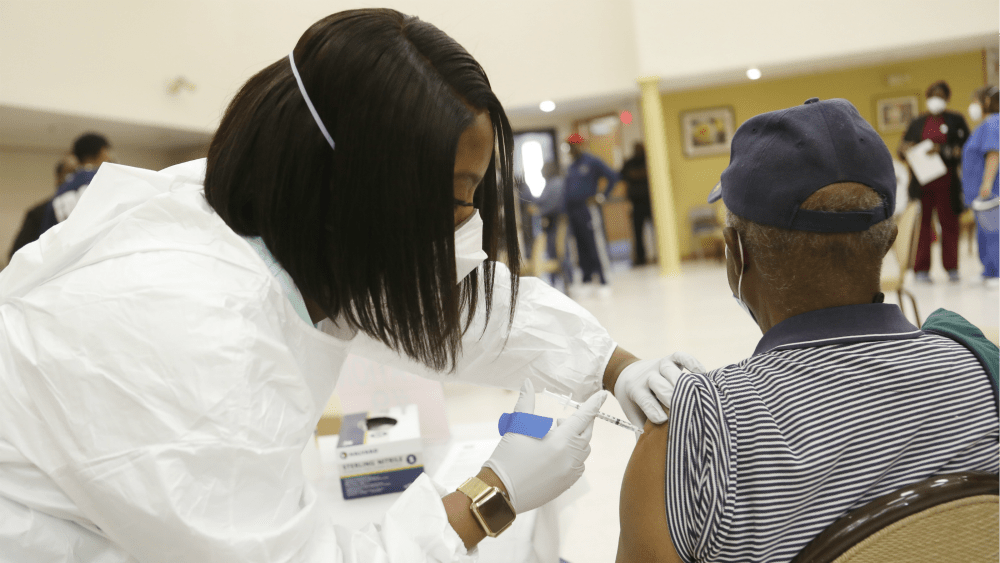
Where Two or More Are Vaccinated: Advice for Churches in 2021

Five science-based suggestions to gather and worship safely as COVID-19 vaccines roll out.

Christianity Today January 27, 2021
Illustration by Rick Szuecs / Source images: Twenty20Photos / Pressmaster / DavidPereiras / Envato / Anete Lusing / Emre Kuzu / Pexels

After 10 months of limited in-person gatherings or online programming, church congregants—like the rest of society—feel pandemic fatigue. We are hopeful that the availability of COVID-19 vaccines will allow our society and churches to return to normal. But a return to normalcy will take time.

Unfortunately, many of our Christian brothers and sisters living in low- and middle-income countries, where I have worked for more than 25 years to stop the spread of infectious diseases, will not receive vaccines until 2022 or later. In countries like the US where the rollout of COVID-19 vaccines began last December, experts predict it will be fall before vaccination coverage reaches 70–90 percent and herd immunity can hopefully be achieved. Only then can society begin to resume more normal activities. The next several months will be a transition period when vaccinated and unvaccinated individuals mingle in our communities, but it is not yet safe to return to normal life.

During this transition period in the US, how should church leaders decide on in-person gatherings for their churches? Because vaccination will proceed at different rates in different communities and vaccination of church congregants will vary even among churches within the same community, there is no single approach to regathering.

In consulting with four churches in my home city of Seattle to plan for this transition, I've seen leaders struggle with the complex issues before them. James Broughton, the senior pastor of a predominantly African American congregation said, “This is such a complicated situation—with so many moving parts. We really need godly wisdom, which includes scientific knowledge, to know what to do.” All those I talked with see the need for open discussions within the church and the value of having a plan before churches are confronted by different pressures to regather.

To navigate this transition period, I will explain how COVID-19 vaccination influences decisions about church gatherings and provide five suggestions that can help churches develop a plan to regather as vaccination coverage increases.

As in my previous CT articles on church gatherings during this pandemic, I have tried to discern God’s call for his church using two guideposts: biblical truths and scientific knowledge, both of which have been given by God.

How COVID-19 vaccination influences church gatherings

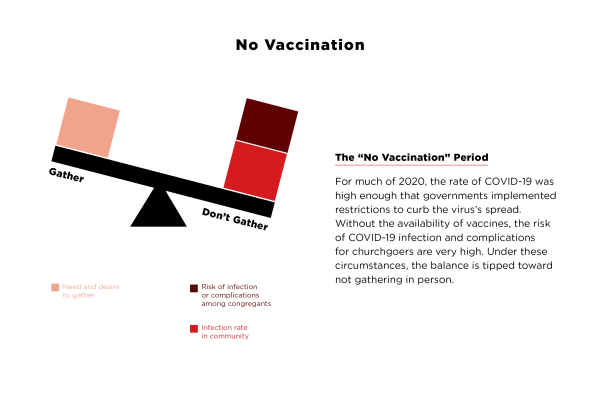
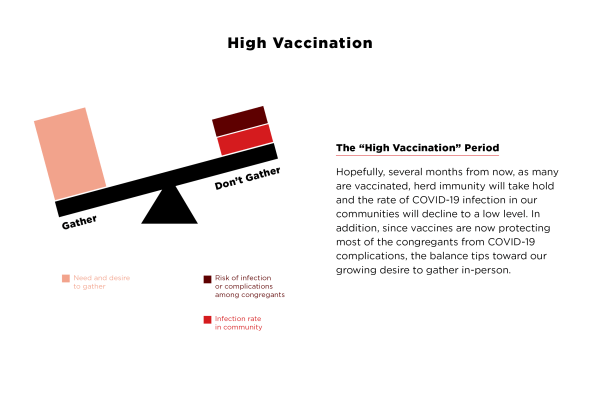
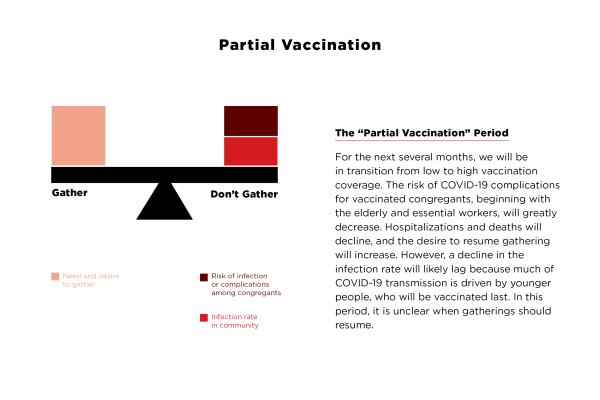
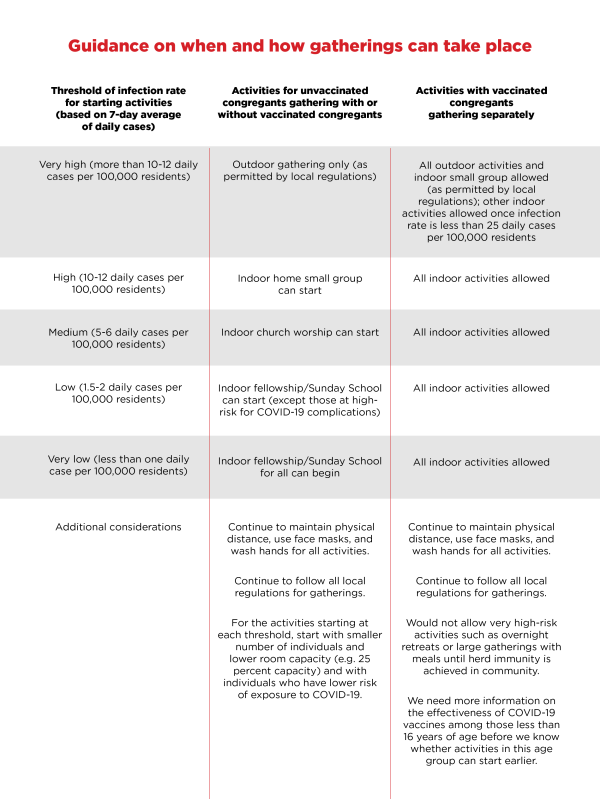
Explicitly stated or not, church leaders are balancing three factors when they consider church gathering during this pandemic: the need and desire of congregants to gather, the rate of COVID-19 infection in the community, and the risk of COVID-19 infection and complications among the church’s congregants. I created three figures to describe how these factors of churches gathering influence three vaccination periods:

Figure by Mallory Rentsch / Data Compiled by Daniel Chin

The partial-vaccination period will last until there is herd immunity against COVID-19 and the infection rate declines to a low level. How long this takes is affected by the availability, effectiveness, and uptake of COVID-19 vaccines as well as the contagiousness of new COVID-19 variants. The media will report on these issues in the months ahead, and church plans may need to adjust as new information becomes available. However, here is background on two important issues.

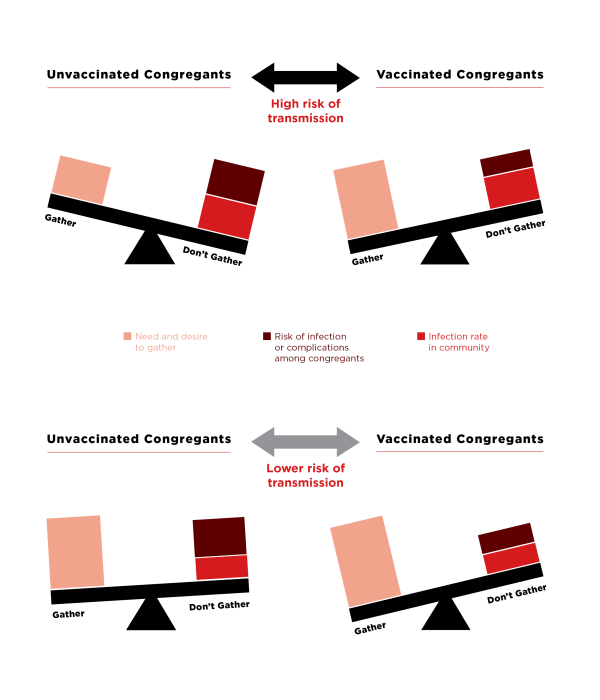
First, scientists are still unsure about whether vaccinated individuals who are not apparently ill from COVID-19 can harbor the virus and spread it to others. Recently approved vaccines can reduce the risk of COVID-19 illness by more than 90 percent, including the virus’s serious complications. But if the virus can spread through the vaccinated, then we must continue to use masking, physical distancing, and other means to protect vaccinated individuals from COVID-19 in the same way we protect unvaccinated individuals. The purpose of this, however, would not be to prevent COVID-19 complications but to limit the spread of the virus.

Second, fast-spreading variants of COVID-19 in different parts of the world appear to be 10–70 percent more transmissible. This is an alarming development because these variants may worsen and prolong the pandemic. Fortunately, most scientists believe current COVID-19 vaccines should remain effective against these variants.

Since the spread of these COVID-19 variants could delay the time to reach herd immunity, the need for our churches to have plans on how and when to gather is greater than ever. If these virus variants become more common in our communities as anticipated, then we need the suggestions below even more to minimize the spread of COVID-19 in our churches. Because COVID-19 and all its variants spread through nasal secretions and respiratory droplets, the ways to contain their transmission remain the same. Therefore, my suggestions remain relevant even with the spread of these variants.

Five suggestions for a gathering plan during the partial-vaccination period

1. Use the level of COVID-19 infection as the primary guide for congregational gatherings.

If in-person gathering resumes during this period, vaccinated and unvaccinated attendees will mix with each other. Because herd immunity has not been achieved, COVID-19 infection rates in our communities will remain high. Given that our church activities facilitate virus spread, there is still a high risk of transmission between the unvaccinated and even between unvaccinated and vaccinated congregants. If scientists determine that vaccinated individuals can still harbor the virus and spread it, then even after a high proportion of people are vaccinated, the risk of spread may remain high as long as the level of COVID-19 infection in the community remains high (see upper figure). Only when the infection rate declines to a lower level will the risk of transmission between congregants also decline and then in-person gatherings can safely resume (see lower figure).

Therefore, this partial-vaccination period is an especially tricky time because the risk of COVID-19 complications for unvaccinated congregants has not decreased, but the desire to gather will likely increase. This will undoubtedly influence a church’s decision to gather. Therefore, the decision on when it is safe for vaccinated and unvaccinated congregants to gather should primarily be based on the level of COVID-19 infection in the community and not on the proportion of congregants vaccinated.

Figure by Mallory Rentsch / Data Compiled by Daniel Chin

2. Consider allowing vaccinated congregants to gather separately.

Although churches may choose to gather only when both vaccinated and unvaccinated congregants can mix safely together, there is an option to gather earlier with just vaccinated congregants. Because vaccinated congregants are protected from serious COVID-19 complications, it is much safer for them to gather indoors even when the infection rate in the community is high. Many of our elderly and more vulnerable church members, who will be vaccinated earlier, may welcome an earlier opportunity to gather before everyone can safely do so. An easy first step would be small groups for vaccinated individuals.

However, church leaders may have reservations about separating their congregants into groups. Laurie Brenner, a pastor of a Seattle neighborhood church deeply engaged in the community, said, “In my medium-size church, there is a real tension. On one hand we do not want to separate people; on the other hand people want to meet as soon as possible.”

But the church leaders I talked with generally believe it is possible to set up gatherings just for those who have been vaccinated. Broughton said, “Pods are already popping up spontaneously that bring people with lower risk for COVID-19 together. These are being self-managed by the members themselves. I can see the same with vaccinated members.” Brenner added, “We need to work to ensure that vaccination does not end up dividing existing groups.”

In general, the idea of a parallel structure for both vaccinated and unvaccinated congregants seems to resonate with these leaders. George Hinman, the senior pastor of the large multigenerational church that I attend, said, “I can accept the idea of having a worship service just for the vaccinated if we also provide another option for people to worship regardless of their vaccination status. We need to give everyone an accessible experience.”

Nevertheless, limiting gatherings to only vaccinated congregants could prove challenging as churches may be reluctant to require a proof of vaccination for entry through their doors. However, the idea isn’t new; the use of health passes could become commonplace in the coming months.

3. Take a step-wise approach to resume specific forms of in-person gathering.

We need a step-wise plan because different church activities have different risks of COVID-19 transmission. Activities that carry a higher risk of airborne COVID-19 transmission should start only when infection rate is low, while those with a lower risk can start at a higher infection rate. Moreover, it is easier to mitigate COVID-19 transmission in some activities compared to others.

The table below provides guidance on in-person activities that can start once the level of COVID-19 infection drops to certain thresholds. It builds on the step-wise plan for church reopening that I wrote in an earlier CT article and provides thresholds of infection for the steps. For those who live in the US, the tricky part is that there is no national standard for high or low levels of infection, though health departments have come up with similar thresholds of infection for their use. I have adapted them for the steps in the table.

One confusing aspect is that COVID-19 case rates are sometimes presented as the total number of cases over 7 or 14 days per 100,000 residents instead of the daily number of cases per 100,000 residents. In the table, I recommend using the daily number as thresholds, so you may have to convert your local health department’s number to use the table or use a global dashboard with this information, such as the one by STAT News. Always keep in mind that insufficient COVID-19 testing may underestimate the true infection rate; therefore, in communities with inadequate testing, be more conservative in starting activities.

As more information becomes available or clearer guidelines emerge, the thresholds in the table may need to be adjusted. Churches may choose slightly higher or lower thresholds for starting activities. With the fast-spreading variants, it is even more important to start activities at each threshold with a smaller number of individuals. Given that infection rates have skyrocketed in the last few months in many areas, it will be a while before infection rates decline to a level that will permit indoor gatherings for unvaccinated congregants.

Table by Mallory Rentsch / Data Compiled by Daniel Chin

4. Encourage congregants to reduce their risk of exposure to COVID-19.

As COVID-19 vaccines are rolled out, many churchgoers are in a lower priority group for vaccination, and some may never be vaccinated either by choice or due to health reasons. Regardless of the reason, it is important for unvaccinated congregants everywhere to be able to gather safely with others in their churches.

Disease control experts have long recognized the importance of behavioral change in helping people reduce their risk of exposure to an infectious agent. Before our church attendees gather, we can ask them to modify their behaviors to reduce their risk of exposure to the COVID-19.

The risk of exposure to the virus is simply sharing the air that other people breathe. Our congregants can lower this risk by reducing their close contact with others (defined as being within six feet of another person for at least 15 minutes) and increasing the use of face masks, physical distancing, and well-ventilated spaces when meeting with others.

When we gather with others in our churches, we can love our brothers and sisters by protecting them from the harm of this virus. “It is fair to ask people to mitigate their risk for the sake of others. I believe it is even fair to ask for vaccination before gathering. But it is important not to exclude people. We need to provide options for all,” said Hinman.

“Our church emphasizes the importance of personal accountability and not just what the church mandates,” said Elton Lee, an elder of a large Chinese American church, who is grateful for members who take responsibility to protect others. “The church can provide guidelines, but it is up to individuals to adhere to them.”

To help our congregants take responsibility, it would be helpful if they knew their risk level. A few apps are designed to help individuals estimate their risk of catching COVID-19 at a gathering. But with COVIDRisk.Link, a tool I recently developed with others, congregants can monitor their own risk of exposure to the virus on a regular basis and reduce their risk, if necessary, before meeting with others. The spread of the new virus variants, which increase the contagiousness of individuals with COVID-19, makes this more important. In addition, the use of this assessment tool can help congregants form social bubbles to meet more safely with those who have a risk of exposure with which they are comfortable.

At every threshold of infection in the above table, gatherings can be safer if we ask congregants to reduce their risk of exposure to the virus, and we encourage those with a lower risk of exposure to participate in activities sooner than those with a higher risk.

5. Encourage your congregants to get vaccinated.

If a significant proportion of people in our communities refuse to be vaccinated, this will prolong the pandemic and its harmful effects on our society. Unfortunately, nearly 40 percent of Americans and a slightly higher percentage in American churches are reluctant to be vaccinated. Broughton explained, “Our people are currently reacting based on fear because of the influence of past experiences like the Tuskegee experiments. They don’t know if they can trust the vaccines.”

Because we know that COVID-19 vaccines can protect people from the harmful effects of this virus and allow us to return to normal church ministries sooner, in my opinion, churches should be promoting COVID-19 vaccination. Not only will vaccinated Christians be protected from serious complications if they get infected, but they will also be able to serve others in need sooner and contribute to ending the pandemic.

It is unfortunate that this pandemic has been so politicized that some church leaders are hesitant to endorse vaccination, but I suggest that we use the Great Commandment as our primary motivation. Although experts are not certain vaccination will prevent the spread of COVID-19, there is a very good chance that vaccines will reduce at least some (if not most) COVID-19 transmission. Therefore, let us love one another by encouraging vaccination, especially those in our churches.

But it may take significant efforts and patience to communicate with our church attendees about the benefits of the vaccines. Broughton emphasized this, “I need to continue to have conversations with the congregation. Where this information is coming from makes a big difference to them. The trust greatly increases when they know it is coming from men and women of faith who are knowledgeable about science.”

More important than words are actions. Church leaders can set an example to their congregations by getting vaccinated themselves. There is a lot of distrust of the government, of science, and of COVID-19 vaccines. The most trusted members of many communities are in our churches. Therefore, church leaders can play an important role in encouraging their congregants to get vaccinated.

With the start of COVID-19 vaccination in our communities, we are beginning the long road back toward normalcy. At the same time, the US is experiencing the most tumultuous and divisive period in its recent history. Hinman said, “As the church, we cannot allow how we handle this pandemic and the issue of vaccination to divide us.” To help our churches move forward in unity, I pray these five science-based suggestions can help our churches to be a beacon of light—embracing faith and science—as we resume gathering and continue serving the world around us.

Daniel Chin is a physician trained in pulmonary and critical care medicine and epidemiology with 25 years of global public health experience. In 2003, he led much of WHO’s support to China to contain the SARS epidemic.

News

Francis Chan Returns from Hong Kong After Visa Rejected

The California pastor hopes to return to the small group of house churches he started last year.

Christianity Today January 26, 2021
Biblical Restoration Ministries / YouTube

Less than a year after moving to Hong Kong, Francis Chan and his family have had their visas rejected and been forced to leave their fledgling house church ministry behind.

Chan, known as a spirited preacher and bestselling author of Crazy Love, told his ministry partners early in January that he was back in the US but applying to return to Hong Kong, where he and his sons-in-law were leading three house church gatherings.

“Hopefully we can get back in Hong Kong because, man, we want to be there,” he said in a January 5 video from San Francisco.

Besides the pandemic hitting in 2020, last year brought further political unrest to Hong Kong, where protestors opposed the imposition of new national security law allowing mainline China to hold more authority over the area.

As a result, some Americans, including journalists, have struggled to get visa extensions, and ministry leaders from overseas have grown more worried about oversight.

Chan described leaving the churches behind on a couple weeks’ notice and appointing young leaders to take their place, reminding them that the early church too relied on the Spirit when leaders like Paul had to move on.

“That went way faster than we expected, but now I’m going, ‘Wow, Lord, I think if I’d stayed too long, that might have hurt the church,” he said.

A Chinese American, Chan announced his family’s plans to move to Asia in 2019, describing a sense of calling to a region where he had experienced the gifts of the Spirit and, eventually, to a neighborhood where his late mother had ministered before moving to the US.

He described wanting to leave the crowded ministry landscape in the US for a pond where “fish are biting” and “no one’s fishing in it.”

While some Christians celebrated his willingness to follow God’s call, other missionaries challenged his approach as a celebrity pastor coming in as an outsider in the region.

“There are actually millions of passionate Christians in Asia, and many of them are active and well equipped to share the gospel contextually in their own local communities,” wrote Craig Greenfield, a Canadian missionary living in Cambodia. “They are far and away the most effective people to reach their neighbours, because they share a common worldview, culture and language.”

Greenfield added, “I’m more than hopeful that Francis Chan will surround himself with folks that will challenge his role at the center of the gospel-sharing, church-planting story that he is telling. He’s a wise and seasoned leader, and a good listener.”

Chan described it as a stretching experience to rely on Scripture while teaching using his “horrible” Chinese. He said he and has family of 12—including his daughters, sons-in-law, and grandkids—had fun building a church family that spanned from “street kids” to “crazy rich Asians.” They had gathered three house churches of 15–20 people each.

The pastor smiled throughout the 30-minute update and praised God that even after the unexpected news around their visas, his whole family is “at perfect peace at a time when most people would be freaked out.” One of Chan’s daughters and sons-in-law have returned to Los Angeles, while the other went to Ireland.

The day after Chan’s announcement—January 6—dozens of pro-democracy activists, including Christians, were arrested in the latest police raid, most have since been released on bail. The incoming Biden administration has recently spoken up about its plans to stand with the people of Hong Kong.

Books
Review

A Christian Approach to Social Justice Is Slow, Careful, and Self-Reflective

Thaddeus Williams asks good questions about contemporary zeal for change. But there are questions to ask of his critique as well.

Illustration by Rick Szuecs / Source image: Envato Elements

When it comes to tackling injustice, many Christians have an impulse to push harder and faster. Eager to hit the accelerator, they don’t always pause to consider whether their zeal is prudent or proportionate.

Confronting Injustice without Compromising Truth: 12 Questions Christians Should Ask About Social Justice

Confronting Injustice without Compromising Truth: 12 Questions Christians Should Ask About Social Justice

HarperCollins Children's Books

288 pages

This is one thing to commend about the measured approach taken by Thaddeus K. Williams in Confronting Injustice without Compromising Truth: 12 Questions Christian Should Ask About Social Justice. Williams, a theology professor at Biola University, seeks to lay a Christian foundation for programs of social justice while critiquing the excesses and extrabiblical emphases of secular “social justice.” He encourages us not to slam on the brakes but to slow down and engage in critical self-reflection before diving headfirst into the latest cause. Justice advocates often put up their defense shields when confronted with arguments like these. But Williams invites us to come and reason together, laying down our tribal and ideological weapons.

As Williams affirms at the outset, “Social justice is not optional for the Christian.” The question is, which type of social justice? Williams distinguishes between what he calls “Social Justice A” (biblical social justice) and “Social Justice B” (unbiblical social justice), and the book proposes 12 questions aimed at helping believers discern between the two rivals. For instance, does our vision of social justice take seriously the godhood of God? Does it acknowledge the image of God in all people? Does it encourage love, peace, and patience or suspicion, division, and rage?

Williams affirms the reality of racism and systemic injustice, pointing to well-documented disparities in housing and the criminal justice system as examples. But he is careful to distinguish between good and bad diagnoses and remedies that reflect the different underlying assumptions of biblical social justice and its secular counterpart. His diagnosis goes straight to the heart of the core deficiency in Social Justice B: its tendency to see evil almost exclusively in systems rather than in the sinful human heart. (Hard-line conservatives often commit the opposite error.) Only a holistic, biblical worldview can comprehend both sides of the equation.

One highlight of the book is found in chapter 9, where Williams asks arguably the most foundational question of all: Does our vision of social justice obscure the gospel? Social justice is a worthy cause, but it makes for a terrible god. It cannot save you. It cannot absolve you of your sins, no matter how many acts of penance you perform. Nor can it fix all the flaws of this world by itself. Christian social justice advocates like to wax eloquent about “the kingdom,” but we do well to remember that the kingdom will only be consummated when Christ returns in glory. In the meantime, we are called to live out the reality of that kingdom through acts of justice and mercy. This saves us from complacency and inaction while discouraging naïve hopes that ultimately lead to despair.

Williams’s attempt at evenhandedness is admirable. He recognizes that tribal thinking can prevail equally on the Right and the Left, and he cautions those on the Right against demonizing all social justice advocates as liberals or Marxists. “There is truth,” he assures readers, “to be found on both sides.” Even so, the book’s analysis remains a bit asymmetrical. For instance, while Williams rightly rejects Social Justice B standbys like socialism (and the Marxist ideology behind it), he fails to criticize the excesses of unbridled American capitalism.

While Williams acknowledges that Christians can accept insights found in social justice circles without embracing a secular worldview, he seems to fall prey to the slippery slope fallacy, implying that too much sympathy with the former invariably causes a slide toward the latter. But this discounts the many believers who explicitly champion social justice without surrendering one iota on biblical authority. Take Tim Keller’s church, Redeemer Presbyterian in New York City, which lists “social justice” alongside “personal conversion” in its vision statement.

As I progressed through the book, I couldn’t escape the feeling that something essential was missing. Williams writes that seeking justice is a “clarion call of Scripture.” So why did I get the impression that the book’s own call for justice fell flat, ending in a whimper rather than a crescendo? Williams asks many helpful and thought-provoking questions. But I’d like to offer some alternative questions: Does our critique of social justice galvanize God’s people toward doing justice? Does it spur us toward a better form of advocacy for the vulnerable, the marginalized, and the disadvantaged?

My suspicion is that for the vast majority of grassroots evangelicals, the answer is no. Too many are accustomed to dismissing concerns about race, immigration, poverty, or the refugee crisis as trap doors for Social Justice B. To his credit, Williams warns readers against using his book as a “billy club” to bash fellow believers who differ in their approach to social justice. But some will inevitably use it as an excuse to remain overly comfortable with the status quo.

I have a master’s degree in mental health counseling. My wife, who works at a low-income school, is completing her master’s degree in social work. Our community remains pretty segregated. We have seen firsthand the legacy of systemic racism as it continues to play out in low-income families and communities, enduring from generation to generation. The church needs to reckon with such realities if it is to maintain its witness in settings like these, to say nothing of society at large. Williams’s book will help Christian social justice advocates proceed more carefully and biblically. But I doubt it will do much to convict those who are not convinced there’s a problem in the first place.

Michael Agapito works for a Christian housing ministry serving the University of Illinois at Urbana-Champaign. He blogs at The Confessing Millennial.

News
Wire Story

Tolkien Fans Hope to Make Oxford Home a ‘Rivendell’ for Writers

Project Northmoor is fundraising to turn the place where the Catholic author wrote ‘The Lord of the Rings’ into a center for creating faith-inspired fantasy.

Christianity Today January 25, 2021
Michael Pätzold / Creative Commons

Fantasy novel enthusiasts wish to turn the house of famed Catholic author J. R. R. Tolkien in Oxford, where he wrote The Lord of the Rings and The Hobbit, into a meeting place for writers, screenwriters, and filmmakers from all cultures and faith backgrounds.

In 1930, Tolkien moved into the house at 20 Northmoor Road where his children would grow up during the Second World War. Project Northmoor is a charity created with the purpose of buying the house, currently for sale for roughly $6 million. The project has already raised about $1 million.

While many influential English writers, such as Jane Austen, Charles Dickens, and Thomas Hardy, have a center or museum dedicated to them, there is no equivalent that pays tribute to Tolkien’s legacy.

The Oxford City Council will not allow the property to be turned into a museum, since it’s in a residential area, but Tolkien fans hope it might become a literary center of discussion and encounter for those who wish to delve deeper into the world of Middle Earth.

Actors who were a part of the Lord of the Rings movie franchise have also voiced their support, including Martin Freeman, who played the hobbit Bilbo Baggins; Sir Ian McKellen, who starred as the wizard Gandalf; and John Rhys-Davies, who played the dwarf Gimli.

“I think it would be wonderful to go and read and be inspired by Tolkien,” Julia Golding, an award-winning author and screenwriter who founded Project Northmoor, told Religion News Service.

Golding said she hopes the place will be “a version of Rivendell,” the elven city in “The Lord of the Rings” where sojourners from all fantastical races and backgrounds meet for reflection and, of course, adventure.

The project has come under fire due to concerns that the trustees behind it, who have backgrounds in Christian organizations, might use the house more for proselytizing than promoting Tolkien’s legacy.

According to Golding, in fantasy writing “there should be a space for everyone” to write, regardless of their faith. “Narrowing the world’s cultural voices is the opposite of what we want to do,” she said.

Tolkien was a serious Catholic and founder of the Inklings, an informal literary group of fantasy writers who gathered to share notes and try out new ideas. Many of the members were Christian, including Tolkien’s close friend C. S. Lewis, author of The Chronicles of Narnia.

Lewis incorporated Christian themes far more explicitly than Tolkien, who favored a more demure approach to faith in his books. Golding compared the use of faith in Tolkien to the computer graphics effects used to create Gollum in the Lord of the Rings films, all of which won Oscars for their visual effects.

Actor Andy Serkis wore a bodysuit and had dots marked on his face to play the schizophrenic villain Gollum during filming, but what eventually appeared on screen was a computerized version of the character. Faith in Tolkien feels similar, Golding said, “despite the rendering and under the surface, you can still feel the faith that’s driving it.”

Even though Tolkien wrote in the context of his time and faith background, Golding said his stories can be universal. “He’s very accessible to everyone, no matter what faith you are coming from, because he portrays core human values like sacrifice, friendship, fellowship and—let’s not forget—love,” she said.

Tolkien’s books are pretty clear about which side is right and which is wrong, which Golding believes can still be relevant today even amid growing polarization worldwide. While some recent fantasy sagas, such as Game of Thrones, have offered multifaceted conflicts coming in all shades of gray, Golding believes there is still space for clear heroes and villains in the genre today.

“Yes, it’s awful the world situation, but there is a human spirit that can be heroic and positive,” she said, pointing to the example given by doctors, health professionals, and even neighbors during the COVID-19 pandemic.

Project Northmoor’s organizers say there is still space for faith-inspired fantasy novels, though they should not be limited to Christianity and must be grounded in “respect and tolerance” for different worldviews.

Tolkien’s house, once it’s renovated and its garden is restored, will stand as “a center for creativity,” Golding said. After all, she added, one of the great legacies of Tolkien’s writing and the Inklings group is the importance of coming together for a common purpose.

“You cannot defeat evil on your own,” she said, pointing to the ring that in The Lord of the Rings trilogy represents the corruptive evil of power. “You cannot do it on your own. You need mercy and help.”

Or, as another beloved Tolkien character, Samwise Gamgee, once said, “There’s some good in this world, Mr. Frodo, and it’s worth fighting for.”

News

Black Churches Step in to Help Distribute COVID-19 Vaccines

Florida pilot program could become model for other states.

Christianity Today January 24, 2021
Octavio Jones/Getty Images

In this series

In his four decades as a minister, R. B. Holmes Jr. has never dealt with so much death.

More than 24,000 Floridians have died from COVID-19, including more than a few of the flock that Holmes shepherds at Bethel Missionary Baptist Church in Tallahassee.

“No one is immune from this,” Holmes told CT. “The thief is winning. The virus is a thief.”

The black pastor is especially concerned that the coronavirus has disproportionately impacted his community and other communities of racial minorities around the state. According to statistics from the Centers for Disease Control and Prevention, black people are 1.4 times more likely to become infected with COVID-19 and 2.8 times more likely to die from it than white people.

There are a number of possible reasons for this. The National Urban League points out that many minorities are more exposed to the virus because they work in fields that don't accommodate working from home. African Americans also tend to have more preexisting conditions—often poverty related—that put them at risk of COVID-19. On top of that, they are less likely to have health insurance.

Whatever the reason, Holmes said the crisis has created an emergency for black people, and African American community leaders, especially pastors, have to find a way to respond. After one too many funerals in 2020, he felt compelled to action.

“Why sit here as leaders and watch our people die and our families die?”

So Holmes organized the Statewide Coronavirus Vaccination Community Education and Engagement Task Force.

The group is partnering with hospitals and the state to better distribute vaccines—as they become available—through local churches to the people who are most at risk. On January 10, Governor Ron DeSantis announced that seven predominantly black churches would each be getting 500 doses of the vaccine to distribute to people over the age of 65. The state hopes to soon expand the program quickly, distributing vaccines to about 50 churches across Florida.

Holmes said the task force has made it their mission to locate 40 primarily black churches, community centers, and colleges to be involved with distributing the vaccine by January 31. He hopes Florida’s plan is replicated throughout the country and wants the task force to become a model for how to reach the black community.

“Our plan is very systemic, very measurable, very achievable,” he said.

There are practical reasons to involve black churches in vaccine distribution—they have buildings and parking lots and good locations for distribution. But the reasons go deeper too.

“The church is in some ways a center, not just a religious center, but a social institution as well,” said Jamil Drake, a religious studies professor at Florida State University who specializes in African American religious culture. “The church has historically been a site that the state has used to gain the trust of African Americans given the role that churches play in African American communities.”

Black communities often distrust the government and are skeptical of medical authorities. Drake said there are good historical reasons for this, citing the racist writings of 19th-century medical doctors who used science to justify slavery and 20th-century medical experiments performed on unsuspecting African Americans.

The most notorious, Drake said, was the Tuskegee Syphilis Experiment, which continued into the 1970s. The United States Public Health Service promised health care to 600 black people in Alabama in exchange for participation in a study. The health service identified 399 of the men who had latent syphilis but did nothing to help them. Instead, the service chose to study what would happen if they did nothing to treat the illness. The experiment continued for 40 years, and 128 of the participants died.

“You can’t talk about medicine and science without the history of race,” said Drake. “History is not just an antique that we observe. History is in us.”

Today, black people are less likely to seek medical treatment than white people or even get flu vaccines. There is some concern that, even though the coronavirus is disproportionately hurting black people and other minorities, black people and other minorities won’t seek out vaccines.

Anthony Evans, pastor and founder of the National Black Church Initiative, points out that administering the vaccine in black communities requires trust building. His network has decided to wait to promote the vaccine until more data confirms it is safe.

Elaine Ecklund, professor of sociology at Rice University, said that kind of caution is justified.

“People have good reason to be suspicious,” Ecklund said. “I think that’s really important to understand.”

At the same time, COVID-19 is devastating communities, and multiple controlled studies show the vaccine is safe. Competing pharmaceutical companies have come up with very similar approaches to fighting the coronavirus, and their tests have come back with consistent results.

“The science is pretty clear at this point that our very best hope is getting as large a group as possible vaccinated,” Ecklund said. “That’s all we have now.”

Ecklund, who is director of the Religion and Public Life Program at Rice University, believes that churches helping distribute vaccines could be a good first step toward the larger goal of building trust. Church leaders should take the opportunity to help Christians understand science and see how it is compatible with faith.

Religious leaders can also help health authorities think through the ethical questions involved with distributing limited resources. Morally, Ecklund said Christians have a legitimate role to play in these fields and can use their influence to address injustices and “care for the least of these.”

Janice Minnis, an administrative assistant at the Koinonia Worship Center and Village in Pembroke Park, said to her it only makes sense that the church should help at a time like this. The center is one of the Florida churches that has signed on to help distribute the vaccine, and on January 10, they facilitated 500 people receiving their first COVID-19 vaccine shot.

“The church gives hope through our Lord and Savior Jesus Christ,” she said. “We ought to be a beacon of light in our community as well.”

According to Minnis, organizing the event wasn’t much different than other events at the church. From her perspective, the church can respond to the coronavirus in the same way it might to a hurricane on the Florida coast.

“This is something that we do on a regular basis when it comes to emergency situations,” she said. “The church should be a safe haven, and what better place to get the help you need than from the church?”

Church Life

Prayers and Praises from the World’s Hardest Places to Be a Christian

The struggles and joys experienced by believers in 11 nations on Open Doors’ Christian persecution watchlist.

Christianity Today January 23, 2021
Illustration by Rick Szuecs / Source images: Envato Elements

More than 340 million Christians live in places with very high or extreme levels of persecution, according to Open Doors’ 2021 World Watch List.

Since these believers are our brothers and sisters in Christ, we thought it might be helpful to hear from the church and those close to them in 11 different countries on how God is working—and how you can pray for them.

Countries that have been ranked in World Watch List’s top 20 in its 2020 and 2021 lists are represented here. They appear in order of how they are ranked on the current list.

North Korea

We praise God:

  • for the descendants of believers in North Korea who have kept their faith despite the relentless persecution there since 1945.
  • for building underground churches and allowing the gospel to be shared in North Korea even though all churches there were destroyed by Communist oppression.
  • for helping North Koreans, who are thoroughly disconnected from the outside world, to nevertheless translate, print, and share the Bible.

We pray:

  • that the sin of idolatry that deifies the leader in North Korea will cease so that all North Koreans can serve the true God.
  • that the sins of violating and repressing human rights will be stopped so that North Koreans can enjoy and worship the God who created all of us in his image.
  • that vital foodstuffs and other basic necessities are provided to North Koreans who continue to suffer from hunger and frigid winter weather so they can at least maintain their minimal standard of living.

Submitted by Peter Lee, executive director, Cornerstone Ministries International

Pakistan

We praise God:

  • for the numbers of students training in the seminaries and Bible colleges.
  • for the many agencies discipling people in the faith.
  • for boldness in witness by many Christians.

We pray:

  • for current seminary and Bible college students to become good pastors and evangelists in the future.
  • for the continuing danger posed by the blasphemy laws.
  • for the systemic discrimination faced by Christians in employment, education, and society.
  • for Muslim-background believers who face particular dangers if their identities become known.

Submitted by Bishop Michael Nazir-Ali, director of the Oxford Centre for Training, Research, Advocacy and Dialogue

Iran

We praise God:

  • for the number of Iranians coming to Christ. In the beginning of 2020, Iran Alive Ministries (IAM) sensed that Iranians were even more open to the gospel, so we dedicated the month of May to evangelism. During that month, we not only aired more evangelistic programs, but we also taught our viewers how to evangelize. The number of registered salvations jumped from 20–50 per week to over 500 salvations per week. This went on for months and now fluctuates between 300 and 400 per week. The best news is that two-thirds of those who came to Christ did so not through our programs but through the personal witness of those whom we trained to evangelize.

We pray:

  • for the safety of the people in our network. Two of our Bible distributors (a male and a female) inside Iran were arrested in the last few months. Because of their arrests, the lives of others in the network are in danger. If they are tortured and give out names, the rest of the network will be arrested as well.

Submitted by Hormoz Shariat, founder, Iran Alive Ministries

Nigeria

We praise God:

  • for his strength and grace that have kept our brethren in northern Nigeria going in their service and faith in God despite intense persecution.
  • for providing help and succor for Christians who have been displaced by terrorism in northeast Nigeria.
  • for his intervention in many cases where kidnapped Christian leaders (some with their spouses) have been successfully rescued.
  • for providing many opportunities for the church of God to keep marching on during the lockdown occasioned by the COVID-19 pandemic. Many believers experienced revival in their Christian lives from attending virtual meetings. Cities were locked down, but the Word of God could not be locked down as record numbers of souls came to Christ during the ongoing pandemic! Hallelujah!

We pray:

  • that the Lord will raise help for the church of God in northern Nigeria to be rebuilt. Many places of worship are lying in ruins, and we pray for God's divine and miraculous restoration.
  • that the Lord will arrest and convert the kingpins who are unleashing terror and spearheading the persecutions of Christians in Nigeria. Lord, let them have the same experience that Saul (Paul) had on the way to Damascus.

Submitted by Ronke Mosuro, ordained pastor of the Redeemed Christian Church of God and lecturer at the Lead City University in Ibadan, Nigeria

India

We praise God:

  • for the way the church was and is able to reach out to cater to the needs of the nation during the COVID-19 pandemic. From nationwide efforts to the local church in the grassroots, all reached out in compassion to alleviate the sufferings of their neighbors.
  • for the unity efforts going on in the church in India. The coming together of the National United Christian Forum comprised of the Catholic Bishops’ Conference of India, the National Council of Churches in India, and the Evangelical Fellowship of India is a big step forward in promoting unity and cooperation among churches in India.
  • for church leaders’ ability to take care of their congregations using tools that have helped them take the church online. We praise God for giving the church resources that have helped in pastoral care, preaching, and teaching, thus keeping the church in India vibrant even during the lockdown.

We pray:

  • for the church in India to be a major voice for peace, justice, equality, and harmony in the nation. Pray that the church would keep on not only speaking but also intervening on behalf of the marginalized and the oppressed. Pray that the church in India would live the values of the kingdom of God and bless and transform the nation.
  • for the church in India as persecution and opposition grow, nurtured by the ideology of religious nationalism and extremism. Pray that the church would stand steadfast and in faith, continuing to reach out in love even to those that oppose and persecute.
  • for the church in India to be able to effectively train leaders to meet the need of a growing church so that both the church and the nation would be blessed. Pray for grassroots discipleship and leadership movements in different parts of India that the Lord continues to work through them to produce commendable people who engage in society with compassion and love to bring about transformation.

Submitted by Vijayesh Lal, the Delhi-based general secretary of the Evangelical Fellowship of India

Iraq

We praise God:

  • that Christianity is still present and that the government is trying with all its might to consolidate and strengthen this presence.
  • that the Baptist church reached many poor or displaced families from Mosul or the Nineveh Plains and from a variety of ethnic and religious backgrounds with food and relief aid.
  • that evangelical churches in Kurdistan have received official legal status.

We pray:

  • for the government to be strengthened. In fact, the weakness of the government in Baghdad and its inability to extend its influence over important facilities in the country lead to the existence of many behaviors that—although far from persecution—make Christians feel unequal.
  • for political and security stability in the country. That Christians can feel safe returning to their villages and cities from which they were displaced since 2014. Many of them are still in Baghdad and other areas of Kurdistan.
  • for the official registration of evangelical churches—including our own—as the failure to register these churches hinders their normal functioning as well as their service.

Submitted by Ara Badalian, senior pastor of the National Evangelical Baptist Church in Baghdad

We praise God:

  • that evangelical churches helped the local government distribute food and medicine despite the quarantine.
  • that in the midst of the persecution and pandemic, many started looking for answers in the Bible. Now we have Bibles in the Bahdinan Kurdish language.

We pray:

  • for the completion of the Bible in Kurdish language and the translation of some exegesis and discipleship books to help believers understand the Bible more clearly.

Submitted by Ashty Bahro, pastor of Evangelical Apostles Church and director of the relief organization, Zalal Life, based in Duhok, Kurdistan.

Saudi Arabia

We praise God:

  • for the continuing/developing openness politically/culturally/religiously and that old-school clerics have been marginalized and replaced with those who encourage liberal thinking.
  • for the new connections between the youth and the foreigners that have helped to increase tolerance and appreciation for other cultures, Christians, and Jesus.

We pray

  • for more caretakers for the Muslim-background believers who want to show God’s love practically. We pray that they will continue to grow in God as we witness to his care for their life and comfort.
  • for church unity that witnesses by showing a beautiful life for others to see and an understanding and synergy toward the needs of the “inquiring” and Muslim-background believers.

I. Hanna, church leader, Dammam, Saudi Arabia

Egypt

We praise God:

  • for his support to our economy that has been affected by COVID-19.
  • for his protection over our churches against many terroristic attempts and for the efforts that President Abdel Fattah El Sisi is doing to promote citizenship and equality.
  • that although our churches have been closed due to the pandemic, Christian faith is strengthened and Christians are seeking God like never before.

We pray:

  • for God to put an end to the coronavirus pandemic that has caused the death of some leaders and pastors in our churches.
  • for peace to prevail in the Middle East, especially with all the changes taking place in the United States and Europe.
  • for peace and protection for Egypt, specifically in confronting terrorism and extremism.

Submitted by Andrea Zaki Stephanous, general director, Coptic Evangelical Organization for Social Services

China

We praise God:

  • for online prayer meetings and joint missional events that have brought incredible vibrancy to the Chinese churches. COVID-19 has led us to give attention to the needs of the world like never before. We praise God for the growing fervent prayers and unity for missions through online meetings.
  • for the growing hunger for the truth and for the sense of belonging in the body of Christ. New churches have been planted every week in various forms across the country in the past year.
  • for the growing Christian witness through social services during the pandemic. More and more churches are stepping out to make an impact through faith-based NGOs.

We pray:

  • for Christian students facing more surveillance and inspections than ever. Campus evangelism has become almost impossible under digital totalitarianism. Pray for perseverance and growth of Christian students, as they are the future.
  • for foreign workers who have led ministries among the minorities over the years. As more and more are expelled from the country, pray for mature and culturally sensitive workers to grow and be sent from the majority Han churches to fill in the gap and continue the work.
  • that as God answered our prayers and China first recovered from the pandemic, we pray that it will be a blessing to all nations, not a curse.

Submitted by a church leader in Shanghai

Vietnam

We praise God:

  • that there have been significant efforts and progress in building relationships and mutual understanding between the government and the Christian community.
  • that Christians have been proactive and bold in meeting the physical and spiritual needs of their community. In 2020 we saw greater cooperation between local authorities and churches in providing relief to areas in central Vietnam hit by severe flooding.
  • that evangelism continues to take place through personal relationships, in the workplace, on church premises, and through street performances.

We pray:

  • for policies and laws on religion to be implemented with a greater emphasis on religious freedom (as opposed to control), especially in rural and mountainous areas of the country.
  • for greater unity and cooperation between churches so that they have a stronger presence in public life.
  • for more resources for church leadership training, which was negatively impacted by the pandemic, and that they would attract greater numbers of younger Christians.

Submitted by the Institute for Global Engagement

Uzbekistan

We praise God:

  • that the first-ever evangelical church in Karakalpakstan has been registered by the government in 2020. This releases a lot of stress from the ministers and their family members because in Uzbekistan an unregistered religious activity is punishable according to the law.

We pray:

  • for more Christian brothers and sisters in our country to have access to theological education.
  • for the many people, especially women, who are experiencing enormous psychological pressure due to the COVID-19 lockdown. A lot of people lost their jobs, and families struggle financially. We pray that God will provide the opportunities for the families to make ends meet.

Submitted by a women’s ministries’ leader in Uzbekistan

News

Montenegro’s Churches Get a Religious Freedom Do-Over

Property dispute between Orthodox church and government that sparked mass protests in the Balkans ends—for now—with a strengthening of religious rights for evangelicals and other faiths.

Priests and Orthodox nuns watch the funeral service for Metropolitan Amfilohije Radovic from the balcony on November 1, 2020 in Podgorica, Montenegro.

Priests and Orthodox nuns watch the funeral service for Metropolitan Amfilohije Radovic from the balcony on November 1, 2020 in Podgorica, Montenegro.

Christianity Today January 22, 2021
Filip Filipovic / Getty Images

Europe’s second-newest nation made a second effort this week at greater religious freedom.

And evangelicals in Montenegro, the Balkan nation independent from Serbia since 2006, couldn’t be more pleased.

“This is a great blessing, we are out of the gray zone and drawn into legal existence,” said Sinisa Nadazdin, pastor of Gospel of Jesus Christ Church located in the capital city of Podgorica.

“We were permitted before, but now we know our rights and duties.”

Montenegrin evangelicals were pleased with the new law’s first iteration a year ago as well. But in between, the controversial text split Montenegro’s 75-percent Orthodox community, and nearly tore the nation apart.

Controversially passed last February by lawmakers aligned with the 30-year ruling Democratic Party of Socialists (which ran the regional government when the nation was part of Serbia), ethnic Serbian politicians stormed out of the session in protest.

At issue were not the general provisions of the law, which guaranteed the right to change religion, to establish religious schools above the elementary level, and to conscientiously object from military service.

Replacing a 1977 communist-era law, it also eased licensing procedures and permitted foreign-born leadership and international headquarters.

Rather, a clause in the religious freedom law required all religious communities to provide evidence of ownership for properties built prior to the 1918 integration of Montenegro into the Kingdom of Yugoslavia.

Critics interpreted it as a challenge to the Serbian Orthodox Church.

Failure to do so would transfer ownership of hundreds of ancient churches and monasteries to the state, to be regarded as part of Montenegro’s cultural heritage.

Church leadership rallied the faithful in protests throughout the year. The end result was a narrow electoral victory for an alliance of opposition parties, including the ethnic Serbian-led Democratic Front.

Their first priority was to change the religious freedom law.

“This is the ‘Year of Justice’ in Montenegro,” Vladimir Leposavic, newly appointed Minister of Justice and Human and Minority Rights, told CT.

“Our amendments are an example of how we will fight for the rule of law, with clear norms and nondiscrimination.”

Seeking to strengthen the law further, the amendments also specified the right of a religious community to have its own teachings, to elect its own leaders, and to create affiliated bodies. Jews and Muslims are permitted special diets in schools, prisons, and public institutions such as the police and army.

And as a boon to smaller movements, only three persons are required to establish a religious community.

Within the Connecticut-sized nation’s population of 620,000, roughly 45 percent are ethnic Montenegrins, 30 percent are ethnic Serbs, and 17 percent are Muslims drawn from the Bosnian and Albanian ethnicities.

Evangelicals number between 200-300 believers, worshiping in six registered churches. Nadazdin believes a few currently informal fellowships will soon apply. Others have no intention to register, and the new law gives them this right also.

But the DPS, seeking to undo the changes, will soon send it to the nation’s Constitutional Court.

“The former regime is using all the mechanisms of power to make things difficult,” said Nadazdin. “The new government will have to work very hard to dismantle the previous structures.”

President Milo Djukanovic, who remains the head of state though his party lost control of parliament last year, initially pledged cooperation.

But this week’s vote was actually a confirmation of earlier passage on December 28, this time met with thousands of ethnic Montenegrin protesters chanting “Treason!” After DPS-aligned lawmakers boycotted the session last month, Djukanovic referred it back to parliament for further discussion.

According to Leposavic, this rule had been rarely used in Montenegro’s history. The president similarly refused dismissal of army chiefs and prominent ambassadors.

And using the constitutional right of 26 members to refer any law to the top court, the religious freedom law remains in limbo.

Last month, the chief justice of the parallel Supreme Court resigned, facing criticism from the European Union (EU) that she had stayed on beyond her legally limited two terms of service.

Montenegro has sought EU membership since 2012, and joined NATO in 2017. While the new ruling parties have worried some citizens with promises of better ties with Serbia and Russia, they have also pledged continued integration into Europe.

Leposavic expressed no fear the law would be annulled.

“There is a legitimate concern that some members of the court might be connected to the old regime, and will not be objective,” said the former Fulbright scholar at American University, where he specialized in international human rights law.

“But they must justify their decision, and there is no chance that any part of this law can be seen as discriminatory.”

Not all evangelicals support the removal of the 1918 property clause, however.

“The law is clearly pandering to the Serbian Orthodox church,” said one pastor, who requested anonymity to share this view so as not to offend the Orthodox with whom he is sharing Christ.

“It creates a possible legal pathway for buildings bought with government money to pass into ownership of a church with legal headquarters in Belgrade.”

But overall, the law is “beneficial” for evangelicals, he said.

However, whereas the government promised it would consult with all religious communities prior to drafting the amendments, Stanisa Surbatovich, one of two evangelical ethnic Montenegrin pastors in the nation, said it was “disappointing” that evangelicals were overlooked.

But Leposavic hailed the overall government outreach.

“In five days, this government has done more for dialogue with religious communities than the previous one did in five years,” he said. “Now we have a real chance to celebrate multiculturalism in Montenegro.”

Formerly legal counsel for the Serbian Orthodox Church, Leposavic admitted there was a short timeframe for consultation. But as an Orthodox believer, since his appointment as justice minister he has distanced himself from the church in order to emphasize his impartiality.

“Try me,” he told the religious communities, calling by phone and frantically visiting them. “I know it is a short period of time, but we are ready to adopt everything in line with the constitution.”

Even so, representatives of the Muslim, Catholic, and Jewish communities complained they did not have time to present official statements. The Montenegro Orthodox Church, a breakaway body not recognized by other Eastern Orthodox churches, also said it was ignored.

Evangelicals sent a “hey, we are here too,” letter, said Nadazdin. Signed by the six registered evangelical congregations and the Seventh-day Adventist Church, it noted the omission but signaled positive good will to work with the ministry.

Leposavic stated he did not contact the Montenegrin Orthodox Church because its strident position against the removal of the property clause was well known, and he didn’t wish to provoke them further.

And it is not possible to lose control of national heritage to a foreign-based church, he said. Serbian Orthodox Church canon law states all properties are owned at the diocesan level.

As for the evangelicals, Leposavic told CT they enrich Montenegrin life by connecting the nation to the contributions of the Protestant Reformation.

“Their biggest contribution is to exist, and when they do the flower is more beautiful,” he said. “They hope for better relations, and we have to help them.”

Nadazdin believes Leposavic knew the general evangelical stance toward the law through shared contacts with Orthodox church officials. And he understands the justice minister had more pressing matters than to meet with such a small community.

But while he sees hints that the new government will follow through to implement the law in a way never done under the old regime, it “would take a lot of nerve” to assert confidence.

To some extent, Nadazdin said, evangelicals mirror the national ethnic divide in their response to the government. But there is the additional issue of traditional opposition from the Orthodox church.

With a government aligned so closely to the Serbian bishops, the disconnect between proclaimed consultation and actual reality makes pastors nervous.

Leposavic said he encountered skepticism from the churches, engrained through Montenegro’s long history with communism. He knows he must listen better than the previous regime, and be objective.

“I think they deserve a chance,” said Nadazdin.

“As evangelicals, this is as far as we have ever gone.”

News
Wire Story

SBC President’s Church Releases Report on Bryan Loritts’s Abuse Response

(UPDATED) Seven months after hiring Loritts as executive pastor, the Summit Church has commissioned an independent review of how he handled voyeurism incidents at his former church.

The Summit Church in Durham, North Carolina

The Summit Church in Durham, North Carolina

Christianity Today January 22, 2021
Courtesy of The Summit Church

Editor’s note (March 29): A third-party investigation commissioned by the Summit Church “found no convincing evidence” that pastor Bryan Loritts was involved in a cover-up at a previous congregation, Fellowship Church, though there were “a number of errors in judgment” in his response.

The findings were released Friday by Guidepost Solutions. The investigation included interviews with 21 people, including three victims of Loritts’s former brother-in-law and worship director, who secretly recorded women on his phone. While one victim and another individual suggested Loritts’s response was “inappropriate” because he was given the phone when it was discovered but didn’t immediately turn it over to police, the report said “there is no conclusive evidence” of a cover-up.

Lorritts was hired in May 2020 by Summit Church in North Carolina, led by Southern Baptist Convention President J. D. Greear. “While this report affirms our confidence in Bryan’s position here at the Summit, we note that there are many questions that remain unanswered in regards to what took place at Fellowship Memphis among other pastoral staff,” the church stated last week. “It is the Summit’s position that independent assessments by a qualified firm are an important step for churches to take where significant questions of mishandling or covering up abuse have been raised.”

Guidepost is also the firm conducting a comprehensive review of Ravi Zacharias International Ministries and fielding reports from additional victims.

————–

Original post (January 22): The Summit Church has retained the services of an outside firm to perform an independent review of specific actions taken by Pastor Bryan Loritts in his handling of 2010 sexual misconduct allegations against his then-brother-in-law at a Memphis church Loritts pastored.

A statement released by the church acknowledged that an investigation conducted by the church prior to Loritts being hired as Summit’s executive pastor of teaching and development “should have followed better-advised protocols.”

The statement also said The Summit Church committed “to work with the (Southern Baptist Convention) Church Cares team to establish a protocol that will be helpful to other churches in similar circumstances.”

SBC President J. D. Greear is senior pastor at The Summit Church in Durham, North Carolina, which hired Loritts in June 2020 after completing an investigation into sexual misconduct allegations at Fellowship Memphis Church.

At that time, Summit elders cleared Loritts of any wrongdoing in the case against his then-brother-in-law Rick Trotter. But in a statement on its website Wednesday, the church announced that it has hired Guidepost Solutions LLC to conduct a new investigation.

Bryan LorittsBaptist Press
Bryan Loritts

“The Summit Church did their own investigation into this matter before Bryan was hired in June, 2020, and the Elders were convinced that Bryan had not attempted in any way to cover up the incidents of abuse, to protect the abusers, or discourage victims from seeking justice for their abuses,” the statement reads.

“After talking with the Caring Well team and desiring to do everything possible to foster a culture in churches that are safe from abuse and safe for survivors, the Summit decided it would be helpful to get an independent firm to review this matter.”

Guidepost is intended to “pursue any additional information regarding Bryan’s handling of the sexual abuse cases at Fellowship Memphis which may have been missed in our previous assessment, including creating a channel for other victims to share their experience at their discretion,” Summit said in its statement. “Our hope is that as we continue to learn and implement the best practices for responding to abuse allegations that we can do so in a way that allows other churches to learn from our journey.”

The church declined further comment about the investigation at this time.

During Loritts’s leadership of Fellowship Memphis from 2003 to 2015, Trotter, Loritts’s then-brother-in-law and a music minister at the church, was fired in 2010 after allegations that Trotter had secretly recorded women on a camera hidden in a restroom.

The allegations came to light after Trotter was arrested on charges that he took inappropriate video of women during worship services while he was on the music staff at Downtown Church in Memphis in 2016. In a plea deal to the 2016 charges, Trotter served six months in jail and is a registered sex offender, the Biblical Recorder reported.

Editor’s note: Loritts is a Christian author and speaker known for his teachings on leadership, discipleship, and racial reconciliation. He founded Kainos Ministry, a multiethnic church planting movement, and won a CT book award for his 2016 book Saving the Saved . His father is the pastor and evangelist Crawford Loritts.

addApple PodcastsDown ArrowDown ArrowDown Arrowarrow_left_altLeft ArrowLeft ArrowRight ArrowRight ArrowRight Arrowarrow_up_altUp ArrowUp ArrowAvailable at Amazoncaret-downCloseCloseellipseEmailEmailExpandExpandExternalExternalFacebookfacebook-squarefolderGiftGiftGooglegoogleGoogle KeephamburgerInstagraminstagram-squareLinkLinklinkedin-squareListenListenListenChristianity TodayCT Creative Studio Logologo_orgMegaphoneMenuMenupausePinterestPlayPlayPocketPodcastprintremoveRSSRSSSaveSavesaveSearchSearchsearchSpotifyStitcherTelegramTable of ContentsTable of Contentstwitter-squareWhatsAppXYouTubeYouTube