Pastors

Have Yourself a Bittersweet Easter

A typical Holy Week is out of reach this year. That’s cause for lament—and celebration.

CT Pastors March 31, 2020
Brenton Clarke / Lightstock

A pastor friend lamented this week, “All our Easter plans are shot. We are gutted—our entire vision and hard work are down the drain!” Another colleague said to me that he openly wept on a staff Zoom call when he finally gave in to the realization that there was no way, given social distancing rules, to pull off the normal joys of Holy Week.“This is unthinkable,” he said. “It’s worse than the Cubs not playing baseball!” Many leaders I am talking to fear that Easter 2020 will whimper into a non-event, into an anticlimax that does not seem at all like Easter.

This year we face a reality check. Kids standing shoulder to shoulder waving palms on Palm Sunday? That could get you arrested. Maundy Thursday foot washing? Are you kidding? Walking the stations of the cross or pinning a note of one’s sin to a cross on Good Friday? Nope. Saturday Vigil or Holy Saturday activities? No way. And then there is Easter, where the lament comes to its deepest, most profound level.

This year we are something like our ancient exiled relatives who, with lovely memories of Jerusalem in mind, exclaimed, “By the rivers of Babylon we sat and wept when we remembered Zion. … How can we sing the songs of the Lord while in a foreign land?” (Ps. 137:1, 4). Today, the lamenting refrain from working pastors goes something like this: “On Slack we sat and wept when we remembered Easter last year. … How can we sing the classic songs of resurrection and preach the classic Easter passages in a foreign place called ‘online’?”

The songs of Zion glorified Yahweh’s presence in the city of Jerusalem. But those songs seemed emotionally and spiritually distant and disconnected from the point of view of exile. In a similar way, a normal Easter is out of reach this year. On Easter Sunday morning, most of us will be housebound, sheltering in place when everything in our being will yearn to break free from our tight confinement and isolation to join Jesus in his freedom. Our hearts will cry for accustomed sanctuaries, familiar people, and family dinners. Leaders and our people will wonder, even if we can’t put precise words to it, How does loss, pain, confusion, and lament work on the one day of the year when we focus sharply on celebration?

Here are four ideas for how to navigate an Easter in exile.

Practice Both/And

What story are we in: the pain of virus and economic catastrophe or the Easter one? Must we choose? Christians do not privilege the spiritual over the material so much that the material does not matter. Two things are simultaneously true. First, Jesus has risen from the dead and it changes everything about the material world: its origin, how it is superintended, and how it will come to fulfill God’s purposes. Second, America now has the highest numbers of COVID-19 victims in the world. This is a stark, undeniable fact regarding physical bodies. This year we celebrate in the context of deep lament.

You can do it. You can walk and chew gum at the same time. Perhaps you have never had to lament-celebrate on Easter before, so it feels foreign. It is foreign. Embrace that truth. God is in liminal, foreign times.

Don’t just celebrate resurrection; practice it. Pull the eschatological power of resurrection into the pain of pandemic. Work with your team so that with emotional, spiritual, and intellectual honesty you can “keep it real” Easter morning. Process real pain within the promise Easter guarantees: “I saw ‘a new heaven and a new earth’ … [in which God] ‘will wipe every tear from their eyes. There will be no more death or mourning or crying or pain, for the old order of things has passed away’” (Rev. 21:1–4).

Find Perspective

In Northern Italy, 60 priests have died from Coronavirus. How do their churches celebrate Easter? What if 60 pastors had died the last few weeks in your city or state? Historically, Easter in wartime meant that loved ones were not just sheltering in place but were far away with lethal danger nearby. There has often been fighting and killing on Easter day. We get to celebrate Easter this year because, through the hardest things humanity has to ever had to experience, the church finds a way to keep the chain of Easter unbroken.

I am hearing from clergy that last Sunday more people tuned in online than usually attend church in person. Easter 2020 may not have your hoped-for aesthetics, but it can be a gospel moment that keeps the Easter message intact for the generations to come. By keeping Easter alive this year amid all our disappointments, you will accomplish something you can cherish forever.

Pass Easter Peace

“The peace of the Lord be with you.”

“And also with you .

Those common words used in liturgical worship are challenged when we pastors are working ourselves into exhaustion while our phones anxiously scream the latest dire predictions. Who knows what is going to happen in the next few weeks? But it doesn’t feel like a stretch to say that we could have many dazed or stunned people in our online congregations this Easter. I interact with loads of pastors, and those conversations lead me to bet on something: You are thinking your best thoughts, summoning the best creativity from your team, and praying your most fervent prayers in the hopes of staving off anticlimax while channeling the victory of God over the dark gloom and sorrow that overshadow your city in this pandemic.

As you should. There is nothing wrong with diligent, focused, passionate work. But along with effort, I want to invite you, as citizens of God’s kingdom, to relax. See if you can cultivate some times where you are less tense, moments that are less dense, softer. Create wider margins. Shoot for simplicity. As The Message has Jesus saying,

What I’m trying to do here is get you to relax, not be so preoccupied with getting so you can respond to God’s giving. People who don’t know God and the way he works fuss over these things, but you know both God and how he works. Steep yourself in God-reality, God-initiative, God-provisions. You’ll find all your everyday human concerns will be met. (Luke 12:29–31)

What if this Easter there is an invitation from God to focus on the peace that marked some of the first words of the resurrected Jesus: “Peace be with you” (Luke 24:36). Peace is an attribute of God, seen in the risen Christ. It is woven into God’s intention for humanity and is therefore possible and powerful—a potent way to live and lead for the good of others.

A difference-making aspect of practicing resurrection is to practice peace. When you cultivate peace in your heart and help others do the same, you are leading well. You are giving God’s people an amplified appreciation for the peace implicit in resurrection. Can you find peace in the coming weeks in order to embody and pass peace on Easter?

Communicate a Missional Imagination

In recent days, many of you have heard the story of 72-year-old Don Giuseppe Berardelli. We can safely bet that he, as a senior Roman Catholic priest, spent his life in mediation of, and seeking alignment to, the sacred heart of Jesus. In Holy Week, we focus especially on the heart of Jesus, who in his death lived out the truth that “God made him who had no sin to be sin for us, so that in him we might become the righteousness of God (2 Cor. 5:21). And in his resurrection he defeated sin, the Devil, the principalities and powers, and death itself.

Giuseppe so cherished the other-focused heart of Jesus—and so prized the reformation of his own life into Christlikeness—that when the moment came, desperately sick with COVID-19, Giuseppe overflowed with Christlikeness by giving up his ventilator so a younger person could live. Giuseppe’s act is an evocative and imaginative model for the missional moment provided to us during Easter this year. Acts of selfless generosity and sacrifice are popping up by the millions across America. In your congregation, breathe life into that hope. Fan it into flame. Celebrate how such acts are proof of the living Jesus in the church.

Pastors and preachers are always aware of audience and context. When you can’t have the special sermon, decorations, music, and musicians, when you can’t flower the cross or tease about the people who only come on Easter, the normal Easter story seems overshadowed. In actuality, the historical fact and ongoing power of the Resurrection overshadow everything and give every person, place, and time its true meaning. Even Easter 2020.

As you think about how to work on those four ideas for Easter in exile, I have a final idea for you: Jesus is alive! He is leading the most substantive, interesting, and consequential life imaginable. Even through pandemic, Jesus is superintending all creation to its intended telos. Be confident in that. Lead from that. You will deliver Easter 2020 from mere banishment of our cherished routines to freeing people to find their life, amid tragedy, in Jesus’ now-life, shepherding them into an experience of the with-God life.

Todd Hunter is a bishop of Churches for the Sake of Others (C4SO) in the Anglican Church in North America.

Theology

Playing God: Pandemic Brings Moral Dilemmas to US Hospitals

Two Christian bioethicists on life or death issues that American doctors may soon face.

Christianity Today March 31, 2020
Illustration by Mallory Rentsch / Source Images: sturti / Getty Images

Medical professionals across the US are preparing COVID-19 units in a suspenseful quiet, while others in places like New York are already overwhelmed with patients. The city has ordered hospitals to increase capacity by 50 percent, and they are looking at ways to use temporary facilities, including a recently arrived Navy hospital ship, hastily built field hospitals, and even hotels.

In the midst of all this, doctors and nurses are preparing to face agonizing ethical decisions as their Italian counterparts have already in recent weeks. According to some estimates, the number of projected coronavirus patients needing ventilation in the US could reach anywhere between 1.4 and 31 patients per available ventilator.

There are three main ethical concerns that medical professionals are now facing, according to the Center for Bioethics and Human Dignity: protecting the vulnerable by not overwhelming health care systems, allocating insufficient medical supplies, and keeping medical workers safe who lack the proper protective equipment against the virus. The questions are very real: Who should receive medical care when there aren’t enough resources to go around?

Two ethicists aiding US medical workers with these dilemmas are Carol L. Powers, a lawyer and the co-founder and chair of the Community Ethics Committee out of Harvard Medical School’s Center for Bioethics in Boston; and David Stevens, a physician and CEO emeritus of the Christian Medical & Dental Associations in Bristol, Tennessee who spent 11 years on the front lines of the HIV/AIDS and malaria epidemics in Africa.

CT spoke to Powers and Stevens about how Christians should approach issues of life or death.

How does the relationship between the physician and patient change during a public health crisis like a pandemic?

Powers: In the normal course, the physician-patient relationship is shaped by two different “spheres of decision-making.” Typically, the patient is charged with articulating their individual goals of care based upon their personal values and preferences. The physician then responds with various treatment options that would accomplish those individual goals of care.

In a public health crisis where health-care resources become limited, the physician-patient relationship changes drastically. The weight accorded to an individual patient’s goals of care diminishes in light of the community’s increased need for health care resources. Rather than focusing solely on the patient in the bed, the physician must now consider the many patients in many beds. Treatment options available to both the physician and the patient become necessarily limited.

Critical care resources—an isolation unit or an ICU bed or a ventilator or dialysis—may not be a treatment option offered or it may even be withdrawn. In the case of non-critical medical needs, surgeries or treatments may be delayed or become completely unavailable. Resource allocation questions force a shift in the physician-patient relationship so that the patient’s desires for specialized medical treatments cannot be accommodated and the physician reluctantly becomes a gatekeeper for access to any care at all. Medical care that was once assumed to be available may become limited or completely unavailable.

For the physician, an uncomfortable shift occurs from providing patient care supported by evidence-based medical standards offering a full panoply of treatment choices to operating under crisis standards of care providing limited treatment options in an attempt to save as many people in jeopardy as possible.

Whenever the question arises “what should we do?” then you are in the arena of ethics. The focus of decision-making in ethics often centers upon balancing benefits and burdens of competing “good or right answers.” In our pre-March 2020 world, a patient was able to exercise a good deal of decision-making authority about what treatment options they wanted based upon an ethical decision-making principle of autonomy. In our post-March 2020 world, the ethical principle of justice asserts itself and physicians must find ways to allocate limited resources in ways that are fair and do the most people the most good. For years, we have stayed away from talking about rationing health care and now, because of a crisis beyond our control, we are being forced to ask hard resource allocation questions.

How are medical professionals making decisions about who to prioritize for care?

Stevens: The four basic principles of ethics [include] beneficence, which is doing good; non-malfeasance, which is doing no harm, justice, [and autonomy], and all those things are impacted by an epidemic.

You have the ethical quandary of, do I take care of the sickest folks or do I take care of the most folks? You focus on those in the middle. You have those that aren’t very sick, you tell them to stay home. And then you have people who are desperately sick and when there are not enough respirators, there’s going to be a decision-making situation where you’re going to say, this person is so sick, I’m just going to sedate them or give them something for pain or air hunger, but I don’t have the resources nor the time to focus on this person to the detriment of 15 others who are moderately sick who I can save. That is what we call competing goods. Both of those are good things but you can’t do both.

I remember as a young missionary in Kenya, we had a lot of premature births—some of the highest in the world because we had the highest multiple births—that one out of every 28 deliveries was a set of twins. So we had a lot of preemies. We didn’t have 24-hour electricity. We had a little generator we could use to run one isolette. You can put three premies in an isolette, but what do you do when the fourth one comes? I had to make this decision many times and say, Okay, great, this one’s doing better. I think we can take it out and put this one in. But other times you looked, and all of them were doing bad and you think, this one is so bad in the middle, I’m going to take that one out and just give it comfort care and give it back to its mother and I’m going to take this other one that was just born and is doing better and put it in.

Well, that’s not fair. You can’t be fair in these types of resource-depleted situations. And you get into what we call utilitarian ethics of doing the best you can to save the most people when you can’t save them all. You do that while not violating any moral absolutes.

Powers: There are several different ways to allocate scarce medical resources. One could argue for a first-come, first-served system or even a lottery. What most hospitals are instituting are crisis standards of care that are that trying to maximize the most life years. What that means on a practical basis is a patient with COVID-19 whose health is already compromised by other life-threatening medical conditions may not receive as much intensive medical support as someone whose health is not medically compromised.

Doctors are trying to assess who will benefit the most for the longest when they offer access to scarce medical resources. It means hard choices are inevitable, especially because we have come to rely on the physician acting as an advocate for their individual patients. In order to keep that relationship intact as far as possible, hospitals are now putting into place triage teams—clinicians who are not directly providing care to a patient—who evaluate the test results and determine who will be most likely to benefit the most.

Stevens: One of the premises of medicine is you do no harm. We are taught in health care in this country that you never do anything you’re not trained to do, that you’re not competent to do. We’re already moving past that in New York because you’re going to have people that haven’t practiced medicine in years coming back to help out. This is a place where you have to do that. There’s a place when you’ve got a moral duty to help people, but you have a conflict. And you’ve got to set priorities and you have to allocate limited resources. All these things play into it and make it a very difficult situation, especially here in the US where people haven’t had to deal with these things.

How are these policies formed? Who is involved in making decisions?

Powers: Because these policies are being formulated under duress in exigent circumstances, the opportunity for community review is limited. Harvard Medical School’s Center for Bioethics has provided some resources to a Community Ethics Committee which I have overseen for the last 13 years. It is a diverse group of community members that provides review and comment on hospital policies. We were asked to comment upon a draft policy promulgated by some of the hospitals within the Harvard system and we are working on drafting informational materials to help the public navigate these turbulent health-care waters. A sister group at Yale called the Community Ethics Forum has also been looking at this topic.

Stevens: At a hospital level, there are ethics committees, there are administrators, there are chief of staff, physicians, and others. But often ethics committees have the time to do this. The trouble in these types of epidemics is that you don’t have that time as things get worse. You have to essentially trust your doctor. It gets as basic as that.

Powers: Even if we were able to provide robust community input, the problem lies in the fact that incredibly difficult medical decisions will have to be made at the bedside with limited time and limited knowledge of the patient’s life and values. The volume of patients needing intensive care could potentially require a total reliance upon a team of clinicians deciding access to critical care resources based on the results of medical tests and nothing more.

Each community member can be involved in their own health care by educating themselves about advance care directives. Health care proxies should be signed and personal values that inform choices for medical care should be discussed with family members. Proactively, each one of us should reach out and mend broken ties to the extent we can. We need to tell our loved ones how important they are to us. And goodbyes should be said now. That sounds like a drastic recommendation but given the prohibition of hospital visitors, we need to do now what we may not be able to do later.

Do people have a right to palliative care in the event that there is not enough equipment? If that isn’t possible, how are medical professionals thinking through dignity at the end of life?

Powers: The dignity each of us experiences at the end of life is provided not by who is at our bedside or what medical treatments have been made available to us. The dignity each life has is based upon the image of God bestowed upon each of us—with our first breath given to us at our births to the last breath taken at our deaths, our dignity is based upon our relationships with each other and our God. Because our God will never leave us or forsake us, he will be with each one of us as we die. It is our loved ones who will need that sense of dignity—a sacramental leave-taking —that may be missing in this world of isolated dying. To my point above, we all should spend this time in closing accounts—communicating our love and showing our respect and giving our blessing —with those we love. Therein lies our dignity.

Stevens: You always want to provide comfort even when you cannot provide a cure. That’s not difficult. It doesn’t mean people have to physically suffer, as long as the medications last. You always want to show compassion as best you can.

How should Christians think about these ethical dilemmas?

Stevens: For Christians in health care in particular, you’ve really got to dig into God’s Word. One of the verses that really helped me as I dealt with these things for 11 years [in Africa] was 2 Timothy 1:7: “For God had not given us a spirit of fear, but of power and love and a sound mind.”

It means you pray for wisdom and help [patients] with compassion. People care less that their doctor can cure than that they really care. If they know they care, they know they’re doing the best that they can.

For centuries, Christians have not run away in situations like this in a crisis—they’ve run to them. I think this is a tremendous opportunity for Christian health-care professionals—and of course, I deal with 35,000 of them—it’s a great opportunity to demonstrate Christ, not just in word, but in deed. That’s the good news—that we don’t have to fear. God is still in control. I didn’t walk home in the middle of an epidemic [in Africa] afraid to death for my wife or kids. I took reasonable precautions and then trusted God. I realized he was in control. He called me there and this wasn’t a job. This was a calling.

Kara Bettis is an associate features editor at Christianity Today.

News

Most Pastors Bracing for Months of Socially Distant Ministry

Barna findings show the toll of the coronavirus crisis is setting in week over week.

Christianity Today March 31, 2020
Alex Kormann / Minneapolis Star Tribune via AP

As the US outlook around the coronavirus pandemic changes day by day, pastors are quickly adjusting their expectations about how the disruptions will impact their ministry.

Oregon pastor Tyler Braun explained that “on top of just navigating the right-now urgency of how to pivot”—the push to move services and giving and small groups online—pastors are grappling with the inevitable fallout on their members and community.

At New Harvest Church, where he leads worship and family ministries, Braun worries people will be forced to experience grief in isolation, lose out on finances, and face the coronavirus restrictions “well into the summer.”

A new survey by Barna Research found over the course of just a week, most church leaders went from thinking they’d be back to meeting as usual in late or March or April (52%), to projecting the changes would extend to May or longer (68%).

“There is this realism that’s setting in,” said David Kinnaman, Barna Group president.

But while most pastors are realistic, they’re also optimistic, according to Kinnaman. “One of the cool things about pastors we’ve learned over the years is that they are by job description and by disposition more upbeat, positive, hope-filled people,” he said. “So they are often pretty capable of putting a good face in a tough situation, and they, like other leaders, are going to face a lot of tough decisions in the coming weeks as the crisis continues.”

Though most had already called off normal activities at church, pastors also implemented swift changes in policies around smaller group meetings over the past several days.

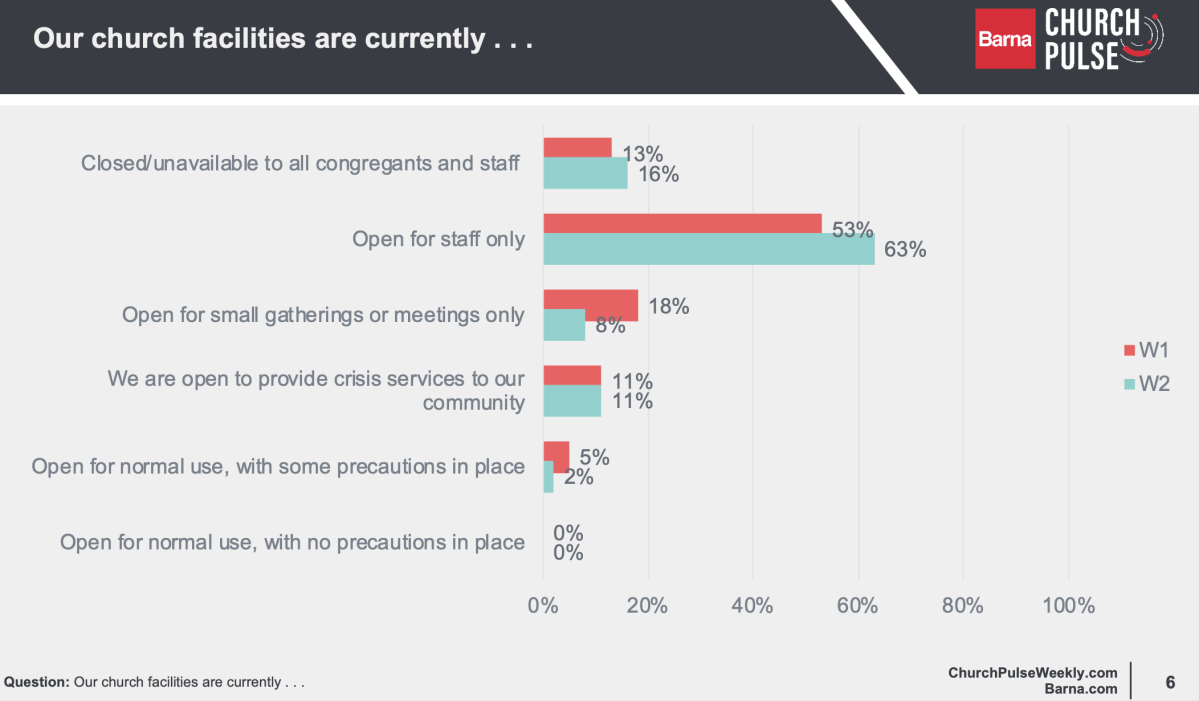
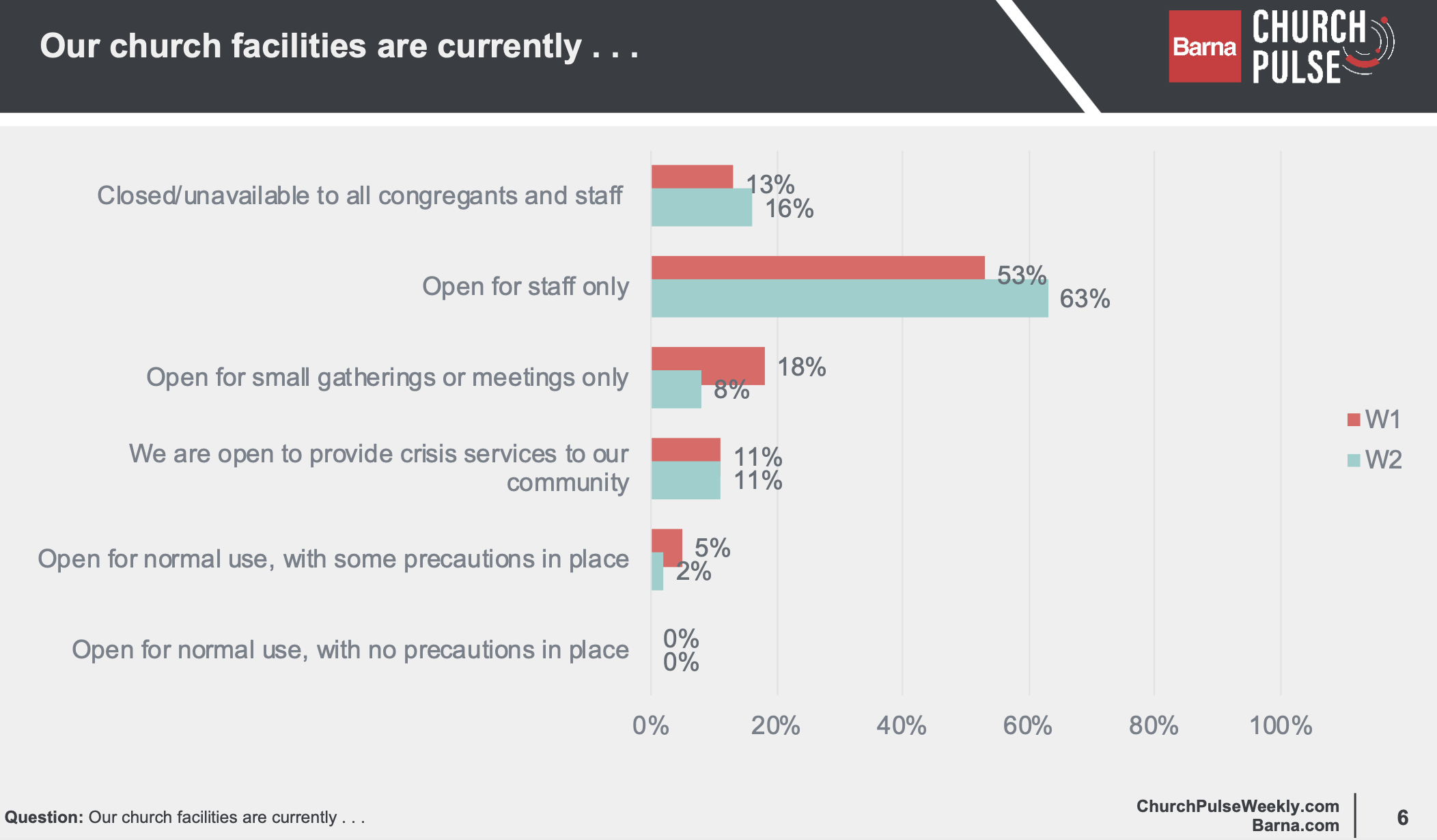
The percentage who still allow the church building to be used for “small meetings and gatherings” has dropped by about half (from 18% to 8%), according to Barna’s Church Pulse survey, hearing from 434 Protestant senior pastors and executive pastors in the US. A plurality say the church staff will be working remotely for the foreseeable future (up from 25% to 40%).

The question of restrictions (not just for worship but also staff meetings, Bible studies, even the group assembled to livestream services) has been an urgent one for pastors as more stories emerge of coronavirus spreading in church settings like choir practices and funerals.

A recent poll conducted by Denison University political scientist Paul Djupe and two fellow researchers found as many as 17 percent of US worshipers across traditions were still attending in-person gatherings of some sort as of early last week.

Compared to other traditions, evangelicals weren’t significantly more likely to say their churches were still open, but those who also ascribe to the prosperity gospel do have stronger feelings against churches closing to comply with government orders, a case which played out in Tampa on Monday. Nearly half of evangelicals with prosperity gospel beliefs agreed that “freedom to worship is too important to close in-person religious services due to the coronavirus even if more people die as a result.”

At this point, the vast majority of US Protestant pastors have closed their church doors and understand that ministry will be disrupted for months ahead. So the pressing questions have shifted to the state of their congregation as a whole, and what they as leaders can do to shepherd their disparate flock through an unprecedented time.

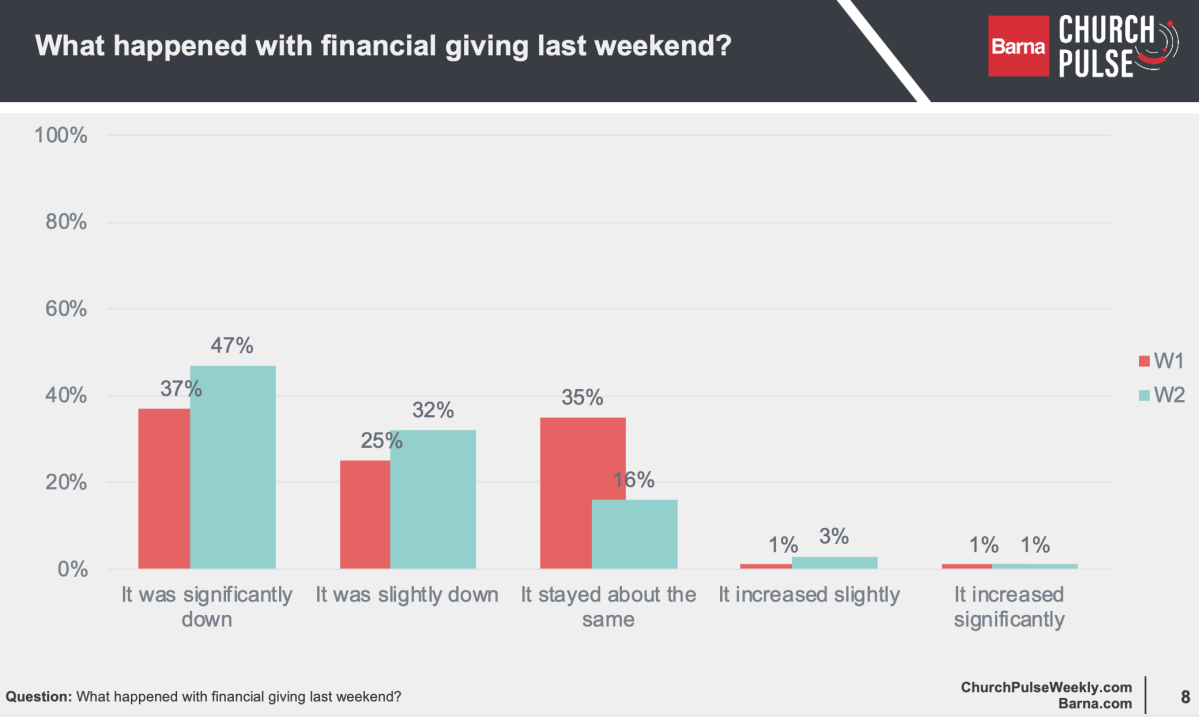
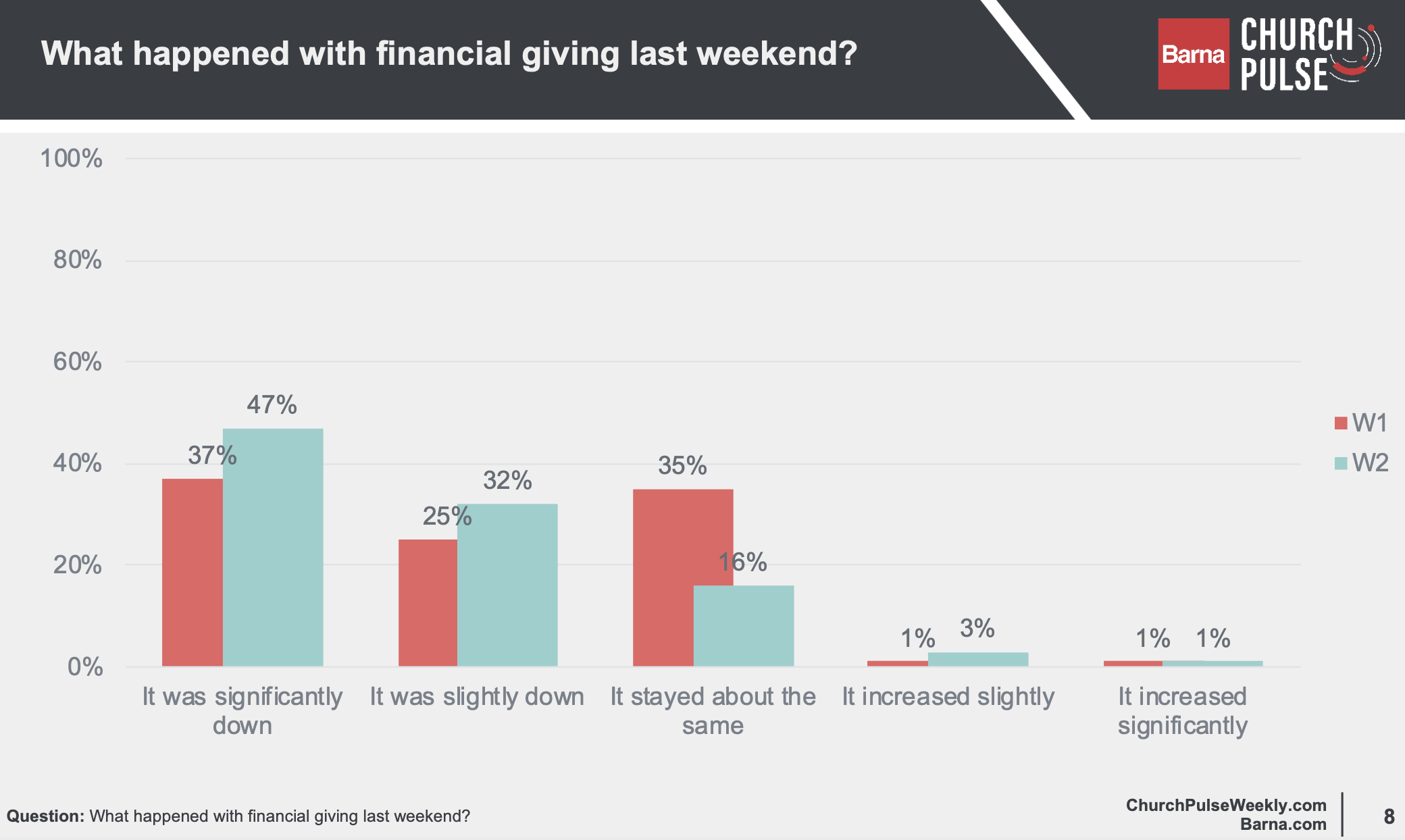
More than three-quarters of pastors surveyed by Barna over the past few days indicated that the coronavirus pandemic had affected the well-being of their church, up from two-thirds during the beginning of the March 20–30 survey window. Half (47%) say giving was “significantly down,” but only one in five (21%) have decided to cut staff hours. The vast majority (71%) say they have not been forced to make staffing changes.

Though they recognize the financial impact as giving levels drop, pastors said their biggest concern is their congregants: how to care for more isolated members from afar and, in worst-case scenarios, how to minister to the sick and dying. (In many places, even chaplains can no longer visit patients.)

What about the people who live alone? The depressed? The sick? Those who have lost loved ones? It feels like just at the time when their congregation really needs pastoral care, they aren’t able to be with them as they typically would.

“I am primarily concerned for the health of our people, particularly those in high risk categories,” said Chris Taylor, teaching elder at Christ Church Bentonville in Arkansas. On his social media feeds, Taylor shares daily clips of driving to congregants’ homes to greet and check in from a distance.

“I am not concerned for us as a body,” he said. “I actually expect us to be strengthened and encouraged by our responses both individually and as a whole.”

Taylor’s outlook reflects what fellow pastors in the Barna survey: 95 percent are confident that their church will endure the pandemic and nearly all say it will not diminish their congregants’ faith, with 42 percent saying it is growing stronger as a result.

Erik Koliser, who pastors the West Campus of Center Point Church in Lexington, Kentucky, brought up the challenge of meeting the “large-scale needs of my church and community,” but said that things have gone better than he expected. “I have to admit I’m quite proud of my church with this so far,” he said on Monday.

Kinnaman at Barna said that without the weekly in-person church gathering, many pastors have had realized how much they counted on seeing people in the pews as a sign of the health of the congregation. “One of the long-lasting impacts of this crisis is that leaders will have to use better tools to stay connected with their people,” he said.

Ed Stetzer, director of the Billy Graham Center, saw similar challenges as more than 1,500 pastors responded to a recent survey around church life amid the COVID-19 outbreak.

“While pastors might have been looking for information or encouragement in the early days of the epidemic, their overwhelming request is for practical advice,” Stetzer wrote on his CT blog, the Exchange. More than half of pastors specifically were looking for resources around ministry outside of Sunday services and traditional face-to-face outreach.

News
Wire Story

Samaritan’s Purse Sets Up Field Hospital in Central Park

The ministry’s temporary setup will help alleviate the anticipated surge in COVID-19 patients in New York.

Christianity Today March 31, 2020
Stephanie Keith / Getty Images

A series of white tents went up in New York’s Central Park this weekend as workers assembled a 68-bed emergency field hospital for people infected with the coronavirus.

The field hospital, which is expected to open today, will allow Mount Sinai Hospital on 98th Street and Fifth Avenue—just across the street from the park—additional surge capacity as New York City grapples with an overstretched hospital system.

Samaritan’s Purse also set up a field hospital in Cremona, Italy, in the hard-hit Lombardy region, where it has treated more than 100 people.

New York’s death toll from the coronavirus surpassed 965 on Monday—the most of any state. It had nearly 60,000 confirmed cases of COVID-19.

Samaritan’s Purse will staff the New York City hospital with 72 disaster response specialists from around the country, working as contractors for the organization. They include doctors, nurses, paramedics, lab technicians, and pharmacists, as well as a technical support crew.

“It’s not only that New York is overwhelmed and has a lack of patient beds,” said Kaitlyn Lahm, a spokesperson for Samaritan’s Purse, the evangelical humanitarian aid organization led by Franklin Graham. “It’s that staff are overworked. We will be fully self-sustained at the emergency field hospital.”

The field hospital will have up to 10 intensive care unit beds with ventilators.

Several trucks left the organization’s North Wilkesboro, North Carolina, warehouse Saturday morning and arrived in New York City that night. By Sunday, it had recruited dozens of New York City church volunteers to help set up the hospital. They worked throughout the day to unpack crates, drive stakes into the ground, and lay down plastic flooring.

The makeshift hospital will have electricity, heating, water, and a fully staffed pharmacy and lab.

Cory Maxwell-Coghlan said he got a text asking if he’d be willing to volunteer Sunday morning. The 38-year-old director of the Faith and Work Center at Redeemer Church in New York City was among about 40 local volunteers who helped the North Carolina team.

“I’m not a medical professional, so I can’t do much,” said Maxwell-Coghlan. “But it felt really good to contribute in some way—to be useful.”

He said several New Yorkers stopped by as the teams were assembling the hospital and snapped photos.

“It’s not something you would expect in a fairly affluent neighborhood of New York City on the Upper East Side,” he said. “These hospitals are usually deployed to developing countries. It felt eerie to do that.”

The first field hospital set up by Samaritan’s Purse was deployed in 2016 in response to the earthquake in Ecuador. The organization also set up an emergency field hospital about 12 miles from Mosul, Iraq, during the 2016–17 battle for the city. Last year, it installed a field hospital in the Bahamas in response to Hurricane Dorian.

Lahm said Samaritan’s Purse is now in the process of acquiring materials for a third field hospital.

News

A Christian History of Pandemics

How the church has responded to disease throughout the centuries.

Christianity Today March 31, 2020
Kean Collection / Getty

Church history is intertwined with plagues. Read about what healthcare looked like during the Roman Empire, how Christian communities responded to outbreaks like the Black Death by persecuting Jews, and how the modern church approached the AIDS crisis.

Ideas

Apart Is Temporary. Together Is Forever.

President & CEO

Jesus’ love knows no borders.

Christianity Today March 30, 2020
Illustration by Mallory Rentsch / Source Images: saemilee / Getty Images

For today’s musical pairing, listen to “S.T.A.Y.” from Hans Zimmer’s “Interstellar” soundtrack. Note that all the songs for this series have been gathered into a Spotify playlist here. See video below.

“The Spirit you received does not make you slaves, so that you live in fear again; rather, the Spirit you received brought about your adoption to sonship. And by him we cry, ‘Abba, Father.’”Romans 8:15

“Amen. Come, Lord Jesus.”Revelation 22:20

Day 9. 775,306 confirmed cases, 37,083 deaths globally.

My youngest daughter was born on the other side of the world to a family I never met. Since her heart had not formed properly, she was left in a baby safe-house outside an orphanage and eventually found her way to people who produced the funding needed for life-saving surgery. Americans and Chinese, most of them followers of Jesus, helped her heal and grow.

She was three years old when her picture appeared on our Facebook feed. She needed a home and a “forever family.” My wife and I did not need to make a decision. We simply recognized our daughter.

Adoption is a mysterious thing. It’s not a resolution to form something new. It’s a realization that something beautiful was already formed, and we are only now beginning to realize it. My wife fought like a lioness to bring her home. “My child is stuck in another country,” she said. Our little girl called me Baba (“daddy”) when we spoke across computer screens. Although we started on opposite sides of the planet, separated by oceans and borders and languages and cultures, somehow she was a part of our family from the very beginning.

So we made our way around the world and found a little girl who was 37 inches and 39 pounds of laughter and energy and determined affection. Then we brought her home. We were apart for a little while, and now we are forever family.

You say, O Lord, we are adopted. As we watch the virus reaching swiftly across the face of the Earth, as we see it take root more firmly in our own soil, we take comfort that you have made us your children.

When you look upon us, you do not see strangers. You see your sons and daughters. You loved us before we knew you existed. You see our suffering.

Perhaps it feels like we are in a foreign land. Isolated and alone, unloved and unsheltered and vulnerable to the whims of fate. Perhaps it feels like our hearts are failing us. Like we cannot breathe, cannot rest, cannot find our way to safety.

So we take comfort, Jesus, that you are a Savior who comes to us. No matter how far we feel from you, we are yours and you are ours. Even if we were on opposite ends of the universe, somehow our cry would reach your ears and you would find your way to us.

And when we leave this place, whenever that day may be, it will be a day of rejoicing. You will not lead us to a strange country. You will lead us to the home we were always made for.

Apart is temporary. Together is forever. Give us strength in our apart and joy in our together.

Sign up for CT Direct and receive these daily meditations—written specifically for those struggling through the coronavirus pandemic—delivered to your inbox daily.

News
Wire Story

Florida Pastor First to Be Arrested for Defying Coronavirus Order

Misdemeanor charges against Rodney Howard-Browne set up legal battle over right to worship in a pandemic.

Christianity Today March 30, 2020
Chris O'Meara / AP

Florida officials have arrested a megachurch pastor who allegedly held two Sunday services with hundreds of people in violation of a safer-at-home order in place to limit the spread of the new coronavirus.

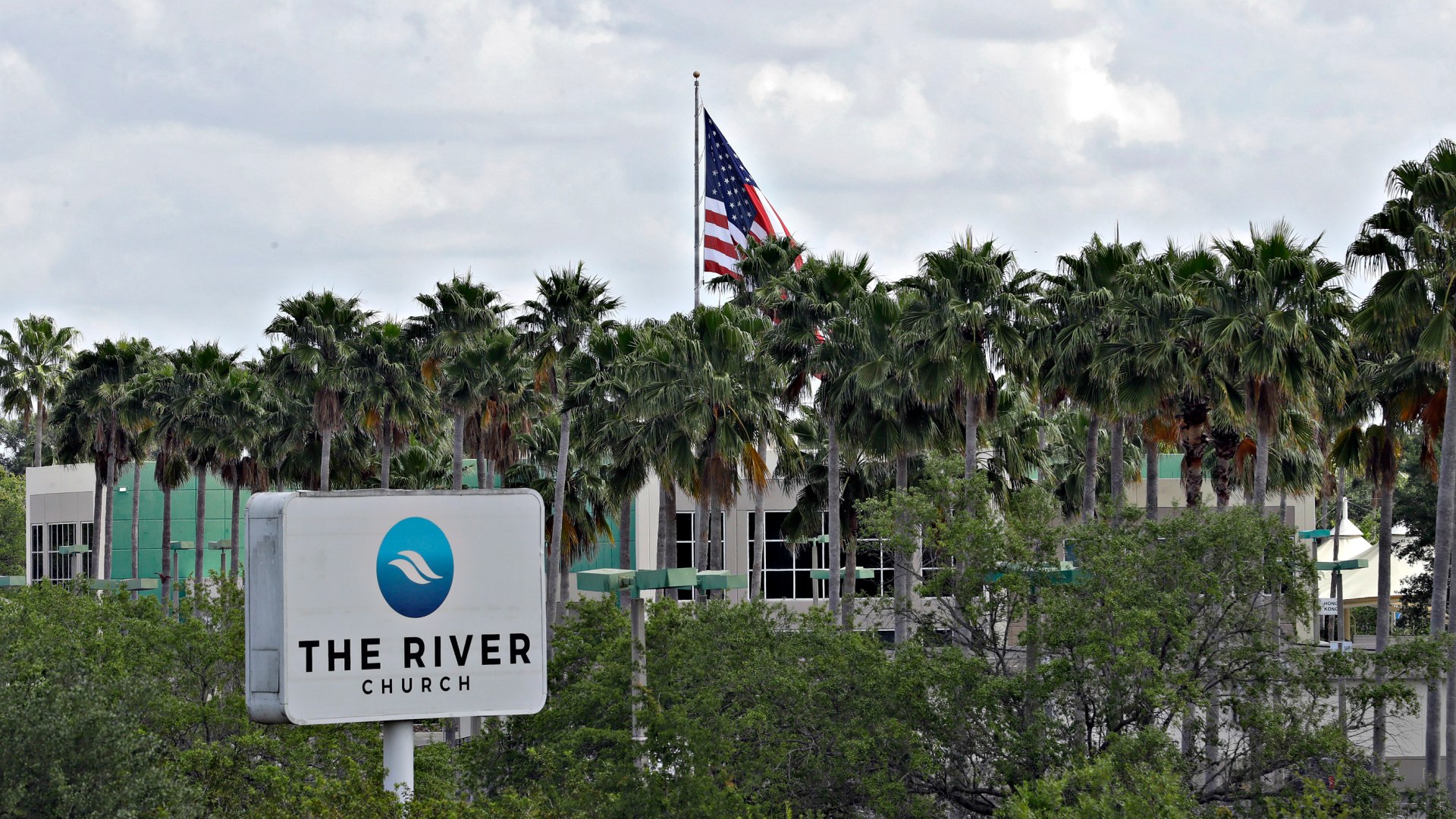
Rodney Howard-Browne turned himself in to authorities in Hernando County where he lives on Monday afternoon, according to jail records. He was charged with unlawful assembly and violation of a public health emergency order. The two misdemeanors carry a possible maximum sentence of 60 days in jail and a $500 fine.

Hillsborough County Sheriff Chad Chronister said his command staff met with leaders of The River at Tampa Bay Church about the danger they are putting themselves—and their congregation—in by not maintaining appropriate social distancing. The sheriff’s office also placed a digital sign on the road near the church driveway that said “practice social distancing.” But Howard-Browne held the services anyway, according to detectives.

“Shame on this pastor, their legal staff, and the leaders of this staff for forcing us to do our job. That’s not what we wanted to do during a declared state of emergency,” Chronister said. “We are hopeful that this will be a wakeup call.”

Several churches across the country have boldly violated gathering restrictions and stay-at-home orders to continue in-person worship, but Howard-Browne at The River is the first to face punishment for doing so.

Recent research shows 1 in 10 Americans say their house of worship is continuing to gather in person, according to data reported last weekend by Deseret News.

The church has said it sanitized the building, and the pastor said on Twitter that the church is an essential business. Howard-Browne defended the church’s right to gather for worship and attacked the media for “religious bigotry and hate.”

Howard-Browne is a controversial Charismatic preacher associated with the prosperity gospel and known for promoting uncontrolled laughter—called “holy laughter”—as a manifestation of the presence of the Holy Spirit. He is originally from South Africa, and is a vocal supporter of President Donald Trump.

Howard-Browne has also preached a number of conspiracy theories, claiming without evidence that the CIA trains ISIS fighters in the United States, and that vaccines are part of a secret plot to sterilize people, and that there was a secret assassination attempt on President Trump. He has also promoted wild theories about forces controlling the coronavirus.

Emergency rules instituted by county and state government ban all meetings of 10 or more people, including those held by faith-based groups. Health officials say this will help limit the spread of COVID-19. A live stream of Sunday’s three-and-a-half-hour church service showed scores of congregants at The River.

On March 18, the church called its ministry an essential service, just like police and firefighters, and said it would keep its doors open.

In a Facebook video Sunday, Howard-Browne said “it looks like we’re going to have to go to court over this because the church is encroached from every side.”

“This is really about your voice. The voice of the body of Christ,” he said. As recently as last year, Howard-Browne’s church hosted an event with Paula White Cain, who was named an advisor leading President Donald Trump’s Faith and Opportunity Initiative. She’s also an unofficial spiritual advisor to the president.

Books
Review

A Year of Suffering and Soul-Searching in Sutherland Springs

How does a God-fearing, gun-friendly church recover from a horrific mass shooting? Long after the camera crews departed, a Texas journalist stuck around to find out.

Christianity Today March 30, 2020
Illustration by Mallory Rentsch

Frank Pomeroy, pastor at First Baptist Church of Sutherland Springs, Texas, was away for the weekend when he received a text message alerting him that a gunman had just attacked the church during Sunday worship. Among the dead was his own daughter, Annabelle.

Sutherland Springs: God, Guns, and Hope in a Texas Town

Sutherland Springs: God, Guns, and Hope in a Texas Town

Hachette Books

304 pages

$11.49

“By noon,” as Texas journalist Joe Holley writes in his new book recounting the massacre and its aftermath, “Frank was in his truck barreling down I-35, every mile a rolling kaleidoscope of memories … [He] began to separate out the feelings of pain and desperation that threatened him from the practical steps he knew he had to take in the next few hours, the next several days.”

Holley, columnist for the Houston Chronicle and a Pulitzer Prize finalist for his columns on Texas gun culture, was at a book signing when he learned about the shooting. Driving home afterwards, he heard all the terrible details on the radio: “A Baptist church. Multiple deaths. Sutherland Springs.”

Soon enough, a clearer picture of the carnage—and an outline of the trials to come—was emerging: “Twenty-five friends and loved ones had lost their lives … A pastor who knew and cared about those broken people needed to preach their funerals. Twenty of their friends and loved ones were in area hospitals, some still fighting for their lives; they needed visiting and their families needed consoling.”

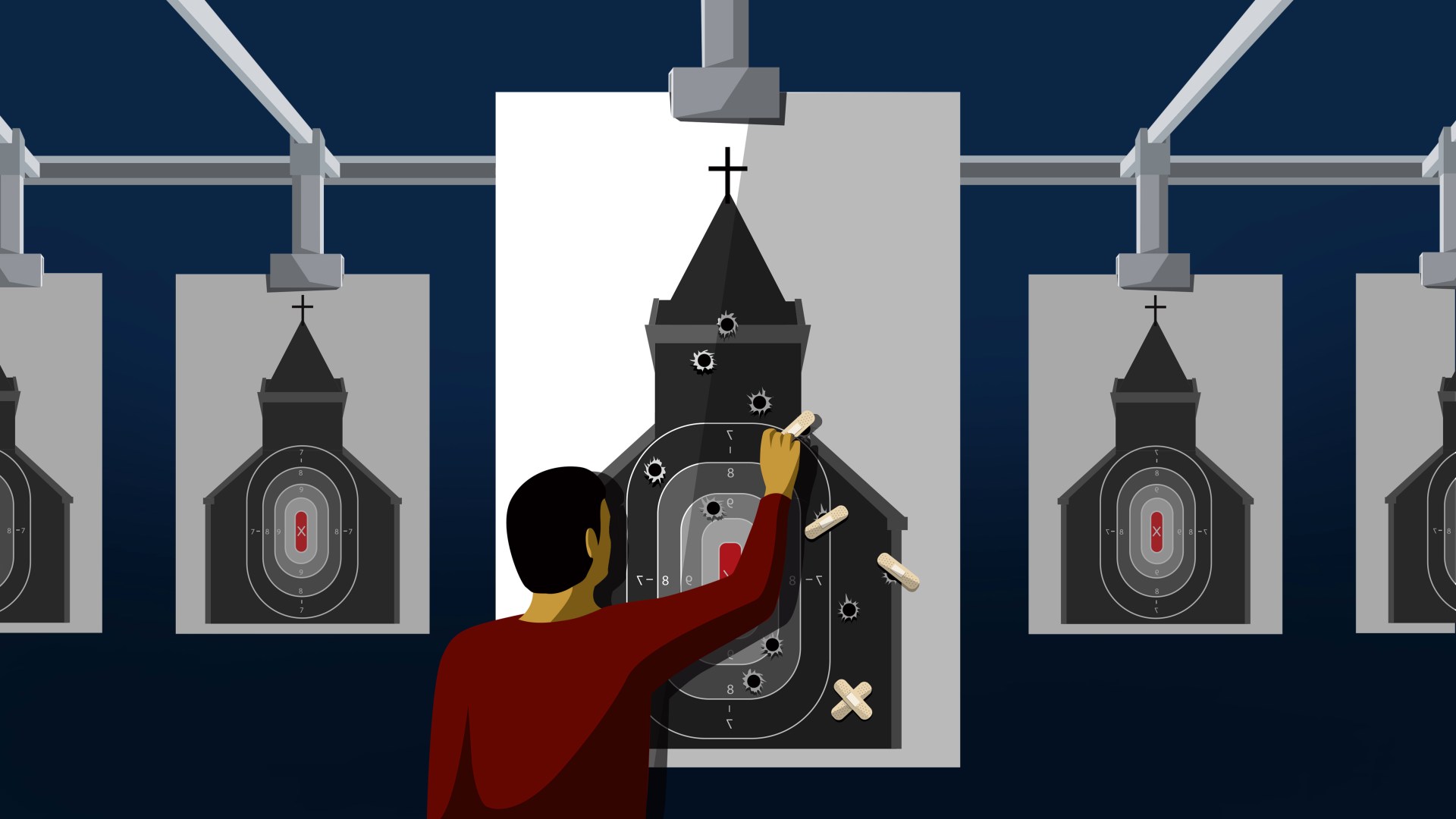
When Holley saw the exit for I-35 he began driving toward the small town. He would spend the next year of his life there, remaining long after most reporters had left. The resulting book, Sutherland Springs: God, Guns, and Hope in a Texas Town, paints a picture of tragedy, despair, faith, and resilience. But Holley also shows the systemic failure of American society to protect places like Sutherland Springs, one that left the small congregation totally alone and exposed to terror.

‘I Choose Forgiveness’

What happened within the four walls of First Baptist Church on November 5, 2017 was a paroxysm of violence unlike anything any human, save soldiers in the fiercest of combat, ever encounters. For the handful of worshipers trapped by the attacker, it must have felt like the devil himself had appeared in their midst, tearing apart the very fabric of reality.

Holley’s re-creation of gunman Devin Patrick Kelley’s rampage is as shattering an experience reading a book as you’re likely to ever have.

Waves of bullets, like swarming angry hornets, streamed through the walls and shattered windows …

[Kelley] moved to the right side of the sanctuary and began firing single shots into people huddled beneath pews. He was killing at point-blank range …

[Julie Workman] could tell he was wearing military gear, all black … He seemed to target children, aiming at their heads. Precious little ones she thought of as her own were being pulverized before her eyes.

The shooter moved toward Joann Ward, thirty, who was lying between pews atop three of her children, like a mother hen sheltering her chicks. He shot Joann and killed her, and then kept firing through her body to make sure he killed her children.

Four times bullets burned into [Farida Brown’s] legs. Four shots hit the woman to her right. Farida held the woman’s hand as the bullets slammed into her. She tried to comfort her, assuring her that soon it would be over, that soon she would be in heaven. The woman lay still, tears streaming down her face.

The carnage continued until 26 members of the church were dead.

Holley spends considerable time recounting the shared experiences in the life of the church before the shooting occurred: the potlucks, the Bible studies, the weekend and weeknight services, the home visits, the joy of their worship, the communal way they raised their children and cared for their sick.

Many of the activities centered on sharing meals together: breakfast before Sunday worship, dinner before Thursday Bible class, the Pomeroys cooking Thanksgiving dinner, Pastor Frank manning the barbecue pit for Vacation Bible School. In most cases, calling a church community an extended family can sound fairly cliché, but in the case of Sutherland Springs it was often literally true. As Holley soon discovered, “interfamily marriage entanglements make it hard for newcomers to figure out who’s related to whom.”

He adds, “They worship and study the Bible together several times a week, they eat together, they vacation together, go on hunting trips together, watch the Super Bowl together. Sunday after Sunday, month after month, year after year, their lives layer with familiarity, interdependence, and affection.”

Holley admits that he thought he’d find relationships broken by the tragedy, and he was surprised when “their community, their ‘communality,’ held firm. The remnant found strength in its faith and common purpose.” They would need every last thread of strength these bonds afforded. “As the weeks passed,” Holley continues,

I saw people laugh and joke and enjoy themselves. I saw children and adults come to church one Sunday morning dressed like pirates, greeting each other with a fearsome “Aargh.”

I saw happiness break through often. And, just as frequently, I saw sadness. I saw people wander down the aisles of the sanctuary on a Sunday morning and suddenly stop and embrace someone, tightly, in tears, for minutes at a time.

The faith, trust, and resilience the congregation exhibited over the following months, as members began to reassemble the fragments of their broken lives, is simply unfathomable. As Holley recalls, “I don’t know how many times I heard, in sermons, prayers, and supplications, in interviews and conversations, some version of the following: We don’t know why it happened, but we trust that God has a plan, and someday we’ll understand.”

It is difficult for an outsider to hear these expressions of faith and forgiveness without a profound sense of disbelief, and Holley admits his difficulty with these conversations. “At first I found it incredible, almost infuriating … and yet who was I to question the depth and sincerity of their belief—and their grief. I could only listen and try to understand.” He adds:

Still, their suffering and their soul searching were nothing if not profound—and profoundly in the tradition of humankind’s age-old dilemma. They distilled the ancient existential questions into one agonizing word, the word long-suffering Job uttered in the midst of his inexplicable agony: Why? Their answer—or rather their un-answer—could be distilled in one word, as well: Trust.

Perhaps most stunning is how faith led the members of First Baptist to forgive the man who brought this horror upon them. As Holley reports, at a Bible study held after the shooting, a member named Elizabeth Briggs asked, “Should we include the forgiveness of that man who to me was demon-possessed? Should we have a cross up there for him?” She and other members answered with a resounding yes.

The church placed blame for their suffering directly at the feet of a figure familiar to evangelicals across the earth: Satan. As Pastor Frank said to his congregation, “We must be doing some real bottom-kicking; otherwise, he would have passed us by.”

At a service six months after the shooting, he preached, “There shall be life. I’m not saying it’s simple. I’m not saying it’s easy. But I’m saying that God has given us the ability to do so. I choose life. I choose peace. I choose forgiveness.”

‘Do Your Duty’

In recreating the events that led to the attack, Holley shows that the violence at Sutherland Springs was the end result of a systemic collapse that enabled Kelley, the attacker, to wield weapons he never should have been allowed to legally possess. Most infuriating is the incompetence of the United States Air Force, which failed to report Kelley, a former enlistee, to the FBI for domestic assault and child abuse on multiple occasions.

Instead, Kelley was able to purchase the assault rifle and enough ammunition to unleash more than 700 rounds, multiplying exponentially the carnage inside the small sanctuary.

In addition to the failures of the Air Force, Holley mentions two others incidents after Kelley’s discharge, related to animal cruelty and sexual assault, that were “serious enough to block a gun purchase.” Local authorities neglected to investigate either case.

The cruelest cut of all occurred during the attack itself, when victims repeatedly dialed 911 and got no response. First responders didn’t arrive until after Kelley had fled the scene.

In the seconds after the shooting ended, Julie Workman, a nurse, began moving from victim to victim, looking for people she could help. Holley vividly recreates the scene:

The first seven people she approached were dead. She got to Brooke Ward; the five-year old was beyond help. Julie began screaming.

From several pews away, Gunny [Macias, a retired Marine sergeant] rose up. He was drenched in blood. “Julie!” he ordered. “Do your duty!”

“Let me cry and scream over this baby,” she said to herself, maybe to Gunny. “Then I’ll do what I’m trained to do.”

She went back to work. Twice more, anguish overwhelmed her. Twice more, Gunny rose up and ordered her back to work. “Julie! Do your duty!”

In the end, Julie Workman, the other members of the church, and a neighbor across the street were the only ones who did. That neighbor was Stephen Willeford, who heard the rapid fire of Kelley’s weapon and ran outside, clutching his own assault rifle. In a scene Holley renders in heart-stopping detail, Willeford shouted to get Kelley’s attention and shot him twice, critically wounding him before the gunman sped off in a Ford Expedition.

Undoubtedly, lives were saved by the bravery of Willeford, the quintessential “good guy with a gun.” But of course this only raises the question of whether there are legal reforms that might keep guns away from the bad guys before the good guys are obliged to come to the rescue. Is the unrestricted right to own weapons, specifically assault rifles designed to inflict maximum damage to the human body, worth leaving the door open to the kind of mayhem that played out in Sutherland Springs? It is impossible to read Holley’s book without considering how many religious Americans regard the right to own firearms not just as a constitutional guarantee but as something of a divine imperative.

Common-Sense Conversations

Among the townspeople of Sutherland Springs, the conviction that gun control wouldn’t curb violence was widespread, even after the shooting. These are gun people. Pastor Frank wears a pistol on his hip band when he stands behind the pulpit. Speaking to Focus on the Family founder James Dobson on his national radio show Family Talk, shooting survivor David Colbath applied the “good guy with a gun” principle to issues of school safety. If you “don’t want armed teachers and armed personnel in there,” he said, “then you’re [telling] me as a school district or whoever that you don’t want people that are armed protecting our kids….You show me how you’re going to protect them. Your way is not working.”

Within this gun-friendly consensus, however, there was room for a few notes of hesitancy. Colbath conceded, in Holley’s telling, that “law-abiding gun owners need to resist the NRA’s all-out obstinance.” And as pastor Frank told NPR, “I am one of the few that do believe that there’s not much use for automatic weapons in the hands of civilians.”

For his own part, Stephen Willeford, who was invited to the State of the Union address and spoke at the NRA’s national convention after his heroics outside the church, remained fiercely pro-gun, telling Holley, “I met [the attacker] with the very same gun that he had. There’s only one thing that stops a bad guy. That’s a good guy.”

That’s a great quote for the evening news. Unfortunately, it overlooks certain facts about the United States, where massive gun ownership numbers go hand in hand with elevated rates of gun-related deaths, measured against many nations where tighter gun restrictions exist. Furthermore, as Holley details, mass shootings occur with alarming frequency in Texas, whose gun laws are among the most permissive in the nation.

Not everyone affected by the shooting was as sanguine about Texas gun culture as Willeford and most residents of Sutherland Springs. Kati Wall, a teacher who lost the grandparents who raised her in the attack, published an editorial in the Dallas Morning News urging Texas Governor Greg Abbott to consider various gun-control and mental-health measures, including stronger background checks. She pushed government leaders to “value the lives of the American people over gun lobbies,” the better to “encourage common sense conversations that shut down the extremists.”

By carefully reconstructing the details of the shooting at First Baptist and faithfully observing the church’s long journey of mourning and recovery, Holley’s book makes its own important contribution to state and national debates over gun control. Decades of inaction amid recurring episodes of tragedy cast doubt on our willingness to embrace more forceful restrictions. Perhaps Sutherland Springs can renew our sense of urgency.

John B. Graeber is a writer living in Chattanooga, Tennessee, whose work has appeared at Curator Magazine, The Blue Mountain Review, Ekstasis Magazine, Nooga.com, and Fathom Magazine. His poetry has been featured on Chattanooga's local NPR affiliate. He is also co-founder of Tributaries, a literary newsletter that explores the inspiration behind great writing. Follow him on Twitter: @jbgraeber

News

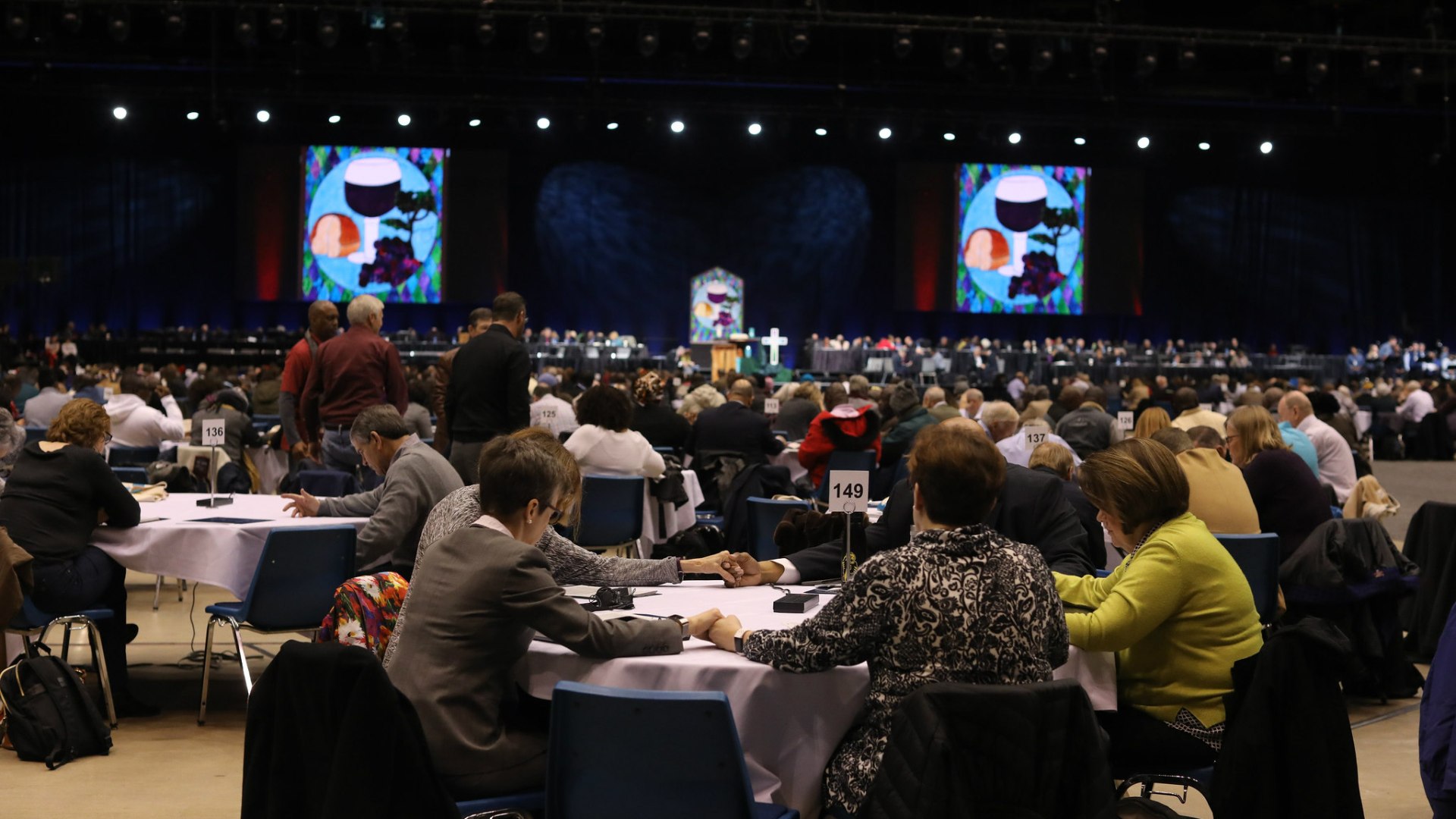
With Conferences Canceled, UMC Split and SBC Votes Wait for Next Year

Besides budget approvals, most denominational business can be rescheduled.

Christianity Today March 30, 2020
Kathleen Barry / United Methodist News Service (UMNS)

Major conferences held by the two largest Protestant denominations in the country have joined the long list of events canceled by coronavirus.

Last week, the Southern Baptist Convention (SBC) called off its annual meeting scheduled for June 9-10, its first cancellation since World War II 75 years ago. The week before, the United Methodist Church (UMC) announced it would have to push back its quadrennial General Conference another year after its venue, the Minnesota Convention Center, canceled events through mid-May.

While members understand the circumstances, the decisions still come as hard news. Besides the denomination-wide fellowship and morale-building that happens at these gatherings, they are the vehicle for important decision-making affecting churches and ministries.

Leaders from both denominations say the delay puts some business on hold—but in most cases, the votes can wait. That includes the long-anticipated decision over how the UMC could split over irreconcilable differences on LGBT issues.

UMC split delayed

Postponing the UMC conference to 2021 gives leaders more time to deliberate their disunion. In January a group of traditional and progressive denominational leaders agreed on the “Protocol of Reconciliation & Grace Through Separation,” which proposed allowing conservative congregations to break away and form a new body. Rather than voting on the protocol in May, delegates will hold off until the 2021 General Conference.Many UMC churches had already begun to discuss whether to stay or go—with exiting churches keeping their buildings and taking $25 million to form the new denomination under the proposed protocol—but it’s unlikely any could afford to jump the gun and leave before the rescheduled vote takes place.

“I am confident that there are congregations that are frustrated, disappointed, and even angry at the delay,” said Keith Boyette, president of the Wesleyan Covenant Association (WCA) and one of the leaders who helped develop the protocol. “There is not a vehicle for them to depart the denomination in the absence of the protocol that’s not very costly.”

Even if churches stay put for the time being, some worry individual members may not.

“The primary concern I have is that there are a lot of people who are going to say, ‘I’m not willing to wait any longer,’” Jay Brim, a lay delegate from Texas, told UM News.

Mark Tooley, president of the Institute for Religion and Democracy, said postponing the vote on the protocol gives churches more time to discuss and plan for the future.

The general conference was also the chance for United Methodists to elect new members of its Judicial Council and approve the budget for the next four years.

While the election is delayed, the budgets needed to be approved so ministries could continue operating into 2021. On Friday, the General Council on Finance and Administration extended the same apportionment calculations approved by the 2016 General Conference for another year, with some concern that ministries would need even more funding under the demand of the COVID-19 pandemic.

Southern Baptists and sexual abuse

In the case of the SBC, the work around its highest-profile issue in recent years—combatting abuse—goes on regardless of whether the whole convention assembles or not. Churches and state conventions will continue to train through its Caring Well curricula, and the credentials committee will keep evaluating reports of churches that disregard denominational standards on sex abuse, race, or theological issues.

After the committee gathered in February, just one church was removed from fellowship for a blatant violation: employing a known sex offender whose victims were pre-teen girls. It’s possible that at the June annual meeting, where motions can be made from messengers on the floor, someone could have challenged the efficacy of the committee, which only evaluates claims submitted to it and “has no investigative authority or power.”

Though mishandling sexual abuse has already been grounds for dismissal from the denomination because it violates the Baptist Faith and Message, the SBC will have to wait for the second of two consecutive votes to confirm a constitutional change to call it out explicitly.

That, as well as the rest of the business on this year’s SBC docket, will be moved to the 2021 convention, which is scheduled for June 15–16, 2021, in Nashville.

The Executive Committee, which is tasked with deciding on convention business in between annual meetings, will have the option to vote to approve the annual budget at its next meeting, currently scheduled for September.

And while convention-wide voting cannot take place anywhere outside the in-person annual meeting, some other elements of the 2020 gathering may be shared in different formats. The annual reports given by missional entity heads and seminary presidents will be compiled into a digital PDF to be shared in June, for example, and some related gatherings will take place over livestream instead.

But right now, most Southern Baptists are more worried about the state of their churches and communities under the coronavirus outbreak than anything that would have happened in a convention center in June.

“The work continues,” said Amy Whitfield, associate vice president for convention communications. “They have everything they need to do their jobs, and they are already on it,” with state conventions, local churches, and denomination-wide entities rallying resources and aid.

SBC President J. D. Greear, whose would have ended at this year’s meeting but will extend until 2021, urged churches to consider using the funds designated for sending pastors to the Annual Meeting to instead alleviate some of the financial strain for others, like helping a bi-vocational pastor or church planter make payroll.

Other denominations’ annual meeting plans

The Presbyterian Church in America (PCA) is still waiting see the intensity and duration of the COVID-19 pandemic before making a decision on its general assembly, scheduled for June 16-19 in Birmingham.

The International Church of the Foursquare Gospel (ICFG) canceled its Global Summit and Foursquare Connection 2020, scheduled for the end of May in Denver.

The Anglican Communion has postponed until next year its decennial Lambeth Conference to be held in Canterbury, England. The conference brings together bishops from around the world.

News
Wire Story

Black and Latino Church Planters Hit Hard by Coronavirus Shutdown

Because their congregations are less established, they risk losing significant momentum and funding.

Christianity Today March 30, 2020
Nicholas Castro / Lightstock

Pastor Kerlin Calderon knows that if the coronavirus shutdowns continue for another three months, it’s possible his church in the Bronx could be in trouble.

Weekly offerings keep dwindling. He worries that the church may have to dip into its savings to pay its rent. But he remains hopeful.

“You always have faith that you are going to make it, that God is going to provide because if God called you, then he will sustain you,” said Calderon, 35, pastor of Tabernáculo de Gracia (Grace Tabernacle).

Calderon, who grew up in Washington Heights, started the congregation three years ago when he noticed a lack of Spanish-speaking churches in an area where Catholic churches were shutting down.

What began with Bible study classes from people’s living rooms is now a church of about 150 members that rents space inside a Korean United Methodist Church. Next to the Korean church signage is Grace Tabernacle’s message: “Una iglesia en comunidad para la comunidad” (A church in community for the community).

As the novel coronavirus continues to spread across the United States, faith leaders have canceled worship services and shifted their ministries online to abide by social distancing guidelines aimed at preventing the spread of COVID-19. While megachurches and more established congregations likely have the financial resources to weather this pandemic, church plants may not have the means to do so.

This is concerning for Elizabeth Rios, executive director for Plant4Harvest, an organization that coaches and trains black and Latino faith leaders to start multiethnic churches in urban communities. But she is motivated by the way startup churches are advocating for their flocks during this crisis. Black and Latino churches, Rios said, have a history of rising up in crisis.

“Honestly, I’m excited and hopeful because they have risen to the occasion,” said Rios. “I haven’t seen church planters give up hope or throw up their hands and say, ‘This is it for us.’

“They feel like modern-day disciples,” she added. “They’re going to revolutionize how we do church.”

Church planters skew younger and can adapt more quickly to change, Rios said. She has seen these churches approach an “everybody is a minister” mentality. One church divided attendees into groups of about 15 people and designated leaders to check if their groups were in need of prayer, food or any other supplies.

Younger churches have also quickly adapted to online ministry because they were already doing it, she said.

Still, there are big challenges.

“For regular-sized churches and megachurches it will impact them, but it won’t wipe them out,” Rios said. “This has the potential to wipe out church plants.”

Some church plants didn’t have automated or online giving set up, Rios said. There are also others who just started their churches and have not yet established deep ties in their communities. One pastor, for example, signed a lease just three months ago to operate a new church, Rios said.

“People may not necessarily feel as engaged because you still are new to them,” she said.

Troy Davis, who planted a church in Atlanta, knows the struggle. He rented a space from a school to operate his church, which closed nearly two years later due to lack of resources.

The rent was too pricey, he said.

“It’s already rough for us to plant a church where the church is needed,” said Davis, who works with youth and people who are homeless. “Then you tackle something like a pandemic, it becomes even harder because of lack of resources.

“A lot of inner-city churches, our bread and butter (is) that we’re community. We stick together,” Davis added.

During a time when people can’t gather because of the pandemic, that fabric of community is impacted, Davis said.

Davis said pastors need to stick together and share strategies of how they’re adapting.

“Church planting is a lonely road already. It’s lonely. It’s competitive, which it shouldn’t be, but it is,” Davis said.

With something like the pandemic, Davis said “it could drive a wedge between brothers who are planting churches in the inner city to do well, but because we’re all fighting for resources, it becomes a church war.”

For the David Ramos, there’s both risk and opportunity during this pandemic. Ramos is an associate director for City to City in New York, an organization that trains pastors to plant gospel-centered churches in the city.

Many church planters, Ramos said, do not have the cash flow or reserves that more established churches may have.

“Many perhaps may not weather the storm because (of) the funding that’s going to impact them when they’re not meeting week to week,” Ramos said.

Part-time pastors are also under a lot of stress, working another job on top of leading their churches, Ramos said. With social distancing measures in place, some pastors are working from home while caring for their kids and families as well as trying to minister to their flock.

“It’s overwhelming to do that,” Ramos said. “As the tsunami of sickness begins to hit New York City, this is just going to get worse, because what’s going to occur is now we’re going to be (dealing) with death and dying.”

But Ramos also sees a silver lining.

A lot of church planters are run by a younger generation and have already been livestreaming, creating chat rooms and a larger virtual presence, he said.

“They are probably the vanguard of doing church in new ways,” Ramos said.

Ramos is encouraged by church planters who do this work “out of a sense of calling.” For the Latino church in particular, Ramos said it “has thrived in some of the most depressed neighborhoods.”

Churches of color “have a history of operating with challenged environments” and “may actually be better able to rise up in the midst of crisis,” he said.

That’s what Calderon and his church Grace Tabernacle are doing.

Grace Tabernacle connected with the neighborhood housing project to gauge the needs of elders, delivering toilet paper, milk, and any other supplies.

Normally, their church hosts workshops on wellness and healthy eating. Now, they’re thinking of hosting virtual Zumba workouts that their members can access.

The younger members of the church are also FaceTiming with parents who now have the added task of helping their children with distance-learning school assignments. For some parents, there are language and technology barriers that have made that process difficult. In those video chats, church members have guided parents on how to use iPads their children have brought home from school.

They’re also there to just listen to their fellow church members over the phone.

“They just need somebody to encourage them to let them know that this will pass,” Calderon said. “As a church, we’re offering encouragement through prayer, through counseling. Just working with them and listening to them while they vent.”

On a normal weekend service, Grace Tabernacle members take a one-minute break to say hello to one another and exchange pleasantries. It’s like a “New York minute,” Calderon said.

Church members have joked that once this is all over, “We’re going to have ten New York minutes next time we meet.”

Apple PodcastsDown ArrowDown ArrowDown Arrowarrow_left_altLeft ArrowLeft ArrowRight ArrowRight ArrowRight Arrowarrow_up_altUp ArrowUp ArrowAvailable at Amazoncaret-downCloseCloseEmailEmailExpandExpandExternalExternalFacebookfacebook-squareGiftGiftGooglegoogleGoogle KeephamburgerInstagraminstagram-squareLinkLinklinkedin-squareListenListenListenChristianity TodayCT Creative Studio Logologo_orgMegaphoneMenuMenupausePinterestPlayPlayPocketPodcastRSSRSSSaveSaveSaveSearchSearchsearchSpotifyStitcherTelegramTable of ContentsTable of Contentstwitter-squareWhatsAppXYouTubeYouTube