News

Why German Evangelicals Are Praising God in English

Through worship, they can connect to the global body of Christ.

Illustration by Mallory Rentsch

English is the first thing you notice at Hillsong Berlin. The church was meeting at the Kino in der Kulturbrauerei—a movie theater in a historic brewery, just one tram stop from the last standing section of the Berlin Wall—but on Sunday night the sign out front said, “Welcome Home.” A smiling cadre of young, fashionable, and diverse volunteers from around the world greeted people in accented English.

Inside, the entire service is in English, including the sermon and all the worship songs. Participants sing “Wake,” “What a Beautiful Name,” and “King of Kings.” Most international Hillsong churches translate their services from the local language into English. In Berlin, there is no translation. The service is just in English. That isn’t Hannah Fischer’s first language, but that’s part of why she comes to Hillsong Berlin.

“People from outside Germany can’t really understand how awkward it is to be Christian here,” she said. “I could never praise God like that in my language.”

Five hundred years ago, Martin Luther insisted that Christians needed to hear the gospel in their own language, in words they could understand. When the Reformation swept Germany, people abandoned Latin worship for German prayers and praise.

Today, however, German Christians like Fischer are turning from their own language to a more global tongue: English. They say the foreign language allows them to loosen their German identity, praise God in an uninhibited way, and connect with a global, cosmopolitan Christianity.

Deborah Justice, an ethnomusicologist at Syracuse University, researched transnational evangelical groups in Germany, including Hillsong, Vineyard, and the campus ministry Cru. She found many are “choosing to worship in English as a globalized non-native language.”

These Christians, Justice wrote in an article last year, are adopting English as their special worship language, and that changes “how people are relating to their fellow congregants and to God.” When German evangelicals sing in English, “they understand themselves as singing in community with the millions of other Christians around the world.”

And sometimes those other Christians are not so far away. At the Leipzig English Church, a lot of worshipers are binational couples, and English is their common language, according to chaplain Martin Reakes-Williams. “People like the style, the international flair,” he said.

At Rhema Café, an Assemblies of God mission in Landstuhl, in the southwest, services are in English because the church is trying to reach US and NATO soldiers stationed in the area. “Service members from 28 NATO nations all speak English and their native tongue,” said pastor Timothy Carentz Sr. “Only the Germans really speak German, but they also speak English.”

At the Freie Evangelische Gemeinde (FeG, or “Free Evangelical Community”) in Bamberg, in central Germany, the congregation has a few expats and international students but is mostly made up of Germans. Worship leader Ben Häst still picks English-language worship songs like “Whom Shall I Fear (God of Angel Armies)” by Chris Tomlin or “In Christ Alone” by Keith Getty and Stuart Townend.

There are German versions of the songs. Worship books like the Feiert Jesus! feature German translations of Chris Tomlin, Matt Redman, and Hillsong, as well as works by German Christian songwriters, including Outbreakband, Lothar Kosse, and Arne Kopfermann.

“Some songs like ‘Indescribable’ and ‘10,000 Reasons’ work really well in German,” Häst said. For a lot of worship songs, though, “they are just better in English.” Besides, they are simple enough to understand with subtitles, and the words are “poetic and powerful.”

The lyrics might be simple, but there are occasional breakdowns in communication. “Just because Germans enjoy English-language music does not mean that they always understand it,” Justice said.

There can be awkward moments. The German translation may not match the English, or Germans may mispronounce tricky words like wounds or tears. Native English speakers may smile at such mistakes, but Justice said there could be larger theological consequences.

“If you’re trying to read, pronounce everything, sing along, and translate all at the same time, your brain is so busy,” Justice said. This may be okay when it comes to simpler, more repetitive songs, but if it’s concepts “like being saved through grace, not works,” she said, “people might miss the meaning.”

Worship leaders also receive pushback from time to time. Older members of FeG have asked Häst to “keep this English out of the German church.” They get upset because “they just don’t understand what’s going on,” he said, “and I can respect that.”

But he wants to encourage them to try singing in English. “It is a great enrichment,” Häst said. “Looking beyond our borders can be a great source of healing.”

Other German churches put a lot of emphasis on cultivating that international vision. At the charismatic Tübinger Offensive Stadtmission (TOS) in the southwestern town of Tübingen, church leaders felt led to embrace English and become a global and multicultural ministry. Markus Kalb, a worship leader at the church, said TOS changed about 15 years ago as leaders fasted and prayed about the community’s “dark, Nazi, antisemitic past” and its present prejudices. English worship, they felt, would help them take a different position toward people perceived as “foreign.”

Then in 2015, Germany saw a dramatic influx of refugees as nearly half a million people, mostly from Syria, Afghanistan, and Iraq, applied for asylum in the country. The politics of accepting refugees grew heated, even in small university towns like Tübingen. At TOS, leaders felt God had prepared them for this. Their English-language worship gave them “a way to interact with and welcome people of other nations,” Kalb said.

It’s not always so spiritual, though. Sometimes English just creeps into German speech, in a hodgepodge that Germans jokingly call “Denglish.”

“Our pastors use ‘Denglish’ all the time,” Kalb said. “Words like ‘powerful’ or even ‘worship’ are part of our language.” In a traditional invitation to worship, a minister might say Lasst uns ihn loben (“Let us worship him”), but at TOS a minister might say Lasst uns worship machen (literally: “Let us make worship”).

For the most part, though, the use of English is very intentional. “We know that to reach people in Germany—refugees, immigrants, students, newcomers, and youth—you have to translate it into the local, modern language,” Kalb said.

As Kalb sees it, this isn’t a break from the German tradition of Christian worship going back to the great hymns of the Reformation. It’s a continuation. Luther wrote that the gospel needed to be communicated “as though it were written yesterday,” and the evangelical churches are trying to do that too. Now, that means singing songs in English.

And if he were alive, Kalb said, “Martin Luther would do the same.”

Ken Chitwood is a writer and scholar of global religion living in Germany.

News

Even for Christians, Trump Has Become a Dating Deal-Breaker

More American couples set out to be “equally yoked” on political matters too.

Christianity Today February 14, 2020
Illustration by Mallory Rentsch / Source Images: Laura Chouette / Evelina Friman / Unsplash / Granger Wootz / David Jakle / Getty Images

True love waits … for a political match?

Half or more of white evangelicals say it would be impossible or very difficult to date someone with another view on abortion, religious freedom, or gun rights—their top dating deal-breakers, according to a new survey from the American Enterprise Institute (AEI).

The poll also found that most Americans—and most Christians across traditions—would be unwilling to date someone who had a different stance than them on President Donald Trump.

For decades, married couples have become increasingly united on political issues, and dating has taken a particularly partisan turn under the current administration. For believers, the instinct to make political party a prerequisite for a relationship is complicated.

“If a person prioritizes political leanings as much as faith, that’s not biblical,” said Greg Smalley, a Christian counselor and vice president of marriage at Focus on the Family. “God doesn’t prioritize politics. He prioritizes that we are equally yoked.”

Smalley advised Christian daters to determine what issues are the most important to them—starting with their basis in Scripture—and look where there might be room for compromise, realizing that the goal is not for couples to march in lockstep on every issue.

Religious freedom and abortion are the top issues for self-identified white evangelicals, with more than 6 in 10 saying it would be difficult to impossible to date someone who disagreed on either issue in the AEI’s American Perspectives Survey, conducted last month. Among other traditions, 44 percent of black Protestants and other Christians agreed that it would be difficult to impossible to date someone with another view on religious freedom.

Nearly half of white evangelicals (48%) also say conflicting views on guns would be a problem in their relationships, compared to 38 percent of Americans overall.

AEI surveyed over 2,600 adults, asking them to respond to the scenarios about a potential partner’s politics “even if you are not currently single or dating.”

https://datawrapper.dwcdn.net/

While Americans of different religious traditions prioritize different political issues as deal-breakers, they all believe it’s important for partners to be on the same side when it comes to the president.

Overall, 62 percent of Americans say they wouldn’t date someone who disagreed with their view of Trump. Black Protestants are the most adamant: Nearly three-quarters (74%) say they would refuse to do so. White evangelicals are little more split, with 55 percent saying they couldn’t be with someone with a different stance on Trump, and 45 percent saying they could, according to religious breakouts of the survey provided to CT.

Though he has led a church in the nation’s capital for 15 years, Duke Kwon said he has seen few couples who dated “across the aisle,” and even fewer who marry outside their political affiliation. The Grace Meridan Hill pastor said especially for those working in politics or government, it’s hard to develop a meaningful relationship with someone who doesn’t share your political values. “If [politics] is your day job and what your mind and time are wrapped around, it’s more difficult to be devoted to causes and views that are running in the opposite direction.”

Trump may not be driving a wedge between existing couples as much as opinions about the president keep couples from forming in the first place. As adults use social media to communicate political preferences, many singles filter out people with opposing political perspectives from the pool of potential matches before a date ever happens.

The dating site OkCupid reported a 64 percent increase in political terms appearing in users’ dating profiles after the 2016 election, and eHarmony found that mentions of the president’s name in profiles rose by 50 percent after Trump’s inauguration. “People who in 2015 said, ‘Politics isn’t that big of a deal to me’–they now have an opinion. That opinion largely came to be in reaction to Donald Trump,” eHarmony CEO Grant Langston told Global Dating Insights.

Political variance within relationships has been shrinking for decades. Researchers at Stanford and the University of Houston determined that in 1973, 54 percent of newlyweds shared similar political views, but by 2014 the percent of newlyweds who shared similar political views had risen to 74 percent. (No wonder there are now niche dating sites for conservatives and Trump supporters.)

“As millennials appear to be turning to politics to fill a role that religion once did, this issue of political perspective becoming a barrier between two potential spouses will only increase and become a greater problem in the church going forward,” Kwon said.

But when people look for others who completely share their political view, they can miss some opportunities to understand others and work through conflict.

When Christians date individuals who don’t share all of their political commitments, the ensuing conversations, tense though they might be, will provide insight into how each party handles conflict, a constant in relationships regardless of political opinions, Smalley said.

Plus, no matter how much two people might align on political issues now, it’s no guarantee for how they might feel about the same issue in a few decades, or even in the next administration.

"When you get married, you start growing and change,” Smalley said. “The only constant in marriage is that we are going to change, including opinions and stances on issues.”

Theology

My Husband Is Deconstructing His Faith. How Do I Journey with Him?

This Valentine’s Day, some of us are called to love unbelieving wives and husbands.

Christianity Today February 14, 2020
Paz Arando / Unsplash

In the fall of 2017, not long after we’d celebrated our 10th wedding anniversary, my husband and I sat down for an evening chat after getting the kids to bed. The particulars of the conversation are hazy now, but this was clear: After 30 years of being a Christian and spending almost half of that in ministry, my husband was leaving the faith. The faith that formed our marriage vows; the faith our children were baptized in; the faith we held when we buried a stillborn son; the faith our community was built around; the faith that my vocation is centered around as a spiritual director, writer, and speaker—he was leaving that faith.

I wanted initially to respect this news as his journey (even though it was mine, too), so I didn’t tell anyone. I also tried to keep the experience safe in my head so that I could think my way to answers in the newfound madness. My body, however, told a less cerebral story. I was driving home after a long day of errands when the full impact hit me: My eyes blurred with tears, and short breathes rolled through my chest. Two weeks had passed since my husband had dropped the “I don’t really believe there’s a God anymore” bomb. It took that long before I could even begin to feel the disorienting weight of his words and the betrayal, loss, and grief that came with them. This was clearly more than I could handle alone.

As I shared the news with some close friends and pastors, I felt plagued with questions: How do I tell the kids? What does this mean for their spiritual formation? How do we connect? How do I like him again? How did he get here? Why didn’t he tell me earlier? Will we still go to church together? Will we ever feel normal again?

In Letters to a Young Poet, the 19th century German poet Rainer Maria Rilke writes, “Live the questions now. Perhaps you will then gradually, without noticing it, live along some distant day into the answer.” As the spouse of someone who has lost faith in God, I am living the questions right now in hopes of finding future answers. But not everything is a mystery. Day by day, I’m learning how to love my husband in the midst of change. Over the last two years, I’ve learned these 10 lessons in particular:

1. Trust the work of the Holy Spirit.

Early on in the process, my husband came to me and told me he wanted to share his “anti-testimony.” Though I didn’t tell him, I felt appalled and disgusted. I brought those feelings to my much wiser spiritual director. She said to me, “It is only the Spirit’s work that opens up our heart to want to be known by others. His desire to be known is a gift.” Her words have remained with me and born fruit continually over these years.

As Adam Neder writes, “Our confidence that God will reveal himself … is grounded not in our own competence, character, or powers of persuasion, but in God’s desire to be known and in the eloquent presence of the risen Christ, who makes himself known in the power of the Spirit.” Although Neder is writing about the dynamic between a teacher and a student, his wisdom applies just as well to a spousal relationship. The work of the Holy Spirit is ever-present in my husband’s life, and I can trust that reality.

2. Get clear on what keeps you spiritually growing and then do it.

When my husband parted ways with Christianity, I began to feel spiritual loneliness in the space of my very own home. In that context, I’ve had to consider what keeps me spiritually alive. For example, my connection with my spiritual director has become increasingly essential to me. I also continue to cultivate practices that form me spiritually, like spending time in silence, engaging Scripture, praying, being in nature, reading spiritual formation books, and staying connected with my Christian faith community.

As you ponder your own faith story, think about what fills you up and keeps you open to the Holy Spirit. Stay in community with others who can support your journey and your spouse’s. And cultivate the relationships and practices that leave your heart open to God.

3. Slow down your life.

Two months after my husband declared his departure from faith, I found a new job as a chaplain, something I had always wanted to do. It was a great job and a good fit, but I quit after three months. It became clear to me that I was trying to escape my pain. Leaving that job was a repentance of sorts, not because a woman shouldn’t work or leave her child with a sitter (which I had to do) but rather because I was running from myself, from my husband, and from God. I had to stop the frenzy. I had to reckon with my body and my emotions, and I needed therapy to support the process.

Since then, we’ve moved to a smaller home and slowed our pace of life considerably. Making room for his process and my own has cost both of us, but it has also born significant fruit. We have more time to talk, ponder, and attend to our inner lives. I have more time to pray.

4. Practice hospitality.

Christ’s command to “love your neighbor” never hits home closer than when that person is the one you share a bed with. In split-worldview marriages, we need hospitality for ourselves and also for the deconstructing neighbor right next to us. When we allow ourselves to come as we are, that deep, honest well within brings forth genuine prayers and a closer connection with God. It also enables us to follow Jesus when he says, “Love your neighbor as yourself” (Mark 12:31, emphasis mine).

Although your spouse may be uninterested in Jesus in the formal sense, they’re unlikely to refuse genuine hospitality that comes in the spirit of Christ. In my own marriage, I practice this more than I perfect it, but nonetheless it’s worth every honest, humbling moment with my husband.

5. Stay out of resistance mode.

When someone leaves the faith, it’s easy to get into the habit of making apologetic arguments ad nauseum. Our mistaken belief that faith is primarily cerebral can lead us to center the conversation around theology, ontology, and philosophy in hopes of “winning them back.” These conversations are often (but not always) conversations of debate and resistance. Some of them are necessary, yes, but when they become the primary tool in our belt, we suffocate the wooing power of the Holy Spirit.

As we stay out of resistance mode, we can remain curious about their experiences and grounded when our differences feel insurmountable.

6. Remember their truest identity (and yours).

Genesis 1:27 says that “God created mankind in his own image.” The person you married is made in that image, irrespective of whether they embrace it. That means their truest identity is located not in their new worldview—whether atheist, agnostic, or other—but in the hand of Providence. The Apostle John develops this likeness by reminding us that “God is love” (1 John 4:7) and Paul notes that “all things have been created by him and for him” (Col. 1:16). Your spouse was made by Love and for Love, and there’s nothing you or they can do to change that truth.

When fear threatens to overtake me, I consistently rest my mind in this reality of God’s affection. My husband is loved far more than I can comprehend.

7. Create space for them (and you) to process.

Over the last few years, there have been weeks when my husband and I talked almost daily about faith followed by months when we let it rest between us. At one point, I had to place a conversational moratorium on philosophical and theological debate. I simply couldn’t carry the discussion while holding in my own heartache.

During those times, I’ve told him that I need a break from intense conversation but will gladly offer personal stories of my own faith journey if he asked. I’ve also learned to listen without judgment when he wants to share his own experiences. This practice of “creating space” has protected us individually and also relationally.

8. Develop a deeper friendship.

In any marriage, it’s helpful to cultivate shared interest. But these bonds are increasingly important when two married people have diverging worldviews. Whether riding bikes, enjoying nature or listening to live music together, my husband and I now take more time than we did before to develop our friendship. Enjoying the pleasure of his company is a fulfilling way to live into the glory and beauty of God, and it also eases the sting of knowing that we no longer share faith between us.

9. Keep praying for and discipling your kids.

Discipling kids is no small task with two spiritually aligned parents, and it’s even more difficult with two misaligned ones. One of my deepest desires is that my children will experience the love of Christ in their lives. Raising them with someone who is not even sure that is a “thing” creates a very unique challenge. Though my elementary-age children are not yet developmentally ready for heavy philosophical debates, they’re old enough to ask questions about theology and human origins. For the time being, I’m able to give space to their questions and discuss what Scripture offers.

When I read Scripture to my kids over breakfast almost every morning, my husband isn’t hostile, thankfully. He honors the fact that we agreed early on to raise our kids in the faith. At the moment, he’s chosen not to share his journey with them, so when they question him about church or his unwillingness to receive communion, for example, he simply answers, “I am working things out with God right now.” But we both know there will come a time when he’ll have to share his story. Until then, I am praying for and preparing their young, malleable hearts.

10. Lean into the body of Christ.

As I lean into my believing friendships and learn from my spiritual director and others, I gain the courage and wisdom that I need to cultivate a more loving family rather than a divided one. I’ve made a concerted effort to have my kids around other believers of all ages through family, friends, and church connections. The body of Christ has also given me a steady diet of sermons, rich readings, and communion experiences that keep me fed on multiple levels.

Through this journey, God has called me to practice the hardest part of Christian discipleship: letting go of the life I dreamed of and instead allowing the resurrection power of Jesus to rebuild new life in me time and time again. For me, this could never be done outside of the Body of Christ.

For those of us married to a spouse who is deconstructing the faith, their experience can feel like a problem to fix more than an invitation to heed. But more often than not, these problems can’t be solved, they can only be held. As we hold them in open hands, we in turn hold on to God and trust that he is holding on to us. He is the same God who is and always has been able to be and do “more than you could ask or imagine” (Eph. 3:20).

The process will be hard, there’s no way around that. But it can also be deeply good.

Kimberly Penrod Pelletier is a spiritual director, writer, speaker, and co-host of the Ask A Spiritual Director podcast. Connect with her at kimberlypenrodpelletier.com.

Church Life

Willow Creek and Harvest Struggle to Move On

The departures of Bill Hybels and James MacDonald leave churches waiting for new leadership and hoping to rebuild trust.

Christianity Today February 13, 2020
Digitalhallway / Getty

It’s been 22 months since Bill Hybels resigned from Willow Creek Community Church, and the Chicago-area megachurch—one of the biggest in the country—is still without a senior pastor.

The multisite congregation, once celebrated as a model and training ground for Christian leaders, has struggled to transition to steady leadership in the aftermath—leaving the well-being of its eight locations and thousands of congregants at stake as attendance and tithes dip.

In the fallout of Hybels’s departure over sexual misconduct allegations, the esteemed megachurch lost other top leaders: The church’s elders, as well as Steve Carter and Heather Larson, who were slated to be Hybels’s heirs, resigned the same year. Steve Gillen, who has served as interim senior pastor since then, recently announced his plans to step down next month.

And there’s no successor in sight. The new elders said in late January that after narrowing a months-long search down to two senior pastor candidates, they decided to release both and start over. (The announcement came with another blow as elders confirmed claims of inappropriate behavior by Hybels’s mentor, Gilbert Bilezikian, and the church allowed “Dr. B” to continue serving and teaching despite knowing the reports against him.)

The elder board has passed its goal of naming a senior pastor by the end of 2019 but hasn’t announced a public timeline for the continued search, only stating that “filling this pastoral role is the top priority.”

The current tumult at Willow Creek and at its greater Chicago neighbor, Harvest Bible Chapel, showcase how long lasting the effects of a fallen pastor can be.

“Dear Bill Hybels,” tweeted Sarah Carter, whose husband Steve was appointed preaching pastor after Hybels before also resigning when further allegations against his predecessor emerged. “Thank you for the gift of tucking my kids in as they weep & cry over friendships they can longer have, the home they had to leave, & the faith they’ve watched crumble. I give you & your assembly of lead staff & elders full credit for this current experience.”

Carter, who declined to comment for this article, has implored the current Willow Creek elders to “seek truth” and “repent.” She called the church’s mishandling of Bilezikian’s alleged abuse “the great & final breakup” with her former church home.

Initially, attendance was down 9 percent across all locations in the months after Hybels left in 2018. The church reported 21,000 attendees each weekend when it listed the senior pastor job last fall. But internal reports from October and February showed attendance totals around 18,000. (Five years ago, according to Outreach 100, Willow Creek was the fifth-largest church in the country, with a weekly attendance of over 25,000.)

The church’s revenue dropped by a third the year of Hybels’s resignation, from $89 million to $60 million, but its 2019 financial statement has not yet been posted by the Evangelical Council for Financial Accountability (ECFA).

Projected revenue targets at the main South Barrington campus have slipped year over year, from $685,000 a week in 2018 to $550,000 in 2019 to $535,000 this year. Six Sundays into 2020, the campus (one of seven) is 26 percent behind budget, bringing in just $2.37 million of a projected $3.21 million in weekly offerings.

The church’s spokeswoman declined to comment on attendance or giving trends.

“It appears the only time the leadership and elders are transparent is when they are forced to be,” wrote Rob Speight, a longtime member of Willow Creek, on February 3. “They get caught in a leadership blunder and they are compelled to make some form of admission.”

Outside of sparse, careful public statements, the Willow Creek leadership has encouraged the congregation to leave the past in the past, with recent sermons emphasizing the need for moving forward.

“Just this weekend’s teaching we were told to ‘let go,’ ‘move on,’ ‘forget the past & move into the unknown,’” tweeted Ann Lindberg on January 5, just two weeks before she wrote a long post on Facebook claiming abuse by Bilezikian, which she had reported to Willow Creek leadership. “How about if we handle the ‘known’ first?”

“Willow has been under a purifying fire, and God is at work,” Lindberg told Christianity Today. “The problem is so many people only see the flames and want the fire to go out as soon as possible, by any means necessary. My heart’s desire for the people of Willow is that they would not allow this purging to result in just dead ashes, but to see this as an opportunity for God to make real beauty, to make his love and purity shine.”Lindberg urges Willow Creek leadership to practice greater transparency by inviting victims and former leaders like Steve Carter, who left Willow Creek without a non-disclosure agreement or a severance package, to address the congregation. She worries that the church has held back out of fear that more transparency would threaten them financially.

But for her family, “if Willow Creek gave full disclosure, took responsibility, and perhaps got sued, we would be so much more willing to tithe, because that's a church with integrity,” she said.

Just 7.5 miles down the road from the Willow Creek South Barrington campus stands the Rolling Meadows campus of Harvest Bible Chapel, where another group of churchgoers is waiting for more details from their leadership. A year ago, founding pastor James MacDonald was fired and declared disqualified from ministry by HBC after elders found him to have “a substantial pattern of sinful behavior.” By May 1 of last year, the elder board at HBC had been replaced in its entirety. This year, it will begin the process of hiring MacDonald’s successor.

Last year, under the leadership of Rick Korte, a team called Harvest 2020 began revising the operational structure at HBC with an executive team rather than a single pastor. Initially, the Harvest 2020 team was tasked with managing a reconciliation process with “those who have been grieved by our church,” involving an outside reconciliation firm, according to remarks made last February. By the following month, the church’s lead ministry pastor, Greg Bradshaw, and the Harvest staff had taken over that role.

In late November, the legal firm of Wagenmaker & Oberly released a scathing legal evaluation that cited MacDonald’s “powerful and subversive leadership style,” “development of an inner-circle leadership group through which he could control” the church, “marginalization of broader leadership, particularly the former elders,” and “other aggressive tactics that thwarted healthy nonprofit governance.”

MacDonald disputes the findings—which include an exorbitant salary and excessive spending on big-game hunting, home security, and clothing—on a page titled “Controversy” on his new ministry’s website. He recently announced he has launched a network for Christians who want to skip the “drama” of big churches.

At Harvest, the new elders have implemented accountability measures “to ensure that prior problems never occur again,” according to the report.

Not everyone is sticking around to find out. MacDonald once claimed 12,000 weekly attendees across seven locations. A church spokeswoman told the Chicago Tribune this month that membership is around 6,000 across six locations. (One site, in Niles, is becoming an independent church.)

Former Harvest Bible Chapel member and staffer Lina Abujamra left long before MacDonald did, after questioning the firing of three former elders (which MacDonald later admitted was unbiblical in its approach). When she finally spoke to one of the men who had been forced out, she recognized a pattern of a lack of transparency and dialogue from her church.

“It’s been six years,” she said, reading a “Letter of Forgiveness Over Church Hurt” at the Restore Chicago Conference in November. “Six years since I first walked out of a church I loved. Six years since I was finally able to admit that something was terribly wrong at that church. Six years since the pastor, my hero at the time, stopped being my hero, and my world turned upside down. Six years since I last trusted a church leader. Six years since I’ve been able to shake that feeling of guardedness that now surfaces every time I step into a church. Six years since I’ve been able to tithe without wondering exactly how my hard-earned money would be spent. Six years since I felt safe among God’s people. Six years since I’ve wondered whether God loves them more than he loves me.”

Abujamra told Christianity Today that she gives credit to the people who are trying to rebuild Harvest. But there’s such a fallout, she said, that she’s not sure they even know where to start.

Laurie Newman, a Harvest member, told Christianity Today that she believes the church’s current leaders, like Bradshaw, are “good people who want to lead the church the way God wants it to go.” She said some members at Harvest, herself included, feel discouraged by people who are still “drudging stuff up.”

“We just want to get back to doing church and not fighting people who are tearing things down,” Newman said. “But obviously, if there are still things wrong that aren’t being told to us, it’s not like ‘Oh, we want to move on and don’t want to know.’”

Harvest Bible Chapel did not respond to requests for comments on attendance data, institutional changes in response to the Wagenmaker & Oberly report, HBC’s current financial position, or how HBC has engaged in reconciliation with those who still feel hurt by the church, but referred to updates posted on its website.

After MacDonald was fired, the church adjusted its 2019 budget from $24 million to $16.8 million, and Harvest has mostly followed its new projections. In December—historically its biggest month for tithes—monthly giving was down from $4 million in 2018 to $3 million in 2019.

While the Willow Creeks and Harvest Bible Chapels of the world make the news when their leaders fall, megachurches are far from the only congregations in which abuses of power occur. Across denominations and church sizes, members have gone through the dilemma of whether to stay and push for accountability and change or to leave and try to find a healthier church.

Abuse advocate Ryan Ashton has seen the pattern of pastor misconduct or coverups at multiple churches and is frustrated that more churches don’t look into the factors that can lead to such abuse: lack of accountability, lack of discipleship, or unhealthy church culture. “There has never been an examination into the culture that allowed [the pastor] to behave that way for so long,” he said of one former congregation. “To this day there are people who trickle out of that church who tell me, ‘You were right, Ryan. I’m so sorry I didn’t listen.’”

But prominent churches also have the opportunity to model reconciliation and accountability done well. Willow Creek and Hybels were seen as models for the seeker-sensitive movement, offering production elements and activities to draw in curious unbelievers. One Sunday in the early 2000s, the church had a large bridge stretching across the stage, and during the sermon, Hybels encouraged people who needed to pursue reconciliation to walk across the bridge together. At the time, church member Speight challenged the interactive metaphor since there were no plans for follow-up discipleship, the kind of restoration necessary for reconciliation to take place.

These days, Willow Creek and Harvest are trying to build a bridge of reconciliation with their own members. Willow Creek’s “reconciliation service” in July was heavily focused on moving on—and Hybels has not returned to participate or offer repentance. Harvest Bible Chapel is currently in arbitration with James MacDonald.

How, then, will members of these churches—who are full of questions, hurt, and distrust—feel at home again in the churches they love?

Lindberg at Willow Creek said that she and others are asking: How do you know when a church is safe? What about its staff? How long does it take? How do you know for sure? What should its governance look like?

“If [the leaders of Willow Creek] are not willing to sort of go to their knees and humble themselves and do what God calls them to do,” said James Bedell, who has attended Willow Creek for 30 years. “It’s like that verse. ‘If my people, who are called by my name, will humble themselves and pray and seek my face and turn from their wicked ways, then I will hear from heaven, and I will forgive their sin and will heal their land’ (2 Chron. 7:14). I don’t think Willow will heal until they do that.”

Lindberg similarly sees this chapter in Willow Creek’s story as a pivotal one and invites her fellow members to keep praying. “Trust that the truth will set Willow free,” she said in an interview with CT. “There is a season for mourning and a season for rejoicing. The season for rejoicing could occur with the mourning if we enter into wholehearted integrity. The best days would still be ahead. May the Lord bless us and cover us. May he be a shield and a comfort. Rak Chazak (be strong and courageous!).”

Abby Perry is a freelance writer whose Prophetic Survivors series at Fathom Magazine featured profiles of survivors of #ChurchToo sexual abuse. You can also find her work at, among other publications, Sojourners, Texas Monthly, and Nations Media.

News

Celibate Priests: What You Need to Know

How we’ve discussed clerical celibacy over the years.

Christianity Today February 12, 2020
Fernando Vergara / AP Images

One of the most significant and contentious issues under discussion during the Catholic Synod of Bishops for the Pan-Amazonian Region, held in October 2019, was the question of whether to allow married men in that region to become priests. The reason for this consideration is the significant shortage of priests among indigenous people groups in the Amazon region. Due to the shortage, many indigenous Catholics in that region are unable to regularly celebrate the Mass and receive other forms of pastoral care. After months of reflection, Pope Francis responded to the synod in Querida Amazonía without directly addressing the issue of allowing married men to become priests, thus leaving the current expectation of clerical celibacy unchanged.

What Scripture Says

The Bible affirms the value of celibacy for both lay Christians and church leaders, most notably in 1 Corinthians 7. In this passage, Paul speaks of his own unmarried state (vv. 7–8) and commends celibacy as a way to focus on pleasing the Lord (vv. 32–35). Paul emphasizes the liberty unmarried Christians have in contrast to the obligations married Christians have to their families. Paul’s reference to avoiding entanglement in “civilian affairs” in 2 Timothy 2:4 is also thought to refer, at least in part, to singleness and celibacy. It is important to note that, alongside its discussion of celibacy, 1 Corinthians 7 also clearly affirms Christian marriage. Further, multiple passages of Scripture speak directly about married church leaders, including specific instructions about married bishops or overseers (1 Tim. 3:2), elders (Titus 1:6), and deacons (1 Tim. 3:12).

Celibacy in Church History

Priestly celibacy was discussed and debated by Christian leaders during the earliest centuries of the church, including at the Council of Nicaea. While some at that time upheld celibacy as an ideal state for clergy, others opposed requiring it. Bishop Paphnutius (who was himself unmarried) opposed placing that expectation upon church leaders, saying “too heavy a yoke ought not to be laid upon the clergy,” and that “marriage and married intercourse are of themselves honorable and undefiled.” Within Eastern Orthodoxy, the Council in Trullo (A.D. 625) affirmed that men who were already married could be ordained to the priesthood, though unmarried priests could not marry after ordination. Within Catholicism, clerical celibacy continued to be viewed as ideal by many, and various ecclesial rulings in the early centuries of Christendom supported this view. The expectation that Catholic priests be celibate was clarified and more strictly enforced beginning in the 11th century under Pope Gregory VII. After the Reformation, many Protestant leaders (notably Martin Luther) affirmed marriage and family life for clergy.

Why Catholic Priests are Celibate

A primary reason Catholic priests are unmarried and celibate is the Catholic belief that a priest acts in persona Christi—that he acts “in the person of” or as a representation of Christ. Because Jesus was unmarried, priests are to model themselves after Christ’s example. The Catechism of the Catholic Church further expounds that priests are “called to consecrate themselves with undivided heart to the Lord and to ‘the affairs of the Lord,’ [1 Cor. 7:32]” in order that they can “give themselves entirely to God and to men.” The Catechism emphasizes that this priestly celibacy “radiantly proclaims the Reign of God.”

Not All Priests are Celibate

Today, it is important to note that within Eastern Catholic rites married men are commonly ordained as priests; the emphasis on priestly singleness and celibacy is found primarily within the Latin (or Western) rite of the Catholic church. In some rare cases, the Latin rite also allows married men to become priests if they previously served as ministers within specific Protestant denominations prior to their conversion to Catholicism.

CT on Priestly Celibacy

Christianity Today has examined the topic of clerical celibacy in a variety of ways throughout the years. Here are some of our most important articles on this topic:

In this 1969 editorial, CT reflected upon Paul’s teachings about celibacy and marriage in 1 Corinthians 7, posing important questions for both Protestants and Catholics. The topic of priestly celibacy was covered many times in CT during the late ‘60s and early ‘70s, in part due to a 1971 Catholic synod that discussed the possibility of ordaining married men in Latin America. You can read some of CT’s coverage of priests speaking out against celibacy here, as well as our coverage of the 1971 synod here and here.

While the Council of Nicaea in A.D. 325 primarily focused on discussing Christ’s divine nature and confronting the heresy of Arianism, church leaders also discussed a variety of other issues, including clerical celibacy. This article explains why the council decided not to require it.

Here, historian Bruce L. Shelley explores various visions of pastoral leadership throughout church history, including a discussion of clerical celibacy and monastacism in the fourth century and beyond.

This 1983 article describes Martin Luther’s transition from celibate monk to married man and father, detailing some of his teachings regarding marriage.

In 2002, CT published two editorials related to this topic. “A Preventable Tragedy” comments on child sexual abuse in both Catholic and Protestant settings, refuting the idea of directly linking celibacy to abuse. “Two Cheers for Celibacy” further addresses the sexual abuse of minors, as well as the problem of noncelibate homosexual clergy within the U.S. Catholic church. It makes the case for allowing marriage within the priesthood while continuing to affirm the value of clerical celibacy.

CT’s fall 2019 Quick to Listen podcast featured an episode discussing the Amazonian Synod, including the Pope’s consideration of allowing married priests among the Amazon’s indigeonous people groups.

Here, Protestant pastor Kenneth Tanner shares his own reflections on the unique nature of Pope Francis’ approach to ministry, including his views on celibacy, his vision for active ministry, and his dedication to the poor.

In this piece, Terri Williams discusses 1 Corinthians 7 as she reflects on the value of celibacy for single Christians and advocates that celibacy be honored in the church.

While celibacy is required for Latin-rite Catholic priests, many Protestant churches have an unspoken opposite expectation: that their pastors be married. In this two-part series, Mark Almie provides a Protestant case for valuing and honoring the ministry of unmarried, celibate pastors. Almie notes that “For the first 1,500 years of church history, singleness, not marriage, was lauded as next to godliness. Let me say that again—for the first fifteen hundred years.”

News

Christian College Grads Care More About Helping, Less About Money

Study suggests religious schools should emphasize distinctives.

Christianity Today February 11, 2020
Headway / Unsplash

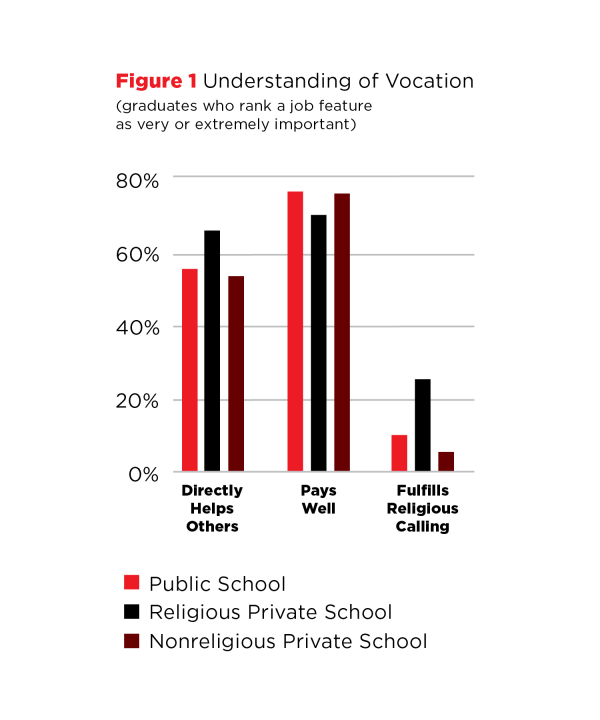
Christian college graduates are different from their peers at non-religious schools. When they think about work and finding a job, they value making a difference more and making money less.

According to a new study from the Christian think tank Cardus, two-thirds of graduates from private religious colleges and universities say it is important to them to find a job that “directly helps others”—10 percentage points higher than graduates from public schools or private nonreligious schools. About 70 percent of Christian school alumni said it was important to them to have a job that pays well, but that was 6 percentage points lower than other college graduates.

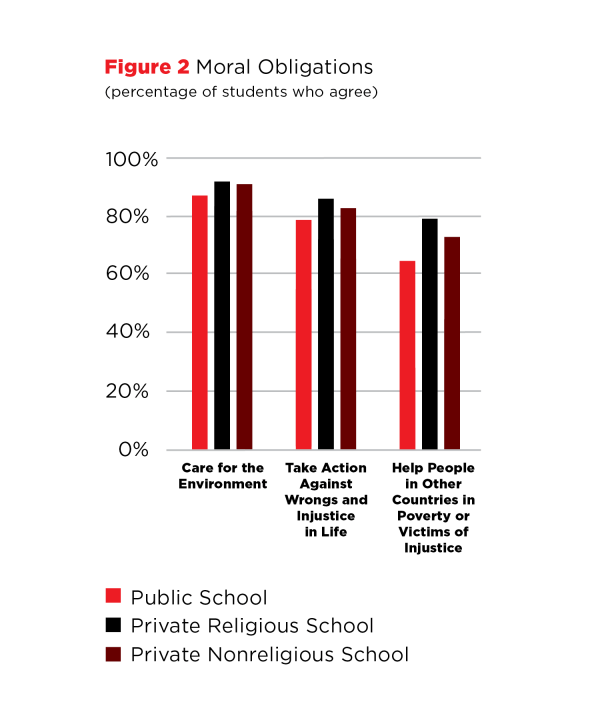
Graduates from religious schools also have a strong sense of moral obligation, according to the study. About 85 percent said it was important to “take action against wrongs and injustice in life.” Almost 80 percent said they should “help people in other countries in poverty or victims of injustice.” This is slightly higher rate than reported by other graduates: About 65 percent of public school alumni and about 73 percent of private non-religious grads feel obligated to oppose foreign poverty and injustice.

Graduates from religious schools are also a little more likely than their peers to feel a moral commitment to caring for the environment. More than 90 percent said that was very important to them.

Cardus, a nonpartisan Canadian-based organization that tries to “translate the richness of the Christian faith tradition into the public square for the common good,” has long been committed to demonstrating the value of Christian schools. This study, “What Do They Deliver?,” was co-authored by Albert Cheng, a professor of education reform at the University of Arkansas, and David Sikknik, a sociologist at the University of Notre Dame. They surveyed more than 1,300 graduates with four-year degrees from public and private, religious and non-religious schools in the United States and Canada.

Report from Cardus

Cheng said the goal of the study was to expand college administrators’ ideas of measurable output. Many small schools are facing financial crises and struggling to maintain enrollments. Religious institutions, in particular, are under pressure to defend their value to both donors and prospective students. Many of these schools make their case in terms of economic impact and spend a lot of time defending the economic value of a college education but don’t consider other factors, Cheng told Christianity Today.

“The language about return on investments and public impact, that’s what drives a lot of Christian colleges,” Cheng said. “We wanted to expand the conversation we have about what the value of post-secondary education is.”

The Cardus study provides what researchers think is a fuller account of what Christian higher education is actually doing in students’ lives—and why it matters to the students who graduate from these schools.

“These institutions are not just helping kids process ‘what I want to be when I grow up’ in terms of money and what I find to be fulfilling,” Cheng said, “but there’s a lot of conversation about what vocation really is.”

It is not clear from the Cardus study that Christian colleges’ formative education is what is causing graduates to care about making a difference and commit to this set of moral obligations. Separating correlation from causation is tricky. It might be that schools with a religious mission attract the kinds of students that care about these things. There’s some evidence in the study that high school seniors choose Christian colleges because they are already thinking about how they want to help people and make the world a better place.

Cheng and Sikknik asked graduates about their reasons for choosing a college. The top three reasons, across the board, were academic reputation, specific degree programs, and cost.

Report from Cardus

Only about 10 percent of students at Christian colleges and universities said their school’s religious mission was the primary reason they chose it. Fifty-five percent, however, said the religious mission mattered to them and factored into their choice.

According to Cheng, this could help college admissions offices as they think about recruiting students. It might be better to emphasize the way a Christian college is different from other schools.

“You know, in my town, we have a lot of restaurants, and when we get a new one, we always joke, ‘I hope it’s a burger place,’” Cheng said. “Because it’s like, how many burger places do we need? College is the same way. How many more job prep places do we need? There are people who want to dive into the formative aspect of education and we can serve them. What about being the place that asks the big questions and fosters connectedness to community and society?”

Cardus will be presenting the research to a Council for Christian Colleges and Universities’ conference for college administrators in San Diego on Wednesday.

News

Google, Tyson, and Target Rank as Top Corporations for Religious Inclusion

List highlights the minority of Fortune 100 companies that include faith in diversity initiatives.

Christianity Today February 11, 2020
Courtesy of Tyson Foods

Karen Diefendorf starts her days at Tyson Foods by checking in with the human resources and nursing staff at the Springdale, Arkansas, facility. After getting any personnel updates and taking care of emails, she puts on personal protective equipment and hardhat affixed with her title: CHAPLAIN.

Diefendorf, who comes out of the independent Christian Churches and Churches of Christ movement, wore the chaplain badge during her 24-year career in the Army before she began her work at Tyson, where she now does daily rounds to meet with employees. It’s so noisy on the production floor that she relies on a thumbs up, thumbs down system to see who might need counsel, prayer, or guidance.

“If I get a thumb sideways, thumbs down, for sure I’m going to meet them in the break room and see what that’s about,” said Diefendorf, a graduate of Lincoln Christian College and Lincoln Christian Seminary. “If I need more than the 15-minute break or have multiple people I need to see, any chaplain is free to go to that person’s supervisor and work a time to get them off the line.”

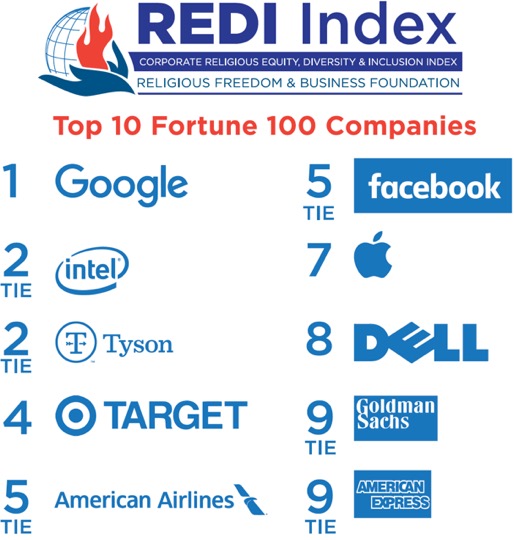
Diefendorf leads a team of 100 chaplains—mostly Christian—who provide spiritual support to 122,000 Tyson employees at nearly 400 locations. Tyson’s chaplain program is unique among big companies, and it earned the food processing giant the No. 2 spot on the Religious Freedom and Business Foundation (RFBF)’s religious inclusion rankings, released last month.

HR experts consider chaplaincy a way for companies to see and support their employees as “whole people,” to signal that they don’t have to pretend to leave their hurt at home when they come to work. Done right, these programs—and others particularly designed for people to discuss their faith—can work in tandem with HR to improve morale.

“When you look at the whole argument for an inclusive work environment, it is to make people feel that they are valued as human beings,” said Kent Johnson, senior corporate adviser with RFBF. “The HR profession has come to realize that people matter, right where they are. The emphasis on creativity, teamwork, the need for new ideas has just taken off in the last decade. When people feel like they can bring their whole self to work, that’s the motivation for a lot of companies to look into this.”

For most companies on RFBF’s Corporate Religious, Equity, Diversity, and Inclusion (REDI) Index, religious programs fall under broader diversity initiatives, such as those for other identity groups like race, gender, and sexual orientation. Top-ranked Google (parent company Alphabet) offers “employee resource groups” for people of faith who work there.

These groups, abbreviated ERGs, function like sanctioned “clubs” within the company, designated groups for employees to meet in an interfaith setting or in a faith-specific setting to discuss things like company culture, holiday observances, and religious accommodations. They can also serve as places for people of faith to find a sense of solidarity, mentorship partnerships, and community within the company.

Google’s Inter Belief Network includes chapters for Christians as well as Jews (“Jewglers”), Muslims, Buddhists, and other faiths. Its founder and global chair, Barbara Phillips, also leads the Christian Fellowship chapter. Last year, she spoke at a work-faith conference in Silicon Valley about her role, quoting Scripture and worship songs in her presentation.At American Express, ranked ninth on the index, the Christian Employee Network called SALT is one of 16 “colleague networks” in the company. Through SALT, Christians at AmEx have gathered for weekly prayers by conference call and participated in corporate charity initiatives.

Courtesy of Religious Freedom & Business Foundation

While some companies will sanction similar groups as part of diversity efforts, Jeff Haanen of the Denver Institute for Faith and Work cautions that people of faith should not equate them with a faith-friendly workplace.“It’s a good trend to see this happening, especially in large corporations. It can be an aspect of faith in the workplace,” Haanen said, particularly when ERGs allow Christians to learn more about the convictions of their co-workers.But Christians underestimate the impact their faith can have in the workplace if they compartmentalize their core beliefs into a designated faith group.“Don’t think an ERG is the only place to express your faith in your workplace. You express your faith through every context at work. The values of a corporation are ultimately a religious, philosophical worldview,” he said. “But as a believer, Christ is Lord of all things and he is renewing all things.”Among the Fortune 100 companies, only 18 percent of companies mention faith-based ERGs on their diversity landing pages. By contrast, over three-quarters (77%) provide ERGs for race and ethnicity, and 78 percent of companies mention gender and sexual orientation.RFBF’s analysis shows that 57 of the Fortune 100 companies make no mention of religion or faith on their landing pages, and of the 43 that do, about half only make a single mention, sometimes only as a part of a boilerplate nondiscrimination statement.Leaders may fear that launching faith groups could lead to evangelization in the workplace or bring forth conflicting religious beliefs and convictions around marriage and sexuality.But corporations who use this model say it can improve bridge-building among employees. Target, whose 2016 transgender-friendly bathroom policy caused outrage among some conservative Christians, now boasts joint efforts between its Christian ERG and its Pride+ Business Council for LGBT employees.Bradley McCoy, sales director for Target’s digital advertising business Roundel, said that the 2018 Empathy Project brings them together for monthly conversations “to build understanding, break down stereotypes and (of course) build empathy.”Johnson at RFBF hopes the REDI Index will embolden Christian employees to ask for faith-based ERGs at their companies. The foundation said PayPal and Walmart announced plans last year to launch their own interfaith ERGs for the first time.

Church Life

Billie Eilish Can Help Us Understand Teenage Anxiety

The Grammy-award winning teen’s dark music can help us have necessary conversations with our children.

Christianity Today February 11, 2020
Rich Fury / Getty Images

Before Billie Eilish swept the Grammys last month, she had largely flown under the radar of anyone over the age of 21. But at (barely) 18 years old, Eilish made history as the youngest solo artist to win album of the year. That might not raise eyebrows if she hadn’t also swept four other Grammy categories: best new artist, song of the year, record of the year, and best pop vocal album.

Onstage at the awards, Eilish repeatedly suggested that other nominees deserved these honors more. In one of several surprise acceptance speeches made with Eilish, her brother, songwriter and producer Finneas flatly offered, “We didn’t think it would win anything ever. We wrote an album about depression, and suicidal thoughts, and climate change, and being the bad guy—whatever that means—and we stand up here confused and grateful.”

If you’ve actually listened to a song or two, you might be confused, too. Eilish’s music is unusual. Adults are kind of weirded out by it. We don’t get it. And that’s precisely the point.

It’s also why teenagers love her.

In 2019 she raked in accolades as Rolling Stone’s Teen of the Year, MTV Video Music Award’s Best New Artist, and two Teen Music Awards. While adults arguably run all of the awards machines, it’s Eilish’s young fan base who fuel her success. They’re captivated by the way she breaks most female pop-star norms.

My 17-year-old daughter was unsurprised that Eilish swept the awards, calling her music “different from everything you hear on the radio.” Which is also part of the deal—Eilish’s music largely became popular before broad radio play, in the teen-driven platforms adults often miss. Her latest music video on YouTube garnered 33 million views.

In hailing her as The Guardian’s Artist of 2019, pop critic Alexis Petridis describes Eilish’s album “When We All Fall Asleep, Where Do We Go?” as “a dark, adventurous, eclectic set of songs that appeared blithely unconcerned with chasing trends.” My daughter used the word “scary” to describe her first listening experience, but said the music grew on her as she took in the whole album.

Some of her lyrics are indeed scary. Like these lines from “Bury A Friend”: “Today, I'm thinkin' about the things that are deadly / The way I'm drinkin' you down / Like I wanna drown, like I wanna end me.”

The darkness and absurdity of Eilish’s music, wardrobe (decidedly asexual and awkward) and facial expressions (mostly flat, peppered with cynicism) all evoke an aesthetic that today’s teenagers get. Life is hard. Adults are handing down a screwed-up world. Politics is depressing. Why not find a way to laugh about all of it?

Her understated, near-mumbling voice stands out against the likes of Taylor Swift or Ariana Grande. Eilish’s vibe endears her to young people looking for an unpretentious hero, someone unwilling to play by the rules of beauty, presentation, or even music genre itself. Because all of this speaks to what teenagers perhaps need most: hope.

Whether or not we’re new to Eilish, we need not look far to see that our teenagers are hurting. Anxiety and depression in particular are on the rise, dominating the ways young people talk about their generation. Seventy percent of teenagers in one recent study considered anxiety and depression a “major problem” among their generation. Suicide currently is the second leading cause of death in young people aged 10 to 24. And it’s estimated that two out of every three young people who experience suicidal thoughts don’t ever get help.

That’s a lot of pain paired with a lot of silence.

While feeling lonely and misunderstood are hallmarks of adolescence and young adulthood (at least across the last few generations), some suggest Gen Z is the loneliest yet, and a just-released study found 7 out of 10 often feel misunderstood. A New Yorker article on Eilish’s appeal to “the loneliest generation” last fall quoted a 21-year-old, “I think gen z is extremely lonely!!!! Songs like ‘When the Party’s Over’ get RIGHT at the desperate, gnawing sense of isolation social media has sewn into a generation who are becoming increasingly sequestered.”

All of these themes find a familiar home in Eilish’s music. Perhaps her popularity is rising on the wings of a generation who feels like finally someone understands and is giving voice to their experiences.

What does this mean for parents, educators, coaches, and faith leaders who care about young people? For starters, it’s an urgent reminder that if we’re not already talking about anxiety and depression with teenagers, now is the time to begin. We may be afraid of what to say in response to all the worry we see, but on this topic, our quiet doesn’t lead to more peace.

Young people need to know that anxiety itself need not be dark and scary. Everyone experiences anxiety. It’s a signal. Anxiety might be telling us something is wrong or that we’re in danger. It might be telling us something about our bodies, our relationships, or that we need more sleep. Teenagers often aren’t good at listening to what anxiety is telling them. A young person might only know, “I can’t breathe,” “My thoughts keep racing,” or “I can’t handle anything right now.” They’re novices at interpreting experiences, much less at employing tactics to wind down a panic attack.

This is where adults can help by listening as a first step. Simply observing, “Sounds like you’re feeling overwhelmed” might open up a conversation about anxious feelings. This is critical because teenagers need to know they aren’t alone in their struggles. Part of Eilish’s intrigue is that she can empathize. She helps put words to feelings. She represents hope—if Billie can get through this, so can I.

As adults, we can offer similar assurance from closer proximity. The more we talk about anxiety as part of life, the more we normalize the conversation. And for people of faith, talking about anxiety, depression, and suicide can help destigmatize mental health and make it part of our discipleship journey.

Anxiety shows up all through Scripture—and not just in verses like “Do not be anxious about anything” (Phil 4:6). Often, we see that while God may neither cause anxiety nor erase it, God is present and stays with biblical characters in their most anxious moments. Mark 6:45-51 recounts a turbulent night when Jesus walks on water and calms a storm. In this story, Jesus actually gets in the boat and then stays in the boat with his anxious disciples. Similarly, in some of our stormiest experiences, the promise of God’s presence with us can provide incredible comfort. Anxiety can actually become a personal and spiritual growth tool when we learn to ask ourselves questions like, Where is God at work in the midst of my worry? or, What might this anxiety be trying to tell me?

Sometimes all a teenager needs to turn a corner is to stop and breathe. Helping a young person slow down their breathing allows the heart to slow down and pump more oxygen to the brain, quieting the alarm systems triggered by intense moments. While most anxiety is manageable for most people, anxious feelings can, at times, have the potential to grow and cause a lot of disruption in our lives. Responses like “just relax” or “keep praying about it” may actually make some situations worse, especially when professional intervention is needed through therapy or medication. It can be tough to know when a teenager needs outside help.

Adults can learn key signs to watch for and steps to take when we suspect something deeper might be going on. Experts say that these signals include trouble managing anxiety, struggles dealing with everyday life, pronounced intensity in any given aspect of life, and use of unhealthy coping strategies like alcohol, drugs, or self-harm.

Parents should trust their gut to talk to their teen when they sense something is wrong, then try to listen without judgment to what the young person is experiencing. One conversation could be enough to turn a corner, or more professional help might be needed. Even if the concern is a false alarm, asking questions reinforces a sense that it’s okay to talk when feelings do become too much to manage.

Maybe Billie Eilish is just dark and disturbing. Maybe her music is a harbinger of something new. Perhaps she’s helping crack open the door for conversations we need to have with the teenagers in our lives. Let’s gather the courage to ask, and to start listening.

Brad M. Griffin is the Senior Director of Content at the Fuller Youth Institute and the co-author of several books including the new resource Faith in An Anxious World.

Note: If you have urgent concerns about a young person you know, call the National Suicide Prevention Lifeline (1-800-273-8255) or visit suicidepreventionlifeline.org.

Books
Review

Are Nationalism and Populism the Cure for What Ails the West?

The “strong gods” of old are knocking at the door. We ought to be wary of letting them inside.

Christianity Today February 11, 2020
Paul Souders / Getty Images

This November’s presidential election could be understood in many different ways. It could be seen as a referendum on Donald Trump’s eventful first four years in the White House. It could be viewed as a response to the president’s impeachment and acquittal in Congress. Or perhaps it could be taken as just the latest election in which a majority of Americans are frustrated with an uninspired, binary choice. But there is a larger narrative unfolding in the mind of First Things editor R. R. Reno, with much more at stake than just the next four years.

Return of the Strong Gods: Nationalism, Populism, and the Future of the West

In Return of the Strong Gods: Nationalism, Populism, and the Future of the West, Reno traces the condition of Western society in the aftermath of the “postwar consensus.” Prioritizing openness and free markets in order to prevent global catastrophes like the two world wars, this consensus has shaped the most influential thinking of our age, from Karl Popper and Jacques Derrida to Friedrich Hayek and William F. Buckley. Reno says it has affected most aspects of society and culture, including politics, economics, education, and even architecture.

In terms of preventing another global conflict, the postwar consensus has been an unmitigated success. But at what cost? As Reno tells the story, the West is now facing several pressing challenges that ought to be laid at its doorstep, including widespread addiction, disenchantment, and loneliness, along with a general loss of social solidarity. And the ruling class—comprised of liberals and conservatives alike—is too focused on maintaining this consensus to notice or care. Yes, countries may not be perpetually on the brink of war, and free trade has made the world more prosperous and closely connected than ever before. But while the postwar consensus has safeguarded and strengthened the global community, Reno sees a loosening of the ties binding individuals to community and nation, ties that lend their lives stability and purpose.

Unifying Forces

Notably, in assigning blame for these developments, Reno does not focus on just one faction of the political ruling class. He has no shortage of criticism for the political left, referring to identity politics as a “cancer” and expressing impatience with those who “despise patriotic ceremonies and traditions.” But he also takes to task those on the political right who have bought into the postwar consensus—proponents of free market capitalism, he believes, have contributed just as much to the hollowing out of Western society as cultural liberals have.

Reno does not believe we can correct these problems under our current political and social arrangement. As he writes in his prologue, “We need to face the challenges of the twenty-first century, not the twentieth.” Instead, he argues, Western society must welcome back the “strong gods” it once tossed aside. What exactly are these strong gods? One is clearly nationalism, which Reno equates with “cherish[ing] self-government.” The postwar consensus demonized nationalism as a driver of conflict, but Reno sees it—and its cousin, patriotism—as a positive force for unity at a moment when society is remarkably fractured. Two other strong gods are the family and the church, institutions that started breaking down as the postwar consensus emphasized other, potentially competing values.

But if there is a leader among the strong gods, it is populism. This is a belief system bigger than Donald Trump or Brexit or Viktor Orbán, Hungary’s prime minister. Populism, according to Reno, challenges the hegemony of the “leadership class.” It emphasizes “strong borders, not open ones; advantageous trade, not open trade; loyalty and patriotism, not open minds.” And it reflects “a growing sense that ‘we’ needs shoring up.” Reno believes that by embracing the strong gods of populism, nationalism, and the like, the West can address the negative effects of the postwar consensus, effectively confront the challenges of the past century, and put itself on a stable footing going forward.

Return of the Strong Gods is sweeping yet concise—the ground Reno covers in just 170 pages is impressive. But the book’s weaknesses are clear in part because of that very succinctness. One consistent problem with Reno’s work is the lack of support he lends to his secondary claims. For example, when discussing the problems of modern education, he writes, “Most education professionals think it’s good for young children to have transgender teachers.” While we occasionally see stories of drag queens in libraries and gender fluidity in the classroom, it is something else to claim without evidence that “most educational professionals” recognize this as a good in itself. A collection of anecdotes does not a consensus make. Reno’s characterization about those protesting Donald Trump’s inauguration—“overwrought women in ridiculous hats”—is similarly problematic and ultimately unhelpful.

The book also occasionally falls prey to odd errors and omissions. For example, in criticizing Barack Obama’s infamous observation that many in the white working class “cling to [their] guns or religion,” Reno writes that Obama’s remark was directed toward “those who were insufficiently appreciative of his leadership.” But Obama said this during his first presidential campaign in 2008, in the context of a larger description of people being left behind by the same leadership class Reno is inclined to criticize. And though Reno critiques the “open borders” sentiment that permeates the postwar consensus, he omits any discussion of the waves of immigration during other periods of American history. In his discussion of the “shared loves” that fuel patriotic attachment, for example, what would he make of the experience of Ellis Island?

Reasons for Skepticism

The message at the heart of Return of the Strong Gods may be tempting for Christians. The central critique of the postwar consensus is that it has transformed society from a connected, united, and shared community to an atomized, anomic shell its past self. Of course, Christians should seek community with those around us, and if the postwar consensus has made that more difficult, then why shouldn’t Christians oppose this arrangement? And there is plenty to lament about the state of contemporary society from a Christ-centered perspective, including the well-documented decline of the traditional family unit and the diminishing influence of the church in our culture.

But are the strong gods the answer? There are reasons for Christians to be skeptical. The values of nationalism and patriotism are not inherently bad, but elevating them the way Reno wants could turn them into the very idols he decries. Moreover, this book conjures some of the more worrisome features of recent debates over the heritage and future of “liberalism” in the West. Culturally conservative writers like Sohrab Ahmari and Patrick Deneen have taken aim at America’s emphasis on individual rights and freedoms, blaming the liberal tradition for undermining faith, family, community, and the common good. Yet as other (equally culturally conservative) writers like David French have countered, Christians need not abandon the whole of liberalism simply because it produces some results they do not like; indeed, this would be a case of the cure being worse than the ailment. Liberalism long predates the postwar consensus, of course, but I cannot help wondering whether a similar caution applies to Reno.

As we continue to struggle with our role in a changing, increasingly inhospitable culture, we would be wise to remember where our identity ultimately lies: neither in our nation nor in our culture, but wholly and completely in Jesus. Such knowledge should equip us to engage our culture in a way that confidently transcends its conventions, rather than shaping our behavior and solutions to the culture as it is or has been. Put differently, Christians can respond to the challenges of the postwar consensus without embracing a return to some sort of pre–postwar consensus.

Despite its shortcomings, Return of the Strong Gods is successful in prompting serious reflection on the challenges of our moment. And considering that the strong gods do appear to be knocking on the door of the West, this is precisely the sort of reflection in which Christians ought to be engaged.

Daniel Bennett teaches political science at John Brown University in Siloam Springs, Arkansas. He is the author of Defending Faith: The Politics of the Christian Conservative Legal Movement (University Press of Kansas).

Breaking Out of the White Evangelical Echo Chamber

Putting faithful witness ahead of political expediency starts with changing surroundings, words, and friendships.

Christianity Today February 10, 2020
Illustration by Mallory Rentsch / Source Images: Courtesy of John Inazu / Photo by Joe Angeles / Washington University

In this series

I sometimes quip that I am half of a white evangelical; that is, I am half-white, not half-evangelical. But the joke points to a greater complexity. I am half-Japanese, but my faith has largely been shaped by culturally white institutions, many within a broadly evangelical orbit. And even though I come from this white evangelical world, I find it increasingly difficult to understand.

I’m not the only one. Despite recent important books like John Fea’s Believe Me and Thomas Kidd’s Who Is an Evangelical?, the meaning of evangelical continues to befuddle religious and nonreligious alike. Around the globe, evangelicalism connotes a subset of Protestant Christianity that prioritizes Scripture, discipleship, and public expression of faith, as reflected in movements like the Lausanne Committee for World Evangelization and the International Fellowship of Evangelical Students. These global movements did not emerge in a vacuum, and some of them import norms that are more Western than Christian. But global evangelicalism differs from the way the label is now understood in the US, as a synonym for white conservative Christians who are increasingly defined by their views about President Trump.

These Christians—whether in urban or rural settings—tend to be isolated in largely white neighborhoods, workplaces, churches, and schools. Not all of them, to be sure. But most. And this insularity often undercuts their own interests and their witness to the watching world. White evangelicals are losing touch with broad segments of this country (and with the global church) that are increasingly nonwhite.

In this cultural context, the meaning of evangelicalism has also become more political than theological. The political dimensions have always been there—it’s not quite right to intimate that evangelicalism recently “transform[ed] … from a theological position to a racial and political one.” Rather, as theologian Lesslie Newbigin has written, “Christianity as a social phenomenon has always and necessarily been conditioned as to its outward form by other social facts.” In the United States, the religion practiced by many white evangelicals has always been racial and political as well as theological, even if the relative intensity of each of these dimensions has varied over time. But today, the political dimension is particularly acute. It manifests in three categories of white evangelicals: Trump critics, pragmatists, and Trump lovers.

Make America Christian Again

We often hear about the 81 percent of white evangelical voters who voted for Trump, but the 19 percent remainder—including Republican “never Trumpers,” Democrats, and third-party voters—is not a rounding error. These are the critics, and they include millions of voters, far more than all Jewish and Muslim voters combined. Beyond the 19 percent remainder, the critics also include a portion of white evangelicals who did not vote in the 2016 presidential election and who are therefore excluded from frequently cited polling numbers. Given what we know about generational differences, the percentage of critics among white evangelicals is likely to increase—if they continue to identify as evangelicals at all.

And then there is the 81 percent. They are in all likelihood committed, churchgoing Christians, and their support for Trump remains strong. We can sort this group into the Trump lovers and the pragmatists. The lovers believe Trump is the man God appointed to restore the country to its purportedly Christian roots. They celebrate the president through an almost Christological lens, from the Thomas Kinkade–style paintings of Trump in messianic settings to the choir of First Baptist Dallas performing a hymn called “Make America Great Again.”

The pragmatists may not like the president, but they see him as their only option, pitted against a Democratic Party that they view as opposed to their values. The most pragmatic among them may be hoping for Trump’s political demise and the quick rise of a successor. The pragmatists are not entirely misguided in betting on Trump, who has delivered some of their key policy objectives. Not the rhetorical ploys to repeal the Johnson Amendment or end the “war on Christmas.” Nor the executive orders on issues ranging from public funding of religious nonprofits to transgender bathrooms—which will be undone with a pen stroke by the next Democratic White House. But Trump’s success with the Supreme Court and other judicial appointments will have much longer staying power. And for some pragmatists, that success more than validates their Faustian bargain.

Another reason that many pragmatists are sticking with Trump is that Democrats have not reached out to them. On policy matters, no Democratic candidate has expressed interest in compromise legislation to address tensions between LGBT rights and religious freedom. Or take abortion. With Joe Biden’s switch on the Hyde Amendment, none of the leading Democratic candidates supports restrictions on federal funding for abortion. Nor has the rhetoric been helpful—too many prominent Democrats show disdain rather than empathy for white evangelicals.

But the relational insularity runs both ways. Many lovers and pragmatists resonate with the promise to “Make America Great Again.” For them, this past greatness is not just economic, militarily, or cultural—it is theological. America was once great because it was moral, a city on a hill blessed by God. These longings for the past produce current laments about a “post-Christian” America in which Christians are the “new minority.” They reveal just how out of touch many white evangelicals are with the world around them. And, truth be told, this detachment characterizes not only the lovers and the pragmatists but also many of the critics.

Trapped in insular language

The phrase “post-Christian” implies that there was an earlier era when this country was Christian. It is one thing to acknowledge that Western political theory and jurisprudence are heavily informed by Christian thought, or that many of America’s founders were themselves Christians. But those are far different claims than suggesting that the United States was ever a “Christian nation.” The land of the free obliterated Native Americans, enslaved African Americans, and imprisoned Japanese Americans. The home of the brave bombed Hiroshima and Nagasaki, killed tens of thousands of Iraqi civilians, and waterboarded its captives. There is much to commend about this country, but there is also much to lament. Too many popular evangelical narratives omit indispensable parts of our story. And the stories we tell about our history shape how we see ourselves and how we engage with the world around us.

Consider the belief that Christians are the “new minority.” This claim only works by ignoring much smaller minority demographics. Recent polls suggest that white evangelicals comprise roughly a quarter of the population. By comparison, 2 percent of the country is Jewish, and 1 percent is Muslim. Second, even if white evangelicals continue to decrease in number, this does not make them minorities in the same way as historically disadvantaged groups. Generations of systemic advantages in housing, education, and employment mean that it will be a long time before a minority of white evangelicals—or white Americans more generally—confronts challenges similar to those faced by racial minorities, sexual minorities, and other maligned groups.

The insular language of white evangelicals is exacerbated by a heightened aversion to terms that almost everyone else in the country does recognize and understand. The term “sexual minorities” in the last paragraph is one of them. Other examples include “social justice” and “structural racism.”

White evangelicals who embrace labels like “post-Christian” and the “new minority” while being suspicious of terms like “social justice” and “structural racism” will continue to alienate themselves from much of the rest of society—including fellow conservative believers, like black Christians, Catholics (especially nonwhite Catholics), Mormons, conservative Muslims, and Orthodox Jews. Ideas like “social justice” may sound off-putting as sound bites on Fox News, but they flow out of important and careful arguments like those found in Bryan Stevenson’s Just Mercy, Jemar Tisby’s The Color of Compromise, and Tim Keller’s Generous Justice.

The white evangelical echo chamber is further hardened by conservative media. Too often, stories in evangelical circles suffer from the same kinds of caricatures, fearmongering, and lack of charity that Christians are quick to call out in the “liberal media.” At their worst, these stories perpetuate harmful distortions about Muslims, immigrants, and others. And the same algorithms and clickbait driving partisanship outside of the church are shaping hearts and minds inside of its walls with every retweet, Instagram like, and Facebook share.

A broad, engaging evangelical witness

It doesn’t have to be this way. I have spent the past few years speaking across the country to groups of people of all faiths and no faith. And I have encountered kind and hopeful people in all of these places. Some of these hopeful people are Christians, especially younger Christians. But too often, the white evangelical narrative I encounter is driven more by fear and anxiety than by the hope and confidence of the gospel. And the world is watching. What can you do if you find yourself surrounded more by anxiety than hope? Let me offer three suggestions.

First, pay more attention to your words. Stop saying you’re living in a “post-Christian” country or that you are the “new minority.” These assertions generate antagonism rather than empathy. Similarly, take care in how you describe others. Invoking tropes like “social justice warriors” or “the gay agenda” assumes the same kinds of stereotypes that you don’t want people using against you. And invoking these tropes ignores the commandment to love others and treat them as individual image-bearers. By all means, speak truth and critique bad arguments and unjust policies. But don’t settle for lazy generalities and ad hominem attacks.

Second, diversify your personal networks. This won’t always be easy or obvious everywhere, but if you look closely, you’ll find people who, at the very least, think differently than you do. Some of you will need to risk finding your first cross-racial friendship. That might mean going to nonwhite spaces and institutions to learn and to experience the discomfort of a cultural baseline that is not your own. You should also diversify the leadership of your institutions. Who is in the room determines which questions get asked, and white evangelical institutions will not escape their insularity without greater racial diversity in circles of power.

Third, show up and take risks. If you want to be known as a pro-life people, advocate for all stages of life. Speak out about dehumanizing and family-separating policies like immigration detention centers and mass incarceration with the same fervor you have for religious freedom and opposition to abortion. Risk uncertain and messy relationships with your neighbors to help repair the social fabric. Step outside of your comfort zones and partner in common-ground causes with progressive and mainline Christians, with people of other faiths, and with nonbelievers. Defend the rights of Muslim Americans, Jewish Americans, and Americans of no faith. Stand up against bullying of LGBT people. Look for opportunities to seek counsel from and promote women rather than avoiding them because of the Billy Graham Rule or the Mike Pence Rule. None of these opportunities threatens your faith. But they all require rethinking the assumptions that come from cultural, racial, and relational insularity.

Will these suggestions win you political favor? Maybe not. But, frankly, political expediency matters far less than the faithful witness of the church. And these suggestions will help you toward a more faithful witness by lessening your insularity. They will lead to less fear and more hope. They will move you closer toward the example of Jesus, who stepped into messy and uncertain spaces with people who were different from him. And that seems worth doing regardless of what is to come in this world—because it is what the gospel asks of those whose citizenship lies in heaven and who believe that he who conquered death will prevail over all other earthly challenges as well.

John Inazu is the Sally D. Danforth Distinguished Professor of Law and Religion at Washington University in St. Louis and co-editor (with Timothy Keller) of the forthcoming book Uncommon Ground: Living Faithfully in a World of Difference (Thomas Nelson).

Apple PodcastsDown ArrowDown ArrowDown Arrowarrow_left_altLeft ArrowLeft ArrowRight ArrowRight ArrowRight Arrowarrow_up_altUp ArrowUp ArrowAvailable at Amazoncaret-downCloseCloseEmailEmailExpandExpandExternalExternalFacebookfacebook-squareGiftGiftGooglegoogleGoogle KeephamburgerInstagraminstagram-squareLinkLinklinkedin-squareListenListenListenChristianity TodayCT Creative Studio Logologo_orgMegaphoneMenuMenupausePinterestPlayPlayPocketPodcastRSSRSSSaveSaveSaveSearchSearchsearchSpotifyStitcherTelegramTable of ContentsTable of Contentstwitter-squareWhatsAppXYouTubeYouTube