News

Why Black Protestants and Evangelicals Still Preach Politics

Amid increasing polarization and shifting church trends, the black church continues to speak out on matters of justice.

Christianity Today November 15, 2019
The Washington Post / Contributor / Getty

Hundreds gathered in a Chicago sanctuary last night to hear Christian leaders calling on believers to engage the political process and advocate for their convictions in the election year ahead.

The Faith and Politics Rally was organized by the And Campaign, a nonpartisan group that says Christians have a “particular obligation” to provide moral leadership and seek the common good—an approach that has become increasingly contentious in the US.

A majority of Americans believe churches should “keep out” of politics, according to a survey released today by the Pew Research Center. Evangelicals and Protestants from historically black churches—both represented at the recent rally—are the only major religious traditions that still want faith communities to “express their views” on social and political issues.

“While a misappropriation of the separation between Church and State has sometimes been used to suggest people of faith are the only people who can’t consider their values when participating in politics, we know that both our faith and the demands of citizenship require that we bring our full selves to the project of self-governance,” And Campaign leaders declared in their 2020 presidential election statement.

Evangelicals (in this survey, a multiethnic sample) and historically black Protestants tend to rank as most devout among religious groups in the US. They share core theological beliefs and a corresponding desire to see those beliefs shape their lives and communities. Evangelicals and black Protestants are the two traditions that consider their faith the most important source of meaning in their lives. But they often come from different racial and cultural contexts as they consider how to apply it to the political realm.

According to Pew, black Protestants are the most likely to say churches don’t have enough influence in politics (54%), compared to 48 percent of evangelicals and 28 percent of Americans overall.

“It’s less about politics in the electoral sense … and more of a sense of black folks seeing faith as a way to rectify and address issues of injustice,” said Jason Shelton, a sociologist at the University of Texas at Arlington whose research focuses on the black church. “The separation of realms (faith and politics) is clear for white evangelicals much more than it is for African American Protestants, even though they have the same heightened religious sensibilities.”

“There’s sense of right and wrong in a moral sense that’s been fused together … The pulpit has inspired us to say, ‘This is the direction we gotta move for social change, to create a better day.’”

Politics at the pulpit

For generations, African Americans have relied on their faith and the church in the midst of injustice, oppression, and suffering. And the black church has played a unique role in addressing community needs and fostering leaders to advocate for change.

“Although we follow church-state separation and we know that’s good for both, the black community has always had a special relationship,” Charles Watson Jr., education director for the Baptist Joint Committee for Religious Liberty, said after a symposium at Howard University School of Divinity in 2016.

“For many years, the African American preacher was more than just a preacher in the community. The preacher was also the person who was the most educated, the most knowledgeable, and had to know the pulse of the community. They were the people the community looked to not only for spiritual guidance, but especially during the civil rights era, the 1960s, the African American pastor became the African American politician in many ways.”

Black Protestants (45%) are about twice as likely as Americans on average (23%) to say churches should endorse candidates, according to the latest Pew survey. In 2016, the researchers found black Protestants were far more likely to hear pastors mention either Hillary Clinton or Donald Trump in their sermons.

Most Americans and most Christians continue to oppose churches officially endorsing candidates. It remains illegal for tax-exempt charities to do so, though President Trump has repeatedly brought up repealing the Johnson Amendment.

“I deliberately avoid using language that is too precise,” said Brandon Washington, preaching pastor at The Embassy Church in Denver. “You’ll never see us endorsing a candidate or anything like that.”

Washington is an African American, and his multiethnic church is just over half white. Along with the racial diversity, his congregation contains members of both parties. He addressed tension after the last presidential election with a sermon from Psalm 72, which begins, “Endow the king with your justice, O God …”

“Falling in line with a theory of politics that’s consistent with the African American church, my decision to not make political statements or not align with a political party from the platform does not keep me from addressing matters that I believe have become politicized,” including abortion and racism, Washington said.

Faith in the parties

Despite all they have in common, evangelicals overall and those in historically black churches have leaned toward opposite sides of the political spectrum. A majority of evangelicals view the Republican Party (59%) and President Trump (58%) as friendly to religion, but few black Protestants agree, Pew reported. About 1 in 5 (21%) consider the Republican Party friendly to religion, and 1 in 6 (16%) say that the president is.
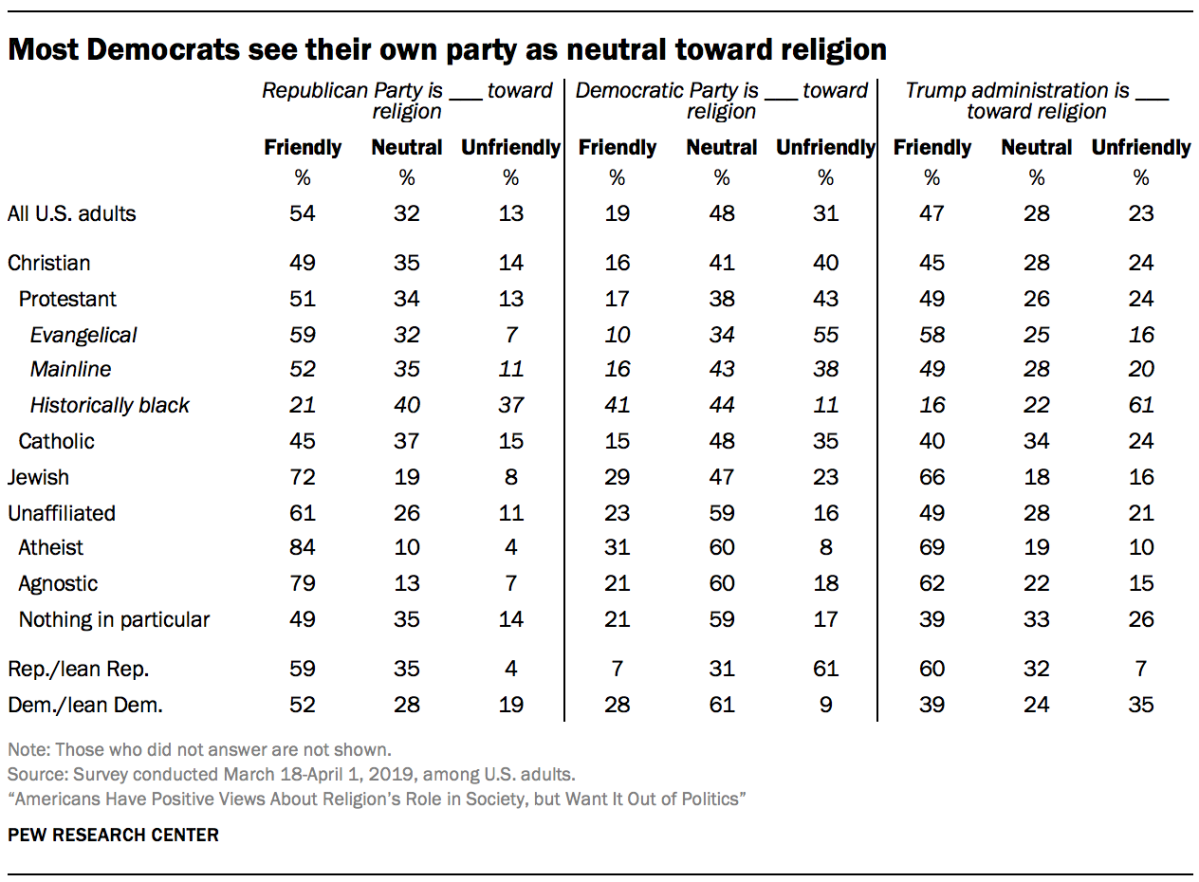
Many black Protestants fail to see the spiritual fruit of the Christian convictions employed by Republicans and actually want to see more faith engagement on the political right. In the Pew survey, 37 percent of black Protestants, a plurality, said religious conservatives have “too little” control of the Republican Party—more than the 28 percent of evangelicals and 18 percent of mainline Protestants who said the same.

This year has also brought renewed attention to the Religious Left, with some commentators making the case that Democratic candidates should do more to address people of faith in particular. Just 16 percent of mainline Protestants and 15 percent of Catholics consider the Democratic Party friendly to religion. Black Protestants, though, are relatively satisfied; 41 percent of them rated Democrats’ approach to faith positively.

Because of the tradition of political engagement and dialogue in black churches, though, black voters are more eager to find a politician who addresses their concerns than one who only references their faith, according to Chris Butler, pastor of Chicago Embassy Church.

“Black folks have been participating in politics in a fairly savvy way, and I don’t think black Christians are looking to their political leaders for faith leadership. On the one hand, we see the two intertwined, but that’s more so in the community,” he said in an interview with CT. “We’re looking at what person, what party is going to most impact those issues.”

Butler, like fellow speakers at the And Campaign event, emphasized putting Christian convictions first.

“It is okay to be partisan. It is not okay to put partisanship above our faith,” he said. “We can be partisan, but we have to challenge our party from the position of our faith versus putting the party first and subordinating our Christian faith and our biblical beliefs to a party.”

Though some black evangelicals have been outspoken against the party’s pro-choice policies or other issues of disagreement, they tend to be in the minority. But political shifts are taking place, according to Shelton’s sociological research, as more African American Christians opt to attend nondenominational churches rather than the traditional Baptist and Methodist congregations.

“Black nondenoms are three times more likely to vote Republican than other groups,” said Shelton, author of the forthcoming book Death of the Black Church: How Religious Diversity Erodes Racial Solidarity. “This is sort of the melting pot in action. You have some black folks that are moving away from the traditional church, embracing the faith still, embracing Christianity in a less black context … and moving into a more racially mixed or predominantly white congregation.”

Washington, who leads a racial mixed congregation, continues to look to the black church’s witness. Going into 2020, he sees black Christians demonstrating the importance of taking a stand for their biblical convictions and leading faithfully from the margins.

“The body of believers should participate in the government and its political structures. My concern though is that we are going to make culture by making laws or putting politicians in office, and that’s a secondary or maybe tertiary approach to cultural influence,” he said. “I think that the church should recognize itself as the most authoritative voice … instead of relegating it to a vote and letting politicians who do not necessarily espouse our same evangelical perspectives be the ones to do that for us.”

Theology

The Faith Behind the Crown

Queen Elizabeth’s belief is deep and sincere, says biographer Dudley Delffs, and Netflix gets it right.

Christianity Today November 15, 2019
PA Images / Contributor / Getty

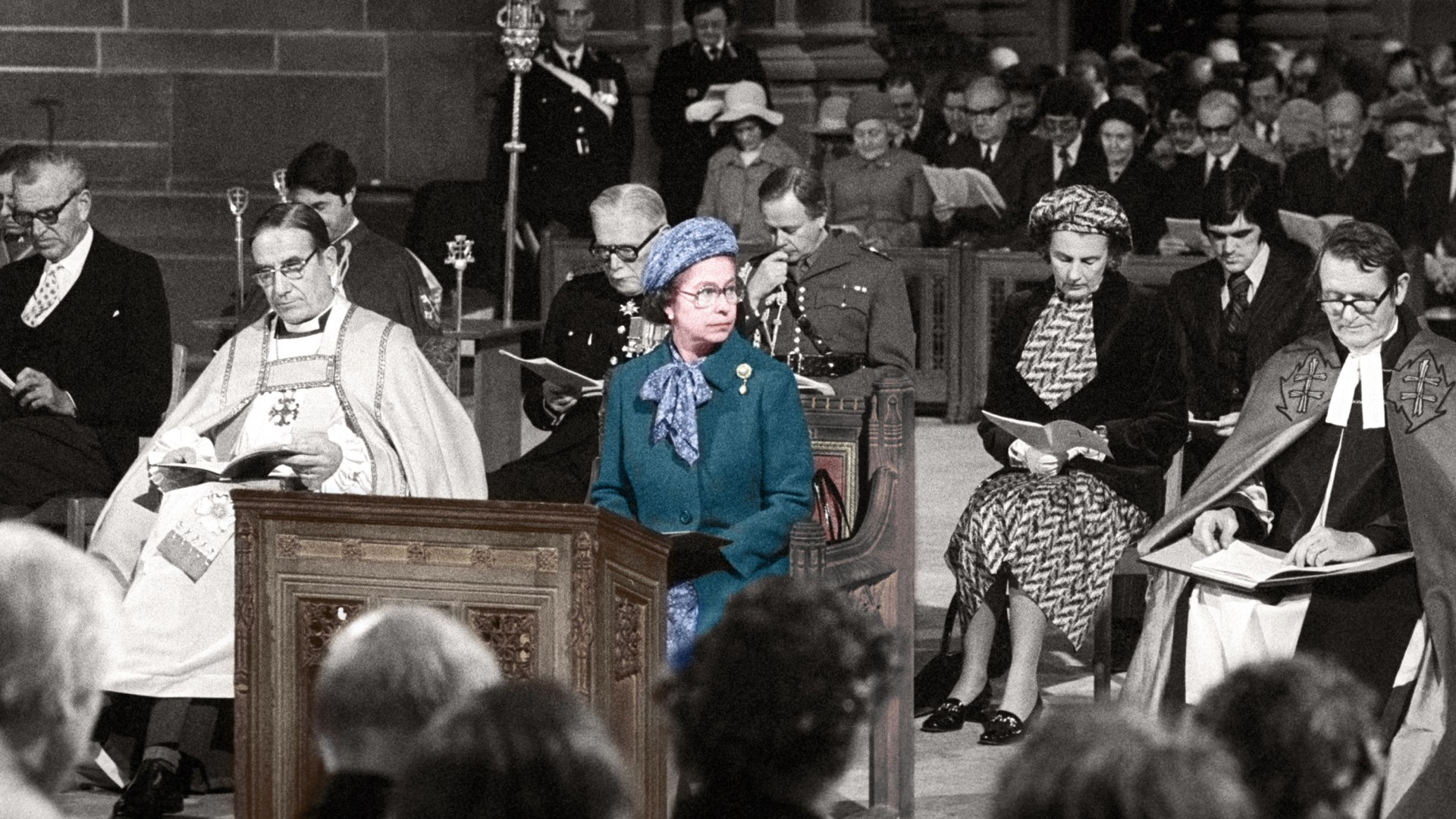
When Season 3 of Netflix’s The Crown releases on November 17, viewers can expect plenty of changes as new actors tackle the lead roles and ferry the royal family through the tumultuous waters of the late 1960s and early 1970s. But they might also expect a reprisal of past scenes, including Queen Elizabeth kneeling beside her bed and praying. That practice “has been verified by numerous staff members throughout the years,” says author Dudley Delffs. “It really is part of the fabric of who she is and isn’t so much a matter of show.”

Delffs, who describes himself as a “lifelong Anglophile,” wrote The Faith of Queen Elizabeth: The Poise, Grace, and Quiet Strength Behind the Crown (Zondervan), which releases on December 3. Megan Fowler spoke with Delffs about the Queen’s faith and how The Crown gets it right.

You note that Elizabeth publicly asked her people to pray for her when she turned 21 and again when she was anticipating her coronation. This seems particularly striking, considering what a private person she was.

Elizabeth’s request for prayer from her subjects and from others has been a way to ground and demonstrate her faith and the fact that it is personal. She’s not just going through the motions, she does want their engagement and their support, and prayer is an incredible way to do that.

I think she’s keenly aware of her great-great-grandmother Queen Victoria, who had a very active, dynamic Christian faith and was very transparent about Bible reading, evangelism, and prayer. During the male monarchs, in between Victoria and Elizabeth, perhaps they were not as demonstrative or open about having a personal faith. That’s not to say that they didn’t have faith, they simply chose not to demonstrate it.

But with Elizabeth—from the time that her Uncle David abdicated, which set in motion for her father to become King George VI and therefore for her to become the heir presumptive—she realized this was so much bigger and so much more overwhelming than she could imagine, and it was going to take spiritual and supernatural support.

You open the book with a lesser-known anecdote: Queen Elizabeth II attending a church service celebrating the Scripture Union’s 150th anniversary. How do you interpret her attendance?

I chose that story because she did not have to go. The Queen could certainly have had one less item on her schedule that day. But she is not only the patron of the Scripture Union and the Bible Society—as she is for several hundred other charities and nonprofits—but she has taken a very keen and personal interest in their work and the way they try to help children and young adults have faith. So for her to attend that service in a very small neighborhood church—she seemed to enjoy celebrating something that has continued to grow and thrive and sustain the Christian faith in a postmodern, post-Christian society.

“Defender of the Faith” is an official title of the Queen of England. How does Elizabeth II steward this responsibility, especially as the church continues to decline in Britain?

That role is definitely a challenge, in part because of the way the church has had to wrestle with changing mores and changing culture. We have seen evidence of that, particularly in attitudes toward divorce or even the institution of marriage, toward inclusivity.

The title “Defender of the Faith” comes with a bit of history of its own, going back to Henry VIII and his establishment of the Anglican Church, but what does it mean to defend the faith and guard it and steward it? I think that’s a very challenging prospect for anyone and certainly for someone in her role as ambassador of her people. I admire the way she has tried to defend the faith and to carry it forward in very difficult, very tumultuous times.

Tell us about how one goes about writing a book on such an intimate subject.

It is difficult. I was looking for lesser-known anecdotes and those moments when the Queen’s faith was on display and not necessarily in a public, ceremonial way. Of course those are somewhat difficult to find, because she is such a private person, and she doesn’t grant interviews. So I was forced to rely in part on individual recollections of encounters that were later published or made public in some way.

I also talked with various British citizens last year when I was over in England doing research. The interviews started out as just incidental to my research, but they ended up making it into the book as a way to close each chapter, because virtually everyone I talked to, regardless of age, ethnicity, or station in life, had a particular connection to Her Majesty The Queen and also seemed to be very much in fear of the time when she will pass.

In describing the Queen’s coronation, you note that she didn’t want to have the communion and the anointing portions of the ceremony televised.

As with so many events during her reign, she had to negotiate and compromise on how to engage and share with her subjects, the public, and the world at large. This once-in-a-lifetime event, the coronation, came at a time in the 20th century when television was just coming in to popular usage. It took some convincing, but she reluctantly agreed to televise it.

But for these moments, the communion and the anointing, it just seemed so incredibly personal and intimate and sacred that she just couldn’t imagine having it recorded and viewed. So that was the compromise—they agreed that those deeply personal moments would not become part of the televised service.

What impact did Elizabeth’s great-great grandmother Queen Victoria have on Elizabeth II’s Christian faith?

Queen Victoria included her Christian faith in her approach to the monarchy by making it very service based. She demonstrated to her children and to almost every facet of her court that faith and service go hand-in-hand. That seems to have established a template that Queen Elizabeth has adopted as well as adapted to her own model of the monarchy.

Did anything in your research surprise you?

The biggest surprises were perhaps small ones, like the consistency of the Queen’s character and personality and temperament over the decades. By almost all accounts, she has treated other people well—staff, members of the military guard, citizens that she meets, world leaders with whom she disagrees—just a vast array of people that she’s been forced to interact with. She’s always maintained a kind of curiosity and respect and compassion.

As someone who’s spent a lot time studying Queen Elizabeth, what’s your opinion of how The Crown portrays her faith?

Peter Morgan and his team have chosen to include aspects of her faith and to give it a kind of respect, to not just trivialize it or make incidental. There’s the wonderful episode where she is wrestling with how to forgive her Uncle David after new disclosures come out about his involvement with the Nazi regime and Hitler during World War II. And that runs concurrent with the first Billy Graham crusade there in London and her interest in the Reverend Graham that resulted in an invitation, and a meeting, and the beginning of a lifelong friendship.

As someone who's spent years researching Queen Elizabeth, what excites you most about season 3?

I am very excited to see Olivia Coleman’s portrayal. I have been a big fan of Olivia Coleman for a while, ever since Broadchurch. I don’t think they could have made a better selection. I think it takes a gifted actress to convey a lot of emotion and internal struggle simply by the look in her eyes or the twitch of her mouth, and I think Olivia Coleman is more than up to that.

What’s one aspect of Elizabeth’s life that you hope to see explored in season 3?

I think there are many elements of her personality that will continue to come out. I was reading another review just yesterday that commented on the sense of tension in Elizabeth’s character. The reviewer was hoping for some big reveal or explosion or moment where she has this fabulous monologue and articulates the struggles and challenges of living in the late 60s into the early 70s, but apparently there really is no big moment like that, and that in itself becomes kind of the point. She has to live with sublimated tension and anxiety and the burden of responsibility without having dramatic outbursts, or at least choosing not to have those, as other leaders or monarchs might be inclined to.

Church Life

Scripture and Neuroscience Agree: It Helps to Lament in Community

Through song, liturgy, and communion, the body of Christ inhabits the suffering experienced by its weakest members.

Christianity Today November 15, 2019
Caleb Luke / Lightstock

Recently, I awoke suddenly around 1:45am in a tangle of sheets, pillows, and sweat, my body fitfully grasping for peace in the presence of pain. I had just made a medication shift the day before, and after over a decade of living with Ankylosing Spondylitis, I knew my joints were demanding attention and deserving of care.

When one part of the body is inflamed, the body needs pathways to register and sense pain in order to facilitate healing. As I rubbed my swollen, aching hands against each other to quell their raging fire, I remembered Philip Yancey’s words from a recent interview, “A healthy body is not one that feels no pain. A healthy body is one that attends to the pain of its weakest part.”

All too often in our bodies, and in the body of Christ, we’d rather pretend health is the absence of pain rather than the willing care of it. And if Yancey is right, when we order our lives and our worship services around overcoming pain rather than attending to it, we block the pathways that mediate our healing. When the church does not make space for lament, the church is not whole.

Last month a reader on Instagram sent me a long message detailing how her family’s pain felt unwelcome in her church. Her daughter had just been hospitalized due to persistent, intense suicidal thoughts, and that Sunday the sermon was about conquering anxiety with truth. While the pastor enthusiastically bubbled over the victory we can have in Christ, she deflated in the defeat of not hearing the complexity of her daughter’s pain acknowledged. “There was no mention that sometimes depression is clinical,” she wrote. “The only answer he offered was to pray more.”

My reader was exposing a common experience in the Western church: a diminishment of our personhood into what philosopher James K. A. Smith has described as “an isolated, disembodied island of beliefs.” We know the gospel is powerful, but we mistakenly place its power in our individual effort to fill the abyss of our discouragement, doubt, and pain. You are more than a walking head, and the body of Christ is more than a vague association of people praising God.

God made our brains to need others. In recent decades, attachment researchers and clinicians, like neuropsychiatrist Daniel Siegel and psychologist Louis Cozolino, have been elucidating truth about our personhood grounded in how our brains and bodies develop and function: we are embodied, relational beings whose flourishing—from first to final breath—requires interdependence. As Siegel explains, “The brain is a social organ, and our relationships with one another are not a luxury but an essential nutrient for our survival.”

The Triune God, who is relationship, created us for relationships in bodies shaped by relationships. Psychologists like Warren Brown and Brad Strawn have integrated insights from neuroscience and cognitive psychology with theology to describe how faith is far more than an individual pursuit, possession, or process. The concept of social cognitive extension describes how our minds extend beyond our brains and are enhanced and strengthened by others. Our capacity to trust, hope, and love in want and in plenty is formed and sustained not merely by individual intelligence but through our embodied experiences in the Body of Christ.

Our physical life together, including in our worship services, shapes the story we live, not just the one we recite with our lips or read on a page but the one we feel in our bones and believe when we’re most broken.

Lament belongs in song. Eighteen weeks into their first pregnancy, Clint Watkins and his wife Jillian learned their son Eli had anencephaly, a condition in which Eli’s brain, scalp, and skull would not form. Babies with anencephaly either miscarry during pregnancy, are stillborn, or die just minutes, hours, or days after birth. Lament has sustained Watkins, though he recognizes his sorrow-filled faith is painfully counter-cultural in today’s evangelical church. Watkins stated, “When over a third of the Psalms are lament, there is a distinct imbalance with what we sing on Sundays and the emotional content of Scripture.

“One of the primary ways God gives us to respond to suffering,” Watkins shared, “is to sing—not just through suffering but about it. And we don’t get an opportunity to do this very often in church.”

Watkins reminds us that if triumph is the overwhelming tone of our life together, we will not experience our trembling or tears as nourishing the life of the world to come. The space the church offers to acknowledge the reality of suffering directly shapes the space we will experience within ourselves and our relationships to receive grace in the middle of pain.

Lament belongs in liturgy. David Rice, a pastor in northern Michigan, has sought to make space for the uncomfortable exercise of lament in his church’s services through following the liturgical calendar, creating physical spaces for unhurried conversation before and after services, and frequently including Psalms of lament.

“Our worshipping life together has to express the full scope of life,” Rice stated. “There is always someone in the room who is in the midst of tragedy and someone rejoicing. We offer one another the fullness of the God who can encompass all of that lived experience.”

Neurotheologian David Hogue’s work supports this, accentuating the truth that in our worship services we present our bodies together as “a living sacrifice, holy and pleasing to God” (Rom. 12:1, CSB). God created our brains with an innate capacity to empathize with one another through the function of our mirror neurons, and sensing one another’s grief and joy in worship is a central way we can be formed to live as who God says we are: “Now you are the body of Christ, and individual members of it.” (1 Cor. 12:27, CSB) The truth of the gospel becomes sustained belief and felt experience not through hearing a sermon and applying it dutifully to our lives but through experiencing the physical presence of other believers, over and over, with us in both sorrow and joy.

Watkins similarly described the power of including such Psalms in worship, recalling one service that began with Psalm 13’s cry of “How long, O Lord?” Starting with that cry, Watkins said, “welcomed us in and allowed us to experience fuller emotions on either side of grief and joy. We were able to laugh when our pastor shared a joke in the sermon, because we weren’t forcing down sadness the whole time.”

Lament belongs in the Lord’s Supper. In our worship services we are shaped by what cognitive neuroscientist Thomas Fuchs has described as our collective body memory. Fuchs demonstrates that when Christians reenact the Lord’s Supper, we are experiencing the past, present, and future presence of Christ himself who both transcends history and pervades it. The collective body memory of the church throughout the ages renews our participation in Christ’s life every time we eat the bread and drink the wine.

When we suffer forsaken, unwanted, and unloved are written all over our neural pathways, but through taste, touch, smell, sight, and sound our minds can be rewritten as beloved. Through group practices and liturgies engaging our bodies’ senses, like communion, we together evoke and participate in the embodied reality of the kingdom of God. The more thoroughly and repeatedly we engage our senses in the rituals of worship together, the more our minds will be renewed to experience the life of the world to come as real, true, and for us. The ritual of communion offers us a means of being shaped by the reality of the kingdom even when it feels far from true.

Lament is for us all. Including lament in weekly services is about the entire body being whole, not just our individual experience being better. Worship both reflects and reinforces the story in which we place our hope, and how we worship will guide our whole selves to participate in either a story of self-sufficiency or the gospel story of interdependence. When we orient our services primarily around praise and the individual internalization of truth, we disciple saints to expect lives where individual effort produces blessing. And when effort is not enough, faith flounders under the weight of our anger and fear. Scripture paints a far more textured picture of blessing, where mourning, hunger, and weakness are the backdrop of displaying Christ’s presence, power, and love.

Strawn and Brown rightly challenge the church to guard our life together from worship that disconnects us from our bodies, one another, and the quotidian reality in which we live. Instead of avoiding pain or covering it with positivity, a church that makes space for lament offers every saint in her midst the sacred space of the embodied experience of hospitality toward the parts of their stories and bodies they most fear and hate. When we intentionally include expressions of our weakness, suffering, and anger in our worship services, we make space for every Christian to acknowledge the insufficiency and finitude at the heart of being human in a world infected by the Fall.

Perhaps as we make space for lament in our churches, we will all more tangibly taste and see how weakness can be the place Christ’s power is perfected: it is in each other.

K.J. Ramsey is a therapist, writer, and recovering idealist who believes sorrow and joy coexist. This piece draws from a chapter of her first book, This Too Shall Last: Finding Grace When Suffering Lingers, which releases with Zondervan in May 2020 and is available for preorder. You can follow K.J.’s writing at kjramsey.com.

She’s a Theology Nerd Who Geeks Out to Beautiful Orthodoxy

What Catherine Taeger Arnsperger finds so compelling about Christianity Today’s core cause.

She's a Theology Nerd Who Geeks Out to Beautiful Orthodoxy

Catherine Taeger Arnsperger loves theology. In fact, when the Arkansas resident graduated from Dallas Theological Seminary in 2017, she had a non-traditional reaction.

“I wept at graduation. I couldn’t believe it was over,” she said. “Everyone else was gleefully wanting to throw their hats, ‘We’re done.’ I’m like, ‘It’s the worst day ever.'”

Arnsperger has been in love with theology since she was a child. In fourth grade she asked why Martin Luther’s catechism reordered the 10 Commandments differently than the book of Exodus. In junior high, she stumped her pastor about scriptural support for infant baptism.

“No one had an answer for me,” she said. “I regularly got the blank looks. And until seminary, that had been the whole of my experience.”

Studying theology has helped Arnsperger work through significant personal tragedy. “When I entered seminary I believed I had a very clear view of God. God, I thought, in his sovereignty, causes evil to happen.”

So when her daughter died and she and her husband experienced challenges in their marriage, she told herself “God is testing me. God is trying to refine me. So, he’s using these bad things to shape me.”

But during her time at school, her view began to shift. A key relationship with a professor convinced her “to never put any kind of evil into the hands of God.”

“God is love. God is full of compassion and mercy,” she said. “God did not cause the death of my daughter, and God does not cause my marital woes. Instead, he held me through those things, and he makes these things work together for my good.”

A year after her graduation, a Christianity Today board member and close friend of the couple asked if Arnsperger and her husband would be willing to host a dinner to introduce leaders to the ministry.

Arnsperger had grown up familiar with the magazine and had subscribed on and off as an adult. But the personal connections she made with the staff during the gathering transformed how she saw the ministry.

“Interfacing with the team really opened my eyes to how much good work was happening,” she said. “We renewed and started to support the ministry after that dinner.”

Arnsperger grew up in a “Presbyterian bubble” in St. Louis, and she’s appreciated the ways that CT articles have helped catalyze thoughtful dialogue with family members. Recently, the testimony of a celibate gay Presbyterian pastor opened up a good conversation with her father.

“The testimony gave a fair perspective of a position that is not normally represented by the more traditional views in which my father engages himself.” she said. “CT facilitates balanced discussions that allows individuals to make a more informed view in a world where Christians become tribal, coalescing around issues that aren’t necessarily central to the faith. This article facilitated many discussions that didn’t leave me or those with whom I discussed it retreating to our tribal stances.”

In addition to its pieces exploring larger thematic ideas, Arnsperger has also appreciated CT’s devotion to news. As her views on the role of women in the church were changing as she studied Greek in her theology classes, Arnsperger found herself closely following reporter Kate Shellnutt’s coverage of a scandal involving a Southern Baptist seminary president’s response to a former student’s sexual assault.

“I found myself back at CT multiple times, following that story,” she said. “I was dependent on CT as I was working through my scholarly studies and, at the same time, I followed what was going on in culture.”

But that story hasn’t been the only thing keeping Arnsperger’s attention.

“I particularly appreciate CT’s up-to-the-minute news about Christian cultural discussions and events,” she said, pointing out a recent piece also about a Southern Baptist sexual abuse conference.

“Balanced and civil reporting is important to me. I don’t want tribal reporting,” she said. “If something within the church is going on, and CT covers it, I know it’s not gossip, drama, or tribalism.”

Arnsperger also deeply resonates with CT’s cause of Beautiful Orthodoxy. “When I think of orthodoxy, I think of the chain of believers from the Resurrection through today,” she said. “I think of my brothers and sisters over space and time proclaiming the same things about the death, burial, and resurrection of Christ and all believing he is coming back to make all things new and the world will be as God intends it.”

“There is a beautiful line of succession that we have inherited. It is beautiful because it is true. It is beautiful because it is the unifying thread of all believers across space and time. In a world of tribalism where we have all retreated to our corners instead of treating the enemy as the enemy, reminding one another of the thread that connects us all the way back to the garden, anything that gets us all holding onto that connecting thread, is to be praised, elevated, and respected. Anything that can bring us back to our brothers and sisters across space and time is desperately needed in this world today.”

Arnsperger points out that at the heart of CT is “an effort to connect sisters and brothers across the globe on that which is central to our faith.”

“Sure, we have differences in our theological views, but that should lead us to embrace thoughtful and productive dialogue,” she said. “I’m grateful for the efforts made by the CT staff and its contributors to promote this much needed dialogue by its reporting. CT helps me remember that we belong to one family and, despite our differences and conflicts, we are part of one another and need one another as we all are conformed to the image of God’s Son.”

Morgan Lee is digital media producer at Christianity Today.

Books
Review

The ‘Self-Actualizing’ Spirituality of Søren Kierkegaard

How the Danish philosopher takes an idea that’s congenial to modern ears and turns it upside down.

Christianity Today November 14, 2019
Royal Danish Library

Protestants don’t have saints. Or at least we claim we don’t. But if we consulted our eyes, fingers, and hearts, they would tell us otherwise. Perhaps we don’t own up to having saints because we worry it might impugn our identity, which is often anchored in the notion that we are those who resist and protest the ways of our elder brothers and sisters in Rome. But no matter what our minds tell us, our eyes, fingers, and hearts tell the truth. We are closet saint-admirers.

Kierkegaard and Spirituality: Accountability as the Meaning of Human Existence (Kierkegaard as a Christian Thinker (KCTS))

Which writer do you read when you are existentially famished? Whose thoughts do you continually find yourself pondering while putting away the dishes? Whose words do you break down and repeat with thrill and delight? Whose life inspires you? Who makes you want to be a better human being? That’s your saint. One of mine is the Danish philosopher and theologian Søren Kierkegaard.

Ever since Kierkegaard’s writing was introduced to an American audience (through the translations of Walter Lowrie, David Swenson, and Howard and Edna Hong), we’ve seen a near-bottomless amount of scholarship focusing on Kierkegaard the Philosopher. And over the past decade or so, the theme of Kierkegaard as Theologian has received a good deal of attention.

With the release of Kierkegaard and Spirituality: Accountability as the Meaning of Human Existence—the newest volume in the “Kierkegaard as Christian Thinker” series from Eerdmans press—C. Stephen Evans has hopefully opened up a new chapter in Kierkegaard studies: Kierkegaard the Spiritual Director. Evans, who teaches philosophy at Baylor University, brings philosophical grit and pastoral sensitivity to this book, making it a work on spiritual formation with a spine.

Errant Spiritualities

Evans summarizes Kierkegaard’s spirituality in three broad strokes. He first outlines the natural basis of spirituality in Kierkegaard’s thought, then the errant forms our spirituality can take, and then Kierkegaard’s notion of a distinctly Christian spirituality.

Everyone is spiritual, Kierkegaard argues, in that we are created by a God who has endowed each of us with a spirit. When we use this “eternal dimension” as a launching pad and compass for relating to our Creator, we use it appropriately and fulfill our designed nature. When we use it to ground ourselves in something other than God, we use it inappropriately and typically fall into some form of despair, because it can’t afford us what we’re ultimately longing for. The heart wants its source; it wants the infinite.

Evans frames Kierkegaard’s vision of spirituality in terms of “self-actualization.” We all want to be something and live our lives to the fullest. But with so many possible paths to take, we’re apt to wander and find ourselves lost. With stunning detail and coherence, Evans weaves together a typology of errant movements of the spirit discerned by Kierkegaard. They all share an attempt to ground identity and fulfillment in something finite, something other than God. This is not genuine self-actualization, though—not if God has created and designed us to be particular kinds of selves in relation to him.

In my estimation, Evans’s discussion of these errant forms of spirituality, paired with his ensuing discussion of Kierkegaard’s view of natural knowledge of God, is worth the price of the book. This is some excellent stuff for anyone looking to think seriously about interreligious dialogue, apologetics, and mission. Relevant applications to our cultural moment bleed through the pages. Case in point: I often sneer at the remark, “I’m spiritual, but not religious.” This is because we all bind (from the Latin word religare) ourselves to someone or something, and various forms of reverence and obligation naturally follow. But Evans’s discussion of errant forms of spirituality present in Kierkegaard’s Sickness Unto Death lends the “spiritual but not religious” trope a little more cognitive weight.

There are plenty of non-Christian or “secular” spiritualities out there—just scan the New York Times bestseller list or step into the foyer of a Barnes and Noble. Kierkegaard discusses (and even occasionally commends) several of these “generic” spiritualities in his writings. Evans groups them under the heading of “Socratic Spirituality” because Kierkegaard greatly respected Socrates—he went so far as to say that although he is a disciple of Jesus, Socrates was his teacher. I think we can agree with Kierkegaard that at least some pagan forms of spirituality have a measure of value and wisdom—and that certain forms of spirituality occasionally found in Christian circles are fundamentally flawed.

Routines and Rituals

Evans’s portrait of Kierkegaardian spirituality as a matter of self-actualization is bound to warm the hearts of contemporary readers who love to peddle “self care” and repost defiant internet memes that read, “Don’t ever let anybody tell you…” We long to be ourselves and to find ourselves. But in typical Kierkegaardian fashion, this is the exact moment when the Danish Socrates would turn the table upside down and ask: Whose self-actualization are we talking about? And according to which moral standard? You have to choose.

One aspect of Kierkegaard’s thought that I wish Evans would have brought to the surface, especially given the current state of the American church, is the Dane’s critique of Christian teachers, leaders, and ministers. Admittedly, Kierkegaard held his criticism of the Danish church for far too long, and when he unleashed it later in life, he did so with vitriol and ad hominem remarks, to which Evans rightly objects. But Kierkegaard’s critique of Christendom, the established church, and leaders he knew personally is worthy of consideration in our day and age. If it doesn’t move or act like Christ, it probably isn’t Christian. More Christian pastors (and Christian university presidents) need to hear that, and heed it.

As I was reading Evans’s book, I wondered, “How exactly do we live ‘before God’ and stay accountable to him?” Evans gives readers a handy snapshot of Kierkegaard’s view of communion and personal Bible reading. But the extent to which these practices form one’s spirit, helping you become the sort of creature God has designed you to be, isn’t all that clear. Kierkegaard himself was formed beyond these two practices. He had his own routines and rituals that shaped the contours of his spirituality, such as his adolescent walks with his father, his neighborly philosophical discussions in Copenhagen, his reflective carriage rides to the country, and even his theatre trips. Evans doesn’t mention these routines and rituals, but these were significant practices for Kierkegaard’s own self-actualization.

If Kierkegaard is to serve as our spiritual director, we need to hold his feet to the fire. How do we self-actualize? If Kierkegaardian spiritual formation is a matter of “self-actualization,” as Evans suggests, then we must press our spiritual director for practical guidance. The fact of the matter is we need to be apprenticed. The equipment of “self-actualization” is there, but we don’t know how to use it properly. We need practices and people to help facilitate and sustain our spiritual formation. We need intercessory prayer, Christian friendship, and pastoral oversight to live an accountable life before God. We need a few apostle Pauls in our lives: “Follow my example, as I follow the example of Christ” (1 Cor. 11:1).

Is Kierkegaard a saint for our time? I don’t know. But I do believe the time is ripe for him to (re)enter discussions on spiritual formation. As Evans ably displays, Kierkegaard is the sort of spiritual director who is unwilling to separate right living from holy living, or ethics from spirituality. I love that about him, and we need that right now. Kierkegaard believed that Christians need to hold themselves to a higher ethical standard than Aristotle and Immanuel Kant. A call from God rearranges the moral board. Revelation sets the playing field. It’s unlikely that Kierkegaard gets read in the same class or small group as Dallas Willard or Eugene Peterson. But after reading Evans, one comes away thinking he should.

Kyle David Bennett teaches philosophy at Caldwell University, where he is program director of the Spirituality and Leadership Institute. He is the author of Practices of Love: Spiritual Disciplines for the Life of the World (Brazos).

Oklahoma v. Baylor: Rivals on the Field, Partners in Ministry

How Saturday’s contenders brought Christ into college football.

Christianity Today November 14, 2019
Alex Batchelor / Unsplash

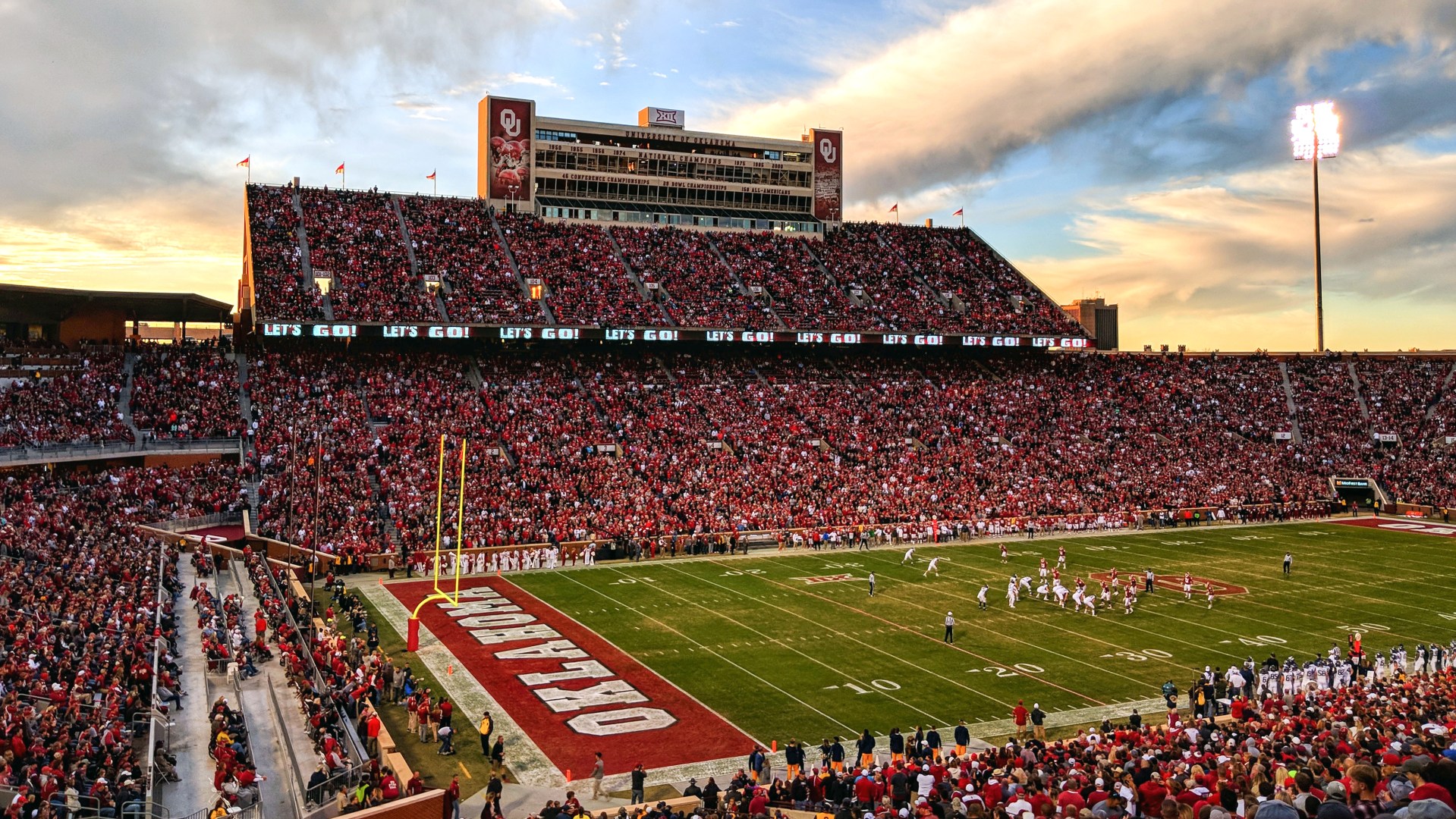
When the tenth-ranked Oklahoma Sooner football team matches up against the twelfth-ranked Baylor Bears on Saturday, the college football world will be watching. The game is slated for a primetime evening slot on ABC, and the premiere college football preview show—ESPN’s College GameDay—will be in Waco, Texas, to heighten the drama.

Despite the attention this year, the matchup is hardly historic. The two teams have only played 28 times—most of them since 1996, when they joined the Big 12 conference—with Oklahoma winning 25. When one thinks of college football’s great historical rivalries, Baylor and Oklahoma are not even on the radar.

Beyond the field, however, Baylor and Oklahoma do have an important shared legacy. While religion has been a part of football since its very origins, one could make a strong case that no two college football programs have played a more important role in bringing evangelical Christianity into modern-day college football than Oklahoma and Baylor. Their ministry partnership has far greater historical significance than their football rivalry.

For both schools, their pioneering roles came through the Fellowship of Christian Athletes (FCA), founded in 1954. Plenty of Christians had participated in athletics before FCA, but there was no organized infrastructure within the sports world providing them with spiritual support. FCA changed all that, sparking a movement of Christian athletes and coaches that by the 1980s had carved out a stable place within the American sports landscape.

College football was not the FCA’s only sport, but it was by far the most important. Its ability to bring local communities together and its association with masculinity and building character fit well with FCA’s ethos. It was fitting, then, that Oklahoma, king of college football in the 1950s, was where it all began.

The FCA idea came from the mind of Don McClanen, a junior college basketball coach in the state. McClanen’s goal, developed in the midst of the Cold War, was simple: mobilize celebrity athletes to sell Christianity to America’s youth before they could be reached by communism. McClanen’s vision was national, but he had inspiration in his own backyard from Bud Wilkinson, standout coach of the Oklahoma Sooner football team. An Episcopalian, Wilkinson was open to McClanen’s religious vision; he and assistant coach Port Robertson helped organize FCA’s official public launch, which took place in Oklahoma in January 1955.

The launch included visits to numerous high schools and colleges in the state. But it was the visit to the University of Oklahoma that proved most fruitful. “All the players and coaches were in the meeting room and soon the back door opened and in walks Coach Wilkinson and three other men,” former Sooner player Chuck Bowman recalled. The three other men were current or former professional athletes: Doak Walker (football), Otto Graham (football), and Pepper Martin (baseball).

The celebrity athletes sensed the potential usefulness of Oklahoma Sooner football. “I would hit that school again and again,” Graham wrote to McClanen, “because they are the big name out there and a big name in the country.” Sooner football players like Bowman, Clendon Thomas, and Bill Krisher all became FCA spokesmen, helping to legitimize the organization within big-time college football.

Oklahoma football players also helped expand FCA’s goals, adding to its public-facing evangelistic mission a more private discipleship and relationship-building program. This occurred after the very first FCA meeting. Ten Sooner athletes stuck around, asking FCA leaders if they could continue meeting together on a regular basis. Put simply, they instigated the pilot program for the small-group structure that FCA would later call “huddle” groups—one of FCA’s most important and lasting innovations.

While Oklahoma served as ground zero for FCA’s move into college football, we could call Baylor an early adopter.

As a Baptist university in the South, Baylor already had a culture of support for the blending of football and Christianity. When FCA visited campus in 1956 it received a warm welcome from Baylor athletes, including All-American lineman Bill Glass. And Baylor athletes contributed to FCA’s growth, too, building on the Oklahoma model by launching a weekly FCA meeting. By 1961 Baylor’s FCA group was so successful that college football programs across the country were writing to Baylor asking for guidance on how to start their own FCA groups.

Baylor’s FCA connections extended into coaching as well. John Bridgers, hired as Baylor’s football coach in 1959, served on FCA’s Board of Directors in the 1960s. His involvement coincided with the leadership of James Jeffrey, a former Baylor football player who led the FCA’s expansion in that decade. Bridgers helped FCA embed itself more fully within the coaching fraternity, participating in FCA’s breakfasts at the annual meeting of the American Football Coaches Association (AFCA) and building relationships with his peers. Bridgers especially wanted to reach coaches who, he explained to fellow FCA Board members, “felt that they were not good enough to be a part of FCA.” He wanted to help them see that FCA members were not perfect; they were simply “sinners who were seeking Christian answers in their personal lives and trying to make it a part of their athletic work."

So successful was this effort that by 1971 the New York Times was taking notice. It published an article describing southern college football coaches as the “circuit riders” of the FCA faith. Frank Deford, too, writing for Sports Illustrated in 1976, quoted a coach who claimed that FCA membership was akin to a college football coach union card.

There was one final way in which Oklahoma and Baylor served as catalysts for the modern-day fusion of faith and football: their move towards racial integration. Although FCA was integrated from its 1954 origins, it was a white-dominated organization and it did not insist that its southern coaches prioritize desegregation. Some FCA-affiliated coaches dragged their feet on the matter, but Wilkinson and Bridgers were relatively quick compared to their peers.

At Oklahoma, Prentice Gautt, who joined the team in 1956, broke the color barrier, while at Baylor, John Westbrook, who joined in 1965, did the same. Both Gautt and Westbrook also played pioneering roles in FCA. Throughout the 1960s Gautt was one of FCA’s few black spokespersons, praising the organization for its “ecumenical and interracial” character, while John Westbrook was hired in 1969 as FCA’s first black full-time staff member.

Westbrook and Gautt serve as a Rorschach test of sorts for how one views the movement that FCA wrought. Supporters might see them as examples of FCA’s positive influence in college football, its promotion of a racially inclusive community. Others, like journalist Tom Krattenmaker, might see the inclusion of black athletes as an example of the way predominantly white evangelical organizations tokenize and use people of color to maintain their own authority.

There are tensions in other matters, too. Baylor, for example, has featured a number of Christian leaders in football since the 1970s, including revered ex-coach Grant Teaff, standout linebacker Mike Singletary, and, most recently, current coach Matt Rhule. But it must also claim Art Briles, whose public proclamations of faith contrasted with a Baylor career that ended in disgrace.

And Briles is hardly alone among Christian coaches. While many athletes and coaches have found meaning, direction, and comfort from the spiritual support system developed by FCA, it’s fair to ask if Christian convictions are too often subsumed by the pressure to win and the allure of money and fame in major college football, or if the evangelicalism planted by FCA has significantly shaped college football culture in positive ways.

But whether you love or hate to see it, there is no doubt that Christianity is conspicuously present within the ranks of college football in ways that it was not prior to the 1950s. When you see a college football coach talking publicly about Jesus, or a quarterback thanking God for helping him persevere through adversity, or players gathering together in prayer, you can think of Baylor and Oklahoma, partners in ministry who helped to pave the way.

Paul Emory Putz has a Ph.D in history and is Assistant Director of the Sports Ministry Program at Baylor’s Truett Seminary. You can follow him on Twitter @p_emory .

News
Wire Story

Tony Evans Becomes the First Sole African American to Author a Study Bible, Commentary Named for Him

Celebrating 50 years of historic ministry, the Dallas pastor discusses his advice to Kirk Franklin and how his new releases highlight the black presence in Scripture.

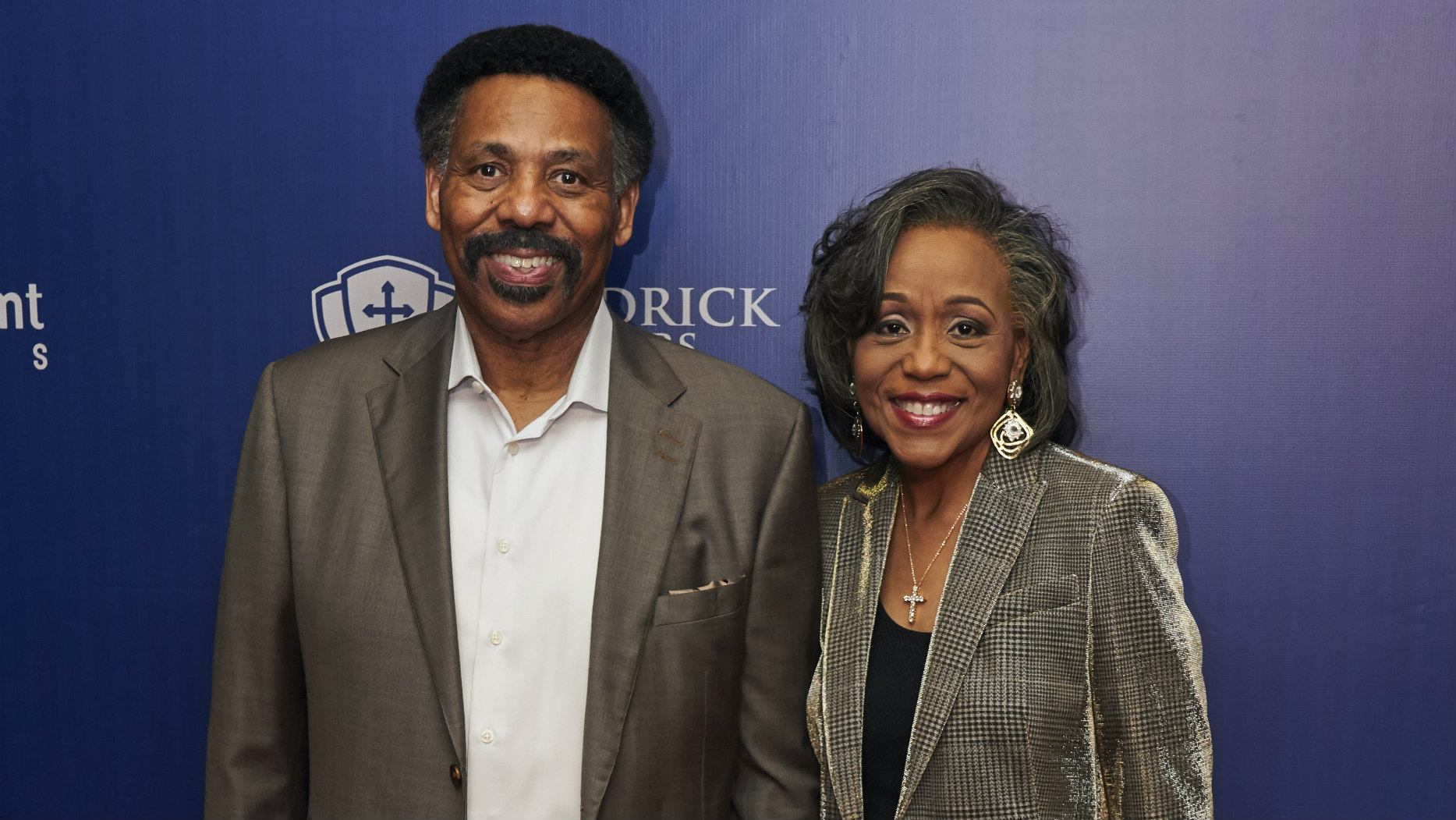
Tony Evans and wife Lois Evans in August 2019

Tony Evans and wife Lois Evans in August 2019

Christianity Today November 13, 2019
Cooper Neill /Getty Images for AFFIRM Films

Pastor Tony Evans has been a megachurch leader, a radio broadcaster, and the author of dozens of books.

Now he has a new title: the first African American to have both a study Bible and a full-Bible commentary with his name.

“Paying attention to context is extremely important if you want to accurately understand what the Bible is saying,” he writes in opening instructions of the new, 1,429-page commentary. (Editor’s note: Evans was the first African American to earn a doctorate in theology from Dallas Theological Seminary.) “If you don’t pay attention to the context, you are in danger of trying to make the Bible say something that it doesn’t actually say.”

Oak Cliff Bible Fellowship, his predominantly black nondenominational church, marked the fall release of the two tomes at a gospel-star-studded celebration on Friday. During the almost three-hour “Kingdom Legacy Live” event, musicians Kirk Franklin and LeCrae both described Evans as the father figure they needed, in person or via his radio broadcast, “The Alternative with Dr. Tony Evans.”

The evening featured video tributes to Evans, 70, from other luminaries, such as former President George W. Bush and former football player Herschel Walker. It also included words of gratitude from family and friends for Evans’ ailing wife, Lois. Priscilla Shirer, one of Tony and Lois Evans’ four children, recalled how her mother worked to pack up and mail cassette tapes of her father’s sermons in the early days of the ministry the couple co-founded.

Just before the event, Evans talked to Religion News Service in an exclusive interview about his new biblical volumes, coping with his wife’s health challenges, and supporting Franklin in his boycott after the gospel musician’s race-related remarks were cut from a broadcast of the Dove Awards.

The interview has been edited for length and clarity.

How is your wife doing, given her diagnosis of biliary cancer and has her condition been a test, perhaps, of faith for you as well as her?

A great test of faith in our lives because it’s incurable cancer, and the doctors said there’s nothing more they can do. So we are totally resting on the supernatural at this point. But because we have a strong faith, we are stable in the midst of instability and uncertainty. We stay close to each other as a family, and we stay close to God. Over the last week and a half there has been a slight improvement that was unexpected even by the doctors. So we’re just trusting God in the middle of that and taking it day by day. We’re believing for a miracle, but we trust him regardless.

RNS / Courtesy image

There have been Bible commentaries by groups of African American scholars, but why do you think there hasn’t been a commentary, under one black person’s name, until yours and until now?

It’s seven years of intense work, but the reason for it is to promote a specific worldview. I believe the Bible has a very specific worldview, which is the glory of God through the advancement of his kingdom. And so I wanted to thread that worldview through the Bible and the commentary.

For the lay person, what do you mean by “the advancement of the kingdom”?

Mankind was established to advance God’s purpose in history. God’s purpose in history is the establishment of his rule in every area of life. We call this the kingdom agenda. And so what we’re trying to show is that he wants to rule your personal life, your family life, your church life, and your societal, governmental life, all of life. So the closer you are to that rule, the more ordered your life will be. The further you are from that rule in all of those categories, the more chaotic life becomes. So we’re trying to help people to understand how that works, what that looks like, how that functions, how you get in it and how you operate by it so you can have a well-ordered life in a chaotic world.

You’re being honored for 50 years of pastoral ministry, and I understand that your first big crowd was at the Apollo Theater. So how old were you then and what do you remember of that moment?

I was 21 years old. There was an evangelistic crusade and I was a support to that crusade, but the head of the crusade—his mother passed away and he had to leave—so I had to step in for him, and it was being held at the Apollo. So that was my special moment.

Kirk Franklin has cited you as having a role in his recent decision to boycott the Dove Awards and other events related to the Gospel Music Association and Trinity Broadcasting Network. Why did you recommend that he take these steps?

One of the things I point out in the Bible is the black presence in the Bible. And one of the issues I have dealt with: There were years where I was not allowed to be on radio because of my race, and I was told that directly. So there has been in the Christian community and the evangelical community, a consistent disparity in how minorities are treated and how we are allowed to sit at the table equally.

And so when they cut out the part of his speech that was critical to his and our experience, that demonstrated cultural, racial insensitivity, especially since it was nothing offensive. It was a fact of what had happened. So I felt that would have been appropriate since that’s what his conscience told him to do. But I also told him, you must honor your conscience in a righteous way. And so that’s why he put in there he’s willing to help rectify it, not just complain about it because a lot of times you have complaints without solutions. Let’s help heal. Let’s not just keep divided, but also let’s be clear on what’s right and what’s wrong.

After the shootings of the police officers in your city in 2016, you said the church “must do better” to influence “good in the midst of darkness, fear and hate.” What has happened since then by you, your congregation or other religious organizations to address these issues of shootings by police officers of people of color and also shootings of police?

Here at our church, we’ve held political forums where we have asked community leaders about their positions on issues to show that fits the kingdom agenda, which is the government side of things—that we want to have a voice. But we also have a lot of police who come to our church, and we held a police forum here because the former police commissioner is a member of our church, Chief (David) Brown. We’ve had him come to speak to groups in the church because there’s a citizen side to this, too. You must respect the office of the policeman. But the policeman must respect the life of the citizen. And that is a mutual respect message that needs to go out.

To go back to your mention of the black presence in the Bible, is there something new that you brought forth in your commentary Bible?

Well, one is to acknowledge that it’s there. In the lineage of Jesus are a number of people from the lineage of Ham. The lineage of Ham goes back to African people since he settled in Africa. We deal with the curse of Ham that was used to promote slavery in America and apartheid in South Africa. The role of Egyptians in the Bible is pointed out in Scripture as well, the African presence in the church at Antioch in Acts Chapter 13. Moses married Zipporah, who was the (daughter) of Jethro, an African priest. So that’s often not pointed out. And, in fact, in Numbers 12, God judged Aaron and Miriam for their rejection of Moses’ African wife. So early on, God was dealing with racism and interracial marriage.

What I want to say to African Americans is if you see what’s really in the Bible, you can find yourself there. You don’t have to lose yourself to believe in Jesus. In fact, much of who we are is in Jesus.

So after some 50 years of pastoral ministry, do you think about retiring at all?

No. Not yet, at least. As long as God gives me health and strength and vision—I couldn’t function without vision. So as long as those are pulsating, then much to my staff’s chagrin (laughs), there’s much more work to do. And I love what I do. I love what I do. I’ve got to do it differently at 70 years old. But still I love what I do.

Clarification: The initial headline for this article indicated that Evans was the first African American to author a study Bible and commentary. While he is the first to take on such projects on his own, per his publisher, other black theologians have pioneered Bible scholarship for African Americans, including the late Cain Hope Felder, the editor of the Original African Heritage Study Bible .

Pastors

The Peculiar Tale of an Anglican-Baptist Church Plant

Why would two distinctly different denominations work together? And what have they learned?

CT Pastors November 12, 2019
Source Image: Noah Buscher / Unsplash

In the fall of 2014, a Baptist church in Edmonds, Washington, planted another congregation. But this wasn’t an ordinary planting experience—rather than starting another church in their own tradition, they planted an Anglican one.

When they heard about it, the editors of CT Pastors had to talk with the two key leaders behind the new church plant. Barry Crane is lead pastor of North Sound Church in the Seattle area, associated with Converge (formerly known as the Baptist General Conference). Todd Hunter is a bishop of Churches for the Sake of Others (C4SO) in the Anglican Church in North America.

How did this happen?

Barry Crane: North Sound Church is located in Edmonds, just north of Seattle, about 15 minutes from the Interstate. We debated buying property next to the Interstate to become a regional congregation, but we decided to drill deeply into our own community. We considered planting neighborhood churches. But we don’t have the population density of Manhattan; many people would just drive to the main building.

Eventually I called a group of people together in 2011 and asked, “What would it look like if instead of a traditional church-planting model—planting our denomination in a different geography—we looked at it from a missiological viewpoint? What if we saw the unreached people groups in our area? Who in our community is not being reached by existing churches?”

What did you discover?

Crane: An unreached people group. Our study through Percept Group revealed about 17,000 people within a three-mile radius of the church who prefer a liturgical form of worship.

Aren’t they being served by mainline churches?

Crane: We estimated that if you added all the folks attending liturgical churches in our area, there would be a maximum of 3,000. That left most of this group unserved. The fact is, although it has been a challenging half-century for all churches in America, it has been especially so for mainline liturgical congregations. From 1965 to 2005 they have lost anywhere from 15 percent to 46 percent of their adherents.

We’re guessing that planting a liturgical church was a hard sell for your leaders.

Crane: Our history somewhat prepared us. We were planted by a Baptist church in 2004, so we became part of a church-planting network, “paying it forward” by helping another church get started financially. We still do that with Converge. And in this church-planting world we live in, there is a principle we take as axiomatic: “Churches committed to church planting don’t make sense to other churches. They give money and people away.” Usually we don’t apply that beyond our own tribe, but it’s not a big stretch to say, “We want to give people and money away, to show love to our community. Who could our Anglican friends reach that we’re not able to reach? And how can we help them do that?”

Todd Hunter: You could have started liturgically-leaning Baptist churches.

Crane: We flirted with that idea at North Sound: “Should we do Communion every Sunday?” I realized, Unless you have a sacramental theology, it won’t work. If a liturgical service was going to work, it had to be authentic to the people, and that’s not who we are.

What was the reaction?

Crane: My mentor wasn’t too sure of our plan. I said to him, “You are the person who taught me the theology of the kingdom of God. And this is the logical extension of your theology.” He looked down at his plate and said, “I know.” Then he became a cheerleader.

Todd, how did you come in to this?

Hunter: Barry knew of me through a friend, and my days at Alpha. He contacted me and proposed we start an Anglican congregation in North Sound’s building, sponsored by them. I said, “It may be a little strange, but this could work.” In October 2013, I sat with Barry’s elders and we said, “What would it look like for a Baptist church to plant an Anglican church on top of it?”

What were the challenges from your side?

Hunter: Barry and I had easy, automatic trust, but for this to work, we had to form a partnership of North Sound Church, Converge, C4SO, and the Anglican Diocese of Cascadia. There was this immediate question of episcopacy.

Since the books Missional Church and The Divine Conspiracy, there’s been a lot of kingdom rhetoric. And it’s easy to work together for the kingdom when, say, three churches get together to refurbish somebody’s home. But the reality in this situation was harder—when you plant a church that will be under a bishop, that church can’t be under someone else. And this church would be planted not in my diocese, but in Cascadia, under Bishop Kevin Allen, so he also needed to support the plan.

What kept you motivated?

Crane: We hoped this church plant would reach three groups: (1) de-churched Christians from mainline churches, (2) baby boomers who had tired of contemporary worship (I was an executive pastor in a large church, and I understood other people like me), and (3) young people who wanted to capture the mystery of ancient-future worship. There appears to be a growing interest for an alternative to contemporary worship led by a soft rock band. Robert Webber saw this years ago when he said that in a postmodern setting, young people would be drawn into mystery and sacrament.

For the plant, which group does what?

Hunter: North Sound helped fund the launch, and they provide an office. They also had a resident church planter, Ryan, who wanted to serve in an Anglican setting.

That’s unusual.

Crane: I would call it miraculous or at least awesome. We had sent Ryan for the Converge assessment, and he began developing himself and preparing to plant a Baptist church. But during that process, several people crossed his path who were Anglican, and he began to rethink his approach. I said to him, “Ryan, we made a commitment to you to help you plant a church. Are you now hoping that church will be Anglican?”

Hunter: Ryan and his wife, Emily, spent time with me, and I approved them as planters. What I love about this model is the great safety network it gives the church planters. Ryan and Emily interact daily with the North Sound staff. Barry lets Ryan use his church space and serves as a mentor. Converge pastors are his friends, and he has Bishop Kevin overseeing him.

This sounds way beyond a lease agreement.

Crane: North Sound Church and the plant, Holy Trinity Edmonds, join together for community events and even a joint service on Good Friday. Relationally, we are very connected. Many pastors ask, “What if the churches in our community were actually able to work together?” Unfortunately, unless you start that way, it tends to break down.

So how’s the plant going?

Crane: Holy Trinity, Edmonds held its grand opening October 4, 2014. At the end of 2016, they became financially independent, with an attendance around 90.

But can cross-denominational plants work beyond this situation? It seems all the dynamics were just right.

Hunter: Holy Trinity Edmonds is now working to plant another Anglican church in Everett, about 30 minutes north—in partnership with North Sound Church, C4SO, Converge, Bethel Baptist Church in Everett, and the Anglican Diocese of Cascadia.

Crane: For our first plant together, North Sound Church pretty much paid the bill. In this next one, the largest financial gift is from Todd and C4SO.

Hunter: We’re all doing this “without proprietary interest.” The church will end up in Cascadia, not C4SO. The planter is an intern I had.

So you see this as a model for other churches to use?

Crane: We can do innovative, effective, low-cost church planting this way. Consider the savings: The plant has essentially no initial facility costs. And it starts with the launch church’s computers, copiers, and receptionist. Our hope is to provide a proof of concept that can be adopted at the national level.

Still, do those cost savings outweigh the theological differences? As Ed Stetzer quipped, “It sounds like a good idea until the first baptism, and then you don’t know if you need a cup or a tub.”

Crane: For us there were three issues that required the most understanding: infant baptism, the Real Presence in communion, and episcopal authority. I do not want to minimize what may be very different understandings of important practices, but as we learned more, we realized there could be cooperation. On baptism, for example, I was influenced by my Greek professor, George Beasley-Murray, and my theology professor, Dale Moody. Both uphold believer’s baptism but ask that we extend grace to 1,500 years of practice.

How did you explain “extending grace” on infant baptism to your members?

Crane: In our history, we essentially took over a church that was dying, and along with their building, we inherited their by-laws. Those stated that if you had been baptized as an infant, you couldn’t be a full member; you could be only an associate member. And long before there was any thought of planting an Anglican church, I had said, “Folks, for at least 1,500 years, our brothers and sisters in Christ have followed this practice. Are we really ready to say that people like John Stott, J. I. Packer, and N. T. Wright are somehow less Christian as a result of this experience?” They agreed, and we started to welcome as full members those who were baptized as infants (who could always be baptized as adults, if they wished).

Hunter: I give big bragging rights to Barry and his people. They didn’t ask us to negotiate our position or compromise our beliefs. They just bit the bullet and said, “We’re planting Anglican churches, and this is what they do.” They never once made us be something we are not.

Ultimately the reason this worked was that Barry and North Sound Church looked at their community from a kingdom point of view. Not like a McDonald’s or Starbucks, making sure they have a unit in every part of Seattle.

Do members feel they are “losing” by planting a church outside their denomination?

Crane: This is a gift for the kingdom. It is not a quid pro quo arrangement. Our denominational systems reward denominational progress. Our resources are poured into the expansion of our own tribe. Imagine what can be accomplished for the kingdom if we move beyond models of denominational competition toward strategic partnerships.

But strictly speaking, one reason an evangelical congregation can plant an Anglican church in the same facility is because there is such a dramatic difference between a contemporary service and a liturgical service. Typically the evangelical congregation will not “lose” many people to the liturgical expression—other than those who are encouraged to assist in the startup. You can plant on top of yourself if you reach a different universe.

What should a typical pastor take away from your uncommon approach?

Crane: The need for church plants. New churches have a much younger age profile than do older churches, and new churches have two to four times the conversion rate of new Christians than older churches do. New churches are required to keep the church species healthy and strong.

Hunter: The power of trust. Stephen Covey wrote about The Speed of Trust. When you have trust, things that would otherwise be really hard become doable.

This article originally appeared in CT Pastors’ Guide to New Church Models , which offers an overview of the model-rich landscape of church ministry. It can be found at BuildingChurchLeaders.com.

Books

What Would Jesus Ask?

Asking ourselves questions found in the Bible can transform our spiritual life.

Christianity Today November 12, 2019
Illustration by Rick Szuecs / Source images: Envato / Unsplash

Have you ever been around a child who did not stop asking questions? Do you recall doing the same thing when you were young?

Inspired Questions: A Year’s Journey Through the New Testament

Inspired Questions: A Year’s Journey Through the New Testament

Christian Focus Publications

240 pages

$16.99

Even as adults, much of our day is still spent asking others for information—soliciting feedback on a project, for example, or requesting status updates on an event. We probably spend even more time each week with those closest to us enquiring about work, school, marriage, parenting, leadership, time management, and the direction of our lives. But have you ever paused to consider asking inspired questions?

What are Inspired Questions?

Inspired questions are the ones found in the inspired Word of God—the Holy Scriptures. They help us sense the presence of God in our life and empower us to become more sensitive to the Holy Spirit’s moving. They reveal our hearts in ways other questions cannot. They help us discern God’s calling on our lives. They drive us deeper into our own reading of the Holy Scriptures. They are a uniquely powerful tool for unlocking key information in the Bible. They persuade us toward a godly direction. Indeed, they are for everyone who lives on this planet for the simple fact that God’s Word is for everyone. The fact that the Spirit inspired them means we are meant to ask and consider them as well.

Yet in the age of secular counseling, and now question-centered therapy, inspired questions have largely been set aside. Even though they are among the most effective and time-tested ways to help us diagnose our spiritual condition, strengthen our walks with God, and foster our journey with others, many Christians don’t understand what they mean for our spiritual growth. Maybe now is the time to notice and note the question-driven nature of the Bible. Perhaps we should start allowing God to lead us in the question asking.

Four Ways to Utilize Inspired Questions

A substantial portion of our Bible is questions, and asking questions was a primary teaching method of Jesus. To put this in perspective, the Book of Proverbs has approximately 930 sayings, while the New Testament alone contains about 980 questions. That means, you could ask yourself a new question from Scripture every day for the next two and a half years and never see the exact same one—even if you limited yourself to just the questions in the New Testament.

Now it is important to note upfront that we must understand each inspired question in its inspired context. Otherwise, we might mistakenly give a generic answer to what looks like a generic question. For instance, in Mark 10:3, when Jesus says, “What did Moses command you?” Jesus isn’t asking the religious leaders to think about any or all of Moses’ commands, but specifically about his command concerning divorce. Therefore, we shouldn’t ask this inspired question and then meditate on God’s law against coveting, even if that would be spiritually beneficial to do.

A second issue we might face is giving a completely wrong meaning to a text because we didn’t look at the inspired question in context. For example, in Matthew 6:25, Jesus asks, “Is not life more than food, and the body more than clothing?” It would be possible for someone to get the idea that God was unconcerned about what we eat and what we wear. But just the opposite is true. Our heavenly Father is intimately concerned about these things. The point of the question is that we are often more concerned about material things than we are about the kingdom of heaven and whether we are living righteous lives. God still wants us to have food and clothing, but living in a world that preoccupies itself with them can easily rub off on us, even to the point of addiction.

For some of us, wrestling with the question in its context comes as no surprise. For others, this careful reading might require you to ask a more mature believer for prayer and guidance. You may need to reach out to a local pastor, or grab a reliable commentary or devotional, for assistance. The good news is that help is available, and learning how to study, interpret, and apply the Bible becomes easier over time as you do it both individually and communally.

With that in mind, here are four ways to utilize inspired questions for the sake of your spiritual formation and the spiritual formation of your community.

1. Start with yourself.

Pause for a moment and remember that someone in the Scriptures heard each question you read in the Scriptures. Many of the questions were ones Jesus himself heard or asked. Now you—the 21st century listener—can hear the same ones when you encounter them during your time alone with God.

Start by putting yourself in someone else’s shoes and listen to the questions they heard or asked. Imagine what it was like for some people in Simon the leper’s house to hear Jesus ask them, “Why do you trouble her?” (Mark 14:6). Or think about what it would have been like for Peter, who just openly denied being one of Jesus’s disciples, to hear the resurrected Jesus ask him, “Simon, son of John, do you love me?” (John 21:17).

Then direct the questions to yourself like the godly saints in Scripture did. Consider this question that the Psalmist asked himself: “Why are you cast down, O my soul, and why are you in turmoil within me?” (Ps. 42:5). Or recall how each disciple, “one after another,” asked this question after hearing that someone would betray Jesus, “Is it I?” (Mark 14:19). They did not start by looking around, pointing fingers, or questioning others. They first examined themselves with a question that you too would do well to use for your own spiritual growth.

Don’t be afraid to ask the exact same questions that the people in Scripture did. When Habakkuk was struggling with his surrounding circumstances, wondering why so much evil was going on around him, he cried out to God with questions. He spent time alone with God, asking questions that are now included in the inspired Word of God for your use and instruction (Rom 15:4).

2. Enjoy them with friends and family.

Whether it is with your parents, roommates, siblings, friends, or kids, discuss inspired questions as part of your daily conversations, mealtime fellowship, or family worship. Put a handful of them into a bowl or jar, for example, and then over the meal discuss the question someone picks.

The good news is that you don’t need to make up your own questions. You don’t need to be creative here. Simply allow God’s Word to lead in the question-asking. Let the inspired questions be the icebreakers. Let them become the launching pad into the type of conversations that leave your souls most satisfied.

Indeed, the best questions are inspired questions. Their home is already the Bible, where they are nurtured. They move us from being passive observers to being active participants. And Bible questions point us to Bible answers.

3. Discuss them with your church community.

Inspired questions unite Christians across congregational and denominational lines. No matter where you live, or what church community you plug into, all Christians have the same inspired questions. Therefore, consider adopting a new approach to your small group discussions where you ask and answer a handful of inspired questions each week. Perhaps select a character or book in the Bible, and chronologically engage each question that surfaces. What a great way to foster dialogue within your group, develop life-on-life learning, and help each person find their place in the bigger story of God’s Word.

When you do this, the payoff is great. Questions draw us out of our comfort zones. They remind us of our dependence on God and each other. And despite our differences, inspired questions connect us with other believers and remind us that we are one in Christ. Listen afresh to the questions Paul asked the Corinthian church: “Is Christ divided? Was Paul crucified for you?

Or were you baptized in the name of Paul?” (1 Cor. 1:13).

As individualistic as we are, and as isolated as we’re becoming, we need to seize upon more occasions and opportunities to come together, ask and answer questions, and grow as communities. Discussing inspired questions communally is yet another way to foster community connections and grow together into Christlikeness.

4. Use them to engage your surrounding culture.

From his youth, Jesus spent time asking people questions (Luke 2:46). He engaged lawyers, scribes, Pharisees, Sadducees, and other leaders with questions (Matt 22:41). His followers did the same. In the Book of Acts, for instance, Philip engaged an Ethiopian eunuch with a question, “Do you understand what you are reading?” (8:30). The eunuch immediately replied with yet another question, “How can I, unless someone guides me?” (8:31).

Using such inspired questions is an effective but neglected way to engage your surrounding culture. The same questions that Jesus and the early church used to engage their surrounding culture you can still use to engage yours. You have the opportunity (indeed, privilege!) to use them to point others to Christ—in whom is the fullness of all wisdom and knowledge. Their quest for understanding—just like yours—can only be found in him alone.

Perhaps start by picking one or two questions in the Scriptures that nonbelievers asked, and then ask a nonbeliever you know if they have ever considered the same one. For instance, Pilate asked Jesus, “What is truth?” (John 18:38). Imagine giving your surrounding culture the opportunity to ask you the same question because you engaged them with it via the Scriptures. Even if they do not believe the Bible to be true, they can at least understand that it is part of our common literary heritage, like Plato and Aristotle.

Change Your Questions, Change Your Spiritual Life

Using inspired questions as a tool for spiritual formation is both spiritually forming and informing. They facilitate a deeper engagement with God’s Word. They aid us in better understanding and more effectively living out the upward call of God in Christ Jesus. They help us recognize God’s work in others and us. They keep us missionally minded.

Through both personal experience and pastoral counseling, I can testify that asking inspired questions has radically changed my life and ministry. My marriage has been positively impacted because of them, such as the ones posed in James 4:1: “What causes fights and quarrels among you? Don’t they come from your desires that battle within you?” My counseling benefited from questions like Luke 12:25: “Who of you by worrying can add a single hour to your life?” Indeed, there are many others: witnessing and missions via Romans 10:14; communion via 1 Corinthians 10:16; and parenting via Hebrews 12:7.

Abraham, Isaac, and Jacob all asked questions, as did Jesus, his apostles, and their disciples. Perhaps now is the time for you to consider using the same ones for your spiritual growth, as well as the benefit of those around you.

Any questions?

Brian J. Wright is a chaplain for the Federal Bureau of Prisons and teaches for several universities and seminaries as an adjunct professor. His latest book is a 365-day devotional, Inspired Questions: A Year’s Journey Through the New Testament (Christian Focus, 2019).

Theology

Kay Warren: Moms of Kids with Mental Illness Need Christ and Community

The California-based ministry leader recently hosted a retreat for mothers of suffering kids.

Christianity Today November 12, 2019
Courtesy of Joy Hurlow / Saddleback

I first met Kay Warren a few years ago when we served together on a federal task force focused on the intersection of faith and mental health, a topic that has touched both our lives in profound ways.Like many Christian women, I’d followed her from a distance for decades, admiring her advocacy on HIV/AIDS issues and global orphan care and tracking all that God was doing through her and her husband, Rick Warren, at Saddleback Church in California. But then I got to know Kay at a more personal level, as a faithful and compassionate friend who understands what it means to be a mother of a child with serious mental illness.

Warren has extended this friendship to many others like me. After her son Matthew’s death by suicide, she made a commitment to help mothers in similar situations. This passion led to a new retreat called Breathe, held recently in San Juan Capistrano, California and attended by almost 90 moms of children with mental illness.

After the event, I spoke with Warren about the isolation of parenting someone with mental illness, the comforts of Scripture, and what she’s learned about God after Matthew’s death.

With all the advocacy and educational work that you do on mental health issues, why was doing a retreat for moms a priority?

After Matthew died, I talked to hundreds of parents who have kids with mental illness. And it slowly began to dawn on me that not only did parents not have enough support, they didn’t have good community.

There are a lot of reasons for that. There’s stigma and discrimination against people living with mental illness. In the Christian community, there’s a standard that we feel like we have to measure up to—you know, perfect marriages, perfect families, always “things are good, things are good.” And when your life isn’t good, you end up hiding how difficult your life really is.

When there is serious mental illness, there can be extreme chaos, violence, or threats of violence. There is extreme dysfunction. There can be homelessness, substance abuse, and a sense of helplessness. And so parents don’t have a place where they can really say, “This is what my life is like.” And I just kept thinking, what can I do, what can I do? How can I help make a place for others, particularly moms, where they can be real, where they can tell their story, where they can find community?

Then a really good friend—you!—said early this year, “Have you ever thought about doing a retreat for moms?” And my response was “Uh, no, but I will.” It became crystal clear to me that that was exactly what I was supposed to do.

What outcome were you hoping for with the retreat?

I was reading Walter Brueggemann’s book called Reality, Grief, Hope. Just those three words encapsulated what it was I wanted in this weekend retreat. I wanted to create space where women could get away from the chaos and the burden of being a caregiver, and in that beautiful space, we could all take a really hard look at reality.

Any time you take a hard look at reality, it’s gonna lead to deep grief. But I didn’t want to leave people in their deep grief, because I know in my own life that hope really can emerge out of grief. But it takes time, it takes space, it takes intentionality, and I wanted the weekend to be that kind of place.

What surprised you?

I wasn't prepared to feel in myself the depth of community that occurred. Community—it's a bit of a throwaway word now. We use it so lightly. But I was looking for koinonia, for community that’s built on the fellowship of common suffering.

The koinonia of the Bible is at a much more soul level, and I saw that happen. I saw strangers who almost instantly bonded with each other over shared suffering. There was a lot of collective pain and sorrow, but at the same, there was a depth and a richness to it that fed my soul. And it was what I had longed for.

I would have given anything to have had even just a taste of that when Matthew was alive and we felt so alone in our pain, like there was nobody that understood the agony of watching our son deteriorate and knowing that, unless some miraculous thing happened, we weren't even sure he would live. (Pause for emotion.) To be able to receive that kind of fellowship, that soul kinship, would have been such a gift.

During the retreat, I really wanted women to see the goodness of God even in their suffering, even in their pain, even in their uncertain outcomes. And I really I saw it. I saw them recognize the goodness of God in their lives.

Tell us about the significance of the name “Breathe.”

Matthew was actively suicidal for so long that we lived on the edge every single day. We woke up going, “Is this the day? Is today gonna be the day that we lose him?” And after living in that hyper-vigilant state for so long, I realized that I didn't know how to breathe deeply. After Matthew died, somebody’s advice to me was to be sure I was breathing. It offended me at first. But then it woke me up to the fact that I had spent two decades breathing in a very shallow way and that one of the ways I could calm myself when grief was taking me to the ground was to pause, breathe deeply, and allow my whole self to reconnect with God and reconnect with other people.

So I wanted retreat goers to practice that not only physically but spiritually, to really breathe in God and his goodness. Because I am convinced that one of Satan’s main tactics in our suffering is to separate us from a sense of intimacy with God.

Let’s talk about your theology of suffering. How has your experience of parenting someone with mental illness formed your view of faith and hardship?

Well, I wish I were a better theologian and I could express it as eloquently as many others do, but I’m thinking of a very desperate time in 2010 when Matthew had been hospitalized after his first suicide attempt and everything just felt so dark.

I was up late at night and could not find my way to God, couldn't find my way to hope, to optimism, to expectancy, to a good future. I have a computer program that allows me to type in a word or phrase that’s in the Bible in 10 or 20 different versions, and so it pulled up every single place in the Bible where the word dark or darkness is used.

That night, I began a study of darkness. And it was pretty shocking, because 2 Samuel 22:12— in The Message translation—say that “God had wrapped himself in a trench coat of black rain-cloud darkness.” Job 19:8 says, “God had built an impassable wall across my path and covered my way with darkness.” And Psalm 13:3 says, “Answer me, oh Lord my God. Give me light in my darkness lest I die.”

As I was reading those verses, I thought yes, yes, that is exactly what I feel. I was resonating with verses where God's people had been very frank and honest about their desperation. And then I got to Isaiah 45:3, where God tells Isaiah that he's gonna use this Gentile King Cyrus to free his people from Babylon. It says in the NRSV, “I will give you the treasures of darkness and riches hidden in secret places so that you may know that it is I, the Lord God of Israel, who calls you by name.”

I sat back in my chair and pondered that for about the next hour. I felt like I was faced with this decision: Will I believe what God says, that there are treasures in the darkness? And I decided that yes, I was going believe it.

I don’t like darkness; it’s not fun, it’s uncomfortable. It’s hard to find those treasures in the darkness, but I have. I've seen God produce riches in my suffering—not only in the trauma of Matthew’s life with serious mental illness but in the trauma of his death. God has produced gold that helps other people, and I am grateful for that. It doesn’t always make the darkness any brighter, but it does give me strength to walk in the darkness.

So many people throughout the US and the world have prayed for you and Rick after Matthew’s death. Our readers would love to know how both of you are doing. How can people continue to pray?

I decided a couple of years ago on the best way to answer the question, “How are you?” What I’ve settled on are two words: wonderful, terrible. There is so much in my life that is absolutely wonderful. I mean, I have more than I could ask for in every way. I have a strong marriage. I have amazing kids and grandkids. I love the work that I do. My financial needs are met. My health is good. I'm cognizant of the fact that I have been given a lot that I don’t deserve, but I have it. And so in that sense, I cannot complain.

At the same exact time, there is a terrible, gaping, yawning hole in my life where Matthew belongs. That hole is not gonna close over, it’s gonna remain open until the day I see Jesus. And when I see Jesus, I know I’ll see Matthew. And so I live with both. I live with wonderful, and I live with terrible, and I'm learning that that’s an okay way to live.

How have you felt most supported in the wake of Matthew’s death?

This sounds cheesy, but it’s the truth that I have received my deepest comfort from God. And we also have some friends who have decided to make our suffering theirs. They have not urged us to get over it, to move on, they’ve just chosen to suffer alongside of us, and they've moved at our pace.

I've had a great counselor, too. And we’ve benefited because of our visibility, particularly Rick's visibility. We’ve received so much goodwill from thousands and thousands of people. When I go out on speaking engagements, there's always somebody who comes up and says, “I just want you to know my family is still praying for your family.” And I never get tired of hearing that. I usually look at them and say, “Please keep praying, please keep praying.”

As you look to the future of your mental health ministry, what’s your vision?

I’d like to continue to have these retreats for moms—I’d like to expand them. But I’d also like to have them for both parents, because it’s not just the moms who are raising kids with mental illness. Dads need an awful lot of support, as well.

I know what it would do for people living with mental illness to have a weekend where they don't have to put on a mask, where they can be real about their own grief, their own agony, their own lament, and where they can find hope. To gather people in safety, in beauty, in breathing spaces is a powerful way to strengthen the body of Christ. And I want to be a part of that. I want to keep making that happen.

Read Kay Warren’s previous interviews with CT here and here.

Apple PodcastsDown ArrowDown ArrowDown Arrowarrow_left_altLeft ArrowLeft ArrowRight ArrowRight ArrowRight Arrowarrow_up_altUp ArrowUp ArrowAvailable at Amazoncaret-downCloseCloseEmailEmailExpandExpandExternalExternalFacebookfacebook-squareGiftGiftGooglegoogleGoogle KeephamburgerInstagraminstagram-squareLinkLinklinkedin-squareListenListenListenChristianity TodayCT Creative Studio Logologo_orgMegaphoneMenuMenupausePinterestPlayPlayPocketPodcastRSSRSSSaveSaveSaveSearchSearchsearchSpotifyStitcherTelegramTable of ContentsTable of Contentstwitter-squareWhatsAppXYouTubeYouTube