






Whether or not fantasy is your shtick, you'd have to bury yourself into a rather large hobbit hole to hide from The Lord of the Rings and The Hobbit, reignited in the 21st century by filmmaker Peter Jackson, or the recent movie adaptations of the Chronicles of Narnia. As Inklings J.R.R. Tolkien and C.S. Lewis returned to the pop culture spotlight, they spurred Christian commentaries such as Walking with Bilbo: A Devotional Adventure Through The Hobbit, The Gospel According to Tolkien, and Finding God in the Land of Narnia.
As we re-examine favorite Protestant thinker C.S. Lewis, though, we're confronted with an aspect of his writing that can make some evangelicals uncomfortable: his portrayal of women. My own experience with this uncomfortable situation was exposed when the best defense I could muster to a male colleague's complaint of Lewis's backward-looking chauvinism was a weak shrug and a mutter about historical context. After all, the girls in Narnia are prone to tears, less than independent, and do not embody the qualities of traditional heroes; therefore, Lewis must be a sexist, right?
Probably the loudest bit of piffle about "the sexist Lewis" started around the 1990s with biographer A.N. Wilson, who complained about Susan's treatment in The Last Battle. Years later, literary critic John Goldthwaite asserted, among other things, that "Lewis feared women and disliked them categorically." Following that, Philip Pullman – moderate that he is – added his two bits: Lewis was "monumentally disparaging of women," claimed Pullman; in fact, "he didn't like women in general, or sexuality at all."
We've since probably read of J. K. Rowling's – scholarly to be sure – acerbic comment about Susan being sent to hell because she became "interested in lipstick … [and] found sex." As if these were not enough, my favorite, perhaps because of my argument in this piece, is from another critic, Kath Filmer. She stated that what "disturbed" her most about the Narnian Chronicles was how "ultimate good is depicted as ultimate masculinity, while evil, the corruption of good, is depicted as femininity." Really? Lewis was attempting to depict the corruption of good and downright evil as something specifically – gasp – feminine?
Enter Monika Hilder's deeply challenging and compelling interpretation of Lewis's presentation of gender, specifically in Narnia. In her latest book, The Feminine Ethos in C.S. Lewis's Chronicles of Narnia, she does not approach and defend Lewis's depiction of gender from a conventionally understood feminist perspective; rather, by pointing to the disturbing assumptions underlying the traditional model of gender criticism, Hilder makes a convincing case that Lewis was not a sexist, and instead was consciously presenting a "radical theological feminism" that actually liberates us from our sexism.
In her call to seriously consider what our culture considers characteristic of "successful" women, she challenges readers to reflect on how our ideas of female equality get shaped by the very same power-exertion paradigm we try to eschew in the first place.
In an age that worships the cult of personality and aggrandizes the "virtues" of the energetic, the magnetic, the stunning, and the forceful – because these traits lead to more materialistic wealth and power – what room left is there for the fruit of the Spirit? Qualities such as self-control, meekness, patience, and peace sound quite out of vogue; "Let's see how far the meek, patient, and peace-loving female can succeed," I can hear the cynic ask. Hilder, though, suggests that our struggle for independence, power, and autonomy echo Satan's thirst for domination more than Christ's model of humble servanthood.
If we are uncomfortable with some of the female characterizations throughout Lewis's series, perhaps we should reconsider where this discomfort stems from. While we as women are right to strive for gender equality, we are wrong to measure it according to mere chauvinistic ideas of accomplishment. As Hilder states, "to the extent we have not examined our own chauvinism, we demean the 'feminine' qualities and extol the 'masculine'—not noticing that Lewis does the opposite." And indeed, it is in doing exactly that opposite that Hilder suggests Lewis's radical theological feminism can be found.
So what brand of feminism does Hilder see in Lewis's presentation of certain stereotypically feminine traits? And how is this applicable to my pursuit of a physically, emotionally, and spiritually integrated life?
To be honest, at first I was a wary participant of Hilder's controversial tour of Narnia. As a Christian, I know that I have been called to community, love, and reliance on God; as a secularly educated graduate, however, female characters who embody these non-assertive characteristics frankly insult my conventional ideas of politically correct gender discourse. What I can I learn about authentic living from this late-married bachelor?
Lewis's idea of true spiritual strength— for both men and women— rests in openness to our Father, community, submission, compassion, truth, grace, and humility. So, when Lewis has Lucy run towards Eustace-the-dragon and bestow upon him grace only expressible in a child's unrestrained kisses, or Lucy and Susan weep with Aslan while he is on the stone table, or, even Mrs. Beaver demonstrate foresight and responsibility for those in her care (or one could even dare say, community mindedness) in bringing along her domestically stigmatized sewing machine, Lewis wasn't belittling these characters. I can learn that true spiritual strength, or spiritual heroism as Hilder terms it, "establishes the kingdom of heaven through humility," not independence.
Lewis had the same model for men and women: spiritual heroism ever rooted in love and mercy. Indeed Peter's or Edmund's independent thinking, physical ability in battle, or autonomous action don't earn them praise. Instead, their actions are held to the same standards as the girls. Indeed, as Hilder suggests, it may often be because of our own sexist assumptions that we accuse Lewis of sexism.
If the Christ life serves as our model, we can't be surprised by Susan's dismissal from Narnia. Not at all because we reject all interests in heels, hair, and cosmetics, but because we know what is of lasting importance: relationship with and delight in the divine. According to Hilder's interpretation, Lewis reproves Susan not because she is growing into womanhood, but because she falls into the trap of idealizing youth and beauty at the cost of investing in fellowship and love.
In contrast to Lucy's enlarging commitment to faith in the wondrous nature of Aslan, joy in simplicity, and childlike obedience, Susan's world is made smaller by her shrinking realm of superficial pursuits. And isn't it exactly Lucy's childlike eagerness to abandon self-interests and respond to Aslan's numinous call of love that makes her so appealing?
If Hilder is right, as long as we measure achievement according to attributes of conquest, autonomy, and self-assertion, we have all truly fallen prey to a merely chauvinistic narrative. It is only when we grow large enough to see the beauty of dependence, the value of compassion, and the splendor of love that we, like Lucy, will learn that every year we grow, we will find God has too.
Matthew and Joy Steem enjoy teaching, discussing contemporary implications of foundational theologians, herb gardening, and writing. The Steems hold graduate degrees in History (Trinity Western) and English (Queen's) and are currently ghostwriting a manuscript on alternative approaches to cancer.
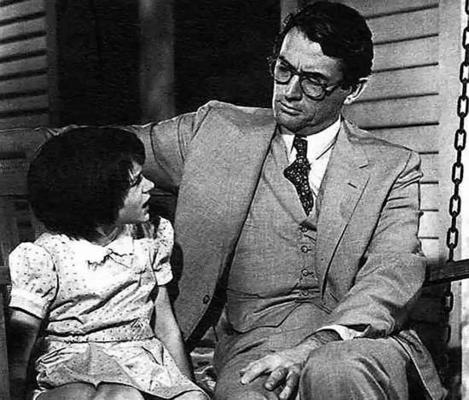
The 50th anniversary this year of the beloved novel To Kill a Mockingbird has many of us remembering the Oscar-winning film and Gregory Peck’s portrayal of Atticus Finch—voted the greatest American hero of 20th century film by the American Film Institute. One key scene shows why this character has become enshrined as an iconic hero and a model of courage: Atticus, alone, facing down an angry, drunken lynch mob late at night with nothing but a newspaper.
Yet when you view Atticus Finch in light of many of our culture’s heroes, something doesn’t add up. Our society reveres success and power. Our heroes prevail in court cases, survive the island, win the big games. Christians seem just as determined to see our view recognized as correct, our argument heard, our sense of entitlement satisfied. Even the heroes of Christian culture seem to be winners these days.
So it’s remarkable that a half century after the publication of Harper Lee’s novel, we still celebrate this small-town lawyer who works out of a meager office and spends his time helping people who can’t afford his services. By today’s standards, Atticus Finch is no winner. We learn at the beginning of the novel that his last two criminal clients were hanged, and —spoiler alert!—his attempt to defend the innocent Tom Robinson (an African-American man falsely accused of rape) doesn’t work out well either.
 After the birth of the Royal Baby, our months of speculation over its sex—A boy? A girl?—will end. But depending William and Kate's use of family heirlooms, the baby might wear pink either way. Historically, before pink became considered a feminine color, it had masculine connotations, too.
Despite today's gender-reveal parties and hyper-girly and boyish baby clothes, it wasn't that long ago that parents dressed infants differently. Some friends recently mentioned that the family christening gown passed down over a few generations — and worn by more than one baby boy — featured pink ribbons. Their son had recently worn it for his baptism. Not only did many of our ancestors once deem pink acceptable for both sexes and even a "strong" color, blue was often seen as appropriate for girls and women, partly due to its association with the Virgin Mary.
As Jo Paoletti recounts in her fascinating history of children's clothing, Pink and Blue: Telling the Boys from the Girls in America, the word "pink" didn't even initially connote a hue and only joined the color vernacular in the mid-19th century. Until the early 20th century, most American babies wore long, white gowns favored for both their practicality (easy to bleach and starch) and lack of gender specificity. When pastels did decorate babies' clothing or nurseries, "pink and blue were suggested as interchangeable, gender-neutral 'nursery colors.'" If a parent did favor one or the other shade, it might depend on the child's coloring.
Though pink and blue began to acquire "gender coding" in the latter half of the 19th century, Paoletti reports that it took almost 100 years for people to uniformly interpret the colors the way we do today. During those days, adults were more concerned with distinguishing adults from children than they were little boys from little girls. Not until age four or five might boys begin to wear clothes that aped their fathers' fashions; before then they often wore dresses largely indistinguishable from those worn by their sisters.
But however much Americans gradually came to perceive pink and blue in such a fashion, this did not make our gender coding globally ubiquitous. "Baby clothes in other countries were still following a variety of rules," Paoletti writes, "meaning that imported items or gifts from overseas continued to observe their own traditional patterns…. Blue was still a 'girl' color in Switzerland, and pink was an acceptable color for baby boys in Korea in the 1980s." (Nor are cultural color differences limited to our baby pastels. The rainbows I see frequently in San Francisco have a very different meaning in Peru, where I saw similar flags in Cusco as a nod to the city's Inca heritage.)
As a knitter of many baby clothes, I tend to follow recent convention in choosing yarn colors, depending on what I know of the child who'll wear my gift. I was a child of the late 70s, and most of my peers are having babies these days. However, Paoletti suggests it's no accident the mothers of my generation are so obsessed with pink and blue baby clothes. Not only can we find out the baby's sex much earlier than our own mothers could, but most of us were raised during the brief unisex clothing fad that followed the sexual revolution.
Paoletti argues that some clothing trends need to be understood in relationship to how the parents buying those clothes experienced childhood themselves. Thus, the current obsession with gender coded children's attire may partly entail a reaction against the clothes we children of baby boomers were forced to wear. Whether or not she's right, Paoletti's book reminded me that the world of color — and gender — is more complex than I sometimes acknowledge.
We often see our habitual ways of doing things as not just preferred, but right. As Christians, it's easy to conflate what seems right to us with what's biblical, particularly when it comes to matters of gender. Much depends on what we think it means to be male or female and what God's intention was when he created the two sexes. But whose views haven't evolved a bit over time? And what's to say we won't undergo further changes in the future?
As a follower of Jesus, I certainly believe in truth, but the human tendency to change should spur humility about our beliefs. The fact that truth exists does not guarantee that we, its human discoverers, are equally infallible in our perception or understanding of the truth. History strongly suggests otherwise.
That's one reason cross-cultural contact — even that as trivial as following the Royal Baby's gender and attire — can be so beneficial. Years ago, I heard Tim Keller give a sermon about the early church in which he remarked that both the Jews and the Greeks had distorted understandings of food. However, their places of confusion were different. Whereas the Jews needed to reckon with what the gospel meant for keeping kosher, the Greeks struggled over meat sacrificed to idols. Perhaps only in hearing Paul's instructions to each other were their own, cultural issues illuminated.
And as Keller pointed out in other sermons, especially on Isaiah, cultural differences also highlight the breadth, depth and complexity of the God whose image we all bear. In the vision of Israel's glorious future, Isaiah sees the nations coming to Israel not with the same gifts, but those particular to their lands and cultures.
We were made by an incredibly big God. If he needed so many different people to fully image himself on earth, perhaps we could all stand to embrace more of the color spectrum as we each go about our image-bearing roles. We used to.
Sometimes when watching that landmark would-be lynching scene in the movie, I forget that in the book, Atticus’s daughter Scout tells us that her father’s hands were shaking. Plain fear was shooting out of his eyes when she approached him in front of the mob. How could we forget that he allows the bad guy, Bob Ewell, to spit in his face and curse him in public—he simply wipes his face and walks away.
Certainly, onlookers may have made assumptions about Atticus’ ability to handle himself. In the courtroom, he steadily draws out the truth without raising his voice, always treating Tom’s despicable accusers with respect they certainly did not deserve. He tips his hat in kindness to the old lady, Mrs. Dubose, who curses and taunts his children day after day. Known as the “best shot in Maycomb County,” he refuses to pick up a gun to protect himself. He takes on a court case that sets him at odds with his community and places his children’s well-being in jeopardy, but tells his daughter that no matter how bad things get she should always remember that these people are their neighbors. His actions aren’t expedient, clearly aren’t in his best interests, and on top of it all—Atticus does not win. Not the day, the argument, the fight, or even the court case.
So why are we so drawn to this character as a hero?
I believe it’s because his courage is so grounded in faith. When Scout asks him why he must defend Tom Robinson, he simply responds, “I couldn’t go to church and worship God if I didn’t defend that man.” Atticus grasps something that I often forget in my own life—that my daily choices have an eternal impact. This is why Atticus can place himself between the mob and an innocent man—teaching us that courage isn’t the absence of fear but the absence of self. It is where he draws the inner resolve to walk away from Bob Ewell’s assault. It is why he understands the importance of maintaining a connection to his neighbors—even when their views are despicable.
Atticus teaches us that courage has nothing to do with winning. “I wanted you to see what real courage is,” he tells his children. “It’s when you know you’re licked before you begin but you begin anyway and you see it through no matter what. You rarely win, but sometimes you do.”
Such heroism is evidence of something divine running through the DNA of humanity. A God-given courage that recognizes our actions might impact eternity more significantly than they ever will in the here and now—that we may lose the argument, the day, even the trial—but we have still advanced the kingdom. This kind of courage isn’t about winning, but making the decision to do what is right—no matter the cost.
"It's a beautiful thing, the destruction of words." So said Syme in George Orwell's prognostic novel, 1984.
Syme was a lexicographer and the developer of "Newspeak," a language designed to diminish the range of thought so that the totalitarian regime nicknamed "Big Brother" could control the thinking of the masses. By omitting words such as "freedom," "excellent," and "bad," Big Brother reduced the language and limited people's capacity for lucidity. When you lose a word, you lose the concept and the experience it describes as well.
Earlier this month, sales of Orwell's novel skyrocketed 6,021 percent in just 24 hours after tech whiz Edward Snowden released documents revealing the mass surveillance tactics of the U.S. and British government. Snowden said national intelligence director James Clapper's sworn testimony before the Senate that triggered him to leak the information. Clapper had told the Senate Intelligence Committee, in response to Sen. Ron Wyden, that the government was not involved in direct surveillance of Americans.
Wyden: Does the NSA collect any type of data at all on millions or hundreds of millions of Americans?
Clapper: No, sir.
Wyden: It does not?
Clapper: Not wittingly. There are cases where they could inadvertently, perhaps, collect, but not wittingly.
In this sworn testimony, Clapper committed perjury because he willfully lied. In an interview with NBC's Andrea Mitchell, he said:
I thought, though in retrospect, I was asked [a] "when are you going to … stop beating your wife" kind of question, which is … not answerable necessarily by a simple yes or no. So I responded in what I thought was the most truthful, or least untruthful, manner by saying, "No."
Since the government doesn't actually read all the e-mails or listen in on all phone calls, Clapper thought he could massage his words enough to obscure the truth of the matter. It seems as though he's going to get away with perjury.
I'm no advocate of Ed Snowden (who certainly has some odd bedfellows), but it's hard to miss the irony that Snowden, the truth-teller, is America's most wanted, while the liar, Clapper, goes about his business without fear of prosecution. As countless parents teach their children the importance of honesty, the government hunts down the truth-teller and effectively rewards the liar.
While the recent purchasers of Orwell's 1984 likely did so because the NSA surveillance tactics seem eerily reminiscent of Big Brother's, I'm more concerned that the lies promulgated in Washington accomplish what Syme set out to do. Our tolerance of lies threatens to destroy clear thinking and moral conscience through the desecration of words.
The Bible emphasizes the importance of words. All of creation was called into being with the spoken word (Genesis 1). God is God, and he could have used any infinite number of ways in which to create the universe, but he chose to use the spoken word. The first task of Adam is a task of words in the naming of the animals (Genesis 2). Part of what makes us humans created in the image of God—the strongest break from the animal kingdom—is language, our ability to use spoken and written words to communicate thoughts.
When we lie or we tolerate those who do, we desecrate and minimize an important aspect of our humanity and our ability to reflect our Creator. In John 8:44, Jesus tells the Pharisees, "You are of your father the devil, and your will is to do your father's desires … When he lies, he speaks out of his own character, for he is a liar and the father of lies." What he's saying is this: "You're never more like Satan than when you're lying—or when you look the other way when someone else lies."
It's tempting to fall into the trap of indifference, to believe that politicians have always lied and always will. It's easy to stop caring because there seems to be nothing you can do. But Christians aren't given that option. We are called to be engaged citizens, guardians of the truth and thus, of words. We can't just be concerned about whether or not we ourselves tell the truth, we must demand truth of others.
As Marilyn Chandler McEntyre points out in her book, Caring for Words in a Culture of Lies, part of telling the truth—of responsibly stewarding words—is refusing to tolerate lies. "Do we shrug and say there's nothing we can do?" McEntyre writes. "I don't think so. It seems to me that the call to be stewards of words requires of us some willingness to call liars to account—particularly when their lies threaten the welfare of the community."
In my own house, I've been teaching my daughter Ellie what it means to tell the truth. At four, she's just now learning that she can conceal her actions—like hitting her sister or swiping an extra piece of chocolate from the candy jar—by lying about it. I'm telling her that truth is important, however much it hurts.
Indifference is a decision with moral consequences. Like the ancient prophets we ought to be brokenhearted over lies and be faithful in voicing our dissent. I cannot set about teaching my daughters to be brave in truth and at the same time be complicit, either directly through my support or indirectly through my silence, in the lies that are promulgated and sanctioned in our government.
***
Matt Litton, author of The Mockingbird Parables(Tyndale), lives in Cincinnati with his wife Kristy and their four children.







