News

Jesus Remains in UK State Schools—in a Manger in the Nativity Play

British culture continues to act out the Christmas story even as fewer believe it.

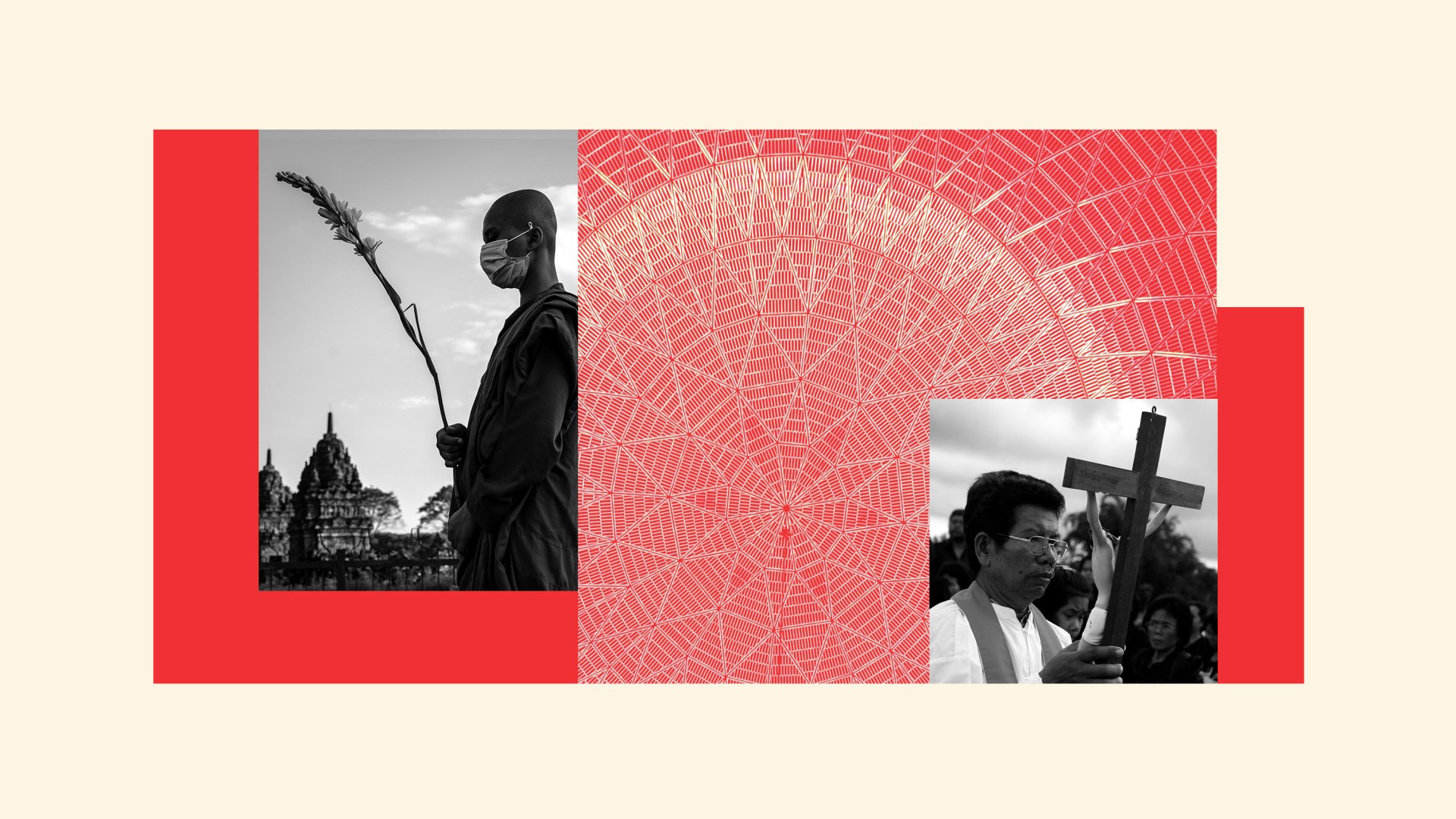
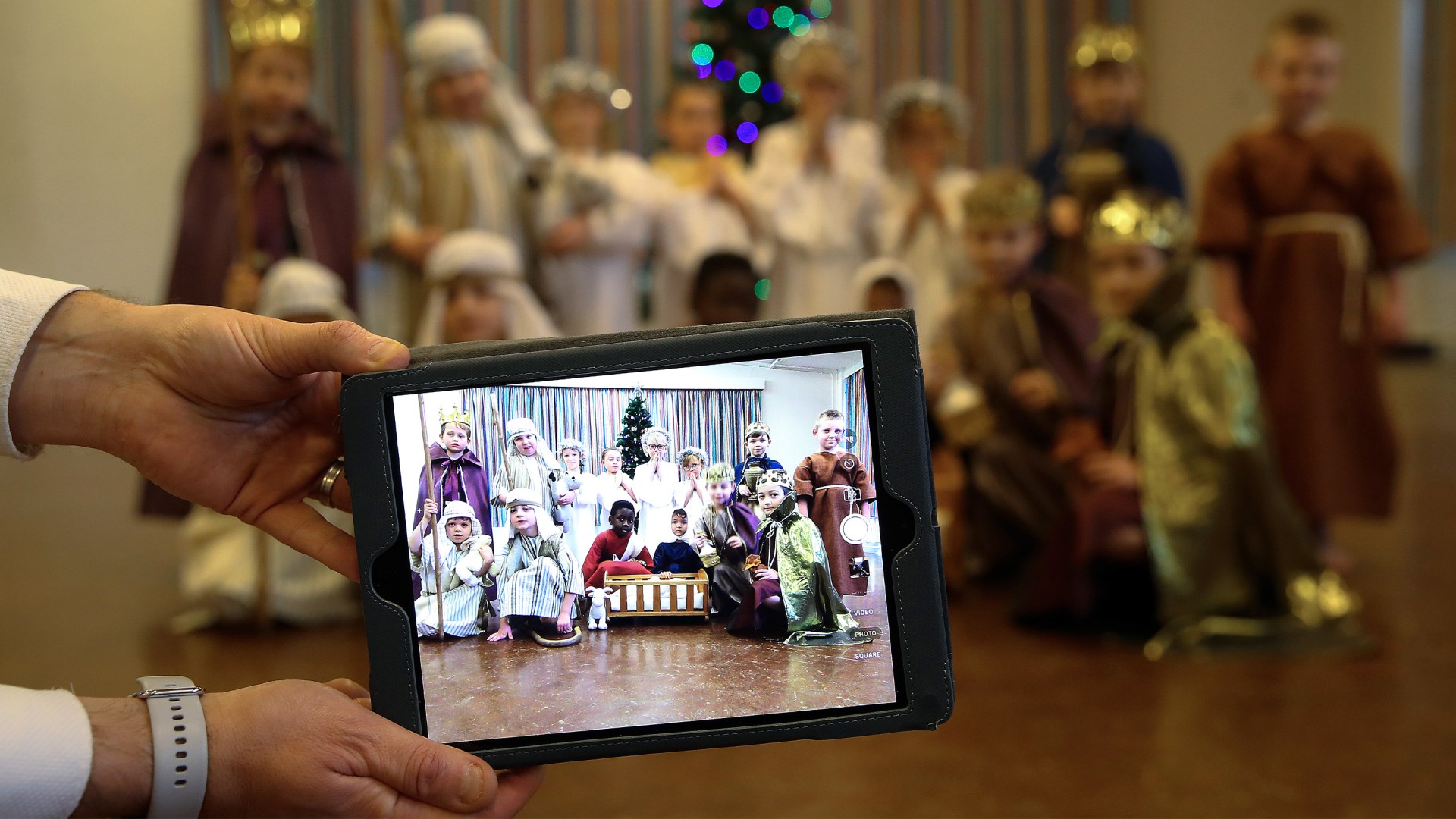
Pupils at Manor Park School in Knutsford, England perform their Christmas nativity play.

Pupils at Manor Park School in Knutsford, England perform their Christmas nativity play.

Christianity Today December 12, 2023
Martin Rickett / Getty / Edits by CT

Ask a British person about Nativity plays, and it’s not unlikely that a crustacean will get a mention. Emma Thompson’s slightly incredulous discovery that there was, in fact, more than one lobster present at the birth of Christ—a scene in Love Actually—is a nod to some of the more outlandish consequences of playing with the Christmas story. But the scene also reflects the cherished place the Nativity play continues to hold in British culture.

With Christmas just weeks away, many a parent is likely to be setting aside tea towels to adorn the heads of tiny shepherds, if not sewing eight legs on an octopus.

While precise statistics are hard to come by, polls suggest that Nativity plays remain widespread in schools in the UK. In the years before the pandemic, around 8 in 10 parents reported that their children had taken part in a Nativity play. In 2021, when COVID-19 public health measures were still in place, 81 percent of teachers were still planning to put on a Nativity play, even if it had to be online.

In a typical production, young children will enact the story of Christ’s birth, from the angel’s visit to Mary to the arrival of the wise men. While many are simple retellings in school halls, some entail an impressive degree of stage management.

At Mayfield School, a Catholic boarding school for girls in Sussex, a tradition dating back to the 1950s sees Mary and Joseph journey through the village with a donkey. They are turned away at the local pub before arriving at the school’s 14th-century chapel, with a real baby playing the part of Jesus.

Rob Barward-Symmons, impact and evaluation manager at the Bible Society, describes Nativities as “fascinating moments in the context of British Christianity … this key moment in which a huge proportion of the population are not only hearing Scripture but embodying it and experiencing it. … We do kind of take it for granted.”

For most children and young people in Britain, he observes, “school is the only place where they are going to encounter the Bible.” The vast majority of children—around 94 percent—are educated in state-funded schools. For centuries most schools were run by church authorities, and even today, around a third of England’s state-funded schools are “faith schools,” a majority of which are affiliated with the Roman Catholic Church or Church of England.

Anyone can go to a faith school, although some schools do give priority to children from families that are regular worshipers. (They’re the minority—75 percent of parents of kids under 18 go to church rarely or never.) Most of the 1.9 million pupils taught in state-funded faith schools in England will not attend church outside of school.

Even for the majority not attending a faith school, the classroom will likely be the place they encounter religion through lessons on the subject. Technically, all state-funded schools are required by law to provide an act of “collective worship” that is “broadly Christian” every day, but the extent to which schools comply varies enormously.

While debate about the place of Nativity plays in a multicultural society occasionally arises, they remain popular. A 2020 poll found that 78 percent of the population approved of schools performing them and that around as many had taken part in a Nativity play when they were at school. This is despite the fact that less than two in five of the population identify as Christian.

“They’re a valued rite of passage for parents to share with their children,” Barward-Symmons observes. “This revisiting of this experience that people have gone through.”

The nostalgia factor is something that has been observed at close hand by Lucinda Murphy, who recently completed a PhD exploring Nativity plays. She interviewed four parents whose children had recently performed in a Nativity play in a nonfaith primary school in a multicultural area of North West London.

For one nonreligious parent, it was “seeing your kids doing the stuff you did when you were five” that created a powerful sentimental attachment. A Hindu mother who had attended a Church of England school as a child was keen for her children to “have the same memories,” to know the story she had “learned as a kid.”

Céline Benoit, a senior teaching fellow at Aston University whose work explores how children encounter religion in primary schools, agrees that there is a “huge sense of nostalgia that goes with Nativity plays.”

Her research has led her to conclude that Nativity plays in schools are not primarily about celebrating Christianity and the birth of Jesus. Rather, she suggests, they illustrate the fact that “a certain form of Christianity—a liberal form of Christianity, if you like—is viewed as entwined with Englishness.”

She connects this to research showing that parents often expect schools to teach their children about “the basics of Christianity. … In that way, the learning gets passed on, and it doesn’t have to happen in the home context.”

Nativity plays are viewed less as a religious festival and more as a “cultural performance,” she argues. This is not to detract from parents’ attachment: At her own daughter’s school, nine performances were put on in 2021 to enable as many parents as possible to watch, while obeying COVID-19 health guidelines.

Barward-Symmons agrees that the ubiquity of Nativity plays should not give rise to overconfidence in their evangelistic potential.

“There is the risk of it being perceived as a child’s story equivalent to a fairy story: nice, lovely, and not a space for going into complexities around the Virgin Birth and the depth of the Incarnation,” he observes.

There remains a challenge, he says, to get children to “consider and reflect and think about this story as something that has a deeper truth behind it and is not purely a British cultural tradition.” He wonders how many teachers are encouraging children back to the Bible to read the gospel accounts from which Nativity plays are a “few steps removed.”

Interestingly, a recent national review of religious education—a compulsory subject for state-funded schools—suggested that pupils could study the concept of the Incarnation as part of the Nativity story from the age of five.

In fact, the Bible Society’s own research with children aged 8 to 15 contained some encouraging findings. As of 2014, 71 percent recognized that the Nativity story is in the Bible, while 75 percent had read, heard, or seen it. It was by far their favorite Bible story.

At St Mary’s, a Church of England primary school in East Barnet, an area in north London, a traditional Nativity play is performed every year by the youngest children, while older pupils take part in a more contemporary Nativity production. Last year, they put on Bethlehem Bandits, a musical by Dave Corbett in which a group of bandits fail to steal anything from Mary, Joseph, the wise men, and even the shepherds and decide to change their ways.

Children arrive at the school with “lots of different experiences of faith—some with very little, and some with lots,” says the headteacher, Maria Constantinou, who aims for every pupil “to establish the ability to hold a balanced and well-informed conversation about beliefs and religion, including the Christian faith.”

“As a church school, Nativities are part of our identity,” she told CT.

“It gives the children an opportunity to really experience the story and empathize with what it might have been like for the holy family. We weave our collective worship theme during Advent into this, to support the children to understand how the birth of a tiny baby would change the lives of so many people. A Nativity helps even the youngest members of our St. Mary’s family to know the story of the first Christmas and that it's not all about wrapping paper and presents.”

Nativities are “about people and communities as much as they are about the message of God’s love and Christ’s light and hope,” she says.

Many performances involve an element of audience participation, with parents, grandparents, siblings, and members of the local clergy often present. “There is always laughter at the puns and terrible jokes (‘We must give these camels a rest before they get the hump’),” she observes, “and a few tears of pride, especially when we end the infant Nativity with a beautiful rendition of ‘Away in a Manger.’”

It’s an approach that resembles medieval mystery plays, says Eleanor Parker, lecturer in medieval English literature at Brasenose, a college of Oxford University, who notes that including additional, sometimes comic elements to Nativities is nothing new.

Medieval dramas telling the Christmas story took a “creative approach” that brought the story to life, she says. “In one play, there is a comic storyline in which the shepherds play tricks upon one another. You have a sense of those shepherds as people … characters you can relate to. … It’s quite moving, then, when you see them at the manger, giving their cherries to the baby Jesus.”

While St. Francis is often cited as the originator of the Nativity—he famously used live animals to create the first-ever Nativity scene in Greccio, Italy, in 1223, as a backdrop to his preaching—Parker notes that Nativity plays in schools are a 20th-century invention that arose after a reawakening of interest in medieval mystery plays.

Suppressed at the Reformation, religious plays remained “taboo” for centuries, right through the Victorian period, she explains. This shifted in the early decades of the last century, with a more “open-minded” approach to medieval culture that, rather than dismissing the plays as superstition, recognized them as “lively, interesting, original ways of telling the story.”

While today’s Nativity plays are performed as standalone productions, in the medieval era, the story would have been part of a larger cycle of plays telling the story of Christianity from Creation to Judgment Day, usually during the summer given their outdoor nature. While children may have contributed to the music used in productions, Parker thinks it unlikely that they would have been given the roles they now enjoy in Nativities.

Like Nativity plays, mystery plays were widely accessible, designed to communicate Bible stories through visual performance, and appealing to an audience that was “young and old, literate and nonliterate.” While many contained comedic elements, the entire cycle would not have shied away from the darker elements of the story, including Herod’s persecution, Parker notes.

For Barward-Symmons, the popularity of the modern Nativity play represents a foundation for teachers and others to build upon, to encourage children to ask deeper questions.

“What does it mean for this child born to poor and marginalized parents, who have been kicked out of their homeland, who are ostracized in many ways, to be fully divine, fully human, in the form of this tiny vulnerable infant?” he says.

“What does it mean for Jesus to be visited by wise men or shepherds? To be hunted by Herod? There is the potential for tapping into this well-known story and going, ‘Have another look; look deeper; reflect on it more. It’s something you know, but there’s more to it.’”

Books

Beyond Narnia, Ramona, and Green Gables

A conversation with Christian authors, editors, and more about contemporary children’s literature and how to find the right books for your kids.

Christianity Today December 12, 2023
Illustration by Michael Hirshon

You have to write the book that wants to be written. And if the book will be too difficult for grownups, then you write it for children. – Madeleine L’Engle

If you haven’t visited the children’s section of a bookstore recently, you may be surprised at the sheer floor space taken up by books for young readers. Tens of thousands of children’s book titles are published each year, joining the countless volumes already on the shelves. As of 2022, children’s literature accounted for nearly one third of all book sales in America.

But the reasons to pay attention to this category far exceed any financial impact. These texts have tremendous influence on each new generation. “Because children’s tales perform a variety of cultural functions, they are crammed with clues to changes, attitudes, and behavior,” notes Mitzi Myers, a leading authority on children’s literature. “Above all, these key agents of socialization diagram what cultures want of their young and expect of those who tend them.”

Unfortunately, as anyone perusing the stacks quickly discovers, quantity does not necessarily translate to quality in these lofty aims. In fact, the sheer volume of books only complicates the search for greatness. The bigger the haystack, the harder it is to find the proverbial needle.

One segment of children’s books in particularly high demand is classified as middle grade (or MG) literature. Kids between ages 9 and 13 are considered by many to be in the “golden age” of readers, voraciously consuming books as they first experience the joy of being transported to other worlds through the written word. My own memories of the impact books had on my life in fourth and fifth grade are what drew me to write The Inkwell Chronicles for that audience.

And there’s much to celebrate in the contemporary MG genre, especially as diverse voices become more readily available, making it easier for young readers of varied backgrounds to find characters with whom they can readily identify. The new crop of literature is also unafraid to tackle tough topics, offering children resources for navigating difficult situations.

These books serve as both mirrors and windows, as Rudine Sims Bishop, professor emerita at Ohio State University, has aptly put it. Children see themselves in what they read, and they also need reading material that gives a view into other, larger worlds than their own.

Yet the zeal to offer those “larger worlds” through culturally relevant plot lines and characters can put publishers at odds with the gatekeepers who are buying books for children. Parents may be taken aback when they crack open recent titles. This is a vastly different marketplace than we saw even a decade ago. From vulgarity to violence, sexualization to spiritual darkness, themes once deemed inappropriate or too mature for younger readers are now ubiquitous in MG books.

Alarmed parents’ reactions to these unpleasant surprises have filled the news with stories of book bans and challenges—and those reactions are often met with equal alarm over censorship and freedom of speech. MG stories now face routine scrutiny from both conservative and liberal critics, either for what they include or what they omit.

Manuscripts are often subjected to sensitivity reads before going to print, screening for any language or material that might be seen as problematic for one group or another. A recent article in Publisher’s Weekly included this rather telling quote from independent publisher Tony Lyons: “The bigger publishers used to look at the content of a book; now they look at what an author might be accused of.”

That’s a weighty burden for storybooks—works that previously were judged on their ability to capture a child’s imagination and tell a good tale. And it’s a weighty consideration for parents trying to decide what books to permit or encourage their children to read.

Some parents respond by seeking out books from their own childhood, known commodities with no surprises. But is it realistic to expect that the stories that delighted a previous generation will resonate the same way with the next?

“It’s tougher to keep a child interested because a child doesn’t have the concentration of an adult,” said Roald Dahl years ago. “The child knows the television is in the next room.” Mobile devices have only shortened that attention span even further, and even the most attentive child will ask about reading their friends’ contemporary favorites.

For Christian parents, this all raises serious philosophical questions about the place and purpose of stories in the development of a child’s belief system. Should we choose only books that portray or align with Christian values? Is our goal to reflect the realities of the world or to provide a respite from them? When are we rightly safeguarding young minds, and when are we being overly protective?

It raises questions for Christian authors writing for this audience too. Do we have a responsibility to incorporate a measure of theology into our stories? Or should we studiously avoid anything that smacks of indoctrination in the context of a fictional adventure?

I spoke with a panel of authors and industry insiders to provide their perspective on the complex state of contemporary children’s literature and its relationship to faith.

These interviews have been edited and condensed.

Let’s start with the basics. How would you describe the current landscape for what we’ll call MG Christian literature?

Stephanie Cardel, founder of Lighthouse Literary agency:Very limited. I'm not seeing a lot of new acquisitions [by Christian publishers] in MG at all. Some have even halted MG acquisitions and are focused on picture books. If you look at their websites, the MG book list doesn’t have a lot from 2022 and 2023.

That’s a little counterintuitive. My assumption would have been that it would grow with the general market. Sounds like that’s not necessarily accurate.

Donna Baker, owner of Dightman’s Bible Book Center: On my end it seems like there’s less. There are not nearly the number of [Christian publisher] sales reps that there used to be.

Melinda Rathjen, senior editor at WorthyKids, Hachette Book Group: I think Christian children’s literature is a pretty broad umbrella, and the various faith-centric publishers vary in how much of that spectrum they publish: from very overt, message-driven books to stories with subtle references to a life of faith, to books whose authors are writing from a Christian worldview but for a very broad audience.

In other words, the channel defies a single description.

Rathjen: I think there are markets and readers for every flavor of Christian literature, and each publisher has its own approach to that mix.

Bunmi Ishola, editor, Random House Christian Children’s: When I’m acquiring, I’m ultimately looking for an underlying Christian message that encourages kids in their faith or models how they can live out their faith in the real world. Not all the stories have to have overt faith content, but I want the character choices, themes, and the overall messaging to align with tenets of our faith. I want the story to help spark dialogue for kids around what it means to be a Christian and how they can practice their faith.

Cardel: I would add that I’ve seen an uptick in MG non-fiction across the board—secular and Christian publishers.

How do you write about faith in a fantasy or fiction context in a way that doesn’t lead readers to lump belief in God with the other “made up” elements of a book?

S. D. Smith, best-selling author of The Green Ember series: I haven’t seen this as an obstacle with my kids. Maybe it’s because fiction and faith are a native tongue for us, parts of an ongoing conversation in our home. As an author, I just try to be clear and honest inside and outside my books.

Amanda Cleary Eastep, senior developmental editor at Moody Publishers and children’s author of the Tree Street Kids series: I write realistic fiction for children and integrate faith elements into the stories the same way I do any other elements. Faith must be as authentic to the individual characters as their physical features, strengths, and weaknesses. Fiction can still be true even if it is made up.

That makes me think of Stephen King saying that “fiction is the truth inside the lie.” What do you see as the role of fiction in forming faith?

Smith: I believe it is to delight and to help us see what we cannot otherwise see. That we cannot see what a gift from God life is—and that we already live in a fantasy world—is down to a delusional spell we are under. The best, most faithful fiction breaks the spell and lets us see.

Cleary Eastep: When I talk with writers and readers about how fiction can play an important role in forming the moral imagination of children, I usually point to Jesus’ use of parables. Similarly, fiction invites readers to imagine themselves in a story and then ask at pivotal moments in a character’s journey, What would I do in this situation? A good story doesn’t simply teach a lesson our minds can grasp; a good story engages readers on an emotional level and provides the opportunity to respond.

Beverly Cleary, author of the Ramona Quimby books (and no relation to you), once said in an interview that when she was a child, she didn’t like reading books in which the characters learned to be “better” children. How do you avoid moralizing or oversimplifying faith when portraying it in fiction?

Cleary Eastep: Many of my readers are from homeschooling families or families who actively practice their faith and want their children to read books that don’t shy away from God, religion, and the Bible. However, most kids and their parents also don’t want catechizing. My two guidelines for integrating faith into my books are (1) tell a good story, period; (2) make faith authentic to the characters.

Is it freeing to write for a Christian audience that welcomes more overt references to your faith, or is it more restrictive because of the expectations of what is acceptable?

Smith: My audience is incredible. I receive tens of thousands of letters from kids all over the world and many say, “I am praying for you.” The best! It is pretty easy to write for them. Since I’m independent and have operated outside the New York and Christian book industries, I’ve never had an intermediary in that relationship with my audience. It’s always been direct and genuine. The original audience for my stories was my kids, so I felt total freedom to write exactly whatever I felt was best for them.

You’re in good company. C. S. Lewis once described J. R. R. Tolkien’s way of writing as growing directly out of stories he created with his own children in mind.

Smith: I’ve never changed that approach and I find it has been the most generous and authentic.

Cleary Eastep: Writing for a primarily Christian audience is freeing in that I enjoy writing about Jesus and his creation. I also enjoy exploring what faith formation can look like in the life of a child—both in my young characters and my readers. Overt references to my faith depend on the type of story or article I’m writing. But even when I don’t write directly about Christianity, it’s what I live and, at the core, my faith can’t be separated from how I see the world and how I write.

Do Christian writers have any responsibility to imbed theological truth into their work, or is it best to just let a good story be a good story and not make it teach as it entertains?

Cleary Eastep: A good story and biblical truth shouldn’t be separate for the writer who is a Christian … who sees the whole world—and the worlds they create—through the lens of faith. How overtly a writer integrates Scripture into a story line or faith into the development of the characters can depend on their audience and the desires of their publisher.

That’s a good distinction between what is inherent in the writing and what is explicit in the text.

Smith: Is the best way to be a faithful Christian as a basketball player—after you make a basket—to drop down on your knees and praise God? It is not. It’s to get back on defense. Because God made the world and Jesus is King, all things are his. So, I don’t have to bend things to fit my secondary purpose.

Education scholar Karen McGavock wrote something very similar about the purpose of children’s literature. She asked, “Does it point to a solution? Does it rally for a cause? Does it provide a moral lesson? Does it prove a theory?” And then she concluded, “Though it may by chance do any of these, it should not be bent to these purposes.”

Smith: I don’t have to write “Jesus saves!” on the sandwich I make for my kid; I can just serve them food. Likewise, storytellers can best honor God and serve people by telling excellent stories. Of course we must tell the truth and be faithful in our calling. And I don’t say a person may not have a point or be concerned with a central proposition. I only say that God is God, so we can love and serve our audience without trying to trick or dominate them. We are free to be generous and honest, as well as faithful.

Parents often seek out Christian books when they’re looking for what they consider “safe” content. Does that lower the bar on literary quality?

Ishola: Parents and other adults love seeing their kids enjoy reading but are also looking for content that helps share and uphold their values and beliefs. We share the same goal of nurturing a love of reading while also transmitting messages of hope, love, and other components of the gospel.

Cardel: I’m frustrated when I see Christian publishers pulling back from real-life, tough issues in young people’s lives like divorce, bullying, racism, or even abuse in the name of “clean” content and not being “preachy.”

There’s something disingenuous about attempting to shield young readers from subjects they’re already confronting in their day-to-day lives.

Cardel: Secular publishers have an abundance of these topics without a Christian perspective to point the reader to trust God in difficult circumstances. I think that example is desperately needed.

Smith: I understand and validate the concerns of parents who, like me, are concerned about the toxicity of many stories. I share those concerns. I don’t, however, think the best reaction is to make our books safe. Like Aslan, we need good, not safe. I’d rather write books that are dangerous for dangerous kids. I’d rather tell the truth in a hospitable way so that kids are prepared for the darkness they will face and they are inspired to go ahead bravely, armed with the light. I want kids who read my books to become more dangerous to the darkness.

I like that thought. It’s very empowering to flip the script and instill a sense of courage in the face of darkness rather than the need to shrink away from it to stay safe.

Smith: I think much of what we call “safe for the whole family” is dishonest drivel that pats us on the head and tells us comforting lies. I am not saying I would embrace the dominant culture’s propaganda stories. No. I’d look for excellence, truth, integrity, honesty, and faithfulness to Scripture (which isn’t safe).

Amanda, when you’re trying to exhibit that faithfulness in realistic fiction, how do you do that?

Cleary Estep: The Tree Street Kids characters include two “churched” characters, one from a Catholic background, and one who doesn’t attend church but is learning what God means to his friends through their everyday interactions.

You’ve all been around long enough to observe trends come and go. What changes have you seen in children’s publishing?

Cardel: More BIPOC (Black, Indigenous, People of Color) representation is prevalent across the board, and definitely a good thing.

That’s true of the general market. Are you seeing that carry through in faith-based publishing as well?

Ishola: There’s room for improvement within the Christian market. As I’m acquiring new titles, I’m always keeping my eye out for authors who can bring diversity to the space. It’s something our entire children’s team is passionate about.

Baker: The market is very different today than 20 years ago! Parents and kids would be coming to the store looking for “chapter books.” Kids used to be required to do book reports for school and page count was important. Now, very few come looking for those types of books. The internet has severely hurt sales in brick-and-mortar stores. Kids aren’t coming in to look for books. We do sell graphic novels.

Smith: I try very hard not to study the market. Ignorance is bliss. But I have seen something I find disturbing: I see the dominant culture making inhospitable, propagandistic stories about adult-themed arguments and aiming them at kids. That’s horrible.

Many Christians react to this by making inhospitable, propagandistic stories that take up the other side of the argument and offer that to our kids.

So you’re noticing a reactive brand of literature that ends up being just as egregious as what it’s resisting.

Smith: And because parents are (understandably) disturbed by the evil they see aimed at their kids, they embrace what they see as the opposite and fight back. But I don’t think these dueling propaganda stories are generous or excellent. They are an imposition on kids, not an invitation to truth, beauty, and goodness.

Cleary Eastep: The biggest change I’ve observed in children’s publishing is the inclusion of sexuality and gender identity in books for even the youngest readers, 0–4.

Cardel: I thought the shift in the secular market would create a boon for the Christian publishers because of parents seeking content that didn’t push sexual identity representation. But that wasn’t the case.

I’d like to circle back to the topic of diversity for a moment. Given the culture-transcending, equalizing message of the Cross, I would think Christian authors could bring something uniquely hopeful to the conversation. How do we demonstrate the inclusivity of the gospel without becoming performative?

Ishola: I believe that how we worship and how we connect with God is generally filtered through our individual cultural lenses. Demonstrating the inclusivity of the gospel means we can’t try to hide or ignore the ways we’ve been created or experience life differently. It’s also hard to “love your neighbor,” if you don’t actually know, understand, or connect with your neighbor. By celebrating diversity in our literature, we show the world how we are all invited into God’s great story.

That feels like writing in a way that honors the imago Dei in everyone.

Ishola: Whether you’re a reader or a writer, it’s important to actively seek out and listen to stories that are different from your own and choose to make space for them. Committing to being inclusive and putting in the work shows that you not only care about getting it right but that you also truly care about the real-life people represented within each story. It’s a way we can live out God’s call for us to love one another.

In general, it sounds like finding a good book these days takes a lot of discernment, given the plethora of titles and worldviews on the shelves. To that end, what word would you have for Christian parents seeking great reading material for their kids?

Cardel: In today’s world, parents are wise to vet their children’s books. If you can’t find it in Goodreads or a blog review, Amazon reviews are a good source.

Cleary Eastep: As a children’s author, I’d ask that families share, share, share the books they feel are well written and align with their beliefs and values. Christian children’s authors struggle to compete with the huge general market. Many fiction writers don’t have large platforms and must work daily to reach new readers.

Baker: They should always shop at their local Christian bookstore! We can find books that are sometimes out of print, and we will go the extra mile and order from somewhere else when we can’t get it from our own distributors. And we order almost every day, so we get it fast.

Rathjen: Children’s librarians and booksellers are amazing. They are the original algorithm, dedicated book matchmakers—endlessly connecting readers with books. Teachers, of course, especially those that already know your children well, are a great source of recommendations. They’ve seen which books have lit up their students’ faces over the years. For those fortunate enough to have a children’s ministry program at church, those leaders may also have recommendations.

Smith: My hope is that parents and grandparents will go deeper than the (yes, important) battles of the moment and look for timeless, generous, fantastic stories to delight and shape their precious children.

Cleary Eastep: Families should demand great literature, not just “safe” content. I encourage parents and guardians to think about how they choose books for their children—and help their children choose books—as an opportunity to curate a home library.

I like the idea of curating a collection rather than just making an isolated book purchase.

Cleary Eastep: Parents can begin to build a family bookshelf with the books they read as kids and are familiar with. They can then add well-loved classics. To expand their library, families should consider books by diverse authors and seek recommendations for both Christian and general market titles from trusted friends and family, faith-based websites, and authors and publishers who align with the family’s beliefs and values.

When children have the opportunity to choose books on their own, for instance at a public library or bookstore, they will more likely measure books against the high standards of their family bookshelf.

Ishola:There are lots of communities—both online and in-person—where families can connect with others who share this goal. The Rabbit Room is one that immediately comes to mind. But I’d also encourage parents to look up specific publishers and see what books they are publishing.

A lot of times, I think we can be a bit stuck in the past and default to buying books that we’re already familiar with or the ones we read as kids ourselves, but there is a lot of great literature being put out every year in the middle grade space. Be intentional about seeking out new authors and new stories. Be intentional about diversifying your child’s bookshelf. Go to bookstores and explore the stacks.

And maybe kids will end up introducing their parents to a few good reads.

Ishola: Middle grade books have incredible storytelling and tackle a lot of complex ideas about life. And choosing to read the genre also gives adults the opportunity to have honest and organic conversations with kids about the many issues raised in the books they love.

Rathjen: I may be biased, but I’d recommend middle grade books to any grownup. It’s not only a wonderful way to help discover books for the kids in your life, but you’re likely to find a new favorite yourself!

J. D. Peabody is the pastor of New Day Church in Federal Way, Washington. He is the author of Perfectly Suited: The Armor of God for the Anxious Mind as well as the children's fantasy series, The Inkwell Chronicles.

Theology

How to Behold the Glory

We are continually becoming what we behold

Phil Schorr

Now the Lord is the Spirit, and where the Spirit of the Lord is, there is freedom. And we all, who with unveiled faces contemplate the Lord’s glory, are being transformed into his image with ever-increasing glory, which comes from the Lord, who is the Spirit. — 2 Corinthians 3:17-18

The first time the word glory really captured my attention was on a hot Sunday morning at a predominantly Black church in Atlanta, Georgia. I was the young guest preacher, and “Glory!” rose up repeatedly from the back row of pews as I spoke, rich in cadence and with undeniable spiritual authority. The bold group of women in the back were in tune with something that I, as a fresh graduate from seminary, was not. As I spoke to their beloved church, I was more focused on intellectually connecting the dots of my text and passing along my knowledge of the Scriptures than in the reality of this glory they so beautifully proclaimed. For me at the time, the word glory did not occupy much space in my thoughts or conversation. The concept seemed vague and even made me a bit uncomfortable. But that day, I decided I needed to know what those women knew. I spoke with them after the service, and it was abundantly clear that they were not shouting rote religious words to stir up emotion—they had been experiencing the gathering of the saints and the preaching of the Word as a sharing in his glory and as fellowship with the Holy Spirit.

Their vibrant faith reminded me that we are becoming what we behold. As we fix our eyes on Jesus and experience the presence and power of God in our lives, we understand and reflect glory more and more. On the other hand, the greatest bondage comes when we fix our eyes on ourselves or the idols that surround us. Jesus made a way for the Spirit’s indwelling, so that we could be set free from bondage to sin and behold the Lord’s glory. His advent removes the veil over our hearts and offers both the blessing of beholding his glory and that of being transformed into the same glory (2 Cor. 3:17–18).

On that Sunday morning many years ago, it was clear to me—and those around me—that I was out of my comfort zone. As I expressed my own challenges after the service, one woman declared, “He’ll get you through!” I have needed that encouragement to fix my eyes on Jesus throughout the journey of life and my pastoral vocation. Those women were, for me, like the angels who proclaimed “Glory to God in the highest heaven” (Luke 2:13–14), declaring the glory of the Lord and pointing me to the presence, power, and peace of my Savior. I wish they were part of my church every Sunday, helping me behold Jesus, who came so that we could all become like him.

Reflection Questions:


1. Considering the significance of the word glory in the context of a worship service, how would you describe your understanding of glory? How has this concept influenced your relationship with God and your worship?

2. We often express gratitude for the impact of church community in helping us behold Jesus. In what ways does your faith community support and encourage you in your journey of beholding God's glory?

Steve Woodrow has been the Teaching and Directional Pastor at Crossroads Church Aspen, CO. for the past 23 years.

This article is part of The Eternal King Arrives, a 4-week devotional to help individuals, small groups, and families journey through the 2023 Advent season . Learn more about this special issue that can be used Advent, or any time of year at http://orderct.com/advent.

Books

My Top 5 Books for Christians on the Druze

A survey of resources on the heterodox Shiite sect of Islam that calls itself “Unitarian” and believes in reincarnation.

Christianity Today December 11, 2023
Illustration by Christianity Today / Source Images: Getty / WikiMedia Commons

Chosen by Chaden Hani, a Lebanese Druze researcher and PhD student in peace studies at the International Baptist Theological Study Centre (IBTS) and Vrije Universiteit Amsterdam. A believer in Jesus, she wrote her master’s thesis on the best practices of Arab evangelical churches in their missiological outreach to followers of this heterodox branch of Shiite Islam, and continues to live among her community in the mountains of Lebanon.

The Druzes: A New Study of Their History, Faith, and Society, by Nejla M. Abu-Izzeddin

Published in 1984, this foundational work—written by a Druze herself—traces the early pre-Islamic tribal movements of the community in the Middle East through their establishment as a separate religion primarily located in Lebanon, Syria, and Palestine. Presenting the main tenets of their faith, it describes in detail how the sect emerged from mainstream Islam, named derogatorily after an early preacher deemed a heretic by Muslims and Druze alike.

Though the appellation stuck, Druze prefer to call themselves “Unitarians.”

A secretive sect that does not accept conversions, despite numbering less than one million people in the Levant, the Druze have played an outsized role in the politics and economics of the region. Abu-Izzeddin accessed several less accessible internal manuscripts to prepare her study, describing how their tightknit solidarity has enabled the Druze to maintain an independent existence for over a thousand years.

Being a Druze, Fuad I. Khuri

Khuri describes the strong in-group feeling among the Druze. Evident even among immigrant populations, their deep attachment to ethnicity and unbending solidarity ensures that, as a minority community, they stand firmly by their leadership in times of crisis. The text also discusses the concept of taqiya, which permits the adoption of outward forms of Islamic ritual to protect the inward faith in times of persecution by mainstream Muslim sects.

But within the community, the five pillars of Islam are spiritualized, and Druze will not regularly pray or fast but commit themselves instead to a moral code emphasizing loyalty, honesty, and courage. Spiritual practice is largely confined to a religious class called shaykhs, members of which dress in black robes with white caps and strive to achieve a connection with the divine, gathering once per week to read their holy books. With no formal higher educational seminaries, religious knowledge is passed on internally and lived out in self-discipline and austerity.

The Druze: Realities and Perceptions, Kamal Salibi

An international team of scholars share their insights within this profound contribution toward understanding the Druze community. Spanning their faith, identity, society, and historical significance in the Middle East, the 15 published papers include three that concentrate on religious issues.

The first presents the broad outline of Druze doctrines and their philosophical underpinnings. Another significant entry describes the Druze canon of scripture—the “six books of wisdom”—as well as their Cairene setting of authorship four centuries after the advent of Islam.

The third chapter studies the life and writings of the most venerated Druze saint, Jamal al-Din Abdullah al-Tanukhi (A.D. 1417–79), a theologian, reformer, and ethical philosopher whose ascetic adherence to monotheism made him a preeminent religious figure. Furthermore, Tanukhi’s commentaries on marriage, divorce, and the original six texts have led many to consider him the founder of the normative Druze faith.

A History of the Druzes, Kais M. Firro

This book explores how the Druze emerged as an offshoot of the Isma’ili Shiite doctrine and how dedicated missionaries propagated their combination of messianic ideas, Neoplatonic philosophy, and esoteric mysticism in the Levant. The content includes information on the basic tenets of the Druze faith, the impact of persecution on the community, and the role of its central historical figures.

It also discusses the five cosmic principles of the Druze, each represented by a color and arranged in a five-pointed star, a symbol of temperance and moderation. Green stands for “wisdom,” red for “soul,” yellow for “word,” blue for “the past,” and white for “the future.” Each has been embodied in “spiritual dignitaries” throughout history, who the Druze esteem as prophets—consistent with but differing from the traditional figures of Christianity and Islam.

“Converting the Druzes: The American Missionaries’ Road Map to Nowhere,” by Samer Traboulsi, in One Hundred and Fifty, edited by Nadia Maria El-Cheikh, Lina Choueiri and Bilal Orfali

In this anthology about the first 150 years of Protestant missions in the Middle East, Traboulsi describes the challenges faced in evangelizing the Druze people. Confident their planted seeds would eventually bear abundant fruit, the missionaries struggled to bring a new faith to a land of ancient religions, which constituted an essential part of community identity.

The chapter includes a copy of the report written by William M. Thomson, sent to the American Board of Commissioners for Foreign Missions in 1870. It proposed shifting the focus of missionary activity away from indigenous Christians—where Protestant faith was failing to take hold—toward the Druze community, in hope that these converts would then spearhead the evangelizing mission among the Bedouin Arabs in Transjordan.

Adopted by the mission, it led to the appointment of Cornelius Van Dyck—translator of the modern Arabic Bible—to prepare literature addressing the Druze people and their religion, the basis of which is still used in outreach today.

Editor’s note: Curated lists in this religious literacy series for Christians include the best books for better understanding Islam (in five regions), Hinduism, Buddhism, Sikhism, the Druze, Daoism, Confucianism, and the sinicization of Christianity in China.

CT also offers a top 5 books list on Orthodox Christianity, among scores of subjects.

Books
Review

Journalists Won’t Earn Back Trust by Claiming a Monopoly on Truth

Margaret Sullivan’s “reality-based” approach to journalism overlooks the reality of legitimate division in American society.

Christianity Today December 11, 2023
Illustration by Elizabeth Kaye / Source Images: Getty

Veteran journalist Margaret Sullivan’s Newsroom Confidential: Lessons (and Worries) from an Ink-Stained Life first appeared in hardcover a year ago. It was released in paperback this month, generally the sign of a successful run and a reason for new critical attention, like this very review.

Newsroom Confidential

Newsroom Confidential

288 pages

$8.91

But if you want to get the gist of Newsroom Confidential’s core dispute with the mainstream press—what Sullivan dubs the “reality-based media,” a term to which I’ll return momentarily—you could skip the book and instead read a few dozen words from one of her November columns.

Reflecting on then-fresh poll results showing former president Donald Trump edging out current president Joe Biden in key battleground states, Sullivan says Trump is on the verge of “making the United States an authoritarian regime,” so the media must “do its job better. The press must get across to American citizens the crucial importance of this election and the dangers of a Trump win. They don’t need to surrender their journalistic independence to do so or be ‘in the tank’ for Biden or anyone else.”

The trouble here, as in Newsroom Confidential, is never Sullivan’s skill as a writer. She has a varied and impressive career, enough that the reader should grant her the impulse to toot her own horn.

It’s a big horn, after all. Few can boast of having served as the public editor of The New York Times. Sullivan has worked, too, as a media critic for The Washington Post, the newsroom leader at The Buffalo News, and now, a columnist at The Guardian. She’s well-positioned to pen this kind of memoir, and I was eager to learn from her experience while comparing CT, journalistically, with these larger, secular players.

No, the problem with Sullivan’s case isn’t the writing but the case itself. While issuing a call to defend reality and democracy, she seems remarkably out of touch with the reality of our democracy and, specifically, the tens of millions of people within it who simply do not think as she does.

Her goals—accurate, transparent reporting; a media-canny citizenry; well-earned trust in the press; flourishing democracy—are admirable. But her explanations and remedies are strikingly out of touch.

‘And this is very bad’

Sullivan writes extensively in Newsroom Confidential of the 2016 and 2020 elections, finding significant fault in the mainstream press, first for helping Trump win and later for failing to pry his supporters away from him and his lies. In this telling, the media never scrutinized and deplored Trump enough to convince the public to deplore and reject him too.

The traditional media helped make “this democracy-threatening mess,” Sullivan writes, by

treating [election] denialists as legitimate news sources whose views, for the sake of objectivity and fairness, must be respectfully listened to and reflected in news stories. By inviting the members of Congress’s “insurrection caucus” on the Sunday broadcast–TV talk shows week after week. By framing the consequential decisions being made in Congress, including Trump’s second impeachment, as just another lap in the horse race of politics.

In sum, she writes, “Too many journalists couldn’t seem to grasp their crucial role in American democracy. Almost pathologically, they normalized the abnormal and sensationalized the mundane.”

Is this an accurate account? It’s wildly divergent from my recollection of late 2020 and early 2021. Sullivan was on staff at The Washington Post at the time, so let’s have a look at some Post headlines from that period, some from reported stories and some from opinion pieces:

I could list more—so many more. But how many do you need? The point couldn’t have been clearer unless editors had tacked “and this is very bad” to the end of every headline.

The Post was no outlier. Contra Sullivan, the mainstream press painstakingly detailed Trump’s every abnormality and immorality. If the president and his congressional allies still got ample attention amid their most egregious behavior, well, they were the president and his congressional allies. They held power. They already had the ear of millions. Keeping your talk show untainted by the “insurrection caucus” doesn’t make the caucus disappear. Refusing to publish Tom Cotton’s “Send In the Troops” op-ed doesn’t make Cotton, a sitting senator, stop thinking that’s a good idea.

Sullivan’s recollection of mainstream opprobrium about Trump isn’t all that’s distorted. So is her conception of the American public, which she seems to imagine as far less fractured than it is. She once muses that figures in the Watergate hearings were as “familiar to us as the characters of The Sopranos, or later still, Mare of Easttown, would be to [later] generations.”

But ratings for these three broadcasts prove the opposite of her point: An estimated three in four households watched some part of the hearings, while The Sopranos averaged 11 million viewers at its peak. Only one Mare episode topped 2 million.

The reason Trump has a large base of loyal supporters, many of whom continue to believe the 2020 election was stolen, isn’t that the mainstream media failed to adequately condemn him. They did condemn him. But, maybe more important, their condemnation never mattered to that base.

‘But her emails’

Sullivan’s main allegation for 2020 is a sin of omission, but in 2016, she sees a sin of commission against Hillary Clinton. “I don’t believe [The New York Times], as an institution, was trying to get Trump elected or cause Clinton to lose,” she writes in one remarkable line. But she endorses a reader’s claim that the Times and other mainstream outlets normalized Trump and demonized Clinton, particularly in coverage of the Clinton Foundation and (in Sullivan’s grudging phrase) “the email scandal, if that’s what it really was.”

It’s not wholly clear what Sullivan believes should’ve happened here. She doesn’t deny that these stories were newsworthy, and—aside from a well-grounded objection to anonymous sourcing—doesn’t pick apart the actual reporting. Much of her dissatisfaction comes down to matters of framing and print layout, as well as how the Timesreporting became “delicious catnip for right-wing politicos and their media allies.” Her apparent solution is giving the stories fewer words and a less prominent placement in the Times: a spot on D5, say, instead of A1.

But this too is out of touch with reality. Clinton’s enemies would’ve found anything politically damaging to her no matter how few words the story got or how deeply it was buried in print. Google news alerts exist, and Fox News reporters know about them! They might’ve reported the story themselves if the Times hadn’t gotten it first.

As with the suggestion that reprehensible politicians be ignored, Sullivan seems to operate out of desire more than fact. She clearly wishes then–FBI director James Comey hadn’t made his infamous announcement, days before the 2016 election, that he was reopening an investigation into Clinton. But the fact is he did it, and it was newsworthy by virtue of his position and hers. He may deserve censure, but he could hardly be ignored.

And as with the claim that Trump wasn’t adequately scrutinized and critiqued, Sullivan misjudges the influence of mainstream journalism on the public.

She avers that the “media’s endless emphasis on Clinton’s email practices doomed her campaign perhaps more than any other factor” (emphasis mine). But, just a few pages later, she presents a Pennsylvania construction worker in a dive bar who names “his news sources as local TV and ‘whatever pops up on my phone.’” He’s one of many interviewees who “just didn’t care much about the news, shrugged off the implications of a Trump presidency, and seemed uninterested in following the news closely or critically, except for those who hated the press.”

These people didn’t base their voting decisions on subtle analyses of the Times’s framing and layout choices. The bar interview is illustrative, but the picture is not what Sullivan thinks.

‘Reality’ and ‘democracy’

I promised to return to the phrase “reality-based media,” and now I will, as it is perhaps the crux of the matter.

“Americans no longer share a common basis of reality,” Sullivan writes. This is right, and so is wanting to regain that basic agreement. But it’s difficult to conceive of that mission being accomplished with a phrase so unwittingly smug and epistemically blinkered as “reality-based media” (in a book without endnotes or any other formal citations, no less). Of course, media should be reality-based—but “reality-based media” is part of the problem.

Almost no one of any political persuasion will tell you they don’t care about reality. It’s true that many of us have lost our feel for truth, but that’s not the same as not caring to know it. We disagree about what is true, and we too often lack the skills to discern truth, particularly in chaotic, high-stakes public conversations. (In Christians, this is a grave matter of discipleship and intellectual formation.) But that is not the same as apathy.

“It sickens me that people like you post lies and deception to the public,” begins one angry reader email Sullivan received at the Post. “This article has no right to be printed to the public.” Sullivan calls the email “nasty” and apparently intends it as a shocking example of what the “reality-based media” is up against. And yes, this angry reader might well be deceived and certainly doesn’t have Sullivan’s research skills. But the email’s phrasing doesn’t signal lack of concern for truth. It signals deep concern, however misguided the author’s conclusions may be.

We won’t stand much hope of developing a “common basis of reality” unless we recognize that concern in our political rivals. Differing views of reality can be sincerely, intelligibly, and even sympathetically held. And difficulty navigating our chaotic information environment isn’t evidence of ill intent. But “reality-based media” assumes only one side cares about reality and therefore has permission to both claim its name and dismiss opponents as reprobates or retrograde idiots analogous—per Sullivan’s explicit comparison—to flat earthers.

Unfortunately, Sullivan’s media reforms for the sake of democracy have the same deficit of imagination. She envisions a “legitimate public” (my phrase, not hers) of people like her and gives proposals they’ll find appealing, like increasing demographic diversity in newsrooms and creating government subsidies for struggling outlets. Then there’s everyone else, who—despite comprising one third to one half of the demos, depending on how you count—are all but dismissed as a threat to democracy.

The single most revealing section on this front is Sullivan’s recounting of another editor’s imaginary archetypal reader, Sweeney, “a working-class guy sitting on his front porch in Irish Catholic South Buffalo, cracking open a Labatt Blue and picking up The Buffalo Evening News to see what it had to say. [The editor] kept him in mind when he made news decisions: What would Sweeney think?”

For her part, Sullivan seems to have little use for Sweeney. She instead directs mainstream reporters to look to “publications with a clear political perspective,” pointing to the progressive magazine Mother Jones as a desirable model. There’s nothing wrong with publications having a perspective—CT certainly does. Nor does that preclude honest reporting with a high regard for truth. But the notion that Americans would be closer to agreeing on reality if straight news reporters at The New York Times acted more like Mother Jones is laughable.

‘Hillary’

Early in Newsroom Confidential, Sullivan tells of meeting Clinton, then a Senate candidate, at the Buffalo News. “We chatted [in] a walk-and-talk scene out of The West Wing, and I could feel the newsroom staff’s eyes on us,” Sullivan recalls. “Hillary, always well prepared and knowledgeable, made a point of observing to me that there weren’t many top newspaper editors in the nation who were women. I appreciated that she knew such a thing, and her observation accomplished what perhaps it was intended to do: give me a sense that we had something in common as groundbreakers.”

Elsewhere, Sullivan writes of Clinton with more journalistic distance. But notice here the address: “Hillary.”

There are two kinds of people I’ve observed habitually calling Clinton by her first name. One is her despisers, people who spit out “Hillary” to connote her symbolism of all they believe is rotten in the Democratic Party. The other is her admirers, people “in the tank” for Clinton, especially women who see her less as politician than icon.

For all her protestations of independence, I’d venture to place Sullivan in that latter category. She urges mainstream journalists to get “out of the inside-the-Beltway mentality,” but what could be more inside-the-Beltway than happily comparing a meet-cute with a former first lady, senator, secretary of state, and presidential nominee to The West Wing? What could be more “in the tank” than slamming the Times for rigorously scrutinizing Clinton, then praising the Post for rigorously scrutinizing Trump? Sullivan’s journalistic principles are solid, yet somehow, she doesn’t see how this handling of Clinton would for many Americans contribute to the very distrust of media she bemoans.

“That’s the odd thing about reporting,” Sullivan observes toward the end of Newsroom Confidential. “You never know what will happen when you put the truth out there in real time. … And it’s not your job to make that calculation. It’s your job to dig it out and to tell it straight.” So it is—even if it’s bad news for “Hillary.”

Bonnie Kristian is the editorial director of ideas and books at Christianity Today.

Theology

Hudson Taylor’s Wish for a ‘Thousand Lives’ for China’s Millions Has Become a Reality

The legacy of Hudson Taylor and his China Inland Mission is still inspiring new generations of Christians in China and beyond.

Christianity Today December 11, 2023
Illustration by Elizabeth Kaye / Source Images: Wikimedia Commons

In the courtyard of the headquarters of Overseas Mission Fellowship (OMF), across the street from lush botanic gardens in the city-state of Singapore, there is a pavilion emblazed with words in both Chinese and English: “Have faith in God.”

This simple but overwhelming command is the spiritual core of the mission that OMF continues, the work of British missionary James Hudson Taylor (Dai Desheng 戴德生, 1832–1905), who founded OMF—then known as China Inland Mission (CIM)—in 1865. Taylor’s pioneering work in China’s inland was groundbreaking, and he is remembered for his missional drive, spiritual discipline, evangelistic strategy, contextualization to Chinese culture, and support for single women missionaries.

For Chinese Christians in China, Taiwan, and overseas, Taylor remains a peerless figure. He is loved and admired, and many Chinese Christians can still recite his best-known words: “If I had a thousand pounds, China should have it. If I had a thousand lives, China should have them. No! Not China, but Christ.”

Taylor’s descendants of four generations, each boasting at least one missionary dedicated to the Chinese church, are affectionately called an example of Dai Dai xiang chuan (戴戴相传), a “legacy of dedication from one generation to the next.” Indeed, the very existence of tens of millions of Chinese Christians and thousands of Chinese churches all over the world today is significantly the legacy of Taylor and CIM/OMF.

“History has proved that the fruit of the gospel produced by CIM has a strong foundation and can stand up to the winds and rains,” wrote mainland Chinese pastor Yan Yile. “Even though Western missionaries were forced to withdraw from mainland China in 1950, the seeds of the gospel had been sown among the people, and, for the first time, Christianity really took root in Chinese soil.”

As the Chinese church faces new challenges, it’s time to revisit those roots. In mainland China, Christians are experiencing real persecution and suppression, and many missionaries from overseas have been driven out of the country. The church in Taiwan is dealing with rising secularization, a shockingly low birth rate, constant threat of war, and disinterest in faith among younger generations. In the Chinese diaspora, churches are inevitably affected by deteriorating relations between China and the West.

In these troubles, some Chinese Christians are thinking back to the suffering and setbacks Taylor and CIM experienced more than a century ago during the Boxer Rebellion, and to the 1950s, when Western missionaries were forced to take a “reluctant exodus” from China. The persistence of those generations—and of Taylor in particular—can inspire and edify us still.

Scaffolding the church

Patrick Fung was the first Asian general director of OMF. On November 27, 2023, Fung handed over the leadership role to Joseph Chang, the 11th general director in the organization’s nearly 160-year history. When interviewed by CT about Hudson Taylor’s legacy, Fung said he believes Taylor's greatest contribution to the Chinese church in China was his concept of “scaffolding” as a metaphor for transitioning away from foreign oversight to local church leadership. As Taylor explained it, Western missionaries in China were like a scaffold: necessary for initial construction, but never meant to be permanent.

Once the local church was established, Taylor taught, foreign missionaries should train up local Christian leaders. And once the local leaders were trained, the scaffold could be dismantled. “Hudson Taylor never wanted to build up CIM like building his own kingdom,” Fung told CT. “His vision went beyond himself. It’s God’s people serving God for the Chinese, and for the Chinese Christians to rise to the challenge and lead the Chinese church.”

This is the meaning of Taylor’s famous interjection, “No! Not China, but Christ.” His goal was to exalt the name of Christ and abide in him, Fung said, including amid great hardship: “Even when he suffered from depression, Hudson Taylor relied on ‘abiding in Christ’ to experience the grace of God.”

Just three years after CIM was founded, its headquarters was set on fire in the Yangzhou riot. CIM missionaries, including Taylor’s wife, Maria, who was pregnant at the time, were nearly killed. After the riot, Taylor fell into severe depression, and it was only in Christ, Fung said, that Taylor could continue. “His whole theology of trusting in God was not learned in a classroom setting,” Fung mused, “but in suffering and difficulties.”

It’s a theology worthy of emulation for Christians today, says I’Ching Thomas, author of Jesus: The Path to Human Flourishing: The Gospel for the Cultural Chinese. “In the face of persecution, Hudson Taylor’s unwavering love for Jesus was what gave him the faith, strength, and hope to persevere through even the most painful experiences,” Thomas told CT. Like Taylor, we need a “clear focus on what and where God calls us, and a profound understanding and embrace of the theology of suffering. It is my observation that many Christians today are still grappling with this.”

Beyond suffering

To Joy Li (pseudonym for security purposes), a young Christian who returned to China after going abroad for graduate school, emphasizing suffering alone is not the best way to encourage younger generations to follow Taylor’s example.

When Chinese Christians talk about Taylor’s legacy, Li said, they lionize his sacrifice, perhaps to pressure young Christians into mission work. But Chinese Christians shouldn’t overstate the persecution they face, she contends.

“Compared to the persecution Christians experience in some other parts of the world, such as some Muslim countries, the persecution we suffer is minor,” she told CT. “And compared to the ‘slowly boiling frogs’ situation in the West—where faith is declining in an environment of freedom and comfort—it can even be said that we Christians in China have a good opportunity given by God to keep our faith on fire.”

Overemphasizing suffering and sacrifice may only “frighten the young people of today and make them more afraid to step out of their comfort zone into the mission field,” Li said.

Better to build on his legacy by learning from his “wisdom and courage, as shown in his medical mission, in CIM’s respect for the Chinese culture—like Western missionaries wearing Chinese clothes—and in the acceptance of single female missionaries,” she said. These were all “strategic and innovative approaches to mission” in Taylor’s day.

Innovating anew

What does innovation look like in Chinese mission now? “In today’s world, the challenges to mission are more complicated” than the violence of Taylor’s day, Fung observed. “Hostility against Christian faith is one. Global migration is another. Today’s mission is no longer one direction—from the West to the rest of the world—but more crisscrossing.”

And missionaries themselves are different too, he added: “We also need to acknowledge that the new generation of Christians comes from a background probably much more broken than the generation 100 years ago (e.g., just look at the divorce rate). We need to deal with our own brokenness first, if we believe God is bringing healing to this broken world.”

One consistent project, though, is contextualizing the gospel to make sense in different cultures and different eras. CIM missionaries’ willingness to wear Chinese clothing as well as braids in the style of the Qing dynasty era—for which they were mocked by some Christians in the West as “pigtail missionaries”—minimized cultural hindrances to spreading the gospel, Fung believes.

Taylor’s contextualization went well beyond appearances, however. He required missionaries to learn the Chinese language and gain a deeper understanding of traditional Chinese culture by reading works by ancient Chinese philosophers, Fung said. “They had to study the Analects of Confucius and the writings of Mencius. There were six levels of exams they had to pass, and in level 5, they had to write down all the names in the Bai Jia Xing (The Hundred Family Surnames) from memory, which very few Chinese people would even be able to do today. That’s how serious Hudson Taylor was about cross-cultural missions. It was no joke when he said we need to live out an incarnational ministry.”

That commitment never meant subverting gospel truth for cultural appeal. Taylor’s “contextualization was about culture, not theology,” explained Andy Johnson, associate pastor of Capitol Hill Baptist Church in Washington, DC.

“Behind his ponytail and Chinese robe, through his Chinese speech and cultural allusions, he preached the same, often-offensive, biblical message that all other faithful missionaries preached,” Johnson wrote. “His contextualization was for the sake of clarity, not for his listener’s comfort, and the offense he wanted to avoid was needless cultural offense, while proudly embracing the offense of the cross.”

Across the Strait

Taylor’s unwavering embrace of the cross had a profound impact in Taiwan as much as mainland China. “The influence of the four generations of the Dai (Taylor) family on the church in Taiwan is not only in the past tense but in the present,” said Ray Peng, a young missionary leader in Taiwan and founder of the mission mobilization organization WE Initiative.

Speaking of the contributions that generations of the Taylor family have made to Taiwan, Peng counts the blessings as if they were treasures of his own family, rattling off the achievements of James Hudson Taylor II (Dai Yongmian 戴永冕, the third generation), James Hudson Taylor III (Dai Shaozeng 戴绍曾), and James Hudson Taylor IV (Dai Jizong 戴继宗) who serves as president of China Evangelical Seminary (CES) in Taipei today.

Beyond the immediate Taylor family, Peng told CT, many OMF missionaries have been God’s hands and feet in Taiwan. He pointed to Ross Paterson (巴柝声), a British missionary who has profoundly influenced the charismatic movement in Taiwan over the past 30 years. Dutch missionary Tera van Twillert (林迪真) has led the Pearl Family Garden Woman’s Center, which ministers to disadvantaged women in the red-light district of Wanhua, for more than 20 years. New Zealand missionary Judith Jackson (张丽安) worked with students in Campus Evangelical Fellowship. In these and other OMF missionaries, Taiwan has been blessed with a “great cloud of witnesses” (Heb. 12:1).

The advantage of Taylor’s grassroots mission, says Yan Yile, the mainland Chinese pastor who wrote about CIM history, was its lack of “intellectual pride and ideological baggage.” Where other missionaries focused on Chinese elites, Taylor’s team “could establish local grassroots churches, which were easy to take root and were stable, and had a high survival rate regardless of the changes in the external environment.”

OMF missionaries in Taiwan have preserved that missiological philosophy of ministering to the disadvantaged, Peng said. They still give special attention to frontline service industry workers, migrant laborers, farmers, fishermen, and single-parent families in remote areas.

But the contributions of OMF missionaries to theological education in Taiwan are noteworthy too. On the Taipei campus of CES, Dai Jizong (Hudson Taylor IV) pointed to an enlarged vintage photo on his coffee table depicting founders and leaders of influential evangelical organizations and churches in Taiwan, all of whom had deep relationships with OMF.

Dai himself remains a coworker with OMF to this day. As a child of missionaries (the fifth generation of Dai) who was raised to be fluent in Mandarin, attending local schools in Taiwan, he was often asked if he too would enter missions when he grew up. (His Chinese name, Jizong, means “inherit the legacy of my ancestors.”) He was so annoyed by questions like this as a kid, Dai told CT, that he had decided he’d avoid missions altogether—but, at 24, he changed his mind, submitted to God’s calling, and entered seminary.

His family heritage “used to be a burden, but now it is a blessing,” Dai marveled, telling CT he has experienced God’s “miraculous” provision many times in his own ministry, just as his great-great-grandfather did. Taylor’s “unwavering, daring faith in the promises of God was instrumental to him” and continue to be instrumental in Dai’s own life.

A new generation

The success of Hudson Taylor’s scaffolding and contextualization strategies is easily seen in the lives of Chris and Emily Cheng, second-generation Christians from a Chinese church in Boston who are now serving as missionaries in Japan. Though delayed by the pandemic—and forced to spend several months couch surfing with their two young children before they could depart—they started their ministry with OMF at the organization’s language school in Sapporo, Japan.

God “put in my heart a yearning to serve among unreached people groups, but I found myself questioning whether I could support my family financially and my children educationally if I were to pursue a career in full-time missions,” Chris Cheng told CT.

“Into this, God challenged me and exposed how little faith I had in him as I tried so hard to maintain control over my own life,” he continued. “As I began to explore missions more seriously, the words of Hudson Taylor rang true to me: ‘God’s work done in God’s way will never lack God’s supply.’ The legacy of Hudson Taylor is to live by faith such that when there is need, we pray and look to God for provision.”

The Chengs’ inspiration to ministry is no surprise to Patrick Fung. “Hudson Taylor embodies the far-reaching vision of Psalm 145:4 (‘one generation commends your works to another’) for sharing Christ with the world through equipping the next generation,” he said. Taylor mobilized younger Christians to mission work in his own lifetime, and he continues to mobilize more today.

“Hudson Taylor was not a superhero,” Fung said. “He was frail and, as historian Kenneth Latourette said, not particularly intelligent. He needed help from others, and most of all, from God.”

“Yet he had one thing in mind, one thing only: that the gospel should reach inland China,” Fung continued. “His whole life was about this one thing only. His commitment of trust and prayer that moved him on and allowed him to be used by God shows us an example of what we can also do. His story will inspire a new generation to make that kind of commitment.”

Isabel Ong, CT associate Asia editor, also contributed to this article by carrying out interviews with Patrick Fung and James Hudson Taylor IV.

Sean Cheng is CT Asia editor.

Theology

A Universe-Sized Love

The thrill of hope that emerges in our hearts at Advent

Phil Schorr

For God so loved the world that he gave his one and only Son, that whoever believes in him shall not perish but have eternal life. For God did not send his Son into the world to condemn the world, but to save the world through him. — John 3:16-17

I love the interplay between Nicodemus and Jesus in the Gospel of John. He meets Jesus at night to avoid judgment from his fellow Pharisees because he wants time to ask Jesus some honest questions. The keeper of the Jewish customs wants to get to the bottom of what’s intriguing him about this man who speaks with such authority.

Jesus responds so patiently and kindly to Nicodemus’s candor. He communicates his mission to the world by framing it in love, which is interesting when you consider that Nicodemus was a teacher of the law. In his kindness, Jesus shows Nicodemus that in God’s universe-sized love, he gave his only Son so that whoever believes will not be condemned to an eternity without God.

What kind of love is Jesus talking about here? I know that I use the word love a little generically in order to show my affection for something: I love this kind of food, I love my job, I love this TV show, I love my hobby. This is a kind of love.

But through Jesus, God revealed the kind of love he has for us and what effect he intended that love to have on us: “See what great love the Father has lavished on us, that we should be called children of God! And that is what we are!” (1 John 3:1).

Jesus’ big reveal about the design and depth of God’s love is calling us children of God. But it’s a love that came at a massive cost, which always comes with the greatest kind of love. “Greater love has no one than this: to lay down one’s life for one’s friends,” Jesus says in John 15:13. This wasn’t merely an affection, a squishy feeling, or a special fondness for us. The love of God for us goes even deeper and wider than the universe itself, because “God is love. Whoever lives in love lives in God, and God in them,” John tells us in 1 John 4:16.

Though we are born in a darkness that comprises the depths of our souls, God sent Jesus to burst through the blackness with a light that is bright enough to illuminate the farthest reaches of the universe. Jesus didn’t merely lay out the blueprints for God’s redemption; he also included God’s motivation: love. This is the thrill of hope that reemerges in our hearts every year at Advent, as we imagine the unfathomable volume of God’s love for us in the person and work of Jesus Christ.

Reflection Questions:


1. Nicodemus, a teacher of the law, seeks answers from Jesus and encounters the profound message of God's love. How does Jesus' framing of his mission in terms of love challenge our understanding of the common cultural notions of love?

2. Advent is a season of anticipating and celebrating the unfathomable volume of God's love manifested in Jesus Christ. How can we cultivate a sense of awe and gratitude for the immeasurable love of God in our lives?

Ronnie Martin is lead pastor of Substance Church in Ashland, Ohio. He also serves as Director of Leader Renewal for Harbor Network and is the author of seven books.

This article is part of The Eternal King Arrives, a 4-week devotional to help individuals, small groups, and families journey through the 2023 Advent season . Learn more about this special issue that can be used Advent, or any time of year at http://orderct.com/advent.

Theology

The Good News About Our Bad News

Sometimes, suffering can’t be spiritualized

Phil Schorr

“I have told you these things, so that in me you may have peace. In this world you will have trouble. But take heart! I have overcome the world.” — John 16:33

I have some good news for you: There’s going to be bad news.

Christ’s incarnation was punctuated by bad news. His arrival saw the slaughter of a generation at the hands of a tyrant. His ministry climaxed with his torture and execution. Even after the victory of the Resurrection and birth of the church at Pentecost, his Spirit-filled followers were persecuted and exiled, “scattered throughout the provinces of Pontus, Galatia, Cappadocia, Asia, and Bithynia” (1 Pet. 1:1). Eventually the church took the gospel global, only to suffer pain and division over petty theological disagreements and cults of personality. I imagine this is not the messianic story Israel had expected, nor was it the dream of the early church.

We live in a culture obsessed with eradicating pain—inventing and selling technologies to insulate against it, pills to dull it, or self-help techniques to avoid it. It’s unpopular to say “Life is hard; expect to suffer,” but it’s true.

Jesus says directly that “in this world you will have trouble” (John 16:33), and though we have heard this, many of us have found ourselves shocked, angry, and unprepared when we actually do experience deep suffering. As the dust settles, we realize our reactions to life’s troubles don’t match the theological truths we affirm.

I’ve been jarred by this dissonance more than a few times. Jesus’ teaching that we can expect a life filled with bad news—and expect him to lead us through it—is actually very good news.

Knowing that suffering is coming inoculates us from a shallow spirituality that believes pain can be avoided or attributes difficulties to unfaithfulness. It is no exception or failing when we suffer—it’s a baked-in fact of life. If we believe that our efforts or positive thinking will protect us from pain, we are set up for existential shock when it comes. Christ is forthright about this reality and invites us to accept both the inevitability of trouble and the assurance that he has overcome it. This reality is actually quite liberating.

Christ overcame the world’s suffering and temptations in the same way that he overcame death: not by removing it but by traveling through it faithfully, allowing it to become the very vehicle by which he offers salvation to the whole cosmos. In John 16, Jesus invites us to do the same by living from the peace of his Spirit rather than the anxiety of our circumstance, seeing the trouble of the world as an aberration held in Christ’s hands, an expected reality we are empowered to walk through.

Suffering will come, and sometimes it will be the sort you can’t spiritualize and probably think you can’t face. When it happens, don’t be surprised, and don’t think it’s on you to make it into a miracle. Remember that it is Christ who overcomes—trust him, lean in, and allow him to do the work of saving you and the world through it. This is the earthy reality of the Advent story. Hallelujah!

Reflection Questions:


1. How do you personally respond to suffering and difficult circumstances

2. How can you lean on Christ's example and the peace of his Spirit during times of suffering?

Strahan is a writer, musician and spiritual director from Aotearoa, New Zealand. He has authored three devotional prayer books including the recently released Beholding.

This article is part of The Eternal King Arrives, a 4-week devotional to help individuals, small groups, and families journey through the 2023 Advent season . Learn more about this special issue that can be used Advent, or any time of year at http://orderct.com/advent.

Theology

How are Minority Religions Viewed in Indonesia?

Question 4 of 6 in Christianity Today’s roundtable on religious harmony in Indonesia.

Christianity Today December 8, 2023
Illustration by Mallory Rentsch / Source Images: Getty

In this series

About a third of Indonesian Muslims said that the growing number of Christians in Indonesia is a threat to Islam, according to a special report by the Pew Research Center. One way such concern is manifested is in restrictions local officials place on Christian worship. We asked a panel of Indonesian religious leaders—both Muslims and Christians—their thoughts on why this concern exists, and how can Indonesians address persecution against minority religions.

Muslim Respondents:

Inayah Rohmaniyah: This is a classic issue where growth is feared and perceived as a threat, but it is not a serious problem as long as there is education. In practice, Indonesia is accustomed to diversity, with many people living next to neighbors of different faiths, both in rural and urban areas. Although Islamic symbols are growing, such as hijabs for Muslim women, it does not correlate with a desire to establish an Islamic state. These are merely expressions of religious identity in the public sphere, not the political realm.

We need to examine why these fears toward other religions exist. There are narratives, including hoaxes, that are circulated through social media. At the same time, critical thinking is lacking in our educational and societal contexts. To address this, we need counternarratives and activities to instill new knowledge that challenges the status quo.

Regarding restrictions on worship, we need to question the motives of politicians or local leaders who are partial to intolerant or radical groups. Could it be that they aim to gain support from the community for potential reelections?

Intolerant groups exist at the grassroots level, but the question is whether we will exploit these fears for political gain or counter them, eliminate them, and make them productive through communication and collaboration among people of different faiths.

Amin Abdullah: The fear is an exaggerated feeling of insecurity that has been around since the ’60s and ’70s when interfaith dialogue between Muslims and Christians failed. Such feelings of insecurity are entirely unhealthy for the nation’s life and should not be allowed. Christianity has been present in Indonesia for hundreds of years, since the Portuguese and Dutch colonizations, and is not a threat.

But again, Muslim thoughts are diverse and not monolithic; they cannot be reduced to a single representation. In political Islam, for example, there are also interests such as wanting to gain votes through negative campaigns against Christian threats and taking advantage of feelings of insecurity that do not align with reality. Restrictions on worship are one of the tangible manifestations of this feeling of insecurity.

Second, those who have such feelings are not abiding by the constitution, and they don’t fully understand concepts like al-muwatanah (citizenship), the principles of statehood, and equality before the law. Not only should they have religious knowledge, but they should also know about governance.

Christian Respondents:

Ferry Mamahit: The Muslim-Christian relations in Indonesia are quite complex, as there is a mutual distrust between the two groups, which sometimes breeds feelings of hostility and competition, especially in the realms of politics and economics. Suspicion arising from differences in beliefs and religious practices reinforces this dynamic. Legally, these worship restrictions contradict the principle of religious freedom guaranteed by the constitution. The government and relevant authorities need to ensure fair and equal law enforcement for all citizens, regardless of their religion or beliefs.

On the other hand, understanding the socioreligious conditions of the community is also crucial. Church denominations need to consider judiciously how to establish churches under government regulations and create constructive dialogue with the local community. Legal advocacy remains important, but dialogue and collaboration with the community can be additional steps toward achieving justice and harmony, proving that Christianity is not a threat but a positive force.

Farsijana Adeney Risakotta: The freedom of religion embraced in the national life of Indonesia has allowed citizens to convert from one religion to another, either through marriage or personal choice. Therefore, the survey results indicating that the growth of the Christian population is a threat to Islam demonstrate the success of a pluralistic way of life, where interfaith cooperation has become a part of cultural life in Indonesia.

Views on the threat posed by the development of Christianity in Indonesia will encourage Muslims to practice Islam in a way that responds to and addresses the needs of people in the modern world. The future of religion will no longer emphasize indoctrination but also encourage believers to digest religious teachings wisely and functionally. When believers reach this stage, it will lead to discussions with an emphasis on the virtues and benefits of religion in building and guiding Indonesia.

The difficulty in establishing churches in Indonesia is a legacy from the New Order era [under Suharto], and its spirit violates freedom of religion and human rights. The 2006 Joint Decree [which requires a church to provide a list of at least 90 local Christian residents before a church can be established] is often used by conservative Islamic groups to hinder Christians from constructing church buildings. This regulation has a good intention, which is to ensure that gatherings proceed in an orderly manner. Yet both maintaining order and religious freedom must be preserved.

Read our panelists’ bios in the series’ lead article, Parsing Pancasila: How Indonesia’s Muslims and Christians Seek Unity. (Other articles in this special series are listed to the right on desktop or below on mobile.)

Theology

How Can Christian Indonesians Seek the Country’s Flourishing?

Question 6 of 6 in Christianity Today’s roundtable on religious harmony in Indonesia.

Christianity Today December 8, 2023
Illustration by Mallory Rentsch / Source Images: Getty

In this series

Some have argued that the Indonesian church is too inwardly focused instead of seeking the good of the nation and participating in broader societal issues. The Christian leaders on CT’s panel were asked how Indonesian churches can become more involved in loving their community and their country.

Tantono Subagyo: We can instill the love of the country through various activities such as teaching the history of the struggle for independence and the roles Christian figures played in obtaining freedom and the formation of the Indonesian nation.

Many churches distance themselves from the real world and only focus on the spirituality of their members. The church should contribute its services to the development of Indonesia. If the church encourages believers to be the salt and light to their surroundings, we can contribute to society like Christian schools and hospitals have done in the past.

Today the role of Christian schools has diminished because they have become expensive and only accessible to the wealthy. Christian hospitals have also declined due to intense competition, and the foundations managing them don’t always adhere to Christian principles.

Ferry Mamahit: The development of churches in Indonesia is inseparable from the arrival of missionaries during Western colonization. But Christian Indonesians remain distinct. They had a spirit of patriotism to fight for Indonesia’s independence from the shackles of colonization. Today, this spirit still exists in churches and among Christians, but no longer in the form of physical or moral struggle against colonization. Now, the focus is making use of that independence through prayer, work, and efforts in their respective fields and capacities for the welfare of the nation and the state.

However, efforts to promote patriotism within the church are still insufficient, as some churches appear to be lacking in their involvement in addressing national issues such as poverty, socioeconomic injustice, the environment, peace, gender equality, and a low human development index. The church can play a significant role in encouraging its members to contribute to society. One way is by providing an understanding of the nature of differences and diversity from a Christian perspective and emphasizing values of tolerance, respect, and cooperation in a diverse community within the framework of the country motto of Bhinneka Tunggal Ika (Unity in Diversity).

Farsijana Adeney Risakotta: As the Shepherd, Jesus asks Christians not to fear the world of wolves but to develop the characteristics of prudence and sincerity, relying on him who will guide them through difficult situations. Christian communities that only live by faith within the church environment without interacting with fellow countrymen forget Christ’s mission to send His disciples into the world of wolves.

I have found that Christians often don’t see the experiences of Christian figures involved in liberating Indonesia from Dutch colonization as a model of national concern that the church can apply to serving the community. Training on patriotism stops at theological discourse and has not progressed into action to collectively address national and state issues. The church cannot only be charitable within the church, but it must also empower its members to advocate for human rights.

Church leaders should be willing to learn beyond the walls of Christian institutions and enlighten other Christians. Christians should continuously write in outlets such as newspapers and magazines to articulate the values of Christian teachings that offer salvation in Christ to all beings.

Read our panelists’ bios in the series’ lead article, Parsing Pancasila: How Indonesia’s Muslims and Christians Seek Unity. (Other articles in this special series are listed to the right on desktop or below on mobile.)

Apple PodcastsDown ArrowDown ArrowDown Arrowarrow_left_altLeft ArrowLeft ArrowRight ArrowRight ArrowRight Arrowarrow_up_altUp ArrowUp ArrowAvailable at Amazoncaret-downCloseCloseEmailEmailExpandExpandExternalExternalFacebookfacebook-squareGiftGiftGooglegoogleGoogle KeephamburgerInstagraminstagram-squareLinkLinklinkedin-squareListenListenListenChristianity TodayCT Creative Studio Logologo_orgMegaphoneMenuMenupausePinterestPlayPlayPocketPodcastRSSRSSSaveSaveSaveSearchSearchsearchSpotifyStitcherTelegramTable of ContentsTable of Contentstwitter-squareWhatsAppXYouTubeYouTube