News

Christians Could Change Adoption Laws in the Middle East. Will They?

Some have been reticent to reform, despite the needs of children and would-be parents.

Associated Press

The orphanage was a great mercy for Amir.

The 14-year-old Jordanian boy, whose last name is being withheld because he is a minor, was bullied in school after his father died. Then his mother, who was mentally ill and violent, was deemed unfit to parent. If not for a Christian orphanage, he wouldn’t have had any place to go.

But Nisreen Hawatmeh, director of Sanadak (“Your Support”), the evangelical ministry that provides psychological support to Amir in the orphanage, isn’t happy with how the story ended.

“Orphanages are very good in Jordan,” she said, “but not compared to a loving family.”

For Amir, however, a loving family was not available. Adoption is prohibited in Jordan.

The same is true in much of the Middle East. Islamic law forbids adoption. Children without parents or extended family are cared for by kafala, a system of child sponsorship that can include orphanages and foster care. But grafting a child into a new family is not allowed, because of how that would impact family lineage and the inheritance of biological children.

For Muslims, at least. Sharia law grants non-Muslims wide latitude to live according to their religion’s understandings of marriage, divorce, and inheritance, but it is often unevenly applied. In Jordan, constitutional amendments in 2014 permitted Christians—who make up only 2 percent of the population—to draft distinct legal statutes to govern Christian family life, giving them the opportunity to change the adoption rules that apply to them.

And they chose not to.

“Our problem is not the government,” said Haytham Ereifej, a Christian lawyer. “It is within our own community.”

Within the past year and a half of intense interchurch negotiations, the Council of Christian Denominations considered adding adoption processes to some drafted legislation reforming inheritance laws for Christians. The proposed reform, unanimously approved by the council, said women should receive equal inheritance.

It said nothing about adoption. Inheritance for women has been deemed more urgent. Even with unanimous support from the council, the law still faces an uphill battle. Some Christian leaders are quietly opposing the drafted change in inheritance laws, Ereifej said, worried about how families will lose a share of their wealth when a daughter marries outside of her tribe. The nine Christian lawmakers in parliament are reportedly divided. The rest of the legislators will look to them for direction and so may vote it down.

That’s bad news for the children who might have otherwise been adopted. Between 7,000 and 14,000 children in Jordan are believed to have lost both parents. As many as 70,000 have lost one parent, according to the Ministry of Social Development.

No one knows how many might have benefitted from adoption, if that were a possibility in Jordan. Ministries like Sanadak, which was founded in 2016 with support from a consortium of evangelical churches, are committed to keeping vulnerable children with their parents whenever possible. The second choice is placing them with relatives.

For a small group of children, though, adoption would be a redemptive and life-transforming option, if it were available in Jordon.

The other group hurt by the failure to reform adoption law is Christian couples looking to adopt.

Many who struggle with infertility long to have children and seek adoption. For Christians, there is often an added theological dimension that makes adoption desirable.

“When Christians seek to adopt children, they are imitating God, who adopted them,” said Imad Shehadeh, president of Jordan Evangelical Theological Seminary. “The adoption process is a theological and solemn declaration, bestowing full and legal rights of an heir.”

People in the region say they’ve heard of Christian couples who can’t have children and are so desperate that they go to Syria and bribe a doctor to forge an orphan’s birth certificate.

In Lebanon, Christians make up roughly one-third of the population and have long enjoyed the right to adopt. Charlie Costa, a Baptist pastor and magistrate in the evangelical family court in Beirut, said he personally receives about 30 inquiries from Arab Christians every year. Many of them are from outside the country, hoping to find a way to adopt through proper channels in Lebanon.

To secure the legal right to adopt in their own nations, Costa said that Christian advocates should pursue quiet diplomacy, appealing to local Muslim allies, international human rights organizations, and Western governments. Most Middle East governments are less concerned about restricting Christian rights than about avoiding backlash.

“It all depends upon the authorities to approve,” he said.

Most Muslims aren’t concerned with how Christian handle family issues. But Christian adoption can spark intense controversy—especially in the rare case of unknown parentage. In Islam, every child is thought to be born a Muslim, and an abandoned baby should not be raised apart from the true faith.

Egypt, which also forbids adoption, has enthusiastically endorsed the kafala system to provide foster homes for around 11,000 children currently in residential care. Some of these are in Christian orphanages, most still connected to at least one parent. Around 140 Christian families have been approved for their care. Kafala Christian Child, which is endorsed by the Coptic Orthodox Church, is raising awareness and has, thus far, facilitated the placement of two children in foster care.

The country has been rocked, however, by the national soap opera of a secret Christian adoption.

In 2018, a two-day-old boy was abandoned in the bathroom of a church. A priest found him and gave him to an infertile couple, who named the child Shenouda. The couple obtained a fake birth certificate and for the next four years raised him as their own. They were then reported to authorities by a niece who was apparently jealous and worried about her share of future inheritance.

Police initially declined to press charges, noting the boy seemed well cared for and loved. But given the law, Shenouda was removed from his home and placed in an orphanage.

There was a great popular outcry on the family’s behalf, however, and the grand imam of al-Azhar, the foremost institution of scholarship in the Sunni Muslim world, identified an Islamic precedent allowing a child found at a church to be considered a Christian.

Shenouda was set to return to his adoptive parents and be processed officially under the kafala system. Then the same niece brought a claim that her cousin had conceived the child with a Muslim man and so—even though she returned to Christianity—the boy could not be considered Christian. A DNA test on Shenouda, however, disproved this, and he was reunited with the couple.

Egyptian Christians, like Jordanians, have had the opportunity to reform this system and haven’t taken it. A proposed draft of family law for Christians does not include anything on adoption.

“It is clear adoption is allowed in Christianity,” said Samira Luka, an evangelical member of the National Council for Human Rights. “Our council supports this, but internally. We still have to discuss, and state our clear opinion.”

Some evangelicals hope that, in the coming years, Christians will work together to reform adoption law.

“Things should be done differently,” said Jack Sara, general secretary of the Middle East and North Africa Evangelical Alliance. “If it is within the capacity of the Christian community to advocate for such rights, I would encourage them to do so.”

Sanadak served 550 Jordanian orphans last year. Adoption would still be third best compared to staying with the birth family or with relatives. But Hawatmeh said that, as a last resort for children in orphanages like Amir, it would be a nice option to have.

“Our heavenly Father’s heart is for the orphan,” he said. “This is why the Bible says, ‘God sets the lonely in families’” (Ps. 68:6).

Jayson Casper is CT’s Middle East correspondent.
Church Life

With Eyes to See Addiction, Appalachian Churches Respond to the Opioids Crisis

As the toll of overdoses continue to rise, congregations provide recovery, medical care, and redemption.

Illustration by Vartika Sharma

It was the prayer requests that caught the new minister’s attention. Not long after Lisa Bryant arrived at the Madam Russell United Methodist Church, a historic congregation named for one of the original pioneers in Saltville, Virginia, she began to notice the repetition. The same underlying problem kept rearing up in the needs she heard.

“I got phone calls from some members: ‘Please pray for my grandson, he’s on drugs again,’” she said. “Or someone’s niece would get arrested again.”

Drugs—methamphetamines, oxycontin, heroin, fentanyl—were hiding everywhere in the prayers of the people.

The town of just 2,000 people in southwestern Virginia had almost nothing to help those struggling with addiction. The nearest recovery group was an hour’s drive away. Residential rehab facilities were even farther—out of reach of anyone without a decent income and reliable transportation, which is a lot of people in that part of the country. So Bryant believed that the church, in the Wesleyan spirit of doing all the good you can for all the people you can, could start a recovery group.

It shouldn’t be too hard, she thought. Churches have been hosting 12-step meetings across the country for decades.

She brought the idea to the church council: They should launch a program to help people in Saltville deal with the opioids crisis ravaging the region.

“Everybody was quiet,” Bryant told CT, recalling the moment from five years ago. “Then one guy spoke up and said, ‘We don’t really have that problem here. That doesn’t pertain to us.’”

“Really?” she asked, stunned to tears. “It’s all around us. You have to see it.”

By the numbers, the crisis should be impossible to miss. A record number of people died of drug overdoses in the US in 2021 and again in 2022. Almost 110,000 people, twice—the vast majority connected to opioids. The Centers for Disease Control and Prevention expects to see that many deaths again in 2023. That’s like losing the entire population of South Bend, Indiana, or Sugar Land, Texas, three years in a row.

And the problem has grown rapidly. Seven years ago, the overdose toll was less than half of what it is today. Twenty years ago, it was less than a third of that size. But the numbers have soared with increased availability of fentanyl, which is highly addictive in even small quantities and is frequently and fatally mixed into other drugs.

Appalachia, the mountain region that stretches from Mississippi up to New York State, has been especially hard-hit. Some of the highest per capita death tolls are in Eastern Tennessee, Kentucky, West Virginia, and Ohio. Researchers connect this to the economics of the region, especially the decline of the coal industry, which contributed to widespread poverty and depression. Many of the jobs that do exist entail risks of physical injury, which increases the likelihood of prescribed pain relievers, which in turn increases the likelihood of addiction, plus a ready quantity of leftover pills that can be sold for extra cash. In the 2010s, opioid prescription rates were 40 to 50 percent higher in Appalachia than anywhere else in America.

Yet the drug abuse can still be hard to see. A lot of congregations, like the Methodists in Saltville, have had trouble recognizing the problem, even as the destruction wrought by opioids filled their prayer lists. It seemed like something that happened to other people. And it was covered up by deep shame.

This has started to change, though. A growing network of churches—evangelical and mainline alike—have started acknowledging the drug problems in their communities and responding like they think Jesus would: with an outstretched hand.

Once people see the need, they go do it,” said Andrea Clements, a psychology professor at East Tennessee State University in Johnson City, Tennessee. “It’s just getting the fire lit.”

Clements, who earned her doctorate at the University of Alabama, researches the connections between religion, health, and responses to trauma, with a particular focus on addiction. Her work has led her to believe that faith communities have a critical role to play in dealing with the substance abuse crisis at the grassroots level.

Addiction goes back to trauma, according to Clements, and the impact trauma has on neurological systems. When people are loved and cared for, their bodies produce a healthy amount of hormones, including natural opioids such as endorphin, the “feel-good” hormone. When they’re not cared for or otherwise experience severe stress, the hormone receptors are not replenished. Chemical substances including alcohol, heroin, and fentanyl can meet that same physical need, though, and the external drugs are so powerful that the body will stop producing its own hormones.

“It shuts down the natural production,” Clements explained. “And when it’s gone, it’s awful. The feeling is often something below sadness.”

The process fuels addiction, which is both a strong physical craving and a deep emotional need.

“There are biological reasons for what’s going on, a reason for why it happens,” Clements said. “That’s not an excuse, but it is a call for compassion.”

Because addiction isn’t only a medical issue, though, Clements and others are skeptical it can be addressed in a strictly biological way. Medication-assisted treatment, such as methadone, can certainly help people cope with cravings and be functional. But is there a way to address the underlying trauma?

The question, according to Clements, is whether the natural system can be restarted with enough love, care, and human connection. That’s where the local church could step in.

“The church needs to walk with people,” she said. “The gospel is what we offer differently from everyone else.”

That part isn’t theoretical for Clements. She and her husband, Dale, and their son, Tanner, joined with others to plant a nondenominational church in Johnson City in 2012 with the goal of helping people dealing with substance abuse, including users and their families.

One of their primary forms of ministry became transportation. The church connected people who could provide rides with people who needed to get to jobs, medical appointments, court hearings, recovery meetings, and church events. As the practical need was filled, relationships formed and people became a community. Together, they believed it was possible to not only stave off the wreckage of addiction but also address deeper human needs and begin to flourish.

In 2019, the Clementses also helped start Uplift Appalachia, an organization that equips faith communities to respond to the substance abuse crisis in their areas. Uplift is an “ecumenical but evangelical” group, which views faith in Jesus as central but is willing to work with groups that start from a different place. It serves as a hub for a growing network of congregations.

Illustration by Vartika Sharma

“We want to help churches to be equipped,” Clements said. “We help churches develop plans that are appropriate to their circumstances and can act as a liaison between the faith, science, and medical communities.”

Uplift has connections with more than 80 congregations, including Baptist, Methodist, Episcopal, Presbyterian, Stone-Campbell, Pentecostal, and nondenominational churches. The group also works with researchers at East Tennessee State University; the University of Virginia, in Charlottesville; Duke Divinity School; the Duke University Medical Center; the Wolfson Research Institute for Health and Wellbeing at Durham University, in the United Kingdom; the Center for Integrative Addiction Research at the University of Vienna, Austria; and other institutions.

When Appalachian congregations contact Uplift, once they’ve seen the problem in their own community, touching their churches, they are asking a fairly basic question: What can they do? Is there any way to help?

“We can sit with them while they survive—walking along, having someone who answers the phone,” Clements said. “It might start with: Can you give someone a ride?”

David Ball, pastor of The Anchor Church in Tupelo, Mississippi, said it started pretty simply for his church. He planted Anchor at the southern end of Appalachia in 2011, as the opioids problem was dramatically expanding in Mississippi. It began with 80 people reading the Book of Acts and talking about the New Testament model for bringing “health and hope and healing to hurting people.”

As they kept meeting, praying, reading the Bible, and discussing what it meant to be “a church for today’s world,” they started to see that a lot of people in northeastern Mississippi were hurting in a very specific way.

“We wanted to be the hands and feet of Jesus, and we kept discovering needs,” Ball said. “Our mindset needed to shift to find the biggest need in the community and start meeting it.”

Through its Grace and Mercy Ministries, the church launched twin residential programs for people struggling with substance abuse: the Transformation Ranch for men in 2014 and, a year later, Transformation Home for women. The women’s program is housed upstairs at the church building in the Tupelo suburb of Verona. The men’s “ranch” is on church property outside of town.

Not everyone at Anchor loved this idea. Ball said the decision to help people with addictions led to an exodus of members the first year. Others came, however, and today about 500 attend the church’s two Sunday services. Around 100—70 men, 30 women—come from the Transformation ministries.

The 10-month program does not provide medical care. If people need a doctor, they are sent to a licensed facility. But Ball is skeptical of medication-assisted treatment. He doesn’t like how it gives people different drugs, and it concerns him that medical treatments don’t address the problem of living life. It’s the daily struggle of being alive—getting up, going to work, paying bills, feeding a family—where people face the temptation of returning to opioids, he said.

“We have to teach people how to cope and deal with life,” Ball said. “We do that through a relationship with Christ.”

Transformation Ranch and Transformation Home walk with people through four stages of intensive discipleship. When they first arrive, it’s like “Jesus boot camp,” according to Ball. Residents attend worship services, 12-step meetings, discipleship classes, and Bible studies. They are given chores and prayer partners and are cut off from contact with the outside world—at least until counselors can identify the people in their lives who are most likely to disrupt their attempt at sobriety.

In the next two phases, residents meet with peer counselors to “start figuring out their identity in Christ,” Ball said. They take more classes and receive job training, money management lessons, and instruction in other life skills. They are integrated more into the life of the church. They also join a work program Anchor organized through local businesses to start earning and saving money. Typically, a resident graduates with $6,000–$8,000 in the bank.

After about nine months, residents enter the fourth and final phase when they move into their own housing, paid for with their savings, and check in with their mentors once a week. The goal is to get reestablished as thriving, independent adults who are also part of this church community.

Ball reports that the program is successful for about a quarter of the men and one-third of the women. The program has a slightly higher relapse rate than the overall rate for recovery programs tracked by the Department of Health and Human Services. But Anchor’s standards are also higher, only counting people who never return to addiction, no matter how long they’re out of the program.

Brett McCarty, a theological ethicist at Duke Divinity School and associate director of the Theology, Medicine, and Culture Initiative, has observed a divide in the way Christians think about addiction. More conservative Christians tend to favor abstinence, making sobriety a first priority. This is usually structured around 12-step programs. More progressive Christians typically support harm-reduction efforts, like methadone treatment, needle exchanges, and fentanyl testing kits. These deprioritize staying clean, but still reduce overdoses.

Such polarization frustrates McCarty. There are strengths and weaknesses in both approaches. There’s a lot of data that supports the effectiveness of harm-reduction efforts, but researchers can also see the impact of community involvement.

“The opposite of addiction is connection,” McCarty said.

Aaron Hymes, a licensed professional counselor and board-approved clinical supervisor who oversees the addiction counseling program at Milligan University in East Tennessee, suggests an “every door approach.” Bring people in the door—any door.

“You go with what works,” he said. “Medical assistance helps to minimize urges and cravings, to let a person work on other skills.” At the same time, “If all you do is hand out meds, nothing’s going to happen. They need to be engaged with a community, such as a church” to change their lives.

Hymes studied peer counseling for his doctoral dissertation and found that it had real value. But he also encourages congregations that offer peer counseling to look into training and professional supervision.

“Recovery happens in community,” he said. “But it’s not the same as clinical therapy. … Without training and supervision, someone can actually do harm.”

Before any of that can happen, though, churches have to see the need. They have to identify the problem as their problem and see themselves as the hands and feet to meet the need.

Back in Saltville, the youth group led the way. The teens of the church befriended a high school junior they knew from school and welcomed him into their community. As the boy started to share more about his life with the church, Lisa Bryant, the pastor, learned that all the adults in his family—both parents, a grandparent, and an uncle—were addicted to drugs. The boy wasn’t a user, but he was struggling to keep his head above water while he helped his family function and finished high school.

Sometimes his home was not a safe place to sleep. On those nights, he would sneak through an unlocked door at the town’s public library, where he found refuge in a crawlspace.

Bryant shared some of the details of his situation with a Bible study made up mostly of retired teachers and asked them to pray. She couldn’t help but notice the repeated need—drugs again.

This time, however, her church felt like it pertained to them. It wasn’t abstract anymore, a problem “out there” that they knew through statistics. This was a person in front of them with a need. They began collecting money, clothes, and food, and committed to support the boy until he finished high school. He graduated a year later and enlisted in the Army.

Now, the church is reconsidering starting a recovery group and thinking of other ways to address the opioids problem as well. The congregation is working with other Methodist churches in the district and a regional government agency to secure some short-term housing. They hope to set up an addiction counseling center.

“You do what you can,” Bryant said. “In 10 years, I’d love to see less drug use, but more realistic is that when we see somebody struggling with addiction, we see the image of God in them. What can we do to bring out that image?”

S. J. Dahlman is a professor of communications and journalism at Milligan University and the author of A Familiar Wilderness: Searching for Home on Daniel Boone’s Road.

Ideas

Reclaiming MLK Jr.’s ‘Dream’ 60 Years Later

How we can better engage with the famous March on Washington speech.

Illustration by Pola Maneli

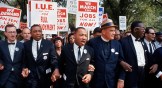
From the steps of the Lincoln Memorial, Martin Luther King Jr. cast such a transformative vision for freedom and equality in his “I Have a Dream” speech that, “with a single phrase, [he] joined the likes of Lincoln and Jefferson as men who’ve shaped modern America,” wrote Time magazine. Sixty years ago this August 28, King gave his speech during the 1963 March on Washington for Jobs and Freedom. In that moment, King ascended from a movement leader to a cultural icon.

Though they are well known, cultural icons are often flat and static, lacking the luxury of nuance or adaptability. An iconized version of a person can be easily co-opted and used against the very causes and values of the person in whose image the icon is fashioned.

Within his own lifetime, King experienced the difficulties of having a single moment define his entire legacy, and he worried about misuses of his “Dream” speech. King knew listeners tended to focus on his final six minutes of soaring refrains at the expense of the first 11 minutes of careful socioeconomic and cultural analysis. For many, the hopeful conclusion of the “Dream” speech was twisted into a facile optimism that avoided the hard questions necessary for real progress.

In May 1967, King publicly addressed these concerns. Much of the optimism he’d embodied just three years before had been tempered by a stark realism that racism, economic exploitation, and militarism were much more entrenched in the American way of life than he’d realized. In an interview with journalist Sander Vanocur, King attempted to reclaim his own legacy.

“I must confess that that dream that I had that day has in many points turned into a nightmare,” he said. “I’ve come to see that we have many more difficulties ahead and some of the old optimism [of the “Dream” speech] was a little superficial and now it must be tempered with a solid realism.”

Acutely aware of popular misunderstandings, King used his platform to help people better understand how to properly apply his words. Nevertheless, in the decades following his assassination, some have unwittingly misconstrued and misrepresented King’s dream by lifting phrases from the speech out of context—sometimes even in service of causes that threaten to erode the very legacy of justice King worked so hard to build.

This has become such a common occurrence that King’s youngest daughter, Bernice King, routinely takes to social media to correct some of the worst misuses of her father’s legacy. Last year, for example, Virginia Gov. Glenn Youngkin invoked the “Dream” speech while signing an executive order banning books that teach the history of racial discrimination in America.

Bernice King quickly responded with a charitable but direct tweet, writing that “our nation has yet to comprehensively, strategically, legislatively, and systematically cast aside prejudice, racism, and bigotry. I call you beyond acknowledging my father to embracing the work of ensuring policies, including in education, that reflect his teachings.” Like her father, Bernice King calls us beyond talk and superficial optimism to a higher mission, a deep commitment to the hard work that makes for real progress.

The apostle John instructs us to “not love with words or speech but with actions and in truth” (1 John 3:18). As believers, we can renew our commitment to genuine service-oriented love by avoiding the popular misuses of King’s “Dream” speech. Today, there are at least three ways we can more substantially engage with King’s dream.

First, we must recognize the painful history behind the speech. King’s dream can only be properly understood against the nightmarish backdrop of American chattel slavery and its persistent legacy. King chose the steps of the Lincoln Memorial precisely in order to invoke this history. While the centennial anniversary of Lincoln’s Emancipation Proclamation that same year remained fresh in America’s collective memory, King seized the opportunity to remind the nation that “100 years later the Negro still is not free.”

King especially focused on the hundred years of failed promises since the Emancipation Proclamation: the unfulfilled hopes of the reconstruction era, racialization of the prison system, the sharecropping system, racial terrorism against Black economic centers, Jim Crow, and segregation. According to King, these systemic failures of the country (rather than personal failures of its Black citizens) were the chief cause of racial disparities. Though disturbing, this history of broken promises must be reckoned with in order to realistically understand King’s dream.

America’s racial history may be one of the most contentious struggles of our modern political landscape. Many fear that reckoning with America’s racial sins may erode patriotism or national morale. But as Christians, we know healing is not found in hiding from the past (Prov. 28:13). Denial of our racial past or attempts to revise it are strategies to justify ourselves, to clean up our own reputation by minimizing America’s misdeeds or by national mythmaking. But we will only find God’s mercies for healing and hope as we confess and repent in faith.

How can we ever turn from the ongoing legacy of past atrocities if we will not face that past with honesty and humility? Confession and repentance are acts of faith. As believers, we hold that the gospel of Christ has enough power to heal even the ugly divisions and disparities of American racism.

King held that to be true. That’s why he could begin his “I Have a Dream” speech with an unflinching confession of America’s past. So can we. Texts like Carter G. Woodson’s The History of the Negro Church and Jemar Tisby’s The Color of Compromise can help the church in America wrestle with its own complicity in racial injustice and embrace its calling to help heal the country.

A second way the church can honor King’s legacy is to examine the practical issues he spoke of in the “Dream” speech. In its first two thirds, King broached several specific topics that are still pressing today, including police violence: “We can never be satisfied as long as the Negro is the victim of the unspeakable horrors of police brutality.”

In the wake of the killings of Michael Brown, George Floyd, Breonna Taylor, and numerous other unarmed Black people at the hands of police in recent years, many Christians have been galvanized against police brutality. This marks a place of substantial resonance between the struggle for freedom in the ’50s and ’60s and its ongoing expressions today.

Any meaningful engagement with the “Dream” speech and the civil rights movement must take police violence seriously. Esau McCaulley pointed out in CT that police misconduct is not merely a social concern, but a gospel concern. Examining Romans 13 and Luke 3:14, McCaulley said a vision of gospel-grounded policing “calls both the state and its officers to use their influence to protect the weak.”

Understanding and addressing the obstacles to fair and accessible housing is another key to meaningful engagement with King’s dream. Sixty years ago, King said, “We cannot be satisfied as long as the Negro’s basic mobility is from a smaller ghetto to a larger one.” And yet, five decades after the Fair Housing Act was signed, the rate of Black homeownership remains at 42 percent—the same as in 1963.

This ongoing disparity is rooted in the legacy of red-lining and other discriminatory housing practices, including the Federal-Aid Highway Act of 1956 that began routing highways through Black and brown communities. This legacy, as well as current discriminatory practices, can keep potential Black homeowners from gaining access to the best opportunities for housing.

The prophets Micah, Amos, and Isaiah spoke powerfully in their day about God’s intention to provide a place of safety, rest, and abundance for his people through the means of land. Walter Brueggemann points out in The Land that ancient Israel’s land promises speak redemptive hope to America’s current housing crises.

Perhaps unsurprisingly, voting rights and equitable political representation also factored prominently in King’s speech. He noted, “We cannot be satisfied as long as the Negro in Mississippi cannot vote and the Negro in New York believes he has nothing for which to vote.” King saw equal access to the ballot box and political representation as key to securing civil rights within a democratic society.

Thanks in large part to King’s moral leadership, the Voting Rights Act of 1965 was signed into law by president Lyndon Johnson. This addressed the long history of literacy tests and other discriminatory practices that had historically disenfranchised Black voters. Today, as lawmakers work to ensure the integrity of the voting process, they must not do so at the expense of equitable access to the vote. Restrictive laws that depress turnout among voters of color stand in direct opposition to King’s legacy.

King desired more than voting rights; he knew it would be pointless to achieve full access to the vote without meaningful representation on the actual agendas of lawmakers. King’s dream entails real political representation that addresses the unique needs of minority populations.

By the time he reached the famous refrain in his speech, King had already laid the necessary historical and social groundwork to take us to church, as fellow civil rights leader Clarence Jones phrased it. King’s hopeful vision assumes serious work around police and criminal justice reform, fair housing, and voting rights, among other issues. His words are not merely historical relics of a bygone era but are a distinctly contemporary call to action.

Last, the church can examine the practical theology beneath the “Dream” speech. King was a fourth-generation preacher who carried out his public ministry as a pastor-theologian. In order to understand King’s message, we must understand his faith. One of the most fundamental aspects of King’s theology was what he often called “somebodiness.” This was a biblically rooted belief in the fundamental value and dignity of every human life.

In the Jim Crow South, society sought to instill a sense of inferiority among Black Americans. Grown men were routinely called “boy,” and Black people were forced to accept not only separate conditions but inferior ones.

However, the Bible and the Black church taught King differently. He was raised on biblical passages like Genesis 1:27 and Galatians 3:28, believing that all people are made “in the image of God” and that all believers, regardless of race or gender or social status, “are one in Christ Jesus.” He understood that in the sight of God and within the life of the Black church, everybody was somebody. This belief in the inestimable value of human life drove King to fight for equal rights and freedom until “justice rolled down like waters and righteousness like an ever-flowing stream” (Amos 5:24).

When King said, “I have a dream that my four little children will one day live in a nation where they will not be judged by the color of their skin but by the content of their character,” he was mainly referring to the doctrine of somebodiness. He longed for a day when America’s legacy of racial injustices no longer hindered access to equal opportunities.

However, this quote from King’s speech has been co-opted by some who suggest colorblindness as a solution for racial reconciliation. But this entirely misses King’s point, and it contradicts everything he’d said so far.

If the nation were to suddenly become colorblind, it would forget the hundred years of painful history with which King began his speech. If the nation became colorblind, it would never address the racialized criminal justice, housing, economic, and political disparities that King highlighted. If America became colorblind, it would never make good on its emancipatory promises to Black citizens because it would never redress historic injustices or their current legacy of racial disparities. Instead, the nation would move ahead without repairing what is broken. A colorblind nation would enshrine racial disparities beneath a veneer of false peace, ensuring that King’s dream would never be fully realized.

No, King never envisioned a colorblind America. However, he did envision a committed America. King dreamed of an America so committed to the truth that it would acknowledge its historic failures and make good on its promises of freedom.

King dreamed of a country so committed to peacemaking and racial justice that it would do the hard work needed to ensure no vestige of historical racial disparities remained. The church in America ought to be at the forefront of that effort. If freedom will ever truly ring across this land tomorrow, we must commit ourselves to every positive action necessary to make King’s dream a reality today.

Mika Edmondson is lead pastor of Koinonia Church in Nashville and the author of The Power of Unearned Suffering: The Roots and Implications of Martin Luther King, Jr.’s Theodicy. Speaking Out is Christianity Today’s guest opinion column.

Cover Story

Should I Offer My Pronouns?

Gendered language is increasingly controversial in public life. Christians are grappling with how to engage.

199562_image

Shua Wilmot and Raegan Zelaya worked in residence life at Houghton University, a Christian school in upstate New York. Even though it conflicted with university policy, they listed their pronouns in their email signatures to help students identify their genders, they said, given their atypical names. When the university requested they remove their pronouns earlier this year, Wilmot and Zelaya refused. They were fired.

“My name is Shua. It’s an unusual name. And it ends with a vowel, a, that is traditionally feminine in many languages,” Wilmot, whose full first name is Joshua, said in a YouTube interview. “If you get an email from me and you don’t know who I am, you might not know how to gender me.”

Zelaya added in the same interview that she felt removing her pronouns from her email signature would imply that “the students who felt safe by me doing that, the students that felt seen by me doing that” weren’t worth “taking this risk and this stance.”

Furthermore, as Wilmot told ABC News, his views regarding gender and identity do not fully align with the theology of the Wesleyan Church, the sponsoring denomination of Houghton University.

The university denied in statements to the press that anyone was fired solely over pronoun usage, adding that its policy required any “extraneous items” be removed from email signatures, including Scripture references.

Houghton president Wayne D. Lewis Jr. told CT, “The ideas that one’s pronouns are preferred, subject to change, and may be inconsistent with one’s biological sex are inconsistent with the beliefs of Houghton University. … We believe the assignment of one’s sex and gender is a divine prerogative. We require that employees of the university be respectful of the university’s beliefs and positions.”

Christian colleges and their employees are not the only ones confronting changing institutional norms around pronoun usage. Specifying personal pronouns is increasingly common during introductions and in correspondence at workplaces, in classrooms, and in organized social settings. In such contexts, evangelical Christians often face the opposite pressure of the former Houghton staff: being expected or required to provide or use personal pronouns against their own convictions.

While some evangelical Christians don’t mind identifying their pronouns, others believe that doing so—or referring to someone by a pronoun that doesn’t match their birth sex—makes inherent ontological claims that should not be glossed over.

“We’ve reduced this giant conversation, and it’s become so culturally salient that it raises the whole debate of a signature line,” said Mark Yarhouse, a psychologist and head of the Sexual and Gender Identity Institute at Wheaton College. In other words, salutations and autographs, which for generations were mere formalities, can now feel like a litmus test.

The discussion over pronouns goes beyond “virtue signaling” or “political correctness.” Christians who have thought deeply about this issue understand the role of language in shaping reality and thought and believe it’s central in how we treat people as image-bearers of worth and value.

Lexicological change won’t happen overnight,” a New York Times columnist wrote in 2016 about the increase of gender-neutral pronouns such as they.

And yet in a way, it has.

It’s taken less than a decade for gender-neutral and alternative pronoun usage to shift from a theoretical discussion to the norm in many places of employment, academia, and much of the media.

In 2014, Facebook rolled out 50 new gender identity options for users. Five years later, Merriam-Webster declared the singular pronoun they its word of the year, and public figures like some Democratic presidential candidates signaled their support by adding their pronouns to their social media profiles leading up to the 2020 election.

Pronouns have become a political land mine within broader transgender debates, from women’s sports to trans representation in marketing. Multiple lawsuits have been filed in recent years over individuals who refused to use a transgender person’s pronouns. And in the first quarter of 2023 alone, 24 US states introduced legislation to regulate pronoun usage in schools.

Some employers are trying to keep up. “Using a person’s correct pronouns provides gender affirmation, signals mutual respect, and creates a more welcoming and tolerant environment,” a National Institutes of Health guide for gender pronouns in the workplace states. “Intentional refusal to use someone’s correct pronouns is equivalent to harassment and a violation of one’s civil rights.”

Many companies advise employees to declare their pronouns in business communications. “Private enterprises are often quicker than governments to recognize that sensitivity to gender issues may be good for business,” linguist Dennis Baron writes in What’s Your Pronoun?: Beyond He and She.

The Boston-based tech company HubSpot, for example, offers its employees a guide to pronoun usage in online correspondence. “Adding pronouns to email signatures or online profiles,” it says, “lets people communicate their gender identity, which is how they see themselves and want to be seen. This may differ from a person’s gender expression, which is the gender they seem to be based on appearances.”

The institutional push for pronoun identification seemingly reflects the increasing number of people who use either nonbinary pronouns or a pronoun different from their birth sex. Pew Research Center reported in 2022 that 1.6 percent of all US adults said their gender is different than their birth sex—and 5 percent of adults under the age of 30 identify as nonbinary or transgender.

One in ten Americans have a close personal relationship with someone who is transgender, and the same percentage have a close friendship with someone who uses gender neutral pronouns, according to the Public Religion Research Institute (PRRI). Using gender-neutral pronouns in the workplace and marketplace “reduces mental biases” toward women and the LGBT community, one 2019 study found.

But other studies suggest the growing emphasis on pronouns has perhaps strengthened traditional views on gender. According to a spring 2023 PRRI study, more Americans believe in a gender binary now than two years ago (increasing from 59 percent to 65 percent). Among religious Americans, 92 percent of white evangelical Protestants, 81 percent of Hispanic Protestants, and 71 percent of Black Protestants agreed. A poll from NPR, PBS, and Marist found in June 2023 that a similar percentage (61 percent) of Americans believe gender is defined by the person’s sex at birth, and that belief has significantly grown in the past year.

Around 40 percent of Americans, and a bit less than 80 percent of evangelicals, told PRRI they would be uncomfortable if a friend told them that they used gender-neutral pronouns or pronouns that didn’t match their appearance.

While businesses attempt to be inclusive toward a broader workforce, pushing employees to identify their pronouns can sometimes have the opposite effect.

One professor argued in an op-ed for Inside Higher Ed that directly asking someone for their pronouns can cause unnecessary pain for the very people it is meant to recognize. And a sales employee wrote to a New York Times advice columnist in 2021 worried about losing customers by including his pronouns in his emails. The Times columnist was also concerned, but for a different reason: “For trans or nonbinary people who aren’t ready to come out … this policy is problematic. It pressures people to either out themselves before they’re comfortable or lie.”

Words matter.

“Language is a profound tool. It’s how we access and construct reality,” said Abigail Favale, a Catholic scholar at the University of Notre Dame and the author of The Genesis of Gender: A Christian Theory. “Postmodernism and gender theory recognize the power language has in shaping human perception.”

The stakes around language and gender are high. Some people argue that to not use their self-identified pronouns is to erase their existence. For them, pronouns are not just “preferred”—they are in fact the most accurate. And when mental health and suicidality are on the line, some advocates like the Minnesota Department of Health say that “using a person’s correct pronouns saves lives.”

Today, “gender identities are not grounded in the reality of bodily sex; they are grounded in language,” Favale said. “I think that’s why there’s such a profound focus on words.” But Favale says that postmodernism and gender theory go too far in creating reality out of words—only God can do that (Gen. 1; John 1:1).

The first two chapters of Genesis ground human identity in relationship to God and to each other, argues Katie McCoy, author of To Be a Woman: The Confusion Over Female Identity and How Christians Can Respond. Genesis 1 refers to the creation of a male (zakar) and a female (nequeba)—the biological terms for the created man and woman.

But in Genesis 2, McCoy argues, the creation story is much more relational. Rather than male and female, this chapter refers to man (ish) and woman (ishah)—gendered terms—as they relate in their natures to one another. Even the way that God names Adam and Adam names his wife is according to their natures (Gen. 2:7; 2:23).

“In Genesis 1 and 2 we see the created intent that there would be harmony between biological sex and gender identity. Gender is something that is theologically bestowed and not socially constructed,” McCoy said. But today, “our words create our identities rather than reflect them.”

Earlier this year, Atlantic journalist George Packer argued against what he called “equity language” and the often unreasonable pressure it puts on the culture. It is polite and dignifying to “address people as they request,” Packer wrote, but equity language isn’t organic; it’s being “handed down in communiqués written by obscure ‘experts’ who purport to speak for vaguely defined ‘communities,’ remaining unanswerable to a public that’s being morally coerced.” New language makes ideological claims, he wrote. “If you accept the change—as, in certain contexts, you’ll surely feel you must—then you also acquiesce in the argument.”

Many evangelical leaders are realizing that they and their congregations are not equipped to respond to the evolving linguistic and social norms. Travis Rymer, a pastor in Providence, Rhode Island, was one of them. “I went into [studying pronouns] wondering why anyone would be consumed by this topic, and then I realized this is a bigger philosophical and ideological thing than I realized,” he said.

Rymer, who teaches on gender ideology at his own church and other local churches, views it as a sort of secular religious system that aims to dismantle the binary of male and female. To use preferred pronouns without further honest conversation is not only to acquiesce to a belief system that is biblically unfaithful but also to promote it, Rymer says. He encourages his congregants to compassionately decline to offer their own pronouns in a work or educational setting or to use others’ self-identified pronouns. Not only is this an act of faithfulness toward Scripture; it is also an act of love, he says.

“I see this as a creation issue and a gospel issue,” Rymer said. “I believe God’s creation is good and designed for human flourishing. My call to love my neighbor is that I want the best for them.”

Some evangelicals who write on sexuality, such as Rosaria Butterfield and New Testament scholar Robert Gagnon, have gone so far as to say that using pronouns that don’t match a person’s biological sex is a sin—it is bearing false witness and an affront to the Creation mandate. Butterfield, a former English and women’s studies professor, calls their use the “Achans in the camp of broad evangelicalism” (referencing Joshua 7), and Gagnon cites Paul’s warning to those who eat the meat sacrificed to idols (1 Cor. 8–10).

“Paul’s remarks clearly do not extend to participating in another’s self-deception in matters abhorrent to God, such as idolatry, even when one recognizes the idolatry to be self-deception,” Gagnon wrote on Facebook, adding that he does not see this as “an agree-to-disagree issue.”

Others, like Robert Smith, an ethics lecturer at Sydney Missionary and Bible College and the author of How Should We Think About Gender and Identity?, prefers the pathway of avoidance rather than what he sees as compliance or resistance to using self-identified pronouns, especially as the cultural expectations, and sometimes people’s pronouns, can quickly change and “new offenses are being created.”

Using someone’s name is often the easiest way forward, in order to build a relationship and still hold to personal conviction. “Scripture tells us, ‘Do not lie to one another’ (Col. 3) but also ‘Do all you can not to cause offense to others’ (1 Cor. 10), so we want to avoid both of those pitfalls,” he said. “That pushes me to a path of avoidance.”

The apostle John wrote three letters during a period when Gnosticism, the heresy that salvation could be found in escaping the physical body, was prevalent in the early church. “Dear children,” he writes, “let us not love with words or speech but with actions and in truth” (1 John 3:18).

He was not saying that words do not matter, but rather the opposite: that our sincerity of love must be shown in our whole lives through obedience and walking in love (2 John 6). John demonstrates this even through his tender parting words of his final letter: “Greet the friends there by name” (3 John 15).

As the early church fathers dealt with Gnosticism, McCoy believes, the Western church can and should think deeply and speak boldly about the value of our bodies—and that extends to how we talk about them. This is one reason McCoy thinks the pronoun conversation is a defining one for the church. “Our embodied God was born, died, raised, and is physically going to resurrect us,” McCoy said. “At the end of history is physically resurrected people brought into heaven by our physically resurrected Lord. The physical body matters to God, deeply.”

In a sense, much of the disagreement among Christians on whether to use personal pronouns boils down to priorities. Which takes precedence: using language that reflects God’s immutable design, or using language that honors our neighbors’ wishes and invites them into deeper relationship?

Using others’ requested pronouns can demonstrate that Christians care for them, whether or not they hold the same positions on questions around gender and sexuality. (Favale and others warn, however, that this could also negatively affect relational trust when it becomes apparent there is a discrepancy in belief.)

As a clinical psychologist at Wheaton College, Yarhouse frequently works with transgender young adults and people who experience gender dysphoria. While he generally doesn’t volunteer his pronouns in an institutional setting, he will offer them when requested. He neither objects nor initiates. He sees the use of pronouns in places like an email signature as, at best, “signifying an awareness that there are individuals whose identities are discordant with biological markers.” At worst, “it can come across as virtue signaling.”

Christians can hold to multiple “ontological truths” simultaneously, Yarhouse believes. One can believe in the inherent truths of maleness and femaleness and also that God loves and cares for every person.

Yarhouse believes in the value of acknowledging people whose experiences do not fit into social norms about gender identity, though he is careful not to imply that gender is arbitrary. But some of the institutional forms of inclusivity, like using pronouns online, are “reductionistic,” he said, even in a community with diverse views about pronoun usage.

“There are many ways to express an awareness of these topics without symbolism [like email signatures],” Yarhouse said. “You teach differently and you talk differently and preach differently—as if there are people in the room that have these experiences.”

Preston Sprinkle, like Yarhouse, has become known as an advocate of the position some call “pronoun hospitality,” in which Christians use self-identified pronouns for the sake of showing grace and building relationships. Several transgender or formerly transgender Christians Sprinkle interviewed for his podcast and a book on transgender identity said that part of their journey to faith in Jesus included relationships with Christians who used their self-identified pronouns. If those Christians had refused to use them, it would have scared them away, they said.

“All throughout Scripture, we see God meeting people where they are in order to walk with them toward where he wants them to be,” Sprinkle writes in Embodied: Transgender Identities, the Church, and What the Bible Has to Say. He “spoke our human language in all its imperfection, because that was the language we could understand.”

Sprinkle writes that he believes a “long-term goal of discipleship” is for all Christians to “see their biological sex as a divine gift and part of their identity” and to eventually use pronouns that match their biological sex. “But I don’t think it should be a short-term prerequisite,” he clarifies.

However, some believe that this position doesn’t go far enough. The founders of Kaleidoscope, a Christian nonprofit that ministers to LGBTQ young adults in New York City, say that a phrase like “pronoun hospitality” can convey a power dynamic and be “condescending toward trans and nonbinary people.”

“We believe in mutuality,” said CEO Meg Baatz. “We are using language to build trust.”

Their organization aims to contextualize the gospel in a missional way. One action they find important in their community is to intentionally offer their pronouns in introductory remarks or in online communication. They’ve seen this approach lower walls in conversations and make relational and pastoral connections in their outreach efforts.

Christians should show generosity to those with a different framework, added Kaleidoscope president Elizabeth Delgado Black. “Jesus himself interacted within a cultural framework. I’m sure there were things that he didn’t agree with. However, he made himself a part of the community for the sake of his message and for the sake of the will of the Father.”

And they’ve found a commonality among conservative Christians and those in the trans and nonbinary community they minister to: People simply want to think and talk about pronouns less. The PRRI findings affirm this: More than half of Americans (62%) think that people talk and think about pronouns too much.

One Christian who experiences gender dysphoria and works in campus ministry on the West Coast identifies as “pronoun agnostic,” since avoiding pronouns is the easiest way to “pursue peace” in ministry: “If we are trying to reach all people as missionaries, that includes queer people.”

As declaring pronouns becomes more ubiquitous, what’s a Christian to do? Christian leaders who hold a spectrum of opinions agreed: Everything is changing so fast, we’re figuring it out together, and we should give each other grace.

Sam Allberry, a pastor and the author of Is God Anti-Gay?, believes that using pronouns is a “wisdom matter, not a righteousness matter” and that Christians of differing opinions should give each other grace. He references the Book of Proverbs and the wisdom it offers for navigating life’s challenges, especially wisdom in speech. Allberry himself has publicly identified as same sex attracted but upholds and teaches a traditional biblical sexual ethic.

“We should allow each other enough grace where we might not agree, but understand why we did it and understand that motives are honorable,” he said. “Our call as Christians might be to step in and defend people whose ideology we don’t agree with from ideologist reaction against it. We don’t want to see trans people demeaned or bullied.”

For many, the matter of pronouns is one of conscience. Some look to the biblical example of Daniel, who lived in exile in Babylon and was chosen to serve in the king’s palace (Dan. 1:4). Daniel and his friends had to navigate the pressures of living with holiness and integrating into a culture that didn’t care about their religious convictions. They were assigned pagan names, were taught a new language and culture, and were given food and drink that likely violated Mosaic Law (1:4–7).

The text says Daniel graciously and wisely navigated these situations. He accepted his new name and engaged in learning the culture, but he drew the line at food and drink. Was it a matter of law, or of wisdom, or of conscience? While Scripture doesn’t say, it’s clear that Daniel strove to follow God’s law with courage and grace.

“They were actually willing to go quite far. They were willing to take pagan names in this assimilation program,” Allberry said. “But at the same time, they had a line.” Scholars aren’t sure why Daniel and his friends discerned this specific line while accommodating other aspects of Babylonian culture. But it made a point: “I’m going to communicate that I’m going to be an obedient employee but let them know, ‘You don’t own me, I have a higher allegiance,’” Allberry said.

Some Christians distinguish between institutional norms and personal relationships. “Love is due to persons, not to ideologies,” Favale, the Notre Dame scholar, said. In other words, Christians whose consciences are bound by their convictions might choose to show love by using friends’ self-identified pronouns yet resist providing their own pronouns on an institutional level through civil disobedience or silence.

In his letters, the apostle John emphasizes the Christian commands to follow the truth and to walk in love. In the Christian life, these theological truths are woven in constant tension. Problems arise when one exists without the other.

“We’re often in the position of cultural warrior or cultural capitulator. We have fewer examples of how to be an ambassador,” Yarhouse said. “But we are ambassadors of the kingdom of God to a culture that is increasingly unfamiliar with what that means.”

The Scriptures do not offer specific answers for every situation, but they do give us general principles and truths underscoring the inherent dignity of every person and our need for godly wisdom found through the Spirit, the Bible, and the church.

“It takes a prayer-soaked, discerning response and ambassadorship in my neighborhood, work setting, and relationships,” Yarhouse said. “I wouldn’t want to reduce my ambassadorship to a pronoun.”

Kara Bettis Carvalho is associate features editor at Christianity Today.

Inkwell

A Theologian’s Dilemma

Inkwell August 12, 2023
Photography by Kazuend

How do you empty a light of its light? 
How does the clockmaker enter the caliber? 
How does the immeasurable become finite?  
How does the author become a character? 
Why would the morning surrender to night?
Why would a great king become a pauper?
Why would the all-seeing limit his sight?
Why would he thirst, who is living water?

I set my mind to comprehend these things, 
to wrap them up in a tidy package, 
propositions placed in concentric rings—
but how reality outstrips language.
Questions come crashing as waves on the shore, 
but better than knowing, is to adore.

Andrew Menkis is a Theology & Rhetoric teacher with a passion for helping students to see and experience the truth, beauty, and goodness of God and his creation.  Andrew’s poetry has been published in Modern Reformation.

News

Two Anglican Church Plants Leave for the Episcopal Church

Resurrection South Austin is the latest to go, citing issues around race, women, sexual minorities, and abuse response.

Christianity Today August 11, 2023
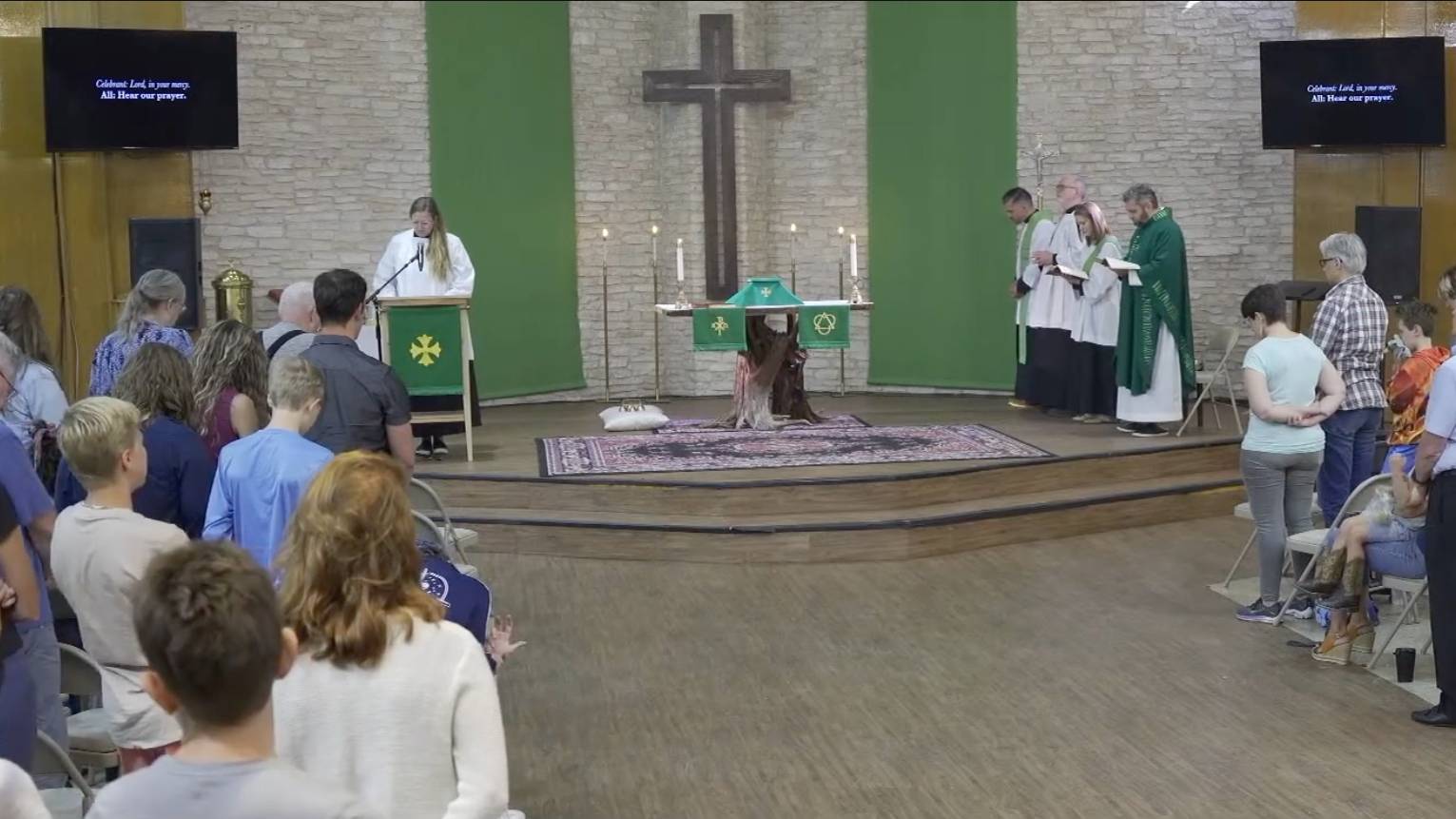
Screengrab / Resurrection South Austin livestream

In the past year, two Anglican congregations in the US have left their more theologically conservative denomination for the mainline Episcopal Church.

Formed in 2009, the Anglican Church in North America (ACNA) is known for taking in breakaway Episcopal congregations and clergy, though these two departing churches—Resurrection South Austin in Texas and The Table in Indianapolis—didn’t have previous ties to the Episcopal Church.

Both were church plants belonging to the Church for the Sake of Others (C4SO), an Anglican church-planting movement that predates ACNA and, for the past decade, has functioned as a diocese in the denomination. Its parishes span across California, Texas, the Midwest, and the South. Very few of its clergy or churches were Episcopalian before, and many of its members come from evangelical backgrounds.

Some Anglicans see C4SO as less conservative than others in the denomination due to its focus on justice and since it’s among the dioceses that ordain female priests.

Clergy at the departing churches attributed their decision to a range of issues where they felt out of alignment with the ACNA as a whole and for which they faced backlash from fellow Anglicans online.

They cited their convictions around the inclusion of women in leadership, hospitality toward sexual minorities, opposition to white supremacy, treatment of people of color, and response to abuse victims in the church (including a contentious investigation in the Upper Midwest Diocese).

Though LGBT inclusion was not named as the primary impetus for either church’s withdrawal, it became the impasse for the more theologically conservative minority who decided not to stay during the transition to local Episcopal dioceses.

“Everyone in our church was in agreement about women and people of color, and even our concerns about the sexual abuse investigation. [The sticking point] was around sexuality, and their concern I think is legitimate,” said Shawn McCain Tirres, rector of Resurrection South Austin, which voted in July to leave the ACNA.

“We tried to create a lot of space for people to say, I’m not there. I had to reiterate many times … we just want you to remain and receive the kind of hospitality that we have long extended to those who have been on the other side of this issue.”

McCain Tirres spent months discussing concerns first with C4SO bishop Todd Hunter and then with his parish, which draws about 150 attendees each Sunday. Two weeks ago, with more than 80 percent of the congregation voting, the majority were in favor of seeking affiliation with the Episcopal Diocese of Texas.

Hunter will visit Austin this weekend to meet with the dozens of Anglicans “left behind” by Resurrection South’s transition. During an initial gathering following the parish’s vote, C4SO leaders hosted a time for lament, Eucharist, and healing prayer.

“There are people who are brokenhearted. They lost their church—and not just the place where they meet every Sunday, but their community,” Hunter said. “They feel abandoned theologically because they thought they had joined something that was orthodox on human sexuality.”

At a follow-up gathering on Sunday, he hopes to listen to congregants and discuss next steps, asking whether they want to join other local churches or start another community of their own. Texas is home to more ACNA congregations—well over 100—than any other state.

Many of the leaders that first formed the ACNA went through challenging disputes over churches, property, and credentials as they left the Episcopal Church. Because of this, they have set up their denomination with an easier process for churches that opt to leave, though departures have been rare over the denomination’s 14-year history.

“Congregations are accorded a healthy level of self-determination and respect,” said Andrew Gross, the ACNA’s canon for communications and media relations. They have the right to disaffiliate, with their property, after consulting with the bishop of their diocese.

Matt Tebbe, a co-rector at The Table in Indianapolis, said he spoke with friends at Resurrection South Austin about what he and his church went through when they disaffiliated nine months earlier. Though the transition came with a bit of culture shock (“I don’t speak mainline”) and with the grief of leaving friends in C4SO, “the fit has been so much better” with the Episcopal Diocese of Indianapolis.

He said he feels the support of fellow Episcopal clergy in the area—with the ACNA, he had to face the fallout when he would post on social media decrying white supremacy or love of mammon. According to Tebbe, “The Table has never been in 100 percent agreement about the way the ACNA frames human sexuality and gay marriage,” and since last October, its Episcopal affiliation has allowed the church to offer a broader welcome to the LGBT community.

A third congregation, St. Mary of Bethany in Nashville, had left C4SO in 2021, citing ACNA’s posture of “always moving forward” and the place of LGBT Christians in church life, but did not join another denomination.

“The Anglican Church in North America has just over 1,000 congregations, and therefore three congregations leaving because they changed their theological commitments is not exactly a trend,” said Gross. “However, because of the Anglican Church in North America’s history, one would expect or at least hope that number to be zero, so I understand why it has raised some eyebrows.”

“If there is a lesson to be learned, it might be that even denominations that have been very clear about their theological perspective over the last decade are not immune from the ramifications of the cultural shift that is continuing to play out across the West.”

After three departures from his diocese in two years, the bishop of C4SO is reconsidering his role in helping these churches. For the congregations in Austin and Indianapolis, Hunter said his approach involved “giving them a lot of space” and “being very patient with their exploration.”

“Here’s what I regret and what I’ve learned: that while I’ve done a good job caring for the clergy, I don’t think I’ve done a good job caring for the people in the church who are not progressive,” he said. “By the time I’ve stepped in, everything’s too far gone.”

Going forward, Hunter is working with C4SO leaders and their canon lawyer to develop a clearer process for how and when the bishop “can have his voice in a church earlier, so that it doesn’t get to a place where it’s very far off from not only just what I teach, but what the rest of the diocese expects.”

Like other C4SO clergy, Hunter has been called out and labeled communist, Marxist, and woke for his concern for racial justice and for ordaining women. He says his willingness to engage in conversation attracts the sort of people who are asking questions and deconstructing faith.

“It’s fascinating in online and other spaces to be criticized for these things … I am thoroughly committed to orthodox Christianity,” he told CT, “but I’m equally committed to figuring out how to live that out winsomely and truthfully, without engaging in culture wars constantly.”

Jeff Walton, Anglican program director for the Institute for Religion and Democracy, said the departures from ACNA—each from church plants in urban centers—may reflect deeper divides in a denomination largely comprised of Christian transplants.

“These departures are indicative of a disconnect between two groups within the ACNA: former mainline Protestants, including former Episcopalians, standing against revisionist theology, and post-evangelicals reacting against cultural hallmarks of their prior church homes, such as complementarianism or Christian nationalism,” Walton said.

“The Diocese of Churches for the Sake of Others is among the largest and fastest growing dioceses in ACNA partly because it can speak to those originating from an evangelical, charismatic, or Pentecostal context. These three departing parishes were all within C4SO, but this isn’t exclusively a C4SO problem. It’s a post-evangelical problem.”

Walton refers to the ACNA as a small but “heavily transited parcel of ecclesial real estate.” As of June, the denomination includes 1,003 congregations, according to Gross. Its last annual report indicated a membership of nearly 125,000.

As a historic mainline denomination, the Episcopal Church has a much longer scope. Its last report, from 2021, tallied around 6,300 congregations and over 1.6 million members. But it’s also experiencing ongoing declines that accelerated during the pandemic, with one in three Episcopal churches reporting a drop in attendance by at least 25 percent since 2019.

Editor’s note: This article has been corrected. A previous version said St. Mary’s in Nashville, which left ACNA in 2021, joined the Communion of Evangelical Episcopal Churches. Though some clergy initially moved their orders to the communion, the church remains unaffiliated.

Church Life

‘We Are Not in Heaven’: Niger Analyst Explains Christians’ Concern After Coup

Wary of West African war and Western sanctions, Christian minority in the jihadist-plagued Sahel region nervously prays for peace.

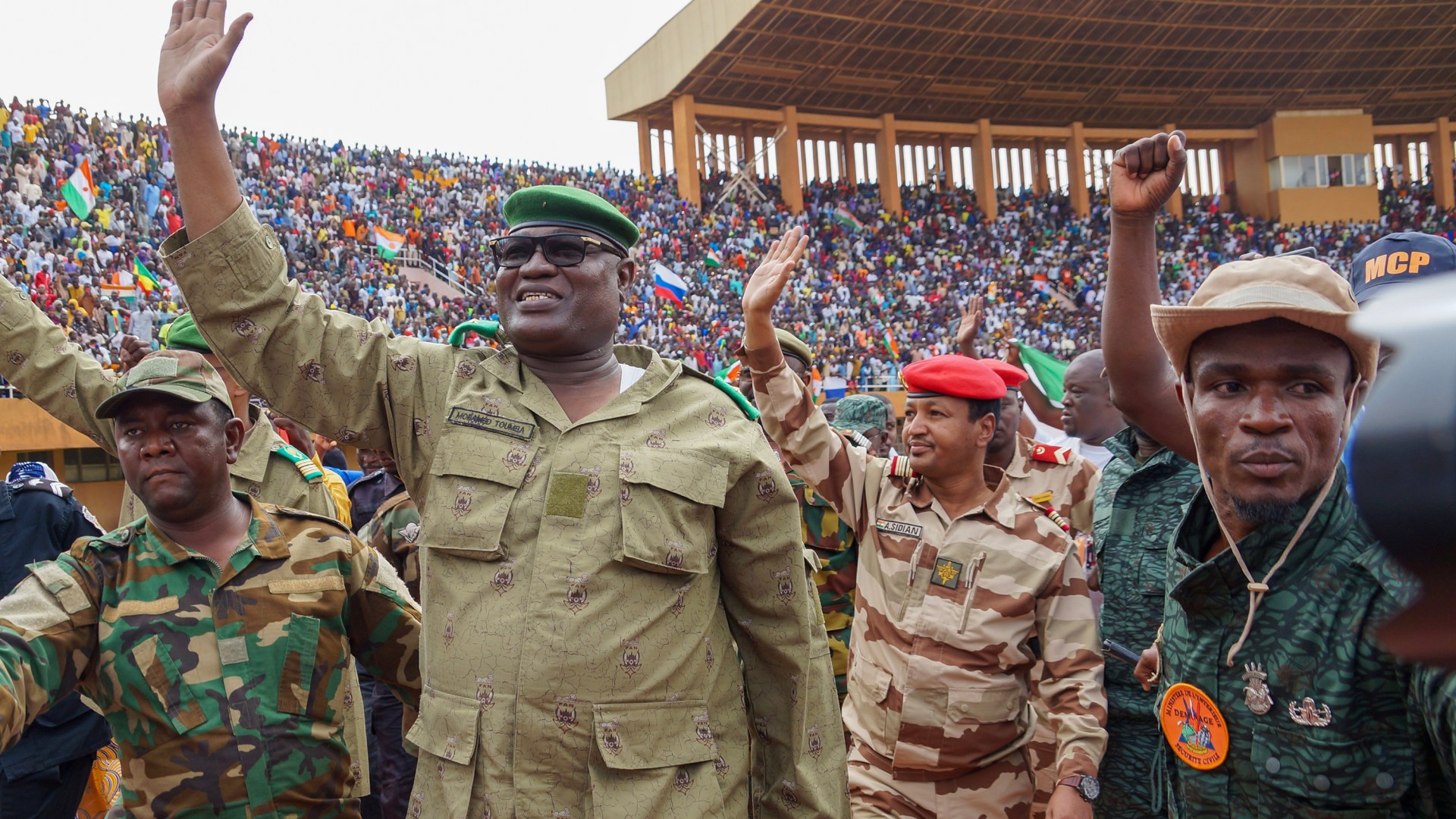
Mohamed Toumba (second to left), one of the leading figures of the National Council for the Protection of the Fatherland, greets coup supporters at a stadium in Niamey, the capital of Niger.

Mohamed Toumba (second to left), one of the leading figures of the National Council for the Protection of the Fatherland, greets coup supporters at a stadium in Niamey, the capital of Niger.

Christianity Today August 11, 2023
Anadolu Agency / Contributor / Getty

The military coup in Niger has now entered its third week. Four days after the July 26 putsch, the 15-member Economic Community of West African States (ECOWAS) threatened military action if democratic rule was not restored within seven days.

That deadline has passed, and leaders are still mulling their options while imposing sanctions against the junta, the group of military officials that seized power. But worried by the seventh coup in the Sahel region since 2020, the remaining democratic nations in West Africa believe they must draw a line in the sand.

Neighboring countries Mali and Burkina Faso, both with military governments after their own recent coups, have warned that any foreign intervention in Niger will be considered an act of war against them as well.

Niger suffered its last coup attempt in 2021, right before the elected president—now deposed—was sworn in. The former French colony had been the last bastion of Western military cooperation against jihadist militants in the Sahel, amid the expanded regional influence of Russia through its Wagner mercenary unit.

Niger, meanwhile, is the world’s seventh-largest producer of uranium.

CT interviewed Illia Djadi, Open Doors’ senior analyst for freedom of religion and belief in sub-Saharan Africa. Though he resides in London, he is a citizen of Niger, a nation which ranks No. 28 on the World Watch List of the top 50 nations where it is most difficult to be a Christian.

Djadi provided the regional context, described the difficult but improving situation of Christians, and issued a strong appeal against military intervention [interview also available in French]:

How serious is the situation in Niger right now?

I am very sad. As a Nigerien, I find the situation difficult to watch.

But as an analyst, I can say confidently that what happened two weeks ago plunged Niger into a new era of uncertainty. The country is facing a terrorist Islamist insurgency coming from Nigeria, Mali, and Burkina Faso. And Niger is also one of the poorest nations in the world, with unemployment making it easy to radicalize our youth.

We are not in heaven.

But compared to our neighbors, we had been in a much better situation. For the first time in our history we had a president complete two terms in office before ceding power in democratic elections. And President Mohamed Bazoum did a lot to stabilize the country and improve security. I can’t remember the last time we suffered a terrorist attack.

And despite its poverty, Niger is home to 300,000 refugees from other nations—because it has been safe. All this shows there was no justification for the coup, which is a major political setback. Active militants will take advantage of the resulting instability.

So why did the coup take place?

Personal ambition. The junta claims the coup was for security and because of economic deterioration. But some say the president was ready to appoint a new head of security. Having held his position for the last 12 years, the head of security needed to go—but he refused and deposed the president in order to keep his power.

Do you connect this coup to others in the Sahel region?

Only in two ways: There is an overall regional political fragility, and there’s a copy-and-paste mentality. Because coups happened in Mali and Burkina Faso, people anticipated it could happen here also. West African youth widely hold an anti-French sentiment against the colonial past, and some have waved Russian flags during protests.

I don’t know if Russia is behind the coup.

But the region is facing external influence exerted from France, the United States, Middle East nations, and more recently, Russia. Niger is the key Western ally in the region. And as a French-speaking country, we have many links. There is a new scramble for Africa underway, seeking its natural resources.

Within this contest, France is often made the scapegoat. Sometimes the scapegoating is valid, but France is not to blame for everything. And it is certainly not right to say, “Let’s replace France with Russia.” That is what happened in Mali and Burkina Faso, and these nations are moving in the wrong direction.

How so?

Political instability. Since its coup in 2012, Mali never recovered, as one coup led to another. Each new leader promises solutions, but the country is losing the battle against terrorism.

Burkina Faso’s social uprising in 2014 also led to a military coup that tried to fix the resulting problems but never did. Again, coup followed coup, and today the nation has lost control over half of its territory to militant insurgencies.

Do you think ECOWAS military intervention is necessary to stem the tide of military regimes and the resulting instability?

No, it would make the situation worse.

Military intervention would create chaos, providing safe haven for terrorists. We don’t want another Libya—which borders Niger and wound up exporting the crisis of instability to the whole Sahel region.

Whether Western or African, war would be a similar mistake.

Have Christians expressed an opinion about the coup?

No, as a religious community they don’t have to do so. But they were included by the junta when summoning national stakeholders. The point was simply to convey explanations, and they did ask the church to pray for the nation.

The evangelical and Catholic churches have appealed for prayer—for a peaceful outcome to the crisis.

Nigerien Christians have no political opinion, but they do oppose the imposition of economic sanctions against their nation. These will affect everyone, as would war. But for the most part, Christians are concerned, afraid that if chaos continues, they will be among the first to pay the price.

Why so?

Back in 2015 at the time of the Charlie Hebdo protests in France, when the magazine published satirical cartoons of Muhammad, there were protests also in Niger. Muslims burned French flags, they burned a French cultural center—but then they went on to attack Christian churches, homes, and schools.

Many people associate Christians with Westerners, and once again, we see the burning of French flags. So it’s raising alarm.

How do Christians fit into the social fabric of Niger?

They are a tiny minority: 1 percent of the population, against the 99. And though Niger is a secular country with freedom of religion protected by the constitution, Christians often face challenges. We have records of Nigeriens who have been denied scholarships to university because of their Christian names, for example.

Catholic Christianity came in the 19th century with French colonialism, but the Protestant church was planted largely by American missionaries. The largest denomination—today’s Evangelical Church of Niger—stemmed from the work of SIM, coming up from Nigeria.

There is also a Baptist presence mainly in the western region. And in the 1980s, Pentecostal groups from various part of the world—France, the US, Nigeria, Burkina, and Ivory Coast—came to Niger, and created the Assemblies of God denomination, among others.

But by and large, Christians share the same poverty as everyone else.

What is your story of faith?

I was raised in the evangelical church. My parents went to a Christian school and eventually converted. My extended family includes Muslims and members of traditional religions, and we live in peace together.

In middle school, however, I became aware that I was different. Classmates asked, You are Nigerien, a Hausa, how can you be a Christian? I began to wonder if my faith was something wrong.

But by high school, I had developed strong convictions not only to defend my faith but to challenge others. My friends called me “the pope,” after John Paul II, because I was not afraid to face a crowd. One needs to be strong to be a Christian in Niger, and when I reflect upon my current position as an advocate, this is probably how it started.

What is next for Nigerien Christians?

We don’t know—the context is very fragile. But just as I said our nation is in better shape than our neighbors, so also the situation of Christians has been improving. After 2015, the government reacted against the riots to strengthen religious relations, and the church joined in the successful national campaign to promote social cohesion. Today, Christians are present in the public sphere, employed in the civil service. We have the freedom to preach—even to hold large open meetings.

When I last lived in Niger, I was the national leader of our youth fellowship, and we organized summer camps in churches and our Protestant schools. But today the camps take place in public settings with high officials in attendance, and are broadcast by public TV and radio services.

The military coup is a setback. But so far there are no indications of rhetoric against Christians. We fear instability and are praying for peace. God willing, this period of uncertainty will come to an end.

News

For Some Christians, Ohio’s Issue 1 Wasn’t All About Abortion

Not all Christians in Ohio agreed on how to approach the referendum, which aimed to raise the threshold for passing constitutional amendments.

A sign asking Ohioans to vote in support of Issue 1 sits above another sign advocating against abortion rights at an event on July 20, 2023, in Cincinnati, Ohio.

A sign asking Ohioans to vote in support of Issue 1 sits above another sign advocating against abortion rights at an event on July 20, 2023, in Cincinnati, Ohio.

Christianity Today August 10, 2023
Patrick Orsagos

Ohio went to the polls on Tuesday to vote on whether to make it harder to amend the state constitution by ballot, just months before a significant abortion measure goes before voters. But the measure failed.

The headlines around the referendum, called “Issue 1,” framed it as another hot-button issue splitting Americans into the same factions—Democrats versus Republicans, abortion opponents versus abortion rights advocates.

For some Christians, Issue 1 wasn’t so black and white. Many supported it, believing the higher threshold would hurt the chances of the upcoming abortion amendment. Some opposed it, and others struggled to reconcile their views against abortion with their concerns over how it would affect other rights in the state.

Issue 1 would have raised the passing threshold for constitutional amendments to a 60 percent supermajority, up from the current 50 percent plus one vote needed to do so. It also would have required signatures from all 88 counties in the state, instead of the current 44 needed, to initiate a ballot petition.

The subtext of the referendum, however, was abortion. In November, voters in Ohio will be considering a constitutional amendment that aims to enshrine the right to abortion in the state—a measure that already has been adopted by several states and is supported by 58 percent of Ohio voters, according to a July poll by Suffolk University and USA Today. Opponents of Issue 1 saw it as an effort to hamstring that amendment before it came to a vote, as well as a threat to voting rights in the state.

But on Tuesday this week, about three million voters in Ohio participated in the referendum, and a majority (57%) said “no” to Issue 1, setting up a showdown in November over abortion rights in the state.

Aaron Baer, president of the Center for Christian Virtue, an Ohio-based advocacy organization, supported Issue 1. He pinned responsibility on outside groups—who “want to jam their political agenda into our state constitution”—for influencing the referendum’s result. Though, according to Ballotpedia, more than 80 percent of contributions to campaigns both for and against Issue 1 came from out-of-state donors, and pro-life groups spent millions of dollars in ad campaigns.

Baer sees Ohio as the vanguard for other states where similar measures on abortion are being considered. On Tuesday, for example, abortion rights advocates filed a ballot measure in Arizona to make it a constitutional right.

“If they can win here, it’s going to be tough to beat them in these other places, because Ohio is generally a pretty pro-life state and it’s a pretty conservative state,” he said.

He also worries the constitutional amendment on abortion will “obliterate parental rights” in Ohio. Critics argue the amendment’s language does not specify age, making abortion available to underage teenagers without parental consent. They also worry that the vague language could make abortion available through a full-term pregnancy.

Others, like Mel Oliver and his wife, who attend a nondenominational church in Columbus, tried to separate Issue 1 from the conversation on abortion.

“We do consider ourselves pro-life, and we do not intend to vote in approval of the amendment vote in November. However, what are the ongoing longer-term ramifications of changing the way we ratify our constitution in the state of Ohio?” he said.

Oliver says he voted in a split-second decision in favor of Issue 1 because it would have brought Ohio’s constitutional rules in line with federal guidelines for the US Constitution, as well as with rules from other states. But Ohio is not alone: According to the Brennan Center for Justice at New York University School of Law, at least 17 states have citizen-initiated amendments, with several requiring a simple majority to pass.

Two former Republican governors of Ohio, Bob Taft and John Kasich, opposed Issue 1 on grounds that it would change voting rights in the state, which have remained the same for over a century. The American Policy Roundtable, an Ohio-based non-profit “anchored in Judeo-Christian principles,” also opposed Issue 1 while at the same time declaring its opposition to the constitutional amendment on abortion.

Rob Walgate, the vice president of the APC, says there were other Christians who opposed Issue 1.

“Many didn’t come out and [they didn’t] scream out loud from the rooftops. They were voting against the measure—they just did it quietly, because they felt like they were being unfairly lectured about their position when it comes to the life issue,” he said.

According to Walgate, there were plenty of reasons to oppose Issue 1. He noted that since Ohio ratified ballot-based constitutional amendments in 1912, measures have come from citizens and been added to the constitution only 19 out of 71 times. Issue 1 also would have empowered elected officials while stripping citizens from a measure meant to help keep them in check. And the fact that it was “done last-minute in August—one of the last possible hours to get on the ballots—quite frankly infuriated a lot of folks.”

Some Christians worried that Issue 1 could have hurt efforts to pass future amendments on pro-life issues such as capital punishment, gun control, and minimum wage.

Walgate argued that instead of pushing Issue 1, Republicans should have been focused on the constitutional amendment on abortion, which he says has “some of the most heinous language that has been seen on the issue of abortion.”

Mark Caleb Smith, a political scientist at Cedarville University, told Baptist Press that the referendum’s result may also indicate that Republicans are not as unified on abortion as it is often assumed.

“The Republican Party is more fractured on the issue of abortion than most people would think,” Smith said.

He added, “I do think you have some Republicans [who] voted against Issue 1 because of its potential impact on abortion in November.”

Since the Supreme Court overturned Roe v. Wade and returned the issue of abortion to the states, Republicans have failed to form a cohesive policy on abortion. In several states, Republican-led governments have sought stringent anti-abortion measures that some blame for backlash in elections that the party has lost or performed poorly in.

Last year in Ohio, Republican lawmakers ushered a “heartbeat bill”—originally passed in 2019—that banned abortions after six weeks. The measure is believed to have cut abortions by more than half in the state, before a judge from Hamilton County put the bill on hold.

This week, the state’s Supreme Court set a hearing date for September 27 for oral arguments on the case, less than two months from when Ohioans will decide whether to make abortion a constitutional right.

News

Evangelical Alliance Accepts Iran Invite. Critics Claim Broken Engagement.

Wise as serpents or naïve as doves? WEA defends why it co-sponsored a UN human rights forum organized by the Islamic Republic, after accusations of legitimizing a persecutor.

The 53rd UN Human Rights Council meets in Geneva on June 19, 2023.

The 53rd UN Human Rights Council meets in Geneva on June 19, 2023.

Christianity Today August 10, 2023
Fabrice Coffrini / AFP / Getty

Last June, the World Evangelical Alliance (WEA) received a peculiar invitation. On the sidelines of the 53rd meeting of the United Nation’s Human Rights Council (HRC) in Geneva, the government of Iran organized a forum entitled “The Role of Religions in Promoting Human Rights.”

The WEA was the only Christian group invited.

Upon its acceptance, the alliance—representing 600 million evangelicals—under UN protocol became an official forum co-sponsor with the Islamic Republic, designated by the United States as a state sponsor of terrorism since 1984.

Ranked No. 8 on Open Doors’ World Watch List (WWL) of the 50 nations where Christians experience the most persecution, Iran also partnered on the event with Pakistan, ranked No. 7 (both are considered “severe” offenders). Another co-sponsor was the Organization of Islamic Cooperation; 35 of its 57 members rank on the 2023 watchlist.

The intersection of topics, however, secured the participation of the HRC itself, the Office of the UN High Commissioner for Human Rights, and the Geneva School of Diplomacy. The official title of the WEA presentation was diplomatically bland: “Harnessing the immense potential of religions in cultivating pluralistic societal cohesion and global peace.”

But behind the scenes, Iran wanted something different.

“They asked us to explain: What can evangelicals contribute to the good of society?” said Thomas Schirrmacher, WEA secretary general. “I would have a bad conscience if we did not use such opportunities to testify in the court of the world.”

American critics of the UN, however, believe “kangaroo” is this court’s most suitable adjective. One month after President Donald Trump’s 2018 withdrawal from the Iran Deal, the US similarly withdrew from the HRC—protesting the hypocrisy of electing China, Cuba, Saudi Arabia, and other dictatorships among its 47 member nations. (Three years later, President Joe Biden reversed Trump’s decision.)

The WEA presentation was delivered by Gaetan Roy, the WEA’s permanent representative to the UN in Geneva. Citing the propriety of his role as a behind-the-scenes actor, Roy declined to be interviewed about his interactions with Iranian diplomats. But Schirrmacher summarized Roy’s remarks as giving specific examples of what evangelicals believe and how they defend the freedom of religion or belief for all.

“It was amazing, a result of our diligent work over many years,” he said. “In many of these countries we are seen as troublemakers, if not terrorists.”

But did the message translate? Iranian press summarized Roy’s remarks as emphasizing “the importance of the role of dialogue.” And some critics lambasted the WEA for “legitimizing” Iran in the public arena, seeming to support its propaganda as a purported defender of human rights.

“The UN is where human rights concerns should be most addressed, and the WEA should be a prophetic voice there,” said Johnnie Moore, who formerly served on the US Commission on International Religious Freedom (USCIRF). “But they are hobnobbing with diplomats and drinking tea, becoming part of the problem.”

Moore co-authored a book about Islamic terrorism in Nigeria, called The Next Jihad, together with current USCIRF chair Abraham Cooper, a Jewish rabbi. Cooper’s associated Simon Wiesenthal Center stated it was “difficult to put into words the damage done” by the WEA.

Coming in the waning days of anti-hijab, women-led protests, the WEA’s public co-sponsorship has emboldened a “murderous” Iranian regime, the center stated. And contrary to the title of the forum, it stated evangelical leaders demonstrated instead how religion can “degrade” human rights.

“For Iran, it means business as usual,” Cooper told CT. “And for the beleaguered innocents, it means their martyrdom, suffering, and muffled pleas are forsaken—by a group they were counting on for public support.”

One such Iranian woman called the WEA’s participation a “comedic drama.”

She requested anonymity as a formerly imprisoned convert from Islam. Though she is now in asylum in Europe, Iranian agents have continued to harass her.

“Every day Christians are arrested, in every corner of Iran,” she said. “WEA participation was not wise, and does not help Christianity at all.”

Also in opposition is Hormoz Shariat, president of the US-based Iran Alive ministry. If the WEA were to engage Iran in such a forum, he said, it should only be if Christian persecution is at the top of the agenda, with a pre-negotiated agreement on the principles of religious freedom.

But even then, it likely would not make a difference.

“Iranians are the masters of deception and manipulation,” Shariat said, himself a convert to Christianity. “And evangelicals are naïve when dealing with Muslims, thinking everyone behaves according to a similar moral code.”

He cited the practice of taqiyya, which he said permits a Shiite Muslim to lie.

Yes, the theological concept exists in Shiite Islam, said Sasan Tavassoli, senior lecturer at the London-based Pars Theological Institute. But its application is disputed and Christians should not be overly concerned. He is a “huge advocate” for dialogue with Iran, and lauds the WEA for seeking to build a positive relationship.

“We can hold Iranian Muslims accountable for their statements, just like everyone else,” he said. “Jesus commands us to love our enemies, and by showing respect in these gatherings, we are following him.”

Having been involved in evangelical interfaith dialogue with Iran since 2004, Tavassoli said the WEA can help “tone down” the common accusations that converts from Islam are part of a deviant cult, an imperialist tool of “Zionist Christianity.” And for former Muslims imprisoned for this reason, such connections can help quietly advocate on their behalf.

Schirrmacher said the WEA has performed this role already, securing the release of several pastors and other believers in Iran.

“Such success only follows when you have a personal connection,” he said. “Protesting itself does not change anything, because once you are heard, you need people who can negotiate a solution.”

Moore agrees in principle. The ministry of advocacy, he said, involves many private meetings that are part and parcel of diplomatic tradecraft. But he says the WEA crossed the line by making its engagement public.

Moore has interacted with Middle East governments since 2005. Among the most controversial is the kingdom of Saudi Arabia, which he first visited—then privately—in 2013. His first public visit took place in 2017, when the kingdom lifted its ban on women drivers. But it was also the year the new crown prince purged political and business leadership to consolidate his hold on power.

Open Doors ranks the kingdom No. 13 on its watchlist, in the “very high” rather than “severe” category of persecution, reflecting a slight decrease in violence against Christians. The Pew Research Center also rates Iran somewhat worse than Saudi Arabia in terms of government restrictions against religion. But while Freedom House considers both countries “not free,” Iran rates poorer in terms of overall access to political rights and civil liberties.

The difference is a “once in a century” opening in Saudi Arabia, Moore said. While the Wahhabi kingdom sidelined its religious police in 2016, last month Iran announced a new campaign to enforce compulsory veiling. More than a million women have reportedly received SMS warnings since then that their cars will be confiscated if they are found driving with improper attire.

“Far more than legitimization, this is collaboration with the world’s leading state-sponsor of terrorism,” he said. “This is what makes Iran different from other countries.”

Like Moore, Schirrmacher also sees a Saudi opening. In 2022 he represented the WEA in Riyadh.

John Girgis, the WEA representative to the UN in New York, said it was vital for evangelicals to work together. But there are two different jobs to do, and the WEA has assigned roles for both.

“Behind-the-scenes ‘soft diplomacy’ only works when there is also a voice in the public arena that speaks clearly about issues,” he said. “In our polarized world, the enemy wants to divide us into silos.”

Unlike the office in Geneva, Girgis’ task is to build long-term relationships with as many of the world’s 196 sovereign nations as possible. After three years of prioritizing countries where Christians are oppressed—including Iran—in November 2022 he was granted an hour-long sit-down with the newly-appointed Iranian ambassador.

“We know that meeting with certain diplomatic missions can be used to harm us,” Girgis said. “But Jesus said to be ‘wise as serpents and innocent as doves,’ so we take care not to be used to further anyone’s agenda.”

The critical voice often falls to Wissam al-Saliby. Director of the WEA’s Geneva office, his relational work has also won him the position of vice president of the NGO Committee on Freedom of Religion or Belief at the UN. But while his colleague Roy joined the Iranians on the sidelines of the HRC meetings, at the same convocation Saliby hosted the fifth-annual joint report on rights violations against Christians in Iran.

Compiled by Open Doors, Middle East Concern, CSW (Christian Solidarity Worldwide), and Article18, their featured witness was Iranian pastor Victor Bet Tamraz. Hailing from Iran’s recognized Assyrian Christian minority, in 2014 he was nonetheless arrested for allowing Muslim-born, Persian-speaking Iranians to attend his Pentecostal church.

The joint report tallied 134 wrongly arrested Christians in 2022, including 61 detained, 49 subjected to psychological torture, and 30 given prison sentences. And apart from converts, members of Iran’s historic churches face unfair discrimination in public employment, treated as second-class citizens.

“We advocate publicly for justice, and call on nations to right what is wrong,” said Saliby. “It yields results with some and fails with others.”

Every nation also receives the voice of WEA national alliances before the entire UN body, at four-year intervals, in the Universal Periodic Review. But Saliby also nurtures relations with diplomats, and sometimes reports a breakthrough. One Iranian official complained against the WEA accusation that his government closed churches. Upon seeing Saliby’s evidence, he reviewed the accusation with his colleagues, who then collectively told him it should not have happened.

“We ask prayer for discernment,” Saliby said, “to influence the hearts and minds of diplomats, and plant the seeds for systemic change.”

Denise Godwin values the sentiment, but she doubts the Iranians’ sincerity.

“Anyone can be touched by the gospel, but these people are trained with an agenda,” said the president of the Spain-based International Media Ministries (IMM). “Jesus was clear: Shake the dust off your feet if the message is rejected. And Iran gives no peace to anyone not aligned with the regime.”

IMM first prepared Persian-language evangelistic material a few decades ago, and more recently began translating its eight 30-minute history videos on North African church history into Farsi. But its major project, due to release in 2025, is the creation of a miniseries on the life of Esther, connecting Iranian female protestors with their historical—and biblical—antecedent.

Empower Women Media (EWM) has a similar focus. Its multifaith team has organized a yearly short-film festival to promote women’s rights and freedom of religion and belief since 2018, eight of which have been directed by members of the Iranian diaspora. The 2023 first runner-up, Unity, is a direct appeal to support the protestors seeking democratic change.

Shirin Taber, EWM’s Iranian-American director, is a Christian. She commends the WEA engagement as “bold and brilliant.”

“We must provide education about the benefits of interreligious harmony,” Taber said. “If Iranian leaders are smart, they will listen to their people and learn how to build a religiously free society.”

She hailed nations like the United Arab Emirates and Saudi Arabia for recent concessions and for reaching out to engage faith communities. Afghanistan and Iran show the opposite inclination—and as a result, she said, millions of Muslims are walking away from their faith.

In June, a senior Shiite cleric stated 50,000 of Iran’s 75,000 mosques have closed over declining attendance.

Two months earlier, Schirrmacher attended the Stephanus Foundation’s presentation of the St. Stephen’s Award for Persecuted Christians, given to Iran’s Mary Mohammadi. The 24-year-old convert was arrested five times and imprisoned twice, once at age 19 for attending house church, and again in 2020 for her participation in street protests. She endured inhumane conditions in prison, she said, and has since fled to the United States.

But she was unaware of the WEA’s forum appearance, and reacted negatively when told by CT.

“In my post-speech interview, I emphasized that the only way to change Iran is to make a complete revolution,” Mohammadi said. “I am seriously opposed to any kind of relationship with the regime.”

Meanwhile, Mansour Borji seeks a middle road.

The advocacy director for the London-based Article18, dedicated to the promotion of religious freedom in Iran, “understands” why the WEA accepted the government invitation in hope that dialogue could improve the situation for local Christian converts. But overall, he was “dismayed” that Iran took center stage at a UN meeting to falsely present itself as a defender of human rights.

In principle, Borji supports a “constructive engagement” that can challenge a government on serious rights violations beyond diplomatic pleasantries. But he is “highly skeptical” of success with Iran.

“Over the past 44 years, the regime has clearly illustrated that it is unwilling to reform,” Borji said. “We hope that our friends at the WEA will ensure that pressing issues are addressed during any future engagements.”

But for Schirrmacher, engagement is the only way forward.

His visits with the pope do not legitimize papal infallibility, he told CT, nor do meetings with the German government reward its lack of concern for international religious freedom. And diplomats, he said, are rarely robots. Consider a 2021 Supreme Court of Iran decision, declaring house churches are not illegal, as evidence that a regime is never monolithic.

In fact, the evangelical ethos demands such engagement, he said. Personal relationship with God is witnessed through personal stories, within the personal approach believers should take with everyone. Paul likely appeared before Nero, the great Roman persecutor of Christians. And Jesus dined regularly with the Pharisees.

“The tools of power are outside our reach,” said Schirrmacher. “Ours are the tools of the church: prayer, words, and friendship.”

This includes the necessary rebuke, and the WEA has three red lines it will never cross: No whitewashing. No hobnobbing. And no initiative apart from the will of national alliances.

As for the Islamic Republic, the church there is growing, which will lead either to more problems or to an official acceptance of reality. In either case, the presence of the WEA will support the evangelical and convert churches.

So should the world. Article 18 of the Universal Declaration of Human Rights, of which Iran is still an official signatory, states that all citizens have the right to change their religion and to manifest it publicly. From its history (see sidebar below), the WEA believes international diplomacy ensures the best chance of success.

But only God can judge sincerity.

“There is no alternative for political engagement with governments worldwide,” said Schirrmacher. “But to know the future of Iran, you have to know the heart of the Ayatollah.”

WEA Advocacy Highlights


Founded in 1846, the WEA has always played an advocacy role on behalf of evangelicals, Schirrmacher said. He cited:

• 1856: Ottoman Sultan Abdülmecid I granted greater freedom to Protestants and abolished the death penalty for apostasy. Three years earlier, the government executed a convert to Christianity, and the WEA lobbied European governments to pressure for reform.

• 1860: The parliament of Sweden deleted the paragraph on apostasy from the criminal code. The WEA helped lead the campaign on behalf of Swedish Catholics and free church believers who faced exile if converting from the official Lutheran church.

• 1861: The Austrian Empire granted legality to Protestant churches. Despite facing opposition from some evangelicals for meeting with a “Catholic Caesar,” WEA meetings with Emperor Franz Joseph I led to noticeable relief for the Protestant minority.

• 1917: The Balfour Declaration assured the religious rights of all peoples living in the Holy Land. The WEA lobbied for this provision with the British foreign minister, an evangelical, as he authorized the settlement of Jews in Palestine as a refuge from their persecution in Europe.

And in recent years:

• Spain: In 2017 the Supreme Court ruled in favor of evangelical pastors receiving government pensions, having been excluded from social security buy-in during the Franco dictatorship. The WEA raised the issue at the UN, and was granted meetings with officials to heal the situation.

• Bulgaria: A 2018 religion law was poised to severely restrict activities and funding for religious minorities. WEA advocacy in Europe helped lead the government to abandon its initial position.

• Gambia: In 2020 citizens defeated a constitutional referendum that would have impinged religious freedom. The WEA helped convene both Christian and Muslim leaders against the text.

• Africa: In 2020 in an unnamed nation, three pastors were released from prison. The WEA made a deal with the dictator that it would not publicize their case if he issued an official government pardon.

• Russia: In 2022 the WEA maintained relations with the government after the national alliance came under pressure for criticizing the war in Ukraine. This support enabled evangelical relief work for flood victims in Kherson.

“This is very much in line with what the apostles did with the kings of their era,” Schirrmacher said. “If evangelicals are not present in the courts of this world, how can we support positive developments and counteract the evil?”

Church Life

He Brought God and a Guitar to 245 Nations. Now He Serves Tea to the Suicidal.

Benny Prasad was once a sickly, depressed teenager. How the Indian artist has since used travel, music, and hot beverages to share the gospel.

Benny Prasad, holding the bongo guitar that he designed, seated next to his wife, Zanbeni.

Benny Prasad, holding the bongo guitar that he designed, seated next to his wife, Zanbeni.

Christianity Today August 10, 2023
Courtesy of Benny Prasad

From the 2004 Olympic Games to the 2006 FIFA World Cup, Kandukuri Benny Prasad has performed before presidents, parliaments, and universities with his “Bentar,” a bongo guitar that he designed himself.

A gospel musician and an instrumental guitarist, the Bengaluru native also set a world record in 2010 for the fastest time to visit 245 countries, an accomplishment he achieved in 6 years, 6 months, and 22 days, from May 1, 2004, to November 22, 2010.

However, these accomplishments are far from the trajectory his life seemed headed toward as a child.

“I was a failure in every aspect of my life—be it music, education, character, or even health,” said Prasad, who was asked to leave school in tenth grade because of his laziness and poor grades.

As a child, Prasad suffered from rheumatoid arthritis and asthma, and at the age of 16, doctors gave him six months to live. The illnesses damaged 60 percent of his lung function and his immune system broke down, causing Prasad to feel useless and to even contemplate suicide.

At this lowest point in his life, Prasad, who grew up in a Christian home, heard the voice of Jesus, who said, “Benny, even though you feel useless, I still want you. I can transform your life and make you a new person.”

Prasad said this was the first time someone embraced him in his weakness. Many close to him in his life had called him worthless.

“But here Jesus was willing to accept me just the way I was,” said Prasad.

Now at the age of 48 and living again in Bengaluru, Prasad spoke with South Asia correspondent Surinder Kaur in Delhi about his dramatic transformation, why he started traveling, and his mission to save young people.

What were the major areas where you witnessed change after your encounter with Christ?

Growing up, I struggled with severe anger issues that frequently led to physical outbursts. I would grab whatever object was close by—a cricket bat, a brick, or anything else—and direct my anger toward others, including my family. However, after embracing Jesus, my anger diminished dramatically. It now takes a lot for me to get angry.

Further, I transformed from someone with anger problems into a dedicated individual who embraces hard work—a concept that was previously foreign to me. My past was marked by self-pity due to health challenges, and I rationalized my lazy behavior with my poor health.

With the influence of Jesus in my life, a newfound eagerness to learn, develop, and thrive emerged. The change was so profound that, during my initial year of theological studies, the principal contacted my parents, expressing concern that I was studying excessively, and suggested that they ask me to reduce my workload.

Doctors had given you six months to live, and yet here you are.

After becoming a Christian, there was no immediate alteration to my ailments. But overtime, I found stamina that enabled me to accomplish tasks that were once impossible. Despite conditions like rheumatoid arthritis, which causes swollen and stiff fingers, I managed to practice guitar daily for up to seven hours.

While I wasn’t cured of my arthritis, I was empowered to surmount these challenges and achieve what seemed beyond the reach of a typical person. In 2012 I played the pan flute at the DaDaFest (an international festival that celebrates disability arts) in London. After I returned, my doctor in Mumbai checked me thoroughly and informed me that my lung function had increased from 40 percent to 95 percent.
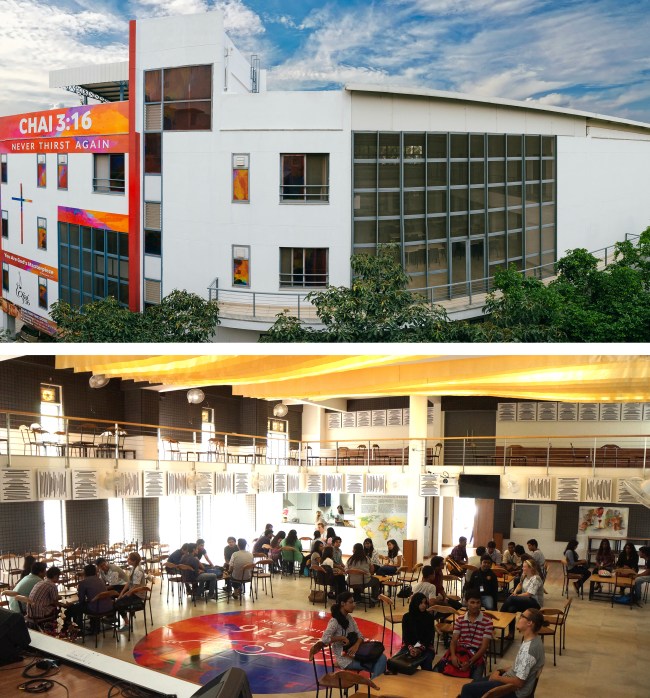
What motivated you to travel the world?

The Bible says God’s ways are higher than our ways and his thoughts higher than our thoughts (Isa. 55:8). So I asked Jesus, “What is your dream for my life?” Jesus said, “Benny, I want you to travel to every country by 2010,” and that is when I started off.

I had an Indian passport which required visas to every country, and I was just earning $25 a month—besides my health condition. When I questioned Jesus, he said, “Benny, what is impossible for man is possible for me.”

I aimed to convey the message of hope I discovered in Jesus, who transformed my life from a state of despair to one of purpose and strength. Alongside my guitar performances, I shared my testimony, emphasizing the hope I found in Jesus and encouraging others not to give up but to find their resilience in him.

What were the biggest challenges you encountered on your trips?

Traveling can be extremely lonely, and I was traveling alone. But I dealt with that by staying with families.

Also, a lot of time, energy, and paperwork went into getting visas. For some countries, we did not have embassies in India, so I had to first fly all the way to Washington, DC, or Geneva, or New York.

For countries and territories like the Pitcairn Islands, Falkland Islands, Ascension Island, Antarctica, Cuba, and North Korea, it was extremely difficult to contact the authorities to get permission to enter, obtain a permit to perform, and organize the event. To this day, I am the first and only person to have performed a concert in the Pitcairn Islands.

When did you realize you could actually compete for a world record?

Though I had been traveling since 2002, I didn’t start keeping a travel log until 2004. So I ended up visiting some countries twice. In 2009 I found out that I was very close to breaking the world record after the news of Kashi Samaddar surfaced, who had visited 194 UN-member countries in six years, ten months, and seven days.

I quickly checked my list and realized that I was only 10–12 countries short of setting a new world record. I thank God that I never knew about it because, had I known, my entire mission would have focused on traveling faster rather than traveling with the purpose of spreading the good news.

How did you end up inventing your “Bentar” instrument?

I was invited to perform on the cultural stage of the Olympic Games in Greece in 2004, and the invitation mentioned that I could only play my musical instrument and not share the gospel. But for me, sharing what God has done in my life is the first and foremost thing.

So I prayed and asked God to help me design a guitar that the world has not seen, and that because of my guitar, people would come and ask me questions about its invention and I would be able to share my story with them.

Tell us about the Christians you met.
I was quite inspired by the Christians in Erbil, the capital city in the Kurdistan region of Iraq. I saw their vibrancy and passion for the Lord, which was remarkable. In some of the African countries, the people’s devotion to the Lord was quite inspiring.

I saw that Jesus is working among all the nations. I heard amazing testimonies from people who encountered Jesus—his presence and his peace. This was prevalent in all my travels to all these countries.

What are you doing now? What is Chai 3:16?

I run a 400-seat café in Bengaluru called Chai 3:16. Chai means “life” in Hebrew and is the word for “tea” in the Hindi language, and 3:16 refers to John 3:16. It is a non-commercial café where each customer who walks in is met by a “friend” who is there to sit and listen to them.

The café doesn’t urge customers to pay, and the collection box isn’t our main income. Nonetheless, church members have donated due to seeing our impact, reflecting divine influence. We remain self-sufficient through providential resources, bypassing external funding and promotional costs.

We ask our employees to do 80 percent listening and 20 percent talking. I want every young person to banish the thought of suicide and have a long life filled with purpose and value. It has been eight years now, and every week we are able to rescue one boy or girl who is on the verge of committing suicide.

What motivated you to open your café?

In 2011, I reached the pinnacle of my career, boasting 300 performances annually across 50 countries. I reveled in this success, finding myself abundantly provided for in terms of food, wealth, and fame. Yet a moment of introspection led me to question the need for God in my life.

With comfort and strength to combat illness, I pondered my self-sufficiency, only to realize the dangerous territory this mindset led me to. I humbled myself in prayer, acknowledging that my abundance had turned into a curse rather than a blessing, and that life without Jesus was devoid of meaning.

That night, I sought God’s dependency and guidance. Promptly, God urged me to purchase land and dedicate my savings for this purpose. In response, the vision for Chai 3:16 was bestowed upon me, reminding me that my true purpose lay in service to him.

Top: Chai 3:16 Bottom: Inside the café where young individuals, who are contemplating suicide, come to seek help.Courtesy of Benny Prasad
Top: Chai 3:16 Bottom: Inside the café where young individuals, who are contemplating suicide, come to seek help.

You are on a mission to rescue youngsters, and you said that every week you rescue at least one individual on the verge of committing suicide. Can you share some of their stories?

There was a young boy who went to the railway track with the intention of ending his life. He chose to wait for the train, avoiding lying on the tracks due to his fear of backing out at the last moment. Instead, he planned to jump directly in front of the oncoming train. As he sat and awaited the train’s arrival, he became lost in his thoughts.

Suddenly, he realized that the train had already passed. Frustrated by the wait for the next train, he felt unsure of how else to proceed with his intentions. It was during this moment of despair that he heard a voice urging him to go to Chai 3:16. The voice also gave him directions to the café.

Once he arrived, he recounted his story and poured out his feelings and frustrations. After listening attentively, we shared our testimony and prayed with him. Inspired by this encounter, he made the decision to embrace life anew. Over time, his life underwent a remarkable transformation. He emerged as a talented musician, establishing his own successful music school, finding happiness and success.

In another instance, a different individual faced another difficult situation. He had to retake his engineering exams in 25 subjects, and was confronted with feelings of depression and hopelessness. At a crossroads, his friend presented him with two choices: to turn to drugs or to visit Chai 3:16. Opting for the latter, he embarked on a 1.5-hour bus journey to reach the café.

He spent a continuous eight-hour stretch at the café, pouring out his frustrations and seeking solace. This became a regular pattern for two months. Through this process, his life underwent a complete transformation. He returned, determined to turn his life around. He diligently tackled and cleared all 25 backlog papers, eventually securing a position as an engineer in Kerala.

Chai 3:16 has seen numerous stories like these—stories from individuals who were grappling with thoughts of suicide or facing overwhelming challenges. Our approach involves patient listening and offering understanding and compassion. We’ve had young women confide in us after experiencing traumatic incidents, such as rape. These girls often fear disclosing their experiences to their parents due to potential consequences with their education.

Chai 3:16 provides a safe space for them to open up without revealing their identities. The impact of the café is evident in the positive transformation of those who have sought refuge here. Even journalists who have visited to interview us have later returned to disclose their own struggles with suicidal tendencies. Over time, we have forgotten how some of these people look, but we still remember the experience of how God used us to speak truth and life into them.

This interview has been edited and condensed for length.

Apple PodcastsDown ArrowDown ArrowDown Arrowarrow_left_altLeft ArrowLeft ArrowRight ArrowRight ArrowRight Arrowarrow_up_altUp ArrowUp ArrowAvailable at Amazoncaret-downCloseCloseEmailEmailExpandExpandExternalExternalFacebookfacebook-squareGiftGiftGooglegoogleGoogle KeephamburgerInstagraminstagram-squareLinkLinklinkedin-squareListenListenListenChristianity TodayCT Creative Studio Logologo_orgMegaphoneMenuMenupausePinterestPlayPlayPocketPodcastRSSRSSSaveSaveSaveSearchSearchsearchSpotifyStitcherTelegramTable of ContentsTable of Contentstwitter-squareWhatsAppXYouTubeYouTube