Books
Excerpt

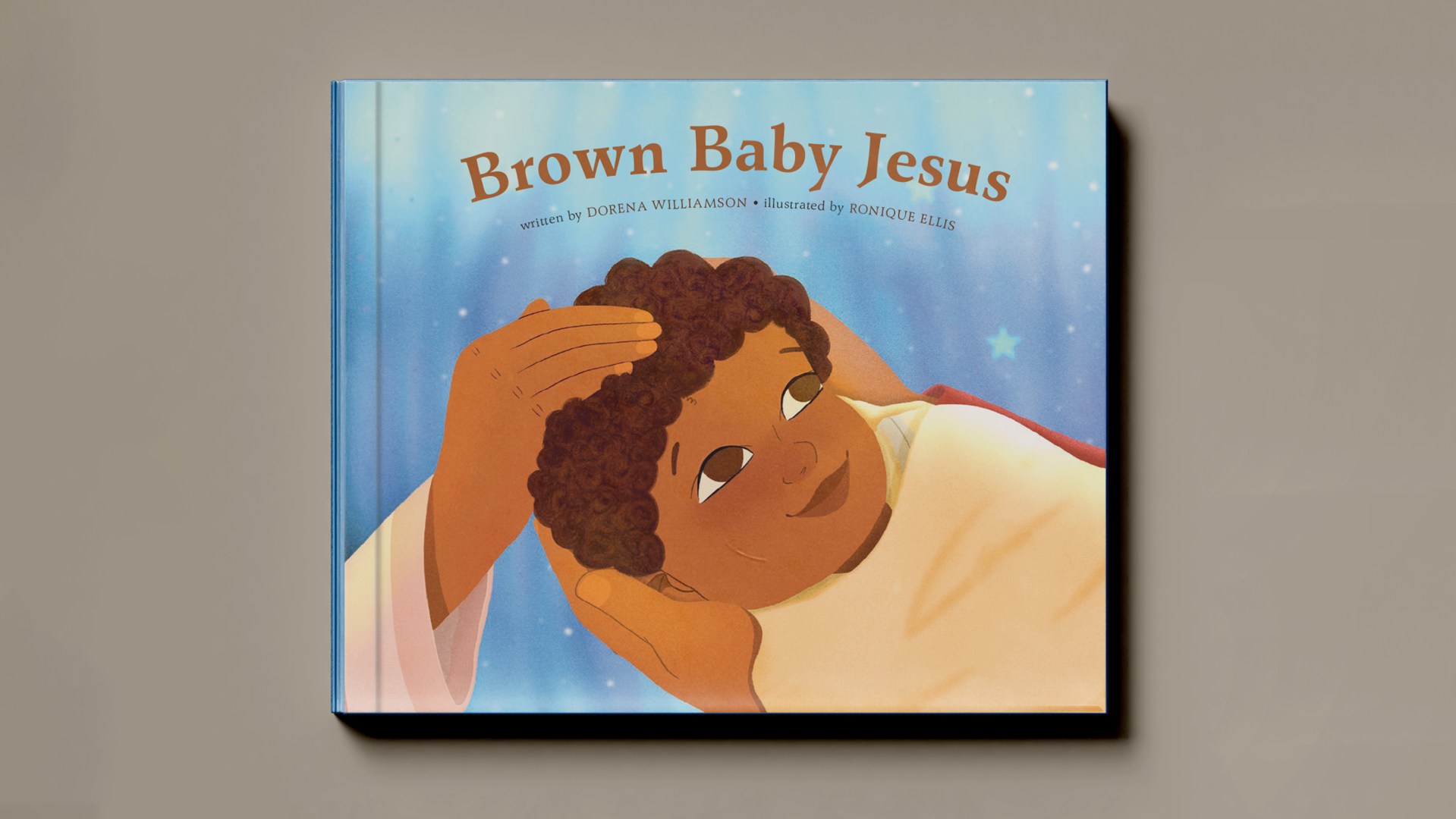
Jesus Was a Brown Baby

This children’s Christmas book paints baby Jesus in a new (or rather ancient) light.

Christianity Today December 22, 2022
Excerpted from BROWN BABY JESUS © 2022 by Dorena Williamson. Published by WaterBrook, an imprint of Random House, a division of Penguin Random House LLC, on September 20, 2022. All rights reserved. No part of this excerpt may be reproduced or reprinted without permission in writing from the publisher.

In 2010 I visited the Church of the Annunciation in Nazareth and was struck by how different ethnic groups portrayed baby Jesus. From the shape of his eyes to the shade of his skin, each country portrayed Jesus as one of them.

Brown Baby Jesus: A Picture Book

Brown Baby Jesus: A Picture Book

Waterbrook

40 pages

$13.86

I have always been fascinated by the women God was pleased to include in Jesus’ family tree. Inspired by memories of Nazareth, I longed to disrupt the cultural norm of a white Jesus with a Biblically accurate depiction that celebrates the diverse world Jesus came to save.

Four years ago, a little brown boy at church asked his white mom why everyone made Jesus so white and suggested I write a book with a brown Jesus. I crafted this story so that children like my young friend could see the multicultural weaving of love that God designed in Jesus' family tree.
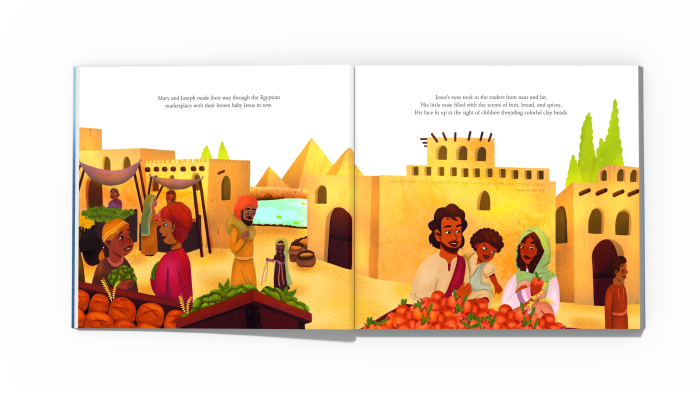
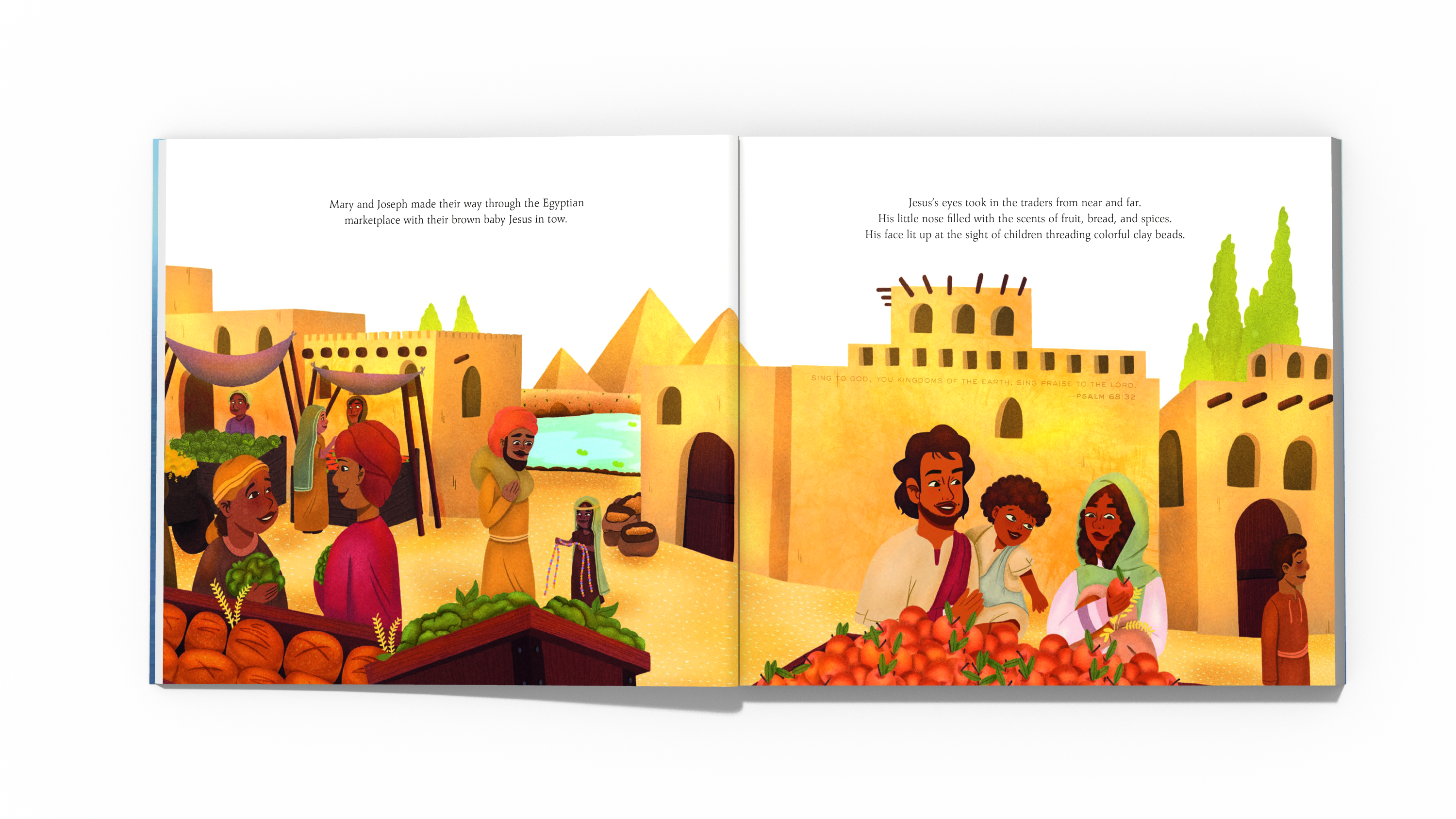
Mary, Joseph, and baby Jesus spent years in Egypt following the angel's warning to flee from King Herod's intent to seek and kill Jesus. Toddler Jesus would have enjoyed visiting a marketplace like this.
Mary, Joseph, and baby Jesus spent years in Egypt following the angel’s warning to flee from King Herod’s intent to seek and kill Jesus. Toddler Jesus would have enjoyed visiting a marketplace like this.
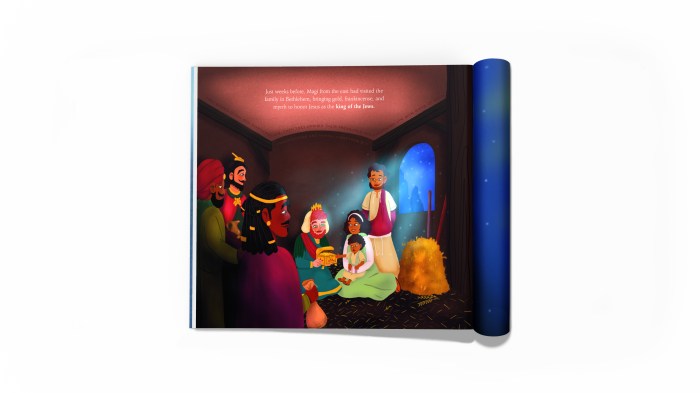
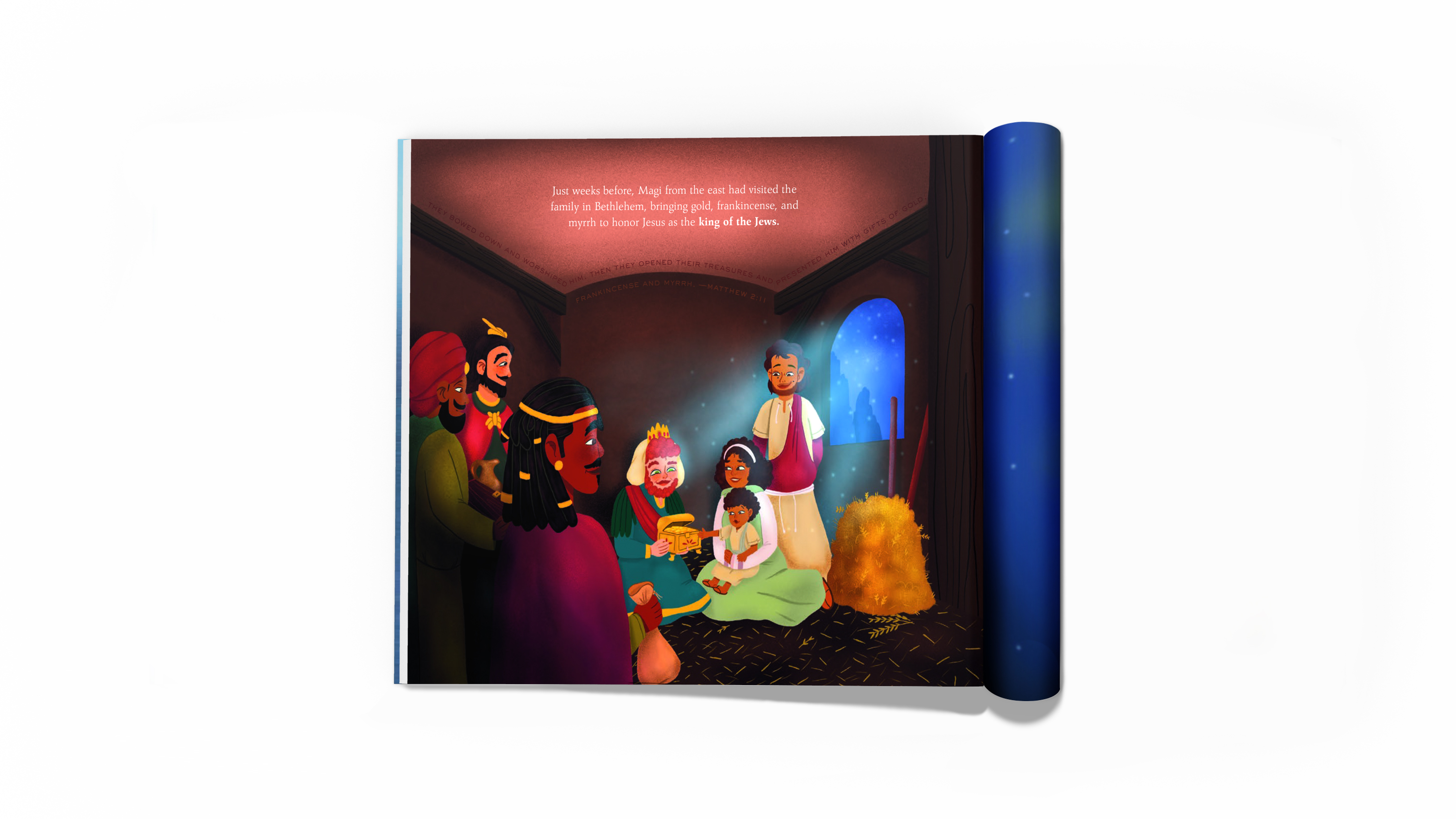
While we know the Magi presented three gifts to young Jesus, there may have been more than three among the caravan. It is likely that these visitors came from Asian and African countries to the east of Jerusalem.
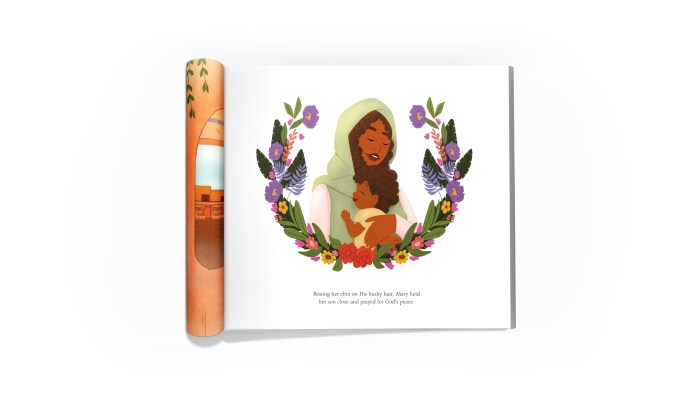
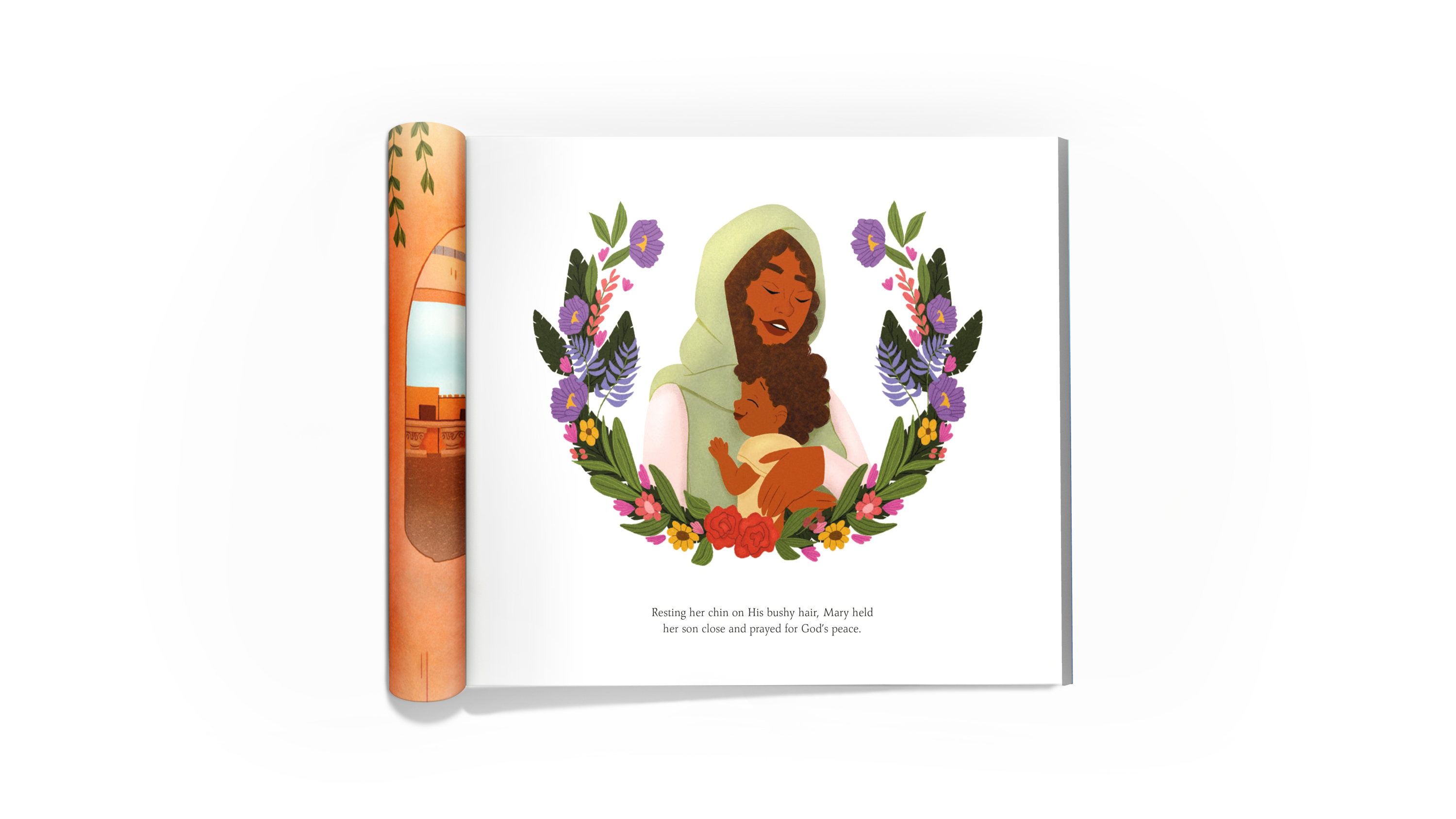
As Mary pondered the events in her young son's life (Luke 2:19), she might have held young Jesus extra close as she recalled the words of prophecy from Simeon. Jesus' bushy hair is a nod to the description of hair like wool from the Apostle John in Revelations 1:14.
As Mary pondered the events in her young son’s life (Luke 2:19), she might have held young Jesus extra close as she recalled the words of prophecy from Simeon. Jesus’ bushy hair is a nod to the description of hair like wool from the Apostle John in Revelations 1:14.

Excerpted from BROWN BABY JESUS © 2022 by Dorena Williamson. Published by WaterBrook, an imprint of Random House, a division of Penguin Random House LLC, on September 20, 2022. All rights reserved. No part of this excerpt may be reproduced or reprinted without permission in writing from the publisher.
Theology

Christmas Is a Happy Day for Broken Hearts

Because of Jesus, we are not like those who grieve without hope this holiday season.

Christianity Today December 22, 2022
Illustration by Christianity Today / Source Images: Unsplash

Christmas has always been the most special day of the year for my family.

We enjoy New Year’s Day, Easter, and Thanksgiving and other holidays that come our way as the calendar pages turn. But there has always been something special about Christmas—with its well-established celebrations, personalized traditions, and faith-filled observations. And yet we recently learned a difficult lesson—that the most special days can also be the most painful ones, and that sorrows are often amplified in festive times.

It was just two short years ago that my son Nick was unexpectedly taken from us. He was a college student who was progressing well in his studies, a fiancé looking forward to his upcoming wedding, a faithful son, and a loving brother. But then, in an instant, he was taken—and our world was shattered.

Not a day goes by when he has not been on our hearts and in our minds. Not a day goes by when we do not miss him dearly and grieve him sorely. Not a day goes by when we do not long to hear his voice and see his smile.

And as this most special of days draws near, we feel that longing grow and that ache deepen, for we know that at Christmas we will sense his absence even more. It will be impossible to ignore or overlook—for there will be fewer gifts under the tree than there once were, fewer chairs around the table, one less stocking above the hearth. We know that on this day, of all days, he will be most deeply missed.

This Christmas falls on a Sunday and we will, of course, gather with the rest of our church to mark the day with worship—with songs and prayers and scriptures and preaching. How could we better mark Christmas than like this? My older daughter and her husband will be in town and joining us. My younger daughter will be with us as well.

What we wouldn’t give to worship together as a whole family, intact and reunited. What we wouldn’t give to spend this Christmas as we’ve spent so many others, with all of us sitting, singing, and marveling together at the wonder of the day and all it represents.

And yet we are not without hope, and we are not without joy. Although we know Christmas will be a day of sadness, we are also convinced it will be a day of happiness. It must be a day of happiness, for how could we be without joy on Christmas, of all days?

If Christmas was only an occasion for our family to gather and enjoy one another, we might well despair. But there is far more to it than that. Christmas commemorates a historic event of tremendous significance—not only the birth of a baby, but the advent of our hope.

It is on Christmas that we remember Jesus Christ and the narrative of his birth—a baby born to an obscure young girl in an obscure small town in an obscure province of the mighty Roman Empire. And yet all that obscurity cannot belie the fact this child was special, for He was God’s own Son.

There is much about the Christian faith that is unique, but surely nothing more than this—that God entered the world and became a flesh and blood human being. We speak often and rightly about Jesus dying upon a cross. We profess that it is through his death that he saves his people—and through his resurrection he promises a future in which every wrong will be made right and every grief will be comforted.

But for Jesus to die he had to live, and for Jesus to live he had to be born.

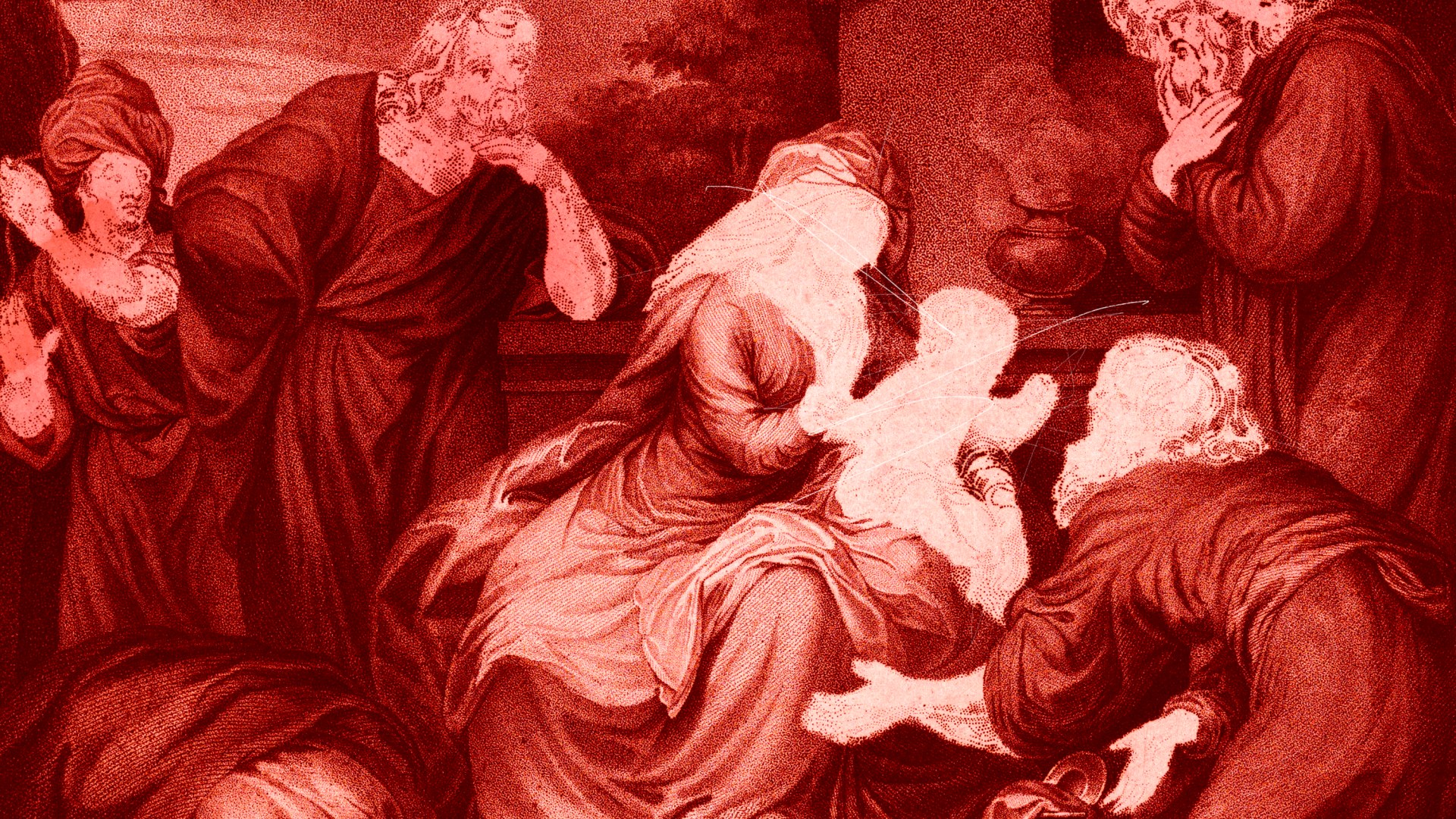
We ought to pause and consider one of the obscure characters from the early life of Christ, one we often pass over. Simeon was an old man, described only as righteous and devout. The baby Jesus was brought to Jerusalem, and there Simeon saw him—and he knew this baby was the Savior.

Taking this baby in his arms he said, “Sovereign Lord, as you have promised, you may now dismiss your servant in peace. For my eyes have seen your salvation, which you have prepared in the sight of all nations.” (Luke 2:29-31)

Now that Simeon had seen Jesus—seen him with his eyes and held him in his arms—he was ready to depart and die in peace. And now that we have seen Jesus—see him with the eyes of faith and held him in our hearts—we are ready to live and ready to die, ready to endure and ready to depart. Simeon’s words are our words, his confidence is our confidence.

If we have hope as a family, it is hope that is rooted and grounded in Christmas. If we have hope that our disrupted family circle will be repaired and restored, it is hope that begins with the birth of Jesus Christ. If we have hope that a day is coming when all our sorrows with be soothed and all our tears will be dried, it is hope that dawns on Christmas morning—celebrating the day Jesus was born to save this world.

And so even as we grieve on Christmas, we do not grieve without hope (1 Thess. 4:13). Even as we weep, we do not weep without comfort. Even though it may be a day of sadness, it is also a day of joy, for Christmas is just what we need in our most difficult times and in our darkest of days.

Christmas is a happy day for broken hearts—when rays of light first pierced the darkness, when hope dawned after a long and excruciating night—the morning when Jesus was born.

Tim Challies lives with his family in the suburbs of Toronto and blogs daily at Challies.com. He is the author of Seasons of Sorrow: The Pain of Loss and the Comfort of God.

Theology

Christmas Is a Myth (The Good Kind)

How the fact of the Incarnation fulfills the hopes of every culture.

Christianity Today December 22, 2022
WikiMedia Commons

On All Saints’ Day, my wife and I often tell stories about the saints who have most impacted us. This year, I shared with my family the story of C. S. Lewis’s conversion.

For some time, he had been teetering on the precipice of faith, unable to resolve his intellectual difficulties with Christianity. On a late-night walk around Oxford with his friends Hugo Dyson and J. R. R. Tolkien, he voiced his essential objection.

Everything that matters, Lewis said, belongs in the realm of myth.

Lewis had a great fondness for Norse mythology that went all the way back to his youth in Northern Ireland. For him, however, myth was about meaning making , whereas history was about unrepeatable facts, collected and analyzed in an empirical way. The great tragedy of human existence was that myth and history did not and could never intersect.

Like the German thinker G. E. Lessing before him, Lewis described the “ugly ditch” between history and theology. Irrespective of how radiant his life was, a man named Jesus who lived 2,000 years ago could never be anything more than an inspirational figure.

Dyson’s and Tolkien’s responses were electrifying: In this instance, they said, myth had become fact. Everything eternal and mystical—the deep magic of the world—was real and incarnate in the person of Christ. He was not simply a historical person but the Creator God enfleshed to save the human beings he had created.

With that riposte, Lewis was suddenly able to put the pieces together. As he wrote later to his friend Arthur Greeves, “the story of Christ is simply a true myth: a myth working on us in the same way as the others, but with this tremendous difference that it really happened.”

Through the Son of God, there was a true marriage of heaven and earth. God embraced matter in the person of Jesus. The Incarnation happened in one place, but it was “diffused” and “communicated” in all places, as the Jesuit priest and scholar Henri de Lubac wrote.

In his “infinity dwindled to infancy,” as Gerard Manley Hopkins put it, God’s descent into human flesh was not simply about dignifying us or being with us in our joys and sorrows. Heaven descended to earth so that the stuff of earth might ascend to heaven.

The idea of a union between heaven and earth resonates so much with me because it’s strikingly non-individualistic. It involves an acute understanding of the human person. As modern Westerners, many of us walk around with a distorted understanding of the person as an “autonomous, self-directing, therapeutically oriented individual,” in the words of sociologist Christian Smith.

But if we simply follow Lewis’s insight, we can see immediately how far short that vision falls. We are, Lewis seems to say, the myths that have made us. We are the stories that we’ve inherited—that give shape to what we hope for and define our view of the good life. The idea of myth becoming fact is an inherently culture-affirming idea, because myths arise only within cultures.

A person is thus something infinitely greater and more sacred than an interchangeable individual. Each one is involved in relational, narrative, geographic, and institutional webs that are essential to personal identity and flourishing. The Incarnation demonstrates that these cultural forms are not a mere accident of history, nor are they simply the outgrowth of human sinfulness. God’s intention is to subtly, gently reframe those bent cultural forms until they express the shape of integrity he designed for them.

Lewis recognized all of this. But here I need to acknowledge that Lewis was an Englishman of his times, and it’s here that I find it necessary to part ways with him. His Christianity had a distinctively English hue. But if he was right, then the Incarnation means there is no distinctively Christian culture. The myths that prepare the way for Christ are not only Norse myths or Greco-Roman myths. Christianity is not a Western religion, nor is it a white one. It’s not properly expressed exclusively in English.

We know this from studying the global church. Diaspora networks and immigration are driving the resurgence of Christianity in post-Christian places, and migration and the mixing of cultures have been major engines for the propagation of the gospel in history. As Andrew Walls once argued, Christianity is always an incarnation—a translation into an already-existing culture that subverts and draws people from that culture to Christ. It is precisely this “infinite translatability” of the Christian faith that distinguishes it from other world religions.

As a Latino who grew up and continues to serve in predominantly white and English-speaking contexts, I have been amazed to find Jesus honored and glorified by Dominican Pentecostal musicians like Lizzy Parra and Ander Bock. I have been astonished to meet fellow Anglicans from Nigeria who worship Jesus with an energy and intensity that give me hope in the living, active work of the Holy Spirit. My faith has been expanded after encountering Iranians who’ve suffered the loss of everything and who follow a Jesus who speaks Farsi.

In all these cultural expressions, we see the fulfillment of Isaiah’s prophecy—that all nations will stream into Zion (Isa. 2:2; 60:3). Christ is the desire of every nation, because he’s been at work sowing preparatory grace among every people. As Lewis put it, the Lord is present in the “good dreams” of every people group; it’s their myths that make them ready to receive him when he comes.

The Incarnation touches every part of human existence. It’s an essential part of the hope we celebrate at Christmas. There is no human culture from which Jesus is a foreigner. Myths—the myths of all nations—became fact in Jesus Christ. It’s hard to deny the power of the Incarnation when we see vibrant communities of Christians who look and sound nothing like us praising the name of Jesus.

We see that it is all of humanity that Christ came to save. This is what we remember when we meet Christ in the manger.

Jonathan Warren Pagán is an Anglican priest living and serving in Austin, Texas.

News

Will Ukraine’s Threatened Ban on Russia-Linked Churches Violate Religious Freedom?

Evangelical, Orthodox, and academic sources weigh security concerns against the right to associate with historic patriarchate losing popularity and suspected of war collaboration.

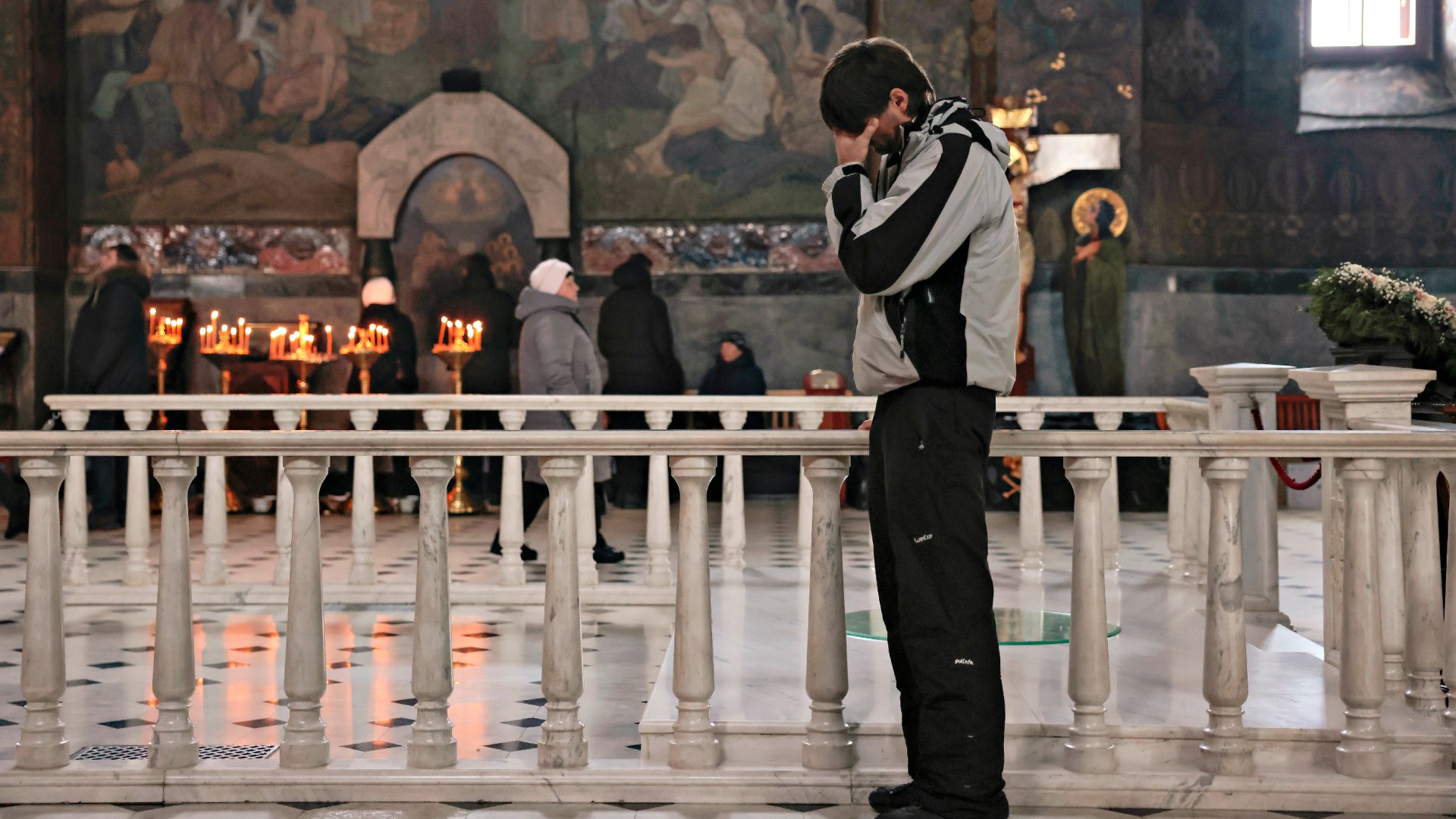
People pray at the Kyiv Pechersk Lavra "Monastery of the Caves" on December 4, 2022 in Kyiv, Ukraine.

People pray at the Kyiv Pechersk Lavra "Monastery of the Caves" on December 4, 2022 in Kyiv, Ukraine.

Christianity Today December 21, 2022
Jeff J. Mitchell / Getty Images

Ukraine, a bastion of religious freedom, is moving to possibly outlaw a church.

President Volodymyr Zelensky began the month by endorsing a draft law to “make it impossible” for the Ukrainian Orthodox Church (UOC), canonically linked to Moscow, to operate. His December 1 decree followed raids on several monasteries under the UOC’s jurisdiction.

Security services searched over 350 buildings and investigated 850 people.

“We will ensure complete independence for our state. In particular, spiritual independence,” stated Zelensky. “We will never allow anyone to build an empire inside the Ukrainian soul.”

The reaction from Russia was swift—but also illustrated the issue.

“The current Ukrainian authorities have openly become enemies of Christ and the Orthodox faith,” stated Dmitry Medvedev, deputy chairman of the Russian Security Council.

Kremlin spokesman Dmitry Peskov, however, was more specific, accusing Ukraine of “waging a war on the Russian Orthodox Church” (ROC).

His comment prompted a UOC spokesman to assert his church is not Russian.

The raids—centered on the 11th-century Kyiv-Pechersk Lavra complex, known as the Monastery of the Caves—uncovered large amounts of cash, “dubious” Russian citizens, and leaflets calling on people to join the Russian army, according to Ukrainian authorities. Other material cited as evidence included prayer texts of ROC patriarch Kirill and a video of hymn singing that celebrated Russia’s “awakening.”

Kirill has publicly blessed Russia’s invasion of its neighboring nation, even promising forgiveness of sin to soldiers who die in the war. Security services also described finding UOC priests in possession of literature denying Ukraine’s right to exist and contacting Russian intelligence agents.

Sanctions were announced on at least 10 UOC members, including the governor of Kyiv-Pechersk Lavra, a UNESCO heritage site. Another, the archbishop of the Kirovohrad diocese, was accused of subversive activities.

Zelensky stated the government would examine the Lavra’s jurisdiction.

Since then, sanctions have followed on seven additional members, while the UOC stated that local authorities have issued over 70 orders to ban its activities.

In 2019, the newer Orthodox Church of Ukraine (OCU) was formed from a merger of two breakaway jurisdictions from the ROC, after which it was declared an autocephalous (independent) body by Ecumenical Patriarch Bartholomew I of Constantinople.

The new church was rejected by Moscow and accepted by Greece and other national churches, while some in the Orthodox world stayed neutral. The UOC, meanwhile, continued under the leadership of the Moscow patriarchate.

Russia’s invasion in February 2022, however, placed the UOC in a bind. Although it is the largest church in Ukraine with about 12,000 parishes, polls indicate it now receives the support of only 4 percent of the population. As a further sign of its decline in favor, only 13 percent of Ukrainian citizens of Russian ethnicity support the church.

In May, Metropolitan Onufriy, head of the UOC, declared its parishes were no longer subordinate to the ROC, though he maintained Eucharistic communion with Moscow. By then, 387 parishes had already transferred allegiance to the OCU.

Onufriy has consistently spoken out against the war, and last month he deposed three top bishops, two of whom fled to Russia. And following the raids he declared support to UOC chaplains in the Ukrainian army, while the Holy Synod—speaking from the Lavra—reiterated that the church “consistently stands for the preservation of the sovereignty, independence, and territorial integrity of Ukraine.”

After the draft law’s disclosure this month, Ukraine dismissed Elena Bogdan, state official for ethnopolitics and freedom of conscience, reportedly for her opposition to banning the UOC. She had previously confirmed Onufriy’s statement that the church was no longer governed by the ROC.

Zelensky’s decree tasked her office with the determination of UOC’s continuing ties with the Moscow Patriarchate.

“Increasingly as the war grinds on and winter advances, the weaponization of religion will continue,” said Catherine Wanner, professor of history, anthropology, and religious studies at Penn State University. “All of these dynamics conspire to clamp down on the potential—if not actual—use of this church as a portal for the Russian World ideology.”

Promoting Russian cultural influence outside its borders, such ideology has been supported by Kirill and used by Moscow to politically engage on behalf of Russian speakers in other nations. Ukrainian officials stated that materials found in the Lavra integrated this teaching into seminary and parish school curriculum.

The ROC viewed the raid as an attack on its heritage.

“The Ukrainian leadership are prepared to act against their own population, and the most defenseless and unobjecting kind at that," stated spokesperson Vladimir Legoyda. “Ordinary believers and the humble, honest priests of the Ukrainian Orthodox Church, whose sole blame is their keeping the faith of their fathers.”

And many wish to honor this heritage.

“We have certain relations with Russia, and it’s painful for us what is going on now,” stated Ioan, a UOC priest in the Lavra, following the raids. “The most important is that the war is over … for the guilty to be punished, and for us to live in peace.”

Announcing the measures, Zelensky stressed Ukraine’s commitment to religious freedom. At the same time, a new legal entity was created to register the Lavra as a monastery within the OCU, without changing the status of the complex pending further investigations.

Alexander Webster, archpriest and emeritus professor of moral theology at Holy Trinity Seminary in New York, called it an “outrageous ploy” and objected strongly.

“Silencing and arresting Orthodox clergy as ‘dissenters’ and ‘traitors’ ought to wake up America to the corrupt, fascist regime in Ukraine,” he said. “Zelensky and his cabal are no less brutal tyrants than Putin and his government.”

Webster’s institution is under the jurisdiction of the Russian Orthodox Church Outside of Russia, and he laments the “shameful internal disagreements”—led by Bartholomew and backed by the West—that may permanently splinter the Orthodox world.

Wanner noted that the UOC was the final holdout of religious unity between Russia and Ukraine. Author of Communities of the Converted: Ukrainians and Global Evangelism, she stated that Protestant, Muslim, and other believers in the two countries have already broken communion.

“This is the last shoe to drop,” she said.

Maksym Vasin, executive director of the Ukrainian Institute for Religious Freedom, headquartered in Kyiv, provided commentary to CT, stating it is too soon to assess the implications.

“After a significant public outcry in Ukraine and public accusations against clergymen of the UOC (affiliated with the Moscow Patriarchate) of high treason and collaboration in favor of Russia as an aggressor state, the Security Service of Ukraine has started to inspect the UOC-MP activities considering its connections with the Russian Orthodox Church which is engaged with the Kremlin,” he said.

“However, at this moment, it is too early to estimate the possible legal consequences for the UOC-MP, while the investigation is in process. At the same time, the Ukrainian parliament is still discussing various legislative initiatives which can affect the UOC-MP and other denominations in general. In the meanwhile, the State Service for Ethnopolitics and Freedom of Conscience recently appointed a new chief.”

Russian religious freedom advocates were critical.

"We see a full-fledged ideological war of Ukraine against Russia,” stated Sergey Melnikov, chairman of the Russian Association for the Protection of Religious Freedom. “The Ukrainian authorities stop at nothing and violate fundamental human rights, including the right to freedom of religion.”

Ruslan Maliuta, the Ukrainian cofounder of the World Without Orphans alliance and taskforce leader for the World Evangelical Alliance’s coordination of relief for Ukraine, referenced recent church history. The UOC structure dates back to the time of the Soviet Union, when the church was under full government control. After independence, it maintained strong ties with the ROC, which critics say became co-opted by Putin.

Today, there is no evidence the Ukrainian government has suppressed any church, he said. The current investigation is simply a matter of national security, examining the potential involvement of clergy in supporting aggression against their own country.

“The government should have probably investigated this much earlier,” said Maliuta. “But there is no doubt that many, if not most, believers in the UOC are Ukrainian patriots.”

Mark Elliott, editor emeritus of East-West Church and Ministry Report, recognized both the risk to religious freedom and the danger of ROC soft power. But there is no “concrete evidence,” he said, that Onufriy himself is guilty.

“An outright ban on the UOC would not be in the interest of Ukraine,” Elliott, a former history professor at Asbury University and Wheaton College, said. “But neither, obviously, would it be to forgo security measures against Russian collaborators in their ranks.”

To protect the freedom of conscience of all citizens, he recommended that before the parliamentary vote, the draft law should be submitted for review to the European Court of Human Rights. In addition, evidence against the UOC clerics should be shared with Orthodox leaders outside Ukraine for evaluation.

To help mediate between the UOC, the OCU, and the state, Elliott suggested the Orthodox archbishop of Albania and patriarch of Jerusalem, both of whom have remained neutral in the byzantine conflict between Bartholomew and Kirill.

Until then, the jury is out on religious freedom’s future in Ukraine—as the war rages on.

“It is too early to tell,” said Wanner. “The goal is to end this punishing war, so we encourage the use of nonviolent means.”

Editor’s note: CT offers select articles translated into Ukrainian and Russian, including a daily Advent devotional.

You can also join the thousands who now follow CT on Telegram: @ctmagazine (also available in Chinese and Russian).

Books

Our Lady of Everywhere

5 questions about the global icon of Mary you see every Christmas.

Christianity Today December 21, 2022
Illustration by Mallory Rentsch / Source Images: Courtesy of Matthew Milliner / WikiMedia Commons

The Virgin of the Passion, also known as Our Lady of Perpetual Help, has been called the most popular Christian icon of the 20th century. I would argue the same applies to our own century as well. As an art history professor, I’ve been chasing her around the globe for nearly two decades (and have now collected those studies in my recent book, Mother of the Lamb: The Story of a Global Icon).

Here’s what you need to know about her.

1. Where does the story of the icon start?

The first surviving instance of the image appears on the island of Cyprus, where the icon was painted as an Eastern Orthodox response to Western Crusaders occupying the island—specifically King Richard the Lionheart of England and the Knights Templar. After the Knights slaughtered the Orthodox population on Easter morning of 1192, the image was offered as a prayer of lamentation. The angels flanking Mary traded their scepters of triumph for instruments of defeat: the cross, the spear, and the sponge.

Jolted from their onetime position of power on Cyprus, the island’s Orthodox inhabitants were forced back to the original political conditions once faced by Mary and Jesus. As the Byzantine Empire slowly crumbled, the Virgin of the Passion emerged. From the crags of the Balkans to the caverns of Mediterranean islands, this icon surfaced wherever Eastern Christian political power lost its ground.

Given those origins, the icon is relevant to Christians anywhere in the world who may be losing the power and influence they once enjoyed. The image tells us that sometimes the loss of power is not an end but a beginning.

The Virgin of the Passion from CyprusPhoto by Slobodan Ćurčić / Courtesy of Matthew Milliner
The Virgin of the Passion from Cyprus

2. What are some contemporary examples of this image?

Well, there are too many to count. The Virgin of the Passion shows up in The Avengers, the finale of the TV series Justified (its concluding scene, no less), and also the 2012 London Olympics, when an Ethiopian Orthodox runner unfurled her again to the world by pulling a cloth icon out of her jersey.

Perhaps the most timely example is one that lies dormant in the heart of contemporary Moscow, where—as I’ve recently argued—the Virgin summons Russia back from the war in Ukraine to a state of peace. Fittingly, she’s all over Ukraine as well.

Virgin of the Passion, late 15th century by Andrea Rico di CandiaPhoto by Princeton University Art Museum
Virgin of the Passion, late 15th century by Andrea Rico di Candia

The icon often appears in ways that check the abuse of political power. As the patroness of Haiti, for example, the image is directly associated with the only successful slave revolt in human history.

3. Where does she show up in history?

When the city of Rome was sacked in the fifth century, Christians like Saint Augustine responded by exalting what he called the City of God over the City of Man. But what if the capital of a Christian empire collapses? The Eastern Roman (or Byzantine) Empire had to ask that question when Constantinople (now Istanbul) fell to the Ottomans in 1453. I would argue that the Virgin of the Passion icon provided the same service for that disaster that Augustine provided in his famous book City of God. But this time the answer came not in writing but in paint.

As Orthodox Christian refugees piled onto Crete after the fall of Constantinople, the icon was revived and spread from that island throughout Europe. As with Cyprus centuries earlier, when Christians faced political upheaval, the icon of Jesus and Mary suffering their own disaster ministered profoundly to those displaced by the Ottomans.

Then, as now, she showed that the Christian faith is not dependent on temporal political entities to survive. I hope the analogy to our own moment is clear, as American Christians face new challenges. We certainly need this icon today.

4. Where is this particular icon in the United States?

She’s everywhere here too, especially in connection to marginalized people groups.

Considering the icon’s historical connection to territorial loss, it’s not surprising that Native Americans revere this particular version of Mary. She’s the titular icon of the Catholic Cathedrals of Rapid City, South Dakota, and Oklahoma City (a point I first made in The Everlasting People: G. K. Chesterton and the First Nations).

The Virgin of the Passion at St. Thomas Aquinas University Parish in Charlottesville, VACourtesy of Matthew Milliner
The Virgin of the Passion at St. Thomas Aquinas University Parish in Charlottesville, VA

The icon has a large following among Black Catholics as well. In the heart of St. Louis at Saint Alphonsus Liguori Catholic Church (nicknamed “the Rock”), visitors will find a fully Africanized Gothic environment. Black saints, Coptic iconography, and African drums grace the space along with its famous icon, Our Lady of Perpetual Help.

The South has her too. Not long after the Unite the Right riots of 2016, a chapel featuring the icon (pictured here) was erected in Charlottesville, appended to St. Thomas Aquinas University Parish Church. As the statues of Robert E. Lee and Stonewall Jackson came down, she filled the ensuing void with beauty.

Wherever you are, if you plug “Our Lady of Perpetual Help” into a search engine, you’ll likely find that you’re surrounded by the image. If you have eyes for the icon, you’ll see her again and again.

5. But aren’t icons like these mostly for Catholic and Orthodox Christians?

Sure, but not only for them. This particular icon scrambles our tidy church categories. Catholics have claimed the Virgin of the Passion as their own. (Their renaming her Our Lady of Perpetual Help was a strategic move.) But as mentioned, she was originally created as an Orthodox response to Catholic violence.

The Orthodox claim her, but they would have to concede that she’s most heavily embraced by Roman Catholics, not to mention Coptic Orthodox and Ethiopian Orthodox Christians. She is therefore African Orthodox as much or even more than she is Greek Orthodox.

As evangelicals reckon with their changing influence in American life, they too might consider embracing this icon of suffering love. Martin Luther celebrated Mary for his entire life, but he’s also well known for his anti-triumphalist “theology of the cross.” The Virgin of the Passion brings together Luther’s love for Mary and the crucified Christ.

For Anglicans like me, she is an especially perfect fit. In his sermon on December 25, 1626, the great Anglican poet John Donne said Christ’s “Christmas day and his Good Friday are but the evening and morning of one and the same day.” Thanks to the Virgin of the Passion icon, Christmas and Good Friday are one and the same icon.

In his carol, “What Child Is This?” the Anglican hymn writer William Chatteron Dix put it this way:

Nails, spear shall pierce Him through,
The cross be borne for me, for you.
Hail, hail the Word made flesh,
The Babe, the Son of Mary.

That is the Virgin of the Passion icon. The cross does not dampen our Christmas celebrations; it deepens them.

Matthew J. Milliner teaches art history at Wheaton College. He is the author of The Everlasting People: G.K. Chesterton and the First Nations and Mother of the Lamb: The Story of a Global Icon.

Ideas

Remember the Murdered Babies of Bethlehem at Christmas

Herod’s massacre of the innocents in Matthew 2 challenges us to participate in the “groans” of God’s world.

Christianity Today December 21, 2022
Illustration by Mallory Rentsch / Source Images: WikiMedia Commons / WikiArt

I detest the Christmas season—not so much for the commercialism that, after all, runs through all of modern life, but for the nauseous sentimentalism.

The story of Jesus’ birth has absolutely nothing to do with cuddly babies, exchanging gifts, or celebrating family togetherness, let alone snow, reindeer, mistletoe, and Santa Claus.

It is about imperial control, social prejudice, unwed mothers, political refugees, pagan astrologers, violence, bereavement, and murderous dictators. As such, it opens a window into our own contemporary world.

Take the Gospel of Matthew’s account of Jesus’ birth, where horrific murders take place amid this momentous event. In Matthew 2:14, Jesus, like Israel under the first Joseph, is taken to Egypt. And Herod, like Pharaoh before him, orders the slaughter of Israelite male children (v. 16).

Jewish readers of Matthew would also have picked up parallels with some nonbiblical Jewish traditions about the birth of Moses. The narrative presents Jesus, typologically, as a new Moses but especially as the true Israel who embodies God’s vocation to be a light to the nations as God’s obedient Son, a theme that is developed in the rest of Matthew’s gospel.

Sobering paradoxes abound in these infancy narratives. The Word to whom the universe belongs has no place to lay his head, let alone count as home. The pagan Magi turn out to be servants of Israel’s God and are led to recognize the true king of Israel, while Israel’s ruler is worse than any pagan tyrant.

When cruelty reigns

Herod was king of Judea from approximately 37 to 4 B.C. He is credited as a “prodigious builder” who established sprawling fortress-palaces, the entire city of Caesarea on the Mediterranean coast, and the second temple in Jerusalem.

In Matthew’s gospel, King Herod is disturbed by news of one who has been born king of the Jews (2:2–3). Herod decides to locate the child and sends the Magi to Bethlehem to give him a report, but they receive a warning in a dream not to return to Herod (vv. 7–12). An angel also warns Joseph and Mary to flee to Egypt because Herod intends to kill their baby (v. 13). In retaliation for being outwitted, Herod orders that all boys in Bethlehem who are two years old and below be killed (v. 16).

Around 20 male infants and toddlers were killed by Herod in the Bethlehem village population of no more than 1,000, scholars estimate. Although there is no extrabiblical account further documenting this tragic event, it fits very well with what we know of Herod’s paranoid brutality from contemporary historians, such as Josephus.

Under Herod’s rule, his favorite wife and two sons were strangled on suspicion of treason. His brother-in-law met with a “drowning accident” when he became too popular. Herod also ordered that nobles be executed on the day of his death to ensure national mourning. Emperor Augustus is reported to have popularized the saying, “Better to be Herod’s pig than his son.”

Herod’s character and actions reveal that power brings its own paradoxes. The more power one acquires, the more insecure one becomes. Friends are replaced by sycophants, and the loyalty of sycophants can never be counted on. Frequent purges are necessary. Hence the superstition and paranoia that have enveloped most of the infamous tyrants in human history, right down to people such as Vladimir Putin and Kim Jong-un today.

A voice cries out

Matthew reads the slaughter of the innocents through the lens of one of the most distressing times in his nation’s history: “A voice is heard in Ramah, weeping and great mourning, Rachel weeping for her children and refusing to be comforted, because they are no more” (Matt. 2:18).

Matthew cites Jeremiah 31:15, which speaks of Rachel mourning her children. The passage figuratively depicts the favored wife of Jacob (Israel) weeping because her descendants were being led into exile in Babylon. Ramah was the traditional site of her tomb, and the Judaeans, including Jeremiah, were assembled there to make the journey (Jer. 40:1).

Rachel, who lamented from her grave in Bethlehem during the Exile, was now weeping as another installment of her people’s tragic history unfolded.

Matthew, unlike Luke, has no account of Mary’s joyful song. He has only Rachel’s anguish. The dawn of the messianic era of salvation provokes a violent backlash, and this conflict with evil powers will continue until the Messiah’s kingdom is finally victorious.

Perhaps this is intended to also connect with the theme of exodus. Just as the first Exodus was launched by the enslaved people’s groaning, which reached the ears of God who remembered his covenant with their forefathers, so the new exodus of humanity begins with the groans of God’s people over the pain of their world.

While some Christian traditions do remember Herod’s slaughter of the children by observing the Feast of the Holy Innocents on December 28 (or December 29 for Orthodox believers), other events on the liturgical calendar, such as Epiphany (the visit of the Magi), receive greater collective attention.

Traditional Christmas sermons and carols also ignore the tears of Rachel (Matt. 2:18) in favor of the praise of Mary. But both have long been inseparable in Jewish and Christian devotion.

Lament was the ancient Israelites’ response to the silence of God in the face of rampant injustice. Since they worshiped a God who spoke and acted, they were bewildered by his apparent silence and indifference. Since they believed God was just, they were troubled by his slowness to judge wickedness.

Lament is addressed to God, unlike complaining and grumbling. In lament, paradoxically, we cling to God in faith even as we accuse him of being unjust or uncaring.

Psalm 88, the darkest of all the lament psalms, connects us to the silence of God and the darkness within which so many of us live, from depression, dementia, violence, severe illness, divorce, bereavement, disability, unemployment, and so on.

Psalm 22 was on the lips of Jesus when he hung on the cross (“My God, my God, why have you forsaken me?”). He was expressing solidarity with all who have uttered those words in human history.

Arresting death

When people die very young, through an act of violence, accident, or sickness, it is right to be angry. But this was normal for most of our recorded history and still is the norm in many parts of the developing world.

Alan Lewis completed his remarkable book, Between Cross and Resurrection: A Theology of Holy Saturday, during the last stages of terminal cancer. He wrote:

How foolish and hollow sound the protests of the healthy and the wealthy and the safe, against the unjust shortness of their lives, when heard against the cries of those who hopelessly endure the banal monotony of evil, unending cycles of poverty and famine, war, oppression and abuse, and for whom the shortening of life would be good news indeed.

The church is called to share in Jesus’ intercession for his world. This involves remembering the “groans” of God’s world in public prayers as well as public witness.

This includes the terrible suffering not only of the people of Ukraine and Myanmar but also of those in forgotten wars and political conflicts elsewhere. Climate change affects most severely the people who are least responsible for it. That is injustice.

The more we study the history of our nations or the way the current economic order works, the more we shall discover that our comfortable lifestyles are being subsidized by the world’s poor. This happens within countries as well as between countries. (Just think of how poor migrant workers in California and Texas prop up the American economy, especially in agriculture and the hotel and restaurant industries.)

To those who refuse to face the suffering of those among whom they live, the cries of lament can seem so “unspiritual,” embarrassing, and even loathsome. And many churches that suppress the biblical lament tradition in their preaching and liturgies are very much part of the status quo, so comfortable in the world and pretending that all is well. They don’t yearn for a more just world order.

If we are accustomed to thinking that we are the center of things and that God’s job is to make our lives happy and successful (“God has a wonderful plan for your life”), then tragedy will likely destroy us.

If, however, we have learned to consider the world as an arena of so much unjust suffering where innocent lives—like the 20 male children massacred in Jesus’ day—are cut short prematurely, then we will not be surprised when what is happening every day to countless others also happens to us.

We have been decentered. Our personal suffering can decenter us even more if we surrender it to God.

Sharing in God’s own protest against unjust suffering should also lead to our turning away from indulgent self-pity and the temptation to nurse feelings of resentment toward others. It should lead us to actions in the world that address the causes of unjust suffering and needless deaths.

We can create spaces in local communities for others to share their own stories of suffering that have largely been ignored, such as in the #MeToo movement or (on a larger political stage) the various Truth and Reconciliation Commissions that have been set up in countries in the aftermath of civil strife.

No easy answers

Returning to Rachel’s tears, the passage in Jeremiah that Matthew cites goes on to speak of God comforting Rachel, promising the restoration of his people because Israel is “my dear son, the child in whom I delight” (Jer. 31:16–17, 20; cf. Matt. 2:15–18). He will make a new covenant (Jer. 31:31–34).

The painful events of Jesus’ persecuted childhood were the anvil on which God would forge the emergence of a new and transformed Israel, ending their exile and ushering in a new covenant through his Son’s death and resurrection.

Why did God not warn the mothers and fathers in Bethlehem of Herod’s murderous plan, even as he did Joseph?

Such questions are unanswerable. Grief is a terribly lonely experience, but it also links us across space and time with a grieving humanity, longing for that day when God “will wipe every tear” from our eyes. “There will be no more death or mourning or crying or pain, for the old order of things has passed away” (Rev. 21:4).

The babies of Bethlehem will rise and flourish with us—a hope made possible by the one who was spared (but not for very long).

Until then, Rachel’s tears will always be part of the Christmas story.

Sharing her pain over the slaughter of the innocents enables us to journey with God in the darkness, with a foot in each of two worlds: the world that is groaning under the sway of idolatrous powers and the new world that has been birthed and is on its way.

Vinoth Ramachandra lives in Colombo, Sri Lanka, and is the author of several books, including Sarah’s Laughter: Doubt, Tears, and Christian Hope (Langham, 2020).

News

Ukraine Celebrates Christmas Twice. Now Its Orthodox Christians Can Too.

Breaking with tradition, local leaders grant permission to move celebrations from January 7 to December 25, continuing separation from Russia.

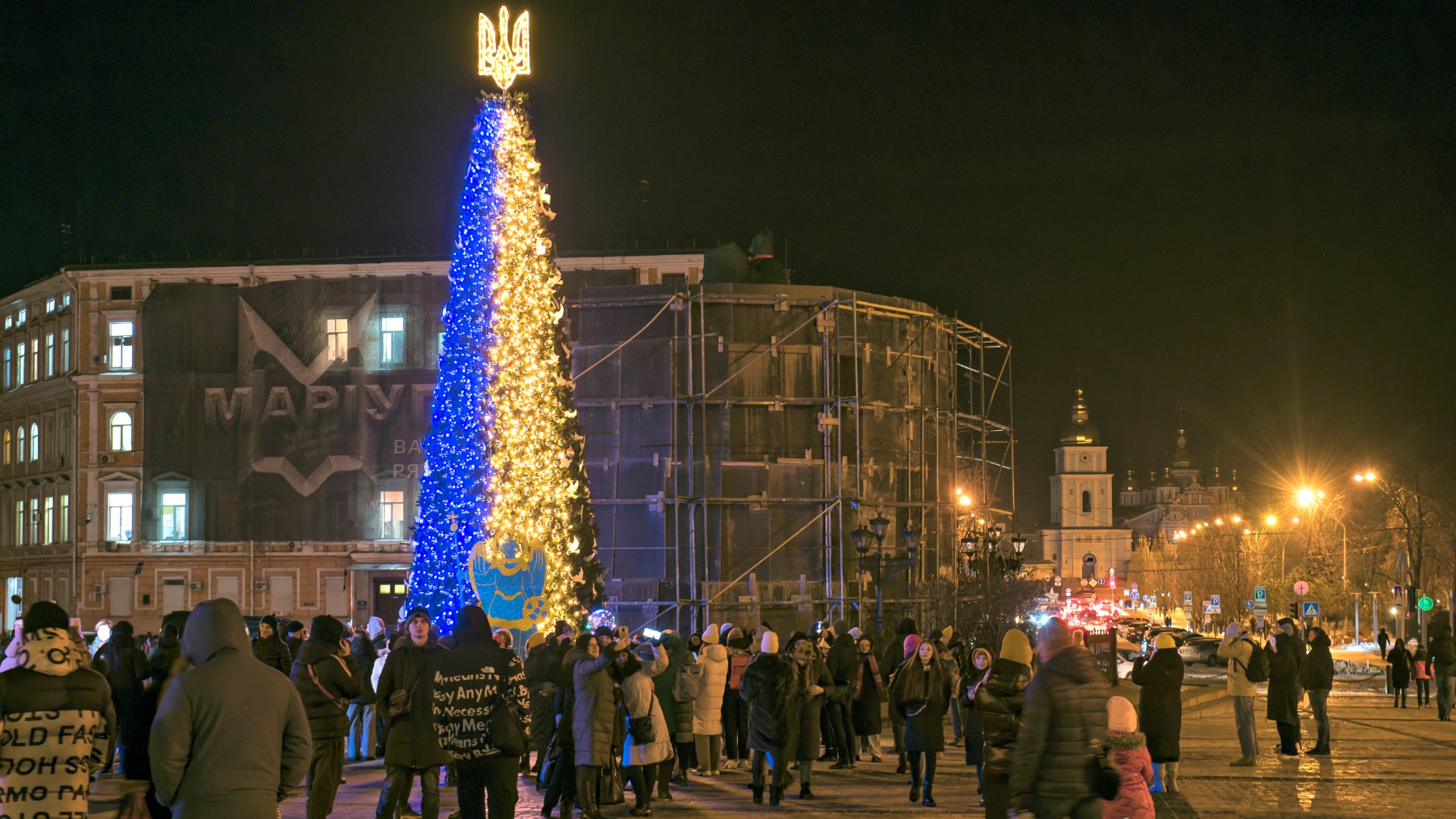
People take photos the Christmas tree at the Sofiyska Square after a Russian drone attack on Ukrainian power infrastructure early morning in Kyiv, Ukraine, on December 19, 2022.

People take photos the Christmas tree at the Sofiyska Square after a Russian drone attack on Ukrainian power infrastructure early morning in Kyiv, Ukraine, on December 19, 2022.

Christianity Today December 20, 2022
Maxym Marusenko / NurPhoto / Getty Images

Thanks to Russia, Ukrainian Orthodox Christians may now partake in a Christmas feast on December 25.

The joyous, 12-dish celebration has been their timeless practice—on January 7, according to Eastern tradition. But this year, the Holy Synod of the Orthodox Church of Ukraine (OCU) has permitted its clergy to conduct religious services on the same date as Western tradition, granting a one-day exemption to the 40-day Nativity Fast.

Beginning after the feast day of St. Philip, observed by Ukrainian Orthodox on November 28, the faithful abstain from alcohol and most meat products until the first star appears on Christmas Eve, January 6. But with millions of refugees in Europe witnessing the revelry of fellow Christians in the West, the OCU decided to permit Ukrainians everywhere to decide parish by parish which date they would honor.

Liturgical reform has long been on the agenda, but war was the spark.

“For most bishops of the church, the calendar is not a dogmatic issue of faith,” said Archbishop Fedir, head of the youth department of the OCU. “Especially after the full-scale aggression of Russia, there is a desire to become part of the Western family of churches.”

Ukraine had already established December 25 as an additional official Christmas holiday in 2017, joining Belarus, Eritrea, Lebanon, and Moldova as nations that formally celebrate the birth of Christ twice.

But altering the calendar disrupts the entire church cycle. Saints’ days, sermons, and gospel readings are all impacted, with scholars engaged in response. The Holy Synod decision tasks priests with gauging the sentiment of parishioners and bishops with conducting follow-up research. Many believers love their traditions, Fedir said, and the hierarchy is wise to proceed cautiously.

The archbishop is responsible for the diocese of Poltava, 220 miles southeast of Kyiv, where one newly established congregation of young people has decided to switch from the Julian to the Gregorian calendar altogether, with his blessing. With blanket permission granted, he does not yet have a tally of how many parishes will join them—nor does the OCU’s Holy Synod.

But within her circle of Ukrainian friends, Nadiyka Gerbish finds none opposed.

“I expected it to happen and wanted it to happen long ago,” said the author of A Ukrainian Christmas, updated and rereleased last month. “They want a solid line between them and the Russian Orthodox Church [ROC].”

Gerbish, a member of Hosanna Evangelical Church in Zbarazh, a small town 250 miles west of Kyiv, condemned the support ROC patriarch Kirill has given to the invasion. And religiously, she sees the decision as part of a long-standing battle over jurisdiction between Moscow and Constantinople.

In 2019, Ecumenical Patriarch Bartholomew I of Constantinople issued a tomos of autocephaly (independence) to the OCU. The Ukrainian Orthodox Church (UOC) remains canonically linked to the Moscow patriarchate, though it has condemned Russia and Kirill since the invasion.

But culturally, Gerbish stated, it is very important for her nation to lean westward, joining NATO and the European Union.

“Every decision we take as a country should be in this direction,” she said. “Church is about religion, but in Ukraine it is also about politics.”

Even so, she expects most people will still celebrate Christmas on January 7.

Young professionals like herself do not care about calendars, but the holiday is about family. Parents and grandparents in the villages will host the Sviata Vecheria (Holy Supper) 12-course feast—honoring the 12 apostles—highlighted by kutia (wheat berry pudding) and uzvar (a spiced fruit and berry drink). Mushroom soup, pickled herring, and half-moon-shaped dumplings are other favorites.

Many Ukrainians like their traditions.

According to a recent survey, they are not alone: 71 percent plan to celebrate on January 7, compared to 4 percent on December 25. Nearly three out of five Ukrainians oppose the license given by the Holy Synod.

“We don’t want to force anyone,” stated OCU archbishop Yevstratiy Zoria. “We understand that doesn’t resolve anything.”

Some in the older UOC have been critical.

“One gets the impression that [this] absurd decision,” stated Archbishop Viktor, responsible for Odessa, “was written by illiterate people who have no idea … about the worship of the Orthodox Church.”

Metropolitan Luke of Zaporizhzhia called it a step toward Catholicism.

Fedir stated that while some Catholic and Protestant churches in Ukraine also celebrate Christmas according to the Eastern calendar, discussions between them can promote essential ecumenical unity. And for young Ukrainians especially, it is “not convenient” to fast on New Year’s Eve if they want to “live a pious life.”

But this “first step” is essential—and prompted by Ukraine’s northern neighbor.

“If we want to survive as a nation, we have to break from Russia,” said Fedir. “Not only politically and physically, but spiritually.”

Through the ROC’s connections to the UOC, the identity of Ukraine has been suppressed, Fedir said. And he claims Kirill’s Moscow patriarchate bears little resemblance anymore to Christianity but rather is “paganism wrapped in autocracy.”

Yet as the prolonged war has shifted to devastating Ukraine’s infrastructure, petitions have been launched to cancel New Year and Christmas celebrations completely. They argue the electrical grid should not be strained for holiday lighting, while money saved should be given to the armed forces and the internally displaced.

Kyiv will host no concerts, but insists all city trees will be lit.

“We cannot allow Putin to steal our Christmas,” stated mayor Vitali Klitschko.

Whether following the Eastern or Western calendar, however, the church is headed toward December 25. A decision has been taken—at least internally—consistent with an affinity for the West.

“It will be shifted, but we have to study the pace,” said Fedir. “The church as an institution is ready, and will move when the believers are ready as well.”

Editor’s note: CT offers select articles translated into Ukrainian and Russian, including a daily Advent devotional.

You can also join the thousands who now follow CT on Telegram: @ctmagazine (also available in Chinese and Russian).

News

Muslims Love Russian Christmas. So Do Eurasia’s Evangelicals.

Christian communities in former Soviet Union nations reap the benefits of still-secularized holiday, winning recognition and opportunities for the gospel.

Actors dressed as the Russian Ded Moroz (Grandfather Frost) and his companion Snegurochka (Snow Maiden) take part a New Year parade in Kyrgyzstan's capital Bishkek.

Actors dressed as the Russian Ded Moroz (Grandfather Frost) and his companion Snegurochka (Snow Maiden) take part a New Year parade in Kyrgyzstan's capital Bishkek.

Christianity Today December 20, 2022
VYACHESLAV OSELEDKO / AFP / Getty Images

Kris Kringle should be in Kyrgyzstan.

If he is efficient, that is. The Central Asian nation, according to a 2007 study by Swedish consultants, is the geographic center best situated for his annual toy delivery campaign.

Regional evangelicals welcome his advent.

With Kyrgyzstan’s snowfall and freezing temperatures from November to April, Old Saint Nick would feel right at home in the mountainous peaks that raise the country’s average elevation to 9,000 feet. But whatever the religion of his army of elves, Father Christmas would have to adjust to Islamic customs in the valleys below.

Quick to seize on the marketing opportunity, the 90 percent Muslim-majority nation declared 2008 as “The Year of Santa Claus.”

There was eventual pushback—though seemingly confused in terms of the calendar. Frustrated with the non-Islamic revelry, in 2012 the Kyrgyz Muslims’ Religious Administration (KMRA) issued a fatwa forbidding New Year’s celebrations.

Not Christmas. Not even Xmas. The birth of Jesus remains an official holiday.

But it is observed on January 7, not December 25. Nearly half of the nation’s 7 percent Christian population is Russian Orthodox and follows the Eastern almanac. And since Kyrgyzstan’s independence in 1991, the government has honored its primary religious minority with few Muslim objections.

New Year’s Day celebrations on January 1, however, are a holdover from the Soviet era. The atheistic communists banned Christmas in 1917 but in 1935 reconstituted it as a secular holiday, celebrated one week earlier. No baby Jesus, but no Santa Claus either.

The Russians instead promoted a vague ethereal figure named Ded Moroz, which translates as “Grandfather Frost.” And they kept the trappings of tree decorations, gift giving, and family gatherings. With Islam suppressed as well as Christianity, over time the Muslim peoples of the USSR adjusted to the imposed culture.

After the collapse of the Soviet Union, Islamic authorities in Kyrgyzstan, Kazakhstan, Tajikistan, Turkmenistan, and Uzbekistan—as well as Azerbaijan on the western bank of the Caspian Sea—largely left New Year’s alone. Nominal Muslims shared in the festivities, including the sharia-forbidden consumption of alcohol.

It was Santa Claus that offended the KMRA—or rather, it was the modern, globalized excess of consumerism. Declaring the holiday un-Islamic, the administration asked the faithful to avoid celebrations altogether and instead give to the poor the substantial sums they would have spent on frivolities.

The fatwa found resonance, but not enough to dent the market.

“January 7 is the religious holiday, but the ‘real’ celebrations of Christmas come from the West,” said Ruslan Zagidulin, a lecturer in missiology at United Theological Seminary in the capital city of Bishkek. “But these have nothing to do with Jesus.”

Not that such celebrations are unwelcome. While there is no set custom for the meal, many families welcome the New Year with the national dish beshmarbek, a noodle soup with meat. Others enjoy boiled mutton or horse meat, served in dishes with sour cream or yogurt.

Following a speech by the president, fireworks go off in Bishkek’s Ala-Too Square—and on countless balconies across the country. Children await the visit of Ayaz Ata, the Kyrgyz name for Ded Moroz, and his beautiful granddaughter Snegurochka, known as Kar Kiz, meaning “Snow Maiden.”

But where the Soviets merged religious heritage into a secular New Year’s celebration, freedom unlinked them again. Faithful Orthodox will argue the superiorities of Santa Claus versus Grandfather Frost, but they are enamored instead with Saint Nicholas—a patron saint of ancient Rus.

Religious ethnic Russians attend church on January 7, which for most is simply a quiet day off. The nominal of both religions party on December 31, many until the early morning hours.

No matter. January 1 is a national holiday also.

“We thought we were saying goodbye to communism,” said Zagidulin. “But a secular culture is harder to change.”

In some Central Asian countries, Muslims are succeeding.

“We have few Muslim converts in our churches,” said Arman Arenbayev, presbytery chairman and pastor of Almagul Presbyterian Church, named after its district in Kazakhstan’s largest city, Almaty. “Because only the young profess Islam.”

His paradoxical answer belies the fact that of his nation’s estimated 150,000 evangelicals, half are Russian while the rest are of Muslim ethnicities. He himself is Kazakh-Tatar, but both of his parents were atheistic college professors. They followed him in faith a few years after his Campus Crusade-led college conversion.

Missionaries flooded Kazakhstan after the nation’s independence, and found fertile field—but so did Muslim revivalists promoting the faith of their fathers. Extremist preachers from Chechnya and Dagestan joined them from the troubled Russian republics, and Salafi influences from Saudi Arabia and Pakistan led a sizable minority to don long robes and grow long beards.

Today the mosques are full, Arenbayev said, but so are the malls. Shops and restaurants deck the halls with festive decorations, and fir trees line the streets awaiting customers. A recent poll found 17 percent of the population consider New Year’s to be a “foreign” celebration, while more than 70 percent could not imagine the season without it.

But Christmas, said the pastor, is considered a Russian holiday and Jesus a Russian god. There is no animosity, but village churches in the more Islamic south will celebrate quietly. Many churches there meet in homes, which is technically illegal.

Kazakhstan ranks No. 47 on the Open Doors’ World Watch List of the top 50 countries where it is most difficult to follow Jesus. But the situation is improving, Arenbayev said, as it is in many Central Asian nations. His country’s diplomatic efforts were even cited as a “proof of concept” for religious freedom advocacy with the United States.

So while the churches in the south gather for Christmas in homes, they still feel free to make it an evangelistic opportunity. Friends and relatives are invited, as everyone loves a holiday party.

In the north, it is more elaborate. Churches will have candlelight services and host a huge potluck dinner the evening of the 24th. A favorite food is plov, a beef and rice dish with carrots, cooked in cumin and oil. Served afterward, baursak (doughnuts) always please the kids.

The fare is similar in Azerbaijan, which adds the traditional dolma, crushed lamb mixed with mint and spices, wrapped in grape or cabbage leaves. Another preference is baliq, fish served with pomegranate sauce.

But for evangelicals—almost entirely of Muslim background—Christmas is an even bigger affair. This year the Vineyard church is renting a 400-person capacity hall, inviting people for weeks before.

“Pastor tells us to be ready to give up our seats as newcomers enter,” said Vadim Melnikov, a church elder. “Christmas is an opportunity to unite with Christians around the world and with Muslim neighbors who celebrate New Year’s.”

Nearly all of them do. In the early 1990s, there was a movement among some nationalists to ban the “Christian” holiday amid war with neighboring Armenia, an Orthodox nation. But despite the tensions, the government encouraged public celebrations as a marker of multiculturalism—and as a curb to Islamic extremism.

With far fewer Russians than in the Central Asian nations, Azerbaijan’s turn toward Christmas is remarkable, Melnikov said. And the capital flaunts this holiday grandeur. Baku hosts two Christmas markets, symphonic carols enliven the subways, and New Year’s trees lighten streets throughout the city.

It is less pronounced—or celebrated—in the more conservative countryside, but there is still a tree in every central square, as smiling families take photographs with Saxta Baba, the Azeri name for Grandfather Frost.

Similarly motivated as Vineyard, Greater Grace church has hosted public caroling events since 1992 at the historic Lutheran Church of the Savior in Baku. Known locally as the Kirkha, the Gothic cathedral was converted into a concert hall by the Soviets. Today it hosts several Azeri congregations and only one predominantly German.

The Azerbaijan Bible Society estimates there are about 20,000 evangelicals in the country. Most are in smaller fellowships unable to match the outreach of others. But Melnikov said they will still host special services and invite the community. These will be repeated on January 7, to both honor the minority Russian Orthodox as a fellow family of faith and draw the nominal closer to Christ.

And the nominal are many—Christian, Sunni, or majority Shiite. Yolka parties on New Year’s Eve are as popular as in Central Asia, and while drunkenness is less pronounced, pork is renamed “wild boar” to soothe the consciences of consuming Muslims.

Most will have trees in their homes.

Traditionally, children will recite poems to Saxta Baba, but increasingly there is a question about its translation. All sources said they cannot differentiate between the Russian (Ded Moroz) and Western (Santa Claus) characters, but use of the latter name is growing.

“The days of Frost are ending,” said Melnikov, relating a common—but not yet dominant—sentiment. “The time of Santa is now.”

But is this good news—in terms of the gospel?

What good is a tree without a Nativity set? What value have lights with no heavenly host? “Silent Night” is everywhere, but played only in English.

Yet evangelicals rest content.

They tend not to participate in the year-ending champaign toast, offering quiet witness against the alcoholism that plagues many Russian-world families. Even if December 25 is overlooked, they appreciate the national honor given to January 7. And as younger generations grow more aware of the Soviet manipulations of an ancient Middle Eastern birthday, they reference the culture as Paul did in Athens (Acts 17:16–34).

But for Zagidulin, also the Lausanne Movement codirector for Eurasia, there is an additional benefit for the region’s tiny evangelical community. They are not part of the landscape like the Russian Orthodox, nor are they Muslim like the indigenous ethnicities. Emerging from both, they might be suspect to all.

“The embrace of Western celebrations gives us a place in our nations,” he said. “A globalized Christmas helps us keep our identity.”

Editor’s note: CT offers select articles translated into Russian, including a daily Advent devotional.

You can also join the thousands who now follow CT on Telegram: @ctmagazine (also available in Chinese and Russian).

News

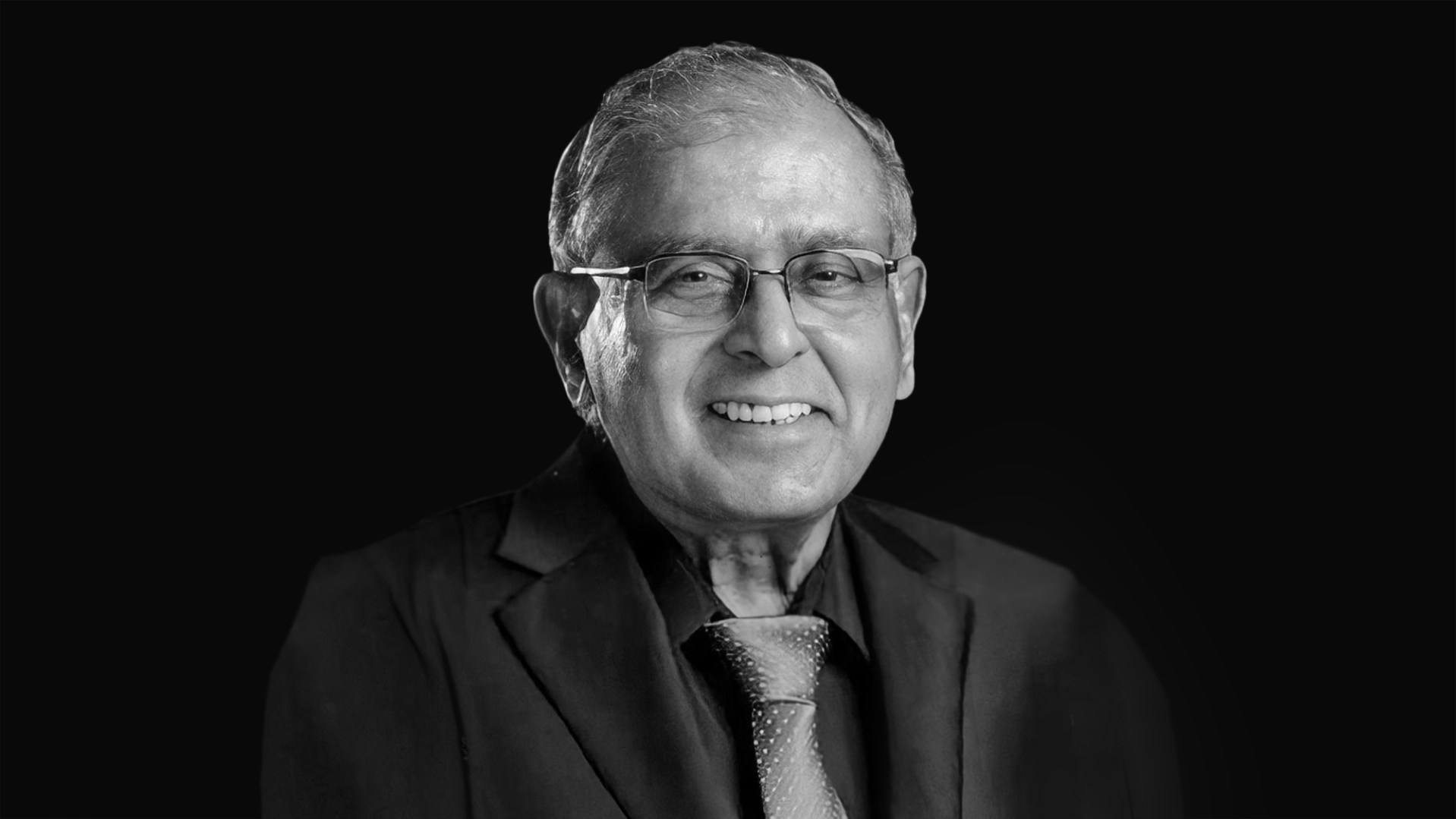
Died: Francis Sunderaraj, Indian Evangelical Leader Who Encouraged Education

Under his leadership, a popular Sunday school curriculum was translated into 32 languages and dialects.

Christianity Today December 20, 2022

Francis Sunderaraj, an evangelical leader in India who prioritized spiritual education and ministry to lay Christians, died last month at 85.

As head of the Christian education department of the Evangelical Fellowship of India (EFI), Sunderaraj encouraged and oversaw the development the most popular Sunday school curriculum in India. It has been translated into 32 languages and dialects.

He believed that “training laypeople to be the Lord’s workers in society at large is a greatly productive ministry,” said longtime friend Saphir Athyal.

The curriculum is also credited with fostering a sense of unified evangelical identity in India. It distinguished evangelicals from liberal Christians and gave them direction and focus.

“Education is absolutely vital for the growth of the Church,” Sunderaraj wrote. “Our focus must always be building up the Kingdom of God.”

Sunderaraj was born to a middle-class Anglican family in Chennai, Tamil Nadu, on April 7, 1937. He sang in the choir and served as an altar boy but struggled to live out his faith as seriously as he wanted.

When Sunderaraj was 17, he attended a Youth for Christ meeting where a visiting priest from England shared the gospel. Sunderaraj was convicted and gave himself to Christ, believing Jesus “could make my life meaningful in this world, if only in faith I surrendered myself to him.”

Despite his conversion experience, Sunderaraj continued to struggle into his 20s.

“Though I was outwardly participating in the worship service, deep inside I was in a desperate condition,” he later wrote. “Desperate because of the frustrating inconsistency I was going through in my spiritual life and the sense of lack of direction concerning my future.”

An American-born Methodist mentor pointed out that this, too, was an issue he should surrender. The pastor pointed to 1 Thessalonians 5:24: “The one who calls you is faithful, and he will do it.” The words stayed with him for the rest of his life.

Sunderaraj became a chemist in 1957. He felt a call to ministry but needed to support his family. He took a job with a paint manufacturer in Chennai and then was moved to Kolkota. After five years in the field, however, he found he couldn’t ignore the call to ministry anymore.

“Deep within me I was restless and had a feeling of guilt,” he wrote. “I cried to God saying, ‘God, you know my intention is not to let you and my parents down. But as you know, I could not resist your call. … I just give myself to you.”

Sunderaraj studied at Union Biblical Seminary at Yavatmal, Maharashtra, and then received a scholarship from the World Council of Churches to attend Princeton Theological Seminary.

His understanding of ministry, he said, was shaped by the challenge of professors from different points of view. He became convinced of “the importance and necessity of holistic ministry,” comprising evangelism and social action.

“That’s what we find in the life of Jesus,” he said.

Sunderaraj was also deeply influenced by classic Christian films, including Ben-Hur, The Ten Commandments, and The Robe. He was impressed with the way they could nourish faith.

“God used these movies to some extent to lead me step by step into this glorious fellowship and relationship with him,” he said.

After graduating from seminary, Sunderaraj went to Malaysia and pastored a Methodist church ministering to the large Indian diaspora, including migrant workers extracting rubber from trees. As part of Sunderaraj’s first ministry assignment, he drove a Volkswagen Beetle from site to site, meeting with community members.

The systemic economic problems faced by the migrant workers convinced him more than ever of the importance of holistic ministry. His concern for the people pushed him to assess the conditions they were living in. And thinking about the history of exploitation reminded him of the importance of evangelism.

“I began to realize that we live in a fallen world and there is so much of injustice and the root cause is something else. So I must present the gospel to them,” he said.

Sunderaraj later led a Tamil congregation in Kuala Lumpur and then returned to India in 1978 to work on the education program for EFI. He made the Sunday school curriculum a top priority.

“[He] was a ‘people’s leader,’” said Leela Manasseh, who currently leads Global Spiritual Care Networks and Singles Asia, and who worked alongside Sunderaraj for many years. “He loved relating to children, young people, and adults from all social strata and ministering among them. … He loved his Bible-based, Christ-centered, Spirit-empowered, and people-oriented ministry.”

Sunderaraj became head of EFI in 1984 and then general secretary of the Evangelical Fellowship of Asia in 1994. He served in the position until 2001.

He promoted women to decision-making positions and strove to strengthen the identity of evangelicals across India and Asia.

“He really rallied and marshaled evangelical organizations to have a common focus,” said John B. Samuel, an evangelical leader and Sunderaraj’s son-in-law. “Evangelicals had really lost a sense of direction.”

The general secretary of the World Evangelical Association (WEA) said he could always count on Sunderaraj for his Methodist perspective and his deep commitment to building up the kingdom of God.

“Many holy men and women of global stature have served in the International Council of the WEA over the years,” Thomas Schirrmacher said in a statement. “Dr. Sunderaraj was one of them … representing Asia’s and India’s passion for world mission in the best way possible.”

Sunderaraj is survived by his wife, Sheila Bhanu; daughter, Mallika Ruth; and son, Vinodh Samuel.

Books

A Tale of Two Books, One Podcast, and the Contest over Christian Nationalism

Answering Stephen Wolfe’s arguments for blood, soil, and sedition.

Christianity Today December 20, 2022
Illustration by Mallory Rentsch / Source Images: WikiMedia Commons / Getty

Earlier this year, just months apart, two books on Christian nationalism hit shelves. Both were written by veterans of the US Army with PhDs in political science. Both books define nationalism as an effort to use the government to preserve a people’s cultural particularity, founded on a felt sense of affinity and similarity with one another. The main difference is that one book argued that these are good ideas and the other that they are bad.

The first book was Stephen Wolfe’s The Case for Christian Nationalism. The second was my own, The Religion of American Greatness: What’s Wrong with Christian Nationalism. Our books do not cite each other, yet it is remarkable the degree to which they speak to the same issues from opposite perspectives.

Sacralizing tribalism

Wolfe argues that we have a natural affinity for similar people and that, since God is the author of nature, this natural affinity is good. He believes, therefore, that we should affirm our desire to be with similar people, working to preserve what makes us culturally distinct and using government power as part of that effort. Wolfe’s argument is refreshingly clear, honest, and forthright about the foundations and implications of nationalism.

That we have natural affinities is clear. As I argue in my own book, we are tribal creatures, naturally drawn “to the people and places that feel familiar and in which we see ourselves reflected.” That’s a simple observation of human reality. But that doesn’t mean such loyalties are reliably good. Which leads to my first major difference with Wolfe: We cannot simply take human experience as an infallible guide, because human experience is corrupted by sin. As theologians in the natural law tradition might put it, that something is doesn’t imply that something ought to be. Wolfe leaps over this dilemma by a dubious sleight of hand, reading our group loyalties backwards into humanity’s unfallen state and so sanctifying them, unrevised and unchecked. “Your instinct to conduct everyday life among similar people is natural,” he argues, “and being natural, it is for your good.”

Equating “natural” with “good” is not how one typically appeals to natural law. Sex, to take one example, is natural—but only good within certain bounds. Whether or not our desire to be with similar people dates back to the Garden of Eden is less relevant than how our fallen state corrupts our tribalism and magnifies its destructive tendencies. But for Wolfe, the Fall is no more than a speed bump on his way to sacralizing tribalism with little consideration for the boundaries necessary to keep it good. Nationalism pretends we can embrace the organic simplicity of tribal life without worrying about its dark side.

For that matter, Wolfe also might consider that not everyone experiences the pull toward similarity in the same way. Some of us, at least, are also drawn to difference, finding it equally important to our flourishing. Wolfe’s “phenomenological” method seems to be little more than a license for projecting his own sentiments onto humanity as a whole and thus cloaking them with the authority of what is “natural.” But nature, including human nature, is broader and more multifaceted than Wolfe imagines.

Enforcing cultural particularity

By this path, Wolfe develops a theology of identity politics, though he does not call it that. If our group loyalties are good, he contends, we should advocate for them: “Each people-group has the right to be for itself. You and your people are entitled by nature to a right of difference.” And if we should advocate for our groups, we should try to use the government to protect them. “Nations must have and ought to fight to secure law-making authority … to order and secure themselves according to their particularities.”

That groups should use political power to sustain and uphold their cultural particularity is my second major disagreement with Wolfe. As I explore at length in my book, cultural borders are fuzzy, overlapping, and changing, which makes them a poor fit for clear, hard, permanent political boundaries. Using government to enforce culture is blunt and inevitably leads to repression against cultural minorities and dissidents. Using government to enforce culture ends up violating basic ideas of the open society, like free speech and free religion.

Wolfe addressed this argument of mine—not in his book but on his podcast, Ars Politica, during which he devoted three hours to reviewing my book in September. I am grateful for the attention, but was I disappointed that, when he and his three conversation partners raised this portion of my argument, they mischaracterized or misunderstood it. According to them, my argument about the blurriness of cultural boundaries means that I deny the goodness or even the reality of cultural particularity, and that I treat cultural identity as trivial and easily changeable. In fact, I affirmed both the reality and the goodness of cultural particularity. And my example of changing culture was learning to speak a new language or converting to a different religion, neither of which is quick or easy. I don’t object to cultural particularity—only to its enforcement at the point of law. Wolfe and his conversation partners seemed to miss the point.

They also neglected my argument that nationalism is illiberal. Indeed, instead of responding to my objection, Wolfe made my argument for me: To him, illiberalism is a feature of nationalism, not a bug; an advertisement, not a cautionary warning. Wolfe and I agree that nationalism is illiberal; we only disagree on whether that is a good thing or a bad thing. Wolfe (or one of his podcast interlocutors—it’s hard to distinguish voices amid some of the cross-talk on the recording) noted that I am “really uncomfortable with the fact that some people might be treated as a second-class citizen” in a nationalist regime. Yes, I am, because the Golden Rule tells me to do to others what I want done to me.

By contrast, Wolfe openly argues for laws criminalizing blasphemy, heresy, and public impiety. “That is not to say that capital punishment is the necessary, sole, or desired punishment” for heresy, Wolfe reassures us. “Banishment and long-term imprisonment may suffice as well.” How magnanimous.

A Christian Caesar

Sustaining such a world, of course requires more than the church; it requires a Christian culture and a Christian prince. Wolfe wants to enlist the power of the state and the pressure of social conformity to bolster Christian nationhood. He calls for a “measured and theocratic Caesarism,” overseen by a “prince as a world-shaker for our time, who brings a Christian people to self-consciousness,” a man of “dignity and greatness of soul.” In a footnote he frankly states that “modern democracy is often more oppressive than its alternatives. I prefer Caesarism in our time.” Such claims vindicate my warning that nationalism has authoritarian tendencies. One suspects the Uyghurs of China, the women of Afghanistan, and the besieged citizens of Ukraine may differ with Wolfe on the relative merits of democracy compared to its alternatives.

Wolfe’s Christian prince has a far more expansive mandate than our liberal democracies do. “Civil government ought to direct its people to the true religion,” he argues. He roots this assertion not in Scripture (which does not say any such thing), but as “a principle of nature.” This is the cornerstone of all that follows, for the premise can justify anything done for the sake of whatever the government deems “true religion.” Again, Wolfe pays scant attention to how the Fall corrupts governments or to how we ought to guard against their inclination toward abuse and oppression.

Armed thus, the Christian prince is empowered to protect the church from heretics, fund religious education, convene and moderate synods “to resolve doctrinal conflicts,” and “confirm or deny their theological judgments.” Wolfe pays lip service to a version of the separation of church and state—but it’s unclear why he bothers. If the prince can decide whose theological school to fund, how to define heresy, and which theological judgments to endorse, whatever vestigial independence the church has is strictly pro forma.

(Wolfe, to his credit, recognizes that at least one community of Christians fits poorly with his Christian nationalist vision: Baptists. As he writes, “Baptizing infants brings them outwardly (at least) into the people of God. When the body politic is baptized, all are people of God,” which furthers the goal of Christianizing the state and society. As a Baptist, all I can say is that Wolfe has inadvertently made a strong argument for the merits of Baptist political theology.)

The great-souled Christian prince will be aided in his efforts by the social pressures of cultural Christianity, the defense of which takes up its own chapter. Wolfe believes that cultural Christianity “warms the people’s heart to Christianity, making them receptive to Christian belief and practice,” and it “internalizes the felt duty to perform Christian practices.” These are odd claims. Wolfe had earlier used a “phenomenological” approach to demonstrate the lived experience of ethnicity and nationhood. Wolfe ought to have considered the same approach here. The “lived reality” of cultural Christianity is not one of warm hearts joyfully performing Christian duties, but a Christian version of political correctness: a legalistic religion enforced by social pressure and group conformity.

Wolfe defends Christian culture by contrasting it to contemporary culture. In modern society, he complains, parents must stay vigilant to raise children in a hostile culture. As I can attest, that is certainly true. But should parents let their guard down in a “Christian” culture? One of the chief dangers of cultural Christianity is that it lulls us to sleep with promises of spiritual safety while reducing the gospel to nothing more than what sociologist Christian Smith famously dubbed “moralistic therapeutic deism.”

‘Amicable ethnic separation’

And cultural Christianity’s harms can run much deeper. At its worst, it has supplied a kind of religious buttress for whoever happened to be in charge—which, in American history, meant white men. Historically, Christian nationalism was the mask that white supremacy wore.

But Wolfe refuses to discuss that history. The track record of nationalism around the world, and the specific history of American nationalism, is irrelevant to him. He’s not arguing for the bad kind of nationalism, he assures us, so he has no responsibility to denounce it or even notice it. “The reader,” he writes, “should not assume that I’m trying to justify or explain away any historical example of nationalism.” Indeed, he tries to wave away any effort to rebut his arguments with empirical evidence. “If the social scientists wish to critique my book, they must step out of social science, suspend their belief in social dogma, and enter rational inquiry.”

This is nonsense, of course; Wolfe does not get to set parameters on how his critics are allowed to disagree with him. Social science is a mode of rational inquiry, and Wolfe himself invokes history: In an extended argument about the right of nations to exclude outsiders, he recounts the history of how refugees disrupted local communities and destroyed local cultures during the Wars of Religion in pre-Enlightenment Europe. And he makes similar points in a final chapter on the role of religion during the American founding. History, it seems, is relevant after all. As Jesus reminds us, “By their fruit you will recognize them” (Matt. 7:16). Observing the historical fruit of a given ideology is fair game for discerning its true nature.

And so we should ask about race and Christian nationalism. This question brings us to the most controversial part of Wolfe’s book. In my book, I argued that the cultural particularity of white American evangelicalism comes with certain epistemic blinders that can obscure the realities of intergenerational racial inequality, which can make white evangelicals passively complicit in its perpetuation. In practice and in history, then, Christian nationalism seems to go together with white supremacy.

Given Wolfe’s defense of group identity and the right of groups to advocate for themselves, a reader may reasonably wonder if Wolfe’s argument leads even more directly to white nationalism. He denies this in a footnote, but it is unclear how one avoids the conclusion that white people should advocate for themselves, including through legal power, given passages like this:

Blood relations remain relevant to nations, when referring to one’s ancestral connection to a people and place back to time immemorial. … Christian philosopher Johann Herder was correct in saying that the volk is a “family writ large.” This is an apt description not because everyone is a cousin by blood but because one’s kin lived here with the extended families of others for generations, leaving behind a trace of themselves and their cooperation and their great works and sacrifices. Blood relations matter for your ethnicity, because your kin have belonged to this people on this land—to this nation in this place—and so they bind you to that people and place, creating a common volksgeist [national spirit].

This is, literally, blood and soil nationalism. A reader could be forgiven for thinking that Wolfe is arguing that people who share white ancestry and kinship constitute a nation that should be “for itself.” In his (sort of) defense, Wolfe consistently speaks of “ethnicity” rather than “race.” And he clarified on his podcast that “I don’t think people identify as ‘white’ people,” suggesting he does not think “white” denotes a coherent people group for the purpose of his argument. (He does not offer that clarification in the book).

On the other hand, Wolfe also criticized (on the podcast) the double standard inherent in left-wing identity politics: Everyone else gets to celebrate their identity except white people, who are denied an ethnic identifier despite being saddled with responsibility for historic oppression committed by whites. Wolfe is not wrong about the double standard. But instead of opting for the obvious solution—rejecting identity politics altogether—he lays a theological foundation for embracing our ethnic identities, arguing that we ought to love our own people more than others and, sometimes, seek “amicable ethnic separation along political lines.”

Again, Wolfe explicitly denies that he is arguing for white nationalism—but if you write the recipe, denouncing the cake rings hollow. Wolfe’s denial does not stop others from using the same recipe, cloaked in Christian language—which is precisely what generations of American racists did.

Resurrecting Christendom

Despite how alarming all this may sound, it only scratches the surface of what is troubling in Wolfe’s book. He presents it as a work of Christian political theory yet disavows any need to consult and faithfully interpret Scripture, which appears almost nowhere over the course of nearly 500 pages. He rests his argument on a dense thicket of appeals to 16th- and 17th-century Reformed theologians, along with scattered references to Thomas Aquinas, Augustine, and, oddly, German philosopher Johann Herder, not usually recognized as a “Christian” thinker.

At points, Wolfe brands his work a product of early-modern Reformed thinking, yet he appeals often to the authority of “the Christian tradition,” as if it were a singular thing. Wolfe wants his work to be seen as an organic outgrowth of a long tradition of continuous Christian political thinking. In reality, it is an idiosyncratic text with little connection to the Bible, resting on a host of cherry-picked quotations from favored philosophers.

Wolfe’s approach to his sources is key to his agenda. “My goal is to reinvigorate Christendom in the West—that is my chief aim,” he says. But this is hardly the chief priority of the Bible, the church, or Jesus Christ, which is why Wolfe cannot appeal to them. “The Christian nation is the complete image of eternal life on earth,” he claims. “My kingdom is not of this world,” Jesus affirmed (John 18:36). The resurrection of Christendom is not the point of Christianity.

Wolfe’s agenda becomes clear in his epilogue, in which he drops the scholarly tone. He offers “a series of loosely organized aphorisms,” denouncing progressives, the “New America,” transgenderism, sexual deviancy, the “globalist American empire,” and “gynocracy.” He goes on and on (and on) about the virtues of masculinity and dangers of feminine leadership. Wolfe compares progressive governance to military occupation and calls “the ruling class” the “enemies of the human race,” while extolling the virtues of a “strong and austere aesthetic,” and calling on his Christian prince to nullify unjust federal laws. Wolfe is neither exaggerating for shock value nor writing ironically to demonstrate absurdity. In a chapter on the right of revolution, Wolfe concludes that we are living under tyranny and that violent revolution against the United States government is “morally permissible,” because the “universalizing and totalizing non-Christian regime” attacks true religion. “How is this not tyranny?” he asks.

As it happens, before writing a book on Christian nationalism, I wrote one on just war theory and paid special attention to the right of revolution. Wolfe is wrong on several counts. He acknowledges that other, peaceful avenues are still available to contest the government’s unjust policies. If such avenues exist, how is this tyranny? And how would war be the last resort (a standard criterion in the just war tradition)? It is fashionable among far-right commentators to accuse the American “regime” of tyranny, and their freedom to do so is the best proof that they have no idea what real tyranny is. Wolfe’s theology of civil war is wrong on the merits—and deeply irresponsible in our polarized times. His use of Christian language to defend political violence against a freely elected government should be bigger scandal than it is: It amounts to a call for holy war against democracy.

Sedition aside, his epilogue isn’t wholly without insight. Drawing from Friedrich Nietzsche and Francis Fukuyama, he condemns the “Marvelization” of reality—our passive consumption of virtual battles through social media to distract us from the boredom of life at the end of history. He’s not wrong. But Wolfe offers Christian nationalism as the answer, entailing a “pursuit of higher life” that requires real will, effort, and sacrifice. This is no answer: What is Christian nationalism but another imagined epic contest, a fantasy of Great Renewal? Wolfe doesn’t hate Marvelization—he just thinks he has a better script.

Nietzsche hovers in the background in other places. Wolfe muses about the importance of mustering sufficient will to achieve the Christian nationalist state. “I emphasized the will throughout this book,” he says, because “we have to retrain the mind by the strength of will.” Elsewhere Wolfe asserts that “we must overcome ourselves.” It’s an odd phrase; biblically, a better concept would be self-control, which is a fruit of the Spirit, not of our own (sinful) will. The idea of “self-overcoming” through strength of will is a Nietzschean concept, and a close cousin to another of Nietzsche’s best-known ideas: the will to power, and its triumph.

Where Christian nationalism leads

The tale of our two books has a strange coda, one that unfolded like a parable illustrating the dangers I warned against. At the conclusion of his three-hour podcast, Wolfe dismissed my work as an “anti-white book,” an odd claim considering I had written admiringly of Anglo-Protestants’ “awe-inspiring historical record of moral and political crusading,” and argued that we should honor the American Founders and their heritage.

I wondered why Wolfe and his interlocutors seemed so taken with my treatment of race, a relatively small part of my book. They complained that I “spent so much time attacking white people.” Weeks later, I got at least one answer: Wolfe’s co-host, Thomas Achord, was outed as the person behind a virulently racist, misogynistic, antisemitic, white nationalist anonymous Twitter account.

To be clear, this revelation is not, by itself, an argument against Wolfe’s book. Wolfe denounced Achord’s tweets, claimed he was unaware of Achord’s views, and is not responsible for them. (Within days, the Ars Politica podcast was taken down and has disappeared from almost every distribution app.) On the other hand, Wolfe did promote Achord’s book about the virtues of segregation. Regardless, Wolfe would be understandably eager for his book to stand on its own and not be judged guilty by association with his podcast partner. That is a fair expectation and the reason why I’ve only mentioned Achord after assessing Wolfe’s book itself.

Still, the whole episode does suggest something about the relationship between Christian nationalism and America’s racial history. Why did Achord, who believes in the superiority of white people, see common cause with Wolfe, the author of a book defending Christian nationalism? It is easy for Wolfe to disavow the connection, but why did Achord believe the connection was there? Why do white nationalists believe that Christian nationalists are their allies?

Because history matters—the history Wolfe resolutely refuses to talk about, even as Achord and his ilk know it well. And that history consistently shows that Christian nationalism is not a guardrail against authoritarian white nationalism, but the gateway to it.

Or to something even worse. Recall that Wolfe spent the scholarly portion of his book calling for “theocratic Caesarism” helmed by a great-souled, world-shaking prince who is “a sort of national god”; musing on the importance of blood and land; affirming our tribal instinct to stick close to similar people; calling for state control of churches and the banishment of heretics; exhorting us to show strength of will; yearning for the “totality of national action”; dismissing liberal democracy as worse than its alternatives; and justifying violent revolution against the godless regime. With even a cursory knowledge of history, we know what this is.

Paul D. Miller is a professor of the practice of international affairs at Georgetown University, a research fellow with the Ethics & Religious Liberty Commission, and a veteran of the war in Afghanistan. His most recent book is The Religion of American Greatness: What’s Wrong with Christian Nationalism.

Apple PodcastsDown ArrowDown ArrowDown Arrowarrow_left_altLeft ArrowLeft ArrowRight ArrowRight ArrowRight Arrowarrow_up_altUp ArrowUp ArrowAvailable at Amazoncaret-downCloseCloseEmailEmailExpandExpandExternalExternalFacebookfacebook-squareGiftGiftGooglegoogleGoogle KeephamburgerInstagraminstagram-squareLinkLinklinkedin-squareListenListenListenChristianity TodayCT Creative Studio Logologo_orgMegaphoneMenuMenupausePinterestPlayPlayPocketPodcastRSSRSSSaveSaveSaveSearchSearchsearchSpotifyStitcherTelegramTable of ContentsTable of Contentstwitter-squareWhatsAppXYouTubeYouTube