News
Wire Story

After Pushing for UMC Unity, Former Bishop Joins New Denomination

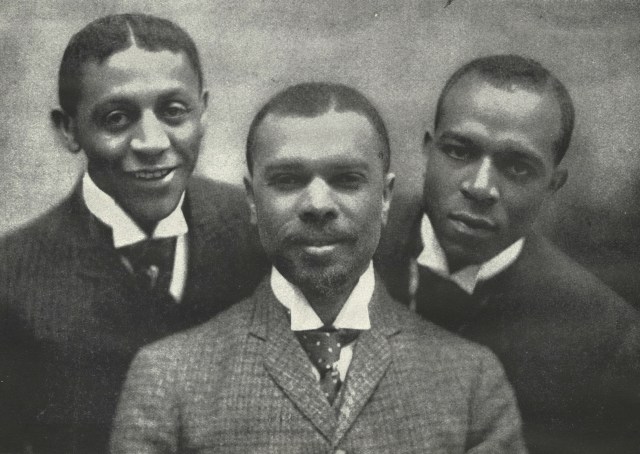
The Global Methodist Church welcomes Scott Jones, who led Methodists in Texas and had advocated for the “extreme center” and “staying at the table.”

Bishop Scott Jones

Bishop Scott Jones

Christianity Today March 1, 2023
Photo by Kathleen Barry/UMNS

Bishop Scott Jones isn’t the first United Methodist bishop to join the Global Methodist Church since the theologically conservative denomination launched in May, but his exit from the UMC has arguably caused the greatest stir.

That’s partly because of the unique position his family holds in Methodism and the “extreme center” position he had staked out within the United Methodist Church.

For some, it also casts a different light on his retirement, just days before he joined the GMC, as head of the Texas Annual Conference where about half of its churches—more than any other conference in the United Methodist Church—likewise left the denomination.

“The Jones family is truly one of the first families of Methodism in our church,” said Will Willimon, a retired United Methodist bishop and a professor of the practice of Christian ministry at Duke Divinity School in Durham, North Carolina.

Willimon added, “This family has been a family of leaders of our church, and it’s such a shock to have one of the members of the family leading churches out of our church.”

Jones’ late father, S. Jameson Jones, Jr., was president of the Iliff School of Theology in Denver and then dean of Duke Divinity School—two United Methodist schools.

His brother, L. Gregory Jones, now the president of Belmont University, previously served as dean of Duke Divinity School, arguably Methodism’s premier seminary.

And one of his three children, Arthur Jones, is senior pastor of a United Methodist Church: St. Andrew United Methodist Church in Plano, Texas, which is currently negotiating to leave the UMC.

Both Arthur Jones and Greg Jones declined to be interviewed for this article.

“So when you talk about family involvement, there is a lot of that,” Bishop Jones said, who after seminary got his Ph.D. in religious studies from Southern Methodist University in Dallas.

He wrote his dissertation on the history of biblical interpretation and John Wesley, one of the founders of Methodism, because, he said, “I recognized that how Christians interpret the Bible is the most controversial question in Christianity today.”

That question is at the heart of a controversy that has haunted the United Methodist Church for decades and has led to the current split: whether to ordain and marry LGBT Christians.

In 2020, delegates to the global UMC’s General Conference were expected to consider a proposal to split the denomination, but the meeting was subsequently delayed three times due to the pandemic. After the third pushback to 2024, the Global Methodist Church, which is against ordaining LGBT clergy and marrying same-sex couples, split from the United Methodist Church earlier this year.

Jones—who pastored several congregations in Texas and taught at the Perkins School of Theology at Southern Methodist University before he was elected bishop in 2004—had previously positioned himself in what he calls the “extreme center,” a phrase he said he first encountered in The Economist.

He wanted to convey how Methodist doctrine holds in tension things other Christians may see as contradictory, such as evangelism and social action.

After reaching out to the magazine to make sure it wasn’t trademarked, Jones said, he wrote it into the title of his 2002 book United Methodist Doctrine: The Extreme Center, his social media presence and his website.

Methodist doctrine is “conservative in some ways and liberal in other ways; it occupies the extreme center and is totally opposed to the dead center,” he explained in his 2008 book, Staying at the Table: The Gift of Unity for United Methodists, in which he argued the debate over homosexuality was “a symptom of deeper disagreements,” including Christology, ecclesiology and authority of Scripture.

Alongside essays from a diverse group of United Methodist leaders, he wrote that he believed the denomination should not split.

“Now, years later, I realized that my hope and my dream turned out not to be possible because the church has in fact, split this last year,” Jones told Religion News Service. “But it was a desire to try to do whatever I could to hold it together and point the way forward. It just didn’t work.”

It didn’t work, he said, because some church leaders and regional conferences have taken action to oppose the denomination’s official stance barring LGBT members from ordination and marriage.

“These doctrinal and moral disobedience questions have made it hard to keep the idea that we really are a church following the same Book of Discipline,” he said.

In June, after more than 18 years as a bishop, he announced he was retiring from the United Methodist Church. But, Jones said, he thought he might have a few more years of “good service to Christ” and wanted to go where he was most needed.

In the meantime, he said, he continued helping churches in the Texas Annual Conference discern whether to remain United Methodist or join the Global Methodist Church, recording videos, writing articles and leading decision-making processes. Either was a great option, he said.

“I think God has a great future for the United Methodist Church. God also has a great future for the Global Methodist Church, and people needed to decide which place could they best serve Christ,” he said.

On vacation for the last few weeks of December, he said it was time for his own discernment.

On the last day of 2022, nine days after his retirement, he joined The Global Methodist Church as an elder and bishop in the fledgling denomination.

The move touched a nerve with Methodists.

The Rev. Keith Boyette, who heads the Global Methodist Church as its transitional connectional officer, said in a statement at the time that the GMC was “rejoicing over God’s good grace to us,” calling Jones a “tremendous blessing” to the new denomination.

Boyette told RNS he commends Jones for creating a “fair playing field” for churches and clergy to discern whether to stay in or leave the United Methodist Church, though he understands others might be critical.

The Rev. David Donnan—pastor of Glennville Methodist Church, a Global Methodist congregation in Glennville, Georgia—penned a blog post titled, “Why Scott Jones is a Bigger Deal than You Think.”

“By moving he is demonstrating how his views align better in the Global Methodist Church. This (is) more than any person moving. This is the extreme center poster child himself moving out,” Donnan wrote.

Others were skeptical of the timing.

In his own post, which came in the form of a satirical video on his Picklin’ Parson YouTube page titled “Dear Bishop: What Took You So Long?,” the Rev. Stan Copeland of Lovers Lane United Methodist Church in Dallas said he wasn’t surprised.

Copeland had already raised the alarm about Jones and two other bishops he said had provided “promotion and support” to the Global Methodist Church, all the while being paid by the UMC.

The Texas Annual Conference, once one of the strongest conferences in the UMC, has lost 302 of its nearly 600 churches since 2019, according to United Methodist Church data. That doesn’t happen if a bishop is presenting neutral information, Copeland said.

Jones then retired—with benefits, Copeland stressed—before joining the new denomination himself.

“I think when he wrote those books, he really believed in an extreme center, but he’s extreme right of center now,” he said.

Boyette said Jones had been part of the 2020 gathering that produced a statement outlining a vision for what became the Global Methodist Church, but they had not discussed any potential role for the bishop within the denomination until after Jones retired.

The bishop was “very insistent on observing those appropriate boundaries,” said Boyette.

Jones maintains he provided a process that allowed clergy and local churches to make “a genuine discernment.”

“And I provided high quality, accurate information that helped people see what was going on,” he said. “For example, I said the United Methodist Church is going to be moving in a progressive direction over the next several years. The only question is how far will it go and how fast? I was criticized for telling people that, but I believe it’s the truth.”

Jones and Bishop Mark Webb, who left the United Methodist Church just before him, are tasked with overseeing all the congregations in the Global Methodist Church — about 1,100, as of mid-January.

A third retired United Methodist bishop, Bishop Emeritus Mike Lowry, had joined the new denomination’s Transitional Leadership Council ahead of its launch.

The Global Methodist Church’s nine provisional annual conferences and districts are now holding convening gatherings. By the time its three Texas conferences — Mid-Texas, Great Plains and Eastern Texas—finished meeting earlier this month, Jones said they had ordained about 120 new clergy and received a number of United Methodist clergy, who can transfer their credentials to the new denomination.

It’s difficult to build something from scratch, the bishop said, but he believes the Global Methodist Church has a lot of potential.

“It’s exciting to be in a community of people who are focused on worshipping passionately, loving extravagantly and witnessing boldly. I love that mission statement and look forward to being a part of it,” he said.

At the same time, he wishes the best for the denomination that was his home for so long.

“They can reach people that the Global Methodist Church will never reach, and that’s a good thing.”

Church Life

It’s Time to Correct Your Negative Stereotypes About Haiti

What this Jamaican missionary loves about the island—and wishes more Western media and donors knew about it.

Christianity Today February 28, 2023
Dieu Nalio Chery / AP Images

Haiti and Jamaica sit less than 350 miles apart from one another in the Caribbean Sea. But growing up in Kingston, Jamaica, Claudia Charlot learned little about her Creole-speaking neighbors until the man she later married came to her island to attend Bible school.

The two countries share tropical fruits, climate, and music—and the fact that their populations, like those of other Caribbean islands, are largely composed of people of African descent, says Charlot. Both have a similar Afrocentric culture, are former colonial islands, and have struggled for independence and with their people’s identity as descendants of former slaves.

Charlot made note of these similarities after she and her husband, Guenson, moved to Haiti after the 2010 earthquake. Arriving in 2011 with no job and little knowledge of French or Kreyòl (as Creole is known in the native language), Charlot opened a school to teach English to locals and ran it for five years. Today, she works as the dean of business at Emmaus University, and the Charlots live in a small community on the outskirts of Haiti’s second-largest city, Cap-Haïtien.

As Charlot has advised and worked with donors and investors over the years, she’s taken note of how often she’s had to correct negative stereotypes about Haiti. She completed her doctorate in 2021 on transformational leadership and turned her research into Haiti: The Black Sheep?, a book she wrote to help dispel the misconceptions about Haiti. “This country is rich in wisdom, values, and resilient people,” she says.

Global books editor Geeta Tupps spoke with Charlot concerning what the mainstream media got wrong about Haiti and the pandemic, her personal experience with Vodou, and how the global church can truly help this country.

Why did you decide to write your book?

Having been married to a Haitian for 14 years and lived in Haiti for 12 years, I wanted to highlight the value, the wisdom, and the beauty of Haitian culture. I've met so many donors who have donor fatigue and well-meaning investors who are confused or unsure what else to do in the country. I wanted to encourage them to not stop investing in Haiti.

I also wanted to help with questions asking why Haiti is as it is. What should donors do? This book is a capsule of my experiences and what can be done to improve the situation in Haiti.

In my doctoral research, I stumbled across numerous details about Haitian history, the country’s perception in the mainstream and Western media, and how it handles foreign aid. My doctorate adviser told me, “You have to make sure you get this research out. This would be a real plus to the humanitarian sector and NGOs.”

When I started teaching at the university in 2020, I held a symposium where I received feedback from university students about foreign aid. While they asked questions, I immersed myself in their culture in order to learn more about Haiti. The perspectives in my book include, among others, the voices of businesspeople as well as high school students, who are part of Smart Haiti, a leadership program I founded for young people.

What prompted you to move to Haiti?

From around the age of 15 or so, I felt that God was calling me to be a missionary. At first, I thought that this would be in Africa. But when I met my husband, Guenson, and learned more about his homeland, I felt that it was the Lord confirming to me that Haiti is like a chip off the continent of Africa.

When I arrived, I started an English school in order for Haiti to integrate more globally, as they are quite isolated from the rest of the world. Teaching English equipped me in learning Haitian culture. I now teach at Emmaus University, a school founded by Methodist missionaries, as the dean of business. It is at this university, in 2020, my husband became the first Haitian appointed president of this institution.

What do you think the mainstream Western media misses about Haiti?

As I write in my book, the most common words the US newspapers use to describe Haiti are violent and some form of the word poor or blood. During the pandemic, it was really upsetting to see how biased media reports were against Haiti. At the beginning, so many people were afraid of Haiti and its poor living conditions. We have only around 11 ICU units in a country of 12 million people, and many live in cramped living quarters, so some people said Haitians would be really wiped out.

Next door, the Dominican Republic, which is much more developed and has a similar population size, had 10 times the COVID-19 rate as Haiti despite more social distancing, vaccinations, and other precautions.

Here in Haiti, we had a medical miracle, despite the fact that vaccination was almost nonexistent and there was no social distancing because people have to go out every day to get food. (There’s no electricity to power a freezer to conserve food.)

Nevertheless, as I note in the book, as the COVID-19 predictions from the World Health Organization and Doctors Without Borders fell through, the media scrambled to explain the death toll of “only 54” as “not reflect[ing] the reality on the ground.” At the same time, the Dominican Republic had 10 times Haiti’s death rate yet received none of this negative press.

I also have noticed that other upheavals in the Caribbean, like violent uprisings, rarely make the Western news. In the Dominican Republic, if there is something terrible in the news, this would not be widely reported because they have a vibrant tourist industry. But the media reports on bandits’ uprisings in Haiti (only) because Haiti is poor and the leaders are negligent.

Beyond Haiti’s struggles with poverty and unrest, many also associate it with Vodou. What has been your experience with this?

I live in a community that is very involved in Vodou ceremonies. I have encountered ceremonies at night and hear the drums beating throughout the city. There are a lot of witch doctors and seers. I’ve seen sacrifices in the streets left in the mornings, like chickens left dead in the intersection of the roads. But mostly, I’ve heard other people’s experiences where families consult a witch doctor for advice on marriage, sickness, and other ordeals they are facing.

Haitian Vodou is very pervasive in the country. And unfortunately many Haitians practice Vodou to try to be true to their culture and identity. They feel like they have to continue performing sacrifices for their ancestors and worship their families.

What does Christianity in a Vodou context look like?

The Catholic church here in Haiti is different from the Catholic church in other parts of the world. There is so much syncretism with Vodou. There is a popular expression that Haitians are 90 percent Catholic, 10 percent Protestant, and 100 percent Vodouist! Many of the Catholic saints symbolize Haitian gods and goddesses. They use a combination of saints, like Saint James, Saint Peter, and Saint Mary, for Haitian gods and goddesses.

One similarity between Haitian churches and Jamaican churches is that women’s dress tends to be very conservative. Many women do not wear jewelry or pants. I assumed that conservatism was a carryover from Victorianism or repression of women. But when I did my research, I found that in the Haitian pantheon of gods, there is a goddess of excess beauty and fertility who was characterized by extravagant dress, expensive clothes, and jewelry. If associated with this goddess, Haitians believed that she inspired seductive behavior.

Typically Haitians make a mental decision to follow Christ but tend to fall back on Haitian Vodou especially in times of crisis. When they encounter sickness, loss, or uncertainty, they may go to a witch doctor for healing, or sometimes they seek a clairvoyant. They want to see if there’s a spirit that wants to harm them. Haitians are continually trying to find out, What’s happening? What’s going to happen? Why is this happening?

What allows Haitians to continue to find hope amid significant amounts of adversity?

Haiti has had a very rough history. Coming from the height of their economic dominance and expansion in the 1700s, Haiti was known as a pearl of the Antilles. It was a wealthy colony because the biggest exports are sugar and cotton. As a French slave colony, Haiti had 8,000 plantations and produced 40 percent of France’s foreign trade, including more cotton than Maryland and Virginia put together and 40 percent of the world’s sugar at that time (late 1700s).

Post-emancipation, Haiti began to struggle. In 1825, to maintain their freedom, they had to pay an indemnity or the freedom tax of 150 million [francs] (equivalent to $21 billion today). They also faced two US occupations and subsequent political upheavals, coup d’etats, trade embargoes, and natural disasters.

Despite all the despair, bad history, and bad experiences, the Haitian culture is very resilient. There are a lot of proverbs and sayings about persevering and being patient. One Haitian proverb that I highlighted in my book was ​​“Bondye pa bay pitit Li penn san sekou,” which means “God never gives his children a problem without giving them a solution.” One of the most beautiful things about Haitian culture is how they are survivors and how, despite the difficulties, they really believe that things will change no matter what.

When comparing Haitian culture to Western culture, I began to notice how rare suicide is here. It has only been in rare instances that I have heard of anyone killing themselves in my entire 12 years living here. So, imagine, we’re in a culture of so-called poverty and a culture of despair. But despite these hardships, the cases of suicide, especially when compared to the US, are low.

The low suicide rate shows that Haitians generally don’t tend to give up. They find comfort by enjoying time with their families, in having babies, and in the little things in life. In a country that’s supposed to be full of despair, there is contentment.

How do you feel the church can truly help Haiti?

One of the purposes of my book is to highlight what has worked and what we should continue doing. Foreign aid and missions groups and churches have helped Haiti. The Haitian educational system is largely privatized; many students can’t afford these private institutions until the church steps in and church groups sponsor them. My husband is an example of someone who sponsored him to go to Jamaica. In my book, I enjoyed writing about positive stories to inspire people.

Part of what we need to revisit as a Christian community is our partnerships with other organizations. Many of the efforts are segmented or fragmented in Haiti. It’s a deficit-based community-development approach where many outsiders feel like there are no resources on the ground. They come in with a savior mentality: “We’re gonna come in and save Haiti because there’s nothing there.”

Quality public schools in Haiti are limited, which leads to high levels of illiteracy and a struggle with math. I know many donors complain to me and tell me that reporting and providing receipts are a big issue for their big projects, but many people might not understand that Haiti is mostly an oral culture. Consequently, if we have to provide receipts for everything, the project becomes quite challenging. Donors might assume it is dishonesty, but Haitians just need better training.

I want those on the outside to transition to an asset-based community-development approach—where you come to Haiti with the posture of a learner, with the idea that there’s already something working no matter how terrible the communities. If there is something that works fine, then organizations on the ground, churches, schools, assets in the community can partner with foreign churches. Faith groups need to build partnerships with the locals and to involve them in the project.

Theology

The Prophet Who Tells Us to Pay Attention

Habakkuk also lived in a time of injustice—and just like him, we must not look away.

Habakkuk

Habakkuk

Christianity Today February 28, 2023
Illustration by Mallory Rentsch / Source Images: WikiMedia Commons / Pexels

In the Old Testament, prophets were God’s spokespeople who told it to his people straight—we must pay attention. The Bible paints the prophets as those who jolt us awake and force us to see what is happening and what God says about such things.

As one scholar puts it: “The situation of a person immersed in the prophet’s words is one of being exposed to a ceaseless shattering of indifference, and one needs a skull of stone to remain callous to such blows.”

Prophets are the watchmen signaling with waving arms, often to people wanting to look away. Look up and see the evil done against others (Mic. 2:1–2), the prophets said. See the impact of your own choices on the vulnerable (Isa. 10:1–2). See the disobedience of God’s people (Zeph. 3:4). God sees the ways we’ve gotten things super wrong, guys, and he’s coming to do something about it. Get ready. We might not be paying attention, but he is.

It would be easy for some of us—and beneficial at times—to look away from the wrong done around us. We much prefer the aesthetics that way. Yet there are consequences to indifference.

We should not be surprised by discipline from the Lord if we choose not to pay attention to the discrepancy between our community’s actions and God’s righteous standard, just as the prophets warned in Israel. The Lord told them it was because they did not listen; it was because they didn’t pay attention to his words that they were sent into exile (Jer. 29:18–19).

All right, you may think, suppose we pay attention to the injustice and brokenness around us, even when we want to look away. Then what? Do we acknowledge it, then put on a happy face? What do we do with anger, sadness, and powerlessness in the face of the horrific evil of this world that we cannot stop?

This is exactly where we join Habakkuk on his journey. You see, this prophet’s book isn’t a collection of his messages from God like some other prophetic books. Nor is it a narrative of his life, like the book of Jonah.

Habakkuk does something different—he invites us into his conversation with God, like we’re sitting in on his prayer meeting. We have a front-row seat to Habakkuk’s wrestling, listening, bravery, and gritty faith. We get to see what real faith in the middle of chaos, wrongdoing, and suffering looks like.

His situation can feel far from our lived experience, but it really isn’t. Habakkuk lived in a time of political chaos, violence, and a whole lot of wrong. He had witnessed strong leadership and even revival. Then, he saw it all crumble before his eyes as leaders lived for their own power and believed in their own authority. Oppression, danger, and hardship enveloped his society. Sound familiar?

Do we see leaders around us live for their own power so that injustice seeps in? Have we seen the choice of self-protection and self-benefit instead of caring for those in need and those in the right? Time and again. In organizations, in nations, and, sadly, at times in churches.

As I write this, the global Christian community is still reeling from the news of a major Christian leader who was found to be a systematic sexual abuser. Some dear to me are mourning the broken systems of foster care and the impact on children.

And I bet you’ve seen some situation or issue unravel in recent years that made your stomach turn. Maybe it’s human trafficking. Or racism. Or the needs of children. Or unfair treatment of some vulnerable population. Here’s what I want you to know in all of that: Habakkuk gets it. He was facing what we still see in our world: injustice.

Our friend Habakkuk lived under the rule of King Jehoiakim. It wasn’t a virtuous reign.

King Jehoiakim, the token king for Egypt, encouraged anything but righteous faith in the Lord of his name. “Change Your Worship to What Aligns You with the Right People” would have been his sermon title (Jer. 25:1–6; Ezek. 8:5–17). Additional idolatry brought gain in his mind. Thus, he seemed to ignore the feasts and temple—worship that God required of his people—using religion only for what served him.

Again, does this sound familiar? Leaders who would use religion to manipulate others and gain allegiance and power, all under the banner of God’s name? A quick scroll through various types of media will prove that our present reality is littered with such stories.

Adding to his horrific reign, Jehoiakim raised taxes to fuel his own lifestyle and to pay Egypt their tribute. His lavish buildings required slave labor and abuse of his own people. The people lived in poverty as he built his costly homes. He clashed with Jeremiah, whom God used to warn him of coming judgment (Jer. 22, 25).

What was Jehoiakim’s response to God’s correction? He burned Jeremiah’s scroll bit by bit, literally silencing the Word of God written for the people. To further silence the prophets who would dare to speak against him, Jehoiakim sent out assassins. Habakkuk faced the threat of death! The result of the abandonment of God’s justice in Judah’s society was chaos.

The silencing of correcting voices wasn’t unique in Habakkuk’s time.

Leadership punishing those who want to serve the Lord describes the circumstances for many across the world today. While our government may not have been taken over by a Pharoah, the misuse of power is around us, injustice and corruption too, even in the name of the Lord.

Though we’d rather look away sometimes, faith requires us to pay attention.

In the midst of all that Habakkuk saw, he spoke. Habakkuk had a burden weighing on him after paying attention, and he told God about it. It’s as if the prophet puts his arm around us and invites us into his prayer: “How long, Lord, must I call for help and you do not listen or cry out to you about violence and you do not save?” (Hab. 1:2, CSB throughout).

Habakkuk used God’s divine name, revealed to Moses: Yahweh (“Lord”). It reminds us that this is no ordinary master but the Lord who is in relationship with his people, and this clearly isn’t the first time Habakkuk brought up the chaos and pain around him. He’d stood there waving his arms in frustration before. Through poetry and repetition, Habakkuk told God what has been happening—he’d been calling out for help, and God wasn’t helping.

Habakkuk may appear brash to us as he accuses God of dallying instead of saving. But Habakkuk’s prayer wasn’t impertinent; it was like a child, scared and hurting, asking for help from a devoted parent. An intimate dialogue with a trusted God. His neighbors were pulled into forced labor. His family was taxed with little left. The Word of God was ignored, and godly worship was twisted to do whatever served the powerful.

Lord, the God who knows us, where are you for your faithful people? Habakkuk’s heart expressed. He continued: “Why do you force me to look at injustice? Why do you tolerate wrongdoing? Oppression and violence are right in front of me. Strife is ongoing, and conflict escalates” (Hab. 1:3).

He described the oppression and violence that smacked him in his face. It escalated, piling higher and higher, like a mountain that blocks the sun. It felt hopeless.

“When will it be too much, God?” Have you asked that? “When will the injustice hit the point that you have to take notice, God? Do you even see?”

Some of God’s people in Habakkuk’s time were faithful. They were the ones listening in on Habakkuk’s prayer time. Others in Judah were anything but—taking advantage of those in need and seeking their own pleasure.

So Habakkuk said, “This is why the law is ineffective and justice never emerges. For the wicked restrict the righteous; therefore, justice comes out perverted” (Hab. 1:4).

Let’s zoom in on this verse. In the first two lines of verse 4, Habakkuk made the claim that the law of God wasn’t working. The word for “law” here speaks to what should be ruling the society, the law of the land. It also speaks to God’s teaching for his people’s spiritual and moral formation.

Those who followed Jehoiakim into idol worship and greed now rejected God’s instruction. Their personal make-your-own religion led them to ignore the practices of the temple, designed to form their hearts and shift how they treated others. What was the impact on justice for the hurting? It never showed up.

With muddied allegiance to the Lord, their devotion to things like the idols of the king brought injustice to the community. Their lack of faithfulness to God led to lack of faithfulness to others.

In the second sentence, the servants of the Lord were surrounded by betrayers, as the word restrict literally means “to encircle.” Those who cheated and manipulated for their own gain gathered around those who would not give up their integrity, like bullies ganging up on a playground child or a wolf pack enveloping prey.

People who should be trustworthy entrapped instead. There was no place to turn. Habakkuk said it again—justice? It was twisted and bent, winding like the country road that gets you nowhere. It’s as if the constant reoccurrence of “justice” indicates that it is meant for all humankind.

Isn’t this the common pattern of injustice? Those who should have done right have done wrong. Those who should have stood up to stop it didn’t. Those supposedly trustworthy instead conspire for their own gain.

Just like thousands of years ago, muddied allegiance to God (and to his means of grace that form our hearts) leads to unfaithful care for the hurting. When we become devoted to idols that make our lives easier, like the status-giving idols of Egypt, we are less willing to do what’s right for our neighbors.

Do you feel like you’re living in that place where you, in some form or fashion, long for the wrong to finally be set right? Do you feel like you looked to those with lots of promises, only to find that the results were twisted versions of the truth with no strong advocate in sight?

That’s where Habakkuk was living. The wicked surrounding the righteous and justice coming out bent. If we are meant to live in a just community, then what do we do in the face of the opposite? How do we respond with faith?

It’s easier to leave injustice in our blind spots. This is especially true when the injustice is being done to those with different life experiences than our own, or when we cannot see beyond our own suffering.

Yet corruption and misuse of power are alive and kicking, and more are enslaved worldwide today than ever before. When we pay attention, we see the children without families and the desperate refugees searching for safety.

There may be three women in your small group whose husbands just left them. Your neighbor may face prejudice on a weekly basis for his ethnicity. Your friend’s children may struggle with anxiety from being bullied.

God sees the injustice on the grand stage and in small corners—he does not look away. And you know what? He asks his people to do the same.

The call of the prophets begging God to act shifts in the New Testament. God has already come in Jesus Christ and continues to work through his Spirit. So now, we read the exhortation for God’s people to be alert and ready. We must pay attention to what is happening around us and to God’s work in the world.

Adapted by permission of B&H Publishing Group from Trembling Faith by Taylor Turkington.

Christianity Today Welcomes Dr. Nicole Martin as Chief Impact Officer

In her new role, Martin will work to advance CT’s mission through the Global, Big Tent, and Next Gen initiatives.

Christianity Today CIO Nicole Martin

Christianity Today CIO Nicole Martin

Christianity Today February 28, 2023

Christianity Today has hired veteran Christian leader and educator Dr. Nicole Martin to the ministry’s executive team in the role of Chief Impact Officer (CIO). Martin joined the company after serving as a member of CT’s Board of Directors.

“I first worked with Nicole years ago on a Bible education project. I was immediately impressed with her powerful faith, her transcendent intellectual and relational gifts, and her vast capacity for leadership and productivity,” said Christianity Today’s president and CEO, Dr. Timothy Dalrymple.

“I told myself that if the opportunity presented itself to hire her, I would do it in a heartbeat. I am so grateful that opportunity arrived. She will serve Christianity Today’s mission and community with talent, passion, and grace.”

Dalrymple added that Martin’s new role will be integral to advancing CT’s mission.

“We have three major strategic initiatives that are shaping the future of this ministry. The Global Initiative dramatically expands the storytelling and thought leadership footprint of Christianity Today to serve the church around the world, the Big Tent Initiative seeks to represent and draw together the diversity of the North American church, and the Next Gen Initiative will cast across multiple media a captivating and capacious vision of following Jesus Christ that our younger generations can live into,” Dalrymple said.

“Nicole will be in an umbrella position over those initiatives, developing the relationships, partnerships, and strategies we need to achieve our missional goals.”

Martin, who was born and raised in Baltimore, Maryland, graduated magna cum laude from Vanderbilt University with a triple major in human and organizational development, educational studies, and French. She worked as a business analyst for Deloitte before receiving her master of divinity from Princeton Theological Seminary, where she was the recipient of the David Hugh Jones Award in Music and the John Alan Swink Award in Preaching.

While in seminary, she served as the director of evangelism at St. James African Methodist Episcopal (AME) Church in Newark, New Jersey, and spent a summer in ministry at Mandalay Baptist Church in Cape Town, South Africa. She went on to earn a doctor of ministry at Gordon-Conwell Theological Seminary, where she now serves as an adjunct professor.

CT’s Executive Board chairman, Bishop Claude Alexander, has known Martin for years as a professional colleague, a mentee, and a fellow CT board member. From 2006 to 2017, Martin filled a variety of leadership roles at The Park Church in Charlotte, North Carolina, where Bishop Alexander is senior pastor.

“I am elated that Dr. Nicole Martin is joining CT as its Chief Impact Officer,” said Bishop Alexander. “She brings a unique blend of skills, sensitivities, and spirituality that are undergirded by an unwavering commitment to excellence and, most importantly, an unshakeable faith in God.”

Prior to accepting the position at CT, Martin was senior vice president at the American Bible Society (ABS), where she spent six years leading major ministry projects. At ABS, she forged a wealth of church relationships, domestically and internationally, and is well regarded as a thoughtful and dynamic preacher, teacher, and writer.

Formerly a monthly columnist for the Faith and Values section of The Charlotte Observer, she is also the author of two books, Made to Lead: Empowering Women for Ministry and Leaning In, Letting Go: A Lenten Devotional.

“I am absolutely delighted to join CT in this new season of growth,” said Martin.

“Tim’s vision for inspiring beautiful orthodoxy and equipping the church through CT’s three initiatives fits perfectly with my own sense of calling. I believe in the power of God’s work around the world that is lifted through our Global Initiative, the importance of broadening conversations through the Big Tent Initiative, and in the relevance of equipping younger people and those who disciple them through our Next Generation Initiative. Just knowing that I have the honor of stewarding the strategy and impact of these three areas brings joy to my soul. I cannot wait to see what God has in store for us all.”

Martin resides in Maryland with her husband, Mark, and their two daughters. She plans to stay engaged in local ministry at her home congregation, Kingdom Fellowship AME Church.

For media inquiries pertaining to this story, please contact media@christianitytoday.com.

Christianity Today was founded by Billy Graham in 1956. In the nearly 70 years since, it has served as a flagship publication for the American evangelical movement, equipping the church with news, commentary, and resources. An acclaimed and award-winning media ministry, CT advances the stories and ideas of the global church. Each month, across a variety of digital and print media, the ministry carries the most important stories and ideas of the kingdom of God to over 4.5 million people around the planet.

Ideas

What Evangelicals Owe Haiti

Staff Writer

To understand the island nation’s crisis and what the church must do now, start with what we didn’t do.

Illustration by Isabel Seliger

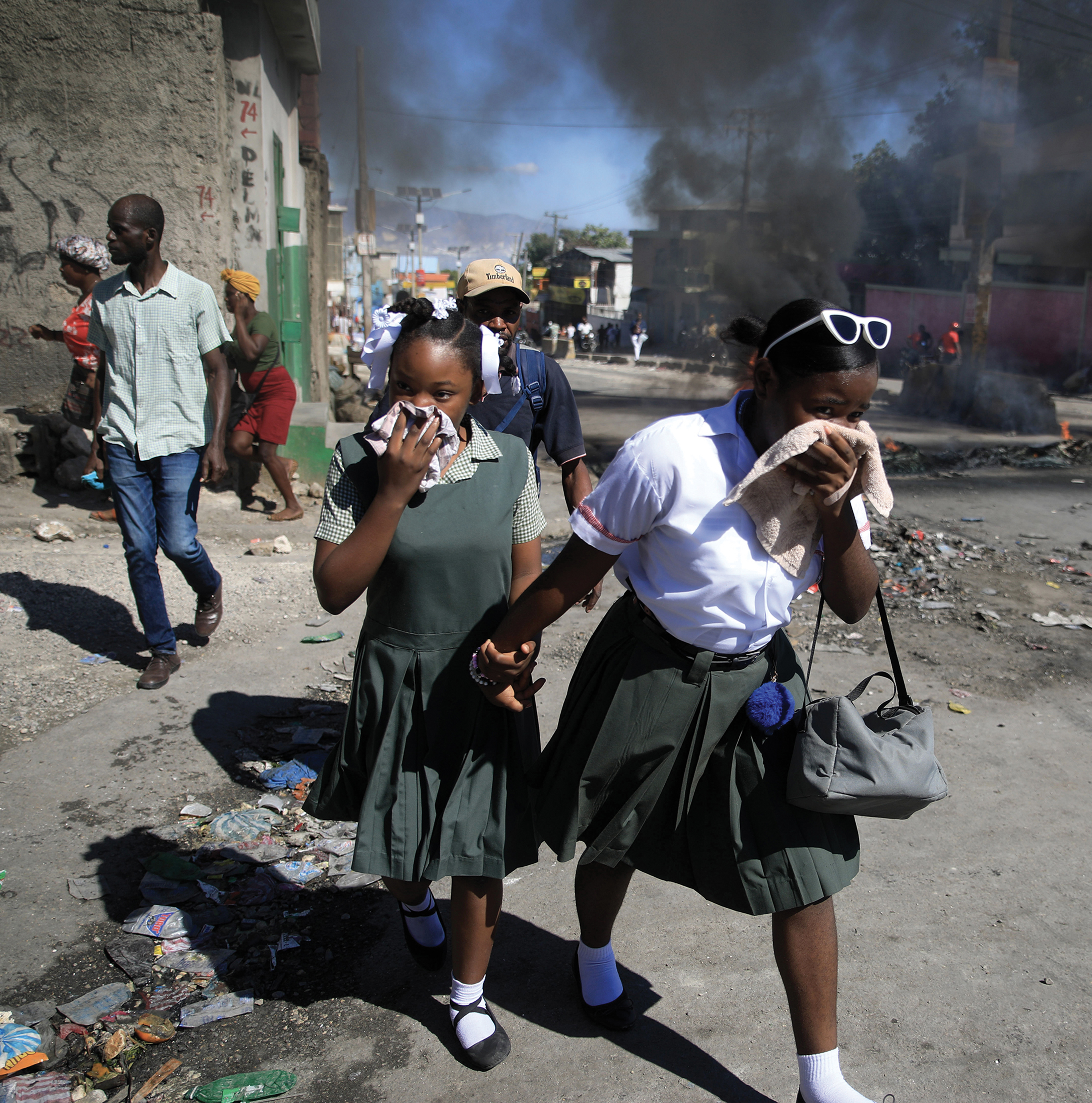
Right now, the Western Hemisphere’s second-oldest republic is collapsing. Militant gangs in Haiti control most of the capital, Port-au-Prince, and significant territory in other cities. They extract bribes at gunpoint for every case of diapers, bag of rice, box of gauze, and gallon of gasoline that moves in or out of its seaport. They set fire to neighborhoods and mount coordinated attacks on police stations. They drag rivals from emergency room beds and execute them outside.

Thus, Haiti’s economy is in free fall. Its annualized inflation verges on 50 percent. Fuel in some areas fetches $10 a gallon on the black market. The nation is slipping into famine—a term, believe it or not, rarely before used there. Thousands of its people are swamping boats bound for South Florida and marching across continents and piling up against the US-Mexico border.

To face these crises, there is no government. Haiti’s putative head of state, prime minister and acting president Ariel Henry, took office after the brazen and bizarre 2021 assassination of an unpopular president. But Henry is also unpopular. He has long overstayed the constitutional limits of his term. To replace him, Haiti would need to hold elections; its last elections were so long ago that every chair in its legislature sits empty.

Haiti cannot safely hold elections, though, because law enforcement is consumed with a battle against gangs that have become so powerful that young men who want to join them are reportedly put on waitlists. The national police—a force roughly the size of Chicago’s police department tasked with securing a mountainous land of over 11.3 million people—are underpaid, underequipped, and burning tires in the streets in exasperation. Yes, corruption infects their ranks. But also, at least 78 officers have been killed in the line of duty in the last 19 months.

Last October, Henry asked the international community for “the immediate deployment of a specialized armed force, in sufficient quantity” to help contain the gangs. Four months later, that hasn’t happened.

Today’s instability has shaken Haitians in some ways even more deeply than the horrors of Haiti’s 2010 and 2021 earthquakes: It is corroding the communal bonds that have carried them through generations of hardship.

“I have never seen people in the street so fearful and suspicious of other people,” Guenson Charlot, the president of Emmaus University, a Wesleyan college and seminary near Cap-Haïtien, told me. “That is damaging the very fabric of our resilience.”

How did it come to this? When I worked in Haiti in the early 2000s, first as a journalist and then with an aid organization, I often heard both Haitians and blans—as foreigners are known there—attribute the nation’s afflictions to vague causes. Corruption. Deforestation. Vodou.

There are more specific explanations. There is the collective trauma imparted by life under butcherly French slave owners and by a war for independence that ended in tit-for-tat genocide on both sides. There was the time, two decades after Haitians won their freedom, when France sailed 14 gunships to Port-au-Prince and demanded 150 million francs to recognize Haiti as a nation—a sum that economists estimate ultimately left the country with a $21 billion handicap. And let’s not forget 1914 and 1915, when US Marines plundered Haiti’s national bank of gold and, months later, returned and seized control of import and export tariffs, the government’s main source of revenue.

If the complexity feels numbing, well, it is. The antecedents of Haiti’s meltdown stretch like a thread across five centuries. Pick it up wherever you like, but you won’t make out the whole length.

Evangelicals, however, have an easier starting point for understanding Haiti’s story. We wrote ourselves into it.

Haiti has been one of the world’s most active mission fields for American evangelicals—so active that, in 1983, the pope visited the country and made it a rallying point against the concerning inroads Protestants were making into Catholic turf.

As of 2020, according to the Center for the Study of Global Christianity, roughly 1,700 career missionaries were serving in Haiti—one for every 7,000 people. No one counted how many Christians went there on short-term trips before the COVID-19 pandemic curtailed such travel. Some have put the number at around 10,000 a year, a figure that seems low. In a three-month study from 2013, more than 9 percent of travelers entering Haiti with a tourist visa said they were there for missionary work, meaning a more reasonable guess may be that, at one point, something like 85,000 short-termers were traveling there annually, the large majority of them from North America. Picture the entire population of Franklin, Tennessee, flying to Haiti over spring and summer break, then doing it again next year.

If you have ever traveled there, or if your brother or daughter or friend is a member of that vast group, then you know at least one gift Haiti gave the church: a playground for spiritual retreat. We built a vast network of facilities across the country offering camp-like experiences whose benefits, mission leaders have not been shy to admit, mostly accrue to visitors. Whatever your opinion on short-term missions, a tour in Haiti—or repeated tours—has now shaped the faith of generations of Americans.

“Every church and mission group has a presence in Haiti,” Wendy Norvelle, then a spokeswoman for the International Mission Board, told NBC after the 2010 earthquake.

Relatively speaking, almost no missionaries are traveling to Haiti at present. The risk of kidnapping is too high. But missionary work has taken: Almost all Haitians claim the Christian faith, and somewhere between a quarter and half of Haitians today are Protestant.

So why is Haiti not stronger for it? Haiti’s current crisis is, first and foremost, a tragedy for Haitians. Simple compassion demands we not look away. But it is also a reckoning. How did the most evangelized realm in all the world become a nation in dismaying anarchy?

Any significant encounter with Haiti puts you at risk of infatuation. I succumbed nearly two decades ago, scribbling in the margins of books ranging from C. L. R. James’s history, The Black Jacobins, to analyses by journalists and sociologists, to the moving writings of Edwidge Danticat and the unsettling fiction of Marie Vieux-Chauvet. But for a nation that hosts so many missions and aid organizations it has been dubbed the “Republic of NGOs,” no decent accounting exists of the role evangelicals played in Haiti’s formation.

As it turns out, there were roughly two eras of evangelical missions there. In the first, a small band of missionaries saw their calling as spreading the gospel and helping build and defend a Haitian state that would bless its people. In the second era, a legion of missionaries advanced the gospel by building a parallel state of their own. They relieved Haitians from the harms of a brutal dictatorship. But in the process, missionaries also became the regime’s unwitting instrument, providing it cover as it ransacked the Haitian state. They may even have helped prolong the regime’s cruelty.

All of this primed Haiti for the implosion happening before our eyes. The blame, of course, does not lie solely at missionaries’ feet. It is shared by entire nations, by international organizations, and by individuals. But for now, to the plank in our own eye: If there is a next era of missions in Haiti, it will be judged by what we do in this moment—and by whether we can recover the spirit in which Haitians first called us there.

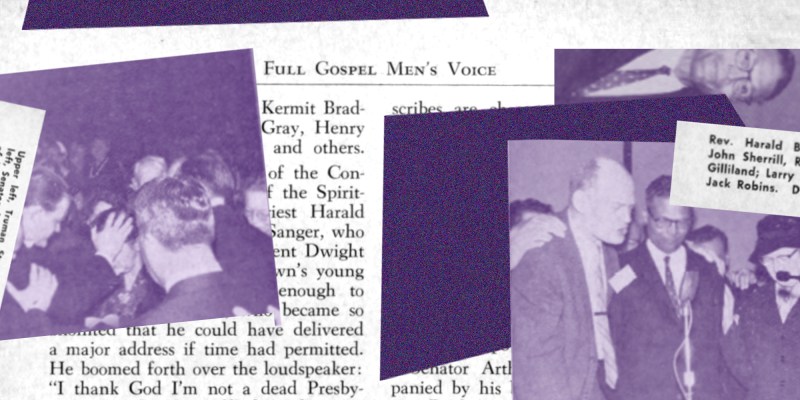
Illustration by Mallory Rentsch / Source Images: Full Gospel Business Men’s Fellowship International

I. The first era

I began to understand the first era of evangelical missions in Haiti when, exploring the dusty annals of British sending agencies, I stumbled upon a man I had never heard of named Mark Baker Bird. You should know a little background before we get to the day his house fell, in 1842.

Bird, a 30-something Methodist from England, led a small mission in Haiti. Other English Methodists had started the mission decades before him—some came at the written invitation of Haiti’s first president, Alexandre Pétion, and some came clutching a letter of endorsement from Britain’s star abolitionist, William Wilberforce.

Even with friends in such high places, Methodism had grown to little more than a couple of house churches by the time Bird arrived. He was one of the country’s few white missionaries. Protestant workers were fanning out across the world in the middle of the 19th century, but they largely bypassed Haiti. Most of the few missionary efforts gaining traction in the young nation were initiated by Black believers escaping antebellum America or inspired by the prospect of a Black-led republic.

The Bird family—Mark, his wife, Susan, and their three young boys—lived in Cap-Haïtien, a city on the north coast with august colonial architecture and a glittering harbor, hailed as the “Paris of the Antilles.” On the sweltering afternoon of May 7, Mark was on his balcony, catching what breeze he could, and was feeling optimistic. After two years in country his French had improved and his friendships multiplied. Tomorrow would be Sunday. He had just written his supporters that he was “ready to hope for good days here at the Cape.”

But the Birds never made it to church that weekend. At 5 p.m., a magnitude 8.1 earthquake struck, its epicenter directly beneath the city’s harbor. Floors gave way. Grown men hugged one another as they dropped. More than 5,000 people were swallowed by crumpling masonry and flames kindled therein.

Bird found himself face-down in the street. His wife and children were inside their toppled residence, hunkered in the lee of a wall that had not fallen. Astonishingly, the entire family survived. They relocated from the ruined city to Port-au-Prince. Then, within weeks, their two youngest sons died.

If the Birds had quit, you wouldn’t have blamed them. It might have been the embrace of the Haitian-led church in Port-au-Prince that kept them there.

Port-au-Prince was the hub of Methodist action. The 100-member-strong congregation there was just completing a stone-and-brick chapel, only the second Protestant church building in Port-au-Prince. And in 1843, they started a school. To be more precise, the government started a school. The president was pushing for better education, and the city of Port-au-Prince needed to launch half a dozen free primary schools. It asked Bird to run one of them in the Methodists’ new chapel.

The government funded the school at the 19th-century equivalent of a couple thousand dollars a month, and the mission provided some teachers and the rest of the budget. Soon, 180 students had enrolled.

Haiti in 1844 was young and scrappy, still infused with the memory of thumping Napoleon’s army and with a vision of what the young nation could become. That year, the government partnered with the Methodists to open schools in several other cities. A government leaflet called on churches to help rebuild the country—it was still recovering from the earthquake—and remarkably, the leaflet challenged missionaries and pastors to preach against the Black-versus-Mulatto racism that was fueling political violence and tearing Haiti apart.

“The influence of religion on public education, and on the happiness of a people, is now no longer a matter of dispute,” is how Bird translated part of the document in The Black Man, one of many books he wrote later in life. “Let the sacred Word recall from their errors any who, through ignorance, depravity, or any other cause, have been led to attach any importance to the color of the skin.”

When the Port-au-Prince school outgrew the church’s sanctuary, Bird went knocking on doors to fund a dedicated building. More than 160 Haitians and foreign-born business leaders committed to make monthly donations. The president gave money. Nearly the entire cost—somewhere over $100,000 in modern terms—was raised locally. Bird christened the new schoolhouse in July 1846, to the soundtrack of flutes and violins and a hymn written specifically for the occasion.

The government and the Methodists continued to join forces well into the 20th century. According to Bird’s personal letters, newspaper accounts, and the published histories of the English Wesleyan mission, officials gave grants for the construction and repairs of Methodist churches and school buildings. They funded evangelism efforts. In 1881, mission records show that the government was contributing 42 percent of the Methodist church’s budget.

These numbers seem almost unfathomable to me today. You could fill a library with books and articles critiquing Haiti’s toxic dependency on foreign aid. It strained my imagination to picture a time when Haitians weren’t dependent on the missionaries and, instead, the mission was dependent on Haitians.

It was not entirely unusual for English missionaries in the British Empire to get financial help from colonial governors, just as Catholic missionaries got a boost in Catholic colonies. But this dynamic was strikingly different: White Methodist missionaries worked side by side with the independent government of formerly enslaved peoples. This partnership endured over a period in which, 600 miles north in America, the Civil War came and went and Jim Crow entered adolescence. The Haitian state saw the missionaries as allies in nation building and entrusted precious resources to their oversight. The missionaries saw the gospel as a gift for both individuals and entire societies, and they entrusted the Haitian state with the future of their programs.

They, like missionaries in Haiti ever since, did not have it easy. But Methodism “was always a player in the game,” Leslie Griffiths, a Methodist minister and member of Britain’s House of Lords who wrote a book about 19th-century Wesleyans in Haiti, told me. “It produced political, institutional, and even literary figures of great national importance.”

We’ll highlight just one: Louis-Joseph Janvier, a student at the Wesleyan primary school in the 1860s whose uncle had been arrested at a worship service during a period of anti-Protestant foment. Janvier went on to study in France, becoming a diplomat and one of Haiti’s most influential—if polemic—thinkers. There are schools named after him. In his writings, Janvier argued that to become a great nation, Haiti needed the Protestant church. The Protestant “is a friend of intellectual culture, a protector of science,” Janvier wrote in his 1885 book, Les Affaires d’Haiti. “He puts the light on the mountain.”

Not every Protestant missionary who set foot in Haiti in the 1800s was a light on the mountain. But as we’ve seen, the handful who went there at all during the 19th century tended to be drawn by a special interest in seeing Haiti succeed.

Griffiths, the Methodist historian, is shamelessly proud of what his church has done in Haiti. In his research, he boils down what I might even call the spirit of the first era, quoting the closing line from a posthumous book of Bird’s called Un Paradis Terrestre: “We leave to each Haitian, to each man, to each woman in this beautiful country, the country of our adoption, to wonder, in front of their incomparable resources, if Haiti could not be an earthly paradise.”

If the first era began with missionaries helping to forge the Haitian state, it ended with them fighting to save it.

On July 28, 1915, the USS Washington sailed into the waters outside Port-au-Prince, and 330 Marines disembarked in the city. Meeting almost no resistance, they seized control of Haiti’s government buildings and state institutions. Then the US Marines stayed for nearly two decades.

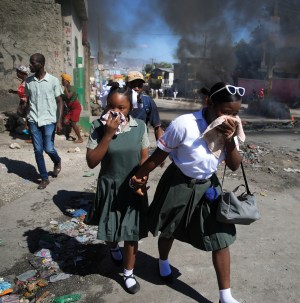
Police burn tires to protest a lack of support in their fight against gangs. Joseph Odelyn / AP Images
Police burn tires to protest a lack of support in their fight against gangs.

A cocktail of worries triggered the US occupation: World War I had just begun. Germany was growing its influence over Haiti’s economy, stoking concerns that Berlin might secure a military base in the country. And Haiti was fragile: Seven presidential administrations had toppled in four years, each through revolution or assassination. One of them involved a bombing at the presidential palace that detonated thousands of kegs of stored gunpowder and shattered windows and doors at the Methodist mission a few blocks away.

Haiti has passed through much political fire. “But one could argue that 1911 to 1915 was probably the worst,” Chris Davis, a historian at University of North Carolina Greensboro who studies military interventions, told me.

Two missionaries, in particular, watched closely as the invasion unfolded. One was S. E. Churchstone Lord, a minister with the African Methodist Episcopal Church. The other was L. Ton Evans, a white Baptist pastor funded by the Lott Carey Society, a Black missions agency.

At first, both men were hopeful in their own way about the arrival of American troops. Lord saw them as a necessary evil to help a Black nation get back on its feet. Evans imagined the Marines as something like conquering heroes.

But things fell apart. The United States set up a puppet government and dissolved Haiti’s legislature when representatives refused to vote as directed. Business interests swept in, taking advantage of the situation to manipulate Haiti’s economy and steal its government revenues for US banks.

The Americans’ biggest misstep—one that galvanized Haitian resistance to the occupation—was born from gross ignorance or disregard of Haiti’s history, or from unvarnished racism, or from all of the above. Beginning in 1918, Marines and their local military counterparts forced thousands of Haitians from their homes, marching them to worksites to build roads and other infrastructure for meager pay. Haiti’s leaders had attempted such slavery-by-another-name schemes before—known as corvée—and they were universally hated.

This was the last straw for Lord, who was Black and who had quickly soured on the occupiers. He sent dispatches to his acquaintance, W. E. B. Du Bois, who used the reports as part of the NAACP’s campaign advocating for America’s withdrawal from Haiti. Lord shared eyewitness accounts with Black newspapers and magazines in the United States, describing incidents such as an assault by US troops that killed nine young Haitian girls. Lord published a piece in the Chicago Defender on June 4, 1921, in which he told readers that “if you condone the presence of the American Marines in Haiti you will be guilty of a more devilish lynch law than is known in America.”

Evans, the Baptist missionary, held out hope that the occupation was a force for good. But he was sending complaints of his own directly to the State Department. In letters, he criticized America’s steamrolling of the Haitian government and a tendency of occupation forces to jail Haitian judges and other officials it did not like. He was alarmed at the “brutality leading to frequent murders by ignorant, immoral and drunken” soldiers and at the ways that men were being seized on the road or in their gardens and forced to construct new roads, “and without food.”

In 1918, Evans’s missions agency urged him to give up his criticism of the occupation and focus on ministry. Someone in the Wilson administration had contacted a board member and hinted that Evans’s reports were un-American. Congress had only a year earlier passed sweeping legislation criminalizing anti-war speech, and the accusation was especially unsettling at the time for a Black organization.

Evans tried to get back to preaching. He traveled to the town of Saint-Marc, north of Port-au-Prince, to evangelize troops and prisoners. But as congressional records show, a Marine captain named Fitzgerald Brown confronted the missionary and threw him in jail for trying to “Christianize and mentally and morally develop these low” Haitians. While incarcerated for less than a month, Evans said that he witnessed, under Capt. Brown’s watch, prisoners being fatally beaten and their bodies put on public display.

After a Haitian court ordered that Evans be released, he was soon arrested in another Haitian city at the order of Marines allegedly conspiring with Capt. Brown. A different Haitian judge found no basis for the arrest and dismissed the charges. But before Evans left, a Marine officer allegedly threatened him with a gun and warned him against any more preaching.

The experiences were a watershed for American views of the occupation. In 1920, newspapers from New York City to Washington, DC, to Phoenix were running stories about Marine abuses in Haiti, and Evans, with his tales of being arrested twice for the sake of the gospel, was a frequent source. In 1921, he testified before Senate hearings. It would take the United States an agonizing 13 more years to completely extricate its Marines from Haiti, but the course was already set: American disenchantment with the project was snowballing, and internal government reports were exploring the best options for withdrawal.

On June 10, 1922, the Chicago Defender published an article featuring both Lord and Evans. It cast them as prophets standing against American attempts to “revive slavery” in Haiti—complete with an anecdote about Lord stepping in front of a group of Marines to stop them from firing on Haitians.

Davis, who introduced me to Lord and Evans, has been reflecting a lot on the history of missionaries in Haiti as he watches the political crisis unfurling now. He began studying the 1915 invasion after he went to Haiti himself on a short-term mission trip, then kept bumping into historians who had never even heard of the occupation.

“Part of what made missionaries so helpful in the early 20th century is that, yes, they were there as missionaries first and foremost, but they were also, whether they realized it or not, cultural representatives … to the American government, which was making decisions about a people that it had limited to no interaction with,” Davis said. “I haven’t seen that kind of interaction today, which is kind of a shame.”

II. After the colonizers

The second era of evangelical missions in Haiti did not begin until after the occupation. This realization took me by surprise: Missionaries are usually lumped in with the colonizers, and in some places like 1910s Nicaragua, missionaries drafted behind occupying US forces. I expected more of the same as I combed the archives of periodicals and the works of amateur historians. But in Haiti, the colonizers came and went, while the missionaries mostly stayed away.

In the late 1920s, a trickle of arriving missions organizations began widening into a stream. By the 1950s, buoyed by America’s global prestige after World War II and by a newfound interest in evangelizing the Western Hemisphere, the stream became a tidal wave.

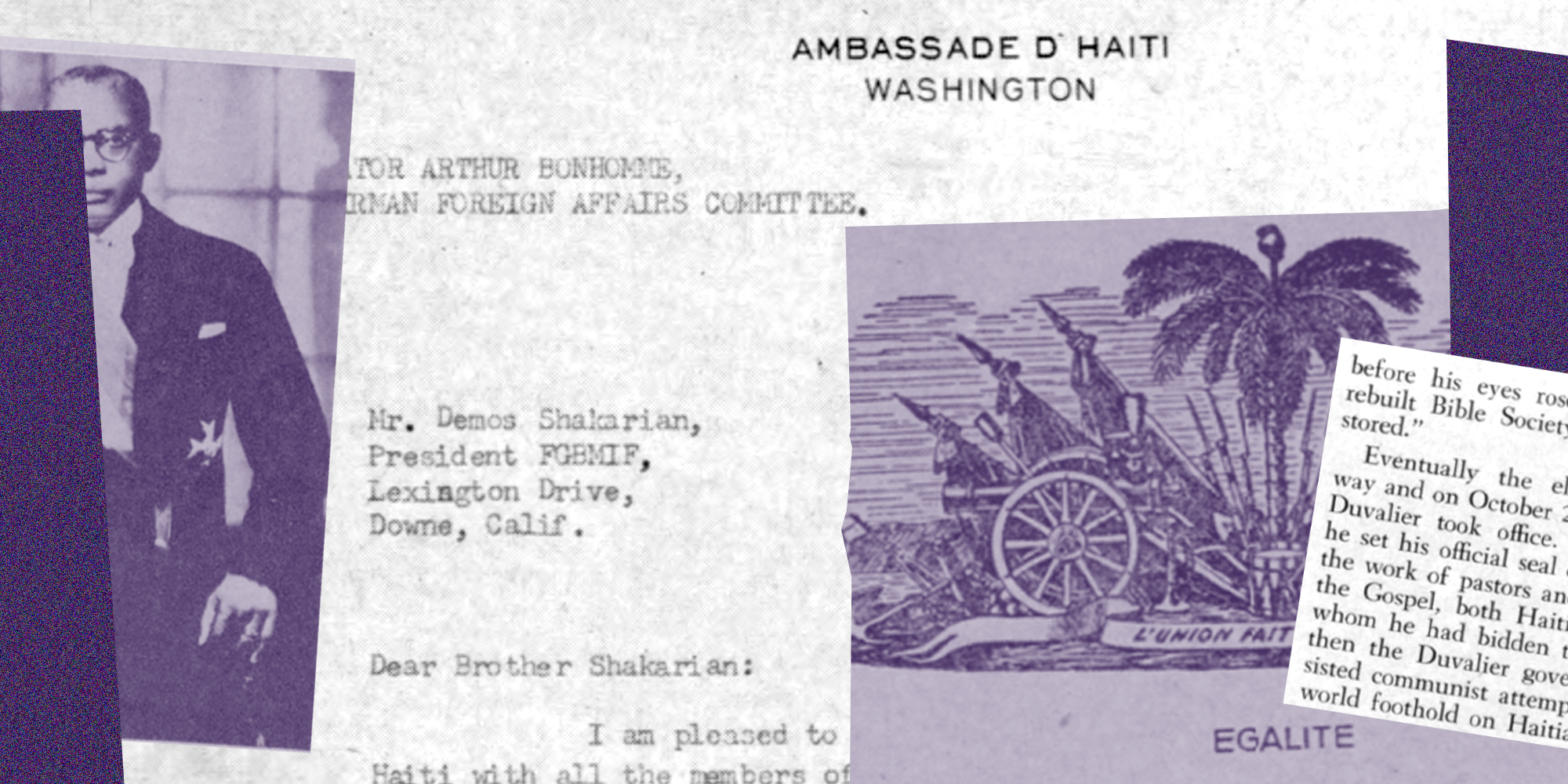
Illustration by Mallory Rentsch / Source Images: Full Gospel Business Men’s Fellowship International

The deluge coincided with the rise of François Duvalier, a soft-spoken and bespectacled doctor educated at the University of Michigan and known as “Papa Doc.” He was elected Haiti’s president in 1957 and became one of the Western Hemisphere’s most ruthless autocrats. He built a fearsome paramilitary group to punish dissent. He siphoned government funds and foreign aid to enrich himself and his supporters.

Duvalier eased into his villainy. During his first few years in office, he threatened political opponents into exile and shuttered unfriendly newspapers, and his agents began quietly abducting and torturing perceived critics.

One of Duvalier’s early targets was the Roman Catholic Church. A Catholic himself, he saw the church’s foreign-controlled hierarchy as a threat. In 1959 he began expelling Catholic priests for supposed acts of sedition. In 1960, after the regime arrested dozens of priests and nuns, Rome excommunicated Duvalier.

In stark contrast, Duvalier aggressively courted Protestants. In 1958, the president honored Wallace Turnbull, a conservative Baptist missionary and a statesman of American evangelicals in Haiti, for “tireless efforts and spectacular accomplishments for the welfare of the peasants of Haiti.” His regime reached out to a broad swath of US church groups. But nowhere was that outreach as well documented as it was in the charismatic movement.

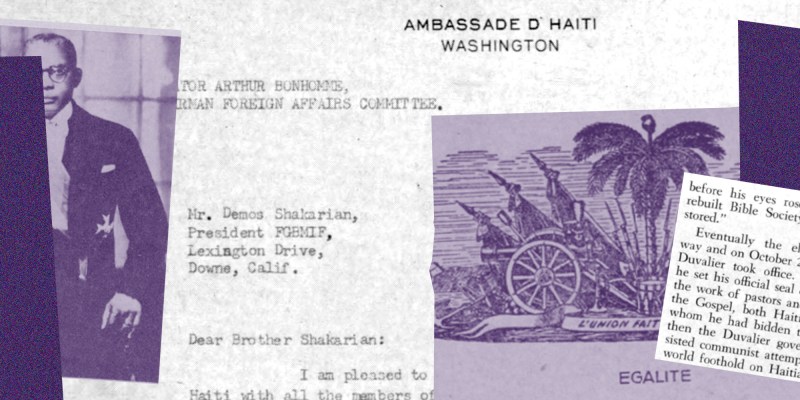
In November 1959, Duvalier dispatched a member of his foreign affairs committee to a convention of Christian businessmen at a waterfront hotel in downtown Miami. Arthur Bonhomme was a Haitian senator and Methodist lay preacher and an architect of Duvalier’s evangelical strategy. Only three months after Haitian police had arrested several Catholics at a silent prayer meeting for protesting the expulsion of some priests, Bonhomme stood at a podium and read a message from the president: “I give the assurance of my desire to see Haiti evangelized and of the full protection of our constitution and of our laws for each mission that comes.”

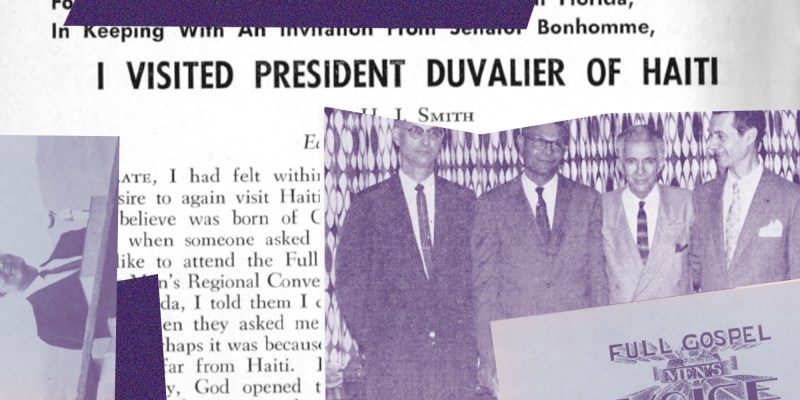
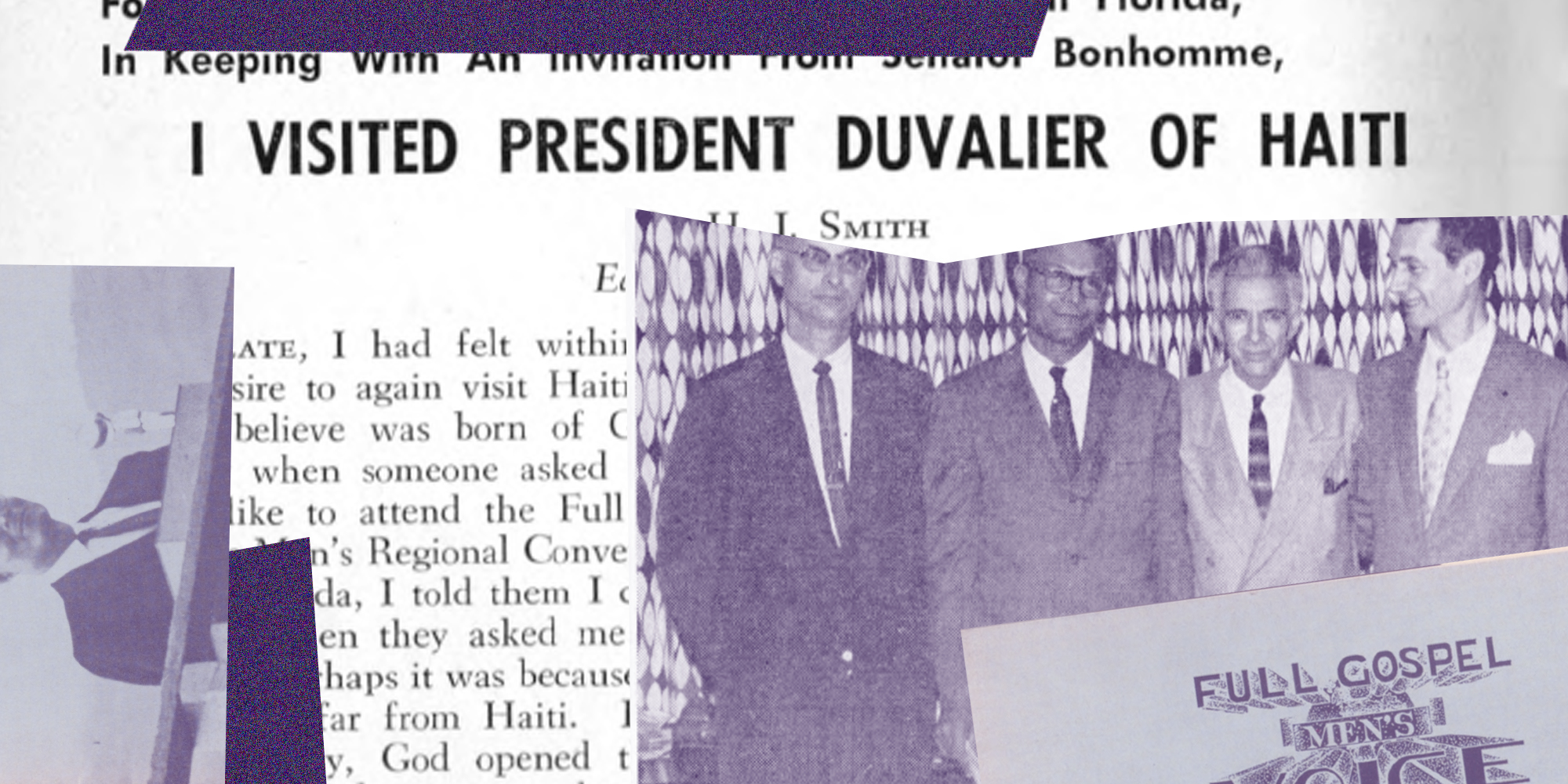
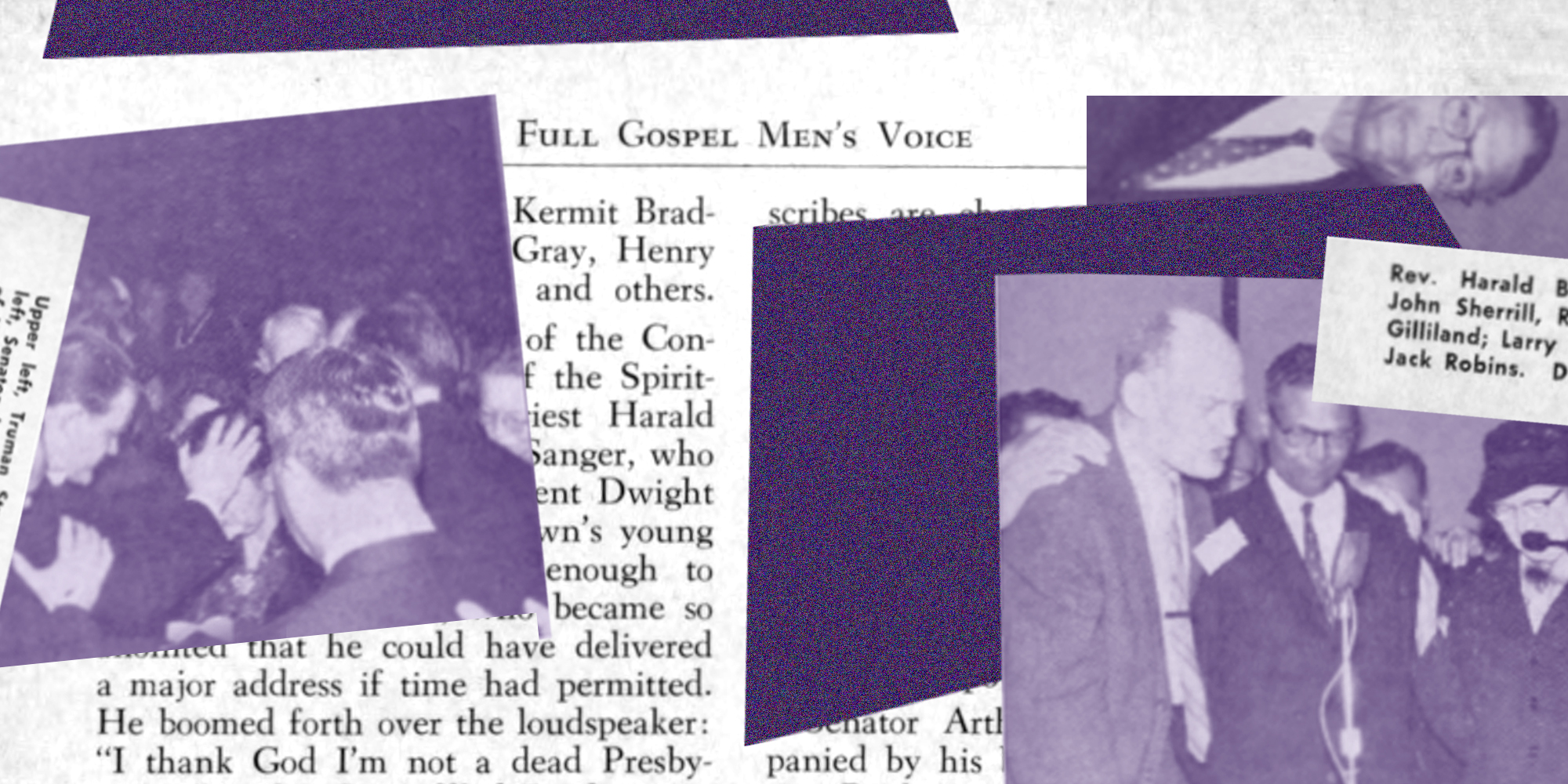
After the conference, a Los Angeles minister named H. J. Smith flew with Bonhomme to Port-au-Prince and met with Duvalier at the presidential palace. “His one concern is for the advancement of his people,” Smith wrote about his visit in Full Gospel Business Men’s Voice, a magazine that recorded many of Bonhomme’s recruiting efforts among business leaders in the charismatic movement. The president repeated to Smith that he wanted American missionaries and evangelists to come to Haiti. Duvalier “has concluded that only those nations whose God is the Lord can hope to survive,” Smith observed. “May this coming year be the best that Haiti has ever experienced.”

But that year, 1960, was not the best. In the spring, the United States paused assistance to Haiti over concerns about Duvalier’s authoritarianism. Duvalier grew anxious and brooding. He hosted more evangelicals at the palace, urging them to tell their government to keep sending aid. Bonhomme sent a letter to Demos Shakarian, the president of the Full Gospel Business Men’s Fellowship, reminding him, “Do not forget the call from Haiti.”

Five months after Bonhomme typed that letter, Duvalier hosted a parade at the National Palace where he unveiled a new militia built of recruits from across the country, some of whom had already been murdering, torturing, and disappearing alleged opponents of the regime. Known best by its nickname, the Tonton Macoute, the force became the president’s main tool of terror to defend himself from opponents real and imagined.

Still, among evangelicals, Bonhomme kept up the charm offensive. His testimony—in which he suggested Duvalier, his boyhood friend, had been miraculously delivered from bombs and a heart attack in order to open Haiti to the gospel—was featured in various Christian publications. Bonhomme infused his message with Cold War rhetoric. In the summer of 1960, he spoke at a convention in Tulsa, Oklahoma, where an Assemblies of God pastor told the Full Gospel magazine he was thrilled to hear that a shipment of food to Haiti and an accompanying evangelism crusade “had stopped Communism dead in its tracks.”

By 1963, president John F. Kennedy, concerned about the actions of the Macoute and by reports that Duvalier was skimming as much as $15 million a year from American aid money, had completely cut off funding to the government. Instead, his administration began routing assistance to Haiti through nonprofit groups—including Christian relief agencies and missions. The booming humanitarian community kept resources flowing to desperate Haitians and also offered Duvalier cover. He doubled down on his oppression while outsiders tended to the needs of his people.

The wooing of evangelicals continued. Bonhomme engaged with evangelicals throughout the decade, a period during which the Duvalier regime assassinated or executed an estimated 30,000 or more victims around the country. Sometimes Duvalier supervised torture sessions or watched them through peepholes cut in walls at the Port-au-Prince police headquarters, where at least 2,000 people were killed.

Christians weren’t ignorant of the dictator’s crimes. Although the full extent of Duvalier’s bloodlust did not emerge right away, his brutality was regularly covered by US media, such as a mass execution of hundreds of dissidents in 1964. Yet as late as 1967, Bonhomme—by then promoted to ambassador—was speaking alongside Oral Roberts at a Full Gospel Business Men’s gathering in Washington, DC, attended by more than 1,000 people. In 1968, Bonhomme told CT: “Duvalier is a tool of God. If he was so wrong, he would be an enemy of the Word of God.” In 1969, Duvalier hosted Roberts and a student choir from Oral Roberts University at the presidential palace.

The regime’s terms for missionaries were unambiguous. After ejecting more than 18 Jesuits from the country in 1964 for complaining about the government’s interference at a seminary, the foreign ministry said in a statement that it welcomed clergy “so long as they do not interfere in the internal politics of Haiti.”

Missionaries weren’t spared all the pain of political unrest. Many evacuated when anti-Duvalier protests flared in the early 1960s and again during violent spells in later decades. Some had run-ins with the regime when they were wrongly suspected of trying to undermine it.

Even so, by the early 1970s, missionaries and aid groups were pouring into Haiti at a breathtaking pace. As many as four or five US denominations per year were establishing missions in Haiti, a country with a landmass the size of Maryland. They opened hundreds of schools and clinics and orphanages and radio stations and feeding programs. Charles-Poisset Romain, a Haitian sociologist and theologian who wrote one of the country’s most important histories of Protestantism, argued that Haiti during the ’70s was the most active mission field in the Western Hemisphere.

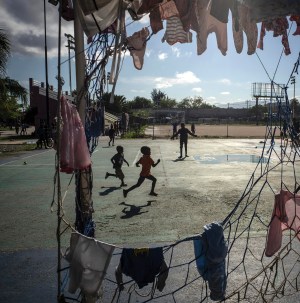
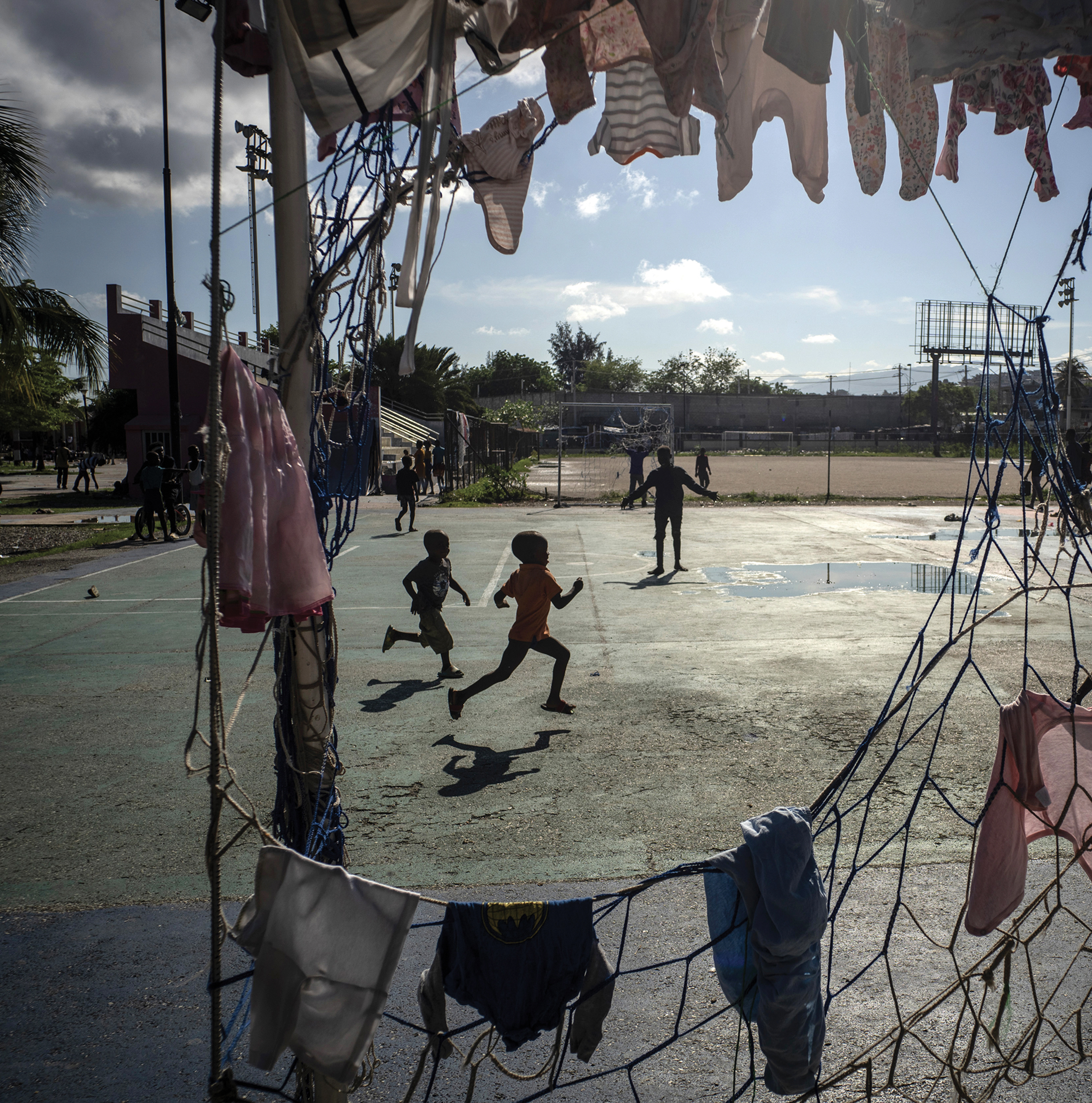
Children play in a Port-au-Prince park housing families displaced by gang violence. Ramone Spinosa / AP Images
Children play in a Port-au-Prince park housing families displaced by gang violence.

Duvalier’s heart gave out in 1971, and he passed his illicit kingdom to his reluctant 19-year-old son, Jean-Claude “Baby Doc” Duvalier. Jean-Claude swore to the world he’d do better than his father but followed more or less in his footsteps—minus some of the brutality but with extra helpings of self-enrichment in the form of European shopping sprees and a $2 million wedding.

Jean-Claude, who dozed during cabinet meetings and neglected statecraft and fancied France, didn’t continue his father’s overtures to American evangelicals. But he didn’t need to. He persuaded the United States to resume aid to his regime, and Protestants already had momentum. They ran at least 35 percent of schools in Haiti. In 1983, the Haitian Council of Evangelical Churches listed 1,097 Protestant organizations—almost certainly only a partial accounting. Twenty percent of them reported being involved in evangelism or church planting; the rest were dedicated to aid projects.

In one of Jean-Claude’s final acts before being overthrown and fleeing the country in 1986, he recognized Protestantism as an official Haitian religion.

The event could have been a ribbon-cutting for the crowning achievement of the second era: the short-term surge. What North American churches had built in Haiti provided a trestleworks for the short-term missions machine that roared in during the late 1980s. Haiti was uniquely-suited for quick visits: A two-hour flight from Miami, it offered church groups “a little piece of Africa,” as I sometimes heard it described, in a place that for millions of Americans was easier to get to than Mexico. The service trip became, if not the defining facet of American Christianity’s relationship with the nation, at least a monument to how geography had bound them together. (“The biggest threat to our ministry,” one mission leader told me, “is not being able to get mission teams in.”)

If the missionary enterprise flourished under the Duvalier family’s reign, Haiti was left behind. Its economy stalled for 28 years. Preoccupied with eliminating threats to power, the Duvalier government made little investment in services like education, infrastructure, or health care. Haiti’s police and justice system, having been hijacked for the regime’s ends, offered no real protection to the most vulnerable. Educated professionals—the managerial and the creative classes that Haiti desperately needed to right itself—fled by the thousands. The regime cemented an oligarchy that, Haiti observers say, is roughly the same one that funded the gangs warring for control of Haiti today.

The Haitian state never really recovered. In three and a half decades since the end of the Duvalier era, there has been no merger of Haiti’s two republics—its constitutional one and the Republic of NGOs. True, subsequent natural disasters and waves of unrest—the saga of twice-elected and twice-overthrown President Jean-Bertrand Aristide, for instance—buffeted Haiti’s civil servants and the machinery of its democracy. But the state wasn’t broken by an earthquake. It was broken before.

As the edifices of Haiti’s most important institutions burned and reburned, scores of American evangelicals acted sacrificially and even heroically: rescuing victims from the inferno and giving them cups of cold water and, yes, preaching the good news that their hope ultimately lay beyond any shelter those edifices could offer.

Could they have done more to fight the fire? We’ll never know.

Here’s what we do know: We know, as CT has covered, that missionaries in bygone times and places documented abuses and stirred up opposition in ways that made possible the birth of the nation of Botswana and reforms in the rubber industry. We know that, in Haiti, when missionaries spoke out against the violent oppression of Haitians during the US occupation, it shook public opinion and spurred government action. We know that, in the mid-1980s, the liberation-theology wing of the Catholic church rallied the masses and eventually led to Jean-Claude Duvalier’s ouster.

Haitian evangelicals were “very timid” about politics, Claude Noel, then head of Haiti’s Council of Evangelical Churches, told CT a few months after Jean-Claude stepped down. “Whenever the question came up about saying something against the political situation, the pastors would declare that their job is to preach the gospel, not to be political leaders. If the churches had stood together from the beginning, the Duvalier regime would not have been able to stand for long. And those in power would not have been so bold in their oppression.”

For the few who tried, resistance was dangerous—and messy. Leslie Griffiths, the Methodist historian, would know. In the 1970s, he was vice principal at Nouveau College Bird, the Port-au-Prince school Mark Bird founded—and where Jean-Claude Duvalier was a student. A couple of times Griffiths was summoned before François Duvalier to prove the school’s loyalty to the regime. His Haitian boss, Alain Rocourt, was forced by Macoutes to dig his own grave before they had a change of heart and spared him.

But what about Arthur Bonhomme, who was also a Methodist? “I can’t even begin to accept the suggestion,” Griffiths told me, “that Methodism might have cozied up to the dictator.”

Then there was Raymond Joseph, a Haitian pastor’s kid who grew up among Baptist missionaries. He was educated at Wheaton College and worked for a while as a Bible translator. In 1964, Joseph was studying at the University of Chicago and dreaming of starting a Christian college in Haiti when he learned that François Duvalier had invited children to witness a firing squad.

“I was revolted,” Joseph told CT in a 1968 interview. He had heard missionaries preach that Christians should avoid politics. He felt they were turning a blind eye to Duvalier—were sometimes using prayer as an escape from taking action—and he was tired of it. Haiti needs “more than the Bible,” he said. “What we need is to get rid of a dictator.” He moved to Brooklyn and became a journalist. He led a coalition of exiled Duvalier opponents and built a spy network in the presidential palace. After the 2010 earthquake, he launched a failed bid for Haiti’s presidency.

The criticism didn’t land well in missions circles. “Our old friend Raymond Joseph is proving himself out of fellowship with his Lord,” Wallace Turnbull wrote in an angry letter. “The hundreds of foreign missionaries and national ministers who have continued to preach the Gospel and to lend their neighbors a helping hand are not seeking escape from social problems. We are following the example of our Lord, who did not abolish crucifixion or gladiatorial combat but taught by example the way to show his love and salvation from sin.”

That may be true. If Haiti ever has elections again, however, Charlot, the seminary president, wants to see evangelicals show their love a little more at the ballot box.

“People in the church don’t vote,” he told me. “And we suffer from the consequences.”

There are reasons for that. “We have a big divide between the secular and the sacred,” he said. Many Christians think “if you want to have a good life after this life, you should not be involved so much in the secular things. And one of the most secular things in the mind of people in Haiti is politics.”

Is it possible that missionaries, with the best of intentions, left the church ill-equipped to help Haiti solve some of its most crippling national challenges?

“That is a solid argument,” Charlot said. He’s one of a number of church leaders who think the explosive evangelical growth came at the expense of depth. Missionaries often passed down a faith that was orthodox but not contextualized. Believers learned to avoid Vodou but not how to engage a culture seeped in it.

Today, he said, up-and-coming Haitian church leaders are starting to ask, If politics in Haiti are so bad, isn’t it because we aren’t part of it? “Some of the older pastors don’t take the position that we, the younger ones, are taking right now. What is going on outside the church world does not concern them. They must have learned that from somewhere.”

Illustration by Mallory Rentsch / Source Images: Full Gospel Business Men’s Fellowship International

III. The next era

So, what now? On a dark evening in January, I was listening to another Haitian diplomat address a convening of church leaders and make his case for their help. Bocchit Edmond, Haiti’s ambassador to the United States, spoke into a webcam to a mostly faceless Zoom crowd of church leaders, nonprofit directors, missionaries, and donors. It was a friendly audience. His pastor, who baptized him decades ago in a Port-au-Prince church, prayed for him on the call.

Edmond was not boasting about defeating communism, like his predecessor Bonhomme. He was not expounding the virtues of Protestantism in nation building, as his counterpart of old, Louis-Joseph Janvier, once did in his writings. Edmond just sounded desperate.

“Sometimes, I’m really scared that one day I will wake up in the morning to hear that the gangs have taken over all the public institutions—the president’s office, the prime minister’s office,” he said. “I’m really scared of that.”

It’s not hard to imagine. Effectively, Edmond is already an ambassador without a government. He wondered aloud if Haiti might already be a nation without an economy. And he wondered if anyone really cared. “To some extent,” he said, “the signal we have had is like signaling that Haitian lives are not important.”

Since Henry’s request for military assistance four months ago, there has been little movement. The United States and Canada slapped financial sanctions and visa bans on Haitian politicians and oligarchs thought to be supporting gangs. But many observers say the largest of the gangs are now powerful enough they have outgrown the need for their underwriters.

On the Zoom call, Edmond said his country needs boots on the ground, and it needs Christians to lobby for them. Haiti is not asking for a 1915-style US Marine invasion, Edmond said. It needs an international force with “more firepower” to equip, train, and fight alongside Haiti’s national police. “You have to talk to the leaders of the churches you are connected to,” Edmond pleaded. “Contact the offices of senators, representatives.”

Is he right? Clearly, an intervention is warranted. With each passing day it seems less likely that Haiti’s police will suppress the gangs on their own. It is obvious to Edmond and to anyone who follows Haiti that the international community is waiting for the United States to take the first step and lead a fighting force that could, at the least, reopen key roads and enable medical workers and food to begin moving again through Port-au-Prince.

The Biden administration has spent $92 million over the last year and a half to airlift armored vehicles and ballistic vests and trainers to the National Police. It’s a start. “Is it enough? No,” Todd Robinson, the State Department’s security liaison to Haiti told the Miami Herald this month.

For one thing, there soon may not be many Haitian police to equip. After the Biden administration announced in January that Haitians could enter the United States under a new immigration policy, Haitian officials had to open a dedicated office just to process the thousands of police officers applying to flee the country.

“I’m not sure the Haitian National Police force has the strength at this point that, just given the tools, they’ll be able to take it from there singlehandedly,” Davis, the military historian, told me. “The situation has gotten to where military intervention is a bad option, but it might be the least bad option.”

Last year, pundits and Haitian diaspora were warning against another American intervention in Haiti. Skepticism seemed prudent: US troops have been to Haiti three times since the fall of the Duvaliers. None of the operations were as reprehensible as the 1915 invasion, but all had mixed results. As recently as January, foreign policy wonks were penning their objections, urging US leaders to listen to what Haitians wanted. But the outcry has been muted lately. Haitians, indisputably, want the United States to act.

“Ninety-five percent of Haitians are for the foreign police to come in,” said Mevais Lovinsky. He’s an attorney who lives and attends church in Port-au-Prince on weekends, but on weekdays works and sleeps in a town more than an hour away, where he can practice law safely. “Absolutely no, the national police cannot stop what we have in Haiti today without the international security support.”

The data bear this out. In a January survey by a leading Port-au-Prince polling firm, more than two-thirds of Haitians said they wanted an international force to come. A smaller survey conducted by the Haiti Health Network, an organization of local and foreign medical providers, found that 80 percent of Haitian respondents supported a military intervention. Christians in North America don’t need to have been on a trip to Haiti to have reason to lobby their governments to step in. They could do so simply because millions of their brothers- and sisters-in-faith next door are begging them to.

It’s not like Haitians are naïve about the side effects of foreign meddling. Their bodies are still paying the price. In 2010, Vibrio cholerae, the bacteria that causes cholera, slipped into Haitian waterways through the wastewater system at a camp of UN peacekeepers who had carried the microbe from halfway around the world. Nearly 10,000 people died in the ensuing epidemic. And a months-old resurgence linked to the 2010 strain has already killed hundreds more.

“We have some very unfortunate souvenirs—some scars—as a result of occupations,” Charlot told me. “If the international community is taking so much time, my hope is that they’re thinking differently than before” and learning from past mistakes.

But if he had to vote on a military force?

“If there is a way they can just come to just do away with the gangs, I would vote for that.”

Assume, by some small miracle, the international community provides the support Haiti needs and the gangs are brought to heel and commerce resumes and kids return to school and life returns to some kind of normalcy.

Then comes the hard part. Because a nation with no elected leaders—with an exhausted and demoralized police force and a currency gone up in smoke—does not reboot overnight. A reopening of Haiti will usher in the next era of missions there, and it will begin with a wholesale reconstruction of the state: rebuilding a democracy, reintegrating gang members, restoring basic medical care and education that was inadequate to begin with.

If we do not want the country to return to chaos and bloodshed, missions and Christian aid groups must be a part of that process. They should participate not out of guilt, but out of generosity. Haitians helped evangelicals build a missions empire in their backyard; it will be our turn now to heed the words of the prophet Jeremiah to “seek the welfare of the city where I have sent you in exile, and pray to the Lord on its behalf, for in its welfare you will find your welfare” (29:7, ESV).

Missionaries and short-term groups and donors who come back to Haiti will have to find ways to invest in and advocate for Haitian institutions, not merely their own. They will have to rediscover the examples of Mark Bird, and S. E. Churchstone Lord, and L. Ton Evans and imagine new ways to imitate them.

The first and easiest step will be ensuring that missions groups are investing in the Haitian leaders already under their noses: promoting Haitian staff to the highest levels, if they haven’t already, and giving them the largest vote in organizational decision-making processes. Training Haitian medical students, if they aren’t already, then finding ways to employ them to treat patients who before might have only been treated by visiting medical teams.

The next step will be identifying leaders that the usual patterns of evangelical engagement in Haiti have overlooked. This will be less intuitive. For instance, instead of underwriting higher education only for charismatic Haitians savvy enough to endear themselves to visiting mission teams and future benefactors, could those teams underwrite a young scholars program administered through a Haitian youth group or high school?

But the rethinking of the missions enterprise will have to go even further. If we want a Haiti and a Haitian church that actually look different in 50 years than they do today, the next era of missions must involve projects and partnerships that churches have rarely attempted, like working with trustworthy Haitian churches to establish scholarship funds for the children of underpaid cops, or directly contributing to the budget of an under-resourced public clinic just down the road from a mission compound.

Finally, the new era may even require the church to take big and risky bets. So far we have spoken of Haitian law enforcement as something strictly for governments to repair. But justice system reform has been a hallmark of evangelical charity in the last two decades. Groups such as International Justice Mission—where, full disclosure, I was once employed—have convinced Christians to give hundreds of millions of dollars to high-level reform and anticorruption programs in some of the world’s most notorious judiciaries. Is there really anything, besides will, stopping evangelicals from exploring similar partnerships with Haitian police, judges, and prisons?

Ideas like these may work, or they may fail. No matter. Foreign evangelicals cannot end Haiti’s problems, but we can stop doing our own thing. Careful listening—to what Haitian churches want, to what Haitian community leaders want—will be one of the most powerful tools for building back a nation.

“You know what I’m praying for? I’m praying for God to put me in touch with people who are not just in the business of ‘fix it now,’” Charlot said. He’s thankful for those who give food and medicine and meet Haiti’s urgent needs. But he would be ecstatic to meet donors who did not care whether their money made any immediate difference. “We need people who are thinking about the next generation, 15 years from now—people who are okay that they may not see with their eyes what they see in the Spirit.”

It will not be easy. It will have risks. And it will be frustrating. But we know the alternative: In the absence of a functioning Haitian state, leaders of multiple ministries have told me their organization may not survive much longer. Already this year a major hospital has closed because there are virtually no police nearby to protect it. A clinic in southwestern Haiti now employs a small army of 72 security officers. The director of a surgery center closer to Port-au-Prince recounted to me how, in the past three months, one of his doctors was shot and another was kidnapped. (The doctor was released after a child-sponsorship ministry agreed to deliver a shipping container of food to a gang.)

The greatest obstacle to reprogramming missions in Haiti, however, may not be external. It may be reprogramming the evangelical mind: Christians, both American and Haitian, will have to believe in Haitians again.

“I don’t think a lot of people realize that there’s sort of this tendency to write off Haiti as naturally politically unstable and just assume this is their fate,” Chris Davis, the military historian, said. But “there are solutions we can work toward to solve that situation.”

There are signs of hope. When I talk to Haitians and ministry leaders and aid workers, I hear them asking hard questions about their methods and making real changes that few people were making when I worked in the country nearly 15 years ago.

“There’s been a lot of education in the missions world about how it’s better to work with indigenous populations than to just go in and start your own thing,” Barbara Campbell, who runs a foundation in Ohio and helped organize the Haiti Health Network, told me. “I see a lot less of that.”

She hopes all that progress is not about to be lost. Last week, Mission Aviation Fellowship announced in a letter to customers that it is pulling out of Haiti for at least the rest of the year for the safety of staff. It was the last remaining provider of flights to more than a dozen small and rural airfields around the country and, for many organizations, the only way to skirt gang-controlled roadways. “This is a game changer for a lot of missions barely hanging on,” one missionary told me.

Charlot doesn’t have all the answers. But he’s confident in the Haitian church’s potential to help its country. He points to the fact that the congregation he pastors has given nearly $60,000 from its own pockets to fund a building. He thinks gangs haven’t yet taken hold of his city, Cap-Haïtien, because many of its police officers are in his congregation and have found supernatural strength to stand against them. He believes that, somewhere in his church, there is a kid someone is going to help to go off to college and study political science, and that kid is someday going to be elected as his mayor.

If the Haitian church should have a political agenda, Charlot says he can’t yet see the details. But he is asking God how he should lead to help pull Haiti out of its nosedive. Last December, he joined more than 350 other pastors and their families from in and around Cap-Haïtien who gathered at a megachurch to pray for their country. Pentecostals, Wesleyans, Methodists, Baptists, Church of God pastors—they filled seats on the floor and spilled up two balconies as they pleaded with God.

“We were all crying, literally crying to the Lord, telling him, ‘Enough is enough. You have to come help us. We have exhausted every option; we have cried to our friends in other countries. Nothing is working,’” Charlot said. “He’s the only one who can do what we need for him to do for us now.”

Andy Olsen is senior editor at CT.

News

The King’s College Shutters Classes, But Says It Is Not Closing

The New York City school is beginning layoffs of staff and faculty. It was in a financial crisis and lost its accreditation.

The King's College entrance in Manhattan's Financial District.

The King's College entrance in Manhattan's Financial District.

Christianity Today February 28, 2023
Courtesy of The King's College

Update (July 18, 2023): The King’s College announced that it would not be offering classes in the fall, after months of uncertainty about the future of the last remaining evangelical school in New York City. The school’s board said staff and faculty positions would be “reduced or eliminated.” Multiple faculty members told CT that all of the faculty had been laid off on Monday.

“We emphasize that this is not a decision to close The King's College permanently,” the board said in a statement. The board will continue to “pursue strategic alliance opportunities,” it said.

The decision follows the Middle States Commission on Higher Education’s (MSCHE) withdrawal of King’s accreditation in May, citing the school’s finances. MSCHE forbade King’s from accepting new students.

The King’s board said at the time that MSCHE had not given the college “due process.” The school is continuing with its appeal of the decision, despite ending its education offerings.

King’s, which began in New Jersey in 1938, is the last of two Coalition of Christian Colleges and Universities schools in New York City. The other, Alliance University or formerly Nyack College, announced its closure just days after losing its accreditation in June. Alliance’s provost, David Turk, told CT at the time that Alliance and King’s had been in talks about a possible merger in recent months.

Update (March 6, 2023): The King’s College said it received “bridge financing” to finish the spring semester. The student newspaper the Empire State Tribune reported that the financing was a $2 million loan from Primacorp CEO Peter Chung, whose company had been in a contract with the college for online education and other administrative functions at the school. The loan does not solve the school’s problems after the spring semester.

Original post (February 28, 2023): The financial crisis in Christian higher education has hit The King’s College, a Christian liberal arts school in New York City, with the school saying it needs $2.6 million to finish this semester and to avoid the real possibility that it will have to close entirely after this school year.

The interim provost Matthew Parks told students in mid-February that the school was discussing transfers with other schools in the event of closure and that the school had been in touch with the Department of Homeland Security about making arrangements for international students.

The college so far has been able to raise only $200,000 of the $2.6 million shortfall for this semester, according to a spokesperson. The fate of the school could be announced any day—it is currently seeking partnerships or a merger with another school as a last-ditch bailout.

King’s spokesperson Katelyn Tamm told CT that “there is no current plan to close the college mid-semester” and that commencement logistics had been set for May, with Christopher Scalia, the son of Justice Antonin Scalia, as the speaker.

“Our top priority is to help students finish the semester at King's well,” Tamm said. “We already have transfer agreements in place with other institutions and are working on others, which include transfer credit and financial aid arrangements, to provide students with options for the fall in the event that the college needs to close.”

Though King’s has had struggles with enrollment, its bigger issue appears to be that it relied heavily on big donors who disappeared in recent years, according to public tax filings and interviews with people at the college.

It had no significant New York real estate to offset those financial challenges, so it was stuck paying high New York rents and salaries. Other prominent Christian organizations, like the American Bible Society, left the city in recent years for less expensive places.

In a fundraising appeal at the beginning of February, the school said it faced “the perfect storm of a slow, post-COVID-19 recovery, an economic decline, and rising interest rates which have complicated the sale of” its single $20 million property.

The sudden announcement of the school’s troubles in an email to its community at the beginning of February has left students, faculty, staff, and alumni reeling.

“I personally had no idea that things would get this bad so fast,” said Rafa Oliveira, a junior from Brazil who said things seemed fine until he arrived for this spring semester. “Morale is really low for a lot of people on campus. … The end of King’s could be the end of the American dream for me. We’ll have to see what the Lord has in store.”

The troubles appear to be caused by losing some key donors. According to public tax filings, gifts to the school dramatically dropped after the 2018 death of billionaire and Amway cofounder Richard DeVos, who gave tens of millions to the school.

The school has also had a lot of leadership turnover. Four people on the nine-person board joined last year, and only two board members have been around since before 2017. The presidency at King’s also turned over in 2022, with Tim Gibson stepping down and interim president Stockwell Day, a Canadian politician, taking charge.

Students at the small school—it has about 400 undergrads—say this semester has been tight with stress as rumors have circulated. They are coping with their school’s possible closure in their own ways.

Some got ice cream and walked around Brooklyn, dancing with a boom box to try to enjoy what might be their last weeks together. One student started a TKC Letters Project website where students posted stories about the school’s effect on their lives.

A few nights ago, Oliveira said he and his friends watched “a dope movie” together that was about trauma and analyzed it for almost an hour afterward based on a class they’ve been taking—“It was the most King’s movie night ever.”

Oliveira, who is a soccer player and the director of spiritual life in student government, is trying to figure out other schools he could go to; scholarships would be his number one priority. But the process of being an international student is daunting enough that he feels like he can’t think about it and is trying to focus on being a student and finishing the semester.

He grew up a missionary kid in South Africa, where he was used to things being uncertain—but finally he had been in one place for a long time at King’s: “I thought something was permanent.”

Student journalists at the school newspaper have been working late nights to cover all the developments of the financial crisis, with their work being cited in national media.

“The last four weeks have been a bit of a blur,” said Melinda Huspen, a junior and the managing editor of the student newspaper, the Empire State Tribune. “Even if the school does close, for the student journalists this was a really, really good experience with having … an opportunity to put our skills to the test, to practice what we’ve been learning.”

Huspen works as a nanny in addition to having a rigorous academic schedule and covering the school’s financial crisis for the paper. She receives a scholarship for full tuition that requires a high GPA.

“I’m doing my best to remain faithful,” she said, “to continue praying for the school and trust that it will all work out in the end.”

Oliveira noted that most juniors at King’s missed a normal graduation from high school because of the pandemic, and now they’re facing the disruption of their senior year of college too. Some received past-due rent notices in their dorms because the college was behind on rent payments, according to the student newspaper.

Some faculty have shuffled classes to be done with their curriculum sooner, in case the school doesn’t make it to the end of the semester. They, too, are facing the possibility of their jobs being gone and a bleak employment outlook for Christian higher education. Some young alumni started a round-the-clock prayer spreadsheet to pray for the school.

Financial trouble, with a dash of Manhattan prices

Trinity International University, also facing financial trouble, recently announced that it was shutting down in-person learning and moving its undergrad program online after the semester ends in May.

Christian colleges have turned desperately to online education in the face of declining enrollment, some with success. King’s tried that approach too in 2021, enlisting the for-profit company Primacorp, which promised to significantly boost enrollment through online education. That didn’t pan out.

“Online school isn’t for every college … especially for schools that advertise really rigorous degrees,” said Huspen.

The dean of academic affairs, Kimberly Reeve, told students in February, according to a transcript from the student journalists, that King’s was awaiting a $1.5 million COVID-19 grant for employee retention. Then if the school could sell its one $20 million Wall Street property, that would free up about $1 million. (Because the school took a line of credit on the building, any sale would go toward settling that credit.) King’s also has a small endowment, about $500,000, according to a 2021 audit.

“One of the core reasons [for financial problems] is that the funding gap was filled by a couple of really large donors,” said Huspen, the student editor. “One of the things I’ve seen that King’s failed to do is rearrange their budget when Richard DeVos passed away. … My understanding is they proceeded largely as normal … and it’s caught up to them.”

Kimberly Thornbury spent about six years at King’s leading institutional research, strategic planning, enrollment, and communication—leaving in 2019. Her mother, Carolyn Wilson Carmichael, graduated from King’s back in 1958; her father, Jack Carmichael, was on the board of Northeastern Bible College when it shut down in 1990 and directed $1 million of the sale of that school to King’s. She loves the school and is distressed at what’s happened.

“The silver bullet was rent. … It was the tipping point of how much had to be raised” each year, Thornbury told CT. “It’s literally a real estate situation. Where was the board after 9/11 or 2008, when there were deals to be had?”

Her experience at King’s, she said, taught her the importance of a high-quality, engaged board.

She also said the school felt pressure from donors that were “more to the right” when the school wasn’t as conservative. Donors wanted “Christian-right language,” she said, and she recalled having to go on speaking circuits with conservative figures like Charlie Kirk to help raise money.

Raising at least $8 million a year to keep the lights on was a tall task, she recalled. “You burn through that line of credit really fast.”

A history involving Campus Crusade and Billy Graham

Evangelist Percy Crawford began the school in New Jersey in 1938, and Billy Graham served on the board in the 1960s. Graham argued there should be an evangelical college in Manhattan, but that didn’t happen until later.

King’s had a sudden closure in 1994, when it was a school in Westchester County just north of New York City. New York’s Board of Regents ordered the school to close just a few weeks before the end of the fall semester, citing financial problems and an insufficient number of qualified faculty.

“Action to date does not preclude the college’s opening again,” Joyce Anderson, the vice president of academic affairs, told CT at the time.

King’s did reopen in 1999 in Manhattan, with financial help from Campus Crusade for Christ, or Cru as it is now known. Thornbury’s dad told her Campus Crusade provided the school with $5 million in seed money to pay off old debt and restart.

Thornbury said it was “one of the many miracles about The King’s College” that it reopened in 1999, because it was able to retain its charter—which she said is “tough, tough, tough”—from the New York Board of Regents. The board is unique in its power to decide on whether schools can operate.

The idea of a college in Manhattan was to bring Christian students to spheres of influence. A Christian college in Manhattan “doesn’t happen every day,” Thornbury said. Nyack College, now known as Alliance University, recently moved across the street from King’s to add another evangelical school to the island.

The mission has paid off: King’s has made a name for itself with its alumni landing in prominent New York jobs in journalism, finance, law, and think tanks. It also had a series of high-profile presidents, with the most notorious being Dinesh D’Souza, who was caught in an affair as president and later pleaded guilty to federal campaign finance fraud.

Another former president, Andy Mills, was co-CEO of Archegos Capital, which collapsed in 2021 and shook the global financial system. The Archegos founder, Bill Hwang, faces federal fraud charges over the collapse, although Mills is not charged with any wrongdoing. Hwang’s Grace and Mercy Foundation gave about $500,000 to King’s in 2019.

Whatever the current administration decides about closing, students are “spending a lot of time with each other and soaking everything in,” said Oliveira.

“There’s opportunity to be hopeful, for us to be like, ‘All right, God, this is hard, but you are good. You can do more than we ask, hope for, or think,’” he said.

News

22,000 Indian Christians Peacefully Protest Rising Persecution at Historic Delhi Gathering

Leaders demand the government crack down on violence against the church: “We are not asking for anything out of the ordinary.”

Christianity Today February 27, 2023
Surinder Kaur

India’s church is exhausted by the surge of anticonversion laws and accusations of illegal proselytization. They’re tired of mobs driving out Christians from their villages and the possibility that many face property destruction and personal violence. Perhaps most significantly, they’re angry at a government that passively enables these actions at best and actively foments them at worst.

Last week, 22,000 Christians across the denominational spectrum and from around the country gathered together in their nation’s capital to demand better.

“This protest is basically to call the attention of the government to the increasing violence against Christians and our institutions. These attacks are without reasons and basis,” Metropolitan Youhanon Mar Demetrios at the Malankara Orthodox Syrian Church in Delhi told CT. “So, we are calling upon the government to ask how the protection of the Christians and their institutions will be guaranteed. We are not asking for anything out of the ordinary.”

Major national media outlets like Outlook and The Indian Express and the YouTube channel India Speaks, among others, covered the protest.

Thousands of young people, church leaders, human rights activists, educationists, lawyers, musicians, and other professionals from more than 80 denominations and Christian organizations gathered at the February 19 event at Jantar Mantar, a historic observatory. The protest was organized by the Delhi and National Capital Region Christian leaders across the denominational spectrum. Many attendees wore white to symbolize peace or wore their traditional attire and sported black armbands as a mark of protest.

“This coming together of all the denominations is not to show our muscle power; rather, it is a unity to strengthen the kingdom of God,” said Abraham Mathew of the National Council of Churches in India.

“It is a cry of our people for their brothers and sisters who are suffering in rural areas. They have the right to believe in their God, but that is being curtailed. There is no other hope for us but only crying to God to save us, and this is a loud cry,” he added.

Choirs from different Delhi congregations as well as ethnic groups from Punjab, Rajasthan, Kerala, Tamil Nadu, and North-East states and the Chota Nagpur plateau offered songs of worship and encouragement in various languages and musical styles. (Many of these regional languages have flourished in recent decades due to missionary-led Bible translation and education efforts.)

But the protest also offered a time for many Christian leaders from different parts of India to share and lament the way their communities are being targeted.

Bhupendra Khora, an activist hailing from Chhattisgarh, provided a first-person account of the oppression that Christian Adivasis residing in the Bastar region have been enduring. In December 2022, in what appeared to be a coordinated assault, Hindu radicals in the area offered their Christian neighbors three choices: deny their faith, abandon their ancestral homes, or face death.

Those who chose to stay were attacked, their homes and places of worship demolished, their crops set on fire, and their animals killed and consumed—atrocities that have been confirmed by numerous fact-finding investigations.

Despite the high court’s directive for the Chhattisgarh government to offer aid to the displaced people in the region’s established government camps, the majority of those fleeing have opted to stay in hiding, concerned that they would be compelled to return to their villages after a few days. While some of them desire to return to their native land and normal routines, they demand police protection and justice against those responsible.

“While the community continues to have faith in the leadership and the legal system of the nation, it makes a heartfelt and earnest appeal to fellow citizens to stand in empathy and solidarity with it, to raise their voices at the targeted, violent, and organized injustice happening across the nation against their brothers and sisters, outraging their religious freedom and inherent dignity,” said John Dayal, a Catholic activist, at a press conference preceding the protest.

Meanwhile, multiple Christians in Uttar Pradesh have suffered over allegations of violating the state’s anticonversion laws.

Shivdesh (who prefers to use only his first name) spent 20 days in prison in 2022 on an alleged accusation of forced conversion. The Fatehpur, Uttar Pradesh, resident recounted the violence he and his family experienced at the hands of a mob and the subsequent troubles they faced because of the authorities’ cold response.

Last year, the Evangelical Church of India based in the city was targeted during the Maundy Thursday service on April 14, 2022. Since then, 47 local Christians have been detained in ongoing arrests. Uttar Pradesh authorities have also accused the 113-year-old Broadwell Christian Hospital; the faith-based Sam Higginbottom University of Agriculture, Technology and Sciences; and World Vision of violating anti-conversion laws.

Patsy David, an activist and lawyer from Uttar Pradesh, revealed an unusual case where last year, the government accused a Christian of violating the anticonversion laws—despite the fact the individual had passed away more than two years prior. This mistake raised questions about local authorities’ investigation procedures and competence, he says.

“The government is not listening to us,” David, who attended the protest, told CT. “Wherever persecution is reported in Uttar Pradesh, we approach the authorities to intervene and help Christians who are being targeted, but instead we see that the authorities start to act against the Christians rather than help them. … The situation in the state is worsening with every passing day, so this united peace protest is the need of the hour.”

Narendra Modi’s 2014 ascension to prime minister has corresponded with a significant increase in incidents of hostility and violence against members of the Christian community in recent years.

In 2015, only 142 verified incidents against Christians were reported on the United Christian Forum (UCF) hotline, but by 2021, the number of calls to the human rights group had risen to 505. Last year, UCF reported 598 incidents, and 57 incidents had been counted as of January 2023.

The violence and hostilities against Christians have been largely concentrated in Uttar Pradesh, Jharkhand, Chhattisgarh, and Karnataka.

Other organizations, such as Evangelical Fellowship of India and the US-based Federation of Indian American Christian Organizations (FIACONA), have also recorded several incidents, with FIACONA reporting nearly 1,200. In its 2023 World Watch List, Open Doors ranked India as the 11th worst country to be a Christian.

According to activists who spoke with CT, incidents of violence against the Christian community are not isolated and are indicative of a broader trend of discrimination against minorities in India. They highlight that eight states have either introduced or reintroduced anticonversion laws since 2017, which are frequently exploited by religious extremists and supporters of Hindutva to target minority groups based on their religious beliefs.

“We demand that the government provide security to all our churches and arrest the vigilantes who are behind the attacks on each church,” said Sanjay Magee, president of Unity in Compassion, an activist organization.

Last March, the Archbishop of the Catholic Diocese of Bangalore, Peter Machado, along with Evangelical Fellowship of India and the National Solidarity Forum, filed a petition seeking the court’s direction in establishing a special state-level investigation team to register criminal cases and prosecute groups responsible for attacking Christians to help reduce such incidents. In response, the Court has ordered an investigation and report on the list of incidents that were mentioned in the petition, pertaining to the top eight states.

Organizers of last week’s protest also reminded attendees that for the past 20 years, the Supreme Court has been reviewing a challenge to the Presidential Order of 1950, which provides benefits and protections exclusively to Dalits belonging to the Hindu, Sikh, and Buddhist religions, while neglecting the Dalit members of the Christian and Muslim communities. Despite several committees extensively concluding over the years that all Dalit groups confront similar discrimination and atrocities, regardless of their religious beliefs, the Supreme Court has yet to deliver a ruling on this issue.

“The prime minister in his speech in February 2015 expressed that his government will secure religious freedom for every citizen. We are yet to see that in action. It is our hope that the government will respond positively to our concerns,” said Vijayesh Lal, general secretary of the Evangelical Fellowship of India and one of the protest organizers.

Christian leaders signed a memorandum, based on the reports from UCF, FIACONA, and EFI among others, that they intend to present to Modi, President Droupadi Murmu, and other government officials at both union and state levels. The memorandum requests justice from the government for the indiscriminate violence against Christians, guidance to empower law enforcement authorities to provide better protection, and stricter actions against the disruptive vigilante groups who impede religious freedom in the country and operate with impunity.

Specifically, the memorandum asks the government for the following:

  • To strengthen human rights monitoring mechanisms, including the National Commission for Minorities and the National Human Rights Commission
  • To constitute a National/State Redressal Commission/s headed by a retired Supreme Court judge, with community and civil representatives, to address the issues of targeted violence against minorities
  • For a speedy closure of cases where false allegations have been levied against Christians, including in the case of late Fr. Stan Swamy, who died in prison, and others who continue to face wrongful detentions and prosecutions
  • For the reconstruction of illegally demolished churches across the country
  • For appropriate and adequate compensation to Christian individuals and institutions who are targeted for their religious identity, under the central and state victim compensation schemes
  • For strict action against vigilante mobs who round up individuals; trespass private property belonging to churches, Christians, or persons of other religions who also have their faith in the Lord Jesus Christ; or shout anti-Christian slogans outside police station premises on the pretext of forcible religious conversions
  • For basic preliminary investigation to be conducted by the police in cases alleging religious conversions before the government files a first information report
  • For the installation of CCTV cameras (to document misconduct) in local police stations across India
  • For first information reports to be immediately registered on receipt of complaints by victims of religion-based violence or discrimination

“We would like to peacefully bring our agony and our sorrows to the knowledge of the government that this is what we are going through and it is their responsibility to take care of us, as a minority,” said Saji Esao, the general secretary of the Union of Evangelical Students of India.

Theology

Human Beings Are Stewards, Not Slaves to God

The biblical concept of imago Dei sets the Judeo-Christian narrative apart from other ancient origin stories.

Christianity Today February 27, 2023
Illustration by Christianity Today / Source Images: WikiMedia Commons

Recently, there have been discussions about the core identity of humankind—whether we are first and foremost sinners in need of a Savior, or whether God has created us with a nature that is fundamentally good. This is a deeply theological issue with implications for nearly every aspect of our lives and society at large.

Who are we? Why are we here? What does it mean to be human? These are questions that virtually every human society has asked and answered through origin stories—which are religious or cultural narratives that speak to the purpose and destiny of humanity.

I explored many different origin stories from around the world while creating a video series called “Storytelling and the Human Condition” for The Teaching Company and Wondrium (formerly The Great Courses). And even though I was raised in an evangelical Christian home, I was struck by how much I took for granted in the Judeo-Christian anthropology when I compared it to others.

In the Judeo-Christian worldview, the origin story of humankind is defined by the imago Dei: the notion that God created human beings in his image. And when I compared the creation narrative in Genesis to other ancient origin stories from the Mesopotamian region, this concept hit me in a new way.

Genesis reveals important information about the character of the Judeo-Christian God. There is a single Creator who acts upon the world with intention and brings order out of chaos. There is a purpose to it all. It is all done in a peaceful environment: The phrase “Let there be” is sufficient to bring whole new creations into being.

After the creation of the cosmos, earth, and animals, God creates Adam and Eve—suggesting that humankind is the pinnacle of the created world. Human beings bear the imprint of the divine, as we share in the nature of the God who created us. The imago Dei means that we have dignity as well as a responsibility to steward the rest of the created world.

In contrast, let’s consider what is often considered to be the world’s oldest creation story—the Enuma Elish from ancient Babylon around 1100 B.C. This violent narrative may seem strange to us now, but it reveals how the ancient Babylonian civilization understood how the world, the gods, and human beings came to be.

Two primordial beings—Apsu and Tiamat—exist at the beginning of time. They give birth to other gods. When their children act out, some rather gory intergenerational warfare begins.

After great tumult, Marduk, the son of Apsu and Tiamat, creates the heavens with one half of his mother’s body, and the Earth with the other half. Marduk makes his fellow gods stewards over the heavens, the air, and the water, and sets the planets and time itself in motion.

The rest of the gods—still bitter toward the older generation of gods—demand more revenge, so Marduk kills his stepfather, Kingu, and from his blood, Marduk creates humanity.

Marduk states his purpose in creating mankind: “I shall bring into being a lowly primitive creature … so that the gods may have rest” (emphasis added).

The cosmos is now set. Marduk is the supreme ruler over the universe, including the other gods and humanity. Human beings were created as an afterthought—only after the other gods complained about their labor and yearned for more revenge—and humanity’s purpose of existence is to “set the gods free” from the labors of their daily existence.

The Genesis narrative and the Enuma Elish share some similarities.

For example, both stories draw from the idea that while humanity partakes in the nature of the divine in some way. In Genesis, man is created in God’s image, and God breathes life into Adam. In the Enuma Elish, humanity emerges from a god’s blood. Still, humanity is still distinct from God in both stories.

Relatedly, both Genesis and the Enuma Elish claim that humanity was created for work. God commanded Adam and Eve to cultivate the earth, and to be stewards over it. In the Babylonian story, mankind was intended to work in service to the gods for all of time.

But there is a difference between the stewardship of Genesis and the servitude of the Enuma Elish. In Genesis, we weren’t merely created to work. We, and creation in general, have a non-utilitarian purpose as well: to delight God, and to delight in him.

The refrain that comes after each act of creation— “And God saw that it was good”—shows that God took pleasure in his created world. A superlative is added to this statement after human beings are created, when “God saw all that he had made, and it was very good” (Gen. 1:31, emphasis added).

Genesis tells us that there is beauty and abundance to be found and enjoyed in the world he created for us to inhabit. Beauty and enjoyment are non-utilitarian. We have work to do here on Earth, but enjoying our life in the fulfillment of our duties affirms the way that God created us to be. There is also an order, a design, and a purpose to the world—of which we were created to take part.

In Genesis, human beings are unique among creation. We weren’t created as an afterthought amid a cosmic intergenerational warfare and out of a murdered god’s blood to free other gods from labor, as was the case in the Enuma Elish. In the Babylonian narrative, there was no created “first man”—there was no Adam—but instead humanity was created anonymous and en masse.

The New Testament also tells us that human beings were created to lead lives of joy and fullness. As Jesus says in second half of John 10:10, “I have come that they might have life, and that they might have it more abundantly” (NKJV).

In the Judeo-Christian story, no other creature was created in God’s image. Humans are distinctively and intrinsically valuable. This tradition has been integral in developing the concepts of human dignity and human rights which we often take for granted in our modern world today.

As secular classicist Tom Holland argues in his recent book, Dominion: How the Christian Revolution Remade the World, universal human rights or a concept of personhood were completely foreign to the pagan, Greco-Roman world. It was Christianity, and the imago Dei, that forged and built our ethic of basic respect for other human beings today.

The idea that all human beings have equal worth in God’s eyes is a historic anomaly. Most of human history has rejected this idea—that only one’s tribe and one’s family mattered. Everyone else was less valuable, or less than human—especially one’s enemies.

The stories we tell reflect and shape how we see the world and our place in it. The narratives we accept about our origins—along with what we believe about God and humankind’s relationship to God—invariably colors how we view our role and purpose in the world. Exploring worldviews that differ from ours allows us to see what we take for granted: They clarify, and help us better appreciate, our own stories.

Comparing the Babylonian origin story to the Genesis creation narrative renews my gratitude that I’m not merely an inglorious servant to the divine, my fate subject to the whim of their caprice. Instead, I serve a just and benevolent God who is fundamentally affectionate toward his creation—and especially toward humans, whom he created to delight in and to bear his own image.

We become more fully human, and more truly ourselves, when we partake in and reflect his image by creating and engaging in the world around us—beautifying and ennobling in our work as “little creators”—including when we tell and retell meaningful stories.

Alexandra Hudson is the founder of Civic Renaissance, a former Novak Journalism Fellow and the creator of a new series with The Teaching Company, called Storytelling and the Human Condition. Her book, The Soul of Civility: Timeless Principles to Heal Society and Ourselves, is forthcoming from St. Martin’s Press.

Culture

‘Lift Every Voice and Sing’ Continues Its Steady Beat

Written as a hymn for Black middle schoolers, the song’s celebration of resilient faith still resonates.

Sheryl Lee Ralph performs “Lift Every Voice and Sing” before Super Bowl LVII on February 12.

Sheryl Lee Ralph performs “Lift Every Voice and Sing” before Super Bowl LVII on February 12.

Christianity Today February 27, 2023
Robb Carr / Getty Images

I was in elementary school when I learned the words to all three verses of “Lift Every Voice and Sing.”

As a Black adolescent in the Leimert Park neighborhood of Los Angeles—made famous by movies such as Boyz n the Hood, Training Day, and Straight Outta Compton—this song had particular meaning to me. It was sung with pride at church and social events during Black History Month, an annual commemoration that Black lives, Black accomplishments, and Black achievements matter.

Now known as the “Black national anthem,” “Lift Every Voice and Sing” was penned in 1900 as a hymn of hope—grounded in the belief that resilient faith would sustain us against oppression.

James Weldon Johnson, the songwriter, was born in Jacksonville in 1871 to a Haitian mother from the Bahamas and a father from Richmond. The Johnsons had moved to the coastal Florida city, which stood out as a place in the South where Black people had access to education (though segregated) and economic opportunity.

Like many other Black Americans at the time, James Weldon Johnson was influenced by the message of educator, orator, and public intellectual Booker T. Washington. Born into slavery in 1856, Washington advocated for Black liberation through economic and educational achievement, serving for decades as the first leader of the Tuskegee Normal and Industrial Institute (now Tuskegee University).

Washington was also a devout Christian who integrated his pragmatic approach to faith into his service as an educator and national leader. He believed that God was powerful enough to liberate Black people from the evil of racism. Washington’s focus on education and emphasis on hope and resilience inspired Johnson.

James Weldon Johnson (center) with composers Bob Cole and J. Rosamond Johnson.New York Public Library / Wikimedia Commons
James Weldon Johnson (center) with composers Bob Cole and J. Rosamond Johnson.

After attending Atlanta University (now Clark Atlanta University), Johnson returned home to serve as principal of his middle school alma mater. For a celebration of Abraham Lincoln’s birthday in 1900, the young educator penned “Lift Every Voice and Sing,” which 500 middle schoolers sang in tribute to Booker T. Washington. Johnson’s prose was set to music by his younger brother, J. Rosamond Johnson, a New England Conservatory–trained composer.

Both at church and at home, James Weldon Johnson developed the foundational theological and practical faith that came through in his three-stanza hymn. With lines such as “Sing a song full of the faith that the dark past has taught us / Sing a song full of the hope that the present has brought us,” the song evokes the struggle of Black Americans, our sights on victory, and our prayer that God would continue to lead us.

Johnson grew up in Jacksonville’s only Colored Methodist Episcopal (now Christian Methodist Episcopal) church, believing that through education and faith Black people could achieve. Local Black churches, predominately Methodist and Baptist, were the most influential entity uplifting and preparing Blacks for the oppressive forces of post-Reconstruction racism.

The churches supported and, in some cases, created educational institutions; economic development and volunteer organizations to provide mutual aid; cultural gatherings; and, in the case of the Afro-American Life Insurance Company, insurance policies. Ebenezer Methodist Episcopal Church, where the Johnsons attended, was one of the largest congregations and one of the most actively engaged, with a focus on self-determination, self-awareness, and pride.

At the time of the writing of “Lift Every Voice and Sing,” Jacksonville had been a haven for snowbirds. Tourism, however, was disrupted by the Spanish-American War, horrible yellow fever and typhoid outbreaks, and the resulting deaths. White-supremacist ideologies permeated the southern city through Jim and Jane Crow written and unwritten laws. Although there was a small Black middle class of ministers, teachers, and small-business owners (like barbers, tailors, cobblers, and grocers), Black people as a whole were not thriving socially, economically, and certainly not politically.

“Lift Every Voice and Sing” is a faith-oriented, inclusive, and pragmatic response to the societal ills Johnson saw around him. Faced with white supremacy, nationalism, and the proliferation of colonialism, he put to words a theology sung out from the mouths of children, a calling to “lift every voice and sing” and “march on ’til victory is won.”

The melody is as complex as the lyric. The Johnson brothers were intentional about not sugarcoating the urgency or the seriousness of preparing young people for the days ahead. The difficulty of tune and text made it worthy of committing to memory and thus internalizing the message and the vision of hope.

The first verse of the hymn points to a redemptive arc toward “the harmonies of Liberty.” Johnson’s second verse is a lament that acknowledges the vestiges of our nation’s oppressive, “gloomy past.” These lyrics come not as a doldrum of depression but as a way to avail meaning to the resilient hope that is cast as the vision forward in the first verse.

The final verse is a prayer that positions the second verse as a launching point for achieving the aspiration of the first—with divine assistance, of course. “God of our weary years, God of our silent tears,” the song goes, “Thou who hast brought us thus far on the way …” Although Johnson had great proximity to hymnody, his affinity to poetry, especially that of Rudyard Kipling, inspired the shape of “Lift Every Voice and Sing.” Kipling’s “Recessional” offers a glimpse at a possible literary influence.

Johnson’s prose was intentional—to show middle schoolers, who even as kids faced the horror of Black oppression, that this was their experience and their truth. Their preparation for a future lay in interacting with a vision of Liberty’s harmonies through a theological lens that victory can be won if we stay “true to our God” and “true to our native land.”
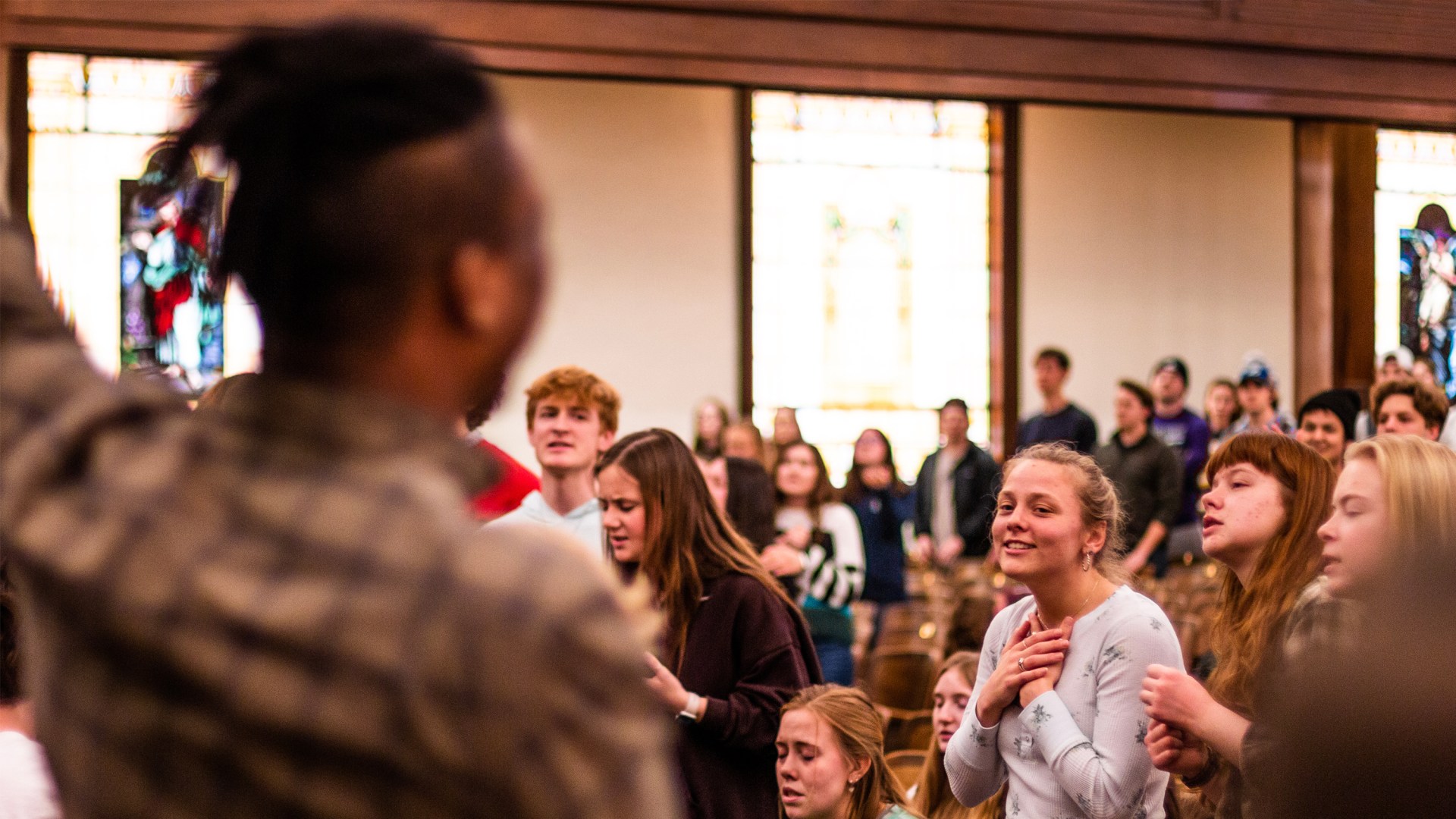
Johnson later wrote that the song spread as those students kept singing it and teaching it to others, and “within twenty years it was being sung over the South and in some other parts of the country.”

Like the young middle schoolers of Johnson’s school, my peers and I faced challenges during our youthful days. Ours were different yet still traumatic. Although many of us were taught poems by Langston Hughes, Gwendolyn Brooks, and Maya Angelou, we found more applicable inspiration in songs of Motown, Philadelphia International Records, and Stax. Each year, our favorite recording artists would appear on television singing “Lift Every Voice and Sing,” making our ability to sing it too, more potent, more palatable, and, simply put, more personal.

We navigated the streets of Los Angeles more fearful of the corrupt civil servants than gangbangers and more anxious about nefarious stereotypes than the drug-infested streets. As young citizens too young to vote, we believed in having the courage to “sing a song full of the hope that the present has brought us,” and we believed that “we have come, treading our path through the blood of the slaughtered.”

Beyond an anthem or a song of faith, this is a hymn of hope and invitation. It gives us hope for an inclusive, equitable, and just society and an invitation to be a part of the making of such! Let us all commit to “lift every voice and sing, ’til earth and heaven ring, ring with the harmonies of Liberty!”

Emmett G. Price III is the inaugural dean of Africana studies at Berklee College of Music & Boston Conservatory at Berklee. He also serves as president/CEO of the Black Christian Experience Resource Center (BCERC) and can be reached via emmettprice.com.

News

For Gen Z, Revival Is Not a Bandwagon

Christian students aren’t afraid to ask questions and continue to seek the “still, small voice” of the Spirit.

The first day of revival at Asbury University

The first day of revival at Asbury University

Christianity Today February 27, 2023
Sam Reed

Today’s college students know their generation can be skeptical—cynical, even—when it comes to big Christian movements. Young believers recognize that claims of God at work can be faked or manipulated, so they would rather ask questions and do their research before adding their “yes and amen” to the cause.

For Generation Z, this sense of discernment can be a strength when it comes to how they approach the revivals taking place on college campuses across the US this month.

When a week-long revival broke out at Samford University in Birmingham—one of several schools whose chapels filled following news of spiritual outpouring at Asbury University—Bethany Walters wanted to stop and pray before jumping in.

“I think with any type of social movement I am more skeptical,” said Walters, a first-year student. “I did not go because I was afraid that it was me wanting to be a part of something without really pausing and thinking about how that would affect me or my relationship with the Lord.”

Christian college students across the country told CT that they were impressed that Asbury and other schools prioritized student-led worship and resisted calls to livestream the events. They said they were encouraged to hear reports of reconciliation and revival and stirred to seek the Spirit’s work in their own lives.

But they still had questions—and didn’t immediately assume that what happened elsewhere should take the same format at their school.

“Whenever you’re trying to copy something that’s happening at one school and bring it to another, that does raise the question of, ‘Is this genuine stuff that’s happening, or is it being kind of forced?’” said Dallas West, junior marketing major at Louisiana State University, where Christian fellowship groups have pushed to hold worship nights.

Beneath those questions, young Christians see a desire among their generation for authentic faith.

“I think people of my generation are hungry to know the truth and are hungry for something deeper,” said Lydia Kang, a senior international relations major at Wheaton College in Illinois.

For people ages 10 to 24, suicide rates increased almost 60 percent between 2007 and 2018, according to the Centers for Disease Control, and Gen Z is about twice as likely as Americans over 25 to battle depression and feelings of hopelessness, according to the Walton Family Foundation and Murmuration.

As the least-religious generation in the US, Gen Z may not seem to be a likely incubator of spiritual revival. One-third of Gen Z identifies as religiously unaffiliated, and they are leaving the faith of their childhood earlier than other generations, many well before leaving for college, according to the American Enterprise Institute’s American National Family Life Survey.

But the recent string of revivals can also be a reminder of God’s presence and ministry through Generation Z.

Sarah Christensen, a student at Grand Canyon University in Phoenix, had been skeptical when she first heard about the Asbury revival through a group chat. As she researched, however, she started to really admire the student leaders in their commitment to not broadcast the services. She felt convicted by what God was doing with people her age 1,800 miles away.

“His sovereignty is not based around me,” said Christiansen, first-year Christian studies major. “It allowed me to really check myself and be like, ‘Okay, I’m not putting God in a box, because that’s a very small God if that’s the case.”

Braden Myers, junior accounting major at Geneva College, felt similarly.

“When we see God move in such a powerful way, it can give us peace and comfort,” he said. “It is our king who is reigning.”

Gen Z students also pointed out that revival doesn’t have to take place in college chapels or in large gatherings, though those can be powerful. The news of revival has them seeking the Holy Spirit in their own contexts, in the stillness of dorm rooms or the bustle of campus.

“I don’t think that [Asbury] should be a beacon call for every college campus, every church to do exactly the same thing,” said Sam Stockfisch, sophomore at Grand Canyon University. “What we may need is people on campus asking people, ‘Hey, how can I pray for you?’”

Days before hearing about the campus revivals, Esther Foster, first-year English writing major at Wheaton College, had been praying to ask God to be the center of her life again. After she joined a group of students on a trip to Asbury, she reflected on God’s calming presence and voice, as described in 1 Kings 19:11-13.

“I’ve been thinking a lot about that passage, the one where God comes with a still, small voice,” Foster said. “I think technology has kind of damaged [Gen Z] to kind of be expecting big and exciting things. But God doesn’t always move in the most exciting and thrilling ways. My prayer is that we are just more open to looking for God in everyday life.”

During the trip, arranged through the college’s chaplain office, she got a message from a friend at Michigan State University, and the students stopped to pray for the campus amid the active shooter incident that claimed three lives.

“That was really impactful for me,” Foster said. “They were really excited about going to the revival but were able to become serious suddenly and change their emotions to, ‘Yeah, wow, we need to grieve right now.’ I definitely saw God working in that.”

Students at Asbury can now testify—revival can and does happen in the midst of the everyday.

For Samuel Reed, junior at Asbury University, it began just like any other Wednesday chapel. He directed the broadcast in sweatpants and a sweatshirt. Panning the camera, he focused on Zach Meerkreebs, the assistant soccer coach, who preached on Romans 12 and love in action.

“The chapel was great,” Reed said. “I definitely was very moved by it, and I felt that many other students felt the same way. I cut the feed, and we all moved on.”

Reed promptly left chapel, worked a shift at the Bistro, a fast-food cafeteria, and grabbed some lunch. Sitting in his Spanish literature class, he cracked open a copy of Literatura Española when a breathless chapel intern swung his head into the classroom and told the class that worship never stopped.

When class ended, Reed made his way to the almost 100-year-old chapel. At first glance it simply looked like extended worship, but Reed recognized something different. “You could see it in their eyes,” he said, photographing his classmates singing praises and lamentations unto the Lord.

In the days to come, he watched the student body experience the peace and transformation they’d called for. A dozen people prayed over a friend who had contemplated suicide. He saw students making amends with each other, as Scripture readings emphasized Matthew 5:23-24 and seeking reconciliation. “It was incredible to watch,” Reed said.

On Sunday, Wheaton moved its monthly all-school communion from the chapel to gym. Student leaders conducted foot-washings and prepared to receive prayer requests. Three students from Asbury came to share from the revival there, and one told the crowd, “Be expectant for God to move, but don’t have expectations for how God will move.”

Students prayed over one another and held each other while crying and repenting of their sins. J. T. Reeves, student chaplain of worship, told the students, “Just because it started in Asbury doesn’t mean that it’s inauthentic to come to Wheaton.”

Near 1 a.m., students began to approach the mics in the front of the auditorium, repenting of addictions such as pornography and lust and testifying to Lord’s deliverance in areas of mental illness. They plan to gather again in the gym Monday night.

At the campus chapel at Cedarville University in Ohio, Lalitha Gadde spent over 11 hours singing, praying, reading Scripture, and playing the piano. Her friends prayed together over the situations causing them anxiety and despair.

Gadde said it reminded her of the Holy Spirit’s intervention in her parents’ lives in India and how they continued to seek out the Spirit in their church in the states. Gadde’s father, an elder, would lead all-night prayers where he’d read an entire book of Scripture.

A first-year pharmacy student at Cedarville University, Gadde prays that ultimately what comes out of this revival for Gen Z is the same lesson that Paul taught Timothy. “He told him, ‘Let not anyone look down on you for your youth, but be an example,’” she said.

At Samford, first-year student Sarah Noe played the guitar as part of a rotating student worship team at its revival that began one week after Asbury’s. The band picked songs as they went along, pulling up chords on an iPad. The first night, students stayed in the chapel for worship until 3 a.m.

As special as it was to be a part of the campus’s extended worship, she believes that revival isn’t just what happens in their chapel and isn’t contained by four walls.

“Revival is how we live our lives,” Noe said. “It’s how we come out of an experience like this changed.”

Anna Mares is a freshman at Wheaton College studying international relations with minors in English and Spanish. She is features editor of the Wheaton Record and enjoys London Fogs and collecting flowers.

addApple PodcastsDown ArrowDown ArrowDown Arrowarrow_left_altLeft ArrowLeft ArrowRight ArrowRight ArrowRight Arrowarrow_up_altUp ArrowUp ArrowAvailable at Amazoncaret-downCloseCloseellipseEmailEmailExpandExpandExternalExternalFacebookfacebook-squarefolderGiftGiftGooglegoogleGoogle KeephamburgerInstagraminstagram-squareLinkLinklinkedin-squareListenListenListenChristianity TodayCT Creative Studio Logologo_orgMegaphoneMenuMenupausePinterestPlayPlayPocketPodcastprintremoveRSSRSSSaveSavesaveSearchSearchsearchSpotifyStitcherTelegramTable of ContentsTable of Contentstwitter-squareWhatsAppXYouTubeYouTube