News

Tim Keller Calls on God’s ‘Providential Oversight’ Amid Treatment for New Tumors

Three years into his pancreatic cancer diagnosis, the New York pastor will undergo immunotherapy again.

Tim Keller

Tim Keller

Christianity Today March 12, 2023
Rachel Martin / Courtesy of Redeemer City to City

Update: Tim Keller died of cancer on May 19, 2023. CT offers an obituary in nine languages and a tribute from his biographer in eight, along with a special collection of articles by and about the New York City pastor who modeled a winsome witness.

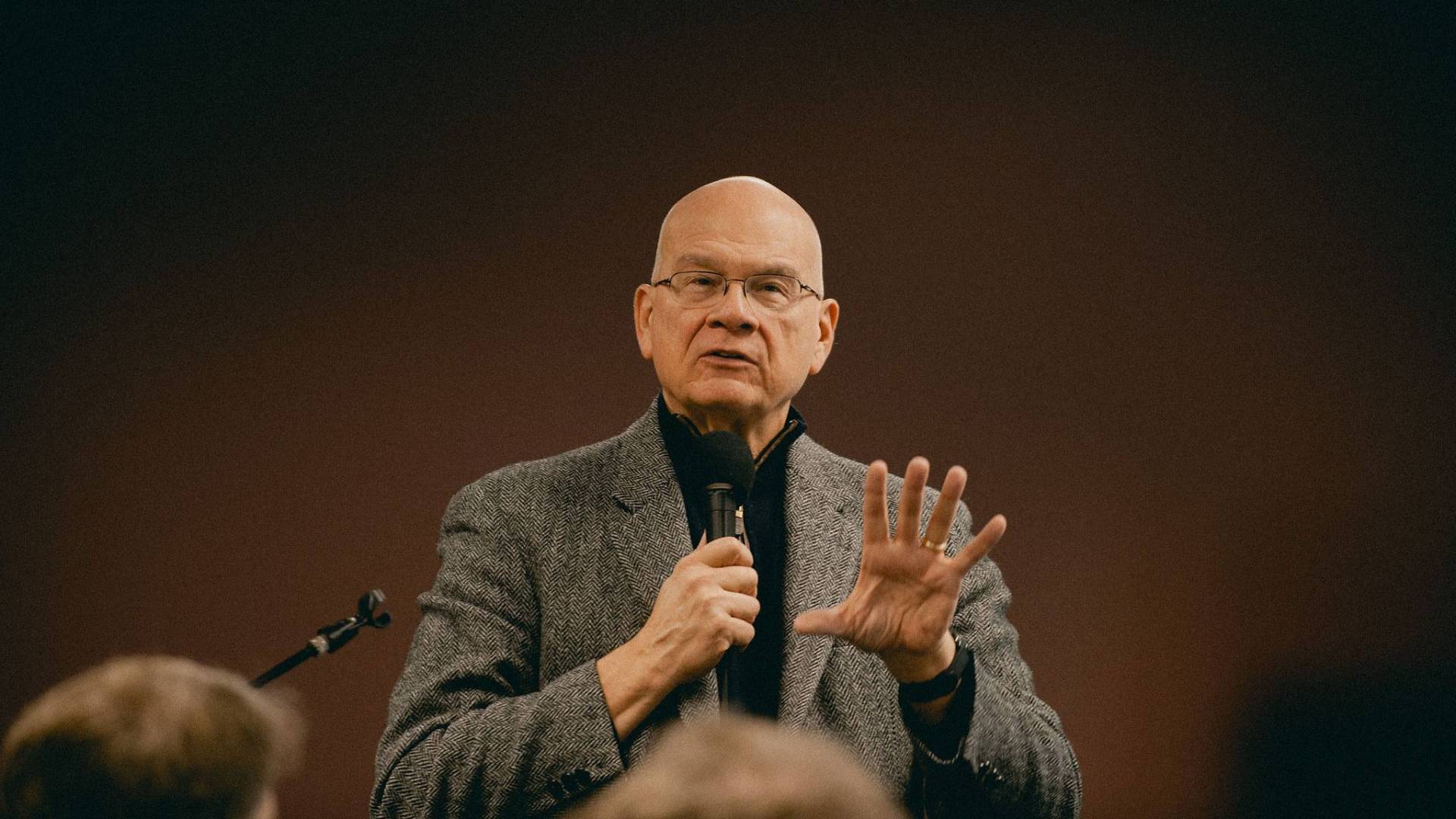
Tim Keller shared on Sunday that he will once again go through a “brutal” treatment for his pancreatic cancer and asked for prayers.

Last June, Keller participated in an inpatient immunotherapy trial at the National Institutes of Health’s National Cancer Institute, which he said had “shown great promise in potentially curing cancer.” The 72-year-old is returning to the Bethesda, Maryland, facility next month to do another variation of that immunotherapy on new tumors.

The tumors “are unfortunately in some fairly inconvenient places,” Keller said, “so the doctors encouraged us to go through the treatment again, this time targeting a different genetic marker of the cancer.”

“It was brutal last June, so we approach this with an awareness of how much prayer we need,” Keller wrote on Twitter. “Please pray for our trust and dependence on God, for his providential oversight of the medical preparations now in process, and for our desire to glorify God in whatever comes our way. Thank You.”

The longtime pastor of Redeemer Presbyterian Church in Manhattan, Keller was diagnosed with stage IV pancreatic cancer in May 2020. He went through 14 rounds of chemotherapy, followed by a surgery to remove nodules the following year.

In June 2022, he first went through the month-long immunotherapy treatment at the National Cancer Institute. At the time, his son Michael Keller posted an update saying, “Things were scary for a bit but God was gracious, working through your prayers and the skill of the doctors, and now he is doing much better.”

Last July, Keller reported that the initial signs from the immunotherapy were encouraging. Eight months later, he said it “was successful in eradicating 99% of the tumors,” but new tumors developed afterward.

https://twitter.com/timkellernyc/status/1635011064260870144

According to the National Cancer Institute, researchers are studying new combinations of immunotherapy treatments and drugs for pancreatic cancer, including immune checkpoint inhibitors, which help the immune system fight the tumors.

“Pancreatic cancer can be hard to treat surgically due to the location of the organ, and because the disease has often spread in the body by the time it is diagnosed,” the institute says.

Earlier this year, Keller tweeted that since he spends a lot of his time in cancer treatments, he focuses the rest on writing, mentoring, and being with family.

During his cancer treatment, he wrote Hope in Times of Fear, a book on the Resurrection that released last Easter. The year before, he reflected on his diagnosis in a piece for The Atlantic titled “Growing My Faith in the Face of Death.”

“I can sincerely say, without any sentimentality or exaggeration, that I’ve never been happier in my life, that I’ve never had more days filled with comfort,” he wrote. “But it is equally true that I’ve never had so many days of grief.”

He also wrote Forgive, which came out last November. He spoke on The Russell Moore Show about forgiveness as the key to Christian witness.

Last month, The Gospel Coalition announced the launch of The Keller Center for Cultural Apologetics in his honor. So far Keller’s work with the center and its fellows has taken place behind the scenes; the initiative is meant to carry on his legacy after him, executive director Collin Hansen recently told CT.


Culture

‘Everything Everywhere All at Once’ and the Paradox of Achieving ‘Nothing’

Did Evelyn have anything to show for after a life in the laundromat? Did I as a homeschool mom?

Christianity Today March 12, 2023
Image: Courtesy of A24

Evelyn Wang feels like she has achieved nothing.

Evelyn (Michelle Yeoh) is the main character in the award-winning film Everything Everywhere All at Once, which won multiple awards at this year’s Oscars. Yeoh was awarded best actress for her role, while Ke Huy Quan, who plays Evelyn’s husband Waymond, and Jamie Lee Curtis, who plays their tax auditor Deirdre Beaudeirdre in the film, won best supporting actor and actress respectively. The film also scored best picture and best original screenplay, and its writer-directors Daniel Kwan and Daniel Schienert took home the best director award.

The film opens with scenes of Evelyn’s current life, where she experiences the tedium of running a laundromat business. (Spoilers ahead.) As she visits other parallel universes in which she is a successful actress or a skilled teppanyaki chef, she begins to see her current life as the result of a series of bad decisions.

Evelyn soon comes to the devastating realization that she has not accomplished anything significant. Her marriage to Waymond (Ke Huy Quan) is on the rocks. Her relationship with her daughter Joy (Stephanie Hsu) is, well, hardly joyful. Overall, her life seems to be a complete failure.

Where I identify most with Evelyn's identity struggle is in her role as a parent.

My husband and I are from Taiwan. We met and married while studying in Germany. After graduation, I left my career to support my husband's work, moving from country to country and city to city.

When I became a mother, I received a call from God to become a home-schooling mother. I enjoyed living with my husband around the world and savored every moment I spent with my children in homeschool.

I am thankful for God's blessings in my family and marriage. But occasionally, in the quiet of the night, I have wondered what my life would have been like if I was not married and if I had not become a mother. There are times when I miss experiencing the passion for the political ideals I held as a student.

Yet, I stand by my choice to give up my career and homeschool my children. As Evelyn’s life reminds me, choosing to serve others by achieving “nothing” in a world that pursues upward mobility requires a deep love and a God-given calling.

Reckoning with failure

In Everything Everywhere All at Once, Evelyn and her family never have good conversations with one another. Waymond and Joy are both eager to talk to their respective wife and mother, but Evelyn constantly rejects them.

On the surface, it appears that Evelyn’s life has become so busy that she does not have the time and energy to listen to them. But when I look deeper into Evelyn’s situation, I find that rather than being too busy to talk to her family, it is more likely that Evelyn is using her busyness to escape her marital and parenting difficulties.

From the disappointed and hurt look in Joy’s eyes, which occurs repeatedly in the film, we discover that while Joy longs to share her struggles and gain acceptance from her mother, Evelyn uses her busy schedule as an excuse to shut Joy out. Joy only manages to receive superficial responses from Evelyn like “You’ve put on weight recently. Watch your diet.”

As parents, we encounter times in which our children are like Joy. They hope that someone will listen to their struggles, point out their blind spots, and help them to discern what to hold on to or let go of. Unfortunately, our responses may often mirror Evelyn’s, even though we know that what our children need are parents who are willing to spend time with them, listen to them, give them clear guidance, discipline them, and accompany them through the mundanity of life day in and day out.

This is the kind of parent that Evelyn slowly grows to become as the film progresses. But for Evelyn to learn what it means to be a good mother to Joy, she must start by accepting who she is: a nobody.

“I’ve seen thousands of Evelyns, but never an Evelyn like you. You have so many goals you never finished, dreams you never followed. You’re living your worst you,” says Waymond from the Alphaverse, a parallel universe.

“Most people only have a few significant alternate life paths so close to them. But you, here, you're capable of anything because you’re so bad at everything,” Waymond continues.

In A Room of One’s Own, 20th-century feminist writer Virginia Woolf asks the question: If Shakespeare had a sister of equal talent, what would her fate be? Judith, the fictional sister that Woolf dreams up, is just as clever and talented as the celebrated bard is. However, one can imagine that as a woman in that age, her experiences are as different from Shakespeare’s as heaven is from earth.

When Judith flees to London to escape a proposed marriage that her father has arranged for her, she soon finds that no one believes in her or recognizes her talent. Finally, in the loneliness of having achieved nothing, the despairing Judith dies by suicide.

Perhaps this story merely reflects one woman’s plight in being unable to realize her potential. But failure is a common experience that all humanity faces. As Ecclesiastes 1:14 says: “I have seen all the things that are done under the sun; all of them are meaningless, a chasing after the wind.”

In a world corrupted by sin, no one lives without a nagging sense of futility. No one can escape the heartbreak it causes either. To a greater or lesser extent, all of us have caused or experienced hurt from others. We have continually hurt our loved ones in perpetuating vicious cycles of dysfunction. We have gone astray because of our own foolishness and ignorance.

As a parent, there are times I have felt like Evelyn in that I have achieved nothing of worth in life. Sometimes, there is a tendency to think that I am merely a broken, hopeless individual in whatever circumstance I happen to find myself in. It is here that I cling on to the hope I have in Jesus.

Searching for significance

Where and how do we find meaning in life as Christians? It may well happen when we give our lives up for another.

If a wildly successful professional forsakes the opportunity to achieve success and fame and chooses to put his or her children first instead; if a powerful executive insists on treating others kindly in a cruel dog-eat-dog environment because of his or her faith; if a professor invests more time with his or her students rather than producing research results; if a gifted preacher sets aside pulpit ministry to take care of an ailing spouse … Their having achieved “nothing” in life is not due to a lack of ability, but because they have decided to relinquish their personal dreams and goals for the sake of another human being.

When we choose to live selflessly, we serve the physical and spiritual needs of those around us, rather than striving for worldly standards of success. This is the kind of life Jesus led, which is what Philippians 2:3–5 encourages us toward: “Do nothing out of selfish ambition or vain conceit. Rather, in humility value others above yourselves, not looking to your own interests but each of you to the interests of the others. In your relationships with one another, have the same mindset as Christ Jesus.”

In a world where success is worshiped, being unsuccessful is often equated with being weak. However, walking the path of achieving “nothing” can be a powerful and meaningful choice.

In the movie, Evelyn becomes a “savior” precisely because she has accomplished nothing. As a daughter, wife, and mother, she is pulled in various directions by the different values and roles she occupies. In the end, she chooses to be her most ordinary self—an immigrant mother living in America who runs a laundromat—even if it means giving up on glitzier dreams and desires.

In parenting, there are many similar ideals that we may have to give up, even if others do not fully understand or appreciate these decisions.

When I chose to forgo my career after graduation due to family considerations, my father was very puzzled and felt that I had achieved nothing. When I chose to educate my three children at home, I was asked why I did not try to influence more people in the workplace and why I did not “fulfill my personal worth” in my profession and instead chose to spend my time, experience, and talents with my children day in and day out.

In The Selfless Way of Christ: Downward Mobility & the Spiritual Life, Henri Nouwen points out that our contemporary lives revolve around heightened competition and pressure. Whether intentionally or not, the world pushes us to move upwards and become “victors” in this cruel competition called life.

Nouwen, however, believes that true growth should not be driven by such “upward mobility.” Rather, authentic growth arises from serving others through Christ’s love, and the purpose of life is not to uplift oneself but to become a blessing.

Because of this insight, Nouwen set aside the “glory” of teaching at Harvard and Yale and entered the Daybreak community in Toronto, Canada, to become a priest and serve the mentally disabled in their daily needs. He set aside worldly acclaim and took up what many would have considered a career that achieves “nothing.”

Nouwen’s deliberate choice has offered the world a striking example of a life lived for the good of others. He has inspired people like me to choose a path that leads not to worldly achievement, but to follow Jesus’ example of humble self-sacrifice in serving others.

The “nothingness” of it all

Of course, when endless choices are available for us to pursue in life, it may sometimes be difficult to stay the course and remain faithful to what God has called us to be, whether it is a homeschool mom like me or a laundromat owner like Evelyn.

Part of the relief for these moments when we feel most disconnected from purpose and calling is grounding ourselves in human presence.

In a pivotal scene from the film, Evelyn’s father from the Alphaverse asks her to kill her daughter Joy to prevent Jobu from taking over her body in that universe. Evelyn refuses to obey her father’s instructions and decides to search for another way to save her daughter from total desolation.

Like Evelyn, we often find ourselves hoping to remove suffering from our children’s lives by our own strength. As Christians, however, we are aware that suffering is a part of life. “Even though I walk through the darkest valley, I will fear no evil, for you are with me,” says David in Psalm 23:4. God does not take away the valley in David’s life, but in God’s companionship, he is able to walk through the lowest of lows peacefully and safely.

Everything Everywhere All at Once also recognizes that suffering will continue to exist in life and that fellowship amid suffering is essential. At the end of the movie, after experiencing the dazzling adventures in all the parallel universes, Evelyn finally chooses to stay with Joy: “Of all the places I could be, I just want to be here with you.”

Evelyn’s choice to be Joy’s mother effectively means she has chosen to become “nothing.” Being a nobody is one of the most significant choices Evelyn makes. It reflects her unconditional love for Joy and the extraordinary depth of this love, which might seem inconsequential on the surface.

My choice to be a homeschool mother rests firmly on the unconditional love I have for my children. My day-to-day life may seem very unexciting and unimpressive compared to others, but God is with me, sees me, and loves me unconditionally even in my “nothingness.” I cling to this reminder in 1 John 3:1: “See what great love the Father has lavished on us, that we should be called children of God! And that is what we are!”

Wang Min-li is a Taiwanese writer.

Trnaslation by Christine Emmert.

Church Life

How to Preach to Sleeping People

Sometimes there is more to the story than just a bored listener.

Woman sleeping on a church in the countryside
Christianity Today March 10, 2023
Illustration by Mallory Rentsch / Source Images: Getty / Unsplash

I think his record was 15 minutes.

Usually, he was out in under 10 minutes. Brother Leroy (not his real name) just couldn’t seem to stay awake during the sermon. And he wasn’t a quiet sleeper. On occasion, he would snore, but most of the time he would throw his head back, mouth agape, and drift into a sleep so deep I’m not sure he’d have heard Gabriel’s trumpet.

After the service, I would stand in the back. Brother Leroy would nod and tell me, “Good sermon, pastor.”

I’ll be honest and tell you that as a young pastor, I was deeply offended by this guy. If most of the congregation was falling asleep, I might have concluded I was the problem. But there were many others truly engaged. This one was on Leroy.

I concluded that Leroy was an unspiritual man who had zero taste for the preaching of the Word of God. Christians value God’s Word. How could you fall asleep when someone is passionately sharing the gospel?

Are you bored with Jesus, brother Leroy? Why even bother coming to church? What are you getting out of this little charade?

Compassion for sleepy congregants

Then I had a conversation with brother Leroy. He told me, “I really do appreciate your sermons, young man.” Then he kind of chuckled and said, “Well at least the parts I stay awake for. I’m really sorry if you’ve ever noticed me nodding asleep …”

(Oh, I’ve noticed Leroy. How could I not?!?!?)

“I’m on this darn medicine I have to take in the morning, and I just cannot stay awake. I try, but the medicine seems to win every time.”

Being young and foolish at the time, I probably concluded that Leroy was just making an excuse for his sleeping. But over the years I’ve matured (at least a little) and thought about some of the other “sleepers” in our congregation. There was a single mom, a guy who worked the graveyard shift, and another older man going through cancer treatment. And suddenly I realized they were in church and even falling asleep because they did value God’s Word.

Most of them didn’t want to fall asleep. They weren’t devaluing God’s Word; they were just being human. Their sleeping didn’t communicate anything about my preaching or about their love for God. After all, I love watching football. But on most Sundays, I’ll fall asleep when my preaching exhaustion sets in.

Tips for preaching to sleepy congregants

There’s a gentleman in my church now who is dying of cancer. He falls asleep for at least a bit of my sermon every Sunday. But it’s a joy to have him here. I knew this guy before he was pumped full of meds to keep him alive, and I know how much he loves Jesus.

I know I have about five to 10 minutes at the beginning and usually a little bit at the end. So, I will put a few morsels in the first five minutes and the last five minutes, just to feed him. One or two lines of encouragement. It’s something related to the text I know he’ll be able to chew on before he drifts into sleep.

It’s funny because the sermon he tells me was “so good and helpful for his week” usually isn’t exactly squaring with the overall message. But he is fed what he can digest. And I know he eats that little bit because he loves the Word.

It’s amazing what happens when we can look past our own egos and learn to not take a sleeping congregant personally. It shifts our perspective. My goal isn’t to keep him awake for the whole sermon. My goal now is to feed him whatever I can while he is awake. It’s a way of loving him where he is at for that day. If the apostle Paul had someone fall asleep during his sermon (Acts 20:9), it will probably happen to you.

The challenge from sleepy congregants

This advice doesn’t mean we should stop attempting to keep everyone engaged and awake. You should be able to tell if you have your people’s attention or not. They may not be sleeping, but if they keep shifting in their chairs, checking watches, looking around the room, etc. it’s quite possible you have lost them.

If someone’s falling asleep in your congregation, and the culprit isn’t medicine or exhaustion, it’s quite likely the problem is clarity.

Have you ever been reading a book and then realized you’ve turned three pages but haven’t processed anything you’ve read? That is because something has tripped up your brain. It might be a difficult word, a tough concept, or even something that triggers another thought. But for whatever reason, our brain cannot move on.

The same thing happens with preaching. When we are unclear, our words are bound to trip people up. I love the words of Einstein, “Everything should be made as simple as possible, but no simpler.” In this regard, our sleepy congregants can challenge us. If I have only a few minutes before your medicine kicks in, that motivates me to say as much as possible and as simply as possible with as few words as possible.

Preaching and listening to the preached word are sacred things. But they are also sacred things we engage in as humans, and we are at times frail. Our spirits relish the preached word, but our bodies aren’t always able to cooperate. When this is the case, our people don’t need an angry and chiding shepherd. Shaming a sleeping congregant will only breed shame and legalism.

Love your people where they are. Even when that means they are in the land of Nod.

Mike Leake is the pastor of Calvary of Neosho in Neosho, Missouri. This article originally appeared at Lifeway Research. Please visit their article here.

Church Life

Why Broken Friendships Hurt

For believers, both old and new relationships carry an eternal weight and value.

Christianity Today March 9, 2023
Illustration by Christianity Today / Source Images: Unsplash / Getty

This piece was adapted from Russell Moore’s newsletter. Subscribe here.

As I headed off to California for the installation of my old friend Matthew J. Hall as provost of Biola University, I commented to my wife, Maria, “I wonder what the most-repeated sentence I’ve ever said to or heard from Matt Hall would be.” And what we landed on was “Well, that was crazy.”

Matt and I have had many opportunities to say that to each other since we first met—back when he was a call screener for a talk-radio show I sometimes guest hosted. His job was to filter out the people who wanted to make a relevant comment from those outraged after I said something positive about, say, Willie Nelson or Harry Potter. (Those were simpler times, reader.) And in the years since, we have often looked at each other whenever some explosive debate on the floor of our denomination was gaveled out of order and said, “Well, that was crazy.”

For 20 years, I’ve been able to laugh with Matt about some display of craziness or another—and I can always count on him to know what qualifies as “crazy.” In the two days I visited with him recently, I found myself laughing at stories we would tell and retell, with lots of sentences starting with “Remember when … ?”

In the past, I might have considered memories of such moments as “nostalgia,” but now I see them as a grace. And I no longer take them for granted.

New friendships are often made from stories. Whenever you meet someone new, that person may ask you, “So what’s your story?” Even when it’s not directly said, it’s an unspoken question. We tell pieces of our life stories to each other and are often happy to find those stories overlap. As C. S. Lewis put it in one of the most often-quoted passages of The Four Loves, we say, “You too? I thought I was the only one.” Without new friendships like these, our lives can become stagnant and boring.

Even so, Dolly Parton and Kenny Rogers were on to something when they sang, “You can’t make old friends.” Old friendships are rooted in shared experiences that accumulate over time.

When you tell something of your story to a new friend, you are saying something akin to “Here’s who I am. What about you?” When we spend time with old friends and tell remembered stories, we’re doing something different. We aren’t communicating information; we’re reliving our experiences. We’re saying things like “Can you believe we got to see that?” or “Can you believe we survived that?” or “Don’t you miss that?” or “Aren’t you glad that’s over?”

It’s just another way of knowing one another—and of being known.

Over the past several years, hundreds of people have spoken to me about the pain of broken friendships in their lives. Sometimes those friendships were split apart by politics—maybe because of different views of Trump, the COVID-19 vaccine, critical race theory, or any other real or imagined divide.

For some, a friendship fractured over some kind of “deconstruction” or church split. For others, friendships blew up in the fury of argument. In some cases, the friendship simply fizzled out. In carefully observing the demilitarized zones of things “safe” to talk about, some friends just couldn’t cobble together enough shared stories anymore.

Whatever the reason, broken friendships hurt. For those of you who ever moved as a child, your mom was right when she said, “You’ll make new friends.” Still, what you knew then—and, deep down, you still know now—is that you can’t replace old friends. Broken friendships hurt because friendship is so important.

People often criticize evangelical gospel songs about friendships with Jesus. “Jesus isn’t your girlfriend,” they may say. “Jesus is your Lord, not your buddy.” Jesus is Lord, but part of how he defines his lordship is by calling us friends. And Jesus grounds that friendship in a shared story. Servants can obey their masters, but they don’t know what’s going on beyond their immediate tasks. But Jesus said to his disciples, “I have called you friends, for everything that I learned from my Father I have made known to you” (John 15:15).

Shortly after making that statement, however, Jesus experienced the breaking of certain friendships. When he was arrested and put to death, some of his friends didn’t want to share the story anymore.

One of those broken relationships was irreparable (in the case of Judas), but Jesus sought out the others after his resurrection. He met with Peter—who had denied even knowing Jesus—while Peter was fishing, which is right where Jesus had first called him (John 21:1–19). Perhaps the charcoal fire Jesus prepared—the same sort of charcoal fire where Peter had cursed out his denial—was Jesus’ way of signifying, “I know all about it, and I love you anyway.”

Jesus then repeated the very words he had spoken to Peter when he first found him: “Follow me!” (v. 19). Maybe that was partly Jesus’ attempt to remind Peter that they still shared a story—a way of saying, “Remember when …?” What a friend we have in Jesus.

About once a day, I see or hear or think about something that reminds me of a story that would make sense only to one of my old friends—say, an inside joke or news about a mutual acquaintance. I start to call that person but then realize I can’t.

Sometimes it’s because that old friend has passed away. Sometimes it’s because that old friend thinks I’m a “cultural Marxist” now or whatever. And at other times it’s because I’ve just lost touch with that old friend in the whirl of our busy lives and it feels kind of awkward to reach out after so long.

Maybe some of you have never experienced a broken friendship, but I’ll bet most of you have. And I’ll bet it hurts more than you want to admit. In many cases, there’s nothing you can do about that.

But there is one thing you can do: Thank God for new friends and keep making them.

And while you do, hold on with gratitude to those old friendships, to the people with whom you share stories. Consider calling one of them. Perhaps say out loud, “I love you” even when it’s awkward—or maybe especially when it’s awkward.

Take the time to retell old stories with those friends who will know exactly what you mean when you say, “Remember when…?” Let it point you to the shortness of life and beyond that—to a day when all that was broken will be mended and when all that we have lost will be found. I suppose we will all feel like old friends then.

And as we look forward to the ever-expanding glory of eternity, we might catch each other’s eye as we look backward—just for a moment—to say, “Well, that was crazy!” Russell Moore is the editor in chief at Christianity Today and leads its Public Theology Project.

Church Life

‘Women Talking’ Focuses on Survivors, Not Abusers

The Oscar–nominated film started a conversation that the church can learn from.

The main cast of Women Talking portrayed in the film.

The main cast of Women Talking portrayed in the film.

Christianity Today March 9, 2023
Michael Gibson / © 2022 Orion Releasing LLC

Earlier this year, CT reported on the sexual abuse and spiritual manipulation of Jean Vanier, who violated at least 25 adult women without disabilities over nearly a 70-year period, and did so “during prayer and spiritual devotion.”

A few weeks ago, Hohn Cho came forward about how elders at Grace Community Church mishandled treatment of women who were abused by their husbands. These names and institutions have been circulated among evangelical communities, among a list of other abusers that have been accused over the past several years.

In some accounts of sexual abuse cases, the story presented to the world is about the abuser rather than the act of courage it took for the survivor to step forward—sometimes for the sake of the survivor’s privacy and safety. But that’s not the case when it comes to the recent film Women Talking, written and directed by Sarah Polley (spoilers ahead).

Polley’s film centers on a group of eight women in a religious community left in the wake of sexual violence. The film is adapted from a book with the same title released in 2018 by Miriam Toews. In the book, the author imagines what could have taken place during an egregious yet true event that happened in a Bolivian Mennonite colony back in 2009—in which over a hundred women and girls, including children as young as five years old, were drugged with animal tranquilizers and systematically raped by men in the colony.

Throughout the film, the focus stays on the women who were abused. The stylistic choices of the film are sensitive to the topics at hand and aim to keep the survivors’ stories, dignity, and emotions at the center of the narrative. According to Polley, “We never showed the assaults. We don’t go deep into that. What we go into is the recovery and the healing and the conversation.”

The filmmakers do not include any faces of any of the abusers, and only one of the abusive men is named. This is a deliberate detail to keep the survivors in the center of the story, especially in contrast to how abusers’ names are the ones so often repeated in mainstream media. This is also a distinct element to the film adaptation, omitting these details from the book.

Instead, Women Talking invites us to witness the thoughts, emotions, and responses of those who were abused. We get the rare opportunity to see a glimpse into the world of survivors, to empathize and sympathize with those harmed—and more importantly, to witness them process their faith amid spiritual manipulation.

The abusers led the women to believe they were possessed by ghosts or demons. As the narrator, who is cast as the voice of one of the survivors, said: “They told us that it was Satan. Or the result of wild female imagination.”

While the true events took place in Bolivia, the film was shot in Canada. Polley’s goal was to make the events portrayed in the movie feel as if they could have happened at any time or in any place—since the film’s focus was not so much on the setting but on the conversation and the exchange of ideas.

In an interview on the Scriptnotes podcast, the director states that she “wanted it to be timeless. I didn’t want people to be able to pin these issues which we’re dealing with in every patriarchal society to some degree or another on this obscure, already misunderstood community.”

This movie could not come at a more opportune time for those in the Christian community, as we are being bombarded by stories of sexual abuse at the hands of spiritual leaders.

When asked about why she made the film, Polley said, “I [make films] because I feel like I have to and it’s urgent. I hadn’t felt like that about anything in a really long time. I felt like that about this book and working with these people.”

In the film, we see the women comparing their stories as well as wrestling with their faith as they process the aftermath of their sexual and spiritual abuse. The abusers tell the women that if they leave the cult, they won’t go to heaven—gaslighting the women into thinking they must choose between their safety and their salvation.

This is seen most evidently in Scarface Janz (Frances McDormand), who stays behind because she is afraid of eternal damnation if she leaves with the others. As Craig Mazin, film and television writer and producer, from Scriptnotes states, “She’s so enslaved that she can’t imagine being free.”

After many hours of conversation in the hayloft of a barn, the other women decide to leave the colony. And although religion is used as a weapon of abuse against the women, their decision to leave is grounded in their faith. As Greta (Sheila McCarthy) says, “We are leaving because our faith is stronger than the rules. Bigger than our life.”

As Justin Chang writes in NPR’s film review of Women Talking,

What distinguishes this survival story from so many others is that, even as it acknowledges the abusive, patriarchal power structure in this religious colony, it still takes seriously the question of spiritual belief: It’s the women’s faith in God that ultimately empowers them to imagine a better, fairer way of life.

With many stories about sexual manipulation and sexual abuse in churches and Christian organizations, we often hear about the organizations that have failed and about the leaders who fell short. But we rarely get to hear about the acts of immense courage it takes to even just admit that one has been abused, let alone decide to stand up against a system of abuse.

Women Talking is a film that’s designed to start more conversations around abuse stories, especially in the context of faith. It gives us the opportunity to see a spectrum of responses from those abused and provides representation of the survivors behind the scandal. It also shows the emotional and spiritual turmoil that goes into the decision to speak out against abuse.

To me, one of the most impactful moments in the film is when Autje (Kate Hallett) gives a brief monologue, saying “We didn’t talk about our bodies, so when something happened, we didn’t have the language for it. Without language for it, there was a silence, and in that silence was the real horror.”

Without the words to explain their experiences, survivors sometimes lack the power to do anything about their abuse. And in a broader sense, this reminds us of how difficult it can be to stand up against abuse when we don’t know how. It often takes someone leading by example to get others to act. For every person that stands up against abuse, there are a handful of others who hear that person’s story and recognize themselves in it.

In the end, the eight women in the film rely on Philippians 4:8 in choosing to leave their abusers. They knew that, whatever they decided, they must cling to what is good, even if the future was completely uncertain. To cope with this uncertainty, the film ends with the women listing good things—a literal practice of clinging to what is good.

At the prescreening I attended, I was fortunate to hear Sarah Polley speak about her experience of making Women Talking. I remember her saying that she hoped people leave the theater continuing the conversation that the film started. Personally, I hope this conversation continues in the church.

As Christians, we especially grieve for those who have been spiritually manipulated on top of being sexually abused—for the ways someone else’s sin has harmed them and for the way their trust was broken by those they saw as spiritual leaders.

And for survivors in the context of Christian institutions—for those who know that their faith is stronger than the forces fighting against them—we pray that they too will have the strength and courage to cling to what is true and good.

Mia Staub is the content manager at Christianity Today.

Church Life

4 Incredible Christian Women Who Changed India

How a social reformer, a lawyer, a doctor, and a peacemaker changed the subcontinent.

Christianity Today March 8, 2023
Illustration by Christianity Today / Source Images: WikiMedia Commons / Internet Archive

Women in India have endured often harsh and cruel lives in a society which has long favored boys to girls, sanctioned child marriage, and practiced a dowry system. The government and culture have limited their access to education, employment, and escape from (domestic) violence. What they have accomplished has at times been overlooked or credited to others.

In many instances, Christian women have confronted additional challenges. Christian converts have faced significant persecution from the communities they’ve left, and those raised in families who switched faiths a generation or two prior still endure generational pain and trauma related to these hardships.

Nevertheless, numerous Indian Christian women have responded to their circumstances with a strong sense of justice and compassion for others suffering oppression. They have made notable contributions to child rights, social justice, the freedom struggle, nation building, and women’s empowerment. Here are four Indian Christian women whose lives of service, ambition, and compassion offer the church imperfect but remarkable role models.

The Social Reformer: Pandita Ramabai Sarasvati (1858–1922)

“People must not only hear about the kingdom of God, but must see it in actual operation, on a small scale perhaps and in imperfect form, but a real demonstration nevertheless.”

Pandita Ramabai Sarasvati devoted her life to empowering women and promoting gender equality in 19th-century British-ruled India, a society where patriarchy was deeply entrenched. Although politicians and activists have routinely applauded her relentless efforts to serve the marginalized, they often overlook her Christian faith, which served as the foundation for her life and work.

Though Ramabai was born into a Hindu Brahmin family in the jungles of Karnataka State, she converted to Christianity in her 20s after famine took the life of her husband and spurred a crisis of faith.

In 1882, Ramabai met Father Nehemiah Goreh, an Indian priest, who revealed Christ’s message of compassion and love to her. When she traveled outside the country, including a trip she took the following year to England to pursue her studies, Ramabai later acknowledged that “Father Goreh preached to me from India. His humble sweet voice has pierced my heart.”

She also began to read the Bible herself.

“I realized after reading the fourth chapter of St. John's Gospel, that Christ was truly the Divine Saviour he claimed to be, and no one but He could transform and uplift the downtrodden women of India,” Ramabai wrote, in a quote that is attributed to her. “Thus my heart was drawn to the religion of Christ.”

Even prior to her conversion, Ramabai had felt called to care for the vulnerable. In 1881, she founded the Arya Mahila Samaj, a women’s organization that advocated for women’s education, including the training of female teachers and administrators, and for the elimination of practices such as child marriage.

Herself a widow, Ramabai knew the plight of women who had lost their husbands, and in 1889, she founded the Mukti Mission as a refuge for destitute women, children, and disabled persons. The mission provided shelter, education, and vocational training for women and gave them tools they needed to lead independent and fulfilling lives.

Pandita Ramabai SarasvatiIllustration by Christianity Today
Pandita Ramabai Sarasvati

Ramabai’s care for the communities she served also manifested through her Bible translation endeavors. She learned Hebrew and Greek and in 1905 started translating the Bible into simple Marathi (the native language of Maharashtra) for the people living in rural areas, who found the classical form too difficult. It took her 18 years to complete the translation.

“I was hungry for something better than what the Hindu Shastras gave. I found it in the Christians’ Bible and was satisfied. … How good, how indescribably good!” she wrote later. “What good news for me a woman, a woman born in India among Brahmans who hold out no hope for the likes of me! The Bible declares that Christ did not reserve this great salvation for a particular caste or sex.”

Ramabai's Christian faith also made her a target of criticism and persecution. Many Hindus saw her conversion as a betrayal of her culture and heritage and accused her of attempting to convert others. Despite this, Ramabai remained steadfast in her beliefs and continued to use her faith to promote social justice and equality.

Her legacy continues to inspire women and social reformers in India and around the world. As she wrote, “A life totally committed to God has nothing to fear, nothing to lose, nothing to regret.”

Pioneering physician: Hilda Mary Lazarus (1890–1978)

Hilda Mary Lazarus dedicated her life to serving others through medicine and faith.

Born in Visakhapatnam, Andhra Pradesh, in 1876, Lazarus grew up in a devout Christian family that had converted to the faith two generations before from the Brahmin Hindu background and had suffered significant persecution for doing so.

Her father, Daniel Lazarus, was a respected educator and author and served as the principal of Canadian Baptist Missionaries (CBM) School, which his daughter attended.

Hilda Lazarus entered Madras University years before the prestigious university officially opened its doors to women in 1915. She later earned a medical degree and gold medal for exceptional work in midwifery from Madras Medical College.

She then pursued further medical education in the United Kingdom, passing exams in London and Dublin, obtaining membership in the Royal College of Surgeons, and specializing in obstetrics and gynecology. Lazarus became the first Indian woman to join the Women’s Medical Service (WMS) and worked for the government from 1917 to 1947.

As a doctor, Lazarus supervised hospitals and improved medical services for women and children across India. She trained nurses and midwives, a responsibility that at times required her to learn new languages. She authored a book about her life and experiences in England.

Hilda Mary LazarusIllustration by Christianity Today
Hilda Mary Lazarus

In her late 50s and a year before retirement, Lazarus left the WMS for Christian Medical College (CMC), in Tamil Nadu, becoming its first Indian head. The decision to lead “an institution that would clearly face a struggle even to survive” at this stage of life was fueled by a “deep and strong” Christian commitment, later noted Ruth Compton Brouwer, in a piece on Lazarus’s legacy.

“Not only had [Lazarus] grown up in a home that had implanted an ethic of Christian service, but she had contributed over the years in a variety of ways to the work of medical missions in India,” she wrote. “Thus, when an opportunity came to help secure a future for a fully professional Christian medical college in an independent India, it seems clear that she felt a sense of vocation to take up that opportunity, notwithstanding the difficulties to be faced.”

Lazarus was concerned with not only keeping CMC’s standards of care high but also making its Christian commitment central. When there were concerns about proselytization taking place at the hospital, Lazarus did not deny these charges but countered that the patients found the institution’s clear religious commitments helpful, noted Arthur Jayakumar in History of Christianity in India: Major Themes.

“She seems to have practiced and defended forms of overt evangelism that many medical missionaries had by then eschewed in favor of a more informal approach and the witness provided by their professional and personal lives,” he wrote.

In recognition of her contributions, Lazarus was awarded numerous honors and accolades throughout her life, including the Kaisar-i-Hind Medal in 1942, one of the highest civilian awards in pre-independence India, and the Padma Shri, one of the highest civilian awards in independent India.

India’s First Female Lawyer: Cornelia Sorabji (1866–1954)

"I am sure God is sending you to your work, my child. Don't be afraid to go in his strength,” Florence Nightingale to Cornelia Sorabji in 1892

Cornelia Sorabji had several firsts to her credit. She was the first woman to graduate from Bombay University, the first Indian woman to study law at Oxford University, and the first female lawyer in India. Additionally, she was the first woman to practice law in both India and Britain, a fact that was recognized and honored when a bronze bust of Sorabji was unveiled in London in 2012. (In 2017, she even earned her own Google doodle on the anniversary of her 151st birthday.)

Sorabji was born in Nashik, Maharashtra, to former Zorastrians who had converted to Christianity. Her family—particularly her father, who later became an ordained minister—had suffered intense persecution for their faith. Nevertheless, she was fortunate to receive a good education, which was rare for girls at that time.

Cornelia SorabjiIllustration by Christianity Today
Cornelia Sorabji

In 1889, she traveled to England, where she became the first woman to study law at Oxford University. However, she did not graduate, as women could not be awarded degrees until 1920.

After a long struggle, Sorabji became India’s first female lawyer in 1923 and practiced in the Calcutta High Court. Besides fighting gender segregation, which kept women and girls from mixing with men outside their own families, she advocated for social reforms like the abolition of child marriage, protection of widows and orphans, and education for girls. Sorabji worked alongside Pandita Ramabai, and in 1929, she gave up her law practice to devote her time entirely to social work.

“She believed that children should be educated to understand and critique their customs so they could modify them,” wrote Oxford-educated lawyer Aradhana Vadekkethil. “She knew that the law could help drive social change but strongly believed that education had to be done first.”

Nevertheless, her work had hard and lonely moments. Over the years, she had to remind herself that “God removes mountains,” “I must have faith in the outcome,” and “[I] must learn trust in God” as recounted in Richard Sorabji’s Opening Doors: The Untold Story of Cornelia Sorabji, Reformer, Lawyer and Champion of Women's Rights in India.

In a letter to a close friend, she confessed, “I feel that God would not have made it possible for me to try and get my call and come out again, unless I was meant to try and struggle on a while at this job here.”

Though initially an advocate of independent India, she later changed her stance that India should continue to be under British rule to counter “Hindu laws to eliminate child marriage and uplift widows and putting an end to the cruelty they were subjected to” and thus became unpopular among the nationalist leaders.

Sorabji was also no fan of Gandhi and at one point told him, “The missionaries take hundreds of thousands of outcastes under their protection, clothe and educate them, and fit them to stand on their feet. Besides, you are an outcaste yourself now. What credit can be claimed by an outcaste for adopting an outcaste child?”

Her relationship with Katherine Mayo, an American journalist who used Sorabji’s critiques of Gandhi for her own white-supremacist ends, also led to significant controversy for the Indian lawyer. Sorabji eventually moved to England, where she lived until her death in 1954.

Sorabji was awarded the Kaiser- i- Hind Gold medal (one of the highest civilian awards in pre-independence India) in 190 by the government of India.

The Courageous Peacemaker: Neidonuo Angami (1950–Present)

“Peace is always in the making. It is not an event. There is no success in peacemaking. It is always in the making.”

Neidonuo Angami was born on October 1, 1950, in the midst of conflict. Her home, Nagaland, had declared itself as an independent state, sparking conflict between the Nagas and the Indian military.

Neidonuo AngamiIllustration by Christianity Today
Neidonuo Angami

The Angamis were a Christian family, like the majority of their neighbors. (The community collectively are known as the Angami Nagas.) Just 200 years ago, the community were headhunters. Since the arrival of American missionaries in the late 19th century, more than 90 percent of the community has embraced Christianity.

From an early age, Angami had to face the challenges of living in a war zone, spending her childhood hiding in the thick jungles surrounding her home to escape the constant gunfire. When she was six years old, her father, who was working as an interpreter with the state administration, was captured and beheaded while on duty. Her widowed mother did her best to raise Angami and her four siblings under difficult economic conditions.

Despite financial hardships, Neidonuo Angami went on to university and, after graduating, became a police officer and later a teacher.

Together with a few other Naga women, Angami founded the Naga Mothers’ Association (NMA) in 1984. The organization she led for many years began with a focus on social problems such as drug addiction and alcoholism, as many women bore the brunt of their husbands’ and fathers’ deadly habits. It later fought the stigma borne by HIV/AIDS patients (specifically prisoners), but it soon expanded into a space where women attempted to mediate the bloodshed that existed within the community.

NMA’s advocacy echoed much of the work women had done for centuries in the community, where at times they entered battlefields to stop fights between Naga intervillage headhunting wars.

At risk to their own lives, through the “Shed No More Blood” campaign, the NMA brought together groups from the Naga underground and Naga mothers who had gone through terrible pain and sorrow because of the struggle (between the Naga underground and the Indian forces). In 1997, with the trust that NMA built with these men, they negotiated a ceasefire between the insurgents and the federal government.

With no professional skill or support, Angami and her colleagues have built up a successful peace initiative. Today, Naga women have a role and a say in the peace process between the state agencies and the nonstate army. The trust-building process continues even in the midst of fierce violence and suspicion. This year, she is supporting four candidates seeking to become the first women to ever be elected to Nagaland’s assembly in its 60-year history.

Neidonuo Angami's contributions to society have not gone unnoticed. In 2000, the government marked its appreciation of her role in the peace process by conferring the prestigious Padma Shri on her, and she was one of 1,000 women shortlisted for the Nobel Peace Prize.

In 2022, for her work in combating drug abuse and alcoholism as well as breaking the stigma of HIV and other social evils, Angami was conferred with the prestigious A Kevichusa Citizenship Award 2022, a local prize honoring those who seek the common good of the people.

“I was a very seriously traumatized child,” she said. She recounted to the audience that her father’s skull was brought home three years after his death, a horror that spurred in her “anger, shame, and all this bitterness for a long time.”

“It is all God’s grace to be recognized again.”

Church Life

Hispanic Leaders Don’t Want to Miss This Missional Moment

The Latino population boom has resulted in more passionate, growing churches in the US. Can pastors keep building on the momentum?

Christianity Today March 8, 2023
Nicolas Castro / Lightstock

For years, Hispanic pastors in the United States have watched their flocks grow in faith and number. This year, a long-awaited survey confirmed it nationally.

Lifeway Research’s first Hispanic church study, said to be the most comprehensive of its kind, offered leaders lots of reasons to celebrate: pastors who remain committed to Scripture and evangelism, churches that are thriving and drawing in young worshipers.

While Christianity overall ages and declines in the US, Hispanic believers are countering the trends, and leaders are hopeful for the future, as immigration from Mexico and Latin America continues.

“For a long time, the Hispanic Latino church has been invisible to many in the United States and its growth has not received the necessary attention, considering it is the fastest-growing evangelical group in the United States,” said Gabriel Salguero, president and founder of National Latino Evangelical Coalition (NaLEC).

“The church has been navigating the reality of the Latino demographic boom. One in four children born in the US are Latino. There are over 60 million Latinos in the country,” he said. “It is important for the church in the United States to pay attention to one of the fastest-growing groups, to notice the missional force that Hispanics represent.”

The Lifeway survey was sponsored by the Billy Graham Evangelistic Association (BGEA) and Samaritan’s Purse and conducted in partnership “with two dozen denominations and church networks” including Salguero’s.

Leaders were quick to note commitment to Scripture as a key reason for Hispanic churches’ success. In the survey of nearly 700 pastors of majority Hispanic congregations across denominations, nearly every one (99%) agreed that their church considers the Bible the authority for their church and lives. Ninety-four percent strongly agreed.

“This brings just such a clear revelation that the Hispanic church is still alive because it’s a church that still believes that God is God and the Word of God is the Word of God,” said Lori Tapia, national pastor for Hispanic Ministries at Disciples of Christ. “It's beautiful to see how it’s so biblically grounded.”

Luis López, associate vice president of Hispanic relations for the Southern Baptist Convention Executive Committee agreed.

“The relevance of the Bible for the Hispanic church is outstanding, and that means we have a tremendous opportunity to present the Jesus the Bible speaks about in a way that will connect with people,” he told CT. “That is especially important because we live in a culture where the relevance of the Bible is being questioned tremendously.”

The report reflects a church that has similar trends between evangelical and mainline denominations, which evangelical leaders see as a potential call to unity. “We are learning that we have more in common than we often believe,” Tapia said.

Ministry leaders also saw Hispanic Americans’ cultural and sociological distinctives reflected in the survey results. With 58 percent of Hispanic Protestants being born outside the US and another quarter being second-generation Americans, most church members have endured the hardships of immigration and resettlement.

“The Latino church is entrepreneurial. It’s passionate about mission. It has a deep commitment to evangelism,” said Salguero, who pastors a multiethnic church in Orlando. “Hispanics often come from places where there is a lot of need, and they come with a passion for the gospel.”

López agrees with this logic. “Where there is discomfort, people will look for ways to look up to God, and I think God is using that to bring people to him,” he said. “Sometimes our crises and difficult circumstances are the ones that will draw us closer to him.”

While established churches across denominations worry about their aging flocks, Hispanic congregations skew young, with 35 percent of attendees under 30, including 18 percent under the age of 18.

The Hispanic leaders see these numbers as a valuable window of opportunity and a big responsibility.

“The survey is showing us that we have an outstanding number of young children and young adults in our classrooms. We have great potential, but this is something that we need to pay attention to very closely,” said López. “The older generation has to be creative to make sure that they pass the baton of faith.”

Angel Jordán, Hispanic initiatives director for BGEA and Samaritan’s Purse, sees the same challenge.

“We see a disconnect when two out of three pastors belong to the first generation, while so many church attendees are younger,” he said. “The Hispanic church needs to be open to find ways to be a church for the younger generations and do whatever it takes for them to be strong followers of Jesus.”

CT had previously explored how first-generation pastors preach mostly in Spanish, while second- and further-generation Hispanics many times speak better English than Spanish, pointing to the great challenge that Hispanic churches face to accommodate two different cultures.

“First-generation pastors bring traditions and practices from their own countries, which are great, but they don't always work for the second generation of Hispanics who were born in the United States,” said Jordán. “That is why it is so important for churches to have multigenerational leadership with the younger generations in mind so as not to lose them.”

“I believe that engaging this next generation through both the message of John 3:16 and Matthew 25, which is reconciling men with God but also caring for those in need, is what’s resonating and has our young generation excited about the Lord and about the gospel,” said

Abraham Hernández, executive director at the National Hispanic Christian Leadership Conference. “Young people want to play an active role in the church.”

The number and size of Hispanic churches in the US are growing, according to Lifeway. They are continuing to welcome new, first-generation immigrant families, with a spike in migrants coming to the US from Cuba, Venezuela, and Nicaragua last year, in addition to the significant numbers from Mexico and Guatemala.

“And first-generation Hispanics continue to arrive,” said Salguero. “That’s how the great [spiritual] awakenings we’ve seen in the Spanish-speaking Caribbean and Latin America have come to impact the United States.”

In some countries that were once predominantly Catholic, evangelicals are growing to record numbers.

“Interestingly enough, the United States sent missionaries toward Latin American countries to bring the gospel,” said Hernández. “Now we see that people are coming from Latin American countries to show the fruit of their faith here.”

With promising growth from youth and new arrivals getting involved in their congregations, leaders cautioned against letting this moment fade.

“Spiritually, there is a reality that all churches have to confront, and that is that comfort becomes the enemy of passion for evangelism and church growth,” said Salguero.

“The Hispanic church has to be careful, because it can easily fall in the same comfort zone and become dull,” said López. “We have to be watchful and never lose that sense of need of the Lord, or the success won’t last forever.”

Theology

The Bible’s Marriage Metaphor Doesn’t Belong In the Bedroom

We can rightly look to God as husband and God as Father without making male sexuality divine.

Christianity Today March 7, 2023
Illustration by Mallory Rentsch / Source Images: Unsplash / Getty

Last week, my students and I were looking at ways to interpret difficult texts in Paul in class when a storm broke out online around the theology of the marriage metaphor.

In Twitter threads and Substack posts, Christian voices offered their discerning views around pastor Joshua Ryan Butler’s metaphorical reading of Ephesians 5 published on The Gospel Coalition website. Butler’s piece, an excerpt from an upcoming book on sex, generated enough critical feedback that the article was removed.

The recent discussion, though, underscores a perpetual question for us as Christians: How can we discern the Bible and Christian tradition faithfully? What should be our key?

As Christians, we point to the triune God as the fount of all love, and one way that Scripture invites us to consider God and love is through the metaphorical language of marriage. In Ephesians 5, Paul describes marriage, a union both social and physical, as a great mystery (v. 32), and he draws out practical lessons of self-sacrifice for wives (vv. 21–24, 33) and husbands (vv. 21, 25, 28–29, 33). Woven throughout these teachings on marriage are beautiful statements about Christ and the church.

Our interpretation of these statements must be anchored in the biblical text itself. Before describing him as a husband, Paul uses imagery in Ephesians 5 to reveal the Lord’s sovereignty. Although he has just given his incarnate name, Jesus, Paul refers to the Son of God as Christ and Lord. Jesus Christ is the Messiah, the one who reigns over God’s kingdom, and the Lord, the sovereign over the universe. He is also the Savior of the body (v. 23).

Christ exercises his sovereign lordship through acts of self-giving service and love, as in John 13 and Philippians 2. Christ the Sovereign loved the church and gave himself for her, in order that he might sanctify the church. Christ dealt with the problem of sin by washing, which was the job of a servant (Eph. 5:26–27). All the members of the body, individually and collectively as the church (v. 30), needed the salvation only Christ the Lord could bring.

Paul compares husbands to Christ in this passage, but this does not mean that husbands are like Christ in every respect. It is freeing for men to know the ways they should not (because they cannot) “be Lord” to their wives. They can neither save nor sanctify their wives, for they too are in need of a Savior and contaminated by sin.

Not like other males

Paul does provide the relationship of wives to their husbands as an example of all Christians submitting to one another and all the members of the church submitting to Christ, but he never tells husbands to lead their wives, only to love—a directive he repeats in Ephesians 5:25, twice in verse 28, and again in verse 33.

We see husbands are not Jesus, and Jesus is not in all ways like a husband. While Paul teaches husbands to love self-sacrificially by following the example of Jesus’ self-sacrificial death for the church, he goes beyond the bounds of the marriage metaphor when he speaks of Christ’s love for the church. Paul makes it clear that Christ’s self-sacrificial love is not only a one-time atoning event. Christ engages in long-term, ongoing care for the church.

In Ephesians 5:29, he nourishes the church, a term used for father’s care of children (Eph. 6:4) and related to the term for mother’s nursing (Luke 23:29). Christ also cares for the church, a term used for keeping warm (Deut. 22:6) or nursing (1 Thess. 2:7). Paul is not limiting the metaphor to husband and wife but is introducing into the marriage metaphor parental imagery for Christ—even parental imagery associated with female bodies.

The church is feminized in Paul’s metaphor, but the church is made up of male and female members who are all called to love Christ as a bride. Christ is primarily cast as the husband in this metaphor—and he is certainly embodied as male—but Christ is not like other males, not only because he is God, but also because his male body came from the flesh of a female body (Mary) and not also a male body (Joseph).

This reality is simply the statement of the doctrine of the virginal conception of Jesus. In short, Paul’s depiction of Christ’s singular sovereignty and saving work, in addition to the mixed parental and marriage metaphors, preserves the boundary upheld by all Christian teaching: the boundary between Creator and creation.

And this means that this text also preserves the boundary between Christ and males, freeing husbands from a standard they could never achieve. The only way they are called to be like Jesus is to love their wives self-sacrificially, the precise call Paul issues to all believers (Eph. 5:1–2). It is the biblical text itself that closes the door to privilege of proximity between men and Jesus/God, a concept that has been used to justify abuse of women by men, dressed up in spiritual garb.

A deeply inclusive mystery

As is apparent from Ephesians 5, marriage is not the only metaphor for God’s relation to the church in Scripture. Another prominent arena of biblical language is that of the family. God is sometimes the husband, but more often, God is named as the Father. Even Ephesians 5, known for the marriage metaphor, starts this way: “Therefore be imitators of God, as beloved children” (ESV, emphasis added).

One of the dangers of overemphasizing the marriage metaphor is that it can contribute to an idolization of marriage and privilege the experience of those who can righteously engage in sexual intercourse. On the other hand, the family metaphor is more universal. Whether or not the experience is a good one, everyone knows what it is to be a son or daughter, but not everyone knows what it is to be married. The pervasiveness of familial language for God takes the marriage metaphor off any inappropriate pedestal.

Moreover, familial terminology does not lend itself to unsuitable comparisons between sex and relationship with God as the marriage metaphor has. Granted, a man does not become a biological father save through sex, but the same doesn’t apply to God the Father. God is Creator. God is Spirit. God is eternally three persons in dynamic loving relationship as unbegotten, begotten, and proceeding.

When the triune God was revealed preeminently in the incarnation of the divine Son, that revelation took place through a nonsexual act. God’s Holy Spirit overshadowed Mary but did not have intercourse with her (Luke 1:35).

When rightly understood, both metaphors in Scripture—God as our husband and God as our Father—work against a fundamental problem that must be avoided: a crude male sexualization of God and its corollary, a divinization of male sexuality. This is the mistake that Butler made in his interpretation, which parallels how “Christ penetrates his church with the generative seed of his Word” with the sexual intimacy of a bride waiting in the honeymoon suite.

In the Incarnation, the eternal God chose to reveal God’s own self as the Father who is not an embodied male and an eternal Son who became one. And in God’s eternal wisdom, this revelation took place through and with the active agency and body of a woman. There is a profound and deeply inclusive mystery in the body of our Lord, a male virginally conceived by the power of the Holy Spirit when Mary said yes. His body evokes the image of God (Col. 1:15; 2 Cor. 4:4) as proclaimed in Genesis 1:26–27, the image of God in male and female.

It is this revelation of God in Jesus Christ that should control our interpretation of the marriage metaphor in Ephesians 5. Jesus is the key to our discernment. If the Father of Jesus Christ is revealed preeminently in the Incarnation, which does not happen through sex; and the Son who is male from the body of a female also never engaged in sex; and if that God is metaphorically the husband of the church, then the creaturely category of male sexual activity cannot be projected onto our God.

When understood through the Incarnation, our metaphorical relationship with the triune God as husband offers something beautiful and good for all people, married and single, men and women, without privilege for some but lack for others.

If anything, this controversy shows that different schools of interpretation need to be in communication with one another and not ensconced in self-contained silos. It is unity, even and especially, unity across difference, that Jesus said would communicate God’s love to a world so desperately in need of it (John 13:35).

We are not all married to one another, but we are all a part of the same family.

Amy Peeler is associate professor of New Testament at Wheaton College and associate rector at St. Mark’s Episcopal Church in Geneva, Illinois. She is the author of a book on Mary titled Women and the Gender of God.

News

Should Messianic Jews Return to Israel from Russia and Ukraine?

Leaders of Russian-speaking followers of Yeshua discuss whether making aliyah is a commandment, a blessing, or a choice.

Christianity Today March 7, 2023
Illustration by Christianity Today / Source Image: Pexels / Unsplash

Jews should leave Russia if they can.

The stark warning was issued by Pinchas Goldschmidt, the former chief rabbi of Moscow, as 2022 came to a close. After 30 years in office, he left two weeks after the invasion of Ukraine and later revealed the Kremlin pressured him to support the war—“or else.”

A student of history, he fears Jews will again become scapegoats as the government tries to “redirect the anger and discontent of the masses.”

The resulting question: Where does God want them to go?

Goldschmidt, currently in Israel, has been joined by 41,813 Russian Jewish immigrants since the war began a year ago, according to recent data released by the Knesset. [Editor’s note: On March 15, Goldschmidt updated this figure to 50,000 during a webinar hosted by the US Commission on International Religious Freedom. An additional 30,000 Russian Jews have fled to other nations in Europe or the Middle East.] Another 90,000 arrived in Israel without immigrant status. Israel’s immigration minister stated 600,000 Russians are currently eligible.

But according to its 2010 census, Russia has only 156,000 Jews.

The discrepancy comes from the concept of aliyah—the Hebrew word for “ascent”—in which Israel grants automatic citizenship to anyone who has at least one Jewish grandparent and has not converted to another religion. A controversial coalition deal in the new government includes revising the Law of Return to ensure these olim (immigrants) qualify under religious law—and thus reduce intermarriage. Over 70 percent of last year’s war-induced immigrants are not considered Jewish per Orthodox law, stated the Aliyah and Integration minister.

In many cases, Messianic Jews have been disqualified, and their status is disputed. But last September, the seventh World Conference of Russian-Speaking Messianic Leaders overwhelmingly declared the return to Zion to be a “blessing.”

The only dispute was whether it is also a commandment.

Russian Jews are not the only aspirants. The Knesset stated 13,490 Ukrainian Jews have also immigrated to Israel, as “Operation Homecoming” opened 18 aid centers in Ukraine and neighboring countries. An additional 1,990 Jews immigrated from Belarus.

A 2020 study identified 43,000 Jews in Ukraine—making it one of Europe’s largest Jewish communities—though those eligible to make aliyah could be as high as 200,000.

An estimated 5,000 worship Jesus as Messiah.

Of these, about 1,000 have gone to Germany, where they doubled the local community.

“Aliyah is a certain type of coming home—to the land that belongs to us,” said Vladimir Pikman, executive director of Beit Sar Shalom. “But I don’t see a direct commandment to go to Israel.”

Centered in Berlin, his is the largest Messianic Jewish organization in Europe. Its Hebrew name translates to “House of the Prince of Peace,” and has been a refuge to Ukrainian Jew and Gentile alike, providing translation, logistical help, and trauma care counseling.

They prioritized the special needs of displaced Jews, believers in Jesus included.

He and other Messianic Jewish leaders caution about numbers, as many members are non-Jews who resonate with their worship style and theology. But Kyiv had been a regional center, boasting Europe’s largest congregation with up to 2,000 believers.

These and most other Jews in Ukraine traditionally spoke Russian, with half citing it as their native language. Today only 20 percent say so as, like Ukraine’s Jewish president Volodymyr Zelensky, they are switching in protest to Ukrainian.

Russian-speaking Messianic Jewish congregations are prevalent around the world, however. Chosen People Ministries (CPM) counts at least 75 in the nations of the former Soviet Union, 100 in the rest of the diaspora, and at least 60 in Israel.

The war has split the community, Pikman said. Many fellowships have agreed not to discuss it, and the conference resolved not to let the conflict back home cause conflict abroad. Many delegates were from Ukraine, while most Russians were unable to obtain visas. But the majority of congregations in Russia are not opposed to the war, he said, and the rift with Ukrainians is severe.

German Messianic Jews, though divided themselves, have welcomed all, he said.

Being deliberately provocative at the conference, Pikman cited his country as a counterweight to the idea of Israel being the necessary refuge for suffering Jewry. The modern nation-state is certainly a sign, and he is optimistic the end times are near. But there is no guarantee that the state of Israel will survive or that the children of Abraham will not be scattered once again.

Pikman traveled to Israel 14 years ago to explore the idea of making aliyah. He says God quickly answered no. He sees it as a personal decision and rejoices with those who do emigrate. But just as Paul was not called to stay in Jerusalem, Jews in general—and Messianic Jews in particular—have a mission to the nations.

Israel needs their geopolitical support, he said. And everyone needs the gospel.

“It is always a blessing to be where God wants you to be,” Pikman said. “But doing aliyah, apart from God’s will, is wrong.”

Yet the burden of proof, said one leader, falls on those outside Israel.

Leon Mazin, founder and director of Shavei Zion Ministry in Haifa, said he would “very timidly” tell Jews in the US, Canada, or Europe to “think and direct your eyes and paths to Zion.” But he is “absolutely not shy” about giving such advice to Ukrainians.

“Those already expelled from one diaspora should go to the Promised Land,” he said. “There is no need to go to another diaspora.”

Sixty percent of his congregation—including Mazin himself—came to Israel from the former Soviet Union. Others said the same ratio applies to the entire Messianic Jewish community in Israel, which has received 1 million Russian-speaking Jews since 1990. The legacy of Soviet atheism, he has found, has stunted the biblical knowledge of many Jews, especially secular ones.

His organization’s name—Return to Zion, in English—expresses its belief in the importance of aliyah, based on the biblical “dynamic” making clear it is God’s intention for his people to go to Israel. Mazin cites the original command of Genesis 12: “The words that God said to Abraham—‘Lech lecha, go to the land of your forefathers’—have not been canceled.”

He understands that some individuals have a “certain vocation” to stay in the diaspora. “But the majority should come home.”

In the days of the apostles, up to 30 percent of Israel followed the teachings of the man from Nazareth, he said. But today, less than 0.2 percent do.

“We do not so much have to evangelize as rehabilitate the name of Yeshua,” Mazin said, using the Hebrew name for Jesus. He is grateful that the persecution of Messianic Jews in Israel has decreased, and it is much easier to be a Messianic believer in Israel now than in prior decades.

“In the days of the Babylonian captivity, only 42,000 people went home,” he noted. “This indicates that for many it is easier and better in the diaspora. But God’s Word says, ‘Come out of Egypt.’”

Boris Goldin is trying, in obedience to what he views as a divine commandment.

“Sooner or later, we should all go back, whether we want to or not,” said the president of the US-based Association of Russian-Speaking Messianic Jewish Congregations. “But I want to do it truthfully.”

Born in Kyiv to a communist father, the then-secular Jew immigrated to the US in 1989, finding faith two years later. But as a youth he was beaten and cursed for his ethnicity—an antisemitism Ukraine has not yet fully excised, he said, as the 71-year-old continues to see it firsthand.

Today Goldin leads a fellowship in Florida but also spends four to six months every year in Ukraine as country director for CPM. The organization helped a handful of Messianic Jewish women make aliyah since the war, providing financial aid and connections in eastern Europe. But the processing is done individually with Israel, and to avoid complications, one said she was a secular Jew.

Goldin said it is too early to know how the new coalition government will treat aliyah applications by Messianic Jews, and much depends on the local officials. But he has studied the process for the last six years, keen not to deny Yeshua.

He agrees that those leaving Russia and Ukraine should go to Israel, if possible. But those in the diaspora are not necessarily in sin. There is a long tradition of rabbis who knew well the commandment of God to return to the Promised Land yet served faithfully their spiritually displaced people.

Messianic Jews must do the same today, wherever they are, Goldin said.

Another leader, born in Tel Aviv, immigrated to the United States. He disagrees strongly that Jews must return home.

“Israel is the Jewish homeland, a place where all Jewish people should feel welcome and free,” said Dan Sered, chief operating officer of Jews for Jesus (JFJ). “But the answer to this question depends on the individual, deciding how to follow God’s leading.”

Leaving Israel as a teenager, he found Jesus in America and returned in 2000 as a JFJ missionary, later heading the organization’s office in Tel Aviv. Now supervising the global ministry, he resides in New Jersey. But he agrees that in welcoming Russians and Ukrainians, Zion fulfills its purpose as a “safe haven” for diaspora Jews.

For some, it will be increasingly necessary.

“They won’t have a choice,” said Ariel Rudolph, director of operations for Jerusalem Seminary. “Worldwide persecution, either as believers or as Jews, will force them to go.”

Emigrating from South Africa in 1993, he considers making aliyah to be a blessing—though it is not for everyone, and some cannot make it work. But for the nation, it is the fulfillment of Ezekiel’s valley of dry bones brought back to life.

Michael Zinn, a descendent of Holocaust survivors from Ukraine, referred to “the weeping prophet.”

“This is the hunter stage of Jewish emigration,” said the CPM national director, drawing on Jeremiah 16:16. “There is no doubt that God ultimately wants his people back in the land.”

The disputed interpretation sees a contrast between the “fishermen” who will win Jews to their Messiah and the “hunters” who will force them home. Some say both groups are malign actors. But while the preceding verse speaks of God returning Jews to the land, the following verses put it in the context of punishment for their disobedience.

The leaders interviewed by CT hold varying views on eschatology, but all anticipate the final ingathering of God’s chosen people. It will happen, they say; the question is when. Residing in the diaspora, said Pikman, is akin to life abroad.

“Restoration is attached to our national repentance as Jewish people at the return of Jesus,” he said. “It is nice to be on a business trip, but it is nicer to come home.”

Additional reporting by Jeremy Weber

Editor’s note: CT now offers select articles translated into Ukrainian and Russian.

You can also now follow CT on Telegram: @ctmagazine (also available in Chinese and Russian).

News

To Whom Shall We Go? Global South Anglicans Reject Canterbury’s Leadership

Conservative Anglicans’ gathering in April comes after the Church of England’s “disqualifying” decision to bless same-sex marriages.

Anglican bishops from around the world at the Lambeth Conference in 2022.

Anglican bishops from around the world at the Lambeth Conference in 2022.

Christianity Today March 7, 2023
Gareth Fuller / PA Wire / AP

When conservative Anglicans from around the world gather next month in Rwanda, they could begin to explore a new framework of leadership in response to the Church of England’s recent move to let its clergy bless same-sex marriages.

The decision around the blessings, a compromise made at the Church of England’s General Synod in February, provoked bishops representing a majority of the world’s Anglicans to threaten a break with the mother church of their communion.

“The Church of England has departed from the historic faith passed down from the Apostles” and “disqualified herself from leading the [worldwide Anglican] Communion as the historic ‘Mother’ Church,” according to a statement endorsed by 12 archbishops aligned with the Global South Fellowship of Anglican Churches (GSFA).

The bishops represent Anglicans in Africa, Asia, and Latin America. One member of the group, archbishop Foley Beach, represents conservative Anglicans in North America who have broken with the more liberal Episcopal Church.

“As much as the GSFA Primates also want to keep the unity of the visible Church and the fabric of the Anglican Communion, our calling to be ‘a holy remnant’ does not allow us [to] be ‘in communion’ with those provinces that have departed from the historic faith and taken the path of false teaching,” the GSFA stated, a reference to endorsement of same-sex marriage, among other issues.

The Church of England still won’t perform same-sex ceremonies and maintains that marriage is a lifelong union between one man and one woman, but it has now opted to allow clergy to offer prayers and liturgies at civil marriages. At last month’s synod, the Church of England also said it repents of its failure “to welcome LGBTQI+ people and for the harm that LGBTQI+ people have experienced—and continue to experience—in churches.”

The move could widen the already significant rift among the Anglican Communion, which includes about 85 million adherents across 165 countries.

The GSFA was not alone in denouncing the Church of England’s action. Also opposing the move were Anglican primates in Nigeria and Asia, along with conservatives in North America and England. Though battles over theology and ethics in the Anglican Communion extend back to the 1970s, Anglican observers say the present controversy could represent a decisive shift south in the communion’s center of gravity—where Anglicans are more numerous and more conservative.

A hundred years ago, more than three quarters of the world’s Anglicans resided in Britain, according to the Pew Research Center, but today most Anglicans are in Africa.

The Anglican Communion includes more than 40 self-governing provinces and churches across the world, each with its own ruling bishop. Being “in communion” with one another includes mutual agreement on key doctrines and welcoming Anglicans from other churches and provinces to participate in the sacraments. The Archbishop of Canterbury, currently Justin Welby, is regarded as the “first among equals” amid Anglican bishops.

The GSFA says that could change. The Global South bishops are “no longer able to recognise” Welby as “first among equals,” they said, because he led his church’s General Synod to make decisions that “run contrary to the faith and order of the orthodox provinces in the Communion whose people constitute the majority in the global flock.”

GAFCON, a movement of worldwide conservative Anglicans, agreed with the sentiment. “It’s time for the Primate of All England to step down from his role as ‘first among equals’ in leading the Anglican Communion,” GAFCON said in a February 9 statement written by Beach, chair of the GAFCON Primates Council. “It is now time for the Primates of the Anglican Communion to choose for themselves their ‘first among equals.’”

For its April 17–21 meeting in Rwanda, GAFCON has adopted the theme “To Whom Shall We Go?” The movement was already at odds with other Anglican churches to recognize civil marriages of same-sex couples, including the Episcopal Church in America, the Anglican Church of Canada, and the Scottish Episcopal Church.

The world’s largest Anglican Church, the Church of Nigeria, appears to welcome any leadership change afoot in the communion.

“The Anglican Church is at the threshold of yet another reformation,” Nigerian archbishop Henry Ndukuba said in a February 12 statement, “which must sweep out the ungodly leadership currently endorsing sin, misleading the lives of faithful Anglicans worldwide and endangering their prospects for eternity.”

Some Anglican congregations in England are among those disenchanted with the Church of England. In late February, Church of England bishops met with between 150 and 200 clergy members, many of whom were concerned about the General Synod’s approval of blessing same-sex marriages, the Church Times reported.

The Anglican Church in South East Asia also objected to the Church of England’s latest move on gay marriages but will remain in communion with the historic mother church for now.

“Despite our grave reservations regarding the Church of England’s decision, we believe that the unity of the Anglican communion should not be lightly abandoned,” said the bishops of Singapore, West Malaysia, Sabah, and Kuching in a February 18 pastoral letter. “Hence, we will remain in communion with the Church of England while praying fervently for her and speaking boldly for God’s truth.”

For Welby’s part, he seemed open to a change in the Anglican power structure at a February 12 address in Ghana.

“I will not cling to place or position as an Instrument of Communion,” he said, a reference to the leadership structures that hold together the worldwide Anglican Communion. “The role of the Archbishop of Canterbury, the See of Canterbury, is an historic one. The Instruments must change with the times.”

David Roach is a freelance reporter for CT and pastor of Shiloh Baptist Church in Saraland, Alabama.

addApple PodcastsDown ArrowDown ArrowDown Arrowarrow_left_altLeft ArrowLeft ArrowRight ArrowRight ArrowRight Arrowarrow_up_altUp ArrowUp ArrowAvailable at Amazoncaret-downCloseCloseellipseEmailEmailExpandExpandExternalExternalFacebookfacebook-squarefolderGiftGiftGooglegoogleGoogle KeephamburgerInstagraminstagram-squareLinkLinklinkedin-squareListenListenListenChristianity TodayCT Creative Studio Logologo_orgMegaphoneMenuMenupausePinterestPlayPlayPocketPodcastprintremoveRSSRSSSaveSavesaveSearchSearchsearchSpotifyStitcherTelegramTable of ContentsTable of Contentstwitter-squareWhatsAppXYouTubeYouTube