News

Liberty U. Dean Claims He Was Fired for Whistleblowing

John Markley says he raised concerns about fraudulent management, enrollment rate misrepresentation, and “compensation schemes.”

The Liberty University campus in Lynchburg, Virginia.

The Liberty University campus in Lynchburg, Virginia.

Christianity Today November 22, 2022
Screengrab / Liberty Univeristy Youtube

A former dean at Liberty University has sued the university, alleging he was fired in retaliation for his whistleblower reports to Liberty leadership and law enforcement.

The lawsuit, filed in the Lynchburg Circuit Court last Thursday, claims that over the past four years John Markley made “repeated good faith reports of disturbing violations” of state and federal law at Liberty, only to be terminated from his role as administrative dean for academic operations in June.

The university says that he was let go as part of a reorganization and that his allegations are without merit.

Markley’s suit lists 15 “improper activities” he said he raised concerns about, including potentially fraudulent management of Liberty charitable organizations and corporate subsidies; the intentional misrepresentation of acceptance rates and enrollment numbers for financial gain; and a compensation scheme for LU business executives.

“The improprieties witnessed by Dr. Markley were numerous,” the suit says. “Dr. Markley’s position provided an eye-opening perspective on the inner workings of a multi-billion-dollar enterprise that operated to maximize profits without ethics and at the expense of truth and those willing to fight for it, and to the detriment of the students, and professors.”

Liberty spokesman Ryan Helfenbein said in a statement that Markley’s termination was “wholly unrelated” to any misconduct allegations and that the school did not learn about his communication with a federal agency until after he left.

The recent lawsuit, which alleges “retaliatory actions taken against employees of LU” is similar to one filed in October 2021 by Scott Lamb, Liberty’s former spokesman. Lamb alleged that he was fired for criticizing Liberty’s response to sexual assault. The school said that “played no role in his termination.” The suit is ongoing.

Markley’s suit also lists reports of conflicts of interest in investigations of wrongdoing at Liberty, intentional destruction of likely relevant evidence in such cases, and attempts to “obstruct the aims of Title IX and corrective measures to combat sexual assault on campus.”

In July 2021, 12 women sued Liberty University for fostering an unsafe campus environment and mishandling Title IX complaints. Within months, 10 other Jane Does joined the lawsuit. An investigation by ProPublica found the Lynchburg, Virginia, school discouraged and dismissed student reports of sexual assault. Former students said that when people reported assault or rape, the school threatened to punish them for violations of “the Liberty Way.”

Liberty settled the Jane Doe lawsuit in May, announcing that it “had already undertaken various initiatives” to better protect women on campus. All but two of the Jane Does reached a settlement with the university. Advocates have called for an audit by an independent third party as the findings from the investigation commissioned by Liberty’s board in 2020 into “all facets of Liberty University operations” were not disclosed publicly at its conclusion.

According to his filing, Markley began voicing concerns to Liberty leadership in 2018—a decade after he started working at the university and a year after he was given a full-time position.

It’s been a tumultuous few years at Liberty. The school lost its spot as the largest Christian university, though it remains one of the biggest players in Christian higher ed with total enrollment over 130,000. Former president Jerry Falwell Jr., whose business savvy grew the evangelical school, entangled Liberty in controversy: his financial deals, his friendship with Donald Trump, offenses over race, and the sexual scandal ultimately led to his resignation in 2020.

After Falwell Jr.’s resignation, the board commissioned an outside firm to investigate business operations during his presidency, “including but not limited to financial, real estate, and legal matters.” The findings have not been made public. Multiple stories by Politico reported on self-dealing at the multibillion-dollar university, such as construction and real estate projects going to family and friends of the Falwells.

The school has yet to name Falwell’s successor and is currently being led by longtime LU board chair Jerry Prevo. Markley was supervised by Scott Hicks, Liberty provost and chief academic officer, who serves under Prevo.

In his filing, Markley says he never received workplace discipline or a performance improvement plan from Liberty before his termination.

The school plans to file “a point-by-point refutation of the allegations beginning with the fact that Dr. Markley was let go from the university as a result of an administrative reorganization,” it said in a statement. “During his time of employment at the university, Dr. Markley expressed his opinions on certain administrative matters. His opinions were taken seriously and addressed appropriately, even when unfounded.”

Markley’s lawsuit says he acted as a whistleblower until his termination.

“Dr. Markley reported these issues as he had a good faith belief that they were violations of the law and doing so was in the best interests of the institution, its students, and its academic programs,” it reads. “But for Dr. Markley’s numerous protected reports under the law, LU would not have terminated Dr. Markley’s employment.”

Markley is asking for financial compensation and for reinstatement to his job.

Theology

Thanks Be to God for Scripted Gratitude

The words I say every Sunday guide me toward gratefulness.

Christianity Today November 22, 2022

I grew up doing sword drills. The Sunday school teacher or youth group leader would yell out a passage, chapter and verse, and we would scramble to find it first. It was important to the churches I grew up in and the evangelical subculture I was raised in that we were “Bible people.”

Years later, when I began a doctoral program in political theology, I joined a church in a different tradition than the one I’d grown up in. My new church was still fairly “low church” in many ways—no smells or bells or vestments and a plain church building. But in this context, I encountered sword drills of another sort in the form of liturgy—words meant to engrain God’s Word in our hearts.

After the reading of Scripture, the pastor says, “This is the Word of the Lord,” and the congregation responds, “Thanks be to God.” In those two short phrases, I have found a rich theology of Scripture that directly addresses our anxieties about how to use the Bible in a theologically and politically fraught world.

As theologian Brad East writes in his book The Church’s Book: Theology of Scripture in Ecclesial Context, the liturgical designation of a text as “the word of the Lord” alerts the gathered community that what they hear is “for them the living speech of God.”

This miracle of human and divine words is possible because God delights in using humans for redemptive purposes beyond themselves. While people are “like grass, and all their glory is like the flowers of the field,” as 1 Peter 1:24–25 says, “the word of the Lord endures forever.”

Our familiarity with this miracle might conceal how incredible it is. While the books of the Bible were written “by human hands” as theologian J. Todd Billings describes it, “the church’s affirmation of the Bible as the word of God is not a simple case of transferring authorship from a creature to the Creator.”

Instead, we say together as the community of faith that Scripture’s primary author is God, who chose to use humans for his greater purposes of communicating to his people. “This is the word of the Lord” does not merely communicate a recognition of the value or truthfulness of Scripture; it roots that value and truthfulness in God’s decision to communicate and create a community.

When we respond to the reading of Scripture with “Thanks be to God,” we aren’t merely agreeing with the designation of the words read as the “word of the Lord.” We are echoing 2 Corinthians 9:15: “Thanks be to God for his indescribable gift!”

In a way that the best rhythms, liturgies, or spiritual disciplines can work, this regular language has grown in me an instinctive posture of thankfulness. Even when the passage is confusing, sounds strange, or seems contradictory, this one little practice has made it natural for me to respond “Thanks be to God” when Scripture is read.

If this sounds too passive, it’s probably because we’ve grown accustomed (especially in American evangelicalism) of seeing in Scripture a repository of helpfully transcendent language, symbols, and stories tinged with divine authority, that we can wield at will. We see people—pastors and politicians alike—use the Bible like a weapon that they have total control over.

Pastors embroiled in an abuse scandal reach for passages against gossiping or verses that support church authority. Politicians quote passages about Israel as if they were written about America.

Facebook posts and church potluck conversations give us plenty of examples too: of people using Bible verses to justify themselves, support their political parties, or harm others with supposed divine authority. The Bible has been so deeply abused, we might be tempted to forgo biblical authority altogether.

But the simple practice of expressing our gratitude to God for His Word reminds us that the Bible is not a static artifact that we stand over—whether with a personal or political agenda—but a word of authority that stands over us.

Biblical scholar Ellen Davis says much of our reading of the Bible is done merely to confirm our presuppositions, and that is sinful. “It is an act of resistance against God’s fresh speaking to us,” she writes,” an effective denial that the Bible is the word of the living God.”

“This is the word of the Lord” reminds us of whose word it really is—and of the sovereignty of the God who graciously reveals himself to his people.

We have always been prone to “battle over the Bible”—sometimes because of important and worthy questions of interpretation, but often because we want to claim the mantle of divine authority for ourselves.

Our doctrine of Scripture, rehearsed in these two short sentences, reminds us that God has always used fallen and finite people for his greater purposes. Our response should be not to wield his words like a weapon but to give him praise for this gift. Thanks be to God!

Kaitlyn Schiess is a doctoral student in political theology at Duke Divinity School and the author of The Ballot and the Bible (forthcoming from Brazos Press, August 2023) and The Liturgy of Politics (IVP 2020).

Theology

This Giving Season, Offer the Poor a Pew

Church structures and schedules often make it hard for the working class to participate. Let’s change that.

Christianity Today November 21, 2022
Illustration by Mallory Rentsch / Source Images: WikiMedia Commons

As the holidays come around, with them comes a particular generosity and care that’s often expressed through charity initiatives. For the next month, this spirit will give rise to toy collections, food poundings, and coat drives. A lot of local churches will act as points of access and distribution.

But what if the poor need something more from Christian communities? What if the gift that churches can uniquely offer them is a place to worship and belong? One of the most discussed religion stories of the past decade is the rise of the “nones,” or those who don’t affiliate with a specific religious community. Today, that number stands at 29 percent of the American populace, up 10 percentage points in as many years. Pew Research predicts that if current trends hold, nones will be a majority by 2070.

But the data reveals an even more startling picture among the poor and working class. According to Ryan Burge, author of The Nones: Where They Came From, Who They Are, and Where They Are Going, 60 percent of nones make less than $50,000 a year, while only 21 percent have a college degree.

In a word, church affiliation is increasingly the purview of the educated professional classes. To some, this data might suggest a correlation between religious commitment and the kinds of choices that lead to wealth, based on the theory that faith and local church attendance bring about social success. Others may note that marriage correlates with socioeconomic status, and that adult children of continuously married families are 78 percent more likely to attend church than those from divorced, never-married, or widowed homes. Perhaps those who commit to spouses also end up in more stable places in society.

My experience in working class congregations suggests another, more pressing reality: Too often, structural hurdles prevent the poor from meaningfully integrating into religious communities. The most vulnerable people are put at further risk when they’re shut off from the benefits of stable fellowship. Scheduling is one of the hurdles that keeps the poor out of the pews, since traditional church worship calendars often align with the professional class. Gathered worship takes place mostly on Sunday mornings, with other events on evenings and weekends. But the poor and working class often have erratic schedules that change without much notice.

Even those with more stable, structured schedules might find themselves on night shift, working while others sleep and sleeping while others worship. Given the habitual and ritualistic nature of church community, those who aren’t able to attend gatherings are significantly hampered in their ability to meaningfully integrate. The end of “blue laws” is also a factor. Once widespread, these regulations limited commercial transactions and other activities on Sunday. While rooted in Christian religious practice, the laws also served a common need for rest, if only because they checked employers’ ability to demand workers’ time on Sunday. This was especially significant for those in service industry. Restaurants and stores that are open on Sunday must be staffed on Sunday—a weight that falls disproportionately on those at the bottom of the market ladder. So while the professional class can opt to attend worship and then grab lunch at a restaurant afterward, the service class has less control over whether they can choose to work. The unavoidable reality is that one person’s need to be served on Sunday means another person will face challenges to worshiping. But hurdles for the poor go beyond work schedules to family and household structure. Compared to their professional-class counterparts, the poor and working class experience much lower rates of marriage and much higher rates of divorce, along with higher rates of children born out of wedlock. The result: eclectic households that include extended kin networks, chosen family, and a revolving set of romantic partners and their children. Insofar as poor and working-class households don’t map onto the nuclear family structure, it can be difficult for them to integrate into church community. This isn’t to suggest that churches change their ethical teaching on marriage or family formation, but it does mean that if having an intact home is a prerequisite for meaningful involvement, those outside the norm will get stuck on the margins.

Again, it would be easy to see the correlation between falling marriage rates and low church affiliation and presume that poor and working-class people are choosing a lifestyle that sets them outside of community. But even if that’s true, it’s hard for them to return to church if they ever decide to. Christian community then becomes a place that is accessible only to those who’ve consistently chosen a certain lifestyle from the beginning. To complicate things even further, that “lifestyle” may not include sexual faithfulness. Many church cultures map most closely onto the household structures of the professional class—not because folks are following a particular sexual ethic, but because they’re following a particular domestic prototype.

To put it bluntly, professional-class couples are not forgoing sex before or even outside of marriage. They’re forgoing family formation outside of marriage and waiting until after education, career, and marriage are established. That “success sequence” works not simply because it’s ethical but because it aligns with established structures—including church structures. As Ross Douthat once put it, those in the professional class can end up making certain lifestyle choices “because the rewards for following a careful ‘education, job, marriage, kids’ trajectory are so obvious that college-educated American understand [it] … as a kind of gnostic wisdom that doesn’t need to be spelled out.” So what can churches do to lower barriers to the poor and working class? How might we resist the disaffiliation trend happening among the country’s most vulnerable?

Church leaders might consider diversifying their weekly worship and programming schedules to offer more points of entry. They might also take Communion or Bible studies outside of the church to places where missing congregants are—the same way churches have developed ministries for those who can’t attend services due to health or age. They might also take stock of whether a particular vision of the nuclear family drives their ministries. Could a single parent meaningfully integrate into a Bible study? Would a grandparent raising young children find support and care?

These changes might work for churches that already have diverse populations. By contrast, other communities might need to humbly assess whether a person of a lower socioeconomic status could meaningfully integrate into their congregation at all. Do they feel like perpetual outsiders because of the church’s expectations about volunteering, giving money, paying for costly events, or even living in the same neighborhoods as other parishioners? More prosperous, homogenous congregations might find ways to financially support the work of congregations that already minister to poor and working-class communities. Given the socioeconomic stratification of American denominations, that means crossing denominational and cultural boundaries to support ministries unlike your own. But that’s part of the point. So write a check and send it to a church that’s serving where you can’t.

Those of us who are professional-class worshipers need to use our social power for the good of people who don’t sit in the pew next to us but who work on our factory floors. As we understand the value of Sabbath and worship for ourselves, we must also consider that Sabbath and worship are the rightful inheritance of all God’s children, regardless of their incomes. Ultimately, religious affiliation is a question of belonging. While the data suggest that the poor and working class don’t feel like they belong to specific congregations, we know that all of us belong to God and thus, we all belong to each other. In the language of the King James Bible, “The rich and poor meet together: the Lord is the maker of them all” (Prov. 22:2).

This season, then, as members of the household of faith, perhaps the most generous thing we can do is to prop the doors wide open and welcome our brothers and sisters home.

Hannah Anderson is the author of Made for More, All That’s Good, and Humble Roots: How Humility Grounds and Nourishes Your Soul.

Ideas

Making a Better Christianity Today: An Update

In March, we published on harassment reports at CT. Here are the steps we’ve taken since then.

Christianity Today November 21, 2022
Illustration by Christianity Today / Source Images: Unsplash

One of our deepest prayers and most important objectives over the past year has been that Christianity Today should provide a work setting where the intelligent and kind and immensely talented women who serve this ministry could flourish.

Women and men at Christianity Today should be treated with equal dignity and professionalism. They should know they are respected and cared for and should have every opportunity to unfold their gifts for the glory of God and the good of the world.

After I came to the ministry in May 2019, it became progressively clear that our organization had work to do on this score. We are deeply grateful for the faithful labors of the men and women who came before us and put us in position to advance the stories and ideas of the kingdom of God all around the globe.

Yet many women at our ministry did not find that CT provided a healthy environment. When two women in September 2021 shared about their experiences of harassment by former employees, we lamented with them, asked their forgiveness, and sought to respond with wisdom and love. The employees they named had not been on staff for some time at that point, but their narratives stretched back many years and made it clear that our ministry had done less than love requires of us.

Earlier this year, we published an editorial on what we were learning, alongside an independent assessment of our culture and practices we had commissioned from Guidepost Solutions. In the interest of radical transparency, which we felt especially important for us as a journalistic institution, we also published an article in which one of our own reporters examined our ministry and released a podcast episode in which we responded to questions.

Our intention throughout has been to honor the women who shared their stories with us, confess where the ministry had failed, and reflect openly on how we and other organizations could avoid such failures in the future. In this moment when so much of the church is confronting its mistreatment of women, perhaps honesty about our own sins and shortcomings could serve the greater good.

It is past time to provide an update on our efforts.

Internal responses to these reports have varied. Many current employees joined the team after the misconduct occurred, and others worked in parts of Christianity Today where they never witnessed or experienced harassment. But many others were deeply relieved that something so painful and real was being openly discussed. All were grateful to the women who shared their stories and have taken the process seriously.

After allowing a little time for our colleagues to absorb the news, we held a company-wide meeting to answer questions and explain the process ahead. We then held three listening sessions, to which all staff were invited, so that everyone would have the opportunity to share their thoughts in a smaller group setting.

Independent professionals then hosted separate discussions in which women could speak about their concerns with other women and men could do the same with men. Importantly, we also formed a working group to examine all of Guidepost’s recommendations and develop our own ideas on how we might foster a culture in which all our employees could flourish. That task force has convened regularly and is due to deliver recommendations to the leadership team before the end of the year.

At the time of the report, I committed on behalf of the ministry to implement the six most urgent recommendations from Guidepost (found on pages 5–6). Let me treat the first five briefly, since they are easily summarized. We have retained external services for anonymous reporting of employee misconduct and made the contact information readily available to all employees (recommendation 1).

We have clarified HR processes and procedures and elevated the authority of HR within the ministry (recommendations 2–3) by hiring a vice president of human resources and naming her to the leadership team. Her impact has been immediate and profoundly positive. We have initiated a series of internal discussions on harassment (recommendation 4) and established a communications schedule to ensure that leadership continues to reinforce the message that harassment will not be tolerated. Finally, we have also commenced (per recommendation 5) full background checks on all new employees.

The sixth recommendation from Guidepost Solutions was that CT should “develop an actionable plan for recruiting and retaining women and diverse candidates.” At the time of the report, having just lost a woman leader to retirement, we only had one woman on our leadership team. Today, through new hires and promotions, we have four women on the leadership team and others who have been moved into upper management positions.

We conducted a pay equity study and found that men were paid 2 percent more than women for positions of equal responsibility. The positional inequity is more stark, with senior positions held disproportionately by men. This reflects historic hiring and promotion practices and the fact that the men who have led the ministry (including myself) have tended to hire senior positions from within their networks, which are generally more male than female. The recent hires and promotions of women into senior leadership are a first deposit on correcting the balance. More will come.

Some of our critics view this as feminism run amok. We view it as common sense. Perspectives and experiences matter. If our senior leadership possesses very little experience of what it’s like to be a woman in the workplace, we are collectively less informed than we should be.

We do hire on the basis of merit—Christianity Today is blessed to have an abundance of talented men and women who would like to work with us, so we do not need to sacrifice merit for representation. But there is individual merit as well as the collective merit of the team. We believe we can better serve our staff and readership, and better speak to and from the church in all its diversity, when our leadership better represents women and people of color. We have made progress and we are determined that we should continue to do so.

Christianity Today stands within an American evangelical tradition. It’s a tradition we love, but one that has too often belittled the talents of women and treated them as objects instead of full subjects of the kingdom of God with their own remarkable gifts and callings.

Whether one comes from a complementarian or egalitarian setting, or neither, one can recognize that the church is better, stronger, and truer to the example of Christ when it allows women full scope to express all their capacities, including capacities for leadership. We yearn to see this in the body of Christ, and if we wish to see it in the world then we must start with ourselves.

Timothy Dalrymple is the president and CEO of Christianity Today.

Theology

The Science of Giving Thanks to God

A growing body of research backs the benefits of divine gratefulness, in good times and bad.

Christianity Today November 21, 2022
Janosch Diggelmann / Unsplash

For many, 2022 has been a difficult year, and the perception of blessings is hard to come by. Once again, we find ourselves in the seeming contradiction of believing in an unconditionally loving, all-powerful God and experiencing the reality of the global crises facing humanity.

How might gratitude—and gratitude to God specifically—be vital for flourishing and resilience in today’s world? Amid pandemics, climate change, addiction, political extremism and polarization, financial collapse, crime, inequality, international conflicts, nuclear threat, and forced migration, is there a healing power in gratitude to God?

For a while, people relied on personal testimonies and scriptural admonitions to “give thanks” to answer these kinds of questions. Scientifically, research had little to say about being grateful to God since gratitude had largely been studied on a horizontal, human-to-human level. New projects funded by the John Templeton Foundation have theologians, philosophers, and psychologists like us exploring gratitude to our supreme benefactor.

Already, these researchers have discovered that believers who experience and express gratitude to God report feeling more hope, higher satisfaction, more optimism, fewer depression episodes, and greater stress recovery. Their studies suggest that gratitude to God magnifies and amplifies the effects of gratitude toward other people.

Grateful believers aren’t just happier because they’re better off, either. We see people experiencing gratitude to God in the midst of adversity.

Jason McMartin, a theologian at Biola University, in a paper not yet published, contends that suffering intensifies our encounters with God, reframing the experience of gratitude by expanding our vision of what we can be grateful for, including painful experiences as gifts themselves. Pain is real, but God’s grace abounds. Gratitude to God is our response to our suffering meeting God’s sovereignty.

Research ratifies this. A study by Joshua Wilt and Julie Exline at Case Western Reserve University found that among theistic believers, gratitude to God for negative events functioned similarly to gratitude for positive events in that both drew one closer to God.

Such findings suggest that when facing difficult life situations, the practice of gratitude to God can be cultivated to counter the natural tendency of prioritizing bad over good. This reframing is not merely a veneer of positive thinking but rather a deep and abiding sense that goodness dwells under the rancor and heartache of daily life.

Social psychologist David Myers has long observed, based on scientific research, that just as we can think ourselves into a way of acting, we can act ourselves into a way of thinking. If we deliberately practice gratitude, our thoughts and feelings often come around.

One idea is keeping a journal listing the blessings that we receive from God along with the lessons learned from our challenges. During times of adversity, we can ask ourselves, How is God present in this challenge? How is this challenge a reflection of God’s will for my life? How do I experience God uniquely through this challenge? How does this challenge make me closer to God?

Another practice is to intentionally engage in worship. Of course, this includes weekly corporate worship but may also involve a few moments of private worship throughout the week where gratitude is openly expressed. For example, it is hard to not be grateful, even in the worst of times, when singing hymns such as “How Great Thou Art”:

And when I think that God, His Son not sparing,
Sent him to die, I scarce can take it in—
That on the cross, my burden gladly bearing,
He bled and died to take away my sin!

Openly expressing such sentiments is yet another way of acting ourselves into being thankful.

Perhaps one of the biggest challenges in experiencing gratitude to God is the acceptance of unmerited grace as a gift from God. Our human relations are based on notions of equity; when others provide something of value to us, we want to somehow repay them.

In Confessions of a Born-Again Pagan, former Yale Law School dean Anthony Kronman wrote, “Second only to an inability to feel gratitude, the worst disaster that can befall a human being is to be blocked in the desire to thank the world by making a reciprocating gift that is adequate to the one he or she has received.”

Though God does not need to be repaid, Jenae Nelson, a postdoctoral research fellow at Baylor University, found that a sense of indebtedness to God in the form of wanting to repay God resulted in better social and individual outcomes than the sense of having to repay God as some form of social obligation.

Although we have begun to learn about gratitude to God and how it differs from gratitude to humans, many questions remain among our research team:

  • Why are public expressions of gratitude to God often dismissed, discounted, or disapproved of by observers?
  • What about people who have doubts about God’s existence or about whether God really cares about them? Can they be grateful to God, and if so, how?
  • Do people think God rewards or punishes people based on whether they remain grateful to him?
  • Is it possible to be grateful enough to God?

Whether directed toward God or not, we know that gratitude alone will not solve the world’s problems, let alone our internal daily struggles. But it’s doubtful we can solve any significant problem without it.

Yes, 2022 has not been an easy year. However, gratitude is among the greatest of the virtues, even in the midst of adversity and struggle, and God is the greatest of the givers.

These truths alone have inspired both of us to learn more about how we should respond to this gracious and giving God and the difference that makes in our lives. We hope that such truths do the same for you.

Peter C. Hill, professor of Psychology at Biola University, conducts research in the psychology of religion, particularly as it relates to the development of such virtues as humility, gratitude, and forgiveness. Robert Emmons is professor emeritus at the University of California, Davis, and author of five books on gratitude including The Little Book of Gratitude.

The Gratitude to God project is holding a conference for the general public on Saturday, December 3 in Anaheim, California.

Books
Review

Solving Spiritual Abuse in the Church Is Simple and Straightforward—at Least in Theory

None of Michael Kruger’s proposals are earthshaking, but they require time, effort, and vigilance.

Christianity Today November 21, 2022
Illustration by Mallory Rentsch / Source Images: Pexels

Spiritual abuse is far from new, but recent scandals involving high-profile leaders have drawn renewed attention to this reality. Michael J. Kruger’s Bully Pulpit: Confronting the Problem of Spiritual Abuse in the Church brings a new resource to the conversation, rich with biblical foundations and practical applications.

Bully Pulpit: Confronting the Problem of Spiritual Abuse in the Church

Bully Pulpit: Confronting the Problem of Spiritual Abuse in the Church

Zondervan

192 pages

$20.57

Kruger isn’t the first name you might expect to see on the cover of a book about spiritual abuse. He’s a well-respected scholar of the New Testament and early Christianity at Reformed Theological Seminary in Charlotte, North Carolina. Yet, in his role as a professor and seminary president, he has witnessed several recent cases that compelled him to address the issue of spiritual abuse. “Sometimes,” he points out, “you do things not because you want to but because they need to be done.”

Bully Pulpit isn’t aimed primarily at abusive leaders. The book is directed first toward Christian leaders, churches, and parachurch organizations that may be hiring and enabling leaders whose practices are opposed to the ideals described in Scripture. Such leaders may embrace orthodox theology even as their habits of leadership distort or ignore the New Testament’s witness.

What spiritual abuse is—and isn’t

Early in the book, Kruger acknowledges potential misunderstandings related to the term spiritual abuse. He is careful to point out that not every sin a leader commits is spiritual abuse; nor is every slight that a member feels. Spiritual abuse can be confused with calling out someone’s sin, initiating church discipline, and engaging in other legitimate practices of pastoral care.

So why use the term spiritual abuse at all, given the possibility of such misunderstandings? Other terms have been deployed over the years, after all. In a work from 1868 entitled The Church of Christ, Scottish theologian James Bannerman used phrases like “spiritual tyranny” and “spiritual oppression” to describe patterns that we identify today as spiritual abuse. And yet Kruger rightly recognizes that even if it may be misunderstood at times, spiritual abuse does accurately describe abuse perpetrated by persons with spiritual authority.

Rather than abandoning the term, Kruger chooses to define spiritual abuse with clarity and care. His definition is central to Bully Pulpit and merits quotation in full: “Spiritual abuse is when a spiritual leader—such as a pastor, elder, or head of a Christian organization—wields his position of spiritual authority in such a way that he manipulates, domineers, bullies, and intimidates those under him as a means of maintaining his own power and control, even if he is convinced he is seeking biblical and kingdom-related goals.”

Kruger is careful not only to define what spiritual abuse is but also to point out what it isn’t. Although spiritual abuse can overlap with physical, sexual, or emotional abuse, it shouldn’t be conflated with any of these. At times, it may be difficult to separate abusive tendencies from personality traits that are intimidating, unfriendly, or unintentionally insensitive. And yet love for the church compels every Christian to pursue the holiness of the church by identifying and confronting these patterns, despite the occasional difficulty of determining whether a particular act qualifies as spiritual abuse.

In the early chapters of the book, almost all the examples seem to come from high-profile megachurches, which could inadvertently give the impression that spiritual abuse happens primarily in these contexts. By the time Kruger moves to providing practical advice, however, it’s clear that spiritual abuse is no less common in small and plateaued congregations than in rapidly growing megachurches.

Authority isn’t the problem

The solution to spiritual abuse is not flattening an organization so that authority no longer exists. As Kruger points out, “the Bible doesn’t solve abusive authority by eliminating all authority.” Spiritual abuse is a real possibility precisely “because spiritual authority is a real category.” To make this case, Kruger turns to Scripture, beginning with humanity’s first sin and continuing through Eli’s failures as a priest and Israel’s demand for a king before moving to the words of Jesus and his apostles. The result is a deeply biblical vision for the proper function of authority among the people of God. Part of this vision is recognizing that, as Kruger puts it, “God will hold accountable not only the bad shepherds but also those who protect and enable them.”

Kruger is unabashedly complementarian, believing that God has ordained distinct and complementary roles for men and women. Yet he is not blind to the ways that abusive leaders distort biblical complementarianism. When that happens, a woman may be expected to submit to an abusive male leader not only because of his position in the church but also because of the mere and sheer fact that he is male and she isn’t. Kruger rightly refuses to excuse such misapplications of complementarian theology. This willingness to challenge those of us who share his convictions strengthens his argument.

Prevention, accountability, and protection

Bully Pulpit provides a concise guide to the tactics that an abusive pastor may employ to evade accountability, as well as a compassionate presentation of the impact of spiritual abuse on victims. In the end, the solutions that Kruger offers are not surprising, but they’re also not easy to faithfully adopt. Strategies include preventing abusive leaders from gaining positions of authority in the first place, holding leaders accountable and limiting their power, and providing protection and care for those who report spiritual abuse. He ends the book with a plea for leaders to watch their lives so that they don’t become spiritual abusers.

One of the most helpful sections of the book describes the ways an abusive pastor may manipulate people through partial—and usually highly emotional—expressions of apparent remorse. By confessing just enough misbehavior to elicit sympathy or to awaken hope that repentance has taken place, the abuser can manage to hold on to his position of authority. Chuck DeGroat, a pastor and prominent writer on spiritual abuse, has dubbed such tactics “fauxnerability.”

Kruger’s recommendations of prevention, accountability, and protection aren’t earthshaking or groundbreaking. They’re simple suggestions that require time, effort, and vigilance to implement. But they’re also deeply biblical responses to the problem of spiritual abuse. Here and throughout Bully Pulpit, one of the strengths of the book is its simplicity. Kruger is a scholar, yet he’s managed to produce a book that’s brief and straightforward, peppered with references to Harry Potter, Star Wars, and The Lord of the Rings. A layperson can easily pick up this book and read it in a couple of days.

When the abuser is also the founder

The simplicity and brevity of this book are some of its greatest strengths, but that also means much had to be left out. There are several common dynamics that might have been helpful at least to mention.

To give one example, in several of the high-profile cases mentioned throughout the book, the abusive pastor was also the church’s founding pastor. Kruger rightly recognizes the importance of preventing a spiritually abusive leader from being called as the pastor of a church in the first place. But what happens when a successful founding pastor is also a spiritual abuser? In such scenarios, staff and members may be willing to enable abusive behaviors not because they fear the abuser but because they fear what will happen to the church if the founding leader is no longer in charge. People are unlikely to confront spiritual abuse if they believe that the abuser is necessary for the church’s survival.

Because of this dynamic, removing a spiritually abusive founding pastor can seem like removing a diseased organ from the body. The organ may be diseased, but it still feels as if the body cannot go on without it. And sometimes, the church has, in fact, been so built around a founding pastor ’s vision that the church will not survive in the same form after this leader’s exit.

But this is a tiny gap in an exceptional book that will serve churches well in years to come. The biblical and theological focus of Bully Pulpit provides a particularly helpful balance when read alongside more psychologically focused books like DeGroat’s When Narcissism Comes to Church: Healing Your Community from Emotional and Spiritual Abuse.

Recent scandals have forced us to face the issue of spiritual abuse in the church. Kruger calls us to admit the problem and equips churches with initial steps to take in the direction of lasting change.

Timothy Paul Jones is the C. Edwin Gheens Professor of Christian Family Ministry and chair of the Department of Apologetics, Ethics, and Philosophy at The Southern Baptist Theological Seminary.

Books

New & Noteworthy Fiction

Chosen by Cathy Gohlke, author of “A Hundred Crickets Singing” and “Night Bird Calling.”

The Giver of Stars

Jojo Moyes (Pamela Dorman Books)

In Depression-era America, hardscrabble, isolated mountain lives are transformed through the wonders of books thanks to the bold and determined work of a team of traveling librarians. Braving the elements on steep and solitary trails, knowing they risk dangers from both men and beasts, these heroic young women are threatened, and their work obstructed, by powerful businessmen who fear that educating the locals will change the status quo. In this enthralling, sometimes heartbreaking, sometimes humorous read, Moyes weaves rich and complex characters with questions of singleness, marriage, childbirth, domestic violence, disability, racial prejudice, low wages, and the abusive power of big business.

The Gold in These Hills

Joanne Bischof (Thomas Nelson)

Hoping to heal his heart and rebuild his broken family after his wife’s abandonment, a young father throws himself into restoring a century-old house in Kentucky. He never expects the letters he discovers in an aged trunk—from a young mother whose husband disappeared after the local gold mine failed decades prior—to parallel the tragedy of his own life or to accompany him on the rocky journey to greater faith amid loss. Engraved with powerful life lessons, images, and memorable lines, The Gold in These Hills addresses the pain of real-life issues and the persevering road to faith and wholeness.

Band of Sisters

Lauren Willig (William Morrow)

Armed with good intentions, a group of young women from Smith College sets sail for war-torn France amid the Great War. But nothing is as they imagined—not their decimated lodgings, not the desperate state of the civilians they’re meant to aid, and not the British bureaucracy that would happily send them home. With only two doctors and minimal training, the group rallies to overcome fear and personal jealousies, banding together to learn essential nursing, surgical, and survival skills; to drive supply trucks running on a wing and a prayer; and to creatively lift the morale of an abused populace.

Books

5 Books on Women in the Global Church

Chosen by Gina Zurlo, author of “Global Christianity: A Guide to the World’s Largest Religion from Afghanistan to Zimbabwe.”

wilpunt / Getty

Women in the Mission of the Church: Their Opportunities and Obstacles throughout Christian History

Leanne M. Dzubinski and Anneke H. Stasson

In many places around the world, women represent more than three quarters of the regular, active participants in congregations and Christian ministries. Dzubinski and Stasson have written an excellent complement to the standard narrative of white, male, Western church history by highlighting women who helped make Christianity a world religion.

Weavings: Women Doing Theology in Oceania

Edited by Lydia Johnson and Joan Alleluia Filemoni-Tofaeono

This volume helped set the stage for theologizing about gender justice in a region where patriarchy is widespread, with women caught between the expectations of traditional culture and Christianity. Violence against women is especially severe in Papua New Guinea, Solomon Islands, Vanuatu, New Caledonia, and Fiji, even though these countries are majority Christian.

The Church of Women: Gendered Encounters Between Maasai and Missionaries

Dorothy L. Hodgson

In the 1950s, Catholic missionaries went to Tanzania hoping to convert Maasai men. But as Hodgson shows in this classic of ethnography, they deemed the mission a failure when Maasai women converted in droves. Today, nearly one-fifth of the world’s Catholics live in Africa, with women making up a distinct majority.

Abuelita Faith: What Women on the Margins Teach us about Wisdom, Persistence, and Strength

Kat Armas

A core practice of world Christianity scholars is looking at what is happening at the so-called margins of society and the church. This is exactly what Armas does in Abuelita Faith, identifying the theological contributions of mothers, grandmothers, sisters, and daughters in their everyday lives.

Invisible Women: Data Bias in a World Designed for Men

Caroline Criado Perez

This book helped me recognize a flaw in how we study global Christianity: insufficient data on women in churches, ministries, and missions. Invisible Women illustrates how women are left out of decision-making processes, causing decision-makers to overlook their unique needs, experiences, and bodies. From inequalities in medicine to ill-fitting uniforms to poorly designed public restrooms, when research caters mainly to men, women suffer more than inconveniences.

Books
Review

Who Do You Say He Is?

In her follow-up to “Confronting Christianity,” Rebecca McLaughlin helps us discover (or rediscover) all that Jesus is and does.

Illustration by Abigail Erickson / Source Images: Getty

I’ve been a children’s pastor for two years, and I’ve come to realize that kids ask some of the best questions, like “How much poop was on Noah’s Ark?” or “How exactly does the Trinity work?” I’ve learned, too, how those questions touch on matters that even grown-ups struggle to understand.

Confronting Jesus: 9 Encounters with the Hero of the Gospels (The Gospel Coalition)

This is one reason I’m grateful for books like Rebecca McLaughlin’s Confronting Jesus: 9 Encounters with the Hero of the Gospels. As McLaughlin describes it, Confronting Jesus represents “something of a sequel” to her previous book, Confronting Christianity, which tackled some of the hardest questions about the Christian faith. Her new book won’t answer your most difficult questions about Jesus (that isn’t her purpose here). Instead, McLaughlin uses evidence and personal experience to introduce (or reintroduce) us to someone who could change our lives if we would trust him to do so. Whether you’re an atheist, an agnostic, or a Christian, you’ll walk away with a better understanding of Christ.

In Confronting Jesus, McLaughlin does three things: She provides meaningful and life-giving reflections about Jesus and his many roles with clarity and gentleness. She shows that truth about Jesus is paramount for a rich, biblical faith. And she presents accessible illustrations that will resonate with Christians and non-Christians alike.

In McLaughlin’s words, the book “looks straight at Jesus himself.” She aims to draw us nearer to Christ by considering different aspects of his identity: Jew, son, king, healer, teacher, lover of humanity, servant, sacrifice, and Lord.

Perhaps the most thought-provoking chapter, for me, was “Jesus the Lover.” Western culture likes to repeat the mantra “Love is love,” but I don’t think we really know what that means. What is love? McLaughlin finds her answer in Jesus, bringing Christ’s love to the forefront. Our hearts yearn to be known and loved despite our flaws and wrongdoing. McLaughlin shows that “Jesus is the only one who can fill that need.” And Jesus loved all kinds of people: Zacchaeus, the Samaritan woman, Matthew, Lazarus, Judas, Thomas, you, and me.

His love, of course, culminates in his role as the sacrificial Lamb. In chapter 8, “Jesus the Sacrifice,” McLaughlin explains why sin demands justice. To invoke a well-known line from Shakespeare’s The Merchant of Venice, we owe a pound of flesh for crimes we’ve committed. And yet, we’ll never do enough to earn forgiveness. Humanity, McLaughlin says, is “terminally ill,” dead in our sins; and “Without a doctor sent by God himself, there is no hope.”

McLaughlin does not shy away from biblical difficulties about Jesus. As an apologist, I appreciated her approach. She’s not afraid of hard questions, and she acknowledges that some claims about Jesus are extraordinary, like the narrative in Luke’s gospel regarding Jesus’ virgin birth. She writes, “In the Old Testament, there are multiple instances of God enabling infertile women to conceive. But a virgin being made pregnant by God himself is unprecedented.” Although this isn’t a book that will answer every conceivable objection to Scripture, McLaughlin addresses some of the more common questions, like biblical reliability and the historicity of the Resurrection.

Confronting Jesus is brief, but the Good News is woven beautifully throughout each chapter. McLaughlin never loses sight of her message or purpose. She calls our attention to Christ, and she does so passionately. Her message is hopeful: She was transformed, and you can be too. Her tone is light but not irreverent. She shares personal anecdotes that are at times jarring but quite relatable. One story about a cancer scare had me flipping frantically to the end of the chapter because I couldn’t stand the suspense.

McLaughlin openly shares her own sins as an illustration that all have sinned and fallen short of God’s glory (Rom. 3:23). Although some might find a few of her accounts uncomfortable (she talks about sex, gasp!), most will find them applicable. Sometimes authors who write about Jesus don’t seem like people we can relate to because they must lead perfect, sinless lives with no hardship, doubt, or stress. McLaughlin is not one of those authors—you’ll realize she could be one of your friends.

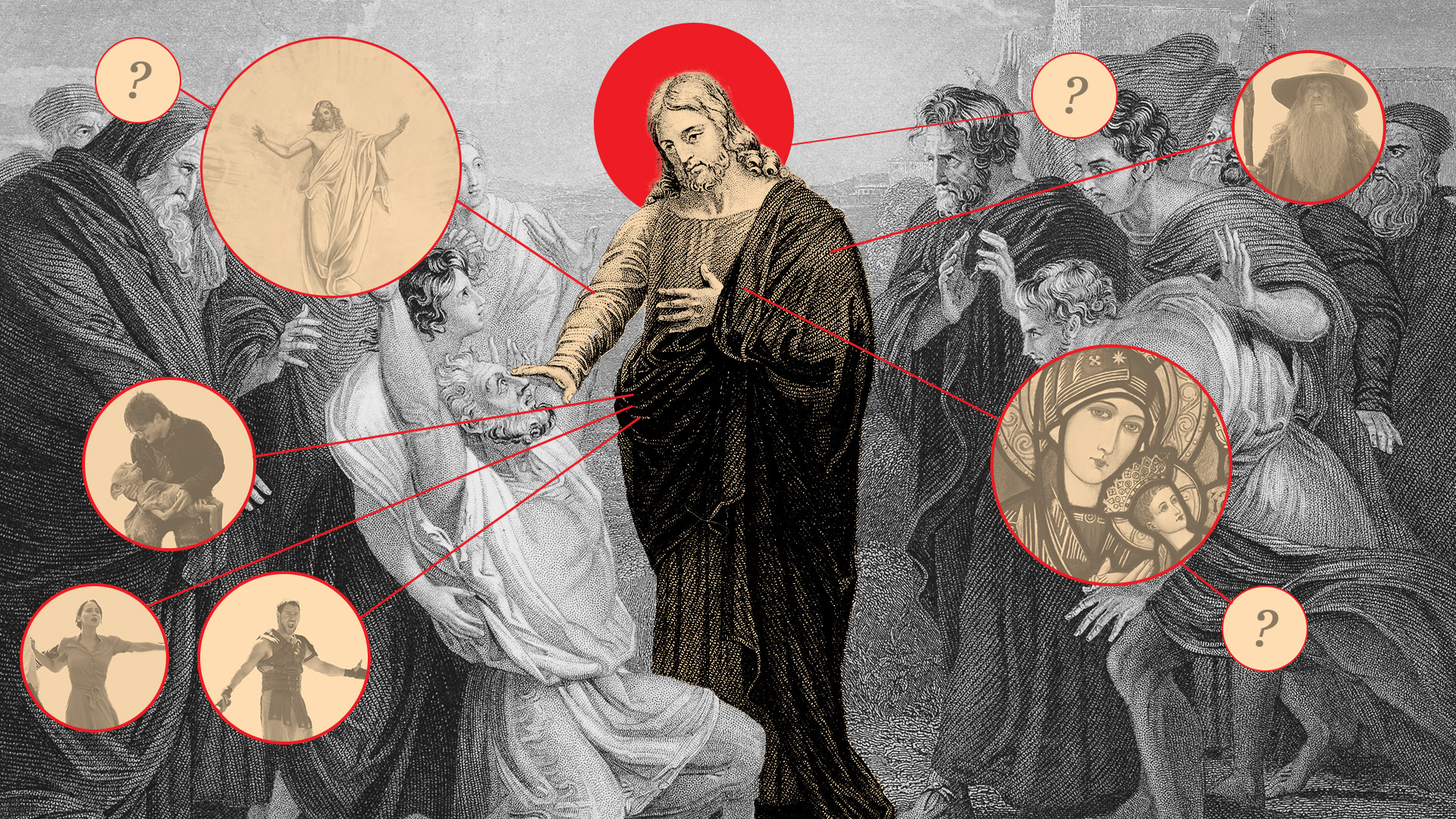
Although Confronting Jesus is grounded in Scripture, one element some readers might find distracting is the number of references to films, books, and plays McLaughlin uses to clarify her points. That said, if you enjoy seeing connections between faith and pop culture, you’ll love how easily McLaughlin makes them. For example, she uses films like Gladiator and Lord of the Rings to show how Jesus is the hero no one expected. Who would have thought that the son of a Jewish carpenter would save the whole world?

Other films dramatize themes of sacrifice. Our hearts are broken when we see Dobby die for Harry Potter or when Katniss stands in her sister’s place in The Hunger Games. How much more should our hearts break knowing Jesus suffered for us? Like Paul on Mars Hill, McLaughlin employs familiar cultural and philosophical ideas to teach truth.

I’m always looking for books I can recommend to Christians and non-Christians alike. Confronting Jesus fits that bill. It reminds Christians of their calling to think and act like Jesus, and perhaps it will help non-Christians see Christ clearly for the first time. All will walk away with a deeper understanding of the one McLaughlin calls the “shepherd and the sacrificial lamb,” the “one true God made flesh.”

Lindsey Medenwaldt is director of ministry operations at Mama Bear Apologetics.

Books
Review

From the Rise of the ‘Nones’ to the Indifference of the ‘Never Weres’

A sociologist observes the changing tides of American antireligion.

Tim Peacock

Nonverts: The Making of Ex-Christian America, by Stephen Bullivant, is really two books in one. Book 1 consists of interviews with a variety of Americans who, though raised in households that were recognizably religious, now describe themselves as nonreligious. They converted out and became the sort of people who check “no religious affiliation” on surveys. And they are now part of a subgroup that sociologists call “nones.” Bullivant uses the term nonverts to describe the subset of nones who were once affiliated but now are not.

Nonverts: The Making of Ex-Christian America

Nonverts: The Making of Ex-Christian America

Oxford University Press, USA

272 pages

$27.61

Bullivant argues that nonverts deserve special attention. Many people have no religious affiliation. But the nonverts, the formerly religious, view their nonaffiliation differently from those Bullivant calls “cradle nones.” The story of how nones recently rose to be 30 percent of American adults hinges on understanding the proliferation of nonverts. The past three or four decades of religion in America are defined by adults leaving religion. If you fail to understand what might be called “nonversion,” you cannot understand the rise of the nones.

Something has shifted

Bullivant’s theory of why and how this happened comprises book 2.

The chapters move back and forth between book 1, the interviews, and book 2, the theory. Their titles are laden with language gags that would leave even the most devoted punsters stifling groans and eye rolls.

Take, for instance, the chapter that introduces the theoretical narrative, which Bullivant titles “None the Up and Up.” (If you don’t care for this sort of wordplay, you may want to skip past this paragraph.) Next comes interviews with Mormons (“When the Saints Go Marching Out”). Then a theoretical chapter defining the nones (“None Specific”). Then interviews with members of the old mainline (“Flatline Protestants”). Then a chapter of historical context (“Nothings Come from Nothing?”). More interviews (“Exvangelicals”). More theory (“The Ex Effect”—and here the author really lays out the book’s core argument). More interviews (“Recovering Catholics”). And then the theoretical finale (“Nonvert Nation”).

If listing all nine chapter titles seems a little much, I would argue that they give a better flavor of Bullivant’s writing style than any description I could offer.

If you are not especially interested in theory as such, please do not let my use of that term put you off this book, which is not especially theoretical in any labored academic sense. However, if you read the chapters I’ve called “theory” and the footnotes, which are copious and very interesting, you’ll find a clear story being told. That story, in a nutshell, is this: “The rise of the nones, fueled primarily by an extraordinary two or three decades of … nonversion, marks a decisive moment in American religious and cultural history.”

Bullivant hopes you will read the theory and the footnotes, but he tries to make this book accessible to nonsociologists by saying things like this about the more technical parts: “They are there for the benefit of readers who like or need these kinds of academic accoutrements. Others may simply allow their eyes to skim over the little numbers floating in the text, safe in the knowledge that they’re mainly missing out on bibliographic details and dad jokes.”

Even if you do skip the stats and the notes, you will find the theory helpful. The details about nones in the “None Specific” chapter are clear. If you read studies from political scientists like Ryan Burge or sociologists of religion like Mark Chaves, you may know some of this already, but Bullivant does a good job of summarizing the relevant findings.

The history provided in “Nothings Come from Nothing?” is even more helpful. Something has clearly shifted in American culture—and though some of this shift is recent, it is grounded in changes that came much earlier. Several million people did not randomly, suddenly have several million individual changes of heart in the space of 40-odd years. Kudos to Bullivant for his cultural history, summarized in six clear statements at the end of the chapter.

“The Ex Effect” lays his argument out most clearly. America really has become less religious and, more specifically, less Christian, over the past several decades. In the middle of the 20th century, the Cold War reinforced the ideal of godly America as a counterpoint to godless communism. As the Cold War faded, however, the option of not having a religious affiliation became normalized. The tide turned slowly, but turn it did. Religion’s ability to maintain traditional authority over against the many forms of burgeoning personal choice available in ideas, sexuality, gender identity, and so on, weakened.

This led, as we now know, to a flurry of activist antireligion (think Richard Dawkins and other New Atheist celebrities). Interestingly, though, Bullivant believes this vibrant antireligion will tail off soon enough. Right now, nonreligion is fueled by several decades’ worth of ex-religionists who have strong reasons, often emotional and sometimes very painful, for leaving. But soon enough, nonreligion will be one more mainstream viewpoint, and there will be more cradle nones than ex-religionists. At that point, as Bullivant sees it, antireligious activism will slow down because, in essence, most nones will no longer care very much. They won’t be therapizing the loss of their old religion; they’ll just be none the way other people are Protestant or Catholic.

Roughly here is where a reviewer says, “But I do have some concerns,” so here are mine. First, the introduction to this book hints that it will be a qualitative study based on interviews with ex-Christians of various kinds. But in the end, it is an argument that nonverts are the real story of the nones—an argument Bullivant was gestating long before these interviews were conducted. That argument is the real book, with the interviews there to add color and texture. If you pay attention to much religious journalism, you can correctly guess what soured ex-Mormons, ex-mainliners, exvangelicals, and ex-Catholics on the religion of their youth. Their stories in the interview chapters are believable, but this is not a qualitative study in the sense that the argument rises up from their narrated experiences. This is the story of what happened, and why, with personal narratives thrown in for ballast.

The theory, especially the theory supported by the statistics and footnotes, would seem to be for sociologists and social psychologists. The author believes they have mostly missed this key distinction, the part about “ex” being so different than simply being “none.” Says Bullivant, “In truth, and as is often the case, sociologists are late in catching up to what common sense screams at us” about why the exes are different. Basically, as he explains, there are lots of people we are not married to, but our ex-spouse is qualitatively different from all the others.

The underlying story

It is tactless for a reviewer to talk about the book he or she would have written instead, but I will suggest two possible insights here, because I think they are relevant to digesting this book.

First, perhaps the underlying story is really the flourishing of individualism. Many Americans now define themselves as self-actualizing in myriad ways. Yes, many abandoned the discipline and authority of religion—this is self-evidently true—but many also abandoned traditional gender roles and identities, traditional strategies of household formation, and traditional vocational or educational models. Their movement away from religion might be exactly the same as their movement away from many other kinds of belonging.

This hypothesis, if true, does not make Bullivant wrong, but it puts his story in a much larger context. In a world where individual desires trump every kind of organizational authority, leaving one’s religion is just one more case of a general trend.

Second, it is easy, and frequently unfair, to plead “diversity” against any theory, because no theory can cover every different situation. But this story of nonverts sure sounds like a “white people” story. In Britain, where Bullivant lives and works, immigrant religion has led a comeback in religious participation, even though it has done little for the established Anglican communion. Could it be that a segment of white Mormons, white mainliners, white Catholics, and white evangelicals are headed one way in America—out of religion—but the rest of America is, taken together, headed the other way?

The secularization of white, Western countries is a global anomaly, not the rule. The world will get steadily more religious in the next century, primarily due to growth in birthrates in Muslim countries, growth of Christianity in the Global South, and—if Purdue University religion scholar Fenggang Yang is correct—growth of Christianity in China.

America appears to be headed toward a non-white majority very soon, so maybe the present story of religious decline actually has a very different ending. The majority of children in the U.S. today are not of European descent. We are witnessing white, European America experiencing its own version of what happened to white Europe, but perhaps a new religious tide is coming in just as these older remnants are drifting out.

Those two points notwithstanding, the change in religion noted by Bullivant is very real, and his argument about nonversion leading this change is convincing. If you are interested in the story of decline in certain traditional forms of American religion—and if you work in the field of American religion, you should be—this book is worth a look.

Arthur E. Farnsley II is research professor of religious studies at Indiana University–Purdue University Indianapolis. He is senior research fellow for The Center for the Study of Religion & American Culture.

Apple PodcastsDown ArrowDown ArrowDown Arrowarrow_left_altLeft ArrowLeft ArrowRight ArrowRight ArrowRight Arrowarrow_up_altUp ArrowUp ArrowAvailable at Amazoncaret-downCloseCloseEmailEmailExpandExpandExternalExternalFacebookfacebook-squareGiftGiftGooglegoogleGoogle KeephamburgerInstagraminstagram-squareLinkLinklinkedin-squareListenListenListenChristianity TodayCT Creative Studio Logologo_orgMegaphoneMenuMenupausePinterestPlayPlayPocketPodcastRSSRSSSaveSaveSaveSearchSearchsearchSpotifyStitcherTelegramTable of ContentsTable of Contentstwitter-squareWhatsAppXYouTubeYouTube