News

Gen Z Evangelicals Vote More than Millennials or Gen X Did

New study finds believers aged 18 to 25 more likely than peers or previous generations to get involved in civic engagement.

A young person votes in the midterm election at a Church of Christ in Indiana.

A young person votes in the midterm election at a Church of Christ in Indiana.

Christianity Today November 11, 2022
Drew Angerer/Getty Images

Lydia Franklin says the leaders of her church don’t talk much about politics. But they do talk about Jesus, his commands to love your neighbors, and the importance of Christians helping others.

So when the 18-year-old went to the polls for the first time this election, those are the values she took with her into the voting booth.

“To be evangelical is to follow Jesus Christ and to do as he teaches in the Bible,” said Franklin, who lives in Oklahoma. “I feel that as Christians, we are called to help people. What better way to help than to vote for people that will get the job done?”

Franklin was part of the estimated 27 percent of Gen Z that voted in the midterm election—a notably higher turnout rate than millennials and Gen Xers when they were between the ages of 18 and 29.

The turnout doesn’t surprise Kevin Singer, president of nonprofit Neighborly Faith (NF). He has been looking at younger evangelicals’ civic engagement and the influences on their politics.

A recent NF study, done jointly with Philanthropy for Active Civic Engagement and Springtide Research Institute, surveyed nearly 2,000 people ages 18 to 25, oversampling those who identified as evangelical (24%) and born-again (54%) and asking questions about their views of Jesus and the Bible. They wanted to see how faith shapes civic engagement for Gen Z. What they found is that Gen Z evangelicals are activists.

More than half say it’s important for them to vote, but about 45 percent say they also get involved in community service and fundraising. They are more likely than their nonevangelical, non-Christian, and nonreligious peers to say they believe in advocating for a cause, engaging with local government, and even protesting.

“Young evangelicals are consistently engaging with the civic and social and political life of this country, more so than their peers of other faith groups, of other Christian groups,” Singer said. “There’s something about being evangelical, I think, in America as a young person that just draws you out into society and draws you into social and political issues and draws you into political conversations. It draws you into having a really strong opinion about issues of concern in our society and in our elections.”

Evangelicals of color lead the way in every measure of civic engagement, according to the study. But even white evangelicals, considered separately, were 10 points more likely than their nonreligious peers to say that they protested and 15 points more likely to say they engaged with a community group.

And Gen Z is also less likely than older cohorts to be partisan.

“It was extremely unlikely that young evangelicals would contribute to a ‘wave’ in either direction [in the midterm election],” Singer said. “Our data shows this group watches CNN and Fox News at the same rates. They listen to both Ben Shapiro and Bernie Sanders.”

Other media figures they listen to for political perspective include Donald Trump and Joe Biden, Elon Musk, Candace Owens, Jimmy Kimmel, and Joe Rogan. The majority of the younger evangelicals say they are not taking their cues from media figures, though. They are more likely to look to their religious leaders.

Nearly 40 percent say their political opinions have been influenced by a religious leader. “Prayer leaders” were ranked most influential in this aspect of their lives (approximately 48%), followed by assistant pastors (43%), pastors (41%), camp leaders (39%), and worship ministers (37%).

Only 16 percent of young evangelicals said leaders in the church don’t impact their politics at all.

The religious influence may be more clearly seen with some issues than others, though. Gen Z evangelicals said they were most influenced on the topics of education, health care, COVID-19, abortion, and economics (in that order). The survey also asked about crime, prison reform, gun violence, climate change, immigration, LGBT issues, and foreign policy but found few felt that religious leaders influenced their views on these topics.

According to Singer, however, younger evangelicals like Franklin are thinking less about specific issues than they are about values. When they go to the polls, they’re looking for ways to coherently connect their faith-formed values with their vote.

“Coherence is really important for young people—to feel like their values are truly represented in what they’re engaging in,” Singer said. “They need to know that there is coherence in how they’re behaving politically in the world.”

They also may not ask about specific issues. Kirby Neely, the students’ senior director and pastor at Woodmen Valley Chapel, a multisite church in Colorado Springs, says the young people he sees don’t talk about politics a lot.

“Our broader cultural backdrop has led many students to wonder whether politics will harm relationships, even in the church,” he said.

They build relationships first and talk about issues with people they can trust. And even then, they’re more likely to focus on broader and deeper values than anything that seems “hot button.”

Franklin relates to this. She cares about issues, but when she thinks about voting, she thinks about her faith and how as a Christian she is called to “love people for who they are and to help people in any way I can.”

She doesn’t claim to speak for her generation, saying she personally believes that if the “right people got out to vote,” the democratic process would be an effective tool for change. She’d like to see it change so that poverty is eradicated or at least significantly decreased. She’d like there to be less inequality and wants to see unhoused people given homes.

“I hope to see more acceptance for others, no matter what they look like or who they are,” she said.

And ultimately, for Franklin, all this is about faith—living out her love for Jesus in a way that others can see.

“Through my actions,” she said, “I can then hopefully lead more people to Christ."

Culture

Ancient Stone Marks China’s First Encounter with Christianity

What the Xi’an stele reveals about the rise and fall of the Nestorian church in the Tang Dynasty.

Left: 1907 photograph of the Xi'an Stele, on its turtle (Bixi) pedestal. Right: A Nestorian tombstone from Quanzhou.

Left: 1907 photograph of the Xi'an Stele, on its turtle (Bixi) pedestal. Right: A Nestorian tombstone from Quanzhou.

Christianity Today November 11, 2022
Illustration by Mallory Rentsch / Source Images: WikiMedia Commons

Earlier this year, scientists announced that the Black Death had originated in the Tian Shan mountain ranges that pass through Kyrgyzstan, Kazakhstan, Xinjiang (China), and Uzbekistan. Evidence for this revelation came after studying DNA from human remains in two 14th-century cemeteries in Kyrgyzstan. These are well-known archaeological sites , and on one of the tombstones is an inscription in Old Uyghur indicating Nestorian Christian beliefs.

Today, this tradition of Christianity largely exists in the Middle East and is known as the Assyrian Church of the East. Most of the Christians brutally killed by the Islamic State in Syria and Iraq in recent years belonged to this church that shares the Nestorian Christology. Despite the narrow geographic region they inhabit today, the church once sent missionaries out across Asia, eventually entering China in the seventh century.

In A.D. 451, the Council of Chalcedon affirmed the full deity of Christ, the full humanity of Christ, Christ being one person, and that the deity and humanity of Christ were distinct and not blurred together. This theology was adopted by Roman Catholics, Eastern Orthodox churches within the Roman Empire, and later by post-Reformation Protestants. However, five Oriental churches, most of which were outside of the boundary of the Roman Empire, refused to accept the Chalcedon definition of faith: the Armenian Church, the Coptic Church, the Assyrian (Syriac) Church, the Ethiopian Church, and the Indian Church of Malabar. Their split from the church within the Roman Empire caused the first great schism in Christianity.

In the fifth century, the Assyrian Church of the East was founded in Persia through a merger of the Roman Empire’s Antiochian Church and the Assyrian Church. The followers of this sect regarded Nestorius as a saint, in spite of the fact that the archbishop of Constantinople had been accused of heresy and anathematized at the Second Council of Ephesus in 431.

Nestorian Church enters China

The Nestorian Church had a high level of zeal for foreign mission. Throughout the sixth century, they sent missionaries across Central Asia, the Mongolian desert, China, and what is now India, establishing a large number of churches in these areas. The church spread throughout Western and Central Asia and along the Silk Road to China in the seventh century, providing the earliest encounter between Christianity and ancient Chinese civilization. It later flourished in China during the Tang Dynasty (618–907).

In 2019, the Chinese historical TV drama series The Longest Day in Chang’an became popular in China, and its 20th episode takes place in a “jing (Nestorian) temple.” It attempts to recreate the splendor of the ancient Nestorian church’s architecture prompted Chinese viewers to wonder what religion the temple belonged to.

In Chinese, the ancient Nestorian Church is called jing jiao (景教), or “the Religion of Bright Light.” After the fall of the Tang dynasty, the arrival of Nestorian Christianity in China was forgotten and only discovered later in history because of a monumental stele (slab).

Known as 大秦景教流行中国碑 (“Stele of Flourishment of Roman Nestorian Church in China”), or “Xi’an Stele” or “Xi’an Monument” in English, it is one of China’s national treasures and considered by scholars to be an critically important record of the exchange between ancient China and other cultures. It is regarded as one of the four most representative ancient monuments in the world, along with the Rosetta Stone, the Mesha (Moabite) Stone, and the Aztec Solar Calendar Stone.

“As early as the fifth and sixth centuries, groups of Syrian monks crossed Central Asia and brought the name of Jesus to your forebears,” wrote Pope John Paul II in a letter to Catholics in China in 1999. “Even today, a famous stele in the capital Chang’an (Xi’an) powerfully evokes that moment in history, from 635 onwards, which saw the official entrance into China of ‘the Religion of light’.”

The stone tells the story

In A.D. 781, missionary Yazdhozid (伊斯) erected the Xi’an Stele in the courtyard of a Nestorian church. Engraved by a Persian missionary named Adam (景净) and written by Lü Xiuyan (吕秀岩), a military officer in Taizhou, the inscription has a total of 1780 Chinese characters and hundreds of Syriac characters. Some of this text articulates the theology of Nestorianism:

Therefore, our Messiah (弥施诃), sent by the Triune God, the Bright and Glorious One, hid his glory and came to this world, humbling himself as a man. God sent an angel to announce the good news of a virgin giving birth to the Son in the Roman Empire. He established a new religion of the Triune God, guided by the Holy Spirit, so man can be justified by faith.

The stele text also recounts the arrival of Nestorianism. According to it, in the ninth year of Emperor Taizong’s (太宗) reign (A.D. 635), a Nestorian “man of great virtue” (大德, the title for a bishop) named Alopen arrived in China. The emperor received Alopen in the royal court in Chang’an and invited him to the palace library to translate the scriptures of his religion.

Taizong personally inquired about this new religion, and felt its teachings were righteous, true, and suitable to pass on to the general populace. Three years later, he issued a royal edict to establish a Nestorian Temple (Yining Fang) in the city. Twenty-one Nestorian monks were ordained to manage the church. A colorful and vivid portrait of Taizong was hung on the wall of the temple.

Historians believe that Alopen was likely a Turkic-speaking Persian. Emperor Taizong probably also spoke the Turkic language—his grandmother, mother, and wife were all from a Turkic-speaking nomad ethnic group called Xianbei, and the two probably conversed directly.

The stele was lost after the emperor banned foreign religions in China in the ninth century and was buried during one of the many wars in later Chinese history. In 1623, during the reign of Xizong of the Ming Dynasty, laborers unearthed it in the outskirts of Xi’an. After they informed the governor, he visited the site himself and had it installed on a pedestal.

The newly unearthed stele attracted attention of local Chinese intellectuals. One of them, a newly converted Christian, identified the text as Christian in content. He sent a copy of the stele text to Li Zhizao (李之藻)—a Christian convert through Matteo Ricci, the first Jesuit missionary in China—and a deputy minister in the Ming court. Li published the text and told the Jesuit missionaries about it.

Many Western missionaries learned about the stele and scrambled to topograph it and translate the text into European languages. Fearing that the stele might be stolen by the Westerners, the locals secretly moved the stele to a nearby Buddhist monastery, Jinsheng Temple, and asked the Buddhist monks to take care of it. Meanwhile, many Westerners urged the Qing Dynasty (1636–1912) government to protect the stele.

At the beginning of the 20th century, Frits Vilhelm Holm, a Danish adventurer, attempted to buy the stele and ship it to London for preservation. When Rong Qing, the minister of education , was informed of the potential purchase, he ordered the governor of Shaanxi to stop the sale. In the end, Holm agreed to void the purchase contract, but he was allowed to produce a same-size replica of the stele and bring it back to London. In 1907, the Shaanxi governor had the stele deposited in the Xi’an Beilin (“Steles Forest”) Temple (now the Xi’an Beilin Museum), where it resides today.

After Holm returned to London, he made a batch of copies from the replica he transported from China and distributed them to universities in various countries. Today, these replicas exist in Washington, DC; Rome; Mount Kumgang, North Korea; Kyoto and Kasugai in Japan.

History’s lessons for Christian mission

Nestorian Christianity was practiced through the reigns of 10 emperors in the Tang Dynasty. According to the stele text, Christianity was “in all 10 provinces,” Nestorian temples “filled over 100 cities,” and the believers’ families “were wealthy and blessed.” It counted among its converts Guo Ziyi (郭子仪), a famous general and the prince of Fenyang.

In A.D. 845, Emperor Wuzong (武宗) ordered the “annihilation of Buddhism,” a proclamation that also impacted other religions from foreign countries, and banned the Nestorian Church. Christianity had flourished in the Tang Dynasty for over 200 years, but overnight it vanished.

As a church historian, I can’t help but ask: How could Nestorianism, which had been in China for 210 years, disappear so quickly? Why was Buddhism able to make a comeback and later thrive in China? But perhaps we can learn a few lessons from the mission strategy of the Nestorians.

When the Nestorian Church entered China, it was clearly dependent on the traditional philosophy and religions of China—Confucianism, Buddhism, and Taoism, especially Buddhism. Buddhism was prosperous and powerful in the Tang Dynasty, to the point where its leaders didn’t fear minority religions from the West , and the Tang emperors responded tolerantly toward Nestorianism.

The Nestorian Church called its churches “Jing Temples” (景寺) and its clergy “monks” (僧侣), using the same words for Buddhist temples and monks. In order to pursue vernacularization and because qualified translators were few, the Nestorians borrowed significant Buddhist and Taoist language and terminologies in their translation of biblical and theological terms. For example, they used “clean wind without speech” (浄风无言) to refer to the Holy Spirit, “cultivating goodness through the right faith” (陶良用于正信) for justification by faith, and “shaving the head” (剃度) for the ordaining of priests.

Moreover, the Nestorian Church adopted the strategy of “mission through politics,” taking a high-level approach to influence high-ranking officials of the imperial court to come to faith, gaining the emperor’s attention and the patronage of princes and ministers.

However, such strategy proved to be too dependent on Chinese culture and political power. When Emperor Wuzong became a Taoist and was influenced by Taoist priests to “exterminate Buddhism,” Nestorianism was directly implicated and became the target of eradication.

Although the high-level route won temporary official acceptance for Nestorianism, the spread of the faith was limited to the scholarly class and did not reach the general public. Thus, compared to Buddhism, which was also a foreign religion, Nestorianism remained marginalized because of its small number of followers and weak influence among grassroots people. Once the support of the ruling class disappeared, the church’s resources were dealt a severe blow.

Such a mission approach would also weaken the truth of the gospel. As Guizhou University scholar Liu Zhenning said in his journal paper:

In order to take root and make their voice heard in a foreign country as soon as possible, in the process of translating the classics and expounding the faith, the (Nestorian) believers relied totally on the various resources of Chinese culture. … But this was done at the expense of tampering and diluting the doctrines and theological thoughts of the Christian gospel they preached.

Although Nestorianism was later vindicated against the accusations of heresy by many Christians, the “Sinicized” version of Nestorianism may have just been a syncretistic faith that differed from the orthodox Christian belief.

This is worthy of reflection by Christians with a mission mind today. The issue of contextualization, or the relationship between the Christian faith and Chinese culture and the relationship between church and state, must be faced and paid attention to in the later development of Christianity in China and in the mission work of the Chinese church today. It is my hope that understanding and reflecting on the history of Nestorianism in China will be beneficial to the future development of Christianity in China.

T. N. Ho is a researcher of church history living in Southern California. He has been engaged in teaching and training among Chinese churches both in China and overseas for many years. He is the author of The Gap in History: Footprints of Christian Mission Along the Silk Road.

Part of this article was published on the website of Behold magazine. Re -published with permission of Behold and with expansion and revision.

Translation by T. N. Ho and Sean Cheng

News

Ethiopia-Tigray Peace Agreement Contains Biblical Mandate

Two-year war ends with the African Union’s first test of transitional justice, as believers continue to debate the rights and wrongs of each side.

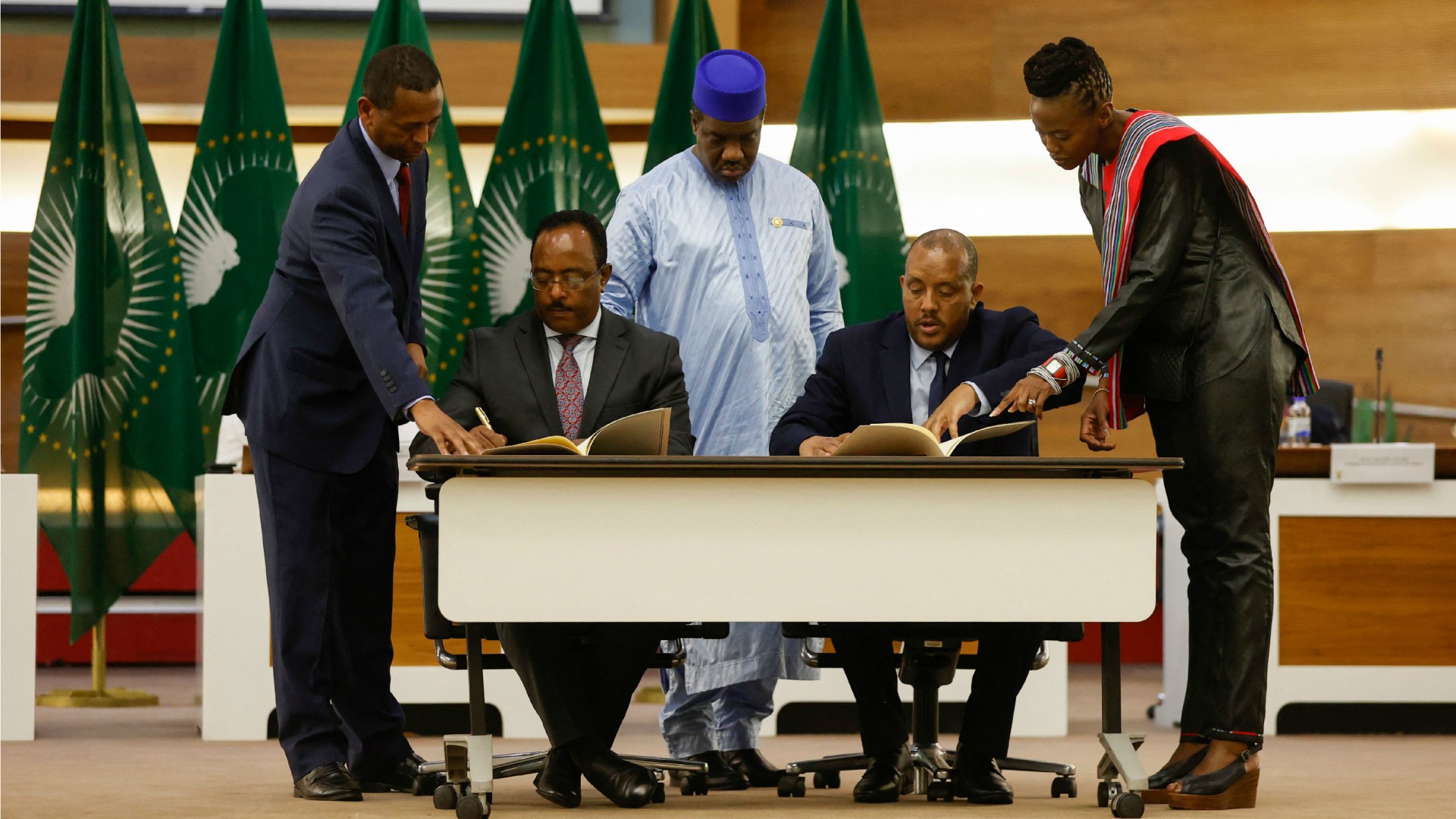
Ethiopian government representative Redwan Hussein (second left) and Tigray People's Liberation Front (TPLF) representative Getachew Reda (second right) sign a peace agreement during a press conference regarding the African Union-led negotiations to resolve conflict in Ethiopia, in Pretoria on November 2, 2022.

Ethiopian government representative Redwan Hussein (second left) and Tigray People's Liberation Front (TPLF) representative Getachew Reda (second right) sign a peace agreement during a press conference regarding the African Union-led negotiations to resolve conflict in Ethiopia, in Pretoria on November 2, 2022.

Christianity Today November 11, 2022
Phill Magakoe / AFP / Getty Images

The Ethiopian war in Tigray is over.

On November 2, federal forces and rebel authorities agreed on a “cessation of hostilities,” ending a conflict believed to have killed hundreds of thousands and displaced millions. All sides committed abuses, as documented by the Ethiopian Human Rights Commission and other international observers.

“No one has been clean in this war,” said Desta Heliso, a visiting lecturer at the Ethiopian Graduate School of Theology. “As Christians, we have to feel sorry about this.”

The peace agreement, however, provides for a biblical mandate.

Most negotiations concerned military realities. The two-year conflict in the Horn of Africa nation’s northernmost region—home to 7 million of Ethiopia’s 120 million people—vacillated in advantage between the two sides and between hostilities and humanitarian truce.

The United Nations stated 5.2 million Tigrayans need assistance.

But as federal forces pressed deeper into Tigray, peace talks sponsored by the African Union (AU) in South Africa concluded with an agreement for complete disarmament of the Tigray People’s Liberation Front (TPLF) within 30 days. National troops may enter the regional capital of Mekele; assume control of all borders, highways, and airports; and expedite humanitarian aid.

Both sides agree to cease defamation campaigns, and the central government will ensure restoration of communication, transportation networks, and banking services.

But long-term peace may depend on the outcome of a minor clause included among the 15 measures. The federal government agrees to conduct a “comprehensive transitional justice policy” consistent with the AU framework.

Ethiopia will be the first experiment in implementation.

“The possibility for reconciliation is there,” said Heliso, who was formerly vice president of the Kale Heywet Church, one of Ethiopia’s largest evangelical denominations. “But some claims for justice will have to be given up for peace, painful as it might be.”

That may not be necessary.

Adopted in 2019, the African Union’s 2019 Transitional Justice Policy (AUTJP) goes beyond criminal accountability—while ensuring impartial investigation—to set up measurable standards for reconciliation, reparation, and memorialization of the conflict. It establishes commissions, employs traditional conflict resolution mechanisms, and requires the participation of women and other vulnerable groups.

“We now have a Transitional Justice Toolkit,” wrote Moussa Mahamat, chairperson of the AU Commission, in the forward, “that is home-grown … rich in its progressive methodologies and approaches, and rooted in African shared values.”

Now it just needs to be followed.

“The devil will be in the implementation,” stated former Kenyan president Uhuru Kenyatta, who helped facilitate the talks.

The Ethiopian federal government has since lifted the designation of TPLF as a terrorist entity, while the AU—responsible to monitor the peace agreement—has begun translation of the AUTJP into Amharic (Ethiopian).

The UN called the agreement a “welcome first step,” while urging both sides “to continue … in a spirit of reconciliation, in order to … silence the guns and put the country back on the path to peace and stability.”

Many analysts viewed the agreement as a capitulation by Tigray forces. Getachew Reda, head of the TPLF delegation, agreed there were concessions, necessary to “build trust” in the negotiations to come.

Ethiopian prime minister Abiy Ahmed viewed it as a win.

“We need to replicate the victory we got on the battlefield in peace efforts, too,” he stated. And addressing the Tigray people, he said, “Tricks, evilness, and sabotage should stop here.”

Abiy, who won the Nobel Peace Prize in 2019 for ending hostilities with neighboring Eritrea, hailed the agreement amid his nation’s “steadfast” commitment for peace. Significant ethnic tensions and outbreaks of violence continue in the Oromia, Somali, and other regions of Ethiopia.

Heliso linked these to the TPLF seeking to undermine the government. With joy and elation, he said his hope for Ethiopia “quadrupled” once the Tigrayan fighters agreed to lay down their arms.

Abiy, who came to power in 2018, was once part of the ruling TPLF coalition, which dominated Ethiopian politics for 27 years. But as the Oromo evangelical leader began reforms and expanded human rights, he also established a national political party to lessen Tigray predominance.

Tensions leaped during COVID-19, when Tigray held regional elections in defiance of Abiy’s decree to postpone voting nationwide. The war began when rebel forces attacked a federal army base, escalating when the Eritrean military—despite Ethiopian denials—joined in the government’s southern attack by invading from the north.

The worst atrocities have been blamed on Eritrea.

Analysts noted possible weaknesses in the peace agreement in failing to mention this longstanding enemy of the TPLF, or the disputed territories between the Tigray and Amhara regions that also witnessed fighting.

Meanwhile, other Tigray parties and organizations condemned the agreement.

Disarming the regional force is “completely catastrophic,” said Meron Gebreananaye, coeditor of the Tghat media company, which documented federal atrocities during the war. Not politically affiliated, she agreed with their fears.

“It is inconceivable that peace negotiations did not factor in an international peacekeeping force to protect the people of Tigray through a transitional period of national reconciliation,” said the PhD student in theology at the University of Durham in England. “The people of Tigray do not bear guilt for holding their ground in the face of genocide.”

She cited international organizations that warned of military deployments before the war began, as evidence of Abiy’s effort to “fully incapacitate” a political rival. She recognized the Eritrean president as a “perennial spoiler” of peace, condemning the “complete siege” that devastated her region.

But she included religious actors in her doubts about transitional justice.

“The churches of Ethiopia have been part of the problem due to ethnic allegiance or religious kinship with those in power,” said Gebreananaye, a Baptist. “Many are themselves in need of reconciliation and truth.”

Tigray is overwhelmingly Ethiopian Orthodox, the faith expression of about 44 percent of the national population. Evangelical denominations, often called P’ent'ay and mostly Pentecostal, total about 19 percent nationally and are most numerous in the southwest, while Muslims make up about 34 percent of the population.

Amnesty International shares Gebreananaye’s concern, noting “rampant impunity” on the part of the government.

Heliso said that several offending soldiers have been tried and imprisoned, with investigations ongoing.

Abiy, he predicted, would forgive many Tigray offenders. Lawmakers would return to their parliamentary posts following elections. And the government is worthy of trust, having previously announced two unilateral humanitarian ceasefires later broken, he said, by the rebels.

At the least, the government should be respected.

“People don’t realize how hard our ministers struggle to balance their Christian faith with the need to keep constitutional order,” Heliso said. “Sometimes, by force.”

But beyond the TPLF, his ire was pointed outward.

“Keep the human rights organizations away from us, with their political agendas,” he said. “Let us use our Christian values to deal with our own wounds, ourselves.”

Even for the UN he had “little respect,” and he was optimistic that the AU brokered the agreement and will continue to monitor it. Heliso recently created Sophos Africa, a secular civil society organization, to find African solutions within the Judeo-Christian heritage to the corruption, tribalism, and religious extremism that plague the continent.

Despite her different analysis, Gebreananaye expresses “cautious optimism” about the agreement, hoping it will at least end the brutal conflict. Peace, however, will depend on widespread social transformation and official accountability.

“We have all been wounded, and now must become wounded healers,” echoed Heliso, “while keeping a balance between justice and peace.”

Church Life

Without Answers, Long COVID Patients Keep the Faith

The uncertainty of the condition makes it a challenge for sufferers and caretakers.

Christianity Today November 11, 2022
Illustration by Mallory Rentsch

Christian psychologist Ashley Trieu thought she had already come to terms with her body’s limits.

After years of questioning, she began to accept her cerebral palsy on a mission trip to Africa 15 years ago when she and her group leader, who is quadriplegic, discussed Paul’s thorn in the flesh.

“I realized that God had chosen to heal me at a spiritual and emotional level but not physically,” said Trieu, now a 35-year-old mother of two. “And by the end of that trip, I was not just tolerating [my disability] but embracing it.”

Then came the coronavirus.

In 2020, COVID-19 landed Trieu in the hospital. Her bout with the virus necessitated bimonthly autoimmune infusions that she will need the rest of her life. It also made her realize how much she still expected a certain level of control over her health—and how she’s needing “to rest more in the Lord’s embrace.”

Trieu is one of an estimated 7 million to 23 million Americans who are experiencing long COVID. Around 10 percent to 20 percent of those who contract the disease continue to have symptoms months later; they vary in severity but often include fatigue, brain fog, and breathlessness.

Scientists are still studying what’s behind long COVID, whether the infection persists in tissues and creates inflammation, triggers autoimmune issues that become chronic, or reactivates latent viruses like Epstein-Barr.

Regardless of the etiology, one thing is clear: Both patients and clinicians are learning to live with more uncertainty. And the people around them—family, friends, and church members who seek to care for those with this complex illness—must help them adjust to their new normal.

While church communities regularly care for the sick in their flock through prayers and meals, long COVID isn’t the same as other illnesses. It’s a new condition that emerged in the midst of political clashes and social isolation. There are no clear tests for it, and no timeline for healing. In many ways, it resembles other complex, poorly understood diseases like chronic fatigue. Sufferers can feel misunderstood and are often looking for people to believe them and take their pain seriously.

It meant a lot to Melody Maxwell that her fellow church members in Wolfville, Nova Scotia, brought meals for her for months at a time while she was too ill to grocery shop and cook for herself.

Maxwell has been living with long COVID since a 2020 infection abruptly curtailed her active church life, hiking activities, and rigorous teaching schedule as an associate professor of Christian history at Acadia Divinity College.

“I appreciate those who have stuck with me throughout these long months,” said Maxwell, who has kept friends and fellow Wolfville Baptist Church members updated through her blog. “I wish I weren’t in it for the long haul, but I’m grateful for those friends near and far who haven’t forgotten me throughout it all.”

Beth Crosby is a fellow church member and retired grandmother of seven who has kept in touch with Maxwell regularly through this process.

“I think it’s important to trust and respect the person’s process, and maintain hope on their behalf,” said Crosby. “Our hope is in an eternal God. This allows us to walk alongside a person in uncertainty.”

But others haven’t experienced the support and care they expected. Trieu, who previously served on staff at her church, thought of her community as a place of safety and acceptance. As she suffered from long COVID, their silence was devastating. “There was no real follow-up, no meals,” she said. “It was tough because I had considered these people my family.”

Many in her church were skeptical of masks and vaccination. “Some saw masks as a liberation thing or a fear thing, but I just saw it as a safety thing,” said Trieu, who lives in Kalamazoo, Michigan. “To me it was no different than a peanut allergy. Would we tell someone we wouldn’t accommodate them and to not be afraid?” She and her husband have begun visiting other churches.

Dean and Karen Fritzemeier of Muskegon, Michigan, also changed churches as a result of long COVID, which Dean contracted in October of 2020.

Before then, the 52-year-old walked seven miles a day, taught math at a community college, and served as a deacon at church. His severe long COVID symptoms have left him unable to work, and he relies on a wheelchair to get around outside the home.

“My brain fog feels like a constant heavy dose of Benadryl,” said Dean Fritzemeier, noting that this is a blessing and a curse—it’s hard to think clearly but it also dulls the pain of reflecting on his condition.

Karen Fritzemeier, who has struggled with chronic health issues herself, stopped homeschooling their two children to return to work to support the family.

“I wrestle with forgiving people, but God has taught me how to forgive and show grace, while also setting boundaries,” she said. Their previous church dropped precautions early in the pandemic. When Dean’s health declined, his fellow deacons provided yardwork help but refused to acknowledge his diagnosis for political reasons, she said.

The Fritzemeiers now attend a different church and have received significant financial help from family, friends, and their church community. “Every time I begin to get nervous about money, God says, ‘Here, Karen, I’ve got this,’” she said. A fundraiser for Dean’s hyperbaric chamber treatments this summer raised $6,000, covering the need completely.

Dean and Karen marvel at how their roles have changed (“I used to be the one with a handicapped tag, now he is”), and how their marriage is stronger than ever. “We have learned to live one day at a time because we have to,” said Karen Fritzemeier. “There is still a lot of joy in every day. We don’t feel sorry for ourselves.”

Making life changes

So much of learning to live with a chronic illness like long COVID involves adjusting to new limitations and needs.

Laura Martino is the director of clinical operations for Good Samaritan Health Centers in Norcross, Georgia. Good Samaritan, which offers free healthcare for the uninsured and serves many immigrants, has seen dozens of its patients develop long COVID and is creating protocols to treat them.

“Patients come to us scared and tired and often embarrassed,” said Martino. “But we are able to come alongside them and say, ‘You’re not crazy, and we will walk with you through this as long as it takes.’”

One man came to the clinic’s drive-up tent clinic during a frigid day at the beginning of the pandemic, having just been discharged from the hospital with COVID-19 complications. Wearing full personal protective equipment (PPE), Martino and an assistant got into his car and examined him, then refilled his oxygen and referred him to a pulmonologist and cardiologist.

Nine months later, the man saw big improvements with his long COVID. But he had to make a number of life changes to make this possible: keeping his specialist appointments, remembering to take his medicines, making better food choices to manage his other chronic conditions, and accepting the counseling provided by Good Samaritan to help his wife manage the stress of becoming a caregiver.

This whole-person approach is a necessary part of healing from complex illnesses like long COVID.

“I used to work 50- to 60-hour workweeks but now can only work 20 hours a week,” said Joshua Lickter, pastor of Incarnation Anglican Church in Roseville, California, who has had long COVID for two years. “And I now preach just two times a month instead of four. Any more and I wouldn’t be able to do other things like meet with people one on one and grow our community.”

In his early days of long COVID symptoms, the traditional tools of spiritual formation that he used to lean on—praying, reading the Bible, fellowship—became difficult.

“I used to have a robust morning and evening prayer schedule using the Book of Common Prayer, but suddenly my brain wasn’t working right, and I couldn’t pray or retain Scripture like I used to,” said Lickter, 51. He turned to audiobooks and audio prayers.

He also began to seek God in nature, withdrawing into the Sierra Nevada mountains every few months to practice stillness and reflection. “God speaks to me through the beauty of creation, and I realized this was actually helping rewire my brain,” Lickter said.

His bishop, who is a trauma therapist, explained that mindfulness rewires neural pathways and can help with traumatic stress. Researchers largely agree; for all we don’t know about long COVID, they’ve found mindfulness and support groups help.

Grappling with suffering

Lickter believes his theology of suffering, shaped as his wife coped with a connective tissue disease, helped prepare him for the blows of long COVID. He went public right away with both his long COVID diagnosis and the depression that came in its wake, sharing his experience from the pulpit and granting an interview to a local news station that later shared his story nationally.

“I’ve had emails from people around the country who thanked me for being honest,” said Lickter. “It was refreshing for them to hear Christians say that sometimes life is hard.”

Ashley Trieu regularly explores a theology of suffering with clients in her counseling role.

“It’s important to make space to let people ask these questions,” she said. “Our human brain doesn’t understand—we want to fill in the gaps.”

She cites the John 9 passage where the disciples ask Jesus if a blind man was being punished for his or his family’s sin, and Jesus says it happened that God might be glorified.

“I am glad God didn’t take away my cerebral palsy,” said Trieu. “I get to leverage it every time someone asks me in a grocery store why I walk the way I do. It’s an open door to talk about the gospel.”

Her battle with long COVID provides ongoing opportunities to wrestle with the realities of illness while also proclaiming her faith.

“I don’t have all the answers, and that’s okay,” said Trieu. “This may not be a pretty journey, but I am learning to rest in the unknown.”

News

Pope Francis in Bahrain: A Royal Reminder of Religious ‘Freedom of Choice’

The pontiff esteemed the welcome given to Christian migrants in the Gulf’s island kingdom, while discreetly calling for wider application.

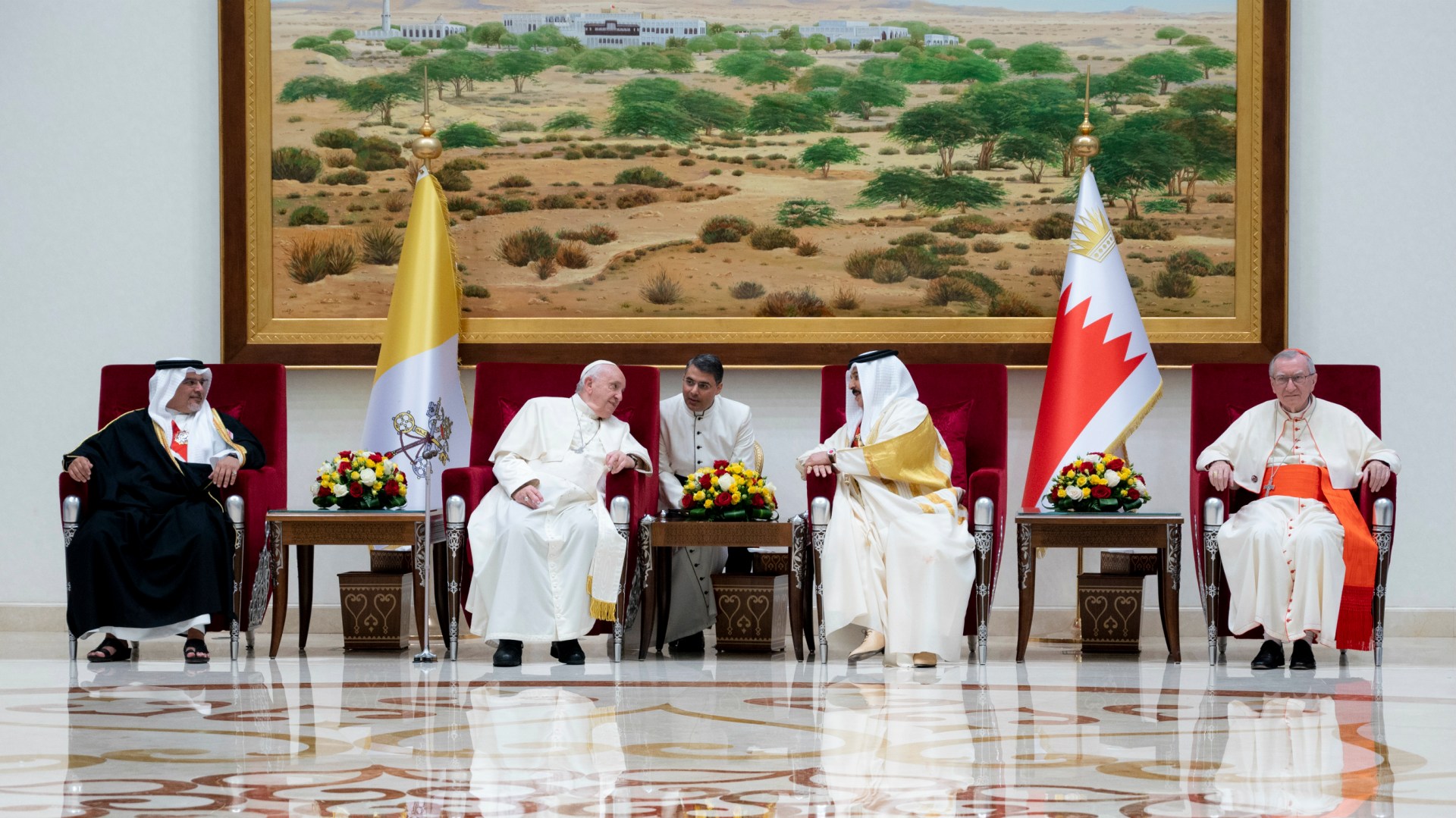
Pope Francis meets with King of Bahrain Hamad bin Isa Al Khalifa (second from right) at the Sakhir Royal Palace on November 3, 2022.

Pope Francis meets with King of Bahrain Hamad bin Isa Al Khalifa (second from right) at the Sakhir Royal Palace on November 3, 2022.

Christianity Today November 11, 2022
Loredana Mantello / Getty Images

After greeting Pope Francis last week with a red carpet, a 21-gun salute, and a contingent of horses to accompany his humble vehicle, King Hamad bin Isa Al Khalifa highlighted one document to characterize his realm:

The 2017 Kingdom of Bahrain Declaration.

“[Bahrain is] a cradle of mutual coexistence between followers of different faiths,” he said, “where everyone enjoys, under our protection after that of God Almighty, the freedom to perform their rituals and establish their places of worship, in an atmosphere of familiarity, harmony, and mutual understanding.”

With Bahraini flags flying side by side with the Vatican banner, Francis was profuse in his praise. Enduring severe knee pain, he noted the country’s centuries-old “Tree of Life,” a 32-foot acacia that somehow survives in the Arabian desert.

Bahrain honors its roots.

“One thing stands out in the history of this land: It has always been a place of encounter between different peoples,” said Francis. “This is in fact the life-giving water from which, today too, Bahrain’s roots continue to be nourished.”

In the island nation the size of New York City, flanked on either side by Iran and Saudi Arabia, from November 3–6 the pope visited its 160,000 Catholic migrants—primarily from the Philippines and India—living among a population of 1.5 million, evenly divided between foreign workers and citizens.

From 111 nationalities, 30,000 gathered this past Saturday at the national stadium for Mass.

Bahrain is a Sunni Muslim monarchy ruling over a narrow majority of Shiites. Christians comprise 10–14 percent of the population, with up to 1,000 Christian citizens originally from Iraq, Palestine, and Jordan who were present at the time of independence. Alongside a 200-year-old Hindu temple, a renovated synagogue hosts prayer for Bahrain’s few dozen Jewish citizens.

But beside pastoral responsibilities, Francis came prepared to preach.

At the Bahrain Forum for Dialogue: East and West for Human Coexistence, his message was a near homily on the 2017 declaration. Addressing over 200 religious leaders from the Gulf, he urged their leadership and introspection.

“It is not enough to grant permits and recognize freedom of worship,” Francis said. “It is necessary to achieve true freedom of religion.”

The Bahrain Declaration, one of several similar charters issued by Muslim nations in recent years, has two main distinctives. First, it was issued by the head of state, rather than an assembly of clerics and scholars. And second, where others spoke in clear defense of the rights of Christian minorities, King Hamad’s document asserted in general that “freedom of choice” is a “divine gift.”

Bahrain proscribes no legal punishment for apostasy.

Francis’ message to the forum was discreet, not drawing out the full implication of the declaration. And his targets were many. He spoke about the necessity of education to counter religious fundamentalism. He promoted the role of women in the public sphere. And he called listeners to oppose the agenda of the powerful that marginalizes the poor, the migrant, and the unborn child.

But he centered his speech on prayer and the “meaningful relationship with God” that can only come with religious freedom.

His envoy, speaking to the press, provided the cultural context.

“I know the style of this part of the world a bit,” said Paul Hinder, the Catholic bishop and apostolic administrator of Bahrain and neighboring countries. “They don’t like open criticism.”

He also echoed the papal praise.

“Religious liberty inside Bahrain is perhaps the best in the Arab world,” Hinder continued. “Even if everything isn’t ideal, there can be conversions [to Christianity], which aren’t at least officially punished like in other countries.”

The US State Department’s annual Report on International Religious Freedom notes that converts in Bahrain are reticent to speak out publicly—but from fear of family and social pressures, not government restrictions. And Abraham Cooper, vice chair of the US Commission on International Religious Freedom (USCIRF), praised the declaration.

“Many people talk about religious tolerance, but Bahrain is living it,” said the associate dean of the Simon Wiesenthal Center, which hosted the 2017 signing. “Just cut and paste this declaration, and the world will become a better place.”

Francis’ visit was the 39th foreign trip of his papacy, in which dialogue with the Muslim world has been a prominent feature. Two months earlier he was in Kazakhstan, and Bahrain represented the 13th Muslim-majority location in his travelogue.

In 2019 in the United Arab Emirates, he cosponsored the Document on Human Fraternity for World Peace and Living Together with Egypt’s Ahmed al-Tayyeb, Grand Imam of al-Azhar, the foremost center of learning in the Sunni Muslim world.

Francis referenced the document at the forum, and Tayyeb concurred.

“The Quran establishes … that man was created free and able to choose belief, religion, ideology, and doctrine,” he said. “It follows that they must be free to choose any faith.”

This is not yet true in many nations in the Islamic world.

In preparation for the International Day of Prayer for the Persecuted Church (IDOP), observed on November 6 and 13, the World Evangelical Alliance (WEA) noted that 1.3 billion Muslims do not have the freedom to leave their faith, an act criminalized in 24 nations.

“The most dangerous thing you can do at the moment,” said WEA general secretary Thomas Schirrmacher, “is to convert from Islam to Christianity.”

But Bahrain is different, stated evangelical leaders.

“I don’t think it is that big a deal here,” said Johnnie Moore, invited by the king in his role as president of the Congress of Christian Leaders. “Much of what the pope said was intended to be heard in the region, including next door.”

Hrayr Jebejian, general secretary of the Bible Society in the Gulf, was more moderate.

“Bahrain is the most open and free country in the Gulf, then Kuwait, then UAE,” he said. “But it is still a Gulf country.”

In agreement with Hinder on conversion, Jebejian said he believed the pope was indirectly calling for Bahrain and surrounding nations to give Christians the same freedom Muslims experience in the West.

The Bible Society operates two bookstores in Bahrain, he said, one within the National Evangelical Church and the other in St. Christopher’s Anglican Cathedral. The nation hosted the Gulf’s first Catholic church in 1939 and last year opened the region’s largest, the 2,300-capacity Cathedral of Our Lady of Arabia.

There are no restrictions on their programs, Jebejian said, but to be more “complete”—quoting the pope—the practice of faith should be welcomed also outside of the churches.

Critical analysts would add: outside the mosque.

Bahrain is home to 598 Sunni houses of worship, and 763 for Shiites. But the “elephant in the room,” said Amnesty International, is the denial of full political rights to the Shia religious majority.

Saudi Arabia helped crush Arab Spring protests in 2011, and since then Shiite activists have been arrested, deported, and stripped of citizenship. In 2016, the Bahraini government outlawed al-Wifaq, the leading Shiite opposition party.

Moore, a former USCIRF commissioner, cautioned advocates to be wary of Islamist political agendas seeking religious freedom protections. The spiritual leader of al-Wifaq, he noted, is a known admirer of Iran’s Islamic revolution and Ayatollah Khomeini. Yet he did not want anything to “distract one second” from the beautiful gathering.

But USCIRF chair Nury Turkel wanted the pope to raise concerns with the king. Even so, last year USCIRF removed Bahrain from its “special watch list” of offending nations, recognizing improvement in recent years.

Without direct criticism, and consistent with his long-term conviction, Francis spoke out publicly against the death penalty. Since 2017, Bahrain has executed six prisoners. According to Human Rights Watch, 26 are currently on death row—half for political convictions.

And when Tayyeb called for an intrafaith dialogue between Sunnis and Shiites, Francis praised his initiative as “very courageous.”

But his public ire was pointed outward.

“In the garden of humanity, instead of cultivating our surroundings,” said Francis, “we are playing instead with fire, missiles, and bombs.”

An envoy from the Russian Orthodox Church was in attendance. But lest his remark be interpreted in only one direction, Francis called on religious leaders to “not support alliances against some, but means of encounter with all.”

And remarking on the Arabic meaning of Bahrain as “two seas,” his critique was universal.

“Tragically, East and West increasingly resemble two opposing seas,” Francis said. “We, on the other hand, are here together because we all intend to set sail on the same waters.”

Also consistent with the pope’s style was an emphasis on ecumenism over evangelism. Michael Lewis, archbishop of the Anglican diocese of Cyprus and the Gulf, praised Bahrain for its welcome of Christian communities and said these expressed “heartwarming and overwhelming” appreciation to Francis.

And as the pope addressed the Muslim Council of Elders, he returned to the image of the tree of life—this time, in Eden. “Meant to embrace all creation,” Francis said, human beings “turned their back on the Creator” and “a flood of evil and death burst forth from the human heart.”

His answer: prayer and fraternity.

“Let us be guided by the saying of Imam Ali,” Francis said, quoting from the Shiite hero, the adopted son of Muhammad: “‘People are of two types: they are either brothers and sisters in religion, or fellow men and women in humanity.’”

As he ended his apostolic mission in an address to local Gulf clergy, the Catholic pontiff invoked the maternal intercession of the Virgin Mary. He also urged them to “spread Christian joy,” proclaiming the gospel in living witness.

And though he earlier urged the migrant faithful to ask for grace to be kind to those who mistreat them as they follow the Sermon on the Mount, they were also—through peace—“to shatter the chains of evil.”

His final words invoked imitation of the prophets.

“They call into question false human and religious certainties,” Francis said, “and they invite everyone to conversion.”

News

The Forest Underground: How an Australian Missionary Regrew the African Sahel

Evangelical farmer takes his technique from Niger to COP27 in Egypt, pitching a project in which “everything needed, God has already provided.”

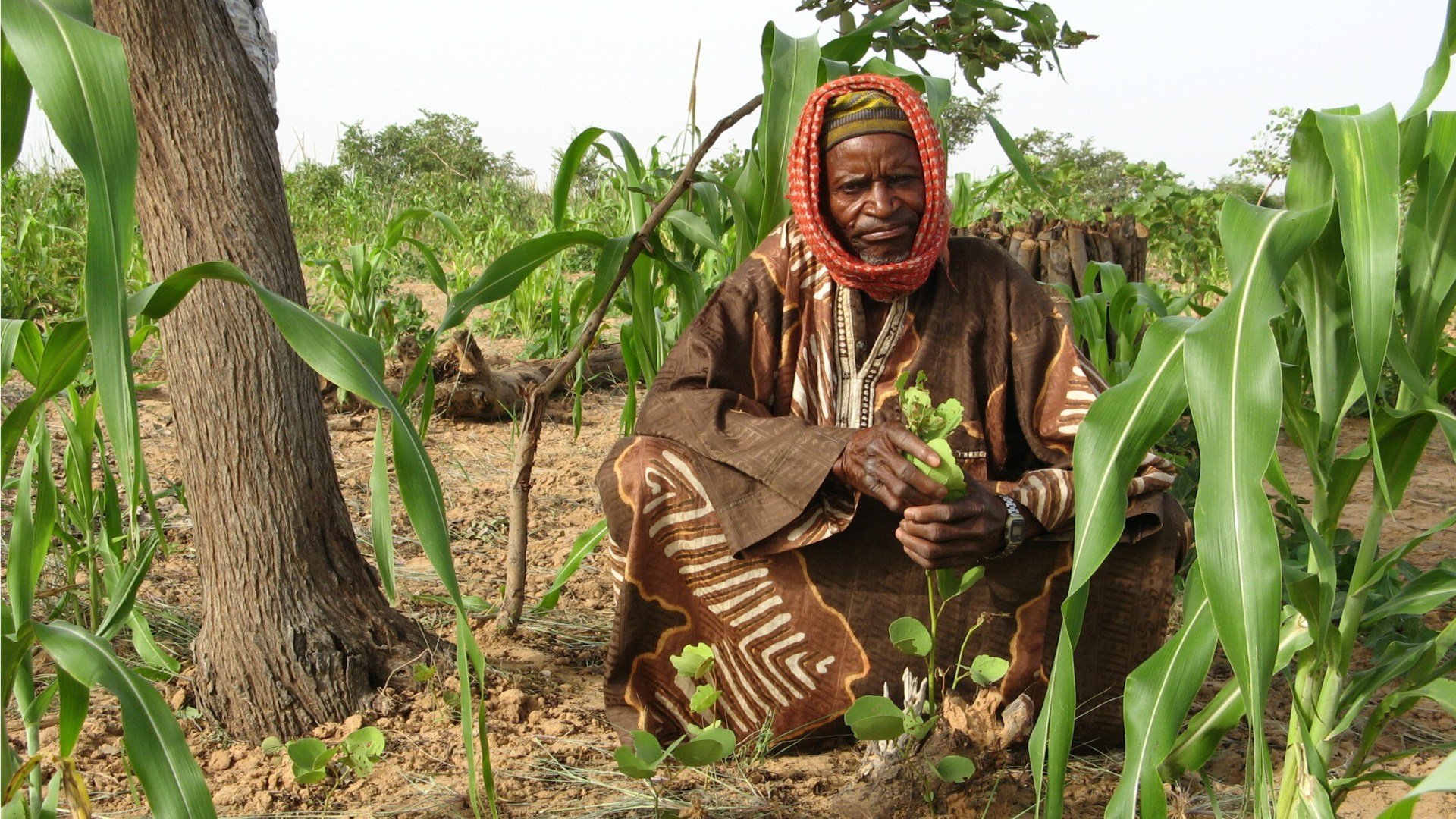
Farmer-managed natural regeneration in Niger

Farmer-managed natural regeneration in Niger

Christianity Today November 10, 2022
Silas Koch / World Vision

After 18 grueling months fighting desertification in Niger, Tony Rinaudo was near despair. As manager of a small reforestation project for SIM in 1983, he knew few of the 6,000 trees the missions agency had planted yearly since 1977 had survived the arid Sahel climate.

Locals called him the “crazy white farmer,” not wishing to waste valuable agricultural land on more failed efforts. But, trudging on, he loaded another batch of saplings into his pickup truck, struggling to fulfill his childhood prayer.

Years earlier in the threatened Ovens Valley of southeast Australia, Rinaudo lamented the bulldozing of hilly bushland and the killing of fish by drift from insecticides sprayed on tobacco plants—while children elsewhere went to bed hungry.

“God,” he cried out, “use me somehow, somewhere, to make a difference.”

Soon thereafter he stumbled upon I Planted Trees by Richard St. Barbe Baker. One line impressed itself upon Rinaudo, becoming his eventual life work.

“When the forests go, the waters go, the fish and game go, herds and flocks go, fertility departs,” he read from the 19th-century English botanist’s book. (The quote is attributed elsewhere to Scottish science journalist Robert Chambers). “Then the age-old phantoms appear stealthily, one after another—Flood, Drought, Fire, Famine, Pestilence.”

In 1981, Rinaudo settled in Maradi, 400 miles east of Niger’s capital, Niamey. The West African nation’s economic center, on its southern border with Nigeria, hosted SIM’s agricultural project, a hospital, and a local Bible school. Present since 1924, the mission—together with Catholics—established Niger’s largest concentration of Christians, though they numbered less than 1 percent of the population overall.

French colonialists and later international development projects contributed to environmental degradation through large-scale farming, clearing trees to maximize yield. Local farmers felled them further—out of poverty and hunger—to sell the wood, while women would walk miles to find kindling for their cooking fires.

As Rinaudo stopped to deflate his tires to traverse the sandy landscape for his delivery, he sighed and once again called out to God.

“Forgive us for destroying the gift of creation,” he prayed. “Show us what to do, open our eyes.”

Looking up, he spied a bush.

On any other desert trek, Rinaudo recounted to CT, he would have passed by similar-looking shrubs soon to be consumed by wandering goats. But this time, examining it closely, he recognized the small sprout as a Philostigma reticulata, a tree that could grow over 30 feet tall. Today the scientific community recognizes its ability to redistribute deep soil moisture to surface-level crop roots—often the difference between survival and failure in water-parched lands.

Suddenly, the battle lines changed.

“Everything needed, God has already provided,” Rinaudo said. “Many deserts are altered landscapes with an underground forest that just needs a chance to grow.”

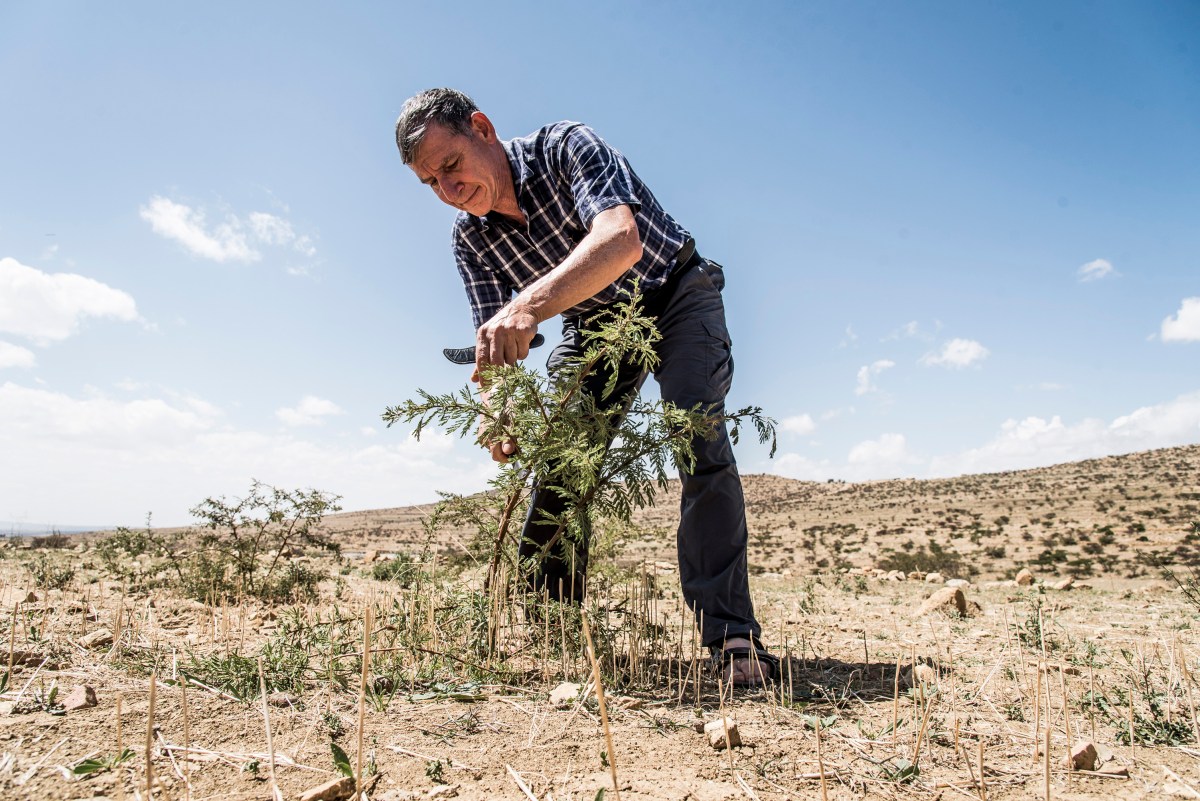
Planted trees lack the developed root system to survive non-shaded soil temperatures that can reach as high as 160 degrees and winds as strong as 35 miles per hour. But by gently pruning down the 30-plus shoots that emerge from a stump, water is concentrated into the strongest few that then grow quickly.

Pioneering “farmer-managed natural regeneration” (FMNR), Rinaudo next had to convince the community. It took a famine to do so.

In 1983, Niger was devastated by drought, and SIM launched a “food for work” project with farmers who would agree to try FMNR on a portion of their land. Rinaudo recounted how the initial 12 villages spread to 100, but following payment and harvest, 75 percent of beneficiaries cut down the new growth, returning to their traditional practice.

“We are finished with Tony and his ‘silly trees,’” they said.

But the 2,000 farmers who continued were enough to form a critical mass of practitioners, who influenced others. Over the next 20 years, the SIM project regenerated 200 million trees, increasing density tenfold to 40 trees per hectare. Crop yields improved by 30 percent, as shade decreased air temperature by 18 degrees and soil temperature by 65 degrees.

Animals and birds returned to the fields, and manure and urine joined with fallen leaves to nurture the ground beneath. Conversely, every 2 degree rise in temperature above 95 degrees results in a 10 percent loss of crop yield.

In 1999, Niger awarded Rinaudo its Agriculture Order of Merit for sparking the technique that would reach 50 percent of national farmland. And today, FMNR is practiced in 29 countries around the world, having restored forests to 17 million hectares.

Two billion more could be regenerated—the size of South America.

Meanwhile, by 2045, 135 million people risk displacement by desertification.

“Nature is the scaffolding upon which all life on earth depends,” said Rinaudo. “We are playing Jenga … pulling out the building blocks, one by one. If we continue, the tower will collapse.”

Tony Rinaudo, author of The Forest Underground

World leaders are meeting in Egypt this week to steady the foundation. The Red Sea city of Sharm el-Sheikh is hosting the 27th session of the Conference of the Parties (COP27) to the UN Framework Convention on Climate Change.

Rinaudo will be there, advising all he can.

Now working with World Vision as its principal climate action advisor, he will present at a side event with the German development agency GIZ and Australia’s DFAT (Department of Foreign Affairs and Trade), both akin to USAID. He will make the case that FMNR is a far more effective technique than spending millions in tree-planting reforestation.

A study tracking forestry programs from 1975 to 1982 noted a sum of $8,000 spent per hectare on trees judged ultimately to be “not doing well.” Another study brought expenses down to $400 per hectare. A typical FMNR project costs only $40–50, and sometimes as little as $4 per hectare.

After implementation, income from Niger’s associated farms rose $68 per hectare. Studies from Ghana and Senegal showed increases of 78 percent and 84 percent, respectively.

Far greater is the value of a human soul—though Rinaudo rejects a dichotomy.

“People came to the Lord, but I’d like to reframe the question,” he said. “I see repairing and caring for God’s creation as God’s work in its own right, as an act of love.”

SIM served all, regardless of response. They witnessed appropriately, and some small churches emerged. One friend, Sule, a devout Muslim, became a key employee and frequently engaged staff in conversations about religion, patiently answered by his Nigerien supervisor. Yet, respected in his faith, he was never pressed to attend devotions or prayer meetings.

It was an act of simple hospitality to his father—providing lodging while facing an operation—that made the key impression. Sule prayed to know the truth, and God gave him a vision of Jesus.

As he was already a respected leader in the community, the change in Sule’s life attracted the attention of many, including Jadi, the village drunk. He asked: Is this “fair dinkum”—as Rinaudo related the inquiry, using an Australian idiom—or is it just to keep your job?

Sule gave witness and told Jadi to seek God himself. Jadi prayed, receiving a different vision—of himself in a pit, surrounded by snakes. He repented, believed, and to this day is a transformed man.

“When you are a missionary with SIM, people expect you to be an evangelist,” said Illia Djadi, Open Doors’ senior analyst for freedom of religion or belief in Africa, who attended the same church as Rinaudo in Maradi. “Tony didn’t carry a Bible or set up any church—but he left a legacy.”

Djadi praised the “whole gospel” emphasis that led Rinaudo also to live in the city with the people, unlike many missionaries who stayed on the SIM compound. He spoke Hausa fluently and coined a proverb he constantly repeated: “He who cares for the trees will never go hungry.”

Djadi compared Rinaudo to John the Baptist, with love, compassion, and the pre-evangelism necessary to bring Muslims to Jesus. But the impact went further.

In the 1990s, Islamic fundamentalism surged in Niger. Preaching against Christians began to undo traditional religious tolerance and radicalized many in the youngest nation in the world.

And in 2015, the cartoon defamation of Muhammad—which sparked the Charlie Hebdo terrorist attack in Paris—resulted in hundreds of attacks on churches, schools, homes, and even an orphanage. But in Maradi, Muslim neighbors surrounded the SIM properties, defending the “good people” inside.

“To fight against intolerance, we need local relationships of trust, to develop the mindset that Christians work for the good of others,” Djadi said. “We do not need more evangelists, but more Tonys.”

Coming soon to the United States, Rinaudo’s book, The Forest Underground: Hope for a Planet in Crisis, won the 2022 award for Australian Christian book of the year. His key verse is Psalm 104:30—“When you send your Spirit … you renew the face of the ground.”

“God is not only in the business of restoring broken people,” he said. “He is also in the business of restoring a broken earth.”

How the Persecuted Church Wants You to Pray

Leaders in six countries explain how Christians can best support and rejoice with fellow believers suffering for their faith.

Christianity Today November 10, 2022
Illustration by Mallory Rentsch / Source Images: WikiMedia Commons

The first two Sundays of November, as part of the International Day of Prayer for the Persecuted Church, Christians around the world intentionally intercede for their brothers and sisters in Christ who face violence, prison, arson, kidnapping, bureaucratic restrictions, and shunning because of their faith.

Around 309 million Christians live in places with very high or extreme levels of persecution, according to Open Doors’ 2022 World Watch List. Shortly after the release of last year’s list, Christians from around the world shared their joys and concerns. We encourage you to use the praises and requests of Christians from the six countries included here as a tool to guide your prayers today.

China

We praise God:

  • for God keeping his church faithful in meeting for worship in spite of the pandemic and persecution.
  • that, using new technologies such as Zoom, many churches have been able to develop creative evangelistic opportunities that were not previously available.
  • During strict government pandemic control, many state churches have been closed. But some of these believers have been able to transfer to house churches and continued to grow spiritually there.

We pray:

  • Some house churches are still under severe persecution. Preachers are being arrested on trumped-up charges. Pray for the preachers’ perseverance and for their families.
  • Internet meetings in some churches are often interfered with and disrupted by the government, and many elderly believers need training for using new technologies.
  • In Xi Jinping’s third term, the church is facing even greater challenges and more serious persecution. Many Chinese people who feel threatened, including believers, will choose to leave China if they are capable of immigrating elsewhere. Pray that God will keep and guide those who choose to leave as well as those who choose to stay.

Aaron Chau (name changed for security reasons), a house church pastor in Hubei

Egypt

We praise God:

  • for protecting our ministry to women in rural Upper Egyptian villages. He has provided for all the needs of this team and its beneficiaries. God is faithful and good all time with us.
  • for the start of construction of our community center at El Minya in Upper Egypt.
  • Our first community center, known Oasis Center, was badly affected by COVID-19. Now all activities at the Oasis have returned, including conferences, the vocational training courses, and the retreats.

We pray:

  • for ending trafficking of girls in El Hawamdeya, where parents often sold their daughters to rich old men. We continue to pray for the protection for women and for more awareness for parents.
  • for inflation in Egypt and how the poor people are affected by this. Every time we distribute sacks of food, we find that the poor people are increasing. We pray that God will provide.
  • for planned demonstrations on November 11 by opposition groups linked to the Muslim Brotherhood. We pray for security for the whole country and for stability and protection for churches.

Submitted by Bassem Fekry, president of the Evangelical Fellowship of Egypt

India

We praise God:

  • that in spite of anti-conversion laws in certain states, hundreds of new believers have come to know the saving grace of our Lord.

  • Due to the pandemic we didn’t have VBS for several years, but this summer we were finally able to conduct it! Due to an unexpected rainy season, we had to postpone it several times but thank God we could finally accomplish the task.

  • that he enabled us to reach out to the interior tribal villages in the eastern part of India. More than 700 school teachers received training about how to teach students to adopt Christlike character. We also trained 350 gospel workers in church planting.

We pray:

  • for our Christmas outreach ministries to people with leprosy, blind people, commercial sex workers, and tribal and slum street children

  • Due to anti-conversion laws we were unable to baptize 350 new believers in various communities as we needed to obtain official approval from the government authorities through the court of law. We need to wait 40 to 60 days in order to get approval from the court and the local police. Pray that everything goes well with the legal process.

  • We have 2,500 church planting and Christlike character training books. We need funds towards imparting training gospel workers throughout India. Please uphold us in your prayer for the needed funds and other training logistics.

David K. Dass, ministry leader in India

Iraq

We praise God:

  • for his work through the church because he blessed us during this year by being able to visit one of the displaced people’s camps in Ramadi. We provided families with food baskets and presented a message of love to the children at the camp.

We pray:

  • for the stability of the political and security situation in Iraq and that this stability will bring comfort and peace to the country and citizens of various secondary affiliations, such as race, religion, sect, clan, and tribe. (Many challenges in Iraq are related to the dominance of sub-identities over national identity.)

Ara Badalian, senior pastor of the National Evangelical Baptist Church in Baghdad

Laos

We pray:

  • that the church will grow and be strengthened so that it can be administratively, evangelistically, and financially self-reliant and be a blessing to the development of the nation.
  • for unity among believers, church leaders and between every church.

The Protestant church community in Laos

Mali

We praise God:

  • Mali has been going through a multidimensional crisis for a decade. This has greatly affected the church, especially in the north and center of the country. Despite this growing insecurity, God continues to watch over the local churches.
  • for the commitment of the churches in the witness of Jesus Christ despite their difficult context. Evangelism initiatives like the distribution of Christian tracts, evangelism messages on radio stations, and evangelism through personal relationships continue to move forward.
  • because the church is making its voice heard by the authorities of the country through the Association of Groups of Evangelical Protestant Churches and Missions in Mali (AGEMPEM) and the Episcopal Conference.

We pray:

  • for churches to grow and engage in holistic acts of witness. Pray for the unity of the body of Christ in the current context of Mali, which is marked by an increasingly visible Islamic extremism.
  • for Christian families displaced because of the conflict. May God grant peace and courage necessary for spiritual, psychological, and economic resilience.
  • Kidnappings continue in northern and central Mali. Pray that God will preserve the lives of the church members and that the churches will be protected from terrorist threats and attacks. Pray that the church will continue to be a powerful instrument in God’s hands to bring peace, restore wounded hearts, and ease downcast spirits.
  • that the church in Mali will emerge victorious from this situation and continue to proclaim and manifest God’s unconditional love.

Josue Djire, faith, development, and peacebuilding advisor at World Vision Mali

Pakistan

We praise God:

  • for the churches and seminaries who are faithfully serving the Lord and expanding the kingdom of God.
  • for blessed spiritual senior leadership and the development of young pastors and evangelists.
  • for the Pakistani church and Christian NGOs being salt and light during the current flood disaster.

We pray:

  • for the underage forced marriage and forced conversion of Christian teenage girls.
  • for illiterate Christians to obtain education as they are below the poverty line and are mostly persecuted.
  • for the victims of false blasphemy cases.
  • for the unity and purity of the Pakistani church, so they become bold witnesses of Christ through their words and actions.
  • for the great movement of the Holy Spirit to revive the church through the Word of God, miracles, and conversions.

Ujala Hans, lead pastor at CPM (Christian Prayer Ministry) Church Pakistan, Lahore

With additional reporting by Jayson Casper, Angela Lu Fulton, and Sean Cheng.

Church Life

Orissa’s Christian Widows Struggle to Survive

Nearly 15 years after a brutal massacre, victims struggle to overcome trauma and poverty.

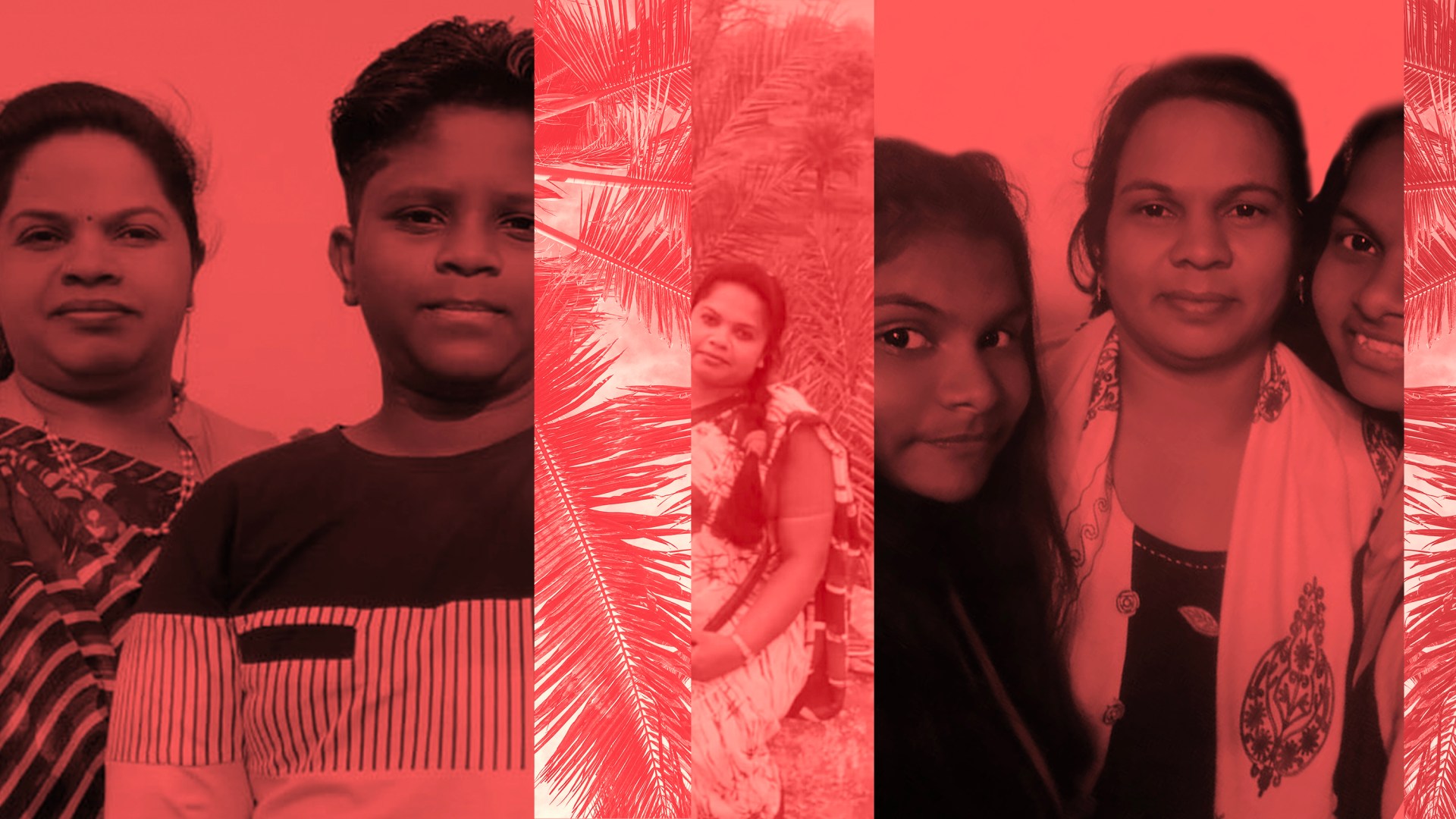
(left) Asha Lata Nayak and her son (right) Asmita Digal and her daughters

(left) Asha Lata Nayak and her son (right) Asmita Digal and her daughters

Christianity Today November 9, 2022
Illustration by Christianity Today

This story contains depictions of graphic violence.

August 26, 2008, was the worst day of Asmita Digal’s life and the last day of her husband’s.

Digal lived with her husband, Rajesh, a pastor, and their two young daughters in Kandhamal, a community in the eastern Indian state of Odisha, then called Orissa. Christians and Hindus had lived as neighbors relatively peacefully in the area for years.

The majority of Christians in Kandhamal were Dalit converts who demanded that the government continue to pay them reparations even though the law discriminated against them, only allowing Hindu scheduled caste members to get funds. But Hindutva (a political ideology seeking to establish the hegemony of Hindus and Hinduism in India) groups used the Dalit converts’ actions as a justification to instigate tensions between the local tribes and the Christian majority-Dalit community of the area.

In December 2007, Hindu nationalists had burned down churches and Christian houses. But the worst yet came the following August.

Rajesh Digal was returning home when a mob surrounded him. Finding a Bible in his possession, the mob assaulted him and buried his body, leaving only his head above the ground.

“They kicked Digal’s head like a football,” said Asmita, who learned of the graphic details of her husband’s last moments from his Hindu friend, an eyewitness to the atrocities whom the mob set on fire after they rejected his religious claim. (The friend jumped into the river to extinguish the fire.)

When Rajesh asked for water to drink, one of the Hindu extremists urinated in his mouth. After intense torture, the mob covered Digal’s face with mud and buried him alive.

Asmita Digal reported the matter to the police, but when they searched for the body, they couldn’t find it, leading her to believe that his killers had exhumed and disposed of it. She and her daughters, ages four and one, fled.

“We were in the jungle for three days, without food and water. I had a packet of cookie on which my daughters survived,” Digal said.

When the family returned home, they found their home burned down. For three years, the family took shelter in a relief camp with other displaced Christians, 30 miles from her home. No one was ever prosecuted for her husband’s death or the majority of deaths of the more than 100 people who lost their lives in the wave of massive anti-Christian violence.

The Indian government paid damages to some widows like Digal who lost their husbands to the mob. But not all traumatized families received money for the murder of their fathers and husbands, and none received compensation for property damage or loss.

In the nearly 15 years since, with no fixed monthly support from the government or church, the widows have struggled on a daily basis to provide for their families. In addition to facing poverty, many still suffer significant emotional trauma from the horrors of the attacks.

“Besides compensation, we [church leaders and activists] have to return to them their dignity and right to live without fear,” said Kulakanta Dandasena, an attorney and activist in Kandhamal.

Reign of terror

The August 2008 terror began when right-wing Hindu groups accused Christians of murdering a controversial Hindu guru, swami Lakshamanananda Saraswati, and his four disciples on August 23, 2008.

Even though Maoist groups said they immediately claimed responsibility for his murder and accused the government of suppressing the information, the Vishwa Hindu Parishad (VHP, the World Council of Hindus) alleged that Christians had killed the swami and called for thousands of protesters to flood the streets, effectively shutting down traffic and forcing shops and schools to close.

The same day, Hindu extremist mobs started brutally attacking and assaulting Christians, destroying their property and destroying the lives of more than 6,000 families.

The Kandhamal anti-Christian violence did not stay in the community but instead spread to nearly half of the 30 districts in the state of Odisha, leaving more than 75,000 people displaced.

Mobs ransacked more than 6,500 Christian houses and burned or damaged nearly 400 churches and places of worship in the violence that lasted into November. Nearly 40 women were raped and sexually assaulted, and violence disrupted 12,000 children’s education for years. Several cases of forced conversion, from Christianity to Hinduism, were reported, according to media reports and surveys done in the years that followed.

Many saw this aggression coming, especially after the December 2007 violence in which at least three people lost their lives. (Other reports put the death toll at nine.) In January 2008, an independent fact-finding team led by the All India Catholic Union’s John Dayal had warned the government to act or there would be “more tragedy waiting to happen.”

In the aftermath of the 2008 attacks, the Odisha state government established two fast-track courts to deal with the number of complaints filed by Christian victims. But a lack of evidence or poor investigation on the part of the police doomed most attempts for justice. Of the 3,300 complaints made to police, only 800 were registered and 518 indicted. Of those, less than a dozen were convicted.

A survey by the Housing and Land Rights Network (HRLN) estimated that the total property and livelihood-related losses of 122 families from three villages in Kandhamal amounted to $4.58 million, adding that it was an “underestimation of the actual loss suffered.”

The government extended help to victims in the form of relief camps and some financial compensation. The central and state government offered 10,000 rupees and 20,000 rupees respectfully for a partially damaged home, and 30,000 rupees and 50,000 to rebuild a fully destroyed one. But the compensation was not consistent. The government also provided 500,000 rupees to the dependents of 39 Christians who had been killed. (Even though more than 100 people were killed, the government only recognized 39 deaths.)

A 2016 Supreme Court order also allowed some widows to receive an additional 300,000 rupees.

Beyond the government, Christian victims of the Kandhamal violence had few places to turn for help.

“All the local churches were destroyed or burnt down to ashes. The churches had no funds to establish themselves; therefore the victims did not get any kind of monetary or emotional support from them,” said Sukanta Nayak, a local Christian leader and a former school principal.

Some widows and their allies are continuing to fight for justice. Last August, on the 14th anniversary of the attacks, a victim rights group submitted a 15-point memorandum to the district administrator. Its demands included the reopening of the 315 closed cases; the review of cases closed due to faulty investigations; prosecution of government officials who were complicit or negligent; just, enhanced, and adequate victim compensation; livelihood and skill training for those who fled their homes because of the violence; scholarships for the children who belong to minorities; and reversing the state’s anticonversion law.

“[The widows] continue to live in a majority Hindu community and have never felt the freedom to share their agony and pain that they still live with, for all the past years,” said Father Purushottam Nayak, a Catholic priest and a survivor of the violence himself who works closely with the victims.

These Hindu neighbors continue to discriminate against the widows because of their faith, including forcing them to endure long lines to fetch water or receive government subsidies.

“Though we have forgiven the Hindu community, we have not forgotten what they did to us,” Asmita Digal said. “There is constant fear and insecurity as we continue to live among them.”

Plight of the widows

Digal, like many Dalit women in Kandhamal, is illiterate and unskilled and relied on her husband to financially support her and her family. Years after their husbands were killed in the worst attack on the Indian Christian community in decades, many of these widows say they continue to live in poverty, struggling for basic necessities.

Asha Lata Nayak’s husband, Vikram Kumar Nayak, was stabbed before her eyes. She managed to grab her five-month-old son and escape to the jungle, where she hid for three days. Her husband succumbed to his injuries.

After the attacks, Nayak’s in-laws mistreated her to such an extent that she was forced to leave her home and her village.

“I went from one relief camp to another, lived with my brother’s family for many months, and then shifted to living with my parents. It took me years to finally settle at one place,” she said. “It was hard for me to answer my growing-up son’s questions about his father and raising him all by myself.” Her son Ashirwad is 14 now.

Sixty-year-old Priyatama Nayak is the widow of Abhimanyu Nayak. On August 26, 2008, a mob kidnapped her husband while he slept on the porch and set him on fire. Abhimanyu died the next day from his wounds under the care of Priyatama. She filed a complaint with the police, but no one was convicted of the murder, she said. Her husband left her with three daughters and a son to care and provide for. Today she works as a manual laborer, supplementing her wages with occasional help from a Catholic priest and relief distributed from time to time by various organizations in her area.

“All hell broke out on me when my husband was killed and left me with four children to bring up all alone,” Nayak said.

“The government just gave a one-time help, but I had to feed my children every day and educate them. Where would I get the money for food and schooling? Coping up with the trauma, caring for four young children, thinking of ways to set food before the children, and above all the fear of being attacked again was constantly haunting us,” she said.

Despite the lack of justice and—in most instances—resources, the widows of the Kandhamal attacks are determined to hold on to God.

“What keeps them going is their faith. None of them have abandoned their faith even in their testing circumstances,” said Ajay Singh, a Catholic priest and a social activist working closely with the victims.

“Despite utter poverty, there was not a single day when there was no food in my house,” said Priyatama, pointing to the goodness of the Lord who has “always provided.”

Her youngest daughter, Barsha, was just 7 when her father was murdered.

“Though my mother gets upset with Jesus, she has no other option but to turn and pray to him,” said the now 21-year-old.

“The Lord allowed this for a purpose,” said Priyatama, “and we will endure this.”

News

Republicans Win on Inflation but Lose on Abortion

Prayed-for midterm “red wave” fails to materialize.

Christianity Today November 9, 2022
Michael M. Santiago/Getty Images

Mayra Flores thought the full moon, which looked red as it passed through the Earth’s shadow in the early hours of Election Day, was a good sign.

The Latina Republican who declared she was “taking Jesus to the halls of Congress” when she won a special election in South Texas in 2021, hoped and prayed for “a red wave” to carry her to reelection on Tuesday.

“The moon controls the tide,” Flores tweeted. “Bring on the red wave!”

But as votes were counted late Tuesday night and early Wednesday morning, it became clear the moon meant nothing. Flores, a conservative with a lot of evangelical support in the Rio Grande Valley, lost by about 11,000 votes. She blamed her defeat on the people who didn’t vote.

“Republicans and Independents stayed home,” she wrote on Twitter. “DO NOT COMPLAIN ABOUT THE RESULTS IF YOU DID NOT DO YOUR PART!”

Votes were still being counted Wednesday morning, but Republicans looked like they were going to win a slim majority of congressional races, taking control of the House away from Democrats. They were not on track to win the sweeping victory that so many had hoped for.

The rapid rise of food and fuel costs was the top issue for voters, according to CNN’s nationwide exit polls. Three out of four people casting a ballot said they were unhappy with the economy. Roughly two-thirds said gas prices were causing them hardship.

Seventy percent of the voters who said inflation was their top issue voted Republican.

Roughly a quarter of the electorate identified as white evangelical or born-again Christian, according to the exit poll. The vast majority of them voted for Republican candidates, but CNN did not share data on the concerns or issues motivating the bloc.

The second most important issue for voters was abortion. But only 16 percent told pollsters they were “enthusiastic” about the Supreme Court ruling overturning Roe v. Wade in June. Nearly 40 percent told pollsters they were angry about the Dobbs decision.

The majority (76%) of voters who listed abortion as their top priority voted for Democrats.

Pro-life poll watchers were disappointed in the results of several ballot initiatives across the country. Voters in Vermont, California, and Michigan enshrined the right to abortion in their state constitutions with ballot initiatives.

The vote was close in Michigan, where the state’s 1.8 million Catholics were urged to oppose the measure and the Christian Reformed Church called all believers “to a ringing testimony against the evils of abortion.” The amendment ultimately passed, however, with more than 55 percent of voters in favor.

In Kentucky, where abortion is currently banned, voters rejected an amendment that would have made that part of the constitution, becoming the second conservative state to defeat a pro-life ballot initiative after Kansas.

“I'm disappointed in Kentucky,” David O’Bryan, a 73-year-old pro-life advocate in Louisville, told the Courier-Journal. “People misunderstood the amendment, what it means to Kentucky and what it means for Right to Life and pro life issues.”

Lila Grace Rose, president of the pro-life group Live Action, tweeted that the results “show the need to redouble our efforts of education & persuasion on the value of human life” and the “need to 10X pro-life marketing resources to beat the incessant lies.”

An incredible amount of money was raised and spent in this election. The Associated Press reported the midterms cost roughly $16.7 billion, nearly double the amount seen in nonpresidential elections a decade ago.

The largest single donor was George Soros, the liberal billionaire who is often at the center of antisemitic conspiracy theories. Most of the top donors this election, however, gave to conservative candidates and causes. Shipping goods magnate Richard Uihlein gave $80.7 million; hedge fund manager Ken Griffin, $68.5 million; banking heir Timothy Mellon, $40 million; and tech investor Peter Thiel, $32.6 million. But the results, for conservatives, were mixed.

Kristan Hawkins, president of Students for Life, said the abortion-rights ballot victories convinced her that going forward, the pro-life movement needs to focus on the fight at the federal level.

“Like other injustices our nation faced in our past,” she wrote on Twitter, “some states will just refuse to acknowledge human rights and progress.”

Several races became proxy battles over abortion. Montana saw an unprecedented amount of spending in one nonpartisan judicial race as activists and outside groups claimed one state supreme court judge could “save abortion in Montana.” With about 74 percent of the vote counted by the end of Tuesday, the pro-choice candidate had a 17,000-vote lead.

In North Carolina, Democratic governor Roy Cooper claimed victory when Republicans failed to win enough seats in the state legislature to overturn his promised veto of any ban on abortion. The state saw a dramatic increase in abortions in the months after Dobbs was decided, with as many as 75 percent of patients at one Planned Parenthood clinic coming from outside of North Carolina.

“North Carolinians voted for balance and progress,” the governor tweeted.

Control of the Senate was up in the air Wednesday morning, with races in Nevada, Arizona, Wisconsin, and Georgia too close to call.

The Georgia race may not be decided when the counting is complete, since rules there say the winner must have more than 50 percent of the vote. Incumbent Raphael Warnock, a Black Baptist minister, claimed 49.4 percent on Wednesday morning but couldn’t quite wrest the majority from his scandal-plagued Republican opponent Herschel Walker and a Libertarian who grabbed about 2 percent.

Some Republicans won handily, though. J. D. Vance, author of the best-selling Hillbilly Elegy and a popular speaker at the National Conservative conference, was able to declare victory with 53 percent of the vote about an hour after polls closed.

Texas governor Greg Abbott never appeared seriously threatened by Democratic challenger Beto O’Rouke and won reelection to a third term. Florida governor Ron DeSantis—who ran an ad saying God needed him to “take the arrows and stand firm in the wake of unrelenting attacks” and save people’s jobs, livelihoods, liberty, and happiness—cruised to victory with nearly 60 percent support from voters.

Abbott and DeSantis have both been touted as potential Republican presidential candidates in 2024, possibly even challenging former president Donald Trump in the primary. Trump, who campaigned for a number of candidates in the midterms, has teased the imminent announcement of his 2024 election bid.

Some of Trump’s key supporters who falsely claimed he won the 2020 election lost their own races yesterday, however. Secretary of state candidates who promoted baseless conspiracies about rigged elections lost in Arizona and Michigan. Representative Lauren Boebert, a Republican who has been one of Trump’s most strident supporters, was unexpectedly trailing a few points in the vote count in Colorado.

Democrats seemed to benefit from emphasizing concerns about the state of democracy and the message that “democracy is on the ballot.” Nearly 7 out of 10 voters said they agreed that democracy in the US is under threat. Those voters were a few points more likely to vote Democratic.

That may have made the difference in the Grand Rapids area, where Democrat Hillary Scholten won Michigan’s 3rd congressional district by about 9 points. Last election, Scholten, a Christian Reformed Church deacon and former Department of Justice attorney, lost to Republican Peter Meijer by 6 points.

Then Meijer voted to impeach Trump following the January 6 riot at the US Capitol and lost the next Republican primary to a Trump-endorsed challenger. The Democratic Party spent $425,000 in ads raising the profile of Meijer’s more extreme opponent, hoping he would be easier for Scholten to beat.

The gamble apparently paid off.

But Scholten, a pro-choice Christian, said she hoped her victory would help move the country away from extremism and increasing partisan polarization.

“This campaign has, and continues to build, something new here in West Michigan,” she said. “A new political home for people on the right, the left, the center, who are tired of politics as usual, who are ready to cast aside the old frame of division, ‘us versus them,’ and join hands together for a better, brighter West Michigan for all of us.”

She will join a closely divided Congress debating economics, abortion, and the next two years of president Joe Biden’s agenda in January.

News

Makoto Fujimura Awarded Kuyper Prize

The prize, named for the Reformed theologian who defended art’s importance, goes to a visual artist for the first time.

Artist Makoto Fujimura

Artist Makoto Fujimura

Christianity Today November 9, 2022
Courtesy of Windrider Productions

Calvin University and Calvin Theological Seminary named artist Makoto Fujimura as its 2023 Kuyper Prize winner, which is named for Reformed theologian Abraham Kuyper, who argued that art was vital to renewing God’s world.

Fujimura is the first visual artist to receive the prize, which Calvin has given out annually since 1998. On Tuesday when Calvin announced the prize, Fujimura was in the middle of a private meeting with Pope Francis.

A Japanese American and Christian, Fujimura has always related Reformed theology about renewal to his work. He practices kintsugi, taking broken pottery and restoring it with precious metals. He also practices the Japanese technique of nihonga, painting with pulverized minerals that in his work symbolize brokenness and renewal. He has long talked about a framework of “culture care” as opposed to “culture wars.”

“As Christ followers, we are called to the work of renewal,” said Jul Medenblik, president of Calvin Theological Seminary in a statement about the prize. “What Fujimura is doing through his work is reminding us of the Kuyperian perspective that ‘The final outcome of the future … is not the merely spiritual existence of saved souls, but the restoration of the entire cosmos, when God will be all in all in the renewed heaven on the renewed earth.’”

Kuyper—a 19th- and early 20th-century theologian, entrepreneur, journalist, and prime minister of the Netherlands—argued that Christians should commit their lives to the renewal of the world in whatever sphere they served in. He believed that church work was not more special than other work and that grace invaded all of life, specifically in saving grace for the Christian and in common grace for all humanity. To Kuyper, the work of renewal was not simply an individual endeavor but best accomplished through institution-building, which he did by founding a university.

“Kuyperian vision allows me to be fully Christian and fully artist,” Fujimura told CT. “The work of faith and the act of making are deeply connected, one flowing into the other.”

Kuyper talked about art as an essential part of restoring the world.

“Art has the mystical task of reminding us in its productions of the beautiful that was lost and of anticipating its perfect coming luster,” he said in an 1898 lecture at Princeton Theological Seminary. “Art reveals ordinances of creation which neither science, nor politics, nor religious life, nor even revelation can bring to light.” He added the artistic gifts have “flourished even in a larger measure” outside of the church.

Princeton, where he gave that lecture, had its own Kuyper Prize, which it awarded to Presbyterian pastor Tim Keller in 2017 and then rescinded over an outcry that the Presbyterian Church in America (PCA), where Keller serves, does not ordain women. Keller is likely the most popular Reformed preacher and author in the US today.

“If you can't give an Abraham Kuyper award to Tim Keller, who can you give it to?” asked Southern Baptist leader Daniel Darling in a tweet at the time.

Fujimura, too, was an elder in the PCA and was at one time a part of Redeemer Presbyterian Church where Keller pastored. He’s now “a bit nomadic,” he said, living in Princeton, New Jersey, and attending Episcopal churches there and in New York. He has been a fixture in the New York Christian art world, and his family survived a close encounter with the attacks on 9/11—they lived three blocks from the Twin Towers.

He founded arts organization International Arts Movement, now named IAMCultureCare, and his book, Culture Care: Reconnecting with Beauty for Our Common Life, won a CT book award in 2018. He was also the director of the Brehm Center for Worship, Theology, and the Arts at Fuller Theological Seminary. He has had broad national recognition as well, with a presidential nomination to the National Council for the Arts.

His faith has also led him to work related to literature and film. Shortly after he became a Christian in Japan in 1988, he encountered in a museum a fumi-e, a brass block with images of Jesus that 17th century Japanese rulers forced Christians to step on to renounce their faith or face torture. The brass blocks are a central feature in Shūsaku Endō’s novel Silence, and Fujimura became an expert in the blocks and Endō, writing a book on the subject. He was a consultant for Martin Scorsese’s 2016 movie based on that novel.

Fujimura reflected on his work’s ties to Kuyper in a 2012 Books and Culture article.

“For many years now, I have advocated for the arts in the church and in the world,” he wrote. “By advocating for the arts, we are, by extension, advocating for the potential of humanity and for the evidence of God's grace in the world.”

Apple PodcastsDown ArrowDown ArrowDown Arrowarrow_left_altLeft ArrowLeft ArrowRight ArrowRight ArrowRight Arrowarrow_up_altUp ArrowUp ArrowAvailable at Amazoncaret-downCloseCloseEmailEmailExpandExpandExternalExternalFacebookfacebook-squareGiftGiftGooglegoogleGoogle KeephamburgerInstagraminstagram-squareLinkLinklinkedin-squareListenListenListenChristianity TodayCT Creative Studio Logologo_orgMegaphoneMenuMenupausePinterestPlayPlayPocketPodcastRSSRSSSaveSaveSaveSearchSearchsearchSpotifyStitcherTelegramTable of ContentsTable of Contentstwitter-squareWhatsAppXYouTubeYouTube