Books

Five Lesser-Known Children’s Fantasy Series That Point to the Gospel

Meet a new generation of authors picking up where Lewis and Tolkien left off.

Christianity Today May 16, 2022
Illustration by Mallory Rentsch / Source Images: Benjamin Voros / Unsplash / WikiMedia Commons

When COVID-19 seized the world, and our kids, wide-eyed, first voiced their fears, our family devotions helped assure them that nothing, not even a pandemic, could wrench them away from God’s love. And the quieter moments spent cuddled on the couch, steeped in the magic of Narnia and Middle Earth, reminded them of that truth.

In challenging times, stories that point children to the gospel are as vital as air. J. R. R. Tolkien argued that imaginative stories so thrill us because they echo the greatest story of all: our salvation through Christ. Great children’s literature with themes of sacrifice, redemption, love, and radical hope offers families tangible and memorable reminders of the truths they read in Scripture, truths that carry us safely through the storms of this broken, fallen world. Reading and discussing great books with your kids can be a ministry unto itself.

C. S. Lewis and Tolkien have offered families rich opportunities for reflection for nearly a century, but over the past two decades another generation of Christian authors has lavished our bookshelves with vibrant stories. These books, imaginative and infused with their authors’ convictions, promise to inspire young minds and nourish old souls for years to come. Peruse the following list, consider incorporating it into your own family routine, and marvel at the hope, the glory, and the happy ending embedded in these stories.

The Wingfeather Saga

Andrew Peterson

Christian musician and author Andrew Peterson wrote the Wingfeather Saga “to tell a story that would strike a little match of hope in a kid’s heart that the light is stronger than the darkness,” as he explained in an interview. His series more than delivers on that goal. Imaginative and witty, with moments that alternate between side-splitting hilarity and aching beauty, the Wingfeather Saga offers families a rich read-aloud experience that sparkles with gospel themes.

Peterson invites readers into an entirely new world as they journey with the Igibys, a displaced family endeavoring to combat the wicked Fangs of Dang, reclaim their homeland, and restore goodness, truth, and loveliness to a fallen kingdom. The Christian undertones strengthen as the series progresses, and parents will recognize scenes in the final book that reflect Christ’s sacrifice in the Gospels, as well as Revelation’s promise of a new heaven and a new earth.

Some readers find the ample world-building footnotes in the first book cumbersome; don’t stop reading! Snuggle up with your kids, press on, and prepare for your children to fall on the floor laughing, and for you to intermittently pause, gasp, and wipe tears from your eyes.

The Green Ember series

S. D. Smith

Author S. D. Smith describes his Green Ember series as “a new story with an old soul.” Even a cursory read hints at his meaning, as he interweaves threads of beloved old tales with the hope of the kingdom to come.

With echoes of Watership Down and Mrs. Frisby and the Rats of NIMH, The Green Ember chronicles the struggles and triumphs of Picket and Heather, two orphaned rabbits fighting to free the kingdom of Natalia from the clutches of the evil Morbin Blackhawk and his savage wolf army. The books offer children of all ages not only a hefty dose of gripping adventure, but story arcs of fall and redemption, sacrifice, and hope of a new world. One of the main characters, a prince who returns after presumed death to save the kingdom, is a clear figure of Christ.

Perfect as a family read-aloud, The Green Ember is sure to inspire the youngest members of your family to muster their courage and venture into the unknown, “till the Green Ember rises or the end of the world!”

The Wilderking Trilogy

Jonathan Rogers

Alligators, Celtic fortresses, and King David. Only the most talented writer could weave these disparate threads into a cohesive, convincing narrative, and thankfully, Jonathan Rogers is just that sort of author. In his Wilderking Trilogy, Rogers retells the story of King David in a fictional setting that seems part medieval kingdom, part Louisiana bayou. With his gifts as a writer on display, he unites these unlikely elements into an engaging, moving story that will ring familiar for even the youngest Bible scholar.

Although Bathsheba doesn’t appear in these books (to the relief of parents everywhere), Rogers’s depiction of the tension between the protagonist Aidan Errolson and the jealous King Darrow offers rich opportunities to discuss David’s conflict with Saul. Study these passages with your kids beforehand and enjoy the ride as Rogers guides your family through backwoods and swamps, offering glimpses of bravery, loyalty, and grace along the way.

The Mistmantle Chronicles

M. I. McAllister

Who knew a story about anthropomorphic squirrels could be so profound? In her Mistmantle Chronicles, British author Margaret McAllister offers families a beautiful, heart-wrenching story in lovely prose as Urchin the red squirrel combats the sinister forces threatening his island.

As the wife of a retired Methodist minister and the author of vivid retellings of Bible stories, McAllister weaves religion overtly through her narrative, referring to God as “the Heart,” a creator who is good, loving, and true. She also reflects upon sin and our propensity to do what is right in our own eyes. While these books have the elegance and whimsy of Beatrix Potter, they deal in much weightier themes, and sensitive readers will want a parent close by. One caveat about this series: The later books are hard to find. But the publisher reprinted the first two books last year, and book three is slated to appear later this year, with books four and five following in 2023.

100 Cupboards series

N. D. Wilson

Calling all tweens and teens! 100 Cupboards chronicles the perilous adventures of Henry York, a boy who discovers magical doors that transport him to other realms. During his journey he accidentally frees an evil sorceress bent on overtaking the world, and Henry and his family spend the next two books fighting to save humankind.

N. D. Wilson grew up on a healthy diet of classic literature, and 100 Cupboards hints at this influence, with some details reminiscent of Arthurian legend. The books also feature themes of good versus evil, sacrifice for others, and redemption.

As a caution, these books, while thrilling and compelling, are too scary for most young readers; the antagonist is truly creepy, and there are some grotesque descriptions and violence that might induce nightmares. While the other books on this list are great read-alouds for many ages, this one is best reserved for kids 12 and up.

Kathryn Butler is a trauma surgeon turned writer and homeschooling mom. She is the author of Between Life and Death: A Gospel-Centered Guide to End-of-Life Medical Care and Glimmers of Grace: A Doctor’s Reflections on Faith, Suffering, and the Goodness of God. The Dragon and the Stone, the first volume of her middle-grade children’s fantasy series the Dream Keeper Saga, releases this week.

News

Elderly Taiwanese Church in California Attacked by Shooter

Members showed “exceptional heroism and bravery” as they overtook the gunman, who killed one person and wounded five.

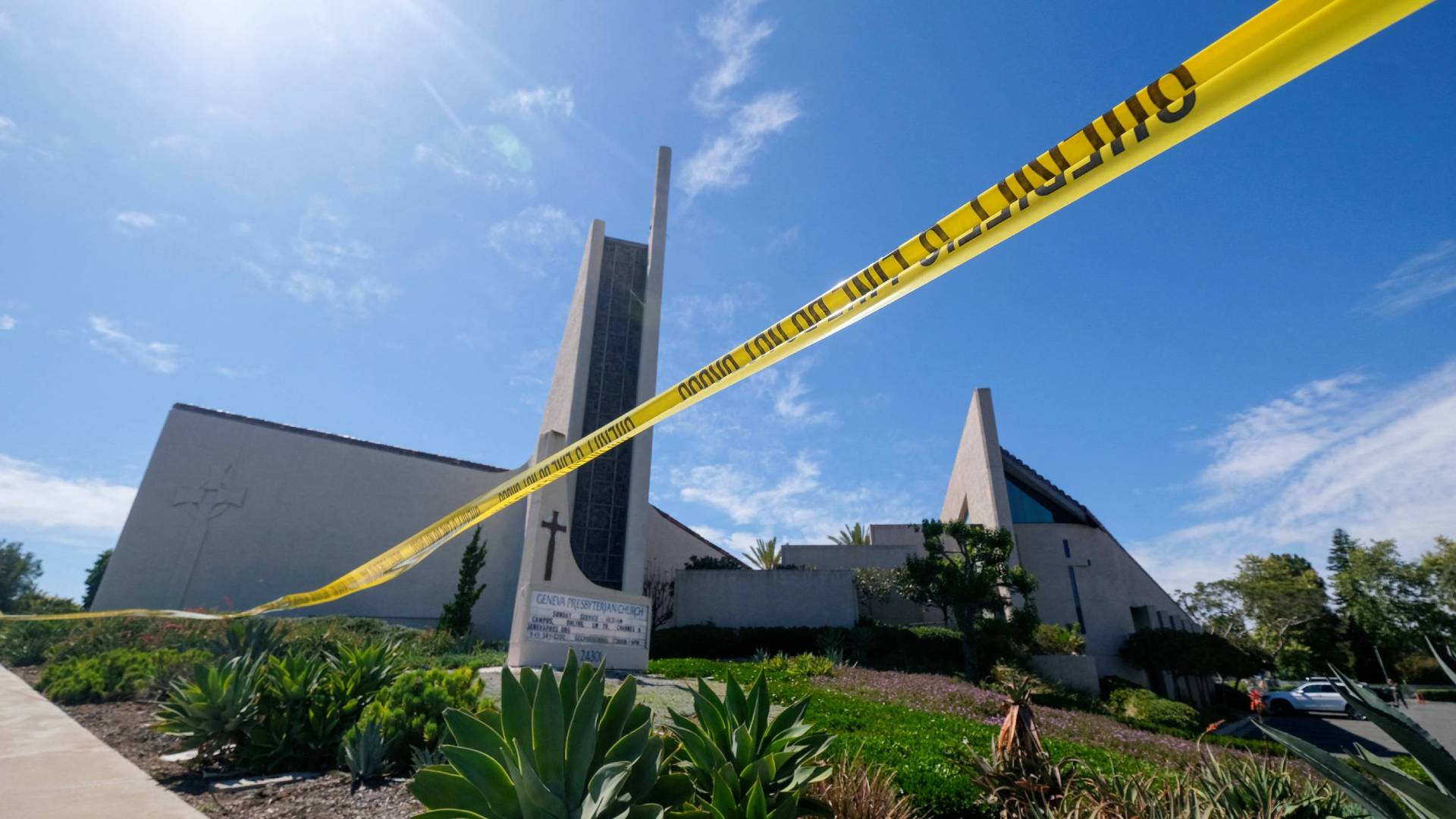
A gunman attacked a Taiwanese Presbyterian congregation gathered at Geneva Presbyterian Church in Laguna Woods, California, on Sunday.

A gunman attacked a Taiwanese Presbyterian congregation gathered at Geneva Presbyterian Church in Laguna Woods, California, on Sunday.

Christianity Today May 15, 2022
Ringo Chiu / Getty Images

A celebratory Sunday luncheon for the former pastor of a Taiwanese congregation in California ended in “grief and disbelief” when a gunman opened fire, killing one person and injuring five others.

Visiting from Taiwan, the longtime pastor of Irvine Taiwanese Presbyterian Church knocked down the shooter, preventing the intruder from reloading and firing at more of the aging congregation, according to news accounts. Members were then able to use an extension cord to hogtie the shooter and disarm him.

The incident took place at Geneva Presbyterian Church in Laguna Woods, California, where the Taiwanese church has met for the past decade.

Sunday’s luncheon—a tradition that had been on hold during the pandemic—resumed in honor of the return of their longtime pastor Billy Chang. According to the Los Angeles Times, Chang pastored Irvine Taiwanese Presbyterian for 21 years and left in 2020 to lead a church in Taiwan.

Authorities said 30 to 40 members were gathered when the suspect, an Asian man in his 60s, opened fire with two handguns. The church’s current pastor, Albany Lee, told The New York Times that no one recognized the shooter and it was the visiting pastor who subdued him. Several accounts describe Chang hitting the gunman with a chair.

Orange County law enforcement applauded the congregation’s response as a display of “exceptional heroism and bravery” that prevented the situation from becoming worse.

On Monday, the sheriff called the attack a “a politically motived hate incident” and said the suspect—David Chou, a Chinese American from Las Vegas—held animosity toward the Taiwanese community. Authorities opened a federal hate crime investigation.

John Cheng died on the scene after launching to action to stop Chou and being shot multiple times. Cheng, a 52-year-old doctor, had accompanied his mother to church that day.

Four were in critical condition on Sunday. One suffered minor injuries. The oldest victim was 92.

“There is a lot of grief and disbelief among the congregation,” Yorba Linda councilwoman Peggy Huang, who is Taiwanese American, said in the Orange County Register. “This was supposed to be a joyous occasion.”

The banner photo on Irvine Taiwanese Presbyterian’s website depicts about 150 church members posed at the front of their sanctuary, almost all of them older and graying. The vast majority of Laguna Woods residents live in a retirement community called Laguna Woods Village.

https://twitter.com/JocelynSChung/status/1525994834539884544

The Presbyterian Church in Taiwan is the island’s largest denomination, and some Taiwanese immigrant churches in the US come out of the Presbyterian tradition.

Both Geneva Presbyterian Church and Irvine Taiwanese Presbyterian are listed as part of the Presbyterian Church (USA)’s Los Ranchos Diocese, which includes 44 churches in eight languages. Irvine Taiwanese Presbyterian proudly continues to conduct services in Taiwanese.

“We use our own language and culture to worship God,” reads a message on the church website from Lee. “Although we don’t have our own church building, we are thankful to Geneva Presbyterian Church and their generosity, allowing us to share their facility.”

“Irvine Taiwanese Presbyterian Church is a family of love,” wrote the pastor. “I hope that all brothers and sisters can become acquainted with each other on a deeper level.”

A member of the nearby Evangelical Formosan Church of Irvine said the two congregations had shared family and leaders.

The attack occurred a day after a mass shooting at a Buffalo, New York, grocery store, and a few months after another deadly incident at a California church.

For Taiwanese Americans, the tragedy comes amid ongoing concerns for safety—particularly for elders—amid anti-Asian violence during the pandemic.

“God, have mercy. 1 dead, 5 injured at a Taiwanese church today in Laguna Woods, California,” tweeted Michelle Ami Reyes, vice president of the Asian American Christian Collaborative. “Another precious Asian image bearer’s life tragically lost. How many shootings will we be forced to bear witness to this month?”

https://twitter.com/bikhim/status/1526011018647900162

The Faith Based Security Network has tracked more than 500 fatal attacks in churches from 1999–2018, and the tally of incidents each year is climbing.

“Churches are intended to be safe sanctuaries from hate and violence,” said Orange County district attorney Todd Spitzer. “That serenity was shattered this afternoon by a gunman who unleashed unspeakable violence in a house of worship.”

This story has been updated.

Ideas

Vote as a Christian, Not Because You Are Christian

Lebanese evangelicals—like believers worldwide—often approach elections torn between hope and despair. But with a major vote looming, do they have a biblical mandate to participate?

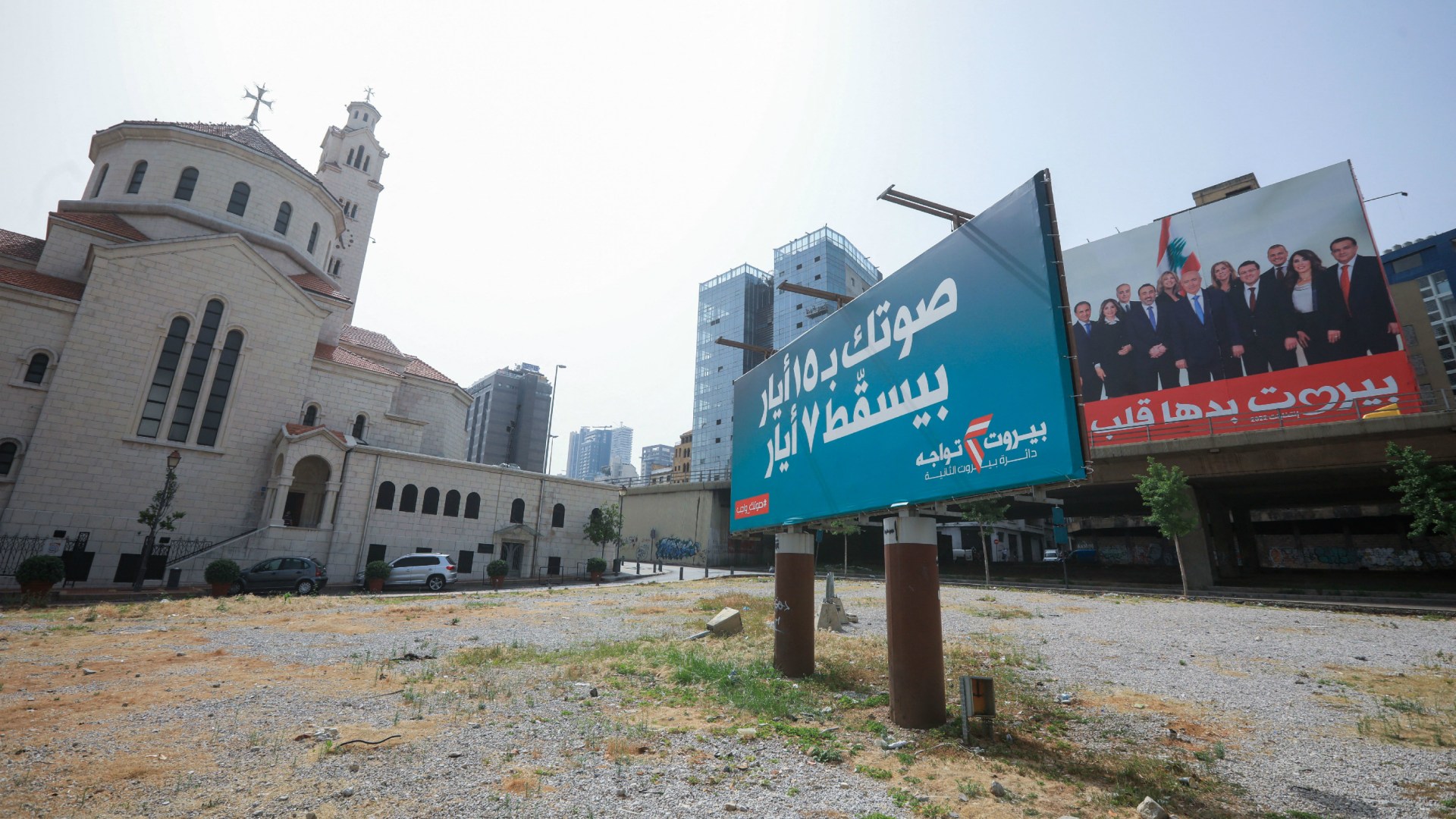
Billboards depicting Lebanese candidate lists and slogans hang near the Armenian Catholic Cathedral of Saint Elias and Saint Gregory in downtown Beirut on May 14, 2022, on the eve of parliamentary elections.

Billboards depicting Lebanese candidate lists and slogans hang near the Armenian Catholic Cathedral of Saint Elias and Saint Gregory in downtown Beirut on May 14, 2022, on the eve of parliamentary elections.

Christianity Today May 14, 2022
Louai Beshara / AFP / Getty Images

Lebanon is a mess. A stalled revolution. The Beirut explosion. Economic collapse.

But now we have a chance to vote. On May 15, for the first time in four years, citizens can react officially to the disastrous failure of our ruling parties. Even if in limited fashion, ballot boxes can change the course of a country.

No matter your nation, elections offer hope.

But also uncertainty. In Lebanon, will we renew the mandate of leaders who have led us into this malaise? Will one side of the political spectrum ascend against the other? Will opposition movements and individuals manage to win seats?

These elections are of massive importance.

But what will happen afterwards, when the excitement of democratic involvement wears off? Lebanon teeters regularly between expectation of upheaval and disillusionment with the corrupt system. Some view this weekend’s vote as our best chance to hold leaders accountable. Others, in apathy or despair, doubt anything will change.

Amid these questions, evangelicals are debating their faithful response.

Last week, I was the guest of a weekly morning Christian radio show. Given our political season, the host asked me about the believer’s duty to participate in the elections. Sharing a zeal for political change, she offered a softball question inviting me to give a moving speech encouraging Christian listeners to make a difference.

I chose my words carefully.

I will vote, I replied, and I have a clear preference. The secular movements opposed to our sectarian system offer the best hope for justice and change. But—and it is a big “but”—I told her there is no biblical or theological obligation for Christians to take part in elections.

She pushed back, surprised by my answer. Knowing my history of political activism, she likely expected an enthusiastic ramble about the responsibility to vote. We grew up in the same Lebanese evangelical circles, where the prevailing view is that faithful Christian citizenship involves casting a ballot.

I want to be clear: Our current ruling regime has behaved in a criminal fashion against the people of this country—Lebanese, refugees, and foreigners alike. They should be voted out of power.

But this is not a Christian mandate.

As believers, we have a rich biblical and historical tradition of opting out of the messiness of political life. Alternately, though it makes me uncomfortable, we also have legitimate examples of voting for the “lesser of two evils.” Some of us will abstain altogether. Others, in good faith, will vote for the parties I despise. But no matter our choices, the Bible consistently affirms that we belong to a new Kingdom that transcends political borders and divisions. Our citizenship is in heaven.

But on the earth, 1 Peter and 1 Timothy call us to accept current rulers and to pray for those in authority. It is possible to enact change through faithful witness and living out the gospel, rather than through direct political engagement. But we balance these passages with the examples of Israel’s prophets facing off against oppressive kings, and John’s description of the Roman empire as a murderous beast.

The Bible is full of politically charged passages, offering a spectrum of reactions to worldly realities. And among them, equally political, is the choice to abstain from political life.

All are viable Christian positions.

We are not being faithful to our scriptures if we tell our congregations that our biblical duty is to vote. Our biblical duty, simplified, is to be faithful to the gospel—the good news of Jesus. God has launched the new creation, uniting heaven and earth to himself in Christ. He invites us to join in this marvelous divine plan as a church, as we seek justice, love mercy, and live in service as a feet-washing community to each other and the world.

How we do that can vary among individuals, faith communities, and situations. I choose to seek justice through voting. You might choose to seek justice through acts of mercy in the local community. The two are not mutually exclusive, nor does one hold privilege over the other.

The key is faithfulness to the gospel. Do our choices and actions further the reach of the Kingdom? Do they glorify God? These are the question we must wrestle with as communities and individual travelers on the road of faith—far more than any specific political choice.

Of course, the different democratic and governmental systems bring different sets of theological questions. I may be compelled to vote in one situation but then refrain in another. Theology in practice always demands degrees of fluidity, and it is good to regularly evaluate our postures and convictions.

Does your conscience compel you to not vote? That’s fine. Consider the Anabaptist tradition of practicing Christian ministry in humility and mercy to all parties. Does your conscience compel you to vote? Wonderful! Consider the example of William Wilberforce, who labored 20 years in parliament to end the British slave trade.

What does this mean for us in Lebanon—or for believers in any nation?

Let us know—before, during, and after the elections—that Jesus is Lord.

Let us be wary of dressing our political decisions with biblical certainties.

Let us take care that our political philosophies, whether leading us towards direct engagement or conscious disengagement, be biased towards the marginalized and against the interests of power, money, and accumulation of privilege.

Let us pray: Lord, have mercy over our nation and its people.

A faithful Christian can vote. A faithful Christian can also abstain from voting. Our tradition is a big house with room for both. But in all places and times, the faithful disciple in the way of Christ must decide in accordance with the principles of justice and mercy.

This is the truth that guides us on election day—and every day.

Nabil Habiby is a Beirut-based lecturer in New Testament studies at Arab Baptist Theological Seminary (where a version of this op-ed was first published), and is a political activist with the Li Haqqi secular opposition movement.

Speaking Out is Christianity Today’s guest opinion column and (unlike an editorial) does not necessarily represent the opinion of the publication.

Theology

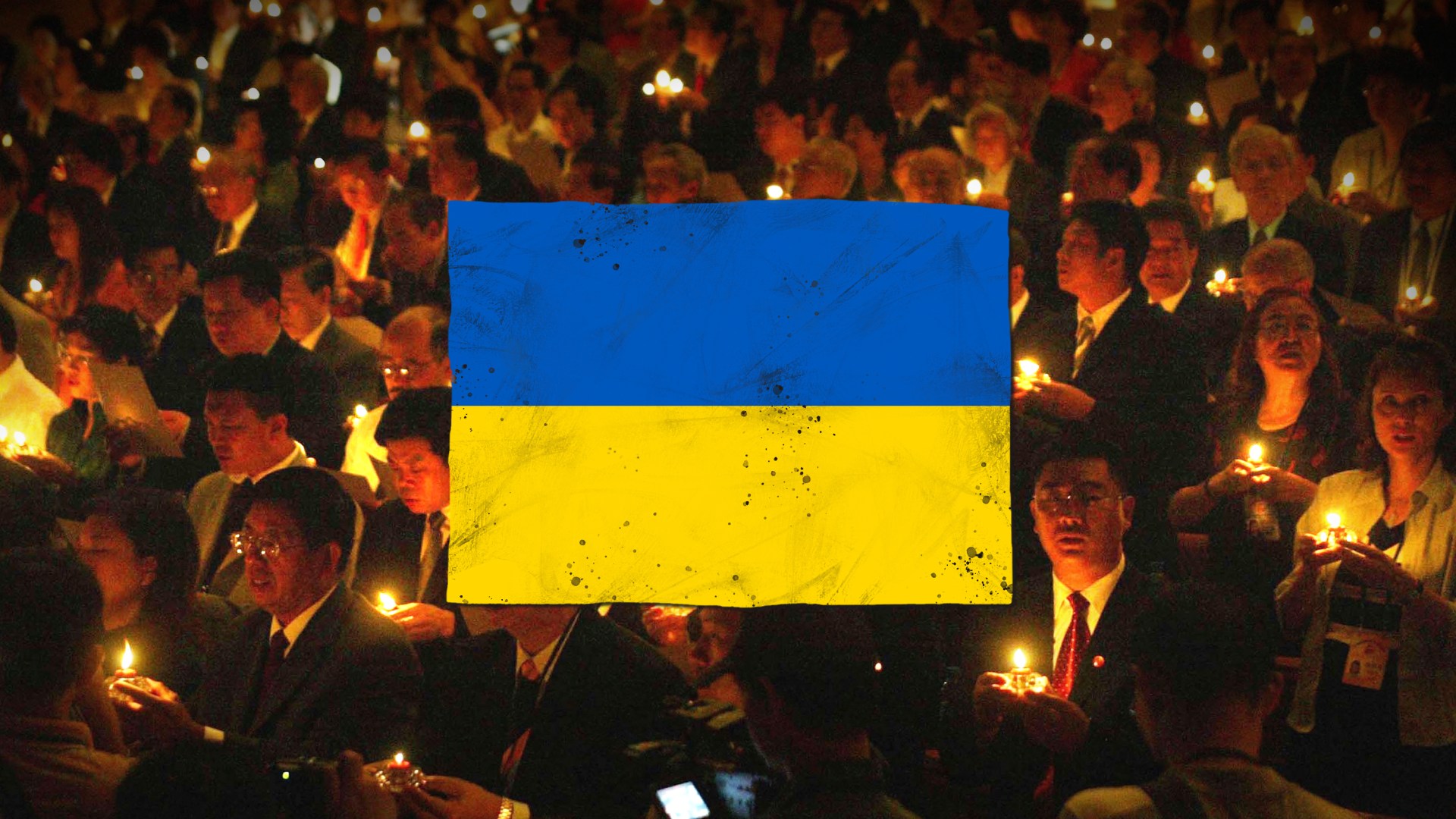
Why Taiwan’s Christians Should Support Ukraine: A Theological Rationale

Christian solidarity doesn’t derive from civil religion, but from the church’s role in redemptive history amid world history.

Christianity Today May 13, 2022
Edits by Christianity Today / Source Images: China Photos / Stringer / Getty

Every year, the people of Taiwan come together on February 28 in remembrance of an event from 1947 that ended with massive police and military crackdowns. In commemorating “228,” we reflect on our nation’s historic and current struggles against tyranny to establish and protect the rights and freedoms that we presently enjoy.

This year, I called for my fellow Taiwanese to voice support for Ukraine as a way of commemorating 228. For me, being Taiwanese means standing in solidarity with the Ukrainian people in their fight against invasion and tyranny.

A question then arose in friendly theological discussion: Did I post this comment in my capacity as a Taiwanese citizen or as a Christian theologian—or perhaps both? How do I make sense of my Taiwanese identity in relation to my Christian identity?

First, I must state unequivocally: I am not “a Taiwanese Christian,” but rather “a Christian from Taiwan.” The notion of a civil Christianity—a Volksreligion—has no room in the biblical worldview.

The Swiss theologian Karl Barth, who was forced to leave Germany in 1935 because of his opposition to its mystical nationalism, wrote of his native land in Gottes Gnadenwahl (God’s Gracious Election) in 1936: “There is no such thing as Swiss totality of life [Lebenstotalität], no Swiss religion, no Swiss Christianity.” In a similar vein, German theologian Jürgen Moltmann said to my fellow Taiwanese theologian Lin Hong-Hsin and my Chinese colleague Hong Liang in a 2019 interview: “I am not a German Christian, but a Christian in Germany.” As a neo-Calvinist, I heartily agree with these repudiations of civil Christianity.

Of course, it may be argued that civil religion can take on many different forms and that nationalism is not a monolithic phenomenon or ideology. Some have argued that nationalism is simply the idea that a nation is formed and held together by the normative and shared values of a people, and that these values are best described as religious.

Civil religion, in this view, is the religion that gives to a people a certain national identity. Nationalism and civil religion as such, it has been argued, can be innocuous and even biblical, and do not necessarily resemble the form that they took in the Third Reich.

To this argument I can only respond with a resolute Nein!

The neo-Calvinist principle of “sphere sovereignty,” a biblical principle that has found various expressions in other brands of Christian theology, dictates that the spheres of religion, statehood, and nationhood must be kept abidingly distinct. Jesus Christ alone is sovereign over all. Within God’s good creation, every sphere is sovereign in relation to all others. Just as Russia is under an ethical duty to respect Ukraine’s national sovereignty, within the moral order of God’s creation, religion, statehood, and nationhood are forbidden from invading one another.

In neo-Calvinism, the notion of sphere sovereignty is incorporated into what is often called a “Christian worldview.” Some have described it as a “creation-based worldview,” but this description does not encapsulate the whole concept.

Simply put, what the theologians that I like to call the “magisterial neo-Calvinists” (most notably Abraham Kuyper and Herman Bavinck—and I would add Geerhardus Vos) mean by “Christian worldview” is a view of world history as the stage on which redemptive history—the history of creation, fall, and redemption—is enacted. I like to borrow Barth’s rhetoric to describe world history as the “external basis” of redemptive history and redemptive history as the “internal basis” of world history.

If this sounds too abstract, consider Luke 2:1 which documents Jesus’ birth into the Roman Empire under the rule of Caesar Augustus. The first de facto emperor of Rome took the title of Caesar from the assassinated Julius and adopted the name Augustus—a word that was customarily used to describe the gods—to insinuate the divinity of his person. He made Virgil’s Aeneid—a folkloric epic fabricating the story of the divine origin of the Latin race as a people chosen by fate to rule over the nations in the name of justice—the official narrative of Rome’s national identity.

That he who named himself Augustus was indeed God’s chosen ruler is one of the best dramatic ironies written by the author of world and redemptive histories. God chose this man to be known through the ages and throughout the world by a brief yet important mention in Luke’s gospel.

The significance of the mention is to show just how unimportant the self-fashioned emperor divine is to world history when we examine the outcomes of world history in light of its internal basis: namely, the history of God’s covenant with his people in Jesus Christ, grounded in an eternal and unshakable pact between the Father, the Son, and the Holy Spirit. (Reformed theologians call this the “covenant of redemption” or pactum salutis.)

A child was born, whose birth continues to be celebrated throughout the world today, while Aeneas is relegated to the category of a legendary or mythical hero of warmongers seeking glory on the battlefield (his apparent virtues of compassion and justice notwithstanding).

Those of us who profess faith in the story of the child born under the reign of Augustus must search our hearts for remaining shadows of Aeneas and cast them out, for Christ was born to fulfill the First and Second Commandments—and all of the 10, for that matter. We who confess Christ as Lord will have no other god beside the God self-revealed in the incarnate Son, and will not divinize anything that is not God. This applies to the nation as well as to the state to which one belongs.

Still, some may argue that nationalism and civil religions, as defined earlier, do not necessarily divinize the nation or the state. But I argue that they necessarily do.

Among all earthly communities, Scripture only knows of one that God has chosen for the communion of the faithful to be a means of grace by the preaching of the Word and the administration of the sacraments. That community is the church, which took the form of Israel in Old Testament times.

Israel, not as a political state but as a spiritual community of faith in God’s covenant with Abraham, was God’s “chosen people,” now manifested through the church across the earthly nations. The apostle Peter tells us that the church alone constitutes “a chosen people, a royal priesthood, a holy nation, God’s special possession” (1 Pet. 2:9). Before we were called and gathered from the nations, we “were not a people, but now [we] are the people of God” (v. 10).

The church, in other words, is the only community in which unity in diversity is founded upon one Lord, one faith, and one baptism (Eph. 4:5). The earthly nation may be held together by some common values that are ultimately religious in some sense. And by all means, Christians ought to do their best to inform these values—because Athens is the external basis of Jerusalem. However, the attempt to unify an earthly nation with one Christian faith would be to divinize Athens and to give to it the status of a heavenly Jerusalem.

This immanentization of the heavenly Jerusalem (by some explicit or implicit secularization of the doctrines of election, providence, the church, and the last things) was precisely what the philosophies of Hegel and Marx were all about, as documented by Nazi-era Christian thinkers like Karl Löwith as well as contemporary writers like Charles Taylor and Michael E. Rosen. Immanentizing the heavenly Jerusalem and divinizing the earthly Athens are two sides of the same coin.

The church alone is chosen by God to be a present foretaste of the heavenly kingdom that has yet to come. Yet we do pray “Your kingdom come.” Our Lord did not teach us to pray to be taken to heaven. We are taught to pray for his will to be done “on earth as it is in heaven.” That is because the earthly history of Caesar Augustus was the external basis of the history of God the Son who came to earth, and the history of Jesus Christ was the internal basis of the history of Rome. By the same token, the church is the internal basis of the nations, and nationhood is one external basis of the coming of God’s kingdom.

Now, herein lies precisely the rationale with which I call for Christians in and from Taiwan to stand in solidarity with the people of Ukraine: a) Taiwan has a church in her midst to serve as her internal basis; and b) this church is in—but not of—the world to reenact in the here and now the history of the incarnation that was accomplished once and for all, there and then.

In the history of Taiwan’s quest for rights, freedoms, and the rule of law, the Presbyterian Church in Taiwan (PCT) has played a decisive role. When George Leslie Mackay and other Presbyterian missionaries first came to Taiwan in the late 19th century, they introduced to the island—then under Chinese rule and later occupied by Japan—modern medicine, agriculture, and education. They provided education for women and advocated for women’s rights. They studied and helped to preserve the cultures and languages of the indigenous peoples, and to this day ministers trained in PCT seminaries are required to learn to preach in the native tongues of their respective parishes.

These missionaries did not try to assimilate the Taiwanese First Nations or the Hokkien communities to a supposedly “Christian” civilization from the West. Nor did they attempt to convert local rulers and government officials in the pattern of Jesuit missionaries to China in the 16th and 17th centuries. Constantinian Christianity was not on their agenda. They envisioned a Christianity that would, in historical actuality, become the internal basis of Taiwanese history.

A church that exists as the internal basis of a nation has a prophetic duty to call society to “act justly and to love mercy and to walk humbly” (Micah 6:8). Presbyterians in Taiwan have historically stood at the frontlines to resist tyranny on behalf of their non-Christian neighbors. Many of our Presbyterian leaders were in fact people of high social status with overseas connections. But they partook of the “mind of Christ” who “emptied himself” (Phil. 2:5–7), and so they were willing to be murdered and jailed for the sake of their neighbors.

They understood one thing: Jesus came to be crucified by Pontius Pilate. God did not merely tell us to act justly and to love mercy; God accomplished justice and mercy at Golgotha. Golgotha is the external basis of God’s immutable justice and mercy. It is thus ill-becoming for those who pride themselves as bearers of the cross to take up an attitude of indifference towards the tyrannies, injustices, lies, and sufferings of this world.

“The Word became flesh” (John 1:14). If we truly believe in this central truth of the gospel, then we are forbidden to remain spectators and outsiders of world history.

Mackay the Canadian, who came to Taiwan exactly 150 years ago, became a part of the island’s history. The whole of Taiwan—and not just Christians—has come together to celebrate his arrival this year. The PCT after Mackay and his colleagues has profoundly informed Taiwanese culture to this day.

To be sure, Taiwan remains a religiously plural society, and aside from certain charismatic churches and movements Christians in Taiwan have no intention of turning the country into Christendom. The church remains the internal basis of our nation, and the nation the external basis of our church. The church in Taiwan as such shall continue to inform the nation with the values of justice, mercy, and humility by God’s common grace.

And because Taiwan has a church in its midst to serve as the internal basis of the nation, the church will continue to remind society, Christian or not, that being Taiwanese means participating in world history (common grace) through which the history of God’s own justice, mercy, and humility—that is, the history of the incarnation and the Second Coming (special grace)—unfolds.

Alex Tseng is a neo-Calvinist theologian from Taiwan specializing in studies on Karl Barth.

Ideas

Why Not All Pro-Lifers are Celebrating

Like the prophet Jeremiah, a biblical lament for abortion is neither apathetic nor triumphant.

Christianity Today May 13, 2022
Illustration by Mallory Rentsch / Source Images: British Library / Unsplash / WikiMedia Commons

Colloquially, English speakers often use two words to mean “indifference”: ambiguity and ambivalence. But if you consult a dictionary, neither of these words actually means a lack of feeling. Ambivalence means “having mixed feelings” while ambiguity signals a general “lack of clarity.” Part of the confusion lies in how we often cope with both mixed feelings and uncertainty. In the first case, you can become indifferent as a way to resolve conflicting or paradoxical ideas. In the second, you can become indifferent because you can't identify your precise feeling about something. And when we feel overwhelmed or uncertain, it’s often easiest to simply ignore our feelings altogether. It seems to me, however, that learning to live with the ambivalence of conflicting feelings and ideas is necessary for spiritual maturity—especially in an era when debates are raging and hot takes are abundant. I recently reread the book of Lamentations and was struck by the prophet Jeremiah’s ambivalence. Recounting the Babylonian siege of Jerusalem in 586 B.C., the entire book is awash with emotion, gut-wrenching realities, and seemingly disparate truths.

For years, the people of Israel had rebelled against Jehovah, disobeying his commandments and “crush[ing] underfoot all prisoners in the land, to deny people their rights before the Most High, to deprive them of justice” (Lam. 3:34-36). Jerusalem finally succumbs to her enemies in judgment. The siege is so desperate that women are driven to consume their own children (Jer. 19:9) in an attempt to survive (Lam. 2:20). Throughout the book, Jeremiah voices the agony of the people as well as his own.

He confesses and acknowledges that they have brought this upon themselves—but he also cries out for God’s mercy, claiming that their punishment is more than they can bear. Likening Jerusalem to a promiscuous woman, he sees her enemies as having taken advantage of her. She trusted people who abused and debased her, who inflicted pain and suffering on her. What’s interesting to me, however, is that if anyone is pure in this situation—if anyone has the right to pronounce God’s judgement on Israel with a righteous, singular vision—it’s Jeremiah. For years, he had warned his people that destruction was coming—and he was persecuted and imprisoned for it. But what you don’t get from Lamentations is the slightest whiff of triumphalism. There is no, “I told you so.” No, “Look what you’ve done” or “Well, this is what you get when you make certain choices.” Part of the reason that Jeremiah’s lament is so powerful is because the point is not simply to assign guilt. The point of Lamentations is to confess and beg God for mercy. So rather than pointing his finger at others, Jeremiah counts himself among them, confessing sins that he himself did not commit. The result is a humble, complex, and deeply human response. It is also ambivalent, full of a multitude of conflicting feelings: lament, guilt, shame, repentance, longing, faith, and hope. Jeremiah’s ability to live in the tension of seemingly disparate realities is one of the key features of a mature mind and spirit. In her book, Surprised by Paradox, Jen Pollock Michel writes,

“Allowing for paradox does not represent a weakened approach to theological understanding. On the contrary, it allows for a robust theology, one that is filled with the sort of awe that not only regards God as unimaginably wondrous but also awakens in us the desire… to see Him as He is.”

I’ve been thinking about all of this in light of the leaked draft of the Dobbs decision—which has the potential to overturn Roe v. Wade, the landmark Supreme Court case that enshrined abortion (including elective abortion) as a constitutional right. Many pro-life advocates are hailing this pending decision as the answer to decades of prayer, advocacy, and political will. But other responses have been more complicated, and dare I say, ambivalent. Consider these words, written anonymously, by a pro-life pastor whose daughter became pregnant after rape:

“There are many women, Christian and non-Christian alike, who have made the choice to preserve the life of the baby in the womb of their self-autonomy, who do not feel the euphoria of the political pro-life movement even though many of them strongly believe that the only wise choice is always life. Many even believe in some forms of legislation that shepherd women to the right choice, but they are not in the victory parade with politicians, activists, and moralists who believe a great conquest has happened.”

Pro-life Christians who feel ambivalent about the coming Dobbs decision are not indifferent. They do not see abortion as ambiguous or unclear. In fact, for many of them, things are exceptionally clear. They understand that we must continue to work for just laws and social ecosystems that support life. We must value women and unborn children alike. But even as they recognize what is clear, they also recognize that clarity is not the same as simplicity. And thus, they inhabit the ambivalence of this moment, embracing a multitude of responses. Grief over lives lost. Joy over lives saved. Shame over how often we adopted worldly means to reach certain ends. Anger over the misogyny that goes unchecked in both pulpits and the highest offices in the land. Resolve to work for a just society that values all human life from womb to tomb. And yes, even concern that new state laws will not be written carefully enough to protect women’s lives.

Like Jeremiah, we must acknowledge that all these disparate feelings and realities can be true at the same time. We must hold them in tension, refusing to opt for the easy resolution offered by either triumphalism or apathy.

We must also admit that we are part of something larger than ourselves. Because just as was true for the women of Jerusalem, the destruction of children is too often the result of larger, collective sins. Thankfully, God’s faithfulness is greater than our complicity. While Lamentations models ambivalence, its core message is one of clear-eyed hope.

“My soul is downcast within me,” Jeremiah writes. “Yet this I call to mind and therefore I have hope: Because of the Lord’s great love we are not consumed, for his compassions never fail. They are new every morning; great is your faithfulness.” (Lam. 3:20-23) If Christian public witness depended on our ability to preserve certain moral stances—or even on our ability to abide by them—it would be a very poor witness indeed. Our public witness does not rest on our own steadfast convictions. Rather, a distinctly Christian public witness consistently points back to the faithfulness of God in spite of our moral failings. And in so doing, it teaches us that we can choose hard, counterintuitive things because of who he is. The anonymous pastor—whose daughter chose life for her baby despite her rape—went on to describe the power of that decision. “[These women] found deep within themselves a humanity that was God-like, sacrificial, bold, and empowering. They chose to have a baby, to bring into the world a new creation. Out of their void, they would form something new.” What she describes here is the way of the cross. It is the way of suffering, of laying down one’s life for another. It is the way of Jesus, and it is the way of Jeremiah. Tradition tells us that Jeremiah suffered with his people. He was not removed or raptured away to safety. He was not even among the remnant carried off to Babylon with the promise that their descendants would return (Jer. 29:10-11). Instead, Jeremiah was imprisoned in Jerusalem, held under siege by the Babylonians, and eventually, forcibly removed to Egypt by his fellow countrymen. And there, we are told, he died. Jeremiah died in exile without witnessing any clear resolution for the people of Israel. He died as he lived, in ambivalence—recognizing both what had been promised and what had yet to be fulfilled.

But he also died in hope. He died believing, “The Lord is my portion; therefore I will wait for him The Lord is good to those whose hope is in him, to the one who seeks him; it is good to wait quietly for the salvation of the Lord (Lam. 3: 24-26).”

Hannah Anderson is the author of Made for More, All That’s Good, and Humble Roots: How Humility Grounds and Nourishes Your Soul.

Speaking Out is Christianity Today’s guest opinion column and (unlike an editorial) does not necessarily represent the opinion of the publication.

Ideas

How Shall We Now Grieve Abortion?

After Roe v. Wade is overturned, we must find new ways to turn our mourning into action.

Christianity Today May 13, 2022
Illustration by Mallory Rentsch / Source Images: WikiMedia Commons

For 15 years, my mother headed each week to the back room of a small office suite to sort baby clothes.

A stalwart volunteer at our community’s crisis pregnancy center, my mother processed thousands of donations over her years of service—clothes, car seats, cribs, maternity wear, even infant formula. She had watched in sorrow as Roe v. Wade passed in 1973 and viewed caring for expectant mothers as a way she could make a difference, to give her grief legs.

On visits home from college, I’d sometimes accompany my mother to the back room where she worked. I never met the new moms who arrived each week to gather supplies. I never sat and held the hand of a woman contemplating termination.

Nonetheless, I, too, grieved for all the lives lost to abortion. My faith had taught me that all life was precious from the cradle to the grave. Unlike my mother’s, however, mine was grief over an intangible loss—of babies I never held and would-be moms I never knew. My sadness, like that of many pro-life evangelicals, was an ambiguous grief, deeply felt but tragically unresolved.

For almost 50 years, pro-life evangelicals have grieved abortion statistics, procedures, and court documents. We’ve worked behind the scenes to support women choosing life for their unborn babies, and we’re more than ready for this grief to end.

And while the Supreme Court decision might present the illusion that our sad days are over, abortion will remain an ambiguous loss. Abortions past, present, and future will continue to provoke complex sorrow.

Like it or not, we’re here to grieve for the long haul. But how do we do it well?

Grief Without a Face

In the late 1970s, therapist and researcher Pauline Boss sat with grieving families as they processed the absence of their loved ones who had disappeared in the Vietnam War. The term “ambiguous loss” emerged from her research as she watched communities cope with the physical absence of soldiers missing in action—those who were gone and yet not gone.

Over the years, Boss began to see parallels with those who grieved dementia diagnoses, severe family alienation, kidnappings, and, among other losses, abortion. She found that when a person or community couldn’t connect directly with the loss they’d suffered, they couldn’t really move forward toward a productive life. To create a flourishing life after their loss, they would need to chart a unique path that embraced the ambiguity of their grief.

It should go without saying that even if Roe v. Wade ends, abortions will still occur. A landmark SCOTUS victory would be a victory, yes, but only as a point on a line—a moment of clarity in an otherwise ongoing, ambiguous loss.

But even while this grief remains unresolved or disenfranchised, Christians can model productive practices that both enact our sadness and chart a positive path forward. The ongoing ambiguity of abortion loss invites us to grieve and grow, even in the absence of closure.

Consider how these three principles of ambiguous grief recovery might guide us toward a resilient pro-life witness, regardless of a court decision.

1. Finding New Meaning

For over 50 years, evangelicals have defined closure for our abortion grief as an overturned court decision—the very one we expect to happen shortly. But ambiguous loss tells us a different story—that closure from an ongoing loss is only a mirage.

However, that doesn’t mean we must despair.

Instead, the church can find new meaning as we engage in purposeful work around the losses we continue to suffer. As abortion becomes harder to obtain, we can give our grief expression by mobilizing to meet women’s emotional and financial needs more earnestly than ever before.

Women will need safe spaces to grieve, process, and move forward after decisions about their pregnancies. We can open our homes and our lives to the vulnerable. We can work to rid our faith communities of abortion stigma and shame.

2. Adjusting Our Identity

For many evangelicals, an opposing position on Roe v. Wade has been a defining feature of who we are.

Processing ambiguous loss requires that we reassess our strongly held identities, calling forth the places where we have inadequately or incorrectly named ourselves and finding new ways to talk about who we are. Ongoing grief asks us to look to the future, beyond the narrow labels we may have assigned to ourselves in the past.

As we process our long-term grief, the church can resist the dangerous urge to be defined by a single political issue. We can allow our sadness to inform and reshape our identities—making us a more resilient and grace-infused pro-life movement in this new season of loss.

3. Normalizing Our Ambivalence

The day after the official SCOTUS decision will be just like any other day on Capitol Hill; it will be just another day for evangelicals in America.

After the confetti covers the celebration floor, we might be surprised to feel that old sense of grief creeping back into the room. We may find that life has not changed as much as we’d hoped—there will still be many sorrows left to comfort and much darkness yet to confront.

As we acknowledge our long-held abortion grief, the concept of ambiguous loss invites us to accept that we may feel a certain degree of ambivalence—whether or not we achieve our desired outcome. Because regardless of a court decision, we know the victories we achieve in this life will always be tainted with a measure of disappointment.

This side of heaven, Christians must carry both joy and grief in the same hand. Until Jesus comes again, the brokenness of the world will surround us and dwell within us. We’ve come so far, but the grieving process reminds us that our earthly sadness is a long road.

And we still have miles to go.

Clarissa Moll is an award-winning writer, podcaster, and the author of Beyond the Darkness: A Gentle Guide for Living with Grief and Thriving after Loss.

Speaking Out is Christianity Today’s guest opinion column and (unlike an editorial) does not necessarily represent the opinion of the publication.

Church Life

Here’s What Thousands of Christian WeChat Accounts Reveal About Chinese Internet Evangelism

Were rampant commercialism and plagiarism more harmful for Chinese Christians than government censorship?

Christianity Today May 13, 2022
Illustration by Rick Szuecs

The Chinese government’s latest crackdown on online evangelism has deleted or led to the closure of numerous Christian accounts after new measures took effect in March.

Among them are Jonah’s Home, which for years provided Bible study, evangelism, and discipleship resources for Chinese Christians. A Christian apologist and influencer who writes under the username Jidian lost nearly 300 Christianity and Bible-related questions he had answered on Zhihu, a Q&A platform.

These restrictions have intensified since 2018 and have crushed hundreds of WeChat public accounts created by evangelical organizations and Christians. Those who attempted to reopen would find their “reincarnated” accounts quickly deleted.

WeChat is a powerful digital media outlet with more than 1.2 billion users worldwide and tens of millions of “public accounts.” Over the past decade, WeChat accounts have been an important platform for Chinese Christians to speak about their faith and communicate the gospel. Prior to 2018, these accounts offered discipleship materials, inspirational messages, and apologetics resources, attracting followings of millions of Christians and seekers.

In 2017, our Chinese team at ReFrame Ministries commissioned a professional company in China to analyze more than 5,000 WeChat public accounts and to study the content and influence of the Christian accounts. This report examined and calculated parameters such as the number of reads, likes, Christian-related keywords, and published articles.

Though many individual Christians and Christian media groups have left WeChat or lost their accounts recently, we hope that our study can still be a useful reference for believers, churches, and organizations interested in using new media for evangelism. We highlight two major points:

Are Christian WeChat accounts really “Christian”?

Few public WeChat accounts that contained Christian keywords regularly posted Christian content or had Christians or seekers as their target audience. Of the 5,263 accounts we found with Christian keywords, only 349 of them seemed to actually have a ministry focus. In contrast, the vast majority were either non-Christian accounts mentioning Christian words in passing or accounts that contained Christian contents but for commercial purposes.

The fact that there were non-Christians on WeChat posting Christian faith-related content for profit (in imitation of evangelical public accounts) is reflective of the fact that Chinese Christians in China and overseas had gained considerable attention and influence using WeChat as a marketing platform. These commercial public accounts often mentioned Christianity, Jesus Christ, the gospel, Israel, and the Bible in content about religion, faith, culture, history, current affairs, finance, and academia. But the perspective and the purpose of their references had little to do with gospel and mission, and they did not even help readers understand the gospel correctly.

This confusion isn’t necessarily eradicated among the public accounts run by Christians. The individuals and organizations running these accounts had mixed-faith backgrounds and include “cultural companies” with opaque information about the specific organizations operating them. (China does not allow religious or ideological organizations to exist unless they are government sanctioned, so groups register as “cultural companies,” which are distinct from nonprofits.) These public accounts heavily plagiarized other Christian sites. Some accepted donations and offerings but did not explain where the money would be directed.

Many of the commercial public accounts of unknown origin or even operated by non-Christians significantly outpaced, in terms of numbers and readership, the core evangelical public accounts that urban Chinese Christians were relatively familiar with—outlets such as Life Quarterly, Good News Today (ReFrame), and Overseas Campus that made the list of top 50 Chinese Christian accounts (ranked by a combination of number of articles, reads, likes, and keyword hits).

Curiously enough, 4 of the top 5 of the 349 “Christian public accounts” were operated by a marketing company based in Jinan City, Shandong province, and all used the same “WeChat Church” logo. All top 5 accounts had WeChat shops, selling Christian products and some health products unrelated to faith. These five accounts had a combined readership of 76 million, which exceeded the combined readership of the next 95 accounts (with a combined 57 million).

Errors and inaccurate statements about biblical truth were rampant in these commercial accounts’ articles, yet the tallies of reads and comments were shockingly high. For example, an article on “Five Secret Ways of Prayer” from the third-ranked public account, which contained specious and unbiblical “tips for prayer,” was read by more than 10,000 people and received more than 200 likes within a few hours of being posted.

The study also revealed widespread and serious plagiarism and copyright infringement on Christian public accounts. (Chinese social media platforms have generally not been effective in preventing and punishing plagiarism and infringement.) In particular, public accounts that promoted Christian movies, music, and videos had the most serious issues with violations. Operating at “zero cost,” these public accounts used a lot of unauthorized video, audio, and text, yet accepted donations and bundled advertisements with their contents. By using the word Christian but disregarding basic Christian ethics, they gave a bad testimony to Chinese readers.

To some extent, these issues are related to the composition of the Chinese church. A significant percentage of Chinese Christians have a low level of literacy, and as the popularity of WeChat has increased so has the percentage of under-educated Christians who use it.

These Christians likely looked for Christian content on WeChat’s indiscriminate platform but were not able to discern between good and bad quality. So what became their daily “spiritual food” was more often than not content posted by public accounts set up by non-Christians to scam them for money. It is concerning that a large number of Chinese rural Christians were being “shepherded” by WeChat commercial accounts on a daily basis.

Why Christian WeChat accounts lacked influence

The enormous number of WeChat public accounts meant that Christian accounts with a low number of hits did not show up in results. Therefore, we were not able to retrieve content from many public accounts owned by evangelical organizations that are relatively influential among Chinese believers in China and overseas. Consequently, we selected 35 public accounts owned by evangelical organizations for additional research and obtained the communication data of all 3,086 articles published in a total of 60 days from May to June 2017. Here are some of our findings:

First, the overall number of articles published by evangelical organizations and the number of readers were low. Of the 35 evangelical accounts, only five posted more than 180 articles (at least three a day) in two months, and the highest average readership was fewer than 8,000. In contrast, many of the plagiarizing commercial accounts have multiple articles a day, each easily reaching 20,000–30,000 readers.

Second, very few of the articles from these evangelical accounts were able to win readers through quality. Some of those that published fewer (less than 50) articles in two months managed to get a relatively high average reading rate, but there were only eight such articles.

Christian public accounts also failed to artfully engage non-Christians on WeChat. They generally suffered from overly homogeneous content and gave people the impression that Christians do not care about earthly matters and only live in the spiritual stratosphere, lacking the ability to pay attention to public affairs and dialogue with the public. These shortcomings also reflected the lack of preparation and capability of the church in this area of online evangelism.

Although the public accounts of evangelical organizations do have the advantage of originality in content and orthodox theological insights, statistically they undoubtedly lost out to commercial accounts that sold goods under the guise of evangelism. We believe that this phenomenon of “bad money driving out good” suggests that many Christian public accounts struggled with a lack of awareness of social media marketing, insufficient training in professional operation and management of public accounts, poor understanding of new media audiences, neglect of social issues, and immaturity in public theology.

On the positive side, these findings help us understand that building and maintaining audience relationships is crucial, and that precise targeting is beneficial for increasing the impact of public accounts. WeChat accounts should be aesthetically pleasing and be able to respond quickly to current events.

For example, we believe that the articles of Christian accounts “Mr. Daniel,” “The Road,” and “Territory” gained thousands of readers because they knew their core audience—i.e., urban, intellectual, and white-collar Christians—and spoke to them effectively with their content, timeliness, and aesthetic design. With a good sense of design and fashion and highly visual elements to refine a gospel narrative script, “The Road” ranked first, far ahead of all other Christian accounts.

WeChat differs from social media outside of the Great Firewall (GFW) in many distinct ways. Due to increasingly strict censorship of religious content, Christians are inherently limited in their gospel-related speech on WeChat, and often have to do some self-censorship in order to remain on the platform. Moving out of WeChat (using VPN and other GFW-circumventing tools for those in China) may eliminate censorship concerns. Yet new media Christian missionaries still face many other challenges.

For instance, the COVID-19 pandemic forced the Chinese church to go online, and many Chinese pastors and Christians launched their own platforms, often on YouTube. The advertisement sharing mechanism of YouTube encourages many users to earn income and even make a living from it, and Christians are no exception. However, viewers must learn to discern the nature of these teachers’ sources and the attitude with which they engage public dialogue. Furthermore, YouTube’s potential for profit can reward Christians who may end up reaping financial benefit from peddling “alternative truths” and conspiracy theories.

For many of today’s internet mission organizations that have moved their contents to off-GFW social media platforms, not all of the above insights and experiences we gained through our study of Christian WeChat public accounts are applicable. But some of these insights into the basic principles of using new media for evangelism should still be helpful. Christians who have the burden and passion to make good use of new media for evangelism and disciplemaking still have a lot to learn and much room to grow.

Jerry An is the Chinese Department Director of ReFrame Ministries, a missionary pastor, publisher of the Chinese book series “New Songs of the Wanderer,” and leader of the Chinese Christian Internet Mission Forum.

Translation by Sean Cheng

News

Photos Show Ukraine’s Bible Belt Struck Down But Not Destroyed

After Russia’s withdrawal from Kyiv suburbs, Irpin evangelical ministries emulate the scattered yet persevering church from Acts 8.

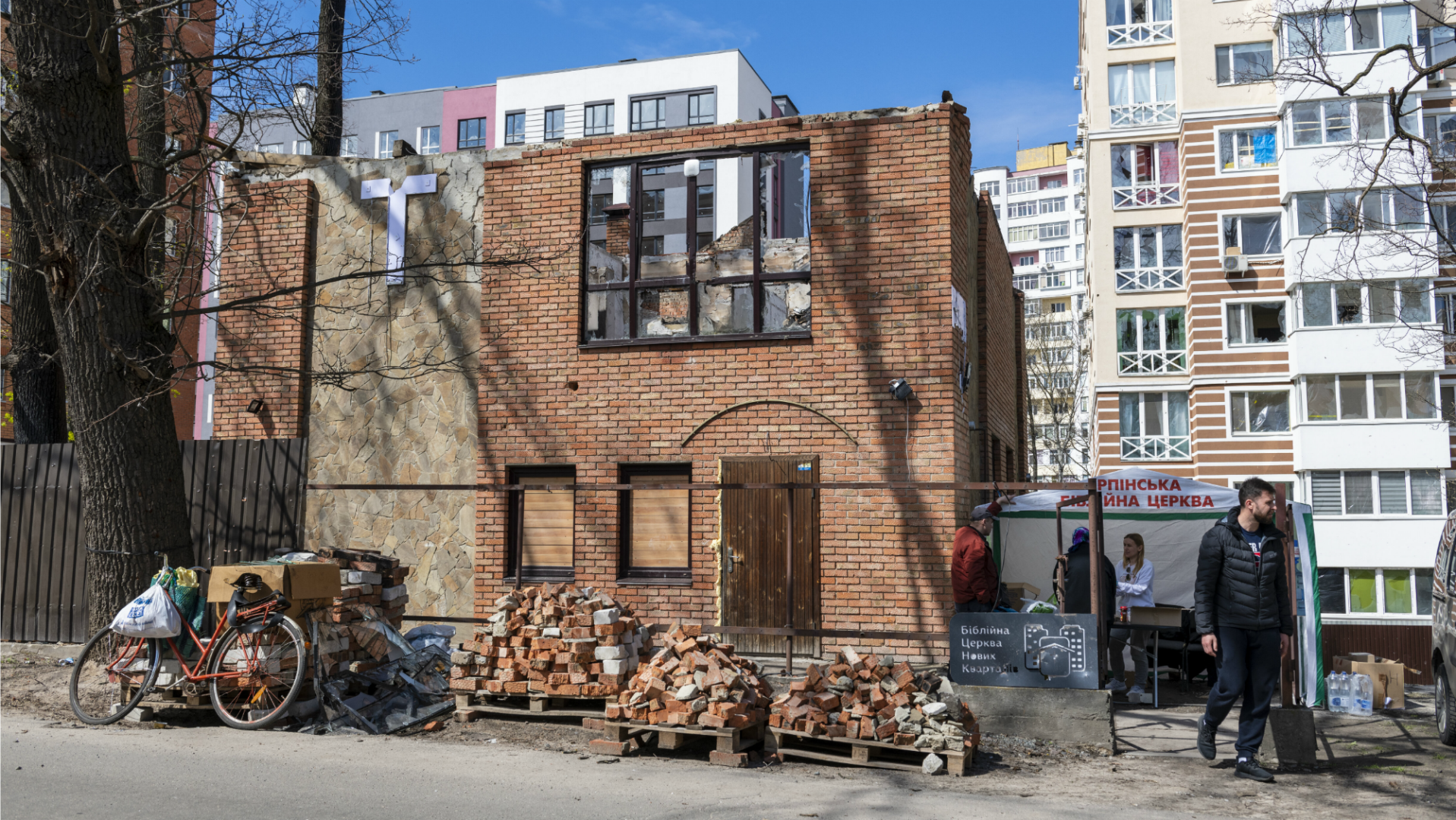
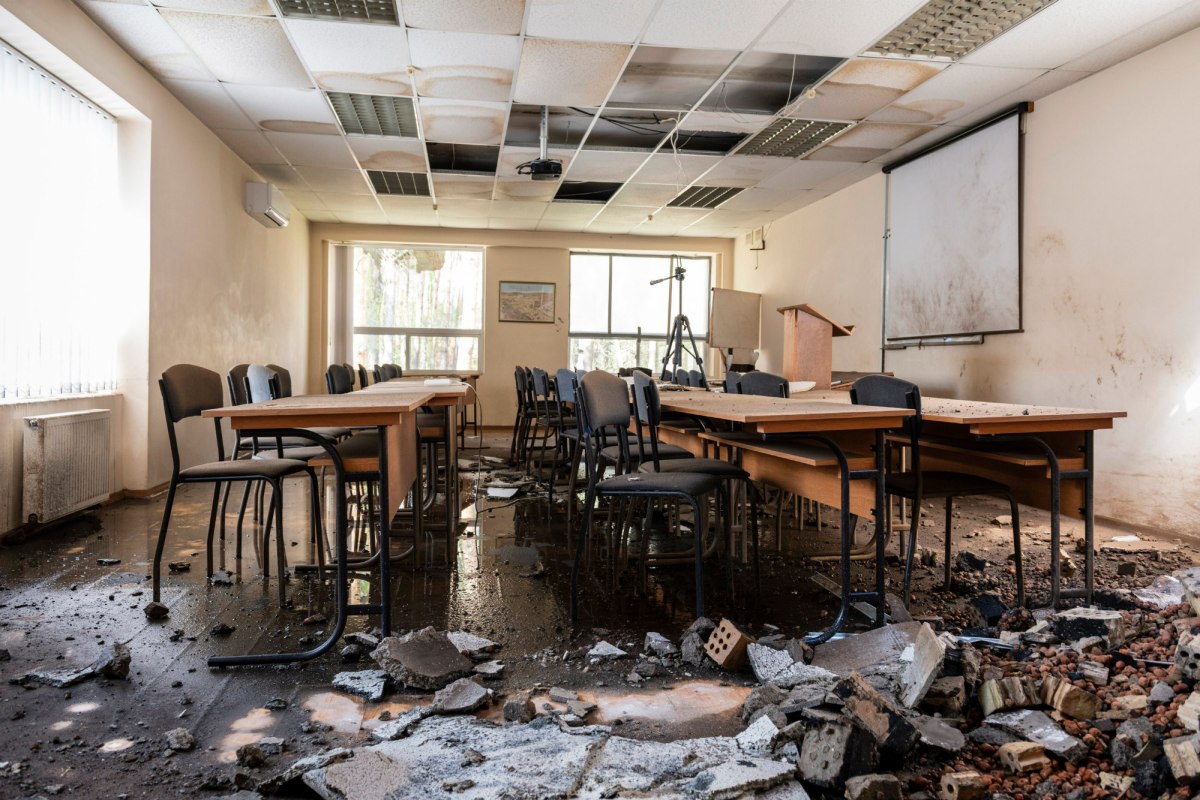
A Baptist church plant in Irpin, Ukraine, damaged during the Russian invasion.

A Baptist church plant in Irpin, Ukraine, damaged during the Russian invasion.

Christianity Today May 13, 2022
Joel Carillet

Ministry had been going so well in Irpin, Ukraine.

Over the past decade, the population of Kyiv’s northwest suburb swelled to 90,000, and Irpin Bible Church (IBC) grew with it. The Baptist congregation grew to include 700 adults, with an additional 300 children. And in 2019, 12 members launched a church plant in the “New Blocs” neighborhood, where 15,000 Ukrainians lived in multi-story apartment complexes with no church of any kind.

Meeting previously in a basement office, last December the church planters purchased a stand-alone building from a local bank, grateful to have their own location amid a shortage of rental space. With a ground-floor capacity of 200 people, the congregation’s 60 members anticipated additional growth.

Three months later, the Russians invaded.

Hostomel was the first suburb to fall, being home to the regional airport. The assault on Irpin and neighboring Bucha began February 27, attempting to encircle Kyiv.

IBC senior pastor Mykola Romanuk was in the US at the time, while his family relocated to western Ukraine. He returned on March 5, only to leave later that day when tanks first breached the suburb. The next day, a member of his congregation who had returned to Irpin to assist with evacuations was killed alongside a mother and her two young children—a tragedy witnessed and shared worldwide by The New York Times—as Russian forces shelled the humanitarian corridor.

By March 14, Russia occupied half the suburb, including the church plant’s quarter. IBC’s sanctuary remained secure, but 200 of its members fled to 20 nations across Europe, while another 500 scattered across western Ukraine. Romanuk was in Rivne, 200 miles west of Kyiv, with about 70 of his congregants. Services resumed online while the stalwart faithful tried to serve 4,000 mostly elderly residents left behind in Irpin.

Dozens were killed in Russian atrocities.

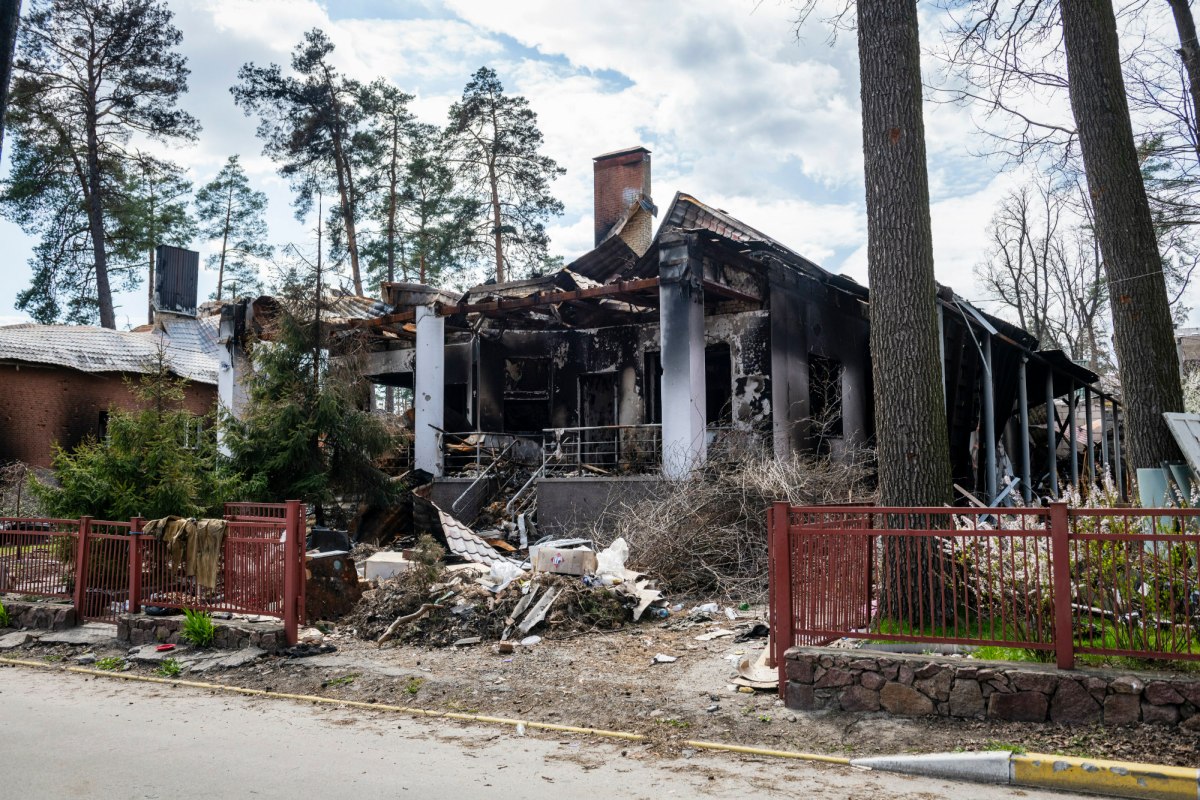
On March 16, Ukraine announced a counterattack. The army recaptured the suburb on March 28. But fighting continued in Bucha for another two days, during which time Russia increased its seemingly random barrage of missiles into Irpin. One hit the church plant, destroying its roof and the second floor Sunday school classrooms.

There were no military personnel in the area.

“Any building can be rebuilt,” said Romanuk. “Compared to the destruction of the city and the many who died, it is no big deal.”

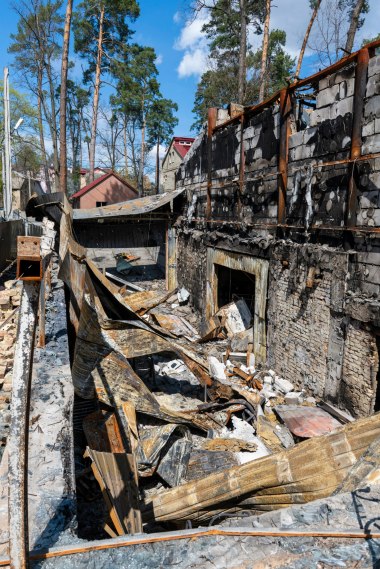
The Irpin headquarters of Mission Eurasia, founded in 1991 to spread the gospel in the former Soviet Union, was destroyed during the Russian invasion.

While some Ukrainian Protestants see church buildings as holy, he added, the majority Orthodox Christians view sanctuaries as a sacred space to connect with God, imbued with divine aura. No food is allowed inside; certainly not a bathroom toilet.

This has impacted relief efforts. Of the eight Orthodox churches in Irpin, only two had service annexes. Though only one was damaged—and its priest killed in an airstrike—it was only the annexes that opened to shelter their neighborhood members, he said. One Orthodox priest tried to help more broadly.

“In our theology, the church is a place for service and worship,” said Romanuk. “Now it has become a home for the homeless, catering to the needs of all.”

Leading IBC since 2009, he returned with his wife and daughter on April 3, living in the church basement with 40 of Irpin’s displaced residents. His apartment is undamaged, though a shell hit the neighboring complex. But though electricity returned to half the suburb on April 20, the Romanuks reside in their place of ministry.

The community is welcomed during morning and afternoon shifts to charge their cell phones. Up to 200 people are served a daily lunch. At 6 p.m. there is a Christian film or spiritual lecture. Home furnishings are given to those who need it, while 30 elderly and disabled people are delivered food and medicine.

And in the past three weeks, church members have begun light repair and plastic covering of broken windows and roofs, before coming rains cause further damage.

Other evangelical ministries in Irpin have made similar pivots to better serve their battered community.

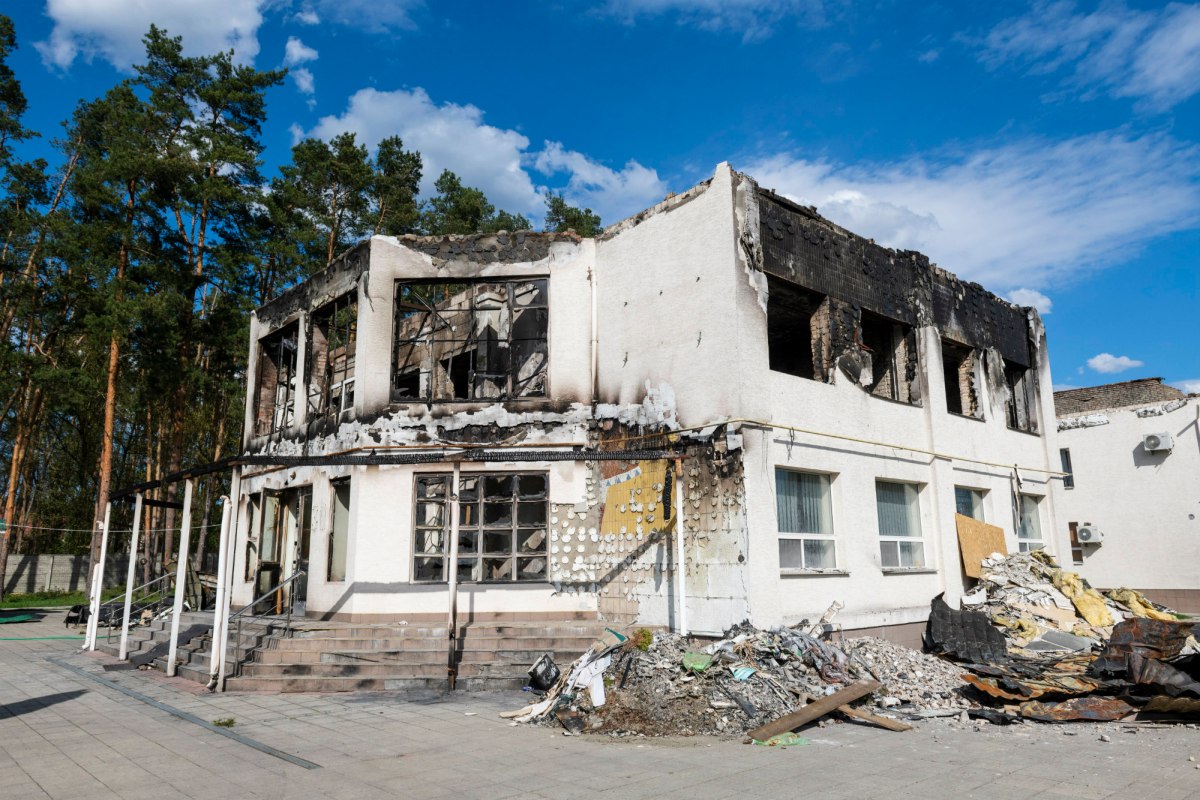
Irpin Bible Seminary sheltered 200 people during the invasion. Hundreds more came to get clean water and charge phones before the building was destroyed.

“We understand that a seminary is not a building—it is our students and staff,” said Igor Yaremchuk. “But now the war has taken them out of the classroom, with countless opportunities to practice their ministry skills.”

President of Irpin Biblical Seminary (IBS) since 2008, he keeps daily contact with the school’s 837 students via an evening prayer group via social media. Every week he prepares a 10-minute devotional—“A Cup of Coffee with the Rector”—in which he encourages faithfulness amid difficulty and provides updates about the school.

The worst came on March 20.

Also located in Ukrainian-controlled Irpin, IBS remained connected to the utility grid. The campus welcomed 1,000 people a day to draw water and charge cell phones, while giving shelter to 200 people who lost their homes.

The Ukrainian counterattack was already underway, and Yaremchuk believes Russia shelled each of the five connected seminary buildings because of this community contribution. Their iconic green roofs were destroyed, along with the kitchen and all second-floor classrooms.

“With God’s help, we will restore it,” he said. “But it was sad and painful.”

Irpin Bible Seminary will wait to repair its building, in case the Russians return. Today, the 800-plus students stay connected via a daily devotion on Zoom.

The campus is being cleared of debris, but repairs will wait until the situation stabilizes. Russia could return to attack Kyiv. But if the status quo holds, IBS plans to resume theological education in September—in person if possible, online if necessary. Currently it offers one course only, taught by linked professors in the United States.

The topic could not be timelier: “Counseling in Critical Situations.”

While he cannot be sure how much each of the 700 registered students can commit to the coursework, Yaremchuk hears many stories about their active ministry. The influence of the Baptist Union institution is felt in relief work and psychological care throughout the nation and in Eastern Europe, he said. And the gospel is shared—especially in bomb shelters.

He compared Ukraine to the church in Acts 8:1–4. When persecuted and scattered, members evangelized.

“The war is terrible, but it has been good for Ukrainian souls,” said Yaremchuk. “And in a Europe that is spiritually dead, our Bible Belt refugees are bringing a religious revival.”

Large parts of Mission Eurasia's headquarters were destroyed.
Large parts of Mission Eurasia’s headquarters were destroyed.

Mission Eurasia is a good example.

Having relocated to Irpin from Moscow to escape renewed pressure on evangelical ministries, Sergey Rakhuba never expected Russian President Vladimir Putin would follow him to Ukraine.

The Mission Eurasia president purchased its suburban headquarters from a local bakery—switching the facility’s focus to offering the bread of life. But when the area fell to occupying forces, the Russian military commandeered the ministry as a barracks, making use of its two apartments and 38-person second-floor dormitory.

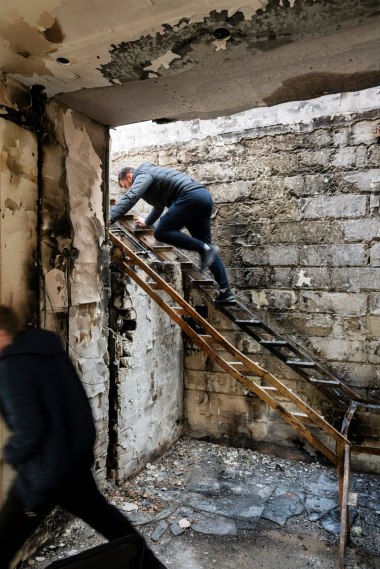
Ammunition was stored in the basement. Bibles were stacked to barricade windows. And when the unit finally retreated on March 28, it burned the religious literature and blew up its weapons.

The building went with it.

“We shed tears. There are so many memories,” said Rakhuba. “It was our mission hub not just for Ukraine, but for all of Eurasia.”

Bibles and Christian literature at Mission Eurasia were destroyed by fire.

But now, there are two hubs in Poland providing relief for refugees, with the international work in 14 former Soviet nations coordinated from Moldova. And four western Ukrainian hubs serve the internally displaced, with Lutsk printing and distributing ten times the Bibles that were destroyed in Irpin.

“Young leaders trained in our center are now leading service on the front lines,” said Rakhuba. “God’s victory will be bigger than the destruction.”

The Baptists remaining in Irpin have started the long process of rebuilding their damaged churches.

Romanuk sees a spiritual silver lining also.

New Blocs Baptist Church resumed weekly worship on May 8. The day also marked the first service in Hostomel, where 35 people joined a new IBC plant launched to accompany the church’s relief work there.

And it was the fourth meeting at IBC’s undamaged main campus, with 50 members who had returned to the now-liberated suburb. They were joined by another 50 believers whose churches have not yet restarted, along with 100 others from the community at large.

Having accepted their trial, Irpin evangelical leaders maintain hope.

“When you see your city destroyed—all month long—you understand it could hit you also,” said Romanuk. “But despite our sadness, God has given us more ministry than before.”

Follow CT’s Russia-Ukraine war coverage on Telegram: @ctmagazine (also available in Chinese and Russian).

Select articles are offered in Russian and Ukrainian.

News

Southern Baptists Drop 1.1 Million Members in Three Years

Baptism tallies, though, are beginning to recover from 2020’s pandemic plunge.

Christianity Today May 12, 2022
Kelli M. Allison / Lightstock

The Southern Baptist Convention (SBC) has lost over a million members in the past three years, with back-to-back years of the COVID-19 pandemic following a decade-plus of decline.

Reported SBC membership fell to 13.7 million in 2021, its lowest tally in more than 40 years, according to the latest Annual Church Profile released on Thursday.

Membership in America’s largest Protestant denomination has dropped from 14.8 million in 2018 and a peak of 16.3 million in 2006, and church attendance continued to dwindle during the pandemic.

One area of promise for Southern Baptists is their key metric: baptisms. After falling by half in 2020, reported baptisms were up by a quarter last year. SBC churches baptized 154,700 people in 2021, still significantly lower than 236,000 a year before the pandemic.

“The reasons that baptism numbers matter to us is because they represent conversion,” said Adam Blosser, pastor of Goshen Baptist Church in Spotsylvania County, Virginia.

His congregation of about 100 people didn’t baptize any new believers in 2020, when they shut down for the first few months of the pandemic before spending most of the year gathering outside. In 2021, the church held some baptisms again—but Blosser says not at a level he’s satisfied with.

Like many churches in the US, Blosser’s congregation in Virginia saw steady, generous giving even when church rhythms were disrupted. Last year, Blosser estimated, could have been the biggest annual offering in the church’s history.

Across the SBC, giving levels have climbed even as membership has trended downward. Churches reported taking in $11.8 billion in 2021, even more than the year prior to the pandemic.

The Annual Church Profile represents the 70 percent of SBC-affiliated churches and state conventions who choose to report their statistics; it’s not a complete picture. And for the past two years, it has captured statistics amid COVID-19 disruptions that have resulted in more churches purging membership lists and more churchgoers attending online or not at all.

Membership numbers have fallen 7 percent since 2018, with the denomination losing 409,000 members in 2021 and 436,000 in 2020. The year before the pandemic, the decline of 288,000 members had been the biggest annual drop in a century.

The report asked about online attendance for the first time in 2021 and found that more than 1.4 million Southern Baptists are worshiping digitally every week.
“In some ways our churches across the landscape have still been feeling the effects of COVID-19 and people who have not come back yet. They’re staying online for a variety of reasons,” said Southwestern Baptist Theological Seminary president Adam Greenway.

“I think 2021 is a snapshot of the beginning of a post-COVID recovery, but certainly not the completion of that. Hopefully while we have time in 2022, we’ll take these numbers and that will again motivate us and mobilize us to do better.”

Southwestern’s three-year-old Center for Church Revitalization, Greenway said, focuses on investing in existing congregations to help reverse the trends toward decline.

Both years of the pandemic, the SBC’s North American Mission Board has reported a bump in church plants, including 735 planted last year.

Willie McLaurin, the interim president of the SBC Executive Committee, told Lifeway that he was proud of churches that have kept up evangelism, but that “more individuals still need to hear the life-changing gospel of Jesus.”

Blosser, the pastor in Virginia, suggested that given the SBC’s size, the denomination’s trends could reflect broader trends and tension points across evangelical churches.

“I’m not concerned with the numbers of the Southern Baptist Convention,” he said, “as much as I am [with] people coming to faith in Christ.”

In March, Pew Research Center reported that only two-thirds of regular churchgoers were back in person and the attendance level had been plateaued for months.

Theology

How to Lose the Abortion Debate While Winning It

Christian cultural influence only lasts when it’s backed up by the moral credibility of the church.

Christianity Today May 12, 2022
Illustration by Christianity Today / Source Images: Jordan Lye / Doug Armand / Getty

This piece was adapted from Russell Moore’s newsletter. Subscribe here.

As leak after leak from the United States Supreme Court indicates, the Roe v. Wade decision that has legalized abortion for nearly 50 years likely will soon be gone.

The question of where a pro-life ethic goes from here won’t be decided by courts or even legislatures, but by the state of the church in America—and that’s a far more complex realm. In fact, for pro-life Christians like me, the warning should be that it is possible to “win” and “lose” a culture of life at the very same time.

Both sides of the abortion debate have voices warning their compatriots of overreach. Some pro-life governors seem unprepared to talk in interviews about exceptions for rape and incest or the legality of IUDs and other contraceptive devices.

And many are warning pro-choice activists that they are in danger of losing public opinion by protesting at the homes of justices or seeking to pass wildly expansive bills at the state level guaranteeing nine months of legal abortion for any reason.

For decades, some of us have argued that a “hearts and minds” strategy alone is not enough to deal with this issue. One cannot make the case that unborn children are our neighbors without seeking to protect their most basic rights by law. And those of us who are so-called “whole life” advocates have argued that a hearts-and-minds strategy toward women in crisis alone is not enough.

We must have real action, from advocating for a government safety net to supporting church congregations willing to care for the poor and their children. In so doing, we oppose the idea we see often with some on racial injustice questions—“Just get people saved, and racial issues will take care of themselves.”

But while we need more than just a hearts-and-minds strategy, we also need nothing less. If the American people don’t care about the humanity of their imperiled neighbor—whether the pregnant woman or the preborn child—no set of laws will hold for long.

Perhaps the greatest danger here is not what focus groups or polling data say about abortion, but something that has nothing to do with abortion at all—the moral credibility of the American church.

To see a model of how possible it can be to “win” and “lose” a cultural debate at the same time, we need only look across the Atlantic to Ireland.

A recent book by historian Fintan O’Toole examines the seemingly sudden collapse of Catholic cultural influence in the land of Saint Patrick, in ways that could be a premonition of what could happen to evangelical America.

O’Toole writes, for instance, about the unchallenged influence of the long-serving archbishop of Dublin, John Charles McQuaid. This influence was such that the archbishop could call a radio network to account for playing a song by Cole Porter—the lyrics of which (“I’m always true to you, darling, in my fashion”) the cleric found to represent a “circumscribed morality.”

One reviewer frames the matter bluntly, writing, “The only circumscribed morality McQuaid was prepared to tolerate was the abuse of young boys and girls by priests, and of women from many backgrounds by nuns in the infamous Magdalene Laundries.”

The church’s influence was unquestionable—Ireland stood apart from the rest of Western Europe on the moral matters of abortion, contraception, divorce, and so on.

And yet, as O’Toole argues, the church’s influence was far-reaching in other ways too. He writes that when numerous instances of molestation by clergy were discovered, the parents of the children harmed seemed inclined to apologize to the church for the “difficulties” these abusive priests faced.

“This was the church’s great achievement in Ireland,” O’Toole writes. “It had so successfully disabled a society’s capacity to think for itself about right and wrong that it was the parents of an abused child, not the bishop who enabled that abuse, who were ‘quite apologetic.’

“It had managed to create a flock who, in the face of an outrageous violation of trust, would be concerned as much about the abuser than those he had abused and might continue to abuse in the future,” he continues. “It had inserted its system of control and power so deeply into the minds of the faithful that they could scarcely even feel angry about the perpetration of disgusting crimes on their own children.”

Although some evangelical leaders would tell us that language of “gaslighting” and “spiritual abuse” are just vague therapeutic slogans for the deconstructing, these terms describe perfectly what O’Toole saw in the abusive church systems in Ireland—and they just as easily describe what many have experienced in American evangelical contexts.

The end result—perhaps for born-again America as for Catholic Ireland—is a church with an inordinately powerful force of cultural influence, if not moral authority, that finds itself suddenly without the credibility to enforce its orthodoxy at all.

The reason? People could not withstand what O’Toole calls the “most shocking realization of all,” which was “the recognition by most of the faithful that they were in fact much holier than their preachers, that they had a clearer sense of right and wrong, a more honest and intimate sense of love and compassion and decency.”

The church in Ireland is now a hollow presence culturally compared to what it once was. Abortion is now legal in Ireland, after a popular referendum in 2018 repealed the laws preventing it. Abortions are, in fact, free through the nation’s public health service. Divorce, as of 2019, is liberalized as well.

Did these massive and unpredictably sudden changes happen because of dramatically improved mobilization or messaging tactics by the (to use an American framing) “cultural left”? No.

Many researchers believe that the cultural shifts in Ireland were due, in large part, to a backlash against the church itself. Was this backlash because of cultural forces of secularization warring against the church? No. It was because people who once revered the church came to realize that the church did not itself believe what it taught.

O’Toole points to the previous cultural necessity of obtaining an annulment by a church board to end a marriage. He notes that one of the church’s board members was a priest credibly accused of sexual predation on minors—and under the authority of leaders who were credibly accused of covering up the abuse.

The corruption of any institution does not, of course, decide the morality or immorality of any action, nor the rightness or wrongness of any belief. Martin Luther believed the medieval Roman church was wrong about indulgences and purgatory but right about the efficacy of the sacraments and the existence of a heaven and a hell. And yet, as Jesus put it, “Woe to the person through whom the stumbling block comes,” (Luke 17:1 NASB).

I wrote above that the cultural collapse of the Irish church was the “end result” of their very public hypocrisies and scandals, but that isn’t quite right. As a Christian, I do not believe the “end result” is Ireland’s turn away from the church, or any other sociological or historical shift.

Rather, the true end result is the judgment of God. And while that is far less quantifiable, it should be far more terrifying.

What the pro-life movement needs most from American evangelicalism is not more of our cultural or political influence. Indeed, much of what must be done to achieve that sort of influence is itself part of the crisis of our credibility.

Short-term cultural influence without moral authority can lead to some gains. But long-term, those gains cannot be sustained. More importantly, what can be lost by an influential but carnal church is far more than what can be gained—and that which is lost can be very difficult to recover.

What the world needs most from evangelical America is that we be a people who really believe what we say. Whether the world agrees or disagrees with us on abortion, or any other matter, they need to see us love vulnerable children—whether in the womb, in abusive homes, in foster care, or in our own pews.

They need us to stand for justice not only in the public arena but, more importantly, by holding ourselves to a high standard of integrity and accountability.

They need us to demonstrate what we say we believe—that all of life is lived before the face of God and nothing can be covered up before the judgment seat of Christ. They need to witness the testimony that the new birth we claim is more than just a brand.

Influence can be important, if it is used the right way. But credibility is more important still. And the next generation, born and unborn, is counting on us to recover it.

Russell Moore leads the Public Theology Project at Christianity Today.

Apple PodcastsDown ArrowDown ArrowDown Arrowarrow_left_altLeft ArrowLeft ArrowRight ArrowRight ArrowRight Arrowarrow_up_altUp ArrowUp ArrowAvailable at Amazoncaret-downCloseCloseEmailEmailExpandExpandExternalExternalFacebookfacebook-squareGiftGiftGooglegoogleGoogle KeephamburgerInstagraminstagram-squareLinkLinklinkedin-squareListenListenListenChristianity TodayCT Creative Studio Logologo_orgMegaphoneMenuMenupausePinterestPlayPlayPocketPodcastRSSRSSSaveSaveSaveSearchSearchsearchSpotifyStitcherTelegramTable of ContentsTable of Contentstwitter-squareWhatsAppXYouTubeYouTube