Ideas

Faith Is More than a Feeling, but Not Less

Contributor

Discipled living demands not only right belief and right action but also right passions.

Illustration by Rick Szuecs / Source Images: RawPixel

When I was in seminary, my husband and I met with a trusted pastor. We told him how we were savoring our courses in systematics and biblical studies. The conversation then turned toward our personal lives. My husband mentioned that he was struggling to spend time in prayer and that he and I were fighting like cats and dogs.

Our pastor matter-of-factly replied, “You know, you can’t have orthodoxy without orthopraxy.”

We were familiar with this idea, but nonetheless it struck both my husband and me like lightning. We had entered seminary to steep in Scripture and good doctrine, but we needed to be reminded that orthodoxy (right belief) and orthopraxy (right action) are so essentially entwined that if we neglect one, we lose the other.

Christians champion this unity of belief and action. But they often neglect another key part of faithfulness: orthopathy.

The word denotes right passions or feelings. It names the reality that we as Christians not only profess the truth of Jesus and practice the things he says to practice, but we also endeavor to do all this in the posture of Christ.

Orthopathy involves a redeemed and transformed interior life. This includes our feelings and emotions. But more foundationally, it involves our motivational structure, our longings, and our desires—that which most deeply drives us. The broader goal of orthopathy is that our total disposition would be changed to be more like that of Jesus.

This idea isn’t new. Isaac the Syrian said that virtue is not simply doing the right thing but doing it with “a heart that is wise in what it hopes for, and whose actions are accompanied by right intention.” Augustine told his flock that any study of Scripture and doctrine must be for the purpose of building up charity, love, and graciousness.

We’ve all seen the ugly results when someone passionate about orthodoxy doesn’t embody the internal disposition of Jesus. They end up destroying people.

All of us are capable of seemingly speaking truth in a spirit of contempt, impatience, pride, or fear. “Standing for truth” without humility or kindness falsifies the gospel we proclaim. You can’t have orthodoxy without orthopathy.

In the same way, you can’t have orthopraxy without orthopathy. If people seek biblically motivated action by, say, caring for the poor or advocating for justice, but they do so without the posture of Jesus, then orthopraxy is lost amid arrogance, legalism, or self-righteous political posturing.

The ultimate vision of Christian orthopathy is the fruit of the Spirit. In Galatians 5, when Paul contrasts this fruit with the “acts of the flesh,” he includes internal states of the heart: impurity, hatred, discord, jealousy, rage, rivalry, and envy.

Someone can be devoted to these acts even as they profess right ideas about Christology, ecclesiology, or human sexuality, and even as they volunteer in a soup kitchen or lead worship. This possibility should make all of us tremble a bit. It’s far easier to declare a view, recite a creed, or give time to a worthy cause than it is to rid ourselves of resentment, pride, or antipathy.

In these passages, Paul suggests that our interior depths, not just our beliefs and actions, must be healed and changed by Jesus.

How then do we cultivate orthopathy? It’s not a matter of will, where we can simply redouble our efforts to “do better.” It doesn’t automatically spring from orthodoxy, so we can’t grasp it through better doctrine. Nor does it inevitably flow from orthopraxy, so we can’t busy ourselves with Christian duties enough to achieve it.

Instead, the shaping and healing of our interior life comes through years of repentance and deep union and communion with God.

Taking on the disposition of Jesus isn’t something we can easily control, manage, or produce on our own. We need the transformation of God. We need the profound healing of Christ. And we need the mysterious leading of the Holy Spirit to help us embody Christian wholeness in its entirety: orthodoxy, orthopraxy, and orthopathy.

Tish Harrison Warren is a priest in the Anglican Church in North America and the author of Liturgy of the Ordinary and Prayer in the Night.
News

Ukraine’s Evangelical Seminaries Plead for Help

“How much longer, Lord?” and “God, break the bones of my enemy” now equal hallelujahs as leaders ask for advocacy and assistance, lamenting the silence by Russian Christians.

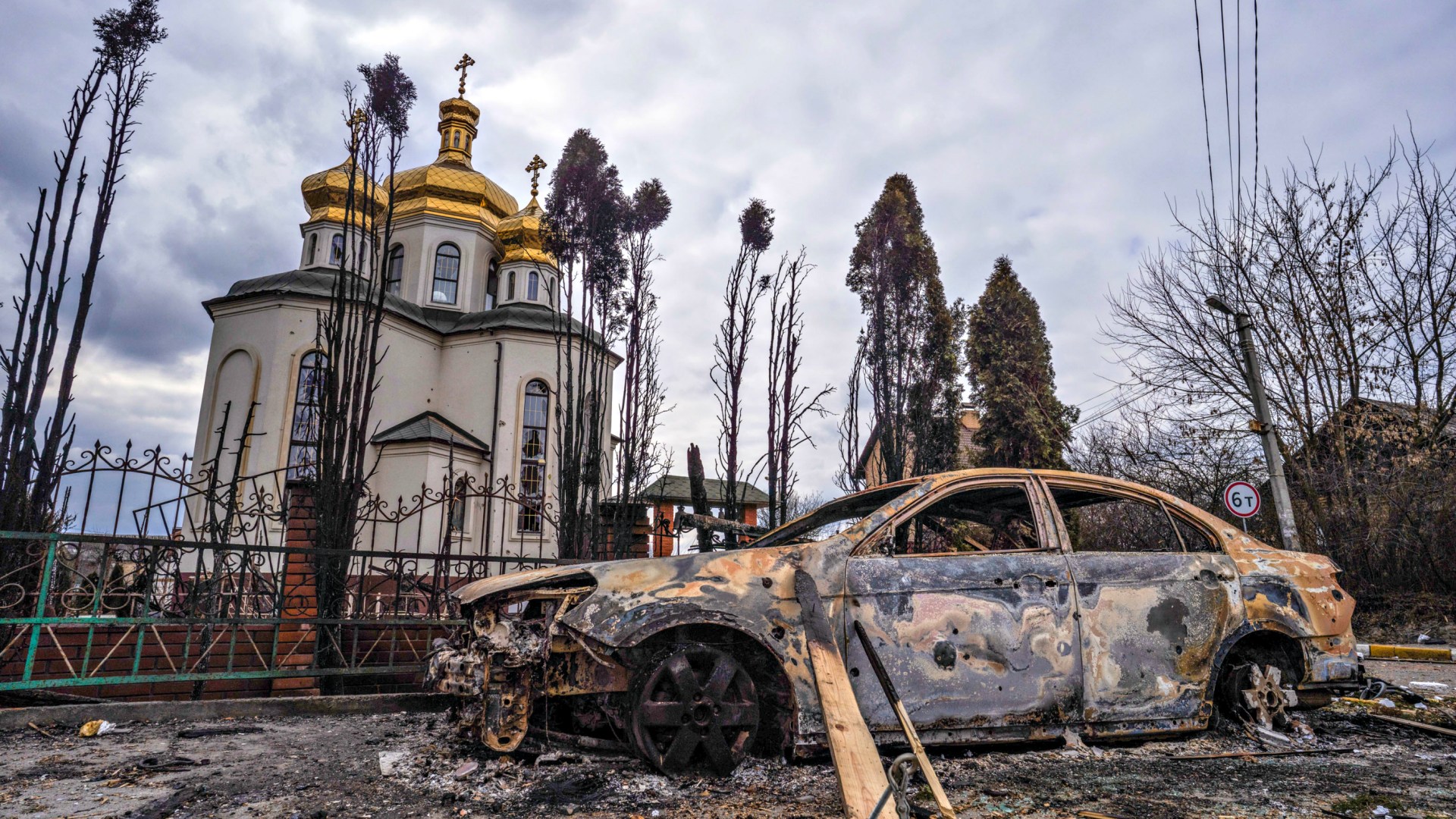
A damaged church and burnt car in Irpin, Ukraine, caused by a Russian military attack on March 9, 2022.

A damaged church and burnt car in Irpin, Ukraine, caused by a Russian military attack on March 9, 2022.

Christianity Today March 18, 2022
Kaoru Ng / SOPA Images/LightRocket / Getty Images

One month ago, Taras Dyatlik gathered in Moldova with friends and partners for another 10-day round of mundane seminary meetings. Serving as regional director for Eastern Europe and Central Asia for Overseas Council, he was a lynchpin for strategy and funding for a network of theological institutions in Ukraine and Russia.

Three days later, he was desperately scrambling back to Kyiv. Dyatlik’s family—like much of Ukraine—was under Russian military fire. And the only thing louder than the air raid sirens that would soon pervade his sleepless nights was the silence of his Russian colleagues.

“It’s not a conflict, it’s not a situation, it’s not tension within Ukraine; this is invasion, this is aggression; this is not a special operation,” he said, using the terms employed by most Russians—and too many otherwise cautious supporters in the West.

He emphasized the Bible shows the importance of precision in language.

“It’s not just that Abel died or that Jesus was just betrayed; Judas betrayed Jesus, Cain killed Abel,” he said. “Not just that a man sinned; Adam and Eve sinned. Biblical truth has names, has a cause-and-effect chain.”

Dyatlik’s charged remarks mirrored others voiced at an online roundtable organized Thursday by the Ukraine-based Eastern European Institute of Theology (EEIT). About 500 supporters, partners, and general wellwishers registered for The Russia-Ukraine War: Evangelical Voices, eager to hear from fellow believers on the front lines.

Follow CT’s Ukraine-Russia coverage on Telegram: @ctmagazine (also available in Chinese and Russian)

The attendees, from at least 25 nations and 20 US states, received theological reflection—and raw emotion.

“It’s difficult for us Ukrainians to stay calm when we talk about what is happening in Ukraine,” said Roman Soloviy, EEIT director, who served as moderator. “Most of us men have never cried so much as during the last three weeks. We really need your help, your prayer, and your voice in the world.”

Oleksandr Geychenko, rector of Odessa Theological Seminary (OTS), expressed the shock of all.

“We died with the pregnant woman and her child when the maternity hospital was bombed. We fled with those running from Russian shooting,” he said. “All we were used to is wiped out—now just a wilderness.”

OTS is the oldest of the Ukrainian evangelical seminaries, tracing its history to a 1989 local effort to train preachers and Sunday school teachers. The campus was evacuated at the start of the war as the Ukrainian military took up occupancy in defense of the Black Sea port.

But what has puzzled and discouraged Geychenko most is the position of many Russian evangelicals. A week before the invasion, as tensions were rising with Moscow, he participated in an initiative to craft a joint statement by theological educators in Eastern Europe and Central Asia that would condemn the threat of and preparations for war.

The Russian participants balked, he said. They wanted a generic call to prayer for peace.

“A week later, our cities were hit by missiles and these colleagues started changing their perspective,” Geychenko said. “Unfortunately, the wider circle of Russian ministers, evangelical celebrities, and average Christians have not done this.”

“Most of the experts are wrong when they say that this war is Putin’s war,” he said. “No, this war is supported by a significant portion of Russian people.”

The great challenge, said Valentin Siniy, rector of Tavriski Christian Institute (TCI), is processing the feelings of hurt and betrayal.

Located in Kherson, the first major city to fall under Russian control, his seminary is now occupied by the Russian army. The Ukrainian Orthodox Church labeled these occationally repeated actions “sacrilege.”

Siniy cited the biblical example of Jesus cleansing the temple of money-changers with a whip. “If we are going to hide our fear, our anger behind a mask, then we will be acting like Pharisees,” he said. “… We Ukrainians will need to accept our anger and give it to God.”

He reflected on the Mennonite-influenced history of his youth. But today Siniy is praying the curse of Deborah in Judges 5 upon those who did not come to help. Seeking to direct it against the war itself, he also prays positively that God’s kingdom would more clearly manifest itself in the world.

Ivan Rusyn is more specific.

“Someone has said that the expression ‘How much longer, Lord?’ is as spiritual as the word hallelujah,” he said. “I want to take a step further and say that I have come to the conclusion that the words ‘God, break the bones of my enemy’ are as spiritual as Aaron’s blessing.”

As rector of Ukrainian Evangelical Theological Seminary (UETS) in Kyiv, Rusyn is one of a handful of staff who have stayed behind to help their community. The campus initially served as a hub for ministry to both neighbors and those fleeing war zones further east.

But then it was shelled, his neighborhood fell under Russian control, and he now lives in the office of the Ukrainian Bible Society.

Missile fire, he added, was audible during the presentation.

“This is a full scale, unprovoked war of the Russian Federation against the Ukrainian people,” he said. “The goal is the complete destruction of Ukraine.”

Yet he still sees God at work. Rusyn is learning the meaning of incarnational ministry. Neighbors promise to visit the campus when the war has ended. Bibles are distributed to soldiers and civilians alike.

And he sees an even greater impact.

“The war has brought Ukrainians together,” Rusyn said. “If the church follows Christ, it follows where the need is greatest and stays there.”

Still able to remain safe so far is Stanislav Stepanchenko, dean of Lviv Theological Seminary near Ukraine’s western border. Every day his campus hosts about 100 people fleeing on their way to neighboring Poland or Romania.

The UN estimates more than three million refugees from Ukraine.

“We are the first place they can take a deep breath and get some food,” he said. “There is no fighting in our streets, but we see the war in the eyes of those escaping.”

Coordinating the work of 40 volunteers, Stepanchenko agreed with the imprecatory prayers of his colleagues. He has been praying Psalm 82 and Psalm 55, wishing the aggressors to descend into the pit.

But he and his team find hope in Matthew 25—I was a stranger, and you took me in—and they remind themselves of this in every act of service. Even so, they think of the dozens of children killed in the war, returning frequently to the Genesis cry of Rachel.

“Ukraine is weeping for her children, and refusing to be comforted,” Stepanchenko said. “Why is Putin doing this? Because he can.”

Following Ukrainian President Volodymyr Zelensky’s address to Congress, US President Joe Biden called Putin a “war criminal.”

A theater sheltering hundreds of civilians in Mariupol was shelled on Thursday—despite two large labels of “CHILDREN” painted outside. A neighboring pool complex was also hit, with women and children inside.

The damage throughout Ukraine is considerable. The Russian offensive has largely stalled, with major cities shelled from a distance. Religious sites have not been immune.

Soloviy and Geychenko joined dozens of other clerics and religious freedom advocates to condemn the damage suffered by 28 churches, mosques, and synagogues. The Religious Freedom Roundtable in Ukraine also tallied the killing of four Orthodox priests and the capture of two more (one released since).

Similarly, CBN reported the kidnapping of one of its affiliated aid workers near Mariupol, a woman named Valentine.

The roundtable’s appeal, signed also by the Ukrainian Bible Society, Youth for Christ, and leaders from the Baptist, Pentecostal, Orthodox, Muslim, and Jewish communities, called for Orthodox Church parishes affiliated with Moscow to break ties with Patriarch Kirill of the Russian Orthodox Church.

It has already happened abroad. Churches in Amsterdam and Estonia have announced separation.

Kirill foresees a tense struggle for Orthodoxy in Ukraine, and a recent survey bears it out. Prior to the war, the Ukrainian Orthodox Church (UOC) reportedly had about 12,000 parishes, while the breakaway Orthodox Church of Ukraine had about 7,000, noted Eurasia Daily Monitor. (Though the Jamestown Foundation journal also noted this tally fails to reflect attendance at each parish and requests for transfers that remain unapproved.)

But a recent poll conducted March 8–9 found that more than half of parishioners in the UOC favor breaking relations.

Pope Francis of the Roman Catholic Church and Archbishop Justin Welby of the Anglican Church remain in dialogue with Kirill. Separate communications emphasized an agreed-upon need for peace and justice.

“The church must not use the language of politics but the language of Jesus,” Francis stated. “We are pastors of the same people who believe in God, in the Holy Trinity, in the Holy Mother of God.”

Kirill, meanwhile, told Welby the politics trace back to 2014, alleging Ukrainian efforts to repress Russian speakers in the occupied Donbas region. The problem, his office stated, was that information on both sides of this conflict is “completely different.”

Too many are falling for the propaganda, according to the Ukrainian evangelical seminary leaders—pained particularly by their fellow evangelicals in Russia.

“They believe what is shown on the news,” Dyatlik said, “but don’t believe the witness of Christians from the shelters, from the ruins, from the street fighting.”

He was keen, however, to honor those who have protested the war.

“We know the heroes … who were not silent,” he said, “risking their families and their freedom. We pray for them, we are thankful to them.”

In early March, hundreds of Russian evangelical leaders signed an open letter calling on their government to “stop this senseless bloodshed.”

Putin has labeled domestic opposition to the war as “gnats,” “traitors,” and “scum.”

Nearly 15,000 Russians have been arrested for anti-war protests. Tens of thousands have reportedly left the country since the war began.

Valerii Antonuk, president of the Baptist Union of Ukraine, appealed to Christians abroad. Speaking from the heart of the capital, he said success in Kyiv, indirectly, will impact Moscow.

“Stand with and for us in this spiritual breach, and hold this shield of prayer over Ukraine,” he said. “We pray today that God will allow our country to persevere and win, and to defend the freedom that is so important for spreading the gospel in Ukraine [and] Russia.”

But beyond the call for prayer and advocacy, the evangelical seminary leaders suggested ways supporters can help—alongside essential financial assistance.

Geychenko requested consultation on how theological education can continue in the seminaries’ tattered shape. Having lost all materials but their e-readers, he suggested online libraries abroad can be opened for faculty and graduate student use.

UETS said it is ready to start online education immediately. OTS hopes to do so by April.

Siniy, however, advised beyond theology as many refugees will wind up having to remain a long time in their host nations. “Think about their education,” he said, “not just food and water.”

Ukrainians must organize in their displacement, to start schools for their youth and to plant churches for their families. Pastoral care must be prioritized quickly, as feelings of survivor’s guilt are starting to develop among refugees.

But to close the meeting, Dyatlik offered a theological message—one he said was needed greatly in a post-truth society.

Satan’s first challenge was to get Adam and Eve to question reality: Did God really say? And as this brought sin into the world, requiring God’s initiative to cure, so also can only the Holy Spirit convict the hearts of blinded Russians, he said. Argument and evidence will not help the cause.

Besides, there is too much work to do, and little time to rest.

“Today is the 22nd day of the war,” Dyatlik said. “Now there is no weekend, no Monday, no Tuesday. We are just counting the days.”

Correction: An earlier version of this article errantly quoted Dyatlik as stating that Judah betrayed Jesus, instead of Judas. CT regrets the error.

Follow CT’s Ukraine-Russia coverage on Telegram: @ctmagazine (also available in Chinese and Russian).

News

At the CDC and Emory, Christians Live Out Dual Callings During the Pandemic

COVID-19 fatigue has strengthened and challenged the faith of public health and hospital workers in Atlanta.

Christianity Today March 18, 2022
Edits by Christianity Today / Source Images Courtesy of Nathaniel Smith

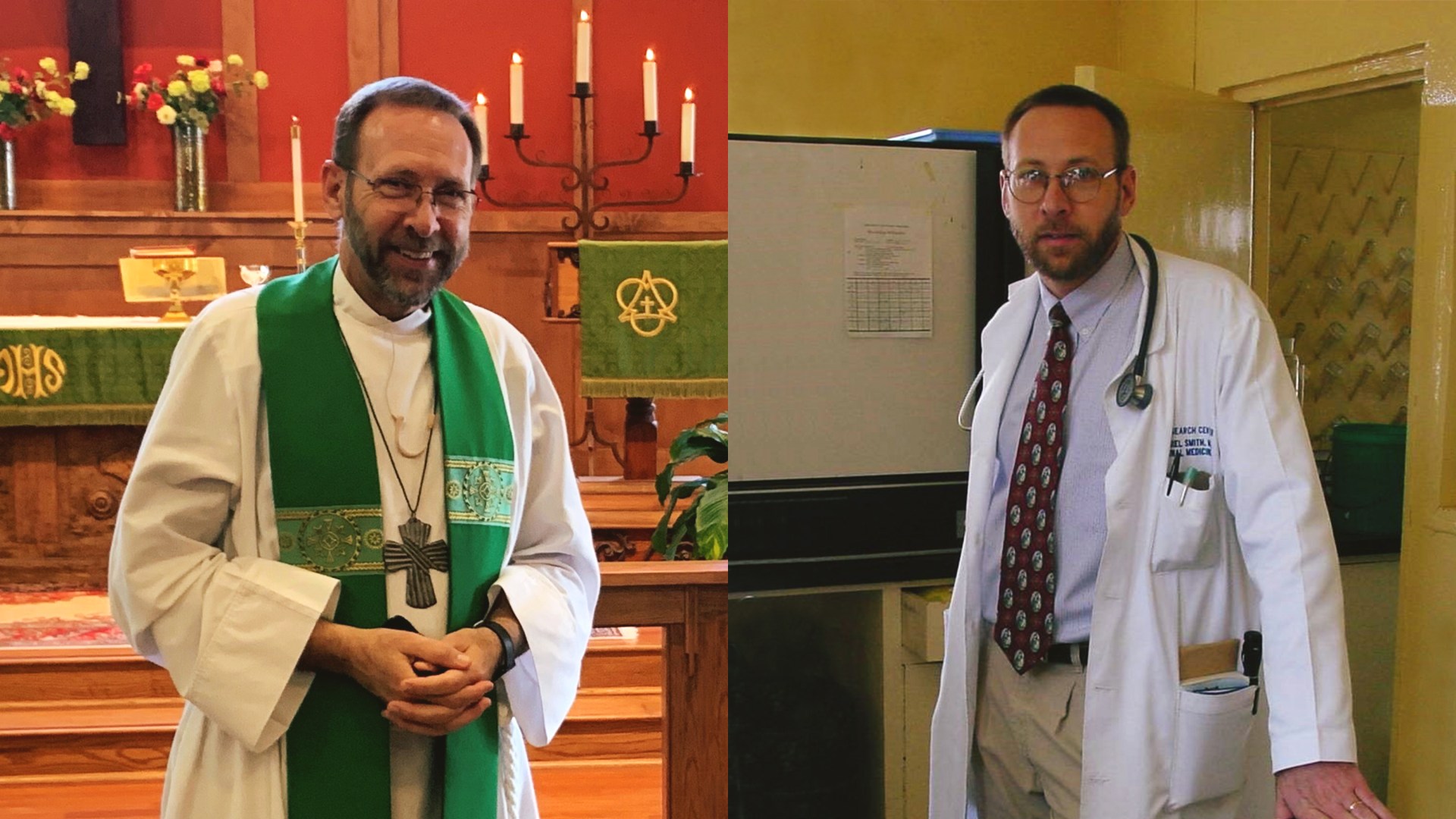
Infectious disease physician Nathaniel Smith took on two new roles during the pandemic: acting director of the Centers for Disease Control and Prevention’s (CDC) Center for Global Health and interim priest of his Anglican church plant.

“My interest in faith and medicine come from the same place: the desire to share Christ’s love in practical, tangible ways,” said Smith, a former medical missionary. “They both flow out of my identity in Christ.”

In his role at the CDC, Smith helps his team identify emerging public health threats in more than 60 countries, run treatment programs for diseases ranging from HIV to measles, and support COVID-19 monitoring and vaccination efforts worldwide.

But the isolation of the pandemic urged him toward greater involvement in his local church. He was ordained as an Anglican priest in 2020 and stepped in as interim priest of Atlanta’s Trinity Northside Parish in 2021.

Smith’s CDC office is situated along the Clifton Corridor in Atlanta, a major hub of education, research, and health care that also houses Emory University and multiple hospitals. And Smith is one of many Atlanta-area Christians working there who have lived out a dual calling during the pandemic, seeking to reduce illness through their clinical knowledge and to proclaim Christ in word and deed.

That task started with a swell of public gratitude at the beginning of the pandemic in 2020 but has grown more difficult over time as public perception toward medical recommendations has shifted. And this provides a central challenge for Christians working in public health and medicine at this stage of the pandemic—how to persevere in their faith while wrestling with their limits and trusting God’s sufficiency.

“This is the hardest time I have ever walked through as a physician, as a hospital administrator, and as a laboratorian,” said Dr. Colleen Kraft, associate chief medical officer at Emory University Hospital in Atlanta. “I don’t know how people come through this experience without having faith.”

Kraft is no stranger to high-stakes medicine. She was on the team of infectious disease doctors who treated the first Ebola patients in the United States in 2014 as an anxious nation watched. Thankfully, those patients recovered, and the hospital’s rigorous protocols prevented the deadly virus from escaping into the community. But the experience of the COVID-19 pandemic has been much different.

Working in hospital administration, Kraft is part of the team that makes sure the hospital can handle the COVID-19 surges. She’s addressing logistics and staffing issues, doing things from tracking down reusable hospital gowns when others are held up in the supply chain to staying late to log samples alongside overwhelmed lab technicians to improve morale.

The intensity of her role during the pandemic has kept her from participating in church activities as much as she used to. “I’m missing the ritual of [church] community,” said Kraft. “Sometimes work can feel like a worship community. We are trying to relieve suffering together, and that is worshipful to me.”

As her job intensified during the pandemic, she found herself going back to basics, revisiting old college worship music and her Experiencing God workbook. “It helps me look out for those ‘it could only be God’ moments,” said Kraft, thinking of the times when an “impossible” administrative obstacle somehow cleared by the end of the day.

Fighting misinformation and COVID fatigue

One key struggle for Christians working in health care and public health during the pandemic has been pushing back against misinformation.

Rose Glass is a founding member of the CDC’s 320-member Christian Fellowship Group, created in 2001 for CDC Christians to worship and pray regularly for the CDC’s work and one another. The Christian Fellowship Group hosts weekly lunchtime prayer and Bible studies and had offered monthly worship services before the pandemic.

As a 34-year veteran of the CDC, Glass has been stunned at the misinformation she has witnessed both from political figures and from faith leaders she once admired.

“These messages that the vaccine will kill you, these conspiracies … It’s madness,” said Glass, an ordained minister in a nondenominational church. “But that is what the Enemy wants us to do, to turn against each other.”

Glass lost a cousin to COVID-19 earlier this year because of lax protocols by family members, despite their knowledge that the cousin was high-risk. “That was a low point for me. Your cousins are your first best friends,” she said. “It was so avoidable.”

Nursing clinician and educator Rachel Blanchard has seen new challenges emerge in later stages of the pandemic. Though the pace of ER admissions has slowed, her Atlanta-area hospital now struggles with staffing shortages and sagging morale as travel nurse incentives encourage rapid turnover.

“We have a sense of ‘When will this end?’” says Blanchard, a mother of three who worships at a Methodist church. “How long can we continually find new staff?”

She is finding the need to relax her instinct to plan for every scenario. “I have to let go of what I cannot control.”

Embracing limits

If any lesson has emerged from the pandemic, it is that we do not control our world as we thought we did.

“We had all sorts of preparedness plans,” said Smith. “But so much didn’t go according to plan.”

Kraft says this reality is ushering her into a new phase of faith. “I’m constantly having more and more things to turn over to God—things that I thought I had control over. It makes me yearn for a place that is not this earth.”

This acknowledgement of limits can lead to deeper, more dependent faith.

Jonathan Yoder, who worked on COVID-19 in addition to his role as deputy chief for waterborne disease prevention at the CDC, describes the upheaval of the past two years: “If [something like] this doesn’t lead you to question your faith, you probably aren’t being honest with yourself.”

He appreciates how the pandemic has underscored the simple reality that life is fragile. And that we all must learn to walk in greater humility.

“There have been missteps and we have a commitment to learn from this and get it right,” said Yoder, a Presbyterian. “We must approach it with transparency and humility.”

But he finds that his ultimate hope in Christ gives him freedom to focus on what is essential. The pandemic has shaken loose a new understanding of the Christian walk. “We often think about being a Christian as doing things to show our faithfulness,” said Yoder. “But that’s not it at all—it’s about how faithful he is to us.”

He was initially drawn toward public health as a tool for the common good, a way of bringing shalom to the world God has made. During the pandemic, he has been reminded of the Hebrews 13 passage that describes how Jesus was sent outside the camp to die a death of isolation, mirroring Israelites with infectious disease in Leviticus who were sent outside the camp.

“He suffered for us and experienced physical and spiritual loss,” said Yoder. “Maybe part of the loss of connection that we experienced during COVID will bring us closer to understanding Christ’s sacrifice for us.”

Lessons from the pandemic

Nathaniel Smith has made multiple adjustments during the pandemic. His family moved from Arkansas, where he worked for the state health department in the early months of the pandemic response, to Atlanta so he could work at the CDC.

As he stepped in as interim priest last year, he learned to fit sermon preparation into evenings and weekends. Leading his 100-person congregation amid the COVID-19 waves was an opportunity to see past political divides and to lean into the person of Jesus, he says.

“We learned to love even as we disagreed,” said Smith. As the world turned upside down, his congregation saw that God was still active and in control.

Smith’s faith deepened further as his wife was diagnosed with stage IV breast cancer during the pandemic. The couple was prompted to reflect on God’s faithfulness through years of grueling, at times perilous, medical missionary service in Kenya.

“We have seen the Lord take us through difficult times in the past,” said Smith, “and he will continue to provide in the future.”

Despite the loss and uncertainty brought by the pandemic and his wife’s diagnosis, Smith finds himself tightly tethered to God, believing that his purposes are beyond our understanding.

“If God can draw me close to him and reveal things that are most true, he can do the same thing in our world,” said Smith. “We can come out of the pandemic with a better way of thinking about each other, the world, and God as the source of life.”

Ideas

We Have No More Tears Left

Ukraine’s history has been marked by tragedy and bravery. What can we learn and how can we pray?

Christianity Today March 17, 2022
Illustration by Mallory Rentsch / Source Images: Lisa Fotios / Pexels / WikiMedia Commons

For more than a month, the world watched as Russia began encircling the nation of Ukraine, all the while insisting it had no plans to invade. Now we watch as the horror unfolds daily.

We’ve heard of artillery shells falling on a nuclear power plant. Kindergartens and theaters bombed. Apartment blocks and entire neighborhoods reduced to rubble. A tank obliterating three people in a car. Hundreds of orphans walking into Poland, some unaccompanied, dazed and crying into their scarves.

We’ve seen civilians defusing a live Russian bomb by hand. Residents drinking water from water heaters after weeks of surviving freezing temperatures with no electricity or heat. Air strikes on at least 20 health care facilities, including a maternity ward and a children’s hospital.

The Ukrainian response to such an onslaught has captivated the world. The polling service “Rating” reports that 88 percent of Ukrainians believe they will repel the Russian attack, and 98 percent support the actions of Ukrainian armed forces.

More than two million have fled for safety, but those who remain have hardly surrendered. They are fighting back with Molotov cocktails and hunting rifles in support of their military, which has performed better than anyone—especially Vladimir Putin—imagined.

Peter Wehner wrote in The Atlantic that “what drove support for Ukraine were the human virtues being displayed in a terrible human drama.”

“It was seeing ordinary people—including the young and the elderly—act in extraordinary ways to defend the country they love, against overwhelming odds. It was seeing people do the right thing at the risk of death when nearly every instinct within them must have been screaming: Do what you have to do to survive, even if survival, though not dishonorable, is less honorable.”

He continues, “Whatever fate awaits them—and right now the Russians are laying siege to cities that are home to millions—the people and the president of Ukraine [Volodymyr Zelensky] have shown that love of honor never grows old, even to a world that is sometimes indifferent, weary, and cynical.”

As Martin Luther King Jr. once said about fighting injustice, “If a man has not discovered something he will die for, he is not fit to live.”

In its tragic history, Ukraine has grown familiar with suffering.

I visited the country in 2018 and found the main tourist sites were monuments commemorating human atrocities in their nation’s past. I toured the Famine Museum, a memorial to the millions of Ukrainians who died of starvation in the 1930s when Soviets took over their farms and confiscated their crops.

Other museums recounted the occupation by Hitler’s army in World War II, when Kyiv alone suffered a million casualties—more than the total number of American casualties in the entire war. In the countryside, the fighting destroyed 28,000 villages.

The following day I visited a grassy ravine at the edge of the city. Today Babi Yar is a park, a peaceful sylvan setting, nestled in a neighborhood of shops and houses; but the very name conjures up scenes of genocide. Babi Yar was Hitler’s first act of mass murder in his campaign against the Jews. SS soldiers rounded up the city’s Jews, stripped them naked, and machine-gunned them at the edge of a cliff.

Around 22,000 died the first day and 12,000 the second. More than a million Jewish Ukrainians died in the Holocaust, including many relatives of Zelensky—a Jew, who understandably finds it revolting that Vladimir Putin tried to present him and the Ukrainian government as part of a “neo-Nazi” movement.

Hitler’s defeat led to four more decades of Soviet occupation. When the USSR collapsed, Ukraine at last saw an opportunity to become independent. In 1990, 300,000 Ukrainians formed a human chain in a show of unity, linking hands along a 340-mile route from Kyiv to Lviv.

The next year, 92 percent of the population voted for independence from Russia. In a separate agreement, the new nation gave up its nuclear weapons (the world’s third largest stockpile) in exchange for security guarantees. As one of the signers, Russia agreed to respect Ukraine’s territorial integrity.

Democracy got off to a rough start in Ukraine. If you think US elections are dirty, consider that in 2004, when the Ukrainian reformer Viktor Yushchenko dared to challenge Viktor Yanukovych—the party backed by Russia—he nearly died from a suspicious case of dioxin poisoning.

Ignoring the warning, Yushchenko remained in the race, his body weakened and his face permanently disfigured by the poison. On election day, an exit poll survey showed him with an 11 percent lead, and yet the incumbent government managed to reverse those results through outright fraud.

In one of the little-known twists of history, deaf people sparked a peaceful revolution. On election night, the state-run television station reported, “Ladies and gentlemen, we announce that the challenger Viktor Yushchenko has been decisively defeated.” However, government authorities had not taken into account one feature of Ukrainian television: the translation it provides for the hearing-impaired.

On the picture-in-picture inset in the lower right-hand corner of the television screen, a brave woman raised by deaf-mute parents gave a very different message in sign language. “I am addressing all the deaf citizens of Ukraine,” she signed. “Don’t believe what they [the authorities] say. They are lying and I am ashamed to translate these lies. Yushchenko is our President!”

Inspired by their translator, Natalya Dmitruk, deaf people texted and emailed their friends about the fraudulent elections. Soon other journalists took courage from Dmitruk’s act of defiance and likewise refused to broadcast the party line. Spontaneous protests broke out in major cities, and the Orange Revolution was born.

In Kyiv, 500,000 flooded Independence Square, many of them camping out in frigid weather and wearing orange in support of Yushchenko’s campaign colors. Over the next few weeks, the crowd swelled to a million at times. When outside observers proved election fraud had occurred, courts ordered a new election—and this time, Yushchenko emerged as the undisputed winner.

Ten years later, the Russian-backed candidate that Yushchenko defeated was serving as president. He had amassed a fortune of $12 billion and lived in a mansion complete with a private zoo, a fleet of 35 cars, a golf course, and an underground shooting range—while most Ukrainians were living in poverty. When he halted the new nation’s tilt toward Europe and instead sought closer ties with Russia, Ukrainians took to the streets once again. Parliament ultimately ordered new elections, and a pro-Europe president won.

A bearded guide named Oleg led me through memorials to the “Heavenly Hundred,” a list of names honoring the 130 people killed by snipers firing from government buildings during the 2014 uprising. Another 15,000 demonstrators were injured in the same protest.

“This was an internet revolution,” Oleg said. “As word spread online, taxis began offering free rides to protesters from all over the city. I set up a prayer tent in the midst of half a million protesters and spent 67 days there. We provided a place for prayer, and distributed bread and hot tea to activists and police alike. And now I make trips to the front lines in an armored van, ferrying supplies of food and water to the soldiers and civilians caught up in the conflict in Eastern Ukraine.”

Shortly after the 2014 “Revolution of Dignity,” Russia used the opportunity to seize the Crimea peninsula and two other regions, starting a minor war that set the stage for the full-scale invasion we are watching now.

I think of the poignant poem by Ann Weems, “I No Longer Pray for Peace.” Like many Americans, I feel a sense of helpless despair as I see the death and devastation in Ukraine. How can we pray?

I pray first for the 40 million Ukrainians left behind, struggling to survive as jets scream overhead and tanks target their homes and hospitals.

I pray for the refugees streaming into Hungary, Poland, Moldova, and Romania, as well as the thousands lucky enough to escape to faraway places such as the UK, France, Canada, and the US. I pray for the husbands and fathers who remain in their homeland, risking their lives to repel invaders. I pray for the host families who meet refugees at border crossings and train stations with offers of free lodging.

I pray for the Christian ministries such as Mission Eurasia and New Hope Ukraine, many of which were based in the bedroom community of Irpin, scene of some of the fiercest fighting.

One of the leaders stated in a newsletter email, “We’ve learned to love and to hate on a whole new level. We’ve discovered what it means to hate evil to the very core of our being. And we learned to love the truth. The truth that sets us free. … Many of us just don’t have any tears left. Now we all are just so angry about all the injustices done to us, and we ask the Lord of Hosts to display His righteous judgment.”

I pray for the Russian soldiers. British intelligence has intercepted some of their panicky phone calls home. They were told they would be welcomed with flowers, as liberators, and instead find themselves in the midst of a bloody war against Ukrainians determined to resist. The New York Times issued a report saying that some demoralized Russian units have laid down their weapons and surrendered, or sabotaged their vehicles, to avoid a fight.

I pray for the Russian people, who are hearing an entirely different version of events. It’s a limited military operation, they’re told, with no civilian casualties. Meanwhile, the hostile West is trying to strangle their country economically. Those who protest the war are arrested, and just using the word war on social media risks possible jail time.

I pray for my own country, that we would not grow weary of higher gas prices and a falling stock market or fail to support those who stand up for freedom and justice.

Yes, I also pray for Vladimir Putin. Did not Jesus tell us to love our enemies and pray for those who persecute us? It would take a colossal miracle for a dictator with such ego-driven determination to experience a change of heart—the kind of miracle the exiled Hebrews witnessed in Nebuchadnezzar’s day (Dan. 4).

Tish Harrison Warren wrote recently of the maternal rage she felt while staring at the image of an anguished Ukrainian father holding his young son’s lifeless, blood-stained body: “An innocent child was violently killed because Russia’s leader decided that he wanted a neighboring sovereign country as his own.”

She found an odd kind of solace in the imprecatory psalms, which call down God’s judgment on evil. “This is the world we live in,” she wrote. “We cannot simply hold hands, sing ‘Kumbaya,’ and hope for the best. Our hearts call out for judgment against the wickedness that leaves fathers weeping alone over their silent sons. We need words to express our indignation at this evil.”

For Christians, Putin offers a cautionary tale. After the Soviet Union dissolved, formerly atheist Russia warmly welcomed an influx of foreign missionaries who taught Bible in the public schools, established a Christian university, and organized a host of evangelical ministries. Many of them praised Putin, who rebuilt churches and took their side on Russia’s version of the “culture wars.”

Eventually, though, most foreign-based ministries were forced out by a strategic alliance between Putin and his staunch supporter, the Russian Orthodox Church. The official church gained access to power and government sponsorship, while Putin gained a loyal following.

In light of this, Russell Moore draws a lesson we dare not ignore: “Evangelical Christians should watch the way of Vladimir Putin—and we should recognize it whenever we are told that we need a Pharaoh or a Barabbas or a Caesar to protect us from our real or perceived enemies. Whenever that happens, we should remember how to say, in any language; ‘Nyet.’”

Philip Yancey is the author of many books including, most recently, the memoir Where the Light Fell.

Follow CT’s Ukraine-Russia coverage on Telegram: @ctmagazine (also available in Chinese and Russian).

News

Pandemic Streaming Inspires New Filipino Christian Music Label

A division of Sony Philippines, Waterwalk Records is crossing genre and denominational lines to bring inspirational songs to the online masses.

Christian singer Darla Baltazar

Christian singer Darla Baltazar

Christianity Today March 17, 2022
Courtesy of Sony Philippines

As Roslyn Pineda drew closer to God during the pandemic, she reconnected online with Christian friends she hadn’t seen in years. Though she had been living in Hong Kong for 20 years, she joined their Bible studies back in the Philippines.

And as the general manager of Sony Music Philippines, she began thinking about the significance of Christian music during this global moment.

“Given the many hardships and the monumental losses that COVID-19 has brought about, would it not make sense that people would turn to God? Whether they knew it or not, would they not need more faith-based and inspirational music in their lives?” asked Pineda, who is Filipina.

In October 2021, Pineda and Sony Music launched Waterwalk Records, a Christian label focused on contemporary artists and streaming listeners.

The new label was promising on the evangelistic front and on a business one. Sony’s Christian division, Provident, ranked the Philippines among its top 10 markets outside the US. And the audience demographics were also the most sought-after by churches and companies alike: 16-to-35-year-olds who demand authenticity and consume music through Spotify and YouTube.

“It is an unexplored market that has a huge potential,” Pineda said. “We had to go where the streaming market is. While many of our audience is active in their Christian communities, we also wanted to reach out to those who are non-Christians and/or nonpracticing Christians.”

In the Philippines, top songs on the Christian charts often come from global labels like Hillsong or church networks like Every Nation Music and Victory Church, which has more than 100 locations across the country. Original Filipino Gospel, mostly sung in Tagalog, has also acquired a strong following over the decades through the larger evangelical churches.

Much of the Christian indie music has been inspired by Papuri, a popular music ministry developed by the radio network Far East Broadcasting Company 40 years ago, noted Jungee Marcelo, a Christian songwriter and producer.

Waterwalk Records, though, is not affiliated with a particular church or tradition, and its artists come from a range of denominational backgrounds.

Courtesy of Sony Philippines

Its first dozen streaming singles come from musicians who are active in praise and worship ministries but also in secular entertainment; many of them have built their followings online. All but one are from the Philippines, and their churches are spread across the 7,641-island archipelago, deliberately not limited to the National Capital Region.

While Waterwalk seeks to be “genre-agnostic” and features a generation of artists that transcend Christian music check boxes, the label is holding to some nonnegotiables when it comes to faith. First, songs have to be “theologically sound and Bible-based.” The team guides artists to ensure that their lyrics are aligned with Scripture. “Some lyrics can be empowering, but they are not necessarily gospel-based,” Pineda said.

Second, the artists have to be “strong in their faith and … devout Christians,” who have been walking with the Lord for a while and not brand-new believers. The hope is that such spiritual maturity would reduce the risk of an artist doing things that could cause their audience to stumble and that it would make the music richer, with the authenticity that young listeners were looking for.

Darla Baltazar, 24, who sings and produces music from her bedroom in Manila, is one of Waterwalk’s most popular artists. She shares her songs, her faith, and her process on her social channels. Her most popular song, “No Good Thing” is a “holy groovin’,” jazzy take on Psalm 34.

“I am very serious about my relationship with God,” Baltazar said in an interview with CT. “I can’t fake and force the lyrics. Those words come from my walk with him. God would tell me to share my music so that listeners would find their way to him.”

Baltazar’s chill, smooth, coffee-shop sounds draw in non-Christian listeners, while her lyrics introduce them to gospel truths. She sees fans go from confused to curious to inspired. “I ask my non-Christian Instagram followers why they are following me,” she said. “They like the melody, but the message pulls them in.”

Taiwanese singer Ariel Tsai, another Waterwalk artist, has the same experience.

“They say in the comments section that they don’t know God,” she said, “but they crave for that sense of belonging that they felt through my music.”

Tsai, 27, has gone viral for her Chinese cover songs and now composes piano-driven worship. Her English-language release called “My All and All” came out last year.

“There is so much uncertainty and hardship, which make people think of what is truly certain and what we can hold on to,” she says. “My central message is that God is consistent, and his love does not change. That sense of consistency attracts people to get to know him.”

Baltazar believes pandemic streaming has led to a new acceptance, and possibly even hunger, for gospel-centered music among people on TikTok, YouTube, Instagram, and Spotify.

“Everybody at home was listening to this genre of music,” she said. “It’s why my music multiplied, and people played it in the background while working or studying. They say it’s peaceful and calming.”

Pineda confirms that there was “growth in music consumption in the Philippines during the pandemic across all platforms but most especially YouTube and TikTok. There was also a spike in catalogue songs [of iconic artists] because, during uncertain times, people wanted the comfort of familiar tunes.”

Baltazar thrives off the interactivity on social media, replying to followers’ questions, incorporating their suggestions in the songwriting process, and sharing her reflections on faith. She holds online events—catering to needs in a global pandemic—where she and listeners can experience the music and the message together.

As she describes it, “People tell us about the music they want, and we curate it for the listening party. We divide the program, and there is a 15-minute gospel message. In these events, we listen to Christian music together, not like a concert, but just appreciating it. The listening party can also become evangelistic as we also invite non-Christians.”

Baltazar, a former preschool teacher before going into full-time music creation, loosely describes her affiliation as “Christian indie, or people who make Christian music but outside the typical church congregation.” Her 2020 single “Feet in the Rain,” took off on Spotify playlists, and Baltazar was named one of The Gospel Coalition’s artists to watch in 2021.

“The majority of my listeners are in the US. They’re mostly Christians from the ages of 18 to 24,” she said. “They don’t even realize I’m Filipino.”

Tsai’s followers are an international mix composed of her native Taiwanese and Southeast Asian communities as well as Asian communities in North America. They also found her on Spotify and YouTube.

“My fans know I’m an outspoken Christian,” said Tsai, a successful pop artist before she became known for her Christian music. She is currently under contract with Sony Music Taiwan.

Unlike the Filipino Christians on Waterwalk, Tsai comes from a context where Christianity is not the majority faith.

“People in Asia have biases against Christians and think we can be pushy,” she told CT. “I’ve never thought of releasing a worship song publicly, no pop singer in Taiwan does that. It’s very sensitive here. No artist wants to be officially associated as a hardcore Christian.”

At the same time, she maintains, “I always want to stay true to myself. Christianity is my lifestyle, and I feel that there is no shame in saying that. I make it clear to the audience that the song I release is what I feel from my religion, and that it can give them empowerment.”

https://open.spotify.com/embed/playlist/4ne18eGlLT1IE7oSKMzUcp?si=2cf9cf341c654f31

While the initial list of artists is mainly Filipinos, Pineda envisions making Waterwalk more regional in the future. There will be efforts to reach out to Christian artists in Korea and other countries in Southeast Asia, banking on Sony’s extensive international network.

To date, Pineda says the response from the streaming platforms has been encouraging, opening up Waterwalk’s current playlist to the US market.

As the label continues to release new music, Pineda hopes the project lives up to its namesake.

“Waterwalk is based on Matthew 14:22–36. Everybody remembers that passage of Jesus walking on water. But they tend to forget that Peter also walked,” she said. “We wanted a name that showed something similar: to be bold, stepping out in faith, and something adventurous.”

News

Amid Cascade of Coups, African Christians Debate Civic Duty

Concentrated lately in the impoverished and jihadist-plagued Sahel, military overthrows disturb democratic development. Do they equally disturb believers?

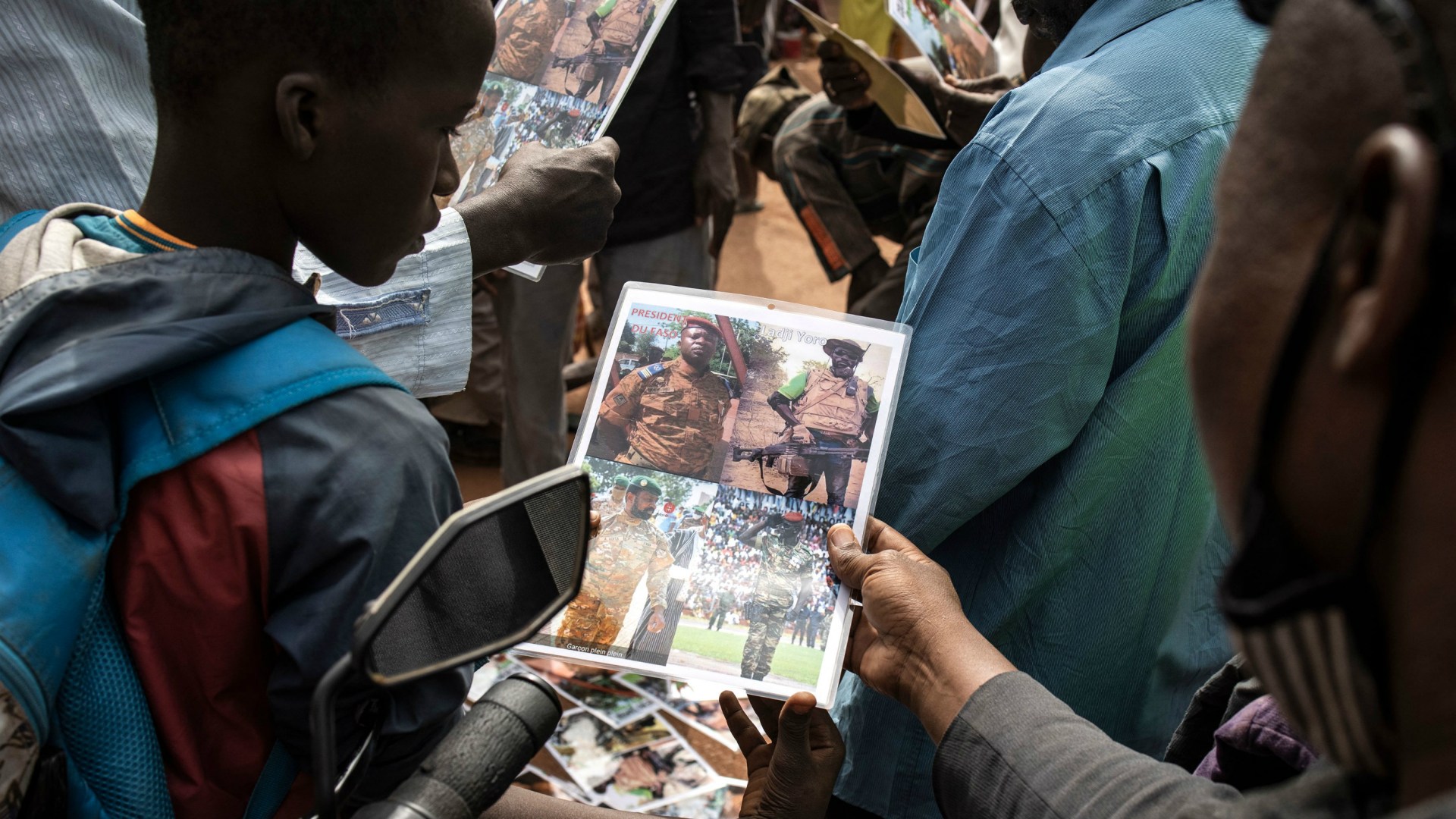
A young boy looks at a poster of lieutenant-colonel Paul-Henri Sandaogo Damiba, new strongman and head of the junta, outside the Grand Mosque of Ouagadougou after Friday prayers on January 28, 2022.

A young boy looks at a poster of lieutenant-colonel Paul-Henri Sandaogo Damiba, new strongman and head of the junta, outside the Grand Mosque of Ouagadougou after Friday prayers on January 28, 2022.

Christianity Today March 17, 2022
John Wessels / AFP / Getty Images

There is “an epidemic” of military coups in Africa, says the head of the United Nations. The past year and a half witnessed the overthrow of governments in Mali (twice), Chad, Guinea, Sudan, and Burkina Faso. At least three additional attempts were thwarted in Madagascar, the Central African Republic, and Niger.

Averaging two per year for the last decade, this is Africa’s largest surge since 1999.

What should Christians in these nations do about it?

Abel Ngarsouledé of Chad, where roughly 45 percent of the Muslim-majority nation is Christian, is walking through it.

“It is not for me to support a military coup in my country,” said the secretary general of the doctoral program at the Evangelical University of Chad. “But if God wants to remove a king from his throne, [God] uses all the means in his power to restore his fear and justice in the land.”

When Chad’s president was killed on the battlefield last April, the army moved quickly to place his son in charge of a 15-member Transitional Military Council that would govern for 18 months, renewable once. Pledging to hold a national dialogue, invitations were sent to rebel groups, politicians, civil society, academics, and religious leaders—including Ngarsouledé.

He accepted.

With the council now delayed until May, he serves on two committees in a process designed to lead to reconciliation, social cohesion, and new elections. There are no guarantees any of these will happen, he says, and asks for prayer.

Also deputy director of the Council of Theological Institutions in Francophone Africa, Ngarsouledé recalled that at times in Old Testament history, God used prophets or priests to depose kings. Though today prayer should be employed, he is not so concerned about the end result.

“The form of the state is not the subject of biblical teaching,” he said, noting God’s priority for peace and justice. “It is men who adopt this or that form of governance, according to the orientation of their hearts.”

Ngarsouledé is not the only African Christian leader whose opinion does not reflect the ironclad American Christian defense of democracy.

“Between democracy and autocracy, democracy seems to be the best suited at the moment,” said Samuel Korgo, director of the Institute of Theological and Artistic Education in Burkina Faso. “But certain coups come to relieve the populations of authoritarian, corrupt, and incapable regimes.”

The latter is what drove popular acceptance of the January 23 coup d’etat in the West African nation.

This included Christians, said Korgo, also an Assemblies of God pastor. Though only 30 percent of the population, Burkinabè Christians have historically been at the forefront of government. Not that this has helped democracy: The nation has been under military rule for 48 of its 62 years of independence, suffering eight coups in its history—a record for the continent.

Some concern is starting to seep in, however. The situation after successive coups in nearby Mali, including sanctions imposed by the Economic Community of West African States (ECOWAS), is feared in Burkina Faso, Korgo said.

The coup also undoes what had been promising democratic development, as 86 percent of the country viewed the 2020 election as “free and fair.” But since then, Burkina Faso has been pummeled by a jihadist insurgency that has displaced 1.5 million people. Over 3,000 schools have been closed, and nearly one-fifth of its 21.5 million population now needs humanitarian assistance.

The junta promised to restore control.

Don’t trust them, warns Lawrence Gomez, associate regional secretary for the West African branch of the International Fellowship of Evangelical Students, affiliated with InterVarsity.

“It is the responsibility of the military to provide security,” he said, from his home in Gambia. “If they failed, they have no right to tell me they will do better if they are in government.”

In fact, the junta reappointed the same defense minister.

The first thing coup leaders do, Gomez said, is consolidate power. Often a messy endeavor, development becomes a secondary concern, and promised elections are simply a way to fend off international condemnation.

Contrary to the apparent continental trend, Gambia is one of Africa’s democratic success stories. A popular revolution dislodged its 20-year president in 2017, after he tried to overturn an election loss.

Last year witnessed the peaceful transfer of power in Malawi, Zambia, and Tanzania; since 2015, peaceful transfers also occurred in Liberia, Sierra Leone, and Nigeria. Across the continent, 73 percent of Africans want to choose their own leaders, and 76 percent want term limits.

In fact, stated the Institute for Security Studies, the continent is more democratic than other regions, relative to its level of development.

But the problem, Gomez said, is that too many governments do nothing to improve the status quo. Democracy itself is no balm and, in fact, can allow social evils the Bible condemns. But at least it gives the people a choice.

“Just because someone is doing something wrong, you don’t do wrong to fix it,” he said. “The worst civil leadership is better than the best military rule.”

Not necessarily, countered Illia Djadi, Open Doors’ senior analyst for religious freedom in Africa.

“Military or civilian, it is not the main question,” he said. “It is who will help them live in peace.”

Djadi noted that most of the recent coup attempts have taken place in Africa’s volatile and poverty-stricken Sahel region—including his own nation of Niger. Only four months of rainfall determine yearly agricultural production, exasperating the underdevelopment that plagues many countries in Africa.

But the plague of jihadism killed 1,300 civilians in Mali, Niger, and Burkina Faso alone last year, reaching 3,500 casualties since 2015. The people have had enough.

“Let’s wait and see if these coups change things for good, on the ground,” he said. “It is not the place of Christians to support or oppose.”

Instead, Djadi placed much onus on the international community.

Western nations have a responsibility to help. But repeating the same mistakes made in Iraq, their focus is primarily on the military response to jihadism. Yet it was their intervention in Libya that induced regional chaos, sparking the southward movement of Islamic extremism into the Sahel.

Mali is now kicking out its French counterterrorism partners, as Russian mercenary troops enter the country. Russian influence is also established in Libya and the Central African Republic and rumored to be in Burkina Faso, Sudan, Chad, and Mozambique.

The people are not interested in geopolitics, said Djadi. Simply desiring security, they instead suffer under the weight of punitive economic sanctions. ECOWAS has taken a different approach with each coup leadership, depending on their willingness to work together for democratic restoration.

Djadi strongly opposes these sanctions, however, and calls for greater cooperation in development. The church is a capable partner—when not the target of attack—and contributes to socioeconomic welfare through its many schools, hospitals, and aid organizations.

“It is the responsibility of the worldwide church to support the body of Christ,” he said. “But the Sahel is not getting the attention it deserves.”

John Azumah, executive director of the Lamin Sanneh Institute at the University of Ghana, agrees with much of this—but not all. Economic sanctions are damaging. Within the Sahel, security is the necessary priority for Christians. And African governments have failed at supporting democracy with development.

But Azumah reflected on his nation’s two decades of successful multiparty governance and from whence it came. Ghana ranks third in African coup attempts with 10, five of which have been successful.

Juntas do not bring the stability they promise.

“The church has been at the forefront of the struggle against dictatorship,” Azumah said. “But it did not run deep, and our seminaries have failed in public theology.”

Democracy is certainly the most suitable governing system for Africa, he said, guaranteeing freedoms and sustaining minority communities. But it has also been a vehicle for corruption, and the church has often been compromised.

Even when not involved, it has regularly sided with power.

“It is not the place of the church to rally for democracy but to rally for the people,” Azumah said, stressing the need to be nonpartisan. “Uphold the principles when the nation grows disenchanted, but always call out the abuses.”

Such pessimism is rampant in Africa—and worldwide. Freedom House recently noted the 14th consecutive year of global democratic decline. Of the 12 largest drops, seven are sub-Saharan. Only 9 percent of the sub-Saharan population lives in seven “free” nations, the lowest tally since 1991.

Similarly, Afrobarometer noted that of 15 surveyed nations since 2011, only Sierra Leone registered an increase in support for elections. And across 34 nations, only 43 percent are satisfied with how democracy works in their country.

This is why Ngarsouledé has gotten involved.

Chairing one committee and serving as rapporteur (secretary) of another, he interacts with senior army officers, government officials, academics, businessmen, and civil society activists. Though there is open discussion and a commitment to religious liberty, sometimes it gets partisan.

“It is precisely at this strong moment of debate,” he said, “that I make myself heard.”

Most sources reported a growing Christian realization that engagement in politics is necessary. Despite his critique, Azumah pushes the issue in Ghana’s seminaries. Gomez aims to raise a new generation of leaders among his college students. And Korgo said the holistic dynamic of the gospel demands that Christians fight against poverty and corruption.

But pastors, these leaders said, should avoid public politics.

Opinions among African Christian leaders differ about democracy and military coups. But regardless of the system, the political expression of sinful nature is hardly confined to Africa.

“As citizens of heaven, we serve God within our nations—and beyond—based on Christian values,” said Ngarsouledé. “It is among this corrupt and perverse generation that Christians are called to live their faith.”

Theology

Spiritual Lessons from My Dumb Phone

It’s time to fight our technology addictions.

Christianity Today March 17, 2022
Illustration by Mallory Rentsch / Source Images: WikiMedia Commons

Scrolling through Twitter on my train commute home, I came upon a photo of an odd-looking phone—matte black and paperwhite. A former coworker of mine had been using the low-tech phone for about year. I was fascinated because I had been thinking about ditching my smartphone altogether. The post unintentionally revealed a felt need. After a few days of watching product review videos, I placed my order.

I bought my first cellphone in my mid-30s when we moved to the New York City area 11 years ago, where I still work as a college professor. It was a “dumb phone” that lived mostly in my backpack. I eventually eased into a refurbished iPhone about six years ago. The iPhone eventually moved from my backpack to my front left pocket. I never put social media apps on it—just email and a web browser. Recently, I added a mindless brick-smashing game and used it often to divert my attention on the train ride home.

I’m familiar with the pangs of addiction. I used to smoke two packs of cigarettes a day for ten years. In addiction’s loving arms, I couldn’t go long without a hit. Fifteen or 20 minutes after my last drag, my anxieties would crescendo to a frenzied need for relief. My entire being grew restless until it found its rest in smoke—40 times a day. It was exhausting.

Making myself still, mentally or physically, has always been hard for me. I often have many irons in the fire. But maintaining the discipline of stillness requires a certain level of security with oneself and with God. My smartphone, on the other hand, offered an all-too-easy way to focus my constant motion, without truly slowing me down.

Scripture commands weekly stillness—Sabbath. Our bodies are designed for the daily stillness of sleep, where we trust the sovereignty of God to uphold all things together and “my soul to keep” while we slumber. The burdened find their rest in Jesus (Matt. 11:28). And yet, my phone was becoming my main source of mental burden. It’s always on. It provides instant access to work that needs doing.

Christians should be marked by a sense of stillness, practices of stillness. If I am honest about it, I am terrified of being still because it quietly affirms that I am not in charge.

Though my app usage might seem restrained compared to some of my students’, I always felt a vague sense of guilt when I spent the whole ride home reading news, checking email, looking at social media on my web browser, and smashing bricks. I recognized the subtle addictive pangs of this phone in my pocket.

Every semester, I challenge my freshmen students to go a week without screens: no texts, no streaming, no music. I’ve been chronicling their reactions to this challenge. In past years, my students were hooked on Instagram. But in 2021, students say they can’t do without music. Music helps them to “drown out,” “distract,” “close out,” and “numb” themselves to the real world. These are their words. By musically medicating their emotions, reflection and contemplation seemed to be collaterally damaged.

I introduced the digital challenge after researching the effects of smartphones on teenagers. I thought it would make for a lively illustration for a book I was writing on the power of rituals to shape our understanding. The research was not encouraging. It’s all the things we’ve already heard. Our phones monkey with our neurology. Social media apps (especially Instagram) inflame depression and anxiety. And most troublesome from my perspective, the 24/7 demands for their attention came mainly from their parents. They were always expected to be “on.”

For my students, rest, boredom, silence, and other human rituals taught across Scripture were deemed absurdly unattainable. Keeping their phones out of their hands and off their bodies seemed to them a dream. And when they dismiss such dreams as unrealistic, other dreams can get shoved off with it too: sexual self-discipline, contentment, generous giving, giving up prestigious opportunities, and a host of practices that characterize Christian maturity.

Many students reported to me that they hadn’t experienced undistracted boredom for as long as they could remember. When stillness was unavoidable, most reported anxiety to the point that they had to get a fix of music to avoid having a panic attack. These are their words.

A week after seeing the “Light Phone” on Twitter, mine arrived. One colleague described it as “a tiny Kindle with a built-in phone.” That’s about right. It makes calls, sends texts, plays audio, navigates, and has an alarm and calculator. It doesn’t take photos or allow apps, and I always show up as a green text bubble in my friends’ iPhone chats.

So what’s it like to switch to a phone “designed to be used as little as possible”? The first week, I kept pulling it out of my pocket as the iPhone had trained me to do. The dumb phone quickly re-trained me out of that old habit. It would just look at me, and I at it. Then, I’d realize that there was nothing to do, tap it a few times as if I had just sent an important email, and, feeling somewhat silly, settle it back in my pocket.

Matt Wiley, a doctoral student at Trinity Evangelical Divinity School whose phone had inspired me, had already removed social media from his phone but was lured in by news and email. “I was already pretty minimal with my iPhone use, but I still found myself using it more than I wanted,” he told me. “I found that I would fill any little moment. I would just pull out my phone. I don’t even know what I would do with it—mindless clicking.”

I also found myself constantly responding to email, reading the news, or listening to podcasts. I have little silence in my life except during intentional quiet times, but those times are almost always in the morning. By evening, my mind is spaghettified with discussions, thoughts, dilemmas, emails, and family matters.

By dividing the phone from the computer, a few unexpected benefits flowed. First, I started having concentrated times where I could do more focused work. When I was away from the computer, I felt away—free from a sense of urgency to check.

Aaron Griffith, a history professor at Whitworth College, has been using a low-tech phone since last fall. He noticed not only the “sabbath inducing” benefits when there’s nothing to do on a phone but also how it allows for focused work. He loves that he can go to a coffee shop with a book and his phone and still be able to read the book. The phone doesn’t draw his attention away.

Griffith, who admits to enjoying the app-accessible world, even appreciates that low-tech “texting is not very fun to use.” It’s effective, he says, “but not going to suck you in.” The phone’s touchscreen responds a little more lethargically than I want. It forces me to slow down, be patient, and make decisions about whether I really want to text or just wait to talk in person.

Mainly, I feel as if I’ve gotten my brain back, but also my sensory attention. The number one benefit for me became clarity of mind and time to think. A month in and I feel much more coherent in my own headspace. After my body fully realized that there’s no need to pull out my phone for anything, I began attending to smells, sounds, and sights more than before. My prayers have also increased, and more in the mode of intercession than pleading for personal favors.

What I’ve learned from my students and myself is: None of this is magic. I can be busy and “always on,” regardless of whether I have a smartphone or not. Making the switch just shook up my daily rituals enough to make me rethink how I should be physically and emotionally navigating the spaces into which God has put me.

For me, the most terrifying line in the Psalms has always been, “Be still, and know that I am God” (Ps. 46:10). In unremarkable ways, moving to a low-tech phone eased my terror of stillness by forcing quiet into a dozen little junctures of my day.

But that doesn’t mean we have to switch devices. Deleting email or social media apps, turning our phone on airplane mode for periods of time, or switching to grayscale screens are all ways to help us reevaluate our relationship with the computer in our pocket.

Dru Johnson is the director of the Center for Hebraic Thought, teaches biblical studies and theology at The King’s College in New York City, and is the author of Human Rites: The Power of Rituals, Habits, and Sacraments.

Books
Excerpt

Faith Comes from Watching: Christian TV in the Middle East

Media gives MENA Christians the opportunity to “share their sorrows, joys, faith, and hope” amid persecution and unrest.

Christianity Today March 16, 2022
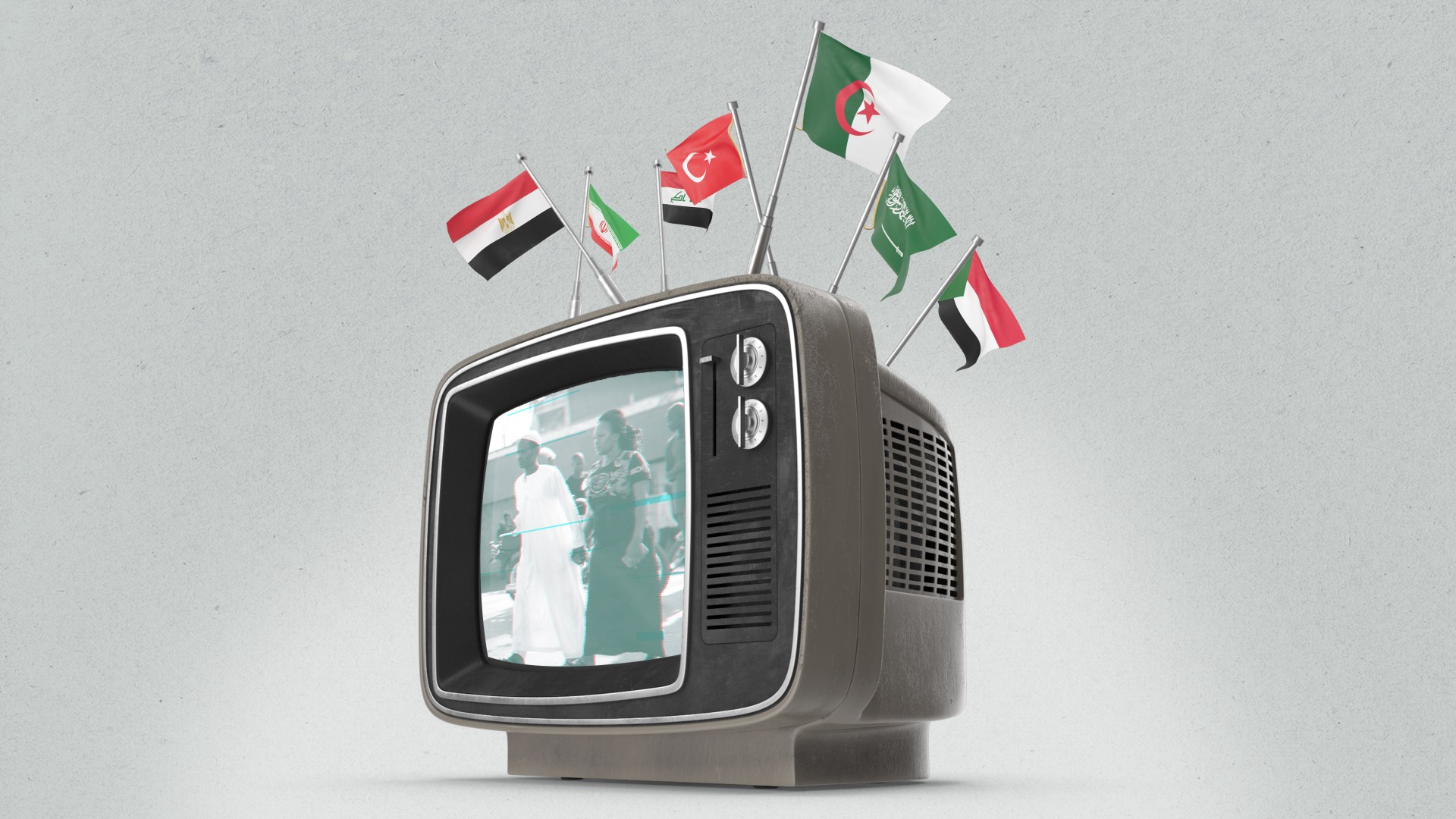
Illustration by Rick Szuecs / Source images: Envato Elements / Sam Balye / Unsplash

Walking along the dusty streets of Cairo, Terence Ascott had an epiphany. Having served in literature ministry in the Middle East and around the world, the British missionary grew somber as he passed by the local bawab (gatekeeper), his wife, and three children.

“How can such an illiterate family ever be exposed to the Christian faith?” Ascott mused.

Hired to guard a construction site, the Egyptians sat huddled under a makeshift tent with only the most rudimentary of kitchen items—and a television that transfixed them and left Ascott unnoticed as he lingered.

Last year, satellite TV ministry SAT-7 celebrated its 25th anniversary. Broadcasting in Arabic, Turkish, and Farsi, the embodiment of Ascott’s epiphany now communicates the gospel across 25 nations in the Middle East and North Africa, home to 400 million people.

Having transitioned SAT-7 to local leadership but continuing to serve as a member of its international council, Ascott turned back to literature to reflect on four decades of ministry.

Below is an excerpt from Dare to Believe, a collection of Ascott’s anecdotes of faith from ordinary believers, telling the story of his journey—through civil wars, arrests, and deportation—to establish an evangelistic ministry embraced today by nearly every Christian denomination in the region.

Tertullian, the early North African Christian writer, observed, “The blood of the martyrs is the seed of the church.” When one considers the dozens of murdered Christian workers in Algeria over the past decades, it is not surprising to know that it hosts the fastest-growing church in the Arab world today.

The Protestant Church of Algeria (EPA) was officially recognized by the government of Algeria in 1974. While the exact number of its members has never been clear, estimates in 2011 were in the range of 60,000 to 120,000.

Almost all of the membership was not from a Christian tradition, with many of the 50 or so registered churches being in the Berber, Kabyle-speaking regions of the country. Though these believers had faced waves of persecution and church closures, their numbers continued to grow.

The violence Islamists have committed against Algerian civilians also appears to have been a factor in turning many to Christ. This was graphically illustrated by a drawing a young Algerian girl sent to our children’s program, AsSanabel.

It pictured Jesus on the cross, holding an Algerian flag in each hand. To Christ’s left was pictured something that no child should be thinking about: a bearded Islamist cutting the throat of this young artist with a sword. Over this gory part of the picture was a big X, rejecting the behavior.

To Christ’s right was a happy child holding a cross in one hand and declaring their freedom. And at the bottom of the picture she had written, “They are killing the children, but Jesus was killed for the children.”

Rita El Mounayer, who was by then the executive director for SAT-7’s Arabic channels (and still the presenter and producer of AsSanabel), and I flew into Oran on July 25, 2011. It was a long-postponed trip to strengthen SAT-7’s ties with the church and local producers there. Security was tight but friendly. Several of the immigration staff in the airport recognized Rita from her regular programs on SAT-7. This perhaps delayed things a bit, as they seemed anxious over the possibility of us filming in their country. We assured them we would not.

Our first impressions of the city were not that great. For the second largest city in Africa’s geographically biggest country, with one of the world’s greatest reserves of natural gas, their investment in public services and infrastructure seemed underwhelming. Many of the streets were unpaved, littered with rubbish. And we could find stores selling only the most basic range of local produce. Unemployment was high. Many of the apartment buildings seemed poorly maintained and had no elevators or air conditioning, despite the stifling summer heat.

But they all had satellite dishes!

Our Algerian hosts welcomed us warmly. They clearly had a heart for ministry and for sharing their faith with others in North Africa through SAT-7’s broadcasts, especially at a time when half a dozen churches in the country had recently been given orders to close. These brothers and sisters had already been recording simple church services and other programs but were obviously in need of both better and more equipment, as well as some advanced training in television production.

Rita questioned if the believers at the church services being recorded minded that their faces would be shown on television, especially given the growing problems for such churches at that time. Youssef, the ministry leader, explained that when they discussed this issue in church, instead of people moving to the back and away from the cameras, many moved to the front to let their faces be seen more clearly!

Rita then asked Samia, both a presenter and a producer of several shows, “Is it not dangerous to show your face on screen?”

“Rita, what are you afraid of?” Samia asked.

“I am not afraid for myself or for SAT-7,” replied Rita, “but for your sake.”

“Afraid for me?” Samia said. “Persecution is actually a crown that we put on our heads each and every day before going out into the world. Don’t take this away from us!”

These are the Christians of North Africa.

***

Today we are seeing in the region a turning away from religion, due to several factors.

First, religious extremism. Many have been appalled by Muslims killing other Muslims in the name of their common god. The rise of the so-called Islamic State in 2014 only served to widen such attitudes.

Others have been turned from religion by the hypocrisy and the corruption they have seen in religious leaders, especially in theocracies like Iran.

This disappointment and loss of trust in religious leaders and religion was exacerbated by the disappointment many people had at the way the 2011 Arab Spring uprisings turned out. At the time, people believed that these would lead to new freedoms, new employment opportunities, and being able to live with dignity. But all they got was chaos and destruction. And disappointment led to a loss of hope, even among the region’s Christian populations, motivating many more to make the hard decision to emigrate.

But for most Christians and Muslims in the region, emigration has never been a legal or practical option, something that has only added to their loss of hope, noticeably pushing up despair and suicide rates, especially among the young.

It is in this context that there has never been a more important time for Christians to broadcast, on air and online, messages of hope in our region. But I do not mean just academic, theological messages of hope. I mean a whole gospel, to minister to the whole person, authentically touching all areas of human need: the spiritual, the emotional, the psychological, the socioeconomic, and the educational.

But it is not just taking a holistic approach. It is also seeing God’s Holy Spirit at work in the lives of our viewers, sometimes in a very special way through visions and dreams.

The story of Aziz is typical of such interventions. He is a young Iraqi who had been a militant, fighting with a violent Islamic group in Syria. He telephoned SAT-7 to explain that he had been hiding in a destroyed church during a battle when he had a life-changing vision. He saw the broken pews restored and Christians filling the building, worshiping God.

A man in white, radiating light, walked over to him and touched his shoulder. The militant recognized him as Jesus Christ from the Jesus film he had watched on SAT-7’s Arabic service. And it was to a SAT-7 counseling line that Aziz turned after he left the ruined church a changed man.

“The living Jesus himself came to me,” he said. “He called me and I told him, ‘I want to follow you.’”

Media continues to give the Christians of the Middle East and North Africa the opportunity to come out of their churches and homes and to be the salt of the earth, a city on a hill, a lamp on a lampstand.

Over the past quarter century, the Christians of the region have shared their lives through media with millions who may never have spoken with a Christian before. They have shared their sorrows, their joys, and the faith and hope that are theirs. As individuals and a community, they have shown the unconditional forgiveness of God through their own public acts of forgiveness, sometimes in the wake of terrible acts of violence against them.

God is using this witness to bring many to himself and, in the fullness of time, I believe that the rest of the global church will be surprised, even stand in awe, when all that is happening today, in secret, becomes clear to everyone.

If there’s one thing I have learned from my time living among our Christian brothers and sisters in the Middle East and North Africa, it is that most of them please God every day through their bold faith in him, in daring to believe. And they have also helped show me that not daring to believe—not being willing to trust God in such an area of the world—is far more dangerous.

Terence Ascott is founder and president of SAT-7 and author of Dare to Believe.

News

Sexual Harassment Went Unchecked at Christianity Today

Women reported two top leaders’ inappropriate behavior for more than 12 years. Nothing happened.

Christianity Today March 15, 2022
Christianity Today

Disclosure: This story was reported by CT news editor Daniel Silliman, edited by senior news editor Kate Shellnutt, and published without prior review by ministry executives. Neither editor had access to personnel files or meetings regarding the allegations or investigation. You can read president and CEO Timothy Dalrymple’s statement here.

For more than a dozen years, Christianity Today failed to hold two ministry leaders accountable for sexual harassment at its Carol Stream, Illinois, office.

A number of women reported demeaning, inappropriate, and offensive behavior by former editor in chief Mark Galli and former advertising director Olatokunbo Olawoye. But their behavior was not checked and the men were not disciplined, according to an external assessment of the ministry’s culture released Tuesday.

The report identified a pair of problems at the flagship magazine of American evangelicalism: a poor process for “reporting, investigating, and resolving harassment allegations” and a culture of unconscious sexism that can be “inhospitable to women.” CT has made the assessment public.

“We want to practice the transparency and accountability we preach,” said CT president Timothy Dalrymple. “It’s imperative we be above reproach on these matters. If we’re falling short of what love requires of us, we want to know, and we want to do better.”

In separate, independent reporting, the CT news editor interviewed more than two dozen current and former employees and heard 12 firsthand accounts of sexual harassment.

Women at CT were touched at work in ways that made them uncomfortable. They heard men with authority over their careers make comments about the sexual desirability of their bodies. And in at least two cases, they heard department heads hint at openness to an affair.

More than half a dozen employees reported harassment from Galli or Olawoye to a manager or HR between the mid-2000s and 2019. But neither leader was written up, formally warned about their inappropriate behavior, suspended, or otherwise punished. There is no record that Christianity Today took any corrective action, even after repeated complaints of nearly identical offenses.

“The culture when I was there was to protect the institution at all costs,” said Amy Jackson, an associate publisher who left what she said had become a hostile work environment in 2018. “No one was ever held accountable. Mark Galli was certainly protected.”

The misconduct at CT may not rank with the worst examples exposed by the #MeToo movement, but the ministry has never measured itself by those standards.

“In the midst of our ugly world,” Galli wrote in 2015, “Christianity Today offers an oasis of the true, the good, and the beautiful.”

At the same time that Galli was developing the “beautiful orthodoxy” branding for CT, he made inappropriate comments about women. Three people recalled him talking in the office, for example, about how he liked to watch female golfers bend over. Galli denies the specific comment but said he probably referred to the women on the golf course as “eye candy.”

Remarks about women’s bodies and even the occasional stray hand can be seen as merely “boorish,” said online managing editor Andrea Palpant Dilley, one of the people who pushed for the external assessment. But that behavior has had an impact on the women who work at CT.

“There is a physical fear with sexual harassment, but the bigger fear, for me, is I’m afraid of the diminishment and disrespect,” Palpant Dilley said. “It’s a threat to my professionalism, and that is fundamentally a threat to my ability to flourish and trust that I can be respected as a woman at CT.”

HR complaint brought backlash

Richard Shields, HR director from 2008 to 2019, declined to comment on any specific employees or allegations for this story. But he objected to the idea that HR had fallen short.

“I always took complaints seriously and very, very confidentially,” he told the CT news editor. “I’m very confident that we used the processes we had in place very consistently, very thoroughly, very effectively.”

CT policy dictated that HR document any allegations of misconduct and then report to the executive team. The executive team did not, however, have clear corporate guidelines laying out the consequences for violations, according to Harold Smith, president and CEO from 2007 to 2019.

It wasn’t until after the start of the #MeToo and #ChurchToo social media movements that CT leadership started to review policies and train staff on sexual harassment.

“We were playing catch-up,” Smith said. “And regrettably it was the women who brought this issue to our attention … who were sadly caught waiting and waiting for some resolution.”

When people made allegations, HR opened files and took notes. But then nothing happened, leaving many current and former employees with the impression there were no consequences for any misconduct short of a felony.

For some, reports to HR actually made things worse. For one woman, an HR complaint brought so much backlash that it changed her experience at CT.

Her name, like the names of other women who experienced sexual harassment, is being kept confidential, following CT’s policies for reporting on abuse. The details of each story have, however, been confirmed with multiple sources who observed the same incident, learned about it firsthand at the time, or saw identical instances of harassment.

When this woman was hired on as an editor in the mid-2000s, someone joked that she was only brought on because a senior editor wanted to have sex with her. She didn’t report that to HR, but a colleague did. After that, the woman heard regular comments from men at CT about how she was too quick to see sexual harassment in everything.

Galli in particular began asking her if she was offended when he held a door open for her, she recalled. He would make a banal statement about gender, she said, and then add, “Are you going to report that?”

It made her believe that if she reported anything, she would be treated as if she was crying wolf. “It was pretty chilling,” she said.

A short time later, CT’s advertising director, Olawoye, came into her office and shut her door. He told her how good she looked, she recalled. Then he started talking about how unhappy he was in his marriage and put his hand on her leg.

She did not report it to HR. She did not think it was worth the risk.

“It’s hard for people to come forward with claims of harassment—very hard,” said Sonal Shah, assistant director of employment law services at HR Source. “Most complaints go unreported, so if you’re getting multiple complaints, then the problem is likely more serious and more pervasive than you realize.”

Multiple women who worked at CT between 2000 and 2019 said it was not even clear to them whether HR was responsible for sexual harassment complaints. The state of Illinois mandated sexual harassment training for all workplaces in 2019, and CT now requires employees to complete an annual online course. Before that, the women recalled, the general impression was that HR wasn’t interested in sexual harassment allegations and only dealt with hiring, firing, and retirement plans.

The HR director, Shields, was also associated with a group of senior men at the ministry who played golf, including Galli, Olawoye, and several others. A number of women said they decided not to report harassment because he seemed more likely to sympathize with men in leadership than young women making accusations.

“I was told not to expect anything from HR,” one former employee said, “but just go to other women.”

Women helping women avoid sexual harassment

Women in the office organized informally to protect each other against unwanted attention from Olawoye, who was known at CT by his nickname “Toks.” Several described warning new hires that he did not respect personal boundaries, but frequently invited himself into women’s offices, shut the door, and engaged them in long, personal conversations.

Some even made a pact to pretend to have meetings with each other to create an excuse to politely end conversations with the higher-ranking man.

Despite those efforts, three more women had identical experiences of harassment. Each independently said that Olawoye commented on their physical appearances, told them his wife was not as attractive as she used to be, and mentioned he wasn’t having as much sex as he would like.

“My whole body tensed up and I wanted to throw up,” one woman recalled. “I was just like, ‘Uh, uh, uh, I don’t want to be your friend. I don’t want to be here. I don’t want to talk to this person alone ever again.’”

None of these women reported the incidents to management or HR. One said she felt like she dealt with it personally, and the others said they were embarrassed and didn’t think it would help.

They may have been right. When others did report Olawoye for inappropriate behavior, they found they were treated as if they were the problem.

One woman told her manager that Olawoye was staring at her breasts during meetings. The manager’s response: “It helps if you wear a scarf.”

The manager, who is a woman, confirmed that account but noted that she did not receive training about sexual harassment when she was promoted and did not know to file a formal complaint.

Another manager, a man, did file a complaint. He went to HR and said that Olawoye was spending an inordinate amount of time talking to a college intern. He seemed to be asking her inappropriate questions—whether she had a boyfriend, whether she’d ever had a boyfriend, and whether she’d like to have dinner at his house.

A few days later, Olawoye stormed into the office of the manager who reported him and demanded an apology. He had learned who made the complaint and was irate about the possibility of an “awful mark” on his record.

The manager did not file any more HR complaints during his time at Christianity Today.

There is no record that Olawoye was formally reprimanded for that incident or that it left any sort of mark on his record.

Olawoye’s tenure at CT ended after he was arrested by federal agents in a sting operation in 2017. He was attempting to pay for sex with a teenage girl. He ultimately pleaded guilty and was sentenced to three years in prison.

Today he lives in suburban Chicago and is registered as a sex offender. He did not respond to multiple requests for comment for this story.

After Olawoye’s arrest, HR offered counseling for employees who may have been upset but did not investigate whether anyone had been harmed by Olawoye during his time in the office, according to multiple employees. Instead, CT leaders urged the staff to show Olawoye grace and remember that everyone is innocent until proven guilty.

Galli accused of touching eight women

In CT’s editorial department, it was Mark Galli who shared the news of Olawoye’s arrest and delivered the message about suspending judgment. He told at least two women he supervised that he understood how a man could be tempted to pay for sex with a teenager. According to the women, Galli said that he also had unfulfilled sexual urges and that was a common male experience. The important thing was learning not to act on those urges.

Both would later question why he told them that. Both were later touched inappropriately by the then–editor in chief.

In all, eight women said Galli touched them inappropriately.

Six reported the incident to HR. One didn’t. Another had the incident reported by a colleague. Galli was not reprimanded in writing or given any sort of formal warning about his behavior.

“HR is supposed to protect us,” one former employee said. “It’s supposed to handle these situations, but I saw time and again, HR has authority in title, but not authority to actually do anything.”

None of the women saw Galli suffer any repercussions, and several said he seemed to brush the complaints off as a minor annoyance, a generational difference, or a problem of “politically correct” culture.

Today, Galli views the allegations as misunderstandings.

“I have never done anything consciously, deliberately wrong,” he told the CT news editor. “I’m happy to apologize for those areas in which I miscommunicated or made people think one thing when I was actually trying to do another. I’m happy to do that.”

Galli expressed frustration that CT allowed the misunderstandings to “fester” and said he wished the ministry had facilitated reconciliations between him and the women who accused him of inappropriate conduct.

“Some individuals might have interpreted any kind of touching as a sexual come-on,” he said. “Anything I’ve done to trouble, offend, bother anyone, even two years after I left the company, I’d appreciate the opportunity, even with the presence of a third party, to understand what they’re saying.”

The accounts shared with the CT news editor followed nearly identical patterns. Most of the women said he rubbed his hand on their lower back and touched their bra clasp.

Some said his touch seemed sexual and they felt violated. Others said they did not believe he intended it to be sexual, but they were bothered that he didn’t respect boundaries. He acted, they said, as if he could cross any personal or professional lines he wanted.

In one incident in 2008 or 2009, Galli walked up behind a woman at a copy machine and put his hand on her lower back, the woman said. It wasn’t obviously sexual, according to the former employee. But it made her uncomfortable, and she thought, “Why did he need to touch the small of my back?”

The woman reported the incident to HR. She met with Shields. The HR director took notes, she said, and seemed to understand why the behavior made her uncomfortable.

Then nothing happened. A few weeks later, she said, Galli approached her and said, “Just come and talk to me directly next time.” It was only later that she realized that he assumed there was going to be a next time.

“I didn’t feel comfortable talking to HR after that,” she said.

Another former employee recounted how Galli touched her twice in ways that didn’t feel right, including caressing her bare shoulder when they sat next to each other at an event in the late 2000s. According to emails written at the time, she reported the behavior to her manager, but he decided not to file a complaint with HR.

A third woman recalled that in 2012, Galli told her he wasn’t supposed to hug her, but he was going to anyway. She felt his hand linger on her bra clasp.

A fourth said that Galli rubbed her back and got his hand stuck under her bra. When she told a vice president, the senior leader suggested she had misread the situation and discouraged her from “making it an HR issue.”

“The specific words said to me were: ‘No one has ever reported him,’ ‘He has no HR complaints against him,’ ‘He has a spotless record,’” the woman said. “I remember it was said three different ways, and I thought, Maybe I am the problem.”

The employee went to HR anyway. She was later told that, because Galli denied it, there were no witnesses, and there was no previous documentation of inappropriate touching, nothing could be done.

Galli confirmed multiple conflicts over touching people at work but disputed the women’s interpretation of what he did.

“My hand couldn’t have been on her back for more than a second,” he told the CT news editor. “I obviously violated her space. I am really sorry about that. I wasn’t feeling her bra. … I was just trying to physically affirm that I was coming as a friendly person that wanted to have a conversation with her.”

‘Of course, I crossed lines’

After repeated complaints to HR, Galli considered making a personal policy against touching people in the office but rejected the idea, he told the CT news editor. He touched people to encourage them, to connect, and to communicate effectively, he said, and he thought he would just have to live with some misunderstandings.

“Of course, I crossed lines,” he said. “It shouldn’t surprise anyone who knows me that, working there for 30 years, I probably crossed boundaries. Yeah, that happened. Just to be clear, I never had any romantic or sexual interest in anyone at Christianity Today.”

Galli violated other boundaries as well. In the early 2000s, he told a woman who worked under him that he found her attractive, according to the woman and six colleagues who knew about it at the time. After she quit, Galli said, “You are the type of woman I would have an affair with.”

In 2018, Galli barged into an office where an employee was pumping breast milk. There had been an announcement that a new mother would need privacy and a sign on the door that said, “Do not disturb.” Galli looked at the sign and said out loud, “That doesn’t apply to me,” according to two people who were there.

The incident was reported to HR. Galli was not formally reprimanded or disciplined.

Galli did not cross lines with every woman he worked with. Several current and former employees said they had good experiences: Galli encouraged them, trained them, promoted them, and advocated for them.

More, however, said he was a hard boss to work for. Both men and women said he had a strong authoritarian streak and unpredictable moods. He sometimes got angry, overreacted to criticism, and yelled and slammed things in the office.

No one with authority seemed to acknowledge this behavior or check Galli in any way, current and former employees said. He would act out and then joke that he was a bad boss like the character Michael Scott in The Office.

‘The next incident will be taken seriously’

That status quo continued until August 2019, when Galli was accused of inappropriately touching three women in three days.

First, he walked up to a woman and hugged her from behind by surprise. A manager saw and reported it to HR, according to multiple people who were there.

Jaime Patrick, who succeeded Richard Shields as HR director in 2019, took the report to Timothy Dalrymple, the new president and CEO. Dalrymple, who had been appointed three months before, went to Galli and told him the behavior was unacceptable. It was a verbal warning.

The next incident happened the following day. During a group photo at a public outing, Galli put his arm around a female colleague and rested his hand on her butt. He kept his hand there, the woman said in a written statement to HR, until the photo was taken.

Dalrymple declined to speak about specific HR complaints against specific employees for this story. According to people familiar with the situation, however, he asked HR for documentation of previous inappropriate behavior and to research the legal options for suspending or firing Galli. At the time, nearly 30 years into Galli’s employment at the ministry, an HR staff member found no evidence of disciplinary action against Galli.

Before that anything more could happen, HR received a third complaint from a woman who said Galli grabbed her shoulders and shook her while telling a story.

Dalrymple issued a formal warning. Galli said he signed a statement acknowledging the reprimand. It was the first time any allegation left a record in his HR file.

According to best practices in HR, there should be clear, escalating consequences for misconduct, said Shah, the expert from HR Source. Typically, a first and second offense get a warning, a third gets a suspension, then there’s a final warning and, ultimately, termination.

An investigation and any corrective action also need to be thoroughly documented, she said, so an organization could demonstrate in court that it punished people consistently, regardless of status or other factors, and did its due diligence to protect employees.

“Saying, ‘Hey, don’t do that again’ is not enough,” Shah said. “That’s not taken seriously.”

Galli, however, had received no more than verbal reprimands prior to Dalrymple’s notice.

“The next incident,” an HR staff member told one of the woman who filed a complaint in 2019, “will be taken seriously.”

Galli announced his retirement two months later, in October 2019. In December he published an editorial calling for Donald Trump to be removed from office. In January, he retired.

Another incident occurred in 2021, however. At a gathering in Wheaton, Illinois, Galli hugged a current employee and ran his hand up her back.

“He effectively felt me up,” she told the CT news editor.

Then he stepped back and looked her up and down. She interpreted the gaze as “unapologetically sexual.” Even though she didn’t think there was anything that could be done, since he was a former employee, she reported the incident to her manager, who took the complaint to Dalrymple.

After that, several women, including online managing editor Palpant Dilley, pushed CT to hire an outside firm to assess why Galli’s sexual harassment had been allowed to continue unchecked for so long.

“We need really robust protocols and procedures so that when people fail, the systems behind those people don’t fail,” Palpant Dilley told the CT news editor. “We have to have checks and balances. As Christians, we of all people should have a strong and realistic view of human nature that accounts for and prepares us for human failure.”

Guidepost Solutions, a consulting firm, was contracted in September 2021 to review how CT had handled harassment claims, assess the ministry’s policies and procedures, and recommend concrete changes.

On March 13, Guidepost concluded that while there was no “wider pattern or culture of systemic harassment,” CT could do better.

“CT’s flawed institutional response to harassment allegations could have been influenced, in part, by unconscious sexism,” the report said. Leaders at the ministry “at times tried to minimize or rationalize” sexual harassment, treating it as nothing more than the behavior of “an older male who was out of touch with current workplace mores” instead of recognizing it as “inappropriate by any standards, for any person.”

Guidepost recommended changes for CT to improve its HR response by creating a system for anonymous reporting and putting set procedures in place for investigations. The external review noted that CT had “no provisions governing confidentiality” around HR investigations.

Dalrymple said CT will implement the recommendations and review other potential changes over the next six months.

“Employment practices are in place for a reason,” he said, “and I think we need to be clear with our employees that reporters of misconduct are welcome, they will be safe from retaliation, and their concerns will be taken seriously.”

Broader cultural problems

No one who was hurt at CT thinks the culture of the ministry is uniquely sexist. Some have had worse experiences in other Christian workplaces. But the sexism nonetheless placed an extra burden on women, who now make up more than half of CT’s staff.

Men at the ministry commonly assumed that single women always wanted to get married and have children, current and former employees said. And department leaders assumed that mothers at the company would prioritize their families so much that their work could never be as important to them as it was to their male colleagues.

Current and former employees say there have been ongoing issues with men talking over women in meetings. And it was considered acceptable when some men in leadership said that biological differences between the sexes extended as far as intelligence and that men might just be smarter.

A few former employees blamed sexism on evangelical culture, saying its norms around gender could blur the lines between acceptable and unacceptable behavior.

Agnieszka Zielińska, a former CT editor who has since left Christianity and considers herself “a happy agnostic,” looks back at her experience at the company from 2000 to 2006 and sees glaring problems.

“The evangelical culture tends to encourage earnestness and improperly boundaried disclosure,” she said. “It promotes the treatment of coworkers as family members. This can feel nice. But it can also create problems, such as a disregard of professional boundaries at work.”

More, however, were disappointed by the ministry’s failure to live up to its Christian commitments and CT’s specific mission. Several pointed to a 2015 editorial where CT issued a call for “honest witnesses to moral failure.”

The piece said that the scandals of individual evangelical leaders are a problem. But the many people who knew and did nothing is devastating.

“If you know something, tell someone,” wrote Ted Olsen, who was then the managing editor for news and is currently CT’s executive editor. “If you’re hoping that something will resolve itself, you need more fear that it will blow up terribly. If you are praying that God will bring something to light, listen to his call to ‘take no part in the unfruitful works of darkness, but instead expose them’ (Eph. 5:11, ESV).”

News of an external assessment has been met, by most of those hurt at CT, with wariness. While Dalrymple’s commitment to transparency has raised some hope, there is still a good deal of skepticism.

Current and former employees say they worry that the ministry will be too quick to think that all its problems are in the past. They worry about what happens the next time someone has a complaint they should take to HR. They worry it will be too easy to look away, too easy to let more men cross more lines, and too easy not to hold them accountable.

“I’ve run out of grace for it,” said creative projects director Joy Beth Smith, “and honestly, I don’t know if the institution has.”

News

Russian American Pastors Combat Propaganda in Their Churches

Tensions are surfacing among Slavic communities in the US, which have ties to both sides of the war in Ukraine.

The Russian Church of Evangelical Christian-Baptists, also known as Bryte Church, is in a hub of evangelical refugees from the Soviet Union in Sacramento, California.

The Russian Church of Evangelical Christian-Baptists, also known as Bryte Church, is in a hub of evangelical refugees from the Soviet Union in Sacramento, California.

Christianity Today March 15, 2022
Courtesy of Bryte Church

Michael Cherenkov, a pastor in Washington state, has relatives on both sides of the fight between Russia and Ukraine. And as wartime propaganda makes its way into immigrant churches around him, he has spiritual family on both sides too.

Evangelical pastors in the US, leading churches where Russian Americans and Ukrainian Americans worship side by side, see the stark but quiet tensions between those who believe Russian president Vladimir Putin’s justifications for the invasion and those who are decrying the injustice of the war. Many have ties to both countries, but the war has highlighted some long-unspoken political divisions.

Cherenkov leads Revival Baptist Church in Vancouver, Washington, a 400-person, mostly Ukrainian congregation. He grew up in Ukraine, where one of his brothers is fighting and his parents are sheltering, but was born in Russia, where his sister lives.

Cherenkov’s sister—also a Baptist—supports the invasion, seeing it as a natural consequence of Ukraine siding with the European Union and the United States, and she believes that Ukraine should submit to Putin.

“It’s hard to discuss,” Cherenkov said. “It is heartbreaking for all of us.”

The tension has been more overt in Ukrainian and Russian Orthodox churches in the United States. In New York last week, the Ukrainian Orthodox Cathedral of St. Volodymyr invited Russian Orthodox leaders to a prayer service for Ukraine along with New York’s governor. The governor came, but the Russian leaders did not.

In Sacramento, California—a hub for evangelical refugees who fled the Soviet Union—an associate pastor of a Russian Baptist church opened a recent service with a call for unity as “Satan tries to divide even our community, the Slavic community, who is for Russians and who is for Ukrainians,” and decried the war, taking a political side that was unprecedented for the church.

Slavic evangelical churches in the US draw Eastern Slavic immigrants from Russia, Ukraine, and fellow former Soviet countries from the region. The communities have united around a shared background of escaping Soviet repression and having families that crisscross national boundaries. The 2014 Russian-backed conflicts in eastern Ukraine brought some political differences to the surface in American Slavic congregations, but church leaders rarely addressed it publicly.

Even with both Russians and Ukrainians in Cherenkov’s congregation, church leaders at Revival have been praying for and supporting Ukraine without any overt division. Some Slavic churches in his region, he said, have had open arguments, with Russian Americans blaming the invasion on Ukraine’s alignment with the West—a stance he attributes to the influence of Russian media.

“We have to be strong and honest. We have to name all the things as they are,” Cherenkov said. “At the same time, I have to be merciful to those who are weak and sick and brainwashed. … I just have pity. It is so sad that we as Christians are so vulnerable to the state propaganda machine—here in the US in the time of Trump and in Russia now in the time of Putin. It is so sad that we trust those politicians like false messiahs instead of the gospel of Jesus Christ.”

Since the February invasion, Russian state media like Channel One Russia and RT America have lost platforms in the US—YouTube blocked RT America’s livestream—but remain available through other streaming platforms.

RT America is in favor of the invasion, describing Ukrainians as people with “European values” and alleging Ukrainian crimes against civilians in contested Ukrainian regions like Donbas. One banner headline on its broadcast read: “Russia Accuses Ukrainian Forces of Targeting Chernobyl Infrastructure.” Sputnik News, a state-sponsored radio outlet, had a headline: “The American History of Meddling with Neo Nazis in Ukraine.”

Congregants listen to state media

Other Ukrainian and Russian pastors in the United States shared similar stories and concerns over the influence of propaganda.

“It is really sad for me, especially for the Christian people, people who are supposed to know the truth,” said Paul Demyanik, a pastor who leads the Western Ukrainian Baptist Convention in the US.

Demyanik understands why Russian evangelicals have to censor themselves under Putin. The head of the Russian Union of Evangelical Christians-Baptist in Russia, Peter Mitskevich, for example signed onto a Baptist World Alliance statement that avoided the word “war” and didn’t assign blame, because pastors in Russia risk arrest for speaking out.

“But here in the United States … they are supposed to be not afraid because the American government will not do anything against them,” Demyanik said. “Some Russian leaders are still quiet. … Many of them went through the Soviet experience. Many of them or their parents went through the persecution and prison. I cannot understand it.”

The head of the Pacific Coast Slavic Baptist Association, pastor Ivan Mileyev, said if Russians support the war, they “are very quiet.” He thinks those who listen to Russian propaganda are a small minority.

“We have some believers who do not 100 percent understand English. They sometimes listen to Russian news, so they catch up with some junk—they became victims to the propaganda,” Mileyev said. His father is Russian, and his mother Ukrainian, but he has spoken against the war.

Pew Research Center, Nielsen, and other media experts could not offer data on Russian American consumption of Russian state media. But researcher Anton Shirikov said Russian immigrants, especially those who came as adults, watch state media because it is familiar, it is in Russian, and it’s more interesting to them than US politics.

Shirikov, who used to work as an independent journalist in his native Russia, is now working on his PhD on Russian propaganda and censorship at the University of Wisconsin. Even with independent media prior to the recent crackdowns around the war, Russians still chose to listen to state outlets.

“It’s the same logic that drives media choices here and there,” said Shirikov in an email. “People like to read/watch something that portrays their home country nicely … at the same time, those who support the war may not be even watching TV—but they still get the picture from their friends or in the church.”

Russian Americans try to fight tensions

The war was the first topic at a March 6 service of the Russian Church of Evangelical Christian-Baptists, in Sacramento, also called Bryte Church, nicknamed for the Slavic neighborhood.

“We are praying God will stop this war,” associate pastor Igor Dronov told the 2,000-person congregation. “We need this peace as well….May we be united through this service and through these signs that show us the blood that was shed from Jesus Christ’s wounds and his death. Jesus’s body was broken. May we be restored in our unity.”

Senior pastor Mikhail Avramenko said this war was the first time the church had commented on political events. They have always been cautious to avoid unnecessary tensions because many Russians in Russia watch their services online. But the day after Russia invaded Ukraine, the church leaders stated that they strongly supported the freedom of Ukraine.

“We try to calculate our words,” said Avramenko. “But when the invasion happens and we see atrocities, we say it is an invasion. We are against it.”

Older Russian Baptists have a history of pacifism, according to several Russian immigrant pastors who themselves risked arrest for refusing to take up arms under mandatory military service in the Soviet Union. They tend to avoid discussing politics from the pulpit, and to focus on preaching the gospel.

Andrey Chumakin, the president of the Northwest Association of Slavic Baptist Churches and the pastor of Salvation Baptist Church in Edgewood, Washington, was one of those pacifist pastors and immigrated to the US from Russia 20 years ago. He said Russian Baptists would “not touch political topics on any occasion.” Mileyev, the head of the Pacific Coast Slavic Baptist Association, confirmed that tendency.

“For me as a leader it’s important to send a clear message. Other leaders, they don’t want to take a side in this situation, [saying], ‘We are Christian and we are not really in politics,’” said Mileyev. “They are trying to insulate themselves from reality … because they have some people in their churches who are more pro-Russia. They are trying to please everybody and not spark some fight. I think it’s not right in this time of war, when innocent people are dying, to say, ‘It’s not my business.’”

Plenty of Russian American evangelical leaders have spoken against the war and organized donations and aid for Ukraine. Bryte Church has already sent $20,000 in humanitarian aid through a Christian relief agency in Germany, along with doing regular prayer and fasting for Ukraine. But the pastors across the US are still navigating new tensions in congregations and have urged parishioners to be mindful in their social media posts.

“Any person who can cause murky waters or division—I am almost crying from the pulpit, ‘Please do not be that man who hurts others with words. Before you say anything, pray. Think,’” said Bryte’s Avramenko. “We talk about this openly in the church.”

Apple PodcastsDown ArrowDown ArrowDown Arrowarrow_left_altLeft ArrowLeft ArrowRight ArrowRight ArrowRight Arrowarrow_up_altUp ArrowUp ArrowAvailable at Amazoncaret-downCloseCloseEmailEmailExpandExpandExternalExternalFacebookfacebook-squareGiftGiftGooglegoogleGoogle KeephamburgerInstagraminstagram-squareLinkLinklinkedin-squareListenListenListenChristianity TodayCT Creative Studio Logologo_orgMegaphoneMenuMenupausePinterestPlayPlayPocketPodcastRSSRSSSaveSaveSaveSearchSearchsearchSpotifyStitcherTelegramTable of ContentsTable of Contentstwitter-squareWhatsAppXYouTubeYouTube