News

As Russia Invades Ukraine, Pastors Stay to Serve, Pray … and Resist

(UPDATED) Prayer requests from Donetsk: “First, to stop the aggressor. But then for peace of mind, to respond with Christian character and not from human hate.”

The body of Captain Anton Olegovich Sidorov, recently killed in Donetsk, is seen during his funeral on February 22, 2022 in Kyiv, Ukraine.

The body of Captain Anton Olegovich Sidorov, recently killed in Donetsk, is seen during his funeral on February 22, 2022 in Kyiv, Ukraine.

Christianity Today February 24, 2022
Chris McGrath / Getty Images

As Russia invaded Ukraine today, pressing near even to the capital of Kyiv, a Baptist home was destroyed and a seminary shaken by nearby blasts. Local sources told CT, however, that no churches or Christian buildings had been attacked so far.

President Vladimir Putin announced his forces were targeting only military installations. He also asserted that Ukraine does not truly exist as a nation.

Igor Bandura, vice president of the Baptist Union, the largest Protestant body in Ukraine, heard about collateral damage to the home of a Baptist in Donetsk during a Zoom call with his 25 regional superintendents.

Minus one. On the front lines of the eastern Donbas region, the Baptist leader from the occupied territory of Luhansk was unable to join.

But from the town of Chasov Yor on the front lines in neighboring Donetsk—in an area then still under Ukrainian government control—Bandura learned the local assessment.

“People don’t want to be under Russian control,” he was told. “But they feel helpless. What can ordinary people do?”

Pray. And remain calm.

This was the message put out by the Ukrainian Council of Churches and Religious Organizations (UCCRO), a day after its appeal to Putin went unanswered.

Ukraine’s chief rabbi invited Christian leaders to recite Psalm 31 together.

“We urge you to remain calm, not to give in to panic, and to comply with the orders of the Ukrainian state and military authorities,” stated the UCCRO. “The truth and the international community are on the Ukrainian side. We believe that good will prevail, with God’s help.”

Thousands of Ukrainians fled west as Russian missiles hit targets throughout the nation. Ukraine’s Ministry of Internal Affairs reported hundreds of instances of shelling.

President Volodymyr Zelensky announced by video shortly after midnight that 137 Ukrainians died during the invasion’s first day. “They are killing people and transforming peaceful cities into military targets,” he said, according to The New York Times. “That’s villainous and will never be forgiven.”

Valentin Siniy, president of Tavriski Christian Institute (TCI) in Kherson, about 50 miles from Crimea, had to evacuate his seminary along with a team of Bible translators as Russian helicopters attacked local targets.

“The majority of old pastors of the churches stayed in the cities. Youth leaders started evacuating young people,” he told CT. “We managed to purchase a van with 20 seats in order to evacuate people. About 30 people are in a safe place now, in western Ukraine. There are about 40 more people driving west [in] vehicles that are in bad condition.”

Meanwhile his church has opened its basement to shelter neighbors living in multi-story buildings from bombings.

“I and all ministers stay in Kyiv,” said Yuriy Kulakevych, foreign affairs director of the Ukrainian Pentecostal Church. “We continue our intercessory prayers, talk to people to reduce panic, and help those in need.”

In Kamyanka, 145 miles south, Vadym Kulynchenko of Our Legacy Ukraine reported that his church had already started to receive refugees from the east. Temporary shelter will be provided, and the main needs are food, medicine, fuel, hygiene products, and air mattresses.

Bombs hit three infrastructure centers in his city.

“Please pray for disciple-making in the country, safety for our people, and generosity in the midst of war,” Kulynchenko asked. “And also for discernment, as there is a lot of fake news.”

Kyiv Theological Seminary (KTS) had earlier issued a general warning.

“Generating panic through the spread of manipulative false information is exactly what the enemy seeks,” a communications professor wrote on Tuesday. “This war is not as much for our territories, as it is for our soul and our mind.”

On Thurs, KTS cited Isaiah 41:10 as it urged its Facebook audience “not to panic, but to remember how many times God in His Word says ‘don’t be afraid.’” The seminary noted that fear equals paralysis, while prayer, trust in God, and love of neighbor all give strength.

With a “leaden heart,” Taras Dyatlik wrote to supporters of theological education of the many prayer needs currently facing his fellow church and seminary leaders in Ukraine—including receiving refugees into their dorms.

“Many of them are thinking about evacuation of their workers and faculty and students within Ukraine, and some do not have any possibility to evacuate,” wrote the Overseas Council regional director for Eastern Europe and Central Asia.

He asked for prayer for families, including his own, as Ukraine’s announcement of total mobilization “means many students, graduates, faculty will be called for military duty to serve in the army and participate in the combats.” And he requested prayer for the spouses of male leaders. Since all men ages 18 to 60 are no longer allowed to leave the country, he said many wives are staying as well.

“Today I talked to [my wife] about evacuation out of Ukraine,” wrote Dyatlik. “She immediately refused and said: ‘I will be with you to the very end.’”

Students at Ukraine Evangelical Theological Seminary (UETS) outside Kyiv were instructed to shelter in place as military battled at a nearby airport, according to the school’s director of English language services, Josh Tokar. Those on campus are scared but not panicked, he said. The seminary president sent out a message from Psalm 27: “The Lord is my light and my salvation— whom shall I fear?”

Bandura did not resonate with the call for calm.

“Who are you to say our nation doesn’t exist?” he said of Putin’s rhetoric. “The truth is with us, and God is with us. We want to live in peace, but if Russia wants to take this from us, let’s fight.”

While some Ukrainians favor Russia, he said, half the population is ready to personally defend their nation.

Pictures have circulated of grandmothers with guns. A recent CNN poll, meanwhile, found 13 percent of Ukrainians in favor of Russia’s use of force to reunite the two nations. Only 36 percent of Russians were in favor. (73 percent and 43 percent disagreed, respectively.)

The Russian Evangelical Alliance (REA) conveyed its support for the UCCRO appeal for peacemaking initiatives.

“All evangelical Christians pray every day and ask the Almighty to give wisdom to all,” stated Vladimir Vlasenko, REA general secretary, “to preserve the fragile peace and not to plunge our countries into fratricidal conflict.”

“We see no justification for these actions and are deeply distressed by the death, destruction, chaos, and misery that will result,” stated Thomas Bucher, secretary general of the European Evangelical Alliance, according to Evangelical Focus.

“The invasion of Ukraine is both unjustified and unprovoked,” he stated. “It has been claimed that the attack is necessary to protect ethnic Russians within Ukraine and to stop Ukraine from threatening Russia. These claims are untrue. This disaster has been provoked into being by President Putin for wider geopolitical purposes.”

In Rivne in western Ukraine, local officials directed all churches to remain open, with church leaders staying in touch with residents to help coordinate aid as well as military equipment as needed.

Many in Ukraine are showing resilience.

“Our prayer today is that God’s will spreads on Earth as it is in Heaven,” said Siniy. “I encourage my staff and other Christian leaders that the mission stays the same even if we have to change geography.”

Staff at New Life Radio in Odessa, on the Black Sea coast, watched missiles fly past their homes. They told Evangelical Focus they are taking actions to hide equipment and preserve broadcasting, in case the station is raided in the near future.

Vasyl Ostryi, a pastor at Irpin Bible Church 18 miles northwest of Kyiv and a KTS professor of youth ministry, has also decided to stay.

“When this is over, the citizens of Kyiv will remember how Christians have responded in their time of need,” he wrote for The Gospel Coalition. “We will shelter the weak, serve the suffering, and mend the broken. And as we do, we offer the unshakable hope of Christ and his gospel.”

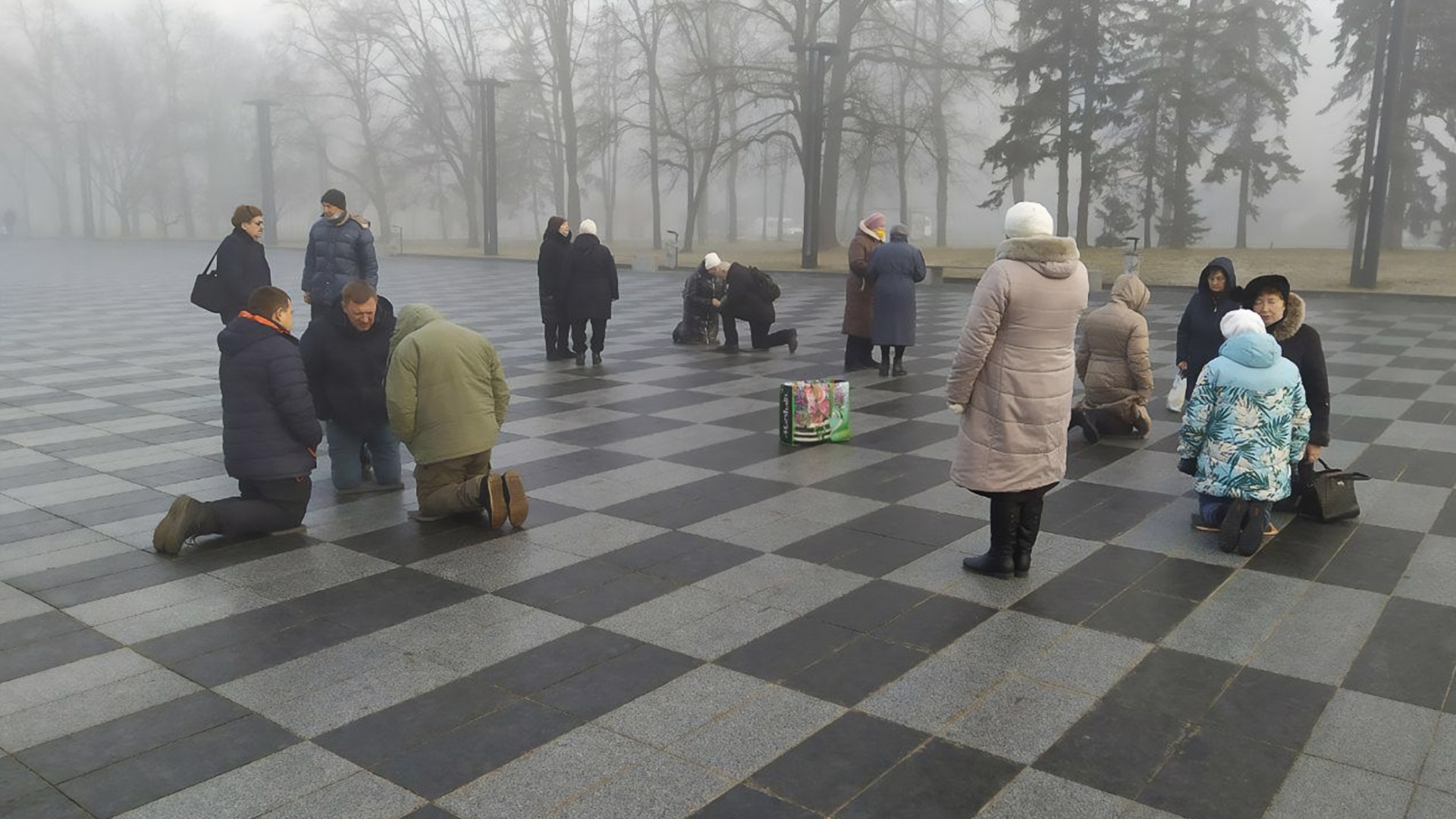
Photos have circulated showing Ukrainians kneeling in prayer in city streets.

Ukrainians praying in the central square of Kharkiv, Ukraine.

YouVersion noted a spike among Ukrainian and Russian users of its popular Bible App over the past three weeks: searches for fear increased 11 percent; searches for peace increased 44 percent.

“We printed Bibles for 2022 and we are now in second month of the year and the stock in our warehouse is almost gone,” Anatoliy Raychynets, deputy general secretary of the Ukrainian Bible Society, told Eternity News shortly before the invasion.

“In our churches—whether it is Orthodox, Catholic, Protestant, or Evangelical churches—there are more new people. Not only on Sundays or Saturdays, but also during the week,” he told the Australian Bible Society news service. “On evenings when we have a Bible study, new people are coming. They want to pray, to hear something that brings hope or comfort.”

Rick Perhai, director of advanced degrees at KTS, said the international church he pastors in Kyiv has several leaders recommending the congregation continue its worship this coming Sunday. Some of their expat members have fled; others want to stay and join the fight.

He laments that the enemy is seeking to destroy Ukraine as its Christians grow more and more poised to carry the gospel to surrounding nations. Nonetheless, he is praying for the Russians, asking for God to grant them repentance.

But his petition is also imprecatory.

“Pray that the nation of Russia would tire of their tyrant’s rantings at home and abroad,” Perhai said, “and that they would remove him.”

Dyatlik also requested prayer for “the truth,” citing all the “perspectives” in the media.

“We did not invite the war. The Kremlin and Vladimir Putin brought it to Ukraine. … There is moral evaluation of the acts of aggression like this,” wrote the theological educator. “These acts have biblical definition and biblical evaluation. Please pray for the spiritual discernment about these things.”

Dyatlik closed his prayer letter with requests for believers on both sides of the conflict:

Please pray about Russian Christians that they would raise their prayers and voice toward Russian government to stop the aggression; [that they] would not keep silent; please pray for the Western governments, of the US and European Union.

Finally, please pray about Ukrainian Christians, that we will serve and live as the community of hope in a full sense of this term; that during these terrible times we would invite more and more people to the relationships with God and His children, to the relationships of love, hope, encouragement, support; that our minds and characters would continue to transform into the character of Jesus Christ.

Western nations have roundly condemned Putin, and readied sanctions. Reports circulated of Russians lining up at ATMs to withdraw their cash, fearful the nation would be cut off from the international banking system.

Meanwhile in Donetsk, where 25 missionary teams have been working to establish churches, gas lines require a wait of hours for a rationed supply of five gallons. Grocery stories suffer empty shelves, as Ukrainians stock up on emergency food and water.

Bandura conveys his supervisor’s two main prayer requests.

“First, to stop the aggressor,” he said. “But then for peace of mind, to respond with Christian character and not from human hate.”

Additional reporting by Rachel Pfeiffer

Church Life

The Ukrainian Church: ‘We Need More Bibles’

As Eastern Europe goes to war, Scripture is in higher demand, say some.

Ukranians praying in the central square of Kharkiv, Ukraine.

Ukranians praying in the central square of Kharkiv, Ukraine.

Christianity Today February 24, 2022
Courtesy of Ukrainian Bible Society

On recent Sunday mornings in Ukraine, whispered reports have run through the churches: The soldiers on the eastern border have portable rocket launchers. The Bondarenko boy was shot in the leg; they say he won’t walk again. Did you know the Kovals left? Some questions have gone unspoken: Will we be here again next week?

Yesterday, those whispers became cries as a series of missiles hit near Kyiv.

The invasion puts the Ukrainian church at the heart of the conflict, as Christian leaders contend with people’s despair and uncertainty. They are standing, united and strong, and they’re helping Ukrainians find hope in God’s Word.

As the head of the American Bible Society, I’ve been in close contact with my friend and counterpart, Anatoliy Raychynets, who serves as the deputy general secretary of the Ukrainian Bible Society. Over the past few months, he has shared reports that are hard to read: mothers wailing for their sons outside the hospitals; children who won’t remember their fathers’ faces; thousands of people feeling hopeless and afraid.

But Anatoliy has noted something else too: church leaders working together for peace, and people seeking out the hope of Scripture.

In Anatoliy’s church, people are fearful they will lose everything. In response, he has been sharing Psalm 31 with anyone searching for reassurance. He reports that people are often surprised to hear words that, according to them, sound like they could have been written in Kyiv in 2022: “Praise be to the Lord, for he showed me the wonders of his love when I was in a city under siege” (v. 21).

As people grapple with unknown, many are experiencing the Bible’s message for the first time ever. According to Anatoliy, priests and pastors over the past weeks have been flocking to the Bible Society store in Kyiv to buy Bibles. Demand is so high that they’ve run out of copies.

This, Anatoliy says, is one of their biggest challenges: “We need more Bibles.”

Another resource offered by the church in Ukraine is Bible-based trauma healing. Although it was introduced only six years ago, the program has been incredibly effective, especially for family members of those killed in the conflict with Russia. It allows community leaders to guide small groups of people through a restorative process.

Now that it’s available in so many churches across the country, the Ukrainian Bible Society can’t keep up with requests for resources and training.

What, then, can we do to help?

Our brothers and sisters in Ukraine need Bibles for people searching for comfort in troubled times. They need trauma-healing resources to provide the balm of Scripture. And they need us to intercede for them.

“I ask you, in the name of Jesus Christ—whoever can pray, please keep us in your prayers,” says local pastor Viacheslav Khramov. “Today, the war started on our land. We ask everyone who is able to pray, please pray for us. Pray for Ukraine. Pray that lives are spared, as well as our bodies and souls."

Anatoliy, too, echoes this plea.

Out of everything he’s shared with me, I am most inspired by the show of solidarity from the Ukrainian church across confessions, borders, and party lines.

“We speak to our colleagues in Russia,” he told me. “We church leaders speak to one another, and we pray together. We are united in the Lord.”

This is exactly the gospel message we should be magnifying to a hurting world: God’s Word can reconcile enemies, drive out despair, and heal suffering hearts.

This is the vision of the united church we see shining in Ukraine. Amid war, politics, and division, the church of Jesus Christ is still spreading the gospel and building the kingdom.

Robert L. Briggs is president and CEO of American Bible Society.

Follow CT’s Ukraine-Russia coverage on Telegram: @ctmagazine (also available in Chinese and Russian).

News

The Big Quit Hits Homeless Ministries

They never stopped serving on the frontlines, but now short-staffed nonprofits are struggling to compete with flexible, virtual work that took off during the pandemic.

Bowery Mission staffer David Mason greets a guest at the mission's main chapel.

Bowery Mission staffer David Mason greets a guest at the mission's main chapel.

Christianity Today February 24, 2022
Courtesy of The Bowery Mission

At 6 a.m. and in a 40-degree rain, David Mason arrived at work at the Bowery Mission, New York City’s oldest ministry to those without homes, with addictions, or in need of a meal.

He has been working on the frontlines as a staff “ambassador” serving the city’s most vulnerable throughout the pandemic, without getting sick once, when others were working at home and the city was largely shuttered. He is a steady presence as the mission has seen staff and volunteer turnover.

Even when short on volunteers or kitchen workers, the mission starts the day by offering hot showers, a chapel service, and then breakfast to those on the street. It served 255,000 meals last year and housed 266 adults in its long-term residential programs. The mission’s main location in Manhattan, with its trademark red chapel doors, has been operating since before the last pandemic in 1918.

In this pandemic, though, volunteer numbers have been down and the mission has been short-staffed. About 10 percent of the Bowery Mission’s staff roles have gone unfilled for the past year, according to president and CEO James Winans, and the organization isn’t getting many applicants for those spots.

Winans said the organization set aside money in the budget for those roles “for a reason,” and the gaps put an extra burden on remaining staff. The omicron wave took another 10–15 percent of staff out of work temporarily, leaving the organization scrambling to continue serving hundreds of meals a day and offering shelter and residential programs in five 24/7 locations.

Until recently, the mission’s donations closet was a mountain of unorganized clothes and shoe donations because there weren’t volunteers to unpack and sort. The mission has turned to temp agencies to fill essential spots in kitchens or security and is leaning heavily on people like David Mason. The Bowery Mission is not alone in feeling these pangs.

The pandemic has led people to resign in record numbers across industries, with employees burned out and oftentimes eager for the flexibility of a new remote job. Volunteering has also slumped over the past couple of years. The Big Quit has left the Bowery Mission and many frontline ministries across the country short on help while demand for services has shot up. Across Christian shelters, drug recovery programs, food programs, and health clinics, ministries are having to rethink their operations in the long term while remaining staffers are shifting how they see their work. The work these employees do was already heavy and unrelenting, with drug overdose deaths, mental illness, and homelessness climbing.

Mason, though, liked working in-person through the pandemic and was grateful for a job. He’s an introvert but enjoys being with the people coming off the street. He used to work maintenance jobs where he didn’t have to talk to anyone, but now he is starting to see that he is empathetic and good at loving people. Still, working on the frontlines during the pandemic wears on a person.

“You don’t realize in the moment,” he said. “Everything is changing, but you’re just plowing through.”

He recognizes that guests coming to the Bowery Mission feel that too, and when someone getting help speaks harshly to him, he thinks about the stress everyone is under. At one point, as Mason was talking to people outside the entrance, a man who had been in a fight in the mission biked past and cursed at them.

On this particular February morning, men and women knocked on the mission’s chapel door with a string of requests for Mason. They were looking for pants, a copy of the Bible, a COVID-19 test, a pair of boots, and a haircut. Mason said this was a slow day because of the rain, but it didn’t feel slow, and his walkie-talkie buzzed.

A woman knocked on the chapel door as he was sorting out three different requests for clothes and showers. “Give me a few minutes,” he said, waving her in out of the rain. “Come in and have a seat.”

Some people just wanted to pray with Mason. He recognized each one who came in, which is the idea behind having a staff person in that position and not a volunteer. The mission wants staff to build relationships and know the stories of the people it serves. With a lot of new workers, Mason tries to make sure to introduce them to guests. Staff turnover means a loss of that institutional knowledge.

Mason greeted another man by name as he came in: “What’s up? We’re running low on a lot of stuff, but I’ll see if I can get you what you need.”

The appeal of remote work

Ask ministries working on the frontlines about staffing during the pandemic, and they’ll tell you how they’ve felt the pinch, from looking for cooks at temp agencies to deciding which programs could be temporarily cut. “The whole ecosystem is disrupted,” said Winans.

Across the city in Staten Island, Beacon Christian Community Health Center is short-staffed as it tries to keep up comprehensive health care offerings to low-income New Yorkers while administering COVID-19 vaccines and testing. Walker Methodist, a Christian assisted-living organization with multiple locations in Minnesota, has 77 openings and is offering a $1,000 signing bonus for cooks. A rescue mission in Boise, Idaho, has 10 staff openings, including multiple shelter staff and cooks. City Relief in New York, which also serves the homeless, is not short-staffed, but its referral partners like detox centers are, according to CEO Josiah Haken. That makes it hard to get men and women into drug recovery.

With nearly 800 staff members, the Salvation Army Greater New York Division is one of the largest nonprofits in the city, running disaster response, homeless shelters, food pantries, afterschool programs, daycare, homes for adults with developmental disabilities, and music lessons for children.

“We got hit like a truck,” said Major Kevin Stoops, the general secretary of New York’s Salvation Army, a role equivalent to the chief operating officer.

Its five daycare centers are short key positions, staffing at shelter services is at 80 percent, and the director of the afterschool program went on leave. No one has applied for that job. Stoops often gets one or two applicants for job postings, “so you don’t even get a choice.”

At the height of the pandemic, Stoops had to do three funerals for adults in homes for the developmentally disabled, one of whom had been in a Salvation Army group home 40 years–a death that was hard on staff. “Those types of impacts can’t be measured by a stat or a dollar,” Stoops said.

Three employees from the organization’s development department were headhunted by other organizations and left, more big losses of institutional knowledge. The Salvation Army has had to get employees from temp agencies for its afterschool programs and homes for those with disabilities in Queens, which is expensive. Overtime is up. Stoops has been at the Salvation Army for 34 years, and he has never seen such a shortage of people before.

The organization has had to cut back some services—mostly socialization programs for children and adults—but decided to prioritize basics like food distribution as much as possible.

Winans at Bowery and Stoops both heard from employees who were concerned about using public transit to commute and the safety of the workplace. Stoops added that the city has a strict vaccination mandate, and some employees resigned over that. Winans said people are sometimes choosing remote work at “a higher pay scale than we’re able to offer as a nonprofit ministry.”

“It’s the ministry of presence, and that’s the strain on employees and volunteers,” said Stoops. “I’m so grateful for some very committed people who are like, ‘Nope, we’ll still show up.’”

Revamping to keep staffers

The Salvation Army higher-ups have been meeting to talk about the “mental fallout” of the last two years, looking at staff facing anxiety, depression, and possible addiction. They’ve encouraged respite days as needed, and during particularly strained times in the pandemic, they sent clergy staff to one of their camps outside the city for a few days at a time, with orders: Breathe. Don’t check email. Walk in the woods.

Planning extra days off in the master schedule when the organization is already short-staffed is “a logistical nightmare,” said Stoops. But he’s trying to hold on to people: “The next wave has nothing to do with COVID; it has to do with fatigue. Fatigue is not, ‘I’m tired’; it’s, ‘I’m done.’”

During the height of the pandemic, the Bowery Mission arranged transportation and nearby housing for some staff doing night shifts, as well as hazard pay. Now it is trying to improve compensation, and it’s offering counseling through either a direct line staff can call at any time or reimbursements for outside counselors.

Research on resilience for frontline ministries coming out of the pandemic is scant, but the Hartford Institute for Religion Research did a survey last summer to measure some of the effects of the pandemic on congregations. What the survey found surprised Scott Thumma, the institute’s director.

The social safety net services that churches offered increased, as did giving in most places, even as churches reduced staff and saw a big drop in volunteers. Thumma found it remarkable that outreach increased while volunteers and staff decreased.

“Demand for food assistance, financial assistance, counseling … all went up,” Thumma said. “[Churches] did rally and address this crisis. … There is a tremendous amount of resilience … in one of the hardest years of their ministry.”

Now Thumma is interested to see, after “profound shifts” within churches the last two years, how that congregational social outreach continues as the pandemic abates. He will continue to survey congregations: “People are worn out. It’s been a roller coaster, but I don’t see a majority of them ready to get off the ride.”

Winans thinks the pendulum might swing back in a year or two as people feel more isolated in remote jobs.

“People may be looking for work in community, in close proximity with people, and in a place where I can touch and feel and see what I'm doing,” he said. “So many folks are working in situations where they're cut off from that kind of opportunity right now. Working from the bedroom or the kitchen and interacting mostly with coworkers and mostly on Zoom … I’m optimistic.”

Back on the frontlines, Mason was fielding requests and knocks at the mission’s chapel door. He picked up stray food left behind and swept the floor under a wall’s biblical inscription: “Come to me, all you who are weary.”

The Bowery Mission residents from the long-term recovery program upstairs came down for lunch before the lunchroom opened up to everyone on the street. Mason went outside to manage the lunch line of about 200 guests in the rain. He left at the end of his shift. He now tries to avoid working overtime and appreciates his regular time off more.

“Not to be super spiritual, but it’s by God’s grace,” Mason said, about staying in his job. “One person might thrive working here in a pandemic; another might not.”

Books
Review

The Arc of White Evangelical Racism Is Long, but Complicated

Anthea Butler’s book isn’t for those who don’t like being challenged, but her account leaves out important nuance.

Christianity Today February 24, 2022
Illustration by Mallory Rentsch / Source Images: Eduardo Dutra / Unsplash

The last several years have witnessed no small uptick in accessible academic books about evangelicals. Some of the most striking works have explored the political and racial history of the movement. This is evident in books like Jemar Tisby’s The Color of Compromise: The Truth About the American Church’s Complicity in Racism, John Fea’s Believe Me: The Evangelical Road to Donald Trump, and Thomas Kidd’s Who is an Evangelical?: The History of a Movement in Crisis.

White Evangelical Racism: The Politics of Morality in America (A Ferris and Ferris Book)

White Evangelical Racism: The Politics of Morality in America (A Ferris and Ferris Book)

University of North Carolina Press

176 pages

$21.25

Into this rich body of work steps Anthea Butler’s White Evangelical Racism: The Politics of Morality in America, an analysis of American evangelicalism’s last 50 years that also includes a larger backstory. In some ways it is a cross between the spirit of The Color of Compromise and the style of Believe Me. Butler argues that the persistence of racism among evangelicals (not fear, as Fea argues) explains their support for Donald Trump and conservative politics since the 1970s.

Butler, a professor of religious studies at the University of Pennsylvania, provides a strong historical overview of the depth and breadth of racism in American evangelical culture since the early 19th century. A strong work of synthesis designed for a popular audience, White Evangelical Racism deftly weaves together cutting-edge scholarship on evangelicalism from the last 20 years. Citing such important scholars as Daniel K. Williams, Joseph Crespino, Kelly J. Baker, Darren Dochuk, and Randall Balmer, among others, Butler challenges evangelicals to reject their racism and lust for political power and to work cooperatively with their fellow Americans to build a better society.

Serious soul-searching

While prominent scholars of evangelicalism such as Mark Noll, George Marsden, David Bebbington, and Thomas Kidd define the movement theologically and historically, Butler argues that it is “not a simply religious group at all” but rather a “nationalistic political movement.” Evangelicals, she writes, have defined themselves by their “ubiquitous” support for the Republican Party and its conservative quest to retain America’s “status quo of patriarchy, cultural hegemony, and nationalism”—and this has made evangelicals, for all intents and purposes, culturally and politically “white.” She argues that racism and a quest for political power have defined evangelicalism for approximately the last 50 years.

While evangelicals often like to emphasize the proudest moral and racial moments of their past, Butler cares nothing about boosting their collective self-esteem. In fact, her project is designed to do the exact opposite. She wants to use history to jump-start some serious evangelical soul-searching.

To this end, she deliberately focuses on the “trajectory of evangelical history that supported slavery, the Lost Cause, Jim Crow, and lynching” because it is key to understanding how and why evangelicals “continue to use scripture, morality, and political power” today in support of racist and conservative policies and politicians. All this makes for painful reading, especially for those unfamiliar with the history. Butler argues emphatically and unapologetically that racism thoroughly infects all of evangelicalism. “Racism,” she declares, in one of her pithiest formulations, “is a feature, not a bug, of American evangelicalism.”

Butler is at her best when exposing and seamlessly weaving together the long arc of racist evangelical practices from the days of slavery to our own generation. (About half of the book covers national politics in the post-1970s era.) She offers a refreshing corrective to common popular misconceptions about 19th-century evangelicals and race, such as the notion that evangelical theology “required” believers to be abolitionists and that only Southern evangelicals were racists. She unflinchingly confronts evangelicals’ complicity in America’s lynchings (over 4,000, according to NAACP records), their support for Lost Cause ideology, their history of opposition to interracial marriage, and their contemporary insistence on a colorblind approach to race.

Butler’s analysis of the 20th century is impressively thorough as it draws in a wealth of prominent evangelical leaders, organizations, and initiatives: Billy Graham, the National Association of Evangelicals, W. A. Criswell, Jerry Falwell, James Dobson, Focus on the Family, the Moral Majority, the Christian Coalition, Bob Jones University, Oral Roberts, Pat Robertson, Jack Hayford, George W. Bush, Franklin Graham, John Hagee, the Memphis Miracle (a 1994 interracial gathering of charismatic denominations), and the 1995 Southern Baptist resolution repudiating racism and slavery.

For me, one of the most painful parts of the book involves the sad story of Butler being offended while she was a member of Church on the Way, a key turning point in her journey away from evangelicalism. Another involves her recounting of a pair of infamous quotes from conservative political operatives Paul Weyrich and Lee Atwater. In the 1980s, Weyrich had told a mostly Christian audience that they should not want as many people as possible to vote, and Atwater had explained how conservative political rhetoric, while less outwardly racist than in the 1950s, still aimed at policies with a similar “byproduct”: that “blacks get hurt worse than whites.”

Omitting nuance

While the arc of Butler’s narrative is largely accurate, she sometimes omits nuance to magnify the force of her argument. Black evangelicals, non-Trump-voting evangelicals in 2016, and self-identified progressive evangelicals will not find themselves well represented in this book. While she acknowledges the existence of these groups, she makes it clear that this book is not about them. In some ways Butler’s narrative implies either that they can’t be “real” evangelicals or that they are irrelevant to the story of evangelicalism. These groups already have a difficult time being heard within the movement, even without writers like Butler further downplaying their existence.

At times, Butler pushes her argument so passionately that she implies either that Black evangelical is an oxymoron or that all Black evangelicals have effectively become culturally white. Both views are quite disturbing. Butler’s book left me wondering whether she personally knows anyone in any of these evangelical subgroups and, if so, what she would say to them.

Furthermore, Butler sometimes uses dubious or uncontextualized statements to support her narrative. Her discussion of the argument that slavery resulted from the Curse of Ham lacks historical context. She implies that this understanding of Genesis 9 originated with Southern white slaveholders, when in fact it began in medieval times and involved non-Christian interpreters. When discussing the evangelical response to Hurricane Katrina’s impact on New Orleans, Butler highlights quotes from figures like Pat Robertson, Franklin Graham, President George W. Bush, and Dwight McKissic. But she omits the vast efforts undertaken by evangelical groups to provide relief to victims, leaving readers with a tremendously oversimplified picture. Just because the media emphasizes certain “high-profile” evangelicals does not mean that rank-and-file evangelicals believe these individuals represent their views.

On a related note, Butler sometimes demonstrates a shaky grasp of who belongs within the evangelical fold. Her definition of evangelicalism leads her to identify pastors Rod Parsley and John Hagee as on the “margins of the evangelical world,” while placing Dylann Roof, who killed nine Black parishioners during a Bible study at a historic Charleston church, squarely within it. I understand that there is some overlap, however regrettable, between the domains of white supremacists and evangelicals, but Butler presents no evidence that Roof inhabits that space.

Perhaps Butler’s most egregious statement comes when she asserts that evangelicals “have turned away from those who are impoverished and in need” to support powerful businesses and wealthy politicians. But a wealth of research tells a different story: After Mormons, on a per capita basis, evangelical Christians are the most generous givers in the United States.

While Butler’s book does not commit a lot of space to discussing Donald Trump specifically, it does argue that white evangelical racism helps to explain why so many overlooked his moral failures in order to vote for him.

All in all, Butler clearly aims to be a prophetic voice awakening evangelicals to their ongoing racism and its implications for American society. And while there are certainly other factors besides racism that explain individual evangelicals’ political choices in recent years, Butler is correct to make sure we don’t overlook the role racism has played overall. This is definitely not a book for people who don’t want to be challenged.

Paul Thompson is professor of history at North Greenville University.

News

Russia Keeps Punishing Evangelicals in Crimea

Last year, there was an uptick in fines to Protestants and fellow religious minorities in the region annexed from Ukraine.

In the largest city in Crimea, Sevastopol, several evangelicals faced penalties last year under Russia’s anti-evangelism law.

In the largest city in Crimea, Sevastopol, several evangelicals faced penalties last year under Russia’s anti-evangelism law.

Christianity Today February 23, 2022
Vladimir Zapletin / iStock / Getty Images

Since Russia annexed the Crimean Peninsula from Ukraine in 2014—one of the central points of conflict in the current clash between the two countries—Protestant Christians in the territory have faced greater government penalties for practicing their faith.

Like elsewhere in Russia, meeting together to sing and read Scripture or letting others know about a church gathering puts believers at risk under a strict 2016 anti-evangelism law. Last year, authorities prosecuted 23 cases of such activity in Crimea, up from 13 the year before, according to Forum 18, which tracks religious freedom violations in the region.

Evangelical Protestants in Crimea received the most penalties. At least nine people from Pentecostal, Baptist, and other Protestant churches were fined for “missionary activity.”

Four of those cases involved members of the Potter’s House, a Protestant congregation in Sevastopol, a southern port and the largest city in Crimea. Pastor Evgenii Kornev leads efforts to proclaim the gospel online and in the streets; his Twitter feed features clips of an Easter procession and service, new home Bible groups, ministry to former drug addicts, and open-air evangelism. Even when Kornev came down with COVID-19, he continued to preach over video.

But that activity has also gotten his church in trouble. Kornev and fellow pastor Aleksey Smirnov were fined in 2021 for leading services. One of the Potter’s House members, Ivan Nemchinov, was fined twice for performing music, praying, and participating in church gatherings, in part because authorities were tipped off by YouTube and social media posts.

The Christians tried to appeal the charges, but none of the cases brought by the Police Center for Countering Extremism have been overturned, Forum 18 reported.

Over the years, Potter’s House and its pastors have also been fined and warned for failing to inform government officials of its existence and for previous violations of the anti-evangelism law, including distributing information at a bus stop. Kornev celebrates the congregation’s evangelism and street preaching, saying it’s “priceless for God.”

During the pandemic, Russia has continued its crackdown on evangelism and unregistered church activity—which includes almost all religious practice outside of the Russian Orthodox Church. The 2016 regulations restrict people in Russia from sharing about their faith or announcing church activities, even online or at home, unless permitted through a religious organization that has registered with the Russian government. Even then, evangelism is only sanctioned to occur within those designated churches.

The regulations have targeted evangelicals along with minorities such as Jehovah’s Witnesses, who are banned in Russia, and Muslims. Most fines end up being 5,000 Russian rubles, which Forum 18 says is equivalent to five day’s pay (about $60).

Besides Potter’s House, another Sevastopol pastor was prosecuted last year for sharing his faith outside a movie theater. In the second-largest city in Crimea, Simferopol, the pastor of Generation of Faith Pentecostal Church was punished for at least the third time for ministry activity; Artyom Morev was fined in 2017, 2018, and again in 2021.

In the town of Saki, two Baptists were caught by anti-extremist police and fined, Forum 18 reported. Both had been sharing Christian resources and Scripture without permits.

Local authorities, at times, have partnered with Russian security officials (the FSB) to raid worship gatherings. In addition to raiding a mosque, they raided a Protestant church in Kerch in eastern Crimea.

Inspectors found that church leaders “told those gathered about faith, about god [sic], about hope for another life, read the Bible and sang songs.” They discovered that two women there had been invited to attend earlier that day. As a result of the invitation, I. Denisov of the church was fined and found guilty of sharing faith with people who were not church members—which is forbidden under the anti-evangelism law.

Though Russia regulates church activity nationwide, in Crimea this oversight takes place in an area that the international community still recognizes as part of Ukraine.

Last month, Yuriy Kulakevych, foreign affairs director of the Ukrainian Pentecostal Church, described how Pentecostals acquiesced to the new reality when Russia took over in Crimea and eventually realized as citizens how much Russian evangelicals suffer. Just last year, Russia declared Ukraine’s New Generation Pentecostal groups “undesirable,” effectively banning them from the country. (A New Generation pastor in Sevastopol, Sergei Kolomoets, had previously been charged under the anti-evangelism law.)

The other contested territory, the Donbas region in eastern Ukraine, has also been controlled by pro-Russia forces. During a recent visit to Kyiv, amid the escalating tensions and predictions of war, Elijah Brown of the Baptist World Alliance noted that Baptists—the largest Protestant group in Ukraine—had suffered prosecution as a result of the occupation. They have been designated as terrorists and 40 of their Donbas churches were shut down.

“If the occupation of these territories is a foreshadow of what may come to Ukraine,” he said, “it should lead all of us to pray with greater fervor.”

News

RZIM Spent Nearly $1M Suing Ravi Zacharias Abuse Victim

Ministry-funded assessment shows the board didn’t ask questions but came up with creative ways to redirect donor funds.

Christianity Today February 23, 2022
Screengrab / RZIM Canada YouTube

Ravi Zacharias International Ministries (RZIM) spent nearly $1 million to defend its founder and namesake against allegations of sexual misconduct in 2017 and then lied about it, according to an RZIM-funded assessment obtained by CT.

RZIM approved an external review last year to examine the ministry culture and practices that enabled apologist Ravi Zacharias to sexually abuse multiple women and almost completely cover it up. Investigators found that the board used deceptive financial maneuvers to fund the RZIM founder’s federal lawsuit against a woman he sexually abused.

Bills were sent to a board member, records were kept in a confidential financial file, settlement money was given to Zacharias as a personal loan, and the personal loan was paid off with a bonus. When the lawsuit came to light in 2017, the ministry officially misstated the fact that “no ministry funds were used.”

The executive committee of the board and some members of the RZIM leadership team knew the statement was false, according to the 78-page assessment completed by Guidepost Solutions. None of them corrected the record.

“There are no immediate consequences,” an RZIM accountant said in an email to the chief financial officer in 2017, which was forwarded to the CEO the same day. “I just pray the ministry is never challenged or brought to account.”

Five months and more than 55 interviews

RZIM hired Guidepost Solutions, a corporate consulting firm that specializes in reviewing how organizations handle sexual misconduct, in February 2021. The review followed a four-month investigation by another firm, which uncovered a pattern of abuse by Zacharias and a lack of accountability by RZIM.

Guidepost set up a system for additional victims to come forward but was told to focus on assessing the “structures, culture, policies, processes, finances, and practices” of the world’s largest Christian apologetics ministry.

The assessment included interviewing more than 55 people about RZIM’s response and reviewing “a voluminous number of documents and video” over the course of five months. A near-final draft of the report with 22 recommendations was sent to the board and CEO in July 2021.

The report concludes that RZIM’s reputation was severely damaged not only by Zacharias’s moral failures but also by catastrophic lapses of ministry oversight and leadership.

According to Guidepost, it is unclear “how and even if” RZIM can continue with its crippled credibility, but if it does continue, the ministry needs “new, diverse, independent” board members who do “not have any deep personal relationships with Zacharias or his family members.”

CT obtained a copy in February 2022.

The document was sent to CT anonymously one year after CEO Sarah Davis said RZIM leadership “painfully and increasingly recognize organizational failures that have occurred and the repentance that needs to take place in both heart and action.”

Davis, who is also Zacharias’s eldest daughter, has since left RZIM. She was replaced by Garth Morrison, a business adviser who specializes in “turnarounds” for troubled corporations.

Morrison confirmed the July report was a draft and provided CT with the final version, dated August 3. The assessment was posted to RZIM’s website on Wednesday morning. The final version shows minor edits, but no substantial changes.

“Although we are releasing this report, we do not agree with everything in it,” the board said in a statement. “Regardless, we believe this report provides an important assessment of our organization’s actions to investigate Zacharias and the steps we sadly failed to take. The report highlighted that the work environment at RZIM was largely positive, and that organizational and financial processes were sound.”

Chose not to ask questions

The Guidepost investigators did not find any evidence that anyone inside RZIM knew about Zacharias’s sexual abuse of massage therapists before it was exposed. Some knew about his financial involvement in Atlanta-area spas, some knew he traveled alone with a female massage therapist, and some knew he used an RZIM scholarship fund to give large sums of money to at least three massage therapists, but they told investigators they did not consider any of that morally questionable.

Zacharias legitimately needed massages for his injured back, and RZIM leaders worried only about the possible perception of impropriety.

When a law firm hired by RZIM confirmed allegations of abuse reported by CT, many of the top leaders and board members seemed to believe that they were “duped,” Guidepost found. They saw themselves as innocent victims of Zacharias’s master manipulations—not unlike the women he sexually abused.

According to Guidepost, it “may be true” that they were duped, but the board and ministry leadership also actively chose not to ask questions when it was their job to do so.

“RZIM heavily and unjustifiably relied on Zacharias’s representations, many of which were discernibly dubious,” the report says. “Their veneration (bordering on devotion) for Zacharias and his family contributed to a culture that discouraged honest and open discussion about Zacharias’s conduct and valued loyalty to Zacharias above almost all else.”

The most egregious example may be the way the board responded to allegations that Zacharias had exchanged sexually explicit texts and solicited nude photos from a Canadian woman named Lori Anne Thompson.

According to Guidepost, the RZIM board was stubbornly incurious about the facts of the matter, while the executive committee found creative ways to fund an expensive legal defense.

Thompson and her husband’s lawyer sent Zacharias a letter on April 27, 2017, outlining the allegations and stating a demand—not unusual in the run-up to a lawsuit—for $5 million. Within a few days, the executive committee passed a resolution committing RZIM to “all payments made to legal counsel and related parties pertaining to the legal matter involving Ravi Zacharias.”

The executive committee did not investigate the abuse allegations at that time, according to Guidepost, but assumed Zacharias had not done any of the things the Thompsons said. When the full board was informed of the allegations, there is no record that anyone on the board asked for any further inquiry.

One member of the executive committee connected Zacharias with the law firm Nixon Peabody and arranged to have a donor make unrestricted gifts to RZIM that could be redirected to pay legal fees, according to Guidepost.

Nixon Peabody filed a federal lawsuit against the Thompsons in August 2017, alleging extortion and racketeering. Before the lawsuit was settled two months later, RZIM paid Nixon Peabody more than $560,000. “RZIM repeatedly wired funds to the law firm,” the report says, “to cover Zacharias’s legal expenses.”

Legal bills paid in unusual way

The payments, however, were not processed with other invoices. The law firm did not send bills to RZIM’s financial office. It sent them instead to one board member, who would personally contact the chief financial officer, who then instructed finance personnel to pay the bills without reading them, according to Guidepost.

The legal bills were placed in a confidential file where, the report says, they were “not subject to the usual recordkeeping and approval processes.” According to Guidepost, RZIM had no policies for deciding what ended up in the confidential file, creating a convenient loophole for hiding payments.

At any point during the Zacharias-Thompson lawsuit, board members could have asked to review the evidence that the lawyers gathered, preparing for Zacharias’s defense. Nixon Peabody in fact put together a binder of email exchanges between Zacharias and Thompson. The executive committee agreed, however, that only one of them would have designated access to the binder.

That person told Guidepost he did not look at the evidence until after the lawsuit was settled.

When it was settled for $250,000, Zacharias told the board that the non-disclosure agreement he signed prevented him from giving them any details. Meeting minutes show board members did not ask any questions about the non-disclosure agreement or the settlement. According to Guidepost, “the matter was treated as closed.”

The following month, the report shows, the executive committee authorized a “general purposes loan from RZIM to Dr. Ravi Zacharias” for $260,000, covering the settlement and associated costs. RZIM had a policy against making personal loans but appears to have ignored it in several instances.

Zacharias worked successfully to keep the settlement a secret, omitting any mention of it in the official statement given to CT in December 2017. In an email the following day, Zacharias explained to his lawyers that “I don’t want to get into a magazine’s platform to fight this out.”

RZIM employees, donors, and supporters were left with the impression that there was no settlement and that each side had been left to pay its own legal bills. Zacharias’s official statement, reproduced by CT in its entirety in 2017, also specifically said no ministry money was used for the legal defense.

“This inaccuracy,” the Guidepost report says, “has been left to stand for years.”

The RZIM board’s official statement on Wednesday apologized for letting the misstatement stand, but noted that “the payments were legal and properly accounted for.”

In the spring of 2018, the executive committee found another creative way to help Zacharias. The committee gave Zacharias a $400,000 bonus—$260,000 to pay off the loan it gave him, plus $140,000 to cover taxes. According to Guidepost, the resolution approving the bonus said it was given with “the expectation that Ravi will use the funds to immediately pay off in full the entire amount of his financial indebtedness to the ministry.”

Combined with the funds given to the law firm, RZIM spent $960,000 of ministry money on Zacharias’s lawsuit against the Thompsons.

‘Bombshell evidence’

The Guidepost report appears to confirm the allegations of the lawyers suing RZIM in federal court on behalf of donors who believe their contributions were misused.

According to the class-action lawsuit, RZIM “deceived faithful Christians” and “bilked tens—if not hundreds—of millions of dollars from well-meaning donors” by taking money intended for apologetics and using it to enable and defend a sexual predator.

“If it’s true that RZIM used any money—let alone $1 million of donor funds—to participate in Ravi’s cover-up, then that is bombshell evidence in this case,” Drew Ashby, an attorney representing RZIM donors, told CT. “RZIM should immediately disclose it to the court.”

In a court hearing in Atlanta in September, RZIM’s lawyers told Judge Thomas W. Thrash Jr. that RZIM wasn’t involved in the lawsuit against Thompson. The ministry was “not a party to that litigation … not a party to that settlement.”

The Guidepost report, however, shows that while the ministry didn’t have its name on the lawsuit, the settlement, or the NDA, it was paying the bills—and using donor money.

Lisa Yearwood, a former RZIM supporter who estimates her family gave several million dollars to the ministry over the years, said knowing the board secretly directed donations to Zacharias’s legal defense just adds to the cycle of grief and anger she has felt since learning of the allegations against him in 2020.

“For us it isn’t about the money,” she told CT. “It’s the deception and the cover-up and that people we knew and trusted were part of covering up what he did. It’s been going on for years and it continues to this day.”

News

Arab Christian Scholars: Trade Minority Mindset for Abundant Life

Urging a new political engagement and commitment to witness, academics call region’s Christians to seek refuge in God, not their regimes.

Christianity Today February 23, 2022
Illustration by Rick Szuecs / Source images:Joe Raedle / Staff / Carl Court / Staff / Getty / Frank Mckenna / Unsplash / Wikimedia Commons

A group of academic Christians in the Middle East has thrown down the gauntlet: The local church, bound in fear to its minority mindset, needs to walk afresh in the Holy Spirit.

“We must tell the truth and call for freedom,” said Souraya Bechalany, coauthor of “We Choose Abundant Life,” a document released last September that makes 20 recommendations. “We are powerful in Jesus Christ, but too often we don’t believe it.”

Bechalany, a professor of theology and ecumenism at the University of St. Joseph in Lebanon, joined 14 other scholars across the region to challenge local Christians to give up their self-understanding of being a minority and to work for the rights of citizenship for all in a changing society.

Local clergy, they say, have instead often wedded themselves to the regimes.

Surveying experience from the Ottoman Empire onward, the document laments how many Christians have taken refuge in sectarianism, turning their vision inward toward survival.

Arab nationalism provided an escape, as Christians took leading roles in developing a common political discourse independent of religion. So did relationships with Western churches, as Catholics and Protestants pioneered modern education and built hospitals to serve society.

But as the region’s nation-states increasingly sacrificed democratic norms in favor of political stability—whether secular or Islamic—church leaders tended in one of two directions: Ally with the authorities, or plead to patrons in the West.

“If we continue in this direction,” said Gabriel Hachem, a Melkite Catholic priest and editor in chief of the French-language journal Proche Orient Chretien, “there is no future for us in the region.”

For now, the regimes are winning, as the challenge of ISIS and political Islam have pushed Christians to support the pillars of authority in alliances of minorities. But in doing so, they sided against human rights and dignity. This is inherently unstable, Hachem said, and Christians suffer also.

Their rate of emigration is rapidly increasing.

The ecumenical Abundant Life is the product of a three-year consultation involving 100 experts, youth, clergy, and selected Middle Eastern Muslims and Jews. The document also critiques Christians in their interactions with these communities.

Toward Muslims, it criticizes the church’s “doublespeak” of “dissembling courtesy” that engages in superficial dialogue while promoting theories of systematic persecution.

Toward Jews, while criticizing religious Zionism and its Western promotion, it nonetheless calls for a “new page” of “serious dialogue.” In some nations of the Middle East, such outreach can land one in jail.

The controversial nature of Abundant Life, in fact, led 4 of the 15 drafting committee members to shield their names. Of the signatories, Lebanon leads with nine, reflective of the nation’s greater level of freedom. Other publicly identified scholars came from Palestine and Jordan.

Those from Syria, Iraq, and Egypt, however, declined to identify themselves.

“The document denounces the regimes but does not call for revolution,” said Hachem. “We are not pretending to say what they should do.”

The heads of churches, however, should lead the way in careful collaboration. A better strategy is needed, said Bechelany, to work with moderate Muslim leaders aligned with the principles of Abundant Life .

Needing full approval from clerical representatives, the Middle East Council of Churches (MECC) has not endorsed the document.

But this has not deterred the authors, many of whom have lengthy experience working with the MECC. Moving beyond the document, they formed the We Choose Abundant Life Group in order to spread their ideas beyond academic circles. Youth have been particularly engaged.

“We cannot wait for church authorities to accept everything before we do anything,” said Rouphael Zgheib, national director of the pontifical mission societies in Lebanon. “This is the faithful, prophetic voice, and the task of theologians.”

In fact, mission is a key theme in Abundant Life, and witness is repeated throughout.

“Christians misunderstand the meaning of their presence,” said Hachem. “It is not to play a role within these societies, but to witness to Jesus Christ, the resurrected one, and call for his universal salvation.”

For too long, he explained, Christians have relied on the leveraging of their institutions to gain influence in society. It has worked well, as they have educated generations of Muslims and healed them in their hospitals.

But now, Muslims are catching up, and will no longer need this Christian role.

What they really need is the witness to Jesus.

“I have to work on behalf of the gospel—quietly, with wisdom, love, and respect,” said Bechalany. “But I have to be a witness, or they will never know him.”

Within Islam, most Muslims do not recognize the right of religious conversion, or to publicly give up their faith.

A former secretary general of the MECC, Bechalany said she challenges Muslims to respect the right of religious conscience, without calling them specifically to Christianity. But Christians she challenges toward unity. Securing this “paradigm shift” will mean nothing if the church is not prepared to receive any who show interest in Jesus.

“How can we be witnesses to Christ’s resurrection when we are divided?” Bechalany said. “We have to work on ourselves first.”

Abundant Life calls for full engagement with the MECC, which it rattled by promoting a contextual approach that includes lessons from sociology and cultural anthropology, Zgheib said. The church, unfortunately, relies on dogmatism and resists frank discussion in an atmosphere of freedom, he said.

But the whole church is needed, and Abundant Life calls for better incorporation of youth and women into leadership and decision-making. It even commended Protestants for their ordaining of female pastors.

One of them, Najla Kassab, a Lebanese Presbyterian, served on the drafting committee. She was joined by two others of Reformed heritage, George Jabra al-Kopti, an Anglican from Jordan, and Mitri Raheb, a Lutheran from Palestine.

And the document won endorsement from the evangelical SAT-7 television ministry.

“This is a group that wants to see change in the church,” said George Makeen, executive director for Arabic programming. “They have thrown a rock into the still waters.”

Makeen believes the document’s call to witness is consistent with SAT-7’s understanding. But it goes further. If traditional Christians have been focused on survival and their role in society, evangelicals in the Middle East have often reduced it to belief and moralism.

“We witness to the power of Jesus Christ,” Makeen said, “and how it changes us to work for the restoration of the world.”

And therefore, he also praises Abundant Life’s political orientation.

“For centuries we lived in the mentality of the victim, thanking the Lord we still endure,” he said, with special reference to his Egyptian heritage. “But here the core message is to develop a Christian character that will stand against injustice and inequality.”

Just be sympathetic with those who in the face of violence find whatever refuge they can, Makeen said. Abundant Life proscribes no method of either political activism or spiritual outreach. But to the Syrian, Palestinian, or Egyptian, he said the charge is clear:

“Witness is essential. Do not sacrifice it for existence.”

It calls for a level of faith most in the West cannot imagine, Makeen said.

And to some degree, even by the drafting committee. Some in the group were threatened not to affix their signature, said Bechalany.

“Do we have the courage to witness to the truth?” she asked. “Jesus Christ offered his life. We must be willing to do the same.”

Recommendations for Mideast Christians


A selection from the choices and policies section of the document, on the “profound change of mindset” needed to find abundant life:


• The social, political, and theological realities in the Middle East today, with all the challenges they pose, place before Christians crucial choices that require a profound change of mindset. This change requires us to move from an obsession with existence and survival to taking the risk of presence and witness. It means building durable policies based on biblical principles and enshrined in the prophetic role we need to play, the significance of our witness to the resurrected Christ, and our engagement in our societies with their different geopolitical contexts.

• The prophetic role of the Christians of the Middle East requires us to be biased towards the causes of freedom, justice, human rights, the right to self-determination, democracy, and the regular peaceful transfer of power in all the countries of the region.

• Christians in the Middle East should refuse to adhere to dictatorial political regimes, whether ideologically secular, theocratic, or feudal, or to identify with them. They must also reject a “minority alliance” and the choice of calling for protection. They must refrain from politicizing religion and religionizing politics, and from any authoritarian gains, influence guarantees, or personal benefits, while preserving their positive social role.

• We also urge the churches to develop strategies and undertake positive and practical initiatives to help Christians stay in their countries, and foster their involvement in the public sphere and the struggle for a civil state, a state of constitution and institutions, governed by full citizenship that will embrace diversity and be ruled by modern civil law.

• Hosting refugees and displaced people on the basis of human brotherhood/sisterhood is an obligation referred to several times in both Old and New Testaments … It is important for Christians in the Middle East to be in solidarity with the oppressed and support those whose rights have been violated, to defend them, to empower them, to expose their oppressors, and to establish processes for calling those oppressors to account within the bounds of justice.

• Media and communication are a supporting pillar in establishing Christian and human values. … Churches must give [them] utmost priority … in terms of vision, policies, and technologies when mainstreaming their values, especially when it comes to living together with respect for diversity. We urgently need to develop a joint ecumenical action plan for media that would encourage a professional discourse in the service of mission and foster human dignity, speaking to both mind and heart, and free from rigid tradition, fake piety, and apologetic debate.

• Our Christian presence must be founded on service to every human being, dedicated love, and genuine forgiveness, in obedience to the will of God. Our aim must be a more just and humane society in which the kingdom of God may be fulfilled, so that human beings may receive life as God has desired it for them, according to the words of Christ in the Gospel of John: “I have come that they may have life, and have it abundantly.”

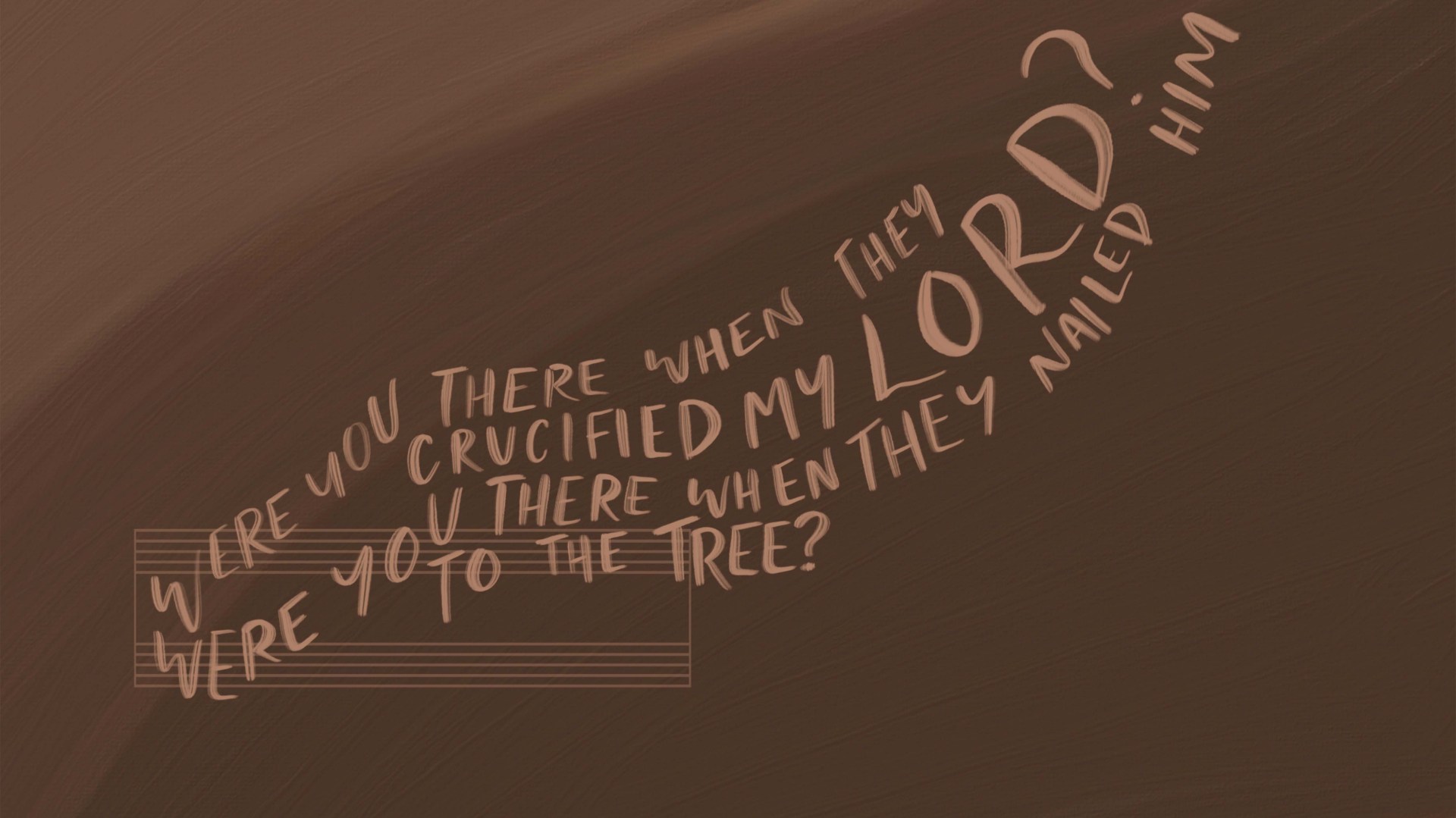
Were You There When They Crucified My Lord?

There are no easy answers to the spiritual’s convicting questions.

Illustration by Cassandra Bauman

I’m standing in the big house at a plantation in Nashville. It’s an impressive structure. Big white pillars. A long, wide porch is dotted with wooden rocking chairs—all of them filled now with tourists like us, people waiting for a tour guide to walk them around the grounds and recount the day-to-day life of a slaveholding family’s massive operation—all 5,400 acres run by 136 enslaved Black men, women, and children.

Still, inside the grand house, a tourist’s hand goes up and a wearying question gets asked. “But weren’t some slave owners good?” The room grows quiet. I pull my little grandchildren closer. But the tourist persists: “Didn’t they take good care of their slaves? After all, they’d invested in them.”

I’ve heard such questions before—perhaps we all have. Still, I stifle a groan. To feel better perhaps, some still yield to the common impulse to look away from horror, to sanitize history. To diminish the reality of evil.

But were you there?

Piercing Questions

This year, Passion Week will likely find our same tone-deaf singing of one of Christianity’s most boldly convicting songs. Most of us may sing it—with its piercing questions—without a lick of context or historical reflection. Sadly, some may sing, too, without deep pondering of the visceral realities of the Cross.

Yet it’s at the Cross, when we dare to look, that we see Jesus most needing us to be fully there. Except for his mother, Mary, and a few other faithful, stalwart women—who stayed during his entire ordeal—Christ comes to history’s most pivotal moment joined only by mocking Roman soldiers and two convicted thieves.

Just days before, he was hailed by “a very large crowd” who spread their cloaks on the road or cut palm branches from trees and laid them before him, shouting, “Hosanna to the Son of David!” (Matt. 21:8–9). But at his crucifixion, Jesus would face its cruelty as a reviled outcast, with even his disciples fleeing.

Listen to “Were You There?” and the rest of the songs featured in

The Wondrous Cross

here:
MoreCT.com/EasterPlaylist.

What irony then, that to recall his passion and suffering, we blithely sing a song born from slavery’s most disgusting pains, so often forgetting what it deeply asks—both about Jesus and the first singers of the song—when it whispers, “Were you there? 

It’s a profound question, one easily sidestepped because of the song’s haunting, awful beauty. As a child, in my humble Black church, we leaned into its minor chords with our actual bodies—folks throwing back their heads, groaning out the song’s pleading Ohs.

It didn’t have to be Good Friday or even close to Easter. After a rousing sermon or maybe during the altar call, a determined preacher—or some man or woman just sitting on a church pew—might stand up and start to sing. Were you there when they crucified my Lord?

As a child, I heard the question but didn’t understand what it was asking. Nobody unpacked the inquiry, not even in my Black church. As with so many of us, I just loved the music. At some point in my childhood, I realized it was Negro music—and, thus, to me, a little Black girl growing up during the draining insults of Jim Crow, the music meant something important, even if I didn’t try to articulate what or why.

By then, at age 12, I’d given my life to Christ, heard Black preaching every Sunday of my life, celebrated a dozen Easters, heard the Seven Last Words sermonized the same number of times, taken part in Easter plays, stood under rude wooden crosses in fellowship halls portraying one of the women at the cross.

But was I there when they crucified him? Understanding all that his sacrifice meant? Let alone appreciating all that the iconic Negro spiritual song, with its repeated refrain of questions, means to any believer?

What it asks should convict, indeed, the deepest recesses of our souls.

The Double Message

As with many slave melodies, the song presents a double, hidden message—in this case, a brash challenge to the institution of slavery, particularly to those owning and selling humans as property. Therefore, it asks: If you were there for this Jesus you preach about all the livelong day, why do you chain me up? Whip and rape my sister, mother, and daughter? Rip apart my family? Work me without mercy? Feed me dregs? Insist that I’m a brute and inhuman? Refuse me the right to read, write, and study? Live in your fine home with carpets and rugs but house me in a shack with a dirt floor? Then demand I sing about the Savior you claim to love?

If you can’t answer, is it because you were not there? When they crucified “my” Lord?

It brings chills, indeed, to consider the hypocrisy that the song confronts. Thus, it’s not so different than what Christ himself told the hypocrites of his day. In fact, the lie that you live, as Jesus told teachers of the law, is so abhorrent, says this song, it causes me to tremble.

Thus, there’s no place to sit in comfort when singing this song. No matter our views on injustice or other sources of sorrow, the song offers no respite. It’s about suffering. And for most, our relationship with suffering may be half-hearted and tentative. Suffer like Christ? Do any of us deliberately choose such pain?

Choosing to Remember

For answers, I can read scholars who’ve developed the theological insight, wisdom, and guts to enter the reality of both Christ’s crucifixion and this song we choose to celebrate it. Theologian David Bjorlin, a minister in the Evangelical Covenant Church, writes precisely and bravely about the anamnesis of “Were You There”—pointing to the Greek word meaning “to remember”—challenging those who sing the song to “re-member the past to the present, to bring these historic events to bear on the now and make them part of our story.”

But instead of remembering, some push back. We live in a world ruled not by anamnesis but by a deliberate amnesia. Efforts across history to ignore the past, to bury racial history, to even outlaw the speaking or teaching of it, still ignite the sad support of fearful, denying hearts.

Seeing these developments gives fresh urgency to the Lord’s Upper Room command not to turn from pain but to remember it—by remembering him, celebrating what his passion, suffering, and death daily gives to us. Thus, after he took bread, gave thanks, broke it, and gave it to his disciples, he said, “This is my body given for you; do this in remembrance of me” (Luke 22:19).

In a similar way, the song “Were You There,” as Bjorlin puts it, “is meant to bring the past events of Christ’s suffering and death into the present and transform us in its light.” Otherwise, we too easily forget. Likewise, we’d rather not hear poet Langston Hughes’s own withering question—because a Black life may be filled with laughter and “deep with song,” do we not think that soul hasn’t suffered after holding pain “so long”?

Or maybe we’d rather not think at all about suffering, neither Christ’s nor the slaves’ who sang spiritual laments. Across the years, the song’s lyrics have been tweaked, seemingly to fit certain racial sensibilities. Thus, some churches sing, “Were you there when they nailed him to the cross?” Others, more boldly, sing: “Where you there when they nailed him to the tree?” An undeniable reference to lynching, that lyric seems to signal exactly how a singer interprets this song that arose from slavery’s communal horror and burden. Those words suggest a solace or connection with Jesus’ suffering, as well, and how it brings mysterious comfort to believers in our own suffering.

Still, were some slave owners “good”? To those still asking the question—still looking for individual exceptions to an institutionalized system—Frederick Douglass spared no discomfort describing the “flesh-jobbers” of his day, driving their victims by the dozens, chained, usually in the darkness of night, wailing from their “bleeding footsteps,” beaten bodies, and torn family ties.

But were you there? The song invites us not to sing it without answering, refusing to let us forget what happened, and what still goes on in sorrowing places. Thus, may we tremble as we sing it—in gratitude to the Christ who died for every one of those lashed, starved, maimed, and dehumanized, and for those still facing injustice, near and far, waiting on us to respond. But were you there? Was I? If not, our lowly Lord’s passion requires that we understand this: He died for us all.

Read Matthew 27:45–61

, reflecting on the experience of those who were there as Jesus suffered, died, and was buried. What might it have been like to be there? What does it mean for us today to truly grapple with the question “Were you there”?

Patricia Raybon is a writer who explores the intersection of faith and race. Her books include the recent mystery novel All That Is Secret and her nonfiction work My First White Friend.

This article is part of The Wondrous Cross which features articles and Bible study sessions reflecting on the meaning of Jesus’ death and resurrection. Learn more about this special issue that can be used during Lent, the Easter season, or any time of year at MoreCT.com/Easter.

Culture

Jesus Is the God of Ground Zero

In grief, he is our consolation.

Illustration by Cassandra Bauman

Right after September 11, 2001, theologian Calvin Seerveld told singer-songwriter Michael Card: “The church has no such songs (of lament) to sing.” Our contemporary praise music does not seem to account for such a national tragedy as 9/11 or even for funerals, no dirge or lamentation appropriate to express loss beyond words.

As a survivor of 9/11—my family lived three blocks away from the World Trade Center and I was trapped in a subway stop underneath the collapsing towers—I can testify to this lack. Today, we may similarly pause to ask, “Do we have songs to sing during a pandemic?”

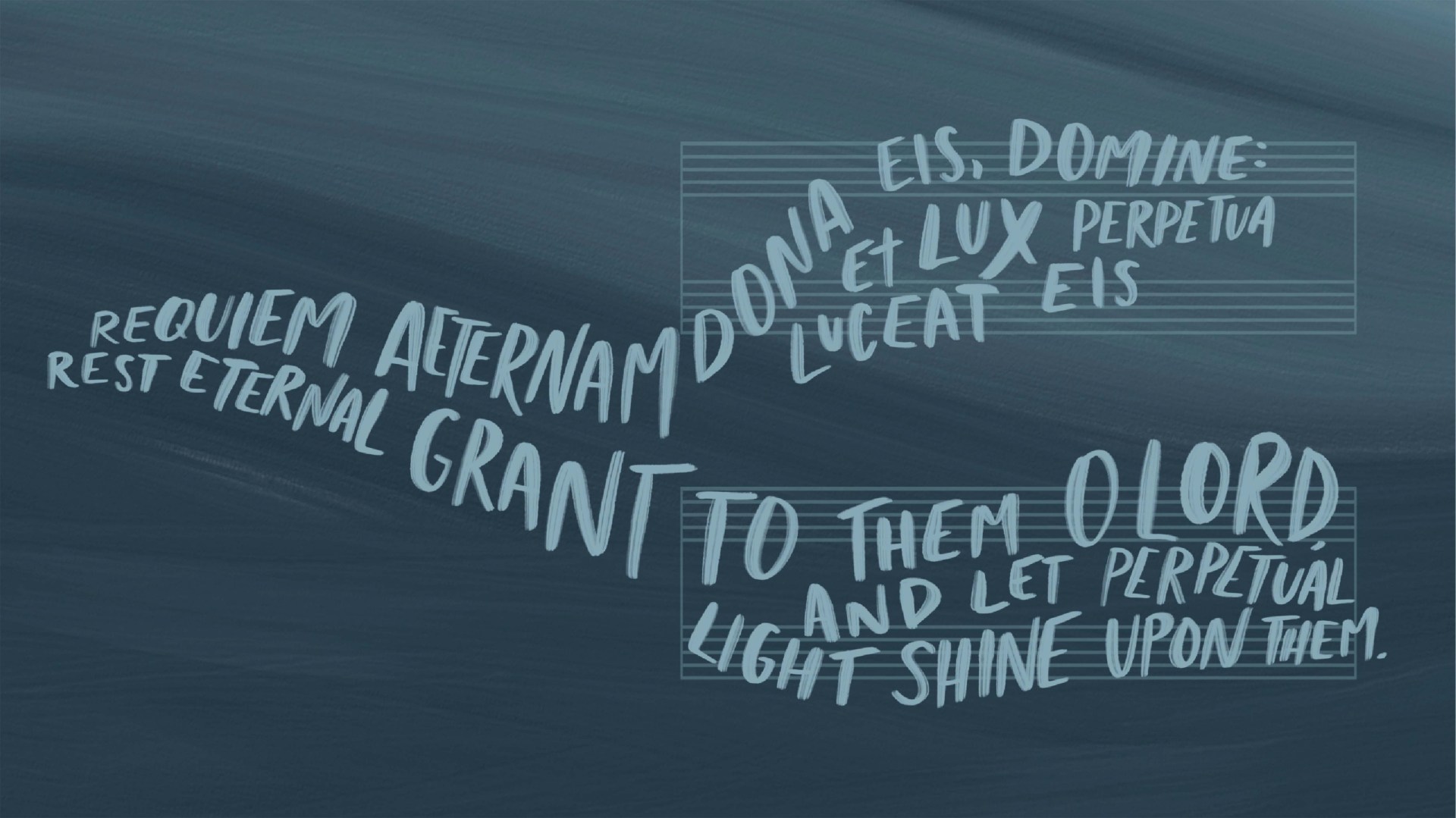
There was one piece of music that was played over and over during the period after 9/11 on classical music radio stations. It was Lux Aeterna by Morten Lauridsen. In this choral piece, the overwhelming cascade of voices coalesces and moves deeply into our lament, yet the music rises above the nadir of our common despair and somehow reframes our hopes.

Listen to Lux Aeterna and the rest of the songs featured in

The Wondrous Cross

here: MoreCT.com/EasterPlaylist.

Several years after 9/11, I had an opportunity to reflect on Lauridsen’s composition and honor him. I was appointed to the National Council on the Arts by president George W. Bush and worked on the nominations for the 2007 National Medal of the Arts. The council selected Lauridsen as one of the award recipients. I was the table host designated to welcome him to the list of great artists and arts advocates including the likes of Andrew Wyeth and Henry Steinway. Lauridsen’s legacy will be known with other great composers who’ve received this high honor, such as Aaron Copeland and John Williams.

As Lauridsen looked around the room, he said, “What am I doing here?” I responded: “Sir, millions of people sing your songs; I think you deserve this honor.”

Lauridsen composes music that the vocal range and singing capacity of a typical community choir can handle; in other words, he makes his music accessible to all. Perhaps that accounts, in part, for the popularity of his music in the classical and choral music world. But how is it that this communal music can carry the weight of our common curse yet manage to infuse hope in us?

‘Thou Best of Consolers’

My dear friend James Jordan, the master choral director of Westminster Choir College, told me that Lux Aeterna is “a work of sound art that is humanly honest, because of its Gregorian chant roots.” It makes sense that some of the text of this choral work was first created out of a community—a community of ordinary saints seeking to renew their daily faith through their monophonic plainchants. Such an integrated, authentic song from a community many centuries past does not fit neatly into our contemporary categories like “secular” or “sacred” or “Christian music.” And precisely because it does not, it is a song for eternity that resonates in all areas of human experience, lifting all of us to the heavens in worship.

Lux Aeterna, Latin for “eternal light,” begins with the movement “Introitus.” Its words, translated from Latin to English, read:

Rest eternal grant to them, O Lord,
And let perpetual light shine upon them
A hymn befits thee, O God in Zion.
And to thee a vow shall be fulfilled in Jerusalem:
Hear my prayer,
For unto thee all flesh shall come.
Rest eternal grant to them, O Lord,
And let perpetual light shine upon them.

These lines are repeated over and over in the piece, providing an echo of voices that seems to embrace our stricken hearts. Cello undergirds the movement of rising voices, giving the movement gravity. The line “Rest eternal grant to them” is like a whisper, a mother’s voice to calm a troubled soul.

Then, in the fourth movement, “Veni, Sancte Spiritus,” we hear:

Thou best of consolers,
Sweet guest of the soul
Sweet refreshment.
In labor, thou art rest,
In heat, the tempering,
In grief, the consolation.

The triumphant last movement of Lux Aeterna, “Agnus Dei,” awakens our hearts toward the beatific hope, then the choir settles into the cascade of restrained hush at the end. The closing “Amen” is sung as if a last breath in unison.

The life, death, and resurrection of Jesus—or the “life after life after death” as N. T. Wright puts it—provides an entry point for us into new creation. “Just as the sufferings of Christ are abundant for us,” the apostle Paul wrote, “so also our consolation is abundant through Christ” (2 Cor. 1:5, NRSV). We are consoled by the voice of the one who suffered and took the penalty of sin away by giving his life on the cross. “In grief, the consolation” matters to Jesus because he chose to be executed as a common criminal so that we can be redeemed. Jesus is the God of ground zero.

Thus, in my personal ground zero, the choral voices in Lux Aeterna called me to persevere and also to see the experience as a starting point—as a “zero” point of cancellation of my sins and brokenness, my transgressions against my Maker. The voices carry me beyond my transgressions into the hope of Easter morning.

Mending to Make New

This past fall, as I wrestled with the 20th anniversary of 9/11, Lux Aeterna continued to hover over me and allowed me to move into my pain again, haunting me and releasing me as I journeyed through a difficult day. In Lux Aeterna, I hear the dissonance of brokenness, and yet, like the gold veins in a kintsugi bowl, I hear mending to make new.

In a unique way, the music highlights and captures the spirit of a single line from John 11, the shortest sentence in the entire Bible: “Jesus wept” (v. 35). These words frame a central thesis in my book Art + Faith: A Theology of Making:

In John 11, Lazarus is found sick and dies. Jesus comes to the scene late, intentionally. Before showing his power as the Son of God to resurrect Lazarus, he does something that has no practical purpose: He “wastes” his time with Mary, to weep with her. Theology of Making hinges on this gratuitous act of Jesus … on a kind of culture that flows out of the tears of Christ.

There is a sense of such gratuity in Lux Aeterna, in the music’s power to slow down time. It’s as if all that is violent and torn, explosive and horrifying, is made to obey the silent rhythm of the ordinary. What I detected in the music as I navigated our post-9/11 struggle was the depth of a profound Presence and the powerful pauses of refrains that were at once both vulnerable and refocused. Lux Aeterna traces the flow of Jesus’ tears into our stricken desert of ashes; and what seems extravagantly wasteful, like the nard Mary poured out on Jesus’ feet (John 12:3), becomes then absolutely necessary. Music and art can make the extraordinary ordinary and accessible, the peaceful and beautiful chants of our days sung into our despair-filled ground zeros.

Our Holy Saturdays

Though Lux Aeterna has themes of both sorrow and hope, I don’t primarily think of Lux Aeterna as Good Friday music or as Easter Sunday music. I think it’s most appropriate to consider Lux Aeterna Holy Saturday music. Holy Saturday sits in between the devastation of Good Friday and the triumph of Easter Sunday. It is a day of darkness, of waiting—a day that echoes in our own experiences of waiting and darkness. The choral voices of Lux Aeterna arise out of that restrained pause. Like new bulbs taking root deep beneath dark, frozen earth, Lux Aeterna captures that invisible life growing even in times when we can only see the snowy, cold ground.

“In my end is my beginning,” T. S. Eliot wrote, and Lauridsen’s Lux Aeterna captures the same diction of the heart as Eliot’s post-war masterpiece Four Quartets. It points us toward the one who promises, “Behold, I am making all things new” (Rev. 21:5, ESV). As we stand on the ashes of our common curse of the pandemic today, the profound meditations and music of Lux Aeterna can guide us toward the new, not by “fixing” but by mending to make new. It resonates into my own fragmented journey, into my life and my art, and composes my own life of loss and joy.

Read 2 Corinthians 1:3–5.

Reflect on a time you experienced sorrow or tragedy—or upon the recent painful realities of the pandemic. How has Christ been your consolation? How have you experienced “mending to make new”?

Makoto Fujimura is a contemporary artist who has served on the National Council on the Arts. He is the author of several books including Art + Faith: A Theology of Making.

This article is part of The Wondrous Cross which features articles and Bible study sessions reflecting on the meaning of Jesus’ death and resurrection. Learn more about this special issue that can be used during Lent, the Easter season, or any time of year at MoreCT.com/Easter.

Christ the Lord Is Risen Today!

Reflections on Wesley’s great hymn of suffering and salvation.

Illustration by Cassandra Bauman

In the First United Methodist Church of Wichita Falls, Texas, Easter brought no surprises. The liturgy, combined with a music director devoted to replicating the same service year after year, meant that my childhood memories of church on Easter Sunday would look virtually identical to those of my stepmother from 25 years earlier and those of her mother before her. If you craved novelty, you had better find it in your Easter basket. Once you entered the carved doors of the sanctuary, the service would proceed by rote. And gloriously so.

The same Easter lily procession, the same redolent scent of those white blooms, the same vestments and banners, the same congregational greeting and response (“He is risen!” “He is risen, indeed!”), the same sermon text, the same doxology and benediction. And the same hymns.

I have not worshiped in a liturgical church nigh on these 35 years. Novelty is the norm in my Easter gatherings, but each Easter my heart still wakes with the notes of Charles Wesley’s “Christ the Lord is Risen Today” surging through my memory.

Listen to “Christ the Lord Is Risen Today” and the rest of the songs featured in

The Wondrous Cross

here:
MoreCT.com/EasterPlaylist.

Hymn No. 302 in the United Methodist Hymnal is as much a sermon as a song, a poetic exposition of the 15th chapter of 1 Corinthians. Though the version I grew up singing had only six verses, the original contained a full 11. Eleven verses to extol the risen Christ, now ascended to the right hand of God.

It is often noted that Charles Wesley wrote over 6,500 hymns in his lifetime, but he also preached extensively. His was a mind and heart saturated in the truth of the Scriptures. Typical to form, his best-known Easter hymn is not merely musical; it is deeply theological. It preaches not just the Resurrection but also the doctrines of original sin, atonement, union with Christ, justification, sanctification, and glorification. And it does so with elegant rhyme, meter, and melody.

Of all its stanzas, the words that arrest me most are these:

Lives again our glorious King, Alleluia!
Where, O death, is now thy sting? Alleluia!
Dying once he all doth save, Alleluia!
Where’s thy victory, O grave? Alleluia!

The third verse. The one where the thrum and clarion of the organ fall silent, and the unadorned voices of the congregation swell into the rafters. Wesley skillfully paraphrases 1 Corinthians 15:55, layering in a truth from Romans 6:10: “The death he died, he died to sin once for all; but the life he lives, he lives to God.” One efficacious death for all sin. One cruel death to remove the sting of death. One victorious death to end the victorious reign of death over humanity. One death to crush once for all Eden’s lisping lie of You will not surely die.

Where thy victory, O grave? Where thy sting, O death? The words Paul quotes from the prophet Hosea speak to the hope of the good news of Easter. But we sing them in a world that indeed reels under the sting of death, and in which, by all appearances, the grave still triumphs. Through tears, tight-chested, we bury those old and full of years, those born without breath, and those with years cut short by illness or violence, by accident or natural disaster, or even—God help us—by hopelessness itself.

When Wesley penned his great hymn in 1739, it was no different. If anything, daily awareness of death’s dominion was even greater. Wesley himself was born the 18th of 19 children, 10 of whom did not survive to adulthood. He buried five of his own eight children in infancy. He lived during a time in which the average life expectancy was a mere 37 years. The prevalence of poor nutrition and infectious disease meant those who lived past adolescence would likely experience the loss of young loved ones multiple times over.

And when loved ones died, they died at home. Only fairly recently in human history has death and its physical aftermath become a process that occurs elsewhere, relatively out of sight. Home was both the setting for death and the setting for burial customs. The “laying-out” of the body took place in the home, as did the wake. Long after the funeral procession to the churchyard, the sting of death would have lingered, readily associated with the very rooms in which daily life took place.

I imagine Charles Wesley walking the distance from home to church on Easter morning, passing through the churchyard with those five small headstones bearing his surname, entering through the carved doors of the sanctuary to sing his own words back to God. Singing hope into sorrow. Singing a balm into the sting. Carrying a costly sacrifice of praise into the house of the Lord. I am reminded that my own sorrows can find rest in the declaration of hope. Certainly, Wesley knew to grieve as one with hope. He knew the Son of Man would one day split the eastern sky, with power and authority to resurrect the dead. Visit an old English churchyard and note the direction of the headstones. You will find them facing resolutely east, expectantly.

Like the church of my upbringing, the Hebrew temple was a building devoted to repetition and remembrance. From its articles to its observances to its architecture, it called worshipers to remember the sting of death and to long with hope. For centuries, the blood of goats and rams ran thick in the temple court. For centuries, the high priest offered blood on the horns of the golden altar to atone for the sins of the many. Sacrifice upon sacrifice. The sting of death in the house of the Lord. Rivers of blood, year after year, spilled onto the stones of a sanctuary facing resolutely east, expectantly.

Until at last, Christ offered for all time a single sacrifice for sins. Until at last, death itself was put to death in one final sufficient spilling of blood. Dying once, he all doth save. Yet, the holy one would certainly not be abandoned to the realm of the dead, nor would the faithful one see decay. After he had suffered, he would certainly see the light of life. The grain of wheat that fell to the ground would certainly yield a harvest. Hope was certainly alive.

In Jerusalem 2,000 years ago, Easter brought no surprises. The angel’s words to the women trembling at the tomb testified to the sheer predictability of the morning: “He has risen, just as he said” (Matt. 28:6, emphasis added). Just as the prophets had said. An ancient liturgy, repeated century after century, was at last culminating in its glorious fulfillment. The seed of the woman had crushed the serpent’s head, once for all. The words once lisped in falsehood are proclaimed by Christ in truth to all who call upon his name: You will not surely die! And so, on Easter, we look to the east and raise the cry of victory in the house of the Lord. Lives again, our glorious King. He is risen. He is risen, indeed.

Read Matthew 28:1–10

. How are these events a “glorious fulfillment” of “an ancient liturgy” as Wilkin puts it? What gives you joy as you celebrate the truth that “He has risen, just as he said” (v. 6)?

Jen Wilkin is a Bible teacher and the author of several books, including Women of the Word and Ten Words to Live By, and serves as a cohost of the Knowing Faith podcast.

This article is part of The Wondrous Cross which features articles and Bible study sessions reflecting on the meaning of Jesus’ death and resurrection. Learn more about this special issue that can be used during Lent, the Easter season, or any time of year at MoreCT.com/Easter.

Apple PodcastsDown ArrowDown ArrowDown Arrowarrow_left_altLeft ArrowLeft ArrowRight ArrowRight ArrowRight Arrowarrow_up_altUp ArrowUp ArrowAvailable at Amazoncaret-downCloseCloseEmailEmailExpandExpandExternalExternalFacebookfacebook-squareGiftGiftGooglegoogleGoogle KeephamburgerInstagraminstagram-squareLinkLinklinkedin-squareListenListenListenChristianity TodayCT Creative Studio Logologo_orgMegaphoneMenuMenupausePinterestPlayPlayPocketPodcastRSSRSSSaveSaveSaveSearchSearchsearchSpotifyStitcherTelegramTable of ContentsTable of Contentstwitter-squareWhatsAppXYouTubeYouTube