In this series




While Americans’ confidence in various institutions dips, the church remains in relatively high regard—especially among Christians and Republicans.
According to Pew Research Center, Americans view the impact of religious institutions more positively than colleges, labor unions, banks, or the media, and their reputation has changed little during the political shifts over the past few years.
Amid growing skepticism over the benefits of college among Republicans and a widening political divide over the media, a majority of the country—59 percent—continue to see the church as having a positive impact, while 26 percent see it having a negative impact.
The church’s positivity ratings are more than twice as high as the lowest-rated institution, the media, which 28 percent of Americans view positively and 63 percent negatively.
The Pew report, released Monday, follows a trend of America’s shifting perspectives toward major institutions.
Last year, Gallup found the church ranked among the most-trusted institutions in the country (beat only by military and police), even though it dropped to a record-low 41 percent confidence rating. The decline corresponds with a broader sense of skepticism, Gallup noted:
Americans clearly lack confidence in the institutions that affect their daily lives: the schools responsible for educating the nation's children; the houses of worship that are expected to provide spiritual guidance; the banks that are supposed to protect Americans' earnings; the US Congress elected to represent the nation's interests; and the news media that claims it exists to keep them informed.
Each institution has its own specific probable causes for this situation. But the loss of faith in so many at one time, while Americans are becoming more positive in other ways, suggests there are reasons that reach beyond any individual institution.
Many see the 2016 election of Donald Trump as fueling and being fueled by a sense of public distrust, as he branded himself a political outsider and made efforts to discredit the media. Accordingly, Pew found significant differences in how the political left and right view institutions.

When it comes to the church, about three-quarters of those who identify as Republican or Republican-leaning see it having a positive impact, compared to half of the Democrats or Democrat-leaning.
The unaffiliated are least likely to take a positive view of churches (34%), while majorities of white evangelicals (80%), black Protestants (66%), and white Catholics (61%) do.
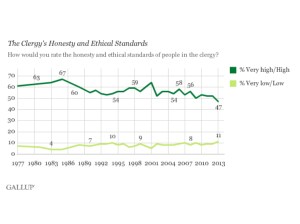
Gallup has also reported that public trust in clergy is on the decline. Pastors represented the most-trusted profession when the company began surveying Americans on career ethics; after three years of record-lows, clergy now rank 8th on the list. Their confidence rating has dropped from 61 percent in 1977 to 44 percent in 2016.
Professors, which outrank pastors, and journalists, which fall lower on the list, also saw ratings slide.
“For the fourth year in a row—in a nation where religion is an important part of life for three-fourths of the population—less than half of Americans think religious leaders have high ethical standards,” Gallup said. “Meanwhile, two groups of professionals linked to the bitter political battles of 2016—college teachers and journalists—are at or near their all-time lows, with views split along partisan lines.”