News

Church Leaders Are Still Waiting for Volunteers to Come Back

Gallup survey found involvement in religious service dropped again in 2021.

Christianity Today January 14, 2022
Zayne Grantham Design / Lightstock

The COVID-19 pandemic is forcing many churches and ministries to rethink how they recruit, train, and maintain the fleet of volunteers they need.

Volunteering for religious organizations dropped during the first year of the pandemic, when in-person services were canceled and outreach events were put on hold, and has continued to decline.

According to Gallup, 35 percent of Americans reported volunteering for a religious organization last year, down from 38 percent in 2020 and 44 percent in 2017.

“A recovery in volunteering may be more elusive as concerns about COVID-19 exposure and public health safety measures limit Americans’ willingness and ability to perform volunteer work,” the researchers wrote.

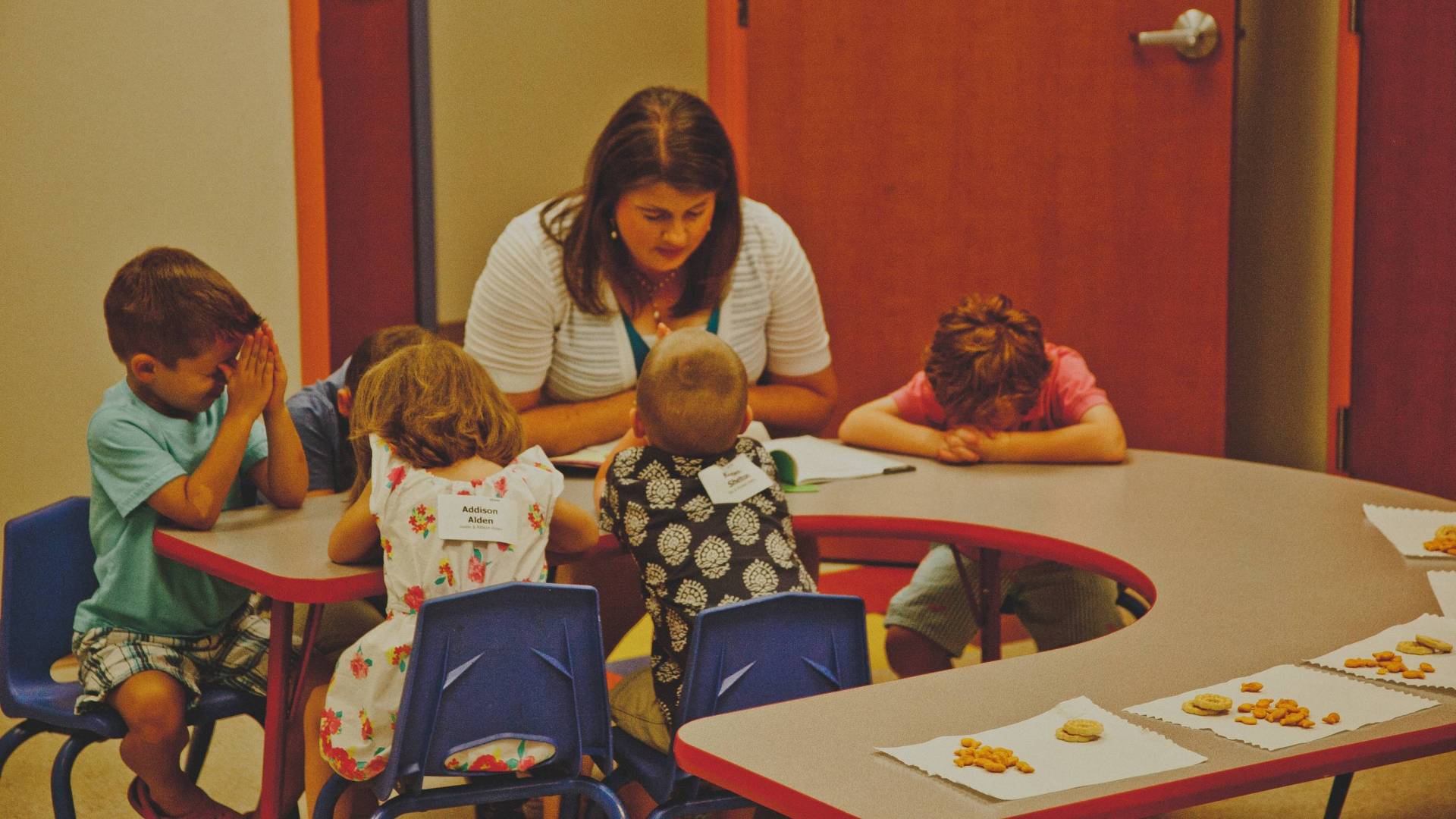
A lot of churches saw their longtime, reliable volunteers back away from their roles because their age put them at risk, said Chuck Peters, director of the kids ministry team at Lifeway Christian Resources.

Even those who remain willing to serve can be unpredictable; the likelihood of illness or exposure at home, especially during COVID-19 surges, has meant more volunteers are calling out sick when leaders are strapped for help. Plus, church attendance is down overall, though nearly all churches have reopened.

In a Lifeway survey last spring, pastors listed committed volunteers among the biggest needs for their churches. Over three quarters of US pastors said they were concerned about developing leaders and volunteers, as well as people’s apathy and lack of commitment. Over two-thirds said training current leaders and volunteers was a concern.

“A lot of churches lost their long-term, reliable, go-to people and were left with no one. That’s been the challenge. Where do you look now to find a new base of volunteers?” said Peters. “The tendency becomes ask everyone and take anyone. Really, that’s not the best approach … it’s a new opportunity to revisit what kind of volunteers we’re looking for.”

That may mean it’s time to conduct new training, new resources, to rally and prepare volunteers. In children’s ministry, which requires volunteers to serve in roles like teachers, classroom assistants, and security, Peters recommends focusing on the mission of the ministry and the giftedness of the potential volunteers, rather than the desperation for help or obligation to the church.

“Recruit with the why of the ministry, not the need of the ministry,” he said. “In a season where the world is crazy, kids need Jesus more than ever to speak to their fears, and people are experiencing real losses. We have to be faithful to the mission.”

Over in the United Kingdom, a survey by the Evangelical Alliance last fall found 59 percent of church leaders saw volunteering decrease, and 31 percent of church members said they were volunteering less during the pandemic.

Some churches that reopened had not resumed activities in youth ministry (25%) or children’s ministry (17%). Leaders suggested that former volunteers were attending church less and enjoyed having fewer commitments.

Virginia pastor Tom Pounder recommended pastors individually reconnect with volunteers who dropped off the schedule during the pandemic to ask about their concerns and level of interest going forward.

“If we, as ministry leaders, are not connecting with people and letting them know of the variety of different options out there, then we will continue to have a lack of lay/volunteer leaders,” wrote Pounder, student minister and online campus pastor at New Life Christian Church. His church also offers online volunteer opportunities, including chatting with attendees during virtual services.

At the Salvation Army, which runs programs in 7,000 locations in the US, “volunteers have an impact on every aspect of our work,” said Dale Bannon, national community relations and development director.

Some volunteer programs through the evangelical charity were on hold during the beginning of the pandemic, but many have been re-instated with new protocols such as using personal protective equipment and doing contactless delivery to distribute food and supplies.

Christian refugee resettlement agency World Relief moved its volunteer application process and orientation online during start of the pandemic and began offering virtual opportunities, such as English tutoring, youth mentoring, and youth homework help. While in-person volunteering has resumed, the ministry will likely keep some virtual options in the long-term.

“We have found that online tutoring, for example, creates flexibility both for some immigrants and for some volunteers (who in both cases are also balancing job schedules and childcare responsibilities),” said Matthew Soerens, World Relief’s US director for church mobilization and advocacy.

After seeing a drop in volunteers in 2020 due to pandemic shutdowns, World Relief saw unprecedented interest in volunteering last summer, as Americans anticipated Afghan evacuees coming to the US after Kabul fell to the Taliban.

The ministry was able to process the uptick thanks to moving its process online due to COVID-19, as well as more staff dedicated to training volunteers.

“As a result, we had more than 11,000 active volunteers in 2021, far more than in any year in the recent past,” even though the ministry has fewer office locations than it did five years ago, said Soerens. The number of volunteers was twice as many as were involved with World Relief in 2020.

Other ministries have also been able to recruit to meet urgent needs. Last month, Samaritan’s Purse sent 2,000 volunteers to Arkansas and Kentucky after the tornadoes.

But for many nonprofits—from mentoring organizations to food banks—demand is up, and they haven’t been able to find enough volunteers to help.

Volunteering doesn’t just benefit the organizations and their constituents. It’s good for volunteers, too. Returning to serve in person can be a refreshing and much-needed step back into the routines they enjoyed before COVID-19.

Jamie Ivey, author and host of The Happy Hour podcast, recently discussed her involvement with Sunrise Homeless Navigation Center in Austin, Texas.

“Hands down one of the best decisions I made this year was to start volunteering again,” she shared with her social media followers. “In early 2021 I kept feeling like something was off. I know 2020 & 2021 have both been off (understatement of the century) but it was more than the pandemic. Something was off in me.

“If you are feeling off, maybe you need to give some of yourself away each week,” she wrote. “It’s been super healing for me this year!”


News

Faith Leads Doctor Back to Zimbabwe

Amid ongoing turmoil in national health system, orthopedic surgeon practices “practical Christianity.”

Christianity Today January 14, 2022
CURE International

Tongai Chitsamatanga just finished treating an 8-year-old with dislocated hips, two children with bone infections, and another two with clubfoot.

It’s hard work, requiring great patience and greater skill. The 41-year-old doctor could be earning a lot more for his expertise at his old hospitals in Oxford and Derby, United Kingdom. But instead he is here, in Bulawayo, Zimbabwe, in a 13-bed children’s hospital that opened in April 2021.

He personally doesn’t think the decision is that hard to explain, though.

“To me that is practical Christianity,” Chitsamatanga told CT. “Rather than saying you’re Christian and having nothing to show for it.”

Chitsamatanga is one of just two pediatric orthopedic surgeons in a country of more than 15 million. The other, his colleague Rick Gardner, is an expatriate.

The two work at CURE Zimbabwe, the only place in the country offering care for children with complicated conditions such as clubfoot, knock knees, and bowed legs. The newly opened children’s hospital, which has three operating theaters and an outpatient clinic, is one of eight that the Christian nonprofit CURE International operates around the world.

Poor pay and working conditions have triggered an exodus of qualified health workers from Zimbabwe. More than 2,200, including doctors, nurses and pharmacists, left government service last year, according to the government's Health Services Board. The figure is more than double that of 2020, and nearly triple that of 2019.

Last July, the city of Harare announced that 240 nurses had left its service and in October local reports said nine clinics had closed due to staff shortages.

The situation is likely to worsen in the wake of the COVID-19 pandemic, medical professionals warn. Health care workers are also drawn to the better working conditions and superior pay in the developed world. Some industrialized countries such as the UK and Germany have eased immigration requirements for health workers in recent years to attract more trained medical staff to care for their aging populations.

“Brain drain” is a real challenge for Zimbabwe health care. But the country is also struggling with conflicts over the state-run system.

“Sometimes it’s not even brain drain, but skilled workers resigning from government service and going and sitting at home,” said Shingai Nyaguse-Chiurunge, president of the Zimbabwe Senior Hospital Doctors’ Association.

In late 2019 and early 2020, doctors at state hospitals went on strike for months over poor pay and working conditions, as well as lack of PPE to fight COVID-19. Junior doctors have been earning around $200 per month.

The government has proposed amendments to the Health Services Act that would prevent prolonged strike action and impose jail terms or fines on those who incite protests.

These conditions are hardly conducive to luring workers back home.

According to Chitsamatanga, returning to Zimbabwe is a real commitment.

“It has to be your calling,” he said. “People will say, ‘Come, come, come,’ but they might not be able to get the same kind of blessing as you.”

And even when you feel like it is your calling, it can take a long time. For Chitsamatanga, the journey began 15 years ago, when he was assigned to the Mutambara Mission Hospital, in the remote mountains of the Chimanimani district, near Zimbabwe’s eastern border with Mozambique.

He had studied for five years at the University of Zimbabwe’s medical school and then spent two interning at Harare’s main Parirenyatwa Hospital.

In 2006, when he got to the mission hospital run by the United Methodist Church, he saw dire need. The hospital hadn’t had a doctor in four years.

At the time, the late Robert Mugabe was in power, political tensions were high, and the economy was in freefall, worsened by foreign currency shortages and record-high inflation. Due to poverty, poor health care and high rates of HIV, the average Zimbabwean could not expect to reach their 40th birthday, according to the World Health Organization.

The hospital was one of just five in the country that could distribute antiretroviral drugs to prevent AIDS-related deaths, thanks to assistance from the Geneva-based Global Fund to Fight AIDS, Tuberculosis, and Malaria. But patients often couldn’t reach the hospital, and Chitsamatanga and his team would travel around Manicaland—the second most populous province in the country—to administer the lifesaving medication at small rural clinics.

Chitsmatanga will never forget one patient who was trying to reach a clinic in a wheelbarrow.

He and his team had been conducting an outreach clinic at Rusitu, a banana-, pineapple-, and avocado-growing district around an hour’s drive from the mission. As they drove home in the dark, their headlights caught a woman in her 40s being pushed in a wheelbarrow up the dirt road by a family member. They stopped the car. The HIV-positive patient wasn’t able to walk and hadn’t been able to make it to the clinic while they were there.

Chitsamatanga’s team did a clinical assessment right there on the road and started the woman on a course of antiretrovirals.

Chitsamatanga saw the woman again three months later, at another clinic. She was well enough to walk up to him and ask, “Doctor, do you remember me? I’m that lady who was in the wheelbarrow.”

“It was amazing,” he told CT. “Sometimes you never get such feedback. But to me that was a testimony, to say, ‘This is exactly what the Lord wants at this moment in time. This is why I’m here.”

His posting to the mission only happened, however, because the government reinstated a controversial rule that required newly trained doctors to do one year in a district hospital to receive certification.

Like many of his friends and colleagues, Chitsamatanga opposed the rule.

“We were young, we all wanted the streetlights of Harare,” he said. “At that time some of my colleagues left the country, but I decided to do the year, and the year turned into six years."

Mercy Gaza, the woman who was to become his wife, was also posted to the mission hospital. She too was a doctor, and after a year at the mission, they got married. Their first child was born three years later.

“That was an amazing time for us as a couple,” he said. “We had a very good time getting to know each other.”

Chitsamatanga had to return to Harare, though, to begin his specialization in orthopedics. He followed that up with a year spent training in general orthopedics at the College of Surgeons of East, Central, and Southern Africa, and fellowships at hospitals in the UK.

But then, when the choice came, he decided to return and work at the new hospital in Bulawayo, the second largest city in Zimbabwe.

CURE International, based in Grand Rapids, Michigan, worked with the government to launch the hospital and committed to treating children under the age of 18 for free.

“Our organization is here because of Jesus’ calling to ‘heal the sick and proclaim the kingdom of God,’” CURE Zimbabwe’s Executive Director Jonathan Simpson said. “Our hospital is a safe place for children, where we hope they will experience the love of Christ.”

Chitsamatanga knew the work would have its challenges. He would be treating children who should have been taken care of much earlier, in difficult medical conditions worsened by poverty. Economic struggles continue in Zimbabwe, and the ongoing conflict between the government and health care workers seems intractable. Financially, for a doctor who could work in the UK, maybe the decision didn’t make a lot of sense.

But Chitsamatanga is a man of faith. He calculates these decisions differently than other people.

“If I think or pray about something and realize this is the direction God wants me to take, then I just take it,” he told CT. “I need to go the way the Lord is pointing.”

No, Religious Freedom Doesn’t Send People to Hell

Why Christians should support our government staying out of religious affairs.

Christianity Today January 13, 2022
Illustration by Rick Szuecs / Source images: Lenny Acompanado / Chris Nguyen / NeonBrand / Unsplash / Michael Judkins / Pexels

This piece was adapted from Russell Moore’s newsletter. Subscribe here.

Last week an old video resurfaced on Twitter in which John MacArthur, pastor of Los Angeles’s Grace Community Church, announced he did not support religious freedom. In the clip, MacArthur argued that supporting religious freedom promotes idolatry and enables the kingdom of darkness—that “religious freedom is what sends people to hell.”

Some reports contend that quote is out of context, fitting as it does in a larger argument. Even so, this kind of argument against religious freedom is a familiar one—usually in reference to somebody else’s religion.

Years ago, a pastor told me that religious freedom is essentially the affirmation of the words of the Serpent, “Ye shall not surely die” (Gen. 3:4). To grant religious freedom for false religions, this person contended, is the equivalent of allowing the prophets of Baal have a place of their own on Mount Carmel.

These are certainly statements of strong conviction—like propositions of biblical truth to which the only appropriate response should be a loud “Amen!” That is, until one actually listens to what is being said and hears it for what it is: theological liberalism.

Religious freedom, after all—whether as articulated by the early British Baptists, the persecuted Anabaptists of the Reformation era, or the colonial American evangelists and their allies—has never been a “You believe in Baal; I believe in God; what difference does it make?” kind of pluralism.

The question of religious freedom is who should have regulatory power over religion. If you believe religion shouldn’t be regulated by the state, then you believe in religious freedom.

That’s why denominations with “free” in their name (like the Free Methodists, for instance)—along with those who believe in the necessity of personal repentance and faith—have been the most dogged supporters of religious freedom for all.

These groups of people understand that the gospel according to Jesus is not an external affirmation of generic belief, from a heart still untransformed. It is not accepting Christianity as a ticket of admission into society.

Rather, the gospel according to Jesus means that there is one God and one Mediator between God and men, the man Christ Jesus (1 Tim. 2:5). One can stand before God at judgment only by union with the crucified and resurrected Jesus Christ. And one can only come into union with Christ by grace through faith (Rom. 3:21–31).

That faith—as defined by Jesus and his apostles—does not come through the proxy of a nation or a ruler, or even a religious structure. If that were the case, John the Baptist would not have needed to preach repentance to the descendants of Abraham (Matt. 3:10). Moreover, the apostle Paul could have found no fault in those who served the false gods chosen for them by their national or family traditions (Acts 17:22–31).

Instead, the gospel addresses each person—one by one—as an individual who will stand before the judgment seat of Christ, who will give an account, and who is commanded to personally believe the gospel and repent of their sin (Rom. 10:9–17).

As Jesus said to Nicodemus by night: “Truly truly, I say to you, unless one is born again he cannot see the kingdom of God” (John 3:3, ESV).

And how does this new birth, this personal receiving of Christ by faith, occur? It does not happen by the changing of a family crest or by a vote of the city council, but through the Spirit opening the heart—through an “open statement of the truth” commending itself to each conscience (2 Cor. 4:2).

Some of the old liberalisms and social gospels of various sorts preferred a different message—a gospel that changed externals and did not demand personal repentance and faith. Under such a gospel, if a country was “Christian,” then its citizens were Christian too. As long as one’s ruler was “Christian,” then one could count themselves a part of the church. If one’s morality was adequately regulated, whether by law or by social custom, then one was a good Christian.

That’s all well and good—unless there’s a hell. If Jesus is telling the truth that there is a judgment to come, and that no one comes to the Father except through him (John 14:6)—that “coming to him” means not just external behavior but faith in him (6:40)—then no legal edict or social pressure could regenerate a human heart. Such things cannot make a person into a real Christian. That is not the gospel of Jesus Christ.

Religious freedom is a restriction on the power of the state to set itself up as a mediator between God and humanity. It is not an affirmation of idolatry, just as saying, “The government shouldn’t take your baby away and raise your children” is not an affirmation of bad parenting. Saying parents should raise their children, instead of the government, does not mean everyone’s parenting is good. It just means that—except in very dire and unique situations—parents should raise their children, rather than the state.

Religious freedom does not mean that everyone’s religion is true. All it means is that God judges the heart and that people must really believe in their heart that Jesus is Lord, instead of saying, “Lord, Lord” merely because they are required to do so by law.

If there is no religious freedom, then ultimate matters aren’t up for consideration by persons—only by majorities. If you’re in 19th-century Denmark, it’s already decided for you that you are Lutheran. If you’re in the 20th-century Soviet Union, it’s already decided that you’re a Marxist atheist. If you’re in 21st-century Saudi Arabia, you’re a Muslim—no questions asked. That might be a way for the state to indoctrinate its citizens, but it is not the gospel of Jesus Christ.

If religious freedom is wrong, not only do majorities decide religious affiliation, but they also dictate the scope of what’s permitted in deviating from that religious affiliation.

Does anyone really believe that Los Angeles would adopt Calvinistic dispensationalist Christianity? No one believes that, including, or maybe especially, John MacArthur—who just spent almost two years going back and forth in court with the state of California about the freedom of his church to meet in spite of COVID-19 regulations, arguments he made on the grounds of religious liberty.

If California were to decide that the official state religion is Zen Buddhism, I would be willing to wager that Grace Community Church would not stop preaching the gospel. Nor should they. That’s religious freedom. And I would further wager that if the state of California were to vote in its legislature that every citizen of the state is a good Christian, Grace Community Church would not stop calling their neighbors to repent and believe, personally, in Christ. That’s religious freedom.

We believe in religious freedom not because we believe in freedom on its own terms, but because we believe in the exclusivity of Christ and in the power of the gospel. We believe there is one name under heaven whereby we must be saved—and that name is not “Caesar” or “Ayatollah” or “assistant secretary for civic affairs.”

We believe in religious freedom because we know what Jesus has given us to fight against the kingdom of darkness—the sword of the Spirit, which is the Word of God. We believe in religious freedom because there’s no civil substitute for the gospel of Christ.

We believe in religious freedom because we want to persuade our neighbors to be reconciled to God—not so they won’t be fined by the earthly government, but so they will find eternal life in the heavenly kingdom. So that they won’t end up in hell.

Russell Moore leads the Public Theology Project at Christianity Today.

News
Wire Story

Your Pastor Cares When You Don’t Care

Apathy ranked as the single biggest pastoral concern in 2022.

Christianity Today January 13, 2022

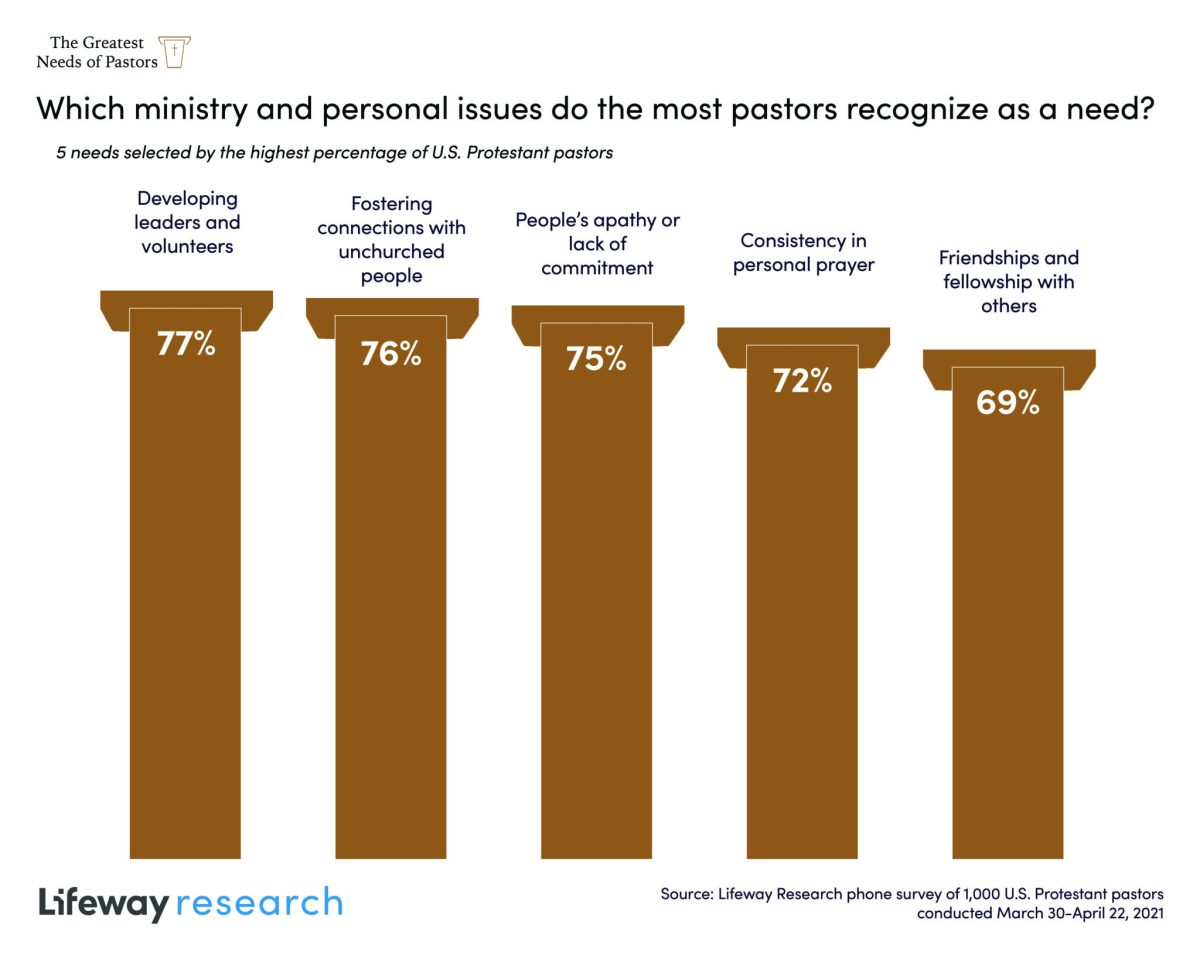
Pastors face unique difficulties inherent in their career, but what are their greatest needs? Pastors themselves say they’re most concerned about seeing their churchgoers grow spiritually and making connections with those outside of their churches.

After speaking directly with pastors to gather their perspectives on their ministry and personal challenges, Lifeway Research surveyed 1,000 US pastors for the 2022 Greatest Needs of Pastors study to discover what they see as their most pressing issues.

“The pre-existing challenges of ministry were amplified by COVID, and it’s important we lean in and listen closely to pastors,” said Ben Mandrell, president of Lifeway Christian Resources. “This project has shed light on critical needs they have and will point the way forward in how we partner with them to fuel their ministries and improve their health in multiple areas.”

Scott McConnell, executive director of Lifeway Research, said his team began the study by speaking with more than 200 pastors, asking them to think beyond the current pandemic-related struggles and share some of the enduring needs of pastors and their churches today.

“Their responses to the challenges they face and the areas that are most important for them were then presented to more than 200 additional pastors,” explained McConnell. “Based on those responses, 1,000 pastors were asked about almost four dozen needs to measure the extent to which each is something they need to address today.”

Of the 44 needs identified by pastors and included in the study, 17 were selected by a majority as an issue they need to address.

  • Developing leaders and volunteers: 77%
  • Fostering connections with unchurched people: 76%
  • People’s apathy or lack of commitment: 75%
  • Consistency in personal prayer: 72%
  • Friendships and fellowship with others: 69%
  • Training current leaders and volunteers: 68%
  • Consistency of Bible reading not related to sermon or teaching preparation: 68%
  • Trusting God: 66%
  • Relationships with other pastors: 64%
  • Consistency in taking a Sabbath: 64%
  • Stress: 63%
  • Personal disciple making: 63%
  • Confessing and repenting from personal sin: 61%
  • Consistency exercising: 59%
  • Avoiding overcommitment and over-work: 55%
  • Challenging people where they lack obedience: 55%
  • Time management: 51%

“The number and breadth of needs pastors are currently facing is staggering,” said McConnell. “All seven spiritual needs asked about on the survey are a current concern for most pastors, as well as practical, mental, self-care, skill-development, and needs around ministry difficulties. Clearly pastors are not looking for shortcuts and are taking their roles as spiritual leaders in their church seriously.”

The 44 identified needs fall into seven broader categories. Subsequent releases in Lifeway Research’s 2022 Greatest Needs of Pastors study will explore each of the categories and the related needs specifically.

Single greatest need

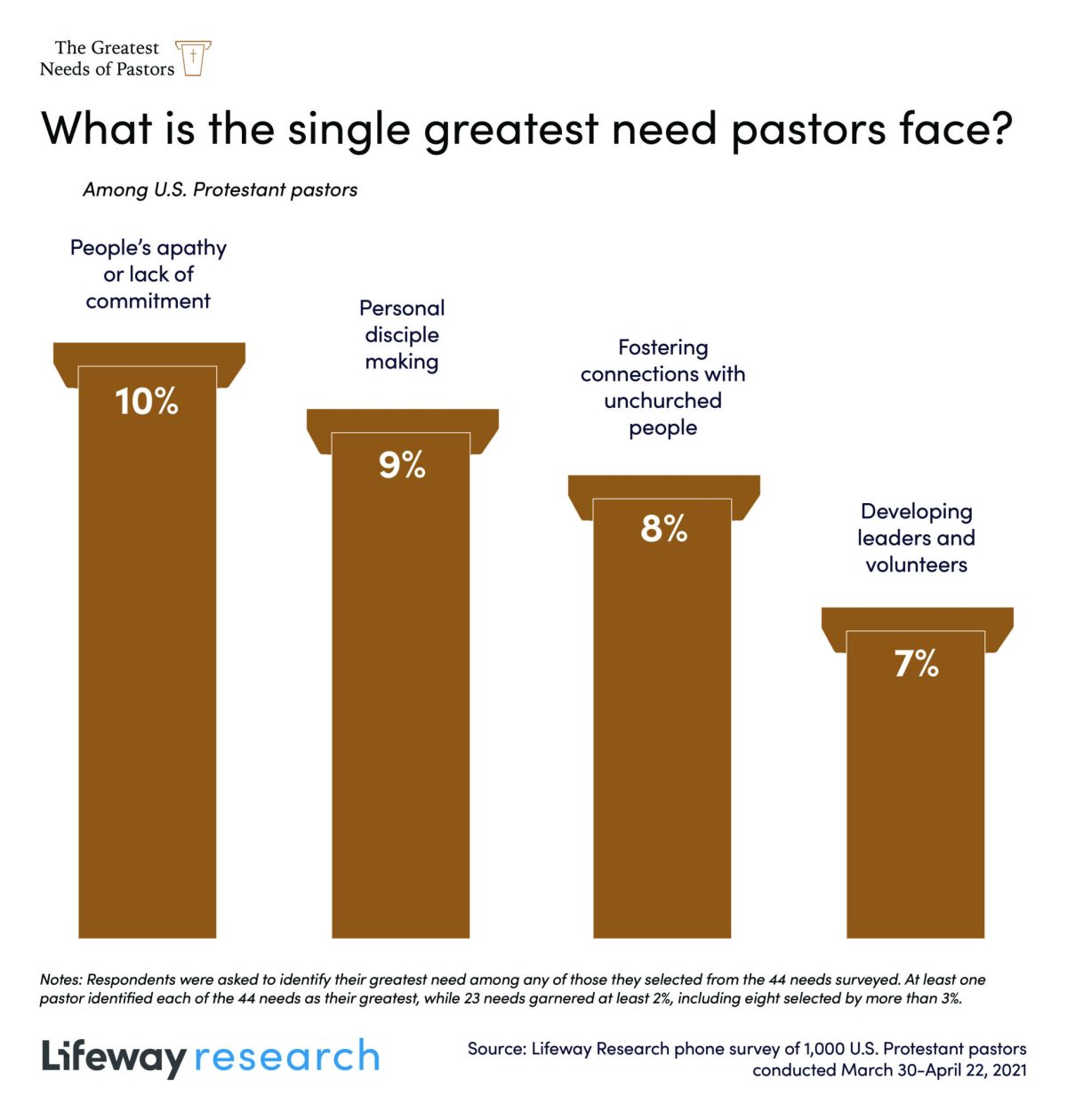
When asked to narrow down their list to the single greatest need requiring their attention, pastors’ responses varied.

At least one pastor surveyed picked each of the 44 possible needs, while 23 needs garnered at least 2 percent of pastors. Eight needs were chosen by more than 3 percent of pastors, and one reached double digits.

  • People’s apathy or lack of commitment: 10%
  • Personal disciple making: 9%
  • Fostering connections with unchurched people: 8%
  • Developing leaders and volunteers: 7%
  • Establishing a compelling vision: 5%
  • Technology: 4%
  • Consistency in personal prayer: 4%
  • Consistency exercising: 4%

“When asked to prioritize their own greatest need, pastors tend to put the needs of their church’s ministry ahead of personal needs,” said McConnell.

“Personally making disciples, developing leaders, connecting with those outside the church and mobilizing the people in their church are the most common ‘greatest needs’ and are among the most common needs pastors want to make a priority.”

Pastoral help

When thinking about getting help with their needs, pastors want to hear from their fellow clergy who have been through the same struggles.

Three in four US pastors (75%) say they would be interested in getting advice or guidance on the issues they are facing from other pastors who have already been through those problems. Similar numbers (74%) would like to hear from those who understand churches like theirs.

Another 70 percent would listen to other pastors who are currently facing the same needs. Slightly fewer (57%) want to hear from experts on those types of needs. Older pastors are the least likely to say they’d like advice from any of those sources.

“The most monumental needs of pastors are not new to this generation of pastors,” said McConnell. “They know other pastors and pastors who have gone before them are best positioned to understand and help them with the wide variety of ministry and personal needs a pastor faces.”

Still, previous Lifeway Research shows not all pastors are actively seeking out advice from their fellow clergy. More than 8 in 10 US Protestant pastors say they feel supported by other pastors in their area. Fewer than half (46%), however, know and spend time with 10 or more other local pastors, according to a 2020 Lifeway Research survey.

Most pastors (54%) have those relationships with fewer than 10 other area clergy, including 1 in 20 (5%) who aren’t connected with any area pastors and 8% who have relationships with only one or two other ministers.

Pastors may also look to retired pastors for advice and wisdom for navigating common challenges. A 2019 Lifeway Research study of retired Protestant pastors, ministers, and missionaries found some have struggled with the transition into retirement and are looking for ways to serve and connect with others.

More than 4 in 5 retired ministry workers (86%) say they have continued to make new friends in recent years, but 29 percent admit they feel lonely or isolated.

When asked what resources would most help them with their relationships today, most say they want to make additional ministry connections: 25 percent say making friends who have similar experience in ministry, 23 percent making friends who live near me, 20 percent relating to a church in which I am not in leadership, and 17 percent making friends who have had similar experience in leadership.

“Retired pastors and other ministry workers still want to serve the church,” said McConnell. “When Lifeway Research asked them how ministries could best serve those like them who are retired from full-time ministry, the most common response was to provide them with opportunities to serve or minister (16%). Current pastors looking for guidance may find retired pastors ready and willing to help.”

The phone survey of 1,000 Protestant pastors was conducted March 30 – April 22, 2021. The sample provides 95 percent confidence that the sampling error does not exceed plus or minus 3.1 percent.

News

Died: George O. Wood, Who Led the Assemblies of God into Growth

As general superintendent, he brought women and minorities into leadership, added “compassion” to the denomination’s constitution, and set ambitious goals for church planting.

Christianity Today January 12, 2022
Portrait Courtesy of Assemblies of God / Edits by Christianity Today

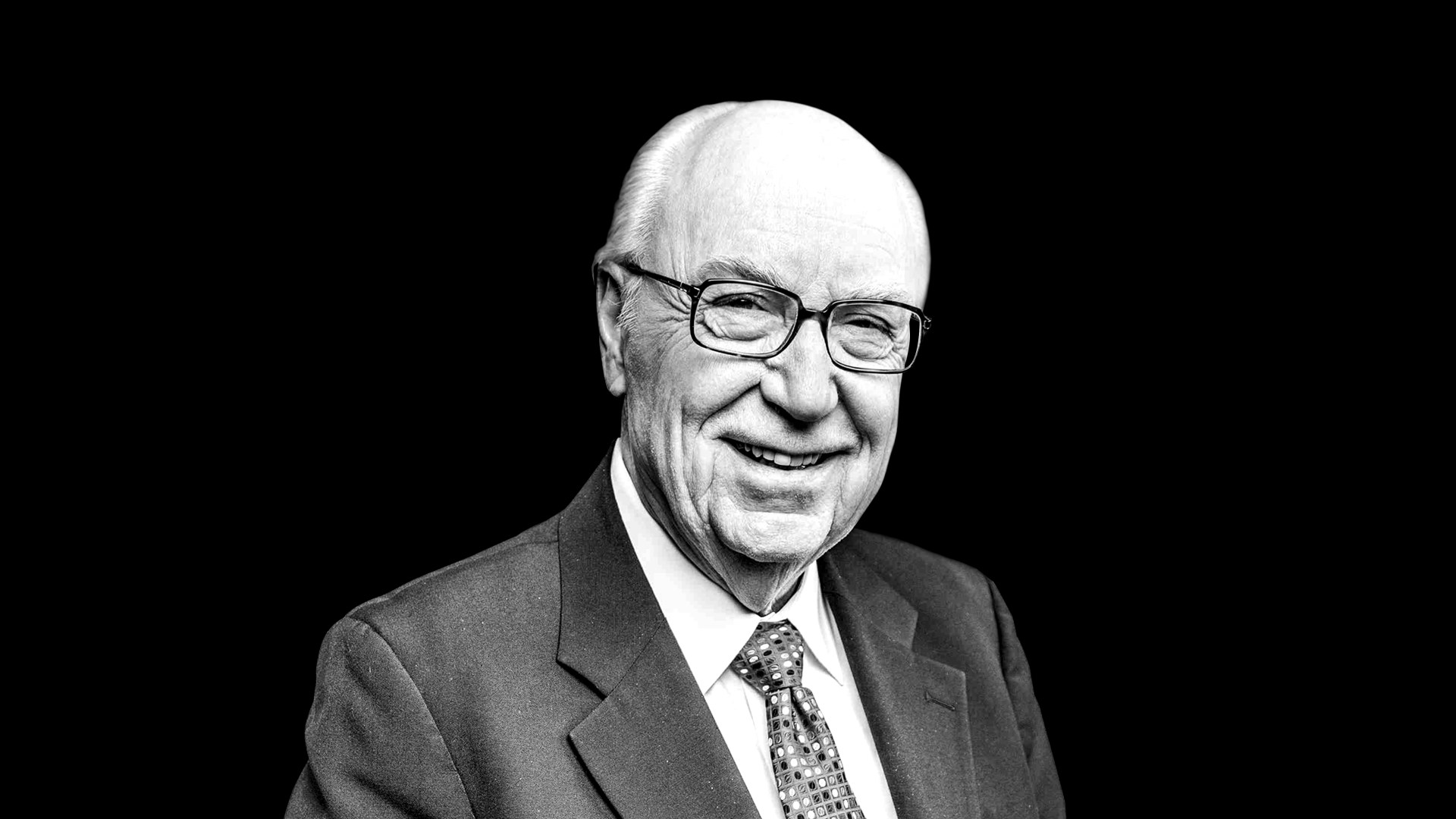
Assemblies of God leader George O. Wood, who encouraged expansive growth in the Pentecostal denomination through a commitment to diversity, conservative doctrine, and church planting, has died at the age of 80.

Wood served as general superintendent of the General Council of Assemblies of God from 2007 to 2017. In that decade, the denomination grew to a record 3.24 million members, and cumulatively added more than 660 congregations, according AG News. And the Assemblies grew more diverse—both in the pews and at the leadership level, as Wood worked to make sure more women, minorities, and people under 40 had prominent roles in directing the denomination’s future.

When he began as general superintendent, the executive presbytery was made up of 14 white men. When he left, it had expanded to 21 seats, with seven occupied by racial minorities and two by women. The denomination itself—historically white—was about 42 percent minority when Wood retired.

“He had a unique ability to open doors for young people, women, and ethnic minorities by providing them a meaningful seat at the table,” Doug Clay, Wood’s successor as general superintendent, told AG News. “That has been a major force behind our growth in each of those areas.”

Wood, for his part, attributed his vision to the Pentecostal tradition of being flexible when it is important to be flexible and firm when it is important to be firm.

“We have been flexible when it comes to culture—music, dress, pulpit attire,” he told Religion News Service in 2013. “While remaining consistent on that which has not changed, which is doctrine.”

George Oliver Wood was born to missionaries George Roy Wood and Elizabeth Weidman in China on September 1, 1941.

He learned early of the transformative power of the Holy Spirit and the importance of hard work and education. George O. Wood’s father—who had been pulled out of school after the fifth grade and put to work in a glass factory by his stepfather—always spoke of what he missed, with his lack of education, and what he had gained, with conversion, baptism in the Holy Spirit, and a call to ministry.

The Wood family moved back to the US in 1949, after the Chinese Communist Revolution, and served in a variety of small Assemblies churches, never staying in one community for more than a few years. The younger Wood described himself at that time as an awkward missionary kid who worried too often about whether he was really saved or if he could have possibly blasphemed the Holy Spirit.

He liked school, though, and was encouraged to pursue an education. Wood earned a BA from Evangel College (now University), and then followed it up with a master’s degree, a doctorate, and a law degree. Despite historic Pentecostal skepticism of education, Wood was not drawn away from the church. Instead, he threw himself into ministry, first as director of spiritual life and student life at Evangel, and then as pastor of Newport-Mesa Christian Center in Costa Mesa, California.

What it means to be a leader

He was a faithful pastor and a humble servant of the church, his son George Paul Wood recalled in a 2014 interview with the Springfield (Missouri) News-Leader. Every Sunday morning, father and son would go get doughnuts and take them to the church, unlocking the doors before anyone else arrived.

George Paul admired his father’s preaching, but when he said he was also interested in becoming a minister, his father didn’t teach him about homiletics. He hired him as the church janitor.

“I learned what it means to be a pastor,” said George Paul Wood, who is now executive editor of Assemblies of God Publications. “That’s training you can’t pay for. That’s life training.”

George O. Wood rose to national leadership in the Assemblies of God in the 1990s, taking the role of second position of general secretary. He was promoted by the denomination to the top spot in 2007. That same year, the general council voted to expand the national presbytery to include a female minister and a minister under the age of 40.

As Wood pointed out, about a quarter of all Assemblies of God ministers were women in 2007. More than a third were under 40. And yet no women or ministers under 40 had a position in national leadership.

Some in the Assemblies—with an eye on Southern Baptist debates over women in ministry—questioned whether the Pentecostal church was “going liberal” because of its stance on women. Wood argued the Assemblies of God wasn’t adapting to changing cultural norms, but staying true to the Pentecostal understanding of Scripture.

“I grew up listening to my mother and other women preaching the gospel,” he wrote. “What was their basis for so doing? The Holy Spirit had called them in light of the prophetic promise of Joel 2:28–30 fulfilled in Acts 2:17–18—in the last days God would pour out His Spirit on all flesh, including daughters as well as sons who would prophesy, including women as well as men servants.”

Pushing for ‘compassion’

Perhaps the most controversial moment in Wood’s tenure as general secretary, however, came in 2009—when he temporarily stepped down from leadership.

Wood wanted the Assemblies of God to add a fourth fundamental purpose to the denominational constitution. In addition to seeking to save the lost, worshiping God, and building up the body of believers, Wood wanted to add “compassion” as one of the church’s “reasons for being.”

The resolution was defeated. As the general superintendent, Wood was chair of the council meeting and not allowed to make an argument from the floor. So he decided to step down from leadership to make the argument that compassion ministries were “an important growing edge of ministry.”

“We live in a culture in which the church has to earn credibility, and without acts of compassion I believe the church loses its credibility in the world,” Wood said at the time.

In a second voice vote, it wasn’t clear whether Wood’s argument had carried the day or not. A third vote was taken, and the compassion resolution won by a vote of 585 to 242.

Before the council left Orlando, it also reappointed Wood as general superintendent.

In subsequent years, Wood pushed the Assemblies to focus on church planting. He even challenged the denomination in 2011 to plant one church per day. That year, 368 new Assemblies of God congregations were started. He set a similar vision for the World Assemblies of God congress, telling those gathered in 2017 that the Holy Spirit was telling him the Assemblies should aim for one million churches worldwide by the year 2033.

‘I’m really loved by God’

Wood spoke out more about politics in later years—expressing special concern about the legalization of same-sex marriage and threats to religious liberty. He made headlines in 2019 warning that “a day of persecution” was coming for Christians in the US.

Wood also worked, however, to keep his distance from partisan politics, and encouraged leaders in the Assemblies not to identify too closely with a party or a candidate.

“Our focus should be on the gospel,” he said in 2017. “If we begin to endorse candidates, then we are politicizing the church, diluting our message, and bringing unnecessary division among our people. It is sufficient that we can speak on issues without endorsing specific candidates for office.”

Wood was diagnosed with stage IV cancer on August 31, two days before his 80th birthday. It was a surprise, but he later said he also felt instant peace.

“As a follower of Jesus, I have two great options,” he said. “I can go to my home in Springfield or I can go to my home in heaven. I like both.”

In the last four months of his life, he said he was more convinced than ever of the personal love of God.

“As I’ve been reading Scripture lately, I just keep focusing upon the fact that God deeply loves us,” he said in a 2021 interview. “And that’s part of the, ‘I can do all things through Him who strengthens me.’ He strengthened me by giving me this great emotional assurance to this still-insecure missionary kid that I’m really loved of God.”

Wood is survived by Jewel, his wife of 56 years, and their children George Paul Wood and Evangeline Hope Zorehkey.

Theology

The Case for Not Treating NFTs as a Scam

Proprietary gifs may seem silly, but Christians have reasons to think about digital ownership.

Christianity Today January 12, 2022
Illustration by Mallory Rentsch / Source Images: AlexandrBognat / RoyalFive / galitskaya / a3701027 / Getty / WikiMedia Commons

“Why would I buy a jpeg I can copy and paste for free?”

That is how most conversations about NFTs (non-fungible tokens) begin. And it makes perfect sense. People are purchasing NBA clips for thousands of dollars—which can be streamed without cost on YouTube.

Crypto degens” are changing their Twitter profile pictures to pixelated cryptopunks to signal their membership in a new libertarian world order. As the NFT market soars to a value of $7 billion, it’s been compared to the dot com bubble, where speculation-fueled investment flooded the market.

However, before you write off NFTs, revisit David Letterman speaking to Bill Gates about the internet in 1995. Letterman poked fun at Gates, mocking people who were excited about the internet’s ability to broadcast baseball games. Letterman smiled and asked, “Does radio ring a bell?”

Gates tried to explain the difference between radio and the internet by pointing out that baseball fans could listen to the game whenever they want, not just live. But Letterman wasn’t impressed—“Do tape recorders ring a bell?” he asked.

Or recall the time when Katie Couric and the entire Today Show crew made fun of “@” symbols and asked, “Can you explain what internet is?” Or remember Newsweek’s notorious 1995 editorial headline that read, “The internet? Bah!

Christians especially did not begin to think seriously about the internet (or its successor, social media), until well after they were adopted at a popular level. Pastors did not prepare their congregations for the promises and pitfalls of the web. This left Christians caught up in the cultural tide, lacking discernment and wisdom with how to engage.

Perhaps that’s why 19 of the top 20 “Christian” Facebook pages are actually run by nefarious, foreign troll farms, and millions of believers sharing their posts are totally unaware.

The internet can be a powerful discipleship tool, but without a serious understanding of the technology and its ethical and theological implications, Christians are likely to be “blown here and there by every wind of teaching and by the cunning and craftiness of people in their deceitful scheming” (Eph. 4:14).

So let’s avoid past errors, and start with two basic questions: What are NFTs, and how will they be used in the future?

What are NFTs?

Five hundred years after it was painted, the Mona Lisa still captivates crowds of tourists who travel to Paris every year. There are no doubt hundreds of thousands of replicas, but the small painting that hangs in the Louvre is the original. And how do we know that? Because it’s been thoroughly authenticated by professionals.

Now imagine if Leonardo da Vinci were alive today. How would someone know that a piece of his art was authentic? How could da Vinci make a living from his artwork?

Enter NFTs.

An NFT is proof of ownership that is verifiable by a public ledger of transactions—they make it possible to spot when something is real and when it is a forgery, such as a knockoff Mona Lisa.

This public ledger, referred to as the blockchain, is the best method we’ve developed to prove whether something online is authentic—based on publisher source or the publication’s time stamp.

Consider the music industry—and more specifically how musicians are paid. Musicians have long been at the mercy of large record labels, both for how well and how often they are compensated.

When a record is created and the digital masters are made, they are not owned by the musician, but by the record label. And the record label determines the rules the musician must play by.

The record labels then work with third parties who can encrypt their music to protect them from theft and distribute them on proprietary marketplaces. Those who “own” the songs cannot sell or transfer them to another digital platform. For example, if you buy a Taylor Swift album on Apple Music, you can’t listen to it on Amazon.

In today’s era of the web, you do not own anything. That is, until now, we could not attach proof of ownership to anything online. Which is why NFTs have the potential to change the future of digital ownership.

They change the artists’ contract with the record label. They change the record label’s partnership with third-party marketplaces. They change the consumer’s relationship with the art—which can now be owned anywhere and everywhere they exist digitally.

The future of NFTs

It’s helpful to look at the future of NFTs (digital ownership) in three different categories, including digital art (think of an original artist creating art similar to the Mona Lisa but on a computer or a musician releasing an album), collectibles (think of sports or Pokémon cards), and digital property or utility.

This technology will replace the complex and difficult-to-use systems that we currently rely on. Below is a brief list of real-world use cases in which you’ll see NFTs in the coming months and years:

Musicians can now own their own music, prove they own it, and earn income in a matter of seconds based on sales instead of waiting two-plus years based on a standard 36-month record deal. Brands can also create NFTs as digital representations of their physical assets for the metaverse; some already are (e.g., Adidas, Budweiser, Pepsi, Zara, etc.).

If you buy a car, the contract can be an NFT. Similarly, real estate titles can be NFTs. Traditional real estate and vehicle transfers require complex systems that NFTs solve. Your airline ticket, your conference pass, and your seat at the football game could all become NFTs.

Location-based NFTs, or POAPs (proof of attendance protocols), can prove that you were somewhere, like a concert ticket or pictures of a special event. And if something magical or record-breaking happens at that event, you can now prove you were there and sell that NFT on a secondary market to collectors.

University and college degrees can be NFTs. Right now, the process is complicated: Someone graduates from a school and needs proof of their graduation to get a job or apply for more schooling. They might have to email admissions, try to find a file in their old school login, or, worse yet, request a paper copy.

With NFTs, all you need to do is log in with your web3 wallet (your online profile that interacts with the blockchain). It instantly verifies that you are a grad from whatever school, and associated with that is all the metadata necessary that shows your degree, grades, year you finished, etc.

If you’re a parent of a young kid, I’m sure you’ve been asked at least once if you could purchase Robux for a new Roblox skin or V-Bucks to purchase the latest Fortnite outfit. This can now become an NFT that can then carry over into other applications. Again, these gaming NFTs are verifiable because of the blockchain.

In short, we’ve had 25 years of an internet where people couldn’t own things digitally. With the invention of the blockchain and NFTs, that changes.

Almost instantaneously, digital scarcity becomes a reality—upending the landscape of digital economics. In the current era of platform-based digital economics, digital goods have limited value because ownership and property are non-transferable.

As of now, I cannot easily move my Kindle purchases to Apple Books, nor can I resell or give away my digital property. Owning a first printing of Harry Potter is valuable, while owning a first digital copy is useless.

NFTs reduce the need for complex platforms by automating complex contractual agreements and tracking ownership. And as digital property (think clothing, avatars, house decorations, and real estate) becomes more desirable in the metaverse, NFTs will ensure they have value.

This technology will create a new world of possibilities for creatives, content creators, businesses, churches, and parachurch organizations—which means now is the time to ask some serious questions about how to think ethically and theologically about digital ownership. What are the promises? What are the pitfalls?

Non-fungible theology

On the frontiers of theological thinking, queuing the right questions is an important task. So what questions should Christian theologians and ethicists wrestle with today regarding cryptocurrency? Here are a few:

What are the unique dangers of digital consumerism?

Sneakerheads joyfully stay up until midnight, madly refreshing their browsers to get the perfect pair of Air Jordans. Why? Because owning a pair is a status symbol and promises membership in a niche community.

The same can be said about designer clothes, luxury vehicles, Apple devices, and much more. But Jesus warned us that “Life does not consist in an abundance of possessions” (Luke 12:15). He taught his disciples that worrying about possessions was the path to anxiety, not freedom (Matt. 6:25). Perhaps consumerism leads to anxiety because of the human tendency to identify with what we have rather than who we are in Christ. Or perhaps owning stuff produces anxiety because it soaks up our most scarce resource: time.

It takes countless hours to research, purchase, use, and upkeep all the things we buy, and NFTs are no exception. You could spend hours researching the next big NFT drop, browsing OpenSea, or figuring out the perfect way to display your NFT artwork online.

This will only increase in the metaverse, as digital property becomes increasingly associated with social class and group membership.

In light of this, Christians will need to form practices that help them resist the allure of digital consumerism—knowing that, in the end, amassing more stuff on earth is “meaningless, a chasing after the wind” (Ecc. 2:11).

What unique risks accompany digital identity creation?

Many NFT investors are purchasing PFPs (NFTs that function as profile pictures) as a way of signifying their place in the community. But at what point does a PFP move from a fun, community-forming asset into full-blown identity confusion?

Daniel Maegaard, an investor making millions trading crypto and NFTs, declined a $1 million offer for a Cryptopunk that resembles Breaking Bad’s Walter White. He explained to Time magazine, “People almost now tie that character to me. It’s almost like I’d be selling a part of myself if I ever sold him.” Social media platforms already allow people to craft curated versions of themselves, but NFTs will expand this trend by making digital identities and their avatar accoutrements discrete, ownable (or salable) digital property.

And yet self-creation runs against the grain of God’s created order. The prophet Isaiah warned, “Woe to those who quarrel with their Maker, those who are nothing but potsherds among the potsherds on the ground. Does the clay say to the potter, ‘What are you making?’ Does your work say, ‘The potter has no hands’? (Isa. 45:9).

The gospel is a gift precisely because in it, we receive our true God-given identity, “So in Christ we, though many, form one body, and each member belongs to all the others.” (Rom. 12:5).

Roman Catholic philosopher Charles Taylor argues that modern people reject the gift of an external, God-given identity. Instead, they look inward—hoping that through self-discovery the authentic me might become a fully realized, self-expressing individual.

Choosing the right PFP becomes another tool in the self-definition toolbox distracting us from fully enjoying the gracious gift of our externally received, God-given identity.

What unique creative opportunities does digital ownership unlock?

The creator God made man in his image (Gen. 1:27). We all share a calling to create new things, produce new value, and serve our communities with creativity. Perhaps this is why one of Adam’s first tasks was creative: to name all the animals (Gen. 2:19).

Increasingly, much of the culture-making is happening online. Most of the art we consume is now digital: TV shows, movies, photos, music, audiobooks, podcasts, ebooks, online articles, and newsletters. NFTs allow digital intellectual property to become verifiable property.

The possibilities here are promising.

For example, I love to browse bookshelves. In the future, we can browse NFT bookshelves. Maybe a friend can sell, loan, or give you a digital book—all of which range from inconvenient to impossible right now. If you’re a digital visual artist, you can finally sell your work to art collectors. And digital works could even correspond to physical pieces.

Damien Hirst, a world-renowned physical artist, recently dropped “The Currency,” a digitized collection of his artwork, as NFTs. Each NFT includes a high-resolution image of the front and back of each piece. Collectively, the 10,000 NFTs are valued at $500 million.

Musicians may benefit the most, as NFTs promise a way to bypass streaming services (which requires millions of streams per year for the artist to make minimum wage) and instead let artists sell their work directly to fans. For example, Kings of Leon released their latest album as an NFT and made $2 million.

NFTs may rebalance the economic scales back in favor of creators rather than platforms, such that those doing the creative work can reap the rewards of their labor (2 Thess. 3:11–12) instead of those distributing the work. Christians, who affirm the goodness of creativity and economic fairness, should celebrate this.

How does evangelism change in the digital era?

NFTs already function as the cost of entry to various online communities. Occasionally, they even gather in person.

NFT lovers descended on Manhattan for Ape Fest, a weekend-long party open exclusively to Bored Ape Yacht Club owners. They weren’t alone. World of Women, Cool Cats and others all scheduled in-person hangouts in Miami. It’s not hard to imagine a future where shared interest in real estate NFTs, clothing NFTs, gaming NFTs, or music NFTs can form on- and offline communities. The question is whether Christians will be present in those spaces, building relationships for the sake of the gospel (Matt. 28:19). As more people live more of their lives online, Christians should start re-imagining the internet as a missionary space.

In the first century, the apostle Paul saw the Roman roads, which were initially designed for an imperial war machine, in terms of their potential for church planting. Likewise, Christians should see the internet—while often used for consumption, advertisement, and self-expression—as presenting greater opportunities for evangelism.

We’ve only scratched the surface of NFTs and their potential, but now is the time for believers to start thinking, programming, developing, and creating in that space.

The kingdom of God produces flourishing wherever it reaches, and Christians must make sure the future of the internet is no exception.

Stephen McCaskell is an award-winning filmmaker and Web3 enthusiast. He purchased his first bitcoin in 2013, unfortunately he hadn’t yet learned the principle of hodl. He resides with his wife and four sons in Orlando, Florida.

Patrick Miller is a cultural commentator on the podcast Truth Over Tribe and the author of the forthcoming book Truth Over Tribe. He's also a pastor at The Crossing, where he oversees digital ministries, pioneering next-generation strategies to reach people online.

News

Wanted: Church Planters. Reward: $50,000.

Q&A with Acts 29 president Matt Chandler on assessing narcissists, the challenge of COVID-19, and new opportunities for vibrant churches.

Christianity Today January 11, 2022
Screengrab YouTube / The Village Church Resources

Acts 29 announced a new funding initiative today to encourage more church planting in 2022. The network, which includes more than 700 churches in 44 countries, will give newly affiliated planters two gifts of $25,000 to help them get started. Currently, there are more than 500 men going through the Acts 29 assessment and affiliation process.

CT talked to Acts 29 president Matt Chandler about the challenges of church planting in 2022, how the assessment process has changed in response to reports of abuse and narcissism, and what he’s learned in 10 years at the helm of Acts 29.

How has the pandemic impacted church planting?

By and large, the network did very well through COVID-19. If you were in week two of gathering and you were at a school, all of that stopped immediately and it was hard to get back into the schools, because they basically shut down for the rest of the year. If you were a more established church, you tended to do a lot better.

We didn’t have a ton of churches die—not as many as you might think—and then we got to serve the communities that we were in.

What other challenges are you facing? What is Acts 29 wrestling with in 2022?

Like everyone else, it seems, there is a lot of polarization and division right now, a lot of ideological tribes. Where churches have been healthy, they’ve navigated that well, and when maybe they haven’t been healthy, they’ve had some difficulty.

I hope and pray because A29 is deeply theologically driven, we had some of the foundations laid to be ready for this moment. A lot of churches have done a lot of work on what it means to be made in the image of God, a lot of teaching on the imago Dei, and then the imago Dei really becomes the foundation from which you address these other issues.

Looking at this new plan to give new church planters two $25,000 gifts, it’s obviously great for a church planter to get this money, but was there a problem that this is solving?

It’s an accelerant. We see an opportunity right now—with the new Pew data about declining rates of religious identification, with a generation lost, with I think 4,500 churches closing their doors every year—to really lean in to this moment of history and plant biblically serious, spiritually alive, vibrant and innovative families of faith. We have been building toward this for the last couple of years, and are now finally able to do it.

We know you can give the wrong guy a million dollars and he’ll fail. You can give the right guy nothing but encouragement and he’ll succeed. We’re trying to find the right guy who has the right competencies and then assess him for a long-term run, and where he makes it through our process of assessment, then we want to give him $25,000 to start up with.

I’m glad you brought up assessment. One of the things we’ve been thinking about at CT, especially with The Rise and Fall of Mars Hill podcast, is the challenge of assessing character and not just talent. How is Acts 29 assessing character?

We made a major shift several years ago. I want to say about seven or eight. We decided we didn’t want to plant a 22- or 23-year-old who hasn’t spent a significant amount of time working in a church under someone else. We want to plant a 28-year-old guy, a 31-year-old guy, 36-year-old guy more than a 22-year-old who thinks he’s going to fix evangelicalism and has a dynamic preaching gift. I think that’s how you get in trouble, when the dynamic gift trumps everything else.

Do they walk in humility? Are they willing to serve others? Do they have to be in the limelight? Do they have to be in control?

Since that shift has been made, we haven’t seen as much of a problem with narcissism.

The second shift is we’re assessing toward 11 core competencies. The first one is spiritual vitality. The second is theological clarity. The third is conviction. We’re looking for a healthy marriage. We’re looking to see that you have healthy relationships and genuine friendships. Is there a history of godly leadership? Do you have spiritual maturity? Do you share the gospel with other people or is it just when you preach? You have a history of faithful disciple making. The tenth one, can you actually teach? And the 11th one is we’re looking for an entrepreneurial aptitude, because at A29 we want to plant churches that plant churches.

Have those always been the competencies you assessed or has that changed over time?

It’s developed over the last few years as we’ve tried to do a better job with all of this. I hope we’re not finding every 22-year-old angsty gifted guy who’s going to “save” Christianity in our day and giving him a platform.

To ask my question kind of bluntly: The next Mark Driscoll or a young Steve Timmis, would they make it through Acts 29’s assessment as it is now?

I would hope they would get caught by it. I think there’s something about the dynamics of narcissism that makes it hard to catch, so I want to be careful, but we’re trying to organize as best as we can so that we can vet men before they get our sticker on them. And then after they’ve been vetted, get them in the kind of community that they might be encouraged or challenged if you start getting red flags.

We’ve done a lot of work around this and we hate abuse in all its forms.

You’re coming up on 10 years as president of Acts 29. What’s the biggest thing you’ve learned?

The majority of pastors out there love Jesus; desperately want to serve, love, and shepherd people; and are not in this for money, fame, or accolades. They are oftentimes bullied and battered. They make little to no money, and they’re having their whole life wrung out for the glory of Jesus Christ.

What ends up happening is you get the Mars Hill podcast, you get an exposé, and you get these guys whole souls are wrung out for the glory of God getting lumped in with the ones that make the news.

I always get heartbroken when I read the stories because I know there are other pastors who get lumped in “Oh they’re like that guy,” when they’re simply not.

You think that’s a big problem?

I think clarity can be perceived as control. I think accountability can be seen as abuse. I think we live in a day where no matter what, it’s a hard time to lead.

I hear you. There are many pastors I know and love who I see making sacrifice after sacrifice. But also, from my position at CT, I hear about more abusive pastors than I can possibly report on. There is so much terrible stuff that no one ever hears about. In every city in America, there is a biblically serious, theologically sound pastor who is hurting people. Isn’t that a bigger problem?

I’m a big Ephesians 5:11 guy, take no part in unfruitful works of darkness but instead expose them. I think that needs to be exposed. My concern is, the moment we live in lumps guys into that category who don’t belong there.

We started by talking about challenges; where do you see the biggest opportunities for church planting?

I see an opportunity around expressive individualism. I think that we’re seeing right in front of us the breakdown of the promises the world makes. We have a real opportunity to step in and answer the questions the world is asking.

The whole idea that you can define yourself and solve yourself, I think people are starting to realize that’s not true. I think that the churches can step into this space if you’re willing, but I think we’re going to have to be smart about it and we’re going to have to be kind about it.

Explosive growth is going to come out of a call to holiness and morality.

Can you talk more about the kindness piece? I feel like I’m seeing a harshness from a lot of Christians, an approach of, like, speaking the truth in brutality.

We have to go back to Christian hospitality where Christians can walk their neighborhoods and pray blessings over their neighbors’ homes, then meet their neighbors and have their neighbors into their homes and get to know them as people, and engage them with the gospel in that framework. That’s how the gospel works. It doesn’t work on social media at all. On social media, let’s be who we were called to be, let’s be salt and light, but the kinds of conversations we need to have for the gospel, those need to take place in living rooms and at dining room tables.

News

The Potter’s House Denver Sells Property, Goes Virtual

The congregation in T. D. Jakes’s network is one of the biggest to shutter its doors due to COVID-19 constraints.

Christianity Today January 10, 2022
Courtesy of The Potter's House

Online church and virtual campuses have become mainstays during the pandemic, and one Denver-area megachurch is making virtual services its only options—for good.

Last week, The Denver Post reported that The Potter’s House Denver will sell its property in Arapahoe County and continue to worship exclusively online.

The church—led by the daughter and son-in-law of T. D. Jakes—is one of the first and most prominent megachurches to move one of its locations online permanently without operating other in-person campuses in an area.

“COVID-19 forced every church in America to rethink how to best serve their parishioners and the broader community,” pastor Touré Roberts told the Post. “Due to the inability to gather and the economic instability of the pandemic, our church, like many other churches in the nation, experienced declining donations.”

As a result, The Potter’s House Denver decided to abandon its 32-acre property and 137,000-square-foot building, first built in 1989 and the church’s home since 2011. Another pastor at the Denver campus said the church had averaged 10,000 worshipers in live attendance and 300,000 weekly YouTube views.

Roberts cited the building’s condition and need of repairs, saying, “We decided that the best way forward would be to sell the property, continue our online offering that had proven a successful alternative and maintain our hands-on community outreach operations.”

Even with another round of COVID-19 infections disrupting services, experts don’t predict that many others will follow suit.

“Black churches … whether historical African or classically evangelical traditions, emphasize not forsaking assembling together,” said David Goatley, professor of theology and director of the Office of Black Church Studies at Duke Divinity School. “Being the body of Christ means functioning together, and being in community is critical.”

Despite giving up its physical location, The Potter’s House Denver will continue its local outreach and mercy ministries, including its food bank, which Roberts said feeds thousands of Denver families each year. In January, the church also launched local community groups.

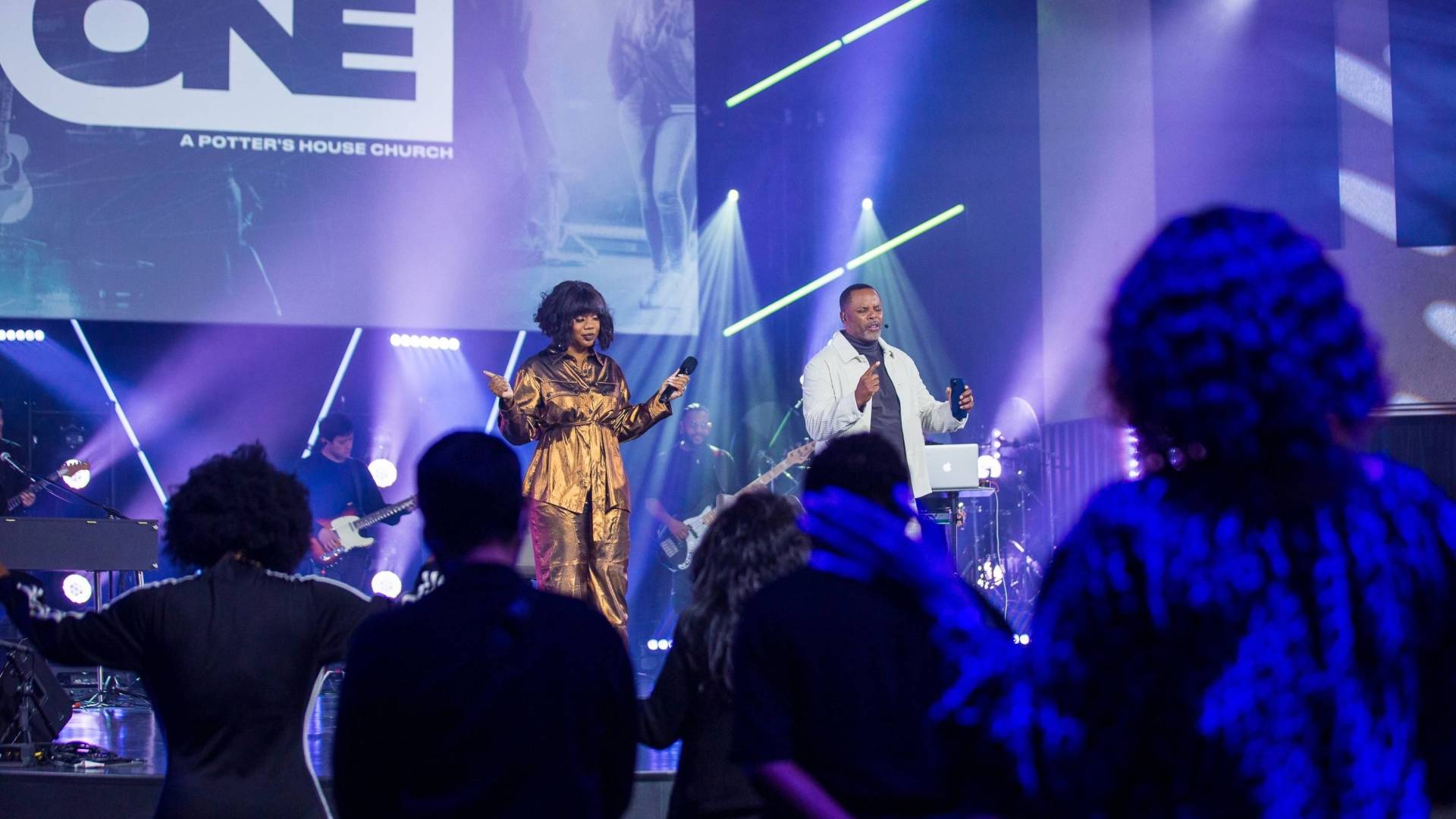
When visitors to The Potter’s House Denver site click to “watch online,” they’re directed to the church’s Los Angeles location, named ONE, which streams five services on Sundays and two on Thursdays, with attendees there in person. On The Potter’s House Denver’s Facebook page, members from LA lead prayer on Facebook Live.

A spokesman for The Potter’s House declined to answer further questions and referred CT to Roberts’s statements in The Denver Post.

The Potter’s House, founded in 1996 by Pentecostal preacher T. D. Jakes, now reports over 30,000 members across its locations in North Dallas, Fort Worth, Denver, and Los Angeles—the latter two led by Sarah Jakes Roberts and Touré Roberts. Jakes has returned to preaching in person at the Dallas church, where masks are required.

Jakes’s “influence as a thought leader and exemplar because of his media reach is significant,” said Goatley, but the number of churches that identify with Jakes is relatively small compared to the number of churches identifying with historical Black denominations like the African Methodist Episcopal and historic Baptist congregations.

Throughout the pandemic, Black churches have exercised caution in regard to in-person gatherings. Black churches have generally waited the longest to resume worship in person, and churches that have remained closed have been more likely to see significant drops in giving.

Lifeway Research found last November that African American pastors were 3.5 times more likely than white pastors to say their offering was down by 25 percent or more during the pandemic.

Though Black church leaders also been quick to implement technology to connect with church members virtually during the pandemic, gathering together as a community remains an integral part of life for the Black denominations.

Because The Potter’s House Denver is relatively new to its community and attracts young people, Goatley suspects it can successfully transition to an online-only congregations, but he doesn’t believe the online-only platform will become a trend among Black churches.

Congregations that have prioritized relational intimacy—showing up for births, deaths, marriages, graduations—will not want to trade their relational capital for online views.

“Churches that haven’t had that intimacy of ministry and [have instead] focused on gathering and production, people can experience that virtually. What you cannot virtually experience is relational intimacy,” Goatley said.

Digital church can be a great outreach and missiological resource, says Jason Thacker, chair of research in technology ethics at the Ethics and Religious Liberty Counsel of the Southern Baptist Convention. But he worries that by going exclusively, permanently online, The Potter’s House Denver misses the New Testament directives to gather together.

“Digital services are dangerous when they become the primary means of the church, because we are an embodied people,” Thacker says. “Church isn’t a service, a sermon, or even worship gathering, but the people of God.”

Thacker and his family have taken advantage of their church’s online worship services to protect his wife, who is currently immunocompromised after multiple rounds of cancer treatments. He’s grateful that vulnerable families like his can maintain a connection to their local church and for the outreach opportunities online church can create for those hesitant to enter a church building.

Thacker appreciates that The Potter’s House Denver will continue its food bank ministry, but wondered, “If you’re not forsaking those [ministries], why forsake the body gathering?”

News

How ‘Christian’ Overtook the ‘Protestant’ Label

When given the option, most younger believers go for a broader term.

Christianity Today January 10, 2022
Brown Bag Photography / Lightstock

Over the past several decades, American evangelicalism has moved away from the religious labels, symbols, and buildings that used to define church.

Many newer churches don’t contain stained glass, crosses, or traditional sanctuary setups. They tend to adopt contemporary names, leaving out denominational labels or other religious language. Along with those shifts, churchgoers have changed the way they speak about their faith; think of phrases like “It’s is not a religion; it’s a relationship.”

These trends have had a real impact on how younger people understand their religious identity. Evangelical Protestants have been debating for years over the definition and usefulness of the “evangelical” label. Now, it appears “Protestant” may be losing its place too.

New research shows that a significant portion of Americans no longer attach to the word “Protestant” the way older Americans have for generations—a finding that has implications for those who study and measure religious affiliation as well as for church communities themselves.

The insight comes thanks to a weekly survey called the Nationscape, which Democracy Fund began in mid-2019 and stands as the largest publicly available survey dataset in history, with nearly a half million people surveyed.

When asking about religion, survey administrators gave respondents the option to identify as Protestant, Catholic, Mormon, Orthodox, or Christian, among other options for other faiths. It’s the “Christian” response that makes a difference. Surveys typically make people specify a tradition within Christianity. But when given the option to not choose the “Protestant” label, many who attend Protestant churches don’t.

The younger a person is, the more likely they are to prefer Christian over Protestant. Among 20-year-olds, 22 percent indicated that they were Christians, while 8 percent said that they were Protestants. At 40, 25 percent said Christian, and 11 percent chose Protestant. Around age 55, people are just as likely to say Protestant as Christian.

The oldest Americans clearly still identify as Protestant. About a third of 70-year-olds said that they are Protestants, with just 10 percent indicating that they are Christians.

The label “Catholic” seems to be less impacted by age; 18 percent of young folks say they are Catholic compared to 25 percent of folks 75 and older.

While it can be problematic to seek out a causal link for survey findings around religious identity, the shift corresponds to the recent history of Protestant Christianity. The rise of nondenominational Christianity and the decline of the mainline Protestantism began in the 1980s. People who are in their 50s or younger grew up in a world where Protestant terminology was falling out of favor.


How did Christian organizations respond to two of the world’s most severe disasters?

Relief organizations were glad to see 1985 come to an end. Two of history’s most devastating disasters came less than two months apart—earthquakes in Mexico City in September and a volcanic eruption in Colombia in November. More than 30,000 people died in those two disasters.
This one-two punch on the heels of mass famine in Africa tested the resiliency of the disaster-relief community. Private organizations, denominational agencies, and national governments responded. But in many cases the collective response lacked coordination. The perennial problems of large-scale relief efforts surfaced, including duplication of services and the accompanying waste of material and human resources.
Within a week of the Mexico City earthquakes, for example, Mexico’s capital was inundated with supplies that could not be used. “We saw plane after plane unloading what was, literally, junk,” said Larry Glass, director of national health programs for MAP International, a Christian global health agency.
Likewise, following the eruption of the Nevada del Ruiz volcano in Colombia, individuals and organizations sent so many clothes the government made a formal request that no more be sent. “Organizations feel an obligation to respond because their donors expect them to respond,” Glass said, “even if it’s not needed.”
This is not to say that all of Colombia’s needs have been met. An overabundance of short-term emergency supplies is often followed by a scarcity of resources needed for long-term rehabilitation. The rebuilding does not begin in earnest until well after the disaster has ceased grabbing headlines and donor interest has waned.
From a public relations standpoint, however, it is important to take action while a disaster is in the news. Thus, says Stanley Mitton, director of international disaster response for Church World Service, “there is the temptation to get something on the plane and to [publicize] … it in a news release.”
Sometimes getting something on a plane quickly is exactly what is needed. MAP, for example, rushed 0,000 worth of antibiotics into Colombia. (The drugs were not available in the country.) But in most cases donors and organizations help best by providing financial support.
Explains World Concern spokesman Craig Shuck: “Not only is it less expensive to purchase supplies in the country where the disaster has occurred, but it helps stimulate that country’s economy.” Mitton notes, however, that some donors are not content simply to give money. “People like to visualize something tangible flying into the disaster-stricken area.”
The mere climate of a disaster-stricken area works against reasoned judgment and contributes to inefficiency. “In those first few days, people are in a panic,” says World Vision’s Brian Bird. “They may not know what they need. So they say, ‘Give us anything.” But Bird says the biggest reason services are duplicated is lack of coordination among relief organizations—due largely to poor communication.


Unique Challenges
Effective communication is important because each disaster brings its own set of problems. Needs range from clean water to heavy machinery. In some countries, governments monitor relief operations more heavily than in others. Without reliable contacts in a stricken area, a relief effort can be doomed. When they do not have a staff person at the site of the disaster, it is standard procedure for organizations that can afford it to fly somebody in to assess needs and determine how to meet them.
Some maintain that this in itself is wasteful, that organizations should use information already available. But reports coming out of a country are often contradictory. Church World Service got word on November 19, six days after the Colombia earthquake, that foreign medical personnel, tents, blankets, and food were not needed. On November 25, however, World Vision sent a shipment of blankets, tents, and cooking supplies.
Bird explained that World Vision had seven projects in and around Armero, including a child-care project where 156 people were killed. He said that other organizations may have had enough supplies for their relief projects, but that World Vision’s shipments were a direct response to requests from people it knew, including its own staff.
The New York Times reported on November 24 that some volunteer workers said the Colombian government had mishandled the rescue operation. They told of shortages of manpower, medicines, stretchers, and other basic supplies the government allegedly had said it did not need. In the midst of conflicting information, relief organizations operate on reports from their own sources.


Coordinated Efforts
Organizations operate independently to preserve their distinct philosophies of ministry. For example, World Relief, the relief arm of the National Association of Evangelicals, gives evangelism a high priority, and thus works within evangelical church structures wherever possible. “A lot of people in Colombia have come to know the Lord through our efforts,” says Jim Johnson, a World Relief official who oversees donor development. “You just won’t get that with secular organizations.”
In contrast, the goals of Church World Service are not as directly tied to evangelism. “We make it clear that we are the church,” says Mitton, “and we show witness by helping, but we don’t try to convert.”
More and more, however, the disaster-relief community is seeing the merits of a coordinated effort. Evangelical relief experts regard the formation of InterAction in 1984 as a major step forward. InterAction is an umbrella group for private relief organizations, including major evangelical organizations. During a disaster, it serves as a clearinghouse for information not only on what is needed, but also on what is already being done.
In addition, the formation of the Association of Evangelical Relief and Development Organizations (AERDO) has enhanced communication and cooperation among evangelical groups. Not long after the disaster in Colombia, Food for the Hungry told World Vision it had ,000 worth of antibiotics, but no way to get the medicine to Colombia. The antibiotics ended up on a World Vision shipment.
Food for the Hungry president Tetsunao Yamamori says such exchanges have become standard operating procedure among evangelical agencies. “AERDO has given relief leaders a platform to meet and talk about common problems,” he said. “This has contributed to smoother working relationships.”
Communication has also helped eliminate competition among relief agencies. Says World Relief’s Johnson, “People think we’re constantly competing against each other for funds. That’s blarney. There’s just too much suffering and death in the world for us to be playing those kinds of games.”
Johnson acknowledges there is room for improvement in the coordinating of relief efforts both within and outside the evangelical community. But, he says, “in most of the disasters I’ve seen, the problem has not been overlap. The problem has been we’ve needed ten times more.”
RANDY FRAME

However, race is also a factor in the gap between Protestants and Christians. Among younger Americans, ages 18 to 45, African Americans have the highest levels of religiosity and were more likely than other racial groups to prefer Christian to Protestant. Thirty-eight percent of Black respondents said they were Christians, compared to 10 percent who said Protestant.

Younger Hispanics are also nearly four times more likely to choose the Christian option over Protestant. The gap is smaller among white respondents (24% versus 11%) and those who identify as Asian (13% versus 7%).

In a new paper published last month at the Journal for the Scientific Study of Religion, I attempted to find other factors around why people hold onto Protestant identity or prefer the Christian label.

The data indicates that those with higher levels of education are more likely to identify as Protestants, but even among younger people with a graduate degree, most prefer Christian over Protestant.

While the Nationscape survey does not include many questions related specifically to religion, it does ask respondents about politics. There is some evidence that younger people who identify as Protestants are more likely to say that they are Democrats than those who say that they are Christians. For instance, 27 percent of white Protestants were Democrats, compared to 20 percent of white Christians. That gap also appears for Black and Hispanic respondents as well.

This may be because churches in the mainline tradition such as United Methodists and Episcopalians, which are more likely to still use Protestant as a label in sermons and literature, tend to be more politically moderate.

In a review of my bookJohnny Come Home, the reviewer observed that, “The only character in the novel who is holy is … God.”
He was right. No human character can be portrayed with any accuracy unless he or she is painted warts and all. A human being without sin is as rare as an incarnate deity. And that the greatest of saints continue to struggle with sin long after their conversions is axiomatic (except to the most militant perfectionists).
The obvious fact that we all sin can, of course, create an atmosphere of false security among us. Sin being commonplace, we can passively accept the idea that we ought not to be too bothered by it lest we surrender our mental health to a self-deprecating neurosis. Yet in our desire to console ourselves and maintain a good self-image, we may push to the back burner the mandate of God: “Be ye holy, for I am holy” (1 Peter 1:16; cf. Lev. 11:44–45).


A Sure And Certain Remedy
Evangelical Christians stress the fact that justification is by faith alone and that righteousness is found in Christ alone.
Though these assertions are true, it is equally true that the faith that justifies us brings forth fruit in our lives. The slogan of the Reformation was that we are justified by faith alone; but not by a faith that is alone. The moment true faith is present in the heart of the believer, the process of sanctification begins; the Christian is being conformed to the image of Christ. We are becoming holy. And if we are not becoming holy, then Christ is not in us and our profession of faith is empty.
Martin Luther gave the following analogy: When we are justified it is as though a doctor had just administered a sure and certain remedy for a fatal disease. Though the patient would still endure a temporary struggle with the residual effects of the illness, the outcome would no longer be in doubt. The physician pronounces the patient cured even though a rehabilitation process must still be carried out.
So it is with our justification. In Christ God pronounces us just by the imputation of the merits of Christ. Along with that declaration God administers something to us—his Holy Spirit—which begins immediately to bring us to holy living.


Unholy Pursuits Of Holiness
The New Testament contains a ringing paradox with respect to sanctification. The Bible says, “Work out your own salvation with fear and trembling; for God is at work in you, both to will and to work for his good pleasure” (Phil. 2:12b–13). Notice that there are two agents working here. We are called to work, and God promises to work as well. To be sure, our initial regeneration is accomplished by God alone, but our sanctification involves mutual activity.
The two great heresies that have plagued the church on this matter for centuries are the heresies of activism and quietism. These twin distortions are guilty of eliminating one or the other poles of the paradox. In activism, God’s working is swallowed up by human self-righteousness. In quietism, the human struggle is swallowed up by an automatic divine process.
Activism is the creed of the self-righteous person. He has no need of divine assistance to achieve perfection. Grace is held in contempt, a remedy needed only by weak people. The activist can lift himself up by his own bootstraps. His confidence is in himself and his own moral ability. Perhaps the most arrogant statement the activist can make is: “I don’t need Christ.”
The quietist, on the other hand, insults the Holy Spirit by insisting that God is totally responsible for his progress or lack of it. If the quietist still sins, the unspoken assumption is that God has been lacking in his work. The creed of the quietist is, “Let go and let God.” No struggle is necessary; no resistance to temptation is required. It is God’s job, from beginning to end.
God calls us to the pursuit of holiness. The pursuit is to be undertaken with strength and resolution. We are to resist unto blood. To wrestle with powers. To pummel our bodies, rejoicing in the certainty that the Holy Spirit is within us—helping, disposing, convicting, and encouraging.
To the end that we may be holy.

I’m a pastor and an academic, and the findings from the Nationscape survey are troubling from both perspectives. Younger Americans don’t seem to have much familiarity with the term Protestant. If surveys continue to ask about Protestant identity—as most still do—and the average American doesn’t understand that distinction, then social scientists run the very real risk of mismeasuring religion.

Fortunately, the overall composition of religion in the Nationscape survey does not look substantively different from other surveys that only include the Protestant option. If Protestants are combined with Christians in the survey, their overall composition doesn’t differ significantly from Protestants in other data. But that may not always be the case.

From a social science standpoint, how people identify (or not) with a religious tradition is incredibly important. One of the key questions that human beings face is “Who am I? And who are people like me?” Religion is one of the ways in which Americans help sort themselves into social space. The Protestant identity helps Baptists, Methodists, and Episcopalians know that they share a great deal of commonality. When those labels begin to fade, there are fewer social signposts to aid people in finding like-minded people.

For churches, a bigger issue may be that many folks sitting the pews may not have any clue about their church’s denominational affiliation or its connection to larger church history. That kind of religious literacy—an understanding of how the basic precepts of their tradition differs from other Christians—can be helpful for understanding their Catholic, Mormon, and Orthodox neighbors, but also for a deeper understanding of the distinctives of their own faith as Protestants.

Embracing a label-less approach to spirituality seems to be the current trend, but as this data indicates, it is having very real impacts on how Americans understand their place in the religious world.

Ryan Burge is an assistant professor of political science at Eastern Illinois University. His research appears on the site Religion in Public, and he tweets at @ryanburge.

Books
Review

Another Big Book on Paul? Bring It On!

Some thoughts from a fellow Pauline scholar on Douglas Moo’s eagerly awaited, comprehensive study of the apostle’s letters.

Christianity Today January 10, 2022
Illustration by Mallory Rentsch / Source Images: WikiMedia Commons / JoyImage / Getty

About a decade ago, I watched a YouTube video featuring New Testament theologian Anthony Thiselton. He was holding up one of his books (skip ahead to the 7:45 mark) and talking about how funny it is that he wrote a 1,500-page commentary on 1 Corinthians, which takes up about 13 pages in the Bible.

A Theology of Paul and His Letters: The Gift of the New Realm in Christ (Biblical Theology of the New Testament Series)

A Theology of Paul and His Letters: The Gift of the New Realm in Christ (Biblical Theology of the New Testament Series)

HarperCollins Children's Books

784 pages

$31.42

To most people outside the world of biblical studies, that does seem … extreme. But what can we say? Biblical scholars like Thiselton (and me) love to give careful and prolonged attention to all the details in Scripture.

Over the past few decades, the bulk of that attention seems to have been directed toward the life and writings of Paul. In 1998, James D. G. Dunn published his massive Theology of Paul the Apostle, weighing in at over 800 pages. Not to be outdone, 15 years later N. T. Wright produced double the size in his two-volume Paul and the Faithfulness of God.

As much as some might groan at the thought of reading (or reviewing!) a long book, many experts on Paul actually relish another opportunity to revisit the mystery and genius of the first and greatest Christian theologian. This describes the sense of anticipation with which I awaited a new study from Douglas J. Moo, A Theology of Paul and His Letters: The Gift of the New Realm in Christ.

General reflections

Moo is widely known for his work on Romans, articulating and defending a Reformed, evangelical interpretation for a new era. He has also written books on a wide range of New Testament topics such as eschatology, creation care, the use of the Old Testament in the New Testament, law and gospel, sin and salvation, and men and women in family and ministry. In my view, Moo shines brightest as a writer of biblical commentaries, having penned insightful studies on Romans, James, 2 Peter/Jude, Colossians/Philemon, and Galatians.

A Theology of Paul and His Letters is a kind of theological textbook introducing the key aspects of Paul’s thought and weighing in on practically all of the “hot topic” debates it inspires. Moo’s goal is not to give extensive defenses of his own views or lengthy critiques of opposing views, but rather to articulate his own approach to Paul’s theology and its implications with some critical reflection. (A good amount of “color commentary” on scholarly debates happens in the footnotes.)

The book’s content is complex, but its organization is straightforward. In part one, Moo addresses necessary preliminary issues, like methodology, influences on Paul’s thought, and the foundations of Paul’s theology (more on that below). Part two offers a walkthrough of Paul’s life and Moo’s quick exposition of each of Paul’s letters. Part three, the longest section of the book, engages Paul’s theology directly: Christ and his gospel, the beginning of salvation, the problem of sin, the benefits of salvation, final eschatology, the people of Jesus Christ, and how to live out the faith in the here and now.

Reviewing a book like this is like reviewing the Oxford English Dictionary—there is no way to talk about everything, and no one would want that anyway. So permit me to make some general comments, and then I will hit some key topics of the book as I see them.

My first reaction to reading Moo’s tome is that it is a gift to students and scholars alike. His decades of careful study of Paul’s letters and penetrating engagement with current scholarship have culminated in this rich volume. A Theology of Paul and His Letters is not a reaction to current scholarship but a study of Paul’s letters that happens to converse with other modern interpreters. This ensures that Moo’s work will serve readers for many years to come.

Second, the book’s foundational concepts are well conceived and expressed. Moo identifies the “center” of Paul’s theology as Christ, particularly our “union with Christ.” This is probably obvious but still worth stating, because sometimes scholars get so excited about arguing for certain theological constructs that they overlook or underemphasize the person of Jesus and the divine-human relationship mediated by Jesus.

Thirdly, Moo introduces a (somewhat) new term to express what he considers the “organizing concept” of Paul’s theology: “the new realm.” The word realm is a bit awkward, Moo admits, but it aspires to capture several important elements at once: the new age, the transforming gospel, the presence of the Spirit, and the “new person” in Christ who lives out a new life in community, no longer under the domination of sin, death, and the anti-God powers. Moo’s “realm” language brings more concrete imagery to classic discussions of salvation history and eschatology.

I also want to mention the tone of Moo’s book. He is extraordinarily gracious in conversation with scholars on “the other side.” I could imagine a less mature scholar feeling the temptation to score points by dismissing other views or making them look stupid or amateurish. Moo not only treats his critics fairly but often quotes from and cites positively scholars he strongly disagrees with on some major issues.

Hitting the hot topics

Below, I have pulled out six hot topics in Pauline studies that Moo discusses in his book, and that struck me as worthy of further comment.

All 13 letters

When constructing his theology of Paul, Moo works with all 13 letters in the New Testament attributed to Paul’s name. That defies the academic trend of treating Colossians, Ephesians, 2 Thessalonians, and the pastoral epistles (1 and 2 Timothy and Titus) as “pseudepigraphy” (written by someone else). But Moo makes a strong case that separating out these letters and dismissing them creates a lopsided Paul. Including all 13 letters allows for a “messier” picture of Paul, which helps avoid artificially simplistic portrayals.

The new perspective on Paul

Moo champions core Reformational concerns like justification by faith and the salvation of the individual. Analyzing the so-called New Perspective on Paul, which questions the notion of first-century Judaism as a works-based religion, he admits it has challenged New Testament scholars like himself to be careful about representing the Judaism(s) of Paul’s time fairly and putting Paul’s language about works, circumcision, and traditions into proper historical context.

But Moo affirms that Paul’s gospel was primarily about the vertical relationship with God, not horizontal matters (like unifying Jews and Gentiles). While he acknowledges that Dunn and Wright affirm Paul’s concern for the individual, his vertical/horizontal distinction still strikes me as a bit limiting. After all, in Galatians, when Paul refers to how Scripture “pre-preached” the gospel to Abraham, the key message was “All nations will be blessed through you” (Gal. 3:8), a clear reference to the Abrahamic blessing extended to the Gentiles (v. 14). That doesn’t mean Paul’s gospel was only about unity or sociology, just that the vertical and horizontal elements are intertwined.

Believing and doing

Moo repeatedly returns to his perspective that the Law could not save because it was about “doing,” while Christian faith is about “believing.” Yes, Paul does contrast works of the Law with faith in Christ (Gal. 2:16), but is this really about the problem of doing? Moo gives frustratingly short attention to examples in Paul’s writing of belief and works going hand in hand. The apostle speaks, for instance, of “faith at working through love” (Gal. 5:6) and the “work of faith” (1 Thess. 1:3, NRSV).

I remember the late New Testament scholar R. T. France once noting that when Jesus critiques the Pharisees (Matt. 23:23), he points out their neglect of performing the “the more important matters of the law—justice, mercy and faithfulness.” The verse makes a reference to pistis, a Greek word meaning faith or loyalty, and poieō, which refers to doing. At least in Matthew’s eyes, then, faith is something we do or perform. This seems to challenge Moo’s statement that for Paul, believing “is not something that a person ‘does’—it is fundamentally receptive.” Faith, of course, really is a gift from God, and we receive grace and salvation rather than earning them through righteous deeds. But at the same time, we’re called to live by faith, exercising our will in ways consistent with that faith.

Fundamental identities

Moo spends time engaging the “Paul within Judaism” scholars, some of whom argue that while Paul’s letters are focused on Gentiles saved through Christ, he saw Jews as saved through the Mosaic covenant. Moo finds no evidence for this interpretation, as Paul praised Christ as Lord of all, Jew and Gentile (Rom. 10:11–13). He agrees with certain scholars that Paul would have respected believers who preferred to observe Jewish traditions (Rom. 14–15). Even so, he affirms that “the church must be a place where such specific [ethnic] identities take a back seat to one’s more fundamental identity as a Christian.” I think Moo’s points are legitimate here, though perhaps overstated at times.

Justification and judgment

Moo spends significant time and energy on justification, explaining it as “God’s judicial decision to consider a sinful human being to be ‘right’ before him—entailing both a declaration of innocence in the divine law court and also the conferral of a righteous status.” As he explains it, although union with Christ is the center of Paul’s theology, justification is still vitally important.

Moo insists that, for Paul, justification is “forensic” (a declaration of righteousness) rather than “transformative” (something that actually makes the believer righteous). We ought not to “smuggle” transformation into justification, he argues. But the question I wrestle with is this: If union with Christ is the core of Paul’s theology, and one cannot help but be changed by that relationship, how can it not directly affect Paul’s conception of justification?

Another thorny issue in this conversation is how justification relates to final judgment. Believers are justified by faith in Christ, declared innocent, but Moo admits that final judgment will truly examine the believer’s life and the deeds done in the body (Rom. 2:8–9; 1 Cor. 3:12–14). He does not explain, though, how Paul could emphasize judgment and the threat of divine wrath when justification is all but a settled matter. The only answer he offers is that justification texts, like Romans 5:9–10, take “priority” in Paul’s writings. It is unclear to me on what basis that is true. This seems like an attempt to resolve a tension in Paul’s theology that is not meant to be resolved, or at least not so easily.

Men and women in the family

Moo only briefly touches on the topic of women in the family and household. With an eye on the New Testament “household codes” (Col. 3:18; Eph. 5:22; Titus 2:5), Moo views wifely submission to the husband as a theological, and thus universal, imperative. This does not justify male abuse or deny that wives (like husbands) ultimately submit to Christ, but Moo supports a Christian version of patriarchy: “The husband, Paul suggests, has the difficult and challenging role of being the final authority in the relationship.” He appeals to passages like Ephesians 5:23 for theological support.

To see the problem with this argument, consider that Paul gives a similar command to slaves—encouraging them to obey their masters, even if Christ is their highest master. “Slaves,” he writes, “obey your human masters with fear and trembling, in the sincerity of your heart, as to Christ” (Eph. 6:5, NET). It would seem difficult to validate wives submitting to husbands on theological grounds (which Moo supports) without also validating slaves submitting to human masters (which Moo rejects). Instead, I think it best to say that Paul was calling Christians to conform, to some degree, to the prevalent cultural norms of the time, as a way of maintaining positive relationships with outsiders. Ideally, over time, these relational dynamics should be transformed by humility, love, and grace.

Just as we have rethought the validity and morality of slavery, we ought to rethink patriarchy, and I think Paul would recognize the cultural freedoms we have now to free slaves and women from their respective forms of bondage.

Not the last word

Moo titled his book not The” Theology of Paul and His Letters, but A” Theology. He does not pretend he has written the last and greatest work on Paul. In fact, his work invites response and engagement. It is a specimen of thoughtful, mature academic reflection on Paul’s letters, with a view towards synthesis wherever possible. Along the way, Moo is sharp and incisive in criticism, humble in spirit, balanced in (most) conclusions, and ultimately focused on the heart of the Apostle’s thought: new life together in the new realm with Jesus Christ.

Nijay K. Gupta is professor of New Testament at Northern Seminary in Lisle, Illinois. He is the author of Paul and the Language of Faith.

Apple PodcastsDown ArrowDown ArrowDown Arrowarrow_left_altLeft ArrowLeft ArrowRight ArrowRight ArrowRight Arrowarrow_up_altUp ArrowUp ArrowAvailable at Amazoncaret-downCloseCloseEmailEmailExpandExpandExternalExternalFacebookfacebook-squareGiftGiftGooglegoogleGoogle KeephamburgerInstagraminstagram-squareLinkLinklinkedin-squareListenListenListenChristianity TodayCT Creative Studio Logologo_orgMegaphoneMenuMenupausePinterestPlayPlayPocketPodcastRSSRSSSaveSaveSaveSearchSearchsearchSpotifyStitcherTelegramTable of ContentsTable of Contentstwitter-squareWhatsAppXYouTubeYouTube