Ideas

Gov. DeSantis, Let My Ministry Serve Migrant Kids

In preventing care for unaccompanied minors, Florida’s governor is interfering with US law and religious freedoms.

Christianity Today January 28, 2022
Brynn Anderson / AP Images / Joe Raedle / Staff / Getty

In December, Florida governor Ron DeSantis issued an “emergency rule” blocking the issuance and renewal of state licenses for organizations that serve unaccompanied migrant children, including many faith-based organizations.

Recently, Floridian evangelical pastors joined other religious leaders and laypeople in urging the governor to reconsider this decision, which both puts vulnerable children at risk and impinges on the religious liberty of Floridians.

Governor DeSantis’s stated rationale for the order is focused on preventing the resettlement of “illegal aliens” to the state, but the reality is that the unaccompanied migrant children at the center of this debate are being treated precisely how US law requires.

The William Wilberforce Trafficking Victims Protection Reauthorization Act is a law that President Bush signed after significant advocacy from evangelical leaders in 2008.

It states that when the Border Patrol identifies a child from a noncontiguous country seeking protection at the US-Mexico border without a parent or legal guardian, the patrol is to transfer the child to the US Department of Health and Human Services (HHS) to ensure the child is kept safe.

From there, HHS works with a network of childcare providers—which are required to be licensed by the state to ensure they meet appropriate standards. These providers care for the kids until a sponsor is identified, which is usually the child’s mother or father who already lives in the US, or another relative.

The child is eventually required to report to an immigration court to determine whether he or she lawfully qualifies to stay in the US.

Christians may agree or disagree with whether this is the best process for responding to these uniquely vulnerable kids, but it is the law of the land—and the federal government is not doing anything illegal or nefarious by complying with its mandates.

Faith-based organizations like Bethany Christian Services, Lutheran Services, and ministries of the Catholic Church have agreed to partner with the federal government to provide care for these children. In many cases, that includes Christian foster parents who partner with them by opening their homes to help the kids.

In doing so, such Christian individuals and organizations are being faithful to the Biblical command to care for foreigners who reside among us (Lev. 19:34).

Pro-life Christians who believe that every human life is made in God’s image (Gen. 1:27)—and therefore possess inherent dignity and worth—have a clear direct scriptural directive to ensure that such children are protected from harm. Jesus reserved some of his harshest words of judgment for those who would cause children to stumble (Matt. 18:6).

In fact, is a very practical application of the Golden Rule to care for someone else’s child the way I would want a brother or sister in Christ to care for my child if he or she ended up stranded alone in a foreign country (Matt. 7:12).

That’s why Gov. DeSantis’s policy presents a startling threat to religious freedom.

By withdrawing a required state license, foster parents cannot care for unaccompanied children and ministries cannot operate a temporary shelter while they search for the child’s family. Therefore this new policy actively blocks Christians (and those of other religions) from exercising their freedom of faith.

After all, religious liberty is more than just the right to worship in a church building on Sunday. It is the freedom to follow and obey all the tenets of one’s religion, including caring for vulnerable children.

Gov. DeSantis also said that the policy is designed to prioritize the care of Floridian children. But he knows very well that the unaccompanied migrant program is fully paid for by federal (not state) funds—and therefore does not divert from the care of local children in need of foster care.

In fact, many of the organizations that partner with the federal government to care for migrant children also partner with the state of Florida to care for domestic children in need. Which means that withdrawing these licenses could end up harming many vulnerable US citizen children as well.

The governor’s decision is part of a troubling national trend of politicians one-upping one another to demonstrate how heavy-handed they can be toward particular immigrant populations. It apparently banks on the assumption that doing so is more politically salient than standing up for religious freedom and the dignified care of children.

What’s particularly troubling to me as an evangelical Christian is when such politicians seem to think these kinds of measures will appeal to a voter base that is largely composed of fellow evangelicals.

In this case, I hope Governor DeSantis’s political calculations are proven wrong—and that evangelicals in Florida and beyond will speak up forcefully against his recent actions.

Whatever their views on immigration policy more generally, American Christians should agree that innocent children waiting for a decision on their immigration case should be protected during their stay in our country.

Moreover, no government should interfere with the ministries and individuals who are obeying a biblical mandate by providing compassionate care for vulnerable kids.

Matthew Soerens is the US Director of Church Mobilization and Advocacy for World Relief, the national coordinator of the Evangelical Immigration Table, and coauthor of Welcoming the Stranger: Justice, Compassion and Truth in the Immigration Debate and the forthcoming Inalienable: How Marginalized Kingdom Voices Can Help Save the American Church.

Speaking Out is Christianity Today’s guest opinion column and (unlike an editorial) does not necessarily represent the opinion of the publication.

News
Wire Story

Ukrainian Seminary Leader: Russian Invasion Could Send Baptist Churches Underground

Baptists in western Ukraine prepare to open their homes and churches if brethren have to flee the eastern border.

Christianity Today January 28, 2022
Chris McGrath / Getty Images

Baptists in western Ukraine have made plans to shelter fellow believers in the case of a Russian invasion at the eastern border, a Southwestern Baptist Theological Seminary graduate who now leads a Baptist seminary in Ukraine told Baptist Press.

“If Russia will invade, they will invade in eastern part and northern part, and a little bit of south,” said Yarsolav “Slavik” Pyzh, president of Ukrainian Baptist Theological Seminary (UBTS) in Lviv who holds a doctorate from Southwestern.

“Churches already agreed,” Pyzh said. “Those that are on the western part of Ukraine … told our brothers and sisters in other parts of Ukraine [that] if something happens we will open our homes and our churches to you.”

Russia persecutes religious minorities, including evangelical Protestants, through restrictions such as the 2016 Yarovaya Law criminalizing evangelism outside church walls. Russia considers any church beyond the government-influenced Russian Orthodox Church to be sectarian or a cult.

Pyzh believes Russian victory in Ukraine would more than likely lead to Ukraine being split into two countries, with western Ukraine remaining independent. Baptist churches that would fall to Russian rule as a consequence would likely transition to spread the gospel underground, Pyzh said, rather than abandon the faith.

“The church will go underground,” he said. “You have to understand that historically we had that experience before under the Soviet Union. So the church did not forget what does it mean to be persecuted, and I think that we will rearrange, reorganize, and still do what we always do, still preach the gospel.”

About 400 of the 1,300 students enrolled at UBTS are from eastern Ukraine, Pyzh said. The seminary has already helped Christian missionaries safely navigate the region during the current threat of violence.

“I think here in the West we would have the opportunity to train more students, to train more people, facilitate some help and support them in any possible way,” he said, “because I don’t believe that [Russian President Vladimir] Putin will come here.”

Malcolm Yarnell, who taught Pyzh at Southwestern more than a decade ago, has asked Southern Baptists to pray for Christians in both Ukraine and Russia.

“I would pray first of all for peace and justice between the two nations,” said Yarnell, research professor of theology. “I think that’s important for us to pray for, because we want human beings to be respected and to be treated with human dignity. And in wartime, if war were to happen, human dignity seems to go out the window.”

He described his second prayer request, “for the witness of the churches,” as closer to his heart.

“Both Russian Baptists and Ukrainian Baptists believe firmly in religious liberty,” Yarnell said. “They are respectful towards the state, but … they see themselves as coming under the Lordship of Jesus Christ, and they want to serve Christ and they want to witness for Christ.

“Like Baptists in so many places, they have a strong legacy of asking for religious liberty, and this is true of all of the Baptists there.”

Pyzh encouraged churches in the US to reach out to any Christians and churches in Ukraine with whom they’ve already established relationships, to earnestly pray for Ukrainian Baptists and to find ways to provide humanitarian relief in the event of armed conflict.

“I think if US churches will renew their connections with Ukrainian churches, with Ukrainian entities, and ensure that ‘yes, we are with you, yes, we are praying for you, yes, we are ready to step in and help, in case you need that help,’” Pyzh said, “that would be a tremendous encouragement for our people, that they are not alone in that.”

The evangelical church in the US is in a better position than the evangelical church in Europe, Pyzh said.

“You have to understand, the evangelical church in Europe is not that strong,” he said. “But the evangelical church and Baptist church in particular in the United States are a lot stronger.”

About 2,000 churches are members of the Ukrainian Baptist Union, comprising about 100,000 believers. UBTS, located about 1,000 miles west of the Ukrainian-Russian border, has graduates serving in 230 Ukrainian churches, Pyzh said.

It’s unclear how humanitarian aid would be delivered in the event of war, he said, but pointed to such groups as the American Red Cross.

News

Died: Robert Shine Sr., Black Baptist Leader in Philadelphia

The pastor was “not a kingmaker” but called Christians to see social issues as God testing the church.

Christianity Today January 28, 2022
Courtesy of the Shine family / edits by Rick Szuecs

A conservative commentator on Fox News once dismissed Robert Shine Sr. and the impact of the group of Black Christian clergy he led in Philadelphia with a wave of his hand.

“They’re not kingmakers,” he said. “They probably lose more than they win.”

But that wasn’t how Shine measured the ministers’ witness. That wasn’t how he understood the job.

“We represent the kingdom of God,” he told a Philadelphia newspaper in 2002. “We are the voice calling for conscience, appealing to do the right thing.”

Shine, who spoke out for “the least and the last and the lost” for more than 40 years, pastored a Black Baptist church in the East Germantown neighborhood for more than 30, and taught pastors and deacons at a Bible institute for more than 20, died at home on January 4. He was 82.

“He was truly a man of God who loved doing what God called him to do, and that was pastoring, teaching and working for social justice,” Michael W. Couch, a fellow pastor, told The Philadelphia Inquirer.

Shine was born on August 4, 1939. His parents, Benjamin and Estelle Shine, raised him and his 15 siblings in Germantown, the historic Philadelphia neighborhood that gave birth to the American antislavery movement.

He knew early on that he wanted to be a preacher. At 8, he climbed up on a milk crate on a street corner and delivered his first sermon. He was baptized at a Baptist church at 11 and ordained a deacon at 20.

After high school, Shine took classes at La Salle University’s business college and worked as an evangelist with a group he helped organization called Christians United Reaching Everyone.

Shine earned a degree from Manna Bible Institute in 1971. The unaccredited Bible college describes itself as offering an education “built on the full authority of the Bible as the written Word of God and dedicated to God’s glory.” It was founded to serve people who couldn’t afford a formal seminary education. Many classes were offered at night for working students seeking a “Christian worker” or “standard Bible” degree.

Shine was ordained after graduation and immediately began pastoring a local Baptist church. The congregation couldn’t pay enough for him to provide for his young family, though, so the 31-year-old pastor took a second job as a janitor, first at Prudential Life Insurance and then at Merck Pharmaceuticals.

It was at the multinational pharmaceutical company—mopping floors, cleaning toilets, and emptying trash—that the bivocational pastor started turning his attention to social justice issues. He and 12 other employees joined together and sued the company for racial discrimination, alleging it gave preferential treatment to white people in hiring and promotion. In 1976, Merk settled the suit, committing $3.2 million to a fund for minority training.

A few years later, the AIDS epidemic changed how Shine thought about social problems. When the first few cases were diagnosed in the city in 1981, he thought the disease was God’s punishment for gay men.

He looked at how God sent 10 plagues to Egypt and leaned on Amos 3:6: “Shall there be evil in a city, and the Lord hath not done it?” (KJV). Then, looking more closely, he became convinced that one key reason God sends evil to a city is to challenge his people. Shine was convicted that AIDS was sent to test the church, and the church was failing.

“Evil … tends never to recede until the church draws its sword,” Shine wrote in The Philadelphia Daily News. “If the church could be more compassionate and less judgmental, we the church would be far more helpful in reaching those whose souls are perishing from this evil. As the Apostle James writes, ‘Mercy triumphs over judgement’ (James 2:13). And surely mercy suits this cause.”

In 1996, Shine became the chair of social action committee of the Black Clergy of Philadelphia & Vicinity. In that role, he became a leading voice on social justice issues in Philadelphia, speaking out against racism, police violence, state-sponsored gambling, and violence against Asian Americans.

Regardless of the issue, Shine maintained that social problems were an opportunity for churches and ministers to stand up and speak with moral authority. The root cause of many problems, he said, was silence from the church.

“The reason racism has continued so long,” he said in 2000, protesting police brutality against a Black suspect, “is that certain pulpits have been quiet too long.”

Shine was elected president of the Black Clergy of Philadelphia in 2001. He also served with the Philadelphia Martin Luther King Jr. Association for Non-Violence and the Pennsylvania Statewide Coalition of Black Clergy.

However much time Shine spent on social activism, he continued to focus on strengthening the church. One way was his ministry at Manna Bible Institute, where he taught and served as chair of the board as the school went through a difficult time.

Manna was forced out of its five-building campus in the 1990s because of plumbing and heating problems. The school moved three times and then had its building go up in flames when a group of teenagers set it on fire. (Manna officials intervened with a local judge not to send the boys to prison but instead arrange a plan of mentorship and restitution.)

The institute moved nine more times before finding a home in North Philadelphia in 2011. Shine said the leadership of the school believed it was important Manna remain in the city “to provide that additional opportunity to strengthen our churches and leaders at a cost that is affordable.” At the time, at least 100 pastors in Philadelphia had been trained at Manna.

Shine also pastored Berachah Baptist Church from its founding in 1985 to the summer of 2021. He preached a final one-hour sermon the day before he died. He told his congregation about his cancer treatment and preached on Christ’s incarnation and the final judgement.

“Some of us have the mindset we can do whatever we want to do and call it ‘Christian.’ But if it’s not doing the will of God, then it becomes self-will,” Shine said. “Whatever you have left undone, your record is on high now. You can’t reach it. You can’t amend it. You can’t send any notice to the secretary of heaven. … The record is sealed and will be sealed until the day the Lord comes and the book will be open.”

Shine is survived by his wife, Barbara Ann Wayns, and children Robert P. Shine Jr., Randall Shine, Robin Shine Maddox, Rhonda McKinney.

News

Grand Canyon University Sells $1.2 Billion Debt

Arizona school aims to continue expanding campus and increasing in-person enrollments.

Christianity Today January 28, 2022
Grand Canyon University / Google Maps

Three years and five months after transitioning to nonprofit status, Grand Canyon University (GCU) has successfully sold off $1.2 billion of debt. The milestone marks a major step in a very unusual journey for a Christian school.

One of the nation’s largest Christian universities, GCU was founded as a nonprofit in 1949 but turned into a for-profit entity in 2004 during a period of financial distress. After a decade of increasing its earnings and enrollment, the university returned to nonprofit status. The debt sale, finalized in December, completes GCU’s transition and positions the university for its next phase of growth, GCU president Brian Mueller told CT.

“It was not an easy process, but it ended up being an exhilarating one,” he said. “It’s been described as the largest real-estate-related financing in the state of Arizona history, and so it wasn’t without its complexity; it took some time.”

As a for-profit college, GCU was able to invest $1.6 billion into its academic infrastructure over the last decade, according to Mueller, without significant tuition increases. GCU renovated and expanded its campus, building new classrooms, 25 dorms, a recreation center, and a 7,000-seat arena.

With the money from the junk bond sale, GCU will refinance the remaining debt on a $875 million loan it took out in 2018 as part of the arrangement to separate from Grand Canyon Education (GCE), which remains a for-profit institution. That loan, due in 2025, allowed GCU to buy its assets from GCE.

GCU will also continue freezing on-campus tuition costs and work to grow enrollment, Mueller said. In 2008, the school had around 1,000 on-campus students. Today it has about 23,000—with another 90,000 enrolled online—but hopes to increase in-person enrollment to 40,000.

The path to those numbers is not well trod.

“GCU is something of a unicorn in the Christian higher ed world,” said John Hawthorne, a retired sociology professor and Christian university administrator who has watched the developments unfold. “Not just the for-profit piece, but the size of their online program relative to their on-campus program I think exceeds Liberty’s (leading to arguments about which one is ‘the largest Christian University’). One thing I have noticed is that GCU has leveraged their online success into building a robust campus experience, something the original for-profit folks weren’t interested in.”

Investors who looked at buying the school’s debt also noticed it was different than other universities. The corporate-bond market has seen large deals from name-brand Ivy League schools, but not rapidly growing evangelical colleges, and the size of the sale is extraordinary.

John Augustine, who managed the sale for Barclays, said GCU generated interest from about 30 investors.

“The university now joins a very select group of not-for-profit and public universities who have successfully closed a bond offering of this magnitude,” he said in a statement. “Grand Canyon University’s mission to make private, Christian education affordable and accessible to high achieving students, regardless of economic status, was received well by investors.”

The school was a standout success story in the for-profit industry, CT previously reported, avoiding industry pitfalls such as high loan defaults, maxed-out federal funding, and failure of the federal gainful-employment regulation that can lead to the bad reputation of such for-profit schools.

Now, as a nonprofit, GCU’s bond issue “is unprecedented,” Bloomberg reported in December, despite a Ba1 rating by Moody’s Investors Service, which is one step below investment grade.

Higher-ed issuers sold about $4 billion of corporate debt in 2021, Bloomberg reported, slightly higher than the $3.6 billion per-year average since 2010. Last year’s offerings included the top-rated Massachusetts Institute of Technology and Howard University, rated one step above junk.

GCU’s large sale comes as returns on junk-rated corporate and municipal debt outpace the broader national bond market. Still, the bonds have a stable outlook, Moody’s said, with the university benefiting particularly from its online education niche.

The school doesn’t plan to sell debt again, Mueller said, even with so much intended growth and investment in academic infrastructure on the horizon. Over the next four years, the school plans to invest $500 million to expand the campus further.

For Mueller, all of this serves one core goal: making Christian higher education more affordable.

He’s grateful there were people in the market for junk bonds who could get behind that vision.

“That they were extremely excited about our mission as an institution, our commitment to making private Christian higher education affordable to all socioeconomic classes of Americans, our commitment to rebuilding the inner-city neighborhood that we’re in,” Mueller said. “Those were all things—in addition to the basic and fundamental financial model—that they wanted to get behind.”

Theology

Jerry Falwell Jr. Isn’t a Hypocrite

But the former Liberty president is a cautionary tale for cultural Christianity.

Christianity Today January 27, 2022
Carolyn Kaster / AP Images

This piece was adapted from Russell Moore’s newsletter. Subscribe here.

Over the past week, countless friends texted me a Vanity Fair profile of former Liberty University chancellor Jerry Falwell Jr., featuring an extended interview with the man who went from being a kingmaker in the 2016 presidential election to resigning after a series of scandals.

What most people highlighted was not the salacious recounting of the stories but one particular quote from Falwell: “Because of my last name, people think I’m a religious person. But I’m not. My goal was to make them realize I’m not my dad.”

For some, this shows the problem: hypocrisy. If only it were.

When I say that Jerry Falwell Jr. is no hypocrite, I mean it in only one sense. Obviously, Falwell was hypocritical in, among other things, allegedly engaging in behavior that, for even the smallest of the offenses, would have led to fines or expulsions for his students.

In that sense, the scandal is similar to the revelations that British prime minister Boris Johnson attended Downing Street cocktail parties while the public was forbidden by law to gather due to COVID-19 public health measures. And, of course, beyond that is the much more fundamental matter: How can the chancellor of one of the world’s largest Christian universities justify his behavior by saying he’s not religious?

That’s precisely the point, though. Hypocrisy is an ongoing and always-present danger in the church. Jesus warned us to beware of hypocrisy—charging the religious leaders of his day with maintaining piety out of pretense.

For Jesus, the congruence between the inner and the outer—the heart and the mouth, the motivations and the behavior, the public and the private—is a crucial matter of integrity before God. The warnings were needed, Jesus told us, because hypocrisy is, by definition, crafty and hidden. Wolves look like lambs, which is why they are able to ravage the flock.

For such hypocrisy, Jesus used the metaphor of yeast (Luke 12:1)—a metaphor he also used for the kingdom of God (13:20–21). In other words, both hypocrisy and the kingdom work powerfully but invisibly, under the surface of perception. Only in the very long term are such hidden realities brought to light (12:2).

Hypocrisy typically leaves people vulnerable to deception and predation precisely because it is so carefully hidden. I often find churches or ministries unable to discover horrific things done in their ministries because they assume that evildoers in the church give off a creepy vibe or have a supervillain’s sinister laugh.

The most dangerous hypocrites, though, are those who are actually skilled at hypocrisy—at pretense, at hiding, at mirroring the look of true fidelity.

Yet Jerry Falwell Jr. told us repeatedly how he saw the world. When confronted with the immorality and scandals of his preferred presidential candidate, Falwell didn’t seek to measure the moral deficiencies against what he saw as the greater good as much as he ridiculed the premise of the question.

To him, Trump was moral because he had created jobs and made payroll. Unlike some other Trump evangelical supporters—with whom I disagreed but whose positions were reasonable and understandable—Falwell didn’t try to measure the business leader’s intemperate and crass attacks on people with some other objective, like judicial nominations, for instance. Instead he often mimicked such attacks, right along with the cartoonish and bullying tone of them.

Falwell Jr. frequently spoke not in terms of the gospel or the way of Christ, even parenthetically, but in terms of decidedly Machiavellian political aims and objectives. When individuals questioned the cost to Christian witness of merging evangelicalism with populist demagoguery, he often dismissed them as though they were morally preening puritans, out of touch with the real world.

When his own scandals started to proliferate, Falwell did not defend himself as a faithful follower of Jesus Christ. He didn’t even (as do so many scandal-ridden Christian leaders) present himself as a repentant David in the middle of Psalm 51.

Falwell said that he was a lawyer, not a preacher—as though the commands to integrity, obedience, repentance, and mercy were ordination vows, not the call of Jesus on every one of his disciples and, even before that, written by God on the consciences of every human being.

In many ways, Jerry Falwell Jr. did not hide from us who he was. He told us, over and over again.

If the problem were his hypocrisy, we could blame him. We could absolve ourselves of responsibility. After all, how could we know? We knew enough to know that something was wrong here. When some of the details of the final days of the Falwell Jr. era were revealed, lots of people said, “How could he be this stupid and self-destructive?” But I don’t think many said, “How could this happen? He was such a godly man.”

That is a crisis of accountability, yes. If we cannot see the problems even when a leader is telling us (at least the roots of) them outright, how can we expect to keep watch for leaders who actually are skilled at mimicking discipleship and sanctification?

But this is also a crisis of love. As evangelical Christians, it is a scandal that we didn’t hold Jerry Falwell Jr. accountable for all the vulnerable people who suffered because of his decisions. And yet it’s more than that: It’s a tragedy that we did not love Jerry Falwell Jr. enough.

My reaction to some Christian scandals—the Ravi Zacharias revelations, for instance—is a kind of simmering anger at the leader. In the case of the Vanity Fair profile, though, I fail to see how anyone can read it and not come away with at least some compassion for Falwell.

When asked whether he was seeking to self-destruct, he said, “It’s almost like I didn’t have a choice.” And then he disclosed, repeatedly, how he identified with the wilder side of his family—the atheists and bootleggers—rather than with what he seems to consider the puritanical piety of his mother.

In this, he does not appear to be a prodigal son, rebelling against his father, as much as a son who loved his father and who counts him as being on his side. He and his father understood each other, he said. They shared an irreverent sense of humor and a knack for institution building.

While Falwell Sr. was building a Religious Right empire, the younger Falwell’s description of his role is telling: “I’d be the kid in the back of the auditorium selling my dad’s books and records to people while he preached. I would have all this money stuffed into every pocket. That was my life.”

Indeed it was. And, later, when the university his father built was in financial trouble, Falwell Jr. was tapped to help lead them out of it. In the article, he discloses how his father affirmed and admired his business savvy. And he was successful at that.

As chancellor, Falwell Jr. built Liberty’s enrollment, campus, and financial reserves into a powerhouse. Even to the end while someone else was preaching, he was right there, selling.

In some ways, the Jerry Falwell Jr. story is emblematic of the state of American cultural Christianity. If, as the old saying goes, hypocrisy is the homage that vice pays to virtue, then the older form of American cultural Christianity was genuine hypocrisy.

Some people belonged to churches so they would be seen as good people. Even if they never believed, they sang the hymns and prayed the prayers and played on the church softball teams. The adulterer would pontificate on family values, and the embezzler would teach Sunday school classes on the Ten Commandments.

In time, as always happens, politicians sought to make this kind of religion a political force—a moral majority—that could de-emphasize the less popular aspects of Christianity (Trinity, incarnation, blood atonement, carrying a cross) and emphasize the more marketable aspects (fighting for the soul of America, reclaiming the culture, saving Western civilization).

Now, though, cultural Christianity seems to have evolved to the state where many people don’t even have to pretend to belong to churches. They just need to know how to post Facebook memes about Christian values right along with profane slogans about the president of the United States.

And behind all of that, are real people—created in the image of God, destined for an eternity of glory or damnation. The consequences aren’t just societal or even just theological. They are strikingly and tragically personal.

Is it possible that Jerry Falwell Jr. could never see himself as anything but someone who had to succeed, who was trapped into leading a family business bound up in a religion he didn’t really embrace? I don’t know.

I do know that when a man tells us he was in such a desperate, self-destructive place for so long, we owe it to him—and to ourselves—to ask, “Were we so deceived that we couldn’t help him? Or did we turn our attention away as long as he was succeeding?”

If the latter, the problem isn’t Jerry Falwell Jr.’s hypocrisy. The problem is us.

Russell Moore leads the Public Theology Project at Christianity Today.

News

Anti-Trafficking Ministries Now Fight QAnon Conspiracies Too

Online myths and misinformation are becoming more of a distraction from their work.

Christianity Today January 27, 2022
Stephen Maturen / Stringer / Getty

When Alia Dewees conducts seminars about the scourge of sex trafficking and its prevention, there’s one group of people more likely than others to quiz her about the furniture and décor company Wayfair selling missing children or kids being smuggled through tunnels under New York City: Christians.

These stories are among the conspiracies that were popularized by the QAnon movement and have captured the imaginations of countless Americans and more than a quarter of Christians.

What myth-believing Christians don’t want to hear is Dewees’s experience as a trafficking survivor. When her experiences don’t match what they’ve read on the internet, some trust the internet rather than the survivor in front of them.

“My voice is invalidated; my experience is invalidated,” said Dewees, who now works as the after care development director for Safe House Project, an anti-trafficking organization based in Alexandria, Virginia. “That was so true for me in my trafficking experience for so many years that it’s a triggering experience. It triggers a trauma response of feeling like I want to shut down.”

January is National Slavery and Human Trafficking Prevention Month, and anti-trafficking groups are struggling to combat not just an international multibillion-dollar industry but also misinformation that distracts from real survivors.

Anti-trafficking advocates have always encountered misconceptions, often formed from media portrayals of trafficking like the film Taken. It’s common for people who know nothing about trafficking to assume traffickers work by kidnapping unsuspecting victims off the street. And Dewees said that most people will abandon their misconceptions when they learn the facts through education and training.

Those who believe conspiracies are different, though. Dewees says they are far less eager to abandon their misconceptions when they hear information from experts in the field.

Kristi Wells, Safe House Project’s CEO, recently spent 90 minutes after a North Carolina training event answering questions about why Safe House Project isn’t fighting the conspiracy theories attendees had read on the internet, like about US government operatives smuggling children.

Wells tells conspiracy enthusiasts that every day people call Safe House Project for help. “If we’re constantly focused on looking for conspiracy theories and survivors that we can’t impact, we’re ignoring the opportunities to identify and respond to the children in our communities that are being trafficked and are right under our nose,” she said.

Anti-trafficking advocates understand that those under the spell of conspiracy theories almost always have good intentions and want to help. Stephanie Simpson, communications and training manager for Restore NYC, said some of its most devoted supporters contacted her with questions about the Wayfair trafficking conspiracy. But they have believed a myth about trafficking that flattens complicated situations into good-guy/bad-guy scenarios.

“It’s human nature—we want so badly for there to be a bad guy,” Simpson said. But the truth is far more nuanced, and “nuance isn’t sexy.”

Rather than fighting bad people, Restore NYC focuses on bad systems that force labor- and sex-trafficking victims to feel as if they have no other options. Housing inequality, employment discrimination, racism—these systemic issues are harder to see and believe and even harder to dismantle.

And by focusing on the bad guy, not only do conspiracy believers not see the complex roots of trafficking, but they often miss the victims too.

Pat Bradley, founder of Crisis Aid, said trafficking myths get people interested in an exciting “rescue,” but not the long road of healing that survivors must walk. Crisis Aid has moved away from using eye-popping statistics about trafficking to keep the focus on survivors.

“Lots of people are interested in the rescue, but we are more focused on the victim and getting Christian, trauma-based care” to those leaving trafficking, he said. Crisis Aid provides wraparound support for survivors and their families and walks survivors through the healing process, even over the course of several years.

Polaris, the anti-trafficking agency that operates the US National Human Trafficking Hotline, saw its phone traffic dramatically increase in 2020.

“Today, we see a new urgency around awareness,” the organization said in a statement on its site. “It is more important than ever before to move past the myths, stereotypes, and unfounded fears that feed panics and conspiracy theories, which manifest in real harm to victims and survivors.”

Bradley said he commonly encounters people who wrongly believe their communities—no matter how small—are hubs for traffickers. This just isn’t true. He doesn’t believe in “awareness campaigns” anymore. “It goes in one ear and out the other.”

As an article in The Atlantic this month noted, the recent panic over sex trafficking has been perpetuated by social media.

“On Facebook and Instagram, friends and neighbors share unsettling statistics and dire images in formats designed for online communities that reward displays of concern,” the story read. “Because today’s messaging about child sex trafficking is so decentralized and fluid, it is impervious to gatekeepers who would knock down its most outlandish claims.”

Some anti-trafficking advocates don’t mind the counterfeit stories because they are a means of getting people to pay attention to the cause. Elizabeth Fisher Good, founder of The Foundation United, said if the rumors open more eyes to the issue of trafficking, that’s fine with her. Fisher Good said churches need to be better equipped to spot abuse in the church, since experiencing abuse makes people more vulnerable to being trafficked.

Sandra Morgan doesn’t even like the term conspiracy theories; it’s too politically charged. Instead the director of the Global Center for Women and Justice at Vanguard University talks about “counterfeit” stories.

As anti-trafficking advocates do the work of educating and advocacy while combating counterfeit narratives, Morgan likens them to the Israelites in the book of Nehemiah, building Jerusalem’s walls with their tools in one hand and swords in the other to fend off marauders.

“You could spend your whole time putting out fires, and that distracts from what we need to be doing every single day,” she said.

Even now Morgan, based in Orange County, California, is dealing with the Super Bowl myth, the misconception that the host city Los Angeles will see a dramatic increase in sex-trafficking business next month.

Instead of investing time debunking counterfeit narratives, she urges churches to spend time educating themselves with truth so they can easily spot counterfeits and identify real victims.

She’s developed the Ending Human Trafficking podcast and a curated set of interviews with survivors. She also cowrote the forthcoming book Ending Human Trafficking to give churches a resource for the work for which they are uniquely suited: prevention.

Restore NYC has added a module about counterfeit myths to its Trafficking 101 training since questions about conspiracies came up so often in these settings. And while Christians might not see the systemic issues that push the vulnerable toward trafficking, Simpson said believers do see people made in God’s image and are eager to help fellow image bearers in need, regardless of what brought about their difficult situations to begin with.

In the 2021 fiscal year, Restore NYC distributed $940,000 in emergency relief to trafficking survivors.

Dewees of Safe House Project noted that some of the most devoted, effective advocates she works with in the anti-trafficking field are Christians.

“Those really solid faith-based leaders in this field are the ones having the most incredible impact because they’re taking the Christlikeness that they have and extending it to the survivors they work with,” she said.

To see the truth of human trafficking, Wells says Christians need to abandon their “savior complex.”

“The idea that we see the most rampant in the church is if there’s a perfect victim, there’s a person we can go out and save, and we’re going to be the heroes of the story.”

But just as Christians aren’t the heroes in their own salvation stories, they are not the heroes in the stories of survivors leaving trafficking and entering a path of healing.

History

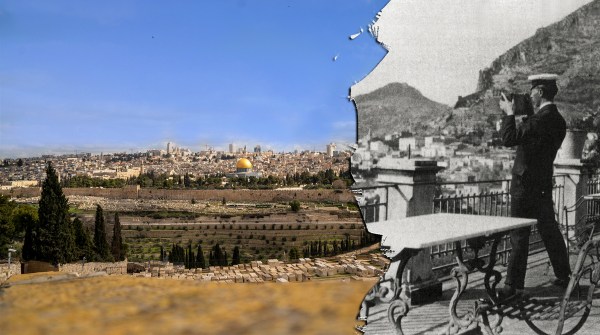
How Bible Scholars and Treasure Hunters Unearthed Modern Jerusalem

They were looking for the past. They created the present.

Christian History January 27, 2022
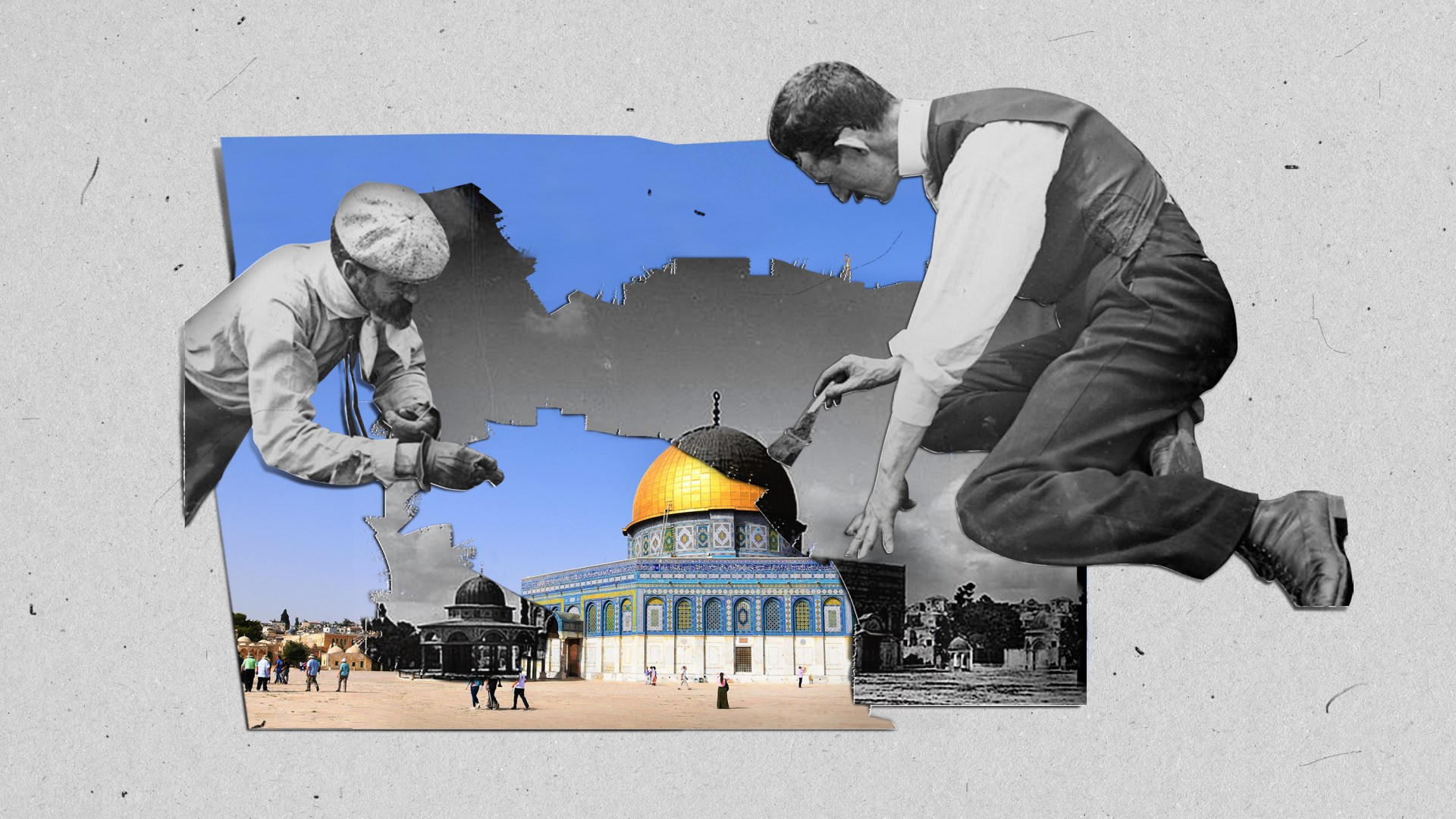
Illustration by Mallory Rentsch / Source Images: WikiMedia Commons / Gary Chapman / Unsplash

Modern Israeli leaders are unequivocal about the importance of Jerusalem to the state of Israel.

“It has been proved without a doubt that Jerusalem is the main artery of our national consciousness,” former Israeli prime minister Benjamin Netanyahu said in 2017. “The root of Zionism is in Zion.”

This wasn’t always the case. In the early years of the Zionist movement, the Jewish diaspora considered recreating a homeland in many places, from the United States to Uganda. Palestine was on the list, but many Zionists, who tended to be secular, viewed Jerusalem as a backward and superstitious place—exactly the opposite of the forward-thinking socialist nation they envisioned.

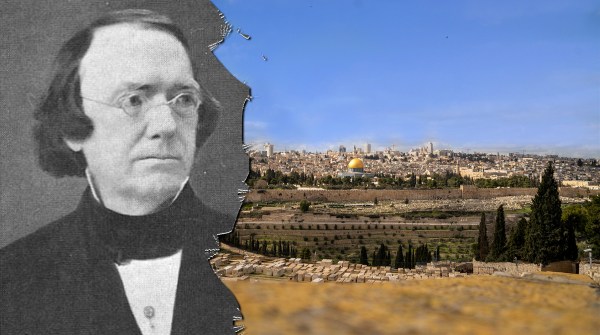
The story of how that changed starts, oddly enough, with a 19th-century Congregationalist minister from Connecticut named Edward Robinson.

When Robinson visited Germany in the 1830s, he was shocked by the discipline of biblical criticism then flourishing in Protestant universities there. Instead of treating Scripture as divine revelation, German academics subjected the Bible to the same textual criticism as other ancient documents.

Robinson was deeply concerned these scholars were calling into question what he cherished as the revealed truth of Scripture. He was worried the theological disease would spread from Germany to liberal-minded Harvard University and from there infect American Christians.

To combat this trend, Robinson hit on the novel idea of proving the veracity of places, names, and events described in Scripture. He would use the tools of science to oppose what he saw as a dire threat to the Christian faith. So in 1838, he arrived in Jerusalem armed with a compass, measuring tape, telescope, and the Good Book as his guide.

“From the earliest childhood I had read of and studied the localities of this sacred spot; now I beheld them with my own eyes,” he wrote later. “And they all seemed familiar to me, as if the realization of a former dream.”

His specific goal was to pinpoint what he called “indisputable remains of Jewish antiquity.” He hoped to see some evidence of the reign of Solomon. Or at least Herod the Great. This was no easy task, given the Roman destruction of Jerusalem in the year 70 and the subsequent centuries of war, regime change, and religious upheavals.

He was disappointed by what he found—or, rather, didn’t.

“The glory of Jerusalem has indeed departed,” he wrote. Long under the rule of Ottoman Turks, it was by then a small town crowded with the shrines of three faiths.

Undeterred, he scoured the city and surrounding countryside to match the names of buildings, wells, and villages that betrayed an echo of the nomenclature used in the Bible. He wanted to map the Holy Land, pinpointing the sites of Scripture in contemporary geography.

When he returned to New York City in 1841, Robinson and his collaborator Eli Smith published a book with the sonorous title of Biblical Researches in Palestine, Mount Sinai and Arabia Petraea. It laid out their case for the Bible’s geographical accuracy.

Edward Robinson
Edward Robinson

The tome was perhaps not an obvious bestseller, but people snatched it up on both sides of the Atlantic. For some, it wasn’t just interesting; it was divinely inspired.

“They were obeying an impulse from on High,” one British reviewer wrote. "Jehovah meant them to be witnesses of His truth.”

Whether or not their trip was divinely guided, this novel marriage of science with religion proved irresistible to millions of Christian believers. It also put Jerusalem back on the physical map for Westerners at a moment when steamships and trains made it more accessible. Robinson and Smith had laid the basis for “an entire new scholarly, religious, and political enterprise in the Holy Land,” notes historian Neil Asher Silberman.

It was an enterprise that would reshape the Middle East.

One of those inspired by Robinson was a Disciples of Christ missionary from Virginia named James Turner Barclay. After settling in Jerusalem in 1851, he heard “marvelous tales about its subterranean passages, galleries, and halls.” An Ottoman official assured Barclay that beneath the city were “the magnificent subterranean remains of the gorgeous palaces of King David, Solomon, and various other monarchs of former times.”

Barclay didn’t find many Jews interested in converting to Christianity, so he spent his time surreptitiously exploring various caves and wrote a popular book about his adventures.

A dozen years later, in 1863, the Ottoman sultan in Istanbul issued the first license to excavate in Jerusalem. It went to a French senator named Louis Félicien de Saulcy.

A devout Catholic and confidante to French Emperor Napoleon III, de Saulcy quickly discovered an ancient sarcophagus in the Tombs of the Kings, the city’s largest tomb complex, located just north of the walled Old City. Despite complaints from Jerusalem’s Jews, who accused him of robbing their ancestors’ graves, the Frenchman declared he had discovered the bones of an ancient Judean queen. He had them shipped to the Louvre. His claim later proved false, but the exhibition of the world’s first purported biblical artifact proved a public sensation.

Not to be outdone by their French Catholic rivals, British Protestants quickly organized the Palestine Exploration Fund to bring back biblical remains for the British Museum. Their star explorer was an Anglican military officer named Charles Warren, who was also a dedicated Freemason fascinated by Solomon’s temple.

Scholars presumed that temple—said to have been destroyed by the Babylonians in 586 BCE—had once stood on the city’s acropolis. Muslims call this vast rectangle held up by massive stone walls the Noble Sanctuary, while Jews know it as the Temple Mount. Digging in what has long been Islam’s third-holiest site was strictly forbidden, so Warren tunneled his way around the enormous walled enclosure, sometimes using dynamite to remove underground obstacles.

This did little to endear him to Arab Muslims, who suspected the Englishman, quite plausibly, of attempting to undermine their holy site.

Soon enough, the residents of Jerusalem saw an unexpected side effect of all this excavation: tourists. Bevies of visitors—mostly American Protestants—started flocking to the city.

Like Robinson, early Western visitors often found themselves disappointed by the Holy City. Most Jews spoke Arabic, and Muslim imams jostled past Christian priests in the narrow alleys. The place seemed at odds with the Jerusalem they had learned about in Sunday school. One contemporary guidebook warned that little was left of the “far-famed capital of the Jewish Empire.”

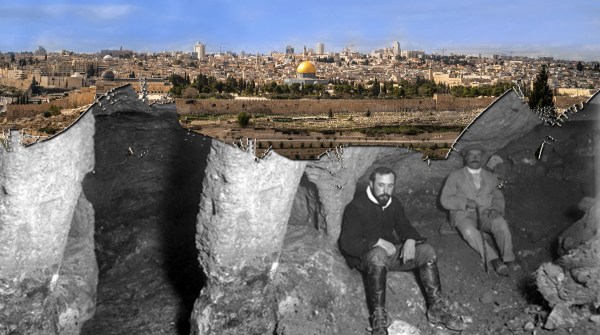
Underground tunnels in Jerusalem.

The Westerners were happier underground. Warren’s tunnels, exposing passages and rooms from the days of Herod the Great, became major attractions, satisfying tourists’ appetite for what Jerusalem was “supposed to” look like.

Soon, German and Russian archaeologists joined the British and French in probing for evidence of the ancient Judean past. These explorers sought more than proof of Jerusalem’s biblical role. They also wanted to unearth remains that were valuable materially as well as spiritually. In 1909, a British aristocrat named Montagu Brownlow Parker even assembled a team of European psychics, code breakers, and engineers to seek out the temple treasures—including the ark of the covenant—rumored to lie beneath the city.

Parker estimated the artifacts were worth $5.7 billion in today’s currency. He and his peculiar excavation team tunneled for two years but failed to find anything beyond a few potsherds. Desperate to pay off investors, he used bribes to obtain access to the Dome of the Rock on the Noble Sanctuary. Discovered hacking away at the sacred stone beneath the dome, the team fled for their lives. It was rumored—falsely—they had made off with Solomon’s riches. The incident soured Arab Muslims on both Western explorers and the city’s Ottoman rulers. The scandal that ensued nearly brought down the Ottoman government in Istanbul.

European Jews were no more pleased with the ongoing excavation efforts than the local Muslims. From their perspective, Christians were attempting to abscond with important remnants of their heritage.

Montagu Parker in Jerusalem.

“We, who should be the most interested party in these archaeological excavations, do almost nothing in this field and leave to whomever else wants it: Germans, Americans, British,” one writer complained in a 1912 Russian-Jewish newspaper article.

Edmond de Rothschild, a French-Jewish banker, launched his own expedition to find the ark of the covenant in 1913. It was the first Jewish-led effort in the Holy Land. Rothschild, who also was working to settle displaced European Jews in Palestine, was eager to beat out Christians in the hunt for ancient Jewish treasures.

“Excavations be d___,” he told a friend. “It’s possession that counts.”

That dig ended without success when World War I broke out the following year. Yet the attention lavished on subterranean Jerusalem by the early Western explorers—and the tremendous press coverage accompanying each find—nourished a growing interest in the city among those Jews seeking an independent homeland for their people.

By the time the British conquered the city in 1917 from the Ottomans, Western Jews saw Jerusalem’s ancient sites as more than simply places of prayer. They became symbols of a Jewish nation. And what had begun as a Christian effort to prove the veracity of biblical history led to the beginnings of the state of Israel.

In the wake of World War II, the British relinquished the territory to the United Nations, and the nation of Israel was born. By then, in the aftermath of the Holocaust, many Jews felt a deep yearning to make Jerusalem their capital.

After 1967, when Israel captured the Old City from Arab forces, excavations continued but under the auspices of the Israeli government. These have focused on the Judean past, and Israeli politicians have often cited archaeology to claim all of Jerusalem as Israeli territory. This has drawn complaints, prompted protests, and sparked riots by Palestinians who see the Holy City as their own.

The search for biblical Jerusalem begun by Robinson continues to stir political and religious controversy. In fact, it is this very search that has made Jerusalem the contested city that it is today.

Andrew Lawler is the author of Under Jerusalem: The Buried History of the World's Most Contested City.

Church Life

Worship Leaders Hit with Pandemic Burnout

Music ministry has always been demanding, but the past two years have made it unsustainable for some.

Christianity Today January 26, 2022
Keagan Henman / Unsplash

Dianna Holden had been looking for an opportunity to step down as her church’s worship leader for a few years. After 27 years of serving, Holden felt like she was drawing from an empty well.

“I loved the whole thing,” said Holden, “even to my exhaustion.”

She was leading every Sunday, managing other musicians, and planning every service for her 200-person church in Kelso, Washington.

“I am a devoted person and a martyr to my demise. I just go for it and try to be faithful.”

Then, as the pandemic heightened the emotional and logistical demands of her (unpaid) position, she decided it was time. In January 2021, Holden wrote in a Facebook post that she was grateful to have someone to take over the music ministry for her. She was ready to step away. She didn’t have any reserves left.

“It wasn’t something I really hated in the end,” Holden said. “I was just tired.”

The emotional and spiritual toll of pastoral work is leading many to reevaluate their places in ministry. According to a Barna study released in November 2021, 38 percent of senior pastors have seriously considered leaving full-time ministry in the past year.

“Pastors are facing more intense scrutiny and pressure,” said Mike MacKenzie, a counselor who works with pastors as the director of Marble Retreat in Marble, Colorado, and author of Don’t Blow Up Your Ministry. “We have been just inundated with calls in the last couple of years from pastors who are [saying,] ‘I’m just done. I’m just so maxed out.’”

There are unique aspects of music ministry that leave leaders particularly vulnerable to burnout. Worship pastors are spiritual leaders, performers, managers, creative directors, and tech support. Being on stage has always made them the target of critical feedback, but after the past two years, they’re finding that criticism they might have easily shaken off in the past hits a little harder.

The year 2020 obviously brought upheaval and countless logistical challenges for worship teams as churches moved their services online, stopped meeting in person, or pivoted to smaller gatherings. But the stress of 2021, worship leaders say, was more relational; they had to manage illness on their teams and make decisions about asking singers and other musicians to wear masks, all while trying to meet the increased need for pastoral guidance and counsel in their churches.

“I’ve had to shepherd people even more,” said Jen Smale, worship pastor at 29:11 Church in Tempe, Arizona.

“People think that [when] you’re a worship leader, your job is to pick out some songs and schedule some people and be ready for a weekend. That’s part of the job, but if you’re truly a shepherd or worship pastor, there’s so much more involvement in taking care of the sheep.”

While the offstage, relational aspects of the job are getting more difficult, the onstage leadership remains as demanding as ever.

After the chaos of December, those in music ministry often feel like they limp into January. Last year, Christmas Eve fell on a Friday, which meant that most worship pastors were working extra hours to organize Advent services, Christmas Eve services, and Sunday morning services for two days after Christmas. It’s a hard time to call for more help from lay leaders and volunteers, who are also busy and want a break.

Matt Collins, worship leader at Christian Family Chapel in Jacksonville, Florida, felt like his mind was endlessly running throughout the month of December, thinking through rehearsal needs or adjustments to set lists or arrangements.

“You’re just constantly kind of ‘on,’” said Collins. “It’s fun, but by the time you’re done, you’re just ready to crash.”

But taking time to “crash” or even find a few days of rest is difficult. There’s always another Sunday coming, and if there isn’t another leader who can confidently take over, a worship pastor may not feel that he or she can step away for a break.

Although she was encouraged to take a break, Dianna Holden could rarely bring herself to do it, even after the Christmas season. “I had no one to fill in,” she said.

“My pastor was like, ‘Any time you need off, take it off, [even] if we have to sing acapella,” said Holden. “My thing was the guilt.”

Especially at larger churches with bands and highly produced services, the worship pastor is often held responsible for a part of the service that involves other musicians (who may have varying degrees of experience and ability), support staff and volunteers, and equipment that may or may not work perfectly on a given Sunday morning.

“The preaching pastor has near-complete control over the presentation of the sermon,” MacKenzie pointed out, “whereas the worship pastor tends to have half a dozen people participating with him or her.”

A 2017 Gallup poll found that 74 percent of American church attendees consider music in their decision to attend services (with 38 percent saying it’s a major factor and 36 percent saying it’s a minor factor). Most worship leaders are aware that music can play a key role in gaining and keeping attendees, even if that shouldn’t necessarily be the case.

This combination of internal and external pressure leaves worship leaders with a sense of responsibility to make sure that the service goes smoothly and leads people into authentic worship.

“You’re thinking, Is the congregation entering in?” said Holden. “On top of that, you want to worship God. You want that to be your main focus. And I have to be honest: The last few years, I found it harder to worship God.”

Like Holden, who stepped away a year ago, drained worship pastors may increasingly feel like they are performing rather than worshiping. Now, she savors worshiping in the back row of her church sanctuary with no one watching or listening. “It’s beyond words. I feel very refreshed.”

Smale, who also cohosts the podcast Worship Leader Probs, often hears from fellow worship leaders about feeling unappreciated and undervalued. The podcast has a recurring segment called “Prayer Concerns” that features funny and over-the-top complaints and suggestions submitted by listeners, such as “Can the stage be less dark?” and “It would be great if you played more hymns every week.”

“People are so much more vocal about what they don’t like,” said Smale.

Helping pastors move through a period of burnout requires congregational support and personal reflection, in MacKenzie’s view. The church needs to recognize the need for its leaders to take a break after a demanding season, and leaders need to be willing to take a step back to heal and rest.

He cautions senior and worship pastors against starting the first week of January with the “big, exciting next thing” or New Year series, accompanied by a new song or two and a dynamic kickoff.

“Scale back,” said MacKenzie, “whether it’s volunteers leading worship or redoing old songs.”

The church needs to give worship pastors permission to step aside, schedule a smaller team, wait to introduce new songs, or even do fewer songs. Worship pastors need to give themselves permission to do those things as well.

“They feel guilt or fear or concern that it won’t be good enough,” said MacKenzie, “and they need to wrestle with that in themselves and say, ‘It’s going to be fine. God’s will and worship will be accomplished.’”

Church Life

Taking Kids to Church Matters More Than the ‘Right’ School, Study Suggests

Even faith-based education has less impact than religious attendance.

Christianity Today January 25, 2022
Edits by Christianity Today / Source Images: Stefanie Amm / EyeEm / Zhuo Cheng You / Unsplash

Public health expert Tyler VanderWeele, who coauthored the cover story for our November print issue, recently analyzed how four school categories—public, private, religious, and homeschool—might affect the long-term well-being of adolescents.

VanderWeele and his team at Harvard examined a large swath of data, collected over more than a decade, which tracked the development of 12,000 nurses’ children into their young adulthood. The longitudinal study surveyed social, physical, and mental health trends across the group—like substance abuse, anxiety/depression, community engagement, and sexual activity.

The team’s analysis was published recently in PLoS ONE, and some of their findings were surprising.

In comparing key health indicators, the researchers found little difference between the long-term well-being of adolescents who attended public school and those who went to private school. (All of the kids who participated were between the ages of 9-14 when the study began.)

“We didn't go in having any clear expectations, but we certainly didn't expect to find basically nothing—which is what we found,” VanderWeele said. “We found relatively little difference comparing public and private schools across a whole host of outcomes.”

There was, however, a noted difference between the kids who attended public school and those who were homeschooled.

“We found a lot of positive, beneficial outcomes of homeschooling,” VanderWeele said.

Their data showed that homeschooled kids were more likely to volunteer, forgive others, possess a sense of mission and purpose, and have notably fewer lifetime sexual partners.

Homeschoolers were also 51 percent more likely to frequently attend religious services into their young adulthood. “It is quite possible that a lot of homeschooling parents were religious or did this for religious reasons, but we unfortunately don’t have data on the content of the curriculum,” VanderWeele said.

The researchers found only one adverse effect of homeschooling: those children were 23 percent less likely to attain a college degree than public and private school kids (who had similar college completion rates in this sample). “This may point to the need [to] focus more on college preparedness,” VanderWeele commented.

Another surprise was how the public-school experience compared to private religious education. In the long list of health metrics, the team found only a marginal difference on a few outcomes—around 10–15 percent—between the kids who were sent to public school and those who attended schools with faith affiliations.

The kids who went to religious schools were marginally more likely to register to vote, less likely to be obese, and more likely to have fewer lifetime sexual partners by the time they became young adults.

On the other hand, they were slightly more likely to engage in binge drinking.

“It might be that some children feel they want to rebel if they’re going through religious schooling all of their life,” VanderWeele said. “We weren’t really able to determine why, but something like that could be the explanation.”

In adulthood church attendance, homeschooled students also came out ahead of others. The kids who went to faith-based schools were only slightly more likely to attend religious services as young adults than those who went to either secular private or public schools—and much less likely than those who were homeschooled. (Worth noting: The study did not look at faith retention among Christian students, only religious attendance among the whole group.)

Demographer Lyman Stone cautions not to interpret the results of this single study as proving a definitive causal link—to say, for instance, that homeschooling or religious schooling alone are direct causes of higher religious attendance—but to recognize that this data set is related by association.

“The link between religious schooling and adult religious service attendance—and probably homeschooling too—is causal. This study doesn’t show that it’s causal, but it is. And we know that from other studies,” Stone says, referencing older research that analyzed Catholic education in France and Islamic education.

“The environment that a child is exposed to does cause changes in their adult religious behaviors,” Stone says, and “the results [of this study] are consistent with that.”

Yet the differences between public and religious schools were much less than VanderWeele expected, based on trends he’d discovered in previous research using the same data set.

“Our prior work had indicated that religious service attendance during adolescence was really important and shaped health and well-being in all sorts of ways,” VanderWeele said. That conclusion still holds. “But the effects were much smaller with religious schooling, which was not exactly what we expected.”

“What we found was that religious service attendance makes a bigger difference than religious schooling,” he said. “Religious service attendance has beneficial effects across the different school types and has stronger effects than religious schooling.”

In other words, the kids who grew up attending church regularly rated far higher in overall well-being as young adults than those who went to a religious school but did not go to religious services during their formative years.

And while “the effect of religious schooling itself did not seem to dramatically differ comparing those who attended religious services versus not,” Vanderweele explained, “for those who went to both, religious service attendance in youth was clearly the more dominant force in shaping health and well-being, at least as this pertains to the data and experiences 20 years ago.”

In previous studies, VanderWeele had discovered that weekly service attendance in adulthood was associated with “about 30 percent reductions in all-cause mortality, 30 percent reduction to the incidence of depression, [and] fivefold reductions in suicides.”

Furthermore, “regular service attendance helps shield children from the ‘big three’ dangers of adolescence: depression, substance abuse, and premature sexual activity,” VanderWeele writes in his latest article for Christianity Today. “People who attended church as children are also more likely to grow up happy, to be forgiving, to have a sense of mission and purpose, and to volunteer.”

“So regardless of school type,” VanderWeele says, “it’s beneficial to go to religious services, both as an adolescent and as an adult.”

Books

Miracles Are Outlasting the Arguments Against Them

New Testament scholar Craig Keener investigates contemporary accounts of “signs and wonders,” while suggesting that many grounds for skepticism are behind the times.

Christianity Today January 24, 2022
Illustration by Mallory Rentsch / Source Images: Roc Canals / Getty / Manuel Keller / Unsplash

In the halls of the academy as well as on the street, there is no more controversial aspect of the Bible than its accounts of miracles. Skepticism about supernatural intervention in human affairs—rooted in the Enlightenment, especially the writings of philosopher David Hume—has become mainstream in the modern mind. At the same time, however, there is a growing body of documented evidence, as well as compelling stories by credible witnesses, of miracles taking place.

Miracles Today

Miracles Today

Baker Academic

304 pages

Ten years ago, prominent New Testament scholar Craig Keener assembled a large collection of this evidence in his two-volume work Miracles: The Credibility of the New Testament Accounts, and he returns to the topic in his latest publication, Miracles Today: The Supernatural Work of God in the Modern World. Freelance writer and editor of The Worldview Bulletin Christopher Reese spoke with Keener about the reasons for widespread skepticism of miracles and about some of the amazing stories his new book recounts.

You wrote a two-volume book on miracles in 2011, a topic you revisit in this current book. Why has this been an important subject for you to write about?

My regular job is as a New Testament scholar, and one of my interests is historical study about Jesus and his first followers. Sometimes critics have dismissed miracle stories in the Gospels and Acts simply because they recount miracles. (They often do make exceptions for potentially psychosomatic cures, but normally not for instant healings of blindness, raisings from the dead, or stilling storms.) The idea is that such reports must be legends that couldn’t really go back to eyewitnesses.

Yet I always found that approach problematic, since I know of many eyewitness reports like this in my own circle and have witnessed some events like this myself. In my two-volume book, I was seeking to challenge the prejudice against eyewitness claims to miracle events of this sort.

Unfortunately, that book is 1,100 pages long, so most people never had time to read it. For that reason, it seemed important to revisit the subject with a much shorter, more readable book. To make it more accessible, I condensed the philosophic and other material and elaborated specific accounts (which I tried to keep short, like many New Testament accounts!). Among these, I favored especially those with multiple witnesses, with special appreciation for when doctors were witnesses.

What is your definition of a miracle?

There is no universally agreed-on definition (our term does not correspond exactly to biblical terminology), but probably the most useful one, with abundant historic warrant, is “special divine action”—although that definition may require some defining itself.

Believers recognize God’s activity in all creation; existence, life, and DNA are all larger expressions of divine action than most miracle accounts I report. These are so pervasive and happen with such regularity that people consider them “ordinary.” In the Bible, though, God also acts in special or “extraordinary” ways in history and people’s lives to reveal himself and get people’s attention.

We may not always be able to clearly define the boundaries between “general” and “special” divine action, since even in special events (such as the parting of the sea in Exodus) God may use ordinary causes in extraordinary ways. (Exodus says God blew back the sea with a strong wind.) But plenty of events are extraordinary enough that virtually any observer would consider them “special” or “extraordinary.” When God uses such events to draw attention to his message, we usually call them miracles.

Why do you think contemporary Westerners are so skeptical that miracles happen or are even possible?

The roots go back to the radical Enlightenment, but the idea was popularized especially by David Hume’s essay against miracles, which took over some deist arguments of the day. Many people today take for granted the assumptions he published without always realizing the historic source of their assumptions.

Hume’s essay falls into two parts. In the first, according to what I think is the most straightforward reading, he defines miracles as violations of natural law. He also defines natural law as something that can’t be violated. Therefore, his very definitions effectively define miracles out of existence. His idea of natural law borrows from Isaac Newton and early proponents of Newtonian science. They, however, believed not only that God established nature’s laws but also that he transcended them and could act within nature as he pleased.

The second half of Hume’s essay essentially argues that uniform human experience should predispose us to doubt all claims about miracles. This argument begs the question, however, of how uniform human experience is. Even in his own day, Hume cites the medically documented healing of Blaise Pascal’s niece in front of many witnesses. How does he respond to it? Basically, he simply remarks that it’s unbelievable and moves on.

Hume’s access to knowledge of human experience was far more limited—though sometimes self-limited—than what we have available today. I don’t think that even Hume would have attempted to argue his case from uniform human experience today. Pew and other surveys show that hundreds of millions of people in the world today claim to have witnessed miracles. Other sources indicate millions of people converted at great social cost from different ancestral traditions because they believed they witnessed or experienced extraordinary miracles, beyond their indigenous healing traditions, in the name of Jesus.

How do biblical scholars in the mainstream academy tend to treat the miracle accounts in the New Testament?

With respect to belief in actual miracles, that depends on the scholar. Biblical scholars today span a spectrum of theological and philosophic beliefs, and their personal approach to the reality of special divine action varies no less. Because “divine action” is considered a theological or philosophic claim, our polite discussions of New Testament history often leave it off the table.

But the question of divine action differs from the historical question of ancient experience and interpretation. Many mainstream scholars accept a core of historical tradition in many New Testament miracle accounts. In fact, a strong majority of New Testament scholars, regardless of their personal theological convictions, affirm that Jesus was experienced by his contemporaries as a healer and an exorcist.

Jesus’ healing activity appears in every stratum of gospel tradition, is acknowledged by his ancient detractors, is attested by the first-century Jewish historian Josephus, and is consistent with reports of his followers’ activity in Acts and over the next few centuries. Paul speaks of signs and wonders following wherever he was breaking new ground for the kingdom (Rom. 15:19) and appeals to his own audience’s eyewitness testimony of them (2 Cor. 12:12). By every criterion of historical investigation, Jesus appears as a healer and exorcist. Whether scholars attribute this only to something like psychosomatic experiences or whether they are willing to consider special divine activity depends on the particular scholars and their approach.

You mentioned witnessing the miraculous firsthand. Can you share the details?

I have witnessed some events firsthand that, I think, most people would consider miraculous. When I was a young Christian helping at a nursing-home Bible study, one wheelchair-bound woman complained every week how she couldn’t walk. One day the Bible study leader, someone from Fuller Theological Seminary, took her by one hand and commanded her in Jesus’ name to rise and walk. To both her astonishment and mine, he led her around the room. From then on she happily walked to the Bible study.

When I was a new seminary professor, the campus ministry scheduled an outreach on the attached undergraduate campus. On the scheduled day, however, it was pouring down rain, and the forecast said it was going to pour down rain all day. A sophomore biology major led us in prayer for the rain to stop, and just after we said “Amen,” it stopped. Then the sun came out for the rest of the day.

So I have accounts like that. But they pale in comparison with many other accounts in the book, especially in the chapters dealing with medical documentation, instant healings of blindness, raisings from the dead, and so forth.

You relate accounts in the book of many modern-day miracles. Which one stands out to you as the most remarkable?

That is always a hard question for me, because there are so many that are remarkable in different ways. One of the first in the book is that of a young woman on her deathbed, almost completely paralyzed from multiple sclerosis. She heard Jesus’ voice calling her to rise and walk, and she was instantly healed so thoroughly that she didn’t even have to contend with atrophied muscles. All three of her doctors have confirmed the account in writing, laying their own reputations on the line. She lived for 40 more years with no recurrence, passing away only recently from COVID-19, much to the sorrow of those of us who knew her.

Another story is of a woman blind for 12 years, instantly healed during prayer, a fully documented case now written up in a medical journal. There are some others so remarkable that I initially hesitated to include them in the book, lest someone disinclined to believe them would discount all the others.

One account that I almost always share is the one that some years ago began shifting my own perspective. There’s no medical documentation, because it happened in a place where no doctors were available, which was probably partly why a miracle was needed. I had heard the story before, but it was when I interviewed Antoinette Malombé in Congo that I learned the details. Malombé’s two-year-old daughter Thérèse cried out that a snake bit her; Malombé found her not breathing, and she ran for about three hours with the toddler on her back to where a family friend was doing ministry. He prayed, and Thérèse began breathing again; the next day she was fine. Even though irreparable brain damage starts after just six minutes without oxygen, Thérèse had no brain damage; she later achieved a master’s degree and just recently retired from ministry.

This is far from the most dramatic case, but it got my attention because Antoinette Malombé was my mother-in-law, and Thérèse is my sister-in-law. Not to doubt one’s mother-in-law, but we confirmed the story with the family friend who prayed for her.

Most of the miracles you recount in the book are healings of various kinds. Have you discerned any pattern as to why healing does or does not take place?

In terms of patterns, most healings and other miracles recounted in the book appear in the context of people praying for them to happen. It shouldn’t surprise anyone that they happen more often among people who trust God enough to ask, recognizing that he is able to act. Also, the most dramatic miracles happen most often (though not by any means exclusively) on the cutting edge of evangelizing unevangelized areas, a setting similar to the one in the Gospels and Acts. They also happen where they are most needed—not to entertain us, not to get us to neglect other resources God has provided, but because of the Lord’s compassion for our need.

As in the Gospels, healing also often follows persistent or desperate faith. But also as in the Gospels, initial or deepened faith sometimes follows God’s special divine action. And there are cases today where people have to show their great faith by trusting God despite not experiencing healing right away or even in this life at all. Indeed, God’s power is displayed especially in weakness—most visibly in what for a time seemed the triumph of evil at Jesus’ cross. Some of the people who have witnessed the most miracles prayed for them for months or years before they began to see them—maybe so they would learn persistent faith or perhaps so they would learn that it is God’s grace, not who we are, that makes them happen.

But these observations are not a model for prediction in a given case. God remains sovereign. When my friend Leo Bawa was doing research in a Nigerian village, people there asked him to pray for their dead child; after a couple hours of prayer, he handed the child back to the parents alive. But the only other time Leo prayed for someone who died, it was his best friend, and the friend stayed dead.

When cardiologist Chauncey Crandall prayed for and shocked Jeff Markin, who had been flatlined for 40 minutes, Markin was restored. But when Crandall’s own son Chad earlier died of leukemia, Crandall had to determine that he would trust in God no matter what.

The greatest 19th-century heroes of faith like Hudson Taylor are no longer with us; sickness and death remain. My wife and I experienced many miscarriages. Before our marriage, she spent 18 months as a refugee. God has been good to us, but we are also keenly aware of the reality of suffering in this world, and suffering will continue until Christ’s return to put all the world right. Miracles get our attention, but they are not a panacea for all the world’s problems.

Skeptics often insist that if they could witness a miracle themselves, they would embrace religious belief. Is this how skeptics who were personally involved in the stories you cite have typically responded—by embracing faith?

It’s all across the board. When I was an atheist a few decades ago, witnessing a miracle probably wouldn’t have converted me instantly, but it sure would have gotten my attention and turned me into an inquirer. Some sources for the book were converted through witnessing miracles, such as the healing of their paralysis or the raising of their child many hours after he was pronounced dead. Some friendly skeptics who have not been converted by their “anomalous experiences” have admitted that this has made them more open-minded about possibilities. But I also have a couple skeptical friends who have told me that they wouldn’t believe even if somebody were raised from the dead in front of them.

This spectrum fits pretty much what we see in the Bible. When Jesus raised Lazarus, some people believed, but others ran and warned Jesus’ enemies what had just happened. Jesus’ enemies already had their minds made up not to believe him. Despite seeing the pillar of fire and the sea parted for the Israelites, Pharaoh’s army pursued them into the sea. Pharaoh still expected his own gods to be stronger than Israel’s God. We might say that he and Moses had different theological presuppositions.

Although John’s gospel reports that Thomas got to see the risen Lord, it goes on to explain that it offers testimony for the sake of those who didn’t get to see him (John 20:28–31). God has provided evidence already, and Jesus warns that those resistant to faith will not be converted even if someone returns to them from the dead (Luke 16:31). Nevertheless, for those who are open-minded, miracles can get their attention.

Not everybody experiences physical healing in this life, but when God does any miracle, it’s a gift to every one of us. That is because it’s a confirmation to us of God’s promise of a world made new—of the day when he will wipe away our tears and when death and suffering will be no more. Until then, as people of his kingdom, we keep working for people’s health and security in every way available to us, through medicine, through food, and, sometimes, through prayers for miracles that God hears and answers.

addApple PodcastsDown ArrowDown ArrowDown Arrowarrow_left_altLeft ArrowLeft ArrowRight ArrowRight ArrowRight Arrowarrow_up_altUp ArrowUp ArrowAvailable at Amazoncaret-downCloseCloseellipseEmailEmailExpandExpandExternalExternalFacebookfacebook-squarefolderGiftGiftGooglegoogleGoogle KeephamburgerInstagraminstagram-squareLinkLinklinkedin-squareListenListenListenChristianity TodayCT Creative Studio Logologo_orgMegaphoneMenuMenupausePinterestPlayPlayPocketPodcastprintremoveRSSRSSSaveSavesaveSearchSearchsearchSpotifyStitcherTelegramTable of ContentsTable of Contentstwitter-squareWhatsAppXYouTubeYouTube