Books
Review

Disowning ‘Evangelical’ Is a Denial of Responsibility

If our movement is carrying reputational baggage, then we have no choice but to own it.

Illustration by Jarred Briggs

Not long ago, I asked Tim Keller to give a guest lecture in a university class I teach, in which nearly all the students come from secular backgrounds. Most have no contact with evangelical Christianity other than what they’ve seen in the news. After rehearsing some of the reputational damage evangelicalism had sustained, especially in the post-2016 cultural environment, one student asked, “Why not just get rid of the word evangelical and call yourselves something else?”

Struggling with Evangelicalism: Why I Want to Leave and What It Takes to Stay

Struggling with Evangelicalism: Why I Want to Leave and What It Takes to Stay

IVP

208 pages

$10.76

Keller deadpanned: “Because most of us are in Africa, Asia, and Latin America and like the word evangelical just fine. North Americans aren’t entitled to choose what we’re called.” I wondered if being called out for a kind of “America first” colonialism would disorient these students, but instead I saw nodding heads and expressions that seemed to say, “Fair enough.” What I saw as most important in that exchange was not the pros and cons of the word evangelical but the subtle and searching use of the word us.

I thought of that exchange as I read Struggling with Evangelicalism: Why I Want to Leave and What It Takes to Stay, a new book from Dan Stringer, an Evangelical Covenant Church pastor and an InterVarsity campus minister at the University of Hawaii. Stringer comes at the subject with wide-ranging connections to American parachurch evangelicalism (he’s a graduate of Wheaton College and Fuller Seminary, for instance). His publisher bio describes him as “a third culture kid” who grew up “in five countries on three continents,” while the book jacket speaks of a “lifelong evangelical who happens to be a biracial Asian/White millennial.”

Owning our baggage

The book begins with Stringer establishing his evangelical bona fides—though not in the sense of Paul’s “of the tribe of Benjamin, a Hebrew of Hebrews” self-depiction in Philippians 3:5. Stringer instead clarifies that he is not an exvangelical turning his back on the movement. Unlike those rattled, say, by the 2016 election or the sexual abuse scandals, Stringer admits to having been conflicted about evangelicalism from the start.

As someone who came to evangelicalism from a United Church of Christ background while living outside of a North American context, Stringer notes that, in some ways, he was never a natural fit. And yet despite that—or maybe because of it—he quickly immersed himself in evangelical culture, from McGee and Me! tapes to DC Talk and Audio Adrenaline albums.

Stinger refers to evangelicalism as his mother, describing his resemblance to the hatchling in the P. D. Eastman book Are You My Mother? “Not only was I searching for evangelicalism,” he writes, “I was searching for myself.” That search goes on, with an ambivalence that combines love for the movement with distress at what significant parts of it (at least in the United States) have become.

Readers shouldn’t expect a treatise directed toward those tempted to walk away from Jesus or advice on continuing to love Jesus while exiting the church. Instead, this book mainly addresses the kinds of questions my non-Christian students were asking—questions touching on the confusion increasingly felt by evangelical Christian students (and their parents) all over the country. Why would someone embrace a designation that can describe both John Perkins and Paula White, both Jim Wallis and Robert Jeffress, both Kenneth Copeland and Shane Claiborne, both TBN and TGC?

Stringer’s argument here is unique and compelling. He does not seek to wage a “war for the soul of evangelicalism,” deeming some as winners and exiling the rest. Nor does he seek to argue that “real” evangelicals are better than the hucksters and heretics who get so much media attention. Instead, Stringer argues that abandoning the word evangelical amounts to a denial of responsibility. This is because he understands evangelicalism as a kind of “common space.”

“Once we re-envision evangelicalism” this way, he writes, “we start noticing how its well-being impacts residents.” He likens the evangelical space to a neighborhood with increasing crime rates or a water system contaminated with poison, arguing that we can’t wave away charges of corruption by pointing back to some idealized version of ourselves. Refusing the evangelical label, he contends, is refusing to “own our baggage.”

Stringer defines the evangelical space doctrinally (through markers like the Bebbington quadrilateral) and sociologically (with reference to Kristin Du Mez’s writings on white evangelicalism as primarily cultural). But his definition also lumps in aspects seemingly so trivial that we often pass them by (knowing what a “hedge of protection” is, for example). While it’s true that evangelicalism often assumes a cultural identity rather than a theological identity, one wonders whether this “splitting”—especially by sociologists and historians—is all that accurate. After all, even when a shared theology is virtually absent (few are discussing justification by faith while waiting to be baptized by Benny Hinn at the Jordan River stop on the Holy Land tour), at least some theological continuity is assumed.

Stringer is right that we evangelicals bear responsibility, at least to some degree, for the confused state of the word. After all, for a long time we have counted on defining it as broadly as possible for various strategic reasons. Sometimes, the goal is maintaining cultural influence. The Religious Right’s “moral majority” branding sought to portray the “real America” as an America of born-again believers and values-voting fellow travelers, thus implying that the nation’s “secular humanism” was the result of a tiny minority of coastal elites frustrating the will of the people.

At other times, the objective is furthering our evangelistic witness by showing that following Christ might be countercultural but not crazy. We might embrace our image as “Jesus Freak” outsiders, but we also love pointing to business leaders, Hollywood actors, and politicians who claim membership in our movement. (In some ways, this mentality—“Look how many of us there are!”—harkens back to the practice at some evangelistic crusades of “priming the pump.” During the altar call, trained volunteers would leave their seats and walk to the front, hoping to convince the hesitant that it was safe to join in.)

Confused understandings of evangelicalism also encourage us to point to large numbers of fellow evangelicals around the world, but without wondering how much commonality there really is between an Anglican in Sydney and a prosperity-gospel Pentecostal in Quito. We can hardly maintain this sort of “open borders” approach to evangelicalism as a means of demonstrating our bigness while protesting when people keep lumping us in with those we consider foreigners to Zion.

While Stringer is perceptive in discussing evangelicalism’s present baggage, he is less clear on how, precisely, we ought to own it. Suppose we recognize the harm done by toxic forms of evangelicalism—what then? The Roman Catholic Church could, if it wanted, excommunicate the bishops and priests who have sullied the church’s name. But evangelical movement can’t do that—unless by “excommunicate” we mean exerting our energies in the arenas of public relations and media to deny the evangelical label to those who use it in ways we believe harmful.

However we presume to set these boundaries, what makes us think those on the losing side would willingly hold themselves accountable to anything dictated by the victors? That would bring us right back to the course Stringer rightfully rejects as unproductive: shedding the word evangelical to avoid being tainted by a compromised brand—or, even worse, just giving up and providing cover for those who wish to use the gospel as a vehicle for political mobilization, financial grifting, or ethno-nationalist populism.

Moreover, Stringer argues persuasively that opting out of evangelicalism is itself an aspect of majority-culture privilege. After all, he notes, when Muslims and Mormons face scandal or stereotypes, they can’t just change their name to boost their favorability ratings. He rightly observes that a refusal to be named “evangelical” can easily fall back into the fundamentalist assumption that only we are true Christians. And from there, it’s only a short step to dissolving any boundaries between being a Christian and being “one of us.”

Stand and stay

“Make no mistake: there’s a big mess to clean up in American evangelicalism,” Stringer writes, “but it starts with admitting we live here.” As he explains it, that means being aware of both the strengths of our evangelical heritage (which he appreciates without resorting to PR-style spin) and our sins (which he describes without delving into cynicism). And while declining the exvangelical option himself, he models compassion and empathy for the leavers.

While most of Stringer’s suggestions for renewal are compelling, a couple seem better suited to the United Church of Christ than evangelicalism. This includes changing the lyrics of “Hark! The Herald Angels Sing” to be more gender inclusive. We have many examples of evangelical men mistreating and ignoring women; fixating on Charles Wesley feels like a case of misplaced priorities.

I wonder, too, if Stringer expects too much of evangelicalism, which is ultimately a generic descriptor, not a covenant body. After all, the church—not evangelicalism—is our mother. Maybe evangelicalism can be, at best, a very good teacher, sending us back home to Mother in the afternoon but never trying to replace her.

That said, Stringer’s book offers a hopeful charge to evangelicals (whatever they want to be called) to stand and to stay, to cultivate the evangelical shared space, and to leave it better than we found it. To that, I find myself, like my students, nodding and saying, “Fair enough.”

Russell Moore leads the Public Theology Project at Christianity Today.

Books

5 Ways Nonbelievers Are Drawn to God Without Knowing It

How the Bible’s doctrine of humanity gives us hope for reaching even the hardest of hearts.

Priscilla Du Preez / Unsplash

Daniel Strange has spent years helping Christians connect their faith to an increasingly secularized culture, first from his teaching post at London’s Oak Hill College and currently as director of Crosslands Forum, a new center for cultural engagement and missions. In his latest book, Making Faith Magnetic: Five Hidden Themes Our Culture Can’t Stop Talking About … And How to Connect Them to Christ, Strange discusses five “itches” everyone is looking to scratch—five needs we all share and that only Christ can fulfill. Evangelist Glen Scrivener spoke with Strange about how this framework can aid our outreach to nonbelievers.

Making Faith Magnetic: Five Hidden Themes Our Culture Can't Stop Talking About... And How to Connect Them to Christ

When we think of evangelism, we usually think of people who need to begin a relationship with God. In your book, though, you say everyone is in a relationship with God already. What do you mean?

Often in evangelism, we worry, “How can I make any kind of connection?” We need to realize what the Bible says about people. All people are in a covenantal relationship with God. It’s not always a good one, but they are in a relationship with the God who created them.

I’m not naive. I recognize there are levels of hardness of heart. I don’t deny that at all. And that hardness can be culturally specific and bring with it certain challenges depending on the culture. But we need to remember there are universal truths the Bible declares about human beings. For instance, the Bible says they are “without excuse” regarding their capacity to know God (Rom. 1:20). It says this because they—humanity—are all in a relationship with him. I mean they know him, and yet they don’t know him—it’s a paradox. But it’s also a point of connection we can use.

You mentioned the phrase “without excuse” from Romans 1. How should this chapter shape our thinking about outreach?

Humanity is playing a cosmic game of hide-and-seek. And we think that God is hiding while we’ve honestly been looking for him. But according to Romans 1, we’re the ones who are hiding, and God is jumping up and down and Christ is saying, “Here I am.” It can’t be clearer.

And that means that in evangelism, there is always an unmasking that has to happen—not God’s unmasking but ours, because we are the ones hiding. We “suppress the truth,” as Romans 1 puts it (v. 18). And Paul says, “God’s invisible qualities—his eternal power and divine nature—have been clearly seen, being understood from what has been made, so that people are without excuse.”

I appreciate the point made by missiologist and theologian J. H. Bavinck, Herman Bavinck’s nephew: Even though we suppress the truth, we have both a sense of dependence and a sense of accountability. In Bavinck’s thinking, those realities—dependence and accountability—are inescapable. We all experience them, even as we suppress them. And so Bavinck takes those two realities and derives from them five points, five implications of what it means to be made in the image of God.

You describe these five realities as “magnetic points.” In other words, they are inescapable aspects of living in God’s world and they are—or they ought to be—attracting us to Christ. What are the five magnetic points?

The first one is called totality. It’s the idea that we want to be connected to something or someone. On the one hand, we think of ourselves as insignificant, just a speck in the universe. But then we connect with something or someone—it could be a particular cause or my national identity or an LGBT rally or a comic convention. And when we get that sense of connection, we suddenly realize we’re significant. So we’re all asking, how do we find this connection?

Secondly, there’s the norm. Is there a right way to live? We all have standards and rules, even though they might not be Christian rules. In other words, there’s a norm we’re measuring ourselves against. We see this, for instance, in the dynamics of contemporary “cancel culture”—whatever we might think of the norms being enforced, they are certainly being enforced. Another example I give in the book is goth culture, where everyone has to be different in the same way. A student recently told me that apparently, if you’re an experienced goth, you can wear baby pink, but if you’re new to the goth world and you wear baby pink, you’ll be seen as an outsider. So we’ve all got these norms.

The third magnetic point is deliverance. Meaning, is there a way out? We all think there’s something wrong with the world, but the reason we think it’s wrong and the form of deliverance we hope for are completely different. And in an ultimate sense, we still ask whether we can be delivered from death itself.

The fourth point is destiny—this interplay we experience between feeling like we are puppets and feeling like we have freedom. J. H. Bavinck has this great line that says, essentially, “We both lead and undergo our lives.” Am I in charge, or am I simply the result of my DNA, my educational system, my ethnicity? People who’ve got no time for God will often talk quite superstitiously about how things are meant to be for them—their destiny.

Then the final magnetic point is kind of a supermagnetic point: transcendence. Which means: Is there a way beyond? Who is the one who connects all these magnetic points? Who’s the one who gives us the norm? Who’s the one who gives deliverance? And who’s the one who’s ultimately in control? In the book, I talk about secularized religious experiences. They make us ask questions like: Are John Lennon’s “Imagine” lyrics right? That “there’s no heaven,” and “above us, only sky”? Or is there something else?

Now the exact nature of these magnetic points will differ in different cultures, and we need to understand that. But I’m arguing that these are universal questions, and each of them are answered in Christ.

Which brings us to the second part of the book. How does Jesus answer the five points?

This is very important. We must get to talking about Jesus. He is the way to connect: the Vine himself. He is the way to live: the Way himself. He is the way out: the Resurrection and the Life. He is the one in perfect control: the Good Shepherd. And he is the way beyond: the Light of the World—the great I Am. No wonder Jesus can say, “When I am lifted up from the earth, [I] will draw all people to myself” (John 12:32). He is the “Marvellous Magnet,” as Charles Spurgeon called him, and the magnetic points all lead to him.

What are some of your hopes for the book?

Christians seeking to share their faith want to know: How do we get traction? In our conversations with others, how do we connect? Actually, the Bible gives us a doctrine of humanity that tells us there will always be a point of contact in any kind of culture. There are universal “itches” to scratch.

We need to think deeply about what they are—for our own sake as much as theirs. And then we can ask: How does Christ relate to these? As for the results? At the end of the day, it’s only the Lord who can make a dead heart alive, but I hope people find this framework helpful as they give a reason for the hope they have.

Theology

My Boss Is a Jewish Construction Worker

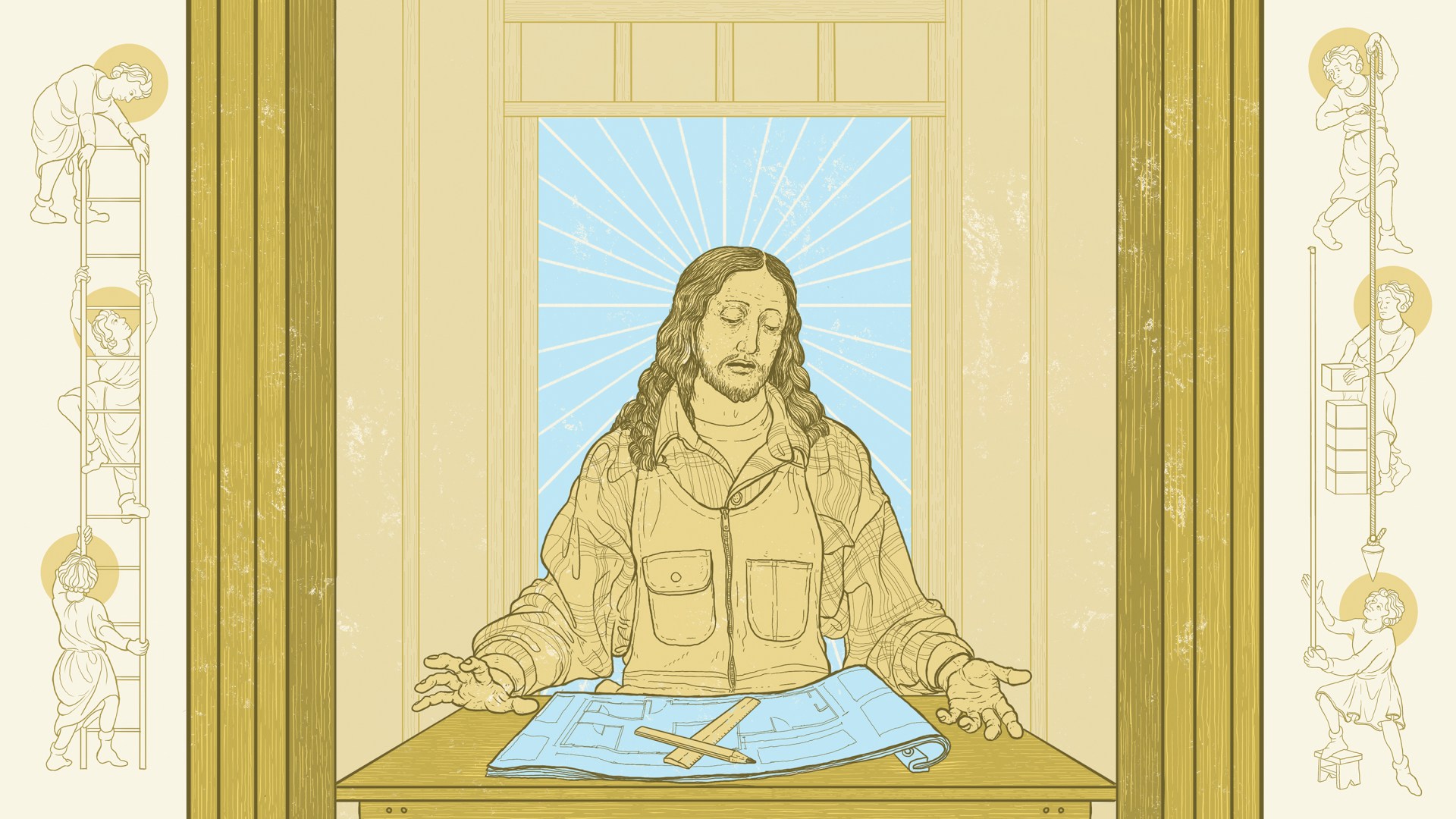
Our popular imagining of Christ as a woodworker obscures a richer story.

Illustration by Scott Aasman

When John Everett Millais began the painting that would launch his career as one of 19th-century England’s most prominent artists, he needed props. He envisioned a young Jesus surrounded by his parents, Joseph and Mary, in their working-class carpenter’s shop. It would be a new kind of scene: serene, overindulged with religious symbolism, yet done in a style no one was expecting.

But Millais had a problem. The 20-year-old was not a working-class man. His parents were old money and he lived in Bedford Square, one of the toniest neighborhoods of central London. He could not simply wander over to his father’s garage and sketch what he saw.

So he set out into the nearby cobblestone streets for inspiration. A woodworker on Oxford Street let Millais recreate his shop on canvas in painstaking detail—workbench, wood shavings, and all. A butcher gave the painter two sheep’s heads that he replicated in fields visible through the holy family’s doorway.

The resulting painting, Christ in the House of His Parents, was completed in 1851. It placed a redheaded Christ at the center of a poor family with shabby clothes and shoeless, dirty feet. And it shocked England. For some, the image was so realistically ordinary it bordered on blasphemy. Charles Dickens hated it. Queen Victoria heard so much rumbling that she had it brought to Buckingham Palace so she could see it herself.

People objected to almost everything Millais painted in that carpenter’s shop. The one thing no one questioned, however, was his assumption that Joseph ran a carpenter’s shop in the first place.

Few would today, either. Even people who know little else of Jesus grasp the idea that he, like his father, was a carpenter. From “My boss is a Jewish carpenter” bumper stickers to the names of woodworking businesses to church signs to best-selling apologetics books, Jesus-as-carpenter is ubiquitous. Johnny Cash wrote a song about it in 1970, imagining how well-built the Savior’s furniture must have been. Mel Gibson hinted that Jesus invented the modern table and chairs in his film The Passion of the Christ. (“Tall table, tall chairs!” )

There is obvious poetry in the image of a carpenter, not lost on countless lyricists: A man begins his calling with lumber and nails and fulfills it nailed to a cross.

Unfortunately, carpentry as we think of it was not Jesus’ trade. It is a misperception born of the imprecision inherent in Bible translation and the ethnocentricity of 17th-century England. We have long known this. But a more accurate story has never permeated the cultural mainstream, and our understanding of the life of Christ has suffered for it.

If you had to surmise Jesus’ trade based solely on his teaching illustrations and vocabulary, you might make some informed guesses.

He spoke constantly of agriculture: crops, weeds, farmers, fields, seeds, fruit. Working the land was the primary vocation in first-century Nazareth, and agricultural examples connected with nearly all audiences. But the biblical text, early church tradition, and even apocryphal writings agree: He was not a farmer.

Illustration by Scott Aasman

Jesus spoke of fishing. At least a third of his disciples were fishermen. It’s not groundless to imagine he had something to do with the fishing economy.

But when Jesus told the fishermen to cast their nets to the other side of the boat, they tried not to scoff at his outsider’s lack of knowledge of their profession. (The surprise would be theirs.)

Curiously, one trade Jesus never spoke of is carpentry. He hardly mentioned wood at all.

In all four Gospels, he only referred to wood as a material twice. In the first instance he asked, “Why do you look at the speck of sawdust in your brother’s eye and pay no attention to the plank in your own eye?” (Matt. 7:3). The second is a reference to a green or dry tree in Luke 23:31, but it’s not especially relevant to woodcraft.

So for a supposed carpenter, we have only one mention of workable wood from Jesus.

Even so, that plank from the Sermon on the Mount is sometimes invoked in connection to Jesus and carpentry. At the least, it is not the kind of wood a furniture-builder or toolmaker would use. In the Greek, as many hypocrisy-focused sermons have noted for emphasis, the kind of planks Jesus spoke of were thick timbers meant to support roofs in larger building projects.

It’s not surprising that a Galilean didn’t talk much about wood. Galilee had few trees, and the trees it did have were small. Beams and timbers had to be imported from surrounding countries. And only the biggest-budget projects—like temples and government buildings—could incorporate these planks.

In 1 Kings 5, for example, Solomon went to extreme lengths to acquire timber for the construction of the temple. He negotiated with the Phoenician king of Tyre and Sidon, sending Israelite men by the tens of thousands to learn how to cut down trees and then to actually do the work of cutting, because “we have no one so skilled in felling timber as the Sidonians” (v. 6).

The Israelites had to go abroad precisely because they did not have the trees locally. It’s hard to be a carpenter in a place with so little wood.

Jesus may not have spoken much of wood, but there is one material about which he could not stop talking: stone. This, Jesus and his contemporaries had in abundance, and they built with it.

He spoke of it constantly, particularly of its use in large building projects: towers, foundations, cornerstones, rocks, walls, millstones, temple stones, and winepresses.

When Jesus reached for a metaphor or symbol, stones and building projects filled his semantic toolbox. If those praising him were silent, even the stones would cry out (Luke 19:40). The one who hears his words and does them is like the person who dug deep and laid their foundation on the rock (Matt. 7:24). “Which of you, if your son asks for bread, will give him a stone?” (v. 9, emphasis added).

His disciple Simon’s nickname was not Cedar or Timber, but Cephas in Aramaic and Peter in Greek, which both mean “rock”: “And I tell you that you are Peter, and on this rock I will build my church, and the gates of Hades will not overcome it” (Matt. 16:18).

And when Jesus chose to cite the Jewish Scriptures about his mission on earth, stone came to the foreground: “The stone the builders rejected has become the cornerstone” (Mark 12:10, from Psalm 118:22).

Jesus’ imagination was saturated with stones, rocks, building projects, and foundations. It was nearly devoid of wood.

It’s an odd thing, then, that our translations call him a carpenter. Did we get it wrong?

The New Testament records Jesus’ vocation only once, in Mark 6:3: “Isn’t this the carpenter? Isn’t this Mary’s son and the brother of James, Joseph, Judas and Simon? Aren’t his sisters here with us?” The word carpenter is translated from the Greek word tektōn, a word that lives on for us in English words like architect (literally, “chief builder”).

Scholarly dictionaries identify tektōn as “one who uses various materials (wood, stone, and metal) in building” and “one who makes, produces” and “one who constructs, builder, carpenter.”

“From our cultural perspective,” said James C. Martin, author of A Visual Guide to Bible Events, “the vocation of Joseph and Jesus would be understood as ‘a builder.’ This would include all aspects of building including materials such as stone, wood, mud thatch, plaster, tiles, nails, etc.”

Craig Keener teaches New Testament backgrounds at Asbury Seminary and has a forthcoming commentary on Mark. He said that “the term [tektōn] was never limited to woodworking in any case; it simply designates a constructive craftsman.”

Scholars are still debating the implications. Keener points to one of his graduate students, Matthew K. Robinson, whose forthcoming article in the peer-reviewed journal Neotestamentica argues the carpenter interpretation has been overused and the most accurate term for Jesus’ occupation is “builder-craftsman.”

Illustration by Scott Aasman

And as a rule, craftsmen—handymen, if you will—tend to use materials that work, that are readily available, and that are not prohibitively expensive. In Nazareth, this meant stone.

An early church tradition recorded by Justin Martyr has that Jesus made and repaired plows and yokes, which were made of both wood and metal. It certainly fell to the local tektōn to do this work. But it wasn’t a living.

In a small agrarian village with a few hundred inhabitants, Robinson points out, there simply wasn’t enough need of those implements. The local tektōn made his living in bigger projects, supplementing with smaller side tasks, just as a building contractor would today.

According to biblical studies scholar Ken Campbell, ancient translations recognized the broader use of this term as a “builder” who would be skilled with numerous materials. With one influential translation, however, this was all but forgotten.

In 1611, when the King James translators arrived at the word tektōn, they saw that the Greek term clearly meant something like a craftsman or builder.

But they had two things working against them. For one, their knowledge of Greek was primarily classical Greek, the older Greek of Homer and Plato that developed in Greece. And Greece had trees.

Mark, though, was not steeped in the Greek classics. His use of tektōn, Robinson argues, was colored by the Septuagint—the Greek translation of the Old Testament—which is cited more often in the New Testament than the original Hebrew.

Campbell, who used to teach at Belhaven College, helpfully explained this linguistic hairsplitting in a 2005 article in the Journal of the Evangelical Theological Society.

In the Septuagint, Campbell argued, tektōn is used broadly to stand in for the Hebrew and Aramaic word hārāš, a general term for a builder or craftsman. After all, when the townspeople in Mark 6:3 called Jesus a tektōn, they were actually speaking Aramaic, which the Gospel writers later translated to Greek when they recorded their histories of Jesus. So in Aramaic, they would have called Jesus a hārāš. And whether the builder was using stone or metal or wood, the Septuagint translates it as tektōn.

The second disadvantage for the early English translators was less technical. It was simply, well, England. A shortcoming of the KJV translation—as with most Western scholarship before the era of the passenger jet—was that most scholars never set foot in the biblical lands. They never saw how few trees grow in Galilee.

In England, trees lined the entire country, and wood—not stone—was the readiest material for building. From Shakespeare’s Globe Theatre to the rudest peasant hut, the English built with a lot of wood. So, given their material culture, English builders were mostly carpenters.

Just as an Ethiopian painting of Jesus looks Ethiopian, and a 20th-century Swedish Jesus looks like he belongs on an Abba album cover, so different peoples imagine that Jesus’ material culture resembled their own.

Around the same time the KJV translators went with carpenter, so did every other major European-language translation, Campbell wrote. And as translation followed translation, we made a carpenter Jesus in the European image and translated him to the ends of the earth.

Where Jesus is concerned, it seems valuable in its own right to draw the most accurate portrait we can, replacing any notions of a man who planed tables for a living with notions of a man who may have spent more time cutting stone with his father from quarries.

But if we’re only debating what kinds of building materials Jesus worked with, it probably doesn’t make much difference. Why quibble?

Illustration by Scott Aasman

Jesus’ knowledge of building, however, did not seem to stop at the materials themselves. He spoke constantly of financial practice, of management of both projects and people: payment, debt, wages, investment, hiring and firing, relationships between managers and staff and masters and bondservants.

Consider: “Suppose one of you wants to build a tower. Won’t you first sit down and estimate the cost to see if you have enough money to complete it? For if you lay the foundation and are not able to finish it, everyone who sees it will ridicule you, saying, ‘This person began to build and wasn’t able to finish’” (Luke 14:28–30).

Stand Jesus’ references to masonry next to his references to the business side of construction work, and we begin to fill in gaps in his personal history and cast new light on his entire ministry.

It’s an attractive image for many of us, for example, if Jesus worked mostly alone as a freelance carpenter in his woodshop. In this vision, before he embarked on public ministry, his days were filled with a dedication to the craft, communing with the Father in a prayerful, almost monastic setting not unlike what Mel Gibson’s film portrayed.

But what if, instead of working in silent reverie, Jesus worked with others? On some projects he would have worked under authority, under an arch-tektōn, for example. And as a tektōn, he might also have had authority over others—the day laborers and less-experienced tektōns.

If that’s true, our perception of Jesus’ formative preministry years begins to shift—especially for those of us in the West, where work has an outsized grip on our identities.

For one thing, Jesus had coworkers—probably diverse ones by the era’s standard. King Herod’s first-century public works projects generated massive demand for laborers from across the region, and many scholars believe Joseph and Jesus would have participated.

“Jesus worked in workplaces with coworkers of different worldviews,” said Luke Bobo, a theologian and vice president of networks at the faith-and-work ministry Made to Flourish. “We are not to shun workplaces with coworkers of different worldviews. Rather, we are called to be salt and light in such places.”

Those tradespeople were also common men—undesirables, even. Roman society generally “divided artisans, or craftsmen, into ‘free,’ such as painters and sculptors, and ‘lowly,’ such as carpenters and metalsmiths,” Keener said. “Someone inventing a background for Jesus, one that elites as well as peasants and artisans would appreciate, might choose an occupation such as a scribe; they would not choose a [tektōn].”

That changes how we see Jesus’ familiarity with ruffians, then. He didn’t just dine with sinners when the Pharisees were watching or when the Gospel writers were taking notes. He likely spent a good deal of his life among the lowbrow.

Jesus was not elite. His trade was not respected. Early church leaders of an aristocratic bent found Jesus’ trade to be embarrassing. They wanted to distance him from it. The first substantive polemic against Christianity attacks the respectability of Jesus precisely on this account. In the second century, the pagan philosopher Celsus disparaged Jesus as “only a tektōn.”

The late New Testament scholar William Lane noted in his Mark commentary that the question “Is not this the [tektōn]?” along with calling Jesus the son of Mary (instead of the son of Joseph) are meant to disparage within that cultural setting. Isn’t this the manual laborer whose mother, well…you know?

And some things, it seems, never change. While 19th-century English critics of John Everett Millais’s painting had come to accept the KJV’s assertion that Christ was a carpenter, they were disturbed by the artist’s embrace of the low-class lifestyle that came with it: unswept floors and shirtless houseguests, Joseph’s rough hands and veined muscles that were modeled by an actual carpenter.

Jesus was a laborer. He would have hammered, chiseled, broken, carried, and laid stone for half his life. He did not look like the emaciated Jesus of the medieval paintings.

It’s easy to focus entirely on the salvific meaning of the Incarnation. Or when we read that Jesus took on the “nature of a servant, being made in human likeness” (Phil. 2:7), it’s easy to think immediately of him washing his disciples’ feet.

But to go before us as high priest, Jesus assumed the place of a servant from his earliest years of manhood in every sphere of life. He can fully empathize with human weakness (Heb. 4:15) because he has been made “fully human in every way, in order that he might become a merciful and faithful high priest in service to God, and that he might make atonement for the sins of the people” (Heb. 2:17). A fully human experience was necessary for his atoning role as a high priest who goes before us.

Jesus experienced the full range of human emotion and a broad range of human circumstance—including how “the fall of man impacts our workplaces,” as Bobo told CT.

We cannot be certain, but Jesus surely experienced or witnessed at least some, if not all, of our workplace suffering. At times, he may have felt exploited. He may have endured drudgery, for days or even years. Despite these difficulties, Bobo said, “Jesus pleased his Father in all that he said and did.”

In a culture that lauds creative-class jobs at the expense of the trades and service work, we would do well to linger on a deeper investigation of Jesus’ vocation. “The idea that Jesus, God incarnate, worked with his heart, head, and hands in an ordinary blue-collar job illustrates that there are no degrees of sacredness,” Bobo said.

It’s all the more reason for us to rejoice in the builder-craftsman rabbi. He was not rich or important or noble or Ivy League–educated. Like most of us, he was not powerful in the way of the world. That’s not the kind of king he came to earth to be.

A culture’s concept of the ideal Messiah shifts over time. Second-century Greeks like Celsus and 19th-century English critics like Dickens preferred a Messiah who was more cultured, like them. First-century Jews, like some Americans today, wanted a savior with political and military influence, a new King David who would free them from Rome and even conquer it.

Pilate interrogated Jesus with that concern in mind. But Jesus said his kingdom was not of this world. It cost him untold followers but earned at least some favor from the Roman governor.

It would not be the last time Roman officials evaluated such a claim.

The early church historian Hegesippus, whose work was preserved through another historian by the name of Eusebius, recorded that generations later, two Christian men were called to appear before the emperor Domitian. These men were biological descendants of David and local leaders in the Christian churches.

The emperor said he’d heard the claim that a seed of David would conquer Rome. Just what were the aims of these descendants of David?

The two reported that the kingdom was not of this world. As proof, they extended their hands, showing their permanent dirtied callouses—the hands of men who’d worked field and earth since the time they could walk. These were peasants’ hands, not soldiers’ hands.

The emperor decided the men bore no threat; they were just laborers. So he let them go.

Of course, these farmers, fishermen, and builders did conquer Rome, just not in the way or the time frame the emperor feared. Rome would be majority Christian within just a few centuries.

But that came later.

On their return from their interrogation, the two men surely must have connected their experience with the story of Jesus before Pontius Pilate. They would have known some Scripture. But they also might have heard the story directly from their grandfather, who knew it as well as anyone. His name was Jude.

His brother?

Jesus, son of Mary. A builder by trade.

Jordan K. Monson is an adjunct professor at the University of Northwestern–St. Paul, a former Bible translator, and the pastor of Capital City Church in St. Paul, Minnesota.

Our December Issue: When God’s Word is Silent

The Gospels don’t tell us what we don’t need to know.

Illustration by Matt Chinworth

The vocation of Jesus and his earthly father, Joseph, has always tempted romantic imaginations. The creators of the streaming series The Chosen, for example, depicted Jesus working as a traveling, Santa-esque toymaker and an installer of wheelchair ramps in Judean latrines, among other jobs. What exactly did Jesus do for a living? As pastor and former Bible translator Jordan Monson explores this month, experts are still sorting it out.

Every year around this time, when lawns sprout nativities and we’re asked again to place ourselves in the sandals of the holy family, we’re confronted with just how much we don’t know about Jesus’ life before he began his public ministry. In preparing this issue, our editors found more questions than answers. How much formal education did Jesus actually receive? Was the manger-born Savior as lowly, socioeconomically speaking, as our Christmas sermons insist? Or was he something closer to middle class? Why do we see so little of Joseph?

If we are honest, we’re bothered that the Gospels are so silent about Christ’s first 29 years. Save for his birth, his dedication, and a preteen instance of running off to study at the temple, the written record is blank. But we excel at filling any void of biblical authority with our own, and we’ve spun some colorful apocryphal yarns. Medieval Britons decided young Jesus must have spent time in England. In the 19th and 20th centuries, various writers on spiritual walkabout in India claimed they had evidence that Christ journeyed there during his hidden years.

More plausibly, Egyptian Christians have long observed mulids, celebrations at sites where Coptic tradition holds the holy family stopped on their flight from Herod’s infanticide. Dismiss such festivals for lack of archaeological or historical evidence, if you must. But don’t miss the faith behind them.

We don’t know why God didn’t reveal more about Christ’s youth. Probably, in part, because the extra material would distract us. And perhaps because sin has made us unable to “know fully” in this life (1 Cor. 13:12). We tasted the fruit of a certain tree in the middle of the Garden, and its branches have partially eclipsed our view of God ever since.

But God did leave something for us in the hidden portions of the narrative: an invitation to faith, to trust him more than our own ability to piece together empirical certainty. It’s an invitation to marvel, to wonder at what the Son of God was like on earth. Of course, we hold the line between fact and fantasy. But there is a power in fantasy, in what ifs, and it can draw us closer to the author of all truth if we allow it. “Blessed are those who have not seen and yet have believed” (John 20:29).

Andy Olsen is print managing editor of Christianity Today. Follow him on Twitter @AndyROlsen.

Church Life

Houston’s Cambodian Baptists Lose Founding Fathers to COVID-19

The next generation grapples with how to continue the legacy of two prominent pastors who built and brought together the refugee community.

Pastor Ty Bo (far right) and Pastor The Mey (center) at a joint-church retreat at Somerville Lake outside of Brenham, Texas.

Pastor Ty Bo (far right) and Pastor The Mey (center) at a joint-church retreat at Somerville Lake outside of Brenham, Texas.

Christianity Today November 22, 2021
Courtesy of Rokha Mey

Houston’s Cambodian Baptist community, a tight-knit group of faithful refugees, is mourning the loss of two of its founding fathers to COVID-19.

Their churches now face the compounding challenges of recovering from pandemic disruptions and transitioning leadership from Khmer-speaking elders to younger generations without the wisdom of the influential pastors who dedicated their lives to their community.

Pastor Ty Bo of Metrey Pheap Baptist Church and pastor The Mey of Rosharon Bible Baptist Church fled the Khmer Rouge regime, founded two of the city’s four Cambodian Baptist congregations, pastored for decades, and supported ministries back in their home country. And both died of the coronavirus this year.

When asked about the two pastors, congregants cross their fingers and say they were “like this.” They were like “blood brothers,” their widows said. Though they led congregations on opposite sides of the Houston metro area, Ty Bo and The Mey would pray together over the phone for half an hour each Sunday morning as they prepared for the day’s service.

In February 2021, Ty Bo, my great uncle, lost his long battle with COVID-19 at age 69. San Jacinto Funeral Home and Memorial Park overflowed with masked guests on the day of his funeral, many standing in the hallway or even in the parking lot due to pandemic-related restrictions. Pastor Mey was there too, a black leather Bible tucked under his arm. I’ll always remember him that way.

Seven months and seven days later, The Mey, 76, died from the same disease that took the life of his best friend.

As a whole, Asian American communities have been disproportionately affected by the pandemic, but details about specific impacts have been scant, a 2020 report by McKinsey and Company confirmed. They’ve also suffered the double blow of xenophobia and rumors around COVID-19 hurting their businesses and weighing on their spirits.

Back in July 2020, the death of a 28-year-old in the Houston Cambodian community shocked and grieved members of both congregations (enough that my mom called to tell me the news). From there, the pandemic continued to take its toll, peaking among Asian Americans in Houston in March 2021, according to local statistics.

The loss of the two pastors was “a different kind of hurt,” wrote Lisa Khuth, who led Metrey Pheap Baptist Church’s children and youth ministries for more than a decade. Metrey Pheap, which means something close to friendship and reconciliation, was the place where Khuth accepted Christ as a child and received her first Bible.

Ty Bo and The Mey were more than just preachers on Sunday morning and active pastors who prayed and fellowshipped with their congregations. They were like family to many in the community, having helped hundreds of Cambodians come to the United States in hopes of starting better lives.

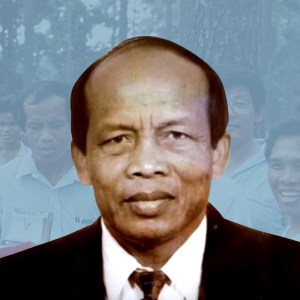
Pastor The MeyCourtesy of Rokha Mey / Edits by Christianity Today
Pastor The Mey

My parents are one of the 25 families Ty and his wife, Eang Kim Bo, sponsored to immigrate to the United States. When my dad’s father was taken by Khmer Rouge soldiers and never seen again, it was Ty Bo (or Tha Ty as I called him) who became like a father to my dad and, by extension, a grandfather to me.

Pastor Mey was like a father to Khuth’s mom. In fact, he was the one who suggested that Khuth’s mom name her Lisa. And Pastor Bo led Khuth to salvation in Christ and baptized her, and it was his church that she would go on to serve for 15 years.

Pastor Bo and Pastor Mey were known for their work as teachers and mentors for hundreds of Cambodian Christians in Houston. Khuth called them “faithful builders,” people who “not only worked their purpose in building a church but stayed faithful to continuing that on even through the hardship.”

‘God knew him then’

Bo and Mey represent a generation of Cambodian American Christians whose testimonies date back to fleeing the Khmer Rouge. They powerfully attest to a God who miraculously intervened, who saved them from the deadly regime that took over their home country in the late 1970s.

Ty Bo served as a commander in the Cambodian national army, effectively placing a target on his back when the Khmer Rouge came to power in 1975. Ty and Kim Bo knew they couldn’t stay in the country, so they joined a group of Cambodians fleeing to Thailand by night. During the three- or four-day journey, their family couldn’t keep up with the rest of the group and got lost.

Kim Bo said they felt so sure that they would be found and killed, either by the Khmer Rouge or a tiger, that Ty Bo planned to kill her, their two-year-old daughter, and himself to ensure they could at least die on their own terms. But then the miraculous happened—what Kim Bo describes as an act of God.

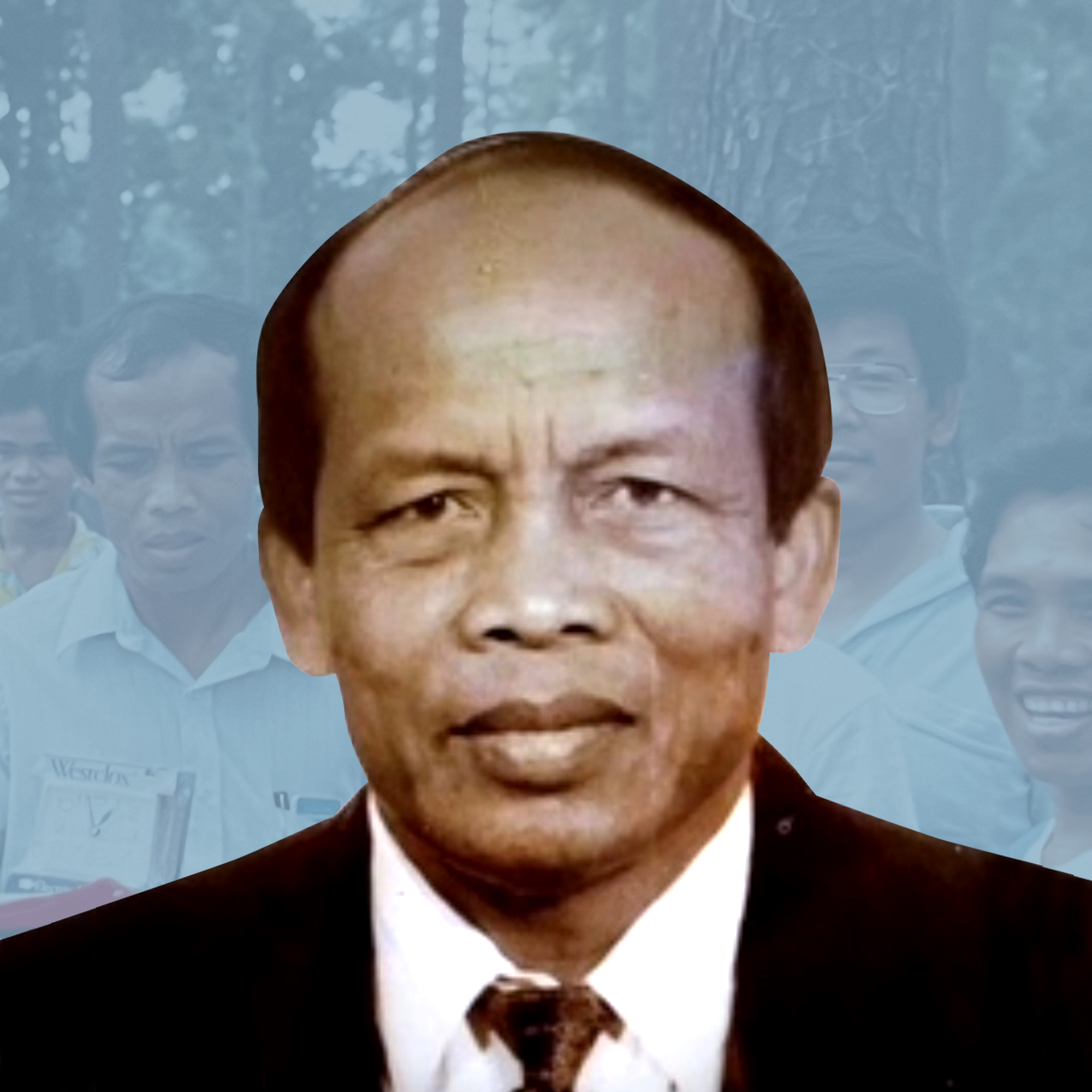
Pastor Ty BoCourtesy of Kim Bo / Edits by Christianity Today
Pastor Ty Bo

Ty Bo, though not a believer at the time, began to pray, “God in heaven, help me please. God who created heaven and earth, help me.” Immediately, Kim Bo said she got up and instructed Ty Bo to follow closely behind her. She started walking again, and then, seemingly out of nowhere, four people found them and led them to safety.

“He didn’t know God,” Kim Bo said. “But Tha said God knew him then.”

By God’s providence, Kim and Ty Bo made it to Thailand, where they lived until the opportunity to immigrate to the United States arose. That was another act of God, she said. In 1976, they arrived in Houston, where they lived in a downtown hotel room sponsored by the YMCA.

It was there that someone knocked on their door and invited them to church for the first time in their lives. After a year at a Church of Christ congregation, the couple began attending South Main Baptist Church in Houston, where Ty Bo grew in his faith and was asked to lead the church’s Cambodian ministry.

Ty Bo was ordained around 1985, per Kim Bo’s memory, and pastored among the Cambodian Christian community until the time of his death. He led Khmer-speaking congregations that met in the buildings of other local churches before finally moving to what would become Metrey Pheap Baptist Church on Van Hut Lane in 2000.

“It was his one job before he went to heaven,” Kim Bo said.

Sent to serve

Roughly one month before Pastor Mey died, he began writing an account of his church’s history on sheets of wide-ruled notebook paper. The Mey started by “thanking God for sending him over to serve and to share the gospel,” said his sister-in-law Chamroeun Lor, translating from the curly Khmer script on the page.

Like many Cambodian converts, Mey and his wife, Khim, became Christians at the famed Khao I Dang refugee camp, which housed up to 140,000 people at the Thai border.

In Houston, he settled in the far south suburb of Rosharon, in an area nicknamed “Little Cambodia,” and began Rosharon Bible Baptist Church in 1987. In Cambodian circles, the neighborhood is known as srok sreh, meaning “farm village” or “country.” Most of the Cambodians who live there are vegetable farmers, growing crops like mustard greens and water spinach, or trakuon in Khmer.

Like Pastor Bo, Pastor Mey began in Cambodian ministries connected with other local churches, such as First Baptist Church of Missouri City, another Houston suburb, before launching his own congregation. He didn’t always know ministry would be his vocation and initially hesitated to get involved.

Khim Mey remembers a church member asking her husband, “If you don’t do it, who’s going to do it? All these people need the Khmer language.”

Mey’s ministry also extended to his home country. He took more than a dozen trips back to Cambodia, spending more than a day in transit, to visit the ministries his church supported. In 2015, the journey became too difficult to undertake, so he started sharing sermons for small groups in Cambodia over the phone instead.

Every Saturday at 8 p.m., he would preach over the phone for an 8 a.m. service at a church in Cambodia—and then another, then another.

“He believes in God—whatever God called him to do, he would do it. So that’s how he started” his ministry, Lor said. “He just prayed that God would lead him to do bigger things in the future. That was his vision.”

After his death, Texas Baptist leaders remembered Mey as “small in stature, quiet in manner, but a giant in the faith” and said, “Whenever The Mey shared his testimony, he made it clear that every bit of his salvation was accomplished by God.”

COVID-19 and the refugee experience

Like many other churches, Metrey Pheap Baptist Church and Rosharon Bible Baptist Church adjusted during the pandemic, streaming sermons on Facebook Live, then adopting social distancing, masking, and outdoor services.

“Even though we could not meet together, we met online, prayed together, and served together,” said Chhoeur Khlot, a longtime church member of Metrey Pheap and nephew of Pastor Bo.

But there are no guidelines on how to grieve the loss of pastors who were mentors and supporters for many members and even father figures for some.

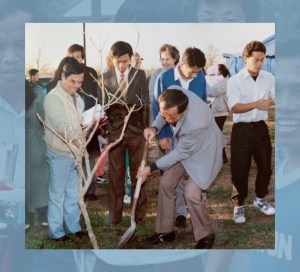
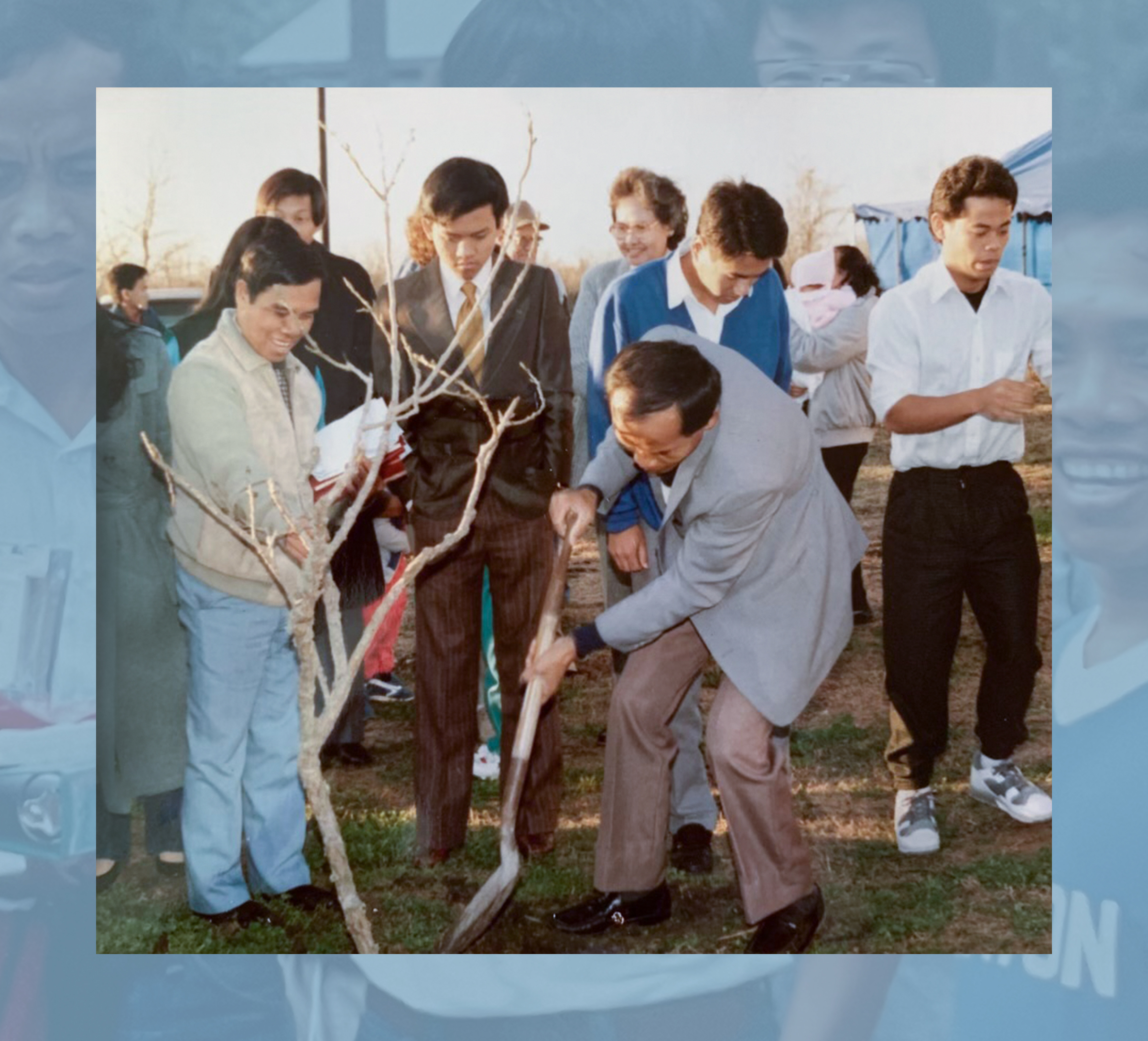
Pastor Bo and Pastor Mey planting a tree at what is believed to be Rosharon Bible Baptist Church.Courtesy of Rokha Mey / Edits by Christianity Today
Pastor Bo and Pastor Mey planting a tree at what is believed to be Rosharon Bible Baptist Church.

Not only did Pastor Bo and Pastor Mey serve as models in the faith, but their ministries also helped Houston transplants adjust to life in a new country. When they first arrived in the States, many of the families Pastor Bo sponsored, like my parents and Khlot’s family, lived for an extended period of time at the Bo family’s three-bedroom, two-bathroom house in Houston’s Northshore neighborhood.

The latest data shows about 7,000 Cambodians lived in the Houston metro area in 2015. But that figure has since dwindled; Houston wasn’t even listed among the nation’s top 10 cities by Cambodian population in 2019.

Many Cambodians in Houston arrived in the early 1980s and have known each other since. They were neighbors and fellow church members supporting one another as they navigated their new lives. And Pastor Bo and Pastor Mey were there making connections, ministering, and offering help.

Cambodians describe how in the refugee community the pastor becomes more than a typical spiritual leader; he’s a friend and father figure too.

“The way [Pastor Bo] related to me is very, very close … like I gave my right hand to him,” said Vuthy Chea, a deacon at Metrey Pheap who immigrated to the US in 1984 after accepting Christ at Khao I Dang. “I help him; he helps me. I keep my eye on him, and he keeps his eye on me.”

Generation gaps

Even before the pandemic, even before the deaths of the two influential pastors, their small and aging congregations faced big questions about their future.

Khuth left Metrey Pheap—the congregation where she came to faith—in 2014, when she said she felt God prompting her to attend a church that focused more on the Holy Spirit and healing. For Khuth, the generational divide between the older and younger congregants was a “huge barrier,” but not an insurmountable one; it wasn’t why she decided to go.

But it’s significant factor for younger Cambodian American churchgoers. Most understand but are not fluent in the Khmer, making language an obstacle even if they still feel a cultural connection and enjoy the traditional homemade cuisine offered at the weekly or monthly potluck fellowships.

Currently, Rosharon Bible Baptist Church has bilingual services, singing and praying in both languages, according to Rokha Mey. Sermons are preached in English and then translated in real time to Khmer. But after the older generation passes away, leaders say the church will gear more toward English speakers.

Metrey Pheap over the years has integrated more bilingual practices at the church. For instance, each church service begins with a Khmer and English Scripture reading now, rather than a reading only in Khmer.

But even with expanded ministries for children and more English in services, the second generation of believers is “gone” from the church, according to Khlot. Church leaders and members are praying and planning for ways they “can invite the second generation to come back.”

Both Metrey Pheap and Rosharon Bible Baptist average about 30 parishioners each Sunday, with no more than a handful of young people.

“For now, we pray for our children. We pray our children come closer to the Lord,” said Chea, from Metrey Pheap. “We pray for the Lord to protect them … for our generation to pass on to our children so they can build and can minister the gospel of the Lord.”

Chea said that this time in-between pastors has actually made the church stronger. All the congregants, from deacons to church members, have “opened their minds” to see how they can serve and become more-active participants in the life of the church, Chea said.

Currently, two deacons, including Chea, and longtime church member Khlot are working as a team to lead the congregation. Each week, the three men alternate leading and preaching that Sunday’s service. When decisions arise––such as, for example, whether to proceed with Sunday school classes in the midst of the pandemic––the leaders will meet, reach a consensus, and then bring the decision to the congregation to get their input. The congregation will then discuss and vote if necessary.

Although the church knows how they’ll choose their next pastor––with a simple majority vote––the timeline for when that vote will happen remains in limbo. It seems likely that the lead pastor will be chosen from among the three men currently at the helm, but Chea said he thinks a vote within the next year would not give the pastor-elect enough time to prepare.

Still, he said the church is continuing to pray and consider whatever door God opens, whether it’s to appoint a pastor from the “outside or inside,” from the younger generation or “from [one] of our children.”

At Rosharon Bible Baptist Church, two of The Mey’s four sons, Reaksa Mey and Rokha Mey, serve as associate pastors. They’re also praying for the church’s senior pastor role to be filled. Currently, a church committee is “in the process” of conducting the search and plans to select a pastor within the next three to six months, Rokha Mey said.

Rokha Mey said he believes it’s possible that the committee will choose a lead pastor from among the church’s community, likely from one of the three associate pastors. “I think it makes sense because we’re all familiar with the community, the members, and the people,” he said.

Church members miss the pastors they knew and loved for so long. But during moments of grief or uncertainty, they think of their steady and faithful examples.

“I know that members still grieve. It’s hard, but we all have to continue to serve God. [Pastor Mey] would want us to do that, even though he’s not here. He’d say, ‘I want you all to keep worshiping God, praying, sharing the gospel. Go out and do something for God,’” Lor said. “He doesn’t want us to stay still. He just wants us to continue his legacy, or God’s work, in other words.”

Pastor Bo, too, spoke of wanting his church to grow and continue on for the sake of the community.

“What that looks like now, I don’t know,” Khuth said. “But I did know that he wanted us to all take part in continuing on what he started, what he felt God telling him to do.”

Khuth has gone on to support or start children’s ministries at other churches, and she gives credit to Pastor Bo for allowing her to learn the ins and outs of ministry at his church. Still, her heart is with the Cambodian church, and she said she’s praying for ways she can contribute to the ministry that Pastor Bo started.

“I used to think ‘Oh my gosh, I go to this really small church,’ but I can take it with pride now,” Khuth said. “I am a part of the Cambodian church. It’s something unique. And I know that without [Pastor Bo and Pastor Mey] being builders of God’s church, I wouldn’t be able to say that.”

Phoebe Suy Gibson is a writer based in Houston.

Reply All

Responses to our October issue.

Envato

What’s True About Christian Fiction

Just as Peretti’s small-towners sensed cosmic strife over their heads and treated school-board disputes as holy war, evangelicals have used the same lens to overspiritualize politics. Compromise is a virtue. Instead, our culture warriors have grown absolutist. Those who resist their agenda are seen as less than human. They are demonized, and compromise is viewed as a sin.

Tom Griffith Beverly, MA

As a 28-year-old new-age Jew who was living in Tucson at the time, I was given [This Present Darkness] to read on a flight to visit family in December of 1989. This was one of the last bricks that, I believe, God used to tear down the walls of my heart. One month later, I trusted Jesus to be my Lord and Savior. My life was never the same. That book helped me to understand the spiritual battle around me. Satan did not want this “Jewish” girl to be saved, and I became very aware of that in the battles I faced after my salvation experience. I learned how to pray in Jesus’ name against the Devil and his schemes, without giving the spiritual darkness too much credit, knowing that God is over everything.

Bete Primm La Vergne, TN

Thanks to Daniel Silliman for drawing attention to how evangelical fiction does what all literature does: speak to readers’ imaginations and form people into communities. This aligns the value of fiction that reinforces and helps understand evangelical identity with the much wider field of literature that helps us better imagine how to love God and neighbor while being good stewards of creation.

Curtis Gruenler West Olive, MI

Where Billy Graham Is Remembered

I believe you guys missed one of the roads: The Billy Graham Parkway is a major road in Charlotte, NC.

@samueltyson (Twitter)

What’s Lost When Prison Mail Goes Digital?

I was once incarcerated in a federal prison. I had the privilege of using the federal email system. It was great to receive quick notes relatively fast when something was happening at home, like when my granddaughter was born and my father was dying and my son was waiting for a kidney transplant. However, email costs money, and I often had to wait in line to use a computer with a missing key on the keyboard. But it was snail mail that made my day extra special. I loved being able to read them in the semiprivacy of my cell. I have also seen the dark side of snail mail. I have seen the effects of fellow residents who had received mail dipped in K2 and smoked it in the showers stalls. I had cards rejected because they weren’t sent in white envelopes. My hope is that technology can help in a different way. What if they could pass letters through a scanner to detect chemicals and then forward the clean letters to the residents? We should not punish everyone for the sins of a few.

Bryan Erbst Stratford, WI

We Are All Baptists Now—So Let’s Not Fight Like It

Russell Moore’s comments about Baptists doing better when out of power than with power is, of course, true of the Christian church, which did better in the first few centuries than once Constantine made Christianity the religion of the Empire. Christianity—the “church”—needs to stand outside and be able to shout, “Enough!” and “Stop” when the secular powers go astray.

John A. Johnson Tucson, AZ

Martha: Busy Hostess or Dragon Slayer?

It has always interested me that Luke has two sibling rivalry stories: Mary and Martha and the parable of the Prodigal Son. In both, the one who is conventionally dutiful becomes resentful and appeals not to the sibling who has failed to be dutiful but to a third person. Both stories are unique to Luke. I always wondered if a bit of autobiography sneaked in. We will never know.

Patricia Hunt Staunton, VA

The Harvest Is Plentiful, but the Workers Are Divided

Having had a solid Reformational theological education in a thoroughly “sola scriptura” institution in Australia, I wonder whether both authors may have given more emphasis to applying biblical and theological insights to the various social and cultural contexts. I’m reminded of the challenge Jesus gave to the religious leaders in Matthew 16:3, where they were skilled at understanding weather patterns but poor in interpreting “the signs of the times.”

Neville Carr Melbourne, Australia

Philip Yancey, as Few Could Have Imagined Him

The value of tragedy is found in redemption. It’s the foundation of all of our stories.

William Pritchard (Facebook)

Correction: English poet W. H. Auden, mentioned in October’s review “Have We No Shame?” on page 72, did not become an American citizen until 1946.

Theology

Joseph’s Simplicity Was Actually Spiritual Maturity

God entrusted his only Son to a man who could not provide as his culture expected.

Illustration by Matt Chinworth

During Burundi’s civil war in the 1990s, I spent several months in a crowded camp for internally displaced people—people like me who had fled home but could not flee the country. One of my most painful experiences was to see fathers’ healthy masculinity shattered by the change in their lives.

Once the providers for their families, they now had to rely on relief food. They were deprived of their freedom of movement, unable to do what they had been doing all their lives (farming or business). Some began drinking heavily to deal with their depression.

I have since thought of Joseph, Mary’s husband, who also had to flee and deal with the frustrations of providing without stability. He could have become like those men. He could have resented his local and colonial governments for the ways they deprived him of good choices and made him move all over the region. He could have resented God for telling him to marry a woman who—his fellows might have said—deserved divorce and not his support. He could have tried to make up for his threatened masculinity with a lack of cooperation or with domineering legalism.

But that is not how the Scriptures portray Joseph. Instead, we see the man God selected to parent his son accepting God’s unexpected direction at each delicate step, not characterized by resentment but by wholehearted cooperation with God. I’ve seen how difficult that is. How did Joseph do it?

We don’t know a lot about Joseph. He is one of the biblical characters of whom very little is said. Not a political leader or a great prophet, his name would be absent from the Bible had he not been the guardian of the Messiah. Still, his lineage could have been a matter of pride and a basis for him to strive for a position of honor. In Luke’s account of the angelic visitation of Mary, Gabriel affirmed that Jesus was the promised descendant of David and that he would be given the throne of David and a kingdom that would have no end (Luke 1:31–33).

The fact that Matthew, a Jewish gospel writer and a disciple of Jesus, introduces Joseph as a descendant of David is significant (1:20). It puts Joseph in the spotlight of the divine plan for humanity as the adoptive father of the Messiah.

Apocryphal writings supply an unreliable, sometimes even angry, image of Joseph. Both the Protoevangelium of James and the History of Joseph the Carpenter assert that Joseph was a widower with children from a previous marriage. Those details about Joseph prop up the idea that Mary was a perpetual virgin, but there’s no reason from the Scriptures to think Joseph had previous children: The nativity accounts don’t list anyone besides Mary as traveling to Bethlehem with Joseph, and Joseph was asked to flee to Egypt with just Mary and Jesus (Matt. 2:13–15).

It is most likely that the real, nonapocryphal Joseph was an average Jewish young man, with some religious education. Rabbinic writings suggest that the expected age for marriage in Joseph’s time was the late teens. So Joseph was probably living with his parents or relatives when the angel told him to marry Mary. After Jesus was born, Joseph had four boys and an unknown number of girls with Mary (Matt. 13:55–56).

The Bible implies Joseph was a very ordinary man from an ordinary place, a village man who was known through his profession. People thought of him as “the carpenter” (13:55). His days were likely filled with hard work.

While the Jewish culture valued menial labor, the reality was totally different with the Romans, the colonizing power that ruled Palestine during Joseph’s life. From a Roman perspective, carpentry was a slave’s profession. So Joseph was far from being among the people with high status.

Some of that status he may have been born into, but some of it he may have chosen. Joseph lived during rough times, when opportunists could collaborate with the Romans and enjoy a materially comfortable life. He did not take the path that Matthew, the former tax collector, chose. Matthew, the writer of the Gospel that says most about Joseph, might have seen the temptation of collaboration most clearly. And yet, Joseph wasn’t needlessly uncooperative with the Romans. He went to the city of his ancestors for the government census, for example.

In this simple and useful lifestyle, he was confronted with the powers that be—the powers that were—who thrived on injustice, violence, and corruption. In that confrontation, Joseph’s spirituality becomes more evident, and God clearly stands with him.

Indeed, God is close to those who, like Joseph, are humble and contrite and who tremble at his word (Isa. 66:2). Simplicity, as a spiritual discipline, helps us avoid the enticement of materialism and enables us to focus on things that really matter. Those who practice simplicity can be wealthy without materialism and be descendants of the line of kings without competing with Herod. For them, righteousness is better than the glory of the world.

It seems clear to me Joseph was able to guide his family well because he was open to God and his messengers in a way that defied legalism. Joseph’s spirituality prepared him for the unexpected.

In strongly patriarchal cultures, men usually expect to be able to provide well for their families, sometimes with a good dose of emotional detachment from their wives, and they often expect their own plans to be the plans that direct their families. Heads of families can be rigid and resist unconventional behavior. In my culture, for example, though the winds of human rights have been blowing for more than two decades now, most Christian men still struggle to get rid of rigid patriarchal attitudes and behaviors, and some distort the Bible to justify those behaviors in themselves.

Flight Into Egypt by Henry Ossawa TannerWikiMedia Commons
Flight Into Egypt by Henry Ossawa Tanner

Joseph wasn’t like that. We see that most clearly in his treatment of Mary. As a Jewish man, Joseph understood what could happen to a girl who had sex before marriage (Deut. 22:13–21). Pregnancy was the most convincing proof of sexual misconduct. Legally, he would have been right to denounce Mary.

But to Joseph, Mary’s perceived sin did not make her an outcast. He knew she deserved love and protection. The NIV beautifully combines Joseph’s Jewish religious culture and his personal spirituality in one sentence: “Because Joseph her husband was faithful to the law, and yet did not want to expose her to public disgrace, he had in mind to divorce her quietly” (Matt. 1:19).

Here, we see that Joseph isn’t the grumpy, emasculated husband of Christmas legend. Even before he received God’s message about Jesus, Joseph’s demonstrated love for Mary and his commitment to protect her dignity overpowered any legalism. Joseph’s behavior portrays genuine masculinity and Bible-certified righteousness.

The situation, of course, isn’t what he had first imagined. In a dream, an angel told him Mary’s pregnancy was of divine origin. Joseph dismissed his previous plans and agreed to obey just as quickly and simply as Mary had accepted that she was pregnant before marriage (Matt. 1:24; Luke 1:38).

Such a positive response to such a difficult and risky circumstance would have been impossible in a spiritually dull, legalistic mind. A legalistic man might have quickly dismissed the angel’s message as hallucination, as it seemed to contradict the law. Joseph’s spirituality was of such a kind that he was able to value the will of the lawgiver more than the law, something that eluded many sophisticated theologians and religious leaders (Matt. 15:3–9), not to mention Jesus’ disciples.

When, in another dream, an angel ordered Joseph to flee to Egypt with Mary and the baby, Joseph obeyed and fled (Matt. 2:13–14). For many in Joseph’s position, the command would have seemed nonsensical. They expected a powerful, conquering Messiah, not a baby refugee (Acts 1:6).

That Joseph was able to set aside the common mindset because of a dream shows that his spirituality was deeper than the prevailing religious thought of the people of his time. He could tell when God had spoken to him directly. We see the simple village man cooperating with God to preserve the life of the Messiah.

We often see the Nativity as a celebration of comfort and innocence. In Europe and the United States, Christmas is often a time to think of coziness. In my country, it’s sort of a children’s holiday among evangelicals.

Could Joseph ever fit in with these modern Christmases? Certainly, we can say Joseph had the childlike humility that Jesus later praised (Matt. 18:4), and his simplicity and righteousness are a form of innocence. But Joseph parented Jesus in turbulent times. Perhaps our Christmases would be better if we remembered that innocence and responsiveness characterized the father God chose to guide a family through danger, not just children cuddled up in safety. Joseph surely knew how violent Roman rulers could be. On the roads, he may have passed by agonizing crucified people who, like his family, were a threat to the regime.

Because of a political decision of an emperor thousands of miles away, Jesus was born in overcrowded Bethlehem—a logistical headache for Joseph. It is possible that the couple traveled with relatives who were by their side when Jesus was born. But no mention is made of relatives helping Joseph tend Mary and the baby. When there wasn’t space for them in the guest room, Joseph didn’t have the wherewithal to do better (Luke 2:4–7). Later on, another political decision and another message in a dream caused Joseph to flee to Egypt with Mary and Jesus. Herod could not allow a child who could potentially challenge him on the throne to grow, and he targeted the baby for assassination.

The Flight into Egypt (La fuite en Égypte) by James TissotBrooklyn Museum
The Flight into Egypt (La fuite en Égypte) by James Tissot

Fear, anguish, and a sense of powerlessness must have plagued Joseph’s tender heart when he became aware of the threat. Anyone who has lived through massive violence (as in the case of a civil war) knows the agony of the possibility of losing loved ones accompanied by the incapacity to protect them.

Anybody in Joseph’s place would have asked themselves existential questions and questioned their faith. Was he tempted to take his life, as some are when confronted with a similar situation? Did he think of migrating to a safer place and never returning to Palestine? Was he tempted to become passive or fatalistic? The combination of danger, grief, boredom, lack of meaningful work, heavy responsibility, and even heavier burdens have led many forcibly displaced people to react in these ways.

It is the spirituality of Joseph, beautifully mingling with the hardships he faced, that makes his story one of hope. He surely pondered the words of the angel: “So get up, take the child and his mother and escape to Egypt, and stay there until I tell you to leave” (Matt. 2:13, GNT). Part of this was an order; the other part was a promise. God was in control. One day, Joseph and his family would go back. The selfish and cruel rulers did not have the last word in the life of Joseph’s family.

And yet, Joseph and his family were in a delicate situation where he needed to depend on God to make the most basic decisions. One wrong decision could be fatal. When the time to go back came, the angel instructed Joseph to return (Matt. 2:19–20).

Again, Joseph was divinely guided to make a decision that was very dangerous. Anyone who has been a refugee recognizes this. In the camp for displaced people where I lived, some men left to resume their normal lives before the area was safe; their impatience cost them their lives.

The world was still the world—even at a moment of reprieve. God advised Joseph not to live in Judea, but in Galilee. There was no complete safety, no complete relief. Herod was dead, but his son was in power (vv. 21–23). God did not destroy all the wicked right then, but neither did he allow his plans to be thwarted by them.

Today, the world is in some ways better than it was during Joseph’s time. Human rights organizations can speak for the weak and help protect their lives. However, humanity is still fallen and, therefore, far less than perfect. The number of forcibly displaced people in the world has risen to a 40-year high. Wars, earthquakes, volcanic eruptions, hurricanes, pandemics, and the decisions of rulers can destroy our sense of safety and stability.

That said, we should never forget that God is at work and that he is with us even at our darkest hour (Ps. 23:4–5). Besides, he has promised to instruct us in the way we should go (Ps. 32:8) as instruments of his will on earth.

As God used Joseph, so does he intend to use us to carry out his purposes for our generation. But this requires of us the kind of spirituality that transcends denominational traditions and legalistic mindsets. We must also carefully avoid the snares of the flesh to remain sensitive to God moving in our time.

Just as God does not allow these things to separate us from him, we should not allow danger, insecurity, or even death to stop us from cooperating with him.

How can we do that? Not through complicated strategies, but with a faith like Joseph’s: a simple, childlike faith, ready to depend on God for the decisions we make, to do what he instructs us to do, and to go where he leads us without grumbling, whether it is comfortable or dangerous.

Acher Niyonizigiye is a pastor at Bujumbura International Community Church, a cofounder of the leadership nonprofit Greenland Alliance, and the author of Be Transformed and Glorify God with your Life.

Ideas

In 2022, Let’s Take T.S. Eliot’s Advice

Staff Editor

The poet said Christian institutions and community needed refreshing. They still do.

Illustration by Rick Szuecs / Source image: John Gay / Stringer / Getty

This is a season for taking stock of who we are, how we live, and what we are building. It is the best season, perhaps, to ask ourselves the question of poet T. S. Eliot’s choruses from The Rock: “Have you built well?”

In 1934, Eliot penned The Rock to fundraise for 45 church buildings near London. Appropriately, his frequent theme was building—not only churches but also the church as a thick community, an institution, a people seeking knowledge of God, a sanctuary from alienation and futility.

“The Church must be forever building, for it is forever decaying within and attacked from without,” Eliot said. So, how are we building?

When we think of the church community and institutions the church has founded, our workmanship is mixed at best. In society at large, distraction, alienation, and futility seem to have only escalated since Eliot’s day, while the church in the West shows many signs of decay. Religious disaffiliation is rising rapidly, and even we who remain in the faith often can’t escape the inattentive, disintegrating tendencies of modern life.

We too live amid the breakdown of the local relationships, businesses, and civil society analyzed by Alexis de Tocqueville in Democracy in America and eulogized by Robert Putnam in Bowling Alone. With us, as Eliot saw in his society, a sense of community can be too weak, with people “settled nowhere,”

And no man knows or cares who is his neighbour
Unless his neighbour makes too much disturbance.

In this state of communal disrepair, Eliot advised, “The good man is the builder, if he build what is good.” His words echo James 2’s contention that faith without works is dead (v. 26), that it’s possible to have right beliefs without acting in service to God and others. Eliot warns us against relying on the work of past generations and doing nothing to shore it up.

Eliot says we can learn to build well from “things that are now being done, / And some of the things that were long ago done,” and from “the work of the humble.”

For building ideas now being done, we might look to parts of the church both near and far. For example, I’m fascinated by the Bruderhof, a network of Anabaptist communities in which members live and work together, keeping a common purse.

As the Bruderhof website notes, this exact model of daily—and even financial—involvement in each other’s lives isn’t necessary to faithfully follow Jesus. But it’s a striking witness and a healthy challenge to my own faith and assumptions about what Christian community should look like, what it can ask of me, and how much of my life it should shape.

As for things “long ago done,” church history is a wealth of wisdom and warning. One hopeful evangelical trend is renewed interest in the liturgical calendar. None of the six evangelical churches I attended before college observed Lent—or anything beyond Christmas and Easter. Now it’s not unusual for evangelicals to use the calendar to break through the din of ordinary life with a reminder of the kingdom, a prompt to reorient ourselves toward God through a chapter of God’s story of salvation.

Other things built long ago that would aid our building: formalized catechism, memorization of Scripture, and habits of Sabbath. With so many other claims on our attention, we can’t expect to “be made new in the attitude of [our] minds” by social osmosis (Eph. 4:23). We need to dust off these tools of deliberate discipleship for new use.

The warnings in our history bring me to “the work of the humble.” We cannot “build what is good” if we build to increase our own power, wealth, or glory. Our task is to prefigure the coming kingdom in love and service of God and neighbor, to give ourselves “fully to the work of the Lord” (1 Cor. 15:58). It is not to serve ourselves.

Without humility in building, we risk the sin of Babel. But with it, and with God’s grace, this year we may build what is good. And we must, for there is “much to build, much to restore,” as Eliot charged. “Let the work not delay, time and the arm not waste.”

Bonnie Kristian is deputy editor at The Week and the author of A Flexible Faith: Rethinking What It Means to Follow Jesus Today.

History

How Archaeologists Are Finding the Signatures of Bible Kings, Ancient Villains, and Maybe a Prophet

Wet sifting brings us closer than ever to the world of Jeremiah, Isaiah, and Hezekiah.

Volunteers look for artifacts in soil removed from the Temple Mount. Background: Buckets of debris from the Temple Mount Sifting Project.

Volunteers look for artifacts in soil removed from the Temple Mount. Background: Buckets of debris from the Temple Mount Sifting Project.

Photo by Menahem Kahana / Staff / AFP / Getty Images

The closest I’ve ever felt to the prophet Jeremiah was sitting at the bottom of an empty cistern. About 20 years ago, I was taken to an excavated water reservoir in Jerusalem and told this could be the actual hole in Jeremiah 38:6 where the prophet was left to starve when four government officials decided they didn’t like his messages from God.

I sat on a bench and looked up at the stone walls. Jeremiah sank into the mud, according to the biblical account.

But maybe it wasn’t at that spot. Who’s to say it was this cistern, which was dug up in 1998, and not another one that has yet to be found? Or perhaps it will never be found. I could imagine the prophet trapped in that exact place, wondering if God would rescue him, but short of finding “Jeremiah” scratched on the wall, no one could say for sure.

In the time since I was there, questions have been raised about that cistern, casting doubt on its role in the Jeremiah drama. It’s not a place people visit these days.

Archaeology can take you so close to the biblical world and still leave you wishing someone had left a signature.

When people do find signatures, it’s a very big deal. In the past few years, in fact, archaeologists have been finding a lot of the impressed clay seals that ancient Israelites used to secure the knot on the string that tied up a scroll.

In 2005, Israeli archaeologist Eilat Mazar was directing an excavation of the oldest part of Jerusalem. Her team found the imprint of a stamp, and on that clay seal was a name: Jehukal, the son of Shelemiah, one of the men who threw Jeremiah into a cistern.

Three years later, Mazar announced the discovery of another “bulla,” as the seals are called. This one also had a name: Gedaliah, son of Pashur, another official from the story in Jeremiah 38.

The two biblical villains seemed to spring to life with these discoveries. They had touched these seals, leaving their names as physical evidence to be discovered thousands of years later.

“Nothing is more exciting at an excavation than the discovery of a seal or bulla,” said Scott Stripling, director of the Archaeological Institute at The Bible Seminary in Katy, Texas. “Often, there are partial or complete fingerprints, which remind us of the human connection. These were real people.”

Clay seals are rare finds, but they’ve become more common since 2005. They are small—often just the size of a fingertip. And they’re made out of clay, basically the same stuff that archaeologists are digging up, which makes them hard to spot. In the archives of the biblical archaeology newsmagazine that I edit, Artifax, I see very few mentions of bullae from the early 1990s until 2005.

Since then, however, there have been so many discoveries of impressed clay seals that the news has become almost common. And some of the finds are so remarkable—including one with the name of King Hezekiah and another that may belong to the prophet Isaiah—that they often make my annual list of top 10 biblical archaeology discoveries for Christianity Today.
The change can be traced to the development of the archaeological technique of wet sifting.

Innovation in Kidron Valley

It started with 9,000 tons of dirt, dumped unceremoniously in the Kidron Valley. Back in 1999, Muslim authorities in charge of Jerusalem’s Temple Mount decided to build a third mosque on the holy site in the underground “stables of Solomon.” They excavated an entrance and removed a massive amount of earth without archaeological supervision.

The historical evidence that could be recovered in that space is of vital interest to scholars and many Christians and Jews. But in Israel, where ancestral claims are aggresively contested, archaeology is also political.

Scholars reeled at the scale of this crime against archaeology. Some, though, also realized it was a unique opportunity. They could look through the 400 truckloads of dirt. This could be a way to get some rare insight into the Temple Mount at a safe distance from the incendiary politics.

“It has lost 90 percent of its scientific value,” Israeli archaeologist Gabriel Barkay told his colleagues. “We have 10 percent left. But that’s much more than zero percent.”

In 2004, Barkay and archaeologist Zachi Dvira launched the Temple Mount Sifting Project (TMSP), using wet sifting to see what still remained in the dirt.

The process works like this: A bucket of dirt is dumped onto a screen held at waist level by a wooden frame. A volunteer takes a hose and sprays water, forcing the dirt through the screen and leaving small items behind: pottery, stones, bones, coins, other bits of metal, glass, mosaic tesserae, and bullae.

“We came up with the idea on the first days,” Dvira told CT, “since it was very difficult to differentiate between natural stones and potsherds. That is because the soil is full of ashy dust… which coats the objects.”

Dvira and his team soon developed a method they could teach to volunteers. Over the next 17 years, more than 170,000 volunteers dumped bucket after bucket of Temple Mount material into sieves, sprayed away dirt, and scrutinized everything left.

A clay seal bears the name of Jehukal, the son of Shelemiah, one of the officials who threw Jeremiah into a cistern to die for prophesying the destruction of Jerusalem.Photo Courtesy of Eilat Mazar
A clay seal bears the name of Jehukal, the son of Shelemiah, one of the officials who threw Jeremiah into a cistern to die for prophesying the destruction of Jerusalem.

What they found was thousands of artifacts from the Stone Age on. More than 6,000 Jewish, Islamic, Roman, and medieval coins have been recovered.

Another important discovery: a 3,000-year-old seal from the time of King Solomon. Scholars say it may challenge the theories of archaeological minimalists who claim the Scriptures exaggerated the age and significance of the temple in Jerusalem.

“That is why archaeology is so fascinating,” Mazar told me a decade before she died in May. “It’s written in the Bible, and then we find these seal impressions. It demonstrates that this biblical story is so accurate.”

Mazar was impressed with the potential of wet sifting and started sending dirt from the excavations she supervised to TMSP. That’s where volunteers in 2004 uncovered the bullae with the names of the officials who tried to have Jeremiah killed.

“Seals and bullae have repeatedly proven to be a very significant category of evidence outside the Bible,” wrote Larry Mykytiuk, a Purdue University professor emeritus whose research focuses on the historicity of the Scripture, in an email to CT. “They are extremely valuable, because they confirm the existence and official positions of kings, high priests, and royal officials who are mentioned in the Hebrew Bible/Old Testament, and the titles in some seals and bullae show that they were in a position to do what the Bible says they did.”

Laypeople often don’t realize how few written texts have survived from biblical times. Scripture was preserved through duplication, but few of the older copies of the books of law, prophets, poetry, and history remain. Compared to the hundreds of Egyptian hieroglyphic papyri and thousands of Mesopotamian cuneiform tablets excavated in the past couple centuries, the corpus of ancient Jewish texts is miniscule.

“Seals and seal impressions are the largest part of inscribed items which we have discovered,” said Robert Deutsch, a scholar and dealer who has published information about numerous bullae in academic journals.

Deutsch has been criticized by archaeologists for buying and selling seals on the antiquities market. The trade creates incentives for looters and cover for forgers.

Deutsch counters that ignoring the many objects in private collections means banishing them to nonexistence. He argues that archaeologists benefit from knowing about them, even if they have a dubious history.

In 1997, for example, he published information in an academic journal about a seal bearing the impression of King Hezekiah. It has no known provenance and could have been forged. But in 2015, Mazar discovered an identical bulla in Jerusalem. The find would have been significant on its own, but the privately owned bulla added context.

There are so few examples of ancient Hebrew, he says, that they all have to be seen as important.

Still not standard practice

Despite the obvious value of wet sifting, its use has not become standard at excavation sites in Israel.

Stripling, who worked as a supervisor with TMSP in 2008 and 2009 and directed excavations at Khirbet el-Maqatir and Tel Shiloh, thinks the Israel Antiquities Authority should make wet sifting mandatory. He worries what archaeologists are missing when they don’t wet sift through the dirt. At Tel Shiloh, he had volunteers sift through a dump pile left by an excavation done in the 1980s. They found five scarabs, beetle-shaped amulets from Egypt.

He did the same thing at an old excavation site at Mount Ebal. Stripling found a bronze knife blade and a tablet that may have been used for ceremonial cursing. He noted that Mount Ebal is described as a mountain of cursing in Deuteronomy 27.

“Dump piles of past excavations contain a tremendous amount of material. These are the types of finds that are being thrown away by most excavations because of a failure to wet sift,” he said during a 2020 presentation at the meeting of the Near East Archaeological Society.

“Wet sifting holds the potential to revolutionize what we are finding from archaeological sites.”

Volunteers sort through debris at the Temple Mount Sifting Project.Photo Courtesy of Gordon Govier
Volunteers sort through debris at the Temple Mount Sifting Project.

Other archaeologists working on Israeli excavations say the process shouldn’t be mandated. It’s very labor intensive and uses a lot of water. It can require a lot of volunteers, which are not available for every dig, and a lot of water, which is not available in the desert. Some say the method is best used with discretion.

Robert Mullins, chair of the Department of Biblical and Religious Studies at Azusa Pacific University, says he uses wet sifting when it’s critical for interpreting a site. At the dig he directs at Abel Beth Maacah in northern Israel, the team wet sifted the dirt from a storeroom containing dozens of 2,800-year-old jars. That way they found anything that had been left inside the jars or on the floor.

Daniel Master, who is currently directing excavation in the Jezreel Valley, said it’s a matter of knowing “the right method for the right context.”

“I tend to think that using one particular method as a proxy for ‘good’ excavation is entirely missing the point,” he said. “An archaeologist, like any researcher, needs a repertoire of techniques and tools and needs to know when to use each one of them.”

But every archaeologist knows stories of discoveries made not by expertise but by chance, accident, or beginner’s luck. Jimmy Hardin, codirector of the excavation of a small site called Khirbet Summeily at the northern edge of the Negev Desert, remembers several years ago when some volunteers found eight or nine clay seals. They weren’t wet sifting, and the bullae looked just like the dirt around them, but the sharp-eyed students spotted them.

It happens often enough to make the most experienced archaeologists wonder what they might have missed.

“Once you excavate this stuff, it’s gone,” Hardin said. “It’s your responsibility to collect as much data as you can.”

The data on the bullae, now so commonly discovered with wet sifting, are especially compelling. They carry the authority of ancient names, committed to clay and preserved for millennia. There’s one that says “Nathan-Melech, servant of King Josiah.” And another recent discovery is a bulla belonging to the priestly family of Immer.

“Each seal and seal impression brings to life a person,” Deutsch said. “The Bible comes to life.”

A third bulla, broken almost in half and found in an ancient rubbish pit, may say “belonging to Isaiah the prophet.” It’s not clear, though, because the word that could be “prophet” is broken off. Without the final aleph, who is to say for sure?

It’s easy to imagine the prophet pressing his mark into the clay, touching that exact object, marking it with his name. But maybe not. Archaeology can take you so close to the biblical world and still leave you wishing someone had left a signature.

Gordon Govier is the editor of Artifax magazine and writes about archaeology for Christianity Today.
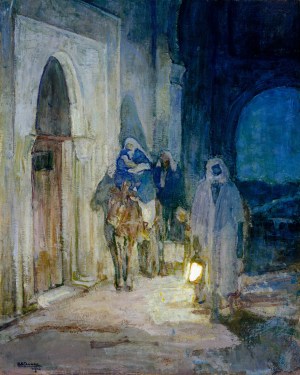
News

The Secret to Deradicalizing Militants Might be Found in Middle Eastern Churches

A bold new thesis proposed in extremist studies is based in testimony of Arab Christian pastors.

Illustration by Rick Szuecs / Source images: Sohaib Al Kharsa / Unsplash / Abid Katib / Staff / Getty

A Muslim man walked into the offices of a Christian pastor whose congregation in Lebanon’s Bekaa Valley has been serving Syrian refugees since the outbreak of civil war.

“I’ve hated you for the past eight years,” the Muslim said, “and I’ve tried to turn my community against you. But three months ago, it was your American doctors who treated me and paid for my hospital stay.

“We hate these people,” he continued, “yet they come here and show us love. Tell me the time of your services; I want to follow Jesus. How great is your Christianity!”

This story, told to CT in October by the pastor, who asked that their names not be used for security reasons, is remarkable. But it is not unique. Evangelical ministers in the Middle East readily recount conversion narratives of the most militant, radicalized Muslims. A second pastor has described how a Syrian confessed that he started coming to church to kill him. Now a believer, the man serves other refugees as a member of the congregation. A third says his once-small Christian fellowship has grown to more than 1,500 largely due to converted refugees. Perhaps as many as 10 percent of them are former extremists.

These accounts and others like them have led Scott Gustafson, a PhD candidate with Vrije Universiteit Amsterdam’s Extreme Beliefs program in Amsterdam, to a realization: Evangelical Arab ministry succeeds where millions of dollars of security-based solutions have failed in turning militant Muslims away from violence.

“No one strategizes: Let’s deradicalize the extremists,” he said. “But it is a demonstrable side effect.”

In the diverse academic field trying to find secular pathways out of extremism, this is a novel idea. Gustafson published an article on it recently in the Journal for Deradicalization, making an argument for “Missiological Engagement in Counter/Deradicalization.” He has interviewed Christian ministry leaders in Lebanon, Syria, Iraq, Jordan, and Egypt with testimonies of former extremist figures who have converted to Christianity. Gustafson has had in-depth conversations with half a dozen former extremists as well.

He says the research points to a conclusion that makes a lot of sense to a missiologist like him but is startling to many academics and government officials. Conversion, it seems, changes people. Yet not all of the accounts of deradicalization he has gathered involve conversion. Some maintain their Muslim faith but grow more tolerant of non-Muslims and are willing to work with them for the benefit of others.

Tony Skaff, pastor of Badaro Baptist Church in Beirut, says this is what he sees in prisons where evangelicals have ministered for the past 25 years. As part of a government-sponsored interfaith consortium, his church has the legal right to enter, serve, and preach to the 3,000 incarcerated people.

Weekly worship services draw about 80 people, Skaff said, and he estimates that about 10 percent of them are extremists. Most remain Muslim, even as they attend the Christian service, but the interaction does alter their perspective.

“They see our respect and how we help even if they are not Christians,” he said. “Without necessarily converting, many now have a genuine respect for Christianity.”

If academics are skeptical of Gustafson’s thesis, it’s not because it contradicts the reigning academic orthodoxy of best practices for deradicalization. It’s because there are no standard accounts of the process. According to Daniel Koehler, head of the German Institute on Radicalization and De-radicalization Studies, the field is “more or less completely free of any working standards,” and no one really knows what works.

The steps toward extremism are more established. Those who study the process generally agree it’s a three-part process. First, there is a perceived grievance that goes unanswered. Second, there’s exposure to a narrative or ideology that offers violence as a solution. Third, the individual is adopted into a social network that gives meaning and belonging.

The church, according to Gustafson, can undo each part of that process. It meets real and perceived grievances, especially with the charity work that responds to physical needs that governments are not taking care of. The gospel message is Jesus’ manifesto for undoing violence with love. And the body of Christ adopts individuals into the family of God, giving them a social network imbued with meaning.

It’s much more effective than imprisoning former fighters or treating radicalization as a psychiatric problem, Gustafson argues.

Rik Peels, the lead investigator for Extreme Beliefs, which is funded in part by the European Research Council, said the proposed answer is unusual but not out of bounds for academic study. He notes that one of the most significant developments in the field has been an emerging understanding that extremists are not irrational. His project asserts that they consciously choose the wrong response to their situation—a departure from the framework, dominant since 9/11, that tries to explain away extremists’ actions through social, physiological, or economic factors.

“We want to listen to them, taking extremists and terrorists seriously as normal, rational, healthy human beings—with reprehensible behavior,” Peels said. “Scott is doing exactly that, as are the churches he studies.”

There has been some corroboration from other research. The RAND Corporation conducted interviews with former radicals and their families and found deradicalization was often triggered by interventions of kindness from hated outsiders.

But not everyone is convinced. Philip Madanat, a Jordanian evangelical who researches political sociology, suspects some are too quick to see a radical behind anyone who calls them a “kafir”—nonbeliever or infidel. He has worked in the camps and never seen a radical refugee. He has also negotiated with terrorists in Syria and dialogued about Jesus with Salafi-Jihadi ideologues whose writings birthed al-Qaeda. He thinks the definition of radical matters. Some equate it with support for sharia. Others see it in every practicing Muslim.

He’s also skeptical of the evidence of firsthand and secondhand accounts of deradicalization without verification far beyond the scope of most ministries.

“As long as these people are helped by the church, you cannot rely on their testimony,” he said. “Stop the relief, then check the facts.”

Tim Noble, Gustafson’s doctoral supervisor and an associate professor at the Protestant Theological Faculty of Charles University in Prague, said that is the challenge for the deradicalization thesis.

“Scott sets out a fascinating, plausible hypothesis that he will have to prove,” he said. “He just has to talk with more former radicals.”

For their part, evangelical pastors such as the one who saw a man convert after eight years of hate are not waiting for evidence. They witness to the gospel because it’s good news, and they take care of people in need because they love Jesus. But deradicalization, Gustafson has helped them realize, is a very visible side benefit.

The pastor in Jordan says the church started a community center that distributes locally grown produce, operates a medical clinic, and even provides free laundry service. But he is most proud of the school, where classrooms replaced the underground lot where people once parked their cars for Sunday worship.

“If you kill a terrorist, ten more will emerge,” the pastor said. “Their displaced children are tempted by all kinds of vices, including radicalization. Education gives them hope.”

But when opening a second location near the camp, Muslim refugee leaders expressed concern they would teach Christianity as they did in the church garage. Similarly, both secular and believing donors make sure there is no discrimination or conditionality in receiving aid.

The church honors all regulations in distribution. But as the pastor told CT, there is no regulation against compassion. And compassion opens radicals to radical change.

Today, he said, having won the trust of the community and donors alike, parents voluntarily send busloads of school children to weekend Bible classes, the wife of an al-Nusra unit leader is graduating as a trained nurse, and 20 former fighters have been saved through their ministry.

“They see the difference and become ambassadors to their own people,” he said. “Love is the real weapon against terrorism.”

Jayson Casper is Middle East correspondent for Christianity Today.
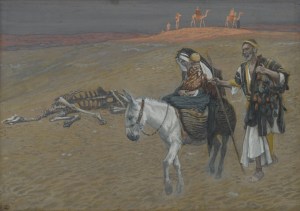
Apple PodcastsDown ArrowDown ArrowDown Arrowarrow_left_altLeft ArrowLeft ArrowRight ArrowRight ArrowRight Arrowarrow_up_altUp ArrowUp ArrowAvailable at Amazoncaret-downCloseCloseEmailEmailExpandExpandExternalExternalFacebookfacebook-squareGiftGiftGooglegoogleGoogle KeephamburgerInstagraminstagram-squareLinkLinklinkedin-squareListenListenListenChristianity TodayCT Creative Studio Logologo_orgMegaphoneMenuMenupausePinterestPlayPlayPocketPodcastRSSRSSSaveSaveSaveSearchSearchsearchSpotifyStitcherTelegramTable of ContentsTable of Contentstwitter-squareWhatsAppXYouTubeYouTube