Culture

Francine Rivers Wants ‘Redeeming Love’ to Draw People to Christ

It’s the story of Hosea—but steamier.

Abigail Cowen as Angel and Tom Lewis as Michael Hosea in REDEEMING LOVE.

Abigail Cowen as Angel and Tom Lewis as Michael Hosea in REDEEMING LOVE.

Christianity Today January 21, 2022
Redeeming Love Movie

“While studying the Book of Hosea, I felt nudged to write another novel, but one that would show the difference between what the world considers love and the unconditional, sacrificial, all-consuming love of God,” Christian romance author Francine Rivers wrote for CT in 2016. “The result was Redeeming Love. The writing process kept me close to the Lord.”

The book was her first after becoming a Christian and was wildly successful among evangelical readership, selling more than three million copies. Along with a loyal fan base, it has garnered criticism for being a “gateway” to soft pornography for its steamier scenes and as an endorsement of unequal power dynamics between men and vulnerable women. Thirty years later, the historical romance has been brought to the screen with Rivers as executive producer.

The Gold Rush–era retelling of the Book of Hosea follows Angel (Abigail Cowen), a woman trapped in prostitution, and Michael (Tom Lewis), the man God calls to rescue her by marriage. Angel struggles to believe in Michael’s love or in his God, but slowly becomes convinced. But in the screenplay, Angel’s conversion experience mellows Rivers’ original distinction that the titular redeeming love is ultimately God’s, not Michael’s.

Dorothy Bennett talked with Rivers, who cowrote the screenplay with director D. J. Caruso, to discuss the film’s purpose in Christian culture today.

Redeeming Love addresses traumatic sexual experiences and celebrates sex between a husband and wife. The book was released at the beginning of the purity culture movement (1990s–2000s). How does Redeeming Love address how Christians talk (or don’t talk) about sex?

Well, that’s a good question. Thinking from Angel’s point of view, she’s sold into prostitution at the age of eight. For her, sex is degrading. It is disgusting, and it represents being captured and being in bondage. So when she meets Michael, she has no concept of love at all. He’s gently wooing her. And in the movie—and it might kind of raise the brows of some—he has married her, and he’s waited, and he’s wooed her, and he’s gently courted her, until he knows she loves him. Then he consummates the marriage.

We tend not to talk about sex, but the Song of Solomon is in the Bible. That was what I wanted reflected in this. It’s a gift from God when it’s in the right frame, within a marriage. And unfortunately, in our culture, it’s like anything goes. We’re seeing so many different things on TV that are explicit, shockingly so. I think there is a place for a tastefully done love scene to try to show the difference between what the world says love is and what God says it is.

Among other sex scenes, there is a scene in the brothel when Michael and Angel first meet, where the camera lingers on Angel. But there is only a short, comedic scene where Michael takes a dip in the river. There seems to be an inequality in how they are depicted on screen.

We’re not trying to titillate people. There’s a point to the scenes and a reason for them to be in there. And it’s such a gritty story. It’s coming from a hard place. I’m thinking about the letters that I’ve gotten and people talking about how it impacted them as survivors, coming out of that kind of life, and them wanting to know Michael. And I’m able to say, “Well, this is really about Christ and the way Christ loves you and how he defines you.” There’s the line in the movie where Michael’s saying, “You didn’t choose the life you had, but you can choose the life you want.” We all have to make that choice. And that’s the primary message in this too: the love of God and letting him make you a new creation.

There is a triangular relationship structure of Michael, Angel, and God in a marital relationship. Do you feel like that was adequately portrayed in the film?

I would hope so. That’s the primary thing we were trying to do, and we wanted to reach unsaved people. It’s a Universal Studios release. It’s going into theaters all across the country and in Canada, and hopefully it’ll reach people that don’t know anything about Jesus. We try to make sure that faith message is right there, from the beginning to the end, because he goes into that church and he’s asking God to give him somebody to share his life.

There were things that we had to leave out because you want the faith message to get through and not have people distracted. You want the passion of God to show. You want to uphold the sanctity of marriage and the beauty of sex within the marriage that’s the gift of God. But it’s been a journey, and we’ve tried to be very careful and do it in a very tasteful way.

When Angel leaves Michael for the final time, she begins to experience God on a personal level. Because we didn’t have that audible voice of God like in the book, there may be confusion about it being God’s redeeming love that brings her back (versus Michael’s).

In some of the earlier scripts, [the writers/producers] wanted Michael to go after [Angel] and save her at the end. The point of the story is God’s heart. God wants our hearts, our souls, and he’s the ultimate decision we have to make.

Courtesy of Francine Rivers

You write in the romance genre, which follows a narrative arc between two people. In Redeeming Love, you break the mold in the sense that you introduce Angel to a wider community, including female friends. Why was that important for you to include?

Oh, I think it’s very necessary, and that’s what we’re supposed to be in the church. We’re supposed to come around and help people and come alongside them. Galatians 6:1–2—walk alongside people that are struggling and share your own victory in Christ. Michael’s also got that community around him. They are mirroring Christ’s love in front of Angel. And it takes. Sometimes it takes more than one. You don’t know how many seeds are planted in a person’s life before they ever really understand that God is chasing them and trying to bring them home to him, where they belong.

Even though some elements of the story are sensational, you seem to be attempting to depict something realistic.

Yes. It is a gritty story, and the thing that I feel is a blessing out of it is people that are survivors connect with the story and it gives them a sense of hope. They can watch this, and they can realize, God loves me and there is a plan for my life, and I don’t have to live in my past. My past does not have to define my future. We all have to make a choice. So for me, it was about my coming to Christ and looking to other things. But then for other people who have been through tremendous trauma, that means something different. Holly Caruso, [director] D. J. Caruso's wife, and I created a foundation for sex trafficking survivors. That's something that has come out of the proceeds of the movie.

Is the bottom line of the movie about choosing a relationship with God more than choosing a pleasant life with Michael on the farm?

Absolutely. I want people to walk out of the movie hopeful. I really hope that Christians will use it. That they can bring unsaved friends and say, “Let’s watch this movie together, and then let’s talk about faith issues.” And really, fiction is always meant to go back to the real thing. It’s meant to draw people to Christ. The movie is meant to bring people to Christ, and it’s to offer a tool for us to share our faith with people who don’t know Jesus at all.

During the Synagogue Standoff, We Showed Up to Help Our Neighbors. We Ended Up Praying Together.

Texas pastor Bob Roberts Jr. led prayer among interfaith clergy who were there to support the rabbi’s family and local authorities throughout the Colleyville hostage crisis.

Congregation Beth Israel synagogue in Colleyville, Texas

Congregation Beth Israel synagogue in Colleyville, Texas

Christianity Today January 21, 2022
Emil Lippe / Getty Images

Last Saturday, Bob Roberts Jr. had just sat down at a restaurant with his wife when he heard about the hostage standoff at nearby Congregation Beth Israel in Colleyville, Texas. Rabbi Charlie Cytron-Walker and three others were being held at gunpoint.

A local pastor and cofounder of Multi-Faith Neighbors Network, Roberts felt the responsibility to step in and help. He ended up hunkered with fellow clergy and the rabbi’s family at a church near Beth Israel for the duration of the crisis. The standoff extended for 11 hours before all hostages escaped safely; the hostage taker was killed in a SWAT team assault.

Afterward, the group of clergy made for an apt photo op—an evangelical pastor, Catholic priest, Muslim imam, and Jewish rabbi all standing together for the sake of their community. But behind that picture were years of relationship building to create the kind of network that runs to help in times of disaster.

“A lot of times, when these situations come, there’s really nothing anybody can do because they have no relationships. So the only thing you can say is, ‘Well, let’s pray,’ and ‘Isn’t it sad?’” said Roberts, who leads Northwood Church in Keller, Texas. “We have to do better.”

https://twitter.com/ISNAVI/status/1482566702382649349

In an interview with CT, Roberts shared his prayers during the crisis, his work that allowed him access, and an encouragement to evangelicals in an increasingly fractured religious landscape.

How did you find out about the hostage situation?

As we were sitting there, my phone began to blow up with texts from people telling me something was going on. Then somebody else sent me some pictures of the situation. I looked at my wife, and we didn’t know how serious it was or what to make of it. In the meantime, a friend of mine who is a Muslim leader reached out to me, and I told him that we’ve got to get Omar Suleiman over there, because at that time, we’d heard the [hostage taker] was Palestinian. Omar is a Palestinian, and he’s an imam, and we thought maybe he could somehow or another defuse the situation.

What circumstances led you to be near the crisis with other clergy during the standoff?

To get Omar in, I’m friends with the Keller police chief, and he’s friends with the Colleyville police chief, and they were working together. I wanted to validate Omar Suleiman, to stand for his credibility so that he could go in and work. … It was me and him; one other rabbi [Andrew Paley]; Azhar Azeez, who is another Muslim leader; and the chairman of the board of the synagogue, along with the rabbi’s wife and daughter.

After we’d been there for several hours, I was looking around, praying quietly to myself, and I saw Omar a time or two and felt like he was praying. I know that it may have made them all feel awkward, but I just told them, “You know, all of us believe in God. I used to think only God heard my prayers as a Christian. But I discovered in reading the Hebrew Scriptures, and even the New Testament, that God heard the prayers of people who were not necessarily even his followers, from Cornelius to even how the temple was built for Gentiles to come and pray and seek God. And I’d like for us to just pray if y’all would be okay with it.”

A man looked at me and said, “Great, Bob, lead us in prayer.” So I did and just basically asked God to be with us in the situation, to give us wisdom and discernment, to give wise counsel, to give comfort. To allow the hostages to be released and for the gunman to be subdued, but to also be with him, because he must have some kind of mental torment.

What was going through your head during that time?

“Please, Jesus, protect that man.” I was thinking I wanted him released. I wanted him free. I didn’t want to have to comfort people from a death, and I was grateful for that. There was a sense of heaviness. It was very intense for me. It was for real. A guy had a gun, claimed he had bombs. Four people are in another building just within walking distance down the street from us. No guarantee it’s going to come out good. As a matter of fact, it didn’t look good.

I was running all kinds of scenarios in my mind. How do we do this? What can Omar do? What can I do? How do we do it together? How do we use our faith to challenge this whole situation? How do we keep it from disintegrating in the community so that Islamophobes will not use it as an excuse to attack Muslims and Christians won’t get more negative toward Muslims than they already are? There were a thousand things going through my head. But the biggest thing was, “Please, God, spare the lives of those people. And the hostage taker included.”

How worried were you and the other clergy?

We were very worried. My gosh, I mean, a guy had a gun and, for all we knew, explosives. Four lives were on the line. But worried is not the right word. It was more of a heaviness and a seriousness. It was like, what do we need to do? What can we do? A lot of times, all we could do was just be present—whether we were coming up with different scenarios to try to defuse the situation or being present to comfort the people.

What encouragement would you want to give evangelicals as a result of this?

We have a massive open door to live out the gospel with people of other faiths. And we have a moral responsibility as followers of Jesus and as the majority in America to watch out for the rights of the minority faiths. If we really love religious freedom around the world, we will model it most right here at home.

The tragedy is, though it’s a wide-open door with a massive opportunity and a moral responsibility, it’s one that very few people walk through. Yet when you read the Book of Acts, that’s exactly how the gospel spread. So while we do our church stuff with Christians, we’ve got to start asking, “What are we doing to bring value to our communities?”

We talk a lot as Christians about feeling God’s presence in the midst of difficult circumstances. What was it like to be in such close proximity to a life-or-death situation?

I didn’t think about it in those terms. I was praying the whole time. And what I heard Jesus saying to me was “Bob, be present. Just be present; be alert.” We sat there for many hours, and there would be all kinds of things that happened throughout the day, and I needed to be present. Whether it was comforting someone, giving counsel to someone, working on a scenario—just be present.

One of the biggest lessons I’ve learned in my life is to follow the Holy Spirit. And a lot of times, as American evangelicals and pastors, we’ve got our mission, vision, values, and action plan. But the most important thing is to listen to the voice of God, and as the Spirit moves, stay in the flow. And be that salt and light in the moment you find yourself in. The greatest things I’ve been a part of were the small things I did that seemed insignificant in moments when somebody needed something and I was present.

Has this experience changed the way you think about prayer or intercession?

No, because sadly, this isn’t the first time I’ve been involved in something like this. I’ve worked with pastors and imams and rabbis around the world in very sensitive places. And I’ve been involved in other very sensitive situations. It just keeps me on my knees and helps me to remember this stuff is real. And we’ve got to take it serious. Sometimes our church life can unintentionally take us away from real life. Experiences like this—they bring us back to reality and what’s at stake and what’s going on and what really matters.

How has your interfaith and bridge-building work prepared you to play a role in something like this?

Well, I wouldn’t have been there if I hadn’t done it. I think the great tragedy is, as evangelicals, we have made [interfaith] a specialty of ministry instead of our context of life. I don’t view it as a specialty; I view it as our context. And we’re either present or we’re not. But all the work that I’ve done is why I was there. It’s why I was texted and called and brought into the whole situation. It’s why I knew to call an imam.

https://twitter.com/bobrobertsjr/status/1482561570312007682

It’s amazing to me how we evangelicals want to win the world for Jesus, but we’re so segregated from it and isolated from the very people that we would win. We don’t even know how to talk to them, other than to give them a tract or tell them why we’re right and they’re wrong. We’re not in relationships with them.

Roberts encourages Christians interested in making interfaith connections to visit the Multi-Faith Neighbors Network website, where they can sign up for retreats with local imams and rabbis or start their own chapters of the network.

News

Texas Pregnancy Centers See Clientele Shift After Abortion Ban

With the Heartbeat Act restricting abortions after six weeks, the women coming in for tests are earlier along, more confused, and more desperate.

Christianity Today January 21, 2022
Nikola Stojadinovic / Getty Images

On paper, Texas’s Heartbeat Act—the most restrictive ban on abortion in the country—doesn’t affect the nearly 200 pregnancy centers spread across the state, since such facilities don’t perform abortions or make abortion referrals.

Yet those who work at pro-life pregnancy centers have seen shifts in their clientele ever since the law passed in September, making it illegal to perform abortions on women when a fetal heartbeat is detected.

Centers were flooded with phone calls from women worried they might be pregnant or unclear about the details of the law. Tonya Thomas, executive director of Pregnancy Help 4 U in Keller, Texas, said client calls and walk-ins picked up right away.

“Before, we would see them at 6–8 weeks of pregnancy,” she said. “Now, we’re seeing them right at 4 weeks—as soon as they think they should have their period. … They know time is of the essence.”

Women who are further along know they’ll have to cross state lines to obtain an abortion, so they go straight to facilities out of state, like in Oklahoma and New Mexico, where there are fewer restrictions. The new clientele at Texas centers often arrive in shock and desperation, never expecting to face a decision so early in pregnancy.

“We have heard of some clients being upset at the pregnancy centers themselves, thinking they are to blame for the new law,” said Vincent DiCaro, chief outreach officer (COO) of Care Net, the evangelical network of more than 1,100 pregnancy centers around the country and 168 in Texas. “Many of our centers have said it's a very challenging environment.”

The controversial law comes as a victory for pro-life advocates—the University of Texas estimates that 8 in 10 women seeking abortions will now carry to term—but the move also puts more pressure on women who experience unplanned pregnancy. They must make a quick decision since heartbeats can be detected as early as six weeks, around the time many women realize they’re expecting.

Pregnancy center staff across the Lone Star State recounted to CT high numbers of panicked women not even certain they were pregnant—one woman still mid-cycle—coming in for free pregnancy tests their facilities offered.

“They’re hostile, in a hurry, and don’t want to answer questions,” said Deborah McGregor, chief executive officer of Care Net Pregnancy Center of Central Texas, which is located across the street from a Planned Parenthood in Waco.

Women generally come into the clinics to get free pregnancy tests or an ultrasound to find a heartbeat. Some don’t have health insurance to cover a doctor’s appointment. Thomas recounted the story of a woman who came to Pregnancy Help 4 U after the local Planned Parenthood quoted $95 just to see her. Unable to pay, she turned to the center for help.

“Our client advocate asked if she had considered adoption, and she hadn’t,” said Thomas. “She had literally thought abortion was her only option, but we were able to relay that information … have a spiritual conversation, and she left in tears.”

With only 600 Planned Parenthood centers across the nation and less than two dozen abortion clinics in Texas, pregnancy centers offering free services are generally more accessible and available.

Some clients walk in thinking abortion is offered, a common mistake. They often stay, however, for the free testing. This gives the pregnancy center staff a brief opening to show care, inform each woman of options, and offer support if she chooses to continue her pregnancy.

With intake forms, brief questioning, and a pregnancy test, an appointment can last 30 minutes to an hour, depending on how quickly the client moves through the steps. Most centers offer high-grade urine tests, and results are delivered within a few minutes. Once pregnancy is confirmed, women can then decide if it’s worth making an appointment at an abortion clinic.

“More women than not decide to carry to term [after visiting the clinic],” said McGregor, who said she welcomes the opportunity to speak with women regardless of how they approach the appointment. “We ask for permission to follow up even if they do go through with the abortion.”

Texas has more pregnancy centers than any other state in the country—198 according to one directory—and most are faith-based ministries operating free of charge. Studies have found that close to half of those seeking abortions have had them before, so an open line of communication gives a woman the chance to choose life for a future pregnancy, even if she chooses abortion now.

As for immediate needs, most centers are well stocked with supplies like diapers, strollers, and baby gear. But if abortion restrictions hold in Texas and continue to expand in other states, DiCaro said the long-term trajectory will require more partnership with local churches. With close to 400,000 churches in the United States, the 2,700 pregnancy centers need their help in the days to come, he said.

“If you take the Texas law and multiply it by every state that is politically similar,” said DiCaro, “how overwhelmed they would be. … They can’t do this on their own.”

Though pregnancy centers are important, he said, the church should be on the frontlines of caring for vulnerable women in the community first.

When churches do step up, it makes a big difference. When Erika S. found Pregnancy Help 4 U in a Google search two years ago, she was under extreme financial stress and considering abortion.

“They talked with me, prayed for me, and made me feel like it was going to be okay,” she said in a phone interview. (She asked CT to use only her last initial for privacy.)

The support moved Erika to continue her pregnancy. She kept appointments with the center, and soon a local church offered to pay her medical bills and provide all the items needed for the baby’s first months of life.

Now that more women in Texas will be unexpectedly parenting, such church partnerships will be key.

Prior to the Heartbeat Act, when women could obtain an abortion up to 20 weeks in Texas, an estimated 85 percent of abortions happened after the six-week mark. The AP reports multiple abortion clinics turning patients away in compliance with the law after heartbeat detection—causing their daily number of abortion procedures to be reduced by more than half.

In addition to the six-week ban, Texas has other restrictions in place, including a required ultrasound and 24-hour waiting period and a ban on telemedicine for abortion pill prescriptions.

The combination of regulations, along with the Heartbeat Act, saw the number of abortions slashed by half in September and October 2021.

The lives saved by the law are a victory. Yet lockdowns and pandemic-related struggles compound the stress of unplanned pregnancies.

“Proverbs says, ‘Hope deferred makes the heart grow sick,’” said McGregor. “Hope was deferred all year long in 2020, so people feel defeated, like everything is out of their control.”

Thomas, of Pregnancy Help 4 U, agrees. She said her goal is to ensure women who come to the office under the new law “can feel they are being cared for and that we don’t have anything to gain from their visit.”

She counts on God’s love to illuminate their conversations with abortion-minded women. Client advocates, she said, help each woman find “peace of mind” to care for her own health first—so she can then advocate for the life of her unborn child.

“I don’t know what I would have done without them,” said Erika S. “I might have gone through with [the abortion] … so I hope more centers like this open up around the state.”

Other states are aiming for the same outcome as Texas. A Mississippi bill proposed and blocked in 2018 would ban abortion after 15 weeks—and may pass later this year, pending a ruling by the Supreme Court. If approved, the viability standard that Roe v. Wade set for abortion restrictions would likely be overturned, changing the game for abortion measures at the state level.

The Supreme Court heard oral arguments for this case—Dobbs v. Jackson Women’s Health Organization—last year and will likely rule on it in June.

“States are going to wait and see what happens when the Supreme Court votes on Dobbs,” said DiCaro. “That will probably have an effect on what other states choose to move forward with.”

In the meantime, Texas pregnancy centers are ready and waiting for women in need of pregnancy tests, ultrasounds, spiritual guidance, physical support, and the assurance that they can choose to give their children life even in the hardest of circumstances.

News

What’s New in Evangelical Views on Abortion? The Age Gap

Between 2016 and 2020, younger white evangelicals started to shift away from pro-life positions while older ones solidified their stances.

Christianity Today January 21, 2022
Drew Angerer / Getty Images

Abortion holds a unique place in the realm of American public opinion.

While views on issues like same-sex marriage and marijuana legalization have shifted dramatically over the last ten years, people tend to hold on to their positions on abortion. In my upcoming book, 20 Myths about Religion and Politics in America, I spend a chapter explaining how abortion opinion is basically unchanged over the last four decades.

Evangelicals have been the religious group with the strongest views against abortion, and across generations, they’ve held to their pro-life stances. As recently as 2016, the age gap between younger and older generations on the issue was small and substantially insignificant.

But data from 2020 has begun to show a different trend. Younger white evangelicals have become more permissive of abortion, while older ones have moved in the opposite direction.

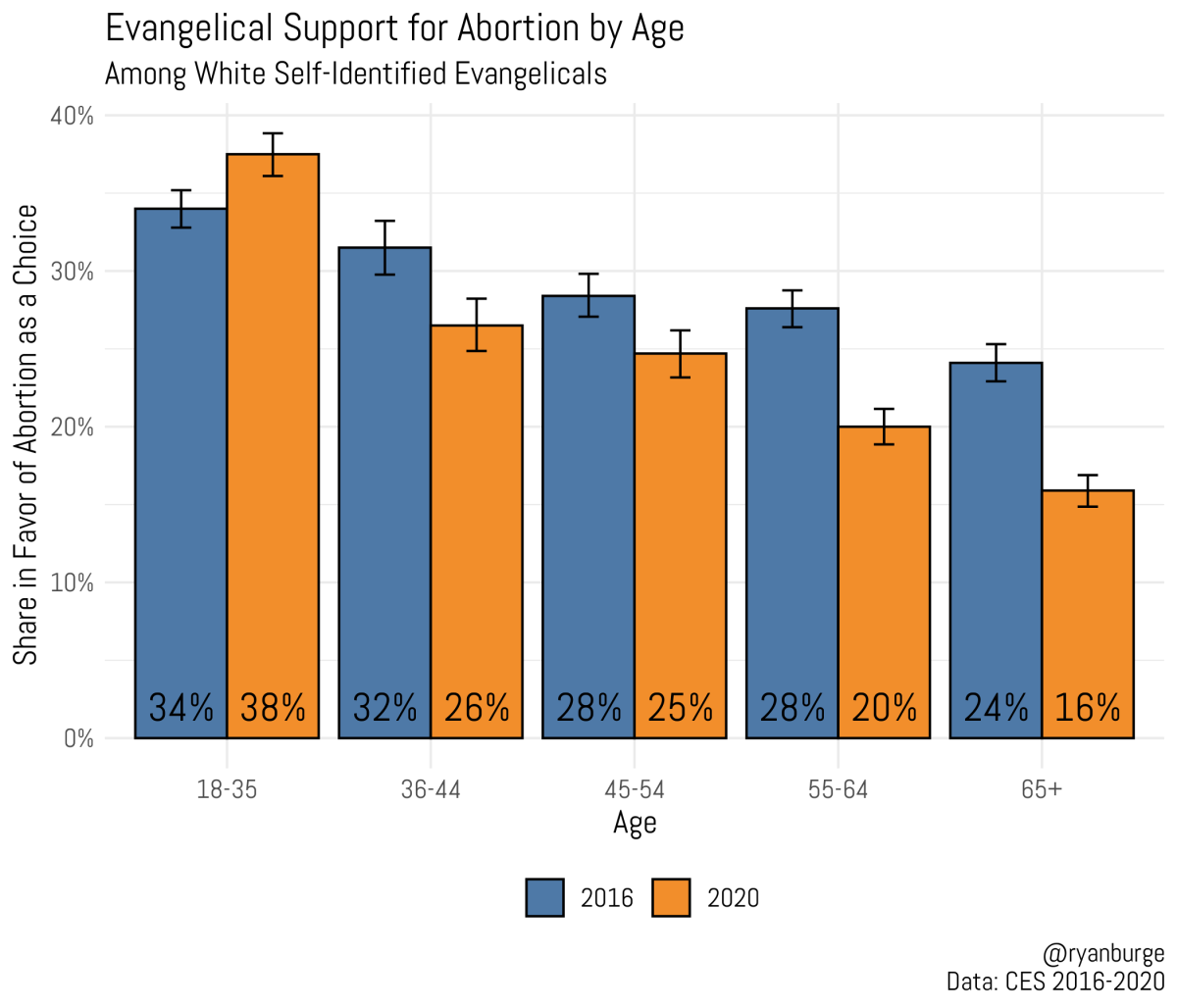
When survey participants were asked about abortion rights—whether women should always be allowed to obtain an abortion as a matter of choice—overall support was predictably low in 2016. Just a third of those 35 and younger were in favor. In older groups, fewer and fewer evangelicals were in support. Among white evangelicals of retirement age, less than a quarter were in favor. There was about a 10-percentage-point gap between the youngest and oldest evangelicals on the issue of abortion.

The leader of the Christian Right tells how political activism has affected him.Shedding his earlier opposition to political involvement, Jerry Falwell helped found Moral Majority in 1979. The group was organized to oppose abortion and to support traditional family values, a strong national defense, and the State of Israel.Moral Majority enabled fundamentalists to join forces with those from other religious traditions in addressing social and moral issues. Falwell says Catholics make up the largest constituency in Moral Majority, accounting for some 30 percent of its adherents. The organization also includes evangelicals, Jews, and Mormons.Last month, Falwell announced the formation of Liberty Federation, an umbrella organization that will address a broader range of public policy issues (CT, Feb. 7, 1986, p. 60). Among other issues, the organization will speak out on the strategic defense initiative, the spread of communism, and American foreign policy toward South Africa and the Philippines. Moral Majority is functioning as a subsidiary of Liberty Federation. Another subsidiary, Liberty Alliance, operates as the educational and political lobbying arm of Liberty Federation.CHRISTIANITY TODAY asked Falwell to assess the Religious Right in 1986. He also outlines his goals for the future, and tells how he has changed after seven years of political activism.Has the New Right’s political power crested, or will it continue to grow?The New Right has been very successful, and its influence is growing rapidly. There is a perception across the country that with Ronald Reagan in the White House, the moral issues are on the front burner, the country is moving to the Right, and we have won the battle.However, most people in the New Right would tell you they are having difficulty raising funds. That is true for two reasons. First, so many more organizations are raising funds out of the same pool. Second, the perception of safety, which our success has created, hurts fund-raising efforts. You don’t do well in fund raising unless you are in trouble.Organizations in the political Right are realizing that there are X number of people interested in supporting conservative causes, and they are all asking those same people for money. One of my friends receives at least 30 letters a day from political and conservative organizations. The number of organizations needing money is growing faster than the head count of conservative supporters. So some of these organizations are going to die out.But these factors have not affected the Christian Right. Our supporters back us out of a spiritual motivation, rather than political motivation. Our budget is 0 million—the largest ever. Our supporters are giving continuously, regardless of who is in the White House.The New Right has had a positive influence on the Christian Right. They have educated us on many of the issues, giving us political savvy in a hurry. And groups like Moral Majority have spawned hundreds of groups of conservative Christians who are now registered voters. They are speaking to the issues, and they are politically involved. The next step for us is challenging our people to run for office. We probably have 90 to 100 running this year.Your statements last fall opposing economic sanctions against South Africa raised the ire of many Americans, including religious leaders. Isn’t this a problem that has no simple theological answer?I don’t know any reasonable Christian who supports apartheid. So we begin from a point of agreement. But there is tremendous diversity on how to solve the problem. I have fundamentalist friends who disagree with my position on South Africa.I want to see every one of the 30 million residents of South Africa participating in the political process there. And I want to see it happen as quickly as possible. But I don’t want South Africa to go the route of Mozambique, Zimbabwe, and Angola. When colonialism became history in Africa and Europeans moved out instantly, bloodbaths occurred. The citizens of those countries had not had time to develop the expertise to operate a fair and reasonable government.The gradual move toward reform that South African President P. W. Botha is committed to will eventually bring a participatory government. It will bring an end to apartheid, and provide prosperity without bloodshed.Now, the African National Congress (ANC) and its arm inside the country, the United Democratic Front, are advocating violence. Half of the 800 people who have died have been blacks killed by blacks. There has been brutality, and you can’t excuse all the conduct of the South African government any more than you can the ANC.Change can take place. But intervention from outside—from the Soviets or the United States—will create havoc. We need to use economic pressure and a lot of restraint to give them time to do in a few years what it took America 170 years to accomplish.Your stands on political matters give rise to criticism from both the Right and the Left. How do you live with that kind of tension?I have a relative position of safety as pastor of Thomas Road Baptist Church, in Lynchburg, Virginia. We have 21,000 members who have grown up with me since the inception of the church 30 years ago. They know where I’m coming from. They have seen my views develop.Many of them were here when we were a part of the segregated South and had no black members. They were here when our first black member was baptized. They saw our philosophy change, and they saw our commitment to noninvolvement in political issues reversed. They were here long enough to hear the rationale and to see that change is not always bad.They see the weeks and weeks of information and experience that lead up to the public positions I take. As a result, no matter what may be printed in the newspapers, when I come home I have no reaction to calm down. And with no intention of ever running for political office, I don’t have to worry about opinion polls.When you espouse a position that you know will be criticized, are you prepared to respond to your opponents?As a younger preacher, I was far more sensitive to public opinion and criticism. There are two college professors who for 15 or 20 years have taped every message I have preached. They try to find some contradiction or ethnic bias or something. Every time they think they find something, they run to the Washington Post. There were days when I responded to them. But one day I realized that no matter who said what, it didn’t hurt me. My response to this garbage did me far more damage than what my critics said or did to me. So I stopped responding long ago. I operate totally on offense now.Criticism can help keep us accountable. Who carries out that function in your life?First, I am accountable to God. Next, I am accountable to a local congregation. As a pastor, I can’t have any scandals. And I can’t have a financial debacle because my congregation must have confidence in me. Third, as an organization, we are accountable to our donors. We are audited by an outside accounting firm every year. All of our donors have access to our financial statements.How has your role changed since you founded Moral Majority?Before Moral Majority was formed, I had more freedom to express my opinions. Since then, I’ve had to gradually pull in the ropes and be very cautious on making statements until I’ve weighed the impact on our own camp. The South African debate is probably the most volatile one we have been involved in because there are really good people on both sides of the issue.I’ve had to pull in my tendency to shoot from the hip. I’ve also had to learn that I can’t talk to anybody outside my own family about sensitive subjects, because my comments invariably appear in print. That’s a hard lesson for a very public, extroverted person like myself.In Lynchburg, I can stop at a hot-dog joint and talk with the guys I went to high school with. That doesn’t mean I don’t have detractors here. I do. But in this town I’m just Jerry.It’s totally different when I leave Lynchburg. My high visibility has made me become what I don’t like to be: a private person outside of my home town. That is the most painful consequence of what I do.Liberty University is a special concern of yours. What are your hopes and dreams for that school?Liberty University is my way of carrying out the dream and vision God has given me. That vision is to give the gospel to the world in my generation. Television and radio are effective; the local church here is effective; our speaking tours are effective. But my hope for making an impact on the world with this generation and generations to come is to train young people in the things that are vital to the cause of world evangelization.Now in our fifteenth year, we have 6,900 students. We have 75 majors, and we are fully accredited. Our master’s program is in place, and our doctoral program begins this fall. We’re also planning to start a law school. When you include our elementary and high school, we have 8,500 students. We have a dream of 50,000 students shortly after the first of the century.There are several areas where Liberty University can reverse the trends that have corrupted society. We have trained 1,000 preachers. We have also trained journalists. We have a large business major, and a large education major. Our students who major in political science are required to work as interns in Washington for senators and congressmen. One of our graduates is running for Congress this fall. One day we will be doing what Harvard has done. We’ll have hundreds of our graduates running for office.How is God moving you further along the ministry path he has set for you?At age 52, my spiritual growth is as important as it was 34 years ago when I became a Christian. The study of the Word of God, my personal relationship with God, and my time in fellowship and prayer are as vital, if not more so, now as in the past.I read a lot—not only the Bible and books about the Bible and men and women of God—but also books like Iacocca and Losing Ground. I try to read all the best sellers that are coming out so the world doesn’t walk past us. I probably read two books a week. I have to make some sacrifices in order to find the time to do that. I’m trying to improve myself. I’m trying to learn. I’m trying as hard to grow now as I did 30 years ago so that I am capable of leading the people that God has put under my ministry.What would you like your legacy to be?I’d like to be remembered as a good husband, father, and pastor. That is my first calling. I’ve got three children in school. Two of them are in college, and one is in law school. We do everything together. I may fail in a lot of areas, but, God willing, it won’t be at home.Likewise, as pastor of Thomas Road Baptist Church, I’m always here on Sunday morning, Sunday night, and Wednesday morning. I won’t miss two Wednesday nights a year. And I don’t miss any Sunday mornings.NORTH AMERICAN SCENEPROLIFE DEMONSTRATION36,000 March in WashingtonThe annual March for Life brought an estimated 36,000 people to Washington, D.C., last month to protest legalized abortion. The demonstration marked the thirteenth anniversary of the U.S. Supreme Court’s Roe v. Wade ruling that made abortion legal in the United States.Marchers gathered on the Ellipse behind the White House where they heard an address by President Reagan via a telephone and loudspeaker hookup. “We will continue to work together with members of Congress to overturn the tragedy of Roe v. Wade,” Reagan said.The demonstrators also heard from members of Congress, including U.S. Sen. Jesse Helms (R-N.C.) and U.S. Rep. Jack Kemp (R-N.Y.). “The success of this movement is assured,” Kemp said, “not only because it’s predicated on those Judeo-Christian values upon which America was founded, but because it is pro-people.”The demonstrators marched to the Supreme Court building and the Capitol, where they lobbied members of Congress. Ten persons were arrested for demonstrating at the Supreme Court, and 31 others were arrested for protests at two Washington, D.C., abortion clinics.Proponents of legalized abortion used the occasion to criticize the prolife movement. Eleanor Smeal, president of the National Organization for Women, said her group is planning a major march in Washington this spring in support of artificial contraception and legalized abortion.UNIFICATION CHURCHVoices of DissentTwo newsletters are calling for change in the Unification Church, the cult headed by Korean religious leader Sun Myung Moon.The newsletters, published by members of the Unification Church, call for greater freedom in personal lifestyles, more democratic participation by members, and doctrinal reform. One of the newsletters, The Round Table, was started last year by graduates of the Unification Theological Seminary in Barrytown, New York. The other, called Our Network, was begun in 1984 to support Moonies who are moving out of the cult’s mainstream.Our Network editor Aquacena Lopez said most of Moon’s followers live outside the communal centers that serve as bases for the Unification Church’s missionary work. She said those followers feel rejected by Moon’s organization.David Doose, an editor of The Round Table, said many members oppose the authoritarian style of Unification leaders from Eastern nations, primarily Korea. Another Round Table editor said many Unificationists want Moon’s organization to stress a stronger relationship to historic Christianity.Doose said a Unification Church newsletter called The Pyramid is being published in part to counter the impact of The Round Table. However, Pyramid editor Dan Stringer said his newsletter is “only meant to articulate the faith of many members.” Stringer, a member of a Unification anti-Communist organization called CAUSA, said many of the dissenters “have not reconciled themselves to authority.… [They] leave themselves little choice but to move on and go beyond the Unification Church.”TRENDSPoor Do Worse in 1985Demands for emergency food and shelter rose sharply last year in most of the 25 cities surveyed by the United States Conference of Mayors.A report prepared by the organization says the demand for emergency food rose an average of 28 percent during 1985. Officials in 66 percent of the cities said the demand is so great that they must turn people away from their emergency food assistance programs.Demands for shelter increased in 90 percent of the cities surveyed, staying the same in the remaining cities. Officials in most of the 25 cities said poverty levels remained the same or increased during 1985.In a separate study, the National Urban League reported that economic and social gaps between blacks and whites in America widened significantly last year. In its annual report, the civil rights organization said income and educational attainment among blacks has declined in relation to whites. Poverty, youth unemployment, and single-parent families among black Americans increased.National Urban League president John E. Jacob said government figures show that in 1984, the latest year for which figures are available, the median income of blacks dropped to 56 percent of the white median income. In 1970, the figure was 62 percent.PEOPLE AND EVENTSBriefly NotedDamaged: By fire, the platform area of Chicago’s historic Moody Church. Fire destroyed the church’s pulpit, a grand piano, parts of a pipe organ, and the public address system. No one was injured in the blaze. Authorities said an intruder ransacked two church offices and then apparently ignited the fire after pouring a flammable liquid around the pulpit. Damage to the church was estimated at 0,000.Appointed: To chair the board of World Vision International, Roberta Hestenes, director of the Christian Formation and Discipleship Program at Fuller Theological Seminary. An ordained Presbyterian Church (U.S.A.) minister, Hestenes is the first woman to head the World Vision board in the agency’s 35-year history.Died: Former Wheaton (Ill.) College registrar Enock C. Dyrness, 83, on January 15, in Walnut Creek, California. A 1923 Wheaton College graduate, Dyrness served on the college’s faculty and administration for more than 40 years.Presented: To Navajo official Edward T. Begay, a copy of the first complete Bible translated into the Navajo language. The Navajo nation, representing 220,000 native Americans, first received the complete New Testament in its language in 1956. Navajo Bible Translators, with financial support from Wycliffe Bible Translators and the American Bible Society, finished the complete Navajo Bible last year.

By 2020, support for abortion rights dropped among every age group but the very youngest.

Thirty-eight percent of them said that they favored abortion on demand—a four-point increase in four years. But among older evangelicals, support dropped significantly. In 2020, just 16 percent of the oldest white evangelicals were in favor, a drop of eight points in just four years. The age gap doubled in the four-year span, now up to 22 percentage points.

This age gap is persistent across a number of questions about abortion.

Respondents were asked if they favored allowing private employers to decline coverage for abortion in their insurance. Support for the policy has been robust among white evangelicals both in 2016 and 2020, never dropping below 60 percent among any age group.

However, the age gap has also grown. In 2016, there was almost no variation to this question based on age. Evangelicals born in the 1950s became even more supportive of the policy in 2020, a jump of nearly 10 points, while support from younger evangelicals dropped nearly as much. In 2016, about 73 percent of white evangelicals born in 1990 were in favor—it was 64 percent by 2020.


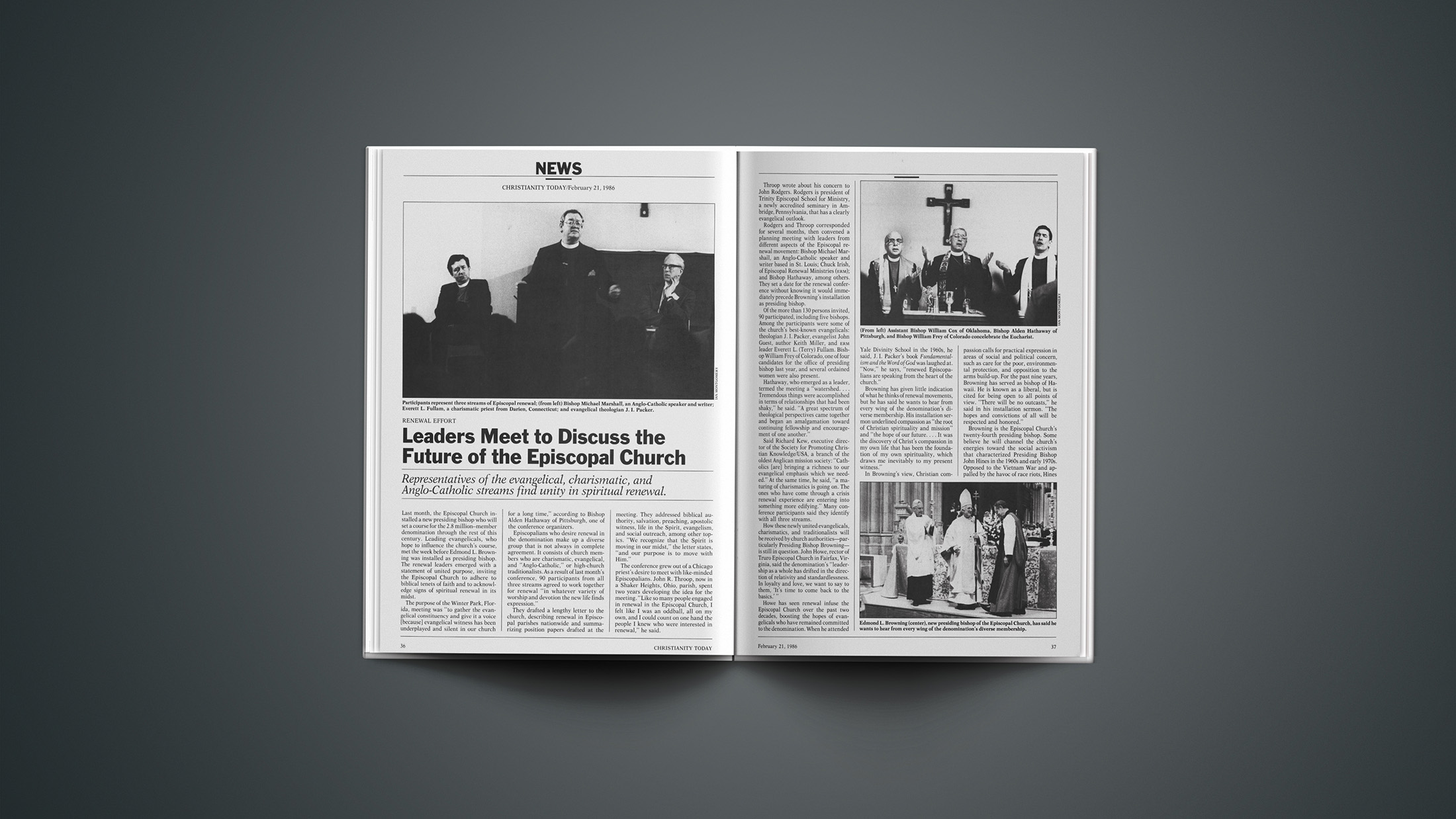
Representatives of the evangelical, charismatic, and Anglo-Catholic streams find unity in spiritual renewal.
Last month, the Episcopal Church installed a new presiding bishop who will set a course for the 2.8 million-member denomination through the rest of this century. Leading evangelicals, who hope to influence the church’s course, met the week before Edmond L. Browning was installed as presiding bishop. The renewal leaders emerged with a statement of united purpose, inviting the Episcopal Church to adhere to biblical tenets of faith and to acknowledge signs of spiritual renewal in its midst.
The purpose of the Winter Park, Florida, meeting was “to gather the evangelical constituency and give it a voice [because] evangelical witness has been underplayed and silent in our church for a long time,” according to Bishop Alden Hathaway of Pittsburgh, one of the conference organizers.
Episcopalians who desire renewal in the denomination make up a diverse group that is not always in complete agreement. It consists of church members who are charismatic, evangelical, and “Anglo-Catholic,” or high-church traditionalists. As a result of last month’s conference, 90 participants from all three streams agreed to work together for renewal “in whatever variety of worship and devotion the new life finds expression.”
They drafted a lengthy letter to the church, describing renewal in Episcopal parishes nationwide and summarizing position papers drafted at the meeting. They addressed biblical authority, salvation, preaching, apostolic witness, life in the Spirit, evangelism, and social outreach, among other topics. “We recognize that the Spirit is moving in our midst,” the letter states, “and our purpose is to move with Him.”
The conference grew out of a Chicago priest’s desire to meet with like-minded Episcopalians. John R. Throop, now in a Shaker Heights, Ohio, parish, spent two years developing the idea for the meeting. “Like so many people engaged in renewal in the Episcopal Church, I felt like I was an oddball, all on my own, and I could count on one hand the people I knew who were interested in renewal,” he said.
Throop wrote about his concern to John Rodgers. Rodgers is president of Trinity Episcopal School for Ministry, a newly accredited seminary in Ambridge, Pennsylvania, that has a clearly evangelical outlook.
Rodgers and Throop corresponded for several months, then convened a planning meeting with leaders from different aspects of the Episcopal renewal movement: Bishop Michael Marshall, an Anglo-Catholic speaker and writer based in St. Louis; Chuck Irish, of Episcopal Renewal Ministries (ERM); and Bishop Hathaway, among others. They set a date for the renewal conference without knowing it would immediately precede Browning’s installation as presiding bishop.
Of the more than 130 persons invited, 90 participated, including five bishops. Among the participants were some of the church’s best-known evangelicals: theologian J. I. Packer, evangelist John Guest, author Keith Miller, and ERM leader Everett L. (Terry) Fullam. Bishop William Frey of Colorado, one of four candidates for the office of presiding bishop last year, and several ordained women were also present.
Hathaway, who emerged as a leader, termed the meeting a “watershed.… Tremendous things were accomplished in terms of relationships that had been shaky,” he said. “A great spectrum of theological perspectives came together and began an amalgamation toward continuing fellowship and encouragement of one another.”
Said Richard Kew, executive director of the Society for Promoting Christian Knowledge/USA, a branch of the oldest Anglican mission society: “Catholics [are] bringing a richness to our evangelical emphasis which we needed.” At the same time, he said, “a maturing of charismatics is going on. The ones who have come through a crisis renewal experience are entering into something more edifying.” Many conference participants said they identify with all three streams.
How these newly united evangelicals, charismatics, and traditionalists will be received by church authorities—particularly Presiding Bishop Browning—is still in question. John Howe, rector of Truro Episcopal Church in Fairfax, Virginia, said the denomination’s “leadership as a whole has drifted in the direction of relativity and standardlessness. In loyalty and love, we want to say to them, ‘It’s time to come back to the basics.’ ”
Howe has seen renewal infuse the Episcopal Church over the past two decades, boosting the hopes of evangelicals who have remained committed to the denomination. When he attended Yale Divinity School in the 1960s, he said, J. I. Packer’s book Fundamentalism and the Word of God was laughed at. “Now,” he says, “renewed Episcopalians are speaking from the heart of the church.”
Browning has given little indication of what he thinks of renewal movements, but he has said he wants to hear from every wing of the denomination’s diverse membership. His installation sermon underlined compassion as “the root of Christian spirituality and mission” and “the hope of our future.… It was the discovery of Christ’s compassion in my own life that has been the foundation of my own spirituality, which draws me inevitably to my present witness.”
In Browning’s view, Christian compassion calls for practical expression in areas of social and political concern, such as care for the poor, environmental protection, and opposition to the arms build-up. For the past nine years, Browning has served as bishop of Hawaii. He is known as a liberal, but is cited for being open to all points of view. “There will be no outcasts,” he said in his installation sermon. “The hopes and convictions of all will be respected and honored.”
Browning is the Episcopal Church’s twenty-fourth presiding bishop. Some believe he will channel the church’s energies toward the social activism that characterized Presiding Bishop John Hines in the 1960s and early 1970s. Opposed to the Vietnam War and appalled by the havoc of race riots, Hines channeled millions of church dollars into social endeavors, some of which were backed by radical secular groups. Membership and giving dropped precipitously, and when the church chose Hines’s replacement in 1973, it opted for John M. Allin, a low-profile, cautious churchman. His 12-year term saw two major changes occur in the church. In 1977, women were ordained to the priesthood—a development that Allin opposed. In 1979, a new Book of Common Prayer came into use, updating the language and, some believe, the core doctrine of the historic prayer book.
Both of these developments drew some members away from the Episcopal Church and toward affiliation either with Roman Catholicism or conservative Protestantism. Within the church, scattered opposition to women priests and the new prayer book continues. In circles where renewal is occurring, however, these are not central issues. Fleming Rutledge, a woman priest who attended the Winter Park renewal conference, delivered a stirring sermon at the closing Communion service. Another priest, Carol Anderson, told conference participants about her congregation’s work among street people in New York City.
The basics of renewal, spelled out in the letter produced at the Florida conference, include an affirmation of Scripture as “completely trustworthy and sufficient.” Salvation, the conferees agreed, is a gift from God that is appropriated by “repentance, faith, and conversion of life” made possible by the Holy Spirit. The letter states that the Lord’s “actual resurrection from the dead attested his divinity, vindicated his claims, and broke the power of sin and death once for all.”
The letter says “the scriptural promises of supernatural resources to the believer are true,” and “the personal experience of the Holy Spirit quickens worship in the church.” It defines evangelism as a call to “personal commitment through repentance and faith.” Outreach and service are essential, according to the document, because “renewal will die unless [individuals and congregations] continue to move beyond themselves.”
A paragraph penned by theologian J. I. Packer concludes the document, stating, “Where Jesus Christ is known, trusted, loved, and adored; where the sinner is loved but all forms of sin are hated and renounced; where Christ’s living presence is sought and found in fellowship; and where righteousness is done—there the church is in renewal, in whatever variety of worship and devotion the new life finds expression.”
BETH SPRINGin Winter Park

Bishop Alden Hathaway of Pittsburgh


A Renewal Leader from Pittsburgh

According to theologian J. I. Packer, Bishop Alden Hathaway of Pittsburgh is being anointed as a leader in Episcopal renewal—a movement the bishop at one time thought was irrelevant.
In the 1960s, Hathaway served on the staff of a large suburban Detroit church, specializing in human-relations training and proabortion activism. Inner-city riots—the same events that galvanized liberal social action on the part of then Presiding Bishop John Hines—dashed Hathaway’s hopes for his ministry. “A lot of that liberal commitment evaporated over a period of months and years, as the suburbs retreated into themselves and the inner city became polarized. I saw there was something missing from that social-action movement. We were trying to do God’s work using man’s tools, and we concluded that the sin was in the institution, not in our own hearts.”
Hathaway left Detroit and took a job at a parish in the Virginia suburbs of Washington, D.C. The church was split over the Vietnam War, and Hathaway’s best efforts to patch the congregation together had little effect. “I was absolutely burned out, tired of failing, tired of expending my energy and having nothing to show for it,” he said. Then a friend, Jim Hampson, got involved in what Hathaway called “this evangelical business.”
“We’d exchange sermons,” Hathaway said. “He’d write ‘heresy’ all over mine, and I’d write ‘irrelevant’ all over his. We argued and fought.” Hampson challenged Hathaway to submit his ministry and his life to Jesus Christ, but Hathaway resisted the notion. “I knew I had to do that, but it was not a happy thought at all. It was a bitter thought. With my heart I knew I had to get on my knees and confess Jesus, but with my pride I said no.”
At his church, Hathaway had a seminary intern who “preached the Bible, not Watergate.” He knew people were listening more attentively to the intern’s sermons, so he cynically decided, “Okay, you’ll get Bible stories.” He changed his preaching to conform with what he heard from the divinity student, and noticed something happening.
“I found a power and authority that was not my own. I found myself saying things that I didn’t believe or that weren’t credible, but it was touching people in a way I’d never touched them before. And it was touching me, too. It was convincing me of the power of the Word.”
Several months later, Hathaway attended a charismatic conference where he heard the preaching of Everett L. (Terry) Fullam, rector of Saint Paul’s Episcopal Church in Darien, Connecticut. “I heard Scripture being used in a different way. It all pointed to Jesus. In the confidence of that, I laid down my life and received the Holy Spirit. Nothing particularly happened, except I realized I was on the right track, that Jesus was with me. It’s been slow growth ever since then.”
In 1980, Hathaway was elected bishop of Pittsburgh, placing him in the role of overseeing a great variety of priests and parishioners. “I have a diocese with all kinds of sheep in it,” he said. “It’s not my job to sort them; it’s my job to feed them. The only thing I will not tolerate is skepticism on the [divine-human nature] of Christ. We are not a unitarian church, and I don’t buy for a minute that that is a legitimate Anglican position.”
Hathaway is unfazed by the prospect of a major leadership role in the spiritual renewal of the Episcopal Church. He took charge of sending the renewal conference’s letter to Presiding Bishop Edmond L. Browning, and offered to coordinate a meeting of conference organizers to discuss ways to cooperate in the future. “I know I’m where God wants me,” he said, “and I wouldn’t be any place else in the whole world.”

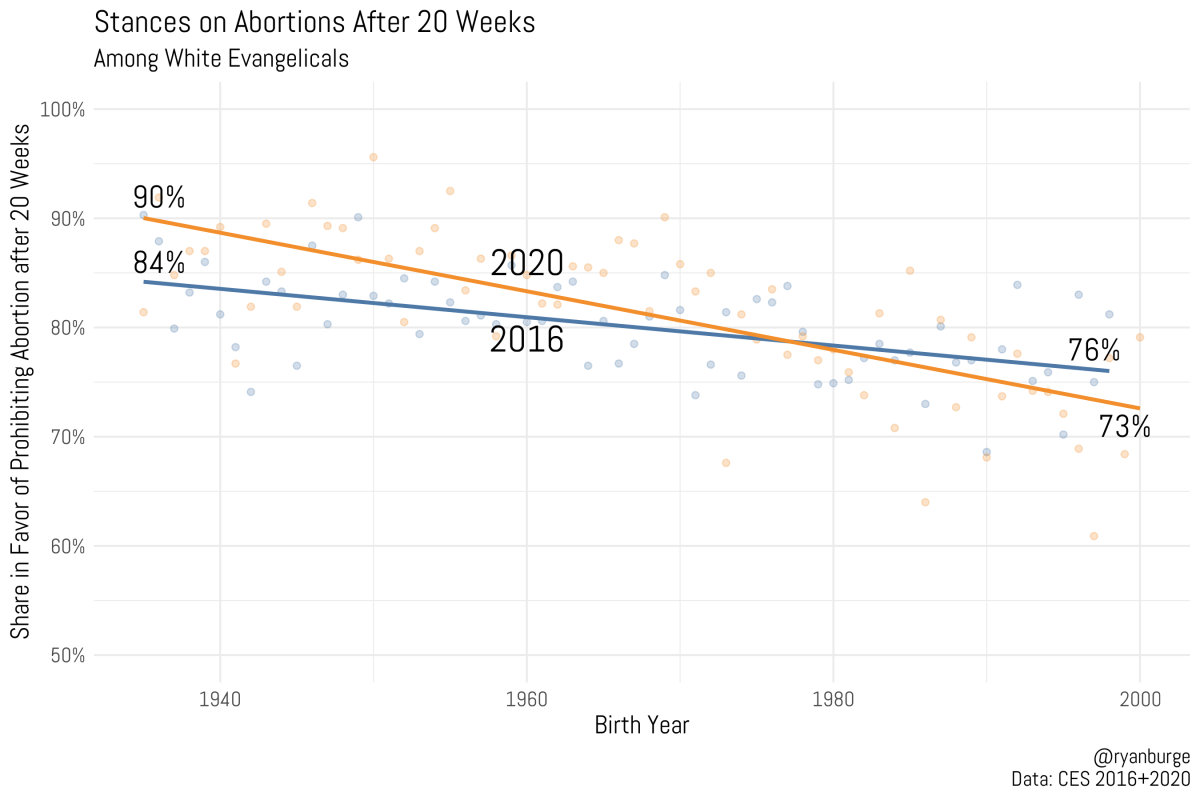
When respondents were asked about late-term abortions, the age gap persisted. In 2016, between 80 percent and 85 percent of older white evangelicals supported a ban on abortion after 20 weeks of gestation. Just four years later, support for a ban increased by about five percentage points.

Yet among evangelicals born in 1980 or later, there was less enthusiasm for a late-term abortion ban in 2020 compared to 2016. Among white evangelicals born in 1990, 77 percent were in favor in 2016, dropping to 74 percent in 2020. While the majority still believe in banning late-term abortions, the age gap is much larger in 2020 compared to 2016.

It’s not possible to say that white evangelicals actually changed their minds on abortion because the same people were not surveyed in both waves of the research. Instead, we can see that older people who identified as evangelicals were more anti-abortion in 2020 than they were in 2016, while younger white evangelicals became more in favor of abortion rights.

Why did we see so much change in just the four years between 2016 and 2020? There aren’t easy answers in the data. Younger white evangelicals, in many ways, are just as committed to Republican politics as older ones.

One potential explanation is that abortion has become less stigmatized and more openly discussed, and that can have tremendous impacts on public opinion. It’s plausible that some younger evangelicals were persuaded to moderate their stance on abortion because they had a more personal connection to the issue.

Abortion may not be as central a cause for young people overall. A 2021 New York Times article noted that “some, raised in a post-Roe world, do not feel the same urgency toward abortion as they do for other social justice causes.”

For years, pro-life evangelicals were the exception. Pro-choice advocates had worried about the “intensity gap” among young people, Slate reported, with a NARAL survey finding that pro-choice voters under 30 were half as likely as their pro-life counterparts to consider the issue of abortion “very important” in the 2016 election.

Perhaps the shifts we see among young evangelicals, and the burgeoning wave of Gen Z adults, show this distinction beginning to fade.

In a year when many evangelicals are anticipating a major milestone in the pro-life movement—the chance that the Supreme Court will overturn Roe v. Wade—it looks as if fewer young believers will celebrating alongside them.

Ryan Burge is an assistant professor of political science at Eastern Illinois University. His research appears on the site Religion in Public, and he tweets at @ryanburge.

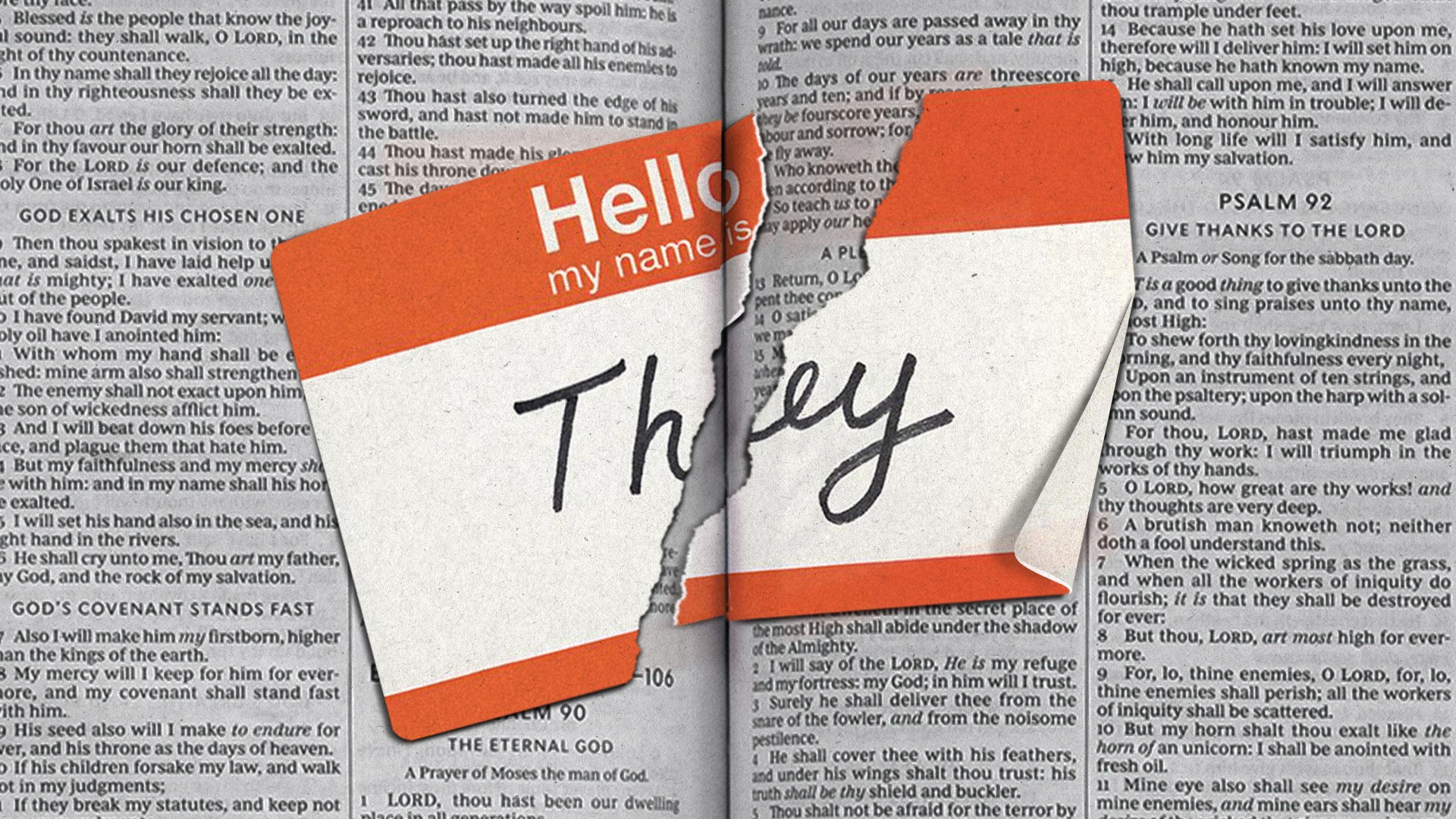
‘They’ Is Not a Pronoun for God

God doesn’t have a gender, but his pronouns do.

Christianity Today January 20, 2022
Illustration by Mallory Rentsch / Source Images: Aaron Burden / Unsplash

Terms and their meanings have always shifted as cultures change. Over the last several years, some of the most significant controversies in the public square have hinged on the use and meaning of words, whether in reference to sexuality, gender, political convictions, or many other examples.

At present one of the liveliest language debates in our culture centers on personal pronouns. As a part of that conversation, some groups are expanding the semantic range of they to include a singular subject rather than only a plural subject—a linguistic leap previously nonexistent in the English language.

Many Christians (including myself) disapprove of this semantic expansion on legitimate and significant anthropological grounds. There is no such thing as a nongendered human and therefore no need to use a nongendered pronoun in reference to a person. Even so, since they is now being popularly used in English as a singular pronoun, I was recently asked about the implications for Christian theological language. If they can take a singular subject, is it appropriate to use they in reference to the triune God?

Put simply, the answer is no. Introducing a nongendered, personal, singular pronoun into our theological discourse isn’t orthodox, in my opinion. The primary reason: God has revealed himself in the words of Scripture, and Christians should use biblical language to refer to him whenever possible.

Let’s dig a bit deeper into why.

First of all, God is holy. In his eternal being, he is wholly separate from everything and everyone he has created. This divide between God and creation presents a quandary for theological terminology. Every word we use in reference to God—whether a noun, verb, or pronoun—already has a meaning from our context within creation.

For example, when we say God is Father, Son, and Holy Spirit, we already have a preconceived notion of what the word Son means from our understanding of human sonship. If we take that human meaning and apply it by direct analogy to the divine Son, we will make grave, heterodox errors.

Instead, we can allow our words and concepts to be conformed out of reverence for God’s holiness. We can approach God with openhanded humility and allow him to define himself for us, as he reveals himself to us in his Word.

Christian theological language is entirely dependent on God’s self-revelation in Scripture. That means all theological speech should emerge from the biblical text wherein he has made himself known. God’s revelation is inseparably personal and articulate. Through the words of the Bible God gives himself personally to us.

As such, biblical terminology is not arbitrary to God’s eternal being. He willingly chose to reveal himself through those particular terms, as the Holy Spirit inspired the authors of Scripture to pen them (2 Pet. 1:21). In our theology, then, Christians should use the same language in reference to God. We should speak of God using the words he has spoken of himself.

We can apply this principle to God’s pronouns. The biblical witness uses a masculine, singular pronoun to refer to God with absolute consistency in both Greek and Hebrew. While God’s being and essence are not gendered, the use of masculine terminology is not arbitrary. God is Father and Son, and those terms are linguistically masculine. Thus, masculine pronouns are proper to use in reference to God.

While divine Fatherhood and Sonship are altogether different from human fatherhood and sonship, God chose these creaturely linguistic concepts to reveal himself. He takes hold of these human terms and transforms them. Christians are meant to interpret the meaning of those words in the context of the gospel of Christ and in accordance with Scripture.

We can no more replace the masculine pronoun in reference to God than we can replace the terms Father and Son. Unilaterally substituting those words—and the ideas behind them—would have a significant impact on our understanding of God’s eternal being. We cannot separate the personal content of God’s self-revelation from the linguistic form of the biblical text. We are not the lords of theological language; God alone is. For through it, he saw fit to reveal himself.

I can think of two potential counterarguments to rejecting they as an appropriate singular pronoun in reference to God.

First, no nongendered, singular, personal pronoun is used in the biblical languages to refer to people. If the biblical authors had the option, would they have used it? There is no way for us to answer a hypothetical question about the minds of the biblical authors. We can know their minds only as inscribed in the text.

Nevertheless, God specifically chose these languages, these authors, and these historical times to reveal himself. His actions were not random or haphazard. We can trust his good purposes in the words he chose.

Second, we routinely use extrabiblical terminology in our theological discourse, such as the term Trinity. How is using they any more problematic than using Trinity to refer to God?

The pronoun is different from terms like Trinity in three ways.

First, the historical development of these extrabiblical theological terms occurred because there was no biblical alternative. As the early church recognized the need to clarify the gospel according to Scripture, they developed terms like Trinity or hypostatic union to help Christians understand God in their context.

Second, using they in reference to God does not develop a new term; it replaces a biblical term. The Bible already uses a masculine personal pronoun in reference to God. We have no warrant to search for new terminology.

Finally, using they introduces an unnecessary and harmful lack of clarity into our theological discourse. Even if it becomes culturally normative to use they as a singular subject, using they as a plural subject will continue. That means if a person used this pronoun routinely, some hearers would be unable to differentiate whether the subject (God) was singular or plural without clarification.

The theological stakes here are high. Our triune God is one being in three persons. He is not a collective of three beings. So the terms we use in reference to God are immensely important.

God has revealed himself through the words of Scripture. Even as our contemporary language shifts, Christians should look to the unchangeable nature of God’s Word so that we might behold him as he is.

Christy Thornton holds a PhD in systematic theology from Southeastern Baptist Theological Seminary, where she serves as the director of the ThM program and associate director of the PhD program. She lives in Wake Forest, North Carolina, where she is a member of The Summit Church.

Theology

What Liz Cheney Can Teach American Evangelicals

Christians should preserve their integrity instead of conserving their influence.

Christianity Today January 20, 2022
Anna Moneymaker / Staff / Getty

This piece was adapted from Russell Moore’s newsletter. Subscribe here.

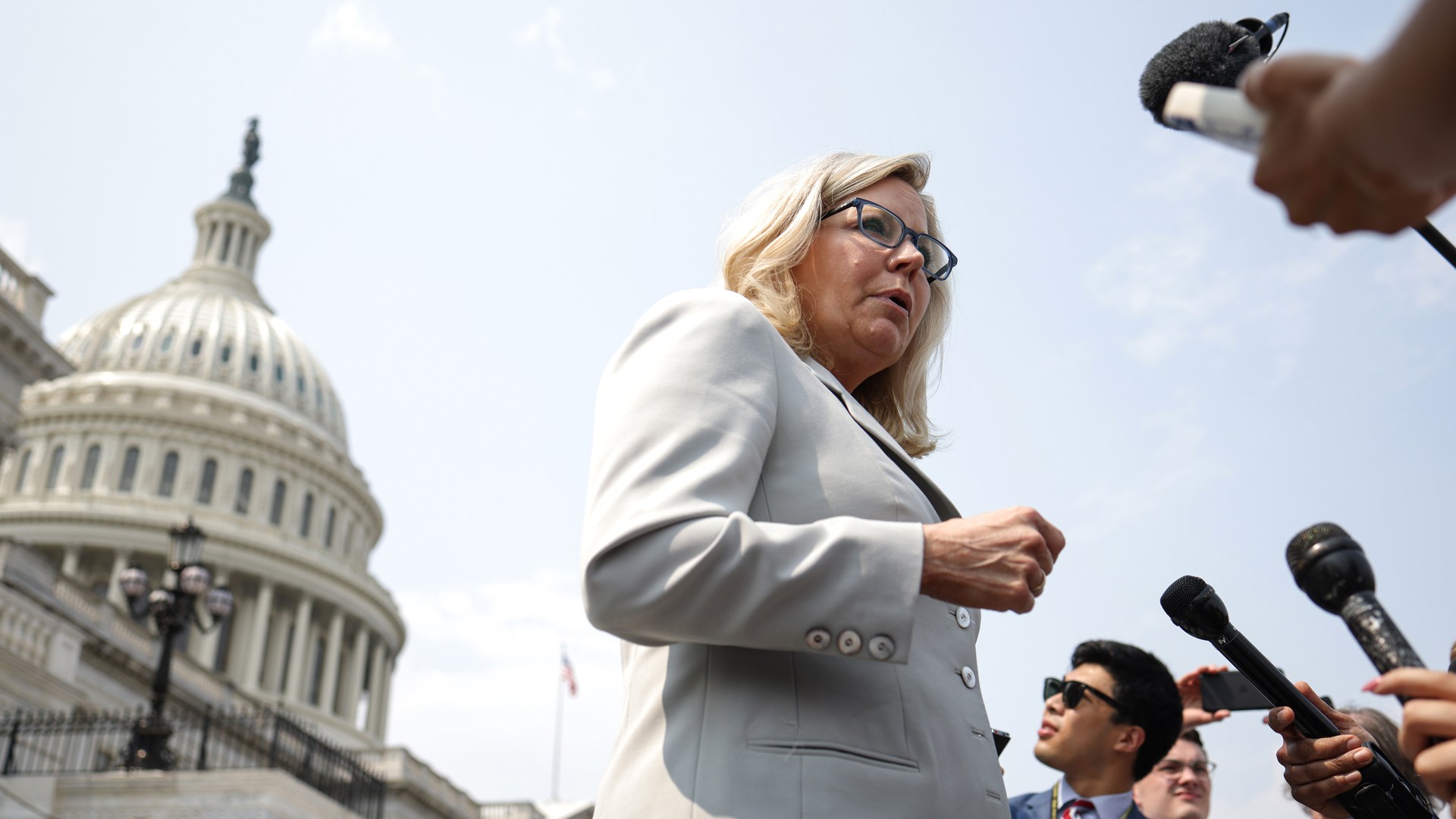
Some people in her own party want Rep. Liz Cheney (R-WY) to lose her membership on committees and even her place within her party’s conference in the United States House of Representatives, all because she won’t “move on” from her beliefs that the attempts to overturn the last election—leading up to last January’s attack on the Capitol—are a clear and present danger to democracy.

Whatever you think of Cheney (as you can imagine, I am a fan), there’s a larger point here—one that applies to many evangelical Christians in a thousand different situations in their churches and communities: At what point will you stop conserving your influence?

I thought about this conundrum last week while reading the transcripts of a New York Times podcast debate between Charlie Sykes of The Bulwark and Rich Lowry of National Review, both of whom are conservatives that admire Congresswoman Cheney’s integrity and conviction.

Where they disagree is on whether Cheney has squandered her influence within her party in ways that will prevent her from solving these problems in the future.

“As a politician, you have to be aware of where your voters are,” Lowry said. “Doesn’t mean that you pander to them or play to their worst instincts or always say yes to anything they want. But to live is to maneuver. Especially if you’re a politician.” Lowry said that Cheney’s refusal to back down on these matters wouldn’t be helpful. After all, if you’re not at the table, you can’t have influence.

Sykes noted that this idea is a common rationalization and that it’s circular. People who want others to remain silent or to go along with any sort of craziness often “tell themselves that they need to stay in the room so they can sound the alarm, but they refuse to sound the alarm so they can stay in the room.”

When I read this, I immediately thought of how often I have sat in the surreal situation of a television debate where the person I was debating gave a sad shrug and agreed with me off camera but went right back to saying the opposite as soon as the lights and cameras came back on.

I can think of people I’ve known in Christian ministry who told me, behind closed doors, how disgusted they were with a politician they deemed to be immoral but then, in public, praised the same politician as a man of integrity. The same thing is true all through the government.

The argument is that we need grownups in the room. As leadership expert John Maxwell once put it, “Being one step ahead makes you a leader. … Being fifty steps ahead could make you a martyr.” People in the vortex of craziness—whether in a workplace, a church, or a government—often tell themselves they have to play along with things they find insane to maintain their long-term ability to keep bad things from happening. “If I’m not here; someone worse will be,” they reason.

There’s a kernel of truth there, of course. I do a facepalm every time I hear of a young pastor who, after just arriving at a church, removes the American flag from the sanctuary or tries to excommunicate everybody who hasn’t attended in a year. “Even if you are right, these are not your biggest problems right now,” I would tell that person. “And this is the wrong time to take them on.”

Daniel in Babylon was willing to go the lions’ den over the demand that he worship the king, but, when it came to eating the rich delicacies of the king’s table, he prudently posed alternatives instead. Jesus didn’t believe he owed the temple tax but paid it “so that we may not cause offense” (Matt. 17:27). The apostle Paul circumcised Timothy so that the younger man’s Gentile heritage wouldn’t be a stumbling block to the mission (Acts 16:3).

The problem is that there comes a point where one moves from “choosing battles” to having one’s conscience seared. Peter’s refusal to eat with the Gentiles was, Paul wrote, “not acting in line with the truth of the gospel” (Gal. 2:14). Almost every time someone acts out of fear of getting kicked out of what C. S. Lewis called the “Inner Ring,” the person reasons that this is just “working within the system” or “living to fight another day.”

Whatever you think of Liz Cheney (did I mention that I’m a fan?), no one can seriously suggest that she was a radical revolutionary inattentive to maneuvering. She twice supported the president she now criticizes and voted with him over 95 percent of the time. She had the esteem of her colleagues such that she was elected to the third-highest rank in her party’s House hierarchy. She is a grownup. She was in all the rooms.

There came a line, though, that she could not cross—when she was asked to support things she believed to be contrary to her oath to the Constitution. What was she supposed to wait for? If attacking the Capitol to stop the counting of electoral votes is not the moment she should speak out, what exactly is that moment?

Martin Luther King Jr., in his famous “Letter from Birmingham Jail,” was responding to a group of “white moderate” pastors who had criticized his nonviolent action in the city as doing more harm than good by pressing progress so fast that it caused backlash.

Sociologist Peter Berger explained in the same time period how this happens. He showed that a key predictor of whether a pastor would speak out on the injustice of Jim Crow was whether that church was in a building program or a major church growth campaign.

And, contrary to the idea of biding one’s time and building one’s influence in order to do the right thing later, Berger found that the longer a pastor served at his church, the less likely that pastor was to challenge Jim Crow.

On the way up, we tell ourselves, “I don’t have the platform yet to speak; when I get one, I will.” After we arrive wherever we were heading, we tell ourselves, “I have too much to lose; if I am not at the table, they will lose my voice.” We think this is the voice of prudence inside us, but maybe more often than not, it’s just ambition mixed with fear.

Not only are the internal rationalizations circular, but so are the external circumstances. Whether in a church, a ministry, a workplace, a city council, or a neighborhood association, we tell ourselves, “I am going to live with this little bit of craziness so that I will be here to stop major craziness.”

Yet while those crazy things are happening, someone watching all this is wondering, “Am I the only one who sees that this is crazy?” When everyone else acts like the crazy situation is normal, that observer shrugs and concludes, “It must just be me.”

And then the craziness becomes the new normal. And folks “conserve their influence” for when it’s needed, for whatever is just a step crazier. I’ve been there, and that way leads to nowhere good.

Sooner or later, one’s influence isn’t conserved but hoarded. Sooner or later, one is operating not out of prudent patience but from a seared conscience.

Stop counting on the grownups in the room to solve the problems. Stop imagining that the crises erupting around us will settle down on their own.

Sometimes the grownup in the room is the only one who can point out that the room is on fire.

Russell Moore leads the Public Theology Project at Christianity Today.

Church Life

How to Church Shop Like the First Christians

In an age of virtual worship services, some things should stay the same.

Christianity Today January 20, 2022
Illustration by Mallory Rentsch / Source Images: Unsplash / Thibault Renard / Getty

A lot has changed with respect to church service attendance since the COVID-19 pandemic began, and some of these trends are likely to continue this year.

Many believers are still navigating the precarious balancing act between in-person gathering and online streaming, while some are looking to switch churches or denominations this year. Others have stopped going to church altogether.

There are those who attend multiple churches, often via virtual platforms—a practice which intensified last year.

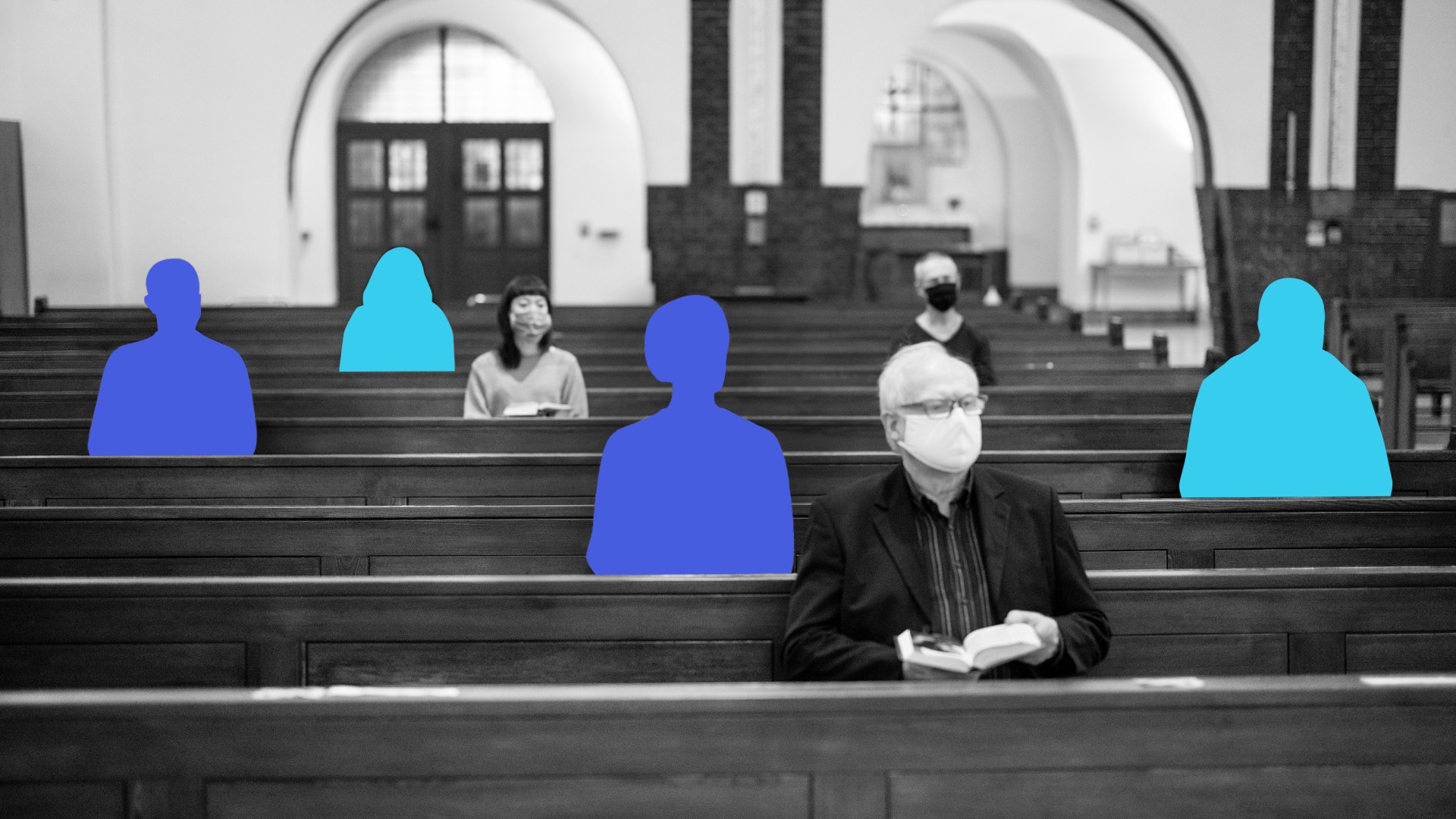
In the summer of 2020, just a few short months into the pandemic, more than one in three practicing Christians—those for whom church engagement is a priority—were streaming services from churches other than the one they were formally committed to.

And while this trend is relatively recent historically speaking, the phenomenon of church hopping and shopping began well before the pandemic—with nearly two in five churchgoers reporting regular attendance to multiple churches back in 2019.

A friend told me recently that when the pandemic first forced churches online, she began streaming services from a church across the country because she had always enjoyed the preacher’s style and his books. But once her county allowed gatherings again, she returned to attend her home church in person. When I asked her why, she said she came to the realization that “watching a service is great, but it isn’t church.”

While we may not all agree on that statement, it is worthwhile for us to discuss what constitutes “church” and what sets it apart—as well as how and why we are called to commit faithfully to one. Whether they acknowledge it or not, some Christians primarily consider the following three elements when it comes to reassessing their church commitments:

1. What’s most comfortable?

2. What’s most agreeable?

3. What’s most entertaining?

Unfortunately, the underlying forces driving some church searches are the basic tenets of individualistic consumerism, born out of an assumption that “church” is primarily a product package of goods and services, designed and marketed to achieve customer satisfaction.

The problem today, as Carl Trueman notes, is that “we all live in a world in which it is increasingly easy to imagine that reality is something we can manipulate according to our own wills and desires.” Unfortunately, this modern mindset has filtered into our ecclesiology—into the way we understand and embody what it means to be the church. But this instinct is not new.

Decades ago, theologian Dietrich Bonhoeffer wrote that “those who love their dream of a Christian community more than the Christian community itself become destroyers of that Christian community even though their personal intentions may be ever so honest, earnest, and sacrificial” (emphasis added).

It can be worthwhile to pursue a thoughtful and prayerful search for a faith community in which we meaningfully belong. But when it turns into a search for a church according to some perfect or hypothetical ideal, we may have gotten off course.

A healthy local church, Mark Sayers argues, should see themselves as “a disparate and dishevelled group of very ordinary people, crying out to God … who fall at the feet of Christ and are filled with His presence, who become infectious agents of the kingdom in the world.”

We see this dynamic at work in the story of the early church—an example that can guide us toward asking better questions in our search for a church community.

First, the early church “devoted themselves to the apostles’ teaching and to fellowship, to the breaking of bread and to prayer” (Acts 2:42). According to Strong's Concordance, the Greek word for devoted is defined as “devout persistence; a willingness to stay and remain loyal.”

As we seek out a faith community where we can belong, we should ask the question “Is this a church I can commit to?” before considering “Is this church comfortable?” Placing our comfort before commitment treats church as a mere form of leisure, which may lead to our spiritual stagnation, veiled beneath a thin layer of ease.

By contrast, offering our devoted commitment to a local church—despite its inevitable flaws and shortcomings—can help us weather the significant storms of life and faith in the long term. And this is the sort of genuine comfort we all truly long for and ultimately need.

Second, early Christians “had everything in common” (Acts 2:44, emphasis added). Communion was a lived and embodied value for these ancient believers, not simply a hypothetical concept. Yet today, when we ask the question “What do I have in common with these people?” we’re essentially asking, “Do these people agree with me?” The difference is stark.

In the book of Acts, commonality was about sharing the burdens of everyday life. They “sold property and possessions to give to anyone who had need” (2:45). In other words, the tangible needs of others drove the church toward true communion.

Especially given our current culture’s politicization, some people today seek commonality via alignment on various social and political issues rather than offering their skills, talents, and resources for the common good of the community.

We expect to discover perfect commonality that already exists rather than working to achieve real commonality through service. In the words of Edwin Freidman, we are becoming “a [society] of ‘skimmers’ who constantly take from the top without adding significantly to its essence.”

But a strange and wonderful thing happens when we lay ourselves down for the literal good of those in need. Divides can be bridged, and unexpected unity forged, when we surprise those on the opposite side of the aisle with acts of selfless care and a willingness to go above and beyond to serve others in times of need.

This is why the church, at its finest, is what the theologian Scot McKnight calls a “fellowship of differents.” When we focus our energies on attending to needs in the congregation rather than trying to sway opinions, we are much more likely to find true belonging.

Finally, early believers “continued to meet together in the temple courts. They broke bread in their homes and ate together with glad and sincere hearts” (Acts 2:46). The word glad in the Greek is far more exuberant than its English counterpart. A better way to understand it would be “joyful.” The early church gathered with genuine joy.

What has always been fascinating to me is the simplicity of the setting of first-century church services. The believers gathered around the Scriptures, teaching, prayer, and a meal. Nothing flashy, nothing novel. In fact, Strong's Concordance indicates that the word sincere actually means “simple.” In essence, the early church gathered daily in “joy and simplicity.”

So instead of asking, “Is this church entertaining?” what if we began with a different question: “Is this church a community filled with gladness and sincerity?”

In other words, does this community embody a joyful simplicity—born of a longing to gather around the Scriptures, teaching, prayer, and genuine connection with one another—regardless of how spectacular its external adornments look and sound?

No amount of entertainment or hype can provide the meaningful rapport that happens when people do the hard work of developing real relationships with one another. If the early Christians met together every day and broke bread in one another’s homes, what makes us think we can generate dynamic relationships by programs alone?

Despite today’s trend of church hopping and shopping (and its valid critiques), the search for a healthy church community can often be a noble pursuit. Many of us have good reasons to leave one church and seek another. In the worst situations, some have experienced pain, trauma, and abuse at the hands of broken leaders.

I've heard and encountered many such stories throughout my time in the local church. But I am always moved beyond measure when I see those who’ve been hurt continue to believe that belonging in the church, where we can pursue holiness and wholeness together, is still possible.

We can rewrite the story of our own family of faith—despite the pain caused by so many churches and leaders today—by remembering and embodying what the local church was always meant to be at her finest.

As broken, sinful, insecure, frail, and flawed as we are, you and I can do this work together by relying on God’s grace and his immense power and strength to simply be the church—fully, graciously, sacrificially.

Jay Y. Kim serves as lead pastor at WestGate Church. He’s the author of Analog Church and Analog Christian and lives in the Silicon Valley with his wife and their two young children. You can find him on Twitter at @jaykimthinks.

Church Life

Here’s Who Stopped Going to Church During the Pandemic

Recent research paints a grim picture for local congregations. But it also highlights opportunities.

Christianity Today January 20, 2022
Illustration by Mallory Rentsch / Source Images: Luis Alvarez / Getty Images

During his 21 years as lead pastor of Grace Church in Greenville, North Carolina, Mike Meshaw has seen many people come and go in the transient area that is home to East Carolina University.

Before COVID-19 shut things down in March 2020, the independent evangelical church averaged about 220 people a week. Almost two years after the church briefly suspended in-person services because of COVID-19, he says they are averaging about 150 people a week.

“Most of the people who are not attending [services] are afraid,” he told us. “They are uncomfortable being around crowds.”

The church voluntarily halted in-person worship early in the pandemic, but it was not long before the leadership began hearing from members who missed their church family. “More than 50 percent of our church pushed us to reopen,” Meshaw noted.

As soon as possible, they reopened—and sooner than other churches in the area. That decision turned out to be a positive thing for the church.

“Our people still take precautions, social distancing, and masks—voluntarily,” Pastor Meshaw stated, including canceling a service when necessary. “But we stay open.”

While the church has fared well, the pastor is concerned about the impact of the ongoing pandemic on his congregation, especially during this recent surge in cases.

“One positive test and you put the information out there, and the fear multiplies into a monster, and people get shaken by it,” he said. “My concern is this wear and tear on people’s emotions. How long will they be able to sustain that before they just get frustrated? Some have.”

Other churches have had to deal with declines in attendance and tensions in the congregation over safety protocols.

Wade Bradshaw is the lead pastor of a large PCA church in Charlottesville, Virginia, which began livestreaming services in March 2020 and reopened for in-person worship last fall.

“There was a Zoom fatigue that set in with streaming,” he acknowledged, adding that the church has experienced “significant, discouraging tension over masking.” He explained that “many doctors attend the church and advise us to be conservative. But an element of the congregation is angered by the mask-mandated position.”

Overall, Bradshaw said church “attendance has not recovered to pre-COVID levels,” but, he added, “it is very hard to prognosticate on what long-term effects the pandemic will have.”

Some recent research offers insight into that question.

In June 2021, the Associated Press broke a story that many houses of worship in the US had shuttered forever because of the pandemic.

According to data collected in April and May 2020 by Barna Group, one in three practicing Christians dropped out of church completely at the beginning of COVID-19. Moreover, church membership in the US dropped below 50 percent for the first time in 2020, according to Gallup data dating back to 1940.

This year, a new Institute for Family Studies (IFS) analysis—using the American Family Survey—sheds further light on how religious attendance has declined significantly over the past two years.

https://datawrapper.dwcdn.net/S6G7z

The share of regular churchgoers is down by 6 percent, from 34 percent in 2019 to 28 percent in 2021. (It’s worth noting that the terms “church”, “religious services” and “house of worship” are used interchangeably.) Meanwhile, the share of secular Americans who have never or seldom attended religious services increased by 7 percent.

The American Family Survey measured religious service attendance as: “Aside from wedding and funerals, how often do you attend religious services?” (We don’t know whether respondents’ answers included online church attendance as part of their religious service attendance.)

The decline in religious attendance varies by a few demographics. Americans who are younger or older are more likely than those in the middle age groups to have experienced a drop in attendance. It is also more pronounced among married adults without children under age 18. Some 30 percent of married adults without young children attended religious services regularly in 2021, down from 40 percent in 2019.

On the other hand, ideology does not appear to be linked to the decline. Conservatives are more likely than moderates and liberals to attend religious services in the first place, but the decline in attendance is similar in all three groups. Likewise, there are no significant differences by income.

That’s not the case when it comes to race. According to the data, Black Americans are more likely than others to have experienced a sharp decline in church attendance.

In 2019, 45 percent of Black Americans attended religious service regularly. But by 2021, the share dropped to 30 percent, a difference of 15 percent. The decline in other racial/ethnical groups is between 5 to 6 percent.

https://datawrapper.dwcdn.net/4l6Sg

We spoke to an African American pastor of a 2,000-member evangelical church in Raleigh, North Carolina, that has managed to beat the pandemic odds. The Upper Room Church of God in Christ just celebrated its 86th week of live worship since going online for a seven-week stretch nearly two years ago.

“One of our slogans is ‘We believe worship is worth the risk,’ so we put our safety protocols in place,” the senior pastor, Bishop Patrick L. Wooden, Sr. explained. This includes mandatory temperature checks, socially distanced seating, and two worship services to help space people out. “We have fared well, and the Lord has spared us,” he added.

Although the church has not experienced a big decline in attendance, some of its members have not returned to in person worship yet—either due to sickness, the compromised health of a family member, or just not being comfortable coming back yet. But he says most of the congregation still wants to gather in person.

“I’m telling you, they have come out!” Wooden said, noting the church has even had visitors travel from other states to worship with them “just to be in a live church service.”

Still, he is concerned about the decline in church attendance nationwide, which he attributes, in part, to many churches closing their doors to in-person worship.

“I am somewhat disappointed with how many are responding to this particular hour,” he said. “We’ve begun to justify closing our churches and going online. If you think that church attendance is down now, what do you think is going to happen as these same people hear ministers say that attendance is not necessary?” he asked. “Just sit there in the comfort of your home, and stream us, and that’s the same? I don’t think we can survive that kind of a thing.”

As more COVID-19 vaccines and treatments become available, the burning question is whether there will be a rebound in church attendance after the pandemic finally passes. It is hard to predict, but previous research on how the 2007–2009 Great Recession affected religious attendance may shed some light.

At the time, many people believed the economic crisis would lead to higher levels of church attendance. However, data shows there has been no such increase since the Great Recession. Research also suggests the financial crisis did not have any clear impact on the levels of religious attendance in European countries, either.

“I think some people look at [the pandemic decline in church attendance] as the church being purified of people who are just uncommitted, rolling over into the rise of the ‘Nones,’” Meshaw said. “But for our church, that has been a low number.” He believes most people who haven’t come back are just not comfortable enough to attend in person yet, but he’s been reassured by many others who continue to show up on Sunday.

It is possible that some empty pews may be replaced by online worshipers, but there is no available data to support this. Moreover, a lack of in-person interaction could weaken the social bonds within churches as the pandemic prolongs.

As we know, religious service attendance is not only linked to having a better social support network, but also to several public health benefits—such as less depression, lower suicide rates, and less drug and alcohol overdoses. Online services, with people isolated at home, are unlikely to offer the same level of benefits.

There are also emotional costs for people who practice religion but no longer attend services. According to the Barna survey, respondents who stopped attending church during COVID-19 were more likely to feel insecure and anxious, compared to practicing Christians who didn’t stop attending services in person.

As Tyler VanderWeele and Brendan Case pointed out in a recent CT article, “Empty pews are an American public health crisis.” And this crisis includes the health of the nuclear family. That’s because Americans who attend religious services frequently are more likely to be married and have children.

Coming out of the COVID-19 pandemic, religious Americans are also more likely than nonreligious Americans to have a stronger desire for marriage and children. So a decline in religious service attendance has the potential to negatively affect not only public health but also family stability and population growth.

“I believe that the reason we have tremendous increase in suicides, depression, and mental problems is because the House of God is closed,” Wooden said. He believes the solution to the decline in church attendance is simple: more churches should get back to in-person fellowship, safely.

Pastor Meshaw of Grace Church in Greenville, NC emphasized that the pandemic has increased the need for pastoral care ministry.

He said pastors need to work harder than ever to keep in touch with people who cannot attend a church service—whether through social media, email, phone calls, or visiting in person when possible, especially for the elderly who have been hit hardest by the isolation.

At the end of the day, however, Meshaw is not letting the pandemic discourage him about the future of the church.

“If anything,” he said, “I’m more motivated than ever to shepherd our people through this to the other side.”

Wendy Wang is director of research at the Institute for Family Studies and a former senior researcher at Pew Research Center.

Alysse ElHage is the editor of the Institute for Family Studies blog. She formerly worked for 17 years as a writer and researcher for the North Carolina Family Policy Council.

Ideas

Let’s Praise Progress on Religious Freedom. Start with These Countries.

Four Muslim-majority nations deserve our support and engagement, as an alliance of 33 other nations finds its voice.

From left: Coptic Pope Tawadros of Egypt | Pope Francis visits the UAE | Women enter a church in a Sudan refugee camp

From left: Coptic Pope Tawadros of Egypt | Pope Francis visits the UAE | Women enter a church in a Sudan refugee camp

Christianity Today January 19, 2022
Source images: Francois Nel / Staff / Abdulmonam Eassa / Stringer / Amir Makar / Contributor / Getty Images

Today the Open Doors World Watch List has again thoroughly documented the severe repression that many Christians experience every day. The church is under outright attack in many countries, while grinding repression and ceaseless limitations slowly strangle believers in others.

The list is a call to action and prayer for the persecuted. Understanding the dire situation should motivate Americans of all denominations to ask our government to help the persecuted church and to speak up for others victimized for their beliefs.

Yet while the World Watch List paints a troubling picture, the news is not all bad. There are positive situations in a few countries. Of course they are not perfect, and Open Doors still gives several low marks. But these glimmers of light are worthy of prayer, support, and continued engagement to press for further improvements.

Here are my picks for five recent religious freedom developments worth praising:

1) United Arab Emirates

Last year, construction begin in Abu Dhabi of the first official synagogue in the country, part of a larger state-funded project to build a mosque, church, and synagogue in the same complex to represent the three Abrahamic faiths. The UAE is also funding the restoration of two historic churches in Iraq that ISIS tried to destroy. The synagogue construction comes alongside the Emirates establishing ties with Israel and expatriate Jewish life blossoming in the Gulf state. Emirati citizens do not enjoy full conscience rights, but the country boasts many churches for foreign Christians—something remarkable considering its neighbor Saudi Arabia and nearby Iran.

2) Sudan

In 2019, the transitional Sudanese government issued a new constitution with several notable provisions defending religious freedom and minority worship. While the devil is always in the details, the transitional government also repealed the law mandating death for apostasy and reduced blasphemy penalties by removing flogging as a punishment. These were notable developments, as the Muslim-majority world trends toward increasing—not weakening—apostasy and blasphemy punishments. At the same time, the transition away from former dictator Omar Al-Bashir is in jeopardy, with the military pushing out key civilian leaders and using deadly force against unarmed protesters.

3) Uzbekistan

In a far corner of the world, the former Soviet Republic of Uzbekistan has opened space for religious freedom. From 2006 to 2017, the US State Department designated Uzbekistan as one of the worst countries in the world for religious freedom. However, new leadership brought a new interest in improving relations with the United States, creating momentum for religious freedom reforms. Uzbekistan has eased legal restrictions, released prisoners, and registered churches. Not everything is perfect, however, and the old Soviet mentality hinders reforms that would bring greater religious freedoms.

4) Egypt

Authorities continue to approve the building of new Coptic churches, a significant change from a decade ago for the Middle East’s largest Christian community, estimated at around 10 million. Previously, Copts endured a painful approval process for new churches or even simple repairs, an exercise designed to frustrate and eventually suffocate Christian life. But as CT reported last year, the Sisi government has now approved 44 new churches. In addition, the release of Coptic activist Ramy Kamel after two years of pre-trial detention is positive. However, Kamel’s jailing demonstrates deeper problems with the dismal human rights environment in the country for all Egyptians—Muslim, Christian, or otherwise.

5) IRFBA alliance

Rights-respecting nations are responding to the threat of religious persecution worldwide. In 2020, at the initiative of the United States, a new alliance was launched to promote international religious freedom. Now, for the first time, a group of 33 nations are explicitly working together to advance religious freedom for all. Still in the early stages of development, the International Religious Freedom or Belief Alliance has spoken about Afghanistan and Burma (Myanmar). Other multinational efforts include the upcoming multinational summit in London this summer focused on freedom of religion or belief, and a US summit led by civil society groups will continue. Time will tell if words will translate into deeds.

Moving governments and international institutions to act can save lives, free prisoners, and increase religious freedom for all. But why should we fight for the religious freedoms of non-Christians, be they Muslim, Hindu, or atheist? Because they are our global neighbors. To love them as we love our own, we should speak up for them as well as for our brothers and sisters in the faith. Such a heroic love of neighbor would be a powerful example of God’s love. And practically, if not everyone can enjoy religious freedom, then there is not complete religious freedom for anyone.

A great example is Open Doors calling for an Olympics boycott because of China’s persecution of Uyghur Muslims, or the Southern Baptist Convention condemning China’s treatment of the Uyghurs as a genocide.

Open Doors should be commended for its commitment to accuracy. For instance, its statistic on Christian martyrs is much lower than other organizations. Although inflated numbers would be effective clickbait, it would undermine their credibility and rigorous research—and ultimately hurt the people they want to help. Groups found to exaggerate, misrepresent, or be ill-informed will have difficulty persuading persons of power and influence.

The World Watch List also clarifies the blessings of liberty we enjoy in the United States. While some have spoken of Christian persecution in America due to COVID-19, the Open Doors report demonstrates what real persecution looks like: violent, targeted, and unrelenting. What occurred this past weekend at the Colleyville synagogue in Texas resembles what one finds throughout the list. Unfortunately, too many of our brothers and sisters overseas must bravely confront violent persecution every day. Overuse of the term in our domestic context only cheapens it and lessens the impact in actual situations of persecution.

Knox Thames served as the State Department Special Advisor for Religious Minorities for both the Obama and Trump administrations. He is currently writing a book on 21st century strategies to combat religious persecution. You can follow him on Twitter @KnoxThames.

Speaking Out is Christianity Today’s guest opinion column and (unlike an editorial) does not necessarily represent the opinion of the magazine.

CT offers an analysis of the Open Doors 2022 World Watch List in English, Spanish, Portuguese, French, Chinese (Simplified and Traditional), Korean, Indonesian, Italian, Russian, Arabic, and Catalan as part of CT Global’s 800+ translations.

News

The 50 Countries Where It’s Hardest to Follow Jesus in 2022

Latest report on Christian persecution finds Nigeria has 4 out of 5 martyrs worldwide, China has 3 out of 5 church attacks, and Afghanistan is now worse than North Korea.

Open Doors has released its 2022 World Watch List of the 50 countries where Christian persecution is worst.

Open Doors has released its 2022 World Watch List of the 50 countries where Christian persecution is worst.

Christianity Today January 19, 2022
Illustration by Mallory Rentsch / Source Image: Benne Ochs / Getty Images

Editor’s note: Open Doors has now released the 2023 World Watch List of Christian persecution.

A thousand more Christians were killed for their faith last year than the year before.

A thousand more Christians were detained.

Six hundred more churches were attacked or closed.

And Afghanistan is the new No. 1, according to the 2022 World Watch List (WWL), the latest annual accounting from Open Doors of the top 50 countries where it is most dangerous and difficult to be a Christian.

“This year’s findings indicate seismic changes in the persecution landscape,” said David Curry, president of Open Doors USA.

Since Open Doors began its tally in 1992, North Korea has led the ranking. But since Afghanistan’s takeover by the Taliban last August, Afghan believers have had to leave their country or relocate internally. Many lost everything they had, notes the report, while house churches were closed in their wake.

“Before the Taliban, it was not great, but it was good,” said one evacuated Afghan, requesting anonymity in hopes that he may one day return. “[Now] Christians are living in fear, in secret, totally underground.”

Open Doors is quick to note the displacement of North Korea to No. 2 does not reflect an improvement in religious freedom there. On the contrary, a new anti–reactionary thought law has resulted in an increase of Christian arrests and house church closures.

Overall, 360 million Christians live in nations with high levels of persecution or discrimination. That’s 1 in 7 Christians worldwide, including 1 in 5 believers in Africa, 2 in 5 in Asia, and 1 in 15 in Latin America.

Last year, for the first time in 29 years of tracking, all 50 nations scored high enough to register “very high” persecution levels on Open Doors’ 84-question matrix. This year, all 50 again qualified—as did 5 more nations that fell just outside the cutoff.

While Islamic extremism continues to create the most persecution, Open Doors noted that COVID-19 restrictions “have become an easy way to tighten control and surveillance over religious minorities and worship services” in China and other nations. Researchers also found that persecution is increasingly displacing Christians from their communities, with tens of thousands—especially from Myanmar—becoming refugees in other nations.

The purpose of the annual WWL rankings—which have chronicled how North Korea has competition as persecution gets worse and worse—is to guide prayers and to aim for more effective anger while showing persecuted believers that they are not forgotten.

The 2022 version tracks the time period from October 1, 2020, to September 20, 2021, and is compiled from grassroots reports by Open Doors workers in more than 60 countries.

Where are Christians most persecuted today?

Afghanistan does not represent the only substantial change in this year’s rankings. Myanmar moved up to No. 12 from No. 18, due to increased violence after its coup and discrimination in health care. Qatar climbed to No. 18 from No. 29, as previously tolerated house churches were not permitted to reopen after COVID-19 closures, despite permission given to mosques and the few officially registered church buildings. Indonesia rose to No. 28 from No. 47, driven by two deadly Islamist attacks on churches despite a government crackdown against terrorists. And Cuba jumped to No. 37 from No. 51, due to intensified action against Christian leaders and activists opposing Communist principles.

Overall, the top 10 nations only shuffled positions from last year. Somalia held steady at No. 3, as did Libya at No. 4, Eritrea at No. 6, and India at No. 10. Yemen rose two spots to No. 5, replacing Pakistan which fell three spots to No. 8. Iran fell one spot to No. 9, and Nigeria rose two spots to No. 7, completing the group.


1. Afghanistan
2. North Korea
3. Somalia
4. Libya
5. Yemen
6. Eritrea
7. Nigeria
8. Pakistan
9. Iran
10. India

Surprisingly removed in November from the US State Department’s annual listing of Countries of Particular Concern after finally being added in 2020, Nigeria was given special attention in the Open Doors report.

“Once you are Christian in Nigeria, your life is always at stake,” said a Nigerian believer identified as Manga, whose father was beheaded by Boko Haram. “[But] it's not like we have anyplace [else] to go; we have no option.”

Africa’s most populous nation ranked first in the WWL subcategories of Christians killed, abducted, sexually harassed, or physically or mentally abused, and in homes and businesses attacked for faith-based reasons. It ranked second in the subcategories of church attacks and internal displacement.

“It has … become increasingly clear that Christians (and minority groups) cannot count on the security apparatus for their protection,” stated the report.

Violations of religious freedom in Nigeria are tied to a rapidly growing Islamist presence in the African Sahel. Mali rose to No. 24 from No. 28, and Open Doors fears it may increase further next year. Burkina Faso held steady at No. 32, and Niger jumped to No. 33 from No. 54. Nearby, the Central African Republic (CAR) rose to No. 31 from No. 35.
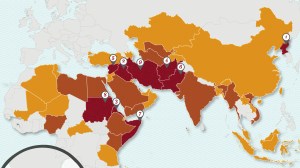
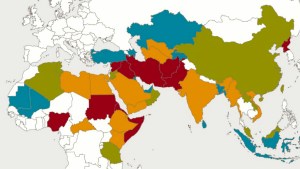
“The epicenter of international jihadism is now [in] the Sahel area,” said Illia Djadi, Open Doors senior analyst for freedom of religion and belief for sub-Saharan Africa. “This terrorism is moving south … and predominantly Christian countries like Benin, Togo, Ghana, Ivory Coast are now affected.” (None rank on the watch list.)

Countries with Christian majorities rank relatively low in the top 50, and include Colombia (No. 30), Cuba (No. 37), Ethiopia (No. 38), the Democratic Republic of the Congo or DRC (No. 40), Mozambique (No. 41), Mexico (No. 43), and Cameroon (No. 44).

Of the top 50 nations:

  • 11 have “extreme” levels of persecution and 39 have “very high” levels. Another five nations outside the top 50 also qualify as “very high”: Kenya, Sri Lanka, Comoros, United Arab Emirates, and Tanzania.
  • 18 are in Africa (6 in North Africa), 29 are in Asia, 10 are in the Middle East, 4 are in Central Asia, and 3 are in Latin America.
  • 34 have Islam as a main religion, 4 have Buddhism, 2 have Hinduism, 1 has atheism, 1 has agnosticism—and 10 have Christianity.

The 2022 list included two new countries: Cuba and Niger. Two countries dropped off the list: Kenya and Comoros.


1. Nigeria
2. Pakistan
3. India
4. Central African Republic
5. Democratic Republic of Congo
6. Mozambique
7. Cameroon
8. Afghanistan
9. Mali
10. South Sudan

Open Doors reporting period: Oct. 2020 to Sept. 2021

Other noteworthy increases include Saudi Arabia at No. 11, up from No. 14, due to the availability of more specific information on the situation of migrant converts. Similarly, fellow Gulf nation Oman rose to No. 36 from No. 44, following an increase of surveillance against Christians, especially converts, with several forced to leave the country. And in Asia, Bhutan rose to No. 34 from No. 43, due to a rise in violence against Christians in the traditionally nonviolent Buddhist nation.

Not all noteworthy movement was negative. Iraq and Syria each dropped three slots to No. 14 and No. 15, respectively, due to decreases in their number of churches attacked and Christians killed. Tunisia dropped to No. 35 from No. 25, as fewer Christians were detained, while a decrease in violence against Christians caused Tajikistan to fall to No. 45 from No. 43. Meanwhile, fewer attacks by radical Hindu groups in the Himalayan nation of Nepal led its rank to sink to No. 48, down from No. 34.

Open Doors suggested that some declines may be superficial, however, caused by decreases in Christian activity due to COVID-19. Egypt dropped to No. 20 from No. 16, and Turkey fell to No. 42 from No. 35, as attacks on churches lessened. Yet in Egypt, violence against individual Christians remained high, with eight believers killed, while Turkey witnessed increasingly aggressive government rhetoric against Christians, who suffered from growing social distrust.

Other nations canceled out positive developments with negative ones. Sudan remained at No. 13, given that religious freedom reforms at the national level have not yet been enacted at the local level. Colombia held steady at No. 30 as fewer Christians were killed yet criminal activity and social hostility rose—especially in indigenous communities. And Ethiopia, which dropped two spots to No. 38, saw a drop in violence against Christians offset by community pressures amid civil war conditions that make it difficult to discern religious versus ethnic persecution.

How are Christians persecuted in these countries?

Open Doors tracks persecution across six categories—including both social and governmental pressure on individuals, families, and congregations—and has a special focus on women. Nearly all categories saw increases this year, and some hit record highs.

When violence is isolated as a category, the top 10 persecutors shift dramatically—only Afghanistan, Nigeria, Pakistan, and India remain. In fact, 16 nations are deadlier for Christians than North Korea.

Martyrdoms rose by more than 1,000 from the prior year, as Open Doors tallied 5,898 Christians killed for their faith during the reporting period. Representing an increase of 24 percent, the toll remains an improvement over the 2016 high of 7,106 deaths. Nigeria accounted for 79 percent of the total, followed by Pakistan at 11 percent.


1. Nigeria: 4,650
2. Pakistan: 620
3. Name withheld: 100*
4. Burkina Faso 100*
5. Democratic Republic of Congo: 100*
6. Mozambique: 100*
7. Central African Republic: 29
8. Cameroon: 27
9. Tanzania: 25
10. Indonesia: 15

*Estimate | Open Doors reporting period: Oct. 2020 to Sept. 2021

Open Doors is known for favoring a more conservative estimate than other groups, who often tally martyrdoms at 100,000 a year.

Where numbers cannot be verified, estimates are given in round numbers of 10, 100, 1,000, or 10,000, assumed to be higher in reality. And some national tabulations may not be provided due to security reasons, resulting in an “NN” designation for Afghanistan, Maldives, North Korea, Somalia, and Yemen.

Under this rubric, an unnamed nation, Burkina Faso, the DRC, and Mozambique all follow with a symbolic tally of 100 martyrs.

A second category tracks attacks on churches and other Christian buildings such as hospitals, schools, and cemeteries, whether destroyed, shut down, or confiscated. The tally of 5,110 represents a 14 percent increase from last year, but is only about half of the 2020 report’s high of 9,488.

China (No. 17), which rejoined the top 20 last year for the first time in a decade, led the way with 59 percent of recorded church attacks. Nigeria was second with 470 incidents, followed by Bangladesh, Pakistan, and Qatar. Central African Republic, Burkina Faso, Mozambique, Burundi, Angola, and Rwanda all were assigned a symbolic 100 attacks.


1. China: 3,000
2. Nigeria: 470
3. Bangladesh: 200
4. Pakistan: 183
5. Qatar: 100
6. Central African Republic: 100*
7. Burkina Faso: 100*
8. Mozambique: 100*
9. Burundi: 100*
10. Angola: 100*

*Estimate | Open Doors reporting period: Oct. 2020 to Sept. 2021

The category of Christians detained without trial, arrested, sentenced, and imprisoned set a new high in 2021, with a total of 6,175, about 1,000 more cases than the previous reporting period. Open Doors divides this into two subcategories, with 4,765 detained believers representing an increase of 69 percent. India led with 1,310 cases, and along with an unnamed nation, Pakistan, and China, made up 90 percent of the total.

The tally of 1,410 believers imprisoned, however, represented a decrease of 4 percent from the prior period. An unnamed nation, Eritrea, China, and Bangladesh comprised 91 percent of the total.

Another new high was registered in the number of Christians abducted, with the total of 3,829 representing an increase of 124 percent over the prior period. Nigeria accounted for 66 percent of the total, followed by Pakistan at 26 percent.

By far the largest category total was displacement, with 218,709 Christians forced to leave their homes or go into hiding for faith-related reasons. An additional 25,038 Christians were forced to leave their countries. Myanmar represented 9 in 10 internal displacements and 8 in 10 refugees tallied.

Open Doors stated that several categories were particularly difficult to count accurately, highest of which were the 24,678 cases of physical and mental abuse, including beatings and death threats. Of the 74 nations surveyed, 36 were assigned symbolic numbers. Nigeria was the highest, followed by India, two unnamed nations, Eritrea, Pakistan, Myanmar, China, CAR, Mozambique, and Malaysia.

An estimated total of 4,543 Christian homes and properties were attacked in 2021, along with 1,906 shops and businesses. Of the latter, 18 of 36 countries were given symbolic numbers, with Nigeria first.

Nigeria, Pakistan, and Mozambique had the most in the former category, with only Cameroon and Bangladesh able to record actual cases. Iraq, Syria, China, Burkina Faso, and the DRC rounded out the top 10, each with a symbolic score of 100 attacks.

Categories specific to women were also difficult for Open Doors researchers to count accurately. There were a total of 3,147 cases of rape and sexual harassment, led by Nigeria and Pakistan as the highest, with 36 of 48 countries scored symbolically. For forced marriages to non-Christians there were a total of 1,588, led by Pakistan as the highest of the 25 out of 37 countries scored symbolically.

Why are Christians persecuted in these countries?

The main motivation varies by country, and better understanding the differences can help Christians in other nations pray and advocate more effectively for their beleaguered brothers and sisters in Christ.

Open Doors categorizes the primary sources of Christian persecution into eight groups:

Islamic oppression (33 countries): This is the main source of persecution that Christians face in more than half of the watch list countries, including 7 of the top 10 overall: Afghanistan (No. 1), Somalia (No. 3), Libya (No. 4), Yemen (No. 5), Nigeria (No. 7), Pakistan (No. 8), and Iran (No. 9). Most of the 33 are officially Muslim nations or have Muslim majorities; however, 6 actually have Christian majorities: Nigeria, CAR (No. 31), Ethiopia (No. 38), DRC (No. 40), Mozambique (No. 41), and Cameroon (No. 44).

Dictatorial paranoia (5 countries): This is the main source of persecution that Christians face in five countries, mostly in Central Asia, with Muslim majorities: Uzbekistan (No. 21), Turkmenistan (No. 25), Bangladesh (No. 29), Tajikistan (No. 45), and Kazakhstan (No. 47).

Communist and post-communist oppression (5 countries): This is the main source of persecution that Christians face in five countries, primarily in Asia: North Korea (No. 2), China (No. 17), Vietnam (No. 19), Laos (No. 26), and Cuba (No. 37).

Religious nationalism (4 countries): This is the main source of persecution that Christians face in four Asian nations. Christians are primarily targeted by Hindu nationalists in India (No. 10) and Nepal (No. 48), and by Buddhist nationalists in Myanmar (No. 12) and Bhutan (No. 34).

Organized crime and corruption (2 countries): This is the main source of persecution that Christians face in Colombia (No. 30) and Mexico (No. 43).

Christian denominational protectionism (1 country): This is the main source of persecution that Christians face in Eritrea (No. 6).

Secular intolerance (0 countries) and clan oppression (0 countries): Open Doors tracks these sources of persecution, but neither is the main source in any of the 50 countries on the 2022 list. However, last year clan oppression was the primary driver in Afghanistan, Somalia, Laos, Qatar, Nepal, and Oman.

How does the WWL compare to other reports on religious persecution?

Open Doors believes it is reasonable to call Christianity the world’s most severely persecuted religion. At the same time, it notes there is no comparable documentation for the world’s Muslim population.

Other assessments of religious freedom worldwide corroborate many of Open Doors’ findings. For example, the latest Pew Research Center analysis of governmental and societal hostilities toward religion found that Christians were harassed in 153 countries in 2019, more than any other religious group. Muslims were harassed in 147 countries, followed by Jews in 89 countries.

When examining only hostility by governments, Muslims were harassed in 135 countries and Christians in 128 countries, according to Pew. When examining only hostility within society, Muslims were harassed in 115 countries and Christians in 107 countries.

The breakdown corresponds to Open Doors’ data. China, Myanmar, Sudan, and Syria tallied over 10,000 incidents of government harassment each. Sri Lanka, Afghanistan, and Egypt were noted for high levels of social hostility.

Most of the nations on Open Doors’ list also appear on the US State Department’s annual list that names and shames governments that have “engaged in or tolerated systematic, ongoing, and egregious violations of religious freedom.”

Its top-tier Countries of Particular Concern (CPC) list includes Myanmar (No. 12 on the 2022 WWL), China (No. 17), Eritrea (No. 6), Iran (No. 9), North Korea (No. 2), Pakistan (No. 8), Russia (which exited the WWL last year), Saudi Arabia (No. 11), Tajikistan (No. 45), and Turkmenistan (No. 25). Its second-tier Special Watch List includes Algeria (No. 22), Comoros (which exited the WWL this year), Cuba (No. 37), and Nicaragua (unranked but monitored by Open Doors).

The State Department also lists Entities of Particular Concern, or nongovernmental actors producing persecution, which are all active in countries on Open Doors’ list. These include Boko Haram and ISWAP in Nigeria (No. 7 on the WWL), the Taliban in Afghanistan (No. 1), Al-Shabaab in Somalia (No. 4), ISIS in primarily Iraq (No. 14), Hayat Tahrir al-Sham in Syria (No. 15), the Houthis in Yemen (No. 5), and ISIS-Greater Sahara and Jamaat Nasr al-Islam wal Muslimin in the Sahel.

Meanwhile, the US Commission on International Religious Freedom (USCIRF) in its 2021 report recommended the same nations for the CPC list, with the addition of Nigeria, India (No. 10), Syria, and Vietnam (No. 19). For the State Department’s watch list, USCIRF recommended the same nations except for Comoros, with the addition of Afghanistan, Azerbaijan (unranked but monitored by Open Doors), Egypt (No. 20), Indonesia (No. 28), Iraq, Kazakhstan (No. 47), Malaysia (No. 50), Turkey (No. 42), and Uzbekistan (No. 21).

All nations of the world are monitored by Open Doors researchers and field staff, but in-depth attention is given to 100 nations and special focus on the 76 which record “high” levels of persecution (scores of more than 40 on Open Doors’ 100-point scale).

CT previously reported the WWL rankings for 2021, 2020, 2019, 2018, 2017, 2016, 2015, 2014, 2013, and 2012, including a spotlight on where it's hardest to believe. CT also asked experts whether the United States belongs on persecution lists, and compiled the most-read stories of the persecuted church in 2019, 2018, 2017, 2016, and 2015.

Read Open Doors’ full report on the 2022 World Watch List here.

Editor’s note: CT offers this report in Spanish, Portuguese, French, Chinese (Simplified and Traditional), Korean, Indonesian, Italian, Russian, Arabic, and Catalan as part of CT Global’s 800+ translations.

We welcome your feedback here. Get involved here.

-

addApple PodcastsDown ArrowDown ArrowDown Arrowarrow_left_altLeft ArrowLeft ArrowRight ArrowRight ArrowRight Arrowarrow_up_altUp ArrowUp ArrowAvailable at Amazoncaret-downCloseCloseellipseEmailEmailExpandExpandExternalExternalFacebookfacebook-squarefolderGiftGiftGooglegoogleGoogle KeephamburgerInstagraminstagram-squareLinkLinklinkedin-squareListenListenListenChristianity TodayCT Creative Studio Logologo_orgMegaphoneMenuMenupausePinterestPlayPlayPocketPodcastprintremoveRSSRSSSaveSavesaveSearchSearchsearchSpotifyStitcherTelegramTable of ContentsTable of Contentstwitter-squareWhatsAppXYouTubeYouTube