Books

John Stott’s Global God

The evangelical leader invested resources in Christian leaders around the world. Now those leaders are blessing the Western church.

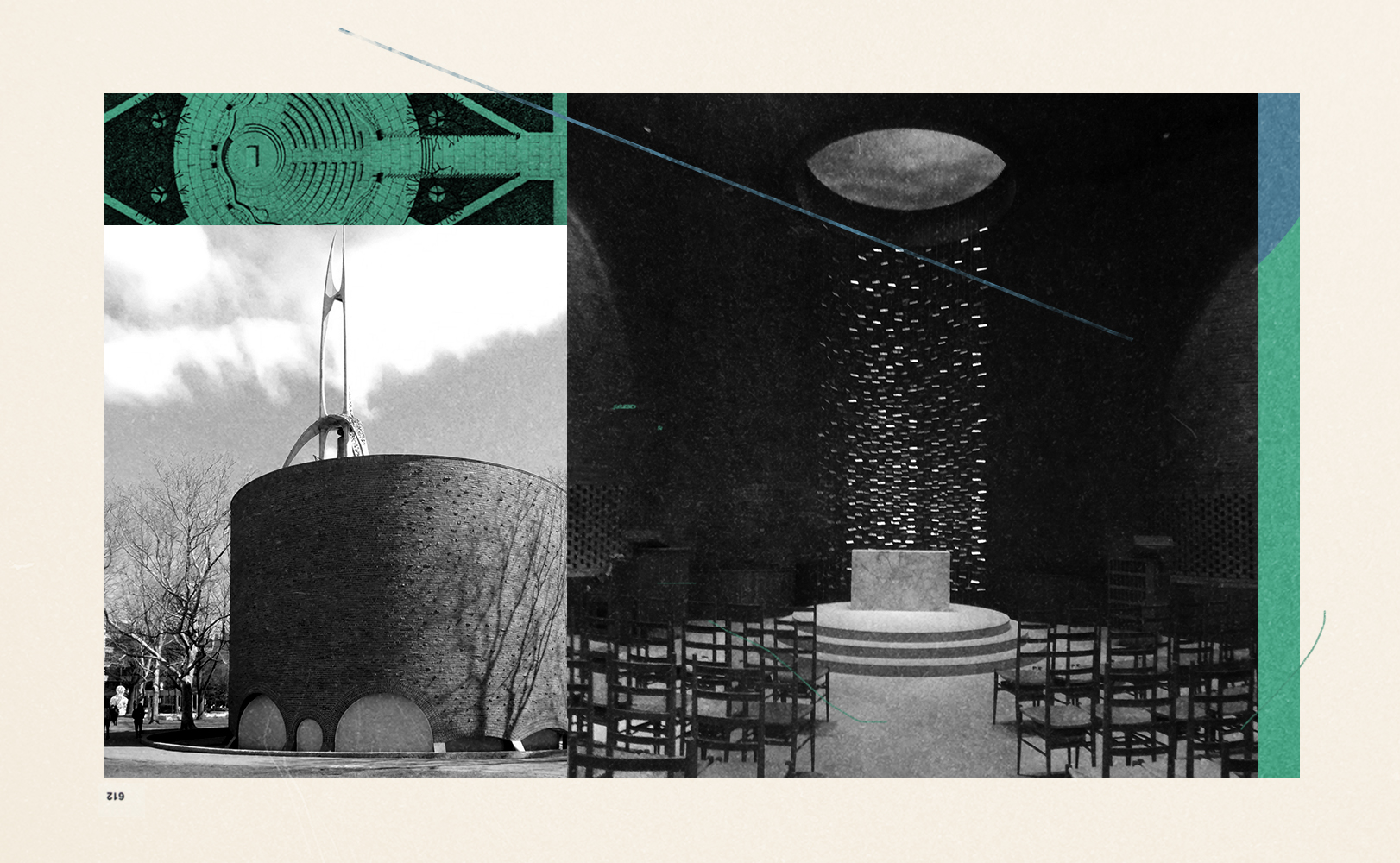
Illustration by Mallory Rentsch / Source Images: Unsplash

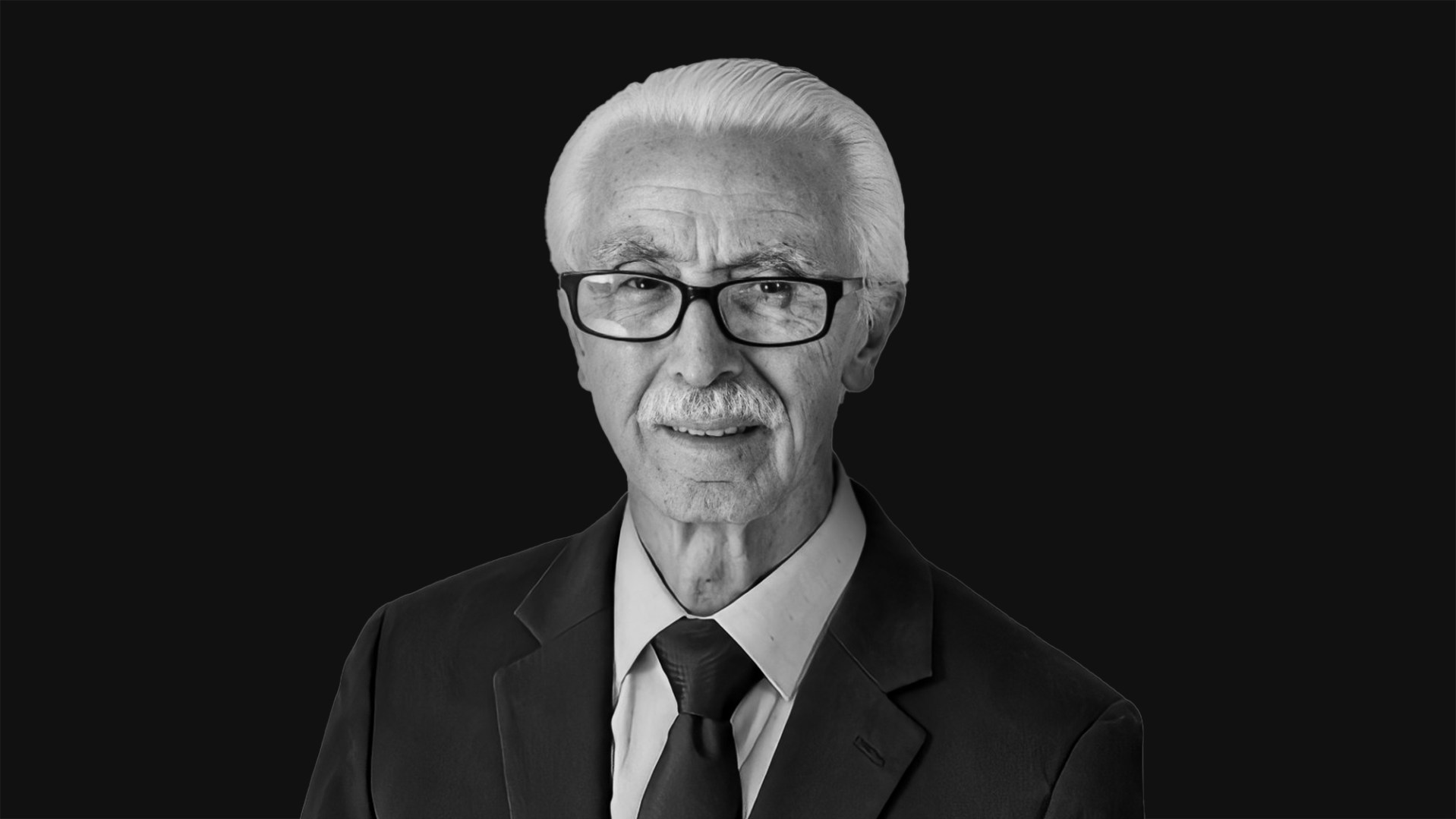
John Stott believed strongly in mutuality and reciprocity within the global church. Though a son of the Western church, Stott, like the apostle Paul, was passionately committed to the worldwide body of Christ. He not only knew and loved so many church leaders in many denominations outside the West, but he also wanted to enable their voices to be heard, to affirm their leadership, and to facilitate the development of their giftings, academically and spiritually. “We must be global Christians,” he used to say, “with a global vision, because our God is a global God.”
Living Radical Discipleship: Inspired by John Stott

Living Radical Discipleship: Inspired by John Stott

134 pages

I have sometimes said that John Stott was both apostolic and Abrahamic. There was something apostolic about his evangelistic commitment to the gospel and to the faithful teaching of biblical truth. And there was something Abrahamic about his “all nations” perspective. Not only was he himself a blessing to many nations; he also modeled and taught the “obedience of faith” (to quote Paul) that characterized Abraham’s combination of faith demonstrated in works (Rom. 1:5, ESV; James 2:20–26).

So for John Stott, to strengthen the leadership of the church outside the West would be to strengthen global church leadership, including the West. He prayed and longed for the greater health and maturity of the worldwide church, including the West. So whatever he could do to strengthen the Majority World church, the whole body of Christ would benefit.

Stott recognized an additional benefit that would adorn the truth of the gospel. As the leadership of the global church outside the West was strengthened, resourced, and recognized, then the truly international, multicultural nature of the church itself would be far more visible and more in line with the biblical portrait of the church.

We who are Western Christians need help. We need to acknowledge that we are the minority church in global terms. We need to recognize the vast and alarming extent to which, like the people of Israel before the Exile, we have succumbed to a range of idolatries and syncretisms—“going after the gods of the people around us” (to paraphrase the frequent warnings of Deuteronomy). We should be lamenting the way many who profess to be Christian succumb to frightening collusion with political leaders and policies that bear no resemblance whatsoever to the teachings and demands of Christ.

It is from Asia, Africa, and Latin America that God is already raising up leaders, scholars, thinkers, writers, and preachers who can speak with the authenticity of their contexts (and especially the authenticity of suffering for the Word of God and the testimony of Jesus Christ) into the moribund churches of the West. And some of those emerging (and already fully emerged and established) leaders are undoubtedly part of the fruit of John Stott’s vision and initiatives, including the Langham Partnership, which equips and publishes theologians. As Tim Keller has said in commending Langham’s work, “John Stott foresaw the rise of Christianity in the Global South before most anybody. He got there and saw the need for training. … This ministry has been a game changer.”

So there is, in my view, a rather delightful irony about how John Stott’s vision has turned out. His initiatives for theological education and literature were initially born of his desire that the well-resourced Western church should come alongside the underresourced churches of the Global South with generous assistance. But in God’s long-term providence and the grand sweep of church history, there will most likely be a reverse impact. Stott’s efforts will have helped to empower and equip the non-Western churches to come to the aid of the Western church in its decline.

We in the West are already finding ourselves the recipients and beneficiaries of the spiritual, missional, and theological leadership in the non-Western church that is in part the fruit of such investment over decades.

Adapted from Living Radical Discipleship, edited by Laura S. Meitzner Yoder, Langham Global Library, Carlisle, UK (2021). Available at langhamliterature.org.

News

Coup Reversal Divides Sudan’s Christians

Controversial deal to bring back deposed prime minister turns many protesters against him. Sudanese believers debate if he did the best he could.

A Sudanese man waves a flag at a Day of Resistance protest on November 13, 2021 in Omdurman, Sudan.

A Sudanese man waves a flag at a Day of Resistance protest on November 13, 2021 in Omdurman, Sudan.

Christianity Today December 10, 2021
Stringer / Getty Images

As a young mother in Sudan, Susanna al-Nour struggled like many others with rising prices and shortages of goods. International support pledged after the 2019 revolution was slow to materialize. The government struggled to disburse promised aid. And tribal groups protesting in the east were blocking access to essential imports coming through the Red Sea city of Port Sudan.

And then this October things got worse.

Citing divisions among politicians, Abdel Fattah al-Burhan, the general heading Sudan’s mixed military-civilian Sovereign Council, launched a coup against the popularly selected prime minister, Abdalla Hamdok.

Phone and internet connections were cut, Hamdok was detained, and security forces raided neighborhoods to arrest supporters of his government, roughing up others. Thousands poured into the streets, including Nour’s husband, an evangelist and pastor’s assistant at Faith Baptist Church in the Soba area of the capital, Khartoum.

“With a small child, I couldn’t go because of the tear gas,” she said. “But it was necessary to demonstrate against the regime.”

Sudan’s Christians were then solidly in support of Hamdok, sources told CT. Two months later, sources no longer speak in consensus.

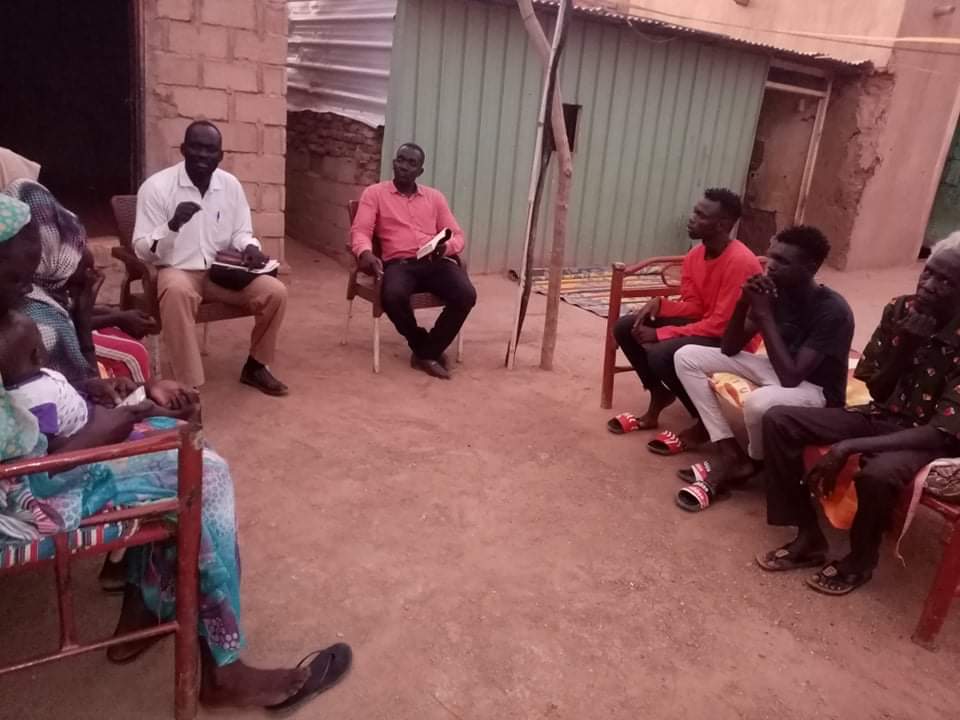
A gathering of Christians in Khartoum

At the time, enraged and without communication, the nation went into a standstill. Nour’s online studies through a seminary in Lebanon became impossible. So did her husband’s student ministry—as most young people were marching to reverse the coup.

Back in 2019, Hamdok quickly became the symbol of the revolution. Chosen by consensus among the political and revolutionary groups that deposed the 30-year Islamist dictatorship of Omar al-Bashir, his leadership was one of the few unifying factors in a rapidly fraying partnership between civilians and the military.

And then he wasn’t.

Amid international condemnation of the October 25 coup and efforts to suppress demonstrations, last month Burhan announced his welcome for Hamdok’s return—without politicians.

His originally technocratic government had added them following the October 2020 Juba Peace Agreement with rebel forces in Darfur and elsewhere. But this was in response to militia leaders then joining the Sovereign Council, disturbing the military-civilian balance.

The additions threw confusion into an agreement to hand over council leadership to a civilian figure by May 2021. Burhan and Hamdok celebrated an end to the conflict that had riddled Sudan for decades. But the military’s conflict with civilians was increasingly spilling out into the open.

The May deadline came and went, with no clarity. An office established after the revolution to remove Bashir-era corruption from government began challenging the resulting military dominance of the economy. Bashir himself became a point of negotiation, to be handed over to the International Criminal Court in The Hague. But other military officials were implicated also, not only for crimes in Darfur but also for the killing of civilians during the 2019 demonstrations.

And thus came the coup. Burhan denied ill intention, saying he acted to protect the democratic transition from the squabbling politicians. Under house arrest, Hamdok was a crucial lynchpin. He was welcome to return—but only with a technocratic government.

After three weeks of pressure, on November 11 he agreed. Too much blood had been shed in protest, he said. The military couldn’t be allowed to take over everything, he hinted. And the economy needed international support, suspended after the coup.

Hamdok’s 14-point agreement with Burhan returned Sudan to constitutional legitimacy, reestablishing a military-civilian partnership. Political detainees were released, and a civilian government was promised after democratic elections in July 2023. Promised steps toward a legislature, judiciary, and constitutional convention would also be expedited.

But by then Burhan had already hand-picked new civilian members of the Sovereign Council, and there was no mention of a midway switch in leadership.

The streets exploded in anger—this time also against Hamdok.

Christians, however, were not so sure.

Susanna al-Nour in Khartoum

“Most Christians support Hamdok in returning to his position,” said Nour. “But a smaller part rejects him, saying he should not cooperate with a criminal.”

At issue, however, is “most.”

“Christians are in great disagreement with this step,” a Sudanese Christian leader told CT, requesting anonymity because of the sensitivity of the situation. “Some in Khartoum support him, but they are very few.”

This leader spoke of Bashir-era evangelicals who cooperated with the government in order to seize control of church properties. And after the coup, Burhan moved to place members of Bashir’s now-dissolved political party into key positions of the administration. Hamdok has since called for a review of all recent dismissals and appointments, but the damage had been done—he aligned with the coup.

“The military is causing all the problems it lists as reasons to intervene,” said this leader. “The state is controlled by security, but it is not offering security to the people.”

In addition to the at least 44 demonstrators killed since Hamdok was deposed, about 100 have been killed in renewed ethnic conflict in Darfur. Dozens more have been killed in the Nuba Mountains. And the tribal blockade in East Sudan, the leader asserted, was coordinated from the beginning by the military.

“The Juba Peace Agreement has not brought peace,” said Aida Weran, academic officer for Nile Theological College, which has campuses in Khartoum and Juba. “But it was a way to delay democratic progress.”

She respects Hamdok for not breaking his oath, as he returns to office with constitutional legitimacy. This is unlike the most prominent Christian in the government, Raja Nicola. The sole joint selection in the Sovereign Council, the Coptic Sudanese accepted reappointment under Burhan’s coup.

But it was a mistake to add politicians to the government, Weran said, and their opposition to the coup is driven by partisan interest. They should instead prepare for their own legitimacy through coming elections, as a technocratic government—led by Hamdok—is a good result given all that has come before.

But she is still protesting.

“Entering our third year, we are still at the starting block, with no justice and no real freedom,” Weran said. “And while we demonstrate, people are going hungry. Even this is a delay.”

Not demonstrating at all is Hassan James.

“As Christians, we have the responsibility—as a minority—to be neutral,” said James, the assistant bishop of the Anglican diocese of Kadogli, in the Nuba Mountains state of South Kordofan. “Supporting one side or the other is not wise.”

James believes that stability is paramount. Currently Sudan is in a “fog,” while constant protests amid regional violence are filling many with fear. But democratic transition is impossible without peace, he said, and partnership with the military is necessary.

“What happened has divided us as a people,” he said. “But no one side can afford to isolate the other, and none can lead the country alone.”

Guma Komey reached the same conclusion but from an entirely different path.

“If someone has a gun, how can you take him to the gallows?” said the head of peace programs at Sudan’s branch of the Carter Center in Khartoum. “The country is held hostage by the collective concern of Sudan’s military leaders.”

An elder in the Evangelical Presbyterian Church in Bahri, Khartoum, Komey served as an official advisor to Hamdok before taking his current position. Amnesty was discussed behind the scenes, he said, to be granted after the democratic transition was complete.

But as the military-civilian partnership began to “drastically deteriorate,” rhetoric from certain politicians called to sideline the military and fully investigate their role in the deaths of protesters. Threatened, Burhan decided to fight.

Hamdok did the best he could in a tough situation, said Komey. And while Christians have no unified position toward the prime minister, they cannot put him in the same box as Burhan and Bashir. (Burhan gave the order to overthrow Bashir during the revolution.)

Yet many Sudanese do. Though numerous, these are only the loudest voices on the street, and the ones who control the social media accounts of political and revolutionary movements. But others, like Weran, are protesting also.

A different approach is needed, said Komey. Some sort of “package deal” is needed to institute a program of transitional justice while putting the generals at ease. The deal made could have been better, but it was the best of a bad situation. The protesting youth want democracy, but in their zeal must first ensure they can reach power.

“If the opposition weakens Hamdok, it strengthens the military leadership,” said Komey. “He is under extensive pressure, but I think he will absorb it over time.”

There is a window of opportunity. The United Nations general secretary expressed sympathy for protesters, but stated that “common sense” demands working together. The US has called it a good “first step” but stated that more progress is needed before resuming its $700 million in suspended aid to Sudan.

In the meanwhile, Nour and her husband have returned to ministry, paying home visits to church members without working electricity. Internet service has resumed, tribal leaders unblocked Port Sudan after the coup, and most importantly, the prime minister has returned.

“Hamdok is intelligent and wise, and knows how to plan,” said Nour. “I believe he will put things right in Sudan.”

News

Died: Patrick Marsh, Ark Encounter and Creation Museum Designer

Visionary artist built Noah’s Ark and world of Genesis with experience gained at the Olympics and Universal Orlando.

Christianity Today December 10, 2021
Answers in Genesis / edits by Rick Szuecs

Patrick Marsh worked on the design of the 1984 Summer Olympics in Los Angeles and then turned around to help with the renovation of the Statue of Liberty in New York Harbor, which reopened to great fanfare in 1986.

He played a key role in designing two popular rides at Universal Orlando when it opened in 1990—Jaws and Kongfrontation—and then moved to Japan to design cutting-edge theme parks in Tokyo and the foothills of Mount Fuji.

But he didn’t think he had reached the height of his career until he got to Kentucky. He didn’t like the mud, he told a local newspaper reporter, but he loved the work—designing the Creation Museum and Ark Encounter.

“That’s probably the most incredible thing I’ve had a chance to do,” Marsh said. “I just feel like all the things that the Lord has been working on my life has led up to actually coming here to Answers in Genesis” (AiG).

Marsh, the creative force behind the creationist attractions in Petersburg and Williamstown, Kentucky, died on December 2. He was 77.

“Calling him a ‘genius’ is not an overstatement,” Ken Ham, AIG founder and CEO, said in the organization’s official announcement. “Patrick’s fingerprints are all over the Creation Museum and Ark Encounter. I have never worked with a more creative person.”

Anthropologist James Bielo, who wrote a book about the process of designing the full-scale recreation of Noah’s ark and the opening of the park in 2016, said there was always a creative give-and-take between Marsh and his team, and Ham had to sign off on every decision, but Marsh was the undisputed “maestro.”

“Patrick would bring Ken Ham fully fleshed-out design ideas,” Bielo told CT. “And they butted heads though, from what I saw, Patrick won out whenever it was about design. Patrick had a vision. And the artists had total respect for him.”

Marsh was born in 1944 and raised in Southern California. He was a creative child and spent much of his time making things. If he saw something on TV that he wanted but couldn’t afford, he would try to create it himself. He once sewed a cowboy jacket—an accomplishment he remained proud of decades later.

He wasn’t very religious but, as he recalled in later years, he never accepted theories about evolution. Life seemed like it needed a designer.

“I know how much work and tears go into making something, and it does not come easily,” Marsh said. “Every living thing is so complex, so wonderful, so beautiful: each leaf, each insect, each person, each sunset. God is ‘in’ everything all around us, and we have to be blind not to see that the world was purposefully made by a Designer who cares about everything.”

Marsh studied at the University of California, Los Angeles, earning an undergraduate degree and a Master of Fine Arts in design. He graduated in 1971 and went to work in design. By the early 1980s, he had landed a position at Sussman/Prejza & Co. in Santa Monica. The new firm was working on urban branding and heralded for “carnivalesque modernity,” inspired by punk and postmodernism, as part of the broader New Wave design movement, which broke away from grid structures and stretched the limits of legibility.

At 40 years old, Marsh had proved himself enough to be given responsibility for a team of 50 designers as Sussman/Prejza took on the Olympics account.

After that, he helped with the Statue of Liberty and played a major role in development of several rides for Universal Studios Escape, a theme park designed to let visitors “ride the movies.”

“Just a momentary escape”

He loved the work—creating an interactive story, engineering the moods that would affect people, designing every piece of the machine and the illusion and seeing it all come to life exactly as he’d imagined it in his mind—but he did wonder, sometimes, if there was any point to it all.

“It was just for fun,” he explained to an Orlando Sentinel reporter. “Just a momentary escape.”

In Japan, Marsh worked on Sanrio Puroland, also known as Hello Kitty Land. He met and married to a Japanese woman named Sakae and had a religious conversion.

“The Bible is the only thing that gives you the full picture,” he said. “Other religions don’t have that, and as for scientists, so much of what they believe is pretty fuzzy about life and its origins.”

A few years later, in 2001, Marsh read about Answers in Genesis’ plans for a creation museum and wrote an email asking if there was any way he could be part of it.

“I want to use my talents for the Lord,” Ham recalled the email saying. “I want to come and help you build the Creation Museum. Please, will you employ me to build the Creation Museum.”

Marsh took over the design for the Creation Museum and brought the 60,000-square-foot vision to life. It opened in 2007. It was popular with conservative Christians and church groups—but also won a strange respect from self-identified critics and culture war opponents who hated it but also thought it was really well done and, worse, kind of fun.

A New York Times culture critics gave it marks for “sheer weirdness and daring.”

“Whether you are willing to grant the premises of this museum almost becomes irrelevant as you are drawn into its mixture of spectacle and narrative,” he wrote. “Its 60,000 square feet of exhibits are often stunningly designed by Patrick Marsh.”

Atheist blogger Hemant Mehta described it as “nothing more than an expensive way to confuse and indoctrinate children,” but even he had to admit that the design “really is beautiful.”

Drawing people in

Marsh, for his part, wasn’t worried about whether the museum convinced anyone of creationism or the literalism of the biblical account of Genesis 1 and 2. That wasn’t his job.

“Either God is going to call you and open your heart to believe what I’m showing you, which is really God showing you, or he won’t. That’s what the Bible says,” he said. “If I can get you to be curious about the Bible, and you actually read it and you read stories about the Ark and you read whatever it is, maybe God is going to speak to you and open your heart.”

To create the spaces that would draw people in, Marsh and his team studied other museums together. One of his favorites was the Lincoln Museum in Springfield, Illinois. The design team studied the way it created an embodies sensory experience. Another place they looked at was the Holy Land Experience in Florida. According to Marsh, it was a good idea poorly executed. The problem, he said, was the designers didn’t seem to understand the spiritual message.

It wasn’t a mistake he would make, and in 2010, Marsh got to demonstrate his vision, planning Ark Encounter with Ham from day one. It started with a 500-foot replica of Noah’s biblical craft, but for the designer of the ’84 Olympics and Hello Kitty Land, it didn’t end there. He envisioned a Tower of Babel and a ten plagues ride, complete with sound effects, for a theme park starting with Noah’s story but expanding across Genesis.

“You never know where God is going to take you in life,” he said. “He gives you all these experiences, and you want to be able to use them. What a privilege to have the kind of job that I have, and be able to take all those things that I’ve enjoyed in life and bring them together. I can’t imagine doing anything else.”

In 2016, a few days before the grand opening of Ark Encounter, Marsh got to turn the lights on for the first time.

“I kept wanting to see what it looked like,” he said. “I designed the lighting in here, and I didn’t get it turned on until last week.

“You visualize in your mind what it’s going to look like, but until you see it—I didn’t know. Once they got the lights in, and turned on the switch…it looks exactly the way that I hoped it would look.”

Marsh is survived by his wife, Sakae. Funeral arrangements have not been announced.

News

State of Giving: Pandemic Trends Defy Ministry Expectations

Camps and conferences, a sector that had been dramatically affected by COVID-19 shutdowns, actually saw the biggest boost in funds and historic levels of support.

Christianity Today December 9, 2021
Ezra Shaw / Getty

When the pandemic took off last year, evangelical ministry leaders had two concerns in mind: how would they continue their mission amid the COVID-19 restrictions and how would they stay afloat financially to keep operating into the future.

Many of those leaders are now praising God for his provision, as donations to evangelical nonprofits increased in 2020. Even organizations whose ministry activity took drastic hits saw outsized support from donors, according the Evangelical Council for Financial Accountability (ECFA) annual State of Giving report.

During a year when cabins and retreat centers remained empty, camps and conference ministries saw the biggest boost in giving compared to any sector, with a 21 percent surge in 2020.

Hume Lake Christian Camps in California raised $7.75 million, around double the camp’s typical annual fundraising, to make up a $6 million shortfall. During the initial lockdown, camp staff placed 10,000 calls to reach out to supporters and pray for them.

Then the donations to its relief fund kept coming—from former campers who gave their life to Christ in Hume Lake’s cabins, couples who had their marriages restored at its retreats, and even a grandma who wanted to sponsor a new camper and wrote a check to give the $8,000 she made selling homemade jam at a roadside stand.

“People sacrificially gave to a ministry that touched their lives or that they believed so deeply in,” said John Boal, chief development officer at Hume Lake.

Other camps experienced similar levels of fundraising success.

“Donors stepped up and filled the gap,” said Jake Lapp, vice president of membership and accountability at ECFA. “We talked to many [in the camps and conferences sector] who said that it was their biggest year ever.”

A 75-year-old camp located in Fresno, Hume Lake had hosted around 20,000 kids a summer before the pandemic, so calling off spring and summer programming last year meant losing $17 million in revenue during a year when finances seemed unpredictable.

“It felt daunting,” said Boal. “But when giants come my way, whether professionally or personally, I try to step back and look at my theology. And my theology is that God’s in control and God will provide.”

Prior to starting its $6 million relief fund campaign, Hume Lake had to tap into its cash reserves. Among ECFA members, Christian camps and conferences were more likely than any other type of evangelical nonprofit to deplete their reserves, with 10 percent spending all their reserves in 2020 and 14 percent doing so in 2021.

Overall, three-quarters of ECFA nonprofits and churches left their cash reserves untouched the first year of the pandemic and two-thirds left them untouched this year.

Pulling from financial information from 2,600 members, the new State of Giving report offers the clearest picture so far of how evangelical groups fared financially during the pandemic, and as with the boost in the camp sector, some of the biggest takeaways were unexpected.

Even though Americans were making less money due to the economic crisis, they were giving more away. While wages were down 2.9 percent, donations to ECFA members were up 3.2 percent—a gap of more than 6 percent.

The financial trends defied some historic patterns for nonprofits. Churches and ministries that were steadily growing prior to the pandemic were actually less likely to experience a pandemic bump in support than those whose giving had been declining. Fifty percent of growing organizations saw donations increase, compared to 65 percent of declining organizations, the report said.

Giving was up in 26 of 36 nonprofit sectors, with camps and conferences, rescue mission and homeless, discipleship, anti–human trafficking, and health services organizations seeing the most growth.

https://datawrapper.dwcdn.net/t3H2u

More than half of ECFA member churches in 2020, and nearly two-thirds in 2021, said their giving was the same or higher than the year before. But the trends were less positive across the board for congregations.

Churches saw cash giving dip 1.2 percent last year, according to the State of Giving. Among ECFA members, the biggest megachurches—with over $20 million in annual revenue and 8,000 attendees—had a 6 percent increase in giving in 2020, while giving levels for smaller churches dropped.

“Larger churches tend to have a wider range of economic levels among their members, which might help explain why they’ve been able to weather the pandemic better, as some of their more financially established members have had consistent giving to their church during the pandemic,” said Warren Bird, senior vice president of research and equipping at ECFA.

Digital giving platforms, which were correlated with more consistent and higher giving levels before the pandemic, became a crucial tool for financial stability once churches were no longer gathering in person. Bird noted that while larger churches may have been more likely to offer digital giving in the early months of COVID-19, churches of all sizes have since embraced the technology.

“Since early 2020, we have seen a huge uptick in the online presence of many churches, which has also resulted in increased giving across the board,” said Justin Dean, director of marketing at Tithe.ly, one popular giving platform.

“What we’ve seen is that it doesn’t matter if you’re a large church with staff and resources, or a small church with just a few staff members wearing multiple hats. What matters is embracing technology that will come alongside you and grow with you, and staying consistent with it.”

The ECFA findings, which are based on members’ financial information from the 2020 fiscal year, follow previous surveys that have shown that most churches ended up with steady or improving budgets, despite the fears of economic downturn.

Last month, a survey by Lifeway Research found that most pastors report giving in 2021 was at or above 2020 levels. But for a minority of congregations, the decline is acute. One in 14 churches saw giving drop by 25 percent.

News

Died: Bill Glass, Football Star Who Changed Evangelical Approach to Sports and Prisons

The Cleveland Browns defensive end was good at sacking quarterbacks, but his real passion was witnessing for Christ.

Christianity Today December 9, 2021
Baylor University / Edits by Rick Szuecs

Bill Glass, a football player turned evangelist who pioneered evangelical sports ministry and prison ministry, died on December 5 at age 86.

The six-foot-five, 250-pound defensive end had an impressive resume in professional football, with four Pro Bowl selections, a National Football League championship, and the Cleveland Browns team record for career sacks. But Glass would have pointed to a different set of metrics as far more consequential: In 2019, his evangelistic prison ministry, Bill Glass Behind The Walls, reported that up to that year in their ministry’s history, they had “trained 58,550 Christians to share their faith, reaching 6,056,432 incarcerated men, women and youth, with over 1.2 million commitments to Jesus recorded.”

Glass could also point to the chapel services held before NFL, Major League Baseball, and National Basketball Association games. Evangelical outreach to professional athletes, and the work of organizations such as Baseball Chapel and Pro Athletes Outreach, exists in no small part because of Glass.

Glass brought fans to their feet as a star defensive end, but it was through his pioneering ministry work that his imprint on evangelicalism is most apparent today. When Glass was born in 1935, sports ministry and prison ministry were not a major focus for evangelicals. Glass helped change that.

“His passion for evangelism, training the church in evangelism, and reaching the incarcerated with the gospel was unprecedented,” said Karen Swanson, director of the Correctional Ministries Institute at Wheaton College. “His legacy lives on in the countless lives he touched.”

And Glass “personified a reengaged combination of faith and athleticism conducive to institutionalization,” according to historians Tony Ladd and James Mathisen. “He provided an early model for ministry among athletes that his fellow evangelical muscular Christians would soon perfect.”

Finding confidence in football

Born in Texarkana, Texas, Glass moved with his family to Corpus Christi when he was five. It was there, at 14, that his father died of cancer. That loss would shape his future ministry efforts, which often focused on the importance of father figures.

An awkward, clumsy kid at the time, Glass developed confidence as he poured himself into football, inspired by his high school football coach, a man who became like a second father. It was in high school, too, that Glass had a born-again conversion at his local Baptist church. Faith and football would be central to his life from then on.

Glass enrolled at Baylor University in 1953, where his talent, work ethic, and size opened up future possibilities in the sport. Baylor also brought Glass and his wife, Mavis, together. She was drawn to Glass after reading a newspaper story about a football player who taught a Sunday school class. The two clicked immediately and were married six months after first meeting. They spent 60 years together—Mavis passed away in 2017—and raised three children.

Baylor set the trajectory of Glass’s life in one more way: It introduced him to a brand-new organization formed by a basketball coach in Oklahoma: the Fellowship of Christian Athletes (FCA). Over the next two decades, the FCA galvanized a growing network of evangelical athletes within sports, and Glass was a key player in its rise.

Glass’s identification with the emerging Christian athlete community came at a transitional time for evangelical engagement with professional sports. While Catholic and mainline Protestant athletes were willing to play on Sundays, evangelicals saw this as a clear violation of the Fourth Commandment. As late as 1960, CT lambasted Christian athletes who played professional football and thereby “yielded to the lure of money and added fame, and joined in the desecration of the Lord’s Day.”

At first Glass followed this line of thinking. After graduating in 1957, All-American honors in tow, he spurned the Detroit Lions, who had drafted him in the first round, and chose to play in the Canadian Football League (CFL). But one year later, Glass had a change of heart. Turning away from what he described as his “legalistic” perspective, he decided he would play in the NFL after all.

Witnessing to atheletes

“I just couldn’t believe,” Glass later wrote , “that God was willing for all pro sports to go without a witness just because of Sunday game days.” To equip himself for the work of witnessing, he enrolled at Southwestern Baptist Theological Seminary, spending six off-seasons taking classes before graduating in 1963.

With the Lions, Glass started a practice that would follow him throughout his NFL career: holding Bible study and prayer meetings at the team hotel before games. It began as a one-on-one session with Detroit sportswriter Watson Spoelstra, who later founded Baseball Chapel. Although twice as old as Glass, Spoelstra—who had recently experienced a dramatic conversion—gravitated toward the young defensive end, seeing him as a spiritual mentor.

When Glass was traded to the Cleveland Browns in 1962, he became more intentional and strategic. Along with pregame devotionals, he launched a team Bible study with a simple format: Players would read a chapter of the New Testament together and then rewrite the chapter in their own words, using contemporary language.

Glass’s intense drive to excel and grow earned the respect of teammates, even those who did not share his faith commitments. Bernie Parrish, who played with Glass in the early 1960s, described him as “a kind of paradox, a fundamentalist preacher off the field but a lusty, physical man” who “laughed at himself as well as anyone.”

Glass also inspired an entrepreneurial Florida minister named Ira Lee “Doc” Eshleman. In 1964, Glass invited Eshleman to join a devotional service before a game against the Philadelphia Eagles. “It was heartwarming,” Eshleman said at the time. “I was amazed to think there were that many on one pro team who would place such emphasis on the importance of prayer.”

Two years later Eshleman launched a new career as a self-described pro football chaplain, organizing pre-game services in the NFL. Pro Athletes Outreach, the leading evangelical ministry in pro sports today, began as an offshoot from Eshleman’s ministry in 1971.

Concerns about racial injustice

As Glass became a leading voice for Christian athletes, he occasionally spoke up about issues of moral concern in American society, including racial discrimination. In his first book, Get in the Game! (1965), Glass urged fellow white Southerners to support racial integration. His approach to race followed that of many other white evangelicals. He was not involved with the civil rights movement, focusing instead on person-by-person change and colorblind rhetoric: “Forget color and treat everyone alike,” Glass urged.

Yet Glass also demonstrated sensitivity to the continued reality of racial injustice. His admiration for Cleveland teammate Jim Brown—an outspoken advocate for civil rights—played a role in this.

“Even if a black athlete is treated fairly by the coaches, he still has to live in a prejudiced society,” Glass admitted.

He saw housing discrimination and other forms of inequality as evidence that Black people could be “accepted as a black athlete but rejected as a black human being.”

Ultimately, however, Glass saw himself as an evangelist in the style of Billy Graham, and he took steps toward that path even as he spent his fall Sundays crashing into quarterbacks. Throughout the 1960s, Glass filled his off-seasons with speaking engagements at evangelistic rallies and events. He also began to write, publishing Get in the Game!, the first of more than a dozen books, in 1965.

“I don’t fancy myself as being any great scholar or certainly not a great writer,” he later said. “But I do think you’ve got to write down what you do or otherwise it won’t last.”

Most of Glass’s books were practical guides to Christian living, combining a basic evangelical perspective on sin and salvation with a focus on success and positive thinking. But Don’t Blame The Game: An Answer to Super Star Swingers and a Look at What’s Right with Sports (1971), cowritten with seminary professor William Pinson, Jr., took a different approach. Written as a conservative defense of the social value of sports, it challenged recent books by athletes like Joe Namath and Dave Meggyesy that glorified promiscuous sexual behavior (Namath) or blasted professional football for fostering militarization and dehumanization (Meggyesy).

Glass positioned himself and fellow Christian athletes as constructive defenders of the status quo. Yet Glass later came to wish he had been more circumspect. He especially regretted singling out individual athletes like Joe Namath. “I was picking up stones and throwing them at Namath and all the sinners,” he said last year. “I think I would have had a better witness to him if I just quietly went about witnessing behind the scenes.”

Going into prisons

Glass retired from football after the 1968 season and founded the Bill Glass Evangelistic Association to support his new career as a preacher of the gospel. His evangelistic events were modeled after Billy Graham’s popular “crusades.” In 1972, at the behest of a friend, Christian businessman Gordon Heffern, Glass held his first event inside a prison.

Initially his interest in prisons was limited, but when the Marion, Ohio, prison event proved successful, Glass began thinking about new possibilities for ministry to incarcerated people, gradually adding more prisons to his national crusade itinerary. A few years later, Glass moved to full-time prison evangelistic work, part of a larger “prison revival” taking place in the 1970s, where evangelical ministries innovated new forms of correctional outreach.

Glass developed a sports-themed program, bringing other stars—professional baseball and football players as well as Olympic athletes—inside correctional facilities to perform athletic feats and share the gospel. Many would play catch or accept physical challenges from prisoners, the theatrics at the events guaranteeing large crowds.

Occasionally the showmanship proved dangerous. In 1982, a young University of North Carolina basketball player named Michael Jordan joined Glass in a prison visit and volunteered for a samurai swordsman’s demonstration that involved cutting a watermelon on Jordan’s stomach. The swordsman’s blade went too far, leaving Jordan with a gash that required three stitches at the local emergency room.

Glass was horrified by the accident, but he also believed that athletic spectacles offered him a chance to share the gospel with people who might not otherwise be interested. In classic entrepreneurial evangelical style, he intentionally avoided ministry expressions that appeared “churchy” and eschewed prison chapels as sites for his events. He chose instead to hold most of his crusades outdoors, on the yard or on prison ballfields. He believed that many incarcerated people had no interest in the chapel, and “those are usually the inmates we are the most concerned about reaching.”

Blessing incarcerated people

While his crusades’ feats showcased athletic prowess and power, Glass’s messages in his preaching and writing were intensely relational, stressing the importance of intimacy and emotional connection. Glass often spoke of the need for incarcerated men to experience “the Blessing,” a sense of love and belonging. In Glass’s estimation, many prisoners were incarcerated precisely because they lacked unconditional love, encouragement, and physical affection from father figures. They needed to know the love of their heavenly Father and experience the intimate fellowship of Christian believers (including Christian prison volunteers) who might act as “substitute fathers.

Because of his focus on fatherhood and changing individual prisoners’ hearts, Glass rarely spoke of systemic injustices or the problems of the criminal justice system itself. And while he saw racial reconciliation as an outcome of his prison work, his avowed colorblind racial emphasis could reinforce a blindness to racial disparities.

But Glass’s gospel message resonated with many incarcerated people, evidenced by testimonies and letters from prisoners thanking him for his ministry’s positive impact in their lives and his clear concern for their spiritual and emotional well-being. Glass also inspired many other Christians to get involved in prison ministry, often after they had volunteered to work at one of his crusades.

“The thing we did for prison ministry,” Glass said near the end of his life, “was that we popularized it. We made it something people wanted to do.”

By the end of his career, Glass claimed he had been in more prisons than “any man that’s ever lived.” It’s impossible to verify the claim, but it is certain that Glass made a lasting impact in prisons and on playing fields.

“Christianity does not teach a withdrawal from life, but an infiltration of it,” Glass explained in his first book. By ministering in spaces that evangelicals had previously avoided, Glass taught future generations of evangelicals to do the same.

Glass is survived by his three children, Billly, Bobby, and Mindy. A memorial service will be held December 18 at Waxahachie Bible Church in Waxahachie, Texas.

News

Josh Duggar Found Guilty in Child Sex Abuse Materials Case

Advocate: “The right result happened not because of the faith community, not the family, or even the church.”

Christianity Today December 9, 2021
Patsy Lynch/ MediaPunch / IPX / AP

Update: On May 25, 2022, Josh Duggar was sentenced to more than 12 years in prison for his crime. One count was dropped by the judge, and he faced a maximum of 20 years. The US Attorney cited his “history of sexually abusing minors and the grave risks associated with his potential to recidivate” as factors in the length of his sentence.

Josh Duggar has been convicted of receiving and possessing material that depicts the sexual abuse of children, a decision that provides a moment of consolation for Christian victims and advocates fighting against abuse coverup.

Duggar, the oldest sibling in the Christian homeschooling family made famous by the reality show 19 Kids and Counting, was taken into custody after the federal jury delivered the guilty verdict at a court in Arkansas on Thursday. He faces up to 40 years in prison.

“For everyone who was abused within their households or in their religious communities where nothing was done, where the male was given a second chance, where there was some excuse or minimization used, seeing Josh Duggar go to prison gives them some vindication or maybe some hope that the right result can happen,” said Boz Tchividjian, a sexual abuse attorney and advocate who founded GRACE (Godly Response to Abuse in the Christian Environment).

“But the right result happened not because the faith community, not the family, or even the church, rose up and said, ‘Absolutely not. We cannot tolerate this type of crime.’”

Federal investigators found the illegal material on his computer at the car lot where he worked in May 2019. One investigator said the images of young children including toddlers were the worst he had seen in his career.

The Duggars, who are independent Baptists, rose to national prominence in the mid-2000s and came to represent a segment of Christian homeschoolers known for large families, conservative attire, and adherence to teachings from Bill Gothard. Their fame meant Josh Duggar was covered heavily when news broke in 2015 that he had molested five girls back when he was a teenager.

Knowing his history and seeing family and church leaders come to his defense, some Christians have questioned whether Josh Duggar could have had a different trajectory, and abuse could have been prevented, if the 33-year-old had been held accountable and given necessary treatment earlier.

“It’s impossible to see this current conviction outside of the context of what happened when he was a teenager, sexually abusing his sisters, and the way that his family responded to that,” said Jacob Denhollander, a victims advocate who grew up one of 13 siblings in “the same homeschooled circles as the Duggars.”

Denhollander, husband to survivor and fellow advocate Rachael Denhollander, tweeted that it’s “hard to feel jubilation” when “there is so much harm that has been done in this situation and in this family.”

At the trial, judges permitted testimony about the abuse that took place when Duggar was 15. A church friend told the court that the Duggars invited her and her husband over to their house, and Josh Duggar confessed to inappropriately touching four girls between 2002 and 2003, including a five-year-old who sat on his lap during Bible study.

At the time, church leaders agreed to address the issue by sending Josh Duggar to an Arkansas training program through Bill Gothard’s Institute in Basic Life Principles. Months later, Jim Bob Duggar said he notified a friend in law enforcement, also a church elder, of the incidents but he didn’t take it any further. (That officer went to prison in 2012 for 10 counts of distributing, possessing, or viewing material depicting child sex abuse.) When the incidents came up again in 2006, Josh Duggar made a statement to police, but no charges were filed.

In a pretrial hearing, Jim Bob Duggar said he couldn’t remember the details of what his son had confessed as a teenager and called the case “sealed” since Josh was a juvenile at the time. Two of Jim Bob’s daughters, Josh’s sisters, had come forward in 2015 as his victims.

The defense argued against permitting testimony from Jim Bob Duggar and the church friend, saying it should fall under clergy privilege, but the court disagreed. In the ruling allowing testimony around Josh Duggar’s abuse as a teen, the judge wrote, “The Court found Mr. Duggar’s selective lapse in memory to be not credible; he was obviously reluctant to testify against his son.”

Author and blogger Sheila Wray Gregoire said the case reminded her of a biblical story. “When Jim Bob took the stand last week and couldn’t recall the abuse, I thought of King David,” said Gregoire in an interview with CT, referencing the 2 Samuel story of Amnon’s rape of Tamar.

“On a broader scale, we see repeatedly the evangelical world choosing to side with abusers over the abuse … it stems from one simple belief: All men struggle with lust; it’s every man’s battle,” Gregoire wrote on her blog, where she chronicles and critiques evangelical teachings on sex and marriage.

During a widespread evangelical reckoning around abuse and the church’s response, pastors are paying attention to the Duggar verdict and its implications for their ministry.

“If there’s any beauty coming out of these ashes of this Duggar trial—other than with regard to victims seeing some hope—it might be for a moment in time where at least pastors who are paying attention go, ‘Wow, I want to learn [about responding to sexual abuse],’” said Tchividjian. “Not because they don’t want to get sued. It’s not about risk management. It’s about loving children and honoring them.”

Tchividjian said for pastors, that starts with acknowledging what they don’t know and being willing to listen and learn. GRACE offers training, as do other organizations that investigate and advocate for abuse victims. The Southern Baptist Convention developed a 12-lesson program called Caring Well.

Denhollander, whose dissertation examines how beliefs on penal substitutionary atonement inform Christian understands of abuse, said there is also a theological dimension to Josh Duggar’s example.

“I think the first lesson would be to seriously consider the cost of cheap forgiveness,” he said, calling out the faulty idea that forgiveness allows people to avoid confronting and addressing the wrong that has been done.

Denhollander also warned against focusing on the sin of an individual over the impact on his victims.

“Oftentimes, it’s looked at as a ‘moral failing’ on his part without recognition that his moral failing carried with it significant psychological, physical, physiological damage to other people,” he said. “Even with child sexual assault material, he was feeding the most horrific industry, the most horrific way of enslaving children that could be imagined.”

Justin Holcomb, a theologian who studies sexual abuse and has written a Christian children’s book about protecting bodies, previously told CT how a lack of accountability for young perpetrators can put more potential victims at risk and keep them from fully reforming their sexual thoughts and behavior.

“If you don’t get a young sex offender holistic, therapeutic care before he’s an adult—because there’s significant psychological development taking place—it almost solidifies the recidivism,” said Holcomb, describing how sexual abuse and pornography establish pleasure pathways in the brain. “The chances that he will repeat again are through the roof. It’s nearly hopeless.”

Following Thursday’s verdict, Holcomb reshared a blog post detailing the harm caused by porn addiction.

It can be tempting to dismiss a case like Duggar’s as an abherrant example. But the sad truth is that these cases are more common than most people assume, and church communities are not exempt.

The level of online material depicting sexual abuse is multiplying at a terrifying rate, while criminal convictions for the producers and viewers of such clips (once called “child pornography”) lag behind. Christian resources like Covenant Eyes, meant to report instances of suspicious internet use to an accountability partner, only work as well as a person’s commitment to abide by them. There are workarounds, as Josh Duggar allegedly found.

The news of Josh Duggar’s abusive conduct became public six years ago, when he lost his place on the family’s TLC show and his job with the Family Research Council. He went on to also confess to infidelity and to porn addiction in his marriage. Josh Duggar now has seven children with wife Anna. Since he was charged in May, he was permitted to see his children only under supervision.

According to The Associated Press, the federal investigation against Duggar was prompted by a Little Rock detective who found images depicting sexual abuse of children as young as toddlers being shared by a computer traced to him.

The defense in the case argued that someone else had acquired and viewed the images on Josh Duggar’s device. Experts said the technology had been set up with Duggar’s password, a version of which was once associated with the Duggar family Instagram account.

The trial also brought up Duggar’s use of the screening and reporting software Covenant Eyes. A Covenant Eyes report indicated that he had previously been blocked from downloading uTorrent and accessing an anonymous browser that was later used to download the child sexual abuse material.

Judge Timothy Brooks said sentencing will take place in about four months.

News
Wire Story

Most Americans, and Many Christians, Don’t Believe the Son of God Existed Before the Manger

There’s widespread agreement around Christmas as a historical event, but people are confused about the Trinity, per a recent survey.

Christianity Today December 8, 2021
Journey Box Media / Lightstock

Christmas is a celebration of a real event, according to most Americans. Just don’t expect them to know exactly why Jesus was born and came to earth.

A new study from Lifeway Research finds close to 3 in 4 Americans believe Jesus was born in Bethlehem more than 2,000 years ago. Even more say Jesus is the son of God the Father, but less than half believe Jesus existed prior to being born on that first Christmas.

“Most Americans consider Jesus’ birth a historical fact,” said Scott McConnell, executive director of Lifeway Research. “It can be easy to only evaluate Jesus like you would any other historical figure—thinking about when He lived and what He did. However, the Bible also describes Jesus in a way that one must evaluate who you believe He was. Most Americans believe His origin was from God the Father, but half as many believe He existed before His birth.”

More than 9 in 10 Americans (91%) celebrate Christmas, according to a previous Lifeway Research study released this year. For most of those celebrating, Christmas is about a historical occurrence. More than 7 in 10 (72%) say the Jesus Christians believe in was born in Bethlehem more than 2,000 years ago, including 49 percent who strongly agree. Few (9%) disagree, while 18 percent aren’t sure.

https://datawrapper.dwcdn.net/17Xl8

Most Americans (80%) agree Jesus Christ is the Son of God the Father, while 10 percent disagree and 10 percent aren’t sure.

The average person isn’t quite as sure about the Son of God’s existence prior to Jesus’ birth. Around 2 in 5 (41%) say God’s son existed before Jesus was born in Bethlehem. Close to 1 in 3 Americans (32%) disagree, and 28 percent say they’re not sure.

“The 2020 State of Theology Study showed that 72 percent of Americans believe there is one true God in three persons: God the Father, God the Son and God the Holy Spirit,” McConnell said. “Prophecies such as those in Isaiah 9 reflect that the Messiah would be the Wonderful Counselor, Mighty God, Everlasting Father and Prince of Peace. While these titles reflect the Trinity, some Americans do not connect the Jesus born in Bethlehem with the Messiah who already existed as God now coming in the flesh.”

The religiously unaffiliated are least likely to agree with any of the statements surrounding Jesus’ birth and identity, but some still believe despite their stated disconnect from organized religion. Almost half (48%) believe Jesus Christ is the son of God the Father. A third (33%) say Jesus was really born in Bethlehem more than 2,000 years ago. Fewer (15%) believe the Son of God existed before Jesus was born.

Among Christians, those who attend church four times a month or more, are most likely to believe each of the statements about Jesus and His birth: 98 percent believe He is the Son of God the Father, 95 percent say He was born in Bethlehem 2,000 years ago, and 63 percent agree the Son of God existed before Jesus was born.

Why Christmas?

Americans aren’t always sure what motivations Jesus ascribed to Himself and His coming to earth. When given seven options—four correct and three incorrect—for reasons the Bible records Jesus as saying why He came, only one choice garnered a small majority.

Americans are more likely to choose a correct answer than the false ones. Half (51%) say the Bible records Jesus as saying He came to give His life for many, which Jesus does say in Mark 10:45 (“For even the Son of Man did not come to be served, but to serve, and to give his life as a ransom for many”).

Around 3 in 10 Americans (31%) rightly say Jesus came to give life in abundance (“I have come so that they may have life and have it in abundance,” John 10:10 CSB) and testify to truth (“I was born for this, and I have come into the world for this: to testify to the truth,” John 18:37 CSB).

Far fewer (9%) believe the Bible records Jesus saying He came to bring division rather than peace, despite Him making that claim in Luke 12:51. Altogether, only 3 percent of Americans recognized all four options in the list that match biblical quotes from Jesus.

Fewer than 1 in 10 Americans falsely identified other reasons for Jesus’ coming to earth: 9 percent believe Jesus said He came to be served (contradicted by Mark 10:45), 8 percent think He said He wanted to abolish the Old Testament law and prophets (contradicted by Matthew 5:17), and 8 percent say Jesus came to condemn sinners (contradicted by John 3:17).

“Despite widespread belief that Jesus really came to earth as a baby, there is far less familiarity with why Jesus said He came,” said McConnell. “However, the majority of Americans believe Jesus came to give His life for many, which is reflected in the angel’s words to Joseph in Matthew 1:21, ‘She will give birth to a son, and you are to name Him Jesus, because He will save His people from their sins.’”

Theology

‘No Room in the Inn’ Was Good News

The story of the Bethlehem hostel means Christ keeps company with pilgrims, not emperors.

Christianity Today December 8, 2021

In nativity pageants all over the world, several roles fit well for those terrified of public speaking: cows, sheep, and the innkeeper. The innkeeper, in most dramatic renditions, has no speaking lines. Instead, the person must merely look sad, hold out their hand, and shake their head to say no.

Luke’s gospel tells us that Mary and Joseph laid Jesus in a manger “because there was no room for them in the inn” (Luke 2:7, KJV). Some people are surprised when they find out there is no innkeeper in the Bible—and probably not even an actual “inn,” at least in the way we think of it.

Many experts in this time period argue that the word translated “inn” in our New Testament texts probably doesn’t refer to the Middle Eastern equivalent of a hotel or motel. The problem is not one of overbooked rooms.

New Testament scholar Darrell Bock suggests that the “inn” refers to any form of public shelter—usually a two-story house in which the lower story was for animals and the upper floor was for guests, or a one-story building with a stable attached.

The “inn” may have been the home of Joseph’s or another’s extended family in town—who welcomed them as guests but were unable to accommodate birth-giving in the upper rooms. In no first-century context would a Jewish family have countenanced such a breach of hospitality by turning away strangers, let alone extended family, into the night.

Regardless of what exactly Luke meant by the word “inn,” the larger point stands that not only was Jesus born into humble circumstances—placed in what was probably the feeding trough of an animal—but also that his birth was displaced by a crowd of people.

The crowding of public shelters in Bethlehem was no doubt due to the influx of people into the small town for the census, which Luke references at the beginning of the nativity passage. The political decree from Caesar Augustus was that all people must register in their hometowns (2:2–3). This story of people trekking into the City of David for a census should prompt us to recognize it as a callback to a previous biblical plot line.

After all, David himself had sinned against God by doing the equivalent of what Caesar Augustus mandated in Luke 2: counting the people. And in doing so, he brought a plague of judgment on his kingdom (1 Chron. 21:1–17)

David’s notable sins are clear to readers of his story—the sexual misconduct with Bathsheba, the arranged killing of her husband, and so on. But on this point, one that brings about anguished repentance in David, his mistake isn’t immediately obvious to us. What’s wrong with a statistical representation of people?

Daniel Heller-Roazen, a Jewish scholar in language and literature, illustrates the dangers of such counting by citing Rabbi Eleazar: “Whoever counts Israel transgresses a prohibition, as it is said, ‘Yet the number of the children of Israel shall be as the sand of the sea, which cannot be measured.’”

Implicit here is the idea that counting people—often done, directly or indirectly, for political purposes or military readiness—seeks to quantify by sight what God has promised by faith. Or it could be that the census was meant to replicate the world’s standards of power and strength—that is, through numbers and armies rather than through the covenant presence of God himself.

The sin of this counting, meant to create corporate solidarity, created isolation instead—as David begged for the curse of God to fall on him alone and not on the people (1 Chron. 21:17). Seeking to avert God’s judgment, David then purchased a threshing floor, where he built an altar to the Lord. There, God accepted the king’s offering by fire and ordered the fearsome angel to put away his sword (vv. 18–27).

The site of this altar, and later the temple, was the spot where Abraham had once offered up his son Isaac—the very forefather of faith through whom God’s promise to make the people of Israel as numerous as the stars of heaven, would come (2 Chron. 3:1).

In the shadow of a census, which was meant to showcase carnal might and multitude, God brought forth a sacrificial offering in an unlikely place. In the time of another ruler—Caesar Augustus—the house of David was the counted, not the one counting.

Thomas Merton, a 20th-century Trappist monk, saw the lack of room in the census city as a metaphor for our time. The end-time judgment, Merton notes in an essay reflection, was a time of crowding—a mustering of armies, a moving of mobs, a display of power.

“That which is to be judged announces itself, introduces itself by its sinister and arrogant claim to absolute power,” he writes. “Thus, it is identified, and those who decide in favor of this claim are numbered, marked with the sing of power, aligned with power, and destroyed with it.”

“Why was the inn crowded?” Merton asks. “Because of the census, the eschatological massing of the ‘whole world’ in centers of registration, to be numbered, to be identified with the structure of imperial power,” he answered. “The purpose of the census: to discover those who were to be taxed. To find out those who were eligible for service in the armies of the empire.”

He goes on to say that “the numbering of the people of God by an alien emperor, and their full consent to it, was itself an eschatological sign.”

But the point of the Incarnation was not the absorption of the person into a nameless, faceless mass. “It was therefore right that there should be no more room for him in a crowd that had been called together as an eschatological sign,” Merton writes. “His being born outside that crowd is even more of a sign. That there is no room for Him is a sign of the end.”

Merton complained that our age is one of crowdedness, an era in which our technological mastery and connectedness leave us with no room for solitude or thought—a time in which “the crowd” leads to more loneliness than ever.

Keep in mind, Merton observed this long before anyone had imagined an internet or an iPhone or a Metaverse. Merton foresaw that such crowding and “fullness” would end in emptiness, lifelessness, and alienation.

Can we deny that this is the case, especially when our identities are subsumed in the “power” of our political herds or our digital tribes? Who can deny that—in a time of the most concentrated power in human history—we feel weak, lonely, and lost in whatever crowd we choose to seek refuge?

“Into this world, this demented inn, in which there is absolutely no room for Him at all, Christ has come uninvited,” Merton wrote. “But because He cannot be at home in it, because He is out of place in it, and yet He must be in it, His place is with those others for whom there is no room.”

Christ’s place, Merton argues, “is with those who do not belong, who are rejected by power because they are regarded as weak, those who are discredited, who are denied the status of persons, tortured, exterminated. With those for whom there is no room, Christ is present in this world.”

Maybe there wasn’t an annoyed hotel supervisor at the nativity scene. Maybe the straw-filled manger was itself an offer of hospitality by some compassionate villagers. But what is clear is that Caesar’s quantifiable numbers did not bring good tidings of great joy. For that, we must look to the baby in a feeding trough, surrounded by sheep-herding nomads.

Instead of Caesar’s statistics, we find the kind of promise that results in a number no man can count—and instead of a place with no room, we will find a house with many mansions.

Russell Moore leads the Public Theology Project at Christianity Today.

Theology

Why the Mars Hill Podcast Kept You Waiting

“Rise and Fall” producer Mike Cosper takes listeners backstage to answer questions about production delays, his personal experience, and more.

Christianity Today December 8, 2021
Portrait Courtesy of Mike Cosper / Edits by Christianity Today

Last week, CT’s director of podcasts Mike Cosper posted the much-anticipated final episode of The Rise and Fall of Mars Hill. CT editor Stefani McDade sat down with him to talk about the stress and joy of unexpected interviews, how exvangelicals and other groups responded to the series, and what listeners can expect from bonus episodes and future projects.

How do you feel about the overall reception of the podcast and its wide audience?

If you had asked me, “Who’s gonna listen to the podcast?” I would have said, “I think pastors and church leaders, Gen X men, aged 35 to 50, who were part of this phenomenon.” And then, you know, some broader interests beyond that. The fact that it’s had millions of downloads is not something we would have imagined at all from the beginning. I mean, we were back in the top 10 in Apple podcasts yesterday, you know?

You had some significant delays in production. Tell us about that.

With this influx of unexpected interviews and conversations, we decided to just roll with moving forward. By the end of July, we were like, “This is going to be a problem.” It took this storyline that was kind of a straight line and just kept expanding it and opening it up—“Let’s follow this thread, let’s follow this thread.” And then, you know, there were a couple of stories that just came at the last minute, stories that we really wanted to have. We thought, “This is worth pressing pause. This is important.”

What do you think made all these people change their minds and decide to talk to you at the last second, especially with the final episode?

There were just a few things that happened in a handful of episodes that built some trust with people. So that showed them that we understood: We were not trying to paint a picture of this community that was demonizing everyone inside of it, but really trying to paint a picture of how complicated it is when you get caught up.

We said this in the podcast, but one person we did connect with kind of late in the process was Lindsay, who was on the final episode. And her motivation was very much, “I know I’m not alone. I know I’m not the only one who experienced something like this.” Someone who’s been through an experience like that—domestic violence and church hurt and everything else—it’s like, man, that’s hard stuff. And so to have the courage to come forward took a lot.

Some very different groups of people—exvangelicals and others—have engaged with the podcast series. Did anything in particular surprise you?

A lot of people who’ve made those journeys have been through something similar to Mars Hill. The Josh Harris episode was controversial for a variety of reasons. We didn’t push back real hard on the deconstruction stuff in the episode itself. But I think some of the pushback in that episode is stuff that needs to be an ongoing conversation, even while we talk about the dark nights of the soul. We ended the episode by saying, “Hey, we still believe Jesus is at work in these lives. We believe he’s at work in Josh’s life.”

The reaction to that was kind of funny. I said to a friend of mine, it’s like we need to have a headline tomorrow morning on the front page of CT that says, “Breaking news, Christianity Today is still Christian.”

I think the other piece of this that’s interesting to me is that there’s a whole lot of folks that wanted us to conclude that the problem itself is Reformed theology, complementarianism, and evangelicalism as a whole. I see comments on social media saying things like, “CT got so close to saying it, but they’re just afraid of saying the final thing.” I understand that. Particularly for somebody who’s come out of a complementarian context where they’ve been hurt.

Have you received any hate mail from angry listeners?

Yeah, I’ve received a few responses. There’s a handful of commenters who see the whole thing as a gossip fest. And again, I understand the impulse to frame it that way. We could have made it a lot gossipier than we did. The real hate mail, interestingly enough, has come from really strong theological conservatives who think this is an attack on Reformed theology and complementarianism. Which it’s not. The other hate we get—hardcore criticism—is from progressives who say it’s not enough.

I’ve seen some comments saying, “Okay, now that The Rise and Fall of Mars Hill is done, when are we going to talk about all the other pastors of that era who were wannabe Mark Driscolls?”

It’s one of the reasons why we wanted to talk about it, right? Here’s the guy who in many ways sort of pioneered the social marketability of a pastor. There is a very American, very performative thing that comes together in this story. You have these themes: It’s the American West, it’s Seattle, it’s California, it’s entrepreneurship, it’s celebrity. It’s all of those things. Some of that is very attractive in the church-planting world.

One of the things that didn’t make the final cut was this really interesting conversation I had with Collin Hansen. When he was coming out of divinity school with his MDiv, he was like, “If you were a real man, you were going to go to plant a church.” In 2007, 2008, 2009, that was it—that was what brave souls went and did. And why was that? Because of Mark Driscoll and Darrin Patrick, and these other iconic guys at the time who were doing really interesting, groundbreaking work.

So yeah, I think there were a lot of imitators. And I think there’s been a lot of fallout. I could easily name a dozen pastors who were made in that mold and who’ve had similar arcs with being disciplined by their churches and run out of their churches.

In light of all the craziness and the dark places this podcast has taken you, what kept you encouraged throughout the process?

That’s a great question. There are a few answers to it. One is that for so much of the process, you’re just living on the adrenaline of, “Okay, another day; no, 12 hours; no, another 14 hours.” Whatever it was, you stay in it. The second is that I remember hearing radio producer Ira Glass years ago talking about immersing yourself in a story like this and saying, “You know you’ve gotten to a really interesting place in the story when you can look around and say, ‘Oh, my goodness, I love these people.’”

There was this interesting dynamic where it almost felt like some of these people were truly on this journey with me. We were touching base every few days—“Hey, I remembered this, I thought about this, go talk to this person, here’s some background.”

And then Erik Petrik, the executive producer—I can’t say enough about him. The support he gave and the time he gave, when he and I were sitting on the phone together at twelve-thirty or one o’clock in the morning, working things out, trying to get things cranked through. That sense of solidarity, that sense of community, got me through. At no point did I feel like I was alone in all of this. There were definitely people around me. But it was like nothing I’ve ever experienced before.

If you could go back and do it all over again, would you do anything differently?

There are decisions that we made as storytellers that were intentionally trying to provoke and get people to ask hard questions. Some of that provocation, I don’t know that it landed quite the way we wanted it to land. But I don’t know if I’d do it differently.

The decision we made at the end of the day was to let the character speak, let the stories tell themselves, and let the audience wrestle with the story. And then in the bonus material, to kind of come back and say, “Okay, what can the church learn from that?” So I don’t know, I think I’d like to see a reaction to that, right? Did that work? Did that provoke the right stuff? I hope it does.

This is one of the challenges with Christian storytelling. You look at Christian movies and books and things like that. They often resolve in ways that are trying to tell the audience exactly what to think. And I wanted to resist that impulse a little bit. I wanted to provoke. I wanted to leave these things a little more tense.

And at some point, I need to relisten to it. That’s one of the things that’s been funniest. I’ve been very hesitant to even relisten as we go, because by the time an episode goes out, I’ve heard every piece of it a thousand times. So it would be very strange.

What are you most proud of?

Well, I’ll put it this way. I think the thing that mattered to me the most—more than pleasing the crowd or anything else—was asking, “Did the people from Mars Hill who were willing to share their stories feel like we did that honestly and fairly?” The feedback I’ve gotten directly from them was really positive along those lines. They have felt like we represented their experience and told the story fairly and honestly. The thing I’m most encouraged by is that I think we pulled that off.

What projects do you foresee in the future?

We’ve had a lot of people bring us really heartbreaking stories about their own pain, their own wounds from the church. And we take that really seriously. It’s not something that we just dismiss out of hand.

So I’m pretty interested in saying, “Well, what other stories we can explore that help us answer similar questions about where we are now and how we got here?” I think the Mars Hill story is a story that helps us understand where we are right now—in terms of church culture but also to some extent the exvangelical deconstructive moment.

So I want to say, “Well, what are the stories that help us understand our moment—whether it’s where the church sits culturally, or what people are experiencing in terms of faith and doubt, or our sense of identity as the church?” There’s a lot to talk about.

I’m embracing a chance to let those things simmer a little bit, let the dust settle. We’ll get these bonus episodes put together over the next few weeks, and then we’ll look seriously at it at the start of the new year.

What can listeners look forward to in one of the bonus episodes?

We’re going to have an episode that looks at some short clips that didn’t quite make the series but are interesting side stories or vignettes. It’ll be great.

Theology

For Those with Eyes to See, There Is Theological Truth in Church Architecture

How to read what the wood, glass, and stone say about God.

Christianity Today December 8, 2021
Illustration by Mallory Rentsch / Source Images: Asia Cultural Center / Chuttersnap / Unsplash / Courtesy of Amanda Iglesias

God is bigger than a church building. He reveals himself to us in myriad ways: through the Bible savored in silence or thundered in a sermon, through prayerful solitude or bread broken with others. He reveals himself in the contours of nature and whispers of wind. We do not rely on church buildings for divine encounter.

And yet churches can reveal God to us. If we pay attention.

As an architect, I am learning how to read buildings. In the same way musicians must be musically literate, architects must be architecturally literate. A musician must be constantly exposed to a range of compositions to develop musical literacy; an architect must engage all kinds of buildings to be able to read them. This isn’t simply a matter of naming specific styles or noting unique details. It’s learning to understand what statements or narratives are embedded within the design of a building.

So, I study churches. Church, of course, is a weekly rhythm of small group, choir practice, Bible study, Sunday school, and an inevitable potluck. Church is community and fellowship and belonging. More broadly, there is “one holy, catholic and apostolic church” that spans time and culture. But there are also these buildings that often hide in plain sight.

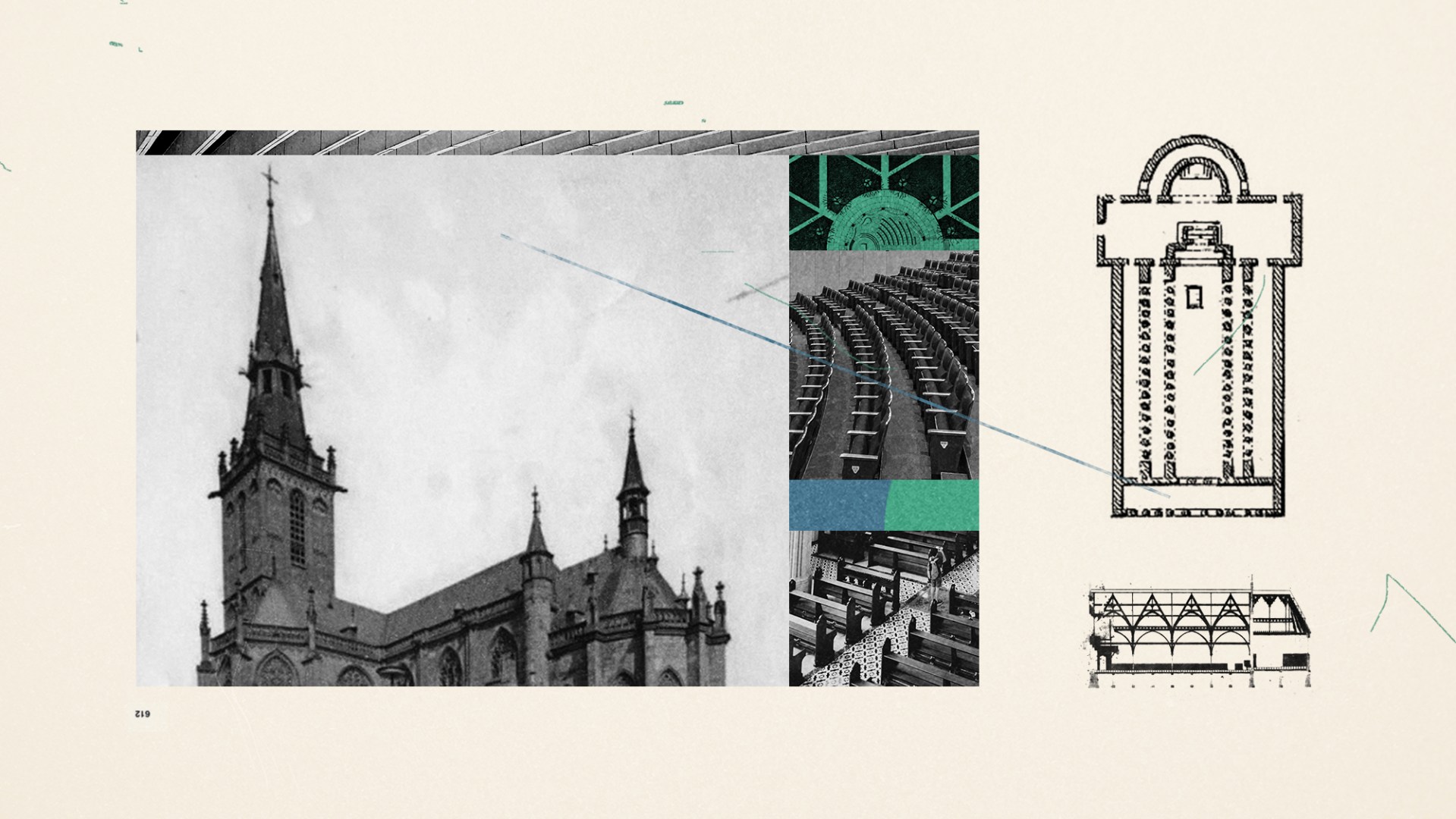
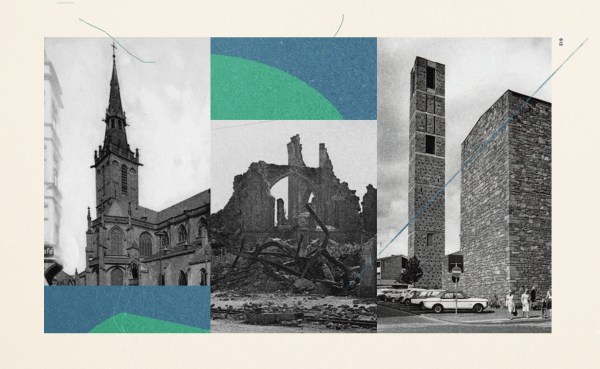
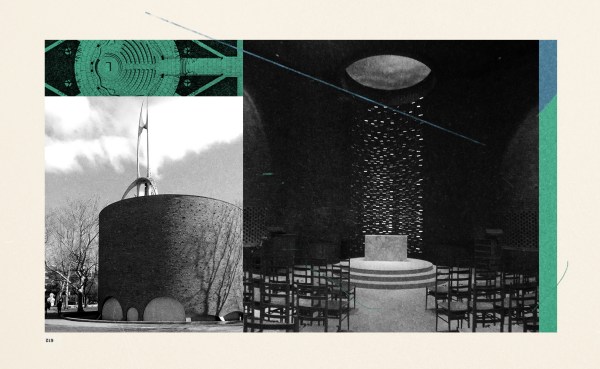
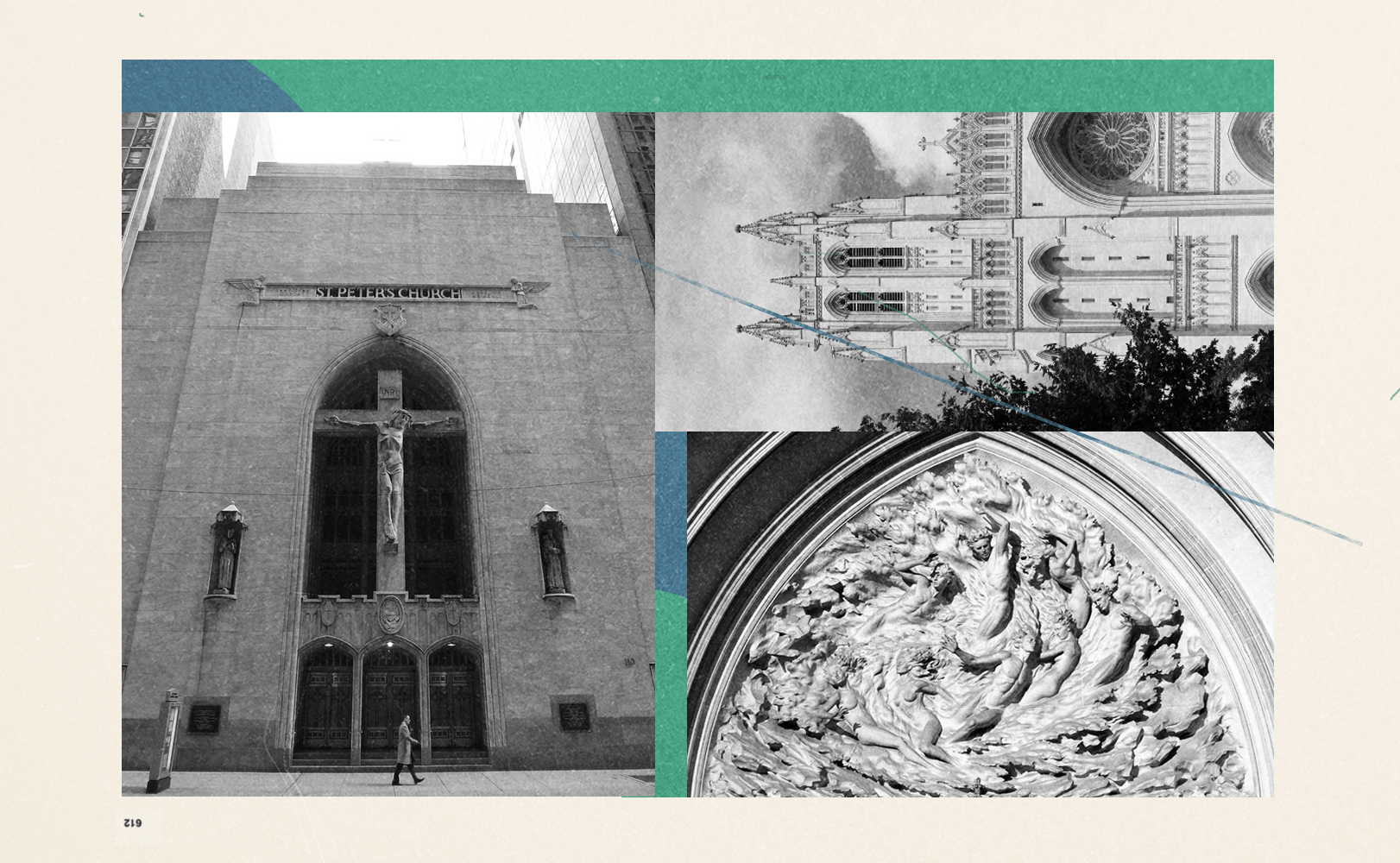
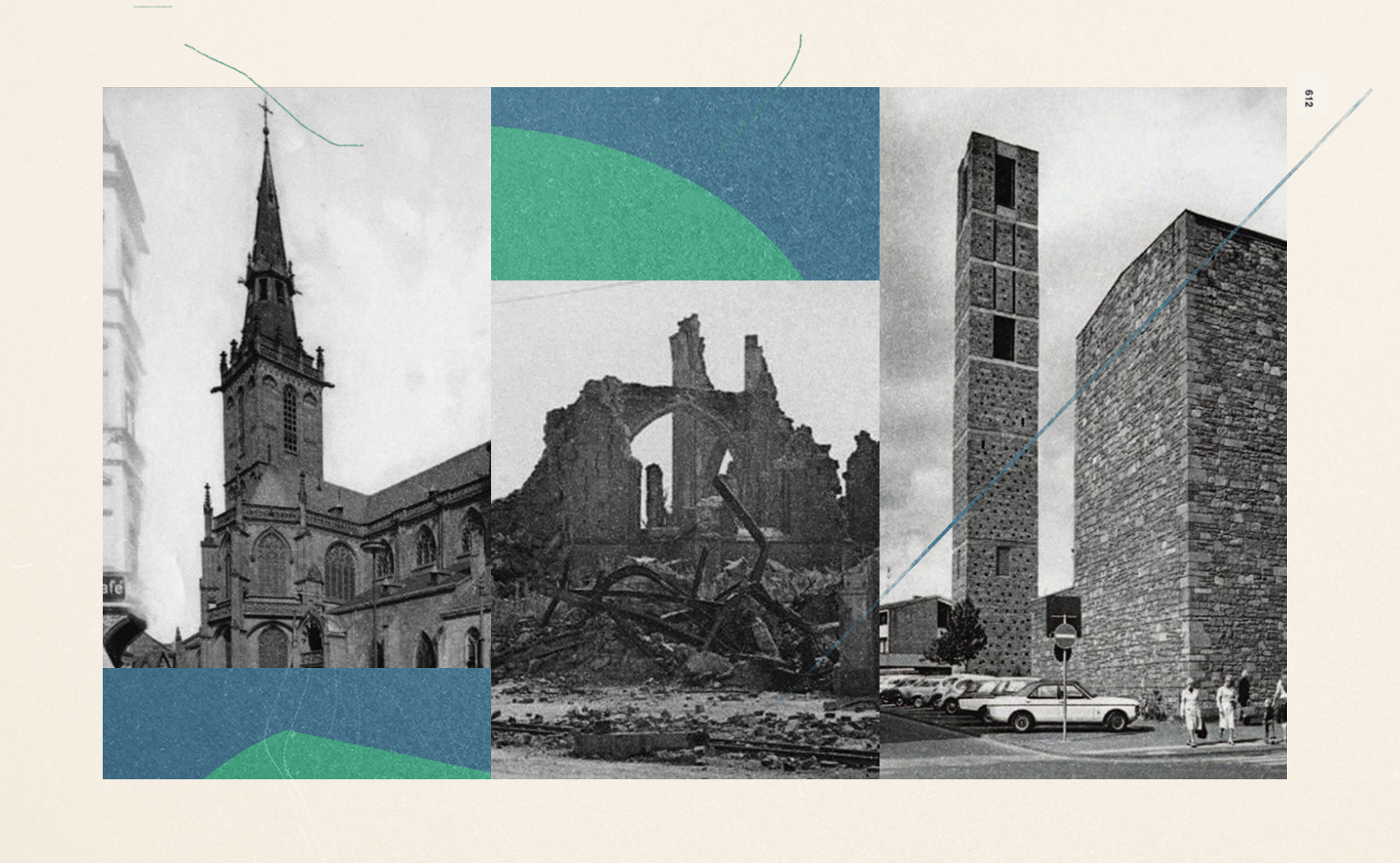
Embedded in every church is a theology that reminds us of our relationship to God through Christ. If we can learn to read the buildings architecturally, through their elevation, plan, and section, we can grasp what the structures are communicating about God—and, perhaps, what God is communicating to us through these churches.

Elevation

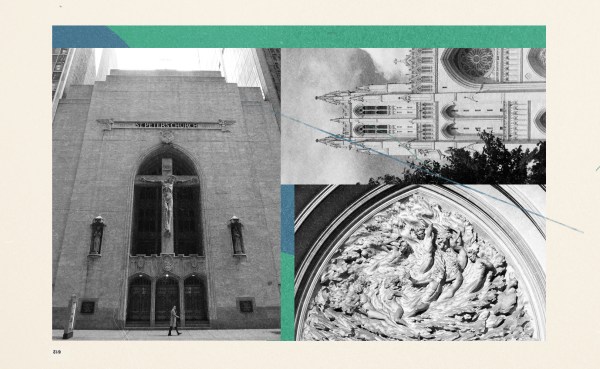
Well before we ever enter a church, we can begin to read its theology simply from its exterior or elevation. An elevation is how a building looks. A church’s posture toward the surrounding world is communicated through its elevation. Many traditional churches are designed to be outwardly explicit in delineating the sacred as a place set apart.

For example, notice whether there is a bell tower, which signifies that the church is a building of both visual and auditory “otherness” from its surrounding context. Note the color and material of the entryway. Traditionally, red doors signify the blood of Christ and demarcate the church as a place of sanctuary. Note any floral ornamentation on the facade that both recalls the Garden of Eden and prefigures the new heaven and new earth.

St. Peter's Church in Chicago (left) and the National Cathedral in DC (right).Illustration by Mallory Rentsch / Source Images Courtesy of Amanda Iglesias / WikiMedia Commons
St. Peter’s Church in Chicago (left) and the National Cathedral in DC (right).

Of course, note any overtly Christological imagery. For example, Chicago’s St. Peter’s in the Loop reminds us that Christ’s atoning sacrifice on the cross is indiscriminate: Suspended on the Madison Street facade is an enormous dying Christ, offering himself to the daily onrush of commuters, tourists, and impoverished alike. Above the west entrance of the National Cathedral in DC, however, we find God’s ex nihilo creation of Adam, a swirling and visceral reminder that from dust we come and to dust we will return.

However, a church exterior need not be expressly iconographic to tell the story of God’s work in the world. In fact, most are not.

Many post–World War II churches were designed as a corrective to the perceived excesses and antiquarianism of preceding styles. Such “mute” facades communicate an incarnational approach to the world that eschews this idea of a sacred-secular divide. The Chicago suburban churches of Edward Dart are simple edifices built in common brick. Taking on the scale and material of “everyday” architecture—such as a school or a library—Dart’s modest churches remind us that the infinite God took on flesh and dwelt among us.

St. Anna’s Church in Düren, Germany before (left) and after (middle) it was destroyed during a 1944 Allied airstrike. It was later rebuilt (right) by Rudolf Schwarz with the rubble of its medieval predecessor. Illustration by Mallory Rentsch / Source Images Courtesy of Amanda Iglesias
St. Anna’s Church in Düren, Germany before (left) and after (middle) it was destroyed during a 1944 Allied airstrike. It was later rebuilt (right) by Rudolf Schwarz with the rubble of its medieval predecessor.

Further, St. Anna’s Church in Düren, Germany, was designed by Rudolf Schwarz with the rubble of its medieval predecessor, which had been destroyed during a 1944 Allied airstrike. The simplicity and austerity of the church belie what is in fact heavily marred masonry walls, a reconstitution of assembled fragments. We are reminded that in God’s kingdom, broken things, people, and places are made whole again.

Plan

Inside a church, we take note of the architectural plan. The plan is what organizes a building on the horizontal plane. It reveals a church’s conception of our relationship to one another.

For example, note the presence or arrangement of altar, font, and baptismal. These elements create spaces for liturgical participation and designate the format of collective worship. The location and visibility of pulpit, lectern, or stage, however, reveal to us an emphasis placed on preaching. The seating shapes our posture and receipt of the Word.

Further, take note of how the seating arrangement shapes social dynamics: Semicircular auditorium seats gather congregants around a fixed stage; linear pews uphold a hierarchy and separation from the altar; simple folding chairs allow for self-determination according to a congregation’s changing needs.

Beyond the interior layout, however, the architectural plan is theologically motivated and historically inherited. After Constantine’s 313 Edict of Milan propagated Christianity as the religion of the empire, churches began to adopt the civic Roman basilica as the formal architecture of Christianity. Under imperial patronage, the basilica church developed a liturgy of procession, hierarchy, and veneration, all of which emphasize Christ as emperor. The cruciform cathedral layout also emerged from this basilica type, proclaiming the work of the Cross not just inwardly in plan but outwardly at the scale of the city.

Contrast this with the domestic, interior environments of Jesus’ ministry and covert early church gatherings. At the opposite scale of the cathedral, we find the table to be the smallest plan of a church, an intimate gathering where believers can fully participate in the Lord’s Supper. Many churches employ centralized plans to recreate this intimate scale and break down the historic hierarchy between laity and clergy.

The small scale of chapels honors the individual’s need for reflection as a precursor to collective participation. The MIT Chapel designed by Eero Saarinen employs the totalizing geometry of the circle to create a hushed, prayerful environment set apart from its busy Boston context. The chapel’s simple brick walls are animated with the rippling reflection of outside water; such architecture ennobles the contemplative practices of silence and solitude as core dimensions of the Christian life.

The MIT Chapel designed by Eero Saarinen.Illustration by Mallory Rentsch / Source Images Courtesy of Amanda Iglesias / WikiMedia Commons
The MIT Chapel designed by Eero Saarinen.

Section

If the plan organizes space along the horizontal axis, the architectural section organizes space along the vertical axis. Orienting our attention upward, the section reveals a church’s theology of God’s relationship to us.

Note a church’s vertical height: The awesome, dizzying interiors of cathedrals evoke a theology of God’s transcendence and omnipotence. Conversely, small is also powerful. Small- or medium-sized interiors remind us of God’s immanence, or nearness, to our daily lives. The Chapel of St. Ignatius in Seattle is topped with light wells that wash the peripheral walls in subtle shades of color, reminding us to pay attention to the way God reveals himself through general revelation, such as in the changing beauty of a sunset.

The section also determines how daylight enters a church. Note the presence and type of daylight: The quality of light from high Gothic clerestory windows, floor-to-ceiling panes of stained glass, or small storefront windows will differ. First Christian Church in Columbus, Indiana, designed by Eliel Saarinen, employs strong shafts of sidelight to illuminate the main auditorium, with concealed skylights to illuminate the altar’s back wall with daylight. This creates a “living” wall, the luminosity of which changes with every passing cloud.

Toplight also creates a powerful focus point. Peter Zumthor’s humble Bruder Klaus Field Chapel in northern Germany is a dark and charred concrete cavity illuminated solely by a small overhead oculus, reminding us that God’s light pierces the darkest places.

The Chapel of St. Ignatius in Seattle (top left), the First Christian Church in Columbus, Indiana, designed by Eliel Saarinen (bottom left), and the inside and outside of Peter Zumthor’s Bruder-Klaus Field Chapel in northern Germany (right).Illustration by Mallory Rentsch / Source Images Courtesy of Amanda Iglesias / WikiMedia Commons
The Chapel of St. Ignatius in Seattle (top left), the First Christian Church in Columbus, Indiana, designed by Eliel Saarinen (bottom left), and the inside and outside of Peter Zumthor’s Bruder-Klaus Field Chapel in northern Germany (right).

Contrast this with contemporary churches that have little to no daylight. The absence of daylight is increasingly commonplace, owing to the popular “black box” churches that rely on their own light systems for service. This is partly pragmatic. Many churches inherit, retrofit, or rent preexisting structures such as theaters, school auditoriums, or office buildings. Such environments can point us to architect Edward Sövik’s idea of a “non-church” church that is multifunctional and flexible and that emphasizes the idea that the church is first and foremost a gathering of people.

The point of this is not architectural knowledge. This can of course be a good thing to acquire, but nobody is being quizzed on how to identify a Corinthian versus a Doric column capital.

Reading churches is worthwhile, though, because churches are everywhere. They are constantly communicating theological truths through their architecture.

We often miss these daily reminders of truth. Yet we are invited to pay attention to the movements and workings of God in the world, through his people, and through our buildings. After all, what is spiritual formation if not developing eyes to see (Matt. 13:15–17)?

Amanda Iglesias is an architectural designer in New York City.

addApple PodcastsDown ArrowDown ArrowDown Arrowarrow_left_altLeft ArrowLeft ArrowRight ArrowRight ArrowRight Arrowarrow_up_altUp ArrowUp ArrowAvailable at Amazoncaret-downCloseCloseellipseEmailEmailExpandExpandExternalExternalFacebookfacebook-squarefolderGiftGiftGooglegoogleGoogle KeephamburgerInstagraminstagram-squareLinkLinklinkedin-squareListenListenListenChristianity TodayCT Creative Studio Logologo_orgMegaphoneMenuMenupausePinterestPlayPlayPocketPodcastprintremoveRSSRSSSaveSavesaveSearchSearchsearchSpotifyStitcherTelegramTable of ContentsTable of Contentstwitter-squareWhatsAppXYouTubeYouTube