Books

Henrietta Mears, the Improbable Evangelical Leader

A new biography shows the Sunday school teacher played a key role in the movement, and the directions its leaders took.

Illustration by Jared Boggess / Source Images: Gospel Light / Archive Holdings Inc / Fotograzia / Getty

Even in her own day, Henrietta Mears cut an improbable figure. So short she often stood on risers to be seen over the speaker’s podium, she was built, as one of her devotees put it, “like a fireplug.” Rather stocky with thick glasses and a husky voice, she did not often leave her home without a fur draped over her shoulders and a hat perched jauntily atop her neatly coiffed hair.

Mother of Modern Evangelicalism: The Life and Legacy of Henrietta Mears (Library of Religious Biography (LRB))

Mother of Modern Evangelicalism: The Life and Legacy of Henrietta Mears (Library of Religious Biography (LRB))

Wm. B. Eerdmans

320 pages

Nothing about her physical presence would lead a casual observer to view her as anything more than a rather well-to-do middle-aged Southern California matron out for a drive down Sunset Boulevard on a sunny Sunday morning. But once she turned left onto Gower Street, parked the car, and made her way to the First Presbyterian Church of Hollywood’s original sanctuary, that impression melted away. Mears, the church’s director of Christian education, taught Sunday school with a clipped, rapid-fire delivery that utilized every inflected nuance of a powerful voice that commanded attention. She exposited the biblical text with confidence, pacing the front of the room, punctuating her main points with dramatic pauses, and rarely, if ever, consulting her notes.

Interjecting seemingly tangential stream-of-consciousness asides that somehow wound their way back to the central narrative every single time at just the right moment, she seemed to grow in physical stature as the significance of her words turned more trenchant and the force of her arguments more persuasive. By the end of the hour, every person in the room knew that this formidable presence was no ordinary Bible teacher. The broader Protestant world also learned that about Henrietta Mears. Since the second decade of the 20th century, she had been in the advance guard of those who worked to recast orthodox Christianity.

Though committed primarily to the educational welfare of those under her authority—initially at First Baptist, Minneapolis, and then at First Presbyterian, Hollywood—her local endeavors became the springboard for imaginative thinking and inspired actions whose effects rippled far beyond Minneapolis and Hollywood. She taught countless youth who went on to become some of evangelicalism’s most influential leaders. She founded publishing companies. To appropriate a phrase in current usage, Mears always acted locally but thought globally about the church. As a direct consequence of her creation of evangelically oriented programs and institutions that arose from her local responsibilities, and her cultivation of a rich network of mutually beneficial relationships across boundaries many chose not to cross, Mears could justifiably be considered a foremost architect of the 20th-century reformation of Protestant America.

With bespectacled eyes riveted on her audience, “Teacher,” as she was known by her 6,000-plus-member Sunday school class, would lean over the podium and, as if telling us for the first time, reiterate that “the Christian life is not ‘trying to be good,’ or ‘trying to be like Jesus.’ It is seeking to have a deeper experience of fellowship with Christ.” For her, the gospel had to stand pure and unadulterated by other causes or concerns, however just and honorable they might be. How often her staff and students heard her proclaim prophetically “If he is not Lord of all, he is not Lord at all” over the years is anyone’s guess.

Over the course of more than five dozen interviews conducted with those who knew Mears well, one of the questions I asked repeatedly concerned her teaching on political and social topics. Many could tell me where she stood politically, but not one could remember a time when she taught directly on these potentially divisive subjects.

For example, while more than a few Protestant leaders of the post–World War II church preached entire sermons or offered conference seminars regarding the threat of communism, Mears kept a discreet distance from ideology in her teaching. She often used the intense dedication to Marxism unmistakable in the postwar world as a powerful illustration to provoke Christians to take their faith development more seriously, just as she utilized statistics from social, economic, and other political issues to drive home the importance of total commitment to God. But she persistently refused to politicize the gospel.

According to Betsy Cox, who wrote a thesis on her in 1961, Mears believed “that the field of Christian Education should first introduce men, women, and children to Christ as Savior and Lord and then train them in the Word of God.” While she drew extensively upon stories or aphorisms of a political or social nature to energize her text and enliven her message, she constantly affirmed that “Christ should be the center and circumference of the Christian Education program.”

Mears never forgot that the purpose grounding her decades of service was “to know Christ and to make him known,” as the motto of her College Department at First Presbyterian Church of Hollywood made clear. Any other activity paled in comparison to building the kingdom.

This single-minded devotion to evangelism and discipleship, of course, meant that her deafening silence on contemporary issues could be heard from coast to coast. Her refusal to take a public stand with respect to antisemitic or anti-Catholic rhetoric or California’s Rumford Fair Housing Act, to name a few hot-button issues of her day, could certainly be perceived as complicity in perpetuating an unjust status quo.

Yet it would be helpful to remember the tightrope she believed she had to walk as a bridge-building evangelical female at a time when there were precious few of them and the span was still under construction. If she faced censure in some quarters of the interdenominational network she did so much to enrich because of her attachment to a Christian fellowship of Hollywood insiders, how much more might her work be threatened if she gave public voice to her inward convictions on these and other matters?

At the same time, she refused to devalue the importance of active participation in and service to a world both broken and blessed. If the inner life is all the life Christians have, Mears believed that “the outer life is that expression of life that makes Christ known to others.”

Though insistent on a laser-like focus on matters of faith and spiritual growth in the Christian education work of the church, Mears believed just as intensely that personal piety must have tangible public consequences. Her charge to “Live the gospel first! Tell about it afterward!” motivated generations of theological conservatives to pursue redemptive work in the world as the Spirit gave guidance.

For to Mears, making a faith commitment meant entering a life of service to those both within and outside the walls of the church, just as it had for past generations of her family. Her devotion to service only broadened the longer she lived, as her support for the work projects of the World Deputation program, Lillian Dickson’s holistic Mustard Seed ministry, and the social activism of her friends and associates demonstrates.

Like her grandmother and mother before her, Mears reaffirmed that the supreme need for humanity remained spiritual regeneration, but she also recognized that Christ called the church to sustain and enrich the material and emotional lives of all those for whom he died as the Holy Spirit gave direction. If Christians are to serve those beyond the church effectively, Mears believed, they must participate actively in the wider secular world that surrounds them, for to speak into the culture, it must be understood.

She modeled a willingness to wear theological orthodoxy proudly while dancing with prudence and grace in what were often less than hospitable circumstances.

Adapted from Mother of Modern Evangelicalism: The Life and Legacy of Henrietta Mears by Arlin C. Migliazzo ©2020 (Wm. B. Eerdmans Publishing Co.) Reprinted by permission of the publisher.
Books

How to Disagree Nicely but Not Lose Your Convictions

Everything is not a biblical issue—but who decides?

Illustration by Jared Boggess / Source Images: Ekely / Sanjeri / Mikroman6 / Getty

A few days after Bill Clinton was elected, I (Rick) was facilitating a small-group leaders’ meeting. One of the leaders whose political convictions leaned strongly Republican suggested that our small groups should have a time of lament in light of the recent election. Some others nodded in agreement. Was this a good idea?

Winsome Conviction: Disagreeing Without Dividing the Church

Winsome Conviction: Disagreeing Without Dividing the Church

IVP

224 pages

I thought not. I mentioned to the leaders that about 80 percent of evangelicals voted Republican, a fact that most seemed to be aware of. Then I asked all of the leaders to take a sheet of paper and write down the two to three people in their group who were likely to vote Democratic.

There was dead silence. No one picked up their pencils.

Finally, a leader spoke up and said they didn’t think anyone in their group had voted Democratic. I pointed out that if our congregation reflected the national averages for evangelicals, a small group of 12 to 14 people would have three Democrats. I was just asking them to stop and think who those people were and how they would likely feel if we opened up the small group meeting with a season of lament. It was an awkward moment.

The leaders realized that opening the small group with a season of lament might not be welcomed by certain group members. They also realized that prayer times in the past several weeks leading up to the election were probably equally alienating. We had simply been blind to an underlying diversity of political convictions within our groups.

The standard dictionary definition of conviction runs something like this: a fixed or firmly held belief, a belief that we won’t be giving up anytime soon. But we have beliefs like that about arithmetic, and we don’t usually call those convictions. Convictions are not just about garden-variety facts but rather about particular sorts of beliefs. We might say that convictions are firmly held moral or religious beliefs that guide our beliefs, actions, or choices. This shuts out beliefs we have about matters of taste (not moral), and it also shuts out beliefs we hold but are happy to disregard or ignore (they don’t guide our actions).

Notice that this definition makes room for two different kinds of convictions, what we might call absolute convictions and personal convictions. Absolute convictions are called absolute not so much because of the zeal with which we hold them, but rather because we feel that they should apply to “absolutely” everyone. They are universal; they apply both to ourselves and our neighbor. The great Christian creeds are examples of such absolutes.

Personal convictions, on the other hand, are things we believe personally and which guide our personal conduct, but we realize others may not share. This might be a conviction about refusing to drink alcohol because a family member had been killed by a drunk driver. We would probably hold this conviction quite firmly, but we would also know that not everyone would share it. The distinctions we are making here are nothing new; they simply reflect the famous maxim “In essentials, unity; in nonessentials, liberty; in all things, charity.”

So how can we form deep Christian convictions without dividing the church? Let’s take a deeper look at convictions themselves.

Convictions are like light: They come in many colors and form across a spectrum. Consider the belief that God created human beings in his own image—a timeless theological truth grounded in Scripture (Gen. 1:26). This sort of conviction could be called a confessional belief—an absolute that all Christians should share in common.

People tend to agree about the values themselves but tend to disagree on how the values should be prioritized.

A few chapters later, in Genesis 9:5–6, this truth is formed into a moral mandate that prohibits killing a person because all humans are made in the image of God. This moral mandate can be further expanded into a set of positive claims that actively value human life. Unpacking this a bit, we would see that valuing human life would probably mean more than just being “pro-life” in the sense of opposing abortion. Instead, one might think of a “consistent ethic of life,” a phrase coined by Cardinal Joseph Bernardin. Such an ethic shuns abortion and also euthanasia, war, and violence. It would likely have positive entailments such as access to basic human freedoms that image bearers require, such as the freedom to worship according to one’s conscience and have basic necessities such as food and shelter.

These increasingly refined judgments do not emerge because we are finding more and more explicit teachings of Scripture, but because we are unpacking more and more implications of our confessional belief that human beings are created in the image of God. These implications might be summarized in a core value statement such as, “Every human being should be protected from life-threatening harms and provided access to essential goods needed for a flourishing human life.”

Clearly we are moving across a spectrum and becoming increasingly specific as we go. Our confessional beliefs and moral mandates are shaping core values within our souls—shaping our desires and pursuits. However, these core values are still not specific enough. Ultimately, we must discern specific guidelines for conduct. We must decide if the prohibition against taking the life of an image bearer means that we should oppose both abortion and capital punishment or only abortion.

Notice that as we move across this spectrum, each step makes our convictions more specific, but as they become more specific, they also become more contested. At the outset, explicit statements of Scripture or universal creedal confessions assure agreement among all Christians. Convictions about these matters are absolute and universal. However, the more specific we make our judgments, the more culture, prudence, historical circumstance, and practical wisdom influence our conclusions, and therefore the more diverse our opinions become.

We can connect this spectrum to three different types of issues: absolutes, disputable matters that are included in this spectrum, and matters of taste that are not. The spectrum begins with absolutes and increasingly addresses disputable matters. At the far opposite end would be matters of taste, but they are not included because they are not matters about which we form convictions.

In detail: Four types of convictions

Confessional beliefs. Confessional beliefs define the boundaries of Christianity and ground the beliefs and practices of the church and individual believers. They are often expressed in creedal statements such as the Apostles’ Creed or the Nicene Creed. Creedal statements are commonly recited by the whole church in public worship. They are also generally worded as “We believe” statements rather than “I believe” statements.

Clearly the implication is that all members of the congregation are expected to share these beliefs. Denying these creedal statements is good grounds for doubting the authenticity of a person’s Christian faith. These confessional beliefs serve as preconditions for our convictions. We might even call them Christian convictions as opposed to personal convictions exactly because we believe that these convictions are part and parcel of the Christian faith itself. They are not simply matters of personal conviction.

As the name implies, confessional beliefs focus on belief, not action. They are largely composed of timeless theological assertions about the nature of God, mankind, and salvation. Churches and individual disciples of Christ have to decide what honoring Jesus as Lord demands of them in the particular times and cultural circumstances in which they find themselves.

Moral mandates. Identifying moral and spiritual mandates is the first step in “operationalizing” our confessional beliefs—that is, moving them into action. Like confessional beliefs, moral and spiritual mandates are universal or near universal among Christians. They are the behavioral counterparts to the theological beliefs found in our confessional statements and creeds and are derived from the commands of Scripture, even as the confessional beliefs are derived from the theological claims of Scripture.

“Mandates” is a handy way to refer to these high-level action-guiding principles, but it should be noted that the term covers a wide range of behaviors. Some of these mandates address spiritual issues related to proper worship and devotion to God. Other commands deal with ethical issues about how we treat fellow human beings. We will use the phrase “moral mandates” as an umbrella term that covers both ethical and spiritual matters.

Core values. Moral and spiritual mandates almost immediately beg for further specification. We have labeled this next step along our conviction spectrum “core values,” referring to the things that are important to us—the things that we actually value.

The term values is commonly used by moral psychologists or sociologists to identify underlying motivations for actions. Values are desired ends that guide us in our choices and help us evaluate policies, people, and events. Recently, social psychologist Jonathan Haidt has formulated a “Moral Foundations Theory” that identifies six basic human values: care, fairness, loyalty, authority, sanctity, and liberty.

How can common values result in such different guidelines for action? The reason is that people tend to agree about the values themselves but tend to disagree on how the values should be prioritized. Most controversial issues intersect more than one value, as in the case where a policy that promotes liberty may diminish fairness or fail to care for a basic human need.

For example, when discussing immigration, everyone may agree that people should obey governing authorities and also regard immigrants with love and dignity, but they may disagree on how to weigh these in particular cases. Furthermore, people do not construct a single, universal hierarchy of value but rather may prioritize values differently depending on the situation. In other words, we might weigh values differently in the cases of Syrian refugees and Central Americans crossing our southern border. In short, values are the place a common starting point leads to different end points.

Guidelines for conduct. The final step along the conviction spectrum is developing specific guidelines for conduct. Here, moral mandates and core values find expression in actual policy decisions, responses to ethical dilemmas, and plans for action within a specific cultural context. Guidelines for conduct have time frames, locations, and audiences in mind. They answer the question, How can I best honor Christ in the time and place and circumstance where he has placed me?

Practical wisdom and knowledge play an extremely important role in forming guidelines for conduct. Tim Keller argues that caring for the poor is a clear biblical teaching and a moral mandate, but it is a matter of practical wisdom whether the best way to do this is through private enterprise or government redistribution or some combination of the two. Similarly, neighbor-love and the protection of life in the image of God mandates that we alleviate human suffering and care for the afflicted. There is no single “Christian” answer to questions like these. Nonetheless, we must decide what we will do. We cannot pursue all options at once.

In general, it is not uncommon for us to have strong, gut-level intuitions about moral and political issues. This is not necessarily wrong—our conscience often operates intuitively without our being able to identify principles that would support our intuition. However, it is valuable to refine and deepen our intuitions by reasoned reflection illuminated by the wisdom of others. We are not the self-sufficient source of all truth.

Jennifer Herdt, a Christian ethicist at Yale Divinity School, notes that a deep dependence on God is essential to developing “truthfulness concerning one’s own character and capacities [which] enables the admission of weakness and strength, incapacity and capacity, alike.”

We pursue truth together, as part of a community. An essential part of this process is, as James says, being “open to reason, full of mercy and good fruits, impartial and sincere.” Such virtues lead to a “harvest of righteousness” (James 3:17–18, ESV). Once we have listened to others with openness and sincerity, we are in a much better place to pursue Paul’s project of becoming “fully convinced in [our] own mind” (Rom. 14:5).

Adapted from Winsome Conviction by Tim Muehlhoff and Richard Langer. Copyright © 2020 by Tim Muehlhoff and Richard Langer. Published by InterVarsity Press, Downers Grove, IL. www.ivpress.com.

Reply All

Responses to our November issue.

Envato Elements

Empty Pews Are an American Public Health Crisis

No one is doing more to advance the study of religion and health than Tyler VanderWeele, and I was pleased to see his article (along with Brendan Case). It’s important to note, however, that the case for attendance is so strong because it’s one of the only religion/spirituality variables historically included in high-quality studies. More and better data will help evaluate additional variables, including an area I focus on, attachment to God. Notably, believers who experience insecure or anxious attachments are unlikely to benefit from religious services.

Blake Victor Kent Santa Barbara, CA

I enjoyed the article and see the need for communal worship and gatherings. What you missed is more emphasis on hypocrisy, especially with sexual abuse in the church. Too much is covered up to keep the church looking good. Another aspect is the fear and condemnation of the other outside the church. Your article would be more effective by interviewing those who have left because of intolerant attitudes and forms of worship that do not glorify God. I have not left God or my Savior, just church.

Marjorie Logman Aurora, IL

Jesus Loves the Brown Pop-Eyed Atewa Slippery Frog

Thank you for sharing this story and this man’s wonderful work to preserve God’s creation. May we all do likewise.

Tricia Gaitely Murfreesboro, TN

Churchgoers May Remember Song Lyrics Over Sermon Quotes

As someone who is asked to speak in small churches, I am grateful to be allowed to choose the hymns for the service. I believe that this is an opportunity for the congregation to worship and to confess with their mouths truths about God grounded in Scripture.

Judy Hewitt Ottawa, Ontario

The Church Needs Reformation, Not Deconstruction

God will bring much good and renewal to those who are reframing their understanding of the gospel. They may be “throwing the baby out with the bathwater” now, but God will not let go of those who belong to him.

Jeanette Lamothe Albuquerque, NM

We Need a Savior More Than a State

To the unchurched, isn’t “washed in the blood” spiritual and abstract? It’s a phrase full of meaning to a segment of the evangelical culture, but let’s face it, it’s in-speak. I couldn’t agree more that solid theology is the remedy for the travesties committed in the name of Christianity. Unfortunately the evangelical world has more than its share of shaky, amateur theology and seems loath to police itself.

Joseph Costantino Bridgetown, Barbados

How Scripture Keeps Surprising Me

Memorized Scripture shines light on paths we may be tempted to take in haste and those we might avoid out of fear.

@PATTI_TILTON (Twitter)

The New Head of the World Evangelical Alliance Wants to Talk

There is no agreement based on labels. Agreement must be based on doctrines. There has been a migration of many North American “evangelicals” away from historic doctrines of the united church. Without this identification with doctrines of the church, how can you define evangelical or Christian?

Stephen Wuest (Facebook)

Books “stuffed into shelves, stacked in piles, and even teetering on top of the toilet.” As a bookworm, that sounds perfectly reasonable, and I am wondering what is on top of your toilet, Ken Chitwood?

Annette Johnson (Facebook)

My Body Is a Temple, Not a Fighting Machine

I wanted to let Hector know that I loved his story. He is a great writer and storyteller, but more importantly, a man whose convictions steered him to God’s bigger plan and purpose for his life. I don’t know him, but I can say I’m proud of him!

Sandy Anjilivelil Denver, CO

Theology

If I Had to Bow to an Idol, It Would Be the Sun

No other created object tells us more about the real God.

Illustration by Mallory Rentsch / Source Images: WikiMedia Commons / Guillaume de Germain / Jacob Bentzinger / Unsplash

I have never been able to understand why anyone would worship a wooden statue. Or a tree or an Asherah pole, a cow or an elephant, or a god who looks like a frog. I think I get it at an intellectual level—they represent fertility or whatever—but I cannot get my head around people being spiritually drawn to adore them, rejoice before them, or sacrifice to them. If I had been born an ancient pagan, I wouldn’t have been the idol-fashioning, maypole-dancing type. (At least, I struggle to imagine myself that way.)

God of All Things: Rediscovering the Sacred in an Everyday World

God of All Things: Rediscovering the Sacred in an Everyday World

HarperCollins Children's Books

224 pages

But I can see why people used to worship the sun. I’m not saying they should have, obviously, but I can relate to the instinct. So far as anyone knew until quite recently, the sun was by far the largest thing in the sky and the source of all light, heat, power, and life. Especially in Northern Europe, where I come from, the difference between sunshine and darkness, summer and winter, is so great that it must have been tempting to rush outside in the springtime and prostrate yourself before the giant yellow ball of fire. Were it not for Christianity, I suspect many of us still would.

Unsurprisingly, this presented a challenge to ancient Israel. Moses had to urge the people not to worship the sun, with fairly drastic legal consequences for anyone who did (Deut. 4:19; 17:2–5), and the prophets revealed that it was still a problem many centuries later (Jer. 8:2; Ezek. 8:16).

The risk of idolatry is partly why Scripture keeps pointing out all the things the sun is not. It is not eternal: The Bible’s opening chapter makes clear that the sun was not created until day four, and its last chapter tells us that the sun is no longer needed, “for the Lord God will be their light” (Rev. 22:5, ESV throughout). It is not inevitable and can be darkened (and dethroned) at will by the one who created it (Ex. 10:21–29). It is not in control; it can be made to stand still (Josh. 10:12–14) or to move shadows in the wrong direction (Isa. 38:8). These might look like random potshots at the sun, but they are ways of protecting Israel from turning a gift into an idol. The sun had the potential to be a huge theological problem.

Yet it also had the potential to be a huge theological opportunity. So long as people could use the sun as a way of meditating on and worshiping God, rather than as something to be meditated on and worshiped itself, they could learn a great deal about him. The psalmist is very happy to use the sun to shed light on the nature of God: “The Lord God is a sun and shield” (Ps. 84:11).

There are numerous attributes of God we can see more clearly by thinking about the sun for a moment, and in a way that is true of nothing else in creation. Glory, for instance. Fire and the fear it produces. Otherness. The mysterious combination of great distance and felt presence, transcendence and immanence. The all-seeing, all-illuminating orbit, bringing heat and revelation to the entire world (Ps. 19:4–6). The fact that the sun is always shining, even when its light is concealed from us by the position of the earth or the covering of the clouds. Radiant brightness. Sheer power. When the apostles want us to see the splendor of Christ, sunshine is the only metaphor they need. “He was transfigured before them, and his face shone like the sun, and his clothes became white as light” (Matt. 17:2; see also Rev. 1:16).

The sun shows us something of the primacy, centrality, and sovereignty of God. It is a fountain of light: the first, the source, the origin of illumination for everything else. In ancient terms, it is the “greater light” that rules the day, dictating the seasons, the days, the harvests, and the weather (Gen. 1:14–16). In modern terms, it is the giant gravitational centerpiece of the solar system, containing more than 99.7 percent of the system’s total mass and pulling everything else into its orbit. Although it is created, its existence even points to the independence of God, since the sun is a luminary in its own right rather than (like the moon) reflecting light from another source. It governs our notions of time (the hours of the day). It governs our notions of space (our relative sense of east and west). Other than a human being, it is hard to think of anything in creation that highlights as many of God’s characteristics as the sun.

There are subtler connections here as well. With the sun, as with God, there is no distinction between what it is and what it does. The sun gives light and heat because it is light and heat. Its action reflects its identity; its goodness is the overflow of its nature. And the same is true of God. He does good all the time because he is good all the time. “Every good gift and every perfect gift is from above, coming down from the Father of lights, with whom there is no variation or shadow due to change” (James 1:17). This may be why, when comparing God to the sun, the psalmist waxes lyrical about his goodness: “The Lord God is a sun and shield; the Lord bestows favor and honor. No good thing does he withhold from those who walk uprightly” (Ps. 84:11).

For all these associations, however, the one that stirs my heart the most—and certainly the one that we sing about the most, at least in the English-speaking world—is the one that comes in Malachi 4. Malachi has no idea that he will be the last prophetic voice for more than 400 years. He doesn’t know that he is writing the final words of the Old Testament, at least in our English Bibles (the Hebrew Scriptures are ordered differently). But he wants God’s people to know that no matter how long they have to wait, the Lord will surely come and judge evil and turn the hearts of the fathers to their children, and the children to their fathers (v. 6). And he wants them not just to know but to feel the joy of that future moment, the joy of God’s presence rising over them, even if they don’t live to see it. “For you who fear my name,” God promises, “the sun of righteousness shall rise with healing in its wings. You shall go out leaping like calves from the stall” (v. 2).

It is a beautiful image. The return of the King, when he comes, will prompt the kind of joy that a songbird feels at dawn or a photographer feels at sunrise. It will feel like the whole world is being healed by beams of celestial light. It will bring the abandon and gaiety that you see in newborn lambs and calves when they skip from their barns into spring fields in the morning, mingled with the relief experienced by emperor penguins when the sun finally breaks through at the end of an Antarctic winter. You will want to dance for joy because the long-awaited day of sunshine has come.

So every Christmas we sing about it and remind ourselves of the brightness that has broken into our darkness:

Hail, the heaven-born Prince of Peace!
Hail, the Sun of Righteousness!
Light and life to all he brings
Risen with healing in his wings!

Taken from God of All Things by Andrew Wilson. Copyright © 2021 by Zondervan. Used by permission of Zondervan. www.zondervan.com.

Testimony

I Entered Prison a ‘Protestant.’ I Left a Christian.

How a violent Northern Ireland loyalist became a pastor and an evangelist.

Rob Durston

I grew up in Belfast, Northern Ireland, during an era of bitter and violent conflict between Protestants and Catholics. The Protestants wanted Northern Ireland to remain within the United Kingdom, while the Catholics wanted to unify Ireland as a single, independent republic.

A Cause Worth Living For: The Story of Former Terrorist David Hamilton

My first awareness of the political differences between Protestants and Catholics came when I was 14 years old. On that day, I had been skipping school with a group of other boys, all Catholic. We were down in a glen, among the trees, where there was a rope swing attached to a branch jutting out over the river. I stood there listening as the other boys discussed what they should do to me. What they did was beat me up and throw me in the river.

As I climbed out of the water, I tried to figure out what I had done to deserve this. When I asked, one of the boys told me: They had attacked me because I was a Protestant. Until then, I didn’t know what it meant to be a loyalist or a Republican. Nor did I understand the distinction between being a Protestant and being a Catholic.

That day marked a turning point in my life, and it set me on a destructive course. I decided I would never again have Catholic friends. And as a teenager, I made the fateful decision to become a political terrorist, joining an illegal paramilitary organization called the Ulster Volunteer Force. I saw myself as a righteous activist fighting for a good cause—for loyalty to queen and country.

Time to change

As a UVF member, I committed several crimes, including a bombing, a bank robbery, and several other armed robberies, one of which got me sent to prison at age 17. After being released one year later, I got involved again, which ended in another arrest and a 12-year sentence.

I had been in prison a few years when something out of the ordinary happened. I was attending a church service just before Christmas. (Like nearly everyone else, I wasn’t there out of any religious convictions, but only for the chance to get out of my cell, see prisoners from other wings, and exchange contraband and scuttlebutt.) The prison chaplain asked, “Any volunteers to read the Bible passage this morning?” When no one responded, someone sitting in front of me turned around and said, “Davey said he will do it!”

My first instinct was denial. But I knew everyone would laugh at me. So I took the Bible and read the passage—Luke’s account of the nativity of Jesus. When I finished, I was smiling! For some reason, it felt good. In fact, I wrote a letter to my mother that evening explaining what had happened. But nothing changed. Christmas came and went.

In early January, I had another amazing experience. One evening, not long before lockup, I made myself a cup of tea. Returning to my cell, I noticed a small piece of folded-up paper lying on the pillow: a Christian gospel tract with the title “Jesus Christ is Coming Back Soon.” I laughed, balled it up, and tossed it out the cell window.

But a sudden thought came into my mind: “It’s time for you to change, to become a Christian.” This was startling. But a few moments later, the thought repeated itself.

At first I laughed it off, figuring God would never be interested in someone like me. I was a bad man guilty of doing bad things. The UVF had killed many people. Some of my friends were murderers. Thankfully, I had not taken anyone’s life, but it wasn’t for lack of trying.

I shook myself back to reality and put my cup on the shelf, beside a Gideon Bible. (Every prisoner kept one in his cell—not to read, but as a backup source of cigarette paper.) Curious, I flicked through the pages, reading a few lines here and there. It didn’t make any sense, so I put it back on the shelf. A few minutes later, I tried reading once more. It still didn’t make any sense.

Lying on my bed, I started thinking about my close brushes with death. Like the night when the Irish Republican Army attempted to kill me while I was eating out with my fiancée. Or the time I planted a bomb that exploded prematurely while I was still in the building. Although my jacket was cut to shreds, I survived without a scratch. Or the moment on the street when someone put a gun to my head and pulled the trigger, only for the gun to jam.

Not many live to tell such tales, so why was I still alive? Suddenly the thought rushed through my mind: “It was God who kept me alive!” The more I pondered it, the more convinced I was.

Suddenly, I knew I wanted to become a Christian, although I wasn’t sure how. Thankfully, the next morning I encountered the very man who had put the tract on my bed. To my surprise, I began confessing my interest in becoming a Christian. I thought he would laugh at me because I had mocked him so many times for his faith. Instead, he simply gave me a hug. He also gave me several more tracts—enough reading material for a month.

One of the tracts contained a simple prayer on the back side:

Come into my heart Lord Jesus, come into my heart today.
Come into my heart Lord Jesus, come into my heart to stay.

I prayed the prayer six times, just to make sure God knew I was serious. When the cell door opened for us to return to work, I decided to tell the first person I saw, but to my horror he started yelling, “Davey’s a Christian now! He’s joined the God Squad!”

When I spotted the prison chaplain, I shouted, “I am a Christian now!” He stopped and walked over. “When did this happen?” he asked. He invited me back to his office, where he sat and smiled as I recounted my story. After I finished, he opened a cupboard and gave me the first Bible I considered my own, a little red Gideon’s New Testament. When he prayed for me, I felt ten feet tall.

Hope for the hopeless

At the time, I didn’t realize that someone else had been praying behind the scenes: my uncle’s mother-in-law, an elderly woman named Mrs. Beggs. On the day of my sentencing, when my mother was crying about her hopeless son, Mrs. Beggs shook her head and said, “If God could change the heart of John Newton”—the slave ship captain who penned “Amazing Grace” after his conversion—“he can change the heart of your son. I will pray for him every day.”

In fact, when my mother told her the good news, Mrs. Beggs reported back that she already knew, because God had “lifted the burden of her heart.” She added, “God has told me I am to pray for his future ministry—he will become a minister!” Though Mum could hardly believe it, Mrs. Beggs was right.

After my release, I worked as an evangelist for Prison Fellowship. (Charles Colson had visited me after my conversion.) Five years later I began to travel across Europe as an itinerant evangelist. In another 12 years, I received a call to pastor a church in England, which I did until my retirement. Nowadays, having moved back to Ireland, I continue to evangelize across the country.

Truly, there is no such thing as a hopeless case, because God is mighty to save!

David Hamilton is a retired minister living in Northern Ireland. He is the author of A Cause Worth Living For: The Story of Former Terrorist David Hamilton.

Theology

Blessed Are Those Who Embody the Beautitudes

As we search for meaning in the “blessings,” we must let them transform us.

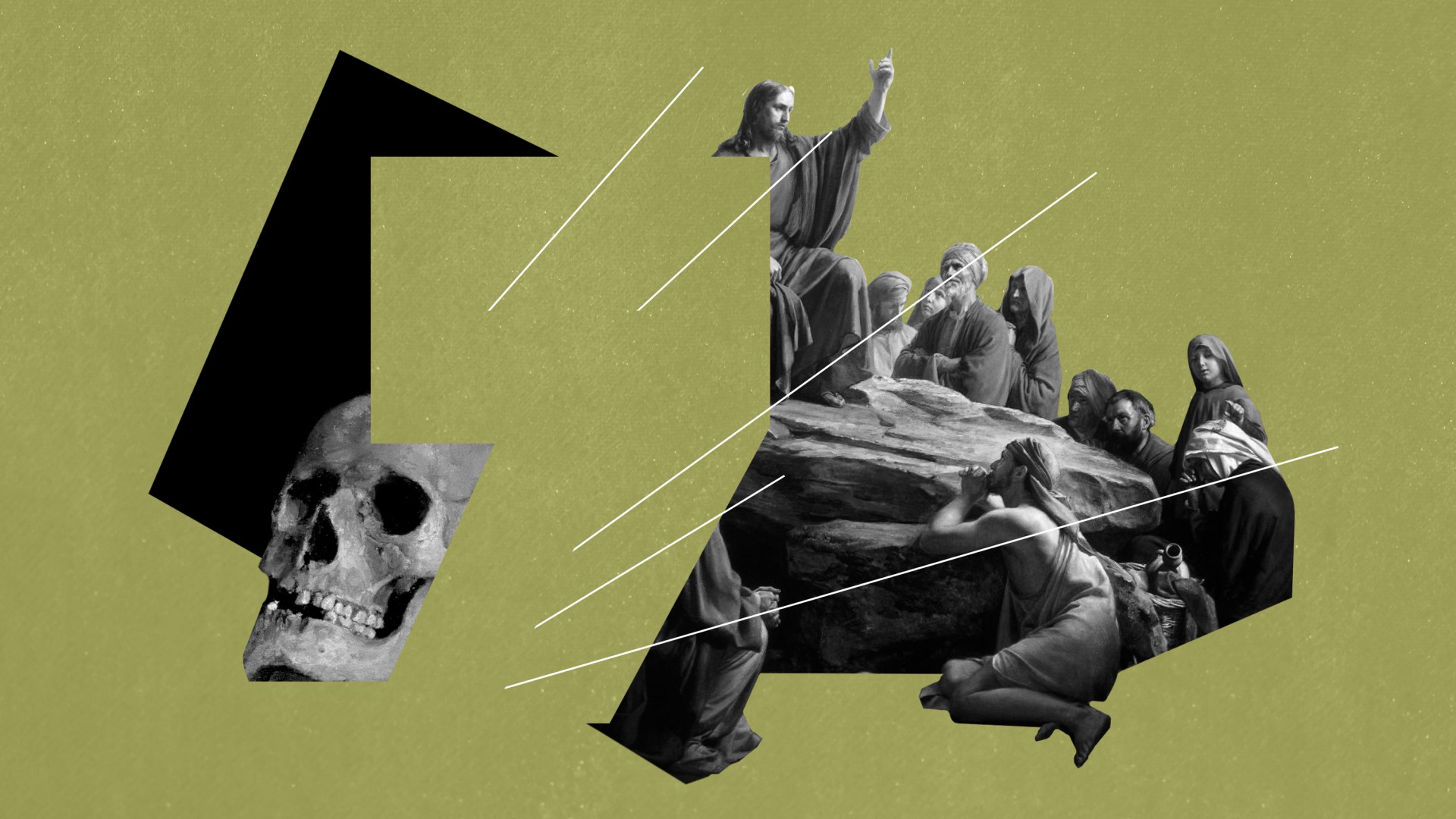
Illustration by Jared Boggess / Source Images: WikiMedia Commons

The yellowing notebook for my college philosophy of religion class contains this plaintive inscription: Sunday school was never this complicated. Similarly, the Beatitudes are more complex than they first appear. They are (like all of Scripture) inexhaustibly rich. The deeper you dig, the more they yield.

The Beatitudes through the Ages

The Beatitudes through the Ages

Wm. B. Eerdmans

352 pages

It’s hard to say that a beatitude means anything apart from a context in which that meaning might be practiced, and apart from lives in which the Beatitudes might mean something. The Beatitudes are best understood in their wider narrative contexts in Matthew and Luke: They only make sense as part of a wider story about God and God’s Son, Jesus.

As Kavin Rowe writes, “We cannot understand the sense ideas or practices have apart from the stories that make them intelligible as things to think/do in the first place.”

Now I also want to make a case that the Beatitudes can be known most fully not by reading about them but through seeing what they look like in human lives. Perhaps it’s better to say not that the Beatitudes mean something but that they hope to transform someone, that they aim to transform us.

I didn’t expect to be changed by writing a book on the Beatitudes, but I was. I thought often about how I experience and express anger, whether I am a gentle person, how I spend money, how I treat people who are poor or homeless, when and how I pray, and whether I ever suffer for a commitment to justice. “How can one communicate the flame of the beatitudes,” wonders René Coste, “if one does not oneself burn?”

Christin Lore Weber writes of the Beatitudes:

If we approach their meaning through analysis we will fail to understand them. Instead we need to receive them with love . . . and hold them within us until they bear fruit in our lives. We cannot explain them; but we can tell stories about finding them enfleshed in the people and situations we encounter.

Taking Weber’s cue, then, I want to share two stories—two performances of the Beatitudes, if you will. The first story is about a girl named Lena.

Helena Jakobsdotter Ekblom (1784–1859) was born in Östergötland, Sweden, the same province from which the Eklund side of my family originated. At an early age she began to have visions of paradise, in which all the promises of the Beatitudes have come to fruition—she saw the poor rejoicing, laughing, and possessing the earth, crowned as sons and daughters of God. She started to preach about her visions, attracting crowds of impoverished peasants, who eagerly received her message, and the authorities, who did not.

Lena declared, in the words of the Beatitudes, good news to her fellow poor. As in Luke’s gospel, this message carried with it an implied corollary: “Woe to the rich who cause poverty, to those whose laughter is bought by tears, to those whose opulence is built on misery, to the mighty and powerful whose strength is founded on injustice, to those who despise and persecute and oppress the little ones of Jesus.”

This implied corollary proved deeply challenging to both state and church authorities. As Jerry Ryan wrote, “Viewed through Lena’s eyes, the existing order becomes intolerable, literally revolting.” Her preaching proved so disturbing that she was locked away for 20 years in Vadstena, in a castle converted into an insane asylum.

Even there, where she found herself among the poorest of the poor, the humiliated and abandoned, Lena continued to preach. She preached of God’s unshakeable love for them, assuring them that even “in their cells they delight in the freedom of the sons of God, that they are the heirs of the promise” (Matt. 5:9–10).

After 20 years she was released, but she would not stop preaching the good news of the Beatitudes—good news for the poor, bad news for the powerful. She was arrested again, but on the way back to Vadstena, she and her escort passed through a town devastated by plague, and the guards fled in terror. Lena, however, stayed there, tending the sick, comforting the mourners.

When the plague subsided, she was so beloved by the local people that nobody dared to arrest her again. When she grew old and unable to work, she moved into a shelter for the poor in her home village. Lena performed the Beatitudes in her preaching and in her life—she blessed the poor and was poor; she comforted and she wept.

The second story is about a woman whom I will call Anna. She has been, by turns, a community organizer and a preacher, a minister and a companion of the impoverished. For many years she brought a peaceful, generous, and resilient spirit to a neighborhood riven by gun violence and racial injustice. She also became a mother to two daughters, one of whom was diagnosed with autism after a period of anguished struggle to understand why every stage of her development was fraught with so much difficulty.

As with her other vocations, she has borne this one with grace, gentleness, and strength. Knowing her, I have not had to look far to see what a peacemaker looks like, or how strong meekness is, or what poverty of spirit might be, or how to mourn in a way that calls beauty into the darkness.

When the Beatitudes take root in lives, they flower in different ways. Both of these women live on both sides of the Beatitudes: mourning and comforting, making peace and needing it, offering mercy and receiving it. “So we will honor the humiliated,” wrote Allen Verhey, “and be humble ourselves. So we will comfort those who mourn, and weep ourselves in aching acknowledgement that it is not yet God’s future. So we will meekly serve the meek. We will hunger for justice—and work for it.”

The Beatitudes occupy the same space we do: the time in which it is not yet God’s future. For pastor and theologian Sam Wells, the first part of each beatitude is a description of the Cross (poor, thirsty, meek, merciful, persecuted), and the second half is a description of the Resurrection (comfort, mercy, the kingdom of God).

Wells writes that we live right in the middle of the first half and the second half. We dwell in the comma between “Blessed are you who weep now” and “for you will laugh.” Life in the middle of the Cross and the Resurrection is not easy, but it is joyful. It is deeply painful but also beautiful. And so are the Beatitudes.

I’ve found that the Beatitudes, like Jesus’ parables, are deceptively simple. As Origen says (in the words of Stephen and Martin Westerholm), “the presence of mysteries in the divine text is hardly accidental: . . . The struggle to understand them is one of the divinely appointed means for bringing believers to maturity.”

Perhaps one of the main functions of the Beatitudes is to make us wonder about them. The more you wrestle with the Beatitudes, the more they pull you into their depths. The deeper you dig, the more they yield.

Adapted from The Beatitudes through the Ages by Rebekah Eklund (Eerdmans: 2021). Reprinted by permission of the publisher.

Church Life

How White Rule Ended in Missions

Western missionaries championed racial equality abroad while struggling with it in their own ranks.

Illustration by Jared Boggess / Source Images: NSA Digital Archive / Volody Myrzakharov / Getty

After the horrors of the Second World War, global attitudes on race began to change as secular and religious leaders called for both civil rights and an end to white rule. While historians usually recount the civil rights movement in the United States with little reference to events in the wider world, religious and secular leaders of the period understood American civil rights as part of part of a larger campaign against global racism.

World Christianity and the Unfinished Task: A Very Short Introduction

World Christianity and the Unfinished Task: A Very Short Introduction

Cascade Books

172 pages

Attitudes of ethnic superiority were pervasive throughout the Western world, and white, colonial rule was viewed as an expression of the racist worldview. In 1942, a chorus of Protestant leaders began calling for the equality “of other races in our own and other lands.” In 1947, two years after the war ended, the Lutheran theologian Otto Frederick Nolde produced a series of essays arguing for global racial equality, calling for the church to lead the way:

The Christian gospel relates to all men, regardless of race, language or color. … [T]here is no Christian basis to support a fancied intrinsic superiority of any one race. The rights of all peoples of all lands should be recognized and safeguarded. International cooperation is needed to create conditions under which these freedoms may become a reality.

The call for racial equality was part of a worldwide movement that demanded freedom for “all peoples of all lands.” In 1948, the global community adopted the Universal Declaration of Human Rights (UDHR), a watershed event in the worldwide battle against racism. American Protestant missionaries were highly influential in the language of the UDHR and became vocal proponents for religious freedom as well as global human rights. Attitudes were shifting in the Western world, and missionaries were helping lead the way. W. E. B. Du Bois, who is perhaps best known as an American civil rights activist, is more properly understood as a prophetic voice calling for an end to global racism and white oppression. Though he was an atheist, Du Bois worked alongside Western missionaries in the adoption of the UDHR in 1948 and expressed his belief that Western missionaries had an important role to play in putting an end to global racism.

Yet racism remained an acceptable sin following the Second World War, even among many evangelical Christians. The “problem of the color bar” was a problem among some Christian mission societies during the first half of the 20th century.

During my doctoral studies, I examined the organization that became the century’s largest Protestant mission agency on the African continent. It was in turmoil over how to handle the issue of racial integration in the 1950s. Executives balked at the suggestion by some of its missionaries that it should accept “colored Evangelicals” as full-fledged members of the mission community. Officials in the home office wondered aloud (mostly in closed-door meetings) how they would address the question of equal compensation as well as problems that would arise when the children of Black American missionaries wanted to attend school with the children of their white colleagues. Mission authorities suggested that perhaps they could create separate mission stations that “were staffed entirely by negroes” in Africa.

So some missionaries were working to change racist attitudes abroad, while others were coming to terms with such attitudes in their own ranks. But there is something else I became more aware of as I was toiling away in dusty archives: Those same changing attitudes on global human rights and white rule became a crisis for some missionaries and mission societies even as they tried to remain focused on their primary work of gospel proclamation.

As an example, the mission I became most familiar with was forced to reposition itself due to the rise of nationalism and anti-white sentiment in the 1950s during the Mau Mau Conflict (circa 1952–56). The changes sweeping the African continent created political pressure to “Africanize” all spheres of society (including the church). In the decade that followed Kenyan independence from Great Britain (the process began in about 1958 and independence was announced in 1963), the all-white mission initially resisted pressure from African church leaders for a peaceful handover of its property and power. In spite of assurances otherwise, missionaries feared they would then be pressured to leave the country (thus ending their work).

The mission finally relinquished its authority in the 1970s after African church leaders threatened a hostile takeover, though it was not until 1980 that a complete handover had taken place due to the demands of the African church’s stalwart bishop, who grew weary of what he called the “mission station mentality.” (He was referring to the failure of missionaries to fully “integrate” with the African church.) Foreign control by whites—whether in the nation, the church, or mission societies—was out of step with the times. Even mission organizations that were not fully on board with the changing times brought by decolonization were forced to adjust.

It is important for Western Christians who are engaged in world missions to understand that white supremacy in all its forms has been rejected by the non-Western world. During the latter 20th century, missionaries serving in the non-Western world were keenly aware of this global mood. Throughout the African continent during the second half of the 20th century, colonies rebelled against their Western masters, buoyed by the fight for human freedom and the end of global racism. As former colonies became independent, Western missionaries from various denominations, Catholic and Protestant, were forced to relinquish ecclesiastical authority.

The transitions “from mission to church” (referred to as “devolution”) in various denominations were often tense and uneven. Progressive voices within mission circles called for devolution as soon as possible. Max Warren (1904–77), who served as the vicar of Holy Trinity, Cambridge from 1936 to 1942, and the general secretary of the Church Missionary Society from 1942 to 1963, was especially persuasive in convincing the global mission community to adjust to the changes sweeping the world during decolonization.

In most cases, missionaries and mission societies responded with alacrity, preparing local leaders for positions of authority as quickly as possible, often out of concern that they would be forced to leave the country by new government regimes that might be hostile to Western workers (as in China in 1949 and the Belgian Congo in 1960).

In newly independent nations where mission societies were allowed to continue working, missionaries sometimes felt compelled to relinquish control of the church, fearing that they might be perceived as antigovernment or even racist. Conditions in South Africa were even more complex, with church and state intertwined in private and public spheres, and racial tensions continuing well past the end of apartheid (1994) up to the present day. In China and India, most Western missionaries had already been pressured to return home by 1950 due to anti-Western sentiment, and mission societies had no choice but to hand over the leadership of the church to indigenous leaders. In Latin America, while nations had experienced political freedom more than a century earlier, frustrations mounted in the middle of the 20th century over the elitism that was displayed by church hierarchy.

Christian leaders, both Catholic and Protestant, expressed solidarity with the poor and oppressed through the espousal of liberation theology in the 1950s to the 1990s. This form of theology, drawing heavily on the Exodus motif, argued that God is on a mission to set his people free, both spiritually and politically. The rhetoric of liberation theology was often anti-Western, and some of the criticisms of liberation theologians were directed toward Western missionaries who were viewed as neocolonialists. From the 1940s through the 1990s, Western missions societies were pressured to adjust to the rapidly changing world around them. “White rule” in all its forms was being rejected in Africa, Asia, and Latin America.

I learned about the growth of Christianity in the non-Western world during my sabbatical in Kenya in 2006, and I also learned a lot about the attitudes of non-Western Christians toward Western missionaries. A research project I undertook while in Kenya showed that Africans not only resented the legacy of Western control and racism (this did not surprise me), but they also believed that mission societies had displayed attitudes of cultural and racial superiority. Many Africans believed that the reluctance of Western missionaries to provide adequate ministerial preparation for local leaders was an expression of cultural and racial superiority.

While I was lecturing in the church history department at the Nairobi Evangelical School of Theology that year, a pastor from Ukambani (near Machakos, Kenya) came by my cottage one evening to deliver a copy of Joe de Graft’s literary masterpiece Muntu. The African play was performed in 1975 at the World Council of Churches gathering in Nairobi and is now considered a classic in African literature.

In the play, the Waterpeople arrive while the sons and daughters of Africa are fighting among themselves over how to govern their own affairs. The “First Water-man” is a Christian missionary who has come to Africa to make converts; the second is a trader who sets up a shop for buying and selling; the third is a white settler in search of land; the fourth is a colonial administrator with plans to build a railway for exporting gold.

The Waterpeople were brandishing muskets, and even the missionary proved to be an excellent marksman. The African pastor who handed me the play explained that de Graft’s work would help me understand the mindset of many Africans, especially those who were university educated. African Christians, I was to learn, remember that the Western missionary arrived along with the settler, the trader, and the colonial administrator—often on the same ships. More discerning Christians, he informed me, understood that the missionary had different aims. However, he continued, it was important for me to understand that a new generation of African leaders had emerged who would not abide anything that resembled Western superiority. The end of white rule in non-Western nations, he wanted me to understand, also meant the end of any hint of white rule in the African church.

Christians in Africa, Asia, and Latin America want (and deserve) to work with the church in the Western world as coequals in the gospel for the cause of global missions. Church leaders in the non-Western world are keenly aware of the history of subjugation that they and their forefathers have endured. They do not want to be ignored, bypassed, looked down on, or patronized by the Western church—arriving in their country to carry out their work independently as though no African, Asian, or Latin American church actually exists. They want the Western church to serve with them in common witness. They also want Western church leaders to acknowledge them, respect them, and listen to them. They want Western Christians to first understand their needs and then come and serve alongside them.

It is easy to mistake the hospitality offered by the people of the non-Western world to Western visitors for willing subservience. But it is critical to understand that attitudes toward North Americans and Europeans have changed during the 20th century and that even hospitable hosts are aware of the long history of cultural and racial superiority.

Bishop Oscar Muriu is an influential Christian leader on the African continent who has also become a personal friend. I have been the recipient of his kind hospitality on many occasions, and he has been a guest in my home on more than one occasion. We have had many frank discussions over good meals. In a recent exchange, I was soliciting his counsel on a matter related to missions, and he opined (again) about “all the white people from the West…dreaming [about missions] in the 2/3 world.”

Our non-Western brethren want us to be engaged in mission, but they don’t want to be ignored, especially when we are planning mission initiatives in their own backyard! As the Kenyan activist and photojournalist Boniface Mwangi put it in a 2015 op-ed published in the The New York Times: “If you want to come and help me, first ask me what I want…then we can work together.” It is not the “The White Man’s Burden” to save the world; it is the responsibility of the whole church to take the whole gospel to the whole world.

Adapted from World Christianity and the Unfinished Task, by F. Lionel Young III. Used by permission of Wipf and Stock Publishers, www.wipfandstock.com.

Books

Evangelicals Have Made The Trinity a Means to an End. It’s Time to Change That.

For 2,000 years, church leaders held to the same Trinitarian doctrine. How did we lose our way?

Illustration by Jared Boggess / Source Images: Fotograzia / Digitalhallway / Laurence Monneret / Leo Patrizi / Getty

The story of Ebenezer Scrooge, read afresh each year at Christmas, reminds us what to live for, what in life really matters. What could be worse than a life lived and nearly finished only to be full of regrets, haunted by the past? Thanks to the Ghost of Christmas Past, Scrooge is scared sober, with still enough time to change his ways. And change he does.

Simply Trinity: The Unmanipulated Father, Son, and Spirit

Simply Trinity: The Unmanipulated Father, Son, and Spirit

Baker Books

368 pages

But it’s not just individuals who can be haunted by the past; entire movements and historical eras can be too. Sometimes we are so nearsighted that we cannot see the big picture of where we’ve been and where we’re headed. And so, the haunting begins—if we’re lucky enough for a ghost to scare us stiff.

Lewis Ayres, one of today’s leading experts on the Trinity, tells us that there is a great divide between the biblical, orthodox doctrine of the Trinity, which can be traced back to the Nicene Creed, and the modern understanding of the Trinity over the past hundred years.

However, this modern Trinity has snuffed out the biblical, orthodox Trinity, even pretended to be the orthodox Trinity, until there is little of orthodoxy that remains. It’s not merely, Ayres writes, that “modern Trinitarianism has engaged with pro-Nicene theology badly.” The situation is way worse: “It has barely engaged with it at all. As a result the legacy of Nicaea remains paradoxically the unnoticed ghost at the modern Trinitarian feast” (emphasis added).

Not that long ago, this ghost went unnoticed at the Trinitarian party, but now it haunts us, and its moans are only growing louder, its blinding light so bright no candle snuffer can extinguish it. To see why, we must walk through the rooms in this haunted house we call modern Christianity, rooms that explain and expose the recent past.

But don’t be fooled; it’s our recent past. It’s my recent past too. I was once taught a modern view of the Trinity as if it were the Bible’s view of the Trinity. But the Ghost of Orthodoxy Past kept haunting me.

What I discovered in these haunted rooms will be frightening for us to see: The Trinity of the Bible, our Trinity, has been manipulated beyond recognition. The guest of honor at the Trinitarian feast is not the biblical, orthodox Trinity at all. Trinity drift is real. And we are its victims.

The Trinity goes social

One of the most influential theologians of the past century—and that is no exaggeration—is Jürgen Moltmann, well-known for his belief in a God who suffers. As it turns out, two Karls—Karl Rahner and Karl Barth—taught him the Trinity when he was a student. But Moltmann believes his mentors got the Trinity wrong: By starting with “the sovereignty of the One God,” they were “then able to talk about the Trinity only as the ‘three modes of being’ or the ‘three modes of subsistence’ of that One God.”

Moltmann may detest Barth’s trinitarianism the most because it prides itself on the way God reveals himself as Lord. This obsession with lordship can only be the outcome of a Western, individualistic preoccupation with the one divine substance and monarch. Moltmann even criticizes the Nicene Creed, that historic standard of orthodoxy, as “ambivalent where the question of God’s unity is concerned.” For it “suggests a unity of substance between Father, Son, and Spirit” with all its talk about the Son being homoousios (of the same essence) with the Father, begotten from the Father’s essence from all eternity.

Moltmann bucks against this Western emphasis on lordship because it stems from an unwavering commitment to monotheism—a most terrible word in Moltmann’s opinion. The “unity of the absolute subject is stressed to such a degree that the trinitarian Persons disintegrate into mere aspects of the one subject”; this stress on unity leads “unintentionally but inescapably to the reduction of the doctrine of the Trinity to monotheism.”

By contrast, he has “decided in favour of the Trinity.” No one who calls themselves a Christian decides in disfavor of the Trinity, so what does Moltmann mean exactly? “I have developed a social doctrine of the Trinity, according to which God is a community of Father, Son, and Spirit, whose unity is constituted by mutual indwelling and reciprocal interpenetration.”

Notice what word social Trinitarians like Moltmann use to define the Trinity: community. The Trinity is a community or society, a cooperation of divine persons, each with his own center of consciousness and will. Since each person in this society is equal, equality is distributed and hierarchy eliminated.

By redefining the Trinity as social, Moltmann now has the solution for the evils that plague society. If his social Trinity is the way to go, then “we find the earthly reflection of this divine sociality, not in the autocracy of a single ruler but in the democratic community of free people, not in the lordship of the man over the woman but in their equal mutuality, not in an ecclesiastical hierarchy but in a fellowship church.”

Countless Christian philosophers today have embraced a social view of the Trinity, even at the risk of tritheism.

Moltmann rejoices that feminist theologians can now fight for the equality of the sexes thanks to the Trinity being an equal society of persons—God himself is no longer patriarchal but bisexual, giving matriarchy a divine voice. Moltmann cheers on a liberation gospel as well. We can now champion the cause of the oppressed in society over against “political monotheism” thanks to the lack of hierarchy in the triune community.

Is Moltmann alone in his social agenda? As it turns out, he launched a social crusade carried on by one of his own students and one of today’s most popular thinkers: Miroslav Volf.

The Trinity is our social program

Volf is from Croatia, but he has been influential in America. Much of his career has been devoted to political and public theology, so it is not surprising that Volf has something to say about the Trinity and society. In fact, the title of his book says it all: After Our Likeness: The Church as the Image of the Trinity.

Volf is just as convinced that the historic doctrine of the Trinity must be modified or even rejected, at least if the Trinity is to serve as a model for church and society, which it must. The Trinity, in some sense at least, is to be our social program. With his aim set on the church in particular, Volf concludes that there must be a direct correspondence between the type of community we see in the church and the Trinity.

We must understand what Volf was responding to. Some social Trinitarians said the secret to the Trinity was to redefine God’s being as communion. Rather than defining the “being” of the Trinity as the Great Tradition did, as an essence with three modes of subsistence, it was argued instead that “being” refers to the interpersonal love relationships or communion that the persons have with one another. Just as there is hierarchy in the Trinity, the Father at the top, so too, this group argued, there is hierarchy in the church, the bishop at the top.

Volf, too, is a social Trinitarian. “Amen!” he says to interpersonal, societal relationships of love. “Amen!” he says to being as communion. But the Trinitarian communion is one of equality rather than hierarchy, and since the Trinity is the paradigm for church and society, then so too should the church’s polity reflect such equality. Authority rests in the gathering of the whole, not in a single patriarch or bishop at the top. In a word, the church is to be as congregational as the Trinity and the Trinity as congregational as the church.

With all this talk about church, don’t miss the real issue: To meet the agenda of the church, the Trinity has been redefined. But don’t miss the irony either: Social Trinitarians are coming to opposite conclusions; some want hierarchy, others want equality.

To see such revisionism with crystal clarity, let’s travel to Brazil and meet a theologian whose name just happens to sound similar to Miroslav Volf. His name is Leonardo Boff. What’s so unique about Boff is this: He believes the Trinity is the prototype not only for the church but for politics as well. Boff has been a long-standing voice for liberation theology, especially in South America.

Liberation theologians read the Bible and conclude that its main message is the promise and hope that the oppressed in society will be set free from their oppressors. The gospel is not the triune God’s plan to send his Son, as if Jesus substituted himself for us, taking the penalty for our sin so that we can be forgiven and receive eternal life. Rather, the gospel is social and political liberation, setting free those pushed down in society from those in power.

So why did Jesus die? “The incarnate Son died as a protest against the slaveries imposed on God’s sons and daughters,” Boff writes in Trinity and Society. That redefinition of the gospel assumes a redefinition of the Trinity, to be sure.

Redefining the Trinity begins with swapping out the orthodox definition of person for a modern one: “The modern notion of person is basically that of being-in-relationship; a person is a subject existing as a centre of autonomy, gifted with consciousness and freedom.” In this one sentence, Boff sums up social trinitarianism. But Boff anticipates an objection: If this modern redefinition of person is applied to the Trinity, how can it not result in tritheism? Boff is convinced he escapes this heresy because the “stress is laid on relationship, the complete openness of one person to another.”

Redefining person as one who is in relation ship with others, Boff then redefines the Trinity as a society and a community. Boff looks to the human society for help. “Society is not just the sum total of the individuals that make it up, but has its own being woven out of the threads of relationships among individuals, functions and institutions, which together make up the social and political community.” The outcome: “Cooperation and collaboration among all produce the common good.”

So too, then, with the Trinity: It is a divine society where the individuals are persons in relationships with one another, persons who cooperate and collaborate as would a human community. Human society is a “pointer” to the Trinity, and the Trinity is the “model” for society.

The Trinity is a “community vision”: “God is a community of Persons and not simply the One; God’s unity exists in the form of communion (common-union).” Such community means there is “total reciprocity” between the Father, Son, and Spirit, a “loving relationship” one to another.

Evangelicalism is no exception

But wait, the Ghost of Orthodoxy Past is not finished. Evangelicals, too, have contributed to Trinity drift.

For example, countless Christian philosophers today have embraced a social view of the Trinity, even at the risk of tritheism. They propose a social Trinity where Father, Son, and Spirit are “distinct centers of knowledge, will, love, and action.” What defines the persons as persons? They are “distinct centers of consciousness,” writes Cornelius Plantinga. Together they form a “community” or “society,” so that “the Holy Trinity is a divine, transcendent society or community of three fully personal and fully divine entities.” With such an emphasis on distinct wills and centers of consciousness, the historic Nicene affirmation of simplicity will just not do anymore.

Others are bolder still. William Lane Craig and J. P. Moreland argue that the “central commitment” of social trinitarianism is this: “In God there are three distinct centers of self-consciousness, each with its proper intellect and will.” Three wills, three centers of self-consciousness—this is the very DNA of social trinitarianism. No Trinity otherwise. Rejecting the classic affirmation of divine simplicity, they conclude, “God is an immaterial substance or soul endowed with three sets of cognitive faculties each of which is sufficient for personhood, so that God has three centers of self-consciousness, intentionality, and will.”

However, they also feel the pressure to explain why three wills and centers of consciousness is not tritheism. They even acknowledge that their view contradicts many of the church’s creeds, including the Athanasian Creed. Nevertheless, they find comfort in an appeal to sola scriptura.

Evangelical theologians are no exception either. Take Stanley Grenz, one of the most renowned evangelical thinkers of the past century. The Trinity is a social reality, said Grenz, and the defining mark of this community is love. Love is the all-controlling attribute of God and the defining mark of the society we call Trinity, binding the persons in unity. Their benevolent fellowship, bound by the Holy Spirit in particular, is what keeps the persons united as one single being.

But it takes self-dedication: Each person must be committed to relationships of societal, cooperative love. Grenz rebukes the Great Tradition for emphasizing God’s being, a being with three modes of subsistence. According to Grenz, that creates a fourth person. Instead, we must define the persons as those who pursue eternal love relationships with one another.

The New Calvinist movement is not immune to social trinitarianism either, as much as it thinks it is. Evangelicals like Wayne Grudem and Bruce Ware have also redefined the Trinity as a society of persons defined by societal “roles” and “relationships,” cooperating with one another as distinct agents.

In the 20th century, social Trinitarians redefined persons as relationships of mutuality and self-giving love to support equality in society, especially between the sexes.

But Grudem and Ware believe this society of relationships in the Trinity is defined by functional hierarchy. The Son, for example, is subordinate to the supreme, absolute authority of the Father within the immanent Trinity, a novel view known as EFS (eternal functional subordination). Their social agenda comes through just as strong, if not stronger, than social Trinitarians before them, when they then argue that authority-submission inside the Trinity, within the eternal Godhead, is the paradigm and prototype for hierarchy in society, especially wives submitting to their husbands in the home.

Revival or departure?

Many who have experienced the resurgence of interest in the Trinity have drawn the conclusion that there has been a revival of Trinitarian thought. Despite the dismissive attitude of old school Protestant Liberalism, the Trinity matters after all. Through doctrinal CPR, the Trinity has been resuscitated, and never has it been more relevant for society.

But the Trinity they’ve resuscitated is neither the orthodox one nor the biblical one. To be blunt, they have not revived the orthodox Trinity, but they have killed it, only to replace it with a different Trinity altogether—a social Trinity—one that can be molded, even manipulated, to fit society’s soapbox. With the arrival of the 21st century, it’s now conspicuous that there are as many Trinities as modern theologians. With each new Trinity arrives a new social program.

Quests for the Trinity are in the end not about God but about me and my social agenda. As Karen Kilby writes, the Trinity is now a “pretext”: We claim to have a new “insight into the inner nature of God” but only so that we “can use it to promote social, political or ecclesiastical regimes.” I have experienced this firsthand. Within evangelical circles, both in the classroom and the church, contemplating and praising the Trinity was not the end goal (as it should be), but the Trinity was used merely as a means to other ends.

I am not alone in such a conclusion. With a detailed analysis of modern thought, Stephen Holmes voices a lament just as sobering: “The explosion of theological work claiming to recapture the doctrine of the Trinity that we have witnessed in recent decades in fact misunderstands and distorts the traditional doctrine so badly that it is unrecognizable. … [These are] thoroughgoing departures from the older tradition, rather than revivals of it.”

Trinity drift is real. We have not only drifted away from the biblical, orthodox Trinity, but we have manipulated the Trinity to meet our social agendas.

Adapted from Simply Trinity: The Unmanipulated Father, Son, and Spirit by Matthew Barrett (Baker Books, a division of Baker Publishing Group, 2021). Used by permission.

Books

Are the Arts a Tool, a Temptation, or a Distraction?

In “Discovering God Through the Arts,” Terry Glaspey says Christians haven’t always been suspicious of creative expression.

Illustration by Mallory Rentsch / Source Images: WikiArt / Chance Anderson / Unsplash / Tawanlubfah / Getty

One day I was sitting in the lunchroom where I worked, thoroughly engaged in reading a novel by Kurt Vonnegut. His books have always made me laugh even as they challenged my thinking, and it must have been the snort of mirth I released that made Carl determine that this would be a good time to interrupt me.

“Whatcha reading?” he asked, gently closing the Bible that sat on the table in front of him as a sign he wanted to chat. Honestly, I didn’t want to talk right then, as I was kind of lost in my book, but I knew the polite response would be to answer him. So, I did.

“It’s a really great novel by Kurt Vonnegut,” I answered, holding it up so he could see the cover.

“Hmmm,” was his only response, and I detected a disapproving tone in it.

“Yeah, Vonnegut is so creative and such a great cultural critic,” I offered.

“Oh.”

“Have you read any of his books?” I asked, thinking it likely that he had at least been assigned Cat’s Cradle or Slaughterhouse-Five at some point.

“Nope. I don’t really have time for reading fiction,” he explained. “I mostly just want to read books that will help me in my life or help me grow closer to God. Life is too short to read about things that never really happened. I figure that if I mostly just read the Bible, I am going to learn everything I need to know.” He knew that I was a Christian, so I imagine he thought I would find this convicting somehow.

As we chatted further, I learned that he also didn’t go see movies unless they had a strong Christian message (or at least no swearing or dirty bits), that he rarely listened to anything other than worship music, and that, outside the Bible, his reading was pretty much limited to popular faith-based books about how he could be a better Christian or how he could overcome certain sinful tendencies that he struggled with. Carl felt that it was dangerous to pay too much attention to art and culture, as it might cause a person to doubt or your choices might cause others to stumble.

He was completely sincere, and I knew him to be a person who tried to walk out the implications of his faith. I understood his passion to place every area of his life under the lordship of Jesus. But I found his thoughts to be a little shortsighted and actually not in line with what the Bible teaches or with what Christians have believed down through time.

Such thinking, I suggested, could actually cut him off from tools that God might want to use to help him in his spiritual growth. After some back and forth, I could tell he had decided I was a lost cause on this issue, at least until he could gather some more ammunition for arguing his views. So he suggested we agree to disagree, and he let me go back to wasting my time with my book. I gladly did so.

There have always been Christians who were suspicious about the value of the arts. It is a conversation that Christians have been having since the early days of the church.

Some early leaders suggested that any focus on the visual instead of the verbal or written was potentially dangerous, and, quoting the second commandment, they warned against making any “graven image” (Ex. 20:4–5, KJV). While that passage is focused on forbidding idolatry, some were concerned that a revered piece of art might easily become an idol. Such fears arose again during the Reformation, based on a concern about the excesses of previous centuries; their artistic creations may have, at times, brought people perilously close to confusing the divine with a human creation.

In some cases, these artistic artifacts were believed to have spiritual powers as direct connections with the divine. Some thought, for example, that touching a statue of the Virgin or of a revered saint could heal them of their diseases.

In response, some of the Reformers took a hard line and stripped their churches of all adornments, even to the point of busting statues, whitewashing over frescoes, melting down gold furnishings, and destroying religious paintings.

Martin Luther, however, suggested a different approach. He was open to the arts as long as it was clear that they were only symbols of divine truth and not actually direct channels of any divine power. He saw that art and music could help people understand the new Reformation theology. He even collaborated with his friend, painter Lucas Cranach the Elder, to create new altarpieces with a more distinctly Protestant message to replace the previous Catholic ones.

And outside the walls of the church buildings, Reformation polemics on all sides were often carried out by the popular media of broadsheets, paintings, and prints, made possible by the new technology of printing and distributed to the common folk as visual tracts. Or art could be useful for explaining the meaning of the new Protestant theology in simple terms, as in this wonderfully didactic picture by Lucas Cranach. Such work was art as instruction.

Art as a helpful tool. Art as a dangerous temptation. Both views of art survive into our own time. While some remain cautious, others have seen the great power of the arts to move the human soul and assist believers along their spiritual journey.

Altarpiece by Lucas Cranach the ElderWikiMedia Commons
Altarpiece by Lucas Cranach the Elder

The Bible does not forbid using art as part of religious practice. In fact, it encourages it. The prohibition against graven images, writes Francis Schaeffer, “does not forbid the making of representational art, but rather the worship of it.”

Artists are free to exercise their creativity but must never confuse the work of art with that which it points toward.

The tabernacle and then later the temple were places where worship took place for the ancient Israelites. As we read their descriptions in the pages of the Old Testament, we discover that each was a work of architectural artistry and each was embellished with elaborate ornamentation. When God gave directions for what he wanted these buildings to look like, he did not order up a straightforward or simple design, nor did he instruct the craftspeople to only create the expected religious imagery. Instead he had them use images of natural objects such as flowers, trees, and animals. When building God’s temple, King Solomon called for the walls to be encrusted with precious stones. The purpose of such ornamentation was not utilitarian. Its purpose was that it be beautiful (2 Chron. 3:6).

The designs for the tabernacle and the temple are a good reminder that God, the one who created everything, delights in creativity and sees it as a way of pointing toward his truth. And God takes art so seriously that he handpicked a man named Bezalel to undertake this work of creativity and filled him “with the Spirit of God, with wisdom, with understanding, with knowledge and with all kinds of skills—to make artistic designs for work in gold, silver and bronze, to cut and set stones, to work in wood, and to engage in all kinds of crafts” (Ex. 31:3–5). It was not enough, in God’s eyes, to create something functional; he wanted something that was exquisitely artful.

Art has been part of the Christian heritage from the earliest days. Deep in the catacombs of Rome, early believers left behind images that reflected their faith and their struggles against persecution. It is really a miracle that any early Christian art still exists today, but some has survived the persecution of the faith, the ravages of time, and the suspicion of some early church leaders about the appropriateness of representing the sacred in a visual form.

In the early days, there were no public places (no church buildings) to display art and, for the first few centuries, scant financial resources in the churches to patronize artists. With all the challenges, art went underground. Literally. Creative believers left behind their pictures in these burial chambers to celebrate the new faith.

Good Shepherd image in the CatacombsWikiMedia Commons
Good Shepherd image in the Catacombs

Many of these images focused on Old Testament stories of deliverance, such as the three Hebrews in the fiery furnace, Noah and the ark, Daniel in the lion’s den, and Jonah, whose three days in the belly of a whale was a prefiguration of the three days Jesus spent in the tomb before his resurrection.

Other images illustrate stories of Jesus’ miraculous healings or celebrate him as the Good Shepherd. There are, in fact, more than 120 instances of the Good Shepherd image in the catacombs. This image was never intended to be a literal portrait of Jesus, but it was a potent symbol of his love and care.

As early as A.D. 215, the church father Hippolytus allowed new believers to become or remain artists as long as they didn’t make idols. By the time of Gregory the Great (A.D. 600), a tradition of valuing the arts as a way of communicating truth had become generally accepted, though there would still be a drawn-out iconoclastic controversy, which ultimately had as much to do with political motivations as religious ones. Finally, when the rhetoric cooled and the dust settled, the church came down on the side of embracing the value of images.

Gregory famously wrote, “Pictorial representation is made use of in churches for this reason: that such as are ignorant of letters may at least read by looking at the walls what they cannot read in books.” He saw the arts as a way to educate the largely illiterate population of his time in theology and spirituality. This perspective was responsible for an explosion of visual art, sculpture, mosaics, and church architecture in the centuries that followed.

The views of such thinkers might be encapsulated in this quote from Robin Margaret Jensen, a prominent historian of early church art:

Art crystalizes, or perhaps materializes, certain points of doctrine which, while based on scripture, are sometimes more often encountered in theological arguments than in ordinary daily experience. Images can make the bridge between the material and the intellectual. . . . Visual images also speak directly and clearly, even to the simplest believer.

So artistic images continue to speak to us today, as well as other art forms that comment on the Scripture text, reinforcing Scripture’s power and bringing it to life with dramatic effect. They help us understand the complexities of theology and of life and awaken our spirits to the wonder of God’s Word and God’s world.

Music found an easier acceptance in the church because of its connection with worship in ancient Israel. From the song of Moses (Ex. 15) to the poetic expression of the Psalms, there is a strong tradition of valuing music in the Bible.

The New Testament records that Jesus and the apostles sang a hymn after celebrating the last supper (Mark 14:26), Paul and Silas sang in prison (Acts 16:25), and singing was part of the early gatherings of the church (Acts 2:46–47). In Ephesians 5:19, Paul celebrates “psalms and hymns and spiritual songs” (ESV). Many scholars even suggest that several Pauline passages may be quotes from hymns of his day, such as 1 Timothy 3:16 and 2 Timothy 2:11–13, which were used as quick summaries of key doctrinal beliefs.

Then there is the book of Revelation, which is filled with instances of worship and singing. Singing, it seems to imply, is nothing less than a foretaste of heaven.

Luther was a proponent of the great value of music in the church. He recognized its ability to communicate the truths of Scripture in a way that could stir the hearts of every man and woman. In fact, he wrote that “next to the Word of God, the noble art of music is the greatest treasure in the world.” He wrote at least 36 hymns and made music and singing a centerpiece of worship. He reveled in the joy that music could bring to the human heart, and memorably said:

This precious gift has been bestowed on men to remind them that they are created to praise and magnify the Lord … one begins to see with amazement the great and perfect wisdom of God in this wonderful work of music, where one voice takes a simple part and round it sing three, four, or five other voices, leaping, springing round about, marvelously gracing the simple part, like a folk dance in heaven with friendly bows, embracing, and hearty swinging of partners. He who does not find this an inexpressible miracle of the Lord is truly a clod.

Each of the artistic disciplines—visual art, music, literature, poetry, architecture, filmmaking, photography, and more—can be not only a source of enjoyment but also a tool for spiritual growth and formation. The arts can change and transform us within, which is why they are indispensable for our lives. And hey, you don’t want to be a “clod,” do you?

Adapted from Discovering God Through the Arts: How We Can Grow Closer to God by Appreciating Beauty & Creativity by Terry Glaspey (©2021). Published by Moody Publishers. Used by permission.

Our Jan/Feb Issue: Words in the Wild

Our books issue offers a jungle of Christian ideas to lose yourself in.

Illustration by Jared Boggess / Source Images: New York Public Library / Getty / cyano66 / Hemera Technologies / George Marks / SerkanBg

As a bachelor, I tended to house my books haphazardly. Browsing my shelves, you might have spied, say, a biography of Winston Churchill next to a John Stott Bible commentary next to a volume of Civil War history next to a Charles Dickens novel next to goodness knows what else. I couldn’t even manage to keep the seven Chronicles of Narnia bundled together.

After I got married, my wife thought it wise to bring some order to this chaos. She reasoned that the pleasures of serendipity ought to give at least some ground to practical considerations, like actually being able to find the book you’re looking for. And so I embraced my inner librarian, sorting and classifying my way toward something better resembling a tidy garden than a teeming rainforest.

But one great thing about bookshelves is that you can’t squelch serendipity, no matter how determined you are to impose rationality or functionality. Apply the rigors of Dewey and his decimal system all you like, but it won’t change the fact that no one book is exactly like its next-door neighbor. As readers, we should savor that kind of irreducible variety. It furnishes our minds. It enlarges our hearts. It stokes fires of curiosity. It testifies that the world is a big, beautiful, fallen, and endlessly fascinating place where, whatever you think you know, you have a thousand times as much left to discover.

This book-focused issue of CT leans into this tension between cultivation and wildness. Alongside our annual Book Awards, it includes a dozen adapted book excerpts covering a range of topics. Featured books were finalists in their respective awards categories, and some were winners. Excerpts were selected based on space considerations and on their capacity, as a collection, to surprise. But all were outstanding examples of Christian writers bringing biblical and theological insight to matters of contemporary concern.

It’s fair to wonder whether the resulting mix of authors and ideas feels like a hodgepodge. How, for instance, does the sun’s divine symbolism relate to the improbable mid-century evangelical influence exercised by Henrietta Mears? And why are stories of lives transformed by the Beatitudes bumping up against Percy Shelley’s poetic foreshadowing of the sexual revolution?

But even the apparent miscellany gestures toward a Christian approach to books. As believers, we weigh our reading choices carefully, doing our best to discern truth from error, wisdom from folly. We also roam freely across the literary landscape, cracking open whatever tickles our fancy, secure in the hymnwriter’s conviction that “This is my Father’s world / He shines in all that’s fair.”

Matt Reynolds is books editor of Christianity Today.

addApple PodcastsDown ArrowDown ArrowDown Arrowarrow_left_altLeft ArrowLeft ArrowRight ArrowRight ArrowRight Arrowarrow_up_altUp ArrowUp ArrowAvailable at Amazoncaret-downCloseCloseellipseEmailEmailExpandExpandExternalExternalFacebookfacebook-squarefolderGiftGiftGooglegoogleGoogle KeephamburgerInstagraminstagram-squareLinkLinklinkedin-squareListenListenListenChristianity TodayCT Creative Studio Logologo_orgMegaphoneMenuMenupausePinterestPlayPlayPocketPodcastprintremoveRSSRSSSaveSavesaveSearchSearchsearchSpotifyStitcherTelegramTable of ContentsTable of Contentstwitter-squareWhatsAppXYouTubeYouTube