News

Free at Last: All 17 Missionaries Kidnapped in Haiti Have Been Released

“I will sing unto the Lord, for he hath triumphed gloriously,” states Christian Aid Ministries after release of American and Canadian hostages held by Haitian gang for months.

Unidentified people carry bags to a vehicle before departing to the airport from the Christian Aid Ministries headquarters at Titanyen, north of Port-au-Prince, Haiti, on Thursday, December 16, 2021, after 12 hostage missionaries kidnapped two months ago were finally released.

Unidentified people carry bags to a vehicle before departing to the airport from the Christian Aid Ministries headquarters at Titanyen, north of Port-au-Prince, Haiti, on Thursday, December 16, 2021, after 12 hostage missionaries kidnapped two months ago were finally released.

Christianity Today December 16, 2021
Joseph Odelyn / AP Photo

Update (Dec. 20): The final 12 Haiti missionary hostages made a daring escape overnight, instead of a paid ransom securing their release, according to new details from Christian Aid Ministries. CAM says the missionaries forgive their kidnappers.

After months of fervent prayer and fasting by Anabaptists and other Christian supporters worldwide, every member of a group of American and Canadian missionaries held hostage in Haiti for months has now been released.

“We glorify God for answered prayer—the remaining twelve hostages are FREE!” stated Christian Aid Ministries (CAM) today in announcing the good news.

“Join us in praising God that all seventeen of our loved ones are now safe,” stated CAM. “Thank you for your fervent prayers throughout the past two months. We hope to provide more information as we are able.”

The Ohio-based group, one of the world’s largest Anabaptist parachurch organizations and active in scores of countries, cited Exodus 15: “I will sing unto the Lord, for he hath triumphed gloriously.”

In Port-au-Prince, Haitian police spokesman Gary Desrosiers confirmed the release to The Associated Press (AP) but did not provide additional details. It remained unclear whether any ransom was paid or what efforts led to the hostages’ freedom.

Late Thursday afternoon, a convoy of at least a dozen vehicles, including US Embassy SUVs and Haitian National Police, brought the missionaries to the Port-au-Prince airport from the missionary group’s offices in Titanyen, north of Port-au-Prince.

Earlier, people at the CAM campus could be seen hugging each other and smiling.
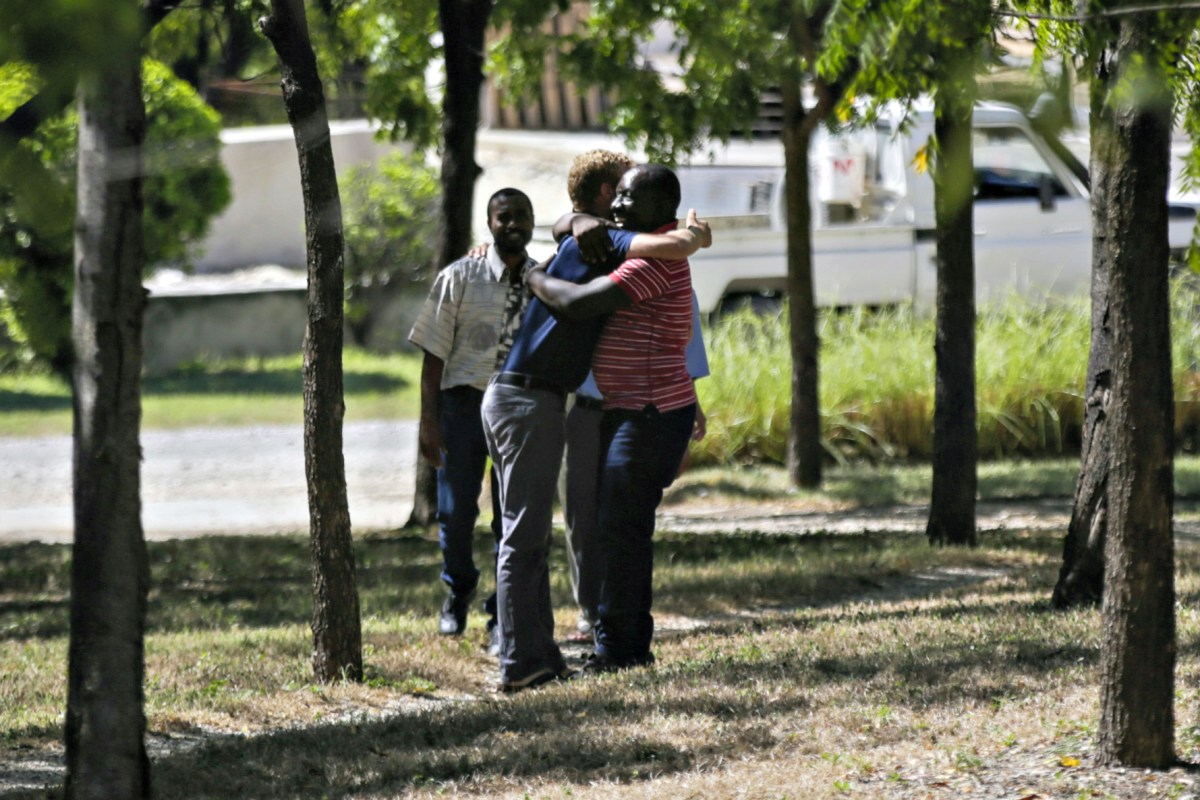
People hug at the Christian Aid Ministries headquarters in Titanyen, north of Port-au-Prince, Haiti, on Thursday, December 16, 2021, after 12 hostage missionaries kidnapped two months ago were finally released.

The group of 12 adults and five children—including an 8-month-old—was kidnapped by a Haitian gang called 400 Mawozo in October after visiting an orphanage. The gang demanded $1 million ransoms and threatened to kill the CAM workers.

Two hostages were released on November 21 and three more were released on December 5.

Today marked two months since “our difficult journey began,” stated CAM:

As we stated one day after the crisis began—As an organization, we commit this situation to God and trust Him to see us through. May the Lord Jesus be magnified and many more people come to know His love and salvation. We again want to affirm our commitment to trust God to guide us.
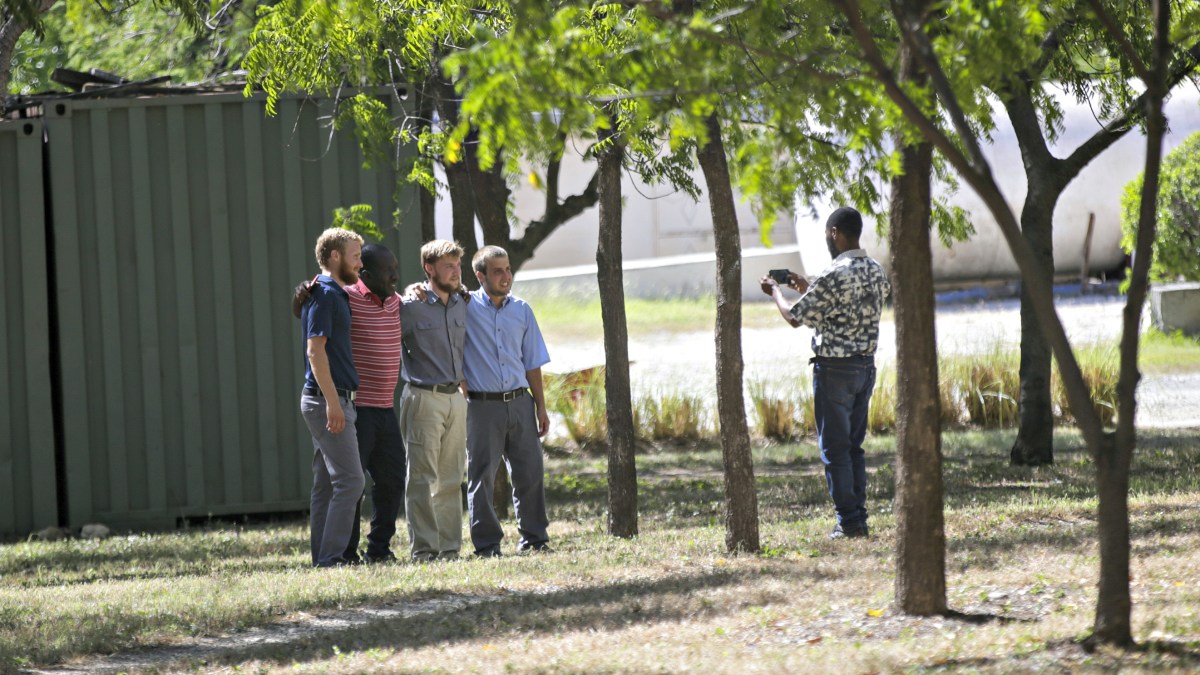
A man takes a photo of missionaries at the Christian Aid Ministries headquarters at Titanyen, north of Port-au-Prince, Haiti, on Thursday, December 16, 2021, after 12 hostage missionaries kidnapped two months ago were finally released.

News of the hostages’ release spread quickly in and around Berlin, Ohio, where CAM is headquartered.

“It’s an answer to prayer,” said Ruth Miller, who was working at the front desk of the town’s Amish and Mennonite Heritage Center.

Berlin is in Holmes County, Ohio’s Amish heartland, and many Amish and Mennonites volunteer in CAM ministries and donate to it. The organization’s roots date to the 1980s, when it began working in then-communist Romania. It has since expanded worldwide but has been particularly active in Haiti.

CAM’s work ranges from planting churches and providing food, school supplies, and other materials to those in need, to disaster relief and putting up billboards with evangelistic messages.
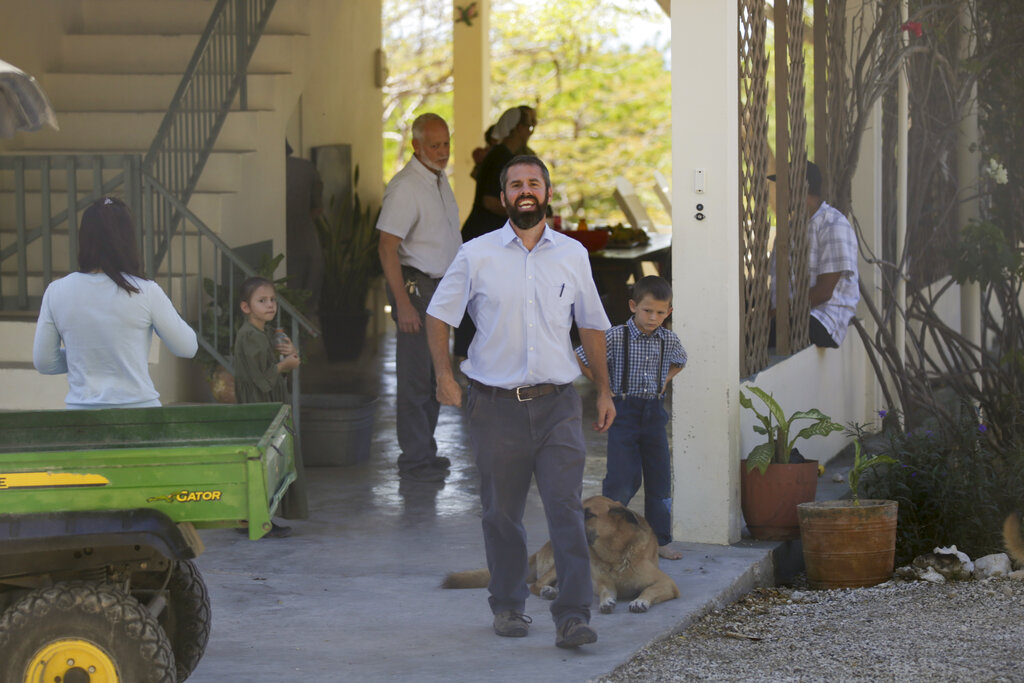
Unidentified people gather at the Christian Aid Ministries headquarters in Titanyen, north of Port-au-Prince, Haiti, on Thursday, December 16, 2021, after 12 hostage missionaries kidnapped two months ago were finally released.

Wes Kaufman, who attends a church where some CAM leaders also worship, said many congregations had heeded the mission group’s recent request to devote three days to fasting and praying over the situation.

“It’s amazing how God works,” Kaufman said as he dined with family in nearby Walnut Creek at Der Dutchman, a restaurant featuring traditional Amish and Mennonite fare.

“We’re feeling great,” said Ron Marks, minister at Hart Dunkard Brethren Church in Hart, Michigan, whose members included some of the hostages.

Carleton Horst, a member of the Hart congregation, told the AP that church members received a text message Thursday morning from “someone connected to the situation” that all of the hostages had been released.

A mother and her five children, two of them adults, who belong to the church were among the hostages. Horst, who is friends with the family, said the church is rejoicing and he’s “elated that that portion of things is finally over, just praise the Lord for that.”

In addition to Michigan, the hostages are from Wisconsin, Ohio, Tennessee, Pennsylvania, Oregon, and Ontario, Canada, according to CAM.
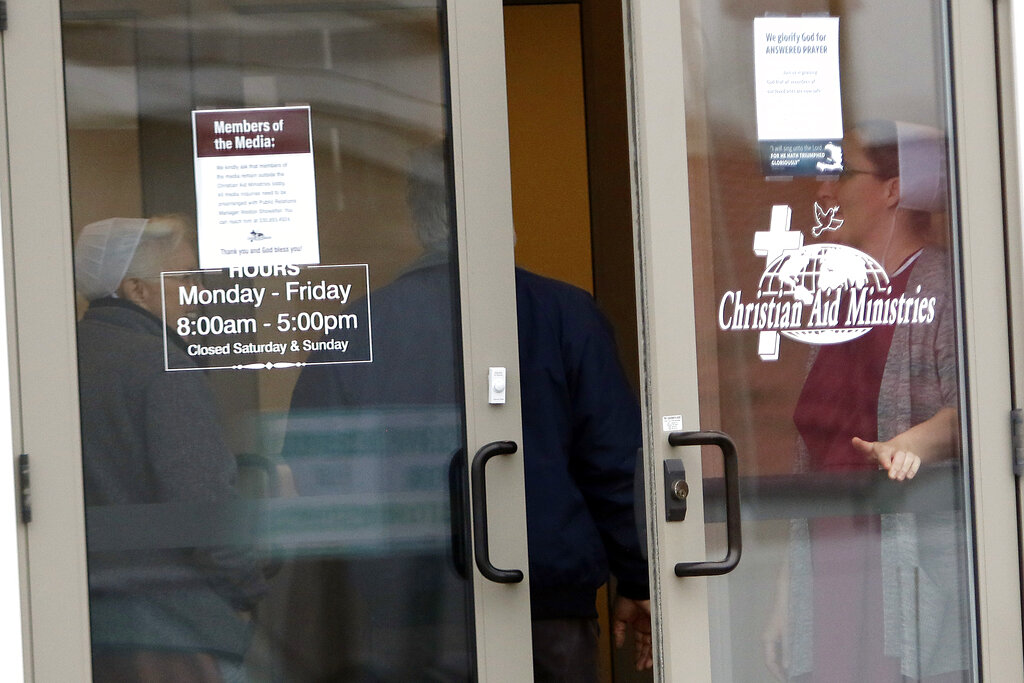
Visitors are granted entry at Christian Aid Ministries in Berlin, Ohio on Thursday, December 16.

Luke Perkins, assistant to the president of Evangelical Theological Seminary of Port-au-Prince, was not surprised the group was released. “I would have been very surprised if they were hurt,” he told CT. “Haitians have always been so generous in their hospitality to us as Americans. It’s unfortunate that they were taken—that in and of itself is a departure from the norm.”

Christians in Haiti, both Haitian church leaders and other American missionaries, recently explained their concerns to CT about how the CAM workers could be released in ways that would embolden the gangs that have brought life in Haiti to a standstill.

Meanwhile, the consistently loving prayers of CAM supporters for the kidnappers themselves reveal three Anabaptist distinctives that other Christians should find both familiar and thought provoking, according to experts at the Young Center for Anabaptist and Pietist Studies.

The release comes amid an ongoing spike in kidnappings in the capital of Port-au-Prince and elsewhere in Haiti, which is struggling to recover from the July 7 presidential assassination, a 7.2 magnitude deadly earthquake that struck in mid-August, and a severe fuel shortage.

“My earnest prayer is that [the missionaries’ release] forces change in Haiti—that something is done to address the impunity kidnappers have enjoyed,” said Perkins. “Haitians have been living under a cloud of fear for some time now—the kidnapping of these Americans made that worse.”

A caravan drives to the airport after departing from the Christian Aid Ministries headquarters at Titanyen, north of Port-au-Prince, Haiti, on December 16, 2021, after 12 hostage missionaries kidnapped two months ago were finally released.

Edner Jeanty, executive director of the Barnabas Christian Leadership Center in Port-au-Prince, celebrated the good news but expressed concern that the release “does not change much” in terms of the risks faced by Christians in Haiti.

“We do not know for sure whether money was given. But we do know that the gang 400 Mawozo is still alive and well,” he told CT. “If the American government had some weight in the release of the North Americans, it did not help the Haitian people in helping getting rid of the kidnappers.”

“As this kidnapping incident has come to some form of closure, it is important for Christians to continue to pray and support the former hostages as they have been traumatized and need healing,” he said. “… It is also important to remember that Haitian brothers and sisters are being kidnapped routinely. Help us pray for the peace of the country because our welfare depends on its peace (Jer. 27:4).”

He urges more investment in job creation for local youth, in order to “change the dynamics of fear, struggle, and hope in Haiti.”

“The Haitian people by and large are exhausted. They are tired of witnessing the continued downward spiral of their country,” said Perkins. “[But] when I’m in class with my students, I see such hope. There are so many in the emerging generation that are ready and eager to take the country in a different direction. … I can’t wait to see what the Lord uses them to do.”

CT’s Quick to Listen podcast recently explored how Haitian Christians persevere through crises and whether God really wants missionaries to risk their lives.

Reporting by The Associated Press’ Evens Sanon in Port-au-Prince, Peter Smith in Berlin, Ohio, and Anna Nichols in Lansing, Michigan, as well as by CT’s Morgan Lee and Jeremy Weber.

Theology

Always Festivus and Never Christmas

This season calls for reconciliation, not rage and resentment.

Christianity Today December 16, 2021
Illustration by Mallory Rentsch / Source Images: WikiMedia Commons / Sean Locke / EyeEm / Getty

This piece was adapted from Russell Moore’s newsletter. Subscribe here.

In my much younger years, I celebrated Festivus. This was not by choice. I was working at a place where every year, at a celebratory holiday party, we always knew there was one guy who would spend the entire time “airing grievances” at the rest of us. One of my coworkers would say, “Are you ready for Festivus this year?”

He was, of course, referencing the famous storyline on the old television comedy Seinfeld, in which George Costanza’s father Frank celebrated his own made-up holiday, complete with an aluminum pole, feats of strength, and of course, the airing of grievances. I would always laugh at my coworker’s joke, because, after all, Festivus was funny—the product of Jerry Seinfeld or some writer’s comedic imagination. Except that it wasn’t.

The Daily Beast recorded an episode of its podcast, Fever Dreams, in which former Seinfeld writer Dan O’Keefe explained the real-life origins of Festivus. (Beware of profanity in the episode.) He said the holiday was not fictional, at least not in his house growing up, and it was anything but funny. O’Keefe said his father, an editor at Reader’s Digest and “an undiagnosed bipolar, severe alcoholic,” invented Festivus. He did it with a clock in a bag hung on the wall. The famous aluminum pole wasn’t part of it, but the Airing of Grievances definitely was. “It was just a very formalized setting for yelling at us,” he told Fever Dreams. “Yeah, growing up, myself and my two brothers were in a form of child abuse that yet wasn’t recognized as such by the state of New York, included to perform seasonal rituals.”

O’Keefe talked about his childhood to some fellow writers, who told him that they along with Jerry Seinfeld wanted to adapt the Festivus ritual for Frank Costanza—minus the abusive behavior and the childhood trauma.

My first thought was, “That is dark.” Then I thought, “How did I never hear the story till now?” I wondered how many other of my favorite comedy moments had started this way. Was there a horror story behind the Dundie Awards or funerals for beloved mini horses? I didn’t want to know. But then I wondered whether Festivus is the holiday of this cultural moment.

Over a decade ago, James Davison Hunter warned that Christian cultural and political engagement had failed in part because of what Friedrich Nietzsche called “ressentiment.” This is more than resentment, Hunter argued, but includes “anger, envy, hate, rage, and revenge as the motive of political action.”

Ressentiment, Hunter wrote, is grounded “in a narrative of injury or, at least, perceived injury; a strong belief that one has been or is being wronged.” This is especially true, he contended, when the group holds a sense of entitlement—to greater respect, to greater power, to a place of majority status. This posture, he warned, is a political psychology that expresses itself with “the condemnation and denigration of enemies in the effort to subjugate and dominate those who are culpable.”

In Hunter’s explanation, the church—at least in its culture-war-activist form—did not withstand this pull but plunged in headlong. Thus, we end up with the language of “reclaiming” America or “taking back the culture.” Turns out, it all comes down to airing of grievances and feats of strength. Before we say, “There’s nothing wrong with that,” we should consider what it has done to us, not just as a country but, more importantly, as a church.

In Luke 4:20–30 (ESV throughout), we find that pivotal moment where Jesus announces his mission. To the rest of the world—to our own children—do we look more like the one announcing the good news of “the year of the Lord’s favor,” or like the crowds outraged by the suggestion that the kingdom is bigger than their ethnic and national boundaries? Do we look more like the mobs “filled with wrath” and seeking revenge at the edge of the cliff ,or like the one who, “passing through their midst,” calmly walked forward, face set like flint toward the cross?

Christ’s actions don’t make sense in a world where “feats of strength” are necessary to ward off threats. To a person who doesn’t believe in the living God, the Sermon on the Mount looks weak and the protection of Pharaoh looks strong (Isa. 30:1–2). If there is no Judgment seat, then the “airing of grievances”—accelerating in shrillness and theatricality—is the way to make sure that “Vengeance is mine, I will repay” (Rom. 12:19).

All we need do is redefine what “vengeance” means and who “I” means. Then we can avoid our calling as ambassadors of reconciliation (2 Cor. 5:18–21) and embrace a different mission—one that feels better, intimidates more, raises more money, and mobilizes more crowds.

Sure, it ends in the way to death (Prov. 14:12), but death is a long time off.

Isn’t it?

And yet, here we are with Scriptures that make their way even into some of the Christmas carols playing in the grocery store or the mall. Herod is the one who “is troubled, and all Jerusalem with him” (Matt. 2:3). His rage and ressentiment isn’t a sign of strength but of how threatened he is, how scared, how angry, how pitiful. He, like the old spirit of Eden, marches forward with “great wrath, because he knows that his time is short” (Rev. 12:12). Old Herod still speaks—with just as much wrath and just as much fear and just as much hunger for power—and he still says, “Come, follow me.”

But we have something different. We have a word handed down to us that tells us, “Fear not, for behold, I bring to you good tidings of great joy that will be for all the people” (Luke 2:10). And the sign is in a feeding trough. The sign is at the pigeon table in the temple courts (vv. 22–35). The sign is a body present on an imperial execution stake, and a body absent from a borrowed tomb. The sign is what seems weak and foolish and “unrealistic.” That’s where the wisdom is, the power is, the reality is.

But that will require a different kind of power than Darwinian strength that gets us noticed by whatever Pharaoh or Caesar we want to protect us. It will require a different kind of belonging than the kind that comes by loathing those who the people in our circles tell us to hate. It will require us to be a people who really believe that what we carry is news, that it is good, and that it is for all people.

Feats of strength and airing of grievances are exhausting and demoralizing. Look at their fruits. Are we more connected or more lonely? Is the light of the gospel more visible or less? David Foster Wallace warned us about this: “Worship power—you will feel weak and afraid, and you will need ever more power over others to keep the fear at bay.” Like Festivus, it all seems funny until you see the trauma underneath.

Maybe what we need is not a new holiday—real or metaphorical—for “the rest of us.” Maybe what need is rest, for us. Maybe what we long for is the kind of rest that need not prove itself by its self-protection and influence. Maybe what we need is a different witness, an older kind—one that really is good news in a world where it’s always Festivus and never Christmas.

Russell Moore leads the Public Theology Project at Christianity Today.

News

Trump or Netanyahu? American Evangelicals Support Israel, Yet Signs of Change

13 experts assess new survey conducted after Gaza conflict, which finds solidarity with the Jewish state but increasing preference for Palestinians among younger and non-white evangelicals.

View of Jerusalem and the Dome of the Rock from the Mount of Olives in Israel.

View of Jerusalem and the Dome of the Rock from the Mount of Olives in Israel.

Christianity Today December 15, 2021
Frédéric Soltan / Corbis / Getty Images

In the public spat between Donald Trump and Benjamin Netanyahu, who would American evangelicals support? A new survey suggests it might be the Israeli.

Polled shortly after the Gaza war last May, it also reveals a substantial generational gap in level of support for Israel and a lack of impact by pastors from their pulpits.

And it happens to release this week, following Trump’s explosive comments.

In excerpts from a recently released interview, the former president blasted the former prime minister for his statement of congratulations to Joe Biden after the 2020 election.

“Nobody did more for Bibi. And I liked Bibi. I still like Bibi,” stated Trump in an expletive-laced diatribe, using Netanyahu’s nickname. “But I also like loyalty … Bibi could have stayed quiet. He has made a terrible mistake.”

Netanyahu responded with praise for Trump. But in noting a friendship with Joe Biden, he also honored the longstanding partnership between the US and Israel.

During his presidency, Trump moved the American embassy to Jerusalem, acknowledged Israeli sovereignty over the Golan Heights, and negotiated with five Muslim-majority nations to normalize relations with the Jewish state.

American evangelicals joined Netanyahu in appreciation. According to a new online poll surveying a multiethnic panel of approximately 1,000 self-identified evangelical and born-again Christians, 35 percent say they became more supportive of Israel because of Trump’s policies. Only 11 percent became more supportive of Palestinians, while 53 percent had no change.

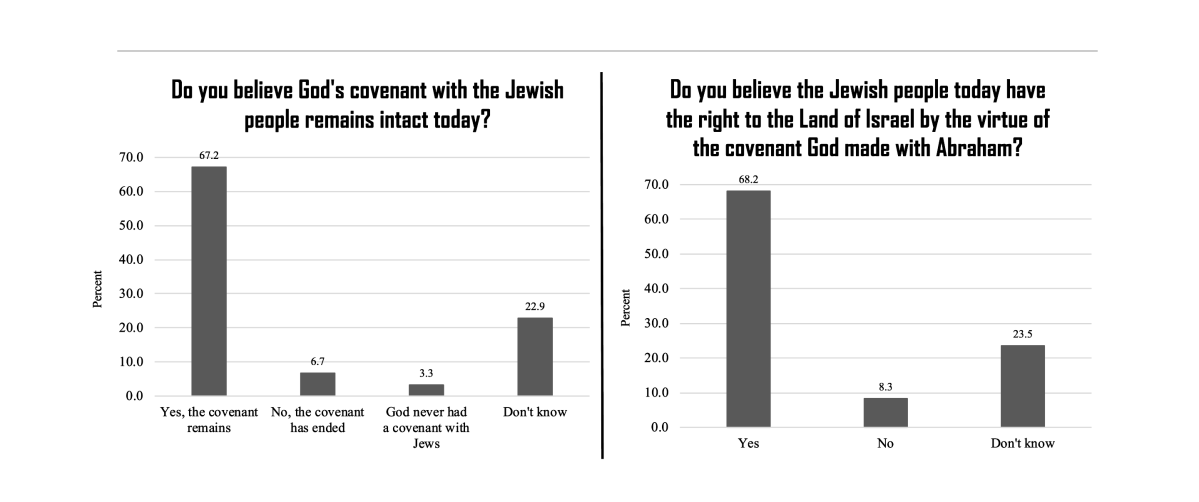
And overall, 68 percent of American evangelicals believe the Jewish people today have the right to the land of Israel, by virtue of the covenant God made with Abraham which “remains intact today.” (About 23% say they don’t know.)

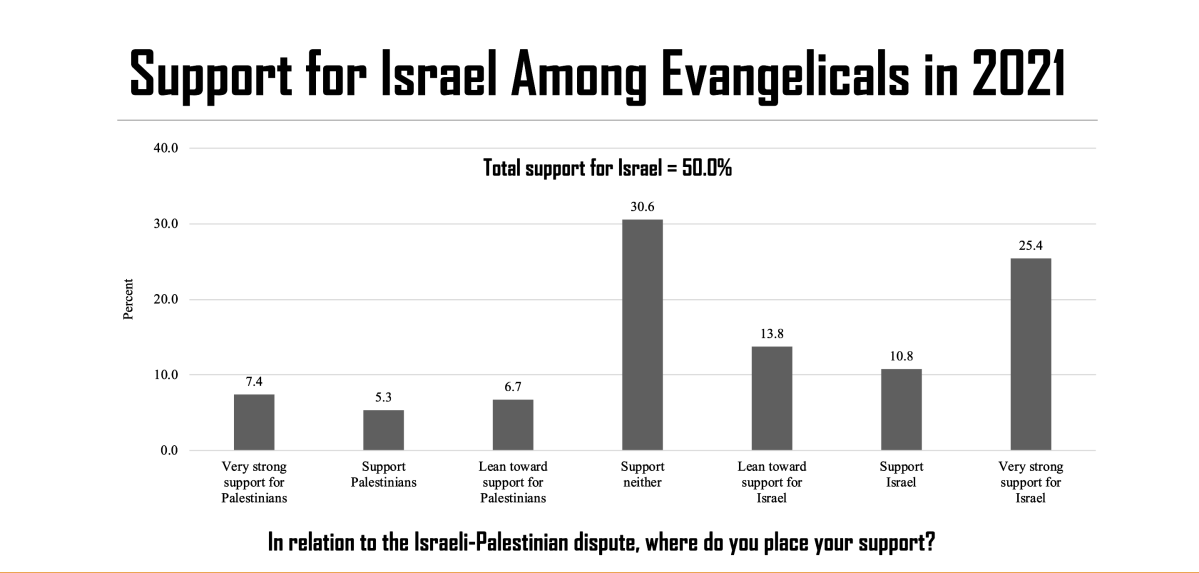
American evangelical support for Israel vs. Palestinians (July 2021)

The survey, conducted by professors Kirill Bumin and Motti Inbari from the University of North Carolina–Pembroke in conjunction with Barna Group, was released today but conducted in July, well before public knowledge of Trump’s falling out with Netanyahu.

The 15-year Israeli prime minister scored a 74 percent favorable rating, based on the share of evangelicals who gave him a score of 6 or greater on a 10-point scale. One in five (22%) gave him the top rating possible.

The survey did not include a direct comparison. But given the fact that it included evangelicals of all ethnicities (59% white, 24% Black, 11% Hispanic), researchers found that support for Biden and for Trump by vote share was almost identical (42% vs. 40%)—even though 49 percent of evangelicals believed a Biden presidency would hurt the US relationship with Israel. Conversely, 31 percent believed Biden would do no harm.

Similarly, 47 percent believed Netanyahu’s defeat as prime minister, to a coalition headed by Naftali Bennett, would hurt the Israeli relationship with US evangelicals. Only 16 percent believed it would do no harm.

Nearly 1 in 2 (47%) believed Netanyahu improved these relations, compared to only 16 percent who did not.

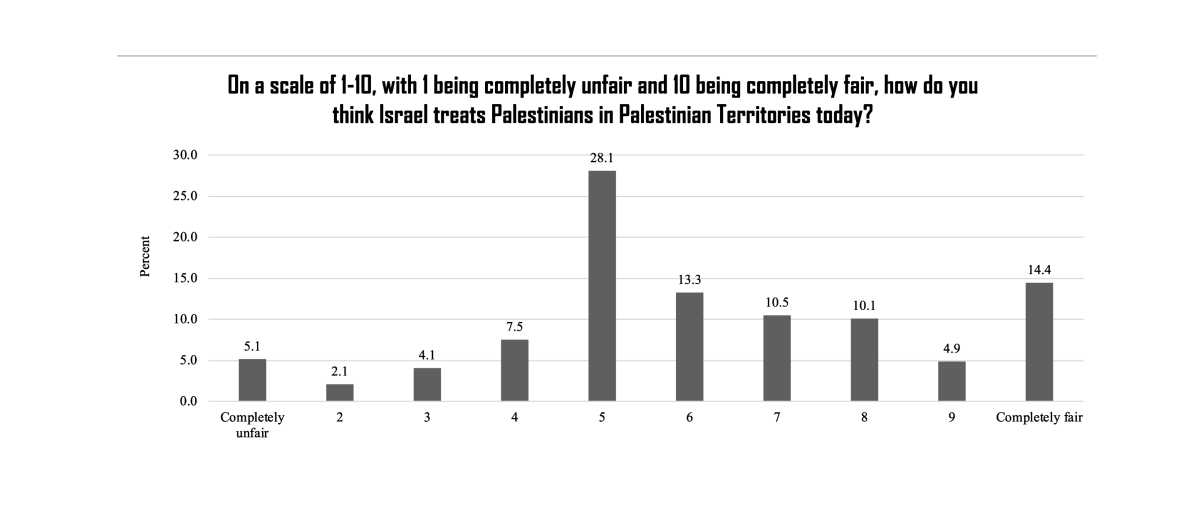
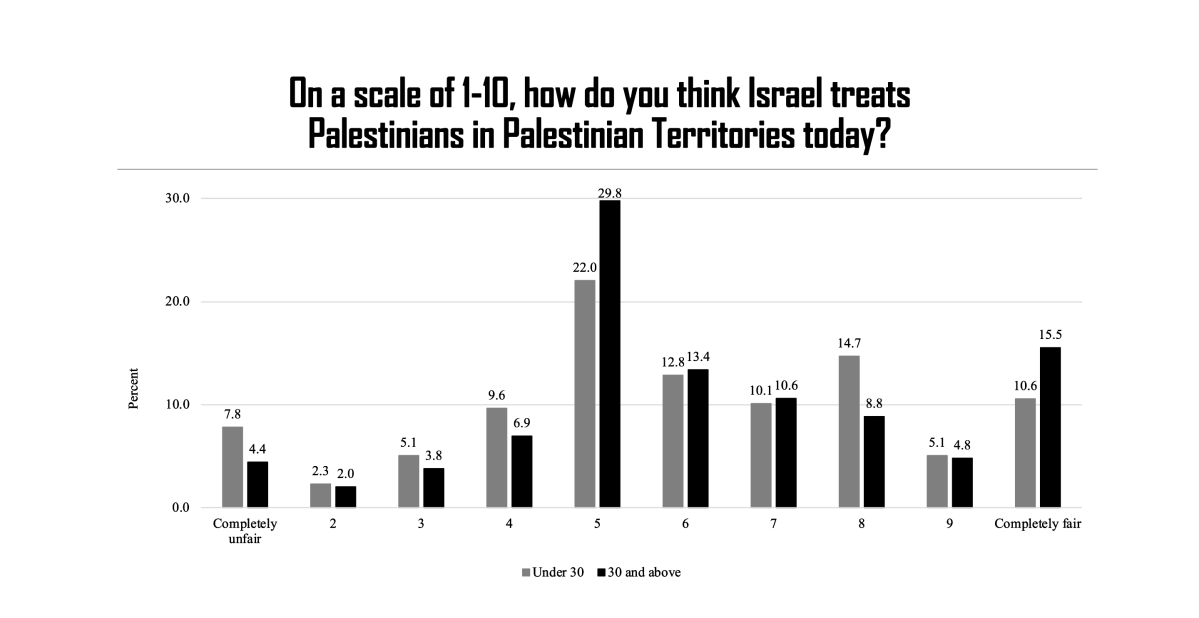
In terms of relations with Palestinians, American evangelicals largely recognized Israeli policy as “fair.” Asked about how Israel treats Palestinians in the Palestinian territories, 53 percent of respondents scored Israel’s treatment at 6 or greater on a 10-point scale. While only 14 percent said it was “completely fair,” only 19 percent scored Israel at 4 or lower.

Views of American evangelicals on Israel's treatment of Palestinian territories (July 2021)
Views of American evangelicals on Israel’s treatment of Palestinian territories (July 2021)

The 11-day conflict in May between Israel and Hamas in the Gaza Strip did not significantly alter evangelical perceptions.

Protesting threatened evictions of Palestinians from their homes in East Jerusalem over complex leases, Hamas launched missiles toward Israeli cities. Israel responded, stating its missiles were aimed at militant targets often located in civilian centers. According to the UN, 256 people, including 66 children and 40 women, were killed in Gaza, while 13 people were killed, including two children and six women, in Israel.

While 48 percent of American evangelicals reported no change in their overall opinion, 26 percent stated the conflict increased their support for Israel. Only 7 percent stated it increased their support for Palestinians.

A plurality (43%) blamed both sides equally. One in three (34%) blamed Palestinians primarily, while 17 percent blamed Israel primarily.

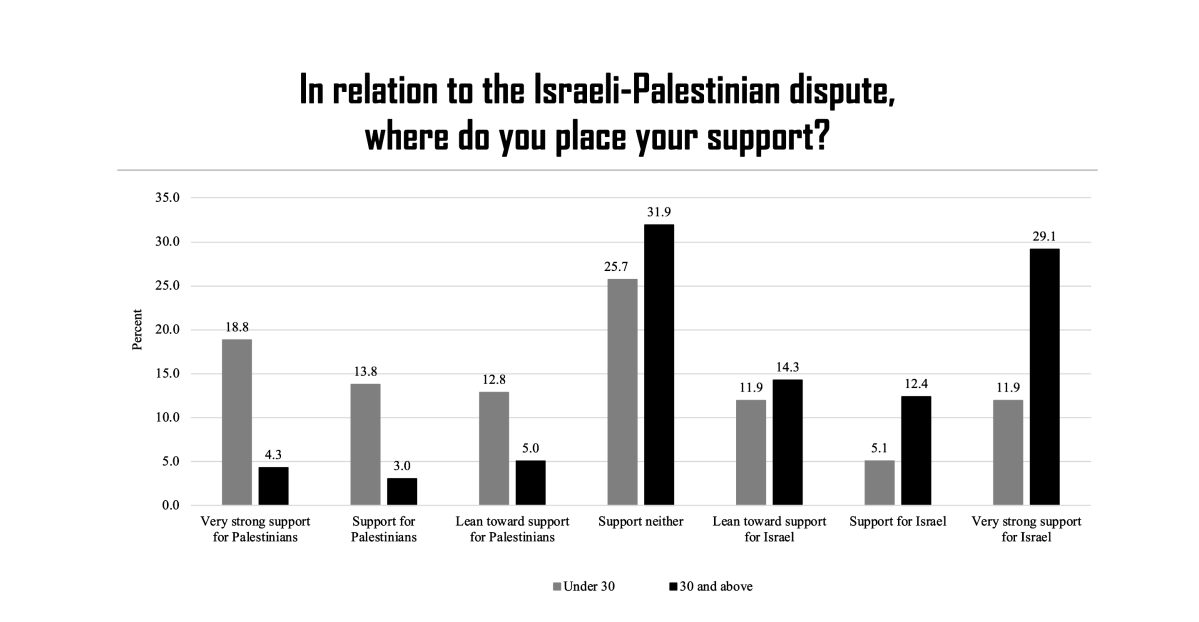
Overall, the report, sponsored by the Messianic Jewish organization Chosen People Ministries, notes that “only” 50 percent of American evangelicals support Israel (25% “very strongly”) in its dispute with Palestinians, whom 19 percent support. The remaining 31 percent support neither side.

American evangelical views of God's covenant with Israel (July 2021)
American evangelical views of God’s covenant with Israel (July 2021)

A similar survey released earlier this month by Grey Matter Research identified 20 percent of American evangelical Protestants as “Israel loyalists,” who see the Jews as “God’s chosen people” today and put a high priority on supporting them via charity. (It did not poll specifically about Palestinians.)

Using the National Association of Evangelicals’ four-point definition of evangelicals by belief but not restricting its sample to white evangelicals as many surveys do, the Grey Matter study found a roughly even split between evangelicals who believe charitable support for Israel is a high vs. low priority, as well as an even split between evangelicals who believe the Jews are God’s chosen people today vs. who do not believe this.

These statistics align well with the UNC-Pembroke survey, which found that 52 percent of American evangelicals say their religious beliefs make them more supportive of Israel. Only 8 percent say it makes them more supportive of Palestinians, and 40 percent say it doesn’t impact their view of either side.

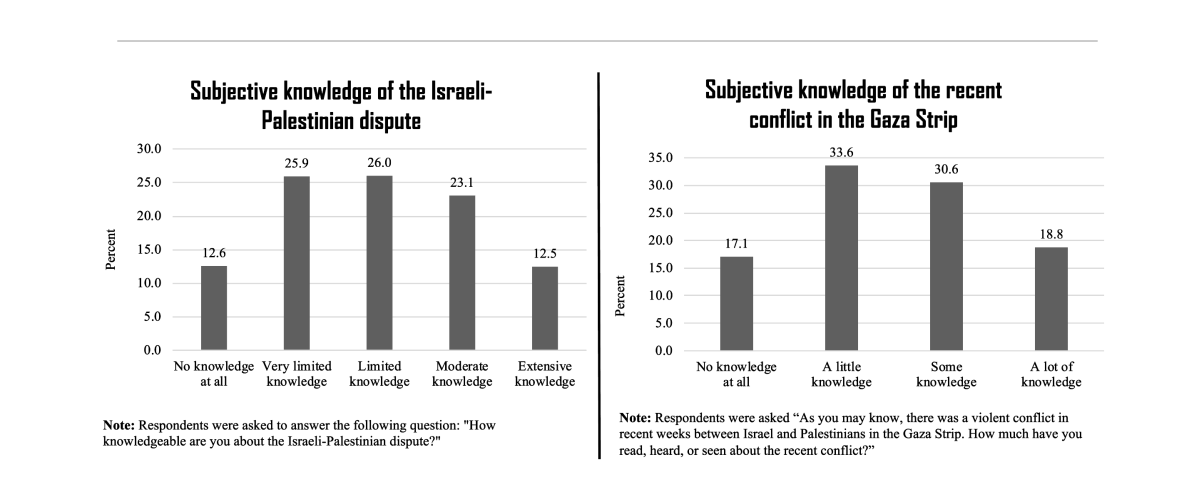
Notably, only a third of American evangelicals claim their knowledge of the conflict is “moderate” (23%) or “extensive” (13%). Half claim “limited” (26%) or “very limited” (26%) knowledge, and 13% claim “no knowledge at all.”

American evangelical self assessment of knowledge about Israel-Palestinian conflict (July 2021)

In terms of policy, 41 percent want the US to support Israel, while 10 percent want the US to support Palestinians. About 1 in 3 (36%) want the US to remain neutral.

Despite widespread criticism that Trump’s policies in office favored Israel, he consistently maintained that his efforts were a new strategy to resurrect a failing peace process.

The survey did not query evangelicals on who they blame primarily for the lack of peace. But like many, Trump initially put the onus on Palestinians.

He appears to have changed his mind.

“Bibi did not want to make peace. Never did,” Trump stated for a Hebrew book project on the normalization deals, released last weekend. “I [had] thought the Palestinians were impossible, and the Israelis would do anything to make peace and a deal. I found that not to be true.”

The reporting claims Netanyahu surprised the White House by announcing a controversial West Bank annexation during the rollout of Trump’s peace plan. Israel’s then-ambassador to the US denies the claim.

Is Trump’s shift similar to that of younger US evangelicals, which previous surveys have found are growing less attached to the nation of Israel? Those 65 years and older are four times more likely to express high levels of support for Israel than those under 30 years of age.

Overall, 29 percent of younger evangelicals support Israel while 45 percent support the Palestinians. And while 40 percent blamed Israel and Palestinians equally for the Gaza conflict, those faulting one side or the other balanced out. Three in 10 blamed Israel (29%) or Palestinians (27%) primarily.

Of US policy, 36 percent of evangelicals under 30 want America to remain neutral. Israel ranks slightly higher for US support at 31 percent, while 26 percent want the US to support Palestinians.

The younger generation is consistent with evangelicals at large in viewing Israel’s treatment of Palestinians in their territories as fair: 53 percent gave a score of 6 or above on a 10-point scale. But more chose an “unfair” rating than evangelicals at large: 25 percent gave a score of 4 or below.

American evangelical support for Israel vs. Palestinians by age (July 2021)
Views of Americans evangelicals on how Israel treats Palestinian territories, by age (July 2021)

While age has the largest statistically significant impact, it is not the only corresponding factor.

Evangelicals who never attend church are 63 percent less likely to support Israel than those who attend at least once per week. Adherents of postmillennial and amillennial eschatologies (who comprise 22% and 33% of evangelicals, respectively) are 51 percent less likely to support Israel than premillennialists (who comprise 33%). And those with positive views of Muslims (34%) are 27 percent less likely to support Israel than those with negative views (19%). (A plurality of 34 percent of evangelicals are neutral.)

There is no relation between the frequency of pastoral statements of support for Israel to overall evangelical opinion. Neither is race or ethnicity or commitment to social justice a statistically significant factor.

However, researchers noted that African American evangelicals express the lowest levels of support for Israel (37%) and the highest levels of support for the Palestinians (31%). Among Hispanic evangelicals, 40 percent support Israel and 23 percent support the Palestinians. Among white, non-Hispanic evangelicals, 58 percent support Israel and 14 percent support the Palestinians.

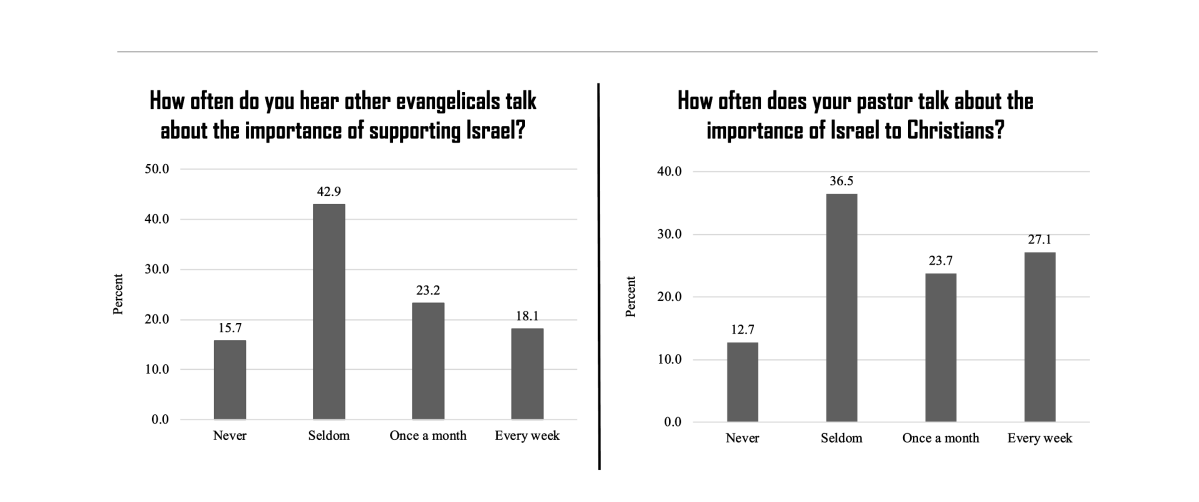
American evangelicals on how often their pastor or fellow believers speak about supporting Israel (July 2021)

And while a quarter of American evangelicals say their pastor talks about “the importance of Israel to Christians” every week (27%) or once a month (24%), a plurality say “seldom” (37%), and 1 in 10 say “never” (13%).

Similarly, a plurality of American evangelicals say they “seldom” hear other evangelicals talk about “the importance of supporting Israel” (43%), compared to those hearing it every week (18%) or once a month (23%) vs. never (16%).

CT invited evangelical experts in the US and in Israel to react to the survey results:

Sidebar:


When it comes to personal actions by American evangelicals:

41% have prayed for Israel
22% have prayed for the Palestinian territories

17% have prayed with a Jewish person
12% have prayed with a Palestinian person

14% have given money to pro-Israel causes
7% have given money to pro-Palestinian causes

8% have traveled to Israel
5% have traveled to the Palestinian territories

5% have done missions work in Israel
6% have done missions work in Palestinian territories

10% have engaged Jewish people with the gospel
7% have engaged Palestinian people with the gospel

7% have demonstrated against antisemitism
8% have demonstrated against Israel and its policies toward Palestinians

8% have contacted their congressional rep to express support for US policies that favor Israel
6% have contacted their congressional rep to express support for US policies that favor Palestinians

38% had done none of the eight Israel-related actions listed.
57% had done none of the eight Palestinian-related actions listed.

Robert Nicholson, president of Philos Project:

Most young evangelicals still believe in biblical promises regarding the people and land of Israel, but have a hard time thinking about the State of Israel and why it’s necessary to defend that people on that land. They don’t realize that a Jewish-majority country makes the Near East more pluralistic, not less. Worst of all, they’ve bought into the silly idea that support for a Jewish state means opposition to Palestinians, Arabs, or Muslims—which of course isn’t true.

Young evangelicals, as opinionated as they are, don’t know much about Israelis or Palestinians. Their views are based on gut feelings, media impressions, slogans, and peer pressure. Few have spent any time in the region, and even fewer know anything about the Jewish people beyond Sunday school stories they grew up on.

It is wholesale ignorance of the Jews, and for that matter Palestinians, that produced these survey results. The answer is immersive education and personal encounter.

Gary Burge, professor of New Testament at Calvin Theological Seminary, author of Whose Land? Whose Promise? What Christians Are Not Being Told About Israel and the Palestinians:

Younger generations see social justice as central to their faith. Despite Israel’s consistent effort to shape the Palestinian narrative, when this survey is compared with parallel surveys just 20 years ago, evangelicals are increasingly neutral in their political views on Israel and Palestine, as younger generations realize that four million people held in military occupation by Israel is a moral issue.

But surveys such as this generally have two problems. First, “self-identified” evangelicals may today only represent those who have wed their faith to Republican politics, as many other younger evangelicals have left and are not represented here. Second, the survey leads with biblical language about God’s “covenant people,” which skews the following questions about justice. When a survey is commissioned by a pro-Israel organization (Chosen People Ministries), we are wise to question its results.

Danny Kopp, co-pastor of the Narkis Street Congregation in Jerusalem:

The very framing of this issue in this survey as binary is a tragic reflection of our inability as Christians to appreciate moral complexity in our lives and in the lives of nations. The Bible weaves a complex narrative of God’s unique calling of a particular people, the Jews, to demonstrate his universal love and impartial care for all peoples.

It is a merciful truism that throughout the biblical narrative every hero is flawed and no villain is beyond redemption. Yet, we as Christians, who should be the most adept at introspection and self-criticism, throw this principle out the window and are increasingly recognized as the most tribal in our unswervingly blind loyalties to political dogmas and personalities.

The Israelis have a right to live in their own national homeland at peace with their neighbors, while the Palestinians deserve support in their pursuit of a political accommodation that affords them equal rights in their national homeland. Maintaining a nuanced, sophisticated biblical perspective in no way means that we should ascribe moral equivalence to either side’s political blunders, but it means that we can never lose sight of God’s unique, particular, and equal calling upon both Israelis and Palestinians.

Munther Isaac, academic dean at Bethlehem Bible College and pastor of the Evangelical Lutheran Christmas Church, Bethlehem:

What is troubling is that many evangelicals have very strong opinions about Palestine and Israel, while having limited knowledge about the reality on the ground. What is missing is a theology of justice and peacemaking, which should not depend on one’s view on eschatology, but on our call to bring God’s love to all peoples, as ambassadors of reconciliation.

Evangelicals, like all Christians, must take informed positions. Peacemaking involves listening to both sides of a conflict, taking risks, and standing on the side of justice. We must speak truth to power, even when it involves our own people, religion, or nation.

Trump and Netanyahu were not good for peace. Their approach was based on the logic of might and power, not truth and justice. America and Israel are political allies, basing their actions on what is best for their own political interests. Their policies did not reflect the biblical verse: “Act justly, love mercy, and walk humbly with your God.”

Michael Brown, Messianic Jewish radio host of The Line of Fire:

Given the way these evangelicals voted, I’m pleasantly surprised that the support for Israel is as high as it is. That being said, the poll confirms a growing and disturbing trend.

Why is this the case? First, the younger generation does not have a memory of the horrors of the Holocaust and the miraculous birth of the State of Israel. To them, Israel is the bully, intimidating and hurting the Palestinian population. And, since they have a heart for justice and for the underdog, they naturally side more with the Palestinians.

If they had a more accurate and fuller picture, they would realize that having a heart for justice means recognizing the agonizing history of the Jewish people, the degree to which Israel is surrounded by hostile, even deadly enemies, and Israel’s deep desire to live at peace with its Arab neighbors.

Second, as we know through church history, forms of replacement theology, also known as supersessionism, open the door to antisemitism.

The key for Christians of all ages is education: Let them be well grounded in the Scriptures, let them know church history, and let them get the full picture of the conflict. If they do, they will recognize God’s restoration of the Jewish people to the land; they will pursue justice for all; and they will love their Muslim neighbor just as they love their Jewish neighbor. And when Israel does wrong, as friends and supporters of Israel they will speak the truth in love.

Lisa Loden, co-chair of the Lausanne Initiative for Reconciliation in Israel-Palestine:

Depending on current events and diverse theologies, evangelical support of Israel is continually in flux. Surveys are always a snapshot, never a cross-section, and this survey is no exception.

Evangelicals need to fully integrate the social aspect of the gospel with their theology, and especially their eschatology. Evangelical ignorance, polarization, and lack of active interest in the real-time effect of the Israeli-Palestinian conflict on the local populations are lamentable.

White US evangelicals will likely continue to support Trump and Netanyahu, whose views are both solidly pro-Israel, regardless of the current discourse and their reduced national roles.

Salim Munayer, executive director of Musalaha and regional director for the World Evangelical Alliance’s Peace and Reconciliation Network:

From this survey—especially concerning the recent conflict in Gaza—we can see a trend that there is a growing gap between young and older evangelicals. One possible explanation is the multiple sources of information young people are exposed to on social media.

It is also amazing to see that despite their very strong feelings, American evangelicals claim to have limited knowledge of the conflict. Especially when only 10 percent have traveled to the region to know the reality on the ground.

It seems that their opinions are highly shaped by theology, their view on Islam, and participation in church life.

Gerald McDermott, author of Israel Matters, editor of The New Christian Zionism and Understanding Jewish Roots of Christianity:

The survey suggests what many of us have been noticing for several decades—that evangelicals are less biblically literate and less informed about what is going on in Israel today. More and more evangelicals are unaware, for example, of Paul’s belief in God’s ongoing covenant with the Jewish people (Rom. 11:28–29), his belief in the land promise (Acts 13:19), and Jesus’ promise that one day Jerusalem will welcome him (Matt. 23:39; Luke 13:35). Nor do they know that more than two million Israeli citizens are Palestinians who enjoy world-class education and health services and do not want to live under Palestinian rule in the West Bank or Gaza.

The survey also shows that support for Israel is down among those under 30, but there are surprises. While 45 percent offer strong support for Palestinians, only 29 percent say Israel is to blame for the recent Gaza fighting, and only 26 percent say the US should take the Palestinians’ side in the conflict. Further, a majority of those under 30 say Israel is “fair” to Palestinians who live in Palestinian territories.

The recent exchange between Trump and Netanyahu shows Trump as petty and Netanyahu as statesman-like. I think most evangelicals would agree.

James Zogby, president of the Arab American Institute:

This survey tracks polling we have done which shows that there is a significant shift in the attitudes of younger voters, including those who self-identify as “born again,” toward Israel/Palestine. We believe it is the result of access to expanded sources of information.

This generation is more tolerant, more accepting, and more inclusive, and I suggest that their thinking is more in tune with the vision of Jesus. They see situations like the Israeli-Palestinian conflict as less black and white, and have more compassion for those they identify as victims of the hostilities. So this shift in attitudes among the young born-again Christians doesn’t surprise me at all.

That said, I am puzzled that race was not a significant factor in determining support for Israel. In our polls, the two main factors in shaping attitudes on Israel are age and race.

Jaime Cowen, former president of the Union of Messianic Jewish Congregations:

I believe the evangelical church’s support for Israel is part of a correction in rebuilding relationships between the church and the Jewish people. While it cannot undo the tremendous harm of historic Christian antisemitism, it has gone a long way towards breaking down walls between Christians and Jews, and paved a way for the rise of Messianic Judaism. So while evangelical views of Israel’s contemporary government and politics are incredibly naïve and often one-sided, it still is better than past injustices.

Sadly, the politicization of the gospel in the US has turned off many young people, including those in evangelical churches. It is strange and unfortunate how support for Israel is lumped in with opposition to abortion, LGBT issues, and critical race theory. Support for Israel becomes problematic, especially as the younger generations confront social injustices, which include Israeli policy towards the Palestinians. Unless Israel seriously tries to address the Palestinian question, support for Israel will likely continue to erode.

The support for Trump among evangelicals is the most shocking thing I have ever witnessed as a believer. He was popular among the majority of Israelis, but damaged US-Israel relations by offering American support for anything Israel did. As for Netanyahu, he did nothing about a problem that eventually must be addressed. While his efforts to reach agreements with other Arab nations is highly laudable, it doesn’t negate the elephant in the room.

Todd Deatherage, executive director of The Telos Group:

The shifting attitudes of younger evangelicals toward Israelis and Palestinians in their conflict is significant, but not surprising. We’ve been seeing movement within pockets of evangelicalism for years, as more Christians try to re-center their faith away from politicization and back around Jesus and his teachings. When Jesus is at the center, nationalistic forms of Christianity like Christian Zionism just don’t hold up.

These changing attitudes represent an opening for Christians to support mutual flourishing for Israelis and Palestinians, all of whom deserve equal measures of freedom, dignity, and security as image-bearers of God.

And I think these numbers are also connected to something else we’re seeing: the growing number of Christians who are pursuing justice and reconciliation in a variety of ways, as they live out the charge Jesus gives his followers to be peacemakers.

Botrus Mansour, lawyer, writer, and evangelical leader in Nazareth:

I regret that a large portion of American evangelicals’ knowledge of the conflict, by their own admission, is limited. But it has great impact on American policies on the ground. They had a large role in promoting the anti-Palestinian sentiment that informed the Netanyahu-Trump era, which was bad for peace in the Holy Land.

The young evangelicals’ view of the conflict is fairer. Palestinians are people created in God’s image and are entitled to human dignity. I would expect that more American evangelicals pray for them, and act as brokers for peace.

Mitch Glaser, president of Chosen People Ministries and sponsor of the survey:

I am concerned about how evangelicals view Israel, as they are often Israel’s greatest supporters in the United States. Yet, often it seems as the reputation of Israel becomes tarnished, particularly among younger evangelicals, Israel is cast as the aggressor, rather than as the responder to aggression. Further education in Christian colleges, seminaries, and local churches needs to be developed. Videos, podcasts, and social media should be created to further inform these future leaders of the church.

Unfortunately, when we have a negative view of others, whether Palestinians or Jewish Israelis, often instead of love and mission there is enmity and a lack of passion for winning these Abrahamic cousins to Jesus.

I believe prophecy was fulfilled in the formation of the modern state of Israel in 1948, but Israel is not yet what Israel will become. One day my beloved Jewish people will turn to Yeshua the Messiah, as promised by the prophet Zechariah, and “they will look to Me whom they have pierced.”

Until then, I pray my fellow evangelicals will have a positive view of the Jewish people, and even come to the conclusion that by virtue of the Abrahamic Covenant, the land does belong to them.

News

Orthodox Christians Yearn for Famous Seminary 50 Years After Turkey Closed It

The Halki Seminary, whose graduates include two saints, seven patriarchs, seven archbishops, and six metropolitans, has become an international bargaining chip.

Rooms upon rooms of books in the library of the Halki Orthodox Seminary on the Turkish island of Heybeliada.

Rooms upon rooms of books in the library of the Halki Orthodox Seminary on the Turkish island of Heybeliada.

Christianity Today December 15, 2021
David I. Klein

The classrooms and halls of the Halki Orthodox Seminary on the Turkish island of Heybeliada, in the Sea of Marmara south of Istanbul, look much as they did when Konstantinos Delikostantis was a student there more than 50 years ago.

Wooden chairs and black desks line the classrooms, some still bearing the graffiti (in both Turkish and Greek) of their past occupants. The chalkboards, which sit beneath portraits of Turkey’s founding father, Mustafa Kemal Ataturk, look as if they could use a good wash.

At 73, Delikostantis is among the youngest remaining alumni of the school, which counts among its 990 graduates at least two saints, seven patriarchs, seven archbishops, six metropolitans, and countless other clergymen, authors, and theologians who went on to serve as leaders of Orthodox Christianity around the world.

In its heyday, Halki Seminary was a place of intense study, deep introspection, and strong brotherhood, recalled Delikostantis, now an adviser to the spiritual leader of Eastern Orthodox Christians, Ecumenical Patriarch Bartholomew I, a fellow graduate of Halki.

“Halki was the iron theological arm of the Ecumenical Patriarchate,” said Delikostantis, leaning back on a sofa in the office of the Greek Orthodox Patriarchate in Istanbul’s Fener district.

The first monastery on the island, known in Greek as Halki, was founded in the ninth century by Patriarch Photius I. A second was established by Byzantine Emperor John VIII Palaiologos just a few decades before Constantinople was conquered by the Ottomans in 1453.

The school itself was founded in 1844 when then-Patriarch Germanus IV converted part of Photius’ monastery of the Holy Trinity into a high school and a seminary.

However, for 50 years no new students have been permitted to walk through its halls. In 1971, the Turkish government closed the school under a law nationalizing all institutions of higher learning. It was the last school to train priests in modern Turkey, a region that has been the center of the Orthodox church for more than 1,600 years.

An interior room of the Halki Orthodox Seminary on the island of Heybeliada in Turkey.

The school’s closure is just one chapter in the story of forced migration, pogroms, and other forms of persecution that saw the Greek Orthodox community in Turkey decline from nearly 2 million at the turn of the 20th century to barely 5,000 today.

But with the 50th anniversary of its closing, Orthodox leaders’ longstanding petition to allow the school to reopen has gained new life.

Many of the Orthodox Christians remaining in Turkey feel that they have been robbed of decades of spiritual leadership, while those in far-flung territories of Orthodox Christianity have had their ties to unique Constantinopolitan theological traditions all but severed.

“We lost two generations of priests and clergy and bishops of the church, who are not educated in the only school that the Ecumenical Patriarchate has in Istanbul,” Archbishop Elpidophoros of America, who serves under the purview of the Patriarchate of Constantinople, said in an interview marking the 50th anniversary of the school’s closing earlier this year.

In July, the US State Department issued a statement urging Turkey to allow the reopening of the school.

Turkish authorities fired back, arguing that it was in fact the patriarchate that was responsible for the school’s continued closure, as the patriarchate would not consent to Halki being administered by the state-run faculty of theology.

Ankara has repeatedly tried to use Halki’s possible reopening as a bargaining chip in Turkey’s tense relations with Greece.

During a 2019 visit by Greek Prime Minister Alexis Tsipras, Turkish President Recep Tayyip Erdogan suggested he might allow the reopening of the school if Greece would open a mosque in Athens.

“Look, you want something from us, you want the Halki seminary. And I tell you [Greece], come, let’s open the Fethiye Mosque,” Erdogan said, referring to a 17th-century Ottoman mosque in Athens and Greece’s stalled promises to open a new house of worship for Muslim residents in the Greek capital.

Embroiling the seminary in the sparring between Athens and Ankara has left Istanbul’s remaining Greek Orthodox population frustrated, according to Laki Vingas, a former president of the community.

“It’s so sad to witness that Halki is no longer a matter of education or religious training, but it has assumed a political role and become a symbol of antagonism,” Vingas said. “For a 2-millennia-old church, this is very difficult.”

Halki Orthodox Seminary in Heybeliada, Turkey

As the years go on, the generation that remembers the place as anything other than a political bargaining chip is fading. A quick scroll through the school’s alumni Facebook page shows mostly death notices above pictures of graduates dressed in both the black robes of the priesthood and secular garb.

In the school’s absence, Turkey’s Orthodox community has had to send its ecclesiastically minded youth to Greece for training.

Delikostantis thinks the distance has had a significant effect. “It is not good for the Patriarchate that our theologians are studying in Thessaloniki or in Athens,” he said. “They lose something in the four or five years when they are there.”

It’s not that the Greek schools are lacking; during his time in seminary they largely had the same learning materials both in Turkey and Greece, he said. But what’s been lost is the “spirit of Halki.”

After a lifetime teaching throughout Europe, Delikostantis has returned to Fener to advise his old friend Patriarch Bartholomew I as an expert on the intersection between human rights and Orthodox theology.

Though the patriarch is just under a decade his senior, the two go back a long way. Both are natives of the Turkish island of Gökçeada—known in Greek as Imbros—and Delikostantis boasts that he was there when the future patriarch was first appointed a deacon in 1961.

Despite Delikostantis’ time at the seminary, he never ended up joining the priesthood like his old friend, instead going on to research the intersection of philosophy and theology. Today, Delikostantis looks as comfortable quoting the words of Immanuel Kant as those of the Nazarene.

Delikostantis says he was first set upon that path during his time at Halki.

“The main characteristic of our school was this combination of academic study and church life,” he explained. “During my seven years there I lived between the church, celebrating the liturgy, and the classroom and library.”

Halki’s students also thrived on the diverse environment of Istanbul. Despite the school’s isolated spot on Heybeliada, the environment of 1960s Istanbul required a measure of openness—not only openness to other sects of Christianity and other faiths, but an appreciation for scientific study and a necessary dialogue with modernity.

“It’s not easy to be faithful and to be open,” Delikostantis said, but it’s something the school inculcated in him and the current Patriarch. “This was, I think, the power of Halki, this combination between faith and science.”

What the future holds for the school remains unclear. Though there’s been little movement on the part of the Turkish government, the patriarchate remains hopeful, having even drawn up renovation plans for potential future use.

“For Turkey, it could be an ornament, you know, a school which produces open people,” Delikostantis said. “Open-minded, nonfundamentalist people of dialogue who accept diversity.”

That was the seminary he remembers.

News

Missing Papyri Professor Must Return $7 Million to Hobby Lobby

Dirk Obbink has lost a federal lawsuit over the fraudulent sale of Gospel fragments.

Christianity Today December 15, 2021
Screengrab YouTube / World Monuments Fund Britain

Dirk Obbink didn’t answer the door of his Oxford, England, houseboat docked in the Thames. He dodged the private investigators trying to serve him a legal summons in August and September and failed to answer the official letter notifying him that he was required to respond to allegations he had defrauded Hobby Lobby by selling the craft store $7 million worth of ancient papyri that he didn’t actually own.

A clerk of the United States federal court has certified a default judgment against the famed papyrologist, noting in late November that “defendant Dirk D. Obbink has not filed any answer or otherwise moved with respect to the complaint herein.”

The former Oxford University professor and visiting scholar at Baylor University, once heralded for his amazing discoveries of ancient texts, including early copies of the Gospels and unknown poems of Sappho, now owes Hobby Lobby a full refund.

The resolution of the civil lawsuit leaves a lot of questions unanswered, though. Chief among them: Where are the other 81 ancient fragments that went missing from the Egyptian Exploration Society (EES) library at Oxford at the same time that Obbink, then head of the library’s papyri digitization project, took 32 fragments and sold them to Hobby Lobby?

“I think many of us hoped that a trial might bring to light further information on the whereabouts of the roughly 80 Oxyrhynchus papyri that still seem to be missing,” wrote history of religions scholar Brent Nongbri on his blog.

According to the lawsuit, Obbink worked as a private antiquities dealer in addition to his academic work. He sold Hobby Lobby four lots of papyri between 2010 and 2013, as the Oklahoma-based company invested in an expansive collection that it would use to launch the Museum of the Bible in Washington, DC, in 2017. The fragments were discovered in a rubbish heap near a vanished city in Egypt in the early 20th century.

A sales record shows that Obbink claimed four of them were first-century copies of Matthew, Mark, Luke, and John—which would have made them the oldest known pieces of the New Testament.

In 2017, Obbink contacted Hobby Lobby to say he had made a mistake and mixed up the EES fragments with his fragments he was selling as part of his antiquities business. He promised to pay the money back but asked for patience, as he had already spent it.

At the same time, Obbink told EES he had showed the New Testament fragments to some visitors associated with Hobby Lobby and owner Steve Green’s “Green Collection,” but claimed he never told them it was for sale.

“Professor Obbink insists that he never said the papyrus was for sale, and that while he did receive some payments from the Green Collection for advice on other matters, he did not accept any payment for or towards purchase of this text,” an official statement said. “The EES has never sought to sell this or any other papyrus.”

Hobby Lobby then sent a copy of its purchase agreement to EES, and the library launched a systematic check of its collection of more than 500,000 artifacts. More than 120 were missing, and someone had tampered with the card catalogues and photographic records to hide the fact they were gone.

Seven were recovered from an evangelical collector in California. More than 80 are unaccounted for.

According to the director of the EES, the items may have been sold for millions, but they are actually priceless.

Obbink, for his part, spoke of the fragments in the EES collection in rhapsodic terms.

“For me personally,” he once told a British audience, “working on these texts … was like being shipwrecked on a desert island with Marilyn Monroe.”

Obbink was arrested in 2020 and then sued in 2021. Shortly after that, court records show, he moved to a houseboat named the James Brindley and started hiding from the private investigators attempting to serve him summons.

A neighbor signed an affidavit that she saw Obbink on the boat a little before 4:30 p.m. on Saturday, September 11, and the summons had been removed from the houseboat door.

“The main cabin door was open,” the affidavit says. “Mr. Obbink would have had to remove the envelop to open the door.”

The British woman helpfully photographed Obbink for the investigators, who presented it to the US federal court as evidence and asked for a default judgment.

Obbink is also facing criminal charges in England. The investigation is ongoing.

Theology

Research: Religious Americans Less Likely to Divorce

Recent data suggests that faithful young adults can marry in their 20s without increasing the risk of separation.

Christianity Today December 14, 2021
Thanh Nguyen / Unsplash

According to the US Census, the average American couple gets married around the age of 30. Many young adults believe that forming unions closer to that age reduces their risk of divorce, and, indeed, there is research consistent with that belief. But we also have evidence suggesting that religious Americans are less likely to divorce, even as they are more likely to marry younger than 30.

This paradoxical pattern raises two questions worth exploring: Is the way religious Americans form their marriages different than the way their more secular peers do? And do religious unions formed by 20-somethings face different divorce odds than those formed by secular Americans in the same age group?

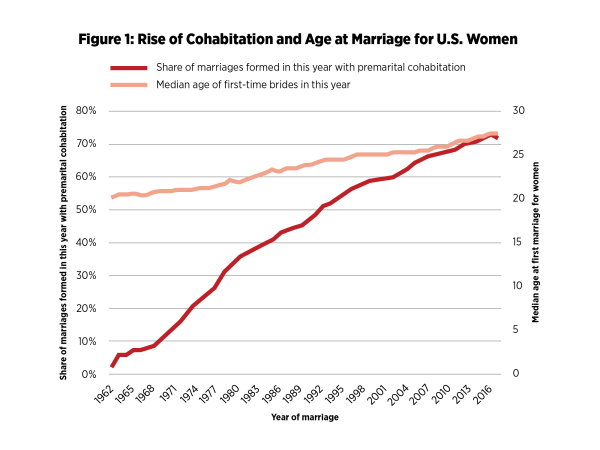
The answer to that last question is complicated by the role of cohabitation in contemporary family formation. Today, more than 70 percent of marriages are preceded by cohabitation, as Figure 1 indicates. Increased cohabitation is both a cause and a consequence of the rise in the average age of first marriage. But what most young adults do not know is that cohabiting before marriage, especially with someone other than your future spouse, is also associated with an increased risk of divorce, as a recent Stanford study reports.

One reason that religious marriages in America may be more stable is that they reduce young adults’ odds of cohabiting prior to marriage, even though they increase their likelihood of marrying at a relatively young age. With that in mind, we’ve explored the relationships between religion, cohabitation, age at marriage, and divorce by looking at data from the National Survey of Family Growth (NSFG).

Does religion influence marriage and cohabitation?

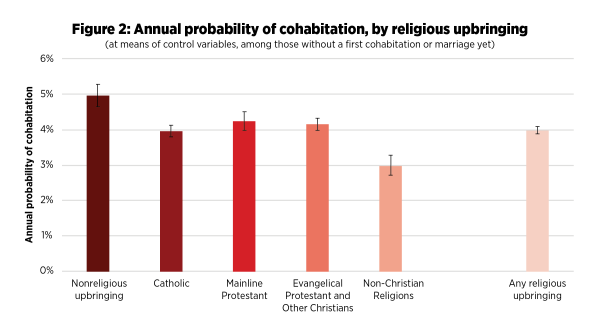
To address this question and others, we merged data from the National Survey of Family Growth (NSFG) from 1995 to 2019, using responses from over 53,000 women ages 15–49. After controlling for a variety of background factors, women who grew up religious are about 20 percent less likely to begin a cohabiting union in any given year than their nonreligious peers. By age 35, about 65 percent of women with a nonreligious upbringing had cohabited at least once, versus under 50 percent of women with a religious upbringing.

Not only does religion reduce the odds that young adults cohabit, it also increases the odds of what we call direct marriages, or unions that didn’t include premarital cohabitation. The trends depicted below in Figure 3 show up in similar form for all marriages, but direct marriages are particularly important because they are a closer proxy for the “traditional” relationship pathways promoted by many religions.

In other words, religiosity is associated with a markedly higher likelihood of going directly from singleness to a married union without cohabiting ahead of time, and generally at younger ages.

On the whole, then, religion greatly influences the nature and age of relationship formation.

Does religion influence breakup and divorce?

Earlier marriage is a known risk factor for divorce. Premarital cohabitation is too. Since religiosity tends to motivate earlier marriage but less cohabitation, the effects on divorce are not easy to guess. What we really want to know is: Do religious people get divorced less?

The answer appears to be yes.

Without controls for age at marriage or an indicator for premarital cohabitation, women with a religious upbringing do have slightly lower likelihoods of divorce. As shown below in Figure 4, the annual divorce rate among married women with a nonreligious upbringing is around 5 percent. For religious women, it’s around 4.5 percent. The effect is clearest for Catholic and mainline Protestant women and less clear for evangelical Protestant women.

Overall, if we control for basic socioeconomic background and a woman’s educational career trajectory, the typical marriage of a woman with a religious upbringing is about 10 percent less likely to end in divorce within the first 15 years of marriage than the typical marriage of a woman with a nonreligious upbringing.

Adding controls for age at marriage yields about the same results, suggesting that even though religious people get married younger, their divorce rates are still a bit lower. But it may just be that religious people cohabit less, and that drives the reduction in divorce. (For additional details on this point, see the full research brief here.)

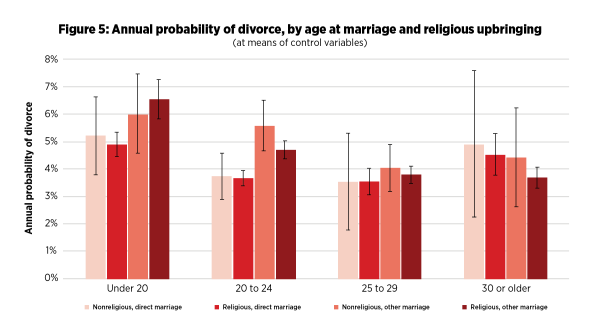
Figure 5 above makes it possible to answer three specific questions: What is the effect of premarital cohabitation? What is the effect of age at marriage? And what is the effect of religious upbringing?

Starting with premarital cohabitation, women with direct marriages tended to have lower divorce rates than women with the same religious background and the same age at marriage but who married after cohabiting. This was especially true for religious women who married before age 25.

For women marrying after age 30, the relationship seems to flip, though estimates are less reliable. But particularly for youthful marriages before age 20 or in the early 20s, cohabiting before marriage appears to be a major risk factor for divorce.

Age at marriage also matters, but in different ways for different groups. (Here again, see the research brief for full details.)

What are the takeaways, then?

Among some groups, it’s commonly believed that postponing marriage until the late 20s or early 30s reduces the odds of divorce, because greater maturity results in a wiser choice of partner. There’s some truth to this. However, the life orientations associated with delayed marriage are often also associated with (and even causal of) greater acceptance of premarital cohabitation, which is also linked to a higher risk of divorce.

The net result: Lifestyles that motivate earlier marriage—like religiosity—do not necessarily create the higher likelihoods of divorce usually associated with early marriage, because they discourage cohabitation.

Yes, very young marriage still has risks (as does very late marriage), but religious upbringings seem to partly compensate for those risks, especially among women marrying in their 20s.

Our results also suggest that religion fosters relationship stability by pushing young adults away from cohabitation, which is highly unstable, and toward marriage, which is much more stable.

Figure 6 provides a simple illustration of divorce or breakup risk by year, by union type.

The effect of cohabitation on marriage is indeed statistically significant, since premarital cohabitation increases divorce probabilities by about 15 percent. But the biggest effect of religion on union stability isn’t about what happens once a woman is married. It’s more about her relationship choices before marriage—the fact that she did get married, rather than start a series of cohabiting relationships.

What remains unclear is how religion may foster more stable marriages. There are three broad possibilities: Religion might induce people to “make lemons out of lemonade.” It might give people institutional or community support. Or it might positively alter the quality of romantic pairings.

The first explanation is simple, if pessimistic. The second possibility is that religion actually changes the experience of being married. Religious communities might provide institutional support to married couples, by way of peer support, community or pastoral interventions, and even material or financial support in times of hardship.

Finally, religion may change exactly who women marry in important ways.

First, women of faith may be able to access a larger and more marriage-friendly pool of potential spouses in church and related community settings.

Second, religion could alter the criteria that women have for selecting partners. Knowing that cohabitation is disfavored, and desiring the companionship of a committed union, religious women might more actively pursue “husband material” earlier in life than other women.

Third, religion might alter the dynamics between partners in important ways. Faithful women might look for spouses who share values, beliefs, or practices that are important for marital stability. Sharing these values might reduce the potential for conflict down the road.

It’s hard to say exactly which of these factors is at work. But one way or another, our research suggests that waiting to marry until you’re 30 does not always increase your odds of forging a stable marriage. Especially for religious men and women who avoid cohabitation, our analysis of the NSFG material indicates that they can marry in their 20s without increasing their risk of divorce.

The upshot of all this is that the religious model of marriage and family appears to boost the odds that young adults can marry before 30 without increasing their risk of landing in divorce court.

Lyman Stone is a research fellow at the Institute for Family Studies, chief information officer of the population research firm Demographic Intelligence, and an adjunct fellow at the American Enterprise Institute.

W. Bradford Wilcox is the director of the National Marriage Project at the University of Virginia and a senior fellow at the Institute for Family Studies.

The full research brief is available here.

Theology

Taking the Trinitarian Christ out of Christmas

A recent poll shows nearly half of Americans believe a Christological heresy.

Christianity Today December 14, 2021
Illustration by Mallory Rentsch / Source Images: Kevin Carden / Lightstock

Who is Jesus? Few questions could be more relevant at Christmas.

Yet a new Lifeway Research study reports a statistic that has the potential to deflate the Christmas spirit. Only 41 percent of Americans believe the “Son of God existed before Jesus was born in Bethlehem.” That means 59 percent either do not believe or are unsure whether they believe that the Son of God existed prior to the Nativity.

As pastors prepare their Christmas sermons this year, they might want to keep this fact in mind. Many who will walk through their doors on Sunday morning—some Christians, some not—hold to a heretical understanding of the Trinity. They’ll listen to the sermons and sing the songs, but their view of God is not orthodox. To be blunt, their view of God is not Christian.

We are not the first to struggle with retaining a biblical view of the Trinity.

In the fourth century, a group within the church known as Arians also said there was a time when the Son was not. The popularity of this belief so threatened to rupture the unity of the church that our fathers gathered at Nicaea and Constantinople.

With the authority of the church universal, they declared, “We believe … in one Lord Jesus Christ, the only-begotten Son of God, begotten from the Father before all time, Light from Light, true God from true God, begotten not created, of the same essence as the Father, through Whom all things came into being.”

Everything hinges on that one word begotten. It distinguishes the Son from the Father—at the risk of stating the obvious, a son is a son because he is begotten by a father. However, that word begotten also guarantees the Son is equal with his Father. Unlike human begetting, this Son was eternally begotten by the Father.

Furthermore, he was eternally begotten from the Father’s divine essence. He is not from a different essence or a similar essence, both of which create hierarchy in the Trinity. Rather, as the author of Hebrews says, the Son is “the radiance of the glory of God and the exact imprint of his nature” (1:3, ESV).

This core concept of Christianity was confessed by the church universal for over 1,700 years. Even as late as the middle of the 20th century, C. S. Lewis devoted two chapters of Mere Christianity to eternal generation. Lewis thought this doctrine was that essential to what it meant to be a Trinitarian Christian.

Then everything changed.

The depth of the change hit me recently when my family was celebrating Advent and I picked up the Baptist Hymnal to sing “O Come, All Ye Faithful.” Verse 2, which sings the Nicene Creed—confessing the Son as true God of true God, begotten, not made—was missing.

I was thankful the Trinity Hymnal was nearby, which I snagged just in time to recover verse 2. Yet as we sang, my mind was elsewhere: How many Christians absorb Christmas carols that never teach them who Jesus is apart from a baby born in a manger?

I’m afraid the absence of orthodox Trinitarianism is not accidental. In the late 20th century, evangelicals erased “begotten” language from their translations of the Bible—even John 3:16 no longer reads that God “gave his only begotten Son” but that God gave his “one and only” Son.

In academia, major textbooks in theology rejected the doctrine because evangelicals could not find a chapter and verse that spelled out its specifics or because it did not make sense to them. Theologians also replaced orthodox concepts like eternal generation with social categories, redefining the Son’s eternal unity with the Father as a societal relationship of cooperation.

Operating from a social Trinity, some evangelicals went so far to subordinate the Son, inserting a functional hierarchy within the immanent life of God from eternity, as if the Father is a greater supremacy, glory, and authority than the Son.

These novel maneuvers reveal how far we have drifted from Trinitarian orthodoxy.

But there is hope.

Consider a few ways we can put the Trinitarian Christ back into Christmas.

To start, when we present the good news this Christmas, we must not leave the Trinity out. Without the Trinity we have no gospel to celebrate. As I explain in Simply Trinity, if the Son is not the only begotten Son, then there is no basis on which the Father can send his Son into the world to save sinners like you and me.

Only one who is God himself, begotten from the very essence of the Father, is qualified let alone capable of saving a fallen humanity. If he is not the eternal Son—true God of true God—how can he grant us that greatest of Christmas gifts: life everlasting?

Next, remind those around you that the application of God’s amazing grace to us depends entirely on the Trinity. If Jesus is not a Son by nature, what hope do we have that we can become sons by grace?

As his adopted sons, we have life in his eternal Son, and through him the Spirit communicates to us the Father’s benevolence. As recipients of his everlasting grace, as benefactors of his unceasing mercy, we cry out to him, “Abba, Father” (Gal. 4:6) with every confidence he will receive us as sons in his Son (Rom. 8:15).

Last, rather than resting content with a narrow focus on what Christ does, expand your vision to who Christ is. John’s gospel is exemplary: “In the beginning was the Word, and the Word was with God, and the Word was God. He was with God in the beginning. Through him all things were made; without him nothing was made that has been made” (1:1–3).

The apostle is eager to introduce the saving work of Christ, but before he does so, he lifts us outside the confines of history to contemplate who this Son is from eternity: the Word who was not only with God but also was God. Here is the true meaning of theology, that marvelous task of contemplating who God is in and of himself.

David once said he desired one thing alone: to “gaze on the beauty of the Lord” (Ps. 27:4). Our “blessed hope,” says Paul, is nothing less than the “appearing of the glory of our great God and Savior, Jesus Christ” (Titus 2:13).

But unless our Savior this Christmas is the “great God” himself, the one who descends into our darkness out of the glory of his everlasting light, we will never enjoy the blessedness and bliss of that beatific vision.

Matthew Barrett is the author of Simply Trinity: The Unmanipulated Father, Son, and Spirit (Baker Books), associate professor of Christian theology at Midwestern Baptist Theological Seminary, and host of the Credo podcast.

News

Sunday Worship Comes to the Gulf

Economic reforms in the UAE tilt toward secularism and shift Christian services from Friday, the Muslim day of prayer.

Etihad Towers and Emirates Palace Hotel in Abu Dhabi, UAE.

Etihad Towers and Emirates Palace Hotel in Abu Dhabi, UAE.

Christianity Today December 14, 2021
Walter Bibikow / Getty Images

The United Arab Emirates (UAE) wants to create a more friendly financial climate. Christians, say local evangelical leaders, are among the unintended beneficiaries.

“The business of Dubai is business, even though they are committed Muslims,” said Jim Burgess, evangelical representative to the Gulf Churches Fellowship, referencing the UAE’s economic hub. “But worshiping on Sunday—our traditional day to celebrate the resurrection of Jesus—will be a great blessing.”

Seeking better alignment with international markets, the Emirates is adopting a Monday to Friday workweek. The weekend had previously begun with Friday, in deference to Muslim communal prayers. Christians aligned their corporate worship accordingly.

“It is a bit strange to worship on a Friday, but you get used to it,” said Hrayr Jebejian, general secretary of the Bible Society of the Gulf, who lives in Kuwait. “The [UAE’s] reasons are purely financial, but for Christians it will be like going back to normal.”

Of the UAE’s 10 million people, 88 percent are migrant workers. The Pew Research Center estimates 13 percent are Christians, coming largely from India, Indonesia, and the Philippines, in addition to Western expats.

It is necessary to keep and attract good talent.

Alongside officially secular Lebanon and Turkey, the UAE is now the third Middle Eastern nation to keep the Western calendar. But it comes with a tweak. All public sector employees will be dismissed at midday Friday, as the Emirates becomes the only nation in the world with a four-and-a-half-day workweek.

While the innovation puts the UAE in the forefront of the longer-weekend labor debate, it also facilitates Muslim Friday prayers—though not yet for the private sector. Both Burgess and Jebejian were surprised by the workweek decision and wondered how local conservatives would respond.

The grand mufti of neighboring Oman indirectly criticized the change. And Kuwait, the most democratic of Gulf nations, indicated no intention to imitate.

While Friday afternoons off may be an effort to forestall criticism, other moves in the past year clearly show the Emirates trending toward secularism.

“If I want to pray in my house five times a day, 50 times a day, or zero times a day, that’s my business, not the business of the state,” stated Youssef Otaiba, UAE ambassador to the United States, last April. “I certainly believe in the separation of religion and state … my government believes that, [and] that is the way to the future.”

That future includes a geopolitical dimension, as this week Prime Minister Naftali Bennett became the first Israeli head of state to visit the UAE. In the 16 months since signing the Abraham Accords, investment between the two nations has reached $1 billion.

Jewish tourists have made Dubai a favored holiday destination, the Emirates has appointed a senior rabbi in residence, and in 2022 the capital Abu Dhabi will open the nation’s first synagogue, within a multifaith complex.

And last month, the UAE announced the creation of a court for non-Muslims, introducing civil marriage and allowing family status issues to be adjudicated outside of sharia law. Divorce, child custody, and inheritance issues can now also be argued in the English language, alongside Arabic.

Christians will feel more comfortable, said Burgess.

But a year ago, more controversial changes in the law applied to Emiratis as well as expats. The UAE scrapped penalties for consuming alcohol and the cohabitation of unmarried couples.

Society is opening up, said Jebejian. Compared to a similar loss of values in Western nations, taken together there is nothing to lament.

Burgess, also senior pastor of Fellowship Church in Dubai, evaluated the decision as a licensed minister.

On average, every month a handful of individuals from outside his church have approached him for marriage. Usually coinciding with cycles of government enforcement of the law, pregnant couples would also seek matrimony to shield themselves from jail. Redirecting their focus, it was a chance to present the gospel and offer biblical counseling.

“Empty marriages are as hurtful as cohabitation,” he said. “Decriminalization, though regrettable, will help solve many problems.”

Still, complications have ensued as the law adjusts. Released from prison, unwed mothers still have difficulty officially documenting their children.

But overall, the changes are meant to put the foreign workforce at ease. Other reforms extend residency for three months after job termination, allowing expats time to find new employment without immediate risk of deportation. The UAE is also offering residency for retirees and freelancers.

“If you don’t mind the heat, it is a great place to live,” said Jebejian. “The beaches have sun 365 days a year.”

His tongue-in-cheek remark masks an emphasis on ministry. The Bible society distributes Christian literature in 17 cities in the Gulf. And the UAE, Oman, and Bahrain maintain hospitals still run by missionary organizations. Foreign Christian workers arrived to serve society long before the oil boom; today, Gulf royals continue to honor that debt.

And last week, Bahrain consecrated the peninsula’s largest cathedral. The Mary, Queen of Arabia church will seat 2,300 worshipers and serve as the headquarters for all Catholic ministry in the Gulf.

“It is a sign of respect for the Christian presence,” said Jebejian. “The degree of freedom in every country is different, but such a step will gradually influence the others.”

The UAE, ranked No. 48 on Open Doors’ 2020 list of the 50 nations where it is hardest to be a Christian, continues to criminalize blasphemy and the propagation of any faith other than Islam. But in 2021, it dropped off the watchlist.

Burgess, now 70 years old, will transition this spring to work with Arabian World Partnership—a nongovernmental organization his church founded to attract evangelical service to the Gulf. Unlike much analysis that centers the steps toward greater religious coexistence on public imaging and financial concerns, he attributes the changes to a young Muslim generation seeking its place in the world.

Their greatest fear is Islamic extremism—and to be lumped in with it.

“They are embracing tolerance, and we should embrace them right back,” said Burgess. “Maybe one day they will see the value of freedom of religion—for everyone.”

News

Churches Starting to See Cryptocurrency in the Collection Plate

As digital monetary systems go mainstream, ministries weigh pros and cons of accepting donations.

Christianity Today December 14, 2021
Chris McGrath/Getty Images

No one wanted to donate cryptocurrency.

James Lawrence, who founded Engiven to help nonprofits and especially churches process crypto donations, thought that surely some of the owners of Bitcoin, Litecoin, Dogecoin, Ethereum, Zcash, Tron, Polkadot, or the hundreds of other new and emerging cryptocurrencies would want to give a bit of it away.

But even as these decentralized, digital mediums of exchange grew more popular, 2019 and 2020 were like a desert for the startup.

By the beginning of 2021, Engiven had had a grand total of 40 customers.

“We built the platform. We figured out how to do it,” Lawrence said. “Then we’re like, ‘Someone’s going to come to the game, right?’ But there were very few.”

Then something changed in 2021. The percentage of Americans aged 18 to 49 who own Bitcoin, the most well-known cryptocurrency, rose to 13 percent, roughly the same as the percent who invest directly in the stock market. In April, Coinbase, the world’s largest cryptocurrency exchange, made its stock market debut, giving cryptocurrency increased legitimacy.

At the same time, the value of cryptocurrency started rising. One Bitcoin was worth about $8,000 at the start of 2020. The same coin was worth $32,000 at the start of 2021 and rose to a peak of $68,000 in November.
Investors who sell their cryptocurrencies are responsible for capital gains taxes but can reduce the amount they owe the government by making charitable donations.

The time for crypto donations finally came, and by the fall of 2021, Engiven had processed contributions for more than 700 nonprofits, including the Salvation Army, Compassion International, and Ronald McDonald House Charities. Engiven processed one $10 million Bitcoin donation and has seen several six-figure donations, Lawrence said.

About 400 of those recipients are churches—some quite large—but many small and medium congregations are now receiving crypto donations as well, Lawrence said. Church donations have become common enough that the Evangelical Council for Financial Accountability recently recorded a webinar about the potential ministry impact of cryptocurrency.

Fern Creek United Methodist Church in Louisville, Kentucky, has been accepting cryptocurrency for a while. Longtime member Tim Totten said he and several other members were involved in Bitcoin and realized there were considerable tax benefits to donating some of it. Several regular members decided they wanted to give to the church that way, and when Fern Creek set up the system, they started receiving donations from nonmembers too.

They have received “$5, $10, $20 donations—some a little bigger,” Totten said. “As far as we can tell, they want to be totally anonymous. They just drip across the website, and they think, ‘That’s something I want to support.’”

Justin Greene, the chief financial officer at Liberty Live Church in Hampton, Virginia, said his church originally didn’t know what to think about cryptocurrency. They weren’t sure why their church should accept it.

But as Greene researched cryptocurrencies, he came to believe they represented an entirely new donations stream for churches and Christian ministries. If a church doesn’t accept a credit card, a donor might write a check. But donors who can’t give through cryptocurrency may not donate through other methods. “That’s a very good argument for accepting it,” said Greene, who also serves as the nonprofit tax and accounting adviser for Engiven. “There are a lot of people who are very generous out there, ready and willing to donate. … Let’s say a few years back you bought a lot of Bitcoin for very cheap, and now that Bitcoin is worth a tremendous amount, then there’s a big tax benefit to donating it.”

Liberty Live decided to prepare to receive cryptocurrency donations and received $20,000 in cryptocurrency in 2021.

One challenge for churches and nonprofits receiving cryptocurrency is that the value of the gift can fluctuate wildly. The price of Bitcoin in particular has been notoriously volatile. Bitcoin dropped by 30 percent in a single day earlier this year before regaining 18 points. Another cryptocurrency, Ethereum, dropped 40 percent in less than 24 hours. A gift worth $20,000 would have been worth $12,000 the next day.

Liberty Live solves this problem by immediately liquidating cryptocurrency donations, turning them into the more traditional—and stable—American dollars. Greene recommends that to other churches as well.

Nils Smith, coauthor of Crypto for Good: Demystifying Cryptocurrencies for Nonprofits, says some churches may want to leave some cryptocurrency in their account, though, to watch it and see how the whole process works. Understanding cryptocurrency takes away a lot of the mystery and fear, he said.

But he agrees churches and nonprofits shouldn’t, as a rule, hang on to cryptocurrencies.

“Your job is not to be an investor. Your job is to use the donation,” said Smith, who also works as a strategist at Dunham+Company, a nonprofit fundraising agency. “Just like when people donate stock. You don’t want to be sitting on Tesla’s stock. You want to liquidate it because they gave it to you to be used for ministry purposes. The same is true with cryptocurrency.”

The other common concern that Smith hears from churches and ministries is the perception of cryptocurrencies’ involvement with criminal activity. Since the currency is not controlled by governments or federally regulated banks, criminals and terrorists can use it to move money internationally and launder funds. According to one industry report, criminal cryptocurrency transactions amounted to about $10 billion in 2020.

There’s no reason to think criminals benefit from giving their cryptocurrency to churches, though.

For Christians, the bigger concern may be about potential scams. Some churches, particularly those associated with the “prosperity gospel” movement, have become targets. In the last few years, for example, two Samoan churches got caught up in a scam involving the cryptocurrency OneCoin.

Churches that don’t get involved in investing—especially when the promises of returns are too good to be true—will not have a problem, though. Accepting donations doesn’t put anyone at risk, Smith said.

The biggest issue for churches and small nonprofits may just be deciding whether the potential donations are worth the cost and hassle of figuring out how to deal with cryptocurrency. Most churches were slow to accept credit cards, for example, and online giving platforms weren’t seen as essential until the pandemic.

“Most churches are probably not going to receive a crypto donation for another year to two years,” Smith said. “But what we’ve encouraged nonprofits we work with at Dunham+Company to do is, don’t wait until somebody comes to you with a crypto donation to be ready to accept it.”

Books
Excerpt

The Cosmos Is More Crowded Than You Think

How an old prayer and a newborn baby changed my perspective on angels.

Illustration by Jared Boggess / Source Images: WikiMedia Commons / Laureen March / Getty

For close to 15 years, I forgot about the existence of angels.

Prayer in the Night: For Those Who Work or Watch or Weep

Prayer in the Night: For Those Who Work or Watch or Weep

IVP Formatio

208 pages

I didn’t exactly decide I no longer believed in them. I simply didn’t think about them, and if I ever did, it was a passing thought about how corny the depiction of angels usually is.

I rediscovered angels by putting a baby to sleep at night.

When my first child was a newborn, I realized one night, to my surprise, that without really noticing it, I had developed a habit of asking God to send his angels to protect her.

Back then I worked at Vanderbilt University and became a regular at a Greek Orthodox cafe and bookstore near campus. I loved its quiet beauty, its ancient books, and its veggie chili. I got to know Father Parthenios, an Antiochian priest, and his wife (known to all as simply “Presbytera,” or “priest’s wife”), who ran the place together. One afternoon, late in my pregnancy, Presbytera handed me an icon of an angel and told me it was for the new baby. I appreciated her kindness but wasn’t particularly spiritually moved. I’m a Protestant, after all. At the time I felt no particular skepticism toward icons or angels, but I didn’t feel a deep connection either. Still, I hung the tiny wooden icon on my daughter’s wall.


Months later, as I prayed for my daughter before laying her to sleep, I would point out the icon and ask that angels would be near and protect her. I don’t know what changed in my mind or heart. My only explanation is that the towering responsibility—and love and vulnerability—of motherhood opened my heart to ask for help wherever it could be found.

I keenly sensed my daughter’s smallness and fragility in this giant cosmos and knew that all the passion of my maternal love wasn’t enough to keep her safe. I was small and fragile too. And yet, in our ordinary house in the vast darkness of night, I believed I wasn’t alone.

The weird stuff

The Book of Common Prayer contains various prayers for Compline, the name for the church’s tradition of nighttime prayer. One offering includes the line “Give your angels charge over those who sleep.” This Compline prayer dares us to believe in a crowded cosmos.

As children of the Western Enlightenment, we have emptied the cosmos of supernatural life, as surely as industry emptied Cape Cod of cod. Our default now, however subconsciously, is to imagine the cosmos as an empty sea on which we drift alone. It’s not full of enchantment, not teeming with mysteries, and certainly not crawling with angels.

But this was not always the case. The historic church imagined a universe jam-packed with angels, and ancient Christian leaders talk about angels a lot—more, frankly, than I am comfortable with. Thomas Aquinas called them “intellectual creatures” or “incorporeal creatures.” In the fifth century, Dionysius the Areopagite wrote, “Angels number a thousand times a thousand, ten thousand times ten thousand … so numerous indeed are the blessed armies of transcendent intelligent beings that they surpass the fragile and limited realm of our physical numbers.” Hilary of Poitiers wrote that “everything that seems empty is filled with the angels of God, and there is no place that is not inhabited by them as they go about their ministry.”

What was assumed for centuries—that the universe is buzzing with divine life—is something I have to stretch to believe. Yet my ambivalence about angels is not due to reason. It stems from a failure of my imagination, an imagination formed by a disenchanted view of the world—the empty ocean of the cosmos.

Believing in the supernatural can frankly be a little embarrassing in my urban circles. Angels? Like the cheesy figurines lining your aunt’s bookshelves? It wasn’t that I rejected a belief in angels so much as that they were drained of reality. They had become silly, sentimentalized into parody.

We Christians can be tempted to make our faith less enchanted. We try to prop it up with respectability. But the fact is, we still believe in a lot of weird stuff. If we do not embrace an enchanted cosmos—the weird stuff—we miss the fullness of reality, the fullness of God, and we will never fully embrace the mystery of our own lives. To endure mystery, we must learn to surf the teeming waves of wonder.

A doorway into the supernatural

Night is a time when we hear the whispers of a crowded cosmos and wonder about hidden spiritual realities. Our imaginations run wild with possibilities—every culture on earth is filled with stories of ghosts and other spirits that appear in the night. When we pray, in the Compline tradition, for angelic aid, we brush against the uncomfortable reality of a universe beyond what we can see, measure, or control.

Prayer itself, in any form, dares us to interact with a world beyond the material realm, a world filled with more mysteries than we can talk about in urbane company. In one sense, prayer is completely ordinary. It’s common and daily. And yet it’s a doorway into supernatural reality. Gussy prayer up as a moment of silence or wrap it round with scripted and beautiful words, but still, in a culture that imagines the world in only three dimensions, prayer is inevitably and blessedly undignified.

When I became a priest at a local church, supernatural phenomena became unavoidable. It’s common for parishioners to approach a pastor on our staff asking for help with an unexplainable spiritual encounter. Physicians, professors, and businesspeople—by all accounts intelligent and well-adjusted—ask if we could maybe come pray at their home because they think they saw a demon or had some other unexplainable experience. Eventually priests learn to respond to the supernatural like plumbers respond to a call about a clogged drain. It’s part of the job.

But it wasn’t ultimately being a pastor or any odd experiences that led me to a deeper belief in the supernatural. It was prayer.

Prayer expands our imagination about the nature of reality. And it often precedes belief. Most popular understandings of prayer get this backwards. We think of prayer as mostly self-expressive—as a way to put words to our inner life. But prayer actually shapes our inner life. And if we pray the prayers we’ve been given, regardless of how we feel about them or God at the time, we sometimes find, to our surprise, that they teach us how to believe.

This is especially the case in times of suffering and sorrow. In times of deep pain in my own life, the belief of the church has carried me. When we confess the creeds in worship, we don’t say, “I believe in God the Father …” Instead we confess, “We believe …” Belief isn’t a feeling inside of us, but an external reality into which we enter. When we find our faith faltering, sometimes all we can do is fall on the faith of the saints.

The Scriptures, the songs, the sacraments, and the prayers of the church give us a lifeline in pain. When we want to know God but are too weak to walk, these practices carry us.

An act of surrender

What I most love about praying for God’s angelic protection at night is that it pulls together supernatural cosmic strangeness and the most quotidian of human activities: sleeping.

We sleep each night in our ordinary beds in our ordinary homes in our ordinary lives. And we do so in a universe filled to the brim with mystery and wonder. We always sleep in a crowded room in our crowded cosmos, so we ask for crazy things—that God send unimaginable supernatural beings to watch over us as we drool on our pillows.

Every day, whether we like it or not, we must enter into vulnerability in order to sleep. We can be harmed. We can be robbed. We are at the mercy of those around us, and at the mercy of the night.

Sleep reminds us of how helpless we are, even merely to stay alive. In the Christian tradition, sleep has always been seen as a way we practice death. Both Jesus and Paul talk about death as a kind of sleep. Our nightly descent into unconsciousness is a daily memento mori, a reminder of our creatureliness, our limitations, and our weakness.

But of course our bodies and brains are not inactive in sleep. A whole world of activity happens inside our heads. We dream. We fight illness. We form, sort, and strengthen memories from our days. Scientists tell us that learning actually depends on our sleep. Information that we take in during the day is subconsciously repeated in our brains so that we can absorb it.

And crucially, all of this happens without our knowledge, consent, or control. Our bodies require us to loosen our grip on self-sufficiency and power if we are to thrive. Both physically and spiritually, then, we must be willing to embrace vulnerability if we are to learn or grow at all.

Each night, the revolution of planets, the activity of angels, and the work of God goes on just fine without us. For the Christian, sleep is an act of surrender—and a declaration of trust.

The ergonomics of salvation

Several years ago, my father had a massive heart attack on a cruise ship. My brother, sister, and I got a message from our mom letting us know, but for a day or so we couldn’t get any more information. Finally we got through to the ship’s doctor and found out that Dad was going to be medically disembarked and transferred to a hospital in South America. But first, the ship had to sail all night to make it to shore.

I remember lying in bed that night, thinking of my dad and mom rocking back and forth on a ship in the middle of the ocean. I knew I could not save them, visit them, or even call them. There was nothing I could do to make the ship move any faster. And with such a keen sense of my own powerlessness, I fell asleep quickly—like a child who knows it’s not her job to run the New York Stock Exchange since she can barely manage her times tables.

Like practices of prayer, the practice of sleep helps us rest in God’s care in moments of utter frailty, when we have no promise of how or when morning will come. This is the ergonomics of salvation, the way we learn to walk in a world of darkness.

There is more mystery in our brains and bedrooms than we could ever pin down. And so we lie down and sleep each night knowing we aren’t left alone.

Taken from Prayer in the Night by Tish Harrison Warren. Copyright © 2021 by Tish Harrison Warren. Published by InterVarsity Press, Downers Grove, IL. www.ivpress.com.

addApple PodcastsDown ArrowDown ArrowDown Arrowarrow_left_altLeft ArrowLeft ArrowRight ArrowRight ArrowRight Arrowarrow_up_altUp ArrowUp ArrowAvailable at Amazoncaret-downCloseCloseellipseEmailEmailExpandExpandExternalExternalFacebookfacebook-squarefolderGiftGiftGooglegoogleGoogle KeephamburgerInstagraminstagram-squareLinkLinklinkedin-squareListenListenListenChristianity TodayCT Creative Studio Logologo_orgMegaphoneMenuMenupausePinterestPlayPlayPocketPodcastprintremoveRSSRSSSaveSavesaveSearchSearchsearchSpotifyStitcherTelegramTable of ContentsTable of Contentstwitter-squareWhatsAppXYouTubeYouTube