News
Wire Story

Even Pastors Are Pessimistic About the Future of Denominations

As nondenominational identity grows, evangelical pastors are less likely to consider such affiliations vital today and few see their importance holding steady over the next 10 years.

Christianity Today June 9, 2021
Elisa Schulz / Lightstock

As many Protestant denominations prepare to gather this summer for their national meetings, most pastors believe it is vital for their church to be part of a denomination but doubt the importance of those types of ties lasting another decade.

A Lifeway Research study asked Protestant pastors their thoughts on the importance of denominations and how they believe denominations will fare in the next 10 years.

“Among Protestant churches in the United States, there continues to be denominational splits and disputes, the emergence of new local and national nondenominational networks, and the presence of a large number of churches that do not belong to a denomination, convention or conference,” said Scott McConnell, executive director of Lifeway Research. “This begs the question whether those within Protestant denominations still see value in them.”

Continued connections

Almost 8 in 10 Protestant pastors whose church is in a denomination or denomination-like group (78%) say they personally consider it vital to be part of a denomination, with 53 percent strongly agreeing, according to the Nashville-based research firm. One in 5 disagree (20%), while 2 percent are not sure.

Pastors believe their congregations share their opinion about the denominational ties. A similar percentage (77%) say their congregation believes it is vital for their church to be part of a denomination, though fewer strongly agree (44%). Again, 21 percent disagree, and 2 percent are not sure.

“While the connections of some denominations are completely voluntary, those of others are deeply rooted in their polity,” said McConnell. “Yet communicating the importance or the benefits of relating to the denomination in this way cannot be taken for granted. One in 5 pastors do not see that value today.”

Some pastors are more likely to believe connecting to a denomination is vital to them personally. Younger pastors (18-44) are more likely to agree than those 65 and older (83% to 74%). White pastors (80%) are also more likely to see that tie as vital than African American pastors (63%).

There are also distinctions within different denominational streams. Mainline pastors (92%) are more likely than evangelical pastors (76%) to say being a part of a denomination is important to them personally. Among specific denominational groups, Lutherans (95%) are the most likely to agree and pastors in the Restorationist movement (31%) are the least likely to agree.

Denominational demise?

Despite most pastors affirming the personal and congregational importance of being connected to a denomination, a majority believe that value will decrease in the next decade. More than 6 in 10 pastors currently at a church in a denomination or denomination-like group (63%) say the importance of being identified with a denomination will diminish in the next 10 years. Around a third of pastors (32%) disagree, and 5 percent are not sure.

In many cases, those pastors most likely to see personal and congregational value in denominational connections are those most likely to see that importance continue through 2030. Young pastors (18-44) are the least likely to say identifying with a denomination will diminish in importance in the next decade (54%).

“Many, including pastors, who predicted the demise of Protestant denominations in the US have not proven prophetic,” said McConnell. “The fact that younger pastors are less pessimistic could signal better days ahead for denominations or at least fewer memories of the worst days.”

While it is impossible to know how those predictions will fare 10 years from now, pastors shared similar views in 2010, according to a previous Lifeway Research study.

Strong agreement has dipped slightly on the questions of denominational importance since 2010, but overall agreement has remained largely unchanged. A decade ago, 76 percent of denominationally connected pastors said they considered it vital to be part of a denomination personally, and 76 percent said their congregation felt the same.

In 2010, 62 percent believed the importance of being identified with a denomination would be diminished by now. The total percentage who sees a coming decline is near the current 63 percent, but fewer today are as confident in their prediction. A decade ago, 28 percent strongly agreed the importance would diminish. Today, the percentage dropped to 19 percent.

https://datawrapper.dwcdn.net/h2tsZ

Pastors may be more pessimistic about their denominations than those in their communities. A 2015 Lifeway Research study on Americans’ views of denominations found most were open to churches connected to major Christian groups. No matter the denomination, fewer than half of Americans, even among the nonreligious, said a church connected to that denomination was “not for me.”

When asked whether they had a favorable or unfavorable opinion, or were not familiar enough to form an opinion of specific denominations, favorable percentages were higher than unfavorable for each group, and every denomination had unfavorable percentages below 28 percent.

Aaron Earls is a writer for Lifeway Christian Resources.

Based on a 2020 survey of 1,007 Protestant pastors by phone and online, with 95 percent confidence that the sampling error does not exceed plus or minus 3.4 percent. For more information, view the complete report or visit LifewayResearch.com.

News

As Denominations Decline, Faith Looks Different in Nashville

In the Music City, CCM sales outpace country albums.

Illustration by Michael Hirshon

When Mike Glenn began pastoring Brentwood Baptist Church in suburban Nashville 30 years ago, the region was known as a Southern Baptist Convention (SBC) hub, and working for the denomination gave a sense of status in the church.

Not anymore. The church has boomed by thousands, and being a denominational leader “no longer carries any cachet,” Glenn said. “If you had in one room the executive of a denomination and in the next room you had a YouTube influencer, everyone would go to the YouTube influencer.”

Brentwood’s story parallels Nashville’s. Its Christian culture once centered on the headquarters of the SBC and the United Methodist Church (UMC), but the Music City has become a corporate hub populated more and more by nondenominational evangelicalism.

That’s not to say Christian denominations have left Nashville. The two largest US Protestant denominations—the SBC and the UMC—as well as two of the largest Black denominations—the National Baptist Convention, USA and the African Methodist Episcopal (AME) Church—all maintain administrative offices, publishing houses, and operations there.

But denominations are less prominent than they once were in America, and that national trend is amped up in Nashville.

Between 1980 and 2020, the metro area’s population more than doubled, from 520,000 to 1.2 million. The city made a home for major corporations, including Amazon, Bridgestone, and HCA Healthcare. And as the city’s demographics shifted, so did its Christian landscape.

Workers flooding in from elsewhere didn’t particularly care about denominational identities, Glenn said. To reach them with the gospel, “nondenominational and community churches” and ministries have proliferated.

Nashville has been a home for nondenominational publishing since 1972, when Thomas Nelson located its headquarters in the area. And the city’s Christian music industry also contributes to the corporate and nondenominational flavor.

A contemporary Christian music surge in the 1990s saw artists like Steven Curtis Chapman, Michael W. Smith, and Kirk Franklin sell as many albums as rock or country acts. As album sales soared, the Christian music industry came to employ more Nashvillians than the country music industry.

Denominational enterprises, on the other hand, have faded. Belmont University departed from the Tennessee Baptist Convention in 2007. UMC publisher Cokesbury shut down all its bookstores. The SBC’s publishing house, Lifeway Christian Resources, is shedding its 277,000-square-foot building in Nashville’s Capitol View development.

Even the city’s civil rights advocacy—a proud part of its Christian heritage—is less tied to denominations than it used to be. Dennis Dickerson, an AME historian at Vanderbilt, said today white and Black leaders have forged relationships apart from their institutions.

Meanwhile, Educational Media Foundation (EMF), which owns the K-LOVE and Air1 radio networks but also does publishing, faith-based films, podcasts, and live events, is moving its $200 million operation from Northern California to Nashville.

“Everything has really migrated here,” EMF CEO Bill Reeves told The Tennessean. “It just makes sense for us to be here around the content creators and the business people.”

David Roach is pastor of Shiloh Baptist Church in Saraland, Alabama.

Theology

Youth Pastors and Parents Cross Wires on the Core Purpose of Church

Sociologist Christian Smith says most American moms and dads see the Body as nothing more than a resource center for their kids.

Christianity Today June 8, 2021
Illustration by Mallory Rentsch / Source Images: Annie Spratt / Tuyen Vo / Unsplash / Mixetto / Getty Images

Faithful parents everywhere aspire to “Train up a child in the way he should go,” (Prov. 22:6, ESV throughout) but are sometimes torn between “do not provoke your children to anger” (Eph. 6:4) and “whoever spares the rod hates his son” (Prov. 13:24). Threading the needle of Christian parenting is tough, any way you cut it.

How religious mothers and fathers balance their children’s growing autonomy with robust discipleship is the topic of a new book, Handing Down the Faith: How Parents Pass Their Religion on to the Next Generation, by Christian Smith, the William R. Kenan Jr. Professor of Sociology at the University of Notre Dame, and Amy Adamczyk, professor of sociology at John Jay College of Criminal Justice in the City University of New York (CUNY).

Lyman Stone, a demographer specializing in fertility and family, spoke with Smith about where their research connects with the National Study of Youth and Religion (NSYR), why young adult faith is more consumeristic than ever, and how parents and youth pastors often talk past each other in their efforts to disciple the next generation of believers. (Click here for a companion interview with Melinda Lundquist Denton, NSYR researcher and coauthor of Back Pocket God.)

At a personal level, what was your reaction to the research findings?

I would say we started getting a handle on the importance of parents way back when we were studying teenagers in the National Study of Youth and Religion, which started in 2000. But there are two things that did surprise us a lot.

The first surprise in talking to religious parents in the United States is how similarly they talk about why they want to raise their children religiously, what the value of being religious is, and how they want to go about religious parenting.

In sociology, there’s a lot of emphasis on difference and diversity, and we were expecting to find all these differentiated ways that parents from various traditions and social classes structures would talk about parenting. But it turns out they all basically say the same things. Even Buddhists, Muslims, Hindus, and Mormons have a similar way of understanding religious parenting.

Christian SmithIllustration by Mallory Rentsch / Portrait Courtesy of Christian Smith
Christian Smith

The other piece of that, which wasn’t surprising but is still worth pointing out, is that most parents think what’s really important about raising kids in the faith is that it’ll be good for them in this world. There’s very little reference to salvation or eternity. It’s very “this worldly” focused: The kids will be happier and make better choices. So I think religious parents have a very immanently oriented, not transcendently oriented, rationale.

The other big surprise was parents’ views of their religious congregations. The common story is that laypeople just want to dump their kids off at church and have religion taken care of by youth ministers. But we found parents just want church to be friendly and a good environment, but they think it’s their job to take care of religious things. That seemed to be kind of a mismatch in how clergy and youth ministers think about parental involvement and the way parents described that involvement.

What’s the connection between this book and the National Study of Youth and Religion?

When we started the NSYR, we had no idea about parents. That wasn’t the focus. But over the course of that study, it became very clear how important parents were in the formation of their children. We realized that what parents are doing with teenagers really matters more than media, school, or friends. If we really wanted to figure this out, we needed to do a study focused on religious parents.

In the book, you say that a central part of your argument is that what religion is has fundamentally changed from a “communal solidarity project” to a “personal identity accessory.” Can you elaborate briefly on what that means?

This is my historical interpretation of our findings, trying to make the best theoretical sense I can of what’s going on. The idea of a communal solidarity project is that in a former time in American history, religion would have been much more of a collective, community-based experience. It would have been something people shared in common and that had much more of a social dynamic to it. The parents wouldn’t have had so much burden to promote religion because it would’ve just been living in the community. Over time, that world has dissolved.

There are pockets of it here and there, but for the most part, religion has been redefined. It’s an individualistic thing that may or may not be part of one’s personal identity, along with other features like your career or your sexual orientation or your hobbies. Religious faith may be a piece of that larger sense of individual self. You can choose it or you can not. As a result, it’s a lot of pressure on parents.

As congregations think about this change, especially in context of their programmatic offerings, what are the implications?

Parents are looking to congregations basically as resource centers. They’re not community ways of life. They’re not bodies of people who are embodying some alternative or renewed way of living. They’re resources. My sense is that clergy understand this to some degree.

I don’t want to prescribe anything. But if congregations want to be able to connect with parents where they are and maybe lead them to somewhere else, they need to think about what the resources are that parents want. But I hate even talking like this; it sounds like marketing.

No, I understand.

But yes, it has implications. I would say the way to think about it in terms of faithfulness is something like this: If what parents are demanding is not exactly what we want to be offering, you can’t just ignore the parents.

So how do you create an environment that meets people where they are but draws them into something beyond that, without becoming just a dispensary of religious resources for people who want to pick and choose?

And it has big theological implications too.

A major theme in your interviews is that many or even most parents would prefer to use indirect methods of religious transmission. Not so much “sit your kid down and lecture them about the faith,” but instead, “show them what’s happening, and by osmosis, they’ll kind of pick it up along the way.”

But you found that the frequency of religious conversations between parents and kids strongly predicted the success of religious transmission. What do you make of this mismatch? Are religious parents adopting a bad strategy?

I don’t feel it’s too much of a mismatch. First of all, parents who are effective are just being who they are. They’re not saying, “Oh my gosh, my kid’s age seven, I better start some religious training.” They’re being who they are authentically. And part of who they are is they think about things in view of their religious faith.

Some do that more intentionally than others. I think those who are more successful at passing on their faith to their kids either are so authentically religious to begin with or they’re intentional about saying, “Hey, we need to pay attention to this and not just let it happen.” In other words, there’s a way to do something by osmosis which is still intentional.

What absolutely doesn’t work (and what parents are not going to try anyways) is the “sit down and lecture for one hour a week” approach. Parents are way too worried about rebellion, and so they’re willing to play religious transmission kind of with kid gloves. I think that most parents have this sense they’re worried about “overdoing it.” They’re worried about doing too much, being too direct, but still they kind of push and prod as much as they can.

Let’s go back to what you said about parents who had fairly modest expectations of religious congregations. They saw themselves as the primary actor in their child’s religious formation. But if youth ministers, for example, see parents as very disengaged, and parents see themselves as very engaged, what might account for this difference?

First of all, I have to say, we didn’t do an ethnography of parents. We didn’t drive to church with Susan and pick up her kids from youth group. So we’re basing this on what parents and teenagers report in interviews and surveys. But my sense of things from studying this over the years is that it’s probably a combination of things. It could be that youth ministers want more direct investment from parents, but parents just don’t want to do it that way.

My suspicion is that a lot of youth ministers get their information about parents from the teenager. They’re not going out for coffee and breakfast with the parents. I’m not saying teenagers are lying, but teenagers obviously are going to give their own perspective on what’s going on at home.

Also, part of it is probably just expectations. If you’re hired as a youth minister, you’re ready to do great things. But then you enter into a situation where families have their settled routines. And it probably is kind of a frustrating situation for a youth minister, right?

Maybe, per your earlier point, clergy or youth ministers have a different kind of religion in mind than parents and really want something transcendent to be communicated. That gets into this cultural model of parenting that you described—where parents see religion as a kind of moral training to prepare kids for the journey of life, and additionally, as a way of building family solidarity.

In addition to the moral training, I would say religion gives you kind of a home base, a place to return to when things go badly.

So that’s moral, but it’s also psychological, emotional, mental, relational. Which, as I anticipate you’re about to point out, I doubt that that’s what clergy learned in seminary.

As a missionary and a dad, I find this portrait terrifying for my child’s future. To me, the idea of religion as a psychological, emotional, moral script detached from existential or fundamentally spiritual questions is concerning. Was this research finding surprising to you?

On one level, it was. I expected there to be more of a mix at least. At another level, having studied American religion for decades, no, it wasn’t surprising. American religion has just become very therapeutic, consumeristic, and this-world-oriented.

And you raised the question of mismatch earlier, but I would say this is the real mismatch. Not so much strategy differences between parents and youth ministers, but what church is for. I think some of the main actors that are gathered in congregations have very different ideas of what they’re even doing there. What’s fascinating, sociologically, is how they can continue that mismatch for years and not really figure out the differences between each other—like not really have it dawn on them, “Oh, we have totally different realities going on here.”

Out of curiosity, I did a poll of my Twitter followers to get their take on some elements of the cultural model you describe.

My Twitter followers are not a representative sample, but I found a rather large majority who disagreed with the idea that exclusivity in religion is bad, or that parenting is largely about helping kids discover who they are. Do you think there are meaningful subpopulations who might be consciously resisting the cultural model that you identify?

Yeah, I guess I would say two things. First, Twitter followers of somebody who’s getting a PhD in demography, who’s a missionary, and writes for Christianity Today are not the average sort of American religious parents. I also think it shows the last point that you raised: Of course there are pockets of people out there who don’t conform.

But you know, we were just blown away with how similarly all these parents talk. I think it’s fair to say there is this dominant model, but it hasn’t turned everyone into a robot.

There are clearly subpopulations who don’t believe that cultural model of parenting. And from the point of view inside that subpopulation, it can look like the world has all these faithful people in it. But when you look at a national sample the vast majority are still what we described.

That makes sense to me. Speaking of interesting subpopulations, I wanted to give you a chance to talk about the chapter on immigrant religious groups, which was just fascinating.

I’m particularly proud of that chapter. I didn’t write it, so I can say that. I would say for a lot of evangelicals, the world is sort of college educated or some college and largely white. But there’s a lot of the world that isn’t that. Even though evangelicalism has in some ways been diversifying ethnically and racially, I think it’s worth bearing in mind that the world out there is much more diverse than what our individual experiences can convey. Society changes. It’s interesting to think about how to be faithful while connecting with these differences.

So what’s the big takeaway for people of faith?

This is not a new conclusion, but it’s reinforcing what we have known for a while: American religion has really morphed into an individualistic, consumeristic reality.

It seems to me that requires some stepping back, reflecting, and having conversations—hard ones—about how you bridge between all these different tugs and pushes and pulls so that you’re not just selling out but you’re also not a going-down-the-toilet sectarian.

Read the companion interview here:

Theology

If Your Kid Leaves the Church, Don’t Despair. But Act Quickly.

There’s a window of opportunity to bring young adults back after they leave organized religion, says sociologist Melinda Lundquist Denton.

Christianity Today June 8, 2021
Illustration by Mallory Rentsch / Source Images: Tuyon Vo / Annie Theby / Milo Bauman / Unsplash

Almost two decades ago, a small group of sociologists embarked on a longitudinal research project called the National Study of Youth and Religion (NSYR). Hosted by the University of North Carolina at Chapel Hill and the University of Notre Dame, NSYR researchers tracked the faith lives of America’s youth for a full 10-year span, from early adolescence into emerging adulthood. Their findings were reported in three books: Soul Searching (2005), Souls in Transition (2009), and A Faith of Their Own (2011).

The culmination of this mammoth project comes in Back Pocket God: Religion and Spirituality in the Lives of Emerging Adults, coauthored by Melinda Lundquist Denton, associate professor of sociology at the University of Texas at San Antonio, and Richard Flory, senior director of research and evaluation at the University of Southern California’s Center for Religion and Civic Culture.

CT spoke with Lundquist Denton about the dramatic drop in church attendance among young adults and what it means for the discipleship going on in our living rooms, classrooms, and sanctuaries.

(Click here for a companion interview with Christian Smith, coauthor of Handing Down the Faith.)

Before we get into the details, I’m interested in your personal take. As you look back over these years of research, what is your reigning sentiment for the future of the church?

We didn’t study congregations, we didn’t look at churches. We looked at individuals and their connection with or not with churches. That said, we can say we learned some things about that by talking to this cross section of young people. Big picture, I think if this group of young people is any indication, then ongoing lifetime commitment to religious organizations is going to be more and more precarious over time. I do think that the church is going to struggle to maintain future generations. I don’t think that’s a news flash for anybody.

No, it’s not. But you’ve seen it up close.

I don’t think it’s even an issue of, “Oh, just be relevant to figure out this generation.” I think that the relationships within institutions are changing as a whole, and emerging adults don’t see the church tracking with where their lives are going. So there is a lot of intersecting things we could talk about.

Let’s talk about what you call the “committed” category of emerging adults. How, exactly, does that group split out?

On the religious side, we make this distinction between people who are regularly committed and religion is part of their life and those people who are only marginally attached to religion. And among the regularly committed, there are two subgroups. There is a very small group, where religion is what we call the driver of their life. It’s the driving force of their lives; everything they do is informed by their faith and it’s part of what’s motivating their life choices, their careers, their education decisions. That’s a very small group of people. We did see some of them but not many.

Melinda DentonIllustration by Mallory Rentsch / Source Images: Portrait Courtesy of
Melinda Denton

But then you have this group of regularly committed religious young people where religion is part of a larger package. It’s not that religion drives the rest of their lives, it’s that religion complements the rest of their lives. So it’s like, “I’ve got a job, an education, a family, and religion, and they all sort of fit together into this version of the good life.”

Religion is important inasmuch as it’s an important part of this larger package of their lives. It’s become more routinized. So they are willing to stay committed. They are attending church regularly, and faith is part of their identity. But it’s a different feel in terms of the role that that faith has relative to the rest of their life.

But on surveys, both groups show up as religiously committed. They’re all going to church semi-regularly, they all believe in God. They look the same on surveys, but it’s in our interviews where we really hear this difference between the routinized committed with religion as one of many aspects of their lives, and the highly committed for whom religion is really the driving force in their lives. So we wanted to make that distinction; even though from survey data they kind of lump together in the same group, there really is a distinction there.

You spend a big part of Back Pocket God focused on those who haven’t left the faith and may in fact be increasing their commitment. Tell us about this storyline—what you call the “stable high category.”

There is a group of young people who are religious or committed to their faith, they are still regularly attending, and faith is part of their identity. And that group seems to be stable over time.

When we say that the commitment is getting stronger, there are two explanations for that. The first is attrition—the weeding out of those who were less religiously engaged to start with. So as a group, they look more religious because you siphoned off the less religious individuals of that group. That is certainly part of what is going on, that the group itself might be smaller but it’s the committed core.

There also does seem to be some evidence that those who stay in that committed core then become more committed. As they grow through adolescence and into adulthood—and that was the title of the second book, A Faith of Their Own—they’re having to go through this process of making this faith their own, deciding, “Am I keeping it or not?” So over time that religion becomes more embedded in their lives.

So because of those two things, when we compare the committed evangelical protestants of Wave 4 [the last phase of the study] with the committed evangelical protestants of Wave 1 [the first phase of the study], we see slight increases in things like importance of faith and belief in God and that sort of thing.

It sounds like there’s a hollowing out of the middle. So when nominal Christians leave, those still in church are on the high end of religious engagement.

Yes. I will say I don’t want to oversell that story, in a sense, but I think that’s true. I would not say what that means is that these people are just on fire in their faith. There are some, but I think the bar for everyone has gone down.

They’re still at the top; the ones who haven’t left are committed. Among that group, you have the small segment for whom faith is the driving force in their lives, and they are digging in deeper and this is becoming more and more of a focus for them.

But for the majority of the people who are still in church, there’s an instrumental aspect to their religious commitment. The commitment might be driven by religious fervor, but more often it seems driven by the idea that “This is the life I want to live” or “Faith facilitates the life I’ve chosen.” For some, it’s part of this larger package of life. It very much has an American Dream feel to it, and religion is just part of the package. But that being said, because they are committed to that package, they are committed to their faith.

There’s some pragmatism there. And the bar is lower, so those who are on the high stable end are still operating under a bar that we would have expected maybe 20 or 30 years ago. Is that right?

In terms of participation in organized religion, those expectations are lower over time for this group, certainly. I think comparatively as well, there’s just not the expectation to be in church every time the doors are open or to be highly active in a religious congregation. Those sorts of things.

I just pulled a quote from the book that says, “Reports of never attending religious services have increased 33 percentage points over ten years from 18% of the sample in 2003 to 51% of the sample in 2013.” That’s a notable drop in church attendance.

Correct. When we look at all the other measures, there is not that level of change. It’s attendance where we see the major change. Even I, having followed this study all the way through, when I saw that 51 percent, I recalculated because I was sure it was not correct. I thought, “That’s huge.” 51 percent of our sample never attend religious services. That means basically half of all these young people never set foot inside of a religious congregation. Which on the one hand isn’t that surprising but it’s a huge change, from 18 percent to 51 percent over ten years. It’s dramatic.

That’s really dramatic. It reflects the hollowing out of the middle but from the other end of the spectrum.

Yes, it’s a large gain in the never attenders, and those never attenders are coming from the sporadic-attender categories. The weekly attenders dropped almost in half, but the biggest shift was among the never attenders.

Over the ten years of this study, you’ve seen a correlation between church attendance and the reported significance of faith in daily life.

Yes, there is a relationship between those two things; they are not entirely independent of each other. And I think that it’s disingenuous to think, “It’s okay, this generation can walk away from organized religion but they’re still going to have this vibrant internal spiritual life.” They’re not. That’s not happening. They might say on surveys that God is important to them, but in the practical everyday, being part of a religious community matters for that cultivated spiritual life.

Practices and perspectives do go together.

What does that mean for thought leaders, parents, and pastors?

Well, we have to maybe reimagine what participation in church looks like. I think we are moving beyond “If you build it, they will come.” They’re not showing up. And that matters.

The flip side of that coin is that there is a window of opportunity. They are not opposed to being engaged, they’re not opposed to faith, they’re not opposed to religion. There is skepticism about the church, but there is not a lot of animosity toward the church. So what we said when they were young was, “Don’t give up on engaging them; they’re willing to be engaged.”

We don’t have this group of young people who have said, “Oh, the church, I want nothing to do with it.” It’s just not at the top of their list of priorities. Therefore, even when they’re not attending or really engaged, there is an opportunity to reengage at that level. I’m not sure if that makes any sense.

It does, yes.

What we see is that people are shifting into the “never attend” or “not religious at all” categories, but that’s not happening overnight. So you have this window between when they are no longer participating regularly but they’re still open religiously.

The young adults you studied can self-report an allegiance to faith, but can they articulate specific doctrinal beliefs?

Not really, but to be fair, adults can’t do it either.

That’s true.

We’ve said from the beginning, “Here are all our findings, but please hear us that we are not picking on this group of people.” We don’t think that they are alone in lacking articulacy. But they happen to be the age group we studied.

In the first round of the study, we had pushback from people saying, “Well, they’re 13 to 17, of course they’re not articulate.” But it doesn’t seem to be about cognitive ability. It doesn’t seem to be about age. As they get older, they’re not getting any more articulate about their faith.

It doesn’t seem to be something that they particularly feel like is important to be able to articulate. Their answers are good enough for them. Every few years we come along and poke and prod and ask them to explain themselves, but other than that nobody is asking them to explain their faith. So the articulation of faith is something that we did not see change significantly over time.

Given what you’re seeing with this inability to articulate doctrine, what compensatory measures do you recommend, if any?

Some of it depends on your context. I don’t know that the solution is any different than what we said ten years ago, which is that this is like a second language and you learn by immersion. So if it’s not part of what’s happening in our congregations, and what’s happening in our homes, with their parents, if they’re not hearing this language on a regular basis, then it’s not something I think you can just teach at a catechism class or as a separate thing.

You have to be part of the culture of the religious group for it to be picked up on. I’m not sure it is effective to say, “Let’s have a training or let’s have an additional class or something like that.” I think it has to be part of the culture of the religious tradition. And by culture, I mean the church culture but also the family—if their parents are talking about it in that way.

Your colleague Christian Smith coined this now-well-known concept of moralistic therapeutic deism. Is it more prevalent than it was ten years ago?

We do see it playing out in Wave 4 of the study. We actually called it “moralistic therapeutic deism 2.0.” In the original conception of it, the idea is that God is a butler. There’s a divine being out there, and when I need him I can ring my bell and call for his services, and the goal of life is to be happy. But now there has been a shift. The deism piece has shrunk a little bit, and that’s referenced in the title of the book. We went from God as divine butler to God in my back pocket, and God’s role has become even more conscripted.

So I think those impulses are still there, with the role of God being somewhat shrunk even more down to just when I need him, or if it’s useful. It’s a much more instrumental perspective. But I don’t think the change is dramatic; I think it’s just a morphing of that original concept.

And what about the adjacent relationship between the church and the public square, between faith and the practice of faith in politics?

When I hear the young adults talking about organized religion and the church, I hear them saying, “Well, they’re sort of out to lunch on all these issues that are important to me. And to the extent that they are engaged, I don’t really see how religion makes them any different and in some cases it makes it worse. I can be a good person, I can love my neighbor, I can be welcoming and accepting of other people without religion.”

So there is a sense that religion is either out of touch or not distinct. The question is: How do we engage those issues that are important to them in a way that’s distinctive yet not alienating?

It’s a huge enigma for church leaders and parents to be thinking through.

Yes. We have to face two difficult questions: What does the church have to offer that emerging adults can’t get anywhere else? And how can they take what the church has to offer without it dividing them from the world that they want to be engaged in?

Read the companion interview here:

News

Hillsong Atlanta Launches Sunday Services With Hip Hop and Gospel Worship

Sam Collier, Hillsong’s first African American senior pastor, calls for revival in the birthplace of civil rights.

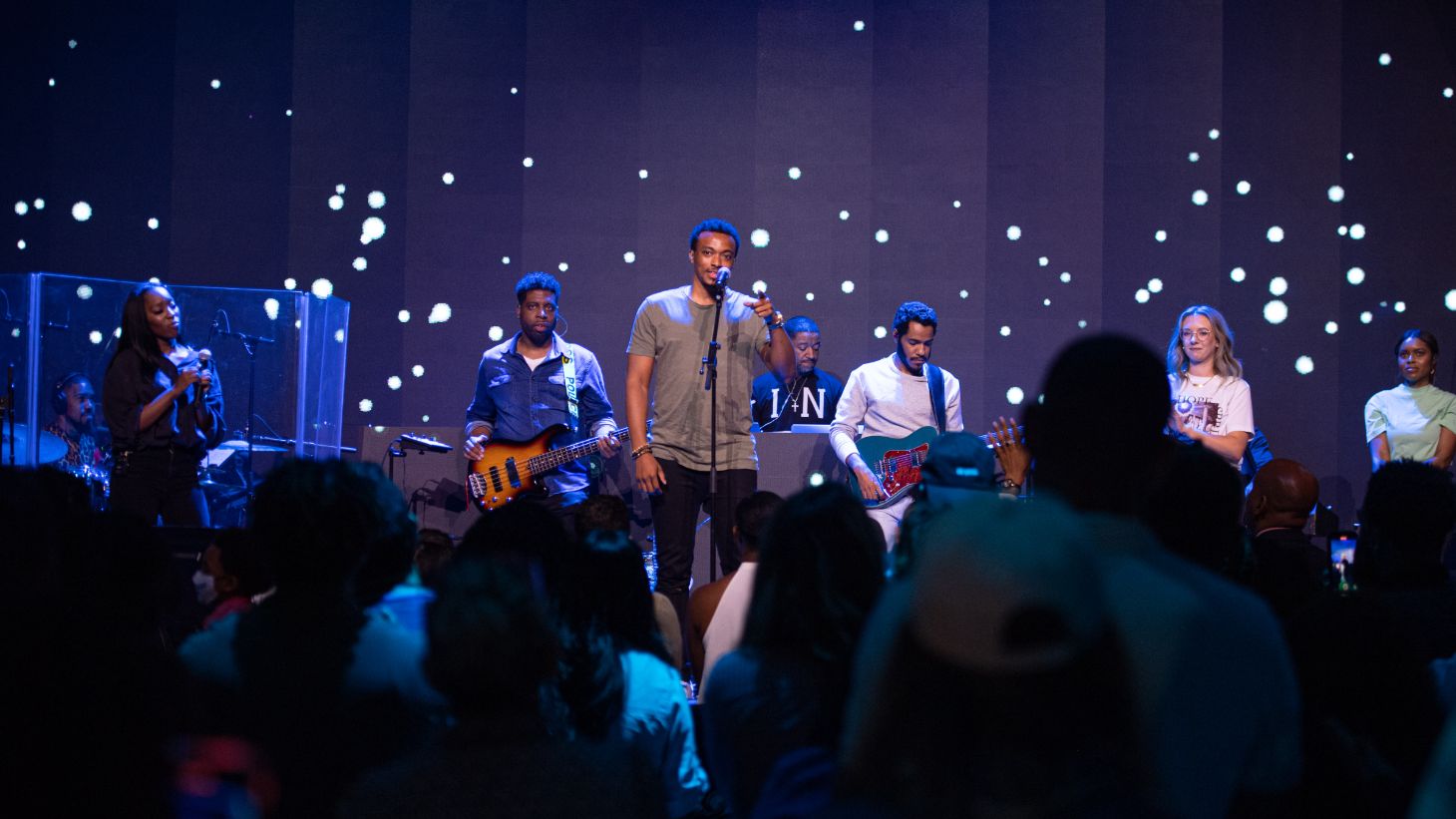
Jonathan McReynolds performs on stage during Hillsong Atlanta's opening day on June 6.

Jonathan McReynolds performs on stage during Hillsong Atlanta's opening day on June 6.

Christianity Today June 8, 2021
Marcus Ingram / Getty Images

Hillsong Church, known for its popular worship music, sounds different in Atlanta. At the new location’s first day of Sunday services, rapper Da’ T.R.U.T.H. kicked off worship in the dimly lit Atlanta Event Center, formerly Club Opera in the heart of downtown.

Donning a sweatshirt, jeans, and a man bun, Da’ T.R.U.T.H., who was also featured in Hillsong Atlanta’s “Welcome Home” launch video, rapped the lyrics to his song “The Faith” in front of the congregation at three opening-day gatherings.

Attendees—few were masked, despite the church advertising mask wearing and social distancing requirements—stood from black folding chairs and gold-seated booths to cheer for Sam Collier, who’s the first African American to serve as lead pastor of a Hillsong church.

The crowd was diverse, and the service felt like a pep rally. “I guess I need to know if anyone who loves Jesus is in the building?” Collier asked. “Lift him up! Welcome to our grand opening!”

Collier, who came to Hillsong from Andy Stanley’s North Point Ministries, has deep connections in the city. He previously ministered at Ebenezer Baptist Church, the home church of Martin Luther King Jr., and New Birth Missionary Baptist Church, another well-known Black church in the metro Atlanta area.

Hillsong, which formed its own denomination in 2018, has locations in about a dozen US cities and 28 countries, averaging a total global attendance of 150,000 a week, according to its website. The services drew prominent Atlanta figures and celebrities and featured Hillsong Church global senior pastors Brian and Bobbie Houston.

“It’s been a difficult year, but you’re the greatest leaders I’ve ever met,” said Collier, as he introduced the Houstons. He likely was referencing numerous revelations that have rocked the global church starting with the admission of adultery by Carl Lentz, former pastor of Hillsong Church’s New York City location, last November. “We pray against demonic forces, and that [the Houstons] will have victory in Jesus’ name.”

https://www.instagram.com/p/CP1CDassLVj/

Bernice A. King, CEO of The King Center, was also in the congregation on Sunday to support Collier, whom she called a friend. Atlanta City Council member Michael Julian Bond presented the church with a proclamation.

Most of Hillsong’s existing US locations are in the West or Northeast; the Atlanta church is its first in the South. Last year, Hillsong announced that Collier would copastor the church with his wife, Toni, but she stepped out of the role to write (she has a two-book deal with Thomas Nelson).

On Sunday, the Colliers thanked their relatives as well as their “global family” for support before focusing on their vision for Atlanta. In his message, Sam Collier drew from Exodus 3:7 as he called for revival and racial reconciliation in the “birthplace of civil rights.”

“God is talking to Moses about his own people in captivity. He invites Moses into a solution. He told Moses, I need you to go and free the people. Because of Moses’ sacrifice, he sets the captives free,” Collier said. “God is inviting us into revival where Black and white and political divisions will go away. We’ve been separate for too long, every race, every political affinity. We love the same Jesus and therefore we should be together. We should be unified about being unified especially in the city of MLK. What started in Australia will continue here.”

The church has used worship music including Christian hip hop to build momentum and set the tone for its launch, according to Rapzilla, which is partnering with Hillsong Atlanta. Leading up to its June 6 launch, the church involved artists like Lecrae, Andy Mineo, and Natalie Grant in worship nights that drew 2,200 people in person and 30,000 online, the site reported.

“I like the fact that they’re not straying away from the culture of Atlanta and the culture of hip hop,” said Terran Gilbert. Gilbert, a Christian rapper who performs as T-Ran, came from Nashville with his wife Alexis to support Da’ T.R.U.T.H.

https://twitter.com/J_MacStreetTeam/status/1401593501079379970

Grammy Award–winning gospel artist Jonathan McReynolds, who is also a judge on the BET gospel music talent show Sunday Best also took the stage, beginning his performance with a riff, singing about turning “an old Atlanta night club into awesome place of worship.” He sang his hit song “Not Lucky, I’m Loved,” which Brian Houston enjoyed as he sang a few notes of the song more than once as he spoke to the room following McReynolds.

Houston joked about his accent (“like Bruce the shark in Finding Nemo”) and described the early days of Hillsong’s founding in the Sydney suburbs back in 1983. He also reflected on his marriage of 44 years to Bobbie. “Vision will hold you together when things try to pull you apart,” he said.

Referencing 2 Corinthians 11:23–29, Houston said the apostle Paul had vision and vision creates resilience, faith, discipline, and reward. “God always used people to accomplish his vision,” he said. “Jesus doesn’t play the keyboard.”

Finally, he encouraged the Atlanta attendees, “You guys are pioneers, and this is the beginning of an amazing journey ahead. Thank you for what you’re about to do here. Pray that the Holy Spirit will move in a fresh way in this city and reach people who have never been reached before.”

More critical voices worry that Hillsong, known for its celebrity adherents and global brand of “hypepriests,” will be another force for gentrification in Atlanta.

Following Lentz’s resignation in New York last November, a string of shakeups have taken place this year. The leaders of Hillsong Dallas stepped down, then a New Jersey pastor resigned over Instagram selfies. The church is reevaluating its policies around abuse.

https://twitter.com/definitelynick_/status/1401311243626029060

But Hillsong remains a huge force and a familiar name to evangelicals worldwide. Amanda and Jonathan Carmenate, a Black and Hispanic couple who live in Columbia, South Carolina, were in Atlanta for vacation and decided to attend the first service after seeing a social media post. “We were looking for a church to attend while we are here,” said Amanda. “I liked that it was multiethnic and multigenerational.”

Cheryl Rowland, who lives in Gwinnett County, stood in line to get into the second service. She is familiar with the Colliers’ ministry from when they were based at North Point. “I’m starting a new season in my life and want to expand my base of friends and worship opportunities and experience more of Atlanta,” she said.

The church will continue to meet with two services on Sunday. Its eight-week series “Launch” begins next week.

News

Charles Stanley: Not Selling CBD

Social media scam is using the Baptist preacher’s name to advertise gummies, oil.

Christianity Today June 8, 2021
In Touch Ministries

Charles Stanley has been spending more time with family since he stepped down as pastor of First Baptist Church Atlanta in 2020. He has continued his schedule of preaching on TV and radio with In Touch Ministries. And he is working on a book about prayer that will be released this fall.

He has not started a new business selling gummies and other products infused with cannabidiol (CBD), a compound extracted from the marijuana plant.

Enough people thought the longtime Southern Baptist pastor, considered one of the best evangelical preachers of his generation alongside Billy Graham and Chuck Swindoll, might have gotten into the CBD business, however, that In Touch Ministries released a warning on Saturday: “IT IS A SCAM.”

“Dr. Stanley has not begun any new venture,” the official statement said. “Scammers are attempting to trick you into giving your personal information or infect your electronic devices by using Dr. Stanley’s image.”

In Touch Ministries staff have reported the false advertising to Facebook and other social media sites selling “Charles Stanley CBD gummies” and “Charles Stanley CBD oil,” but new ads—with the preacher’s name superimposed over a large marijuana leaf, or the preacher’s name next to a spilled pile of glistening gummy bears—have appeared to replace them.

“Our social media team has been working with Facebook to quickly remove these false ads as soon as we are alerted to them,” Seth Grey, an In Touch Ministries spokesman, told CT. “Unfortunately, as soon as one ad is removed, another pops up in its place.”

And just to be clear: “This is false and Dr. Stanley does not endorse anything like this,” Grey said.

The false advertisements seem to have started back in April, beginning simultaneously on multiple websites registered in Iceland. Some of the sites were started right before the scam began, while others have previously advertised the same CBD products with other celebrities’ names, including Oprah Winfrey and Martha Stewart.

A second wave of websites, designed to look like news outlets with names like “24×7 News” and “Big News Network,” pretended to review the product in May and June. Each piece ended with a large red button to buy the product.

The promotional material was all written in garbled English, infused with health and fitness buzzwords.

“Charles Stanley CBD Gummies are one of the most selling and effective health improvement products that are constituted from various herbal and natural ingredients that are pure and natural to help consumers to get over various mental and physical health issues such as anxiety, depression, stress, mental headache, sleeping disorders, acne issues, heart diseases, etc.,” said one website.

Another explained that with this miracle product, “one’s wellness, namely in terms of inflammation and related health consequences is believed to gradually reverse with time.” The phrase “health consequences” linked to an advertisement on another site designed to look like a news report on a safe herbal ingredients.

One of the fake reviews said that “Charles Stanley CBD Gummies Gummies have 600mg of unadulterated, top-notch CBD to assist you to really feel extraordinary without the substantial!” and concluded, “CBD is as of this moment astonishing the us.”

The artificial English, snake-oil promises, and nonsense “reviews” serve as a backstop for the social media ads, providing an appearance of legitimacy to convince computer algorithms and anyone doing a quick Google search that Charles Stanley CBD gummies do, in fact, exist.

They don’t, but these scams do work, according to consumer protection advocates. The Better Business Bureau has documented more than 400 people taken in by CBD scams in the US in the last five years.

Some lose only a little money: $6, $12, $13.95.

Others, signing up for a “free sample,” agree to pay shipping and handling and then later find their bank account charged hundreds of dollars month after month. There is no established estimate of how much money is stolen this way every year.

In some cases, however, the product does exist. It’s just the endorsement that is not real.

The Charles Stanley CBD ads link to gummies and oils that are actually sold by a company called Smilz, which is owned by a self-described “serial entrepreneur” and “mind/body transformation guru,” named Jas Mathur. According to an advertisement designed to look like an article in USA Today and other media outlets, “Jas is a testament to a hidden truth of progress: one can only behave according to what they believe they can do and when he sets his mind, Jas can do anything.”

Whether Mathur is behind the ads claiming Stanley’s endorsement for CBD products or there are other parties involved is unclear. The company’s public relations firm did not respond to a request for comment.

It has become common for scammers to bait their hooks with fake celebrity endorsements, according to the BBB. The consumer advocacy group warns people to “Be skeptical of celebrity endorsements” and “Resist being swayed by the use of a well-known name.”

Scammers seem to choose famous people with a very broad fan base and a well-established reputation for reliability. Actors Morgan Freeman, Jennifer Anniston, and Sandra Bullock have all had their names and images misused in this way. The fact checking site Snopes investigated whether Tom Selleck is a spokesman for CBD oil. He is not.

Tom Hanks’ name has been used to sell CBD twice, sending the actor to Instagram to make a statement.

“I’ve never said this and would never make such an endorsement,” wrote the star of Forrest Gump, Saving Private Ryan, Sleepless in Seattle, and Toy Story. “Come on, man. Hanx!”

Before Stanley’s fake endorsement, at least three Christian leaders have been used to sell CBD products: Joyce Meyer, Joel Osteen, and T. D. Jakes, all Christians with popular television programs.

Stanley did not address the scam during his televised sermon on Saturday, but he did preach about the dangers of deception.

“When the Holy Spirit is within you, you’ll have foresight,” he said. “You’ll be able to see things that look like one thing when they’re another. You’ll be able to discern deception and know that what you’re seeing is a lie.”

Stanley said we can ask God to help us recognize counterfeit promises of “joy and peace and happiness and prosperity” as “one big Satanic lie.”

Then he went back to not selling CBD products.

Ideas

Paul Teamed with Women to Start Churches. So Will We.

Why women of color are essential to today’s church-planting movements.

Christianity Today June 8, 2021
Nicolas Castro / Lightstock

The apostle Paul ranks as the greatest church-planting apostle and missionary the world has ever known. He determined to build the church wherever Christ was not named. At great risk to himself, he entered city after city to proclaim the gospel and organize converts into churches.

Yet, the great apostle did not achieve these things alone. Paul always worked in teams. To the delight of some and the consternation of others, Paul’s church-planting teams included women. When he wrote the Christians in Philippi, he instructed them to help Euodia and Syntyche. Paul describes Euodia and Syntyche as women who “contended at my side in the cause of the gospel, along with Clement and the rest of my co-workers, whose names are in the book of life” (Phil. 4:3).

While Paul does not specify their exact role, these women labored side by side as equals with Paul, and their work was not ancillary or support work but gospel work. Paul regarded them with the same title he often uses of male partners in ministry—“co-workers” (Rom. 16:3; 1 Cor. 3:9; Phm. 1:24).

As Michelle Lee-Barnewall observes in Neither Complementarian nor Egalitarian, “The focus on authority, leadership, equality, and rights tends to lead to yes or no answers that do not prompt deeper questioning.”

As Christians continue to debate the role of women in ministry, we need to ask why today’s church doesn’t have more teams comprised of men and women as Paul’s were. We need to ask why typical debates about women and their roles end up with women being restricted from areas of service that the Bible nowhere prohibits. We need to ask deeper questions about how we regard women who do serve on ministry teams.

I fear contemporary debates obscure a vital truth: Women are essential to fulfilling the Great Commission. Their lives and ministries are not nice to have, but necessary, as Bible teacher Jen Wilkin has often observed. Or as Aimee Byrd argues in No Little Women, our sisters are “necessary allies” in the work God has given the church. Indeed, the Lord’s last words in Matthew 28:19–20 are embraced as a charge for the entire church—women as well as men.

Perhaps many of our churches are ineffective in advancing the Great Commission precisely because we have sidelined one-half of the body of Christ. In 2011, I began arguing for substantial women’s involvement in ministry work. At the time, I think I saw the problems more clearly than I saw any solutions. But following years of child- and sex-abuse scandals and increasingly misogynistic, patriarchal, and mean-spirited evangelical responses to women, that earlier diagnosis now seems quaint. The need to increase women’s leadership opportunities appears more urgent to me than ever.

So when we planted Anacostia River Church in 2015, our first ministry as elders was to meet monthly with the older women in our congregation, not only to disciple them in the spirit of Titus 2:1–3 but also to give them direct input into our lives and ministries.

The presence, faith, courage, and perseverance of our sisters in difficult contexts provides the surest foothold we have for reaching overlooked people.

Their biblical wisdom and intuition have proven invaluable. It was the older women who suggested the elders attend women’s fellowship meetings so women could have greater access to the pastors. We attend not as the teachers but as learners and brothers, benefitting from the fellowship and gifts of our sisters. Women comprise the majority of our deacons and give invaluable guidance to the church. We have committed, Lord willing, to making our next couple of staff hires women earning equitable salaries, the first of which should happen this summer.

We have not figured everything out, but the pastors and the congregation have been attempting to make the flourishing of our sisters a theological and practical priority. That has required jettisoning fear-based hesitations that have more to do with restricting women than promoting them. It has also required taking seriously how culturally bound so much of complementarian teaching is and gleaning from women’s perspectives in Black and brown church communities.

Truth be told, our sisters are most often on the frontlines of gospel advance wherever the work is most difficult. That’s true on the mission field, as groups from Africa Inland Mission to YWAM report that women make up 80 percent of single people willing to enter missionary service. It’s also true in neglected Black and brown neighborhoods, where membership in local churches is predominantly female, and many church starts are headed by women.

At The Crete Collective, a church-planting network that launched last year to reach neglected Black and brown neighborhoods, we’ve also made the decision to prioritize the leadership of godly women. We believe this priority to be a necessary correction to years of extrabiblical restriction in conservative Christian spaces, restrictions that sometimes go beyond home and church to most every area of Christian endeavor.

Our first executive-level hire is Dennae Pierre, who not only brings experience in church planting and network leadership but also her perspective as a Latina Christian and immigrant. Prioritizing women’s leadership also means including more women on the board as we grow. And it means focusing our training on teams that invite and welcome women rather than solely targeting male pastors and lead planters.

Many church planting efforts assume a middle-class, white cultural norm, but the deeper we take the gospel into poor, neglected, Black and brown communities, the less that model transfers or serves the needs of those communities. In fact, if class and cultural assumptions go unexamined, even well-intentioned planters and churches can hurt communities and be stymied in their efforts to evangelize and serve their communities.

In an era of sharply divisive social and political issues, we desperately need more leadership from the diverse parts of Christ’s body—especially Black and brown women, immigrant communities, and the poor among us.

Female leaders such as Christina Edmondson and Michelle Reyes have helped to make church planting more aware of and sensitive to mental health, cultural competence, anti-racism, justice, and mercy—both within their local churches and in the church at large. And a countless number of women without national followings have done the work of evangelism, led in public worship, provided biblical counseling, offered various forms of training, used their administrative gifts, and simply made themselves available wherever needs exist.

The presence, faith, courage, and perseverance of our sisters in difficult contexts provides the surest foothold we have for reaching overlooked people. Our sisters may better reach homes headed by single women, which exist in high numbers in America. They may provide more empathetic leadership and care in communities filled with complex and acute trauma. And in a church world riddled with high-profile scandal among pastors, our sisters may be a much-needed source of insight, accountability, and health in our leadership culture.

Current disparities in funding for African American and Hispanic church plants might also point to the need for more women in leadership. It may be that the sometimes unrecognized and unpaid leadership and skills of Black and brown women provide a hidden subsidy to church plants in ethnic and sometimes neglected contexts.

We can benefit from women’s leadership in all these ways and more, whether or not we believe women can or should hold the office of pastor. The flourishing of women is good for the flourishing of the church and the community.

Our sisters have much to teach us if we would listen and give them genuine leadership opportunities. Apollos learned from Priscilla and Aquila, Paul’s ministry companions and co-workers. The Roman church learned from Phoebe, who is commended by Paul as a deacon and benefactor (Rom. 16:1–2). Which women are we learning from today?

Thabiti Anyabwile is a pastor at Anacostia River Church and president of the board of The Crete Collective.

Speaking Out is Christianity Today’s guest opinion column and (unlike an editorial) does not necessarily represent the opinion of the magazine.

News
Wire Story

Rick Warren Announces Search for Saddleback Replacement

Purpose-driven pastor has “zero regrets, zero fears, zero worries.”

Christianity Today June 7, 2021
Saddleback Church

Pastor and best-selling author Rick Warren announced Sunday, June 6, that he is stepping down from leading Saddleback Church, the Southern California megachurch he founded in 1980.

In a message titled “How to Discern the Best Time to Make a Major Change,” Warren, 67, announced the church would begin the official search for his successor in the next week. When the new lead pastor is in place, Warren will transition to the role of founding pastor.

Warren recounted his pledge from when the church was founded that he would give the next 40 years to leading the Saddleback family. Early in 2020, the church celebrated its 40th birthday.

“This is not the end of my ministry,” Warren told the congregation via video and in person at the Lake Forest campus. “It’s not even the beginning of the end. … We’re going to take one step at a time in the timing of God. … God has already blessed me more than I could ever possibly imagine. I don’t deserve any of it, and so this next transition in my life is something I am anticipating with zero regrets, zero fears, zero worries.”

Warren also stated the church does not have a successor in mind already, and that they would look both inside and outside the church for “a leader who is already doing some ‘purpose-driven’ ministry”–a term synonymous with Warren’s life and leadership.

Aside from pastoring Saddleback Church, Warren is most known for his best-selling book The Purpose Driven Life. Released in 2002, the book has sold more than 50 million copies worldwide according to publisher Simon & Schuster. Its predecessor, The Purpose Driven Church, was released in 1995 and has sold more than a million copies.

Saddleback Church is one of the largest Southern Baptist churches in the United States. According to a 2019 article in the Orange County Register, the church averages 30,000 attendees and 7,000 small groups each week. The church has 15 domestic campuses and another four around the world in Germany, Argentina, Hong Kong, and the Philippines.

In 2010, Saddleback announced the church had sent mission teams to every nation in the world. In 1991, the church started its Celebrate Recovery ministry, which is now used in more than 35,000 churches around the world. In 2018, Saddleback celebrated its 50,000th baptism.

News

Loving the Foreigners—Even When They Have a Deadly Disease

Inspired by Deuteronomy, Singapore Christians win praise for serving migrant workers at epicenter of COVID-19 outbreak.

AGWO director Samuel Gift Stephen talks to migrant workers in a Singapore factory-converted dormitory to find out their needs during lockdown in April 2020.

AGWO director Samuel Gift Stephen talks to migrant workers in a Singapore factory-converted dormitory to find out their needs during lockdown in April 2020.

Christianity Today June 7, 2021
Ore Huiying / Getty Images

When Singapore detected its first case of COVID-19 in January 2020, containment seemed manageable—until the disease started spreading like wildfire among migrant workers.

While cases among the general population of 5.7 million numbered only about 10–20 a day, by April 2020 news agencies were reporting that infections among the Southeast Asian nation’s approximately 288,000 migrant workers—who live in small dormitories where social distancing is difficult—had spiked to 10,000 cases in one week.

In response, the government placed the workers in isolation in their dorms, preventing them from going out into the community—for five months.

The story of how local Christians stepped up to meet the need is an overlooked silver lining among all the gloomy headlines of the pandemic. And with Singapore reentering a season of heightened restrictions last month as COVID-19 cases climbed again, the fact that migrant workers are not a focal point of the outbreaks shows how they are better taken care of now, due to the kampung (meaning “village”in Malay) spirit that led many Christians to serve Singapore’s least of these.

Trouble in paradise

Migrant workers in Singapore have traditionally led challenging lives in the island city-state. They hail mainly from India and Bangladesh but also from Malaysia, Myanmar, and Thailand. As the main source of labor for the wealthy nation’s construction projects and other low-wage jobs, they form a vital part of the Singaporean economy.

While some employers treat their workers well, other workers live hard lives, facing long hours doing dangerous work for low pay (about $15 USD a day). They miss their loved ones in their home countries and often feel the weight of debts they have to pay off.

The plight of these migrants—especially during the government’s “circuit breaker” campaign when the workers were in mandatory isolation, facing the stress of being cooped up and not receiving any income because they couldn’t work—touched the hearts of many Singaporean Christians. A Bible verse that motivated many believers to begin ministering to them was Deuteronomy 10:18–19, where Moses instructs:

[God] loves the foreigner residing among you, giving them food and clothing. And you are to love those who are foreigners, for you yourselves were foreigners in Egypt.

Such efforts have been coordinated by the Alliance of Guest Workers Outreach (AGWO), which was formed in 2019 under the Hope Initiative Alliance (HIA), an interreligious aggregator of services for the needy that partners with more than 100 organizations—including many churches—to provide holistic care for vulnerable and marginalized communities in Singapore.

A significant proportion of AGWO’s partners are Christian churches and organizations, though it has members from all faiths and also works with various government agencies to support their own assistance to migrant workers. Two key leaders are Christians: Ezekiel Tan, who serves as HIA’s president through his role as CEO of SowCare, the social service arm of The Bible Society of Singapore (of which Tan is general secretary); and Samuel Gift Stephen, senior pastor of Life Center, who serves as HIA’s chief outreach officer and the lead director of AGWO.

Food for the hungry

Due to the rising number of COVID-19 cases in April 2020, the Singaporean government imposed a two-month lockdown on the entire nation, calling the restrictions a “circuit breaker” for the pandemic. Migrant workers became the most affected group.

With the coronavirus raging in some of the dorms, they lived in deep fear for their health, feeling imprisoned in the small rooms they shared with up to 20 fellow laborers. Worst of all, they couldn’t go out to get food and couldn’t cook in their dorms. Some employers stopped providing wages and food because of their own economic difficulties, while many caterers didn’t want to deliver food to the dorms because of the high number of COVID-19 cases. They were in danger of going hungry.

Migrant workers in Singapore at the Cochrane Lodge II, a purpose-built dormitory designated as an isolation area in April 2020.

While migrant workers had long lived challenging lives in Singapore, it was their unique vulnerability during the circuit-breaker period that really woke up local Christians to the need to help them—in both the short and long term.

One of the most remarkable ministry efforts to arise was a food distribution service, which was intended as a one-day exercise but became a four-month operation. It started on Good Friday 2020, when AGWO decided to send nearly 10,000 special-care meals to the workers and discovered how many hadn’t eaten for days. The alliance leaders became convicted to run a feeding program to distribute food, in cooperation with government agencies, to the migrants for as long as they needed it.

The feeding ministry faced many challenges. While AGWO obtained the necessary permits to distribute the food while following all health and safety protocols, volunteers still had to deliver food to the dorms. With the high infection rates there, the volunteers were putting their own lives at risk. Raising the funds for the food was also another challenge. The alliance aimed to deliver 20,000 packets of food a day; at a cost of three Singaporean dollars per packet, that meant the alliance had to raise more than $45,000 USD a day.

“It was truly a miracle,” said Tan. “We had over a thousand volunteers, but none of them got COVID.”

The HIA and Bible society president also said the financial provision for the food distribution costs was another miracle. A call for donations on Giving.sg, a national website where Singaporeans can donate to charities, raised $2.3 million USD.

Together with the help of many churches, AGWO distributed more than 1 million meals and more than 1.2 million essential items (e.g., hygiene packs, medical supplies, and foodstuffs) to about 21,000 workers across more than 300 dormitories.

In October 2020, HIA received the Organization of Good award—bestowed by Singapore’s president, and the highest award given to a charity in Singapore—for the alliance’s work with migrant workers.

Stephen, the AGWO director, recalls how he had to go “dorm hunting” during the circuit breaker. The problem was that many workers were housed in factories that had been converted into dormitories, but it was not obvious from the outside.

For example, he was walking around Defu Lane one day and saw five men squatting under a tap by the road. He found out these migrant workers hadn’t eaten for three days and were trying to fill their stomachs by drinking water. So he quickly arranged for them to get food. Stephen said they told him, “Without you, we would have died. Thank you so much. Now we know we have family in Singapore.”

“Migrant workers have been an immense blessing to us here in Singapore in more ways than one,” said Singapore pastor Guoliang Wong, one of the volunteers who visited the dorms. “And the least we can do is to show them the love of Christ by supporting and encouraging them through this crisis.”

Pastor Guoliang Wong (right) and Thomas Franks (middle) pray together with Francis Xavier (left), a Christian migrant worker outside a factory-converted dormitory in Singapore in April 2020.

The food distribution program also created a lot of interest in the international media, with media outlets including the BBC and Reuters covering AGWO’s efforts.

By the end of 2020, the COVID-19 infection rate in the dorms was reduced enough that the workers could cook and feed themselves again, so the food distribution service ended. However, AGWO and the Christian community still wanted to serve them.

Friendships and festivals

Developing long-term friendships with migrant workers became a key aspect of ministry for some of the main volunteers working with AGWO.

In September 2020, AGWO launched iFriend, a befriending program to encourage volunteers to care for the workers.

Ivan Tan (no relation to Ezekiel), a documentary director who was one of the key volunteers leading the migrant worker ministry of The City (a church in Singapore’s business district), described how he formed a friendship after helping a worker to distribute food to dorm mates.

“I wanted not just to give him material things but also to engage with him as a friend,” said Ivan. “He and I have WhatsApp video calls at night, and I came to know that he’s just like me; we share similar joys and struggles. For example, there was a period when both of our mothers were sick in the hospital and we commiserated with each other.”

“Ivan is a very good friend to me,” the worker told CT. “Now he’s like my family.”

The iFriend program also trains volunteers in the dorms to spot signs that migrant workers might be contemplating suicide.

Stephen recalls the story of how one migrant worker, burdened by financial difficulties, was planning to kill himself by drinking toilet cleaning liquids. Before he did, he had packed all his belongings from his cupboard into a suitcase. A volunteer saw the man’s odd behavior, realized it was a sign of a potential suicide case, and managed to talk the man out of killing himself. “We have saved lives through our volunteers,” said the AGWO director.

Another key initiative of AGWO and the Christian churches is their continued work in celebrating major religious festivals with migrant workers, including Vesak Day (also known as Buddha Day), Deepavali, Good Friday, and Christmas.

For example, during Deepavali—a primarily Hindu festival of lights also known as Diwali—last November, AGWO delivered meals to about 8,000 guest workers from more than 70 dorms, mobilizing more than 100 volunteer drivers to distribute the food.

Some church groups also organized celebration activities with the migrant workers. Ivan organized a Good Friday carnival at a recreation center, where workers played basketball and participated in archery games and painting stations. “The workers would draw their village and we would talk about the drawing, talk about their home, and get to know them a bit,” said Ivan. “It was good to engage with them.”

The Christian community’s celebration of non-Christian festivals with migrant workers is a unique aspect of Singapore’s culture. The nation is proud of its respect for different faiths, and the migrant workers to whom churches minister are predominantly Hindu and Muslim. The churches have rallied to help these workers even though they are from different faiths.

“We believe in doing good to the needy, to have beneficiaries of different faiths so as to foster greater trust and acceptance of all the faith groups,” said Ezekiel. “God is like that. He sends rain to all.”

Dorm parents

Among the unsung heroes helping the migrant workers during the pandemic is a group of 20 to 50 women who came to be known as the “dorm mums.”

Priya Mohan, who runs her own financial consultancy firm, was one of the key organizers. During the circuit breaker, the dorm mums helped coordinate food delivery to more than 12,000 men in 250 dorms. Mohan says the ministry was a natural fit for her. “I’m Indian, and Indians have a big focus on food,” she told CT. “We show love and affection by feeding people. It’s part of our culture.”

The dorm mums still talk to their migrant-worker friends regularly. “Any trouble or distress or paperwork that needs to be done, they come to us,” said Mohan. “We talk about their health, how their families are in India, how to make a CV [resumé] so they can apply to get a better job, how to choose a girl to marry—everything.”

She showed CT some of the messages that migrant workers have sent to her, such as “Really mummy I’m so lucky, I have Singapore mummy.”

While the food crisis is over, AGWO and many Christian groups are still committed to serving the migrant workers, seeing it as a long-term ministry and the food crisis as merely a catalyst that sparked their work.

Ezekiel describes plans to continue working with recreation centers so migrant workers will be able to play games and attend talks and English classes. The HIA president is also contemplating how to enable the workers to give back to Singapore—for example, by donating blood or cleaning the beach. “Hopefully that would help with social integration,” he told CT, “to show that they care for Singapore and Singapore cares for them.”

The story of the migrant workers during COVID is an inspiring case study of how Singapore’s Christian community worked with multiple stakeholders including the government, employers, and dormitory owners—who were all portrayed in many media accounts in a bad light—as well as charities and other religious groups to help improve the lives of these workers, turning their trials into triumph.

This progress was apparent last month, as Singapore entered Phase 2 restrictions (targeted to end June 13) amid a rise to 20–30 daily COVID-19 cases. Infections in the migrant worker dorms have been very low—less than 10 per week and on many days zero—due to their better living conditions, vaccinations, contact tracing, and safe-distancing measures. And Christians have continued befriending and counseling them and organizing social and educational activities at the recreation centers.

“They’re just like us. They have families, feelings, and fears,” said Stephen. "Even if they are different, we should still minister to them since we are called to love everyone regardless of who they are, where they are from, and from which faith.”

Not only is this an opportunity to fulfill the Great Commandment amid the pandemic, the AGWO director notes it also gives Singapore Christians an opportunity to fulfill the Great Commission.

“Now we cannot travel overseas to do missions, so we have to focus on the nations within our nation," said Stephen. “Serving the foreign migrant workers in Singapore gives us the opportunity to do global missions locally.”

Hwee Hwee Tan is a freelance writer based in Singapore.

CT Gave Him Hope For the Future of Christian Discourse

Atlanta businessman Bruce Neurohr uses CT articles to build bridges in his community.

CT Gave Him Hope For the Future of Christian Discourse
Photo Courtesy of Bruce Neurohr

Bruce Neurohr recommitted his life to Christ because of door-to-door Baptist evangelists. Well, technically the evangelists talked to his wife, knocking on the door and asking, “If you died today, where would you go?” Looking back, Bruce is still surprised that tactic worked. “She accepted Christ in the house. The odds were amazingly against it; she was the only one out of 10,000 or something.” But after her conversion, they started going to the Baptist church together and several years later, Bruce started his own technical land acquisition company, which he dedicated to the Lord. This company went on to be quite successful and was featured twice in Inc. Magazine’s “America’s 500 Fastest Growing Private Companies.”

Ten years later, Bruce read the book “Halftime: Moving from Success to Significance” by Bob Buford. Then and there he decided to sell his company and work in full-time ministry. After the sale, he spent two years doing strategic planning for his home church, a volunteer job that required a whopping 70 hours of work a week, and later did a second paid stint as executive pastor. During the time he served there, they doubled the size of the property and set up a nonprofit to allow the attached K-to-12 school to fundraise and expand. They now enroll over 1,000 students.

Even though his administrative impact was great, and his skill in executive management undeniable, he began to wonder if full-time ministry was for him. “I initially got into serving in the local church to do ministry, not to be an administrator. But when you’ve got 10 paid professional seminarians on the staff, people are not coming to me for advice like they did in my company. If my employees had a problem with their marriage, or financial problems, or spiritual questions, they’d come and talk to me. And I realized that the idea of moving from ‘success to significance’ really ended up being bogus in my mind. The most significant ministry I did in my life was running my own company because I was able to have those types of impactful conversations with people.”

Bruce strives to be a safe place for people to bring hard conversations. That’s a large part of why he decided to become a CT partner. “Christianity Today gives me a way of beginning biblically-based conversations with my kids and with people who I’m in relationship with. We need to be able to speak to one another in truth and love, and CT models this posture. And to do it with a mindset that is an eternal mindset, rather than trying to win an argument. CT creates space for that dialogue.”

You can see this desire to help people parse hard conversations traced through Bruce’s career where he’s often been part of creating places for people to process big life transitions, whether that’s helping young missionaries process their overseas experience when they leave the mission field or helping launch a retreat program for breast cancer survivors who, after years immersed in medical care, are trying to figure out how to resume normal life.

But you can also see this desire in Bruce’s personal life. Several years ago, Bruce’s daughter came out as gay. While Bruce has his own beliefs on homosexuality, he strives to make sure conversations around her sexual orientation focus on maintaining their relationship. A testament to this close relationship is that all his kids who live locally still come over for dinner with him and his wife most Sundays. Bruce says he sends copies of CT to his kids, including his daughter, who he says is still following God. Recently, they even discussed a CT article on the relationship between the Church and the LGBT community.

Bruce says this kind of conversation is only possible because CT serves to build bridges, rather than walls. “CT promotes love towards the LGBT community and others who raise sincere questions about the teaching of Jesus. CT doesn’t apologize for biblical truth and neither does CT seek to use biblical truth as a hammer. CT reflects the love of Christ and seeks to understand other perspectives rather than just spout dogma at people. I don’t think I’d have a relationship with my daughter if I came at it with a dogmatic approach.”

CT gives Bruce hope for the future of discourse in the church. He recently enjoyed CT’s article on pastoring purple congregations, churches who have a mix of Democrats and Republicans in attendance, as he has seen his own faith community fall into tribalism at times. When Bruce has significant disagreements with fellow believers, he sometimes sends a CT article to express his perspective. Bruce says, “CT is far better at articulating where I’m coming from than even I can do it.” And CT has helped him start to bridge that contentious political divide. “To be able to share a CT article gives biblical credibility to my position and shows a person that I want to engage them in a conversation. And that there are some things that we can still agree on.”

Katie Bracy is digital marketing specialist at Christianity Today.

Apple PodcastsDown ArrowDown ArrowDown Arrowarrow_left_altLeft ArrowLeft ArrowRight ArrowRight ArrowRight Arrowarrow_up_altUp ArrowUp ArrowAvailable at Amazoncaret-downCloseCloseEmailEmailExpandExpandExternalExternalFacebookfacebook-squareGiftGiftGooglegoogleGoogle KeephamburgerInstagraminstagram-squareLinkLinklinkedin-squareListenListenListenChristianity TodayCT Creative Studio Logologo_orgMegaphoneMenuMenupausePinterestPlayPlayPocketPodcastRSSRSSSaveSaveSaveSearchSearchsearchSpotifyStitcherTelegramTable of ContentsTable of Contentstwitter-squareWhatsAppXYouTubeYouTube