Books

Gender-Identity Conversations Don’t Have to Be Scary

Preston Sprinkle gives guidance on thinking biblically and listening in love.

Illustration by Rick Szuecs

Of the many books concerning Christianity and LGBT topics, most have addressed the front end of the acronym, leaving the back end woefully neglected. Yet questions of gender identity are growing in volume and urgency, both within and outside the church. In his latest book, Embodied: Transgender Identities, the Church, and What the Bible Has to Say, Preston Sprinkle, president of the Center for Faith, Sexuality & Gender, provides guidance on addressing these questions constructively and lovingly. Author and Cru leader Rachel Gilson spoke with Sprinkle about his book.

Embodied: Transgender Identities, the Church, and What the Bible Has to Say

Embodied: Transgender Identities, the Church, and What the Bible Has to Say

David C Cook

288 pages

$11.00

Why this book, and why now?

There are two emphases woven together in the book: a people strand and a conceptual strand. I’m focused, in other words, on loving people well while also thinking biblically, logically, and scientifically on all the topics that gender-identity conversations stir up: male and female sexual embodiment, relationships between body and soul, and gender stereotypes surrounding masculinity and femininity. We can’t just do one without the other. Thinking carefully without loving well leads to damage just as surely as loving well without thinking carefully.

Did any of your views change while researching and writing?

I certainly gained a stronger appreciation for some of the finer nuances of these conversations. For example: One common question is whether someone can be born in the “wrong” body. My hunch going in was: no. Having wrestled with that question from several angles, I haven’t changed my mind. But I can better understand why some make this claim.

How much of your personhood is due to your brain, and how much to your body? That’s a complex question! It brings in neuroscience, philosophy, theological anthropology, and other perspectives on human nature. There are more complexities than our culture-war framework acknowledges.

In conversations about gender, intersex people often get used as mascots. Sometimes they’re lumped in with the trans populations, and on other occasions they’re ignored entirely. How can we care well for people whose bodies aren’t fully male or female in a conventional sense?

Intersex people are often like the kid caught in a divorce, pulled in different directions and utilized in service of one argument or another. As several intersex people have pointed out, this feels dehumanizing.

If we’re going to discuss the subject of intersex conditions, let’s make sure we’re not doing so in passing, as a stepping stone toward something else. There are important questions, in their own right, about newborns whose sex is ambiguous: Should they be operated on right away? And who gets to determine which sex is the preferred outcome? These are big concerns within the intersex community. There are overlaps, of course, with conversations on transgender identity, but the point remains that we can’t just employ intersex conditions in service of a broader ideological argument about gender and sexuality.

For those who don’t identify as trans or intersex, how do we enter into this conversation? What are some dos and don’ts?

First, listen to actual trans people—especially if you’re coming from a more conservative Christian environment. Sometimes that environment can harden our hearts toward those who have been marginalized, shamed, or shunned by the church, and the trans population often fits that description. To shave off the harsh edges of our posture, we need to maintain genuine relationships with trans people.

Second, we need to learn the right language—understanding, for instance, the difference between sex and gender, what gender identity means, and why words like “transgenderism” can be a turnoff. As one of my trans friends told me, “‘trangenderism’ feels like a nameless, faceless concept that people can vilify.” To many people, it can sound uncomfortably like a disease. Certain words convey certain unintended meanings, and that’s important to get clear.

Many people use sex and gender interchangeably. What is the difference?

It’s beyond dispute that humans are sexually dimorphic: We reproduce only when a male impregnates a female, and these categories are basic to our humanity. Scripture attests to this, stating that God created human beings as male and female (Gen. 1:27).

Gender, by contrast, deals with our psychological and social response to biological sex. Under that umbrella, you can identify three categories. Gender identity is our internal sense of who we are—whether we resonate with being male or female. Gender expression is how we manifest inward identity, typically with clothing or mannerisms that suggest masculinity or femininity. And gender roles refer to societal expectations for males and females. These concepts are related but still distinct.

Some Christians might hear your answer above and think, “That sounds reasonable, but the Bible doesn’t speak in those categories. What am I supposed to do with them?”

While the Bible doesn’t have a term like gender that’s used in distinction to sex, I think it does speak to the differences those words signify. It recognizes, of course, that humans are created male and female. And it does depict behavior that we might consider masculine or feminine.

In the Greco-Roman world, there were certain expectations that came with being male or female. You might be a biological male, but if you were kind to the marginalized, say, or washed people’s feet, you might be stigmatized as unmanly. While the Bible celebrates sex difference, it also challenges certain cultural stereotypes. Take someone like King David: He was a great warrior and cut the head off Goliath, but he wrote poetry, played the harp, and cried a lot. Or take the Book of Judges, where women like Deborah or Jael play crucial roles in military battles. Scripture has a more expansive vision, then, for what it means to live out our male and female identities.

We both have friends who identify as trans or nonbinary Christians. What would you say to believers who are suspicious about those labels?

Terms like trans or transgender can mean different things to different people. I have a biologically male friend, for instance, who calls himself transgender because he identifies as a woman. That’s the kind of usage that comes to mind most commonly. Another friend of mine is biologically female, and believes she’s female, but calls herself trans because she experiences gender dysphoria. So while some people use these terms to speak about their fundamental personhood, others use them mainly to describe their subjective experience.

Sometimes, it’s as simple as feeling like you don’t match a particular set of gender stereotypes. Often enough, that’s all nonbinary means—not that you don’t believe you’re biologically male or female, but that you don’t completely resonate with either masculinity or femininity. In the end, the only way to avoid confusion is getting to know the people themselves—and learning why they use the words they use.

What should trans readers take away from your book? And what about non-trans readers?

For my trans readers, I want them to feel seen and understood. I would never presume to tell them about their own lived experiences, but conceptually, I hope they find greater clarity about what science and Scripture do and don’t say. After all, many trans friends will remind me that they aren’t experts on these matters. They don’t necessarily have an airtight grasp of a biblical theology of gender—or even gender dysphoria itself.

As I say in my preface, however, my primary audience is non-trans people. I hope they’ll come away no longer scared of this conversation. Because if you’re scared of this conversation, you’ll likely be scared of trans people themselves. And that’s not a posture any Christian leader should have.

Church Life

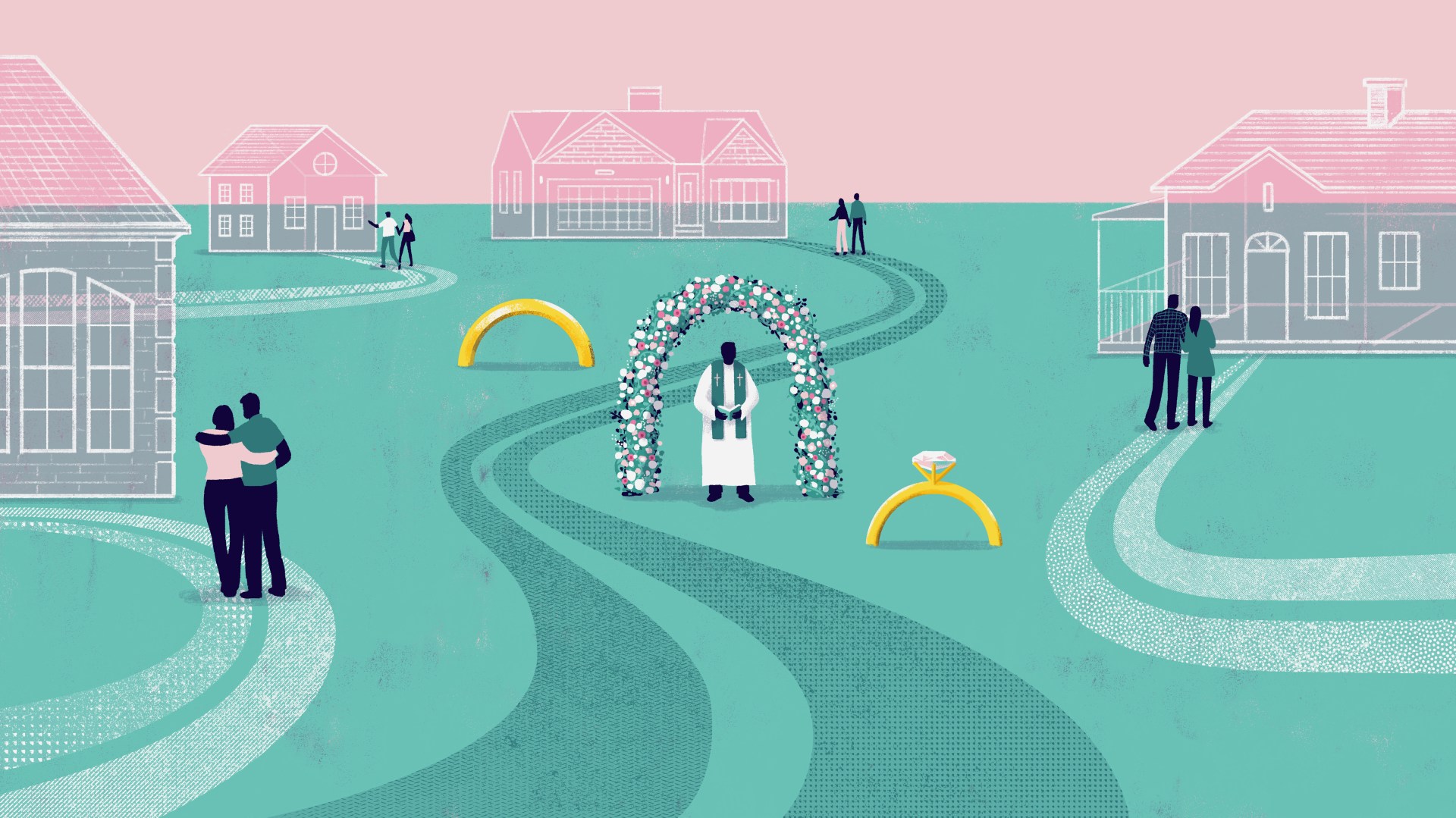
The Cohabitation Dilemma Comes for America’s Pastors

More evangelicals are living together before marriage. Church leaders struggle to respond.

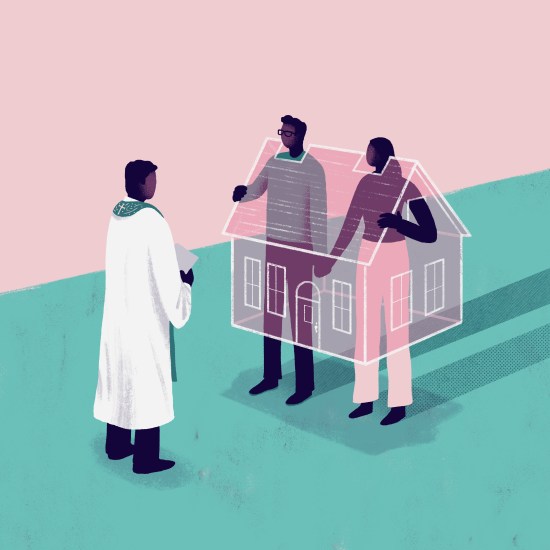
illustration by Matt Chinworth

In early 2019, the internet was aglow with news about Chris Pratt and his fiancée, Katherine Schwarzenegger, moving in together. Media outlets cited the couple’s evangelical Christian faith as the reason they did not cohabit until they were engaged. Few suggested there was any contradiction between Pratt’s cohabitation and his status as a “devout Christian,” a “folksy, popular evangelical” who urged “living boldly in faith.”

This may seem odd to those who recognize that Scripture forbids all sexual activity outside marriage. But the choice that Pratt and Schwarzenegger made isn’t contained to Hollywood—it’s the new norm among young, professing evangelicals across America.

While speaking to a large gathering of evangelical pastors in late 2019 in Pennsylvania, I asked how many of them regularly faced cohabitation in their churches. Most raised their hands. One told me that he had stopped conducting weddings because so many of his engaged couples were cohabiting and got angry when he addressed it. Another suffered bitter criticism from church members when he dismissed a church employee who refused to leave a cohabiting arrangement.

What I have seen for years in large national surveys and learned in interviews with a spectrum of pastors in 2019 corresponds with these anecdotes: Evangelicals, especially those under 40, increasingly see cohabitation as morally acceptable. Most young evangelicals have engaged in it or expect to.

Simply put, living together is far more common and accepted than Christians realize. American pastors are grappling with how to navigate wedding policies and premarital counseling among cohabiting congregants. But one thing is certain: If the church is to preserve and protect marriage, something about its approach has to change.

A habit of cohabiting

Evangelicals are much less likely than Americans overall to approve of cohabitation. Still, a Pew Research survey in 2019 found that 58 percent of white evangelicals and 70 percent of black Protestants believe cohabiting is acceptable if a couple plans to marry. The youngest Americans are far more liberal on cohabitation, with less than 10 percent finding it morally problematic.

This age difference is clear among evangelicals as well. In 2012, only 4 in 10 evangelicals ages 18 to 29 told the General Social Survey they disagreed with the statement: “It is alright for a couple to live together without intending to get married.”

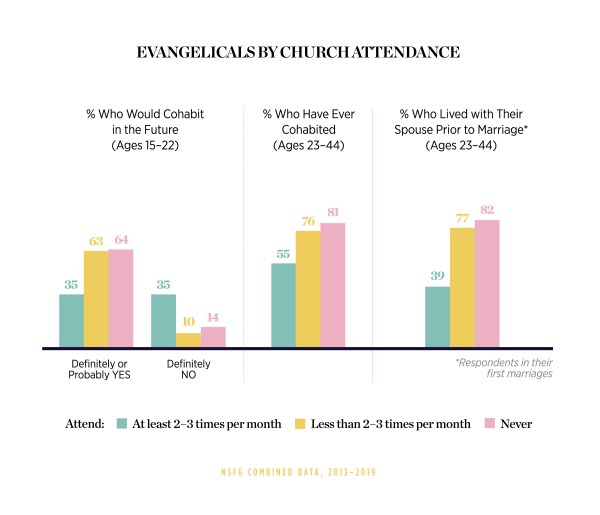
The idea of waiting until marriage comes across as even more antiquated in other studies. The most recent National Survey of Family Growth, done by the Centers for Disease Control and Prevention and completed in 2019, has found that 43 percent of evangelical Protestants ages 15 to 22 said they definitely or probably would cohabit in the future.

Only 24 percent said they definitely would not. Over two-thirds of those ages 29 to 49 had cohabited at least once. And 53 percent of evangelical Protestants currently in their first marriage cohabited with each other prior to being legally wed.

Evangelicals, especially those under 40, increasingly see cohabitation as morally acceptable. Most young evangelicals have engaged in it or expect to.

The coronavirus pandemic also seems to be increasing cohabitation, according to the Population Research Institute. As more couples than ever are likely to delay marriage, many are opting to move in together rather than be physically separated under the force of COVID-19 restrictions. There is no reason to believe that these pressures are not affecting evangelical singles.

Bill Henry is senior associate rector of St. Stephen’s Anglican Church, a fairly affluent congregation in Sewickley, Pennsylvania. He has counseled at least 75 engaged couples, many of whom “choose to live together and/or sleep together before they are married and do not know they are sinning or choose to ignore the fact,” he said.

Henry estimated that roughly half of the teens and young adults in his church are comfortable with cohabitation and that more than a third of older adult attendees feel this way.

Pastors’ experiences confronting cohabitation vary depending on the size and location of their churches, the strictness of their church’s membership and marriage requirements, and the degree to which they conduct weddings and premarital counseling for nonmembers. But all of the pastors I’ve interviewed on the subject agree that cohabitation has become normalized among evangelicals.

In his 20 years of ministry, Rich Herbster of Mt. Pleasant Church, a congregation outside of Pittsburgh in the Evangelical Presbyterian Church, has witnessed what social scientists have long seen as parallel trends: exploding cohabitation and declining marriage.

“In a time when our congregation has more than doubled in size, I receive only a quarter the wedding requests,” Herbster said. “Our millennials are simply not getting married at the same rate that was true a generation ago.”

There is some reason for hope. The cohabiting habit is less acute among those who are theologically conservative and attend church weekly. Even with shifting cultural attitudes, the studies show that evangelicals who attend church regularly or who regard their faith as very important to their daily lives are much less likely to plan on cohabiting or to actually do so. Church attendance and personal faith commitment make a huge difference.

Nate Devlin, senior pastor of Beverly Heights Presbyterian Church near Pittsburgh, notes that those who grew up at his church and marry there are usually not living together. “However,” he said, “friends and distant relatives of those from the congregation and those loosely associated with the church who inquire about being married at Beverly Heights are more often cohabitating prior to marriage.”

But even among evangelicals who believe cohabitation is wrong, few can articulate why. Gerald Dodds, pastor of Bethel Evangelical Presbyterian Church in Enon Valley, Pennsylvania, believes the majority of teens in his rural congregation would not be able to explain from Scripture why living together before marriage is wrong, despite his clear, conservative biblical teaching. “It just doesn’t seem to get through sometimes,” he said.

Erie First Assembly of God senior pastor Nichole Schreiber has counseled four evangelical couples in the past year alone who were engaged and cohabiting. Many no longer see cohabitation as being at odds with their faith, which she believes is due to a “lack of understanding” about why it’s a poor decision in light of biblical principles.

Robert Hall recently retired as co-pastor of The Bronx Household of Faith, a small Conservative Congregational church in New York City. He said that while few of the church’s young people would publicly break with its traditional stance on sex within the bounds of marriage, those who feel differently simply opt out of membership. In the South Bronx, cohabitation has long been the norm, and liberal beliefs about it regularly arise in the church’s outreach.

The church’s newest pastor, Jordan Roberts, grew up in the tight-knit congregation. “I would say that cohabitation among young adults actively participating in the life of the church has either been nil or kept very quiet,” he said. Yet for his peers who were raised in the church and made a break with it, cohabitation is fairly common, particularly when childrearing is involved.

Jay Slocum has ministered in Episcopalian and Anglican churches over the past 20 years, most recently at Jonah’s Call Anglican Church of Pittsburgh but also in Northern Virginia. Among teens and young adults, he’s observed that the majority of new Christians and “cultural” Christians—those he says were raised in the church but may attend infrequently—believe cohabitation is acceptable.

In his experience, even perhaps a third of Christians he would consider “committed” are cohabiting. Many of “these believers have a strong sense of the sinfulness of cohabitation but may be tempted to give in to the practical benefits of living together, especially in urban settings or when they are in entry-level jobs, since economics is a definite factor in all of this,” Slocum said.

For richer, for poorer

Practical considerations, expedience, and economic factors consistently arise as justifications for cohabitation. Henry, the pastor in Sewickley, interviewed eight premarital couples—three of whom were cohabiting—as part of research for his Doctor of Ministry degree. When he asked them why young people in their generation choose to live together, the term “convenience” was used seven times. But finances was by far the most common rationale, mentioned twice as much.

Churches must be sensitive that economic and practical pressures can make it genuinely difficult for cohabiting couples to separate until marriage. When I was an elder, my church encountered a situation where a repentant cohabiting couple were not only poor, but were raising children together. While willing to marry, they did not see how they could live apart until their premarital counseling and wedding were completed.

And such pressures aren’t limited to young couples. Dodds pointed out that many widowed and elderly people today want to be married but are afraid that “getting married would hurt their government benefits.” They see living together as their only alternative to being alone.

Jack Roberts also pastors at The Bronx House of Faith and has witnessed the threats that poorly designed social policies and high costs of living pose for older believers wishing to marry. A new attendee was interested in joining the church, but she had been living with a man for 15 years—even helping raise his grandchildren.

“Everyone considered them married,” Roberts said. The church told them they would need to be legally married to join the church. She was willing; her partner was not. “They were both receiving disability, and if they told Social Security they were now married, he feared their disability checks would decrease. Consequently, they did not get married, she did not become a member of the church, and in fact, stopped coming.”

To be sure, practical pressures can also push couples away from moving in together, rather than toward it. Some of Henry’s interviewees noted that they did not want to give up their independence, or that convenience and financial incentives led them to remain in separate domiciles. Family disapproval also mattered.

But for believers, issues of doctrine and commitment appear to take center stage. As one of Henry’s interviewees said about young people today who refrain from cohabitation, “I think the biggest reason why people would wait is because of their faith and their belief that that’s the right thing to do.”

Premarital preoccupations

What approach should churches take when cohabiting couples seek premarital counseling or want to book the sanctuary for their wedding ceremony? It’s a quandary for many pastors made messier by the fact that most cohabitation among evangelicals is not even “premarital” in the strict sense of the word.

Among evangelicals who had ever cohabited, only 47 percent of first cohabitations had resulted in marriage at the time surveys were conducted. Among evangelicals who were currently cohabiting, only 14 percent were engaged, and another 21 percent had definite plans to marry when they moved in together.

Of the 12 pastors I interviewed, only four were willing to proceed with premarital counseling and officiation for cohabiting couples who did not separate prior to marriage.

Henry’s church, while open to marrying non–church members, will not conduct weddings for cohabiting couples who, following counsel and instruction, do not separate and cease sexual activity until they are wed.

Their position on cohabitation is clearly stated. “We ask the question at the opening of the pre-marriage process, so unless they lie (which has happened), we know who lives together,” Henry said. He is comfortable with refusing marriage services when necessary even though this means that some choose to walk away from his church or from having him officiate at the wedding.

“I present the idea of ‘leave, cleave, one flesh’ as a guideline and God’s best,” he said. “That means move out, if they live together, until marriage, and stop sleeping together, if they’ve started to, until marriage.”

Devlin’s Pittsburgh-area church also insists that those living together must separate and stop having sex until they are married. He offers to help the couple manage their temporary separation and often encourages them to “greatly expedite the wedding date.”

Slocum recounts that one church he was involved with developed a premarital course and premarital covenant where the couple would agree to either move into separate rooms and not have sex, or to move into different housing.

“The benefit of this was that we had a concentrated number of couples go through a discipleship process where I literally taught them a pattern that included: chastity, then marriage, then buy a house, then make babies while loving the city through your vocational calling,” he said. “The average age of our church kept going down because couples kept getting married and having babies!”

Illustration by Matt Chinworth

Other pastors I interviewed ministered to couples and addressed cohabitation without requiring that they cease cohabiting.

Herbster, for example, recognizes that, despite the common preference among couples to “test” a relationship by living together before committing to marriage, there is no research suggesting premarital cohabitation reduces the risk of divorce. He tells couples there are plenty of “secular studies” that suggest the opposite. National Survey of Family Growth data, for one, shows that when evangelicals were interviewed, 45 percent of marriages that resulted from first cohabitations had already dissolved. But for evangelicals who had never cohabited, 79 percent of first marriages were still intact.

“If I decide to proceed with the marriage,” he told me, “I try to establish a relationship with the couple, guide them toward the best path toward their marriage, and hope to prayerfully work with them toward embracing a biblical vision for their life together.”

Churches that require cohabiting congregants to separate until marriage should consider the financial hardship that may ensue in such cases, especially if children are involved, or where elderly people would lose necessary income by legally marrying. This may mean speeding up the wedding date or helping one of the partners with temporary housing.

In situations that call for it, some evangelical pastors have even suggested offering a church wedding and vows but forgoing a legal marriage certificate. In the future, I am certain many evangelical churches will begin seriously looking at church marriages and wedding vows as solemnly binding as any, without any expectation of a state marriage license.

Pastors can also approach these dilemmas proactively. First, congregations cannot take for granted that worshipers—young or old—know and understand biblical teaching on sex outside of wedlock. Christians often hold to myths that help justify cohabitation, such as the need for a couple to “practice” living together to be successful.

Churches need to equip and train people not only regarding Christian doctrine, but also by passing on real experience and practical wisdom. This could look as simple as This is what God teaches about cohabitation and sex outside marriage morally and theologically, and here is the evidence that his way really is the best path to a happy, stable, vibrant marriage.

Real compassion lies in the path of empathetic truthfulness, not sympathetic lies.

Many of the pastors I interviewed practiced this by preaching through Scripture and not avoiding culturally difficult texts on sexuality. Others may use topical sermons, Sunday school classes, youth groups, or guest speakers.

Second, we need to approach each other with humility and integrity. Far more people in the pews have cohabited or engaged in premarital sex than we realize or care to admit. Maybe it’s time to be honest about it and help younger believers learn from our failures.

Younger generations are not more sinful than their parents’ or grandparents’ generations; they are simply facing different opportunities and pressures to self-gratify and self-justify. We should approach discipleship on sexuality laterally—coming alongside our brothers and sisters with encouragement and empathy, sinners helping other sinners to love and serve the Lord.

Third, as the data and my pastor interviewees made clear, believers who regularly join in worship and fellowship with the visible church do a lot better than casual attenders. Nutrients don’t reach organs that are cut off from the body’s blood supply. Similarly, when Christians by God’s grace choose to be deeply committed to their faith, they are more likely to “hear … and obey” God’s truth (Luke 11:28).

Most pastors and other church leaders already encourage daily exercise of the Christian faith and weekly church attendance, but many others are negligent to follow up with church members who become sporadic in their involvement. In cohabitation, as with every other area of sinful temptation, the basic disciplines of the Christian faith are necessary for growth.

Fourth, couples heading toward marriage often cohabit while saving money for a large wedding. I have seen this in my own extended family. This prioritizes a wedding celebration over the sanctity of marriage and obedience to God. There is no reason that couples cannot simply marry before moving in together and then save up for a larger marriage celebration later.

In a time in which same-sex marriage and gender identity have become the dominant sexuality issues dividing professing believers, it might seem like cohabitation is something evangelical pastors could afford to downplay, if not ignore, as at least one of my pastor interviewees suggested.

However, our God is not only merciful, long-suffering, and compassionate, but he is a just and holy God whose Word is perfect. We do not honor him by setting aside what we may view as “lesser sins.”

And for those experiencing gender confusion or same-sex attraction, ignoring certain sexual sins or temptations from the pulpit does not appear wise or kind; it appears hypocritical. If we ignore one, we have no grounds to denounce the other. If we call one to holiness, we must call the other. Real compassion lies in the path of empathetic truthfulness, not sympathetic lies.

How we approach cohabitation among believers in our pews can be a matter of healthy difference among those who agree on what the Bible teaches about sex and marriage. But we must address it. With compassion and wisdom, we can teach and apply God’s truth that only marriage is a legitimate ground for sexual union between a man and a woman, whether they live together or not.

David J. Ayers is professor of sociology at Grove City College. He is the author of the upcoming book Beyond the Revolution: Sex and the Single Evangelical (Lexham Press, 2021) and Christian Marriage: A Comprehensive Introduction (2019).

Reply All

Responses to our January/February issue.

Source Image: Garakta-Studio / Envato

When A Word Is Worth A Thousand Complaints (and When It Isn’t)

Thank you for being honest enough to look at the Bible through a lens of accuracy rather than inerrancy. Our Bible comes to us with a beautiful complexity that speaks of God’s power to use the tools of language, culture, and literature to speak to us and lead us to Jesus. We trivialize his great work when we do not embrace the alternatives and insights scholars bring to the reading of the Word. God’s Word was made to be meditated on, to be seen more deeply and richly with each reading and each new perspective.

Nancy LaChance Talking Rock, GA

Excavating Black Church History

One of my former students wrote a short essay for our local newspaper’s Black History Month Essay Contest about an early pastor from the Revolutionary War period, the Rev. Andrew Bryan, from his church, Silver Bluff Baptist Church in Silver Bluff, South Carolina. Several churches claim the distinction of being the first African American church in North America. Two are located in the Augusta, Georgia, area.

Julia Key Augusta, GA

Complementary Questions

I am a 94-year-old Christian woman and have been discouraged by the attitude that only men are qualified for many positions in the church. Our country church was started by neighborhood ladies in 1933 under the American Sunday School Union and was primarily served by women! Once we got a full-time pastor, suddenly we became incapable of things being done before.

Catherine Dunlap Corbett, OR

It did not go without notice that the Wayne Grudem who co-created the Danvers Statement is the very same man who edited the ESV Study Bible notes submitted by synoptic Gospel scholars to change their meaning. To Jo Dee I say, the sooner you find a congregation who treats women the way Jesus treated them, the better.

Kristen Pollock Muskegon, MI

The Pro-Life Project Has a Playbook: Racial Justice History

The BLM movement does offer some valuable insights on how to make life matter. The problem for the pro-life movement is that their victims are unborn and unnamed. Pro-lifers are left shaming people who are often caught in the crossfire of poverty, women’s rights, and social inequality. Abortion is never a good idea. Mainstream society seems to get this intuitively as rates are dropping. But what responsibility does society have to those who will try it anyway? Jesus told the lady caught in adultery, “Go and sin no more.” He was working at a more fundamental level so we could choose to surrender our hearts to him.

Anne Stairs Knowlton, Quebec

Are the 81 Percent Evangelicals?

I tire of being lumped into a “bloc” as a Trump supporter when in fact my vote is “pro-life,” “pro-constitution,” and the platform values of the Republican party. The fact that Donald Trump is the “figurehead” of that vote and party distresses me but does not change my vote to support those values and oppose the radical Democratic party platform.

Terry Major Martinsburg, WV

As a school subject, grammar won very few popularity contests. Equally unpopular is correcting a person’s grammar. But not with the word evangelical, where a small grammatical change makes a world of difference. As a Bible-believing follower of Christ, I’m fine with being known as an evangelical (adjective) Christian. But as an evangelical (noun)? Never! Bonnie Kristian deals primarily with the noun form, a label with both present and past political identity, to which many evangelical Christians are unwilling to connect.

Doug Snyder Hamilton, MT

Can We Do Better than the Enneagram?

Scientific support or discovery does not determine validity. I, too, was at first skeptical about the Enneagram until further study of the system revealed its uncanny ability to expose aspects of my personal identity that I had found difficult to articulate to myself and others. Perhaps the system does not lend itself to scientific deconstruction in the conventional methods of Freud and Jung precisely because it is relational and complex, a reflection of the fractals of human beings made in the imago Dei.

Mary Martinez-Tuttle Miami, FL

As a model of individual differences, the enneagram doesn’t merely lack supporting evidence; the available evidence disconfirms it. One therapist who uses an enneagram assessment described the model to me as “a useful fiction, just like any theory.” That struck me as a creative rationalization, because all theories are not created equal. They must always be judged on how well they are supported by evidence; that’s the most basic principle of science, one of God’s essential gifts for seekers of truth not directly addressed in Scripture.

Bryan J. Dik Fort Collins, CO

Our Attraction to Idols Remains the Same, Even When the Names Change

Indeed, Christians can stand on solid biblical grounds for choosing to both pray for and against practices and policies of those in the political arena.

Doug Bennett Charlotte, NC

Theology

How a Mother’s Love Built a School that Can Transform Hearts and Brains

Jacob’s Ladder challenges special education norms thanks to Amy O’Dell’s relentless belief in her son.

Photo by Mathew Odom

What happens when the best of science is sandwiched by the best of love?

This is the question that Jacob’s Ladder school has been answering for 27 years as it has helped guide more than 4,000 children with neurobiological disorders toward hope and a future.

Amy O’Dell founded the school in Roswell, Georgia, as a way of making a better life for her youngest child. Jacob had been “born with such a sweet and beautiful spirit, but such a broken body and mind,” she says. Pervasive developmental delay was the diagnosis, a life sentence handed down with piles of documents at once condemning and disaggregated.

“I was told to adjust to the reality of the disability and to try to get pregnant again and hope for a ‘better child,’” she recalled. “It’s still really painful to remember those words.” Where medical experts declared little hope for any kind of change in her son, Amy saw a soul fighting to be seen.

“There was something in his eyes,” she says. “I couldn’t let it go.”

Amy had learned in the years before Jacob’s birth never to give up on a person deemed a lost cause by the accepted systems. She had worked in both adolescent and adult psychiatric care at Woodridge Hospital in Clayton, Georgia, using her degrees in activity therapy and counseling.

But home life was becoming a struggle, as her husband’s job was bringing in an annual income of just $3,000, and she, only able to work part time, wasn’t adding much more. They were borrowing more and more from Amy’s parents while credit card debt compounded. Meanwhile, Jacob’s needs were demanding more attention, and rural Appalachia didn’t have the infrastructure she felt he needed.

Things came to a head one day when Amy dropped off 15-month-old Jacob at a daycare center. As she paused outside the window, she watched as he struggled to hold himself upright. Each time Jacob turned his head upon being released by a caregiver, he toppled over.

Something twisted inside Amy. She watched as the workers moved on and Jacob ceased crying. Perhaps, she suspected, Jacob had decided that if his mother was leaving him, and the cry didn’t work, he was going to sit and be quiet until she came back. “He’d gone into a shell,” she says, shuddering at the memory.

She turned around and picked Jacob up then and there. Placing him on her hip and leaving, Amy drove to Woodridge and quit her job. She then dedicated herself to figuring out how to care for Jacob—pursuing certification in neurodevelopmental growth and intervention, studying programs around the country, working with Jacob eight hours a day, and reading all she could about brain injury and rehabilitation.

When Jacob was five, Amy and her husband decided they could no longer keep their marriage together, and with that finality, she moved with Jacob and his younger sister to Atlanta. Amy knew no one in the big city; she just sensed that hope for her son could be built here.

“I just remember waking up one day and saying, ‘No more. No more information. It’s not going to be information that changes my son’s life. It’s going to be me picking a path and then giving myself to it fully.’”

Amy with her son, JacobPhoto by Mathew Odom
Amy with her son, Jacob

Love is a method

“Who was I to do a seminar on anything?” Amy says, chuckling at the memory of her early chutzpah as a stranger in Atlanta. “But I hung up some flyers, and people came.”

Amy had decided to offer free seminars at night for families who had kids with special needs. One of the first parents who attended was a wealthy real estate investor. After asking Amy if she could work with his daughter, he gave her an empty nail salon at a shopping center and helped her re-furnish the space. She continued offering the free seminars, but as more families participated, she decided to start charging for evaluations.

These evaluations were novel at the time, pairing an intensive interview with a quantitative electroencephalogram (qEEG) brain scan. Using a noninvasive cap on the patient’s head, the scan maps the brain by measuring electrical activity in the form of brainwave patterns associated with impulsivity, cognitive inflexibility, anxiety, and other symptoms. Using this data, Amy could design custom programming.

Each case was unique. One family thought their son was blind and deaf, only to learn through Amy’s evaluation that he was dealing with a cortical deficiency, which the brain could be trained to overcome. Other kids would come in wheelchairs, unable to walk. Amy would focus heavily on mobility, encouraging at least six hours a day out of the wheelchair, and for many, a new mental map would form.

“In the early years,” Amy says, “no scientist thought I should be running something like this.” Amy didn’t have the right credentials or a PhD. She hadn’t prepped her hands-on work by spending years in a lab. “The common refrain from the experts was, ‘Wait, you?’”

It was the 1990s, and the reigning neuroscience was cautious about the capacity of compromised brains to grow new pathways. Attachment theory—the idea that a secure relationship with a loving authority figure was the necessary basis for healthy development and eventual individuation—was just beginning to be explored as not only psychological in orientation, but possibly physical too.

Amy wanted to explore the possibility that love might not simply be a posture but could define an entire methodology. When paired with recent discoveries in neuroplasticity—the ability of brains to form and reorganize synaptic connections after a traumatic experience or physical injury—could love make the difference between surviving and thriving?

Parents found something hopeful in a leader who believed their children had the capacity to change. Word began spreading that Amy was a different kind of neurodevelopmental clinician, and soon a few children became dozens, and dozens became hundreds.

Amy’s fees became her salary, with a growing surplus that enabled her to hire her first three employees. Jacob’s Ladder hung up its sign in 1999.

When paired with recent discoveries in neuroplasticity, could love make the difference between surviving and thriving?

“We do two trainings for staff at Jacob’s Ladder,” Amy says. “Training in the hope, truth, and love methodology, and training in the science methodology. When you apply both, and you do so very consistently, the brain responds and stretches into new terrain.”

The name Jacob’s Ladder reflects this philosophy. While it honors the inspiration of her son, as well as Amy’s identification with the story of Jacob wrestling with God, there is also a notion of steps, of linkages built one on the next to heal neural connections in the brain. Amy doesn’t believe in dead ends, not for children, not for the human brain.

“Our ethos has always been, ‘Let’s just meet each child where he or she is at, right here, right now, and not worry about 20 years in the future,’” Amy says. “When the child gains that momentum, and covers that ground, [our task is] to be acutely aware of the next step.”

The interpersonal whole-brain approach

With a curriculum customized to each child and a 1.6-to-1 teacher-to-student ratio, Jacob’s Ladder welcomes those with conditions as varied as autism, Down syndrome, attention deficit disorder, anxiety disorder, oppositional defiant disorder, traumatic brain injury, cerebral palsy, and bipolar disorders, among others.

“We promise families that their child will have a very specialized approach to their learning and developmental needs,” Amy says. “But each carefully designed day will be wrapped within the constants of heavy psychological safety, security, relationship, compassion, and unconditional positive regard, no matter how difficult someone’s behavior becomes.”

Kids arrive to teachers wearing “Choose Love” shirts and are ushered into one of three learning environments: the Ladder, which serves students needing intensive one-on-one care; The Hope School for students with emotional, behavioral, and relational challenges; or COMPASS, which works with young adults in need of job training and community-based instruction. Bolstering the three pods are various licensed specialists: occupational, physical, speech, and mental health counselors, as well as a consulting clinical psychologist who specializes in neurofeedback and brain mapping.

“We don’t waste a moment of a child’s day,” Amy says. “We take every opportunity we can to integrate each lesson with one another—from their language base to their relational skills to their conflict resolution skills to their self-regulation skills when stress hits them. It may look like this fast-moving river to the visitor, but it’s all very intentional.” Children are taught to be growers and nurturers, tending to gardens, raising goats. Outdoor play happens daily.

“I was skeptical at first,” says Rachel Pereira, “and then I saw the school.” Her son had been physically abused to the point of suffocation by a teacher in kindergarten. As he would lose self-restraint and increasingly lash out in violence as he grew, his elementary school years were, in Rachel’s words, “a nightmare.” She and her husband felt they had no choice but to confine him at home.

At their wits’ end when their son was ten, the couple was told about an “oasis of angels” not four miles from their house.

“You feel the love as soon as you walk on campus,” Rachel says of what is now a 13-acre property complete with butterflies, birds, walking paths, and gardens. “My son wanted to be a normal kid, but he simply couldn’t. Amy told me that Jacob’s Ladder was never going to give up on him, and I decided to believe her.”

After a first few tough months, Rachel’s son ceased having fits and breakouts. Amy’s own son Jacob—then 26 and a teacher at the school—built a trusted bond with him. “It’s a miracle,” Rachel says. “The school is a godsend.”

An invisible yet fierce circle of norms protects the Jacob’s Ladder experience. Phones and iPads are nowhere to be seen. Staff work to leave behind their life stresses on their commutes in.

“We expect our staff to learn what it means to be a vessel and pour into another human being, whatever the self-sacrifice,” Amy says. “We may not hit it every day all day, but just trying to do it daily makes a difference.”

Students are respected as those who pick up on the smallest signals of mental presence or absence. Regardless of neural condition, Amy believes, human beings intuitively know when they are treasured and when they are a burden.

“In the early years,” Amy says, “when I was working with Jacob, it quickly became clear that as much as I gave of my own thought and energy to the moment, that’s the amount he received. If I was trying to teach him to read the alphabet, he would learn the letters if I was 100 percent with him. But if I got distracted and would start thinking about my grocery shopping list … I could be physically right there, turned towards him, same everything on the outside, but he would falter.”

The school’s success with each student depends on many factors: the severity of the child’s condition, the child’s age, and the family’s degree of support toward the efforts. For some parents, a child just learning to use a hand that couldn’t be used before could be a giant gift of hope.

“When you undertake this work diligently, consistently, and with integrity, you will always see growth and change,” Amy says. “It could be slow and in very small ways for one child, and quick and dramatic for another.”

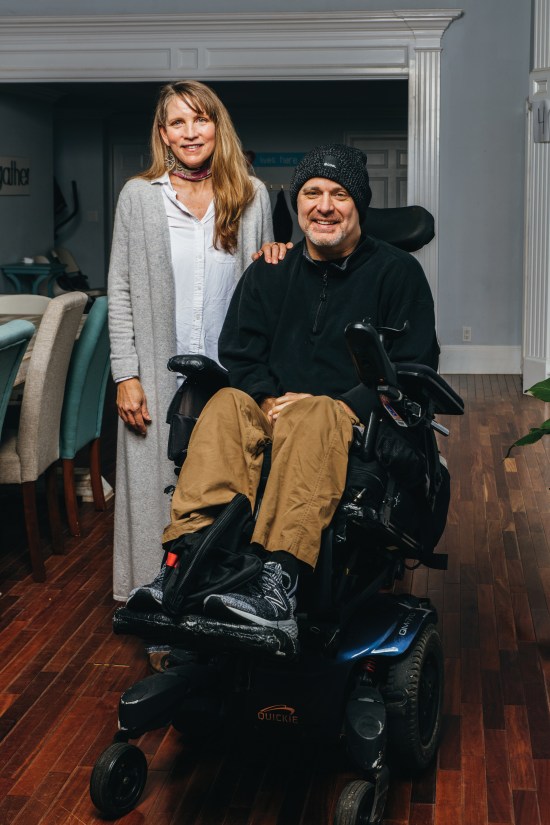
Amy O'Dell and Ross MasonPhoto by Mathew Odom
Amy O’Dell and Ross Mason

The power of naming

Chris Hatcher and his wife had tried everything for their son: public school, private school, therapeutic programs, homeschooling. The boy had also experienced trauma early in his elementary education, and he now dealt with ADHD, emotional dysregulation issues, dyslexia, and more. He was breaking pencils, dumping desks over, threatening other students, and in one fourth-grade year was restrained 27 times.

A consulting firm mentioned The Hope School at Jacob’s Ladder. Chris looked at the website and read, “kids with complex problems … conduct disorder … high-functioning autism …” “It described our kid,” Chris says. He took the 11-year-old in for an assessment.

“From the brain scan, we learned that the fear center was all lit up in his brain, shutting down the speech center,” Chris says. “We learned that when he’s under a lot of stress, he goes quiet and can’t communicate.” Rife fear, it turns out, was drowning out the healthy development of other neural pathways.

This identification was a comfort all on its own. “Then Amy and her colleagues went through a very thorough set of questions to find out who at the school would be the right people for [him], customizing a program specifically to him,” Chris says. They learned that he liked to work with his hands, so they assigned him to help with maintenance on campus.

Two years after entering the program at a first-grade reading level, he’s catapulted to a seventh-grade level. He’s also in better control of his emotions when stresses occur. “We have seen his toolbox grow greatly for how he can deal with things,” Chris says. “Particularly the emotional dysregulation—the stuff that used to be explosive is just not there anymore.”

“I think other schools had an understanding of what we were going through,” Chris says, “but they still had their program, their way of doing things. And the one thing we always came back to was that they couldn’t handle the behavior. Jacob’s Ladder can handle the behavior.” All staff who work with kids with severe track records are trained and certified in crisis intervention, and the school keeps strict safety protocols.

But equally noteworthy? “Amy always tells us, ‘You’re the parents, you understand your child better than anyone,’” Chris says. “That is something that you rarely hear.”

Can love scale?

As success stories have multiplied and Amy’s public credibility has grown, so has demand from parents outside Atlanta to take the methodology global. As happened to many, the COVID-19 pandemic forced Amy to experiment with different ways of packaging the methodology for national—even international—use.

“Growth is always painful. I’m needing to learn how to delegate and how to trust others in new ways,” Amy says. “But the call is clear: I need to take 27 years of work and create a training platform.”

But can something so high-touch and communal in nature go global without losing its distinctive magic?

One figure in the Atlanta health tech scene thinks so.

Ross Mason has been a serial entrepreneur, a civic leader, and a triathlete. In 2007, he had a vision to make Atlanta the Silicon Valley of health, to inject market excellence and incentives into a system he thought was too self-satisfied. He founded HINRI (the High Impact Network of Responsible Innovators), a venture philanthropy group that “mirrors how angel investors help entrepreneurs build companies that can scale effectively and reduce risk for investors and donors,” according to its website.

Around this time, Ross and Amy met up for lunch. They had gone to Sunday school together while growing up in Madison, Georgia. Ross found in Amy exactly the sort of social entrepreneur HINRI existed to help. The two of them pledged to collaborate when, just weeks later, Ross’s life took a dramatic turn.

He was biking his normal training route when a bee snuck inside his helmet. As he tried to swat it out, he swerved sharply. He crashed, breaking his neck and enduring a C6 spinal cord injury.

Amy visited Ross many times in the hospital, praying with him and accompanying him through terrain she knew from her own journey. Their friendship blossomed, and in 2010, Ross began to approach foundations to launch the first capital campaign for Jacob’s Ladder. He put together a formal board of directors that he would chair.

Ross’s experience convinced him that health care experts exclude all but a narrow range of credentials tied to industry and prestige. Amy, by contrast, embodies qualities Ross believes could turn American health care around: personalism, holistic paradigms, praxis before theory, no shortcuts.

“Amy is focused on ‘What does this child need?’ Not, ‘How do you fit into the research paper that I just wrote?’” Ross says. “She’s the kindest person you’ll ever meet, but she threatens the status quo.”

Ross is challenging Amy to put her methodology online and make it open source. He wants to turn the center in Roswell into “a mothership training center”—like a demonstration city—which would spawn replicas in Geneva, Jerusalem, San Francisco, and elsewhere. He wants, in short, to change the way the world treats human potential.

Eternity begins in the proximate

“As truth is revealed in the day-to-day moments of life,” Amy says, “and in the interchanges and relationships that surround me, I’m always awestruck at how the grace of God works.”

This attitude is not for lack of suffering.

“One of the greatest gifts about having Jacob was that it completely crushed the illusion that I have control in my life. … I was completely brought to my knees in the midst of that fear to see that, for me and my life personally, it was an opening to knowing there is a power much greater than myself that I can rely on. So rather than seeing my fear, I put the fear into action, and the action is called love.”

That love has worked itself out through steps, one at a time, in brains, hearts, and households. “Families will come in so despairing,” Amy says, “and by the time they leave, they are just so thankful that someone is believing in their child.” She coaches parents in principles of truth-telling, choosing joy, focusing on a child’s strengths, and, to borrow from Eugene Peterson, a long obedience in the same direction.

“This is the story God gave me,” Amy says. “He authored it, and I’ve done my best to walk it out.”

Anne Snyder is the editor in chief of Comment, the founding editor of Breaking Ground, and host of the podcast The Whole Person Revolution.

Cover Story

Christian Singles Aren’t Waiting for Marriage to Become Parents

As more unmarried women and men foster and adopt, how can the church provide what some nontraditional families cannot?

Illustration by Pete Ryan

Heather Creed grew up in suburban Indiana and attended Taylor University, expecting her life trajectory to be similar to that of many of her friends. “I always thought I would marry and have seven kids and be a stay-at-home, homeschool mom,” Creed said. “That’s clearly not what happened.”

Creed, 45, is now an attorney who settled in Columbus, Ohio, after stints in Waco, Texas, and New York City. Her family isn’t the traditional midwestern one of her childhood. She never married. But that didn’t stop her from adopting two boys and recently becoming licensed, for the second time, to foster children in her home.

Andy Jackson, 33, was single when he started fostering a decade ago while working as a special education teacher in Pell City, Alabama. He adopted his first child when he was 23 and went on to adopt two more children, one with special needs.

Now married, he and his wife have eight children—including a toddler they are in the process of adopting together, three biological children from his wife’s previous marriage, and one she adopted with her deceased husband. Collectively, they estimate, they have fostered more than 50 children through foster and respite care.

Angelle Jones, 64, was one of the first in her community to foster or adopt when she took in a five-year-old girl in Cincinnati in 1978. She was 21 then and hadn’t met another single African American adoptive parent like her—or even a black couple who had adopted from an agency. (Kinship adoption was more common, she said.) More recently, she’s had multiple conversations with single women around her who are considering adoption.

While adoption and orphan care have long been core causes for evangelicals, they have largely had the nuclear family at their center. In his 2010 case for “Why Every Christian Is Called to Support Adoption,” Russell Moore wrote in CT that “the fatherhood of God is better understood in a culture where children know what it means to say ‘Daddy’ and ‘Mommy.’”

Creed, Jackson, and Jones represent a small but significant number of Christian women and men pursuing foster care and adoption while single. Like other single parents, these single parents by choice often face immense financial and lifestyle challenges. But in evangelical churches, such parents also have to swim against the current of long-held norms around family.

As many Christians remain single longer and later, however, advocates say that singles who foster and adopt are finding increased acceptance and support among their fellow conservative Christians.

Singles—mostly women—accounted for nearly 30 percent of all public adoptions in 2019, taking in more than 19,000 children. The Department of Health and Human Services doesn’t track adoptive parents by religion and doesn’t distinguish between never-married and divorced individuals, but limited data from the National Survey of Family Growth shows that unmarried evangelical and nonevangelical women express similar levels of interest in adopting.

Jedd Medefind, president of the advocacy and support group Christian Alliance for Orphans (CAFO), said he has seen singles involved in foster care and adoption throughout his career, but he’s noticed it a lot more in the past five to seven years, as foster care and adoption in general have surged in the church.

“It’s been a steady increase in both interest and engagement by singles in every facet of working with vulnerable children—foster care, adoption, mentoring,” Medefind said. “There is a desire to live out God’s call in practical ways, for their faith to not just be theoretical but to serve in hands-on ways.”

Atlanta’s North Point Community Church is one place where that desire is evident. More than 100 families are involved in its Fostering Together ministry, which supports foster and adoptive families across the multisite church’s seven locations. At the Buckhead campus alone, nearly half of the 13 families with foster children are parented by single adults.

Alison Feyereisen, who helps lead the ministry, hasn’t seen any recent surge in singles taking in children, but she has noticed that “the church seems to be more welcoming and supporting it better than [in] years before.” Fostering Together aims to bolster that support—for singles and couples—by providing both adults and children with what Feyereisen calls “wraparound care” that is holistic and practical and by engaging in churchwide activism and prayer.

“Psalm 68 says that God puts the lonely in families. And that’s not primarily just talking about a biological nuclear family; it’s talking about the people of God,” said pastor and The Gospel Coalition editor Sam Allberry in a TGC video in early 2019. “A single person may be thinking, ‘I’m just a mum or just a dad and I can’t do the role of both parents,’ but actually, with the support of a wider church family, that child should be growing up in a very, very healthy family context. I think it’s a great thing for singles to adopt.”

Helping singles who are already caring for vulnerable children seems like a natural role for churches. But how much they should encourage singles to pursue foster care—and especially adoption—is far less clear.

Historically, married couples have been upheld as the ideal family model, including for foster care and adoption. The Child Welfare League of America standardized its commitment in 1958, stating that adoptive families should include both a mother and a father. Efforts to recruit single adults to adopt began in the 1960s, according to the University of Oregon’s Adoption History Project, when the Los Angeles Bureau of Adoptions tapped single African Americans to help place black children.

The church, in particular, has had a “high view of the nuclear family and a hesitancy about intentionally forming families that are something other than a traditional, two-parent home,” according to Jonathan Reid, the founder of Fostering Hope, a New England–based group that supports local churches in foster care and adoption.

Steve Roach, the executive director of Catholic Charities of Springfield, Illinois, told The Heritage Foundation in 2018 that “our preference for non-relative foster placements was with married couples to give children the opportunity for a mother and a father figure in their lives. We would work with single parents as long as they were not cohabitating with another adult.”

“There is no perfect family, but there can be a ‘just right fit.’” – Cheri Williams, Bethany Christian Services

While most states allow for adoption by an unmarried person, in Arizona and Utah, married couples are explicitly preferred over single-parent households. Individual agencies have their own preferences, which often stem from religious objections to cohabiting or same-sex parenting and have been challenged in court. Policies at some faith-based agencies that prohibit placement with LGBT couples, for instance, are at the center of a case currently before the Supreme Court.

Many studies have shown detrimental effects on children who grow up in single-parent households instead of two-parent households. And children who are adopted or fostered are more likely to struggle socially, emotionally, and academically, said sociologist and National Marriage Project director W. Bradford Wilcox.

“Single parents and single mothers may struggle with the challenges of raising a kid in foster care without having a second parent to support them and support the child,” he said.

In some situations, that could be dangerous, he said, putting the parent, the child, or both at risk. Foster children especially are already in a difficult situation, and Wilcox believes that in most cases, agencies should prioritize placements with married, two-parent households for the sake of stability and support for the children.

But for singles like Clarise Cannings, running up against the traditional agency preference for married parents can feel like a personal rejection. The 42-year-old originally applied to a private Christian agency when she was pursuing foster care in Bowie, Maryland.

“They were looking for a certain type of person to be an adoptive parent,” she said. When the agency found out that she was single and worked full-time (even though she worked from home and her company was supportive of foster care), Cannings said they told her they “have moms we use.”

“It hurt a lot,” she said. “Maybe they didn’t think I was motherly enough.”

That agency referred Cannings to a public agency, and she has since fostered eight different children from newborn to 19 years old over the past two years. The only time she declined a placement was when the agency asked if she could take both a one-year-old and a three-year-old. Despite her desire, she felt that wasn’t wise as a single person.

“I had a yearning to be a mother. I recognized that there were children who need a mother. The Lord allowed me to have these rooms, this space, and allowed me to have room in my heart,” she said.

Advocates like Reid think evangelical attitudes toward single parenting by choice are shifting. One reason could be reduced stigma toward single parenting generally, given the prevalence of divorce within the church and the desire among Christians to support mothers who otherwise might choose an abortion, said R. Marie Griffith, a professor of humanities at Washington University in St. Louis who has studied trends among evangelical women.

Marriage rates, too, are declining inside and outside the church, leaving more single women childless. Reid, who said his own views on the issue have evolved, noted that singles have other entry points beyond fostering and adoption: There is respite care (a trained position to aid foster families), or working with emergency placements that are as temporary as a day or a weekend.

“Is it ideal for a kid to be in foster care with two parents? Yes, of course,” Reid said. But there are so many kids and the need is so urgent that there is “absolutely a place” for singles to provide direct care for at-risk children.

For a child coming from an unstable background, living with just one stable parent can be a huge improvement. And in some cases, singleness can be an advantage: Children with a history of sexual or physical abuse, refugee children, or teen boys with a violent history toward men (for instance, protecting their mother from her batterer) might benefit from placement with a single woman, said Cheri Williams, who oversees Bethany Christian Services’ domestic programs.

“There’s the myth of the perfect family or stay-at-home mom,” Williams said. “There is no perfect family, but there can be a ‘just right fit.’ You’re not meeting family’s needs; you’re meeting the kid’s needs.”

Bethany estimates that about 20 percent of its foster parents are unmarried. The agency saw a 3 percent increase in single foster parents from 2019 to 2020, according to a spokesperson. There are more than 400,000 children in foster care nationwide, with 120,000 of them eligible for adoption right now.

In March, Bethany announced it would allow LGBT couples to foster and adopt nationwide, in a move to be inclusive toward different arrangements of parents (it was already allowing such foster placements in some states).

Williams’s team watches for certain red flags when they consider placements with single people. They try to weed out those who may be motivated by the financial “benefits” of foster care (which is a myth, Williams added) or by overly strong maternal instincts, which she calls the “motherhood motivation.”

Single parenting by choice is a calling. It’s not for people who simply want to “experience having kids,” said Robin Gerardi, head of WeFoster, a ministry of First Baptist Church Woodstock in Georgia. WeFoster provides extra support for single foster moms—who make up 12 of the 60 foster families at the church—including laundry services, handyman volunteers, and meal trains when a family receives a placement.

Illustration by Pete Ryan

“We’ve proven that single moms are some of our best foster moms. They get it, they focus on the kids,” Gerardi said.

Heather Creed agrees. “I don’t have to worry about the health of my marriage and myself and my husband and any biological children,” she said. “I can give so much more focus to the healing and restoration of the child.”

Still, like Gerardi, Creed cautions those in particular who want to adopt simply out of a parental desire to have kids. “There are a whole lot of issues that will emerge from that,” she said.

Cristen Simcox, 31, also believes that singles don’t have to adopt. There’s a waiting list for adoption, she said, but not for foster care and “in the gap” care.

Simcox felt led to foster while a pediatric emergency room nurse in Temple, Texas, after seeing the awful circumstances her young patients faced. She and a friend—also a single Christian and an ER nurse—had wanted to house children in need but felt their unpredictable schedules would make it too difficult.

“Logistically, neither of us could do it alone, but maybe we could together,” she said. So, they moved in together. Though their parenting styles were different, Simcox said, they were able to support each other and lean on the wraparound care of their community.

“I really wanted to show [the kids] the love that God has for them for whatever period I had with them in my home.” Simcox ultimately adopted her first two placements before meeting her future husband, Stephen. They met on a dating app, and she wasn’t able to hide the fact that she was a single mom.

“I had baby clothes in a bag on our first date,” Simcox said. “So, I told him right away. He was surprised but was attracted to my heart for the Lord.”

With widespread evangelical enthusiasm for adoption and foster care, it can be easy to forget those institutions only exist because of widespread brokenness.

In some ways, singles are catching the sharpest pieces when families and communities break.

Health and Human Services data shows that, in public adoptions nationally, singles have been more likely than married couples to adopt children with special needs. It’s difficult to know exactly what this means, since many adoptions happen privately and each situation is unique. But it suggests that often, “single parents offer families of last resort for desperate children who have no other choices,” according to the authors of the Adoption History Project.

Creed, a white woman, feels she has stepped into the pain of broken families in new ways as she parents 13- and 5-year-old fatherless black boys. It’s part of the reason she moved to New York City from Texas.

“I will never understand what it means to be black, a black man, adopted, and raised by a single mom. But they both do, and they have each other,” she said. “It wasn’t their choice; they didn’t have any say whether they were going to be raised by a single mom.”

While her church is very supportive and several men there are good role models for her boys, Creed realizes they can never fully substitute for a father.

“It’s not how it’s supposed to be,” she said. “I don’t think that makes [adoption as a single person] wrong, and certainly not sinful, but I think it’s a result of brokenness.”

Angelle Jones was raised without the picture-perfect nuclear family, and she didn’t see that as a barrier to her own desire to provide a home for children.

“I grew up with a single mom. She made it look easy. I realize in my community and context there were more single parents than married. It was a norm for me,” said Jones, who never married and who adopted her daughter in 1984 after two years of fostering. Sixteen years later, she also raised her granddaughter. “For years I didn’t meet any single African American women who adopted.”

Now, she is having more conversations with unmarried women in their 40s who are considering adoption, but she doesn’t necessarily recommend it to them. It’s hard, she says, and foster care may be the better route as a single person. But she recognizes the benefit: She learned deep sacrifice and found a “level of love that single women who never marry and never have children have the opportunity to experience.”

While many singles say that fostering and adopting are isolating experiences, others have found a wider network. There are global or national communities on social media, such as the 5,000-member “Single Foster Mommas” Facebook group. “Please remember that we are looking for women who are unmarried and doing this without a spouse,” wrote the administrators in the group’s description.

But Christian community is harder to find. Singles who might already feel overlooked in the church can feel even more like outsiders when they begin foster care, said CAFO’s national director for church initiatives Jason Johnson. The feeling of not belonging can be “compounded with singles,” he said.

In some ways, singles are catching the sharpest pieces when families and communities break.

Many men and women interviewed by CT mentioned that around the same time that they started considering taking children into their homes, they had changed churches to find a more supportive community.

Jillian Hazel, 33, is a preschool teacher and has fostered children of all ages over the past two years from her home in Tulsa. At-risk children have always been a big part of her life through professional and volunteer engagements. But fostering a different child every few months “felt like whiplash,” she said. She has at times struggled to find her place in her church’s social structure as an unmarried working woman, parenting kids in constantly changing stages.

“My church is incredible. They do trauma-informed care, and even still I feel like people don’t know how to think of me,” Hazel said. With her current placement, a 13-year-old girl, she gets together with families that have older children. But she socialized with different families when she housed a two-year-old boy.

This year, during the pandemic, caring for a child “who is experiencing the effects of trauma, isolation, and puberty has made this the hardest year of my life so far,” she said. No one else is there to help her, to take the child for a minute while she does chores. Although she worked through the desire to be married before fostering, she said, she felt the weight of her singleness again while fostering. But she has learned to lean on the sufficiency of Christ.

“When I come up against the fact of my own weakness as one person to be everything they need in a parent, I remember that I can trust myself and them to his hands,” she said. She recalled rocking her two-year-old to sleep, singing his favorite worship song: “King of My Heart.”

“As I rocked him to sleep, overwhelmed with the children’s needs and my own fears and inadequacy, the words I was singing were, ‘[You’re] never gonna let me down. You are good, good.’”

Despite the unprecedented challenges of parenting during the COVID-19 pandemic, the numbers of families interested in foster care and adoption have actually increased. Bethany saw a 55 percent jump in families expressing interest.

Sarah Cruz is one of them. Spending time in quarantine during 2020 crystallized her desire to adopt. Never married at 41, Cruz had chewed on the idea for 10 years but now has begun fundraising and working with an adoption consultant—someone to walk her through the process. It was not an easy decision.

“The scriptural command to care for widows and orphans is very clear, but I believe it’s ideal for a child to have a mom and a dad, so I never considered being a single parent,” said Cruz, who is also the creative director for Saddleback Church in Southern California.

For Cruz, as for many people, quarantine exacerbated feelings that singles like her don’t have much support in the church in general, let alone if they are considering adoption. “Single people struggle to find their place since the church is built a lot around the nuclear family,” she said.

Only after starting her process did she learn of other single people involved in foster care and adoption at her church. “While I feel like I intellectually know there’s support for adoptive parents, I have yet to know how much support there will be for me,” she said.

Cruz wrestles with plenty of questions: Am I just adopting because I want to force God’s hand? Do I just want to move into the next chapter? Is it okay to start a family while you’re single? Is this really God’s will?

“There’s a big gap in conversation in the church that I know, for myself, I’m having to sort through it by myself and I don’t have the answers,” Cruz said. “I trust, as I move forward in this, that God will continue to lead me and guide me.”

Move forward she will. Cruz was recently matched with a birth mom. Her little girl is due in April.

Kara Bettis is associate features editor for Christianity Today.

Ideas

The Digital Devil Looks to Devour

Staff Editor

Scripture and sermon can hardly compete with the charms (‘prelest’) of cable news and Twitter.

Illustration by Rick Szuecs / Source image: Envato

The Eastern Orthodox have a word, prelest, a transliteration from Russian, where in common use means something like charm. In the Orthodox Church, however, prelest has a darker denotation. It’s a kind of spiritual delusion, the “wounding of human nature by falsehood,” using the phrase of the 19th-century Russian monk and theologian Ignatius Brianchaninov.

“All of us are subject to spiritual deception” in a general sense, Brianchaninov taught, when we do not have the truth of Christ (John 14:6). But prelest as spiritual delusion can have a narrower meaning, too: a more specific delusion in which we actively embrace falsehoods, including ones about our own spiritual state.

Orthodox teaching warns that the Devil, the “father of lies” (John 8:44), works to draw us into prelest. (The demons in C. S. Lewis’s Screwtape Letters practice exactly this, pushing their human subject toward delusion about himself, his politics, his church, and anything and everything else.) Also closely linked to prelest is the vice of vainglory, the disordered desire for the approval of others, especially when no such approval is merited. Prelest has us believe something not good is good.

The Devil can fool us into forgetting that our political opponents are beloved of God too.

Isn’t that an apt description of how our use of political media, especially social media, affects us? How it has us believing lies? How it deceives us about ourselves and our neighbors? How it invites us into vainglory and distracts us from tasks of loving God and others? How it degrades our attention spans, incites our fears, escalates our (not always righteous) angers, and pulls us into delusion? How it can fool us into forgetting that our political opponents are beloved of God too?

The “devil makes every effort to keep [us in our] former subjection,” Brianchaninov said, by using “his primordial and customary weapon—falsehood.” The sheer quantity of content available to us today, and the deep appeal of its habitual consumption, give the Devil’s quiver a constant supply of arrows.

I regularly run across comments from pastors who say, “I’m doing my best to disciple my congregation, but I just can’t compete with Facebook and Fox News. I get one hour a week, and media gets 20. If it’s Scripture and pulpit versus screen, the screen wins.” Whether Facebook and Fox News, Twitter and MSNBC, YouTube and One America News, or Instagram and CNN, each pair possesses the same deliberately immersive, habitual, and titillating design.

There’s data to back up these anecdotes in survey research from political scientist (and CT contributor) Ryan Burge. He’s found a significant and growing divide between American evangelical leaders “and the millions of white evangelicals who occupy pews on a typical Sunday morning all over the United States.” On some key political issues, as well as bigger-picture perspectives on how to engage in politics, Burge writes, “the views of those in the pews are out of step with those in the pulpit.”

Note that “those in the pews” are still in the pews. This isn’t about leaving the faith or skipping church to go browse Facebook. But the disproportionate amount of time accorded to each activity is enormously consequential. What we think and talk about shapes who we become (Matt. 15:10–11). Attention and conversation are integral to discipleship (2 Cor. 10:5). I am increasingly convinced the sheer availability of content (particularly political content designed to inflame our worst passions) may be the most unprecedented challenge in Christian discipleship today.

It’s certainly a challenge I see in my own life. I’ve never felt the appeal of cable news, but my entire job (and, during the COVID-19 pandemic, much of my social life) is screen-bound. I’ve broken my Facebook habit, but political Twitter use is an occupational hazard in journalism. And so I spend a lot of time thinking about schedule and priorities, where I’m according my attention and, with it, the often-unnoticed authority of spiritual and political formation.

Are Scripture and pulpit losing to screen in my own life? Is my soul being wounded by falsehood? Am I approving of and seeking approval for things that don’t deserve it? Is a digital, political prelest setting in? For all my efforts, the weekly screen time report on my iPhone is still too embarrassing to put in print. But naming prelest as a threat is a first step toward escaping it. Knowing the word helps us see the problem.

Bonnie Kristian is a columnist at Christianity Today.

News

Gleanings: April 2021

Source Image: Takashi Watanabe / Unsplash

Investigation confirms Ravi Zacharias sexual abuse

Ravi Zacharias hid hundreds of photos of women, sexual abuse during massages, and a rape allegation, according to an independent investigation of the late apologist commissioned by the organization he founded, Ravi Zacharias International Ministries (RZIM). The four-month investigation confirmed reporting from CT that Zacharias groped, masturbated in front of, and solicited sex from massage therapists at two day spas he owned near the RZIM offices in the Atlanta suburbs. It also found evidence Zacharias sexually abused massage therapists in Thailand, India, and Malaysia and paid them with ministry funds earmarked for “humanitarian aid.”

One woman told investigators that “after he arranged for the ministry to provide her with financial support, he required sex from her.” Zacharias warned the woman—a fellow believer—that if she spoke out against him, she would be responsible for millions of souls lost when his reputation was damaged.

Investigators found Zacharias had little to no oversight from the RZIM board, the family members and loyal allies who ran the ministry, or the men who traveled with him. After he was accused of manipulating a woman to send him explicit images in 2017, a cursory examination of his multiple phones would have revealed he was in fact exchanging messages with multiple women, but this was not done. The evidence shows he continued sexting until a few months before he died.

The RZIM board released a statement acknowledging it has “fallen gravely short” and expresses regret for “our misplaced trust in Ravi.”

The revelations threaten the future of RZIM. The UK and Latin America branches have announced they are splitting off, the Canadian branch is closing, and the Spanish and African branches have temporariliy suspended operations. The US ministry has stopped accepting donations and announced a time of prayer.

Abortion legalized despite evangelical, Catholic efforts

Argentina legalized abortion over the objection of the nation’s evangelicals and Catholics. Women can now terminate their pregnancies in the first 14 weeks. Previously, abortion was only allowed in select cases, though researchers estimate illegal underground abortions numbered in the hundreds of thousands. Evangelicals wearing light blue handkerchiefs led mass protests against the new law, but their growing numbers do not yet carry significant political weight, observers say. The Catholic Church’s influence seems to be waning. The symbol of the movement to legalize abortion, a green handkerchief, has started showing up in other Latin American countries.

Pastor condemns coronavirus misinformation

An Assemblies of God pastor in Manaus, Amazonas state, condemned evangelical missionaries spreading misinformation about the coronavirus vaccine. Pastor Mario Jorge Conceição said conspiracy theories harm “our indigenous brethren.” No specific groups of missionaries have been accused, but health workers attempting to vaccinate indigenous tribes say they have met with resistance only in the areas where evangelicals are spreading “crazy ideas.” One widespread myth, repeated by President Jair Bolsonaro, is that the shot will turn a person into an alligator. On the indigenous reservations in the Amazon, more than 48,000 people have contracted the coronavirus and about 1,000 have died.

Anti-Muslim sermon law would impact evangelicals

Evangelicals in Denmark are opposing a proposed law that would require all sermons be translated ahead of time into Danish. The law is aimed at Muslims as the social democratic government is concerned that the Arabic-language messages in Denmark’s mosques could conceal growing radicalism and prevent assimilation. However, the “Act on Sermons in Languages Other than Danish” would also impact German-speaking Christians who have worshiped in Denmark for 800 years, Romanian-speaking Christians, Anglicans, and people who worship in the minority languages of Greenlandic and Faroese. Historically, such laws are selectively enforced. Religious traditions with spontaneous testimonies and extemporaneous talks especially struggle to comply.

Church bells safe from vacationers’ complaints

The French government has passed a law protecting the “sensory heritage” of the nation’s countryside. Vacationers and tourists will no longer be allowed to file official complaints or sue over crowing roosters, manure smells, or early-morning church bells. In 2018, a visitor to the village of Jettingen complained about a 5:40 a.m. bell. The villagers voted 427–73 to continue ringing it, though Mass no longer takes place at that time. In 2019, someone sued Saint-Chartres in Vienne over the volume of the 7 a.m. bell. An estimated 5 percent of French people attend church regularly.

Churches object to COVID-19 rules

Ghanaian Pentecostal leaders pushed to be exempt from a second pandemic lockdown in February, pointing out that the churches have strictly adhered to safety protocols and helped educate people about preventing the spread of COVID-19. Emmanuel T. Barrigah, the general secretary of the Ghana Pentecostal and Charismatic Council, told media there is no evidence that churches are contributing more to the spread of COVID-19 than supermarkets, workplaces, or social gatherings.

Evangelicals fund girls’ schooling

The Evangelical Association of Malawi has launched a campaign to end child marriages in the country. Nearly 10 percent of girls are married before 15, and more than 45 percent before the legal age of 18, according to UNICEF. The main cause is poverty. In one district, the evangelical association has funded vocation training for about 300 girls pulled out of child marriages, with classes on tailoring, carpentry, motorcycle mechanics, welding, and fabrication. There are also classes on sexual violence and reproductive health. The project is supported by the Malawian government and a Danish humanitarian organization.

Anti-missionary accusations end ministry partnership

The Jewish Agency for Israel is cutting ties with a Canadian Christian organization committed to helping Jews immigrate to Israel. Return Ministries, which was operating one of the agency’s education facilities, was accused of evangelizing vulnerable newcomers. The Jewish Agency “found no evidence of any direct missionary activity,” according to a statement, but ended the partnership regardless. Evangelism is not illegal in Israel, but many Jews consider it an anti-Semitic effort to spiritually eliminate Jews. Return Ministries staffed the facility with Christian pilgrims and volunteers, including some Messianic Jews, who held a regular worship service.

Blasphemy trial set to begin

A 47-year-old Christian man is set to go on trial for blasphemy charges in April. Nadeem Samson was accused by his landlord of opening a fake Facebook account to post blasphemous material. Samson was arrested and, according to his brother, beaten by police for three days until he confessed. Samson’s brother alleges the landlord made the accusation to keep Samson’s $4,000 deposit. The Centre for Social Justice in Pakistan reports that 200 people were accused of blasphemy in Pakistan in 2020: Seventy percent were Shiite Muslim, and 3.5 percent were Christian. Samson’s defense is funded by a Catholic charity in Pakistan.

Peace activist in prison for prayer

Mennonites from around the world are urging South Korea to release a Christian peace activist from prison. Song Kang Ho, 63, is charged with breaking into a naval base on Jeju Island to pray for peace. It is his fifth arrest. The government declared the island a symbol of peace in 2005 but then installed the military base in 2010. Local critics say the base was built to host US aircraft carriers and nuclear submarines to “threaten China.” Song committed to what he calls biblical pacifism when he worshiped with Mennonites during his doctoral studies at Heidelberg University in Germany.

University recognizes missionary heritage

Yonsei University in Seoul registered the home of a Presbyterian missionary as a cultural heritage asset in February. Horace Underwood taught English at the school until World War II, returned as a missionary in 1946, and served the US military as an intelligence officer during the Korean War. He died in 2004. The school was founded by his grandfather, also Horace Underwood, who is believed to be the first Protestant missionary in Korea. The elder Underwood famously tried to protect the last monarch of the Joseon Dynasty from Japanese assassins in 1895 and founded Yonsei University in 1915.

Ban on political clergy reconsidered

The Tennessee Senate is considering an amendment to the state constitution that would allow ministers to serve in the legislature. The constitution says clergy should not be distracted from the high calling of the gospel and “therefore, no minister of the gospel, or priest of any denomination whatever, shall be eligible to a seat.” More than a dozen states adopted similar provisions from the 1770s to the 1870s, concerned about the political power of pastors. Only Tennessee’s ban remains on the books, and it is not enforced. The US Supreme Court found the prohibition unconstitutional in 1977, but the state has not amended the constitution.

News

Did You Go to Church Last Week? Might Depend on Who’s Asking.

Why religion polling methods are changing.

Wocintechchat.com / Unsplash / George Marks / Getty

The data didn’t make sense.

The American Bible Society (ABS) and Barna Group researchers looked at the results from 1,000 cellphone interviews asking people about their engagement with Scripture. The numbers seemed to show more people were reading the Bible—a lot more. But nothing else had dramatically changed.

There were not more people praying, or going to church, or identifying religion as something important in their lives. There wasn’t a corresponding increase in people saying the Bible was the Word of God. It was just this one metric, breaking logic and defying trends.

“When you get a big surprise in the social sciences, that’s often not a good thing,” said John Farquhar Plake, lead researcher for the State of the Bible 2020. “We were seeing from the cellphone responses what we considered to be an unbelievable level of Bible engagement. You think, ‘That might be noise rather than signal.’”

Researchers found the cause of the “noise” when they compared the cellphone results with the results of their online survey: social desirability bias. According to studies of polling methods, people answer questions differently when they’re speaking to another human. It turns out that sometimes people overstate their Bible reading if they suspect the people on the other end of the call will think more highly of them if they engaged the Scriptures more. Sometimes, they overstate it a lot.

The ABS and Barna decided to do 3,000 more online surveys and then throw out the data from the phone poll. For the first time, the annual State of the Bible study was being produced using only online survey data.

Christian groups are not the only ones changing the way they measure religion in America. Pew, considered the gold standard for religious polling, has stopped doing phone surveys.

Greg Smith, Pew’s associate director of religion research, said Pew asked its last question about religion over the phone in July 2020. It may do phone surveys again someday, but for the foreseeable future, Pew will depend on panels of more than 13,000 Americans who have agreed to fill out online surveys once or twice per month.

Smith said that when Pew first launched the trend panel in 2014, there was no major difference between answers about religion online and over the telephone. But over time, he saw a growing split. Even when questions were worded exactly the same online and on the phone, Americans answered differently on the phone. When speaking to a human being, for example, they were much more likely to say they were religious. Online, more people were more comfortable saying they didn’t go to any kind of religious service or listing their religious affiliation as “none.”

“Over time, it became very clear,” Smith said. “I could see it. I wasn’t doing research on ‘mode effects,’ trying to see how different modes of asking questions affect answers. I could just see it.”

After re-weighting the online data set with better information about the American population from its National Public Opinion Reference Survey, Pew has decided to stop phone polling and rely completely on the online panels.

This is a significant development in the social science methodology Americans have relied on to understand contemporary religion. How significant remains to be seen.

Modern polling began in 1935, when journalism professor George Gallup used sampling techniques to correctly predict the results of the presidential election and then made a business out of it. From the start, Gallup focused on questions about politics, but he also asked Americans about their religious beliefs and practices. One early survey found that about a quarter of people had read the Bible all the way through, and 46 percent of those people concluded they preferred the New Testament while 19 percent preferred the Old.

Polling increased after World War II, when more Americans got phones. By the 1950s, ’60s, and ’70s, polls became the dominant way that Americans understood religion in the US.

For Christians who wanted to preach the Good News, start churches, and encourage people to study the Bible, polls seemed like an invaluable resource. If you want to love your neighbors, it helps to know who they are. More generally, Americans felt this was the best way to move beyond impression and anecdote and get an accurate picture of faith in the country.

Some critics have contended that the dependence on polls led to deep misunderstandings, however. Sociologist Robert Wuthnow has argued, for example, that pollsters created “white evangelicals” as a category in the 1970s, erasing a lot of differences and distinctions. If they had decided that regional variation or theological particulars mattered more, or race less, then “evangelicals” would be thought of differently today.

Similarly, Wuthnow argued that polls have always inflated church attendance, although the social desirability bias only became visible with the gradual change in polling methodology.

“At best,” he wrote in Inventing American Religion, “polling information about attendance provided crude indication of religious involvement.”

Pew’s analysis finds that, today, about 10 percent of Americans will say they go to church regularly if asked by a human but will say that they don’t if asked online. Social scientists and pollsters cannot say for sure whether that social desirability bias has increased, decreased, or stayed the same since Gallup first started asking religious questions 86 years ago.

“My own sense, having been in the field 20 years now and reading the literature, is that that source of error and type of bias is quite consistent and quite robust,” said Courtney Kennedy, Pew’s director of survey research. “With religion, it’s so personal and nuanced, we may never know a true score about whether or not you prayed or believe in God.”

While pollsters attempt to eliminate or at least reduce social desirability bias, however, some scholars say the “error” in the data is actually meaningful and should be studied. At the University of Massachusetts Boston, sociologist Philip Brenner gathers small groups of people, asks them questions about things like church attendance, and then asks them why they answered the way they did.

“When we hear ‘error,’ we think accident, like random chance,” Brenner said. “But these aren’t accidents. These have motive behind them. The respondents are telling us something about themselves: who they are, who they want to be, who they think they ought to be. That may not be the information we wanted, but it’s still useful if we can understand what they are saying.”

Brenner thinks there should be more emphasis on interpretation. Data that seems “bad” could make sense, he argues, if more time and effort were put into parsing the human motivations behind seemingly false statements like “I read the Bible every day.”

But the promise of polling is something simpler. The goal is hard numbers quantifying religious activity. Polling firms want to know how many Americans really do read the Bible every day. Pew, Barna, and the American Bible Society are refining their methods and moving from phone polls to online polls in the hopes that they can achieve an accurate—if never perfect—picture of American faith.

When the data does make sense, according to the ABS, it reveals something powerful. “We can see from the data that when people read the Bible, they really do change,” Plake said. “We want you to understand, we’re seeing God at work in people’s lives, and it shows up in the data.”

Daniel Silliman is news editor for Christianity Today.

News

The Hiding Place: Asylum Seekers Pray to Leave Sanctuary Churches

Immigrants on ICE’s list may see kinder treatment from President Biden, but change hasn’t happened yet.

Illustration by Kumé Pather

After 1,000 days, Miriam Vargas still believes that God is watching over her and her two daughters as they hide from deportation inside First English Lutheran Church in Columbus, Ohio. But she is also still afraid.

“I do have that fear always,” she told Christianity Today through a translator, “that somebody is going to come into the church and take me away from my family.”

Vargas is one of about 50 women across the US who sought asylum in churches, as a revived sanctuary movement emerged in response to President Donald Trump’s efforts to increase deportations and get tough on immigration, illegal border crossings, and refugees. Now that Joe Biden is in the White House, proposing a kinder, more generous immigration reform, the latest chapter of the sanctuary movement may be drawing to a close.

Vargas spent 31 months worrying that Immigration and Customs Enforcement (ICE) could still detain her; separate her from her two American-citizen daughters, ages 7 and 11; and send her back to Honduras, currently one of the most dangerous places in the world. In March, she had been granted an “order of supervision” from ICE, saying she won’t be deported. But she, and others like her, are not ready to breathe just yet.

Vargas doesn’t love living inside a church. “It’s being in four walls 24-7,” she said. But she will wait a little longer.

Peter Pedemonti, co-director of the New Sanctuary Movement in Philadelphia, said that legal challenges to the deportation freeze and political opposition to Biden’s day-one immigration bill have reminded immigrants that while change may be coming, it’s not here yet. They have reasons to stay worried even as they find new hope.

ICE, after all, didn’t start with Trump. The government agency was founded in 2003 under George W. Bush, as part of the nation’s response to terrorist attacks on New York City and Washington, DC. Pedemonti said ICE also is seen by many immigrants and immigrant advocates as “a rogue agency” that may or may not follow orders. Asylum seekers were still being sent back to war-ravaged Cameroon in late 2020, for instance, despite the incoming president’s call for a halt to deportations and evidence that Cameroonian deportees were being placed in maximum-security prisons upon their return.

The fear and trauma run deep for these immigrants, Pedemonti said: “When they talk about ICE, they talk about being persecuted.”

To them, it’s kind of a miracle the immigration agents won’t enter churches. There’s certainly no law forbidding it. The agency has just decided not to breach the sanctuary of American churches protecting refugees.

Part of that may be fear of political backlash, but Pedemonti, a Catholic inspired by the radical faith of Dorothy Day, also believes the churches provide spiritual protection against ICE. So much of the work of giving sanctuary is mundane, he said, meeting basic needs and providing meals and fellowship to people struggling with isolation. But it is also holy work.

Practical and legal support run alongside vigils and fasting. Volunteers, churches, and even people in the community supporting the churches are praying for the protection of the immigrants in sanctuary. “We do believe they have impact,” Pedemonti said.

When churches open their doors as an act of civil disobedience, they are imitating Jesus, Pedemonti argues. He compares it the story where Jesus defied Sabbath rules to point out that the teachers of the law were misconstruing justice and had lost the narrative thread about how God cares for people. “I ask you,” Jesus says in Luke 6:9, “which is lawful on the Sabbath: to do good or to do evil?”

The sanctuary movement is mostly made up of mainline Protestants. When the movement started in the 1980s, many of the evangelicals who had rushed to help refugees from Vietnam and Cambodia were more cautious about helping people coming to the US from Latin America. Some expressed concern that the aid was really performative criticism of Ronald Reagan’s foreign policy—in the same way some today feel providing sanctuary is really about critiquing Trump.

But alongside the Presbyterians, Methodists, Lutherans, and Episcopalians providing sanctuary, a reliable number of independent Baptists, Mennonites, and Christian Reformed Church believers have been active in the movement. In the 2010s, many of those seeking sanctuary were themselves evangelical.

Sandra Chicas, who co-pastored Iglesia Evangélica Jesús el Pan de Vida with her husband, José, in Raleigh, North Carolina, turned to white evangelicals first for help advocating for her husband’s immigration status. She wanted them to vouch for her husband, a fellow minister, maybe host a rally, call their congressman, or at least sign a petition. They turned her down.

“When they told me that, I’ll be honest, it made me angry,” Chicas said.

José Chicas ended up asking mainline Christians for help and took sanctuary in an interfaith learning center in Durham, North Carolina. Sandra Chicas kept pastoring their church—while inundated by racist messages on social media—and prayed like she never had before.

“You want to believe it’s a bad dream,” she said. “But then you start to pray.”

Back in Ohio, the pastor of First English said she has seen prayers answered through the hands and feet of her congregation. Sally Padgett said the people of the church love the Vargas family like their own, and they’ve eagerly volunteered to run errands, get groceries, and care for the two girls.

At the same time, she sees a clear spiritual dimension to the problem. The church is meeting a family’s physical need, but that need shouldn’t even exist. The problem was created by the US immigration system, which has made it nearly impossible to win an asylum claim, and by ICE’s enforcement policies, such as separating families and deporting parents of American citizens.

Vargas was cooking in a restaurant, paying her taxes, and taking care of her family when the agency decided that people like her were a priority for deportation. The church, which could be doing other work, has to focus on this need. It reminds Padgett of passages of C. S. Lewis’s Screwtape Letters, where one demon advises another about how to neutralize Christians.

“It’s really a satanic thing,” she said. “We took Miriam, who was supporting her family … now she has to be dependent on people.”

After years of fear and waiting, the election of a new, pro-immigrant administration brings a breath of hope. Vargas has spent the past years worrying that ICE agents were going to change their minds about not raiding churches. But she knew God was watching over her and her daughters. Chicas wondered if her husband would ever be able to come home again. She didn’t vote for Biden, because she is not a citizen, but when he won, she said, “I felt like, ‘Hallelujah!’”

But the promised change is still just a promise, so far. Deportations have not stopped. An immigration bill has been outlined, not scheduled for a vote. But in sanctuary churches across America, there is hope.

Bekah McNeel is a reporter in Texas.

News

A Kentucky Church’s Secret to Handling Abuse Allegations: Humility

Tates Creek Presbyterian won praise for its transparent investigation. Then it had to do it again.

Illustration by Michela Buttingol

Of all his ministry duties, Robert Cunningham most enjoys the academic responsibilities: reading, crafting sermons, writing on faith and public life, and working on his dissertation.

But the Lord had other plans for the senior pastor of Tates Creek Presbyterian Church in Lexington, Kentucky. Over the past three years, his congregation has undergone two independent investigations into separate allegations of sexual abuse from its past.

Cunningham had no special training for abuse cases or familiarity with best practices for handling abuse allegations. But he had a deep awareness of what he didn’t know and a sense of responsibility to lead his church through scandals it did not ask for. For three years, he has worked to build a culture of openness, care, and justice.

In a landscape marred by cover-ups, incomplete investigations, victim blaming, and denial, Tates Creek has emerged as a model for how churches should respond to allegations of sexual abuse.

Cunningham was in his sixth year as senior pastor when the first case emerged in 2018.

The 1,000-member congregation—large by Presbyterian Church in America (PCA) standards—was healthy, growing, and planting churches. The Savannah River Presbytery, the PCA’s governing body in southern Georgia, told Cunningham that former Tates Creek youth pastor Brad Waller had confessed to inappropriately touching young men at a Savannah-area church.

By then, Waller’s time at Tates Creek was a distant memory for the church. He had left over a decade before, and most of his students were long gone, too.

“It would have been easy for us to say, ‘Okay, that’s weird. Hate to hear that. Let’s just keep moving on,’” Cunningham said. Instead, leadership decided to give the accusations a second look.

Cunningham has been involved in Tates Creek since his college days and knew the former pastor. He spent one summer as an intern for Waller before replacing him as youth pastor when Waller moved on in 2006. He called Waller and asked him whether any abuse happened when he was at Tates Creek. Waller said no.

Cunningham wanted to believe his former boss. But he suspected that he hadn’t heard the whole truth. A few phone calls to former members of the youth ministry confirmed his concerns. The church leadership contracted with GRACE (Godly Response to Abuse in the Christian Environment) to open an investigation.

“I think it was that humility, vulnerability, and teachability that showed leadership to his church and demonstrated a great deal of encouragement and hope to sexual abuse victims not only from the church, but also from anyone who was watching what was going on,” Boz Tchividjian, then executive director for GRACE, told Christianity Today.

With Tchividjian’s help, Cunningham crafted a public statement to communicate what the church knew, what it planned to do, how potential victims could contact investigators, and why all of these steps mattered. The statement also included apologies to the outside community and the abuse victims.

“I have literally wept on multiple occasions at the thought of high school and college students being abused at the church I love and pastor,” wrote Cunningham, who himself came to faith through Young Life in high school. “I am so sorry. I want you to know that all of this transparency, urgency, and energy is for you.”

The 2,600-word letter detailed what the church knew and when, what it planned to do, and the next steps.

“It is important for everyone to understand the difference between an internal and an independent investigation,” church leaders explained. “An internal investigation is when we (or our attorney) investigate ourselves. In this scenario, we maintain control over the investigation. An independent investigation, however, is inviting a third party to investigate us. In this scenario, we are relinquishing control over the investigation and inviting any and all findings and corrections. It was important to us that we choose the latter.”

Cunningham’s statement and approach to the investigation got the attention of abuse survivor and victim advocate Rachael Denhollander, who has become an advisor on sexual abuse issues. After all of her work trying to convince churches to be open about abuse allegations, she finally found one that seemed to get it right.

Immediate transparency, educating the congregation about biblical justice, and practical training on the dynamics of sexual abuse—these three hallmarks, according to Denhollander, signaled that the church took seriously its obligations to victims.

“They signaled to survivors that it was safe to come forward and told abusers that they would not be safe at Tates Creek,” she said.

Over the next two years, Tates Creek allowed GRACE to investigate, accepted its report, and implemented the steps recommended as future safeguards. Cunningham told the congregation that they would never move on from what happened and would always be open to new stories of abuse emerging, but the terrible chapter of the church’s history seemed to be ending.

It was not. In October 2020, a former member of the Tates Creek student ministry told Cunningham he had been sexually assaulted by musician Chris Rice. The former student met Rice on one of several student and college retreats when Rice led music for the church between 1995 and 2003.

The call devastated Cunningham. He knew how hard another scandal and investigation would be on the church, especially with the issues of Christian celebrity and a COVID-19 pandemic added on top.

But it was also a sign that the church’s approach was working. The victim knew if he came forward and disclosed what happened, church leadership would take his claim seriously. And they did.

The church knew what it had to do. “We wrote the playbook,” the pastor said. “Let’s just follow it.”

Cunningham declined to comment on the Rice investigation while it was still ongoing, but said the allegations are credible and backed by corroborating evidence. The church is keeping the name of the accuser confidential—often necessary for a thorough and impartial investigation. Whatever the investigation finds, victims’ advocates hope that Christian leaders learn from Tates Creek’s example.

In the years since the #MeToo and #ChurchToo movements brought abuse to the forefront, evangelicals have become more eager than ever to train leaders to prevent abuse in their churches and respond to allegations with compassion, accountability, and justice.

In June 2019, the PCA formed a committee of theologians, counselors, and survivor advocates to study issues of abuse in the church and develop best practices for responding. The Southern Baptist Convention (SBC) also published a 52-page report after the Houston Chronicle identified 380 credible allegations of abuse by SBC church leaders over 20 years. The SBC found widespread failure to properly handle claims or take abuse seriously.

But some victims’ advocates have worried that the recent study groups and statements don’t prepare churches to handle allegations. Too few churches have a formalized process in place, and pastors tend to be overconfident in their ability to understand and detect abuse, experts say.

Most churches err by conducting internal investigations or consulting with investigators who prioritize shielding the church from litigation above caring for victims. Few earn the trust of those who have been hurt.

“When victims are abused in a church setting, they rightly feel unsafe coming back to a church setting. You’re not going to get to the evidence if you’re not using an outside investigative firm,” Denhollander said.

Cunningham said the critical element of his response was humility. He knew he had no training in investigation or managing a scandal. He preferred writing and teaching.

Back when he was named senior pastor of Tates Creek in 2011 he really had to wrestle with his own inexperience. At 31, he had a nervous breakdown while assuming the new role.

The process changed him from a young, “arrogant, self-sufficient” leader, he said, to a humble senior pastor who knew his limitations and sought the wisdom of others. That attitude became important to the culture of the church and enabled them to reach out for help when it mattered.

Denhollander said the Tates Creek leadership team “was already aligned with God’s heart on what the gospel looks like and caring for the vulnerable,” before they had to deal with a scandal.

And the church was willing to be vulnerable, put aside concerns about reputation, and trust that the light of truth would also be the light of God’s grace.

“I don’t know why pastors and churches think they have what it takes to navigate these waters and don’t just quickly reach out to experts who do,” Cunningham said. “Really, we just reached out to people who knew what they were doing and did what they told us to do.”

Megan Fowler is a contributing writer for Christianity Today based in Pennsylvania.

Apple PodcastsDown ArrowDown ArrowDown Arrowarrow_left_altLeft ArrowLeft ArrowRight ArrowRight ArrowRight Arrowarrow_up_altUp ArrowUp ArrowAvailable at Amazoncaret-downCloseCloseEmailEmailExpandExpandExternalExternalFacebookfacebook-squareGiftGiftGooglegoogleGoogle KeephamburgerInstagraminstagram-squareLinkLinklinkedin-squareListenListenListenChristianity TodayCT Creative Studio Logologo_orgMegaphoneMenuMenupausePinterestPlayPlayPocketPodcastRSSRSSSaveSaveSaveSearchSearchsearchSpotifyStitcherTelegramTable of ContentsTable of Contentstwitter-squareWhatsAppXYouTubeYouTube