Cover Story

Christian Singles Aren’t Waiting for Marriage to Become Parents

As more unmarried women and men foster and adopt, how can the church provide what some nontraditional families cannot?

Illustration by Pete Ryan

Heather Creed grew up in suburban Indiana and attended Taylor University, expecting her life trajectory to be similar to that of many of her friends. “I always thought I would marry and have seven kids and be a stay-at-home, homeschool mom,” Creed said. “That’s clearly not what happened.”

Creed, 45, is now an attorney who settled in Columbus, Ohio, after stints in Waco, Texas, and New York City. Her family isn’t the traditional midwestern one of her childhood. She never married. But that didn’t stop her from adopting two boys and recently becoming licensed, for the second time, to foster children in her home.

Andy Jackson, 33, was single when he started fostering a decade ago while working as a special education teacher in Pell City, Alabama. He adopted his first child when he was 23 and went on to adopt two more children, one with special needs.

Now married, he and his wife have eight children—including a toddler they are in the process of adopting together, three biological children from his wife’s previous marriage, and one she adopted with her deceased husband. Collectively, they estimate, they have fostered more than 50 children through foster and respite care.

Angelle Jones, 64, was one of the first in her community to foster or adopt when she took in a five-year-old girl in Cincinnati in 1978. She was 21 then and hadn’t met another single African American adoptive parent like her—or even a black couple who had adopted from an agency. (Kinship adoption was more common, she said.) More recently, she’s had multiple conversations with single women around her who are considering adoption.

While adoption and orphan care have long been core causes for evangelicals, they have largely had the nuclear family at their center. In his 2010 case for “Why Every Christian Is Called to Support Adoption,” Russell Moore wrote in CT that “the fatherhood of God is better understood in a culture where children know what it means to say ‘Daddy’ and ‘Mommy.’”

Creed, Jackson, and Jones represent a small but significant number of Christian women and men pursuing foster care and adoption while single. Like other single parents, these single parents by choice often face immense financial and lifestyle challenges. But in evangelical churches, such parents also have to swim against the current of long-held norms around family.

As many Christians remain single longer and later, however, advocates say that singles who foster and adopt are finding increased acceptance and support among their fellow conservative Christians.

Singles—mostly women—accounted for nearly 30 percent of all public adoptions in 2019, taking in more than 19,000 children. The Department of Health and Human Services doesn’t track adoptive parents by religion and doesn’t distinguish between never-married and divorced individuals, but limited data from the National Survey of Family Growth shows that unmarried evangelical and nonevangelical women express similar levels of interest in adopting.

Jedd Medefind, president of the advocacy and support group Christian Alliance for Orphans (CAFO), said he has seen singles involved in foster care and adoption throughout his career, but he’s noticed it a lot more in the past five to seven years, as foster care and adoption in general have surged in the church.

“It’s been a steady increase in both interest and engagement by singles in every facet of working with vulnerable children—foster care, adoption, mentoring,” Medefind said. “There is a desire to live out God’s call in practical ways, for their faith to not just be theoretical but to serve in hands-on ways.”

Atlanta’s North Point Community Church is one place where that desire is evident. More than 100 families are involved in its Fostering Together ministry, which supports foster and adoptive families across the multisite church’s seven locations. At the Buckhead campus alone, nearly half of the 13 families with foster children are parented by single adults.

Alison Feyereisen, who helps lead the ministry, hasn’t seen any recent surge in singles taking in children, but she has noticed that “the church seems to be more welcoming and supporting it better than [in] years before.” Fostering Together aims to bolster that support—for singles and couples—by providing both adults and children with what Feyereisen calls “wraparound care” that is holistic and practical and by engaging in churchwide activism and prayer.

“Psalm 68 says that God puts the lonely in families. And that’s not primarily just talking about a biological nuclear family; it’s talking about the people of God,” said pastor and The Gospel Coalition editor Sam Allberry in a TGC video in early 2019. “A single person may be thinking, ‘I’m just a mum or just a dad and I can’t do the role of both parents,’ but actually, with the support of a wider church family, that child should be growing up in a very, very healthy family context. I think it’s a great thing for singles to adopt.”

Helping singles who are already caring for vulnerable children seems like a natural role for churches. But how much they should encourage singles to pursue foster care—and especially adoption—is far less clear.

Historically, married couples have been upheld as the ideal family model, including for foster care and adoption. The Child Welfare League of America standardized its commitment in 1958, stating that adoptive families should include both a mother and a father. Efforts to recruit single adults to adopt began in the 1960s, according to the University of Oregon’s Adoption History Project, when the Los Angeles Bureau of Adoptions tapped single African Americans to help place black children.

The church, in particular, has had a “high view of the nuclear family and a hesitancy about intentionally forming families that are something other than a traditional, two-parent home,” according to Jonathan Reid, the founder of Fostering Hope, a New England–based group that supports local churches in foster care and adoption.

Steve Roach, the executive director of Catholic Charities of Springfield, Illinois, told The Heritage Foundation in 2018 that “our preference for non-relative foster placements was with married couples to give children the opportunity for a mother and a father figure in their lives. We would work with single parents as long as they were not cohabitating with another adult.”

“There is no perfect family, but there can be a ‘just right fit.’” – Cheri Williams, Bethany Christian Services

While most states allow for adoption by an unmarried person, in Arizona and Utah, married couples are explicitly preferred over single-parent households. Individual agencies have their own preferences, which often stem from religious objections to cohabiting or same-sex parenting and have been challenged in court. Policies at some faith-based agencies that prohibit placement with LGBT couples, for instance, are at the center of a case currently before the Supreme Court.

Many studies have shown detrimental effects on children who grow up in single-parent households instead of two-parent households. And children who are adopted or fostered are more likely to struggle socially, emotionally, and academically, said sociologist and National Marriage Project director W. Bradford Wilcox.

“Single parents and single mothers may struggle with the challenges of raising a kid in foster care without having a second parent to support them and support the child,” he said.

In some situations, that could be dangerous, he said, putting the parent, the child, or both at risk. Foster children especially are already in a difficult situation, and Wilcox believes that in most cases, agencies should prioritize placements with married, two-parent households for the sake of stability and support for the children.

But for singles like Clarise Cannings, running up against the traditional agency preference for married parents can feel like a personal rejection. The 42-year-old originally applied to a private Christian agency when she was pursuing foster care in Bowie, Maryland.

“They were looking for a certain type of person to be an adoptive parent,” she said. When the agency found out that she was single and worked full-time (even though she worked from home and her company was supportive of foster care), Cannings said they told her they “have moms we use.”

“It hurt a lot,” she said. “Maybe they didn’t think I was motherly enough.”

That agency referred Cannings to a public agency, and she has since fostered eight different children from newborn to 19 years old over the past two years. The only time she declined a placement was when the agency asked if she could take both a one-year-old and a three-year-old. Despite her desire, she felt that wasn’t wise as a single person.

“I had a yearning to be a mother. I recognized that there were children who need a mother. The Lord allowed me to have these rooms, this space, and allowed me to have room in my heart,” she said.

Advocates like Reid think evangelical attitudes toward single parenting by choice are shifting. One reason could be reduced stigma toward single parenting generally, given the prevalence of divorce within the church and the desire among Christians to support mothers who otherwise might choose an abortion, said R. Marie Griffith, a professor of humanities at Washington University in St. Louis who has studied trends among evangelical women.

Marriage rates, too, are declining inside and outside the church, leaving more single women childless. Reid, who said his own views on the issue have evolved, noted that singles have other entry points beyond fostering and adoption: There is respite care (a trained position to aid foster families), or working with emergency placements that are as temporary as a day or a weekend.

“Is it ideal for a kid to be in foster care with two parents? Yes, of course,” Reid said. But there are so many kids and the need is so urgent that there is “absolutely a place” for singles to provide direct care for at-risk children.

For a child coming from an unstable background, living with just one stable parent can be a huge improvement. And in some cases, singleness can be an advantage: Children with a history of sexual or physical abuse, refugee children, or teen boys with a violent history toward men (for instance, protecting their mother from her batterer) might benefit from placement with a single woman, said Cheri Williams, who oversees Bethany Christian Services’ domestic programs.

“There’s the myth of the perfect family or stay-at-home mom,” Williams said. “There is no perfect family, but there can be a ‘just right fit.’ You’re not meeting family’s needs; you’re meeting the kid’s needs.”

Bethany estimates that about 20 percent of its foster parents are unmarried. The agency saw a 3 percent increase in single foster parents from 2019 to 2020, according to a spokesperson. There are more than 400,000 children in foster care nationwide, with 120,000 of them eligible for adoption right now.

In March, Bethany announced it would allow LGBT couples to foster and adopt nationwide, in a move to be inclusive toward different arrangements of parents (it was already allowing such foster placements in some states).

Williams’s team watches for certain red flags when they consider placements with single people. They try to weed out those who may be motivated by the financial “benefits” of foster care (which is a myth, Williams added) or by overly strong maternal instincts, which she calls the “motherhood motivation.”

Single parenting by choice is a calling. It’s not for people who simply want to “experience having kids,” said Robin Gerardi, head of WeFoster, a ministry of First Baptist Church Woodstock in Georgia. WeFoster provides extra support for single foster moms—who make up 12 of the 60 foster families at the church—including laundry services, handyman volunteers, and meal trains when a family receives a placement.

Illustration by Pete Ryan

“We’ve proven that single moms are some of our best foster moms. They get it, they focus on the kids,” Gerardi said.

Heather Creed agrees. “I don’t have to worry about the health of my marriage and myself and my husband and any biological children,” she said. “I can give so much more focus to the healing and restoration of the child.”

Still, like Gerardi, Creed cautions those in particular who want to adopt simply out of a parental desire to have kids. “There are a whole lot of issues that will emerge from that,” she said.

Cristen Simcox, 31, also believes that singles don’t have to adopt. There’s a waiting list for adoption, she said, but not for foster care and “in the gap” care.

Simcox felt led to foster while a pediatric emergency room nurse in Temple, Texas, after seeing the awful circumstances her young patients faced. She and a friend—also a single Christian and an ER nurse—had wanted to house children in need but felt their unpredictable schedules would make it too difficult.

“Logistically, neither of us could do it alone, but maybe we could together,” she said. So, they moved in together. Though their parenting styles were different, Simcox said, they were able to support each other and lean on the wraparound care of their community.

“I really wanted to show [the kids] the love that God has for them for whatever period I had with them in my home.” Simcox ultimately adopted her first two placements before meeting her future husband, Stephen. They met on a dating app, and she wasn’t able to hide the fact that she was a single mom.

“I had baby clothes in a bag on our first date,” Simcox said. “So, I told him right away. He was surprised but was attracted to my heart for the Lord.”

With widespread evangelical enthusiasm for adoption and foster care, it can be easy to forget those institutions only exist because of widespread brokenness.

In some ways, singles are catching the sharpest pieces when families and communities break.

Health and Human Services data shows that, in public adoptions nationally, singles have been more likely than married couples to adopt children with special needs. It’s difficult to know exactly what this means, since many adoptions happen privately and each situation is unique. But it suggests that often, “single parents offer families of last resort for desperate children who have no other choices,” according to the authors of the Adoption History Project.

Creed, a white woman, feels she has stepped into the pain of broken families in new ways as she parents 13- and 5-year-old fatherless black boys. It’s part of the reason she moved to New York City from Texas.

“I will never understand what it means to be black, a black man, adopted, and raised by a single mom. But they both do, and they have each other,” she said. “It wasn’t their choice; they didn’t have any say whether they were going to be raised by a single mom.”

While her church is very supportive and several men there are good role models for her boys, Creed realizes they can never fully substitute for a father.

“It’s not how it’s supposed to be,” she said. “I don’t think that makes [adoption as a single person] wrong, and certainly not sinful, but I think it’s a result of brokenness.”

Angelle Jones was raised without the picture-perfect nuclear family, and she didn’t see that as a barrier to her own desire to provide a home for children.

“I grew up with a single mom. She made it look easy. I realize in my community and context there were more single parents than married. It was a norm for me,” said Jones, who never married and who adopted her daughter in 1984 after two years of fostering. Sixteen years later, she also raised her granddaughter. “For years I didn’t meet any single African American women who adopted.”

Now, she is having more conversations with unmarried women in their 40s who are considering adoption, but she doesn’t necessarily recommend it to them. It’s hard, she says, and foster care may be the better route as a single person. But she recognizes the benefit: She learned deep sacrifice and found a “level of love that single women who never marry and never have children have the opportunity to experience.”

While many singles say that fostering and adopting are isolating experiences, others have found a wider network. There are global or national communities on social media, such as the 5,000-member “Single Foster Mommas” Facebook group. “Please remember that we are looking for women who are unmarried and doing this without a spouse,” wrote the administrators in the group’s description.

But Christian community is harder to find. Singles who might already feel overlooked in the church can feel even more like outsiders when they begin foster care, said CAFO’s national director for church initiatives Jason Johnson. The feeling of not belonging can be “compounded with singles,” he said.

In some ways, singles are catching the sharpest pieces when families and communities break.

Many men and women interviewed by CT mentioned that around the same time that they started considering taking children into their homes, they had changed churches to find a more supportive community.

Jillian Hazel, 33, is a preschool teacher and has fostered children of all ages over the past two years from her home in Tulsa. At-risk children have always been a big part of her life through professional and volunteer engagements. But fostering a different child every few months “felt like whiplash,” she said. She has at times struggled to find her place in her church’s social structure as an unmarried working woman, parenting kids in constantly changing stages.

“My church is incredible. They do trauma-informed care, and even still I feel like people don’t know how to think of me,” Hazel said. With her current placement, a 13-year-old girl, she gets together with families that have older children. But she socialized with different families when she housed a two-year-old boy.

This year, during the pandemic, caring for a child “who is experiencing the effects of trauma, isolation, and puberty has made this the hardest year of my life so far,” she said. No one else is there to help her, to take the child for a minute while she does chores. Although she worked through the desire to be married before fostering, she said, she felt the weight of her singleness again while fostering. But she has learned to lean on the sufficiency of Christ.

“When I come up against the fact of my own weakness as one person to be everything they need in a parent, I remember that I can trust myself and them to his hands,” she said. She recalled rocking her two-year-old to sleep, singing his favorite worship song: “King of My Heart.”

“As I rocked him to sleep, overwhelmed with the children’s needs and my own fears and inadequacy, the words I was singing were, ‘[You’re] never gonna let me down. You are good, good.’”

Despite the unprecedented challenges of parenting during the COVID-19 pandemic, the numbers of families interested in foster care and adoption have actually increased. Bethany saw a 55 percent jump in families expressing interest.

Sarah Cruz is one of them. Spending time in quarantine during 2020 crystallized her desire to adopt. Never married at 41, Cruz had chewed on the idea for 10 years but now has begun fundraising and working with an adoption consultant—someone to walk her through the process. It was not an easy decision.

“The scriptural command to care for widows and orphans is very clear, but I believe it’s ideal for a child to have a mom and a dad, so I never considered being a single parent,” said Cruz, who is also the creative director for Saddleback Church in Southern California.

For Cruz, as for many people, quarantine exacerbated feelings that singles like her don’t have much support in the church in general, let alone if they are considering adoption. “Single people struggle to find their place since the church is built a lot around the nuclear family,” she said.

Only after starting her process did she learn of other single people involved in foster care and adoption at her church. “While I feel like I intellectually know there’s support for adoptive parents, I have yet to know how much support there will be for me,” she said.

Cruz wrestles with plenty of questions: Am I just adopting because I want to force God’s hand? Do I just want to move into the next chapter? Is it okay to start a family while you’re single? Is this really God’s will?

“There’s a big gap in conversation in the church that I know, for myself, I’m having to sort through it by myself and I don’t have the answers,” Cruz said. “I trust, as I move forward in this, that God will continue to lead me and guide me.”

Move forward she will. Cruz was recently matched with a birth mom. Her little girl is due in April.

Kara Bettis is associate features editor for Christianity Today.

Ideas

The Digital Devil Looks to Devour

Staff Editor

Scripture and sermon can hardly compete with the charms (‘prelest’) of cable news and Twitter.

Illustration by Rick Szuecs / Source image: Envato

The Eastern Orthodox have a word, prelest, a transliteration from Russian, where in common use means something like charm. In the Orthodox Church, however, prelest has a darker denotation. It’s a kind of spiritual delusion, the “wounding of human nature by falsehood,” using the phrase of the 19th-century Russian monk and theologian Ignatius Brianchaninov.

“All of us are subject to spiritual deception” in a general sense, Brianchaninov taught, when we do not have the truth of Christ (John 14:6). But prelest as spiritual delusion can have a narrower meaning, too: a more specific delusion in which we actively embrace falsehoods, including ones about our own spiritual state.

Orthodox teaching warns that the Devil, the “father of lies” (John 8:44), works to draw us into prelest. (The demons in C. S. Lewis’s Screwtape Letters practice exactly this, pushing their human subject toward delusion about himself, his politics, his church, and anything and everything else.) Also closely linked to prelest is the vice of vainglory, the disordered desire for the approval of others, especially when no such approval is merited. Prelest has us believe something not good is good.

The Devil can fool us into forgetting that our political opponents are beloved of God too.

Isn’t that an apt description of how our use of political media, especially social media, affects us? How it has us believing lies? How it deceives us about ourselves and our neighbors? How it invites us into vainglory and distracts us from tasks of loving God and others? How it degrades our attention spans, incites our fears, escalates our (not always righteous) angers, and pulls us into delusion? How it can fool us into forgetting that our political opponents are beloved of God too?

The “devil makes every effort to keep [us in our] former subjection,” Brianchaninov said, by using “his primordial and customary weapon—falsehood.” The sheer quantity of content available to us today, and the deep appeal of its habitual consumption, give the Devil’s quiver a constant supply of arrows.

I regularly run across comments from pastors who say, “I’m doing my best to disciple my congregation, but I just can’t compete with Facebook and Fox News. I get one hour a week, and media gets 20. If it’s Scripture and pulpit versus screen, the screen wins.” Whether Facebook and Fox News, Twitter and MSNBC, YouTube and One America News, or Instagram and CNN, each pair possesses the same deliberately immersive, habitual, and titillating design.

There’s data to back up these anecdotes in survey research from political scientist (and CT contributor) Ryan Burge. He’s found a significant and growing divide between American evangelical leaders “and the millions of white evangelicals who occupy pews on a typical Sunday morning all over the United States.” On some key political issues, as well as bigger-picture perspectives on how to engage in politics, Burge writes, “the views of those in the pews are out of step with those in the pulpit.”

Note that “those in the pews” are still in the pews. This isn’t about leaving the faith or skipping church to go browse Facebook. But the disproportionate amount of time accorded to each activity is enormously consequential. What we think and talk about shapes who we become (Matt. 15:10–11). Attention and conversation are integral to discipleship (2 Cor. 10:5). I am increasingly convinced the sheer availability of content (particularly political content designed to inflame our worst passions) may be the most unprecedented challenge in Christian discipleship today.

It’s certainly a challenge I see in my own life. I’ve never felt the appeal of cable news, but my entire job (and, during the COVID-19 pandemic, much of my social life) is screen-bound. I’ve broken my Facebook habit, but political Twitter use is an occupational hazard in journalism. And so I spend a lot of time thinking about schedule and priorities, where I’m according my attention and, with it, the often-unnoticed authority of spiritual and political formation.

Are Scripture and pulpit losing to screen in my own life? Is my soul being wounded by falsehood? Am I approving of and seeking approval for things that don’t deserve it? Is a digital, political prelest setting in? For all my efforts, the weekly screen time report on my iPhone is still too embarrassing to put in print. But naming prelest as a threat is a first step toward escaping it. Knowing the word helps us see the problem.

Bonnie Kristian is a columnist at Christianity Today.

News

Gleanings: April 2021

Source Image: Takashi Watanabe / Unsplash

Investigation confirms Ravi Zacharias sexual abuse

Ravi Zacharias hid hundreds of photos of women, sexual abuse during massages, and a rape allegation, according to an independent investigation of the late apologist commissioned by the organization he founded, Ravi Zacharias International Ministries (RZIM). The four-month investigation confirmed reporting from CT that Zacharias groped, masturbated in front of, and solicited sex from massage therapists at two day spas he owned near the RZIM offices in the Atlanta suburbs. It also found evidence Zacharias sexually abused massage therapists in Thailand, India, and Malaysia and paid them with ministry funds earmarked for “humanitarian aid.”

One woman told investigators that “after he arranged for the ministry to provide her with financial support, he required sex from her.” Zacharias warned the woman—a fellow believer—that if she spoke out against him, she would be responsible for millions of souls lost when his reputation was damaged.

Investigators found Zacharias had little to no oversight from the RZIM board, the family members and loyal allies who ran the ministry, or the men who traveled with him. After he was accused of manipulating a woman to send him explicit images in 2017, a cursory examination of his multiple phones would have revealed he was in fact exchanging messages with multiple women, but this was not done. The evidence shows he continued sexting until a few months before he died.

The RZIM board released a statement acknowledging it has “fallen gravely short” and expresses regret for “our misplaced trust in Ravi.”

The revelations threaten the future of RZIM. The UK and Latin America branches have announced they are splitting off, the Canadian branch is closing, and the Spanish and African branches have temporariliy suspended operations. The US ministry has stopped accepting donations and announced a time of prayer.

Abortion legalized despite evangelical, Catholic efforts

Argentina legalized abortion over the objection of the nation’s evangelicals and Catholics. Women can now terminate their pregnancies in the first 14 weeks. Previously, abortion was only allowed in select cases, though researchers estimate illegal underground abortions numbered in the hundreds of thousands. Evangelicals wearing light blue handkerchiefs led mass protests against the new law, but their growing numbers do not yet carry significant political weight, observers say. The Catholic Church’s influence seems to be waning. The symbol of the movement to legalize abortion, a green handkerchief, has started showing up in other Latin American countries.

Pastor condemns coronavirus misinformation

An Assemblies of God pastor in Manaus, Amazonas state, condemned evangelical missionaries spreading misinformation about the coronavirus vaccine. Pastor Mario Jorge Conceição said conspiracy theories harm “our indigenous brethren.” No specific groups of missionaries have been accused, but health workers attempting to vaccinate indigenous tribes say they have met with resistance only in the areas where evangelicals are spreading “crazy ideas.” One widespread myth, repeated by President Jair Bolsonaro, is that the shot will turn a person into an alligator. On the indigenous reservations in the Amazon, more than 48,000 people have contracted the coronavirus and about 1,000 have died.

Anti-Muslim sermon law would impact evangelicals

Evangelicals in Denmark are opposing a proposed law that would require all sermons be translated ahead of time into Danish. The law is aimed at Muslims as the social democratic government is concerned that the Arabic-language messages in Denmark’s mosques could conceal growing radicalism and prevent assimilation. However, the “Act on Sermons in Languages Other than Danish” would also impact German-speaking Christians who have worshiped in Denmark for 800 years, Romanian-speaking Christians, Anglicans, and people who worship in the minority languages of Greenlandic and Faroese. Historically, such laws are selectively enforced. Religious traditions with spontaneous testimonies and extemporaneous talks especially struggle to comply.

Church bells safe from vacationers’ complaints

The French government has passed a law protecting the “sensory heritage” of the nation’s countryside. Vacationers and tourists will no longer be allowed to file official complaints or sue over crowing roosters, manure smells, or early-morning church bells. In 2018, a visitor to the village of Jettingen complained about a 5:40 a.m. bell. The villagers voted 427–73 to continue ringing it, though Mass no longer takes place at that time. In 2019, someone sued Saint-Chartres in Vienne over the volume of the 7 a.m. bell. An estimated 5 percent of French people attend church regularly.

Churches object to COVID-19 rules

Ghanaian Pentecostal leaders pushed to be exempt from a second pandemic lockdown in February, pointing out that the churches have strictly adhered to safety protocols and helped educate people about preventing the spread of COVID-19. Emmanuel T. Barrigah, the general secretary of the Ghana Pentecostal and Charismatic Council, told media there is no evidence that churches are contributing more to the spread of COVID-19 than supermarkets, workplaces, or social gatherings.

Evangelicals fund girls’ schooling

The Evangelical Association of Malawi has launched a campaign to end child marriages in the country. Nearly 10 percent of girls are married before 15, and more than 45 percent before the legal age of 18, according to UNICEF. The main cause is poverty. In one district, the evangelical association has funded vocation training for about 300 girls pulled out of child marriages, with classes on tailoring, carpentry, motorcycle mechanics, welding, and fabrication. There are also classes on sexual violence and reproductive health. The project is supported by the Malawian government and a Danish humanitarian organization.

Anti-missionary accusations end ministry partnership

The Jewish Agency for Israel is cutting ties with a Canadian Christian organization committed to helping Jews immigrate to Israel. Return Ministries, which was operating one of the agency’s education facilities, was accused of evangelizing vulnerable newcomers. The Jewish Agency “found no evidence of any direct missionary activity,” according to a statement, but ended the partnership regardless. Evangelism is not illegal in Israel, but many Jews consider it an anti-Semitic effort to spiritually eliminate Jews. Return Ministries staffed the facility with Christian pilgrims and volunteers, including some Messianic Jews, who held a regular worship service.

Blasphemy trial set to begin

A 47-year-old Christian man is set to go on trial for blasphemy charges in April. Nadeem Samson was accused by his landlord of opening a fake Facebook account to post blasphemous material. Samson was arrested and, according to his brother, beaten by police for three days until he confessed. Samson’s brother alleges the landlord made the accusation to keep Samson’s $4,000 deposit. The Centre for Social Justice in Pakistan reports that 200 people were accused of blasphemy in Pakistan in 2020: Seventy percent were Shiite Muslim, and 3.5 percent were Christian. Samson’s defense is funded by a Catholic charity in Pakistan.

Peace activist in prison for prayer

Mennonites from around the world are urging South Korea to release a Christian peace activist from prison. Song Kang Ho, 63, is charged with breaking into a naval base on Jeju Island to pray for peace. It is his fifth arrest. The government declared the island a symbol of peace in 2005 but then installed the military base in 2010. Local critics say the base was built to host US aircraft carriers and nuclear submarines to “threaten China.” Song committed to what he calls biblical pacifism when he worshiped with Mennonites during his doctoral studies at Heidelberg University in Germany.

University recognizes missionary heritage

Yonsei University in Seoul registered the home of a Presbyterian missionary as a cultural heritage asset in February. Horace Underwood taught English at the school until World War II, returned as a missionary in 1946, and served the US military as an intelligence officer during the Korean War. He died in 2004. The school was founded by his grandfather, also Horace Underwood, who is believed to be the first Protestant missionary in Korea. The elder Underwood famously tried to protect the last monarch of the Joseon Dynasty from Japanese assassins in 1895 and founded Yonsei University in 1915.

Ban on political clergy reconsidered

The Tennessee Senate is considering an amendment to the state constitution that would allow ministers to serve in the legislature. The constitution says clergy should not be distracted from the high calling of the gospel and “therefore, no minister of the gospel, or priest of any denomination whatever, shall be eligible to a seat.” More than a dozen states adopted similar provisions from the 1770s to the 1870s, concerned about the political power of pastors. Only Tennessee’s ban remains on the books, and it is not enforced. The US Supreme Court found the prohibition unconstitutional in 1977, but the state has not amended the constitution.

News

Did You Go to Church Last Week? Might Depend on Who’s Asking.

Why religion polling methods are changing.

Wocintechchat.com / Unsplash / George Marks / Getty

The data didn’t make sense.

The American Bible Society (ABS) and Barna Group researchers looked at the results from 1,000 cellphone interviews asking people about their engagement with Scripture. The numbers seemed to show more people were reading the Bible—a lot more. But nothing else had dramatically changed.

There were not more people praying, or going to church, or identifying religion as something important in their lives. There wasn’t a corresponding increase in people saying the Bible was the Word of God. It was just this one metric, breaking logic and defying trends.

“When you get a big surprise in the social sciences, that’s often not a good thing,” said John Farquhar Plake, lead researcher for the State of the Bible 2020. “We were seeing from the cellphone responses what we considered to be an unbelievable level of Bible engagement. You think, ‘That might be noise rather than signal.’”

Researchers found the cause of the “noise” when they compared the cellphone results with the results of their online survey: social desirability bias. According to studies of polling methods, people answer questions differently when they’re speaking to another human. It turns out that sometimes people overstate their Bible reading if they suspect the people on the other end of the call will think more highly of them if they engaged the Scriptures more. Sometimes, they overstate it a lot.

The ABS and Barna decided to do 3,000 more online surveys and then throw out the data from the phone poll. For the first time, the annual State of the Bible study was being produced using only online survey data.

Christian groups are not the only ones changing the way they measure religion in America. Pew, considered the gold standard for religious polling, has stopped doing phone surveys.

Greg Smith, Pew’s associate director of religion research, said Pew asked its last question about religion over the phone in July 2020. It may do phone surveys again someday, but for the foreseeable future, Pew will depend on panels of more than 13,000 Americans who have agreed to fill out online surveys once or twice per month.

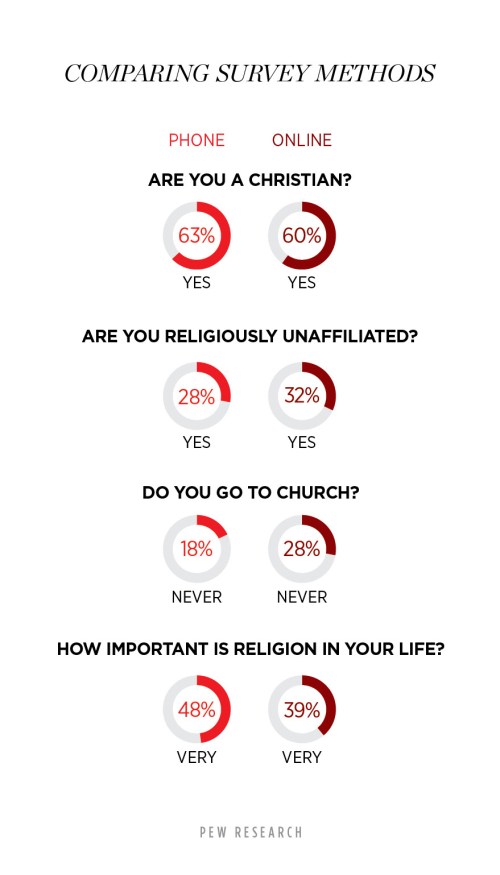
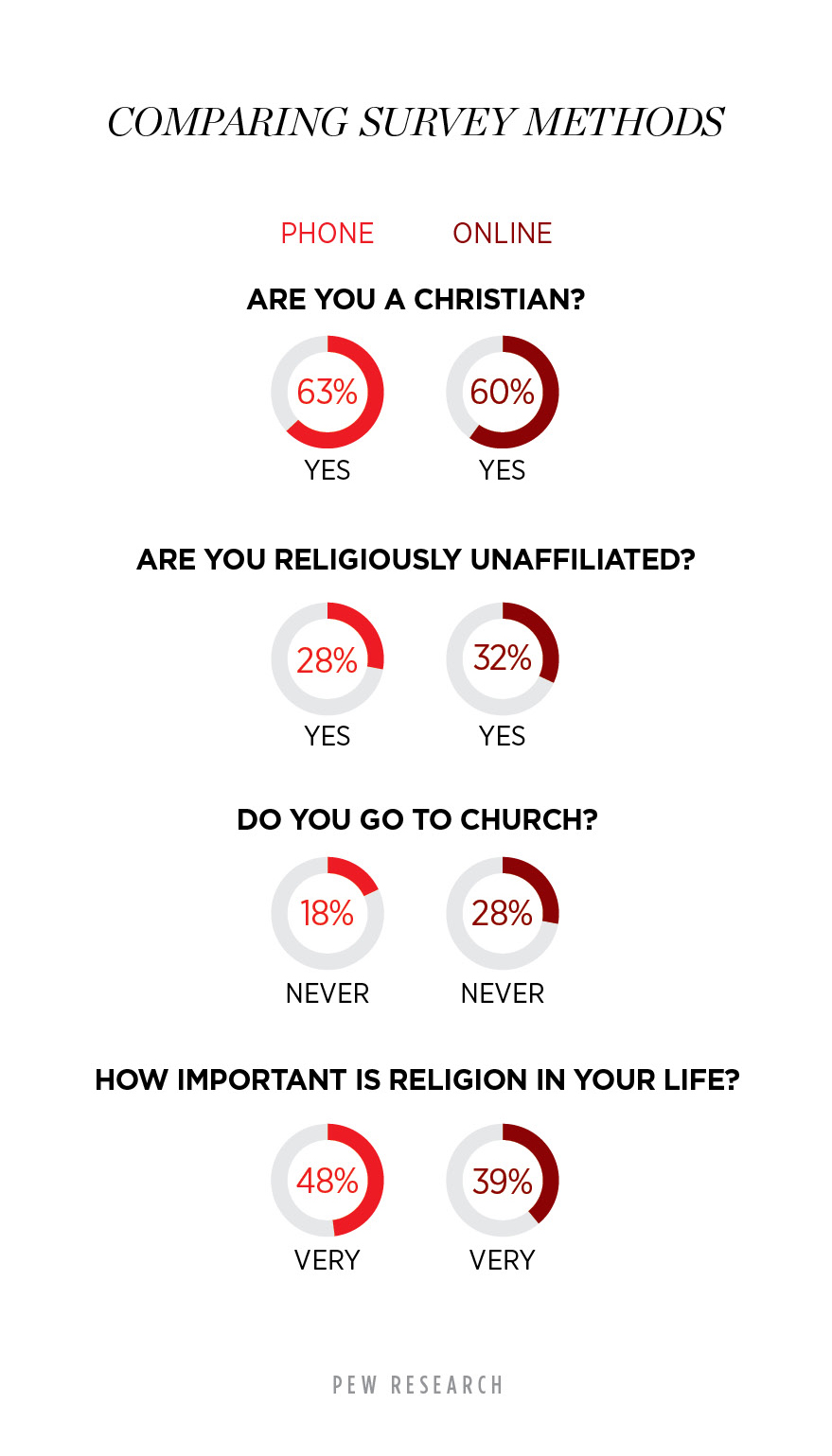
Smith said that when Pew first launched the trend panel in 2014, there was no major difference between answers about religion online and over the telephone. But over time, he saw a growing split. Even when questions were worded exactly the same online and on the phone, Americans answered differently on the phone. When speaking to a human being, for example, they were much more likely to say they were religious. Online, more people were more comfortable saying they didn’t go to any kind of religious service or listing their religious affiliation as “none.”

“Over time, it became very clear,” Smith said. “I could see it. I wasn’t doing research on ‘mode effects,’ trying to see how different modes of asking questions affect answers. I could just see it.”

After re-weighting the online data set with better information about the American population from its National Public Opinion Reference Survey, Pew has decided to stop phone polling and rely completely on the online panels.

This is a significant development in the social science methodology Americans have relied on to understand contemporary religion. How significant remains to be seen.

Modern polling began in 1935, when journalism professor George Gallup used sampling techniques to correctly predict the results of the presidential election and then made a business out of it. From the start, Gallup focused on questions about politics, but he also asked Americans about their religious beliefs and practices. One early survey found that about a quarter of people had read the Bible all the way through, and 46 percent of those people concluded they preferred the New Testament while 19 percent preferred the Old.

Polling increased after World War II, when more Americans got phones. By the 1950s, ’60s, and ’70s, polls became the dominant way that Americans understood religion in the US.

For Christians who wanted to preach the Good News, start churches, and encourage people to study the Bible, polls seemed like an invaluable resource. If you want to love your neighbors, it helps to know who they are. More generally, Americans felt this was the best way to move beyond impression and anecdote and get an accurate picture of faith in the country.

Some critics have contended that the dependence on polls led to deep misunderstandings, however. Sociologist Robert Wuthnow has argued, for example, that pollsters created “white evangelicals” as a category in the 1970s, erasing a lot of differences and distinctions. If they had decided that regional variation or theological particulars mattered more, or race less, then “evangelicals” would be thought of differently today.

Similarly, Wuthnow argued that polls have always inflated church attendance, although the social desirability bias only became visible with the gradual change in polling methodology.

“At best,” he wrote in Inventing American Religion, “polling information about attendance provided crude indication of religious involvement.”

Pew’s analysis finds that, today, about 10 percent of Americans will say they go to church regularly if asked by a human but will say that they don’t if asked online. Social scientists and pollsters cannot say for sure whether that social desirability bias has increased, decreased, or stayed the same since Gallup first started asking religious questions 86 years ago.

“My own sense, having been in the field 20 years now and reading the literature, is that that source of error and type of bias is quite consistent and quite robust,” said Courtney Kennedy, Pew’s director of survey research. “With religion, it’s so personal and nuanced, we may never know a true score about whether or not you prayed or believe in God.”

While pollsters attempt to eliminate or at least reduce social desirability bias, however, some scholars say the “error” in the data is actually meaningful and should be studied. At the University of Massachusetts Boston, sociologist Philip Brenner gathers small groups of people, asks them questions about things like church attendance, and then asks them why they answered the way they did.

“When we hear ‘error,’ we think accident, like random chance,” Brenner said. “But these aren’t accidents. These have motive behind them. The respondents are telling us something about themselves: who they are, who they want to be, who they think they ought to be. That may not be the information we wanted, but it’s still useful if we can understand what they are saying.”

Brenner thinks there should be more emphasis on interpretation. Data that seems “bad” could make sense, he argues, if more time and effort were put into parsing the human motivations behind seemingly false statements like “I read the Bible every day.”

But the promise of polling is something simpler. The goal is hard numbers quantifying religious activity. Polling firms want to know how many Americans really do read the Bible every day. Pew, Barna, and the American Bible Society are refining their methods and moving from phone polls to online polls in the hopes that they can achieve an accurate—if never perfect—picture of American faith.

When the data does make sense, according to the ABS, it reveals something powerful. “We can see from the data that when people read the Bible, they really do change,” Plake said. “We want you to understand, we’re seeing God at work in people’s lives, and it shows up in the data.”

Daniel Silliman is news editor for Christianity Today.

News

The Hiding Place: Asylum Seekers Pray to Leave Sanctuary Churches

Immigrants on ICE’s list may see kinder treatment from President Biden, but change hasn’t happened yet.

Illustration by Kumé Pather

After 1,000 days, Miriam Vargas still believes that God is watching over her and her two daughters as they hide from deportation inside First English Lutheran Church in Columbus, Ohio. But she is also still afraid.

“I do have that fear always,” she told Christianity Today through a translator, “that somebody is going to come into the church and take me away from my family.”

Vargas is one of about 50 women across the US who sought asylum in churches, as a revived sanctuary movement emerged in response to President Donald Trump’s efforts to increase deportations and get tough on immigration, illegal border crossings, and refugees. Now that Joe Biden is in the White House, proposing a kinder, more generous immigration reform, the latest chapter of the sanctuary movement may be drawing to a close.

Vargas spent 31 months worrying that Immigration and Customs Enforcement (ICE) could still detain her; separate her from her two American-citizen daughters, ages 7 and 11; and send her back to Honduras, currently one of the most dangerous places in the world. In March, she had been granted an “order of supervision” from ICE, saying she won’t be deported. But she, and others like her, are not ready to breathe just yet.

Vargas doesn’t love living inside a church. “It’s being in four walls 24-7,” she said. But she will wait a little longer.

Peter Pedemonti, co-director of the New Sanctuary Movement in Philadelphia, said that legal challenges to the deportation freeze and political opposition to Biden’s day-one immigration bill have reminded immigrants that while change may be coming, it’s not here yet. They have reasons to stay worried even as they find new hope.

ICE, after all, didn’t start with Trump. The government agency was founded in 2003 under George W. Bush, as part of the nation’s response to terrorist attacks on New York City and Washington, DC. Pedemonti said ICE also is seen by many immigrants and immigrant advocates as “a rogue agency” that may or may not follow orders. Asylum seekers were still being sent back to war-ravaged Cameroon in late 2020, for instance, despite the incoming president’s call for a halt to deportations and evidence that Cameroonian deportees were being placed in maximum-security prisons upon their return.

The fear and trauma run deep for these immigrants, Pedemonti said: “When they talk about ICE, they talk about being persecuted.”

To them, it’s kind of a miracle the immigration agents won’t enter churches. There’s certainly no law forbidding it. The agency has just decided not to breach the sanctuary of American churches protecting refugees.

Part of that may be fear of political backlash, but Pedemonti, a Catholic inspired by the radical faith of Dorothy Day, also believes the churches provide spiritual protection against ICE. So much of the work of giving sanctuary is mundane, he said, meeting basic needs and providing meals and fellowship to people struggling with isolation. But it is also holy work.

Practical and legal support run alongside vigils and fasting. Volunteers, churches, and even people in the community supporting the churches are praying for the protection of the immigrants in sanctuary. “We do believe they have impact,” Pedemonti said.

When churches open their doors as an act of civil disobedience, they are imitating Jesus, Pedemonti argues. He compares it the story where Jesus defied Sabbath rules to point out that the teachers of the law were misconstruing justice and had lost the narrative thread about how God cares for people. “I ask you,” Jesus says in Luke 6:9, “which is lawful on the Sabbath: to do good or to do evil?”

The sanctuary movement is mostly made up of mainline Protestants. When the movement started in the 1980s, many of the evangelicals who had rushed to help refugees from Vietnam and Cambodia were more cautious about helping people coming to the US from Latin America. Some expressed concern that the aid was really performative criticism of Ronald Reagan’s foreign policy—in the same way some today feel providing sanctuary is really about critiquing Trump.

But alongside the Presbyterians, Methodists, Lutherans, and Episcopalians providing sanctuary, a reliable number of independent Baptists, Mennonites, and Christian Reformed Church believers have been active in the movement. In the 2010s, many of those seeking sanctuary were themselves evangelical.

Sandra Chicas, who co-pastored Iglesia Evangélica Jesús el Pan de Vida with her husband, José, in Raleigh, North Carolina, turned to white evangelicals first for help advocating for her husband’s immigration status. She wanted them to vouch for her husband, a fellow minister, maybe host a rally, call their congressman, or at least sign a petition. They turned her down.

“When they told me that, I’ll be honest, it made me angry,” Chicas said.

José Chicas ended up asking mainline Christians for help and took sanctuary in an interfaith learning center in Durham, North Carolina. Sandra Chicas kept pastoring their church—while inundated by racist messages on social media—and prayed like she never had before.

“You want to believe it’s a bad dream,” she said. “But then you start to pray.”

Back in Ohio, the pastor of First English said she has seen prayers answered through the hands and feet of her congregation. Sally Padgett said the people of the church love the Vargas family like their own, and they’ve eagerly volunteered to run errands, get groceries, and care for the two girls.

At the same time, she sees a clear spiritual dimension to the problem. The church is meeting a family’s physical need, but that need shouldn’t even exist. The problem was created by the US immigration system, which has made it nearly impossible to win an asylum claim, and by ICE’s enforcement policies, such as separating families and deporting parents of American citizens.

Vargas was cooking in a restaurant, paying her taxes, and taking care of her family when the agency decided that people like her were a priority for deportation. The church, which could be doing other work, has to focus on this need. It reminds Padgett of passages of C. S. Lewis’s Screwtape Letters, where one demon advises another about how to neutralize Christians.

“It’s really a satanic thing,” she said. “We took Miriam, who was supporting her family … now she has to be dependent on people.”

After years of fear and waiting, the election of a new, pro-immigrant administration brings a breath of hope. Vargas has spent the past years worrying that ICE agents were going to change their minds about not raiding churches. But she knew God was watching over her and her daughters. Chicas wondered if her husband would ever be able to come home again. She didn’t vote for Biden, because she is not a citizen, but when he won, she said, “I felt like, ‘Hallelujah!’”

But the promised change is still just a promise, so far. Deportations have not stopped. An immigration bill has been outlined, not scheduled for a vote. But in sanctuary churches across America, there is hope.

Bekah McNeel is a reporter in Texas.

News

A Kentucky Church’s Secret to Handling Abuse Allegations: Humility

Tates Creek Presbyterian won praise for its transparent investigation. Then it had to do it again.

Illustration by Michela Buttingol

Of all his ministry duties, Robert Cunningham most enjoys the academic responsibilities: reading, crafting sermons, writing on faith and public life, and working on his dissertation.

But the Lord had other plans for the senior pastor of Tates Creek Presbyterian Church in Lexington, Kentucky. Over the past three years, his congregation has undergone two independent investigations into separate allegations of sexual abuse from its past.

Cunningham had no special training for abuse cases or familiarity with best practices for handling abuse allegations. But he had a deep awareness of what he didn’t know and a sense of responsibility to lead his church through scandals it did not ask for. For three years, he has worked to build a culture of openness, care, and justice.

In a landscape marred by cover-ups, incomplete investigations, victim blaming, and denial, Tates Creek has emerged as a model for how churches should respond to allegations of sexual abuse.

Cunningham was in his sixth year as senior pastor when the first case emerged in 2018.

The 1,000-member congregation—large by Presbyterian Church in America (PCA) standards—was healthy, growing, and planting churches. The Savannah River Presbytery, the PCA’s governing body in southern Georgia, told Cunningham that former Tates Creek youth pastor Brad Waller had confessed to inappropriately touching young men at a Savannah-area church.

By then, Waller’s time at Tates Creek was a distant memory for the church. He had left over a decade before, and most of his students were long gone, too.

“It would have been easy for us to say, ‘Okay, that’s weird. Hate to hear that. Let’s just keep moving on,’” Cunningham said. Instead, leadership decided to give the accusations a second look.

Cunningham has been involved in Tates Creek since his college days and knew the former pastor. He spent one summer as an intern for Waller before replacing him as youth pastor when Waller moved on in 2006. He called Waller and asked him whether any abuse happened when he was at Tates Creek. Waller said no.

Cunningham wanted to believe his former boss. But he suspected that he hadn’t heard the whole truth. A few phone calls to former members of the youth ministry confirmed his concerns. The church leadership contracted with GRACE (Godly Response to Abuse in the Christian Environment) to open an investigation.

“I think it was that humility, vulnerability, and teachability that showed leadership to his church and demonstrated a great deal of encouragement and hope to sexual abuse victims not only from the church, but also from anyone who was watching what was going on,” Boz Tchividjian, then executive director for GRACE, told Christianity Today.
With Tchividjian’s help, Cunningham crafted a public statement to communicate what the church knew, what it planned to do, how potential victims could contact investigators, and why all of these steps mattered. The statement also included apologies to the outside community and the abuse victims.

“I have literally wept on multiple occasions at the thought of high school and college students being abused at the church I love and pastor,” wrote Cunningham, who himself came to faith through Young Life in high school. “I am so sorry. I want you to know that all of this transparency, urgency, and energy is for you.”

The 2,600-word letter detailed what the church knew and when, what it planned to do, and the next steps.

“It is important for everyone to understand the difference between an internal and an independent investigation,” church leaders explained. “An internal investigation is when we (or our attorney) investigate ourselves. In this scenario, we maintain control over the investigation. An independent investigation, however, is inviting a third party to investigate us. In this scenario, we are relinquishing control over the investigation and inviting any and all findings and corrections. It was important to us that we choose the latter.”

Cunningham’s statement and approach to the investigation got the attention of abuse survivor and victim advocate Rachael Denhollander, who has become an advisor on sexual abuse issues. After all of her work trying to convince churches to be open about abuse allegations, she finally found one that seemed to get it right.

Immediate transparency, educating the congregation about biblical justice, and practical training on the dynamics of sexual abuse—these three hallmarks, according to Denhollander, signaled that the church took seriously its obligations to victims.

“They signaled to survivors that it was safe to come forward and told abusers that they would not be safe at Tates Creek,” she said.

Over the next two years, Tates Creek allowed GRACE to investigate, accepted its report, and implemented the steps recommended as future safeguards. Cunningham told the congregation that they would never move on from what happened and would always be open to new stories of abuse emerging, but the terrible chapter of the church’s history seemed to be ending.

It was not. In October 2020, a former member of the Tates Creek student ministry told Cunningham he had been sexually assaulted by musician Chris Rice. The former student met Rice on one of several student and college retreats when Rice led music for the church between 1995 and 2003.

The call devastated Cunningham. He knew how hard another scandal and investigation would be on the church, especially with the issues of Christian celebrity and a COVID-19 pandemic added on top.

But it was also a sign that the church’s approach was working. The victim knew if he came forward and disclosed what happened, church leadership would take his claim seriously. And they did.

The church knew what it had to do. “We wrote the playbook,” the pastor said. “Let’s just follow it.”

Cunningham declined to comment on the Rice investigation while it was still ongoing, but said the allegations are credible and backed by corroborating evidence. The church is keeping the name of the accuser confidential—often necessary for a thorough and impartial investigation. Whatever the investigation finds, victims’ advocates hope that Christian leaders learn from Tates Creek’s example.

In the years since the #MeToo and #ChurchToo movements brought abuse to the forefront, evangelicals have become more eager than ever to train leaders to prevent abuse in their churches and respond to allegations with compassion, accountability, and justice.

In June 2019, the PCA formed a committee of theologians, counselors, and survivor advocates to study issues of abuse in the church and develop best practices for responding. The Southern Baptist Convention (SBC) also published a 52-page report after the Houston Chronicle identified 380 credible allegations of abuse by SBC church leaders over 20 years. The SBC found widespread failure to properly handle claims or take abuse seriously.

But some victims’ advocates have worried that the recent study groups and statements don’t prepare churches to handle allegations. Too few churches have a formalized process in place, and pastors tend to be overconfident in their ability to understand and detect abuse, experts say.

Most churches err by conducting internal investigations or consulting with investigators who prioritize shielding the church from litigation above caring for victims. Few earn the trust of those who have been hurt.

“When victims are abused in a church setting, they rightly feel unsafe coming back to a church setting. You’re not going to get to the evidence if you’re not using an outside investigative firm,” Denhollander said.

Cunningham said the critical element of his response was humility. He knew he had no training in investigation or managing a scandal. He preferred writing and teaching.

Back when he was named senior pastor of Tates Creek in 2011 he really had to wrestle with his own inexperience. At 31, he had a nervous breakdown while assuming the new role.

The process changed him from a young, “arrogant, self-sufficient” leader, he said, to a humble senior pastor who knew his limitations and sought the wisdom of others. That attitude became important to the culture of the church and enabled them to reach out for help when it mattered.

Denhollander said the Tates Creek leadership team “was already aligned with God’s heart on what the gospel looks like and caring for the vulnerable,” before they had to deal with a scandal.

And the church was willing to be vulnerable, put aside concerns about reputation, and trust that the light of truth would also be the light of God’s grace.

“I don’t know why pastors and churches think they have what it takes to navigate these waters and don’t just quickly reach out to experts who do,” Cunningham said. “Really, we just reached out to people who knew what they were doing and did what they told us to do.”

Megan Fowler is a contributing writer for Christianity Today based in Pennsylvania.

Ideas

The Story of Barabbas Is No Mere Prisoner Swap

Columnist; Contributor

Much more was at stake than a criminal’s fate or a crowd’s preference.

Wikimedia Commons

One of the great marvels of Scripture is the way minor characters embody an entire narrative. The Bible is full of obscure individuals about whom we know little besides their names. Yet many of them, instead of shuffling on and off the stage to advance the story (like they would in Homer or Shakespeare), become living examples of the story itself.

The most dramatic examples, for my money, occur in the crucifixion story. Think, for instance, of Simon of Cyrene carrying the cross, as Christ told his disciples they would (Mark 15:21). Or the criminal crucified next to Jesus who receives forgiveness at the last minute, becoming the archetypal deathbed conversion (Luke 23:39–43). Or the Roman centurion who supervises the execution and then exclaims, on behalf of billions of Gentiles in the centuries to come, “Surely this man was the Son of God!” (Mark 15:39).

But my favorite example is Barabbas. At one level, his is a simple story of exchange. Barabbas is due to die for his sins, and he deserves to. Yet without doing anything to merit mercy, he discovers that Jesus is going to die instead. Having awoken on Friday morning expecting nothing but a slow, horrible death, by evening he is home with his family to celebrate the Sabbath. We are clearly intended to see ourselves in this man: destined for death but finding freedom and life through the death of another.

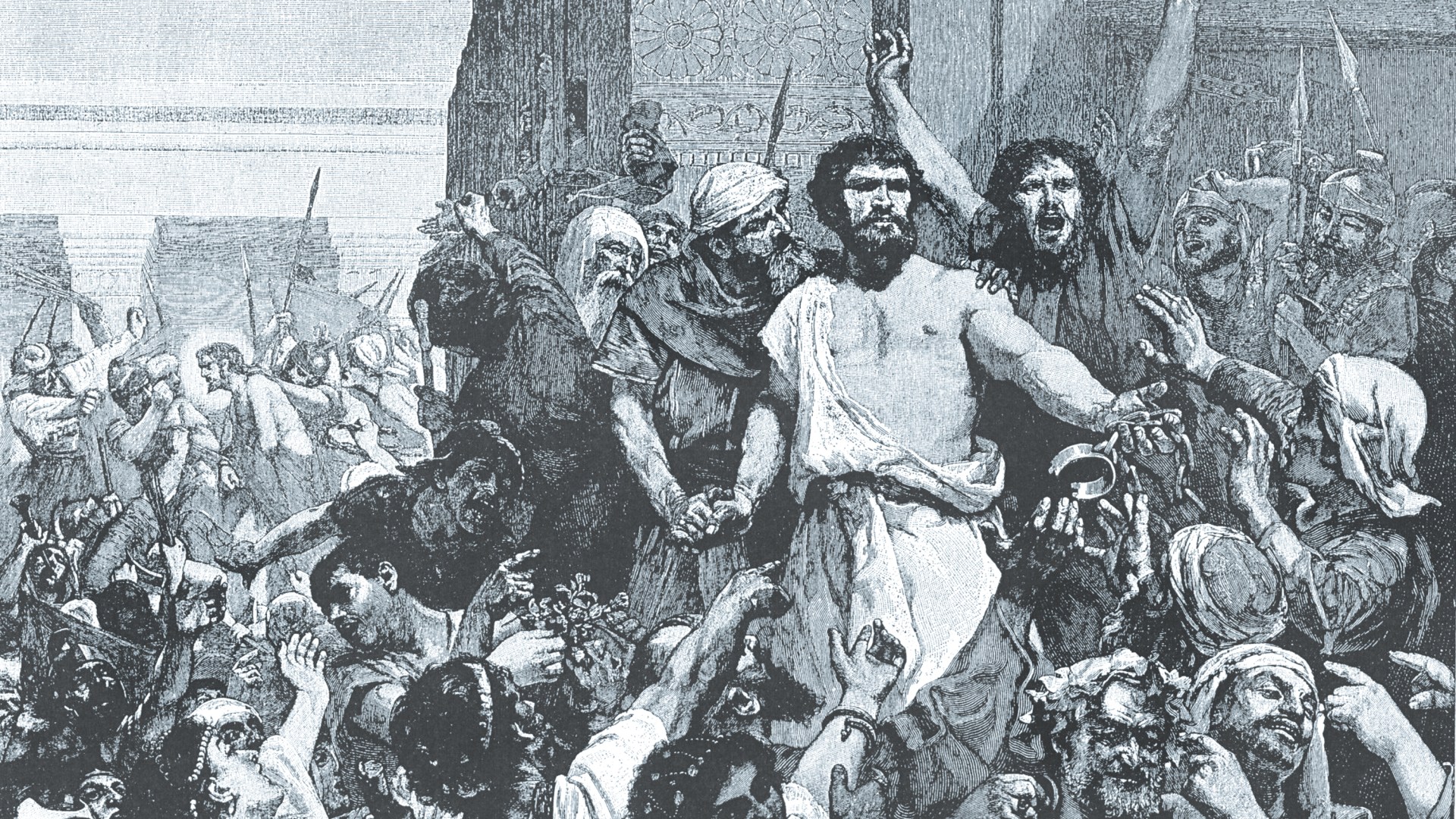
If we reflect for a moment, it becomes clear this is not merely an exchange, but a substitution. Jesus doesn’t just die instead of Barabbas; he dies in his place as his substitute, his representative. We know this because—and this is often missed—Barabbas and Jesus stand accused of the same crime: sedition, insurrection, treason. Barabbas is a revolutionary who has directly challenged Roman rule (Luke 23:18–19). And from a Roman point of view, Jesus’ claim to be king of the Jews poses a threat to Caesar. Few examples of substitutionary atonement in Scripture are clearer than Jesus, the innocent man, taking the penalty so that none remains for the guilty Barabbas.

There is also an Exodus dimension here. The Gospels point out that freeing prisoners is a Passover custom. In other words, it happens in honor of the night when Pharaoh’s firstborn son died so that God’s firstborn son (Israel) could be released. But the Gospels raise a subtle question: Which of these two accused men is really God’s firstborn son? The one whose name, Bar-abbas, means “son of the father”? Or the one claiming to be the Son of God? And is God’s Son playing the part of Israel, escaping to freedom—or that of the Passover lamb, shedding his blood to liberate others?

Another layer to the story is the question of how Israel should respond to Roman rule. Barabbas represents the way of war, strength, and violent insurrection. Jesus represents the way of peace, innocence, and sacrifice. When Pilate asks the crowd for their preference, this is the point at issue. And Jerusalem chooses the way of violence—“No, not him! Give us Barabbas!” (John 18:40)—as Jesus tearfully predicted it would (Luke 19:41–44). But the Prince of Peace will enjoy vindication—not least through the mouths of Roman soldiers, the men of violence par excellence (Matt. 27:54; Luke 23:47).

For a final lens on the Barabbas story, consider the Day of Atonement. On this crucial day in the Jewish year, the high priest would cast lots over two goats. One became the sacrificial goat, whose blood was spilled. The other became the scapegoat, who was released from the camp into the wilderness. The parallels with the Barabbas story are fascinating—one dies while the other is released—not least because it was the chief priests who wanted Barabbas released and Jesus killed (Mark 15:11). When, like a priest scrutinizing a sacrificial animal, Pilate explains that he has “examined” Jesus and found him faultless (Luke 23:14), the Levitical echoes grow louder still.

Barabbas was a revolutionary and a murderer. He has no right to be remembered at all, let alone held up as an example of divine grace. But that is the whole point. Neither do I, and Christ died for me anyway. And through his substitution, I become a Bar-abbas myself: a son of the Father.

Andrew Wilson is teaching pastor at King’s Church London and the author of God of All Things. Follow him on Twitter @AJWTheology.

Testimony

Christian Science Gave Me the ‘Principle’ of Christ, but Never Christ Himself

My journey from a religion of self-salvation to a faith that takes sin seriously.

Whitney Curtis

After the terrorist attacks of September 11, 2001, the world reeled in shock and disbelief. I did too—not only at the events themselves but also at the response I saw within my church.

Raised a fourth-generation Christian Scientist, I grew up on the St. Louis campus of Principia School, the world’s only pre-K-to-college school for Christian Scientists. Before 9/11, I lived within a Christian Science cocoon, enjoying what seemed like an idyllic childhood. In many ways, I acted like a Christian, reading my Bible every day, praying the Lord’s Prayer, and attending church twice a week.

Then everything exploded. Literally. The day after 9/11, hoping for comfort, I sought out the Wednesday night testimony meeting at my Christian Science church. But much of what I heard left me feeling profoundly uneasy. Some congregants boldly declared that a tragedy like this never could have occurred in God’s perfect world. Others lauded the New Yorkers who had prayed and stayed home that morning, subtly implying that the victims were to blame. How, I wondered, could they be so cavalier about the suffering we had witnessed?

Little did I know that this terrible day would launch me on a journey to saving faith in Jesus Christ.

Puzzled and aghast

Not to be confused with Scientology, Christian Science was founded by Mary Baker Eddy in the late 1800s. Its core teaching is influenced by gnostic, pantheistic, and metaphysical beliefs that portray sin, sickness, and death as illusions. Eddy taught that salvation comes through demonstrating the “Principle” of Christ rather than putting faith in Christ himself.

In her book Science and Health with Key to the Scriptures, which she called “divinely-authorized,” Eddy aspired to “reinstate primitive Christianity and its lost element of healing.” Christian Scientists read this book alongside the Bible, and it provides the lens through which they understand Scripture. Her teaching is considered inerrant, even when it contradicts the Bible.

A year before 9/11, I transferred from Principia College to Webster University, my first foray into the secular world. I joined a Bible study where participants worshiped Jesus and prayed for one another. This was deeply offensive. I had been taught that Jesus was merely a “way-shower,” a good teacher to follow. I considered myself a “graduate-school Christian” with a special knowledge, a “scientific” way of praying that allowed me to heal like Jesus.

I tried articulating Christian Science teachings. Instead of crying out to God for help, I explained, we pray to align our minds with the already harmonious spiritual reality of God. We experience illness only to the extent we believe we’re ill, and if we rely on physicians and medicine, we are giving in to the “mortal mind” and failing to “know the Truth.” All this left my friends puzzled and aghast.

After 9/11, I could no longer deny the reality of evil. In my heart I left Christian Science, but I didn’t tell anyone, since my life, family, and heritage were entangled in this world. I felt incredible betrayal, not knowing what to believe or do. With no one in whom to confide, I sank into misery and loneliness.

Eventually, I veered away from Christian Science practice and started seeing doctors. While it was amazing to find medical relief after years of headaches and menstrual cramps, I was plagued by guilt and shame.

Then, by God’s providence, I overheard a coffee-shop conversation on faith. Something in my heart stirred. One of the men in that discussion invited me to his church and gave me a copy of Francis Schaeffer’s book The God Who Is There. Schaeffer spoke to my existential angst with his assertion that the spiritual and physical world originated with a Creator God. I didn’t totally understand this, but it filled me with deep hope and a desire to learn more.

I remember sitting at a café on a glorious spring day, sipping Americanos with some atheist friends and realizing something was missing in their reasoning. As someone with artistic inclinations, I struggled to ascertain where love and beauty fit in their pragmatic, evolutionary framework. Ultimately, these friends believed that matter was an end in itself, a worldview as hollow as the faith I had just departed. In that moment, I knew I believed in God.

The next Sunday, I visited Grace and Peace Fellowship in St. Louis, where I came face to face with the living God. People there worshiped heartily rather than sitting passively in pews. In my Christian Science church, sin was never mentioned, but here it was freely confessed. These believers read Scripture like a real story rather than a set of standalone philosophical truths. They shared painful parts of their lives, and others came beside them to pray. I wept as I heard, for the first time, of God’s deep, sacrificial love for me. I was convicted of my sin and selfishness.

In the following months, I met with pastor Aaron Turner, hoping both to process my anger at Christian Science and to ask questions about biblical Christianity. When he told me I was a sinner, I actually thanked him. After a lifetime of denying and repressing my very humanity, I was relieved to finally admit my brokenness.

Then I met Jesus. In Christian Science, I knew him only as an exemplar, as someone who showed people how to work out their own salvation. I had been taught that he wasn’t divine and that he couldn’t suffer on our behalf. But Pastor Aaron introduced me to the Jesus of Scripture, who came to earth, took on flesh, and died and rose again to redeem his people and restore all creation.

A long recovery

When I accepted this Jesus as Lord and Savior, God turned my world upside down. Right away, I jumped into the life of the church. In some ways this was disorienting—like being plopped in front of an all-you-can-eat buffet. Everything was new. Christian Science used plenty of familiar Christian language, but always with its own twist. For example, it redefined the Trinity as “Life, Truth, and Love.” Heaven and hell became states of consciousness rather than places of reward or judgment.

Though surrounded by a wonderful church fellowship, I struggled to explain the trauma from my past. When I met another former Christian Scientist, I finally felt understood. We laughed and cried as we spoke of common experiences. Our conversation ignited a fire in my heart to help others leave this destructive group.

In 2014, after graduating from Covenant Theological Seminary, I started the Fellowship of Former Christian Scientists. We offer outreach through online support groups, “Get Wise” webinars, and a biannual conference. Every year we see more people making their escape.

In many ways, Christian Scientists resemble mature Christians—they are familiar with Scripture, constantly “trusting in the Lord,” and “always rejoicing.” Yet now I see that the object of their faith is Christian Science, not the gospel. Praise God for untangling my heart and mind from the delusion of self-salvation—and for rescuing me into new life with Christ and his church.

Katherine Beim-Esche is the founder and director of the Fellowship of Former Christian Scientists.

Our April Issue: Single Parenting by Choice

CT’s single-parent adoption pioneer shares her story.

Fernando Lavin / Unsplash / Courtesy of Cindy Cronk

Among the great Latin phrases from church history is Martin Luther’s famous description of the Christian as simul iustus et peccator—at once justified saint and sinner. Cindy Cronk, CT’s director of production services and our longest-serving employee by far (42 years!), appreciates good Protestant theology. She gets what Luther is saying. But she’s had enough of people thinking of her as saint and sinner. She prefers Mom.

Thirty-three years ago, Cronk was the second single person the Evangelical Child and Family Agency worked with in its foster-to-adopt program. Eventually, she says, ECFA greenlit her because they thought it was unlikely that the state would place a black child with a white, suburban, single woman. But they did. (The third single person to adopt through ECFA was Cronk’s caseworker.)

Church is notoriously difficult for single women. As a single, white woman with black children, it was even harder. “I had a real bad time with people mostly talking to me to figure out if I’d been sleeping with a black man,” Cronk says. “People never got to know me. They just made assumptions about me, my education, my work.”

Eventually she found a church where she and her family could be accepted. “But a church that’s good at accepting doesn’t mean a church that’s great about helping,” she says. Informal father-son gatherings tended to forget about her sons. A woman offered to take the kids to her house to bake cookies but couldn’t understand why Cronk asked if she could run a kid to a doctor’s appointment or to childcare instead. “Don’t take the fun stuff! Give me the ability to do the fun stuff!” she tried to explain.

Once church folks couldn’t fit Cronk into their category of sinner, they tried to label her a saint. One of my earliest conversations with Cronk took place shortly after someone had praised her “ministry.” People tend not to make that mistake twice. “They’re not my ministry; they’re my kids,” she answers kindly but forcefully. “I’m no saint. I’m a mom. But the needs really are there.” The people most likely to see her as a saint, she says, are those who seem most blind to the needs around them.

I was eager to hear what Cronk thought about this issue’s cover story. She gave it high praise: “It wasn’t stupid. Most articles on adoption are about parents as saviors.” (CT can be a tough crowd.) She’s glad to read that churches are getting better at integrating single-parent adoptive families. But she’s cautious. Adopting as a single person, especially transracially, is going to be hard even with church support. “A lot of days, you’re just praying a desperate prayer: ‘Lord, you say you’re our Father. Where are you? Show up and take over.’ And he does.”

Ted Olsen is editorial director of Christianity Today.
Ideas

What the Hummingbird Shows Us About God’s Handiwork

Columnist

When God seems invisible, he may just be moving faster than we can see.

Geronimo Giqueaux / Unsplash

A few years ago, I sat on the front porch of an old farmhouse in Vermont writing a new song with two friends. We sipped coffee, looking out over a summer field and testing lyrics that we scribbled in our notebooks. Above us, at the corner of the house, hung a hummingbird feeder. Tiny winged visitors stopped by intermittently to eavesdrop on our song while sipping nectar from the glass globe.

Hummingbird wings move at about 50 beats per second. But when they fly, hummingbirds can appear completely motionless. A miracle of fitness and form, God made these creatures to be a delicate display of paradox: They are still and active at the same time.

These birds are a moving metaphor for the kind of trust that God outlines in Isaiah 30:15: “You will be delivered by returning and resting; your strength will lie in quiet confidence” (CSB throughout). When I think of God’s grace at play in my own life, my most successful moments happen when I hold steady at the center. Confidence is not found in productivity, but in quietness of heart.

We are not measured by our success. We are simply called to faithfully rely upon God for the outcome of our efforts. “Such is the confidence we have through Christ before God. It is not that we are competent in ourselves to claim anything as coming from ourselves, but our adequacy is from God” (2 Cor. 3:4–5).

But the hummingbird metaphor extends beyond the physics of wings. By design, hummingbirds, like many migratory birds, accomplish great feats of travel by trusting that God will guide them where he has hard-wired them to go. They take their GPS coordinates from the moon, the weather changes, and their God-given intuition.

The coronavirus pandemic scrambled our life-coordinates as school went virtual, meet-ups with friends slowed, and church became a livestream. Our lives have been separated into pieces—as my middle-school-age daughter and I were discussing recently—like one of those “best friends” necklaces shaped like a broken heart. We feel lost and incomplete, holding one half of the heart around our neck and hoping to put it back together again soon.

Colossians 1:19–20 speaks directly to this sense of wandering: “For God was pleased to have all his fullness dwell in him, and through him to reconcile everything to himself, whether things on earth or things in heaven, by making peace through his blood, shed on the cross.” God is pulling the broken pieces of our lives back to wholeness.

He does not always do this in ways we expect. And that is one of the miracles of grace: God doesn’t just hand back the two sides of the necklace, nor does he simply return us to something we have lost. Instead, he himself restores and reconciles all things to himself. As he leads birds hundreds of miles year after year to return to the places where they belong but could never find on their own, he continually brings us to something new, giving us a hope and a future we never could have imagined.

He doesn’t promise that the journey will be peaceful. Instead, “he is our peace” (Eph. 2:14). Three years after that day spent song-writing in Vermont, I was working on an album in Nashville when the pandemic halted recording. For several years I had been gathering songs for this project, songs to protest anxiety, songs of comfort over fear. It turned out to be a timely effort as the other musicians and I were all faced with the sudden challenges of illness and isolation.

As we worked, I stumbled on a work-tape recording of a song I had written called “Patient Kingdom.” I had forgotten all about the song. We included it at the last minute, and it became the album’s title, a divinely orchestrated surprise. Recording Patient Kingdom long-distance across four states produced something in the end more beautiful than we could have known.

Our plans are not like his plans. As the hummingbird moves, his wings are invisible to us. So too the work of God is often hard to see in the moment, but nevertheless something remarkable is happening. This is what the Lord says: “Look, I am about to do something new; even now it is coming. Do you not see it?” (Isa. 43:19).

Sandra McCracken is a singer-songwriter who lives in Nashville. Follow her on Twitter @Sandramccracken.

addApple PodcastsDown ArrowDown ArrowDown Arrowarrow_left_altLeft ArrowLeft ArrowRight ArrowRight ArrowRight Arrowarrow_up_altUp ArrowUp ArrowAvailable at Amazoncaret-downCloseCloseellipseEmailEmailExpandExpandExternalExternalFacebookfacebook-squarefolderGiftGiftGooglegoogleGoogle KeephamburgerInstagraminstagram-squareLinkLinklinkedin-squareListenListenListenChristianity TodayCT Creative Studio Logologo_orgMegaphoneMenuMenupausePinterestPlayPlayPocketPodcastprintremoveRSSRSSSaveSavesaveSearchSearchsearchSpotifyStitcherTelegramTable of ContentsTable of Contentstwitter-squareWhatsAppXYouTubeYouTube