Ideas

Chinese Christians Deserve a Better Label Than ‘Persecuted’

Xi’s government isn’t friendly to religion. But its actions shouldn’t color how we think of believers there.

Christianity Today October 9, 2020
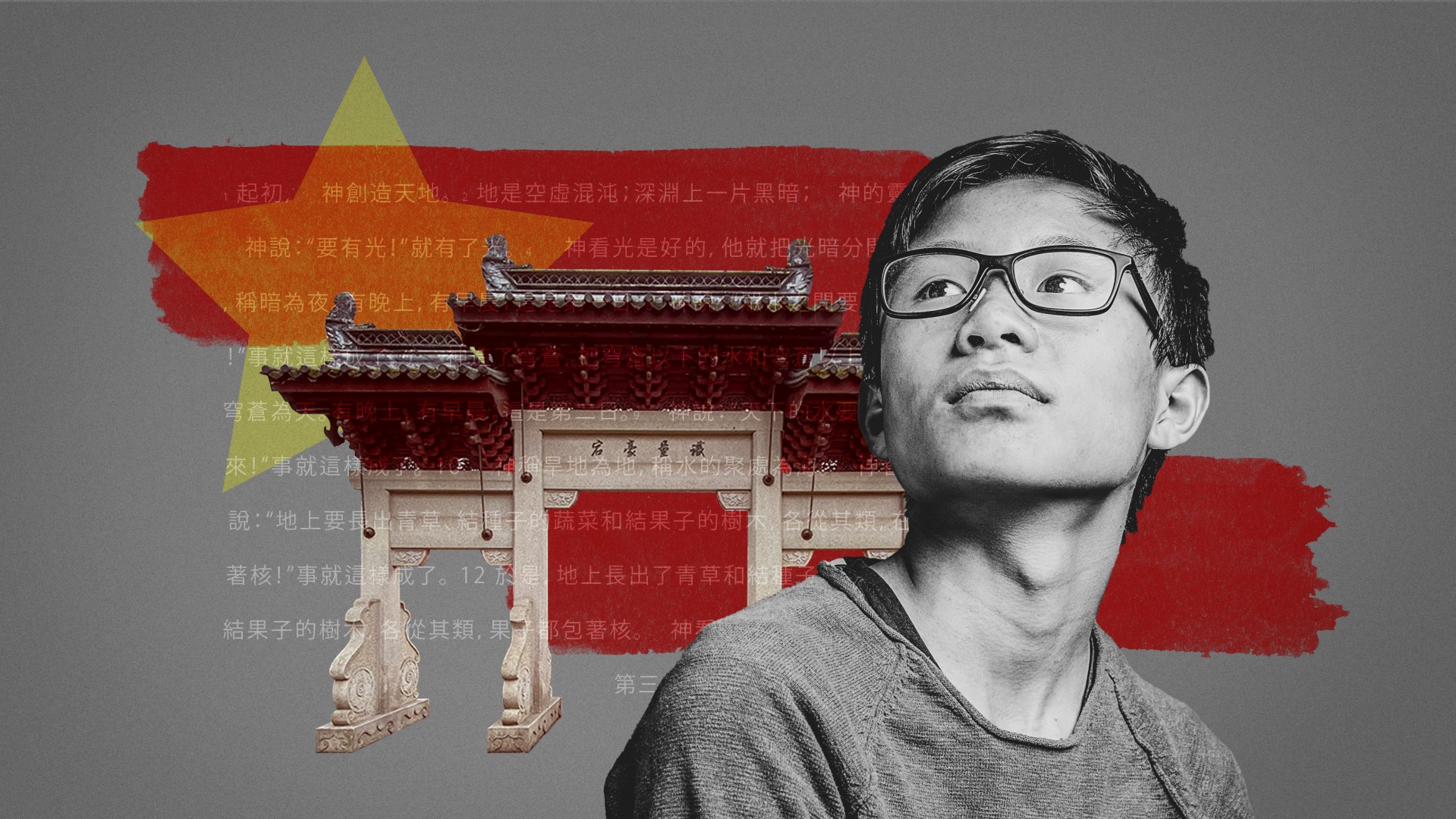
Illustration by Rick Szuecs / Source images: Ulrike Schmitt-Hartmann / Getty / Tianshu Liu / Unsplash

After decades of increasing religious freedom, has China swung toward militant atheism? That’s the takeaway of Religious Freedom Institute president Thomas Farr, who recently told Congress that “the assault on religion in China under President Xi Jinping … has justly been called a Second Cultural Revolution,” a nod to the final chaotic decade of Mao Zedong’s rule, when all religion was banned.

The “Administrative Measures for Religious Groups,” which took effect in February this year, put teeth into existing prohibitions against unregistered church gatherings, stipulating stiff fines for participants and those who host such activities. The regulations also double down on Xi’s insistence that religion be “Sinicized,” or made more Chinese. In the case of Christianity, this means severing the church’s Western connections and reinterpreting biblical teachings in order to conform to “socialist values.”

China’s Christians would generally agree that restrictions on the exercise of their faith are increasing under Xi’s repressive policies. But most would also view their country’s church in a much broader context that defies characterizing it purely in political terms.

In a similar way, as they acknowledge the reality of China’s repressive religious policies, Christians outside China need to stop seeing Chinese Christians merely as “persecuted.” By putting too much emphasis on politics, the familiar persecuted church narrative keeps Christians outside China from understanding the other dynamics at play in what has become arguably one of the fastest-growing Christian movements in history, accounting for one of the largest concentrations of believers in the world.

Rooted in Western assumptions about the relationship between church and state, this narrative sees the church’s problem as primarily political. It paints believers as innocent victims or—in the case of those who dare to speak out against the regime—as tragic heroes. While based in reality, this narrative does not begin to tell the whole story.

The Stories We Tell About China

The persecuted church is one of four dominant narratives that have characterized Western and overseas Chinese Christian discourse on China over the past four decades. It remains the go-to storyline for journalists conditioned to look for conflict between the authoritarian state and groups in society that dare oppose it. Rights activists, think tanks, politicians, and many evangelical organizations amplify the story, often to support issues that are tangential to China itself. In this way, China’s persecuted church easily becomes an unwitting prop in the service of others’ agendas, particularly in the rancor of the US election cycle. While the church portrayed by this narrative certainly exists, it is at best a one-dimensional depiction of Christianity in China.

These various narratives contain an element of the truth, but none tell the whole story.

First, the needy church narrative builds on this portrayal of Christians in survival mode, lacking Bibles, trained leaders, and material resources. For foreign Christians who measure their own effectiveness by their ability to help, the church in China becomes a new section in the organizational strategic plan, a pin on the map in the mission agency boardroom, or a line item in a foundation budget.

Though this narrative may have been accurate in the 1980s as China emerged from the dark shadows of the Cultural Revolution, the church of today is much better resourced. Hundreds of locally run training institutions, both official and unofficial, are equipping a new generation of leaders. A vibrant online Christian community conducts worship services, hosts conferences, and shares discipleship resources—all within the bounds of China’s highly regulated internet. Through innovative local nongovernmental organizations and Christian-run enterprises, believers have emerged as salt and light in their communities. Most of these activities require little or no foreign involvement, and in today’s anti-foreign climate, such outside help could be a liability.

The Christian China narrative emphasizes the church’s numeric growth on the premise that a critical mass of believers will bring about cultural and political change. Proponents of this narrative—often found in evangelical educational institutions or student ministries—talk of filling the void left by communism and of reaching China’s future leaders. Ironically, it is exactly this sort of bottom-up transformation that Xi’s repressive policies, which seek to blunt foreign influence in China, are intended to prevent. While it is true that today’s Chinese Christians­—like generations of believers before them—have been able to enter the cultural sphere in significant ways, their voices are increasingly being silenced. The resurgence of authoritarian rule under Xi has again shown the limits of Christian engagement in bringing fundamental change to China, at least in the near term.

Finally, the missionary church narrative envisions a mighty wave of gospel messengers—perhaps the largest in history—being sent from China to peoples hitherto unreached. Foreign mission organizations, captivated by the Chinese church’s “Back to Jerusalem” vision and finding it harder to recruit at home, rush to equip this new mission force with the latest strategies.

The Chinese church is in fact developing its own mobilization and sending structures. An estimated 1,000 to 1,500 long-term cross-cultural workers have been successfully deployed to fields outside China. Sadly, many times that number have returned to China disillusioned because of poor or nonexistent preparation, conflicts on the field, cultural challenges, or a lack of support from their home churches. Although these missionaries need more local backing (and even maybe even some strategic support from the West), the fact remains that the church in China is already creating its own missionary force and sending that force out into the field. In other words, the Chinese church doesn’t need Western intervention and leadership in order to be a missional church.

Again, these storylines contain elements of the truth. Yet each is incomplete. At best, they approximate something of the complexities of China’s church. At worst, they become caricatures, distorted pictures that would be largely unrecognizable to those whom they purport to describe. At the end of the day, they are still our narratives. As such, they say as much about us as they do about the church in China.

China’s Magic Mirror

For centuries, the Chinese “magic mirror” proved an object of intense fascination among Western visitors to the Middle Kingdom. Cast of solid bronze, with an intricate design carved on the back, the mirror’s highly polished surface appeared to project this design when exposed to bright sunlight, giving the impression that the mirror was somehow transparent.

Narratives about the church in China function somewhat like this mysterious mirror. While appearing to elucidate the Chinese church, they inevitably become reflections of those who promote them. These narratives reveal their preferences for what China ought to be—a free, open society with well-run, well-resourced churches that impact their society and reach beyond China’s borders. Understandably, those engaged in or with China see China in ways that align with their goals. This often results in viewing China’s church either in terms of its limitations or in terms of what they believe it should be doing. While ostensibly about China, these narratives invariably put those who promote them at the center. Humility and honesty are needed in order to maintain a clear perspective on what is actually happening in China.

Like the engagement myth that has dominated contemporary Western interaction with China, promising that trade will somehow bring about political change, these narratives imagine a linear relationship between foreign Christian involvement and China becoming a different place.

A product of the modern era, these narratives speak of control, of measurable outcomes, transforming institutions, harnessing technology, multiplication, scalability, and finishing the task. In many ways they have dovetailed nicely with China’s own Herculean modernization effort. Yet, as a strong, authoritarian China rises on the world scene, and as the Western church declines in its ability to project its vision upon the rest of the world, the limitations of these narratives become increasingly evident.

Reframing the Conversation

To move toward a new narrative, a new conversation is needed with, and about, the church in China—a conversation that, instead of objectifying the believers, embraces them as true partners in the kingdom. With an estimated 100 million Christians worshipping in unregistered “house” churches or in officially sanctioned congregations under the Three-Self Patriotic Movement, China’s church represents a spectrum of theological traditions. These include indigenous strains whose historical influences include figures such as evangelist John Sung and Little Flock founder Watchman Nee, as well as a growing Reformed movement among newly emerged urban congregations.

Becoming more visible and more influential in recent decades, China’s Christians have broken out of the “surviving church” mold in which they are often cast by outside observers. Even amid current restrictions, they are living out their faith in a manner that would have been unimaginable 15 or 20 years ago. Pastors’ networks spanning the country meet regularly for prayer. Chinese believers are finding creative ways to care for the marginalized, engaging in cross-cultural outreach, and witnessing for Christ online and in the marketplace. As one pastor wrote recently, “The era of new media has given the majority of pastors, churches, and individual Christians the opportunity to enter into the public sphere, and expound their own thoughts and opinions in accordance with the Bible regarding public affairs.”

We need the Chinese church to be defined not by its limitations or what it does, but by how it is being made into the image of Christ. The personal transformation taking place in the lives of Chinese believers is the key to this new narrative.

In this light, the familiar themes of our common narratives don’t go away; they take on new meaning. China’s government is repressive, and its church has many struggles. But within these harsh realities there are new stories to be told and, if we are listening, lessons to be learned that address concerns of Christians globally. In this new narrative, China’s church does not change, but our perception of it does.

Instead of focusing solely on the persecution itself, we join Chinese Christians in their profound recognition of how God meets us in suffering. Their example of grace under oppression speaks volumes to believers around the world who suffer in various ways.

In this new narrative, the emphasis on our ability as Western Christians to meet others’ needs is replaced by a willingness to acknowledge our own needs. We recognize that a church that has experienced some of the most extraordinary growth in history may actually have something to say to believers in countries where church attendance is declining. As China’s urban unregistered church leaders are forced to abandon the American- and Korean-inspired megachurch model, for example, there is an opportunity to learn together how the church can grow in inhospitable environments.

Instead of hoping for more “Christian” institutions to transform the culture, we see how Christians in this new narrative are personally transformed as they become vulnerable to one another and to the Holy Spirit in times of weakness. Like believers in Wuhan at the start of the coronavirus pandemic, they experience the power of Christ working through them to bring about change in ways that don’t require access to mass media or the levers of political power.

Finally, as we find opportunities to partner in God’s global mission, we join Chinese Christians who are learning how to have a redeeming presence in cultures different from their own. Their effectiveness depends not on strategies for projecting resources or influence from one part of the world to another, but on their authentic incarnational witness.

In the era of Xi, as China’s Christians begin writing a new chapter in their own story, it is time for foreign Christians to reconsider their China stories in light of a much larger narrative, one that sees Christ working sovereignly both inside and outside of China to prepare a bride for himself.

Brent Fulton is the author of China’s Urban Christians: A Light that Cannot be Hidden and the founder of ChinaSource, a platform engaging Christians in China together with the global Christian community for research and collaboration to serve China’s church.

Speaking Out is Christianity Today’s guest opinion column and (unlike an editorial) does not necessarily represent the opinion of the publication.
Ideas

Political Riptides Rip Us Apart

A religious undercurrent mandates we stay calm and not panic as cultural oceans roil.

Christianity Today October 8, 2020
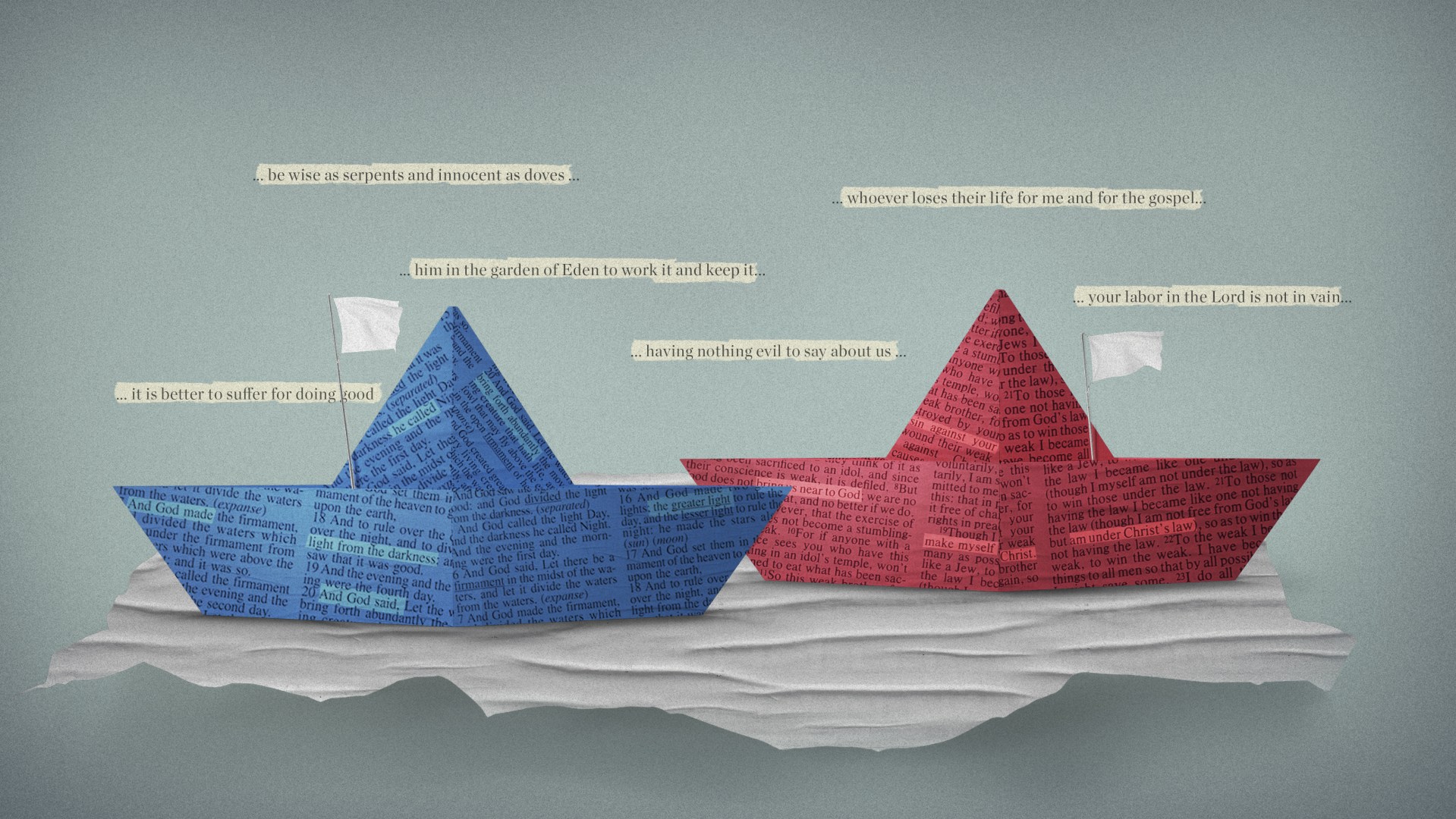
Illustration by Rick Szuecs / Source images: Envato

In 2017, nine people were caught in a riptide off a Panama City beach. Over 80 onlookers formed a human chain extending 100 yards into the Gulf of Mexico, rescuing the last person after just an hour. Riptide deaths usually result from people swimming against the tide until they lose the energy to resist its pull.

Similarly, Christ’s followers tread dangerous waters when trying to navigate America’s sociopolitical currents. How might churches overcome the loss of energy and resist political riptides? America’s polarization current is only part of the story. In 2016, 1 in 10 Bernie Sanders supporters voted for Donald Trump in the general election. How was that possible? According to the conventional left-right spectrum, this makes no sense. What else is going on?

A religious undercurrent, which we call “political denominationalism,” moves just below the surface of our political discourse. Mere opinions are no longer allowed; one must have unwavering convictions. Political commitments increasingly define us, yet at the same time, are increasingly irrelevant. Other forces now pull us.

Modernity affirmed an ordered world discernible through rational, scientific inquiry. It rejected the authority of religious and private beliefs in favor of progress and technological advance. Conversely, postmodernism rejected claims that history progresses or possesses any inherent meaning.

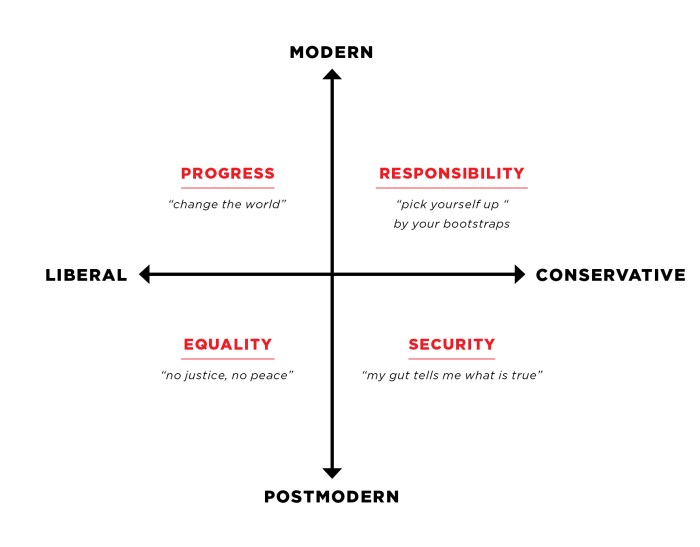
Add the contrast between modern and postmodern to the classic divide between liberal and conservative, and political perspectives get even more complicated. In the accompanying illustration below, the left-right spectrum represents America’s liberal-conservative continuum. The vertical line represents the modern-postmodern continuum. Modern liberals in the upper left quadrant espouse progress. Typified by the Clintons, their slogan might be “Change the world.” The upper-right quadrant represents modern conservatives, who emphasize responsibility. Imagine Ronald Reagan urging, “Pick yourself up by your bootstraps.”

The lower-left quadrant represents postmodern liberals who emphasize equality (“No justice. No peace”). They routinely engage in identity politics, highlighting marginalized social groups. Think Bernie Sanders. For postmodern conservatives in the lower right quadrant like Donald Trump, suspicious of cultural elites and globalism, security is paramount.

Each of these perspectives taps values rooted in Creation. In Genesis, progress, responsibility, equality, and security are aspects of a flourishing world. We are called to progress when God commissions humanity to “be fruitful and multiply and fill the earth and subdue it” (Gen. 1:28, ESV throughout). We’re invited to develop the potential embedded within creation, sinking our hands into the soil and bringing forth creation’s hidden gifts. We see responsibility when God “took the man and put him in the garden of Eden to work it and keep it” (Gen. 2:15). The world was no mere buffet for humanity. Humans were called to steward the property and family given them. The Bible affirms equality and diversity. God’s image consists of both male and female. Finally, Genesis implicitly affirms security. The garden offered safety and provision to freely flourish. People made in God’s image lived in a land without fear.

Progress, responsibility, equality, and security are good aspects of God’s creation. Flourishing societies need progress in science and public policy. Humans need protection. People must take responsibility for themselves and challenge oppressive structures.

Problems arise when we isolate one value from the rest. Overemphasizing responsibility undermines compassion. How many social problems stem from factors outside one’s personal responsibility, whether family background or systemic barriers? Overemphasizing progress threatens the vulnerable. Consequences include environmental degradation and lost jobs. Unborn babies and the disabled are seen as impediments to “the common good.” Overemphasizing equality displaces “opportunity” for “outcomes.” Class warfare ensues, and shaming becomes a weapon of debate. Overemphasizing security displays a lack of faith in God. Fear of “outsiders” fuels violence and racism.

The early church didn’t fit into common sociopolitical categories. How might we engage biblical wisdom and recapture such Christ-centered, countercultural distinctiveness, pointing to Jesus, not political denominations?

Think Long-term

Political philosopher Jim Skillen wrote, “Politics is not something done in a moment of passion with a simple moral zealousness. Politics is more like raising a family, or running a business, or stewarding a farm. It requires a lifelong commitment, patience, steadiness, and great attention to detail day after day.” Our lack of patience and endurance is a symptom of political idolatry.

Productive dialogue is slow and inefficient. Siri and social media severely hinder healthy communication. We’ve become slow to read, quick to retweet. The provocations of the irritated and ill-informed distract from constructive conversation. What’s lost in interpersonal connection is gained in impulsivity. Snarky memes make a point but not a difference.

The volume of information at our fingertips breeds impatience. The egalitarian nature of the internet undermines expertise. Intolerance for dialogue and experimentation prolongs problems. We limit the Spirit’s work to the dramatic and spontaneous. Yet the Spirit often works through our perseverance. Recall Abraham, Joseph, Moses, and Paul, among others. God can hasten change, but he often chooses the path of patience and endurance.

The Spirit is not Siri or Amazon answering prayers with one click. Wisdom is the fruit of time, not expediency. Job 12:12 says, “Wisdom is with the aged, and understanding in length of days.” Significant political problems are not solved on short timetables. A Chinese proverb adds, “Don’t fear going slowly; be afraid of standing still.”

Can churches be known for humble, wise discourse? What if we reject polarization and listen, confess sin, forgive others, and speak truth in love? Such wise and patient communities care for the entirety of God’s world, from economics to evangelism.

Expect to Suffer

People will “cancel” us unfairly. Thus, Paul urged readers to have “sound speech that cannot be condemned, so that an opponent may be put to shame, having nothing evil to say about us” (Titus 2:8). Peter adds, “it is better to suffer for doing good, if that should be God’s will, than for doing evil” (1 Peter 3:17).

The church is inherently political. It challenges anyone claiming ultimate authority, which belongs solely to Christ. Allegiance to Jesus shifts our expectations and political tactics. We bear the world’s burdens, not insisting on self-preservation. The movements for civil rights and against South African apartheid provide two examples where lasting change came through steadfast suffering.

Partisanship is a convenient way to avoid suffering. Social silos ensure the sort of agreement found only in echo chambers. Polarized factions are suspicious of anyone finding common ground with rivals. Yet every political platform envisions an idealized future. We can appreciate the constructive intentions of other political perspectives. Likewise, we critique the inevitable idolatry and injustice in every political movement, perhaps even our own.

Do More Than Tread Water

Riptides weaken about 50-75 yards from shore. To escape, one must show patience and not panic. Patience does not imply contentment. Wise swimmers resist the outward tow in a steady yet measured way until they reach the shallows.

Christ’s followers need to be responsive, not reactionary. Jesus didn’t fill his disciples with romantic notions of revolution. Likewise, churches mustn’t drown in panic. Trying to avoid the political currents, we could easily get carried away by subtler social forces. We must intentionally and persistently seek collaboration with people with divergent opinions. Our labor in the Lord is never in vain.

Jackson Wu (pseudonym) is the theologian-in-residence at Mission One and author of Reading Romans with Eastern Eyes. He uses a pseudonym for reasons of security and respect for his host culture, not from a desire to mislead readers about his ethnicity.

Jim Mullins is the lead pastor at Redemption Tempe Church and co-authored The Symphony of Mission with Michael Goheen.

Speaking Out is Christianity Today’s guest opinion column and (unlike an editorial) does not necessarily represent the opinion of the magazine.

Books
Review

Old Books Are Strange and Threatening. That’s Why We Should Read Them.

Alan Jacobs shows how to resist the pull of the present by engaging ideas from the past.

Christianity Today October 8, 2020
Priscilla Du Preez / Unsplash

It all begins with the ancient poet Horace and a room full of undergraduates. Alan Jacobs and his Baylor University Honors Program class are reading the Roman poet’s Epistles, letters written as poems that Horace dispatched from his home in the country. In moving away from the bustle of Rome, Horace sought to acquire “a tranquil mind.” Rome was the center of everything, of course, and the place where the present, the concerns of the now, mattered most. Horace left the city because he understood what Jacobs and his students come to understand too—that the pull of the present can be the enemy of the tranquil mind.

Breaking Bread with the Dead: A Reader's Guide to a More Tranquil Mind

Breaking Bread with the Dead: A Reader's Guide to a More Tranquil Mind

Penguin Press

192 pages

$19.00

In this story, which introduces his latest book, Breaking Bread with the Dead: A Reader’s Guide to a More Tranquil Mind, Jacobs puts his finger squarely on a seemingly unshakeable problem of our moment: Most if not all of us find ourselves completely overwhelmed by how much information (and disinformation) there is to process and respond to in a given day. Jacobs writes of the reality of “information overload” and the unshakeable feeling of “social acceleration,” which necessitates a strategy, a way of deciding what is and is not worth our attention. Given these realties, most people turn to what Jacobs calls information triage, which is a way of quickly assessing the value of information and of dismissing what seems to be irrelevant or worthless.

The problem with this strategy is that for most people, there is an inherent bias toward seeing the present as the most important and salient thing. So the past is often dismissed outright because it is seen as completely irrelevant or objectively bad. But such easy dismissal of the past is a mistake, Jacobs argues, because the past, though it does contain certain “threats,” also contains untold “treasures.”

Spirit of Generosity

Though this is a book about the past and the benefits of engaging with it, it is not about why knowing history keeps us from repeating it. While Jacobs says he generally agrees with that point, he is after something different and perhaps more relevant to the current moment.

“I am going to try to convince you that the deeper your understanding of the past,” Jacobs writes, “the greater personal density you will accumulate.” He takes the phrase “personal density” from Thomas Pynchon’s famously difficult novel Gravity’s Rainbow. In the novel, an engineer character argues that by deepening your temporal bandwidth, primarily through engagement with the past, you increase your personal density. And reading old books as a way to engage the past is akin to breaking bread with the dead.

But if breaking bread with the dead, if reading and engaging with old books, is truly a way of cultivating tranquility and becoming more personally dense, then what keeps us from it? Jacobs recognizes that the past has fallen on especially hard times. It is viewed with suspicion. It is seen as superfluous or perhaps as even dangerous. Jacobs notes that for some the past is even a place of defilement, a place where one might be indelibly marked by the bad thoughts, bad values, and bad motives of those who have gone before. And to make matters worse, often those who do engage with the past can seem to be nostalgic about it and therefore blind to its real problems. Throughout the book, Jacobs responds to these critiques of the past, but he never simply dismisses them. He truly engages them, takes them seriously, and at points agrees with them—and this is one of the book’s greatest charms.

To describe how Jacobs does this in detail will spoil some of the pleasure in reading the book, so instead I will describe a couple of the strategies he recommends for engaging the past. When encountering ideas from the past that are contrary to our own, Jacobs advises that we must not set aside our own values. Rather, “what we need to do is keep all our values in play, not just some of them.” This allows us to engage the past with a spirit of generosity, which neither denies the wrongs nor naively dismisses them. To engage the past in this way greatly increases our ability to engage the present in the same way. After all, if I can learn to break bread with those in the past whose lives and views are vastly different than my own, then I might just find I am better able to love the neighbor right in front of me too.

Jacobs also encourages his readers to readily acknowledge the strangeness of the past. That the past can be truly strange is in many ways the crux of the book, because this strangeness has the power both to delight and to offend. The strangeness of old books and the strange worlds they speak of might repel us, but that same strangeness is also what can also make them compelling. One can seek the wisdom while trying to ignore the strangeness, but the strangeness is an essential ingredient in what gives the wisdom its depth.

Jacobs’s own way of reading demonstrates why breaking bread with the dead is more of a feast than eating the bread of the present. A lovely side benefit in doing this is that the more we engage the past, the weaker the hold the present exercises on us and our attention. If we learn to regularly feast with the dead instead of continually gathering up the crumbs and scraps of the present, we might find ourselves more nourished and strengthened. This is not to say that the bread of the present, a kind of manna, cannot and does not nourish, but it is always just for the day. For all manna can do, it does not keep. In fact, it rots.

The more we break bread with the dead, then, the less we try to subsist on the crumbs of the present. This is the both the premise and the promise of this book, and it is certainly attractive, but there is nothing easy about acquiring the tranquility it describes. Enlarging and expanding the self, even through reading, is often a dangerous business. Jacobs knows this too. Contending with the past, he writes, “requires us to be like Jacob, who wrestled with a mighty figure by the Jabbok not in order to defeat or destroy him, but with a strange generosity, an eager and earnest belief that his opponent had something of greater value in his possession, and that he could give it to Jacob. I will not let you go until you bless me.”

That the past has real blessings is a beautiful reminder, but it can be easy to forget that Jacob, though he is truly blessed, still limps away from his encounter. That wrestling and that blessing cost him. If we are willing to wrestle for the wisdom of the past, are we also willing to walk away limping? Early on in his book Prayer, the Catholic theologian Hans Urs von Balthasar notes that there is only so much one can learn about prayer by reading about it. There is, in fact, something amiss about only reading about prayer or even just watching and listening to someone pray. At some point one must pray oneself. And so it is with breaking bread with the dead. Though Jacobs is a fine dinner guest himself, at some point we must host our own meals.

Go and Feast Likewise

Breaking Bread with the Dead beautifully demonstrates both how and why Jacobs engages the past. He demonstrates how expanding his temporal bandwidth has increased his own personal density. At certain point, though, if his argument holds any water, the reader must go and do likewise. And so my only fear for a reader of this book is that Jacobs so ably demonstrates what he commends that his readers might think that either the work is already done or that there is no way that they could ever do the same themselves.

That being said, every reader needs able guides, and Jacobs is more than able. Ever since I first picked up one of his books in a campus bookstore as an undergraduate, I have been impressed by his generosity as a reader, both in the breadth of his reading and the depth of his engagement with what he reads. My impression then and my conviction now is that Jacobs is eminently sane. Such sanity is always a rare quality, but now more than ever it seems especially precious. His work confirms that breaking bread with the dead is truly a way to cultivate sanity and tranquility of mind.

Early on, Jacobs describes the book as a meandering and ascending staircase. My encouragement would be to meander and ascend with him. Along the way you will meet all manner of interesting characters and encounter a wealth of stimulating ideas. At the end you might find yourself looking at things from a higher vantage point. You might find you are breathing cleaner air. You might find that things have slowed down, even just a little. And you might find that you have developed an appetite for the kind of bread only the dead can offer. And once you have a taste for such bread, then, dear reader, go and feast likewise.

Christopher Myers is the associate rector of St. Bartholomew’s Anglican Church in Dallas and a doctoral student in theology at Durham University. He blogs at The Road Between Here and There.

News

Biden Said ‘Inshallah.’ Many Arab Christians Do Too.

Arabic phrase invoked during presidential debate parallels James 4 and offers a window into how Christians and Muslims view God’s will.

Christianity Today October 7, 2020
Illustration by Mallory Rentsch / Source Images: Win McNamee / Scott Olson / Getty Images

Unnoticed by many during the contentious first presidential debate, Joe Biden introduced a new Arabic word into the American lexicon.

Inshallah.

Technically, it is three words, in both Arabic and English: “in sha’ Allah,” or “if God wills.”

However, “If you take it literally, you won’t get the intent,” said Ramez Atallah, general director of the Bible Society of Egypt.

“It can also mean, ‘It will never happen,’ and this is probably what Biden meant.”

Asked by the debate moderator about his tax returns, President Donald Trump answered, “You’ll get to see it.”

To which the former vice president interjected, “When? Inshallah?”

Trump continued, and the moment was lost to almost all but Arabic-speaking viewers. Muslim Twitter users lit up in astonishment, wondering if they heard correctly.

Enchilada” was about as close as other ears heard.

But while one Muslim writer has humorously called inshallah the Arabic equivalent of “fuggedaboudit,” what should Christians make of the phrase?

“Everything is uncertain,” Atallah said. “We live in an unpredictable world, and no one is ever sure that what they plan will be accomplished.”

He highlighted the biblical equivalent in James 4:15: “You do not even know what will happen tomorrow … Instead, you ought to say, ‘If it is the Lord’s will, we will live and do this or that.’”

Born in Egypt but educated in Canada and the United States, Atallah returned for good in 1980 and was soon given a crash course in inshallah. Calling a plumber to fix his leaky pipe, he paid about $28 in US dollars in advance and then waited endlessly for the man to come.

“Tomorrow, inshallah,” he was told.

Eventually the plumber came. He was not a thief. But whereas in the West, routine services can expect completion with relative dependability, Egypt has the Mugamma, a Soviet-style government administrative building in downtown Cairo.

Films have been made about the endless runaround needed simply to get stamps on paperwork.

“You have to live by faith here,” Atallah said, “more than you do in a Western culture.”

And Christians do—but not necessarily the way James, the brother of Jesus, imagined.

“I use the phrase all the time,” said Martin Accad, chief academic officer of the Arab Baptist Theological Seminary (ABTS) in Lebanon.

“But I’m not sure if anyone ever uses it meaningfully.”

The Arabic language has several phrases that deflect from giving a straight answer. But whether expressing a general hope or escaping a promise, in the unconscious mind of even the most flippant user is a cultural absolute.

“It is arrogant, and almost a rebellion against God, to say something without that formula,” said Accad. “Inshallah is the biblical and Qur’anic medicine against thinking that life is under your control.”

The wording in Islam’s holy book is almost exactly similar to James 4, he noted. But its presence in the story of Abraham sacrificing his son indicates how thoroughly the biblical understanding permeated Arabia’s seventh-century culture.

“O my father, do as you are commanded,” says the unnamed character Muslims understand to be Ishmael. “You will find me, if Allah wills, of the steadfast.”

This is the sense in which pious Muslims intend the phrase, said Accad, who oversees ABTS’s programs of interfaith engagement. But over the centuries, a misapplied Muslim understanding of fatalism has in turn permeated many Middle Eastern Christians.

“Saying ‘if God wills’ can lead to the giving up of responsibility, rather than following through while trusting the results to God,” he said.

“So in practice, if someone tells me, ‘Inshallah,’ I will generally ask for more assurance.”

To distinguish themselves from this cultural practice, many Arab evangelicals simply change the phrase to in sha’ al-rabb (“if the Lord wills”) or bi izn al-rabb (“with the Lord’s permission”).

Rabb is appropriate, Accad said. The original Greek word is kyrios, and the most popular Arabic translation renders it in James 4:15 as Lord.

Meanwhile, Allah is the Arabic translation for both Elohim and Theos, the Hebrew and Greek words for God in the Bible.

The Catholic Arabic Bible translates the James text as Allah, however. So does the ecumenical Mushtaraka version—similar to the Good News Bible—which Accad said feels more natural to the reader and uses the expression common to both Christian and Muslim Arabs.

But when Imed Dabbour first became a Christian, some Arab believers advised him to avoid saying inshallah.

Raised a Muslim in Tunisia, Dabbour used the phrase instinctually.

“It is a common formula to show our faith, that everything is in God’s hands,” he said. “Muslims use it when referencing the future—whether we mean it or not.”

Uncomfortable with giving up inshallah, Dabbour has since reconciled with the phrase, and with his culture at large. Today he is CEO of the Lighthouse Arab World media production house and is a TV host with experience on several national Arab channels.

He is also outspoken about his Christian faith and produced Augustine: Son of Her Tears to re-introduce North Africa to the early church father.

Tunisians use inshallah in both its positive and negative connotations, Dabbour said. But he wonders if many will be just as uncomfortable with Biden’s use, as he was.

“Some Muslim viewers may say ‘Wow,’” he said, noting Biden was likely trying to appeal to them.

“But others might be offended by the mocking tone, as he used it with the colloquial implication that we are people who don’t keep our word.”

So even if America isn’t ready for Arabic, Middle Eastern Christians offer strong testimony on the term’s behalf.

“We are much closer to James’s intent,” Atallah said. “We should say inshallah.”

Editor’s note: CT previously explored the meaning of two other key Arabic terms—taqiyya and takfir—as well as why many Southeast Asian Christians call God Allah.

Ideas

Coronavirus Church Closures Are Not Persecution

Restrictions on worship are unsettling and, in some cases, illegal. But American Christians must protect the intensity and veracity of the term.

Christianity Today October 7, 2020
David McNew / Getty Images

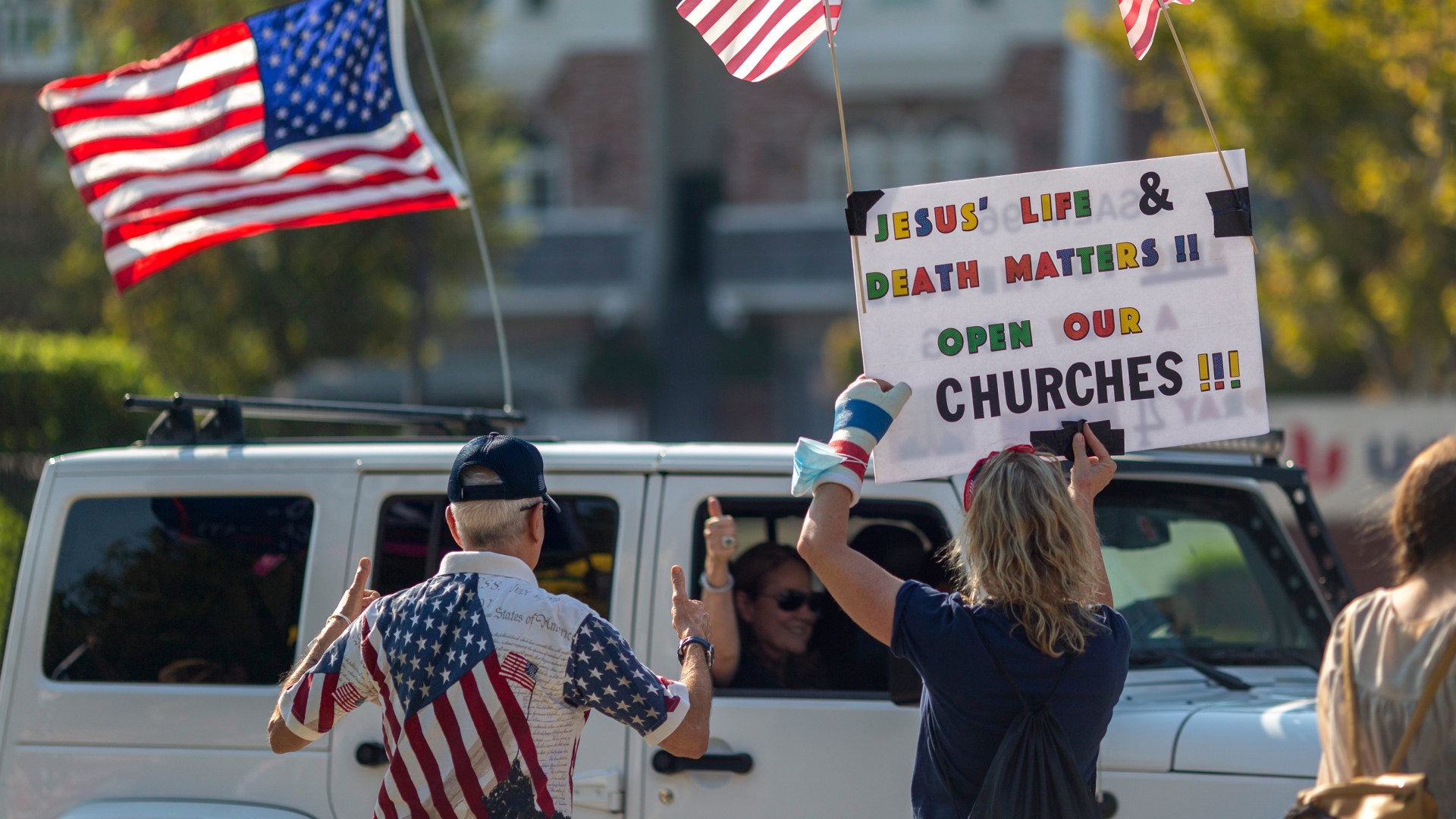
Amid mounting allusions to “persecution” because of the closure of churches on health grounds due to the pandemic, I want to provide some respectful perspective for my fellow American Christians.

I’ve worked my entire 20-year career on international religious freedom, meeting persecuted Christians from around the world. I’ve heard their stories, seen their tears and wounds, and lost friends. From those encounters, I’ve learned persecution is intense, and it is violent.

Therefore, I hope Americans will set the term persecution aside, so it doesn’t lose its intensity or veracity.

The United States is one of the most open and liberal countries for freedom of religion and belief. From our first settlers seeking freedom to practice their faith, to our founding values starting with the First Amendment and consequent laws and now a long-running string of Supreme Court victories, Americans of all faiths (and no faith) have become accustomed to ever-expanding religious liberties. It’s part of American exceptionalism.

And this exceptionalism carries over into how our country promotes and protects religious freedom for all internationally. During my time at the State Department under both the Obama and Trump administrations, we helped carry this out, preaching the values of religious liberty as a social good as well as confronting persecutors. The US is the foremost advocate internationally—full stop. Persecuted people of all faiths pray for our intervention and desire to flee to our shores.

With the pandemic, it’s been unsettling for Americans to see local and state governments direct the closure of churches (as well as synagogues, mosques, and temples) for health reasons. It’s not something most of us have experienced before. However, I know many churches have found innovative new ways to gather virtually, or outdoors, for Sunday worship or fellowship. My church is no exception. It’s better than nothing, and we benefit from our communities of faith during these challenging times.

While the temporary closures are jarring for Americans, foreign governments permanently shut down places of worship all the time. Sadly, it is not unusual, but common. Persecution levels are at all-time highs worldwide, with more than three quarters of the global community facing severe limitations on the free practice of faith. Consequently, Christians of every denomination, people of other traditions, and individuals practicing no faith face persecution every day for what they believe.

In my diplomatic work, I’ve seen churches shuttered and worship criminalized. My bookshelf holds pieces of churches and mosques and synagogues torn down by authoritarian governments. Based on these experiences, I believe American Christians would be wise to avoid labeling the current situation as persecution for three reasons.

First, a significant difference is motive. From what I’ve observed, most state and local officials are searching in good faith for the least-bad options during these uncertain times. For sure, there are some with an anti-religion or anti-Christian agenda. I’ve seen frustrating decisions that appear inconsistent or arbitrary. But if their decisions are unconstitutional, our judicial system provides strong remedies. Most public servants are trying their level best to balance civil rights against concerns about public health, all with imperfect information while under a microscope in an unprecedented situation.

A second difference is duration. When churches are closed for health reasons, the move is temporary until conditions improve. When local officials make these decisions, our faith isn’t banned or made illegal. In fact, I’ve seen officials encourage worship, just online. In many jurisdictions, you can still gather in different ways or in smaller groups without consequence.

Third, and most importantly, the biggest difference is that persecution is brutal and violent. Hebrews 11:35–37 gives vivid examples of the persecution of the early church, which believers faced for centuries. In modern times, here are some examples that I’ve grappled with:

  • Persecution is the imprisoning of Christians because they are Christians, as pastor Andrew Brunson was in Turkey or converts now are in Iran.
  • Persecution is the sudden closing of or commando-like police raids upon your church, as in the former Soviet Union.
  • Persecution is bulldozing churches to the ground, as today in China and not too long ago in Sudan.
  • Persecution is when ISIS attempted genocide against Yezidis and Christians, or the genocide the army of Burma (Myanmar) is committing now against Rohingya Muslims.
  • Persecution is China’s unrelenting assault on Tibetan Buddhists and Uighur Muslims.
  • Persecution is the murder of Christians for their faith, like when the Pakistani Taliban assassinated my friend Shahbaz Bhatti for his defense of Christians and other religious minorities.
  • Persecution is public flogging in Saudi Arabia for merely questioning on the internet their Salafist orientation.
  • Persecution is the kidnapping, forced conversion, and rape of Hindu and Christian girls in Pakistan, with no recourse for the family.

Based on these examples, American Christians should be very careful about labeling our current situation as persecution. There is a continuum from administrative limitations to outright persecution. If there are problems, Americans of faith can petition the courts and fight like hell through any number of pro-bono groups well situated to argue their case. Or American believers can ask their elected representatives to change laws. But these strong tools are often unavailable in other countries.

In short, what is happening in the US is not persecution. It’s disruptive. It’s painful. It’s inconvenient. It’s possibly illegal in some cases. But it’s not persecution.

Americans often forget how blessed we are to enjoy tremendous religious freedom at home. We are not perfect—anti-Semitism, anti-Muslim sentiment, racism, and other ills still exist—so we must continually strive for a more perfect union. At the same time, a bad day for religious freedom in the US still beats a good day just about anywhere else.

We therefore should retire the term persecution when talking about what’s occurring in America during this tragic pandemic.

Knox Thames is the former special advisor for religious minorities at the US Department of State, serving in both the Obama and Trump administrations.

Speaking Out is Christianity Today’s guest opinion column and (unlike an editorial) does not necessarily represent the opinion of the magazine.

Ideas

The Pandemic Sent Thousands of Orphans Back to Their Families. Let’s Keep Them There.

Contributor

The coronavirus outbreak will be either the worst or the best thing to happen to the world’s institutionalized children. It’s our choice.

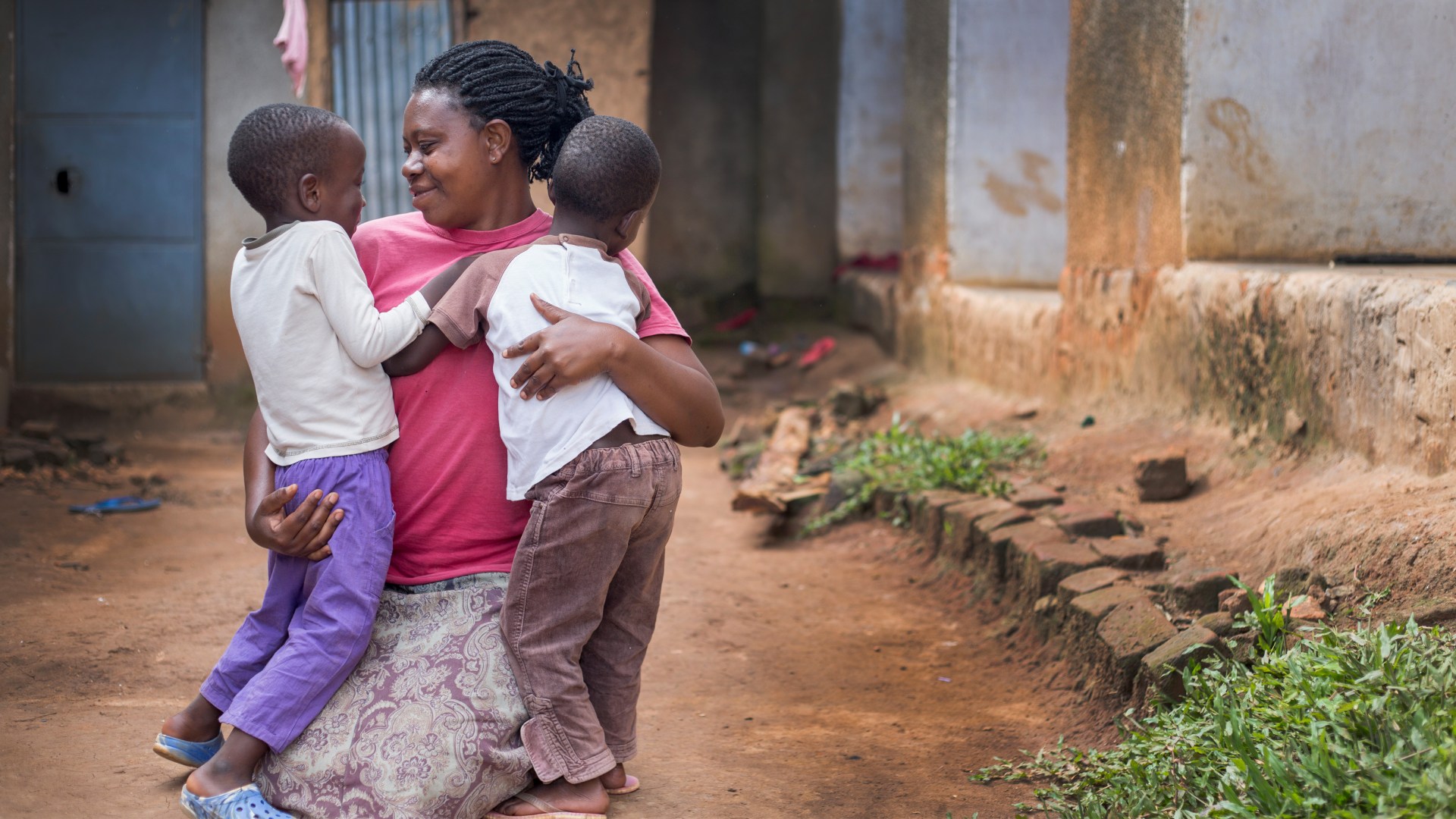
A foster family in Uganda

A foster family in Uganda

Christianity Today October 7, 2020
Child’s i Foundation

In April, 19,200 orphans across Kenya went home. Their orphanages had closed because of the coronavirus outbreak.

In the Ukraine, 42,000 children in institutions were returned to their families in the same time frame, according to the International Leadership and Development Center, a child welfare charity in Kiev. Similar mass movements of orphans back to their families have been reported in Uganda and India.

Many will be surprised that orphans have homes and families to go to. But of the approximately 5.4 million children in orphanages around the world, the vast majority have a living parent and all of them have extended family, according to data from Save the Children and UNICEF.

Research indicates that institutions are not the best place for children to flourish and that the bonds of family are as important as access to education, food, and clothing for children to thrive. One study found that children lose approximately one month of development for every three months they spend in institutional care. Another study found that 1 in 3 children exiting residential care become homeless, 1 in 5 gain a criminal record, and as many as 1 in 10 die by suicide.

Institutions can cause or exacerbate attachment disorders and mental health challenges and can involve a greater risk of abuse, neglect, and maltreatment. Experts believe residential care should only be used as a last resort because, no matter how well-run an orphanage may be, it is still severely detrimental to a child’s well-being and development.

In December 2019, 198 nations signed a United Nations Resolution on the Rights of the Child which, for the first time, recognized the harm caused by institutionalizing children. However, the sudden pandemic, not the signed resolution, provided the most effective impetus to close down orphanages.

For decades, the existence of orphanages has been justified by the assertion that the children had no homes to go to or that it was not possible to trace their families. But the mass movement of children from orphanages back to their homes during lockdown demonstrates that this was a misguided or overly pessimistic view about the possibility of family reunification, even if it stemmed from a well-meaning desire to help.

At one level, this seems to be great news for children in orphanages, as so many have now gone home. But the sudden closure of orphanages is not necessarily good news. Suddenly moving in with relatives after being separated for extended lengths of time can be a challenging transition both for children and their caregivers. Some returned to unsafe situations due to the lack of assessment and monitoring.

“This rapid reintegration of children back to their birth families or extended family has many challenges,” said Christopher Muwanguzi, CEO of Child’s i Foundation. “We have been advised that at least 6,000 children have been returned home in just one district of Uganda, and we are concerned about the pressures this will put families under during lockdown.”

Now that COVID-19 has proved that it is possible for children in orphanages to return home, it is vital to ensure that the right support is in place to protect those children both in the short term and long term. The provision of safe, family-based care requires ongoing practical commitment from governments around the world, as well as from those who have been involved in supporting or managing orphanages in the past.

This is a critical moment. Vulnerable children around the world have gone home in huge numbers and should now have access to the essential nurture and protection that only a family can offer. However, the possibility remains that when lockdowns end, those children may be summarily returned to the orphanages, children’s villages, and residential educational establishments.

In many parts of the world, the pandemic has prompted a new imagination when it comes to dealing with some of our societies’ previously intractable problems. In London, a thousand homeless people were found accommodation in hostels or even hotels—within days. Large hospitals were built in a few weeks. Things we thought were impossible have suddenly proved possible. We need that same ambition when it comes to children from orphanages around the world.

Christians have a pivotal role in making sure things don’t go back to business as usual. It is widely acknowledged that churchgoers and those with faith have historically been the most generous donors and the most frequent visitors to orphanages, driven by a desire to help children and make a difference in the world. This generosity needs to be harnessed and channeled now to ensure that the best possible outcomes are achieved for our world’s most vulnerable children at this critical juncture.

During lockdown, I have spoken with Christian care reform leaders in Brazil, Costa Rica, the Dominican Republic, Moldova, Paraguay, Romania, Sri Lanka, and other places, who are working with their governments to develop and improve family-based care. Many are finding ways to offer family-based care using fostering and domestic adoption routes for those genuinely unable to live with relatives.

In Uganda, Childs i Foundation is working to transform orphanages into child support hubs. An institution that used to house a couple hundred children has been repurposed and the staff have been retrained to care for thousands of children by supporting them with their families.

Christians supporting these kinds of repurposing initiatives, where more children can be supported in more effective and sustainable ways, could be leading the way into a future without the need for orphanages anywhere in the world.

Krish Kandiah is a UK-based speaker and author and founder of Home for Good, a fostering and adoption charity.

Speaking Out is Christianity Today’s guest opinion column and (unlike an editorial) does not necessarily represent the opinion of the magazine.

Correction: The above photo was previously mislabeled as depicting an orphanage. It depicts a foster family.

News

5 Ways Mike Pence Has Shaped the Trump Administration

Loyal to the president, the Midwestern politician has been at work in the background.

Christianity Today October 7, 2020
Drew Angerer/Getty Images

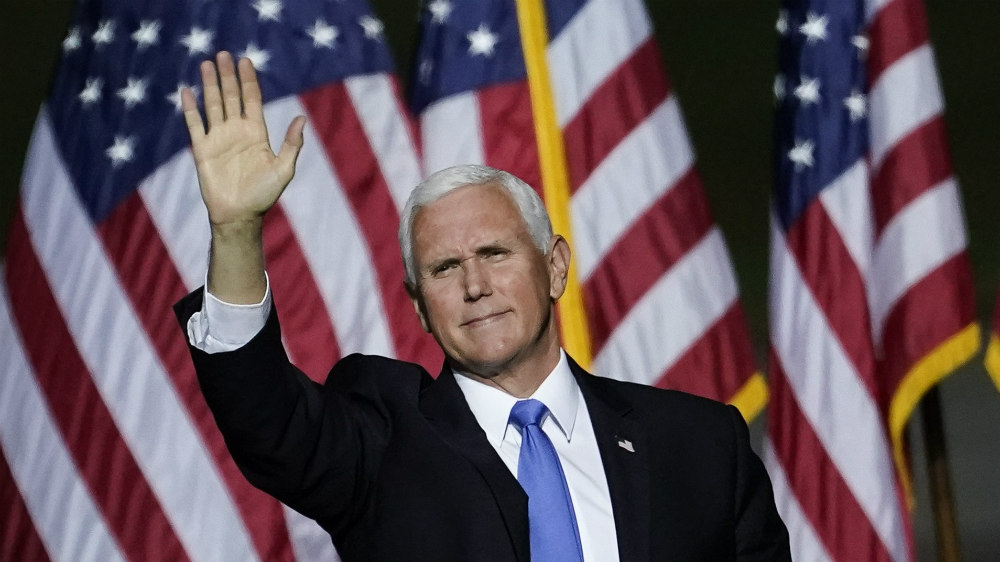
Vice President Mike Pence, set to take the stage Wednesday night in a debate against Senator Kamala Harris, has largely been a background figure in the national discussion over Donald Trump’s presidency. But that may be more about his style than his substance.

Pence played a pivotal role in the administration’s first legislative victory, working out the deal that got the fighting factions of Republicans in the House and the White House to agree to pass the American Health Care Act, which would partially repeal and replace Obamacare.

Then, at the last moment, he had a condition of his own. The “Pence Amendment”—an idea he’d proposed for state-based waivers—couldn’t be called that. He didn’t want to take any credit. Tim Alberta, the conservative political reporter for National Review and Politico, sees this as a quintessential Mike Pence moment.

“The vice president’s persona—the wholesome, aw-shucks, milk-drinking Midwesterner—masks the skill set of a savvy political operator,” Alberta wrote. The former governor of Indiana will “get the job done, and avoid all acclaim in the process.”

Pence is “the 24-karat-gold model” of what politically conservative evangelicals want in a politician, according to Richard Land, president of Southern Evangelical Seminary in North Carolina and former head of the Southern Baptist Convention’s Ethics & Religious Liberty Commission.

“I don’t know anyone who’s more consistent in bringing his evangelical-Christian worldview to public policy,” Land said in 2018.

Pence was raised Catholic and had a born-again experience as a freshman in college, making a personal decision to accept Jesus as his Savior. For a while, he called himself an "evangelical Catholic." In Indiana his family attended an Evangelical Free church.

“I’m a pretty ordinary Christian,” Pence once told a reporter, “trying to make that faith real every day.”

Political scientists say that the vice presidential candidate rarely moves more than a few voters—but the choice determines who will be next in line if the president dies, and says something about the future of the party and the future of the country. In 2016, the VP debate was watched by about 37 million people.

On Wednesday night, Pence will square up with Harris at the University of Utah. According to a recent YouGov poll, 40 percent of Americans say they have a favorable opinion of Pence. He’s more popular than Harris among white people, men, and Americans over the age of 65. About 14 percent of the public, however, has no opinion of the vice president.

As Pence makes his case for four more years for Trump, here are five significant things he’s done so far as his No. 2:

1. Vouch for Trump

Pence was picked as a running mate at least partly to reassure conservative evangelicals that they could trust Trump.

“Mike Pence is there praying over the White House every day,” said Mark Burns, an African American pastor and televangelist who decided to support Trump in 2016, although he had previously voted for Barack Obama. “It takes somebody who knows when you’re headed toward a storm to be there praying for you.”

The prominence of this role has faded somewhat in four years, as Trump has developed his own relationships with a team of evangelical advisers—led by Paula White-Cain—and depended less on Pence to play intermediary.

Yet Pence still serves an evangelical outreach role, joining Franklin Graham at a prayer march in Washington, DC, last month to say, “Thank you for your prayers,” and traveling to Texas last summer to appear at Robert Jeffress’s First Baptist Church of Dallas.

“Of all the people President Trump could have chosen to stand by his side and work with him, he chose a man like Mike Pence—a man of great faith and a man who believes in the power of prayer,” Jeffress said.

2. Provide a Steady Presence

Where Trump seems to love the excitement of chaos—an asset, according to supporters, and a threat, detractors say—Pence has remained steady and calm. When Trump was impeached and faced removal from office, the vice president didn’t do anything to make that moment more exciting, continuing to stand behind the president.

Last weekend, as Trump tested positive for COVID-19 and was moved to Walter Reed National Military Medical Center, Pence was similarly ready to step in if needed, but it was clear he wouldn’t overstep.

3. Break Tie Votes

When the Senate is deadlocked 50 to 50, the vice president casts the deciding vote. Pence has tipped the balance 13 times, more than any other VP since Schuyler Colfax, who served as No. 2 for Ulysses S. Grant. Pence cast the deciding vote to confirm Betsy DeVos as head of the Department of Education and the vote to allow 13 states to block federal money from going to Planned Parenthood.

As a congressman, Pence was the first to propose legislation that would defund Planned Parenthood. “If you follow the money, you can actually take the funding supports out of abortion,” Pence said. “We then have a much better opportunity to move forward to be a society that says yes to life.”

4. Advocate for Persecuted Christians

Pence steered US aid to Iraqi Christian minorities persecuted by Islamic State. He has been criticized for not doing enough, and for interfering where he shouldn’t have, but the vice president’s commitment is clear. Pence wants America to take a leading role in advocating for religious freedom in the world and aiding Christians who suffer violence and loss of liberty for their faith.

“In more than 100 countries spread to every corner of the globe—from Iran to Eritrea, Nigeria to North Korea—over 215 million Christians confront intimidation, imprisonment, forced conversion, abuse, assault, or worse, for holding to the truths of the gospel,” Pence said. “America will stand by followers of Christ in this hour of need.”

Pence also pushed for diplomatic pressure to be applied to Turkey to get the government to release captive American pastor Andrew Brunson, and he condemned Venezuelan leader Nicolás Maduro for persecuting Catholic clergy.

5. Champion a Mission to Mars

In addition to his passion for religious conservative causes, one of Pence's main policy focuses has been the heavens. The vice president has “taken the lead on rebuilding the nation’s space program,” according to Indiana reporter Adam Wren. He helped reinstitute the group of experts who advise the president about space policy and now chairs the National Space Council. Pence has pushed funding for the Space Force, saying American military security should be as important in space as it is on Earth.

Pence is an active proponent of the plan to return to the moon by 2024, before forging on to Mars. NASA is currently working to establish a permanent presence on the lunar surface, where astronauts can live for months at a time and develop the technologies to take the next big leap to land humans on another planet.

“While the tasks before us involve hardship and hazard, sacrifice and perseverance, we know what the men and women of Apollo 11 knew 50 years ago, and that is simply this,” Pence said in 2019. “Americans can accomplish anything we set our minds to. And America will lead the world back into the vast expanse of space.”

News

Armenians Fight to Hold Ancient Homeland Within Azerbaijan

Is the Nagorno-Karabakh conflict a Christian-Muslim clash, or simply politics?

A priest blesses Armenian volunteers and mobilized military personnel ahead of their deployment to the Nagorno-Karabakh front line on October 6.

A priest blesses Armenian volunteers and mobilized military personnel ahead of their deployment to the Nagorno-Karabakh front line on October 6.

Christianity Today October 6, 2020
Sergei Bobylev / Getty Images

Update (Oct. 9): The symbolic Ghazanchetsots (Holy Savior) Cathedral has been damaged by shelling. CT’s complete coverage of Armenian Christians is here.

Fierce fighting has broken out in the Caucasus Mountains between the Caspian and Black Seas, pitting Christian Armenians versus Muslim Azeris.

But is it right to employ their religious labels?

“Early Sunday morning [Sept. 27], I received a phone call from our representative in the capital city [Stepanakert],” said Harout Nercessian, the Armenia representative for the Armenian Missionary Association of America (AMAA).

“He said they are bombing Stepanakert. It is a war.”

One week later, the fighting continues. At stake is control over the Armenian-majority enclave of Nagorno-Karabakh, home to 170,000 people in a Delaware-sized mountainous region within Azerbaijan.

More than 200 people have reportedly died, though Azerbaijan has not released its number of casualties.

Administered by ethnic Armenians ever since a ceasefire was declared in 1994, locals call the region the Republic of Artsakh. Military skirmishes have not been unusual. There have been more than 300 incidents since 2015, according to the International Crisis Group.

This escalation is the most serious since 2016, with Azerbaijani forces attacking multiple positions along the 120-mile “line of contact.”

But the shelling of civilian cities represents a worrisome development.

https://datawrapper.dwcdn.net/

As does the role of Turkey—and the Syrian militants it allegedly recruited—which has pledged full support for Azerbaijan.

Russia, France, and the United States—partners in the “Minsk Group” that has overseen negotiations between the two nations since 1992—have called for an immediate ceasefire.

But Turkey has encouraged Azerbaijan President Ilham Aliyev’s refusal, making a ceasefire conditional on a total withdrawal of all Armenian forces in order to restore the Caspian nation’s territorial integrity.

Complicating matters further has been the disputed deployment of Syrian militants. Denied by Azerbaijan and Turkey, several media outlets have reported their recruitment from Turkish-held areas, and their deployment—even deaths—along the line of contact.

This legitimizes Armenian efforts to cleanse Azerbaijan of “terrorists,” said a Nagorno-Karabakh official, even outside the disputed region.

Turkey’s involvement has awakened the worst fears—or perhaps rhetoric—among Armenians.

“The Turkish state, which continues to deny the past,” said Armenian Prime Minister Nikol Pashinyan, “is once again venturing down a genocidal path.”

The rhetoric of Turkish President Recep Erdogan does not help. He labeled Armenia “the biggest threat to peace” in the region. In the past, he has called Armenians and other Christians in Turkey “leftovers of the sword,” referring to those who survived the genocide—a term he rejects.

Azerbaijanis, though majority Shiite Muslim by religion, are the world’s second-largest Turkic ethnic group after the majority Sunni Turks in Turkey. The groups characterize their relationship as “two states, one nation.”

The latest escalation has Armenians on edge.

“We understand this is an existential issue, not just a war,” said Hovhannes Hovsepian, pastor of the Evangelical Church of Armenia in Yerevan, Armenia’s capital.

“We never do anything to escalate the situation, or take the land of our neighbors. We are for peace—but sometimes you have to fight for it.”

The conflict goes back over 30 years—or maybe 100.

According to international consensus, Nagorno-Karabakh is Azerbaijani territory. UN resolutions have called on all “occupying forces” to withdraw.

In 1987, Armenians in Nagorno-Karabakh petitioned the USSR to add the region to the Armenian Soviet Republic. While consolidating the Caucasus in the 1920s, Stalin placed it under Azerbaijani control, placating Turkey.

Both before and after independence in 1991, Armenians and Azeris engaged in demographic battles. Over 30,000 people were killed, and a million displaced. The two nations swapped about 250,000 people as minority groups were expelled or fled to their ethnic- and religious-majority nations.

Thousands of minority Azeris left Nagorno-Karabakh. Its Armenian population declared independence in 1992, while Armenia occupies the land in between to connect with its own territory.

“All wars have an evil side,” said Paul Haidostian, president of the evangelical Armenian Haigazian University in Beirut, Lebanon.

“But spiritually, as important as legal boundaries are for the world order, they are only one standard. Self-determination, dignity, and the 1,700-year Christian testimony of a land are also very important.”

In formerly Armenian-held land, Azerbaijan has destroyed sixth-century khachkars, ornately carved headstones from a Christian graveyard, according to reports. Muslim cultural heritage was also destroyed in the conflict, though some mosques were controversially rebuilt by Armenians.

Though Azerbaijan denies the khachkar destruction, Haidostian fears also for the heritage of ancient churches and monasteries in Nagorno-Karabakh—and even a massacre, if Azeris regain control.

Meanwhile, he said the Armenian diaspora in the Levant is united in support—and concern.

“Armenians feel this is a continuation of the annihilating policies of pan-Turkism,” Haidostian said.

“Every inch is to be protected.”

But the overlap of religion, ethnicity, and politics makes some uncomfortable.

“The Armenians have learned they get Western support by making this conflict about Christians and Muslims,” said Johnnie Moore, a member of the US Commission on International Religious Freedom who has personally traveled frequently to Azerbaijan with a Jewish rabbi.

“Armenia is allied with Russia and Iran. This is not as simple as people are making it.”

Moore, president of the Congress of Christian Leaders, said he has stressed with his local contacts the need for an immediate ceasefire and negotiated settlement before the situation spirals out of control.

But he also praised Azerbaijan as a model for peaceful coexistence between religions. Its minority Sunni Muslims, who compose 15 percent of the population of 10 million, cooperate with the majority Shiites, while Christians number 3 percent of the population. Meanwhile 12,000 Jews continue their community’s long presence there.

And politically, Azerbaijan represents the essential link for trade and energy between Europe and Asia, Moore said, bypassing Russia and Iran. A brief military flare-up this summer took place not along the “line of contact,” but 190 miles away in Armenia’s north, nearest the oil and gas pipelines.

Some analysts say that Russia—which sells weapons to both sides—is allowing this escalation to linger in order to pressure Armenia’s liberalizing government. Others say Turkey is playing in Russia’s backyard, as a message to Moscow to yield in Syria.

Azerbaijan, meanwhile, has seen its regional power grow since acquiescing to the 1994 Minsk Group settlement that left Armenians in control over Nagorno-Karabakh. Its oil and gas revenues led to a 20-fold increase in military spending between 2004 and 2014, which is two times Armenia’s entire state budget.

Many of the Shiite nation’s weapons are imported from Israel, including the “kamikaze” drones that have brought high-tech warfare to the conflict. Armenia has withdrawn its ambassador from Tel Aviv in protest.

Amid the complicated geopolitical realities, should evangelicals simply support the Christians?

“Absolutely,” said Nercessian.

The pipeline is a minor issue, he said. Armenia must be allied with Russia as it is the regional power broker. And in the early 1990s, with borders closed by Christian Georgia and Sunni Turkey, it was Shiite Iran that supplied Armenia with needed fuel.

“Politics is about national interests and calculations, not moral or spiritual principles,” he said.

“But if the church in America will not support the Christian nation, however nominal, who will they support?”

No one, said Moore. As this is a conflict over land—not religion—it is best to stay neutral and urge both sides to negotiate.

Azerbaijan is willing, he believes.

“Christians shouldn’t instinctually support Armenia just because it is a majority-Christian country,” he said. Doing so could strengthen Iran, while Azerbaijan is allied with Israel.

“This conflict needs to be turned down, and not given oxygen by religious passions.”

There is much of that in Lebanon, with its sizable Armenian minority, said Martin Accad, chief academic officer at the Arab Baptist Theological Seminary in Beirut. His social media has been flooded with statements of support.

Accad said he has not studied the issue sufficiently to weigh between the two nations, though he notes with concern the Syrian militants reportedly developed by Turkey.

But he advises a different measure of judgment.

“We are called to support the just cause, not a common religious or cultural belonging,” he said. “Otherwise it is just tribal sectarianism.

“Still, I can only imagine the psychological impact upon Armenians, given their history [of genocide] a century ago.”

Armenia was the first nation to accept Christianity, in A.D. 301. While only 1 percent evangelical today, 93 percent of its population of 3 million belong to the Armenian Orthodox Church.

The AMAA, established in 1918 to assist genocide survivors in the Ottoman Empire, today operates in 24 countries. Its largest missionary outreach is in Armenia, where it began work following a 1988 earthquake that killed 60,000 people.

But the evangelical movement began far earlier, when an 1860s revival spread through Anatolia to reach even into the Nagorno-Karabakh mountains. Today the region has one Armenian Evangelical church and three Christian education centers, with 22 churches in Armenia proper.

“Our main mission is to reach the people and spread the gospel,” Hovsepian said. His church in Yerevan serves over 200 families.

Relations of late are good with the Orthodox “mother church,” with whom they cooperate in the Bible Society. But while the nation has experienced some revival along with a renewed focus on Christian education, there is still a lack of emphasis on the Scriptures.

So while the younger Hovsepian waits for a phone call drafting him into the army, Nercessian scrambles to answer the phone calls reaching out for assistance. Whether a political or a religious conflict, it is hitting a Christian nation.

“We are a small enclave of spiritual light in a dark region,” said the AMAA missionary. “We were there, we are there, and we will be there still.”

Correction: An Anatolian revival began in the 1860s, not the 1920s as this article initially stated.

News
Wire Story

Latino Evangelicals Narrowly Favor Trump

Though their support for the president has grown, survey finds most Latino Christians plan to vote for Joe Biden.

In 2016, 15 percent of Latino Christians favored Trump. This year, his appeal among the group more than doubled.

In 2016, 15 percent of Latino Christians favored Trump. This year, his appeal among the group more than doubled.

Christianity Today October 6, 2020
David McNew / Getty Images

A new survey focusing on Latino Christian voters found that former Vice President Joe Biden has a voting advantage over President Donald Trump. Even so, Trump’s support among the group has grown significantly since 2016.

It found that 62 percent of registered Latino Christian voters said they would vote for Biden, compared to the 30% who would vote for Trump, according to the Claremont McKenna College’s Latino Religions and Politics National Survey, which was released Wednesday.

Biden leads Trump among Catholics (67%–25%) and Protestants (52%–39%), but not evangelicals (46%–48%), the survey found.

The bilingual survey, which polled 1,292 Latino Christian voters between September 8–22, is described as the largest Latino religion and politics survey this election season. It exclusively focused on registered voters and Latino Catholics, Protestants, and evangelicals.

Gastón Espinosa, who chairs the religious studies department at Claremont McKenna College, said the survey featured 823 Catholics, with a margin of error of plus or minus 3.42 percent, and 453 Protestants and other Christians, with a margin of error of plus or minus 4.6 percent.

Espinosa said they focused on Latino Christians because they “make up the vast majority of Latinos who are religious.” Exploring the role of religion in politics is crucial given that nearly 70 percent of the surveyed Latino Christians said religious guidance is important in their daily lives, he said.

https://datawrapper.dwcdn.net/

The top three issues among Latino Christian voters were the economy, COVID-19 and “stopping racial violence.” Most (64%) disapprove of the way Trump has handled the pandemic, and 59 percent of Latino Christian voters favor Black Lives Matter.

On abortion, 28 percent of Latino Christian voters said it should be generally available, 20 percent said it should be available under stricter limits, and 24 percent said it should only be available in cases of rape, incest or when the pregnancy poses a threat to the mother’s life.

Meanwhile, Trump’s favorability among Latino Christian voters has improved from 15 percent in 2016 to 32 percent in 2020. He’s also doing better in Florida, with 41 percent of Latino Christian voters supporting him compared to 35 percent in 2016.

Faith and Latinos are expected to play key roles in states like Florida, where there are more than two million registered Latino voters.

Trump, for example, launched Evangelicals for Trump in January by visiting El Rey Jesús Global, a megachurch in Miami led by Latino pastor Guillermo Maldonado. Biden last week launched Creyentes con Biden, which translates to Believers for Biden, to spotlight Latino Catholic and evangelical voices.

Although Biden has led Trump in swing states, Espinosa said a high percentage of undecided voters in these same states are Latino born-again Protestant evangelical Christians—a large group in which Trump is slightly leading Biden nationwide (48% to 46%).

Latino voters in swing states like Florida are not only key for Biden, but could also alter the presidential election, Espinosa said.

Espinosa said the nation’s growing Latino Protestants and other Christians are much more likely than Catholics to possibly vote Republican. (The survey’s ‘other Christians’ label refers to Christians from smaller Protestant denominations or who attend independent and non-denominational churches that are evangelical, Pentecostal or charismatic.)

This, Espinosa said, could “have a real impact on the election, because many are undecided and have a history of swinging over and voting Republican.”

According to the survey’s report, 46 percent of Latino undecided voters are born-again Christians.

Among Latinos across the nation, Catholics have declined to 54 percent and Protestants and other Christians have grown to 30 percent, the survey found.

Ideas

Evangelical Witness Is Compromised. We Need Repentance and Renewal.

The National Association of Evangelicals calls Christians to affirm their moral leadership.

Christianity Today October 6, 2020
Source Image: Prixel Creative / Lightstock / Edits by Mallory Rentsch

Polarization is like powerful magnets placed throughout our ideological spectrum. They pull us apart and clump us into tribes. We have a hard time breaking away from the magnetic security of being with like-minded people, who reinforce our like-mindedness. Efforts to move toward others must labor against that pull.

For this reason, the National Association of Evangelicals (NAE) and World Relief have published a short sign-on statement of repentance, renewal, and resolve. It is based on the 2004 NAE document For the Health of the Nation, an evangelical call to civic responsibility and a guide for public leadership.

The statement focuses on eight broad issues of moral importance that are rooted in biblical convictions: protecting religious freedom, safeguarding the sanctity of life, strengthening families, seeking justice for the poor and vulnerable, preserving human rights, pursuing racial justice, restraining violence, and caring for God’s creation.

These issues do not exhaust the concerns of faith or government, but they illustrate a breadth of commitments in which evangelicals can engage in common action.

We are in a season in which the evangelical faith is being narrowly defined and misunderstood by many, with long-term ramifications for our gospel witness. We seek to present a thoughtful, humble, biblically grounded statement of our identity that we pray will function as a light shining on a hill to a watching world, to the glory of our Father in heaven (Matt. 5:14–16).

These biblical values unite us across denominational, geographic, ethnic, and partisan divides. Too many, especially young people and people of color, have been alienated by the evangelical Christianity they have seen presented in public in recent years, and they may rightly wonder if there is a home for them in evangelicalism. We have an opportunity to reaffirm with conviction and clarity that our tradition is rooted in fidelity to Christ and his kingdom values.

In rallying around these principles, we will also show those outside the church that evangelicalism is not defined by politics. Rather, we are motivated by love for God and our neighbor.

We invite Christians to join us in affirming this statement. Now is the time to promote faithful, evangelical, civic engagement and a biblically balanced agenda as we seek to commit to the biblical call to act justly, love mercy, and to walk humbly with our God.

Walter Kim is president of the National Association of Evangelicals.

Speaking Out is Christianity Today’s guest opinion column and (unlike an editorial) does not necessarily represent the opinion of the publication.

Apple PodcastsDown ArrowDown ArrowDown Arrowarrow_left_altLeft ArrowLeft ArrowRight ArrowRight ArrowRight Arrowarrow_up_altUp ArrowUp ArrowAvailable at Amazoncaret-downCloseCloseEmailEmailExpandExpandExternalExternalFacebookfacebook-squareGiftGiftGooglegoogleGoogle KeephamburgerInstagraminstagram-squareLinkLinklinkedin-squareListenListenListenChristianity TodayCT Creative Studio Logologo_orgMegaphoneMenuMenupausePinterestPlayPlayPocketPodcastRSSRSSSaveSaveSaveSearchSearchsearchSpotifyStitcherTelegramTable of ContentsTable of Contentstwitter-squareWhatsAppXYouTubeYouTube