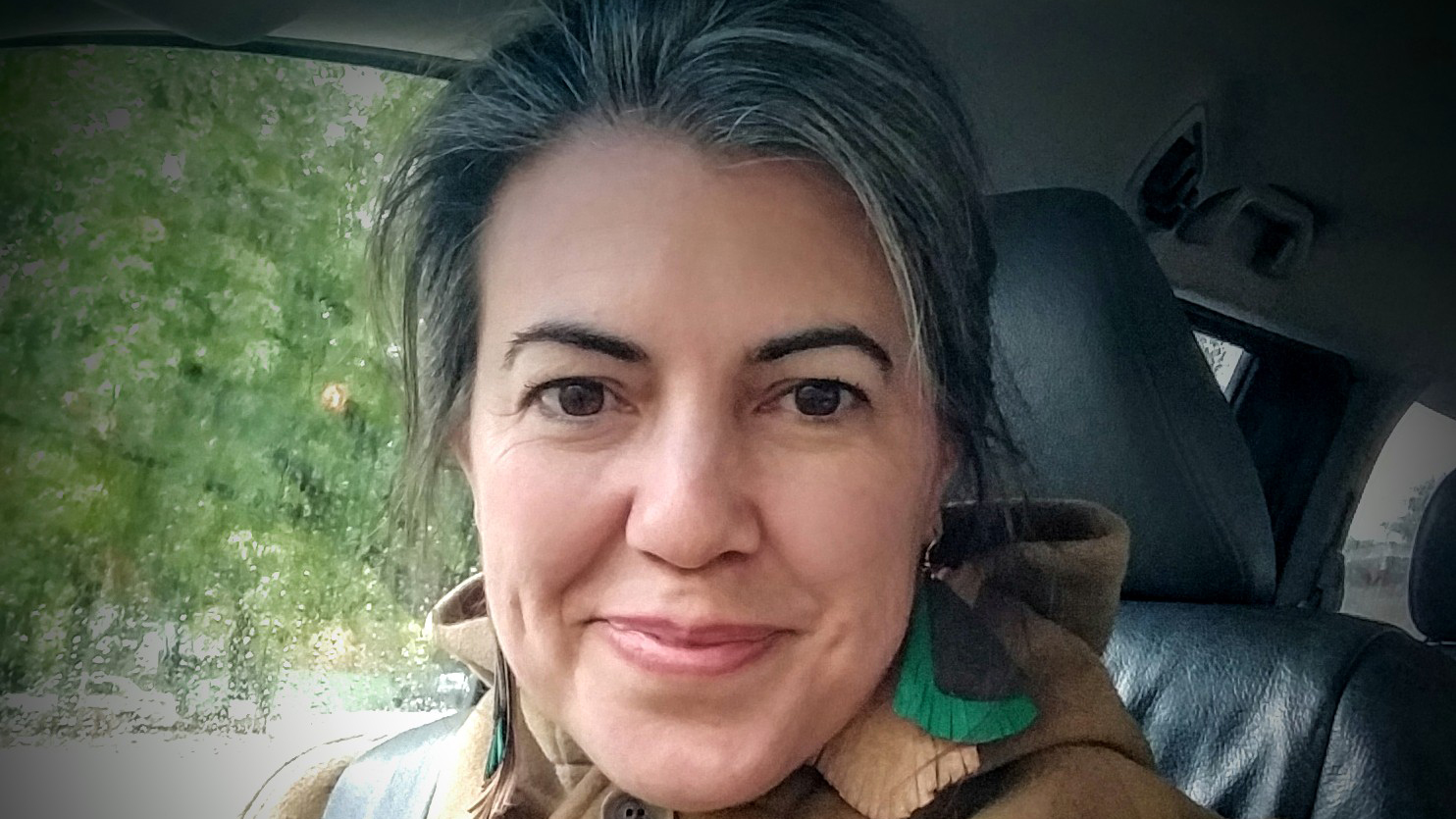
I See Myself in CT’s Testimony

My life, too, has been one of brokenness, depravity, and rescue.

I See Myself in CT's Testimony

Every Christian is an ordinary person with an extraordinary story. That’s the theme behind CT Magazine’s long-running Testimony section. It’s also a big part of the reason that section resonates with so many readers. A fan-favorite, we often receive glowing feedback from those who resonated strongly with particular testimonies. One such reader is Ellen Tuthill, who expressed in an email that the Testimony section had a significant impact on her spiritual life and ministry.

We thought we’d take the opportunity to allow a Testimony reader to share their own testimony and hear more about how CT’s esteemed column has helped her in her own spiritual progress.

The CT testimony that felt most similar to my own story was Rosalind Picard’s. Like Picard, I lived much of my life believing I was vastly superior to born-again Christians, whom I saw as weak and closed-minded. I had to win at everything, and be the smartest person in the room. I didn’t love people. I only judged them.

I grew up hearing that Jesus was just a really nice socialist reformer-but probably not God. I was raised by brilliant, wonderful parents who resented the conservative environment they came out of in Dallas and appreciated the hippy-dippy culture in Austin. I was taught that church was primarily about politics, great music, and community.

I came to associate progressive politics with Christianity. Because I was part of a progressive church that focused on the social gospel, I did lots of work projects to help the poor. I even served as the president of the youth group. But not once in 18 years did I hear that I was a sinner, or that Jesus could save me. Those ideas were considered awkward, closed-minded, and negative.

I received a full academic scholarship to Southern Methodist University, where I became even more driven, perfectionistic, and judgmental. I was quite successful by the world’s standards. Just before my senior year, I met a Baptist boy at a secular collegiate conference who had the gall to explain that I was, in fact, a sinner. Everything else flowed from that one truth, and after several hours of illuminating the gospel and graciously revealing my sin, this young man led me to Christ next to the resort’s swimming pool. I have never been the same.

Through the first decade after being born again, I read constantly from The Economist and Christianity Today. Both are packed with facts, stories, and information, something I specifically craved as a new mom, whose world felt small. Both feature exceptional writing and greater international coverage than I find elsewhere. But CT’s Testimony section is unique. I nearly always cry when I read it. I see my story in most Testimonies I read: one of brokenness, depravity, and rescue.

I read the testimony of a woman who left her lesbian lifestyle for the joy of the gospel and realized my friends with the same hindrance were not beyond His reach. When I was battling fear about my husband being out of town, I read Virginia Prodan’s story, and realized that even if my home is broken into, it could be a divine appointment to speak to the intruder about Christ. When I read about Mitali Perkins, I felt so affirmed. Art had moved her towards Christ, a realization that reinvigorated my investment in art history outreach in the public school.

For the last five years, I’ve gathered a team of Christians from my church to write a summer series for women and their teen daughters in different homes. We have as many as 50 attend each night: Muslims, Hindus, Jews, atheists, and Christians. We discuss a range of topics, from body image and beauty, to friendship, to the Sermon on the Mount.

My husband and I also started a couple’s ministry in our neighborhood. At one point there were 19 couples coming to work on their marriages every week across multiple homes. Many of those same couples began attending church, or even came to Christ, through this marriage ministry. Many face significant challenges, including adultery, alcoholism, and lack of intimacy. But CT’s testimonies always seem to illustrate the gospel in the ways my friends need to hear at the time. I often copy and print out testimonies for friends and Bible students at church or in my neighborhood.

Once, I gave a talk on “Beauty, Body Image, and the Bible” at a mother/teen daughter retreat at my church. I wanted them to understand that even though body-shaming and self-loathing is practically a national pastime for many women, God can use our bodies for glorious purposes. I shared CT’s 2018 testimony from Kim Phuc Phan Thi: her background, horrible burns, and conversion, from the article, as well as the photo from the 70s.

The moms in the room were familiar with the famous photo, but the teens were not. They gasped. Then I showed a recent photo of her scars, and how her imperfect body and those burns actually led her to Christ, and that she now shows her scars proudly, and serves the whole planet as a UNESCO Goodwill Ambassador. I think the teens (and their middle aged moms, of which I am one) were forced to recognize that their own bodies have value, no matter how they look, but are temporary, and that our physical flaws are actually a gift from God. And they would never have had those visuals or that story if I hadn’t learned about Kim Phuc in CT.

God gave us our intellectual gifts for a reason, and until we were humbled, we cannot use them well.

As Rosalind points out,

“I once thought I was too smart to believe in God. Now I know I was an arrogant fool who snubbed the greatest Mind in the cosmos—the Author of all science, mathematics, art, and everything else there is to know. Today I walk humbly, having received the most undeserved grace. I walk with joy, alongside the most amazing Companion anyone could ask for, filled with desire to keep learning and exploring.”
News

Egypt’s Christian Women Treated Like Muslims in Inheritance. Until Now?

Meanwhile, Coptic activist who insists true religious equality does not yet exist goes to prison on terrorism charges.

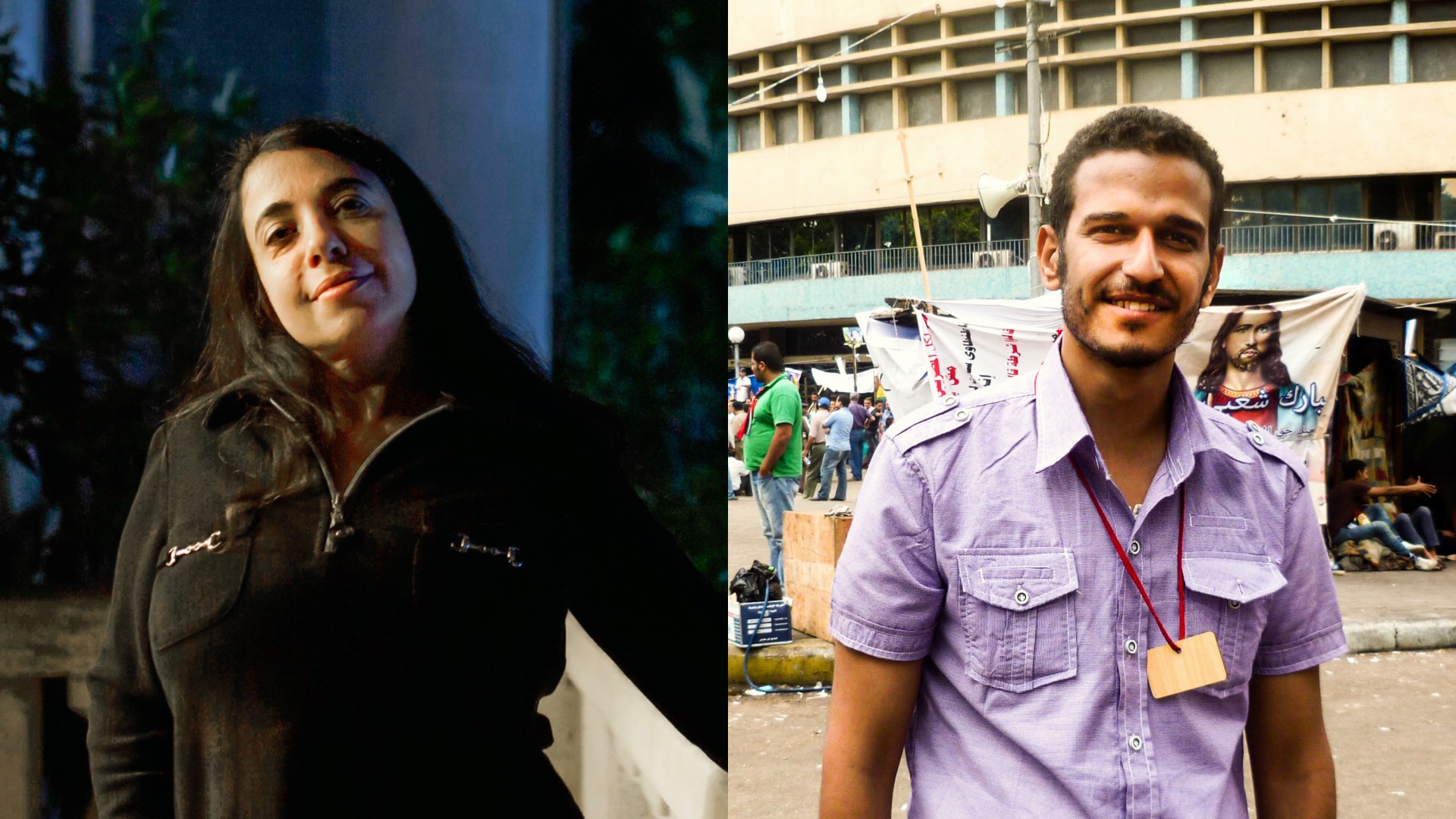
Nasrallah (L) and Kamel (R), both working to address Coptic grievances, find different receptions from the state.

Nasrallah (L) and Kamel (R), both working to address Coptic grievances, find different receptions from the state.

Christianity Today December 5, 2019
Associated Press / Jayson Casper

Coptic lawyer Huda Nasrallah may have won a great victory for Christian women in Egypt. Last week, a Cairo court ruled in her favor, dividing the family inheritance equally between her and her two brothers.

But a few days earlier, Coptic activist Rami Kamel may have suffered a great setback for all Egyptian believers. He was arrested for his reporting of sectarian tension, and accused of joining a terrorist group.

How should these events be interpreted?

Nasrallah’s verdict followed the decision of two other courts to reject her appeal on the basis of the sharia law stipulation that a male heir receive two-thirds of the inheritance.

This past summer, the Egyptian Initiative for Personal Rights (EIPR) took up her cause. In a campaign called “Christian on ID card, Muslim in Inheritance,” it claimed millions of Coptic women suffer similarly.

Coptic men are sometimes all too willing to go along with it, Nasrallah told the Associated Press. But she is “thrilled” by the verdict, and hopes it will inspire other women.

“It is not really about inheritance; my father did not leave us millions of Egyptian pounds,” she said. “If I didn’t take it to court, who would?”

Many have. A similar verdict was issued in 2016, but it did not succeed in establishing a precedent. Girgis Bebawy, a Coptic lawyer, has failed dozens of times, though according to the AP one of his current cases is due to be argued before the Constitutional Court, the nation’s highest.

Might Nasrallah’s novel approach make a difference now?

Rather than appealing to civil, secular equality, Nasrallah based her case on religion. Egypt’s 1938 Coptic Orthodox personal status regulations state that inheritance should be divided equally among children, regardless of gender.

Previous court rulings ignored this law, as well as Article 3 of the Egyptian constitution which states that the “sharia” of Christians and Jews is the primary source in determining issues concerning their personal status.

Copts represent roughly 10 percent of the Egyptian population of over 90 million. Only a handful of Jews remain.

That Nasrallah and her brothers agreed to divide their inheritance equally may have the difference with this final judge. EIPR researcher Ishak Ibrahim told the BBC that Islamic sharia only applies in the case of family dispute.

“[Nasrallah’s] case is important and yet only time will tell what the scope of its importance is,” said Samuel Tadros, senior fellow at the Hudson Institute. “It all depends on the judge’s reasoning.”

If the ruling—which has yet to be released—stems from the family’s agreement, the impact will be minimal, he said. If from the appeal to Christian law, it could be felt far and wide on many personal status issues, such as adoption.

Islamic sharia forbids the formal adoption of children; this applies also to Christian orphans and willing Christian families.

Mina Thabet, head of the policy unit for the Egypt Commission for Rights and Freedoms, agrees that Nasrallah’s victory is a small step. Many more are needed until Christians in Egypt are dealt with as citizens, rather than a religious minority subject to Muslim rules.

Al-Azhar, the Cairo-based central religious institution in the Sunni Muslim world, has previously criticized Tunisia’s secular effort to enforce equality of inheritance among Muslims. But since Nasrallah’s verdict affects Christians, Thabet thinks it will not reverberate deeply.

“This case wasn’t dangerous,” he said. “Confronting the government is different.”

And that is where Kamel fell into trouble. A founding member of the Maspero Youth Union when Egypt’s military tanks rolled over Coptic protesters in 2011, he later documented sectarian strife between Muslims and Christians.

He is now facing charges of joining a terror group and spreading false information, his lawyer told Agence France-Presse. Additional charges include harming public peace, inciting strife between Muslims and Christians, and agitating against the state.

“There is no credible evidence to support these charges,” said Thabet, who last spoke with Kamel a few days before his arrest. Around 10 days prior, security called Kamel in for informal interrogations as a warning to stop his activity.

But Kamel continued, speaking out against the recent arrest of Khalil Rizk, a Coptic labor rights activist charged with joining a terrorist group.

Shortly thereafter, Kamel was arrested also. According to the Cairo Institute for Human Rights Studies, he was scheduled to participate in a UN forum on minority issues a few days later.

Kamel will be tried in the same case as Rizk, and could become the second Copt convicted of terrorism charges. Andrew Nassef was given a five-year sentence in 2017.

Human Rights Watch stated in a 2018 report that “tens of thousands” of peaceful dissidents have been imprisoned.

Egypt has consistently rejected such accusations, calling the reports unprofessional for relying on anonymous sources connected to the Muslim Brotherhood.

But increasingly, opposition and non-Islamist figures have also been targeted.

“These ‘black hole’ cases are used to put activists in pre-trial detention,” Thabet said. “It doesn’t matter if the charges are reasonable, they are used to punish those critical of state policies.”

Three years ago, Thabet was arrested on similar charges, and spent three months in jail. Amnesty International issued a 60-page report last week describing the expansion of terrorism charges to affect peaceful protesters, government critics, and journalists.

Kamel’s arrest coincided with a raid on the offices of Mada Masr, one of Egypt’s few remaining independent news sites. Its journalists were later released, following diplomatic and international outcry, including US Secretary of State Mike Pompeo.

The US Commission for International Religious Freedom tweeted an appeal on Kamel’s behalf, as did In Defense of Christians.

His initial pretrial detention is fifteen days. It is often extended.

“The regime doesn’t want anyone pointing out the discrimination and persecution Copts face,” said Tadros, “because that destroys its propaganda campaign in the United States that depends on the narrative of [President Abdel Fattah] al-Sisi, the protector of Christians.”

Tadros said both cases have to do with religious identity.

“The offer is simple: dhimmitude,” he said, referring to the pre-modern treatment of Christians in Muslim lands who had to accept second-class status in exchange for communal protection.

Today, a similar attitude governs personal status issues and precludes any push for equality, said Tadros.

Thabet views Kamel’s arrest as related to his activism, not his religion—though of course they are indirectly related.

“The timing of the cases is just a coincidence,” he said. “In Egypt, there are many things that just don’t make sense.”

Theology

What It Means that Jesus Was ‘Without Sin’

It is central to our faith that Jesus shared our nature. Does that include its fallenness?

Christianity Today December 5, 2019
Illustration by Rick Szuecs / Source Image:Andrew Howe / Getty

As the lights flashed and the music blared out something caught my attention. It wasn’t the flashing lights nor was it the blaring music. As I stood excitedly at my first Chris Tomlin concert I was struck by the lyrics to his song “Jesus Messiah,” a song I was familiar with and had sung in my church many times, but this time, the well-known worship song was different to me.

As the opening chords played, Tomlin began to sing, quoting 2 Corinthians 5:21: “He became sin, who knew no sin. That we might become His righteousness.” I had heard the lyrics before, in fact I had the verses memorized, but for the first time, I found myself asking, “What does this actually mean? What does it mean that Jesus became sin?” This passage had been explained to me as a simple summary of the Gospel—in one sentence!—and yet I suddenly realized something those who explained it to me rarely admitted: it contains a stunning amount of complexity. Did Tomlin know what he was singing? Did I?

So, what connection does Jesus “becoming sin” have to do with my “becoming the righteousness of God?”

Misunderstanding sin?

To answer this question, we must rethink how we understand sin and salvation. Modern theological language surrounding this topic tends to be forensic in nature, meaning that it is focused on laws and ethics. To be a sinner is to be disobedient, to “miss the mark,” to break the law. Therefore, to be “saved” is to be forgiven of our transgressions. While there are forensic aspects to sin and salvation, it is reductionistic to claim that sin is merely the transgression of a law and salvation is merely legal forgiveness of said transgressions. This is important to understand because the way we understand the problem determines how we understand the solution.

In Scripture, sin is described in three ways: a path we walk, a moral standing, and a state of being. We might conceive of sin as a pie chart made up of these three elements. Most of our pie charts would have the first two—a path we walk and moral standing—comprising the majority and the third—a state of being—would only be a narrow sliver, since it is in the Bible after all. But the pie chart itself misconceives what sin essentially is.

Want to read more about theology and the Incarnation?


Oliver Crisp considers whether Christ was truly tempted in every way.

Thomas McCall looks at the Wrath of God on Good Friday

These first two elements, corrupted living and guilty moral standing, are not what sin is, they are simply the outflow of sin. Sin’s essence must be understood as a state of being; it is a corruption of ontology. The prophet Jeremiah asks “Is there no balm in Gilead? Is there no physician there? Why then is there no healing for the wound of my people?” (8:22) The prophet views sin as an affliction that needs healing. This is echoed by Paul in Ephesians 2 when he says that we were “dead” in our transgressions and sins. Sin is a disease that we can do nothing about, however, the New Covenant that God makes with his people in Ezekiel 36:25-27 says,

I will sprinkle clean water on you, and you will be clean; I will cleanse you from all your impurities and from all your idols. I will give you a new heart and put a new spirit in you; I will remove from you your heart of stone and give you a heart of flesh. And I will put my Spirit in you and move you to follow my decrees and be careful to keep my laws.

Jeremiah’s cry for a balm to heal the sickness (sin) of his people will be given by God as promised to Ezekiel. God promises a cleansing; a new heart and a new spirit. We will be totally recreated so that we will “walk” in His statutes. Unless our corrupt natures are healed, we will never walk the correct path. For the totality of sin to be fixed, there must be a solution that is more than simply forgiveness of wrongdoing and a moral example for us to follow. There must be a solution to sin that includes the recreation of our natures, the healing of our hearts of stone. So, we don’t need a pie chart; we need a flowchart, where guilty moral standing and corrupt living are the domino effect of our sinful essential state.

In the Old Testament, atonement was made for one’s sins by participating in the sacrificial system. A lamb was sacrificed as an atonement for sins in order to gain temporary right moral standing before God. There was a problem, however, a lamb could not recreate our human nature. It only pointed towards the day when the ultimate sacrifice would come that, as Ezekiel proclaims, would provide the removal of our hearts of stone—the only solution to sin. Galatians 4:4-5 says “when the set time had fully come, God sent his Son, born of a woman, born under the law, to redeem those under the law, that we might receive adoption to sonship.” The solution to sin begins at the incarnation when Jesus assumed a human nature and “tabernacled” among us (John 1:14).

If we have misunderstood what sin is, is it possible that we have also misunderstood the solution—the atonement? If so, how should we think of it?

Often salvation is most closely—or even exclusively—linked to the cross, as the place where Jesus made payment for our sins. But while the cross may be an important exclamation point in the unfolding story of salvation, it is certainly not the whole story.

We are told that because of the cross, all we now have to do is ask Jesus to forgive us and our sin problem is fixed. While this may provide a solution to our moral standing before God it does not fix the actual problem of a corrupted nature. In order to fix the problem of sin, our salvation begins on Christmas when Jesus assumes a human nature. But, what kind of human nature did Jesus have? Was it affected by the fall? What effect does the answer to that question have on my salvation? These are the questions that began rushing through my head as I was listening to Chris Tomlin belt out “Jesus Messiah” at his concert.

A Fallen Nature?

We may take for granted that in order for Jesus to be the spotless lamb and a worthy sacrifice for our sins, Jesus had to assume a human nature that was unaffected by the fall. This is the “unfallen nature” view. However, in order for Jesus to secure redemption for fallen humans would He not need to assume a human nature that was affected by the fall? This is the “fallen nature” view.

Those who hold to the former view argue that the latter is problematic for several reasons. First, fallenness is not an attribute that is necessary for one to be fully human. For instance, Adam and Eve were fully human before the fall, thus fallenness must not be an essential attribute of being fully human. Second, if Jesus assumes a fallen human nature this would include the assumption of original sin which includes original guilt and original corruption and, according to theologian Oliver Crisp, simply by virtue of possessing this corruption “he is loathsome to God and must have the blessings of heaven withheld from him,” even if he never actually sins. If Jesus is loathsome to God because of his fallen nature and has heaven’s blessings withheld then he can’t be our savior. So, argues Crisp, this is the “issue upon which the fallenness view stands or falls.” But, is this really the end of the fallen nature view?

Theologians such as Karl Barth and T.F. Torrance argue in the spirit of Gregory of Nazianzus that “the unassumed is the unhealed.” In order for Jesus to bring healing to our sinful natures and provide a new way to be human, in the incarnation Jesus must vicariously assume a fallen human nature into union with his divine nature and divine person. In the words of 20th-century Scottish theologian T.F. Torrance, Jesus “entered into our condemned state under divine judgment and made it his own, suffered the ‘Eli, Eli, lama sabacthani,’ and yielded up the Ghost under the burden of sin and judgment and wrath.”

If sin is indeed an ontological problem that requires an ontological solution, then in this view, Jesus assumed a fallen nature because it was fallen humanity that needed a savior. Christ’s vicarious assumption of a fallen human nature was for the purpose of atonement, for removing our heart of stone and giving us a heart of flesh.

However, this view raises two important questions: First, does Jesus’ assumption of this fallen nature make Jesus sinful and therefore incapable of being our savior? Second, is this view Biblical?

A Sinful Savior?

In continuity with Chalcedonian Christology, we confess that Jesus is the pre-existent second person of the Trinity (John 8:58). This means that He possesses a divine nature and a divine person. In the incarnation, the Son vicariously assumes our fallen human nature into union with himself, thus having two natures, divine and human, united in His one person. Fallenness is a characteristic of human nature post-fall. Sinfulness—as “a perversion of the created will—is properly attributed to hypostasis [person] rather than nature,” argues Ian McFarland.

While our wills are fallen due to the indivisibility of person and nature, Jesus is exempt from this since His person pre-exists his human nature and thus, His will is not bound by His human nature. Thus, we can confess then that Christ is free from sinfulness while vicariously assuming a fallen human nature, for fallenness is a property of nature while sinfulness a property of person. So far so orthodox, but is this position Biblical?

According to the Scriptures?

For the sake of space let us examine just a few key texts. Second Corinthians 5:21 says “God made him who had no sin to be sin for us, so that in him we might become the righteousness of God.” This text has been interpreted to mean that Christ simply became a “sin offering” for us. While the word used here for “sin” is sometimes translated as “sin offering” elsewhere in the Septuagint, David Garland points out that it does not have the same meaning when used elsewhere in the New Testament. If “sin offering” is indeed what Paul meant here, he seems to be using the word inconsistently when he says Jesus “knew no sin.” It can be concluded then that Jesus was made a “sinner” on our behalf while being sinless himself in order to reconcile and unite us with God within His very person.

In Romans, Paul states “For what the law was powerless to do because it was weakened by the flesh, God did by sending his own Son in the likeness of sinful flesh to be a sin offering. And so he condemned sin in the flesh.” (Romans 8:3) Paul begins this passage by reminding the reader that the Mosaic law is not and cannot be the solution to sin. Instead, God solved the problem by sending his son in the “likeness of sinful flesh.” This is a clear argument against teachings which said that Jesus only appeared to be human. But it is important to note that Paul doesn’t just say “flesh” he indicates specifically “sinful flesh.” As Doug Moo argues, the word for likeness here “probably has the nuance of ‘form’ rather than ‘likeness’ or ‘copy.’” In other words, Jesus truly entered into the fallen human condition in order to break us free from our bondage to that fallenness. According to Moo, by entering into that fallen human condition “the condemnation that our sins deserve has been poured out on Christ, our sin-bearer; that is why ‘there is now no condemnation for those who are in Christ Jesus.’”

We find more biblical support in Hebrews 2:14, which says “Since the children have flesh and blood, he too shared in their humanity so that by his death he might break the power of him who holds the power of death—that is, the devil.” F.F. Bruce says Christ “began to share fully the nature of those whom he chose to redeem,” meaning Jesus shares the same “flesh and blood” we all have. The word translated here as “share,” according to David Allen, “describe[s] a participation in a shared reality.” In other words, when Jesus became human in the incarnation he took on the fallen/fractured nature that humanity shares in order that he might set us free from the bonds that it had us in.

He Truly Shared Our Nature

As the lights flashed, the music rang out, and Chris began to sing I never imagined I would begin a journey to understand the nature of Jesus’ humanity. But as Chris Tomlin sang the words of Paul, “He became sin, who knew no sin, so we might become His righteousness,” that journey began. What does it mean that He became sin? What does it mean that He knew no sin?

Sin placed all humanity in exile, separated from God with a corrupt nature that we can do nothing about. Jesus became a human in order to vicariously assume that corrupt fallen nature, to live obediently within that nature, raise our nature to new life and condemn sin in the flesh thus providing a new way to be human. Because sin is a corruption of nature, it is that fallen nature that Jesus assumed into union within His person. Thus, we now gain His right standing before God, and participate in His full obedience through our union with His resurrected humanity, our final balm and healing.

Daniel J. Cameron (Ph.D. candidate systematic theology, The University of Aberdeen) is an adjunct professor of theology at The Moody Bible Institute. He is the author of Flesh and Blood: A Dogmatic Sketch Concerning the Fallen Nature View of Christ’s Human Nature (Wipf and Stock, 2016).

News

629 Pakistani Girls Trafficked to China as Brides

Poor Christians were a new target of brokers in 2019, AP investigation finds.

Pakistani Christian Mahek Liaqat, who married a Chinese national, cries as she narrates her ordeal on April 14, in Gujranwala, Pakistan.

Pakistani Christian Mahek Liaqat, who married a Chinese national, cries as she narrates her ordeal on April 14, in Gujranwala, Pakistan.

Christianity Today December 4, 2019
K.M. Chaudary / Associated Press

LAHORE, Pakistan (AP) — Page after page, the names stack up: 629 girls and women from across Pakistan who were sold as brides to Chinese men and taken to China. The list, obtained by The Associated Press, was compiled by Pakistani investigators determined to break up trafficking networks exploiting the country’s poor and vulnerable.

The list gives the most concrete figure yet for the number of women caught up in the trafficking schemes since 2018.

But since the time it was put together in June, investigators’ aggressive drive against the networks has largely ground to a halt. Officials with knowledge of the investigations say that is because of pressure from government officials fearful of hurting Pakistan’s lucrative ties to Beijing.

The biggest case against traffickers has fallen apart. In October, a court in Faisalabad acquitted 31 Chinese nationals charged in connection with trafficking. Several of the women who had initially been interviewed by police refused to testify because they were either threatened or bribed into silence, according to a court official and a police investigator familiar with the case. The two spoke on condition of anonymity because they feared retribution for speaking out.

At the same time, the government has sought to curtail investigations, putting “immense pressure” on officials from the Federal Investigation Agency pursuing trafficking networks, said Saleem Iqbal, a Christian activist who has helped parents rescue several young girls from China and prevented others from being sent there.

“Some [FIA officials] were even transferred,” Iqbal said in an interview. “When we talk to Pakistani rulers, they don’t pay any attention.”

Asked about the complaints, Pakistan’s interior and foreign ministries refused to comment.

Several senior officials familiar with the events said investigations into trafficking have slowed, the investigators are frustrated, and Pakistani media have been pushed to curb their reporting on trafficking. The officials spoke on condition of anonymity because they feared reprisals.

“No one is doing anything to help these girls,” one of the officials said. “The whole racket is continuing, and it is growing. Why? Because they know they can get away with it. The authorities won’t follow through, everyone is being pressured to not investigate. Trafficking is increasing now.”

He said he was speaking out “because I have to live with myself. Where is our humanity?”

China’s Foreign Ministry said it was unaware of the list.

“The two governments of China and Pakistan support the formation of happy families between their people on a voluntary basis in keeping with laws and regulations, while at the same time having zero tolerance for and resolutely fighting against any person engaging in illegal cross-border marriage behavior,” the ministry said in a statement faxed Monday to AP’s Beijing bureau.

An AP investigation earlier this year revealed how Pakistan’s Christian minority has become a new target of brokers who pay impoverished parents to marry off their daughters, some of them teenagers, to Chinese husbands who return with them to their homeland. Many of the brides are then isolated and abused or forced into prostitution in China, often contacting home and pleading to be brought back. The AP spoke to police and court officials and more than a dozen brides—some of whom made it back to Pakistan, others who remained trapped in China—as well as remorseful parents, neighbors, relatives, and human rights workers.

Christians are targeted because they are one of the poorest communities in Muslim-majority Pakistan. The trafficking rings are made up of Chinese and Pakistani middlemen and include Christian ministers, mostly from small evangelical churches, who get bribes to urge their flock to sell their daughters. Investigators have also turned up at least one Muslim cleric running a marriage bureau from his madrassa, or religious school.

Investigators put together the list of 629 women from Pakistan’s integrated border management system, which digitally records travel documents at the country’s airports. The information includes the brides’ national identity numbers, their Chinese husbands’ names, and the dates of their marriages.

All but a handful of the marriages took place in 2018 and up to April 2019. One of the senior officials said it was believed all 629 were sold to grooms by their families.

It is not known how many more women and girls were trafficked since the list was put together. But the official said, “the lucrative trade continues.” He spoke to the AP in an interview conducted hundreds of kilometers from his place of work to protect his identity. “The Chinese and Pakistani brokers make between 4 million and 10 million rupees ($25,000 and $65,000) from the groom, but only about 200,000 rupees ($1,500), is given to the family,” he said.

The official, with years of experience studying human trafficking in Pakistan, said many of the women who spoke to investigators told of forced fertility treatments, physical and sexual abuse, and, in some cases, forced prostitution. Although no evidence has emerged, at least one investigation report contains allegations of organs being harvested from some of the women sent to China.

In September, Pakistan’s investigation agency sent a report it labeled “fake Chinese marriages cases” to Prime Minister Imran Khan. The report, a copy of which was attained by the AP, provided details of cases registered against 52 Chinese nationals and 20 of their Pakistani associates in two cities in eastern Punjab province—Faisalabad, Lahore—as well as in the capital Islamabad. The Chinese suspects included the 31 later acquitted in court.

The report said police discovered two illegal marriage bureaus in Lahore, including one operated from an Islamic center and madrassa—the first known report of poor Muslims also being targeted by brokers. The Muslim cleric involved fled police.

After the acquittals, there are other cases before the courts involving arrested Pakistani and at least another 21 Chinese suspects, according to the report sent to the prime minister in September. But the Chinese defendants in the cases were all granted bail and left the country, say activists and a court official.

Activists and human rights workers say Pakistan has sought to keep the trafficking of brides quiet so as not to jeopardize Pakistan’s increasingly close economic relationship with China.

China has been a steadfast ally of Pakistan for decades, particularly in its testy relationship with India. China has provided Islamabad with military assistance, including pre-tested nuclear devices and nuclear-capable missiles.

Today, Pakistan is receiving massive aid under China’s Belt and Road Initiative, a global endeavor aimed at reconstituting the Silk Road and linking China to all corners of Asia. Under the $75 billion China-Pakistan Economic Corridor project, Beijing has promised Islamabad a sprawling package of infrastructure development, from road construction and power plants to agriculture.

The demand for foreign brides in China is rooted in that country’s population, where there are roughly 34 million more men than women—a result of the one-child policy that ended in 2015 after 35 years, along with an overwhelming preference for boys that led to abortions of girl children and female infanticide.

A report released this month by Human Rights Watch, documenting trafficking in brides from Myanmar to China, said the practice is spreading. It said Pakistan, Cambodia, Indonesia, Laos, Myanmar, Nepal, North Korea, and Vietnam have “all have become source countries for a brutal business.”

“One of the things that is very striking about this issue is how fast the list is growing of countries that are known to be source countries in the bride trafficking business,” Heather Barr, the HRW report’s author, told AP.

Omar Warriach, Amnesty International’s campaigns director for South Asia, said Pakistan “must not let its close relationship with China become a reason to turn a blind eye to human rights abuses against its own citizens”—either in abuses of women sold as brides or separation of Pakistani women from husbands from China’s Muslim Uighur population sent to “re-education camps” to turn them away from Islam.

“It is horrifying that women are being treated this way without any concern being shown by the authorities in either country. And it’s shocking that it’s happening on this scale,” he said.

Associated Press writers Munir Ahmed and Shahid Aslam in Islamabad contributed to this report.

News
Wire Story

‘Divine Collision’ in Uganda Changed New Pepperdine President’s Life

Before he was named to the university’s top post, law professor Jim Gash helped free a falsely convicted teen in East Africa and became an advocate for justice reform.

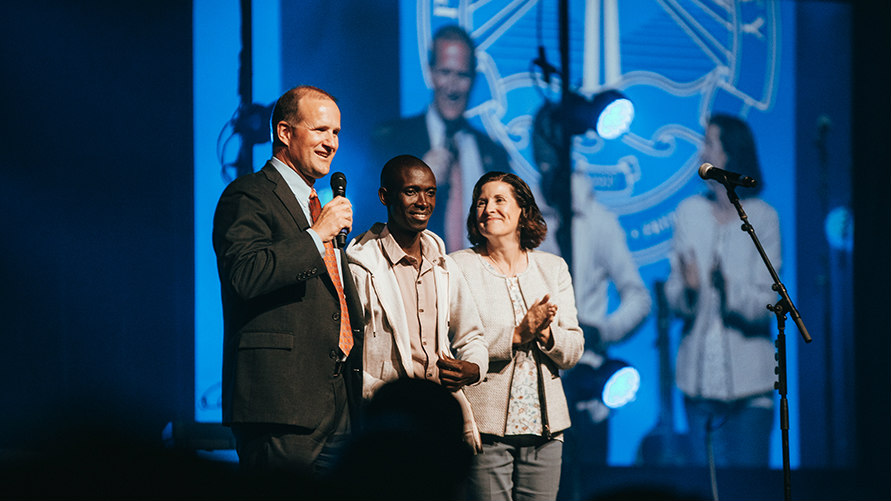
Jim Gash, Tumusiime Henry, and Joline Gash

Jim Gash, Tumusiime Henry, and Joline Gash

Christianity Today December 4, 2019
Ron Hall / Pepperdine University / RNS

A few hours after Jim Gash’s inauguration this fall as Pepperdine University’s eighth president, his wife, Joline, showed up at her husband’s fourth-floor executive suite with a Ugandan medical student.

Tumusiime Henry, 26, had flown nearly 10,000 miles to help celebrate Jim Gash’s unlikely ascension to the top post at the 7,900-student university, which is associated with Churches of Christ.

Henry wore a black suit with a red plaid bow tie as he joined the Gashes in an office overlooking the Pacific Ocean—a postcard-perfect view flanked by Pepperdine’s 125-foot-high monumental cross on one side and a smaller cross atop the stained-glass Stauffer Chapel on the other.

At the inauguration festivities earlier that morning, Henry had sat in the front row as a special honored guest among the thousands of students, dignitaries and faculty members dressed in academic regalia.

As Jim Gash, 52, will tell anyone who will listen, he never would have become president if he hadn’t met Henry.

“It’s all due to this young, brave man next to me,” Gash said of Henry—the nickname by which the aspiring ophthalmologist is known in Uganda, an East African nation that doesn’t have family surnames.

Jim Gash had a life he loved in Malibu, a coastal community about 35 miles northwest of Los Angeles. When the Pepperdine law professor reluctantly joined a global justice trip to Uganda a decade ago, he had no intention of ever going back.

“I was very interested in somebody helping there, but it wasn’t going to be me,” he said. “I went once … to show my wife and my kids and my God that I was willing to take a step of faith.”

Three years earlier, Pepperdine law students had started traveling to Uganda, prompted by a speech by Bob Goff, founder of a nonprofit organization called Restore International, now known as Love Does. Goff had spoken at Pepperdine in 2007 and planted the seed for the first trips. In 2009, Goff again touted Uganda while addressing a Christian Legal Society meeting that Gash attended in San Diego.

Finally, Gash gave in. His January 2010 trek was going to be “my one-and-done, my ‘volun-tourism’ trip,” the father of three said.

But then Gash arrived at a juvenile prison called Ihungu—in the rural district of Masindi in western Uganda.

“I remember walking into that prison. It was a one-room warehouse with no electricity, no running water,” Gash said. “I just remember thinking, ‘This isn’t OK with me.’”

At the prison 130 miles northwest of the capital of Kampala, Gash met Henry, then a teenager.

The 5-foot-4, 120-pound boy was clad in sweatpants, flip-flops, and a blue T-shirt. He had spent a year and a half in custody on false charges of murder. While Henry was at school, villagers had attacked a former herdsman who stole money from the boy’s family. They dumped the man’s body at the family’s home. Henry, his brother Joseph and their father, who since has died, were implicated despite no evidence against them.

While at Ihungu, Henry also had been charged with a second murder—again bogusly—when a prisoner ordered beaten by an adult taskmaster died.

Suddenly for Gash, injustice had a name and a face.

“It changed my life’s trajectory,” said Gash, who has made more than two dozen trips to Uganda.

Gash’s extreme love and care for people are contagious, as evidenced by the relationships he has built in Uganda, said Goff, who participated in the inauguration activities.

“He’s trying to make everything about the power of Jesus Christ unleashed in the world in beautiful ways,” Goff said of Gash, who served for eight years as an elder of the University Church of Christ on the Pepperdine campus. “(But) he’s not out there as an evangelist. He knows what he believes, he knows why he believes it, and he lets love do the talking.”

For Henry, meeting Gash was an answer to prayers.

“I remember that I had actually fasted and prayed for somebody to come and do something, and I was just waiting,” said Henry. “I was very happy to meet him."

Because of limited judicial resources, those charged with a crime often spent years in custody waiting for their case to be heard.

Eventually, the murder charge against Henry, his brother, and father were dismissed. However, Henry remained in custody on the second charge despite his claims of innocence and was eventually convicted of murder.

A judge sentenced Henry to 12 months of probation and released him.

Gash, who became director of Pepperdine’s global justice program, took over the appeal of Henry’s conviction.

At the same time, he also began working with Ugandan authorities to reform the country’s judicial system. Numerous Ugandan judges traveled to Pepperdine to work with legal experts on matters such as developing a plea-bargaining system for their country.

In January 2012, Gash took a six-month sabbatical from Pepperdine. He, Joline and their children—Jessica, Joshua and Jennifer—moved to Uganda. While Gash focused on judicial reform, his wife and children worked with a mobile medical clinic.

“When we decided to move out there, Henry became a part of our family,” Gash said. “Our kids instantly fell in love with him, and Joline became a second mom to him.”

The whole experience, Joline Gash said, let the family “step out in faith.”

“Sometimes, God needs to take you somewhere very far and remote and quiet to tell you what he needs you to do,” Joline Gash said.

In summer 2015, seven years after Henry’s nightmare began, the appeals court finally ruled in his case, striking down the conviction.

Jim Gash called to deliver the news via Skype.

“It’s over! You won!” Gash told Henry. “So no longer are you someone who has been convicted of a crime—the whole thing was nullified. It’s like it never happened.”

“OK!” a teary-eyed Henry replied. “Very good! Praise be to God!”

Henry first traveled to the US in 2016 after the release of Gash’s book Divine Collision: An African Boy, an American Lawyer, and Their Remarkable Battle for Freedom, which recounts the conversation after the appeals court’s decision.

The ex-prisoner returned to America in 2017 to promote Remand, a Revolution Pictures documentary about the relationship between Gash and Henry as well as Pepperdine's work on judicial reform in Uganda.

The night of the inauguration, the law school showed Remand, followed by a panel discussion on “Pepperdine’s Quest for Justice: Spotlight on Reform in Uganda.”

Besides Gash and Henry, the panel featured Bart Magunda Katureebe, Uganda’s chief justice; Yorokamu Bamwime, Uganda’s principal judge; Major Gen. Kahinda Otafiire, Uganda’s minister of justice and constitutional affairs; and Mike Chabita, Uganda’s director of public prosecutions.

Katureebe said Uganda’s judicial system has benefited from the partnership with Pepperdine.

“I think the seed has been sown, and it will be watered, and it will become that mustard seed that will come into a huge dream,” Katureebe said.

Bamwime voiced appreciation “for the project that Jim Gash and friends launched in our country.”

Gash told audience members during the panel that his work in Uganda set him on the path to become president of Pepperdine.

After joining the faculty in 1999, Gash served as the law school’s first dean of students under former Dean Kenneth Starr. Later, under Dean Paul L. Caron, he became associate dean for strategic planning and external relations.

Gash’s work in Uganda impressed Pepperdine’s regents—and others on campus, too.

“Jim’s work for justice in Uganda made him a strong candidate and makes for a good connection with the students,” said Eric Wilson, an associate chaplain at Pepperdine.

Pepperdine has six international campuses—from Buenos Aires, Argentina, to Shanghai, China—where students study abroad. Gash would like to expand that reach to the developing world.

Uganda, the new president said, “gave me a global vision of what was possible on this planet.

“It gave me an entrepreneurial spirit. It gave me the opportunity to interact with leaders of a country,” added Gash. “It gave me the opportunity to speak and to lead students—all because I met this guy who needed something and believed that God would deliver him.”

Bobby Ross Jr. is editor-in-chief of The Christian Chronicle, where this story first appeared. The original version of this story can be found here.

Books

Alister McGrath: Both Science and Stories Declare God’s Glory

The Oxford scholar reflects on the interface between faith and science and how narratives draw us toward belief.

Christianity Today December 4, 2019
Courtesy of Alister McGrath

The relationship between Christianity and science is hotly debated, and both believers and skeptics have appealed to Albert Einstein to buttress their positions. Believers point to Einstein’s many references to God while skeptics note his rejection of revealed religion. Alister McGrath, Andreas Idreos Professor of Science and Religion at Oxford University, has written a new book on the famous physicist, A Theory of Everything (That Matters): A Brief Guide to Einstein, Relativity, and His Surprising Thoughts on God (Tyndale).

A Theory of Everything (That Matters): A Brief Guide to Einstein, Relativity, and His Surprising Thoughts on God

McGrath also recently published Narrative Apologetics: Sharing the Relevance, Joy, and Wonder of the Christian Faith (Baker), in which he argues that stories are an important but often overlooked resource for commending Christianity. In both books, he contends that the Christian faith has a better story to tell than secular alternatives and offers great explanatory power.

Christopher Reese spoke with McGrath about the interconnected topics of faith, science, and apologetics.

You stress in A Theory of Everything (That Matters) that Einstein sought to integrate his scientific knowledge with religion, philosophy, and other disciplines. What can we learn from Einstein’s approach to seeing the bigger picture of reality?

Einstein is emphatic that science is only able to give a partial account of our complex and strange universe. It may help us to understand how our universe functions, but it does not engage deeper questions of meaning and value. For Einstein, it was essential to have a rounded view of this matter, enabling reflective human beings to appreciate new insights into the structure and functioning of the universe, working out what is good and trying to enact this in their lives, and finding meaning in their lives and the universe. Einstein is a very helpful role model for Christians as they try to integrate these different aspects of their lives.

Some prominent intellectuals still hold to the idea that Christianity and science are natural enemies, even though historians of science largely reject that characterization. Why does this view still persist?

Historians of science have decisively rejected the so-called “conflict” narrative of the relation of science and religion. It’s now widely recognized that the relationship between science and religion over the centuries is complicated and that no single model is able to do justice to this. At certain points there are degrees of tension; at others, there are genuine areas in which synergy and mutual enrichment are possible. The disturbing question is why New Atheists like Richard Dawkins and Christopher Hitchens persist with this outdated and discredited narrative, given that they emphasize the importance of evidence-based beliefs. Some scholars suggest that New Atheism has become dependent on the warfare narrative and so is locked into that framework.

How would you describe your approach to relating Christianity and science?

My own approach is to emphasize the importance of dialogue between science and faith, recognizing that this dialogue will involve both disagreement at points and possible enrichment. Some might suggest that this approach is discredited by the fact that science and religion are incompatible. I will point out in response that they are only incompatible if science is allowed to determine everything that we believe, thus undermining political, social, and ethical beliefs. Science and religion are different, but they can talk to each other!

Einstein, for example, was a very active socialist and saw no tension between his political views and his love of the natural sciences. Others would, of course, draw different political conclusions. But I’m not aware of any serious thinker who argues that scientists should disengage from ethical and political reflection, despite the fact that these three areas of human thought, science, ethics, and politics, use quite different methods in reaching their conclusions. The argument that religion is incompatible with science is simply a rhetorical strategy designed by aggressive secularists to silence religious voices and eliminate them from popular discussions.

Briefly summarize for us what Einstein believed about God and Christianity.

Einstein is noted for his impersonal conception of God as a mind behind the universe. He is critical of the idea of a personal God, because he believes it’s a human construction. Some atheist writers have read his criticisms of a personal God and drawn the false conclusion that he believes in no God. Einstein’s very abstract and impersonal conception of God stands at some distance from the personal and relational God so characteristic of the Christian faith. However, Christians can see Einstein’s ideas as a starting point for a deeper discussion of the nature of God. One of the core questions I explore in this book is how Christians can engage in dialogue with Einstein while developing an apologetic route leading from Einstein’s conception of God to a more Christian approach.

What are some common myths about Einstein’s beliefs?

Perhaps the most common myth I uncovered is that Einstein was an atheist who was constantly embarrassed by being described as a theist. This interpretation of Einstein is found in some writings of Richard Dawkins, most notably in his book The God Delusion. I have not been able to find anything in Einstein’s writing that supports this conclusion. If anything, Einstein’s concern was that he was being misrepresented as an atheist by those who had some kind of grudge against God.

Today, science is popularly seen as the final arbiter of truth for all questions. In your opinion, what are the limits of science?

Science is outstanding in helping us to understand how our universe functions. A number of atheist writers have suggested that, since science is so successful in its own field, it ought to be allowed to extend its authority to just about every area of human thought. I think this is a seriously flawed argument. As the philosopher Mary Midgley points out, we develop different tools to investigate different aspects of reality.

Much the same point is made by the quantum theorist Werner Heisenberg, who remarks that we only know nature as it is disclosed by our different research methods. A tool that works well for one purpose will not necessarily work for anything else. The suggestion that science has privileged access to the truth may be true in a wide range of empirical areas, but it’s not true in relation to ethics or the deep questions of meaning that many now regard as being so important to authentic human existence. That’s why Karl Popper introduced the idea of “ultimate questions,” which have deep existential significance for human beings but lie beyond the scope of the scientific method to answer.

Let’s talk now about your other new book, Narrative Apologetics. What is narrative apologetics, and how does it differ from traditional apologetics?

In an increasingly secular culture, apologetics is of increasing importance for the ministry of the church. It takes many forms, including arguments for the rationality of faith in general and the existence of God in particular. Narrative apologetics is not to be seen as an alternative to these older approaches. It has its own distinct strengths, which can complement or supplement those other approaches.

The core element of narrative apologetics is the recognition of the importance of stories or narratives in helping people to grasp theological ideas, connecting with the core themes of the Christian faith, and allowing individual believers to “tell their stories” as an apologetic strategy. Although we find this approach in many Christian writers, it is particularly important for CS Lewis, JRR Tolkien, and Dorothy L Sayers. Lewis, in particular, argues that God authorizes the use of stories as a way of communicating the vitality of the Christian faith and exploring some of its key themes.

What are the unique advantages of narrative apologetics?

Narrative apologetics, like narrative theology, tried to remain faithful to the biblical emphasis on telling stories as a way of explaining what the Christian faith is all about. For CS Lewis, Christianity is able to out-narrate the dominant narratives of our culture. In other words, Christianity tells a better story than its secular alternatives—a story that is more truthful and trustworthy, which is capable of capturing the imagination and serving as a gateway for Christian truth.

We can find many examples of these stories in Scripture. Think, for example, of some of the parables of the kingdom. Yet narrative apologetics also invites us to think of what other stories we might tell. One point I make in this book is that we can use our own stories for apologetic purposes.

In my case, I can tell a true story about how a trenchant atheist was challenged by the rich Christian vision of reality and so left atheism behind and embraced Christianity. That story is interesting, but it’s also important in that it demonstrates that Christianity was not simply true but real. In other words it had the capacity to change my life. Anyone listening to that story will realize that it is implying that others might be transformed by the Christian gospel in the same way.

You note that people in the 21st century are more concerned with whether Christianity works than whether it’s true. In shifting to a narrative approach to apologetics, are we in danger of embracing pragmatism?

I think there’s a real danger that Christians will adopt a very pragmatic approach to apologetics, focusing on whether a particular technique works, rather than carefully examining its theological presuppositions. That’s one of the reasons why I spend so much time in Narrative Apologetics laying the biblical and theological foundations for this approach to apologetics. Pragmatically, it does work really well! But the more important point is that it can be rigorously justified at a theological level.

Although I spend quite some time in this book exploring the theological foundations of narrative apologetics, there’s more work that needs to be done, and I look forward to further explorations and examinations of this approach. It needs more calibrating and road testing.

On a practical level, what are some ways that Christians can use narrative apologetics to share and defend the gospel?

The simplest way of using narrative apologetics is to tell stories in response to questions asked by our friends and family. For example, if someone asks me how believing in God could change someone’s life, I will say “let me tell you my story.” Stories tend to be more interesting than arguments. Yet very often, telling stories makes people want to explore things further, raising objections for further discussion, because they’ve realized there was something serious on offer here. And at this point, more traditional approaches to apologetics can come into play, often to great advantage.

I find it very helpful to work through all the parables of Christ and ask how I would use each of these apologetically. I often use the story of the pearl of great price from Matthew 13 to illustrate the point that people are very often searching for something that really matters and really satisfies, and then I explain how, in my own case, the gospel changed me and met my deepest needs.

Or suppose someone asked me what the love of God is like. I could try giving a definition—for example, telling this person that the love of God is so great and so wonderful that I can’t really describe it. But a more effective apologetic response is to turn to the gospel passion narratives and tell the story of Christ laying down his life so that those who he loves might live. That aspect of the gospel story, it seems to me, communicates the truth of the love of God in a memorable manner.

Christopher Reese is a freelance writer and the managing editor of The Worldview Bulletin. He co-founded the Christian Apologetics Alliance and is general editor of The Dictionary of Christianity and Science (Zondervan, 2017) and Three Views on Christianity and Science (forthcoming from Zondervan, 2021).Read our review of A Theory of Everything (That Matters) here.

Theology

‘The Two Popes’ Pits Tradition Against Progress

What the new Netflix drama can teach us about the interdependency of orthodoxy and reform.

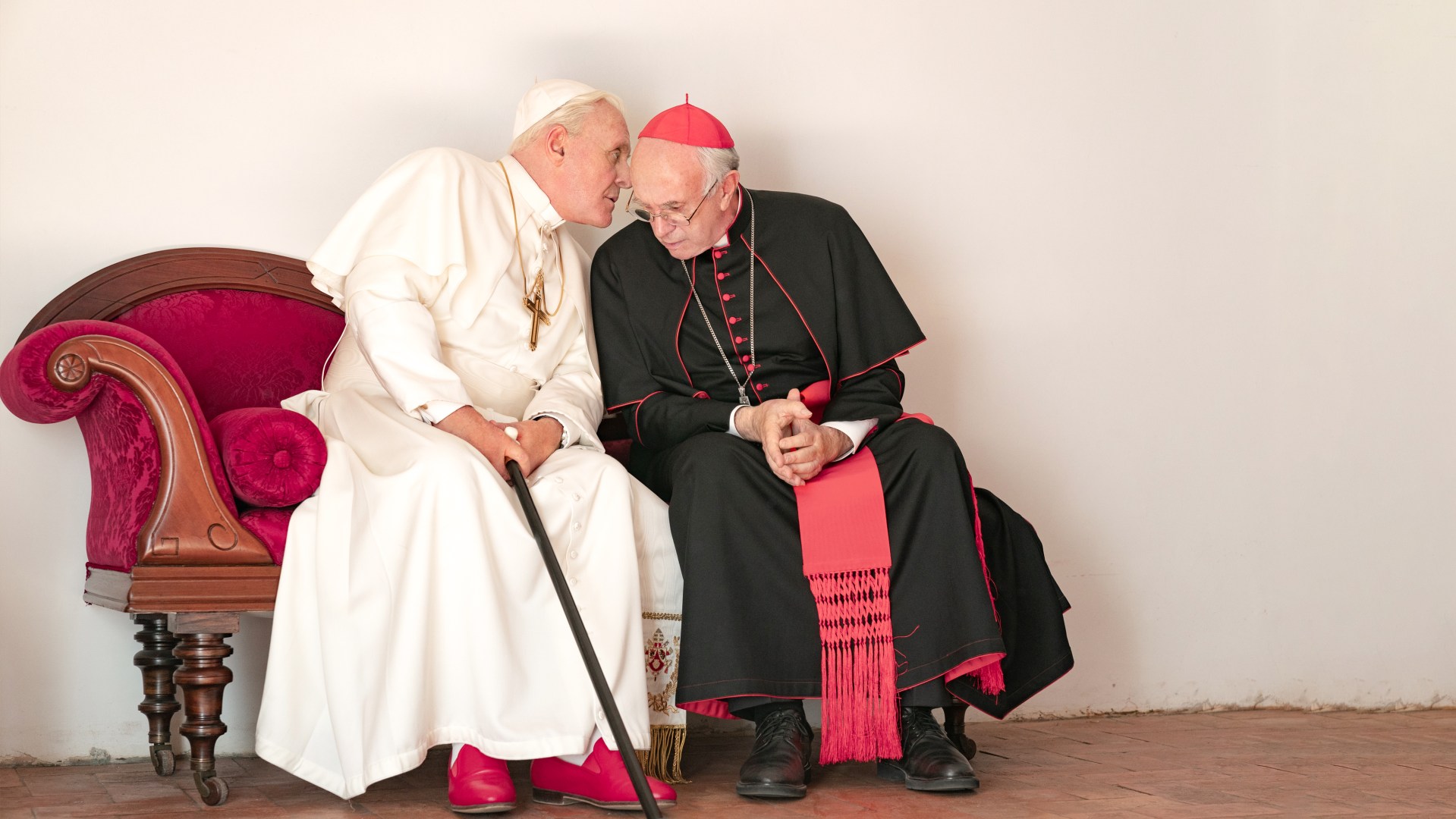
Pope Benedict (Anthony Hopkins) shares a private thought with his former antagonist, Cardinal Bergoglio (Jonathan Pryce) in a Netflix original film that releases on Netflix Dec. 20th.

Pope Benedict (Anthony Hopkins) shares a private thought with his former antagonist, Cardinal Bergoglio (Jonathan Pryce) in a Netflix original film that releases on Netflix Dec. 20th.

Christianity Today December 4, 2019
Peter Mountain / EPK TV / Netflix

The Two Popes, a forthcoming film from Netflix, dramatizes conversations between Pope Benedict (formerly Cardinal Ratzinger) and Cardinal Bergoglio, the man who would eventually assume the papal office as Pope Francis. Inspired by true events, the film is ultimately a work of imagination since the details of their conversations are largely conjectural.

The film sees the key difference between the two men as their respective attitudes toward orthodoxy and reform—a contrast that should interest Protestant viewers as much as Catholics. In ways both large and small, it repeatedly shows a preference for Bergoglio over Benedict and, by implication, for reform over tradition.

It is telling that the film devotes nearly a third of its run-time to Bergoglio’s biography and nary a minute to Ratzinger’s background before he is elected pope. This structural imbalance is disconcerting, since there are ample differences between the two men that the film could explore while considering their qualifications to lead the Roman Catholic Church during a period of social and political turmoil.

Early on in the film, viewers eavesdrop on a group of unnamed cardinals as their votes are tallied to determine who will replace Pope John Paul II. Nineteen votes for “a real change,” one says of the tally for Cardinal Bergoglio. But Cardinal Ratzinger “really wants” the position, another observes as his votes are announced. Ratzinger’s ambition is placed in stark contrast to Bergoglio’s humility.

In the wake of Benedict’s election, the film inserts a series of television commentaries to underline its interpretation of the vote. The split between the two dissimilar cardinals indicates that there is “no true unity” in the Roman Catholic Church, they say. The preference for Ratzinger means that the “Church voted to make overdue reform more overdue.” Those who are against Ratzinger claim that people are abandoning Catholicism “because it’s too conservative.”

It is to be expected that a popular film simplifies complex theological ideas, but The Two Popes does so to the point of unfairness. For example, once Ratzinger is pope, he scolds Bergoglio with the axiom that any church that is married to the spirit of the age will find itself a widow in the next age. (There is, one would think, some alternative to advocating reform besides being married to the spirit of the age.)

Beyond the preference for one pope over another, or a generic interest in historical accuracy, why should these conversations matter—particularly to Protestants? The difficulty of preserving tradition while addressing cultural shifts is not a uniquely Roman Catholic problem. And while Protestant leaders lack the reach and consolidated institutional power of the pope’s office, they too carry an enormous responsibility in guiding their churches through turbulent cultural waters.

Orthodoxy as the foundation of reform

While the film dangerously assumes that making progress and enacting reform are more important than honoring tradition, defenders of orthodoxy should not simply assume the opposite. A survey of Scripture and church history shows that tradition grounds reform, and the rejection of either is unhealthy.

One of the most critical New Testament texts for understanding tradition is found in 1 Cor. 15:3-4, where Paul “passes on” (tradidi in Latin, whence comes our word “tradition”) teaching that he has received. Rather than simply repeating the traditional teachings, however, he deploys them in new, contested circumstances. The Corinthians’ situation is complex, but they seem to be ignoring the relevance of Christ’s resurrection (which they affirm) for their own future identity. In any case, these are new circumstances. Paul then cites tradition comprising truths about past events (Christ’s death and resurrection) and interpretive claims about the significance of those events (“according to the Scriptures…for our sins”), and the tradition speaks through Paul to a new situation.

Paul’s ensuing argument integrates both orthodoxy and reform. He appeals to authoritative, “right thinking” about Christ’s death and resurrection, but he also animates that truth to “re-form” the Corinthian churches—he even reforms Christian teaching about resurrection by expanding it and articulating further applications. If teaching grows, then it changes. Therefore, in 1 Cor 15, Christian teaching about resurrection “changes.” But this is a change from sapling to tree, not from oak to beech. It is the development of doctrine, not switching from one thing to another. What Paul does not do is change (switch) the bedrock tradition: there is no alteration to the teaching that Christ died for our sins and rose according to the Scriptures. Orthodoxy is the foundation of reform.

From a Protestant perspective, the Reformation constitutes a pivotal act of reform, but Martin Luther calls for the Catholic Church to switch its teaching and praxis. Yet Luther’s logic is instructive, as he consistently argues that Rome has done the switching. The selling of indulgences, the claims of the papacy, the abuses of sacramentalism—the Reformers insist that these have broken from orthodoxy by shifting the foundations, and debates then ensue about who is more orthodox.

Luther does not oppose all development of the Scriptural doctrine—he even accords authority to the early ecumenical church councils. What he does denounce, however, is reform as switching, of which he accuses the Church. Now orthodox reform must correct unorthodox reform. But for Luther and other Protestants, semper reformanda in no way contradicts the stable foundation of sola scriptura.

An intriguing analogy can be drawn between Luther and a more recent Christian protesting reformer named Martin Luther. Like Luther, Dr. King appeals to the foundations of American “orthodoxy” (the Declaration, the Constitution, the Bible) to argue that Americans are not living up to their own traditions: “…they are not only standing against the noble precepts of your democracy, but also against the eternal edicts of God himself.” Even in political activism, orthodoxy grounds reform.

In fact, the same can be said for Catholic doctrine vis-à-vis the twin foundations of Scripture and tradition. No document has proven more seminal for grasping the dialectic between reform and orthodoxy in recent centuries than newly-sainted John Henry Newman’s An Essay on the Development of Christian Doctrine (1845). Doctrine develops, or reforms, but does not switch foundations. Far from being a cultural progressive kneeling to the zeitgeist, Newman converts to traditional Catholicism in large part through studying the church fathers.

Newman may be the most illuminating figure for understanding the relation of orthodoxy to reform in view of The Two Popes. Beatified by Benedict and canonized by Francis, Newman complicates false dichotomies between orthodoxy and reform, and he recalls Paul’s image of architects building (developing) teaching to address new circumstances (1 Cor 3:9-15). This reformulating of orthodoxy is then judged by its fittingness to the foundation, which is Christ.

Perhaps , Benedict is not someone who stubbornly clings to power he doesn’t want for the sake of conservative Catholics but is instead a leader deeply concerned that new generations build upon solid doctrinal foundations. Francis might not be someone who wants to tear down and rebuild the Roman Catholic Church, but rather someone who wants to ensure that its doctrinal truths are applied carefully and consistently to a new situation. An historically and theologically informed understanding of orthodoxy and reform should help us to appreciate that these two popes may not be as antithetical as the film would have us believe.

Kenneth R. Morefield (@kenmorefield) is a professor of English at Campbell University. He is the editor of Faith and Spirituality in Masters of World Cinema, Volumes I, II, & III, and the founder of 1More Film Blog.

Thomas P. Dixon is assistant professor of New Testament at Campbell University.

News

Ethiopia Grants Autonomy to Evangelical Heartland

After historic and nearly unanimous referendum, Sidama declared 10th regional state.

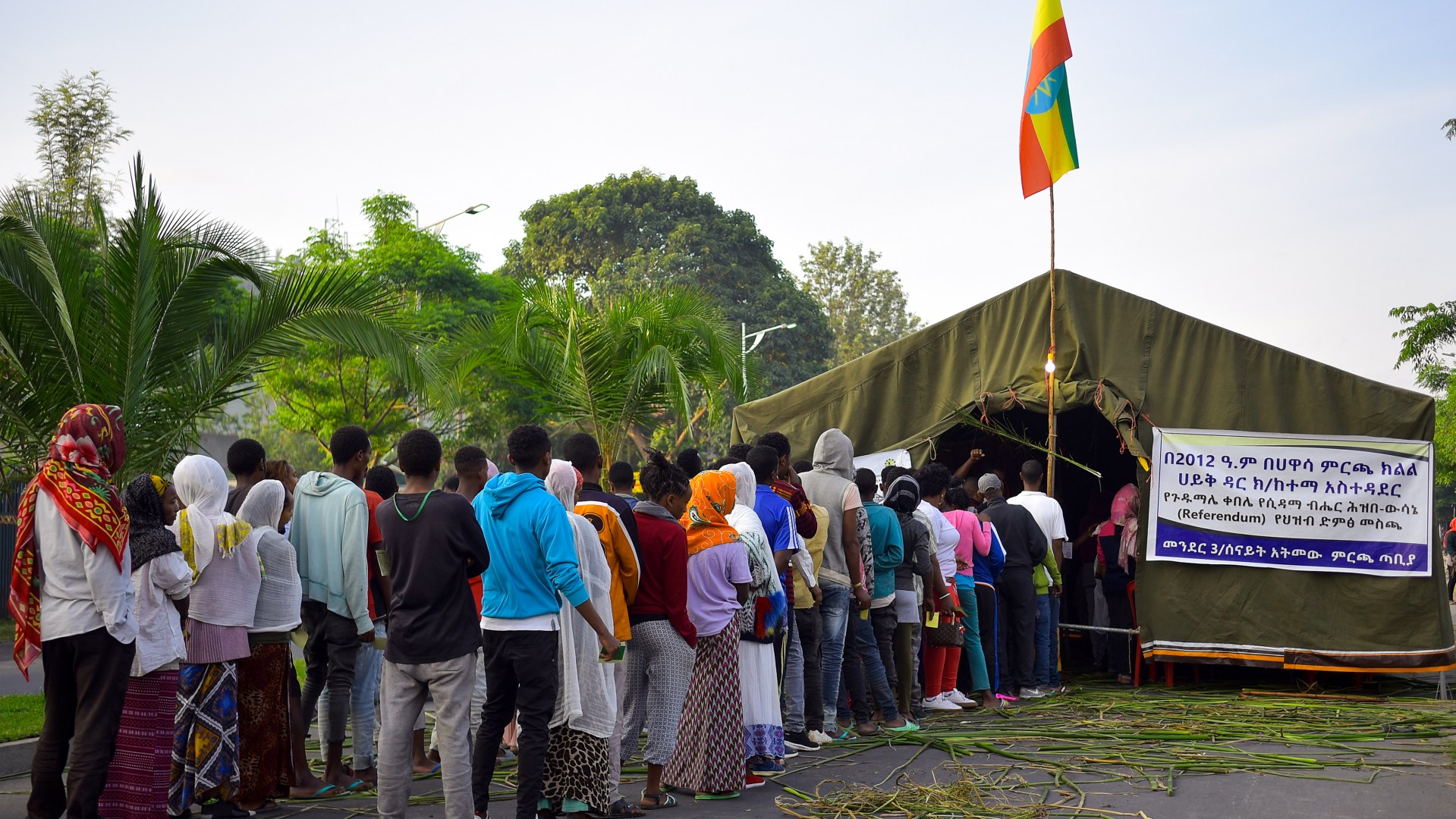
Voters wait to cast their vote during the Sidama referendum in Hawassa, Ethiopia, on November 20.

Voters wait to cast their vote during the Sidama referendum in Hawassa, Ethiopia, on November 20.

Christianity Today December 4, 2019
Michael Tewelde / Contributor / Getty

In a widely anticipated referendum held in Ethiopia’s Sidama zone last month, an overwhelming 98 percent of voters chose autonomous self-rule.

Across the highland region famed for its flavorful coffee exports, voters lined up as early as 4 a.m. on November 20, smiling and waving their green identification cards.

“For the last two months, the church was praying and fasting daily,” said Tessema Tadesse, pastor of a Kale Heywet church in Hawassa, the capital of Sidama. “And on Sunday, the preaching was around peace, love, and embracing others.”

Kale Heywet (Word of Life) is one of Ethiopia’s largest “Pente” or evangelical denominations, with approximately 1,000 congregations in Sidama alone. (Though Pente, pronounced Pent-ay, originated as an Ethiopian term for Pentecostals, it has come to refer to most non-Orthodox Christians, with the closest US equivalent being evangelical.)

Evangelicalism in Ethiopia originated in Sidama, where 87 percent of the population self-identified as Protestants in the 2007 census. Overall, in Africa’s second-most populous nation, evangelicals only comprise about 19 percent of Ethiopia’s 112 million people, while the Ethiopian Orthodox Tewahedo Church comprises about 40 percent, according to the World Christian Database.

Tsedaku Ablo Alema, president of the Evangelical Churches Fellowship of Ethiopia (ECFE), thinks Sidama’s desire for autonomy could stem from the evangelical anti-authoritarian mindset.

“We believe we can understand the Bible, in the priesthood of all believers,” he told CT. “That narrative might have made them think more about the individual.”

Even so, religion was not the source of this political movement, said Nigussu Legesse, executive director of the Consortium of Christian Relief and Development Associations (CCRDA) and a referendum observer chosen by the National Election Board. He traced Sidama’s desire to be a separate regional state back to the imperial time, in the early 20th century.

Recognizing this impulse, self-administration was extended to the Sidama people—Ethiopia’s fifth-largest ethnicity, comprising approximately 4 percent of the nation’s population—by the previous communist Derg regime, which ruled from 1974 to 1989. After the collapse of the Derg, the new government included the eponymous zone—1 of 68 in Ethiopia—in the larger administrative state of the Southern Nations, Nationalities, and Peoples Region (SNNPR), composed of more than 40 ethnic groups.

Sidama’s path to full statehood has been a tension point in Ethiopian politics. Prime Minister Abiy Ahmed, who won the Nobel Peace Prize in October for his peacemaking efforts, was initially praised for working to make the historically repressive society more open. But the democratization process has also made room for old ethnic tensions to resurface.

In July, youth mobs agitating for independence burned two Orthodox churches and killed dozens of people. After continued clashes between nationalist activists and security forces, the region was placed under military control.

Ethiopia’s 1994 constitution provides for federalism and its Article 39 outlines self-administration by ethnic groups. However, the central government in Addis Ababa has long suppressed any pushes for ethnic autonomy beyond the original nine states, which were determined by the ruling party during Ethiopia’s transition from communism. The ethnically-defined regional states—of which Sidama is now to become the 10th—have a degree of independence from the central government on issues such as land ownership and taxation. Each state also has its own security force.

“The Sidama referendum is an expression of the democratization path Ethiopia has set out on,” said Abiy [Ethiopians go by their given names] in a tweet congratulating the Sidama people. “The voting process is demonstrative of our capacity for taking our differences to the ballot, and allowing democratic processes to prevail.”

But the way forward is unclear. Inspired by Sidama’s example, other ethnic groups in SNNPR are currently discussing whether to pursue autonomy. The conflict and tensions that marked Sidama’s path to statehood, if repeated, could lead to greater instability.

In 2018, the Internal Displacement Monitoring Center reported that Ethiopia had the world’s highest number of conflict-related internally displaced peoples (IDPs): nearly 3 million people have been forced from their homes by ongoing inter-communal violence and ethno-nationalism. Increasing fragmentation on ethnic lines could also pose a threat to Abiy’s push for unity ahead of national elections scheduled for May 2020.

In multi-ethnic Hawassa, which has also been the SNNPR state capital, it is not yet apparent what the implications of the referendum will be for non-Sidama peoples. In July, some of their properties were targeted for attacks.

“Being a state does not mean pushing others from the community,” said Tessema, who said many of his fellow pastors have been preaching similarly. He is also the chairman of the Hawassa Inter-Religious Council, which has worked to promote peace and constructive dialogue in the capital.

And though the right to statehood is stipulated in Ethiopia’s constitution, logistical details of how independence will be implemented remain ambiguous—and potentially inflammatory.

“Ethnicity is not the problem, but being ethno-centric is,” said Tsedaku, the ECFE president. “You can demand your rights, but you must be careful not to take others’ in the process.

“As a Christian, you must be a voice to the voiceless.”

The church in Sidama could play a vital role moving forward.

Despite the mob violence, the overall peaceful referendum process is largely due to leaders preaching peace, said Nigussu. People respect their pastor’s word.

“Especially in Sidama, which is mostly Christian, the church must promote peace,” said Tessema. “Even now, church leaders are gathering together, discussing and praying about how we can continue this peace.”

In the Ethiopian context—with so many ethnicities, languages and peoples—Tsedaku said, “Loving your neighbor means loving people from a different tribe.

“The other deserves the same respect, love, and equity as I do. Ultimately we are all human, created in the likeness of God.”

Ideas

Remember the Future

Columnist

Advent reminds us we’ve already seen it.

Christianity Today December 3, 2019
Malorny / Getty

When Mark the Evangelist wanted to sum up the way Jesus started His earthly ministry, he used these words:

Now after John was arrested, Jesus came to Galilee, proclaiming the good news of God, and saying, “The time is fulfilled, and the kingdom of God has come near; repent, and believe in the good news” (1:14–15).

The Greek word that Mark uses to summarize Jesus’ message—basileia—is probably better translated with a word that indicates activity. A word like “rule,” “reign,” or even “kingship” is closer to the original meaning of basileia—which means that when Jesus says “the kingdom of God has come near,” He is proclaiming that God is asserting His rule in the world in and through Jesus’ ministry.

The enthronement of a new king or leader can make one queasy with dread.

But what kind of rule will it be? Coronations can be terrifying. The enthronement of a new king or leader can make one queasy with dread. If you’ve never had to fear when a new prime minister, president, or monarch comes into power, then you have lived a life of rare privilege. For many people in the world—throughout history and also presently, even in the modern West—the passing of power to a new ruler is a matter of gnawing anxiety.

A scene from the end of The Godfather—one of the most haunting pieces of cinema I’ve ever seen—captures this fear well. The protagonist, Michael Corleone, stands near the baptismal font in an ornate Catholic church for his nephew’s christening. As the camera lingers on his stoic facial expression and elegant suit, the scene cuts to a series of assassinations that Michael has orchestrated, which are happening at the very same time as the service of baptism. It turns out that Michael has arranged to become the kingpin of the New York mob, and he is ascend­ing to his throne by means of a bloodbath. The cost of his rule is the death of anyone who stands in his way. The agonizing, devastating final scene of the film shows him being crowned, as it were, as “Don Corleone”—the new monarch of terror.

This fictional story is haunting enough, but similar stories happen in real life all the time. Dictators trample on human dignity to ascend their thrones. Terrorists seize the reins of power. Evil overlords who care nothing for the poor or the sick take control of governments and kingdoms, and the citizens consequently fear for their lives. Coronations, for much of the world, are occasions of uncertainty, worry, and alarm.

Perhaps that same worry and alarm was stirred up in the hearts of Jesus’ hearers when He preached. His message about God’s reign would have conjured up all the churning emotions that coronations usually conjure up: the trembling uncertainty about how severe the new king’s reign would be, the nagging apprehension that the king might demand of them what they aren’t able to give, the dread of what wars the king might lead them into. This is the way things go with kings in our world. Perhaps Jesus’ hearers would have remembered the words of the prophet Samuel:

These will be the ways of the king who will reign over you: he will take your sons and appoint them to his chariots and to be his horsemen, and to run before his chariots; and he will appoint for himself commanders of thousands and commanders of fifties, and some to plow his ground and to reap his harvest, and to make his implements of war and the equipment of his chariots. He will take your daughters to be perfumers and cooks and bakers. He will take the best of your fields and vineyards and olive orchards and give them to his courtiers. He will take one-tenth of your grain and of your vineyards and give it to his officers and his courtiers. He will take your male and female slaves, and the best of your cattle and donkeys, and put them to his work. He will take one-tenth of your flocks, and you shall be his slaves. And in that day you will cry out because of your king. (1 Sam 8:11–18)

The world of first-century Judea was sadly familiar with this sort of kingly script. The Jews of Palestine were used to ambitious would-be rulers rising through the ranks by means of betrayal and intrigue and nighttime assassinations. They were familiar with the story of Julius Caesar’s stabbing. They knew the way that plot unfolds.

But God’s now-arriving rule doesn’t follow the usual pattern, according to Jesus.

The Unseen Kingdom

God’s reign spells liberation for Israel, not coercion. God taking up His crown means the dawning of a new era of deliverance, not domination. When Jesus wants to point His hearers to the telltale signs of God’s kingship bursting onto the scene, He says things like this: “But if it is by the finger of God that I cast out the demons, then the kingdom of God has come to you” (Luke 11:20). Where you see people being delivered from oppression, in other words, there you see God’s reign in action. Jesus made His followers into emissaries of God’s saving rule; “he sent them out to proclaim the kingdom of God and to heal” (Luke 9:2). Where you see healing and the restoration of what sin and death have disfigured, there you see God’s kingship displayed.

Where you see people being delivered from oppression, in other words, there you see God’s reign in action.

That is what Jesus teaches His followers to cry out for: “Your kingdom come” means “Father, make Your healing reign more and more tangible and visible in our world. Let Your rule assert itself ever more concretely in the places where sickness and evil still seem to have the upper hand.”

Jesus also teaches His followers to pray “Your kingdom come” because—we must not evade this uncomfortable truth—God’s rule is not yet visible in the way we long for it to be. God’s reign, Jesus says,

is like a mustard seed, which, when sown upon the ground, is the smallest of all the seeds on earth; yet when it is sown it grows up and becomes the greatest of all shrubs, and puts forth large branches, so that the birds of the air can make nests in its shade. (Mark 4:31–32)

Or, as He puts it in another place, “The kingdom of heaven is like yeast that a woman took and mixed in with three measures of flour until all of it was leavened” (Matt 13:33). God’s rule is breaking into the world in Jesus’ ministry—but not in such a way that it can be readily identified by the unaided human eye. We can discern it by faith, but we don’t yet see it in the way that we will someday.

One illustration that modern Bible interpreters use to describe the mysterious already-but-not-yet nature of God’s reign is the distinction between “D-Day,” the operation whereby the Allied forces in World War II secured a foothold in France in 1944, and “V-E Day,” or “Victory in Europe Day,” which came some eleven months later when Nazi Germany offered its unconditional surrender. Historians looking back now recognize that the war was effectively won when the Allies landed on Normandy’s beaches. The D-Day invasion hearkened the end of the Nazi regime, even though the death camps kept running and many more lives of combatants and civilians alike were lost before Germany’s surrender in May of the following year.

It’s as though we live between two similarly momentous days. We look backward to the life, death, and resurrection of Jesus as the moment when God’s rule showed itself to be unconquerable—theological D-Day, we might call it. In a very real way, God’s conquest of His rebellious world was achieved when His Son left His tomb behind on Easter morning. Yet suffering continues, and we go on longing for an end that isn’t yet public and universal. In this time between the times, as we await Christ’s coming in glory, we who have caught the vision of the way the war will end, we “who have the first fruits of the Spirit, groan inwardly while we wait for adoption, the redemption of our bodies” (Rom 8:23).

We know that God will one day do for us and for His whole creation what He did for Jesus in raising Him from the dead, but for now, in the meantime, we weep and wait. And that is why we continue to pray, “Your kingdom come,” meaning, “Father, let us see, in the present, more and more signs that the war You have won against the powers that corrupt and enslave Your world is nearing its consummation. Give us more tangible previews of that great day when death will be swallowed up in victory. Help us see that Jesus’ resurrection isn’t just a one-off event but will sweep us along in its wake so that we will share in His transformation.”

As we enter this season of Advent, in which we prepare to celebrate Christmas and, beyond that, Christ’s second advent, we wait and long for the promised transformation of the world, the glorious appearing of our benevolent King.

Wesley Hill is associate professor of biblical studies at Trinity School for Ministry in Ambridge, Pennsylvania. This adapted excerpt is from his new book The Lord’s Prayer: A Guide to Prayer to Our Father (Lexham Press). CT’s review of the book is here.

News

Evangelical Giving Holds Steady Despite Tax Reform

Though far fewer Americans are writing off charitable donations, most ministries reported stable giving last year. Denominations saw the biggest decline.

Christianity Today December 3, 2019
Brown Bag Photography / Lightstock

It will take months to tally the millions Americans donate to charity on Giving Tuesday. But analysts already know what kinds of charities are favored by American evangelicals—and that the GOP tax reform bill that went into affect last year has had an impact on giving.

Overall, cash giving to evangelical ministries held steady between 2017 and 2018 (the latest year for which data is available), declining 0.6 percent after six consecutive years of increases, according to a new report by the Evangelical Council for Financial Accountability (ECFA).

The virtually unchanged giving levels among evangelical ministries emerged despite a 6.2 percent decline in the stock market’s S&P 500 index, which tends to mirror trends in charitable giving, and despite a 3.9 percent decline in overall giving to religion between 2017 and 2018, according to an analysis by Giving USA.

“I am pleased to see this ongoing support for Christ-centered churches and ministries,” said Dan Busby, ECFA president and CEO. “This generosity positions ECFA members to continue their positive impact for their causes both domestically and internationally.”

The State of Giving 2019 analysis from ECFA considered the finances of more than 1,900 of its accredited members and included $13.9 billion in cash giving. All year-to-year comparisons in the report were adjusted for inflation.

Despite some recent scrutiny over its role as a financial watchdog, EFCA itself has been growing, from 1,409 member ministries in 2009 to more than 2,400 today. (The year-to-year analysis relied mostly on audited financial statements and considered only ministries that were members during both years under evaluation.)

Eleven of the 26 ministry categories tracked saw decreases in giving for 2018. The four hardest hit were church denominations (down 11.1%), leadership training ministries (down 7.1%), relief and development ministries (down 6.9%), and K–12 education (down 6.5%). [The full table of ministry categories is at the bottom of this article.]

In a webinar accompanying the ECFA’s report, Busby said five-year giving trends generally are more significant than year-to-year comparisons because two-year analyses can be skewed by shifts at larger ministries, among other factors. The bottom four ministry categories in the 2017­–2018 analysis all saw growth or held steady in their giving totals over the previous five years.

Despite the decline in overall denominational giving for 2017–2018 in the ECFA study, giving to the two largest US Protestant denominations—the Southern Baptist Convention (SBC) and the United Methodist Church (UMC)—basically was steady over the same period, according to financial statements from each denomination. The $197 million received through the SBC’s Cooperative Program allocation budget for its fiscal year ending September 30, 2018, was down 0.05 percent from the previous year. Contributions to the UMC’s general funds totaled $143.7 million in 2018, a 0.2 percent increase from 2017.

The 2018 decline in giving to relief and development organizations may have been attributable to the varying number of natural disasters in the two years considered, Busby said. According to annual reports from the Brussels-based Centre for Research of the Epidemiology of Disasters, there were 335 natural disasters worldwide in 2017, affecting nearly 96 million people (including record-setting hurricanes Harvey and Maria and deadly mudslides in Sierra Leone). The number was down in 2018 to 315 natural disasters, affecting 68 million people.

Fifteen of the 26 ministry categories tracked by ECFA saw giving increases between 2017 and 2018. The largest increases occurred among community development ministries (up 26.1%); camps and conferences (up 23.1%); medical, dental, and health services (up 11.9%); and student/youth ministries (up 9.3%). For each of those ministry categories, giving also was up at least 7.2 percent for the previous five years, though increases were more measured than in the past year.

The ECFA analysis of 2018 giving also provided one of the first looks at the impact on charitable giving of the Republican tax reform plan, which was signed into law by President Trump in late 2017 and took effect January 1, 2018.

Tax reform “has definitely influenced giving,” Busby said. But he added that one year of data is not sufficient to establish trends.

The GOP reform package raised the standard deduction in 2018 to $12,000 for singles (up from $6,350) and $24,000 for married joint-filers (up from $12,000), causing fewer givers to itemize their charitable deductions. Some evangelical leaders had worried 30 million Americans could lose part of their incentive to donate.

Busby and lead ECFA researcher Warren Bird noted that just 9 percent of Americans claimed charitable deductions on their tax returns for 2018, down from 27 percent in 2017 before the Republican reforms took effect.

Giving USA reported that total charitable giving declined 1.7 percent in 2018 when adjusted for inflation. Laura MacDonald, vice chair of the Giving USA foundation board, told CNBC, “Tax reform probably hit the middle (income) households that used to itemize the hardest.”

However, the apparent negative effect of tax reform on giving overall seems to have been mitigated among evangelicals, as some predicted would occur thanks to Christians’ commitment to give apart from tax incentives.

“Givers to Christ-centered ministries have adapted to changing attitudes and approaches to giving and allowed ECFA members to see relatively steady giving overall one year into tax reform,” Busby said.

A LifeWay Research survey released today seemed to corroborate Busby’s analysis, with 64 percent of pastors stating they don’t think the 2018 tax reform had any impact on their church’s finances. Among pastors, 14 percent cited a negative impact and 12 percent said it had a positive impact.

Last year, 42 percent of Protestant pastors said their offerings exceeded the previous year. This year, just 37 percent of pastors said their giving is exceeding 2018 levels. LifeWay Research executive director Scott McConnell suggested that lower tax withholding levels in 2018 may have contributed to the drop. He said that “there are no signs 2018 tax reform created continued income growth for churches” in 2019.

Overall, 41 percent of pastors say the economy is having no impact on their church this year, according to LifeWay. Thirty percent note a positive impact and 26 percent a negative impact.

Here is the complete ECFA analysis of changes in giving to evangelical ministries (the percentage increase in cash giving for each ministry type):

Organizational Segment

Recent Year (2017-2018)

Previous Year (2016 – 2017)

Community Development

26.6%

9.6%

Camps and Conferences

23.1%

1%

Medical, Dental and Health Services

11.9%

9.6%

Student/Youth

9.3%

3.8%

Associations

9.2%

-1.1%

Adoption

8.4%

2.1%

Children’s Homes & Orphan Care

8.2%

-8.3%

Publishing

7.4%

-12%

Pregnancy Resource Center

6.3%

6.7%

Child Sponsorship

5.8%

0.5%

Prison

2.3%

-5.6%

Bible Study

2%

-0.1%

Media

1.9%

1.4%

Education: Higher Ed

1.5%

-2.7%

Individual Churches

0.5%

5%

Missions: International

-0.7%

7.4%

Rescue Missions

-0.9%

-1.4%

Missions: Domestic

-1.4%

5.8%

Evangelism

-2.7%

9.1%

Alcohol/Drug Rehabilitation

-3.1%

-1.3%

Missions: Short-Term

-3.6%

-6.4%

Other (many different ministries)

-5.2%

1.6%

Education: K-12

-6.5%

10%

Relief and Development

-6.9%

11.6%

Leadership Training

-7.1%

-0.6%

Church Denominations

-11.1%

12.4%

Earlier this year, CT reported on the rise of digital giving through mobile apps like Tithe.ly and Pushpay, the preferred method of giving for 15 percent of churchgoers and most major US megachurches. Previous research has also shown a generational gap in approaches to charitable giving, with millennials more likely than older generations to see it as a “spur-of-the-moment” decision rather than a planned discipline.

David Roach is a writer in Nashville, Tennessee.

Apple PodcastsDown ArrowDown ArrowDown Arrowarrow_left_altLeft ArrowLeft ArrowRight ArrowRight ArrowRight Arrowarrow_up_altUp ArrowUp ArrowAvailable at Amazoncaret-downCloseCloseEmailEmailExpandExpandExternalExternalFacebookfacebook-squareGiftGiftGooglegoogleGoogle KeephamburgerInstagraminstagram-squareLinkLinklinkedin-squareListenListenListenChristianity TodayCT Creative Studio Logologo_orgMegaphoneMenuMenupausePinterestPlayPlayPocketPodcastRSSRSSSaveSaveSaveSearchSearchsearchSpotifyStitcherTelegramTable of ContentsTable of Contentstwitter-squareWhatsAppXYouTubeYouTube