News

10 Persecuted Christians Chosen by the State Department to Share Their Stories with the World

At this week’s second Ministerial to Advance Religious Freedom, 23 survivors from 15 countries from all faiths were given a global platform in Washington DC.

Survivors of religious persecution visit the Holocaust Museum in Washington, D.C., during the State Department's Ministerial to Advance Religious Freedom.

Survivors of religious persecution visit the Holocaust Museum in Washington, D.C., during the State Department's Ministerial to Advance Religious Freedom.

Christianity Today July 17, 2019
Jeremy Weber

At this week’s Ministerial to Advance Religious Freedom, billed as the largest human rights event the US State Department has ever held, 23 people were invited to share their or their loved ones’ stories of religious persecution.

Below are the 10 Christian survivors from 10 nations, followed by the non-Christian survivors.

Christian survivors of religious persecution:

China: Ouyang Manping is the wife of Pastor Su Tifan, who on December 9, 2015, was placed under administrative detention after law enforcement raided the Three Living Stone Church.

Cuba: Reverend Mario Félix Lleonart Barroso is currently the pastor of the Iglesia Bautista de Waldorf (Baptist Church of Waldorf), where he ministers to the Latino community. While in Cuba, he planted and pastored Baptist churches in the province of Villa Clara and in Havana. In 2016, after years of being harassed, detained, and arrested multiple times because of his faith activities, Pastor Leonard, his wife, Yoaxis, and his two daughters sought asylum in the United States. They arrived in the United States on September 11, 2016.

Eritrea: Helen Berhane was held in a container for almost three years because of her faith. She is now a gospel singer and wrote a book about her experience.

Malaysia: Wife of Pastor Raymond Koh, the pastor kidnapped on a highway by at least 15 men in three black SUVs on CCTV in February 2017 with no proof of life since. Police say one demand for money was opportunistic but that there is no evidence to the pastor's whereabouts. There are possible links to Koh's role as a Christian activist at a time when Malaysia was moving to enforce stricter Islamic laws.

The pastor was accused of proselytizing Muslims in 2011, and a box containing two bullets, with a note in Malay threatening his life, was sent to Koh's house. On April 3, the country’s civil rights commission ruled that that the disappearance probably was the act of the national police intelligence branch.

Iraq: Father Thabet Habib Yousif, Chaldean Catholic Priest from Karamles, Ninevah. When ISIS came, the residents of Karamles fled. Fr. Thabet remained behind to ensure everyone fled and ensure his congregation was cared for in displacement. He helped organize accommodation, food, and work. When Karamles was liberated, he was one of the first to return home and help coordinate rebuilding. These efforts included extending assistance for the small remnant of Shabak families also returning.

Nigeria: “Esther,” 20, is from Gwoza in southern Borno. She was held captive by Boko Haram for over three years. During her captivity, she experienced terrible trauma—from witnessing how people died to surviving sexual abuse. She escaped and was rescued by the military. But her escape did not bring the freedom she had long hoped and prayed for. She was kept in near-prison conditions until a Christian doctor was able to reconnect her with her family. Her family now welcomes her but local gossip attacking her daughter Rebecca as a “Boko Haram Child” was very hurtful. With some help, she has become stronger and ignores the public hate.

North Korea: Ill Yong Joo is a 23-year-old student who defected from North Korea in 2008 at the age of 12. Joo has been an active advocate in the past year. He visited the Department in October 2018 as a Liberty in North Korea Advocacy Fellow. For 10 years, his family listened to South Korean radio, including Christian broadcasting, which was one of the motivating factors for their escape.

He said, “Even listening to foreign radio is considered a crime against the state. If I had been caught, I could have been executed.” His father escaped first, years before he, his mother, and sister crossed the Tumen River, trekked across Southeast Asia, and finally resettled in South Korea after five months of traveling. His father is now a missionary in South Korea.

Sudan: Meriam Yahia Ibrahim was charged with apostasy and adultery in May 2014 for marrying a Christian man. She was raised by her Christian mother and identified as Christian but her father was Muslim and left her to be raised by her mother. She refused to renounce her Christian faith and was sentenced to death row. She was detained when she tried to leave the country after her release in July 2014 and now lives in the US.

Turkey: After practicing his faith in Turkey for more than 20 years, Pastor Andrew Brunson was imprisoned in October 2016 on false charges without a trial until the spring of 2018. The Turkish government presented no evidence that he was guilty, when finally indicted in April 2018, on charges referencing “Christianization” and religious activity, which raised questions about religious freedom in Turkey and indicated that he has been targeted because of his faith. He was released in October 2018 after a few “show” trials.

Vietnam: Pastor A Ga oversaw 12 house churches associated with the Montagnard Evangelical Church of Christ of Vietnam in the Central Highlands of Vietnam. After several detentions and over 40 police interrogation sessions involving torture, he and his immediate family fled to Thailand in 2014. In 2017, the Vietnamese government issued an arrest warrant against him. The Thai police arrested him, his wife, and their son. Due to US intervention, Pastor A Ga and his family resettled in the US as refugees in September 2018.

Non-Christian survivors of religious persecution:

Afghanistan

Hazara Shia: Farahnaz Ikhitari is a survivor of ISIS attacks. Ikhitari is a Hazara Shia from Lashkargah in Helmand Province, who lives in Afghanistan and is fluent in English. She received a BA in law and an LLB in law from American University of Afghanistan, and got engaged with another Hazara studying computer science at American University. On the first day of Nowruz on March 21, 2018, her fiancé, her future brother-in-law (12 years old), and her own brother (18) went to Karte Sakhie to celebrate the New Year, along with many other Hazaras. ISIS planted a bomb near the shrine in Karte Sakhie, and all three were killed, along with 30 other people.

Bangladesh

Secular: Rafida Ahmed, who survived a 2015 ISIS-inspired assassination attempt but lost a thumb to the assailant (her husband, Bangladesh American atheist Avijit Roy, was killed in the same attack) is a prominent blogger. In November 2017 Bangladesh arrested the attacker.

Hindu: Priya Biswas Saha is General Secretary of Bangladesh Hindu-Buddhist-Christian Unity Council. Priya Biswas Saha is a well-known figure in Bangladesh, both among the Hindu and human rights communities. She recently addressed the IRF Roundtable and Ambassador Sam Brownback, describing the situation of her ancestral home in Firozpur being burnt by arsonists in 2019. Priya is a human rights specialist in Bangladesh and focuses on religious minorities in Bangladesh. She has authored and provided insight for numerous reports on the plight of Bangladeshi minorities, particularly women who suffer sexual and physical intimidation. She has a current visa to travel to the United States.

China

Uighur Muslim: Jewher Ilham is the daughter of Uyghur scholar, Ilham Tohti, an internationally noted moderate voice who was dedicated to bridging the gap between the Uyghur people and the Han Chinese. Jewher’s father was given an unprecedented life sentence based on the writings on his website, Uyghur Online. As an advocate for her father, she testified before the US Congressional-Executive Committee on China, wrote op-eds in The New York Times, met with a number of government officials including Secretary of State John Kerry, and received numerous awards worldwide on behalf of her father. In 2015, she recounted her experiences in the book, Jewher Ilham: A Uyghur’s Fight to Free Her Father (University of New Orleans Press). Currently, Jewher is finishing her degree in political science, Arabic (Near Eastern Studies), and Central Eurasian Studies at Indiana University.

Tibetan Buddhist: Nyima Lhamo, a human rights activist and the niece of Tenzin Delek Rinpoche, a renowned Tibetan Buddhist lama who died in a Chinese prison while serving a life sentence. She was born in Tibet but is now based in the US. She has testified before the Congressional Lantos Human Rights Commission and briefed numerous UN Special Mandate holders.

Falun Gong practitioner: Yuhua Zhang is a former professor in China whose husband was arrested, tortured, and has been disappeared by Chinese authorities.

Germany

Jewish: Irene Weiss is a Holocaust survivor born in Bótrágy, Czechoslovakia (now Batrad, Ukraine). She moved to northern Virginia in 1953. She earned a bachelor of arts degree in education from American University and taught in the Fairfax County Public School system in Virginia for 13 years. Irene is a volunteer at the United States Holocaust Memorial Museum.

Iraq

Yezidi: Nadia Murad won the Nobel Prize last year for her work as a Yezidi survivor.

Pakistan

Ahmadiyya: Abdul Shakoor, elderly prisoner of conscience released March 18, 2019. Was detained since December 2, 2015, on charges of propagating the Ahmadiyya faith and stirring up “religious hatred” and “sectarianism”; sentenced to three years in prison for blasphemy and five years under the Anti-Terrorism Act on January 2, 2016. Shakoor ran a bookshop in Rabwah, Punjab province, a city of 70,000 that is 95% Ahmadiyya. Police and elite counter-terror forces raided his shop, accusing him and his Shia assistant of selling an Ahmadiyya commentary on the Quran and possessing sensitive materials. His conviction was for “printing, publishing, or disseminating any material to incite hatred” as well as for acts and speech that insult a religion or religious beliefs or defile the Qur’an, the Prophet Muhammad, a place of worship, or religious symbols. His appeal was listed on the High Court docket in Lahore several times but never actually heard. On March 18, 2019, he was released from prison, but the charges against him were not dropped.

Advocate: Shaan Taseer is an advocate of international religious freedom and based in Canada. He is the son of Salman Taseer, the former governor of Punjab, Pakistan. Taseer called for repealing Pakistan’s blasphemy laws and was then assassinated by his bodyguard Mumtaz Qadri in January 2011. Shaan Taseer has since been an advocate against Pakistan’s blasphemy laws and has supported Pakistani NGOs working on blasphemy cases.

Sudan

Minority Muslim: Badreldin Yousif Elsimat writes and practices a moderate version of Islam advocating separation of mosque and state and did not have a communal space to meet with his followers. He wrote many books about his beliefs that are sold around the world except in Sudan. He was arrested at his home on January 12 with five followers regarding his sermons and the recent protests in Khartoum. When detained he was asked about his religion and was placed with ISIS fighters. He was not tortured but was forced to watch his followers be tortured. Minority religious groups, including Muslim minority groups, express concern they could be convicted of apostasy if they express beliefs or discuss religious practices that differ from those of the Sunni majority group.

Vietnam

Cao Dai: Luong Xuan Duong is a Cao Dai follower, currently in Texas. He is a member of the Popular Council of Cao Dai Religion. Due to his advocacy for religious freedom for his religious organization, he was jailed for 30 months in 1996. In 2008, he was issued an arrest warrant after he tried to convene a general assembly of Cao Dai followers. He went into hiding for eight years and escaped to Thailand in March 2016. In late 2017, he reunited with his wife and daughter in Dallas, where he continues to fight for religious freedom in Vietnam.

Yemen

Jewish: Rabbi Faiz Grady was a rabbi in Raydah, Yemen, and was forced into hiding in Sanaa and then ultimately fled Yemen for speaking out publicly after the murder of Rabbi Moshe Nahari in 2008. US Ambassador Seche assisted United Jewish Organizations with his rescue in 2009.

Editor’s note: This public list has been shortened, per the request of the US State Department.

News

Pompeo: Why We’re Hosting the World’s Biggest Event on Religious Persecution

Secretary of State Mike Pompeo explains to CT why the State Department invited 100 nations and 1,000 participants to its second Ministerial to Advance Religious Freedom.

Secretary of State Mike Pompeo addresses the second Ministerial to Advance Religious Freedom on July 16.

Secretary of State Mike Pompeo addresses the second Ministerial to Advance Religious Freedom on July 16.

Christianity Today July 17, 2019
US Department of State

This week, the US State Department invited more than 100 countries to come to DC and discuss how to stop the dramatic decline of religious freedom worldwide.

CT’s global director, Jeremy Weber, interviewed Secretary of State Mike Pompeo on what has changed between last year’s first-ever ministerial on international religious freedom (IRF) and this week’s second, bigger event.

CT: Why hold a second ministerial on religious freedom?

Pompeo: This is America’s first freedom, and we want to work to make sure other countries understand how central it is to the individuals that are in their country to have the opportunity to worship as one chooses or chooses not to worship, and to know that their government is not going to restrict, impose, impede, or punish those activities is central to human dignity. And so we believe that here at the State Department, we can lead this conversation. We can encourage other countries to recognize this most fundamental human right. And when we do so, we will make life better for millions and millions of people around the world.

What successes came out of the first ministerial?

We saw a couple of things. First, we saw a marked increase in the level of discourse around this as a central right. Lots of conversations. It spurred satellite groups and others to hold similar related conversations inside their own countries. In November of 2018, we sponsored something with the United Kingdom; in February 2019, the United Arab Emirates hosted a conference to discuss the challenge of promoting interfaith understanding. The list is long. There were examples in Taiwan and other places where the elevation of the conversation has taken place. And we’ve actually seen governments continue to increase the place they put, inside of their own decision-making process, the central notion of religious freedom. There is more work to do, for sure, which is why we’ll hold the ministerial again this year. We think this is an ongoing process that is very, very important.

Between this ministerial and last year’s, what’s been improved upon or changed?

We think two things. One, we think there’s an even greater focus. The work that’s been done in the run-up to this ministerial has been enormous compared to the one last year. I think in some sense, because it was the first one last year, I think a number of countries didn’t know precisely what to expect. And I think some suspected there were ulterior motives that just don’t exist. So we saw a much higher level of engagement and preparation for this year’s meeting, and we think we’ll get an even better outcome. Second, this is bigger. There are more countries that will attend this year and will do so at higher levels. We think, too, following this second ministerial, we’ll even see more activity take place in many of the countries that have traveled here to participate in this.

How do you respond to concerns that a whole ministerial solely dedicated to religious freedom impacts the State Department’s focus on other human rights?

I’m convinced we can do more than one thing at a time. This is an important freedom, for everyone. We’re focused on it. It doesn’t exclude the State Department’s efforts across a broad range of human rights. So, holding this religious freedom ministerial in no way diminishes or excludes our capacity to continue to push other human rights. I think you’ve probably seen the Unalienable Rights commission that we’re going to begin to move out on here in the next month or two. It’s looking at a related issue, which is to define appropriately for our time the set of basic human rights that are inherent in each individual human being, and then to begin to articulate—consistent with our founding principles here in the United States—how the State Department ought to support that fundamental set of unalienable rights for everyone.

Last month, you elevated the status of the Office of Religious Freedom. Why?

We did, and we did the same for the monitor for combating anti-Semitism. When leaders identify things that are real priorities, I think that helps institutions like the State Department. And folks around the world will see it too. These are very, very important fundamental rights and the work on anti-Semitism is essential. We see the risk around the world for that. So elevating those two [issues]: First, I think it signals appropriately where they fit into the priorities for the Trump administration; and second, it will provide some incremental resources for them so that they can perform their mission even more effectively.
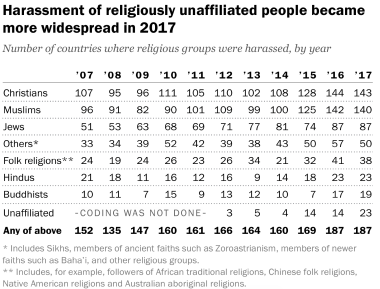
In the wake of last year’s ministerial, Uzbekistan was removed from the list of Countries of Particular Concern, though many advocates still rank them high on religious freedom violations. Why remove them now?

When we hold this ministerial, we’ve made it clear that there will be countries that attend the ministerial that are imperfect with respect to these issues. But what we’re seeking to do here is taking countries that are good and make them better. Countries that are only average, and help them improve. This is the case that we’re looking for countries that are desirous of improving the scope of religious freedom inside of their nation. And we want them to be part of this. We want them to come see what that looks like, what religious freedom really looks like as practiced by the countries that do it really, really well. It shouldn’t ever keep us from critiquing or criticizing any country that falls short of that. But we want countries here who are desirous of improving religious freedom within their own nation. So that’s how we have made our analysis of who’s appropriate to be part of this conversation here.

At last year’s ministerial, there was a focus on Andrew Brunson. I imagine it must be very pleasing to have him officially on this year’s program as someone who’s now released?

It is. It’s fantastic, and we’re looking forward to hearing from Pastor Brunson during the ministerial. It also reminds us of the work that remains ahead, and of others that during this year we were unable to get released; those that were detained during this year as well. So it is the case that you want to celebrate successes and you want to talk about the good work that’s been done, and then you want to learn from the processes that helped achieve those good successes. At the same time, it reminds you that the challenge—the threat to religious freedom around the world—remains. So we must remain diligent to continue to work hard at it.

A number of religious freedom advocates have concerns that while persecution is on the rise worldwide, America’s acceptance of refugees from the same nations has dramatically decreased. How do you respond to concerns that the US is closing off one of the avenues that people of minority faiths have to escape their persecution?

This administration appropriately is incredibly proud of how we treat those who are at risk around the world. I think there’s no nation in history that has accepted as many refugees as the United States has, nor whom has an even broader acceptance of people coming from around the world—both to come here to study and to learn, but those who want to come here permanently as well. Our focus here at the State Department has been to do our level best to do what we believe these people actually want: to help them stay inside of their own country, to deliver them goods and services and benefits, and to help shape their government policies in ways that permit them not to have to flee the country but allow them to exist safely and securely inside of their own country. And we’ll talk about that some in this ministerial as well. But I’m proud of what this administration has done with respect to taking care of the least among us around the world.

The latest IRF Scorecard by Wilberforce21 found that the top religious freedom advocates in Congress are quite bipartisan, yet out of 115 pieces of related legislation, only 6 were brought to a vote and passed. What could be done to make IRF legislation less partisan and quicker to pass?

That’s a good question. Through my time in Congress, I saw that there was broad, broad bipartisan consensus for religious freedom, and I hope that we can continue to work in that vein. The Trump administration certainly works closely with Democrats on Capitol Hill as well as with Republicans to get this right—to get this legislation right. As for how to convince the leaders on Capitol Hill to move that legislation forward, I’ll leave that to them. But I hope everyone will recognize that this administration will be incredibly supportive of those efforts by the legislature to push bipartisan international freedom legislation across the board.

Recent reports have shown an increase in the persecution of Christians worldwide. How does the State Department balance concern for Christians experiencing religious freedom violations without over-identifying Christianity—or them—with the US?

As I said at the outset, you’ll see leaders from nearly every religious faith here at the ministerial. We are equal opportunity when it comes to ensuring that religious freedom is protected. The data you described about the risk to the Christian faith in certain parts of the world is real. There is enormous Christian persecution in many parts of the world. As you know, we work diligently to make sure that those individuals, those human beings, have the capacity to practice their faith that they have chosen—in this case, Christianity. But you watch, too, this administration work on behalf of Muslims or the work we do on anti-Semitism. We want every person of every faith to have the capacity to practice their faith or choose not to.

Is the issue of religious freedom of personal interest to you?

It is. Look. I’m a Christian evangelical believer. This is something that’s been important in my life and the life of my family, and I have had the enormous benefit of being a citizen of the United States of America where I’ve been able to practice my faith personally and freely. I separate that from my obligation as Secretary of State, to the Constitution and the support and protection of all Americans. And I think this notion that has been so important in my life personally means for me—when I travel around the world and I see people who are living in nations where they don’t have that same blessing, that same opportunity to practice their faith—I think is something that does resonate with me.

Ideas

And Now, the Star of the Show….

Columnist; Contributor

How we inadvertently create a cult of personality around our preachers.

Christianity Today July 17, 2019
Rick Szuecs / Source images: Envato / Daniel Gregory / Lightstock

Here is the “most effective” and terrible sermon illustration I’ve ever used:

One day my wife and I were arguing about something—the exact subject has long been forgotten. In the course of the argument—probably when she was getting the best of me—I became so frustrated that I hit our dining room wall with my fist. The wall didn’t move, of course, but I expected to at least put a hole in the drywall. As fortune (or providence) would have it, the place I decided to punch with all my force was backed by a two-by-four stud. Let’s just say it hurt.

We both fell silent after that, and I set about sweeping up the kitchen and dining room (we were remodeling at the time). It became immediately apparent that there was something wrong with my hand, as I could barely hold on to the broom with my right hand.

My wife noticed that I was in pain and that my hand didn’t look right. She gently lifted my hand to look at it. “I think it’s broken,” she said. “We need to get you to the emergency room.” Her diagnosis was soon confirmed by the medical staff at the clinic.

From the point where she looked at my hand, there was no anger, resentment, or moral superiority on her part—all of which would have been justified. She was just concerned about my welfare. She very well knew that there was some part of me that was striking out at her when I hit the wall, but instead she focused on the fact that I vented my anger elsewhere than at her and was in deep pain as a result of my foolishness.

I used this illustration in a sermon on grace. It was the final illustration, tailored to drive home the truth that God treats us with kindness and grace even when we show ourselves to be hostile and angry, even toward him. I thought it the perfect illustration.

Turns out, very few listeners heard all that. Comments after the service, and for a few weeks running, were of three sorts:

“Thank you for being so vulnerable and sharing that story.”

And, in a low voice so no one else could hear, “I’ve done that but was too afraid to tell anyone.”

And of course, “That was so funny!”

No one ever told me that as a result of the illustration they understood God’s grace better. No one.

But they understood me better. They learned something about my temper. My remodeling efforts. About my wife and my marriage. And they were entertained.

By contemporary standards, it was effective: It was riveting; it was funny; listeners remembered it for weeks, even years.

But they remembered the wrong thing. They remembered me. They didn’t remember anything about God’s grace, as far as I could tell. Therefore I have concluded that it was about the worst illustration I ever used.

The problem is this: This type of sermon illustration is the order of the day in evangelical preaching. And it’s one reason evangelical preaching is in dire straits.

When Style Becomes Substance

Preaching is one time in the week when we have the opportunity to hear about something other than ourselves, other than the horizontal. It’s the time to hear about God and the wonder and mysteries of his love, of what he’s done for us in Christ. But more and more, evangelical preaching has become another way we talk about ourselves, and in this case, to learn about the preacher.

Once again, in the interests of identifying with the culture, the entertainment world has become the model here for many churches. To begin with, the sermon in many evangelical churches represents a cross between the patter of a standup comic and the opening monologues of late-night television. The idea is to be “authentic”—that is, natural and unscripted and funny to boot.

This, of course, is naive as naive can get, because you can be sure that those opening monologues are hardly unscripted. The patter of the comedian, as well as his or her persona, has been fashioned and sharpened with months or years of practice. Late-night TV hosts and comics are entertaining, no question about that. But they are entertaining precisely because they are anything but authentic. Instead, they are deeply practiced in their profession.

The evangelical sermon mimics all this but without the use of a teleprompter or without repeating the same shtick honed over months of gigs. There are no podiums or pulpits, no notes, not to mention a sermon manuscript. You can be sure, however, that the preacher has practiced the sermon in the quiet of his or her office and memorized his or her best lines, as well as the right gestures at the right moment—all so that he or she can appear authentic.

It’s not just the setting but the content that communicates the most troublesome thing: that the sermon is, in the end, mostly about the horizontal. Given the length of the sermon and the method of delivery and the personal illustrations from the preacher’s life to drive home the message—it all brings an inadvertent focus on the one who is preaching.

Let me emphasize that word inadvertent. Because I doubt if many preachers invest in this style of contemporary preaching so as to exalt themselves. These men and women love God and strive to make him known. What they don’t recognize is that the style they are engaged in thwarts their desires.

Whatever happened to the pulpit?

Take the method of delivery—often without a pulpit (at best, a transparent lectern), and often by walking back and forth across the stage while preaching. And doing so for 30 to 45 minutes, at least half if not up to 75 percent of the worship hour. What all this communicates is this: The preacher is by far and away the most important person in the room. The preacher is the person upon whom we are riveted for the greater part of the service.

I didn’t realize how theologically important the traditional pulpit was until I received a comment after one guest sermon I preached. The church’s pastoral team liked to preach from the center of the stage and wander back and forth during the sermon—the standup comic style. I, however, stood behind the makeshift pulpit—a wooden lectern sitting on a small table. I did so mainly for practical reasons—I’m pretty dependent on notes and/or a manuscript, and I didn’t wander from them.

After the sermon, one man said to me: “Thanks for preaching from the pulpit.” When I asked why, he explained, “The pulpit reminds us that the authority of the preacher comes not from the preacher and his personality. The pulpit is a symbol that the sermon derives its authority from the church, which in turn derives its authority from Scripture.”

Pondering his comments for weeks afterward, I realized how much a pulpitless sermon, and especially the sermon delivered in standup comic style, does an extraordinarily good job of entertaining people and making the preacher, and not the preached word, the center of attention.

A funny thing happened to me on the way to church

Add to that the problem of content. Make no mistake: Jesus is preached in many evangelical churches still. But not necessarily foremost.

We evangelicals are suckers for the practical sermon that tells us how to live for Jesus. But too often, the practical crowds out the biblical. A sermon on “Five Ways to Keep Your Marriage Strong” might mention Jesus or the Bible here and there, but take away those references and the substance of the sermon remains the same: great, practical relational psychology. In a similar vein, we hear sermons on how to manage one’s finances, with the key insights drawn from financial self-help literature, decorated with verses from Proverbs. And then there are the sermons on raising children and finding a career and work against abortion so on and so forth. Such sermons are full of sound and wise advice, and we need sound and wise advice on many topics.

The question is: Is this the most vital, relevant thing we have to communicate in worship? The one time in the week in which we gather to praise and glorify the God and Father of our Lord Jesus Christ, is this really the most important thing we can say? Have we exhausted the treasures and wonders of God’s Word? Have we said all we can say about the glories of salvation? Or are we bored with talk about God, so that we revert once again to talk about ourselves and how to make our lives more manageable?

One giveaway that we are deeply tempted by the horizontal in preaching is the number of illustrations preachers today use from their own lives. There was a time when preachers were discouraged from using their own lives as sermon illustrations. But sometime starting in the 1960s that began to change. The idea was to show listeners that the preacher was no different from the listeners and faced the same challenges, difficulties, and temptations as everyone else. This led to more attentive and appreciative listeners, who now felt they could connect psychologically with their preacher.

Today, it’s not uncommon to hear a sermon in which the opening, closing, and key illustration from the sermon’s main point is taken from the life and experience of the pastor and his family. Such sermons do a wonderful job of helping listeners connect with the pastor. And pastors keep using them precisely because when people leave the service and shake their hand, they say what a wonderful sermon it was, with comments like, “I love hearing about your family” and “Your kids are so cute” and “I really identify with you.”

Really? We want our congregations to identify with us? This is precisely the problem with personal illustrations: It inadvertently puts the spotlight on the preacher. Within a few months of such preaching, everyone knows the quirks of each member of the pastor’s family, his triumphs and failures in key parts of his life, his passions and his dislikes, and so forth. In the end, they know more about their pastor than they know about Jesus.

Some pastors defend the practice by saying they only use negative examples of themselves—talking about ways in which they have failed to live up to the call of Christ. What they don’t realize is that this just raises their status even higher with the congregation. Invariably, the illustrations turn on a moment or realization when the preacher recognized his flaw and changed direction. So now the pastor is someone who is a model of humility! And even if the pastor says, “I still struggle with this,” either no one really believes her or they exalt her as a model of spiritual seriousness—they think, She really is working hard on her spiritual life!

There is, in short, hardly a way to use an illustration from one’s personal life without it distracting listeners’ gaze from Jesus, the author and perfecter of our faith. That role has now been subsumed by the preacher, who depends on the personal illustration to make the sermon relevant.

Too many evangelical pastors have become addicted to using them because, let’s face it, they love the feedback. People pump their hand after the service and tell them how much they enjoyed that little story. I know of where I speak. Pastors are a lonely and insecure lot, and we need affirmation as much as (and maybe more) than everyone else. It is very difficult to resist this temptation in a day when the personal, the intimate, and tell-all is the order of the day everywhere else.

(It is no wonder that we’ve stopped understanding this part of the service as “worship.” It isn’t in so many of our churches. In this regard, I thank God for praise choruses—they at least keep the service from completely collapsing into the horizontal.)

Some suggestions

The way forward is not hard to fathom, and let me take privilege of being more hortatory in this article, as I do have experience in preaching.

First, we might bring back pulpits. It doesn’t have to be the kind that remind us of churches of yesteryear. How about designing a contemporary pulpit that accents the fact that the preacher has been commissioned by the church, and that the sermon is finally under the authority of the church—all of which is under the authority of God? Something that says in its design that in this moment, the sermon—the spoken word of God—is not about the speaker of that word but about the God who stands with and above the preacher.

Second, pastors might shorten the sermon so that the service is not dominated by one person and one voice. We can make room for more singing. Make room for more prayer. Make room for silence. Maybe make room for the regular celebration of the sacraments/ordinances. In other words, we can make room for God.

That means congregations have to give the pastor more time for sermon preparation. As hard as it might be to believe, it takes more time to prepare a shorter sermon than a longer one, because every word and phrase becomes ever more weighted. It requires the preacher to think hard about what to keep in and what to leave out.

Third, I’d suggest we put a moratorium on personal illustrations—or at least go to some lengths to curtail the number. Preachers can tell they have become addicted to personal illustrations the moment they decide to stop using them. Try for a few weeks not to use any, and what you’ll see is your mind returning to yourself and your experience time and again to drive home a point.

Of course, in a People magazine/Facebook culture, where we are dying to know the intimate details of others’ lives, where someone doesn’t seem authentic unless they reveal something from their personal life—well, we cannot be effective communicators in this culture without dropping in the occasional personal illustration. People want to identify personally with speakers and preachers and writers. So if we want to gain an audience in this culture, we have to offer them a bit of ourselves. This is precisely why, when I am a guest speaker at a church, I try to include one personal illustration toward the beginning of my talk. For better or worse, it makes it more likely that the audience will give me an ear. It’s also why my publisher asked me to include a few in my book.

So I get it. But I’m unclear why a pastor, who has all sorts of occasions other than worship to lift the veil and let the congregation see him as more than a preacher, needs week after week to draw on his own life to drive home a point in sermon after sermon. And I’ve seen too many instances when the personal anecdote becomes such a crutch that a cult of personality slowly but surely begins to develop around the pastor.

Part of this is due to sheer laziness—believe me, I speak from personal acquaintance with the vice. It’s so much easier to reach into one’s memory than it is to read extensively. And when Sunday morning is breathing down your neck, it’s just too easy to reach for the personal illustration.

Part of this is due to the fact that preachers do not feel they have time to read widely and deeply, in literature, in history, in politics, in theology. So they don’t have anything in the tank when they sit down to write a sermon. It’s another reason congregations need to insist that their pastors take anywhere from 10 to 15 hours a week in sermon preparation.

Fourth, preachers need to ask themselves at the beginning, the middle, and the end of sermon preparation: “Is this mostly about God? Does this help people better grasp who God is, and what he has done for us in Christ? Does it first and foremost exalt Christ?”

One sign of how horizontal our faith has become is the internal objection that our minds raise at this point: Really? Can I preach about God week after week? I mean, how much can one say about Christ before it gets old or one starts repeating oneself?

As if God is finite. As if there is only so much one can say about his countless attributes? As if heaven will get boring after a few weeks of praise because we will have run out of things to praise.

One objection, of course, is a good one: “Doesn’t my congregation need guidance on how to live in Christ?” Yes! And when that guidance is thoroughly and firmly grounded in who Christ is and what he has done for us, then it will be more relevant and meaningful than anything we can conjure up by talking about our needs with highlight reels from our lives.

News

New England Cities Named Most ‘Post-Christian’

Barna’s rankings spur pastors in secularizing spots—in the Northeast and across the country—to continue working and praying for revival.

Portsmouth, New Hampshire.

Portsmouth, New Hampshire.

Christianity Today July 17, 2019
Philip Case Cohen / Getty Images

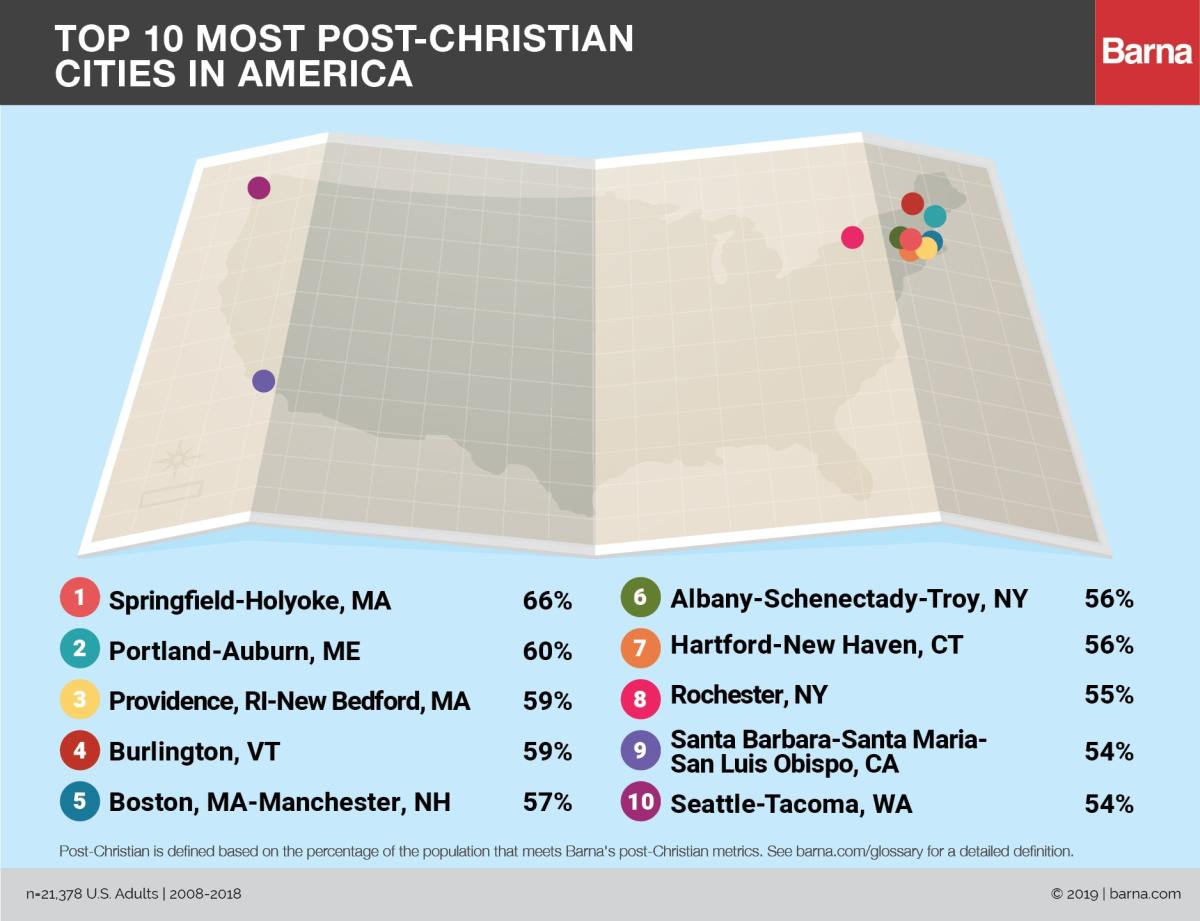
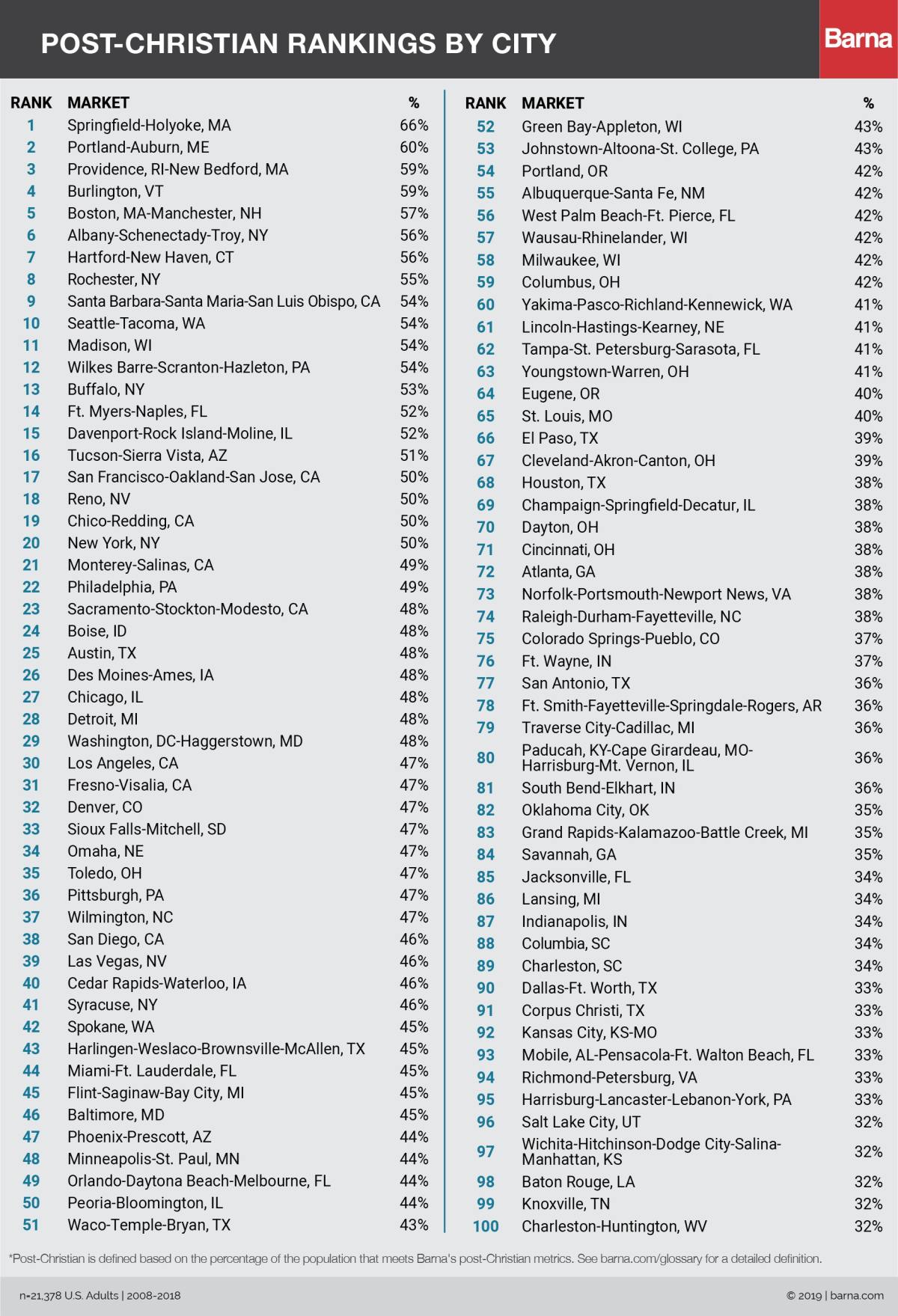
Eight locales in the Northeast and New England, a region historically known for its “righteous roots” and religious freedom, along with two West Coast spots, top the Barna Group’s annual list of most “post-Christian” cities.

Barna researchers use the designation to classify places where the fewest people follow Christian beliefs and practices, as measured by a list of more than a dozen factors.

The Springfield-Holyoke area in western Massachusetts, came in at the top of the post-Christian rankings in 2019, with a majority of residents saying they had never made a commitment to Jesus (60%), hadn’t gone to church recently (65%), and hadn’t read a Bible that week (87%). A significant minority—four in ten residents—said they did not consider faith as an important part of their lives.

Then came fellow New England metros rounding out the top 5: Portland-Auburn, Maine (moving from first place on 2017’s list to second place in 2019); Providence, Rhode Island-New Bedford, Massachusetts; Burlington, Vermont; Boston, Massachusetts-Manchester, New Hampshire.

“It doesn’t surprise us,” said Michael Kriesel, lead pastor at Vibrant Church in South Burlington, which moved up from fifth to fourth on the list over the past two years. “It’s hard to get people to go to church in New England.”

For years, Michael Kriesel, and his wife and assistant pastor, Diana Kriesel, have relied on the Barna findings to help focus their church’s mission and ministry in the Burlington area. According to the 2019 research, 59 percent of people in their city meet the designation for “post-Christian.”

“What we found was that we were living all of this [resistance to religion], and then the research came out, and put words to it,” said Diana Kriesel.

For church leaders in post-Christian cities, the stats are not signs of inevitable decline, but further motivation to pray, serve, and evangelize. “It becomes a mission field…the prayer of the Northeast: Lord, wake up New England,” said Michael Kriesel.

Connecticut pastor Eliezer Perez turned to the history of his own city, Hartford, which ranked seventh on this year’s post-Christian list from Barna and sixth on a previous release. He noted that early colonial settlers fled their homeland in search of religious freedom—a journey that quickly shifted from humble pilgrimage to the pursuit of progress.

“They had so much success that they took their eyes off of God,” said Perez, director of church development at Crossroads Community Cathedral in East Hartford. “I think we started deviating almost immediately from there.”

Completing the rest of the post-Christian top 10 are Albany-Schenectady-Troy, New York (56% post-Christian); Hartford-New Haven, Connecticut (56%); Rochester, New York (55%); and finally the only two cities outside the Northeast: Santa Barbara-Santa Maria-San Luis Obispo, California (54%) and Seattle-Tacoma, Washington (54%).

In Santa Barbara, one of the biggest battles the church is up against is declining belief overall. Christian leaders worry religion has become an afterthought, an antidotal anecdote to run to when disaster—like the 2018 California wildfires—strikes.

“People just don’t feel the need for religion. So many self-made people live here [actors, actresses, celebrities] that they still think they can do it on their own,” said Don Loomer, an elder at Santa Barbara Community Church.

He has served in SoCal churches for 30 years, surrounded by celebrities, great wealth and great weather. “People hardly think about [God]…If the suns out and the surf’s up, you say goodbye!”

Yet, in his area and post-Christian cities across the country—from Reno to New York—churches recognize that people will no longer come to a service for the sake of it. In this context, it takes a sincere effort to evangelize, but it also offers the opportunity for greater transformation.

“You really have to build some in-depth relationships before you can feel the freedom to share with people,” says Loomer. “That’s part of the reason that God had to become a man—he had to come down and live among us so that we could understand what [the gospel] is all like.”

Post-Christian cities across the country have also become destinations for immigrants, as refugees from Africa, Bhutan, and Bosnia land in Burlington, Vermont, and migrants from Central America and Mexico make their way into California. These population shifts have also affected the cultural and spiritual tenor of “secularizing” cities.

More than metrics, the Barna list is motivation for evangelical churches everywhere that are filled with pastors, leaders, creatives, and servants—every day people who aren’t afraid of these facts, but instead are fueled by them and holding out hope.

“Post-Christian doesn’t mean anti-Christian,” said Perez, the Connecticut pastor. “If it’s post-Christian, then that means there is Christian.”

Rachel Kang is a Charlotte-based writer. She is the creator of the online writing community Indelible Ink Writers.

Theology

Moonshot: What Barth, Tillich, and Tozer Thought of the Space Age

CT’s 1958 interview provides some bearing on today’s missions to the sun, Mars and beyond.

Christianity Today July 17, 2019
Nasa/Unsplash

It seems like so long ago that a moonshot was just a moonshot. Today, “moonshot” has come to mean an improbable mission—curing cancer, artificial general intelligence, or interstellar flight—a giant leap for mankind. Humanity’s current leap is toward the sun, as the Parker Solar Probe speeds toward its third perihelion—the point in an orbit closest to our home star—in September.

As we mark the 50th anniversary of Neil Armstrong’s moonshot—his one small step on July 20, 1969—it is easy to forget how improbable reaching the moon seemed before we actually did, when a moonshot was just a moonshot, 11 years before at the dawn of the Space Age.

What might pastors and theologians from 60 years ago think about the success of our space missions today? In digging through our archives, we discovered that Christianity Today posed the question, “Moonshot: Its Meaning?” to 25 of the greatest theological minds of 1958, from Karl Barth to C. S. Lewis to Paul Tillich to Emil Brunner, coupled with a lead-off essay by A. W. Tozer, “A Christian Look at the Space Age.”

What does a moonshot mean for a Christian? Reading over the brief interviews today, several themes stand out: How do Christians interpret world events rapidly occurring without misreading their implication for Christians? In contrast to the many horrific events of the 20th century, can space exploration offer a new hope for the world? Or more of the same? And how does space exploration change the way we see people and the way we see God?

From the CT Archives:

Moon Shot: Its Meaning to 25 Scholars,” Oct. 15, 1958
A Christian Look at the Space Age,” Oct. 13, 1958
Man on the Moon,” July 2, 1969
Space, Science, and Scripture,” July 18, 1969
Spiritual Implications of Exploring the Moon,” Sept. 7, 1972

We had only just begun to absorb the ramifications of the Nuclear Age when the Soviet’s Sputnik 1 changed the trajectory of our world in the fall of 1957. With the further success of Sputnik 2, and for the Americans, Explorer 1, the United States formed the National Aeronautics and Space Administration in the fall of 1958. The space race was a go.

These interviews are a snapshot in time; as with the rest of the world, these theologians had only begun to digest the momentous changes they were living through. And unlike our tendency to look back at the Apollo missions with rose-colored glasses, public opinion leaned against investing in space research. It is unsurprising then that many had a modest skepticism about the endeavor.

Missing the Bigger Picture

The rapid succession of these events in the late ’50s brought with them a sense of uncertainty. Sensing that many were “deeply troubled,” A. W. Tozer, a noted pastor and author, explained that the expectations of the early modern age lulled many Christians into a false sense of normalcy. As a result, Christians were examining the headlines closely, as with a microscope. But according to Tozer, this is the wrong instrument—to understand our world we must get out our telescopes to see the big picture of what God is doing. In fact, we experience today what the apostles saw through their telescopes of their age to come. We need not fear what these early believers knew would come to pass.

As it is hard for many to imagine what life was like before mobile phones and the internet, so too is it hard for most today to remember what it was like before people stood on the moon. And in fact, it has always been possible to dismiss it as unimportant.

Reinhold Niebuhr, perhaps the most prominent American theologian of the 20th century and the founder of Christian realism, insisted that he was “baffled” that we would spend any time thinking about traveling to the moon when we had more pressing issues facing the world, notably nuclear weapons.

Having witnessed the unfathomable evil of the Holocaust, the rise of atheistic communism, and the hate and injustice that subsumed so much of the 20th century, what Niebuhr couldn’t imagine was that powerful technology can be a force for good in our world, not just evil. Even as nuclear weapons seemed poised to destroy the world, space flight gave the world hope—and eventually, starting in 1975 with the European Space Agency and later with joint US-Russian endeavors leading to the International Space Station, a shared sense of the power of human cooperation.

An Unexpected Hope

Speaking several decades before the flowering of this cooperation, Paul Tillich, famed existential philosopher and theologian, suggested that while there may not be direct religious effects to the exploration of space, there are several positives for our world that Christians should applaud. For example, “the opening of outer space can overcome our terrestrial provincialism and produce a new vision of the greatness of the creation of which earth and mankind, their space and their time, are only a part.”

Aside from the occasional mishap or misunderstanding, the International Space Station has remained a long-term, bright light of cooperation among 15 of the world’s most prominent countries. We may not have overcome terrestrial provincialism yet, but we are in the early stages of space exploration. Just as Columbus left mainland Spain with a staging point in the Canary Islands, so too is the moon a staging point for further destinations. We are merely at the liminal edge of the great, cold unknown.

This vision of the luxury of creation compels Christians to hope and explore. “Shooting the moon, therefore, is a divinely appointed task,” reasoned Gordon H. Clark, the Calvinist philosopher and founder of Scripturalism. “Unfortunately, however, the ungodly are generally reputed to have obeyed this commandment more successfully than devout Christians have.”

Fifty years afterward, Clark’s assumption still seems to define the Christian’s place in space. From the exploration of Mars to caring for our planet, evangelical Protestants are less likely to support national investment in NASA’s space efforts than those who are Catholic or unaffiliated with religion, according to a 2018 Pew Research Center survey. While almost half of US adults (47 percent) support NASA “conducting basic scientific research to increase knowledge and understanding of space,” only 35 percent of evangelical Protestants do.

Yet more than ever, Christians have an obligation to use the tools God has granted humanity to demonstrate their ethical use, to explore the heavens that reveal the splendor of our Creator.

People Are Still People

As we continue to explore God’s creation, what does that say about people? Carl F. H. Henry, prominent American evangelical theologian and founding editor of Christianity Today, warned that moonshots are nothing more than the evidence of humanity’s pride, following “in the spirit of proud Lucifer exalting himself against God.” In contrast, the Christians’ purpose is “to bend the universe to God’s purpose,” asserted Henry, but “as a sinner, [humanity] exploits the universe instead; [humanity] reaches for infinity to vaunt his own glory.”

What Henry overlooked—and many of the interviewees noted—is that science and exploration are inextricably mired in the human condition. For every Tower of Babel built with human tools out of human pride (Gen. 11:1–9), there is a seamless robe woven with human tools for divine purpose (John 19:23) or gold refined with human tools that regales a king (Matt. 2:11). Among explorers, there will always be the benders and the vaunters, the Joshuas and the Achans.

On July 20, 1969, Neil Armstrong and Buzz Aldrin stepped onto the moon and staked the sign: “We came in peace for all mankind.” When we the faithful people of God make every effort to live in peace, our holy living makes a way for others to see God (Heb. 12:14).

God Is Still God

Perhaps the most important lesson of space flight is the one we learn about God. F. F. Bruce, a leading British biblical scholar, declared that while human explorers can have selfish motives, “the more that men discover about the universe of God, the more cause they have for admiring his wisdom and power.”

How can a Christian look at the stars in the night sky and not see the handiwork of God? How can a Christian look at the black hole in the middle of Messier 87 captured by the Event Horizon Telescope and not see the handiwork of God? What divine sublimity our ancestors saw dimly, we today see with ever-increasing clarity.

To paraphrase Paul’s analogy, there is one glory of the sun, and another glory of the moon, and another glory of the black hole’s event horizon (1 Cor. 15:41).

Karl Barth, frequently lauded as the greatest theologian of the modern era, explained that from the heights of heaven to the depths of the sea, wherever people are, so too is God (referencing Ps. 139:7–10). So go to the moon! God will be there.

When John F. Kennedy announced the moonshot in 1962, what we remember most is that “We choose to go to the moon.” Yet there is a more important choice that occupied his thoughts before this closing argument: People can use technology like space science for good or for evil, and thus we are called to use it for good. Fifty years later, the moon may seem mundane, but the sun and Mars and Enceladus (the sixth-largest moon of Saturn) and Proxima Centauri (the nearest star to the sun) are not. We, the people of God, still have time to find our voice, lend our hands, and go wherever God calls—for his glory, not ours.

All knowing that when we touch the sun and stand on Mars, God was already there.

Exploring Space Deepens Our Theology

Sensing the fear that could paralyze Christians, Tozer didn’t cool the engines of his critique. While Christians have every right and responsibility to grieve over the evil and hatred in our world, the injustice and the hurts, Tozer noted, if Christians give in “to panic before the growing knowledge of the heavenly bodies [this only will] reveal how inadequate has been our conception of God and how little we really understand the meaning of the resurrection of Christ and his ascension to the right hand of the Majesty in the heavens.”

We’ve come a long way since 1958, between the Parker Solar Probe, the exploration of Mars, the discovery of exoplanets, and the dawn of space tourism. In many ways, the world hasn’t changed; we still need to study the Scriptures, pray for peace, engage our communities, and proclaim the gospel for all to hear, all against the backdrop of a celestial map slowly being filled in one discovery at a time.

And what if we can’t get the gospel right with each other here on Earth? Well, as C. S. Lewis, the great novelist, professor, apologist, and scholar surmised, how then will we ever be able to share it with all the little green men we will soon meet on the moon, by the sun, around Mars, to infinity, and beyond?

Douglas Estes is associate professor of New Testament and practical theology at South University. He is the editor of Didaktikos, and his latest book is Braving the Future: Christian Faith in a World of Limitless Tech.

News

Korean Church Court Dodges Decision on Pastoral Succession

Denomination delays verdict on how Myungsung, the world’s largest Presbyterian church, passed its pulpit from father to son.

Myungsung Presbyterian Church in Seoul, South Korea

Myungsung Presbyterian Church in Seoul, South Korea

Christianity Today July 16, 2019
Panoramio / Cho

In this series

The two-year saga embroiling the world’s largest Presbyterian church remained unresolved Tuesday, despite a scheduled ruling from the denomination’s court.

The court of the Presbyterian Church of Korea (PCK-Tonghap) failed to determine the legitimacy of the 2017 accession of Kim Ha-na as senior pastor of Myungsung Presbyterian Church, a 100,000-member congregation in Seoul founded by Kim’s father, Kim Sam-whan.

The 15-member court began with a morning service at the Korean Church Centennial Memorial Building in Seoul. PCK-Tonghap is the second-largest of more than 100 Korean Presbyterian denominations, with more than 2 million members and almost 20,000 pastors.

Although the decision was due by 6 p.m., and dozens of journalists and activists waited outside the meeting room, no ruling was released until 8:30 p.m.

About 7:30 p.m., two members of the court left the room, one saying, “There’s nothing to expect. We tried to make things right.” When the two doors to the meeting room opened an hour later, an emotional jostling between activists and court members ensued as students and church reformers poured into the meeting room, followed by journalists.

Activists and journalists pour into the room immediately following the conclusion of the PCK court's meeting.J. Y. Lee
Activists and journalists pour into the room immediately following the conclusion of the PCK court’s meeting.

The PCK court head, Kang Heung-guk, declared a decision had been deferred to August 5, and apologized for failing to deliver on last month’s promise to announce a ruling on Myungsung on July 16. The court’s chief umpire, Oh Yang-hyun, added that the court is aware of the severity of the Myungsung case, and compared the gravitas of the current deliberations to the PCK court’s 1938 decision to condone Shinto worship during the Japanese colonization of Korea.

Dozens of students and activists had waited for more than 10 hours since the morning’s press conference held outside the building. Some students broke down in tears, while others expressed their frustration by blocking the narrow corridor outside the meeting room. Chants of “Repeal inheritance,” “Please save Korean churches,” and “Aren’t you ashamed to see students?” reverberated on the fourth floor.

Students and activists question a court member in the parking lot.J. Y. Lee
Students and activists question a court member in the parking lot.

Student activists followed Oh to the underground parking lot and questioned why the ruling was postponed. “I’m also ashamed that I’m a pastor today,” was Oh’s last words as he got into his car surrounded by students.

“Although some older generations sided with Myungsung, we witnessed the whole process and saw the hope within ourselves to rectify what is wrong,” said student council president Kim Joo-young, a senior at PCK Tonghap’s flagship seminary, Presbyterian University and Theological Seminary (PUTS).

This May, some 300 PUTS students and 20 professors marched three miles from PUTS to Myungsung to protest Kim Ha-na’s succession. In 2013, Kim Ha-na had told students in his seminar as their professor at PUTS that he would not become Myungsung’s senior pastor.

Kim Ha-na is a graduate of Princeton Theological Seminary, and a trustee on its board. This past Sunday, president Craig Barnes preached at two of Myungsung’s five Sunday services.

“It’s a wonderful honor to return here to be asked to preach again,” said Barnes, who joked that he has visited Myungsung more than his own church in Princeton. “I’m ready to apply to be a member here.” Barnes did not respond to requests for comment regarding Myungsung’s pastoral succession.

The crux of the debate has been Article 28.6 of the PCK-TongHap constitution, which prohibits the transference of pastor or elder positions to family members. Defenders have argued that Kim Ha-na was elected in accordance with Myungsung’s laws, and the denomination that Kim Sam-whan once headed should not meddle in the megachurch’s affairs. Critics have argued that the denomination’s flagship church is flouting the group laws it must heed.

In 1980, Kim Sam-whan founded Myungsung with 20 members. Today, the church’s footprint extend beyond its cavernous sanctuary with its choir of hundreds. The church owns and operates an evangelical television channel, two schools, the first and only private prison in Korea, and hospitals in Korea and Ethiopia. In 2014, the death by suicide of a Myungsung elder exposed real estate worth millions of dollars managed solely by the late elder and Kim Sam-whan.

The tension between Myungsung and its denomination will likely extend into September when PCK-Tonghap holds its 104th General Assembly in southeastern Korea, a stronghold for Myungsung supporters as Kim Sam-whan was born there and actively recruited pastors from his birth province. During last year’s assembly in southwestern Korea, hundreds of Myungsung members and hundreds of PUTS students held competing protests outside.

Today’s ruling on Myungsung received copious attention beyond Christian media. Many of South Korea’s largest broadcasters and newspapers including KBS, SBS, Joong-Ang Ilbo, and Yonhap reported on the delayed decision.

North American Scene from September 4, 1987

BOYCOTT

One Down, One To Go

A 1,600-member coalition of religious leaders has ended its boycott of one of the corporations it targeted for sponsoring television programs high in sex, violence, and profanity (CT, July 10, 1987, p. 36).

Christian Leaders for Responsible Television (CLEAR-TV), which includes the heads of 70 church bodies, called off a boycott of the Noxell Corporation. The cosmetics company “realized that they were not as careful as they might have been or should have been” in monitoring the programs it sponsors, said CLEAR-TV chairman Billy A. Melvin, executive director of the National Association of Evangelicals.

Carroll Brodie, vice-president and general counsel for Noxell, said the firm had given CLEAR-TV “our good-faith intent” to address the coalition’s concerns. “There was a great deal of inconsistency” in Noxell’s policies for program sponsorship, Brodie said, adding that for the first time the firm is developing a written policy. Noxell manufactures Cover Girl cosmetics and Noxzema skin cream.

CLEAR-TV is continuing its boycott of Mazda Motors of America, which Melvin called “the leading sponsor of sex, violence, and profanity [on television] for the last five years.” He said the automobile manufacturer has not responded to CLEAR-TV’S concerns.

NATIONWIDE

One Less Abortion Drug

The Upjohn Company has stopped domestic sales of a drug known as F2 alpha, which is used to induce second-trimester abortions. Robert McDonough, spokesman for the pharmaceutical company, denied that the decision was related to a two-year-old boycott called by prolife organizations.

While asserting that the boycott has had no impact on the company, McDonough acknowledged, “It’s a big issue. We’ve heard from a lot of people who say they are boycotting us.” But he added that Upjohn remains committed to providing “safe and effective means of pregnancy termination.” The company will continue to market two other abortion-inducing drugs in the United States.

Curtis Young, executive director of the Christian Action Council, said the decision to stop selling F2 alpha in the United States shows that Upjohn is feeling the effects of the boycott. “They’re trying to take a lower profile in the abortion industry by withdrawing one … abortion drug,” Young said. But he called it a “public relations move,” since Upjohn markets two other abortion drugs.

MINNESOTA

Disposing Of Fetuses

A federal judge has temporarily blocked enforcement of a new Minnesota law requiring fetuses and fetal remains to be buried or cremated. Under the old law, which is still in effect, fetal remains can be disposed of through sewer systems.

U.S. District Judge David Doty granted a temporary restraining order against the new statute, saying certain issues needed to be addressed at a hearing. Planned Parenthood of Minnesota, which performs abortions at its St. Paul clinic, had filed suit against the law.

Said Planned Parenthood attorney Becky Palmer: “[The statute] equates fetal remains with personhood, and courts on numerous occasions have held that to be unconstitutional.”

The Minnesota attorney general’s office maintains the law is constitutional, and prolife groups have criticized the lawsuit. “[Planned Parenthood is] against anything that creates the impression that unborn babies are human beings,” said Nancy Koster, of Minnesota Citizens Concerned for Life. Koster’s organization lobbied in favor of the law when the state legislature debated it earlier this year.

ACCIDENTS AND VIOLENCE

Leading Causes Of Death

Accidents and acts of violence have become the leading killers of young people in the United States, according to a study published in the Journal of the American Medical Association. The study found that 75 percent of the 15-to 24-year-olds who die are victims of violence, including accidents.

“… Violence has overwhelmed illness to the point where this age group is the only one whose health status has not improved over the last 30 years,” said Robert Blum, author of the study. “Now that we’ve gained some control over organic illness and infectious diseases, we must learn to cope with different but more preventable causes of death.”

Blum said auto accidents account for about 60 percent of all accidents involving young people. More than half of those who are killed, he said, have blood-alcohol levels above the legal standard for intoxication.

Overall, accident rates involving 15-to 24-year-olds have climbed since 1950, reaching 61.7 deaths per 100,000 population by 1980. Homicide ranks as the second-leading cause of death, claiming the lives of 15.6 per 100,000 young people each year. Suicide ranks third, claiming the lives of 12.3 per 100,000 American young people.

PEOPLE AND EVENTS

Briefly Noted

Declining : The public’s respect for television evangelists. A Gallup poll found that only 23 percent of those surveyed said television evangelists are “trustworthy with money,” while 63 percent said they are not. In 1980, a similar poll found 41 percent saying the evangelists were trustworthy, with 36 percent saying they were not.

Died: Peter Deyneka, Sr., 89, Russian-born immigrant who founded the Slavic Gospel Association, cofounded the Russian Bible Institute, and pioneered evangelistic radio broadcasts into the Soviet Union; July 26, in Wheaton, Illinois.

Filed : A lawsuit against the Cook County (Ill.) Board over its restrictions on a Cook County Hospital physician who has AIDS. The suit, filed by the American Civil Liberties Union, alleges that by prohibiting the doctor from performing “invasive procedures” on patients, the county board violated the Fourteenth Amendment as well as the federal Rehabilitation Act.

Calling the Next Generation of Christian Leaders

According to an old couplet, “It takes more grace than I can tell / to play the second fiddle well.” With those words, Ajith Fernando whimsically illustrated the dilemma faced by young Christian leaders in the Third World.

Fernando, director of Youth for Christ in Sri Lanka, was a speaker at Singapore 87, a nine-day meeting for young leaders. The conference was sponsored by the Lausanne Committee for World Evangelization, which is determined to identify and encourage the next generation of Christian leaders.

The event—designed for those aged 45 and younger—drew 283 “younger/emerging leaders” from more than 60 countries. Participants explored leadership methods and discussed issues relating to their various regions of the world.

Conference chairman Brian Stiller, executive director of the Evangelical Fellowship of Canada, said leaders in the post-World War II generation had too often been “cut from a Western pattern.” As a result, he said, younger leaders had suffered from the “long shadow syndrome,” perhaps feeling “trapped managing the ideas and visions of those who were older.”

Participants agreed that younger leadership is needed to evangelize a younger world. At the same time, they expressed gratitude to those who had led the way over the past decades.

Conference participants were selected after nine regional committees identified leading young people involved in full-time ministry, according to conference director Stephen Hoke. To qualify, participants had to be recognized as influential in their own countries and able to establish a national or regional effort for the cause of world evangelization when they returned home.

By J. D. Douglas, in Singapore.

Leadership Lifelines: Prayer, Fasting, and Flexibility

How discipline and commitment prove essential in your leadership ministry.

Women Leaders July 16, 2019
AaronAmat/Getty

Andy Stanley said, “Leadership is stewardship, and you are accountable,” while speaking to a group of leaders at Catalyst Atlanta in 2006. This quote absolutely resonated with me, because we can forget that as leaders we are responsible for our own leadership. Not only are we accountable to ourselves and those we lead, but most importantly we are accountable to the God that called us to lead.

Leadership in its most basic definition is the action or ability to lead a group or organization. Having been in leadership in education, business, the nonprofit sector, and ministry, I know all too well the truth of this statement. You are only a leader if someone is following you, so we need to give attention to how we lead, the impact of our leadership, and the health of our leadership.

Leading effectively requires discipline, and I have learned I am most effective when I discipline myself. As a leader, I have found three disciplines that help me lead well and avoid leadership pitfalls and burnout. I have used these in every area I have been called to lead. These lifelines have proven viable, having saved my life and the lives entrusted to me. Through the lifelines of prayer, fasting, and flexibility, my leadership has been enhanced in multiple ways. Albeit, prayer, fasting, and flexibility are disciplines, I consider them lifelines because of the life-giving power they have provided.

The lifeline of prayer

We know the power in prayer. We can perform a historical analysis of scripture and see many of the leaders God used were given to prayer. Prayer is what brings our will into alignment with God’s will. Whether God calls us to lead in church or the marketplace, our prayer lives are essential to our success as leaders.

We recall in Luke 18:1, “Then Jesus told his disciples a parable to show them that they should always pray and not give up.” Praying while leading has truly kept me from fainting. As an educational leader, I am tasked with making decisions that affect the lives of children, and I desire always to make the right decisions. Early in my educational career, there was a child who was in deep trouble in their home. I prayed daily before going to work, and the Holy Spirit allowed me to home in on this little girl. I noticed something was not quite right, and I left work with this child on my mind. I prayed for this child through the night and went to bed. The Holy Spirit alerted me that the child was being sexually assaulted. The next morning, I had a meeting with my boss and requested they investigate my concerns regarding this child. They said they would. I continued to pray for the child and the home environment. A few days passed, and my boss met me at the front door as I was about to begin my day, confirming the worst: the child had been murdered in a sexual way. I desperately grieved; it was this singular incident that made me take prayer seriously in my profession.

I continue to discipline myself to pray—the more leadership opportunities I am granted, the more intense my prayers become. Luke 18:1 speaks specifically about us not fainting. Prayer brings us into the presence of God; it is in the presence of God that we find strength and the grace to help us not faint. When I feel weary in leading, I always run to God for answers, strength, and encouragement.

If it were not for my prayer life, I would have resigned from leadership years ago. As a leader, God expects us to represent him in the earth. In the church, leaders are expected to pray. Having been called to minister to Christian leaders, I have discovered that many neglect prayer because they are busy leading. This is death to Christian leadership. I understand I must be given to prayer so that I will have the keen discernment and divine wisdom to make decisions affecting the lives of God’s people. I have been leading in ministry for almost twenty years, and I have come to realize that I make costly mistakes when I am not in tune to God’s will concerning his church and his people. Prayer helps me not be busy for the sake of being busy; it helps me stay focused on God ideas—not just good ideas.

As leaders, it’s easy to get caught up in every Christian move that everyone else is doing. But finding out where God is working and joining God there is where our leadership thrives. Christian leaders can spend countless hours conducting programs, special services, and outreach ministries trying to “win” people to Jesus because of someone else’s success or agenda, when in fact, if we earnestly pray, God may have a strategic plan for our ministry that is unique to us and our call of God. Prayer helps us hit the proverbial bull’s-eye.

As a pastoral and ministry leader, it was through prayer I knew to end a ministry program because God’s grace and anointing were no longer there. If I had neglected prayer, it would have rendered me ineffective, creating an unnecessary whirlwind of frustration. Prayer is the lifeline I use when those I lead come to me with problems. I don’t make any major decisions without taking the matter to God first. I pray about everything because I need God’s wisdom in everything. I desire to be a strong leader. I know that lack of prayer makes me weak; therefore, I don’t go a week without prayer.

The lifeline of fasting

Fasting added to prayer is like giving the Energizer Bunny steroids. Even though some Bible translations have taken the word fasting out of Scripture, God has never told us to neglect it. In fact, the Word of God speaks of fasting in the same manner of prayer and giving.

The Scripture clearly tells us what to do when we fast. It lets us know we have a direct connection with God, and God will reward us in our fasting:

When you fast, do not look somber as the hypocrites do, for they disfigure their faces to show others they are fasting. Truly I tell you, they have received their reward in full. But when you fast, put oil on your head and wash your face, so that it will not be obvious to others that you are fasting, but only to your Father, who is unseen; and your Father, who sees what is done in secret, will reward you. (Matt. 6:16-18)

Leadership challenges often create an opportunity to fast for clarity and to wage war against the forces of darkness that are not visible. There have been times when I clearly discerned I was fighting forces not of this world. Recently, God called me to oversee a new ministry with great potential that was already making significant impact in the kingdom. There was an individual connected to the former leader of the ministry who appeared to want to work with me, but during the transition, I noticed an uneasiness within me whenever I was around the person. I began to pray and ask God to reveal to me if it was just me, or if there was something else going on. The person really did not appear to be doing anything different, but my discernment was heightened. As I prayed, God led me to fast, and I fasted according to Matthew 6:16-18 and Isaiah 58. For two weeks, I fasted and prayed. God began to reveal that which was hidden, and I began to follow the exact instructions given to me by the Lord. As I executed these instructions, motives were exposed, and God caused the situation to work according to his will. Everything that was hidden was brought to light. I have learned that fasting brings us into direct alignment with God’s will for our leadership and for his people.

Fasting has made me more God-conscious in my leadership approach, decisions, and dispositions. I was called to lead by God, but the assignment only dictates what I should do, not how I connect to God through leadership. Regardless of the assignment, we all do our best to lead in a godly manner. Fasting increases our sensitivity to what God desires. Regularly, I designate a time of prayer and fasting to ensure I am leading how God desires me to lead. It is these times that help me to discern directional changes. There are times when we are faced with challenges with regard to the people we lead. When I sense I am agitated or irritated, those are indicators I need to talk to God about how to best lead. When decisions with people are pressing and prayer does not seem to give the necessary answers, I commit my mind and body to a fast conducive for the timing and situation. Before promotion, hiring, or termination of other leaders, I make it a matter of prayer always; when I am still not at peace about a decision, I fast.

Fasting, has given my leadership acumen a boost I can only describe as out of this world. There are times when I wonder how I can effectively do the things God has called me to do. The lifelines I have give me grace and life to do it; they have caused me to trust God, even in the scariest leadership situations.

Currently, I am facing an international leadership assignment that quite naturally scares the pants off me, but because I have prayed, fasted, asked others to pray, and sought counsel—and I am sure I am in God’s will—I trust where God is leading. And I am going afraid. I have learned that fasting helps bend me in the direction of God’s will that I would never have known except I humbled myself through fasting.

The lifeline of flexibility

Blessed are the flexible for they shall lead better and longer. At least, that’s been my experience. When speaking with mentors and those that have been leading many years, they all have told me in one way or another, “Learn to be flexible and don’t take yourself so seriously. The people belong to God and so do you—it’s always up to God.”

I rest in knowing God knew I was a mess when he called me, and I am grateful that God qualifies us as we walk. This helps with flexibility.

Flexibility means having the ability to bend easily without breaking, being easily modified, and possessing a willingness to change or compromise. For some leaders, the ability to be flexible can make or break one’s leadership. Inflexibility in leadership can be detrimental to you, the people you lead, your church, your business, and your organization. Why? You as leader are ever changing (or should be). As we mature as individuals and in God, change is inevitable. So, when we change, our leadership should change. Being open and able to change means you are indeed flexible.

Flexibility means we should not be fighting when we must change: “ And we know that in all things God works for the good of those who love him, who have been called according to his purpose” (Rom. 8:28). This scripture gives me solace in knowing it doesn’t matter what happens along my journey, God is going to cause everything to work out for my good. I don’t have to be stressed. Before I yielded to flexibility, I was always on “ten” and functioning like I was on steroids. I was always on edge. I thought I had to do “It.” I learned that if I do what God told me to do—and He does what I cannot—then I just have to trust that all the outcomes are up to God.

The phrase I live by is, “God, I have done what I know you asked me to do. It’s on you, now!” This is how I stay flexible, because it’s not up to me. I live by this principle, and God has allowed me to lead awesome people in amazing ways. How incredible it has been to watch God strategically move me, people, situations, and circumstances all because I yielded to flexibility.

Flexibility makes us available for whatever God desires. It’s scary to lead that way, but it’s so exhilarating! I have learned when leadership get ugly and messy—because it will—God is going to still cause me to triumph, so I have no need to stress. “But thanks be to God, who always leads us as captives in Christ’s triumphal procession and uses us to spread the aroma of the knowledge of him everywhere” (2 Cor. 2:14). It is refreshing to know that God through Christ will always cause us to triumph and his knowledge will be manifested in every situation.

The bottom line is, we have no reason to stress. The devil acts as a stress magnet, trying to convince us that “our” leadership is ours—it is not. God is the one who called us, placed us, and uses us if we surrender to him—and nothing promotes surrender like prayer and fasting. Be confident in knowing that Romans 8:30 declares, “Moreover whom he did predestinate, them he also called: and whom he called, them he also justified: and whom he justified, them he also glorified.”

I learned my greatest flexibility in pastoral and outreach ministry. In actuality, when I remain flexible, I allow the Holy Spirit to be in control. As a Type A personality (and I am Type A in every sense), seemingly, I would be allergic to flexibility. I have to remind myself to relax and calm down, telling myself, “you cannot control that which belongs to God, so let God do what He does.”

There have been times I have created a well-articulated plan for ministry. In my mind, it was flawless. And God laughed at my plans and brought His will to pass. In doing so, what God did was far better than my own plan. A few years ago, I was part of a local ministry for ministry wives and they needed a new leader for the local group. I thought it would be good for me to lead because that’s what I do. They asked everyone to submit their biographies and why they would make a good leader. I received a phone call explaining that because of my background, I was not chosen. A few years later, a similar opportunity presented itself. This time, I did not apply or inquire, but subsequently was asked to consider leading—a God move. This opportunity was far better than the previous. Had I not been flexible, I would have gotten offended and disqualified myself from greater leadership. Flexibility is not our enemy; it can be our best friend.

Prayer, fasting, and flexibility all require discipline. If you want to lead well, discipline yourself in these areas, and commit to making necessary changes. Adopting lifelines, whether a person or a practice, can help you faithfully steward every leadership assignment God may entrust to you. I have learned that prayer, fasting, and flexibility are my superpowers as a leader. For yourself as a leader, finding practical things to help you lead well will always increase your leadership capacity. Discipline yourself and commit to your leadership assignment. Watch how God will use you as a lifeline.

Dr. Domeniek L. Harris is an author, speaker, educator, women's ministry leader, Bible teacher, and founder of By His Side Ministries, a multicultural, interdenominational, and international ministry for ministry wives. She is the new CEO of The National Coalition of Pastors’ Spouses. She and her husband have helped establish When Pastors Pray, a ministry to address the mental health and spiritual needs of those called to the pastorate. She is a co-laborer in pastoral and outreach ministry with her husband, Apostle Brian D. Harris, at Dominion Living Ministries in Memphis, Tennessee.

News

No Matter Where You Are, Religious Freedom Is Getting Worse

A decade of analysis from Pew details what global faith leaders already know: From China to Europe, from the Middle East to the US, persecution is climbing.

Good Friday in New Delhi, India.

Good Friday in New Delhi, India.

Christianity Today July 15, 2019
Daniel Berehulak /Getty Images

Ahead of a US State Department gathering being touted as “the biggest religious freedom event ever,” a new report showcases how persecution is getting worse—especially for Christians, the most-harassed religious group in the world—and becoming more widespread.

Hostility against religious minorities spans longstanding hotspots in the Middle East and North Africa to Western contexts in Europe and the Americas, according to a comprehensive analysis released today from the Pew Research Center.

Christians endured more pushback than any other religious group each year from 2007 to 2017, when they faced harassment in 143 countries (that’s one fewer than in 2016, but markedly higher than before), researchers found.

This week, Sam Brownback, the US ambassador-at-large for international religious freedom, has organized the second annual Ministerial to Advance Religious Freedom, a summit in Washington to strengthen international commitments to religious freedom.

“There is no common theology in this discussion, but it is towards a common human right,” Brownback said of the event, which is expected to draw up to 1,000 religious and civil society leaders from around the world. “And that human right is that everybody is entitled to be able to practice their faith peacefully and without fear.”

The recent Pew release builds on earlier reports that looked at year-over-year change and offers a decade-long picture of religious freedom’s global decline—and the need for greater political action to curb the trend.

Pew Research Center

Christians remain the largest and most harassed faith community, but Muslims are not far behind, with reports of political or social oppression in 140 countries in 2017. Jews, the third-most targeted group, were persecuted in 87 countries, despite having a disproportionately smaller population (14 million) than Christianity (2.3 billion) and Islam (1.8 billion).

The religiously unaffiliated actually saw the largest rise in harassment over the period of the study, hitting a 10-year high in 2017, the most recent year for which data were available.

“Over the decade from 2007 to 2017, government restrictions on religion—laws, policies and actions by state officials that restrict religious beliefs and practices—increased markedly around the world,” stated the researchers. “And social hostilities involving religion—including violence and harassment by private individuals, organizations or groups—also have risen since 2007.”

The most recent data indicate that 52 governments, more than 1 in 4, imposed “high” or “very high” levels of religious restrictions two years ago, up from 40 in 2007. The highest levels of social hostility involving religion were reported in 56 countries by the end of the study, up from 39 at the start.

Big countries like China, Indonesia, and Russia are some of the worst offenders. And Christians are the biggest target.

By the end of the study, China, for instance, had boosted efforts to detain and deport Christian missionaries. And in just the last year, reports from the State Department, the US Commission on International Religious Freedom, and the World Watch List have called out China’s dimming record as a violator of religious freedom, citing everything from the shuttering of hundreds of churches and a ban on buying Bibles online to the detainment of up to 2 million Uighur Muslims.

Religious restrictions are rising everywhere, but fastest in Europe

The Pew report uses two 10-point indices to gauge levels of religious repression, one of which measures government restrictions and the other social hostilities. Both metrics are further divided into four categories for a total of eight measuring sticks for religious freedom.

Besides “interreligious tension and violence,” all other measures spiked between 2007 and 2017.

The biggest rise comes in the category of “hostilities related to religious norms,” which refers to harassment and antagonism around things like women not abiding by religious dress codes.

Religious freedom violations are most severe in the Middle East and North Africa, but restrictions and harassment are climbing everywhere. Europe saw the biggest jump in restrictions, with its score doubling over the decade of the study.

Legal limits on religious activities, like efforts to restrict proselytizing and male circumcision, are up dramatically in the continent. In 2007, five countries in Europe had restrictions on things like religious dress and religious symbols. Ten years later, 20 European countries had codified such restrictions.

China has some of the strongest limits on religious activity, and MENA has the worst government harassment, but social hostilities are increasing fastest in Europe, with its score in this category more than quadrupling from 2007 to 2017.

Government favoritism of religious groups increased in every region, including in the Americas. The Middle East and North Africa have significantly higher rates of government favoritism of specific religious groups—19 out of 20 countries in the Middle East have an openly favored religion—but rates are rising around the world.

Islam is the most common state religion: 27 of 43 countries with official religions are Islamic. Just a handful of countries (Greece, Iceland, the UK, and Samoa) make special concessions and offer perks to Christianity not offered to other faiths.

According to Pew’s findings, in only 26 countries (13%) are all religious groups “generally treated the same.”

While regional interreligious tension and violence decreased or stayed the same, it still grew in certain countries like Syria and Ukraine.

The State Department’s summit aims to combat this sort of interfaith feuding. “We want to see really a global grassroots movement around religious freedom,” said Brownback. “We want to get the various faiths to bind together and to stand for each other’s freedom of religion.”

Religious freedom is best in the Americas, but it’s slipping

In all categories, the Americas was the region with the fewest restrictions and hostilities. But even there, all measures point to rising levels of harassment and repression.

Over the period of the study, the number of countries in the Americas with noted government restrictions on religious activities increased from 16 to 28.

In the United States specifically, limits on religious activity and individual or social group hostilities based on religion increased dramatically between 2007 and 2017.

More than 8 in 10 (82%) Americans cite anti-Muslim discrimination in the US, according to a separate Pew study released earlier this year. Anti-Semitism is also up sharply in recent years, especially in the shadow of the shooting at a Pittsburgh synagogue that killed 11 late last year and a significant rise in hate crimes targeting Jews.

Even Christians are feeling the effect of threats to religious freedom, both social and political. A full half of Americans believe evangelical Christians are subject to discrimination in the US, up 8 percentage points from 2016.

Around the world, the share of countries with high levels of social hostility is ticking upward. Overall restrictions on and hostility toward religious groups remains a significant challenge as, in 2017, 83 countries (42%) reported “high” or “very high” scores in these categories, a figure that remained the same between 2016 and 2017 and falls just below the 10-year high of 43 percent in 2012.

Among the 25 most populous countries, home to more than three-quarters of the global population, China, Iran, Russia, Egypt, and Indonesia have the harshest government restrictions based on religion. The freest of these big countries in terms of religion are South Africa, Japan, the Philippines, Brazil, and South Korea. The United States falls closer to the middle of the group.

Apple PodcastsDown ArrowDown ArrowDown Arrowarrow_left_altLeft ArrowLeft ArrowRight ArrowRight ArrowRight Arrowarrow_up_altUp ArrowUp ArrowAvailable at Amazoncaret-downCloseCloseEmailEmailExpandExpandExternalExternalFacebookfacebook-squareGiftGiftGooglegoogleGoogle KeephamburgerInstagraminstagram-squareLinkLinklinkedin-squareListenListenListenChristianity TodayCT Creative Studio Logologo_orgMegaphoneMenuMenupausePinterestPlayPlayPocketPodcastRSSRSSSaveSaveSaveSearchSearchsearchSpotifyStitcherTelegramTable of ContentsTable of Contentstwitter-squareWhatsAppXYouTubeYouTube