A recent newspaper ad for a business school stressed that its program teaches “another way of doing business”—meaning that they also teach ethics, an element missing from the concerns of most business schools. Enron, Martha Stewart—dirty business is a hot topic, and it’s no longer unusual for familiar corporations to make headlines when their shady business practices are investigated. People are beginning to think that perhaps “dog-eat-dog” is not a desirable workplace dynamic.
In Good Company—the new comedy from Paul Weitz, director of About a Boy—is a film that examines the current climate of dehumanizing business practice, challenging us to revise the way in which we set and pursue our goals and dreams. The film, currently playing only in New York and L.A., opens in wide release on January 14, when Christianity Today Movies will post a full review. Film Forum will include a roundup of other critics’ observations the following week.
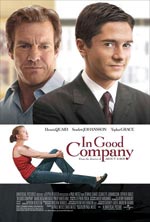
Weitz’s movie is the latest in a series of recent features that pose questions about the difference between animal behavior and “higher” behavior, the call of conscience. Kinsey, Collateral, Closer, We Don’t Live Here Anymore, and other recent releases portray people behaving selfishly and recklessly in the arenas of sex, business, and relationships. Some of them suggest that the “freedom” of amorality is fulfilling rather than damaging. Not this film.
(NOTE: The following involves plot points from the film that could be considered mild spoilers.)
In Good Company features Carter Duryea, a young and ambitious business mogul played by Topher Grace (That 70s Show). In one scene, he’s staring at a goldfish swimming in circles in a bowl, and his mournful gaze shows that he can relate—he’s also trapped in a glass world of demoralizing business practices in an effort to be successful. He realizes that, while he’s gaining responsibility and status, he’s stuck in a circuit that will lead him nowhere. The film follows Carter’s journey of coming to understand what he lacks and what he needs.
When Carter takes a new position as the head of marketing for a sports magazine, he displaces Dan Foreman (Dennis Quaid), a 50-something professional with experience and a sterling reputation. But as Dan begrudgingly consents to work for Carter, the young hotshot sees an alternative way of living and working, a fulfilling lifestyle that represents everything that is missing in his own life. Dan built business relationships with handshakes and sincere conversation rather than high pressure sales tactics. His values—trust, relationship, respect, and dignity—don’t show up on Carter’s radar.

The two men clearly need each other, the way sons and fathers need each other. Carter’s swimming with sharks when what he needs is to be surrounded by a loving family … like Dan’s. Soon, he begins secretly dating (and, unfortunately, sleeping with) Dan’s daughter, hoping to absorb some of that family love. When Dan takes a “fatherly” tone with his new boss, Carter responds, “Nobody has ever taken the time to give me a hard time before!”
When the filmmakers and actors met with the press in L.A. recently, I asked Weitz to comment on Carter’s “animal behavior” and the higher, more human quality of the life that appeals to him. He responded, “Carter is into the surface aspect of things because that is all that he can see. He didn’t grow up in a happy family situation.”
I asked Topher Grace for his perspective on Carter’s attraction to Dan’s family. He replied, “Carter’s got everything on paper. His parents were both absent. But he’s got the job, and the right car, and the right wife, and the right house. Once he goes to [Dan’s] house, he starts to see something that he really wants but doesn’t know how to get. I think he’s dating Dan’s daughter as a consolation prize to being in the family. But he would trade it all in just to be the fifth member of the family.” Describing Carter’s unhealthy business tactics, he echoes a lesson he learned from his own dad: “Having more energy doesn’t mean you’re smarter.”
Meanwhile, Dan is clinging to “the old fashioned way” and doesn’t yet see the rewards that can come from weathering change and being open to new relationships. He needs to know that just because he’s older doesn’t mean he’s washed up. “What happens in the relationship between [Dan and Carter] … I think it’s by design,” Quaid told me. “[Dan’s] a guy with two daughters, and you’re rooting for him to have a son. And … he’s gained a son in his relationship with Topher’s character.”

Crosswalk’s Annabelle Robertson was also at the press junket in L.A. In her feature article about the film, which includes excerpts from that event, Robertson says, “In Good Company has a strong message about fathers and mentors, and focuses on what it means to be a dad under challenging circumstances.”
Harry Forbes (Catholic News Service) saw the film in New York, calling it “a mostly sharp and perceptive take on the heartlessness of today’s corporate world.” He calls an episode that involves premarital sex “a brief misstep in an otherwise solid screenplay,” and concludes, “There are a couple of twists by the film’s ending, which is more bittersweet than the conventional wrap-up you’d expect. This is an intelligent, above-average comedy-drama worth seeing.”
Copyright © 2005 Christianity Today. Click for reprint information.