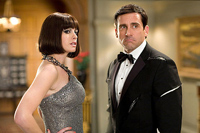
Get Smart seemingly does several things right in remaking the quirky spy parody created by Mel Brooks and Buck Henry. First, it involves Brooks and Henry in some capacity as consultants. Second, it features near-perfect casting with Steve Carell as CONTROL agent Maxwell Smart, Anne Hathaway as Agent 99, and Alan Arkin as their Chief. And thirdly, it largely captures the spirit of the original while paying homage.
However, the film still can’t overcome its biggest hurdle: Get Smart is just not funny.
Sure, it has a few funny moments, but you’ve already seen them in the commercials. Almost all of the rest of the jokes fall embarrassingly flat—like an odd, forced line about milking spiders (??) and really stale political satire. But unfunny attempts are not as much of the problem as is how seldom the movie even tries to be funny. Frankly, I was shocked by how few gags are in the movie. In fact, when the film does detour from the hum-drum spy-thriller plot or sappy down-on-his-luck hero montages, the comedy bits feel out-of-place, forced and rushed. Few bits are given a chance to patiently build to a payoff like the old show was known for. For instance, there is a sequence that seems to be setting up a gag about how assassinated agents keep dying face-first into their food—but after it happens just twice, the joke moves on to something else.
Carell told Entertainment Weekly that he agreed to the movie when it was pitched to him as “a comedic Bourne Identity.” That sounds great. The trouble is that Get Smart isn’t so much an integration of two genres, as it is a tug of war between them. In the end, neither genre fully works.

If the film had a strong spy-thriller plot, a dip in the TV show’s consistent goofiness, sly satire and wordplay could be forgiven. But the writing is pretty poor—as is the plot itself. In fact, the screenplay is basically a mash-up of the original Austin Powers with Rowan Atkinson’s Johnny English. When all of CONTROL’s field agents are compromised by the dangerous KAOS, their hopes depend on sending longtime intelligence man Maxwell Smart into the field. He must discover what KAOS head Siegfried is up to. And what is he up to? Holding the United States ransom with nuclear weapons, of course.
Seriously, the screenwriters couldn’t come up with anything else for KAOS to be doing than threatening nuclear war? Really? Even the very poor 1980 Get Smart movie, The Nude Bomb, and the show’s 1989 TV movie came up with more original and fun plots than that! (The movies dealt with, respectively, a bomb that destroyed only clothing to give KAOS a monopoly on clothes manufacturing and a weather machine used by a mad publisher to make citizens stay indoors and read.)
This maddening lack of creativity makes me think that the whole film was slapped together by the studio to make money with little care or inspiration. The flaws also cause one to wonder how much Mel Brooks and Buck Henry were really involved. This film is not the spy satire they created—built solely on the dopey incompetence and awkwardness of their lead—but a second-rate spy movie with some half-hearted attempts at humor.

Still, not all is a waste. One interesting thread to the plot is Smart’s care for individuals—even if they’re employed by KAOS. Often, Smart discusses how our enemies are humans, too. “They do bad things, but that’s only what they do—not always who they are,” he says. That theme comes to a head in the film’s middle when Smart shows that compassion for an individual can truly be mightier than violence.
Speaking of pluses, nearly all the casting (save for some scene-stealing minor agents) is great. The only newly invented character of note is Agent 23, the rock star of CONTROL’s spies, played by Dwayne “The Rock” Johnson. The ex-wrestler has certainly established himself as acapable actor and brings great flash and charisma to the role—until the end when he becomes a tad flat. Meanwhile, all the character updates are pretty impressive. While some will accuse Carell of being too much like his character on The Office, he actually plays Smart very much like legend Don Adams. In fact, Carell’s natural demeanor (sly wit, awkwardness, and gentle sincerity) is a great match for what Adams lent to Smart. Plus, Carell’s nasally line reading of famous Smart-isms like “Missed by that much” and “Would you believe … ” is priceless.
Those signature lines are not the only familiar pieces of the show for fans. Smart’s Sunbeam Tiger roadster, shoe phone, cone of silence, and even Hymie the Robot are given their due and handled very well—not just as passing references. (And for those really paying attention, there are also references to more obscure things, like The Claw.)
In fact, the introduction of certain Get Smart icons suggests great fun if there’s a sequel. And while I was disappointed with this first stab at the franchise, I think possible future films could be promising if Carell, Hathaway, and Arkin return. The storytelling would have to be more inspired and the humor more consistent and sharp—but it could work well. After all, this movie only missed it by that much.
Talk About It
Discussion starters- Smart says that our enemies “do bad things, but that’s only what they do—not always who they are.” What does he mean? What defines a person if not their actions? How does this philosophy mean people should treat those who do bad things?
- In one scene, Smart helps an enemy when he realizes he knows him. How does knowing about a person change how we can feel toward them? Have you ever hated someone before you really understood them? How did your opinion later change?
- When Smart aids the enemy, does he do it out of true compassion—or because it will help him out of a jam? What does it say about Smart that he does this for this guy, but in every other situation, he shoots the guys opposing him?
The Family Corner
For parents to considerGet Smart is rated PG-13 for some rude humor, action violence and language. Take the language caution seriously; there are many uses of various swear words—everything but the f-word (however, one character gives someone the finger). There’s a sight gag built around two men who seem to be having sex. There’s a very brief glimpse of a female character in her underwear and an open robe, and there’s a brief shot of rear male nudity. And a very gross scene dealing with vomit. Violence is typical of the action/comedy genre but there are cringe-inducing moments like a character taking tiny harpoons to the face.
Photos © Copyright Warner Brothers
Copyright © 2008 Christianity Today. Click for reprint information.