Pastors

5 Books for Reaching Diverse and Divided Congregations

New and recent resources for your preaching library.

A healthy congregation isn’t monolithic. Like the kingdom of God, it likely includes people of various ages, personalities, socioeconomic backgrounds, and cultures. And, hopefully, on a given Sunday, it includes the spiritually curious—those who don’t yet believe in Jesus but are interested in learning more. This variety brings great glory to God, but it can also pose an immense challenge for preaching. How can a pastor effectively connect God’s Word to so many different listeners—all in one sermon? These new and recent books equip pastors to take on this challenge.

Preaching to a Divided Nation: A Seven-Step Model for Promoting Reconciliation and Unity by Matthew D. Kim and Paul A. Hoffman (Baker)

Preachers in North America face an enormous challenge today: People both inside and outside the church are divided over ethnic, racial, gender, and political issues. How can preachers faithfully proclaim the gospel and promote peace and healing in a church and society that are so polarized? In this practical guide that is grounded in a biblical and theological understanding of the gospel, Kim and Hoffman offer a seven-step model for skillful and contextually relevant preaching in today’s divisive climate. They provide helpful tools for understanding the issues in our polarized society and our local communities, and they suggest concrete practices that invite preachers to humbly and prophetically address difficult issues. For example, the contextual step in their model helps preachers develop the historical intelligence needed to diagnose America’s past and present sins and understand how they can manifest in our congregations. Preachers will be encouraged by the model and the six sermon examples from the authors and other notable preachers.

—Kerwin A. Rodriguez is a doctoral candidate in preaching at Baylor University’s Truett Seminary and serves as an assistant professor at Moody Bible Institute.

Speaking Across Generations: Messages That Satisfy Boomers, Xers, Millennials, Gen Z, and Beyond by Darrell E. Hall (InterVarsity Press)

It’s probably a bigger dilemma than most preachers realize: How do you prepare and preach messages that span the generations while still being true to Scripture and speaking out of your own generational strengths? According to pastor Darrell E. Hall, the answer is to become an intergenerational preacher—“one who is characterized by Bible-based content, aha moments, no emotionalism or manipulation, simplicity, and teaching.” How does a pastor do this exactly? Hall emphasizes understanding the values and perspectives of each generation and how these shape their language. This is where Speaking Across Generations is an incredibly helpful tool for pastors: Hall offers well-researched cultural analyses on Gen Z, millennials, Gen X, boomers, and elders while providing a sermon manuscript for each, using language they will best understand and receive. For pastors who feel an increasing burden to shepherd their multigenerational congregations with greater cultural and contextual sensitivity, Hall provides an invaluable resource.

—Ronnie Martin is the lead pastor of Substance Church in Ashland, Ohio, and the author of The God Who Is with Us.

Topical Preaching in a Complex World: How to Proclaim Truth and Relevance at the Same Time by Sam Chan and Malcolm Gill (Zondervan)

As unashamed advocates of topical preaching, Sam Chan and Malcolm Gill encourage pastors to contextualize “both the message and the method” because “in different cultures, people resonate with different styles of message.” They demonstrate how topical preaching makes sense for dealing with differences because it not only recognizes that people learn in different ways but also embraces diverse cultural expressions. Whether it’s preaching to both believers and unbelievers or to different cultural groups, Chan and Gill challenge pastors to reevaluate their cultural assumptions and homiletical practices. For instance, the authors remind preachers to focus on what believers and nonbelievers hold in common: the need for grace. They write, “Neither the believer who needs to be built up nor the unbeliever who needs to be forgiven can live the way God intends through their own efforts.” As Chan and Gill remind us, amid differences, something always remains the same: In our preaching we show people the wonderful, transforming grace of God.

—Patricia Batten is an assistant professor of preaching and associate director of the Haddon W. Robinson Center for Preaching at Gordon-Conwell Theological Seminary.

Ministers of Reconciliation: Preaching on Race and the Gospel edited by Daniel Darling (Lexham Press)

This book serves as a brilliant, practical resource for pastors to lead their congregations in engaging race and ethnicity in a biblical way. Thirteen authors from various backgrounds weigh in on this often-contentious topic, each focusing on one biblical passage and all interweaving their personal vantage points drawn from their unique racial and ethnic experiences. Readers who may tend to shy away from addressing race and ethnicity from the pulpit will likely be convicted by how often the Bible addresses race and ethnicity. All 13 contributors passionately press the point that the healing of racial and ethnic brokenness is central to the gospel message. They exhort believers to champion God’s healing as an outflow of our Christian lives. This compilation will challenge, encourage, and also equip preachers with solid scriptural exegesis and practical tips to use in leading their congregations to navigate this important topic in such a crucial time in history.

—Dennis Liu is the lead pastor at Vineyard of Hope Church, a predominantly Asian American congregation near Los Angeles. He oversees Vineyard USA’s AAPI Association.

Speaking by the Numbers: Enneagram Wisdom for Teachers, Pastors, and Communicators by Sean Palmer (InterVarsity Press)

“A communicator best serves hearers by knowing the nine compulsive personality patterns that hearers adopt in order to feel seen, known, and loved,” writes teaching pastor Sean Palmer. As communicators, we tend to speak out of our own intelligence centers, without training in how to integrate our ideas in ways that hold others’ interest. Palmer empowers us to craft messages across differences in the Enneagram’s intelligence centers of thinking, feeling, and doing . In his view, the essential work is shepherding that brings “healing and wholeness into the lives of hearers in the Intelligence Center where they are repressed.” Providing specific examples throughout, Palmer helps preachers “hit that mark”—the point when our message galvanizes hearers in their thinking, feeling, and doing. In a world riveted by differences, preachers can use Palmer’s method to connect relationally just as Jesus did. This is a critical read for preachers and speakers seeking to be heard by hearers who long to “feel seen, known, and loved.”

—Juanita Campbell Rasmus is a pastor, spiritual director, and author of two books, including Forty Days on Being a One.

This article is a part of our fall CT Pastors issue. You can find the full issue here.

Pastors

Strategies for Preaching to the Polarized

How can our sermons bridge the division of our contentious moment?

Illustration by Daniel Liévano

As I was working out at a local gym, my attention was drawn to the TV that hung from the ceiling. News anchors I didn’t know from a channel I hardly watched made talking points I didn’t understand about issues of which I was only vaguely aware. I feel like I don’t even know the world I’m living in anymore, I thought.

This unnerving feeling also comes up in ministry. Sometimes I wonder, Do I even know the congregation I’m pastoring anymore?

With all the political polarization, lingering resentments over how a church handled mask requirements, people taking sides regarding COVID-19 vaccination, and issues tied to deep pain like mass shootings, abortion, or race, we are pastoring communities in an ongoing state of elevated tension. These current realities layer atop the normal complications pastors face as we preach to congregations made up of different generations, political views, theological backgrounds, and relationships with Jesus (from committed Christians to spiritual seekers to those contemplating deconstruction).

It’s a struggle to preach across so many divisions and differences. Recently, during sermon preparation, I was so distracted by all the opinions and arguments of the day that it felt like I was developing my message inside a hall of mirrors filled with fog while riding a Tilt-A-Whirl! Hyperbole aside, I came away with little confidence in the sermon I’d cobbled together, and I felt further challenged by the reality that I had to actually love those I preached to. I thought of pastor John Ames’s line in Marilynne Robinson’s novel Gilead: “Prophets love the people they chastise.” I felt chastened myself.

As pastors, we face a tremendous challenge today: How can we preach effectively in our contentious moment, often to divided and polarized congregations?

Sermons That Build Bridges

In the city where I pastor, a mile-wide river runs through the middle of downtown. Because several bridges span the river, we’ve incorporated one of the more iconic bridges into our church logo. When our congregation feels divided, leaving me confused about how to go forward in a sermon, I try to remember that image is more than a logo. It represents the preacher’s calling: to build on the bridge Christ has built to us, across a separation far more than a mile wide.

Here are a few ways I’ve been helped in preparing and preaching sermons that seek to bridge divisions in my congregation:

Develop a preaching team of rivals.

A famous book about Abraham Lincoln’s “team of rivals” refers to the people Lincoln assembled around him—including those antagonistic to him—to make his decisions and our divided country stronger. Developing a similar sort of team has been one of the most significant practices for improving the quality of preaching at our church.

For many years, we had a regular small meeting to debrief our sermons. But church growth and changes in staff created an opportunity to think afresh about the purpose of the meetings and who’d be best to participate on the debrief team. Over several years, we’ve built a team of nine: a mix of church staff and volunteers, men and women, young and old, experienced preachers and those who will never preach. We’re all very different, but we share a love for orthodoxy and a commitment to our church’s mission statement.

The team members grab a sermon manuscript when they arrive on Sunday mornings so they have an easy place to write notes. (And yes, sometimes they even use a literal if not metaphorical red pen.) Then we meet together every Monday at noon to discuss the previous day’s sermon and plan for the upcoming one.

I would not consider the team “rivals” in the sense that any of us desire to be antagonistic or contrarian. But it is a group intentionally comprised of diverse perspectives, and candid feedback is encouraged. Together we work for the good of each other and the good of God’s Word preached among his people. Typically, we discuss what went well in the sermon and what was confusing or even unhelpful. We touch on all the major questions about rightly dividing the Word, gospel clarity, quality of illustrations and applications, as well as tone, gestures, mannerisms, and so on. We also at times consider how diverse groups within our church might hear a particularly thorny or sensitive topic.

For example, recently a Scripture passage lent itself toward comments about race. One of our associate pastors was preaching that week, and he sensed his remarks could be contentious. So during his sermon preparation, he sought my feedback, pulling me aside to go over his application points. Perhaps because of my own blind spots and perhaps because I didn’t listen closely enough, I missed anticipating how his words could be misunderstood by a few in our church. Rest assured that when we debriefed the sermon, the preaching team did not let us miss our mistake.

We all have blind spots. A preaching “team of rivals” is like having a sophisticated system of cameras around your car when you park in reverse. The team gives me the blessing of seeing what I can’t, and over time, my preaching instincts become refined even while my perspective enlarges.

It can be hard emotionally to prepare for Monday’s feedback. Sometimes receiving it requires more humility from me in the moment than I have to offer. Some weeks my heart just wants to hear “You’re a great preacher” and not “You spoke too fast in the introduction.”

But alas, I must remember that, while painful, growing in awareness of my blind spots and hearing from different perspectives make me a better preacher and our church a better church. As the wise saying goes, “Wounds from a friend can be trusted” (Prov. 27:6).

Lean on expositional preaching (and keep a topical list of your church’s biggest divides nearby).

I am not against topical preaching—in fact, I often preach a few topical series each year. But I’ve found that the regular practice of preaching expositional series through books of the Bible is more helpful in our divided age than topical sermons. There are many reasons for this, but one in particular is that an expositional preaching series through a book of the Bible requires less of an explanation—an apologetic, if you will—for why a pastor did or did not cover a certain topic.

With a topical series that a pastor or pastoral team has chosen, we implicitly give our people the impression we think they need to hear these topics and they need to hear them right now. Our assessment may be true, of course, but this approach can potentially feel more confrontational to listeners than needed.

People “have ears to hear” more often when they don’t sense the subtext of the sermon series is “I don’t think you’re very good at this, so I’m telling you now.” Instead, applications are often received with warmer hearts (especially on controversial issues) when there is the sense that “God just so happened to have us focus on this passage this morning when such and such is happening in our country, so let’s talk about it.” Approaching controversial matters via expositional preaching (rather than topical preaching) tends to neutralize polarizations by gathering potentially divided listeners on the common ground of esteem for the Word.

There are times, however, when as pastors we do want our churches to feel the sting. For example, this fall we’re preaching through one of the longer topical sermon series we’ve ever done—focused on the purpose and beauty of the local church. And yes, in a sense, we are emphasizing that our leaders chose this topical series, among the infinite number of possibilities, because we think our people have underdeveloped ecclesiology. (Ask me at Christmas how it went.)

Some criticisms of expository preaching are a perceived lack of relevance and immediacy and the tendency to gravitate toward merely pietistic applications (like “read your Bible more,” “pray more,” “love God more,” and so on). I once received feedback from our elders that my preaching tended to stop short of preparing our people for why God breathed Scripture: “teaching, rebuking, correcting and training in righteousness, so that the servant of God may be thoroughly equipped for every good work” (2 Tim. 3:16–17). Thoroughly equipping people for every good work requires sermons that prepare them for more than just what they can do on Sunday mornings or during their personal devotional times.

An approach that has helped me change was to make a topical list of the sins, struggles, and divisions I perceived among our sheep. I typed out the list and asked other thoughtful believers and staff members to add to it. I consult the list often in sermon preparation.

Having a list like this front of mind during sermon preparation will not change the exegesis of the biblical text. But having the proper exegesis of one’s audience at the ready helps preachers connect congregants’ particular struggles with God’s particular grace. I can’t tell you how many times this kind of congregationally aware expositional preaching has helped me address the controversial topics of our moment in a way that listeners could receive them.

Take controversial stands when it’s costly, not when you’ll get applause.

When I feel compelled to flip a proverbial table, I try to remember that Christ did so rarely—and he often did it when it cost him.

I confess that it confuses me when I see preachers take a “bold” and “courageous” stance on a controversial issue and the predominant response from their listeners is applause. In contrast, the boldness of John the Baptist earned him the only pulpit that would have him: the wilderness. The courage of Christ led to the cross.

What does it really mean to be bold? How should we consider when and how and why to take a stand on a tough issue in a sermon?

I find it helpful to examine the pastoring Jesus modeled in the letters to the churches in Revelation. The pastoring is so specific to each church and their moment, both in what Jesus praises and in what he challenges. The same church that hears “I know your deeds, your hard work and your perseverance. I know that you cannot tolerate wicked people” also hears “Yet I hold this against you: You have forsaken the love you had at first” (Rev. 2:2, 4).

More to the point, the bold and courageous challenge that the church in Ephesus received was to them and for them. Jesus did not say, “Church in Ephesus, there is a church just down the road in Pergamum committing sexual immorality and holding to false teaching.” Instead, Jesus raised those issues with that church (Rev. 2:14–15).

To be clear, I’m not saying the way we choose the right hills to die on is by choosing only those hills on which we might actually die. As preachers, we follow the Spirit and the Word where they lead. But when there is an opportunity to make a pointed sermon application, we ought to address the one that will challenge our congregations rather than pander to them—while always remembering that loving to chastise people is not the same as loving the people you chastise.

A place certainly exists for helping church members think biblically about the ills of society; it is one part of discipleship. But I’m learning it is relatively easy to preach about the sins of culture and of those not in my congregation. It can even be intoxicating. In contrast, when church members hear the Word preached to them, repent of their sins (and not their neighbors’ sins), believe the gospel afresh together, receive assurance of God’s forgiveness, and ask for the Spirit’s empowerment to walk in newness of life, these regular practices make a church a unified church. In our divided moment, I’ve experienced that the members who repent and believe together stay together.

Rest in the power of the Word and the Spirit.

A friend in our church was a New York City police officer in the 1980s when the crime rate was extremely high. The murder rate, for example, was four times higher than today. He tells me the experience continually reminded him of two things: not only that he had a role to play in bettering the city, but also that he could not be the ultimate solution. The problems were too big for any one officer.

I assume that, like crime rates in NYC, the macro-division pastors feel in our congregations will ebb and flow for reasons well outside the control of any one pastor in any one church. So I try to remember these same truths. Our sermons have a vital role to play in building on the gospel bridge Christ has built. But if, in the process of preaching, we feel as the apostle Paul once felt—“Who is equal to such a task?” (2 Cor. 2:16)—we must take comfort where Paul took comfort: Our competence comes from God who makes us ministers of a new covenant. For the Spirit still gives life, even in—and maybe especially in—our divided age.

Benjamin Vrbicek is the lead pastor at Community Evangelical Free Church in Harrisburg, Pennsylvania, the managing editor for Gospel-Centered Discipleship, and the author of several books.

This article is a part of our fall CT Pastors issue. You can find the full issue here.

Pastors

Come Ye Pastors, Heavy Laden

Learning to walk under the weight of ministry’s many hats.

Illustration by Daniel Liévano

After years working as a teacher, my wife, Lisa, went back to graduate school to become a therapist. Our church had long advocated for mental health assistance and maintained a referral list for congregants who needed professional counseling. We had even developed a generous scholarship to offset counseling fees. So when Lisa set up her new practice, I was excited to recommend several of our congregants to her care.

Lisa quickly objected to being placed on our referral list. “I’ll likely not see most people from our church. I won’t wear more than one hat with anyone. It is unethical.”

I was surprised, but she explained, “I can’t be a pastor’s wife and a counselor, a fellow worshiper and a therapist.”

Counseling students study the ethics of dual relationships. They are taught to wear only one relational hat with a client and to practice extreme caution in interactions outside their sessions—even on social media. On the rare occasion when a therapist must wear two hats with a client, the counselor is trained to pay careful attention to how the other interactions influence the therapeutic relationship.

Lisa’s caution about counseling our church members clarified something I’d been wrestling with for years. Pastors wear many relational hats with our congregants. It’s an inevitable vocational reality. Most other vocations require only a single relationship: You visit your doctor for medical help, your mechanic to repair your car, your therapist for emotional help. But because church ministry is multilayered, pastors must fill multiple roles to be effective. This relational complexity is a unique challenge in ministry.

A wearying weight

Sometimes these overlapping roles and relationships are annoying but relatively innocuous, like when I show up to a congregant’s party. The laughter stops and someone says, “Well, I was going to tell that joke, but the pastor is here.” In moments like this, pastors realize how hard it is for some congregants to see them as fellow humans. Instead, they see hats on our heads that read, “God’s probation officer.”

Or imagine a pastor on Christmas Day. She hosts Christmas dinner with some friends, thinking her pastor hat is hung up in the closet. Then her friend says, “Hey, while I’ve got you—we didn’t sing enough carols during the Christmas Eve service. And it isn’t just me; several others are saying it too. I just thought you’d want to know.”

Hold that thought while I retrieve my pastor hat—the one I almost never take off, she thinks. The one that’s soiled from a heavy season of pastoral care culminating in a 13-hour Christmas Eve marathon. Also, remind me to set fire to the friends-with-church-members hat once and for all.

This rapid switching of hats can be more than innocuous—it can drain us. Pastors are expected to hold an unusually broad skill set, and some of our required competencies actively contradict each other. It’s common for a pastor to run a board meeting, work on a budget, chat with a staff member about goals and development, host a funeral, and sit with someone who walked into the church asking for money—all in the same day.

I feel this exhaustion most keenly when I move from preaching a sermon to immediately listening to congregants pour out their pain to me after the service. My body is still hopped up from the adrenaline and vulnerability of preaching, and my thoughts are rapidly spinning through what I said and how I could have said it better. But before I have time to focus, someone is asking for prayer about his recent cancer diagnosis or is at her wit’s end with an adult child. My preacher hat is quickly displaced by my spiritual-guide hat.

And it’s not only the switching between hats that makes things difficult. In a few pastoral relationships, we have to wear multiple hats layered on top of one another. The chair of our elders is a wonderful human being, and it’s a pleasure to serve with her. But our relationship is complicated because she is my boss and I am her pastor. I am proud to call her and her husband my friends, but these tangled dynamics complicate things for all of us.

In William Shakespeare’s play Henry IV, Part 2, the title character says, “Uneasy lies the head that wears a crown.” I have no firsthand experience with crowns, but are they as heavy and unwieldy as a stack of 20 hats?

What are we to do with all these overlapping and conflicting relationships? As pastors, we don’t have the option of avoiding dual relationships the way therapists do. Can we mitigate the weight and weariness that come with this multi-hat vocation?

Ministry friendships: A hat on a hat

Most ministry hats can be sorted into two general piles: those we wear based on competency and those we wear based on expectation. The competency pile might include hats like Bible expert, counselor, preacher, visionary, staff manager, recruiter, spiritual director, and fundraiser. The sheer breadth of skills required can grind us down.

Yet in my experience, the competency hats are not what tax me the most. The hats that generate the most anxiety and conflict are those I wear due to expectations I place on myself or others place on me. I expect myself to be a gold-star preacher, a 24-hour care service, and an expert at things I’ve never led before, like a capital campaign. Others might see me as a political partisan, a projection of their dysfunction, or the complaint department.

But there’s one role all pastors must contend with that defies categorization: friend.

Can pastors have true, life-giving friendships inside their congregations? Every ounce of me wants to answer, “Yes, of course!” But instead I must say, “It depends. Proceed with caution.”

How many congregants have their job performance regularly critiqued by their friends? People don’t stand around after a service questioning Peter’s civil-engineering qualifications or debating Danielle’s skills as an insurance agent. But they’re all quite comfortable reviewing the pastor’s latest sermon or leadership decision.

Then, of course, there are people who need to be close to the pastor in an unhealthy way. One time a newer member told me, “I only stay at a church if the pastor and I are close friends.” Yikes. I was far enough along in ministry to know that the best response was to let him down as quickly as I could: “If your single lens for church involvement is friendship with me, then I doubt you’ll get very involved. I hope you can see your way to finding a church where you can simply grow and serve.” He stuck around for a few months and then moved on to the next church, looking for his needed influential friend.

Further, pastors may forget that no matter which hat they put on at a given moment—including the friend hat—most people still see the pastor hat poking out from underneath. Years ago, I was running a capital campaign and asked a married couple I considered good friends to volunteer on the planning team. After a few days of silence, the husband finally replied with his regret that they could not help. But he accidentally also forwarded the correspondence between him and his wife discussing my request. One of the emails from his wife said, “I told him no last time. It is your turn.”

That private correspondence helped me see that my church friends face a challenge in managing my multiple relationship roles too. When I think of church friends critiquing my sermons, I can move into self-pity. But it helps to consider my friends’ perspective: After all, I am the only one in the friend group who gets up on a stage to monologue at them every week!

Yes, pastors can enjoy friendships inside the church. But wise pastors remember that even their closest church friends are navigating a dual relationship with them. And for most congregants, it might be best to stick with friendly over friend.

The simplest remedy to the complexity of ministry friendships is to invest in single-hat relationships outside your church. Pastor and author Glenn Packiam talks about a pastor’s need for a collection of single-hat relationships, all playing different roles in a pastor’s life. He likens this to the titular group from J. R. R. Tolkien’s The Fellowship of the Ring. Frodo had a true friend in Sam, a wise sage in Gandalf, a healer in Elrond, and so on. I’m sure you’ve seen the alarming statistics about ministry loneliness and burnout. Unfortunately, pastors still often neglect proper investment in these needed single-role relationships.

In my coaching, I prompt pastors to do a quick inventory of their single-hat relationships. How many do they have, what role does each relationship play, and how much time do they invest in each one? My own pastoral life has been powerfully relieved by my intentional investment in these one-role relationships outside my church. They’ve given me a fresh ability to cultivate healthier relationships inside my church.

Faulty assumptions and unreasonable expectations

I spend much of my time training pastors to notice, name, and diffuse chronic anxiety. It differs from other forms of anxiety like trauma or grief because it grows from assumptions, expectations, and false beliefs. We hold faulty assumptions about ourselves and unreasonable expectations about our hoped-for levels of vocational competency—both of which lead to untenable beliefs that generate chronic anxiety. Unfortunately, assumptions and expectations are not private affairs. We willingly place them on each other. Chronic anxiety is the only form of anxiety that is contagious.

For example, a young pastor recently told me that after one of his sermons, a new family came up to meet him. They’d just moved to town and were anxious to find a church like their previous one. “Our last pastor was the finest preacher we’ve ever heard,” they said. “No one opens up Scripture the way he did.”

Their expectation, although innocent, infected this pastor’s assumptions about himself as a young church planter. If he is not careful, this chronic anxiety infection will form a false belief that he has to preach a certain way to keep people happy. He will pile hats on his head that God is not calling him to add.

Expectation itself is not bad; we should be held to a high standard, and people should expect certain things from us. But pastors’ ongoing vocational pressure is magnified when people place unreasonable and unattainable expectations on them. Some individuals think they know how to lead a church just because they attend one. Others hold a subconscious belief that God is on their side no matter what opinion they are expressing. Their expectations can infect our own and lead to tremendous stress.

Few things cause as much anxiety as the things we demand from ourselves. Some pastors believe they must always get everything perfectly right every time. Others feel they must always be there for those who are hurting, no matter the detriment to their own well-being. Some are driven by people pleasing—no critic can express a negative opinion without these pastors trying to win the naysayer over. And still others expect every sermon they preach to be the best they’ve ever given. None of these self-expectation hats belong in your closet; they just don’t fit.

As pastors, we’d do well to practice the difficult art of differentiation of self—noticing when we are living under untenable internal and external expectations and clearly defining a human-sized capacity and scope for ourselves. We must learn to sift through our own false expectations and beliefs. We must toss out the hats that don’t belong on our heads and resize those that sit too low on our brows.

Do you expect more of yourself than God does? I have found a simple question to be useful in bringing relief here: What if I were as _____ toward myself as God is?

For example, What if I were as kind toward myself as God is? This question helps me see that the “gospel” of my inner expectation is always harsher than the Good News of Jesus.

Learning to live as human-sized pastors does not come naturally to us. We often use “I can do all this through him who gives me strength” (Phil. 4:13) as a license for self-abuse and exhaustion. But pastoring is complex enough without us adding more hats to the stack.

The dynamic blessings of pastoral ministry

We pastors will never get down to single-role relationships with our congregants—nor should we try. We can mitigate the weight of multiple hats by acknowledging them, paying attention to the rapid switching, cultivating single-hat relationships outside our church, and identifying and rejecting unreasonable expectations.

We may envy counselors with their streamlined vocations and one-role relationships, but pastoral ministry is an astonishing calling. No other vocation so fully opens us to the wonder and mystery of God and to the sacred task of soul care. We get paid to study Scripture, to enjoy God in front of people, to attend to the souls of our congregants over years, to tangibly envision God’s kingdom realized locally, and to do something about the most broken places of society.

So many people in my congregation have shared their pain, regret, doubt, and sin with me; but they also share their healing, joy, hope, and spiritual hunger. Wearing multiple hats can be wearisome, but I know of no other vocation that experiences the abundant life like a pastor. It is a complex, wonderful, exhausting, exhilarating, holy vocation.

Steve Cuss serves on the pastoral team at Discovery Christian Church in Colorado. His books include Managing Leadership Anxiety and, forthcoming, Minding the Gap.

This article is a part of our fall CT Pastors issue. You can find the full issue here.

Pastors

How Irenaeus, Ambrose, and Basil Help Us See the Spirit

When the Holy Spirit seems tough for congregants to grasp, borrow these surprising images from the church fathers.

Edits by Christianity Today. Sources: Getty / Ilbusca / Mikroman6 / Belterz / Wikimedia Commons

When I went to seminary, I learned just enough about the Holy Spirit to render him irrelevant in my life. I knew enough to confess the Holy Spirit as God, the Lord and giver of life, but I could not discern how the Spirit actually shaped my everyday life. Theologian Heribert Mühlen once warned against falling into an atheism of the Third Person, and sadly, many Christians formally confess the Spirit as God but deny the experience of the Spirit by living as if he is irrelevant.

Over the years, I have heard a recurring question from church members: “What does life in the Spirit look like?” They wonder whether the Spirit’s presence can be grasped only by a few privileged people—academics with graduate degrees in biblical studies or specially anointed spiritual elites who witness extraordinary miracles and transcendent experiences. They are looking for a grammar of the Spirit to help them in their everyday spiritual journeys.

Pastors often speak about spiritual matters through difficult-to-grasp, abstract concepts such as grace, law, sanctification, good works, Christlikeness, or holiness. Understandably, they struggle to make life in the Spirit relatable and tangible for churchgoers.

How can pastors help their people envision God’s work in their lives through the Spirit and invite them into that story? Thankfully, early church fathers can be a great resource. Pastors like Irenaeus, Ambrose, and Basil often used word pictures to depict what life in the Spirit looks like and invite their hearers into such life. In their preaching and teaching, they gave us a visual feast of illustrations. They painted pictures of the Christian life that involve death and resurrection, spiritual warfare, and Sabbath rest.

Let us look at some examples from church fathers of the fourth century, a period in history when many theologians wrote treatises, sermons, and letters on the Spirit and the spiritual life. In their writings, these voices from the past combined conceptual arguments with devotional images to depict and demonstrate holiness for believers in whom the Spirit of Christ dwells.

Irenaeus of Lyons: The Word and the Spirit are hands

Picture God as a creative sculptor. The Garden of Eden is his studio. After days of wonderful artistic endeavors and before taking time to behold the beauty of his handiwork, a last stroke of genius: With his hands, the sculptor shapes Adam from the ground and breathes life into him, creating humans in his own image and likeness.

A consensus emerged among early church fathers that the breath of God, which made Adam a living being, refers not only to Adam’s spirit-soul (in contrast to his flesh-body) but also to the Holy Spirit who makes fellowship with the Creator possible (Gen. 2:7; see also John 20:22; 1 Cor. 15:45–49). Bearing the image of God involves bearing God’s own Spirit. This brings humans into a profound, life-giving spiritual relationship with the Creator.

But humanity fell into sin and lost communion with God. Therefore, the divine plan of salvation must involve the restoration of God’s image in people. The Spirit, lost by Adam, needed to be returned to humanity. But how?

Irenaeus of Lyons (circa 130–200) explains that the Father uses his “two hands”—the Word (Son) and the Spirit—to vivify humans (by restoring in them the image of God that Adam lost in the Fall) and to bring them back into fellowship with himself. The Son takes on himself the flesh (human nature) of Adam and is anointed with God’s Spirit so he can redo Adam’s failed history. The Son becomes the new Adam to give us the Spirit of new life.

Referring to the baptism of Jesus, Irenaeus has a beautiful way of describing what the Spirit’s descent and anointing on the Son means for humanity. In Against Heresies, Irenaeus writes:

Wherefore He [the Spirit] did also descend upon the Son of God, made the Son of man, becoming accustomed in fellowship with Him to dwell in the human race, to rest with human beings, and to dwell in the workmanship of God, working the will of the Father in them, and renewing them from their old habits into the newness of Christ.

Inseparably united to Christ as his dwelling place, the Spirit of God becomes used to dwelling once again with the race of Adam. Or as Athanasius of Alexandria (circa 296–373) once put it (in Against the Arians), the Savior is “anointed with the Spirit” in the flesh so “He might provide for us … the indwelling and intimacy of the Spirit.”

Irenaeus’s image of God’s two hands encourages us to think of the Holy Spirit as a hands-on person who dwells and rests in us like he did in Christ’s human nature. He shapes us to be like Christ. As new creatures, we are invited to yield to the hands of the potter (Isa. 64:8; Jer. 18:6), to be molded or sculpted by God’s Spirit to grow into Christ’s likeness. The Spirit works even now to conform us to Christ in his death and resurrection (Rom. 8:9–11). He forms us to die to the old, sinful creature’s ways of life and habituates us to a new life in Christ according to the Father’s will (Rom. 6:4).

Ambrose of Milan: Your soul is a heel and a foot

For Ambrose of Milan (339–397), a theologian and bishop, the Holy Spirit is the rain from heaven that gives life to thirsty pilgrims in times of spiritual drought. As we journey through perilous deserts where we are tempted by evil, the rain of the Spirit cleanses us from sin and preserves us from spiritual death. In his work On the Holy Spirit, in a prayer to Jesus for the gift of the Spirit, Ambrose asks,

May the drops from You come upon me, shedding forth grace and immortality. Wash the steps of my mind that I may not sin again. Wash the heel of my soul, that I may be able to efface the curse, that I feel not the serpent’s bite on the foot of my soul.

Ambrose imagines the soul as a heel and a foot that can be exposed to the Serpent’s bite. He reminds believers to be watchful in the wilderness lest they give in to the Devil’s seduction and curse. We all have a spiritual Achilles’ heel, so to speak: those areas of vulnerability where the Devil is most likely to attack us and we are most likely to fall. The Christian life is one of vigilance and resilience in the desert, where the refreshing rain of the Spirit becomes our life-giving oasis and source of strength amid spiritual attacks.

While our souls may be as vulnerable as bare feet, Ambrose’s images indirectly invite us to think of God’s promise that Christ, the seed of the woman, would crush the Serpent’s head (Gen. 3:15) so that God might also crush Satan under our feet (Rom. 16:20). Just as Christ was led by the Spirit into the desert to be tempted by Satan, so also those who are led by the Spirit of Christ into their deserts suffer the Serpent’s attacks. But we also stand firm in Christ’s victory over the Evil One (Luke 4:1–13; Heb. 2:14–18).

Basil of Caesarea: Your mind is an eye

Basil, bishop of Caesarea (330–379), in a letter to his friend Gregory, reflects on lessons he drew from a short experience in monastic retreat. Although he admits his lack of appreciation for the life of solitude, he sees retreat as an important form of Christlike self-denial, of dying to the anxieties of the world to make room for the mind to focus on God and apprehend his truth:

We must strive after a quiet mind. As well might the eye ascertain an object put before it while it is wandering restless up and down and sideways, without fixing a steady gaze upon it, as a mind, distracted by a thousand worldly cares, be able clearly to apprehend the truth.

How easy it is for the mind to lose focus on what is important. Distracted by too many things, a wandering eye becomes restless. Where, then, can a restless soul find rest?

For Basil, the first step in sanctification is to find quiet—the kind of solitude that rests in God’s Word. Retreat is not an excuse to leave the world but rather a time to leave the cares of the world to receive from God what is needed to engage the world rightly. The point of detachment is not to neglect one’s duties but to make room for the Spirit to form us and help us flourish.

Basil’s teaching on quiet and solitude is an invitation to embrace the spiritual sense of the Sabbath. He calls us to be still in God’s presence and rest in the beauty of his Word.

This is a call to see the Spirit’s work in us with a new set of eyes, fixed in a steady, restful gaze amid the distractions of life. It is a call to be like Jesus, who did not allow his work to get in the way of his time with the Father in prayer. Even when the crowds gathered to hear him and be healed of their sicknesses, Jesus withdrew to deserted places to pray (Luke 5:15–16). Like Jesus, we are guided by the Spirit in our labors and encouraged not to neglect time in deserted places with the Father.

The spiritual grammar of life the Spirit

We can learn from master preachers and teachers like Irenaeus, Ambrose, and Basil as they tell the story of life in the Spirit in ways that teach hearers about the sanctified life—not only at a conceptual level but also viscerally, in their own lives. These fourth-century fathers offer a spiritual grammar—a vocabulary—that can help people in any era discern what life in the Spirit looks like.

Imagine, for example, how a sermon on the work of the Spirit could come alive for listeners if, instead of merely saying, “The Spirit indwells all who follow Christ,” the preacher painted a visual picture like “God molds us like a potter at the wheel. The Spirit, who dwells in us as he did in Christ, shapes the contours of our lives to more closely resemble Christ.”

Consider the difference it would make in how a pastor prayed with others if instead of simply saying, “Lord, guard us from the temptations and attacks of the Evil One,” the pastor prayed something like “Protect our exposed and tender souls like steel-toed boots on bare feet. Send your healing grace to soak the parts of our lives that are dry, cracked, and callused. Help us stand firm with you, Christ, and grant us spiritual victory as you stamp on the Serpent’s head.”

What if, in pastoral counseling, a minister were to ask not only “Do you have a daily quiet time with God?” but also “How do the distractions of modern life keep you from focusing singularly on God? Where could you lean on the Holy Spirit as you take time on a regular basis to tune out the static and find rest in God?” By offering a variety of images and word pictures, pastors can correct the false notion that there is only one way to talk about life in the Spirit.

I once led a Bible study in which one person said, “I am on the brink of burnout.” Another said, “The Devil is tempting me to doubt God’s promises of provision.” Yet another said, “I need the Lord to shape me to die to self so I can be a more forgiving spouse.”

In response, I introduced participants to a variety of images and word pictures from the church fathers and from Scripture depicting the Spirit’s work. These individuals required descriptions of the spiritual life as vivid and diverse as their unique needs.

Through the vibrant and surprising images given, each person received direction critical to his or her situation: Pray to the Holy Spirit for renewal from Adam’s old ways. Pray to the Spirit for refreshment and resilience amid spiritual struggles in the deserts of life. Pray for Sabbath rest to receive God’s gifts amid the busyness of life and all its distractions.

By using such images of life in the Spirit of Christ in our teaching, sermons, and prayers, we, like the early church fathers, can capture our people’s imaginations. We can show them how the Spirit shapes them in the image of Christ even now, to the glory of God and the benefit of our neighbors.

Leopoldo Sánchez is a professor of systematic theology at Concordia Seminary in St. Louis. He’s the author of the T&T Clark Introduction to Spirit Christology and Sculptor Spirit: Models of Sanctification from Spirit Christology.

This article is a part of our fall CT Pastors issue. You can find the full issue here.

Pastors

To Be a Pastor Is to Know Betrayal

Apprenticing Jesus in a cruciform call.

Edits by Christianity Today. Sources: Getty / Ilbusca / Max Dannenbaum / Stringer / Wikimedia Commons

Early in my ministry, an older priest told me that, for a season of her own ministry, she had taken a break from church. I thought this was odd for a priest—maybe even wrong. She didn’t defend herself to me. She only explained that she and her family had been so damaged by parish ministry that they had needed a season to heal before they could resume public ministry in good faith.

What struck me as odd in my early years of ministry today seems unsurprising. When I count the pastors I’ve watched closely over the past decade—from various denominations and generations—a significant majority of them have experienced gut-wrenching pain at the hands of people in their churches.

Ministry is never easy, but it’s always personal. Those of us who serve and lead the church are on the frontlines of dealing with human brokenness—and we often have scars to prove it.

The call to pastor is a call to love. We give more to our work than a set of skills or techniques—we give ourselves. Pastors experience a deep sense of betrayal when the people we love attack, disparage, or turn against us. The pain of betrayal seems to be an immutable part of the pastoral vocation.

The art of vulnerability

Pain caused by betrayal is one reason why pastors, though constantly involved with people, can feel extremely lonely. This is a job that requires becoming vulnerable over and over again, without any guarantee of security, longevity, or safety in relationships. The degree of relational risk can feel very high. So pastors—and their families—often carry relational wounds alone, without many true confidants with whom they can safely share. Without adequate support from trusted friends and mentors, these ministry wounds can fester and eventually devour us.

But there is good news: Avoiding vulnerability—and its inherent risks—isn’t the goal.

It might be tempting to insulate ourselves from the pain of rejection or betrayal by learning to simply care less. We clock in, preach our sermons, take a paycheck, and keep our expectations low. This kind of emotional numbness might feel safer, but it robs us of hope and becomes a recipe for apathy and jadedness in ministry.

In my own ministry, I feel this temptation most often in my relationships with fellow leaders in the church. Maybe I bring unrealistic expectations of other pastors. Maybe the growing number of abuse scandals and cover-ups and the ugly reality of denominational wars have diminished my trust in the integrity of church leaders. I have committed my life to the church; leaving isn’t an option. But at times, I recognize in myself a tendency toward indifference and cynicism that resemble self-protection more than anything else.

In a church full of broken shepherds and sheep, self-protection is understandable. But it is not very Christlike.

Jesus, the perfect pastor, did not insulate himself against vulnerability. Instead, he allowed himself to be disappointed and even hurt by his disciples. When they dozed off at his greatest time of need, he asked them, “Couldn’t you men keep watch with me for one hour?” (Matt. 26:40). And he washed the feet of the one who would betray him.

Jesus knows what it’s like to be abandoned by his people—even by his fellow leaders. And he knows what it is like to die for them anyway: “Having loved his own who were in the world, he loved them to the end” (John 13:1).

In the darkness of Gethsemane, on the eve of his crucifixion, Jesus modeled a kind of resoluteness that could never be confused with stoicism. He remained faithful to his call despite his disciples’ failure to support him, but he also honestly acknowledged his pain before the Father and received the ministry of an angel to strengthen him (Luke 22:43). This invites us to embrace a kind of strength that isn’t cowed by others’ criticism or isolation but that also doesn’t retreat into indifference. It’s the kind of strength that empowers us to lay down our lives.

Our personal ministries will never measure up to Jesus’. He is the Good Shepherd; we are first and foremost recipients of his grace and rescue. But as those whom he has called to serve as undershepherds of his flock (1 Pet. 5:2), we can and should expect our ministries to be cross-shaped.

The fellowship of His sufferings

When we feel betrayed by our people, it is easy to ask, “Where did I go wrong?” But these painful experiences are not a sign of failure in ministry. They are an aspect of our participation in Christ. To share in Christ’s ministry is to share in his sufferings. When we embrace the costly work of self-giving, seeking to faithfully love God’s faithless people, we uniquely live into our vocation as pastors. We’ve been appointed to shepherd and care for people even though they might hurt us.

This call is cruciform, but it is also formative. In a world that champions celebrity and equates success with popularity, our experiences of isolation and betrayal remind us that we apprentice a crucified Lord. We can hope for—and even seek, when appropriate—reconciliation for broken relationships because ours is also the God of resurrection. Restored fellowship is our future in him. But when reconciliation remains impossible on this side of eternity, we can still find meaning in the pain. To have even a small share in his ministry means to be counted worthy to suffer dishonor for his name (Acts 5:41). The heartache of betrayal invites us into deeper union with Jesus, turning isolation into intimacy.

In my Anglican tradition, when priests are ordained, they are invited to lie prostrate with arms extended, forming the shape of a cross. This liturgical embodiment of our vows reminds us that priestly ministry is, in many ways, a ministry of death—a life poured out as an offering to God on behalf of his people (Phil. 2:17). During an especially painful season in her ministry, a priest friend of mine assumed this posture again in a moment of private prayer and lament. As she rested her cheek on the floor of her prayer chapel, she sensed Jesus lying beside her, arms outstretched, his fingertips touching her own. There on the floor, in the humility of prostration, she imagined Jesus saying, “Don’t worry. I do this all the time.”

On the painful and sometimes bewildering path of ministry, Jesus is our guide. He has shown us what cruciform love looks like. He is still faithfully loving his treacherous bride. And he will sustain us as we seek to do the same.

Hannah King is a priest and writer in the Anglican Church of North America. She serves as an associate pastor at Village Church in Greenville, South Carolina.

This article is a part of our fall CT Pastors issue. You can find the full issue here.

Pastors

Changing Minds Is Not Our Job

We cannot control our people, and attempting to do so will only do damage.

Edits by Christianity Today. Sources: Getty / Anthony Saint James / Chrispecoraro / Wikimedia Commons

It’s 2 a.m. on a Tuesday night, and I am wide awake.

Usually my kids are to blame for this sort of thing. They had a bad dream. They want something to eat. They forgot to tell me a funny joke they heard at school. Urgent stuff. But not tonight. Tonight is worse. What has awoken me is not my kids but my anxiety about a conflict at the church I co-pastor with my husband, Ike. Someone we love and are close to, someone who knows our family and our kids and who has been on mission with us for the gospel, doesn’t like a decision we made. They are so upset that they’re threatening to leave.

As soon as my eyes pop open in the darkness, the thoughts that have been churning for days resume:

Maybe if I explained this Scripture passage to them…

Maybe if I came at it from this theological perspective…

Maybe if I shared the wise counsel we received from experts in our congregation…

Maybe if they heard the stories of hurting people in our church…

And on and on it goes.

Throughout my time in ministry, I’ve experienced the occasional conflict-induced sleepless night—but, like many pastors, there’s been a marked uptick over the past two years. In 2020, as church leaders faced the triple whammy of the pandemic, nationwide racial tension, and a polarizing presidential election, the climate inside our churches changed with it. Our sanctuaries’ air became polluted by deep partisanship, which meant every decision, every statement, every sermon, and every social media post coming from pastors was interpreted through a political filter.

Because the risk of misunderstanding was so high, my husband and I gave a lot of time and attention to explaining ourselves. We taught through the Scripture that was guiding our decisions, and we were transparent about the wise and knowledgeable voices we were listening to. We knew this was necessary to instill trust in our people—and usually it did—but this approach also taught us a hard lesson.

What we’ve learned over the past two years is that no matter the scriptural exegesis you use, no matter the theological backing you appeal to, no matter the data, the experts, or your own record of integrity, you cannot convince people of something they do not want to believe.

Why? Because information is not nearly as powerful as we think it is.

In A Failure of Nerve: Leadership in the Age of the Quick Fix, author and family therapist Edwin Friedman described our limited influence this way: “The colossal misunderstanding of our time is the assumption that insight will work with people who are unmotivated to change.”

As much as we wish it were otherwise, information has far less influence than we give it credit for. Downloading the “facts” into others’ brains is not going to magically change their minds, but I will be the first to admit this hasn’t stopped me from trying. Whenever individuals in my church or personal life “need to be corrected” (according to me), I’m off to the races with all the arguments I could employ to persuade them. In seconds flat, I can summon a hundred different talking points to convince them of the truth, if I could just sit down with them to explain it.

But God is showing me that I’m not merely attempting to guide them—I’m actually trying to control them. I am relying on knowledge, information, and the truth of God’s Word to function like the reins on a horse, instantly directing others in the direction I want them to go.

But time and experience are teaching me that I am severely overestimating my own power to convince. Jesus himself hinted at the limited power of our arguments by concluding some of his hardest teachings with the statement “Whoever has ears, let them hear” (Matt. 11:15). The implication is that some will not hear. They will not understand—not because they cannot but because they will not. No amount of convincing, no matter how compelling the evidence or airtight the logic, will move them. Not if they do not wish to be moved.

Research has shown this to be true. When we use information to change someone’s opinion, it can, in some instances, have the reverse outcome. The backfire effect is a term used in psychology to describe the doubling down that occurs when people are presented with information that contradicts their own beliefs.

Rather than view the evidence objectively and adjust their beliefs accordingly, some people entrench their misbelief all the more. Further studies have shown that this phenomenon is especially likely to occur when belief is tied to identity. When new information feels like a threat to one’s identity or way of life, one is much more motivated to reject it.

Thanks to the past several years of ministry, Ike and I have learned to discern those who are receptive from those who are not. Bad-faith assumptions about our motives or a lack of genuine curiosity about our decisions are both sure-fire signs that our explanations will be wasted.

Yet even discerning a lack of true receptivity doesn’t always curb my illusions of influence. Against all experience to the contrary, I still have a deep-seated belief in my own ability to convince. I can spend days ruminating about the perfect argument with all the facts and perspectives that I am convinced cannot be refuted. But if I were to do this in real life—come at people like an attorney instead of a pastor—it would backfire horribly. And it has. Like all forms of control, it doesn’t work. It only feeds anxiety in me and strains my relationship with them.

Identifying this struggle with control has helped me greatly in two specific ways. The first is captured well by the phrase “When you name it, you tame it.” Tension in my neck, back, and jaw; the spiraling of my anxious thoughts; and the insomnia that follows are telltale signs that I am trying to control something God has not given me to control. Naming this temptation helps me reframe what is really happening: I am not merely trying to shepherd my people; I am trying to control them.

Second, this realization about control has emphasized the priority of listening as key to pastoral ministry. Our culture has become increasingly polarized partly because we are experiencing the backfire effect on a societal scale. When we try to control one another with arguments or attempts at persuasion, we often push our dissenters even farther away. In a loud environment like this one, the practice of being “quick to listen, slow to speak” is not just biblically faithful (James 1:19) but also a missional imperative.

In both structured and spontaneous ways, Ike and I are seeking to intentionally listen to our congregants—especially to those who may be disgruntled or angry. These times of focused listening serve as a countercultural witness in a society fractured by its issues with control.

Facing off with the ongoing temptation to control has been crucial for my own spiritual health as a pastor. We cannot control our people—and attempting to do so will only do damage. When we encounter the limits of our influence, we can do one of two things: resist, or recognize this as an opportunity to lay down a burden we were never meant to bear. The limits of our persuasion are not always a sign of the Fall. Often they’re a sign of the right order of things. They remind us that it is time to take up the lighter yoke and to fully trust the Spirit—the one true mover of hearts and enlightener of minds—to do the heavy lifting for us.

Sharon Hodde Miller leads Bright City Church in Durham, North Carolina, with her husband, Ike. She earned a PhD researching women and calling. Her latest book is The Cost of Control. Portions of this article are adapted from The Cost of Control by Sharon Hodde Miller (Baker Books, a division of Baker Publishing Group, © 2022). Used by permission.

This article is a part of our fall CT Pastors issue. You can find the full issue here.

News

Southwestern Seminary President Resigns

The successor to Paige Patterson cites “reputational, legal, and financial realities” as he moves on to an IMB role.

Adam Greenway

Adam Greenway

Christianity Today September 23, 2022
Baptist Press

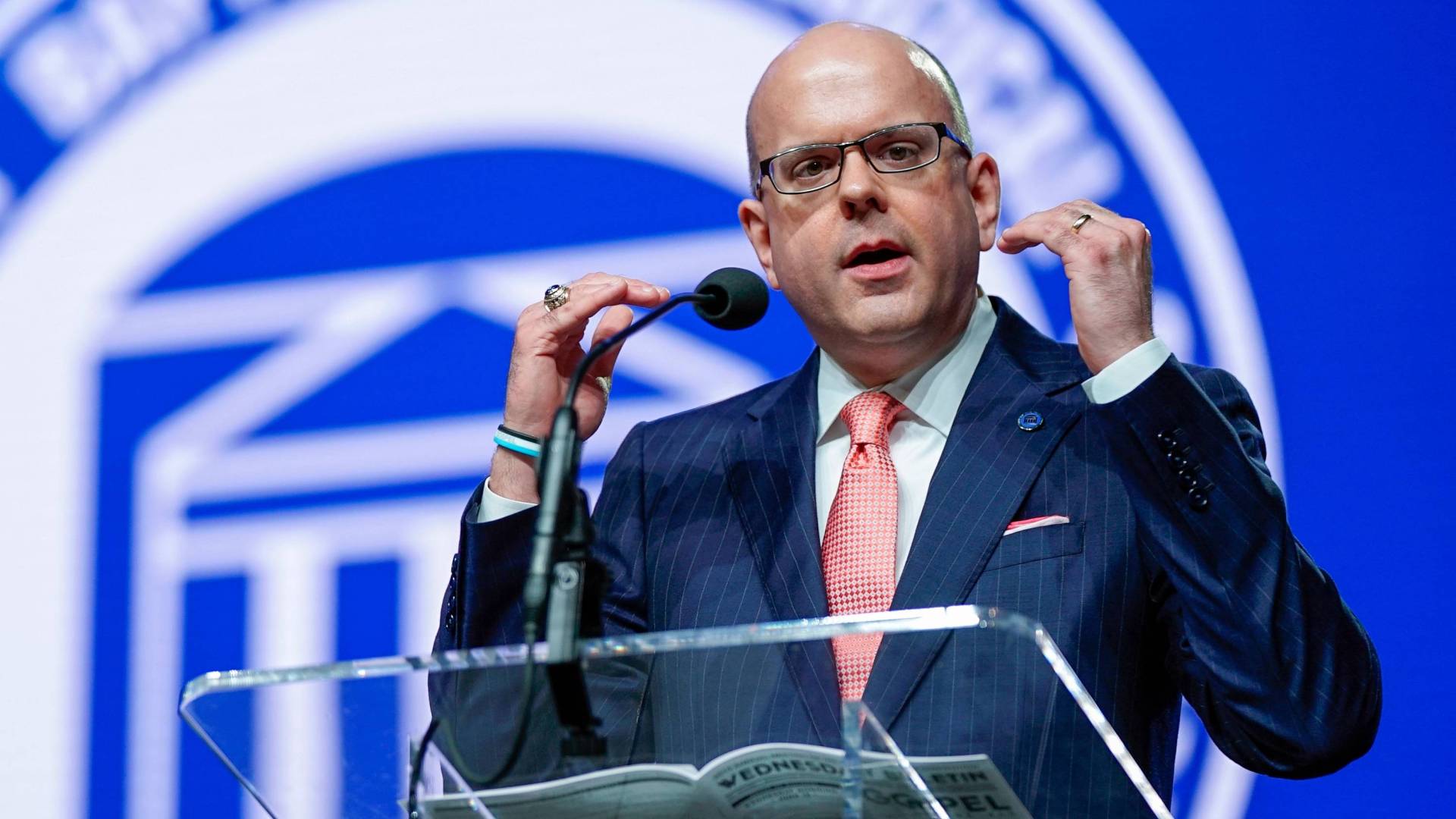
Adam Greenway has resigned as president of Southwestern Baptist Theological Seminary three and a half years after he succeeded fired president Paige Patterson.

Greenway stepped down during a trustee meeting on Thursday and will take a role at the Southern Baptist Convention (SBC)’s International Mission Board, according to a statement from the seminary.

O. S. Hawkins, retired president of the SBC financial services entity GuideStone, will lead the school in the interim. (Update: On September 27, the trustees adjusted plans to have David Dockery—who was a theology professor and special consultant to Greenway—serve as interim president and Hawkins as senior advisor and ambassador-at-large. Dockery was previously president of Union University and Trinity International University/Trinity Evangelical Divinity School.)

Greenway said in a statement:

These days are incredibly challenging in the life of our denomination. They are also challenging times for academic institutions, particularly theological seminaries. In February 2019, Carla and I accepted the call to come back “home” to Southwestern Seminary with an understanding of these challenges, but also with the strong desire to be part of the solution.

What we failed to appreciate was the enormity of the reputational, legal, and financial realities that would welcome us to the Dome—only to be compounded by a global pandemic unlike anything we have ever experienced before.

We have done our best to serve Southern Baptists by helping position our seminary for the future, but much, much work remains to be done. Nevertheless, in the Providence of God we sense a release from our duties here.

Since assuming the presidency at Southwestern, Greenway worked to establish a new era at the Fort Worth, Texas, school, removing stained glass windows commemorating Patterson and other Conservative Resurgence leaders from the school’s chapel and initially making cuts to “recalibrate.”

It hasn’t been a quiet tenure. On top of ongoing litigation around Patterson’s response to abuse, disputes with the previous leadership at Southwestern lingered under the new administration. Last year, the seminary sued to restore donations that were diverted away when Patterson left and called out the former president for taking its property.

At the start of the pandemic, Southwestern cut programs, laid off faculty and staff, and pulled from its endowment for budgetary reasons. Some of the departures have been contentious, including longtime preaching professor David Allen, who left this year.

But in Greenway’s report to the convention at the 2022 annual meeting, he did not indicate any financial woes. Instead, he said, “The Lord is blessing Southwestern Seminary and Texas Baptist College in many ways. The Lord is indeed doing a marvelous work on Seminary Hill.” Greenway announced two fully funded endowed chairs at $2 million each.

According the SBC Book of Reports, Southwestern’s budget grew from $32.6 million during the first year of Greenway’s presidency to $37.3 million for this school year. The school more than doubled its revenue from its endowment, up to $4 million, while also tripling its revenue from private gifts, up to $3.7 million.

But the school was pulling in less money from tuition ($14.7 million in 2019 to $13.1 million in 2022) as enrollment declined. According to the Association of Theological Schools (ATS), the seminary had the full-time equivalent of 1,414 graduate students in 2019, 1,306 in 2020, and 1,105 last year.

By that count, Southwestern is currently the fourth-largest SBC seminary, behind Southern Baptist Theological Seminary, Midwestern Baptist Theological Seminary, and Southeastern Baptist Theological Seminary.

At Greenway’s previous post at Southern, he grew enrollment as dean of the school of evangelism. He has graduate degrees from both Southern and Southwestern, where he met his wife.

Several major Southern Baptist leaders, including Southern’s president Albert Mohler and GuideStone’s O. S. Hawkins, applauded Greenway’s selection, experience, and theological convictions when he was named Southwestern’s president.

“In a time where there are voices wanting to sow seeds of discord and disunity and dissension and division all across our landscape, I want you to know that your seminary in Fort Worth, Texas, desires to be an instrument of healing and reconciliation, of Gospel-advance, working to bring people together under a ‘big-tent’ vision of commitment to a high view of Scripture, confessional fidelity, the Great Commission, and cooperation,” Greenway told the SBC in 2021. “This vision was the heartbeat of our founder, B.H. Carroll, and we remain steadfastly committed to seeing that vision fulfilled in our day.”

He said he sees his new position at the International Mission Board as “not a departure from but a continuation along the journey God has always had us walk.”

News

COVID-19 Church Restrictions Justified, New Zealand Court Rules

Twenty-four pastors and one imam lose argument that the rules designating worship “high risk” violated their religious rights.

Christianity Today September 23, 2022
Christians protesting pandemic lockdowns in New Zealand.

New Zealand’s High Court has ruled that government officials were not acting unlawfully when they restricted and regulated religious services during the COVID-19 pandemic. The court acknowledged that rules curtailed the protected right to “manifest religious beliefs” but deemed that allowable in a health emergency.

Starting in December 2021, the New Zealand government limited religious gatherings to 100 vaccinated people or 25 unvaccinated people. Face masks were also required if the house of worship shared the site with any other groups. The government’s director-general of health, Ashley Bloomfield, deemed religious gatherings “high risk” because of the presence of elderly and immune-compromised people.

Some religious leaders complained the restrictions were reminiscent of Nazi Germany, and one was briefly jailed for refusing to comply.

Twenty-four Christian pastors and one Muslim imam sued Chris Hipkins, the minister for COVID-19 response, and Bloomfield, claiming the regulations violated their religious freedom. The New Zealand Bill of Rights Act 1990 (BORA) says that "every person has the right to manifest that person’s religion or belief in worship, observance, practice, or teaching, either individually or in community with others, and either in public or in private.”

Justice Cheryl Gwyn ruled, however, that though the COVID-19 rules did restrict religious freedom, that was justified by the need to reduce the risk to public health during a pandemic. The right to manifest religious belief is protected, but not absolute. According to the International Covenant on Civil and Political Rights, also signed by the United States, religious freedom can be limited in the interests of public safety, health, or morals.

The New Zealand ruling contrasts with what a number of other courts have decided. In the United States, Scotland, Switzerland, and Chile, restrictions have been found unlawful, either because they violated protections of religious freedom or because they treated religious gatherings differently than secular ones.

New Zealand religious historian and media commentator Peter Lineham told CT the New Zealand churches’ argument was a “direct mirror” of John MacArthur’s Grace Community Church in California and similar cases that won in the US.

“It is mighty hard for churches to realize that they are risky places,” Lineham said.

Lineham is not surprised the New Zealand churches lost. Ideas about the separation of church and state are less deeply embedded than they are in the US, and the right to exercise religion is understood to exist “in a context of a range of human rights which often jostle with each other,” Lineham said.

During the trial, Christian scholars debated whether the health regulation amounted to excommunication, with the state taking for itself the power to say who could or couldn’t attend church. Theologian Matthew Flannagan, a high school teacher in Auckland and a teaching member of Orewa Community Church, one of the churches involved in the suit, argued it was. He told CT it amounted to a serious infringement on religious freedom.

“We were segregated,” Flannagan said. “We could not fellowship together. The restrictions made it practically impossible.”

Paul Trebilco, a New Testament professor at the University of Otago, disagreed.

“The unvaccinated are not actually being ‘removed’ or ‘excommunicated’ from any congregation,” he told the court. “The number of other believers who are part of a particular congregation with whom they can interact is being limited. They are still part of the congregation, albeit not able to interact with all other members for a time.”

According to Lineham, this was a pivotal argument in the case. The churches needed to prove that that they were being prevented from being the church.

“Trebilco rightly shows us that the argument that Christians must meet at all times in order to be the church is flawed,” he said.

Ninety-five percent of eligible New Zealanders are vaccinated. It is estimated that a disproportionate number of unvaccinated people—perhaps as many as 10 percent—are Christian.

The nation’s largest churches complied with the regulations. Megachurches, including Arise Church and City Impact Church, switched everything online in December and January. Both churches complained about the regulations, though, and questioned whether the government was right to do what it was doing.

“While we appreciate the importance of public safety and wellbeing in response to the pandemic and continue to respect the current measures, we do have significant concerns about the potential temporary and permanent restrictions for religious activities and faith-based gatherings based on the vaccination status of church congregants,” said City Impact founder Peter Mortlock. “Such restrictions would have a major impact on the mental, emotional and social health and wellbeing of thousands of people that call City Impact Church their church.”

Even as restrictions eased by Easter (though were not completely lifted until September), some religious leaders questioned whether the regulations made any difference in combating COVID-19.

“I don’t think there were any achieved benefits—it was disproportionate,” said Jonathan Grant, one of four priests at St. Paul’s, a 1,000-member Anglican church in Auckland. “I think it was out of kilter with the rest of the world.”

Grant, one of the 25 who sued, led smaller services during the pandemic so worshipers would not have to show proof of vaccination. The church also offered online services.

Not all evangelical leaders in New Zealand share these concerns, though.

Grant Harris, senior pastor at Windsor Park Baptist, an Auckland church with 1,500 people, agreed with the ruling.

“I was invited to be part of the case,” he said. “I declined. I agree with the court.”

COVID-19 restrictions made things hard, he said. But they did not prevent him or his congregation from manifestation of religious belief.

“As far as our freedom of religion, that was not curtailed at all,” Harris told CT. “We all knew it was a temporary measure. We were still free to worship; we just couldn’t meet in one environment, and we just had to be creative.”

Alan Vink, who spent 23 years pastoring Baptist churches, said he also thought the regulations were warranted.

“Extreme times require extreme measures,” he said. “Church is more than a Sunday meeting.”

Vink is also critical of the pastors who have sued the government, calling it “grandstanding” and “a waste of time.” He said he worries more about the ongoing impact of the pandemic on the church.

“In the cities, people are nervous about going back to church,” Vink said. “Thirty percent are not going back.”

COVID-19 mandates—including face mask requirements at indoor venues such as shops and schools and on public transport—were removed this month.

News

Died: Herb Lusk II: ‘Praying Tailback’ Who Gave Up Football for Ministry

First NFL player to kneel and thank Jesus in the end zone said caring for souls and helping people in poverty were more meaningful than fame.

Christianity Today September 22, 2022
Greater Exodus Church / edits by Rick Szuecs

Herb Lusk II went down in history on a Friday night in August 1977.

The tailback for the Philadelphia Eagles caught an easy toss from the quarterback, tucked the football into the crook of his arm, slipped between a knot of players on his left, and sprinted 70 yards down the field to score a fourth-quarter touchdown. Then, in the end zone, in front of 48,000 yelling fans, he got down on one knee and prayed.

According to the official record keepers, he was the first to do that in the National Football League. He bowed his head, said, “Thank you, Jesus,” and that was history.

But Lusk, who died on Monday at age 69, insisted to the end of his life that that wasn’t the most important day of his professional football career. The most important was the second day of training in 1979, when he woke up in his dorm room and said, “I can’t play football.”

“Man,” his teammate said from the other bed, “this is only the second day of camp.”

“For you,” Lusk said. “For me it’s the last day.”

He was done with football. He was going to be a Baptist minister.

The coach tried to talk him out of it. So did his dad, who was himself a Baptist minister. His father got on the phone and argued more people would see Lusk pray in an end zone than would ever lay eyes on him in a pulpit.

“Dad, I don’t think that’s enough anymore,” Lusk recalled saying. “I woke up in the dorm room and I knew it was over for me. I could feel the Lord’s call.”

Lusk quit football that day and committed himself to ministry. He became a dynamic, powerhouse pastor who turned a dying, debt-burdened congregation into a vibrant community of faith and a vital Philadelphia institution.

“It wasn’t a step down, going from the NFL to the church,” he once told Philadelphia Daily News columnist Ray Didinger. “It was a step up. My work is now eternal. I’m caring for people’s souls. That’s more important than carrying a football.”

Focused on football

Lusk was born in Memphis on February 19, 1953. He was named Herbert Hoover after his father, who was born in 1929, the year the Republican president was elected. In 1961, H. H. Lusk Sr. and his wife Bettye moved their family to Seaside, California, on Monterey Bay. The elder Lusk took a position as pastor of Bethel Missionary Baptist Church, and Bettye taught at the high school before she became the first Black principal. (Today, a wing of classrooms is named for her.)

Growing up, Lusk focused almost entirely on football. There was school and church and friends and girls. There was the tumult of the outside world—the assassination of Martin Luther King Jr., the rise of the Black Power movement, the war in Vietnam, and the end of the military draft the month before he turned 20. He thought sometimes about becoming a minister like his father. But mostly, there was football.

He went to California State University, Long Beach, in 1974 and quickly set himself apart as someone with an incredible talent for running a football down a field. His senior year, he ran 1,596 yards. Lusk led the Pacific Coast college league in rushing yards, rushing attempts, rushing touchdowns, yards from scrimmage, touchdowns from scrimmage, and overall touchdowns.

That same year, he started kneeling in prayer after each touchdown. He got a nickname for it: the “praying tailback.”

He said that sometimes at school the next day a student would ask him if he really believed in God, and it gave him a chance to witness for the gospel.

End zone celebrations were controversial in the 1970s. The National Collegiate Athletic Association banned spiking the ball, which led to touchdown dances in college and then professional football. Some fans booed the first time they saw wide receiver Elmo Wright, “the father of the end zone dance,” high stepping in a game between the Kansas City Chiefs and the Houston Oilers. As it became more common, white sports columnists wrote derisively about “those jitterbug dances” ruining the spirit of the game.

In recent years, kneeling on the field in protest (Colin Kaepernick) or prayer (Tim Tebow) has attracted a lot of attention and generated endless arguments between fans. When Lusk did it, though, people just thought it seemed like something Lusk would do.

“I don’t remember it as shocking or anything like that,” one teammate later said. “We just took it as, ‘That’s Herb.’ We knew he was a religious man, and this is who he was.”

“Toss 48”

Lusk went pro in 1976. He was drafted by the Eagles in the 10th round.

He didn’t score any touchdowns the first year, and his most memorable play was a game-losing fumble. But then, in ’77, when the quarterback called “Toss 48” in a game against the New York Giants, he ran those 70 yards and finally made a touchdown.

A few sports reporters asked him about the prayer, afterward. Why hadn’t they seen him do that before? He told them he hadn’t had the opportunity.

“I wasn’t trying to draw attention to myself. This was just a moment between me and God,” Lusk said. “All I say is ‘Thank you.’ He knows what the thanks is for. We’ve been conversing a long, long time.”

Lusk quit two years later when he felt God tell him it was time. He said he was really tempted to stay, but he knew he couldn’t.

He was ordained at First African Baptist Church in Philadelphia in 1980 and became an associate minister. He went back to school and started studying for a master of divinity at Reformed Episcopal Theological Seminary, which was nearby. He took a steep pay cut but said it was okay because of the faithful support of his wife, Vickey Vickers, an Ebony magazine model who grew up three blocks from Lusk and attended his father’s church.

In 1982, the former football player accepted a call to Greater Exodus Baptist Church in North Philadelphia. It was a dwindling congregation in a crumbling, pigeon-infested Episcopal building that was more than 100 years old. The deacons told him there were about 18 active members of the congregation, $400 in the bank, $200,000 in debt, and seven buckets of water in the building every time it rained. The church was less than five miles from the Eagles’ stadium.

Lusk accepted the call and threw himself into the work of the ministry.

“I’m the pastor, the administration, and the janitor,” he said a few years later. “We’re not exactly overstaffed.”

With his energy and commitment and God’s blessing, the church slowly grew. By the early 1990s, he could count on about 500 people showing up to Sunday services. Some of the people in the pews were football players from his old team: Reggie White, Randall Cunningham, Seth Joyner, Herschel Walker, and others.

He helped them find ways to make their success seem meaningful and, with their financial support, launched numerous social programs to care for Philadelphia’s poor. In 1993, the church gave away $18,000 of food at Christmas.

“People talk about running backs [and] quarterbacks having vision of the field,” Reggie White said. “He had a vision of life.”

Lusk once explained that for his church, the main focus was Jesus, but “it’s hard to talk to a person about Jesus when they’re hungry or when they’re depressed or when they don’t have a job.”

Champion for compassionate conservatism

He started a nonprofit, People for People, to help alleviate poverty. He solicited donations from major corporations and received support from PNC Bank, Coca Cola, and Microsoft. The nonprofit took over the former traffic court building and started a charter school, a daycare, a youth mentoring program, several job training programs, and a community event center. There was also a summer reading program, afterschool care, and even a community development credit union.

Lusk personally pushed CEOs to each support five families on welfare, and one year the nonprofit organized a banking camp to teach inner-city children about banking, with the financial sponsorship of Penn Mutual.

“As long as I don’t have to compromise the gospel,” Lusk said, “I’ll play the game.”

His inventive efforts to care for the poor caught the attention of compassionate conservatives, who hoped to reform government welfare programs through public-private partnerships. World magazine editor Marvin Olasky, who coined the term compassionate conservative, said that Lusk was “a vision of the future.” George W. Bush called him “a general in the army of compassion.”

In 2000, Lusk was invited to speak at the Republican National Convention. He backed Bush for president and gave a rousing speech supporting faith-based initiatives and “putting faith to action.”

After Bush was elected, Lusk became one of the advisers of the program. People for People received $1.44 million in government funds to support the work they were doing and expand with a housing program, a community technology center, and another mentoring program.

Left-wing commentators cried foul, arguing this violated the separation of church and state and Lusk was trading his religious authority for cash. Black people also criticized Lusk, saying he was being used by the Republican Party.

Lusk laughed them off. He continued to preach, grow the church to about 2,000, and develop new ways to help the community. Insiders in Philadelphia politics said whether they agreed or not, they couldn’t deny Lusk was effective.

“People were always talking about the programs they were going to start in North Philly, and almost none of them ever did,” Maurice Floyd, a former city commissioner and well-known political consultant, once said. “Reverend Lusk was different. When he said he was going to do something, he actually did it.”

Philadelphia magazine called him “the driving force behind some of the most effective social service programs in the city.”

Nothing without Christ

But for most, Lusk’s politics wasn’t what they remembered. They remembered him as the man who raced 70 yards in 1977 and then prayed in the end zone. When other players started doing that, he began getting occasional calls from reporters who wanted him to recall that day.

A few weeks before he died, Lusk told The Deseret News that people often assumed he was praying to win, but he was praying because he was thankful and wanted to be a better witness.

“I think people have a misconception that religion doesn’t belong in sports,” he said. “There are people who have said, ‘Wait a minute now, are we playing football or are we in church?’ My answer to that is we do nothing without Christ. We do nothing without our faith. We take it everywhere with us.”

Lusk died at home from cancer. He is survived by his mother, Bettye; his wife, Vickey; daughters, Danuelle Cedrick and Laiah David; and son, Herb Lusk III.

Theology

I Could Sing This Bridge Forever, If It’s an Antiphon

Modern worship music can seem awfully simple. But it has a vital role to play, especially when paired with Scripture.

Christianity Today September 22, 2022
Verdigris Photography / Lightstock

If you spend any amount of time in churches that have a notable proportion of people under the age of 40, you’ll hear the genre of music called “modern worship.” The chords are simple, the melodies are exceedingly singable, the sentiments are sincere, and the lyrics are brief.

Like all genres, modern worship has individual examples of real quality, and this week I was in the car singing along with one—Elevation’s 2018 song “Worthy”—that has many merits. I would gladly lead a congregation in it myself, if only to sing this theologically exemplary couplet:

“It was my cross you bore / So I could live in the freedom you died for.”

But as I sang along with the recording, I couldn’t help feeling, not for the first time, that it was incomplete and just a bit thin on its own.

This is not something I feel about a related genre I’ve spent a lot of time studying and, as a worship musician, leading: the choruses of Black Gospel that emerge out of the tradition called the Negro spiritual.

These songs, too, tend to have very short texts. But because they are anchored in the incomparable spiritual depth of the Black church and because they very often pack a great deal of musical subtlety into a seemingly simple musical package, they can sustain a great deal of repetition and only increase in their expressive and formative power. The greatest spirituals—like “I Want Jesus to Walk with Me”—can and will be sung for a lifetime and beyond.

Not so much with modern worship. There is something bite-sized about these pieces, which we sing so enthusiastically for a year or three but then lose interest in. And yet I do love singing them, even if after seven repetitions of the bridge—not an exaggeration in the case of “Worthy”—it seems like we’ve been chewing for quite a long time on quite a small piece of Wonder Bread.

What to do with these emotionally pure, musically simple, short pieces?

Well, what I have been doing for years as a worship musician is not using them alone. I almost always pair a modern worship song with a longer text, alternating between congregational singing of a song with congregational reading (while continuing an instrumental bed underneath). Matt Maher’s “Lord, I Need You” with a reading of Psalm 121. Bethel Music’s “Our Father” with the entire text of Hebrews 11. United Pursuit’s “Not in a Hurry” with the opening responses and confession of sin in the Book of Common Prayer’s service of morning prayer.

In this format, the emotional simplicity of the song resonates in glorious ways with complex and challenging texts, especially the biblical psalms—which were, of course, originally songs themselves. Over and over I have found this combination is far, far more powerful an expression of worship than either text or song by itself.

Singing along in my car this week, I realized that we’ve had a name for these worship songs all along, though the word is unfamiliar outside high liturgical traditions.

They are antiphons—which the Oxford English Dictionary defines as “a short sentence sung or recited before or after a psalm or canticle” (the canticles being largely other biblical instances of poetic and sung prayer, like the Song of Simeon in Luke 2). The purpose of an antiphon is to give the congregation a way to frame their own response to the biblical prayer. Just like modern worship music, antiphons often draw their vocabulary more or less directly from phrases of Scripture.

Antiphons are not complete prayers—they are brief invitations to reflect more deeply on the content of complete prayers. They are not hymns, either, which typically take singers on an extended journey through some aspect of Christian experience or belief. They are quite literally choruses, the gathered response of the people to a longer and more involved text.

This is what we’re engaging when we sing most modern worship music—beautiful, simple antiphons.

The only problem is that in many churches and worship settings, we are only singing antiphons. We are not reading, chanting, or singing the psalms themselves. We are not attending to long passages of biblical text. Nor, in many settings, are we pairing the choruses with hymns, which would require but also reward reflection and attention.

All we are singing are short texts and extremely simple tunes—too short and too simple to truly express or form a full life of Christian prayer.

This realization that modern worship is almost all antiphons, all the time, has been incredibly helpful to me. It explains why I love many songs in the modern worship genre: They are the antiphons of my Christian life and—thanks to the music distribution mechanisms of popular culture—millions of others’ lives as well. I don’t want to stop singing them.

But it also explains why, after a contemporary worship service composed of four to five antiphons plus a long sermon, I feel like something essential has been missed and something important is not being cultivated or formed in us.

It also points to a deficiency in many liturgical churches, like my own Anglican and Methodist traditions, which have maintained congregational reading of the psalms but do not take advantage of music’s power to deepen the response to that text.

In my own worship leadership, I’ve gravitated (without realizing it) to a solution that was in the Christian tradition all along: putting these choruses in their proper place, surrounding and undergirding the congregation’s attention to the deep texts (and maybe also tunes) of the Christian story. When we sing these choruses before and after and in the midst of the reading of relatively complex texts, they are incredibly valuable pathways to genuine Christian worship.

So let’s keep singing these songs. But let’s sing them as the antiphons they really are.

Andy Crouch is partner for theology and culture at Praxis.

Apple PodcastsDown ArrowDown ArrowDown Arrowarrow_left_altLeft ArrowLeft ArrowRight ArrowRight ArrowRight Arrowarrow_up_altUp ArrowUp ArrowAvailable at Amazoncaret-downCloseCloseEmailEmailExpandExpandExternalExternalFacebookfacebook-squareGiftGiftGooglegoogleGoogle KeephamburgerInstagraminstagram-squareLinkLinklinkedin-squareListenListenListenChristianity TodayCT Creative Studio Logologo_orgMegaphoneMenuMenupausePinterestPlayPlayPocketPodcastRSSRSSSaveSaveSaveSearchSearchsearchSpotifyStitcherTelegramTable of ContentsTable of Contentstwitter-squareWhatsAppXYouTubeYouTube