News

Despite Drop in Deportations, Turkey Still Troubles Christians

Hate speech rises as evangelicals grow more prominent on social media, amid ongoing difficulties to train pastors and register churches.

Christianity Today April 6, 2022
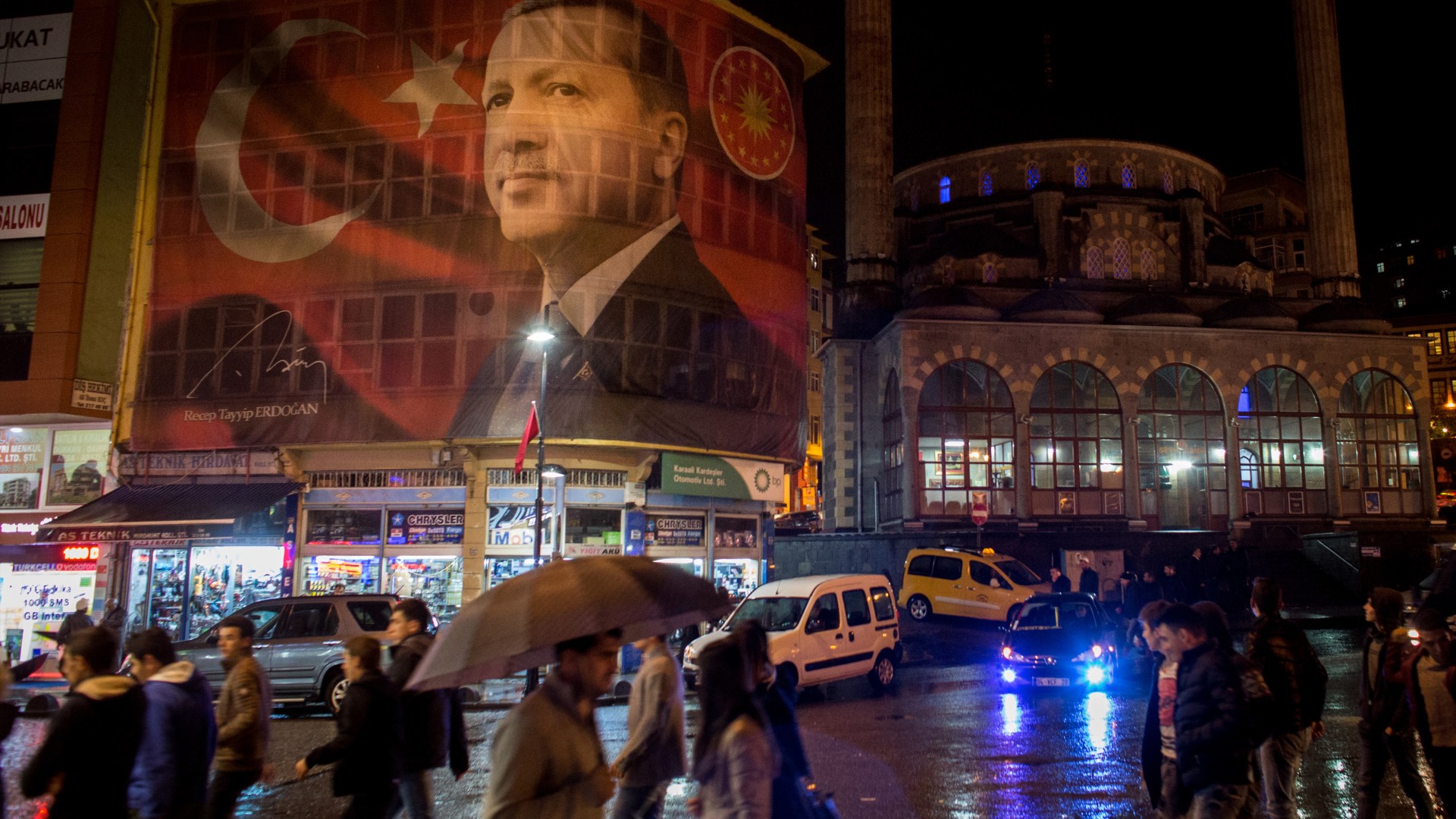
Chris McGrath / Staff / Getty

Last year, Protestant Christians in Turkey suffered no physical attacks.

There were no reported violations of their freedom to share their faith.

And there was a sharp reduction in foreign missionaries denied residency.

But not all is well, according to the 2021 Human Rights Violation Report, issued March 18 by the nationally registered Association of Protestant Churches (APC).

Hate speech against Christians is increasing, fueled by social media.

Legal recognition as a church is limited to historic places of worship.

And missionaries are still needed, because it remains exceedingly difficult to formalize the training of Turkish pastors.

“Generally there is freedom of religion in our country,” stated the report. “But despite legal protections, there were still some basic problems.”

Efforts to unite Turkey’s evangelicals started in the mid-1990s, and the APC began publishing its yearly human rights reports in 2007. Today the association, officially registered in 2009, represents about 85 percent of Christians within Turkey’s 186 Protestant churches, according to general secretary Soner Tufan.

Only 119 are legal entities.

And of these, only 11 meet in historic church buildings. The great majority rent facilities following their establishment as a religious foundation or a church association. While generally left alone, they are not recognized by the state as formal places of worship and thus are denied free utilities and tax exemption.

And if they present themselves to the government in pursuit of such benefits, officials often warn they are not a church and threaten closure. Sometimes the authorities even try to recruit informants. And some Christians who have refused have lost their jobs.

Other Turkish Protestants are simply harassed.

“Dead priest walking,” said residents of Arhavi to a local pastor as he walked the streets of the Black Sea coastal city following an online campaign associating the church with missionary activity. The local political party leader responsible ceased his incitement after the pastor met him personally.

But in Kurtuluş, in southwest Turkey along the Aegean Sea, authorities detained a person behind threats of beheading given to Turkish believers—and then released him.

Tufan said the climate of impunity encourages more online threats. But it is also a sign of greater awareness. Churches have become active on social media, broadcasting live sermons and posting videos.

“The attitude has always been present,” he said. “But with leaders becoming more visible, hate speech finds a target.”

And more congregations are fighting back. Rather than simply lodging a complaint at the police station, last year 70 churches began court proceedings against their harassers, Tufan estimated, up from 50 the year before.

But the primary complaint of Protestants—education—mirrors that of Turkey’s traditional Orthodox community. Their Halki Seminary, established in 1844, remains closed since a 1971 decision placing religious training under state control.

Turkey’s foreign ministry said the Orthodox patriarchate “refuses” to open it.

Protestants would gladly join the system. Currently Turkish pastors are trained informally, with a small percentage able to travel abroad. The majority of discipleship is provided by local believers, but there is still a need for missionary assistance.

Last year there were 13 cases of deportation, refusal of entry, or denial of residency permit renewal for foreign Christian workers. Three of these were Americans, and overall, counting wives and children, 25 people—many of them with long years of service in Turkey—had to uproot their lives.

But the number is going down.

In August 2018, President Donald Trump sanctioned Turkey for its prosecution of American pastor Andrew Brunson on charges of supporting terrorism. He was released in October 2018 after spending two years in prison.

But in 2019, 35 missionaries were denied residency, including 15 Americans. In 2020, there were an additional 30 cases, including 10 Americans, eight Brits, and eight Koreans. Overall, 185 individuals with no criminal activity have been barred from their adopted home since the Brunson standoff.

The tally includes foreign wives of Turkish pastors. In four such cases, the pastors relocated abroad, forced to choose between their citizenship and their family.

One who did not is keeping a low profile while ignoring the 10-day notice to leave the country. After submitting her residency request, the pastor, who wishes to remain anonymous, was interrogated about his conversion to Christianity—a protected freedom in the officially secular state.

He has appealed the case to Turkey’s Constitutional Court.

The APC notes that there have been a few positive decisions from the Turkish judiciary. But these have been ignored by the bureaucracy, which maintains the negative filing marks issued by national intelligence. The N-82 code designation is most common, which requires prior approval that is never given. Less frequent is the G-87, for those deemed a security threat.

Some have appealed to the European Court of Human Rights.

In the past year, Turkey has sought to mend fences with its neighbors. After years of conflict, overtures have been made with Israel, the Gulf states, and even Greece. While seeking to maintain some balance with Russia, the government has also strongly condemned the war in Ukraine.

There is no impact on Protestants, Tufan said.

Instead, he attributes the recent decline in missionary denials to government distraction. The Turkish economy is in terrible condition with rampant inflation, and opposition parties are uniting to challenge President Recep Tayyip Erdoğan’s longstanding grip on domestic politics.

And missionaries are simply traveling less. Issues occur more often at the border than the renewal office, Tufan said. And some have also limited their involvement with the Turkish church in order to better maintain their ministry.

“If Turkey was trying to improve its reputation with the West,” he said, “we would be seeing positive results in the cases that already exist.”

As an example, after three years of very loud protests over the killing of Jamal Khashoggi in Saudi Arabia’s Istanbul consulate, the Turkish prosecutor requested to suspend the trial of 26 Saudi citizens and transfer jurisdiction to the kingdom.

Additionally, foreign policy shifts do not affect internal religious affairs. This Ramadan, the Hagia Sophia is hosting traditional evening prayers for the first time in 88 years.

COVID-19 prevented gatherings since the historic church’s reconversion to a mosque (from a museum) in 2020.

But Protestant complaints extend beyond training pastors and receiving missionary assistance. Believers in Istanbul tried to register a Christian school in 2020, first as an association, then as a business. Getting no response, they tried again with different names to simply establish a regular private school. State investigations easily connected those involved, and their efforts ceased.

There are problems also with religious education in the public system. The teaching of Islam is mandatory, and a 2015 study by the US Commission on International Religious Freedom found bias in the way Christianity and other religions are presented.

Exemptions are accepted upon request, by law, Tufan said. But it creates a stigma. For example, his high school son is the only Christian among 3,500 students. Some teachers question why he does not attend. And 9 in 10 Protestant families do not file the paperwork necessary, Tufan estimated, to avoid social complications for their children.

And such is the situation for Turkish evangelicals in general. Able to practice their faith—and even to file a report on violations of their religious freedom—they have learned their limitations.

“Things are the same, not better or worse,” said Tufan. “Government policies have not changed.”
Theology

A Century Later, the Chinese Union Version Still Dominant

Chinese church historian analyzes five reasons for the long-lasting influence of the CUV Bible translation.

Christianity Today April 6, 2022
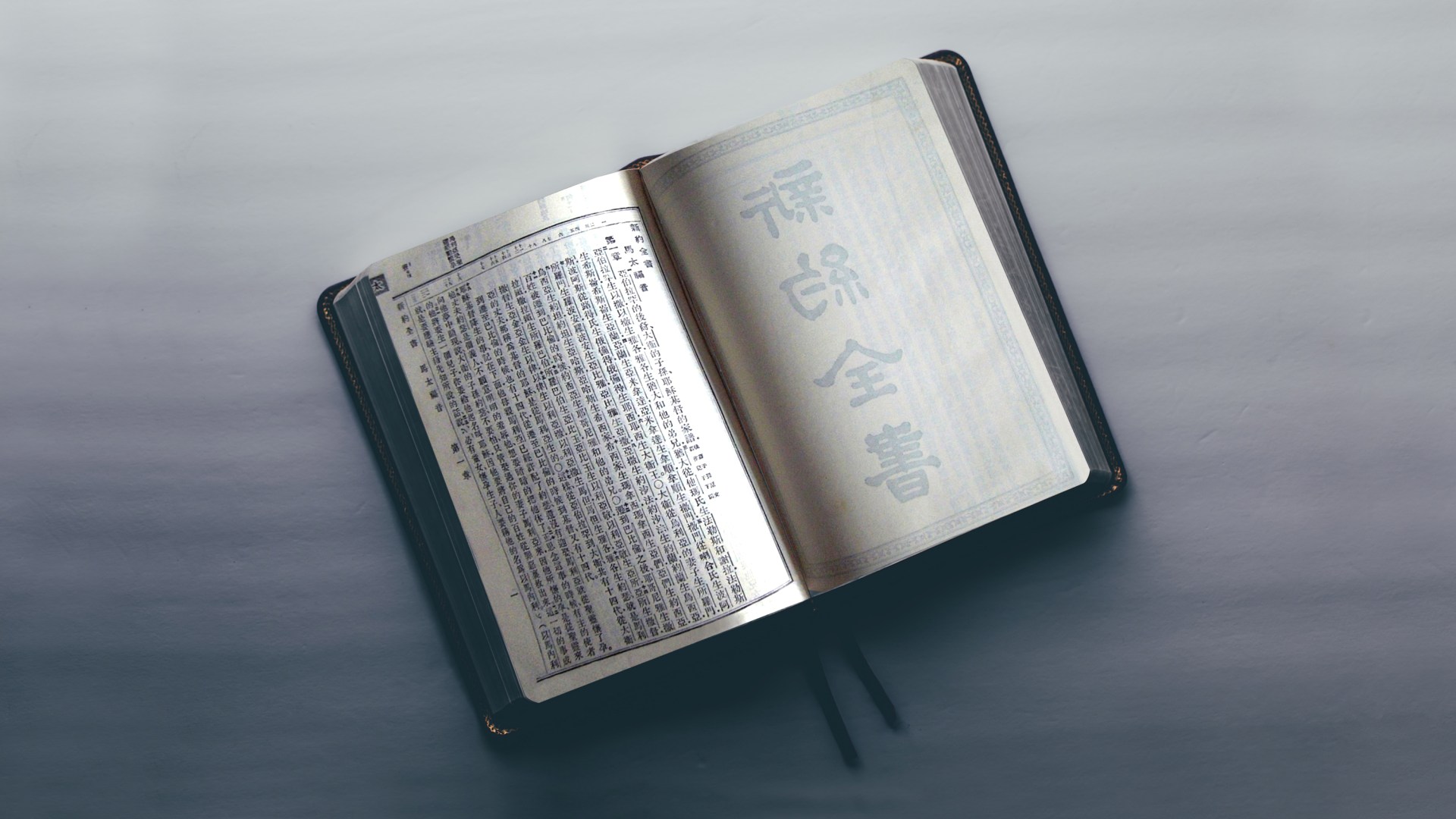
Edits by Christianity Today / Source Image: WikiMedia Commons / Sixteen Miles Out / Unsplash

Since its publication in 1919, the Chinese Union Version (CUV) of the Bible has become the most dominant and popular translation in Chinese. Despite numerous changes to the Chinese language and a significant increase of new translations, its dominance is unabated and unshaken.

“It could well be the most influential ‘Chinese text’ among the Chinese readers for the past one hundred years and also in the future,” Taiwan-based scholar Chin Ken-pa wrote in the anthology Ever Since God Spoke Chinese. “Undoubtedly, even if we cannot claim it has become a ‘canon’ in the Chinese world, it is certainly an ‘authority.’”

The translation team of CUV included 16 Western missionaries and a few Chinese Christian experts, including Americans Calvin Wilson Mateer and Chauncey Goodrich; Englishmen George Sidney Owen and Frederick William Baller, and Chinese scholars Cheng Jingyi, Liu Dacheng, and Wang Zhixin. The translation of the Mandarin New Testament started in 1872, and the whole Bible was published in 1919. The guiding principles of translation included that it must be in the national language (not local vernacular), simple enough to be understood by people from all walks of life, and faithful to the original text without losing the rhythm of the Chinese language.

The translation of the Scriptures is essential to Christian tradition, as the missiologists Lamin Sanneh and Andrew Walls argue. Bible translation into Chinese has been crucial to the development of Christianity in China. Since the beginning of Protestant missions in China, Bible translation has been a major part of mission work.

For most Chinese Protestants, the CUV unquestionably remains an authority with the status of “God’s Word.” While there are multiple Chinese versions of the Scriptures, occasionally Chinese Christians declare on the internet that only the CUV is the true Bible, and all other versions are erroneous and even heretical (although it is now very rare to hear Chinese pastors and church leaders teaching “the inerrancy of CUV”).

Indeed, how fast the CUV rose to dominance and how enduring its dominance has turned out to be are truly mind-boggling phenomena. How can we explain this? As a historian of Chinese Christianity, I would like to highlight the following factors:

1. The CUV played a pivotal role in providing and shaping the theological vocabulary of the Chinese Protestant Church.

In their long and painstaking process of translating the Scriptures into Chinese in the early 19th century, Western and Chinese translators accumulated a rich repository of theological notions and terms in Chinese languages. The CUV inherited and integrated them into its language.

The CUV came out as Western missionaries’ dominance came to an end and the Chinese church came of age. Chinese Christians began to share leadership responsibilities and initiate indigenous evangelical revivals that swept across the country. This was the formative time for indigenous Protestant theological understanding and tradition.

The timely arrival of the CUV provided the Chinese Protestant community with a ready-made set of theological notions and vocabulary that Chinese believers immediately received and embraced. It did not take long for the CUV’s translation of such key biblical terms as faith, sin, salvation, and grace to become the standard “language of faith” used by church leaders, theologians, and evangelists as well as the average churchgoer on a daily basis.

The CUV’s translation of key biblical terms has been deeply ingrained in the theological DNA of the Chinese Protestant community around the world. It is fair to say that this is the only theological language system known and used unquestionably by this community up to today. In contrast, one can hardly identify any single, vernacular translation of the Bible which has had such a commanding and lasting impact on church life in the West.

2. The CUV helped shape a universally, unifying identity for Chinese Protestant communities around the globe.

Before the CUV, previous Chinese translations of the Scriptures had been done in either classical Chinese—only understandable to the educated elites in Chinese society—or in particular dialects for certain parts of the country. Therefore, the CUV’s aim to produce a translation understandable to all people from all parts of the country and all social classes turned out to be hugely strategic. It has served to unite all Chinese Protestant believers under one single Chinese version of the Scriptures.

Today, when you worship with any Chinese congregation in mainland China or the Chinese diaspora, you can easily feel the presence of a common, universal, Chinese Protestant tradition cemented by a shared set of spiritual vocabulary, classical hymns, and common version of the Bible, despite very different contexts. The CUV plays a big part in the forging and maintaining of this common identity among Chinese Protestant believers worldwide.

3. The CUV accompanied the Chinese church through its trials and suffering.

The past 100 years have been a turbulent time for the Protestant church in China. It endured numerous wars, revolutions, constant pressure from an atheist regime, and finally all-out persecution during the Cultural Revolution (1966–1976). Many Chinese believers would attest to finding comfort and strength in the CUV. They greatly loved to read and even memorize texts from handwritten copies of the CUV during the darkest years of the Cultural Revolution. The CUV is part of the Chinese church’s collective memory and heritage attesting to its perseverance and cross-bearing under tremendous suffering. There is a strong emotional bond between the CUV and the Chinese Protestant community that will not easily fade away.

4. The CUV’s exquisite rendering of the biblical texts gives it a special quality and lingering charm.

Linguistically speaking, the CUV does have its own advantage in the contemporary context. It is largely based on the vernacular of northern China but integrates some elements of classical Chinese. This combination reflects the genius of the original translating team. It makes the CUV understandable to ordinary folks but also appealing to the educated segments of society.

Having classical Chinese elements sometimes does make certain wordings read awkwardly or seem old-fashioned today. However, in reality, the CUV’s combination of the vernacular and classical may play to its advantage. Many Chinese believers, especially the more educated ones, would say they prefer the CUV over other more colloquial translations of the Scriptures precisely because a special charm comes with its unique style.

5. The CUV contributed to the emergence of the modern Chinese national language and the New Culture Movement and still commands significant respect within the greater Chinese society.

The longevity of the CUV’s popularity also has to do with its influence beyond the church. Since the late 19th century, China’s modernization project has gradually led to the transformation of a traditional dynasty into a modern nation-state. As part of this nation-building process, attempts were made to replace the single written language (classical Chinese) and diverse dialects with one single, unified, written and spoken language for the entire nation.

The breakthrough came in the form of the May Fourth New Culture Movement of the early 20th century, right around the time the CUV was published. The Bible emerged as one of the very few texts that met the goal of a vernacular, Mandarin-based, unified national language and immediately won popular endorsement.

As both Christian and non-Christian scholars agree, the CUV is a masterpiece of the modern Chinese language. It has served as an example for the May Fourth New Culture Movement and also benefited from the movement’s successful, rapid popularization of the new vernacular based upon the Chinese national language.

The CUV’s contribution in this regard is still widely recognized today by Chinese academia. Scholar George Kam Wah Mak even claims in Ever Since God Spoke Chinese that “as John the Baptist paved the way for Jesus, these vernacular Mandarin translators of the Bible are the pioneers in making vernacular Mandarin a national language.” Not surprisingly, the CUV’s role in China’s nation-building is compared to the roles of Bible translation in nation-building in modern Europe (as scholar Liu Lixia explains in the same book).

Additionally, the CUV is the most cited Bible translation when the biblical terms and texts are quoted by secular academia today. In other words, the CUV enjoys de facto status of being the scholarly norm in China.

In conclusion, the reasons behind the enduring popularity of the CUV among Chinese Protestants and in society run deep historically and presently. For most Chinese believers, the CUV is much more than just another Chinese translation of the Scriptures; it is very close to their hearts. That is why, with all the criticism of the CUV’s “antiquity” and “inaccuracy,” there is virtually no sign that its dominance will change in the foreseeable future.

We can ask whether it is theologically correct to equate the CUV with the Word of God, and whether some Chinese believers have a tendency to turn the CUV into an idol. However, the reality is if any viable revision of the CUV has a chance to win popular acceptance, it has to keep the CUV’s original texts intact as much as possible and make as few changes as possible.

The CUV is a precious gift to the Chinese church from God and has been used by him to nurture generations of believers. How much longer is God going to use the CUV for his glory in China? God alone knows.

Kevin Xiyi Yao is associate professor of world Christianity and Asian studies at Gordon Conwell Theological Seminary.

Originally published by ChinaSource.

Theology

Even the Rocks and the Cacti Cry Out

A recent trip to Joshua Tree National Park brought home the wilderness of Lent.

Christianity Today April 6, 2022
Will Truettner / Unsplash

Joshua Tree gives me the creeps. The landscape unnerves me—dirt, dust, cactus, and, of course, the trees themselves, scaly and spiky and twisted. They’re lined out like a crop, too intentional to make sense. How did they get here? At the top of Ryan Mountain, my husband and I study the brown land. No cell connection. No water! We keep our own jugs in the back of the car.

Boulders shaped like skulls and arches and cathedral spires interrupt the desert. These are enormous rocks, nonsensical rocks, rocks that people climb with ropes and hooks or slip in between: See the “Hall of Horrors,” a slot canyon narrower than outstretched arms. These are rocks you can tumble from, cracking bones. While the sun sets, we visit 12 square miles of granite—called the Wonderland of Rocks—and scoot among the formations.

Eventually, we lose the path. I am nervous. In the twilight, the looming boulders feel unpredictable. Who knows what they’ll transform into? But there, in the narrow inlets of sand between them, we see wildflowers, growing in lavender and periwinkle and violet. They give indications of life, of some preposterous plan—like the cactus garden that stretches out along the highway, smelling of creosote, birds building nests among the spines. Again: Who put this here? Near the Hall of Horrors, a jackrabbit bounds into the shadows.

The Joshua trees themselves march on, row after row after row. The story goes that 19th-century Mormon settlers named them for the biblical prophet because their arms look like they’re raised in supplication. Supplication. An especially deferential plea. Still urgent, though, even with its acknowledgement of limited power, limited means.

The arms jut and branch and double back on themselves, sometimes fulsome and sometimes sparse. They look uncomfortable. They’re trying everything. Trying to survive. Trying to find something to drink, far away from the oases that feed palm trees. They look how I feel here: buffeted and chapped, standing next to a tent that’s flapping and throwing up dust as we try to lash it into place.

Landscapes can agitate me like this.

On another vacation, much further west, I stood before Haleakalā, the dormant volcanic crater on Maui, and wanted only to leave. Down below, back in town, there were mai tais and banana bread. Up there? Just things as they were. Too deep, too shadowy, too dormant—and yet, still alive, cooled lava flows and cinder cones holding shifting light and fog.

“Your fear of immensity,” my husband calls it, when I start to get restive and pensive and quiet on our trips: when we’re driving at the edge of sea cliffs on California’s Highway 1 or listening to howls in the night from the spare shelter of our tent. And he’s right. I’m not afraid of heights or driving or coyotes or water, which don’t concern me in other circumstances. I’m afraid of being swallowed up whole. Decentered. Caught up in something. Seeing or hearing too much.

Right now, during Lent, I’m reading a book of sayings by the Desert Fathers and Mothers, early Christian ascetics and mystics who lived as hermits or in small monastic communities. Their home: the Scetes Desert, full of large, prehistoric fossils and lakes saturated with salt. They prayed and wrote and meditated in large expanses and difficult conditions.

The desert, of course, is the place for reckoning. Forty days of temptation for Jesus. Forty years of exile for the Israelites. They wandered in circles, seeing the same things again and again, trying not to be broken by them. They were uncertain of water, uncertain of food, trusting (and doubting) provision.

Nature is where we go for glory and peace. I think of the landscapes of my Oregon childhood, familiar as the faces of friends: Douglas fir forests, mountain lakes, overcast beaches. The river running over the silt.

But nature is also terrifying and dangerous. It can uncover us. It can even disturb. Creatures prowl and directions fail. Beauty becomes too hot to the touch, too harsh, too steep, too much, unable to be captured by a camera or even a mind. Nature certainly “puts things in perspective,” but not always in a pleasant way. God meets us there in his omnipotence—in control even of the utterly wild.

The Desert Fathers and Mothers give instructions that make sense anywhere: Don’t be prideful. Give away your money. Don’t be gluttonous. Be grateful. But to imagine them in the context of the desert, dusty and defeated, gives the words a different meaning.

Even in extremity, they’re still doing battle with the temptations of the mind and the longings of the heart, still bound by the same jealousies and complaints of any city dweller. They’re only more aware. Their whole lives were more of a Lent than mine ever will be: all penance, reckoning, and preparation, with ultimate questions always on the surface—as given as salt in the lake. How could you not think about death when it awaited you with one misstep, one stream run dry?

Somehow, they stayed among those clear, painful realities. Here, back at home, those realities are often obscured. From my vantage point, the human condition looks like comfort—electricity, cell service, running water, a souvenir mug decorated with a Joshua tree, photos on a phone—everything sized to fit my hands and designed for my convenience. It’s easy to forget the stakes.

Out there at the edges, on the plains, above the void, we see things as they really are: everything, always, an act of supplication.

Kate Lucky is senior editor of audience engagement at Christianity Today.

News

How Bread Became Engrained in Ukrainian Christian Life

In the breadbasket of Europe, ministries bring loaves for hungry bodies and spiritual nourishment for the soul.

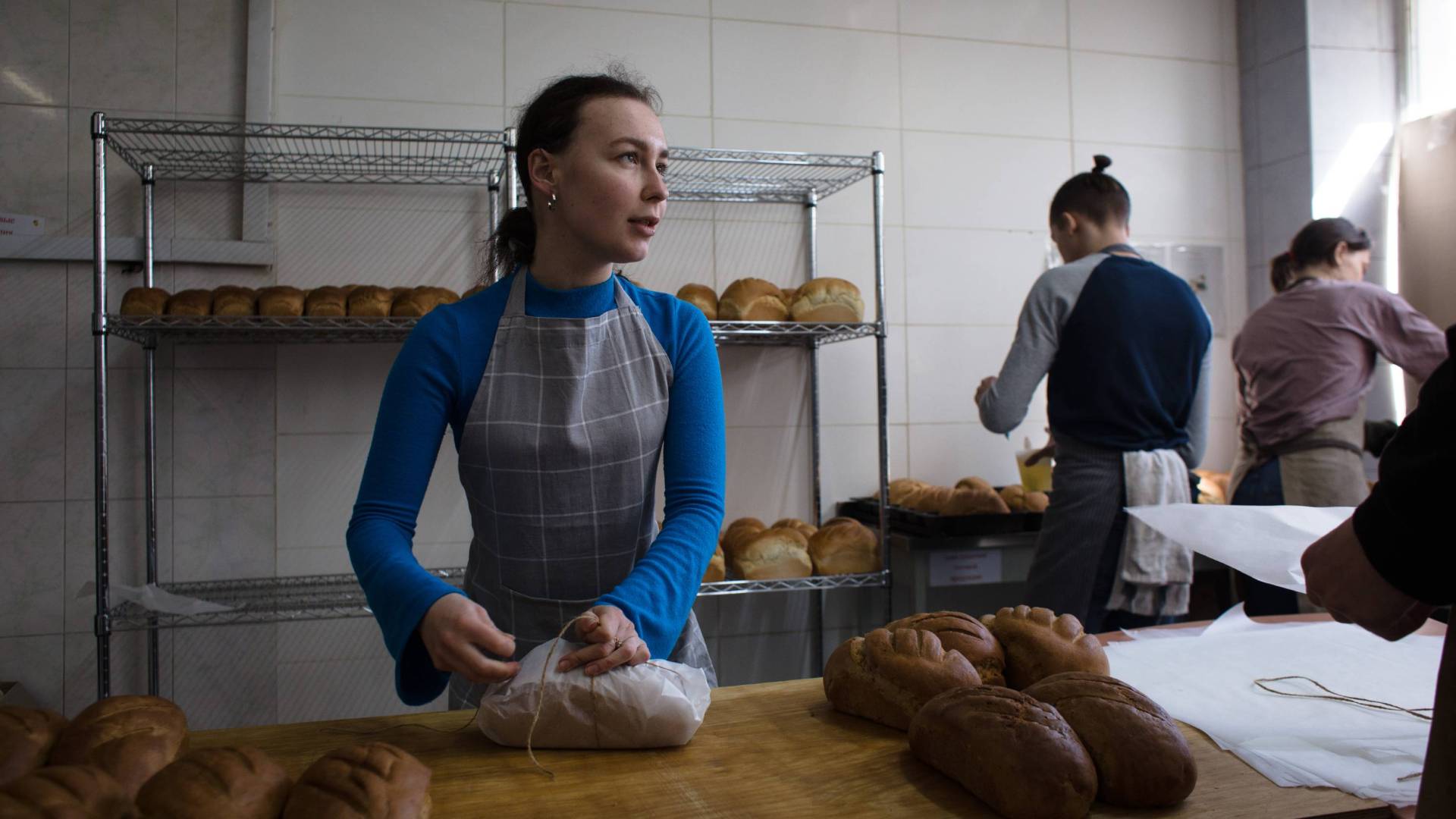
The Good Bread from the Good People bakery in Kyiv, Ukraine, reopened in March to make bread to distribute for free.

The Good Bread from the Good People bakery in Kyiv, Ukraine, reopened in March to make bread to distribute for free.

Christianity Today April 4, 2022
Anastasia Vlasova/Getty Images

For Ukraine, Europe, bread is a way of life. Ukraine’s flag—now displayed around the world in solidarity—proclaims the nation’s agricultural heritage, with the yellow representing wheat fields and the blue representing the sky above.

“Bread is very important in our culture, but Jesus has said that we do not live by bread alone,” said pastor Fedir Raychynets, the head of the theology department at Ukrainian Evangelical Theological Seminary (UETS). “There is something invisible, something intangible, something that is beyond just physical bread.”

As the war continues, pastors and churches across Ukraine are working to bring people both the bread they need to feed their bodies and the bread they need for their souls.

Inspired by the line in Isaiah 58:7 about sharing bread with the hungry and housing the poor, BREADtrust is one of several ministries helping get loaves into the hands of Ukrainians.

The UK-based charity funds local pastors who have remained in the country to continue to serve. They’re able to purchase bread, other food, and supplies for neighbors in need.

“There are those that feel deeply committed and called to where they are,” said BREADtrust project coordinator Phil Downward. One pastor and his family stayed until their apartment building was bombed and they had no choice but to leave. “That takes a level of faithfulness and courage that is utterly remarkable.”

Some ministries continue to bake the bread they distribute. In the days after the war broke out, a Dutch outreach through Oekraïne Zending, located outside Kyiv in Brovary, wanted to rally enough bakers to continue baking bread 24/7. They pass out loaves to hospitals and the army, along with notes containing Bible verses. (When Russia took over Crimea several years ago, CT highlighted the Bread of Life ministry in Maryinka, a bakery that gave away “one-fourth of its 2,000 loaves of daily bread, alongside Bibles.”)

Slavic Missionary Outreach, in an update sent in March, said that since grocery stores have not been open as much, its staff has tried to buy bread wholesale or make it themselves. Some of their neighbors had been going days without food.

“We have our own small bread factory that bakes 1,700 loaves of bread daily, which are then distributed to hungry people by our staff,” they wrote in a letter soliciting support. “We don't know how much longer we can do this. We are trying to buy leftover flour stocks from large bread factories that have closed.”

Ukraine is known as the breadbasket of Europe. The war’s impact on its wheat crop will extend globally. Already, reports expect the disruption will affect Lebanon and Egypt, which rely on imports for government-subsidized bread to feed the hungry. Together, Russia and Ukraine provide almost a third of the world’s wheat and barley exports.

And as the Russian invaders attempt to cut off Ukrainians from their own crops and supplies, the oldest generations recall the deadly famine caused by Joseph Stalin’s seizure of goods the century before. The Soviet dictator had seized crops, livestock, and food itself.

Following the conflict in Crimea, Ivan Rusyn, president of UETS, reflected on this history in Bible Study Magazine:

For Ukrainians, bread is very significant. In 1932 and 1933, we had the Holodomor—a man-made famine. Up to six million Ukrainians starved to death. … Because of this, bread is sacred in our culture. You can’t throw bread away.

The metaphor of Jesus as the bread of life has a lot of meaning for Ukrainians, and the image that the Bible is bread for our souls is very important. We use this to help others understand how vital the Bible is to our lives.

In September, some Ukrainian churches celebrate Harvest Day. During the church service, one pastor will hold up a loaf of bread while another holds up an open Bible. They pray for both, recognizing the need for both. The physical and spiritual needs for bread are not competing but complementary.

Sergey Nakul, pastor of Grace Reformed Church in Kyiv, recently posted a video showing how certain parts of the supermarket, like the meat and seafood counters, were completely empty but thanking God that there was still bread.

“Yes, we have bread,” he said, “but in this period of time we better understand words of Lord Jesus, ‘I am the Bread of Life.’”

Ukrainian churches have developed a network for sharing supplies during the war. In the early days, they helped people evacuate. Now, they’re distributing supplies to those who are staying, like the elderly who have nowhere to go or refuse to leave their homes.

The sirens go off so frequently that some of them simply remain in the basements of the buildings instead of going up and down the stairs each time. It's there that volunteers distribute bread and offer whatever encouragement they can. Additionally, the team distributes supplies to families of soldiers.

Among the military, bread again offers them a reminder of hope when Raychynets offers Communion. His team brings New Testaments with highlighted passages of hope and encouragement. Around two or three dozen soldiers typically take copies.

From his background during the Balkan War and visits to other countries like Lebanon, Israel, and Northern Ireland, Raychynets has experienced the uncertainty, fear, and pain of people in traumatic circumstances. He never tries to impose his faith on them, but when people come to him with questions about God and suffering, he engages them in a conversation.

“I personally don’t believe in answers. I believe in good questions. When they ask me questions, I can ask counter-questions to [encourage] them to think further, to think deeper, to think wider about the situation,” Raychynets said.

Many Ukrainians don’t know where their next meal will come from. Many of their famed wheat fields may not bear a crop this year. However, those faithfully serving in Ukraine hope that there will be a harvest in the country all the same.

“When you are in a situation like these people, you are more sensitive to the divine, to something that is beyond our humanity,” Raychynets said. “We need a physical bread as nourishment for our bodies, but then we need also a spiritual bread. The Word of God feeds our souls.”

Follow CT’s Russia-Ukraine war coverage on Telegram: @ctmagazine (also available in Chinese and Russian).

Select articles are offered in Russian and Ukrainian.

Books
Review

The Gods of ‘Techtopia’ Giveth, and They Taketh Away

Silicon Valley showers its workers with “spiritual” perks, but only at the cost of absolute devotion.

Christianity Today April 4, 2022
Illustration by Rick Szuecs / Source images: Envato Elements

As someone who grew up in Silicon Valley, I can sometimes forget what a peculiar place this is. There are, for example, certain coffee shops and brunch restaurants where you can overhear entrepreneurs pitching to venture capitalists any day of the week. It’s not uncommon to be approached by strangers and asked to beta-test their new apps. The median home price is well above As someone who grew up in Silicon Valley, I can sometimes forget what a peculiar place this is. There are, for example, certain coffee shops and brunch restaurants where you can overhear entrepreneurs pitching to venture capitalists any day of the week. It’s not uncommon to be approached by strangers and asked to beta-test their new apps. The median home price is well above $1 million, every fourth car on the road seems to be a Tesla, and everyone knows someone who works for a giant tech firm like Google, Apple, or Facebook. million, every fourth car on the road seems to be a Tesla, and everyone knows someone who works for a giant tech firm like Google, Apple, or Facebook.

Work Pray Code: When Work Becomes Religion in Silicon Valley

Work Pray Code: When Work Becomes Religion in Silicon Valley

Princeton University Press

272 pages

$11.99

Having spent all my life in the church, I can also forget that Silicon Valley is one of the least religious regions in the United States. The Pew Research Center has found that 35 percent of adults in the San Francisco Bay Area are religiously nonaffiliated. Only 20 percent of adults identify as Protestant, and another 25 percent are Catholic. In comparison, 71 percent of the general population in the US identifies as Christian.

Yet, argues sociologist Carolyn Chen in her fascinating new book Work Pray Code: When Work Becomes Religion in Silicon Valley, this doesn’t mean that high-skilled workers aren’t spiritual. They are, in fact, as hungry for meaning, belonging, and personal transformation as anyone else. But their church, as it were, is the workplace. Their community is made up of coworkers. And they are being shepherded—through not only their careers but also their overall lives—by an array of supervisors, human-resource managers, executive coaches, and meditation gurus.

Meaning-making institutions

It’s no secret that many of the profit-rich corporations of Silicon Valley provide extraordinary perks for their employees, including gourmet meals three times a day, onsite gyms, dry-cleaning services, and free shuttles from the suburbs to the office. In recent years these perks have become increasingly spiritual in nature as corporations compete with one another to offer the best coaching, meditation classes, mindfulness workshops, multiday retreats, and talks by renowned spiritual leaders like Vietnamese Zen master Thich Nhat Hanh.

These are the very trends Chen is examining in Work Pray Code, and her findings should interest (and perhaps alarm) anyone who cares about the health and growth of the American church. Young, high-skilled knowledge workers, who drive not only Silicon Valley but also industries in urban centers throughout the country, are becoming less interested in traditional forms of religion and spirituality. “The decline of religious affiliations and participation, however, does not mean that religious needs have disappeared. They’ve just been displaced,” explains Chen. “Religion exists in the sacred cosmos of a work-centered world.” So strong is the pull of workplace spirituality that some of Chen’s research subjects, who had previously been very devout, drifted away from their faith after beginning to work in Silicon Valley.

All this attention to mindfulness, authenticity, and spiritual health is an outward expression of a larger ethos that has developed in the region’s dominant industries, one that promises to “unlock” your true self and true purpose—so you can be as productive as possible for your employer. The promise of discovering yourself and meeting your full potential is extremely appealing, and it’s backed up by every possible workshop, amenity, and expert that money can buy.

In places like Silicon Valley, the church’s greatest “competitor” for souls may not be other religions, atheism, or even hedonism or greed. It could very well be multinational corporations that offer the promise of changing the world, as well as their employees, through work. “Today, companies are not just economic institutions,” writes Chen. “They’ve become meaning-making institutions that offer a gospel of fulfillment and divine purpose in a capitalist cosmos.” That “God-shaped hole” in our hearts that evangelicals like to reference? It’s being filled by companies with deep-enough pockets to meet their people’s every need—mind, body, spirit.

I’ve seen this firsthand. Ask any entrepreneurs or startup employees in Silicon Valley, and they will sincerely tell you—without a hint of irony or humor—that their companies are going to change the world. The business might be built on an app that finds parking spots, delivers beer via clowns, or makes it look like you got booted off a Zoom call when you want a break (all real apps); nevertheless, it gives their lives purpose. These individuals are as devout and committed as the most zealous of Christians.

Those of us on the outside can see clearly that this promise of fulfillment is ultimately empty, especially when the end goal is utilitarian: to leech as much knowledge, leadership, and productivity out of people as possible. High-skilled professionals gain much, but only by giving much, including 70-plus-hour workweeks and their absolute commitment. Firms will gladly lavish their employees with spiritual perks, teaching, and values, but when someone leaves a job—by choice or not—all of that is terminated as well. This form of religious devotion ultimately will not end well for image bearers of God.

Valuable lessons

Throughout the book, Chen asks this question: What are the larger implications for a society that worships work, that subsumes traditional faith and spirituality under the quest for profit and productivity? She doesn’t really answer this question until the last chapter of the book—which seems insufficient in light of the great and still-growing power, influence, and wealth of the tech industry. Work Pray Code is at its best when Chen contextualizes the findings of her research within broader historical and sociological concepts, such as corporate maternalism, the constant productivity push, and reduced civic engagement.

I wish Chen had supported her claims with additional quantitative research about, for example, the psychological impact of such devotion to work, the connection between high-tech jobs and declining civic participation, or the way corporations in other geographic regions are also trying to “change the world” and help their employees pursue “wholeness.” Instead, she relies so heavily on the quotes and perspectives of a limited number of research subjects that her conclusions—repeated almost ad nauseum—can come across as anecdotal rather than widely applicable. She also misses the opportunity to discuss how the move toward permanent remote work after the pandemic could alter the workings of “Techtopia,” as she calls it. Since the most tangible way corporations attempt to meet their employees’ spiritual needs is through onsite, in-person activities, the ramifications could be very significant.

That said, what Chen communicates is still extremely salient to the American church. There may even be valuable lessons here for church leaders to better understand what millennial and Gen Z professionals are yearning for nowadays: for starters, to be seen as whole, integrated individuals whose work, play, relationships, and spirituality are all deeply intertwined and in need of purpose.

Understandably, how these trends impact the Christian church is outside the scope of Chen’s research and not addressed in the book. There are important clues, though, in her conclusion: “In Techtopia,” she writes, “people don’t belong to neighborhoods, churches, or cities. They belong to work. Instead of building friendships, trust, and goodwill within their communities, they develop the social capital of their companies.”

With the rise of the worship of work, professionals are becoming less engaged and connected with the rest of the world. They believe all their needs are already being met; they are not searching for more. How can the church draw them out of their isolated workplace “cults” (as Chen calls them) toward an eternal and far more dependable promise of fulfillment? How can we compete for souls against institutions with limitless resources?

It may be time for Christians and churches to take a page from the strategic plans of businesses, ensuring that we are clearly articulating the value proposition and competitive advantages of our faith and demonstrating those in bold, irresistible ways. “By this everyone will know that you are my disciples, if you love one another,” Jesus declared (John 13:35). And in writing to the church in Ephesus, the apostle Paul said, “For it is by grace you have been saved, through faith—and this is not from yourselves, it is the gift of God” (Eph. 2:8).

Unconditional love and all-encompassing grace—not mentioned a single time by any of the research subjects in Work Pray Code—could be a good place to start.

Dorcas Cheng-Tozun is a writer, communications consultant, and the editorial director of the Christian nonprofit Pax. She is a former columnist for Inc.com and has written two books on entrepreneurship: Start, Love, Repeat: How to Stay in Love with Your Entrepreneur in a Crazy Start-up Worldand Let There d.light: How One Social Enterprise Brought Solar-Powered Products to 100 Million People.

Theology

Holy Week Playlist: Songs to Survey the Wondrous Cross

Christian leaders and musicians share their favorite Easter music.

Illustration by Cassandra Bauman

Our special issue The Wondrous Cross reflects on eight pieces of music that help us enter into the meaning of Jesus’ sacrifice. In addition to those songs, we’ve asked several Christian leaders—as well as some members of CT’s staff—to share their favorite pieces of music for contemplating the Cross and celebrating the Resurrection. You can listen to all of these songs on our Spotify playlist. 

“King of Glory, King of Peace” by George Herbert There are two parts of this song that get me every time. The first is “Thou didst note my working breast, Thou hast spared me.” The physicality of this image—“the working breast” distressed by our own failures—speaks to my experience. God in his mercy spared me. The second is this: “Though my sins against me cried, Thou didst clear me; and alone, when they replied, Thou didst hear me.” God did not hear the testimony of my sins; instead he heard me. These are great comforts during the season. —Esau McCaulley is an associate professor of New Testament at Wheaton College and the author of Reading While Black and Josey Johnson’s Hair and the Holy Spirit.

“Is He Worthy?” by Andrew Peterson  I have known and loved Andrew Peterson’s song “Is He Worthy?” up-close in our Nashville community, and it keeps on reminding me to believe the story of Easter again and again. The simple, call-and-response style of the chorus is a way of saying the truth, asking the question, saying the truth. As many times as it takes, we keep singing this story of hope. —Sandra McCracken is a singer-songwriter, a CT columnist, and host of the CT podcast Steadfast.

“Kyrie” by Les Troubadours du Roi Baudouin One of the songs I like to listen to during Holy Week is “Kyrie,” from the album Missa Luba. On this album, a choir of Congolese children and adults sing parts of the Latin Mass in the musical styles of the Democratic Republic of Congo. “Kyrie” means “Lord, have mercy,” and this version is sung in the traditional style of a mourning song. It’s fitting for the kind of language that finds itself on our lips not just on Good Friday but all week long as we anticipate the fulfillment of God’s mercy on the cross. This setting of the “Kyrie” has a haunting and plaintive quality that helps me feel my own desperate need for God’s mercy afresh. —W. David O. Taylor is associate professor of theology and culture at Fuller Theological Seminary and author of Open and Unafraid.

“Redeemer” by Nicole C. Mullen This song always takes my often-restless heart and holds it still. My redeemer lives. The Lamb wins. Whatever I see now will not be how this ends. —Heather Thompson Day is associate professor of communications at Andrews University and host of CT’s Viral Jesus podcast.

“Be Thou My Vision,” an Old Irish prayer translated by Mary E. Byrne Great old hymns carry a long, beautiful memory. The memory of the millions of people who have sung this text over thousands of miles and hundreds of years keeps growing as we add our voices to the unending song of God’s people. When I sing this hymn, it lifts my heart and mind and soul to what the rescue of Christ on the cross brings to every generation: the only way out of the darkness into his glorious light. This true light transforms how we see this life and the next. It illuminates the path to pure hope and life and joy with the risen Savior, the high King of heaven. —Kristyn Getty is a modern hymn writer, worship leader, and recording artist.

Christ lag in Todesbanden, a cantata by Johann Sebastian Bach This highly dramatic musical sermon by J. S. Bach features aching pathos, dramatic tensions, and euphoric, triumphant joy. In this version, conductor Maasaki Suzuki leads the Japan Bach Collegium in Bach’s cantanta that features Martin Luther’s poetry. Luther’s words are drawn from a Latin hymn written in about 1050 for Easter liturgies with roots deep in the early church. At once bouyant and weighty, joyful and deep, this music immerses us in the Bible’s own profusion of images and metaphors that explore the meaning of Jesus’ death and resurrection. I first performed in a choir that sang this music over 30 years ago and it still echoes in my soul. —John D. Witvliet is director of the Calvin Institute of Christian Worship and a professor at Calvin University and Calvin Theological Seminary.

“Eat This Bread” from the Taizé community I have always loved the Taizé song “Eat This Bread.” I was first exposed to it at the Taizé community in France many years ago. To me, this song feels like a beautiful invitation to Christ’s table and to feed on him through the Eucharist. Like Cleopas and his companion (Luke 24:13–35), I hope to behold Christ at his table. —Ken Shigematsu is senior pastor of Tenth Church in Vancouver, British Columbia, and author of God in My Everything.

“Now Behold the Lamb” by Kirk Franklin and the Family It’s a well-known fact in my family that I cry literally every time I hear Kirk Franklin and the Family’s “Now Behold the Lamb.” A beautifully arranged, soulful gospel song gets me every time! And Tamela Mann never disappoints. Though originally appearing on a Christmas album, this song celebrates “the precious Lamb of God, Born into sin that I may live again.” The soloists powerfully testify and praise Jesus as the Lamb of God who washes away our sins and sets us free. This saving work of Christ required his sacrifice on the cross for our redemption; hence the song ends by extolling Jesus for his love demonstrated when he shed his blood on the cross at Calvary. —Kristie Anyabwile is the author of Literarily and editor of His Testimonies, My Heritage.

“I Am Living in a Land of Death” by Citizens Though their style is different from the music I make with Prisims, the band Citizens has deeply and sacredly encouraged me through their lyrics and music. “I Am Living in a Land of Death” is an anthem and psalm that helps me fix my eyes on Christ the risen Lord while feeling “the breezes of death” in our culture, our flesh, and the brokenness of humanity. The potent lyrics alluding to the work of Christ are captivating and bring me to worship the Lord with hope. —Esteban Shedd is MC of the hip-hop trio Prisims and creative director of Streetlights, an urban culture audio Bible.

“Con Tu Sangre” by Marcos Witt Marcos Witt has been one of the preeminent worship leaders (and pastors) in Latin America over the past four decades. He released “Con Tu Sangre” (Spanish for “With Your Blood”) over two decades ago, and it remains a powerful anthem in the catalogue of Spanish-language musical worship. The lyrics describe how Jesus, by shedding his blood at Calvary, has redeemed people from every lineage, tribe, tongue, and nation. “Con Tu Sangre” inspires me not only during the Easter season, but throughout the year, reminding me of the great cost of what God has done to secure salvation not only for me but also for a huge global, multinational, multiethnic, and multicultural family—the beautiful body of Christ. He is risen! —Imer Santiago is a recording artist and the director of worship for Urbana 2022.

Agnus Dei, composed by Samuel Barber I remember hearing Agnus Dei by composer Samuel Barber (1936) for the first time in a choral ensemble class I faked my way through. I could not (and still cannot) read music, but I love beautiful harmonies. Hearing Agnus Dei performed by the ensemble brought tears to my eyes. Even though I had no idea what they were singing about, my heart understood: Agnus Dei, the Lamb of God. —Liz Vice is a gospel, soul, and R&B recording artist.

“Jésus le Christ” from the Taizé community Translated into English, this song says, in part, “Your light shines within us, Let not my doubts nor my darkness speak to me.” Hours before a close friend betrayed him, Jesus prayed an anxious, lonely prayer, crying out for relief. Over the course of our lives, many of us will call on God in moments when the heaviness of our circumstances appears to have begun pushing us under the water. We can utter these groans with the realization that Christ himself prayed through visceral pain and that this same man is the Light of the World. —Morgan Pomaika’i Lee is CT’s global media manager.


The Grace Cathedral Concert by Vince Guaraldi The late jazz pianist Vince Guaraldi is best known for giving musical voice to Charlie Brown and his animated cohort. His iconic Peanuts themes were introduced in A Charlie Brown Christmas, first broadcast in December 1965. Earlier that same year, Guaraldi released The Grace Cathedral Concert featuring his trio and a 68-voice church choir leading the congregation at San Francisco’s Grace Episcopal Cathedral in Holy Communion. The concert was considered one of the first instances of a “jazz mass,” and anyone who loves Guaraldi’s music will be captivated by this mixture of original compositions and reinterpretations of sacred hymns. My favorite is “Theme to Grace,” a mostly instrumental track that gently weaves between contemplative and breezy moods before culminating in a burst of choral hallelujahs. The song—and the album—is an expression of resurrection hope. —Ed Gilbreath is CT’s vice president of strategic partnerships.

“The Rising” by Bruce Springsteen On 9/11, as black plumes rose from Manhattan, Springsteen thought he might never sing again. But weeks later, he went down to Ground Zero to watch construction workers, firefighters, and police officers working on the pile. As he left, one recognized him and shouted the familiar “Bruuuuuuuuuce!” He added, “We need ya, Bruce.” “The Rising” (and the album of the same name) was Springsteen’s response to that calling, and this song in particular is an anthem of hope that draws on his deep Catholic roots and points to the Resurrection. —Mike Cosper is director of CT podcasts.

“He’s Alive” by Don Francisco I wrote a whole bunch about Arizona Dranes’s emphatic 1926 gospel blues recording, “Lamb’s Blood Has Washed Me Clean.” Before that, I thought about Luke Morton’s 2011 “The Lamb Has Overcome.” Both songs set my feet dancing. But neither gets a lump in my throat every time I try to sing along. Don Francisco’s 1977 “He’s Alive” does. After years of reflecting on the global and communal effects of Jesus’ death and resurrection and how Jesus came to rescue us, I’ve been remembering more this year that Jesus died for me too. The Lamb’s blood washed me clean. The Easter story isn’t just for me. But it is for me. And no song has hit me harder on that point—no song has shaken me awake to the good news of four and a half decades of Easter mornings—than Francisco’s “He’s Alive.” Does this song still choke me up mostly because of nostalgia? Maybe. I don’t care. The song has been part of my story, and I increasingly find that it tells my story: He’s alive and I’m forgiven. —Ted Olsen is executive editor of Christianity Today.

“Ride On, King Jesus,” an African American spiritual This powerful, exultant spiritual can celebrate various aspects of Holy Week. It sings of Jesus’ triumphal entry into Jerusalem on Palm Sunday, his face set like flint in unhindered determination to go to the cross. Its lyrics can proclaim the victory of Jesus’ resurrection. And the song points toward our future hope: that “great gettin’ up morning” when the dead in Christ shall rise and King Jesus will ride in ultimate victory (Rev. 19). —Kelli B. Trujillo is CT’s projects editor.

 Read the article below to view the songs featured in The Wondrous Cross.

You can find our full Spotify playlist below.

News

Azerbaijan’s Churches Explain Their Evangelism

Many evangelicals celebrate their freedom of religion in the Muslim-majority nation. Orthodox and Catholics urge: Go slow.

Baku, Azerbaijan

Baku, Azerbaijan

Christianity Today April 1, 2022
Emad Aljumah / Getty Images

Emil Panahov has a vision.

“I want to see 96 percent of Azerbaijanis confess their faith in Christ, and revival often began when the king became a believer,” he said. “But our God is the president of presidents, so the government does not rule over me.”

He has a long way to go.

Panahov, founder of the Vineyard church in Muslim-majority Azerbaijan, arrives at his target by inverting his homeland’s estimated proportion of Christians: 4 percent. Most of these are Russian Orthodox, holdovers from when the Caucasus nation of 10 million was part of the Soviet Union.

But the Azerbaijan Bible Society estimates that 20,000 Azeris have become evangelicals, most within the past two decades. And the government—despite being panned for widespread human rights violations in politics—has earned local plaudits for its level of religious freedom, especially toward Christians and Jews.

Panahov’s own story supports his optimism. But is it wise? Orthodox, Catholic, and Presbyterian leaders offer a word of caution.

From an Azeri Muslim family with a communist father, in 1989 Panahov came to faith at the age of 12 through a local Russian Baptist church. But as he grew interested in the arts and dancing, the conservative Christian community could not accept such worldly activity.

Panahov fell away from the faith as he performed professionally around the world—until in 2007 he tore his meniscus. Doctors in Turkey, where he lived at the time, told him he would never dance again.

It was then he recalled Jesus—whom he said spoke a word of healing to him. But through his Turkish pastor, God also gave him a commission: Return to Azerbaijan, and share what God has done for you.

Panahov was reluctant, knowing his artistic passion was a spiritual offense. But trusting God, he went back and eventually found a new church home. Over the next seven years he worshiped comfortably, started a family, and even found work as a dance instructor. But then he heard again the voice that healed him: Go out and start a house church.

He left his fellowship with tears but knew to obey. In the beginning he met mostly with believing relatives, but four years later their number grew to the 50 required by the authorities for registration. Similar miracles have marked many in the movement, which according to Panahov counts 350 believers in 16 cell groups, spread throughout his Caspian Sea country.

And God has used his artistic talent. His team has drawn hundreds to gospel-themed performances in downtown Baku, the nation’s capital. Media and filmmaking have put the message on the internet. The Vineyard church baptized 64 new Christians during the pandemic, he said, and 36 during Azerbaijan’s victorious war with neighboring Armenia.

“Two years ago, the churches did not believe opportunities for evangelism could reach such a level,” Panahov said. “But I know it is from God, because I don’t have the brains for it.”

It is also from the government, which following many years of suppression now works with church leaders to legalize their fellowships. While noting a positive trend, the US Commission on International Religious Freedom still recommends Azerbaijan for inclusion on the State Department’s Special Watch List for religious freedom violators.

Of concern is the legislation that requires 50 people before legal registration.

Many evangelicals celebrate the freedom they do have—and the movement of the Holy Spirit to far surpass this number. But some notice emerging internal issues, and have set their minds on deficient ecclesiology believed to be widespread.

“We place great emphasis in the biblical theology of the church,” said Parvis Mahmudov, pastor of the Presbyterian church that meets in Baku’s historic Lutheran Church of the Savior. “Compared to other denominations, perhaps we have a higher standard of academic learning.”

Mahmudov, also from a Muslim background, noted that up to three-quarters of evangelical churches are dominated by a single charismatic leader. With a lack of accountability, over the years he has seen several fall into moral sin or financial corruption.

Others, especially in home fellowships, tend toward legalism and a controlling spirit. And where there are strong connections to international sponsors, some have been tempted to inflate their numbers.

Ordained by the International Presbyterian Church, with roots in Francis Schaeffer’s L’Abri fellowship in Switzerland, Mahmudov said his congregation has about 60 official members, with up to 80 attending regularly. In the last two years, 20 have come to faith. To join, new believers go through extensive preparation for baptism and membership via the Heidelberg Catechism.

Particularly challenging has been the development of biblical elders.

“We’ve had people join in a month, some in three months, and some that take up to a year,” he said. “We want to make sure it’s genuine, because they can face many difficulties.”

This is a fast track, however, compared to Azerbaijan’s traditional churches.

The Catholics, composed mainly of expat workers, require a year.

“People ask us, ‘Why so many obstacles? In Islam, all we have to do is recite the Shahadah (Muslim creed),’” said Vladimir Fekete, the Slovakian-born bishop of Azerbaijan. “If you are ready to wait, I tell them, it is a sign that your interest is real.”

Within a nationwide parish of 1,000 Catholics, about 100 Azeris have done so—one is now a priest, consecrated by Pope Francis in Rome. But many turn away, exposing their primary desire for financial help or emigration to Europe.

There is no controversy with the government, said Fekete, who keeps good relations. Pope Francis visited Baku in 2016, and Pope John Paul II in 2002. The stained-glass windows in St. Mary’s Church of the Immaculate Conception—crafted by Azeri artists—were financed by the Heydar Aliyev Foundation, managed by Azerbaijan’s first lady and vice president Mehriban Aliyeva. The church bells were donated during an official visit by the president of Poland.

Fekete also organizes a yearly prayer for Christian unity, in which all denominations participate. He is on good terms with the Russian Orthodox church and lends use of his sanctuary and soccer field to evangelical groups. (Panahov was a frequent applicant when needing a large facility.)

But while Catholic caution in conversion and ecumenical relations prevents undue controversies, issues can arise—usually with converts from the villages. Lauding the government’s respect for religious freedom, Fekete compared the situation to rural Italy, where few would welcome the adoption of another faith. Primarily foreigners, however, the Catholic clergy in Azerbaijan are not equipped to advise with family matters, he said.

But local evangelicals are also wary of a rural-urban divide.

Three Azerbaijani pastors requested anonymity to speak candidly about their ministries outside Baku. In the capital, they agreed, there have been great advances in religious freedom since 2010, when the government began registering convert churches.

But in the countryside, said one source, local authorities are more sensitive to variations from the religious norm, worried that outside actors will use faith to destabilize the nation. The primary concern is about Islamist extremism, but they closely monitor Christian activity as well.

The second source hewed closely to Fekete’s experience, agreeing that social pressures to remain Muslim are stronger and thus great care must be taken to explain the new faith identity with deference to traditional customs.

The third source expressed more confidence—but still withheld his name. He said there was no difference at all between city and village, due to a well-educated president who ensures that all religious minorities are treated with respect.

This is also the testimony of the Russian Orthodox, who are present in seven churches throughout Azerbaijan. The government looks to them as the head of all Christians in the country, said Alexy Nikonorov, priest-in-charge of the diocese since the death of its archbishop last June.

Responsible for the spiritual care of over 120,000 ethnic Russians, he said the post-Soviet fervor that led him and 20 others to the priesthood has dissipated over the years. Nonetheless, the church is active in providing sports club and camp opportunities for the youth, who volunteer to assist the elderly.

But only about 5 percent attend church regularly.

Still, half of these were formerly Azeri Muslims, who must first complete a one-year probationary period. Among their number are nine priests and deacons.

Yet Nikonorov’s vision is different than Panahov’s.

“Our purpose is not to make Azerbaijan a Christian country,” Nikonorov said. “Our task is to create a positive image of the church, to show the person who wants to be a Christian the faith that may speak to his heart.”

Even so, the Baku-born clergyman recognized a significant problem. Young Azeris do not speak Russian, and the church does not speak Azerbaijani. Nikonorov aims to change this dynamic, as given an aging population and repatriation to Russia he fears within 50 years the Russian Orthodox church may no longer exist in Azerbaijan.

Evangelicals can help them with evangelism, he said.

Nikonorov came to know the faith through childhood gospel cartoons from America. A local believer sparked his Scripture reading with the Gospel of Luke. And since his ordination, he has facilitated projects with visiting Protestants while partnering closely with the Bible Society.

Yet true fellowship should enrich in both directions.

“We look through 2,000 years of experience, unlike those who just came yesterday,” he said, stressing good relations with government and religious officials. “In the long term, we are usually more right than the others.”

Panahov does not disagree. In fact, he has been more successful than many at achieving positive government relations.

During the war with Armenia over the majority-Armenian enclave of Nagorno-Karabakh, Panahov secured government permission to distribute aid—including Bibles—to Azerbaijani soldiers on the frontlines. Later, in conjunction with local mayors, he extended this service to families who lost loved ones or whose homes were damaged by Armenian missiles.

It gives Azerbaijanis a different picture of Christianity, he said.

After the war, Panahov and his church organized an official concert to promote the National Day of Tolerance in downtown Baku. Currently he is negotiating with the government to establish a major in Christian religion at the Azerbaijan Institute of Theology. And he was one of 20 evangelical pastors who joined the Bible Society, the Russian Orthodox church, and others in a government-promoted open letter supporting Azerbaijan in its war against Christian-majority Armenia.

But Panahov said he does not kowtow to the authorities.

Once at the State Committee on Religious Associations, which grants registration to all religious entities, Panahov was asked why he gave up his Muslim faith. He told them the story of his knee and recalls that their jaws dropped. Half of the committee were KGB agents, he claimed, and more used to the long-bearded Orthodox.

Still, he pushed further.

“I didn’t change my religion, you did,” Panahov told them—not confrontationally, but with a smile. “Azerbaijan was Christian before Islam came in the seventh century. I’m returning to the faith of our fathers.”

He visits the committee frequently, developing friendships. They are all humans anyway, he said, and in need of salvation.

This boldness—or foolishness—has served him well so far. Going forward, it is part and parcel of his vision for Azerbaijan.

“I’m crazy,” Panahov said. “But whenever we get permission, we’re ready for stadiums.”

News

After War, Can Armenia’s Evangelicals and Orthodox Save Their Nation Together?

Some evangelicals thank Apostolic church for preserving their nation amid trials. Some priests fear Protestant newcomers will divide it.

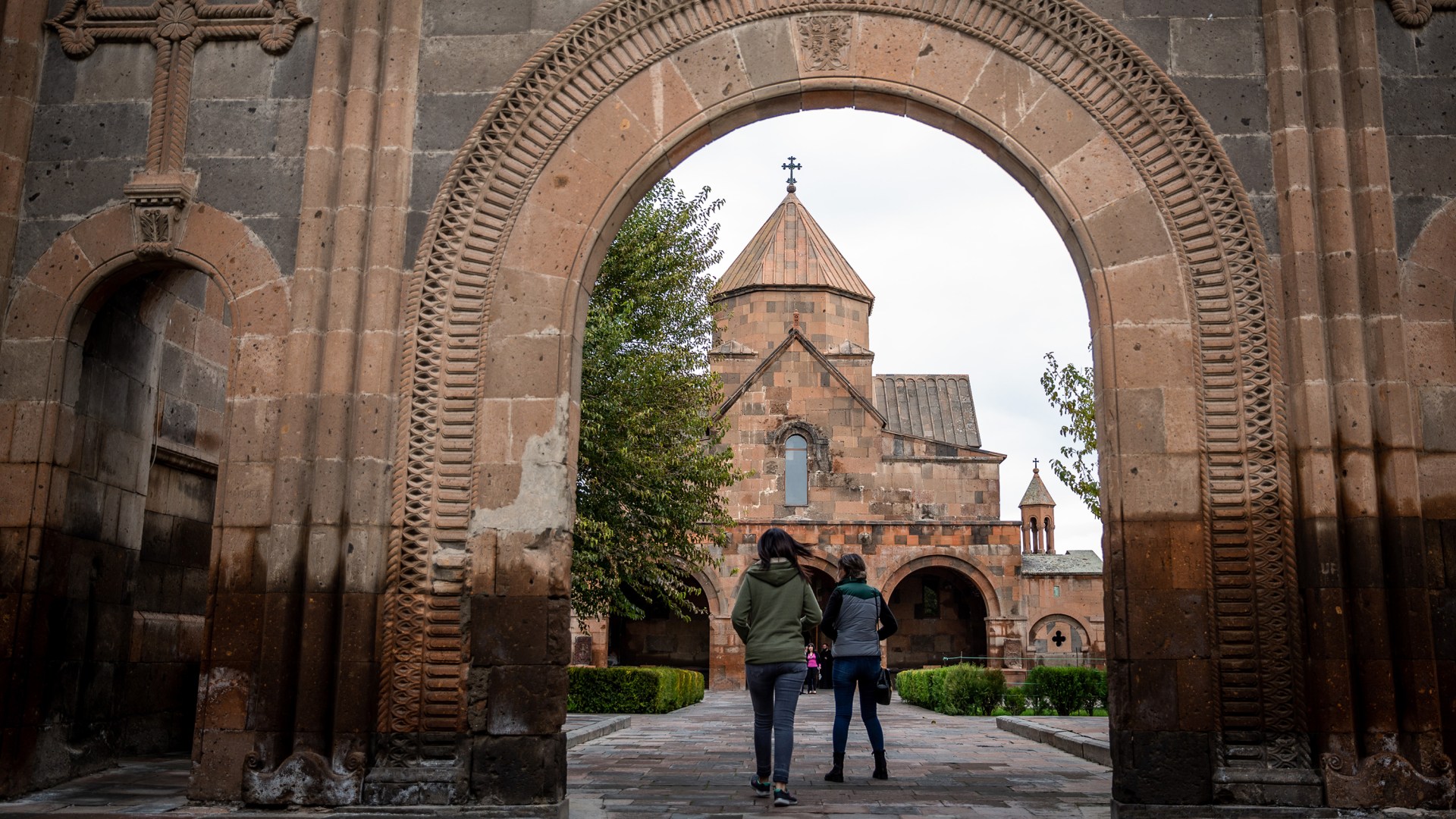
The seventh-century Church of St. Gayane in Vagharshapat, the religious center of Armenia, located within walking distance from Etchmiadzin Cathedral.

The seventh-century Church of St. Gayane in Vagharshapat, the religious center of Armenia, located within walking distance from Etchmiadzin Cathedral.

Christianity Today April 1, 2022
Maja Hitij / Getty

Craig Simonian had a vision. It landed him in a war zone.

Raised in an Armenian-American Orthodox family, he came to know Jesus personally at university. He served as a Vineyard church pastor in New Jersey for nearly two decades but continued to embrace his Apostolic church heritage.

It laid the foundation of his faith—but also of his nation of origin.

“The reason Armenia still exists is because of the church,” he said. “It kept our shattered people together, especially in the diaspora.”

As a child, Simonian’s grandmother witnessed her father and mother murdered in the Armenian Genocide, killed by Turks in the waning days of the Ottoman Empire.

When she eventually arrived in America, it was the Apostolic church that embraced their family. Simonian recalled kindly visits by priests of their Oriental Orthodox tradition who—in the face of tragedy and devastation—gave him a deep appreciation of the sovereignty of God.

It was his evangelical awakening, however, that drew him back to Armenia—and in particular to its church. He relocated in 2018 to a nation locked in a cold war with neighboring Azerbaijan. A self-professed “oddball,” he longed for the Apostolic church to embrace fully the gospel he had discovered.

“If we are going to reach this generation, we can’t do it without them,” Simonian said. “I will call people to Jesus but never to leave their church.”

But two years later, the war turned hot.

Azerbaijan invaded the Armenian-controlled enclave of Nagorno-Karabakh in October 2020. The territory is recognized internationally as belonging to Azerbaijan, yet the residents of what Armenians call Artsakh voted for independence in 1991. For three decades Armenia held the upper hand but was routed in a 44-day war through superior drone technology that Turkey and Israel supplied to Azerbaijan.

Russian intervention enforced a ceasefire, with Nagorno-Karabakh demolished and Armenians holding a fraction of their previous territory. The nation felt numb after its defeat, and many found refuge in the Apostolic church.

Today, Simonian provides ad hoc spiritual care as he builds relationships with evangelicals and Orthodox alike.

His primary worship is through Yerevan International Church. But few in his personal circles have saluted his efforts to attend the Divine Liturgy and cultivate relationships with Orthodox clergy. Many evangelicals are soured by years of the older tradition labeling the newcomers a sect, or worse, a cult. But neither has Simonian yet found in the Apostolic church the fellowship that characterized his diaspora youth.

“The warm fuzzies I had growing up are completely void here,” he said. “The church is not so much a community.”

Simonian understands. Soviet communism purged the church, replacing clergy with compliant leadership. Following Armenia’s independence in 1991, this generation still exists but is giving way to a spiritual cadre that he says recognizes the church needs more than ancient traditions.

“We do not need to re-evangelize Armenia,” said Shahe Ananyan, dean of Gevorkian Theological Seminary in the Apostolic holy see of Etchmiadzin, 13 miles west of Yerevan. “Our main task is to wisely consider how to bring both Eastern and Western traditions together in synthesis.”

The church is still discussing application, he said. But he recognized that modern life for many has crowded out liturgical attendance and Bible reading.

Forging forward anyway is Bagrat Galstanyan, bishop of Tavush, 100 miles northeast of Yerevan on the border with Azerbaijan. Previously presiding over the Canadian Apostolic diocese of Montreal, he is well placed to assist the synthesis—but is struggling with the weight of his spiritual responsibility.

“Practically, we are stretched,” Galstanyan said. “I am relying on the institutional memory of the church.”

Pre-pandemic, he established the One Community, One School program to get religious education—and social work—into the remote villages of Tavush. Out of 70 parishes, his diocese has 18 operating church buildings but only 10 priests.

At Galstanyan’s inauguration, he pledged to “bring Christ into every home.” Sunday school–type activities take place every day after regular classes, which become a sort of village center. And he is uniting each group under rotating themes, with family, identity, salvation, and eternal life at the forefront.

“We start at a level people can grasp easily, and then widen it,” he said, focusing on practical, everyday issues. “The gospel imperative is for the Word to become flesh.”

Galstanyan welcomes evangelical partnership in Tavush. But the few groups currently there, he said, pursue their own interests. And across the country, he lamented, there are so many denominations—all with different names and purposes.

“How can you claim to follow the one unchangeable Christ,” he asked rhetorically, “when you are internally divided?”

Armenia also lacks an evangelical alliance, noted one pastor. Previous efforts fell apart when the new government widened religious freedom, lessening the need for solidarity. Each group then went back to its own ways.

It is very confusing for Armenians, admitted Hovhannes Hovsepian.

Pastor of the Armenian Evangelical Church (AEC) in Yerevan, he is also assistant to the head of the historic Protestant denomination. Founded in 1846 during an Armenian revival and reformation effort in Turkey, its presence is more recent in Armenia proper. Its relief and outreach ministries expanded dramatically after an earthquake in 1988.

Unlike most Baptists and Pentecostals, these evangelicals seek to honor the Orthodox as the “mother church.”

“We stress the importance of the Word of God and the gospel, against traditions that marginalize these,” Hovsepian said. “But once reformation happens, we can freely go back.”

For centuries, he explained, the Apostolic church not only preached Christianity but also held the Armenian people together in unity, becoming the church of the nation. They cannot comprehend another denomination within their fold.

The ancient church traces its roots to A.D. 301 when St. Gregory converted Armenia’s king and created the world’s first official Christian nation. Hovsepian said the church has a biblical explanation for every Apostolic tradition but most priests do not communicate this to the people. And with the liturgy conducted in the old Armenian language, those in the pews cannot understand the richness of their heritage.

Instead, the church calendar is populated with saints who distract intercession away from Jesus himself—the one mediator between God and humanity.

“They prefer to light a candle,” Hovsepian said, “than to open their hearts toward God.”

Ananyan, who is also the head of the ecumenical department of the Apostolic church, grudgingly appreciates the “mother church” label. And he is not against the Reformed faith. The current Catholicos (akin to Patriarch), Karekin II, is also a current president of the World Council of Churches and oversees an official dialogue with the Anglican Communion.

But the Orthodox seminary leader suspects that local evangelicals are confused by what it means to be Armenian. More than 100 different Protestant entities are registered by the government.

“Is their purpose to create as many evangelical communities as possible or to renew spiritual life?” asked Ananyan, calling it nonsense. “Instead, they are creating division and a deformed community.”

He views such splintering as dangerous. By pluralizing Christian identity, Protestants divorce the connection between religion and ethnicity. Look at the results in Europe, he said, where the entire faith is under threat.

Hovsepian sees it differently.

“People can choose what type of church speaks more to their heart,” he said, as some veer toward preaching, music, or tradition. “God is using the church in its diversity, as each gathers its particular flock.”

But there is ample room for cooperation. The last half decade has seen an unofficial dialogue between the Apostolic church and the AEC, resulting in greatly improved relations.

Through the Bible Society of Armenia, Hovsepian has joined Catholics in teaching the Bible to public school teachers, under the auspices of Etchmiadzin. The three denominations have jointly translated the New Testament into modern Armenian, soon to be released to the public. And the Christian Women’s Forum adds Greek Orthodox and Assyrian participation, providing financial and moral support to young mothers considering abortion, among other services.

The Bible Society board is composed of five Orthodox members, two evangelicals, and one Catholic. Ananyan said it sold 30,000 Bibles last year, evidence of a steady hunger for the Word of God.

But though he lauds the Apostolic church for its missionary role in the sixth century, he believes such outreach is not appropriate today among its Muslim neighbors. Instead, the witness of the church comes through preservation—especially of historic monasteries seized by Azerbaijan during the war and threatened with the erasure of their Armenian identity.

This steadfast faith should be better respected by Protestants and Catholics, he said.

“We as a nation are called to witness to Jesus Christ in a very difficult region,” said Ananyan. “Our very existence is a testimony of Christianity.”

This also burdens the heart of Simonian, who is eager to join with the Orthodox to promote church growth and evangelism.

The church is ancient, but it continues.

“I love the Apostolic church,” he said. “Every dream I have for Armenia includes them.”

Church Life

Inside a Ukrainian Baptist Church at War

Christians in Lviv work and pray for victory as they face their nation’s crisis head-on.

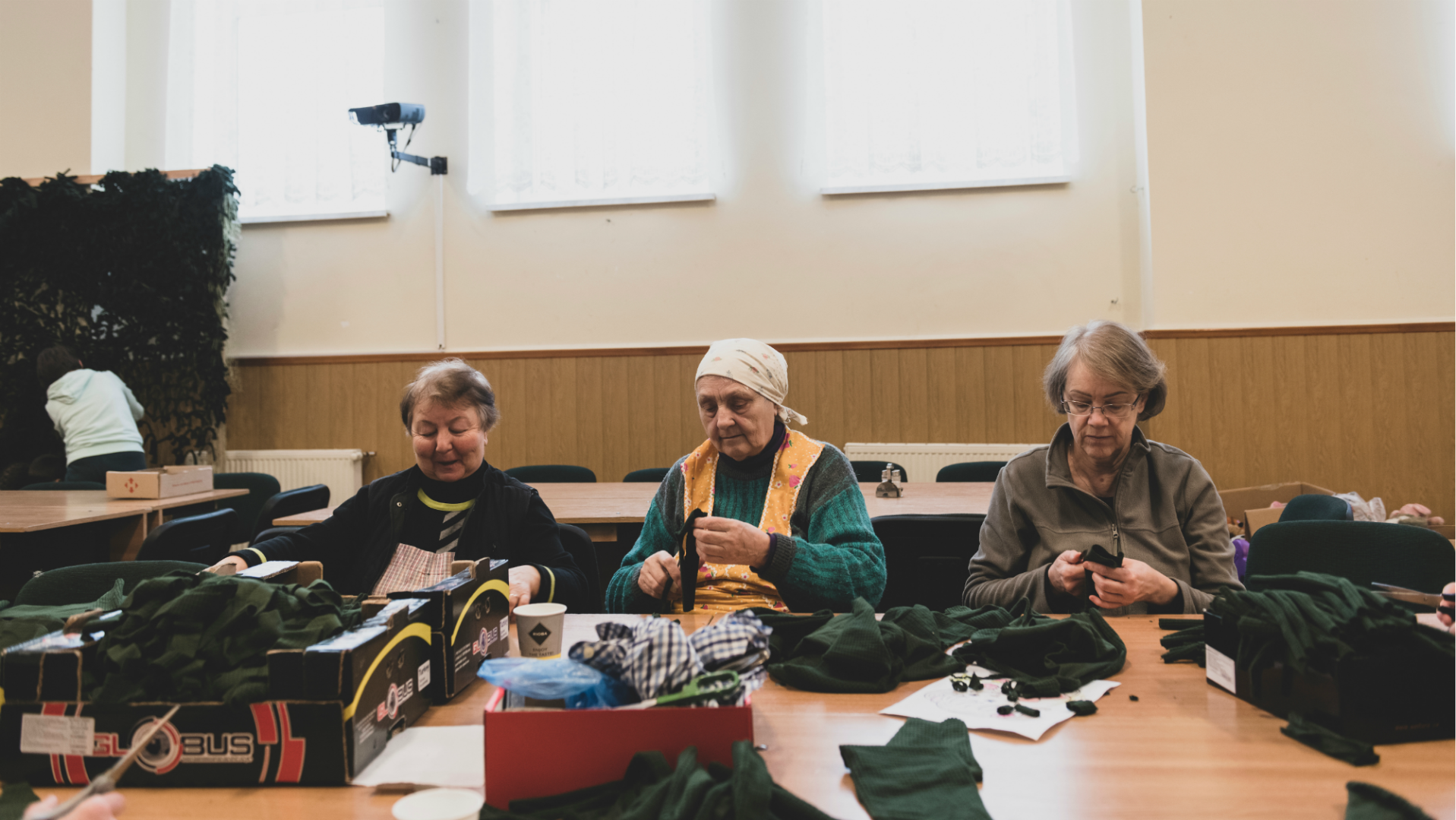
Baptist women in Lviv cut up cloth for military camouflage.

Baptist women in Lviv cut up cloth for military camouflage.

Christianity Today April 1, 2022
Joel Carillet

First they had to get a car.

As the threat of a Russian invasion grew on the horizon, some shrugged it off, thinking it unlikely. But Vika Aharkova, who ministered alongside her husband Vasyl among the 20,000 international students in Kharkiv, near the Russian border, “kind of knew it was going to happen,” she said.

It’s easy to delay when crisis is coming. It’s easy to think of the many plausible reasons the worst won’t happen. They were still praying for peace. But they also knew they needed to be prepared.

They needed a car.

“If we know there is going to be a war, we need to buy a vehicle,” Vika said. “So we can evacuate fast.”

Vika and Vasyl appealed to supporters for funds to buy a car, and two days later, funds in hand, Vasyl traveled to Lviv, in western Ukraine, to purchase the vehicle. He immediately drove back to Kharkiv—a 14-hour journey.

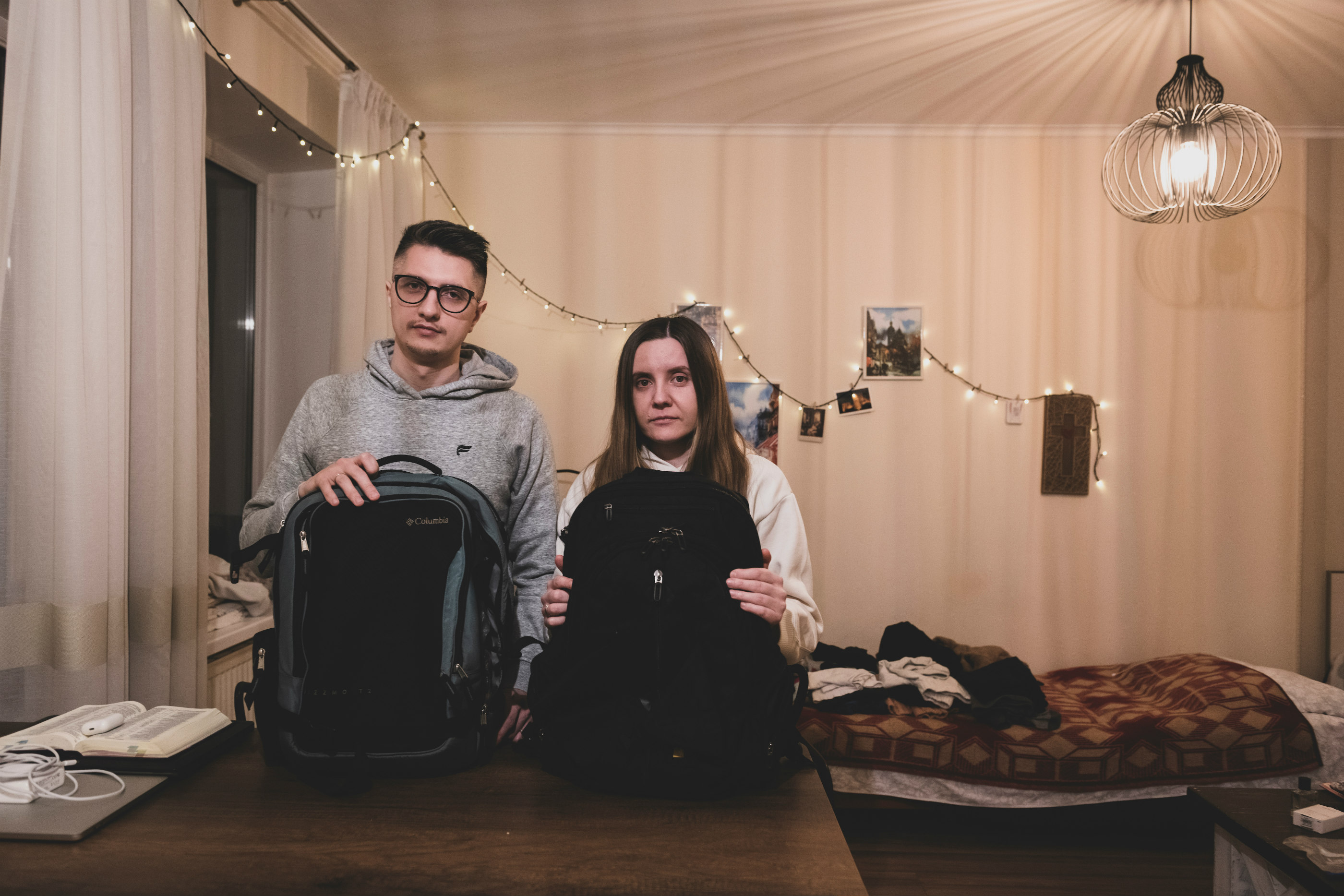
The invasion started eight days later, at 5 a.m. on February 24. At 5:30, Vika and Vasyl were in the car, each carrying just a single backpack.

By the time they left the city, they had five more people, with five more backpacks: Vasyl’s sister, a couple from their church, an elder’s teenage daughter, and a student from the medical university.

No one took any extra luggage, but they did make room for a cat.

They would drive nonstop to Lviv—this time a 36-hour journey. Many people from all over the country have fled to Lviv now. In the West, near the Polish border, it’s more secure.

Here many churches, and many evangelicals like the Aharkovs, have turned to face the crisis head-on.

Vasyl and Vika Aharkova, campus ministers with the International Fellowship of Evangelical Students in Kharkiv, fled their home within an hour of the Russian invasion.Joel Carillet
Vasyl and Vika Aharkova, campus ministers with the International Fellowship of Evangelical Students in Kharkiv, fled their home within an hour of the Russian invasion.

Step onto the grounds of the Central Baptist Church, for example, and the place is abuzz. Parked in front is a bus that will take evacuees to the Polish border. Inside are several rooms serving as temporary shelter for displaced people—those like Irina Malko, 38, and her dog, Zaya, who also fled from the city of Kharkiv.

Walk down the stairs a couple floors and you’ll find several women cutting up cloth to be used for camouflage netting for the military. Walk a little farther, to the church’s kitchen, and you’ll find women preparing meals—for the guests who are leaving in the bus out front and some who are staying longer.

The church is the new, temporary denominational headquarters, home to the staff of the Ukrainian Baptist Union. The union was located in Irpin, a suburb of Kyiv that quickly became a battlefield. Now it’s at Central Baptist Church in Lviv.

Irina Malko, 38, and her dog Zaya fled the city of Kharkiv and found temporary shelter at Central Baptist Church in Lviv.Joel Carillet
Irina Malko, 38, and her dog Zaya fled the city of Kharkiv and found temporary shelter at Central Baptist Church in Lviv.

In one room of the church is a large map of Ukraine, multicolored thumbtacks indicating distribution points—churches of various denominations, mission organizations, and so forth—where humanitarian aid from Haus der Hoffnung, a German Christian organization, can be sent.

Down the hall, Igor Bandura, vice president of the union, is worried about what happens if the Russian military succeeds in taking Ukraine.

“The battle is huge, and it is not only about Ukraine,” he says. “If Ukraine would be taken, it is just a matter of time before Putin would move forward. Poland understands this. The Baltic states understand this. Romania understands this.”

He has stopped praying for peace. Now he prays for victory. He prays he and other Christians and the country as a whole will face the crisis head on. He prays that the Russian people will see the invasion for what it is.

“The majority of people just don’t want to know the truth,” he said in a sermon a few weeks ago. “They are easily attracted by state propaganda. Even our own Christian brothers and sisters are overwhelmed with fears.”

Inside this church, though, there doesn’t seem to be any fear. These are the faces of determination. Like so many people around Ukraine, the Baptists here, in this one church in Lviv, are stepping up to meet the challenges with a sense of solidarity and sacrifice. The church, like the rest of the country, is operating in a crucible, and a sense of unity is being forged—not in some abstract sense but in a blood, sweat, and tears sense.

Baptist women organize clothes to give to those in need. At a nearby warehouse, they collect and sort humanitarian aid from Poland.Joel Carillet
Baptist women organize clothes to give to those in need. At a nearby warehouse, they collect and sort humanitarian aid from Poland.

They are choosing, every day, to face the crisis and make the necessary decisions, from buying a car that can carry seven from Kharkiv to sorting donated clothes in a storage room in the church in Lviv.

What will they think about this time, when it’s all over?

“In the end, after the victory,” Bandura said, “we will look back and say, ‘God, it was painful, but it was so precious, so valuable.’”

Editor’s note: CT’s coverage of the Russia-Ukraine war includes select articles in Russian and Ukrainian.

You can now follow CT on Telegram: @ctmagazine (also available in Chinese and Russian).

News

What Ukraine’s Evangelical Women Want Known About Russia’s War

From preparing food to making Molotov cocktails, Christian women contribute to resistance, while some fear the divide between those who stayed and those who fled.

Christianity Today March 31, 2022
Edits by Christianity Today / Source Images: NurPhoto / Jeff J Mitchell / Getty

Of Ukraine’s more than 4 million refugees, 90 percent are women and children. Of the 6.5 million internally displaced Ukrainians, 54 percent are women. Men ages 18–60 are required to stay and resist the Russian invasion. And thus it is men who usually tell the public tales of war.

Women are often kept to private forums such as their journals:

32 days of war.

Fall asleep while checking the news on your phone.

See nightmares about concentration camps, bombing, dead people.

Wake up from a nightmare and remember it is not just a bad dream.

Check your phone with the thought, I hope everyone I love is alive.

Kiss a sleeping husband thinking about the fragility of life.

Wash your face. Put your clothes on.

Go to work. Wear a smile as a mask. Distance your emotions from pain. Physically hear pain turn into white noise in your head.

Check on your family during a 15-minute break at work. Cry on your break.

Six seconds: breathe in. Eight seconds: breathe out.

Feel grateful for being away from your phone eight hours a day at work. Feel helpless about being away from your phone eight hours a day at work.

So began the March 27 entry of Tetiana Dyatlik Dalrymple, suffering vicariously from afar in Washington, DC. Her father, Taras, sensed that such female perspectives have been missing from coverage of the war.

As Overseas Council’s regional director for Eastern Europe and Central Asia, he recruited six Ukrainian women leaders who could tell their stories. In partnership with the Eastern European Institute of Theology, ScholarLeaders International, and four affiliated seminaries, they sought to counter the critical observation of Svetlana Alexievich, a Belarussian novelist who won the Nobel Prize for literature in 2015:

“Everything we know about war,” Alexievich wrote in The Unwomanly Face of War, “we know with ‘a man’s voice’ … ‘men’s’ words.”

Too few international supporters care to notice the gender gap. The theological educators’ second webinar, “The Russia-Ukraine War: Women Voices,” drew only about 200 registrations yesterday, less than half that of the first webinar, which featured male seminary leaders.

Marina Ashikhmina, vice rector for educational work at Tavriski Christian Institute, said the distinction is patently unfair. Women in war have a “double responsibility.”

Underappreciated in society is their behind-the-scenes work to cook meals, transport aid, and knit camouflage nets. But at the same time, said the licensed psychologist, they are expected to maintain the mental and emotional health of society. Ukrainian children will be the most affected, she said, as the vast majority are likely to experience PTSD or depression.

But though war dehumanizes men, Ashikhmina believes this is impossible for women. The balance of vulnerability and mettle protects them—and even causes them to utter the true sound of conflict.

“War is oppression, abasement, and discrimination, as it stems from a patriarchal worldview,” she said. “And yet, if war had a voice, it would sound like a woman’s lament, a child’s fearful cry, a mother’s quiet prayer.”

This is the service needed and provided by women like Valeriia Chornobai.

“The refugees are destroyed in their inner being; as they come to us, they often are not able to speak,” said the professor of sociology and Christian ethics. “You don’t need to talk to them, but just sit in silence and share their pain.”

She remained with her husband in Dnipro, 300 miles southeast of Kyiv.

Practically every day is the same for her. A truck arrives with humanitarian aid. She helps package it into individual parcels and then distributes the aid to displaced people taking shelter in church basements. Where possible, she helps find employment for those willing to stay.

But amid the emotional toil is joy. Six women slept in what used to be her office; all six accepted Jesus. She even saw God’s healing when she prayed for one woman’s injured leg.

It is Bible reading that keeps her going. But she also avoids pointless debate—too many are arguing about why this happened or about the divisions between Christians, she said. Such discipline helps her balance.

“Stay focused on God’s love, not people’s pain,” Chornobai said. “I want to be with the Good Samaritans.”

So does Olga Dyatlik, Dalrymple’s aunt. An associate regional director at Overseas Council with her brother, Taras, she experienced burnout while helping those who suffered over the past eight years of Russian occupation in the Donbas region. She knows now that she must take care of herself first.

“But how can I,” she said, “when I am flooded with thousands of text messages saying, ‘Please help us’?”

Much of her pain is connected to Russia. Those eight years also involved much effort to strengthen cross-border relationships with fellow evangelicals.

Yet not one of her received texts was a message of apology.

“I then understood, I don’t have Russian friends,” Dyatlik said. “We were building bridges for eight years. Now it is their turn.”

But peace is still needed, said Tetiana Kalenychenko, even if she gets blamed for saying so. A facilitator working for conflict transformation with the Dialogue in Action initiative, she has partnered with Muslims, Jews, and the evangelical seminaries in interfaith peace building.

Still in contact with her Russian colleagues, she admits that a “bridge” cannot be at peace with everyone. But to play its role, it must be at peace with itself—and with God.

She has a dream that Ukraine’s churches will welcome the coming waves of the traumatized, where they can sit in silence and listen for God’s voice. But to be effective, silence is not enough.

“Under shelling, ready to shout, we must be brave and honest with ourselves, and especially in our prayers,” Kalenychenko said. “In anger and grief, we keep our hearts soft enough to feel God’s love.”

But they also keep their hearts firm enough to combat Russian propaganda, said Olga Kondyuk, head of the department of communication at Ukrainian Evangelical Theological Seminary. After evacuating from its campus in Kyiv, she does her best to maintain normal operations online.

“Not only do we have to fight to survive,” she said. “We have to fight to preserve what we have built.”

This refers not just to seminary education but also to the values, economy, and independence of Ukraine. While Russia is doing its best to tear them down, Kondyuk exposes its false rationale.

One frequent idea is that the two Slavic nations are “brothers.” Honorable in concept, it is misused to turn them into one nation and thus portrays Ukraine as having no sovereignty.

Another concept that finds favor among many Christians is that President Vladimir Putin’s “Russian world” ideology is combating the moral degradation of the West. But a simple comparison finds worse rates of divorce, abortion, alcoholism, and crime in Russia.

“Unlike the ‘Russian world,’ Christ saves people through relationship and love,” said Kondyuk. “The job of theology is to root out and condemn such heresy.”

Tanya Gerasimchuk hurts for those taken in.

“People that I used to respect—who are intelligent and well educated—they sincerely believe that what Russia is doing is right,” said the public relations assistant at Odessa Theological Seminary. “I pray that God would open their eyes.”

She was commenting from Moldova, where she evacuated to her mother-in-law’s home. But she is mindful that as the days go by, her status changes from guest to refugee.

“No matter how many good and kind people you meet on your way or how comfortable your conditions are at the moment,” Gerasimchuk said, “the feeling of detachment seems to be the most prevalent one. It gets its hold on you and never leaves.”

But even so, these women are not the classic picture of helpless victims fleeing war. They are active volunteers, helping others and teaching the Bible.

Still, Matthew 24 is a poignant reminder: “How dreadful it will be in those days for pregnant women and nursing mothers!” (v. 19). Such women are present in 1 out of 10 internally displaced Ukrainian families.

Gerasimchuk, at least, is safe. But it is cold comfort.

“You feel helpless, and you feel guilty,” she said, “because you are fine and comfortable, while others are suffering immensely.”

It is a divide that could tear Ukrainian women apart.

“It is becoming increasingly difficult for women to communicate with each other, given the very fundamental differences between their positions,” said Ljuba Pastushenko, Dalrymple’s aunt, a refugee in Poland. “The war cut us to pieces like a pie.”

But it is not simply those who fled versus those who stayed.

Differences have appeared between those who had a backpack and those who left with nothing. Some are with family while others rely on strangers. And of those still in Ukraine, some chose to stay while others had no opportunity to leave.

Suffering the tension, some have cut off communication with each other. But she urges understanding.

“Each of us has her own threshold of sensitivity, her own mechanism of living through panic, fear, and change,” said Pastushenko. “Each of us did the right thing, guided by our heart.”

Weathering the turmoil involves keeping others calm when fear abounds, said Kondyuk. It means talking to journalists and lawyers, said Dyatlik. It even includes making Molotov cocktails, said Ashikhmina.

But whatever voice women give to war, their hearts often need to be expressed in private first. The pressure is tremendous, and journaling helps.

It did for Dalrymple:

Forget to eat. Forget to drink water. Pray for people who don’t have food and water in Ukraine.

Get used to the pictures of dead bodies. Hate Russian murderers. Remind myself there are some good people in Russia. Get a message that my friend’s house was hit by a Russian missile. Feel hate melt into helplessness.

Come home.

Translate documents for refugees. Send an update to donors.

Call family. Be strong for family. See family being strong for me. Tell my brother I love him. Wish my mom and dad “goodnight.” See them online at 4:30 a.m. their time because of air alerts. Text them: “Please make sure you are hiding.”

Pray the missiles don’t hit my hometown. Read the news that the missile hit my town. Feel scared. Feel angry. Feel numb.

Pray.

Pray.

Pray.

Fall asleep while checking the news on your phone.

Follow CT’s Russia-Ukraine war coverage on Telegram: @ctmagazine (also available in Chinese and Russian).

Select articles are offered in Russian and Ukrainian.

Apple PodcastsDown ArrowDown ArrowDown Arrowarrow_left_altLeft ArrowLeft ArrowRight ArrowRight ArrowRight Arrowarrow_up_altUp ArrowUp ArrowAvailable at Amazoncaret-downCloseCloseEmailEmailExpandExpandExternalExternalFacebookfacebook-squareGiftGiftGooglegoogleGoogle KeephamburgerInstagraminstagram-squareLinkLinklinkedin-squareListenListenListenChristianity TodayCT Creative Studio Logologo_orgMegaphoneMenuMenupausePinterestPlayPlayPocketPodcastRSSRSSSaveSaveSaveSearchSearchsearchSpotifyStitcherTelegramTable of ContentsTable of Contentstwitter-squareWhatsAppXYouTubeYouTube