Ideas

Of Orphanages and Armies

Columnist

My Russian-born son enlisting reminded me of my identity in Christ.

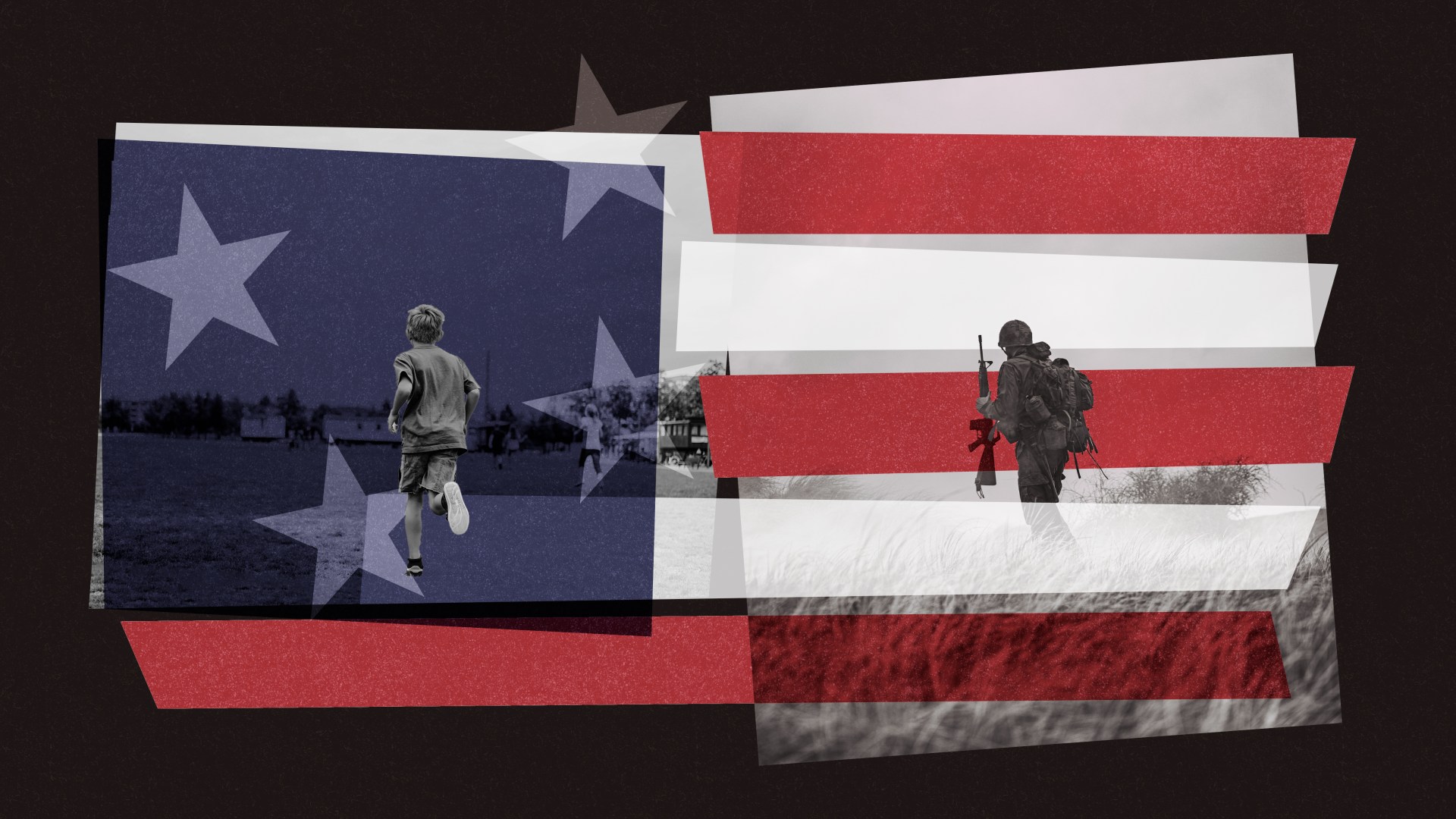
Illustration by Rick Szuecs / Source images: Eduard Delputte / Yanapi Senaud / Unsplash

“He’s like a little soldier!”

Those were among the first words my wife, Maria, and I spoke when meeting a little baby in a Russian orphanage almost 20 years ago. As we walked into the room, this tiny-but-scrappy fellow climbed up against the slats in his crib, straight-backed as though standing at attention. Every day we would visit the room there, and Maxim—soon to be renamed Ben—was always silent and dignified, even as he clung to the back of my hair while I held him. He wasn’t alone in his silence.

As I wrote at Christianity Today shortly afterward, the entire place was that way. Though filled with babies, the orphanage was utterly soundless. Over time, we learned that this was not uncommon in such settings. Infants cry, after all, to communicate: “I’m hungry!” “I’m scared!” “I’m wet!” After enough time with no response, they will eventually stop crying.

As we left the room, knowing it would be several months before we were allowed to return, I could only say, “I will not leave you as orphans; I will come to you” (John 14:18). And then we walked out and shut the door. We could hear little Maxim falling down in his crib, screaming. Between my own sobs, I said, “That’s the most beautiful sound I’ve ever heard. He’s crying because he knows we will hear him. He knows he has parents now. He knows he is loved.”

Ben doesn’t remember the orphanage. But I couldn’t help but think of it late last year as I watched him stand at attention before the American flag while being sworn in to the United States Air Force. When the officer asked the new recruits why they had joined, several of them said, “To better myself” or “To learn skills.” Our son said, “To serve my country, sir.”

To serve my country.

I’ve spoken and written countless times about what adopting our sons taught me about the gospel I believe: what it means to be adopted by God, to have a Father, to have brothers and sisters, to understand that “adopted” is not an adjective (designating something less than full-blood belonging) but a past-tense verb (telling how one came into the family to which one fully and permanently belongs). But the process also taught me what it means to be an American.

When I was the age of my son, we watched the Soviet flag come down the Kremlin flagpole, a totalitarian powerhouse dissolving on live television. This was the “evil empire” whose accent showed up in the voices of every cartoon bad guy, every James Bond villain, every invading army in TV movies. This was the military superpower my classmates and I practiced crouching under our desks to protect ourselves from attack.

Now here was this young man—with a Southern accent and a Bible in his tote bag—swearing to defend his country from all enemies, with no confusion at all about what country that is. And standing behind him was a family—a family to which he belongs for life.

Those of us who rightly decry “Christian nationalism” sometimes fail to communicate that whatever Christian nationalism is, it’s not an overzealous patriotism any more than polygamy is overzealous monogamy. It is entirely different from love of country, which is why so much of it retreats to a “blood and soil” mentality. It rejects “a nation of immigrants” as Statue of Liberty sentimentality, out of step with the “America first” times.

Christian nationalism is not an overzealous patriotism any more than polygamy is overzealous monogamy.

By dawn’s early light, I saw something different. I saw an American patriot. No one cared where he was born. Instead, people prayed for us. And through those prayers I was reminded of a church that will outlast that country—a church made up of adoptees and immigrants and refugees, like you and me.

Ben was never a little soldier. He was always meant to be an airman. He was never really an orphan. He was meant to be a son. And as he bounded onto the bus for basic training, my wife and I stood, just as we had in that orphanage hallway, shaking with tears. Yet the sound of that bus engine growing fainter and fainter in the distance was one of the most beautiful sounds in the world. He knows he has a family; he knows he has a country.

He’s inducted for now, but as always, he’s adopted for life.

Russell Moore is Christianity Today’s chair of theology.

Theology

Christian Witness After War: A Firsthand Assessment of Armenia and Azerbaijan

After churches change hands in Nagorno-Karabakh, can Armenian and Azeri Christians reconcile faster than their governments?

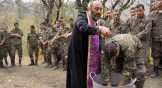
A soldier looks at the damage done to Ghazanchetsots (Holy Savior) Cathedral in Nagorno-Karabakh in October 2020.

A soldier looks at the damage done to Ghazanchetsots (Holy Savior) Cathedral in Nagorno-Karabakh in October 2020.

Alex McBride / Getty Images News

Ibrahim Baghirov died as an infant. His mother, Mary, had read in the Gospels about Jesus and Lazarus, so she prayed for God to raise her child from the dead. He did, she says. Doctors in Baku, the capital of Azerbaijan, confirmed the miracle to her, which also confirmed her fledgling faith as a Muslim-background Christian.

Two decades later, Baghirov is an emerging preacher in the church that meets in the family’s home.

But in September 2020, as Azerbaijan launched what would become a 44-day war against neighboring Armenia, Mary’s faith faltered. Having once trusted God where medicine failed, she hastily made her son an appointment for an unnecessary surgery in hopes of keeping him from conscription. He gently rebuked her.

“I will go wherever God takes me,” said Baghirov, now 26 years old. “There are ways to keep me here, but there will be no blessing in that.”

He deployed within weeks to the front lines in the snowcapped peaks of Nagorno-Karabakh, a swath of land about the size of Delaware that is encircled by present-day Azerbaijan and has been contested for centuries.

Along the way, Baghirov said he received a word from God: None of his fellow soldiers would die, and he would be their minister. His country is predominantly Muslim, and several of his comrades shunned him after his pocket New Testament fell from his backpack. Others asked questions, though, and became friends.

Azerbaijan, with a reputation as one of the most secular countries in the Muslim world, is tolerant of its long-established Christian minority community. But its long-standing animosities toward Christian Armenia are a different story.

The two countries’ generations-old dispute over Nagorno-Karabakh—a majority-Armenian territory whose modern borders were established in 1923 when Joseph Stalin made it part of Azerbaijan—has been fierce. The worst atrocities of the early 20th century killed thousands, leveling villages and leaving blood on both Armenian and Azeri hands. Relations were more neighborly for several decades, until the Soviet Union disintegrated and triggered a new round of massacres beginning in the late 1980s. Thousands were displaced from their homes as each nation purged its opposing ethnic minority, while Armenia depopulated a buffer zone around the territory to protect it from attacks.

In 1991, Nagorno-Karabakh voted for independence, and Armenia-backed forces eventually secured control of the region, dubbing it the Republic of Artsakh. (Neither Azerbaijan nor the international community has recognized Artsakh’s sovereignty.) Skirmishes between the countries smoldered for decades during a languishing peace process led by the US, France, and Russia.

But in 2020, Azerbaijan conscripted soldiers and advanced on the territory in yet another conflict. Baghirov was assigned to an artillery unit, a post that spared his tender pastoral heart from one adversity, at least: He would not engage in direct combat against the fellow Christians he and his military were slowly overtaking.

But Baghirov said he heard another word from God, another promise: Not one Armenian would die from his hand.

On the other side of the lines, shivering in the snow, fighters in an Armenian unit were also talking to God. An embedded priest from the Apostolic Church, the national church of Armenians, carried a relic of the holy cross and encouraged them as they knelt. They beseeched God for their fellow soldiers, surrounded by Azerbaijani forces and pounded by missiles and suicide drones.

“Don’t lose hope,” said Menuk Zeynalyan. “Our struggle is for our holy church and holy land.”

A married father of four, Zeynalyan left a comfortable parish among the Armenian minority in the neighboring nation of Georgia and signed up for military chaplaincy in 2019. Before the war, he led soldiers in three weekly Bible lessons. Many came from irreligious homes, raised by parents under the banner of Soviet atheism. But within two months, he said, everyone knew the catechism.

His highlight was the prayer of dedication prior to the soldier’s oath. Before swearing the secular pledge to defend the nation, Zeynalyan tied their patriotism to the Lord. After all, tradition had it that Thaddeus and Bartholomew preached the gospel in Armenia. And their country had become the world’s first officially Christian nation in the year 301, long before the Roman Empire followed suit.

Miraculously, Zeynalyan’s prayers were answered, and his beleaguered colleagues emerged from the battle unscathed. Zeynalyan said he witnessed many examples of divine intervention in 2020. He was at the Ghazanchetsots Cathedral in the city of Shusha—known to Armenians as Shushi—on October 8, when two missiles struck within five hours in an attack Human Rights Watch deemed a possible war crime.

In early December 2020—with the Armenian lines broken and at least 6,000 soldiers confirmed killed—a Russia-brokered ceasefire ended hostilities. Shusha, the crown jewel of Nagorno-Karabakh, was back under Azerbaijani control, and their military was poised to seize the regional capital of Khankendi, known to Armenians as Stepanakert.

“It was pure joy to recapture our land,” Baghirov said. “For three decades, it was a heavy burden in our hearts, and finally our people can return to their homes.”

Officially, however, it is a ceasefire and not a capitulation. Armenia maintains control over Stepanakert and about a third of the disputed territory, protected by Russian peacekeepers. And while the mood is somber in the Armenian capital of Yerevan, about five hours away, Zeynalyan keeps his faith.

“No matter how much land we lose,” the chaplain said, “we are God’s people and will remain here until the second coming of Christ.”

Christianity Today spoke with more than two dozen sources during a visit to both nations one year after the war. It’s an open question how, if at all, they will reconcile their intense differences.

But for a few Christians in Armenia and Azerbaijan, a more personal question nags. Isn’t there a unity in Christ that transcends geopolitical grievances?

And if there is, should Christians wait for their governments to make peace? Or should they start themselves, by making peace with fellow believers behind enemy lines?

For hundreds of years, the Caucasus region has been pressed between the ambitions of Russia to the north, Persia to the south, and Turkey to the west. The Armenian and Azerbaijani national identities were molded in that friction, to very different ends.

After the fall of the Soviet Union and the shuttering of Russian factories in Armenia, the majority Oriental Orthodox country struggled to develop a democracy. It slowly grew its economy and largely rid itself of Russian-era corruption during its famously peaceful Velvet Revolution in 2018.

Oil-rich Azerbaijan, on the other hand, boomed: It built pipelines to Europe, strengthened relations with the West, and secured military-grade drones from Turkey and Israel, despite being panned by international watchdogs as a human rights–violating autocracy.

All the while, Armenians and Azeris kept a wary eye on one another.

Consider Nune Balayan, an Armenian speech therapist and mother of three. Her family was displaced from Shushi after more than 10 generations in the area. She once lived in a three-story home. Now her family huddles around a stove furnace in a lower-class neighborhood of Yerevan.

“Azerbaijanis have good masks and show themselves very nice, but they are vandals from the day of their birth,” she said. “I don’t believe the words about coexistence and peace—they have so many lies.”

Azerbaijan’s president, Ilham Aliyev, has consistently spoken of his desire to integrate Nagorno-Karabakh and its Armenian citizens into his nation’s economy and society. His administration says Armenia should return the part of the territory it’s still holding onto, then prosper in good relations.

But Balayan is not buying it. For one, she worries about Aliyev’s close alliance with Turkey, the Muslim powerhouse on Armenia’s other border that perpetuated a genocide against her people a century ago. Turkey’s president, Recep Tayyip Erdoğan, disputes this event as civil conflict and “reasonable” deportations.

Then there is the rhetoric closer to home. During Azerbaijan’s campaign against COVID-19, it issued a postage stamp in which a HAZMAT-suited figure resembling an exterminator sprayed the region of Nagorno-Karabakh, paired with a soldier. And until it was removed last October following Armenia’s lodging of a lawsuit at the International Court of Justice, a “war trophies” park in Baku displayed the helmets of dead soldiers and caricatured mannequins of captured Armenians.

For people like Balayan, it echoes horrific childhood memories from when Soviet Azerbaijan controlled Shushi. She says her math teacher was decapitated by Azeris when he went into the forest to retrieve his goat. She says an Azeri godfather to an Armenian child later murdered the boy. And after Azeris were driven from her family’s village, she says Armenian residents discovered a kill list in the cabinet of the local Azeri doctor.

As for Armenia’s recent loss, Balayan believes it is ultimately due to the nation’s present-day aping of Western culture. “God is disciplining us for going away from him,” she said. “Armenia doesn’t have friends, so our strength has to come from him.”

Balayan’s people weren’t the only ones driven from their homes, though. So was Salman Babayev. Two decades ago, he and his Azeri family fled the town of Agdam near Nagorno-Karabakh. Now they live in one of the “little Karabakh” refugee ghettos in Baku, which lies on the Black Sea coast. His country is back in control of his village, laboring to remove land mines and rebuild infrastructure, and Babayev is one of tens of thousands of people planning to return to the region.

He recalls things differently from when he lived in the contested region.

“Our Armenian neighbors cried when we parted,” he said. “‘Why did they destroy our land?’ they lamented. ‘We were living here together, peacefully.’”

He pointed to the injustices his own people have suffered, injustices others have documented in photographs. Faig Hajiyev, a tour guide in Agdam, shows visitors the local mosque. Unlike the surrounding city, it is still standing, but sullied: He points out bullet holes in its prayer niche and shows pictures of cows roaming inside.

“As a person, not even as a Muslim, this is offensive,” he said. “But Azerbaijan is a very tolerant country. We are ready to open a new page in the book.

Emil Panahov is the kind of man who might be able to help open that new page. The founder of the Vineyard Church in Azerbaijan, he’s seen the best and the worst of what people will do in the name of faith.

He became a Christian in 1989 at the age of 12, thanks to the influence of a small Baptist church in Baku. His communist father slapped him for it, but he kept going to church every week.

Then came the first war in Nagorno-Karabakh, in the 1990s. In and around the region, an estimated 30,000 people were killed in interethnic fighting, and 1 million people were displaced—700,000 of them Azerbaijanis.

The displaced who arrived in Baku spoke of Armenian soldiers with crosses on their uniforms who carved the crucifix into the bodies of the dead.

“Back in those days, the accent was on the religiosity of the war, fighting against the Christian states,” he said. “It was political baloney, but my family didn’t want people to think I had become an Armenian.”

Panahov’s parents locked him in his room on Sundays. But he climbed down a vine from his third-story window and made it to church anyway.

He never forgot what his people suffered. Panahov’s church, which includes 16 cell groups and 350 total members, stepped up when the second war came in 2020. With permission from the government, his congregation distributed care packages—and Bibles—to deployed soldiers. Later, they visited bereaved families and those whose homes were destroyed by Armenian missile fire.

On the Armenian side of the conflict, firsthand exposure to suffering in the war zone also changed a leader in Armenia’s charismatic movement. The pastor, who requested anonymity, visited Agdam years ago when his son was stationed there as a soldier. He recalled good relations with his Azeri neighbors in Yerevan, and his understanding back then was that the ring of buffer zones around Nagorno-Karabakh, like the one his son was guarding, would eventually be handed back to Azerbaijan in negotiations for the independence of Artsakh.

But the sight of Agdam, a ghost town turned to rubble, unnerved him.

“I realized something was wrong, that we have to admit our wrongdoing,” he said. “But it’s kind of fair, isn’t it? We feel now what they felt then.”

“If we hate, hurt, and demonize each other at the personal level, nations will do it also.” —Harout Nercessian

Leading a church network that claims hundreds of members in four locations, with another four in development (including Artsakh), he said he is “planting seeds of peace and reconciliation” among his people quietly, warning of nationalism and preparing them to give back what isn’t theirs. But he doesn’t often say so in public; it’s very sensitive.

Vazgen Zohrabyan, pastor of Abovyan City Church northeast of Yerevan, also harbors concerns about his people’s attitudes toward Azerbaijan. His congregation of 300 fed 12,000 displaced families during the most recent war.

“I cannot say sorry on behalf of my nation, but we have to face the reality that we made much harm to Azerbaijani civilians,” he said. “Extremists on both sides convinced us that we cannot live together.”

Zohrabyan, who has a master’s degree in political science from Yerevan State University, has plenty of criticisms for the other side. He wishes that Azerbaijan’s president Aliyev would speak to Armenians the way he speaks to the Western press. Instead, the propaganda they hear calls Armenians “dogs” and “rats” and undoes the tolerant perception Azerbaijan likes to maintain internationally.

But Zohrabyan feels there is reason to hope. Azerbaijan’s cozy relationship with Turkey, for instance, may not be as menacing as Armenians fear. Turkey is more than the genocide, Zohrabyan reminds his congregation—carefully. He says they don’t have to be enemies: For centuries Armenians lived peacefully with Turks, until World War I–era political meddling by Russia sparked accusations of betrayal.

Abovyan City Church, in fact, has played a role in a quiet but burgeoning movement of reconciliation, bringing Turkish believers into fellowship with Armenian evangelicals.

And the two nations exchanged envoys in December to explore a path toward normalized relations. Negotiations have so far led to the February resumption of charter flights between Yerevan and Istanbul for the first time in two years.

“We will be in heaven one day, and I will sit next to my brothers from Armenia.” —Emil Panahov

But can the spiritual bridge-building with Turks be replicated to unite Armenians and Azerbaijanis? Some pastors are trying. One told CT about holding Zoom meetings between Armenian and Azerbaijani believers during the war. Others mentioned interactions at international evangelical conferences prior to the 2020 war, with mixed emotions.

During a time of sharing at the podium, Zohrabyan recalled that at a meeting in Georgia, a group of Azerbaijani pastors delivered an accusatory statement about Nagorno-Karabakh.

“Their behavior was awful,” Zohrabyan said. “When they heard I was Armenian, they changed the table where they were eating and moved away.”

Armenian church leaders have engaged in their own political theater, said Panahov, the Vineyard pastor in Azerbaijan. He remembers a conference he was attending in South Korea, where he says an Armenian pastor stepped to the podium, misrepresented photos of modern Armenian atrocities as the genocide, and asked Turkish believers to stand and apologize.

Panahov was aghast. He had hoped at this conference to extend his hand to fellow pastors across the border, and he felt rejected.

“It has become hard to preach the gospel in Azerbaijan,” he told the assembly after asking those from Armenia to stand. “Because the policy of your country is unchristian.”

His words made a difference. Three pastors came up to him afterward and apologized, offering to wash his feet as they cried together.

Panahov says he longs for this kind of restoration. “I don’t want people to fight over land; I want them to fight spiritual battles,” he said. “In any case, we will be in heaven one day, and I will sit next to my brothers from Armenia.”

While Panahov backs the justness of the Azerbaijani cause, he regrets his government used “the violence of the weapon” to take back the land. Ultimately, he said, it belongs to neither nation, but to God.

But the 2020 conflict did have one very positive consequence in his eyes: “It was open season for the gospel.”

To counter Armenian appeals that the conflict was a religious war, Azerbaijan sought to leverage its small Christian population. Early on, the government engaged the Bible Society of Azerbaijan to gather Christian leaders to write an open letter in support of the cause. It included signatures from 22 evangelical pastors. Panahov was one of them.

Historically, Christianity was restricted mostly to the country’s ethnic Russian and Russian Orthodox communities. But now, according to Samir Sadigov, general secretary of the Baptist Union, the Azerbaijani government mostly leaves evangelical converts alone. Today his denomination counts about 2,000 believers meeting in three buildings and 22 house churches.

Sadigov also supported the open letter when the government contacted him, since Armenia was making Azerbaijan out to be “a wild Muslim country.” The truth couldn’t be more different, he said, and it demanded his signature. Sadigov noted, for instance, that following the death of a Baptist pastor from COVID-19, authorities are now working with him to establish Azerbaijan’s first Protestant cemetery.

“Once, there was some sort of spiritual power behind the government that didn’t want Christianity to spread in Azerbaijan,” said Rasim Khalilov, director of the Bible Society. “Now they understand that Christians are not bad, and appeal to them.”

The Soviets branded evangelicals as sectarian, but local authorities began to warm to such believers in 2005, Khalilov noted. And for the past few years, the society has distributed 5,500 scriptures among the approximately 150,000 Christians in Azerbaijan, including citizens of Russian ethnicity. He estimates 20,000 of these are evangelicals. All materials except the full Bible are printed locally, with translations in Azerbaijani, Russian, Hebrew, Udi—a minority Christian group tracing back to the ancient Caucasian Albanian people—and two other local languages.

“The most important thing is that both government and people understand that Azeris can be Christians,” he said, “and the state has played a very positive role.”

This includes Muslim authorities, who engage the Bible society in dialogue.

“Maybe you internally think about why he or she became a Christian,” said Salman Musayev, vice chairman of the Board of Caucasus Muslims, the official Islamic entity in Azerbaijan. “But no one can influence or punish [a person] for choosing a different belief.”

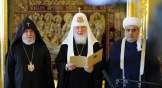
Last October, Musayev participated in an 18th round of negotiations with Armenia’s Apostolic Church that were aimed at settling some of the two nation’s differences. Much of the discussion centered on the preservation of religious heritage sites now under Azerbaijani control, such as the fifth-century Dadivank Monastery.

Other sites have changed hands also, and the Azerbaijani government has since formed a committee to document alleged inscriptions of what it calls “Armenian forgeries.” (Musayev and other Azerbaijani historians claim many of these structures predate the Apostolic Church in this area and are therefore not Armenian at all, a position rejected by mainstream scholarship.)

But if reconciliation depends on each side confessing its role in the conflict, true peace may take long to arrive.

“What should we apologize for? What wrong have we done?” Musayev asked. “They occupied our land for 30 years and kept pigs in our mosque.”

Vahram Melikyan, director of the Apostolic pontifical office, was slightly more inclined. It is “painful” to consider what happened to buffer zone refugees, he said, but the reason for the conflict was the slaughter of Armenians in their historic enclave, the rootedness of which Azerbaijan continues to deny. And last April, Aliyev’s irredentist rhetoric spread further, calling Yerevan and Armenia’s southern provinces “historic Azerbaijani land.”

“They are trying to take our identity from us,” Melikyan said. “But if we fail to preserve our land, history will erase us as it has done to other peoples.”

Christian leaders on both sides of the conflict believe God supports the justness of their cause. Harout Nercessian, who works with the Armenian Missionary Association of America and is based in Yerevan, says some Armenian evangelical pastors went for military training but were never deployed. But spiritual work must also be part of the resolution.

“We have to come to grips with Jesus’ command to love your enemies,” Nercessian said. “And the best way of loving our enemy is to work towards a negotiated peace, based on justice.”

But it also means identifying the right enemy—Aliyev and his corrupt regime, and not the Azerbaijanis.

Christians should pray for Armenian and Azeri mothers who lost their sons, and for all the orphans who lost their fathers. War, Nercessian said—before shifting his language to “sin”—does this to people.

“If we hate, hurt, and demonize each other at the personal level,” he said, “nations will do it also.”

Love, however, does not give away rights. While he can envision a future where Armenians and Azeris live again as neighbors, in the meantime he’s wary of Armenia trading Nagorno-Karabakh’s sovereignty in exchange for peace. From the genocide to the recent war, there is too much history of mistrust.

Peace could come through conversion to Christianity, Nercessian said, which evangelicals have prayed for. (Some say, tongue in cheek, that it would be the best revenge.) Armenians have been slow to act on this mandate, but Nercessian thinks it is why God placed them in the Caucasus. Surrounded by Muslim nations, they must be the gospel light.

But with or without them, God is working.

Across the border in Baku, Baghirov returned from the war a shell of his former self. Traumatized, he shut down completely. For two months, his sister said, he wasn’t able to share in the church that gathered in his home. He had witnessed death all around him. And despite the promise he heard from God about protecting his Armenian enemies from his weaponry, Baghirov couldn’t stomach the fear that he might have killed a human being.

With time and prayer, however, God revived his soul. A year later, on a Sunday when CT visited the fellowship, it had grown to about 50 members. The family marveled at how powerfully their miracle baby was now preaching. One visitor to the home group gave his life to Jesus.

And on this day, a third generation of believers was present: Baghirov participated in a baby dedication. The infant’s father was a former Muslim radical—drawn, they said, to the love he witnessed in their fellowship.

Jayson Casper is Middle East correspondent for Christianity Today.

Cover Story

Wait, You’re Not Deconstructing?

What’s behind the exvangelical trend isn’t new. But it sheds new light on theology.

Illustration by Sarah Gordon

Thomas Aquinas was a theologian’s theologian. His writings comprise more than ten million words, which he wrote at a feverish pace, standing at a desk. He synthesized not only Christian teaching on doctrine but also the broader questions regarding how Christians ought to think about God. Aquinas was also the first theologian I studied.

Until I started graduate school in theology, my faith was simply part of the furniture of my world. It was familiar and somewhat ordinary, its ability to hold me when I put my weight upon it largely unquestioned. It wasn’t that I was afraid to ask difficult questions. God had been the one I went to with my concerns, my loneliness, my existential need. To treat God as the object of study, entirely separate from this kind of piety, did not come naturally to me.

So I found myself quite unprepared to actually study theology once I embarked upon it formally. Truth be told, systematic theology felt too abstract and unemotional when I first encountered it. The earnest love that motivated my study needed to be bracketed for a time—but that earnest love was nearly all I had!

Systematic theology is a world of precision and definitions. But it can feel at first that the discourse betrays much of what motivates the practice of faith.

My desire to study was led by a kind of earnest commitment that, in my experience, was rare in graduate schools, which often seemed given to rancorous turf wars. Of course I believed in God, and in Jesus Christ his only Son. It was not the articles of the faith that I needed to question at the time; it was what it meant to say, “I believe.”

I had a conversion of sorts, both to theology and to its method, when I read Aquinas’s Summa Theologica. I had never had to read anything so slowly.

The Summa Theologica employs dialectical reasoning, which uses the rules of logic to compare competing positions and clarify which position is true. This form of scholastic theology can read like a game. The structure of each argument offers an assertion that seems at first glance credible. Aquinas then reverses course and offers an “on the contrary.”

I would often swallow Aquinas’s initial statement, assuming he’d told me the truth since he tended to give a Bible verse alongside, and his reversals would humble me. I used to wish for easier answers.

Truth about God isn’t always easy, however. Faith that begins in earnest commitment sometimes must advance through a period of slow questioning, of confusion, of switchbacks and labored ascent.

For Aquinas, the claim that God, unlike us, exists without any contingencies, has massive ramifications, especially for how we learn about God. Because God is infinite, what could be known about God also is infinite. But there is also much that we can never learn. Finite creatures cannot have infinite knowledge—this is a logical claim. This is not to say our knowledge of God is deficient; it is simply incomplete.

Take the example of a lizard. A scientist could, given enough time and resources, study this lizard so that she learns all about its biology, systems, history, and habitat. Eventually, this scientist could reasonably say that she knows all there is to know about lizards.

Now some things she may never know. It is difficult, for instance, to judge lizard cognition. But we can know a lizard, or any other creature, as far as it can be known. God cannot be known nearly as well as a lizard can. This is because of what kind of being God is.

Jesus was clear that “this is eternal life: that they know you, the only true God, and Jesus Christ” (John 17:3). So I wasn’t thrilled when I first learned that my knowledge of God would always be incomplete.

I felt, for a time, unmoored. Like many seminary students, I had been praying for years to a God who I had pictured as being just like me, only larger, through difficult days of uncertainty and loneliness. I loved that God and know that he loves me.

Rather than only feeling closer to the God I loved, I learned that there was a clear limit to what I could know. I would need to learn to love God in the dark.

What happened during those early years of my academic study of theology was a kind of deconstruction. More properly, it was a correction. To be disabused of my sense of having comprehended God, initially a worry, has over time become a kind of balm.

That’s because I now better understand what it is to understand. There is a difference between what we do not know, due to our earthly limitations or lack of intellect or experience, and what we cannot know, due to the constraints of human knowledge. Many of our theological problems arise from our inability to tell the difference.

Of course, there is much that grants us certainty while remaining beyond our understanding. (It is precisely because God is “beyond” the natural world and its limitations that makes God able to achieve supernatural ends!). Hebrews 11:1 lays this out when it defines faith as being “confidence in what we hope for and assurance about what we do not see.”

A certain faith does not allow us to hold the incommensurable in the palm of our hand. It is the space between who God is and what we can know of God where faith resides.

I’ve often wished I could communicate this distinction to the unruly apologists who seek first of all to “prove” the Christian faith in order to move others to belief. Such enterprises often speak of God as if God were a lizard, as if we could trace the outlines of God’s existence and predict his behavior.

But to treat God as only an object of study is to make a fatal error. We have to temper our expectations about what it is we can know about God.

The apostle Paul tells us this in 1 Corinthians 13:12: “For now we see through a glass, darkly; but then face to face: now I know in part; but then shall I know even as also I am known” (KJV). So complete comprehension must wait. But we must still deal with our inaccurate pictures of God. The way I dealt with mine might be called deconstruction.

There is much concern as of late about those who are “deconstructing” their faith. The language of deconstruction borrows from literary theorists, especially Michel Foucault and Jacques Derrida, whose insights, though sometimes illuminating, are in rather frequent tension with the Christian faith.

The language of “deconstructing one’s faith” shares the idea that true knowledge delves beneath simple affirmations, asking what social commitments, political assumptions, and gender politics might reinforce what appear to be otherwise straightforward assertions.

It is, judging by my Instagram feed, quite popular to identify as “deconstructing” one’s faith. Individuals note that they are deconstructing as if they were heading out to get a haircut or waiting for a load of laundry to dry.

Some equate deconstruction with a “falling away,” either in search of a faith other than Christianity or simply to try to live as if God weren’t there. In this way, deconstruction can be seen as a very real threat to Christian belief.

It is tempting to treat deconstruction as only an arrogant endeavor, but there are many and varied reasons individuals might want to revisit their Christian practice and belief. Most have to do with doubt about the trustworthiness of former beliefs—and that’s not always bad, nor is it always leaving a good faith for a worse one.

Some might find their trust undermined after they experience abusive leadership or mishandled issues of personal integrity. When an organization fails to wisely shepherd and protect those in its care, doubt about the church’s trustworthiness can bleed over into doubt about the church’s teaching.

Some Christians undergo a period of deconstruction when they hold church teaching up against the lived experience of friends and loved ones and see that it will make them odd. They won’t fit in politically or socially. A form of deconstruction can show whether our peculiarities flow from what God has asked of us or whether they’re an attempt to maintain an image—for example, an old-timey agrarian identity.

In other cases of deconstruction, a person might come to doubt the trustworthiness of the mental picture they once held of God. One might, for instance, reconsider the assumption that God is a grandfatherly Santa Claus type who grants our requests in the form of good outcomes.

Some things about this picture are indeed true: God is a Father who is a giver of good gifts (Matt. 7:11) to whom we should bring our requests (Phil. 4:6). And yet other aspects—the idea that giving things (or refusing to give them) is our chief engagement with God, the assumption that God responds in time in the way a human would—could benefit from reconsideration.

Such reconsideration often does cause pain. I have many times sat with students who needed to process the loss of the picture of God they’ve been praying to for years.

One, for instance, always imagined God looking like her grandfather. Though he was a lovely guy, a rather jolly sort, this student realized that she had projected her grandfather’s weaknesses—his short temper and biting wit—onto God as well. She needed to chip away at her mental picture, to see what was true that remained. A false picture can be replaced with a true picture, but the goal here is to move beyond pictures. A human picture of God can never be more than an idol.

Though language of deconstruction is thrown around somewhat sloppily and encompasses the many experiences above (or just serves as a kind of brand identity), it does have a connection with the work of theology.

The earliest Christian theologians spoke of our knowledge of God as only partial. The early philosopher Pseudo-Dionysius urges those who seek knowledge of God to

leave behind everything perceived and understood, all that is not and all that is, and, with your understanding laid aside, to strive upward as much as you can toward union with him who is beyond all being and knowledge.

Individuals who do so, Dionysius wrote, possess a modesty that puts them in opposition to “the uninformed,” those “who think that by their own intellectual resources they can have a direct knowledge of him who has made the shadows his hiding place.”

To recognize that our knowledge is only human, and that God dwells beyond it, might be to glimpse God for the very first time.

It is, after all, love of God that is the goal of all Christian study of theology. This might mean that some do not reach certainty but actually leave it behind. In learning about God, we often recognize that God is, as Aquinas also wrote, incomprehensible because he is far, far greater than we could ever know completely. But this recognition leads the mind to a kind of darkness, what Pseudo-Dionysius described as a “darkness of unknowing” that is greater than light.

To move from knowing God with simplistic certainty in the light to knowing God in the darkness beyond my comprehension required a major shift in my faith, even in my prayer life. Instead of resting on knowledge, I had to trust that God is good, even when I could not make much sense of that statement. I had to love God beyond what I could know of him. I was able to move from simple faith to trusting God in the dark to loving God as he dwells in inaccessible light.

Deconstruction should be the task of articulating this difference between what we can know and where we must simply trust. There is a distinction that must be made between what we do not know due to a lack of study or training and what we cannot know due to the categorical difference between what God is and what we are.

The process should dismantle certainty where it is not proper. But that does not mean faith will be dismantled; Christian belief is not vested in the intellectual ability of the Christian but in the steadfastness of God.

Deconstruction can fail. One reason it fails is because well-trained guides aren’t included in the process. Many assume they are discovering new problems with the Christian faith. (If I had a dollar for every young “deconstructor” who discovered the problem of evil for the first time, I could fill a library on the topic.)

Without a guide who knows something about the terrain of the Christian tradition, about its tensions and perennial questions and the places where good answers are hard to come by, a naive questioner may feel that they have exhausted the Christian faith, that its tradition cannot hold their questions, that they have moved beyond it.

A good guide also knows when to say, “We cannot fully know”—that is, when to remind her students that God is not like a lizard. Doing so avoids another error of deconstruction: demanding certainty at the expense of trust. Even our very best theological lectures will remain human, and therefore finite, incomplete, and prone to error. At the end of one’s learning about God comes a point where trust is required.

The goal of theological training is to trust in the dark what you have learned in the light, to come to know in part the God who will only be fully known in the life to come.

Many Christians have learned to put knowledge before love, along with the idea that we must understand God before we can love him. But putting love before certainty allows us to know that we are loving God and not simply our own intellectual efforts.

If there is a biblical guide for such efforts, I like to think it is Jacob wrestling at the Jabbok. This story is baffling. For one, it is not clear who exactly Jacob was wrestling with. We are told it was “a man” (Gen. 32:24), but before the night was over, Jacob came to understand his opponent was God. We are also not told why they were wrestling.

But Jacob was blessed for his struggle and given a new name as a sign of this blessing. God changed his name to Israel, “because you have struggled with God and with humans and have overcome” (v. 28). It is notable, however, that though Jacob’s struggle that night was rewarded, no one must struggle with God and deconstruct their beliefs in order to reach a true relationship with God.

Revelation of the truth about God is not merit-based. It is scattered liberally on those who do not seek it out or even want it particularly much. For example, the Samaritan woman at the well in John 4 just happens upon the Christ, the Son of the living God. We are told that God reveals himself to children but not to the learned (Matt. 11:25).

On the other hand, those who were closest to Jesus sometimes did not see his divine identity.

We theologians—perhaps by temperament, perhaps for job security—tend to overvalue our profession. Many Christians have little need of us, able to believe in God and trust his goodness without our assistance.

There are moments, however, where we, like firefighters or rescue divers, have skills that are valuable. During this time, theologians can be especially helpful in disentangling the accretions of culture, history, and personality on our beliefs about God.

Deconstruction, by which I mean the struggle to correct or deepen naive belief, is a significant part of learning theology. Christians should engage in the task to move beyond simplistic conceptions to belief in a God who is vaster than they can comprehend.

Much of the evangelical movement has capitalized on a theological simplicity that has not always served Christians well. Evangelicalism could use the work of theologians to remove some of the obstacles and clear away cultural concepts that mask God’s holiness.

If we saw Elijah, Moses, and Christ as Peter, James, and John saw them during the Transfiguration in Mark 9—as they are now instead of how they’d appeared to people previously—we would travel through sight to that cloud of unknowing. Our pens would still, our questions silenced, our mouths agape. We would see at once what had always been but had only been hidden: God the Word.

Deconstruction can be this stammering, this open-mouthed wonder, when you realize that God is far greater than you’d known. It can be as simple as another scene in Mark 9, where a man cries out, “I do believe; help me overcome my unbelief!” (v. 24).

Aquinas said he encountered a vision of this kind near the end of his life. “All my work is like straw,” he responded. He put down his pen. He had reached that place where silence trumps speech, where millions of words are silenced in the presence of the one who is God the Word.

After such an encounter, Aquinas stopped writing. After his encounter, Jacob walked with a limp. In a way, I have walked with my own limp ever since I learned that God differs differently. I have learned to trust where I cannot see, to hope beyond what I can know for sure. I have learned to love God in the dark.

Kirsten Sanders is founder of the Kinisi Theology Collective, a public theology project that seeks to bring trained theologians to people who want to grow in their knowledge and love of God. She has degrees from Duke Divinity School and Emory University.

Church Life

The Church Is Losing Its Gray Heads

Why are boomers and Gen X dropping out of church at higher rates than younger Christians?

Illustration by Jared Boggess

Robrenna Redl isn’t the kind of person many pastors would expect to stop attending church. The Lincoln, Nebraska, resident still wants to be a faithful Christian. She has a long history of involvement with church ministries. And she’s older than 40.

Redl came to know Jesus in her 30s, and for the years that followed, she was a model member of a conservative nondenominational church.

“I was very involved as a Sunday school teacher for elementary for seven years and for middle school for six or seven years,” she said. She served on the women’s ministry leadership team and worked for the church for five years. She was, by every description, a faithful member.

But in 2018, after 17 years of service, she walked away.

Redl is not alone. Patterns in church attendance show that people over 40—that is, Gen X and baby boomers—are at least as likely to stop attending church as millennials and Gen Z.

There was a time when pastors would look down from the pulpit at the gray-haired congregants sitting in the pews and consider them safe bets. These were the people whose faithfulness they didn’t worry about.

“People took it for granted,” said Ryan Burge, a pastor and researcher, that “the Golden Girls are not leaving. They’re going to be there every Sunday no matter what.”

But according to Barna, some of the biggest declines in church attendance over the past three decades have been among adults 55 and older. “We can’t just blame the young people for the drop in church attendance,” said Savannah Kimberlin, Barna’s director of research solutions.

People are leaving church from all age groups, and older generations are no exception. According to Burge, “There is no birth cohort that is more religious today than it was 12 years ago.”

Barna found that the percentage of people reporting weekly church attendance in America between 1993 and prepandemic 2020 reached a high of 48 percent in 2009 then plummeted to 29 percent in 2020.

That’s partly because an increasing number of Americans never attend church as adults. Millennials and Gen Z, who are 38 or younger in 2022, are statistically less religious than their parents and grandparents were at the same ages.

But that’s a different issue than church dropout, in which people who had been part of a church stop participating.

In 2009, 46 percent of boomers and 44 percent of Gen X said they went to church every week. Before the COVID-19 outbreak in 2020, those rates had dropped by nearly a third to 32 percent and 29 percent. (By comparison, millennial church participation dropped by roughly 22 percent during the same period, with roughly a quarter attending weekly in 2020.)

Lifeway Research reports that as the coronavirus pandemic continues, almost all churches have been meeting in person since August 2021, and most prepandemic churchgoers have returned.

However, Burge finds in US government data that in the past few years, adults between 55 and 64 are reporting significantly reduced church attendance, lowering their attendance by 10 percentage points. These older adults are not fitting the pattern of other generations, who report similar rates of church attendance in 2018 and 2021. This may mean that churches will soon notice the drop in their older attendees, even if the pattern isn’t clear yet.

The data challenge some long-held beliefs about older church attendees, Burge writes in a new book, 20 Myths about Religion and Politics in America. One of them is what he calls the “life cycle effect,” the idea that people raised in the church might drift away when they get their independence after high school but will return to the church to raise their children. When their children leave the nest, some of these parents make their exit from the church, but most will stay.

As logical as this theory may sound, it hasn’t described Americans’ behavior since the baby boomers were emerging adults, Burge argues. “The data is pretty clear,” he said. “The life cycle effect doesn’t really work anymore.” When people stop attending church these days, their pastors can’t expect them to return.

In December 2017, Pew Research Center surveyed Americans about their reasons for not going to religious services. The responses from Christians showed a clear generation gap.

Among those over 65 who didn’t attend church, 45 percent said they don’t go to church because “I practice my faith in other ways.” About the same proportion of people between 50 and 64 said the same. In other words, just under half of Christians over 40 who stop attending church feel they’re still practicing their faith.

It was a different story among younger adults. Only about a quarter of 18- to 29-year-olds said they don’t go to church because they practice their faith in other ways.

David Landow pastors Emmanuel Presbyterian Church in Wilmington, Delaware. He has found that those who leave tend to fall into two groups: those who “fade away” and those who “break away.”

The “fade away” group includes people he knows who have entered retirement communities and drifted out of regular attendance. “They’re not apostatizing,” Landow said. “Church just doesn’t seem to hold a priority.” He believes that’s true of a lot of older adults who are leaving the church.

Nate Phillips pastors Kirk in the Hills, a Presbyterian (USA) church in Michigan, and has witnessed the trend of older adults leaving church. He says when congregants aren’t satisfied, they look for better uses of their time than serving on church committees.

Phillips had a conversation recently with one of his middle-aged members who had left. “I love you. I love the people there,” the man explained. “But quite frankly, I’m getting everything I get at church in my soccer club.”

In the Pew survey about quitting church, less than a third (28%) of Christians over 65 who don’t attend church said they stopped because of dislike for the church. This group selected statements such as “I haven’t found a church I like,” “I don’t like the sermons,” and “I don’t feel welcome.”

Most boomers “are not getting hung up on the negative reputation of the church,” Kimberlin said. But younger Christians are more critical.

Roughly 38 percent of 50- to 64-year-olds and of 18- to 29-year-olds said they didn’t attend church because of some form of dislike. Landow calls this the “break away group.” “It’s a midlife crisis of sorts,” he says.

The Pew survey results fit with other research findings. Kimberlin says Gen Z and millennials are more likely than older Christians to view the church as judgmental and have a less overall positive view of its role in a community.

Josh Laxton, assistant director of the Billy Graham Center at Wheaton College, believes the exodus from church pews has been fueled by a variety of factors. Some are leaving because the church’s views don’t line up with their personal ones. Others find that amplified tensions over issues such as politics and social justice have made church uncomfortable for them.

Josh Baker is a professor at East Tennesee State University and editor of Sociology of Religion. Baker has found that the main difference between those leaving and staying in churches is political affiliation. Those who identify as Independent or Democrat politically are most likely to stop attending church and pursue their faith privately, he says.

However, Burge said, people rarely quit church for dramatic reasons like scandal or abuse. “The reality is that most people leave for very practical reasons,” he said. They could move, or life becomes busy and church is not as convenient as it once was.“Some people can’t even articulate why they left in a coherent way. They just did.”

Of course, some people can point to a specific reason for leaving. For Redl, it was a shift she saw in the church she had been attending. “The church became increasingly antagonistic towards ‘others,’ not attuned to the fact that I am the other,” said Redl, who is Black and has two biracial children.

She said the church also began to display an alignment with extreme-right politics and handled addressing sexual abuse in the church poorly.

While she didn’t feel comfortable in the church she left, Redl hasn’t been able to find the right fit anywhere else, either. “Since leaving, I’ve struggled with returning to church,” she said. “I tried to go to the church my young adult children attended, but it’s a bit too young and hipster for me.”

She’s tried a few informal gatherings and worshiped at a church on Zoom, but she hasn’t formally joined any. “I’m struggling to find my footing due to my mistrust of Christians in groups,” she said. “I’m able to sit in one-on-one conversations, but groups are complicated for me.”

Phillips worries about the spiritual impact that exits like Redl’s have on not only those leaving but also on those caught up in the ripples of their departures.

“Right now the world is just all twisted, and we’ve lost our moment,” Phillips said. “At the very minimum, we used to offer a moral compass,” but now he says Americans no longer look to the church for that.

“I think people are looking for meaning and the infinite and a connection with the great story,” he said. In church services and activities, “sometimes we catch them up in a lot of the finite.”

Still, people who perceive church as a place to hear uplifting sermons or to get moral calibration might point out the convenience of listening to recorded messages and songs. Such activities might be why many older church dropouts believe they are still practicing their faith, still learning, still worshiping.

However, the idea that the church “box” can be checked without meeting with other believers is contradicted in the Bible. Hebrews 10:24–25 tells Christians to meet as a part of a deliberate effort to encourage each other. People do not stop needing church once they become mature believers.

Laxton knows the Bible is full of injunctions to meet with other believers. People don’t stop needing each other, needing a place to belong, just because they can download podcasts. He points out that if people don’t make church a priority, life offers no shortage of activities to lure them away.

While commitments such as childcare (for children or grandchildren), work, and life’s other demands can keep some people over 40 away, Laxton notes that weekends spent traveling in retirement also disrupt regular church attendance.

The reasons for US church dropout are unlikely to lie in changes to what churches say about their own value, Baker says, since his research hasn’t turned up alterations in church teachings on the importance of meeting in person. He points instead to the emergence of other ways to hear sermons or worship music.

Scott McConnell, executive director of Lifeway Research, says life events can often trigger a change in church attendance. In younger adults, it may be going to college, but in later years, moving to a new city or reaching the empty nest stage can be equally disruptive. Even if the life cycle theory doesn’t apply, life events are still transition points, and they can make church participation feel like more of a hassle or less worthwhile.

Landow believes many of those who become disenchanted with Christianity do so when their lives don’t live up to their expectations. “Maybe their marriage is not what they thought it would be, or raising kids is not as fulfilling as they thought it would be,” he said.

It can seem in those times that their faith was founded on a false bill of goods. Landow has worked with numerous people who viewed their Christian walk as a list of milestones: graduate, get married, have children. But once those are checked off—or if the possibility of such a sequence of events expires—they’re left at a crossroads. They don’t see what discipleship means beyond those milestones.

In recent years, Landow has also seen the spiritual turmoil that parents experience when their kids walk away from the faith. If parents aren’t firmly grounded themselves, the struggle can pull them away, too. Some feel like they are choosing between faith and family.

“If your faith is running on self-produced fumes, you kind of run out of gas,” Landow said.

“If they’re not seeing the value themselves in their own faith, that becomes a decision point for them,” McConnell said. He believes that’s why it’s important for churches to consider all age groups as at risk of leaving.

“As people age, they tend to become more spiritually mature, but that doesn’t remove the risk or likelihood that they could go astray or no longer want to be practicing with other believers.”

If church leadership and members keep that in mind and reach out to those who haven’t been at church in a while to see what they’re struggling with and let them know they’re valued, McConnell said it can help push back against the trends.

Landow believes it’s important that churches be careful not to offer a false sense that the Christian life will be a smooth series of accomplishments.

“The Christian life is not easy, and it’s not a promise that if you go through these steps, you’ll be fulfilled,” Landow said. “Christianity is about longing for the kingdom to come. We’ve made it too much about what we long for now.”

Pastor Kate Murphy of The Grove in Charlotte, North Carolina, has pastored a church that was dying. She’s seen people leave and, more often than not, it was over personal preferences. But God used other people in her life to cause her to think more deeply.

“It was so easy to sit inside the sanctuary and think about the people who were choosing to go to brunch or choosing to mow their lawns on Sunday morning or choosing to sign their kids up for a sports league that played on Sunday morning,” Murphy said. “It was so easy to look at those choices and think, ‘Well, those people don’t think as deeply as we do. They don’t care as deeply as we do. They don’t take God as seriously as we do.’ ”

But in the end, she realized that her church wasn’t meeting people’s spiritual needs.

“When people come looking for spiritual transformation and looking for tools that make life in this broken world bearable, we don’t have them. And so people walk away,” Murphy said.

She believes the solution is for leaders and congregants to repent, acknowledge there is something wrong, and admit that those within the church have contributed to the problem. The Holy Spirit is still drawing, and people still have spiritual needs that they long to have filled.

“I think some of us inside the church have forgotten how transformative and life-changing and how inherently and intrinsically good the gospel is,” Murphy said. “If we get back to that, I think we’ll see that God is faithful.”

Kimberlin, for her part, hopes Barna’s research can help church leaders think about how to strengthen their congregations and minister to older generations.

“Are you making sure that your older generations have a place in your church? I think the fact that they have been faithful church attenders their whole life and now they’re walking away from church in their 50s and 60s really says something that they’re feeling very deeply about belonging or value.”

Burge believes churches have a great opportunity and a great risk before them. “To ignore the older people is to ignore them at your peril,” he said.

But it’s not just about churches’ ability to keep running as before. As Lifeway’s McConnell says, “Every generation matters to God and should matter to the church.”

Adam MacInnis is a reporter in Canada and a regular CT contributor.

Testimony

I Left the New Age Behind When I Read the Old Testament

My books and courses brought fame and fortune. Now I’m begging people to ignore what I taught.

Mike Kane

As recently as five years ago, I was the world’s top-selling New Age author. At the time, I enjoyed a phenomenally lucrative lifestyle. I lived on a 50-acre ranch in Hawaii. My publisher treated me like a rock star, flying me and my husband first class to give sold-out workshops across the globe. We would stay in penthouse suites at swanky hotels and rub elbows with celebrities.

Yet despite this worldly success, I was hardly at peace. For all my New Age seeking, there were answers I could never find.

The Devil’s deception

I grew up in the false church of Christian Science, although my mom always said that we were Christians. I was taught to ignore the “negative” parts of the Bible, such as the fall of humanity and the crucifixion of Jesus. To the extent that we studied Scripture, we only cherry-picked verses or read them out of context. So I was ripe for the Devil’s deception.

I went to Chapman University in California, where I earned degrees in psychology and became a professional therapist. From there, I found a literary agent and started writing self-help books for major publishers. This brought invitations to speak at conferences and appear on radio and television, where I preached the gospel of self-help.

When a New Age publisher offered to turn my psychology dissertation into a self-help book, I agreed. With this publisher, I began writing other psychology books that incorporated my Christian Science beliefs. Their popularity landed me a gig as a speaker with a group of New Age teachers and vendors who traveled to convention centers around North America.

During breaks from speaking, I would walk around the convention floors and visit the various New Age booths. I was intrigued by the healing crystals and other exotic wares they displayed, as well as the healing techniques they promoted, which involved sound, energy, massage, and yoga. From these vendors, I learned more about New Age beliefs and practices.

Soon enough, I was teaching these New Age methods at my workshops and incorporating them in my books. Meanwhile, I immersed myself in yoga, Eastern meditation, chakra cleansing, astrology, divination, and other New Age practices. New Agers often view Christianity as having dogmatic rules, but they have their own rigid standards about what an “enlightened person” must and mustn’t do.

During my 20 years as a New Age teacher, I toured with other best-selling authors. We would promote techniques like “vision boards” and “positive affirmations,” believing and teaching that “your words create your reality.” Many of us twisted Jesus’ words to suggest that God would give you whatever you asked for. And all the while, we held up our wealth and fame as evidence that our principles were true and effective.

Yet despite this worldly success, we were unrepentant sinners with lives marred by divorces and addictions. Having sold-out workshops, standing ovations, adoring fans, and celebrity friends gave us swollen egos. I remember believing my every thought was a message or a sign from God or his angels.

All the while, I convinced myself I was actually a Christian, albeit an “open-minded” Christian who was superior to all those narrow-minded followers who only believed in Jesus. For me, Jesus functioned as a “spirit guide” who, like a magic genie, helped me make my wishes come true. I was a student of world religions, and I even had a necklace with symbols of all the major faiths. I believed all paths led to heaven and all religions were worshiping the same God.

Of course, neither I nor any of the other New Age teachers ever pointed to the real Jesus Christ. We certainly never told anyone to read their Bibles. Instead, we encouraged people to pursue their selfish desires, making them more covetous and materialistic.

Godly sorrow

As someone with an intense curiosity about world religions, I frequently listened to Christian radio, as well as stations specializing in Buddhism, Hinduism, shamanism, Celtic goddess worship, and several other types of spirituality. Hungry for answers, I searched far and wide.

In January 2015, I was driving along a Hawaiian road while listening to the Scottish-born pastor Alistair Begg on the Christian Satellite Network. Begg was giving an expository sermon called “Itching Ears.” It was about 2 Timothy 4, where the apostle Paul writes that in the end times, people will want their itching ears tickled by false teachers who offer false hope (v. 3). I could tell he was describing people just like me.

God used Begg’s sermon to convict me for the first time in my life. His words pierced my stony heart, and I felt ashamed of my false teachings. When I got home, I told my husband, Michael, that I wanted to start attending a real Christian church. He readily agreed.

After a lifetime of involvement in Christian Science and New Age practices, it took time to clear away the cobwebs of false belief. I realized that I did not trust God to provide for my needs. So instead of prayer and trust in the Lord, I continued relying on divination cards, astrology, psychic readings, horoscopes, and crystals.

Reading the entire Bible changed everything. When I got to Deuteronomy 18:10–12, I encountered a list of sinful activities that included several I was practicing, such as divination, interpreting signs and omens, and mediumship. This passage says that people using these methods are “detestable,” an abomination to God.

I was broken, deeply shamed, and humbled by these words. I dropped to my knees in shame and sorrow. “I’m so sorry, God!” I kept wailing in repentance. “I didn’t know!” On that very day I gave my life to Jesus as Lord and Savior.

The decision had far-reaching consequences. My husband and I left our fancy Hawaii home. My New Age publisher ended our professional partnership. And New Agers treated me as an object of scorn and scandal after I began publicly renouncing my old beliefs. They sent me hate mail daily, accusing me of betrayal. I also experienced spiritual warfare for the first time, which drew me even closer to God.

To better learn how to rightly divide God’s Word, I completed a master’s degree in biblical and theological studies at Western Seminary in Portland, Oregon. It was amazing to see how God gave me the ability to understand the gospel after a lifetime of believing in a twisted, contorted view of Scripture.

Having to admit that I was wrong to the entire world—my books were published in 38 languages—has been deeply humbling. Even so, I needed that humility to better learn how to lean upon God. I still feel guilty knowing that people continue to use and sell my old products, even though I have begged them to stop. But these situations offer opportunities to share the gospel. I pray continually that God will use my witness to point New Agers to Jesus.

After seeking but never finding peace in New Age, I have finally found it in Christ. Despite the storms in my life, my hope and trust in the Lord holds me steady.

Doreen Virtue is the author of Deceived No More: How Jesus Led Me out of the New Age and into His Word.

Ideas

It’s Hamilton’s World. We’re Just Living in It.

Columnist; Contributor

The Broadway hit serves as a parable of the post-Christian West.

Illustration by Rick Szuecs / Source Image: Dmytro Varavin / Getty

Some stories serve as parables of the period they are written in. Romeo and Juliet and Hamlet depict the religious tensions of Reformation England without ever mentioning the words Protestant or Catholic. Frankenstein reflects anxieties about early industrialization: Will our scientific power turn around and destroy us? The Lord of the Rings evokes World War II and the fight against fascism. Great stories can encapsulate historical moments, and indeed entire civilizations.

If I had to choose a parable for the post-Christian West, it would be Lin-Manuel Miranda’s Hamilton. Even if you haven’t seen it, you know the story: An impoverished immigrant arrives in a new land with nothing but his wits, joins the revolution, writes his way to recognition, fights his way to victory, designs the nation’s financial system, founds a newspaper and a political party, antagonizes nearly everybody, cheats on his wife, loses his son, decides an election, gets shot and killed by the vice president, and ends up on the ten dollar bill.

But Hamilton is about more than one bright, scrappy immigrant fighting his way to the top. The show features multiple clashes between old and new worlds, in which young, brash, loquacious energy collides with stuffy, patrician traditionalism. At the personal level, Hamilton takes on Aaron Burr and Thomas Jefferson. At the national level, New York City and its banks struggle for supremacy against Virginia and its plantations. At the international level, America goes to war with Britain.

In each case, the new kid on the block is derided as big-mouthed, garishly dressed, and obsessed with money. Yet the new kid wins anyway, confirming that the future belongs to Hamilton, New York City, and America, not the slave-owning South or the crown-wearing buffoons across the Atlantic.

In that sense, Hamilton is the story of the modern West. Industrial economies displace agrarian ones. Polyglot democracies win out against patrician monarchies. Creative geniuses with quick wits and a commitment to follow their heart wherever it leads transform the culture. Economic value is determined by the banks in the cities, not the crops in the countryside. Traditional values, for good or ill, are upended by the sweeping power of the market and the social changes it ushers in.

Or consider Hamilton’s treatment of Christianity. For much of the show, faith plays a minimal role, despite its importance to much of the plot and many of the characters. Christian themes and biblical allusions do appear: providence and prayer, homilies and hymns, the sinners and the saints.

But you would never know how large a role Christianity played in the American Revolution or the battles over slavery, or that Eliza Hamilton was a devout Christian, or that Thomas Jefferson was decidedly not.

Then suddenly, when Hamilton’s son dies in a duel, it all comes pouring out. “It’s Quiet Uptown” is the musical’s most moving song, bringing the emotional catharsis we need after watching a teenage boy bleed out in front of his parents. We witness Hamilton’s spiritual renewal. He takes the children to church on Sunday, making the sign of the cross as he enters. He begins to pray. We hear about the grace that is too powerful to name. And then we see Eliza forgive him, not just for his infidelity but for failing to stop his son from getting himself killed.

It might as well be a parable of post-Christendom. Religion is firmly in the background while we are winning wars and making money, and even while we are making shady deals and having affairs. Although Christianity still shapes our history, ethics, architecture, and psychology, we rarely think about it when times are good.

But when things fall apart—when we lose our children or our partners, when we face death ourselves, when we have done something unimaginable and need forgiveness and grace—we know where to find help. We may head to church for the first time in years. We might start praying or reading the Scriptures. Spirituality returns.

Every generation has its parables, and Hamilton is one of ours. If we have ears to hear, there is plenty to learn from it. People may not feel they need the church like they used to, for all kinds of cultural and economic reasons. But they will always need grace.

Andrew Wilson is teaching pastor at King’s Church London and the author of God of All Things. Follow him on Twitter @AJWTheology.
Birth Behind Bars: Christians Fight ‘Cruel,’ Outdated Prison Policies

Ministry efforts aim to induce change and offer care for the growing number of new moms separated from their babies due to incarceration.

Illustration by Leonardo Santamaria

Vanessa Franklin lost her mother, her father, and her husband in a 12-month span. But the grief of their deaths paled in comparison to parting with her three teenage daughters in the same year, 2008, when she went to prison for fraud.

“Being separated from them was worse,” said Franklin, who served four years in Oklahoma.

She couldn’t imagine a deeper hurt until a few years later, when her daughter, Ashley Garrison, was sentenced while pregnant. The 20-year-old went into labor the day she checked into prison.

Garrison had a boy and named him William. She held him for an hour before she was forced to relinquish custody to his father’s family.

Babies can barely see when they’re born, but studies show that newborns still know their mothers—they recognize her voice, her smell, even the smell of her breast milk. Christians celebrate this as the design of a God who forms babies in their mother’s womb.

For Garrison, that meant her baby knew who she was but never saw her face.

“She’s not the same,” Franklin said. “She never recovered.”

In Oklahoma, where they live, roughly 151 of every 100,000 women are behind bars. That’s twice the national average.

Franklin, released from prison in 2012, now serves as the national director of field operations for the Christian ministry Prison Fellowship, working on behalf of a growing number of women and families like her own.

In 2019, there were 231,000 women and girls behind bars in the United States, a 775 percent increase since 1980. Most are serving time for nonviolent convictions, things like drug charges or theft. More than 60 percent were mothers to children under 18 at the time of sentencing. So as America’s mass incarceration problem grows, so does the number of moms in prison—and the number of babies born to women in prison.

But prison “facilities and policies have largely been built around incarcerated men,” said Heather Rice-Minus, a senior vice president at Prison Fellowship. That can make them dangerous for an expectant mother and her baby.

In 2016, three to four out of every 100 women admitted to state and federal prisons in the US were pregnant, according to research in the American Journal of Public Health. The report is believed to be the first systematic investigation of pregnancy in prison.

Most states still permit prisons to put pregnant women in solitary confinement. Sometimes, pregnant inmates are handcuffed or are shackled to their hospital bed by their wrists, ankles, or all four while giving birth. (Even before going into labor, being handcuffed can be dangerous for pregnant women. Baby bumps are a balancing act.)

In all states except Minnesota, prisons can take babies away from new moms—even nonviolent and nonaddicted moms—within days, or even hours, of birth. There is no nationwide standard for the treatment of babies born to women in prison, and there is no regular data on how often it happens.

Eleven states currently have some prison nursery facilities, where babies born to mothers with nonviolent convictions and no history of child abuse or neglect can stay with their mothers for anywhere from a few days to a couple of years. But case-by-case discretion and the lack of facilities in other states mean babies born to incarcerated moms in America have, at best, an uncertain path after leaving their moms’ wombs.

Over the past two years, the COVID-19 pandemic has added to the uncertainty. In some states, such as Colorado, judges have reportedly postponed or commuted the sentences of women who were pregnant when convicted. In light of reports of rapid spread of the virus inside prison facilities (and given its risk for expectant mothers), some states have revisited the sentences of pregnant women and, in some cases, have released them early.

At the beginning of the pandemic, Prison Fellowship celebrated this rare display of agility on the part of the corrections industry and lobbied for states to keep it up, carefully and quickly.

Christian rap artist Lecrae, who has volunteered with Prison Fellowship for years, joined the public effort by calling for Christians to urge their legislators to release nonviolent pregnant offenders after news broke in 2020 that a pregnant Native American woman from South Dakota died after contracting COVID-19 in a Texas prison. Her baby was delivered by C-section shortly before her death.

Rice-Minus said that even before the pandemic posed a risk to vulnerable prisoners, some judges would, upon their own discretion, take a woman’s pregnancy into account when considering sentencing. But it’s possible the pandemic will prove a catalyst for more concrete policy changes on behalf of pregnant prisoners.

Remembering those in prison

As the number of women in prison has skyrocketed, Christians and Christian ministries across the country have been working to protect vulnerable women and babies. From a bird’s-eye view, this modest cohort of ministries is working all angles of the issue—from legislative challenges to the care of the babies born inside prisons.

Prison Fellowship, founded by Charles Colson in 1976, has led the way pushing for policy change on a national scale and continues lobbying for better treatment of pregnant women in jail. Its Angel Tree program aims to care for the children of incarcerated parents by keeping them connected to their parents and, ideally, a local church.

Others focus on the babies who are born to incarcerated moms. My Village Ministries in Columbus, Ohio, offers short-term childcare for families in crisis, including incarcerated parents. A small Mennonite charity in Cañon City, Colorado, fosters babies born to incarcerated moms, keeping them in close, regular contact with their mothers until the two can reunite after their release.

The work done by these ministries follows Jesus’ command in Matthew 25 to visit those in prison, as well as Paul’s exhortation to “remember those in prison as if you were together with them in prison” (Heb. 13:3). These texts are part of a bigger, more profound concept Christians see woven through the entire biblical narrative: human dignity.

Christians who advocate for those in prison see their work as a testimony to the unshakable worth people have, no matter their rap sheet. Their efforts work against the stigmas, stereotypes, and social attitudes that suggest people lose their right to humane treatment once police and courts charge and convict.

Contemporary German theologian Wolfhart Pannenberg wrote that because human beings were made for fellowship with God, “no actual humiliation that might befall us can extinguish” our dignity.

The Bible attests to this feature over and over. In biblical accounts of human failure, the consequences can be viewed as prescribed in service to human dignity. The Book of Proverbs says God “disciplines those he loves” (3:12). The Old Testament often describes God “giving us over” to our sins—suggesting that in his sovereign respect for us as his image bearers, he may give us what we ask for.

Jesus constantly reminded those around him—both explicitly and implicitly—that no one, even through criminal wrongdoing, can forfeit his or her own human dignity or steal the dignity of others. Jesus publicly fellowshipped with Zacchaeus, a cheating tax collector who Jesus proclaimed was saved by God when he repented. He built his church upon the “rock” of Peter, the foolhardy disciple who publicly denied Jesus in his darkest hour (Matt. 16:18).

“Just as Jesus as God is known by his actions but not defined by his actions,” writes Daniel Darling in his book The Dignity Revolution, “so are those made in His image. You were valuable before you did anything. I would still be valuable even if I were rendered unable to do anything.”

Birth behind bars

An American Public Health Association survey of 22 state and federal prisons found that 753 women gave birth in those facilities in 2016; the total number of births behind bars each year is likely even higher when accounting for local jails.

Rice-Minus at Prison Fellowship said neglectful or dangerous policies affecting pregnant inmates reflect an indefensible delay: Corrections officials are updating their policies at a crawl while the number of women in prison explodes.

A shocking example made national headlines a few years ago. In July 2018, Diana Sanchez checked into the Denver County Jail for violating probation after an identity theft conviction. She was eight months pregnant and showed signs of drug use.

Illustration by Leonardo Santamaria

Two weeks later, Sanchez went into labor and delivered her baby alone on her cell bench. Prison officials could watch through a security camera. Nurses slid an absorbent pad under Sanchez’s cell door as she gave birth without assistance. A Denver firefighter had to cut the umbilical cord when responders arrived because the prison didn’t have the equipment.

After a lawsuit, the Denver Sheriff’s Office investigated and said that while they agreed Sanchez should’ve been taken to the hospital, jail officials hadn’t technically violated protocol. Because there was no protocol. The city of Denver ultimately paid Sanchez and her son a financial settlement and has since updated its policy to require pregnant inmates be taken to the hospital when in labor.

Rice-Minus, who is also the foster mom to a young girl whose mother is incarcerated, said she’s noticed over the past five years that more corrections officials are waking up to the need for change.

“Trauma-informed or gender-responsive programming is becoming more trendy in the corrections field,” she said. “We’re recognizing that there actually needs to be a different way of handling and rehabilitating women in the prison system.”

Part of that is thanks to work by Christians who recognize that pregnant inmates are incarcerated for two.

Legal fight over shackling pregnant women

A few days before Christmas 2018, just months after Sanchez delivered her own baby in her cell, President Donald Trump signed the First Step Act. Prison Fellowship had lobbied in its favor.

The law mandates that federal prisons provide feminine hygiene products. It also requires the federal government to track and report pregnancy outcomes in federal prisons and prohibits the handcuffing of pregnant women, though there are exemptions if law enforcement officials believe shackling is necessary for safety reasons.

Even with the exemptions, Rice-Minus said many people opposed the shackling prohibition.

“People will say, ‘Hey I’ve dealt with someone who has come into my jail who is high, or is experiencing a mental breakdown, or an episode where I genuinely feared for her safety … that she was going to harm herself, or harm the staff,’ ” she said.

Rice-Minus said it’s important that law enforcement assess whether a woman is a threat in the moment, not merely whether she was violent before.

It’s an inherent tension of prison reform: A system as vast as the US criminal justice system must, by virtue of its size, standardize procedures. Bureaucracy doesn’t favor flexibility.

But in prisons, where incarcerated people often struggle with mental health problems, drug abuse, or violent behavior, decisions are often made in the moment and stakes are high. Rice-Minus knows it can be a difficult and scary situation for law enforcement officers.

Still, “there are very few medical procedures where you need the patient to be so engaged” as giving birth, Rice-Minus said.

The First Step Act’s prohibition on handcuffing laboring women only applies to federal prisons, and the majority of incarcerated women are held in other facilities. Other Christian groups are trying to make change at that level.

In 2014, the Family Foundation of Virginia lobbied alongside Prison Fellowship for legislation to outlaw shackling pregnant women at state and local prisons and jails in Virginia.

Mary Rice Hasson, director of the Person and Identity Project at the Ethics and Public Policy Center in Washington, DC, called shackling pregnant women “barbaric.” Hasson, a lawyer and a Catholic, said that while she was glad for the First Step Act’s prohibition, she is concerned that it does not reach state or local prisons.

“Treating all people with dignity is at the core of the pro-life message,” Hasson said, “and that includes all moms and babies, including moms who are incarcerated.”

Today, 35 other states also prohibit the shackling of pregnant women.

Separation as a ‘primal wound’

Christians who fight for the humane treatment of incarcerated women giving birth do so knowing it will benefit both mom and baby.

“Forcibly separating a new mom and her infant is a cruelty that serves neither the mom and her child nor the interests of society,” Hasson said. “I would expect that forced separation would be likely to exacerbate the instability of the child’s upbringing.”

Especially in pregnancy and postpartum, mother and child are intertwined. Babies, with their fuzzy newborn vision, don’t even grasp that they are a separate being from their mothers.

Psychotherapist Nancy Verrier calls the separation of a baby from his or her mother a “primal wound.” She published data that suggest children who leave their moms early—even out of utter necessity—will suffer some negative consequences for the rest of their lives, regardless of the circumstances that follow the loss (such as a healthy adoption).

The bond between mother and infant is so inherent to our human nature and so powerful that Scripture uses it as a metaphor for God’s love. Isaiah 66 describes a mother laboring, nursing, and carrying a baby on her arm, with the Lord saying in verse 13, “As a mother comforts her child, so will I comfort you.”

Today’s standards of newborn care urge moms to keep close to the body that was once inside their own. Make time for skin-to-skin contact, they’re told. Babies need to hear your voice; they need to be touched. They need to bond.

Practices like breastfeeding benefit moms too, releasing oxytocin to prompt feelings of joy and affection. Breastfeeding also alerts the mother’s body to begin shrinking her uterus back down to its prepregnancy size. It’s a chemical metaphor for what so many mothers intuit: She needs her baby just as desperately as her baby needs her.

In a fallen world, sickness and circumstances inevitably separate moms and their babies. God told Eve after she and Adam had sinned in the garden that she would experience pain in childbirth, a pain that goes beyond physical delivery (Gen. 3:16). There’s pain in loving something so vulnerable and in the typical and the tragic ways children are separated from their parents.

But right now, in the US criminal justice system, advocates believe we’re inflicting this “primal wound” more than necessary.

“Treating all people with dignity is at the core of the pro-life message, and that includes moms who are incarcerated.” Mary Rice Hasson, EPPC

While most US prisons transfer laboring mothers to hospitals for delivery, what happens after varies widely. Some prisons automatically take babies away from their mothers and place them in the custody of family members or in foster care for the duration of their sentence. This move often ends up permanently severing the mother’s custody and increases the statistical likelihood that her child will one day be incarcerated.

In 11 states, including Indiana, California, and New York, pregnant women in prison can qualify for a nursery program, where they can bond with and breastfeed their children for a time after their birth in a set-apart area of the prison.

Two state prisons—one in Nebraska and one in Ohio—have dormitories where women with nonviolent convictions and short-term sentences can live with their babies.

Last May, Minnesota became the first state to pass a law prohibiting the separation of incarcerated moms and their newborns, likely paving the way for another dormitory-style program in that state.

These facilities aren’t without problems and criticism. Some studies have shown developmental delays in babies who spend time in these facilities; and no one, least of all moms, is particularly comfortable with the idea of babies in prison.

With those challenges in sight, other Christians are imagining restoration on a nonlegislative front.

Mennonite nannies ‘do the impossible’

Women inside Denver Women’s Correctional Facility know all about “the Mennonites.”

“The women who have cycled in and out of the correctional system … if they see someone who’s pregnant, they’ll say, ‘Hey, have you talked to the Mennonites?’ ” said Krista Burkholder, a caseworker for New Horizons Ministries in Cañon City, Colorado.

The small organization began in 1992, founded by two Mennonite men who wanted to help babies born to incarcerated moms.

Until COVID-19 kept pregnant women from entering prisons in the state, New Horizons functioned like a mini chapter in Colorado’s foster care system, almost exclusively for babies born to incarcerated moms.

Families in the Mennonite community sign up to foster and are licensed by the state. Since Colorado law doesn’t allow more than two children under two years old in any single-family foster home, New Horizons recruits young Mennonite women, 21 or older, from around the US to temporarily move to the area and volunteer, usually for a year or a bit more, as caregivers. At New Horizons—and within the walls of Denver Women’s Correctional—these are known as “the nannies.”

The nannies move into the home of one of New Horizons’ licensed foster families, and after a background check, CPR and first aid training, and training in trauma-informed care, they become the primary caretakers for babies born to local incarcerated moms.

https://www.instagram.com/p/CNI7rNosDGu/

New Horizons pays for the nannies’ costs of living, but nothing more. The women take the babies on regular visits to their moms in prison and stick around—they also develop a relationship with the moms until they are released or, if a mom is ultimately unable to raise the child, until the baby is adopted.

“We ask our foster parents and our nannies to basically do the impossible: They love these children as their own and then hold them with open hands and be willing to give them back,” said Burkholder, a trained social worker.

Burkholder’s boss, New Horizons executive director Arlynn Miller, and his wife have been “house parents” for years, opening their homes to several nannies and babies. The couple has adopted two girls they originally fostered through the program. At one point, they hosted four nannies and four babies under their roof at once.

Miller remembers a particularly chaotic scene after a visit to the prison several years ago. “We took 11 children to see their mothers … so I was carrying a baby, my wife was carrying a baby, and we had nine nannies.” The caravan went to a restaurant for lunch after the visit. “A guy comes up to me and he goes, ‘Are these all yours?!’ ” Miller said.

Those days are on hold for now, though, as Colorado has temporarily halted the sentencing of pregnant women to prison.

“If I remember correctly, they used the term ‘experiment,’ ” Miller said of a conversation between New Horizons and state corrections officials shortly after the start of the pandemic. As a result, the ministry hasn’t had any placements in over a year. Nor are there any nannies en route.

Burkholder and Miller say they trust God with the future of New Horizons. They’re also trusting God with the babies born now outside the prison system in Colorado, where she fears kids are being exposed to trauma without the help of ministries like theirs. “He’s doing something. We know he is,” she said.

https://www.instagram.com/p/COjDyxaMQ-I/

‘… Should they be a prisoner?’

Throughout the pandemic, Prison Fellowship has been able to maintain its Angel Tree program and church partnerships to support families affected by incarceration.

It was in prison that Vanessa Franklin first heard of Angel Tree, best known for providing the children of incarcerated parents with Christmas gifts. Franklin now helps run that program, which connects local churches to nearby prisons. The seasonal effort to collect children’s holiday wishes and deliver gifts from those churches can spur longer relationships between incarcerated families and local Christian communities.

For Franklin, those relationships were key for her family. Through Angel Tree, her daughters found a youth group, and Franklin kept a mom’s watchful eye through correspondence with the youth pastor. Was Chelsey playing cheery music on the piano, or did it sound too melancholy? Was Shelby telling enough jokes, or was she struggling again?

Several months ago, Franklin traveled to Ohio to introduce Ohio’s Reformatory for Women—one of only two programs in the country where incarcerated moms can live with their newborns—to Angel Tree. She lamented that Ohio’s program is so rare. Still, she’d ultimately rather see alternative sentencing for pregnant women.

“If we’re talking about drugs and alcohol, should someone be a patient, or should they be a prisoner?” Franklin said. “I think there are many times we need to decide the difference between the two.”

When Oklahoma Governor Kevin Stitt was elected in 2018, he called the state’s incarceration rate—then the highest in the nation—“ridiculous.” In the late fall of 2019, Stitt, a professing Christian, commuted the sentences of 462 Oklahoma inmates based on the recommendation of the state’s Pardon and Parole Board. It was the largest single commutation in US history.

Late last year, the board recommended clemency for Julius Jones, a death row inmate convicted of murder. Stitt, citing “prayerful consideration,” commuted Jones’s sentence to life without parole just hours before he was to be executed.

One of the inmates sitting before that Pardon and Parole Board is Ashley Garrison.

This is what the board will know about her: Ten years ago, Garrison and her husband at the time were cosleeping with their new daughter when the baby died of SIDS (sudden infant death syndrome). Police reported finding dangerous conditions in the couple’s home and unexplained bruises on their daughter. Garrison and her husband, Zachary, were each charged with felony child neglect. Zachary was sentenced to 10 years. Garrison got 20.

It was between her daughter’s death and her sentencing that Garrison became pregnant again, giving birth to her son William the day she entered prison. The baby was sent to live with the baby’s father’s family on a nearby reservation.

Now, a decade later, Garrison has not seen him a second time. She doesn’t even know if the relatives raising him still call him William.

Maria Baer is a CT contributing writer based in Ohio. She also writes and hosts a podcast for the Colson Center for Christian Worldview, named for Prison Fellowship founder Charles Colson. This essay is part of an ongoing CT series exploring how Christians engage the criminal justice system.

Ideas

We’re Not Mad Enough at Death

Contributor

Dying is a fact of life. It’s also the enemy we’re called to resist.

Illustration by Pete Ryan

I’ve never seen so many headlines about death.

Over the past two pandemic years, newspaper obituary sections grew fat with tributes, and my online feeds—keyed up to search for terms like pastor and minister—were filled with local news stories about churches who lost their leaders during the pandemic.

The death tolls we’re reaching now are the worst-case scenarios we couldn’t even imagine when COVID-19 first hit. As the United States commemorated 800,000 dead in late 2021, The Atlantic writer Clint Smith called it a number “so enormous that we risk becoming numb to its implications.”

There’s a sense of resignation in the way people, even fellow Christians, speak of the COVID-19 dead. Depending on their positions on vaccination, they may suggest that the unvaccinated put themselves at risk, or, on the other side, that it simply must have been their time to die.

On Ash Wednesday, Christians traditionally repeat a line aimed to remind each other of our mortality, that we will all die and “to dust we shall return.” We hardly need the reminder in the midst of a pandemic that has taken more than 5.7 million lives around the world.

It would be hard for that level of loss to not shift our conception of death, or move it further in the direction it was already headed.

We have seen a creeping fatalism toward the critically ill. The medically vulnerable have too often been reduced to their COVID-19 “risk factors” and “comorbidities,” as if such conditions justify another life lost.

Governments around the world are moving toward policies to sanction euthanasia. In Australia and the UK, politicians are lobbying to legalize “assisted dying,” and Switzerland debuted a futuristic “suicide capsule” designed for tranquil last moments. In the US, 10 states allow physician-assisted suicide, and this year, another 14 state legislatures will consider bills to legalize the practice.

The inevitability of death does not make it something to be invited or even matter-of-factly accepted—pandemic or not. It is our enemy. As R. C. Sproul writes, it is the intruder in the garden. It robs us of what God made and called good. It should make us mad. Especially when scores of people around us are dying needlessly.

Evangelicals often adopt the label of “pro-life.” But being pro-life also means the opposite: We oppose death.

We should work to save lives, to avoid careless deaths, in every area that we can: in public health and public safety, in wombs and suicide pods. We cannot conquer death on this side of eternity—thankfully, that feat has been accomplished for us—but we have a responsibility to cherish life and keep it while we can.

“The refusal to take COVID-19 seriously is not a case of people prizing eternity over biology. It’s actually the reverse: the refusal to place life over ideology,” CT’s public theologian Russell Moore told me. When we know how deadly this virus is yet continue to place others at risk with our actions and policies, we are playing God, “as though we could decide which lives are worth living,” he said. But as followers of Christ, we must remember that even our own lives are not our own.
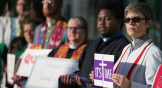
I worry that, as people whose eternal fate is good news, we forget death is still bad news. God gave us life as a gift. Death isn’t our chance to level up into the presence of God; it’s the end of something God delights in and calls good on its own terms. Death is wrong.

“A Christian understanding of death,” theologian Tim Perry writes in Funerals: For the Care of Souls, “… presents death as the great severer of all loving relationships, as the punishment for sin, and as the final enemy.”

In his book full of liturgies around dying, Douglas Kaine McKelvey wrote a six-page intercession against the kingdom of death.

“To call death natural is a lie, to spin it as but one more spoke upon a ‘wheel of life’ is to ignore the groaning cry of your creatures, O Christ,” the prayer reads. “Death is a catastrophe, an obscene enemy, a poisoned arrow piercing the eye of creation, twisting history and nations, bereaving lovers, warping the constellations of community, of family, of flourishing.”

So when people around us die, particularly under circumstances that haunt us with what-ifs, it is right for us to sob in sadness and shake our fists in anger.

Let us linger in sorrow long after those around us deem it acceptable. Let us refuse to minimize the pain of losing our relative, our friend, our neighbor, our coworker. We may mourn for the rest of this life knowing that in the next, our God who conquered death will wipe away every tear.

Kate Shellnutt is CT’s senior news editor.

News

New Brethren Churches Wrestle with Details of Denominational Division

The doctrines separating them are clear. The legal process of disentanglement, less so.

Mt Joy, in Pennsylvania, is one of 52 congregations that have left the Church of the Brethren and joined the newly formed Covenant Brethren Church. The division, though uncontested, is legally complicated.

Mt Joy, in Pennsylvania, is one of 52 congregations that have left the Church of the Brethren and joined the newly formed Covenant Brethren Church. The division, though uncontested, is legally complicated.

Screengrab / Google Maps

Lee Smith thought he knew the name of the church cemetery.
He was pretty sure. But in his years as pastor at Mt Joy in southwestern Pennsylvania, Smith had never actually checked that the legal name of the burial grounds was the same as the name it was commonly called.

“We thought it was called Mt Joy Cemetery, and if that’s the case, there’s no need to change the name,” Smith told CT. “However, there are some forms for purchasing cemetery plots or deeds that say, ‘Mt Joy Church of the Brethren Cemetery’ on them. So we’re still trying to figure that out.”

Add that to the long list of suddenly important details that have to be dealt with when a congregation leaves a denomination.

Mt Joy is one of 52 churches across eight states and the Democratic Republic of the Congo that have separated from the Church of the Brethren and joined the newly formed Covenant Brethren Church in response to an ongoing dispute over homosexuality and the historic peace church’s theological commitment to not enforcing denominational policy.

The Pietistic-Anabaptist denomination is not the first to quarrel over the question of same-sex marriage and the affirmation of LGBT identities. Hundreds of congregations left the Episcopal Church after the ordination of an openly gay bishop in 2003. The United Methodist Church (UMC) and the Reformed Church in America (RCA) are negotiating similar splits.

But while the theological differences are well rehearsed, the actual legal details of division are much murkier. Many departing Episcopal congregations ended up in interminable lawsuits over property. UMC and RCA leaders are trying to figure out what a split means for denominational entities funded by generations of giving. And the Covenant Brethren are researching lots of little details, like the legal names of their graveyards.

Months after the Mt Joy congregation voted unanimously to leave the Church of the Brethren, Smith said the church still has a long list of legalities to straighten out.

The process is time consuming, if not actually difficult, according to Smith and others who are in the process of joining the new denomination. The Brethren, in keeping with their traditional claim that there should be “no force in religion,” are not fighting the departures or doing anything to make them more difficult. The Covenant Brethren, for its part, is encouraging interested congregations not to undertake the move without overwhelming support. The official recommendation is a 90 percent vote in favor, though the voting process and technical requirements vary depending on church district.

After Mt Joy voted to join the Covenant Brethren in April 2021, Smith started working on changing the church’s legal name, getting a new federal tax number, incorporating in Pennsylvania, and updating the church’s bylaws—not to mention changing the name on all the social media accounts.

“Actually, we’re still waiting for some of that,” Smith said.

Two months after sending in paperwork to amend Mt Joy’s incorporation documents with its updated name, Smith discovered a problem—one number in the church’s address line filled out by the state was wrong. Another two months later, after filing corrections and signing the forms again, Smith was told the state had sent the church the wrong form to be corrected.

“It’s almost a comedy of errors,” Smith said. “It’s been a longer process than it probably should have taken—we should have had it done a month and a half ago.”

Mt Joy is still waiting for state recognition of its new name: Mt Joy Covenant Brethren Church. When that happens, the church can start the process of changing the bank accounts. In the meantime, a Mt Joy trustee raised the issue of the cemetery’s official name, which could create an issue if the cemetery is technically owned by the Brethren and Mt Joy fails to transfer ownership.

Craig Alan Myers, an executive board member of Covenant Brethren, went through a similar experience after his congregation in Columbia City, Indiana, voted to leave the Church of the Brethren after 31 years.

“There’s just a lot of little things that you can’t imagine,” said Myers, whose church is now called Blue River Covenant Brethren Church. “We have a transition team. And we’re just taking things as they come. But there’s just a lot of things you don’t even think about when you start. I mean, what about your church sign? Who’s going to handle that?”

Some of the changes, according to Myers, aren’t that different from what a business would go through if it changed its name. But there are also details that are specific to churches.

Myers was recently preparing for a funeral when he realized the funeral home might not be aware of the church’s new name. He had to contact the funeral parlor to ensure the obituary and funeral programs would be printed correctly.

As a new denomination, Covenant Brethren tries to help joining churches anticipate some of the steps involved in switching. But the rules are different in different states and different Church of the Brethren districts, so official case-specific guidance is limited.

Brake Covenant Brethren Church in Petersburg, West Virginia, is still waiting for approval from the IRS for its name change on its employer identification number. The IRS website says churches can request a name change instead of closing and opening new bank accounts, but church business is pretty much on hold until it receives confirmation.

Craig Howard, pastor at Brake, said the church is also working with an attorney for a quitclaim deed to transfer church property.

In the West Marva district, where Brake Covenant is located, church property officially reverts back to the denomination if the congregation disaffiliates. But the district has agreed to sell the property to the congregation for $1, “just to make it a legal transaction,” Howard said.

Other districts have asked for a percentage of the property value to release the deed, or set a price per member for a property sale.

But even for $1, lawyers have to be hired and paperwork processed. The cemetery next to Brake Covenant is incorporated separately, so the church doesn’t have to worry about that detail, but it does have to reapply for its 501(c)(3) status.

Beyond that, the church shut down its former website, and the new one is still underway. Staff are still getting new email addresses, and the bylaws have to be changed to include the church’s new name.

“It’s just a lot of little details. You make a list and start checking it over,” Howard said. “It’s not hard, but it does take somebody putting in some serious amounts of time.”

Hannah McClellan is a reporter in North Carolina.

News

The Confederate Statues Are Gone. The Work of Repentance Continues.

These white evangelicals want to make the former capital of the Confederacy into the capital of racial reconciliation.

Pool / Getty Images

The statue of Robert E. Lee cast a racist shadow over Richmond, Virginia, for 131 years. But today it is gone.

The federal government sent a truck and a removal crew to Monument Avenue one misty day in September. The bronze likeness of the man who betrayed his country to lead the fight for a new nation that was heralded at the time as “the first in the history of the world” based on the belief that “the negro is not equal to the white man” was sawn into pieces. The pieces were hoisted off the marble pedestal. And carted away.

For Katie St. Germain, it felt a bit anticlimactic. She watched from her computer at work.

As a lifelong Virginian, she remembered seeing the statute and other Confederate monuments as a child from the backseat of her mom’s car, headed to ballet lessons. She didn’t know what they meant. She slowly learned as she got older that Richmond—her city—was proud of its heritage as the former capital of a four-year experiment in white supremacy.

When St. Germain graduated high school, a lot of her friends got a class ring adorned with the Confederate battle flag. A lot of her family had those rings too. But she decided she didn’t want one. She wasn’t proud of the Confederacy. As a white evangelical Christian, she thought it was wrong.

So St. Germain was glad to see the statue coming down. But it still felt incomplete.

“I’m not a big liturgy person, but I think we have to have a liturgy,” said St. Germain, who attends a nondenominational church called The Chapel. “I read Be the Bridge by Latasha Morrison and Just Mercy by Bryan Stevenson. Both of those authors talk about the importance of lament. It is a biblical response, to lament. It is a biblical response to repent. It brings healing.”

St. Germain started thinking about what that event could look like. A few months later, she met with community leaders from 15 churches and Christian organizations to start praying and planning—but most importantly praying—about a “big event.”

The community leaders may schedule a service of public lament for the one year anniversary. The idea is to have something that will, in a way, undo what white Christians did in 1890, when the statue went up. Churches in the city raised money to erect it. When it was unveiled, a Presbyterian pastor solemnized the occasion with prayer.

That’s what needs to happen now, many of the city’s evangelicals feel, but in reverse.

“We need formal, liturgical moments to mark this,” said Corey Widmer, pastor of Third Church, an evangelical Presbyterian congregation in Richmond. “We need to say, ‘Yes, we did this and want to be part of the repair, doing the work of repair that is needed.’ ”

Christians concerned about racism know that one event is not enough to accomplish justice and reconciliation, though. Public events are important, but the real work of unwinding racist history happens in private. For a year and a half now, evangelicals across the city have gathered in small groups to discuss this.

Some were organized by For Richmond, a nonprofit that connects and equips Christian leaders. The group is headed by Matt and Anna Shenk, former Cru ministers who were deeply influenced by evangelical civil rights activist John Perkins and have modeled their ministry on Perkins’s Christian Community Development Association and other organizations that bring churches together to serve a city, including For Charlotte, Unite Dallas, and Transforming the Bay with Christ.

“Our dream is that Richmond can go from the capital of the Confederacy to the capital of racial reconciliation,” Anna Shenk said.

In 2020, after the protests following George Floyd’s death in Minnesota, For Richmond hosted training for 80 pastors on how to lead congregations through difficult conversations and then launched 45 Be the Bridge groups to read and discuss the best-selling book.

In the process, the Shenks saw an increased number of suburban churches asking questions about the connections between white flight and church growth, and the way the creation of their communities by Christians in the 1960s hurt the city and Black people.

“There was a groundswell of prayer and lament and repentance,” Anna Shenk said. “I think it just became clear that just because you’re a suburban church, that doesn’t mean you’re not a part of it and doesn’t mean you’re not a part of the work God is doing on racial reconciliation.”

Wynelle Roland is a coleader of a Be the Bridge group at a Southern Baptist church. She’s not a member of that church but was invited to join and then help lead the group. As a Black Christian, she was leery at first about talking with white people about racism for an hour and a half every month. She was worried she might offend them with her perspective, and she didn’t want to be offended by theirs.

But she liked the idea of a faith-based conversation, so she decided to try. Her fears were quickly put to rest.

“They understood there is a need for racial reconciliation; they just didn’t know where to start,” Roland said. “They needed to have a productive place to talk about their feelings, to learn about racial injustice, and also to have avenues to get involved.”

Around the time the Lee statue came down, Roland’s group discussed the Haitian refugee crisis and ways to talk to family and friends who said derogatory things about Haitians.

A lot of the work white Christians need to do is just finding a way to overcome fear, said David Bailey, founder and CEO of Arrabon, a Richmond-based racial reconciliation ministry. Many are afraid of losing cultural power. Others don’t believe there will be forgiveness if they get it wrong.

“These are basic kindergarten Christianity kinds of things, but then when we try to reckon with race, it’s like overload,” Bailey said. “How does Christianity work when it’s committed to everybody’s flourishing and not just its own power? That’s unfamiliar to people, and it brings a lot of fear. And when you have fear, you don’t have the discipline of a sound mind.”

Bailey is encouraged, however, by the progress he’s seen since his father, a Black Pentecostal minister, made friends with a white pastor through Promise Keepers’ racial reconciliation efforts in the 1990s. Today, he said, it’s not so hard for ministers to connect across racial lines. And he sees white Christians who are willing to make sacrifices for racial justice.

“This isn’t a church growth strategy,” he said. “It’s work. It’s spiritual work.”

For some evangelicals, the work looks like learning that their faith calls them to a different kind of relationship with their neighbors.

“Especially in Richmond, I just don’t think you can be a faithful Christian unless you’re in deep solidarity with people of color,” said Widmer, the pastor of Third Church.

That message has come at a cost for his 1,300-person congregation. Third has lost some members in the past year. Many of those who left said that Widmer was getting too political.

On a Sunday shortly after Lee’s statue came down, however, Widmer’s sermon didn’t mention politics. He did call his congregation to acknowledge their privileged position in society and see how it could be an impediment to trusting God.

“Let’s be honest,” Widmer said. “Look around you. You’re a very nice-looking group of people. We’re very successful—financially, personally, professionally, and even in relationships.”

Christians, Widmer said, are called to turn away from their successes. They should repent of the times they clung to power and prestige, trust God, and be reconciled to their neighbors.

In public and in private, that’s exactly what a lot of white Christians who used to live under the shadow of Robert E. Lee are trying to do.

Daniel Silliman is news editor for Christianity Today.

Apple PodcastsDown ArrowDown ArrowDown Arrowarrow_left_altLeft ArrowLeft ArrowRight ArrowRight ArrowRight Arrowarrow_up_altUp ArrowUp ArrowAvailable at Amazoncaret-downCloseCloseEmailEmailExpandExpandExternalExternalFacebookfacebook-squareGiftGiftGooglegoogleGoogle KeephamburgerInstagraminstagram-squareLinkLinklinkedin-squareListenListenListenChristianity TodayCT Creative Studio Logologo_orgMegaphoneMenuMenupausePinterestPlayPlayPocketPodcastRSSRSSSaveSaveSaveSearchSearchsearchSpotifyStitcherTelegramTable of ContentsTable of Contentstwitter-squareWhatsAppXYouTubeYouTube