News

Reformed Church in America Splits as Conservatives Form New Denomination

As Alliance of Reformed Churches begins, some who remain in the RCA are concerned for the small, nearly 400-year-old denomination’s survival.

Logo of the Alliance of Reformed Churches

Logo of the Alliance of Reformed Churches

Christianity Today January 7, 2022
Courtesy of ARC

On New Year’s Day, 43 congregations of the Reformed Church in America (RCA) split from the national denomination, one of the oldest Protestant bodies in the United States, in part over theological differences regarding same-sex marriage and the ordination of LGBT clergy.

The departure of the theologically conservative congregations to the new group, the Alliance of Reformed Churches (ARC), leaves some who remain in the RCA concerned for the denomination’s survival. Before the split, the nearly 400-year-old denomination had fewer than 200,000 members and 1,000 churches.

At least 125 churches from various denominations are in conversation with ARC leaders about joining.

“Realistically, it’s a large group of conservative churches that are also providing a lot of income to the denomination. I really think the mass exodus of all these conservative churches is going to throw the RCA into a really difficult financial situation,” said Steven Rodriguez, an RCA church planter in Brockport, New York. “I doubt the RCA will be financially sustainable for much longer.”

The move follows the RCA General Synod’s October decision to adopt measures for “grace-filled separation” with departing churches and to appoint a team to develop a restructuring plan for those that remain.

The new denomination, besides not affirming same-sex marriage or the ordination of LGBT individuals, will have a strong emphasis on church planting and feature a flexible organizational model meant to foster theological alignment and efficient decision-making, according to ARC leaders.

“We have a passion for this remnant of believers to become a part of reformation and revival in the Northern Hemisphere,” said Tim Vink, the new denomination’s director of spiritual leadership and outreach. “Part of our strategic thinking is designing things for the 21st century that allows a multiplication of gospel-saturated churches and a multiplication of disciples.”

Other conservative-leaning churches in the RCA, as well as those in the Presbyterian Church in Canada, the Christian Reformed Church in North America (CRC), and the Presbyterian Church in America (PCA), are also discerning whether to join the ARC, according to Vink.

Other groups, such as the Kingdom Network, a group of five churches in Indiana and Illinois, have formed and expect to absorb conservative churches leaving the RCA.

Vink said the new alignment will promote growth. “We want to be a safe landing pad for churches in the near term, but in the long term want to be a serious launching pad for the church, in mission, to the world,” he said.

The launch of ARC is part of a larger realignment within North American Protestantism. The last two decades have seen conservative Episcopalians, Presbyterians, and Lutherans form their own denominations, and United Methodists are scheduled to consider a denominational split in the fall.

A theologically and politically diverse denomination that dates to the arrival of Dutch settlers in Manhattan in the 1620s, the RCA has been debating sexuality and LGBT inclusion since the 1970s. In 2018, the RCA’s General Synod formed a team charged with discerning whether the RCA should stay together, restructure, or separate. The team ultimately suggested a path involving all three avenues, but the meeting to vote on the team’s proposals was delayed for 16 months due to the COVID-19 pandemic.

In the interim, roughly 15 congregational, regional, and strategic leaders from the RCA began meeting virtually to consider a future outside the denomination. Part of that future, they believed, involved theological unity on the interpretation of Scripture.

“We believe if the church is going to be successful in the 21st century, it needs to be powered by a more agile structure and it needs to be more theologically aligned than theologically diverse,” said Dan Ackerman, ARC’s director of organizational leadership.

Joel Baar, an ARC board member and elder at Fellowship Reformed Church in Hudsonville, Michigan, which opted to join ARC by a vote of 604–9, said that theological conformity of ARC is part of what appealed to his congregation.

“As the RCA was attempting to define and clarify marriage,” said Barr, “and efforts had been happening over the decades in that regard, there continued to be this tension within the RCA of whether or not the Bible was the full authority of God’s Word. We started feeling at Fellowship we no longer belonged within the RCA.”

But theological differences remain even within the new denomination. While the understanding of marriage as between a man and a woman is a “top-tier” theological belief, Ackerman explained, the question of women’s ordination is a “second-tier issue” that local leaders can address in their own contexts.

Every five years the organization and individual congregations will assess how well they are serving one another and if they should remain partners in ministry, said Ackerman. “The word alliance implies a choosing that happens so you can accomplish a certain thing, and then you reevaluate and say, is that alliance still helpful for the next chapter?”

ARC will replace national in-person conferences with video calls, digital messaging platforms, and other forms of virtual communication to make decisions more efficiently, organizers said. Its board already meets twice a month to expedite response times.

The creation of ARC, paired with the RCA’s decisions at General Synod, has put many RCA congregations in the position of deciding whether to stay in the RCA.

Baar says the decision to leave the RCA wasn’t a simple one. “My roots in the RCA are deep,” he said, saying part of his congregants’ discernment about leaving the denomination was “a grieving process.”

Faith Reformed Church in Zeeland, Michigan, also took time to discern its relationship to the RCA. For now, the congregation has decided to remain in the RCA. But staying isn’t easy either.

“We mourn some of the people who are no longer part of the denomination. There are churches we planted that will leave, there’s children we’ve raised up in the church that are pastors of churches that are leaving,” said the senior pastor, Jonathan Elgersma. “We do feel there has to be space to lament.”

RCA leadership has reached out to its congregations, hoping to sell them on RCA’s increasing diversity and new international church-planting and missional partnerships, which includes its 375-year-old Global Mission organization that supports roughly 100 missionaries and partners through its $8.5 million worth of endowments.

Yet the RCA is also committed to allowing departing churches to leave on good terms. “We want to bless our brothers and sisters who are choosing to find another denominational family,” said Christina Tazelaar, director of communication for the RCA.

The ARC seems equally dedicated to a smooth transition, and ARC pastors say they are open to the idea of continued partnerships with the RCA. “We bless the RCA, we pray for the RCA,” said Vink.

Elgersma, too, is hopeful that the ARC and RCA will remain in conversation. “Are we faithful enough to respect the full kingdom and listen to and learn from each other?” he said. “I really hope that’s where we land as this plays itself out.”

But, said Vink, “the General Synod in October made it clear to many conservative churches that the time is now to look for a new wineskin.”


News

Venture Capitalists See Profit in Prayer

Religion apps attract more than $175 million in investment.

Christianity Today January 7, 2022
George Frey/Getty Images

Tech investors have discovered religion—or at least religion apps.

In 2021, venture capitalists poured more than $175 million into a handful of software companies developing spirituality tools for smartphones, betting big that tech startups can find a way to make a profit off of prayer, daily devotion, Scripture meditation, and Bible reading.

Prayer and spirituality apps aren’t new. They’ve existed almost as long as smartphones. But they didn’t attract this much capital until recently.

Ten years ago, the amount of venture funding invested in religion apps was negligible, coming in at less than $100,000. By 2016, that number had climbed to $6 million, and by 2019, tech investors put about $1.30 out of every $10,000 they invested in startups into religious apps.

Last year, as tech startup funding grew to a record $600 billion, investors put nearly $3 out of every $10,000 toward religious apps.

The two big winners are Hallow and Glorify. Hallow, a Catholic app that has partnered with 250 parishes across the country but especially targets people who’ve stopped going to church, received more than $50 million. Glorify, an app that promises to help users develop a daily worship habit, raised $40 million in investments.

“It’s just a ridiculously exciting time,” Ed Beccle, one of the cofounders of the London-based Glorify, told Religion News Service. “I feel like I am constantly pinching myself.”

Part of the rush of funding may be due to COVID-19. The pandemic drew attention to how much regular religious practice could be moved online. But investors clearly believe religion apps will continue to be popular long after the pandemic passes into memory.

The apps seem to be considered a good investment because people connect to spiritual practices in a deeply personal way. As the investors see it, our phones are ourselves.

“One thing that I’ve always thought deeply about is, how do I find investments that are tied to what people deem to be a core part of their identity,” Connie Chang, an investor at a venture capital firm in Silicon Valley, told The Wall Street Journal. “When you look at these communities that people strongly identify with, that’s where they spend most of their time. That’s where you get longer-term retention.”

Religious uses of new communications technology have a long history. Evangelicals and other Christians have always found ways to make new tech work for them—adapting and innovating with YouTube, television, radio, book publishing, and even the telegraph.

Only a few years after inventor Samuel Morse sent the first morse code message from the chambers of the US Supreme Court in 1844, typing out the words “What hath God wrought,” missionaries hailed it widely as the key to global evangelism. In 1847, Congregationalist missionary Cyrus Hamlin even presented the technology to Abdülmecid I, sultan of the Ottoman Empire, as a reason to convert to Christianity.

Smartphone apps haven’t been any different.

The day that Apple first opened its app store—a year and a half after it released the iPhone in 2007—Life.Church in Edmond, Oklahoma, launched a free Bible app called YouVersion. The software was downloaded 83,000 times in three days. Last year, the app surpassed more than 500 million downloads.

The Bible software, however, remains a ministry of the church. The ongoing innovation and development is supported by donations. There’s no return on investment for venture capitalists.

The first for-profit companies to develop religious apps didn’t have a model for making money either. Instapray, developed in 2014 by a Polish man who emigrated to the US to get an MBA at Stanford University, didn’t even have a business model.

“It was never envisioned as a monetization platform,” founder Fryderyk Ovcaric said. “I started Instapray to create a safe, supportive online community, a place free of the overwhelming negativity present across much of the web.”

When billionaire entrepreneur Peter Thiel put money into Instapray, it was seen as a sign of his eccentricity. Or maybe an indication that Thiel, who once praised Jesus as “the first political atheist,” was more religious than people thought.

But the most recent crop of religion apps are not ministries and are not lacking in plans for monetization.

“I’ve come at it from a lot of different angles and one is very much on an emotional level and my own beliefs around faith,” Glorify CEO Beccle told TechCrunch. “Then the other is: It’s the most incredible commercial opportunity.”

The app is free to download, and the basic version is free to use. But a lot of the features require a subscription of $7 per month. There’s no public data on how many of the millions who have downloaded Glorify in 2021 subscribed, but if even 2 percent pay for 12 months, the company would gross $4.2 million.

Hallow has a monthly subscription for $9, which allows users to create prayer groups with family or friends, keep a journal, and download homilies. More than 1 million have downloaded it.

The recent religious apps are also looking to expand into social media platforms, which will give committed users more ways to connect with other people and more reasons to stay on the app.

The prospect is attractive to investors.

“I felt I understood it immediately,” said James Corden, the British host of The Late Late Show on CBS who received a pitch to invest in Glorify at a dinner party of celebrities in Los Angeles. “I grew up in a family of faith, and I saw that what Ed was doing was building not merely an app, but a community.”

If that’s something people want, then according to the rules of the market, it’s something they’ll pay for. And while prayer, Bible reading, and Scripture meditation will always be free, the smartphone apps that help people do those things in 2022 offer the promise of great potential profit.

Church Life

Why Latino Christians Treasure January 6

Christian leaders in the US on how el Día de los Reyes (Three Kings Day) brings them closer to their heritage and God.

Christianity Today January 6, 2022
Associated Press

Much of the global body of Christ knows January 6 as Epiphany, the church calendar’s final day of Christmas and an opportunity to remember the Magi’s early recognition of Jesus as God. In the Spanish-speaking world, this time is known as el Día de los Reyes, or Three Kings Day, and often includes presents, culinary traditions, and even visits from the wise men themselves. For a variety of reasons, the day and its festivities have been inconsistently carried on in American Latino communities.

We asked seven Latino Christians to share what el Día de los Reyes means to them, how they celebrate it today, and to what extent last year’s insurrection has affected how they’ll observe the day.

Noemi Vega Quiñones, associate director of spiritual formation and theology for InterVarsity’s Latino Fellowship, Dallas, Texas

Each January 5, children around Mexico (and Latin America and Spain) place their shoes near the nativity scene and anxiously await the gifts the reyes magos (the wise men) will bring the next morning! I grew up with my mother’s stories of her childhood in el rancho (a small pueblo) and how the reyes would bring lupita dolls and cardboard cars, filling their shoes with Mexican candies and cacahuates (peanuts). She taught us that Día de los Reyes was more than just receiving presents. It was a day that recalled the miraculous incarnation of God become man in the birth of Jesus and the miraculous escape from Herod’s genocidal decrees.

Because the attacks on the Capitol fell on January 6, the juxtaposition of el Día de los Reyes and the anniversary of the insurrection give us much to consider. El Dia de los Reyes embodies the truth that God became man to redeem humanity and that this redemption was threatened by a king that desired to have complete dominion over his people. Salvation, the king demanded, would come from him alone, not from a baby boy. The wise men knew that Jesus would be the true king of Israel. Upon seeing the guiding star stop where Jesus was, they were filled with joy and worshiped the child.

In contrast, Herod ordered every boy two years and under to be murdered for fear of losing power over the Jewish people. The violence on the US Capitol is certainly not comparable to Herod’s genocide, but perhaps there is something yet we can perceive for our times. Jesus confounds the powers and principalities of this world and declares that God has the last word on humanity’s well-being. Día de los Reyes is a time to pause and remember the miraculous gift that we have in the birth and life of Jesus. It is a reminder for Christians to check our hearts for harboring thoughts or violence against others and a call to worship Jesus alone.

Jules Martinez, the Milton B. Engebretson Chair in Evangelism and Justice, North Park Theological Seminary, Chicago, Illinois

I celebrated el Dia de los Reyes growing up in Puerto Rico. Our Christmas music, festivals, and gifting started right after Thanksgiving and continued until January 6. My family will celebrate exchanging gifts this year, concluding the Christmas season.

Now, as a member of the diaspora, I treasure how Three Kings Day is commemorated with parade celebrations in Puerto Rico (also in Mexico, Argentina, and the Dominican Republic). The kings, traditionally known as Melchior, Gaspar, and Balthazar, appear journeying in towns with gifts for the newborn Jesus. Frequently riding on horseback, they have colorful handmade costumes and crowns and carry gifts for children, often ending in a Catholic cathedral for the celebration. On the eve of the celebration, children are encouraged to find small boxes, fill them with grass (to feed the kings’ camels), and place them under their beds. The idea is that just as the kings brought gifts to the newborn Jesus, they also bring gifts to children. Then when the children wake up, they can look under their beds to find their gifts.

I celebrate this day as part of my culture, and most significantly, as integral to the sacred memory of Epiphany. As Gentile Christians, we also respond to the calling of God to come to see the divine Son. We also respond to the divinely appointed epiphanies that led us to the gospel.

Yet the gospel has always been announced in dangerous times. The insurrection of January 6 is in my memory with its violence and blasphemous use of Christian symbols. Yet this nefarious event only increases my longing for Epiphany’s celebration: The king is here and will transform our world.

Elizabeth Rios, founder, Passion2Plant.com, Miramar, Florida

I learned about Three Kings Day from my Puerto Rican family. Growing up in New York City, we never did much of the presents or the grass under the bed thing—we were from the concrete jungle. However, we celebrated with the traditional food and songs, trying to keep our practice alive despite the commercialization of Christmas.

In my house, this day will hit a bit different after it was tainted by last year’s insurrection, brought on by people who thought they were following Jesus. Traditionally a day to reflect on the baby Jesus being worshiped by three wise men, this year I will choose to reflect on why baby Jesus came into a dark world and how we should guard our hearts against tying our faith to political power.

Sarah M. Guerrero, writer, Austin, Texas

I didn't grow up celebrating el Día de los Reyes, and I’m sorry for that. Like so much of my cultural history on my mother’s side, I don’t know if this holiday was never part of my ancestors' lives, lost somewhere along the line to assimilation, or dropped due to personal preference. While my father can trace his ancestry back to Scotland, my mother’s family has lived on land that’s been claimed by Spain, Mexico, and Texas (and was the home first of people like the Tonkawa). We are Hispanic without being Mexican, which is unusual for the part of Texas I call home.

Despite being a person of mixed ethnicity, I grew up with an unintegrated faith and cultural tradition, primarily informed by European Christianity. This tradition taught me to be suspect of anything that wasn’t white. But as an adult, I’ve learned from theologians like Kat Armas, Karen Gonzalez, and Liz Márquez that an integrated faith can and should embrace all parts of my ethnicity, especially the parts that are brown.

As I’ve learned about holidays close to my heritage (I’m googling things just like everyone else!), I’m stunned by the upside-down wisdom of the wise men. Brown, “pagan,” and students of astrology, they were the first on record to recognize the kingship of Jesus. They bring me face to face with the people and ideas I’ve discounted because they weren’t “Christian” enough. I feel grief this holiday because it reminds me of the cultural heritage I’ve lost and the places I’ve platformed whiteness in my own theology. But there’s also a glimmer of tender hope that as I embrace my own unique ethnic heritage, I will find Jesus.

Aaron Reyes, lead pastor, Hope Community Church, Austin, Texas

Three Kings Day wasn’t celebrated much in my Mexican American household. Like most other evangelicos or cristianos, we interpreted this day as a Catholic tradition that should be ignored. So, I didn’t get to enjoy a Rosca de Reyes until later in life. But it was a fun day for my Catholic friends, who got to open a lot of gifts.

Now, as a parent and pastor, I acknowledge and celebrate this day. It’s meaningful for me this year, on the anniversary of last year’s insurrection, to remember that the King of the Jews came to us as a vulnerable babe in the obscure town of Bethlehem in an obscure part of the Roman Empire. This day reminds me that greatness and power aren’t achieved by force. Jesus didn’t arrive in Rome with an army to grapple for power. The model of Jesus is that true greatness is found in humility and service. Though worshiped and gifted on Epiphany, Jesus came not to be served but to serve and to give his life as a ransom for many.

So, today, I’m going to delight in a Rosca de Reyes with my children. Using the oval-shaped cake, we will recall how, similar to the hidden doll inside the cake, God protected the Christ child from Herod. Moreover, drawing attention to the wreath-like appearance of the cake that’s adorned with candied fruits (“rosca” means wreath), I will explain to my kids that God sent foreign magi to acknowledge that Jesus is King, not only of the Jews, but of all peoples. And, as such, Jesus is deserving of our worship and lives.

Rodolfo Galvan Estrada III., assistant professor of the New Testament at Vanguard University, Costa Mesa, California

My family taught me about Three Kings Day when they explained how they celebrated the holidays in their home country of Costa Rica. They received their gifts on January 6 and celebrated December 24 with dinner. When I would ask, “Why don't we do this here in the US?” they asked me, “How can we compete with Santa?”

Unfortunately, as a third-generation Latino, this holiday is one of those traditions that has been lost through our cultural assimilation in the US. Our family wanted us to culturally fit in with society and others, so we did not carry this tradition in our family practices. Today I want to recover these important and lost traditions that mark and define our cultural and religious identity.

What’s more, these traditions make Christmas celebrations more biblical and meaningful by connecting the stories of the Bible with real celebrations in the home and church life. We make Christmas real through performances and by focusing on the entire Christmas story in the Bible. For this reason, nativity scenes in Latino households are important—they visually remind us of Jesus’ birth.

Fernie Cosgrove, Well-Watered Women staff writer, Connecticut

I have many cherished memories around Three Kings Day from growing up in Mexico. Every year, on January 6, we would gather with our family to eat a “rosca de reyes,” a delicious bread that holds plastic toys in the shape of a baby. If you get the toy, you host the next gathering where you serve guest tamales. As an adult, this is a great reminder of the way the Three Kings were able to gather to praise King Jesus in a manger, and through their gifts proclaim that he was indeed the King of kings they had long been waiting for. This celebration has shaped my thinking to remember that the birth of Jesus doesn’t only impact us on Christmas, but throughout the year and leads me to think about the way I esteem Jesus as the King of my life!

Theology

Move Over, Daily Rhythms. Disruption Is the New Routine.

As I start motherhood amid a pandemic, I’m trying to find God’s grace in the upheaval.

Christianity Today January 6, 2022
Illustration by Mallory Rentsch / Source Images: Nora Carol Photography / the_burtons / Getty

My friends spent the last few weeks wiping the slate clean, burning relics of 2021, and setting goals for 2022 in anticipation of the new year. And while social media makes these rituals look picture-perfect, many of them involved frustrated, last-minute adaptations prompted by the omicron variant of COVID-19, which keeps rearing its persistent head just when it seems like we’ve collectively passed the worst of the pandemic.

In short, rituals aside, we all seem to be limping into 2022 already weary and worn ragged. My own plans for an efficient denouement to 2021 and reflective, peaceful start to 2022 have been upended thoroughly.

Here’s what I hoped would happen: I would finish book revisions on December 15, delivering a beautiful manuscript to my editor in time to take a holiday break and prepare for the arrival of my first child, due in late January. My husband and I would rearrange the house, turn my office into the baby room, and clean everything thoroughly. I would finish a baby quilt while considering the ways my life will change in the coming year. I would drink hot chocolate and eat Christmas cookies.

Here’s how things are really going: After realizing that finishing book edits during end-of-semester responsibilities was a pipe dream, I got an extension with plans to submit in early January. After I revised this book plan, the baby revised his plan as well: The doctor informed me he wanted to induce three weeks early (which, if you’re counting, places baby’s arrival also in early January).

The baby’s room is also my office, and thus a mess of books, papers, and baby gear. I did finish the baby quilt, and it is lovely—but then I washed it and learned that blue dye bleeds everywhere, so I am currently undertaking a rescue mission. Oh, and hot chocolate and Christmas cookies? Out of the question, thanks to gestational diabetes.

In short, nothing about the end of 2021 went smoothly, and the blank slate of 2022 is at best a fantasy. I am not ready to welcome a new year with reflection and peace. Instead, I am heralding 2022 with a chaotic cacophony of old and new, restoration and triage.

My stress is minor compared to that faced by many. My pregnancy follows years of infertility and fertility treatments, but I have friends with similar experiences whose stories have not closed with a baby. The book manuscript currently causing me woe is born from a job in a field I love that grants me time to think and write regularly.

And yet, I am still stressed, and I am fairly confident that God—being God—has a lesson for me somewhere in this mess.

On her blog, Lore Ferguson Wilbert wrote about learning to “enter into the joy God has for me and my house” by embracing “the gift he has given instead of the gift he hasn’t.” The same thing goes, I think, for our trials: What can I learn from my own disruptions, when life isn’t going the way I planned?

The orderly, compartmentalized life I had imagined—where I finish one project, clean up, and prepare for the next—is being disrupted before the baby even arrives. The illusions of orderliness and control I hold close are just that: illusion. And as the illusion fades, I find grace on my mind.

I am especially captivated by the way Frederick Buechner talks about grace in his book Wishful Thinking: “Grace is something you can never get but can only be given. There’s no way to earn it or deserve it or bring it about. … The grace of God means something like … ‘Here is the world. Beautiful and terrible things will happen. Don’t be afraid. I am with you.’”

This whole process—of preparing for a baby and welcoming the new year while the tasks of the old one are not yet done—reveals grace: a gift I am given, but not on my timeline. I have waited and hoped for these things and am eager for their arrival, but they are also inconvenient. They don’t arrive on my schedule and are constant reminders that I have no control.

This parallels the way I am learning to listen to God. The poet Mary Karr imagines the voice of God as one that

… never
panders, offers no five-year plan,
no long-term solution, no edicts from a cloudy
white beard hooked over ears.

Instead, this voice—in Karr’s imagination—whispers up from the ground, coming through the unexpected spaces of manholes. It suggests that grace—a cure for “what’s wrong with you” — can be found, not in magic, winning the lottery, or even a clear five-year plan, but through the mundane: a hot bath and a sandwich, for instance.

As I close out 2021 and enter 2022, I am taking a cue from Karr. I am learning to look for grace in the blue stain slowly leaching out of my quilt and into the bathtub water where it’s soaking. I look for grace in the ability to turn two mediocre passages of my book draft into one good paragraph. I practice remembering that, while the tiny human we await will almost certainly not arrive on my timeline and we are not prepared, he is God’s grace nonetheless.

Ruth Moon Mari is an assistant professor of media and public affairs at Louisiana State University. Her first book, Authoritarian Journalism: Controlling the Press in Post-Genocide Rwanda, is under contract with Oxford University Press.

Books
Review

One of 2021’s Best Novels Revolves Around … a Church Youth Group?

In “Crossroads,” Jonathan Franzen portrays the life of faith with uncanny precision and sympathy.

Christianity Today January 6, 2022
Illustration by Mallory Rentsch / Source Images: WikiMedia Commons

The rumors are true. The panoramic new novel from Jonathan Franzen is about, among many other things, a church youth group. Crossroads, the name of both the book and the group, may even be the finest work of fiction ever written on the subject. Which is not meant as faint praise so much as an acknowledgement of the peculiarity of a work like this coming into existence in the first place, much less in 2021.

Crossroads: A Novel

Crossroads: A Novel

Farrar, Straus and Giroux

592 pages

$11.00

Crossroads is not the sort of youth group that most contemporary readers will associate with the term, however. There are no Bible studies, no prayer circles, no games of capture the flag, no tracts. Instead, the group bears a distinctly mainline Protestant character, albeit in its early-1970s incarnation, the period in which the novel is set.

The language of the group (a ministry of the fictional First Reformed Church in New Prospect, Illinois) is more psychological than spiritual, its character more in line with the confrontational self-help ethos of the support groups that were gaining traction at the time than the “Big E” evangelicalism that was emerging alongside. Crossroads paints a picture of a bygone era, one when cigarettes outnumbered guitars in the church parking lot by a factor of ten.

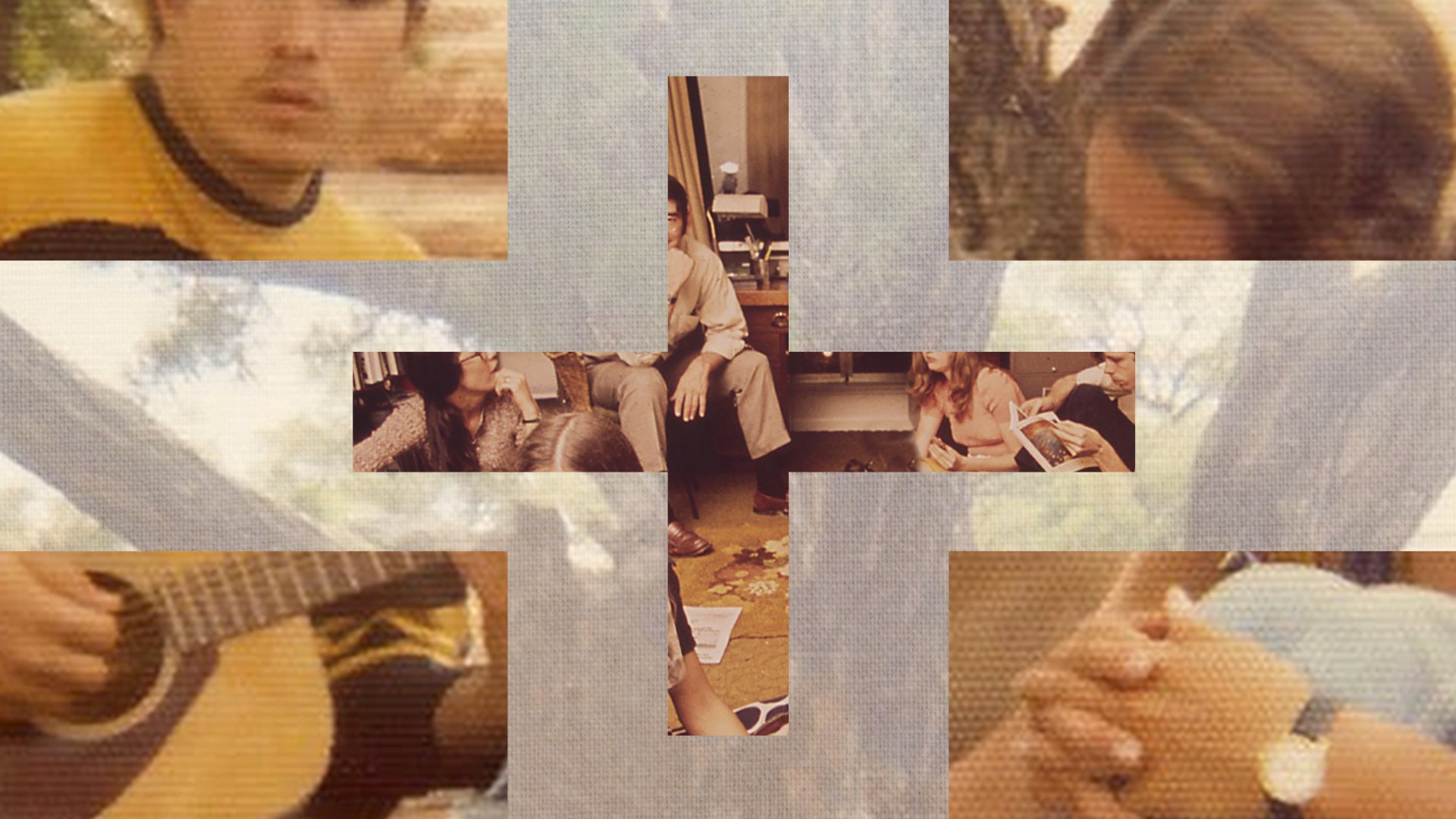
Groups like Crossroads may be relics at this point, but they are not an invention. I witnessed a similar group explode out of a Congregational church in Connecticut during the late 1990s. Franzen chronicled his own involvement in a nearly identical outfit in his essay collection The Discomfort Zone.

Interlocking crises

We first encounter the group at the zenith of its near-cultlike popularity during Advent in 1971. Charismatic leader Rick Ambrose has managed to convene an impressive throng of misfits and “popular kids” alike. This alienates the group’s founder, associate pastor Russ Hildebrandt, which (in classic pastor’s-kid fashion) only attracts Russ’s own progeny to join. Yet Ambrose is no charlatan; what’s on offer on Sunday nights at First Reformed is, in modern parlance, authentic. And Franzen renders it so with uncanny precision and sympathy. This is the opposite of the reductio ad absurdum that characterizes most popular depictions of church life.

Many of the broad strokes will be recognizable to those who’ve logged serious youth ministry hours, either as a member or leader. The urgent sense of purpose, the outsized emotions, the unavoidably hokey icebreakers, the all-important mission trip (and its attendant fundraisers), the ever-pressing hormones, the performative vulnerability, the oddly fierce power struggles. The dramatic possibilities are so fecund that it’s surprising more writers haven’t tried to utilize the setting.

Of course, saying that Crossroads is about a youth group is like saying Infinite Jest is about tennis. The group serves as a backdrop for a series of interlocking crises faced by the Hildebrandt family during that winter and spring. There’s Russ, the sincere and socially conscious associate pastor undergoing a midlife crisis and lusting after one of his parishioners. Then there’s his acerbic wife, Marion, buckling under the burdens of a disastrous young adulthood that can no longer be ignored. We also meet their children: 15-year-old Perry, a drug dealer with a debilitatingly high I.Q.; his social butterfly of an older sister, Becky; and Russ and Marion’s eldest, Clem, a conscientious skeptic tied in knots over his Vietnam draft status.

Each chapter is told from the vantage point of a different family member, their individual turmoil coalescing in tandem with that of their kin, though not always in reference to it. Franzen’s plotting and pacing throughout is something to behold, evidence of a writer at the height of his powers. The prose is deceptively simple and full of humor.

But don’t let the literary hoopla fool you: Crossroads is so gripping that readers will likely be overjoyed to hear that it is the first volume in a proposed trilogy. Franzen has dubbed the project A Key to All Mythologies, a name that will ring bells for lovers of English literature, referring as it does to the eternally forthcoming tome that the insufferable scholar Mr. Casaubon never finishes in Middlemarch.

As Franzen explained in an interview with the West Coast literary journal Zyzzyva, his adoption of the title was “mostly a joke.” It derived from his annoyance with so-called New Atheists like Christopher Hitchens and Richard Dawkins, who purported to have themselves discovered “the key to all mythologies.”

People think that religion is dead. … It’s this sort of snotty 13-year-old’s notion of human psychology to make a career out of sneering at people who actually recognize that everybody’s got some kind of faith.

This claim—that everyone has some kind of faith—might sound like the sort of cliché that gets bandied about in lesser youth groups. Alas, it also happens to be true—and Franzen places that observation at the center of the book. We watch as each Hildebrandt attempts to soothe their inner pain by putting their faith in differing objects. Russ looks to the bedroom, Marion to the therapist’s chair, Perry to narcotics, Becky to religion (and romance), Clem to self-abnegation and service. They are each seeking after some element of goodness, a pursuit which seems to unleash chaos and hurt just as often as benevolence.

Yet that rundown does not do justice to the many dimensions Franzen brings to bear. To his great credit, none of these characters is reducible to a single motivation or set of interests. They all contain multitudes, especially Marion, who ranks among the author’s most shimmering creations. Still, the Hildebrandts are first and foremost a family, and a clergy family at that. (Fellow PKs will find a cringeworthy amount of resonance in some of the descriptions of life in the parsonage—moments of sweetness, too). As such, the shadow of the Almighty hangs over the proceedings from the word “go.”

In fact, what distinguishes the book more than anything is that Franzen takes the religious lives of his characters as seriously as they do. Russ and Marion’s faith may differ in shape, but neither is portrayed as puerile or escapist. Their beliefs are sustaining and genuine. Likewise, Becky’s conversion may not be devoid of the self-righteousness that often afflicts new believers, but neither is it devoid of tenderness. The only characters who give any real consideration to Perry’s sincere if inebriated questions about the nature of (his own) goodness are clergy.

Longtime Franzen readers may be surprised by the pinpoints of light scattered so generously throughout Crossroads—Becky’s jaw-dropping showdown with her rival Laura, Russ’s persistence with a Navajo malcontent, Perry’s devotion to baby brother Judson, Clem’s public defense of his humiliated father. Somehow, none of them read falsely. In fact, I cannot recall another work of recent fiction that captures the experience of answered prayer with such accuracy. Or has the audacity to include an actual foot-washing, free of sentimentality and satire.

And that’s where Franzen’s gifts shine most brightly. Harrowing accounts of marriages disintegrating are not hard to come by; a scene of spousal reconciliation and grace like the one Franzen pens toward the end, however, is nothing less than a literary unicorn.

Spiritual epiphanies

As the action plays out and the tension builds, Franzen demonstrates an unwavering and at times eerie grasp of the inner game of tennis believers play with God, the moments of confidence that exist alongside the doubts, the realizations that accompany the rationalizations—in other words, what it’s like to have a relationship with a living God. He effectively portrays what a spiritual epiphany feels like and what it feels like for life to go on afterward.

No wonder journalist Ruth Graham tweeted that Crossroads contains “some of the deepest, most complex depictions of what sincere Christian faith means in real people’s lives that I’ve ever read.” Those depictions are all the more incisive for not being cordoned off from the actual concerns of adult life. Mental illness, infidelity, abortion, socioeconomic oppression, financial anxiety, intrafamilial estrangement, the prisons of self-pity and regret—very few stones are left unturned.

Not that Franzen lets any of his characters off easy; they are fully drawn, the same fluctuating mixture of the sacred and profane that constitutes all believers. Their pursuit of goodness is not insincere; it is simply marred by self-interest and subject to the same contingencies that make all assertions of righteousness so tricky.

If there is a theology that emerges in the book—and Franzen has claimed there isn’t, strictly speaking—it is not the theology of Crossroads (the group). Ambrose and his team posit that God is found most reliably in the gaps between people, in communities devoted to rigorous honesty and service. None of that is bad, per se, or even necessarily antithetical to historic Christianity. Nor does Franzen portray it that way.

But the group espouses a view of religion that seems to be entirely horizontal. And when Russ tries to inject a more vertical dimension—invoking not only the Bible but the name of Jesus—he is resolutely shut down. It is hard not to read this non-theology as a metaphor for the collapse of the mainline which birthed it—a sort of book-length illustration of what Thomas Bergler observed in The Juvenilization of American Christianity: that many of the cause-centered youth who filled out these groups realized pretty quickly that you can do social justice a lot more nimbly without the baggage of institutional religion.

Marion gestures prophetically in that direction when she points out that, despite its raging popularity, the group has yet to yield a single fresh congregant in adult church. Of course, she has never had much esteem for the youth group. Perhaps she has experienced too many tragedies and reversals to gravitate toward a Christianity that speaks to budding activists rather than established sinners. In truth, her faith may be the lodestar that unlocks the rest of her family’s drama, with a vision of God that can only be described as cruciform, in which all roads lead not only to a cross but an empty tomb.

Collective disaster behind her for the moment, readying herself to board an Easter plane to face a husband and son shattered from self-inflicted wounds, Marion encapsulates her family’s journey—thus far, that is:

She wasn’t afraid of what was still to come, wasn’t afraid of seeing Perry and dealing with the consequences, because her feet had found the bottom and beneath them was God. In coming to an end, her life had also started.

David Zahl is the founder and director of Mockingbird Ministries. He is the author of Seculosity: How Career, Parenting, Technology, Food, Politics, and Romance Became Our New Religion and What to Do about It (Broadleaf Books).

Ideas

‘Give Us a King’: Lessons from the Capitol Sedition

Staff Editor

Samuel’s message to Israel about unchecked power stands true today. We should listen.

Christianity Today January 6, 2022
Jon Cherry / Stringer / Getty

When the prophet Samuel grew old, he made his sons the leaders of Israel in his stead. But his sons were corrupt, and the people were soon discontent with their unjust rule. “Give us a king to lead us,” the elders said. Samuel was offended, but he took the request before God.

“It is not you they have rejected, but they have rejected me as their king,” God replied, giving Samuel a solemn warning to pass along to the people before the deal was done: The king will conscript your sons to his armies and your daughters to his household. He’ll tax away the best of your harvests and lavish the fruits of your work on his friends. He’ll take whatever he wants from you and require your fealty, and when you “cry out for relief from the king you have chosen, but the Lord will not answer you in that day,” because such abusive authority is a result of a fallen, human king (1 Sam. 8:1–22).

The contrast in God’s admonition isn’t between kingship and some other form of human government. Rather, it’s between a king who rules as he pleases in his own right, and a prophet-judge who acts under delegated temporary, limited authority from God. But God’s warning to Israel about concentrated, unchecked power holds true today, and it’s a characterization that keeps coming to my mind as we approach the one-year anniversary of the Capitol sedition on January 6, 2021.

Politics is most basically about power, of course: who holds it and what they do with it. But the way Americans have talked about power over the past year is unusual for our country in living memory. We were trending this way already, yet January 6 feels to me like a tipping point.

The Atlantic’s January cover story, for example, is headlined, “Trump’s Next Coup Has Already Begun.” Many left of center fear a right-wing coup, with some saying that January 6 was just a foretaste of things to come. Next time will be more organized, the thinking goes, more violent and less absurd. Next time, former President Donald Trump might commandeer the unmatched might of the American military to successfully steal an election he’s lost. Next time he gets power, he’ll never let it go.

The mirror fear on the right, meanwhile, is that a left-wing coup is already accomplished. Everyone who could do something about it—Congress, the media, the courts—refuses to notice. Some believe the 2020 election was successfully stolen, but by the guys in suits, not shaman horns. A few hours of chaos on January 6 were merely a petty distraction from the real threat to American freedom. Others say it was a “false flag.” Even if the 2020 race wasn’t provably fraudulent, our whole constitutional system has been undermined by people who are seeking power for their own ends.

Maybe you find yourself in one (or neither) of those camps and see the other (or both) as ridiculous—so ridiculous, in fact, you struggle to accept that proponents seriously believe what they’re saying. It’s just a ploy, right? Just the latest scheme to keep the base riled and the money coming?

Undoubtedly there’s some of that among professional pundits and activists. But I can assure you these are real beliefs. Over and over, in conversations with family, friends, and writers whose work I edit, I’m struck by how very real these fears are. Not always real in the sense of reflecting reality, but real in the hearts of those who hold them. America’s political anger, resentment, and discontent is widely observed in our political discourse. Much of our politics is fueled by those feelings, but it may be even more driven by panic over concentrated and unchecked power in opponents’ hands.

Are we stuck with panic politics forever?

Fear of unchecked power likely can’t be assuaged by political means—“perfect love drives out fear” (1 John 4:18), and perfect love can’t be legislated. Yet there is something legislation can do. We can’t pass a law to stop Americans from being afraid of each other’s designs on power, but we could make the power far more limited, diffuse, and constrained.

The power of the presidency has grown far beyond its original boundaries over the past century to become a sort of rule by fiat. A journalist named Charlie Savage has been presenting presidential candidates with a list of questions on this subject for years, first at The Boston Globe and later at The New York Times, and it’s a good place to start for those new to the subject (I’ve linked to President Joe Biden’s answers in 2007 and 2019, which are illuminating).

Curtailing the presidential power could look like this: allowing presidents to be indicted for criminal offenses; permitting Congress to prosecute the president for abuse of official power; returning almost all decisions to use military force to the legislative branch, where the Constitution originally located it.

It could include, as Savage argues, constricting, if not eliminating, presidential power to use the military against US citizens; curbing the “ability of a president to declare a national emergency and activate various standby powers, and to invoke national-security exceptions to various legal prohibitions”; allowing the “application of the Freedom of Information Act requests to White House records, which are currently exempt.” To this list I’d add limiting the scope of executive orders––the pseudo-laws presidents now routinely use to circumvent Congress but which have no constitutional basis.

A weaker presidency wouldn’t make us coup-proof, of course. But it would preclude much of what Americans fear, keeping power from the hands of would-be oppressors (Ecc. 4:1), making it more difficult to pervert justice (Lev. 19:15), reminding Christians not to put “trust in princes, in human beings, who cannot save” (Ps. 146:3).

We easily remember our political opponents are sinful and can’t be trusted with immense power, but we can’t seem to recall the same about ourselves, which we must in order to make restrictions that would apply to our side, too.

“Power always thinks it has a great soul, and vast views, beyond the comprehension of the weak; and that it is doing God service, when it is violating all his laws,” John Adams wrote to Thomas Jefferson. But if we’re honest, each of us may be thus “deceived as much as any of them,” as he added, and that is why “power must never be trusted without a check.”

The Capitol Attack Signaled a Post-Christian Church, Not Merely a Post-Christian Culture

Last year’s events in DC threatened not only American democracy but also evangelical witness.

Christianity Today January 5, 2022
Edits by Christianity Today / Source Images: Andrew Caballero-Reynolds / Tasos Katopodis / Stringer / Getty

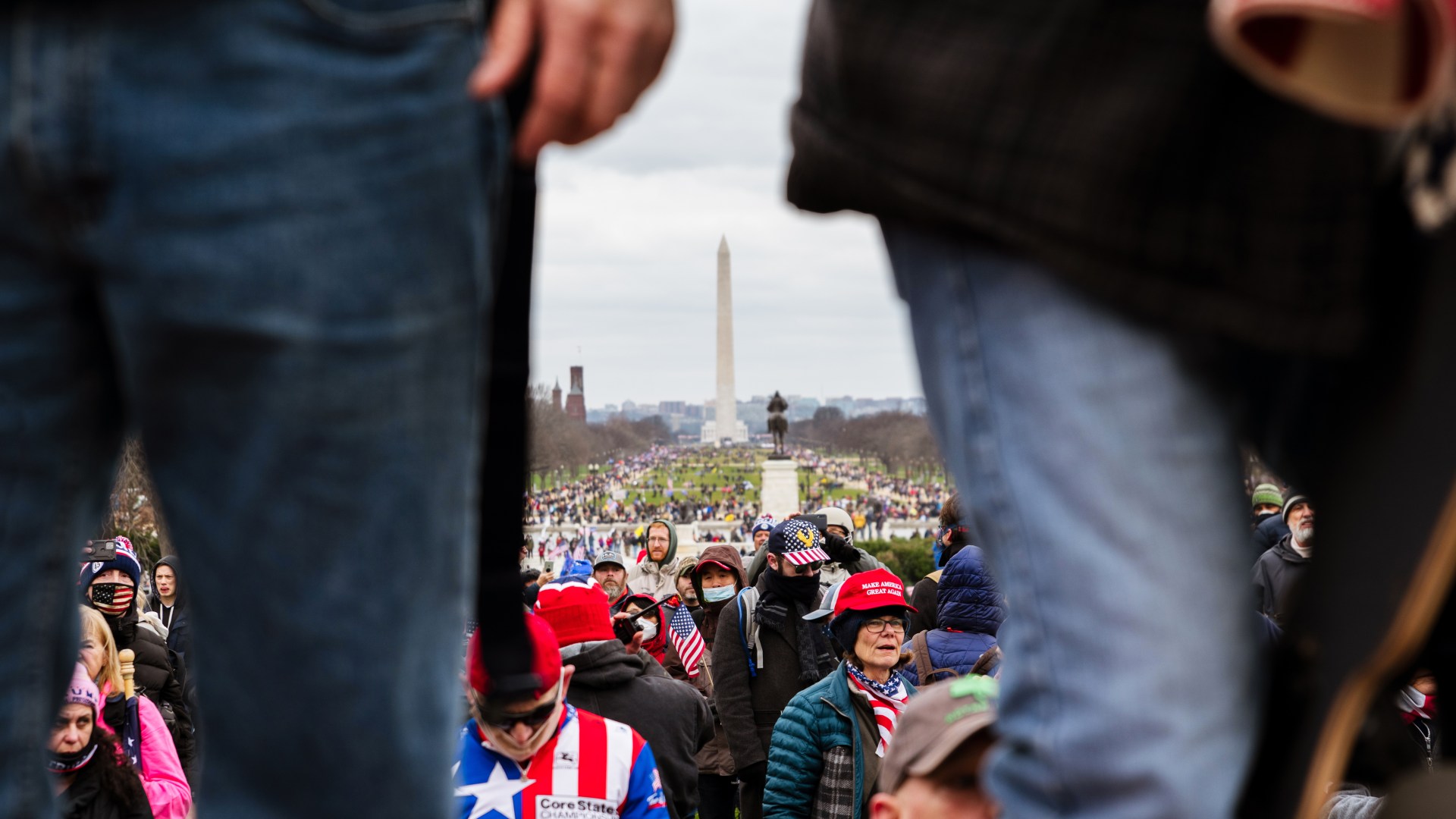
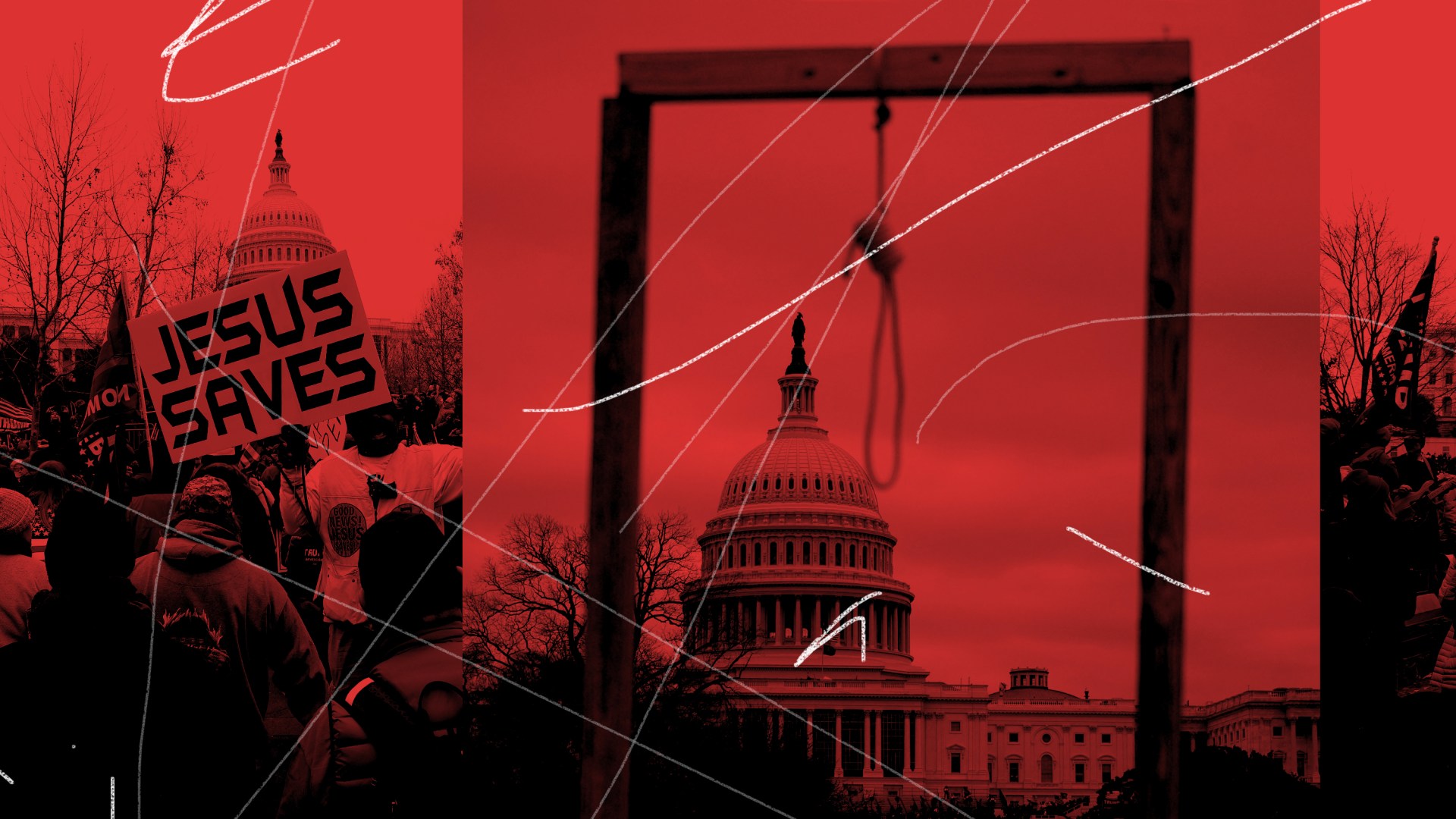
A year has passed since the January 6 insurrectionist attack on the United States Capitol, and two images still haunt my mind. One is that of a makeshift gallows constructed to threaten the murder of the vice president of the United States. And the other is that of a sign, held above that angry crowd, that read, “Jesus Saves.” That these two images can coexist in the same mob is a sign of crisis for American evangelicalism.

Some might dismiss the Christian symbols at the insurrection—not only signs but prayers “in Jesus’ name” right next to a horn-wearing shaman in the well of the evacuated US Senate. And some might wave away the evangelicals who falsely claimed in the days afterward that it had been a crowd of antifa activists, not people from the rally at which the then–President of the United States incited the mob to march to the Capitol.

And yet, survey after survey shows that alarming numbers of white evangelicals believe the lie behind the attack—that the 2020 election had been stolen by a vast left-wing conspiracy that somehow included the conservative Republican governors and election officials in Georgia and Arizona.

An evangelical megachurch hosted former President Trump in recent days—with the crowd chanting “USA!” in response to the former president’s political speech. That scene might be a little too on the nose for most evangelicals, but the polling data show that it is not an aberration. And the same surveys show that, far from “cooling off” after the Trump era and the insurrection, these people believe that violence might be justified in the days to come.

In some ways, what we have seen in the year since the insurrection represents a change. Note the increasing numbers of people who identify as “evangelical”—many of whom don’t even attend church—because they assume that this is the religious designation for their political movement.

But, maybe in even more disturbing ways, these trends represent what hasn’t changed at all.

In the days leading up to the insurrection, some evangelical Christians gathered on the National Mall for a “Jericho March,” repeating the same falsehoods—that the election had been stolen and therefore should be overturned. This type of assertion that, as Trump put it, “If you don’t fight … you won’t have a country anymore,” is hardly new for large sectors of American evangelicalism.

Some have sold literal or metaphorical bunker supplies for the imminent collapse of civilization sure to come because of Y2K or sharia law or the Supreme Court’s Obergefell decision or critical race theory or a plot to shutter churches permanently due to the pandemic, or whatever. Many sectors of evangelicalism have become apocalyptic about everything but the actual Apocalypse.

As with the insurrection (and virtually every authoritarian movement in history), an apocalyptic moment is an emergency requiring emergency measures. Thus we get the cognitive dissonance of people who support law and order (sometimes by quoting Romans 13) beating police officers and breaking through windows in order to shut down Congress’s constitutional duty to count electoral votes. These are the people who can ridicule the very words of Jesus Christ about turning the other cheek as naïve and weak.

This kind of emergency, we’re told, can’t worry about constitutional norms or about Christian character. The reasoning goes that the Sermon on the Mount isn’t a suicide pact and the way of Jesus only works with enemies more reasonable than these, like, I suppose, the Roman empire that crucified the one who gave us such teaching.

Such is the sign not of a post-Christian culture but of a post-Christian Christianity, not of a secularizing society but of a paganizing church.

It would be one thing if this were just a matter of the crowd attacking the Capitol that day. It’s quite another when people—including people with highlights in their Bibles and prayer requests on their refrigerators—wave the attack away as a mere protest from which we should “move on.” This represents more than a threat to American democracy—though that would be bad enough—but a threat to the witness of the church.

One cannot carry Good News to people you might, if things get bad enough, have to beat up or kill. One cannot bring about good by doing evil. One cannot “stand for truth” by employing lies.

Maybe January 6 was a terrible anomaly in our history, one that will never repeat. I hope so. Or maybe January 6 is, as The Atlantic put it, “practice” for even more coup attempts and mob violence to come. I don’t know. Either way, I know this: We as American evangelicals cannot justify what happened at the Capitol a year ago. We can’t ignore it either. If Jesus is the one who saves, then we must go his direction—and that’s toward mission, not resentment, toward gospel and not rage.

And that means we must choose between the way of the gallows and the way of the Cross.

Russell Moore leads the Public Theology Project at Christianity Today.

News

Big Daddy Weave Bassist Jay Weaver Dies at 42

Weaver, who lost both his legs in 2016, spoke and sung of God’s faithfulness during two decades of health struggles.

Christianity Today January 4, 2022
Terry Wyatt / Getty Images for Dove Awards

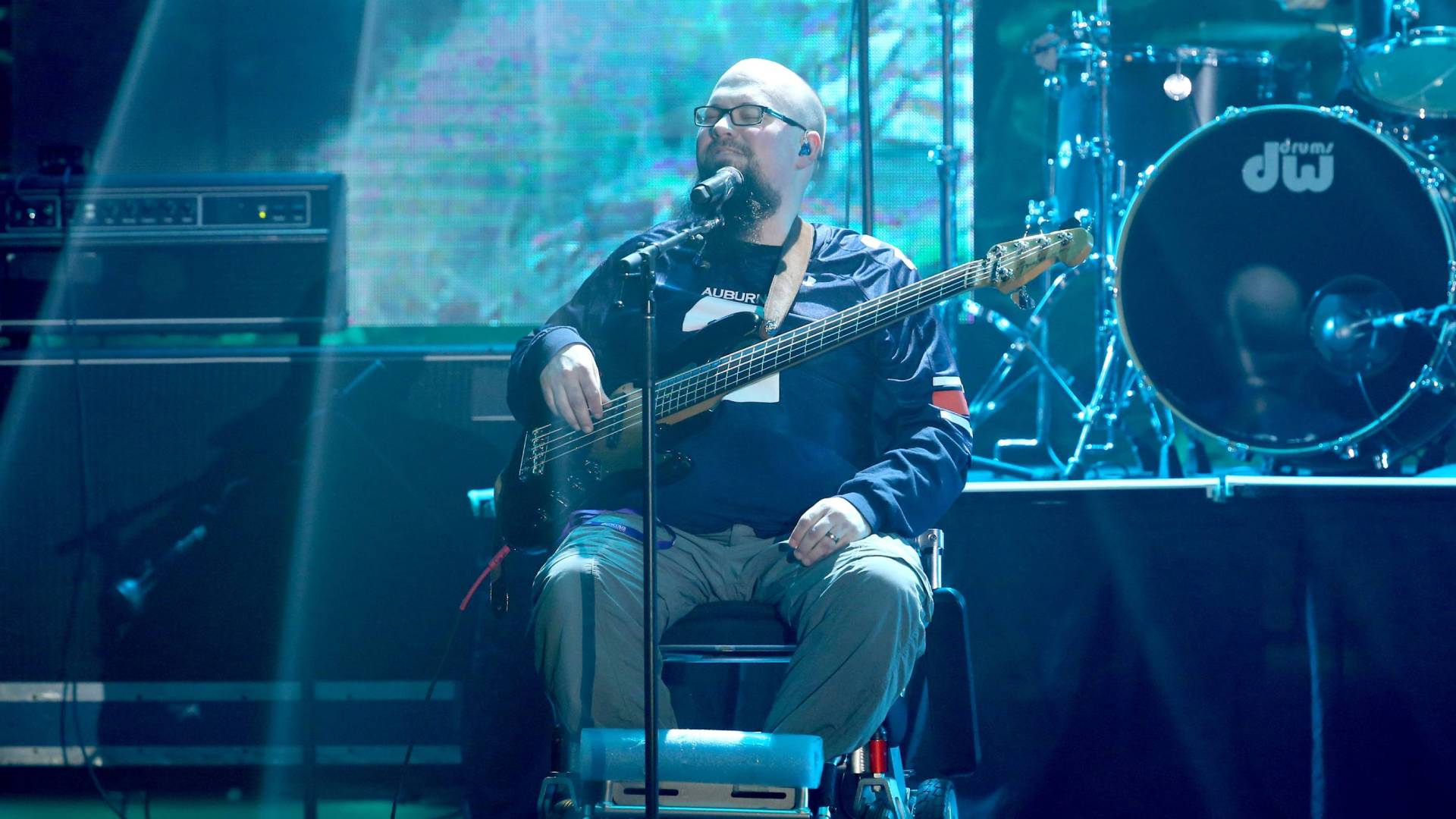
Fans have prayed for years for Big Daddy Weave bassist Jay Weaver as he endured chronic health conditions and multiple hospitalizations.

This week, his brother and the band’s frontman Mike Weaver announced that “those prayers for healing can turn into prayers for thanksgiving now that Jay is in God’s presence.” Jay died Sunday after contracting COVID-19. He was 42.

“The Lord used him in such a mighty way on the road for so many years,” Mike Weaver said in a video clip. “Anyone who came in contact with him knows how real his faith in Jesus was. I believe that even though COVID may have taken his last breath, Jesus was right there to catch him.”

Big Daddy Weave topped Christian charts and earned spots as K-LOVE fan favorites with songs like “Every Time I Breathe” and “Redeemed.”

The band’s 2019 album, When the Light Comes, emerged out of Jay Weaver’s health struggles. He had diabetes and a weakened immune system, which led to the amputation of both feet due to infection in 2016.

Over the years, Jay Weaver shared his testimony of near-death experiences as his conditions worsened as well as the self-doubt he had to face after his legs had been amputated.

“It’s a fairly lonely bed to lay in—until the Lord is remembered,” he said in a 2017 interview. “I’m lying in this hospital bed by myself, but the Lord is the best I know of anybody to come down and get in our junk with us, and that’s exactly what he did.”

Fans lifted Weaver up in prayer and read updates through the band’s social media as he underwent surgeries and treatment. At shows and events, where Weaver appeared in a wheelchair or in prosthetics, he said people often came up to say they had prayed for him.

Weaver had to pause from touring with the band to due to his health; he spent time in intensive care over the summer and had been hospitalized in December with COVID-19.

His favorite part of going on tour was seeing the band’s music minister to people. “It gives us something to look forward to … the expectation of God doing something in the hearts of people and physically seeing it with our own eyes,” Weaver said.

Chris Tomlin, who toured with Big Daddy Weave, called Weaver “a great light and a true heart for Jesus.” Steven Curtis Chapman wrote that his “smile, kindness, generosity and life reflected the light of Jesus in a beautiful way! So thankful that I got to know him this side of Heaven.”

Big Daddy Weave formed in 1998 at the University of Mobile in Alabama. Two years ago, the band was featured in a TBN reality series, where they discussed their spiritual journeys, the demands of touring, and the emotional heaviness around Jay Weaver’s amputation and health struggles.

“Praise God that he is the God of a million and one chances,” he remarked. “All I can say is today, I’ll put my best fake foot forward.”

Weaver leaves behind his wife, Emily, and three children.

When Mike Weaver broke the news of Jay’s death on Sunday he said he was sorry to share it but also “excited to celebrate where he is right now.”

In “The Only Name (Yours Will Be),” Big Daddy Weave sings:

When I wake up in the Land of Glory With the saints I will tell my story There will be one name that I proclaim Yours will be The only name that matters to me The only one whose favor I seek The only name that matters to me

News

Conservation Group Tries One More Thing to Preserve an African Woodland: Prayer

A Rocha Kenya cites WhatsApp intercession group as key to saving habitat for owls, shrews, and other endangered creatures.

Christianity Today January 4, 2022
John Mwacharo

The Dakatcha Woodland is home to Africa’s tiniest owl; a long-legged shrew with golden fur found nowhere else on earth; and weaver birds so rare it took Kenyan ornithologist Colin Jackson 13 years to track down their breeding grounds.

The East African habitat, which stretch over about 465,000 acres north of the coastal town of Malindi, Kenya, are under constant threat from climate change, expanding farms, and charcoal production.

“We’re fighting against a huge wave of destruction,” Jackson, who is also head of A Rocha Kenya, told CT.

There are only so many things you can do to save a forest. You can lobby for environmental laws. Buy land and place it in a trust. Raise money. Raise awareness. Promote scientific research on the importance of the habitat for biodiversity.

And, according to Jackson, you can pray.

“There have been times when things have looked pretty desperate and yet we’ve managed to break through and things have improved,” he said.

A Rocha Kenya, the local branch of the international network of environmental organizations with Christian ethos, has set up a “wall of prayer” to protect the Dakatcha Woodland and other key sites. It consists of a WhatsApp group of about 80 or so Christian conservationists around the world that A Rocha Kenya can call on for intercession when faced with a crisis.

Many people are skeptical of the power of prayer, and there is an especially fierce criticism of those who invoke “thoughts and prayers” as a way not to take action on pressing social issues. But Christians who care about the environment have been increasingly turning to intercession as a spiritual tool commensurate with great need.

Believers from Asia, Europe, and North America gathered monthly ahead of the United Nations climate change conference in Scotland to intercede for the governments negotiating emissions targets. At the conference, Christian observers prayed for “a godly outcome.”

And the Christian conservation group in Kenya is organizing believers who will pray for the protection of the forest that is home to many rare creatures.

The combination of the spiritual and the practical in conservation is not something new in Kenya. Many of Jackson’s colleagues either are Christians or have a Christian background. Government meetings in the area often open and close with prayer.

But some conservationists are sharply critical of the approach—and opposed to any effort to care for the environment that puts an emphasis on Christian convictions.

Mordecai Ogada, executive director of Kenyan nonprofit Conservation Solutions Afrika, told CT that the model of conservation currently practiced in Kenya “is steeped in racial bias and the dominance of ‘whiteness.’” Instead of attempting to decolonize, it draws its traditions and ideas from people like Theodore Roosevelt, the US president who was a noted conservationist, and John Muir, the Scottish American naturalist and “father of the National Parks.”

“In African societies, spirituality is closely tied to stewardship of the environment, but this African spirituality has always been vilified by missionaries and Christianity,” Ogada said. “The Christian basis for conservation instantly excludes those who do not subscribe to the Christian faith.”

But as a researcher at the University of Manitoba’s Natural Resources Institute Joanne Moyer spent 11 months looking at the role of religious organizations in sustainable development and environmental protection in Kenya, and that’s not what she saw.

“While A Rocha was one of the more overtly Christian of the organizations I studied, in terms of integrating prayer, Bible study, and worship in the regular rhythms of their organizational life, I would describe their approach toward non-Christians to be respectfully invitational,” said Moyer, who is now an associate professor of environmental studies and geography at The King’s University, Alberta. “There was an atheist volunteer while I was there, and she was never pressured to attend any of the overtly Christian activities. I think I asked her about how she felt working there as a non-Christian, and she said it was just fine.”

Moyer also believes the religious approach to conservationism may connect with Kenyans more than the Western academic and scientific environmental and conservationist programs.

“Faith-based groups like A Rocha could connect with local people in a language they understood,” she said. “An uneducated farmer might not understand things like biodiversity, habitat, endangered species, and their role in the larger ecosystem. But most Kenyans are Christian, and A Rocha could articulate a fairly simple and straightforward faith-based conservation message that I think made sense to people and resonated with them in a way that made them more motivated to respond.”

That has been Jackson’s experience. He first started connecting with the local community in Dakatcha during his quest to locate the nesting site of a small black-and-yellow bird called the Clarke’s weaver, found only there and in Arabuko-Sokoke, a forest reserve to the south of Malindi.

Like the Sokoke scops owls, the weavers are endangered due to deforestation, and their nesting habits were unknown to science until 2013 when Jackson and colleagues discovered a breeding colony in a wetland in Dakatcha. In a scientific paper published in Scopus, they described the colony, which was filled with hundreds of Clarke’s weavers building ball-shaped nests from sedge fibers and filling the air with their buzzing and sizzling calls.

During the surveys for the nesting site, Jackson and his team had discovered most people they met were church members. The churches became the conservation group’s gateway into the community.

Today, A Rocha is also helping train some of Dakatcha’s farmers in methods that protect the forest, while also promoting soil health, boosting crop yields, and minimizing water usage. Through the churches it is able to give biblical teaching on why God cares about the earth and all things in it—including the farms people work, the birds they see and hear, the air they breathe, and the water they drink.

But while Jackson agrees that faith-based arguments for protecting trees, owls, and shrews are effective, he also has a most straightforward reason to prioritize prayer at A Rocha. He’s a Christian, and Christians are supposed to pray.

“God is sovereign, and he works his purposes out,” he said. “But we do know that God loves us to talk to him and to bring our requests to him and he does answer prayer.”

He also believes that prayer is powerful.

Seven years ago, for example, Jackson and his colleagues saw large yellow earth-moving equipment arrive at Arabuko-Sokoke, a coastal forest that is home to not only many elephants and buffalo but also overlooked rarities like the golden-rumped sengi, a shrew that’s found only there and in Dakatcha. A US-based oil firm, CAMAC Energy, wanted to cut lines through Arabuko-Sokoke to carry out seismic surveys. This would involve planting and detonating explosives.

CAMAC Energy (later known as Erin Energy Corporation) insisted the seismic survey would not harm the forest and that it always complied with environmental regulations. But A Rocha, other conservation groups, and locals were alarmed at what looked to them like impending devastation.

Jackson and his colleagues were spurred into action, working with communities on the ground and other conservation groups and activists. And, as with all their work, they also turned to prayer.

Within weeks, the company had shelved its plans for exploration. CAMAC Energy’s statement at the time said that the decision to not go ahead with the surveys inside the forest was “in keeping with our tradition of involving and listening to all stakeholders.”

Jackson and the other people praying for the situation were pretty sure they knew the real reason.

“We felt very much that God really answered that prayer,” Jackson said.

Pressed on whether he could be sure the prayer partners on WhatsApp were really the key to the decision made in a corporate boardroom in Houston, Texas, Jackson just said, “That’s one of the million-dollar questions.”

A missionaries’ kid who earned a doctorate in ornithology after starting a branch of the conservationist organization at home, Jackson is happy to point to another answered prayer: funds. A Rocha Kenya recently received a grant of $1 million to purchase and protect land within the Dakatcha.

“I completely see that as an answer to prayer,” Jackson said. “I see that as God’s hand at work.”

One key area the group hopes to secure is a patch of forest where the Sokoke scops owl breeds. This 17-centimeter-high bird of prey—Africa’s smallest owl—is listed as endangered by the International Union for Conservation of Nature.

The breeding ground is currently threatened by encroaching pineapple farms and increased charcoal burning. Indirectly, Jackson said, the problem is climate change.

Although places like the Dakatcha Woodlands are considered semi-arid, 30 years ago farmers could plant crops like maize in mid-March and rely on regular soaking rainfall over the next three months. Now the rains come late. A severe drought in recent months has made things much worse.

“People are not getting the crops that they need. That is what forces them into cutting trees and burning charcoal,” Jackson said.

With the money from the grant, A Rocha is negotiating with some of those farmers to buy land, talking to them about the Christian reasons to protect the owls and their habitat, and praying that people might be moved to see the forest as something they should protect instead of consume.

Jackson says for conservation projects to be successful, people’s hearts will have to change.

“They need to get right with God and understand their God-given relationship with creation, which is to tend it and care for it,” he said. “If we get that right, and we’re in a healed relationship with God, then there’s a far greater chance for creation to be protected.”

For that, he believes, the best tool is prayer.

News

On Ukraine-Russia Border, Evangelicals Endure as Invasion Looms

(UPDATED) Baptists and Pentecostals in both nations assess activism, unity, and reregistration in the Donbas region’s occupied Luhansk and Donetsk.

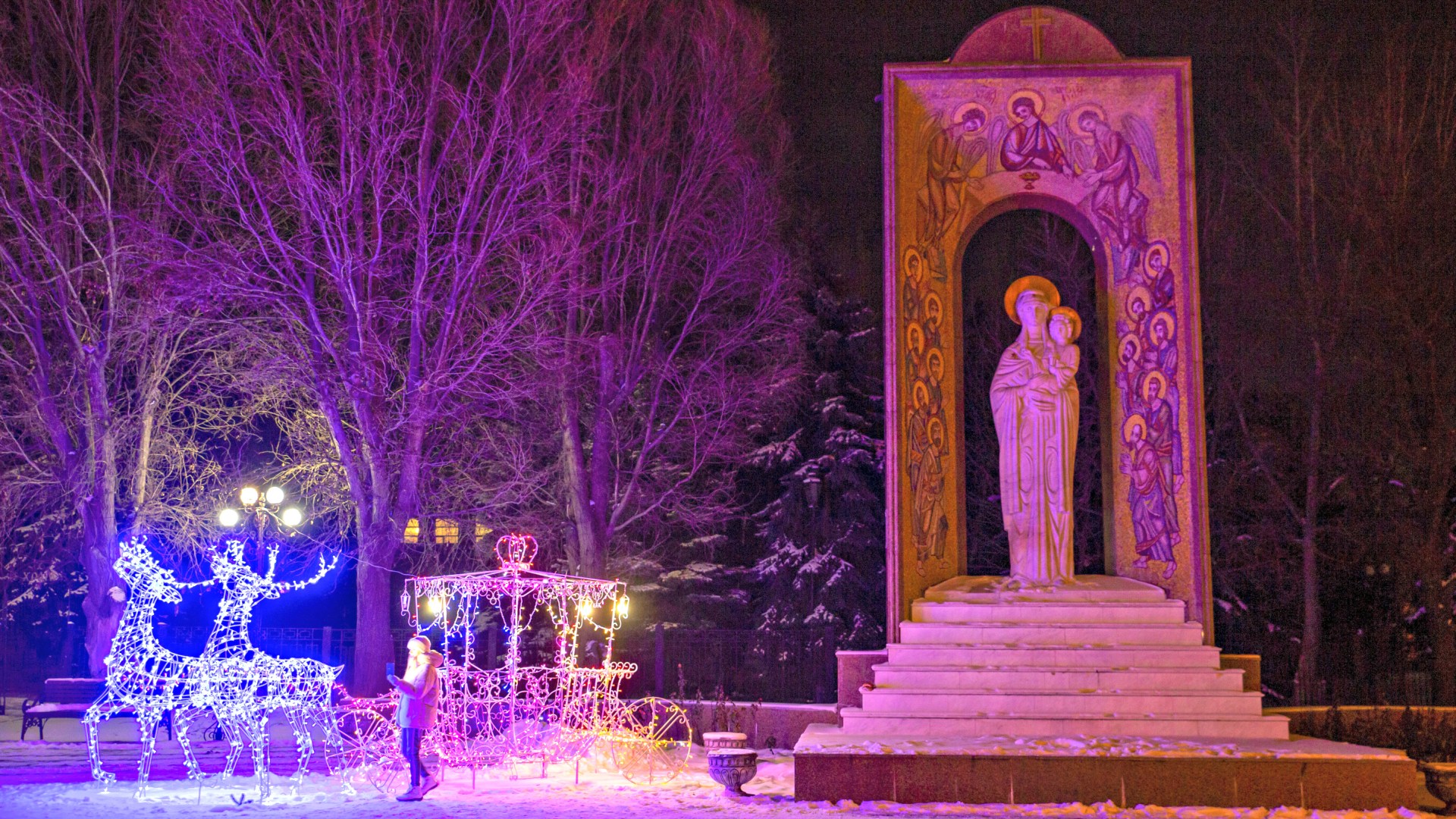
A Christmas light installation in Luhansk, Ukraine, by a monument to the 2000th anniversary of the Nativity of Christ, on December 24, 2021.

A Christmas light installation in Luhansk, Ukraine, by a monument to the 2000th anniversary of the Nativity of Christ, on December 24, 2021.

Christianity Today January 4, 2022
Alexander Reka / TASS / Getty Images

Ukraine celebrates Christmas twice, honoring both the Eastern and Western church calendars. Yet this season, Pentecostals spent the week leading up to December 25 in prayer and fasting while Baptists did the same from Christmas Day to New Year’s Day.

The reason: tens of thousands of Russian troops amassed on the border, threatening a full invasion.

“Prayer is our spiritual weapon,” said Igor Bandura, vice president of the Baptist Union of Ukraine, of the group petitions to the Prince of Peace. “God can undo what the politicians are planning.”

Russian-backed separatists have held control of the Donbas region of southeastern Ukraine since 2014. This past November, the European Evangelical Alliance (EEA) declared Donbas “the area of Europe where the church suffers the most.” In total the conflict has killed over 14,000 people and displaced 2 million of the region’s 5 million people.

This past Friday, US President Joe Biden warned Russian President Vladimir Putin that any further invasion of Ukraine would result in “a heavy price to pay”; Putin replied that any new sanctions would trigger a complete breakdown in relations. On Monday, Biden told Ukrainian President Volodymyr Zelensky that the US and its allies would “respond decisively” to Russian aggression; Zelensky signaled appreciation for the “unwavering support.”

Trying to help years ago from the Russian side, Vitaly Vlasenko was labeled a spy.

Traveling 650 miles south from Moscow to Luhansk, Ukraine, at his own expense, the now–general secretary of the Russian Evangelical Alliance (REA) waded into a war zone.

By 2018, separtist leaders in Donbas had crafted laws to re-register churches, ostensibly under the principle of freedom of conscience and assembly. But two years prior, authorities in Luhansk declared Baptists and Pentecostals a security threat. Pastors had been murdered; churches were seized.

“Our brothers in Christ in Ukraine are crying out: ‘Why don’t you pressure Russia to stop this aggression?’” said Vlasenko. “We tell them we are a small minority with no standing and no clear information, and officially Russia is not a part of this conflict.”

It does not go over well, he admits. Relations between evangelicals in the neighboring nations have become strained, and some assumed the worst of his December 2018 trip to speak with rebel authorities about the registration process.

Only the KGB-connected could get access, Vlasenko heard.

In reality, Vlasenko said the visit was arranged through prior connections with the Russian Orthodox Church metropolitan in Luhansk. Your church received registration, the REA leader told his Orthodox counterpart; where is our Christian solidarity?

Without registration, churches were disconnected from the gas and electricity grid. All remaining evangelical churches were operating illegally, but some still had use of their facilities. But now it was winter, and cold.

The metropolitan agreed the situation was wrong and facilitated contact with the religious affairs official. Vlasenko was told registration would be given to all who completed procedures. He passed on the information to Ukrainian colleagues. But today, he said, relations are at a standstill.

“I understand they are in a difficult situation,” Vlasenko said. “Most churches have their headquarters in Kyiv, so how can they accept registration and explain this to their brothers in the [Ukrainian] capital?”

But Donbas churches face a choice: Continue to suffer, or continue in ministry. Vlasenko stays neutral, as he cannot advise them as a Russian.

Religious freedom problems in Donbas listed by the EEA include:

• Many churches are illegal and cannot meet, especially evangelical and Ukrainian Orthodox ones. Whole denominations are classed as extremist with no justification.

• Much Christian literature is banned, including the Russian Synodal translation of the Bible. Church buildings have been seized by force; the Christian University of Donetsk is occupied by soldiers.

• The registration system for faith communities is totally unfair. Churches have found their applications rejected or have been liquidated later for supposedly being extremist.

To date, only a few evangelical churches have been “legalized” in Luhansk. Bandura said the registration process is designed to be impossible. But in occupied Donetsk, the other half of the Donbas region and also operating under its own rebel laws and leadership, there has been more flexibility.

Luhansk officially designated the Baptist Union as a terrorist group, Bandura said, so the church there is underground. Overall in Donbas, only half of about 100 churches are still functional. Procedures are underway with the rebel authorities in Donetsk to unite three separate Baptist groups under one umbrella, in order to secure registration.

“If this is how you can preserve your churches and ministries, we are not against it,” Bandura said. “We do not encourage or recommend anything—and assume any arrangement is temporary.”

Other groups in Donetsk still find the requirements to be cumbersome. But Yuriy Kulakevych, foreign affairs director of the Ukrainian Pentecostal Church, thinks things may be moving forward.

“Russia likes to show it keeps to international standards of freedom of religion,” he said. “But for now, we are illegal, told to sit down and keep quiet.”

The situation is different in Crimea, he said, which in 2014 was also seized by Russian-backed separatists. Russia conducted a referendum on annexation soon after and formally—though illegally under international law—incorporated the Black Sea peninsula into its territory.

Pentecostals acquiesced to the new reality.

“We saw it as then the best possible means to survive,” said Kulakevych. “And Russian Pentecostal leadership are all Ukrainian missionaries from 30 years ago; we know them.”

But not all relations are good. What he called the second-largest Pentecostal group in Russia is headed by a leader “100 percent committed to the Kremlin agenda in Ukraine.”

Even within his own network, relations were difficult. Kulakevych spoke of Ukrainian Pentecostal frustration in 2014 and onward, when Russian counterparts failed to protest against their suffering. But later, they learned that as citizens, Russian evangelicals suffer even more.

In August, Russia declared Ukraine’s New Generation Pentecostal groups “undesirable,” effectively banning them from the country. And in October, regulations took effect to demand all foreign-trained clergy and missionaries take an official course on church-state relations and recertify their ministry.

The outrage has been felt in Ukraine, and Kulakevych has pleaded on behalf of his Russian brethren.

“I have to calm down our hotheads [in Ukraine], who demand [Russian evangelicals] speak out against Putin,” he said. “We are not in their shoes, and do not understand the risks they take for the gospel.”

Bandura reached a similar understanding two years ago, when the Baptist Union of Russia came to Ukraine. Disturbed by years of quiet acquiescence, coupled with prominent examples of public anti-Ukrainian sentiment, the Russian and Ukrainian Baptist leaders held face-to-face meetings that helped heal relationships, Bandura said. After two days of closed-door sessions with no public statements, the issues between them were solved.

“We understand the religious freedom situation in Russia is terrible and don’t expect them to speak out bravely for us,” Bandura said. “It is enough if they keep silent.”

Vlasenko, however, wants to speak—carefully. He believes in the independence of Ukraine. He wants evangelicals in both countries to communicate to their national leaders that war is not the answer to political problems. And as a pastor he believes he must pursue peace—and reconciliation.

But Russia is unnerved also. If Ukraine joins NATO, ballistic missiles could be minutes from Moscow. It is good for peace, said Vlasenko, that Russia can build natural gas pipelines to Europe. And he has spoken to Crimeans—they wanted annexation, he says, and Ukraine would never have permitted a referendum.

As for the aggression in Donbas, the popular understanding among locals was that Ukraine’s 2014 revolution installed a nationalistic government that wanted to kick out—even kill—Russian-speakers in their historic region.

“Maybe it was true, or maybe it was propaganda,” Vlasenko said. “But Russia denies they are fighting, and I cannot prove otherwise without official evidence.”

But still: “Obviously the weapons come from somewhere; you cannot buy a tank at a store.”

The situation, however, is straightforward for Ukrainians.

“Ukraine has always irritated Russia,” said Oleksandr Turchynov, former interim president of Ukraine and a lay preacher in his Baptist church in Kyiv [full interview below]. “Democracy, and even our very existence, is a threat to Putin’s regime.”

Kyiv was the ancient heart of medieval Rus, long before the modern Russian nation. Putin has written a 5,000-word essay on the “historical unity” of the two nations, which he often combines with Belarus under the concept of “one Russia.”

Turchynov, currently coordinator of Ukraine’s Conservative Movement (known as Sobor) uniting faith-based nonprofit organizations, is not pleased with the negotiation style of European nations that are trying to “reconcile” Russia and Ukraine as if they are equally at fault in this conflict. He sees Putin as using natural gas to win leverage and divide the continent. Yet the key ally of former president Petro Poroshenko said he is eager for Ukraine to join NATO and strengthen conservative values within the liberal European Union.

But Turchynov’s ultimate hope is elsewhere.

“The Lord will ruin all the wrongdoings of the evil one,” he said. “Truth is with us, and thus God is with us. And where God is, the victory is also.”

Even Christmas gets mixed up in the politics. Evangelicals largely celebrate both December 25—made an official Ukrainian holiday two years ago—and the Orthodox date of January 7. But while the metropolitan of the recently autocephalous (independent) Ukrainian Orthodox Church has announced his hope to unite all Christians under the Western calendar within 10 years, he is playing it slow to recruit parishes still loyal to the Moscow patriarch.

Cyril Hovorun, a Ukrainian priest in the Russian Orthodox Church, faults his patriarch in Moscow for aligning religion to the interests of the state. But he warns Ukrainian Christians also of the danger of nationalism. A “third way” is necessary, he said, for the church to support civil society and civic values: transparency, justice, and solidarity.

Can his evangelical brethren find at least the latter?

“We all say we are part of the kingdom of God together,” Vlasenko said. “But when it comes to politics, we immediately divide again.”

(Conducted prior to Biden’s phone calls with Putin and Zelensky)

CT: How do you interpret Russian President Vladimir Putin’s intentions on the border, and how likely is a full invasion?

Turchynov: It is rather difficult to interpret, and it is even more difficult to treat him as someone whose actions can be explained with ordinary civilized values.

One aspect involves political and economic interests, such as the Nord Stream 2 gas pipeline. At the same time, Putin is raising the stakes as a tactic, issuing ultimatums. His approach serves to further polarization and undermines both NATO and the European Union (EU) concerning the expansion of membership.

It is kind of a game, growing worse for everyone. But if the West and Ukraine were to consolidate their actions, Putin wouldn’t be able to prevail. Full-scale invasion is an extremely dangerous project—mainly for Putin himself. But he is capable of making inadequate decisions.

CT: How have discussions with US President Joe Biden changed the situation, if at all? How do you view the response from the West?

Turchynov: One of Putin’s purposes was a glorious moment of triumph by sitting with President Biden as equals at the table of negotiations. But sometimes it is necessary to talk to a terrorist, to distract him from his acts of terror.

Some Ukrainians wanted to hear a different response from the White House, for example by setting a specific date for NATO membership. Others were expecting to receive defense systems from the Pentagon, to make attacking Ukraine extremely challenging. Perhaps even to host Western military forces in Ukraine.

When it comes to Europe, politically informed Ukrainians understand that the EU consists of many countries with different interests. There are friends of the Kremlin and there are friends of Ukraine. EU reaction by default cannot be instant; it is always an ongoing compromise.

For example, the reaction of Great Britain unquestionably inspires with its strictness and consistency. But when Germany and France sit at the table of negotiations with an agenda to “reconcile” Russia and Ukraine, it gives the impression as if Russia and Ukraine bear an equal level of responsibility. This benefits the Russian Federation that has attacked us.

And while Ukraine has many friends in Eastern Europe and the Baltic countries, these voices are rarely listened to.

CT: Do you favor membership for Ukraine in the EU and NATO? Can this be done while keeping peace and good relations with Russia?

Turchynov: Ukraine has always irritated Russia. Putin often questions Ukraine’s statehood, and unfortunately, many Americans know very little about our history, erroneously calling the whole Soviet Union “Russia.” This contributes to the propaganda that we became independent only 30 years ago. In reality, the medieval rulers of Kyiv were the ones who founded Moscow.

Democracy, and even the very existence of Ukraine, is a threat to Putin’s regime. We are a part of Europe, and our place is in the EU and NATO. In addition, Ukrainian membership would enhance the continent’s conservative values.

CT: How have the Conservative Movement and Ukrainian evangelicals responded to the conflict with Russia?

Turchynov: We always come alongside at the place of greatest need. There are many evangelicals among the volunteers since the very beginning of the war. The Conservative Movement (known as Sobor) draws together highly active citizens, including elected and appointed officials who have a share in key government decisions.

Our deep-rooted Christian values define what we do and how we do it. At the same time, we need to understand that the occupied territories are under full control of the Russian Federation, and thus our impact is extremely limited.

CT: What percentage of evangelicals are of Russian-speaking background? Do they have a different viewpoint toward Donbas?

Turchynov: This clash of worldviews is not an issue of linguistics. Many patriots in the Ukrainian army speak Russian on a daily basis. Dividing us by language is part of the Kremlin’s propaganda, which unfortunately has had some success.

CT: What is your opinion about churches in Crimea and Donbas re-registering with the rebel authorities?

Turchynov: Refusal to undergo this process means becoming an underground church. Not everyone is ready to function this way and risk their lives. The church needs to exist in these occupied areas as well. Even so, humanitarian aid and the maintenance of fellowship is possible with the mediation of pastors who remain there.

CT: This conflict takes place over Christmas. Is there a message in the holiday?

Turchynov: Christmas always brings hope for peace and victory. The Lord will ruin all the wrongdoings of the evil one. Truth is with us, and thus God is with us. And where God is, the victory is there also.

Interview with Oleksandr Turchynov, coordinator of Ukraine’s Conservative Movement:

Apple PodcastsDown ArrowDown ArrowDown Arrowarrow_left_altLeft ArrowLeft ArrowRight ArrowRight ArrowRight Arrowarrow_up_altUp ArrowUp ArrowAvailable at Amazoncaret-downCloseCloseEmailEmailExpandExpandExternalExternalFacebookfacebook-squareGiftGiftGooglegoogleGoogle KeephamburgerInstagraminstagram-squareLinkLinklinkedin-squareListenListenListenChristianity TodayCT Creative Studio Logologo_orgMegaphoneMenuMenupausePinterestPlayPlayPocketPodcastRSSRSSSaveSaveSaveSearchSearchsearchSpotifyStitcherTelegramTable of ContentsTable of Contentstwitter-squareWhatsAppXYouTubeYouTube