News

Police Block and Barricade Canadian Church Over COVID-19 Violations

The pastor of the Alberta congregation recently spent a month in jail for repeated refusals to comply.

Christianity Today April 8, 2021
Justice Centre

In this series

Health officials in Alberta, Canada, made the decision to “physically close” a local church building until its leaders agree to finally comply with coronavirus regulations.

Police vehicles blocked entrances to the parking lot of GraceLife Church in Edmonton Wednesday morning and temporary fencing was erected around the building. The congregation has met normally since summer 2020, despite requirements that church gatherings limit capacity, require masks, and practice social distancing.

Over the last nine months, the province’s health department fielded more than 100 complaints about GraceLife and conducted 18 inspections, resulting in multiple fines and orders to comply. Its pastor was arrested and spent a month in jail refusing the conditions of bail, that he agree to follow health regulations.

The Justice Centre for Constitutional Freedoms, which represents GraceLife and its pastor James Coates, said the move to barricade private church property prevents citizens from “exercising their Charter freedoms of peaceful assembly, association, and worship.”

As officials surrounded the church, dozens of GraceLife members gathered outside and sang hymns, according to a report by the Globe and Mail.

“Please pray for wisdom as our elders navigate this new development!” one member tweeted, posting a screenshot of the view of the new fencing from the church’s security camera.

https://twitter.com/theresiasmith52/status/1379791305308442629

Premier Jason Kenney told Albertans a week ago that the province is in its third wave of COVID-19 outbreaks. He suggested that more stringent enforcement by police may be necessary at this point, saying authorities have “been very patient during a difficult time trying to get compliance through education, through voluntary compliance, and using sanctions as a last resort.”

The GraceLife case has drawn the attention of those in both Canada and the US who fear government overreach during pandemic. Alberta legislator Dan Williams, a conservative politician and a Christian, spoke up to defend worship as a fundamental freedom. He said while he respects the 15 percent capacity limit for gatherings, “it is a different line to cross to barricade a church, a place of God.”

GraceLife leaders consider the COVID-19 risks overblown and claim that their ability to continue gathering without spreading the virus is proof.

“We believe love for our neighbor demands that we exercise our civil liberties,” the church wrote. “We do not see our actions as perpetuating the longevity of COVID-19 or any other virus that will inevitably come along. If anything, we see our actions as contributing to its end—the end of destructive lockdowns and the end of the attempt to institutionalize the debilitating fear of viral infections.”

Pastor Coates is due in court next month for violating gathering limits at GraceLife.

News
Wire Story

Evangelicals’ Vaccine Skepticism Isn’t Coming from the Pulpit

Conservative pastors and leaders are encouraging the shot while the people in the pews have been more divided.

Robert Jeffress at First Baptist Church Dallas

Robert Jeffress at First Baptist Church Dallas

Christianity Today April 7, 2021
Tony Gutierrez / AP

In this series

The president of the Southern Baptist Convention posted a photo on Facebook last week of him getting the COVID-19 vaccine. It drew more than 1,100 comments—many of them voicing admiration for J. D. Greear, and many others assailing him.

Some of the critics wondered if worshippers would now need “vaccine passports” to enter The Summit Church in Durham, North Carolina, where Greear is pastor. Others depicted the vaccines as satanic or unsafe, or suggested Greear was complicit in government propaganda.

The divided reaction highlighted a phenomenon that has become increasingly apparent in recent polls and surveys: Vaccine skepticism is more widespread among white evangelicals than almost any other major bloc of Americans.

In a March poll by The Associated Press-NORC Center for Public Affairs Research, just 18 percent of Americans who consider themselves born-again or evangelical have gotten the vaccine, compared to 29 percent of the rest of the population.

The poll found that many white evangelical Protestants aren’t planning on ever getting the shot. Forty percent said they likely won’t get vaccinated, compared with 25 percent of all Americans, 28 percent of white mainline Protestants, and 27 percent of nonwhite Protestants.

The findings have aroused concern even within evangelical circles. The National Association of Evangelicals, which represents more than 45,000 local churches, is part of a new coalition that will host events, work with media outlets and distribute various public messages to build trust among wary evangelicals.

“The pathway to ending the pandemic runs through the evangelical church,” said Curtis Chang, a former pastor and missionary who founded ChristiansAndTheVaccine.com, the cornerstone of the new initiative. With white evangelicals comprising an estimated 20 percent of the US population, resistance to vaccination by half of them would seriously hamper efforts to achieve herd immunity, Chang contends.

https://twitter.com/jdgreear/status/1376999023605915655

Many evangelical leaders have spoken in support of vaccinations, ranging from Dallas megachurch pastor Robert Jeffress to Russell Moore, head of the Southern Baptists’ public policy arm.

Jeffress believes a majority of his congregation at First Baptist Dallas welcome the vaccines, while some have doubts about their safety or worry they have links to abortion. Jeffress is among numerous religious leaders who say the leading vaccines are acceptable given their remote, indirect links to lines of cells developed from aborted fetuses.

Moore expressed hope that SBC pastors would provide “wise counsel” to their congregations if members raise questions about vaccinations.

“These vaccines are cause for evangelicals to celebrate and give thanks to God,” he said via email. “I am confident that pastors and lay members alike want churches full again and vaccines will help all of us get there sooner rather than later.”

Other evangelical pastors have been hesitant to take a public stance.

Aaron Harris, pastor of Calvary Baptist Church in Junction City, Kansas, hasn’t discussed the vaccine from the pulpit or decided whether he’ll be vaccinated.

“We don’t believe that this is a scriptural issue; it is a personal issue,” said Harris, who estimates that 50 percent of the congregation’s older adults have been vaccinated, while fewer younger members plan to do so.

“We shouldn’t live in fear of the virus because we do have a faith in eternity. However, just because we aren’t in fear of it, where is the line of what we ought to do?” he asked. “I’m not going to lay down in front of a bunch of alligators to show my faith in that way.”

Some Christians say they prefer to leave their fate in God’s hands, rather than be vaccinated.

“We are going to go through times of trials and all kinds of awful things, but we still know where we are going at the end,” said Ron Holloway, 75, of Forsyth, Missouri. “And heaven is so much better than here on earth. Why would we fight leaving here?”

John Elkins, pastor at Sovereign Grace Fellowship in Brazoria, Texas, about 50 miles south of Houston, said only one person in his SBC congregation of about 50 has been vaccinated.

“We’re in a very libertarian area. There’s a lot of hesitancy to anything that feels like it’s coming from the federal government,” said Elkins, who is also forgoing the vaccine, at least for now, along with his wife.

Elkins, whose father was a professor of gynecology at the Johns Hopkins School of Medicine, said his congregants’ doubts are not theologically based.

“It’s skepticism about effectiveness,” he said. “People are concerned it was rushed out too quickly.”

Phillip Bethancourt, another Southern Baptist pastor in Texas, has encouraged his congregation at Central Church in College Station to get the vaccine and believes most will. The church hosted a vaccine drive for staff and volunteers at other churches; 217 people got their first doses March 22.

“Even people who might be skeptical from a medical standpoint can understand it from a missional standpoint,” he said. “If it helps more people be able to serve at their church again, so more children can learn about Jesus, that’s a good thing.”

https://twitter.com/pbethancourt/status/1374185478002503682

Bethancourt, a former vice president of the SBC’s Ethics and Religious Liberty Commission, has spoken with congregants who spurn the vaccine and say they’re unafraid of dying if that’s God’s will.

“The sentiment doesn’t trouble me on the face of it, but there’s inconsistency,” he said. “We don’t adopt that mentality in other aspects of our life, like not wearing a seat belt.”

Chang said that as a former pastor, he understands why some whose congregations are mistrustful of the government and the vaccines muzzle themselves rather than risk backlash if they urge their flock to get vaccinated.

“There’s going to be some courage required,” he said.

His initiative includes a toolkit for pastors offering suggestions for how to address—within a Christian framework—the various concerns of skeptical evangelicals. They range from the extent of the vaccines’ link to abortion to whether they represent “the mark of the beast,” an ominous harbinger of the end times prophesized in the New Testament’s Book of Revelation.

Partnering in the initiative is the Ad Council, known for iconic public service ad campaigns such as Smokey Bear and “Friends Don’t Let Friends Drive Drunk.”

“We know the important role faith plays in the lives of millions of people throughout the country,” Ad Council president Lisa Sherman said, expressing hope that the campaign could boost their confidence in the vaccines.

As the vaccines first became available, there was widespread concern that many black Americans would be hesitant to take them due to historic, racism-related mistrust of government health initiatives. But recent surveys show black Protestants are more open to vaccinations than white evangelicals.

“This pandemic has hit our community like a plague — and that’s made our job easier,” said Bishop Timothy Clarke of First Church of God, a black evangelical church in Columbus, Ohio. “We’ve done a tremendous job of educating.”

News

Women and African Americans Now More Likely to Leave the SBC, But So Is Everybody Else

Though data shows declines across the board, departing members aren’t going far.

Christianity Today April 7, 2021
Ismael Paramo / Unsplash

The Southern Baptist Convention has been faced with a string of prominent departures last few months.

In December, several high-profile African American pastors left after denouncing a statement released by SBC seminary presidents that declared critical race theory incompatible with the denomination’s teachings. Then last month, Beth Moore—the most prominent female voice in the Southern Baptist Convention—said she too had departed the convention and would no longer be publishing through Lifeway.

These public exits come as the Southern Baptist Convention continues to report a precipitous decline in members. In 2006, SBC records indicated a total of 16.3 million members. Data released in 2020 notes that the membership has declined to 14.5 million, with a 2 percent decline reported between 2019 and 2020 alone.

The influential members making headlines aren’t the only ones leaving and may represent broader concerns for the people in the pews of the average Southern Baptist church. Is America’s largest Protestant denomination having a harder time retaining women, people of color, and younger members than in the past?

Data from the General Social Survey, which asks respondents about the denomination that they grew up in as well as their current denominational affiliation, offers a subtle and nuanced portrait of a denomination that is struggling to retain its membership regardless of their gender, race, or age. However, several of these factors do seem to make it more likely for some to leave the SBC.

https://datawrapper.dwcdn.net/piDHY

Between 1985 and 1995, women were slightly more likely to leave the Southern Baptist Convention than men. That gender gap essentially disappeared in subsequent waves of the survey, but the decline in retention among both men and women is still something to consider.

In the late 1980s, 75 percent of men and 70 percent of women who were raised Southern Baptist stayed Southern Baptist. In the most recent waves of the data, retention had declined to 57 percent for both men and women. (Thus, the overall decline for men is actually larger, by about 5 percentage points.)

https://datawrapper.dwcdn.net/TIGoT

The pattern for race is slightly different than for gender. In the earliest data available, there was no real gap between white and non-white Southern Baptists. But then a gap began to emerge in the late 1990s that continued for the next decade.

Non-white Southern Baptists did not experience a decline in retention rates during this time period, while fewer white Southern Baptists stayed in the denomination. However, in the last decade or so, non-white defection began to increase and now there’s no discernible difference in defection based on race.

Consider that between 2006 and 2010, about 30 percent of non-white Southern Baptists left the convention, but in the most recent data a decade later, it’s nearly half. This is in spite of the fact that the SBC has reported the number of black churches has increased. It’s not possible to tie this rise in defection to a single source, but the changing political climate may be a culprit.

https://datawrapper.dwcdn.net/Sq8qe

In terms of age, there used to be evidence of a retention gap in the Southern Baptist Convention, but that seems to have dissipated in more recent years.

In the mid-1980s through 2000, younger Southern Baptists were more likely to leave the convention compared to those over the age of 40. But data from 2000 and forward indicates that this age gap has disappeared. The reason for this is because defection among older Southern Baptists has accelerated more rapidly as of late, bringing this age group in line with those under the age of 40.

The question of who’s leaving the SBC also raises the issue of where they end up once they go. Studying their new religious affiliations offers an interesting window into how American Christianity has changed over the last three decades.

But shoots itself in the foot instead, say its critics.Moral Majority appears to have damaged its credibility among Senate allies and perturbed evangelicals in Washington by declaring war on a bill that would update the U.S. Federal Criminal Code.Jerry Falwell’s lobbyists see the revision as “soft on crime.” They have rushed out a hair-raising analysis, written by a Senate staff member, Mike Hammon. He is counsel to the Republican Senate Steering Committee, which is chaired by Sen. Jesse Helms (R-N.C.). Although Hammond wrote Moral Majority’s position paper, the group also retained a lawyer, and relied on its Washington staff for information.The massive bill culminates 15 years of congressional tinkering with overlapping, contradictory, and outdated provisions in the criminal code. The complexities and sheer length of one Senate and two House of Representatives versions make the job of analyzing it staggering. This has spawned a series of charges and countercharges about who, if anyone, fully understands the bill.Nonetheless, some conservative senators say that in reacting so harshly to the bill, Moral Majority leaped before it looked.For example, Moral Majority says the new bill would “create an abortion funding program” for victims of rape. But according to the conservative senators who cosponsor the bill, “The criticism is wrong. The bill provides no compensation of any kind for medical expenses relating to pregnancy.” (An earlier version would have done so.)Another objection involves the length of prison terms. The current maximum sentence for a convicted rapist is either death or life imprisonment. In the revised code it is 25 years. Moral Majority interprets this to mean that the code will “let dangerous felons loose on the streets.”But what Falwell’s attack does not say is that the new code also would eliminate parole. As a result, sentences would be served in their entirety. At present, inflated sentences are assigned and then often reduced by parole boards. Proponents of the code say the new sentencing structure would actually result in longer sentences and easier convictions.Moral Majority’s vice-president, Ronald Godwin, testified before the House Subcommittee on Criminal Justice that “we are experiencing a violent crime wave that is sweeping America, that is being felt by everyone.… We call for a restoration of existing maximum penalties and insist that all existing death penalties be carried forward in a constitutionally valid manner.”Some knowledgeable evangelicals in Washington see it differently.Daniel Van Ness, special counsel for Charles Colson’s Prison Fellowship, said lengthy prison terms are not the answer because “the certainty of punishment is more significant than the severity.”He cautioned, “We have to check our instinct to raise prison sentences, because it’s a false impulse. It makes us look like we’re getting tough, but it doesn’t really accomplish anything.”To identify a criminal’s state of mind, the current law offers 70 definitions, such as “with malice aforethought” or “with a depraved heart.” In the update, these are reduced to four: acting “intentionally,” “knowingly,” “recklessly,” or “negligently.”What this will accomplish, according to Senate staff lawyers, is to introduce language that is commonly understood by both judges and juries. But altering the language has drawn fire from Moral Majority. Said Godwin, “In the high and holy name of neatness, they say surely we must do something to tidy it up. I’m not in favor of neatness,” he added, at the expense of eliminating language used to set legal precedent throughout history.Legislative efforts to update the criminal code began under President Lyndon Johnson in 1966. Later, conservative Sen. John L. McLellan introduced a series of revisions. In 1977, he drafted a compromise bill along with Sen. Edward Kennedy, who chaired the Senate Judiciary Committee at the time. Kennedy’s contribution to that earlier version of the bill has spurred Moral Majority incorrectly to label the current edition a “Kennedy bill.” In fact, it is the result of a broad bipartisan effort, but Kennedy, a liberal Democrat, is a popular target of Moral Majority’s fusillades.A meticulously detailed rebuttal to Moral Majority’s broadside attack was prepared by the Justice Department and three staunchly conservative senators who cosponsored the bill, who say Falwell’s charges are “false and misleading.” The three are Senators Paul Laxalt of Nevade, Strom Thurmond of South Carolina, and Orrin Hatch of Utah. (Two other conservatives, however, John East of North Carolina and Jeremiah Denton of Alabama, withdrew their sponsorship because of Moral Majority’s objections.When asked whether Moral Majority officials had studied the bill themselves, spokesman Cal Thomas said, “there is no way we can know the entire contents of every bill.”Godwin said, “I’m aware of those elements of the bill which concern Moral Majority.”Moral Majority’s statements raised concern among evangelicals in Washington. At the National Association of Evangelicals’ (NAE) Washington office, public affairs director Bob Dugan said, “I think the whistle needs to be blown on inaccurate reporting, whether in liberal media or conservative fund raising. The bill just isn’t quite the threat that it’s purported to be, especially once you’ve read it and considered that it is cosponsored by some very conservative senators.” Responding to Dugan, Thomas said he was disappointed that one Christian organization should criticize another. “We gave a well-reasoned, articulate defense of our position,” he said.In its January Insight newsletter, the National Association of Evangelicals raises questions about the bill. But it goes on to explain the reasoning behind the provisions—something the Moral Majority critique does not do. The legislation has won strong administration support, with President Reagan calling it “the foundation of an effective federal effort against crime.” Attorney General William French Smith says it “contains well over a hundred significant improvements in criminal law” and would “clarify and rationalize” existing provisions. But Moral Majority has vowed to work toward defeat of the measure in Congress, saying they “regard improvement by amendment to be virtually impossible.”As a floor debate in the Senate approaches this spring, Falwell is likely to step up direct-mail and advertising efforts to mobilize Christians to write letters to Congress and financially support his group’s initiative.Moral Majority Has Harsh Words For ReaganSome of the most ominous warnings to the Reagan administration yet heard from the Religious Right came during a recent conference on the Christian faith and social issues held at Huntington College in Indiana. The speaker was Cal Thomas, a former NBC newsman, and Moral Majority’s vice-president for communications.Thomas voiced doubts about the Reagan administration’s commitment to Moral Majority’s social agenda several times in response to questions. “If Reagan cleans up the economy and lots of babies go on being killed, I think we’ll go down the tube. I think we’ll forfeit the right to exist as a nation. The White House doesn’t think we have any place to go. That’s what they think.”He acknowledged that the New Christian Right would have a hard time finding another presidential candidate to support in 1984, but noted that staying away from the polls is always an option—one that can mean the margin of defeat for a candidate.Moral Majority is organizing a profamily conference for next summer, when President Reagan will be warned to start moving on the social agenda of the New Right. “He’ll be told if he doesn’t immediately set a social agenda, he’s through as far as the Religious Right is concerned.”Also, in response to complaints that Moral Majority has not addressed issues such as poverty, Thomas detailed the efforts of Jerry Falwell, Moral Majority president, to help the poor. Last summer, Falwell sent 100 Liberty Baptist College students to live with black families in several urban areas, according to Thomas, including Watts and Harlem. “I think a lot of his social agenda has been unreported. We don’t report it because it sounds self-serving.”Thomas joined Falwell’s organization last year. “He’s one of the best things Falwell has going for him,” said Wes Pippert of United Press International’s Washington bureau, a conference participant. “He’s brought a lot of people into one-to-one contact with Falwell. I don’t know anybody who’s done more to reach to others on either side. He’s established contact between Hatfield and Falwell. He’s also astute in the use of the news media. He knows how the media operate.”Before going to work for Moral Majority, Thomas was a correspondent for NBC television in Washington, D.C.RUSS PULLIAM

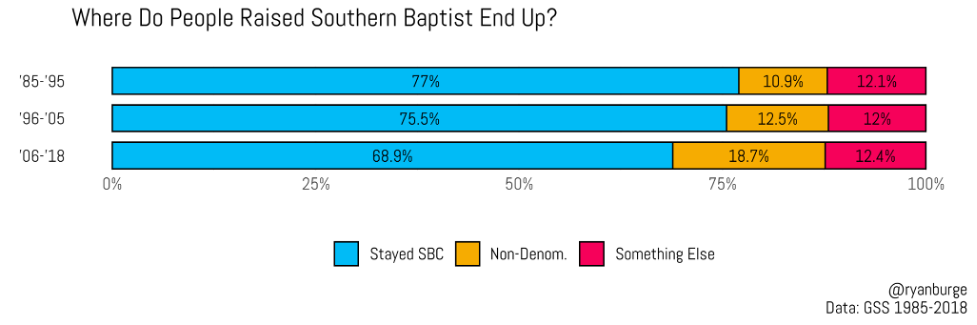
Note first, that overall retention among Southern Baptists has declined from 77 percent prior to 1995 to 69 percent in the most recent data. Where do these defectors go? About 11 percent of those raised Southern Baptist became a member of a non-denominational church in the 1980s and 1990s, but that has increased to nearly 19 percent in more recent years.

If you add together those who stayed Southern Baptists with those who switched to a non-denominational church, there’s been zero change in this percentage over the last 33 years. In essence, people are staying in the same general religious tradition, just larger shares are switching to a non-denominational congregation.

For Southern Baptists, there is good news and bad news from these results. It does not appear that defections from the Convention are especially predicated on gender, race, or age. Instead, the overarching indications point to a decline across all groups over the last 30 years, and there doesn’t seem to be any systematic factors driving those changes—at least not that show up in the data yet.

Still, there’s not any evidence to indicate that the share of Southern Baptists who end up leaving the faith has changed at all since the mid-1980s. Instead, many are switching their affiliation. So it’s not evangelicalism that’s declined, it’s denominational evangelicalism, which may be a more difficult trend to reverse.

News

Why Black Pastors Still Stay Southern Baptist

Even with disputes over Trump and critical race theory pushing some minority leaders out, others stand by the missional advantage in the country’s largest Protestant body.

Marshal Ausberry, first vice president of the Southern Baptist Convention and president of its National African American Fellowship

Marshal Ausberry, first vice president of the Southern Baptist Convention and president of its National African American Fellowship

Christianity Today April 7, 2021
Courtesy of Baptist Press

Fred Luter has been a Southern Baptist for 35 years. But the last four years “have been some of the most difficult times” to be black in the Southern Baptist Convention (SBC), he said, as white pastors appeared to support President Donald Trump uncritically despite character flaws for which they “would have crucified” President Barack Obama.

Noticing the disparity, members of the predominantly black New Orleans congregation Luter pastors told him they’re “almost embarrassed” to be Southern Baptist. They even asked to leave the SBC.

But Luter, the first African American SBC president, hasn’t wavered in his support for the convention.

“We’re not in this convention because of who the president of the United States is,” Luter said. “We’re in this convention because of our commitment to the Great Commission and the Great Commandment.”

Luter shared his story as part of a YouTube series titled Why I Stay, featuring testimonies from leaders of color who have remained in white evangelical circles—including the SBC—despite mounting pressure to leave. The series is hosted by Dhati Lewis, a North American Mission Board (NAMB) vice president who is among the highest-ranking black employees at any SBC entity.

“We have to be as loud as the detractors in letting people know all the positive that’s going on in the denomination” for black and brown Christians, Lewis said.

That positive message increasingly has been needed as high-profile black departures from the SBC spur Southern Baptists of color to question their own involvement in the convention. Thus far, most minority churches have stayed in the SBC. Black and brown Christians who have found a home in the convention hope to keep it that way.

The relationship between the SBC and Christians of color “is kind of like a marriage,” said Marshal Ausberry, SBC first vice president and president of the convention’s National African American Fellowship (NAAF). “In marriage, you’re going to have some rough spots along the way, but we don’t divorce one another.”

The past year has been a rough spot. Chicago’s Charlie Dates and Atlanta’s John Onwucheckwa have been among black pastors to announce their departures from the SBC, citing concerns over the denomination’s racial climate.

Texas pastor Dwight McKissic, a former trustee at Southwestern Baptist Theological Seminary and perennial presence in SBC business sessions, said his church is leaving the Southern Baptists of Texas Convention (SBTC) and may leave the SBC too if it fails to stand behind a 2019 resolution endorsing limited use of critical race theory.

Nonetheless, ethnic minorities remain a strong presence in the SBC. Non-Anglo congregations comprised 22 percent of the 51,538 total Southern Baptist congregations in 2018, the last year for which data is available. That included a record high of 3,382 majority black churches, up 90 percent from 2000. The figure also included 3,509 Hispanic congregations and 2,095 Asian congregations.

Terry Turner, a Dallas-area pastor and former SBTC president, said relationships help keep him in the SBC. The denomination’s Cooperative Program, which funds missions and ministries, is “the best way of building the kingdom,” he said, and the convention is “second to none” in missions, hunger relief, and disaster relief.

When Turner led Texas Southern Baptists, he helped launch the “Look Like Heaven” initiative to spur cross-cultural worship and cooperation. When it comes to racial tension, “I just want to be on the cutting edge of making things better,” he said.

Turner is concerned, however, that the presidents of the six SBC seminaries caused an “unnecessary disruption in race relationships” late last year when they issued a statement declaring that “any version of Critical Theory is incompatible with the Baptist Faith & Message,” the SBC’s confession of faith.

Other black Southern Baptist pastors share Turner’s concern. In Birmingham, Alabama, two years ago, SBC messengers adopted a resolution on critical race theory and intersectionality that provoked some objections from the floor and later a documentary alleging a social justice agenda in the convention. The seminary presidents issued their statement in part to address such objections.

But some African Americans have taken issue with the presidents’ complete rejection of critical race theory, wondering if they caved to pressure and subverted the will of SBC messengers. Critical race theory, while flawed as a worldview, has limited use, pastors of color say, including to help analyze unconscious bias at SBC institutions—none of which has ever hired a chief executive who isn’t white.

Ausberry has been dialoguing with the seminary presidents about non-Anglo Baptists’ concerns. The presidents did not diminish African Americans’ views intentionally, he said, and have admitted that including people of color in their deliberations about critical race theory would have been helpful. NAAF and NAMB are partnering to launch a new outreach effort to black churches, with details to be rolled out later this year.

The NAAF in March, though, said it was disappointed that the presidents had “not moved from their original statement of CRT’s incompatibility in all its forms” and reiterated that “we strongly believe that any discussions on systemic racism must consider the lived experiences of Blacks and other ethnic groups.”

Continued SBC involvement is beneficial to Christians of color, Ausberry said, because of the convention’s “high view of Scripture” and its focus on reaching the lost for Christ. He feels “a sense of God’s calling to be in the SBC.”

Chicago pastor Adron Robinson, a member of the SBC Executive Committee and former president of the Illinois Baptist State Association, feels a similar calling.

Among the “numerous advantages” of SBC affiliation for him are the international and North American mission opportunities as well as relationships with pastors of multiple ethnicities. But he believes the “wholehearted embracing” of Trump by some white Southern Baptists who “tried to baptize” the former president’s ideology is causing black and Latino pastors to reconsider their future SBC involvement.

“Some told me they’ve got one foot out the door,” Robinson said. “Others have told me that they are evaluating things and waiting to see, and some told me they have no intention of leaving at this time.” The “way forward is for the SBC to get back to what the Lord has called us to do. That’s to live out the Great Commission and the Great Commandment.”

Robinson believes minority pastors are looking to this year’s SBC presidential election at the convention’s June annual meeting in Nashville as an indicator of the path it will take. The four announced candidates to date are Northwest Baptist Convention executive director Randy Adams, Alabama pastor Ed Litton, Southern Baptist Theological Seminary president Albert Mohler, and former Executive Committee chairman Mike Stone.

All four have spoken to the issues being discussed by African Americans and other ethnic minorities. Adams leads Southern Baptists in one of America’s most culturally diverse regions. Litton has signed multiple statements on racial reconciliation in recent years and will be nominated by Luter. Mohler has drawn praise in the past for his work toward racial reconciliation, including helping to inspire the 2017 book Removing the Stain of Racism from the Southern Baptist Convention. More recently, he drew critique for endorsing Trump in 2020 after declaring himself a Never Trumper four years earlier.

Stone, a member of the Conservative Baptist Network steering committee, has expressed concern over critical race theory’s influence in the convention. But Latino pastor Javier Chavez, a candidate for SBC second vice president this year, said Stone “pressed diversity” when he was Georgia Baptist Convention president and helped bring Chavez into the state convention’s leadership.

While Chavez wants to see more Hispanics in SBC leadership, he is pleased with the SBC’s outreach to Spanish speakers. Multiple SBC entities offer Spanish-language programs and resources, he said, including a host of publications from Lifeway Christian Resources, the SBC’s publishing arm.

To overcome racial tension in the convention, “let’s open our Bibles,” said Chavez, pastor of Amistad Cristiana, a Hispanic church in Gainesville, Georgia. “Let’s sit down, let’s talk, and then let’s pray, and let’s move forward, … Let’s bring closure to this conversation.”

Last month’s Executive Committee meeting in Nashville provided a glimmer of hope such a moving forward is possible. In his presidential address, J. D. Greear suggested he has heard the concerns articulated by black and brown Southern Baptists. He addressed “our leaders of color, many of whom I know are struggling to stay engaged in a convention that you think cares little about you.”

“At our best, we are Great Commission Baptists,” he said, “and that gospel and that Great Commission is what will keep us unified in trying times.”

David Roach is pastor of Shiloh Baptist Church in Saraland, Alabama.

News

InterVarsity Wins Suit Against Wayne State

UPDATE: University’s nondiscrimination policy unconstitutionally discriminated against the campus ministry.

Christianity Today April 7, 2021
Jeff Dunn / Flickr

Update (April 7, 2021):

The fight for campus access for faith-based student groups scored another legal victory this week.

A district court judge ruled on Monday that Wayne State University violated the First Amendment with a 2017 decision that temporarily denied InterVarsity Christian Fellowship its status as a student group over the chapter’s requirement that its leaders be Christian.

Wayne State’s nondiscrimination policy, according the 83-page opinion by Robert Cleland, “violated plaintiffs’ rights to internal management, free speech, freedom of association, freedom of assembly, and free exercise as a matter of law.”

The judge ruled that the First Amendment protects religious organizations’ rights to select their own ministers, and that the InterVarsity chapter’s student leaders qualified as ministers. While InterVarsity is open to all students, it asks leaders to sign a statement of faith.

Cleland also agreed with InterVarsity’s argument that the school selectively applied its nondiscrimination policy, since other organizations also had specific requirements for their leaders.

The decision comes three years after Wayne State allowed InterVarsity to regain its recognition as a campus group and only resulted in a $1 in symbolic damages. In a statement to Detroit News, the university challenged the decision to pursue litigation when InterVarsity had already been “granted everything it requested in a timely manner.”

The ruling, though, stands to benefit other student groups or chapters at other schools by underscoring the importance of fair treatment and religious freedom. Lori Windham, who represented InterVarsity as senior counsel at Becket, said, “The law is crystal clear: universities can’t kick religious student groups off campus just because they choose leaders who share their faith.”

When they get kicked off campus or pursue legal challenges, “it may be evangelicals who make the headlines because we have the resources,” InterVarsity’s external relations director Greg Jao told CT last year, but the resulting First Amendment protections also help minority faith groups who lose out because of the same policies. “We should be standing there with the Sikh groups, the Hindu groups… those who are most vulnerable.”

The US Department of Education enacted a final rule late last year prohibiting public colleges and universities from discriminating against religious student organizations over their “beliefs, practices, policies, speech, membership standards, or leadership standards” and clarified their right to official recognition, facility usage, and funding alongside other groups.

——-

Original post (March 9, 2018): Just two days after InterVarsity Christian Fellowship filed a lawsuit against Wayne State University, the Detroit school decided to let the chapter regain its official status on campus once again—one of the quickest initial victories in a string of legal battles over Christian groups at public colleges.

Last year, InterVarsity lost its recognition as a student group at Wayne State, the third-largest school in Michigan, over requirements that its leaders affirm the organization’s Christian beliefs. The school viewed the belief requirement as a violation of its nondiscrimination policy.

InterVarsity sued on Tuesday, claiming religious discrimination; other student groups allowed on campus similarly ask leaders to share certain core values. Wayne State ultimately re-certified the student ministry on Thursday.

“We’re so glad that Wayne State is letting us back on campus,” said Cristina Garza, former president and current member of Wayne State’s InterVarsity chapter, which dates back 75 years and is one of the oldest in the country. “We hope the school will make this change permanent, so no other students have to go through what we’ve been through over the last six months.”

InterVarsity is all too familiar with the fight for campus access, having lost then regained its place on 19 Cal State campuses in 2014 and 2015 due to the schools’ “all comers” policy, which requires school-sanctioned groups to open membership eligibility to all students and leadership positions to all members. Such a policy also led to InterVarsity getting forced off Vanderbilt University’s campus a few years before.

Across more than 1,000 chapters at 687 college campuses, InterVarsity opens membership to all students, and about a quarter of participants are “not-yet-Christian,” the ministry reports. However, InterVarsity continues to require its student leaders to be Christians and to affirm its core beliefs.

The Wayne State saga comes weeks after similar issues at other major universities. Last month, Harvard put a Christian group on a year-long probation for asking a student in a same-sex relationship to leave the organization.

“We reject any notion that we discriminate on the basis of sexual orientation in our fellowship,” the leaders of Harvard College Faith and Action stated. “Broadly speaking, the student in this case was removed because of an irreconcilable theological disagreement pertaining to our character standards.”

Becket, a religious liberty advocacy group which represented InterVarsity in the Wayne State suit, also helped a Christian group regain its status at the University of Iowa earlier this year.

Business Leaders in Christ lost its place on campus over a “sexual morality” requirement in its faith statement, which kept a gay student from taking on a leadership role in the organization. Back in January, a judge ordered that the group be reinstated, though litigation is pending.

Baptist Press reported that the Baptist State Convention of Michigan had shifted its funding toward church plants in college towns over on-campus student groups, a strategic decision that may become a necessary move if campus access issues continue.

“Our religious liberty and our opportunity to share as openly as we have in the past” at colleges and universities “is under attack,” said Tim Patterson, executive director of Michigan Baptists. Baptists “have to rethink how we do ministry on campus because the campus has changed.”

Evangelicals themselves are largely split on nondiscrimination regulations at public universities, with 51 percent in favor of allowing belief requirements for student leaders and 44 percent opposed, LifeWay Research found in 2015.

Americans overall are open to exemptions for groups with religious convictions on sexual morality. More than two-thirds (68%) of Americans say public universities shouldn’t only fund religious groups if they allow gay or lesbian leaders, according to the survey.

Recent nondiscrimination policies at college campuses have increasingly brought faith groups under scrutiny, but as CT has reported, the issue of campus access has a long history:

Even before the Christian Legal Society (CLS) narrowly lost its 2010 Supreme Court case protesting the Hastings School of Law’s “all comers” policy, universities were struggling to find a balance between religious freedom and anti-discrimination ….

As far back as 1997, Grinnell College in Iowa banned InterVarsity because of its unwillingness to select a noncelibate gay leader. Later, several schools including Tufts University, Rutgers, and the University of North Carolina (UNC) also derecognized InterVarsity because requiring leaders to be Christians violated the schools’ anti-discrimination codes. UNC reversed its decision just weeks later; Rutgers settled out of court; and Tufts reinstated InterVarsity but later reversed it. InterVarsity recently lost campus access at SUNY Buffalo and Bowdoin College as well.

“It’s good that Wayne State saw the light after it felt the heat,” said Lori Windham, senior counsel at Becket. “This kind of official religious discrimination should never happen again.”

Baptists Can Dunk: 5 Facts About Baylor Basketball’s Historic NCAA Championship Win

A culture of joy is at the center of the 114-year-old program’s first national title.

Head coach Scott Drew and the Baylor Bears celebrate their win against the Gonzaga Bulldogs.

Head coach Scott Drew and the Baylor Bears celebrate their win against the Gonzaga Bulldogs.

Christianity Today April 6, 2021
Jamie Squire / Getty Images

In last night’s championship game, Baylor University beat Gonzaga University to become the first men’s team from a Baptist school to win the highest honor in college basketball.

Baptist fans—or bandwagon fans—chimed in on Twitter with churchy quips, saying the team played “like there’s a potluck after” and joking about a Baptist team being able to go to “the big dance.”

Baylor calls itself a Christian university “in the Baptist tradition,” and its win represents a historic mark not only for the school but for Protestant colleges competing in the sport.

As a staff member with Baylor’s Faith & Sports Institute, I’ve been cheering on the Bears with my colleagues; Tuesday morning we greeted each other with the lingering buzz of excitement overpowering the sleep deprivation from the late-night game. And as a historian, I also have a sense of how this year’s team fits in with the broader historical context of Christian engagement with basketball.

1. Basketball at Baylor goes back more than a century—but Catholic schools tend to win more championships.

Baylor began playing basketball in 1907, just 16 years after the sport originated at the YMCA International Training School in Springfield, Massachusetts. Though many Christian colleges took interest in the game invented by James Naismith, few have been able to rival Catholic schools with championship-level success.

Since the NCAA tournament began in 1939, Catholic schools have won 10 men’s titles. Compare that to Protestant schools—who can claim four only if Duke, originally founded as a Methodist school, is counted—and the battle for Christian men’s basketball supremacy is lopsided. Baylor’s victory in 2021 puts one definitively in the Protestant column.

2. Baptist women have been more likely to dominate in the sport.

While 2021 marked the first national championship for the Baylor men, the women’s team has enjoyed a run of success that includes three titles in the past two decades, most recently in 2019. Thanks to Baylor, among religious schools winning NCAA titles in women’s basketball, Protestants hold a 3-2 advantage over their Catholic counterparts.

And the Baylor women are not the first Baptist school in Texas to dominate the sport. Back in the 1950s, the famed Flying Queens of Wayland Baptist established a dynasty that few have matched before or since. Playing before Title IX opened up opportunities for women to play organized competitive college sports, the Wayland Baptist women competed in the Amateur Athletic Union (AAU), a collection of semi-professional teams and colleges. From 1953 until 1958 they reeled off 131 consecutive wins.

Baylor’s current president, Linda Livingstone, has important basketball connections as well. She played for Oklahoma State beginning in 1978, and her name is still near the top of the school record books for field goal percentage in a season and career.

3. Baylor’s last men’s championship game was in 1948, led by a basketball-playing revivalist.

2021 is not the first time the Baylor men have made it to the NCAA championships. In 1948, the Bears played in the finals before losing to Kentucky. That team, coached by Bill Henderson, marked the high point of a brief run of success in the years following World War II. From 1946 until 1950, they won four conference championships and made three NCAA tournament appearances. (At the time, Baylor was still segregated. It took nearly two decades before Tommy Bowman became the first black player to take the floor for the Bears.)

https://twitter.com/p_emory/status/1379066179013255174

The 1948 team was also notable for its leading player, Robert “Jack” Robinson. Robinson coupled his basketball skills with preaching ability, leading revivals while at Baylor that served as a precursor to his career as a Baptist minister. Robinson’s play in the NCAA tournament also helped him earn a spot on the 1948 Olympic basketball team, which won gold in London. “Never in my life have so few days brought so many thrills,” Robinson wrote of his experience. “I found my Christ adequate again.”

Robinson maintained his sports interests after his playing days were over, serving as one of six ex-athlete clergymen on the Fellowship of Christian Athletes’ first advisory board when it launched in 1955.

4. Scott Drew comes from a family of Christian college basketball coaches.

Baylor head coach Scott Drew told Sports Spectrum that he enjoys the freedom he has at Baylor to publicly share his Christian faith and incorporate Christian ideas and practices into the program.

In many ways, that’s part of the family tradition. His father, Homer Drew, was a longtime supporter of the Fellowship of Christian Athletes and coached at Bethel University in Indiana and then at Valparaiso, both Christian colleges. It was at Valparaiso that the Drew family first earned national recognition when Scott’s brother, Bryce, hit a game-winning shot in the 1998 NCAA tournament. Scott was an assistant at Valparaiso at the time.

After a one-year stint as head coach at Valparaiso, Scott came to Baylor in 2003 in the wake of a tragic scandal involving a Baylor player murdering his teammate and NCAA violations (including a cover-up) by the former coach. Drew gradually rebuilt the program from the ground up. After four straight losing seasons, he’s had a winning season every year since 2007–2008, the best stretch of success in Baylor men’s basketball since Bill Henderson’s post-World War II teams.

5. The team’s motto emphasizes joy and putting Jesus first.

This year’s team has adopted a mantra of a “culture of JOY” within the program. The JOY acronym stands for “Jesus, Others, Yourself,” and is a variation of the popular “I Am Third” slogan used by numerous Christian coaches. But the word “joy” also operates on its own, symbolizing the mutual delight and celebration with which the team plays.

“It’s a hierarchy of the way of thinking,” Baylor star Jared Butler explained. “For me, it’s the fact that I get to be here with this group of guys. It’s joy; it’s fun.”

Of course, we should be careful about the myth-making power of a slogan. It never fully matches up to reality. And its allure is usually driven primarily by its association with a winning team.

Even so, Baylor’s embrace of JOY can remind us of the origins of basketball itself. There is something distinctively Christian about J-O-Y, with the focus on putting Jesus first. But there is something universal about joy as a feeling and emotion that connects with our desires and yearnings as human beings.

In that sense, we see traces of Naismith’s original vision. He created basketball as a Christian and for Christian purposes, but he let it out into the world for all to enjoy and appreciate, hoping he might “leave the world a little better than I found it.”

Naismith never cared much about winning, and he probably wouldn’t be all that impressed to see a Christian school win a national title. But when basketball fosters and encourages joy, it’s operating precisely as Naismith intended.

News

Churches Plunge Ahead with Easter Baptisms

New converts show the impact of distanced discipleship during pandemic shutdowns.

Christianity Today April 5, 2021
Shana / Lightstock

In February 2020, the Evangelical Free Church of Bemidji in Minnesota finally purchased a baptismal tank, eager to conduct baptisms in its building rather than offsite at a local university swimming pool or nearby lake.

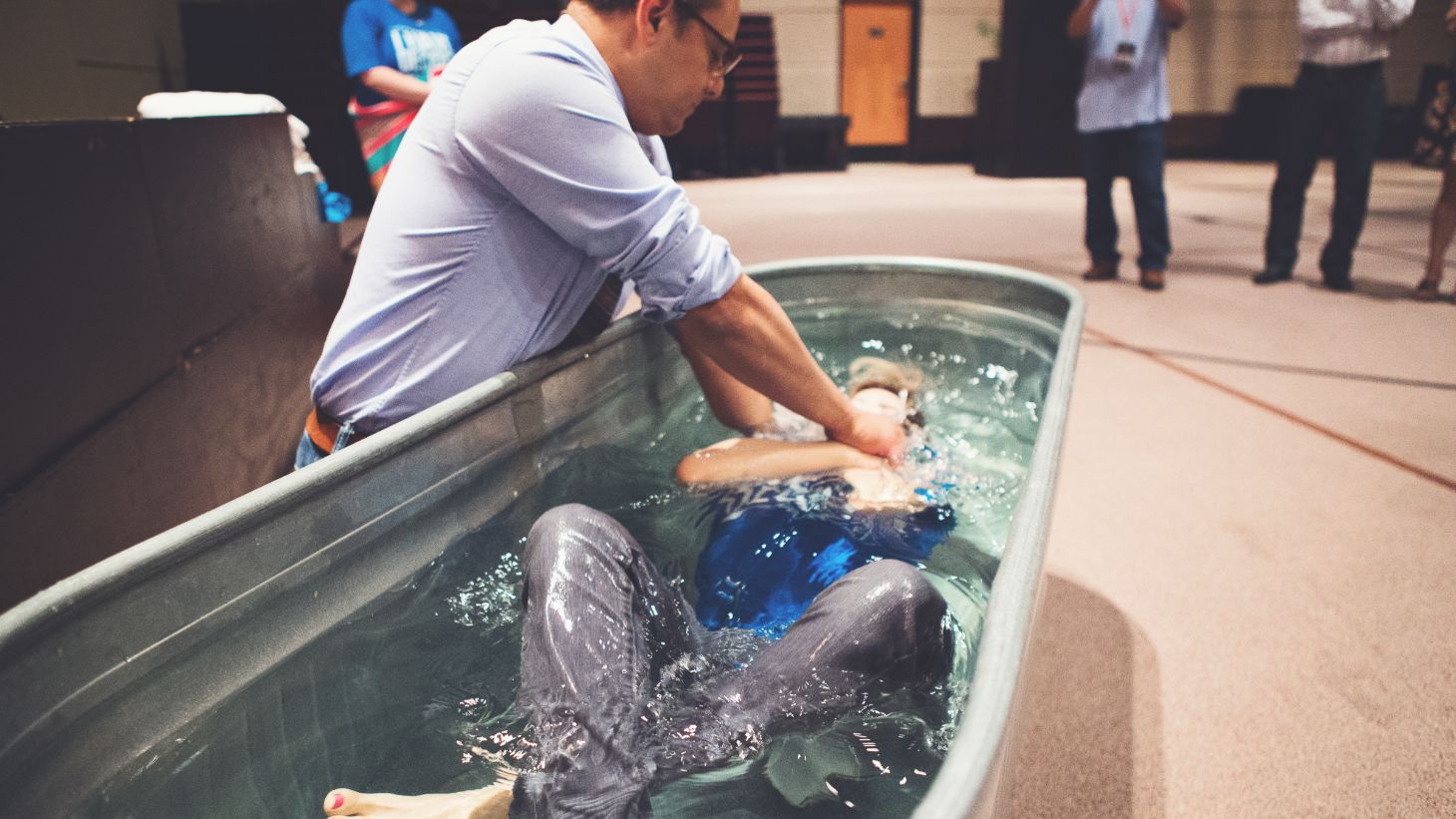
After putting baptisms on hold during the pandemic, the church’s pastor asked a teenaged believer to take off his mask and plug his nose as he became the first to undergo the sacrament in the new wooden baptistry on Easter Sunday—14 months later.

In addition to some churches opening their doors for the first time in over a year, the holiday marked a delayed chance to celebrate new life through baptism, a practice that represents the death, burial, and resurrection of Jesus commemorated during Holy Week.

“We are thrilled that we not only are able to gather for worship in person this Easter but also that we are able to have these baptisms as a part of our Easter celebration,” said associate pastor Eric Nygren.

To reduce the risk of spreading COVID-19, the Evangelical Free Church baptized a set of two siblings during one of its services on Sunday; each shared their testimony by video before stepping up to be baptized before the congregation.

Last year, when only 7 percent of churches were meeting in person, churches had to call off baptisms or, in some cases, adapt the practice as they got creative with other aspects of Easter services. One Florida church held Zoom baptisms where new believers baptized themselves in bathtubs or swimming pools while the congregation watched online.

By the second Easter of the pandemic, church attendance for Easter had risen but wasn’t back to typical levels; around 2 in 5 Christians (39%) said they planned to go in person this year, compared to the 62 percent who normally do, Pew Research found.

As church buildings slowly welcome more and more congregants through their doors, they’ll have the chance to celebrate new converts who made decisions to be baptized during the pandemic. After a year during which death has hovered so near, baptisms feel like ushering in a new era of church fellowship.

While the Catholic Church traditionally holds baptisms for adults joining the church during its Easter Vigil, some Protestant churches had bigger-than-average baptism celebrations this Easter due to postponing the practice during the pandemic.

Outdoors and indoors, babies and professing believers, churches added to their numbers during the Sunday services: 82 people baptized at First Baptist Church of Cleveland, Tennessee; 45 baptized at Christ Place Church in Flowery Branch, Georgia; dozens at a beachside service by Coastline Calvary Chapel in Pensacola, Florida; and on and on—each a tangible sign of how God has continued to grow his church despite the challenges of the past year.

https://twitter.com/ChristPlacePJ/status/1378851587712544768

On Easter Sunday at Tanglewood Bible Fellowship, David Shields baptized two converts who found the Duncan, Oklahoma, church during the pandemic. One became a believer a few weeks ago.

“Every single person who has visited our church has said they heard about us and watched us online before,” said Shields, who went from doubting the effectiveness of virtual services to seeing them as his church’s greatest community outreach.

He became the Tanglewood’s senior pastor just three weeks before the pandemic shut down worship services in March 2020 and believes the Lord has blessed their efforts to continue to preach his Word through the video services.

Nygren has also seen streaming services as a boon. Though his Evangelical Free congregation had a livestreamed service before 2020, more new visitors are finding the church online and following up by coming in person now that cases are down and more people are vaccinated.

Next Sunday, a week after Easter, New Life Church in Colorado Springs will baptize more than 100 new converts during its second baptism service since the pandemic began.

The church consulted with local health officials to ensure that symbolic life in Christ didn’t coincide with real-life outbreaks of COVID-19. By alternating tanks, regularly disinfecting the water, and wearing masks and shields, the church got approval for mass baptisms.

Senior pastor Brady Boyd believes the pandemic has stirred within people a hunger for the gospel that he has never before seen in nearly 25 years of pastoral ministry.

Each week, New Life has 5,000 live worshipers at its eight congregations and another 25,000 streaming the service online. The church bought airtime on its local ABC affiliate to broadcast the service each Sunday.

“Even in the midst of the pandemic, the gospel didn’t get stopped, and people are responding to it,” Boyd said. “As Christ followers, we need to be reminded that the gospel is more powerful than anything.”

Among evangelical Protestants, Pew found that nearly 2 in 5 (37%) say the pandemic has strengthened their faith. The teenager baptized Sunday at the Evangelical Free Church of Bemidji described being inspired by an audiobook about Brother Andrew.

“I want him to be at work in my life like he was in Brother Andrew’s life,” he said in remarks prior to his baptism. “I’ve started reading the Bible not just out of habit, but because I want to learn more about Jesus.”

Books
Excerpt

Tim Keller: Hope for a Better World Starts with the Resurrection

Four reasons Christianity offers unparalleled confidence that history is headed somewhere good.

Christianity Today April 5, 2021
Illustration by Mallory Rentsch / Source Images: Europeana / Unsplash / The New York Public Library / Perth & Kinross Council

The American belief has long been that each generation will have a better life—economically, technologically, socially, personally—than the previous one. But this idea of linear historical progress did not exist in most other cultures. All ancient cultures—Chinese, Babylonian, Hindu, Greek, and Roman—had different views. Some saw history as cyclical, and others saw history as a slow decline from past golden ages.

Hope in Times of Fear: The Resurrection and the Meaning of Easter

Hope in Times of Fear: The Resurrection and the Meaning of Easter

Viking Drill & Tool

272 pages

The idea that history was moving in the direction of continual progress and improvement in the human condition simply did not exist.

Then, however, came Christianity. As Robert Nisbet writes in his book History of the Idea of Progress, Christian thinkers gave “to the idea of progress a large and devoted following in the West and a sheer power that the idea could not have otherwise [in the absence of Christian beliefs] acquired.” The Greeks thought that the accumulation of human knowledge led to a mild, temporary improvement in the human condition—but only between conflagrations. But Christian philosophers “endowed the idea of progress with new attributes which were bound to give it a spiritual force unknown to their pagan predecessors.”

Christianity, then, offers unparalleled resources for cultural hope. (We are not for the moment talking about individual hope—hope for life after death. We are talking about corporate hope, social hope, hope for the future of society, of the human race—hope for a good direction to history.) Looking at the arc of history through the lens of Christ’s resurrection, we can make four broad statements about the nature of Christian hope: It is uniquely reasonable, full, realistic, and effective.

Christian hope is reasonable

First, there is formidable historical evidence that the resurrection of Christ actually happened. This makes Christian hope different from any other variety.

N. T. Wright explains that the resurrection of Christ presents evidence that demands explanation from historians and scientists. It can’t simply be dismissed. He writes, “Insofar as I understand scientific method, when something turns up that doesn’t fit the paradigm you’re working with, one option … is to change the paradigm.” We are not to exclude the evidence just because our old paradigm can’t account for it, but we are to include it within a new paradigm, “a larger whole.” A failure to provide a historically plausible alternative explanation for the eyewitness accounts and the revolutionary, overnight worldview change of thousands of Jews is not being more scientific—it is being less so.

Various kinds of Western progressivism believe history is moving toward more individual freedom or class equality or economic prosperity or technologically acquired peace and justice. But these views are not hypotheses that anyone can test. They are “hope so” hopes—beliefs that are not rooted in the empirical realm. The resurrection of Christ, however, includes powerful evidence from the empirical realm and, while still requiring faith, provides a highly reasonable, rational hope that there is a God who is going to renew the world.

Christian hope is full

Every religion has offered people a hope for a life after death. Our secular culture, in radical contrast, is the first in history to tell its members that both individuals and world history will end in ultimate oblivion. In the end, we go to nothing, both as a civilization and as persons.

Other religions are ultimately “spirit-ist” in the sense that they believe matter is unimportant and in the end all that will exist is spirit. Secularism, of course, is materialist in its belief that there is no soul or supernatural reality, that everything has a scientific, physical cause.

Christianity differs from both. It does not merely offer the prospect of a wholly spiritual future in heaven. The resurrection of Jesus, to cite the Greek New Testament, is arrabon, a down payment, and aparche, the firstfruits of a future physical resurrection in which the material world will be renewed. It will be a world where justice dwells, every tear will be wiped away, death and destruction are banished forever, and the wolf will lie down with the lamb; these are lyrical, poetic ways of saying that this world will be mended, made new, liberated from its bondage to death and decay (Rom. 8:18–23).

This is the fullest possible hope. The resurrection of Christ promises us not merely some future consolation for the life we lost but the restoration of the life we lost and infinitely more. It promises the world and life that we have always longed for but never had.

Christian hope is realistic

The philosophy of G. W. F. Hegel has long been highly influential for Western thought. Hegel taught that history was proceeding through a “dialectic” in which, in each age, conflicting forces reached a new, greater synthesis. This meant that every age was better than the one before and history was moving upward in a series of unbroken steps. That, as we have seen over the last century, is simply unrealistic. Christianity offers an infinitely greater and more wonderful destiny for human history and society, but it does so realistically.

If we look to the death and subsequent resurrection of Jesus, we see a very different divine model. His life was not in any way a series of upward steps. He emptied himself of his glory and came and died, yet this descent led to an ascent to even greater heights, because now he rules not only the world in general but also a saved people. It was only through his suffering and descent that he was able to save us and ascend.

This is not the Hegelian merger of equal and opposite forces. Jesus did not “synthesize” holiness with sin or life with death. He defeated sin and death through death. But neither are Jesus’ life and ministry the random sequence ruptures described by the postmodernists. Jesus goes through darkness to eventually bring us to greater light. History is moving toward a wonderful destiny, but not in a series of successively better and better eras, going from strength to strength. That is not how God works.

The secular idea of progress is naive and unrealistic. It is wrong to base a society on the assumption that every generation will experience more prosperity, peace, and justice than the one before. But the postmodern alternative robs us of any hope. Christianity, however, gives us a noncynical but realistic way to see history.

Christian hope is effective

Finally, Christian hope works at the life level, the practical level.

The New Testament uses the word hope in two ways. When it comes to hoping in human beings and ourselves, our hope is always relative, uncertain. If you lend to someone, you do so in the hope that person will pay you back (Luke 6:34); if we plow and thresh, we do so in the hope that there will be a harvest (1 Cor. 9:10). We choose the best methods and wisest practices to secure the outcome we want. We insist to ourselves and others that we have it sorted and under control. But we do not—we never do. This is relative, “hope so” hope.

But when the object of hope is not any human agent but God, then hope means confidence, certainty, and full assurance (Heb. 11:1). To have hope in God is not to have an uncertain, anxious wish that he will affirm your plan but to recognize that he and he alone is trustworthy, that everything else will let you down (Ps. 42:5, 11; 62:10), and that his plan is infinitely wise and good. If I believe in the resurrection of Jesus, that confirms that there is a God who is both good and powerful, who brings light out of darkness, and who is patiently working out a plan for his glory, our good, and the good of the world (Eph. 1:9–12; Rom. 8:28). Christian hope means that I stop betting my life and happiness on human agency and rest in him.

A person who gets a diagnosis of cancer will rightly put relative hope in doctors and medical treatment. But the main source of dependence must be upon God. We can have certainty that his plan and will for us is always good and perfect and that the inevitable destiny is resurrection. If a cancer patient’s main hope lies in medicine, then an unfavorable report will be devastating. But if that hope is in the Lord, it will be like a mountain that cannot be shaken or moved (Ps. 125:1). Isaiah 40:31 says that those who “hope in the Lord” are not anxiously holding on but always “renewing their strength” and even “soaring.” Hope in God leads to “running and not growing weary” and “walking and not being faint.”

Jesus has secured this for us by his death and resurrection. When this assurance abides in us, our immediate fates—how the current situation turns out—can no longer trouble us. Hope comes from looking at him.

Timothy Keller is the founding pastor of Redeemer Presbyterian Church in New York City. This article is adapted from HOPE IN TIMES OF FEAR, by Timothy Keller, published by Viking, an imprint of the Penguin Publishing Group, a division of Penguin Random House LLC. Copyright © 2021 by Timothy Keller.

Books
Review

Meet the Pro-Life Activist Who Narrowly Escaped Being Aborted Herself

How Claire Culwell’s life changed when she discovered the shocking truth about her biological mother.

Illustration by Rick Szuecs / Source images: Kristaps Ungurs / Unsplash / Courtesy of Waterbrook Multnomah

The most powerful stories are those that bring the hypothetical to life. In 1989, a reported 1,396,658 abortions took place within the United States. Claire Culwell may have been the only infant who survived the procedure that year. Her twin wasn’t so fortunate.

Survivor: An Abortion Survivor's Surprising Story of Choosing Forgiveness and Finding Redemption

Survivor: An Abortion Survivor's Surprising Story of Choosing Forgiveness and Finding Redemption

Waterbrook

240 pages

The Abortion Survivors Network reports only 365 documented cases of abortion survival in American history, though more survivors almost certainly exist. Like Culwell, many of them have grown up unaware of how they entered the world.

In her memoir, Survivor: An Abortion Survivor’s Surprising Story of Choosing Forgiveness and Finding Redemption, Culwell recounts her idyllic childhood spent in a loving adoptive family. As a young woman, she became interested in finding her biological mother, a search that would drastically change her life.

Raised in a compassionate Christian home by parents who worked for the evangelical organization Cru for over 40 years, Culwell was poised to receive the news of her unlikely birth sympathetically. After locating her birth mother, Tonya, and having a joyous first meeting, Culwell penned a note thanking her for choosing life. But the note compelled an astonishing admission.

Tonya was only 13 at the time of the 20-week abortion that killed Culwell’s sibling and nearly took her own life. “The day [my mother] took me to an abortion clinic, I was terrified,” recounts Tonya in the book. “I was alone and scared. The doctor never said a word to me … as if this were just another day in the life of a bad young girl.” Soon thereafter, Tonya discovered she was still pregnant. (She hadn’t known she was carrying twins.) Her mother took her for a second abortion, which never took place due to complications from the first.

Culwell felt “shocked” and “confused” when Tonya tearfully disclosed the disturbing truth. “I now had to face the startling reality that I was almost aborted … twice,” she writes. But where anger may have arisen, love bloomed instead.

As Culwell explains, “I didn’t feel the slightest bit of hatred for her. She seemed like a victim in the whole situation—abandoned by the boyfriend who had fathered me and pressured by her mother to quickly deal with the pregnancy … I actually saw Tonya as exceedingly courageous. She bravely revealed to me her deepest, darkest secret.”

Culwell’s willingness to forgive sprang from her deep faith, as well as a lifetime of care and concern for the vulnerable. She writes passionately of being drawn toward the outcast and downcast, people like the lonely autistic classmate she befriended at school or a developmentally disabled girl she babysat. God had prepared her to respond with compassion.

Ironically, it was only in the aftermath of her discovery that Culwell began considering the mission of the pro-life activists she often saw outside her bedroom window, protesting at a Planned Parenthood clinic nearby. She admits she had “given virtually no thought to abortion” before learning she’d nearly died from one. In fact, she didn’t even know Planned Parenthood offered abortions—or that it was possible to survive the procedure. She immediately felt a strong urge to speak up for children in the situation she once faced.

One prominent voice in contemporary abortion debates is former Planned Parenthood director Abby Johnson, who famously quit her job right before Culwell learned of her own story. Johnson’s former clinic was the same one visible from Culwell’s window. Johnson had just gone public with her new pro-life perspective, reached after she witnessed the ultrasound-assisted abortion of a 13-week-old baby. When Culwell shared her story with the activists outside the clinic, they quickly connected her with Johnson, who encouraged her to begin sharing her story publicly.

That meeting soon launched her into a whirlwind of speaking engagements for pro-life causes. As an introvert, she was uncomfortable becoming a poster child, but she felt she could she help others see the reality of their choices.

In Survivor, Culwell clarifies her discomfort with the unhelpful, divisive tactics of certain angry activists, often seen brandishing grotesque images of aborted babies or Bible verses damning people to hell. These sensational displays reliably generate news coverage, but they misrepresent the vast majority of Christian activists, who approach vulnerable women in love, offering genuine prayers and support. As Culwell writes, she “never would have wanted” someone like Tonya “to encounter angry pro-life activists calling her a murderer, saying she had blood on her hands.”

The book also counters the narrative that abortions aren’t affecting Christians. In reality, as Culwell notes, four in 10 abortions are performed on churchgoing women. She encourages churches to offer better care, support, and financial assistance for women facing unplanned pregnancies, commending the work of church-based organizations like Embrace Grace and Sanctuary of Hope.

From the pro-life world, we often hear it proclaimed that an aborted child could have been the next president or the person who discovered a cure for cancer. But these notions, however well intended, are unhelpful. Every child, regardless of their actual or theoretical contributions to the world, is an image-bearer of God. In the life of Culwell, a wife and mother of four children, we see plainly the humanity of what so many in today’s world mislabel a “choice.”

“I chose to boldly embrace who God said I was—his beloved child he had known since before the dawn of time,” writes Culwell. That’s a truth we should all affirm unwaveringly.

Ericka Andersen is a freelance writer living in Indianapolis. She is the author of Leaving Cloud 9: The True Story of a Life Resurrected from the Ashes of Poverty, Trauma, and Mental Illness.

News
Wire Story

Some Church Plants Launch on Easter After COVID-19 Delays

New congregations have put their initial public gatherings on hold for six months or more.

Christianity Today April 2, 2021
Tucker Good / Unsplash

“Someone asked me the other day how I felt about launching a church this weekend,” Derrick DeLain, lead pastor of Proclamation Church said this morning during a phone call. “I’m hyped, but like it is when you’re getting ready to play in a big game, you almost feel like you’re about to throw up, too. We’re excited about it and ready – Hey, you mind holding on a second?”

Pulling in to the church parking lot, he spotted a man named David he’s befriended. David lives with other men at a nearby halfway house for those battling drug addictions.

“Hey David! How you doin’ bro?” he called out. “Are we going to see you Sunday? I hope so. Yeah, bring them on.” Back on the call, DeLain explained how relationships had been built with David and others as they walk across the church’s lot.

Such spur-of-the-moment ministry opportunities have become essential for pastors in general, and church planters like DeLain in particular, over the last year.

COVID-19 threw an innumerable number of plans out the window, leaving leaders of all kinds scrambling to adjust.

Proclamation Church’s official launch will take place this Sunday on Easter, for instance. But the original launch was supposed to be at the beginning of the year. When the number of positive COVID-19 cases spiked around Thanksgiving, those plans were altered. Instead, an eventual “soft launch” began in January consisting of Proclamation Church and invited guests from the community.

Due to shifting pandemic precautions, churches are ten times more likely to hold services this Easter than they were last Easter, when COVID-19 lockdowns first began. Some churches have held out due to health guidelines or reservations within their community and will be regathering for the first time on Resurrection Sunday. And for some new churches like Proclamation, this week won’t just be their first time to be together since the pandemic began, it’ll be their first open-doors gathering, period.

Church planting can be a trying and unpredictable process in normal times. The pandemic made it even trickier.

After six years on staff as a campus pastor at The Summit Church in Durham, North Carolina, DeLain felt led to plant a church through The Summit in the Nashville area. So, his family and others moved as the core team that would make up Proclamation Church. Along the way, they became acquainted with Glenwood Baptist Church, a graying congregation wanting to increase its ministry presence in the area.

Last August, he and other members of the core team met with Glenwood Baptist. “I laid out a plan of revitalization that had them and us merging into Proclamation Church. I talked about strategies in discipleship, evangelism and other ministry areas,” he said.

Glenwood leaders agreed and that conversation lasted throughout the fall, with Sundays set aside for both groups to meet for worship.

“We wanted to set a healthy DNA and structure with healthy systems,” DeLain explained. “Let’s build some rapport and get to know each other so we can trust each other.”

Church plants have become varied in both their locations and their approaches to launching, said Matt Maestas, a Kansas City-based North American Mission Board church planting catalyst for the SEND Network. And while Easter is a popular launching point, it’s definitely not the only one.

“I encourage church planters to also find times that reflect a ‘normal’ start for a community’s calendar,” he noted.

That includes the start of the school year, the calendar year in January or the start of summer. The last option, he pointed out, can serve to build momentum through events like Vacation Bible School or sports camps.

During 2020, Maestas observed church planters either pausing their launch for six months or longer, or continuing with their launch in a virtual context. “It’s been really different, church to church, city to city—even within a city,” he commented.

That was the case even before the pandemic, but discussions over safety and masks were just as animated in new churches as they were in established ones. Those challenges considered, Maestas commended the overall leadership response to COVID-19 from pastors in all settings, not just those he knows personally.

“If you compare that leadership response from churches with those of the government, business and education, our church leaders knocked it out of the park. They shifted gears and made changes to connect with their people in meaningful ways,” he said.

Derrick DeLain Courtesy of Proclamation Church / Facebook / Baptist Press
Derrick DeLain

At Proclamation Church, plans to delay its initial launch were already being discussed when a longtime member of Glenwood Baptist died from COVID-19. That led to an official decision to delay, not just because of obvious concerns about the virus’ spread, but its effect on senior adults wanting to rejoin their church family in person.

Like many church plants, Proclamation’s average age skews younger. But DeLain wants senior adults to feel safe attending and have a place to pour in their spiritual gifts. That diversity in age was his intention all along.

“We were praying for older people, some spiritual gray hairs, to be in our congregation,” he stated. “We want some Titus 2 women and men who have been around the block. When we first met with Glenwood, we felt this was God answering our desire for that.”

Since January, Proclamation Church has held two “preview” services each Sunday in the 350-seat sanctuary formerly known as Glenwood Baptist Church. With social distancing and the wearing of masks, around 115 have been attending. During the week the church gathers in family groups—a practice that began last fall.

On his way from the halfway house this morning, David recognized DeLain and responded with a “What’s up, Rev? Yeah, I talked to the other guys, and we might show up Sunday.”

DeLain is encouraged by the inroads Proclamation has already established in the community. “Hopefully, those guys at the halfway house will come to know Jesus,” he said. COVID-19 has taken a toll in a lot of ways on people, he added, not just physically, but mentally in how it has affected the economy and relationships.

“So, when people ask me about launching a church this weekend, I say God has provided so far, and he’s still going to move,” DeLain said. “After all, he loves his church a lot more than we do and is going to take care of it.”

addApple PodcastsDown ArrowDown ArrowDown Arrowarrow_left_altLeft ArrowLeft ArrowRight ArrowRight ArrowRight Arrowarrow_up_altUp ArrowUp ArrowAvailable at Amazoncaret-downCloseCloseellipseEmailEmailExpandExpandExternalExternalFacebookfacebook-squarefolderGiftGiftGooglegoogleGoogle KeephamburgerInstagraminstagram-squareLinkLinklinkedin-squareListenListenListenChristianity TodayCT Creative Studio Logologo_orgMegaphoneMenuMenupausePinterestPlayPlayPocketPodcastprintremoveRSSRSSSaveSavesaveSearchSearchsearchSpotifyStitcherTelegramTable of ContentsTable of Contentstwitter-squareWhatsAppXYouTubeYouTube