Political scientists often refer to a “God Gap” in American politics, noting the tendency for religious people to be more conservative and vote Republican while those who are less observant lean left and prefer the Democratic Party. “If I know whether you say grace before meals every day, I can probably predict how you vote,” Notre Dame political scientist David Campbell recently told Los Angeles Times columnist Doyle McManus.
New research suggests there are actually two God Gaps. For some Christians, being more religious makes them more conservative on social issues. For others, going to church, praying, and doing other religious activities actually makes them more liberal on social justice issues.
Previous polls have shown the God Gap has been limited to social issues, issues that focus on individual morality. People who are more religious tend to hold more conservative positions on social issues like abortion and same-sex marriage, but there was no God Gap on issues like welfare, health care, or other social justice policies.
A new study finds the difference between these two types of Christians is what they think it means to be a “good Christian.” For some, being a good Christian might mean greater pietism, a focus on eliminating individual sins. As these kinds of Christians become more religious, they become more conservative on issues like abortion and gay rights. For others, being a good Christian means reaching out and helping one’s neighbor. These Christians take more liberal positions on social justice issues as they become more observant.
Steve Mockabee (University of Cincinnati), Ken Wald (University of Florida), and David Leege (Notre Dame) studied the God Gap with new questions on the American National Election Study, a survey sponsored by National Science Foundation.
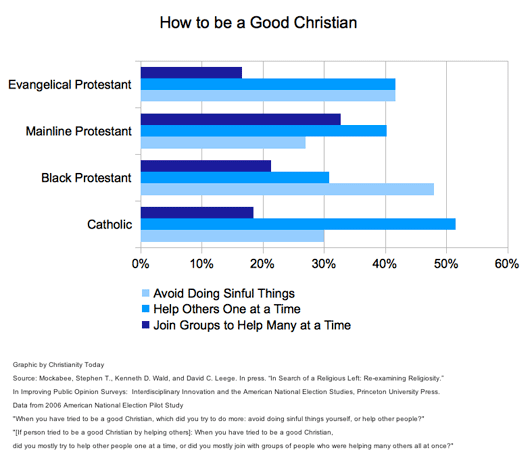
Nearly all Christians said there had been times in their lives when they had “tried to be a good Christian” (94 percent). But Christians differed in how they tried to be a good Christian. Christians were given two choices: “avoid doing sinful things” or “help other people.” Of course, many Christians try to do both, but the researchers forced them to make a choice in order to see which was most important.
Overall, one-third of Christians said they had tried to be a good Christian by sinning less, but there were differences among religious groups. Nearly half of black Protestants said being a good Christian meant sinning less compared to about four-in-ten white evangelicals who said the same thing.
The survey also asked people who thought being a good Christian meant helping others if they did so by helping people one at a time or if they worked with groups helping people. Two-thirds of Christians tried to help people one at a time. Mainline Protestants and black Protestants were more likely to try to work with groups helping many people instead of trying to help people one at a time.

The researchers found that the original God Gap may be overstated. Being more religious makes “avoiding sin” Christians more conservative on social issues like abortion, gay rights, or the role of women in society. “Helping others” Christians do not become more conservative on abortion or gay rights. In fact, these Christians become more liberal on issues related to women.
As these “helping others” Christians become more religious, they also become more liberal on issues such as aid to the poor, welfare spending, government health insurance, government aid to African-Americans, and unemployment aid. Being a more observant “avoiding sin” Christian has no affect on how they view these issues with one exception—the more religious an “avoiding sin” Christian is, the more they oppose government health insurance.
The research is being published as part of Improving Public Opinion Surveys, a Princeton University Press book coming out later this year.
Copyright © 2011 Christianity Today. Click for reprint information.
Related Elsewhere:
Christianity Today covers political developments on the politics blog.