





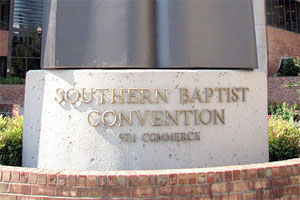
Update (May 7, 2013): The Miami Herald reports on the trend of Baptist churches changing their names and “quietly moving away from their denomination’s historic namesake–worried that it conjured up images of pipe organs, narrow-mindedness or stuffy, formal services.”
Recent research suggests that the decision to drop denominational references in church names is a double-edged sword.
––
The task force appointed to study a possible name change of the Southern Baptist Convention is recommending the convention maintain its legal name but adopt an informal, non-legal name for those who want to use it: Great Commission Baptists.
The report Monday night ended weeks of speculation by Southern Baptists and fellow evangelicals as to what the task force would do. The convention was formed in 1845, and a name change was first proposed in 1903, although one was not adopted then, or since.
The task force was appointed by Southern Baptist Convention President Bryant Wright.
“This is an issue that just won’t die,” task force chairman Jimmy Draper said in presenting the task force’s recommendation to the Executive Committee, which will consider it Tuesday.
The name “Southern,” Draper said, is a barrier to the Gospel in some regions of the country.
If the Executive Committee approves it Tuesday, then convention messengers will consider it in New Orleans in June at the SBC annual meeting.
The recommendation would mean that the legal name of the convention would remain “Southern Baptist Convention” and could be used by any church which wishes to use it. But other SBC churches could call themselves “Great Commission Baptists” if they wish.
“We believe that the equity that we have in the name Southern Baptist Convention is valuable,” Draper said during the task force’s recommendation. “It is a strong name that identifies who we are in theology, morality and ethics, compassion, ministry and mission in the world. It is a name that is recognized globally in these areas.”
Draper continued: “We also recognize the need that some may have to use a name that is not associated with a national region as indicated by the word ‘Southern.’ We want to do everything we can to encourage those who do feel a name change would be beneficial without recommending a legal name change for the convention. We believe we have found a way to do that.”
The goal from the beginning, Draper said, “was to consider the removal of any barrier to the effective proclamation of the Gospel and reaching people for Christ.”
Changing the legal name, Draper said, would have been fraught with problems.
“We believe that the potential benefits of a legal name change do not outweigh the potential risks that would be involved in a legal name change,” Draper said. “Changing the name of the convention would require a great cost in dollars and in energy, and would present huge challenges legally that create a multitude of issues. The value of a name change does not justify the risks involved.
“At the same time, we are concerned about the negative perception that the word ‘Southern’ may carry in certain geographic areas of North America. But even there, the opinions are mixed on this issue. From leaders in non-Southern states, one-half of those we heard from reported that it would be a benefit to them to change the name, but the other half said it would not be a benefit. It is true that the leaders of African American and other ethnic Southern Baptist churches indicated that it would be helpful to them.”
Keeping the legal name while using an informal, non-legal name would be a “win-win” situation, Draper said.
Two task force members spoke to the Executive Committee regarding the report: Ken Fentress, pastor of Montrose Baptist Church in Rockville, Md., and Paige Patterson, president of Southwestern Baptist Theological Seminary.
“Why am I Southern Baptist?” Fentress asked. “This is a question that I’ve been confronted with several times over the years, and it’s probably true that most African Americans are Southern Baptist despite objections of many in the larger black Christian community.”
The convention’s ties to slavery upon its founding in 1845 are a barrier to some in the African American community, Fentress said, saying “the name Southern Baptist is full of meaning, significance and history.
“For many African Americans, our reasons for being Southern Baptist are theological–not cultural, not political, not geographical,” Fentress said. “… I am a Southern Baptist specifically because of the theology for which the Conservative Resurgence stood.”
The SBC name, he said, has been “a source of difficulty for church planters … serving in areas outside the American South.”
At a news conference, Draper said that in recent history, messengers have not been given a report explaining the rationale behind the argument for a new name.
“I don’t think Southern Baptists, at large, ever really saw the bigger picture, and when we came to the conventions, the vote was usually an emotional vote,” Draper said.
The task force, Draper said, is praying that when people come to the convention in June – if the report is OK’d by the Executive Committee – “the people [will] at least have a background on which to make a decision.”
“We’re not stipulating that anybody do anything,” Draper said of a church’s usage of a name. “Already, Southern Baptists can do anything they want to do. But it really would very helpful … to so many that have become disenchanted [that] if they use a name other than Southern Baptist, Southern Baptists said, ‘That’s OK.'”
Christianity Today reported on SBC president Bryant Wright’s plans to launch the task force in September. In 1999, CT also reported that Southern Baptist congregations and other denominational churches are increasingly likely to drop denominational labels from their names.








