Days after promising to “safeguard students’ and teachers’ First Amendment rights to pray in our schools” in an evangelical campaign rally, President Donald Trump backed school prayer and proposed new rules for religious organizations receiving federal funding. The announcements correspond with Thursday’s annual White House proclamation for Religious Freedom Day.
This is first updated guidance on school prayer from the Education Department since 2003. The directive orders states to verify that school districts have no policies limiting constitutionally protected prayer and to refer violators to the Education Department. That’s much like the earlier guidance, but the directive goes further in requiring states to provide ways for making complaints against schools.
Students can pray on their own or together during lunch or other free times, for example, and student speakers can pray at assemblies or sports games as long as they weren’t chosen to speak based on their religious perspectives, according to the guidance.
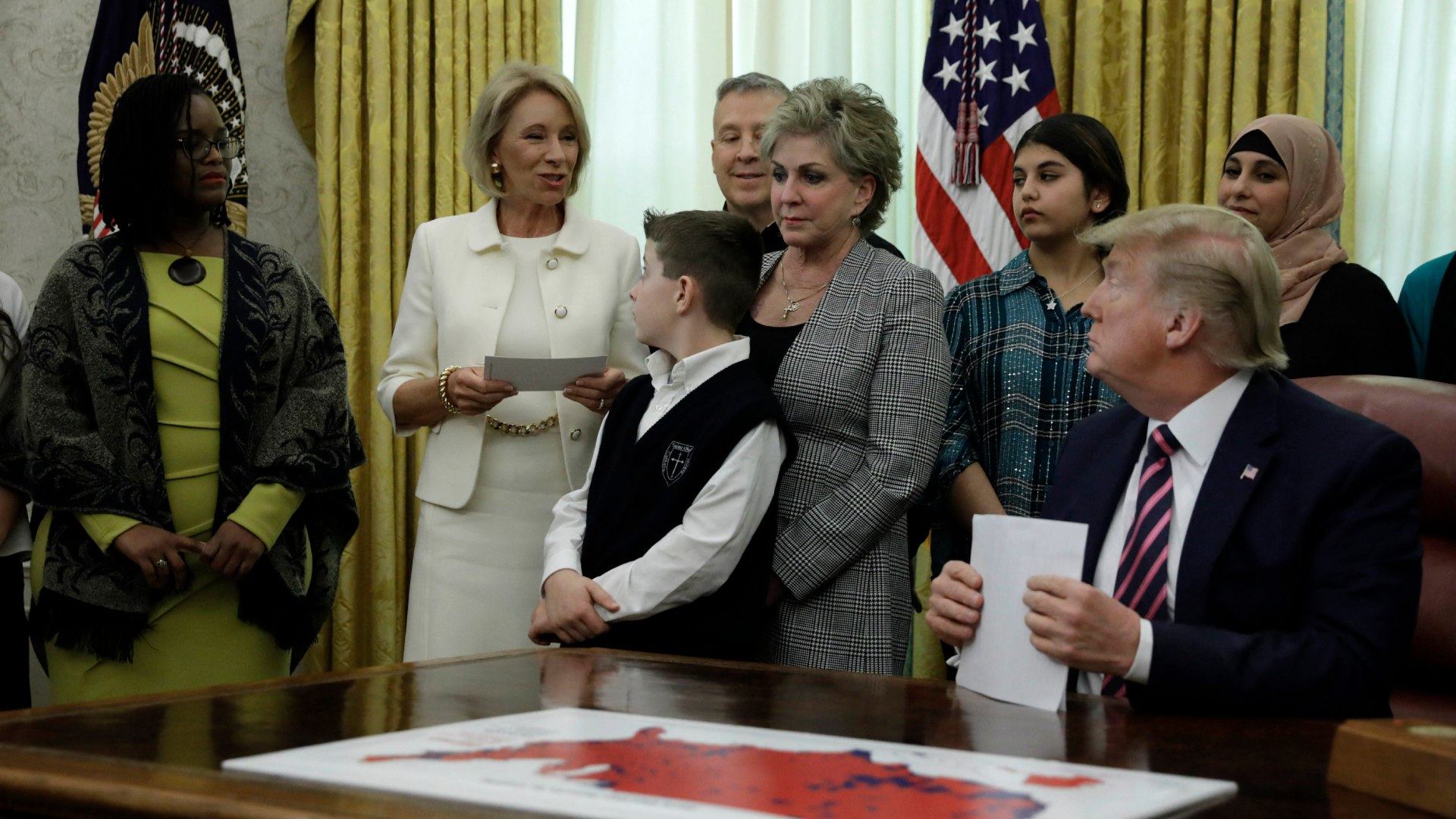
The president hosted more than a dozen students and teachers in the Oval Office for the announcement, including Teachers Who Pray founder Marilyn Rhames, who CT featured in 2018. Her organization gathers teachers for prayer and spiritual formation outside of classroom instruction time.
“There’s a myth out there that what Teachers Who Pray does … is not legal, and it absolutely is,” she said during the presidential gathering. “I’m here to tell teachers we need to pray … We need to do what we have to do for our kids because if we’re not strong, we can’t make them strong.”
Public schools have been barred from leading students in classroom prayer since 1962, when the Supreme Court said it violated a First Amendment clause forbidding the establishment of a government religion. Later decisions extended the ban to school graduation ceremonies and, under certain circumstances, school athletic games.
Yet Americans remain largely in favor of prayer in public schools. According to General Social Survey data analyzed by political scientist Ryan Burge, just 20–35 percent of Christians support a ban against requiring reading the Lord’s Prayer or the Bible in public schools, and the religiously unaffiliated are evenly divided on the question.
Additionally, a 2019 Pew Research Center survey found 41 percent of teens in public schools, including 68 percent of evangelicals, said they view teacher-led prayer in class as appropriate. While most students knew it was unconstitutional, 8 percent of teens said they have had a public school teacher lead a class in prayer.
Matt Sharp, senior counsel with the conservative legal organization Alliance Defending Freedom, told CT in October that public schools “are generally accommodating religious expression,” despite occasional religious freedom conflicts.
Disputes used to center on “whether religious clubs and religious speech can even happen in the schools,” Sharp said, with some schools attempting to prohibit students from founding Bible clubs and handing out Christian literature. Today the law is “well settled” to allow those activities, so legal battles have shifted to “a clash between religious expression and other students’ being offended” by it.
Civil liberties groups say the firewall protects religious minorities and ensures fair treatment of all faiths. But many Christians say courts and schools have pushed too far against the right to free religious expression.
“The White House isn’t saying whether one should pray or to whom or what they should pray to, they are simply making it clear that in the United States students have First Amendment rights,” said Johnnie Moore, an evangelical consultant and one of Trump’s faith advisers, by email. Moore recalled a dispute over a Bible study he held over lunch when he was in high school. “It was totally absurd.”Today, a majority of teens in general (82%) and evangelical teens (64%) say there are no religious support or prayer groups that meet in their school, Pew found.
Additionally, under orders from Trump, nine Cabinet departments on Thursday proposed rules intended to remove “regulatory burdens” on religious organizations participating in federal programs by eliminating a requirement that they refer people to alternative providers upon request.
Melissa Rogers, who served as executive director of the White House Office of Faith-Based and Neighborhood Partnerships under President Barack Obama, expressed concern that the changes threaten the religious liberties of beneficiaries, who may be turned away on the basis of religion without being directed to an alternative. “The religious liberty of social service beneficiaries is as important as the religious liberty of faith-based providers,” she said.
Much of the new proposals follow through on an executive order Trump from 2018 that aims to put religious groups on equal footing when competing for federal grants and other funding.