Ideas

Super Bowl Fans Don’t Want Faith Sidelined

A new survey shows that many of today’s viewers see sports and Christianity in collaboration rather than in competition.

Patrick Mahomes and Jalen Hurts praying and playing football
Christianity Today February 7, 2025
Illustration by Mallory Rentsch Tlapek / Source Images: Getty

On the American sports calendar, there is no bigger day than Super Bowl Sunday.

Nothing else garners the same level of attention, drawing in both serious and casual fans. In the United States, 19 of the 20 highest-rated scheduled television programs of all time are Super Bowls. It is one of our few remaining common cultural touchpoints, an event everyoneknows about.

And for Christians who bring their faith onto the field, the Super Bowl represents a supersized platform.

On the Kansas City Chiefs—who have played in four of the past five Super Bowls—owner Clark Hunt has spoken frequently about his faith and how he prioritizes spiritual development on the team. Chaplain Marcellus Casey provides spiritual support and care, while players like cornerback Trent McDuffie describe faith as “the biggest thing in my life.”

The Chiefs also have kicker Harrison Butker, a conservative Catholic who leans more into political activism and made waves earlier in the year for his controversial remarks at Benedictine College.

On the other side of the field, the Philadelphia Eagles also hold a legacy of outspoken Christian athletes, with the team’s faithful players receiving so much attention in 2017 that an entire book about them was published.

Chaplain Ted Winsley served on that team, and he continues to work with and disciple the Eagles today, including Christian wide receiver A. J. Brown. During the playoffs, Brown went viral for opening up and reading Jim Murphy’s Inner Excellence on the sidelinesin the middle of a game—a book written by a Christian and strongly shaped by a faith-based perspective.

So what do football fans think of all this God talk? A new survey out this week from Sports Spectrum and Pinkston found that most sports fans tuning in on Sunday—the majority of whom are Christian themselves—will be happy to hear players and coaches display their faith.

Sports Spectrum, the closest thing to a “journal of record” for the evangelical Christian subculture in sports, has focused mostly on sharing and amplifying stories of faith from athletes. With this survey, Sports Spectrum moves in a new and intriguing direction—seeking to actively drive and shape public conversation and enhance our understanding of the culture of sports.

Christians used to be concerned about America’s growing obsession with sports. It was seen as a rival for influence and authority in American life, a competitor for devotion and loyalty. To watch a game on Sunday, Christian leaders warned, was either a sin or a sign of lukewarm faith.

Some scholars today continue to stress the conflict between religion and sports. They argue that sporting events have replaced the role that religion used to play in society. Yet this survey, which targeted people who watch games at least a few times a month, suggests sports fans might actually be more religious than others.

Compared to the American population, which has slightly more women than men, the survey respondents skewed male: 57 percent to 43 percent. And respondents also expressed deeper religious commitments: 73 percent identified as Christian compared to around 67 percent of Americans overall, with more than half saying faith is extremely or very important to them. Just 19 percent indicated no religious faith, compared to around 30 percent of the general population.

These results suggest fascinating possibilities for further exploration. Rather than replacing organized religion in American life, perhaps sports has become a cultural space that is more open to religion—a means through which traditional religious identities can be affirmed and expressed.

And perhaps this is true not just of athletes and coaches (an argument I make in my book), but also of the fans who cheer them on.

Growing up in the evangelical subculture, I was taught to see popular culture as a hostile place, with an American public that did not want to hear about Jesus. When I saw Christian athletes and coaches speaking about their faith after games, it seemed subversive, as if they were sneaking in something that the media did not want to promote or share.

In this survey, however, fans have shown broad support for athletes like McDuffie and Brown who use their platforms to talk about their faith: 56 percent are supportive, while only 12 percent oppose.

It’s a result that makes sense, given that the survey respondents tended to place a high value on faith. But it also makes sense in a cultural climate that encourages the expression of personal identities and values, especially for public figures. Few identities are more important to a person than religious affiliations and beliefs.

For Christian athletes, this should provide encouragement to be open and honest about the significance of faith in their lives.

Yet, it is easy to support expressions of faith with which you agree. It’s a different story when an expression of faith doesn’t align with your views.

While three-fourths of respondents (74%) said they support athletes using their platforms to talk about nonprofit causes, only a third (34%) said they support athletes talking about causes they oppose. 

This should not diminish the desire by Christian athletes to speak about their faith. But it should remind them that faith is not some generic common denominator; it takes shape in particular ways, and it makes claims about truth and goodness that not everyone will agree with. Navigating public witness well requires a blend of courage, wisdom, and discernment.

Certainly, Christians should be encouraged that so many athletes, coaches, and sports fans find faith meaningful to their lives. But does the culture of sports shape Christians more than the other way around?

The survey also examined the rapid rise and spread of sports gambling and found that Christians were as likely as Americans overall to back the trend.

When asked how they felt about online sports betting, 43 percent of respondents were in favor, 35 percent neutral, and 23 percent opposed. Among Christians, 42 percent were supportive, 35 percent neutral, and 22 percent opposed. 

While gambling has always been associated with sports, in the past it was done in the shadows, limiting its reach. Now, gambling is front and center, literally funding sports leagues and the media companies that cover them—all the while teaching a new generation of fans to view gambling as a central part of the sports experience.

Christians should be concerned for many reasons: the way gambling can lead to a dehumanizing and transactional view of athletes, the way it encourages addictive and self-destructive behavior in young men, the way it subverts and undermines the constructive possibilities of moral formation through sports.

Yet while some Christian leaders have raised the alarm, there is little organized resistance. Nor, it seems, do church leaders take sports betting seriously as a matter of discipleship.

Whether Christian fans have money on the game, friendly pools for Super Bowl squares, or just favorite teams they are pulling for in their prayers, they may ask whether God cares who wins.

Most fans seem to agree that God doesn’t pick sides: 78 percent of Christian, Jewish, and Muslim respondents said that God does not have a preferred outcome or influence the results.

This is the right perspective. We can’t discern God’s will when it comes to why one team wins and the other loses. If we try, we can easily fall into the transactional frame of the prosperity gospel: If players perform religion in the right way, if they have enough faith, then God will bless them with success.

At the same time, we can acknowledge a sense in which victory does come from God. When fans watch athletes or coaches thank Jesus after a game, they should see it as a recognition of human dependence on a higher power. The skills and talents used on the field have a source, and it is not us.

We should also affirm that God cares about sports. He may not pick winners and losers, but he is not indifferent. He cares about athletic competition because he cares about human beings and the cultural activities we create and engage with.

As we watch the Super Bowl again this year, we should care about sports not just because it provides a platform for Christian athletes to talk about Jesus, but also because sports are a gift that can be enjoyed. And as the survey results remind us, it’s also a formative space for meaning, connection, and community in our culture.

News

USAID Freeze Leaves Ukrainians Out in the Cold

Ministry and nonprofit leaders warn funding pause will hurt the most vulnerable.

Cold Ukrainians in front of a house destroyed during the war with Russia.
Christianity Today February 6, 2025
Ivan Antypenko/Suspilne Ukraine/JSC "UA:PBC"/Global Images Ukraine via Getty Images

It’s a lot of money: more than $30 billion

Ukraine is by far the top recipient of US Agency for International Development (USAID) funding since 2022. And that’s not even counting the billions that have gone to weapons, munitions, and military equipment. 

But Yuriy Boyechko, president of Hope for Ukraine, a nonprofit that serves the country’s poorest communities, thinks about the firewood. 

Some of that $30 billion went toward keeping older people warm and giving them fuel to cook their food. President Donald Trump’s sweeping “stop work” order on American aid in January shut down humanitarian programs. One of the paused projects, headed by a Hope for Ukraine partner organization, provided people with wood. 

“These people rely on firewood to keep warm in the winter and to cook food,” Boyechko told Christianity Today.

In the war-ravaged regions of Sumy, Dnipro, and Donetsk, many of the people who could not flee Russia’s full-scale assault now live in shelters that look like “barns with the doors open all the time.” Most of the remaining residents are elderly. The temperature likely won’t climb above freezing until the end of February or maybe March. 

“They’ve been living without electricity,” Boyechko said, “some of them for two-plus years.”

Hope for Ukraine, Mission to the World, and Mission Eurasia leaders told CT that the Trump administration’s funding freeze hasn’t affected their programs. But the order has impacted many of their partners, and Christians working in the region are concerned about the devastation that could result from even a 90-day pause.

Military aid has not changed. Affected programs include refugee shelters, remote learning (a necessity for the majority of children in frontline regions), health care for internally displaced people, military veteran rehabilitation, and salaries for first responders. 

“I totally understand that they want to audit, but I think to completely cut funding in the middle of winter is a little bit too harsh,” Boyechko said. “This particular freeze is going to impact the most vulnerable people on the ground, and it’s coming at the worst time.”

Elon Musk, who leads the new Department of Government Efficiency, has framed the freeze on USAID as a battle against corruption. And there’s no question there is corruption. 

Ukraine ranks low on Transparency International’s corruption index—104 out of 180 countries. Some of the aid that has been paused was, in fact, going to anti-corruption initiatives. The country has made some progress in the last 11 years, especially through reforms to the justice system that increased the independence of the judiciary. Ukraine has improved by six points on Transparency International’s scale since Volodymyr Zelensky became president.

The US Congress also built anti-corruption measures into Ukraine’s USAID funding, including third-party, in-person monitoring and the use of separate, fully auditable accounts. The Office of Inspector General must assess the safeguards and report to the legislature every 45 days. The World Bank also monitors the funding.

Christian ministries in Ukraine say they wouldn’t object to more oversight. But concerns about corruption don’t justify a funding freeze, and they worry about Ukrainians who are going to suffer because of it. 

“Even a temporary disruption in aid could further exacerbate the crisis for displaced and refugee communities,” Mission Eurasia president Sergey Rakhuba said.

The disruption could also put the country in a worse position to negotiate a possible settlement with Russia. Experts expect the next six months to be critical. The situation doesn’t look great for Ukraine. Zelensky has called for four-way peace talks between Ukraine, Russia, the US, and the European Union, But Russian leaders deny he’s the legitimate leader of Ukraine. Russia has also stepped up executions of Ukrainian soldiers, continued to barrage Ukraine with airstrikes, and pushed for more territory.

“This is a very critical time for a country that’s barely standing,” Boyechko told CT. 

But as a Christian, his main focus is not the conflict or the politics of foreign aid and government efficiency. 

“When I see innocent suffering needlessly, that’s where my compassion and my faith in Jesus supersedes my political views,” Boyechko said. “Jesus gave bread and fish to everyone.”

Theology

Worship Starts with a Pierced God

Practitioners of Thaipusam show devotion to encounter their gods. Our God came to us first.

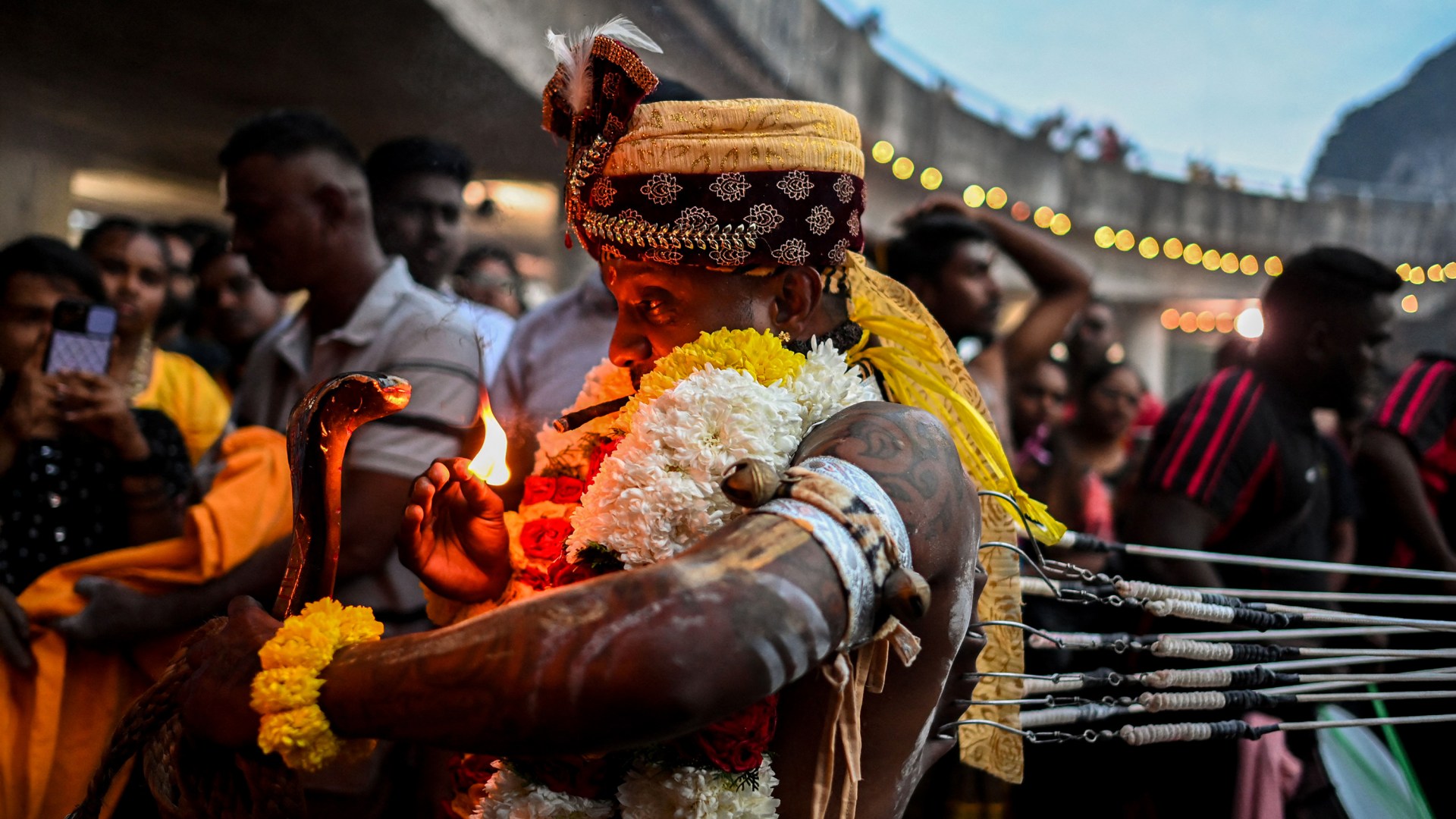
A Malaysian Hindu devotee with his back pierced with hooks makes his way towards the Batu Caves temple to make offerings during the Thaipusam festival.

Christianity Today February 6, 2025
Mohd Rasfan / Getty

As a new resident of Malaysia, the first time I saw the festival of Thaipusam in 2022, I was horrified. Metal hooks weighed down with milk pots skewered the flesh of men’s backs as tridents pierced their cheeks and tongues. Devotees pulled shrines on wheels with ropes and chains hooked to their backs. 

Later in the year during the Hungry Ghost Festival and the Nine Emperor God Festival, I saw my Chinese neighbors display devotion to their gods and spirits by piercing their cheeks with long hooks and walking over hot coals.

As a Christian who grew up mostly in the United States, I was shocked by these extreme religious practices in my new home of Penang, a multicultural, multireligious state in Malaysia. In Penang, around 45 percent of the population practices Islam, 37 percent Buddhism, 8 percent Hinduism, and 4 percent Christianity.

As I got to know my neighbors of different faiths, I learned the deeper spiritual significance behind these religious rituals. For the most part, the piercings were expressions of penance, devotion, or yearning for blessings. These actions expressed the lengths to which devotees would go to connect with their gods or spirits.

At the same time, I noticed that some of my Christian neighbors desired to strive—perhaps not through piercings but through acts of deep devotion—to similarly initiate encounters with God.

It made sense. All around Penang, there are little shrines with deity statuettes on the streets and in stores. Every day, people burn incense and bow their heads with folded hands, asking for a blessing. How could my Christian neighbors not be influenced by this ubiquitous posture toward worship?

Yet the more I thought about the worship of other religions, the more I realized the strangeness—and beauty—of Christianity.

Before we adored him, God pursued us and saved us through Jesus’ suffering and death on the cross. Unlike the piercings of other religions, those on Christ’s hands and feet revealed the sacrifice God made to bring us to him.

Painful acts of devotion

The Tamil Hindu festival of Thaipusam, which this year falls on February 11, commemorates the day the Hindu goddess Parvati gave the Vel (a divine spear) to her son Murugan so he could conquer the demonic Surapadman.

Devotees put kavadi (burdens) on themselves to seek help from Murugan. These semicircular pieces of wood or steel—which can weigh up to 66 pounds—are often decorated with peacock feathers, flowers, and images of deities and balanced on the devotees’ shoulders.

“Carrying a kavadi involves some kind of body piercing to secure it,” said Jeffrey Oh, professor of world religions at Malaysia Baptist Theological Seminary. “This ritual of self-sacrifice is intended to defeat inner demons and gain Lord Murugan’s blessings.”

Many kavadi bearers say the process puts them in a trance, so they don’t feel the pain. The festival comes at the end of a 48-day period of preparation, which includes special diets, rituals, and prayer.

These piercings are also an act of penance to cleanse devotees of their sins, Oh noted. Hindus must perform acts pleasing to the deities so their gods will help them in this life and the next, with a goal of either being reborn into a higher caste or achieving moksha, liberation from the cycle of rebirth.

Meanwhile, for the Buddhists, Daoists, and adherents of Chinese folk religion who observe the Hungry Ghost Festival, the purpose of body piercing is to mark that a person is possessed by a spirit so that the medium can bless the devotees. Chinese people believe the gates of hell open during the festival, which falls in August or September, allowing spirits to roam the earth.

To appease the spirits and prevent them from harming loved ones, people make food offerings, burn paper money and incense, and entertain the spirits with Chinese opera performances. It’s also a time to pray for blessings and good fortune.

Those involved in the body-piercing ritual go through rigorous preparation beforehand, including fasting or maintaining a vegetarian diet to allow the spirit to manifest in themselves and for the devotees to receive blessings.

While body piercing for Thaipusam is for “penitence, repentance, or a vow,” in Chinese festivals, the focus is on “blessings to either be good, successful, or to be able to right a wrong,” said Mark Tan, a Malaysian pastor who formerly practiced Buddhism and Hinduism.

Piercings also play a role in another Chinese holiday, the Daoist Nine Emperor God Festival, in September or October. The objects piercing devotees include not only skewers and swords but also more unconventional items such as banners, table lamps, bikes, and other household items. Similar to Hungry Ghost Festival, body piercings mark people who are possessed by spirits to bless others. But in addition, “some devotees would pierce themselves as a sign of their devotion and penance, because they believe the Nine Emperor Gods could bestow wealth and longevity on them,” Oh said.

I discussed this with my husband, Tony, a missiologist who recently wrote a book about Christianity and Chinese folk religion in Taiwan. He noted that “for Christians, the starting place is God, who he is, and how we ought to worship him. The starting point for Chinese folk religion is humanity, what we need, and how we go about fulfilling those needs.”

He stressed that their main question is not “Are these deities real?” but rather “Are they really good at doing what I need?”

Influence on Christianity

For many Christians—not only those who come from Chinese folk religion or Hindu backgrounds—beliefs about the need to show our devotion to God to secure his blessings permeate our worship. Some believers think that long, strenuous prayers or sacrificial offerings lead to a higher likelihood that God would respond to their petitions.

“Today many Christians’ understanding of worship differs little from that of pagans, except perhaps that God is singular and the forms of worship come from traditions more or less rooted in the Scripture,” wrote Daniel I. Block in For the Glory of God. “Largely divorced from life, such worship represents a pattern of religious activities driven by a deep-seated sense of obligation to God and a concern to win his favor.”

Sometimes the influence from these beliefs is more subtle. As a pastor and a professor of worship, I often encounter the misconception that worship begins with people seeking God, to which God then responds. This is evident in the language many worship leaders use as they start services or in worship song lyrics like Hillsong’s “You’ll Come.” (“You’ll come. / Let your glory fall as you respond to us.”) These words can incorrectly teach the church that the gathered people initiate the encounter with God.

Although it is true that our God accepts offerings given by faith (Heb. 11:4) and answers to our calls and cries (Ps. 118:5), these devotional acts are not prerequisites for Christian worship. God does not withhold his goodness and love until we bring him our offerings. Unlike the Hindu gods and Chinese folk religion’s gods and spirits, our God doesn’t wait for us to show devotion first before he saves us.

In 1 John 4:10, John writes, “This is love: not that we loved God, but that he loved us and sent his Son as an atoning sacrifice for our sins.” God was the initiator of our salvific relationship. He loved us when we did not love him. He sought us when we were not seeking him. This is a continuous pattern we see in salvation, his covenantal relationship with Israel, and worship.

“God invites us to worship,” wrote Constance Cherry in her book The Worship Architect. “We don’t create worship; we don’t manufacture services. Rather, we respond to a person. … Worship happens when we learn to say yes in ever-increasing ways to God’s invitation to encounter him.”

Thus, our worship flows out of what God has done for us and who he is. God is the one who created us and redeemed us, and therefore we adore him. When we deserved to be pierced and punished for our wrongdoings, God chose to pierce his Son instead. Jesus took up our pain, bore our suffering, and was pierced for our transgressions (Isa. 53:4–5). He wasn’t in a trance: Jesus experienced intense physical pain, thirst, and abandonment by God. Therefore, our acts of devotion—prayers, singing, thanksgiving, and offerings—are responses to God’s sacrificial love.

This is what distinguishes Christian worship from worship in other religions: It is not driven by our needs, but it is our response to a good and loving God, the one who first reached out to us.

“In Hinduism and Buddhism, worship was burdensome, tedious, and uncertain as to the result. There was always a need for an offering for appeasement,” Tan said, looking back at his experience. But he added, “Worship to Jesus is always in thanksgiving because he has given us everything we need to be right with God forever.”

Esther Shin Chuang, who holds a doctorate in worship studies, is an award-winning concert pianist, worship leader, and faculty at six seminaries throughout Southeast Asia. She and her husband are pastors at Georgetown Baptist Church in Penang, Malaysia.

Theology

When Obeying God Means Resisting Rulers

What we can learn from the Hebrew midwives of Exodus who defied a tyrant to protect the vulnerable.

Pharaoh and the midwives
Christianity Today February 6, 2025
Illustration by Mallory Rentsch Tlapek / Source Images: WikiMedia Commons

Biblical teaching generally pushes Christians to advocate for submission to authorities, whether in politics or in the church. Paul’s words are often quoted: “Let everyone be subject to the governing authorities, for there is no authority except that which God has established” (Rom. 13:1)

Yet other Scriptures suggest that our loyalty to those in power should be understood in relation to our ultimate allegiance to God.

Famous examples in the Old Testament include Shadrach, Meshach, and Abednego, who were sentenced to death for refusing to bow to King Nebuchadnezzar’s golden image (Dan. 3:16–18), and Daniel, who was convicted for defying the king’s decree against praying to God instead of him. In the New Testament, when Peter and John were thrown into prison for refusing to comply with the authority’s command to stop preaching in Jesus’ name, they stood firm, saying, “We must obey God rather than human beings” (Acts 5:29; see John 19:11).

But one often-overlooked story is found in Exodus, where two minor characters were deemed so important to Israelite history that their names—unlike the unnamed mighty kings of Egypt—were preserved for posterity: Shiphrah and Puah.

When faced with the threat of destructive power, these two women demonstrated courage and inner freedom that can inspire the way we as Christians work and serve in a fallen world today. Their audacity to defy Pharoah shows us what it means to serve and fear the Lord in the face of evil.

The Book of Exodus continues the story that began in Genesis. From a small family clan, Israel became a whole people: “The Israelites were exceedingly fruitful; they multiplied greatly, increased in numbers and became so numerous that the land was filled with them” (Ex. 1:7). This growing foreign population made the Egyptian powers uncomfortable.

A new pharaoh arose and created fear in his fellow native Egyptians, convincing them that the Hebrew people were an imminent threat to the safety and well-being of their nation. In his mind, the presence of a population group which had not assimilated into the society’s dominant culture created an us-and-them dynamic: “‘Look,’ he said to his people, ‘the Israelites have become far too numerous for us. Come, we must deal shrewdly with them’” (Ex. 1:9–10).
Pharaoh began by putting the Israelites to work, oppressing them with forced labor. But the building tasks he imposed on the Hebrew people were not enough to keep them from multiplying. So, Pharaoh’s desire for control then turned to a tactic of terrible cruelty.

Pharaoh wanted to attack the flourishing of the Israelites, but he didn’t dare risk the revolt of his workforce by assaulting adults. Instead, he opted for a cowardly yet foolproof method of destabilizing and demoralizing the population. He summoned two Hebrew midwives, Shiphrah and Puah, and told them to kill all the baby boys born to the women of their people.

Imagine for a moment the horrific task Pharaoh was forcing upon these women: smothering a newborn baby, or perhaps breaking its neck, discreetly, right next to the baby’s mother, who had just given birth. In the monstrosity of his thoughts, Pharaoh wanted to make monsters of the midwives and make them directly complicit in crimes against their humanity.

But then the story shifted: “The midwives, however, feared God and did not do what the king of Egypt had told them to do; they let the boys live” (Ex. 1:17).

The midwives’ actions were not merely an act of obedience to rules (this was, after all, before Moses and the Ten Commandments) but also acts of faithfulness to their vision of what is righteous, just, and good, grounded in their fear of God. They didn’t hide behind a command from their earthly ruler but instead reckoned with the divine consequences of their actions.

When Pharaoh summoned the midwives to account for the failure of his plan, their response was simple: “Hebrew women are not like Egyptian women. They are vigorous and give birth before the midwives arrive” (Ex. 1:19).

What are we to make of this lie, which Scripture—unlike some commentators—hardly seems to hold against them? That’s another question their story raises.

First, it’s important to note that the exception does not make the rule. The Bible’s clear and consistent concern for truth rules out using this case as general permission for deception. But this was a case of great necessity. Shiphrah and Puah were trying not just to save their own heads, careers, or reputations but also to protect a whole community from very real and immediate peril.

Ethically, their choice to resort to the evil of verbal lies seems far preferable to the gruesome lie of treating human life as negligible.

German theologian Dietrich Bonhoeffer came to a similar conclusion in his unfinished essay “What Does It Mean to Tell the Truth?” Well known for his opposition to the Nazi regime, the pastor warns against a “formal, cynical notion of truth” of the philosophical (Kantian) sort, which does not take into account the reality of a situation or relationship at hand.

While he sees the risks of the formula, Bonhoeffer calls for a “living truth.”

“Lying is the negation, denial, and deliberate and willful destruction of reality as it is created by God and exists in God to the extent that it takes place through words and silence,” he argues. According to this definition, there is far more falsehood found in Pharaoh’s demands than in Shiphrah and Puah’s response. In fact, the midwives’ united audacity ultimately tells the truth about the inescapable failure of the Egyptian king’s plans to defy the will of Israel’s God for his people.

Shiphrah and Puah refused to be cogs in a violent political machine. In response, God entered the scene at the end of their story—not only to spare them from the wrath of the Egyptian king, but also to show them kindness and bless their families for their act of defiance (v. 20).

But this ancient king of Egypt was certainly not the first or the last to entertain such horrors. In a significant biblical parallel, the story of Advent begins with a citywide genocidal massacre of baby boys, ordered by King Herod—another powerful man seized with paranoia and insecurity amid rumors of a child who was said to have been “born king of the Jews” (Matt. 2:2).

In both cases, tyrannical rulers either directly or indirectly dehumanized a vulnerable population, seeing each group as nothing more than a political or demographic problem to be solved in order to preserve their own power and control.

In an act of civil disobedience similar to that of the Hebrew midwives, the Magi defied Herod’s order to return and report on the child’s whereabouts, choosing instead to protect Jesus’ life. And just as Pharoah ended up finding other willing participants to carry out his evil orders, Herod did the same.

Every oppressive political system relies on individuals who obey instinctively, without regard to the moral impact of their actions on themselves and others. Throughout history, the big fish have often left their dirty work to smaller ones. But the worldly hierarchies of our day do not allow people to offload their responsibilities before God and toward the rest of humanity.

To follow evil orders like Pharoah’s and Herod’s, you have to become less than human—to act like a robot and carry out orders without independent thought. You have to focus on fulfilling your civic duty regardless of the brutality it calls for. You have to prioritize man’s favor over God’s values and desensitize yourself to the negative human impact of your actions.

Whenever we demean or dismiss the equal humanity of others, we damage and threaten our own humanity in the process. Not only that, but if certain people—whoever they may be—can be viewed and treated as just a number, a statistic, or a sociopolitical problem to solve today, who’s to say we won’t be treated the same way for a similar reason tomorrow?

Many historical examples, including the tragic fate of Bonhoeffer himself, prove that resistance to evil is not without risk. Yet the midwives and the Magi remind us that God is the main character of history and that our accountability and allegiance ultimately belong to him.

Whatever the scale, every generation of believers will face abusive leaders who devalue what God cherishes and damage what God created. But in every age, we are called to align with God’s living truth over the destructive lies of earthly powers.

This is why I believe the biblical authors preserved the names of minor characters like Shiphrah and Puah—to help us as God’s people to persevere in fearing him when the world calls upon us to join in its evil.

Léo Lehmann is CT’s French language coordinator as well as publications director for the Network of Evangelical Missiology for French-speaking Europe (REMEEF). He lives in Belgium.

Theology

Tech Broligarchs Want Jesus Out of the Way

Columnist

When the Living Word speaks, the ambitions of every would-be “master of the universe” stand exposed.

Elon Musk putting on sunglasses
Christianity Today February 5, 2025
Illustration by Christianity Today / Source Images: Getty

This piece was adapted from Russell Moore’s newsletter. Subscribe here.

It’s been a long, strange trip from George Washington to Elon Musk—and maybe we should ask if that has anything to do with Jesus.

For many years, some of us have warned that this moment’s technological platforms would lead us to the point of constitutional crisis. Most of us, though, meant that this would happen indirectly—through the erosion of social capital and the heightening of polarization by social media.

Few of us foresaw the crisis happening as directly as it has: with Elon Musk, the world’s richest man, and a small group of 20-something employees having virtually unilateral veto power over the funds appropriated and the legislation passed by the United States Congress.

There are, of course, massive constitutional, social, economic, and foreign policy implications to this time, implications that will no doubt reverberate through the decades and perhaps even the centuries. But what if there are theological causes and effects too?

Nicholas Carr was one of the early Paul Reveres warning of what digital technology would do to human attention spans. He writes in his new book Superbloom: How Technologies of Connection Tear Us Apart about what the most techno-utopian, “move fast and break things” Silicon Valley barons of industry have told us all along: that behind their project was not just a way to make money (although it’s certainly that) but also a particular view of human nature.

Meta founder Mark Zuckerberg’s statements, for example, would speak of the social network as a “graph”—which is, Carr notes, “a term of art borrowed from the mathematical discipline of network theory.”

“Underpinning Zuckerberg’s manifesto was a conception of society as a technological system with a structure analogous to that of the internet,” Carr writes. “Just as the net is a network of networks, so society, in the technocrat’s mind, is a community of communities.”

Carr argues that Zuckerberg had long held to “a mechanistic view of society,” observing that “one of the curiosities of the early twenty-first century is the way so much power over social relations came into the hands of young men with more interest in numbers than in people.”

The mechanistic view of society is widespread—almost unanimous, though manifesting itself in different forms—among the architects of the social media–artificial intelligence–virtual reality industrial complex. For example, OpenAI CEO Sam Altman created disturbance across the world last week when he suggested that the type of generative artificial intelligence he sees around the bend will result in changes being “required to the social contract, given how powerful we expect this technology to be,” noting, “the whole structure of society itself will be up for some degree of debate and reconfiguration.”

This mechanistic view is not just of society, writ large, but of the human person. For years, comedians have laughed at the “creepy” tech venture capitalists who would, for instance, allegedly seek blood transfusions from younger donors to maintain their own youth and vitality. People would wave away as fringe those like tech leader Ray Kurzweil, who would speak of uploading his consciousness to a computerized cloud in order to live forever. Few paid enough attention to such figures to hear the chilling echoes of Genesis 3 in the answer Kurzweil gave to the question of whether God exists: “Not yet.”

In the past few weeks, my colleague Kara Bettis Carvalho examined tech entrepreneur Bryan Johnson’s claims in the Netflix documentary Don’t Die that he could engineer his body to escape mortality. Once again, few seem to hear the reverberations of Genesis 3: “You shall not surely die” (v. 4, ESV throughout).

All of this is easy enough to chalk up to “creepy” people with fringe positions and an endless supply of money. But this ideology is now not only inhabiting an entire technological ecosystem—to which we are all entwined—but also is the driving factor behind decisions about whether children in Africa get the funds allocated to save them from starvation or AIDS, and whether the constitutional checks and balances of power among equal branches dies in front of our eyes.

And that’s what brings us to the question of God.

Several years ago, Elon Musk told Axios journalists Mike Allen and Jim VandeHei that human beings “must merge with machines to overcome the ‘existential threat’ of artificial intelligence.” When pressed about what this means for our sense of reality, Musk said that we should question whether reality is itself real. “We are most likely in a simulation,” he said, elsewhere noting that the likelihood that we’re not living in a simulated world is only one in billions. The implication is clear—maybe on the other side of the veil of the universe around us is a cosmic Elon Musk.

Seeing humanity and the rest of the “real” world through the metaphor of machine has consequences. Seeing humanity and the rest of the world through the metaphor of data is more dangerous still. Once one interprets the universe through a grid of mechanistic mastery—believing what counts is what’s quantifiable and measurable—the end result is a disrespect of the sanctity of a human nature that cannot be understood that way. And once one sees all limits as arbitrary and “analog,” why would one stop at the limits of norms and traditions and laws and constitutional orders, the things that make up a society?

Ultimately, the “cold” illusion of mastery and the “hot” eruption of chaos prove not to be opposites but two aspects of the same horror. The mindset that sees humanity and society as data to be manipulated naturally gives way to the will-to-power that sees no limits to the appetite and the libido. Elon Musk named one of his children “X Æ A-12” (before having to remove the Arabic numerals for the sake of California law), a “name” reminiscent of a QR code or a serial number, while also fathering children with multiple women. Why would fidelity matter if the world is just data? What are the consequences if the world is a simulation that could be rebooted?

“God” is no problem in this view of reality. After all, the word God can be made abstract and even algebraic. Albert Einstein suggesting that “God does not play dice with the universe” implicated an impersonal structure, a logic, not the living God of Abraham, Isaac, and Jacob. Spinoza’s “God” will never summon a person before a judgment seat. The words God or religion can be used as stand-ins for the very sort of self-deification the tech-bro ideology and all its successors demand.

Jesus, on the other hand, is not easily dismissed. Once he is heard—not as a theoretical avatar giving authority to some ideology, but for the actual words he spoke, the actual gospel he delivered—the ambitions of every would-be “master of the universe” stand exposed.

Dostoevsky’s Grand Inquisitor in The Brothers Karamazov said he wanted Jesus silenced because the Jesus of the Bible didn’t “understand” human nature: that what people really want is the filling of appetites and the spectacles of distraction. Against the Inquisitor’s diatribe, though, Jesus, as with Pilate, simply stands there, with a look that pierces through all the manipulations of a mechanistic view of the universe.

The digital view of humanity cannot fit with the vision of James Madison and the framers of the American constitutional order. Utopian revolutionaries have always offered some version of “One must break a few eggs to make some omelets,” regardless of the price of actual eggs at the moment. But behind that utopianism is always a theology—and the theology can co-opt almost everything. Christianity can be co-opted by a digital utopianism, but only by silencing Jesus.

Yet Jesus is not easily silenced. The universe is no simulation. It is created and held together not by an algorithm but by a Word. And this Word is no abstraction to be decoded but a person, one who “became flesh and dwelt among us” (John 1:14).

A million different Babels lie in the ruins of history, and behind them a million different Nimrods, all of whom would storm the limits of mortality and of accountability to create simulations of themselves and of their rule. They are all gone, and they cannot be rebooted.

The tech-bros have inherited the earth, for now. That’s not their fault. It’s ours. We have believed what they told us about ourselves: that we are ultimately just data and algorithms to be decoded, appetites to be appeased. And because of that, we’ve looked for programmers and coders to keep our simulation going—what previous generations would have called “gods.”

In his inaugural sermon at Nazareth, Jesus read from the scroll of Isaiah the prophet, recounting the “good news to the poor” that comes with “the year of the Lord’s favor” (Isa. 61:1–2; Luke 4:18–19). That same prophetic book taught us to pray, “O Lord our God, other lords besides you have ruled over us, but your name alone we bring to remembrance” (Isa. 26:13).

After all the promises of the tech-bros are gone, Jesus abides.

Russell Moore is the editor in chief at Christianity Today and leads its Public Theology Project.

Culture

‘I’m Still Here’ Does Not Despair

The story of the Paiva family doesn’t end tragically. Neither will ours.

Fernanda Torres as Eunice Paiva in I'm Still Here.

Fernanda Torres as Eunice Paiva in I'm Still Here.

Christianity Today February 5, 2025
Alile Onawale. Courtesy of Sony Pictures Classics

I saw I’m Still Here in its opening days, entering the theater excited. I was looking forward to watching a film made by an award-winning director, featuring renowned Brazilian actors, and telling a story that truly deserves to be on the big screen. That’s the story of the Paiva family, whose patriarch Rubens Paiva—played by Selton Mello—was abducted and later murdered by the Brazilian military dictatorship in 1971. His body was never found.

I’m Still Here features outstanding performances; its pace is perfectly smooth. But the movie also goes beyond technical excellence. It deeply moved me. I left the theater with red eyes. When my friends asked me why I was crying, I could only manage a weak “I don’t know; it’s very sad.”

At the center of the tragedy is Eunice Paiva, Rubens’s wife and the mother of their five children, who’s portrayed by Fernanda Torres. (Torres won Best Female Actor at this year’s Golden Globes and is a strong contender for the Oscar for best actress.) The film powerfully displays her grief as she faces her beloved husband’s disappearance and, later, his confirmed death.

That grief is made more poignant by this story’s devastating before and after. The film’s opening scenes picture the perfect Brazilian life: an upper middle-class family living by the beach in Rio de Janeiro. Children cross the street to play with their friends; parties overflow with dancing. The Paiva family’s lives, for a time, are untouched by the chaos of the military dictatorship that ran Brazil between 1964 and 1985.

But on an ordinary day, Rubens is taken by armed men who politely knock on his door, insisting that he answer a few questions. He never returns. “Where’s Dad?” and “When will Dad be back?” ask the children. Eunice never answers them directly. Eventually, the questions stop. Everyone, with or without answers, becomes aware that paradise has been lost.

I’m Still Here doesn’t have a resolution. Rubens doesn’t come home. The movie made me cry because it reminded me of the still deplorable state of the world we still live in. That’s cause for abject despair.

Or is it?

In an interview with the Brazilian media outlet UOL Prime, Fernanda Torres says that “Eunice is the understanding of something tragic that does not allow self-pity.” Her words remind me of this passage from Jeremiah:

Build houses and settle down; plant gardens and eat what they produce. Marry and have sons and daughters; find wives for your sons and give your daughters in marriage, so that they too may have sons and daughters. Increase in number there; do not decrease. Also, seek the peace and prosperity of the city to which I have carried you into exile. Pray to the Lord for it, because if it prospers, you too will prosper. (Jer. 29:5–7)

When Jeremiah began to preach to the people of God, Judah was a prosperous, protected city. Everything changed when Nebuchadnezzar II began to impose his power. Suddenly, free people found themselves prisoners of a corrupt nation.

But there was no time for self-pity. The Israelites, Jeremiah insisted, were not to see themselves as victims, to accept that the entire history of their people would be defined by a tragedy. God’s plans are dynamic; he was acting, even in the midst of exile, and they were instructed to do the same. Build, plant, marry, increase.

I’m Still Here exemplifies this kind of resilience. “You don’t have to smile,” says the newspaper photographer taking the family’s portrait for an article about Rubens Paiva’s disappearance. Eunice immediately replies, “Why not?” The photographer’s request seems obvious: How can a family that has just lost their father smile for a photo? “The editor asks for a ‘less happy’ photo,” he explains. Eunice is indignant. “We will smile. Smile!”

For Eunice, and for the people of God in Babylon, walking on in spite of evil is the winning option. Refusing to give in to bitterness and anger constitutes true resistance.

When God sent Israel into exile in Babylon and told them to get on with their lives, he made it clear that exile wasn’t forever.

This is what the Lord says: “When seventy years are completed for Babylon, I will come to you and fulfill my good promise to bring you back to this place. For I know the plans I have for you,” declares the Lord, “plans to prosper you and not to harm you, plans to give you hope and a future. … I will gather you from all the nations and places where I have banished you,” declares the Lord, “and will bring you back to the place from which I carried you into exile.” (Jeremiah 29:10–11, 14)

By the time I’m Still Here ends, the Paiva family has moved to another city. Eunice has become a lawyer fighting for the rights of Brazil’s Indigenous peoples, as well as for the investigation and punishment of those responsible for her husband’s murder. Her children have studied and built families of their own. The film’s finale shows an older Eunice still with the memory of pain—and still with faith. She looks on as her children, sons- and daughter-in-law, and grandchildren sit around the table sharing food and laughing.

The story of Israel did not end in Babylonian exile. The story of Eunice and the Paiva family did not end with the tragic death of a father. Our story does not end here. We are still in a fallen, sad, and sick world. Soon, we will no longer be.

Mariana Albuquerque is the global project manager at Christianity Today.

Church Life

Los Angeles, My Chinese Christian Friends Are Praying for Us

As we grieve our losses, I’m comforted and humbled to know that the persecuted church is interceding on our behalf.

An image of two hands reaching around the earth.
Christianity Today February 5, 2025
Illustration by Elizabeth Kaye / Source Images: Pexels, Unsplash

A little after 7 p.m. on January 7, my friend texted: “I saw a fire in the mountains driving home! It looked like a red dragon.”

My phone pinged again. Another friend sent an image, taken by her son out of their car window, of flames and black-plumed smoke barreling down the hill behind a gas station mere yards from them in Pasadena.

At the time, I was driving home to Alhambra, a Los Angeles suburb about seven miles south of the just-igniting Eaton Fire. As I drove, strong winds threatened to push my car to the curb. Broken tree branches littered the streets. Sirens echoed endlessly through the dark.

That night, the community of Altadena, a largely working-class suburb north of us, would burn.

The entire country has been gripped by searing images of the Los Angeles wildfires in the past month. The unprecedented disaster has so far killed 29 people, destroyed close to 17,000 structures, and forced more than 100,000 people out of their homes.

My family survived unscathed, but we are still reeling from the aftermath. Ash floats in the air outside our home, a toxic blend of asbestos and lead paint, as the homes of Altadena now coat my trampoline and orange trees.

Our favorite haunts—creeks and woods and mountains where my family could escape the city—are gone. The cleanup will take years, and thousands of people have lost homes they’ve lived in for decades.

In the face of a disaster like this, the sheer magnitude of collective loss feels so devastating that it’s hard to know how to begin addressing it. In the face of such tragedy, it’s easy to think my prayers are merely a temporary salve on a deep, gaping wound.

But a phone call with a pastor who lives in eastern China—more than 6,000 miles from the LA fires—has shown me the importance of prayer from someone who relies on it daily as he faces persecution.

A few days after the fires began, I woke up at 4:30 a.m. for a prescheduled call with a pastor named Zhang, who ministers to students and young professionals in a bustling city. (He preferred not to disclose his first name for security reasons.)

Although government pressure makes Zhang’s work difficult and dangerous, he presses on. Perhaps because his ministry is so challenging, he relies on a network of praying believers. In an online group of other house church Christians, he regularly shares requests for divine protection or wisdom for the struggles in his students’ lives.

That reliance on prayer is why we were chatting: I wanted to hear more about why it matters to him that the global church remembers and intercedes for Chinese Christians.

I’ve met Zhang in person several times. I felt moved and encouraged whenever he shared about his work in China. But we had never talked about praying for America or my church.

This conversation, however, was different. Zhang knew my home was near the fires. As we greeted each other, he asked how I was doing and how the church my husband pastors was faring. Later in the conversation, he prayed for my family and our country.

Zhang’s thoughtful, empathetic questions surprised me. After all, we were meeting to talk about how he felt to know that Christians outside of China are interceding for his community.

Instead, Zhang was remembering and praying for me.

Believers in China often feel isolated from the larger body of Christ, cut off from their global faith family by a government that views Christianity as a dangerous foreign influence.

“In the latter half of the last century, the Chinese church was like an orphan, separated from the family of the universal church,” Zhang told me.

Christians around the world may not prioritize praying for Chinese believers. Often, this is because they simply don’t know or understand the needs of the Chinese church: the way many people are struggling to make ends meet in the post-COVID-19 economic slump or the stress that Christian families feel in trying to raise their children in the faith. Other times, it is easy to forget that we are part of the global church; we have a myopic fixation on the problems in our own communities and countries.

Prayer, however, is a means of uniting the church, no matter how far away our fellow believers are geographically or culturally. “We pray for all parts of the world,” said Zhang. “We will pray for the California fires, asking God to bless, have mercy and grace, and save the people there.”

No Christian is an orphan, Zhang reminded me. We are not only children of God; we are also loved by a family of Christians across the world. Prayer knits our hearts together, as Colossians 2:2 (ESV) says.

One of the first steps toward becoming knitted together in Christ is recognizing and practicing mutuality in prayer.

For Zhang, the fires were a chance to unite the struggles that his already-beleaguered Chinese church was going through with the suffering that my American community was experiencing.

“When I know you are praying for me or you know I am praying for you, the relationship immediately becomes different [because] we truly see we are brothers and sisters in the Lord,” he said. “We are one family, moved by the same Spirit.”

Recent years have been especially challenging for Chinese Christians as persecution and pressure have grown increasingly severe. Some believers continue to live under surveillance after being released from prison, facing repeat detentions or questioning by local police.

This is why I believe that praying for the church in China is more important than ever. When they suffer, I also suffer. But prayer does not move in only one direction. If I focus only on caring for my Chinese brothers and sisters without allowing them to care for me, we are not in real relationship. Sibling relationships are mutual. We need to pray for one another.

We are to “carry each other’s burdens, and in this way … fulfill the law of Christ” (Gal. 6:2). While it is good to pray for China, we should also welcome Chinese believers to shoulder our sorrows as we form deeper relationships with them. Otherwise, we miss out on their wisdom and experience, formed by years of walking through suffering and bearing the cross of Christ.

What’s more, when we keep our sorrows to ourselves, we rob these other believers of the opportunity to serve us through prayer. Prayer is active, not passive. It is the means by which God builds his kingdom. It is partnership with Christ, and it brings us into community with one another.

Practicing mutuality in prayer, then, allows us to strengthen our collective faith in times of adversity.

When Zhang prayed for me, his words reflected a keen awareness of the dysfunction that churches might experience, which inadvertently hinders cooperation and timely responses to a disaster.

In the Chinese church landscape, many congregations have experienced internal division as a result of persecution. Believers may distance themselves from one another out of fear. Church leaders and their congregations don’t always have the same opinion about how to respond to difficult situations either.

Zhang petitioned God to prevent this from happening in the US, and he prayed that this calamity would help American Christians come together to show Los Angeles a God who cares for them.

“The strength of one church is very limited, but … Lord, may they work together to manifest your love and salvation!” Zhang beseeched God.

I’ve seen many such examples of the people of God coming together in one accord to carry out 1 Peter 3:8: “Be like-minded, be sympathetic, love one another, be compassionate and humble.” Believers across denominations and state lines have banded together to help with the cleanup and assist fire victims in finding new homes, clothes, and belongings.

In the weeks since our 45-minute call, Zhang and I have stayed in touch. Our conversations have become more vulnerable and reciprocal. He’s asked me to share specific prayer requests and conveys them to his community of believers in China so they can also intercede for Los Angeles.

This is how we can exercise mutuality in prayer. When we implore God to do or say something on another person’s behalf, we erase any inkling of a power differential, where one party simply acts as a beneficiary and the other functions as a benefactor.

We stop treating people as projects to fix and begin to appreciate them as people to learn from and grow alongside with.

We gain a deeper understanding of spiritual friendships like that of Paul and Onesimus in the Bible. Here, the apostle calls the slave his “son” and his “very heart,” entreating Philemon to “welcome him as you would welcome me” (Phm. 10–17).

As I continue to see signs of destruction and distress all around me in the aftermath of these wildfires, I rest on God’s promises in Isaiah 43:2: “When you walk through the fire, you will not be burned; the flames will not set you ablaze.”

But it also brings me great comfort to know that Zhang and other believers in China are standing in the gap for my friends, neighbors, and city as we rebuild our lives. We are brought together by prayer for our mutual needs, caring for one another as brothers and sisters. We are part of the kingdom of heaven on earth and around the earth. I know I’m not walking through this disaster alone.

E. F. Gregory is the blog editor at China Partnership, an organization that supports an indigenous gospel movement in China.

Books
Review

An Atheist Urges Christians to Help Save Democracy

Jonathan Rauch wants the church to act as a “load-bearing wall” in American civic life. But his appeal lacks a clear audience.

A column with a bandaid over a crack that has the shape of a cross
Christianity Today February 5, 2025
Illustration by Mallory Rentsch Tlapek / Source Images: Getty

A quarter century ago, author Jonathan Rauch wasn’t very worried about the prospect of Christianity declining in public influence.

But in his latest book, Cross Purposes: Christianity’s Broken Bargain with Democracy, Rauch admits to changing course. “I was smug,” he writes, “about secularization.”

Rauch describes watching apprehensively “as the country sank into chronic anomie and discontent” and “the public turned to dysfunctional and sometimes dangerous alternatives to religion.” Eventually, he “began bending an ear to warnings that Christianity’s crisis is democracy’s, too. I came to realize that in American civic life, Christianity is a load-bearing wall. When it buckles, all the institutions around it come under stress, and some of them buckle, too.”

Cross Purposes assesses the damage and suggests a pathway to repair. Characteristically succinct and sometimes reminiscent of Rauch’s remarkably prescient 1990s title Kindly Inquisitors, it’s a nuanced and honest addition to contemporary conversation around secularization, civic discord, and the social benefits of church.

For those in need of an efficient introduction to these topics, Cross Purposes is a worthwhile read. Rauch is rare in his ability to discuss complex questions in clean, accessible prose without ever talking down to his reader.

But who is that reader? This is the question I kept asking—and couldn’t quite answer—throughout the book.

The necessity of Christian America

It is relevant to mention up front that Rauch is, as he describes himself early and often, an atheist, homosexual Jew. He was involved in the fight to legalize same-sex marriage and remains a dogged scientific materialist. He is not an evangelical preaching to godless liberals that they need us; he’s a godless liberal telling evangelicals that, actually, our help is required.

Americans today “live in a society which, on both left and right, has imported religious zeal into secular politics and exported politics into religion, bringing partisan polarization and animosity to levels unseen since the Civil War,” Rauch writes. If “American Christianity is no longer able, or no longer willing, to perform the functions on which our constitutional order depends,” we are all in deep trouble.

As John Adams famously wrote, “Our Constitution was made only for a moral and religious People,” and historically, the religion in question was Christianity. So the whole country suffers when American Christianity is, in Rauch’s terminology, too thin (culturally weak, in numerical decline, losing theological conviction and distinction) or too sharp (“politicized, partisan, confrontational, and divisive”).

But Christianity is only part of the American bargain Rauch has in view. The other part, despite the titular mention of democracy, is really liberalism, and his defense of it may be the best part of Cross Purposes. Rauch doesn’t mean liberalism in the sense of progressive policies associated with the Democratic Party. He means “the modern tradition of freedom, toleration, minority rights, and the rule of law on which the American republic was founded”:

Some people use the term classical liberalism, but I want to indicate something even broader: the tradition, dating back to the seventeenth century, which grounds ethics in the proposition that all humans are created free and equal; politics in the proposition that the people are sovereign and government’s powers are limited and consensual; and authority in the proposition that everyone follows the same rules and enjoys the same rights.

This is the kind of liberalism that undergirds my politics too, and it was a pleasure to read Rauch’s tidy demolition of the post-liberal critique that’s presently in vogue. Post-liberals tend to argue that “liberalism is inherently self-undermining because it cannot help but destroy the [private] institutions and norms it depends on,” in Rauch’s summary, by embracing “an all-pervasive cult of individualism.” But Cross Purposes makes a strong case that liberalism never promised to supply those norms or institutions. It promised to create a society in which they could flourish without threat of persecution and other coercion, and it did exactly that.

Also praiseworthy is Rauch’s affection and humility in speaking about Christianity. His attitude toward our faith is visibly shaped by friendships with kind and faithful Christians, not least the late Tim Keller and Mark McIntosh, to whom Cross Purposes is co-dedicated. This book stands out among secular acknowledgments of Christianity’s social benefits; it is exemplary precisely because Rauch doesn’t try to claim cultural Christianity for himself, à la Richard Dawkins. He knows he is observing from across a gap that’s not to be minimized for political expedience.

Who will take heed?

Yet for all that care and familiarity with Christianity, and for all Rauch’s insight about religion’s relationship to liberalism, my constant question was about his intended reader.

Over the course of the book, he speaks of four groups: mainline Christians, secular liberals, evangelical Christians, and Latter-day Saints (as many Mormons now prefer to be called). In many ways, mainliners feel like the natural readership, particularly given some of the writers Rauch cites. Lots of evangelicals read Jesus and John Wayne author Kristin Kobes Du Mez, for example, and many are appreciative of her work. But in terms of cultural coding, citing Du Mez probably puts him more in the market for exvangelical or mainline readers than for conservative evangelicals.

Rauch does have a critique for mainliners; he briefly discusses, along the lines of Joseph Bottum’s argument in An Anxious Age, how these Protestants’ commitments became “increasingly social, not theological.” But he doesn’t envision a mainline revival—whether spiritually or in terms of elite cultural influence. Nor does he address mainliners in his concluding exhortations.

One part of those exhortations goes to secular liberals, and this appeal (to protect religious liberty and generally be more respectful of religiosity) is well made. It’s the appeal to conservative evangelicals that doesn’t quite land.

Rauch’s diagnosis of American evangelicalism, which relies heavily on the work of CT editor in chief Russell Moore, is that our movement’s troubles in American civic life are mostly self-inflicted, particularly in the era of President Donald Trump. For too many, he argues, “party loyalty [has] elbow[ed] Jesus aside,” so much so that “evangelical Christianity [has] become, for many who affiliate with it, primarily a political rather than religious identity.” This is the fruit of “Sharp Christianity,” and Rauch describes it—rightly—as not only illiberal but “insufficiently Christian.”

But returning to the matter of sources, the kind of evangelical reader who readily receives Moore quotations as stirring encouragements to faithfulness is not the kind Rauch worries about. The Moore-friendly reader already shares Rauch’s concerns about partisanship, polarization, loss of institutional trust, and so on.

Meanwhile, it strains the imagination to envision Sharp-Christianity types taking Rauch’s plea seriously. Partly this is a case of the disease impeding access to the cure. But it is also possible to imagine, with relatively few tweaks, a version of Cross Purposes that would have stood a far better shot at reaching the edge-case reader, the evangelical whose faith is maybe a little sharp but not irreparably so.

What kind of tweaks do I have in mind? Well, for example, Rauch approvingly quotes a summary of core Christian guidance as “don’t be afraid, imitate Jesus, and forgive each other.” This isn’t bad; it hits some important and biblical notes. It also ignores the fact that Jesus already gave us such a summary, and his first and greatest instruction was to love God (Matt. 22:37–40). Rauch’s summary, by contrast, could be followed by an atheist.

Similarly, Rauch outright dismisses miracles—all miracles. It’s not clear to me how this serves the argument of the book, but it is clearly off-putting for Christians, as our faith can’t exist without the miracle of the Resurrection. As the apostle Paul wrote, “If Christ has not been raised, our preaching is useless and so is your faith” (1 Cor. 15:14).

Rauch makes other counterproductive claims too. Take, for instance, his assertion that in the liberal public square, no one is “entitled to believe whatever we please—that 2 + 2 = 5, or that the world was created in six days, or any other illogical or empirically false proposition.” Or his contention that in answering questions about morality, religions “rely on a cheat, which they call God,” to disguise their relativism. These and similar passages do nothing to advance the core contention of the book and are likely to alienate Rauch’s most desired readers.

Yet far more consequential than any one passage is Rauch’s invoking of the Latter-day Saints (LDS) as a model of patient, diplomatic, and faithful engagement in American politics. The choice is understandable: Here’s a conservative religious group that has charted an unusual political course. They’ve scored some significant wins along the way, most notably Utah’s legislation combining LGBTQ antidiscrimination protections with religious liberty safeguards.

The problem for Rauch’s aim to persuade evangelical readers is twofold. First, as he briefly acknowledges, “some evangelicals do not regard Latter-day Saints as Christians.” I would venture to say nearly all evangelicals think that way, and many would label the LDS heretical, a cult, or both. The LDS beg to differ, of course, but that is the dominant evangelical view, and it matters more than Rauch seems to realize.

“No other church shares the Latter-day Saints’ theology, scripture, or hierarchy,” he grants. But that’s immaterial, Rauch argues, because “I am asking evangelicals to emulate what the Church of Jesus Christ of Latter-day Saints does, not what it believes.”

The second part of the problem is that this is not a viable distinction when we’re talking civic theology. In addition to having other scriptures, the LDS believe the US Constitution is divinely inspired. This goes well beyond the way some evangelicals will speak about biblical principles and culture informing the Founders. The LDS view America’s governing charter as “established forever” by God. In their thinking, as Rauch says, “scriptural and constitutional values” are aligned “as an intrinsic element of God’s plan.”

Some strands of evangelicalism could independently produce a civic theology like that. Others couldn’t. But in any case, borrowing inspiration from the LDS is not a realistic path to better evangelical politics. Rauch proposes an imitation of behavior, not beliefs, but they are not so easily separated. Evangelicals cannot—should not—begin by admiring another religion’s function, then attempt to retrofit a workable substitute from our own resources.

That’s not to say Rauch is wrong in urging Christians to put our own house in order. Informed by Michael Wear’s The Spirit of Our Politics, he’s correct that discipleship in the American church should more often include Jesus-centered civic formation. I don’t think Rauch is close enough to evangelicals’ theology and subculture to make this pitch accurately, but the pitch itself is the right idea.

American Christianity’s problems now—as ever—would indeed be best addressed by the imitation of Christ. If Rauch would like to learn about this from the inside, he would be more than welcome.

Bonnie Kristian is editorial director of ideas and books at Christianity Today.

News

He Prayed Psalm 91 as Bullets Landed on His Roof

A Congolese Christian struggles with despair after the rebel group M23 disrupts his family’s life in Goma.

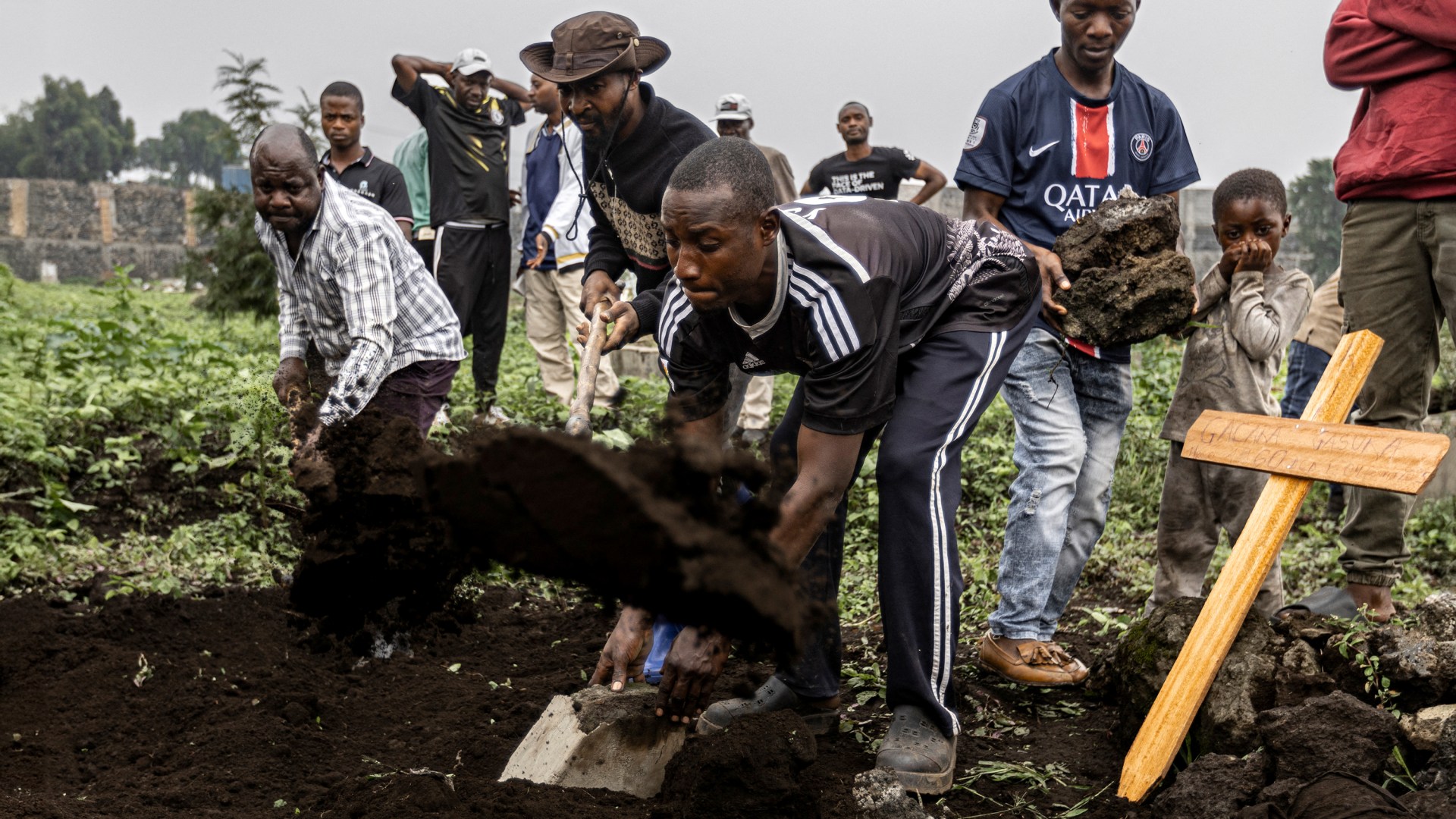
Relatives and friends cover a grave during a funeral for a victim of violence from M23 in Goma, Democratic Republic of Congo.

Relatives and friends cover a grave during a funeral for a victim killed by M23 in Goma, Democratic Republic of Congo.

Christianity Today February 4, 2025
Michel Lunanga / Getty

A week and a half ago, Moïse Ombeni took his wife and four kids to church in Goma, a city in the Democratic Republic of the Congo that sits on the Rwandan border. By the time the second service ended, their pastor had called off the next one, directing congregants to get to safety as rebel militants moved into the area.

The next day, Ombeni watched people flee the city. He had already picked up his school-age children from boarding school on Thursday. Before long, he could hear heavy weapons detonate outside.

“We were in a general panic, and we were wondering if we should stay or go,” he said in French. Before he could decide, he got word that certain districts had fallen to M23, an armed group that was now returning to the city it had once captured, nearly 13 years before. Goma was already surrounded.  

Ombeni locked the doors. He felt the house vibrate when stray bullets hit the roof and ricocheted into his courtyard. Outside, hundreds of civilians and soldiers died from gunfire and explosions. Unlike in previous conflicts, government forces fought directly with M23 in every part of the city, a decision that directly increased the number of civilian casualties and damaged buildings. At least 900 bodies have been found so far on the streets, the UN reported

Ombeni began praying with his family and reciting all 16 verses of Psalm 91 to them. He reached out to his friends from church, and they prayed together on online platforms until their internet connection was cut off. Yet his despair has only grown. 

“We feel like life no longer has any meaning and that everything has stopped,” he said. 

This is not the first time Ombeni’s city has been ravaged by M23. He was a teller at Trust Merchant Bank in Goma when the armed group stormed through in the middle of the day on November 20, 2012.

Ombeni ran out the office and into the street, where crowds tried to dodge bullets and vehicles speeding through the city, while the Congolese army and UN staff stood by. M23 raped several dozen women and girls as young as 10, looted buildings, and stole vehicles. They “forcibly recruited” soldiers, law enforcement, and civilians into “retraining.”   

Nevertheless, Ombeni had felt a flicker of hope. The international community had seen what M23 had done and demanded the group abandon the city. The rebels withdrew within weeks, and they were defeated the following year.

“In 2012, I was still single; I could get by easily. But today it’s different. I have a family,” he said. “Even if I’m afraid myself, I have to have the strength to console and support my wife, my children. … It’s not easy.”

Shortly before last month’s attack, Ombeni heard that M23 was battling the DRC’s armed forces and another rebel coalition less than 15 miles away. He was terrified.

M23’s campaign has emptied camps near Goma that held thousands displaced by past violence. When the fighters shut off electricity and water, some of the displaced escaped to areas near the home of another Christian who has asked not to be named for security reasons.

The Christian and his family tried to share their food and rain-tank water with dozens of people who showed up on their property, having just fled their shelters in a nearby camp.

“We celebrate God for provision and safety,” he wrote in an update to his friends and family, saying he was grateful to be spared from the violence that hit close to home. His neighbors witnessed M23 fighters killing the Congolese soldiers who surrendered to them. The militants left their bodies in the street, and some families were forced to bury their loved ones in their housing compounds.

He also said he feels helpless, seeing overcrowded hospitals and emotionally drained medical staff. He has no idea how his ministry might respond to the widescale suffering. He is currently working to put together relief kits and figuring out how he can offer pastoral care to traumatized soldiers and civilians.

“Please pray that we’ll be given [the] opportunity by God to minister to the church and call the church to [act in] its role in pastoral care, peace-making and reconciliation,” he wrote. “Please pray that the war will end.”

The current conflict, one which peace processes have tried and failed to end, shares overlapping roots with the Rwandan genocide. 

Goma sits practically on the border between the DRC and Rwanda. For years, Tutsi cattle herders passed between what is now Burundi, Rwanda, and Congo. Belgian colonizers also relocated Tutsi from Rwanda to Congo to help with their agricultural initiatives. Under their authority, Tutsi, who since the 18th century had reigned as monarchs in the area, had enjoyed government positions and other privileges. 

But in 1959, violence broke out between the Hutu and Tutsi, a conflict that ultimately ended with Rwanda’s independence in 1962. The new government elevated Hutu at the expense of the Tutsi, and more than 100,000 Tutsi fled the country, some to Congo. Many Tutsi refugees struggled to make new lives for themselves. The DRC government fought over whether to give Tutsi citizenship, despite many having been in the country prior to its 1960 independence. 

In 1993 and 1994, Tutsi conflict with the Hunde, another ethnic group, left thousands dead. After the Rwandan genocide in 1994, scared of Tutsi retaliation, many Hutu fled into Congo, their migration further disrupting the region. 

Some of Congo’s Tutsi formed the National Congress for the Defense of the People (CDNP), which advocated for the community’s political representation and sought to protect it from Hutu attacks. The CDNP was led by a former officer in the Rwandan forces that ended the genocide, famously wearing a “Rebels for Christ” pin.

But the group also attacked civilians, sexually assaulted women, and held child soldiers. When it signed a treaty with the Congolese government in 2009, some disgruntled members later formed M23, taking the date of the anniversary (March 23) as its name. 

Rwandan president Paul Kagame has repeatedly denied his government’s support of these movements. But a 2022 UN report asserted that Rwandan troops had been in the DRC, and a 2024 report stated that 3,000 and 4,000 Rwanda government forces had been operating alongside M23.

On Monday, Kagame said he didn’t know if Rwanda had troops in Congo. 

Kagame has previously accused the Congolese government of collaborating with the Democratic Forces for the Liberation of Rwanda (FDLR), a Hutu armed group with ties to the perpetrators of the 1994 Rwandan genocide. On Monday, he added that the group posed an “existential threat” to his country. 

On Tuesday, citing humanitarian reasons, M23 announced a ceasefire in the areas that it controls in eastern Congo and stated that it would back off its previous goal of taking Kinshasa, DRC’s capital city. 

The news brought people back into the streets, as trucks with goods from neighboring countries drove into Goma and aid workers tended to the wounded and hungry. A couple stores reopened.

Still, life as the Ombeni family has known it has stopped. The kids’ education has been put on hold. Banks, supermarkets, and gas stations have stayed closed. No one can speak out against the government nor resist their requests, whether sexual “favors” or attendance at political rallies. Many doctors have fled, leaving the hospitals ill-equipped to serve the community. Though many seek safety in their homes at night, they worry about break-ins and kidnappings. 

“⁠Some Christians have lost faith because the situation is unbearable,” said Ombeni. “May the Lord light this flame of prayer and faith in our hearts!”

News

Is This the End of USAID?

Christian partners around the world—suddenly fired, defunded, and without answers—worry that the new administration is done with the development agency.

Patients seek treatment at a USAID supported hospital in Somalia during a drought in 2022.

Patients seek treatment at a USAID-supported hospital in Somalia during a drought in 2022.

Christianity Today February 4, 2025
Photo by Giles Clarke / UNOCHA via Getty Images

Projects in 130 countries—from Kenya to Vietnam to Ukraine—ground to a halt. Staff on the ground, many with Christian organizations, were adapting to new information by the hour, trying to find alternatives for patients seeking help from clinics that had closed. Halted projects were addressing famine, lack of electricity in rural health facilities, and malaria outbreaks.

What initially appeared to be a temporary freeze in funding for the US Agency for International Development (USAID) turned out to be an effort to permanently close the 64-year-old humanitarian agency, the single biggest source of relief and development in the world. USAID became a target of Elon Musk’s Department of Governmental Efficiency (DOGE).

Secretary of State Marco Rubio indicated Monday that USAID, an independent agency, would be absorbed into the State Department. It’s unclear how that would work when the administrative infrastructure of the agency has been gutted and projects halted midway through. Former officials in US foreign aid who spoke on background with CT are hopeful that Rubio can find a way for the aid to continue in a restructured form.

But over the weekend, Musk announced on his social media platform X that the agency would be closing permanently and that Trump supported the closure. Musk has publicly accused USAID of being a “criminal organization.” 

“We spent the weekend feeding USAID into the wood chipper,” Musk posted on X on Sunday night. The Wall Street Journal reported that DOGE staffers forced their way into the USAID offices over the weekend and gained access to classified information.

Most of USAID’s budget goes to grants for specific development projects, including at Samaritan’s Purse, World Vision, World Relief, Catholic Relief Services, and many other faith-based groups. It supports local Christian health clinics in Malawi and groups providing orphan care.

In Kenya, PCEA Chogoria Hospital, a historic mission hospital now run by Kenyan churches, provides comprehensive health care to HIV patients through support from USAID. On January 24 the hospital received a stop-work order for that care and has had no indication of a return of funding despite Rubio’s promises that life-saving HIV care could continue.

The hospital has 3,162 HIV patients in that USAID-funded program, and 42 staff members caring for those patients. Chogoria had a plan to gradually take on the funding obligation of HIV patients itself over the next three years.

“However, the abrupt nature of this funding halt was unforeseen and has left both staff and patients facing uncertainty about the future of their care,” said Elijah Mwaura, the CEO of Chogoria, in a statement to CT. “We acknowledge and sincerely appreciate the invaluable support provided over the years, which has significantly improved health outcomes for many individuals living with HIV. While this development presents a considerable challenge, we remain hopeful that a timely solution can be found to sustain these critical services and minimize disruptions to patient care.”

On Monday, Democratic lawmakers who tried unsuccessfully to access the locked agency headquarters protested that Trump does not have constitutional authority to shutter the agency.  

Trump on Monday said he did not need congressional authority to shut the agency down if there were fraud, though he did not have concrete evidence of any fraud at the agency. The administration and Musk have repeated that USAID funded $50 million worth of condoms in Gaza, which is not true. The contract the White House cited funded zero dollars’ worth of condoms to Gaza.

“It is exceptionally painful to watch all this,” said Kent Hill, a former top official at USAID who also worked at World Vision and in Christian higher education as the president of Eastern Nazarene College. If USAID has specific problems, shutting the whole agency down instead of addressing the problems is a “tremendous overreaction” and “inhumane,” he said.

“Few American investments, if any, bring such a remarkable return,” Hill said. “To talk about shutting USAID down is callous and represents a tremendous a lapse in judgment which ought to call forth bipartisan condemnation.”

Groups on the ground have reported to CT an ongoing freeze in USAID funds, like those used for critical healthcare, even after the State Department issued a waiver for life-saving care.

“The total closure of USAID would cause irreparable damage to a number of Christian mission institutions across Africa, and I’m sure across the world,” said Matthew Loftus, a missionary doctor in Kenya. “A lot of what USAID is funding is critical infrastructure that everyone relies on to keep their programs running every day, like medicines.”

One example is Mission for Essential Drugs and Supplies (MEDS), a Christian medical organization that manages the supply chain and quality control of medications in Kenya. MEDS does its work with USAID funding. Loftus said MEDS is a “lifeline” for mission hospitals in Kenya, and it’s how his hospital gets most of its medication.

“This is how the missionaries that you support do their job every day,” Loftus said.

USAID supports health measures like malaria treatment and HIV treatment and prevention. It manages nonmilitary aid for Ukraine, the biggest chunk of its budget. It helps local governments with logistical and technical support as they build health infrastructure. Other than Ukraine, most of its budget goes to health care. It forms less than 1 percent of the US government’s budget, so it provides small savings for DOGE compared to its impact. But officials over the years have discussed a need for USAID reforms.

Here’s how USAID projects work: USAID staffers outline a need (like lack of water in a community) and a solution (like building a well) and form that into a project. An organization—faith-based, secular, for-profit, or nonprofit—applies to implement that project. Project-based funding is where most US foreign assistance goes. The stop-work order on foreign assistance halted these projects.

Even if the administrator of a project is not religious, a local church or religious organization might be implementing it on the ground. USAID supports local faith-based organizations, it said on its now-shuttered website, because it considers them to be “the backbone of local communities.”

USAID staffers read the administration’s actions in the last week as a more permanent ending of USAID as an agency than as a 90-day pause for a review. USAID’s website is offline. Hundreds of USAID employees have been fired—not simply furloughed—including top administrators. The Associated Press reported Monday that remaining employees received a notice not to come to the office.

Recently fired USAID employees told CT that even before their firings last week, they had been barred from talking to partners in the field or from holding any meetings with other staff. They knew of projects that were stopped midstride, like a project bringing electricity to rural health facilities in Sierra Leone. They worried about the breaking of trust with people all over the world. One recently fired employee said USAID supplies say on the outside, “From the American people,” so people know where aid is coming from. Now they’ll know who is at fault for it stopping, too.

Hill, the former USAID official, said that the Trump administration had overreached its constitutional powers.

“The Republican Party, if it is to retain any degree of credibility with the American people and with serious, principled conservatives, must courageously resist all examples of overreach in the new administration, and it must defend USAID from destruction since USAID had been funded and supported by Congress since its inception,” Hill said.

Annē Linn is one of those who was recently fired; she worked on the President’s Malaria Initiative (PMI), an initiative started by President George W. Bush, since 2019. She was an institutional contractor, which means she worked for a contractor but functioned as a USAID employee. She saw her job at USAID as a Christian calling.

The assertions Musk spread online about USAID, like that it was a “criminal organization,” were a “gut punch,” Linn said, for people who have been doing dedicated work.

“It’s one thing to say that it’s not a good use of taxpayer money, but to be targeted in such a grotesque way was beyond anything I could have ever imagined,” she said.

Before she started working for USAID, she and her husband worked in Senegal, where her neighbor died of malaria. She saw USAID’s work on malaria and knew she wanted to be part of it.

Now she is in shock over the sudden stopping of all USAID projects.

“It is nothing short of cruel,” she said. She said already-purchased malaria medications are not being distributed.

Some organizations, she knew, would find a way to continue providing services, but many would not.

“I want the church to know what’s happening,” said a former USAID employee and Christian who was laid off last week and was concerned about sharing his name in part because of the DOGE’s access to personnel files. “Pray for what’s happening. People are dying every day because of this.”

addApple PodcastsDown ArrowDown ArrowDown Arrowarrow_left_altLeft ArrowLeft ArrowRight ArrowRight ArrowRight Arrowarrow_up_altUp ArrowUp ArrowAvailable at Amazoncaret-downCloseCloseellipseEmailEmailExpandExpandExternalExternalFacebookfacebook-squarefolderGiftGiftGooglegoogleGoogle KeephamburgerInstagraminstagram-squareLinkLinklinkedin-squareListenListenListenChristianity TodayCT Creative Studio Logologo_orgMegaphoneMenuMenupausePinterestPlayPlayPocketPodcastprintremoveRSSRSSSaveSavesaveSearchSearchsearchSpotifyStitcherTelegramTable of ContentsTable of Contentstwitter-squareWhatsAppXYouTubeYouTube