Books
Review

Christian Influence Is Only One Explanation for America’s ‘Special Relationship’ with Israel

But here, as in other foreign-policy debates, Christians are well equipped to mediate between competing theories.

Christianity Today January 17, 2023
Illustration by Christianity Today / Source Images: Getty

In an international scene full of competing value systems and brute power politics, Americans tend to approach the conduct of foreign relations in one of three ways.

The Arc of a Covenant: The United States, Israel, and the Fate of the Jewish People

The first—and by far the most common—is to be passive unless it intimately affects day-to-day life. The second clause of Reinhold Niebuhr’s “Serenity Prayer” works as the credo of many Americans: “God, give us courage to change what must be altered, serenity to accept what cannot be helped, and insight to know the one from the other.” Trade relations between the United States and China or US proposals for Middle East peace are things most Americans cannot help.

But two other approaches have their followings. For “realists,” US foreign relations is fraught with centuries of mistakes, either by design or by ignorance. The best the United States can do, whether to protect its own interests or those of the rest of the world, is to remove any sense of transcendent values from foreign policy. In international-relations circles, realists are known for their so-called realistic assessment of the world and the base interests that govern nations.

For “idealists,” foreign policy is unavoidably bound up with moral questions. They believe the way America conducts itself on the international stage implicates its moral standing, whether as a sign of greatness and exceptionalism (including divine favor) or as an expression of deep-seated injustices at the heart of the American experiment. In international-relations circles, idealists are known for their principled assessment of the United States and its global commitments.

Translating Neibuhr’s prayer into foreign-policy categories, we might apply the first clause to idealists (who insist we can change the world for the better), the second clause to most Americans (who find it easier to assume we can’t), and the third clause to realists (who claim the mantle of clear-eyed discernment). Though Christians can be found in all three camps, they might be best known as idealists, for either criticizing or justifying American conduct in the world.

Perhaps no foreign-policy issue raises the hackles of idealists and realists like the relationship between the United States and Israel. Designated by many as a “special relationship” matched only by the relationship between America and Great Britain, the US-Israel bond appears constantly in our headlines. It is debated on college campuses, on cable news, and in op-ed columns. Even minor policy issues, such as changing the location of the US embassy from Tel Aviv to Jerusalem, become the subject of presidential campaign promises.

A lot of people have tried to explain the American fascination with a country more than 6,000 miles away with roughly the size and population of New Jersey. Walter Russell Mead, the well-known columnist and author of such books as God and Gold and Special Providence, has produced a new and clarifying answer in The Arc of a Covenant: The United States, Israel, and the Fate of the Jewish People. In the cottage industry of books purporting to explain the “special relationship,” Mead’s is a singular achievement. The sweeping history, spanning from the 18th century to the present, could have come only from a first-class writer, storyteller, and generalist like Mead.

Driving forces

Clocking in at more than 580 pages of narrative text, The Arc of a Covenant, by its structure and insistence on taking seriously both national interests and values, offers something of a bridge between realist and idealist explanations of the US-Israel relationship. The book examines the role of religious communities and values in forming foreign policy, touching on vast slices of world history that intersect with this story. There are long passages on 19th-century immigration to the United States, on the decline of European empires before World War I, and on the rise of the Sunbelt in the American South (among other topics). There is essentially a book within a book (over 100 pages) on the presidency of Harry Truman, whose time in office saw the US government grapple with the aftermath of the Holocaust, the establishment of the State of Israel, and the deepening of the Arab-Israeli conflict. If it weren’t so well written, the book might be criticized as overly long. As it stands, it is an achievement that will be hard to replicate, in either its breadth or its balanced arguments.

The title gives away the book’s recurring focus on religion and faith. Mead’s deepest insight is one idealists and realists share: that Zionism of one sort or another has been present since the beginning of American history. Even before the organized Zionist movement led by Theodor Herzl in the late 19th century, interest in Jews and the nation of Israel was pervasive in American political culture. “The driving forces behind Americans’ fascination with Israel,” Mead writes, “originate outside the American Jewish community and are among the most powerful forces in American life.” Those forces include religion, but they are too broad (and diffuse) to narrowly identify with one interest group or worldview.

Mead’s telling of this religious story—which begins in the Reformation and includes themes of prophecy, conversion, humanitarianism, and antisemitism—builds on earlier studies. Other historians, including Caitlin Carenen, Shalom Goldman, and Samuel Goldman, have excavated parts of this story. And scholars like Yaakov Ariel, Walker Robins, and Melani McAlister have pondered the puzzle of how conservative evangelicals emerged in the second half of the 20th century to become Israel’s most committed American supporters.

Mead also interacts with a wave of “Israel lobby” analysis that broke into the open with The Israel Lobby and U.S. Foreign Policy, a 2007 volume written by political scientists John Mearsheimer and Stephen Walt. The book, along with others of its ilk, applies a realist perspective, acknowledging the role of religious values but finding them deeply troubling.

In sorting through this maze of claims and counterclaims, Mead resists any single, simple interpretation of how the US-Israel relationship developed. Instead, he offers multiple explanations, sometimes half a dozen at once.

To take one example, consider the famous Balfour Declaration, issued by the British government in 1917, which supported “the establishment in Palestine of a national home for the Jewish people.” US responses to this declaration, Mead shows, are incomprehensible without considering multiple factors: division within the American Jewish community over the desirability of a “national home” outside the United States; anti-immigrant legislation that imposed severe restrictions to Eastern European Jews; the encouragement of national self-determination, by influential figures like Massachusetts senator Henry Cabot Lodge, as a way to expand American commerce and economic activity; wartime passions, led by President Woodrow Wilson, to establish minority rights in once-imperial holdings like Palestine; and a history of American Christian declarations similar to the Balfour Declaration dating back to the Blackstone Memorial in 1891, named after Methodist preacher and businessman William E. Blackstone, an early popularizer of dispensational theology and Christian Zionism.

By holding these strands together, Mead explains a history without simplistic answers. There is no use in isolating one explanation to the exclusion of others. In fact, doing so will distort reality. For some readers this might be discomforting. Yet the loss of concise explanatory power or obvious policy implications is more than worth the gain in capturing the complex range of historical actors, motivations, and forces at work in defining US-Israel relations.

The truest insights

What, if anything, are Christians today called to do in the foreign-policy world? Mead, a Christian himself, offers no religious instruction as such. But he does offer a framework that clears away simplistic and conspiratorial thinking in favor of the complexity of the past. Mead is especially critical of realist arguments that attribute the US-Israel relationship to the influence of a nefarious set of actors. He is particularly dismissive of “Israel lobby” theories, which blame Jewish American organizations for exercising an outsized influence on bending US policy in favor of Israeli interest. And he attends to the ways such arguments play on historic tropes of antisemitism.

Mead compares Israel-lobby advocates to the scientists who searched for Planet Vulcan, a celestial body proposed by 19th-century astronomers to account for irregularities in Mercury’s orbit. Scientists compiled evidence, even visual proof, of Vulcan’s existence—but of course the irregularities were due to their own flawed theories. Einstein’s theory of relativity explained that the sun’s gravity warped space-time in the exact ways observed by scientists on Earth. This did away with the supposed irregularities and thus the need for Vulcan. Similarly, Mead does a good job depicting “the lobby” as a mythical body invented to account for forces better explained through more comprehensive analysis.

Most Christians, when it comes to foreign policy, oscillate between idealism and detachment—between yearning to change the world and accepting that, in most cases, we can’t. Mead is a rare observer in the Niebuhrian tradition of Christian realism who insists, in keeping with the Serenity Prayer’s third petition, that we should focus on better understanding where change is possible and where it isn’t. As a realist, Mead admittedly prefers a “good” foreign policy to a “Christian” foreign policy. As he remarked in a 2018 speech, “just because something is made in a church or made with love doesn’t mean it is any good.”

But as a Christian, Mead has mined that tradition’s values—psychological, theological, social, cultural—and is convinced that Christianity offers the truest insights to promote human flourishing, as well as the only real antidote to human fallenness. And he appreciates the extent to which Christians have deeply shaped the institutions, structures, and practices of international relations for centuries. From the emergence of human rights and international law to the origins of many NGOs and global charities, Christians have played an integral role in shaping the current world order.

If Christian wisdom bridges the idealist-realist divide, it should finally push Christians back toward Niebuhr’s first petition, which exhorts us to change what must be altered. Certain biblical injunctions come into play: God’s command to grieve for other people’s pain (James 2:15–17) and to be peacemakers (Matt. 5:9). How we live these out can vary, but they are not exclusive to a professional diplomatic class.

There are also theological tools that the Christian tradition bestows. In a recent interview, Mead reflected on the importance of “a religious faith, connected to one of the great historical traditions” including Christianity, Judaism, Islam, Hinduism, and Buddhism, for becoming an effective observer and actor in international relations. Such a grounding “gives you a degree of insight and potential for self-criticism that are absolutely crucial to foreign affairs.”

More than any specific policy solution, Mead concludes The Arc of a Covenant by encouraging Americans to better appreciate the connections between how they think and act in the world. In this sense, the US-Israel relationship is no different than any other domain of human existence and far less special than it first appears.

Daniel G. Hummel is a religious historian and the director for university engagement at Upper House, a Christian study center located on the campus of the University of Wisconsin–Madison. His forthcoming book is The Rise and Fall of Dispensationalism: How the Evangelical Battle Over the End Times Shaped a Nation.

News

Federal Judge Tosses Challenge to Christian College Exemptions

In the ongoing tension between religious liberty and LGBT rights, the Department of Education and CCCU win one victory.

Baylor University is a CCCU collaborative partner and one of the schools named in the lawsuit.

Baylor University is a CCCU collaborative partner and one of the schools named in the lawsuit.

Christianity Today January 13, 2023
Courtesy of Wikimedia Commons

A federal judge in Oregon on Thursday dismissed a lawsuit challenging religious exemptions under Title IX. The decision comes as a win for Christian colleges that had joined the US Department of Education (DOE) in defending the exemptions in areas where their theological convictions on LGBT issues conflicted with the anti-discrimination law.

A group of 44 current and former students at religious schools filed a class-action suit arguing that the religious exemptions were incompatible with LGBT rights, and that LGBT individuals were exposed to “unsafe conditions” at religious schools. The lawsuit alleged that through the exemptions, LGBT discrimination was effectively “endorsed by the federal government.”

The students challenging the exemptions were from 31 schools, 22 of which were part of the Council of Christian Colleges and Universities (CCCU), including Baylor University, Oklahoma Baptist University, Moody Bible Institute, and Fuller Theological Seminary. The CCCU joined the lawsuit, Hunter vs. US Department of Education, on the side of the DOE in May 2021.

Though the CCCU advocates a sexual ethic of marriage between a man and a woman, the CCCU in court filings denied that its schools “abuse or provide unsafe conditions to thousands of LGBTQ+ students, or injure them mind, body, or soul, but rather seek to minister, support, and care for them physically, emotionally, socially, and spiritually.”

In the case documentation, LGBT students stated how they had been mistreated at religious schools, in some cases including conversion therapy. The judge acknowledged those accounts but did not find a legal basis for abolishing the federal exemption.

“Plaintiffs have failed to demonstrate any impermissible purpose Congress had in enacting the religious exemption, especially in light the Supreme Court’s decision in Amos and other cases upholding religious exemptions,” wrote Judge Ann Aiken in her 40-page decision.

Title IX is the federal statute that prohibits discrimination in federally funded education programs. Religious schools have narrow exemptions to Title IX in areas where the statute specifically conflicts with one of their religious tenets.

“This is a huge win for religious higher education,” said CCCU president Shirley Hoogstra in a statement. “Judge Aiken’s decision based on strong legal precedent reaffirms the constitutional rights of our institutions to live out their deeply and sincerely held religious beliefs, both in policy and in practice.”

The umbrella organization for the students, Religious Exemption Accountability Project, said it was considering options for appeal. One plaintiff in a press release from the organization said the decision was a “devastating blow,” and another added, “our fight is far from over.”

“Because of today’s decision, tens of thousands of LGBTQIA+ students across the country will continue to be discriminated against at universities receiving taxpayer money,” the organization said.

The almost-two-year litigation was more protracted than lawyers involved expected, and Aiken’s comments at a status conference last year led the CCCU lawyers to wonder whether she might allow some of the claims to proceed, according to one lawyer involved.

“While we thought we had the law and the facts on our side, we were a bit surprised at the rather clean victory for defendants here,” Nick Miller, one of the lawyers for the CCCU, told CT.

The CCCU lawyers believe the Respect for Marriage Act helped their case, though the CCCU did not endorse that legislation. When the law passed in December, the lawyers submitted a supplemental brief to the judge on the implications of the act and how it showed that a Democratic-controlled Congress and White House affirmed their arguments about religious protections.

“It is possible that this filing helped convince the court of the outcome it reached here,” said Miller, who noted that the RMA would apply only to cases brought under it. “Our argument was not that RMA controlled our case but that it showed how both the Congress and White House thought about constitutional and fair balancing in this field. It was of persuasive value, if you will. And it appears to have been persuasive.”

The supplemental CCCU brief on the RMA notes that its passage showed “all three branches of the federal government have now recognized that, while governments must respect same-sex marriage, private individuals and institutions must be allowed to believe, express, and live according to their own convictions regarding marriage and sexuality without losing government benefits or being subjected to official discrimination or any other governmental disability.”

Miller said he assumes the students will appeal and perhaps file cases directly against the schools.

“So we view this as the victory of a battle–an important one–but the overall conflict will continue,” he said. “We are very much in favor of legislative balancing act agreements, such as found in the Marriage Act, that would resolve these issues fairly, without spending so much time and effort on litigation.”

This article has been updated to correct that it was Oklahoma Baptist University, not Oklahoma Christian University, that was one of the schools named in the lawsuit.

News
Wire Story

Diane Langberg: The Church ‘Utterly Failed’ God in Its Abuse Response

The psychologist at the forefront of trauma-informed care calls out leaders for protecting institutions over people.

Diane Langberg

Diane Langberg

Christianity Today January 13, 2023
Colin M. Lenton Photography / RNS

Not long after Diane Langberg began working as a clinical psychologist in the 1970s, a client told her that she had been a victim of sexual abuse at the hands of her father. Not sure of what to do, Langberg went to talk to her supervisor.

The supervisor, Langberg recalled, dismissed the allegations.

“He told me that women make these things up,” Langberg said. “My job was to not be taken in by them.”

The supervisor’s response left Langberg in a dilemma. Did she believe her client? Or did she trust her supervisor’s advice?

“The choice I made is pretty obvious at this point,” the 74-year old Langberg said in a recent interview.

For the last five decades, Langberg has been a leading expert in caring for survivors of abuse and trauma. When she began, few believed sexual abuse existed, let alone in the church. Churches were seen as a refuge for the weary and some of the safest places in the world.

Today, she said, there’s much more awareness of the reality of sexual abuse and of other kinds of misconduct, especially the abuse of spiritual power. Still, many congregations and church leaders have yet to reckon with the damage that has been done to abuse survivors where churches turned a blind eye to the suffering in their midst.

“We have utterly failed God,” she said. “We protected our own institutions and status more than his name or his people. What we have taught people is that the institution is what God loves, not the sheep.”

The daughter of an Air Force colonel, who grew up attending services in a variety of denominations, Langberg still has faith in God. And she remains a churchgoer, despite the failings of Christian leaders and institutions. Still, she said, those churches and institutions have a great deal to repent of and make amends for.

Langberg, author of Redeeming Power: Understanding Authority and Abuse in the Church, spoke with Religion News Service about the sex abuse crisis in the Southern Baptist Convention, what lessons she’s learned over the past five decades and why she keeps the faith despite the church’s flaws.

This interview has been edited for clarity and length.

When it comes to sexual abuse, there are a growing number of church leaders who say, “We get this now and we can fix it.” But are they aware of the long-term consequences that come with mishandling abuse allegations over a long period of time?

Perhaps it would be helpful to first think about not the church but marriage. If somebody has an affair, they cry and say they are sorry. Then a year later, they have an affair with somebody else. How many affairs are going to be OK before you leave?

That is the kind of thing that has happened regarding the Southern Baptists. This has gone on for a really, really long time. And now they want to say they get it. It’s too soon. Even if they were doing absolutely everything they could to get it. It’s too soon.

How can church leaders start to regain trust?

The first step is not asking for it. The first step is to say, “I want to know what this has done to you. I want to know the ways that it’s been hurtful, I want to really understand the depths of what we did, and how it affects you, not just in terms of church, but in terms of understanding God himself.” To realize that this person whom God loves has been damaged by us who represent God. And we can’t fix that.

We have utterly failed God. We protected our own institutions and status more than his name or his people. What we have taught people is that the institution is what God loves, not the sheep.

What have you learned in 50 years of this work?

I don’t think we really understand the level of deception that occurs in people who abuse. We think that if they cry and say they are sorry, that’s a good thing. But it doesn’t touch the practice of deception that runs their lives and that runs their organizations. We’re very naive about that. You can’t marinate yourself in the lies and deception that are needed to keep abusing—and then say “I’m sorry” and have that change who you are.

There’s been a growing awareness about the dangers of the abuse of children and a willingness to address that issue on the part of churches. But many churches have a difficult time with the idea that adults can be abused. There’s an idea that if you are an adult, then a pastor can’t abuse you.

I find that outrageous, to put it mildly. The word “abuse” means to use wrong. I don’t think we understand the power that comes with the position of being a pastor. I mean, do we really think pastors can’t abuse that power? That they’re above this?

That’s a ridiculous thought about any human being. We’re all sinners. We’re all deceptive. We all deceive. To say just because somebody is a pastor means they can’t be abusive is naive.

If you had a group of Southern Baptist leaders right now in front of you, what would you tell them?

I would tell them that the first thing they need to find is humility. You can’t do something wrong for decades and then say, “Oh, we’re sorry, we did it wrong”—and think that now you understand it. It’s not possible for any human. You can’t cry and say you are sorry and ask for forgiveness and then it’s all fixed. My reading of the Scriptures and how sin gets ahold of us, and blindness gets ahold of us, would suggest that’s way off the mark.

What have you learned from survivors of abuse?

We don’t realize the level of courage that has been displayed right in front of us. Particularly in Christendom, if you tell the story of surviving abuse, you’re not only going against the person who did it, you’re going against God’s people, you’re going against his church, which adds up to going against God.

And survivors often lose their place in the church. They lose any status they had. They lose honor. They lose trust. All because of the things that were done to them.

Have you ever thought of giving up?

I cut my teeth working with Vietnam vets and with women who told me about abuse that nobody believed. The diagnosis of post-traumatic stress disorder hadn’t come out yet. So people thought vets were making it up because they were weak, and the women were making it up because they wanted attention. It was a very lonely road. And somewhere along the way, I told God I was quitting. He obviously convinced me not to do that. Then when I began to realize how much of this was in the church, I wanted to walk away. He convinced me to stay. And I’m very glad I did.

Books

‘Jesus Is Inescapable’: ‘Bible 101’ Authors On Why Scripture Is Here To Stay

Two Christian biblical scholars share how they zeroed in on key components of God’s Word.

Christianity Today January 13, 2023
Illustration by Mallory Rentsch / Source Images: Pexels

The Bible may be the best-selling book of all time, but it’s certainly not the easiest to understand.

As a collection of 66 books, written by dozens of authors in at least two distinct languages, God’s Word is a complicated text, to say the least—and one that can be used for almost any purpose. It has been bastardized to enforce chattel slavery, held aloft as a political photo prop, and even commodified as a product for “patriots.” But two Christian scholars hope their new book will remind both the faithful and irreligious of the Bible’s purpose and how it should not be used.

Dr. Edward D. Gravely, a Southern Baptist elder and one of the coauthors of Bible 101, specializes in Koine Greek and the New Testament. Gravely is a professor in Christian studies at Charleston Southern University along with coauthor Dr. Peter Link, who teaches biblical Hebrew and the Old Testament there.

Their new book, Bible 101: From Genesis and Psalms to the Gospels and Revelation, Your Guide to the Old and New Testaments, joins an arena of handbooks and study guides claiming to break the Bible down into layman’s terms for easier engagement. Contrary to what one might expect for such a feat, Bible 101 is not a whopper of a text. Like other books in the “Adams 101” subject-specific series (a Simon & Schuster imprint), Bible 101 is only 288 pages and smaller than an iPad mini.

Reporter Nicola A. Menzie spoke with Link and Gravely about their guiding principles in getting down to the key components of Scripture, their thoughts about taking the Bible out of context for various causes, and more. The transcript has been edited for clarity and length.

A lot of books out there claim to make the Bible easier to understand. What makes Bible 101 different from, or even complementary to, these other books?

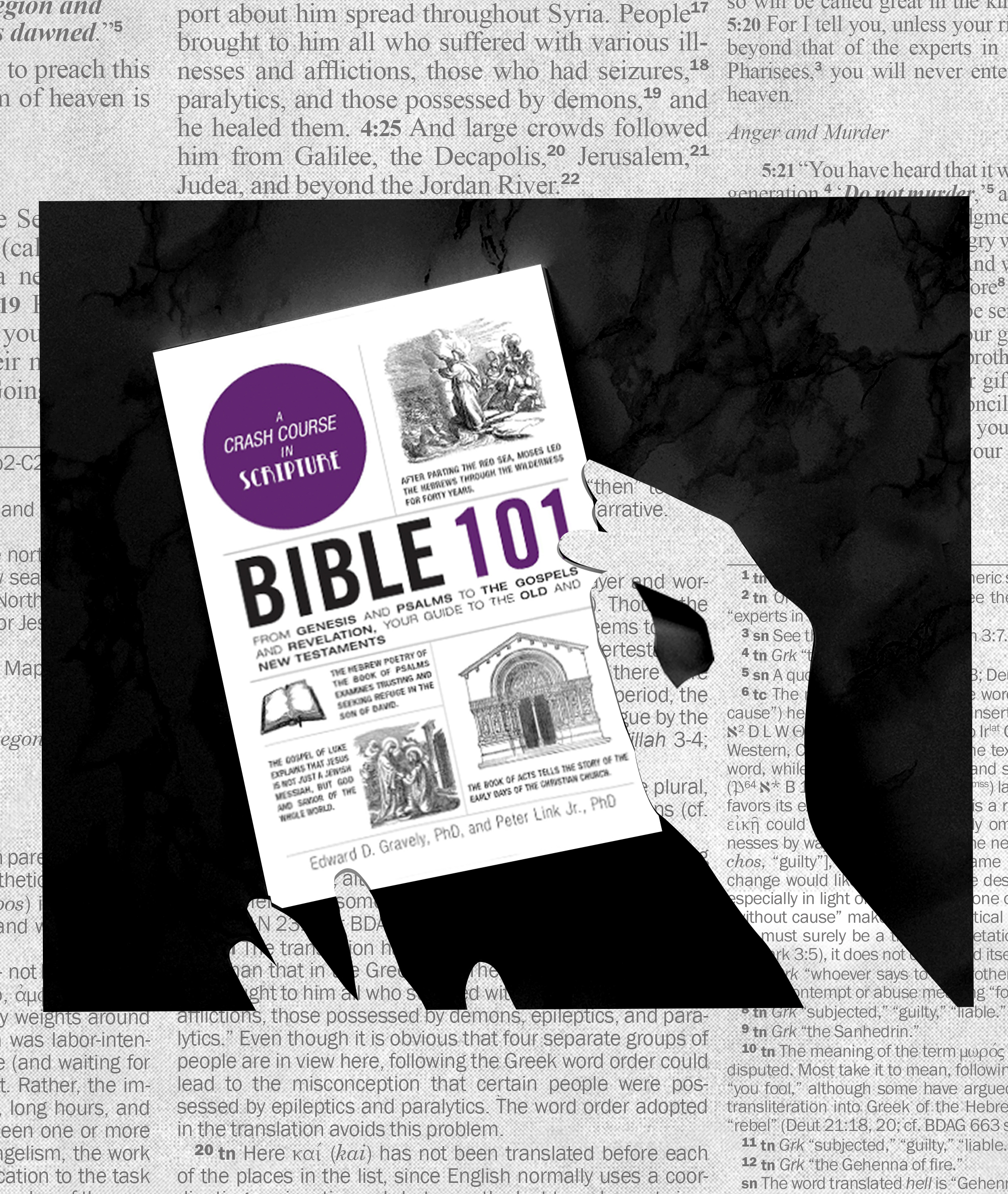
The book cover of Bible 101Edits by CT / Source: Unsplash
The book cover of Bible 101

Link: I think the starting point is simply that in Bible 101, we not only take you to all of the Bible and provide not only organization to what you’re doing, but we really do, I think, a good job of getting to the heart of the matter. And really kind of drawing your attention to this is what the text is interested in; this is what the Book as a whole is interested in. So it’s not a commentary. You’re not going to be caught [up] in millions of questions. But it is directly describing, ’Here’s the heartbeat, the main thrust of the text. And it gets to it, I think, rather efficiently.

Gravely: I agree. Honestly, when the project was first pitched to me, I would have described the level of succinctness of this book as shocking. You know, it’s “Here’s 24 chapters; each chapter needs to be about 1,000 words. Do the New Testament. Go.” … So those are the moments where you think, Okay, I’ve got a lot of very important decisions to make about what to put on this page. I think—this is gonna sound weird as an academic—the book is better for being shorter, because the editors were very rigid about their format. … So we would constantly say, “Okay, you’re over the word count. What are you going to cut?” I actually think that made the project much better.

Link: We felt challenged to not only speak to people who already knew what we knew—academics—but also to speak beyond just people who are already in our theological tribe. So if we could figure out how to communicate what the Bible says the way the Bible says it and only focus on those things that are most essential, then different groups could interact with the Scriptures. … There’s no doubt when you read the book [that] it is a thoroughly evangelical Christian perspective; it’s a conservative perspective. … We were proud about that. But we also want to be able to speak to those who don’t start at those same points or don’t even know that those differences exist.

In your book, you talk about how the New Testament authors and Jesus himself believed the Tanakh, or Old Testament, to be God’s Word. Why is that important?

Link: We want to take the Bible on its own terms. And the Bible itself takes the Bible pretty seriously. One of the things I’ve always said is that the writers of the Bible are also its greatest readers. So when you sit down and you read how a prophet is understanding the Torah, that’s not just a random fact; that’s not just a random idea. The Bible itself depends upon that, right? So all we’re saying is, if you take what the authors really care about, as you can see by what they’ve written, then here’s what they put front and center. That’s what we tried to do—make that front and center. We also don’t want to be dishonest and deny the fact that we’re doing this as evangelical conservative Christian scholars. We are that. But we’re also challenging ourselves to say, “Is the language we’re using … understandable to other people?” I sure hope so. That’s kind of been the goal.

Gravely: We have a wide variety of students here at Charleston Southern University. My approach in beginning a New Testament survey class is to always sort of try to help them understand that lots of people who don’t share our views, they still do gravitate to the Bible and to the New Testament. …

Dr. Edward D. GravelyEdits by CT / Photo by Rhett Marley
Dr. Edward D. Gravely

I think people have an instinct that we need to know … something about Jesus, and they do a little bit of poking around. If they look at reputable scholars of any stripe, they will very quickly realize that if the New Testament does not tell us about the real Jesus, then nothing does. The New Testament is the only game in town. I know there are critical scholars who will argue that the New Testament doesn’t say true things about Jesus; that’s not my point.

My point is just simply to point out that if the New Testament doesn’t tell us about Jesus, then we don’t know anything about Jesus. … It’s the only book around that even purports to be written by the people who actually knew Jesus. Scholars take that kind of appellation seriously. … Even if you’re an Orthodox Jew or a Muslim, the world is so Jesus-soaked that knowing that has got to be important.

As experts in your fields and leaders in your church, you must get all kinds of questions and comments about the Bible. What are some common misconceptions about the Bible that irritate you?

Link: I think because people don’t actually spend as much time reading the Bible, particularly in large chunks as they should, they start off and come to certain concepts rather quickly, such as the Old Testament is a book about a God of wrath and the New Testament is a book about a God of love. Well, you might want to read the Old Testament a little bit more closely. Because you’re going to see that the very ideas the New Testament uses about a God of love are directly coming from what Moses and the prophets said. So, … that I’ve got two different books that have no correlation—I think that’s where most people start off [with] the Bible. That’s the standard language they have.

There are popular Bible apps where people get their daily verse, and while it may not exactly be proof-texting, it still lacks the full context. What are your thoughts on that?

Link: Short statements may get concepts right and may, for a moment, capture a glimpse of something. But if it doesn’t draw you into wrestling with the larger text itself, then there’s something missing and lacking in that. That’s really our goal. Can we encourage people—whether it’s through Bible 101, through our teaching, or through our work at the church—to draw in closer to the Bible? That’s what strengthens anyone’s life: to recognize that this Book really does address the most basic needs about what it means to be human. …

If we can persuade people just to get into the Word, read biblical books on a whole-book level, and really try to ask “What does this mean as a whole?” I think that’s when you begin to have great conversations across multiple traditions and multiple perspectives. The goal is not necessarily to come to the same conclusion but to grow deeper into the biblical world itself. That’s one of my great hopes about not just Bible 101 but pretty much everything that I try to do.

There are dozens of versions of the Bible based on different translation choices, as well as study Bibles tailored to men, women, military members, etc. There are also so-called “patriot Bibles,” which include copies of America’s founding documents. What are your thoughts on Bibles like that?

Dr. Peter LinkEdits by CT / Photo by Rhett Marley
Dr. Peter Link

Link: The unavoidable reality of the consolidation of the Scriptures is that it has been read for a long time, and it’s read within communities. When you pass on the Bible from one generation to another, you’re always passing on the Bible and your understanding of it. That understanding can be good, but it will always have weak spots to it. This is why returning to the Scriptures is so essential. So I would say to somebody, if they have never had an ability to interact with the Bible before they got such a study Bible, go for it. But the mission is to not confuse the study notes or my lecture notes—or even Bible 101—with the Bible itself. Commentary on the Bible is not the Bible. Commentary is necessary. If you encounter the Bible and don’t want to talk about what it says, you probably haven’t encountered the Bible. …

The [patriot] Bible you referenced—I’ve actually seen it. I would argue that it probably confuses people who want to kind of conflate what I would call manmade documents [with] a divinely inspired document, which is the Scriptures. That being said, pastorally, I’m not going to come to somebody and say, “You’ve got to put that thing down.” I’m gonna say, “Well, let’s talk about what this means.” When you do it up close, when you actually do life together reading the Bible, you can make those kinds of moments real and the application real. You can actually help people focus on the biblical text in a way that I think is more organic and coherent and useful.

While not everyone believes the Bible to be divinely inspired, it remains a powerful symbol even in secular society. Why do you think that is?

Link: In the conversation that we’ve had in the West, the Bible has been the central conversation partner… and other things have come with it. But it’s really the Bible’s ability to penetrate through cultures and conversations and generations that I think is why it’s still going to be used, no matter who’s in charge, in what[ever] situation you’re in. Once a society encounters the Scriptures, it will leave an indelible mark.

Gravely: Jesus is inescapable. I think people have a well-earned sense that I need to know something about Jesus. And if I need to know something about Jesus, the Bible is where I go. There’s nowhere else to go. I think that’s even if their search for Jesus is not authentic, … not faith-based. If it’s just curious or it could be political, it could be a power move. Regardless of the motive, the Bible is where you go, and I think that’s why the Bible is ever-present and certainly not going anywhere anytime soon.

Nicola A. Menzie is a religion reporter who has written for Religion News Service, CBS News, Vibe.com, and other publications. She is also managing editor at faithfullymagazine.com.

Church Life

More Evangelical Women Are Leading Conversations on Sex

New voices, resources, and studies focus on wives’ experiences in the bedroom.

Christianity Today January 13, 2023
Illustration by Mallory Rentsch / Source Images: Getty

Juli Slattery, a clinical psychologist with a background in Christian ministry, has spent the past decade teaching couples to “reclaim God’s design for sexuality.”

She felt led to start her organization, Authentic Intimacy, after encountering so many evangelical women struggling with sexual brokenness and distorted expectations around marital sex, often stemming from what they were taught in churches.

“Growing up in the church, many times I heard sex talked about from men, and I heard it talked about from women, but I realized that my husband and other men had never heard it talked about from women,” she said. “I do think women need to be a part of this conversation, but not just teaching women—also teaching men.”

Pastors—oftentimes men—lead premarital counseling, and many have penned best-selling books on sex and marriage (such as Gary Thomas, Tim Keller, Matt Chandler, Francis Chan, and Paul David Tripp). While such books, designed for a general Christian audience, are sometimes written by a husband-and-wife team, books with a sole female author are usually targeted to female readers.

Slattery is among a wave of female leaders, including author Sheila Gregoire, who are shifting the evangelical conversation on sex and marriage by speaking out to both sexes.

Armed with new research on evangelical women’s health and sexuality, they are bringing women’s experiences and perspectives to the forefront, offering a course correction to what they see as incomplete or harmful teachings on sex.

In her survey of 20,000 evangelical women, Gregoire found that 20 percent of them reported experiencing marital rape. She also found that Christian women experience twice the rate of vaginismus, a condition where fear and anxiety cause sex to be painful.

Additionally, a new study by Christian sex researcher Shaunti Feldhahn found that 70 percent of couples had “mismatched” expectations about how often they would or should have sex. This disconnect can lead to a confusing or unfulfilling sex life, especially among women led to believe their bodies are the “outlets” for their husbands’ sexual needs.

For years, issues like the prevalence of porn addiction among men have dominated sermons and church resources around sex, while it was less common to hear discussions around women’s frustrations or struggles.

As a Christian who believed in saving sex for marriage, Morgan Strehlow was surprised at the sense of shame and failure she felt during her early years of marriage. The struggles around sex were serious enough that she considered divorce.

“I felt fooled, lied to, and then everything else just started crumbling,” said Strenlow, now the host of the Sanctuary Women podcast, which focuses on the healing she’s found around a healthier Christian understanding of sexuality and body.

Strehlow originally began voicing her struggles within a church small group, led by a man. It was only when the women of the group began meeting separately to discuss their issues that she realized how widespread some of the sex-within-marriage problems were.

As more evangelical women speak out about their experiences—including their struggles, trauma, and disappointment—the scope of resources available for Christian women and men alike to learn about sex is broadening.

Alia Fisher, a psychotherapist at the Colorado-based Cornerstone Christian Counseling, is optimistic about the conversation within Christian circles.

Fisher said things are looking up and sees women “finding more liberty and men growing in understanding,” in her practice.

In an interview with CT, she said several factors contribute to healthier conversations around sex within the Christian community, including a renewed focus on porn issues within the church, a reckoning with purity culture, and more visible Christian leaders addressing the topic (think Jackie Hill Perry, Rachel Joy Welcher, and Preston Sprinkle).

Gregoire’s guidelines for assessing marital resources include flagging works that blame wives in part for their husbands’ porn usage and seeking out materials that acknowledge women’s pleasure and libido.

Christian intimacy leader Francie Winslow said she also sees “the tide moving in the right direction” on healthy sex within Christian marriages.

“The women who dive in and go deep in my content, I find they’re having major breakthroughs and major healing,” Winslow told CT. “This is an inside-out work, and it’s inviting the Holy Spirit to do some reorientating on the way we see our bodies and view sex.”

Winslow hears from women in her community that say they’re having more sex, better interactions, and deeper intimacy with their spouses.

“It’s about more than sex; it’s about integrating God and seeing his glory and goodness,” said Winslow, who also hosts a podcast, offers group mentoring, and publishes resources on marital sex.

Winslow said that it’s good to see more Christian women leading in this area and that we need even more.

Rachel Walker exemplifies some of positive movement in recent years. She walked out of what she calls “toxic” purity-culture thinking and now shares a testimony of how she found sexual healing within her marriage.

Prior to this transformation, the Washington State mom of three attended the shuttered Mars Hill Church under the leadership of Mark Driscoll for seven years. She recalls growing up with sexual purity at the forefront of her mind—drawing lines and creating endless rules for herself and her husband before marriage.

Walker said she had to learn to “throw out my performance-obsessed view of sex and design a sex life that I actually enjoyed—not one based on the advice and pleasure preferences of a man I wasn’t married to.”

Now, she cohosts the Not Tonight podcast, a show about the complicated world of sex within marriage. She’s among the next generation of Christian women ensuring that the voices of women are heard on this matter.

https://www.instagram.com/p/CnUt6pXBqWj/

Even as Gregoire, Slattery, Winslow, and others work to help couples find healthy vulnerability and intimacy within their marriages, some of the historically harmful sexual ideologies—like emphasizing sex as an obligation and prioritizing male needs over female needs—are still present within popular books and teachings in the evangelical world.

“We cannot heal our present until we address our past,” said Walker. “And when we do that important work of breaking free of the generational junk, we create a hopeful space for our children to live out of a different narrative.”

Theology

Throwing Sesame Seeds and Burning Off Sins

Indian Christian theologians weigh in on the Sikh winter festival of Lohri vs. the Refiner’s fire.

Residents throw sweets, peanuts, puffed rice, and popcorn into a bonfire during the Lohri celebrations in Rajpura.

Residents throw sweets, peanuts, puffed rice, and popcorn into a bonfire during the Lohri celebrations in Rajpura.

Christianity Today January 12, 2023
Saqib Majeed / SOPA Images / AP Images

[This article is available in Hindi and Punjabi.]

Each winter, Sikhs and Hindus across India and around the world thank their gods for a fruitful winter harvest during the Punjabi festival of Lohri. Like on Halloween, children go door to door singing folk songs and demanding lohri or “loot.” In return, neighbors give out money or snacks like sesame sweets, jaggery, popcorn, puffed rice, and peanuts. Because the date of the holiday follows the Vikrami (an ancient Hindu) calendar, Lohri falls on either January 13 or 14.

The night of Lohri, family, friends, and relatives gather around a bonfire dressed up in traditional Punjabi attire and make offerings to a fire god with a small portion of the children’s loot. The party walks around the fire together, throwing sesame snacks into the blaze and praying aloud in Punjabi, “Aadar aye dilather jaye (May honor come and poverty vanish)” and “Til sade, paap sade/jhade (As the sesame burns, thus may our sins burn/fall off).” The celebration ends by eating a traditional holiday meal, performing folk dances, and singing folk songs.

Sikhism was founded around 1500 by Guru Nanak (1469–1539) and nine subsequent gurus developed the community and the Sikh faith. Guru Arjan, the fifth in line, compiled the Adi Granth, which is the first authorized book of Sikh scripture. Sikhs believe there is only one god, genderless and eternal, and refer to this god as Waheguru (wonderful teacher). Sikhs also believe in rebirth and karma.

Those who do not serve the True Guru [God] and who do not contemplate the Word of the Shabad [Sikh scriptures]—spiritual wisdom does not enter into their hearts; they are like dead bodies in the world. They go through the cycle of 8.4 million reincarnations, and they are ruined through death and rebirth.

Guru Granth Sahib 88

Sikhs make up 1.7 percent of India’s 1.4 billion population, and they are spread out all over India, with the highest percentages located in Punjab, Chandigarh, Haryana, and other nearby regions. Outside India, the Sikh community has a significant presence in the United States, Canada, the United Kingdom, Australia, and Malaysia .

Do beliefs about sin and forgiveness overlap for Sikhs and Christians? Christianity Today’s South Asian correspondent spoke with a Sikh leader about his understanding of sin according to their faith’s scriptures and how best to understand the “May our sins burn/fall off” prayer.

CT also spoke with three Punjabi-background pastors, two of which were born Sikh before converting to Christianity. All three have celebrated Lohri at some point in their lives, and they explained how their experience of sin in the Sikh world corresponds to the Christian understanding of the concept.

Devinder Pal Singh, director, Center for Understanding Sikhism, Mississauga, Ontario, Canada

In my opinion, the Punjabi expression Til sade, paap sade/jhade (“As the sesame burns, thus may our sins burn/fall off”) is only wishful thinking rooted in cultural ethos. It has no relation with classical understanding of Sikhism. For that matter, even Lohri has no roots in Sikhism since Sikhs do not worship the sun or fire. Instead, Lohri is generally celebrated by Sikhs predominantly because of its strong connection to Punjabi culture.

In Sikhism, all sins are considered rooted in one’s ego and evil impulses and desires. Sikhism considers a sin [to be] any deliberate noncompliance with hukam, the Punjabi word for “God’s law,” or defiance of the moral law.

Sins can only be atoned for by meditating on God and seeking union with him. According to the founder of Sikhism, Guru Nanak Dev, “When one’s intellect is polluted or sullied by sin, it can only be purified by the Love of God.”

Early Sikh sources do not say anything about other forms of expiation (atonement) that the sinner or offender might have to undergo in the society to which he belonged. The concept of expiation continued to evolve throughout Sikh history and [was] first codified by Guru Gobind Singh Ji, the tenth Sikh guru, for his Khālsā (the religious order of warriors he initiated.)

This code was revised in the 18th and 20th centuries and today is mainly focused on the individual and the various ways in which the person must behave to be a good, non-sinning Sikh.

In Sikhism, expiation is summarily dealt with in the community and must involve service (sevā) to it.

The exceptions are the four major sins: hukka (smoking tobacco and using all other intoxicants), hajamat (removing hair), halalo (eating meat), and haram (adultery and sexual relationships outside marriage). Violations of these may necessitate re-initiation to the community for the offender.

Richard Howell, PhD (theology) and principal of Caleb Institute, Delhi. He was born and brought up in Punjab and spent a significant part of his life preaching the gospel there.

Sikhism defines karma as the sum of a person’s good and bad actions in this and previous states of existence that affects a person’s future. It is not a “vertical” relationship, so the sin of a person is not against a holy God, but is “horizontal” in that it concerns other people and yourself. Hence, there are consequences. Karma determines what happens to that individual’s soul in the next life, whether they go up the ladder or down. In order to progress in transmigration (the passing of a person’s soul from one body to another after death), one’s good deeds must outweigh the bad deeds.

The Lohri tradition of revolving around the fire and speaking the words “Til sade, paap sade/jhade” can point to the evidence of the presence of guilt. Burning sesame snacks in the fire can be, on one hand, a symbolic expression of confession and realization that you have done something wrong but, on the other, can simply be an act of increasing one’s good deeds.

In Christianity, sin is not merely understood as ignorance but also that people are guilty before a holy God. People have disobeyed him and declared their independence from him. That is sin, and it results in separation from the life of God because of disobedience.

Jesus brings us back in harmony with God, and it starts with his incarnation when divinity united humanity. Our confession reunites us with God because of the sacrifice of Jesus Christ. We experience forgiveness because of the grace of God.

Jitender Jeet Singh, former Sikh priest and former national evangelist for Ambassadors for Christ, Haryana

Throwing the sesame sweets in the fire represents the sins an individual has committed throughout the year, and they get rid of them. This act is performed year after year and will continue for a lifetime.

Not so with those who place their faith in Christ Jesus. Christ has taken our sins upon himself and has set us free “once and for all.” There is no redoing again and again, every year. Christ gives every individual a volitional right. If we want to get rid of our sins, we will have to choose to approach Christ. And this is only once. It does not need to be repeated. There is no compulsion, and if we choose otherwise, we carry the burden of our sins to eternity.

Santar Singh, senior pastor, Khush Khabri Fellowship, Singapore. Born Sikh, he later became a Christian and studied at the Assemblies of God Bible College in Singapore. His church includes a service exclusively for Punjabis.

The Sikh understanding of sin is very different from the Christian understanding of sin. Sikhs don’t believe that they have inherited sin, unlike Christians who believe that they are born in sin and spiritually dead. Sikhs don’t believe that their nature is sinful; they believe that their acts make them sinners. In Christianity, a man is not a sinner because he sins; he sins because he is a sinner. What is inside a person manifests on the outside.

Guru Nanak Dev Ji, the first guru out of the ten Sikh gurus and founder of Sikhism, formalized the three pillars (or duties) that help followers earn salvation: Naam Japo (meditation on God and reciting and chanting of God’s name), Kirat Karo (hard work and honesty), and Vaṇḍ Chakkō (sharing and consuming food and wealth together).

Christians believe what is written in Ephesians 2:8–9: “For it is by grace you have been saved, through faith—and this is not from yourselves, it is the gift of God—not by works, so that no one can boast.” We do not believe in works; we believe in the grace of God and our faith in the work of Christ.

Theology

Restoring Trust in the Church Requires the Whole Truth

Our Christian institutions can’t rebuild credibility if we hide our failings.

Christianity Today January 12, 2023
Illustration by Mallory Rentsch / Source Images: WikiMedia Commons

This piece was adapted from Russell Moore’s newsletter. Subscribe here.

“People don’t trust their leaders anymore,” the man said to me. “I think The Rise and Fall of Mars Hill is the problem.”

He was referring to the documentary podcast series by my colleague Mike Cosper. I said, “I actually agree with you, as long as we take the italics out of that statement.” The problem is the situation that led to the rise and fall of Mars Hill and other incidents like it—not those who told the story about what happened.

This man’s lament is not unreasonable. Who among us is not exhausted by the constant revelations of scandals and abuses and griftings and cover-ups within the church, especially its evangelical wing? In that weariness, some would say, “Why don’t we talk about all the good things the church does instead of the bad?” The problem with this approach is that it leaves us with no Good News left to tell.

“The church is glorious,” some might say. “Why don’t we show that glory instead of bashing the church by talking about all these bad things?” I agree that the church carries the glory of God and that we should make this known so the world might behold his glory. But the glory showing and the truth telling are one task, not two.

To the church at Corinth, the apostle Paul wrote extensively about glory, specifically referencing Moses’ encounter with the radiance of God’s glory on the mountain. It was a glory so brilliant that Moses put a veil over his face afterward so the people wouldn’t be overwhelmed by it. What we have now in the gospel, Paul argues, is even greater: “And we all, who with unveiled faces contemplate the Lord’s glory, are being transformed into his image with ever-increasing glory” (2 Cor. 3:18).

Paul went on in that letter to say that the “light of the gospel” we carry is, in fact, “the glory of Christ” (4:4). He wrote, “For God, who said, ‘Let light shine out of darkness,’ made his light shine in our hearts to give us the light of the knowledge of God’s glory displayed in the face of Christ” (v. 6).

Now notice what Paul included right in the middle of that thread about light and glory: “We have renounced secret and shameful ways,” he wrote. “We do not use deception, nor do we distort the word of God. On the contrary, by setting forth the truth plainly we commend ourselves to everyone’s conscience in the sight of God” (4:2).

In the middle of describing the glory of Christ, which Jesus has since entrusted to his church, the apostle renounces deceptive, “secret and shameful” ways. He contrasts these negative things—which he denounces in almost all his letters—with an open proclamation of the truth that addresses the human conscience.

Paul wrote this way because showing the glory of the church does not negate telling the truth about it. This is especially the case, as Paul tells us elsewhere, when it comes to those who manipulate God’s Word to satisfy their own appetites for power, position, or pleasure—and at the expense of vulnerable, easily silenced, and seemingly expendable people.

The task of glory-showing and truth-telling is no more contradictory than the message that brought us to Christ in the first place—a message of both judgment and mercy, a message that reveals sin and offers mercy.

Can this message be unbalanced? Undoubtedly. We all know the type of person who, after embezzling from his business or cheating on his spouse, will say, “That’s what God is here for—to forgive.” And we all know the kind of person who preaches hellfire and brimstone to such a degree that sinners cannot hear the message that God sent Jesus into the world not to condemn but to save (John 3:17).

For those of us who describe ourselves as “evangelical,” this ought to be especially clear. After all, we are the heirs of those who emphasized that the gospel of glory isn’t the rote, dead institutions into which a person is born. We must be—and really can be—“born again.” We are the people who preach a gospel emphasizing that God really does love the world and that he really will judge sin.

Over a century ago, in his book The Varieties of Religious Experience, the pragmatist philosopher William James contrasted the “healthy-mindedness” of the “once-born” with the “sick souls” of the “twice-born.” For years, before I read the book for myself, I thought this framing suggested that those of us who are born again are unhealthy people who need a psychic crutch. But in some ways, his point was just the opposite.

To him, the “once-born” are those who see mainly the harmony and goodness of the world and of the human heart. The “twice-born” have a darker view—both of nature and of themselves—and can’t be reassured by a simple message that the world is just a happy place and that everything will be all right in the end. They know better. Their only consolation is not to ignore the bad news of the darkness but to offer the kind of Good News that sees things as they do—and responds accordingly.

I reject, of course, James’s naturalistic concept of religion. But on this one point, he was on to something important. Nearly a generation ago, the social theorist Christopher Lasch argued that acknowledgment of the darkness is precisely what is missing.

“Having no awareness of evil, the once-born type of religious experience cannot stand up to adversity,” Lasch wrote. “It offers sustenance only so long as it does not encounter ‘poisonous humiliations.’”

In other words, as Jesus shows us in John 9, the problem lies not with the blind person crying out for sight but with those who won’t acknowledge their blindness: “If you were blind, you would not be guilty of sin; but now that you claim you can see, your guilt remains” (v. 41).

For those who really pay attention—to the world, to the church, and to themselves—the portrayal of only the “good things” doesn’t do much to reassure or build trust. People for whom religion is just a vehicle for consolation and flourishing might be totally oblivious to this, but their kind of religion offers nothing for those who wonder whether anyone can see what’s killing them.

A word that doesn’t speak to that isn’t proclamation but propaganda. Propaganda might work for public relations, but it doesn’t come with the authority to drive out the darkness.

Yes, these are cynical times. The way institutions have misused power can make some people wonder whether every institution is that way. This cynicism isn’t accurate, but it’s also not crazy, given what we’ve seen.

Arguments about the facts of institutions and persons are not only legitimate but necessary. Making the case that an accused murderer wasn’t at the scene of the crime is different from saying, “Talking about murder here hurts tourism, so if you talk about it, you are being disloyal to our city.”

Russell Moore is editor in chief of Christianity Today and leads its Public Theology Project

Theology

While We Were Still Criminals, Christ Died for Us

Sin and crime are no different in God’s eyes—so why do we forgive one and not the other?

Christianity Today January 12, 2023
Illustration by Mallory Rentsch / Source Images: Getty

For most Christians, “legalism” is something to avoid—except when we’re talking about the law of the land.

Consider how we usually tell the story of Jesus and the woman caught in adultery (John 8:1–11). This woman was obviously a sinner. She had broken God’s commandments. But when the scribes and Pharisees brought her to Jesus, he did not condemn her. Instead, he exposed the self-righteous hypocrisy of her accusers: “Let any one of you who is without sin be the first to throw a stone at her.”

The moral of the story? Mercy triumphs over judgment.

True enough. But when we set aside our religious jargon for a moment, we find ourselves telling an even more surprising story—a story, it turns out, about crime and law enforcement.

I had read this passage countless times, but it was only while preparing to teach a course in prison that it occurred to me that this woman really had broken the law. Adultery may not be a crime in our world, but it was in first-century Judea—under both Jewish and Roman law. To put it in modern terms, the adulterous woman was a criminal and Jesus helped her evade punishment.

“Let any one of you who is without sin be the first to throw a stone.” As I thought of my students in prison, Jesus’ words took on a new layer of meaning. The grace Jesus offered did not just challenge the legalism of her accusers. It also challenged my own attachment to the retributive logic of law and order. Here was a story of God’s boundless love for sinners, yes—but also a story of God’s redemptive grace for those we call criminals.

Just imagine replacing adultery with a different crime, one that violates our own laws, and notice how troubling the story sounds. A man caught dealing drugs, a woman charged with credit card fraud, a teen who stole a car. “Has no one condemned you?” Jesus asks. “Go now and leave your life of sin.”

He does not say, “God may forgive you—but according to the law you must be punished.”

The longer I thought about it, the more surprising this passage became. Here was a story stranger and more challenging than I had ever suspected, a story that cut to the root of how Christians engage with issues of law and justice. Why had I never noticed this before?

The New Testament casts a radical vision of God’s restorative justice for all wrongdoers—both those we call sinners and those we call criminals. But modern readers often fail to see it because the lens we bring to the text is shaped by the line we’ve drawn between sin and crime.

When we read the New Testament, we are typically focused on the problem of sin and the need for divine forgiveness. From this perspective, the gospel is about the damage human wrongdoing does to our relationship with God and Christ’s work to restore this relationship.

This is not wrong. But it leaves out an important part of the story. Sin not only affects an individual’s relationship with God. It also creates ripples of harm that flow through the communities for which God created us.

Some of these sins we call crime. Yet when we confront crime, we seldom turn to the gospel. Instead, we call on the criminal justice system.

The writers of the New Testament acknowledged only one kind of justice—God’s. And yet when we distinguish sin from crime, we carve out two separate and very different domains of justice: one religious, the other secular. As a result, we tend to wear two different faces. We forgive sin, but we punish crime. We decry religious “legalism” but advocate for “law and order.”

In other words, we create a conceptual firewall that fences off the realm of criminal justice from the New Testament’s challenging teaching on law and mandate for mercy.

Christians haven’t always thought this way. The conventional distinction between sin and crime dates to the 12th century.

Prior to this, as legal historian Harold Berman writes, “All major ‘secular’ offenses—homicide, robbery, and the like—were also sins to be atoned for by penance; and all major ‘ecclesiastical’ offenses—sexual and marital sins, witchcraft and magic, the breaking of vows by monks, and the like—were also crimes prohibited by the folklaw and subject to secular sanctioning.”

In short, sin was crime, and crime was sin.

But as the Catholic church and Europe’s monarchs struggled to carve out their respective areas of jurisdiction, a boundary began to crystallize between secular and religious realms. Some acts of wrongdoing were against God’s law, but not of concern to secular authorities. These were only sins. Others violated human laws too. These came to be called crimes.

Human laws do not forbid all vices,” wrote the medieval theologian Thomas Aquinas, “but only the more grievous vices, from which it is possible for the majority to abstain; and chiefly those that are to the hurt of others, without the prohibition of which human society could not be maintained.”

In other words, God’s law regulated matters of the heart, whereas human laws governed society. And though God might forgive sin, violations of human law must be punished.

The main problem with this distinction is that it blinds us to Jesus’ withering critique of the logic of law and order.

Since Jesus criticizes the Pharisees’ preoccupation with following the letter of the law, we decry their issue as legalism. But we tend to think of this as a strictly religious matter—a question of nitpicky piety.

This misses the point. In first-century Judea, the law of Moses was not just a set of religious prescriptions but a pattern governing all aspects of life, from marriage and divorce to lease agreements and farming practices. Except where the Romans interfered, it functioned as the law of the land, guiding the judgments of local authorities. The scribes we read about in the Gospels served, in part, as lawyers, using their legal expertise to resolve disputes and draft contracts.

When Jesus reproaches them for how they enforce the law, he is not just criticizing their theology—he’s also challenging their legal theory. At its heart, the running debate between Jesus and the scribes is a disagreement about the relationship between law and justice—not just the laws we think of as religious, but the very idea of law as a way of regulating human behavior and punishing wrongdoing. Does meticulous enforcement of the law satisfy God’s justice? Or does God’s justice lie deeper?

“Woe to you, teachers of the law and Pharisees, you hypocrites!” Jesus laments. “You give a tenth of your spices—mint, dill, and cumin. But you have neglected the more important matters of the law—justice, mercy, and faithfulness” (Matt. 23:23).

Sure, he says, you’ve mastered the tax code. But you’re missing what it’s all about. There’s no value in following the letter of the law if you’re not fulfilling its spirit (Matt. 5:17–48).

Look, the Pharisees ask him, why are your disciples harvesting grain on the Sabbath? (Mark 2:24).

Okay, says Jesus, you know the labor laws. But you’ve forgotten their purpose. The Sabbath was made for humans, not humans for the Sabbath. The point is to give weary workers a rest—not stop them from having lunch.

In Jesus’ eyes, God’s law points to values close to God’s heart—justice, mercy, and faithfulness. The specific regulations of God’s law are meant to serve these values. In other words, enforcing God’s law should never get in the way of practicing the redemptive justice it points toward. Neither should enforcing our own laws.

These days, we seldom have legal controversies over tithing or Sabbath observance. Still, Jesus’ penetrating focus on the justice-shaped center of God’s law poses a challenge to modern readers too. God’s law is a beautiful gift. And our human laws also have value. But laws are not an end in themselves. When our desire to maintain law and order distracts us from the weightier matters of justice, mercy, and faithfulness—well, we already know what Jesus would say.

Paul, too, was wary of what happens when enforcing the law takes priority over receiving and sharing God’s grace. “The letter kills,” he wrote, “but the Spirit gives life” (2 Cor. 3:6). This is a truth he knew firsthand—first as an enforcer of the law and then as an imprisoned convict.

Paul’s gospel is articulated in language that would be familiar in any courtroom: law, justice, mercy, judgment. For years I read these terms as theological jargon, while actual laws and courtrooms were the furthest things from my mind. Now I’m convinced I was missing something important.

In fact, although mapped on a larger scale, Paul’s gospel addresses the same fundamental problem the modern criminal justice system targets: the basic fact of human wrongdoing and harm—or, as Paul calls it, sin.

The gospel, Paul says, is God’s solution to this problem. But it is not a solution based on law. No, if God were bound by law and order, we would all be lost. For all have sinned and fallen short of the glory of God (Rom. 3:23). No one is innocent, not even one (Rom. 3:10). We have all violated God’s law.

And yet God issues a surprising verdict: “There is now no condemnation for those who are in Christ” (Rom. 8:1). Through the gospel, the true shape of God’s justice has been revealed—a justice based not on law but rather on faith (Rom. 3:21–22). God declares innocent all who put their faith in Christ.

Paul knows that some think God is soft on crime. “How do sinners keep getting away with it?” they ask. “Why has God not yet punished them?” But the answer is not, Paul writes, that God is indifferent to evil. No, God is indeed a just judge (Rom. 3:26). It’s rather that God’s solution to sin is an unexpected one. Where we look for law and punishment, God addresses the problem of evil through Jesus’ reconciling sacrifice (Rom. 3:24–25).

“Now apart from the law,” Paul writes, “the righteousness of God has been made known” (Rom. 3:21, emphasis added; cf. Gal. 2:21). As Mark Baker and Joel Green have argued, in Romans, we see that Jesus stands in our place not by suffering the legal penalty for sin but by absorbing on our behalf its deathly consequences.

Paul’s thinking about the law is famously complex, but at its heart it mirrors the priorities of Jesus. “The entire law is fulfilled in keeping this one command,” he writes. “‘Love your neighbor as yourself’” (Gal. 5:14; cf. Rom. 13:8–10).

It’s not that Paul thinks the law is useless or wrong. No, he insists, God’s law is good (Rom. 3:31; 7:12). But when we rely on legal regulations—or “works of the law,” as Paul calls them—and when we trust in them to resolve the problem of sin, we only make matters worse by stumbling into judgmentalism and hypocrisy.

Paul is especially troubled by the use of the law to reinforce the marginalization of Gentile believers (Gal. 2:11–14; Rom. 2:17–3:20)—a concern that should make us uncomfortable, living as we do in a nation where Black and brown Americans are much more likely to be arrested than white people, more likely to be jailed while awaiting trial, and far more likely to be incarcerated.

In God’s eyes, we are all offenders: Jews and Gentiles, police officers and felons, model citizens and gang members. No one is innocent, not even one. That’s why we all need God’s mercy—mercy that is not the opposite of God’s justice but its life-giving culmination.

As Bryan Stevenson has written, after decades of work among those our legal system has condemned to death, “The power of just mercy is that it belongs to the undeserving. It’s when mercy is least expected that it’s most potent—strong enough to break the cycle of victimization and victimhood, retribution, and suffering.”

This is the heart of Paul’s argument too—that the free gift of God’s mercy in Christ is the source of our healing and reconciliation. In Christ, God restored us to new life in a way the law never could (Rom. 8:3).

In the end, the question is not whether we should live in a society governed by laws. Paul may not have wanted believers to take each other to court (1 Cor. 6:1–11), but he recognized that those in authority do have a role in punishing wrongdoing (Rom. 13:3–4). At their best, rulers enact the sort of justice that protects the weak and the vulnerable against those who might otherwise take advantage of them (Ps. 72:1–4).

Rather, the question for believers is where our allegiance lies. When confronted with sin and crime, do we find ourselves calling for law and order, or do we join Jesus in advocating for justice, mercy, and faithfulness? Are we focused on enforcing legal regulations, or are we oriented toward what Paul considered the heart of the law—loving our neighbors, both victims and offenders?

Here Christians have a mixed track record. As Aaron Griffith has noted in his recent book God’s Law and Order, no group has been as committed to caring for those in prison as evangelical Christians—and yet evangelicals have also been prominent advocates of the law-and-order ideology that has landed nearly two million Americans behind bars, including a disproportionate number of poor and Black Americans.

God forgives sin, we’ve preached. But crime must be punished.

In this, we risk eclipsing the fundamental message of the gospel: that all have sinned and fallen short of the glory of God—and yet while we were still criminals, Christ died for us.

Ryan Schellenberg is associate professor of New Testament at Methodist Theological School in Ohio. His most recent book, Abject Joy: Paul, Prison, and the Art of Making Do, is a reading of Philippians in its ancient prison context.

Peter’s Words for the Christians Who Stormed Brazil’s Capital

The passionate apostle understood religious zeal. But his change of heart on how to channel it changed the world.

Protesters, supporters of Brazil's former President Jair Bolsonaro, kneel to pray as they storm the Planalto Palace in Brasilia, Brazil.

Protesters, supporters of Brazil's former President Jair Bolsonaro, kneel to pray as they storm the Planalto Palace in Brasilia, Brazil.

Christianity Today January 10, 2023
Edits by Christianity Today / Source Image: Eraldo Peres / AP Images

As a Brazilian, I will remember January 8, 2023, as one of the worst days for my country’s democracy. As an evangelical, I will remember it as one of the darkest days for my country’s church.

This Sunday, dozens of angry citizens arrived in Brasilia and stormed the National Congress, the Supreme Court, and the Planalto Palace, ripping apart furniture, damaging paintings, smashing windows, and beating up journalists. The extremists are supporters of former president Jair Bolsonaro and erroneously believe that the 2022 election was rigged.

Video footage of Sunday’s attack shows the violence of these vandals. But it also reveals some protesters carrying Bibles, praying before they entered Congress, and singing hymns while being detained by federal police—actions that suggest many were evangelicals, an important electoral base for the former president.

https://twitter.com/alexfajardo_/status/1612800012102123520

“Brazil belongs to the Lord Jesus. The Congress is our church. The Congress is the church of God's people. If you are a Christian, come to the Congress. The Congress is ours, the people of God, until military intervention.” From a video filmed in the National Congress originally uploaded by Clayton Nunes.

Unfortunately, the seed of this extremism that reached its peak Sunday was planted and cultivated, in part, by evangelical churches that supported and campaigned for Bolsonaro in the last elections, amplifying polarization, hate speech, and radicalization. In their extravagant stumping for Bolsonaro, some evangelical leaders christened a rude, violent, and greedy politician into a “man of God.”

Beyond the ways in which many in the evangelical church cultivated an inappropriately intimate relationship with Bolsonaro throughout his presidency and reelection campaign, many Christian leaders have struggled to demonstrate significant fruit of the Spirit when engaging in politics. While publicly calling the church to defend family values, too many pastors themselves struggle with hatred, rancor, violence, division, and pride toward political opponents—works of the flesh that Paul suggests deny entry to the kingdom of God (Gal. 5:19–21).

https://twitter.com/ofuxicogospel/status/1612464335560876032

In recent years, churches have had a loose relationship with the truth and have too often irresponsibly shared conspiracy theories. This past year, some Christians claimed that leftist groups were fighting for the legalization of pedophilia. Since Lula claimed victory in October’s runoff, Christians have joined many of their fellow countrypeople in suggesting that the election’s runoff was the result of voter fraud.

In the aftermath of Sundays’s attack, a January 10 poll from Instituto Atlas found that 67.9 percent of evangelicals in Brazil believe that Lula did not actually win the election, 64.4 percent believe the attack was justified, and 73.8 percent think Bolsonaro is not responsible for it.

Following the elections, Bolsonaristas set up camps in front of barracks around the country, asking for the military to intervene and remove Lula from power. A few days ago, as the Belo Horizonte police dismantled one camp, a man prayed to God in bad Hebrew, “Yauh, Yauh, please don't allow it, Yauh.”

https://twitter.com/DudaSalabert/status/1611412447008538624

The prayer was fervent and desperate. It also sounded sincere and revealed a theology that had fostered despair, fanaticism, and a revolutionary posture—perhaps acquired encouragement from someone in a pulpit. The ingredients for demolishing a democracy and tarnishing Christian witness on display. A harbinger of the tragedy to come.

I fear we saw the fruits of the church’s worst tendencies on display this Sunday, including resentment toward the president and fellow Brazilians, an aversion to the truth, and a willingness to embrace violence rather than nonviolent protest when things did not go the desired way. But avoiding this outcome in future fraught elections won’t be achieved by swinging the results to a different party. Instead, for Christians of all political persuasions, it will start by seeing ourselves in the life and example of the apostle Peter—and then embracing his advice for us as we navigate living out our faith in adverse circumstances or in contexts in which we do not always agree.

Peter, passion, and a change of heart

The Bible holds the stories of humans who make mistakes, sin, and yet are called by God to repentance and conversion. The apostle Peter is one such person. Peter shows up in the Gospels as someone who fiercely loves Jesus but is prone to making rash announcements, selfish statements, and sometimes violent decisions. Peter frequently and passionately misses the point, he fights with James about who will sit at the right hand of Jesus one day, he tells Jesus he will never deny him, and he cuts off a man’s ear when Jesus is arrested. Even after Jesus forgives him for his denial and Peter spreads the gospel during the first Pentecost, he subsequently struggles to overcome his xenophobia about sharing Jesus with Gentiles.

Never shy about wearing his emotions on his sleeve, some years removed from his emotional and misguided outbursts, Peter later writes to Christians his advice for those who seek to boldly live out their faith.

In your hearts revere Christ as Lord. Always be prepared to give an answer to everyone who asks you to give the reason for the hope that you have. But do this with gentleness and respect, keeping a clear conscience, so that those who speak maliciously against your good behavior in Christ may be ashamed of their slander. (1 Pet. 3:15–16)

The exhortation to “in your hearts revere Christ as Lord” immediately orders our priorities and asks us to check ourselves for idolatry. Notably Peter is writing to people who believe in Jesus, and yet he is still asking Christians to make sure that they have centered the Lord. This includes not only believing in Jesus but also following his word and example in our actions. Relevant to our current situation, Jesus did not condone nationalism or sedition—two political trends expected in part of the messianism of the time. On the contrary, Jesus not only praised Samaritans but also added Zealots and tax collectors among his disciples: anti-colonials and colonialists.

Speaking to Christians living in a hostile world, the apostle Peter—the same Peter who earlier, believing in an aggressive and cowardly faith, had cut off Malchus's ear and denied Jesus three times—explains how we ought to answer the person who asks the reason for our hope. Peter uses two nouns: gentleness (πραότητα), which means “humility” and “meekness,” and respect (φόβου), which means “reverence” or “fear.” When used to refer to people, gentleness conveys an attitude of humility or submission. Likewise, respect refers to a feeling of deep consideration for another.

Having a clear conscience is a common theme in 1 Peter; the word “conscience” appears in some versions of 1 Peter 2:19 and again in 3:21. In both cases, the context is the attitude of submission and respect that Christians should have, even when they are mistreated or persecuted.

When we feel wronged, we can often feel justified in bending the rules, distorting the truth, or adopting an “ends justify the means” mantra. But if we take a moment to reflect, we can quickly see that these are the very actions that discredit Christians to the rest of the world. In fact, Peter wants our character to be so sterling that—it’s worth repeating these words again—“those who speak maliciously against your good behavior in Christ may be ashamed of their slander.”

So what is the relationship between Peter and Christians who either ransacked the capital on Sunday or bear some responsibility for the attack because of their influence? The lives of both reveal that religious zeal can assume exaggerated proportions and become idolatry, taking the place that belongs only to the Lord. As Peter teaches us, living according to the teachings of Jesus means placing him as the supreme Lord in our lives. Even those of us Christians who may (naively) believe we would never take part in something like last Sunday’s attack can acknowledge that we regularly fall short in this area.

Evangelicals need to experience the same metanoia, or spiritual conversion, that the apostle Peter went through. Perhaps this transformation happened when he started to follow two instructions from his Master: instead of cutting off ears, “put your sword away” (John 18.11), and instead of denying Jesus out of fear or cowardice, “take care of my sheep” (John 21:16).

Guiterres Fernandes Siqueira is a journalist and theologian. He is the author of five books, including Quem tem medo dos evangélicos? (Who’s Afraid of Evangelicals?) (Editora Mundo Cristão.) He lives in São Paulo and is a member of the Assembly of God (Ministério do Belém) in the same city.

With additional reporting by Marisa Lopes and Mariana Albuquerque

News

Wheel and Heal: Medical Bus Wins Award for Church Innovation

After hospitals closed in rural Tennessee, church volunteers stepped in to provide basic care, cut hair, and pull teeth.

A volunteer cuts hair on one of DUO's outreaches.

A volunteer cuts hair on one of DUO's outreaches.

Christianity Today January 10, 2023
Courtesy of DUO Mobile Mission

With six trucks and some volunteers, a church in Tennessee is helping to fill a gap in rural health care. The ministry, Doing Unto Others Mobile Mission, or DUO, thinks other churches can do the same.

DUO is one of four newly announced winners of grants from church insurer Brotherhood Mutual Insurance, which wants to reward innovative church programs that could be replicated across the country. Other winners include a mentoring program with local business leaders and teens, an afterschool tutoring program, and a homeless ministry.

In about two hours with DUO’s fleet, a person in rural Tennessee can see a doctor, pharmacist, optometrist, and dentist, and even get a haircut. The ministry started in 2021 and only operates monthly a few months a year, but it has saved the US health system $3.8 million dollars and 42 emergency room visits, according DUO’s estimates using the Mobile Health Map evaluation from Harvard Medical School.

Jamestown, Tennessee—a city of 1,900 located in Upper Cumberland—needed DUO’s support after losing its only hospital in 2019 due to financial constraints. Emergency services had to take local patients to another hospital nearly an hour away. Another hospital in Cumberland closed in 2020.

Tennessee has the highest closure rate of rural hospitals per capita of any state.

Samuel LeFave, a Christian and recent Tennessee Tech biochemistry graduate, was interested in medical school when he got to know a family in Jamestown and heard about the desperate state of rural health care. His pastor at Life Church in Cookeville, Tennessee, an hour from Jamestown, asked him about setting up a medical program, since LeFave had worked with a free clinic as an undergraduate. LeFave, then 21 years old, dropped his medical school plans in favor of meeting the immediate local problem. DUO launched in 2021.

“I lead Sunday School, youth group; that’s fulfilling, but when you’ve gone to school, worked hard for a degree to serve a need, you want to use that in connection with your faith,” he told CT. It’s been fulfilling for the volunteer medical providers too, he said: “When you can use your talent above your tithe each week, that’s buy-in.”

The new ministry under LeFave bought and outfitted six buses: dental, hair, wellness, eye care, food, and a stage for any kind of church outreach events. The buses are staffed with volunteer medical providers from churches in the region. They see many patients that are homeless or have chronic, unmanaged illnesses.

“I think any congregation of any size could do this to fit their budget,” LeFave said. “It may not be dental and vision for a while—but anyone who wanted to offer wellness services through their church can do it on a very low budget.”

DUO’s dental services are its biggest demand—but a bus with dentists and dental chairs is not the easiest for small churches in rural areas to replicate. Still, studies have shown that in rural areas with few health care resources, churches can be key in communicating the specific medical needs of a community—like substance abuse in Appalachia—to those with outside resources. Churches are also important in convincing community members to get treatment.

Haircuts, though?

“Not everyone has a good background with a health care provider,” said LeFave. “Sometimes the best way to establish trust is a fresh haircut.” The DUO team found that a person hesitant about getting their A1C or lipids checked would be more open to stepping over to the medical bus after a trim.

DUO organizers try to be careful about when and where they offer haircuts, because they don’t want to take business away from locals in barber shops and salons who rely on that for a living.

One key to the mobile medical clinic is that Tennessee allows volunteer medical services without much liability. In states that don’t have that liability protection, churches can apply to be a federally deemed free clinic to be released from significant liability.

DUO has been working on a new need in its region: The remaining local emergency rooms have long waits for psychiatric help. A nurse practitioner from a local church already had a free mental health clinic going, so DUO helped the nurse set up a mobile mental health unit.

The project is still in development but that newly mobile clinic will be able to dispatch a retired ambulance equipped with two mental health nurse practitioners and telehealth access to a psychiatrist to help people in psychological crisis. The organizers recently met with local law enforcement, so the truck will be dispatched to nonemergency cases.

Patients with psychosis going to the ER sit in a hall wearing a special color, LeFave said, which is “traumatic for that patient who is already going through a crisis.” With a mobile mental health unit, “You’re going into the patient’s comfort zone.”

Through the Brotherhood grant, LeFave has four mentors for his program, three in Tennessee and one in Kentucky that runs a clinic. The grant to DUO was a one-time award, but the mentorship relationships continue.

“I have access to them whenever I have a question,” he said. Some are leaders at large churches. “They understand funding and some of the liability.”

Chip Freeman, the business administrator at Bellevue Baptist Church in Memphis, was one of LeFave’s mentors and said he and the other mentors would be available to LeFave as long as needed.

“DUO has experienced great success in a short time period, and they’ve shown how replicable this project is,” Freeman wrote CT in an email.

Brotherhood Mutual started the grant program after CEO Mark Robison noticed that churches had gone through dramatic changes during the pandemic, with declining attendance but increased demand for ministries like food pantries. He wanted to help churches “take risk,” knowing that tithes and offerings and some churches “were going to be a challenge.”

A certified accountant, Robison noted that most businesses fail in the first five years of operating, so he thought his team could help individual churches avoid that. Churches often set up outreach programs without much long-term business strategy, which was evident in the first round of 400 applications for grants Brotherhood received.

“I don’t know that any of them had a real business plan to them,” Robison said. That’s why the program includes mentorship and connections to bigger churches. “One thing we learned about churches is they are horrible at raising money. Most of them have never done a grant application.”

By partnering a smaller operation with large churches with significant budgets, like Memphis’s Bellevue Baptist, Robison hoped that bigger churches could step in as needs arise down the road. And Robison believes these programs might appeal to younger churchgoers, who often give to a specific project rather than a regular tithe.

As the program matures, Brotherhood plans to publish white papers later based on research on the programs they award, to lay out models for other churches.

This first round of Brotherhood winners, awarded last year but not publicized, received grants between $25,000 and $50,000, and Brotherhood has now opened the next year’s round of applications for what they call the Kingdom Advancing Grant. Any church can apply for the grants, not just those connected to Brotherhood. The deadline for new applications is March 31.

“I’m experiencing how sharing the gospel of Christ is a global, team effort,” said Freeman about mentoring LeFave and his team at DUO. “What a personal blessing it has been to me to see there are Christ centered ministries all over this country that want to make a difference for the kingdom of God! All they need is some funding and mentoring to get started.”

This article was updated with information about the grant amounts to winners.

Apple PodcastsDown ArrowDown ArrowDown Arrowarrow_left_altLeft ArrowLeft ArrowRight ArrowRight ArrowRight Arrowarrow_up_altUp ArrowUp ArrowAvailable at Amazoncaret-downCloseCloseEmailEmailExpandExpandExternalExternalFacebookfacebook-squareGiftGiftGooglegoogleGoogle KeephamburgerInstagraminstagram-squareLinkLinklinkedin-squareListenListenListenChristianity TodayCT Creative Studio Logologo_orgMegaphoneMenuMenupausePinterestPlayPlayPocketPodcastRSSRSSSaveSaveSaveSearchSearchsearchSpotifyStitcherTelegramTable of ContentsTable of Contentstwitter-squareWhatsAppXYouTubeYouTube