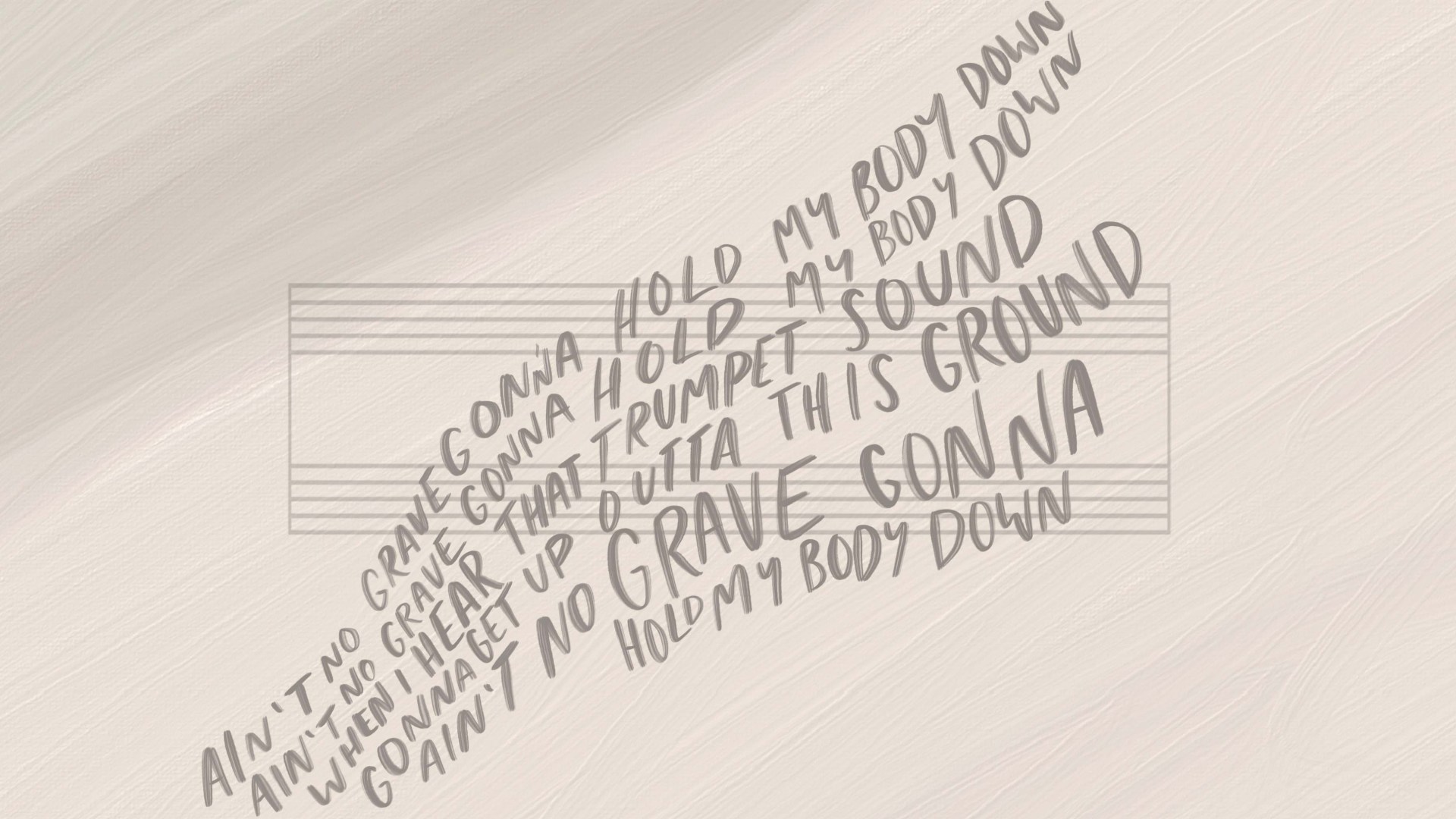
Ain’t No Grave Gonna Hold Our Bodies Down

What does the Resurrection tell us about God’s plans for us?

Illustration by Cassandra Bauman

1934

Twelve-year-old Claude Ely was dying in Virginia, stricken with tuberculosis. As his family huddled in prayer around his bedside, the boy began to sing:

Ain’t no grave
Gonna hold my body down
Ain’t no grave
Gonna hold my body down
When I hear that trumpet sound
Gonna get up outta this ground
Ain’t no grave
Gonna hold my body down

Claude eventually recovered. And the healing in his lungs was so complete that he grew up to become a singer and preacher known for his freight-train volume and Pentecostal gusto. In adulthood, he traveled the South as the “Gospel Ranger,” proclaiming the resurrection power of Jesus in one righteously raucous revival meeting after another.

On October 12, 1953, almost 20 years after Brother Ely’s boyhood healing, King Records captured him in a “live worship” recording session at the Letcher County courthouse in Kentucky. The audio for “Ain’t No Grave” has been preserved, and listening to it is a visceral experience. “Ain’t no …” Claude sings, like he’s pulling a boulder back in a slingshot. “Graaaaaaaaaaaave,” he hollers, like he’s letting the boulder fly. Other worshipers join him, shout-singing and clapping on off beats in a Spirit-fueled Pentecostal Holiness style, overpowering the microphones with gloriously distorted exuberance.

Listen to “Ain’t No Grave” and the rest of the songs featured in

The Wondrous Cross

at MoreCT.com/EasterPlaylist. You can also watch Arends and other contributors discuss their articles in this webinar.

If Ely delivered “Ain’t No Grave” like a sonic earthquake, perhaps it’s because he could trace the song’s conviction back to a literal earthquake. Consider how Matthew describes the moment in history that makes the song true: “After the Sabbath, at dawn on the first day of the week, Mary Magdalene and the other Mary went to look at the tomb. There was a violent earthquake, for an angel of the Lord came down from heaven and, going to the tomb, rolled back the stone and sat on it” (28:1–2).

That angel must have made quite a sight, reclining on the boulder the Roman army had been certain would keep Christ sealed in his tomb. Then he delivered the news that changed absolutely everything: “He is not here; he has risen, just as he said” (v. 6). As Brother Ely might have declared it, no grave could hold his body down!

The “violent earthquake” in Jerusalem that morning was nothing compared to the seismic shift in the cosmos. Every person who encountered the risen Jesus was confronted with the magnificent reality that, in the words of C. S. Lewis in Miracles, “[Jesus] has forced open a door that has been locked since the death of the first man. He has met, fought, and beaten the King of Death. Everything is different because He has done so. This is the beginning of the New Creation: a new chapter in cosmic history has opened.” Maybe it’s only right that Ely’s performance of “Ain’t No Grave” is more battering ram than melodious choir.

Still, Ely’s honky-tonk rendition is only one of many versions of this song. Earlier recordings include an exquisitely soulful 1942 performance by a domestic worker named Bozie Sturdivant, as well as a 1946 barrel-house piano rendition by Sister Rosetta Tharpe, who sang the song at her own mother’s funeral. These renditions have a familiar, well-worn feeling to them, suggesting, as some music historians believe, that earlier variations of “Ain’t No Grave” appeared in Negro spirituals dating back at least to the late 1800s.

The core refrain of “Ain’t No Grave” seems to be more of a primal human expression than the property of any one artist. The song has since been adapted by countless musicians over the years, including Tom Jones, Russ Taff, Robert Duvall, and Molly Skaggs. Many of us first encountered the song through Johnny Cash.

2003

American country legend Cash was days away from death. With the help of his friend and producer Rick Rubin, he continued to sing and record almost to his last breath.

Well, look way down the river
What do you think I see?
I see a band of angels
And they’re coming after me
Ain’t no grave can hold my body down

When the recording was released on the posthumous album American VI: Ain’t No Grave (2010), listeners encountered a fragility in his legendary voice that made the performance porous and transcendent. Rock critics struggled to find words to describe the effect. The Washington Post’s Bill Friskics-Warren wrote about the “spiritual, even biblical” quality of the music. More pragmatically, Ann Powers, a writer at the LA Times, dubbed the project Cash’s “Hospice Record.” Which, by all accounts, was exactly what it was.

2018

My mother was in hospice. I was lying on the couch next to her bed, holding my own breaths in the pauses between her increasingly shallow ones. She’d been unresponsive for days, and I knew her body would soon be in the grave.

“To be absent from the body is to be present with the Lord,” I whispered (2 Cor. 5:8). She seemed absent from her body already. All that remained was an illness-ravaged shell. And yet, it was still a body I loved.

I held her hand and enacted the code she taught me in childhood: Three squeezes mean “I love you.” I traced the remnants of her final manicure on the edges of her fingernails, evidence of her love of color and her enjoyment of chats with the salon technician. I adjusted her pillow and remembered the way her shoulders would shake next to mine when something struck us funny at church and we tried to suppress our laughter.

I found myself thinking of a stanza in Cash’s version of “Ain’t No Grave,” one you don’t find in many of the other renditions:

Well meet me, Mother and Father
Meet me down the river road
And Mama, you know that I’ll be there
When I check in my load
Ain’t no grave can hold my body down

That’s when I was almost startled to remember that, because I am a Christian, I believe not only in the resurrection, but in the resurrection of the body. The resurrection of this body, the one right in front of me. No grave could hold my mother’s body down.

The doctrine of the resurrection of the body has never come naturally to me. I was a mature student in graduate theological studies before I realized I had never seriously considered the final portion of the Apostles’ Creed: “I believe in the Holy Spirit, the holy catholic church, the communion of saints, the forgiveness of sins, the resurrection of the body and life everlasting” (emphasis added). I was sold on “life everlasting.” But subconsciously, I think I imagined it in a decidedly unbodily form. How could the bodies that we know decay in the ground (or, in some cases, we cremate into ashes) be a part of our future?

A professor instructed me to read Paul’s first letter to the Corinthians, chapter 15. When I did, it seemed like the apostle was reading my mail. Paul reminded me that if we are convinced Christ has truly overcome death, then belief in the resurrection of our bodies is not only plausible, but essential.

If it is preached that Christ has been raised from the dead, how can some of you say that there is no resurrection of the dead? If there is no resurrection of the dead, then not even Christ has been raised. And if Christ has not been raised, our preaching is useless and so is your faith. (vv. 12–14)

Then, as if sensing my tendency to divorce our resurrected bodies from the ones we have now, the apostle pressed further.

But someone will ask, “How are the dead raised? With what kind of body will they come?” How foolish! What you sow does not come to life unless it dies. … So will it be with the resurrection of the dead. The body that is sown is perishable, it is raised imperishable; it is sown in dishonor, it is raised in glory; it is sown in weakness, it is raised in power; it is sown a natural body, it is raised a spiritual body. If there is a natural body, there is also a spiritual body. (vv. 35–36; 42–44)

It began to dawn on me that our spiritual bodies will be a transfiguration (rather than an obliteration) of our current ones. The God who made bodies loves them and has truly wonderful plans for them. “The old field of space, time, matter, and senses is to be weeded, dug, and sown for a new crop,” suggests Lewis. “We may be tired of that old field; but God is not.”

In the Gospels, all who met the risen Christ encountered him in corporeal human form—yet he could walk through walls, disappear at will, and ascend into heaven when the time was right. “The body we will rise with will be like Christ’s glorified body,” muses Peter Kreeft, “immortal and perfect yet truly body, as Thomas found when he touched the Lord’s wounds.”

The early church surmised that our risen bodies will be characterized by subtlety (matter and spirit so in sync that walls are no longer a barrier), agility (the ability to travel wherever we want instantaneously), impassibility (immunity to illness or injury), and glory (like the luminosity of Christ at the Transfiguration). No wonder Brother Ely found the resurrection something to hoot and holler about.

Today … and the Future

Today, Brother Ely, Bozie Sturdivant, Sister Tharpe, and Johnny Cash are in the presence of the Lord yet still anticipating the Day of Resurrection. (So, for that matter, are the apostle Paul, C. S. Lewis, and my mama.) What a moment it will be when “in a flash, in the twinkling of an eye … the trumpet will sound, the dead will be raised imperishable, and we will be changed” (1 Cor. 15:52).

Maybe then, as we grin at each other and admire our same-but-different, gloriously transformed bodies, we’ll sing it all together:

When I hear that trumpet sound
I’m gonna rise right out of the ground
Ain’t no grave can hold my body down!

Read 1 Corinthians 15.

How does Christ’s resurrection point toward a triumphant future? How does that future impact your life in the here and now?

Carolyn Arends is director of education for Renovaré as well as a recording artist whose most recent album is Recognition. She lives with her family in British Columbia.

This article is part of The Wondrous Cross which features articles and Bible study sessions reflecting on the meaning of Jesus’ death and resurrection. Learn more about this special issue that can be used during Lent, the Easter season, or any time of year at MoreCT.com/Easter.
Theology

May We Be Shaped by the Songs of the Cross

Devotional readings for Lent from Christianity Today.

Illustration by Cassandra Bauman

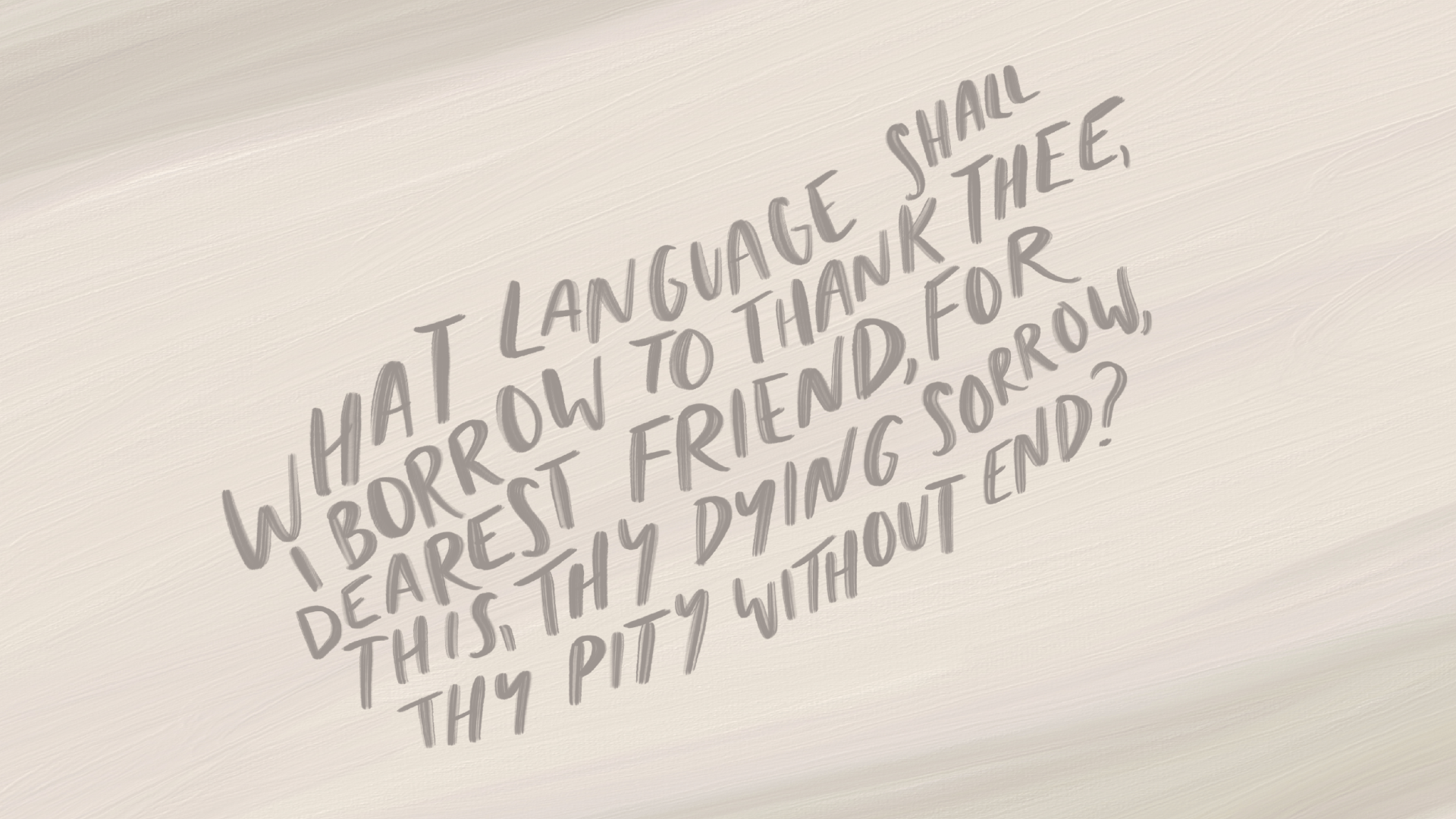
What language shall I borrow
to thank thee, dearest Friend,
for this, thy dying sorrow,
thy pity without end?

Each year during Lent and Holy Week I find myself singing this question, day after day, again and again. This line from “O Sacred Head Now Wounded” captures the utter wordlessness I feel as I contemplate the Cross. As I see Christ there, wounded and suffering. As I consider the deep, deep love of Jesus that compelled him to die for me and, indeed, for all the world. My own words feel meager and inadequate in response to the magnitude of this sacrifice. And so I borrow language to thank him.

We all do—and what a gift it is. We borrow the rich language of early Christian poetry, of hymnody and revival meetings, of spirituals sung out in defiance of injustice. And we hear, expressed in the music itself, truths that transcend words—sorrow and sacrifice, conviction and devotion, victory and joy.

The songs of the Cross give form and voice to the resounding response of our souls. As we sing them, consider them, and pray them, these songs help us enter into the meaning of Christ’s sacrifice. They express the Good News that reverberates even in the darkest moments of Jesus’ passion—and in the darkest moments of our own lives.

Listen to “O Sacred Head Now Wounded” and the rest of the songs featured in

The Wondrous Cross

here:
MoreCT.com/EasterPlaylist.

The Wondrous Cross is CT’s 2022 special issue for Lent and Easter. Each of the articles in this series draws upon a piece of music to reflect on Jesus’ death and resurrection—to wrestle with difficult questions, to meditate upon key moments in Christ’s passion, to delve into the mystery of salvation, and to celebrate Jesus’ victory over sin and death.

When we contemplate the wondrous cross, may this borrowed language give voice to our own worship as we fall before Jesus in gratitude and thank the Savior who is truly our dearest friend.

Kelli B. Trujillo is Christianity Today’s projects editor.

The Wondrous Cross features articles and Bible study sessions reflecting on the meaning of Jesus’ death and resurrection. You can learn more about this special issue that can be used during Lent, the Easter season, or any time of year at MoreCT.com/Easter.
Theology

When We Survey the Wondrous Cross

Lent invites us to gain perspective by facing our mortality.

Illustration by Cassandra Bauman

In 2013, Paul Kalanithi was completing his medical residency and was on his way to becoming a neurosurgeon at Stanford University when he was diagnosed with stage IV lung cancer. He’d just turned 36. Kalanithi began to write, and his memoir was eventually published as the book When Breath Becomes Air. In it, he recites words his oncologist and friend Emma Hayward shared with him as he reckoned with his impending death: “This is not the end. Or even the beginning of the end. This is just the end of the beginning.”

Kalanithi died in 2015. He was raised in a Christian home, eventually strayed from faith, but seems to have found God again during his final years. Hayward’s words ring resolutely true in light of the gospel. For followers of Jesus, death is not the end, or even the beginning of the end. It is simply the end of the beginning and the beginning of eternity.

While most Christians intellectually believe this to be true, our avoidance of death and even the talk of death seems to betray that belief. This is in part because, as anthropologist Anita Hannig observes, “In the United States the end of life has become so medicalized that death is often viewed as a failure, rather than as an expected stage of life.” We’ve been conditioned, in large part by our cultural fixation on pleasure, to ignore, deny, and even try to subvert death. As a result, we fail to ponder, deeply consider, and look upon it. We forget the psalmist’s reminder to “number our days” (Ps. 90:12), a call to reckon with our own limitations and the finitude of this life.

The journey toward Easter Sunday always begins with Ash Wednesday, when we remember that we are dust and will one day die. Before we arrive at the Resurrection, we must first reckon with the Cross. Isaac Watts’s “When I Survey the Wondrous Cross” calls us to this necessary work. Though we may think of the word survey in more technical terms these days, early on, the word actually meant something more along the lines of contemplate. Surveying the Cross isn’t a mechanical, morbid lurking in and out of nihilism. It’s an invitation to contemplate death and, according to the great hymn, to begin the journey toward clarity. Looking upon the Cross clarifies what truly matters now as we consider what is to come, for each and every one of us. And, what awaits us beyond.

Listen to “When I Survey the Wondrous Cross” and the rest of the songs in our special issue here: MoreCT.com/EasterPlaylist. You can also watch Kim and other contributors discuss their articles in this webinar.

Watts published his hymn in 1707, and it may be the most well known of the more than 600 songs he wrote. Though it was originally composed as a Communion hymn, over the centuries it has become an anthem of the Lenten journey toward Easter. At least part of the inspiration for the lyrics are Paul’s words in Galatians 6:14: “May I never boast except in the cross of our Lord Jesus Christ, through which the world has been crucified to me, and I to the world.”

The first line of the second verse—“Forbid it, Lord, that I should boast save in the death of Christ, my God!”—offers us the clearest parallel. But the theme of dying to the world and to earthly longings at the cross of Christ is strewn throughout the hymn:

My richest gain I count but loss,
And pour contempt on all my pride.

All the vain things that charm me most,
I sacrifice them to his blood.

And in one of Watts’s original stanzas that’s often omitted today,

Then am I dead to all the globe,
And all the globe is dead to me.

The Cross is the great revealer, exposing the temporary stuff of earth and directing our hearts and minds toward the everlasting substance of eternity. Human value systems are upended. Worldly riches, pride in our self-sufficiency, vain pursuits—all of these and more lose their splendor and shine in the shadow of Calvary.

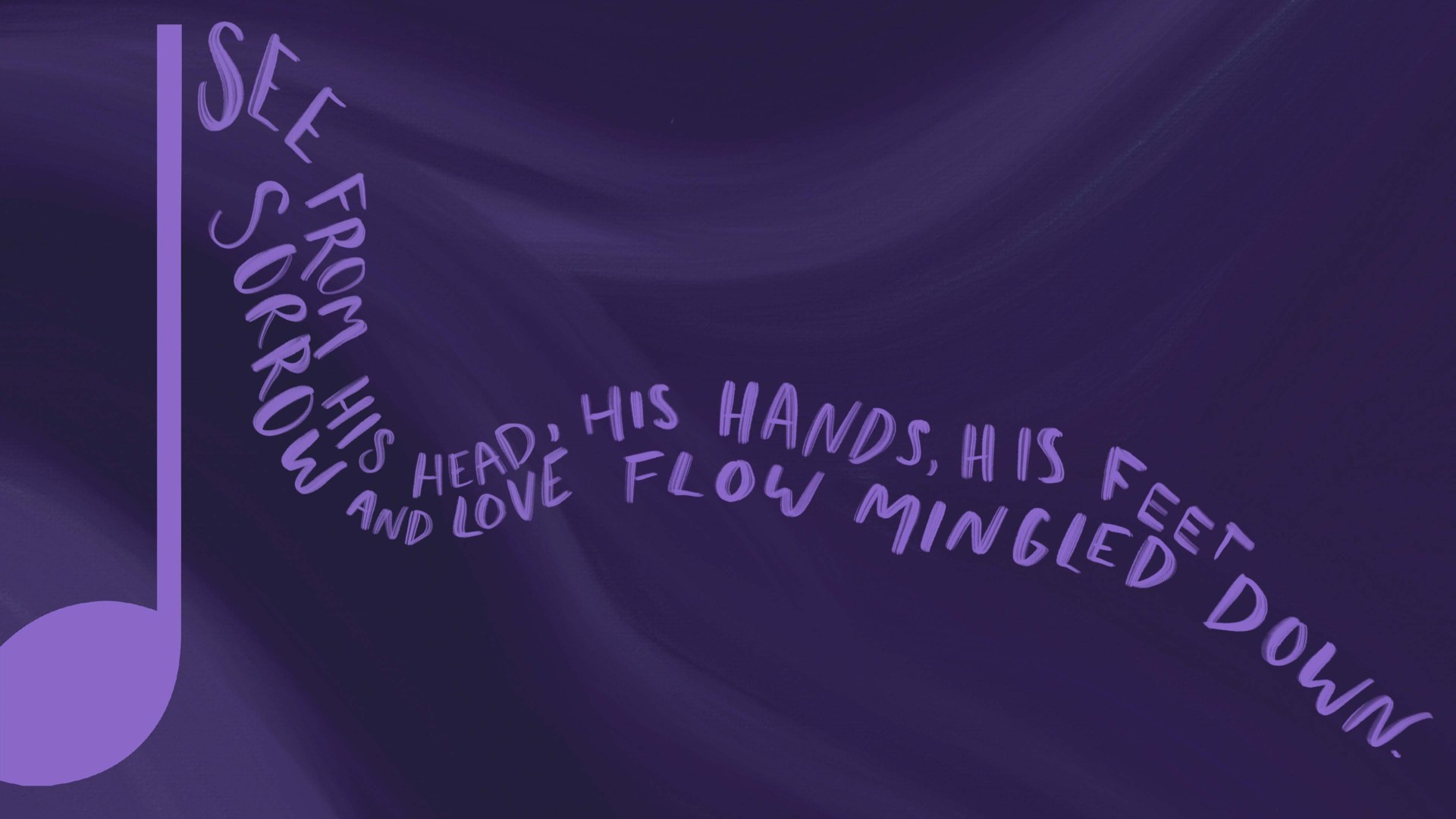
As our gaze begins to shift away from the deceptive gloss of earthly pleasures and toward the wondrous cross of Christ, and we see “sorrow and love flow mingled down,” we are faced with the question, “Did e’er such love and sorrow meet, or thorns compose so rich a crown?” And eventually, we’re compelled toward the reality that a “love so amazing, so divine, demands my soul, my life, my all.”

Secularism tells us that, ultimately, there is only life and death. It tells us that our lone option is to revel in the former before eventually and inevitably succumbing to the latter. And culture at large is at the ready, offering us endless temporary pleasures designed to keep our eyes fixed on shallow versions of the present. This is dangerous because, in the famous adage derived from a William Blake poem, “We become what we behold.” For the Christian, beholding the Cross is a way of breaking free from the morbid, nihilistic shortsightedness of secularism in order to live more fully into the hopeful, eternal story unfolding in the present and awaiting us in the future.

Reflecting on the death of her father, Flannery O’Connor wrote in her journal, “The reality of death has come upon us and a consciousness of the power of God has broken our complacency like a bullet in the side.” This is why Ash Wednesday is so powerful: We’re reminded not only of our certain demise but also, maybe more importantly, of what truly matters.

We’re reminded that all of this—delights and pleasures, life and breath—is ephemeral. It’s all hevel, in the language of the Ecclesiastical poet—vapor, mist, here and then gone. This is the gift we receive when we survey the Cross—the gift of an impeccable scale by which to measure, with precision and perspective, our values system, to consider what truly matters and what doesn’t.

My friend Gerry Breshears has spent decades pouring his life into church leaders as a seminary professor and as a pastor to pastors. This past fall, Gerry was diagnosed with cancer, not his first go around. He updated friends and family on this news with this reminder: “Jesus is in the present, look for Him. … He is easy to miss.” Though the future can seem chock-full of what ifs, in reality, the Cross has already written and finished the story. We know how this ends.

Gerry’s steadiness amid suffering comes from his cross-shaped vision for all of life and eternity—a vision I long to grasp and embody myself. It’s a vision acquired only and always through a deep and consistent contemplation of the Cross. It’s a vision that reveals to us that the crucified, resurrected, and ascended Christ is here, now, with us, guiding us toward a future where there are no more tears, death, mourning, crying, or pain (Rev. 21:4).

In the words of Paul in Romans 14:8–9, “If we live, we live for the Lord; and if we die, we die for the Lord. So, whether we live or die, we belong to the Lord. For this very reason, Christ died and returned to life so that he might be the Lord of both the dead and the living.” There is no fear, no anxiety, no doom and gloom. The Cross has erased all of that—this ancient instrument of death that has now become our great emblem of life and life to the full, both now and forever.

The poet George Herbert described how time (and mortality) was once “an executioner” but in light of Christ’s coming, “Thou art a gard’ner now.” We look upon the cross because it declares that death has been disarmed; it is no longer an executioner, ending our stories, but rather a gardener, tilling the fertile soil from which resurrection life rises. As we survey the wondrous cross, we come to know ever more deeply that “It is not the end. It is not even the beginning of the end. It is only the end of the beginning.”

Read

Galatians 6:14.

In your own words, what does it mean to

survey

the Cross? To

boast in

the Cross? How does the Cross put the rest of earthly life into perspective?

Jay Y. Kim serves as lead pastor at WestGate Church. He’s the author of Analog Church and the forthcoming Analog Christian. He lives in the Silicon Valley with his family.

This article is part of The Wondrous Cross which features articles and Bible study sessions reflecting on the meaning of Jesus’ death and resurrection. Learn more about this special issue that can be used during Lent, the Easter season, or any time of year at MoreCT.com/Easter.

Theology

’Tis Mystery All! The Immortal Dies!

How can we even begin to understand this astonishing, amazing love?

Illustration by Cassandra Bauman

When we sing praise to God, we often confess what we, in joy, know of the God we worship: God’s goodness and mercy, his glorious handiwork in creation, his gracious covenant with Abraham, his mighty and loving work in Jesus. We’ve been given knowledge of the Lord’s great acts that we offer back in praise.

And yet, when we consider the mighty works of God, the King who took on flesh, died, and rose again in Jesus, our praise can also recognize the limits of our understanding. In a posture of awe, we can admit that the God we worship is incomprehensible, that even in our knowledge, we are blinded by the mystery of God’s light.

This wonder is at the heart of our faith: The Holy God has taken on our flesh in Jesus Christ, who suffered, died, and rose for our sake. Our words are laughably inadequate in expressing the depths of this mystery, the mystery of God’s covenant faithfulness. Yet, in song, even our incomprehension can bow before the incarnate, crucified, and risen Lord, in awe of the mystery of his extravagant love.

Words of Wonder and Bewilderment

In his hymn “And Can It Be,” Charles Wesley (1707–1788) gives us a song that overflows with this form of praise, exaltation, and wonder. As the writer of thousands of hymns, Wesley displays an exquisite love for language that reflects the extraordinary acumen of his first teacher, his mother Susanna, who took joy in languages, including Latin, Greek, and French along with English. By the time of the writing of this hymn in 1738, the language of Scripture had been shaping Wesley’s imagination for many years. Wesley had even studied the church’s theology formally, leading to ordination in the Church of England in 1735.

Listen to “And Can It Be That I Should Gain” and the rest of the songs featured in

The Wondrous Cross

here:
MoreCT.com/EasterPlaylist.

And yet his faith and awe burst forth like a waterfall of energy through the lyrics of “And Can It Be,” reflecting the Spirit’s moving in his life anew just three days before his brother John said his heart had been “strangely warmed” in his famous encounter at Aldersgate Street. This hymn expresses old truths being perceived anew, amid surprise and astonishment. Indeed, Wesley’s words of faith are expressed in questions of “unbelief”—of incomprehension, amazement. How could this be true? How could the sacrifice of Christ apply not only to others but to me?

And can it be that I should gain
An int’rest in the Savior’s blood?
Died he for me, who caused his pain?
For me, who him to death pursued?

We do not approach Christ as innocent observers, but as sinners in need of deliverance. How could it be that, in Christ, we who made ourselves enemies of God become his friends?

And then, the song’s repeated underlying question—a vast and cosmic one—a question about the Incarnation and the Cross, about Christmas and Easter:

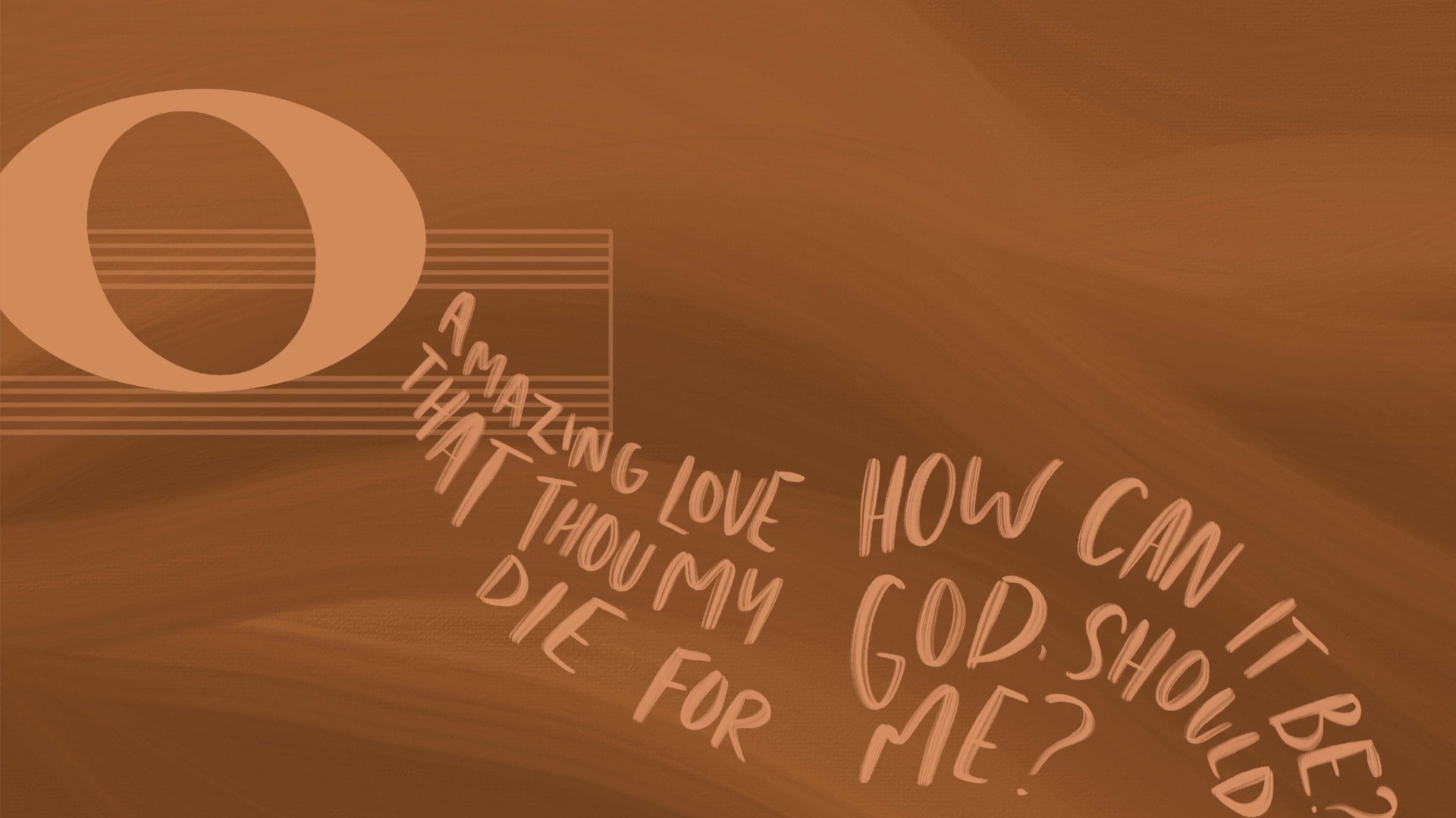
Amazing love! How can it be
That thou, my God, should die for me?

For many of us, this refrain has become so familiar that we may struggle to see how utterly shocking it is. As Psalm 90 confesses, in contrast to our short mortal lives, “Before the mountains were born or you brought forth the whole world, from everlasting to everlasting you are God” (v. 2). And in the words of the apostle Paul, it is God “who alone is immortal” (1 Tim. 6:16). It would be hard to find a more widespread biblical theme about this fundamental difference between God and creatures: God is everlasting. We are not.

This language of God dying for us sounds strange and may even seem scandalous. And yet, such language (referred to in technical terms as “the communication of properties” in the person of Christ), has an ancient history in the church. It was used not only by various church fathers, but also by John Calvin, Charles and his brother John Wesley, and many others.

A few years ago, a hymnal committee asked for me to act as a theological consultant to address concerns about some songs that they planned to include in the hymnal. “And Can It Be” was on the list. They wondered: How could it be biblical to sing, “That thou, my God, should die for me?” Isn’t it more proper to say that Jesus, our Savior, died? How could it be fitting to ask a question like this in a hymn’s refrain? Although such language has a long Christian pedigree, it’s a good question that brings us right to the heart of Wesley’s hymn.

He Came to Die

Wesley’s words approach the Cross from the standpoint of the Incarnation. While in Holy Week, as we may focus on particular moments in the days before Jesus was crucified, Wesley brings a wide-angle lens to remind us of something profound: that this cross-formed path that Jesus walked was taken up by none other than the Lord of the universe, the one in whom and through whom all things were made (John 1:3; Col. 1:16). Jesus’ cross was not a sideshow or ancillary to his calling. In a very real sense, he came to die.

I don’t mean this in a reductive sense, in a way that downplays the significance of Jesus’ preaching, his miracles, his friendships with sinners, or any other aspect of his ministry. But all of these fit within the larger context of God’s astonishing love in being willing to take on suffering and dying human flesh for our sake. The Cross itself discloses the way in which God’s extravagant love was on display in each moment of Jesus’ ministry.

When Jesus’ disciples discussed how they desired places of honor in the kingdom inaugurated by Jesus, he countered by telling them how his whole life, as the true Messiah and King, is shaped by a cross-formed love: “Whoever wants to become great among you must be your servant, and whoever wants to be first must be slave of all. For even the Son of Man did not come to be served, but to serve, and to give his life as a ransom for many” (Mark 10:43–45).

https://www.youtube.com/watch?v=mISbGETVr84&t=3s

The Book of Hebrews describes this reality in powerful terms. On the one hand, Jesus is the Son who “is the radiance of God’s glory and the exact representation of his being, sustaining all things by his powerful word. After he had provided purification for sins, he sat down at the right hand of the Majesty in heaven” (1:3). Yet the Son did not disclose his radiant glory and redeeming power from a distance. In his astonishing love, the eternal God took on mortal flesh and blood as his own to save flesh-and-blood mortals like us.

To bridge the alienation that disrupted God’s relation to creation, “he had to be made like them, fully human in every way, in order that he might become a merciful and faithful high priest in service to God, and that he might make atonement for the sins of the people” (2:17).

This loving act of God in the Incarnation and the Cross meets us not only in our sin, but also in our dying bodies, our flesh and blood. This is astonishing! Amazing! Indeed, because it was none other than God who took on human flesh in Jesus, he has pioneered the path in and through our most universal fear: death. “He suffered death, so that by the grace of God he might taste death for everyone” (2:9).

As church leaders in the fourth and fifth centuries discerned through sermons and debates that resulted in ecumenical creeds at Nicea, Constantinople, and Chalcedon, the Incarnation and the Cross are tightly intertwined. In the words of the fourth-century church father Athanasius, the eternal Word took on flesh because “in no other way would the corruption of human beings be undone except, simply, by dying.”

‘The Depths of Love Divine!’

Charles Wesley’s words are anything but careless and unbiblical. They are deeply theological. But to truly ask the question he poses—“How can it be that thou, my God, should die for me?”—is also personally shocking. It brings us to a place where our words fall short, where even poetry falls short. After the first time through the scandalous refrain, verse 2 circles this mystery with stark beauty:

’Tis mystery all! Th’ Immortal dies!
Who can explore his strange design?
In vain the firstborn seraph tries
To sound the depths of love divine!
’Tis mercy all! Let earth adore,
Let angel minds inquire no more.

Who can explain or understand this astonishing love? The immortal God makes death his own in Jesus? Can the highest of the angels understand this? No. But in wonder, we rightly adore this illuminating mystery: that our expectations of God's kingship are confounded by the Lord who makes the mortal life of a servant his own, who delivers us with a love that is beyond our understanding.

In our day, when we hear the word mystery, some of us think of an ominous type of “hiddenness”—perhaps the government, a political party, or a family member is hiding something from us, and thus there is a “mystery.” But Wesley’s acclamation, “ ’Tis mystery all!” could hardly be further from such a conception. This mystery is not deep darkness but blinding light—a love so great and deep that it is unfathomable. A sovereign King so deeply in love with rebels like us that he makes even death his own to defeat death’s final sting.

In this strange, cross- and resurrection-shaped victory, we discover a brother in our flesh who has pioneered a path through human suffering and even death. In the victory of his cross and resurrection, he secures what we could never grasp ourselves: freedom from slavery to the fear of death which so often holds us captive (Heb. 2:15). This is amazing love that bids our voices to sing. And also leaves us speechless.

Read

Mark 10:43–45

. What’s your response to Jesus’ description of his purpose? How do the questions and wonder expressed in Wesley’s song echo your own reaction to Jesus?

J. Todd Billings is the Gordon H. Girod Research Professor of Reformed Theology at Western Theological Seminary in Holland, Michigan. His most recent book is The End of the Christian Life.

This article is part of The Wondrous Cross which features articles and Bible study sessions reflecting on the meaning of Jesus’ death and resurrection. Learn more about this special issue that can be used during Lent, the Easter season, or any time of year at MoreCT.com/Easter.

The Stunning Humility of God

Jesus’ gruesome death didn’t happen randomly or accidentally. He knew very well what was coming his way.

Illustration by Cassandra Bauman

Many times I’ve stared at Titian’s famous painting “Christ on the Way to Calvary,” which depicts Simon of Cyrene as he helped Jesus carry the cross up the hill to Golgotha. In the painting, it looks as though there is some kind of communication happening between the two—Christ sorrowfully glancing up over his left shoulder and Simon gazing down with kindness at the face of Jesus. What would I have said were I in Simon’s shoes? Maybe it would have been something along the lines of “Ah, holy Jesus, how have you offended, that mortal judgement has on you descended?”

That’s Jesus right there

The other day, as I was driving my 12-year-old daughter Ruby to school, we saw a weather-beaten woman sitting at the top of the freeway exit, begging for money in the Albuquerque sun. I said to Ruby, “That’s Jesus right there.”

“What do you mean?” she asked. I explained how Christ continually identified himself with the downtrodden and marginalized in the world—with beggars, lepers, tax collectors, harlots, thieves—with the “least of these,” according to the society of his day. She still looked at me quizzically. Thrilled to have gained her attention on the subject, I said, “The humility of God is a pearl of great beauty in this desolate world.”

Afraid I might lose her attention, I found myself awkwardly blathering on about the world and its mad lust for fame, influence, riches, stature. I talked about the Kardashians, Donald Trump, Joe Biden, Kim Jong Un, Elon Musk, and other influencers and powerful figures who are on Ruby’s radar. I described how the life Jesus led was in the sharpest contrast to the values of the most influential people living in his day and in ours. Then we talked about the humble and beautiful way in which God became a man and the shocking humiliation of the way he died.

Perfect humility

“This will be a sign to you: You will find a baby wrapped in cloths and lying in a manger” (Luke 2:12). Jesus—the Messiah, the King of Kings, the Lord of the universe—entered into this world through a human birth canal. He was covered in blood and afterbirth then wiped clean by tender, though perhaps clumsy, hands. Too weak and undeveloped to lift his own tiny head, the creator of the stars was held up to his mother’s breast so that he could drink his first meal. He who created all things was now utterly dependent on Mary and Joseph, whom Jesus himself had breathed into existence! It’s a striking image to ponder. The birth of Jesus is a stunning and glorious moment in the history of this cold, calloused world.

The death of Jesus is stunning, too—the humility of God again fully on display, but under the most brutal and savage of circumstances. Consider the prophetic description in Isaiah 50:6–7:

I offered my back to those who beat me,
my cheeks to those who pulled out my beard;
I did not hide my face from mocking and spitting.
Because the Sovereign Lord helps me,
I will not be disgraced.
Therefore have I set my face like flint,
and I know I will not be put to shame.

Titian’s painting poignantly portrays the exhaustion and agony in Jesus’ eyes as he props himself up on a stone embedded in the hard ground. Simon’s visage is tender and compassionate. I imagine however, that the painting does little to accurately depict the unbearable agony that was physically taking place in his tortured body at that moment in Jesus’ slow, brutal march up that hill.

Listen to “Ah, Holy Jesus, How Have You Offended” and the rest of the songs featured in

The Wondrous Cross

here: MoreCT.com/EasterPlaylist. You can also watch Ortega and other contributors discuss their articles in this webinar.

When we sing the hymn “Ah, Holy Jesus” by Johann Heermann every year at our church’s Tenebrae service on Good Friday, it has a unique way of casting me as a Simon-like character in a Passion play. I feel as though I’m walking right next to Jesus and asking him these rhetorical questions as he takes the final steps toward his crucifixion. Who did this to you, Lord? Why are they doing this? What have you done wrong?

Of course, the questions are devastatingly answered in the second verse of the hymn with these words that are almost unbearable to sing:

’Twas I, Lord Jesus,
I it was denied you,
I crucified you.

My daily rejection of the sovereignty of Jesus in my life comes painfully into focus—my moment-by-moment insistence that I’m the one who determines the trajectory of my life. Yet here I am, caught up in the pathos of this extraordinary hymn. My own needy, imperfect humility becomes intimately commingled with the perfect humility of Jesus as we continue the grueling walk up the hill.

No one takes it from me

The third verse of the hymn is now given perfect context. It is a confession, an acknowledgement, that the congregation sings together:

For me, dear Jesus,
Was your incarnation
Your mortal sorrow
And your life’s oblation;
Your death of anguish
And your bitter passion,
For my salvation.

Like many parents, sometimes I imagine what it would be like to have to step into harm’s way in order to protect my daughter Ruby from danger, to save her from being injured or killed. I would gladly do it in a heartbeat. I would not hesitate. But if I were asked to do something like that for a stranger, let alone for an angry group of people who were mocking me, taunting me, swearing at me, and shouting their hatred for me, it would be a radically different story.

Yet, the vast, immeasurable, unsearchable, perfect love of Jesus welled up in him in the very climax of his agony, and he called out to God and said, “Father, forgive them, for they do not know what they are doing” (Luke 23:34). Then Jesus died and darkness fell over the earth.

Jesus’ gruesome death was not something that happened randomly or accidentally. It was not simply that an innocent man was savagely tortured and nailed to a cross because he happened into the wrong place at the wrong time. Jesus knew very well what was coming his way after his arrest in the Garden of Gethsemane, and this is what he’d already said of the matter: “The reason my Father loves me is that I lay down my life—only to take it up again. No one takes it from me, but I lay it down of my own accord. I have authority to lay it down and authority to take it up again” (John 10:17–18, emphasis added).

Jesus came into this world in meekness, tenderness, and humility. Even though he was spotless and without sin, he willingly suffered to die a death that was reserved for the very vilest of vile criminals. Philippians describes Jesus’ “death on a cross” with these simple words: “He humbled himself” (2:8).

Our prayer

I don’t know what Simon felt or understood the day he was forced to help carry Jesus’ cross, though it’s hard to believe that it left him unmoved. Scripture and tradition hint that he and his family may have become part of the early church. When I imagine myself in the scene in Simon’s place, knowing what I know about the meaning of Jesus’ humiliation and willing sacrifice as he climbed the hill to Golgotha, my ardent and passionate response echoes the love and commitment expressed in the prayer that concludes our hymn.

Therefore, dear Jesus,
Since I cannot pay you,
I do adore you
And will ever pray you,
Think on your pity
And your love unswerving,
Not my deserving.

“Ah, Holy Jesus, How Have You Offended?” is a hymn that requires a bit of work to sing with integrity. The text beckons us to concentrate with mind and with soul and to bravely enter into its narrative, to look full upon Jesus’ humiliation, and to be comforted by the transcendent kindness and mercy of our Lord.

Read

Luke 22:63–65; 23:26–37.

Picture these events in your mind’s eye and imagine Jesus’ suffering. What does it mean to you that he endured this willingly, out of his love for us? How do you desire to respond?

Fernando Ortega is a composer, pianist, and vocalist based in Albuquerque. His albums include The Crucifixion of Jesus and Come Down O Love Divine.

This article is part of The Wondrous Cross which features articles and Bible study sessions reflecting on the meaning of Jesus’ death and resurrection. Learn more about this special issue that can be used during Lent, the Easter season, or any time of year at MoreCT.com/Easter.
Why We Sing Such a Bloody Song

The power of “There Is a Fountain” is its insistence that Jesus’ death was real, was messy, and made all the difference.

Illustration by Cassandra Bauman

I wasn’t sure how to tell them. I could already envision their uncomfortable stares, the way they’d look down at the floor to avoid my eyes or pretend they hadn’t heard. I felt my own embarrassment rise, and then shame at being embarrassed. As I walked to my weekly banjo class, I turned over again and again in my mind how to tell my classmates that the song I’d prepared that week was titled “There Is a Fountain Filled with Blood”—how to explain that it was one of my favorite hymns to sing at church.

If you’ve ever heard the tune played on a five-string banjo, you know that the old-time melody is perfectly constructed for the instrument. It has a joyful, vibrant quality, bright as June. You’ll find yourself whistling it hours later, straining for the high notes with a smile.

Could there be a starker contrast between music and lyrics?

There is a fountain filled with blood
Drawn from Immanuel’s veins …

To modern ears—the educated, empathetic New Englanders in my class with me—how can this sound like anything but barbarism? This isn’t some scrape that cauterizes quickly. In this hymn, the amount of blood literally fills a structure; we’re immediately told to picture in our mind’s eye a traditionally quaint park decoration in a horrific incarnation. Worse still, this isn’t merely runoff from a butchery or pig farm. We’re invited to sing out that this overwhelming amount of blood is from a single man, taken from his very veins, an IV gone wrong.

Listen to “There Is a Fountain Filled with Blood” and the rest of the songs featured in

The Wondrous Cross

here:
MoreCT.com/EasterPlaylist.

The amount of blood featured throughout the hymn, the dying Lamb, and the open wounds seem to testify to something ancient and dangerous. A thief hangs miserable on a cross. “Sinners,” that aggressive jeremiad of a term, are “plunged beneath that flood,” an action that looks like a drowning, forceful and sure. This embodied darkness, this celebrated violence, stands in stark contrast to what is prized in contemporary spirituality.

The spirituality of many today, including for many Christians, is symbolic, therapeutic, perhaps even an attempt to escape from the bodies that constantly betray us and disobey us. Our mind and emotions are engaged; the spiritual realm is thought of as beyond, ineffable, invisible. Who has need for such bloody plunging? Isn’t it just a little much, a little macabre? Surely this must be a metaphor—perhaps one we can outgrow.

There is a fountain filled with blood,
Drawn from Immanuel’s veins,
And sinners, plunged beneath that flood,
Lose all their guilty stains.

The delicate tension of this hymn is that it is both metaphor and utterly real. We rush to the metaphor side for the obvious reason that Christians do not practice immersion in or sprinkling by blood. We celebrate water baptism, in our various ways, as our Lord commanded. At a baptism, the basin or baptismal is filled not with blood but with water, or we celebrate it in a natural body of water such as a lake or stream. The candidate doesn’t get washed with soap, scrubbed at in a physical way. The imagery of baptism is clean, restorative, and wholesome. The person emerges from under the water to thunderous applause, or the baby makes a funny face at the poured liquid, and our hearts fill with warm joy. This is the fountain we know. This is a stream we would gladly be led by.

Yet without the historic blood that ran from Jesus Christ at his death on the cross, our rituals are sentimental delusions of a cleansing not actually obtained. Jesus himself explained on the Emmaus Road that the Messiah had to suffer (Luke 24:26), and Paul routinely showed from the Old Testament that same necessity (Acts 17:2–3). Only by entering “the Most Holy Place once for all by his own blood” (Heb. 9:12) could God the Son incarnate provide redemption for us.

The power of “There Is a Fountain” is its repeated insistence that the death of Jesus was real, was messy, and made all the difference. It insists, along with all of the biblical witness, that the type of cleansing we need simply cannot be achieved any other way. Perhaps in our modern sensibilities we hear these lyrics and shudder, asking, Why? The answer back is this: the depth and horror of our sin.

The dying thief rejoiced to see,
That fountain in his day,
And there may I, though vile as he,
Wash all my sins away.

A blood that covers sin was hinted at when God himself killed the animals and dressed Eve and Adam’s nakedness with foreign skins (Gen. 3:21). A blood that rescues was rubbed on Israelite doorways, stolen from lambs so that firstborns would be spared (Ex. 12:12–13). A blood that removes guilt, sin, and uncleanness was shown over and over in Leviticus through an endless parade of bulls, goats, sheep, and birds (Lev. 1–7). The altar was stained, the priests intimate with the smell of blood. Every drop of it, every instance, pointed forward to the dying Lamb of God who healed us by his wounds (Isa. 53:5; John 1:29; 1 Pet. 2:24). Ours has always been a bloody faith because there has always been blood on our hands that needed atonement.

But this is not a hymn primarily of indictment. It is a song of sweet rescue. The first incredulous why is indeed because of our evil; that is why this blood was necessary, why we must be plunged into it. But there is another why in answer to the startling puzzle of this imagery.

Why did Immanuel, God with us, submit to such pain and shame? The blood of Jesus was given because of God’s love for his creation, specifically for us. He bled in our place and for us. For God so loved the world that he gave his only Son that whosoever believes in him shall not perish but have eternal life. We must repent of our sin and believe in the gospel.

This is why the dying thief rejoiced. It would be insane for one dying man to look at another and ask, “Remember me when you come into your kingdom” (Luke 23:42). A corpse doesn’t come into anything except a tomb. A fountain filled with blood cannot clean; it can only defile. So what did that thief see hidden in the battered, broken body of Christ? He had the faithful audacity to see Jesus’ victory and that the victory was won in order to be shared even with someone as guilty and lost as the thief himself. Jesus used some of his last breath to promise him, “Truly I tell you, today you will be with me in paradise” (v. 43).

This is why the hymn demands the major key, the lilt of celebration. This is why the theme is redeeming love and not shame:

E’re since by faith I saw the stream
Thy flowing wounds supply,
Redeeming love has been my theme,
And shall be till I die.

The majority of the lyrics startle, even frighten us. We may wonder if children should sing them, or if our guests at church won’t quietly grab their things and leave once they see what’s on the slide deck. But they are a faithful reminder of what our washing cost and how much we are valued by the one who saw our stains better than we ever could.

Singing such a song marks us as strange indeed. Yet we can have no other theme. And we must keep singing, calling others to join us:

Dear dying Lamb, thy precious blood
Shall never lose its pow’r,
’Til all the ransomed church of God
Be saved to sin no more.

This hymn contains not only the gospel but also the mission. Jesus declared that he had sheep outside the fold that must be brought in; Paul eagerly pressed to reach the nations. The faith has been passed down, down, down, the time and distance from Jesus’ death not in any way diminishing its effectiveness. Not just as an individual person, as precious as that is, but as the entire church are we ransomed, being transformed, to someday be presented without spot, wrinkle, or blemish. We will be beautiful in the holiness Christ bought for us and that the Spirit applied to us—beautiful because of the blood.

Read Luke 23:32–43

, imagining these events from the perspective of “the dying thief” who cried out to Jesus. How does their simple interaction—in the context of their brutal and bloody deaths—enrich your sense of the why behind Jesus’ sacrifice?

Rachel Gilson serves on Cru’s leadership team for theological development and culture. She is the author of Born Again This Way: Coming Out, Coming to Faith, and What Comes Next.

This article is part of The Wondrous Cross which features articles and Bible study sessions reflecting on the meaning of Jesus’ death and resurrection. Learn more about this special issue that can be used during Lent, the Easter season, or any time of year at MoreCT.com/Easter.

News

Amid War and Rumors of War, Ukraine Pastors Preach and Prepare

(UPDATED) Sunday sermons from Baptists and Pentecostals focus on peacemaking but also aftermath of any Russian invasion, as Putin on Monday recognizes independence of Donetsk and Luhansk.

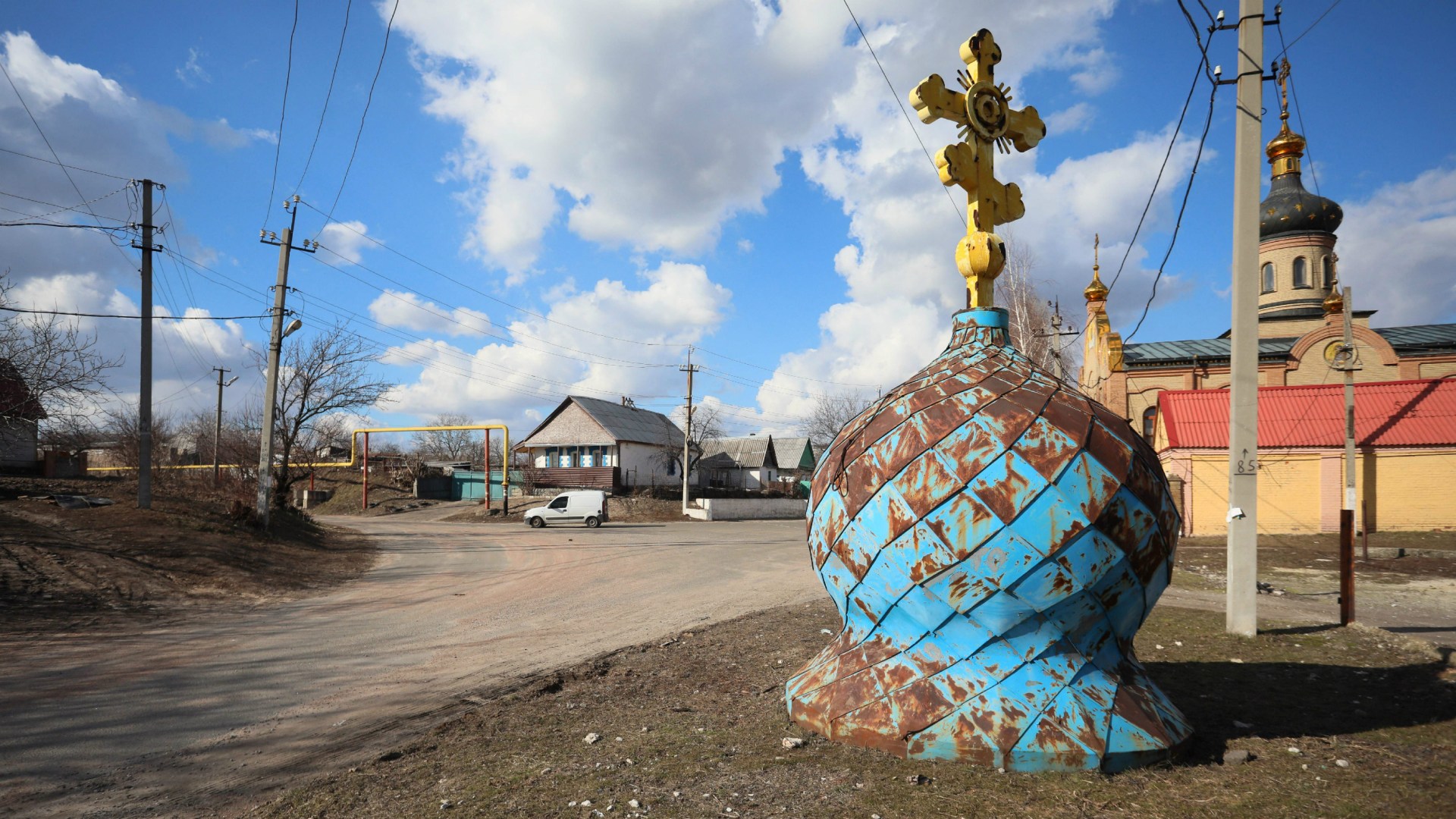
A cupola of a destroyed Orthodox church is seen in the town of Avdiivka in the Donetsk region located on Ukraine's frontline with Russia-backed separatists on February 21, 2022.

A cupola of a destroyed Orthodox church is seen in the town of Avdiivka in the Donetsk region located on Ukraine's frontline with Russia-backed separatists on February 21, 2022.

Christianity Today February 21, 2022
Aleksey Filippov / AFP / Getty Images

Update (Feb. 24): Pastors are staying to serve now that Russia has invaded Ukraine.

Facing imminent war, Ukrainian evangelicals preached peace the day before Russian President Vladimir Putin dramatically escalated tensions by recognizing the independence of two separatist regions on Monday evening.

“Go closer to meet those who are against you or fighting you,” Yuriy Kulakevych, foreign affairs director of the Ukrainian Pentecostal Church, told his congregation on Sunday, February 20, at God’s Peace Pentecostal Church in the capital, Kyiv.

“We are not only to enjoy peace ourselves, but to share it.”

Preaching on the Sermon on the Mount’s injunction toward peacemaking, Kulakevych continued his laser-sharp focus on the possible Russian invasion. Five weeks ago, as the separatist conflict in the eastern Donbas region began to escalate, he surveyed the Bible for its teaching on “wars and rumors of war.”

He followed that with an application of “Do not let your hearts be troubled” and, on the next Sunday, a treatise on worry. Last week, he tried shifting to include more mundane examples in a sermon on Jesus calming the storm, such as pandemic, career, and relationship difficulties. But the Russian threat did not dissipate.

“Protect yourself and your family by all possible means,” Kulakevych told the church. “And serve as a mentor for people in a bad state.”

The latter spirit is also animating Ukraine’s Baptists.

“Pastors in the gray area are not leaving the area,” said Igor Bandura, senior vice president of the Baptist Union of Ukraine, describing the frontline. “Christians are determined to take an active part in the needs of the people around them.”

They have already, planting 25 churches in the past five years.

At Irpin Bible Church in suburban Kyiv, Bandura quickly changed the sermon he had prepared on marriage. Instead, the focus turned to prayer: for wisdom, courage, ministers in the occupied territories, the national army—and even the enemies of Ukraine.

“I do not know in what mood you came here,” he challenged his listeners, “but I know for sure that if you open your heart to the Lord, you will come out renewed, strengthened in Jesus Christ, and ready for anything that is challenging our life.”

And on Sunday evening at Grace Church of Evangelical Christians in Kyiv, over 1,000 people gathered to pray for the unity, peace, and blessing of Ukraine. Representatives of many evangelical denominations were present, said Jaroslaw Lukasik, director of Eastern Europe Reformation.

[Editor’s note: More sermon examples from last Sunday are listed below.]

For weeks the Eastern European nation has lived in tension as an estimated 150,000 Russian troops amassed on the border. But the “gray area” has experienced this friction for much longer. The stretch of land in the Donbas, representing about 40 villages, lies between Ukrainian government control and Russian-backed militias in the occupied regions of Donetsk and Luhansk.

In 2014, Russia invaded Ukraine in support of the separatists. It annexed the Crimean Peninsula on the Black Sea and recognized the proclaimed independence of the two “republics.”

Last week, Elijah Brown of the Baptist World Alliance conducted a solidarity visit to Kyiv, the seventh most-populous city in Europe.

“The tension is real; you can feel it in this frozen air,” he said in a video from the capital. “Should there be chaos and confusion, the Baptist churches could be lighthouses in their community.”

Standing in front of St. Sophia Cathedral, the oldest church in Ukraine and an 11th-century “rival” to Constantinople’s Hagia Sophia that helped spread the Orthodox faith through the Russian world, Brown said the Baptists have invested $2 million into local aid, relief, and development.

The All-Ukrainian Union of Evangelical Baptist Churches, the largest Protestant community in Ukraine, reports among its ranks 2,272 churches, 320 missionary groups, and 113,000 adult believers.

Many of these believers are mobilizing. Bandura explained that plans are underway to turn church basements into refugee centers, as they stock up on supplies. Members with medical backgrounds are readying for service.

“We very much hope that our house of prayer will not be needed to shelter people,” said Volodymyr Nesteruk, pastor of Regeneration Baptist Church in Rivne, 200 miles west of Kyiv. “But we are preparing so that people can come here, if necessary, to find safety and shelter.”

Far from the eastern gray zone, Rivne is only 100 miles south of the border of Belarus, a Russian ally where 9,000 troops have gathered for war drills.

But preparations are being made even further west.

“If something happens, we will open our homes and our churches to you,” said Yaroslav Pyzh, president of the Baptist seminary in Lviv, only 40 miles east of Poland.

In recent days, Ukrainian officials have tried to downplay the threat of an invasion, especially from the Belarussian north. The troops gathered there are not sufficient for a rapid assault on Kyiv, they said.

But conflict has been spiking in the Donbas, threatening Baptist unity.

“Christians are being forced to go to war against Ukraine,” said a pastor in Luhansk, who requested anonymity, referencing reports he received from local churches.

“The brothers received summonses stating that they had to report to the military commissariat. … In case of disobedience, they will be held accountable.”

Since 2014, about 14,000 people have been killed in the war. But until now the trend was downward. Only 25 civilians were killed in 2021, the lowest figure since the conflict began.

Ukrainian positions were shelled 80 times on Sunday, according to a military spokesman. Two soldiers were killed, and troops were given orders not to return fire. Separatist authorities, however, said four civilians were killed by Ukrainian shelling.

Evangelicals in Donbas give conflicting accounts.

Amid a general conscription announced this past Saturday, only the women, children, and elderly are permitted to leave the occupied areas, said the Luhansk pastor. About 100,000 have done so, receiving 10,000 Russian rubles (about $127) in refugee camps near the Black Sea port of Rostov. But there is no reason to evacuate, he said, as the Ukrainian military is not pushing forward.

Pavel Karamyshev, who directs an evangelical camp in Donetsk, confirmed the news about shelling and mass migration. But he said both sides were firing, though he was not sure who initiated.

“As the Lord lives, and blessed is our protector,” he said, “let us intensify prayers for the protection of Donbas.”

His remarks were given to Vitaly Vlasenko, general secretary of the Russian Evangelical Alliance, who had trouble believing Ukraine could be behind the shelling.

“It is not wise for Ukraine to start anything; don’t provoke aggression,” he said, “Something wrong is going on.”

Confident that Russia was not directly instigating things either, he said the provocation could be from either side. Perhaps the military was seeking to stymie negotiations between Russian President Vladimir Putin and US President Joe Biden.

But seeing patterns from czarist and Soviet history, he worried that the rebels might be starting a fight—ready to call on Russia for help.

Vlasenko’s Church of the Annunciation of Evangelical Christian Baptists, in Moscow, held a special prayer for peace and reconciliation on Sunday.

While there was no special emphasis in the sermon, assistant pastor Vladimir Tripolski shared a poignant testimony from his flight with his family from Chechnya, two decades earlier, when Muslim separatists fought for independence from Russia.

“I didn’t know where I would go, but a Baptist church gave me shelter,” Tripolski said, drawing tears from the audience. “Let us turn our hearts toward the refugees.”

Vlasenko said discussions are underway about how the Russian evangelical alliance can assist in the camps outside Rostov.

Brown expressed his thanks to both Ukrainians and Russians who are demonstrating faithful witness.

“As one Baptist family rooted in Jesus Christ as Lord,” he said, “we bear witness to the biblical truth that ‘if one member suffers, all the members suffer with it.’”

Some Ukrainians, however, are calling out the Russians.

“Do you still sing ‘spiritual’ songs on Sundays … despite the bloodshed daily, on your behalf, by your troops, by your government of murderers, liars, and usurpers?” asked Gennadiy Mokhnenko, pastor of the Church of Good Changes. “Go on, don't be distracted from your … fake Christianity.”

Mokhnenko, active in orphan ministry, has reason to fear the creation of more children in need. His church is in Mariupol, 30 miles from the Russian border. It is the second-largest city in the Donetsk region and its redesignated capital, as it remains under Ukrainian government control on the frontlines of the conflict.

Though the situation remains unstable, Putin and Biden tentatively agreed to a coming summit later this month—if there is no invasion. But then Russia proceeded to recognize the independence of the two breakaway regions today, and authorized the sending of “peacekeeping functions.”

(Update: On Wednesday [Feb. 23], the Ukrainian Council of Churches and Religious Organizations sent an open letter to Putin. “[We] appeal to you with a request in the name of the Almighty—to stop the growing fire of war, because it is in your power,” wrote Hryhorii Komendant, chairman of the council and president of the Ukrainian Bible Society. “We authoritatively and unanimously testify that the Ukrainian people do not seek war, and we consider it a common duty of believers to stop it before it is too late.”)

Despite the current escalation, the anonymous pastor in Luhansk said that grocery stores and communication networks remain open, though gas lines have begun to form. And Yuriy Ochkalov, pastor of House of the Gospel church in Donetsk, posted a call to prayer, noting the beautiful Sunday weather outside his place of worship.

All parties do the same.

“If the occupation of these territories is a foreshadow of what may come to Ukraine,” said Brown, recalling Baptists being designated as terrorists and 40 of their Donbas churches shut down, “it should lead all of us to pray with greater fervor.”

Bandura agreed, anticipating victory.

“We believe that the Lord of Hosts will bless Ukraine,” he said, “and the plans of the devil and his servants will be destroyed.”

Kulakevych, however, directed the message back to his congregation—and anyone listening in. However perilous the political situation, there is a greater spiritual battle.

“In the face of the growing aggression of war, we remain the ambassadors of Christ,” he concluded his sermon. “Peace comes through reconciliation with God.”

Examples of Ukrainian Baptist Pastors’ Sermons from Sunday (Feb. 20):


• Christians should not be intimidated, preached Vasyl Furta in Vyshneve, near Kyiv. Concentrating on Isaiah 41:13, where God says he takes hold of our right hand, the pastor reminded believers of God’s presence, his strength, and support.

• “Why does God allow war?” asked Pavlo Marchenko in Shostka, 200 miles northeast of Kyiv near the border of Russia and Belarus. Preaching on Psalm 135:6 that the Lord does what he pleases, the pastor reassured listeners that God is not indifferent to Ukrainians. But at times he will “disturb” us, said the pastor, that people might turn to him in repentance, both for themselves and their people.

• God is our protection and help, preached Alexander Pakhai in Dubno, 230 miles west of Kyiv. But drawing from examples in Psalm 44, the pastor reminded listeners that while sometimes God delivers miraculously, at other times he led his people through times of destruction. But in all cases it is for his glory, that people may know that he is God.

• “Is our faith sufficient?” asked Eduard Bondarovsky in Korsun-Shevchenkivskyi, 90 miles south of Kyiv. Making a comparison to a swimmer able to navigate a small river but not the high seas, the pastor warned the troops that may cross the border are far from friends. Will we be ready to continue in hope, he challenged believers, certain that God is still our protector?

• War at the gates of the city came when the people chose new gods, remarked Dmytro Polyarush in Zhashkiv, also 90 miles south of Kyiv. Preaching on Samson from the book of Judges, the pastor dismissed the idea that God enjoys such punishment. Instead, Polyarush encouraged the faithful that God was already at work preparing the next deliverer.

• Be grateful for US and British intelligence, said Vyacheslav Shcherbakov in Zhytomyr, 85 miles west of Kyiv. Comparing Russia to the enemy Tobias in Nehemiah 4, the pastor remarked how the work of spies thwarted the aggression against Jerusalem. Neither Putin nor anyone else can separate us from the love of God, he emphasized.

Theology

Teach Black History Better by Learning from Jesus

How Christian teachers can tell the story of Black history in culturally relevant ways.

Christianity Today February 21, 2022
Illustration by Mallory Rentsch / Source Images: Maskot / MirageC / Getty / Sixteen Miles Out / Unsplash

As a kid, my friends and I believed that the designation Black History Month in February was due to a racist conspiracy because it was the shortest month of the year.

Thankfully, I learned as an adult that Dr. Carter G. Woodson chose to designate Negro History Week as the week of Frederick Douglass’ and Abraham Lincoln’s birthdays because of the role these men play in the liberation journey of Black people.

For Woodson, Black history was as much about the retelling of American history in a culturally informed way as about revisiting the past and present accomplishments of Black peoples throughout the US and the African diaspora. Those lessons carry forward into the classroom.

Critical race theory (CRT) is the debate du jour in America, and current efforts are underway in several states to pass bills that ban CRT from school curriculum. Many of these bills restrict lessons on Black history, but some of the bans extend to a broader set of concepts related to racial diversity, equity, and inclusion.

Studies show that teaching Black history in its proper context is beneficial, if not essential, to the success of Black children in school. According to sociologists Brian Wright and Sheretta Butler-Barnes, et al., Black kids excel inside and outside the classroom when they develop a positive view of their own racial-ethnic identity.

Rather than wade into the muddy waters of CRT, however, educators might consider pivoting toward another acronym to address the history of race in America: CRP. That is, culturally relevant or responsive pedagogy, which seeks to connect past sins with present problems to craft future solutions.

According to American pedagogical theorist Gloria Ladson-Billings, CRP rests on three propositions: student learning; student awareness of their own culture, history, and experiences (as well as that of at least one other); and student sociopolitical consciousness, or awareness of how their knowledge applies to real-world problems and the solving of those problems.

CRP is about empowering students to frame for themselves how they can use what they learn to confront injustice in the world and defeat it.

What does CRP look like for Christian teachers in particular? To learn how to treat Black history as American history and to teach it with accuracy and integrity, we need not look any further than the pedagogical example found in the person of Jesus Christ.

The Bible portrays Jesus as a master teacher, dating back to the age of 12 years old when he held court at the synagogue (Luke 2:46–47). But we find the nucleus of Jesus’ teaching methodology in John 13:34: “A new command I give you: Love one another. As I have loved you, so you must love one another.”

In this command, we see three things: Jesus knew his disciples, Jesus loved his disciples, and Jesus was the model for his disciples. His approach to teaching rested on those three premises.

First, Christian teachers must know the audiences that are entrusted to them by being culturally fluent and aware of the experiences of their students.

Second, the teachers must genuinely love their students, such that their needs take priority over whatever discomfort the teachers may have with lessons and conversations about race.

Third, these teachers must serve as models for their students by becoming students of Black history and liberation. You cannot teach what you do not know yourself.

We can further look to Jesus’ teaching style to find three specific strategies Christian teachers can employ during Black History Month.

Jesus often taught by telling stories and parables.

Storytelling is a culturally responsive teaching tool.

National data from the Early Childhood Longitudinal Study program shows that storytelling is particularly important for developing early literacy skills in Black children, stemming in part from the cultural and historic influences that have fostered a preference for orality among African Americans.

When teaching Black history, tell the whole story of the history makers—not only the what or the how but also the why. Cultivating an educational environment of storytelling can make teaching and learning Black history feel more natural.

Jesus’ teaching related to the people of his day.

When Jesus taught in parables, he often used illustrations that were familiar to the experiences and environment of his audience.

In his lessons, Jesus referred to everyday first-century objects and people, like a lamp (Matt. 5:14–16), sewing and garments (Matt. 9:16), farmers (Mark 4:1–20; 12:1–12), servants (Mark 13:34–37) and fishermen (Matt. 13:47–50).

In the same way, Christian teachers must utilize what their students are most familiar with to teach them the skills and competencies they need to know. Christian teachers can imitate Jesus by relating lessons to their students’ backgrounds.

In the case of Black History Month, they can teach and explain the impact of Black history makers on students’ individual lives and on society as a whole.

Jesus taught parables with a higher purpose.

Parables are stories that illustrate a greater biblical or kingdom principle.

For example, the parable of the unforgiving servant (Matt. 18:23–35) was a riveting story that captured his audience’s attention. But the moral of the story was that we must forgive our debtors as God has forgiven our debts (Matt. 6:12) or we risk suffering the same fate as those we chose not to forgive.

Likewise, when teaching Black history, it isn’t nearly enough to simply teach names, places, and events. Christian teachers must integrate their Black history lessons with biblical objectives that acknowledge and defend Black humanity—because if not, the sin of racism threatens to consume us all.

Had I encountered this kind of education as a K–12 student, perhaps I wouldn’t have been tempted to believe that Black history in February was simply a racist conspiracy. For starters, I am not sure whether my grade-school teachers had the wherewithal to prove me wrong.

But perhaps these lessons can benefit the next generation.

This year and every year, Christian teachers have the privilege of incorporating Black history into their lessons throughout the school calendar, not just in February.

Above all, they have the chance to be good models for their students by loving Black people in their personal lives and not just when they stand at the front of their classrooms. The benefits of doing all this are far-reaching—not only for Black children but for all children.

Christian teachers who implement the instructional strategies rooted in Christ’s example can go a long way to support the critical work of Black History Month.

Rann Miller is director of anti-bias and DEI initiatives as well as a high school social studies teacher for a Southern New Jersey school district. He's also a freelance writer and founder of the Urban Education Mixtape, supporting urban educators and parents of students in urban schools.

News

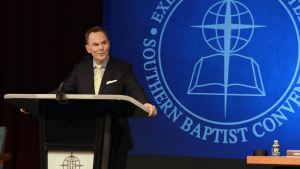
How Will the SBC Move Forward After ‘Unprecedented’ Committee Exodus?

The Executive Committee is meeting for the first time since the contentious decision to turn over privileged documents in an ongoing abuse investigation.

Christianity Today February 21, 2022
Brandon Porter / Baptist Press

When the Executive Committee (EC) of the Southern Baptist Convention gathers in Nashville this week, it will no longer face the debate over waiving attorney-client privilege in an abuse investigation, the topic that dominated a contentious series of meetings last fall.

But it will be hard to ignore the fallout of that decision and how the disagreement highlighted deeper divides in the SBC.

Seventeen members of the Executive Committee have resigned since June. All but one left because of the conflict over waiving privilege in an investigation into the EC’s response to abuse. The choice to waive attorney-client privilege was approved near-unanimously by thousands of messengers at last year’s annual meeting.

Included among the resignations were committee officers Robyn Hari and Robert Showers. Three executives have also resigned since October: president Ronnie Floyd, executive vice president Greg Addison, and chief financial officer Jeff Pearson.

The departures were largely the result of the consequences EC members feared they could face due to waiving privilege, from losing insurance coverage to exposing the organization to legal liability that could bankrupt it.

About half of the resigning members indicated that the potential breach of fiduciary duty that might result from waiving privilege could put their professional status at risk, including attorneys, CPAs, a financial adviser, and a licensed counselor.

Southern Baptist historian and pastor Bart Barber told CT that thus far, none of the things about which members were warned have transpired.

“I know some of the people who stepped aside. I think they had been led to believe and genuinely held the belief that all of these risks were severe,” Barber said.

Many of those who left their elected EC positions said that they were leaving “because they were convinced that waiving attorney client privilege would cause a lot of bad things to happen,” he added. “That didn’t happen.”

An exodus of trustees on this scale is unprecedented in the SBC, according to multiple historians consulted by CT. But it does not affect the committee’s ability to carry out its mandate to disburse funds from the convention’s funding mechanism, known as the Cooperative Program, and act on behalf of the convention ad interim.

Executive Committee bylaws specify that action can be taken when a quorum of existing members is present, and though the normally 86-member committee currently has only 68 members, the committee could legally function with as few as three members.

The controversy over the vote to waive privilege and the ensuing resignations signal a deeper divide within the convention related to politics, sexual abuse, racial reconciliation, women’s role in the church, the legacy of Paige Patterson (known as the architect of the SBC’s “conservative resurgence” in the 1980s), and the degree to which fields of study like critical race theory can have any value for the church.

According to Barber, the Conservative Baptist Network (CBN)—a group in the SBC linked to Patterson that has criticized a purported liberal drift in the SBC—had an outsized presence on the EC and among its officers, and for a number of reasons they opposed waiving privilege. The CBN Steering Council includes immediate past EC chairman Mike Stone, former vice chairman Tom Tucker, former secretary Joe Knott, current officer Jim Gregory, and former officer Rod Martin. Tucker finished his term in June of last year, and Martin resigned in the fall.

Many in the SBC believe that waiving attorney-client privilege in the EC investigation has implications for Augie Boto in particular, since he served as EC vice president and in-house counsel during the 20 years covered by the inquiry. Boto has recently been in legal trouble regarding his connection to Patterson and an alleged plan to redirect foundation monies away from Baylor and Southwestern Seminary, which fired Patterson in 2018.

“If you are someone who has a sense of loyalty and connection to the Pattersons and to the penumbra of people around the Pattersons, and if you see something that poses a risk to Augie,” Barber said, “maybe there’s some personal reasons that people would look and say, ‘This is one of our guys. I like him; he’s a friend of mine. He really doesn’t want this to go forward. And so I’m against it too.’ I think personal affiliations always plays a role in everything in the Southern Baptist Convention.”

Patterson has been accused of mishandling allegations of rape at two SBC seminaries and has denied the accusations. CBN members say they are committed to opposing abuse and abusive pastors in the SBC, but its leaders have also suggested that the issue has been overblown and put undue suspicion on the many pastors in the convention who aren’t abusive.

Of the multiple matters before the EC ahead of this week’s meeting, replacing missing members is not on the agenda. That task is left to the Committee on Nominations, which brings a slate of candidates to the convention’s annual meeting each summer to replace all vacancies among the denomination’s 12 entities and two other committees.

According to Leah Finn, chair of this year’s Committee on Nominations and the first woman to serve in that role, the 24 vacancies to be filled for the Executive Committee—which includes both the resignations and those whose second term is expiring—constitutes more than a quarter of the total vacancies within the convention.

“I don’t think there’s ever been that number of resignations,” Finn said. “And having 24 that we’re replacing all at once, it has to be the highest” number of vacancies to occur in a single year, she added.

EC chairman Rolland Slade told CT that the real challenge for the EC was overcoming staffing challenges in the wake of three C-suite resignations. He also expressed confidence in the officers’ recent appointment of Willie McLaurin as interim president, a role the bylaws stipulate must be filled by an EC vice president.

For a denomination that has long reckoned with its history regarding racism, Slade—the first African American chair of the EC—was hopeful at the appointment of McLaurin, who is the first-ever Black entity head in the SBC.

“This, to me, is a signal of good things in the sense that God has given men opportunities and raised them up for such a time as this,” Slade said. “Willie served on state staff in Tennessee for 15 years. So, you know, he has experience. He’s well qualified.”

McLaurin has also served as an interim pastor at a number of churches throughout his career, and he said that experience will serve him well in this season.

“My role as an interim has been to shepherd the people patiently with the love of God, help the church remember its main mission, keep the church moving forward, and provide stability in a time of instability,” he told CT in a statement. “As the interim president and CEO at the SBC Executive Committee, I will focus on serving our staff team and caring for them well.”

Regarding the historicity of his appointment—which must be ratified by the EC this week—McLaurin told CT he was honored and thankful, particularly for those who had gone before him.

“This is the first time in 177 years that an individual of non-Anglo descent has served as the interim or head of any SBC entity,” he wrote. “I am prayerful this moment will signal the Southern Baptist Convention is actively engaged in erasing the stain of racism.”

The committee will hear a report on the status of the sexual abuse investigation from SBC president Ed Litton and form a search committee that will be tasked with finding Floyd’s replacement.

One criticism of some of the EC’s fall meetings was how often they invoked the use of executive session, typically used to handle legal or personnel matters not open to the public. Slade said that he intends for as much as possible of this week’s meeting to take place in open session.

“I’m confident that we’re going to conduct ourselves in a different tone,” Slade said of this week’s meeting. “We’re really honed in on doing what it is that we are tasked to do and serving the Southern Baptist Convention.”

News

Southern Baptist Missionaries See Baptisms and Converts Surge With COVID-19

Leaders cite missiological methods and the work of the Spirit as the reasons for the surprising statistics.

Christianity Today February 21, 2022
Rob Birkbeck / Lightstock

The Southern Baptist Convention fell on hard times last year, with a contentious sexual abuse investigation, racial tensions, and shrinking US baptism numbers. But amid the gloom, there was a bright spot: international missions.

During the COVID-19 pandemic ’s first year, the number of new believers harvested by the 3,552 missionaries serving with the convention ’s International Mission Board (IMB) increased 62 percent from the previous year. Baptisms were up 81 percent from 2019 to 2020 (the most recent year for which data is available), and salvation testimonies continue to pour in.

The increases are particularly significant in a denomination where many cite missions as their reason for joining and staying.

A 53-year-old Thai man with chest pain went to see an IMB medical missionary outside Bangkok. The man collapsed in the clinic and regained consciousness only after the IMB missionary, a physician, performed emergency medical procedures.

As they waited for an ambulance, the man prayed to receive Christ, prompting the doctor to ask, “When did you start to become interested in God’s story?”

The man pointed to the place on the floor where he collapsed and said, “Right there. Before that, I had never been interested at all. But when I collapsed, I heard God call my name three times, and I knew he was warning me.”

That wasn ’t an isolated incident, according to IMB reports. The evangelistic surge, missiologists say, is attributable to effective methodology, the pandemic, and the sovereign work of the Holy Spirit.

“We ’ve seen the Holy Spirit working across the globe in mighty ways,” said Wilson Geisler, IMB director of global research. One missionary team “saw the first believers among an incredibly tough-to-reach people group.” Another “saw more people coming to faith in 2020 than in the previous three years combined.”

In a video report ahead of February’s Executive Committee meeting, IMB president Paul Chitwood noted that even with canceled short-term missions trips keeping tens of thousands of Southern Baptists at home, full-time missionaries’ international work was able to continue and thrive.

Despite fewer face-to-face evangelistic encounters thanks to COVID, IMB personnel and their partners around the world “found innovative, often virtual, ways to present the gospel,” according to the IMB’s 2020 Annual Statistical Report.

The 535,325 people who heard a gospel witness in 2019 increased to 769,494 in 2020. The approximately 89,000 new believers recorded in 2019 increased to 144,000 in 2020, with a corresponding jump in baptisms from 47,929 to 86,587.

IMB statisticians are sparing in the information they release about their counting methodology. They say data reflects the work of IMB personnel and “their baptistic partners,” though neither the number of partners nor the groups they represent are specified. Several years ago, under David Platt, the IMB saw a dramatic decline in converts, baptisms, and church plants, as the agency transferred ministries from missionaries to national partners. (See CT’s 2016 article on how missions agencies count converts.)

Additionally, IMB cautions against parsing the numbers too closely because the number of missionaries and ministers reporting varies from year to year.

“For security reasons,” Geisler said, “in each part of the world, the number of personnel and close partners who provide data for the report is not provided. This means it will always be unclear how many individual report givers contributed” to annual statistics. “Field research teams and our US-based Global Research Department review reports for anomalies.”

Despite the IMB’s qualification and hedging of the numbers, they argue the increase is incredible.

“I was not surprised at the increase,” said John Brady, IMB vice president of global engagement. “Rather, I was amazed.” He said the increase can be attributed in part to a discipleship plan coming to fruition in parts of the world.

The plan starts with discipling new Christians through 35 Bible passages “which teach the necessity and power of transformation that comes from God,” Brady said. The new believers share those key passages with their neighbors “and repeat the process.” Then they “go on to other studies such as a biblical plan to teach key doctrines and leadership development.”

Most of the reported evangelistic increase occurred in South Asia. Eighty-nine percent of 2020 baptisms (76,904) and 97 percent of new churches (17,772) were reported in that region.

While COVID-19 has caused death and infection in South Asia (with 510,000 reported deaths in India to date, according to the World Health Organization), the pandemic has not interrupted daily life there as it has in the West.

“We have heard anecdotally from South Asian pastors that because many people survive by daily labor, within two weeks of government-sanctioned lockdowns, people had to ignore those in order to feed their families,” Geisler said. “In urban areas of South Asia, we’ve also heard from personnel that COVID provided more opportunities for gospel witness and disciple making.”

Missiologist David Garrison, a former IMB leader in South Asia, attributes the increases to an explosion of church planting. He retired from the IMB in 2015 after 35 years of service, including publication of a 2004 book that has become a standard work on church planting movements.

“When we entered the region, only 4 percent of the IMB’s personnel were serving in this densely populated region,” Garrison said. The explosion of Christians and churches stems from “the multiplication of church planting movements that are an essential part of the vision and DNA of the missionaries in that region. This factor is even more evident in the new churches started in South Asia.”

Not all missiologists agree with Garrison ’s analysis. The term church planting movement (CPM) refers to a specific methodology in the missions world—one that has drawn critique in some evangelical circles and that the IMB says it does not utilize.

The traditional model of church planting focuses on preaching and launching churches with a preaching pastor, said Ted Esler, president of the missions network Missio Nexus, which includes IMB.

The CPM model focuses on starting house churches and utilizing Socratic discussions about Scripture—with the discussion led sometimes by a nonbeliever and almost always by someone from the indigenous culture rather than a missionary. Esler sees the reported IMB numbers as plausible due to IMB’s use of CPM methodology—even if it prefers not to use that terminology.

“All forms of church planting are awesome,” Esler said. “But most of the action in the world is with the movements. In Missio Nexus, we have 320 mission agency members. My guess is that among those that do church planting, 80 percent have some sort of movement-oriented ministry going.”

Among CPM critics are Reformed evangelicals like John Piper ’s ministry Desiring God and the church health organization 9Marks, who argue CPM methodology tends to lack quality controls and at times neglects the biblical task of preaching. CPM advocates reply that preaching is just a method and that Scripture requires only that churches teach the Bible.

In 2006, then-IMB missionary John Massey, now dean of Southwestern Baptist Theological Seminary ’s evangelism and missions school, penned a friendly critique of the IMB’s use of CPM methods, claiming they wrongly elevated speed as a goal of church planting at the expense of biblical fidelity.

“In CPM methodology, quick results take short-term precedence over long-term sustainability,” he wrote.

But Massey told Christianity Today that “much has changed in the IMB leadership” since his critique was written, “with each successive IMB president distancing the organization from CPM methodology.”

Massey is “doubtful” the 2020 baptism increase “was in any way the result of CPM methodology, which has enjoyed less and less favor among Southern Baptists.”

Garrison continues to defend his CPM framework and insists it is “widespread in the IMB and throughout the international church-planting community.” Yet whatever label is used to describe the IMB’s church-planting work, Garrison said the organization is “being very faithful” to Southern Baptist standards outlined in the Baptist Faith and Message as well as the IMB’s Foundations document, which sets forth “12 characteristics of a healthy church.”

The pandemic itself drove some of the growth in conversions. “When the COVID-19 lockdown started, many Muslims in our area were out of work and in need of food,” according to the South Asia section of the 2020 Statistical Report. “Southern Baptists generously provided food for those in need. Local evangelists then had the joy of going house-to-house in Muslim communities providing food and sharing the gospel.”

The leader of IMB work in the Asia-Pacific Rim region reported similar stories from South America and East Asia. One part of Asia saw 191 professions of faith among Buddhists in six weeks through a food distribution ministry. In South America, a woman and her three children “had not eaten in two days.” When an IMB worker arrived with food, “the woman fell at this missionary ’s feet.”

Yet not all IMB statistical increases can be explained by missiological methods or doors opened by COVID-19, such as with a movement of the Holy Spirit among one of the people groups IMB serves in East Asia.

Last fall, a group of adults gathered in an apartment for Bible study and worship while their children met in a nearby apartment to study Acts 16, the story of Paul and Silas sharing their faith in prison. Just then, police raided the gathering, eventually arresting three leaders.

Like the biblical characters they were studying, the leaders shared the gospel in jail. Now more than 20 formerly unengaged people have access to the gospel, along with their families and friends.

“IMB personnel and partners, regardless of the difficulty of the soil, are laboring diligently and with their best efforts, trusting God with the results,” Geisler said.

The IMB’s statistical report for 2021 is expected this spring.

David Roach is a freelance reporter for CT and pastor of Shiloh Baptist Church in Saraland, Alabama.

Apple PodcastsDown ArrowDown ArrowDown Arrowarrow_left_altLeft ArrowLeft ArrowRight ArrowRight ArrowRight Arrowarrow_up_altUp ArrowUp ArrowAvailable at Amazoncaret-downCloseCloseEmailEmailExpandExpandExternalExternalFacebookfacebook-squareGiftGiftGooglegoogleGoogle KeephamburgerInstagraminstagram-squareLinkLinklinkedin-squareListenListenListenChristianity TodayCT Creative Studio Logologo_orgMegaphoneMenuMenupausePinterestPlayPlayPocketPodcastRSSRSSSaveSaveSaveSearchSearchsearchSpotifyStitcherTelegramTable of ContentsTable of Contentstwitter-squareWhatsAppXYouTubeYouTube